@rick — following
Follow buttons here act as you, not as @rick.
@rick follows
| Label | Kind | State | Action |
|---|---|---|---|
| rss.skyfleet.blue | source | — | — |
| rss.skyfleet.blue | source | — | — |
| rss.skyfleet.blue | source | — | — |
| rss.skyfleet.blue | source | — | — |
Timeline
-
L’effet multiplicateur de Keynes, fer de lance de la relance
L’un des apports majeurs des travaux de Keynes est d’avoir pointé l’impact amplifié d’une variation de l’investissement public ou privé sur l’activité, rappelle l'économiste Clément Carbonnier.Reply source -
« On est la première monnaie locale d'Europe » : comment l'Eusko a réussi son pari
Reply source
Plus de 10 ans après sa création, la monnaie locale basque eusko est un succès. Au point qu'elle a créé un institut de formation pour aider d'autres projets à se lancer ou à se développer.
Lire la suite - Reportage / Alternatives
Bayonne (Pyrénées-Atlantiques), reportage
Dans le centre-ville de Bayonne, des QR codes verts fleurissent sur les comptoirs des bars et des commerces, floqués d'un mot : « Euskopay ». Pour régler ses courses dans la monnaie locale basque, il faut flasher ce code avec l'application dédiée, puis entrer (…) -
« La nature a repris le dessus » : à Londres, ces cimetières débordent de vie
Reply source
Construits au XIXe siècle, des cimetières londoniens surnommés les « Magnificent Seven » sont devenus des lieux de promenade où prospèrent oiseaux, insectes rares et plantes par centaines. Un passionné nous a fait visiter celui de Nunhead.
Lire la suite - Reportage / Nature
Londres (Royaume-Uni), reportage
Au début du XIXe siècle, alors que Londres se densifiait à la faveur de la Révolution industrielle, les cimetières entourant ses petites églises anglicanes sont arrivés à saturation. Entre 1832 et 1841, sept (…) -
Trafic de fourmis : les dessous d'un business juteux en pleine explosion
Reply source
[Les nouveaux visages de la criminalité environnementale 1/4] Les fourmis sont au cœur d'un trafic qui peut rapporter gros aux vendeurs qui pullulent sur internet. Un business, en pleine explosion, qui peut causer d'importants dégâts écologiques.
Lire la suite - Enquête / Économie , Animaux
À première vue, la cuisine de Philippe a tout ce qu'il y a de plus classique. Des capsules de café côtoient un grille-pain, des plaques de cuisson ou encore un frigo recouvert de photos de sa famille. Mais ce pâtissier de profession y a également (…) -
Ephéméride des luttes : 10 août
Reply source
Dans l'éphéméride des luttes du 10 août, on aimerait bien que le monde entier ne soit pas soumis au joug de la propriété privée et que celui-ci soit enfin libre. Mais ce n'est pas gagné.
1680 : Au Nouveau-Mexique, début de la révolte de la population Pueblo contre l'occupant espagnol.
1937 : Les évêques espagnols signent un document parlant d'une nécessiare "croisade nationale" contre les républicains et révolutionnaires et en soutien au coup d'état de Franco.
1960 : L'Antarctique devient un territoire international et scientifique, personne ne peut prétendre à sa propriété.
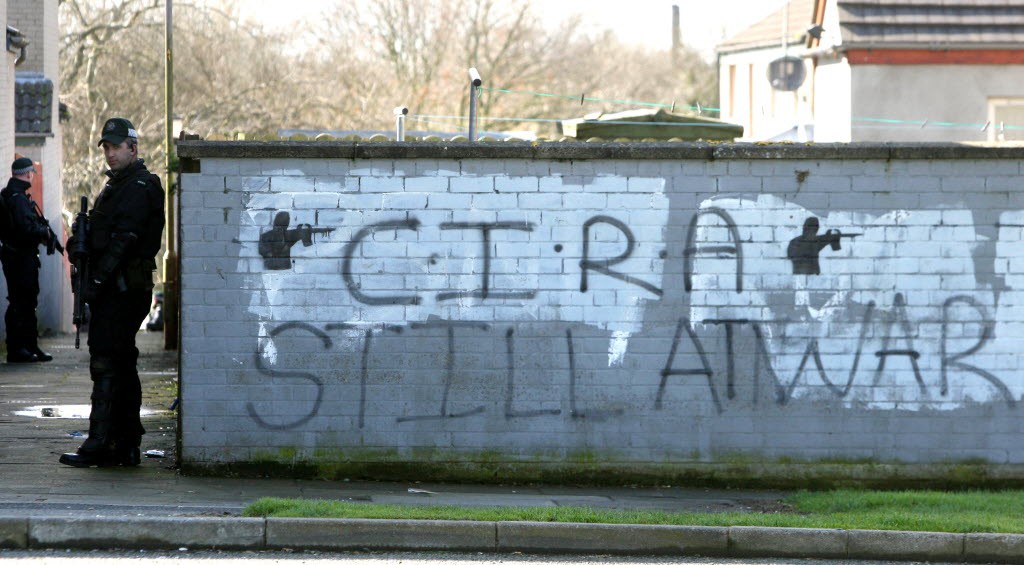
1971 : En Irlande du Nord ont lieu de très graves épisodes de violences, au point que plusieurs milliers de personnes doivent abandonner leurs maisons et partir pour l'Irlande.
1977 : - A La-Charité-sur-Loire, cocktails molotov contre EDF et le nucléaire.
- A Rome, deux cocktails molotovs sont lancés sur la maison du juge Alibrandi.
- En Irlande du Nord, une bombe de l'IRA explose sur la New University of Ulster juste après le passage de la Reine d'Angleterre, qui venait visiter les lieux.
1978 : A Montpellier, des explosifs vont voler en éclats la porte de la maison d'arrêt pour la seconde fois, ce que revendiquera de nouveau le « Groupe Autonome Libertaire », pour « attirer l'attention de l'opinion publique sur le sort des membres des groupes autonomes détenus en Espagne, à Barcelone et Madrid » et exiger leur libération.
1984 : Dans le Minnesota, deux activistes sabotent le système de guidage de sous-marins nucléaires.
2011 : A Madrid, deux fourgonnettes de GDF Suez sont détruites par le feu en solidarité aux prisonniers révolutionnaires dans les prisons suisses.
Voir également l'éphéméride anarchiste du 10 août.
-
De la fleur au fusil : confessions d’un trafiquant d’armes écolo
Reply sourceStart-uppers, communicants ou médecins, ils ont quitté la ville après la pandémie. Partagés entre idées progressistes et penchants survivalistes, ils achètent les carabines et pistolets que leur vend illégalement « Victor », trentenaire comme eux. Rencontres sous le sceau du secret, quelque part dans la campagne française.
The post De la fleur au fusil : confessions d’un trafiquant d’armes écolo appeared first on Revue21.fr.
-
13/08 : Apéro antifa au Geyser
Reply sourceL'Assemblée Antifasciste Nancy et alentours organise un apéro antifa au local associatif le Geyser.
- Initiatives / Nancy, Initiative culturelle -
AMD rachète la start-up canadienne Taalas pour compléter sa stratégie Helios et mieux s’imposer face à Nvidia sur le marché des data centers d’IA
Reply sourceAMD a fait l’acquisition de la start-up Taalas, spécialisée dans les accélérateurs pour l’inférence, pour un montant non divulgué. D’après AMD, l’opération lui permettra de complémenter son rack Helios. Lisa Su, sa dirigeante, avait d’ailleurs évoqué d’autres choses à venir en matière d’architecture désagrégée il y a quelques semaines... Sans doute en référence à cette annonce.
-
Un modèle d’IA a créé 16 virus bactériophages : une avancée scientifique majeure qui relance le débat sur le risque des armes biologiques
Reply sourceDans une étude publiée dans la revue Science, des chercheurs de l’Arc Institute de Palo Alto et de l’université Stanford présentent Evo 1 et Evo 2, deux modèles de langage génomique capables d’analyser et de générer des séquences d’ADN. Le principe est comparable à celui de ChatGPT ou Claude, mais appliqué au vivant. Evo a assimilé des milliers de milliards de nucléotides, les briques fondamentales de l’ADN, afin d’apprendre les règles qui gouvernent les génomes.
-
Judicial Notice (08.09.26): Star-Crossed Lovers
Reply source U.S. Attorney Jeanine Pirro (D.D.C.), at a press conference announcing her office’s prosecution of former Olympic canoeist David Hearn—a case she dropped, a few weeks later (photo by Anna Moneymaker via Getty Images).
This week’s Judicial Notice is sponsored by

Turn your litigation expertise into investment insight. Burford Capital is seeking a commercial litigator with 5+ years of experience to join our U.S. commercial investment team. This is a unique opportunity to apply your litigation experience in the growing alternative asset class of legal finance, evaluating legal risk and structuring innovative financing solutions for leading companies and law firms. Learn more and apply.
In the last edition of Judicial Notice, the most-clicked link was—to my surprise—the photo I used to illustrate the post, featuring the Wachtell Lipton Rosen & Katz letterhead as of March 2000. And when I posted an image of my former firm’s letterhead on LinkedIn, it went viral (by law-nerd standards), garnering more than 185,000 pageviews.
Given this surprising interest in the WLRK letterhead—which back then listed associates as well as partners, making it something of a curiosity—I updated last week’s Judicial Notice to swap in a more legible and somewhat more recent version (from 2003). If you’re interested, you can click here to view it. (See if you can find my name, as well as those of other Wachtell alumni you might recognize.)
Now, on to the news.
Lawyer of the Week: Jeanine Pirro.
On July 31, U.S. Attorney Jeanine Pirro (D.D.C.) moved to dismiss her office’s indictment of former Olympian canoeist David “Davey” Hearn, whom it had charged with felony destruction of property for allegedly vandalizing the Lincoln Memorial Reflecting Pool. According to her motion, the evidence “strongly suggest[s]” that damage to the lining of the Reflecting Pool was caused not by vandalism, but by a “rushed and botched installation” by the contractor.
This didn’t sit well with her boss, Donald Trump, who has repeatedly blamed the many problems with the Reflecting Pool’s renovation on vandals. He publicly criticized Pirro, historically his staunch ally and loyalist, for “choking” and “folding like an umbrella”—and summoned her to a White House meeting, along with Interior Secretary Doug Burgum (whose office Pirro had blamed for providing incorrect information about the work done on the Reflecting Pool).
The meeting, which took place last Monday, was an “Oval Office showdown,” according to The New York Times (gift link)—“a high-drama, face-to-face meeting” that was “worthy of two decorated veterans of confrontational reality TV.” Here’s more, from Tyler Pager, Glenn Thrush, and Katie Rogers of The Times:
Ms. Pirro came prepared. She entered the White House from the West Executive driveway in a bright red blazer that matched her fight-back mood, schlepping a white box containing evidence, plus a black box with documents, on wheels.
Waiting for her in the Oval Office, along with the president: Mr. Trump’s chief of staff, Susie Wiles, and David Warrington, the White House counsel. After about an hour of intense back-and-forth, Ms. Pirro emerged with her job intact, for now.
Emphasis on “for now.” According to C. Ryan Barber, Josh Dawsey, and Meridith McGraw of the Wall Street Journal (gift link), “People close to the president said it is too early to say whether Pirro’s job is safe, noting that Trump remains angry that his longtime ally publicly undercut him.”
Critics of the Trump administration faulted Pirro for not realizing at an earlier stage, based on publicly available information, that the vandalism claims were far-fetched—and generally viewed the whole situation as “a complete catastrophe for the U.S. Attorney's Office and the administration,” as Ken White said on Serious Trouble.
On the other hand, from a “better late than never” perspective, Pirro did eventually drop the charges—showing that, in White’s words, “even Jeanine Pirro has limits to the extent to which she’ll get kicked around for doing stupid stuff for Donald Trump.” Or as longtime defense attorney Joe Flood told Salvador Rizzo, who wrote an impressively balanced profile of Pirro for the Washington Post (gift link), Pirro should “get[] some credit for standing up to Trump.”
Speaking of standing up to Trump, might we see more of that from Todd Blanche—confirmed as U.S. Attorney General on Saturday, 50-49? That was part of the justification that Senator Bill Cassidy (R-La.) gave for casting the deciding vote for Blanche, expressing the hope that being a Senate-confirmed AG would give him “greater leverage to push for things that should be pushed for.”
Other lawyers in the news:
I’ll surely have more to say about this news in next week’s Judicial Notice—it broke just as I was putting the finishing touches on this edition—but at around 5:30 p.m. on Sunday (today), Donald Trump announced on Truth Social that effective September 1, Will Scharf will succeed David Warrington as White House Counsel (and Warrington will return to the private sector).
As some of you might recall, Scharf—a Harvard Law School graduate, former federal law clerk and prosecutor, and former personal lawyer to Trump—currently serves as White House staff secretary, an influential role once held by Brett Kavanaugh. Back in June, Scharf was Lawyer of the Week for persuading Trump not to (1) suspend habeas corpus for unlawful immigrants or (2) invoke the Insurrection Act to deal with domestic protests.
If anyone has additional info on this transition in the White House Counsel’s Office—e.g., whether Scharf had much competition for the job (I’m guessing no), or where Warrington is headed next (I’m guessing a conservative boutique like his former firm, Dhillon Law Group)—please drop me a line.Last Friday, the Senate used its relatively new en bloc process to confirm a fifth batch of second-Trump nominees, 51-47. This group of over 70, whose names can be viewed on the Senate website, included a number of lawyers, such as a new Department of Justice Inspector General, Donald Berthiaume; four U.S. attorneys, namely, Kenneth Sorenson (D. Haw.), Timothy VerHey (W.D. Mich.), Sean Costello (S.D. Ala.), and Christopher Nassar (N.D. Okla.); and two members of the National Labor Relations Board (NLRB), James Macy and David Prouty, whose arrival will give the NLRB a quorum.
A year ago last month, Louis Capozzi became Missouri Solicitor General—and, at age 30, the youngest state SG in the country. He spoke about his first year in office, including growing his team from five lawyers to 15, with the National Law Review and Law360 (which wrote about the rise of state SG’s offices more broadly, in an article titled “How State SG Offices Became A Judicial Pipeline”)
Speaking of successful young lawyers, congratulations to Bloomberg Law’s latest 40 Under 40 honorees, as well as to Law360’s 160-plus Top Attorneys Under 40.
Judge of the Week: Judge Jennifer Mascott.
Last week, Daniel Barnes and Jacob Wendler wrote a piece for Politico about an unusual situation involving Judge Jennifer “Jenn” Mascott (3d Cir.). Here’s the opening of their piece, titled “‘Is she even allowed to be doing this?’: Inside a federal judge’s side gig running a PR firm”:
A Trump-appointed federal appeals judge spent months running a Washington public affairs firm after being appointed to the bench last year, an arrangement that contributed to an exodus among the firm’s staff and clients and only ended when the firm went out of business at the end of June.
Jennifer Mascott, a former conservative law professor who sits on the 3rd Circuit Court of Appeals, was deeply involved in daily operations at the firm, Adfero, for at least six months after she was confirmed as a judge in October 2025, according to 14 former employees and clients granted anonymity to discuss internal details of the firm’s final months.
Nine of the former employees said Mascott, who inherited her ownership stake in the firm from her late husband in 2023, worked at least once a week out of Adfero’s office in Washington and oversaw the firm’s staffing, business development efforts and client relations in between her full-time judicial duties in Wilmington and Philadelphia.
Readers who alerted me to the Politico piece expressed surprise at this arrangement. In general, to avoid ethical issues, federal judges don’t take on non-judicial employment (setting aside teaching and writing books, which they’re allowed to do). If judges do decide to take positions outside the judiciary, they almost always resign from the bench (as former judge Gregory Van Tatenhove (E.D. Ky.) did last month, before becoming dean of the University of Kentucky’s Rosenberg College of Law).
But interestingly enough, the Code of Conduct for United States Judges provides that a judge “may serve as an officer, director, active partner, manager, advisor, or employee of a business,” as long as the business is “closely held and controlled by members of the judge’s family.” This provision allowed Mascott to run Adfero as managing trustee, as requested by her late husband Jeff Mascott—who tragically passed away in 2023 at 48, from pancreatic cancer. As Judge Mascott told Politico:
Consistent with those fiduciary and legal and ethical duties, I endeavored to keep the company going while that was viable and also routinely consulted with long-time firm HR lawyers and other advisors and legal and ethical experts about how to comply with all requirements and how to evaluate whether the company should be wound down, sold, or otherwise entrusted to other firm leadership.
Not surprisingly, responses to Politico’s report varied based on one’s political leanings. Senator Chris Coons (D-Del.), a prominent Democrat on the Senate Judiciary Committee, announced that he’s thinking about filing a judicial misconduct complaint against Mascott (whose nomination to a Delaware-based seat on the Third Circuit he opposed). Meanwhile, conservatives assailed the Politico piece as “disgusting” (Ilya Shapiro) and a “hit job” (Eric Wessan).
I’m friendly with Judge Mascott; I like her personally (based on admittedly limited interactions), and I have a positive opinion of her as a judge (based on her limited tenure on the bench). That said, I wouldn’t call the Politico article a hit piece; it struck me as a legitimate piece of investigative journalism, reporting on an unusual situation that certainly raises ethical questions (but doesn’t appear to involve any ethical violation, based on the code provision mentioned above).
I don’t know the specifics of the situation that Mascott was thrust into by the shockingly sudden passing of her husband—who was diagnosed in 2022 and died in 2023, leaving behind Jenn Mascott as the sole parent to four young children. As a general matter, though, I’d suggest that judges should probably try to avoid situations where they’re involved in the running of outside businesses, even closely held family concerns. And I wonder whether Judge Mascott—with the benefit of hindsight, which is admittedly 20/20—regrets not immediately selling Adfero (perhaps to its employees with an earn-out), in light of the fact that the business ultimately closed its doors.
In other news about judges and the judiciary:
In an interview with James Taranto of the Wall Street Journal (gift link via Howard Bashman’s How Appealing), Justice Samuel Alito confirmed what we already knew (thanks to things like his clerk hiring): “Obviously I’m here for another term.”
Speaking of SCOTUS, a new Marquette Law School Poll (via Adam Liptak’s The Docket) found that 47% of adults approve of the way the Court is handling its job, while 53% disapprove (pretty much unchanged from May—so the final merits rulings of OT 2025 didn’t move the needle).
Judge Brantley Starr (N.D. Tex.)—yes, he’s related to the late Ken Starr (his uncle)—received a lot of attention for the colorful footnotes in his recent opinion in CFTC v. TMTE, Inc. Some readers enjoyed them—like Peter Beck and Seamus Hughes of Court Watch, who wrote that “the entire opinion… is a ride, complete with a reference to the greatest Christmas movie ever produced (footnote 37).” But I did hear privately from others who found the opinion self-indulgent—especially footnote 51, which apparently references a 4chan Meme (or so Reddit tells me). I also wonder whether Judge Starr’s opinion is what Judge Stephen Dillard had in mind when he tweeted, a few days later, “There may be cases where it’s necessary (or at least reasonable) to include an emoji, meme, or the like in a judicial opinion. But I do think judges should avoid using them in a way that appears to be gratuitous.”
In the past year or so, Fifth Circuit judges have started dissenting from grants of rehearing en banc, issuing opinions that some call “disgrantles” or simply “grantals.” Perhaps this will become a trend in other circuits, now that it has been covered by folks like Jacqueline Thomsen of Bloomberg Law and Avalon Zoppo of Law.com. I’m not sure how I feel about this; readers, what do you think?
In nominations news, the Senate confirmed eight judges to the D.C. Superior Court and Court of Appeals—the District’s local courts—but no new Article III judges. The senators will return from their August recess on September 14.
Job of the Week: an opportunity for a midlevel corporate associate in Chicago.
Lateral Link is conducting a search for a midlevel corporate/M&A/private equity associate to join a premier global law firm in Chicago. The corporate group represents the largest practice in the Chicago office, combining the welcoming culture and close-knit environment of a midsize firm with the sophisticated resources and expansive reach of a global platform. Working side-by-side with partners in firmwide leadership, you will gain direct exposure to key decision-makers in a group with a proven fast track to promotion. Candidates must be active members of the Illinois bar with hands-on experience leading middle-market M&A and private equity transactions for funds, institutional investors, and portfolio companies, including drafting, negotiating, and managing deal teams from diligence to closing. For immediate and confidential consideration, submit your résumé to Liz McGarry at emcgarry@laterallink.com.
-
New in SpyWeek: Kremlin Hints FSB May Tempt Kash with Dem Dirt in Moscow, as Berlin Expels Russian Spies, CIA Targets Cuba
Reply source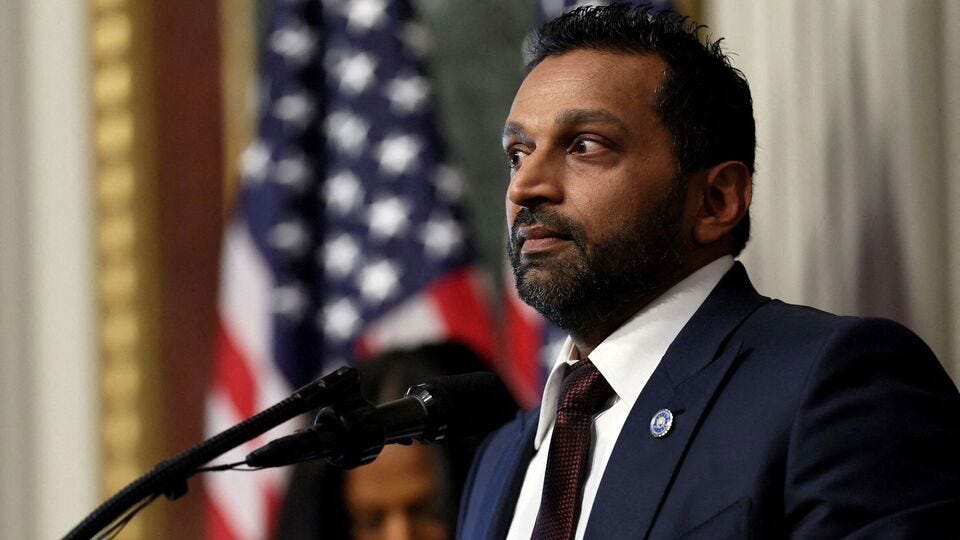 Earlier this year FBI Director Kash Patel claimed without evidence that Democrats went “overseas and hire(d) some bogus intelligence asset to manufacture fraudulent, fake, unverified information” against Trump & co. (LiveMint file photo)
Moscow Mule? FBI Director Kash Patel’s scheduled Moscow sojourn only weeks before the U.S. midterm elections has generated lots of questions, but none so provocative as one from prominent Kremlin commentator Vladimir Vasiliev, a senior researcher at the Russian Academy of Sciences’ Institute for U.S. and Canadian Studies, who suggested the FSB may offer Patel dirt on Democrats. “It is assumed that Russia has some kind of kompromat on the Democrats, and it could be provided by us, in one form or another, to the American side,” Vasiliev told Moskovsky Komsomolets, known as MK, “a Russian outlet with a long history of publishing information and propaganda from the FSB, Russia’s Federal Security Service,” according to Kremlin watcher Olga Lautman. Vasiliev added that “Moscow might naturally ask, ‘What will we get in return?’” There’s much more on this worth your time at Lautman’s “Unmasking Russia” newsletter. Patel also took an underreported trip to Beijing late last month to forge FBI ties with Chinese law enforcement.
Russia, Russia: Germany has expelled 400 Russians since 2022, including 80 suspected intelligence agents under diplomatic cover, according to the tabloid Bild. Meanwhile, an explosive drone discovered near Ukrainian planes at a German airport has been linked to Russia, U.S. intelligence officials told the Wall Street Journal. They also say “Putin could try to test NATO’s resolve with a limited assault on an allied country in the next few years. The assessments envision scenarios ranging from a cyberattack to a small-scale land incursion.”
Ears for Trump: The president has made it incredibly easy for adversary intelligence services to eavesdrop on his conversations, writes Calder Walton, a historian at Harvard’s Kennedy School of Government and author of SPIES: The Epic Intelligence War Between East and West. “One can only imagine how many foreign spies are also listening in to his phone conversations,” Walton wrote at the U.K.’s iPaper. “Any foreign intelligence service worth its name will have recruited agents at his Mar-a-Lago resort in Florida, where security is known to be pathetic. At the end of his first term, Trump had classified documents lying around in one of his bathrooms.”
Follow the Money: “Inside the War on Hezbollah’s Finances” unveils how “Israel and the United States aren’t just targeting the Lebanese militant group’s weapons. They’re going after its money.” (New York Times)
Tehran Security Shuffle: “The appointment of Mohsen Rezaei as secretary of the Supreme National Security Council suggests that Iran’s old guard is consolidating power,” reports The New York Times. Rezaei, “who led Iran’s Islamic Revolutionary Guards Corps during the Iran-Iraq War of the 1980s…is replacing Mohammad Bagher Zolghadr, who stepped into the role when the council’s previous secretary, Ali Larijani, was killed in an Israeli strike during the U.S.-Israeli attacks on Iran earlier this year.”
Iran’s Swimmer Bots: CISA, the U.S. Cybersecurity and Infrastructure Security Agency, is close to proving that it’s Iran that’s been slithering into water control systems across the upper Midwest. “The hackers were ‘targeting water entities of all sizes’ and it recommended “facilities unplug vulnerable controllers from the internet,” it said. (New York Times)
China’s Hitchhiker Spies: “Royal Navy spy drones used by Britain’s elite special forces secretly sent data to China,” blares The Telegraph, a reliable vehicle for U.K. defense leaks. “The cameras on the K3 Scout surveillance drones had components made in China which were secretly transmitting information to a device in the country.”
Netherlands Blacklists Israel: The Dutch internal security agency NCTV now ranks Israel as a threat alongside Iran and Russia. “Placing Israel in the same threat category as Iran and Russia gives Dutch security services institutional cover to treat routine Israeli diaspora outreach as a counterintelligence concern, setting a template other European governments may follow,” said The Jerusalem Post. “The National Coordinator for Terrorism and Security (NCTV) report, released on July 17, lists Israel as one of the countries that aims to ‘control public opinion and political decision making.’”
Ukraine Infowars: Coming this week, The Propaganda Manual of the Ukraine War: Information Warfare by Russia, Ukraine, and Western Nations: Lessons Learned for Future Conflicts, from Thomas Kent, a disinformation expert, from the American Foreign Policy Council. “The book represents two years of research. It describes Russian, Ukrainian, and what have passed for Western information operations in the course of the war,” writes the author. “It attempts to judge what tactics were the most and least successful for each side. The book also assesses an array of ‘resilience’ tactics to protect civilian populations from foreign propaganda efforts.”
Target Havana: The CIA’s buffed-up task force on Cuba is looking for a few good puppets to replace the regime’s communist leaders, a la Delcy Rodrîguez in Venezuela, reports the New York Times. This comes on top of the Trump administration’s financial and economic strangulation of the island.
Former CIA Station Chief Goes Crypto: A former CIA station chief in Caracas, Enrique “Rick” de la Torre “registered on Monday as a lobbyist for a Cayman-based crypto firm previously fined $45 million, including regarding sanctions policy,” reported Jack Poulson on his All Source Intelligence news site. De la Torre was Venezuela station chief “during a period that overlapped with high-profile U.S. intelligence and political operations in the country, including the 2024–2025 capture of former President Nicolás Maduro,” reported Türkiye Today, a center-right news outlet associated with the Recep Erdoğan regime.
FBI Agent Goes Crypto, Badly: An FBI counterintelligence agent has been arrested on charges of “taking about $1 million worth of cryptocurrency from the digital accounts of an overseas suspect in a U.S. criminal investigation, according to court documents reviewed by the Wall Street Journal. Patrick Yaroch, an FBI supervisory agent in Washington, D.C., “came forward late last week to confess, telling a Justice Department employee that it was ‘eating him up inside,’ and he wanted to ‘get it off his chest.’” (MSN)
Don’t miss this week’s SpyTalk podcast featuring former senior FBI executive Lauren C. Anderson on chaos in the Bureau under MAGA warrior Kash Patel.
RIP Sam Faddis: Charles S. Faddis, an ex-CIA officer who won praise years ago as an insightful critic of the agency but later morphed into an election-conspiracies activist, died late last month in Philadelphia from “Covid-related lung disease and pneumonia,” the New York Times reported Friday. (Back in 2013, one of his former CIA colleagues volunteered to me that Faddis was “the best boss I ever had, by far.”)
Fishy Colombians: Ukraine has expelled Colombians suspected of ties to the nation’s drug cartels and rebel groups who’ve been soaking up Kyiv’s vaunted expertise in lethal low cost drones. (Financial Times)
True Spy Yarn: “The BBC went looking for Hussam Luka, the former head of Syria’s most powerful civilian intelligence agency,” the BBC headlined on Friday. “They started with his phone book.” Eventually, the reporters located him in Russia. “Known as ‘The Spider,’ Luka was one of Assad’s top henchmen, accused of orchestrating atrocities and systematic torture, and sanctioned by the UK, US and European Union.” A riveting read about yet another sadist leader sheltered by Moscow over the decades.
On the Screen: High Value Target: The Hunt for Saddam, debuts Sept. 13 onTNT. The multipart docudrama is the story of John Nixon, “the first CIA officer to interrogate Saddam Hussein,” reports Deadline. (See the trailer here.) Back in May, Nixon’s CIA colleague William (Jerry) Watson described the agency’s criminally bad intelligence-gathering on, and fruitless hunt for, Iraqi WMD on the SpyTalk podcast.
Thank you for reading this. SpyTalk is an entirely reader-supported publication. To receive new posts and support the work of all of us here, please consider taking out a paid subscription. We can’t do it without you. Just click below for a no-obligation free trial.
-
Trump appoints staff secretary Will Scharf as new White House counsel
Reply sourceScharf, who helped president win approval for $400m ballroom, to replace David Warrington on 1 September
Donald Trump announced on Sunday that Will Scharf, the staff secretary who helped secure approval for the $400m White House ballroom project, will become White House counsel and assistant to the president.
Effective 1 September, Scharf will replace David Warrington, who will be leaving the administration to join the private sector. Warrington formerly served as a personal counsel and a lawyer for Trump’s 2024 campaign.
Continue reading... -
Trump Tyranny Tracker | Day 564: Aug 6, 2026
Reply source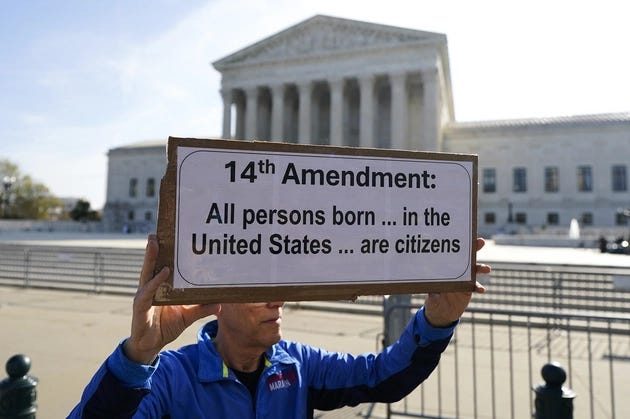 People demonstrate outside the U.S. Supreme Court ahead of U.S. President Donald Trump’s arrival on April 01, 2026 in Washington, DC. | Al Drago/Getty Images
Welcome to today’s Trump Tyranny Tracker…
Trump’s family is benefiting from billions in federal spending, misconduct complaints are soaring as DOJ watchdogs disappear, and Trump’s Iran war is draining critical U.S. weapons as intelligence warns Russia may test NATO.
Today at a Glance
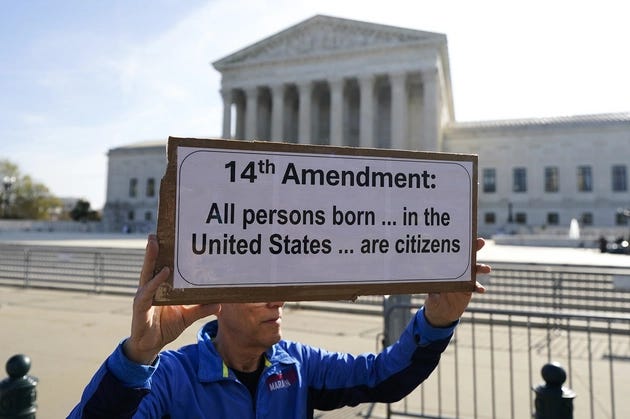
Trump signs new executive orders targeting birthright citizenship
DHS is held in contempt for withholding communications from more than 800 immigration agents
Millions of children could lose free school meals this fall because of Trump’s SNAP cuts.
What We Need to Pay Attention To
A Growing Number of Election Deniers Hold Key Local Roles in Midterms
What Happened: At least 25 election deniers have taken positions overseeing elections since 2024 in counties with key House, Senate, and statewide races. They join at least 69 already in office, including 41 who have tried to interfere with elections or have ties to election denier groups.
Why It Matters: Election deniers who tried to overturn a free and fair election now have power over how elections are run and certified. Giving them control over voter rolls, procedures, and certification allows them to interfere with results and undermine the midterms.
Source: New York Times
Corruption
Tech firm’s $50 million Trump library gift preceded massive federal land deal
What Happened: SoftBank donated $50 million to Trump’s presidential library in January while seeking federal approval for a massive AI data center in Ohio. Two months later, Trump officials approved a lease giving a SoftBank subsidiary roughly 3,700 acres of federal land for the project.
Why It Matters: A company seeking a massive deal from the U.S. government gave $50 million to Trump’s presidential library and got the deal two months later. The library gives companies seeking government favors another way to funnel millions to Trump.
Source: MS NOW
Trump seeks to shield his business finances from BBC in libel lawsuit
What Happened: Trump is trying to stop the BBC from obtaining financial records from hundreds of his companies in his $10 billion defamation lawsuit. Trump claimed the BBC damaged his businesses, but after a judge ruled that his finances were subject to discovery, he moved to rewrite the lawsuit and focus instead on damage to his reputation.
Source: Politico
Lawmakers call for Pentagon probe of Trump family-backed companies
What Happened: Lawmakers are asking the Pentagon inspector general to investigate $3.2 billion in federal contracts, investments, and loans awarded to 15 companies tied to Eric Trump and Donald Trump Jr., most after Trump returned to office. One Trump Jr.-backed company received a $620 million Pentagon loan after reportedly being fast-tracked ahead of others.
Why It Matters: Billions in taxpayer-backed contracts, loans, and investments are flowing to companies tied to Trump’s sons while their father controls the government awarding them. It creates a system where Trump’s family is profiting from federal decisions he has power over.
Source: The Washington Post
Power Consolidation
Trump Signs Executive Orders Targeting Birthright Citizenship
What Happened: Trump signed two executive orders imposing new restrictions on birthright citizenship just weeks after the Supreme Court ruled his previous attempt unconstitutional. The orders target children of some foreign government employees, mothers accused of traveling to the U.S. to give birth, and parents the government labels “alien enemies” or members of terrorist groups.
Why It Matters: Trump lost his attempt to restrict birthright citizenship and is trying another way around the Supreme Court. The Constitution guarantees citizenship to people born in America, and Trump cannot decide which children that protection applies to.
Source: New York Times
Weaponization of Institutions
Justice Department says Duke Law School illegally considered race in admissions
What Happened: Trump’s DOJ accused Duke Law School of illegally considering race in admissions, claiming personal essays and first-generation college status are being used as proxies for race. DOJ is seeking a settlement and has launched similar actions against other universities.
Source: Associated Press
Court holds DHS in contempt, accusing it of withholding agents’ phone data
What Happened: A federal judge held DHS in contempt for failing to hand over messages from the personal phones of more than 800 immigration agents involved in LA raids at the center of a racial profiling lawsuit. Previously released messages showed agents using racist slurs. DHS admitted that at its current pace, producing the remaining records could take up to four years.
Why It Matters: DHS was ordered to preserve evidence in a civil rights case and failed to do it. Agents have already been caught using racist slurs, and now the government is delaying the release of messages that could reveal how much further the racism went.
Source: MS NOW
Senate panel votes to hold Fauci in contempt
What Happened: Senate Republicans voted along party lines to hold Anthony Fauci in contempt after he invoked his Fifth Amendment right and refused to testify about his role during the Covid pandemic. Rand Paul says he plans to bypass a full Senate vote and send the matter directly to Trump’s DOJ for possible prosecution.
Why It Matters: Fauci exercised his constitutional right against self-incrimination, and Republicans want him prosecuted for it. They are trying to turn a congressional investigation into another route for sending one of Trump’s longtime targets to jail.
Source: Politico
Media Suppression & Authoritarian Tactics
Federal Communications Commission scraps limit on broadcast TV ownership
What Happened: The FCC voted 2–1 to eliminate a decades-old rule limiting how many U.S. households a single television company’s stations can reach. The change could clear the way for major mergers, including Nexstar’s proposed $6.2 billion purchase of Tegna, which would put stations reaching at least 60% of U.S. households under one company.
Why It Matters: Millions of Americans get their news from local television. Allowing a few corporations to control more local stations concentrates enormous power over what information Americans receive.
Source: NBC News
West Point won’t fight ban on school policy limiting professors’ speech
What Happened: West Point agreed to a court order blocking a policy that required civilian professors to get approval before publishing papers, speaking at conferences, or appearing on podcasts. The academy’s longest-serving law professor challenged the policy as an unconstitutional restriction on free speech. The academy did leave open the possibility of appealing the ruling.
Source: The Washington Post
Human & Civil Rights Abuses
A Commission Monitoring Human Rights Violations Is Concerned About the US
What Happened: The Inter-American Commission on Human Rights held its first hearing on freedom of expression and peaceful assembly in the U.S. after complaints of excessive force against immigration protesters, journalists, and bystanders. Witnesses described federal agents shooting protesters with pepper balls, using chemical irritants, while facing no accountability.
Why It Matters: An international human rights body that investigates abuses across the Americas is now examining the U.S. over its treatment of protesters and journalists. What began as an immigration crackdown is being used against people who protest, document, or criticize it.
Source: Mother Jones
Louisiana school board and federal government end 61 years of segregation monitoring
What Happened: Trump’s DOJ agreed with Louisiana officials to end 61 years of federal desegregation oversight of Bossier Parish Schools. DOJ spent decades enforcing these orders but now calls them federal intrusion into local schools.
Why It Matters: Federal oversight existed because local officials could not be trusted to dismantle segregation on their own. Now the DOJ is walking away from one of the federal government’s most important tools for enforcing equal protection in public schools.
Source: Associated Press
21-year-old pregnant mom detained at Dilley facility for over a month, family says
What Happened: ICE detained 21-year-old Laura Rojas Ortiz and her infant son during a routine check-in and has held them for more than 40 days. Rojas Ortiz is five months pregnant with what her family says is a high-risk pregnancy, and has reportedly received no ultrasound, blood tests, or specialist care.
Source: ABC News
Trump administration targets children amid push to ‘deport at all costs’
What Happened: A federal lawsuit alleges Trump officials are accelerating deportations of unaccompanied migrant children, including survivors of trafficking and abuse who qualify for legal protections in the U.S. Some children have reportedly been ordered deported even after being approved for protected immigration status.
Why It Matters: These protections exist specifically to keep abused and trafficked children from being sent back into danger. Trump officials are pushing to deport them anyway in their cruel drive to increase deportation numbers.
Source: The Guardian
DHS Is Hiring Bounty Hunters to Find and Photograph Deported People’s Homes Abroad
What Happened: DHS is hiring private investigators to track down deported immigrants in their home countries, photograph their homes, and collect information from them. DHS says it is targeting people who still owe immigration related fines after leaving the U.S.
Source: WIRED
Government Disruption
At Trump’s DOJ, watchdogs gutted as misconduct complaints soar
What Happened: Nearly half the staff at the DOJ office responsible for investigating attorney misconduct has left during Trump’s second term, while new investigations have fallen to a 20-year low. At the same time, misconduct complaints have hit a 20-year high, with federal judges accusing DOJ lawyers of false statements, defying court orders, and using the legal system against political opponents.
Why It Matters: Misconduct allegations inside DOJ are soaring at the same time the office responsible for investigating them is being gutted. That leaves DOJ lawyers with fewer consequences for abusing their power.
Source: Reuters
Trump Administration to Deregulate Head Start
What Happened: Trump officials are moving to eliminate most of Head Start’s 133 pages of federal requirements, including standards for class sizes, math and literacy instruction, medical and dental screenings, and home visits. Head Start currently provides early education, health care, and other support to roughly 700,000 low-income children.
Why It Matters: Head Start was created to provide poor children with more than basic child care, including education, health screenings, nutrition, and family support. Trump officials are stripping away many of the standards that make those services part of the program.
Source: New York Times
Pentagon Removes Decades of Weapon Test Reports From Public View
What Happened: The Pentagon removed 25 years of unclassified weapons testing reports from public access, including reports exposing performance, maintenance, and safety problems. The Pentagon has also cut its independent testing office from 126 employees to 30 and removed 90 weapons programs from its oversight.
Source: Bloomberg
Trump, Hegseth clashed at Camp David over Iran missile depletion concerns
What Happened: Trump reportedly confronted Pete Hegseth after learning that severe munitions shortages are limiting U.S. military options against Iran. The U.S. has nearly exhausted some critical weapons, including ATACMS missiles, while shortages of Patriot and other air-defense interceptors are leaving barely any available for Ukraine.
Source: The Washington Post and The Atlantic
Imperial & Geopolitical Watch
At least 12 states report cyberattacks on water systems possibly linked to Iran-backed hackers, sources say
What Happened: Suspected Iran-backed hackers have targeted water systems in at least 12 states, including more than 30 systems in Minnesota. Hackers gained remote access to pumps, valves, and water pressure controls, forcing some utilities to operate manually. Federal investigators are continuing to investigate and have not officially blamed Iran.
Source: CBS News
US to shut five consulates as critics fear China could fill diplomatic vacuum
What Happened: The State Department plans to close U.S. missions in Canada, Grenada, Japan, Indonesia, and Cameroon as Trump continues shrinking America’s diplomatic presence abroad. More than half of U.S. ambassadorial posts worldwide are vacant.
Why It Matters: Trump is pulling America back from places where China is competing for influence. China already has a diplomatic presence in three of the five countries the U.S. is abandoning, handing Beijing more room to fill the vacuum.
Source: The Guardian
Carney says US trade talks are ‘nasty’ after Trump criticizes Canada’s leadership
What Happened: Canadian Prime Minister Mark Carney said trade negotiations with the U.S. have turned “nasty” as Trump threatens additional tariffs and publicly attacks Canada’s leadership. Carney said the countries are now “in the middle of a tariff war.”
Source: Associated Press
Far-Right & Russian Influence Watch
U.S. Intel Finds Putin Could Test NATO’s Resolve With Limited Incursion
What Happened: New U.S. intelligence warns that Putin could test NATO with a cyberattack, hybrid operation, or limited military incursion sometime between this fall and 2029. The warning comes as U.S. stocks of Patriot, THAAD, SM-3, Stinger, and other critical weapons are severely depleted.
Source: Wall Street Journal
Economic News
Millions of U.S. children could lose free school meals this fall due to SNAP changes
What Happened: Millions of children could lose access to free school meals after Trump’s tax cuts for the wealthy law cut SNAP enrollment and severed the automatic link between food stamps and free school meals. An estimated 1.5 million children have already lost SNAP benefits, while as many as 18.3 million students could lose access to free school meals.
Source: CBS News
Resistance
Check out 50501 for local and nationwide events…
Source: 50501
Airline workers reportedly decline to help US agents as Trump migrant crackdown accelerates
What Happened: ICE and TSA have dramatically expanded immigration enforcement at U.S. airports as Trump pushes for 2,000 arrests a day, including detaining people with pending asylum, visa, and green card applications. Some airline workers are refusing to cooperate without proper legal authority. Southwest employees, for example, blocked an ICE agent from boarding a plane without a judicial warrant.
Source: The Guardian
By the Numbers
$3.2 billion — Federal contracts, investments, and loans awarded to 15 companies tied to Trump’s sons.
$620 million — Pentagon loan awarded to one Trump Jr.-backed company after it was reportedly fast-tracked.
$50 million — SoftBank donation to Trump’s presidential library two months before Trump officials approved a lease for 3,700 acres of federal land for its subsidiary.
18.3 million — Students who could lose access to free school meals because of Trump’s SNAP changes.
1.5 million — Children who have already lost SNAP benefits.
700,000 — Low-income children served by Head Start as Trump officials move to eliminate hundreds of program requirements.
800+ — Immigration agents whose phone communications DHS failed to preserve and turn over in a civil rights case.
30 — Staff remaining in the Pentagon’s independent weapons testing office after sweeping cuts.
25 — Election deniers who have taken positions overseeing elections since 2024, joining at least 69 already in office.
20% — Level some critical U.S. munitions have reportedly fallen to compared with Pentagon targets after five months of war with Iran.
12 states — Water systems targeted in cyberattacks suspected of being carried out by Iran.
What to Watch Next
Election deniers are gaining control over how key races are run and certified — Will they use that power to interfere with midterm results they don’t like?
Trump is trying to restrict birthright citizenship after losing his previous attempt — How far will he go to get around the Supreme Court?
Trump’s Iran war has dangerously depleted critical U.S. weapons — What happens if Putin attacks NATO while American stockpiles are strained?
DHS was held in contempt for withholding agents’ communications in a racial-profiling case — What will those messages show if DHS is finally forced to turn them over?
Trump’s Iran war may now be reaching critical infrastructure inside the U.S. — Will attacks on water systems spread to other critical infrastructure?
Key Takeaways
Family Profits — Companies tied to Trump’s sons have received billions from the federal government, while a $50 million donor to Trump’s presidential library received a massive federal land deal two months later.
Accountability Gutted — DOJ misconduct complaints are at a 20-year high while its internal watchdog loses staff and opens fewer investigations, while the Pentagon is cutting weapons oversight and removing decades of testing reports from public view.
Election Threat — Election deniers who tried to undermine a free and fair election are now in critical positions with power over voter rolls, procedures, and certification.
Children Targeted — Abused and trafficked migrant children face accelerated deportation, a pregnant mother and her infant remain detained, and millions of American children could lose free school meals.
Military Depleted — Trump’s Iran war is burning through critical American weapons, leaving fewer available for U.S. defense, Ukraine, and a potential conflict elsewhere.
Call to Action
Document Everything: Document purges, corruption, and power grabs. Share credible information with journalists, watchdogs, and legal experts. Silence enables authoritarianism—see something, say something.
Defend Press Freedom: Support independent journalism by subscribing to and sharing reporting that challenges Trump’s power grab.
Contact Lawmakers: Demand accountability for Trump’s unchecked power and war on oversight.
Mobilize for Action: Organize or join legal efforts and resistance movements to protect democracy and human and civil rights.
Thanks for reading the Trump Tyranny Tracker. Stay tuned for more updates.
-
Faillite du néolibéralisme : le chômage continue d’augmenter
Reply sourceIls ont versé plus de 200 milliards aux patrons pour les «aider» à embaucher, baissé les allocations chômage, cassé le code du travail, mais les licenciements continuent
L’article Faillite du néolibéralisme : le chômage continue d’augmenter est apparu en premier sur Contre Attaque.
-
Pause estivale des permanences d'accueil de l'OST
Pause estivale 🌞⛱ : Nous ne tiendrons pas de permanence d'accueil en aoûtReply source -
Netanyahu rejects US-led 15-point Gaza peace plan in rare public break with Trump
Reply sourceIsraeli PM says IDF will not withdraw until Hamas is disarmed and rebukes US pressure to end wars without his country’s buy-in
Israel’s prime minister, Benjamin Netanyahu, has rejected a US-backed 15-point peace plan for Gaza in a rare public break with Donald Trump.
In a statement on Sunday, Netanyahu said that he was confronting a “wave of rumours about Israeli weakness and Israeli withdrawals on all fronts” and rebuked US pressure to end wars in Gaza, Lebanon and Iran without Israel’s buy-in.
Continue reading... -
La police convoque les personnes prises dans la nasse du 14 juin
Reply source
Quelques conseils du groupe Antirep (Antirep communication about 14th of June's repression)
Mise à jour
-
Conseils additionnels essentiels ! Additional important tips !
1) Ne pas avoir été contrôléex ne veut pas dire que tu ne va pas être convoquéex car la police peut t'avoir reconnuex sur des images.
2) Débarrasse toi de tous d'objets incriminants. Une perquisition ne peut se faire qu'avec un mandat valable et ne concerne que ce qui t'appartient, pas les objets / chambres / véhicules d'autres personnes avec qui tu habites. Si ça t'arrive demande immédiatement la mise sous scellé de tes appareils électroniques (rappelle toi de la formulation) et prend contact avec unex avocatex
3) Même si un policier te présente des “preuves” ou des photos / vidéos où it dit pouvoir te reconnaître, ne dis rien !! tu verras ça après avec le conseil d'unex avocatexs.
4) Garder le silence c'est : te protéger toi et les autres et faciliter une gestion collective de la répression. Ne fais pas le travail de la police pour eux !
English :
1) Just because you weren't carded doesn't mean you won't be summoned, the police may have recognized you in surveillance footage.
2) Get rid of any incriminating items. A search of your place can only be conducted with a valid warrant and applies only to your personal belongings, not to the items / rooms / vehicles of other people you live with. If this happens to you, immediately request that your electronic devices be sealed (remember the exact wording) and contact a lawyer.
3) Even if the police shows you “evidence” or pictures / videos they claim they recognize you on, don't say anything !! You can deal with that later with the advice of a lawyer.
4) Staying silent when questionned by the police means protecting yourself and others and allowing a collective legal defense. Do not do the police's job for them !
Mise à jour : hier à 14h16 -
1) Ne pas avoir été contrôléex ne veut pas dire que tu ne va pas être convoquéex car la police peut t'avoir reconnuex sur des images.
2) Débarrasse toi de tous d'objets incriminants. Une perquisition ne peut se faire qu'avec un mandat valable et ne concerne que ce qui t'appartient, pas les objets / chambres / véhicules d'autres personnes avec qui tu habites. Si ça t'arrive demande immédiatement la mise sous scellé de tes appareils électroniques (rappelle toi de la formulation) et prend contact avec unex avocatex
3) Même si un policier te présente des “preuves” ou des photos / vidéos où it dit pouvoir te reconnaître, ne dis rien !! tu verras ça après avec le conseil d'unex avocatexs.
4) Garder le silence c'est : te protéger toi et les autres et faciliter une gestion collective de la répression. Ne fais pas le travail de la police pour eux !
English :
1) Just because you weren't carded doesn't mean you won't be summoned, the police may have recognized you in surveillance footage.
2) Get rid of any incriminating items. A search of your place can only be conducted with a valid warrant and applies only to your personal belongings, not to the items / rooms / vehicles of other people you live with. If this happens to you, immediately request that your electronic devices be sealed (remember the exact wording) and contact a lawyer.
3) Even if the police shows you “evidence” or pictures / videos they claim they recognize you on, don't say anything !! You can deal with that later with the advice of a lawyer.
4) Staying silent when questionned by the police means protecting yourself and others and allowing a collective legal defense. Do not do the police's job for them !
Mise à jour : hier à 14h04
Conseils additionnels essentiels ! Additional important tips !
Conseils additionnels essentiels ! Additional important tips !
VERSION FRANÇAISE
QUE SE PASSE-T-IL ?
Nous avons appris que certaines des personnes nassées cette nuit-là ont récemment reçu des mandats de comparution décernés par la police en courrier recommandé. Un mandat de comparution est un papier sommant une personne de se présenter à une audition (interrogatoire) afin d'être interrogée, identifiée ou de voir ses données signalétiques enregistrées (empreintes, photos, etc). La police peut convoquer n'importe qui comme prévenu (c.à.d. accusé-e-x d'une infraction), témoin, ou personne appelée à donner des renseignements. Pour l'instant, toutes les personnes ont été convoquées en qualité de prévenu pour émeute et infraction contre l'autorité publique.
QUE FAIRE ?
Le groupe Antirep est là pour t'offrir du soutien en te donnant infos et conseils, pour te mettre en contact avec des avocat-e-x-s ou avec la Caisse Juridique de Soutien (CJS), et pour sortir les personnes de l'isolement en proposant des stratégies de défense collectives et en partageant ses connaissances. Ainsi :
- Si tu as reçu une convocation ou une ordonnance pénale, contacte immédiatement le groupe Antirep à antirep-ge@riseup.net en nous envoyant juste les motifs envoyés par la police, ainsi que la date et l'heure de ta convocation. En général les mandats de comparution sont envoyés environ une semaine avant la date de la convocation (qui peut, cela dit, être repoussée) et les amendes (ou ordonnances pénales) peuvent être contestées dans un délai de 10 jours. Il est donc impératif que tu sois réactiv-e-x pour que l'on puisse te conseiller. Si tu es mineur-e-x, il est également possible de discuter avec tes parents ou tes proches et de les mettre en lien avec des avocat-e-x-s pour les rassurer.
- Tiens-nous au courant de toutes les évolutions (nouveau mandat, changement de statut dans une affaire, date d'audience, etc) par mail. Pour une même affaire, nous recevons des informations de plein de personnes différentes. La seule manière pour nous d'aider efficacement, c'est d'avoir tout ça à portée de main.
- Surveille ton courrier et organise-toi pour que quelqu'un puisse le relever en ton absence grâce à une procuration spéciale émise par la Poste (une procuration privée ne suffit généralement pas). Il faut savoir que si tu ne retires pas le courrier recommandé, tout comme si tu décides de ne pas te rendre à l'audition, le ministère public peut décerner un mandat d'amener à ton encontre (c.à.d. venir te chercher de force). Si tu es domicilé-e-x hors de Suisse et que la police t'a demandé de leur donner une adresse sur le territoire, il faut surveiller le courrier à cette adresse.
- Pense à prévenir une/des personne(s) de confiance avant la convocation dans le cas où il y aurait une mise en garde à vue à la fin de l'interrogatoire. Tu peux par exemple convenir avec une personne qu'elle contacte le groupe Antirep ou un avocat si elle n'a pas de nouvelles quelques heures après le rdv. Le groupe Antirep peut prendre ce rôle.
- Si, lors d'une comparution devant la police ou un procureur, tu as craqué, fait une erreur et que tu as révélé des informations sur toi-même ou sur quelqu'un-e-x d'autre il est important que le groupe Antirep soit mis au courant. Balancer ou donner un nom est grave et dangereux pour la personne en question. Mais balancer et ne pas donner l'opportunité à celle-ci de se préparer à s'en défendre est bien pire. Si cela arrive, prends sur toi, envoie-nous un mail ou dis-le à la personne en question et mets-la en contact avec nous.
- Enfin, fais tourner au maximum ces infos, tout en continuant à faire attention aux informations que tu divulgues.
QUELQUES OUTILS EN CAS DE CONVOCATION (DÉROULEMENT DE L'INTERROGATOIRE, PRÉLÈVEMENT ADN ET PRISE DE DONNÉES SIGNALÉTIQUES)
Le jour de ta convocation, tu devras te rendre au poste de police de la Gravière, où tu seras interrogé-e-x par des agents qui te feront asseoir dans un bureau afin de procéder à ton interrogatoire. Tout d'abord, ils devront t'informer :
- Qu'une procédure est ouverte, et pour quelles infractions (c.à.d. les motifs énoncés dans ta convocation).
- Que tu as le droit de te taire et de ne pas t'incriminer toi-même.
- Que tu as le droit de parler librement avec ton avocat-e-x (c'est-à-dire en dehors de la présence de la police).
(Dans la convocation reçue par la poste, ils t'auront informé-e-x que tu as le droit de faire appel à un-e-x avocat-e-x et/ou un-e-x interprète. Cependant, si tu choisis de le faire, tu devras les en informer maximum deux jours avant la date fixée pour ton audition). Nous ne conseillons pas à ce stade de venir en présence d'un-e-x avocat-e-x.
Tu seras interrogé-e-x par un ou deux agents. La police rédige un procès-verbal de ton interrogatoire ; le policier qui t'interroge le tape lui-même ou le dicte à un autre policier.
Ils essayent habituellement d'obtenir des aveux en échange d'une promesse de mise en liberté, de simplification de la procédure, ou encore de clémence des juges. Il faut savoir que dans 80% des cas, les suspect-e-x-s sont condamné-e-x-s uniquement sur la base de leurs aveux pendant l'interrogatoire de police. Ne fais pas plus confiance aux gentils policiers qu'aux méchants. Réponds toujours et systématiquement « je n'ai rien à déclarer ». Pouvoir garder le silence est ton droit le plus strict et la meilleure carte à jouer. Utilise-le au maximum, même si la police essaye de te mettre la pression ou le doute. Si l'interrogateur dit ou fait quelque chose qui semble outrepasser ses droits, il faut demander à ce que cela soit écrit sur le PV (par ex : "Vous me dites que je suis obligé.e de répondre, je veux que ce soit écrit sur le pv avant de le faire"). Tout ce que tu dis, dès les premières minutes de ton arrestation, pourra être utilisé contre toi tout au long de la procédure. Il est très difficile de revenir en arrière.
Si pour X raison tu décides de parler (ce que nous ne te conseillons vraiment, mais alors vraiment pas), sache que si le contenu du procès-verbal ne correspond pas à tes propos, que ce soit dans le contenu ou dans la formulation, tu peux refuser de le signer. Il est cependant beaucoup plus utile de demander aux policiers de le modifier, ou de le modifier toi-même à la main avant de le signer.
Toujours dans le cadre de ton audition, il est possible que la police décide de faire un prélèvement ADN (frottis de la muqueuse au moyen d'un petit tampon dans la bouche) ou une prise de données signalétiques (empreintes digitales, photos, etc). Tu peux contester la décision de la police, qui doit alors obtenir l'accord du Ministère public (accord qu'elle obtiendra en général sans difficulté). Même si le fait de s'opposer n'empêchera probablement pas la prise de données, il est toutefois nécessaire de formuler une opposition en disant « Je m'oppose, je veux le papier avec l'accord du Ministère public ». En effet, sans ce papier, un avocat ne pourra pas contester par la suite la prise de données et demander leur destruction.
QUELQUES OUTILS EN CAS D'ORDONNANCE PÉNALE
Toutes les personnes contrôlées peuvent s'attendre à recevoir une condamnation par courrier recommandé.
Si des condamnations tombent, celles-ci prendront vraisembablement la forme d'un document imprimé sur papier bleu intitulé "ordonnance pénale". Il est possible de former opposition à une ordonnance pénale en envoyant un courrier recommandé à l'autorité qui a émis la condamnation. Ce courrier d'opposition doit absolument être posté dans les 10 jours qui suivent la réception du courrier recommandé. Si tu ne vas pas chercher le courrier à la poste, il sera considéré avoir été reçu au bout de 7 jours. Il suffit d'indiquer que l'on forme opposition à l'ordonnance et rien d'autre (l'antirep peut t'envoyer des modèles d'opposition par mail). Sans opposition formée dans les 10 jours, la condamnation entre en force et il n'y a presque plus aucun moyen de revenir dessus, même si celle-ci retient des infractions délirantes à votre encontre. Attention, l'éventuelle ordonnance pénale peut tout à fait arriver dans plusieurs mois sans que tu n'aies aucune nouvelle d'ici là.
Si tu habites dans un pays de l'Union européenne, il est également possible que tu reçoives la condamnation directement chez toi. Dans ce cas, les modalités pour former opposition sont légèrement différentes. Renseigne-toi en écrivant un mail au groupe Antirep (antirep-ge@riseup.net).
L'expérience montre que former opposition aux ordonnances pénales est presque toujours bénéfique. En effet les autorités chargent souvent les peines et retiennent des infractions qui n'auraient pas dû l'être, en misant sur l'absence d'opposition de la majorité des personnes, encore plus lors de procédures qui impliquent de nombreuses personnes. Une opposition peut de toute façon être retirée par la suite en écrivant également un simple courrier.
En formant opposition, la procédure reste ouverte. Cela donne la possibilité de consulter le dossier et de se défendre, tant individuellement que collectivement. L'organisation permet aussi de réduire les coûts du procès et des amendes. La répression pénale fonctionne en individualisant et par conséquent en isolant chaque personne et tente d'effacer le contexte social et collectif dans lequel les faits se sont déroulés. L'objectif est de briser la volonté des personnes poursuivies. Contrer cette logique individualisante permet à la fois d'améliorer la situation de chacun-e-x, mais également d'utiliser le système pénal pour se relier à travers nos luttes.
Groupe Anti-Repression Genève
ENGLISH VERSION
WHAT'S GOING ON ?
We have been informed that some of the people detained that night have recently received summonses issued by the police via registered mail. A summons is a document ordering a person to appear at a hearing (interrogation) in order to be questioned, identified, or to have their identifying information recorded (fingerprints, photos, etc.). The police may summon anyone without any specific time limit as a suspect (i.e., accused of a crime), a witness, or a person called to provide information. For now, all individuals have been summoned as suspects of riot and offenses against public authority.
WHAT TO DO ?
The Antirep group is here to offer you support by providing you with information and advice, put you in touch with lawyers or the Legal Support Fund (CJS – caisse juridique de soutien), and to get people out of isolation by sharing knowledge and proposing collective defense strategies. So :
- If you have received a summons or a penal notice, immediately contact the Antirep group at antirep-ge@riseup.net by sending us the reasons sent by the police, as well as the date and time of your summon. In general, warrants of appearance are sent approximately one week before the date of the summons (which may, however, be postponed) and fines (or penal notices) may be challenged within 10 days. It is therefore imperative that you are reactive so that we can advise you. If you are under 18, it is also possible to talk to your parents or relatives and put them in touch with lawyers to reassure them.
- Keep us informed (new mandate, change of status in a case, date of hearing etc) by email. Despite similar fact patterns or cases, we may indeed receive varying information from many different people. The only way for us to be effective is to have it all.
- Monitor your mail and organize so that someone can take it for you in your absence thanks to a special power of attorney issued by the Post Office (a private proxy is usually not enough). Please note that if you do not withdraw the postal registered mail, just as if you decide not to go to the audience (which is feasible), the public prosecutor can issue an arrest warrant for you (i.e. to come and take you by force). If you are domiciled outside Switzerland, the police may have asked you to give them an address on the territory. Postal Mail must be monitored at this address.
- Plan to notify one or several trusted person(s) prior to your audition in case the police decide to keep you in custody. For example, agree on a person who needs to worry (and contact us or a lawyer) if they do not hear from you a few hours after your appointment. The Anti-Repression Group can take up this role if you cannot entrust someone close to you with this task.
- If during a police or prosecutor hearing, you answer questions, make a mistake and /or reveal information about yourself or someone else, it is important to inform the Antirep group thereof. To grass on somebody or give a name is serious and dangerous for the person whose identity you reveal. But grassing on somebody and not giving them the opportunity to prepare to defend themselves is a thousand times worse. If this happens, send us an email explaining what happened or tell the person and put them in touch with us.
- Finally, share this information as much as you can while continuing to pay attention to the information you disclose.
SOME TOOLS FOR THE HEARING (INFO ON THE INTERVIEW, DNA SAMPLING AND PERSONNAL DATA TAKING)
On the day of your hearing, you will have to go to the La Gravière police station, they will make you sit in an office to conduct your interrogation. The police must tell you in a language you understand :
- That a criminal case is open, and for which offenses (this should be stated on your warrant).
- That you have the right to keep quiet and not to incriminate yourself.
- That you have the right to speak freely with your lawyer (ie outside the presence of the police).
(On the warrant received by mail, authorities will already have informed you that you have the right to call a lawyer and / or an interpreter. If you choose to do so, you will have to inform them at least two days before the date set for your audition). We don't think it's necessary to come with a lawyer at this point of the procedure.
You will be interrogated by one or two agents. The police writes a report of your interrogation (the police officer who is questioning you writes it himself or he dictates it to another police officer). They usually try to obtain confessions in return for a promise of release, simplification of procedure, or leniency of judges. In 80% of the cases, the suspects are convicted solely on the basis of their confessions during the police interrogation. Do not trust the good guys more than the bad guys. Always say « I have nothing to declare ». Your right to remain silent is your most important right and the best card to play. Use it to the maximum even if the police try to put pressure on you or make you doubt. If the police says or does something that seems to exceed his rights, ask for it to be written on the record (eg : "You tell me that I have to answer, I want it to be written on the record before doing it ").
Everything you say, from the first minutes of your arrest, can be used against you throughout the procedure. It is very difficult to go back.If for whatever reason you decide to speak (which we do really, really NOT advise you to do), know that if the content of the interrogation report does not match what you said, whether is the content or the formulation, you can refuse to sign it. However, it is much more useful to ask the police to modify it, or modify it yourself before signing it.
Still in the context of your hearing, it is not impossible that the police decide to sample your DNA (smear of the mucous membrane by means of a small stamp in the mouth) or to record your personal data (fingerprints, photos etc.). You can object to the decision of the police, which must then obtain the approval of the public prosecutor's office (in general, the police will obtain it without difficulty or delay). Although opposing will probably not ultimately prevent this personal data from being recorded, we do recommend you make your opposition thereto vocal and known to the police, by saying « I object, I want the paper with the agreement of the public prosecutor's office » because, without this paper, a lawyer will not be able to challenge the taking of your personal data during the procedure and request its destruction.
SOME TOOLS IN CASE YOU RECEIVE A PENAL NOTICE
All controlled persons might expect to receive a conviction by registered mail.
If convictions are handed down, they will presumably take the form of a document printed on blue paper entitled « ordonnance pénale » (summary penalty order). It is possible to object to an SPO by sending a registered letter to the authority that issued the sentence (most likely, the Public Prosecutor's Office). This opposition letter must absolutely be mailed within 10 days after the reception of the registered mail. If you do not pick up the mail at the post office, it will be considered as received after 7 days. It suffices to indicate that one is opposed to the order and nothing else for example with the help of this generator of standard letters (it is strongly advised to fill only the necessary fields and NOT to justify the opposition).Unopposed within 10 days, the conviction comes into force and there is almost no way to return to it even if it detains delusional offenses against you. Be careful, the possible penal notice can arrive in several months without you having any news by then.
If you live in a European Union country, it is also possible to receive the notice directly at your home. In this case, the modalities to form opposition are slightly different. Find out by writing an email to the Anti-Repression Group (antirep-ge@riseup.net).Experience shows that forming opposition to penal notices is almost always beneficial. Indeed, the authorities often exaggerate penalties and retain offenses that should not have been retained by relying on the lack of opposition of the majority of people, and that even more in procedures that involve many people.
In any case, an opposition can be withdrawn afterwards by writing a simple mail.
When you make an opposition, the procedure remains open. This gives us the opportunity to consult the record and to defend ourselves individually as well as collectively. The organization also reduces trial costs and fines. Penal repression works by individualizing and therefore isolating each person, and attempts to erase the social and collective context in which the facts unfolded. The goal is to break the will of the persecuted people. Countering this individualizing logic allows us not only to improve the situation of each of us, fo but also to use the penal system to connect with one another through our struggles.Groupe Anti-Repression Genève
-
-
Abdul El-Sayed embraces Trump claim he represents ‘very different’ America
Reply sourceMichigan nominee, who spoke to Obama after primary win, vows to fight inequality as president ‘makes billions off you’
Abdul El-Sayed, the Democratic nominee for US Senate in Michigan, embraced Donald Trump’s suggestion that the two represent “VERY DIFFERENT” versions of the US, pledging to fight inequality while the president is “making billions of dollars off of you”.
In a Saturday night post on his Truth Social platform, Trump shared an image of himself and the first lady, Melania Trump, beside a photo of El-Sayed, who is Muslim, and his wife, Sarah Jukaku, wearing a hijab. “Two VERY DIFFERENT America’s [sic],” read the caption.
Continue reading... -
Les attaques se multiplient entre les houthistes et l’Arabie saoudite
Le foyer de la guerre yéménite s’est réveillé et menace d’embraser les côtes occidentales de la péninsule Arabique. Avec cette nouvelle répercussion de la guerre contre l’Iran, les houthistes veulent également faire avancer leur agenda propre.Reply source -
Le désastreux impact du rapport «Frères musulmans» sur le Secours islamique France
Mentionnée dans le rapport qui a fait l’objet d’une instrumentalisation politique, l’ONG française d’aide humanitaire demande depuis un an un «rectificatif» du ministère de l’intérieur, en vain. Elle a depuis perdu ses subventions dans trois départements, engendrant la mise à la rue de dizaines de femmes précaires.Reply source -
Apprendre à incendier un utilitaire Equans
Reply sourceLa nuit du 21 au 22 juillet, un véhicule utilitaire appartenant à la société Equans a été incendié à Grenoble, dans la rue de la Pasionaria
Pour cela, il suffisait d'une simple plaque chimique allume-feu à base de kérosène blanc pour allumer le feu. Elle est placée sur le pneu avant de n'importe quel véhicule à roues, et allumée avec un briquet qui n'a pas peur du vent, puis le pneu commence à prendre feu après quelques minutes. Ce type d'incendie peut être facilement éteint avec un petit extincteur tant que le moteur n'a pas été touché.
La plaque d'allume-feu doit rester dans son emballage plastique pour limiter les odeurs pendant le transport, puis elle est allumée dans son emballage car il brûle bien. Si l'emballage plastique porte des inscriptions, placez-les face vers le haut, ils brûleront mieux que face contre le bas. Ces plaques peuvent s'acheter dans tous les supermarchés, payez en espèces, portez au moins une casquette pour vous protéger des caméras.
Pour consulter les sites ci-dessous, nous recommandons d'utiliser Tor et Tails (https://tails.net)
Pour mieux éviter la répression : https://www.notrace.how
Pour mieux utiliser les outils numériques : https://www.anarsec.guide
Pour donner des idées : https://warriorup.noblogs.orgLes cibles sont partout, repérez votre itinéraire, évitez les caméras, changez de tenue, attaquez puis disparaissez dans la nuit
-
Washington Policy Review: August 8, 2026
Reply sourceToday’s Report
1. Overview
2. White House News
3. Truth Social Posts
4. Government Department News
5. 2028 Democratic Presidential Candidates
6. AI & Tech Company News
7. Congressional Watch
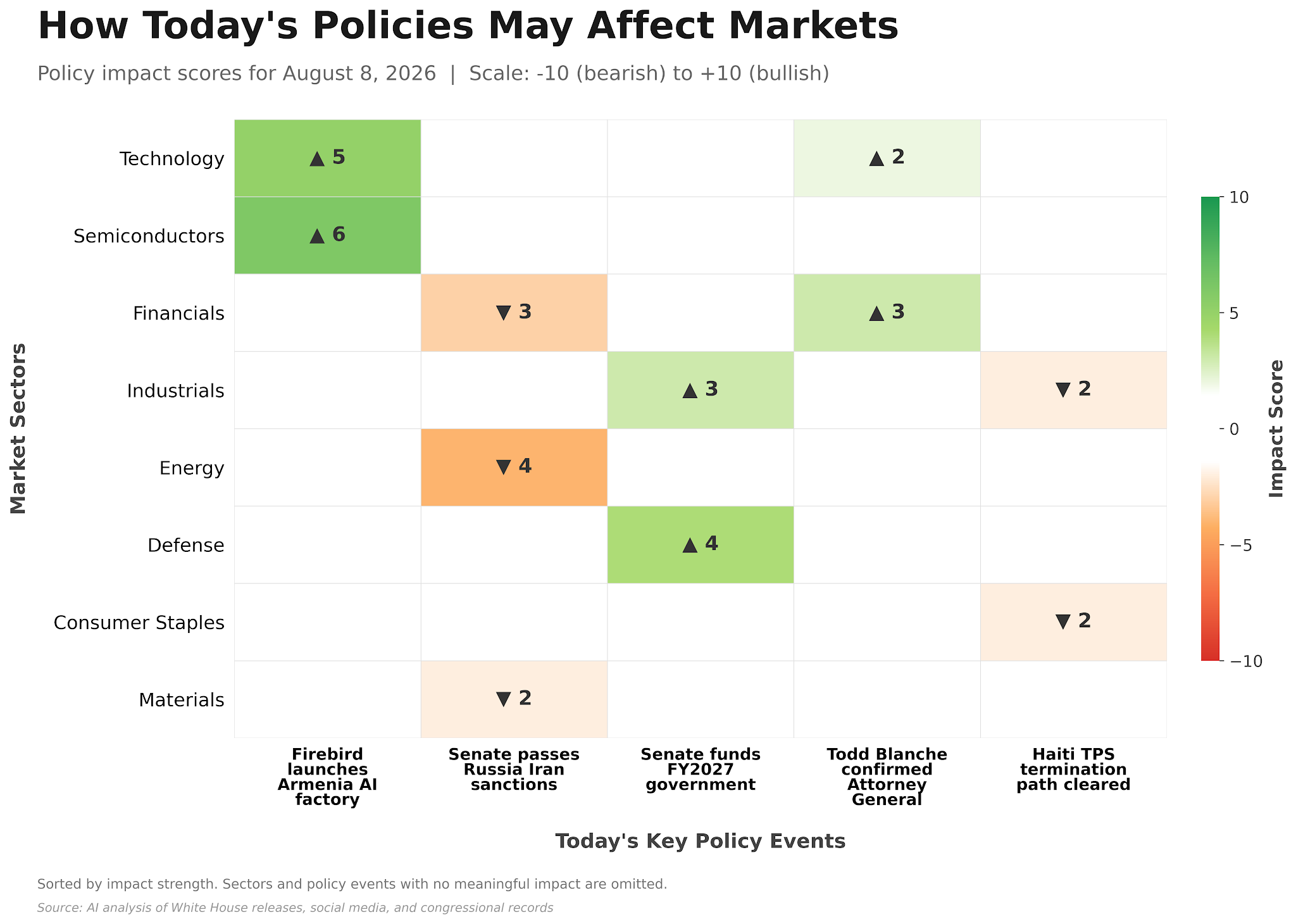
8. Policy Impact Analysis & Heatmap
1. Overview
President Trump highlighted several administration successes, emphasizing a milestone in jobless claims that have remained below 200,000 for three consecutive weeks. He noted that he plans to host over 120 Team USA Winter Olympians and Paralympians at the White House to celebrate their achievements. Additionally, Trump asserted that the United States currently maintains “massive” amounts of munitions to ensure national defense readiness.
On Truth Social, Trump discussed his recent legislative tax victories during a trip to Las Vegas and celebrated the termination of Haiti Temporary Protected Status. He promoted a new fraud-reporting website designed to highlight his task force’s accomplishments and suggested that Republican campaign coffers remain stronger than those of the Democrats. Regarding the 2020 election, he circulated claims that he said undermine the “most secure” election narrative, specifically citing reports of Arizona voter file hacking that he argued went unpunished by the Department of Justice.
The State Department addressed regional security and diplomacy through several announcements. The agency rejected China’s establishment of a “national nature reserve” at Scarborough Reef, labeling it a “unilateral attempt” to advance maritime claims through coercion. Additionally, the department celebrated Singapore’s 61st National Day, underscoring a commitment to security and AI cooperation. Finally, the department marked the one-year anniversary of the peace deal between Armenia and Azerbaijan, highlighting progress on the Trump Route for International Peace and Prosperity (TRIPP) and the launch of a $201 million investment fund to “cement peace.”
In the 2028 Democratic candidate updates, Governor J.B. Pritzker issued a daily public schedule confirming that he had no public events on his agenda for Saturday, August 8, 2026.
NVIDIA announced that Firebird has launched the CIS region’s largest AI factory in Armenia, utilizing NVIDIA’s accelerated computing infrastructure. The facility intends to support sovereign AI capacity by deploying over 70,000 Rubin and Blackwell GPUs by 2027. NVIDIA plans to invest in this expansion, aiming to scale the infrastructure across Armenia and Kazakhstan to reach a total of 2 gigawatts of capacity.
The Senate held an extensive session, concluding in the early hours of Saturday morning to finalize government funding and key confirmations. The chamber passed H.R. 6500, which extends fiscal year 2027 government funding, and approved the “Lindsey O. Graham Sanctioning Russia and Iran Act.” Senators also confirmed Todd Blanche as Attorney General in a 50-49 vote and approved the “Common Cents Act” by voice vote to eliminate the penny. Conversely, an amendment to the Help America Vote Act that would have required photo identification for federal voters failed to invoke cloture.
Tightened sanctions on Russia and Iran disrupt global supply chains, thereby elevating risk premiums for firms with significant international infrastructure exposure. Conversely, the global expansion of AI infrastructure sustains robust demand for specialized semiconductors and server hardware, though potential regulatory hurdles concerning technology transfers and sustainability remain a structural concern. Fiscal 2027 funding legislation provides a valuation floor for industrial and defense sectors through guaranteed government contracts, yet this stability is offset by new leadership signaling an era of “intensified” antitrust and fraud enforcement. The market trajectory is thus defined by a tension between state-backed capital inflows and an increasingly interventionist regulatory environment.
2. White House News
No White House news found.
3. Truth Social Posts
Trump highlighted his recent legislative tax victories during a visit to Las Vegas and noted that jobless claims remain below 200,000 for the third consecutive week, a milestone not seen in 57 years. Furthermore, he lauded an immigration victory regarding the end of Haiti Temporary Protected Status and announced that he will host over 120 Team USA Winter Olympians and Paralympians at the White House. On matters of national defense, Trump asserted that the United States currently possesses “massive” amounts of munitions.
Regarding administrative and political affairs, the White House has launched a fraud website to showcase the achievements of his task force, while Trump observed that Republican coffers are strong for the midterms compared to the Democrats. He also shared an opinion piece detailing the role of Chuck Grassley in the confirmation of Todd Blanche. Expressing appreciation for his standing, Trump thanked supporters for “Great Poll Numbers” and affirmed a sentiment as “Very true.” He also made a brief mention of “Trump Aberdeen!” (no link).
Trump continued to scrutinize the 2020 election, circulating new evidence that he claims undermines the narrative that it was the “most secure” election in history. He further pointed to reports that hundreds of thousands of Arizona voter files were hacked in 2020 without subsequent prosecution by the Department of Justice.
Reference: https://truthsocial.com/@realDonaldTrump
4. Government Department News
State Department (state.gov)
China’s “Administrative Measures” at Scarborough Reef
The United States rejects China’s enforcement of a “national nature reserve” at Scarborough Reef, which denies Filipino fishermen access to traditional fishing grounds. The State Department characterizes this as a “unilateral attempt” by China to utilize “dubing environmental and legal pretexts” and coercion to advance its maritime claims in the South China Sea. The U.S. reaffirmed its support for the Philippines and commitment to a free and open Indo-Pacific.
The United States commemorates Singapore’s 61st National Day and the 60th anniversary of diplomatic relations between the two nations. Secretary of State Marco Rubio highlighted the countries’ partnership in security cooperation, counterproliferation, cybersecurity, and artificial intelligence. The U.S. emphasized its commitment to strengthening this enduring relationship through emerging technologies and shared economic interests to ensure regional peace, stability, and prosperity.
One year after President Trump brokered peace between Armenia and Azerbaijan, the U.S. continues advancing the Trump Route for International Peace and Prosperity (TRIPP). This infrastructure project, designed to modernize transit and energy networks, is currently seeing engineering progress in both nations. Secretary of State Marco Rubio also announced the launch of the $201 million Trans-Caspian Enterprise Fund to drive private investment across the region, positioning TRIPP as a model for how economic cooperation can “cement peace” after long-standing disputes.
5. 2028 Democratic Presidential Candidates
JB Pritzker (gov.illinois.gov)
Daily Public Schedule: Saturday, August 8, 2026
Governor J.B. Pritzker has no public events scheduled for Saturday, August 8, 2026.
6. AI & Tech Company News
NVIDIA (nvidia.com)
Firebird Launches CIS Region’s Largest AI Factory in Armenia
Firebird has launched the CIS region’s largest AI factory in Armenia, utilizing NVIDIA accelerated computing and Dell Technologies infrastructure. The facility aims to provide sovereign AI capacity for local developers and institutions. Firebird plans to deploy over 70,000 Rubin and Blackwell GPUs by 2027, supported by NVIDIA’s DSX platform for increased energy efficiency. The company intends to scale this model across Armenia and Kazakhstan, targeting 2 gigawatts of capacity. NVIDIA plans to invest in Firebird to support this infrastructure expansion in frontier markets.
7. Congressional Watch
Covers the 2026-08-07 session — the Congressional Record is published with a one-day delay.
Senate
The Senate conducted extensive business, focusing on fiscal appropriations, foreign policy sanctions, and a large slate of executive branch and judicial nominations. The session extended into the early hours of Saturday morning to finalize government funding and confirm the new Attorney General.
H.R. 6500, Continuing Appropriations and Extensions Act — Extends government funding and authorizations for fiscal year 2027 [Passed 90-6 (Roll No. 228)]
H.R. 5334, Lindsey O. Graham Sanctioning Russia and Iran Act — Imposes new sanctions related to the Russian Federation [Passed 86-11 (Roll No. 224)]
Todd Blanche — Confirmed as Attorney General [Confirmed 50-49 (Roll No. 230)]
S. 1525, Common Cents Act — Ends the minting of the penny and rounds cash transactions to the nearest 5 cents [Passed by voice vote]
S. 5271, Help America Vote Act amendment — Requires photo identification for federal voters [Failed to invoke cloture 52-46 (Roll No. 231)]
Executive Nominations — Confirmed dozens of various agency heads and ambassadors en bloc [Passed 51-47 (Roll No. 225)]
House of Representatives
The House of Representatives was not in session on this day. No legislative business or committee activity occurred.
None — The House was not in session [No action taken]
Committee Highlights
No committee meetings were held — No chambers conducted hearings or markups
Coming Up
The Senate will meet in a pro forma session at 10 a.m. on Monday, August 10, 2026. The House will also meet in a pro forma session at 11 a.m. on Monday, August 10, 2026.
Reference: Congressional Record Archive
8. Policy Impact Analysis & Heatmap
This analysis is provided for informational purposes only. It does not constitute investment advice or a recommendation to buy or sell any security.
Impact on Market
Based on today’s policy developments, our analysis identifies the following market impact themes:
THEME 1. GEOPOLITICAL FRICTION AND SANCTIONS
The Senate’s move to tighten sanctions on Russia and Iran signals a deepening of geopolitical tensions. This policy shifts costs onto global energy and commodity markets by disrupting established supply chains. Opposition critics express concern that such actions force regional partners to pivot toward alternative economic blocs. The broader market impact reflects elevated risk premiums for firms with international infrastructure exposure.
THEME 2. AI INFRASTRUCTURE EXPANSION
The launch of the Armenian AI factory highlights the aggressive global buildout of computing power. This trend sustains demand for specialized semiconductor components and high-performance server hardware. While fueling innovation, this rapid expansion faces scrutiny regarding energy consumption and the sustainability of regional compute clusters. The influx of advanced hardware into secondary markets may face future regulatory hurdles regarding sensitive technology transfers.
THEME 3. FISCAL CONTINUITY AND REGULATORY SHIFTS
The passage of fiscal 2027 funding ensures a steady stream of government contracts for key industrial and defense players. The concurrent confirmation of new executive branch leadership suggests a transition toward intensified antitrust and fraud enforcement efforts. Market participants remain cautious as the administrative focus shifts toward high-profile investigations. Observers note that while contract flows provide a floor for valuations, regulatory volatility remains an persistent downside risk.
Policy Impact Heatmap with Market Direction
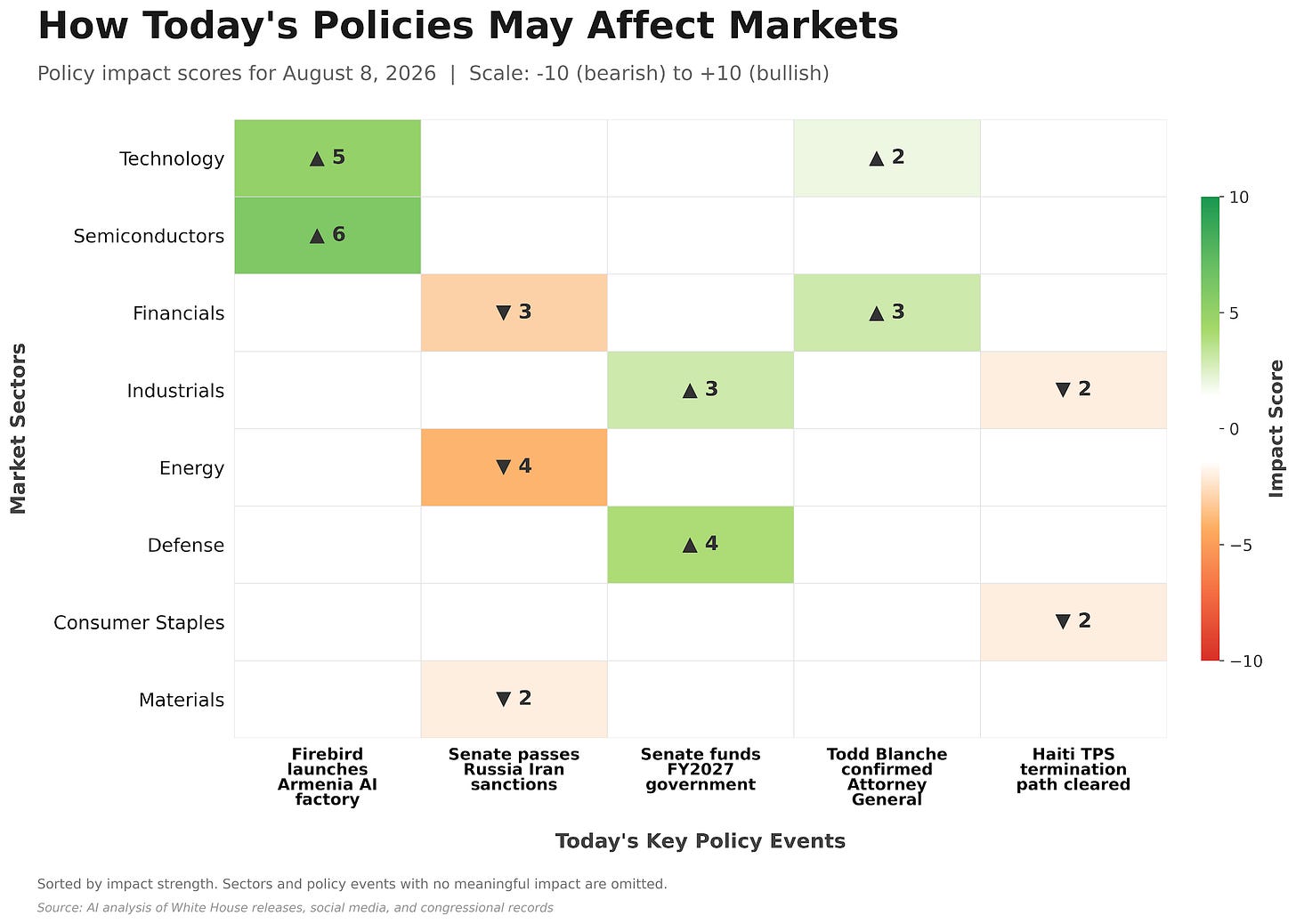
Each cell shows an estimated impact score on a fixed scale of -10 to +10, reflecting how today’s policy developments may affect each market sector. Positive scores (green, ▲) suggest bullish impact; negative scores (red, ▼) suggest bearish pressure. Rows and columns are sorted by impact strength, and sectors and policy events with no meaningful impact are omitted. The heatmap, the analysis below, and the Impact on Market themes above are produced from a single unified analysis: the heatmap visualizes the magnitudes, while the text explains the causal reasoning behind them.
The Senate passage of new sanctions against Russia and Iran creates immediate downside risk for energy and global commodity sectors. Markets anticipate higher compliance costs and restricted access to international markets for firms with exposure to these regions. Concurrently, the confirmation of a new Attorney General suggests a pivot toward a more aggressive regulatory environment for corporate oversight. This development introduces uncertainty for large financial and technology institutions previously navigating a more lenient enforcement landscape.
The deployment of a massive AI infrastructure hub in Armenia underscores the rapid expansion of global high-performance computing capacity. The commitment to utilize high-end GPU hardware indicates strong underlying demand for semiconductor producers. Furthermore, the passage of the fiscal 2027 appropriations act provides near-term stability for government contractors. Defense and industrial firms benefit from the certainty of federal funding flows. Critics argue that “reckless spending” within this package could sustain inflationary pressures, potentially complicating the outlook for interest-sensitive sectors despite the current positive signal from low jobless claims.
-
Washington Policy Review: August 7, 2026
Reply sourceToday’s Report
1. Overview
2. White House News
3. Truth Social Posts
4. Government Department News
5. 2028 Democratic Presidential Candidates
6. AI & Tech Company News
7. Congressional Watch
8. Policy Impact Analysis & Heatmap
1. Overview
President Trump hosted a roundtable with the mining industry to announce over $2 billion in new projects and $180 million for mining school investments. This initiative aims to strengthen domestic supply chains and reduce reliance on “hostile foreign countries.” Additionally, the President submitted several nominations to the Senate, including Leslie Becera for the Department of Transportation and Julia Nesheiwat as Ambassador-at-Large for the Arctic.
The State Department, in coordination with the Treasury, sanctioned six entities and one individual, including digital asset exchanges, for assisting the Iranian regime in laundering funds. Acting Attorney General Todd Blanche led a delegation to Colombia for the inauguration of President Abelardo de la Espriella, promising $1 billion in security aid. Furthermore, the Department of War committed over $2 billion in loans and investments to domestic mining and battery companies to establish a “lethal Arsenal of Freedom.” HHS Secretary Robert F. Kennedy, Jr. initiated the decertification of a Kentucky organ procurement organization, citing “persistent patient safety failures.”
Governor Gavin Newsom announced “MyFirstEV” rebates of $3,500 for zero-emission vehicle buyers and criticized President Trump for being “hellbent on burning more expensive fossil fuels.” In Michigan, Governor Gretchen Whitmer and the Army Secretary announced that Camp Grayling is now a premier U.S. military test range for drone innovation. Governor Wes Moore of Maryland launched an interactive tool to link SNAP recipients with workforce development, characterizing the move as a way to help families “overcome new red tape imposed by the Trump administration.” Governor JB Pritzker of Illinois signed an agreement with Indonesia to expand trade, aiming to mitigate the impacts of “trade instability caused by the President Trump administration’s tariffs.”
OpenAI reported that its upcoming model, Astra, reached the “Critical” threshold for cybersecurity capabilities, noting it can autonomously identify zero-day exploits. The company has implemented heightened security, including sandboxed testing and universal monitoring, to ensure responsible deployment. Meanwhile, Anthropic updated its Fable 5 model to reduce biology-related “false positives” while maintaining strict safeguards to prevent the misuse of “dual-use” research in virology.
The Senate passed several measures by voice vote on August 6, including the USMMA Athletics Act and the DeOndra Dixon INCLUDE Project Act, and confirmed a Space Force general. Senate committees examined small business capital access and international scam operations. The House held a three-minute pro forma session and conducted no legislative business. The Senate is scheduled to vote on the SEED Act on August 7, while the House will next meet on August 10.
Federal prioritization of the defense industrial base via direct capital injection provides a bullish tailwind for domestic critical material processors, though this strategy carries inherent risks of capital misallocation should these entities fail to achieve commercial viability without sustained state support. Treasury’s expansion of sanctions into decentralized finance networks creates a bearish outlook for digital asset participants, as the inclusion of these exchanges within national security protocols threatens to fragment global payment markets and stifle fintech innovation. Simultaneously, rigorous federal oversight and the rapid decertification of healthcare providers generate substantial operational uncertainty, with critics warning that such administrative volatility risks creating “unnecessary chaos” within essential medical service delivery networks.
2. White House News
Fact Sheet: President Donald J. Trump Announces Billions in New Deals and Investments to Power American Mining
President Trump held a roundtable with the mining industry to announce over $2 billion in new projects intended to “revitalize the industry” and $180 million for mining school investments. This initiative aims to strengthen domestic supply chains, reduce reliance on “hostile foreign countries,” and protect national security. By prioritizing domestic critical materials, the administration seeks to bolster the American mining workforce while ensuring economic resilience for vital industries. President Trump’s leadership is reportedly focused on “restoring America’s mining industry and national and economic security.”
Reference: https://www.whitehouse.gov/fact-sheets/2026/08/fact-sheet-president-donald-j-trump-announces-billions-in-new-deals-and-investments-to-power-american-mining/
Nominations Sent to the Senate
President Trump has sent several nominations to the Senate for confirmation. These include Leslie Becera for Assistant Secretary of Transportation, Dennis Kirk as Inspector General for the Department of the Interior, and Mary Lazare as Assistant Secretary for Aging. Additionally, Julia Nesheiwat was nominated for the new position of Ambassador-at-Large for the Arctic. The list also includes various diplomatic appointments, such as ambassadors to Tonga, Madagascar, Chad, Nicaragua, and others, alongside reappointments for the Export-Import Bank of the United States and the National Mediation Board.
Reference: https://www.whitehouse.gov/presidential-actions/2026/08/nominations-sent-to-the-senate-e61c/
3. Truth Social Posts
No relevant Truth Social posts found.
4. Government Department News
State Department (state.gov)
A New Era in U.S.-Colombia Relations
A U.S. delegation led by Acting Attorney General Todd Blanche attended the inauguration of Colombian President Abelardo de la Espriella. The Trump Administration intends to provide $1 billion in security assistance to deepen the partnership. Key goals include dismantling transnational narcoterrorist networks, strengthening security forces against Foreign Terrorist Organizations, enhancing coca eradication and interdiction efforts, and halting illegal migration through increased border security coordination.
Secretary of State Marco Rubio at President Trump’s Roundtable on American Mining
Secretary of State Marco Rubio highlighted the administration’s efforts to secure critical mineral supply chains, emphasizing industrial strength and national sovereignty. Under the Trump Administration, the State Department has signed 27 critical mineral agreements and launched “FORGE,” an international partnership to leverage public finance for supply chain security. The “Pax Silica” initiative, led by Under Secretary Jacob Helberg, aims to coordinate private sector investment in mining and refining to ensure the U.S. remains independent of foreign control over essential resources.
Targeting Digital Asset Exchanges Fueling the Iranian Regime
The U.S. has sanctioned six entities and one individual, including two digital asset exchanges, for assisting the Iranian regime in laundering funds. This action follows recent Iranian attacks on commercial vessels in the Strait of Hormuz. The administration stated it will continue to deny the regime resources used for nuclear ambitions and terrorism. Additionally, the State Department’s Rewards for Justice program is offering up to $15 million for information to disrupt the financial mechanisms of the IRGC and its branches.
Severing Iran’s Illicit Cash Pipeline
The Treasury Department is dismantling a network of currency exchange houses and shell companies used by Iran to launder hundreds of millions of dollars. These measures are part of the Trump Administration’s “maximum pressure” campaign to cut off funding for the regime’s regional aggression and support for terrorism. By targeting the facilitators and banks involved in sanction evasion, the administration aims to isolate the regime from the international financial system and hold those who assist its illicit activities accountable.
The United States extended congratulations to President Alassane Ouattara and the people of Côte d’Ivoire on their 66th National Day. The U.S. reaffirmed its strategic relationship with the nation, highlighting ongoing efforts to expand bilateral trade and investment while strengthening regional security to create new opportunities for both countries.
Department of War (war.gov)
The Department of War’s Office of Strategic Capital (OSC) has issued a $400 million conditional loan commitment to Sunrise Energy Metals Limited to develop a scandium value chain in Australia. This initiative seeks to end foreign dominance in scandium processing and secure supply for U.S. defense and commercial sectors. The OSC gains a right of first offer on the mine’s output, aligning with President Trump’s mandate to “secure a resilient, domestic supply chain for rare earths” and reduce dependence on foreign adversaries.
OSC announced a $1.4 billion conditional loan commitment to Sila Nanotechnologies to expand domestic production of silicon-carbon battery anodes and cell manufacturing. This investment supports President Trump’s goal to “aggressively onshore critical materials” for the defense industrial base. The project aims to reduce reliance on foreign battery components, providing critical energy storage for satellite operations, unmanned aerial systems, and munitions, while establishing a “lethal Arsenal of Freedom for the American warfighter.”
The Department of War has partnered with Strategic Bauxite USA for an $85.5 million equity investment to create a secure, western-hemisphere supply chain for refractory-grade bauxite. Currently, the U.S. relies heavily on Chinese sources for this material, which is essential for high-temperature components like heat shields and turbine engines. By expanding a mine in Guyana and building domestic processing facilities, the Department aims to meet 100% of U.S. military demand and “no longer wait for supply chain dependencies to be exploited.”
The Department of War is investing over $80 million into mining and metallurgy programs at the Colorado School of Mines, South Dakota School of Mines, and Johns Hopkins University. These funds will support technology innovation hubs, workforce development, and the training of geologists and engineers to bolster the national industrial base. The initiative reflects President Trump’s commitment to “solidify America’s role as a global leader in critical minerals production” and ensure the workforce is capable of meeting national security requirements.
OSC has committed $150 million to Niron Magnetics to construct a manufacturing facility in Minnesota for rare earth-free permanent magnets. This project aims to end reliance on foreign-dominated rare earth supply chains by using domestically abundant iron and nitrogen. By scaling production to 1,500 tons annually, the Department intends to mitigate supply chain vulnerabilities and equip the military with components that “enhance battlefield lethality,” fulfilling President Trump’s mandate to “leverage advanced commercial technology” for industrial resilience.
Department of War Publishes Fifth Release of Unidentified Anomalous Phenomena Files on WAR.GOV/UFO
The Department of War has published its fifth batch of declassified historical files regarding Unidentified Anomalous Phenomena (UAP). This release is conducted under the Presidential Unsealing and Reporting System for UAP Encounters (PURSUE). The documents are available for public viewing on the Department’s official website, and officials confirmed that additional file releases will continue on a rolling basis.
Department of Health and Human Services (hhs.gov)
HHS Decertifies Kentucky Organ Procurement Organization to Protect Patients, Restore Trust
HHS has initiated the decertification of Network for Hope, the organ procurement organization serving Kentucky and parts of Indiana, Ohio, and West Virginia, citing persistent patient safety failures. Despite multiple federal reviews and opportunities for correction, the agency determined the organization continued to endanger donors and transplant patients. HHS Secretary Robert F. Kennedy, Jr. stated the move reflects the “Trump Administration’s commitment to protecting the sanctity of life,” emphasizing that organizations failing federal standards will be held accountable.
Treasury Department (home.treasury.gov)
Treasury Dismantles Iranian Regime’s Global Clandestine Currency Networks
The Treasury Department’s Office of Foreign Assets Control sanctioned multiple networks facilitating Iran’s shadow banking system, which moves funds for the regime’s oil sales and military apparatus. Treasury Secretary Scott Bessent stated that “Iran’s shadow banking system is buckling under Economic Fury” and emphasized that facilitators will be targeted. The action, taken under Executive Order 13902, targets entities including Shahr Bank, Titan Exchange, and Alps International for laundering revenue to support Iran’s petroleum sector and illicit financial operations.
Treasury Sanctions Crypto Exchanges Funding Iran’s IRGC and Enabling Illicit Finance
Treasury sanctioned digital asset exchanges and a front-company network used by Iran to launder funds for the Islamic Revolutionary Guard Corps (IRGC). The action targets Siavash Kayvanpour and platforms including Shelbit Exchange and Aban Tether. Secretary Bessent noted that the regime’s reliance on crypto is “further evidence that Economic Fury is working.” The U.S. State Department’s Rewards for Justice program is offering up to $15 million for information to disrupt these financial mechanisms, which support the IRGC and various terrorist groups.
Secretary Bessent Issues Statement Welcoming S&P Global Release of Critical Mineral Reference Prices
The Treasury Department welcomed S&P Global’s new reference prices for critical minerals, including Gallium, Germanium, and Tungsten. Secretary Bessent stated that “transparent, market-based pricing is essential to attracting the private capital needed to build secure, resilient, and diversified critical mineral supply chains.” The administration aims to use these benchmarks to counter non-market policies, support investor confidence, and advance the Trump Administration’s efforts to address market distortions while strengthening international trade frameworks for critical minerals.
Treasury Continues to Follow the Money in Minnesota to Eliminate Fraud
FinCEN renewed a Geographic Targeting Order (GTO) requiring banks and money transmitters in Hennepin and Ramsey Counties, Minnesota, to report funds transfers of $3,000 or more sent overseas. The measure aims to combat the fraud-driven diversion of state and federal benefits, which has cost Minnesota billions. Secretary Bessent stated, “The Trump Administration will not allow criminals to profit from programs intended to help vulnerable Americans.” The order, effective for 180 days, assists law enforcement in tracing the laundering of stolen taxpayer funds.
United States Trade Representative (ustr.gov)
Ambassador Greer Welcomes S&P Global Critical Minerals Pricing Benchmarks
Ambassador Jamieson Greer endorsed S&P Global’s new pricing benchmarks for critical minerals, including gallium, germanium, tungsten, antimony, and neodymium/praseodymium. These benchmarks aim to foster market transparency and support long-term investment. Ambassador Greer stated that this initiative complements the Trump Administration’s supply chain resilience efforts and will inform the ongoing negotiation of the Agreement on Trade in Critical Minerals. The proposed agreement seeks to implement border-adjusted price floors and common standards to counter non-market policies and address global price instability.
5. 2028 Democratic Presidential Candidates
Gavin Newsom (gov.ca.gov)
Governor Newsom announces appointments 8.7.26
Governor Newsom announced several executive branch appointments: Grecia Staton as Chief Deputy Director at the Department of Industrial Relations; Dana Martinez as General Counsel at the Public Employment Relations Board; Salena Chow as Chief Deputy Director at Healthcare Access and Information; Jami Terrell as Deputy Director and Chief Counsel at the Department of Health Care Services; and Monica Montano as Deputy Director of Legislative Affairs at the Department of Managed Health Care. These positions do not require Senate confirmation.
Governor Newsom announces judicial appointments
Governor Newsom nominated eight individuals for the Court of Appeal: Rashida Adams, Denise Hippach, David Sapp, Lauri Damrell, Marsha Amin, Lisa Rodriguez, Juliet Macaulay, and Frederick Chung. Additionally, he appointed nine Superior Court judges across Los Angeles, Riverside, San Diego, Sonoma, and San Francisco counties. The appellate nominations require confirmation by the Commission on Judicial Appointments, and several will face voter confirmation in the November 3, 2026, general election.
The Governor announced instant rebates of up to $3,500 for first-time zero-emission vehicle buyers through the “MyFirstEV” program, funded by a $135.5 million state investment matched by automakers. He also noted California’s battery storage capacity has exceeded 21,000 megawatts. Criticizing the federal approach, the Governor stated, “While President Trump is hellbent on burning more expensive fossil fuels and raising costs for Americans, California is proving there’s a better way,” asserting that state policies enhance energy independence and provide economic security.
Thirty-six new wildlife officers graduated from the California Department of Fish and Wildlife (CDFW) Law Enforcement Division academy in Paradise, California. Following field training, these officers will join approximately 450 existing personnel to enforce fish and wildlife laws, conduct marine and cannabis enforcement, and respond to environmental emergencies. The training program, certified by the Commission on Peace Officer Standards and Training, prepares officers for a variety of public safety and natural resource protection duties across the state.
Gretchen Whitmer (michigan.gov)
Governor Whitmer announced new Fiscal Year 2027 budget investments for rail grade separation projects to reduce traffic congestion and improve safety. Key projects include a $59 million effort to raise the Canadian National rail line over Allen Road in Wayne County and a $115 million highway elevation project on M-85 in Trenton. The Governor stated, “Fixing the damn roads means less wear on your car, a smoother drive, and safer travel for every Michigander.” The budget also increases state support for local road and transit programs.
Governor Whitmer and Army Secretary Dan Driscoll announced that Camp Grayling is now one of four premier U.S. military test ranges open to private industry for rapid experimentation. The initiative, managed by the U.S. Army Test and Evaluation Command, aims to streamline innovation in drone and counter-drone technologies. Industry partners can request access via a new digital portal. A specialized test event is scheduled for September 2026 to help developers “harden their drone and counter-drone systems” against electronic warfare conditions similar to those in Ukraine.
Wes Moore (governor.maryland.gov)
The Maryland Insurance Administration recovered over $53.5 million for consumers during the first half of 2026 through various department programs. Governor Moore stated, “As H.R. 1 makes it harder for people to attain healthcare on the ACA exchange and is taking away people’s Medicaid altogether, $53.5 million dollars returned means money back in Marylanders’ pockets.” The administration emphasized its commitment to mitigating rising living costs while providing consumer advocacy, licensing, and grievance resolution services through initiatives like the Health Coverage Assistance Team.
The Maryland Department of Human Services launched an interactive tool to link SNAP recipients with a workforce development network of 46 partners. Governor Moore stated the effort helps residents “overcome new red tape imposed by the Trump administration to take away families’ food assistance.” The $30 million initiative provides free training and support services. The administration is utilizing this tool to mitigate the impact of federal H.R. 1 requirements, noting that Maryland’s SNAP participation decline has been less severe than in most other states.
JB Pritzker (gov.illinois.gov)
Gov. Pritzker Announces Illinois–Indonesia Agreement to Expand Trade and Economic Cooperation
Governor Pritzker and Indonesian officials signed a Memorandum of Understanding to strengthen ties in business, education, workforce development, and agriculture. The agreement aims to diversify export markets for Illinois soybean producers, specifically to mitigate the impact of trade instability caused by the President Trump administration’s tariffs. With Indonesia as a growing trade partner, the state seeks to reduce reliance on the Chinese market and capitalize on Illinois’ status as a leading national exporter.
Gov. Pritzker Announces One Appointment to Boards and Commissions
Governor Pritzker appointed Nicole Bateman to the Central Illinois Economic Development Authority. Bateman currently leads the Economic Development Corporation of Decatur and Macon County and serves as Chief Strategy Officer for the Illinois Fermentation and Agriculture Biomanufacturing Tech Hub. Her appointment is subject to confirmation by the Illinois Senate.
Gov. Pritzker Takes Bill Action
Governor Pritzker signed various bills into law covering a wide range of state policies. Key legislation includes measures to reform Tax Increment Financing, create the Equitable Access to Education, Employment, and Training for Incarcerated Individuals with Disabilities Act, and establish the Patient Access to Pharmacy Protection Act. Other signed bills address child abuse protections, literacy resources for color-vision-deficient students, and procedures for gun offenders. Additional acts concern higher education rights, infrastructure naming, and new requirements for adult changing stations.
Daily Public Schedule: Friday, August 7, 2026
Governor Pritzker’s schedule includes signing a Memorandum of Understanding with Indonesia at the Chicago Press Room and attending a ribbon-cutting ceremony at the Austin Green Line Station. Additionally, the Governor and Lieutenant Governor Stratton are set to sign SB 3325, which establishes menopause education requirements, and SB 3020, which provides legal protections against online harassment, doxing, and digital tracking.
Tim Walz (mn.gov)
Governor Walz Thanks Grace Arnold for Her Service as Department of Commerce Commissioner
Governor Tim Walz announced that Grace Arnold is stepping down as Minnesota Department of Commerce Commissioner after seven years of state service. Appointed in 2021, Arnold was credited by the Governor for her leadership in consumer protection, clean energy initiatives, and financial literacy efforts. Deputy Commissioner of Insurance Julia Dreier will serve as the temporary commissioner. Dreier, who has led the Commerce Department’s insurance division since 2021, previously held roles at the Centers for Medicare & Medicaid Services and within the Minnesota healthcare policy sector.
Jon Ossoff (ossoff.senate.gov)
Sens. Ossoff and Warnock are demanding that the Defense Health Agency (DHA) provide information regarding plans to close inpatient services and convert the Dwight D. Eisenhower Army Medical Center into an urgent care facility. The Senators argue the DHA’s failure to respond to a June 2026 inquiry is “unacceptable.” They are urging the agency to rescind its Congressional notification for service changes until the impact on servicemembers, veterans, and their families in Augusta is fully clarified.
The U.S. Senate passed a resolution authored by Sens. Ossoff and Warnock to honor those affected by the August 6, 2025, mass shooting at Ft. Stewart. The resolution recognizes the victims, commends the soldiers who subdued the shooter, and praises the first responders and support personnel involved. Sen. Ossoff highlighted this commemoration while noting his ongoing efforts to improve military housing conditions at Georgia bases, including initiatives to ban non-disclosure agreements for military families regarding housing issues.
6. AI & Tech Company News
OpenAI (openai.com)
Responding to the next frontier of critical cyber capabilities
OpenAI reports that its upcoming model, Astra, has reached the “Critical” threshold for cybersecurity capabilities. Evaluations indicate the model can autonomously identify and develop zero-day exploits in hardened systems. In response, the company has paused non-compliant internal activities and implemented heightened security measures, including sandboxed testing and universal monitoring of model logic. OpenAI is working with government agencies and safety organizations to ensure responsible deployment, emphasizing that these advanced tools should be used to strengthen defenses against cyber threats.
Anthropic (anthropic.com)
Improving Fable 5’s Biology Safeguards
Anthropic has updated Fable 5 to reduce “false positives” in biology-related queries, decreasing system “fallbacks” to less capable models by approximately 85%. While this enhancement allows Fable 5 to better assist with general health, educational, and clinical tasks, the model still redirects requests involving “dual-use” areas like virology and molecular design to Opus 5. The company maintains these strict safeguards to prevent the potential misuse of frontier capabilities for developing biological weapons, acknowledging the difficulty in distinguishing between beneficial research and malicious intent.
7. Congressional Watch
Covers the 2026-08-06 session — the Congressional Record is published with a one-day delay.
Senate
The Senate focused on passing several non-controversial measures and confirmed a Space Force nomination. The chamber also reached a procedural agreement to debate and vote on tax-related legislation and pending nominations on August 7.
S. 3266, USMMA Athletics Act — Supports athletic programs at the U.S. Merchant Marine Academy [Passed by voice vote]
S. 434, Space Commerce Advisory Committee Act — Establishes a committee for commercial space activity advice [Passed by voice vote]
S. 2398, Kay Hagan Tick Reauthorization Act — Reauthorizes the Kay Hagan Tick Act [Passed by voice vote]
S. 1838, DeOndra Dixon INCLUDE Project Act — Authorizes research and training programs related to Down syndrome [Passed by voice vote]
Space Force Nomination — Confirmed one rank of general in the Space Force [Confirmed by voice vote]
House of Representatives
The House held a brief pro forma session on August 6 that lasted only three minutes. No legislative business or committee meetings occurred during this time.
N/A — No legislative actions or votes were conducted [None]
Committee Highlights
Senate - Committee on Banking, Housing, and Urban Affairs — Examined strategies for unlocking capital access for small businesses
Senate - Committee on Foreign Relations — Examined the U.S. response to international scam operations
Senate - Committee on Homeland Security and Governmental Affairs — Voted to report a wide package of government oversight and postal facility naming bills
Coming Up
The Senate will convene at 10 a.m. on August 7 to continue consideration of nominations and vote on the SEED Act (H.R. 5334). The House will next meet in a pro forma session at 11 a.m. on Monday, August 10.
Reference: Congressional Record Archive
8. Policy Impact Analysis & Heatmap
This analysis is provided for informational purposes only. It does not constitute investment advice or a recommendation to buy or sell any security.
Impact on Market
Based on today’s policy developments, our analysis identifies the following market impact themes:
THEME 1. INDUSTRIAL ONSHORING VIA DEFENSE SPENDING
The administration is prioritizing the defense industrial base by channeling capital directly into critical material extraction and processing. These conditional loans serve as a synthetic supply chain policy intended to insulate domestic technology and battery manufacturers from foreign market volatility. Bearish risks include potential capital misallocation in nascent industries and the danger of building capacity that lacks long-term commercial viability without continuous government backing.
THEME 2. FINANCIAL ENFORCEMENT AND DIGITAL SANCTIONS
Treasury actions against digital asset networks signal a concerted effort to limit Iran’s ability to bypass traditional financial systems. By linking digital asset exchanges to national security, the government is expanding the scope of its sanctions regime to include decentralized finance participants. Opposition figures argue this heavy-handed approach could lead to fragmented global payment markets and inadvertently stifle legitimate financial technology innovation.
THEME 3. DISRUPTION IN HEALTHCARE OVERSIGHT
Increased federal intervention in healthcare administration is creating significant operational uncertainty for established service providers. The move to decertify underperforming organizations reflects a policy of strict federal accountability in the medical sector. Critics warn that these rapid administrative shifts may disrupt patient care and create “unnecessary chaos” within critical healthcare logistics networks.
Policy Impact Heatmap with Market Direction
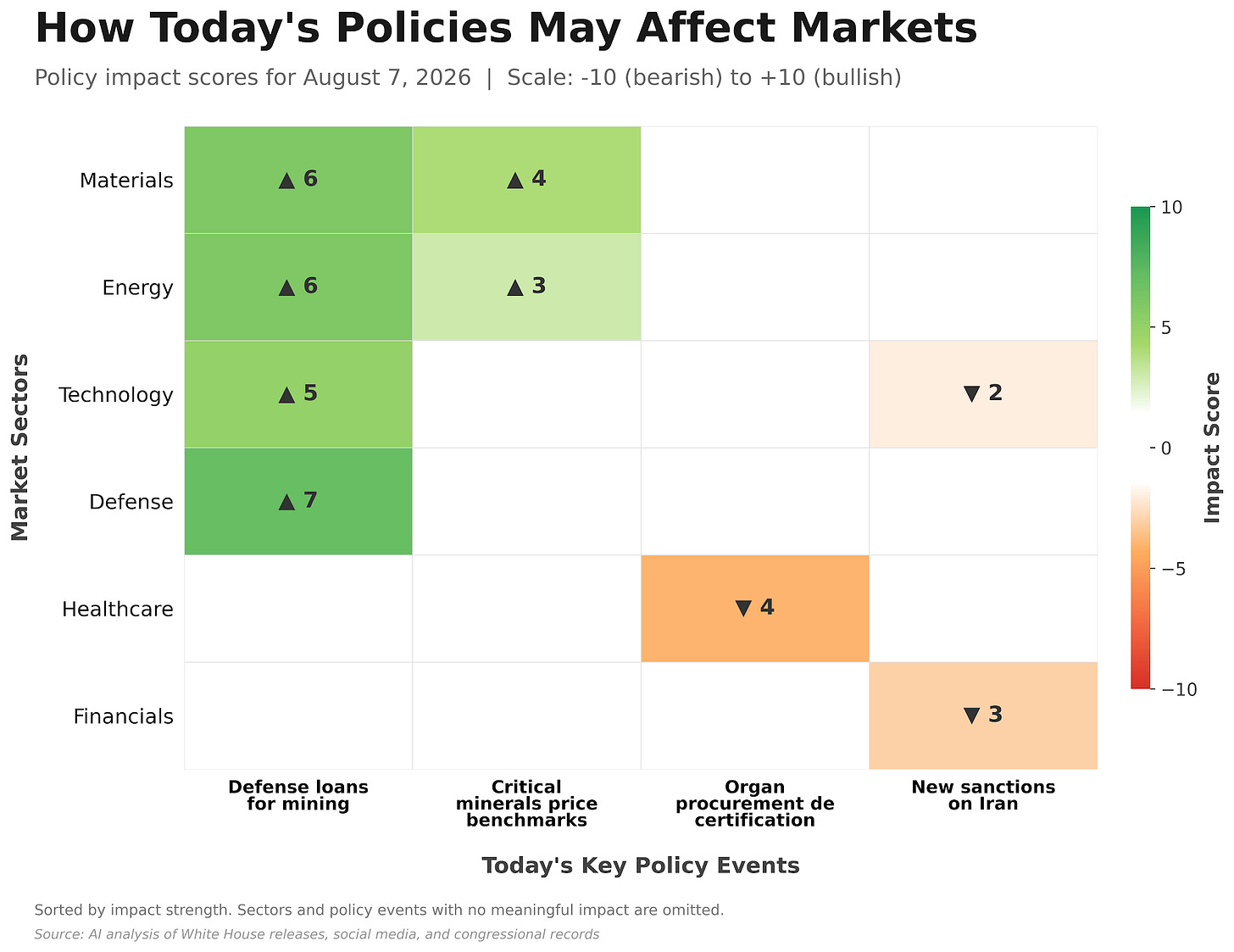
Each cell shows an estimated impact score on a fixed scale of -10 to +10, reflecting how today’s policy developments may affect each market sector. Positive scores (green, ▲) suggest bullish impact; negative scores (red, ▼) suggest bearish pressure. Rows and columns are sorted by impact strength, and sectors and policy events with no meaningful impact are omitted. The heatmap, the analysis below, and the Impact on Market themes above are produced from a single unified analysis: the heatmap visualizes the magnitudes, while the text explains the causal reasoning behind them.
The administration is aggressively utilizing the Department of War to reshape industrial supply chains through targeted financial interventions. By deploying billions in conditional loans to domestic battery and magnet producers, the government aims to force an onshoring of critical inputs for defense and tech sectors. This move seeks to reduce reliance on foreign-dominated markets, directly boosting capital flows into domestic Materials and Energy firms. These efforts are complemented by the endorsement of new mineral pricing benchmarks, intended to facilitate market-based stability and long-term investment. Simultaneously, the Treasury is tightening control over financial plumbing by sanctioning digital asset exchanges tied to Iran. These actions effectively increase the risk premium for international digital financial networks while creating a clear state-directed mandate for domestic manufacturing. Healthcare volatility persists as HHS signals a more punitive regulatory environment for medical service providers. The decertification of regional organ procurement organizations underscores a shift toward strictly enforced performance accountability. While proponents describe these mining investments as “restoring America’s... economic security,” critics in opposition-led states suggest that aggressive federal oversight and the rollback of certain federal benefits create “harmful” obstacles for service delivery and state-level administration. The combination of industrial subsidies and restrictive sanctions signals a broader pivot toward economic nationalism in both energy and finance.
-
Undisputed! Andrew Boutros Makes a False Claim
Reply source
In a motion arguing he and his AUSAs should not be sanctioned, US Attorney for Chicago Andrew Boutros made a substantive false claim. I can’t prove he knowingly lied; that would require the kind of investigation Boutros insists is not warranted. But I can show his false claim happens to be among the core disputes in the Broadview 6 case.The legal argument in this filing (inapt invocation of Trump v. US notwithstanding) might be sound. But it’ll only work if Judge April Perry buys his explanation for why his AUSAs handed her grand jury transcripts that kept the misconduct Sheri Mecklenburg engaged in hidden behind redactions. The excuse is that William Hogan, a guy with past ethical accusations that Boutros chose not to mention in his filing, was just following orders — April Perry’s orders — to provide the grand jury transcripts pertaining to how they charged a conspiracy.
Boutros claims Judge Perry can only hold prosecutors in contempt if they disobeyed her order to turn over instructions on conspiracy
Boutros explains it this way:
The only potentially applicable order in this case [for which prosecutors could be held in contempt] is this Court’s order regarding the grand jury transcripts. Yet former Defendants made a very “narrow” request for only those portions of the grand jury transcripts “pertaining to how the 18 U.S.C. § 372 conspiracy charge was explained to the Grand Jury” and any “related exchanges.” R. 118 at 1. This Court ordered the Government to provide in camera “the relevant portions of the transcripts as outlined in the motion.” R. 119. The Government undisputedly provided all those portions in the redacted transcripts. Whether the Government should have provided additional portions not requested, former Defendants have never argued the Government failed to comply with this Court’s order. United States v. Streett, 437 F. Supp. 3d 940, 952 (D.N.M. 2020) (defendant’s attempts to convince someone else to get picture of his child abuse victims and cover it up was not contemptuous because it did not violate Court’s order prohibiting him from contacting or attempting to contact victims); see also, e.g., Denver-Greeley Valley Water Users Assoc. v. McNeil, 131 F.2d 67, 70 (10th Cir. 1942) (“literal compliance” is not contempt).
Nor did the Government violate the Court’s order to turn over “any related exchanges” to the § 372 legal explanation. R. 118 at 1. “Related exchanges” do not “clearly” (Joyce, 498 F.2d at 596) include: Experienced AUSA 1’s preamble containing “vouching” (Oct. 9), statements suggesting jurors who could not deliberate without bias should leave (Oct. 16), or references to ex parte communications unrelated to the law (Oct. 23). At a minimum, the order is “ambiguous” as to those discussions, and any failure to turn those portions over was not contemptuous. In re Betts, 927 F.2d at 987.
Boutros argues that Judge Perry has no authority to punish the prosecutors, because she did not issue any order that prosecutors defied. He says the only possible contempt was the order she gave to provide the portions of grand jury transcripts outlined in defendants’ motion to compel them.*
He claims to be sure, however, that prosecutors had “undisputedly” provided all those portions; he cites nothing defendants or Perry have said where they agree.
In any case, his claim is false. Prosecutors did not fully comply with Judge Perry’s order to turn over all the legal instructions on conspiracy.
Prosecutors withheld critical instruction on leaving a conspiracy
Most importantly, prosecutors omitted a fairly critical exchange from the October 23 transcript, the session where the grand jury ultimately indicted the Broadview 6, from what they initially shared with Judge Perry; I first noted this omission this post.
As a grand juror tried to track each of the (at that point) six defendants on the two videos prosecutors were showing, they mentioned that some of the defendants seemed to walk away from the Expedition that had driven into their protest. Mecklenberg responded to that observation by claiming that walking away from a spontaneous conspiracy would not affect whether they had joined the conspiracy or not.
GRAND JUROR: — Michael Rabbitt no longer appears in the frame. And neither Kat or either Kat appears to be anywhere near the front of the truck again. I’m just wondering about that. So I don’t — I’m struggling to locate them.
MS. MECKLENBURG: You — they don’t have — they can step away. You can do it that — you can impede for some time, and then you can decide that you’re going to stop. That doesn’t change the fact that you have impeded for some time. And they could be going — and we don’t know where they are here. They could be going and doing something else to the car or something else. We just don’t know.
GRAND JUROR: Okay.
MS. MECKLENBURG: So I — what’s — the probable cause comes from when you do see them on the video, not from when you don’t.
Shortly thereafter, in response to the foreperson also attempting to track each of the defendants, Mecklenburg claimed it was part of the conspiracy that people moved in and out (of the frame? the crowd? I have no idea).
MS. MECKLENBURG: So it’s happening at the same time. But keep in mind, people are moving in and out —
MADAM FOREPERSON: Yeah.
MS. MECKLENBURG: — which is part of the conspiracy.
You can argue whether Mecklenburg’s claim about conspiracy law was correct or not; I think it is (as a grand juror said of the case as a whole) a crock of shit.
But she was undisputedly responding to questions about how conspiracy law applied in this case.
These exchanges should have been included in what got shared with Perry.
Prosecutors included similar instructions
Such exchanges are precisely the kind of thing that Boutros pointed to as proof of the robust back and forth in the October 9 and 23 grand jury discussions.
The grand jurors asked the AUSAs about, among other things, whether conspiracy required forethought (id. at 22), if actions alone could show a conspiratorial agreement (id. at 23), “how far does” the scope of the conspiracy “go” (id.), and whether it was against the law to touch a law enforcement car (id. at 24-25, 30-31).
[snip]
The grand jurors also asked questions about the law, including: the necessity of them weighing in on a misdemeanor (id. at 51-52, 25-31), and if “basically . . . anybody who walked in front of that car could be charged with a conspiracy even if they weren’t actually touching the car and somehow impeding it.” Id. at 55; see also id. at 9, 16, 52-54 (other questions). [links added]
All of these, which include multiple questions about whether it was illegal to touch a cop’s car (and — in one case — challenging whether defendant Cat Sharp had done so), were included, unredacted, among the materials that Hogan deemed responsive Judge Perry’s order.
Questions about whether touching the car were included unredacted.
Questions about whether people who stepped away could be charged were not.
Given the standard for inclusion Boutros is describing in his filing — and given what was actually included in the transcripts originally shared with Perry — the exchanges about leaving a conspiracy should have been included. They were not.
It could be a mistake! Indeed, but for all the other damning evidence, that should be the default assumption here.
But there’s a lot of reason to believe it was intentional.
Boutros gets touchy about the standard for entering this conspiracy
Remember what happened here: People were protesting on a public street, and the ICE goon drove his black Expedition into them. There were definitely people who responded by surrounding and pounding on the car; there was damage (including the word “pig” scratched into the car) that prosecutors not only never tied to the defendants, but never isolated as having been done by anyone in the crowd.
Prosecutors argued that the act of impeding a car that drove into protestors was a spontaneous conspiracy to obstruct the ICE goon’s work, or at least his attempt to get to work. Spontaneous conspiracies are already pushing the edge of conspiracy law (though the argument worked in the Spokane protestors’ case on the same conspiracy charge), but in this case, the “conspiracy” involved a “victim” who initiated contact with lawful protestors in public space, protestors he called “trash in the street” in a text he sent.
What constituted entering into and remaining in this spontaneous conspiracy would always have been a heated contest. In his filing, Boutros uses merely touching the ICE goon’s car — the car that drove into protestors — as the baseline for entering into the conspiracy.
There was a crowd protesting at the facility, some of whom ended up in front of and touching and/or banging on his car. Id. at 78-80. The parties disagreed about the legal significance and constitutional implications of their actions, but former Defendants have never contested that each of them at least touched the Agent’s car, and the Court has confirmed as much. R. 142 at 7-9
[snip]
Former Defendants have never disputed their presence on the scene—which was captured on publicly available video—and even agreed they touched Agent A’s car (also captured on video).
And he seems to assert, without pointing to proof, that defendants did not contest whether they did touch the car that drove into them (as noted above, in the grand jury, there was heated debate about whether Cat Sharp ever did touch the car).
In other words, Boutros tries to dodge the problematic structure of this imagined conspiracy by criminalizing touching a car that drove into you.
This kind of instruction is precisely what defendants asked for
And that’s precisely why defendants took a series of steps that led up to the sharing of transcripts with Judge Perry; it’s precisely the kind of question defendants were raising in the filing Perry invoked when issuing her order.
Boutros’ discussion of the background to defendants’ request for transcripts notes that the request came in the wake of a prior request for specifics about how DOJ was applying the conspiracy. He quotes the defendants saying their request was “narrow,” and implies that Hogan complied by saying the misconduct Perry identified when she first revealed these transcripts would not have been included in her order. But he never bothers to show that Hogan provided everything she asked for.
On January 23, 2026, former Defendants moved for clarification about which of the three means in § 372 they were alleged to have violated. R. 61. Around that time, Experienced AUSA 1 left the Office for a temporary detail in another branch of Government. R. 83, 86. On February 2, 2026, Experienced AUSA 2—who has been with the Office for roughly 40 years—entered his appearance. R. 73. A third prosecutor, AUSA 3, filed his appearance on February 13, 2026. R. 85. The Government filed a motion saying it would only proceed on the “force and intimidation” prong of § 372 and thereby narrowed Count 1 (the felony charge). R. 96. Around that time, the Government moved to dismiss two of the former Defendants with prejudice. R. 91.
The remaining former Defendants sought discovery relating to vindictive or selective prosecution. R. 94. This Court denied the motion. R. 117. [long discussion that doesn’t address the evidence of vindictiveness since released]
The next day, on April 8, 2026, former Defendants made a “narrow” request to see “Grand Jury transcripts pertaining to how the 18 U.S.C. § 372 conspiracy charge was explained to the Grand Jury” and “any related exchanges.” R. 118 at 1. Former Defendants wanted to ensure the grand jury had been instructed on all the relevant § 372 means now that the Government was proceeding on only one. Id. at 1-2, 4. Alternatively, they asked this Court to conduct an in camera review “and order disclosure of those portions of the transcripts the Court determines are necessary to allow Defendants an opportunity to develop this issue further.” Id. at 1, 12.
But Boutros leaves key context out of the request. I provided that background myself in this post. The important bits are:
- Defendants, January 23: Hey, it’s not at all clear how defendants violated 18 USC 372 or what theory of force you’re using. Can we have a Bill of Particulars? [Doc 61]
- DOJ, February 11: No. [Doc 81]
- Defendants, February 23: But bodyworn camera video you only provided on February 12 confirms what we argued in our motion: “Abughazaleh, Defendants Joselyn Walsh, Andre Martin, Michael Rabbitt, and Catherine Sharp all independently moved away from the SUV within seconds after they found themselves in its path.” [Doc 87]
- Judge Perry, February 26: You gotta tell them which theory of conspiracy you’re using. [Doc 89]
- DOJ, March 12: Uh, we’ve decided we don’t have a case against Cat Sharp and Joselyn Walsh. [Doc 91]
- DOJ, March 13: Uh, we’ve decided we only have evidence that defendants intimidated the ICE goon who drove into them. [Doc 96]
- Several requests, including a motion for discovery on selective and vindictive prosecution, a motion to dismiss on 1A grounds, and a motion for details of what evidence from other conspirators will be used.
- Defendants, April 8: Since the government changed its theory of the case and keeps needing to think about it, we want grand jury transcripts “pertaining to how the 18 U.S.C. § 372 conspiracy charge was explained to the Grand Jury.” [Doc 118]
- Judge Perry, April 9: The government can either respond to defendants’ request, or “the relevant portions of the transcripts as outlined in the motion may be provided to the Court by 4/20/2026 in lieu of a written response.” [Doc 119]
That’s the genesis of the order that, Andrew Boutros insists, Hogan “undisputedly” responded to in full. The claim that most of the defendants responded to an Expedition driving into their protest by walking away was at the core of their request for explanation about the conspiracy charge; it was likely at the core of the reason the government dropped their case against Sharp and Walsh. And it would be at the core of any claim that defendants entered into a spontaneous conspiracy to obstruct the guy who just drove his giant SUV into their protest.
What did they do when the Expedition drove into them?
They walked away.
And yet, when grand jurors, based on their observation that some of the defendants did just that, asked Sheri Mecklenburg on the day they indicted the Broadview 6, what about people who walked away, Mecklenburg said that was all part of the conspiracy.
Again, it doesn’t matter whether Mecklenburg’s instruction to jurors was right or not: that you could be charged for conspiring to obstruct an ICE goon after he drove his SUV into your protest if your response was to walk away. If the instruction was pertinent to grand jurors’ decision to indict people who did walk away, then DOJ had to turn it over to Judge Perry.
They did not.
They didn’t do so, even though a significant part of defendants’ argument that led Judge Perry to make DOJ explain their theory of conspiracy in the first place substantially focused on how you could enter into a spontaneous conspiracy if you walked away from it.
The hybrid section of Hylton’s testimony
There’s one more piece of arguable legal instruction that Hogan withheld, revealed by the funkiness in the treatment of FBI Agent Evan Hylton’s transcript (I wrote abt the far bigger funkiness with the ICE witness’ testimony here).
As I laid out here, the court reporters treated testimony from the ICE witness as a separate transcript for both his October 16 (the sketchy one) and his October 23 testimony. That has a number of effects, two of which are important to the question of whether Hogan complied with Judge Perry’s order or whether DOJ deliberately tried to hide stuff from her.
- Funkiness aside, the ICE witness’ testimony makes up a negligible portion of the transcript that includes legal instruction; in the October 23 transcript, for example, the ICE agent’s testimony is marked by a 4-line placeholder
- The ICE witness’ testimony has its own table of contents (October 16; October 23)
These tables of contents were made after the fact and should not be considered reliable, but they do provide an extra road map for what happened with the transcript.
In the case of Hylton, however, the court reporter treated it as all one transcript. And he inaccurately described that the entire thing, pages 3 through 76, consisted of direct examination — of Hylton, is the implication — by Sheri Mecklenburg.

When Hogan redacted the October 16 and 23 transcripts, he could just ignore the separate transcripts pertaining to the ICE testimony (ignoring, of course, the 7-minute anomaly in the October 16 one). But for the October 9 transcript, he had to isolate Hylton’s testimony himself.
To make things worse, Mecklenburg prepared to discuss the law — “I would like to present the law to you” — right before she invited questions, making that work harder. Most of what ensued involved questions for Hylton. But then the foreperson premised a question, “I don’t know if this is a legal question or a question for the agent. I’m pretty sure it’s legal.” Mecklenburg immediately stopped the question and dismissed Hylton.
So there was this hybrid period. Hylton was still there but grand jurors were asking whatever they wanted to know. During it, both the agent and Mecklenburg addressed some questions about the investigation: why they weren’t presenting any of the more obviously obstructive protestors, whether there were fingerprints, what a trucker who would have witnessed the event said. The investigation is ongoing, one or another of them responded.
When Hogan redacted the transcript, he redacted everything up to the moment that Mecklenburg formally dismissed Hylton, on page 62, which would have looked perfectly reasonable to Judge Perry, since the table of contents identified everything up through page 73 as testimony. When DOJ publicly released the transcripts however, they withheld only from the moment from when Hylton was sworn — recorded on page 10, to the moment Mecklenburg described she wanted to discuss the law on page 53 for further redaction. That was released on June 9, and then the pages of Hylton’s testimony that had been redacted in the purportedly unredacted testimony, pages 10 through 53, were released on June 18. (Note, this only pertains to the public releases. I think defendants got everything on May 21.)
And the release of that hybrid section revealed an exchange that was not obviously evidentiary, and Mecklenburg answered that herself: by bullying the grand juror who asked it.
GRAND JURY: Couldn’t he have stopped?
MS. MECKLENBURG: Couldn’t he have stopped?
GRAND JURY: If he is afraid of running over people, isn’t the right thing to do to stop?
MS. MECKLENBURG: Well, didn’t you hear the testimony that he said he was afraid to stop because he was afraid they were going to break the windows and pull him out and he would be injured?
So he said — the testimony was that he said he was concerned about stopping for his own safety and he was concerned about the safety in the front. So he had to balance it. And this is not testimony now, but I would argue he did a pretty good job of balancing it because nobody got hurt.
GRAND JURY: I know.
MS. MECKLENBURG: So you want to talk about the right thing. What if he had stopped?
GRAND JURY: But it’s the flip of the thing is can’t you say he was trying to run over the people?
MS. MECKLENBURG: Did you really think when you saw that video
GRAND JURY: No. It’s a bad question —
This is a less clear-cut case than the two exchanges that included the word “conspiracy” as part of the answer. But it’s still important.
The question is important background to a question Boutros himself pointed to (I’ve marked it in red in his discussion above), does the ICE goon have the right to drive into protestors, which was shared with Perry, as well as Boutros’ insistence that anyone who was touched by the car is fair game for indictment. It’s important background to DOJ’s insistence that grand jurors who thought this whole thing was a crock of shit were biased, as opposed to offended by the notion that the ICE goon who decided to drive into a protest was a victim.
And the answer to that question was integrated into Matthew Skiba’s legal instruction and presentation for both the subsequent weeks (October 16; October 23).

Skiba certainly treated it as legal instruction.
Yet it, and the bullying Mecklenburg did, was withheld from Perry, treated as Hylton’s testimony.
The disappearing bodyworn cameras
Now’s a good time to talk about the bodyworn cameras — the ones that defendants claim showed most of them walking away from the scene of the imagined conspiracy.
There was a big to-do early in this prosecution about such things. In January, after learning that Mecklenburg cherry-picked what video from Broadview police department was relevant, defendants asked for a preservation order. The government did not object, but did claim that Mecklenburg, Skiba, and the FBI agent pulled all bodyworn video that showed the defendants. Perry signed the preservation order on January 30. But — as disclosed during pretrial motions in limine practice in May — in fact, bodyworn camera video that would be important to determine whether defendants did walk away was destroyed.
Counsel for the government repeatedly assured defense counsel that Broadview was informed of this request, and, in a letter dated December 18, 2025, further advised that the AUSAs personally went to Broadview, reviewed all the videos, and “tagged the video showing the incident and any video that morning showing any of the defendants” so that it would be saved to be included in a future discovery production. Despite assurances that the video was being preserved, defense counsel was later notified that certain Broadview police department body camera footage had been “lost/deleted.” Defense counsel were advised that this lost or deleted footage included videos that were previously tagged by the AUSAs as being relevant and material. Specifically, the AUSA assigned to the case at the time wrote to defense counsel as part of a discovery production on February 12, 2026:
Also, you will see an FBI 302 explaining that the Broadview Police Department was unable to transmit some of the videos that we tagged during our visit to the Broadview Police Department in December 2025, that the Broadview Police no longer can access those videos, and their efforts to recover those videos thus far have been unsuccessful. It is our understanding, memorialized in a 302, that Broadview Police had a new system for body-worn camera footage and they appeared to have difficulty with it at the time. However, based on our review, the videos were all repetitive of the same scenes from different officers’ body cameras, standing near each other. In reviewing the videos we were able to obtain and produce to you, it appears that these videos show the same scenes we saw on the videos that Broadview was unable to access.
[snip]
As the Court will see at trial, there will be material disagreements about exactly what happened in the moments before and during the time Agent A decided to turn his SUV into the crosswalk and into the protestors. What the government describes as “repetitive” likely shows different angles that are most likely material to Defendants’ version of events, especially because Defendants were located at different positions in the crosswalk when the SUV turned into them.
That makes Mecklenburg’s squirminess, in two instances in the transcripts, about the Broadview cops suspect. When a grand juror asked her, on October 9, whether they’d be hearing testimony from the cops who let the ICE goon through their checkpoint, Mecklenburg almost immediately turned it into a discussion about politics and jurisdiction as a way of explaining why she wasn’t calling the cops.
Perhaps most damning, the following week, Mecklenburg responded to a grand juror asking whether there was any law enforcement video by claiming that there were no cops there and so no video.
GRAND JUROR: Who took the videos? What’s the source of these videos?
MS. MECKLENBURG: This video is from Ms. Abagazala’s social media.
MR. SKIBA: Yeah. So some were like a Twitter, an Instagram. Some were, I believe, YouTube. This was all civilians taking photos.
MS. MECKLENBURG: Yeah. No law enforcement was out there, so they didn’t take any video.
As with Boutros, I have no idea whether this was an intentional lie. And it is not legal instruction, so this material wouldn’t have been turned over operating on Hogan’s claim that he was just trying to follow Perry’s order. But I find it suspect that, in October, Mecklenburg affirmatively claimed that video that would prove exculpatory did not exist, and then in February, she said it had been destroyed. It makes the choice to withhold related instruction more suspicious.
Some of Boutros’ unredacted page numbers are undisputedly redacted
Finally, Boutros made another misstatement (albeit not as central to his argument).
Partly to explain how Judge Perry had notice there were more than just a few lines of the grand jury missing, Boutros provides a very contorted inventory of the pages that were redacted and omitted. (This passage is one of the reasons I went down this rabbit hole, so thanks, Andrew!) In it, he claims the page numbers clearly show what was omitted.
On April 23, the Government submitted to the Court for in camera review those portions of the transcripts “detailing the presentment of the law on the 18 U.S.C. § 372 conspiracy charge and any related exchanges.” R. 128; R. 129 (Exs. A, B, and C). The transcripts the Government tendered to the Court also contained black redactions clearly marking what was not produced and page numbers showing that the first transcript omitted all pages between 4 and 61; the second transcript omitted pages 3, 9-10, and 30-36; and the third transcript omitted pages 4, 29-40, and a few pages at the end. R. 129 (Exs. A, B, and C). These omitted pages totaled more than 80.8 As he later stated in court, Experienced AUSA 2 took responsibility for the redactions. R. 187 at 30.
8 In addition to the 80 omitted pages, the transcripts contained additional pages that were not provided to the Court because they included witness testimony and portions other than the §372 law and related colloquies. See R. 219 (Oct. 9, 2025, transcript consisted of 76 total pages); R. 220 (Oct. 16, 2025, transcript consisted of 53 total pages); R. 221 (Oct. 23, 2025, transcript consisted of 98 total pages). All three transcripts consisted of a combined 227 pages. [my emphasis]
Having spent most of yesterday trying to track what actually happened with the transcripts, the notion this was feasible without the full transcripts is bullshit, particularly given that there’s no discernible reason why some stuff was omitted and other stuff just redacted.
And in several places — contrary to Boutros’ claim — a page number was redacted, which had the effect of making it harder to understand how many pages — 15, in this case — had been removed.

This includes the passage with the question about walking away from a conspiracy.
Hogan did not follow Judge Perry’s order
Boutros is wrong. It is bluster for the US Attorney to suggest that Hogan undisputedly complied with Judge Perry’s order. There are two instances where information that prosecutors otherwise treated as instruction was omitted from what got shared with Perry, and one of those goes to the heart of the case.
To some degree it doesn’t matter whether Boutros knowingly lied when he made the claim (though a knowing lie would be further contempt). Once the question is under dispute, then Judge Perry has reason to inquire further. Especially given the stack of evidence showing that prosecutors knew the import of that passage, and otherwise withheld related information.
So while I can’t prove Boutros wittingly lied when he claimed Hogan had complied, it should be undisputed there’s reason for Judge Perry to dig further into this.
*Throughout this post, I use the word “defendants” to refer to those now exonerated. I do so because my discussion addresses prosecutors’ treatment of them from the time they were targets, then defendants, and now exonerees; I found using the term “exonerees” when discussing the grand jury discussions confusing.
Redacted transcripts:
Unredacted transcripts:
- October 9 unredacted transcript
- Redacted 3-61; omitted 4-60
- Evan Hylton Testimony: pages 10-53 (pages 54-61 omitted from his transcript, but included in unredacted)
- October 16 unredacted transcript
- Redacted 2-4; omitted 3
- Redacted 8-11; omitted 9-10
- Redacted 25-26 (none omitted)
- Redacted 27-28 (none omitted)
- Redacted 29-37; 30-36 omitted
- ICE witness: introduced 37, testimony starts 40
- October 23 unredacted transcript
- Redacted 3-5; omitted 4-5
- Redacted 29-41; omitted 30-39
- Redacted 52-57; omitted 53-55
- ICE witness: testimony begins 68
The post Undisputed! Andrew Boutros Makes a False Claim appeared first on emptywheel.
-
Ephéméride des luttes : 9 août
Reply source
Ce 9 août, l'éphéméride des luttes contemple toutes les horreurs des guerres impérialistes et de la colonisation et enrage. Aujourd'hui, les choses sont assez claires.
1927 : - A Chicago, une grève générale a lieu en soutien aux anarchiste italiens Sacco et Vanzetti, condamnés à mort. Plus de 16.000 personnes y participent, et la police utilisera de nombreux lacrymogènes contre les manifestant-e-s, faisant également beaucoup d'arrestations. Deux bombes à retardement sont découvertes dans le bureau des Postes et dans une station de métro.
1945 : Au Japon, l'armée américaine fait sauter une deuxième bombe nucléaire, cette fois dans la ville de Nagasaki, tuant 73.000 personnes, 3 jours après la bombe d'Hiroshima.
1965 : Singapour est expulsée de Malaisie, devenant ainsi le seul Etat à devenir indépendant sans l'avoir voulu.
1966 : A New York, des centaines de personnes occupent les locaux de Dow Chemicals pour protester contre l'usage du napalm au Vietnam.
1971 : En Irlande du Nord, l'armée britannique déclenche l'opération Demetrius, qui conduit à l'arrestation et à l'incarcération sans procès de 342 personnes soupçonnées d'appartenir à l'IRA. Cette opération a déclenché de nombreux épisodes de protestation partout sur le territoire, et les affrontements font 17 morts, la plupart abattus par l'armée britannique.
1972 : Toujours en Irlande du Nord, de lourdes émeutes ont lieu après un an d'incarcération des personnes arrêtées lors de Demetrius.

1980 : En Irlande du Nord, de nouvelles émeutes éclatent, faisant trois morts.
1983 : Nouvelles émeutes à Belfast, lors desquelles l'armée britannique ouvre de nouveau le feu sur la foule, faisant un mort.
1995 : Au Brésil, plus de 600 familles du mouvement des sans-terre combattent la police toute la nuit pour tenter de sauvegarder leur camp.
1997 : En Irlande du Nord, la CIRA (Continuity IRA) pose un faux van piégé sur un pont de Derry.

2001 : A Venise, une bombe de forte puissance détruit l'entrée principale du tribunal de la ville, ce qui sera revendiqué par la cellule Carlo Pulcini des Noyaux Territoriaux Antiimpérialistes.
2009 : - Près de la ville de Kozani en Grèce, libération de 10.000 visons.
- En Suède, le Front de Libération Animale (ALF) détruit un club de course de lévriers par le feu.
2014 : A Ferguson aux États-Unis, le jeune Mickael Brown est abattu par la police. Ce meurtre policier donnera lieu à d'immenses manifestations parfois émeutières contre les violences policières et racistes.
2015 : A Ferguson, lors de la manifestation d'hommage à Mickael Brown, des affrontements ont lieu et des voitures de police reçoivent plusieurs impacts de balle.
Voir aussi l'éphéméride anarchiste du 9 août.
-
On vous explique le RAG : la mécanique invisible derrière chaque source citée par une IA
Reply source
Il y a encore trois ans, une IA qui citait ses sources tenait de l'exception. Aujourd'hui, c'est presque devenu la norme. Entre les deux, l'avènement d'une technique née dans un labo de recherche : le RAG.
-
Taylor Swift songs removed from Trump and White House’s social media posts
Reply sourceRage-baiting efforts of Trump accounts silenced after posts such as a video linking her Red album to Republicans
Some of Taylor Swift’s songs have been removed from videos posted on social media by Donald Trump’s campaign and the White House, silencing efforts to mock the pop star.
A video posted on 3 August featuring the US president and the first lady, Melania Trump, watching fireworks was posted this month on TikTok with Swift’s song August.
Continue reading... -
Israël «rejette» le plan américain pour Gaza, accepté par le Hamas
Le premier ministre Benyamin Nétanyahou, qui avait fait part de ses réticences à l’égard de ce texte ces derniers jours, a explicitement annoncé son rejet, alors qu’il est confronté à une forte contestation de ses alliés d’extrême droite, à quelques mois de délicates législatives.Reply source -
Rocky: les États-Unis sortent des cordes
Il y a cinquante ans, en 1976, un film de boxe écrit par un acteur inconnu rencontre un succès phénoménal, faisant souffler un vent d’optimisme dans un pays en crise. Sylvester Stallone raconte une histoire de résilience qui a surtout résonné dans un imaginaire populaire et blanc.Reply source -
Netanyahu says Israel won't pull out of Gaza before Hamas disarms
Israeli Prime Minister Benjamin Netanyahu restated his rejection of Donald Trump's latest Gaza plan in televised remarks to his right-wing government on Sunday, even as Israel's military has effectively halted attacks in the territory under pressure from the U.S. President. Netanyahu is in campaign mode as he seeks re-election at a vote due on October 27 but is caught between far-right ministers angered by concessions in Gaza and his key military backer, Trump, who wants progress toward ending the conflict there with a new 15-point peace plan.Reply source -
Israel rejects Trump's 15-point plan for Gaza
Prime Minister Benjamin Netanyahu says Israel has rejected United States President Donald Trump's Board of Peace plan for Gaza and will not withdraw forces until the Palestinian group Hamas fully disarms. "Israel rejects the 15-point document," Netanyahu said at a cabinet meeting on Sunday, referring to the plan endorsed last month by Hamas.Reply source -
Trump posts examples of alleged Reflecting Pool vandalism amid push for Pirro to revisit decision
President Trump on Saturday posted photos of alleged vandalism to the Lincoln Memorial Reflecting Pool amid a push for U.S. Attorney for the District of Columbia Jeanine Pirro to revisit a recent decision to drop charges related to the pool. Late Saturday, the president posted two photos of what appeared to be graffiti and some peeling of the coating of the pool. Both photos were labeled with the word "Vandalism."Reply source -
The Not-So-Special Relationship
The wild swings in the U.S.-Israel alliance over two Trump administrations belie a clear trend. Half a century after being formed against the backdrop of the Cold War, the "special relationship" is coming apart. The Israeli and American military establishments are closer than ever, yet the estrangement between their countries' political elites grows.Reply source -
Castelnau-le-Lez : police, le racisme que la mairie refuse de voir
Reply sourceLe maire soutient son agent
À Castelnau-le-Lez, un agent de la police municipale agresse violemment une femme qui se serait opposée à une verbalisation pour « dissimulation de visage » visant une femme de confession musulmane, malade.
 Une interpellation violente et foutraque dans les gestes pratiqués
Le 21 juillet 2026, aux environs de 14 h 50, Élise F. se trouvait à l'arrêt de tramway Notre-Dame-de-Sablassou, à Castelnau-le-Lez, dans l'Hérault. Elle était assise à côté d'une femme portant un voile ainsi qu'un masque chirurgical. Un agent de la police municipale s'est approché de cette dernière et lui a « indiqué qu'elle se trouvait en infraction dès lors que son visage n'était pas visible ». La femme lui a répondu qu'elle sortait d'une « consultation médicale », qu'elle était malade et que c'était pour cette raison qu'elle portait un masque.
L'agent lui a alors annoncé son intention de lui dresser une contravention d'un montant de 135 euros. Choquée, elle lui propose alors de lui montrer son ordonnance médicale, mais le policier ne juge pas nécessaire de la vérifier.
Élise F., qui assistait calmement à la scène, a trouvé incompréhensible la démarche des policiers municipaux. Elle a exprimé à plusieurs reprises que leur intervention lui semblait disproportionnée.
Sur la page officielle du ministère de la santé de la République française, Santé.fr, le gouvernement est très clair sur ce sujet : « le port d'un masque lorsqu'on présente des symptômes d'une infection respiratoire est un geste simple qui permet de protéger les autres. Les virus et les bactéries responsables de nombreuses maladies respiratoires se transmettent principalement par les particules émises lorsque nous toussons, éternuons ou...
-
Le Canada déclare l’état d’urgence après un vaste feu de forêt dans l’ouest
Plus de 20 000 personnes ont été évacuées dans la province occidentale de la Colombie-Britannique. Les trois dernières saisons de feux ont été parmi les plus destructrices jamais enregistrées au Canada.Reply source -
Ashkénazes contre mizrahim: la «vague grecque» qui a retourné Israël
Dans les années 1960-1970, les juifs orientaux se sont pris de passion pour les mélodies grecques. Cette culture «méditerranéenne» perçue comme non menaçante leur a permis d’affirmer leur identité face aux élites ashkénazes… Pour finalement prendre leur revanche, dans les charts comme dans les urnes.Reply source -
répression internationale et solidarités internationalistes - semaine du 03/08/2026
Sommaire USA : Les autorités multiplient les attaques contre The People's Forum Sri Lanka : Un mort lors d'une émeute dans une prison surpeuplée Philippines : Trois soldats tués dans des attaques revendiquées par la guérilla maoïste Singapour : Massive Attack interdit de séjour après un soutien à la Palestine sur scène Royaume-Uni : 152 arrestations lors d'un rassemblement de soutien à Palestine Action France : Le gouvernement généralise une définition de l'antisémitisme pour criminaliser l'antisionisme Turquie : Rassemblements pour la libération des militants arrêtés lors du sommet de l'OTAN Inde : Rassemblement en hommage aux victimes de l'opération Kagaar Tarbes : Une étudiante des Beaux-Arts écartée d'une exposition pour un sticker ACAB Sénégal : La répression contre les personnes LGBTQIA+ s'étend aux femmes lesbiennes Indonésie : Des anarchistes libérés, tandis que la répression se poursuit Pays basque : Le recours contre l'annexe de justice du CRA d'Hendaye rejeté Turquie : Emprisonné, le Dr Barış Kaya dénonce des violences policières USA : Appel à une grève nationale des prisonniers du 1er mai au 19 juin 2027 Maroc : La mobilisation continue en soutien aux prisonniers politiques Yasser Mounbir et Ashraf Bayoud Inde : Création d'une organisation au Telangana pour la libération des prisonniers politiques Anvers : Le président de la FGTB sanctionné après une manifestation de soutien à la Palestine France : Procès pour l'éborgnement de Jérôme Rodrigues et indemnisation d'un Gilet jaune blessé Italie : Dix détenus poursuivis après une révolte dans une prison France : Sciences Po accusé de surveiller des étudiants mobilisés pour la Palestine Union européenne : Accord policier avec Israël en négociation Turquie : Depuis la prison, une militante trans de YDK appelle à la lutte Turquie : Libération de militants socialistes arrêtés lors d'opérations politiques Allemagne : Débat après les déclarations des antifascistes lors de leur procès à Düsseldorf Philippines : 79 prisonniers politiques dénoncent leur transfert vers d'autres établissements Inde : Un défenseur des droits autochtones arrêté pour son opposition à un projet hôtelier à Kaziranga Salvador : Grève de la faim contre les projets extractivistes et pour la libération de détenus Turquie : Un projet de loi pour encadrer le processus de désarmement du PKK USA : Une loi expose bibliothécaires et libraires à des poursuites pénales dans l'Arkansas Paraguay : Trois prisonnières politiques en grève de la faim contre leur isolement carcéral Turquie : Plusieurs militantes socialistes libérées après des mois d'emprisonnement Allemagne : Une veillée à Cologne en soutien aux prisonniers politiques en Turquie France : Le procès de l'attaque contre le centre kurde de Paris débutera en février 2027 Turquie : 19 personnes arrêtées et emprisonnées avant le sommet de l'OTAN libérées France : Un dispositif de surveillance découvert dans une voiture USA : Une prisonnière trans communiste violemment agressée par un codétenu Paris : Des centaines de personnes manifestent pour les prisonniers palestiniens et libanais France : Le magazine Al Awda sur la littérature carcérale palestinienne à commander en ligne Sénégal : 71 hommes inculpés pour homosexualité Corée du Sud : Huit militants étudiants arrêtés après une action contre une base militaire étatsunienne Syrie : Le journaliste kurde Ahmet Polad détenu depuis 200 jours, la solidarité s'amplifie Turquie : Mort d'un jeune prisonnier Kurde après des blessures en détention Italie : Mille euros d'amende pour une banderole antifasciste Inde : Trois maoïstes recherchés arrêtés Albanie : Une militante turque réfugiée en France arrêtée, une procédure d'extradition examinée Pakistan : Un militant baloutche victime d'une nouvelle disparition forcée USA : Les réseaux sociaux des demandeurs de visa davantage surveillés Suisse : Une femme expulsée vers la Turquie puis incarcérée avec son enfant de 15 moisarticle USA : Durcissement des opérations de l'ICE, le taux de mortalité des détenus explose Tech : Un logiciel espion lié à la Chine cible plus de 13 pays Turquie : Des détenus entament une grève de la faim en soutien à plusieurs prisonniers USA : Appel aux dons pour soutenir le prisonnier anarchiste Michael Kimblearticle Palestine : Ben-Gvir ordonne la confiscation des vêtements de prisonniers palestiniens Sri Lanka : 2 morts et 11 blessés dans de nouveaux affrontements en prison Canada : Campagne de soutien financier au militant pro-palestinien Ahmad Hajahmad Jarrar, en procès Royaume-Uni : Verdict attendu pour les « Barclays 5 » et mobilisation de soutien à Preston USA : Des véhicules de police équipés de simulateurs israéliens pour localiser les téléphones USA : Les autorités multiplient les attaques contre The People's Forum The People's Forum de New-York City est la cible d'une intensification des pressions de l'administration Trump et de ses alliés au Congrès. Le 21 juillet 2026, la commission des voies et moyens de la Chambre des représentants a émis une assignation exigeant la remise de communications internes et de documents financiers. Cette procédure fait suite à la publication d'un rapport du département d'État intitulé Cuba : The Capital of 21st Century Communism , un outil de propagande assimilant les opposants au blocus de Cuba et les mouvements pour de gauche à des menaces idéologiques. En particulier, The People's Forum est ciblé en raison de son engagement contre le génocide à Gaza, de son soutien aux familles immigrées confrontées aux opérations de l'ICE et de son opposition au blocus étatsunien de Cuba. L'organisation dénonce une « nouvelle ère du maccarthysme » et appelle à la mobilisation pour défendre la liberté d'expression, les droits démocratiques et les libertés civiles. Sri Lanka : Un mort lors d'une émeute dans une prison surpeuplée Des centaines de militaires et de commandos d'élite ont été déployés le 2 août pour reprendre le contrôle de la prison de Mahara, près de Colombo, où une émeute a fait un mort et six blessés. Selon la police, les détenus ont incendié ou détruit plusieurs infrastructures, dont la cuisine, l'infirmerie et un bâtiment de formation. L'établissement accueille environ 4 100 détenus, soit quatre fois sa capacité. Cette nouvelle flambée de violences intervient moins d'un mois après une émeute meurtrière à la prison de Negombo, qui avait fait 31 morts. Philippines : Trois soldats tués dans des attaques revendiquées par la guérilla maoïste La Nouvelle Armée Populaire (NPA) affirment que deux unités du 19ᵉ bataillon d'infanterie de l'armée philippine ont été visées lors de deux attaques distinctes menées en juin et juillet dans les provinces de Samar et de Northern Samar. Selon des communiqués récemment publiés de la branche armée du Parti Communiste des Philippines, trois soldats ont été tués et plusieurs autres blessés. Singapour : Massive Attack interdit de séjour après un soutien à la Palestine sur scène Le groupe britannique Massive Attack a annoncé avoir été interdit de séjour à Singapour après avoir brandi un drapeau palestinien et scandé « Free Palestine » lors d'un concert le 29 juillet. Les autorités, qui ont ouvert une enquête pour soutien à une cause politique et affichage non autorisé d'un drapeau étranger, ont indiqué avoir adressé un avertissement aux deux membres du groupe avant de leur interdire de revenir dans la cité-État. Dans un communiqué, Massive Attack affirme que ses membres ont été détenus, interrogés séparément, fouillés et temporairement privés de leurs passeports, qualifiant cette procédure d'« expérience surréaliste ». Le groupe a également salué les spectateurs ayant scandé des slogans de soutien à la Palestine. Royaume-Uni : 152 arrestations lors d'un rassemblement de soutien à Palestine Action La police londonienne a arrêté 152 personnes le 31 juillet devant le tribunal de Westminster lors d'un rassemblement organisé par Defend Our Juries contre l'interdiction de Palestine Action, classée organisation terroriste au Royaume-Uni depuis 2025. Les manifestants étaient venus soutenir les quelque 1 500 personnes poursuivies pour des faits liés à leur soutien présumé au mouvement. Face au nombre de procédures, l'examen de ces dossiers a été reporté au 26 octobre. Le même jour, la Cour suprême britannique a autorisé la cofondatrice de Palestine Action, Huda Ammori, à contester l'interdiction du mouvement sur un point de droit administratif. Le gouvernement a indiqué qu'il défendrait cette interdiction, tandis que les organisations de soutien dénoncent une atteinte à la liberté d'expression et au droit de manifester. France : Le gouvernement généralise une définition de l'antisémitisme pour criminaliser l'antisionisme Selon une enquête de Mediapart , le gouvernement cherche à généraliser l'usage de la définition de l'antisémitisme de l'IHRA, critiquée par de nombreux obervateurs comme un outil visant à assimiler l'antisionisme à de l'antisémitisme. Après l'échec de la proposition de loi de la députée Caroline Yadan , cette définition serait intégrée au plan national 2026-2029 de lutte contre le racisme, l'antisémitisme et les discriminations (dit « plan Prado »), destiné à orienter les politiques publiques en la matière, via un vadémécum qui serait généralisé à l'ensemble des administrations. Le ministère de la Justice s'est opposé à une circulaire qui aurait rendu cette définition plus contraignante pour les magistrats, estimant qu'elle risquait de porter atteinte à leur indépendance. Le plan Prado prévoit toutefois de diffuser ce vadémécum, déjà utilisé dans l'Éducation nationale, à l'ensemble des administrations, y compris la police et la justice. Parallèlement,le projet de loi « cohésion républicaine par la lutte contre le racisme et l'antisémitisme » , qui doit être examiné à la rentrée 2026, reprend plusieurs dispositions de la proposition de loi Yadan et prévoit un renforcement de l'arsenal répressif de l'Etat. Turquie : Rassemblements pour la libération des militants arrêtés lors du sommet de l'OTAN Des rassemblements se sont tenus le 2 août à Istanbul et Izmir pour exiger la libération de militants révolutionnaires et progressistes arrêtés avant le sommet de l'OTAN. Les organisateurs affirment que des centaines de personnes ont été arrêtées afin d'empêcher toute contestation du sommet et accusent l'OTAN de soutenir les politiques impérialistes et les guerres en Asie occidentale. Par ailleurs, les participants ont exigé la fermeture des bases de l'OTAN en Turquie. Inde : Rassemblement en hommage aux victimes de l'opération Kagaar Le Revolutionary Students' Front a organisé le 31 juillet un rassemblement commémoratif sur le campus de l'université Presidency, dans le cadre de la Semaine des martyrs . L'organisation a rendu hommage aux militants du mouvement communiste tués en Inde et dans le monde, en particulier à ceux morts lors del'opération de contre-insurrection Kagaar menée par les forces de sécurité indiennes et qui a fait des centaines de victimes. Tarbes : Une étudiante des Beaux-Arts écartée d'une exposition pour un sticker ACAB À l'École supérieure d'art et de design des Pyrénées de Tarbes, une étudiante diplômée a été empêchée d'exposer son travail lors de la fête des diplômes en raison de la présence d'un sticker ACAB (« All cops are bastards ») sur une de ses œuvres. L'équipe pédagogique a justifié cette décision par la crainte de réactions des partenaires et financeurs de l'école. Cela intervient alors que les cas de répression se multiplient dans plusieurs écoles d'art françaises, où des étudiants sont la cible de pressions et sanctions disciplinaires. Sénégal : La répression contre les personnes LGBTQIA+ s'étend aux femmes lesbiennes Au Sénégal, huit femmes ont été arrêtées la semaine dernière pour des « actes contre nature » et placées en détention, marquant une extension de la répression visant désormais aussi les personnes lesbiennes. Depuis le durcissement de la législation en mars 2026 , plus d'une centaine d'hommes ont déjà été interpellés. Les femmes lesbiennes, souvent plus exposées aux contraintes familiales et ayant moins de possibilités de mobilité, rencontrent davantage de difficultés pour échapper aux persécutions, poussant certaines à fuir le pays. Indonésie : Des anarchistes libérés, tandis que la répression se poursuit À Bandung, plusieurs anarchistes emprisonnés après la répression des mobilisations d'août-septembre 2025 approchent de leur date de libération. Rhexcy ont été libérés le 29 juillet 2026, Tebe et Iyong le 31 juillet, Jalus le 3 août, et Apip est attendu en septembre 2026. Dans les affaires connexes, Adit et Nopal devraient être libérés en 2027, Pem, Herdy, Dana et Abul ont déjà retrouvé la liberté, tandis que Komar, de nouveau incarcéré à Surabaya, est annoncé libérable en septembre 2026. Parallèlement, la répression se poursuit après les affrontements du 1er mai 2026 à Bandung . Les anarchistes Mpe, Dilan et Pablo sont actuellement jugés pour leur participation présumée à une émeute et à des dégradations de biens publics. Ils dénoncent des violences policières lors de leur détention. Au total, 13 personnes ont été arrêtées dans cette affaire : 3 mineurs ont été libérés sous contrôle, tandis que 10 personnes restent poursuivies. Pays basque : Le recours contre l'annexe de justice du CRA d'Hendaye rejeté Le tribunal administratif de Pau a rejeté le référé-liberté déposé contre la nouvelle annexe de justice du Centre de rétention administrative (CRA) d'Hendaye. Introduit par une personne retenue, le Syndicat des avocats de France et l'Association d'avocats pour la défense des étrangers de Pau, le recours dénonçait des atteintes au droit à un procès équitable et aux droits de la défense, notamment en raison de la tenue des audiences au sein même du CRA, jugée susceptible de limiter l'accès du public, des proches et des soutiens aux audiences. Les requérants envisagent de faire appel devant le Conseil d'État. Ils prévoient également de contester une note interne du CRA autorisant notamment la police à demander aux avocats d'ouvrir leurs sacs et à les soumettre à un contrôle au détecteur de métaux, ainsi qu'à exiger l'identification des personnes assistant aux audiences. Turquie : Emprisonné, le Dr Barış Kaya dénonce des violences policières Le Dr Barış Kaya, emprisonné depuis le 26 juin 2026 dans le cadre d'une vaste opération policière, affirme être poursuivi en raison de son engagement en faveur d'un accès gratuit aux soins. En 2025, il a déjà été poursuivi pour de tels motifs. Dans une lettre écrite depuis la prison de Marmara , il dénonce son arrestation, des violences policières durant sa garde à vue, ainsi qu'une tentative présumée des services de renseignement de le recruter comme informateur. Il assure également que plusieurs autres personnes interpellées dans la même affaire ont subi des mauvais traitements. Le médecin rejette les accusations portées contre lui et défend son activité auprès des populations les plus précaires, rappelant avoir notamment participé à des actions de solidarité pendant la pandémie de Covid-19 et après le séisme de Hatay. Il souligne que son incarcération fait partie d'une répression plus large contre les milieux révolutionnaires et progressistes, tout en réaffirmant sa volonté de poursuivre son engagement en faveur du droit à la santé et des libertés démocratiques. Chers travailleurs de la presse, députés, collègues et notre peuple, Je suis un médecin qui a été déclaré « terroriste » parce que je pratique la médecine pour le peuple et que je défends le droit du peuple à une santé gratuite. Je suis en détention depuis le 26 juin dans le cadre d'un dossier forgé de toutes pièces lors des opérations de l'OTAN. Je souhaite vous faire part du processus de garde à vue et d'arrestation. Le mardi 23 juin, alors que je me rendais à la Chambre des médecins d'Istanbul, on m'a fait descendre de force de mon véhicule en me disant : « Il manque une déposition, tu viens avec nous ». Bien que j'aie dit : « Si je dois faire une déposition, je me rendrai moi-même à la police ou au procureur ; il n'est pas nécessaire de me barrer la route ainsi et d'essayer de m'emmener de force », cela n'a pas été pris en compte. J'ai été encerclé par 10 à 15 policiers et mis en garde à vue sous la torture. Ils m'ont jeté à terre de force, m'ont cogné le front contre le sol. J'ai subi la torture des menottes dans le dos. Ils ont serré les menottes sur mes poignets. Mes poignets ont gonflé, ont anduré des bleus et cela a provoqué des engourdissements dans mes mains. Des contusions et des écorchures sont apparues sur diverses parts de mon corps. Je suis resté 4 jours en garde à vue. Mes amis qui avaient été placés en garde à vue dans le cadre de la même enquête que moi ont également subi des tortures. Pour prendre leurs empreintes digitales, ils ont traîné nos amis sur le sol avec les menottes dans le dos. Ils ont déchiré leurs vêtements et leurs chaussures. Ils ont donné un coup de poing dans le nez d'Emir Karakum et l'ont fait saigner. Ils ont roué de coups de pied mes autres amis au sol. Ils ont essayé de casser leurs doigts et leurs bras. Le mercredi 24 juin, aux urgences de l'Hôpital de la Ville Okmeydanı Cemil Taşçıoğlu où nous nous étions rendus pour l'examen de garde à vue, parce que j'ai dénoncé les tortures de la police, ils nous ont insultés et sont intervenus contre le peuple qui réagissait à la torture. Toujours pendant la garde à vue, le mercredi 24 juin vers 17h00, on m'a traité comme un coupable et le MIT m'a fait une proposition de collaboration. Bien que l'interdiction de voir mon avocat pendant 24 heures n'ait pas été levée, ils m'ont sorti de la cellule en disant « visite d'avocat ». On m'a conduit devant une porte où il était écrit « Salle de déposition ». De l'intérieur est sortie une personne mesurant environ 1,80 m pour 90 kg, à la moustache épaisse et au teint châtain. Il m'a accueilli à la porte en disant : « Viens Barış ». À ce moment-là, en regardant à l'intérieur, j'ai demandé : « Et mon avocat, où est-il ? », et il a répondu : « On t'a amené en pensant à un avocat ? ». Lorsque j'ai dit « Oui », il a répondu : « Viens t'asseoir, discutons un peu ». Lorsque j'ai dit : « Vous essayez de me faire devenir un collaborateur », il a rétorqué : « Nous allons juste discuter ». Je lui ai répondu : « Je n'ai rien à discuter avec vous » et j'ai tourné les talons pour partir. Il m'a interpellé par derrière : « Ce que tu vas entendre te plaira ». J'ai répondu : « Je ne veux rien entendre de votre part. Vous proposez la collaboration. La collaboration est une lâcheté. » À ce moment-là, 2 policiers étant directement à nos côtés, 7 ou 8 autres policiers présents sur place et 5 personnes en garde à vue ont été témoins de ces discussions. En entrant dans la cellule, alors que je scandais le slogan « Être un collaborateur est un acte déshonorant » en frappant à la porte, le commissaire venu à la porte s'est emporté en disant : « Ne tapez pas sur les portes, les gens sont dérangés ». Et quand nous avons répondu : « Alors ne proposez pas la collaboration », il est parti en disant : « D'accord, nous ne proposerons pas la collaboration ». Nous ne sommes pas assez bas pour vendre les valeurs de notre peuple. Nous n'avons pas appris cela de notre famille. La malhonnêteté et le déshonneur ne sont pas dans notre sang ! Il n'y a rien que les ennemis du peuple, qui essaient de me harceler par des moyens illégaux, en essayant de me faire devenir un collaborateur, en torturant, en brisant ma porte, en barrant ma route, en m'empêchant de pratiquer la médecine, en m'arrêtant et en m'emprisonnant pour que je ne cherche pas mes droits, puissent me donner. Je veux la justice, je veux la liberté, je veux ce qui me revient de droit. Et je l'obtiendrai de mes propres mains, avec la solidarité de notre peuple. Ils essaient de créer un jardin de roses sans épines pour pouvoir vendre facilement votre pays à l'impérialisme. Ils attaquent toutes les institutions et organisations révolutionnaires et démocratiques, ils arrêtent quiconque se trouve sur leur chemin. Moi aussi, sous prétexte que « l'OTAN va arriver », je suis devenu un « coupable potentiel » et j'ai été arrêté. Ils ont peur de tout le monde, parce qu'ils sont coupables. Le fascisme s'est tellement institutionnalisé que nous sommes arrêtés sans même qu'un motif raisonnable ne soit nécessaire, sans être traduits devant un procureur, les juges d'instruction faisant office de notaires et piétinant le droit. Une autre « sauce » qu'ils utilisent comme motif d'arrestation est le fait que je pratique la médecine pour le peuple. On dit que je soigne des membres d'une organisation. Je suis médecin et, comme tout médecin, j'ai juré en débutant ma profession d'utiliser mes connaissances professionnelles au profit du peuple, sans distinction de langue, de religion, de race ou d'opinion politique, et de ne pas être complice d'une quelconque initiative qui nuirait au peuple. Non seulement je ne suis pas coupable puisque je remplis les exigences de la profession, mais je ne vais pas non plus demander l'autorisation de quiconque pour exercer mon métier. Ceux qu'ils appellent membres d'une organisation, si c'est le peuple à qui j'ai cousu et distribué gratuitement des masques de mes propres mains parce qu'ils vendaient les masques contre de l'argent pendant la pandémie de COVID, je « soigne » ces membres d'organisation. Ceux qu'ils appellent membres d'une organisation, si c'est le peuple sinistré du séisme de Hatay à qui nous avons fabriqué et distribué gratuitement un médicament contre la gale de nos propres mains parce qu'ils les avaient attrapés à cause du manque d'eau, de logement et de mauvaises conditions d'hygiène et leur vendaient le médicament payant, je soigne ce membre d'organisation. Ceux qu'ils appellent membres d'une organisation, si c'est le patient atteint d'un cancer qui ne peut pas aller à l'hôpital faute d'argent pour les examens ; si c'est l'ouvrier rendu handicapé dans des meurtres dits accidents du travail ; si c'est le retraité qui n'a pas la force de marcher parce qu'il ne peut pas rapporter de pain chez lui ; si ce sont les patients à qui l'on demande des centaines de milliers, des millions dans un hôpital privé pour leur opération ; si ce sont les jeunes qu'ils ont poussés à la dépression parce qu'ils ne trouvent pas de travail, parce qu'on les prive d'avenir ; si ce sont les millions de personnes qu'ils empoisonnent avec de la drogue, je soigne ces membres d'organisation. Nous, quelles que soient les circonstances, ne nous soumettrons pas au fascisme sur cette voie que nous avons empruntée pour notre peuple. Nous continuerons à pratiquer la médecine pour notre peuple, à défendre le droit à la santé gratuite de notre peuple. Nous sommes le peuple, nous avons raison, nous vaincrons. Avec mes amitiés… Dr. Barış KAYA Prison de Type L Marmara N° 2 USA : Appel à une grève nationale des prisonniers du 1er mai au 19 juin 2027 Jailhouse Lawyers Speak appelle à une grève nationale des personnes détenues du 1er mai au 19 juin 2027, sous le mot d'ordre « From May Day to Juneteenth : We Refuse to Slave » (« Du 1er mai au 19 juin : Nous refusons l'esclavage »). La campagne prévoit notamment des arrêts de travail, des ralentissements de la production et un boycott des achats en cantine. Elle s'articule autour de trois revendications principales : l'abolition de l'exception du 13e amendement autorisant le travail forcé des personnes condamnées, le rétablissement du droit de vote des personnes détenues ou anciennement condamnées, et la libération des prisonniers politiques. L'organisation appelle également les soutiens extérieurs à relayer l'appel dans les prisons, à publier les témoignages de personnes détenues, à faire pression sur les responsables politiques et à documenter les éventuelles mobilisations ou représailles pendant la période de grève. Maroc : La mobilisation continue en soutien aux prisonniers politiques Yasser Mounbir et Ashraf Bayoud Âgé de 22 ans, l'artiste Yasser Mounbir (à droite sur la photo) est poursuivi après avoir publié des dessins dénonçant notamment l'injustice sociale, la pauvreté et la répression politique. Ces poursuites constituent une criminalisation de l'expression artistique et s'inscrivent dans un contexte de restrictions croissantes visant les voix critiques, journalistes, militants et artistes. Il est accusé d'outrage à une institution constitutionnelle et d'outrage à un fonctionnaire dans l'exercice de ses fonctions. Sa prochaine audience est prévue le 4 août 2026. Par ailleurs, Ashraf Bayoud, connu pour ses vidéos critiques envers le régime, a été placé en détention après sa présentation devant le procureur du Roi. Selon ses proches, les accusations retenues contre lui n'étaient toujours pas connues au moment de son placement en détention. Son audience doit se tenir le 6 août prochain. Inde : Création d'une organisation au Telangana pour la libération des prisonniers politiques Un Forum uni pour la libération des prisonniers politiques du Telangana a été créé afin de demander la libération des prisonniers politiques, notamment celles accusées de liens avec le mouvement maoïste. Coordonné par le professeur Haragopal et soutenu par plusieurs organisations, avocats et intellectuels, le forum réclame l'abandon des poursuites jugées abusives, l'abrogation de la loi antiterroriste UAPA (Unlawful Activities Prevention Act) et la libération immédiate des prisonniers politiques. Il souligne que près de 90 % des personnes emprisonnées dans des affaires liées au maoïsme seraient des Adivasis, une population autochtone durement réprimée. Plusieurs cas individuels sont mis en avant : Moola Devender Reddy, âgé de plus de 60 ans, détenu à Jagdalpur et ayant presque perdu la vue ; Kartam Joga, paralysé et hospitalisé à Chanchalguda ; Gangadhar Rao, âgé de plus de 75 ans, détenu depuis plus de quatre ans sans procès ; Shiva Reddy et Admal de Poovarthi, incarcérés depuis douze ans comme prévenus ; Kamala et Rajitha, détenues respectivement depuis trois et quatre ans à la prison pour femmes de Chanchalguda. Le forum mentionne aussi Innaiah, militant de Bharat Bachao détenu sous UAPA, malgré des problèmes de santé et le décès de ses deux parents pendant son incarcération, ainsi que Sanjay Deepak Rao, détenu depuis plus de trois ans sans jugement. La situation concerne également d'autres États : en Andhra Pradesh, environ 40 à 50 prisonniers seraient détenus dans plusieurs établissements, dont Sake Kalavathi (sept ans de détention et 55 affaires), Korra Nageswara Rao (40 affaires), Vantala Ramakrishna (45 affaires), Marri Valasa (25 affaires) et Korra Singru (20 affaires). Le forum cite aussi des détenus maintenus depuis de longues périodes dans le Madhya Pradesh, le Chhattisgarh, l'Odisha et ailleurs, notamment Surendra Gadling, avocat détenu sans libération sous caution depuis huit ans, ainsi que Omar Khalid et Sharjeel Imam, emprisonnés à Delhi depuis plus de cinq ans sans procès ni caution. Anvers : Le président de la FGTB sanctionné après une manifestation de soutien à la Palestine Le président de la FGTB, Bert Engelaar, a reçu une sanction administrative communale de la Ville d'Anvers après sa participation à une manifestation en soutien à la Palestine le 29 juin 2026. Il conteste cette décision, affirmant n'avoir commis aucune infraction. Il dénonce une sanction visant l'exercice du droit fondamental de manifester et annonce vouloir engager des recours juridiques. Bert Engelaar affirme également avoir été victime de violences lors de l'intervention policière pendant la manifestation, évoquant des coups reçus et des images montrant une intervention qu'il juge disproportionnée. France : Procès pour l'éborgnement de Jérôme Rodrigues et indemnisation d'un Gilet jaune blessé Huit ans après les faits, le policier soupçonné d'avoir lancé la grenade ayant grièvement blessé Jérôme Rodrigues lors d'une manifestation des Gilets jaunes en janvier 2019 sera jugé devant la cour criminelle de Paris du 28 juin au 2 juillet 2027 pour violences volontaires ayant entraîné une mutilation. Les juges ont écarté la légitime défense. Par ailleurs, le tribunal administratif de Nantes a condamné l'État à indemniser à hauteur de 11 500 € un manifestant blessé par un tir de LBD lors d'une manifestation de décembre 2018. La justice a retenu que ses fractures du crâne et de l'orbite étaient compatibles avec un tir des forces de l'ordre, engageant la responsabilité de l'État. Italie : Dix détenus poursuivis après une révolte dans une prison Dix détenus seront entendus par un juge après la révolte survenue dimanche à la prison de Capodimonte à Bénévent. Poursuivis pour révolte et dégradations, ils ont été placés sous mandat d'arrêt avant d'être maintenus en détention en raison d'autres condamnations en cours. À la suite des incidents, dix prisonniers ont également été transférés vers d'autres établissements. France : Sciences Po accusé de surveiller des étudiants mobilisés pour la Palestine La direction de Sciences Po Paris a mis en place des méthodes de surveillance ciblant des étudiants engagés dans les mobilisations de soutien à la Palestine. Dans une enquête récemment publiée , Médiapart révèle que des étudiants ont été suivis sur les réseaux sociaux, photographiés à leur insu et identifiés grâce à leurs vêtements ou accessoires, tandis qu'un responsable de la vie étudiante a utilisé un faux compte sur les réseaux sociaux. Au total, 48 étudiants ont fait l'objet d'une enquête disciplinaire depuis 2024, dont 13 suspendus à titre conservatoire, la plupart ayant ensuite été réintégrés. L'enquête évoque également l'utilisation de données personnelles et de contenus extérieurs dans certaines procédures disciplinaires, notamment des photos issues de comptes Instagram ou d'un documentaire tourné en caméra cachée. Union européenne : Accord policier avec Israël en négociation La Commission européenne poursuit les négociations d'un accord de coopération policière entre Europol et Israël, malgré des réserves juridiques du Conseil de l'UE. Le projet prévoit d'élargir les échanges de données personnelles et d'informations criminelles avec les autorités israéliennes, y compris pour des activités menées à Gaza, en Cisjordanie et à Jérusalem-Est, une disposition jugée contraire au droit européen et international par le service juridique du Conseil, car elle reviendrait à reconnaître de facto l'application de l'accord aux territoires occupés depuis 1967. Selon des documents révélés par Statewatch , la Commission a dépassé le mandat de négociation qui lui avait été confié et mené les discussions sans informer pleinement les États membres entre 2018 et 2022. Bien que le processus ait été gelé après les objections du Conseil, des échanges avec les autorités israéliennes se sont poursuivis jusqu'en 2026. L'accord, en négociation depuis 2021, vise à permettre des transferts de données personnelles entre Europol et les services israéliens dans les domaines du terrorisme et de la criminalité organisée. Turquie : Depuis la prison, une militante trans de YDK appelle à la lutte Yeni Demokrat Kadın (YDK) et Ankara Pride ont lancé une campagne de soutien à Duru, une jeune militante trans de YDK emprisonnée en raison de son engagement contre l'OTAN et en faveur des droits des personnes LGBTQIA+, des campus universitaires aux rues d'Ankara. Les organisations appellent à lui envoyer des lettres afin de lui témoigner leur soutien en contactant directement Ankara Pride . De son côté, la militante trans Duru a fait parvenir une lettre soulignant son engagement à poursuivre la lutte. Quand je me dis qu'il ne me reste plus rien à écrire, je réalise que mon crayon ne s'arrête jamais. Vous m'avez tellement, tellement manqué. Il paraît que vous continuez à faire vivre [les choses] à l'extérieur. Je vous entends toutes et tous, et je suis fière de nous. Une fois de plus, beaucoup de nos ami·e·s ont été assassinés à cause de la bassesse de cette vie, de ce système. Je suis tellement triste. Comme je l'avais déjà dit dans ma lettre précédente, lubunya [terme queer/LGBTQIA+ désignant les hommes gays perçus comme efféminés et les femmes trans] : nous avons une promesse. Nous allons secouer ce monde jusque dans ses fondations. Pour notre Hande, notre Çağla, notre Poyraz. Nous sommes en colère, et tellement. En nous dirigeant vers le 20 novembre, nous ne ferons pas que vivre notre deuil. Nous ne disparaîtrons pas à cause de votre haine. La malédiction des personnes trans que vous avez massacrées pèse sur vous. .. Nous avons encore tant de gullüm [moments de joie/fous rires queer] à faire vivre, de vélos à enfourcher et de luttes à mener. N'oublie pas, lubunya, nous sommes le remède les un·e·s des autres. Ayez confiance en vous, en votre force. Et n'oubliez pas, si quelqu'un doit détruire ce monde, ce sont les pédés qui le détruiront ! Je serre fort vos beaux cœurs dans mes bras. Je vous aime. Turquie : Libération de militants socialistes arrêtés lors d'opérations politiques Plusieurs militants socialistes arrêtés dans le cadre de l'opération de répression politique du 3 février 2026 ont été libérés après leur première audience devant le tribunal correctionnel d'Istanbul. Parmi eux figurent Hivda Selen, membre du comité central de la SGDF (Fédération des associations de jeunesse socialiste), Onur Mete et Ruşa Sabur, du Grup Vardiya et du centre culturel BEKSAV, ainsi qu'Uğur Ok, vice-président de l'ESP (Parti socialiste des opprimés), Süleyman Horoz, Aytaç Sarıkaya et Levent Tuncaloğlu, militants de l'ESP. Ils étaient poursuivis pour leur participation à des activités politiques, artistiques, syndicales ou commémoratives. La militante trans socialiste Eylem Sıla Bayram, arrêtée pour avoir voulu déposer un œillet à Kazancı Yokuşu en hommage aux victimes du 1er Mai 1977 à Istanbul, a également été libérée. Cette date fait référence au massacre de la place Taksim, où des dizaines de milliers de personnes réunies pour la Journée internationale des travailleurs avaient été prises pour cible par des tireurs non identifiés, provoquant la mort de 34 personnes et marquant durablement la mémoire du mouvement ouvrier et de la gauche turque. La SGDF, l'ESP, BEKSAV et les autres organisations concernées ont salué ces libérations et demandé l'abandon des poursuites visant les dizaines de militants socialistes encore détenus. Allemagne : Débat après les déclarations des antifascistes lors de leur procès à Düsseldorf Le Comité de solidarité antifasciste de Budapest à Leipzig a publié un document à propos des aveux des six militants antifascistes jugés à Düsseldorf pour des affrontements avec des néonazis lors de la « Journée d'honneur » à Budapest en février 2023. D'autres déclarations ont été diffusées à ce sujet, en particulier sur Indymédia, ici ou encore ici et là . Le 14 juillet 2026, les accusés ont reconnu leur participation aux faits , tout en défendant politiquement leur engagement antifasciste et en contestant l'accusation de tentative de meurtre portée par le parquet fédéral allemand. La plupart d'entre eux, originaires de Iéna, ville associée à l'histoire du réseau néonazi NSU, ont expliqué leur parcours militant et refusé de renier leurs convictions. Le comité estime que ces déclarations peuvent constituer un outil politique permettant de replacer le procès dans son contexte et de défendre la légitimité de l'antifascisme, tout en soulignant les débats stratégiques et éthiques qu'elles soulèvent. Il critique toutefois le manque d'implication des structures de solidarité dans la préparation de la stratégie judiciaire et appelle à renforcer les liens entre militants, accusés et collectifs de soutien. Tout en reconnaissant les divergences internes sur les pratiques antifascistes, le comité réaffirme sa solidarité avec les inculpés. Philippines : 79 prisonniers politiques dénoncent leur transfert vers d'autres établissements 79 prisonniers politiques seraient actuellement détenus dans des établissements relevant du Bureau of Corrections (BuCor), l'administration pénitentiaire philippine chargée de la gestion des prisons nationales, dont 45 à la prison de New Bilibid (NBP) à Muntinlupa. Les détenus concernés contestent les transferts en cours vers d'autres établissements, décidés par le BuCor dans le cadre du projet de fermeture progressive de la NBP d'ici 2028 et de transformation du site en zone commerciale. Les organisations de défense des droits humains dénoncent des transferts de ces prisonniers, majoritairement des paysans et des militants engagés dans des luttes sociales, qui perturbent les liens de soutien avec leurs familles et leurs collectifs. Elles accusent également le BuCor de privilégier un projet immobilier au détriment d'une véritable réponse aux problèmes de surpopulation carcérale et de détention politique. Inde : Un défenseur des droits autochtones arrêté pour son opposition à un projet hôtelier à Kaziranga Pranab Doley, défenseur des droits des peuples autochtones et coordinateur du Greater Kaziranga Land and Human Rights Protection Committee, a été arrêté le 12 juillet 2026 dans l'État d'Assam après avoir contesté un projet d'hôtel de luxe près du parc national de Kaziranga. Il est poursuivi dans le cadre d'une affaire liée à une mobilisation contre la construction d'un complexe hôtelier cinq étoiles du groupe Hyatt, prévu sur des terres importantes pour les communautés locales et l'écosystème, notamment comme corridor pour les éléphants. Salvador : Grève de la faim contre les projets extractivistes et pour la libération de détenus Des militants, des défenseurs des droits humains et des représentants des peuples autochtones ont entamé une grève de la faim à San Salvador pour dénoncer les projets destructeurs pour les territoires, notamment l'exploitation minière, les travaux au sein de la forêt d'El Espino et d'autres projets d'aménagement. Ils demandent également la libération des personnes détenues dans le cadre du régime d'exception. Cette mobilisation fait suite à plusieurs mois de veillées et d'actions de sensibilisation, les manifestants dénonçant l'absence de réponse des autorités. Turquie : Un projet de loi pour encadrer le processus de désarmement du PKK Près de deux ans après l'ouverture d'un « processus pour la paix et la société démocratique » avec le Parti des travailleurs du Kurdistan (PKK), le gouvernement turc a déposé le 5 août au Parlement une « loi-cadre » destinée à encadrer le désarmement de l'organisation et le retour des anciens membres de l'organisation, auto-dissoute en mai 2025 après l'appel de son leader emprisonné, Abdullah Öcalan. Présenté comme le socle juridique du processus, le texte ne prévoit pas d'amnistie générale, mais un examen individuel pouvant conduire à la suspension des enquêtes, des procès ou de l'exécution des peines pour les personnes poursuivies pour des activités liées au PKK. Le dispositif s'applique aux infractions liées à l'organisation, mais exclut notamment les « homicides volontaires » commis dans le cadre de ses activités ainsi que certaines condamnations à la réclusion à perpétuité ou à la perpétuité aggravée, en particulier pour des faits antérieurs au 1er juin 2005. Les bénéficiaires, y compris ceux résidant à l'étranger, devront déposer une demande dans les six mois suivant l'entrée en vigueur de la loi. Le projet est aussi critiqué pour le rôle central qu'il confie aux institutions sécuritaires de l'État. Son application dépendra d'abord d'une confirmation par le Conseil national de sécurité (MGK), l'instance réunissant les plus hautes autorités politiques, militaires et de renseignement du pays, que le PKK a effectivement cessé toute activité et remis l'ensemble de ses armes. La mise en œuvre sera ensuite supervisée par un conseil interministériel composé notamment des ministres de la Justice, de l'Intérieur, de la Défense, des Affaires étrangères, ainsi que du chef des services de renseignement (MIT), aux côtés d'une commission parlementaire. Les reports de poursuites ou de peines seront soumis à une période probatoire de cinq ou dix ans, durant laquelle toute nouvelle infraction entraînera la reprise des procédures ou l'exécution de la peine. Ces dispositions instaurent de fait une interdiction d'activité politique pour les anciens membres du PKK et vise en réalité davantage à contrôler et démanteler le mouvement kurde que favoriser une véritable « réconciliation ». Aucune disposition n'est prévue pour Abdullah Öcalan, dont la condamnation à la perpétuité aggravée prononcée avant 2005 le maintient de facto en dehors du dispositif, alors que sa libération est une revendication centrale du PKK et du mouvement kurde depuis des décennies. USA : Une loi expose bibliothécaires et libraires à des poursuites pénales dans l'Arkansas Une cour d'appel fédérale a autorisé l'entrée en vigueur de l'Arkansas Act 372, une loi qui permet de poursuivre pénalement les bibliothécaires et les libraires accusés de mettre à disposition de mineurs des ouvrages jugés « préjudiciables », sans que ces notions soient clairement définies. Toute personne, y compris hors de l'Arkansas, pourra contester la présence d'un livre dans une bibliothèque ou une librairie. Les professionnels risquent jusqu'à un an de prison, la simple présence d'un ouvrage sur une étagère, sa mise en avant ou sa recommandation pouvant être assimilées à une « diffusion ». Adoptée en 2023, la loi avait été suspendue puis partiellement déclarée inconstitutionnelle en 2025 avant que la cour d'appel ne rétablisse son application le 30 juillet 2026. Les organisations de défense des libertés civiles et de la liberté d'expression dénoncent un texte favorisant l'autocensure et visant en particulier les ouvrages traitant des questions LGBTQIA+ ou d'autres sujets étant la cible de larges attaques par différentes forces réactionnaires et fascistes. Par ailleurs, elles craignent que cette décision ne serve de précédent à l'adoption de mesures similaires dans d'autres États américains. Paraguay : Trois prisonnières politiques en grève de la faim contre leur isolement carcéral Les prisonnières politiques Laura Villalba, Carmen Villalba et Francisca Andino ont entamé une grève de la faim le 4 août pour exiger la fin de leur placement sous régime de haute sécurité et leur transfert vers un régime de détention ordinaire. Selon la Campagne internationale de solidarité avec la famille Villalba, elles sont soumises depuis octobre 2024 à un isolement quasi permanent dans le pénitencier pour femmes de COMPLE, où elles vivent seules en cellule 24 heures sur 24, avec un accès limité aux soins, aux visites, à l'eau et à des conditions de vie jugées dignes. Leur soutien dénonce un régime d'isolement prolongé cruel, inhumain et dégradant, dépassant la durée maximale prévue par la législation paraguayenne. Carmen Villalba et Francisca Andino ont déjà purgé leur peine mais restent détenues, tandis que Laura Villalba a été condamnée à 31 ans de prison. Turquie : Plusieurs militantes socialistes libérées après des mois d'emprisonnement Cemre et Medine, deux militantes socialistes arrêtées lors d'une opération visant des organisations de gauche avant le sommet de l'OTAN à Ankara, ont été libérées. A leur sortie, elles ont souligné leur détermination à poursuivre la mobilisation contre la répression politique et pour obtenir la libération des autres militants encore incarcérés. Par ailleurs, Canan Kaplan (à droite sur la photo), coprésidente de la Fondation pour la recherche sur la science, l'éducation, l'esthétique, la culture et l'art (BEKSAV), a été remise en liberté lors de la deuxième audience de son procès à Istanbul. Arrêtée en février dans le cadre d'une vaste opération visant le Parti Socialiste des Opprimés (ESP) et différentes organisations progressistes et révolutionnaires, elle était accusée en raison de ses activités culturelles et artistiques au sein de BEKSAV, que les autorités présentent comme liée à une organisation interdite. De son côté, la militante a affirmé que « BEKSAV a fait l'objet de telles accusations en raison de sa position politique et de son identité socialiste. Nous participons aux résistances ouvrières, nous montons sur scène pour les celebrations de Newroz. Participer à ces événements n'est pas un crime. Je ne crois pas que l'on puisse commettre un crime par le biais de l'art ». Le tribunal a ordonné sa libération malgré la demande du parquet de maintenir sa détention. Allemagne : Une veillée à Cologne en soutien aux prisonniers politiques en Turquie La 146ᵉ veillée organisée à Cologne a été consacrée aux maires, députés et militants politiques détenus en Turquie. Les participants ont notamment attiré l'attention sur les situations d'Ekrem İmamoğlu, Figen Yüksekdağ, Selahattin Demirtaş, Can Atalay et de nombreux autres prisonniers politiques, en appelant à leur libération. Plusieurs intervenants ont pris la parole. Les organisateurs affirment vouloir poursuivre leur mobilisation malgré les menaces et les messages haineux reçus sur les réseaux sociaux, afin de maintenir la pression en faveur des libertés politiques et des droits humains. France : Le procès de l'attaque contre le centre kurde de Paris débutera en février 2027 William Malet sera jugé du 23 février au 8 mars 2027 à Paris pour le meurtre de trois Kurdes et la tentative de meurtre de trois autres personnes lors de l'attaque du 23 décembre 2022 contre le Centre culturel kurde Ahmet-Kaya , dans le 10ᵉ arrondissement à Paris. Evîn Goyî (Emine Kara), le musicien Mîr Perwer et Abdurrahman Kızıl avaient été tués. Malet est poursuivi pour des meurtres et tentatives de meurtre motivés par l'origine, l'appartenance ethnique ou la religion. Les expertises psychiatriques n'ont pas relevé de maladie mentale grave, mais ont fait état de troubles de la personnalité et d'une altération partielle du discernement. L'accusation n'a toutefois pas retenu la qualification terroriste, ce que contestent les représentants de la communauté kurde, qui estiment que le centre avait été délibérément visé. L'affaire intervient près de dix ans après l'assassinat, en janvier 2013 à Paris, de trois militantes kurdes, Sakine Cansız, Fidan Doğan et Leyla Şaylemez. L'enquête sur ce triple meurtre avait notamment été confrontée au secret-défense français, empêchant d'examiner pleinement les éventuelles implications d'Ankara. Turquie : 19 personnes arrêtées et emprisonnées avant le sommet de l'OTAN libérées Dix-neuf personnes supplémentaires ont été libérées en Turquie après leur arrestation lors d'une vaste opération menée à Ankara avant le sommet de l'OTAN. Parmi elles figurent 17 membres du mouvement Kaldıraç, ainsi que deux avocats de l'Association des juristes progressistes (ÇHD), Semra Demir et Kürşat Bafra. Au total, 209 personnes avaient été interpellées le 23 juin lors de perquisitions à Ankara, dont 178 placées en détention provisoire. Ces libérations s'ajoutent à celles de plus de 50 autres personnes intervenues les jours suivants. Parmi les personnes déjà libérées figuraient notamment des militants associatifs et syndicaux, des bénévoles de TEMA, ainsi que Yıldız Tar, rédactrice en chef de Kaos GL, organisation de défense des droits LGBTQIA+. Des membres de la Plateforme révolutionnaire indépendante de la classe ouvrière (BDSP) ont également été libérés à différentes dates. France : Un dispositif de surveillance découvert dans une voiture Un dispositif de surveillance a été découvert le 22 juillet 2026 dans une voiture circulant entre le sud-est de la France et la région Auvergne-Rhône-Alpes, lors du remplacement de son autoradio. Installé sous celui-ci, le système comprenait deux microphones, une carte SIM Orange, une carte microSD, une batterie et une balise GPS, le tout relié à l'alimentation de l'autoradio et dissimulé derrière la paroi plastique. La présence de microphones et d'une connexion mobile pourrait permettre une captation audio à distance, tandis que la balise GPS est susceptible de servir à localiser le véhicule. USA : Une prisonnière trans communiste violemment agressée par un codétenu Gia Abigaill Valentina, une prisonnière communiste trans incarcérée dans une prison pour hommes du New Jersey , a été violemment agressée le 6 août 2026 par un autre détenu, après que deux gardiens lui ait permis d'accéder à sa cellule. Elle a subi un traumatisme à la tête, avec deux dents déchaussées, des vertiges, des vomissements, des acouphènes, une vision trouble et un gonflement de la mâchoire l'empêchant de manger. Le soir de l'agression, elle n'a été examinée que par une infirmière et attend toujours une évaluation médicale complète. Gia demande à bénéficier d'examens médical et dentaire complets ainsi que des soins nécessaires, et à être transférée à Edna Mahan, une prison pour femmes du New Jersey. Ses soutiens appellent à interpeller les autorités pénitentiaires afin de soutenir ces revendications. Paris : Des centaines de personnes manifestent pour les prisonniers palestiniens et libanais Une manifestation s'est tenue vendredi soir à Paris pour réclamer la libération des Palestiniens et des Libanais détenus dans les prisons israéliennes, à l'appel de Samidoun, d'Urgence Palestine et d'Urgence Liban Palestine, entre autres. Les participants ont défilé avec des drapeaux palestiniens et libanais, ainsi que des photos et calicots de prisonniers, en dénonçant les arrestations et la poursuite du génocide à Gaza. La mobilisation a notamment mis en avant Ahmad Saadat , secrétaire général emprisonné du Front populaire de libération de la Palestine (FPLP), le dirigeant du Fatah Marwan Barghouti, ou encore le médecin gazaoui Hussam Abu Safiya, ainsi que plusieurs femmes palestiniennes détenues , dont Shatela Abu Ayad. Parallèlement,la solidarité envers Ali était largement visible afin de dénoncer l'emprisonnement de ce réfugié palestinien, détenu en France depuis deux ans. Les manifestants ont également demandé la libération des prisonniers libanais et appelé à soutenir la résistance face à la poursuite de l'agression israélienne au Liban et en Palestine. France : Le magazine Al Awda sur la littérature carcérale palestinienne à commander en ligne Le magazine Al Awda , consacré à la littérature carcérale palestinienne, est désormais disponible à la commande en ligne sur le site des éditions Premiers Matins de Novembre. Par ailleurs, il est également possible de se le procurer auprès de plusieurs librairies parisiennes comme La Brèche, la Librairie Nouvel Equipage ou encore la Coop de Ménil. Sénégal : 71 hommes inculpés pour homosexualité Le Sénégal durcit la répression de l'homosexualité. En effet, le parquet a annoncé l'inculpation de 71 hommes pour « actes contre nature », tandis que les poursuites contre 28 autres personnes ont été abandonnées. Cette vague judiciaire intervient après l'adoption, en mars, d'une loi ayant doublé les peines pour relations homosexuelles, désormais passibles de 5 à 10 ans de prison. Plus de 100 personnes ont été arrêtées ces derniers mois. Cette situation s'inscrit dans une répression LGBTQIA+phobe plus large en Afrique de l'Ouest , où plusieurs pays ont récemment renforcé les législations visant les relations entre personnes de même sexe. Corée du Sud : Huit militants étudiants arrêtés après une action contre une base militaire étatsunienne Huit membres du Syndicat progressiste des étudiants universitaires coréens (KPUSU) ont été interpellés après une manifestation contre la présence militaire étatsunienne devant la base aérienne de K-55 Osan à Pyeongtaek, au sud de Séoul. Six militants avaient pénétré dans l'enceinte de la base en scandant des slogans appelant au retrait des Etats-Unis du pays, tandis que deux autres avaient été arrêtés à l'entrée. D'abord retenus par les Forces des États-Unis en Corée (USFK), ils ont ensuite été remis à la police sud-coréenne pour enquête. Le groupe affirme que l'action visait à dénoncer l'influence américaine sur le projet de transformation de l'aéroport de Gwangju en pôle majeur de production de semi-conducteurs. Ce projet nécessite des discussions avec Washington car l'aéroport est également une base aérienne à usage conjoint américano-sud-coréen, permettant aux forces étatsuniennes de se déployer rapidement en cas d'urgence. Toute modification de cette installation militaire doit donc être coordonnée avec les États-Unis dans le cadre de l'accord bilatéral de défense. Syrie : Le journaliste kurde Ahmet Polad détenu depuis 200 jours, la solidarité s'amplifie Le journaliste Ahmet Polad, membre de l'Union de la presse libre du Rojava (YRA) et collaborateur notamment de l'agence de presse ETHA, d'Özgür TV et de Perspektive Online, est détenu depuis 200 jours après avoir été enlevé le 18 janvier 2026 à Raqqa avec la journaliste allemande Eva Maria Michelmann. Les deux journalistes, qui couvraient depuis plusieurs années la situation au Rojava, avaient trouvé refuge dans un centre de jeunesse lors d'attaques menées par des milices djihadistes. Ils ont alors été arrêtés par des forces liées au gouvernement syrien, transférés dans un lieu inconnu et privés de toute information jusqu'en avril. Un ancien détenu ayant affirmé avoir vu Ahmet dans la prison d'Alep a révélé leur détention. Eva Maria Michelmann a finalement été libérée le 19 juin et a pu regagner l'Allemagne. Depuis, Ahmet Polad reste détenu sans accès à sa famille, à son avocat ou aux organisations internationales comme la Croix Rouge. Son avocat à Damas a été empêché de le rencontrer et a été menacé après que les autorités ont refusé de reconnaître officiellement sa détention. Des témoins rapportent qu'Ahmet a subi des blessures lors de sa détention, faisant craindre pour sa vie. Sa campagne de soutien accuse les autorités de Damas de maintenir des disparitions forcées et des détentions arbitraires visant notamment des journalistes. Elle appelle à la mobilisation pour exiger sa libération ainsi que celle des628 personnes actuellement portées disparues ou détenues par le régime de Damas. À l'occasion de son 200ᵉ jour de détention, plusieurs initiatives de solidarité ont été organisées dans différents pays européens, notamment en Belgique, devant l'Association des journalistes professionnels à Bruxelles, et en France, dans les rues de Toulouse, par des sections membres du Secours Rouge International. Turquie : Mort d'un jeune prisonnier Kurde après des blessures en détention Özcan Aksu, un jeune Kurde arrêté le 22 juin 2026 à Istanbul et placé en détention provisoire à la prison de Marmara (Silivri), est décédé le 5 juillet à l'hôpital de Bakırköy, douze jours après son incarcération. Sa famille affirme avoir constaté de nombreuses blessures lors d'une visite le 26 juin : visage tuméfié, œil gonflé, lèvre blessée, saignements et blessure au bras. Elle dit avoir découvert d'autres lésions sur son corps après son décès. La cause officielle de la mort et les circonstances exactes des blessures n'ont pas été établies publiquement. La famille et les avocats d'Aksu, soutenus par des organisations de défense des droits humains, demandent une enquête indépendante sur de possibles actes de torture et retards dans sa prise en charge médicale. Une plainte pénale a été déposée, avec des demandes d'expertise médico-légale indépendante, de conservation des dossiers et des images de vidéosurveillance, ainsi que d'audition des policiers, gardiens et personnels médicaux concernés. Italie : Mille euros d'amende pour une banderole antifasciste À Mantoue, deux militantes du collectif antispeciste No Food No Science ont été condamnées à deux amendes de 500 euros chacune, soit 1 000 euros au total, pour avoir brièvement accroché le 28 mars devant la préfecture de police une banderole portant le message « Free Maja – Free all antifas », lors d'une mobilisation antifasciste contre un rassemblement d'extrême droite. Les militantes ont été suivies et surveillées par la police, tandis que celle-ci les ont empêchées d'accrocher une seconde banderole. Inde : Trois maoïstes recherchés arrêtés Trois membres présumés de la guérilla maoïste, recherchés dans le Jharkhand et le Bengale-Occidental, ont été arrêtés lors d'une opération conjointe de la police de Seraikela-Kharsawan et de la CRPF, force paramilitaire fédérale indienne. Madan Mahato, Ravi Sardar et l'épouse de ce dernier, Meena Pahariya, faisaient l'objet de primes de recherche cumulées de 22 lakhs de roupies (environ 25 000 dollars). Plus de 50 affaires seraient enregistrées contre eux. Les autorités les accusent notamment de recrutement, de planification d'attaques et de soutien logistique aux activités maoïstes dans plusieurs districts des deux États. Les arrestations ont été menées dans plusieurs localités à partir de renseignements recueillis par les forces de sécurité. Selon la police, un fusil AK-47, un pistolet, des munitions, d'autres armes et des documents liés aux activités maoïstes ont été saisis. Les trois personnes sont actuellement interrogées. Albanie : Une militante turque réfugiée en France arrêtée, une procédure d'extradition examinée Jülide Yazıcı, militante politique turque et réfugiée politique en France, membre de l'Union pour la reconstruction communiste (URC) et collaboratrice de la revue Teori ve Politika (Théorie et Politique), a été arrêtée le 4 août à l'aéroport international de Tirana, en Albanie. Les autorités albanaises examinent une demande d'extradition transmise par la Turquie dans le cadre d'une notice Interpol. Ses soutiens dénoncent cette procédure politique et alertent sur les risques de torture et de traitements inhumains en cas de renvoi vers la Turquie. Pakistan : Un militant baloutche victime d'une nouvelle disparition forcée Le 24 juillet 2026, le président de l'Organisation des étudiants baloutches et militant politique Jiand Baloch a disparu après une descente à son domicile au cours de laquelle des membres de sa famille ont été menacés et agressés. Son lieu de détention et son sort restent inconnus à ce jour. Il s'agit de la troisième disparition forcée dont Jiand Baloch est victime en raison de son engagement militant. USA : Les réseaux sociaux des demandeurs de visa davantage surveillés Washington a annoncé l'élargissement de l'examen des comptes sur les réseaux sociaux des étrangers sollicitant un visa pour entrer aux États-Unis. La mesure concerne désormais les journalistes étrangers ainsi que certains ressortissants du Mexique et du Canada, en plus des étudiants et participants à des programmes d'échange déjà soumis à ce contrôle. Les demandeurs concernés doivent rendre leurs profils accessibles aux autorités afin de permettre leur vérification. Cette extension s'inscrit dans le durcissement de la politique migratoire menée par l'administration Trump. De nouvelles règles pourraient également limiter à huit mois la durée de séjour des journalistes étrangers sur le territoire étatsunien, avec possibilité de renouvellement. Suisse : Une femme expulsée vers la Turquie puis incarcérée avec son enfant de 15 moisarticle Bahar Yalçınkaya, détenue dans un centre de renvoi à Zurich, a été expulsée de Suisse vers la Turquie avec ses deux enfants âgés de 15 mois et 5 ans. Avant son expulsion, elle aurait été arrêtée à l'aéroport sous entraves sous les yeux de ses enfants, des images qui ont suscité des réactions indignées. Son avocat en Suisse avait alerté les autorités sur les procédures judiciaires en cours en Turquie et sur le risque d'une arrestation après son renvoi. À son arrivée en Turquie, Bahar Yalçınkaya a été placée en garde à vue puis incarcérée pour « propagande d'organisation » à l'issue d'une décision judiciaire. Elle a été transférée à la prison pour femmes de Bakırköy avec son enfant de 15 mois, tandis que son autre enfant, âgé de 5 ans, a également été expulsé vers la Turquie mais n'a pas été placé en détention. Une mobilisation de solidarité est prévue le vendredi 7 août à 16h30 devant l'Office des migrations de Zurich, à l'adresse Berninastrasse 45, pour demander l'arrêt des expulsions de familles avec enfants et soutenir Bahar Yalçınkaya. USA : Durcissement des opérations de l'ICE, le taux de mortalité des détenus explose La police de l'immigration étatsunienne a renforcé sa présence dans les aéroports afin d'atteindre les objectifs d'arrestations fixés par Donald Trump. Jusqu'à 30 personnes par jour ont ainsi été interpellées le mois dernier, parfois à l'enregistrement ou en salle d'embarquement, y compris des personnes dont le visa avait expiré ou dont la situation administrative était encore en cours de régularisation. Certaines compagnies aériennes ont refusé l'accès à bord à des agents souhaitant procéder à une arrestation sans mandat judiciaire. Ce durcissement de la politique migratoire s'accompagne d'une forte hausse de la mortalité parmi les personnes détenues par l'ICE. Au moins 56 personnes sont mortes après leur arrestation depuis janvier 2025, soit presque autant que durant les sept années précédentes. Dans les centres de détention, le nombre de décès a plus que triplé alors que la population détenue a augmenté d'environ 80 %, faisant progresser le taux de mortalité de 140 %. Les conditions de détention, le manque d'accès aux soins et l'insuffisance de l'accompagnement psychologique sont notamment mis en cause. Tech : Un logiciel espion lié à la Chine cible plus de 13 pays Des chercheurs en cybersécurité ont identifié Lightspy, un logiciel espion associé à des hackers soutenus par l'État chinois, utilisé dans plus de 13 pays, notamment en Europe et aux États-Unis. Capable d'infecter smartphones, ordinateurs et désormais routeurs, il peut dérober messages, mots de passe, captures d'écran et données de localisation, mais aussi détruire à distance les données des appareils compromis. L'infrastructure de Lightspy repose sur au moins 117 serveurs répartis dans plusieurs pays et ses capacités sont proposées à des clients chinois, notamment des organismes publics, militaires et entreprises. Turquie : Des détenus entament une grève de la faim en soutien à plusieurs prisonniers Des détenus de la prison de haute sécurité de Kırıkkale ont entamé, le 6 août, une grève de la faim de cinq jours en soutien à Güzin Tolga, qui a commencé une grève de la faim illimitée le 13 juillet à la prison pour femmes de Şakran contre l'imposition d'une carte d'identité de détenue, ainsi qu'à leurs camarades détenus à Marmara mobilisés contre les mauvais traitements et l'isolement carcéral. Cette action intervient alors que plusieurs autres prisonniers révolutionnaires poursuivent des grèves de la faim illimitées : Cem Dursun et Tacettin Erol Şahin depuis le 29 avril, Hasan Basri Yıldız depuis le 18 mai, Emircan Yazı et Cemil Kurt depuis le 15 juillet, et Güzin Tolga depuis le 13 juillet. USA : Appel aux dons pour soutenir le prisonnier anarchiste Michael Kimblearticle Militant anarchiste noir et homosexuel originaire de l'Alabama, Michael Kimble est incarcéré depuis 1987, à l'âge de 21 ans, après avoir été reconnu coupable du meurtre d'un agresseur raciste et homophobe contre lequel il s'est défendu. Depuis, il participe à la défense juridique d'autres détenus, organise des groupes de lecture et des événements sur l'histoire noire, défend les personnes LGBTQIA+ incarcérées et s'est engagé aux côtés du Free Alabama Movement lors de la grève nationale des prisons de septembre 2016. Afin de le soutenir, un appel aux dons a été mis en place afin de lui permettre de poursuivre ses activités d'organisation et de soutien aux autres prisonniers. Palestine : Ben-Gvir ordonne la confiscation des vêtements de prisonniers palestiniens Le ministre fasciste de la Sécurité nationale, Itamar Ben-Gvir, a fait irruption jeudi 6 août 2026 dans la prison de Ketziot dans le désert du Naqab, et ordonné la confiscation des vêtements encore détenus par les prisonniers palestiniens. La vaste opération a laissé la plupart des détenus avec seulement une chemise, un pantalon et un ou deux sous-vêtements. Les autorités pénitentiaires ont également confisqué une grande partie des exemplaires du Coran, ainsi que restreint davantage l'accès aux produits d'hygiène, dans un contexte de conditions de détention catastrophiques. Cette nouvelle mesure constitue une dangereuse escalade de la politique de punition collective, de torture, d'humiliation et de privation visant les prisonniers palestiniens. Elle s'inscrit dans la dégradation continue de leurs conditions de détention depuis le début du génocide à Gaza, marquée par des privations alimentaires, des négligences médicales, des violences, des exécutions et des traitements humiliants. Sri Lanka : 2 morts et 11 blessés dans de nouveaux affrontements en prison De nouveaux affrontements ont éclaté vendredi 7 août 2026 à la prison de Kuruwita, à environ 87 kilomètres à l'est de Colombo, faisant au moins deux morts et onze blessés. Les forces de sécurité ont été renforcées autour de l'établissement et ont utilisé des gaz lacrymogènes pour reprendre le contrôle de la situation. Ces incidents interviennent au lendemain de violences à la prison de Mahara, à Colombo, qui avaient fait un mort et onze blessés. Les autorités sri-lankaises ont indiqué que plusieurs blessés avaient été hospitalisés. Canada : Campagne de soutien financier au militant pro-palestinien Ahmad Hajahmad Jarrar, en procès Une campagne de dons en ligne a été lancée pour soutenir Ahmad Hajahmad Jarrar dans sa défense juridique face à une criminalisation de son engagement militant. Engagé depuis cinq ans au sein du mouvement de solidarité avec la Palestine à Toronto, Jarrar est un défenseur de la cause palestinienne poursuivi pour des discours en manifestation . Royaume-Uni : Verdict attendu pour les « Barclays 5 » et mobilisation de soutien à Preston Les cinq militants liés à Palestine Action, condamnés pour dégradations après une action contre une agence Barclays à Burnley, connaîtront vendredi 21 août 2026 la décision du juge Altham sur une éventuelle condamnation au titre de la législation antiterroriste. Le verdict sera rendu au Preston Crown Court, alors que leurs soutiens dénoncent le risque de les condamner comme « terroristes » pour une action directe visant les liens de Barclays avec l'entreprise d'armement israélienne Elbit Systems. Une mobilisation de soutien est prévue le 21 août à partir de 10 heures devant le tribunal de Preston. USA : Des véhicules de police équipés de simulateurs israéliens pour localiser les téléphones Des véhicules de police étatsuniens sont désormais équipés de FalcoNet, un système de surveillance développé par la société israélienne Cognyte. Dissimulé dans des SUV, des sacs ou des hélicoptères, ce dispositif imite une antenne-relais et force les téléphones alentour à s'y connecter, permettant de localiser potentiellement des milliers d'appareils. Le système ne pouvant pas sélectionner uniquement les téléphones recherchés, il peut aspirer les données de passants, riverains ou automobilistes présents dans une zone donnée. Cette technologie suscite des controverses. En Ohio, un juge a refusé une autorisation permettant de recueillir les données de milliers de personnes non suspectées, tandis que la Cour suprême a récemment réaffirmé la protection constitutionnelle des données de localisation révélant les déplacements d'une personne. Néanmoins, selon le dernier décompte public de l'ACLU (American Civil Liberties Union), au moins 75 agences dans 27 États disposent de simulateurs d'antennes-relais, capables de localiser les téléphones présents à proximité.Reply source -
«Surviving Rome», une plongée dans l’économie quotidienne des Romains de l’Antiquité
Dans un ouvrage publié en 2025, l’historienne de l’économie Kim Bowes décrit au plus près la vie économique des Romains ordinaires du Haut-Empire. Une description passionnante d’une société construite autour de la consommation, des marchés et de la survie.Reply source -
Belgique : La police confisque des banderoles de militants antifascistes au Bois du Cazier
La police de Charleroi a confisqué une banderole et des affiches de militants antifascistes venus protester contre la présence de responsables italiens d'extrême droite aux commémorations du 70ᵉ anniversaire de la catastrophe du Bois du Cazier. Survenue le 8 août 1956 à Marcinelle, près de Charleroi, cette catastrophe minière avait fait 262 morts, dont 136 Italiens, et constitue un symbole majeur de l'histoire minière et de l'immigration italienne en Belgique. Les militants ont également été invités à quitter les lieux. Parmi les responsables visés figurait Ignazio La Russa, président du Sénat italien et membre de Fratelli d'Italia, le parti d'extrême droite de Giorgia Meloni. Les militants soulignaient que sa présence aux commémorations était une insulte à la mémoire des victimes.Reply source -
Tech : Une grave faille de sécurité dans Tails
Tails a réparé une faille de sécurité critique du noyau Linux. Cette faille permettait à un site internet de désanonymiser un·e utilisateur·ice utilisant Tails. Il est donc urgent de mettre à jour sa version de Tails à 7.10.1 avant toute utilisation de cette distribution Linux réputée pour son haut niveau de sécurité et d'anonymat. La faille permettait au navigateur Tor Browser de gagner les droits admin sur le système, et permettait ainsi à un attaquant de prendre le contrôle total du système d'exploitation et de désanonymiser son utilisateur·ice. La faille était dans le noyau de Linux depuis mai 2020, cela fait donc 6 ans que ce type d'attaque élaborée est techniquement possible. La version 7.10.1 bouche une autre faille de sécurité. Voir le changelog détaillé sur le blog de Tails .Reply source -
Juillet sans nom
Reply source Sommaire Montréal (Canada) : Les responsables de la crise ont des noms et des adresses Wiedemannsdorf (Allemagne) : cramer la continuité historique Dijon (Côte-d'Or) : le constructeur de prisons Pennequin sous le feu Leverkusen (Allemagne) : double sabotage ferroviaire Grenoble (Isère) : le constructeur de prisons Eiffage sous le feu Ottawa (Canada) : « Mangez les riches » 10 ans en voyage – Une accolade depuis la clandestinité Saint-Étienne (Loire) : « Contre toutes les armées et tous les États, partout, tout le temps ! » Sur les civilisés [Brochure] Post-scriptum à La flamme d'or [Archives] 2008 : A l'assaut de Ceuta et Melilla Crémone (Italie) : sabotage solidaire d'un poste électrique
Montréal (Canada) : Les responsables de la crise ont des noms et des adresses
À la classe propriétaire, Why we break windows ? Pourquoi est-ce qu'on a brisé vos fenêtres (et peinturé vos bureaux) ? Comme chaque 1er juillet, plusieurs ménages locataires vont se retrouver à la rue. D'autres dans des logements inadéquats, insalubres et/ou trop chers. Dans les prochains jours, on va entendre parler de la crise du logement. Des prix qui montent. Du manque de logements disponibles. Pis comme à chaque année, la majorité des gens vont passer à un autre appel. On connait la chanson. Mais une chose dont on ne parle jamais, ou que du bout des lèvres, c'est des responsables de la crise. Le logement n'est pas en crise comme par magie. Les ménages qui se retrouvent à la rue ne sont pas les victimes du marché invisible. La gentrification et la financiarisation du logement ne sont pas des phénomènes naturels. Il y a des gens derrière cette crise, des gens derrière ce marché, des gens derrière ces phénomènes. Et ces gens ont des noms et des adresses.
https://sansnom.noblogs.org/archives/27641
Wiedemannsdorf (Allemagne) : cramer la continuité historique
Voilà pourquoi la demeure familiale du président nazi du Chili, Antonio José Kast a cramé aujourd'hui (traduit de l'allemand de Kontrapolis, 24 juin 2026 Au Chili, a eu lieu la révolte de 2019 [voir ici] qui a été éteinte par la pandémie de covid. et pacifiée par le référendum sur la Constitution.
[https://sansnom.noblogs.org/archives/27648 ]
Dijon (Côte-d'Or) : le constructeur de prisons Pennequin sous le feu
Dijon contre les CRA : un tractoptelle en moins pour les collabo
de Pennequin … Par une belle soirée de mai, nous nous sommes faufilé.es dans les locaux flamboyants (mais pas encore totalement flambés …) de la société Pennequin, fierté du BTP local, qui a choisi de se lancer dans la construction d'une nouvelle prison pour sans papiers (un CRA), à Longvic, à côté de Dijon.
https://sansnom.noblogs.org/archives/27694
Leverkusen (Allemagne) : double sabotage ferroviaire
[Le 11 juillet 2026, est sorti un communiqué du Commando Angry Birds, revendiquant le sabotage qui venait de mettre en tilt la ligne Cologne-Düsseldorf, un axe ferroviaire très fréquenté de la Rhénanie-du-Nord-Westphalie, région la plus peuplée d'Allemagne. Concrètement, un premier dispositif incendiaire à retardement a été déposé la nuit de jeudi à vendredi 10 juillet, dans un regard situé sur le pont qui enjambe la rivière Wupper (un affluent du Rhin), au nord de la ville de Leverkusen, et un second dispositif a été placé le long des voies, quelques centaines de mètres plus loin, à Langenfeld. De nombreux câbles de signalisation à fibre optique ont été détruits, entraînant une interruption partielle du trafic et de nombreux retards. Rappelons que ce groupe est actif dans le coin depuis 2023, en publiant à la fois des communiqués numérotés de sabotage (qu'on peut retrouver ici) et des manuels techniques pour en étendre la pratique. On trouvera ci-dessous une traduction de leur communiqué n°8, qui a revendiqué ce sabotage, paru sur de.indymedia.]
https://sansnom.noblogs.org/archives/27666
Grenoble (Isère) : le constructeur de prisons Eiffage sous le feu
Pelleteuse d'Eiffage, brûle ! Dans la nuit du 27 au 28 juin, nous avons incendié une pelleteuse près des chantiers de l'A480 [autoroute urbaine de la métropole grenobloise], appartenant à APPR / Eiffage. Sans vouloir viser particulièrement ce chantier, cette attaque est avant tout une participation à l'offensive contre cette entreprise qui construit des prisons et des CRA partout en France. Nous voulons leur dire que tous leurs projets sont une cible et sont accessibles.
Ottawa (Canada) : « Mangez les riches »
Ottawa : Des camions vandalisés au centre de distribution
de Metro.
Salut Metro, tu te demandes toujours qui sont ces gens qui se sont introduits dans la cour de ton centre de distribution à Sandy Hill ? Celleux qui ont percé sans peine les pneus de tes camions — vingt-cinq pour être exact — et saboté le système de freinage de six autres ? Qui ont entièrement recouvert ces mêmes camions de peinture ? Vous obligeant à les laver à la hâte le lendemain matin pour ne pas avoir à traverser la ville avec des slogans comme « Mangez les riches » et « Fuck Metro » affichés sur vos camions. Oh, mais attendez, vous ne pouviez pas, les pneus étaient à plat ! Comme on pouvait le lire sur l'un de vos camions : pas de pneus, pas de profits, n'est-ce pas ?
https://sansnom.noblogs.org/archives/27757
10 ans en voyage – Une accolade depuis la clandestinité
Mes très cher-e-s
Depuis nulle part, je vous serre fort contre mon cœur et j'aimerais vous faire savoir que dans l'ensemble je vais bien ! Malheureusement, les derniers jours ont été un peu rudes, ce jubilé ne cessait de me catapulter vers le passé et ce jour où j'ai dû toustes vous laisser derrière moi. Cette vibrante visualisation de cette époque a eu pour conséquence de faire remonter des sentiments archivés. 10 ans se sont écoulés … Et bien que le temps soit une illusion, je retombe toujours dans le fait d'y croire. Pourtant, alors que je vous écris ces lignes, le passé tombe en écailles de la vieille façade et une bourrasque balaye l'avenir. Je suis avec vous, ici ou ailleurs. Et rien ne peut interrompre ce lien.
https://sansnom.noblogs.org/archives/27741
Saint-Étienne (Loire) : « Contre toutes les armées et tous les États, partout, tout le temps ! »
Contre la propagande militariste d'extrême gauche
Le NPA et BDS projettaient un film militariste pro-ukraine, on était pas hyper content.es.
Jeudi 2 juillet, le NPA et BDS sainté projetaient au cinéma Le Méliès le film « Guerre en Ukraine Les combattants anti-autoritaires ». Des copaines avaient vu le film, et on a décidé d'aller y apporter notre grain de sel. Le film projeté par le NPA et BDS, en plus de se dire « anti-autoritaire », explique que pour résister à l'attaque de l'État russe, il faudrait s'engager dans l'armée régulière ukrainienne, ce que font d'ailleurs des anarchistes, assumant par là de se battre aux côtés de néo-nazis. On a voulu apporter une critique antimilitariste.
Sur les civilisés
Le seul manuscrit de Joseph Déjacque qui nous soit parvenu est une lettre écrite le 20 février 1861, à la veille d'embarquer pour cette Europe, dont il était absent depuis sept ans. Dans cette dernière, adressée à un proscrit français réfugié en Suisse, Déjacque exprime tout son mépris pour un pays où il avait espéré trouver une plus grande liberté, mais où régnait au contraire « le crétinisme politique et religieux ». Les mots de Déjacque sur la société nord-américaine de l'époque sont très durs, et il vaut la peine de les rappeler ici :
https://sansnom.noblogs.org/archives/27763 [Brochure] Post-scriptum à La flamme d'or
Si la réception de la brochure [sortie en février 2026, voir le PDF ici] a été assez largement positive – du moins dans les quelques retours reçus – elle a aussi suscité de vives attaques, principalement concernant la partie sur les « leurres identitaires ». Cela a même valu quelques mots doux lors d'une causerie dans des rencontres anarchistes, certaines personnes qualifiant le texte de « raciste » et « transphobe ». Au passage, à titre perso, quand je considère que quelqu'un porte une position raciste et/ou transphobe, surtout dans ce genre d'espace, j'essaie de faire en sorte de le virer, et si je n'y parviens pas, je me casse. Mais il semble que porter jusqu'au bout les conséquences de sa pensée exprimée ne soit pas un principe de base pour tout le monde.
https://sansnom.noblogs.org/archives/27796
[Archives] 2008 : A l'assaut de Ceuta et Melilla
[Jeudi 30 et vendredi 31 juillet 2026, près de 50 000 migrants ont pris d'assaut avec succès la frontière qui sépare le Maroc de l'enclave espagnole de Ceuta, causant la mort d'au moins 72 d'entre eux, avant que la plupart ne reparte dans l'autre sens. L'article ci-dessous, qui revient en détail sur les premiers assauts contre cette frontière et la question de l'auto-organisation, a été publié en décembre 2008 dans le premier numéro de la revue anarchiste internationale « A corps perdu ».]
https://sansnom.noblogs.org/archives/27808
Crémone (Italie) : sabotage solidaire d'un poste électrique
Le 1er juillet dernier, nous avons saboté un poste électrique. L'heureux hasard a voulu qu'une partie du centre de Crémone se retrouve plongé dans le noir. Plus de lumière dans les rues. Sans crier gare, un black out s'est diffusé et a duré quelques heures.
L'énergie est liée à la guerre, la guerre à la répression, et répression signifie prison.
Par ce geste, nous avons voulu agir pour exprimer notre solidarité avec les anarchistes arrêtés le 16 juin. Salut à tous les rebelles du monde, aussi bien ceux qui sont en taule que ceux qui luttent à l'extérieur. En ces temps d'horreurs, nous ne pouvons oublier Ramy et Fakir*.
https://sansnom.noblogs.org/archives/27802
Sommaire Montréal (Canada) : Les responsables de la crise ont des noms et des adresses Wiedemannsdorf (Allemagne) : cramer la continuité historique Dijon (Côte-d'Or) : le constructeur de prisons Pennequin sous le feu Leverkusen (Allemagne) : double sabotage ferroviaire Grenoble (Isère) : le constructeur de prisons Eiffage sous le feu Ottawa (Canada) : « Mangez les riches » 10 ans en voyage – Une accolade depuis la clandestinité Saint-Étienne (Loire) : « Contre toutes les armées et tous les États, partout, tout le temps ! » Sur les civilisés [Brochure] Post-scriptum à La flamme d'or [Archives] 2008 : A l'assaut de Ceuta et Melilla Crémone (Italie) : sabotage solidaire d'un poste électrique
Montréal (Canada) : Les responsables de la crise ont des noms et des adresses
À la classe propriétaire, Why we break windows ? Pourquoi est-ce qu'on a brisé vos fenêtres (et peinturé vos bureaux) ? Comme chaque 1er juillet, plusieurs ménages locataires vont se retrouver à la rue. D'autres dans des logements inadéquats, insalubres et/ou trop chers. Dans les prochains jours, on va entendre parler de la crise du logement. Des prix qui montent. Du manque de logements disponibles. Pis comme à chaque année, la majorité des gens vont passer à un autre appel. On connait la chanson. Mais une chose dont on ne parle jamais, ou que du bout des lèvres, c'est des responsables de la crise. Le logement n'est pas en crise comme par magie. Les ménages qui se retrouvent à la rue ne sont pas les victimes du marché invisible. La gentrification et la financiarisation du logement ne sont pas des phénomènes naturels. Il y a des gens derrière cette crise, des gens derrière ce marché, des gens derrière ces phénomènes. Et ces gens ont des noms et des adresses.
https://sansnom.noblogs.org/archives/27641
Wiedemannsdorf (Allemagne) : cramer la continuité historique
Voilà pourquoi la demeure familiale du président nazi du Chili, Antonio José Kast a cramé aujourd'hui (traduit de l'allemand de Kontrapolis, 24 juin 2026 Au Chili, a eu lieu la révolte de 2019 [voir ici] qui a été éteinte par la pandémie de covid. et pacifiée par le référendum sur la Constitution.
[https://sansnom.noblogs.org/archives/27648 ]
Dijon (Côte-d'Or) : le constructeur de prisons Pennequin sous le feu
Dijon contre les CRA : un tractoptelle en moins pour les collabo
de Pennequin … Par une belle soirée de mai, nous nous sommes faufilé.es dans les locaux flamboyants (mais pas encore totalement flambés …) de la société Pennequin, fierté du BTP local, qui a choisi de se lancer dans la construction d'une nouvelle prison pour sans papiers (un CRA), à Longvic, à côté de Dijon.
https://sansnom.noblogs.org/archives/27694
Leverkusen (Allemagne) : double sabotage ferroviaire
[Le 11 juillet 2026, est sorti un communiqué du Commando Angry Birds, revendiquant le sabotage qui venait de mettre en tilt la ligne Cologne-Düsseldorf, un axe ferroviaire très fréquenté de la Rhénanie-du-Nord-Westphalie, région la plus peuplée d'Allemagne. Concrètement, un premier dispositif incendiaire à retardement a été déposé la nuit de jeudi à vendredi 10 juillet, dans un regard situé sur le pont qui enjambe la rivière Wupper (un affluent du Rhin), au nord de la ville de Leverkusen, et un second dispositif a été placé le long des voies, quelques centaines de mètres plus loin, à Langenfeld. De nombreux câbles de signalisation à fibre optique ont été détruits, entraînant une interruption partielle du trafic et de nombreux retards. Rappelons que ce groupe est actif dans le coin depuis 2023, en publiant à la fois des communiqués numérotés de sabotage (qu'on peut retrouver ici) et des manuels techniques pour en étendre la pratique. On trouvera ci-dessous une traduction de leur communiqué n°8, qui a revendiqué ce sabotage, paru sur de.indymedia.]
https://sansnom.noblogs.org/archives/27666
Grenoble (Isère) : le constructeur de prisons Eiffage sous le feu
Pelleteuse d'Eiffage, brûle ! Dans la nuit du 27 au 28 juin, nous avons incendié une pelleteuse près des chantiers de l'A480 [autoroute urbaine de la métropole grenobloise], appartenant à APPR / Eiffage. Sans vouloir viser particulièrement ce chantier, cette attaque est avant tout une participation à l'offensive contre cette entreprise qui construit des prisons et des CRA partout en France. Nous voulons leur dire que tous leurs projets sont une cible et sont accessibles.
Ottawa (Canada) : « Mangez les riches »
Ottawa : Des camions vandalisés au centre de distribution
de Metro.
Salut Metro, tu te demandes toujours qui sont ces gens qui se sont introduits dans la cour de ton centre de distribution à Sandy Hill ? Celleux qui ont percé sans peine les pneus de tes camions — vingt-cinq pour être exact — et saboté le système de freinage de six autres ? Qui ont entièrement recouvert ces mêmes camions de peinture ? Vous obligeant à les laver à la hâte le lendemain matin pour ne pas avoir à traverser la ville avec des slogans comme « Mangez les riches » et « Fuck Metro » affichés sur vos camions. Oh, mais attendez, vous ne pouviez pas, les pneus étaient à plat ! Comme on pouvait le lire sur l'un de vos camions : pas de pneus, pas de profits, n'est-ce pas ?
https://sansnom.noblogs.org/archives/27757
10 ans en voyage – Une accolade depuis la clandestinité
Mes très cher-e-s
Depuis nulle part, je vous serre fort contre mon cœur et j'aimerais vous faire savoir que dans l'ensemble je vais bien ! Malheureusement, les derniers jours ont été un peu rudes, ce jubilé ne cessait de me catapulter vers le passé et ce jour où j'ai dû toustes vous laisser derrière moi. Cette vibrante visualisation de cette époque a eu pour conséquence de faire remonter des sentiments archivés. 10 ans se sont écoulés … Et bien que le temps soit une illusion, je retombe toujours dans le fait d'y croire. Pourtant, alors que je vous écris ces lignes, le passé tombe en écailles de la vieille façade et une bourrasque balaye l'avenir. Je suis avec vous, ici ou ailleurs. Et rien ne peut interrompre ce lien.
https://sansnom.noblogs.org/archives/27741
Saint-Étienne (Loire) : « Contre toutes les armées et tous les États, partout, tout le temps ! »
Contre la propagande militariste d'extrême gauche
Le NPA et BDS projettaient un film militariste pro-ukraine, on était pas hyper content.es.
Jeudi 2 juillet, le NPA et BDS sainté projetaient au cinéma Le Méliès le film « Guerre en Ukraine Les combattants anti-autoritaires ». Des copaines avaient vu le film, et on a décidé d'aller y apporter notre grain de sel. Le film projeté par le NPA et BDS, en plus de se dire « anti-autoritaire », explique que pour résister à l'attaque de l'État russe, il faudrait s'engager dans l'armée régulière ukrainienne, ce que font d'ailleurs des anarchistes, assumant par là de se battre aux côtés de néo-nazis. On a voulu apporter une critique antimilitariste.
Sur les civilisés
Le seul manuscrit de Joseph Déjacque qui nous soit parvenu est une lettre écrite le 20 février 1861, à la veille d'embarquer pour cette Europe, dont il était absent depuis sept ans. Dans cette dernière, adressée à un proscrit français réfugié en Suisse, Déjacque exprime tout son mépris pour un pays où il avait espéré trouver une plus grande liberté, mais où régnait au contraire « le crétinisme politique et religieux ». Les mots de Déjacque sur la société nord-américaine de l'époque sont très durs, et il vaut la peine de les rappeler ici :
https://sansnom.noblogs.org/archives/27763 [Brochure] Post-scriptum à La flamme d'or
Si la réception de la brochure [sortie en février 2026, voir le PDF ici] a été assez largement positive – du moins dans les quelques retours reçus – elle a aussi suscité de vives attaques, principalement concernant la partie sur les « leurres identitaires ». Cela a même valu quelques mots doux lors d'une causerie dans des rencontres anarchistes, certaines personnes qualifiant le texte de « raciste » et « transphobe ». Au passage, à titre perso, quand je considère que quelqu'un porte une position raciste et/ou transphobe, surtout dans ce genre d'espace, j'essaie de faire en sorte de le virer, et si je n'y parviens pas, je me casse. Mais il semble que porter jusqu'au bout les conséquences de sa pensée exprimée ne soit pas un principe de base pour tout le monde.
https://sansnom.noblogs.org/archives/27796
[Archives] 2008 : A l'assaut de Ceuta et Melilla
[Jeudi 30 et vendredi 31 juillet 2026, près de 50 000 migrants ont pris d'assaut avec succès la frontière qui sépare le Maroc de l'enclave espagnole de Ceuta, causant la mort d'au moins 72 d'entre eux, avant que la plupart ne reparte dans l'autre sens. L'article ci-dessous, qui revient en détail sur les premiers assauts contre cette frontière et la question de l'auto-organisation, a été publié en décembre 2008 dans le premier numéro de la revue anarchiste internationale « A corps perdu ».]
https://sansnom.noblogs.org/archives/27808
Crémone (Italie) : sabotage solidaire d'un poste électrique
Le 1er juillet dernier, nous avons saboté un poste électrique. L'heureux hasard a voulu qu'une partie du centre de Crémone se retrouve plongé dans le noir. Plus de lumière dans les rues. Sans crier gare, un black out s'est diffusé et a duré quelques heures.
L'énergie est liée à la guerre, la guerre à la répression, et répression signifie prison.
Par ce geste, nous avons voulu agir pour exprimer notre solidarité avec les anarchistes arrêtés le 16 juin. Salut à tous les rebelles du monde, aussi bien ceux qui sont en taule que ceux qui luttent à l'extérieur. En ces temps d'horreurs, nous ne pouvons oublier Ramy et Fakir*.
https://sansnom.noblogs.org/archives/27802 -
Vers un état d’exception pour préparer la guerre
Reply sourceAucune réserve, aucune limite. Le Conseil Constitutionnel a validé le 6 août l'intégralité des mesures militaristes du gouvernement.
L’article Vers un état d’exception pour préparer la guerre est apparu en premier sur Contre Attaque.
-
Après quatre années de guerre, les vacances «sans frime» des Ukrainiens
«Le tourisme intérieur affiche une reprise progressive», confirme la présidente de l’agence nationale pour son développement, Natalya Tabaka. L’ouest, moins touché par les attaques russes, est devenu la première destination des voyageurs et voyageuses du pays, selon les chiffres de l’organisation.Reply source -
« Arrêtez de parler à notre place et écoutez-nous ! » - Entretien sur le Travail du Sexe avec l'association PDA
Reply source
Scorpion, Léa et Sana font partie de l'association bisontine PDA (Partage, Droits & Autonomie). Dans un entretien réalisé pendant la Poudrière en 2022, iels reviennent sur les difficultés d'organisation des travailleurs et travailleuses du sexe et sur les conséquences des dernières lois.
Crédit illustration : @Ed LabCet entretien a eu lieu en juin 2022, au micro de la radio pirate de la Poudrière, un festival féministe et auto-géré qui s'est déroulé à l'Espace autogéré des Tanneries. Il a ensuite été retranscrit pour être publié dans Dijoncter Papier #6.
L'article est également consultable en format pdf mis en page : « Arrêtez de parler à notre place et écoutez-nous ! » - Version pdf
Pour commencer, est-ce que vous pouvez présenter rapidement PDA ?
Léa : PDA a été créé il y a plus de onze ans, parce qu'on avait la volonté de s'organiser. Au départ on n'était pas en non-mixité donc je peux pas dire « entre TDS » mais plutôt « autour des TDS ». On était d'abord un collectif puis on s'est monté·es en association. Évidemment on a fait plein de choses différentes. Maintenant on est en non-mixité entre TDS.
Siana : Pendant longtemps on avait pas de lieu pour s'organiser, et là on a un local depuis deux ans, avec une friperie gratuite à disposition des collègues. On peut y boire un café et se ressourcer entre collègues, parler de tout et rien, de nos problèmes, trasher un peu les clients, ça fait du bien.
Scorpion : Surtout on a le mérite d'exister en région Grand-Est, parce qu'il n'y a aucune autre asso ou collectif.
Pourquoi vous avez fait le choix de passer d'un collectif à un statut d'asso ?
Léa : À ce moment-là on avait un peu l'illusion qu'on pourrait avoir des subventions. Enfin, on a pas essayé très fort mais il y avait une motivation là-dessus. On s'est fait un peu échauder par nos premières démarches et le fait qu'on s'est heurté·es à pas mal d'abolitionnisme [1] de la part des pouvoirs publics, dès le début. Du coup, ça nous a découragé, on a plus jamais fait de demandes de subventions auprès des services publics. On a parfois demandé à des fondations, on n'a jamais rien eu de ce côté-là non plus. Mais on sait jamais, le fait d'être une asso ça permet d'aller chercher l'argent là d'où il devrait venir normalement.
Scorpion : D'un autre côté, on n'a pas vraiment de comptes à rendre et ça nous laisse une certaine liberté, une liberté d'action dans l'asso en tout cas.
Siana : Aujourd'hui, on est plus ou moins d'accord sur le fait qu'on a plus vraiment envie d'attendre grand chose des pouvoirs publics et qu'on préfère s'auto-gérer et vivre avec les dons, réussir à avoir un financement à travers d'autres collectifs, d'autres assos.
Est-ce que vous pouvez parler du changement de mixité au sein de PDA ?
Siana : On a des moments en non mixité entre TDS qui permettent de s'entraider. On est pas une association totalement en non-mixité. Par exemple, une fois par mois on organise un café discussion avec les personnes qui veulent venir, qui veulent continuer une déconstruction, ce genre de choses. On a des évènements ouverts à tout le monde.
Scorpion : En fait, c'est juste qu'on a des moments entre collègues, c'est nécessaire pour que des TDS continuent à venir et se sentent en sécurité. On risquait trop à laisser participer tout le monde sans forcément connaître les intentions des gens. C'est bien plus risqué en tout cas.
Léa : Pour la convivialité, je trouve que ça crée un truc complètement différent de pouvoir être entouré·e de gens qui vivent la même chose ou des choses communes en tout cas sur certains aspects.
On s'est heurté·es à pas mal d'abolitionnisme des pouvoirs publics dès le début.
J'aimerais bien, si vous voulez, que vous parliez plus de vous. Votre histoire par rapport à cette asso ? Comment vous l'avez découvert ? Est-ce que vous militez là-bas depuis sa création ? Qu'est-ce que ça a changé de la découvrir ?
Siana : J'ai découvert l'asso un peu par hasard. Il faut savoir qu'avec l'asso, on fait ce qu'on appelle des maraudes. Donc on contacte des collègues pour dire qu'on existe, que s'iels ont besoin, on est là, que s'iels ont besoin de capotes, de produits d'hygiène, d'un soutien, d'informations juridiques ou quoi que ce soit, on est là. On rencontre des collègues par ce biais-là. Moi je suis pas arrivée comme ça mais un petit peu quand même en fait, j'étais sur les réseaux sociaux par le biais d'un autre journal qui publie aussi sur les réseaux. C'était le moment des premières portes ouvertes de PDA et c'est arrivé sur mon fil d'actualité. J'ai vu plein de commentaires putophobes. J'avais commencé la prostitution quelques mois auparavant. J'avais pas du tout les codes, j'étais pas du tout militante à ce moment-là. Je voyais des commentaires horribles et je voulais juste mettre un commentaire positif en mode "oh c'est trop bien, bon courage". La personne qui avait contacté le journal pour faire cet article est venue dans mes messages privées, on a discuté. De fil en aiguille, elle a compris que j'étais TDS et j'ai mis beaucoup de temps à venir à l'asso. Sachant qu'à la base je n'étais pas du tout dans les milieux militants ou dans les milieux associatifs. J'ai mis du temps à venir et puis finalement j'ai été beaucoup embarquée dans les évènements, petit à petit, c'est venu naturellement en fait.
Léa : Moi j'ai été là à la création de l'asso et du coup je peux parler du fait que je travaillais déjà depuis une dizaine d'années. J'ai commencé à bosser complètement solo et ça m'a fait un bien fou quand j'ai commencé à comprendre qu'il y avait des gens qui partageait mon point de vue sur le TDS. Même pas forcément de la part de collègues parce qu'au départ je n'en connaissais pas. J'ai lu King-Kong Theory [2], ça m'a donné une pêche d'enfer et je suis partie en stop faire une manif TDS à Paris, j'ai compris que ça existait les manifs TDS. Après, j'ai pu échanger avec des collègues, découvrir des nouvelles façons de bosser. Puis, à un moment donné, il y a eu cette volonté de faire cet asso à Besançon avec une collègue et des allié·es.
Scorpion : Moi, du coup j'ai découvert PDA il y a à peu près deux ans. Maintenant je suis militant à l'asso, mais ça fait à peu près huit ans que j'exerce la prostitution. J'en ai parlé petit à petit à des personnes de confiance mais en étant isolé, en continuant à bosser dans mon coin. Cette personne de confiance est une de mes meilleures amies, je lui ai parlé de ça et à son tour elle est devenue TDS suite à mon parcours, et elle a rejoint cette asso. Après c'est moi qui l'ai suivie. Du coup, c'est un peu grâce à elle que j'ai découvert PDA parce que je me suis dit "finalement pourquoi pas commencer à s'ouvrir au monde du TDS et sortir de ma grotte". J'ai pris mes marques petit à petit. Je pense qu'on a toustes rejoint l'asso comme ça, en se demandant ce qu'on pouvait faire. Voilà, petit à petit, on trouve ses repères et on se met un peu au militantisme. Ça fait carrément du bien de fréquenter des gens comme nous et ça je le soupçonnais pas une seule seconde !
Léa : Dans les façons de rencontrer des collègues en dehors de PDA, il y a les maraudes et je voulais préciser qu'elles sont soit virtuelles soit réelles. On a aussi rencontré pas mal de collègues en allant dans la rue, là où les collègues travaillent. Donc ça crée des liens qui sont aussi intéressants.
Siana : Pour trouver des collègues, depuis deux ans on a aussi bien développé les réseaux, je pense qu'avant ça existait pas trop. Et c'est en développant la communication que les gens sont venus près de nous. La communication nous a permis de rencontrer des collègues, ce qui est cool.
Ça fait carrément du bien de fréquenter des gens comme nous et ça, je le soupçonnais pas une seule seconde !
Sur quoi portaient les dernières luttes que vous avez mené ?
Siana : Au niveau de PDA on s'engage sur plein de choses. La priorité c'est quand même d'apporter du soutien localement aux collègues. On essaye aussi de lutter et de militer pour nos droits parce qu'on en manque cruellement, et pour plus de reconnaissance. C'est compliqué dans le sens où les TDS commencent seulement à être accepté·es dans les milieux militants et dans les milieux féministes. Il faut savoir que la toute première fois où on nous a officiellement invité·es, c'était en 2021 par le Collectif 25 novembre de Dijon. On a été invité·es à rejoindre la marche des fiertés en septembre. C'est vraiment la toute première fois où on a pu être invité·es. D'habitude pour manifester dans des milieux féministes, comme pour le mois de novembre [3] ou pour le 8 mars, on y allait mais on n'était pas invité·es. On se sentait pas à notre place. Pourtant, on avait besoin de prendre cette place, on avait besoin de revendiquer des choses, on se sentait exclu·es. On est une association située à Besançon, et pourtant, on n'a pas vraiment d'allié·es sur place. Ça commence un peu à bouger mais c'est compliqué. On a des mouvements qui sont principalement abolitionnistes (le Mouvement du Nid, Osez le féminisme), c'est elleux qui sont souvent appelé·es pour organiser des manifestations. On a essayé de faire des échanges avec ces organismes mais ça n'a pas abouti à grand chose. Donc voilà, autant dire que c'est compliqué et qu'on est quand même extrêmement heureux et heureuses d'avoir des allié·es de qualité (rire), des gens qui puissent enfin nous inviter à des évènements comme La Poudrière.
Scorpion : Oui, on peut parler aussi de deux autres types d'actions quotidiennes, qui sont un peu la routine de l'asso. Pour les maraudes web, on contacte les travailleurs et travailleuses du sexe qui ont des annonces en ligne. On organise aussi, chaque second samedi du mois, comme une sorte de mini portes ouvertes, pour sensibiliser, faire un petit peu de pédagogie. Donc même si vous êtes de Dijon, venez nous voir à Besançon les seconds samedis du mois ! On essaie de créer un peu de lien avec les structures allié·es qui sont assez rares dans le coin. Et qu'est-ce qu'on fait d'autres ? Ben beaucoup de manifestations !
Léa : Après, il y a des choses qui sont de l'ordre du quotidien, de l'entraide et des trucs pratiques sur place. Du genre, « j'ai un tuyau sur comment avoir tel ou tel truc », échanger des compétences parce que tout le monde n'a pas les mêmes ou la même position dans la société. Donc forcément c'est super utile de s'entraider. Il y a aussi des trucs de sécurité quand on parle d'entraides, des trucs d'autodéfense. Il y a aussi le fait de participer un peu à du plaidoyer par rapport à ce qu'il se passe au niveau national et international. On a été aux rencontres de Paris la semaine dernière où on a pu rencontrer des collègues de partout et participer à la construction de revendications communes, etc.
Siana : Il y a aussi les journées de lutte contre les violences faites aux TDS le 17 décembre. Malheureusement, nous, on est quand même une toute petite ville, on ne peut pas organiser ça chez nous donc s'il y a des gens un peu partout dans la France qui nous entendent, n'hésitez pas à aller rejoindre les TDS dans la rue parce qu'on a besoin d'allié·es sur le terrain aussi. À Dijon, c'est trop cool parce que demain [le 24 juin 2023], c'est la marche des fiertés, on va manifester avec nos petits parapluies rouges. Il ne faut pas hésiter à venir aussi nous aider sur le terrain quand il y a des journées spécialement pour les luttes TDS. Je pense aussi au 13 avril, le jour de la loi sur l'indemnisation du client donc des lois qui nous précarisent énormément.
C'est quoi qui rend compliqué l'organisation de manifestations à Besançon ?
Siana : Besançon c'est une petite ville. Faire une manifestation de TDS, de la même façon qu'une manifestation de pride, c'est un outing [4] même si on va mettre des masques. Le fait que des allié·es viennent nous aider, ça nous donne de la force et on se sent plus anonyme. Et oui, on n'est pas assez nombreu·ses pour faire une marche pour nous. En fait, même Besançon et Dijon, ça ne suffirait pas. Il y a des trucs organisés à Lyon, Strasbourg quelques fois. Je sais qu'à Lyon il y en a souvent. Peut-être que dans les années à venir ça va évoluer. En même temps, on est TDS mais ça veut pas forcément dire qu'on est militant·es. On ne veut pas forcer toustes les collègues, on milite chacun·e à son échelle et aller dans la rue pour manifester c'est puissant.
Scorpion : Ça donne beaucoup d'énergie mais ça peut être un danger. Ça peut comporter des risques, qui plus est dans une toute petite ville. Je trouve ça assez fort de pouvoir faire partie de manifestations dans sa propre ville. Mais bon, chez nous on n'est pas très bien accueilli·es.
Léa : On a participé à des manifestations sur Besançon mais c'était sur d'autres sujets où on se sent un petit peu moins visibles que si on était sur une manifestation vraiment centrée sur le TDS, comme des manifestations féministes ou des manif type 1er mai.
Comment vous expliquer que vous soyez la seule association de TDS dans les régions BFC et Grand Est ? Sachant que c'est une grande région où il y a quand même des villes comme Strasbourg, Nancy, Dijon, etc.
Scorpion : Léa, peut-être que tu peux parler des difficultés du début de l'asso, qu'est-ce qui a été compliqué ?
Léa : Oui mais ça n'explique pas les choses parce que c'était un contexte complètement différent. La visibilité du TDS et le respect du TDS a vachement changé et, aujourd'hui, je ne sais pas ce qui empêche les gens de monter de petites structures, peut-être qu'on n'est pas au courant. Je n'ai pas de réponse...
Siana : Après, ça doit demander une énergie incroyable de commencer, un courage aussi parce que moi, créer l'asso, je ne sais pas si j'aurais été capable de le faire. Je pense qu'il faut déjà avoir un bon réseau parce qu'il faut avoir des compétences. Et puis il y a aussi un certain classisme...
Scorpion : Faut se sentir en confiance avec le petit noyau avec lequel tout a commencé dans ta tête. Vous étiez un petit groupe quand même, vous étiez quatre.
Léa : Deux TDS et deux non TDS. Mais toustes dans les luttes LGBTQIA+.
Scorpion : Donc une énergie commune, c'est peut-être ça aussi qu'il faut pour débuter la construction d'une asso.
Siana : J'imagine que c'est quand même compliqué aussi parce qu'en France, les politiques, les institutions, etc. ne veulent pas entendre parler du TDS. Ce qui nous sauve, enfin ce qui permet à PDA de ne pas être empêchée par les associations abolitionnistes de Besançon c'est qu'on met beaucoup l'accent sur la santé sexuelle. On peut pas monter une asso communautaire sans passer par là sinon on n'est pas autorisé·es. À partir du moment où on s'organise entre collègues, même dans le but de se soutenir, ça passe sous la loi du proxénétisme. D'ailleurs les associations abolitionnistes nous accusent de proxénétisme. Donc c'est pour ça qu'il faut mettre l'accent beaucoup sur la santé sexuelle.
Scorpion : Oui, ou redéfinir le proxénétisme.
Siana : Aidez-nous à lutter pour ça.
Tout est utilise contre nous, pour nous dissuader d'exercer.
Je me demandais justement si vous pouviez dire deux mots sur la loi contre le proxénétisme ?
Siana : En fait, on a ce cliché en France, que le proxénète c'est seulement le gros mec cis mac qui va tabasser ses putes pour les obliger à travailler, alors que la loi du proxénétisme est beaucoup plus complexe. En fait, toute personne qui apporte un soutien aux TDS prosti', qui profite un petit peu ou pas du tout de son argent, qui l'aide dans ses démarches de travail, qui l'accompagne au boulot, qui lui prête son appartement, c'est du proxénétisme. Quand les hôtels repèrent les collègues, iels peuvent plus louer de chambres d'hôtel et sont expulsé·es des chambres. Quand on est TDS, on peut se faire expulser du jour au lendemain de son appart parce que les propriétaires qui le remarquent sont officiellement hors-la-loi. C'est des proxénètes parce que même s'iels n'en sont pas conscient·es, on leur donne notre argent du TDS pour payer le loyer, iels sont donc proxénètes hôteliers selon la loi. Et là, ce qui est le plus embêtant, à mon sens, c'est tout ce qui a un rapport avec le proxénétisme de soutien. On n'a pas le droit d'apporter son soutien, d'accompagner la prostitution d'autrui. Un exemple tout con, j'ai pas le droit d'envoyer un message à des collègues pour dire « allez pas voir ce gars-là, il est dangereux », parce que c'est de proxénétisme selon la loi.
Léa : Ça isole énormément, on peut pas être coloc en tant que TDS prosti' : ni coloc d'une autre TDS ni d'une personne lambda. Tout échange économique dans notre vie est à proscrire parce que si on paye quelque chose à quelqu'un·e, c'est qu'iel profite de notre argent et s'iel nous paye c'est du proxénétisme. On ne peut pas avoir de partenaire affectif, c'est n'importe quoi.
Scorpion : Tout est utilisé contre nous, pour nous dissuader d'exercer. Le panel de situation de proxénétisme est hyper large. Peut-être des personnes lambdas et mal informées imaginent le proxénétisme par le prisme de l'exploitation, de la contrainte, du forcing, de l'ultra-violence que peuvent subir les TDS. Mais cette loi dessert tout le monde, même s'il y a des personnes dans ces situations-là, elle dessert vraiment la totalité des personnes qui exercent ce métier.
Léa : Sachant que si ces lois sur le proxénétisme n'étaient plus dans les lois françaises, on se baserait sur le droit du travail qui interdit déjà l'esclavage et la traite humaine en France. Tout ça est réprimé de façon beaucoup plus saine, c'est beaucoup mieux défini que les lois qui nous concernent nous dans notre travail. On trouve que ce serait même beaucoup plus efficace contre les vraies situations de proxénétisme et de violence.
Ce serait quoi pour vous la manière la plus saine d'exercer votre métier ? Est-ce que vous avez des revendications ?
Léa : Nos revendications c'est de ne pas définir une façon d'exercer le métier au détriment des autres. Ce qu'on voudrait c'est avoir le plus de choix possibles à disposition. On peut se sentir plus sécure d'une façon ou d'une autre, trouver ça plus facile d'être indépendante, d'être dans un contexte salariale ou coopératif, l'important c'est qu'on ait le maximum d'option vu que ce métier n'est pas facile. Ce qui ressemble le plus à un truc idéal, c'est déjà de dépénaliser le travail du sexe.
Scorpion : Et que la pensée globale arrête de laisser croire que la violence est intrinsèque au métier. Et pouvoir traiter la violence là où il y en a. Pour ça il faut un cadre, il suffit pas d'interdire. La prostitution existe, comment on l'encadre ? Ça fait suffisamment de temps que ça existe pour pas dire : « On va supprimer la prostitution cette année ! » Ça ne peut pas marcher comme ça. Il faut un cadre qui soit le même pour tou·tes les travailleu·ses. Nous sommes des travailleu·ses, nous voulons avoir les mêmes « droits » que les autres travailleu·ses. « Droit » avec de gros guillemets parce qu'ils sont bafoués dans beaucoup de boulots. Mais en tout cas, s'en approcher un petit peu.
Siana : Et ce qu'on réclame aussi, c'est de laisser la parole aux concerné·es avant tout. Il y a eu des manifestations de collègues déjà bien avant que cette loi passe pour dire « c'est pas bien, ça va nous tuer » et ces personnes n'ont pas été écoutées. Ça serait bien que les politiques acceptent que c'était du caca, et qu'il serait temps de se remettre en question, d'écouter les personnes concernées. Et que les abolos acceptent que les lois qu'elles ont voulu faire passer nous ont plus tué·es qu'autres choses, qu'elles nous ont obligé·es à travailler avec des méthodes beaucoup plus complexes, à nous isoler plus dans la rue, à accepter le non-port du préservatif. La négociation de la capote c'est un sujet qui revient tout le temps avec les clients, ça ne devrait pas être une question, on devrait pouvoir être protégé·es systématiquement. Tout ça c'est le résultat de ces lois, elles étaient sensées nous sauver et elles nous tuent, il faut l'accepter à un moment et arrêter de parler à notre place. Écoutez-nous parce qu'on en peut plus.
Scorpion : Les décideurs n'écoutent pas.
Léa : Ils couchent avec nous et ils votent contre nous.
On va conclure cette discussion. Est-ce que vous avez des messages à faire passer ?
Scorpion : N'hésitez pas à vous informer sur le sujet du TDS directement. Si vous vous posez une question il y a plusieurs sites qui sont de sources fiables. Le site vers lequel j'oriente le plus souvent c'est celui du STRASS, syndicat du travail sexuel, vous trouverez toutes les réponses à vos questions.
Léa : Et si vous êtes TDS ou si vous connaissez quelqu'un·e qui est TDS, vous pouvez entrer en contact avec nous, on sera très content·es de faire votre connaissance.
Scorpion : Aussi, on a une bibliothèque solidaire à l'association, pour y accéder c'est le second samedi de chaque mois, de 16h à 20h. On a plein de livres qui tournent autour du TDS, c'est la bibliothèque « Au bonheur des garces ». Venez faire un tour à Besançon !
 Ed Lab
Quelques définitions rédigées par PDA
Travail du sexe (TDS) : terme-parapluie qui désigne les métiers ou pratiques mettant en scène une prestation sexuelle qui, dans la majorité des cas, est un service rendu en échange d'une compensation monétaire. Le TDS regroupe donc : les personnes exerçant la prostitution (en rue, appart', hôtel, camionnette,...), les acteurs/actrices porno, les dominas, les cameuses/cameurs, les strip-teaseuses/strip-teaseurs...
La prostitution en particulier est régie par un ensemble de lois extrêmement répressives (même si le fait de l'exercer en soi n'est pas interdit en France).
Or, d'après la déclaration universelle des droits de l'homme : « toute personne a droit au travail, au libre choix de son travail ».
Évidemment, nous avons conscience que la notion du « choix » est complexe : il s'agit plutôt d'un spectre, avec de nombreux facteurs, qui offrent aux personnes une marge de manœuvre plus ou moins large pour subvenir à leurs besoins et à ceux de leurs proches.Pénalisation des clients : loi du 13 Avril 2016. Met fin au délit de racolage et rend illégal l'achat de services sexuels. Les clients se raréfient, ce qui rend plus dures nos conditions de travail. Une baisse du nombre de clients signifie plus de temps passé au travail, dans des endroits plus isolés, et pousse les TDS à reconsidérer des pratiques autrefois non acceptées (le port du préservatif, un client potentiellement désagréable voire dangereux, une pratique non-souhaitée,...).
Le parcours de sortie de la prostitution (PSP) : Volet « social » de la loi de 2016, le PSP prévoit l'allocation ridicule de 343 euros par mois, en échange de laquelle la personne bénéficiaire doit promettre qu'elle cessera de se prostituer. Le PSP prévoit également une autorisation (seulement provisoire) de séjour, pour les personnes sans papières, ce qui les maintient dans la précarité, sans la certitude d'être régularisées à l'issue du PSP (d'une durée de 24 mois maximum).
Le PSP, dans sa forme actuelle, a été fait sur mesure avec et pour les assos abolitionnistes, les seules à avoir été consultées pour sa création. Il établit par exemple qu'une asso, pour obtenir l'agrément préfectoral d'accompagnement, doit délibérer en Assemblée Générale en faveur d'une politique dont la finalité est la sortie de la prostitution. Cela exclut évidemment les organisations communautaires composées de TDS, ou les associations en général qui souhaitent accompagner/soutenir TOUTES les personnes prosti', y compris celles qui ne formulent pas le souhait d'arrêter ce travail. Pour beaucoup d'entre nous, et pour une variété de raisons, la prostitution constitue la meilleure option pour payer le loyer/les courses/les factures, pour permettre aux enfants de partir en vacances, pour compléter des revenus insuffisants, etc...Délit de proxénétisme : Les réalités de terrain sont complexes et variées, et l'article 225-5 du code pénal extrêmement maladroit. Il interdit « d'assister, d'aider ou de protéger la prostitution d'autrui ». Cet article hypocrite empêche surtout l'entraide et l'auto-organisation.
Quelques exemples de situations qui rentrent/peuvent rentrer dans le délit de proxénétisme :- Aider une collègue à mettre son annonce de travail en ligne
- Cohabiter (couple, collocation, enfant majeur.e,...) avec une personne qui exerce la prostitution
- Embaucher une tierce personnes pour effectuer les tâches intermédiaires qui sont fondamentales dans notre activé : assurer le secrétariat, la sécurité, se faire conduire sur son lieu de travail, etc...
- Louer un appart à un.e prosti' (délit de proxénétisme hôtelier). Énième discrimination qui rend notre accès au logement compliqué.
Il est évident que cet arsenal de loi, résultat des politiques abolitionnistes/prohibitionnistes, nous protège peu et participe à notre précarisation, à notre isolement et à notre marginalisation, et nous exposent toujours plus aux violences.
Nous voulons pouvoir bénéficier du droit commun qui définit et sanctionne déjà les situations de violences, ainsi que les situations de traite / d'esclavage, d'une manière beaucoup plus pertinente (CF Article 224-1 B du code Pénal, sur le travail forcé/service forcé).[1] L'abolitionnisme désigne les positions de certaines féministes ou de certaines institution vis-à-vis du travail du sexe. Tout en prétextant défendre les droits des femmes, les positions abolitionnistes promeuvent souvent des lois qui pénalisent les clients et les soutiens des (TDS).
[2] King King Theory est un essai de Virginie Despentes sorti en 2006. Le chapitre « coucher avec
l'ennemi » raconte l'expérience du travail du sexe de l'autrice et défend la prostitution.[3] Différents évènements féministes ont lieu chaque année au mois de novembre, autour de la journée de lutte contre les violences sexistes et sexuelles et de la journée du souvenir trans.
[4] L'outing c'est le fait qu'une partie de notre identité soit dévoilée contre notre volonté.
-
Colombie: deux attaques marquent le premier jour du président d’extrême droite au pouvoir
Les deux attentats, qui ont eu lieu dans le nord et le sud-ouest du pays, ont tué un policier et fait plusieurs blessés. Le nouveau président, Abelardo de la Espriella, investi vendredi 7 août à Cali, a promis de lutter contre les groupes armés et le «narcoterrorisme».Reply source -
L’armée sud-coréenne se dote de drones et mobilise l’intelligence artificielle
Confrontées à une baisse préoccupante du nombre de recrues, les autorités de Séoul ont choisi de miser sur l’innovation technologique pour investir dans leur armée. La moindre fiabilité de l’allié américain et les craintes suscitées par le voisin du Nord les y incitent.Reply source -
Quand les fascistes découvrent que la Bretagne est une terre de résistance
Reply sourceÉric Tegnér pensait sans doute pouvoir venir en vacances à Groix en toute décontraction, il avait oublié que la Bretagne est une terre antifasciste.
L’article Quand les fascistes découvrent que la Bretagne est une terre de résistance est apparu en premier sur Contre Attaque.
-
« Ils nous terrorisent par tous les moyens possibles » : à Jérusalem-Est, le nettoyage ethnique des Palestiniens continue
À Jérusalem-Est, les Palestiniens vivent au rythme des démolitions de maisons, des expulsions forcées et des violences terroristes commises par des colons israéliens. Reportage sur place.Reply source -
GoPro MAX2 : l’un des meilleures action-cams pour les vacances passe enfin sous les 300 €
Reply source
[Deal du jour] Vous n'avez pas spécialement envie de filmer vos voyages avec votre smartphone ? Pourquoi ne pas investir dans une petite action-cam, surtout quand l'un des meilleurs modèles sur le marché baisse de prix.
-
Téhéran pose ses conditions à toute réouverture du détroit d’Ormuz
Un haut responsable iranien a posé samedi des conditions drastiques à remplir par les États-Unis avant tout déblocage du détroit d’Ormuz, douchant les espoirs de réouverture de ce passage stratégique au cœur de la guerre au Moyen-Orient.Reply source