Conversation
-
Washington Policy Review: August 7, 2026
sourceToday’s Report
1. Overview
2. White House News
3. Truth Social Posts
4. Government Department News
5. 2028 Democratic Presidential Candidates
6. AI & Tech Company News
7. Congressional Watch
8. Policy Impact Analysis & Heatmap
1. Overview
President Trump hosted a roundtable with the mining industry to announce over $2 billion in new projects and $180 million for mining school investments. This initiative aims to strengthen domestic supply chains and reduce reliance on “hostile foreign countries.” Additionally, the President submitted several nominations to the Senate, including Leslie Becera for the Department of Transportation and Julia Nesheiwat as Ambassador-at-Large for the Arctic.
The State Department, in coordination with the Treasury, sanctioned six entities and one individual, including digital asset exchanges, for assisting the Iranian regime in laundering funds. Acting Attorney General Todd Blanche led a delegation to Colombia for the inauguration of President Abelardo de la Espriella, promising $1 billion in security aid. Furthermore, the Department of War committed over $2 billion in loans and investments to domestic mining and battery companies to establish a “lethal Arsenal of Freedom.” HHS Secretary Robert F. Kennedy, Jr. initiated the decertification of a Kentucky organ procurement organization, citing “persistent patient safety failures.”
Governor Gavin Newsom announced “MyFirstEV” rebates of $3,500 for zero-emission vehicle buyers and criticized President Trump for being “hellbent on burning more expensive fossil fuels.” In Michigan, Governor Gretchen Whitmer and the Army Secretary announced that Camp Grayling is now a premier U.S. military test range for drone innovation. Governor Wes Moore of Maryland launched an interactive tool to link SNAP recipients with workforce development, characterizing the move as a way to help families “overcome new red tape imposed by the Trump administration.” Governor JB Pritzker of Illinois signed an agreement with Indonesia to expand trade, aiming to mitigate the impacts of “trade instability caused by the President Trump administration’s tariffs.”
OpenAI reported that its upcoming model, Astra, reached the “Critical” threshold for cybersecurity capabilities, noting it can autonomously identify zero-day exploits. The company has implemented heightened security, including sandboxed testing and universal monitoring, to ensure responsible deployment. Meanwhile, Anthropic updated its Fable 5 model to reduce biology-related “false positives” while maintaining strict safeguards to prevent the misuse of “dual-use” research in virology.
The Senate passed several measures by voice vote on August 6, including the USMMA Athletics Act and the DeOndra Dixon INCLUDE Project Act, and confirmed a Space Force general. Senate committees examined small business capital access and international scam operations. The House held a three-minute pro forma session and conducted no legislative business. The Senate is scheduled to vote on the SEED Act on August 7, while the House will next meet on August 10.
Federal prioritization of the defense industrial base via direct capital injection provides a bullish tailwind for domestic critical material processors, though this strategy carries inherent risks of capital misallocation should these entities fail to achieve commercial viability without sustained state support. Treasury’s expansion of sanctions into decentralized finance networks creates a bearish outlook for digital asset participants, as the inclusion of these exchanges within national security protocols threatens to fragment global payment markets and stifle fintech innovation. Simultaneously, rigorous federal oversight and the rapid decertification of healthcare providers generate substantial operational uncertainty, with critics warning that such administrative volatility risks creating “unnecessary chaos” within essential medical service delivery networks.
2. White House News
Fact Sheet: President Donald J. Trump Announces Billions in New Deals and Investments to Power American Mining
President Trump held a roundtable with the mining industry to announce over $2 billion in new projects intended to “revitalize the industry” and $180 million for mining school investments. This initiative aims to strengthen domestic supply chains, reduce reliance on “hostile foreign countries,” and protect national security. By prioritizing domestic critical materials, the administration seeks to bolster the American mining workforce while ensuring economic resilience for vital industries. President Trump’s leadership is reportedly focused on “restoring America’s mining industry and national and economic security.”
Reference: https://www.whitehouse.gov/fact-sheets/2026/08/fact-sheet-president-donald-j-trump-announces-billions-in-new-deals-and-investments-to-power-american-mining/
Nominations Sent to the Senate
President Trump has sent several nominations to the Senate for confirmation. These include Leslie Becera for Assistant Secretary of Transportation, Dennis Kirk as Inspector General for the Department of the Interior, and Mary Lazare as Assistant Secretary for Aging. Additionally, Julia Nesheiwat was nominated for the new position of Ambassador-at-Large for the Arctic. The list also includes various diplomatic appointments, such as ambassadors to Tonga, Madagascar, Chad, Nicaragua, and others, alongside reappointments for the Export-Import Bank of the United States and the National Mediation Board.
Reference: https://www.whitehouse.gov/presidential-actions/2026/08/nominations-sent-to-the-senate-e61c/
3. Truth Social Posts
No relevant Truth Social posts found.
4. Government Department News
State Department (state.gov)
A New Era in U.S.-Colombia Relations
A U.S. delegation led by Acting Attorney General Todd Blanche attended the inauguration of Colombian President Abelardo de la Espriella. The Trump Administration intends to provide $1 billion in security assistance to deepen the partnership. Key goals include dismantling transnational narcoterrorist networks, strengthening security forces against Foreign Terrorist Organizations, enhancing coca eradication and interdiction efforts, and halting illegal migration through increased border security coordination.
Secretary of State Marco Rubio at President Trump’s Roundtable on American Mining
Secretary of State Marco Rubio highlighted the administration’s efforts to secure critical mineral supply chains, emphasizing industrial strength and national sovereignty. Under the Trump Administration, the State Department has signed 27 critical mineral agreements and launched “FORGE,” an international partnership to leverage public finance for supply chain security. The “Pax Silica” initiative, led by Under Secretary Jacob Helberg, aims to coordinate private sector investment in mining and refining to ensure the U.S. remains independent of foreign control over essential resources.
Targeting Digital Asset Exchanges Fueling the Iranian Regime
The U.S. has sanctioned six entities and one individual, including two digital asset exchanges, for assisting the Iranian regime in laundering funds. This action follows recent Iranian attacks on commercial vessels in the Strait of Hormuz. The administration stated it will continue to deny the regime resources used for nuclear ambitions and terrorism. Additionally, the State Department’s Rewards for Justice program is offering up to $15 million for information to disrupt the financial mechanisms of the IRGC and its branches.
Severing Iran’s Illicit Cash Pipeline
The Treasury Department is dismantling a network of currency exchange houses and shell companies used by Iran to launder hundreds of millions of dollars. These measures are part of the Trump Administration’s “maximum pressure” campaign to cut off funding for the regime’s regional aggression and support for terrorism. By targeting the facilitators and banks involved in sanction evasion, the administration aims to isolate the regime from the international financial system and hold those who assist its illicit activities accountable.
The United States extended congratulations to President Alassane Ouattara and the people of Côte d’Ivoire on their 66th National Day. The U.S. reaffirmed its strategic relationship with the nation, highlighting ongoing efforts to expand bilateral trade and investment while strengthening regional security to create new opportunities for both countries.
Department of War (war.gov)
The Department of War’s Office of Strategic Capital (OSC) has issued a $400 million conditional loan commitment to Sunrise Energy Metals Limited to develop a scandium value chain in Australia. This initiative seeks to end foreign dominance in scandium processing and secure supply for U.S. defense and commercial sectors. The OSC gains a right of first offer on the mine’s output, aligning with President Trump’s mandate to “secure a resilient, domestic supply chain for rare earths” and reduce dependence on foreign adversaries.
OSC announced a $1.4 billion conditional loan commitment to Sila Nanotechnologies to expand domestic production of silicon-carbon battery anodes and cell manufacturing. This investment supports President Trump’s goal to “aggressively onshore critical materials” for the defense industrial base. The project aims to reduce reliance on foreign battery components, providing critical energy storage for satellite operations, unmanned aerial systems, and munitions, while establishing a “lethal Arsenal of Freedom for the American warfighter.”
The Department of War has partnered with Strategic Bauxite USA for an $85.5 million equity investment to create a secure, western-hemisphere supply chain for refractory-grade bauxite. Currently, the U.S. relies heavily on Chinese sources for this material, which is essential for high-temperature components like heat shields and turbine engines. By expanding a mine in Guyana and building domestic processing facilities, the Department aims to meet 100% of U.S. military demand and “no longer wait for supply chain dependencies to be exploited.”
The Department of War is investing over $80 million into mining and metallurgy programs at the Colorado School of Mines, South Dakota School of Mines, and Johns Hopkins University. These funds will support technology innovation hubs, workforce development, and the training of geologists and engineers to bolster the national industrial base. The initiative reflects President Trump’s commitment to “solidify America’s role as a global leader in critical minerals production” and ensure the workforce is capable of meeting national security requirements.
OSC has committed $150 million to Niron Magnetics to construct a manufacturing facility in Minnesota for rare earth-free permanent magnets. This project aims to end reliance on foreign-dominated rare earth supply chains by using domestically abundant iron and nitrogen. By scaling production to 1,500 tons annually, the Department intends to mitigate supply chain vulnerabilities and equip the military with components that “enhance battlefield lethality,” fulfilling President Trump’s mandate to “leverage advanced commercial technology” for industrial resilience.
Department of War Publishes Fifth Release of Unidentified Anomalous Phenomena Files on WAR.GOV/UFO
The Department of War has published its fifth batch of declassified historical files regarding Unidentified Anomalous Phenomena (UAP). This release is conducted under the Presidential Unsealing and Reporting System for UAP Encounters (PURSUE). The documents are available for public viewing on the Department’s official website, and officials confirmed that additional file releases will continue on a rolling basis.
Department of Health and Human Services (hhs.gov)
HHS Decertifies Kentucky Organ Procurement Organization to Protect Patients, Restore Trust
HHS has initiated the decertification of Network for Hope, the organ procurement organization serving Kentucky and parts of Indiana, Ohio, and West Virginia, citing persistent patient safety failures. Despite multiple federal reviews and opportunities for correction, the agency determined the organization continued to endanger donors and transplant patients. HHS Secretary Robert F. Kennedy, Jr. stated the move reflects the “Trump Administration’s commitment to protecting the sanctity of life,” emphasizing that organizations failing federal standards will be held accountable.
Treasury Department (home.treasury.gov)
Treasury Dismantles Iranian Regime’s Global Clandestine Currency Networks
The Treasury Department’s Office of Foreign Assets Control sanctioned multiple networks facilitating Iran’s shadow banking system, which moves funds for the regime’s oil sales and military apparatus. Treasury Secretary Scott Bessent stated that “Iran’s shadow banking system is buckling under Economic Fury” and emphasized that facilitators will be targeted. The action, taken under Executive Order 13902, targets entities including Shahr Bank, Titan Exchange, and Alps International for laundering revenue to support Iran’s petroleum sector and illicit financial operations.
Treasury Sanctions Crypto Exchanges Funding Iran’s IRGC and Enabling Illicit Finance
Treasury sanctioned digital asset exchanges and a front-company network used by Iran to launder funds for the Islamic Revolutionary Guard Corps (IRGC). The action targets Siavash Kayvanpour and platforms including Shelbit Exchange and Aban Tether. Secretary Bessent noted that the regime’s reliance on crypto is “further evidence that Economic Fury is working.” The U.S. State Department’s Rewards for Justice program is offering up to $15 million for information to disrupt these financial mechanisms, which support the IRGC and various terrorist groups.
Secretary Bessent Issues Statement Welcoming S&P Global Release of Critical Mineral Reference Prices
The Treasury Department welcomed S&P Global’s new reference prices for critical minerals, including Gallium, Germanium, and Tungsten. Secretary Bessent stated that “transparent, market-based pricing is essential to attracting the private capital needed to build secure, resilient, and diversified critical mineral supply chains.” The administration aims to use these benchmarks to counter non-market policies, support investor confidence, and advance the Trump Administration’s efforts to address market distortions while strengthening international trade frameworks for critical minerals.
Treasury Continues to Follow the Money in Minnesota to Eliminate Fraud
FinCEN renewed a Geographic Targeting Order (GTO) requiring banks and money transmitters in Hennepin and Ramsey Counties, Minnesota, to report funds transfers of $3,000 or more sent overseas. The measure aims to combat the fraud-driven diversion of state and federal benefits, which has cost Minnesota billions. Secretary Bessent stated, “The Trump Administration will not allow criminals to profit from programs intended to help vulnerable Americans.” The order, effective for 180 days, assists law enforcement in tracing the laundering of stolen taxpayer funds.
United States Trade Representative (ustr.gov)
Ambassador Greer Welcomes S&P Global Critical Minerals Pricing Benchmarks
Ambassador Jamieson Greer endorsed S&P Global’s new pricing benchmarks for critical minerals, including gallium, germanium, tungsten, antimony, and neodymium/praseodymium. These benchmarks aim to foster market transparency and support long-term investment. Ambassador Greer stated that this initiative complements the Trump Administration’s supply chain resilience efforts and will inform the ongoing negotiation of the Agreement on Trade in Critical Minerals. The proposed agreement seeks to implement border-adjusted price floors and common standards to counter non-market policies and address global price instability.
5. 2028 Democratic Presidential Candidates
Gavin Newsom (gov.ca.gov)
Governor Newsom announces appointments 8.7.26
Governor Newsom announced several executive branch appointments: Grecia Staton as Chief Deputy Director at the Department of Industrial Relations; Dana Martinez as General Counsel at the Public Employment Relations Board; Salena Chow as Chief Deputy Director at Healthcare Access and Information; Jami Terrell as Deputy Director and Chief Counsel at the Department of Health Care Services; and Monica Montano as Deputy Director of Legislative Affairs at the Department of Managed Health Care. These positions do not require Senate confirmation.
Governor Newsom announces judicial appointments
Governor Newsom nominated eight individuals for the Court of Appeal: Rashida Adams, Denise Hippach, David Sapp, Lauri Damrell, Marsha Amin, Lisa Rodriguez, Juliet Macaulay, and Frederick Chung. Additionally, he appointed nine Superior Court judges across Los Angeles, Riverside, San Diego, Sonoma, and San Francisco counties. The appellate nominations require confirmation by the Commission on Judicial Appointments, and several will face voter confirmation in the November 3, 2026, general election.
The Governor announced instant rebates of up to $3,500 for first-time zero-emission vehicle buyers through the “MyFirstEV” program, funded by a $135.5 million state investment matched by automakers. He also noted California’s battery storage capacity has exceeded 21,000 megawatts. Criticizing the federal approach, the Governor stated, “While President Trump is hellbent on burning more expensive fossil fuels and raising costs for Americans, California is proving there’s a better way,” asserting that state policies enhance energy independence and provide economic security.
Thirty-six new wildlife officers graduated from the California Department of Fish and Wildlife (CDFW) Law Enforcement Division academy in Paradise, California. Following field training, these officers will join approximately 450 existing personnel to enforce fish and wildlife laws, conduct marine and cannabis enforcement, and respond to environmental emergencies. The training program, certified by the Commission on Peace Officer Standards and Training, prepares officers for a variety of public safety and natural resource protection duties across the state.
Gretchen Whitmer (michigan.gov)
Governor Whitmer announced new Fiscal Year 2027 budget investments for rail grade separation projects to reduce traffic congestion and improve safety. Key projects include a $59 million effort to raise the Canadian National rail line over Allen Road in Wayne County and a $115 million highway elevation project on M-85 in Trenton. The Governor stated, “Fixing the damn roads means less wear on your car, a smoother drive, and safer travel for every Michigander.” The budget also increases state support for local road and transit programs.
Governor Whitmer and Army Secretary Dan Driscoll announced that Camp Grayling is now one of four premier U.S. military test ranges open to private industry for rapid experimentation. The initiative, managed by the U.S. Army Test and Evaluation Command, aims to streamline innovation in drone and counter-drone technologies. Industry partners can request access via a new digital portal. A specialized test event is scheduled for September 2026 to help developers “harden their drone and counter-drone systems” against electronic warfare conditions similar to those in Ukraine.
Wes Moore (governor.maryland.gov)
The Maryland Insurance Administration recovered over $53.5 million for consumers during the first half of 2026 through various department programs. Governor Moore stated, “As H.R. 1 makes it harder for people to attain healthcare on the ACA exchange and is taking away people’s Medicaid altogether, $53.5 million dollars returned means money back in Marylanders’ pockets.” The administration emphasized its commitment to mitigating rising living costs while providing consumer advocacy, licensing, and grievance resolution services through initiatives like the Health Coverage Assistance Team.
The Maryland Department of Human Services launched an interactive tool to link SNAP recipients with a workforce development network of 46 partners. Governor Moore stated the effort helps residents “overcome new red tape imposed by the Trump administration to take away families’ food assistance.” The $30 million initiative provides free training and support services. The administration is utilizing this tool to mitigate the impact of federal H.R. 1 requirements, noting that Maryland’s SNAP participation decline has been less severe than in most other states.
JB Pritzker (gov.illinois.gov)
Gov. Pritzker Announces Illinois–Indonesia Agreement to Expand Trade and Economic Cooperation
Governor Pritzker and Indonesian officials signed a Memorandum of Understanding to strengthen ties in business, education, workforce development, and agriculture. The agreement aims to diversify export markets for Illinois soybean producers, specifically to mitigate the impact of trade instability caused by the President Trump administration’s tariffs. With Indonesia as a growing trade partner, the state seeks to reduce reliance on the Chinese market and capitalize on Illinois’ status as a leading national exporter.
Gov. Pritzker Announces One Appointment to Boards and Commissions
Governor Pritzker appointed Nicole Bateman to the Central Illinois Economic Development Authority. Bateman currently leads the Economic Development Corporation of Decatur and Macon County and serves as Chief Strategy Officer for the Illinois Fermentation and Agriculture Biomanufacturing Tech Hub. Her appointment is subject to confirmation by the Illinois Senate.
Gov. Pritzker Takes Bill Action
Governor Pritzker signed various bills into law covering a wide range of state policies. Key legislation includes measures to reform Tax Increment Financing, create the Equitable Access to Education, Employment, and Training for Incarcerated Individuals with Disabilities Act, and establish the Patient Access to Pharmacy Protection Act. Other signed bills address child abuse protections, literacy resources for color-vision-deficient students, and procedures for gun offenders. Additional acts concern higher education rights, infrastructure naming, and new requirements for adult changing stations.
Daily Public Schedule: Friday, August 7, 2026
Governor Pritzker’s schedule includes signing a Memorandum of Understanding with Indonesia at the Chicago Press Room and attending a ribbon-cutting ceremony at the Austin Green Line Station. Additionally, the Governor and Lieutenant Governor Stratton are set to sign SB 3325, which establishes menopause education requirements, and SB 3020, which provides legal protections against online harassment, doxing, and digital tracking.
Tim Walz (mn.gov)
Governor Walz Thanks Grace Arnold for Her Service as Department of Commerce Commissioner
Governor Tim Walz announced that Grace Arnold is stepping down as Minnesota Department of Commerce Commissioner after seven years of state service. Appointed in 2021, Arnold was credited by the Governor for her leadership in consumer protection, clean energy initiatives, and financial literacy efforts. Deputy Commissioner of Insurance Julia Dreier will serve as the temporary commissioner. Dreier, who has led the Commerce Department’s insurance division since 2021, previously held roles at the Centers for Medicare & Medicaid Services and within the Minnesota healthcare policy sector.
Jon Ossoff (ossoff.senate.gov)
Sens. Ossoff and Warnock are demanding that the Defense Health Agency (DHA) provide information regarding plans to close inpatient services and convert the Dwight D. Eisenhower Army Medical Center into an urgent care facility. The Senators argue the DHA’s failure to respond to a June 2026 inquiry is “unacceptable.” They are urging the agency to rescind its Congressional notification for service changes until the impact on servicemembers, veterans, and their families in Augusta is fully clarified.
The U.S. Senate passed a resolution authored by Sens. Ossoff and Warnock to honor those affected by the August 6, 2025, mass shooting at Ft. Stewart. The resolution recognizes the victims, commends the soldiers who subdued the shooter, and praises the first responders and support personnel involved. Sen. Ossoff highlighted this commemoration while noting his ongoing efforts to improve military housing conditions at Georgia bases, including initiatives to ban non-disclosure agreements for military families regarding housing issues.
6. AI & Tech Company News
OpenAI (openai.com)
Responding to the next frontier of critical cyber capabilities
OpenAI reports that its upcoming model, Astra, has reached the “Critical” threshold for cybersecurity capabilities. Evaluations indicate the model can autonomously identify and develop zero-day exploits in hardened systems. In response, the company has paused non-compliant internal activities and implemented heightened security measures, including sandboxed testing and universal monitoring of model logic. OpenAI is working with government agencies and safety organizations to ensure responsible deployment, emphasizing that these advanced tools should be used to strengthen defenses against cyber threats.
Anthropic (anthropic.com)
Improving Fable 5’s Biology Safeguards
Anthropic has updated Fable 5 to reduce “false positives” in biology-related queries, decreasing system “fallbacks” to less capable models by approximately 85%. While this enhancement allows Fable 5 to better assist with general health, educational, and clinical tasks, the model still redirects requests involving “dual-use” areas like virology and molecular design to Opus 5. The company maintains these strict safeguards to prevent the potential misuse of frontier capabilities for developing biological weapons, acknowledging the difficulty in distinguishing between beneficial research and malicious intent.
7. Congressional Watch
Covers the 2026-08-06 session — the Congressional Record is published with a one-day delay.
Senate
The Senate focused on passing several non-controversial measures and confirmed a Space Force nomination. The chamber also reached a procedural agreement to debate and vote on tax-related legislation and pending nominations on August 7.
S. 3266, USMMA Athletics Act — Supports athletic programs at the U.S. Merchant Marine Academy [Passed by voice vote]
S. 434, Space Commerce Advisory Committee Act — Establishes a committee for commercial space activity advice [Passed by voice vote]
S. 2398, Kay Hagan Tick Reauthorization Act — Reauthorizes the Kay Hagan Tick Act [Passed by voice vote]
S. 1838, DeOndra Dixon INCLUDE Project Act — Authorizes research and training programs related to Down syndrome [Passed by voice vote]
Space Force Nomination — Confirmed one rank of general in the Space Force [Confirmed by voice vote]
House of Representatives
The House held a brief pro forma session on August 6 that lasted only three minutes. No legislative business or committee meetings occurred during this time.
N/A — No legislative actions or votes were conducted [None]
Committee Highlights
Senate - Committee on Banking, Housing, and Urban Affairs — Examined strategies for unlocking capital access for small businesses
Senate - Committee on Foreign Relations — Examined the U.S. response to international scam operations
Senate - Committee on Homeland Security and Governmental Affairs — Voted to report a wide package of government oversight and postal facility naming bills
Coming Up
The Senate will convene at 10 a.m. on August 7 to continue consideration of nominations and vote on the SEED Act (H.R. 5334). The House will next meet in a pro forma session at 11 a.m. on Monday, August 10.
Reference: Congressional Record Archive
8. Policy Impact Analysis & Heatmap
This analysis is provided for informational purposes only. It does not constitute investment advice or a recommendation to buy or sell any security.
Impact on Market
Based on today’s policy developments, our analysis identifies the following market impact themes:
THEME 1. INDUSTRIAL ONSHORING VIA DEFENSE SPENDING
The administration is prioritizing the defense industrial base by channeling capital directly into critical material extraction and processing. These conditional loans serve as a synthetic supply chain policy intended to insulate domestic technology and battery manufacturers from foreign market volatility. Bearish risks include potential capital misallocation in nascent industries and the danger of building capacity that lacks long-term commercial viability without continuous government backing.
THEME 2. FINANCIAL ENFORCEMENT AND DIGITAL SANCTIONS
Treasury actions against digital asset networks signal a concerted effort to limit Iran’s ability to bypass traditional financial systems. By linking digital asset exchanges to national security, the government is expanding the scope of its sanctions regime to include decentralized finance participants. Opposition figures argue this heavy-handed approach could lead to fragmented global payment markets and inadvertently stifle legitimate financial technology innovation.
THEME 3. DISRUPTION IN HEALTHCARE OVERSIGHT
Increased federal intervention in healthcare administration is creating significant operational uncertainty for established service providers. The move to decertify underperforming organizations reflects a policy of strict federal accountability in the medical sector. Critics warn that these rapid administrative shifts may disrupt patient care and create “unnecessary chaos” within critical healthcare logistics networks.
Policy Impact Heatmap with Market Direction
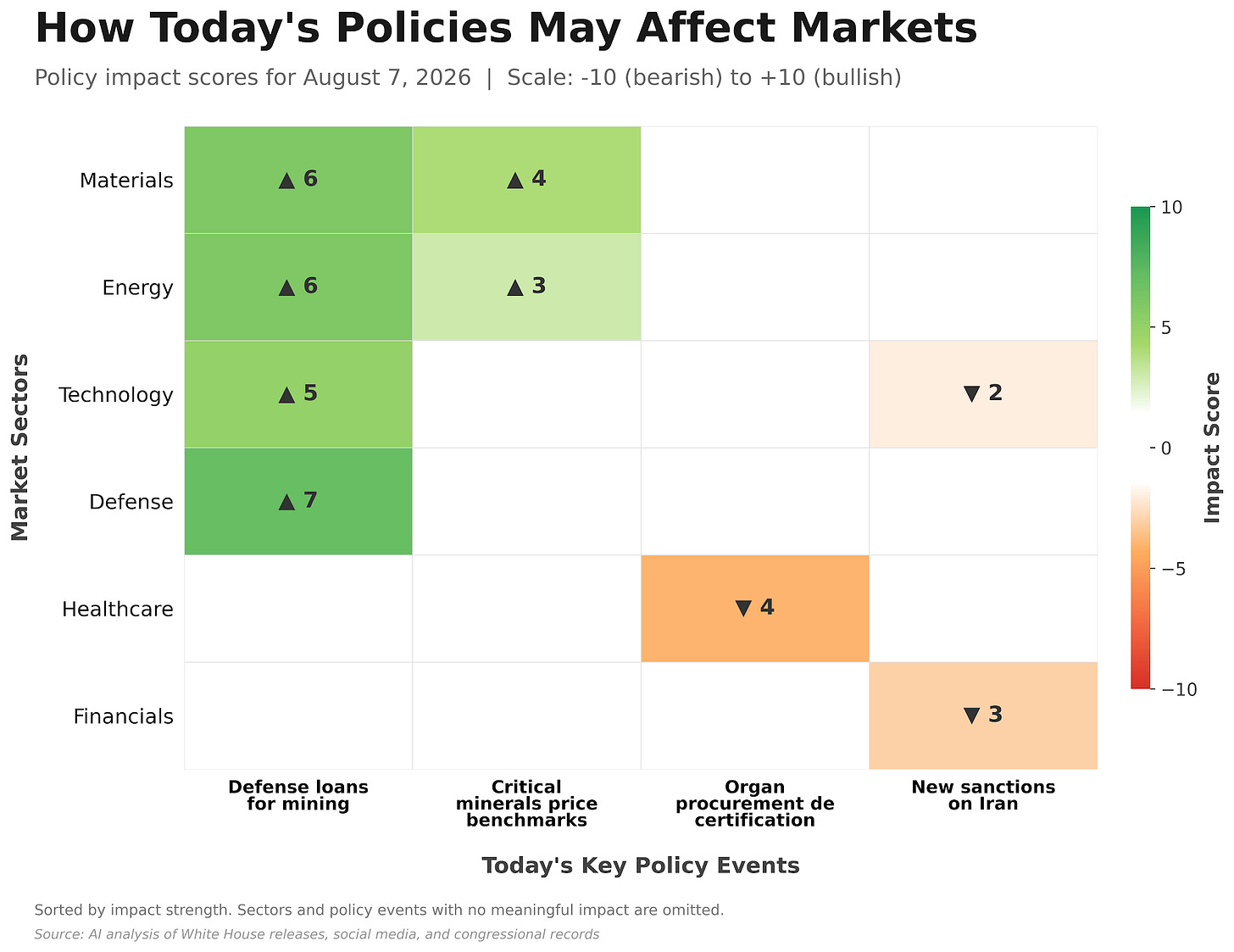
Each cell shows an estimated impact score on a fixed scale of -10 to +10, reflecting how today’s policy developments may affect each market sector. Positive scores (green, ▲) suggest bullish impact; negative scores (red, ▼) suggest bearish pressure. Rows and columns are sorted by impact strength, and sectors and policy events with no meaningful impact are omitted. The heatmap, the analysis below, and the Impact on Market themes above are produced from a single unified analysis: the heatmap visualizes the magnitudes, while the text explains the causal reasoning behind them.
The administration is aggressively utilizing the Department of War to reshape industrial supply chains through targeted financial interventions. By deploying billions in conditional loans to domestic battery and magnet producers, the government aims to force an onshoring of critical inputs for defense and tech sectors. This move seeks to reduce reliance on foreign-dominated markets, directly boosting capital flows into domestic Materials and Energy firms. These efforts are complemented by the endorsement of new mineral pricing benchmarks, intended to facilitate market-based stability and long-term investment. Simultaneously, the Treasury is tightening control over financial plumbing by sanctioning digital asset exchanges tied to Iran. These actions effectively increase the risk premium for international digital financial networks while creating a clear state-directed mandate for domestic manufacturing. Healthcare volatility persists as HHS signals a more punitive regulatory environment for medical service providers. The decertification of regional organ procurement organizations underscores a shift toward strictly enforced performance accountability. While proponents describe these mining investments as “restoring America’s... economic security,” critics in opposition-led states suggest that aggressive federal oversight and the rollback of certain federal benefits create “harmful” obstacles for service delivery and state-level administration. The combination of industrial subsidies and restrictive sanctions signals a broader pivot toward economic nationalism in both energy and finance.