Timeline
Every post and feed across this instance
-
13 Sentinels: Aegis Rim : comment décider lorsque la crise est peut-être une simulation ?
Une simulation peut éclairer le réel. Elle devient dangereuse lorsqu’elle cesse d’être un instrument et commence à définir les seules options que les décideurs sont encore capables de voir.

Treize récits, aucune vue d’ensemble
Le dispositif narratif de 13 Sentinels repose sur une frustration méthodique. Chaque personnage sait quelque chose que les autres ignorent ; chacun interprète les mêmes événements depuis une position différente ; certaines informations exactes conduisent pourtant à une conclusion fausse parce qu’elles sont replacées dans la mauvaise chronologie. Le joueur découvre que l’erreur ne vient pas toujours d’une donnée incorrecte. Elle peut naître de l’assemblage.
Les centres opérationnels connaissent cette difficulté. Les capteurs, les journaux, les rapports humains et les outils de renseignement produisent des fragments cohérents dans leur propre domaine. La panne apparaît lorsqu’une vue synthétique les relie trop vite. Une corrélation devient causalité ; un horodatage mal aligné inverse l’ordre des événements ; deux identités techniques sont confondues ; le tableau de situation paraît complet alors qu’il résulte d’une erreur de fusion.
La première règle de décision est donc de conserver la provenance des fragments. Une information utile doit rester liée à sa source, à son heure, à son niveau de confiance et aux transformations qu’elle a subies. Sans cette mémoire, la synthèse devient impossible à contester. L’organisation ne voit plus des éléments qu’elle pourrait recomposer, mais une histoire déjà écrite par son propre outil.
Le modèle n’est pas le monde
Les Sentinelles donnent aux protagonistes une puissance immense, mais elles ne leur offrent jamais une compréhension totale. Les cartes tactiques simplifient la ville, réduisent les menaces à des symboles et transforment le combat en décisions visibles. Cette abstraction est nécessaire. Aucun opérateur ne pourrait agir s’il devait percevoir simultanément tous les détails du terrain. Mais ce qui permet de décider peut aussi masquer ce qui ne rentre pas dans le modèle.
Un jumeau numérique, une simulation ou un système d’aide à la décision fonctionne de la même manière. Il sélectionne des variables, établit des relations, estime des conséquences et laisse de côté le reste. Sa précision ne dépend pas seulement de la qualité du calcul, mais de la pertinence de cette sélection. Un modèle peut être mathématiquement exact et opérationnellement trompeur s’il ignore la variable qui devient décisive pendant la crise.
La bonne question n’est donc pas : le modèle est-il vrai ? Il faut demander : pour quelle décision, dans quelles limites et à partir de quelles hypothèses reste-t-il utile ? Cette formulation empêche l’outil de devenir un oracle. Elle rappelle que la représentation est une construction temporaire, destinée à éclairer l’action, et non une version supérieure du monde à laquelle le monde devrait se conformer.
Le problème s’accentue avec les jumeaux numériques synchronisés en continu. Leur proximité avec le système réel crée une impression de transparence : ce qui apparaît sur l’écran semble être le monde lui-même. Pourtant, chaque synchronisation possède une latence, chaque capteur une zone aveugle et chaque modèle une granularité. La précision graphique peut masquer une incertitude structurelle. Il faut donc afficher les limites du modèle avec autant de soin que ses résultats.
Attaquer la simulation plutôt que le système réel
Un adversaire n’a pas toujours besoin de détruire l’infrastructure. Il peut chercher à compromettre le modèle qui commande sa défense. De faux signaux déplacent les ressources ; des données de capteurs modifiées créent une menace imaginaire ; un scénario d’entraînement introduit des hypothèses biaisées ; un jumeau numérique sous-estime une dépendance. L’organisation agit alors avec discipline, rapidité et précision, mais dans la mauvaise direction.
Cette attaque est particulièrement attractive parce qu’elle exploite la confiance accordée à l’outil. Une panne visible déclenche le doute. Une simulation apparemment cohérente rassure. Plus l’interface est claire, plus l’utilisateur peut oublier que les données ont une origine, que le modèle possède une version et que ses paramètres ont été choisis par quelqu’un. L’élégance de la représentation devient une surface d’attaque cognitive.
La sécurité doit donc couvrir toute la chaîne : capteurs, transport, stockage, paramètres, bibliothèques de scénarios, moteur de calcul et restitution. Il faut signer les données, contrôler les versions, séparer les environnements, surveiller les dérives et pouvoir rejouer une décision avec un état antérieur. Protéger la simulation signifie protéger la manière dont elle produit une conclusion, pas seulement le serveur qui l’héberge.
Cette chaîne comprend aussi les composants acquis à l’extérieur. Un modèle préentraîné, une bibliothèque de calcul, un jeu de données ou une mise à jour peuvent introduire une hypothèse invisible dans un environnement pourtant maîtrisé. La nomenclature logicielle ne suffit pas : il faut connaître la provenance des modèles, leurs conditions d’entraînement, les tests qui ont précédé leur intégration et les situations pour lesquelles leurs résultats ne doivent jamais être utilisés seuls.
La donnée d’origine est un actif critique
Dans 13 Sentinels, la mémoire n’est jamais un simple souvenir. Elle est une donnée opérationnelle : elle oriente les alliances, révèle une identité, déclenche une action ou masque une répétition. Lorsqu’elle est incomplète, réécrite ou attribuée à la mauvaise personne, tout le système de décision se déforme. La crise ne vient pas seulement de ce qui a été oublié, mais de ce qui a été conservé sous une forme trompeuse.
Les infrastructures numériques accumulent elles aussi des données dites de référence : configurations, plans, historiques, modèles de comportement, listes d’actifs et relations de dépendance. Ces éléments paraissent moins urgents que les flux en temps réel. Pourtant, une donnée instantanée n’a de sens qu’en comparaison avec cette mémoire. Si la référence est compromise, l’anomalie devient normale et le comportement légitime paraît hostile.
La gouvernance de ces données doit donc être aussi rigoureuse que celle des systèmes de production. Origine, responsable, fréquence de mise à jour, contrôles de cohérence, copies indépendantes et procédures de restauration doivent être explicites. Une organisation qui ne sait pas d’où vient son état de référence ne possède pas un modèle : elle possède une croyance automatisée.
La cohérence temporelle mérite une attention particulière. Deux données exactes peuvent produire une image fausse si elles correspondent à des instants différents. Un plan ancien est comparé à une télémétrie récente, une identité révoquée demeure dans une copie locale, une dépendance supprimée continue d’influencer le calcul. Le système doit donc conserver non seulement la valeur, mais la période pendant laquelle cette valeur pouvait légitimement décrire le réel.
Le modèle devient dangereux lorsqu’il ne se contente plus d’éclairer la décision, mais décide silencieusement quelles réalités ont encore le droit d’être observées.
Le scénario peut capturer le décideur
Le joueur de 13 Sentinels apprend progressivement à reconnaître les motifs de la science-fiction : voyage temporel, invasion, boucle, simulation, copie, mémoire artificielle. Cette culture l’aide à formuler des hypothèses. Elle peut aussi l’enfermer. Dès qu’un scénario semble familier, chaque nouvel indice est interprété pour le confirmer. Le modèle mental devient plus puissant que les faits qui devraient le corriger.
Les organisations connaissent cette capture. Elles préparent des scénarios d’attaque, de panne ou de catastrophe afin d’agir plus vite. L’exercice est indispensable, mais il crée un risque : attendre que la crise réelle ressemble à celle qui a été répétée. L’équipe reconnaît les signes appris, applique la procédure et néglige l’événement qui ne correspond pas au récit. L’adversaire peut même exploiter cette préparation en produisant délibérément les symptômes attendus.
Un bon scénario doit donc contenir sa propre contestation. Quels indices prouveraient que notre hypothèse est fausse ? Quelle observation indépendante manque ? À quel moment devons-nous abandonner le plan initial ? Qui est chargé de défendre l’interprétation opposée ? La préparation ne doit pas seulement accélérer l’action. Elle doit accélérer la découverte du moment où l’action préparée n’est plus la bonne.
Plusieurs modèles valent mieux qu’un oracle
Face à une situation complexe, la tentation consiste à concentrer les données dans un modèle unique, plus complet et plus puissant. Cette centralisation facilite la coordination, mais elle crée une dépendance épistémique : si le modèle se trompe, tout le monde se trompe de la même manière. La cohérence apparente remplace la diversité des observations qui permettrait de détecter l’erreur.
Une architecture résiliente conserve plusieurs représentations. Un modèle rapide estime l’urgence ; un autre explore les conséquences de long terme ; une équipe humaine travaille à partir de données brutes ; une source externe vérifie un indicateur critique. Ces vues ne doivent pas fusionner immédiatement. Leur désaccord est une information. Il révèle les hypothèses sensibles, les données manquantes ou les zones où l’adversaire pourrait agir.
Cette pluralité a un coût. Elle ralentit certaines décisions et produit des débats au moment où l’on préférerait une réponse nette. Mais la vitesse d’une conclusion fausse n’est pas une performance. L’objectif n’est pas d’éliminer l’incertitude ; il est de la rendre visible, localisée et gouvernable. Une organisation robuste sait précisément sur quel désaccord elle choisit malgré tout d’agir.
Le désaccord doit être organisé avant l’urgence. Une équipe rouge peut tenter d’empoisonner les entrées, une seconde équipe reconstruire la situation sans utiliser le modèle principal, tandis qu’un arbitre compare les décisions produites. L’exercice ne cherche pas à humilier l’outil, mais à identifier les conditions dans lesquelles il devient trompeur. Ce qui compte n’est pas seulement son taux moyen de réussite, mais la forme précise de ses erreurs dans les situations où elles coûteraient le plus cher.
Un human-machine threatcasting pour tester la décision
Le threatcasting consiste à décrire un futur menaçant, puis à remonter vers les décisions et dépendances qui pourraient le rendre possible. Appliqué aux relations entre humains et machines, il ne demande pas seulement ce qu’un système automatique pourrait faire de mal. Il examine comment une organisation pourrait progressivement lui abandonner la définition du problème, la sélection des preuves et la formulation des options.
Imaginons un centre de crise où le jumeau numérique signale une attaque imminente. Les données sont cohérentes, les simulations convergent et les recommandations correspondent aux doctrines. Pourtant, l’ensemble a été construit à partir d’une référence empoisonnée plusieurs mois plus tôt. Quelles décisions ont rendu cette situation possible ? Qui a validé la source ? Pourquoi aucune vue indépendante n’a subsisté ? À quel moment l’outil est-il devenu impossible à contredire ?
L’exercice permet de transformer la fiction en exigences concrètes : journaliser les hypothèses, conserver des sources hors modèle, organiser la contradiction, limiter l’autonomie, tester les modes manuels et définir l’autorité capable d’interrompre une recommandation automatique. La question n’est pas de choisir entre l’humain et la machine. Elle est de construire une relation où chacun peut révéler l’erreur de l’autre.
Conserver une sortie hors simulation
13 Sentinels conduit le joueur vers une vérité qui ne supprime pas la fragilité des personnages. Comprendre le système ne suffit pas ; il faut encore agir depuis l’intérieur, avec des informations incomplètes et des capacités limitées. Cette tension constitue la meilleure leçon du jeu pour la cyber-résilience. Aucun modèle, même exact, ne délivre l’organisation de la responsabilité de choisir.
Une sortie hors simulation ne signifie pas abandonner les outils. Elle signifie conserver un accès aux données brutes, des procédures manuelles, des chaînes de commandement explicites et des personnes capables de formuler une hypothèse sans l’interface. Elle suppose aussi de pouvoir isoler le modèle, revenir à une version antérieure et poursuivre une mission lorsque les recommandations deviennent indisponibles ou suspectes.
La simulation protège lorsqu’elle élargit ce que les décideurs peuvent envisager. Elle menace lorsqu’elle rétrécit le réel aux seules catégories qu’elle sait calculer. Les Sentinelles ne gagnent pas parce qu’elles voient tout, mais parce que plusieurs fragments finissent par être confrontés sans qu’aucun puisse prétendre constituer seul le monde. La sécurité commence exactement là : au moment où le modèle redevient une hypothèse et où l’action demeure réversible.
Cette réversibilité doit être testée matériellement. Il faut interrompre volontairement le flux de données, rendre indisponible le tableau principal, injecter une contradiction et observer si l’organisation sait encore décider. Un mode manuel qui n’a jamais été exercé n’est pas une capacité ; c’est une note dans un plan. La sortie hors simulation n’existe que si des personnes, des procédures et des moyens indépendants peuvent réellement la franchir.
Repères documentaires
1. Vanillaware, 13 Sentinels: Aegis Rim, Atlus, 2019 ; direction et scénario : George Kamitani. [source]
2. NIST, Artificial Intelligence Risk Management Framework 1.0, 2023. [source]
3. NIST, Developing Cyber-Resilient Systems, SP 800-160, vol. 2, révision 1, 2021. [source]
4. NIST, Security and Privacy Controls for Information Systems and Organizations, SP 800-53, révision 5. [source]
5. CISA, Cybersecurity Tabletop Exercise Packages. [source]
6. Brian David Johnson et Natalie Vanatta, Threatcasting, Springer, 2022 ; NATO STO, ressources sur la modélisation et la simulation. [source]
The post 13 Sentinels: Aegis Rim : comment décider lorsque la crise est peut-être une simulation ? appeared first on INCYBER NEWS.
-
Violent and abusive language is seeping into our political debate. We have Donald Trump to blame | Paul Daley
Liberal MP Angie Bell’s rhetoric and Warren Mundine’s joke about murder at CPAC are part of a dangerous trend
Get our new political email, free app or daily news podcast
At some point, though it’s hard to pinpoint precisely when, the language of supposedly civilised public discourse started to become imbued with a dark malevolence.
Given the long history of American influence on pretty much all things culturally Australian, it seems inevitable that Maga’s violent and abusive rhetoric would make its way into our politics. And it’s pretty fair to say the current US president has led the western populist way when it comes to saying out loud the ugly and violent things that might once have remained internal.
Continue reading... -
Ukraine says new Starlink restrictions disrupt military as it reels from intel gaps and Trump clash
Ukraine has accused Elon Musk's SpaceX of undermining its ability to defend itself by limiting Starlink internet services, as the country reeled from intense Russian ballistic missile attacks that it said came without the usual advance warning from allies. Elon Musk put the responsibility for the restrictions on Trump's shoulders in a social media post, saying the military version of Starlink, called Starshield, is owned and controlled by the U.S. government. -
Volodymyr Zelenskyy feels ‘betrayed’ by Donald Trump over Starlink access
Ukrainian president accused US president of picking the other side after four years of war
Volodymyr Zelenskyy has said he feels personally betrayed by Donald Trump after it emerged that Ukraine’s military has had its access to Elon Musk’s Starlink satellite squeezed, raising doubts about long-term US support for Kyiv.
The Ukrainian president, on a visit to London, accused Trump of picking the other side after more than four years of war, risking a breakdown in relations already strained by the US agreeing to buy diesel from Moscow.
Continue reading... -
Israel blocks construction of key Gaza base created by Trump peace board
Exclusive: Israel has not permitted US-led project to house 150 international troops to move forward
Israel is refusing to allow a key military outpost project for Donald Trump’s Board of Peace to proceed in Gaza, the Guardian has learned.
In early August, the Board of Peace, the international organization authorized in 2025 by the UN and chaired by the US president, issued its first construction contract for Gaza: Louisiana-based Arkel International would construct a military outpost for 150 international troops that would be the vanguard of an international stabilization force.
Continue reading... -
Derrière l’attaque d’un collège à Aubagne, la menace de la «True Crime Community»
Présenté à des juges d’instruction pour tentative d’assassinat, le collégien qui a fait feu dans son établissement est soupçonné d’appartenir à la True Crime Community, un réseau virtuel de jeunes fascinés par les tueries de masse. Un phénomène qui inquiète la justice et la DGSI. -
Révolte de la jeunesse: la fête comme arme destructrice d’un pouvoir tout gris
Depuis le début du mouvement lycéen, la bulle médiatico-politique concentre son discours sur les «violences». Pourtant, cette mobilisation historique est surtout marquée par la fête et la joie comme acte de politisation et de participation d’une jeunesse qui rejette l’horizon qu’on lui impose. Peu importe l’issue du mouvement, le pouvoir a déjà perdu. -
[Nantes] Manif étudiantes/lycéennes
Rendez vous ce jeudi au miroir d’eau !

-
Avant le 17 octobre, la carte des lieux de pouvoir à Paris
Avant le 17 octobre, la carte des lieux de pouvoir à Paris publiée par le Monde Diplomatique !
Alors qu’on parle de blocage et de manifestations, on n’a pas toujours en tête où se trouvent les lieux de pouvoir dans la région parisienne. Une cartographie d’Agnès Stienne publiée initialement en avril 2012 dans le Monde Diplomatique apporte ici des éléments partiels de réponse. Il est temps de mettre la cartographie au service de la guerre sociale !

D’ordinaire, les membres du microcosme parisien portent en sautoir leur appartenance à l’« élite ». Ils garnissent avec délice les notices biographiques du Who’s who ou du Bottin mondain, accordent des entretiens à la presse people, paradent dans les soirées. Tout cela est assumé, affiché, public. Mais il aura suffi que les « gilets jaunes » déplacent le terrain protestataire de quelques kilomètres vers l’ouest de la capitale pour que tout change. Et que dirigeants, possédants et prescripteurs se sentent physiquement menacés.
monde-diplomatique.fr/2019/02/A/59572
-
[Mayday] # 260 Ardeurs face au labeur
Emission du 14 octobre 2026.Bloquer les blocus, un travailleur et un spray par LuigiLa jeunesse en haut lien, sketch de TagoDes jeunes, des travailleurs, un reportage dans la manif par LuigiNos rapports au travail, récit de Luigi, Kim, Mouche et Bas ReliefLes maternittentes, rencontre par NaméLa sécu, une bataille actuelle, un billet de TagoLe mouvement de la jeunesse, un reportage dans les manifs bruxelloise par JijiMUSIQUESNoir Boy georges – les rapports de productionGwendoline – AudiRTTEtienne de Crecy – work Image : manif lyonnaise du 13 octobre 2026 chipée sur Rébellyon
-
L’extrême droite, bras armé du pouvoir dans les universités
Plusieurs attaques fascistes dans les facs en France et un jeune frappé à coups de pied dans la tête à Lille : indifférence médiatique
L’article L’extrême droite, bras armé du pouvoir dans les universités est apparu en premier sur Contre Attaque.
-
This Week In The Big Picture
If you’ve been considering upgrading, we would appreciate your support more than ever right now. As we get closer to the election, independent media matters more than ever and paid support from our readers enables us to continue our work. For just $6/month or $50/year (as low as 13 cents a day), you can help us continue our mission of taking back our democracy.
We are now just 20 days from Election Day, and voters in 24 states are already voting early, with even more to begin later this week. From the available data, Democrats are currently outperforming their early vote numbers, not just from four years ago, but also from the 2024 general election.
With Donald Trump threatening mail-in ballot and Election Day election interference, many Democrats are making sure to vote as early as possible. It’s why Indivisible’s final pre-election No Kings rally this coming Saturday will be focused on Early Voting.
In tomorrow’s piece, digs into the numbers. Where are we seeing the biggest surges in the early vote, which voters are turning out early, and what might that tell us about the top tier elections in those states?
And in case you missed it yesterday, dug into Trump’s latest sketchy deal with Putin to sell 300,000 tons of diesel fuel to the global market, completely waiving our own sanctions against Russia. While Trump touts the deal as relief for our truckers and farmers ahead of the election, the amount of actual fuel—and the actual impact on diesel prices—expected to result from this deal is laughable.
-
[Nantes] AG InterFacs
Si nous voulons que le mouvement dure, il est nécessaire que nous nous coordonnions à l’échelle des différents campus de Nantes !
Pour discuter, créer du lien et organiser la mobilisation, rejoignons-nous en Assemblée Générale InterFac, réunissant les différentes écoles du supérieur mobilisés, vendredi 16 à 12h sous les nefs des machines de l’iles.

OBJECTIFS DISCUTER DE :
– D’un bilan de ces premières semaines de mobilisation sur nos campus.
– Des perspectives communes autour de la date du17/10 et de ces suites.
– De la nécessité de s’adresser au monde du travail.
– Mais aussi des préoccupations propres à chaque campus, dont nous pourrions débattre.
-
Budget 2027 : l’immigration est-elle un « poids » pour l’économie française ?

Source :Compte Facebook, le 11 octobre 2026
Etiqe :à nuancer
Contenu :
« J’ai compris que ce gouvernement voulait faire les poches aux Français », peste Pascal Praud, le présentateur de la chaîne CNews, dans un édito le 8 septembre dernier. L’estocade ciblait alors le ministre de l’Économie, Roland Lescure, qui venait d’affirmer, la veille, que les retraités les plus aisés seraient mis à contribution pour résorber le déficit budgétaire du pays.
Dénonçant des propos « choquants » et « indécents », l’animateur s’offusque que des « efforts » soient demandés aux Français sans qu’un seul mot ne soit prononcé « sur les prestations sociales accordées aux étrangers ». Pourtant, ces dépenses publiques à destination des immigrés représenteraient « un coût net de 40 milliards d’euros », assure le présentateur, citant des « calculs réalisés par l’Observatoire de l’immigration et de la démographie ».
Alors que le Parlement se lance dans l’examen du budget 2027, cette statistique refait surface sur les réseaux sociaux pour justifier des coupes dans les dépenses dont bénéficient les immigrés et ainsi résorber le déficit public.
De quoi donner du grain à moudre aux propositions, très similaires, de la droite et de l’extrême droite dans un contexte de campagne présidentielle. Le Rassemblement national compte ainsi réaliser 15 milliards d’euros de coupes pour alléger « le poids [de l’immigration] sur l’économie », a expliqué le député RN Jean-Philippe Tanguy, le 11 octobre sur BFM TV. Le candidat Horizons à l’élection présidentielle, Edouard Philippe, propose, lui, de « diviser par deux » l’immigration légale afin de réduire la « saturation » d’« un certain nombre de nos services publics ».
Alors, l’immigration coûte-t-elle réellement plusieurs dizaines de milliards d’euros par an à la France ? Et peut-on dire qu’elle représente un vrai poids pour l’économie ? Eléments de réponse.
Un « think tank » orienté très à droite
Tout d’abord, comment le chiffre de 40 milliards d’euros s’est-il retrouvé dans le débat public ? Depuis 2020, l’Observatoire de l’immigration et de la démographie (OID) estime qu’il s’agit du coût de l’immigration pour l’État français. « L’immigration coûte chaque année entre 35 et 40 milliards d’euros aux finances publiques », assurait encore le 23 mars 2024, le fondateur de l’OID, Nicolas Pouvreau-Monti, dans les colonnes du Point. Un chiffre repris quatre jours plus tard par le président du Rassemblement national, Jordan Bardella, sur le plateau de C à vous, sur France 5.
Mais les analyses de l’OID doivent être prises avec précaution. En effet, s’il assure proposer « une vision rationnelle et dépassionnée » des débats sur l’immigration, cet organisme est directement financé par le fonds Périclès du milliardaire d’extrême droite Pierre-Edouard Stérin, qui s’est déclaré favorable à la « remigration », un concept dérivé de la théorie raciste du « grand remplacement ». Il compte également parmi ses cadres diverses personnalités proches de la droite radicale française, comme Xavier Driencourt, le président du comité stratégique du magazine identitaire Frontières. Ses conclusions doivent donc faire l’objet d’une analyse méthodologique.
Pour calculer le coût de l’immigration, l’OID assure s’appuyer sur la littérature disponible, deux études en particulier : « L’impact budgétaire de 30 ans d’immigration en France », publiée en 2018 par le CEPII, un organe de recherche en économie internationale rattaché au Premier ministre, et un travail annuel de l’Organisation de coopération et de développement économiques (OCDE), intitulé « Perspectives des migrations internationales » et daté de 2021. Pourtant, aucune de ces recherches ne fait apparaître la donnée brandie par l’OID.
Un chiffre introuvable
Elle a d’ailleurs été catégoriquement démentie par les auteurs des deux études auprès de l’Agence France Presse (AFP), qui a déjà passé au crible les affirmations de l’observatoire. Résultat : la méthode de calcul de l’OID accumule les critiques.
L’OID ne retient de ces deux études que deux pourcentages, censés illustrer « le coût annuel net de l’immigration » : 1,41 % du PIB selon l’OCDE et 1,64 % selon le CEPII. Appliqués au PIB français de 2019 (2 425 milliards d’euros selon l’INSEE), année de référence que revendique l’OID, ces taux donnent un coût compris entre 34,2 et 39,8 milliards d’euros. Une méthode « hasardeuse », explique l’AFP.
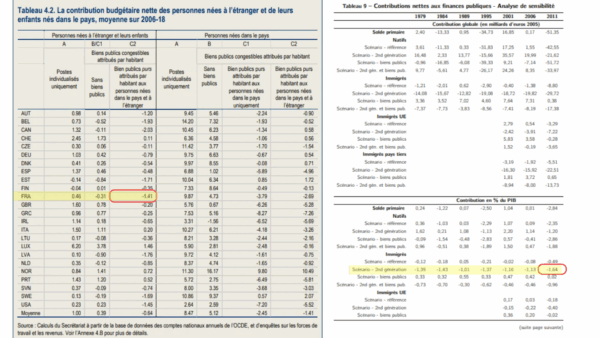
À gauche, le tableau de l’étude de l’OCDE d’où l’OID tire sa donnée (1,41 %). À droite, le tableau de l’étude du CEPII, d’où l’OID tire sa donnée (1,64 %).
Avant toute chose, ces deux pourcentages ne correspondent pas à des valeurs de même nature. Le résultat de 1,41 % avancé par l’OCDE est une moyenne calculée entre 2006 et 2018, tandis que la donnée du CEPII est une valeur fixe pour l’année 2011. Le think tank mobilise ainsi, dans un cas, une moyenne sur douze ans, et dans l’autre, un point annuel isolé qu’il compare ensuite tous les deux à une valeur du PIB d’une année ultérieure (2019). Difficile, dès lors, d’établir une forme de convergence entre ces différents éléments.
Autre lacune : le chiffre de 1,41 % correspond seulement à l’une des méthodes de calcul de l’OCDE, au sein de laquelle l’organisme inclut le coût des « biens publics purs » au coût des immigrés. Or, un bien public pur est un service financé par l’État dont le coût ne change pas en fonction du nombre de personnes qui en bénéficient. Sont concernées, entre autres, les dépenses militaires, mais aussi celles relatives à la dette publique, qui seraient financées malgré l’immigration.
Qui plus est, dans le scénario de l’OCDE retenu par l’OID, le calcul inclut également les dépenses liées aux enfants nés sur le territoire de parents immigrés, jusqu’à 15 ans. Or, les dépenses d’éducation, concentrées sur le jeune âge, ainsi que les moindres recettes d’un individu inactif, font pencher nettement la balance.
Quel est vraiment le coût de l’immigration ?
Autrement dit, l’OID retient des scénarios extrêmes qui ne reflètent pas l’équilibre des conclusions des deux études exploitées. « La contribution de l’immigration aux finances publiques françaises, entre 1979 et 2011, est globalement négative, mais très faible, contenue en deçà de 0,5 % du PIB », explique ainsi le CEPII, bien loin du chiffre de 1,64 % choisi par l’OID.
Même son de cloche du côté de l’OCDE, qui indique dans son étude que « dans les 25 pays de l’OCDE [dont la France] pour lesquels des données sont disponibles, en moyenne au cours de la période 2006-18, la contribution des immigrés sous la forme d’impôts et de cotisations a été supérieure aux dépenses publiques consacrées à leur protection sociale, leur santé et leur éducation ». Pour la France, l’impact varie selon les conventions de calcul entre -0,85 % et +1 % du PIB, hors dépenses liées aux enfants d’immigrés.
Ainsi, si l’on considère l’ensemble des résultats avancés dans les études citées par l’OID, et pas seulement les plus négatives sur le plan budgétaire, le coût de l’immigration serait donc plutôt un jeu à somme quasi nulle.
L’effet positif de l’immigration sur les recettes publiques pourrait même être « plus important que son effet sur les dépenses », d’après Ekram Boubtane, chercheuse associée à l’École d’économie de Paris, en 2024 dans un article publié par l’Institut Montaigne, généralement classé au centre-droit de l’échiquier politique.
« L’immigration n’est pas un fardeau pour les finances publiques ; sa suppression ne pourrait en aucune manière contribuer à la résolution de la crise de la dette actuelle », remarquait, la même année, Xavier Chojnicki, l’un des auteurs de l’étude du CEPII citée par l’OID, dans un article pour la revue scientifique Regards.
Autrement dit, le coût de l’immigration en France n’a jamais été officiellement estimé à 40 milliards d’euros, et plusieurs spécialistes du sujet s’accordent pour tempérer les discours qui dénonceraient le « poids » qu’elle ferait peser sur l’économie.
Auteurs :
Auteur : Jean-Baptiste Breen, journaliste
Relecteur : Nicolas Turcev, journaliste
Liens d’intérêts ou fonctions politiques déclarés des intervenants à l’article : aucun
Secrétariat de rédaction : Nicolas Turcev, journaliste
L’article Budget 2027 : l’immigration est-elle un « poids » pour l’économie française ? est apparu en premier sur Les Surligneurs.
-
MAGA Built The Censorship Machine It Spent Years Falsely Accusing Democrats Of Building
This is not a unique or new observation, but so many MAGA attacks on others are projection, claiming that Democrats were doing the very things that MAGA always knew they would do if they were in charge. We’ve certainly spent plenty of time talking about Donald Trump’s myriad and non-stop attacks on free speech, and just recently I wrote about how Trump has turned his FCC into the very “ministry of truth” that Fox News falsely claimed Biden had created. But two recent articles show how MAGA has gone all in on doing the two things it most loudly (and falsely) accused the other side of: suppressing free speech on campus, and running a “censorship industrial complex” to coerce private companies into silencing speech it doesn’t like.
On the “free speech on campus” thing, we already know that the Trump admin has disappeared students for their speech. But Adam Serwer, over at The Atlantic, has an incredible story on how MAGA officials in Texas have effectively silenced all kinds of speech across universities in Texas.
At Texas Tech, medical students no longer learn about racial disparities in medical care. Faculty at the university’s medical center in Lubbock were advised to “refrain from treating transgender patients, for any medical condition, if a medical student was present,” according to a lawsuit filed by the American Association of University Professors. (When asked for comment, a spokesperson said that the university’s “written guidance is publicly available and expressly protects instruction necessary for licensure and patient care.”) According to the same lawsuit, the censorship bot—officially known as the Course Content Review Process—ordered a Tech philosophy professor to remove Plato’s Republic from a syllabus because “it references Plato’s beliefs concerning gender roles and homosexuality.”
Professors in the Texas A&M system have had to strip their syllabi too. According to an ACLU lawsuit, last January, Aaron George, a professor at Tarleton State University, was told by administrators to remove A Gay Manifesto, a Stonewall-era LGBTQ-rights pamphlet, and White Flight, a history of urban segregation, from his American-political-history course. After a student complained that a different class the professor taught violated university policy, George was informed by administrators that it would be canceled if he did not make “necessary” (but unspecified) changes. He cut a reference in the course description to the significance of the Fourteenth Amendment for LGBTQ rights, and the class was allowed to proceed.
The University of Texas at Austin, the flagship school of the UT system, announced last month that it was eliminating majors in Africana studies, Mexican American and Latino studies, women’s and gender studies, and race and migration studies. More than 100 courses have been flagged for removal from the core curriculum, primarily ones relating to slavery, race, gender, sexuality, and the environment. Consolidating majors isn’t necessarily nefarious, nor is rethinking a core curriculum (a central group of courses from which students must take a certain number to graduate). But these changes are happening, Lauren Gutterman, an American studies professor at UT, told me, “entirely because of the political context.”
Where are all the folks who spent years screaming about “academic freedom” and insisting that colleges were censoring conservative speech? Remember how Bari Weiss and Joe Lonsdale created their “University of Austin” because (they falsely claimed) there were no universities where people could speak freely — and then they fired someone for suggesting that there might be some value in thinking about the importance of diversity.
Hilariously, Texas Governor Greg Abbott had signed a bill back in 2019 guaranteeing “free speech on campus.” But as Serwer’s piece details, these days there are all sorts of banned topics on Texas college campuses, and basically none of free speech grifters who spent years crying crocodile tears over supposed attacks on “campus speech” seem to have anything to say about it.
Even more ridiculous, Serwer details how Texas Tech is using AI to scan syllabi for wrongthink, with predictably stupid results:
Alan Barenberg, a history professor who specializes in the Soviet Union, was told to remove readings by the Princeton historian Joan Scott and the French philosopher Michel Foucault from his Ph.D.-level historiography class, after they were flagged by the AI—whose assessments he described to me as “completely inaccurate.” It also seemed to have mixed his course up with a different one. The texts were part of a unit of the class related to how treatment of gender in historical research has changed over time. “These things have been taught in classes for a long time,” Barenberg told me. The material is controversial, he said, only “in the eyes of a few people who aren’t even actually on campus.”
“The fact that the system AI doesn’t work, that it makes inaccurate pronouncements—that’s a feature, not a bug. They don’t care if it’s accurate or not. They just want to be able to say, Look, we’re making sure that your children are not being exposed to these horrible ideas from these radical professors,” Barenberg said. “A key part of how authoritarian systems often work is that, through the vagueness and sending up signals and vibes, they’re essentially saying, You know what not to do, but being deliberately vague about it.”
Although the AI is now reviewing only some courses, the university could extend the process to more. For now, professors are the ones responsible for volunteering whether their own materials may be considered controversial. Many, unsure of what might trigger the bot, told me that they had private conversations with administrators who told them to simply self-censor and remove materials from their courses in advance, so as not to draw the wrath of leadership or lawmakers.
So the “free speech on campus” crowd is now actively censoring speech on campus because a computer program told them it was woke. What could go wrong?
Now, the other story: Anthony Fisher, at MS Now, is pointing out how Donald Trump has absolutely created the “censorship industrial complex” that a bunch of factually challenged “free speech” grifters insisted the Biden admin had built.
MAGA-adjacent journalists, one of whom now runs CBS News, have claimed there was a vast “censorship industrial complex” — run exclusively by Democrats, of course. In 2022, they peddled Elon Musk’s nothingburger “Twitter Files” as the free speech scandal of the century. It was, in fact, a fake controversy driven by politically motivated reasoning and faux-journalistic laziness, and none of them ever had the integrity to admit they were led by the nose by the world’s richest man or that they got the story completely wrong.
But the Trump Censorship Industrial Complex is very real. It is chilling speech in the media, academia and everyday life.
“Over the last two years, there’s been escalating threats against ABC,” Wilkinson said in court Tuesday. She added that the president “has control over vast regulatory powers that he’s willing to use against those he does not like” and “has put in place a chairman at the FCC who understands his marching orders and is not shy about saying so. These are blatant violations of the U.S. Constitution.”
You can follow the links there to get more details, but the most important detail is that when some individuals and two MAGA-run states sued the Biden admin over the supposed “censorship industrial complex,” it was two Trump-appointed Supreme Court Justices — Brett Kavanaugh and Amy Coney Barrett — who pointed out how wrong they were.
During oral arguments Kavanaugh practically laughed at the lawyer making these claims, pointing out that government officials merely pressing their side of the story with no associated threats or coercion happens every damn day in the government, and is not even remotely close to censorship. Then Coney Barrett wrote the decision of the court, noting the complete lack of evidence tying any government outreach to actual moderation decisions, and called the lower court judge’s factual findings “clearly erroneous.” That resulted in the case being sent back for lack of standing due to the fact that there was zero evidence presented of any coercive behavior.
So there was no Biden “censorship industrial complex,” but there absolutely is a Trump one. As Fisher notes:
The Trump administration’s juvenile bullying has already restricted The Associated Press’ White House access for more than a year over its refusal to call the Gulf of Mexico the Gulf of America. And those efforts have now bled over into MAGA Republican-dominated states, like Alabama, where a new law requires “all state and local entities and their employees” to refer to the body of water as the Gulf of America. That means public schools, colleges and even the state’s NPR affiliate have to abide by Trump’s embarrassing attempt at patriotic virtue signaling.
Carr has threatened broadcasters’ licenses for reporting accurately on Trump’s asinine and failing war on Iran. The administration is still in a legal battle with MS NOW, CNN and Politico, as it preposterously claims its ban on the three news organizations is a national security issue. And the administration has been siccing its secret police force on private citizens who’ve written social media posts criticizing Immigrations and Customs Enforcement’s brutal crackdown on immigrants — and U.S. citizens caught in their lawless dragnets.
And not a peep from those who falsely argued that it existed under Biden. How strange.
Once again, those complaints were all lies and projection. Richard Hanania, the far right commentator who spent years spreading hate and white supremacy online and now pretends to have turned against the very MAGA Trumpism he long supported, at least admitted clearly, back before Elon Musk took over Twitter, that right wingers like himself only scream about “censorship” because they want to do it themselves. This was in response to him getting banned from (again, pre-Elon) Twitter for violating its rules against hateful conduct. At the time, he said:
I don’t feel particularly oppressed by leftists. They give me a lot more free speech than I would give them if the tables were turned. If I owned Twitter, I wouldn’t let feminists, trans activists, or socialists post. Why should I? They’re wrong about everything and bad for society. Twitter is a company that is overwhelmingly liberal, and I’m actually impressed they let me get away with the things I’ve been saying for this long.
But that kind of honesty about how much MAGA authoritarians want to censor people while screaming about non-existent “censorship” from the other side is rare.
Still, it would be nice if everyone stopped pretending that Greg Abbott, Donald Trump, or Elon Musk ever stood for free speech at all. They all whined about free speech solely as a means to make sure that they were in charge of censoring those they disliked.
-
Soaring Energy Prices Push Inflation Higher
Higher energy prices drove up inflation in the United States in September, a warning shot to President Trump ahead of midterm elections that have centered primarily on affordability concerns. The uptick in consumer prices will also keep the Federal Reserve under pressure to raise interest rates again after last month's move. -
The Guardian view on Trump’s deal with Putin: grim and grubby, but not gamechanging | Editorial
President Zelenskyy’s allies must show the Russian president that American perfidy won’t alter the course of a war the Kremlin is losing
When Donald Trump pledged to end the war in Ukraine within 24 hours of re-entering the White House last year, no one with any depth of insight into the conflict believed him. But Mr Trump took his own words seriously enough to feel the lack of a ceasefire as an affront to his self-image as a master dealmaker. After a period when it seemed that Kyiv’s European allies had steered the US president away from pro‑Kremlin partisanship, he has reverted to the grotesque view that Ukrainian capitulation is a necessary precondition for peace.
These are the perilous circumstances in which President Volodymyr Zelenskyy met Andy Burnham on Wednesday in Downing Street. In recent days, the US president has called for a change of government in Ukraine. He claimed that a partial ceasefire had been agreed, while Russia escalated its bombardments. According to Mr Zelenskyy, the latest missile strikes have come without the intelligence warnings from the US that have, in the past, facilitated self-defence. There have been reports of Ukrainian soldiers losing access to the Starlink satellite network, controlled by Elon Musk, the US tech oligarch. This raises suspicion of coordinated pressure to tip the scales in Russia’s favour after many months when Mr Putin’s forces have failed to deliver significant advances and his country’s economy has been suffering from the effect of Ukrainian missile and drone counterstrikes.
Do you have an opinion on the issues raised in this article? If you would like to submit a response of up to 300 words by email to be considered for publication in our letters section, please click here.
Continue reading... -
Lycéens mutilés: la justice accélère, le ministre ne cède rien
Depuis le début de la mobilisation lycéenne, les autorités sont sommées de rendre des comptes sur les blessures les plus graves causées par la police. Certaines enquêtes ont vite avancé mais l’IGPN, aux effectifs réduits, croule sous les saisines. -
En Belgique aussi, la jeunesse se mobilise pour l’éducation
Plusieurs établissements d’enseignement secondaire de Belgique francophone ont été bloqués par les élèves. Ces jeunes dénoncent l’austérité qui frappe l’enseignement et la hausse du coût des études supérieures. Les points communs avec la France sont frappants. -
Après l’accord Trump-Poutine sur le gazole, l’Ukraine tente de ravaler sa colère
Très critique de l’accord entre Moscou et Washington, Volodymyr Zelensky ne veut pas perdre l’aide des États-Unis en matière de renseignement. L’Ukraine dit respecter le cessez-le-feu énergétique demandé par Donald Trump, contrairement à la Russie, qui a encore frappé trois centrales de Kyiv. -
«L’objectif d’Israël est de détruire l’agence de l’ONU pour les réfugiés palestiniens»
Depuis les massacres du 7-Octobre, l’agence des Nations unies pour les réfugiés palestiniens, l’Unrwa, subit une violente campagne de dénigrement. Philippe Lazzarini, qui raconte dans un livre les six ans passés à la diriger, est l’invité de «Mediapart». -
31/10 : Rassemblement contre la venue de knafo
-
05/12 : Pas de Canon français à Vannes !
Rendez-vous à 10h30 boulevard de la Résistance !
- Initiatives / Manifs et rassemblements, Canon français -
Container ship sinks near strait of Hormuz amid surge in Iranian attacks
Second vessel also reportedly sinking as rise in strikes suggests Iran trying to close waterway before US elections
A container ship has sunk near the strait of Hormuz and a second cargo vessel was reportedly sinking amid the sharpest rise in Iranian attacks on shipping since the start of the US-Israel war with Iran.
The increase in attacks suggests Iran is trying to fully close the strategic waterway in a deliberate attempt to frustrate Donald Trump’s efforts to bring down fuel prices before the US midterm elections on 3 November.
Continue reading... -
Samedi 17 octobre : le peuple lance la foudre
Et si ce samedi 17 octobre était enfin venu le temps de faire payer l'addition aux tyrans ?
L’article Samedi 17 octobre : le peuple lance la foudre est apparu en premier sur Contre Attaque.
-
Projection débat autour de la situation en Palestine
Quand ?
Le 22 octobre à 19h30Où ?
EDMP 8, impasse Crozatier, 75012, ParisLe groupe local Paris Nord Est de l'Union Communiste Libertaire vous invite à une projection-débat autour du film "Bye Bye Tibériade". La réalisatrice, Lina Soualem, retourne avec sa mère sur les traces des lieux disparus et des mémoires dispersées de quatre générations de femmes palestiniennes. A travers leur histoire c'est celle du peuple palestinien qui est conté en filigrane.
Alors qu'un mois d'actions contre l'armement israélien a été lancé le 1er octobre, cette projection sera l'occasion d'une discussion autour de la lutte du peuple palestinien et du génocide toujours en cours.
Rendez-vous à le jeudi 22 octobre à 19h30 à l'EDMP, 8, impasse Crozatier, Paris 12e ; projection à 20h suivie d'une discussion.
-
« Perfect Victims » : Le Monde et le certificat de bonne conduite exigé de la parole palestinienne
Dans sa recension de l’essai de Mohammed El-Kurd, intitulé « Perfect Victims », Christophe Ayad, du journal Le Monde, décrit les conditions auxquelles les Palestiniens doivent se plier pour être entendus en Occident. Puis il soumet l’auteur à ces mêmes… -
J’ai testé la conduite autonome de XPeng dans Paris, aussi bon que le Tesla FSD ?

À l'occasion du Mondial de l'Auto 2026, XPeng organise des expérimentations pour son système de conduite autonome baptisé NGP dans Paris. Numerama a pu l'expérimenter et le comparer au Tesla FSD.
-
Food et medical truck : la solidarité s’organise autour des lycéens mobilisés
Depuis le début de la mobilisation lycéenne, des collectifs de Seine-Saint-Denis s’organisent pour ravitailler les élèves mobilisés. Repas chauds, boissons et matériel de premiers secours : une centaine de bénévoles se relaient pour permettre aux jeunes de tenir leurs blocus. Une solidarité concrète, qui entend soutenir leur lutte sans se substituer à eux.
The post Food et medical truck : la solidarité s’organise autour des lycéens mobilisés appeared first on Bondy Blog.
-
L'Ukraine peut-elle encore compter sur Starlink ?
 Source : Le Grand Continent
 -
Désintox : « 3000 professeurs en remplacement », ou les bobards du ministre de l'éducation
 Source : Fakir
Payant
Source : Fakir
Payant -
Mont Blanc : le sommet a regagné près de deux mètres depuis 2023
 Source : Vertige Media
 -
États-Unis: le campus de Cornell secoué par une affaire de viol collectif
Classée par la justice, une enquête sur le viol en réunion dont «Jane Doe» accuse sept autres élèves a été rouverte grâce à une nouvelle plainte et à la mobilisation des étudiants. La question du consentement et des défaillances judiciaires et universitaires revient au centre des débats. -
Nicola Jennings on the public row between Trump and Zelenskyy – cartoon
-
Soirée antincléaire à « La Parole Errante » (Montreuil)
Ce jeudi 29 octobre à la Parole Errante (Montreuil), soirée antinucléaire en soutien à la lutte à Bure !
Infos, repas vegan et spectacles à prix libre.
_________________________________
AU PROGRAMME :
17h Ouverture des portes – infokiosque
17h30 – Discussion et actualités de la lutte à Bure et du projet Cigéo
18h30 – « Affaires Nuisibles : Tarnac » quand l’état transforme une action de sabotage antinucléaire en acte terroriste
Durée : 1h / tout public19h30 – Repas vegan
20h30 – Haute Activité Vie Longue
Philippe Bouvet est communiquant : son travail, c’est de vous faire rêver avec une poubelle nucléaire géante.
Et son travail, il le fait bien.
Même quand tout bascule et qu’une livreuse surnaturelle impose sur scène le déchet radioactif en personne, Philippe repousse ses limites et invente l’absurde pour sauver les meubles, les apparences et vous le faire accepter … Quoi qu’il en coûte.Durée : 1h / conseillé à partir de 12ans
Avertissements : morbidité, greenwashing
_________________________________Venons nombreuses pour vous informer, soutenir les collectifs en lutte là-bas, et affirmer haut et fort que le nucléaire est une énergie coloniale, impérialiste, militaire et destructrice jusqu’à l’infini. C’est ni vert, ni ici, ni ailleurs !
-> Par contre c’est par là pour trembler ensemble ;
La Parole Errante
9, rue François Debergue
M° Croix de Chavaux(prévoir du cash)
-
En Guadeloupe, les lycéens dénoncent des classes surchauffées et les coupures d'eau

Alors que la répression policière contre la mobilisation des lycéens se poursuit les élèves de Guadeloupe ne se découragent pas. Parents et professeurs soutiennent leur blocage dans l'espoir de limiter les violences des forces de l'ordre.
Lire la suite - Reportage / Luttes
Les Abymes (Guadeloupe), reportage
Malgré les 29°C déjà affichés par le thermomètre, mardi 13 octobre, et les gouttes de sueurs qui perlent sur son front, Andréa, 16 ans, reste stoïque. Sur la pancarte qu'elle tient au-dessus de sa tête, on peut lire : (…) -
Covid-19 : des compagnies aériennes interdisent-elles aux personnes vaccinées de prendre l’avion ?

Source :Compte Facebook, le 4 octobre 2026
Etiqe :Faux
Contenu :
Condamnées à rester sur le plancher des vaches ? Trois ans après la levée de l’état d’urgence sanitaire mondial par l’Organisation mondiale de la Santé (OMS), les personnes vaccinées contre le coronavirus pourraient bien s’en mordre les doigts. À en croire certains internautes, « les compagnies aériennes commence[raient] à interdire l’accès aux personnes vaccinées après la mort de pilotes due au pseudo vaccin anti-covid ».
Ils en veulent pour preuve une vidéo dans laquelle un présentateur de la chaîne australienne Sky News (aujourd’hui News24) affirme que « les compagnies aériennes en Espagne et en Russie avertissent les gens qui ont été vaccinés contre le coronavirus de ne pas voyager en raison du risque de caillots sanguins ».
Sauf qu’aucun élément ne permet de confirmer cette allégation et l’Association du transport aérien international (IATA) a démenti cette rumeur auprès des Surligneurs.
L’Association du transport aérien international dément
Après avoir épluché les communiqués des compagnies aériennes et la presse, Les Surligneurs n’ont trouvé aucun élément qui viendrait confirmer cette supposée information. Pourtant, il semblerait étonnant qu’une telle nouvelle ne fasse pas l’objet d’une couverture médiatique, étant donné qu’une large part de la population mondiale a été vaccinée contre le Covid-19.
Plus de 13,64 milliards de doses de vaccin contre le Covid-19 avaient été injectées fin 2024, d’après l’OMS. En France, à la fin de l’année 2022, 83 % des habitants de l’Hexagone âgés de 18 ans ou plus affirmaient avoir été complètement vaccinés contre le Covid-19 et 93 % avoir reçu au moins une dose de vaccin, selon la Direction de la recherche, des études, de l’évaluation et des statistiques. Autrement dit, si des compagnies aériennes avaient réellement décidé de bannir les personnes vaccinées, une large partie de la population mondiale serait clouée au sol.
Il s’agit de toute façon d’une rumeur sans fondement. Contactée par Les Surligneurs, l’Association du transport aérien international (IATA), qui représente d’après leur site « plus de 370 compagnies aériennes » soit « environ 85 % du trafic aérien mondial » nous a renvoyé vers un communiqué de presse, publié le 6 juillet 2021, « qui reste à jour » concernant la même rumeur.
« L’IATA n’a connaissance d’aucune compagnie aérienne envisageant de refuser le voyage des passagers vaccinés en raison du risque de caillot sanguin », dément l’Association avant de préciser n’être au courant « d’aucune suggestion dans la littérature médicale suggérant que le phénomène particulier de caillot sanguin (connu sous le nom de thrombopénie thrombotique immunitaire induite par les vaccins ou Vitt), qui a été désigné comme un effet secondaire rare d’un ou peut-être deux types de vaccins contre la COVID, ait un impact sur les voyages aériens ».
Un type de thrombose différent
Comme en témoigne la date du communiqué de l’IATA, cette rumeur n’est pas nouvelle et circule en réalité depuis 2021. À l’époque, elle avait déjà fait l’objet de nombreux articles de débunks (comme ici, ici ou là), réunissant les démentis de plusieurs associations de compagnies aériennes (comme ici ou là). L’infox s’appuyait également sur un prétendu risque pour les personnes vaccinées de développer des caillots sanguins – soit une thrombose – lors du vol.
Mais, si les caillots sanguins font en effet partie des effets secondaires très rares des vaccins d’AstraZeneca et Johnson & Johnson contre le Covid-19, ce risque ne peut être décuplé à cause d’un voyage aérien. Comme avait pu l’expliquer Marie-Antoinette Sevestre-Pietri, professeure de médecine vasculaire au CHU d’Amiens, à l’AFP, le type de thrombose qu’il est possible de développer lors d’un vol n’a « rien à voir » avec celui associé à certains vaccins contre le Covid-19.
Quant à une prétendue surmortalité des pilotes à cause du vaccin contre le Covid-19, il s’agit également d’une désinformation qui avait circulé sous de nombreuses formes (comme ici, ici ou là).
De manière générale, le secteur aérien a particulièrement été touché par la désinformation diffusée durant la pandémie de Covid-19 (comme ici, ici ou là).
Auteurs :
Autrice : Maylis Ygrand, journaliste
Relecteur : Nicolas Turcev, journaliste
Liens d’intérêts ou fonctions politiques déclarés des intervenants à l’article : aucun
Secrétariat de rédaction : Maylis Ygrand, journaliste
L’article Covid-19 : des compagnies aériennes interdisent-elles aux personnes vaccinées de prendre l’avion ? est apparu en premier sur Les Surligneurs.
-
US inflation rose to 3.7% in September in blow to Republicans before midterms
Final inflation report before voters go to polls comes amid widespread anger over cost of living under Trump
Republicans are entering the midterm elections with the highest rate of inflation since the spring, according to a government report released on Wednesday.
US price increases reached an annual rate of 3.7% in September, according to the latest data from the Bureau of Labor Statistics, up from 3.4% in August. This final inflation report before the pivotal midterm elections comes amid polls showing widespread dissatisfaction with the Trump administration over the cost of living.
Continue reading... -
Starlink bridé en Ukraine, un ministre polonais tance Elon Musk : « Mon grand, tu fais encore de la politique avec tes produits ? »

Radosław Sikorski, ministre polonais des Affaires étrangères, a interpellé Elon Musk, après que SpaceX a bridé à 160 km/h les terminaux Starlink de l'armée ukrainienne. Les deux hommes s'étaient déjà accrochés publiquement en mars 2025 et en janvier 2026.
-
'Honey Please': The Steep Rise and Sudden Fall of Kimberly Guilfoyle.
It started out so well for her. Kimberly Guilfoyle, the U.S. ambassador to Greece until she was effectively fired on live television on Tuesday when the new White House press secretary said that President Trump had asked for her resignation, was at one point engaged to Donald Trump Jr., the president's eldest son. The couple owned a $9.7 million home in Florida, appeared at Trump rallies together and sent each other adoring posts on Instagram. -
Kimberly Guilfoyle resigns as ambassador to Greece amid allegations of improper conduct
U.S. Ambassador to Greece Kimberly Guilfoyle stepped down Tuesday after the White House requested her resignation over allegations of improper conduct during her tenure at the embassy. In her resignation statement, Ms. Guilfoyle rejected accusations that she had abused her position in the Trump administration and vowed to defend her name. "While my time as Ambassador may be coming to an end, my commitment to President Trump, the America First movement, and the country I love will never end," she wrote on X. -
Trump ousts Kimberly Guilfoyle as US ambassador to Greece after corruption allegations
President Donald Trump's administration has asked Kimberly Guilfoyle to resign from her position as US ambassador to Greece, according to new White House Press Secretary Katie Zacharia. Guilfoyle, a former Fox News host, was facing mounting scrutiny over allegations she asked a Trump donor to pay her hefty credit card bill in exchange for access to the administration and behaved inappropriately while in Athens. -
Le mouvement de la jeunesse se renforce
Le 13 octobre, contrairement à ce que prévoyaient les médias et le gouvernement, non seulement le mouvement de la jeunesse ne s'est pas essoufflé mais il s'est renforcé !
L’article Le mouvement de la jeunesse se renforce est apparu en premier sur Contre Attaque.
-
Morts au travail : 1 331 décès en 2025, un nouveau record
-
Neura Robotics passe un cap avec son modèle multimodal Neuron AI qui regroupe tous les modes de perception dans une seule architecture
À la manière du système nerveux pour l’humain, Neura Robotics avance dans sa quête de “cerveau unique” pour robots. La start-up allemande connue pour son robot humanoïde 4NE1 dévoile ce 14 octobre Neuron AI, un modèle de fondation multimodal basé sur une architecture “Perception-Language-Action” réunissant les “sens” du robot (vue, toucher, ouïe, parole, état) et la mémoire. Ceci permet aux machines de relier ses facultés tactiles, visuelles et auditives à ses actions passées, un bond en avant par rapport aux modèles classiques nécessitant bien souvent un traitement séparé des données de capteurs.
-
Des scientifiques dressent le bilan de santé de la planète, et c'est dramatique

Concentration de CO2, fonte des glaces... Alors que plusieurs signaux « vitaux » de la planète atteignent des niveaux record de dégradation, des « bascules sociétales » sont encore possibles, estime une étude parue le 14 octobre.
Lire la suite - Info / Climat
Imaginez que vous soyez en train de perdre vos dents, vos muscles, votre mémoire, de faire une crise de foie et d'avoir des défaillances cardiaques. Que les meilleurs médecins du monde réunis vous disent que tout cela est dû à votre régime alimentaire mais que (…) -
Google déploie Gemini 4 Argon à grande échelle... mais le prix de l’API va doubler le 1er décembre
Google accélère la diffusion de Gemini 4 Argon. Dévoilé au début du mois, le modèle est accessible depuis ce 13 octobre 2026 dans le monde entier via l’API Gemini, ainsi qu’aux abonnés payants dans plusieurs produits de la firme. Google entend en faire un outil de travail pour les tâches complexes et un moteur de ses agents IA.
-
Le journaliste et le greffier
Le RN et les médias de Bolloré s’en prennent aux journalistes qui enquêtent, des directions de presse poussent leurs rédactions vers l’intelligence artificielle : dans cette nouvelle tribune, Jean-François Diana défend un journalisme qui prend le temps… -
Budget 2027 : réduire le déficit au détriment du climat est un calcul risqué

L'Assemblée nationale se penche sur l'examen du budget 2027 depuis le 13 octobre. Au centre des inquiétudes, l'envolée de la dette publique qui pousse le gouvernement à serrer la vis. Une stratégie qui pourrait faire bondir la dette climatique.
Lire la suite - Info / Économie , Politique
Alors que l'Assemblée nationale se penche sur le budget depuis mardi 13 octobre, une question demeure. La lutte contre le réchauffement climatique va-t-elle pâtir des vives tensions sur la dette et la réduction du déficit ?
Percutée de plein (…) -
Au Pakistan, le dauphin de l’Indus a été sauvé de l’extinction
Si ces populations disparaissaient de l’Indus, il n’existerait « aucune population comparable ailleurs » capable d’assurer la survie de l’espèce.
Cet article Au Pakistan, le dauphin de l’Indus a été sauvé de l’extinction est apparu en premier sur La Relève et La Peste.

