@rick — following
Follow buttons here act as you, not as @rick.
@rick follows
| Label | Kind | State | Action |
|---|---|---|---|
| rss.skyfleet.blue | source | — | — |
| rss.skyfleet.blue | source | — | — |
| rss.skyfleet.blue | source | — | — |
| rss.skyfleet.blue | source | — | — |
Timeline
-
Les sols, une terre inconnue de la crise écologique
Reply sourceQuand ?
Le 24 septembre de 19h à 20h30Où ?
Librairie Utopia 1 rue Frédéric Sauton 75005 ParisOnze étudiants en journalisme de l'IPJ Dauphine-PSL ont enquêté sur divers sujets environnementaux autour des enjeux du sol en France.
Leur travail, coordonné par la journaliste Anne Tézenas du Montcel, est condensé dans ce livre intitulé « Des terres minées », en référence à l'état dégradé des sols sur notre territoire.
Sébastien Barot sera également présent afin de discuter avec les étudiants.
- Voir aussi Librairie Utopia
-
Quelle place pour les idées philosophiques dans le débat public ?
Reply sourceQuand ?
Le 17 septembre de 19h à 20h30Où ?
Librairie Utopia 1 rue Frédéric Sauton 75005 ParisLa librairie a le plaisir d'accueillir Malika Temmar et Jean Louis Fabiani pour une rencontre autour de la place des idées philosophiques dans le débat public.
Malika Temmar est maîtresse de conférences, habilitée à diriger des recherches (HDR) en sciences du langage à l'Université de Picardie Jules Verne. Issue d'un double parcours en philosophie et en lettres, elle développe des recherches à la croisée des discours philosophiques et médiatiques. Elle est membre du laboratoire STIH (Sens, Texte, Informatique, Histoire) à Sorbonne Université et chercheuse associée à l'INA depuis 2024. Elle s'intéresse aux formes médiatiques de diffusion de la pensée, elle mène dans ce cadre des recherches sur la philosophie à la radio dans le cadre d'un projet dont elle a été lauréate. Elle anime par ailleurs un séminaire à Sorbonne Université (STIH) sur « Les formes publiques de la philosophie », qui interroge les modalités contemporaines de circulation et de mise en débat des idées philosophiques dans l'espace public.
Jean-Louis Fabiani est sociologue. Il a été directeur d'études à l'EHESS et professeur à Central European University. Il s'est consacré en partie à développer une sociologie historique de la philosophie à travers des livres comme "Les philosophes de la République" (1988), "Qu'est-ce qu'un philosophe français" (2010) et "Pierre Bourdieu. Un structuralisme héroïque" (2016). Il prépare en ce moment une "Sociologie de la philosophie" qui devrait paraître en 2028. Il s'intéresse aussi à la sociologie de l'art et de la culture, comme le montrent notamment "Clint Eastwood" (2020) et "Coluche" (2026).
- Voir aussi Librairie Utopia
-
Soirée de soutien à la Palestine et au Liban
Reply sourceQuand ?
Le 18 septembre à 18h30Où ?
Bourse du Travail de Villejuif 16 Rue Jean Jaurès, 94800, Villejuif, FranceSAVE THE DATE
18 SEPTEMBRE, 18H30,
BOURSE DU TRAVAIL DE VILLEJUIFLes Unions Locales de Villejuif des syndicats Solidaires et CGT organisent ensemble une soirée en solidarité aux peuples palestiniens et libanais.
Voici le lien pour l'inscription pour le public qui voudrait venir.
L'inscription n'est pas obligatoire mais elle reste recommandée pour nous aider dans l'organisation de la soirée, l'espace étant limité.
Cette soirée a pour objectifs de sensibiliser et d'informer le public sur les tueries et le génocide qui se déroulent encore sur ces territoires, mais également de faire connaître différentes organisations qui s'engagent dans la protection, l'aide, le soutien à ces peuples.
La soirée s'ouvrira sur la diffusion du documentaire "66 jours" de la réalisatrice Joude Bazzoun et d'une intervention en visio de cette dernière.
Chaque association se présentera ensuite, expliquera ses actions et ses combats, parlera de la situation actuelle au Liban et en Palestine, et proposera des façons de s'engager pour toustes celleux désireux-ses de s'investir dans ces luttes.
Après chaque prise de parole, le public aura la possibilité de poser des questions.
La soirée se poursuivra sur des débats ouverts, avec un buffet gratuit pris en charge par les deux syndicats organisateurs.
Les associations auront la possibilité de mettre des caisses de dons à disposition du public pour celleux souhaitant les soutenir.
La date du 18 septembre est doublement symbolique : elle précède la journée internationale de la paix et fait écho à la terrible tuerie dans les camps de Sabra et Chatila (16-18/09/1982) durant laquelle des milices alliées d'Israël ont massacré des réfugié-e-s Palestinien-ne-s dans l'ouest de Beyrouth (alors sous occupation israélienne)
Vive la lutte des peuples palestiniens et libanais !
A bas le colonialisme !
Stop aux génocides !(Affiche réalisée par Shiyata (présente sur Mastodon et Pixelfed) gratuitement pour soutenir l'évènement.)
-
Le gouvernement américain désigne NoBlogs.org comme un « terroriste mondial »
Reply sourceTrouvé sur CrimethInc. en anglais, traduit ici :
Le 26 août 2026, le gouvernement américain a classé le collectif italien Autistici/Inventati comme « terroriste mondial spécialement désigné », citant la politique « d’extrême gauche » du collectif pour justifier cette désignation. Ils ont annoncé des désignations similaires du groupe britannique Palestine Action et du mouvement transnational palestinien Masar Badil dans le même communiqué.
Fondé en 2001, Autistici/Inventati est un fournisseur bénévole de courriels, de sites web, de listes de diffusion, de blogs et d’outils de communication axés sur la protection de la vie privée pour les utilisateurices qui préfèrent ne pas se fier aux plateformes des entreprises. Selon le département d’État américain, Autistici/Inventati héberge « environ 16 000 boîtes mails, 1 500 sites web, 5 500 listes de diffusion et 10 000 blogs » sur sa plateforme personnalisée.
Autistici/Inventati expliquent leurs valeurs et objectifs dans leur manifeste :
Nous croyons que la communication doit être libre – et pour la liberté – et, par conséquent, universellement accessible.
Nous essayons d’accomplir tout cela en offrant des services Internet (sites web, e-mail, listes de diffusion, chats, blogs, newsletters, et plus encore) en utilisant nos meilleures compétences et connaissances pour défendre à la fois les individu.es ou les groupes partageant nos objectifs ou idéaux. [… ]
Nous croyons que les médias et la communication ne devraient pas être le domaine exclusif des professionnels de l’information. Nous croyons en la valeur de l’autogestion : c’est pourquoi nous n’avons pas de sponsors ou de financement d’aucune sorte, à part des dons volontaires de celleux qui croient que notre projet est important et doit survivre. Aucun.e d’entre nous ne gagne un sou de ce projet (en fait, c’est tout le contraire).
De nombreux salons du livre, programmes radio et autres projets culturels s’appuient sur la plateforme Autistici/Inventati noblogs.org pour l’hébergement de leur site web. Selon un groupe de recherche antifasciste, « certains des sites NoBlogs les plus connus appartiennent à des chercheurs qui ne rapportent que la haine et la radicalisation d’extrême-droite, ne faisant jamais rien d’autre que de vous montrer ce qui existe. » Ces chercheurs ont contribué à identifier les fascistes qui ont participé au rassemblement « Unite the Right » en 2017, au cours duquel un néonazi a assassiné Heather Heyer dans un véritable acte de terrorisme.
Le Département d’État américain rationalise cette désignation en alléguant qu’Autistici/Inventati « fournit des outils et des services cryptés à de nombreux groupes extrémistes violents d’extrême gauche », y compris Rose City Antifa basée à Portland. Leur affirmation sur Rose City Antifa semble être fausse, cependant, ils confondent Rose City Antifa avec un autre projet appelé Rose City Counterinfo.
Sur la base de cette erreur, le Département d’État s’est précipité pour proclamer un « lien présumé entre Portland et l’Antifa avec le Hamas » et l’« IRGC iranien » [Corps des gardiens de la révolution islamique], la seule justification étant l’allégation selon laquelle un « groupe médiatique extrémiste » non nommé—qui, selon eux, n’avaient aucun lien avec Rose City Antifa—avait republié des déclarations du Hamas et de l’IRGC sur un site web hébergé par noblogs.org. Ceci est représentatif de la malhonnêteté et de l’erreur du communiqué de presse du département d’État dans son ensemble.
Lorsqu’une force militaire attaque un village, la première chose qu’elle tente de faire est de couper les lignes de communication qui le relient au monde extérieur. Nous devons comprendre l’attaque contre Autistici/Inventati de la même manière. Maintenant que les entreprises technologiques, de Meta à la plateforme anciennement connue sous le nom de Twitter, ont montré qu’elles étaient prêtes à interdire tous ce que le gouvernement américain leur demande d’interdire, le gouvernement américain s’en prend aux groupes qui fournissent des services web sur une base non commerciale.
Parce qu’il n’y a pas de désignation d’« organisation terroriste nationale » aux États-Unis, l’administration Trump a commencé sa criminalisation des antifascistes en désignant les groupes antifascistes européens comme « terroristes ». Ils ciblent un projet technologique italien pour la même raison : ils visent à mettre en place les éléments nécessaires pour criminaliser les manifestant.es nationaux en les associant à des groupes désignés comme « terroristes mondiaux ».
Selon le département du Trésor des États-Unis, à partir du 25 septembre 2026, toute transaction avec Autistici/Inventati sera « interdite par les Global Terrorism Sanctions Regulations ». Le communiqué de presse du Trésor stipule :
Les violations des sanctions américaines peuvent entraîner l’imposition de sanctions civiles ou pénales à des personnes américaines et étrangères.
Autistici/Inventati ont publié une courte déclaration sur la désignation :
Nous nions toutes les allégations incluses dans les déclarations, tout en affirmant fermement notre engagement à fournir une plate-forme d’outils pour l’autodéfense numérique, répondant au besoin de communication libre pour les militant.es et autres individu.es, groupes et associations.
Nous ne céderons pas, nous continuerons à faire ce que nous avons fait toutes ces années et nous ferons tout ce qui est en notre pouvoir pour contrer les fausses allégations faites par une administration politiquement désespérée, avec la seule intention de détourner l’attention des gens et des médias de leur propre violence et bellicisme.
L’antifascisme et l’anticapitalisme ne sont pas du terrorisme. Manifester n’est pas du terrorisme. Et chacun.e a le droit de s’exprimer et de lutter pour l’humanité.
S’appuyant sur les interdictions des réseaux sociaux des années précédentes, la désignation terroriste d’Autistici/Inventati est un effort pour supprimer les médias dissidents et une étape importante vers la répression de l’État sur la base de la seule idéologie. Cela ne s’arrêtera pas aux projets anarchistes, mais finira par s’étendre à travers le spectre politique à toustes celleux qui ne sont pas en accord avec l’administration — à moins que l’administration ne soit retirée du pouvoir. Le danger pour toustes augmentera jusqu’à ce que cela se produise.
Bien sûr, les successeurs de Donald Trump pourraient maintenir en place des politiques répressives comme celle-ci, tout comme Joe Biden l’a fait. En plus de se mobiliser contre l’administration Trump, nous devons veiller à ce qu’il y ait suffisamment de pression politique sur toute formation politique qui pourrait succéder à la présidence Trump pour les obliger à annuler les mesures répressives introduites par l’administration Trump.
-
‘Inept, incompetent, craven’: Scott Bessent struggles to clean up the president’s mess
Reply sourceThere’s little optimism about treasury secretary’s ability to handle Trump’s tariffs, Iran sanctions and colossal US debt
History remembers Gen Dwight Eisenhower, the supreme commander of the allied forces in Europe during the second world war, for his role in the D-day invasion of Normandy. Whether Scott Bessent will achieve similar posterity as the face of the “economic D-day” in Iran remains to be seen.
The US treasury secretary, already trying to manage a $40tn national debt pile, this week took charge of Donald Trump’s effort to reverse-engineer his war of choice. Whereas the US would typically take on an adversary with diplomacy, sanctions and military force, in that order, the US president started with a six-month bombing campaign and now hopes that economic isolation can finish the job.
Continue reading... -
The rebranding of ‘Lake America’ is Trump’s desperate attempt to distract us | Arwa Mahdawi
Reply sourceIgnore Iran, the Epstein files, and your wallet – not to mention Trump’s plummeting approval ratings
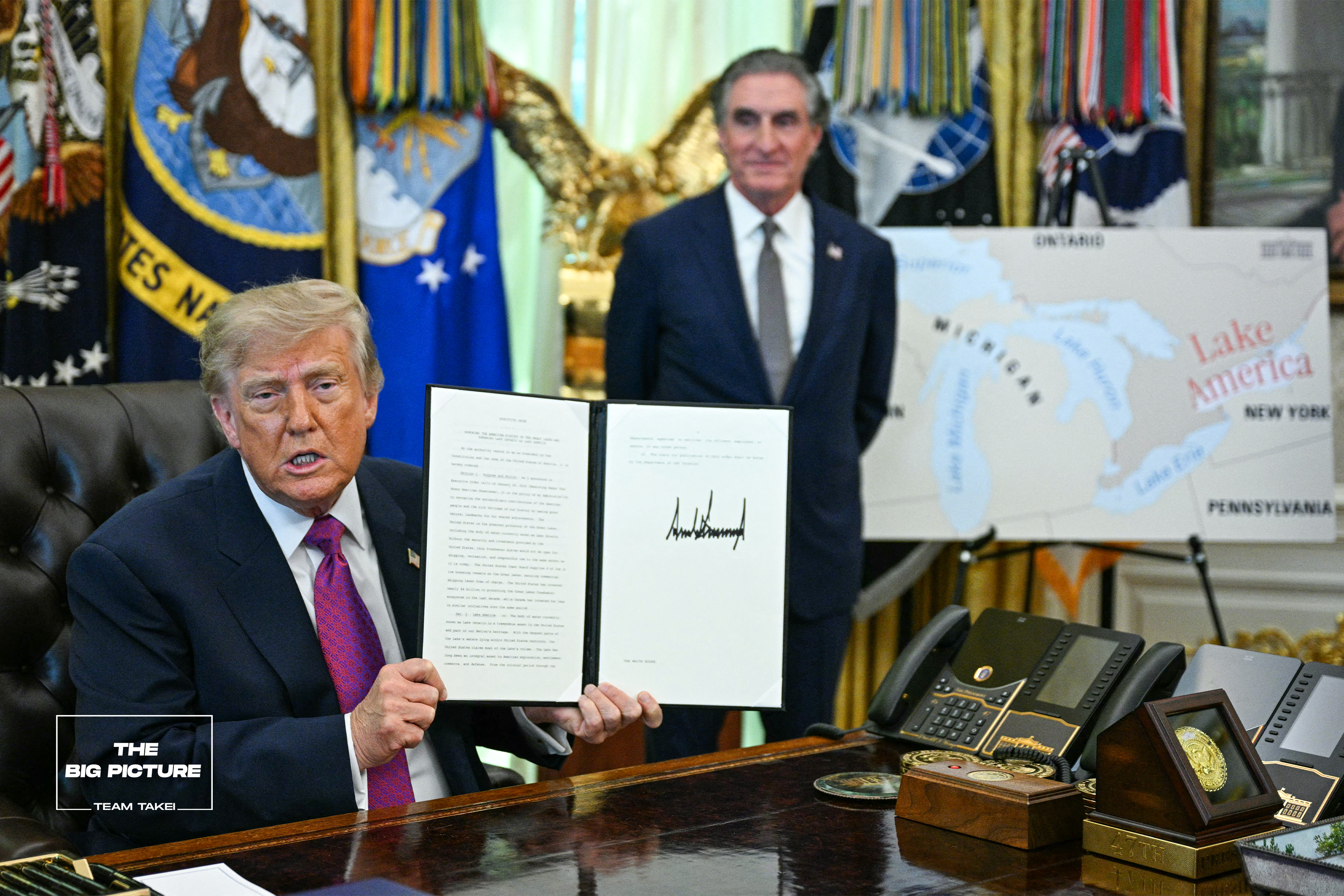
Don’t mention the war! Or the economy, for that matter. Or the Epstein files. Or Natalie Harp. Or “affordability”, which, as Donald Trump recently said at a rally, is a word that was “never used” by the media before he took office. Best not to talk about anything that affects ordinary people or embarrasses the president, really. Instead, let’s all rejoice in Trump’s latest triumph: renaming Lake Ontario, which is shared by Canada and the US, as Lake America.
On Thursday, Trump signed an executive order directing federal agencies to America-fy the lake’s name on US maps and documents, which is an excellent use of time and resources. I suppose we can at least be thankful that the president, who is trying to slap his own name on everything from airports to the Kennedy Center, didn’t decree that the body of water be called Lake Trump.
Arwa Mahdawi is a Guardian columnist
Continue reading... -
Solidarité avec Ceuta (frontière Maroc/Espagne)
Reply sourceOn relaye ici l’appel à don de No Name Kitchen, collectif actif à la frontière Maroc/Espagne à Ceuta :
« Ces derniers jours, des milliers de personnes sont arrivées à Ceuta en nageant, en réalisant une traversée incroyablement difficile. Elles arrivent avec des blessures, des piqûres de méduses, la faim, la soif et le choc.
Ce n’est pas une invasion, c’est une recherche désespérée d’un avenir.
No Name Kitchen travaille à Ceuta depuis 2021. Nous connaissons le terrain, nous savons ce qu’il y a là et ce qui manque, et nous savons comment aider d’une manière inclusive, digne et discrète — sans instrumentaliser cette crise ou transformer une tragédie en spectacle.
Nous renforçons notre équipe avec plus d’activistes sur le terrain et nous avons besoin de fonds pour la nourriture et les produits de première nécessité (chaussettes, sous-vêtements, chaussures) que nous distribuerons de toute urgence, efficacement et sans discrimination aux personnes les plus vulnérables.
Donnez un coup de main si vous le pouvez. Sinon, partagez ceci. Vous pouvez également nous contacter pour donner des vêtements ou aider sur le terrain.
Vive la liberté de circulation. A bas la violence frontalière et l’hypocrisie institutionnelle qui externalise les frontières tout en exploitant la main-d’œuvre migrante. »
Pour leur faire un don, c’est ici : https://donorbox.org/emergency-solidarity-with-ceuta
-
Nasa space telescope launches after surviving Trump budget cuts
Reply sourceSearching for exoplanets and clues on planet formation, the Roman telescope begins million-mile journey from Florida launchpad
A $4.3bn space telescope that Donald Trump tried to kill has lifted off from Florida as Nasa embarks on the next stage of its quest to unlock the secrets of the universe.
The Nancy Grace Roman space telescope survived two rounds of proposed White House budget cuts, and began a million-mile journey into deep space from a launchpad at the Kennedy Space Center on Sunday morning. .
Continue reading... -
Meta verse 18 milliards de dollars pour s’éviter un procès : «Un petit accord de façade»
Pour Bastien Le Querrec, juriste à La Quadrature du Net, l’accord conclu entre Meta et des dizaines d’États américains sur le caractère addictif de Facebook et d’Instagram ne remet nullement en cause le modèle économique du géant des réseaux sociaux.Reply source -
Shocked, Shocked! To Find that Corruption Is Going on in a Trump Casino!
Reply source
In its report on Trump’s social media claim that the US,through a partnership with private business, [has] secured majority U.S. control of more than 65 BILLION BARRELS of proven Oil Reserves in Venezuela, at no cost to the American Taxpayer
The WaPo provides details about how fucking stupid this deal is.
But deal points reviewed by The Washington Post and interviews with people who were close to negotiations as the deal came together suggest that for the plan to succeed in producing oil in the amounts the administration projects, the U.S. government may ultimately need to invest significant amounts.
A list shared with The Post before the deal was announced noted 17 oil fields in which the U.S. would take a stake. Several of the fields lack any infrastructure or access to transport hubs to treat and move the crude. Those where such infrastructure does exist have fallen victim to years of neglect and theft of machinery.
Pumping oil from the fields could require investments of many billions of dollars and costly security plans to protect oil workers and production facilities in lawless and violent regions. The deal points reviewed by The Post say the U.S. government stake in the newly formed oil company will be split between equity ownership and guarantees that it will purchase oil produced by it at cost to refill the U.S. Strategic Petroleum Reserve.
The US:
- Has to make and keep Venezuela secure enough to develop this oil, relying on partners who themselves rely on brutal oppression
- Must invest billions to develop the fields
- Thinks all this will refill the Strategic Petroleum Reserve, which Trump has rapidly emptied because he fucked up the Iran war, in time to matter
And that’s before you consider how renewables will have replaced petroleum by the time any of this can be developed.
WaPo also links their story, from Thursday, that hinted all this was coming. It describes how the US (including Colin McDonald, who playacts as Trump’s Fraud Task Force head), has cajoled multiple countries to drop money laundering investigations into their primary partner to make this happen, Alejandro Betancourt, and catalogs the several US cases where Betancourt has been named as an unindicted co-conspirator in money laundering and bribery.
Senior U.S. officials intervened in an international criminal investigation into a Venezuelan businessman who was enlisted by the Trump administration to help assert control over Venezuela’s government and oil industries, according to two people familiar with the matter.
The officials lobbied to resolve the case in Switzerland in a way that would avoid criminal charges and end travel restrictions against the Britain-based businessman, Alejandro Betancourt, and they have not acted on a Swiss arrest warrant against him, according to the two people, who spoke on the condition of anonymity to discuss a sensitive matter.
Instead, the United States has allowed Betancourt to enter the country repeatedly for meetings with the Trump administration, other people familiar with his travel said.
Betancourt, 46, in the past decade has faced multiple investigations, in Switzerland, Spain and the United States, into alleged money laundering, including whether he had a role in a loan arrangement that U.S. prosecutors say embezzled more than $1 billion from Venezuela’s state-owned oil company.
As good as WaPo’s background story is, it doesn’t mention a few salient facts laid out in an earlier WaPo story, from 2019: Betancourt was financially floating Rudy Giuliani during the period when Rudy was working with corrupt Ukrainians and Russian spies to frame Joe and Hunter Biden.
When Rudolph W. Giuliani went to Madrid in August to confer with a top aide to the Ukrainian president and press for political investigations sought by President Trump, he also met with a previously unidentified client with very different interests.
While in Spain, Giuliani stayed at a historic estate belonging to Venezuelan energy executive Alejandro Betancourt López, who had hired Trump’s personal attorney to help him contend with a Justice Department investigation of alleged money laundering and bribery, according to people familiar with the situation.
A month later, Giuliani was one of several lawyers representing Betancourt in Washington. The lawyers met with the chief of the Justice Department’s criminal division and other government attorneys to argue that the wealthy Venezuelan should not face criminal charges as part of a $1.2 billion money-laundering case filed in Florida last year, said the people, who, like others in this report, spoke on the condition of anonymity because of the ongoing investigation.
The criminal complaint alleges that top officials of the Venezuela’s state-owned oil company, elite business leaders and bankers conspired to steal money from the company and then launder it through Miami real estate purchases and other investment schemes.
Betancourt is not one of the eight men charged in the case, a group that includes his cousin. But two people familiar with the matter said that he is referred to in the criminal complaint as a uncharged co-conspirator, as previously reported by the Miami Herald.
And since, unsurprisingly, Trump credits his Secretary of State (along with the Fox News host running the Pentagon, yikes!) with negotiating this deal, you should remember that Marco Rubio was the target of corrupt plans for a similar deal in 2017, a scheme for which his one-time best friend is going to prison.
This deal does nothing to help Americans.
Indeed, it sucks Americans deeper into the Venezuelan swamp, without doing anything to help your average Venezuelan.
Worse still, it continues to redefine what used to be a country that aspired to serve the common good into a kleptocracy serving a few cronies propped up by repression.
The post Shocked, Shocked! To Find that Corruption Is Going on in a Trump Casino! appeared first on emptywheel.
-
Numerama+ baisse son prix pour la rentrée et vous offre un an de VPN Surfshark One
Reply source
Pour la rentrée, Numerama+ revient à 2,49 € par mois, avec un an de Surfshark One offert aux 700 premiers abonnés : VPN, antivirus, bloqueur de traqueurs et plus encore.
-
INITIATIVE CITOYENNE
Reply source
- INITIATIVE CITOYENNE - de recherche collective et populaire en partenariat avec l'Hôtel Pasteur de Rennes (@hotel_pasteur)
+ d'informations et réservations ici :
https://radical-plurals.com/programme-de-notre-recherche-a-lhotel-pasteur-en-septembre-octobre-2026/
En réservant précisez le créneau qui vous intéresse.Horaires des rencontres :
Pour chaque date il y aura 3 "temps" avec pour chaque temps seulement 8 places.
1 - De 13H12 à 15H
2 - De 15H12 à 17H
3 - De 19H30 à 21H20- Le 8 Septembre :
1res Conversations sur le Droit de Vote -> Droit, ou Devoir ? / Pourquoi ne pas voter ? (en s'appuyant sur la réalité juridique belge où le vote est obligatoire et sans objectif de réponse unilatérale à la question posée)
- Le 10 Septembre :
2d moment de Conversations sur l'expérience de votant.e.s - > Plaisir, ou Corvée ?
(en s'appuyant sur les expériences personnelles des participant.e.s)
- Le 20 Septembre :
Ateliers créatifs sur le Vote - > Imaginer le cadre idéal de vote.
- Le 22 Septembre :
3e moment de Conversations sur la Liberté de Vote - > Consentement éclairé, ou influences et propagande ? (en s'appuyant sur les expériences personnelles des participant.e.s)
Pour les autres dates voir : https://radical-plurals.com/programme-de-notre-recherche-a-lhotel-pasteur-en-septembre-octobre-2026/

NOUS RECHERCHONS DES PERSONNES INTÉRESSÉES DE CONTRIBUER À CE PROJET DE COLLECTE DE TÉMOIGNAGES !
Si vous êtes intéressé.e.s, n'hésitez pas à nous contacter via notre site : www.radical-plurals.com
ou par sms au 0659936241 -
Le PS fait sa rentrée à Blois avec des débats sans risque dans l’attente de la primaire
Toujours divisé à l’approche de la présidentielle de 2027, le Parti socialiste a organisé pour son université d’été à Blois (Loir-et-Cher) une série de débats et de tables rondes consensuels, destinés à ne surtout pas cliver davantage à l’approche d’une primaire sous haute tension.Reply source -
PASQAL au Nasdaq : le quantique français cherche le capital de son industrialisation
Reply sourceEn clôturant sa première séance à 19,11 dollars, PASQAL a presque doublé la valeur du dernier cours de son SPAC. Cette envolée ne valide pourtant ni sa valorisation ni son modèle économique : les détenteurs de plus de 90 % des actions publiques de Bleichroeder ont préféré récupérer leur mise avant la fusion, réduisant considérablement …
L’article PASQAL au Nasdaq : le quantique français cherche le capital de son industrialisation est apparu en premier sur FW.MEDIA.
-
La COP17 contre la désertification s'achève… sans prise de décision
Reply source
En Mongolie, la COP17 pour lutter contre la désertification s'est clôturée le 28 août, après deux semaines d'âpres négociations. Aucune décision concrète n'en ressort.
Lire la suite - Reportage / Monde
Oulan-Bator (Mongolie), reportage
Il y aura bien une COP18 sur la lutte contre la désertification, dans environ deux ans, à Charm el-Cheikh, en Égypte. Cela n'a l'air de rien, mais pour les négociateurs présents à la COP17 d'Oulan-Bator (Mongolie), qui s'est achevée le 28 août, c'est un soulagement : « On a sauvé la COP », (…) -
Milliardaires, dictateurs : bientôt immortels ?
Membres bioniques, cerveaux congelés, consciences dans le cloud… La technologie change notre rapport au corps, à la vie, à la mort et à tout ce qui fait de nous des humains. Quand la chair et le métal se mêlent, les questions qui émergent deviennent…Reply source -
Soirée de lancement du nouveau livre d'Attac, « Le partage des richesses, toute une histoire »
Reply sourceQuand ?
Le 3 septembre à 19hOù ?
Le Point Ephémère 200 Quai de Valmy 75010 ParisEn avant-première, venez découvrir le nouveau livre d'Attac : "Le partage des richesses, toute une histoire" avec les auteur·ices et la dessinatrice VAP (Pauline Vuarin), le jeudi 3 septembre 2026, à partir de 19h au Point Éphémère (200, Quai de Valmy, 75010 Paris).
De la Révolution française au mouvement pour la justice climatique, des mobilisations sociales et citoyennes ont permis de faire du partage des richesses une réalité : à travers une plus grande justice fiscale, l'augmentation des salaires, la protection sociale...
Plongée passionnante dans cette histoire en 144 pages de texte et BD, "Le partage des richesses, toute une histoire" explore aussi cette question au présent, sous l'angle de la nouvelle problématique écologique. Et propose un état des lieux des propositions pour, ensemble, oeuvrer à une plus grande justice climatique et sociale !
Nous vous donnons rendez-vous le jeudi 3 septembre, la présentation du livre sera suivie d'un moment convivial pour se retrouver tous et toutes après l'été et pour échanger avec les auteurs et autrices du livre.
- Voir aussi Attac
-
Les technologies numériques actuelles transforment-elles la preuve par l'image ?
Reply sourceQuand ?
Le 3 septembre de 19h à 20h30Où ?
Librairie Utopia 1 rue Frédéric Sauton 75005 ParisDans un contexte marqué par l'extension des technologies numériques, qu'advient-il du recours à l'enregistrement visuel comme élément de preuve ?
Le pouvoir d'attestation des prises de vue photographiques ou filmiques semble paradoxalement s'être amplifié avec le tournant numérique. Il vient désormais nourrir de nouveaux champs d'investigation et connaît des formes inédites d'expression médiatique ; mais la diversité même de ces usages interroge : entre la circulation virale d'images violentes sur Internet, leur intégration dans un cadre judiciaire ou encore l'émergence d'enquêtes-vidéo élaborées, se pose la question de savoir ce qui véritablement, dans ces procédés, est susceptible de « faire preuve ».
Cet ouvrage propose de mener la réflexion à partir de l'étude de cas concrets et selon une approche transdisciplinaire : il convoque et analyse le travail d'artistes filmiques ou plasticiens, de groupes de recherches indépendants, de journalistes et d'avocats pénalistes, à la croisée d'enjeux épistémologiques, esthétiques et politiques. Du déploiement récent des démarches dites « forensiques » aux usages judiciaires de l'image et aux interrogations suscitées par l'avènement de l'intelligence artificielle générative, il cherche ainsi à cerner les évolutions comme les lignes de continuité avec des pratiques antérieures de l'enregistrement visuel à des fins probatoires.
- Voir aussi librairie Utopia
-
Lutter sans se trahir
Reply sourceQuand ?
Le 10 septembre de 19h à 20h30Où ?
Librairie Utopia 1 rue Frédéric Sauton 75005 ParisLa librairie Utopia a le plaisir d'accueillir Diane Richard pour une rencontre autour de son livre » Lutter sans se trahir ».
« Je viens d'un espoir immense, celui du militantisme féministe qui pensait pouvoir réparer, un peu, la société. Il y a quelques années, lorsque s'éveillait ma conscience féministe, je m'y suis jetée à corps perdu. Mais j'ai été bien obligée de constater, assez vite, que quelque chose n'allait pas. Alors j'écris pour comprendre, pour témoigner, pour résister sans tomber dans l'amertume et le ressentiment. »
Après la mort de Nahel puis le 7-Octobre, Diane Richard constate un double standard inacceptable dans le féminisme. Confrontée au mutisme de ses camarades de lutte face aux féminicides et viols commis à l'encontre des Israéliennes, révoltée par cette différence de traitement, elle n'a pas d'autres choix que celui d'exprimer son indignation. Dans ce texte entre témoignage et essai, Diane Richard analyse les bouleversements qu'elle a vécus ces dernières années : des ruptures amicales au cyberharcèlement en passant par les tentatives de récupération de ses propos par l'extrême droite. Lutter sans se trahir est un appel à la remise en question afin que le féminisme reste une affaire de justice pour toutes et tous.
- Voir aussi librairie Utopia
-
On légalise le vivant !
Reply sourceQuand ?
Le 8 septembre de 18h à 20h30Où ?
Librairie Utopia 1 rue Frédéric Sauton 75005 ParisLa librairie Utopia organise une rencontre autour du livre "Les droits de la nature VS les droits de l'environnement". Cet ouvrage, dirigé par Dominique Bourg et Ernst Zürcher, interroge la pertinence et l'efficacité des droits de la nature face aux limites du droit moderne de l'environnement, en particulier dans la gestion de l'eau.
À partir de quatre études de cas - la lagune de Mar Menor en Espagne, les marais de Bourges, l'Assemblée populaire du Rhône et les écosystèmes forestiers -, il montre les insuffisances d'un droit anthropocentré, largement structuré par des logiques économiques.
Le livre met en évidence l'échec des dispositifs juridiques classiques à protéger durablement les milieux vivants, comme en témoigne la dégradation de la lagune de Mar Menor.
Face à ce constat, les auteurs explorent l'émergence des droits de la nature, en plein essor à l'échelle internationale depuis une quinzaine d'années.
- Voir aussi librairie Utopia
-
Réunion publique du Courant Communiste International
Reply sourceQuand ?
Le 12 septembre de 15h à 18hOù ?
CICP - Centre International de Culture Populaire 21 ter, rue Voltaire, 75011, Paris, FranceLa lutte des étudiants contre le CPE en 2006 est un exemple pour la classe ouvrière de tous les pays.
Ne possédant pas le moyen de bloquer la production par la grève, les étudiants ont eu l'intelligence de jouer rapidement leurs atouts. Profitant d'un faible encadrement syndical, ils ont su utiliser les immenses amphithéâtres pour organiser des Assemblées générales quotidiennes ouvertes à tous. Marquées par une réelle vie politique sans comparaison possible avec les fausses AG syndicales-étouffoirs, ces véritables AG ouvrières ont permis aux étudiants de s'unir et d'affirmer la nécessité de la solidarité entre les secteurs et entre les générations.
Alors que les syndicats s'acharnaient à isoler les étudiants, ceux-ci ont réussi à organiser des manifestations attirant de nombreux ouvriers, jusqu'à 1,5 million de manifestants dans tout le pays le 18 mars 2006. Voulant à tout prix éviter un élargissement du mouvement à toute la classe ouvrière, le gouvernement a été contraint de reculer.
La force des étudiants a été la mise en oeuvre du principe ouvrier de l'auto-organisation, à travers des Assemblées générales vivantes et des appels à l'unité, à la solidarité, à l'extension de la lutte. Ces leçons sont à méditer dans la perspective des prochaines luttes qui s'annoncent. En 2006 cette victoire est restée sans lendemain car la classe ouvrière était encore sous le choc des campagnes idéologiques de la bourgeoisie sur la fin de la lutte de classes après l'effondrement de l'URSS en 1991, elle avait pour ainsi dire perdu son identité de classe. Aujourd'hui, elle n'est pas encore remise et est entravée par les miasmes de la décomposition capitaliste. Mais les leçons de 2006 vont enfin porter leurs fruits alors que les politiques d'armement et les attaques contre les conditions de travail engendrent partout le mécontentement ouvrier.
- Voir aussi Internationalism
-
Un ours bipolaire en colère
Reply sourceQuand ?
Le 26 septembre de 18h à 20hOù ?
Les Murs à Pêches 61 Rue Pierre de Montreuil 93100 MontreuilPrenez un utopiste, mettez-lui le nez dans le dérèglement climatique, puis trempez-le dans Extinction Rébellion, les Zapatistes, les Gilets jaunes. Vous obtenez un ours bipolaire en colère capable de refaire le monde dans la joie et la bonne humeur avec Raymond Aubrac, Antonio Gramsci, Confucius et ... Coluche (notamment).
La situation est grave mais on n'a pas besoin de l'être car ça n'arrange rien ! Alors éteignez la télé et laissez Bisounours vous réveiller pour vous faire rêver d'un nouveau monde dans la joie et la bonne humeur. C'est le one-man-show pour la vie contre l'argent, un duel contre l'hégémonie culturelle du cacapipitalisme !
- Voir Bisounours
- Voir aussi Permamontreuil
-
De l'art de la panthéonisation (Marc Bloch)
Reply sourceMarc Bloch était une personne modeste, réservée mais discutant sur un pied d'égalité avec les paysans creusois comme avec les intellectuels parisiens. Tout le contraire de son panthéonisateur !
- 362 été 2026 / Leur Histoire, Notre Mémoire , Société -
Assiste-t-on à la fin ou à une mutation du libéralisme ? Débat entre Jacques Rigaudiat et Arnaud Orain
Sommes-nous entrés dans une nouvelle phase du néolibéralisme ou glissons-nous vers le néomercantilisme, avec un retour du protectionnisme et de l’Etat ? Les économistes Jacques Rigaudiat et Arnaud Orain confrontent leurs analyses.Reply source -
Soirée de commémoration pour Idir, samedi 12 septembre à 17h
Reply source

Dans un premier temps, RDV place Mazagran à 17h pour une occupation festive : jeux, fanfare, crêpes, et prises de paroles des collectifs de familles de victimes de crimes carcéraux.
On se retrouve ensuite pour un deuxième temps (lieu à confirmer, mais juste à côté de la place Mazagran) à partir de 20h pour partager un bon repas, avec en plus karaoké, open mic et pour finir dj set de DJ Pipas, et autres surprises !
Venez nombreuxses !Justice pour Idir ! Ni oubli ni pardon.
A bas les mitards ! A bas les taules !Si tu souhaites participer à l'open mic ou être bénévole, n'hésite pas à nous écrire à l'adresse idir-espoir-solidarite@proton.me
-
Ephéméride des luttes : 29 août
Reply source
L'éphéméride des luttes du 19 août déteste tous les soldats, ceux de tous les pays comme de toutes les religions. Et elle n'aime pas non plus les rois, les nazis ou les troupes d'occupation. Ce qu'elle aime, c'est la liberté.
1786 : Dans le Massachussets, insurrection paysanne de Shay contre la hausse des taxes et des impôts.
1900 : A Milan se tient le procès de Gaetano Bresci, l'anarchiste qui assassina le roi Umberto I. Il est condamné à sept ans de travaux forcés et sera retrouvé pendu dans sa cellule.
1943 : Les nazis dissolvent le gouvernement du Danemark occupé. En retour, les Danois-es coulent leur propre flotte militaire.
1944 : Insurrection slovaque contre les nazis.
1970 : A Los Angeles, la police attaque une manifestation de personnes originaires d'Amérique Centrale qui manifestaient contre la guerre du Vietnam, faisant trois morts.
1973 : En Angleterre, l'IRA place deux bombes à Solihull ainsi qu'une troisième dans les magasins Harrod à Londres.
2005 : La Nouvelle-Orléans est dévastée par l'ouragan Katrina et les quartiers pauvres sont délibérément laissés à l'abandon par les pouvoirs publics. Des milliers de personnes mourront.
2016 : A Neder-Over-Heembeek (Bruxelles), attaque incendiaire contre le centre de l'INCC (Institut national de criminalistique et de criminologie : une voiture bélier enfonce le portail jusqu'à l'aile des laboratoires et le feu est mis. Voir une chronique.
Voir aussi l'éphéméride anarchiste du 29 août.
-
Pas de congrès pour le RN à Orléans les 24 et 25 octobre !
Reply source
Texte d'appel à un contre-congrès massif et déter à Orléans (village et manifestation anti-fascistes) et à des réunions publiques partout pour des transports collectifs vers Orléans.
Et résumé de la dernière réunion publique de la plateforme anti-fasciste Ciao Fachos.PAS DE CONGRÈS POUR LE RN !
Les 24 et 25 octobre, le RN prévoit son congrès à Orléans, avec son meeting de lancement de campagne le 25. Des bus partiront de partout en France pour une démonstration de force du premier parti fasciste de France.
A chaque fois que le FN/RN remporte des victoires médiatiques ou politiques, il se normalise comme force politique et ses idées gagnent du terrain, en témoigne la loi "permis de tuer" pour la police et gendarmerie votée cet été. Ce parti alimente surtout la violence raciste, comme en juin dernier, dans une discothèque à Rodez, où on a entendu : « Marine au pouvoir, les Arabes à l'abattoir. »
Face aux dangers du fascisme, notre réponse doit être déterminée et massive.
Les manifestations qui ont eu lieu en juillet contre le congrès de l'AfD, parti fasciste allemand, ont rassemblé 20000 manifestant.e.s et doivent nous donner confiance : partout dans le monde, nous sommes la majorité ! Ensemble, nous pouvons infliger une lourde défaite au RN.
Plusieurs initiatives antifascistes sont en train de s'organiser à Orléans, notamment avec un village antifasciste le 24 et une manifestation nationale en direction du meeting le 25. Début septembre il y aura une réunion nationale inter-organisations pour finaliser toustes ensemble l'organisation de ce week-end de mobilisation antifasciste nationale.
Nous appelons aussi toutes les organisations qui le souhaitent à organiser des campagnes dans leurs quartiers, leurs villes et leurs villages pour appeler à manifester le 25 octobre à Orléans contre le meeting du RN.
Au sein de la plateforme Ciao Fachos, nous travaillons sur un kit de mobilisation (argumentaire, tract, affiche...) pour les accompagner.
Rejoignez-nous !
Tractages, collages, réunions publiques, transports collectifs, soirées de récoltes de fonds : soyons partout, et profitons-en pour empêcher le RN de tracter sur nos marchés et coller sur nos murs.
PAS DE CAMPAGNE ET PAS DE CONGRÈS POUR LES RACISTES !
Signataires :
AcaaB (Action citoyenne antiraciste antifasciste Beaucaire), AFA Annemasse, AG anti fasciste 72, Alternatiba Orléans, Amaars (Assemblée Morbihan (Est) Antifasciste Antiraciste Rurale et Solidaire), ATTAC 45, Ciao Fachos, Collectif antifasciste Orléans, Collectif antifasciste Paris 20e, Contrevents (Côtes d'Armor), CRAAAME (Collectif Rêvolutionnaire Autonome Anarchiste Anti-fasciste du Mans et des Environs), G.E.L 72 (Groupe Étudiant Libertaire Sarthe), Gentilly Antifasciste Antiraciste, GRIF (Groupe Radical Intersectionnel Féministe) Orléans, ORA (Orléans Riposte Antifasciste), Organisation de Solidarité Trans (OST), OST Orléans, Riposte Antifasciste Marseille, Riposte Populaire, Soulèvements de la Terre Orléans, Sound of Sudan, Suresnes Antifa Antiraciste, TAF (Tours AntiFasciste)
Texte alternatif décrivant l'affiche :
Visuel avec gros message « Pas de congrès pour le RN »
On voit une foule de bras qui font des siamo tutti antifascisti
Deux pancartes « Orléans 24 - 25/10 » et « mobilisations antifa »
Des drapeaux antifasciste, LGBTQIA+ et palestinien sont brandisRÉSUMÉ DE LA RÉUNION PUBLIQUE DU 6 AOÛT DE LA PLATEFORME ANTI-FASCISTE CIAO FACHOS
Une participation massive !
70 participant·e·s, 33 organisations, dont 5 d'Orléans / du Loiret et 3 organisations nationales (VISA, ASSO Solidaires, Solidaires étudiant·e·s)
Et ça début août, une franche réussite qui annonce d'importantes victoires (et défaites pour les fascistes !)Préparation inter-orga
Après avoir présenté pourquoi c'est important et vital de s'opposer au Rassemblement Nazional, nous avons présenté la situation du congrès / meeting du RN à Orléans et d'où en est la préparation de la mobilisation anti-fasciste nationale !
Nous avons discuté stratégie et amendé une proposition de visuel d'appel à se mobiliser les 24 et 25 octobre à Orléans depuis partout.Continuons à préparer la défaite du RN !
Ensemble nous avons décidé de créer des groupes inter-orga pour organiser- la communication (kit de mobilisation avec argumentaires, tracts, affiches, visuels internet et réunions publiques)
- et la logistique (hébergements, récolte d'argent, transports collectifs, modalités de la manifestation du 25/10)
Toute personne membre d'orga ou d'inter-orga peut rejoindre ces groupes en nous contactant !
Coordonnons toutes les échelles locales et globales
Dans chaque ville et village, nous avons besoin de faire des réunions publiques pour présenter les enjeux majeurs du contre-congrès, organiser des transports collectifs et récolter de l'argent pour les financer !
Se mobiliser localement en assemblées publiques et en inter-orga, pour s'opposer au congrès et au 1er meeting du RN à Orléans c'est monter en puissance pour s'opposer localement aux réunions, tractages, collages du RN.Prochaines réunions
Le 1er septembre il y aura une réunion inter-orga unitaire nationale pour se coordonner sur les actions des 24 et 25 octobre à Orléans (village et manifestation anti-fascistes). Pour que votre orga y participe vous pouvez nous contacter !
La prochaine réunion publique de Ciao Fachos, pour informer des avancements de cette mobilisation nationale et pour donner des outils de mobilisation locale, sera le Dimanche 6 Septembre à 18h30 en visio via ce lien : https://bbb.faimaison.net/rooms/xb9-1lb-jdo-kts/join
Texte alternatif décrivant le visuel :
Dix-neuvième congrès du RN. Orléans 24 et 25 octobre 2026.
Détournement du visuel du RN, en barrant les visages de Jordan Bardella et Marine Le Pen et en remplaçant "victoire" par "défaite" dans leur slogan, ce qui donne : « Une nouvelle étape vers la défaite de 2027 ! ».
Résumé de la réunion publique du 6 août.
Ciao Fachos.OUTILS DE COMMUNICATION DE LA PLATEFORME ANTI-FASCISTE CIAO FACHOS
- Site internet : https://ciaofachos.noblogs.org
- Groupe Signal de diffusion d'informations (invitations et résumés des réunions publiques, campagnes d'actions, etc), aussi utile pour se mettre en contact de manière sécurisée en contactant un.e admin. Lien pour le rejoindre :
https://signal.group/#CjQKIBgEUlNyWfuhem_-VP4M3snoFexoP9-lHUTkwlS_EtTWEhARX1ddFWsDNoqeencBMsPf
- Groupe Signal inter-organisations d'entraide et de coordination : rejoignable à la demande par des membres d'organisation
- Groupe Signal inter-organisations pour préparer le contre-congrès du RN à Orléans et notamment la manifestation du 25/10 : rejoignable à la demande par des membres d'organisation
- Mail : ciaofachos@systemli.org
- Liste mail de diffusion d'informations (invitations et résumés des réunions publiques, campagnes d'actions, etc) : besoin de demander à y être ajouté.e.s par mail.
- Instagram : @ciao_fachos
Nous vous invitons vivement à partager ces informations partout, à nous rejoindre et à participer au contre-congrès de multiples manières possibles !
CIAO FACHOS
-
Salariés en forfait jours : attention à la charge de travail
Avec le forfait jours, les salariés ne comptent plus leurs heures de travail. Ce qui n’empêche pas les employeurs de devoir veiller à leur santé. Les juges, eux, y sont très vigilants.Reply source -
Manger de la terre, se frotter à des coraux... Comment les animaux se soignent
Reply source
Des coraux pour la peau des dauphins, de la terre pour l'estomac des singes, de l'alcool pour les abeilles malades... Tour d'horizon des techniques mises au point par des animaux pour se soigner.
Lire la suite - Chronique / Animaux , Nature
[Chronique « Animaux géniaux »] On nous le serine depuis l'Antiquité : la mémoire des poissons serait courte, la cervelle des moineaux minuscule, la cruauté des ours sans pareille… Pourtant, les études scientifiques démontrant que les non-humains rivalisent d'intelligence, de sensibilité et (…) -
En Ukraine, ils développent une plante capable de capturer les métaux lourds
Reply source
À 45 km de Kyiv, des chercheurs testent la capacité du miscanthus géant à régénérer les sols dégradés et pollués par la guerre. Cette plante pourrait séquestrer du carbone et capturer les métaux lourds, un défi majeur pour le grenier à blé de l'Europe.
Lire la suite - Reportage / Guerres et Armées , Ukraine
Vorzel (Ukraine), reportage
Une musique tonitruante précède un fourgon noir flanqué de drapeaux ukrainiens. « Un enterrement », chuchote Anastasiia Husieva, doctorante de 25 ans en protection des plantes. Elle et sa directrice de thèse, (…) -
Des clubs de football optent pour des pelouses synthétiques... remplies de granulés de maïs
Reply source
L'été caniculaire a grillé bien des pelouses. Certains clubs de football se tournent donc vers les terrains synthétiques. Certains fabricants proposent des options « écologiques », à base de maïs notamment, dont le coût reste élevé.
Lire la suite - Info / Sports , Canicule
Monferran-Savès (Gers), reportage
Sur la route vers Monferran-Savès, entre Auch et Toulouse, les paysages sont durement éprouvés par les épisodes caniculaires de l'été. Au milieu de tout ce jaune, une oasis d'un vert éclatant détonne. Une pelouse en fibre (…) -
Légumes brûlés, maïs en chute libre, prairies grillées… Les chiffres chocs d’un été catastrophique pour l’agriculture française
Reply source Fleurance (Gers), le 19 août 2026. Une rangée de tournesols gravement flétris, en pleine période de sécheresse. © Isabelle Souriment/Hans Lucas via AFP
Le réchauffement climatique frappe de plein fouet l’agriculture française. Après un été record, marqué par une succession de canicules et d’incendies, ainsi qu’une sécheresse générale historique, les premières estimations des filières montrent l’étendue des dégâts, dans tout l’Hexagone comme dans les outre-mer.
«Les maraîchers, les arboriculteurs, les céréaliers, les éleveurs, les vignerons, les agriculteurs de toute la France, presque sans exception, en subissent de graves conséquences», a résumé jeudi la ministre de l’agriculture, Annie Genevard, à l’issue d’une réunion de crise avec les préfet·es de région. D’après les remontées de ces dernier·es, des pertes de rendement de 50% ou plus sont déjà constatées dans plusieurs territoires, et les besoins d’aides dépassent généralement les 10 000 euros par exploitation.
Grandes cultures : le maïs et la pomme de terre s’effondrent, les plantations d’hiver moins impactées
 Il est probablement la victime la plus emblématique de cet été caniculaire : le maïs s’effondre partout en France, avec une production en baisse de près de 45% sur un an pour le maïs grain et d’environ 50% pour le maïs fourrage (récolté en entier, avant la maturation des grains), selon les données communiquées jeudi par l’Association générale des producteurs de maïs (AGPM). «Une catastrophe jamais vue», selon cette dernière, qui évoque une perte de 2,5 milliards d’euros de chiffre d’affaires pour les exploitations. Outre la réduction des surfaces cultivées, le maïs, plante particulièrement gourmande en eau sur la période estivale, a subi de plein fouet la sécheresse, notamment dans les plaines du centre et de l’ouest de la France.
 Un maïs fortement impacté par la sécheresse, sur une exploitation de Haute-Saône, à la mi-août. © Esteban Grépinet/Vert
 Pour les autres céréales, la chute est moins prononcée : la production de blé tendre est en baisse de 4% par rapport à 2025, l’orge de 7% et l’avoine de 21%, selon les données du service statistique du ministère de l’agriculture (l’Agreste), en date du 7 août. «Composées essentiellement de cultures d’hiver [semées à l’automne pour être récoltées au début de l’été, NDLR], les céréales à paille ont nettement moins souffert des conditions caniculaires, survenues en fin de cycle, que le maïs», explique l’Agreste.
 Du côté des plantes oléagineuses, cultivées pour leur huile, les nettes baisses de rendements du tournesol, du soja ou encore du colza pourraient être globalement compensées par l’augmentation des surfaces cultivées en 2025, selon les estimations provisoires de l’Agreste. Par exemple, le rendement du tournesol serait le plus faible depuis un demi-siècle, mais la hausse des surfaces donnerait, à ce stade, une récolte équivalente à celle de l’an dernier.
 La récolte de pommes de terre devrait diminuer de 23% sur un an, selon les chiffres de l’Union nationale des producteurs de pommes de terre (UNPT), qui parle d’une «chute sans précédent». La filière, qui avait réduit ses surfaces cultivées en début d’année, a subi une nette baisse des rendements à cause des canicules et du manque d’eau.
  Les betteraves enregistrent un choc similaire, avec une baisse de la production nationale de 20% par rapport à la moyenne des cinq dernières années, d’après la Confédération générale des planteurs de betteraves (CGB). «Au-delà du manque d’eau, les températures extrêmes enregistrées au cours de l’été ont provoqué un stress physiologique majeur des cultures», explique-t-elle.
Fruits et légumes : de lourdes pertes pour les salades, poireaux, oignons, bananes ou encore fruits rouges
 Mi-juillet, les pertes de salades, carottes, poireaux, échalotes, ail ou encore oignons se comptaient «en milliers de tonnes par produits», atteignant pour certaines filières les 50% de récoltes annuelles, d’après la fédération Légumes de France. «Des “manquants” sont à attendre à court terme dans les magasins, car l’import n’est pas en capacité de couvrir les manques», alerte cette dernière. «Il y a des tensions sur les tomates, les salades, les poireaux et les concombres, mais pas d’envolée générale des prix», a tenté de rassurer le ministère de l’agriculture, ce vendredi, lors de sa conférence de presse.
  Dans le nord-ouest de la France, la marque Prince de Bretagne signale «des pertes allant de 15% à 100% selon les cultures et les conditions d’irrigation» : plus de 40% pour les petits pois, environ 60% pour les brocolis, jusqu’à 100% pour les artichauts, 25% pour les courgettes, 35% pour les salades…
 Côté fruits, la situation apparaît plus contrastée : les canicules ne semblent pas, à ce stade, avoir impacté considérablement les volumes de pommes, poires, pêches ou encore abricots, notamment du fait de l’irrigation des vergers, selon l’Agreste. La production de fraises est en «léger recul» dans le Sud-Ouest, «perturbée par l’alternance de fraîcheurs et de fortes chaleurs», toujours selon l’Agreste – mais, au niveau national, la récolte devrait rester au même niveau que 2025.
  De lourdes pertes ont en revanche été remontées par les préfet·es de région concernant certains fruits rouges (cerises, cassis, groseilles…), pouvant atteindre 100% dans certaines zones. En Martinique, qui fait également face à une importante sécheresse depuis juin, la production de bananes est en recul de 15%, selon le ministère de l’agriculture. En manque d’eau, parfois brûlés par la chaleur et le vent, les fruits et légumes récoltés sont aussi plus petits, plus abîmés : la grande distribution a d’ailleurs annoncé assouplir ses calibres d’acceptation des produits.
Élevage : forte mortalité de volailles et inquiétude sur les stocks de fourrages
 Poulets, pintades, dindes et canards ont particulièrement souffert face aux fortes chaleurs : entre trois et quatre millions de volailles (soit 1% de la production nationale) sont mortes à cause des canicules cet été, notamment en Bretagne et dans les Pays de la Loire, lors de la vague de chaleur de juin. «Nous avons observé des surmortalités dans tous les types d’élevages, aussi bien en bio qu’en label rouge ou en standard», détaille Yann Nédélec, directeur de l’interprofession des volailles de chair (Anvol). Si l’équarrissage est mutualisé au sein de la filière, les dépenses énergétiques et les tensions sur les matières alimentaires (notamment le maïs) pourraient mener à une hausse des coûts de production.
 La chaleur affecte aussi les vaches laitières : d’après les estimations provisoires transmises à Vert par la Fédération nationale des producteurs de lait (FNPL), la production de lait a diminué de près de 7% en juin, et de 5% en juillet, par rapport aux valeurs de l’an dernier. En additionnant ces pertes et la hausse des coûts de production (liées par exemple au manque de fourrages pour alimenter le bétail), le surcoût pour les éleveur·ses représenterait entre 40 et 60 euros pour 1 000 litres de lait produits.
 Sécheresses et canicules ont enfin un effet indirect sur l’élevage bovin : les prairies, où pâturent les animaux, sont grillées depuis deux mois sur la quasi-totalité du territoire (notre reportage). Au 20 août, la pousse de l’herbe est en recul de 36% par rapport à la moyenne de la période 1989-2018, d’après l’Agreste. Les éleveur·ses doivent déjà puiser dans leurs stocks d’hiver, qui peinent à se reconstituer faute d’herbe à faucher et d’autres fourrages (comme le maïs). Les stocks de fourrages sont inférieurs de plus de 50% à la moyenne dans cinq régions, dont l’Occitanie, d’après les remontées des préfet·es.
Face à cette situation climatique historique, la ministre de l’agriculture, Annie Genevard, doit présenter le 3 septembre prochain un vaste plan d’aides d’urgence, qui devrait se chiffrer en milliards d’euros.
-
Marine Le Pen et le Medef, je t’aime moi non plus !
On aura beaucoup commenté, a priori et a posteriori, le débat organisé par le Medef entre les candidats, déclarés ou supposés, à l’élection présidentielle, lors de la Rencontre des entrepreneurs de France (Ref), jeudi 27 août 2026. C’était loin d’être inintéressant, mais l’attente des médias pour…Reply source -
Washington Policy Review: August 28, 2026
Reply sourceToday’s Report
1. Overview
2. White House News
3. Truth Social Posts
4. Government Department News
5. 2028 Democratic Presidential Candidates
6. AI & Tech Company News
7. Congressional Watch
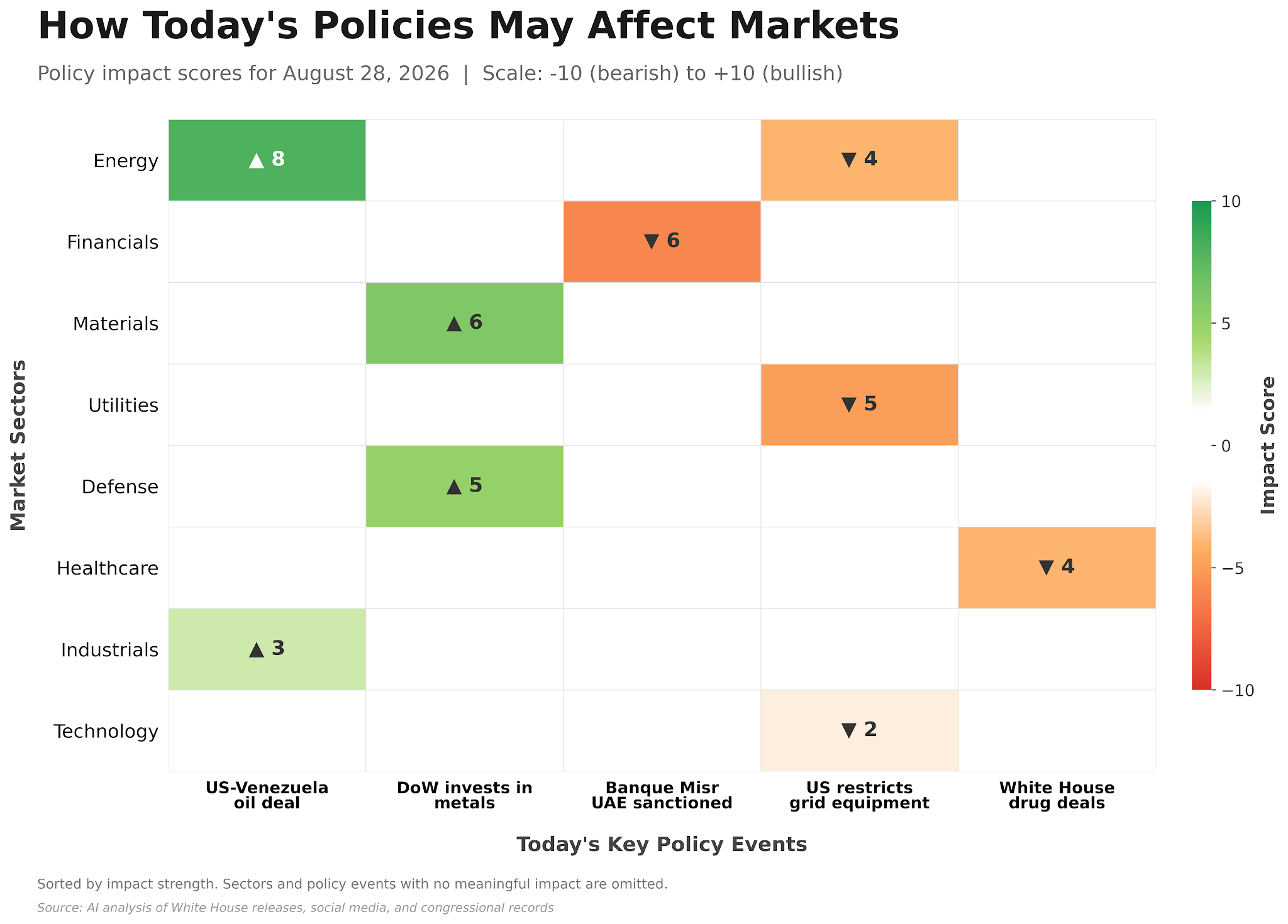
8. Policy Impact Analysis & Heatmap
1. Overview
President Trump signed an Executive Order to establish a Presidential Commission tasked with designing the United States Space Academy. This new federal institution aims to prepare future leaders to “advance our Nation’s interests in space” and ensure “American superiority” in the sector. The Commission, chaired by the NASA Administrator, is required to submit a report on the Academy’s governance and curriculum within 120 days. Additionally, the administration emphasized its ongoing control of the Strait of Hormuz, asserting that “Operation Economic Outcast” is successfully restricting Iranian revenue and preventing the regime from projecting power.
On Truth Social, President Trump announced a deal with Venezuela to secure U.S. control of 65 billion barrels of oil, calling it the “biggest oil deal, by far, in World history.” He highlighted various administrative wins, including the dismantling of a China-linked hacking network and an executive order banning specific foreign equipment from the power grid. He also designated Palestine Action as a terror group and shared information linking Portland Antifa to the IRGC. Finally, Trump attacked a New York Times journalist, labeling her a “scammer” for her reporting on his attendance at 9/11 ceremonies, and dismissed the story as “a total CON JOB.”
The State Dept revoked the visa of an Iraqi national on the FBI’s terror watchlist and sanctioned entities and individuals, including a Bank Melli manager, for supporting Iranian illicit financial networks. The Department of War announced $135.6 million in strategic equity investments across two projects, including Trilogy Metals and Atlantic Alumina, to secure domestic supply chains for critical minerals and defense production. Furthermore, the Treasury Department initiated a rule to revoke Banque Misr UAE’s access to U.S. financial institutions for allegedly processing $1.8 billion for Iranian shadow networks, with Secretary Scott Bessent declaring the goal to “sever every economic lifeline Tehran has left.”
Governor Newsom announced $44 million for tribal and conservation projects and $2.7 billion for transportation infrastructure, criticizing the federal administration for taking the country’s transportation future “backward.” Governor Whitmer filed a brief to force the removal of the Line 5 pipeline from the Straits of Mackinac, labeling the structure a “ticking time bomb.” Governor Moore praised a ruling protecting Maryland ratepayers from “imprudent” utility costs and promoted the Vax Act to ensure state vaccine guidance is “proven by science, not political headwinds.” Governor Pritzker opened a new multimodal station in Carbondale, while Governor Walz announced appointments to various state advisory bodies.
OpenAI announced it will terminate its contract with the code editor Cursor by November 12, 2026, following Cursor’s acquisition by SpaceX. OpenAI cited concerns that SpaceX might not adhere to its terms of service, noting a history of Musk-led companies violating contracts. The company emphasized that it will not provide future models, such as Astra, to the platform, citing a “new level of accountability” regarding the use of its technology.
The House of Representatives held a brief pro-forma session during which members introduced 34 new bills and 8 resolutions. Committees reported several pieces of legislation, including measures to restrict federal higher education funding for institutions participating in commercial boycotts of Israel and bills requiring tax-exempt groups to disclose foreign contributions. The Senate also held a pro-forma session lasting less than one minute with no legislative business conducted.
Government efforts to bolster domestic industrial nationalism through supply chain vertical integration are driving support for energy and mining sectors, though this shift toward local sourcing threatens to induce inflationary pressures and increase exposure to geopolitical risk. Meanwhile, the strategic use of correspondent banking sanctions to restrict foreign dollar liquidity is incentivizing broad risk-aversion, as financial institutions reduce their international footprint to mitigate the compliance burdens associated with “Operation Economic Outcast.” Finally, proactive federal intervention in drug pricing is exerting downward pressure on healthcare margins, raising concerns that these mandates may undermine R&D incentives and discourage capital allocation toward high-risk medical innovation.
2. White House News
President Trump Was Right: America Controls the Strait of Hormuz
U.S. Central Command confirmed that American forces, not Iran, control the Strait of Hormuz, ensuring global energy movement while restricting Iranian revenue. Under “Operation Economic Outcast,” the administration is tightening economic pressure on the Iranian regime, which currently faces a “domestic fuel crisis, collapsing currency, and crushing inflation.” President Trump maintains this strategy to “starve the regime of its ability to project power.” The administration asserts that it will continue this pressure until the Islamic Republic can no longer threaten global commerce or international stability.
Reference: https://www.whitehouse.gov/releases/2026/08/president-trump-was-right-america-controls-the-strait-of-hormuz/
Fact Sheet: President Donald J. Trump Establishes a Commission to Design the United States Space Academy
President Trump signed an Executive Order establishing a Presidential Commission to create a new federal academy dedicated to preparing the next generation to “advance our Nation’s interests in space.” The initiative aims to secure “American superiority in space” by fostering the skills and character necessary for technological and industrial leadership. Highlighting the administration’s commitment, the announcement states that “President Trump has demonstrated consistent leadership as a driving force for American strength and achievement in space,” focusing on building the workforce required for future national space endeavors.
Reference: https://www.whitehouse.gov/fact-sheets/2026/08/fact-sheet-president-donald-j-trump-establishes-a-commission-to-design-the-united-states-space-academy/
Establishing the United States Space Academy
President Trump issued an executive order establishing the Presidential Commission on the United States Space Academy to strengthen the nation’s space workforce. Chaired by the NASA Administrator, the Commission will advise the President on creating a “NASA-led Federal academy” to train the next generation of space leaders. Within 120 days, the Commission must submit a report detailing the Academy’s governance, curriculum, and service obligations. This initiative aims to ensure the U.S. maintains “superiority in space” by developing leaders committed to advancing American interests.
Reference: https://www.whitehouse.gov/presidential-actions/2026/08/establishing-the-united-states-space-academy/
3. Truth Social Posts
Trump announced a historic agreement with Venezuela to secure majority U.S. control of over 65 billion barrels of oil reserves, a development he termed “the biggest oil deal, by far, in World history.” He also shared reports on new drug pricing deals with biotech firms, noted that the FBI dismantled a China-linked hacking network, and highlighted his executive order banning certain foreign equipment from the power grid. Regarding national security, Trump confirmed the designation of Palestine Action as a global terror group and promoted State Department findings linking Portland Antifa to Hamas and Iran’s IRGC. Additionally, he extolled recent economic data showing a decrease in the trade deficit and an increase in exports, crediting the success of his tariff policies.
Domestic policy developments included a court ruling that lifted a nationwide injunction on his mail-in voting order, while he circulated plans for a new affordability initiative focused on highways and rail. In New York, Trump criticized Governor Kathy Hochul for her stance on trade with Canada and her refusal to recognize the name “Lake America,” urging voters to support Bruce Blakeman instead. Trump also expressed his condolences following the passing of King Harald of Norway, describing him as a “strong, proud, and greatly respected man.”
Trump vehemently attacked a journalist from The New York Times, labeling her a “scammer” and a “phony” for reports regarding his attendance at the September 11th memorial ceremonies. He dismissed the reporting as “corrupt news” and “a total CON JOB,” asserting that his potential absence from speaking roles was irrelevant to the “solemn ceremony.” Beyond these comments, he shared media coverage of his Dallas midterm convention (no link) and referenced a commentary regarding his prior warnings.
Reference: https://truthsocial.com/@realDonaldTrump
4. Government Department News
State Department (state.gov)
Deputy Secretary Landau’s Meeting with Ugandan Foreign Minister Ayebare
Deputy Secretary of State Christopher Landau met with Ugandan Foreign Minister Adonia Ayebare in Washington, D.C. The two discussed enhancing bilateral cooperation regarding global health priorities, economic growth, and regional security.
State Department Revokes Visa of Iraqi National on Terror Watchlist
The State Department has revoked the visa of Taif Sami Mohammed Al Shakarchi following her placement on the FBI’s Terror Watchlist. Al Shakarchi previously received an International Woman of Courage Award in 2022. She is no longer in the United States. Assistant Secretary Dylan Johnson stated that under President Trump and Secretary of State Marco Rubio, “suspected terrorists will never be allowed to remain in the United States.”
U.S. Sanctions Sever Financial Lifelines of Iranian Regime
As part of “Operation Economic Outcast,” the U.S. is sanctioning Reza Mohammad Taeedi, manager of Bank Melli’s Dubai branch, and a Hong Kong-based company for supporting the Iranian regime. Additionally, FinCEN proposed a rule to revoke Banque Misr UAE’s access to U.S. financial institutions. The administration aims to “sever the economic lifelines” of the regime, targeting entities that facilitate illicit financial practices and enable access to U.S. dollars.
Deputy Secretary Landau Travels to Pacific Island Nations
Deputy Secretary of State Christopher Landau will visit Palau, the Federated States of Micronesia, the Solomon Islands, and Kiribati from August 31 to September 11. He will participate in the Pacific Islands Forum and meet with government and business leaders to advance economic and security interests. USCG Commandant Admiral Kevin Lunday will join portions of the trip to emphasize maritime security. The travel underscores the administration’s commitment to maintaining “an open, secure, and prosperous Pacific region.”
Department of War (war.gov)
The Department of War has invested $35.6 million into Trilogy Metals Inc. to secure domestic supplies of copper, cobalt, and germanium. This 17.5% economic position supports exploration and infrastructure at the Upper Kobuk Mineral Projects in Alaska. The investment aims to bolster the “Defense Industrial Base” and follows approval of the Ambler Road Project. Officials stated this is a “decisive investment in America’s supply chain independence” to protect the economy from manipulation and secure materials vital for national defense and advanced electronics.
The Department of War is providing a $100 million follow-on investment to Atlantic Alumina Company (Atalco), bringing total government funding to $400 million. This effort has mobilized an additional $400 million in private capital to stabilize the last domestic alumina refinery. The initiative aims to scale production to meet 142% of projected defense demand by 2029. Officials stated the move mitigates “critical supply chain risk” and protects military readiness from “foreign interference” by insulating the U.S. from dependence on foreign adversaries.
The Department of War awarded several contracts, including $147.3 million to Symetrics Industries for ALE-47 countermeasure dispenser systems and $37.7 million to Telos Corp. for cybersecurity modernization and artificial intelligence tools. Kwaan Tech LLC received $30 million for aircrew training services, and BK Manufacturing Co. Inc. was awarded $28 million for missile wings and fins. Additionally, Oneida Engineering Solutions LLC received a $20.2 million contract to manage PFAS response actions at various Air Force installations through 2031.
Treasury Department (home.treasury.gov)
Iran’s Access to UAE Banks Targeted Under Operation Economic Outcast
The Treasury Department, under “Operation Economic Outcast,” has initiated a rule to revoke Banque Misr UAE’s access to U.S. financial institutions, citing the bank’s role in processing roughly $1.8 billion for Iranian shadow networks. Treasury Secretary Scott Bessent stated, “Treasury promised to sever every economic lifeline Tehran has left.” Additionally, the Office of Foreign Assets Control sanctioned Reza Mohammad Taeedi, a Bank Melli manager, and the Hong Kong-based Kameng Trading Limited for laundering funds and facilitating sanctions evasion on behalf of the Iranian regime.
5. 2028 Democratic Presidential Candidates
Gavin Newsom (gov.ca.gov)
Governor Newsom announced $44 million in funding for 15 projects across 11 counties to advance the state’s 30x30 conservation goal. The initiative supports tribal stewardship, salmon recovery, and desert protection to preserve biodiversity. The funding, which includes $32 million from the 2024 Climate Bond, seeks to strengthen partnerships with California tribes and protect ecosystems. Secretary for Natural Resources Wade Crowfoot emphasized the effort as a response to a time “when public lands are under attack by the federal administration.”
Governor Newsom signed AB 1956, which mandates that the California Office of Suicide Prevention explicitly include boys and young men as a target demographic in the state’s suicide prevention strategy. This legislation supports the administration’s “Path & Purpose” initiative, which aims to address mental health, social disconnection, and lack of mentorship among young males. Data cited in the bill indicate that this population faces disproportionately high suicide risks, and the law seeks to reduce stigma and expand access to behavioral health support.
Governor Newsom announced $2.7 billion for over 150 projects aimed at improving traffic flow, transit accessibility, and infrastructure resilience against extreme weather. The projects include tunnel ventilation upgrades, highway lane additions, and wildlife crossings. The Governor noted that while “Donald Trump is taking America’s transportation future backward,” California is continuing to invest in modernization. The funding utilizes state resources alongside federal support from the Bipartisan Infrastructure Law, contributing to a total of $81.1 billion in transportation investments since 2019.
Governor Newsom launched the “Made in California” labeling and marketing program to highlight products manufactured within the state. Managed by the Governor’s Office of Business and Economic Development, the program allows eligible manufacturers to use a state-verified label to signal quality and innovation to consumers. The initiative is designed to assist small and mid-sized businesses in competing for shelf space, contracts, and capital. For a limited time, the state is waiving all application fees for businesses joining the program.
Gretchen Whitmer (michigan.gov)
Gov. Whitmer Takes Legal Action to Get Line 5 Out of the Water, Protect Great Lakes
Governor Whitmer has filed a response brief in an ongoing lawsuit against Enbridge to force the removal of the Line 5 dual pipelines from the Straits of Mackinac. The Governor argues that the state retains the authority to revoke the 1953 easement, characterizing the pipeline as a “ticking time bomb.” She maintains that Michigan must have a say in activities affecting its waters, rejecting Enbridge’s claims that they possess a perpetual right to operate the pipeline regardless of state intervention.
Wes Moore (governor.maryland.gov)
Governor Moore applauded a Public Service Commission decision prohibiting Pepco from increasing rates for infrastructure projects deemed “imprudent.” The ruling disallowed costs for a multimillion-dollar substation, emphasizing that utilities must prioritize lowest-cost solutions like energy storage and non-wires alternatives. Moore stated, “utilities should not earn unreasonable profits while everyday Marylanders can’t afford to pay their power bills.” The decision, alongside the Utility RELIEF Act and recent PJM capacity market reforms, aims to hold corporations accountable and ensure affordable, reliable energy for Maryland families and small businesses.
As students return to class, Governor Moore is promoting the Vax Act, which empowers the Maryland Department of Health to set vaccine guidance independently of federal policy. Moore stated the administration aims to ensure recommendations are “proven by science, not political headwinds,” amid concerns that federal actions create “unnecessary confusion.” The Act authorizes the state to align recommendations with major medical associations. Maryland maintains established K-12 immunization requirements, which officials credit for the state’s low rates of vaccine-preventable illnesses and high kindergarten vaccination coverage.
Andy Beshear (governor.ky.gov)
Gov. Beshear Makes Appointments to Kentucky Boards and Commissions
Governor Beshear announced numerous appointments and reappointments to state boards, including the Kentucky Board of Education, the Board of Pharmacy, the Public Advocacy Commission, and the Kentucky Board of Emergency Medical Services. Other appointees will serve on the Pharmacy and Therapeutics Advisory Committee, the State Advisory Panel for Exceptional Children, the State Advisory Council for Gifted and Talented Education, and the Kentucky Early Intervention System Interagency Coordinating Council. The appointments fill various vacancies and expired terms across these administrative bodies.
Gov. Beshear Orders Flags to Half-Staff Monday for Overdose Victims
Governor Beshear directed state office building flags to be lowered to half-staff from sunrise to sunset on August 31 for Overdose Awareness Day. Additionally, the Executive Mansion will be illuminated in purple to honor those lost to drug overdoses and support their families. The Governor stated, “We’ve made a lot of progress, but we know there is always more to do,” and reaffirmed his commitment to reducing overdose deaths. Citizens and organizations are encouraged to participate in the tribute alongside the ongoing observation for Dolly Parton.
JB Pritzker (gov.illinois.gov)
Gov. Pritzker Celebrates Opening of New Southern Illinois Multimodal Station in Carbondale
Governor Pritzker joined local officials to open the $26.2 million Southern Illinois Multimodal Station (SIMMS) in Carbondale. The facility consolidates several transit providers, including Amtrak and Greyhound, under one roof to improve regional connectivity and tourism. Funded by federal, state, and city resources, the station features ADA-compliant infrastructure, solar power, and a Southern Illinois University tourism center. The project is intended to “connect residents with jobs, education, healthcare, and opportunity” while serving as a catalyst for downtown revitalization.
Gov. Pritzker Appoints Jim Montgomery as Director of Illinois Department of Natural Resources
Governor Pritzker has appointed Jim Montgomery to lead the Illinois Department of Natural Resources (IDNR), effective August 31, pending Senate confirmation. Montgomery, formerly the Executive Director of the Illinois Prisoner Review Board and a former mayor of Taylorville, brings extensive experience in public administration and conservation. Governor Pritzker stated that Montgomery is “an exceptionally qualified candidate” to oversee the agency’s work in protecting Illinois’ natural and recreational resources.
Gov. Pritzker Announces Two Appointments to Boards and Commissions
Governor Pritzker announced two pending appointments: Tara Ori to the Children and Family Services Advisory Council and Chasse Rehwinkel to the Illinois Finance Authority. Ori, an Assistant State’s Attorney for Lake County, brings two decades of legal experience in child welfare. Rehwinkel, the current President of Devon Bank and former Comptroller for the City of Chicago, offers a background in municipal finance and banking regulation. Both appointments are subject to confirmation by the Illinois Senate.
Daily Public Schedule: Friday, August 28, 2026
Governor Pritzker’s public schedule for August 28, 2026, included two primary events in Southern Illinois. At 2:00 PM, the Governor attended the ribbon-cutting ceremony for the new Southern Illinois Multimodal Station in Carbondale. Later, at 5:30 PM, he presided over the official opening of the DuQuoin State Fair at the DuQuoin State Fairgrounds.
Tim Walz (mn.gov)
Governor’s Office Announces Appointments
Governor Walz and Lieutenant Governor Flanagan announced new appointments to four state advisory bodies, effective September 2, 2026. These include the Governor’s Interagency Coordinating Council on Early Childhood Intervention, the Governor’s Council on Freight Rail, the Minnesota Emerging Entrepreneur Board, and the Statewide Independent Living Council. The appointments reflect the administration’s stated goal of seeking “qualified and diverse individuals” to serve Minnesota through their professional expertise and lived experiences. Full terms for the appointees vary by board, with most extending into 2027, 2029, or 2030.
6. AI & Tech Company News
OpenAI (openai.com)
Our decision on Cursor following its acquisition by SpaceX
OpenAI intends to terminate its contract providing models to the code editor Cursor by November 12, 2026, following Cursor’s acquisition by SpaceX. OpenAI stated this decision stems from concerns that SpaceX may not adhere to its terms of service, citing past experiences with Elon Musk’s companies violating contracts. While expressing respect for the Cursor team, OpenAI noted it will not provide future models like Astra to the platform, citing a “new level of accountability” regarding the use of its technology.
7. Congressional Watch
Covers the 2026-08-27 session — the Congressional Record is published with a one-day delay.
Senate
The Senate met briefly for a pro forma session that lasted less than one minute. No legislative business or committee meetings were conducted during this time.
None — No legislative action was taken [N/A]
House of Representatives
The House held a brief pro forma session that lasted three minutes. Members introduced 34 new public bills and 8 resolutions, while several committees filed reports on previously considered legislation.
H.R. 9772 — Requires tax-exempt groups to disclose information regarding foreign contributions [Reported to the House]
H.R. 9771 — Imposes penalties on political committees that accept foreign contributions [Reported to the House]
H.R. 4795 — Restricts federal higher education funding for institutions participating in commercial boycotts of Israel [Reported to the House]
H.R. 7487 — Encourages non-federal hydropower development at Bureau of Reclamation projects [Reported to the House]
H.R. 7730 — Modifies bankruptcy eligibility requirements [Reported to the House]
H.R. 5576 — Promotes timely exploration for geothermal resources on federal lands [Reported to the House]
Committee Highlights
None — No committee hearings or markups were held
Coming Up
The Senate will meet in a pro forma session on Monday, August 31, 2026, at 11:30 a.m. The House will meet on Monday, August 31, 2026, at 12 noon.
Reference: Congressional Record Archive
8. Policy Impact Analysis & Heatmap
This analysis is provided for informational purposes only. It does not constitute investment advice or a recommendation to buy or sell any security.
Impact on Market
Based on today’s policy developments, our analysis identifies the following market impact themes:
THEME 1. DOMESTIC ENERGY AND INDUSTRIAL NATIONALISM
The administration is prioritizing vertical integration of critical supply chains, ranging from Venezuelan oil reserves to domestic copper and alumina production. By funding miners and securing foreign energy assets, the government aims to insulate the U.S. economy from foreign interference. Bearish risks include potential inflationary pressures from replacing cheaper foreign components and the long-term uncertainty of managing infrastructure projects in volatile geopolitical environments.
THEME 2. FINANCIAL BLOCKADES AND SANCTIONS RISK
Aggressive use of correspondent banking bans, such as the action against Banque Misr UAE, serves as a core tool for the administration’s ‘Operation Economic Outcast.’ This strategy aims to starve targeted regimes by isolating them from U.S. dollar liquidity. A key concern for the sector is the secondary effect of ‘over-compliance,’ where international financial institutions exit regions or client bases entirely to avoid even the appearance of violating federal guidance.
THEME 3. REGULATORY PRESSURE ON HEALTHCARE
The government’s push for new drug pricing deals suggests continued downward pressure on industry margins. While the administration frames these as essential for affordability, industry critics argue such interventions damage the R&D incentives necessary for breakthroughs. The risk remains that aggressive pricing controls will compress returns on investment for biotech firms, potentially stifling capital allocation toward high-risk, high-reward medical research.
Policy Impact Heatmap with Market Direction
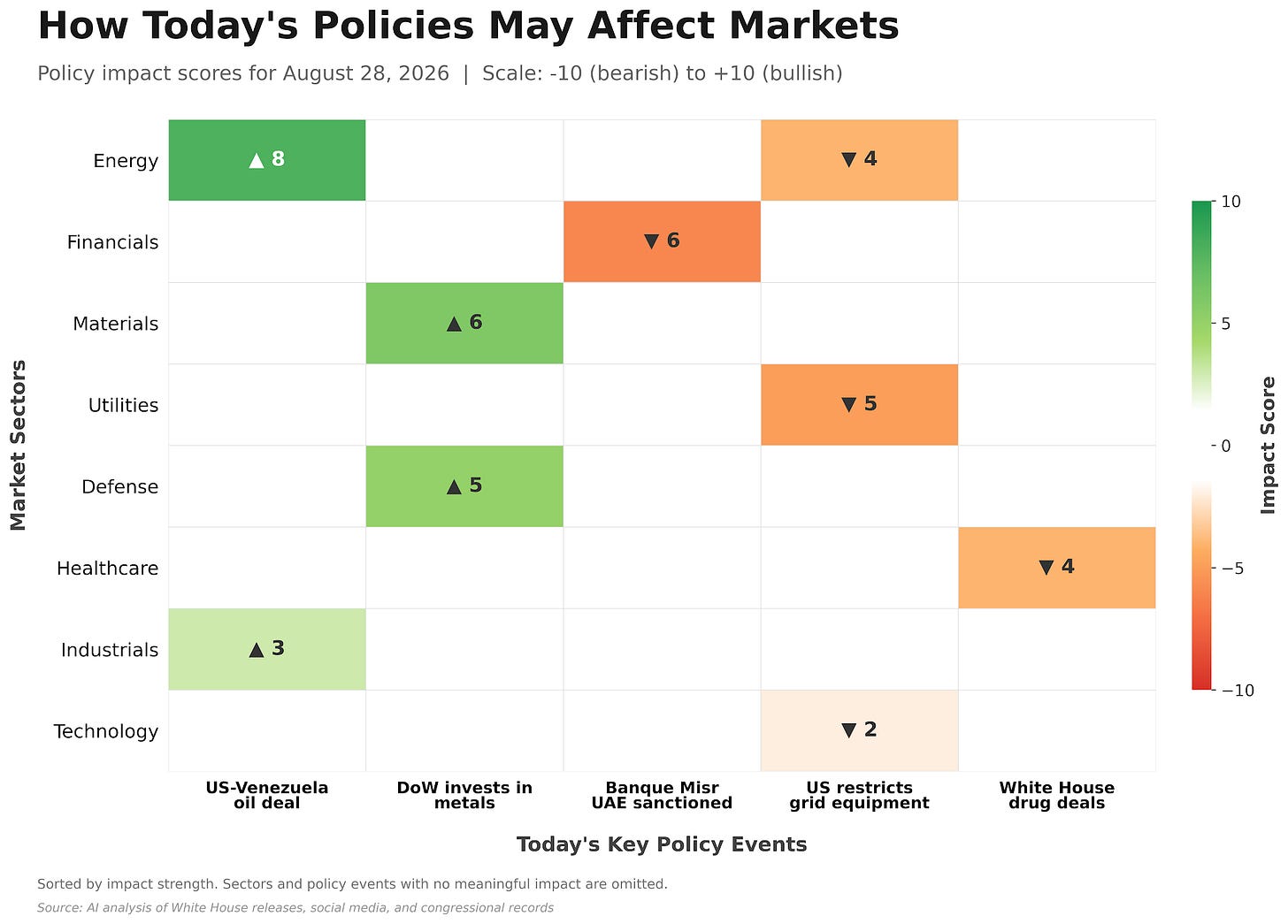
Each cell shows an estimated impact score on a fixed scale of -10 to +10, reflecting how today’s policy developments may affect each market sector. Positive scores (green, ▲) suggest bullish impact; negative scores (red, ▼) suggest bearish pressure. Rows and columns are sorted by impact strength, and sectors and policy events with no meaningful impact are omitted. The heatmap, the analysis below, and the Impact on Market themes above are produced from a single unified analysis: the heatmap visualizes the magnitudes, while the text explains the causal reasoning behind them.
Federal policy is aggressively reshaping industrial supply chains and energy security. The landmark U.S.-Venezuela oil deal acts as a massive supply-side stimulus for the energy sector, intended to lower domestic fuel costs. Conversely, the executive order restricting foreign energy equipment on the national grid introduces significant supply chain friction for utilities. These firms now face higher compliance costs and potential project delays as they replace sanctioned components.
Simultaneously, the Department of War is actively de-risking the defense industrial base through direct equity investments in domestic mining and alumina refining. This shift towards ‘strategic self-sufficiency’ benefits materials producers but implies a move away from globalized cost efficiencies. Finally, the Treasury’s move against Banque Misr UAE signals a hardening of the financial blockade against Iran. This increases the compliance burden for international banking institutions. Critics, such as those monitoring biotech sector shifts, characterize the ongoing pricing interventions as ‘heavy-handed’ interference that threatens innovation pipelines. The cumulative effect is a clear pivot toward domestic resource dominance, albeit with increased regulatory overhead for utilities and healthcare firms.
-
[Entretien] Pour Christophe Sauvé, « le manque d’anticipation climatique cristallise les tensions et la haine envers les Voyageurs »
Reply sourceChristophe Sauvé alerte sur les conditions de vie des Voyageurs en période de canicule. Aires d’accueil très minéralisées, caravanes surchauffées, manque d’anticipation : selon le militant associatif de Loire-Atlantique, les épisodes de chaleur aggravent des inégalités déjà profondes, alors que la récente loi Ripost durcit les règles applicables aux occupations illicites.
L’article [Entretien] Pour Christophe Sauvé, « le manque d’anticipation climatique cristallise les tensions et la haine envers les Voyageurs » est apparu en premier sur Splann ! | Premier média d'enquête indépendant en Bretagne.
-
Comment garantir le financement de notre modèle social, et 3 autres conseils de lecture
En tête de notre sélection cette semaine, l’économiste Anne-Laure Delatte déconstruit les idées reçues sur la dette publique et pointe les vraies faiblesses budgétaires du pays.Reply source -
Don't Look Back
Reply source -
Trump announces new US oil agreement with Venezuela
Reply sourceUS president says US will have ‘majority’ control of 65bn barrels of proven oil reserves
Donald Trump announced Friday a new US oil agreement with Venezuela’s interim president Delcy Rodríguez, saying the US will have “majority” control of 65bn barrels of proven oil reserves.
The terms of the agreement remain to be seen, but the US president said on his social-media platform that it had been brokered “through a partnership with private business” by his secretary of state, Marco Rubio, and defense secretary, Pete Hegseth.
Continue reading... -
Timeline of Milo Yiannopoulos' Ties With Trump and Kanye Amid ICE Arrest
Far-right commentator Milo Yiannopoulos was taken into U.S. Immigration and Customs Enforcement (ICE) custody on Friday, according to agency records reviewed by Newsweek, renewing attention on his yearslong ties to both President Donald Trump's MAGA movement and rapper Kanye West's political and business ventures. The British-born activist was detained in Louisiana while in New Orleans ahead of a scheduled concert by West, according to CBS News...Reply source -
Right-wing provocateur Milo Yiannopoulos detained by ICE
Milo Yiannopoulos, a far-right provocateur who called for ICE to set up checkpoints in order to carry out "on the spot" deportations for anyone in the country illegally, has been detained by the immigration enforcement agency, online records show. Yiannopoulos, a native of the United Kingdom, rose to prominence as a right-wing commentator in the years leading up to the first Trump administration. He wrote for Breitbart News, giving voice to neo-Nazi and white nationalist groups, and became known for his controversial university campus tours, where he railed against everything from feminism and Islam to the Black Lives Matter movement and transgender issues...Reply source -
Los Angeles fire survivors face record wait for federal disaster aid under Trump
Reply sourceNearly 600 days after the devastating 2025 fires, thousands of Los Angeles residents are still waiting for more than $15bn in federal funds to rebuild their communities
As thousands of residents in Spokane, Washington, begin to grapple with a long recovery after a destructive set of blazes that consumed hundreds of homes in the state’s second most populated city this month, victims of the Los Angeles firestorm broke a grim record – they have faced the longest delay in modern history for federal aid.
Nearly 600 days since a historic firestorm roared into communities across Los Angeles, reducing more than 16,000 structures to ash and toxic debris, the Trump administration has failed to appropriate more than $15bn in long-term recovery funds that are crucial to rebuilding. The delay in supplying the badly needed funds is months longer than the last record set when victims of the Maui fires had to wait 500 days to receive the support, LAist noted this week.
Continue reading... -
Trump arch will alter sightlines of many Washington DC landmarks, report says
Reply sourceNational Park Service, which backs the 250ft arch, says it is likely to disrupt historical significance of dozens of sites
A new National Park Service report backs Donald Trump’s proposed arch, despite what it says are adverse effects to the sightlines of a host of landmarks in Washington, including the Washington Monument and the Lincoln and Jefferson memorials.
The report released on Friday says the 250ft-tall (76-meter) memorial arch is likely to disrupt the historical significance of dozens of sites near its planned location adjacent to the Arlington Memorial Bridge.
Continue reading... -
Trump renames Lake Ontario. Mail-in voting order blocked...again. Tributes pour in after Dolly Parton dies at 80.
Reply source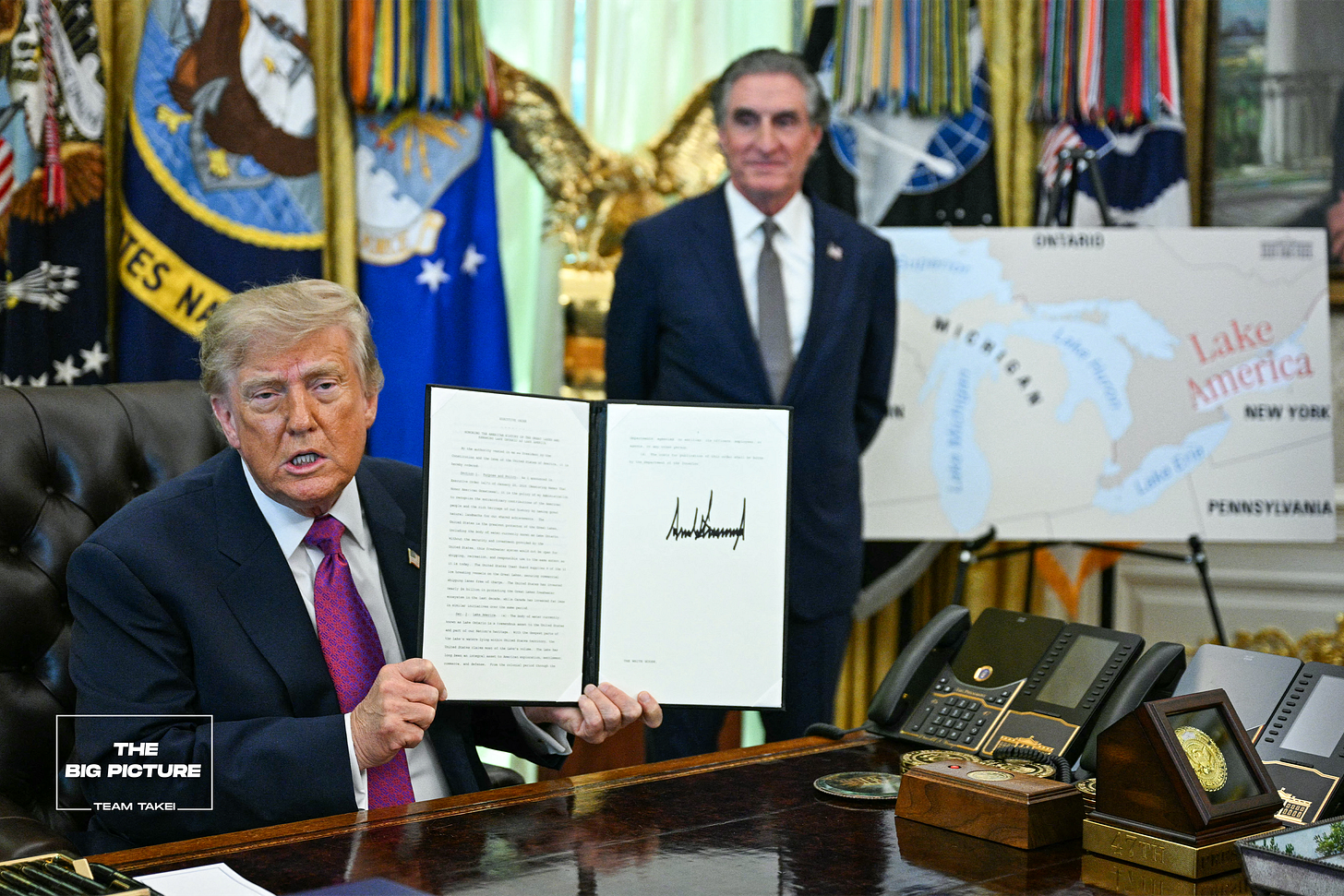 US President Donald Trump, alongside Secretary of the Interior Doug Burgum, displays an executive order he signed that aims to rename Lake Ontario to Lake America. Photo by Jim WATSON / AFP via Getty Images.
Trump Escalates Trade War with Canada—Renames Lake Ontario “Lake America”
After trade negotiations between the U.S. and Canada broke down last week, Trump’s 50% tariffs on $20 billion worth of imports from Canada—including “everything from hockey sticks to some building materials, liquors and certain kinds of clothing”—went into effect Saturday morning. This led Prime Minister Mark Carney to threaten “dollar for dollar” retaliation, saying “You’re at war when you get attacked. We got attacked.” Trump responded by taking to Truth Social on Monday to accuse Canada of “ripping off the United States of America for years” and announced, “On January First, 2027, Tariffs on all Cars, Trucks, both large and small, Automotive Parts, and Steel, will be increased to 50%.” Then on Tuesday morning, Trump declared “The United States is giving serious consideration to changing the name of Lake Ontario to Lake America in that we don’t expect to be doing much business with Ontario any longer.”
That same day, Canada announced that beginning September 8, it would impose “tariffs of up to 50% on about 700 products worth about $20 billion in retaliation for Trump’s tariffs on Canada. Those products include U.S. steel, aluminum, chain saws, appliances, processed cheese, and clams.” As The Wall St. Journal notes, “The Canadian tariffs were designed to protect domestic companies hit by a fresh set of hefty U.S. tariffs and to sting President Trump and his Republican Party as they head into a difficult midterm election in November.” These include tariffs on seafood from Maine, cheese from Wisconsin, and GE appliances from Kentucky. On Thursday, Trump followed through on his “Lake America” threat by issuing an executive order, which read, “In recognition of this flourishing economic resource and its critical importance to our Nation’s economy and its people, I am directing that [Lake Ontario] officially be renamed as Lake America.” To put a fine point on it, Trump also took a Sharpie to a map of Lake Ontario, writing in his new name, “Lake America.”
 @realdonaldtrumpLAKE AMERICA GREAT AGAIN!
  Tiktok failed to load.
Enable 3rd party cookies or use another browserTrump’s Order to Restrict Mail-In Voting Blocked Again after SCOTUS Ruling
On Monday, The Supreme Court issued a 6-3 emergency docket order lifting an injunction placed by a Massachusetts judge after Democratic officials in 23 states and the District of Columbia sued to block Donald Trump’s March EO restricting mail-in voting. Per The Guardian, back in March, Trump “ordered the government to create a ‘state citizenship list’ of eligible voters, requiring that mail-in ballots only be delivered to people on that list.”
-
How the Russians Got Inside My Phone
Reply source The FBI’s warning about Russian hackers infiltrating Signal accounts largely flew under users’ radar. (Image by BleepingComputers.com)
 If you’re a journalist these days and you get a call from the FBI, as I did the other day, your first instinct is to be on guard.
Did the bureau want to grill me as part of a leak investigation? Seize my phone (as it notoriously did to a Washington Post reporter earlier this year?) Or try to coerce me into being a witness against some target of the Justice Department sprawling investigations into President Trump’s political enemies?
Alas, in my case, it was precisely the opposite. The FBI agent from the Washington D.C. field office who reached out on my cell phone wanted to be helpful and alert me to something I was totally unaware of: My account on the Signal messaging app had been compromised, she informed me.
By the Russians, she added.
It turns out I had been targeted by an audacious “phishing” scheme orchestrated by Russia’s FSB, the country’s all-powerful intelligence agency, which has been breaking into one of the most widely used—and presumptively secure—commercial messaging service.
To say that I was dismayed would be something of an understatement. Signal, of course, is routinely used by journalists to communicate with confidential sources. And not just journalists, as the world discovered last year when The Atlantic revealed that Secretary of Defense Pete Hegseth used Signal to discuss with other senior Trump national security officials imminent plans to attack the Houthis in Yemen.
But as I quickly learned as well, I shouldn’t have been surprised by the security breach. It turns out the FBI has issued two alerts this year about the Russian cyber operations that, although they have gotten relatively little attention, should have set off alarm bells across the board. FBI Director Kash Patel had even posted about it on X.
Neither he nor the bureau pulled any punches about what the Russians were up to. “The activity targets individuals of high intelligence value, such as current and former U.S. government officials, military personnel, political figures, and journalists,” the bureau wrote in a public alert last March. (I suppose I should be flattered that somebody in Moscow thinks I have “high intelligence value.”)
This is another free SpyTalk post without a paywall. It’s kind of an experiment: We’ll do more of these if readers will continue to sponsor us with paid subscriptions. We can’t do our wide-ranging reporting without you. And we certainly appreciate your generosity. Thanks.
But I was far from alone. “This global campaign has resulted in unauthorized access to thousands of individual [messaging] apps,” the March alert added. “After compromising an account, malicious actors can view the victims’ messages and contact lists, send messages, and conduct additional phishing against other [messaging] accounts” noting that the “threat actors specifically target Signal accounts.”
In June, the bureau issued a follow up alert specifically identifying the FSB, the Russian intelligence service that ex-KGB agent Vladimir Putin once headed and which to this day maintains tight control over, as the culprit. “Russian Federal Security Service (FSB) officers embedded with the FSB Border Guards and others working on behalf of the Russian military services” were behind the Signal attacks, according to the June 26, 2026 alert.
Moreover, the attacks on Signal and other message apps, like WhatsApp, are very much an ongoing operation, the European Union warned just this week.
To be sure, Russia’s aggressive hacking is hardly a new phenomenon. Eight years ago, I co-authored a book, Russian Roulette, that documented how the Russians penetrated the email accounts of the Democratic National Committee and the Hillary Clinton campaign as part of a plot to disrupt the 2016 U.S. presidential election.
But since then, and especially in the wake of the invasion of Ukraine, Russia’s cyber warriors have dramatically stepped up their game with new and innovative tactics, according to Steven Adair, the president of Volexity, a cybersecurity firm that advises clients on how to protect their data.
“There has essentially been a slew of new techniques that have been extraordinarily successful by the Russians,” Adair told me when I called to tell him how I had been victimized by the FSB.
While his firm had monitored Russian cyber operations for over a decade, in a six month period last year, “we saw more actual breeches than we’d seen in the past 10 years,” Adair added. “In terms of cyber access, it’s through the roof.”
Don’t miss the latest SpyTalk podcast, with former CIA Chief Learning Officer Steve Hirsch on how Russia, China, and Iran exploit the cracks in US intelligence.
So how did the Russians do it? In my case, it began with a message that popped up on my Signal account on May 29 stating it was from “Signal Support” with the blue-rounded circle that is Signal’s signature logo.
“We found logging in to your account from a new device,” it read. “If it wasn’t you, write, ‘it’s not me’ in the chat and follow the further recommendations.” These included instructions on how to enter my “recovery key”— a long hodgepodge of random letters and numbers that are apparently unique to each users’ account.
At first, I didn’t respond. But then, four days later, on June 3, I got a follow up “Signal Support” message that got my attention. “Warning,” it read. “You did not enter your recovery key. Your account will be deleted.”
Not wanting to lose access to an account I believed to be secure and regularly use, I stupidly did what the bogus Signal Support team recommended, including the final step: “Paste the key here immediately to keep your account.”
Remedial Phone Work
When the FBI agent called me this week, she explained what I had done wrong and how I was among a rather large group of Signal users—in the thousands—who had fallen for the scam. She then patiently walked me through how to correct matters by creating a new recovery key and pin that preserves my account and keeps it secure.
So, amidst all the outrageous FBI actions in pursuit of the Trump administration’s attacks on a free press, the bureau in this case was doing a public service.
So a big thank you, Kash Patel. One of your agents was actually helpful to a reporter — and has now helped me to do my job to report on everything you’re doing wrong.
As the FBI explained, anybody who thinks their account has been compromised should click on the circle in the upper left when you open up your Signal account, go to Settings and create a new recovery key and pin. The FBI’s public service alert last March also states: “If you or someone you know has fallen victim to this phishing campaign, file a complaint with IC3. For additional information, see FBI’s guidance on Spoofing and Phishing as well as a previous Public Service Announcement about how “Criminals Use Generative Artificial Intelligence to Facilitate Financial Fraud.” Additionally, see CISA’s “Phishing Guidance: Stopping the Attack Cycle at Phase One | CISA“ and “Mobile Communications Best Practice Guidance.”
Thank you for reading this. SpyTalk is an entirely reader-supported publication. To receive new posts and support the work of all of us here, please consider taking out a paid subscription. We can’t do it without you. Just click below for a no-obligation free trial.
-
Trump administration pushing to hand parcel of Yosemite land to private developer – report
Reply sourceNevada-based Kingsbarn Realty Capital seeks to acquire land to construct private road to development outside park
The Trump administration is reportedly pushing to give a parcel of land inside Yosemite, one of the country’s most popular national parks, to a Nevada-based private developer.
Staff with the National Park Service have been exploring how the agency can give a quarter-mile parcel to a company operated by Kingsbarn Realty Capital, the news outlet Notus reported on Friday, citing agency documents and unnamed sources “directly familiar with discussions”.
Continue reading... -
Tours: rassemblement contre l’expulsion de la MIP, samedi 29 août
Reply sourceAu 1er septembre, la Maison Internationale Populaire (MIP) à Tours et ses 70 habitant·e·s dont 21 mineur·e·s seront expulsables. En effet, le juge de l’exécution (JEX) a refusé notre demande de délai supplémentaire suite à la demande de la société propriétaire (la SET) de réaliser des travaux pendant 2 semaines afin d’installer un câble électrique sur le terrain actuellement occupé. 70 personnes à la rue pour 2 semaines de travaux !
Expulser maintenant la MIP, c’est remettre à la rue des enfants qui vont faire leur rentrée dans quelques jours, des personnes avec des problèmes de santés et des personnes précaires économiquement et administrativement. Dans le département, le réseau d’hébergement d’urgence est déjà surchargé et incapable d’accomplir ses missions. Il est donc irresponsable de forcer 70 personnes à être dépendantes de ce système.
La MIP est un squat ouvert depuis le 18 avril 2025. Elle occupe des bâtiments abandonnés de l’ancienne caserne militaire Beaumonts, concernés par aucun projet d’aménagement.
Depuis plus d’un an, nous travaillons avec la Mairie afin d’être relogé·e·s dans un bâtiment à Tours Nord. La fin de la rénovation de ce bâtiment et le déménagement dans celui-ci est prévu pour novembre 2026.À côté de la MIP, la SET construit des logements pour lesquels elle a besoin de faire passer une ligne électrique sur notre terrain. Ces logements ne seront pas terminés avant l’année prochaine, elle pourrait très bien décaler l’installation de la ligne électrique de 3 mois pour faciliter le déménagement à Tours Nord, ou comme nous leur avons proposé, effectuer leurs 2 semaines de travaux en sécurisant les lieux avec des barrières, comme ils le font depuis le début de l’occupation. Nous avons toujours accepté sans difficulté les nombreuses interventions des chantiers de la SET sur notre terrain et travaillé en bonne intelligence avec les employés du chantier et les vigiles. Nul besoin de nous expulser pour cela.
La préfecture a l’obligation légale d’offrir des solutions d’hébergement pérennes aux personnes expulsées. Mais nous n’avons actuellement aucune confiance envers la préfecture. Après l’expulsion d’un squat, les préfectures ont pour habitude de se défiler de leurs responsabilités en ne proposant que 1 ou 2 semaines d’hébergement. Ensuite, les personnes sont renvoyées à la rue sans aucune autre solution de logement, et doivent espérer avoir une place d’hébergement d’urgence en appelant chaque semaine le 115, qui est déjà surchargé. C’est pourquoi nous souhaitons être reçu par la préfecture afin d’obtenir des engagements clairs.
- Pour que les 18 enfants de la MIP puissent aller à l’école tous les jours sans avoir à se soucier d’où ils vont dormir le soir
- Contre l’expulsion des 70 personnes qui ont trouvé refuge depuis 1 an et demi et contre celle d’un bébé né à la MIP il y a 2 semaines
- Et contre toutes expulsions de bâtiments vacants
Rassemblons-nous avec des pancartes le :
Samedi 29 août 16h Place Jean Jaurès à Tours

[Publié le 27 août 2026 sur La Gabarre.]
-
Hegseth is Being Confronted by his Worst Nightmare, Too
Reply source

Day by day, Hegseth’s nightmare is getting closer to home
I want to follow up on Marcy’s great post on Secretary of Excursions Pete Hegseth’s attempts to deflect and deny responsibility by firing senior people at the DOD. He has gotten a lot of press over his ouster of women and minority generals, admirals, and commanders of various kind, all out of his desire to ride the DOD of wokeness and to purge those who received promotions not on merit but because of diversity quotas. (Note, please, that by Whiskey Pete’s lights, any woman or black who was promoted to a senior position was by definition a diversity hire, not a merit-based promotion.)
But there’s the other side of Hegseth’s problems in the military — promotions — and he’s got problems galore in that respect as well. These problems didn’t start with Hegseth, though. it was part of Trump’s first administration, too. From Helene Cooper in March 2021 (shortly after Joe Biden took office):
The Marine Corps is promoting Col. Anthony Henderson, a combat-tested Iraq and Afghanistan veteran, to brigadier general, a move that cracks the doorway for the service to potentially promote an African-American to its most senior ranks.
The Marine Corps, which had passed over Colonel Henderson for four years, has placed him on a highly selective list of nine colonels to be granted a coveted one star that denotes general rank status — brigadier general. The list, which was signed by President Biden, arrived Wednesday evening at the Senate Armed Services Committee, to start the required confirmation process, according to the committee’s website.
While earlier promotion boards may have passed Henderson over because he didn’t have the same relationships and mentors that other white candidates had, the last board clearly wanted to promote him but were pretty sure that he’d get his name struck off the list by Trump. Thus, they delayed sending up the list until Biden took office. Cooper wrote about Col. Henderson the previous August, shortly before the promotions board met to consider his promotion for the fourth time, and some quoted in the March article attributed to his eventual appearance on the promotions list that Biden signed.
But as bad as the story of Henderson’s promotion is, it also points to an even larger, more systemic problem for Hegseth. In the past two months, Greg Jaffe and Kate Kelly at the NYT have published two major pieces on the promotion practices under Pete Hegseth. The titles alone are instructive:
Secret Vetting and Blocked Promotions: Inside Hegseth’s War on Diversity
A Black admiral fixed one of the Navy’s worst messes. Mr. Hegseth blocked his promotion anyway. [June 19, 2026]An Admiral’s Rise Reveals the Politics Driving Hegseth’s Pentagon
Before he was picked to lead the Navy, Adm. Daryl Caudle found ways to signal his support for Defense Secretary Pete Hegseth’s anti-diversity goals. [July 26, 2026]Buried deep in that first piece is a nugget that points to Hegseth’s biggest problem of all.
By law, one-star and two-star officers are chosen by promotion selection boards made up of senior military officers. The meetings are so confidential that board members are not permitted to tell others that they are part of the process.
And yet, these officers and others like them are starting to talk. That ought to scare the pants off Hegseth, but I don’t think he realized how bad that problem is.
From that second story:
Adm. Daryl Caudle saw an opening to land the Navy’s top job last year, and he seized it.
Before Pete Hegseth had even been sworn in as defense secretary, Admiral Caudle, then the head of a major Navy training command, offered to help Mr. Hegseth prepare for his politically contentious Senate confirmation hearing, according to current and former defense officials.
The outreach was a breach of military ethics, the officials said. Senior military officers are supposed to avoid any hint of partisan bias or political activity.
Nothing came of the offer. But soon after Mr. Hegseth took office, he fired the first woman to lead the Navy: Admiral Caudle’s boss. Days later, a senior officer on Admiral Caudle’s staff contacted Mr. Hegseth’s team in another breach of protocol.
His pitch: Mr. Hegseth should choose Admiral Caudle to be the next chief of naval operations, the current and former officials said, speaking on the condition of anonymity to discuss sensitive personnel matters.
The officer described Admiral Caudle in terms that matched Mr. Hegseth’s view of the values that military officers should embody. There was “no one more in line” with Mr. Hegseth’s vision for remaking the military, he said, according to an official familiar with the exchange. The officer cast Admiral Caudle as a “warfighter” who wanted to remove “woke barriers” that he claimed were weakening the force, the official said.
Even though Admiral Caudle was not on a list of candidates recommended by senior Navy officials, Mr. Hegseth chose him for the job.
Caudle was willing to speak out of turn in order to get this new position, but did you notice the other folks speaking out? Those “current and former officials” – either people who had been on the promotion board, their close staff members, or close friends of the promotion board members.
That’s the real problem for Hegseth. It’s not the NYT reporters that are the problem, but the folks who seem anxious to tell their stories to the media in the first place. Skipping ahead, Jaffe and Kelly wrote:
[Caudle’s] path to that position is a case study in how the military promotion process at the Pentagon under Mr. Hegseth has deviated from tradition, leaving it susceptible in the view of critics to politicization and favoritism.
[snip]
After Mr. Hegseth fired Admiral Franchetti, senior Navy officials, led by the service’s acting secretary, assembled a list of the three officers they believed were best qualified to fill her position. Admiral Caudle was not on it. Navy leaders thought he was better suited to lead the U.S. Strategic Command, which oversees the country’s nuclear arsenal, the officials said.
Mr. Hegseth reviewed the Navy’s list in a meeting with senior staff members.
“Where’s Caudle?” he asked, according to officials with knowledge of the meeting.
“Officials with knowledge of the meeting” were sharing this story? That’s a small group of very senior people, and the people around them. If they are talking like this, it means only one thing: be afraid, Mr. Secretary. Be very afraid.
These folks spoke out, I strongly suspect, because Hegseth had to bring in Hegseth’s and Trump’s legal fixer, Timothy Parlatore, to take care of a hold placed because of an IG investigation about Caudle’s less-than-enlightened mindset toward woman and sexual abuse. At an awards banquet that celebrated the Pentagon’s Sexual Assault Prevention and Response program, some of Caudle’s informal comments over and after dinner were, shall we say, concerning:
According to the sailors [who spoke with investigators], Admiral Caudle offered examples: If he strode naked through the forest, coated in honey, he should not be surprised if he were attacked by a bear, officials said. If he wore gold chains and a fancy watch on a visit to Harlem, he risked getting robbed. At least one sailor believed Admiral Caudle was blaming assault victims for provoking their attacks.
“According to the sailors” who had spoken to the IG? Be afraid, Mr. Secretary. Be very afraid.
The sailor spoke to the IG, I suspect, because it is certainly possible to see Caudle’s remarks as a problem — especially when he had no problem making them at an awards dinner dedicated to Pentagon efforts to respond to and stop sexual abuse. I certainly could see where that might be a problem – but to Hegseth, this only confirmed that Caudle is the anti-woke kind of guy he wanted.
Hegseth’s real problem is that his desire to remove and replace senior leaders who do not reflect his anti-woke, “all we need is great warriors who can bust heads” mentality has broken trust with the very military people he seeks to command. More than just broken trust, he has proven untrustworthy.
Imagine you were on a promotion board, and time and time again Hegseth strikes names off the list you and your colleagues put forward. That’s gotta suck. And the fact that you’re not even supposed to tell anyone you are even on the board means you can’t vent your frustrations about having your work tossed aside so cavalierly. That’s gotta suck even more.
Now imagine you are someone else, asked to serve in silence on the next promotion board. You’ve seen how the work of previous boards has been treated, and you have to wonder if serving on the next board is worth the hassle. “Why bother, if Hegseth is going to ignore what we propose and pick whomever he wants anyway?” On the other hand, simply being asked to serve on the promotion board is a sign that your colleagues sincerely value your ability to assess leaders, and that’s an honor that would be hard to turn down.
Then Imagine you are someone up for promotion, and you’ve seen how Hegseth has unilaterally stripped folks off the promotions lists. You’ve seen how Hegseth promoted an admiral who completely went outside the system to get his desired post. You’ve spent weeks, months, and years to put yourself in the best light for promotion, your superiors have told you how they are doing their best to put your candidacy forward for those stripes, those bars, those birds, those stars. Even so, with what you’ve seen, with what appears to be getting worse by the day, you have to wonder how fairly you will be treated.
No, you don’t have to wonder. You know. And that’s Hegseth’s problem, because it touches the whole military – every branch of the service, and every rank from top to bottom.
Then step away from the promotions mess.
Imagine you are a senior leader whose job it is to manage logistics. Military units need not just weapons, but ammunition to use in those weapons. They need people to load and fire and maintain those weapons. You need food to feed those people and toilets for them to use, as well as clothes for them to wear, beds for them to sleep in, and laundry facilities to wash the clothes and sheets. You know they need these and a 1001 other things, and its your job to get them in place.
You also know the damage done to naval facilities in the Middle East at the outset of the war, that prevented the USS Abraham Lincoln from being supplied in the usual manner and prevented the sailors from getting even a weekend of shore leave. You and your colleagues are the ones who got the urgent pleas from the USS Abraham Lincoln to find other ways to deliver at least a minimum of stuff to let them keep doing their jobs. You and your colleagues are the ones who deal with the folks on shore trying to rebuild their bases and come up with alternative delivery systems. Even if you are handling logistics in the Army and not the Navy, you know these things, because handling supply chains is your Military Occupational Specialty, too.
And then you hear Trump talk about how the deployment wasn’t this bad, and should be even longer, because who knows more about deployments that Cadet Bone Spurs. Then you hear Hegseth saying that the USS Abraham Lincoln has been given everything they need, and there’s no problem to see here.
You hear this, and it no doubt pisses you off. The commander and senior officers of the USS Abraham Lincoln hear this, and it no doubt pisses them off. But it’s the lower level folks that ought to worry Hegseth. Right now, the stories of the USS Abraham Lincoln are being driven mostly by the families back home. “Here’s what we’ve been hearing and seeing in the text messages from out loved ones.”
Those loved ones are finally coming home, and what do you think is going to happen then, Mr. Secretary?
The return of just one sailor who has come home early has already driven the story here – a sailor who tried to commit suicide. His fellow sailors saved him death after he jumped overboard, out of his apparent desperation at the absolute hopelessness of his situation. And now, someone in the Navy has decided that what’s really needed here is to Make An Example out of this sailor by filing charges that he went AWOL.
Rather than try to learn what drove him to such desperation, try to help him, and try to understand what every sailor on the Lincoln has been dealing with so that the Navy can better make sure it doesn’t happen again, the Navy wants to make this sailor the bad guy and scare every other sailor into sucking it up and doing what they are told, mental health be damned.
What’s going to happen, I wonder, when all those other sailors come home? How many stories are going to get told over beers in the local watering holes, as the sailors on the Lincoln start talking with their colleagues at the base or folks assigned to other ships in port? How many sailors are going to decide not to reenlist? How many sailors are going to want answers from the Navy, and will turn to Congressional staffers with their stories? How many will turn to the media?
Hegseth has a standard pattern of how to deal with the press. Deny what they say or write, and keep them from writing their next story. He tried to silence the mainstream media by effectively removing their reporters from the Pentagon. Now he’s fired the senior leadership of Stars and Stripes. But both of these are signs of how desperate Hegseth is. He seems to think that he can manage bad news by shooting enough messengers.
But as the promotions stories demonstrate, those messengers are coming out it greater and greater numbers. The entire military has learned the truth of the saying “trust is build over years and destroyed in days” because Pete Hegseth has done just that. Hegseth’s problem isn’t the media, but the military itself. They are increasingly tired of being scapegoated, lied to, and dismissed as unimportant. Hegseth is only starting to realize the danger he is in, but it appears to be finally sinking in, even if he doesn’t know how to deal with. And that has to scare him to death.
Because with every day that passes, the USS Abraham Lincoln is a day closer to getting home.
The post Hegseth is Being Confronted by his Worst Nightmare, Too appeared first on emptywheel.
-
Martin Rowson on Trump and the consequences of the climate crisis – cartoon
Reply source -
Des marques paient des milliers d’euros pour apparaître sur ce futur MacBook
Reply source
Pour financer son premier MacBook, un développeur a mis aux enchères dix espaces publicitaires sur son capot. Deux jours plus tard, les marques ont déjà misé près de trois fois le prix de l’ordinateur.
-
Marine Le Pen lance sa campagne en évinçant un proche de Jordan Bardella
Cinq mois après avoir été nommé conseiller spécial du président du parti, François Durvye quitte déjà ses fonctions. Cet ancien bras droit de Pierre-Édouard Stérin, en désaccord avec la ligne économique de Marine Le Pen, paie surtout son lobbying pour une candidature de Jordan Bardella à l’élection présidentielle.Reply source