Conversation
-
Washington Policy Review: August 28, 2026
sourceToday’s Report
1. Overview
2. White House News
3. Truth Social Posts
4. Government Department News
5. 2028 Democratic Presidential Candidates
6. AI & Tech Company News
7. Congressional Watch
8. Policy Impact Analysis & Heatmap
1. Overview
President Trump signed an Executive Order to establish a Presidential Commission tasked with designing the United States Space Academy. This new federal institution aims to prepare future leaders to “advance our Nation’s interests in space” and ensure “American superiority” in the sector. The Commission, chaired by the NASA Administrator, is required to submit a report on the Academy’s governance and curriculum within 120 days. Additionally, the administration emphasized its ongoing control of the Strait of Hormuz, asserting that “Operation Economic Outcast” is successfully restricting Iranian revenue and preventing the regime from projecting power.
On Truth Social, President Trump announced a deal with Venezuela to secure U.S. control of 65 billion barrels of oil, calling it the “biggest oil deal, by far, in World history.” He highlighted various administrative wins, including the dismantling of a China-linked hacking network and an executive order banning specific foreign equipment from the power grid. He also designated Palestine Action as a terror group and shared information linking Portland Antifa to the IRGC. Finally, Trump attacked a New York Times journalist, labeling her a “scammer” for her reporting on his attendance at 9/11 ceremonies, and dismissed the story as “a total CON JOB.”
The State Dept revoked the visa of an Iraqi national on the FBI’s terror watchlist and sanctioned entities and individuals, including a Bank Melli manager, for supporting Iranian illicit financial networks. The Department of War announced $135.6 million in strategic equity investments across two projects, including Trilogy Metals and Atlantic Alumina, to secure domestic supply chains for critical minerals and defense production. Furthermore, the Treasury Department initiated a rule to revoke Banque Misr UAE’s access to U.S. financial institutions for allegedly processing $1.8 billion for Iranian shadow networks, with Secretary Scott Bessent declaring the goal to “sever every economic lifeline Tehran has left.”
Governor Newsom announced $44 million for tribal and conservation projects and $2.7 billion for transportation infrastructure, criticizing the federal administration for taking the country’s transportation future “backward.” Governor Whitmer filed a brief to force the removal of the Line 5 pipeline from the Straits of Mackinac, labeling the structure a “ticking time bomb.” Governor Moore praised a ruling protecting Maryland ratepayers from “imprudent” utility costs and promoted the Vax Act to ensure state vaccine guidance is “proven by science, not political headwinds.” Governor Pritzker opened a new multimodal station in Carbondale, while Governor Walz announced appointments to various state advisory bodies.
OpenAI announced it will terminate its contract with the code editor Cursor by November 12, 2026, following Cursor’s acquisition by SpaceX. OpenAI cited concerns that SpaceX might not adhere to its terms of service, noting a history of Musk-led companies violating contracts. The company emphasized that it will not provide future models, such as Astra, to the platform, citing a “new level of accountability” regarding the use of its technology.
The House of Representatives held a brief pro-forma session during which members introduced 34 new bills and 8 resolutions. Committees reported several pieces of legislation, including measures to restrict federal higher education funding for institutions participating in commercial boycotts of Israel and bills requiring tax-exempt groups to disclose foreign contributions. The Senate also held a pro-forma session lasting less than one minute with no legislative business conducted.
Government efforts to bolster domestic industrial nationalism through supply chain vertical integration are driving support for energy and mining sectors, though this shift toward local sourcing threatens to induce inflationary pressures and increase exposure to geopolitical risk. Meanwhile, the strategic use of correspondent banking sanctions to restrict foreign dollar liquidity is incentivizing broad risk-aversion, as financial institutions reduce their international footprint to mitigate the compliance burdens associated with “Operation Economic Outcast.” Finally, proactive federal intervention in drug pricing is exerting downward pressure on healthcare margins, raising concerns that these mandates may undermine R&D incentives and discourage capital allocation toward high-risk medical innovation.
2. White House News
President Trump Was Right: America Controls the Strait of Hormuz
U.S. Central Command confirmed that American forces, not Iran, control the Strait of Hormuz, ensuring global energy movement while restricting Iranian revenue. Under “Operation Economic Outcast,” the administration is tightening economic pressure on the Iranian regime, which currently faces a “domestic fuel crisis, collapsing currency, and crushing inflation.” President Trump maintains this strategy to “starve the regime of its ability to project power.” The administration asserts that it will continue this pressure until the Islamic Republic can no longer threaten global commerce or international stability.
Reference: https://www.whitehouse.gov/releases/2026/08/president-trump-was-right-america-controls-the-strait-of-hormuz/
Fact Sheet: President Donald J. Trump Establishes a Commission to Design the United States Space Academy
President Trump signed an Executive Order establishing a Presidential Commission to create a new federal academy dedicated to preparing the next generation to “advance our Nation’s interests in space.” The initiative aims to secure “American superiority in space” by fostering the skills and character necessary for technological and industrial leadership. Highlighting the administration’s commitment, the announcement states that “President Trump has demonstrated consistent leadership as a driving force for American strength and achievement in space,” focusing on building the workforce required for future national space endeavors.
Reference: https://www.whitehouse.gov/fact-sheets/2026/08/fact-sheet-president-donald-j-trump-establishes-a-commission-to-design-the-united-states-space-academy/
Establishing the United States Space Academy
President Trump issued an executive order establishing the Presidential Commission on the United States Space Academy to strengthen the nation’s space workforce. Chaired by the NASA Administrator, the Commission will advise the President on creating a “NASA-led Federal academy” to train the next generation of space leaders. Within 120 days, the Commission must submit a report detailing the Academy’s governance, curriculum, and service obligations. This initiative aims to ensure the U.S. maintains “superiority in space” by developing leaders committed to advancing American interests.
Reference: https://www.whitehouse.gov/presidential-actions/2026/08/establishing-the-united-states-space-academy/
3. Truth Social Posts
Trump announced a historic agreement with Venezuela to secure majority U.S. control of over 65 billion barrels of oil reserves, a development he termed “the biggest oil deal, by far, in World history.” He also shared reports on new drug pricing deals with biotech firms, noted that the FBI dismantled a China-linked hacking network, and highlighted his executive order banning certain foreign equipment from the power grid. Regarding national security, Trump confirmed the designation of Palestine Action as a global terror group and promoted State Department findings linking Portland Antifa to Hamas and Iran’s IRGC. Additionally, he extolled recent economic data showing a decrease in the trade deficit and an increase in exports, crediting the success of his tariff policies.
Domestic policy developments included a court ruling that lifted a nationwide injunction on his mail-in voting order, while he circulated plans for a new affordability initiative focused on highways and rail. In New York, Trump criticized Governor Kathy Hochul for her stance on trade with Canada and her refusal to recognize the name “Lake America,” urging voters to support Bruce Blakeman instead. Trump also expressed his condolences following the passing of King Harald of Norway, describing him as a “strong, proud, and greatly respected man.”
Trump vehemently attacked a journalist from The New York Times, labeling her a “scammer” and a “phony” for reports regarding his attendance at the September 11th memorial ceremonies. He dismissed the reporting as “corrupt news” and “a total CON JOB,” asserting that his potential absence from speaking roles was irrelevant to the “solemn ceremony.” Beyond these comments, he shared media coverage of his Dallas midterm convention (no link) and referenced a commentary regarding his prior warnings.
Reference: https://truthsocial.com/@realDonaldTrump
4. Government Department News
State Department (state.gov)
Deputy Secretary Landau’s Meeting with Ugandan Foreign Minister Ayebare
Deputy Secretary of State Christopher Landau met with Ugandan Foreign Minister Adonia Ayebare in Washington, D.C. The two discussed enhancing bilateral cooperation regarding global health priorities, economic growth, and regional security.
State Department Revokes Visa of Iraqi National on Terror Watchlist
The State Department has revoked the visa of Taif Sami Mohammed Al Shakarchi following her placement on the FBI’s Terror Watchlist. Al Shakarchi previously received an International Woman of Courage Award in 2022. She is no longer in the United States. Assistant Secretary Dylan Johnson stated that under President Trump and Secretary of State Marco Rubio, “suspected terrorists will never be allowed to remain in the United States.”
U.S. Sanctions Sever Financial Lifelines of Iranian Regime
As part of “Operation Economic Outcast,” the U.S. is sanctioning Reza Mohammad Taeedi, manager of Bank Melli’s Dubai branch, and a Hong Kong-based company for supporting the Iranian regime. Additionally, FinCEN proposed a rule to revoke Banque Misr UAE’s access to U.S. financial institutions. The administration aims to “sever the economic lifelines” of the regime, targeting entities that facilitate illicit financial practices and enable access to U.S. dollars.
Deputy Secretary Landau Travels to Pacific Island Nations
Deputy Secretary of State Christopher Landau will visit Palau, the Federated States of Micronesia, the Solomon Islands, and Kiribati from August 31 to September 11. He will participate in the Pacific Islands Forum and meet with government and business leaders to advance economic and security interests. USCG Commandant Admiral Kevin Lunday will join portions of the trip to emphasize maritime security. The travel underscores the administration’s commitment to maintaining “an open, secure, and prosperous Pacific region.”
Department of War (war.gov)
The Department of War has invested $35.6 million into Trilogy Metals Inc. to secure domestic supplies of copper, cobalt, and germanium. This 17.5% economic position supports exploration and infrastructure at the Upper Kobuk Mineral Projects in Alaska. The investment aims to bolster the “Defense Industrial Base” and follows approval of the Ambler Road Project. Officials stated this is a “decisive investment in America’s supply chain independence” to protect the economy from manipulation and secure materials vital for national defense and advanced electronics.
The Department of War is providing a $100 million follow-on investment to Atlantic Alumina Company (Atalco), bringing total government funding to $400 million. This effort has mobilized an additional $400 million in private capital to stabilize the last domestic alumina refinery. The initiative aims to scale production to meet 142% of projected defense demand by 2029. Officials stated the move mitigates “critical supply chain risk” and protects military readiness from “foreign interference” by insulating the U.S. from dependence on foreign adversaries.
The Department of War awarded several contracts, including $147.3 million to Symetrics Industries for ALE-47 countermeasure dispenser systems and $37.7 million to Telos Corp. for cybersecurity modernization and artificial intelligence tools. Kwaan Tech LLC received $30 million for aircrew training services, and BK Manufacturing Co. Inc. was awarded $28 million for missile wings and fins. Additionally, Oneida Engineering Solutions LLC received a $20.2 million contract to manage PFAS response actions at various Air Force installations through 2031.
Treasury Department (home.treasury.gov)
Iran’s Access to UAE Banks Targeted Under Operation Economic Outcast
The Treasury Department, under “Operation Economic Outcast,” has initiated a rule to revoke Banque Misr UAE’s access to U.S. financial institutions, citing the bank’s role in processing roughly $1.8 billion for Iranian shadow networks. Treasury Secretary Scott Bessent stated, “Treasury promised to sever every economic lifeline Tehran has left.” Additionally, the Office of Foreign Assets Control sanctioned Reza Mohammad Taeedi, a Bank Melli manager, and the Hong Kong-based Kameng Trading Limited for laundering funds and facilitating sanctions evasion on behalf of the Iranian regime.
5. 2028 Democratic Presidential Candidates
Gavin Newsom (gov.ca.gov)
Governor Newsom announced $44 million in funding for 15 projects across 11 counties to advance the state’s 30x30 conservation goal. The initiative supports tribal stewardship, salmon recovery, and desert protection to preserve biodiversity. The funding, which includes $32 million from the 2024 Climate Bond, seeks to strengthen partnerships with California tribes and protect ecosystems. Secretary for Natural Resources Wade Crowfoot emphasized the effort as a response to a time “when public lands are under attack by the federal administration.”
Governor Newsom signed AB 1956, which mandates that the California Office of Suicide Prevention explicitly include boys and young men as a target demographic in the state’s suicide prevention strategy. This legislation supports the administration’s “Path & Purpose” initiative, which aims to address mental health, social disconnection, and lack of mentorship among young males. Data cited in the bill indicate that this population faces disproportionately high suicide risks, and the law seeks to reduce stigma and expand access to behavioral health support.
Governor Newsom announced $2.7 billion for over 150 projects aimed at improving traffic flow, transit accessibility, and infrastructure resilience against extreme weather. The projects include tunnel ventilation upgrades, highway lane additions, and wildlife crossings. The Governor noted that while “Donald Trump is taking America’s transportation future backward,” California is continuing to invest in modernization. The funding utilizes state resources alongside federal support from the Bipartisan Infrastructure Law, contributing to a total of $81.1 billion in transportation investments since 2019.
Governor Newsom launched the “Made in California” labeling and marketing program to highlight products manufactured within the state. Managed by the Governor’s Office of Business and Economic Development, the program allows eligible manufacturers to use a state-verified label to signal quality and innovation to consumers. The initiative is designed to assist small and mid-sized businesses in competing for shelf space, contracts, and capital. For a limited time, the state is waiving all application fees for businesses joining the program.
Gretchen Whitmer (michigan.gov)
Gov. Whitmer Takes Legal Action to Get Line 5 Out of the Water, Protect Great Lakes
Governor Whitmer has filed a response brief in an ongoing lawsuit against Enbridge to force the removal of the Line 5 dual pipelines from the Straits of Mackinac. The Governor argues that the state retains the authority to revoke the 1953 easement, characterizing the pipeline as a “ticking time bomb.” She maintains that Michigan must have a say in activities affecting its waters, rejecting Enbridge’s claims that they possess a perpetual right to operate the pipeline regardless of state intervention.
Wes Moore (governor.maryland.gov)
Governor Moore applauded a Public Service Commission decision prohibiting Pepco from increasing rates for infrastructure projects deemed “imprudent.” The ruling disallowed costs for a multimillion-dollar substation, emphasizing that utilities must prioritize lowest-cost solutions like energy storage and non-wires alternatives. Moore stated, “utilities should not earn unreasonable profits while everyday Marylanders can’t afford to pay their power bills.” The decision, alongside the Utility RELIEF Act and recent PJM capacity market reforms, aims to hold corporations accountable and ensure affordable, reliable energy for Maryland families and small businesses.
As students return to class, Governor Moore is promoting the Vax Act, which empowers the Maryland Department of Health to set vaccine guidance independently of federal policy. Moore stated the administration aims to ensure recommendations are “proven by science, not political headwinds,” amid concerns that federal actions create “unnecessary confusion.” The Act authorizes the state to align recommendations with major medical associations. Maryland maintains established K-12 immunization requirements, which officials credit for the state’s low rates of vaccine-preventable illnesses and high kindergarten vaccination coverage.
Andy Beshear (governor.ky.gov)
Gov. Beshear Makes Appointments to Kentucky Boards and Commissions
Governor Beshear announced numerous appointments and reappointments to state boards, including the Kentucky Board of Education, the Board of Pharmacy, the Public Advocacy Commission, and the Kentucky Board of Emergency Medical Services. Other appointees will serve on the Pharmacy and Therapeutics Advisory Committee, the State Advisory Panel for Exceptional Children, the State Advisory Council for Gifted and Talented Education, and the Kentucky Early Intervention System Interagency Coordinating Council. The appointments fill various vacancies and expired terms across these administrative bodies.
Gov. Beshear Orders Flags to Half-Staff Monday for Overdose Victims
Governor Beshear directed state office building flags to be lowered to half-staff from sunrise to sunset on August 31 for Overdose Awareness Day. Additionally, the Executive Mansion will be illuminated in purple to honor those lost to drug overdoses and support their families. The Governor stated, “We’ve made a lot of progress, but we know there is always more to do,” and reaffirmed his commitment to reducing overdose deaths. Citizens and organizations are encouraged to participate in the tribute alongside the ongoing observation for Dolly Parton.
JB Pritzker (gov.illinois.gov)
Gov. Pritzker Celebrates Opening of New Southern Illinois Multimodal Station in Carbondale
Governor Pritzker joined local officials to open the $26.2 million Southern Illinois Multimodal Station (SIMMS) in Carbondale. The facility consolidates several transit providers, including Amtrak and Greyhound, under one roof to improve regional connectivity and tourism. Funded by federal, state, and city resources, the station features ADA-compliant infrastructure, solar power, and a Southern Illinois University tourism center. The project is intended to “connect residents with jobs, education, healthcare, and opportunity” while serving as a catalyst for downtown revitalization.
Gov. Pritzker Appoints Jim Montgomery as Director of Illinois Department of Natural Resources
Governor Pritzker has appointed Jim Montgomery to lead the Illinois Department of Natural Resources (IDNR), effective August 31, pending Senate confirmation. Montgomery, formerly the Executive Director of the Illinois Prisoner Review Board and a former mayor of Taylorville, brings extensive experience in public administration and conservation. Governor Pritzker stated that Montgomery is “an exceptionally qualified candidate” to oversee the agency’s work in protecting Illinois’ natural and recreational resources.
Gov. Pritzker Announces Two Appointments to Boards and Commissions
Governor Pritzker announced two pending appointments: Tara Ori to the Children and Family Services Advisory Council and Chasse Rehwinkel to the Illinois Finance Authority. Ori, an Assistant State’s Attorney for Lake County, brings two decades of legal experience in child welfare. Rehwinkel, the current President of Devon Bank and former Comptroller for the City of Chicago, offers a background in municipal finance and banking regulation. Both appointments are subject to confirmation by the Illinois Senate.
Daily Public Schedule: Friday, August 28, 2026
Governor Pritzker’s public schedule for August 28, 2026, included two primary events in Southern Illinois. At 2:00 PM, the Governor attended the ribbon-cutting ceremony for the new Southern Illinois Multimodal Station in Carbondale. Later, at 5:30 PM, he presided over the official opening of the DuQuoin State Fair at the DuQuoin State Fairgrounds.
Tim Walz (mn.gov)
Governor’s Office Announces Appointments
Governor Walz and Lieutenant Governor Flanagan announced new appointments to four state advisory bodies, effective September 2, 2026. These include the Governor’s Interagency Coordinating Council on Early Childhood Intervention, the Governor’s Council on Freight Rail, the Minnesota Emerging Entrepreneur Board, and the Statewide Independent Living Council. The appointments reflect the administration’s stated goal of seeking “qualified and diverse individuals” to serve Minnesota through their professional expertise and lived experiences. Full terms for the appointees vary by board, with most extending into 2027, 2029, or 2030.
6. AI & Tech Company News
OpenAI (openai.com)
Our decision on Cursor following its acquisition by SpaceX
OpenAI intends to terminate its contract providing models to the code editor Cursor by November 12, 2026, following Cursor’s acquisition by SpaceX. OpenAI stated this decision stems from concerns that SpaceX may not adhere to its terms of service, citing past experiences with Elon Musk’s companies violating contracts. While expressing respect for the Cursor team, OpenAI noted it will not provide future models like Astra to the platform, citing a “new level of accountability” regarding the use of its technology.
7. Congressional Watch
Covers the 2026-08-27 session — the Congressional Record is published with a one-day delay.
Senate
The Senate met briefly for a pro forma session that lasted less than one minute. No legislative business or committee meetings were conducted during this time.
None — No legislative action was taken [N/A]
House of Representatives
The House held a brief pro forma session that lasted three minutes. Members introduced 34 new public bills and 8 resolutions, while several committees filed reports on previously considered legislation.
H.R. 9772 — Requires tax-exempt groups to disclose information regarding foreign contributions [Reported to the House]
H.R. 9771 — Imposes penalties on political committees that accept foreign contributions [Reported to the House]
H.R. 4795 — Restricts federal higher education funding for institutions participating in commercial boycotts of Israel [Reported to the House]
H.R. 7487 — Encourages non-federal hydropower development at Bureau of Reclamation projects [Reported to the House]
H.R. 7730 — Modifies bankruptcy eligibility requirements [Reported to the House]
H.R. 5576 — Promotes timely exploration for geothermal resources on federal lands [Reported to the House]
Committee Highlights
None — No committee hearings or markups were held
Coming Up
The Senate will meet in a pro forma session on Monday, August 31, 2026, at 11:30 a.m. The House will meet on Monday, August 31, 2026, at 12 noon.
Reference: Congressional Record Archive
8. Policy Impact Analysis & Heatmap
This analysis is provided for informational purposes only. It does not constitute investment advice or a recommendation to buy or sell any security.
Impact on Market
Based on today’s policy developments, our analysis identifies the following market impact themes:
THEME 1. DOMESTIC ENERGY AND INDUSTRIAL NATIONALISM
The administration is prioritizing vertical integration of critical supply chains, ranging from Venezuelan oil reserves to domestic copper and alumina production. By funding miners and securing foreign energy assets, the government aims to insulate the U.S. economy from foreign interference. Bearish risks include potential inflationary pressures from replacing cheaper foreign components and the long-term uncertainty of managing infrastructure projects in volatile geopolitical environments.
THEME 2. FINANCIAL BLOCKADES AND SANCTIONS RISK
Aggressive use of correspondent banking bans, such as the action against Banque Misr UAE, serves as a core tool for the administration’s ‘Operation Economic Outcast.’ This strategy aims to starve targeted regimes by isolating them from U.S. dollar liquidity. A key concern for the sector is the secondary effect of ‘over-compliance,’ where international financial institutions exit regions or client bases entirely to avoid even the appearance of violating federal guidance.
THEME 3. REGULATORY PRESSURE ON HEALTHCARE
The government’s push for new drug pricing deals suggests continued downward pressure on industry margins. While the administration frames these as essential for affordability, industry critics argue such interventions damage the R&D incentives necessary for breakthroughs. The risk remains that aggressive pricing controls will compress returns on investment for biotech firms, potentially stifling capital allocation toward high-risk, high-reward medical research.
Policy Impact Heatmap with Market Direction
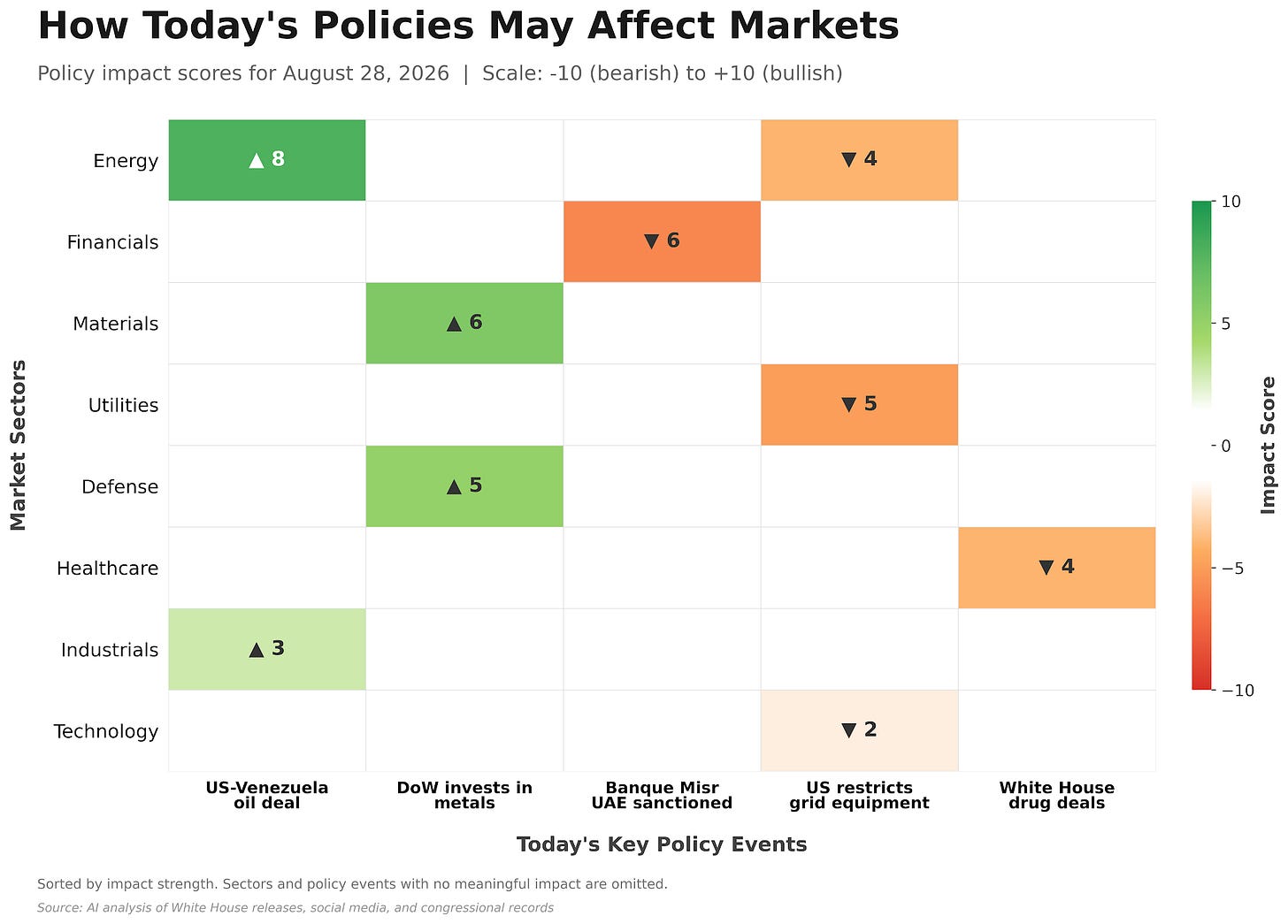
Each cell shows an estimated impact score on a fixed scale of -10 to +10, reflecting how today’s policy developments may affect each market sector. Positive scores (green, ▲) suggest bullish impact; negative scores (red, ▼) suggest bearish pressure. Rows and columns are sorted by impact strength, and sectors and policy events with no meaningful impact are omitted. The heatmap, the analysis below, and the Impact on Market themes above are produced from a single unified analysis: the heatmap visualizes the magnitudes, while the text explains the causal reasoning behind them.
Federal policy is aggressively reshaping industrial supply chains and energy security. The landmark U.S.-Venezuela oil deal acts as a massive supply-side stimulus for the energy sector, intended to lower domestic fuel costs. Conversely, the executive order restricting foreign energy equipment on the national grid introduces significant supply chain friction for utilities. These firms now face higher compliance costs and potential project delays as they replace sanctioned components.
Simultaneously, the Department of War is actively de-risking the defense industrial base through direct equity investments in domestic mining and alumina refining. This shift towards ‘strategic self-sufficiency’ benefits materials producers but implies a move away from globalized cost efficiencies. Finally, the Treasury’s move against Banque Misr UAE signals a hardening of the financial blockade against Iran. This increases the compliance burden for international banking institutions. Critics, such as those monitoring biotech sector shifts, characterize the ongoing pricing interventions as ‘heavy-handed’ interference that threatens innovation pipelines. The cumulative effect is a clear pivot toward domestic resource dominance, albeit with increased regulatory overhead for utilities and healthcare firms.