Timeline
Every post and feed across this instance
-
Spleentember

Loïc est prof d'histoire et de français, contractuel, dans un lycée pro des quartiers Nord de Marseille. Chaque mois, il raconte ses tribulations au sein d'une institution toute pétée. Entre sa classe et la salle des profs, face à sa hiérarchie ou devant ses élèves, il se demande : où est-ce qu'on s'est planté ?
Fin août. Dépité, j'ouvre ma messagerie académique. Il paraît qu'ils ont envoyé les emplois du temps. Pour les profs, c'est un peu le moment de la dernière prière où on croit soudainement à un genre de Dieu protecteur capable d'alléger notre planning, et nos épaules avec. Pas de chance cette fois-ci – à croire que j'ai pêché – je commence à 8 heures du lundi au vendredi. « C'est mort, j'y retourne pas ! » Pendant, les quelques jours qui suivent, je grogne ma mauvaise humeur à tous ceux qui me demandent comment j'envisage cette rentrée. J'ai le spleen de septembre, celui qu'on trimballait déjà enfant, et je n'ai rien trouvé de mieux qu'être prof, histoire de ne jamais briser le cercle.
Je ne voulais pas y retourner parce que, comme enfant, je déteste la hiérarchie. Je déteste les horaires qui m'accablent depuis petit et ces satanés murs blancs qui n'inspirent rien, coupent les horizons. Je ne voulais pas y retourner parce que je sais qu'enseigner dans la France de Macron relève d'une bagarre de chaque instant et que nos mobilisations sont rudes et souvent isolées. Je ne voulais pas y retourner parce que c'est de plus en plus insupportable de lire dans les yeux des élèves la détresse et la colère que je ressentais adolescent, assigné à une chaise, 8 heures par jour. Mais j'avais honte de ne pas vouloir y retourner, parce que je sais qu'il y en a qui se lèvent pour plus difficile que moi et pour beaucoup moins que mes 1 900 euros par mois. J'ai intériorisé quelque part la vision dominante selon laquelle mon métier relèverait du privilège plutôt que de la souffrance. Alors, j'ai arrêté de broncher et j'y suis retourné.
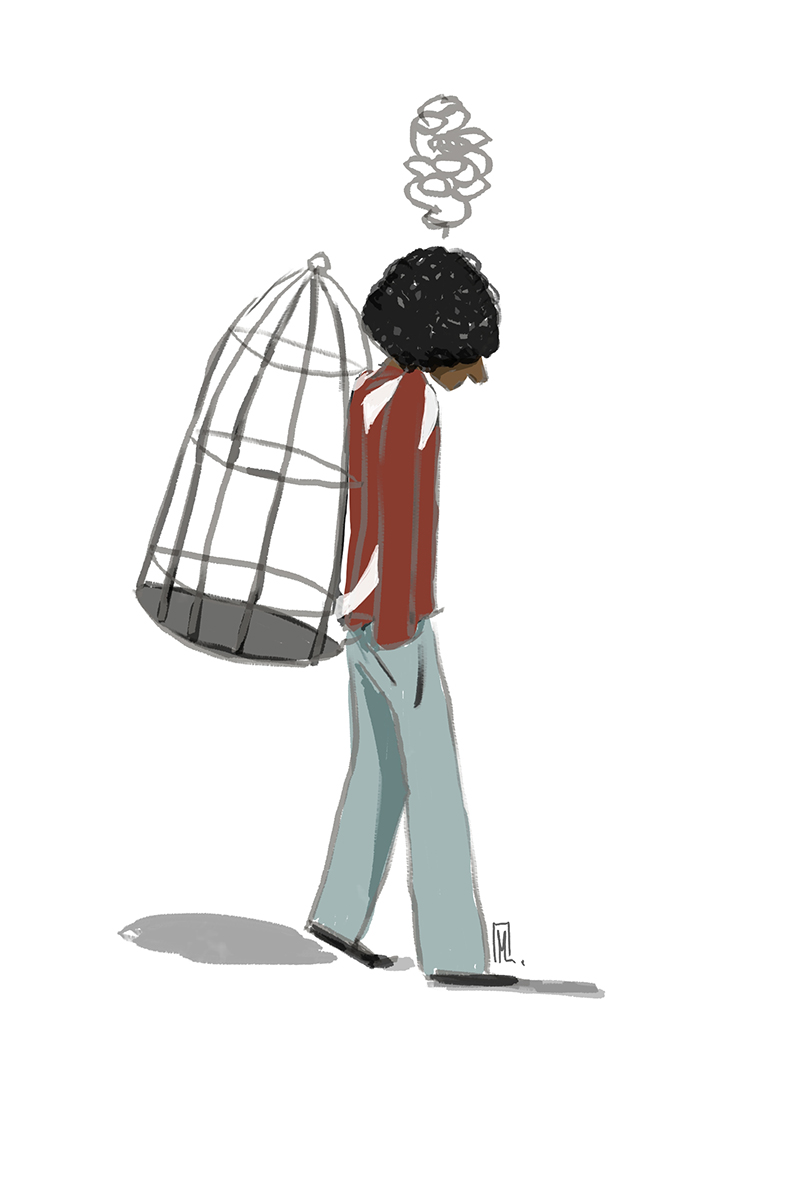
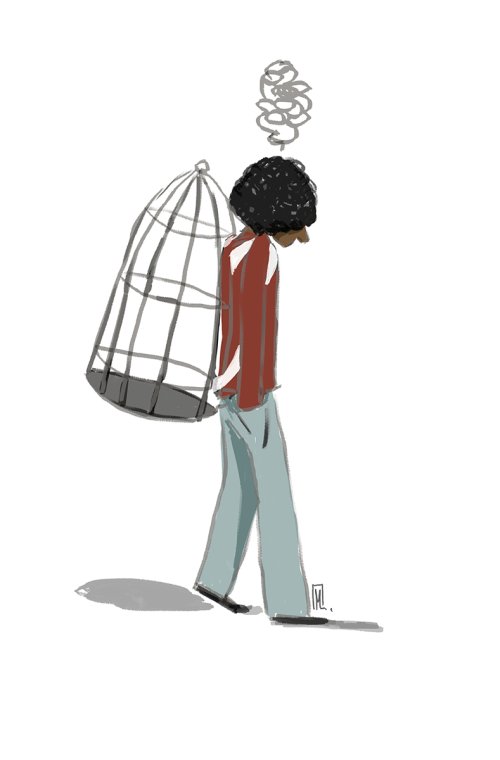
Les premiers jours passés, la messe républicaine de la proviseure suivit de réunions de rentrées interminables où chacun s'accroche à ses souvenirs de vacances avant de se faire rouler dessus par le travail, je retrouve mes nouvelles classes. Dans ma posture soulée et détachée, je retrouve finalement quelque chose d'agréable à enseigner. Ils sont sympas, drôles et touchants. Mince, me voilà pris au jeu et reparti pour un an. Alors qu'on travaille sur l'autobiographie, et que je demande aux élèves de choisir un objet qui les définit, l'un d'eux choisit une cage. Je lui demande pourquoi : « J'ai l'impression d'être enfermé entre l'école et chez moi, toute la journée, alors que le seul endroit où je me sens bien, c'est dehors, en nature. » S'en suit un débat, sur l'école et la liberté. Les langues se délient sur la souffrance d'être ici. « C'est une prison ! L'inverse de la liberté ! » J'en rajoute : « Au bout de cinq ou six heures enfermés, on se sent nerveux et se concentrer relève de l'exploit, moi aussi je ne supporte pas. » Dans le couloir, je croise un collègue AESH. Ils vont supprimer deux postes dans le lycée. Les mobilisations vont reprendre. Et j'espère qu'un jour, on arrivera à la briser, cette cage.
Par Loïc -
Trump Tyranny Tracker | Day 607: Sept. 22, 2026
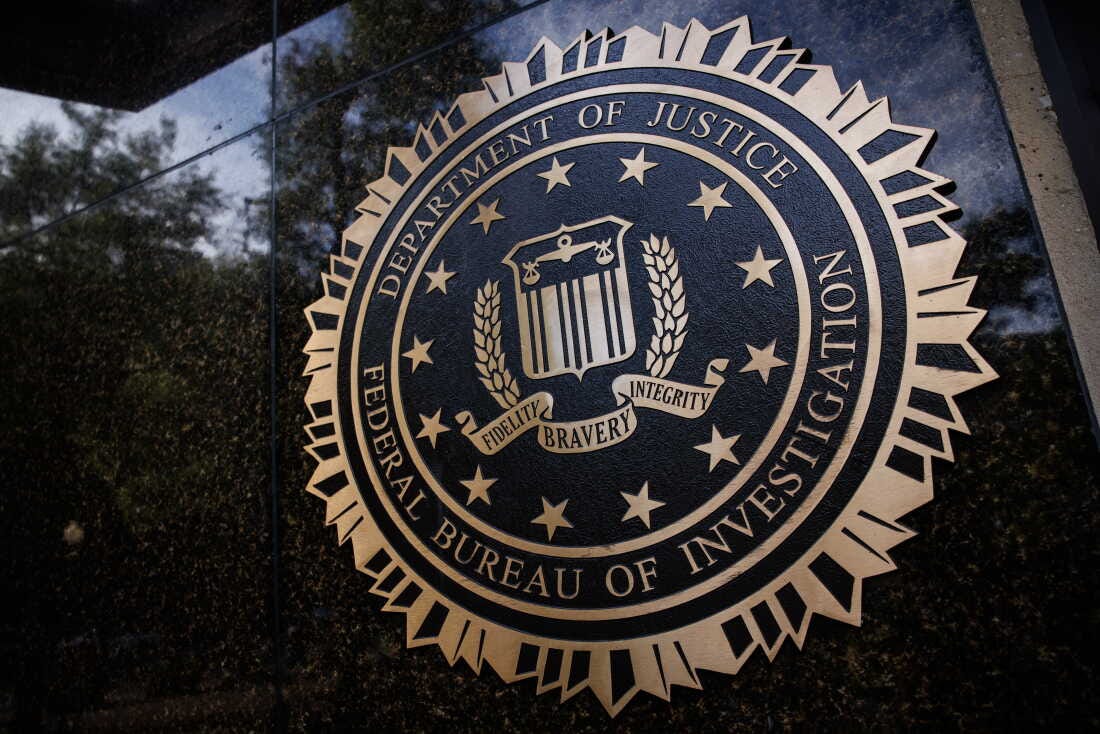 The J. Edgar Hoover FBI Building is seen on Sept. 26, 2025, in Washington, D.C. Samuel Corum/Getty Images
Welcome to today’s Trump Tyranny Tracker…
Trump’s purge of government watchdogs killed a corruption investigation, his financial conflicts continue to grow, and the White House launch of a government-run propaganda operation are among today’s top stories.
Today at a Glance
Trump’s purge of FBI and DOJ anti-corruption teams killed an active investigation into Congress members.
White House launches government-run “Trump TV” after banning major news organizations.
ICE detainee dies after repeatedly complaining he was not receiving insulin.
What We Need to Pay Attention To
The FBI Anti-Corruption Squad Was Circling Susan Collins — Until Trump Got in the Way
What Happened: FBI agents investigating illegal campaign contributions from defense contractor Navatek were cleared in late 2024 to expand the probe into possible bribery involving members of Congress, including Sen. Susan Collins. The investigation ended after Trump returned to office and his appointees dismantled the FBI and DOJ public corruption teams.
Why It Matters: Trump dismantled the teams investigating government corruption, ending an active bribery investigation involving members of Congress. Without independent investigators, government corruption will go unchecked and unpunished.
Source: ProPublica
Corruption
Trump and sons invest heavily in AI economy as he resists calls for slowdown
What Happened: Trump and his sons have money invested in companies involved in AI, data centers, chips, and energy while Trump sets federal AI policy and pushes faster development. Trump has not placed his assets in a blind trust and has reported thousands of securities transactions since returning to office.
Why It Matters: Trump is setting policies that affect industries where he and his family have money invested. Trump is making decisions on AI, energy, and data centers that are increasing the wealth of him, his family, and his cronies.
Source: The Washington Post
Trump bought and sold shares in Musk’s SpaceX in July, financial disclosure shows
What Happened: Trump bought between $15,001 and $50,000 in SpaceX shares on July 10 and sold between $1,001 and $15,000 a week later, according to his financial disclosure. SpaceX is a major federal contractor, and Trump also purchased shares in the company in June.
Source: Reuters
Trump World Eyes Towers, Tungsten, Trade in Ex-Soviet States
What Happened: Trump’s family and associates are expanding business across Georgia, Kazakhstan, and Armenia as his government deepens U.S. economic and diplomatic ties in the region. Projects include a $2 billion Trump-branded development in Georgia, critical mineral investments in Kazakhstan and Armenia, and investments connected to the new Armenia-Azerbaijan trade corridor with Trump’s name.
Source: Bloomberg
Power Consolidation
How Trump Has Cracked Down on Dissent Since the Killing of Charlie Kirk
What Happened: Since Charlie Kirk’s killing last year, Trump has directed federal agencies to investigate organizations and individuals the government associates with left-wing “political violence.” The effort has included scrutiny of nonprofits and unions and federal surveillance of protest groups and other activists.
Why It Matters: Trump is using federal law enforcement and intelligence agencies to target political groups, protesters, and activists. Treating dissent as a terrorism threat is the same tactic Russia uses to criminalize political opposition.
Source: New York Times
Weaponization of Institutions
Democrat says ICE restricted her oversight visit to country’s largest detention camp
What Happened: Rep. Veronica Escobar said ICE prevented her from speaking with detainees during an oversight visit to Camp East Montana, the country’s largest immigration detention facility. ICE has also refused to provide surveillance footage she requested after two disturbances at the camp.
Why It Matters: ICE is blocking congressional oversight of the country’s largest immigration detention facility. Keeping lawmakers away from detainees and withholding footage allows abuse inside the facility to remain hidden.
Source: The Guardian
Trump’s Compensation Fund Is Dead. Could He Find Other Ways to Pay Allies?
What Happened: The Justice Department dropped its proposed $1.776 billion slush fund, but a federal judge is concerned Trump could use other ways to pay allies, including Jan. 6 insurrectionists. The court has already barred the government from recreating the fund under another name.
Source: New York Times
Media Suppression & Authoritarian Tactics
White House Launches ‘Trump TV’ Amid Feud With Press
What Happened: The White House launched “Trump TV,” a 24/7 government-run stream featuring Trump speeches, announcements, and selected highlights. It launched days after Trump barred CNN, MS NOW, and Politico from the White House, and major television networks suspended shared pool coverage in response.
Why It Matters: Trump is shutting out independent journalists while building a government-run channel for his own propaganda. The White House decides what people see, avoids questions, and presents its own version of events. This is what state propaganda looks like.
Source: TIME
Human & Civil Rights Abuses
Costa Rican man complained of lack of care for diabetes before his death in ICE custody, family says
What Happened: Carlos Josue Marchena, a 36-year-old Costa Rican man with type 1 diabetes, died after less than a week at an ICE detention facility in Louisiana. His family and a fellow detainee said he repeatedly complained of missed insulin doses, inadequate food and water, and worsening symptoms before his death. ICE says he received proper medical care; his official cause of death is still pending.
Why It Matters: Marchena is at least the 58th person to die in ICE custody since January 2025 and the third at this facility in less than six months. The growing death toll and repeated failures in medical care are part of the mass human rights abuses taking place across Trump’s detention system.
Source: Associated Press
The ICE Officer in Austin Wasn’t Wearing a Body Cam
What Happened: The ICE officer who shot Wilber Rafael Garcés Pérez in the back was not wearing his assigned body camera, despite ICE rules requiring officers to carry and activate them during enforcement operations. The officer was hired last year during ICE’s rapid expansion; his partner was wearing a camera and recorded parts of the encounter.
Source: The Atlantic
Trump ally Stephen Miller leads sweeping push to accelerate removal of migrant children
What Happened: Stephen Miller is directing an effort across at least five federal departments to accelerate the removal of migrant children. Nearly 200,000 children have received removal orders since Trump returned to office, roughly doubling the number since January 2025.
Why It Matters: Trump officials are using multiple federal agencies to deport children faster while stripping away access to lawyers and other protections. Nearly 200,000 children have already been ordered removed.
Source: The Guardian
Trump administration asks US Supreme Court to allow detention of pro-Palestinian scholar
What Happened: The Justice Department asked the Supreme Court to overturn a ruling that allowed Georgetown scholar Badar Khan Suri to remain free. Immigration authorities detained Suri in 2025 after his pro-Palestinian advocacy, but a federal judge ordered his release after finding he was likely to prove that his detention violated his First Amendment and due process rights.
Source: Reuters
Government Disruption
‘We Hacked the FBI:’ Hackers Say They Have Data on All FBI Employees
What Happened: The hacking group ShinyHunters says it breached the FBI and stole information on employees and applicants, including names, home addresses, phone numbers, and details about spouses. 404 Media checked 5,000 of the alleged records and matched some of the information to DOJ personnel. The FBI says it is investigating activity connected to FBIjobs.gov.
Why It Matters: Personal information on FBI employees and their families in the hands of hackers is a major security and counterintelligence risk. Foreign intelligence services and criminals could use the data to identify, track or target federal agents.
Source: 404 Media
Trump Officials Eject 750,000 From Obamacare Markets, Claiming Fraud
What Happened: Trump officials canceled Affordable Care Act coverage for more than 750,000 people as part of a “fraud” crackdown led by JD Vance, with another 440,000 people reportedly under review.
Why It Matters: More than 750,000 Americans have already lost their health insurance and another 440,000 could be next. Anyone wrongly caught in the crackdown will suddenly be left without health coverage.
Source: New York Times
Pennsylvania measles cases near 800 as outbreak grows
What Happened: Pennsylvania has confirmed 792 measles cases across 39 counties, including 155 hospitalizations and four measles-associated deaths. Only four of the confirmed cases were among vaccinated people.
Source: Reuters
Imperial & Geopolitical Watch
Trump Meets Middle East Leaders as Regional Wars Widen
What Happened: Trump met with Middle Eastern leaders as the Iran war and fighting between the Houthis and Saudi-backed forces in Yemen continue to spread across the region. Trump said he would maintain pressure on Iran and warned there would come a point when the U.S. would not allow Iran to “survive as a nation.”
Source: New York Times
Machado Fails to Slip Into Venezuela While Rodríguez Is Away
What Happened: Venezuelan opposition leader María Corina Machado made three attempts to return to Venezuela but failed. Meanwhile, acting President Delcy Rodríguez traveled to New York to meet with Trump as the U.S. builds closer economic ties with her government.
Why It Matters: Trump removed Maduro and promised Venezuela a political transition. Now he is working with Maduro’s former deputy while Machado and the opposition are being shut out.
Source: Bloomberg
Far-Right & Russian Influence Watch
 Unmasking RussiaGermany’s AfD, Gazprom, and Moscow’s Long GameIt has been four years since Russia’s full-scale invasion of Ukraine forced Germany to begin unwinding its decades-long dependence on Russian energy. Now a senior official from a right-wing party loyal to Moscow is trying to reverse that…Read more11 days ago · 118 likes · 12 comments · Olga Lautman
Economic News
Americans Are About to Lose Access to Cheap Gray-Market Prescriptions From Canada
What Happened: Beginning October 22, prescription drugs mailed from Canada and other countries will face new customs requirements that could shut down many personal mail order imports. Millions of Americans use foreign pharmacies to buy medications at much lower prices.
Why It Matters: Americans who cannot afford U.S. drug prices could lose access to cheaper medications. One patient profiled said she pays around $10 a week for her medication through Canada, and the same drug will now cost her $1,100 a week in the U.S.
Source: Wall Street Journal
Resistance
Check out 50501 for local and nationwide events…
Source: 50501
By the Numbers
$2 billion — Planned Trump-branded development in Georgia as his family expands business interests across Georgia, Kazakhstan and Armenia
750,000+ — People who lost Affordable Care Act coverage in Trump’s “fraud” crackdown
200,000 — Migrant children who have received removal orders since Trump returned to office
58 — People who have died in ICE custody since January 2025
792 — Confirmed measles cases in Pennsylvania
What to Watch Next
Trump has gutted the government’s anti-corruption investigators — What other investigations will disappear as oversight continues to be dismantled?
Trump is turning federal agencies against political dissent — How far will surveillance and investigations of protesters, activists and political organizations expand?
The White House is restricting independent press access while building its own government-run media operation — How much further will Trump go to control what Americans see and hear?
Nearly 200,000 migrant children have received removal orders — How many more children will be rounded up via Trump’s deportation system?
Key Takeaways
Corruption Without Oversight — Trump gutted federal anti-corruption teams, killing an active bribery investigation involving members of Congress.
Personal Profiteering — Trump and his family are investing in industries affected by his policies while expanding business interests across countries where his government is making major economic and diplomatic decisions.
Criminalizing Dissent — Federal law enforcement and intelligence agencies are being used to investigate protesters, activists and political organizations.
State Propaganda — Trump is restricting independent press access while the White House launches its own 24/7 government-run propaganda media channel.
Human Rights Abuses — ICE deaths continue to rise as Trump officials accelerate efforts to deport migrant children and restrict access to legal protections.
Call to Action
Document Everything: Document purges, corruption, and power grabs. Share credible information with journalists, watchdogs, and legal experts. Silence enables authoritarianism—see something, say something.
Defend Press Freedom: Support independent journalism by subscribing to and sharing reporting that challenges Trump’s power grab.
Contact Lawmakers: Demand accountability for Trump’s unchecked power and war on oversight.
Mobilize for Action: Organize or join legal efforts and resistance movements to protect democracy and human and civil rights.
Support Whistleblowers: Encourage legal defense funds for government workers facing retaliation for exposing corruption.
Follow my work on YouTube → Subscribe to Unmasking Russia
https://youtube.com/@unmaskingrussia
Thanks for reading the Trump Tyranny Tracker. Stay tuned for more updates.
-
Democrats rise as Trump and Vance campaign in GOP strongholds. Trump sparks Republican backlash. GOP Senator's gotcha attempt backfires hard.
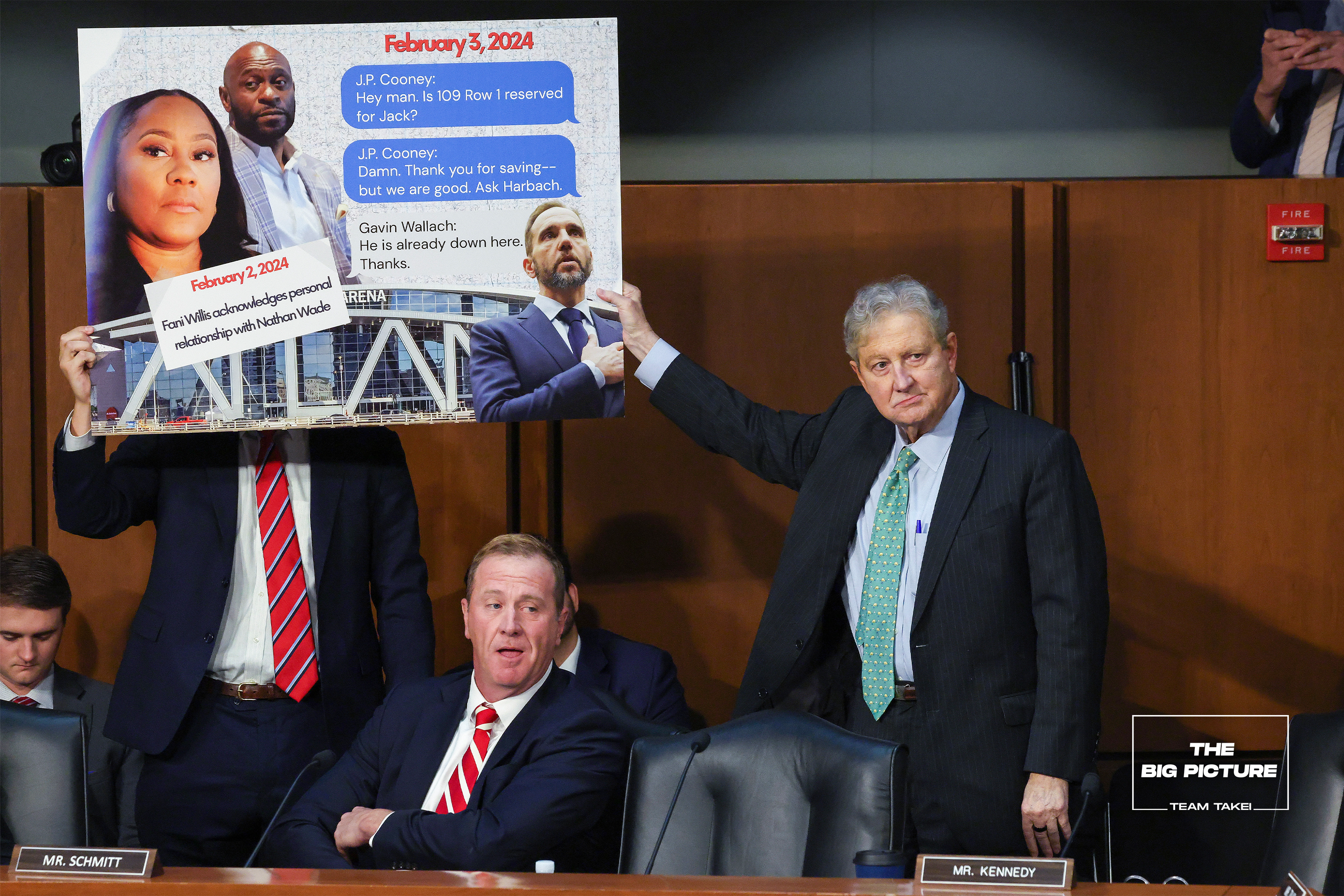
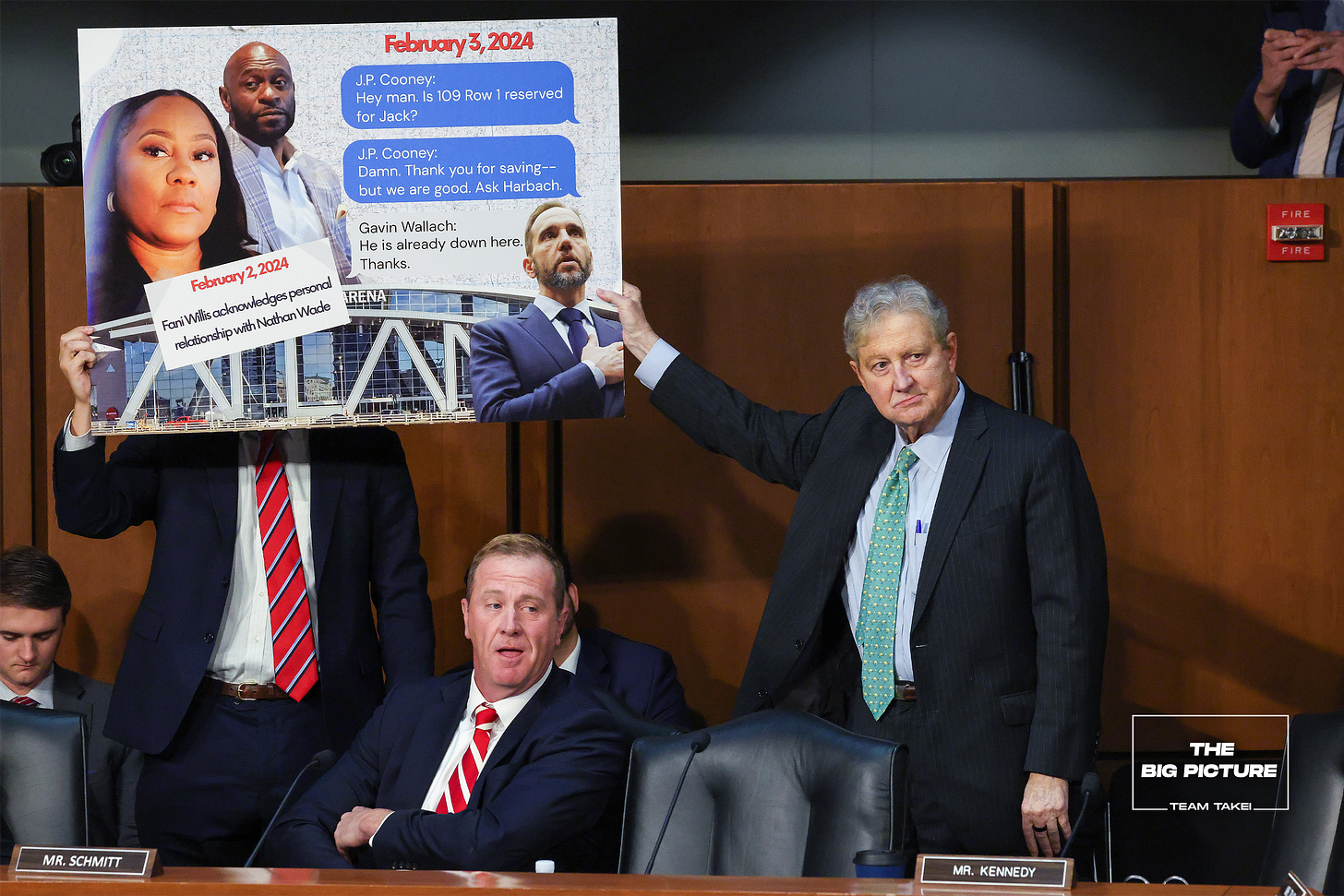 Senate Judiciary Committee member Sen. Eric Schmitt (R-MO) (L) and Sen. John Kennedy (R-LA) display a sign accusing former Special Counsel Jack Smith of meeting with Fulton County, Georgia, District Attorney Fani Willis during a hearing before the Senate Judiciary Committee in the Hart Senate Office Building. Photo by Win McNamee/Getty Images.
Democrats Rise in Race for Congress as Trump and Vance Campaign in Trump Country
Several polls are now showing Democrats with double digit leads on the Congressional generic ballot. A new Economist/YouGov poll found Democrats with a +15 point advantage on the generic ballot among Likely Voters, 53%-38%. The new Quinnipiac University Poll found that Democrats have a +12 point advantage over Republicans among Registered Voters, 51%-39%, and among Independent voters that lead jumps to +24 points. A new Argument Magazine/Verasight poll found Democrats with a +10 point lead over Republicans for control of Congress, 55%-45%. Nate Silver’s model now shows Democrats with an approximate generic ballot lead of +9. In the 2018 election, when Democrats gained 41 seats in the midterm elections, Democrats led the popular vote by 8.4 percent.
These polls come as Donald Trump and JD Vance hit the campaign trail for Republicans. Notably, Trump and Vance are heading to red states and districts to shore up races that should be easy wins for Republicans in a normal year. On Wednesday, Vance held a rally for Eric Flores, who is running in an unexpectedly tight race in Southern Texas. Then on Thursday, he traveled to Florida to campaign with Byron Donalds, who is running in a close race for Governor. On Thursday, Trump held rallies in Denton, Texas, north of Dallas, and in Durant, Oklahoma. Trump has promised that these stops are just the beginning of a month-long schedule in support of Republican candidates. His next stops: Vandalia, Ohio and Grand Island, Nebraska—both normally safe red states.
-
Kennedy Center Honors awards moved to new venue amid Trump’s onslaught
Ceremony will not be hosted at its traditional home for the first time since awards began in 1978
The Kennedy Center Honors will take place away from its traditional home this year for the first time in its history as the John F Kennedy Center for the Performing Arts remains in jeopardy amid Donald Trump’s ongoing battle to have it named after himself.
The Capital One Arena in Washington DC is now set to host the ceremony on 7 December, a Kennedy Center spokespersonsaid. The list of honorees this year has not yet been announced.
Continue reading... -
Trump Tyranny Tracker | Day 606: Sept. 21, 2026
 The Pentagon logo in the briefing room, following the United States and Israel-led strikes on Iran, at the Pentagon in Washington, D.C., U.S., March 2, 2026. REUTERS/Elizabeth Frantz
Welcome to today’s Trump Tyranny Tracker…
The Pentagon undercounting American military deaths, ICE hiding the locations of thousands of detainees, and more government agencies being used against Trump’s political opponents are among today’s top stories.
Today at a Glance
Pentagon’s public database leaves out at least four U.S. military deaths from Trump’s Iran war.
ICE removes thousands of detainees with final deportation orders from its public locator system.
Former federal prosecutors say Trump Media’s $100,000 early access service likely violates criminal law.
What We Need to Pay Attention To
More U.S. troops have died amid Iran war than Pentagon has disclosed publicly
What Happened: At least 22 U.S. service members have died in the Middle East since Trump’s launched the Iran war began, according to five U.S. officials, four more than the Pentagon has publicly reported. A sixth official put the number at 23. The Pentagon declined to explain the discrepancy.
Why It Matters: Americans are entitled to know how many service members have died in a war. Governments hiding military casualty numbers is something that happens in countries like Russia. The Pentagon needs to explain why American deaths are missing from its public count.
Source: The Washington Post
Corruption
RFK Jr. Got Free Flights to Fiji and Greece From a Top Donor
What Happened: RFK Jr. disclosed more than $250,000 in gifts from Gavin de Becker, a longtime friend and major donor to Kennedy’s 2024 presidential campaign. The gifts included nearly $97,000 in flights to Fiji, about $45,000 in airfare to Greece, and use of a Washington vacation home.
Why It Matters: A Cabinet secretary accepted more than $250,000 in gifts from one of his biggest political donors. Kennedy says HHS ethics officials approved the gifts, but that does not erase the obvious corruption and conflict of interest.
Source: Wall Street Journal
Ex-federal prosecutors say Trump media company’s scheme to sell early access to Truth Social posts is likely criminal
What Happened: Fifty-three former federal prosecutors and agents told a federal court that Trump Media’s $100,000 Truth API, which gives paying investors faster access to Trump’s market-moving posts, likely violates federal criminal laws involving securities, conflicts of interest, and public corruption.
Why It Matters: Trump’s company is charging wealthy investors $100,000 for faster access to his posts announcing government policy. That allows paying customers to trade on information before everyone else gets it, while his company makes money selling this advantage.
Source: CBS News
Power Consolidation
How Trump turned a refugee bureau into a $410 million deportation operation
What Happened: Trump officials have authorized or pledged at least $410 million for deportation agreements with 31 countries, allowing the U.S. to send migrants to countries where they have no ties. The program is being run through a new Office of Remigration inside the State Department bureau responsible for refugees and humanitarian assistance.
Why It Matters: Trump took an office meant to help refugees and turned part of it into a deportation operation that pays foreign governments to take disappeared migrants. Some of the agreements were structured to get around human rights safeguards and congressional requirements.
Source: The Washington Post
Weaponization of Institutions
Bill Pulte Scrutinized Mortgages of Trump’s Political Rivals—and Todd Blanche
What Happened: Federal housing chief Bill Pulte scrutinized the mortgages of Trump targets including Adam Schiff, Letitia James and Lisa Cook. He also reportedly examined then-Deputy Attorney General Todd Blanche’s mortgages while the two clashed over the investigations. Some officials believed Pulte was looking for information to pressure Blanche to move the cases forward.
Source: Wall Street Journal
ICE hides locations of thousands of detainees with final removal orders
What Happened: ICE removed thousands of immigrants with final deportation orders from its public detainee locator on September 15, leaving lawyers and families unable to find where many are being held. Nearly 16,000 people booked into ICE detention in July had final removal orders.
Why It Matters: People with final deportation orders still have the right to challenge their removal in court. If their lawyers cannot find them, they can be deported before an attorney or court has a chance to intervene.
Source: Associated Press
Media Suppression & Authoritarian Tactics
CNN, MS NOW and Politico sue Trump administration over White House access
What Happened: CNN, MS NOW and Politico sued Trump after he revoked their journalists’ White House access because he objected to their coverage. The outlets argue the ban violates the First Amendment and due process protections and are seeking an immediate court order restoring access.
Why It Matters: Trump is using White House access to punish news organizations for coverage he dislikes. This is part of his broader attack on the press, using government power to intimidate journalists and punish outlets that report things he does not want Americans to hear.
Source: CNN
Freedom oppressed: the journalists caught up in Trump’s ICE crackdown
What Happened: Journalists covering immigration enforcement have been arrested, assaulted, and detained by federal authorities. Immigrant journalists have also faced ICE detention and deportation. The U.S. Press Freedom Tracker documented 32 journalist arrests and 170 assaults in 2025, most during protests.
Why It Matters: Journalists are being arrested, assaulted, and detained while documenting federal law enforcement. Going after reporters makes it harder to expose abuses and is meant to keep the public from seeing what the regime is doing.
Source: The Guardian
Human & Civil Rights Abuses
Man shot by ICE in Austin being held in detention center with bullet in his back, lawyer says
What Happened: An ICE officer shot Venezuelan DoorDash driver Wilber Rafael Garces Perez in the back in Austin, according to his attorney. ICE then transferred him from the hospital to a detention center with the bullet still lodged near his spine, where he said he was initially denied pain medication and a bed.
Why It Matters: ICE shot a man and then put him in detention with the bullet still in his body, where he says he was initially denied pain medication and a bed. Another example of the grave human rights violations being committed by this regime.
Source: CBS News
Judge orders return of Honduran migrant deported to Central African Republic
What Happened: A federal judge ordered the government to return Brayan Omar Sanchez Servellon to the U.S. and release him after ICE deported him to the Central African Republic, a country where he has no citizenship or personal ties. His federal court case was still pending when ICE deported him.
Source: ABC News
‘Disturbing’: Jacob Soboroff sounds alarm on ICE’s missing miscarriage data
What Happened: ICE recorded at least 18 miscarriages in detention from January through September 2025 but has no miscarriage data after October 3. At the same time, more pregnant women and teenagers are being detained. Women in ICE custody have also reported difficulty getting prenatal and emergency medical care, including treatment after miscarriages.
Why It Matters: ICE is detaining more pregnant women while no longer keeping track of miscarriages in its custody. Without that data, there is no way for the public to know how many women are losing pregnancies in detention or hold ICE accountable for inadequate medical care.
Source: MS NOW
Government Disruption
A new DOJ program restores ex-felons’ right to own guns. What you need to know
What Happened: The Justice Department created a new process allowing people federally prohibited from possessing firearms to apply to have their gun rights restored. DOJ expects hundreds of thousands of applications, with decisions made through the Office of the Pardon Attorney.
Source: NPR
Trump says he will demand drug companies split up vaccines into more doses
What Happened: Trump said he will demand that drug companies split vaccines into as many as five smaller doses given six months apart, claiming it would “reduce autism.” Decades of research have found no link between vaccines and autism, and medical experts say spacing out vaccines can leave children unprotected from preventable diseases.
Why It Matters: Trump wants to change how children are vaccinated based on conspiracies that vaccines cause autism. Spreading doses months apart would leave children without full protection for longer and put them at greater risk of preventable diseases like measles.
Source: The Washington Post
Imperial & Geopolitical Watch
US strikes on alleged drug boats may constitute ‘crimes against humanity’, UN expert says
What Happened: A U.N. special rapporteur found “reasonable grounds to believe” that 68 U.S. military strikes on alleged drug boats, which killed 223 people, constituted crimes against humanity of murder under international law. The report also describes the strikes as extrajudicial killings and rejects the U.S. government’s self-defense justification.
Why It Matters: The U.S. military has killed 223 people without arrest, trial, or publicly providing evidence that those targeted posed a military threat. Now a U.N. expert says the killings may amount to crimes against humanity.
Source: The Guardian
US watching Chinese marine presence off Alaska, Arctic Coast Guard chief says
What Happened: Four Chinese research vessels have operated off Alaska this year, including around the Aleutian Islands and Bering Strait. The ships remained in international waters but did not provide customary advance notice. U.S. officials are watching whether their research could help China explore seabed resources or gain a military advantage in the Arctic.
Source: Military Times
Far-Right & Russian Influence Watch
Trump seeks fertilizer deal with Russia ally Belarus amid Canadian tensions
What Happened: Trump said the U.S. is working on a major deal to buy cheaper potash from Belarus instead of Canada. Belarus helped Russia launch its genocidal full-scale invasion of Ukraine. Also, increased shipments to the U.S. would likely have to travel through Russian ports because its traditional route through Lithuania remains closed.
Source: Washington Post
Economic News
Iran War Will Make Winter More Expensive for Some Americans
What Happened: Heating oil prices have risen roughly 60% since the U.S. and Israel began attacking Iran in February. In New York, heating oil averaged $6.14 a gallon in mid-September, compared with $3.70 a year earlier.
Source: New York Times
Resistance
Check out 50501 for local and nationwide events…
Source: 50501
Air Force Officer Charged After Protesting Trump Says He Spoke to Defend Constitution
What Happened: Air Force Maj. Jason Watson faces 10 military charges after publicly criticizing Trump and calling for his impeachment, including carrying out a protest at the Capitol. Watson has been held in pretrial confinement while the military decides whether his case will proceed to court-martial.
Source: New York Times
By the Numbers
22–23 — U.S. service members, officials say, have died since Trump launched the Iran war, compared with 18 publicly reported by the Pentagon
$100,000 — Price for faster access to Trump’s posts through Trump Media’s Truth API
~ 16,000 — People booked into ICE detention in July who had final deportation orders
223 — People killed in U.S. military strikes on boats
60% — Increase in heating oil prices since the U.S. and Israel began attacking Iran
What to Watch Next
The Pentagon is reporting fewer U.S. military deaths than its own officials say have occurred — Will it explain why American deaths are missing from the public count?
ICE is making thousands of detainees harder for their lawyers and families to find — How many people will be disappeared before their attorneys can locate them?
Trump’s attacks on the press are expanding — What other news organizations and journalists will lose access or face federal action?
Trump is pushing changes to childhood vaccines based on conspiracies about autism — How much further will federal health policy move away from established medical science?
Key Takeaways
Rising Costs — Heating oil has jumped roughly 60% since Trump’s Iran war, leaving families in the Northeast facing much higher winter heating bills.
More Corruption — Trump Media is charging investors $100,000 for faster access to Trump’s posts announcing government policy.
Weaponized Government — Federal officials continue to use government agencies against Trump’s political opponents while ICE makes thousands of detainees harder for lawyers and families to find.
Press Suppression — Trump is banning news organizations over coverage he dislikes as journalists covering immigration enforcement face arrests, detention and assaults.
Hidden War Deaths — Pentagon records show fewer American military deaths than multiple U.S. officials say have occurred since Trump launched the Iran war. A tactic seen in Russia.
Call to Action
Document Everything: Document purges, corruption, and power grabs. Share credible information with journalists, watchdogs, and legal experts. Silence enables authoritarianism—see something, say something.
Defend Press Freedom: Support independent journalism by subscribing to and sharing reporting that challenges Trump’s power grab.
Contact Lawmakers: Demand accountability for Trump’s unchecked power and war on oversight.
Mobilize for Action: Organize or join legal efforts and resistance movements to protect democracy and human and civil rights.
Support Whistleblowers: Encourage legal defense funds for government workers facing retaliation for exposing corruption.
Follow my work on YouTube → Subscribe to Unmasking Russia
https://youtube.com/@unmaskingrussia
Thanks for reading the Trump Tyranny Tracker. Stay tuned for more updates.
-
How Trump changed the way US women vote
A decade after his infamous Access Hollywood tape, the gender divide is again shaping a pivotal midterm election
A decade ago, Donald Trump’s improbable presidential campaign was rocked – and nearly derailed – by the now-infamous Access Hollywood tape, a 2005 recording in which the real estate developer turned reality TV star boasted about kissing and grabbing women without their consent.
“When you’re a star, they let you do it,” he said, a remark he later downplayed as “locker-room talk” before musing that the tape might be fake. (It wasn’t.)
‘Of course I’m the underdog’: the British former spin doctor trying to turn California red
Most Americans don’t know Hasan Piker. The rest say he is changing this year’s elections
Trump campaign ads paid with public money violate federal law, critics say
Trump allies could use midterms ‘counting window’ to disrupt results, experts warn
What Democrats are getting right – and wrong – in run-up to midterms: ‘We can’t just be anti-Trump’
Continue reading... -
Is it 'killer robots' or 'super intelligence'? At the UN, leaders see both
At the United Nations (UN) leaders are discussing the threat or promise of artificial intelligence (AI) at a talk about science and the future. A new U.N. science report warns of the potential of catastrophic and irreversible harm, with U.S. Secretary-General Antonio Guterres calling for more oversight of AI, and the U.K. Security Council will address how to place some controls on the technology. However, Donald Trump, who used "artificial intelligence" as a reference to global warming, countered that the planet was cooling, not warming, and nobody was dead. The UN report also highlighted the danger of human-caused climate change for long-term breaching of the internationally agreed-upon threshold of 1.5 degrees Celsius (2.7 degrees Fahrenheit) of warming since pre-industrial time. -
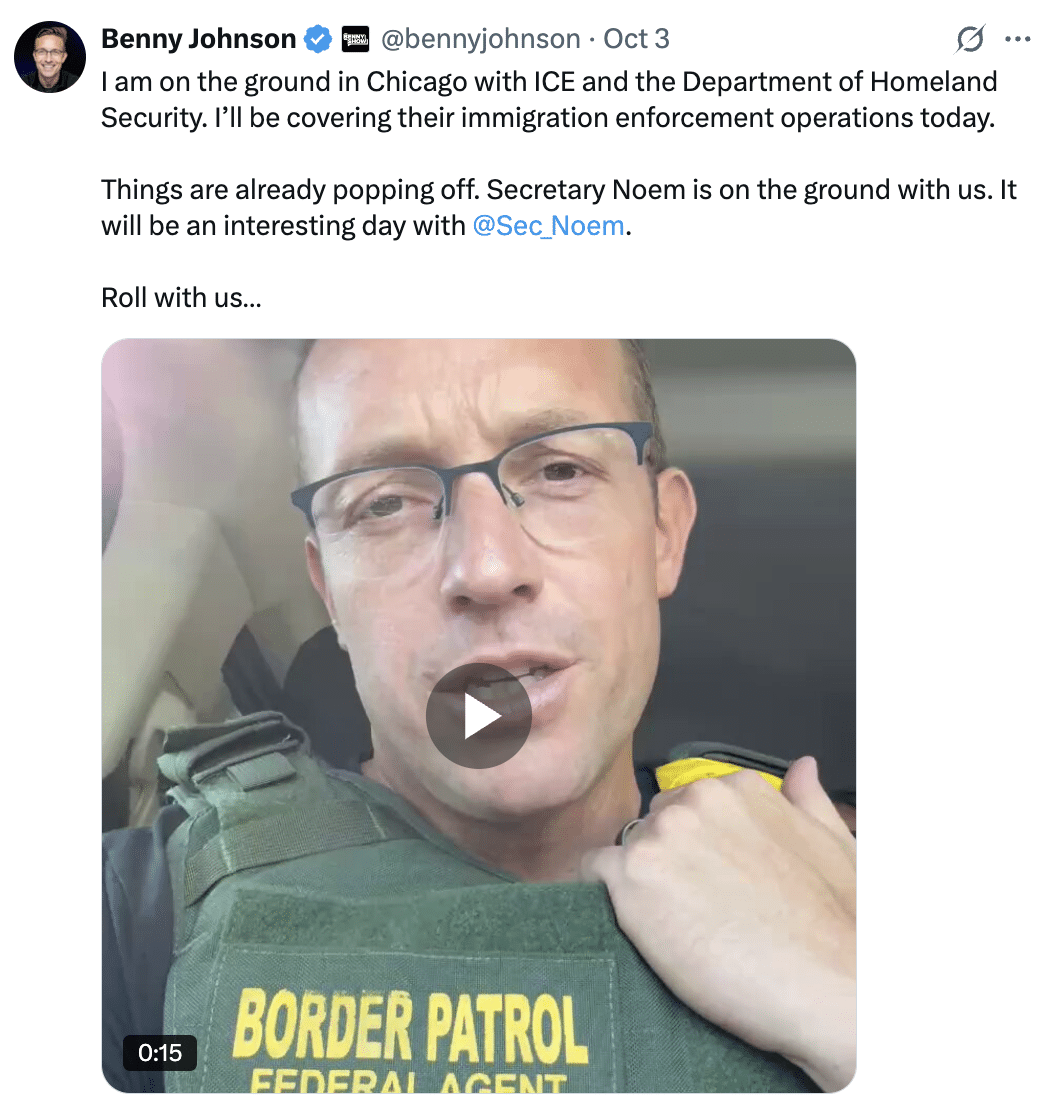
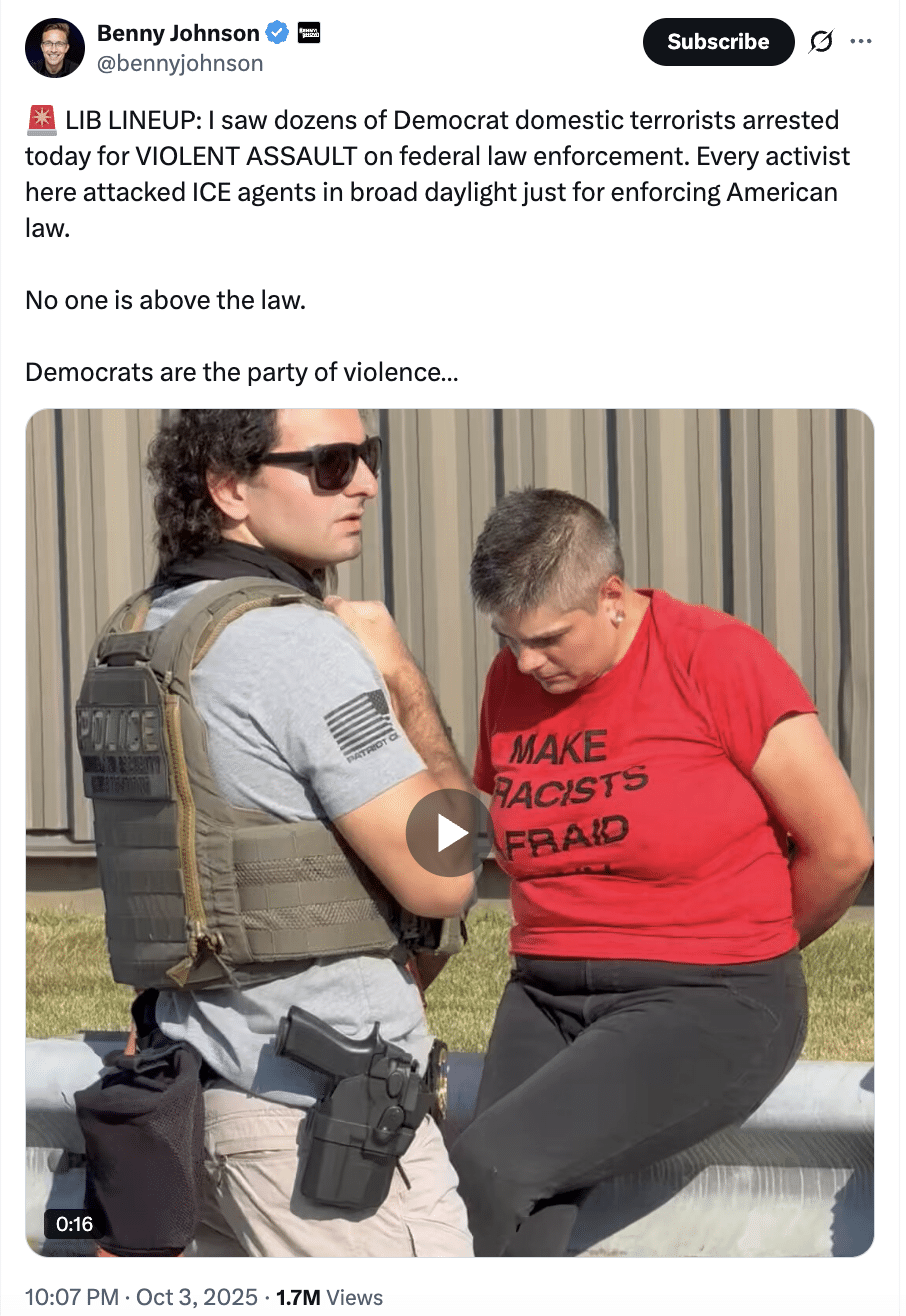
The Protestors Benny Defamed Finally Come After Him
A year ago, I wrote this:Where Noem’s urge to create propaganda may get her in trouble is how she invited Russia’s useful idiot, Benny Johnson, to tag along wearing Border Patrol armor.
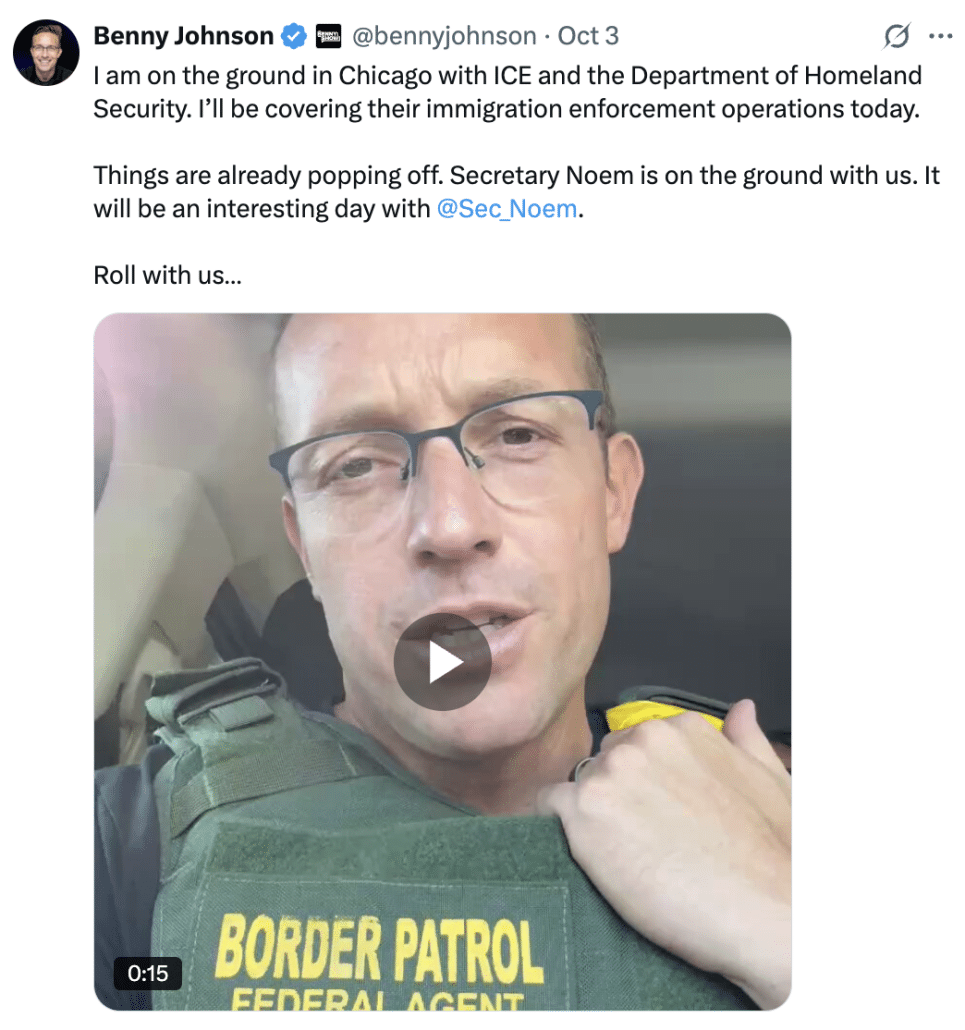
Among other things Benny did on his cosplay cop caper was to post a video of protestors as they were being arrested, claiming they were being arrested for “VIOLENT ASSAULT.”
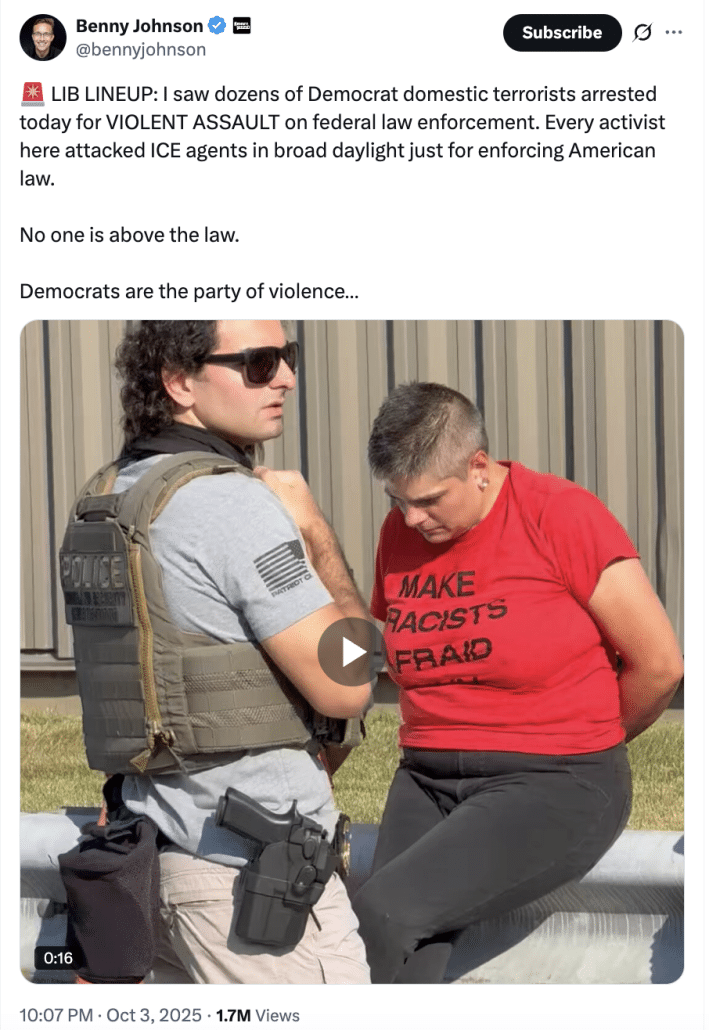
Of the Federal charges filed since then, just one has been from Broadview (it was assault, but even that one sounds like someone charged for being pushed by the Feds). If, in fact, these people weren’t charged — much less with assault — this would be slander. Since he was dolled up as a “Border Patrol Federal Agent,” even if they were arrested, this will be a privacy violation that might endanger any charges the Feds tried to file. [my pink emphasis because it’s Friday again]
Yesterday, lawyers for two of these protestors (including several from the same firm that is suing on behalf of Renee Good’s family), did just that:
205. On October 5, 2025, Defendants posted on Mr. Johnson’s X account the full twelve minute edited video account, produced by Mr. Johnson and Benny Media LLC, of their ride-along with Kristi Noem. That video shows Plaintiffs sitting with their hands bound in a line of detained protesters guarded by law enforcement. Mr. Johnson describes them as “left-wing terrorists arrested for attacking police officers and ICE officers,” and says “[t]hese individuals assaulted ICE officers as they were trying to clear out the area.” The post stated: “I rode with DHS Secretary Kristi Noem and ICE on intense raids across left-wing violence ridden Chicago. From tunnels under Trump Tower to the most targeted ICE facility, we faced violent Antifa, chaos, and criminals on the run.”
206. The statements in the X post and video that Plaintiffs are “terrorists,” “criminals on the run,” were “arrested for attacking police officers and ICE officers,” and “assaulted ICE officers,” as well as the suggestion that Mr. Johnson saw Plaintiffs behave this way, are each false and defamatory.
207. Each statement was intended to convey, and was understood to convey, the false factual assertions that Plaintiffs were not peacefully exercising their First Amendment rights, but instead were engaged in acts of terrorism, violence, and assault against law enforcement, and that Defendants witnessed Plaintiffs engaging in these acts.
208. Each statement is of and concerning Plaintiffs—who are identifiable in the video by their faces and distinctive features and who were recognized by members of their communities.
209. Each statement is libelous per se in that each imputes that Plaintiffs have committed crimes and tends to prejudice Plaintiffs in their profession.
210. Each statement was published to a worldwide platform and, upon information and belief, has been viewed hundreds of thousands of times.
Even more than hoping these people get paid, I’m hoping we get to learn both about the arrangement DHS made with Benny for this cosplay, and — more importantly — who has been funding Benny since his Russian gravy train was exposed.
The post The Protestors Benny Defamed Finally Come After Him appeared first on emptywheel.
-
«Montages», «faux»: 24 heures de mensonges du Rassemblement national
Les lieutenants du parti d’extrême droite tentent de venir au secours de Jordan Bardella en attaquant les révélations de «Mediapart». Dans les médias ou sur les réseaux sociaux, ils enchaînent les contrevérités, même les plus grossières. -
Pour éteindre la contestation, l’exécutif tente d’éloigner les lycéens des lycées
De manière inédite, les préfets ont été incités à prendre des arrêtés interdisant les manifestations «aux abords» des lycées les plus perturbés par les blocages. Quatre cents d’entre eux sont restés fermés vendredi, avec des cours à distance pour certains. -
Jordan Bardella embrasse l’arme trumpienne du mensonge
Donald Trump a placé l’usage des bobards au centre de son action et en a fait le moteur de sa reconquête du pouvoir. Le président du Rassemblement national s’en inspire pour contrer les révélations de «Mediapart» sur ses écrits de jeunesse antisémites. Marine Le Pen le suivra-t-elle? -
Port du calot à l’hôpital: le bras de fer se poursuit en justice
Le tribunal administratif de Paris s’est penché sur la situation de l’infirmière Majdouline B., exclue par l’AP-HP pour avoir refusé d’ôter son calot. L’argument de l’hygiène a été battu en brèche, reste celui du devoir d’obéissance du fonctionnaire. L’infirmière aimerait que soit retenue la discrimination. -
Marine Le Pen et le radioactif Frédéric Chatillon: le mensonge de Jean-Philippe Tanguy
Le député RN a affirmé, le 2 octobre, sur CNews, que «Frédéric Chatillon n’a jamais été un proche de Marine Le Pen». L’ancien chef du GUD est pourtant un ami de trente ans de la candidate à la présidentielle et l’un des prestataires de ses campagnes. C’est aussi un ancien mentor de Jordan Bardella. -
«48 heures d’enfer»: à leur sortie de garde à vue, des lycéens traumatisés
Plus de 2 000 personnes, très majoritairement des mineurs, ont été placées en garde à vue depuis lundi 28 septembre en marge du mouvement des lycéens. Plusieurs d’entre eux témoignent de conditions de détention violentes, qui interrogent sur la réponse politique apportée à cette mobilisation. -
Blocage lycéen en Seine-Maritime: «Ici, ça fonctionne dans le respect»
Entre Rouen et Le Havre, à Yvetot, en zone rurale, le lycée Raymond-Queneau, peu habitué des mobilisations lycéennes, a rejoint le vaste mouvement de contestation. Sans débordement et sous le regard bienveillant des professeurs comme des gendarmes. -
Le gouvernement cherche une improbable réponse politique à la colère des lycéens
L’exécutif multiplie les annonces, le plus souvent sécuritaires, tandis que le ministre de l’éducation, Édouard Geffray, enchaîne les réunions d’urgence avec les principaux acteurs du champ éducatif. L’objectif est d’éteindre le feu avant la journée de mobilisation prévue mardi. -
Au procès en appel du MoDem, la défense de François Bayrou pourfend une accusation «vide»
Le président du MoDem a prononcé quelques mots en conclusion du procès en appel de l’affaire des assistants parlementaires européens, vendredi 2 octobre, après les dernières plaidoiries de la défense. La cour d’appel de Paris rendra sa décision le 17 décembre. -
Ce que les célébrations de Javier Milei disent de la radicalisation du pouvoir économique en France
Récipiendaire, avec Philippe Aghion, d’un prix décerné par un institut actif dans la finance et la technologie à Paris, le président argentin devient un modèle pour certains secteurs du capital. Un signe de plus de leur convergence avec l’extrême droite. -
En Espagne, une majorité de députés rejettent les textes du gouvernement sur le logement
Le premier ministre Pedro Sánchez a subi un revers, après avoir tenté de répondre à l’émotion populaire suscitée par l’expulsion de son appartement d’une personne âgée, Maricarmen. Le mouvement de contestation continue dans la rue, tandis que les spéculations sur l’appel à des élections anticipées sont ouvertes. -
«Il est parfois nécessaire de mener des actions qui vont à l’encontre de la bien-pensance ou même de la légalité»
Le rappeur Youssef Swatt’s, révélé par Nouvelle École, utilise sa voix pour soutenir des associations d’alphabétisation, l’accès à la culture pour les jeunes des quartiers populaires et la Palestine. -
Mobilisation lycéenne : de la colère francilienne aux blocages dans tout le pays
 Format : dossier
Le mouvement a débuté le 21 septembre dans un lycée de Créteil, en région parisienne, mais prend sa source dans un malaise qui ne date pas d'aujourd'hui. Manque de professeurs et locaux délabrés sont les principales causes de cette première mobilisation. Retour sur une colère lycéenne contagieuse.
Les revendications ne sont pas nouvelles, mais le ras-le-bol, lui, prend de l'ampleur jour après jour. Le mouvement de contestation lycéen a débuté le 21 septembre 2026 au lycée Saint-Exupéry de Créteil (Val-de-Marne, Ile-de-France), sur des revendications principalement liées aux conditions d'enseignement : manque de professeur·es, bâtiments dégradés, pression liée à Parcoursup. Il a suffi d'une semaine pour que la mobilisation, très localisée à l'origine, s'étende à travers le pays. Elle est devenue nationale le 29 septembre. Depuis, les blocages de lycées se sont enchaînés dans d'autres villes, telles que Lille, Marseille, Nantes et jusque dans les territoires d'outre-mer, à La Réunion. Un millier d'établissements étaient concernés le 1er octobre, contre 356 la veille.
Une réponse policière avant une réponse gouvernementale
Alors que le mouvement a débuté sans débordement apparent, il s'est durci progressivement, à coups de jets de projectiles, de poubelles incendiées... La réponse policière s'est traduite par des gaz lacrymogènes et tirs de lanceurs de balles de défense (LBD). Avec, pour conséquences, plusieurs élèves blessés. La gestion policière suscite d'ailleurs des critiques, comme à Tours (Indre-et-Loire, Centre-Val de Loire) où un jeune a été grièvement blessé par un possible tir de LBD. À Saint-Ouen-l'Aumône (Val-d'Oise, Ile-de-France), un adolescent a été touché à la mâchoire par un autre tir de LBD. Le Défenseur des droits François-Noël Buffet s'est saisi de cette affaire. Au soir du 1er octobre, le ministère de l'Intérieur dénombrait plus de 1900 interpellations de lycéen·nes.
Vers un dialogue entre lycéens et gouvernement
Après avoir échoué à négocier une sortie de crise lors d'une rencontre vendredi 2 octobre avec des organisations lycéennes, le gouvernement a publié dimanche soir une liste d'engagements en réponse aux revendications du mouvement, en attendant des mesures concrètes « avant fin octobre ». Un première tentative d'apaisement avait aussi été faite le 1er octobre, avec l'abandon de la mesure budgétaire qui prévoyait des frais d'inscription pour les étudiant·es non boursier·es en BTS et en classes préparatoires.
Par ailleurs, plusieurs échanges entre lycéen·nes et rectorats locaux (dont Nice, Bordeaux et Toulouse) ont eu lieu depuis le début des blocus. Bien que le gouvernement ait appelé dimanche à la reprise des cours « partout » le lundi 5 octobre, entre 400 et 500 établissements restaient fermés à cette date par mesure de sécurité. Et la mobilisation pourrait s'intensifier alors que plusieurs syndicats de l'enseignement ont appelés à une large mobilisation le mardi 6 octobre.
-
De la colère aux blocages : comprendre la mobilisation lycéenne
 Format : dossier
Le mouvement a débuté le 21 septembre dans un lycée de Créteil, en région parisienne, mais prend sa source dans un malaise qui ne date pas d'aujourd'hui. Manque de professeurs et locaux délabrés sont les principales causes de cette première mobilisation. Retour sur une colère lycéenne contagieuse.
Les revendications ne sont pas nouvelles, mais le ras-le-bol lui, prend de l'ampleur jour après jour. Le mouvement de contestation lycéen a débuté le 21 septembre 2026 au lycée Saint-Exupéry de Créteil (Île-de-France), sur des revendications principalement liées aux conditions d'enseignement : manque de professeur·es, bâtiments dégradés, pression liée à Parcoursup. Il a suffi d'une semaine pour que la mobilisation, très localisée à l'origine, s'étende à travers le pays. Elle est devenue nationale le 29 septembre. Depuis, les blocages de lycées se sont enchaînés dans d'autres villes telles que Lille, Marseille, Nantes et jusque dans les territoires d'Outre-mer, à La Réunion. Un millier d'établissements étaient concernés le 1er octobre, contre 356 la veille.
Une réponse policière avant une réponse gouvernementale
Alors que le mouvement a débuté sans débordement apparent, il s'est durci progressivement, à coups de jets de projectiles, de poubelles incendiées... La réponse policière s'est traduite par des gaz lacrymogènes et tirs de lanceurs de balles de défense (LBD). Avec pour conséquences plusieurs élèves blessés. La gestion policière suscite d'ailleurs des critiques, comme à Tours (Centre-Val de Loire) où un jeune a été grièvement blessé par un possible tir de LBD. À Saint-Ouen-l'Aumône, un adolescent a été touché à la mâchoire par un autre tir de LBD (Île-de-France). Le Défenseur des droits François-Noël Buffet s'est saisi de cette affaire. Au soir du 1er octobre, le ministère de l'Intérieur dénombrait plus de 1900 interpellations de lycéens.
Vers un dialogue entre lycéens et gouvernement
Une première tentative de sortie de crise s'est jouée le vendredi 2 octobre, à l'initiative du gouvernement, qui a proposé aux organisations lycéennes une rencontre après avoir reçu des syndicats d'enseignants et des associations de parents d'élèves. Un premier pas avait été annoncé la veille, avec l'abandon de la mesure budgétaire qui prévoyait des frais d'inscription pour les étudiant·es non boursiers en BTS et en classes préparatoires. À Nice et à Bordeaux, les rectorats ont également échangé avec des représentant·es lycéen·nes. Reste à savoir si leurs revendications seront entendues. En attendant, 400 établissements sont restés fermés le vendredi 2 octobre, par mesure de sécurité.
-
Mobilisation lycéenne : de la colère francilienne aux blocages dans tout le pays
Format : dossier
Le mouvement a débuté le 21 septembre dans un lycée de Créteil, en région parisienne, mais prend sa source dans un malaise qui ne date pas d'aujourd'hui. Manque de professeurs et locaux délabrés sont les principales causes de cette première mobilisation. Retour sur une colère lycéenne contagieuse.
Les revendications ne sont pas nouvelles, mais le ras-le-bol, lui, prend de l'ampleur jour après jour. Le mouvement de contestation lycéen a débuté le 21 septembre 2026 au lycée Saint-Exupéry de Créteil (Val-de-Marne, Ile-de-France), sur des revendications principalement liées aux conditions d'enseignement : manque de professeur·es, bâtiments dégradés, pression liée à Parcoursup. Il a suffi d'une semaine pour que la mobilisation, très localisée à l'origine, s'étende à travers le pays. Elle est devenue nationale le 29 septembre. Depuis, les blocages de lycées se sont enchaînés dans d'autres villes, telles que Lille, Marseille, Nantes et jusque dans les territoires d'outre-mer, à La Réunion. Un millier d'établissements étaient concernés le 1er octobre, contre 356 la veille.
Une réponse policière avant une réponse gouvernementale
Alors que le mouvement a débuté sans débordement apparent, il s'est durci progressivement, à coups de jets de projectiles, de poubelles incendiées... La réponse policière s'est traduite par des gaz lacrymogènes et tirs de lanceurs de balles de défense (LBD). Avec, pour conséquences, plusieurs élèves blessés. La gestion policière suscite d'ailleurs des critiques, comme à Tours (Indre-et-Loire, Centre-Val de Loire) où un jeune a été grièvement blessé par un possible tir de LBD. À Saint-Ouen-l'Aumône (Val-d'Oise, Ile-de-France), un adolescent a été touché à la mâchoire par un autre tir de LBD. Le Défenseur des droits François-Noël Buffet s'est saisi de cette affaire. Au soir du 1er octobre, le ministère de l'Intérieur dénombrait plus de 1900 interpellations de lycéen·nes.
Vers un dialogue entre lycéens et gouvernement
Après avoir échoué à négocier une sortie de crise lors d'une rencontre vendredi 2 octobre avec des organisations lycéennes, le gouvernement a publié dimanche soir une liste d'engagements en réponse aux revendications du mouvement, en attendant des mesures concrètes « avant fin octobre ». Un première tentative d'apaisement avait aussi été faite le 1er octobre, avec l'abandon de la mesure budgétaire qui prévoyait des frais d'inscription pour les étudiant·es non boursier·es en BTS et en classes préparatoires.
Par ailleurs, plusieurs échanges entre lycéen·nes et rectorats locaux (dont Nice, Bordeaux et Toulouse) ont eu lieu depuis le début des blocus. Bien que le gouvernement ait appelé dimanche à la reprise des cours « partout » le lundi 5 octobre, entre 400 et 500 établissements restaient fermés à cette date par mesure de sécurité. Et la mobilisation pourrait s'intensifier alors que plusieurs syndicats de l'enseignement ont appelés à une large mobilisation le mardi 6 octobre.
-
Minecraft dans GTA, Call of Duty dans Skyrim… les jeux commencent à fusionner dans tous les sens à cause des agents IA

De la TNT Minecraft qui explose dans GTA, des armes et des zombies de Call of Duty dans Skyrim, des séquences relayées sur les réseaux sociaux montrent des jeux qui fusionnent parfaitement. Plusieurs de ces vidéos ont été réalisées avec des agents IA, qui écrivent désormais une bonne partie du code des mods sur PC.
-
Le vrai visage de l’extrême gauche
Nathalie Arthaud et Lutte ouvrière ont lancé, comme à chaque fois, leur campagne pour l’élection présidentielle : SMIC à 2200€ nets, critique de Mélenchon, LO est un parti à la fois discret et aux positions fracassantes. On va regarder ce qu’ils… -
Blocus des lycées : près de 2 000 interpellations en une journée, un lycéen de 16 ans blessé à l'œil à Argenteuil
 Source : INDEX
 -
Un carnet de Mozart retrouvé à la BnF révèle le talent méconnu d'une de ses élèves
 Source : The Conversation France
 -
À Strasbourg, les organisations étudiantes se joignent au mouvement lycéen
 Source : Rue89 Strasbourg
 -
Manifestations des lycéens à La Réunion : le mouvement s'étend et s'échauffe
 Source : Parallèle Sud
 -
Mobilisation des lycées : les quartiers populaires à l'avant-garde
 Source : Politis
 -
Mobilisation lycéenne : élèves et enseignants s'unissent dans un mouvement commun
 Source : Marsactu
 -
« Il n'y a pas les profs » : la convergence poussive des personnels avec le mouvement lycéen
 Source : Rue89 Strasbourg
Payant
Source : Rue89 Strasbourg
Payant -
Cybersécurité : Anthropic accuse le modèle chinois GLM-5.3 d’être dangereux pour protéger son business model et empêcher la compétition
Evaluer un concurrent, souligner les dangers de son produit, puis présenter ses propres outils comme une réponse : c’est la démarche suivie par Anthropic dans son analyse de GLM-5.3, publiée le 29 septembre dernier. L’entreprise, à l’origine du chatbot Claude, apporte des résultats techniques préoccupants... et en tire un argument favorable à son business model.
-
Data centers géants : l'État déroule le tapis rouge, les habitants résistent
655 habitants, 90 hectares de terres agricoles, une prison à 100 mètres : à Fouju, en Seine-et-Marne (77), l'État a autorisé le plus grand data center d'Europe quinze jours seulement après la validation d'une enquête publique éclair. Raccordement… -
Pénurie de DRAM : Micron affiche un chiffre d’affaires en hausse de 379% sur un an et prévoit une année 2027 encore meilleure
Les affaires vont bon train pour Micron, l’un des trois grands acteurs des composants mémoire avec Samsung et SK Hynix. L’entreprise américaine a publié le 30 septembre des résultats record pour son quatrième trimestre fiscal faisant état d’un chiffre d’affaires de 54,23 milliards de dollars (48,15 milliards d’euros). C’est 31% de plus qu’au troisième trimestre 2026 et… 379% de plus qu’au quatrième trimestre 2025.
-
L'Algérie veut élargir la peine de mort aux auteurs d'incendies

Après trente années sans exécution, l'Algérie est sur le point d'étendre la peine de mort. Jeudi 1er octobre, les députés ont voté pour l'élargir aux auteurs de feux de forêt, aux ravisseurs d'enfants et aux auteurs de sévices à leur encontre. Cette mesure, défendue par le président Abdelmadjid Tebboune, intervient après les gigantesques incendies qui ont brûlé une partie de l'est du pays à la fin du mois d'août.
Lire la suite - En bref / Monde , Incendies , Justice
Alors que le bilan officiel s'est arrêté à douze morts, selon un décompte (…) -
Les taux de cadmium dans les engrais devront être divisés par plus de 3 en 2030

Le gouvernement accélère sa trajectoire de réduction du cadmium dans les engrais phosphatés. Vendredi 2 octobre, quatre textes règlementaires ont été publiés pour encadrer les teneurs en contaminants des fertilisants et leurs apports dans les sols agricoles. À partir du 1ᵉʳ janvier 2027, les engrais phosphatés ne pourront plus dépasser 60 milligrammes de cadmium par kilo d'anhydride phosphorique (P₂O₅), contre jusqu'à 90 mg/kg pour certains engrais aujourd'hui. Le plafond sera abaissé à 40 (…)
Lire la suite - En bref / Agriculture , Santé , Alimentation -
La liseuse couleur Kindle Colorsoft d’Amazon baisse son prix avec l’arrivée du nouveau modèle

[Deal du jour] La Kindle Colorsoft permet d’avoir plusieurs milliers de romans et BD avec soi, et de les lire en couleur. Son prix baisse après l'annonce de la nouvelle génération, attendue le 11 novembre en France.
-
Quand le vestiaire des femmes entre en dissidence avec les normes sociales
De l’amazone à la cycliste, le palais Galliera, à Paris, livre une exposition pionnière et très politique sur la masculinisation de la mode féminine tout au long du XIXe siècle, ou comment la culture matérielle permet de «troubler le genre». -
Lycées bloqués, répression policière : pourquoi la colère monte
FR Ignorer les liens de navigation Créer 9+ Image d'avatar LYCÉES BLOQUÉS, RÉPRESSION POLICIÈRE : POURQUOI LA COLÈRE MONTE BLAST, Le souffle de l'info BLAST, Le souffle de… -
Mouvement lycéen : au Blanc-Mesnil, un élève percuté par un policier à moto
-
C’est un signe de plus de la guerre du futur : les USA créent un commandement militaire dédié aux drones, robots et systèmes autonomes

Pete Hegseth, secrétaire américain à la Guerre, a annoncé ce mercredi 30 septembre 2026 la création d'un commandement à quatre étoiles consacré aux drones et aux systèmes autonomes, prévu pour le 1er octobre 2027.
-
Stephen Miller Is Destroying the Great America Trump Is Trying to Make
At the beginning of Time’s painfully disjointed interview with Donald Trump on September 28, they asked him about his meeting with Dario Amodei and the AI summit he had scheduled the next day. Trump repeatedly dodged the question of who he was meeting with, Trump did know one thing: “We’re the most advanced, we have the, we have the smartest people. And tomorrow I have a big meeting. We have everybody.”But my attitude is, we’re winning against the world by a lot, and I want to keep winning. There are those that say it’s bigger than the industrial revolution, and you would think not. But actually, if you look at the numbers—you ever see these numbers? They’re like, they’re like straight up in the air. And from our standpoint, we have trillions of dollars being invested in our country because it’s probably the biggest business there is. We’re the most advanced, we have the, we have the smartest people. And tomorrow I have a big meeting. We have everybody. All the—Dario’s coming back.
I’m curious what exactly is going on with all these meetings with these AI leaders.
Well, look, you know, this isn’t like I’m building a building, which I can do out of my back pocket. It’s easier to do that for me, and it’s what I’ve been doing. This is a whole new world, probably mostly good, but some bad too. And it’s a very powerful world. It’s a very—potentially really could be good for medical. I mean, some of the things they’re coming up with now that they never even thought about. But with good comes bad, and we want them, we want all of them to behave for themselves. Tomorrow’s meeting. What time is that meeting tomorrow? Two?
Natalie Harp: Noon, in the East Room.
Trump: So we have everybody. Give me a list of the people at the meeting.
[snip]
You’ve said there’s going to be an AI force that you announced?
Yeah, but I’m going to change the name.
What is it going to do?
It’s going to be super intelligence.
What will it do?
Because it’s much more accurate. It’s going to be a group of very smart people that understand it, who will be advising me. But I will tell you right now, I’m not going to be easy because I’m not going to kill a thing based on phony threats. They said that our country was going to burn down because of global warming. Then they changed the name to climate change because global warming wasn’t going. They said that we are going to have some of the most difficult times ever. Global warming turned out to be a hoax. Russia, Russia, Russia was a hoax. Ukraine, Ukraine, Ukraine.
It’s a pretty interesting comment, because of the 20 visitors at that meeting, 11 are immigrants, most coming in via student visas of the sort Trump’s twin wars on immigrants and universities has absolutely destroyed (I’m only counting people with institutional affiliations and even there, there’s another error in Brandon Daniels’ name, because Trump’s staffers are slovenly dopes), two were raised by immigrants. Elon Musk famously illegally immigrated, using a student visa to start working in the US.
This is the world Trump wants America to be. And Stephen Miller is destroying that America.
Update: Number of visitors corrected.

1. Shyam Sankar: Born in India, immigrated as a child with his working class father.
Sankar’s dad was born in a mud hut in Tamil Nadu in southern India and was the first person in his family to attend college, studying pharmacy. Shyam was born in Mumbai but lived in Lagos, Nigeria, as an infant. When he was 2, the family relocated to Orlando, Florida, where they initially ran a successful souvenir business for theme parks and later a dry-cleaning business that went bankrupt, Sankar wrote.
After graduating with engineering degrees from Cornell University and Stanford University, Sankar turned down a job offer at a consulting company to join a startup — Xoom Corp. — at the encouragement of his father. “My father urged me to take the risk and fight the machine and gave his blessing,” he recounted. After two years at Xoom, Sankar signed on as Palantir’s first business hire.
2. Chamath Palihapitiya: Born in Sri Lanka, moved to Canada as a refugee.
Chamath Palihapitiya was born on 3rd September 1976, in Sri Lanka. At the age of 6, his family moved to Canada as refugees. His mother was a housekeeper but later became a nurse’s aide while his father was constantly unemployed. He recalls spending cold nights on a mattress in a small living room. When the time came to return to their motherland Sri Lanka, Chamath’s father applied for a refugee visa. When he was 14, his family lived on welfare, forcing him to work at Burger King. While working part-time to support his family, he attended Lisgar Collegiate Institute and graduated at 17. In 1999, he graduated from the University of Waterloo with a degree in electrical engineering.
3. Greg Brockman: Born in North Dakota.
Brockman, 31, grew up on a hobby farm in North Dakota and had what he describes as a “focused, quiet childhood.” He milked cows, gathered eggs, and fell in love with math while studying on his own. In 2008, he entered Harvard intending to double-major in math and computer science, but he quickly grew restless to enter the real world. He dropped out a year later, entered MIT instead, and then dropped out again within a matter of months. The second time, his decision was final. Once he moved to San Francisco, he never looked back.
4. Satya Nadella: Born in India. Came to the US for grad school.
Nadella grew up in the southern Indian city of Hyderabad and studied electrical engineering at Mangalore University (B.Sc., 1988). After moving to the United States, he completed (1990) a master’s degree in computer science at the University of Wisconsin at Milwaukee and went to work at Sun Microsystems, Inc., as a member of its technology staff. He was lured away from Sun in 1992 to join Microsoft, where he initially worked on the development of Windows NT, a landmark operating system that was aimed primarily at business users. While working full-time at Microsoft, Nadella also earned (1997) a master’s degree in business administration from the University of Chicago.
5. Jeff Bezos: Born to a teenage mother; his stepfather was a Cuban immigrant.
Jeffrey P. Bezos was born in Albuquerque, New Mexico. His mother was still in her teens, and her marriage to his father lasted little more than a year. She remarried when Jeffrey was four. Jeffrey’s stepfather, Mike Bezos, was born in Cuba; he escaped to the United States alone at age 15, and worked his way through the University of Albuquerque. When he married Jeffrey’s mother, the family moved to Houston, where Mike Bezos became an engineer for Exxon.
6. David Sacks: Born in South Africa to scientists, moved to the US as a child.
Sacks was born in 1972 in South Africa, and moved to the United States at age 5. He grew up in Memphis and attended an elite boys’ prep school before going on to Stanford University.
7. Lisa Su: Born in Taiwan, moved to the US as a toddler.
Lisa Su was born in the coastal city of Tainan, Taiwan, and came to the United States with her parents and brother when she was two years old. She developed an interest in technology early on, taking electronics apart as a child. Su’s mother, an accountant turned entrepreneur, and father, a statistician, gave her three career options: doctor, concert pianist, or engineer. The latter seemed like the logical choice. After graduating from New York City’s prestigious Bronx High School of Science, a public magnet school, she went on to study electrical engineering at the Massachusetts Institute of Technology (MIT).
8. Alex Karp: Born in NYC, raised by social justice warriors.
Alex Karp was born on October 2, 1967, and grew up in Philadelphia. Being raised by parents active in political and labor rights demonstrations, influenced Karp early in questions of civil rights and social justice. His academic journey was impressive and varied: he earned a Bachelor’s degree from Haverford College, a J.D. from Stanford Law School, and later pursued a Ph.D. in social theory from Johann Wolfgang Goethe University in Frankfurt, Germany. This diverse educational background helped shape his philosophical and ethical perspectives, particularly his interest in German philosophers which influenced both his studies and later his business practices.
9. Tom Brown: Raised in US.
Brown studied computer science and cognitive science at MIT. He cofounded his first company, social club Grouper, in 2011.
10. Brandon Daniels.
11. Dario Amodei: Born in San Francisco to an Italian immigrant father.
12. Hock Tan: Born in Malaysia; came to US on scholarship.
Hock E. Tan was born in Penang, Malaysia. He first came to the United States in 1971 on a scholarship to attend the Massachusetts Institute of Technology (MIT), where he earned bachelor’s and master’s degrees in mechanical engineering. He later earned an MBA from Harvard University.
“It’s really amazing to me, even today, that this great American educational institution took a chance on me, sight unseen, and gave me a scholarship to pursue the American Dream,” Tan said in remarks at the White House.
13. Brad Gerstner: Born in Indiana.
So I grew up in a small rural town in northwest Indiana. You know, I was coming of age in the late 70s and early 1980s. My dad, who was one of my early heroes, was first generation college and he was the general manager of a company that made auto parts and employed a lot of the men in this small town.
And like was happening across America, a big corporate came to town, bought the company and laid off a lot of his men in 1977. And my dad felt this obligation to start his own company, hire them back and compete on making parts for the auto industry. But unfortunately, despite him working heroically, the combination of Japanese low priced cars, 13% interest rates, 13% inflation, he just couldn’t keep the credit in the business to keep the business going and eventually shut down.
14. Mark Zuckerberg: Born in White Plains, NY
Mark Elliot Zuckerberg was born on May 14, 1984, in White Plains, New York, to Edward Zuckerberg, a dentist, and Karen Kempner-Zuckerberg, a psychiatrist. He grew up in nearby Dobbs Ferry with three sisters: Randi, Donna, and Arielle.
His father operated a dental practice from the family home, where computers were part of Zuckerberg’s life from an early age. At about age 11, Zuckerberg created a home messaging network called ZuckNet that allowed his family to send messages between computers. After attending Phillips Exeter Academy, Zuckerberg enrolled at Harvard University in 2002.
15. Jensen Huang: Born in Taiwan, moved to US as a child.
Huang was born the second son of Taiwan citizens Huang Hsing-tai and Lo Tsai-hsiu. Huang’s father was a chemical engineer, and his mother taught grade school. When he was five, the family moved to Thailand. However, due to the then-ongoing Vietnam War, Huang’s parents decided that they wouldn’t settle in Thailand permanently. Huang’s father had previously been accepted into a worker-training program at the American air conditioner manufacturer Carrier and had formed a positive impression of the United States. Huang’s mother helped prepare Huang and his brother for the eventual move by teaching them 10 random English words a day.
When Huang was nine years old, he and his brother were sent to live with their uncle in Tacoma, Washington, while their parents stayed in Thailand. Shortly thereafter, Huang’s uncle sent them to the all-boys Oneida Baptist Institute in rural Oneida, Kentucky, mistakenly believing it to be a prestigious boarding school. In fact, the institute was a religious reform school for “difficult” children. Huang was forced to clean toilets every day while his brother worked on a tobacco farm. The boys were relentlessly bullied by fellow students, were called ethnic slurs, and were even threatened with knives.
About two years later, Huang’s parents arrived in the United States, discovered the situation, and pulled their children out of Oneida. The reunited family settled in the suburbs of Portland, Oregon, where Huang attended Aloha High School.
16. Elon Musk: Born in South Africa, immigrated on a student and illegally worked on a student visa.
Musk arrived in Palo Alto in 1995 for a graduate degree program at Stanford University but never enrolled in courses, working instead on his start-up.
Leaving school left Musk without a legal basis to remain in the United States, according to legal experts.
Foreign students cannot drop out of school to build a company, even if they are not immediately getting paid, said Leon Fresco, a former Justice Department immigration litigator.
17. Sundar Pichai: Born in India, immigrated on student visa.
As a boy growing up in Madras (now Chennai), Pichai slept with his brother in the living room of the cramped family home, but his father, an electrical engineer at the British multinational GEC, saw that the boys received a good education. At an early age Pichai displayed an interest in technology and an extraordinary memory, especially for telephone numbers. After earning a bachelor’s degree in metallurgy in 1993 and a silver medal at the Indian Institute of Technology Kharagpur, he was awarded a scholarship to study at Stanford University, where he earned a master’s degree in engineering and materials science in 1995. He remained in the United States thereafter, working briefly for Applied Materials (a supplier of semiconductor materials) and then earning an M.B.A. from the Wharton School of the University of Pennsylvania in 2002.
18. Sanjay Mehrota: Born in India, immigrated on student visa.
Humble beginnings shaped Sanjay Mehrotra’s early years in Kanpur, India, where he was born in 1958. The youngest of four siblings, Mehrotra grew up in a family that later influenced his career path. His father worked as a liaison officer in the cotton industry and made a life-changing decision to move the family to New Delhi when Mehrotra turned 10. This move to India’s capital city gave young Mehrotra educational opportunities that became the foundation of his future success.
[snip]
Transformative decision came at 18 when Mehrotra started his international education. His father dreamed of seeing his son pursue higher education in the United States—a vision that inspired Mehrotra to apply to American universities. He started his undergraduate studies at the Birla Institute of Technology and Science (BITS) Pilani, spending two years developing his tech skills. BITS Pilani gave him valuable tools that helped him excel in the technology sector. His path soon led him west.
Bold transition marked Mehrotra’s transfer from BITS Pilani to the University of California, Berkeley. This move was more than just geographical—it became a defining moment in his education. His choice to leave India and study in America’s growing technology hub helped position him as a pioneer in the semiconductor revolution. Many international students struggle with adjustment, but Mehrotra tackled this challenge with determination and focus on his studies.
19. Bill McDermott: Born on Long Island.
Bill McDermott, born in New York City in 1961, is an accomplished American businessman currently serving as the CEO of ServiceNow since 2019. Before taking the helm at ServiceNow, McDermott held various leadership positions in the tech industry, including CEO of SAP SE, where he significantly increased the company’s market value.
His earlier career includes roles at Xerox, Gartner, and Siebel Systems. McDermott has authored a memoir titled “Winners Dream: A Journey from Corner Store to Corner Office” and has received numerous industry recognitions and awards for his leadership, such as “Manager of the Year” by the German Business Daily Handelsblatt and top CEO by Glassdoor in multiple countries. In addition to his professional accomplishments, McDermott is known for his civic leadership and involvement in philanthropic activities.
20. Nikesh Arora: Born in India, moved to US as student.
Nikesh Arora was born in Ghaziabad, India. His father was an officer in the Indian Air Force, and Arora regularly changed schools as the family moved. After completing his bachelor’s degree in electrical engineering at the Indian Institute of Technology at Banaras Hindu University, Arora came to the United States for graduate studies. He earned an MS in finance from Boston College and an MBA in business administration from Northeastern University.
The post Stephen Miller Is Destroying the Great America Trump Is Trying to Make appeared first on emptywheel.
-
Ils analysent des excréments de chauve-souris pour limiter l'usage de pesticides

Les chauves-souris, prédatrices d'insectes nuisibles pour l'agriculture, pourraient-elles permettre de limiter les intrants chimiques ? C'est l'hypothèse d'une équipe du CNRS qui analyse leurs excréments dans les Hauts-de-France.
Lire la suite - Reportage / Pesticides , Animaux , Agriculture
Amiens (Somme), reportage
Équipé de sa lampe frontale, Louis Hue inspecte la charpente des combles du lycée agricole Le Paraclet à Amiens. Soudain, son regard s'arrête sur deux petites formes brunes blotties dans l'interstice du bois. « Là, entre la poutre (…) -
Un membre de Shiny Hunters arrêté aux Pays-Bas
La police néerlandaise a annoncé, le 29 septembre 2026, l’arrestation de Pepijn Van der Stap, un Néerlandais de 24 ans accusé notamment d’être membre du collectif cybercriminel décentralisé Shiny Hunters. Les forces de l’ordre le soupçonnent également d’avoir commandité deux meurtres à l’étranger. Ancien employé de Hadrian Security, Pepijn Van der Stap avait été condamné en 2023 à quatre ans de prison, dont un avec sursis, pour vol de données.

Brett Leatherman, un cadre du FBI, le présente comme l’un des dirigeants actuels de Shiny Hunters. Un porte-parole du collectif a contesté cette affirmation. Selon le FBI, les membres de Shiny Hunters auraient fait 140 victimes depuis 2025, générant au moins 70 millions de dollars (62 millions d’euros) de rançons.
The post Un membre de Shiny Hunters arrêté aux Pays-Bas appeared first on INCYBER NEWS.
-
« Je risque la mort » : au Brésil, l'inquiétude des militants écologistes à l'approche des élections

Projets pétroliers ou ferroviaires contestés : au Brésil, le bilan écologique du président sortant Lula est contrasté. Mais à l'approche du scrutin, la peur de Flavio Bolsonaro au pouvoir réunit les militants écolo.
Lire la suite - Reportage / Libertés
Plage de Leme, Rio de Janeiro (Brésil), reportage
Du rouge, du vert, du violet… Le carrousel de couleurs des drapeaux et t-shirts de la petite centaine de manifestants réunis ce dimanche 20 septembre à l'occasion de la marche pour le climat sur la plage de Leme, à Rio de (…) -
Le gang de rançongiciel KillSec démantelé
La police espagnole a annoncé, le 1er octobre 2026, le démantèlement du gang de rançongiciel KillSec, à l’issue d’une opération internationale, et l’arrestation à Alicante de son chef présumé, un Roumain de 16 ans. Les forces de l’ordre britanniques ont par ailleurs appréhendé le ressortissant néerlandais Fouad Eltibrizi, alias « Archduke ». Mis en accusation le 16 septembre 2026 par un grand jury fédéral américain, il attend désormais d’être extradé vers les États-Unis.
Les forces de l’ordre de neuf pays – Belgique, Espagne, États-Unis, Finlande, Grèce, Pays-Bas, Roumanie, Royaume-Uni et Suisse – ont participé à l’opération. À l’issue de huit perquisitions menées en Grèce, en Roumanie, au Royaume-Uni et en Espagne, les enquêteurs ont saisi cinq serveurs et arrêté une troisième personne. Les autorités ont également pris le contrôle du site de divulgation du groupe et de son infrastructure informatique.
Apparu en 2024, KillSec reposait sur le modèle du Ransomware-as-a-Service. La société de cybersécurité Halcyon estime que la plateforme du gang était l’une des plus abordables de l’écosystème cybercriminel, permettant ainsi à des individus peu expérimentés de mener des attaques. Les affiliés de KillSec auraient mené plus de 1 000 offensives, dont la moitié auraient réussi.
The post Le gang de rançongiciel KillSec démantelé appeared first on INCYBER NEWS.
-
«Une vraie victoire» : après sept ans d’alertes, la France réduit enfin les niveaux de cadmium autorisés dans les engrais
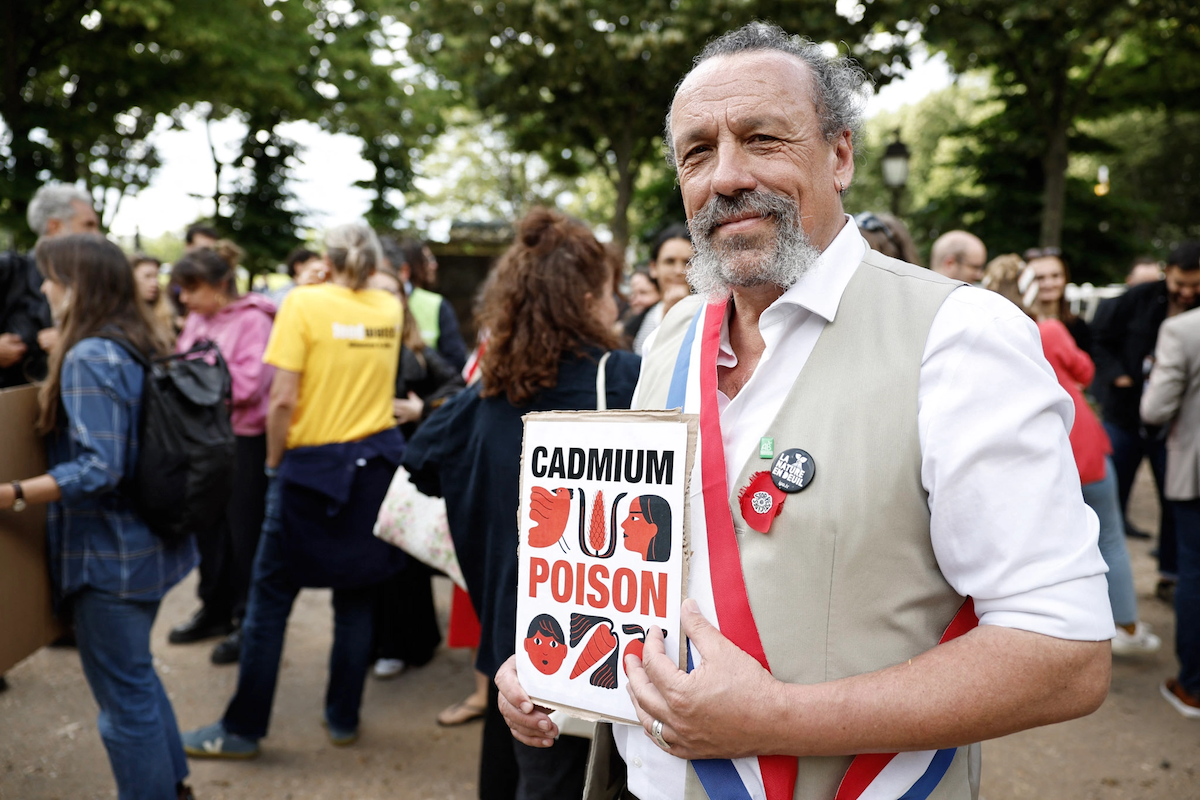 Le député (Les Écologistes) de Charente-Maritime, Benoît Biteau, lors d’un rassemblement sur l’esplanade des Invalides, à Paris, le 2 juin dernier. © Simon Wohlfahrt/AFP
Sept ans. C’est le temps qu’il aura fallu à l’État français pour prendre les alertes sanitaires sur le cadmium au sérieux. Ce métal lourd est hautement toxique et reconnu comme «cancérogène, mutagène et toxique pour la reproduction» (CMR). En 2019, l’Agence nationale de sécurité sanitaire (Anses) avait publié un avis retentissant qui alertait sur la surexposition des Français·es à la substance et recommandait de réduire sa teneur dans les engrais phosphatés utilisés dans l’agriculture. Une mesure jugée nécessaire pour protéger la population de ce métal qui s’accumule dans les sols, pénètre les aliments, puis contamine nos corps.
Les agences sanitaires françaises ont depuis multiplié les alertes, en 2021, ou encore 2026. Toutes ignorées, ou quasiment, par la macronie, comme Vert le documentait dans une enquête il y a quelques mois.
La machine à inertie politique a été enrayée ce vendredi matin. Au Journal officiel, les décrets et arrêtés fixant les nouveaux «seuils d’innocuité» à respecter pour les fabricants d’engrais, et fixant les nouvelles teneurs maximales en cadmium, ont enfin été publiés. Et ce, près de six ans après que l’ancien ministre de l’agriculture Julien Denormandie avait promis de le faire, le 17 novembre 2020.
Au 1er janvier 2027, d’après cet arrêté, les engrais phosphatés ne pourront plus contenir plus de 60 milligrammes de cadmium par kilo d’anhydride phosphorique (P2O5), contre 90 mg/kg aujourd’hui. Les textes plafonnent également les quantités apportées aux sols : les agriculteur·ices et les entreprises qui épandent des boues d’épuration ne pourront plus dépasser trois grammes de cadmium par hectare et par an.
«Le gouvernement franchit une nouvelle étape»
Avec ce premier abaissement, la France rejoint le seuil européen de 60 mg/kg de P2O5. Elle figurait encore parmi les rares pays de l’Union européenne à autoriser des engrais phosphatés au-delà de cette limite. D’autres, comme la Finlande ou la Hongrie, appliquent déjà, depuis 2021, un plafond nettement plus strict de 20 mg/kg.
«Le gouvernement franchit une nouvelle étape pour mieux protéger la santé des Français, préserver la durabilité des sols et accompagner le développement d’une économie circulaire exigeante», affirme le cabinet de la ministre de l’écologie Monique Barbut, dans un communiqué que Vert a pu consulter avant sa publication.
Interrogé par Vert, il a également assuré que la teneur maximale en cadmium des engrais phosphatés serait ramenée à 20 mg/kg de P2O5 d’ici 2030, avec une étape à 40 mg/kg de P2O5 en 2028. Un revirement important : jusqu’à présent, le gouvernement envisageait d’atteindre le seuil de 20 mg/kg en… 2038. C’est-à-dire près de vingt ans après la première alerte de l’Anses, qui recommandait d’atteindre ce seuil dès 2019. Un autre arrêté, confirmant cette nouvelle trajectoire, devrait paraître ce vendredi, promet le ministère.
«C’est une vraie victoire», confie à Vert Benoît Biteau, député Les Écologistes de Charente-Maritime. Sa proposition de loi sur le cadmium a été adoptée en juin en première lecture à l’Assemblée nationale (notre article) et prévoit une trajectoire d’abaissement semblable à celle retenue par le gouvernement.
Comment expliquer ce changement de cap ? Par «l’exposition médiatique et la pression citoyenne. C’est comme ça qu’on obtient des avancées significatives», estime-t-il. Selon lui, l’accélération de cette trajectoire aurait aussi fait partie des conditions négociées par Monique Barbut pour rester au gouvernement après sa menace de démission, cet été.
-
Donald Trump a interrogé Grok sur les effets d’une capture de Maduro au Venezuela, un mois avant de l’ordonner

En décembre 2025, un mois avant la capture de Nicolás Maduro, Donald Trump a demandé à Grok, le chatbot d'Elon Musk, comment les Vénézuéliens réagiraient, d'après le magazine Time. Le président en serait ressorti convaincu que cette IA était « ingénieuse ».
-
LFI et la jeunesse «manipulée»: le retour d’une vieille rengaine
D’une partie de la gauche socialiste à l’extrême droite, de nombreuses voix accusent le mouvement insoumis d’être derrière les blocages lycéens. Une stratégie d’attaque infantilisante et aussi ancienne que la mobilisation de la gauche contre les inégalités scolaires.