Timeline
Every post and feed across this instance
-
Fuse-archive - Vos ZIP montés en dossiers ordinaires
Pour votre système d'exploitation, une archive c'est juste un fichier. Un seul gros fichier bien opaque qu'il faut ouvrir avec un outil dédié, ou décompresser quelque part avant de pouvoir travailler dedans.
C'est pour cela que je vous présente aujourd'hui l'outil fuse-archive qui prend le problème à l'envers en présentant ce fichier comme un dossier ordinaire, en lecture seule, que vous pouvez parcourir avec ls, cat, grep, votre éditeur ou votre visionneuse d'images.
En gros, vous lui donnez l'archive, un nom de dossier, et c'est tout. Ensuite, il le monte comme une partition normale :
fuse-archive foobar.tar.gz mnt
tree mnt
umount mnt
La liste des formats supportés, c'est celle de libarchive, donc elle est assez longue : ZIP, 7z, RAR, TAR compressés de toutes les façons, ISO, paquets DEB et RPM, archives WARC du web.
Vos DOCX, vos EPUB et vos APK étant des ZIP sous un autre nom, ils se monteront pareil, et quand l'extension ne sera pas reconnue, l'outil ira lire les premiers octets pour trancher tout seul.
Et puis vous n'êtes pas obligé de vous arrêter à une archive. Si vous lui en passez trois d'un coup, il les fusionne en une seule arborescence sous le même point de montage, comme si leur contenu avait toujours été rassemblé. Avec le paramètre -o nomerge, il donnera aussi à chaque archive son propre sous-dossier, et quand deux fichiers portent le même nom, il numérote le second en file (1).txt.
Là où je trouve ça trop cool, c'est sur les archives chiffrées. En effet, un ZIP protégé par mot de passe se montera sans souci, AES-256 compris. L'outil vous demandera simplement son mot de passe. Ça permet donc de consulter un document confidentiel sans en laisser de copie déchiffrée derrière vous.
Deux limites quand même sur le chiffrement... Le format chiffré des 7z et des RAR n'est pas géré, et un fichier à double couche comme un tar.gz.gpg réclamera le paramètre -o maxfilters=2, puisque l'outil n'en traite qu'une seule par défaut.
Maintenant, cette lecture sans copie en clair nécessite que fuse-archive décompresse l'archive entière dans un fichier temporaire anonyme, posé dans votre TMPDIR ou, à défaut, dans votre /tmp. Ça peut donc prendre beaucoup de place sur le disque, et votre document confidentiel s'y retrouvera en clair jusqu'au démontage, où le fichier sera supprimé. Toutefois, avec le paramètre -o lazycache, il ne décompressera que ce que vous ouvrez vraiment, et le temporaire grossira alors au fil de vos lectures de fichiers au lieu de tout remplir d'avance. Et avec le paramètre -o nocache, il ne gardera rien sur le disque (au prix de relectures plus lentes).
Notez que ce mode lazycache ne vous fera gagner du temps et de l'espace disque que sur les formats à accès direct, du genre ZIP, 7z ou RAR. Un tar.gz, comme une archive chiffrée, sera parcouru en entier de toute façon, rien que pour lister ses fichiers.
Maintenant pour du vrai accès direct sur ces formats, je vous invite plutôt à jeter un oeil à ratarmount qui relève la position de tous les fichiers du TAR pour sauter droit à celui que vous demandez (et lui s'installe d'un simple pip install).
Ah et j'ai failli oublier, le dépôt s'appelle mount-archive, mais la commande, elle, s'appelle toujours fuse-archive.
-
Meurtre d’Aramburú: «Loïk Le Priol me répond: “Je vais le tuer!”»
Serveur, videur et client du Mabillon sont revenus sur les incidents qui ont conduit des militants d’extrême droite à tuer l’ancien rugbyman argentin. Shaun Hegarty, l’ami et associé de la victime, a livré un récit implacable et factuel. -
La Forge - Le GitLab public des profs codeurs
Je ne sais pas si vous êtes déjà tombé dessus, mais le ministère de l'Éducation nationale fait tourner son propre GitLab depuis un petit moment maintenant, il est public, et il s'appelle La Forge des communs numériques éducatifs . Au moment où j'écris ces lignes, il y a dessus 12 896 projets et 15 638 membres dans ce qu'ils appellent "l'atelier".
Alors c'est quoi cette dinguerie comme disent les anciens ? Hé bien derrière, c'est du GitLab CE, infogéré par le pôle de compétences Logiciels Libres (oui, ça existe, et c'est un vrai service de l'Éducation nationale), et classé dans les services partagés d' apps.education.fr .

Les 595 ressources de la ressourcerie, avec les étiquettes de niveau et de discipline sous chaque fiche
Et le plus beau c'est que pour aller fouiller dedans, vous n'avez besoin de rien du tout puisque les dépôts publics s'ouvrent via le navigateur, sans authentification.
Bien sûr, cette grosse dizaine de milliers de dépôts de code bruts, ça ne se visite pas comme ça. Il y a donc une vitrine, nommée la ressourcerie , qui en met en avant un peu moins de 600, triées par niveau, par discipline et par tag et pour la plupart, testables en ligne.
Par contre, pousser du code est un poil plus encadré. Pour cela, le personnel du ministère doivent avec leur compte Apps, et tous les autres, profs retraités, universitaires, Inria, boîtes de l'EdTech, associations, et j'en passe, passent par un second annuaire avec validation préalable.
Donc non, vous ne pourrez pas y déposer votre side-project éducatif du week-end, mais si votre truc sert vraiment à des profs, la porte n'est pas fermée...
Là-dessus l'Éducation nationale n'est pas toute seule, puisque les Pays-Bas ont également monté leur forge de code , où une cinquantaine d'administrations et de communes publient déjà.
Et l'IA là-dedans ?
Hé bien c'est complètement décomplexée et tant mieux ! Le catalogue a 7 tags officiels rien que pour ça, de "IA chatbot" à "IA prompt" en passant par "IA LLM souverain", et 48 fiches en font partie. Ce n'est donc pas la majorité du catalogue, mais il y a quand même un projet nommé EduVaibe dont le boulot est de "générer, étape par étape, un prompt complet à coller dans une IA pour créer des applications numériques éducatives".
Le truc le plus utile du lot, je trouve, même quand on n'a aucune classe à gérer, c'est ChatMD . Vous forkez le dépôt, vous remplacez le contenu d'index.md par vos propres réponses écrites en Markdown, et votre agent conversationnel bien à vous est ensuite accessible à partir d'une simple URL. Le tout est sous licence MIT bien sûr !
Maintenant derrière une bonne partie de ces dépôts, il y a un prof tout seul qui bricole sur son temps libre, et malheureusement, le jour où il abandonne, le projet s'arrête. Mais la bonne nouvelle c'est que la Forge rétribue chaque année quelques profs pour justement les soutenir dans leurs projet.
C'est maigre à l'échelle d'un ministère, je vous l'accorde, mais c'est quand même mieux que rien. Voilà, en attendant, je vous invite à y faire un tour ! Vous y trouverez peut-être des choses intéressantes.
Merci à Sylvain Bruyère pour le lien !
-
« On se moque de nous » : écologistes et syndicats se mobilisent pour un budget à la hauteur de l'urgence climatique

« Colère », « ras-le-bol »... Alors que le budget 2027 prévoit des moyens en baisse pour l'écologie, après cet été caniculaire et incendiaire, plus de cinquante organisations ont réclamé devant Bercy la fin de l'inaction climatique.
Lire la suite - Reportage / Climat , Luttes , Politique
Paris, reportage
Si c'était l'ouverture du bal de la rentrée sociale et militante, on aurait dit une boum. Entre l'Accor Arena et le ministère de l'Économie, sur l'esplanade régulièrement balayée par les revendications, quelques centaines de personnes agitent (…) -
« Une décision climaticide » : l’État valide le mégaprojet d’extension de l’aéroport Charles de Gaulle
« Ce projet est climaticide et menace la qualité de vie et la santé des franciliens, déjà exposés aux nuisances sonores et à la pollution. »
Cet article « Une décision climaticide » : l’État valide le mégaprojet d’extension de l’aéroport Charles de Gaulle est apparu en premier sur La Relève et La Peste.
-
Les pompiers sont-ils les grands oubliés du budget ?
En grève depuis le 8 septembre, les pompiers dénoncent un manque de moyens après un été 2026 marqué par des incendies historiques. Sont-ils vraiment sous-financés ? Plongée dans leurs comptes. -
Decoding America: Why won't Donald Trump regulate AI? - podcast
In this episode of Guardian Australia’s weekly US politics podcast, co-hosts Jonathan Yerushalmy and Reged Ahmad look at whether there is any appetite across the political spectrum to put guardrails on artificial intelligence as around the world existential fears mount that the technology is developing too quickly.
They also explain what the latest supreme court ruling on the Trump administration’s mail-in ballot restrictions means for the midterms.
And they look at what happened when the US president waded into the Irish reunification debate
Read more:
Trump facing AI backlash in Congress as push for guardrails intensifies
John Crace: AI on course to kill us all within 10 years? Donald Trump says: ‘Hold my Coke’
Continue reading... -
Montée des eaux, extinction d'espèces… Dépasser 1,5°C de réchauffement climatique mondial, ça veut dire quoi ?
 Source : Vert
-
Le monde de la culture encore polarisé autour de la Palestine
 Source : Histoires Crépues
-
Comment la mouvance identitaire tente de reprendre le combat contre les violences sexuelles faites aux enfants
 Source : StreetPress
-
Pologne : à Poznan, la prospérité d'un bar LGBT au centre de la vie locale
 Source : Problematik
-
Comment la mouvance identitaire tente de reprendre le combat contre les violences sexuelles faites aux enfants
Source : StreetPress
La protection des enfants devient un nouveau terrain de conquête pour l'extrême droite, analyse StreetPress. De Némésis à Sarah Knafo, la mouvance identitaire, qui ne se préoccupait auparavant des violences sexistes et sexuelles uniquement lorsqu'elles étaient commises par des personnes immigrées – tente de s'inviter dans les mobilisations contre les violences sexuelles, en s'appuyant sur l'émotion suscitée par les affaires Lyhanna et Lola. Mais derrière les appels à la castration et au durcissement des peines pour les coupables, certaines figures de l'extrême droite jugent l'éducation à la vie affective, relationnelle et à la sexualité à l'école, dangereuse.
Sur le même sujet
Justice
Sarah Knafo propose par exemple de rendre public un fichier des pédocriminels condamnés et veut remplacer les animateurs périscolaires par des grands-parents – oubliant que les violences sont d'abord commises dans le cercle familial ou par des proches. Pour le collectif Enfantiste, cette offensive prospère sur une faille du mouvement de lutte contre les VSS : la difficulté à politiser la question et à formuler des réponses collectives. L'une de ses militantes, Isabelle, dénonce une dépolitisation qui « empêche de voir le risque d'instrumentalisation ». Dans cet article, StreetPress montre comment l'extrême droite ne se contente plus de récupérer des faits divers, mais cherche à investir de nouveaux combats sociaux.
-
Pour Salesforce, les agents IA vont remplacer l’interface utilisateur des CRM
Salesforce ne se contente pas d’ajouter des fonctionnalités d’intelligence artificielle supplémentaires à son CRM. L’éditeur veut revoir la manière dont les entreprises utilisent leurs logiciels. Son pari : demain, les salariés ne navigueront plus nécessairement dans Salesforce pour travailler. Ils demanderont à des agents de le faire à leur place, tandis que la valeur se déplacera vers les données, les processus et les règles métier qui se trouvent derrière l’interface.
-
Appel à manifester contre la venue de Javier Milei à Paris
Quand ?
Le 30 septembre de 19h à 21hOù ?
ambassade d'Argentine 5, rue Cimarosa, 75116, ParisÀ l'occasion de la venue de Javier Milei à Paris, nous appelons à un rassemblement le 30 septembre à 19h devant l'ambassade d'Argentine pour dénoncer sa politique d'austérité, les attaques contre les services publics, les droits sociaux et les libertés démocratiques, ainsi que la répression des mouvements sociaux.
Nous dénonçons également la situation à la Maison de l'Argentine de la Cité internationale universitaire de Paris, dirigée par Santiago Muzio, où sont dénoncées des pratiques discriminatoires à l'encontre d'étudiants et résidents en désaccord avec les orientations du gouvernement Milei, ainsi que le retrait de la plaque commémorative dédiée aux victimes de la dictature militaire argentine.
Des personnalités politiques françaises prendront la parole pour réaffirmer leur solidarité avec la société argentine et dénoncer la véritable facette du plan économique d'austérité avec son lot de souffrance et misère pour l'ensemble des citoyens.
Pour la démocratie, les droits humains et la solidarité avec le peuple argentin !
— ACAF (Assemblée de Citoyens Argentins en France)
- Voir la page Facebook
-
La police expulse, la police tue
Quand ?
Le 19 septembre à 18hOù ?
La Kunda (entrée Lagaisse) 46, rue Jules Lagaisse 94400 Vitry-sur-SeineCe samedi 19 septembre, à la veille de la manif contre la loi Permis de tuer, on pogote et on danse contre les lois Permis de Tuer et Règlement Retour.
Parce que si l'État avec sa police veut nous déporter et tuer, on organise dès maintenant la riposte !
Ce concert-soirée est organisé par des nombreux collectifs qui forment une inter-orga contre le Règlement Retour. Parmi les nombreux collectifs organisateurs on retrouve par exemple La Marche des Solidarités, les Antifas du 20, le Caraf et Le Fuzz.
-
Appel à une assemblée citoyenne contre l'IA
Quand ?
Le 20 septembre de 15h à 17hOù ?
Parc de la Villette ParisStopIA appelle à une assemblée populaire contre l'IA !
Le développement incontrôlé de l'IA menace chacun d'entre nous, de près ou de loin ! Nous pensons qu'il est urgent de créer des espaces citoyens de discussion, de débat et d'organisation contre l'IA afin de ne pas rester seul et impuissant. Ce moment permettra d'échanger sur nos parcours, nos inquiétudes et nos envies d'agir. Réfléchissons ensemble aux prochaines actions pour enfin faire entendre notre colère !
Stop IA est un mouvement qui a pour but de créer une mobilisation populaire contre l'Intelligence Artificielle grâce à de la sensibilisation et des actions.
L'IA comporte des risques majeurs pour l'existence humaine : chômage de masse, surveillance généralisée, désastre environnemental, guerre automatisée, désinformation et manipulation, perte de contrôle...
Notre colère doit être prise au sérieux, nous devons rendre visible notre désaccord dans l'espace public. Pour cela, seule une mobilisation importante peut convaincre les responsables politiques de considérer sérieusement le refus de la population.
Pour influencer le gouvernement français, nous travaillons simultanément sur trois fronts : sensibiliser la population, créer des espaces citoyens de discussion et d'organisation contre l'IA et s'engager dans de l'action directe non violente.
Face au danger que représente l'IA et l'inaction des politiciens, notre seule chance est de créer un rapport de force politique, impossible à ignorer.
RDV AU PARC DE LA VILLETTE (PRAIRIE DU CERCLE SUD)
DIMANCHE 20 SEPTEMBRE DE 15H À 17H- Voir aussi Instagram
-
Goossips SEO : Positionnement
Goossip #1La notion de positions a moins de sens aujourd’hui
John Mueller a réagi sur Reddit à des questions sur la manière dont les impressions sont comptabilisées pour les résultats IA générative dans Search Console. Google dispose déjà d'un document d'aide sur le sujet, mais John Mueller reconnaît que c'est un document assez dense.
Son message principal : l'ancienne notion de « position 1 à 10 » ne correspond plus à la réalité des pages de résultats actuelles, qui comportent AI Overviews, featured snippets, "People Also Ask" et de nombreux autres blocs. Pour les fonctionnalités liées à l'IA générative, Google suit donc les positions comme un bloc global plutôt que ligne par ligne, sans détail séparé dans le rapport de performance Gen-AI.
John Mueller précise qu'il n'y a pas de solution simple pour rendre cette donnée de position "utile" aux propriétaires de sites, et il dit être ouvert aux suggestions de la communauté SEO sur ce qui serait pertinent à suivre.
Source : Search Engine Roundtable
Taux de fiabilité :
 On est d'accord !
Étant donné l’évolution des formats dans les SERP, reconnaissons en effet que la notion de première position n’existe plus vraiment. Tout du moins, telle qu’on pouvait la concevoir par le passé.
L’article "Goossips SEO : Positionnement" a été publié sur le site Abondance.
-
Pourquoi les escrocs de la transition énergétique ciblent les maraîchers

Durant plus d'un an, les aides à la transition énergétique ont été massivement détournées dans le secteur du maraîchage, révèle Reporterre. Un scandale qui a amputé des millions d'euros au secteur.
Lire la suite - Enquête / Agriculture
Tout commence par une pluie d'appels téléphoniques, reçus par des maraîchers. Au bout du fil, des sociétés aux noms écolos, « Energy ceci », « Green cela ». Certaines s'inventent des noms ronflants comme le « Bureau des aides agricoles », ou usurpent des grandes marques comme EDF ou l'Ademe, (…) -
Assemblée Anarchiste
Dans le prolongement de la première Assemblée Anarchiste qui a eu lieu le vendredi 11 septembre, nous appelons à une deuxième Assemblée Anarchiste, le jeudi 24 septembre à 19h30 à la Maison du Peuple.
A celle du 11, nous avons commencé à échanger des infos, des idées, des envies. Certaines idées sont en cours de travail. Rien n’est définitivement fixé: toute idée, toute proposition de perspective, peut toujours être amenée, discutée et mise en oeuvre.
Nous souhaitons faire notre possible pour rendre cet espace ouvert, révolutionnaire et sans chef.fe.
Rdv le jeudi 24 septembre à 19h30 à la MDP pour continuer d’en parler.
(l’appel pour la première Assemblée: https://nantes.indymedia.org/events/168757/assemblee-anarchiste/)
-
Reconquête emploie en alternance un étudiant de l’ESJ Paris, l’école de journalisme des milliardaires Bolloré, Arnault et Saadé
Depuis septembre 2025, le parti d’Éric Zemmour salarie comme communicant un apprenti journaliste de l’école, en voie de bollorisation depuis son rachat fin 2024. Un contrat pour lequel la formation d’extrême droite bénéficie des aides de l’État. -
Militants antifascistes menacés d’extradition: «En Hongrie, je ne peux pas m’attendre à un procès devant un tribunal indépendant»
La justice française étudie mercredi 16 septembre le cas du Syrien Zaid A., réfugié en France et accusé de violences en marge d’un défilé néonazi à Budapest en février 2023. Il est menacé d’extradition vers la Hongrie où il risque, comme d’autres militants et militantes antifascistes avant lui, un procès inéquitable. -
De l’hubris au désarroi : le retournement de fortune du trumpisme
A l'approche des élections de mi-mandat aux Etats-Unis, l'économiste Robert Boyer dresse le bilan des choix économiques aussi dangereux qu'inefficaces de Donald Trump. -
« Casse-toi, avec tes flashs de pédé » : l’inquiétant théâtre de l’AfD dans l’œil d’un photographe
Depuis trois ans, Rafael Heygster écume les meetings du parti d’extrême droite allemand, qui vient de remporter les élections régionales en Saxe-Anhalt. Un regard puissant sur ces dirigeants et militants dont certains n’hésitent pas à flirter avec l’héritage du nazisme.
The post « Casse-toi, avec tes flashs de pédé » : l’inquiétant théâtre de l’AfD dans l’œil d’un photographe appeared first on Revue21.fr.
-
Data centers : même les pro-Trump rejoignent la fronde aux États-Unis

Aux États-Unis, la course à l'intelligence artificielle se heurte à une fronde contre les data centers qui rassemble démocrates et républicains. Aussi inédite qu'improbable, cette coalition pourrait rebattre les cartes lors des élections de mi-mandat.
Lire la suite - Reportage / Monde , Politique , Numérique
San Antonio (États-Unis), correspondance
Mar-a-Lago, ses terrains verdoyants, son golf… et bientôt son data center ? À écouter Donald Trump, sa luxueuse résidence floridienne aurait tout intérêt à accueillir l'un de ces centres de données (…) -
Au bout du marteau : quand la justice épuise ses magistrats
En 2021, des milliers de magistrats signaient une tribune retentissante pour dénoncer leurs conditions de travail. Cinq ans après, fatigue, sous-effectif et surcharge de travail sont toujours au rendez-vous. -
Trump endorses Flock cameras despite bipartisan backlash: 'I like them'
President Donald Trump endorsed law enforcement's use of Flock cameras despite the intense bipartisan backlash they are facing in the court of public opinion. -
Pour changer l’école française, il faut réformer la manière de la réformer
La publication du Programme international pour le suivi des acquis des élèves (Pisa), le 8 septembre 2026 par l’Organisation de coopération et de développement économiques (OCDE), a été l’apogée d’une séquence éducative mouvementée en cette rentrée. Commencée fin août avec la polémique sur le… -
Poverty Rate Was Stable Before Trump's Safety Net Cuts Gained Force
Median household income rose to a record $87,460 in 2025, according to annual Census Bureau data on the financial well-being of Americans. -
[MinuitDecousu] Émission #261 Backlash & K.O technique
Émission enregistrée le 15/09/2026 en direct des studios de Radio Canut. Cette semaine, Minuit Décousu casse l’ambiance avec une émission sur le backlash anti-féministe et luttes qui y font face. »Première vague, deuxième vague, troisième vague. Mais aussi fémo-nationalisme et backlash masculiniste et anti-féministe. Difficile aujourd’hui d’utiliser le mot féminisme au singulier ni même de bien savoir à quoi s’en tenir. C’est toujours complexe et souvent sombre. Alors ce soir on a tiré des fils et tenté de démêler des nœuds. Ça donne une émission douce amère. Un portrait pessimiste des féminismes actuels et des vents contraire qu’ils affrontent. Mais aussi des moment où la lutte prend le dessus, où les camarades se donnent les moyens d’inverser la tendance. Et où, même, il y a des victoires. »Dans cette émission, tu pourras entendre : – Le féminisme, c’est plus radicool- Naissance du Girlxcott national et sa branche lyonnaise (entretien avec Élisa et Camille de la collective Girlxcott lyonnaise*)- Une histoire du masculinisme : des groupes pro-fem à la « révolution conservatrice »- Les Fêtes interconnectées de la BD, un contre-festival d’Angoulême (*)- Une histoire du masculinisme : consolidation, hybridation et masculinisme d’État- Sexisme dans les BD, sexisme dans le monde professionnel de la BD (*)- Le féminisme, encore de gauche ?
-
Trump's Midterm Mayhem - The Wins and the Warnings
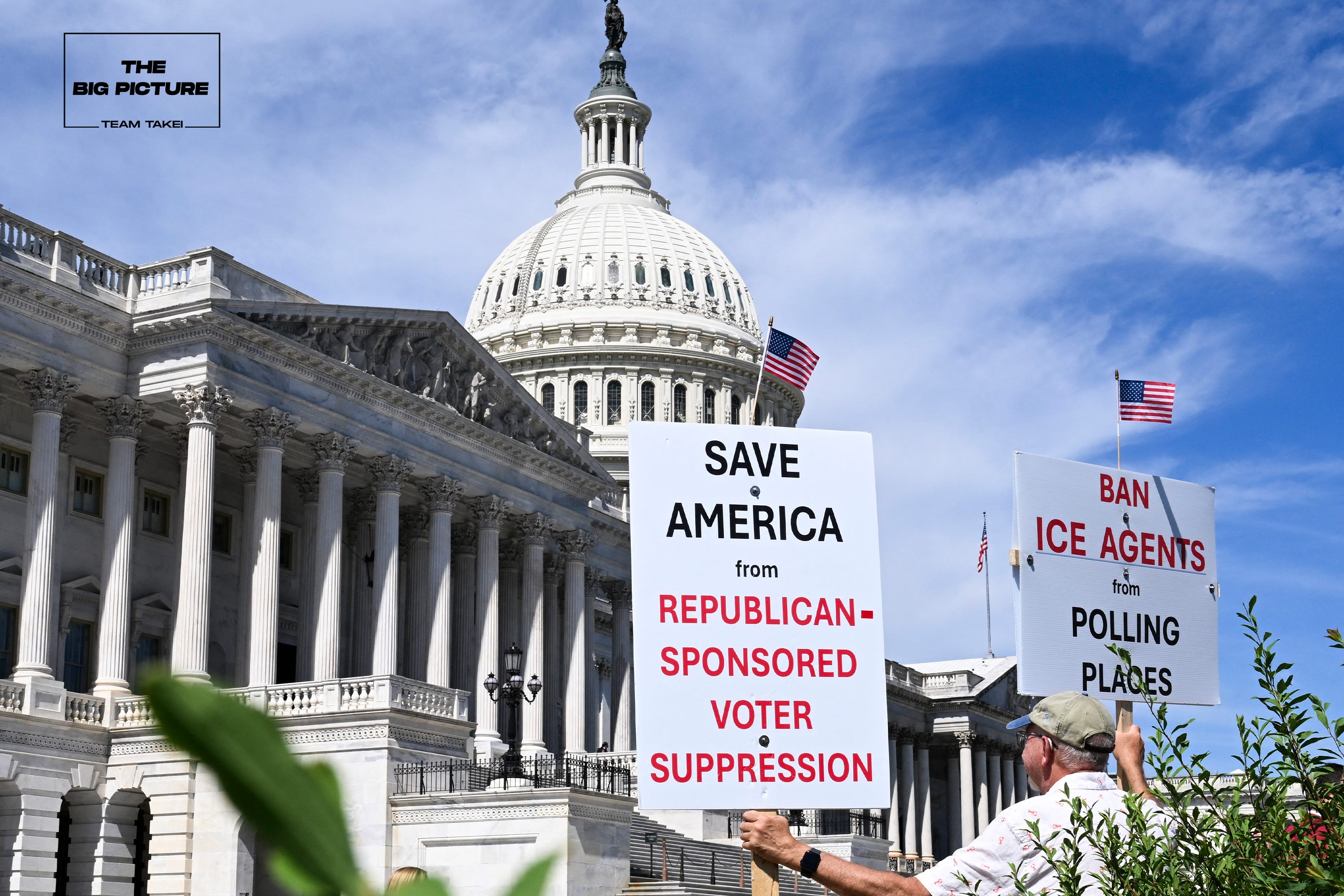
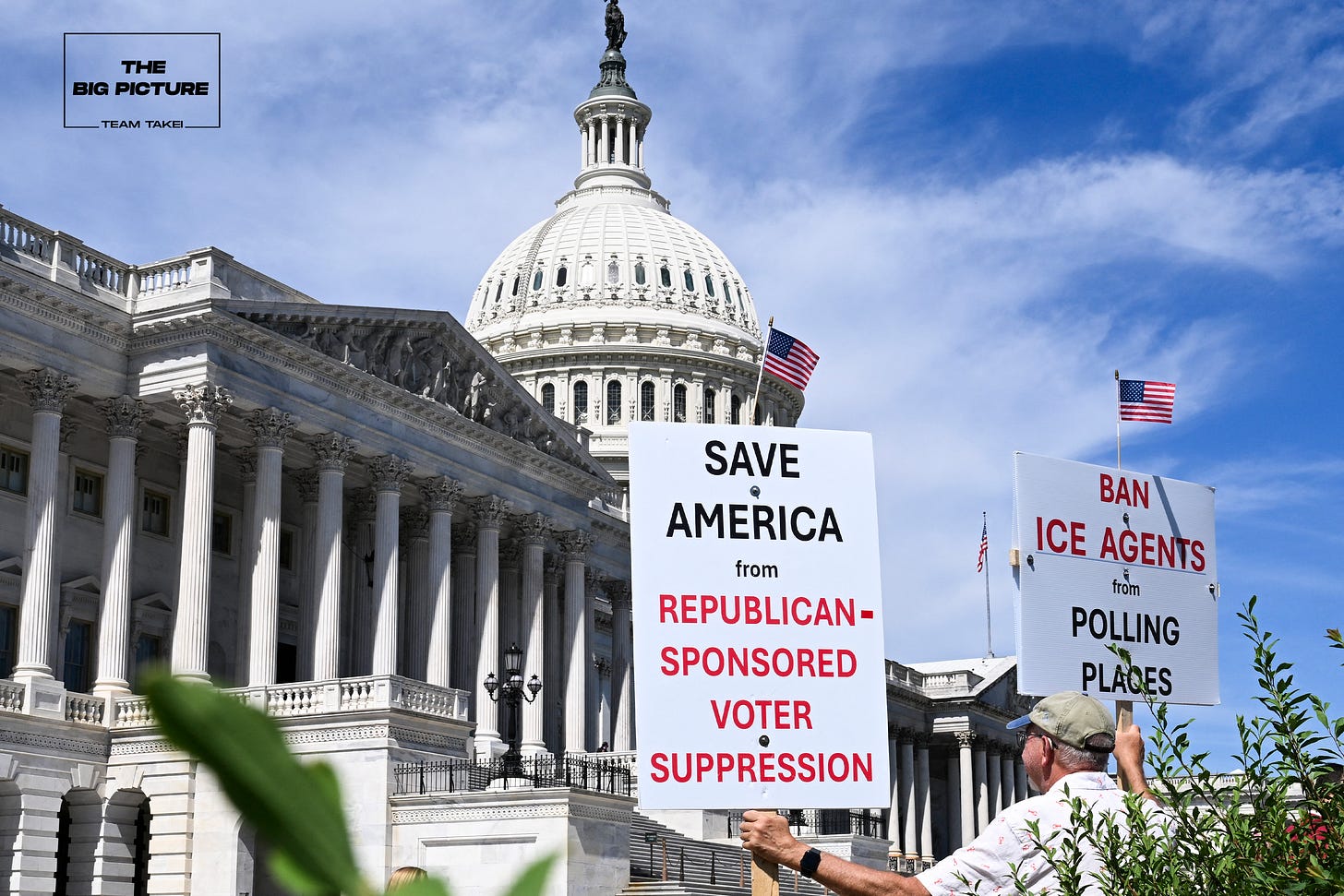 A demonstrator holds signs while protesting against US President Donald Trump’s executive order that aimed to change how Americans vote by mail ahead of the midterm elections. Photo by ROBERTO SCHMIDT / AFP via Getty Images.
Donald Trump has spent six years refusing to accept an election result he did not like, and the run-up to the 2026 midterms has been shaped by his stubborn and baseless claims of election fraud. He has ordered raids on local election offices, demanded state voter rolls through an executive order and tried to end mail-in voting completely. In a February podcast interview with former FBI deputy director Dan Bongino, he told listeners Republicans should “nationalize the voting,” meaning put it all in the hands of his people.
Not a chance. Blue states and voting rights groups have pushed back hard, filing dozens of lawsuits and taking the fight all the way to the Supreme Court. Seven weeks from Election Day, the record so far is good for anyone who cares about free and fair elections. But real risks remain.
The Big Picture is reader-supported. To receive new posts and support our work, consider becoming a free or paid subscriber.
First, the wins
Since May, the Justice Department has sued 30 states and Washington, D.C., for refusing to turn over their complete voter rolls, including driver’s license numbers and partial Social Security numbers. While many GOP-controlled states went along with the demands, Democratic-controlled ones resisted. After all, the administration of federal elections isn’t an executive branch function. Under the U.S. Constitution, it’s left to the states or Congress. It’s not the purview of the White House.
Federal judges have unanimously agreed. So far, they have dismissed 23 of those lawsuits, according to a running tally kept by the Brennan Center for Justice, with one court after another finding the demands unsupported by any statute the department has cited. A California judge went further, writing that the department’s stated purpose of “voter roll maintenance enforcement and compliance” did not match what its own officials had said elsewhere, and that the broader campaign “paints an alarming picture regarding the centralization of Americans’ information within the Executive Branch.”
Then there’s the saga of the USPS and its asserted role in our elections. That storyline ended with a loss for the White House on Monday at the Supreme Court, which issued a single-paragraph ruling on its emergency docket denying the regime’s request for a stay of a lower court’s injunction and emphasizing that it did not think the defendants would prevail on the merits.
The road to Monday’s ruling was a winding one that had bounced up the Supreme Court with a far less positive result. In late August, a majority of the justices sided with the administration in a related case, Trump v. California, lifting an earlier district court injunction. Let me clear my throat before reciting the legal grounds, which are admittedly confusing: The Court lifted the injunction on narrow standing and ripeness grounds, rather than on the merits, briefly clearing the way for the rule to take effect and prompting the district judge to vacate her own block, only to reimpose a new injunction once the Postal Service actually finalized its rule and voting-rights groups sued again.
Monday’s SCOTUS decision closed that door, thank goodness. The justices declined, presumably 7-2 (though as Georgetown law professor Steve Vladeck noted, it could be 6-3 because we only saw two public dissents), to let the Postal Service enforce the rule, leaving standing the district court’s finding that it likely violated the Constitution’s grant of election authority to the states and a federal appeals court’s separate warning that it would likely disenfranchise millions of voters while doing little to combat actual fraud.
To no one’s surprise, Justices Samuel Alito and Clarence Thomas wrote a public dissent, arguing that the White House was likely to prevail eventually on the merits. At least a few, if not all, of Trump’s appointees disagreed.
With this ruling, we are seeing a familiar pattern. It’s one that held in 2020 whenever the Trump campaign’s claims about elections actually reached a courtroom. Inside courthouse walls, Trump repeatedly lost before judges appointed by presidents of both parties, until the Supreme Court finally declared it also wasn’t going to put its finger on the scale for Trump.
Our judiciary continues to function, however battered by the bad faith of the Justice Department and the appointment of cynical partisans. But the courts are only a check on claims already made and challenges already filed. They have no say over claims not yet raised or maneuvers built to never reach a courtroom at all.
Next, the familiar pressures
For anyone who has followed Trump’s threats around this election cycle, the dangers he and the executive branch pose fall into four basic buckets: federal seizure of ballots, data and even voting machines; a declaration of national emergency over election fraud; armed federal agents or even troops stationed at polling places; and local officials engaging in shenanigans, including refusing to certify election results.
The seizure threat is already real, just as it was in 2020 when Trump reportedly regretted not having troops take possession of voting machines after his electoral loss. This election cycle, he has not held back. In January, the FBI raided a Fulton County, Georgia, election warehouse and physically removed the 2020 ballots, an operation former Director of National Intelligence Tulsi Gabbard was somehow present for. And in California, the Riverside County sheriff similarly confiscated ballots from a 2025 redistricting referendum. Obtaining state or county election records does not always take the form of a raid, however, as we saw in Arizona, where a federal grand jury subpoenaed digital election data tied to the state Senate’s discredited 2021 Maricopa County audit. The data was quietly obtained through paperwork after the state Senate president complied and handed the records to the FBI.
A national election emergency is something Trump’s allies, including former adviser Steve Bannon, have pushed him to declare, despite the fact that there is no law authorizing one. A 17-page draft executive order, reviewed in full by PBS News, has already circulated among his allies. It claims foreign interference in the 2020 election as grounds to impose national mandates such as hand-marked paper ballots counted in public, nationwide re-registration with proof of citizenship and new voter ID requirements. Rather alarmingly, Trump has declined to rule it out, telling an interviewer as recently as August who asked about such a declaration that “stranger things have happened.” To be clear, the U.S. Constitution gives states, not the president, authority over federal elections under Article I, Section 4, and no statute grants the executive branch power to override that during a declared emergency. Hofstra law professor James Sample called the idea that Trump could simply declare a national emergency “legally baseless”—and he is right about that.
Bannon has separately called for an “up-armored ICE presence” at polling places. It’s an idea Homeland Security Secretary Markwayne Mullin has pointedly declined to rule out, saying just this month that agents would go to polling places only “if we’re serving a warrant” or responding to a threat, even as the chairman of the Joint Chiefs of Staff has denied any plan to use troops to seize ballots or voting machines. Like the power to declare a national election emergency, the idea of armed agents at polling places is not just controversial; it is squarely illegal. Federal law bars deploying “armed men” to any place where an election is being held and separately bars intimidating, threatening or coercing anyone in connection with voting. As attorneys Jasleen Singh and Kendall Verhovek of the Brennan Center for Justice pointedly noted, ICE has no statutory role in enforcing election law.
Certification refusal is not just a Mike Pence Hail Mary; it has a track record at the county election level. Local election deniers serving as officials in eight states have refused to certify results 35 times since 2020, according to Citizens for Responsibility and Ethics in Washington, and every one of those refusals has eventually been forced through by a court. As the Washington Post reported, a commissioner in New Mexico’s Otero County cited debunked theories about voting machines in 2022 and voted no on certification anyway, telling an attorney who warned she could be jailed for it, “So then what?” A commissioner in Nevada’s Washoe County has voted against certifying every election since 2020, including her own reelection.
The lack of a sound legal basis for any of these mechanisms matters less than what they actually cause in the moment: fear and confusion that could overwhelm a process still working itself through a slow-moving legal system. That is precisely the model Jan. 6 established. Indeed, the attack on the Capitol was never going to succeed as some kind of constitutional procedure. It succeeded, for a few hours at least, as chaos. And chaos was the entire objective. Once mayhem is generated, it can be used to justify invoking the strong hand of the federal government to restore order and stability.
The Pence play, updated
In 2020, Trump’s legal advisers went looking for a single point of technical failure in a process everyone assumed was purely ceremonial, and they found one in Mike Pence. As vice president, Pence’s role presiding over the certification of electoral votes had never before been treated as discretionary. Trump’s team spent weeks trying to convince him otherwise, arguing he had the authority to reject or delay certified votes based on his own judgment. Never has so much ridden on one person simply upholding the oath he took. Pence refused.
Retired federal judge J. Michael Luttig, a George H.W. Bush appointee and longtime conservative legal figure, has identified a similar chokepoint one office removed, laying it out in detail in a September 10 essay in The New Republic titled “The Final Battle for America’s Democracy.” Luttig’s warning centers on House Speaker Mike Johnson, whose term expires at noon on January 3, 2027. Before then, Luttig argues, Johnson could theoretically remove current House Clerk Kevin McCumber and install a loyalist willing to refuse to list Democratic members-elect on the statutory roll used to organize the new Congress. Members-elect would then have to seek a federal court order compelling the clerk to comply. In Luttig’s darkest scenario, that clerk could defy even a Supreme Court writ, dragging the standoff out for weeks or months while Congress sits paralyzed.
A clerk’s job is ordinarily ministerial and invisible. Luttig is describing a scenario where Johnson does to the House clerk what Trump’s advisers tried and failed to do to Pence: give a functionary a reason to believe he actually has the discretion and the justification to keep certified winners out of their seats.
This scenario, while possible, is not on my front burner. Nor is it likely to last long, as attorney and writer Robert Hubbell persuasively argues, given how quickly the Supreme Court has acted when it comes to resolving election-related disputes. Speaker Johnson and any House clerk he appoints would understand this and likely think twice about crossing, let alone defying, SCOTUS on the assumption that they could delay the seating of a new Congress for long.
There’s something lost, however, in the discussion around maneuvers, mechanisms and vulnerabilities. Every one of these schemes depends on the same thing: a public-facing story convincing enough to make the attempt look defensible, at least for as long as it takes to do damage. It also changes what a court is willing to do. A judge asked to intervene within hours of a seizure or a refused certification moves differently against a backdrop of “we found something” than against silence or the lack of any colorable claim or evidence. Trump and his allies are already building that story around three distinct conspiratorial claims.
Conspiracy one: The minority “vote-dumps”
The oldest false predicate is also the most familiar. In 2020, Trump built his entire election fraud narrative around a specific image: ballots counted overnight in large, heavily Democratic, heavily African American cities. He framed the counting of ballots as suspicious simply because it continued after midnight.
“When you see what happened in Detroit, Atlanta, Philadelphia & Milwaukee, massive voter fraud,” he wrote that November. None of those cities decided the election. Turnout in Detroit actually fell from 2016 levels, and Trump won a larger share of the city’s vote than any Republican nominee in decades; Biden won Michigan in the suburbs, not the cities Trump named.
The claim never needed to be true to work, and Trump has already revived it for 2026. In a February podcast interview and again the next day from the Oval Office, he named the same cities as likely culprits in his fantastical election heist. “Take a look at Detroit. Take a look at Pennsylvania. Take a look at Philadelphia. You go take a look at Atlanta.”
This election cycle, the Justice Department plans to deploy roughly 1,000 election monitors this November. That would be a record for a Republican administration, according to Assistant Attorney General for Civil Rights Harmeet Dhillon. During this year’s primaries, federal personnel were already sent to Detroit, Hamtramck, Lansing and East Lansing in Michigan. They were also dispatched to Maricopa, Apache and Pima counties in Arizona, presumably on the false premise that illegal votes were being cast by undocumented Latino residents. Dhillon has framed the deployment around ensuring no voter is “canceled out by someone who should not be voting,” language that echoes the regime’s unproven “immigrant voter fraud” claims rather than the Voting Rights Act compliance the monitor program traditionally exists to enforce.
Conspiracy two: The mail-in mirage
The second predicate is newer, and it compounds the first rather than replaces it. The manufactured fraud claims that failed in 2020 shared a common flaw: They arrived too long after the votes were counted and the result known. That forced Trump’s lawyers to invent stories to fit a result they didn’t like.
The newer conspiracy claim doesn’t need to be invented after the fact because the vote-counting process itself, lawfully and correctly administered, produces the appearance of fraud in real time, before anyone has to lie about anything.
I wrote about this peculiar dynamic in June, when California’s ongoing primary count first became a live preview of what November could look like. The state automatically mails a ballot to every registered voter, a policy Gov. Gavin Newsom made permanent in 2021. Those ballots are valid as long as they are postmarked by Election Day and arrive within seven days afterwards. Los Angeles County alone has to be ready to process ballots from as many as six million people, most of whom vote by mail. Statewide, roughly 13 million of the 16 million votes cast in 2024 arrived by mail. Same-day registrants cast provisional ballots that require separate verification.
As I wrote in June,
Election experts have described the cumulative effect using a vivid analogy: a pig moving through a python. The processing systems in each county must absorb an enormous pile of late-arriving ballots, all legally mailed but at the last minute.
The count takes weeks not because anything has gone wrong, but because that’s how much time absorbing such a huge pile of ballots requires.
Republicans are more likely to vote in person or return mail ballots early, so those votes get counted first, producing an initial tally that leans Republican. Democratic votes arrive and get counted later, and the count shifts. This creates a mail-in ballot mirage of sorts, or as I described in June, “an illusion of Republican dominance created entirely by the sequence in which valid ballots happen to be counted.”
Trump has already shown us what he will do with that gap. During the June primary, as mail ballots shifted two closely watched races away from his preferred candidates, he told NBC’s Kristen Welker that California was “rigging the election.” He offered no evidence, instead saying that “all I have to do is look.” Ron DeSantis, Megyn Kelly and a rotation of Fox hosts amplified the claim within hours, and the Justice Department sent a federal prosecutor to observe ballot processing in Los Angeles County the next day.
California Attorney General Rob Bonta had predicted exactly this scenario months earlier, calling Trump’s rhetoric around the state’s Proposition 50 special election “a tee-up for something more dangerous in the 2026 midterms and maybe beyond.”
The stakes in November are huge. California holds 52 House seats, more than any other state, and five of them shifted into competitive territory after Proposition 50 redrew the maps in favor of Democrats in response to Texas’s partisan gerrymander seeking to hand five more seats to the GOP. Those are exactly the kind of close races that take the longest to call, and they may well decide which party controls the House when the 120th Congress convenes in January of 2027. On election night, Republicans could hold apparent leads in several of those districts. Over the following days, as lawful counting proceeds, some of those leads will narrow or flip toward Democrats, the same pattern that played out in the June primary and in 2022 and 2024. And Trump will pounce.
Conspiracy three: Local yokels
The third predicate is Trump’s recent citizenship-list campaign. The White House has recently accused Pennsylvania, California, New Jersey and Nevada of having hundreds of thousands of noncitizens on their voter rolls, publicly pressing the claim for weeks while struggling to produce evidence. State officials call the underlying data unreliable. Justin Levitt, a law professor at Loyola Marymount and a former Biden administration adviser, describes the 250,000-noncitizen figure the White House has floated as a prop, something to point to if it wants to justify taking action, whether or not the number holds up under scrutiny.
Accurate, smackurate. That justification doesn’t need to hold up under scrutiny to do its work at the county level. Indeed, local election boards already have a template. In Fulton County, Georgia, board member Janice Johnston filed a state lawsuit seeking to leverage unsubstantiated claims about the county’s 2020 election into expanded certification power and direct access to ballot images, despite the secretary of state and the courts having already dismissed those claims. A local commissioner who wants a reason not to certify in November has, in the citizenship-list numbers, a ready-made and presently unfalsifiable one. It doesn’t matter that the underlying data is bad. It only matters that it exists and sounds enough like fraud to hold up for the days or weeks it takes courts to force certification through anyway.
Trump and his cronies are hoping that if enough local election officials rebel, it will look and feel like some kind of national crisis justifying the seizure of ballots, a national election emergency declaration or even the deployment of armed agents or troops to election sites.
So are we screwed?
It’s understandable to feel overwhelmed by the ferocity and scope of these attacks. These three conspiracy-based assaults on our elections could all move into high gear the moment polls close and first counts come in—but before races are officially called and results are later certified by local authorities. It’s that very gap Trump and his allies will seek to exploit.
But standing in that gap will be state and local election officials and voting rights lawyers, who already know the timing and understand the gist of what the other side will attempt. They will be prepared with election monitors, lawsuits and pre-drafted motions for temporary restraining orders, all in advance of the expected attacks.
Federal judges also know it may be a long night, if not a long couple of weeks, as unverified and unsubstantiated claims once again seek to derail the election and certification process. This time, unfortunately, the weight of the federal government will be behind the “evidence,” with the DOJ presenting “data” it received from cooperative red states as “proof” of something untoward.
That’s unsettling, but we can take comfort in the fact that the DOJ still has not prevailed in over two dozen election cases it has fought so far. And for all its faults and partisanship, the Supreme Court has at last signaled that it is not always ready to side with the White House, particularly over election matters in which the executive branch should play zero role as a matter of law.
Trump and his co-conspirators also understand that they may now be holding a losing hand, despite their latest attempts to rig and undermine our elections. If Trump’s past behavior is any guide, one likely retreat will look like any other TACO Tuesday: The president will turn up the rhetoric even as he backs down, then blame someone else for the failure (he’s already pointing to Republicans) and retreat further into his happy zones of ballrooms and monuments to himself.
All this suggests that we should stay the course, prepare for what we know is coming and turn out in droves to power a blue tsunami that will sweep Democrats back into control of one, if not both, chambers of Congress. The recent court wins teach us that if we heed the warnings and do our homework, Trump’s anti-democratic attacks can be defeated and the rule of law can come out on top once again—just in time for democracy to take the W, too.
Thanks for reading! This post is public so feel free to share it.
-
Trump’s DOJ Says ‘Become Ungovernable’ Is Antifa Evidence. Trump’s Convention Put It On The Wall.
“Become ungovernable” is a phrase that has traveled around the world and morphed in meaning over time, but in the last few years has basically become an internet culture joke meme, with vaguely anarchist seasoning.

But, now, in the Trump administration, it has apparently taken on a Schrodinger-esque meaning as either… a slogan for libertarian-leaning MAGA folks… or proof that someone is antifa. Or we just live in a dumb stupid world where nothing matters anymore.
As you may have heard, last week Donald Trump hosted the first-ever GOP “midterms” convention, a desperate ploy to get people excited about the midterm elections as Trump’s approval ratings hit such horrifying lows that even some Republicans are trying to distance themselves. Trump doesn’t have anything productive or helpful he can do to stop the slide caused almost entirely by his own terrible decision-making, and thus he falls back on the only thing he knows how to do: hold rallies to pretend that everyone loves him.
It was apparently difficult to find willing speakers (many top Republican officials came up with excuses to skip the shindig), but he did get Ross Ulbricht to speak. As someone who covered much of the Ross Ulbricht saga — from his arrest for operating the Silk Road Tor marketplace, to the stories of him attempting to hire hitmen to kill off various people, to his “maybe someone else did it!” legal arguments, to his eventual pardon from Trump — I’d say the pardon was a near-perfect encapsulation of Trump 2.0’s transactional corruption.
There were some parts of the Ulbricht prosecution that seemed problematic, and the lifetime sentence was arguably excessive given the evidence, but the attempted murder claims were a pretty big deal. And while some of Ulbricht’s defenders argued he was just a platform operator who shouldn’t be liable for what users did — an argument we’re usually quite sympathetic to — Section 230 never applied to federal criminal charges anyway. And remember: Trump has regularly campaigned on throwing drug dealers in jail, if not executing them outright.
But, freeing Ulbricht became a kind of Libertarian Party cause célèbre, and Trump was desperate for votes in 2024, so to try to bring over some of the increasingly authoritarian wing of the Libertarian Party (as oxymoronic as that may sound) he promised to pardon Ulbricht. Free the guy who set up a giant illegal drugs and weaponry marketplace, in exchange for some votes. Trumpism in a nutshell.
Notably, when Trump spoke in front of the Libertarian Party convention to make this promise, he did so in front of a “Become Ungovernable” banner.

Last week, when Ulbricht spoke at Trump’s midterms rally, he spoke in front of the same banner:

Ulbricht didn’t have anything interesting to say, just misleadingly claiming that he and Trump were both the “target of a weaponized government,” which only makes sense if you haven’t actually looked at the evidence against Ulbricht. It’s not a “weaponized” government when you actually engaged in criminal activity, dude.
But that banner background really caught my eye, because just a few months ago, with Trump’s DOJ trying to cook up charges against the mythical “antifa” cells that MAGA keeps insisting exist, the DOJ claimed that it had found and indicted an antifa cell in Minnesota. And a key part of the evidence? One of the people had posted to Facebook “become ungovernable.”
With these new charges, Rosen said, “the evidence will prove it all out”.
Rosen showed social media posts and videos of a couple of the people indicted to underscore the allegations that they intended to impede law enforcement. In one video, a man declares he is antifa and discusses bringing guns to a demonstration. He showed another post of a defendant saying people needed to “become ungovernable”.
Literally, the US Attorney highlighted the “become ungovernable” Facebook post in his press conference explaining why those charged were “antifa.”
Oh, so they have NOTHING nothing
You could argue that the 2024 Trump appearance in front of the banner doesn’t count. It wasn’t Trump’s convention, he had no say in the backdrop, and it happened two years before his DOJ decided that the phrase was crucial evidence of antifa conspiracy membership. Sure. Fine.
But here we are now, just a few months after one of Trump’s own handpicked prosecutors stood at a press conference and declared that “become ungovernable” was evidence of antifa membership, Trump’s own MAGA convention has plastered that same phrase across the main stage — behind the guy who ran an illegal drugs market and tried to hire assassins to take out his enemies.
It’s almost like nothing actually matters any more, other than whether you’re loyal to Trump or not. And thus, I guess, the only thing one can possible do is… ahem… become ungovernable.

-
Comment agir face au génocide à Gaza
Dans le contexte actuel, comment agir face au génocide en cours a Gaza et en Palestine ?
Depuis le 7 octobre 2023, Israhell mène a Gaza un nettoyage ethnique sans pitié.
En un an, on compte plus de 50 milles mort.es tué.es par l'armée d'occupation sioniste au cours de bombardements mais aussi par tirs ciblé et attaques de drones sur des civils.
Depuis le début de ce génocide, est dénoncé dans le monde entier, la collaboration des pays occidentaux avec Israhell.
Que ce soit par de la vente de matérielle d'armement, dans un discours médiatique deshumanisant le peuple palestien, deligimant la resistance armée et justifiant les horreurs mené par Tsahal, l'armée d'occupation isrealienne.Le soutien évident de la France du processus de colonisation de la Palestine par Isreal s'inscrit dans la conitnuité de l'imperialisme occidental dans lequel s'est construit la france telle que nous la connaissons aujourd'hui. Ce soutien est en grande resonnance avec le racisme et l'islamophobie d'état présent depuis toujours, mais revenant en force dans l'actulité politique ce derniers temps.
Le 16 fevrier 2025, plusieurs collectifs militant pour la liberation de la Palestine se sont réunis à Nantes autour de la question de la complicité du complexe militaro undistriel français avec Israel mais aussi pour apporter des reponses à la question suivante : dans le contexte actuel, comment agir face au génocide en cours a Gaza et en Palestine.
Dans ce podcast, vous pourrez écouter Denis Fortin de l'observatoir de l'armement faire un état des lieux de cette complicité entre la france et Israel. Puis vous entendrez différents collectif : Stop Arming Israel, Urgence Palestine, Kiffah, Guerre à la Guerre et Samidoun Paris Banlieu prendront la parole à tout de role afin de s'exprimer sur les modalité d'action possible face à ces actualité.
Samidoun Paris Banlieu : https://samidoun.net/fr/
Appel des syndicat palestiniens : https://laboursolidarity.org/fr/n/2913/appel-urgent-des-syndicats-palestiniens--mettez-fin-a-toute-complicite-arretez-d039armer-israel
Stop arming israel :
Voir en ligne : pour télécharger, clic droit et enregistrer sous
Guide des entreprises d'armement françaises complices d'israel mars 2024 : https://padlet.com/stoparmingisraelfrance/stop-arming-israel-france-smlj5i3burhikad3/wish/LNV1Q769yRJOamq3
carte interactive : https://framacarte.org/fr/map/entreprises-darmement-en-france_173229#5/47.828/13.052 -
Pour se donner de la force face à la montée de l'extreme droite
Dans cette émission on parlera de lutte, de résistance. C'est une émission dans laquelle vous allez découvrir ou redécouvrir des collectifs qui sont aux coeur des luttes antiracistes et décoloniales. Des collectifs qui nous rassemblent et se mobilisent face à l'oppression de peuples colonisés, occupés, réprimés et tués. nous aborderons avec Filsane du collectif Isonomia, et aussi au travers de l'écoute d'intreviews, le contexte actuel de racisme, de répression et de résistance en France et ailleurs. Tout au long de cette émission vous entendrez d'autres collectifs qui agissent dans ce même prisme de lutte comme le collectif Kanaky libre, Urgence Palestine, Anti CRA, et encore beaucoup d'autres. En fin d'émission on vous proposera l'actualité des luttes à Nantes, les actions concrètes qui y sont menées, les prochaines dates de rassemblement, d'événements, ou encore les mesures d'accompagnement proposés au sein des collectifs.
Ressources :
Voir en ligne : pour télécharger, clic droit et enregistrer sous
Isonomia : https://www.isonomia.fr/
Anti CRA : https://www.instagram.com/anticra44/
Cases Rebelles : https://www.cases-rebelles.org/
Cercles du Marronnage : https://www.facebook.com/people/Le-Cercle-du-marronnage/100063525003712/
Urgence Palestine Nantes : https://www.instagram.com/urgencepalestinenantes/
Commission droit Asile Nosig : https://www.nosig.fr/page/2394337-devenir-benevole Projet Resilience Gaza : https://www.resiliencegaza.org/ Gasprom Asti : http://gasprom.org/
Tamo : https://cemea-pdll.org/TAMO-accueil-de-jour-de-jeunes
Emission Angles Morts : https://www.prun.net/emission/5Xxa-angles-morts
Bruler Bruler Bruler de Lisette Lombé : https://www.youtube.com/watch?v=_dGbFiiArtc -
Pudeur
Dans nos émissions, on aime bien évoquer ce qui nous chamboule, nous traverse, nous saoule ou nous fait kiffer, le tout, à travers notre prisme anti sexiste et queer politique (on insiste sur le politique, des fois, on l'oublie un peu). Pour notre première diffusion on a parlé de pudeur. On la décline dans plusieurs thématiques qui nous font sens :
- dans les milieux queer féministe,
- dans un contexte de soins ,
- à travers le prisme de la race sociale,
- celle qui touche aux émotions,
- liée à l'âge.
Ces sujets peuvent toucher à l'intime, les VSS, les violences médicales, de genre et / ou raciales et envers les enfants. Alors on vous invite à faire du doux, être avec des potes, ou faire pouce dans la lecture quand ça vous fait envie. C'est parti pour la première diffusion d'Embrasier.
-
[ANGERS] Rassemblement contre le projet de ferme usine
Le projet d’élevage intensif de veaux à Verrie franchit une nouvelle étape. Après l’avis négatif du conseil municipal de Verrie sur le dossier, le préfet de Maine et Loire doit maintenant valider ou non le projet.

👉 **À 8 h, une délégation sera reçue par le Préfet de Maine-et-Loire.**
Nous voulons être nombreux à l’accompagner.
📍 **Préfecture d’Angers – place Michel-Debré**
⏰ **Rendez-vous dès 7 h 30 pour le ptit dèj **
📅 **Vendredi 18 septembre**
Plus d’infos ici : https://verrie-bad-trip.houla.net/
-
Jon Ossoff mentions Natalie Harp while condemning Trump's administration – video
During his 16 August campaign event in Atlanta, Georgia, Senator Jon Ossoff mentioned White House aide Natalie Harp when condemning the Trump administration's handling of the Iran war and USS Lincoln sailors
Continue reading... -
A Biglaw Firm Bet On Leadership Training—And It’s Paying Off
 Outside the New York offices of ArentFox Schiff (photo by David Lat).
This article originally appeared on Bloomberg Law, part of Bloomberg Industry Group, Inc. (800-372-1033), and is reproduced here with permission. The footnotes contain material that didn’t appear in my Bloomberg Law column—a form of bonus content for Original Jurisdiction subscribers.
With the November elections fast approaching (and election-related litigation already here), I’ve been thinking a lot about leaders and leadership lately. It’s natural to associate leadership with political figures, but leadership can take many forms—and be shown by everyone, regardless of one’s formal title or role.
This concept of “leading from where you are” is one of the pillars of the AFS Fellows Program, a three-year leadership development initiative open to lawyers ranging from midlevel associates to junior partners at ArentFox Schiff. Launched at Arent Fox in 2017 (prior to its 2022 merger with Schiff Hardin), the program celebrated its 10th anniversary this month and announced its 10th class of fellows last week.1
The program has been “a resounding success,” according to M. Scott Peeler, a longtime ArentFox Schiff partner and executive committee member who created and leads the initiative.2
The AFS Fellows Program’s track record makes it a model that other law firms might want to emulate. To quote two other pillars of the program, “leadership can be taught” and “leadership matters.”
A cultural commitment
With almost 600 lawyers and more than $650 million in revenue last year, ArentFox Schiff is one of the nation’s 100 largest law firms. Many Biglaw firms are even larger, with thousands of lawyers and billions of dollars in revenue.
Great leadership can make a huge difference in such sizable organizations. Visionary chairs and managing partners can supercharge the performance of their firms. And on the day-to-day level, individual lawyers must lead everything from client-matter teams to internal firm committees.
But lawyers in Biglaw generally don’t receive training in leadership, despite its obvious importance. And leadership roles at firms are often allocated based not on leadership ability, but on a partner’s book of business.
“Law firms tend to focus lawyer training more on substantive law and professional skills rather than holistic leadership training,” said Anastasia Boyko, former assistant dean for leadership programs at Yale Law School.3
“Creating more complex, longitudinal programs requires a much larger staff and partner time investment than many firms think is prudent given lawyer attrition rates and billing pressures,” Boyko added. “It often takes a cultural commitment from firm leadership to have the patience necessary to wait for the ROI on these sorts of programs.”
The AFS Fellows Program has definitely required the firm’s commitment, from both participants in the program and the lawyers and staff who run it. Over the course of three years, the 10 to 12 fellows in each class go on retreats, take personality and leadership assessments, hear from outside speakers, attend dinners with firm leadership, engage in team-building exercises, and undertake a variety of individual and group projects.
This extensive programming eats up many hours that could have been spent doing billable work. But the program alumni whom I interviewed all said it was worth it.
Bonding and business development
“Every single person I know who has gone through the Fellows Program has found it so eye-opening,” said Annie Chang Lee, a Los Angeles-based partner and co-leader of the healthcare industry group at ArentFox Schiff, who was a fellow in the class of 2019. “When you actually experience it, it’s unbelievable—and it has had such an impact on me, both professionally and personally.”
Brian Farkas, a New York-based litigation partner, joined ArentFox Schiff in the spring of 2020—the height of the Covid-19 pandemic. With lawyers not going into the office, getting to know his new colleagues was a challenge. But in 2022, he joined the Fellows Program, which wound up being “an incredible way to integrate into the firm.”
“What makes the Fellows Program so special is that it’s a small group of around 10 people,” Farkas explained. “You’re bonding in this intimate way. It’s like being around a fire pit at summer camp, not a stuffy cocktail party dedicated to business development.”

Burford Capital is the leading global finance and asset management firm focused on law. Its businesses include litigation finance and risk management, asset recovery and a wide range of legal finance and advisory activities. Burford is publicly traded on the New York Stock Exchange (NYSE: BUR) and the London Stock Exchange (LSE: BUR) and works with companies and law firms around the world from its global network of offices. For more information, please visit www.burfordcapital.com.
Business development isn’t an explicit part of the program. But according to Alex Spiegler, a New York-based IP partner who was in the 2018 class of fellows, the bonds that get formed end up being helpful for cross-selling.
“In a firm like ours, with 600 lawyers, we’re always looking for opportunities to recommend our partners to clients,” said Spiegler. “Through the Fellows Program, I’ve become friends with a number of great colleagues in other practices. And it’s been wonderful to refer my clients to partners whom I know to be top-notch lawyers and people, who will treat my clients well.”
Return on investment
The AFS Fellows Program hasn’t been cheap—the retreats and dinners take place at swanky destinations,4 and the cost in terms of lost billables is significant over three years—but it has definitely been worth it. In fact, the program has “paid for itself by a staggering multiple,” Peeler said.
He supported this claim with data. Over the program’s 10-year history, 100% of fellows eligible for promotion to partnership have been elevated—60 to income (or non-equity) partner, and 10 to equity partner.
Last year, fellows collected more than $40 million in revenue. AFS Fellows associates bill on average more than 500 additional billable hours compared with other associates, and partners who have gone through the program bill on average more than 140 additional billable hours compared with other partners.5
The program engenders an esprit de corps among the lawyers who have been through it. As Lee put it, “The Fellows Program creates a certain bond, almost like a fraternity or sorority within the firm. It gives people a more purposeful firm life. You’re not just doing work and caring for your clients, but you’re caring for each other and for the firm.”
“Lawyers who have participated in the program feel seen, heard, and valued,” according to Peeler. “Why does someone want to make their career somewhere? Yes, compensation matters, and yes, geography matters—but at the end of the day, it’s because that person feels valued.”
“Part of why you want to stay at a firm is the people around you,” Spiegler said. “The Fellows Program has helped make me want to be here.”
And this increased loyalty to ArentFox Schiff ultimately helps the firm’s bottom line. The Fellows Program has had an 80% retention rate over the past decade—that is, eight out of 10 lawyers who have participated in the program are still at the firm. Considering that attorney attrition costs firms money, anything that increases retention is a financial benefit.
Peeler shared statistics with me because he felt they would be most persuasive to lawyers seeking hard facts. But from his perspective, leadership training is important in and of itself, not simply because it can improve a firm’s financial performance.
“Leadership is about core fundamentals of human interaction,” he said. “What makes me tick? What makes us tick as a group? How can we work together and lift each other up?”
“It’s such foundational stuff, so why don’t we focus on it more?” Peeler asked. “Our clients in corporate America focus on leadership much more than law firms do—and we should learn from their example.”
-
Procès Le Priol / Bouvier : deux témoignages accablants
-
Protestations d’innocence au procès en appel des assistants parlementaires du MoDem
Face à la cour d’appel de Paris, responsables et anciens élus du MoDem assurent qu’il n’y a jamais eu de système d’emplois fictifs mis en place au préjudice du Parlement européen. -
Scandale du périscolaire: face à des révélations embarrassantes, Hidalgo plaide un «échec collectif»
Auditionnée par la mission d’information du Sénat, mardi 15 septembre, l’ancienne maire de Paris a dû admettre que son administration avait cessé, entre 2021 et 2025, d’opérer systématiquement des signalements à la justice, à rebours de ses «consignes». «C’est plus que fâcheux», a-t-elle concédé. -
Le «cadeau de mariage» d’un oligarque russe au fils Trump vire au problème de sécurité nationale
Umar Kremlev, un homme d’affaires qui a fait fortune dans le giron du Kremlin, a déboursé des centaines de milliers de dollars pour financer les noces de Donald Trump Junior et Bettina Anderson, en mai, aux Bahamas. Le marié y voit une preuve d’amitié; le reste des États-Unis est stupéfait. -
Blocages du 17 octobre : le mouvement a déjà commencé
À Fos-sur-Mer, des marins-pécheurs ont bloqué le plus grand dépôt pétrolier de France ce 15 septembre.
L’article Blocages du 17 octobre : le mouvement a déjà commencé est apparu en premier sur Contre Attaque.
-
Affaire de Carcassonne: Laurent Nuñez choisit ses indignations
Si le ministre de l’intérieur a qualifié d’«inacceptables» les propos racistes enregistrés par la caméra-piéton d’un policier municipal de Carcassonne affilié au RN, il ne se montre pas toujours aussi bavard et sévère quand ses effectifs sont pointés du doigt. -
Gaza: «Les États occidentaux sont coupables»
Raconter la Palestine, raconter Gaza, donner de l’écho aux voix palestiniennes et documenter le génocide: l’immense auteur de bande dessinée Joe Sacco est l’invité spécial de «Mediapart». -
Washington Policy Review: September 14, 2026
Today’s Report
1. Overview
2. White House News
3. Truth Social Posts
4. Government Department News
5. Selected Democratic Officials
6. AI & Tech Company News
7. Congressional Watch
1. Overview
The White House sent nominations to the Senate for United States District Judge positions for Samuel D. Adkisson, Philip Axt, Daniel Lewis Ballou, Richard Wesley Bennett, Courtney Leigh Coker, Bradford J. Kelley, Robert E. Long, Jr., Peter M. Mansfield, Jesus A. Osete, Trevor Scott Pemberton, and Zachary Paul West, as well as Lee Philip Rudofsky for United States Circuit Judge and James Lewis Quinn for the United States Court of Appeals for Veterans Claims. The White House also highlighted the rescue of an Air Force officer, mission call sign DUDE 44 Bravo, describing it as a testament to the bravery of warfighters.
Donald Trump reported the completion of a granite heliport on the White House South Lawn and shared a report regarding the National Weather Service renaming Lake Ontario. He affirmed a proposal for a $5,000 dividend to adult citizens, defended his past economic record, and criticized Karl Rove. Regarding Artificial Intelligence, Trump asserted that warnings of global destruction are a “HOAX,” predicted that data centers will be an economic engine, and maintained that military conflict in Iran caused price increases.
The State Department announced that Djibouti signed the Artemis Accords to join 71 other nations in peaceful space exploration. The U.S. sanctioned Russia’s VTB Bank under “Operation Economic Outcast” for allegedly aiding Iran, and the U.S. and Vietnam signed a five-year health cooperation agreement. The Department of War issued a legal waiver authorizing UAP-related disclosures to the PURSUE team, announced a $450 million investment in The Elmet Group for tungsten processing, and publicized upcoming military commission proceedings. The Treasury Department confirmed the sanctions against VTB Bank, and USTR Ambassador Greer invited public comment on foreign trade barriers for the 2027 National Trade Estimate Report.
Governor Newsom signed unspecified legislation and announced that the Supreme Court blocked a Trump Administration rule restricting vote-by-mail, which Attorney General Rob Bonta described as preventing “catastrophic” consequences. Newsom also demanded that Energy Secretary Chris Wright disclose planning regarding the conflict with Iran. Governor Whitmer initiated an investment mission to South Korea and announced the first payments from the Neighborhood Roads Fund. Governor Moore announced $14.5 million in highway safety grants, Governor Beshear announced a $41 million expansion for Toyotetsu Mid America, and Governor Pritzker announced $20 million for manufacturing training. Senator Ossoff reported distributing federal funds to 18 Georgia hospitals to offset Medicaid cuts and announced his cosponsorship of the Biosimilar Red Tape Elimination Act.
No updates were reported for OpenAI, xAI, Anthropic, Palantir, Google DeepMind, or NVIDIA.
No Congressional Record was found for 2026-09-13.
2. White House News
Nominations Sent to the Senate
The White House announced that it sent several nominations to the Senate. These include appointments for United States District Judge positions for Samuel D. Adkisson, Philip Axt, Daniel Lewis Ballou, Richard Wesley Bennett, Courtney Leigh Coker, Bradford J. Kelley, Robert E. Long, Jr., Peter M. Mansfield, Jesus A. Osete, Trevor Scott Pemberton, and Zachary Paul West. Additionally, the White House nominated Lee Philip Rudofsky for United States Circuit Judge and James Lewis Quinn for the United States Court of Appeals for Veterans Claims, among various other administrative, ambassadorial, and commission roles.
Reference: Original White House release
Warrior Ethos in Action: DUDE 44 Bravo’s Incredible Story
The White House highlighted the story of an Air Force officer, mission call sign DUDE 44 Bravo, who was shot down over Iran in April. The White House stated this rescue serves as a “testament to the unmatched bravery of our nation’s warfighters” and the administration’s focus on “readiness, lethality, and standards.” Following an F-15E crash, Bravo and his pilot were rescued on Easter Sunday without loss of life. The White House described this mission as “this Administration’s promise in action: fight to win, hold the line on standards.”
Reference: Original White House release
3. Truth Social Posts
Trump reported the completion of a new, carved granite heliport landing zone on the White House South Lawn, describing the project as “a work of art” that was finished ahead of schedule and under budget. He stated that the renovation, which included replacing asphalt with white granite, restored the White House to a level of magnificence not seen since its construction in 1792. Additionally, he shared a report regarding the National Weather Service beginning to change the name of Lake Ontario to Lake America on maps and weather forecasts.
Regarding economic and political proposals, Trump affirmed his commitment to providing a $5,000 dividend to all adult citizens, stating this will occur if Republicans win the House and Senate. He defended the proposal against criticism from “Dumocrats” by citing his past success in delivering “The Great Big Beautiful Bill” and a $1,776 payment to military members, which he noted were previously labeled impossible to pass. Trump also characterized the Republican Midterm Convention in Dallas as a “solidly sold out winner” and criticized Karl Rove, calling him a “stone cold loser” who suffers from “Trump Derangement Syndrome.”
Addressing Artificial Intelligence, Trump asserted that claims regarding the technology destroying the world are a “HOAX,” comparing such fears to previous “SCAMS” like the Global Warming narrative and various impeachment efforts. He stated that those propagating these warnings are “Revolutionaries” for a “Bad and Evil Cause” who do not have the best interests of the United States in mind. Trump declared himself the “Hoax Buster” and predicted that AI and data centers will become the “Greatest Economic Development Engine in History.” In the realm of foreign policy and defense, Trump maintained that the Biden administration caused price increases and estimated oil prices will drop once the military conflict with Iran concludes. Furthermore, he stated that the U.S. is producing elite weapons at a historic rate and contended that other nations should reimburse the United States for ongoing military efforts.
Reference: https://truthsocial.com/@realDonaldTrump
4. Government Department News
State Department (state.gov)
United States Welcomes Djibouti’s Signing of the Artemis Accords
On September 14, 2026, Djibouti became the 72nd country to sign the Artemis Accords, pledging commitment to peaceful space exploration. Ambassador Mohamed Siad Douale signed the agreement at the Mary W. Jackson NASA Headquarters, witnessed by NASA Deputy Administrator Matthew Anderson and Assistant Secretary for African Affairs Frank Garcia. The Accords, established by the U.S. and seven other nations in 2020, provide principles for sustainable civil space activity. Djibouti previously participated in U.S.-led space training and launched its first two satellites in 2023 and 2024.
U.S. Sanctions VTB Bank for Aiding Iran’s Sanctions Evasion
The United States sanctioned Russia’s VTB Bank for allegedly assisting Iran in evading sanctions and funding terrorism. The State Department stated VTB Bank established offices in Iran and moved billions in Iranian assets. This action, taken under Executive Order 13902, is part of “Operation Economic Outcast,” which seeks to “completely isolate the regime from the financial lifelines that sustain its malign behavior.” The U.S. stated it aims to cut off financial support for the Iranian regime to prevent regional destabilization and threats to economic security.
Joint Statement on the Quad Tabletop Exercise in Tokyo to Advance Indo-Pacific Logistics Network
Australia, India, Japan, and the U.S. held a tabletop exercise in Tokyo on September 3–4, 2026, to advance the Quad Indo-Pacific Logistics Network (IPLN). Hosted by Japan’s Ministry of Defense, the exercise focused on natural disaster response scenarios to improve logistics coordination and interoperability. Participants made progress on developing Standard Operating Procedures to institutionalize the IPLN. The initiative intends to allow Quad partners to leverage shared logistics for faster civilian disaster response, reaffirming their collective commitment to a “free and open Indo-Pacific.”
On September 11, 2026, the U.S. and Vietnam signed a five-year Health Cooperation Memorandum of Understanding. The U.S. plans to provide $98,750,000 in assistance to support Vietnam’s transition to full ownership of HIV/AIDS and tuberculosis programs. This partnership, part of the “America First Global Health Strategy,” aims to “end cycles of dependency.” Vietnam’s annual health expenditure is projected to increase by $10.5 billion over the five-year period. The State Department has now signed 35 such bilateral global health agreements globally.
Department of War (war.gov)
In alignment with a mandate from President Trump, the Department of War issued a legal waiver allowing current and former personnel to disclose UAP-related National Defense Information to the PURSUE team. The waiver protects individuals from administrative and civil penalties typically associated with Non-Disclosure Agreements and Special Access Program Indoctrination Agreements. According to the Department, this action aims to facilitate systematic review, security evaluation, and potential declassification of UAP data while removing barriers for personnel concerned about potential legal liability or prosecution.
The Department of War announced a $450 million equity investment in The Elmet Group to bolster domestic tungsten processing. Assistant Secretary of War Mike Cadenazzi stated the investment strengthens supply chain resilience and manufacturing capacity. The Economic Defense Unit noted the investment addresses a critical chokepoint, as the U.S. currently relies on adversary-dominated supply chains for approximately 85 percent of tungsten. The project is expected to support 1,200 downstream jobs and create new high-tech positions in Michigan, Maine, and Nevada.
Military Commissions Media Invitation Announced for U.S. v. Encep Nurjaman Pretrial Hearing
The Department of War invites media to cover the pretrial hearing for Encep Nurjaman, scheduled for November 16–20, 2026, at Naval Station Guantanamo Bay. The proceedings concern allegations related to 2002 and 2003 bombings in Indonesia. Coverage will be available at the Expeditionary Legal Complex or via closed-circuit television at Fort Meade, Maryland. Registration for media attendance must be submitted by noon on September 21, 2026. The Department specified that tours of detention facilities will not be available during these proceedings.
Media Invitation for Sept. 17 Periodic Review Board
The Department of War is allocating media seats for the unclassified portions of the Guantanamo Periodic Review Board regarding Zayn al-Abd Din Muhammed Husayn (Abu Zubaydah). The hearing is scheduled for September 17, 2026, at 9 a.m. ET, and will be broadcast via closed-circuit television at the McGill Training Center at Fort Meade, Maryland. Interested media must submit registration requests, including organization and contact details, by noon on September 16, 2026. Seat allocation is subject to space availability.
The Department of War announced several contract awards. The National Advanced Mobility Consortium received a $2.5 billion agreement for M1 Abrams engine enhancements. Lockheed Martin was awarded $1.21 billion for Precision Strike Missile development. A $1.05 billion contract for facility sustainment was awarded to a group of 42 companies. BAE Systems Land & Armaments received an $818 million modification for armored multi-purpose vehicles. Additionally, Hensel Phelps Construction Co. was awarded a firm-fixed-price contract, though further details were not provided in the source text.
Treasury Department (home.treasury.gov)
Operation Economic Outcast Sanctions Major Bank Helping Iran Evade Sanctions
The U.S. Treasury’s Office of Foreign Assets Control designated Russia’s VTB Bank for assisting Iranian sanctions evasion under Operation Economic Outcast. Secretary of the Treasury Scott Bessent stated, “Treasury will not tolerate any support to the regime and will continue to identify, expose, and isolate Iran’s enablers.” VTB Bank is now blocked from the U.S. financial system due to its role in moving frozen Iranian assets and establishing correspondent relationships with sanctioned Iranian banks, pursuant to Executive Order 13902.
United States Trade Representative (ustr.gov)
USTR Seeks Public Comment on Foreign Trade Barriers for the 2027 National Trade Estimate Report
The Office of the United States Trade Representative is soliciting public comment on foreign barriers to U.S. exports and investment for the 2027 National Trade Estimate Report. Ambassador Greer stated that President Trump’s “America First Trade Policy” aims to reverse practices that “disadvantaged American workers and businesses.” According to Ambassador Greer, the administration uses trade deals and tariffs to eliminate barriers and strengthen competitiveness. Submissions must be received by October 29, 2026.
5. Selected Democratic Officials
Gavin Newsom (gov.ca.gov)
Governor Newsom signs legislation 9.14.2026
Governor Gavin Newsom announced the signing of legislation on September 14, 2026. The text directs readers to the California Legislative Information website for the full content of the signed bills.
Governor Newsom stated the U.S. Supreme Court blocked a Trump Administration rule restricting vote-by-mail access, calling it a “victory for our democracy.” Attorney General Rob Bonta noted the ruling prevents “catastrophic” consequences. Secretary of State Shirley N. Weber, Ph.D., stated the decision removes uncertainty for voters. Newsom also highlighted state laws he signed previously to protect election integrity, including Senate Bill 73, which restricts federal interference with voter rolls, and other measures addressing public financing and ballot security.
Ready is how California leads, and every Californian has a role to play
Governor Newsom designated September as Preparedness Month, emphasizing state investments in emergency technology. Highlights include the Earthquake Warning California system, the CalHeatScore tool for monitoring heat risks, and the pre-positioning of flood-fighting materials. Cal OES Director Caroline Thomas Jacobs and CAL FIRE Chief/Director Joe Tyler stressed that disaster resilience requires both state resources and individual community preparedness. The administration aims to “build a state that is ready for the threats we know are coming and resilient enough to meet the ones we do not.”
Governor Newsom demanded that Energy Secretary Chris Wright disclose planning provided to President Trump regarding military action against Iran. Newsom stated the conflict has caused “economic shockwaves,” citing Brown University data estimating over $100 billion in additional U.S. fuel costs. Newsom claimed the Trump administration “significantly underestimated” risks to the Strait of Hormuz. The Governor criticized the administration’s energy strategy, asserting that current high fuel prices are a “predictable consequence” of the war and the lack of a plan to stabilize global markets.
Gretchen Whitmer (michigan.gov)
Governor Gretchen Whitmer began an investment mission to South Korea to foster economic ties and attract investments in shipbuilding, semiconductors, robotics, drones, and future mobility. The delegation aims to secure a portion of South Korea’s $350 billion commitment to U.S. investment. Governor Whitmer stated, “Michigan is open for business, and we’re going anywhere and working with anyone to bring more jobs, investment and opportunity back home.” MEDC CEO Quentin L. Messer, Jr. noted the mission ensures Michigan remains “front of mind for future investment.”
Governor Gretchen Whitmer announced the first payments from the Neighborhood Roads Fund, part of a plan providing nearly $2 billion annually for state and local infrastructure. Governor Whitmer stated, “I ran on fixing the damn roads, and I am proud to keep my promise and get it done.” State and local officials expressed support, with Representative Sam Steckloff noting the fund “invests millions into fixing potholes and repairing bridges,” and Mayor Andy Schor stating the initiative helps cities address “aging infrastructure.”
Wes Moore (governor.maryland.gov)
Governor Moore Announces $14.5 Million in Federal Highway Safety Grants
Governor Wes Moore announced $14.5 million in federal highway safety grants to be distributed on October 1, 2026, to 99 Maryland agencies and organizations. The funding supports the 2026–2030 Strategic Highway Safety Plan and its “Safe System Approach.” Lt. Governor Aruna Miller noted the launch of a new roadway safety coalition, while MDOT Secretary Katie Thomson highlighted the goal of “moving Maryland toward zero deaths on our roads.” In 2025, Maryland recorded 486 roadway fatalities, the lowest figure in a decade.
Andy Beshear (governor.ky.gov)
Gov. Andy Beshear announced that Toyotetsu Mid America (TTMA) will invest $41 million to expand its Owensboro facility, retaining nearly 640 jobs. The project, slated for completion in 2028, involves upgrading equipment and automation. TTMA assistant vice president Austin Swope stated the project is “an investment in our people, our customers and the future of manufacturing in North America.” Local officials, including Daviess County Judge/Executive Charlie Castlen and Owensboro Mayor Tom Watson, expressed support for the company’s continued presence in the community.
JB Pritzker (gov.illinois.gov)
Gov. Pritzker Announces More Than $20 Million to Train Illinois’ Next Generation of Manufacturers
Governor JB Pritzker and the Illinois Department of Commerce and Economic Opportunity announced over $20 million in capital grants for five new Manufacturing Training Academies at downstate community colleges. The grants will fund facility improvements and equipment to support training in fields such as automation, robotics, and biomanufacturing. Governor Pritzker stated, “These five new training academies will give more Illinoisans the opportunity to learn in-demand skills, earn a good living, and build a career close to home.”
Daily Public Schedule: Monday, September 14, 2026
Governor Pritzker has no public events scheduled for Monday, September 14, 2026.
Jon Ossoff (ossoff.senate.gov)
Senator Jon Ossoff is distributing federal funding through the Rural Hospital Provider Assistance Program to 18 Georgia hospitals. According to the Department of Health and Human Services, each facility is expected to receive approximately $187,500 to retain staff and preserve essential services. Ossoff stated he helped pass the program into law to “combat the GOP’s Medicaid cuts” following Congressional Republican reductions last year. The funding is intended to strengthen care and prevent hospital closures.
Sen. Ossoff Working Across the Aisle to Lower Price of Medicine for Georgia Families
Senator Jon Ossoff cosponsored the bipartisan Biosimilar Red Tape Elimination Act, which aims to lower medication costs by streamlining access to biosimilars. Ossoff stated that “unnecessary red tape drives up costs” for families. The legislation intends to remove requirements for additional studies for biosimilars to be deemed interchangeable. Ossoff notes his efforts to lower drug prices include passing the Increasing Transparency in Generic Drug Applications Act and legislation requiring drug companies to negotiate lower costs with Medicare, with those new price points effective since January 1, 2026.
6. AI & Tech Company News
No relevant AI & tech company updates found for this date.
7. Congressional Watch
Covers the 2026-09-13 session — the Congressional Record is published with a one-day delay.
No Congressional Record found for 2026-09-13.
-
As the politicians play catchup the tech bros agree: we may only have a decade left | John Crace
US president insists that fears expressed by top experts are a hoax – and that humanity can sleep easy while he’s at the wheel
We can all sleep easy. In a post on his Truth Social account, Donald Trump has declared that fears over artificial intelligence were all a hoax dreamed up by conspiracy theorists. Obviously that includes the top bods at Anthropic and its competitors, who all called for a coordinated global slowdown while the industry works out how to mitigate the risks. Still, good to know the tech bros are just fantasists and space cadets at heart.
All that was needed to keep humanity safe and well, The Donald insisted, was a president with a very high IQ. Someone very like him. The only man alive who could out-think the combined power of the world’s supercomputers. He could tell them where to draw the line and they would reprogram themselves to back off. Inside every AI network is a default off switch that kneels before the US president. Trump can rewire the world with the power of his mind.
Continue reading... -
US lawmakers spar over bill giving Trump more power to sanction Russia
Proponents say sanctions would help Ukraine, but some Democrats say Trump shouldn’t have more tariff authority
A bill co-authored by Lindsey Graham, the South Carolina senator who died earlier this year, that would give Donald Trump broad authority to tariff Russia and its trading partners will be put forward for a vote this week in a high-stakes legislative battle that could provide new sanctioning authority to the US president at a crucial moment in Russia’s war against Ukraine.
The bill is facing considerable pushback not only from Ukraine-sceptic Republicans, however, but also from prominent Democrats who say that the bill will give undue tariff power to the US president that could then be abused and turned against US allies.
Continue reading... -
SCOTUS Won’t Revive Trump’s Ballot-Blocking Rule; Alito Thinks Imaginary Fraud Is The Bigger Problem
A couple weeks ago, we wrote about the USPS whistleblower who revealed that the Postal Service had violated a preliminary injunction from a Massachusetts court in preparing to implement a horrifying Trump executive order designed to get the USPS to block the mailing of many mail-in ballots. We won’t go through all the details again, but there have been two big developments since then, and together they suggest the Trump plan isn’t going anywhere, especially since the Supreme Court is now letting the Massachusetts injunction remain in effect.
First, another judge — Carl Nichols, a Trump appointee — also issued an injunction on Sunday night, holding that the Postal Service had blown past its statutory authority — the Postal Reorganization Act lets it move mail, not run voter data portals — and that the rule would create chaos in the middle of the midterms:
… the public has a “strong interest in exercising the fundamental political right to vote.” Purcell v. Gonzalez, 549 U.S. 1, 4 (2006) (internal quotation marks omitted). For the reasons discussed above, Plaintiffs have demonstrated that, absent an injunction, there is an increased risk that a significant number of otherwise appropriate absentee or mail-in ballots will ultimately not be counted in the upcoming elections. Supra Section II.B. The public has a strong interest in ensuring that doesn’t happen.
On the other side of the ledger, the Federal Government does not point to any record evidence that there will be significant fraud in the upcoming elections in the event the Court enters preliminary injunctive relief. That’s perhaps not surprising, since the Government’s position is that the Final Rule is just a “regulation of the U.S. mail, and a modest one at that.”
But the bigger showdown was at the Supreme Court, where the government had asked for a stay of the earlier injunctions — the ones the whistleblower says USPS was already violating. On Monday evening, the Court (perhaps surprisingly) said no, leaving the injunctions in place and the new rules blocked. No vote is shown, and no real reasoning is given for the decision, so we don’t fully know how strongly the court feels about this, but there are a few indicators.
Justice Kavanaugh wrote a brief one-paragraph concurrence, basically agreeing that letting the USPS implement this rule, at this point, this close to the midterms would be chaotic:
In my view, based on the briefing the Court has received at this interim stage, there is at least a fair prospect that the final rule falls within the Postal Service’s statutory authority. See 39 U. S. C. §401(2). But applying the rule in the 2026 elections would be arbitrary and capricious in violation of the Administrative Procedure Act because state and local election officials do not have sufficient time to reasonably implement the rule before the elections
For what it’s worth, this is a potentially interesting point of debate — the Nichols decision (and the Alito dissent) argue that the USPS isn’t subject to the APA, but the underlying point about the chaos for the 2026 election gets both to the same point.
But the really crazy bit is Justice Alito’s dissent, joined only by Justice Thomas, suggesting that the vote here may have been seven to two. Alito and Thomas are, by a wide margin, the most reliable adherents to the “President Trump gets to do absolutely everything he wants, but when Democrats are in the White House they have no power at all” school of jurisprudence.
It’s honestly absurd how Alito’s rulings read differently depending on which party is in the White House. For example, let’s just go back a few years to 2023 and the US v. Texas case. Here’s Alito in that, when a Democrat is in the White House, decrying the idea that the executive branch can do things without explicit congressional approval:
As I will explain, nothing in our precedents even remotely supports this grossly inflated conception of “executive Power,” U. S. Const., Art. II, §1, which seriously infringes the “legislative Powers” that the Constitution grants to Congress, Art. I, §1.
Got it? When Democrats are in power, the idea of “executive power” is “grossly inflated.” When Trump is in power, it’s suddenly how dare a state challenge the executive’s authority? Here’s how he describes that same executive power this week:
The Postal Service has broad authority to regulate the mail. It holds the “general powers” to “adopt, amend, and repeal such rules and regulations, not inconsistent with this title, as may be necessary in the execution of its functions under this title and such other functions as may be assigned to [it] under any provisions of law outside of this title.” 39 U. S. C. §401(2). Through this provision, Congress has “broadly empowered [the Postal Service] to adopt rules and regulations.”
Anyway, Alito’s dissent gets even more bizarre. In exploring whether or not there is irreparable harm, he claims that the Government has “a strong interest” in enforcing this rule, which Trump put in place explicitly to fight mail-in ballot fraud — a problem researchers keep looking for and failing to find. An American Statistical Association analysis of 2,281 fraud cases over two decades found that states that moved to mail voting saw no increase in fraud whatsoever, with rates running well under one case per million eligible voters. As for how this rule would disenfranchise millions of voters? Well, that’s a sacrifice Alito is not too concerned about:
As for the equities, the Government has a strong interest in enforcing the rule, and implementing it will also “enhance the visibility of Federal Ballot Mail” in order to better detect election fraud. 91 Fed. Reg. 54972. On the other side of the balance, the plaintiff States invoke the practical effects of implementing the rule close to the midterm elections. I take that problem very seriously, but it is not enough to convince me to deny the application.
On the one hand, there’s a completely fabricated non-existent problem that is a pretext for suppressing the vote. On the other hand, there’s the fact that we’ll deny millions of Americans their constitutionally-guaranteed right to vote, but that doesn’t sway good ol’ Samuel Alito.
Alito, more than any other Justice, has given up any pretense of even pretending that he’s on the Court to be a neutral arbiter. He knows his job is to rubber stamp whatever fascist nonsense Donald Trump is pushing, and he’s going to continue to do so as much as he can.
-
Interdiction du voile : la mécanique médiatique de l'islamophobie
 Source : Acrimed
-
Récession, chômage, inflation : le point sur l'économie et l'emploi
La France est-elle rentrée en récession économique ? À en croire les chiffres du deuxième semestre, oui. Cela vient s’ajouter à une augmentation du chômage et de l’inflation. Au bout de la chaîne, une baisse du pouvoir d’achat. Alors pour cette émission…