Conversation
-
A Biglaw Firm Bet On Leadership Training—And It’s Paying Off
source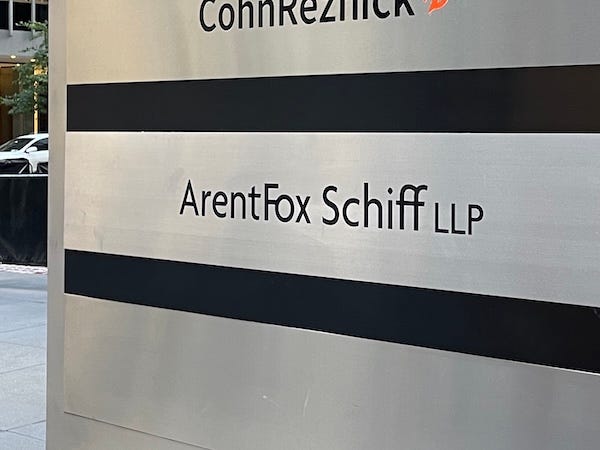 Outside the New York offices of ArentFox Schiff (photo by David Lat).
This article originally appeared on Bloomberg Law, part of Bloomberg Industry Group, Inc. (800-372-1033), and is reproduced here with permission. The footnotes contain material that didn’t appear in my Bloomberg Law column—a form of bonus content for Original Jurisdiction subscribers.
With the November elections fast approaching (and election-related litigation already here), I’ve been thinking a lot about leaders and leadership lately. It’s natural to associate leadership with political figures, but leadership can take many forms—and be shown by everyone, regardless of one’s formal title or role.
This concept of “leading from where you are” is one of the pillars of the AFS Fellows Program, a three-year leadership development initiative open to lawyers ranging from midlevel associates to junior partners at ArentFox Schiff. Launched at Arent Fox in 2017 (prior to its 2022 merger with Schiff Hardin), the program celebrated its 10th anniversary this month and announced its 10th class of fellows last week.1
The program has been “a resounding success,” according to M. Scott Peeler, a longtime ArentFox Schiff partner and executive committee member who created and leads the initiative.2
The AFS Fellows Program’s track record makes it a model that other law firms might want to emulate. To quote two other pillars of the program, “leadership can be taught” and “leadership matters.”
A cultural commitment
With almost 600 lawyers and more than $650 million in revenue last year, ArentFox Schiff is one of the nation’s 100 largest law firms. Many Biglaw firms are even larger, with thousands of lawyers and billions of dollars in revenue.
Great leadership can make a huge difference in such sizable organizations. Visionary chairs and managing partners can supercharge the performance of their firms. And on the day-to-day level, individual lawyers must lead everything from client-matter teams to internal firm committees.
But lawyers in Biglaw generally don’t receive training in leadership, despite its obvious importance. And leadership roles at firms are often allocated based not on leadership ability, but on a partner’s book of business.
“Law firms tend to focus lawyer training more on substantive law and professional skills rather than holistic leadership training,” said Anastasia Boyko, former assistant dean for leadership programs at Yale Law School.3
“Creating more complex, longitudinal programs requires a much larger staff and partner time investment than many firms think is prudent given lawyer attrition rates and billing pressures,” Boyko added. “It often takes a cultural commitment from firm leadership to have the patience necessary to wait for the ROI on these sorts of programs.”
The AFS Fellows Program has definitely required the firm’s commitment, from both participants in the program and the lawyers and staff who run it. Over the course of three years, the 10 to 12 fellows in each class go on retreats, take personality and leadership assessments, hear from outside speakers, attend dinners with firm leadership, engage in team-building exercises, and undertake a variety of individual and group projects.
This extensive programming eats up many hours that could have been spent doing billable work. But the program alumni whom I interviewed all said it was worth it.
Bonding and business development
“Every single person I know who has gone through the Fellows Program has found it so eye-opening,” said Annie Chang Lee, a Los Angeles-based partner and co-leader of the healthcare industry group at ArentFox Schiff, who was a fellow in the class of 2019. “When you actually experience it, it’s unbelievable—and it has had such an impact on me, both professionally and personally.”
Brian Farkas, a New York-based litigation partner, joined ArentFox Schiff in the spring of 2020—the height of the Covid-19 pandemic. With lawyers not going into the office, getting to know his new colleagues was a challenge. But in 2022, he joined the Fellows Program, which wound up being “an incredible way to integrate into the firm.”
“What makes the Fellows Program so special is that it’s a small group of around 10 people,” Farkas explained. “You’re bonding in this intimate way. It’s like being around a fire pit at summer camp, not a stuffy cocktail party dedicated to business development.”

Burford Capital is the leading global finance and asset management firm focused on law. Its businesses include litigation finance and risk management, asset recovery and a wide range of legal finance and advisory activities. Burford is publicly traded on the New York Stock Exchange (NYSE: BUR) and the London Stock Exchange (LSE: BUR) and works with companies and law firms around the world from its global network of offices. For more information, please visit www.burfordcapital.com.
Business development isn’t an explicit part of the program. But according to Alex Spiegler, a New York-based IP partner who was in the 2018 class of fellows, the bonds that get formed end up being helpful for cross-selling.
“In a firm like ours, with 600 lawyers, we’re always looking for opportunities to recommend our partners to clients,” said Spiegler. “Through the Fellows Program, I’ve become friends with a number of great colleagues in other practices. And it’s been wonderful to refer my clients to partners whom I know to be top-notch lawyers and people, who will treat my clients well.”
Return on investment
The AFS Fellows Program hasn’t been cheap—the retreats and dinners take place at swanky destinations,4 and the cost in terms of lost billables is significant over three years—but it has definitely been worth it. In fact, the program has “paid for itself by a staggering multiple,” Peeler said.
He supported this claim with data. Over the program’s 10-year history, 100% of fellows eligible for promotion to partnership have been elevated—60 to income (or non-equity) partner, and 10 to equity partner.
Last year, fellows collected more than $40 million in revenue. AFS Fellows associates bill on average more than 500 additional billable hours compared with other associates, and partners who have gone through the program bill on average more than 140 additional billable hours compared with other partners.5
The program engenders an esprit de corps among the lawyers who have been through it. As Lee put it, “The Fellows Program creates a certain bond, almost like a fraternity or sorority within the firm. It gives people a more purposeful firm life. You’re not just doing work and caring for your clients, but you’re caring for each other and for the firm.”
“Lawyers who have participated in the program feel seen, heard, and valued,” according to Peeler. “Why does someone want to make their career somewhere? Yes, compensation matters, and yes, geography matters—but at the end of the day, it’s because that person feels valued.”
“Part of why you want to stay at a firm is the people around you,” Spiegler said. “The Fellows Program has helped make me want to be here.”
And this increased loyalty to ArentFox Schiff ultimately helps the firm’s bottom line. The Fellows Program has had an 80% retention rate over the past decade—that is, eight out of 10 lawyers who have participated in the program are still at the firm. Considering that attorney attrition costs firms money, anything that increases retention is a financial benefit.
Peeler shared statistics with me because he felt they would be most persuasive to lawyers seeking hard facts. But from his perspective, leadership training is important in and of itself, not simply because it can improve a firm’s financial performance.
“Leadership is about core fundamentals of human interaction,” he said. “What makes me tick? What makes us tick as a group? How can we work together and lift each other up?”
“It’s such foundational stuff, so why don’t we focus on it more?” Peeler asked. “Our clients in corporate America focus on leadership much more than law firms do—and we should learn from their example.”