Timeline
Every post and feed across this instance
-
OLIX, FRACTILE, ETCHED : les milliards affluent vers les futurs moteurs de l’IA
Alors que l’entraînement des grands modèles a longtemps concentré les investissements, les modèles de raisonnement déplacent la bataille vers l’inférence. OLIX, FRACTILE et ETCHED ont déjà levé, ensemble, plus de 1,5 milliard de dollars pour accélérer la production de tokens, réduire la facture énergétique et contester l’architecture imposée par NVIDIA. Derrière cette même ambition se …
L’article OLIX, FRACTILE, ETCHED : les milliards affluent vers les futurs moteurs de l’IA est apparu en premier sur FW.MEDIA.
-
Décès de Raoul Vaneigem
L’écrivain (une cinquantaine de livres) et philosophe belge Raoul Vaneigem est décédé le 28 juillet 2026 à l’âge de 92 ans. Anarchiste, il était très ami avec notre compagnon Marc Tomsin (avec qui nous avions créé en 2008 l’émission «Terre et liberté » devenue plus tard «Trous noirs»), décédé en juin 2021. Sur le site La Voie du jaguar animé par ce dernier, figurent plusieurs textes de Vaneigem, dont un hommage à Marc après son décès : https://www.lavoiedujaguar.net/Un-hommage-de-Raoul-Vaneigem-a-son-ami-Marc-Tomsin
« Légataires des insurgées et des insurgés du passé, nous jetons les bases d’une véritable internationale du genre humain. Choisir le parti pris de la vie est désormais le seul recours contre ceux qui sèment la mort sur la terre entière. C’est le combat que tu as choisi de mener et ton amitié rayonnante avait souvent plus d’efficacité que bien des diatribes ».
Les Éditions Rue des Cascades du même Marc Tomsin avaient publié en 2010 son livre L’État n’est plus rien, soyons tout.
Il est essentiellement connu pour sa participation, de 1961 jusqu’à sa démission en 1970, à l’Internationale situationniste et son Traité de savoir-vivre à l’usage des jeunes générations, paru en 1967.
Ce livre démonte les mécanismes de la domination et cherche dans la vie quotidienne les forces capables de les renverser. Allergique aux idéologies marxistes-léninistes et trotskistes, Il participe à Mai 68 en étant très critique vis-à-vis des mouvements gauchistes.
Il précise ses propositions dans le livre De la grève sauvage à l’autogestion généralisée en 1974. Quelques dizaines d’années plus tard, avec son ami Siné il participe au journal Siné Mensuel.
Ses ouvrages opposent la vie contre la survie, le don contre l’échange marchand, l’autonomie contre les dominations. Se déclarant « pacifiste insurrectionnel », il cherche à construire des espaces où l’État et le marché perdraient leur emprise. Il s’est beaucoup intéressé aux Gilets jaunes (« La démocratie est dans la rue, pas dans les urnes« ), au zapatisme et au Rojava comme espaces d’autonomie et d’entraide à l’écart de nouvelles conquêtes du pouvoir : « Le peuple prenant par lui-même les décisions qui le concernent s’inscrit dans la lignée de l’expérience autogestionnaire menée par les collectivités libertaires espagnoles de 1936. Les zapatistes du Chiapas, les insurgés du Rojava, la tendance la plus radicale du mouvement des Gilets jaunes en France s’en inspirent aujourd’hui unanimement en dépit d’une grande diversité de conditions historiques, politiques et géographiques », mai 2021.
Sa chanson de 1974 « La vie s’écoule, la vie s’enfuit » interprétée ici par Jacques Marchais passe souvent dans Trous noirs : https://www.youtube.com/watch?v=TQWvjqrHdiQ
Serge – Trous noirs
P.S. : Ci-dessous pour mieux comprendre sa pensée très riche, quelques extraits de textes et d’entretiens parus notamment sur le site La Voie du jaguar
Octobre 2008 « Il est temps de jeter les bases d’une société nouvelle, de construire l’autogestion en nous emparant des énergies alternatives et en les mettant au service des collectivités refusant d’avoir des comptes à rendre aux gestionnaires de la faillite mondiale et aux escrocs dont le pouvoir n’a d’autre soutien que la passivité et la résignation des masses ». « Je n’ai jamais confondu révolte et révolution, et moins encore émancipation et prédation. L’émeute est un exutoire, la révolte est toujours récupérable. Les collectivités autogérées ne le seront pas. Nous ne sommes ni des pirates, ni des en-dehors, ni des marginaux, nous sommes au centre d’une société solidaire à créer et, que nous le voulions ou non, il faudra bien que nous apprenions à opposer une démocratie directe à cette démocratie parlementaire, clientéliste et corrompue qui s’effondre avec les puissances financières qui la soutenaient et la dévoraient ».
Septembre 2013 « On croit en Dieu parce qu’on a pas les moyens de croire en soi, investissant un « au-delà », car incapables de vivre un « ici-bas » »
Juin 2019 « On sait comment le combat pour le prolétariat a viré à une dictature exercée contre lui et en son nom. Le communisme et le socialisme en ont fait la preuve ». « On voit d’un côté le ridicule d’élections accaparées par une démocratie totalitaire qui prend les gens pour des imbéciles, et d’autre part le mouvement des gilets jaunes qui se moque des étiquettes idéologiques, religieuses, politiques, refuse les chefs et les représentants non mandatés par la démocratie directe des assemblées ». « Sauver les acquis sociaux ? Ils sont déjà perdus. Trains, écoles, hôpitaux, retraites sont poussés à la casse par le bulldozer de l’État. La liquidation continue. La machine du profit, dont l’État n’est qu’un banal engrenage, ne fera pas marche arrière. Comment ne pas faire plutôt confiance aux mains qui dans les carrefours, les maisons du peuple, les assemblées de démocratie directe, s’activent à la reconstruction du bien public ? »
Avril 2020 « L’État et ses commanditaires ont bousillé les services publics. Plus rien ne marche. Nous le savons en toute certitude : la seule chose qu’il réussit à faire fonctionner, c’est l’organisation criminelle du profit ». « Le temps n’est plus à l’indignation, aux lamentations, aux constats du désarroi intellectuel. J’insiste sur l’importance des décisions que les assemblées locales et fédérées prendront « par le peuple et pour le peuple » en matière d’alimentation, de logement, de transport, de santé, d’enseignement, de coopérative monétaire, d’amélioration de l’environnement humain, animal, végétal ». « Souvenons-nous que ce qui a détruit et interrompu l’expérience des collectivités libertaires de la révolution espagnole, c’est l’imposture communiste .»
Novembre 2020 « Le Mouvement des occupations de Mai 68 a porté un coup mortel à des vérités tenues pour immuables depuis des millénaires : le pouvoir hiérarchique, le respect de l’autorité, le patriarcat, la peur et le mépris de la femme, la haine de la nature, la vénération de l’armée, l’obédience religieuse et idéologique, la concurrence, la compétition, la prédation, le sacrifice, la nécessité du travail » « La religion a toujours été le cœur d’un monde sans cœur. Lorsque les luttes sociales ont fait battre l’organe vital d’une société radicalement nouvelle, on a assisté à la déconfiture du christianisme ». « Il est des flambées d’impatience où je crierais volontiers : « Lâchez tout ! Balayez vers l’égout les thuriféraires de l’argent ! Brisez les amarres du vieux monde, prenez à bras-le-corps la seule liberté qui nous rende humains, la liberté de vivre ! » »
Mai 2021 « Le capitalisme industriel avait favorisé dans son essor l’efflorescence d’inventions nouvelles (électricité, machine à vapeur, chemin de fer). Ce qui subsistait de recherche indépendante est désormais soumis au contrôle accru des intérêts mercantiles qui gèrent les budgets. Le capitalisme financier produit un vide de la science et de la conscience. Physique, biologie, art, médecine sont en quête d’une refonte radicale ». « L’État n’est plus qu’un instrument manipulé par les firmes multinationales, qui, avec ou sans le relais de l’Europe, lui imposent leurs lois et leurs juridictions. La répression policière est la seule fonction qui lui incombe encore ». « Les élections ont toujours été les arènes où la jactance des élus sollicitait la sottise d’électeurs persuadés d’être représentés par eux ». « Pendant que s’affrontent rétro-bolchévisme et rétro-fascisme, les mafias mondialistes empoisonnent et polluent impunément villes et village ». « L’autonomie des individus est la base de l’autogestion. Elle émancipe de l’individualisme, qui prête une liberté fictive aux moutons de la servitude volontaire. Elle apprend à distinguer militantisme et militarisme. L’engagement passionnel ne peut se confondre avec le sacrifice. Le combat pour la liberté refuse les ordres. La confiance et le mandat que lui accorde la solidarité lui suffisent ».
Août 2022 « Si sympathiques qu’elles soient, les manifestations en faveur du climat servent d’exutoires au sentiment d’impuissance qu’éprouvent intimement les protestataires. Comment imaginer que des mesures pratiques et un tant soit peu conséquentes contre la pollution puissent être adoptées par des États et des monopoles qui en sont la cause et les bénéficiaires ? » « Pendant que les pitreries médiatiques captent l’attention, les lobbies du nucléaire, du pétrole, de la pharmacie, de la 5G, du gaz de schiste, des malversations bancaires, triomphent avec le soutien d’une corruption et d’un parasitisme étatiques exhibés sans scrupules ». « L’autogestion — autrement dit l’organisation du peuple par lui-même — n’a plus rien de subversif, c’est une cure de santé parfaitement légitime ! »
-
DOJ Dumps Reflecting Pool Charges, Admits It Was All The Fault Of Trump’s No-Bid Pool Guys; While Trump Sticks By His Vandalism Story
Hail to the Chief. Our country is being run by paranoid conspiracy theorist megalomaniac who openly wishes to kick-start America’s first autocracy. Nothing that goes wrong is ever the president’s fault. It’s always the fault of officials with insufficient loyalty or the criminal acts of people out to get him.
Trump decided the Lincoln Reflecting Pool needed a makeover. Not because it had several long-term issues that had been inadequately addressed over the years but because Trump wanted to make it look more Trump-y. That meant draining the entire thing to apply a layer of “American flag blue,” a hue Trump made up on the spot to demonstrate he was more American than any American who had come before him.
Rather than turn this over to the people best qualified to do the job via a bidding/vetting process, Trump handed out a no-bid contract to an entity that called Mar-a-Lago home and whose owner had thrown some money Trump’s way in the past. The company hired to do this is headed by a long-term Trump donor and sports a name that would become eerily prescient once it was through botching the job: Greenwater Solutions.
Shortly after the refurb, the water in the pool turned a bright shade of green, due to the wholly expected explosion of algae, thanks to the conditions created by the pool shutdown/startup and vastly encouraged by the “American flag blue” now coating the bottom of the reflecting pool.
Shortly after that, the pool sealant began floating to the surface, prompting curious visitors to grab chunks of the “American flag blue” material that bubbled up as Interior Department personnel tried to beat science at its own game by flooding the “Greenwater Green” pool with hydrogen peroxide.
Trump then claimed — without facts in evidence — that the green tint and floating sealant were the actions of vandals, presumably related to the antifa or whatever. In the space of a single press conference, Trump turned a 150-foot flaw in the sealant into a 350-foot “gash” that could only have been created by anti-Trump vandals.
Then the arrests began. US Attorney Jeanine Pirro promised to punish anyone caught “vandalizing” the pool to the full effect of the law. Department of Interior boss Doug Burgum mindlessly repeated Trump’s wild speculation, claiming he too was in possession of “evidence” of criminal pool fuckery. Trump continued to do what Trump always does: engage in stream-of-consciousness responses when asked to provide proof of his accusations.
Former US Olympics team member David Hearn was the first to be officially indicted for daring to touch pieces of the broken pool. That case fell apart almost immediately. First, the government’s own witness testified during the grand jury proceedings that anything Hearn grabbed from the pool was the result of defective workmanship, rather than evidence of malicious vandalism.
This prompted Hearn’s legal team to demand transcripts of the grand jury proceedings. After all, if the unnamed government employee had testified that the pool would have been falling apart with or without Hearn’s brief interaction, the resulting indictment meant government prosecutors seemingly ignored the fact that it takes at least $1,000 of damage to support a federal vandalism charge.
Well, it’s all over now, at least in terms of prosecution. (The government will likely be contending with a civil rights lawsuit in the near future.) None other than lead prosecutor Jeanine Pirro has admitted there’s no basis for the criminal charges against Hearn.
Not only that, but the DOJ’s dismissal [PDF] specifically calls out the botched pool repair job performed by another one of Trump’s no-bid buddies (Greenwater Solutions did the filtration/drainage, while Atlantic Industrial Coatings redid the pool surface). It does this as it seeks to purge itself of any blame for pursuing yet another transparently vindictive prosecution to appease the president.
[I]t was not until after the return of the indictment, that the DOI provided additional documents to the USAO-DC indicating that damage to the Lincoln Memorial Reflecting Pool in June 2026 was the result of flawed installation by the contractor, Atlantic Industrial Coatings (“AIC”), and the rush to complete the project prior to events associated with the America 250 celebration in the weeks surrounding Independence Day 2026. It was not until after these documents were produced that USAO-DC first became aware of information showing that the damage was the result of a botched installation and not vandalism as initially represented by DOI. Indeed, USAO DC could only rely (on the information provided by DOI that the damage was entirely caused by vandals, including the defendant in this case, David Hearn…
This is US Attorney Jeanine Pirro throwing the Interior Department under the bus in hopes of saving her job. That’s not going to work.
First of all, even after this filing Trump still insists the damage was due to vandalism, despite all evidence on the record showing otherwise.

That’s Donald Trump “truthing” the untruth:
I disagree 100% with Jeanine Pirro, the U.S. Attorney for the District of Columbia, on the Reflecting Pool. I don’t know what she was thinking? To me, it was a pure case of VANDALISM, that included the grass, which had a big 86 47 emblazoned in giant letters on it, and other elements of the surrounding area. There may have been some contractor difficulty, but the major damage was caused by VANDALS! President DJT
Nothing to see here, just the President of the United States insisting that his made up fantasy, that no one ever believed was true, is true in the face of a filing from his own hand-picked attorneys at the Justice Department. One would think that the president accusing a US Attorney of lying to a federal court would be a big deal, except everyone let’s it pass because they know he’s full of shit.
The same goes for Doug Burgum, the current Interior Secretary, who similarly insists this is vandalism despite evidence to the contrary, much of it produced by his own agency.

That’s Burgum tweeting:
The evidence is clear, vandals have repeatedly caused damage to the Reflecting Pool. Some of these acts were even caught on camera. We also provided the U.S. Attorney’s office expert and eyewitness testimony to the damage done by vandals and provided every piece of evidence they asked for in the requested time line detailing each area of damage at the pool.
The Reflecting Pool is part of the Lincoln Memorial and dates back to 1922.
@POTUS cares deeply about protecting our sacred national monuments and his leadership has led the restoration of our Nation’s Capital by Making D.C. Safe and Beautiful Again.
Intentional damage done to the Reflecting Pool is no different than defacing any one of our other national monuments.
We won’t back down to deranged people who want to destroy, deface, or degrade our monuments.
So the US Attorney is saying that the Interior Department provided the DOJ with evidence that it was the shoddy workmanship of Trump’s hand-picked contractors. And the Secretary of the Interior makes a public statement saying that’s false?
This administration can’t get its story straight, and that’s going to come back to haunt them in court.
Finally, Pirro’s still likely to face some bench-slapping over this case because she can’t pretend to have just heard of it now when her office definitely heard the damage was due to a “botched installation” from a government witness and yet still charged ahead with securing an indictment against David Hearn.
The DOJ says it’s wrong. But it won’t dismiss the charges against Hearn with prejudice, which means it can still take another swing at this if Trump makes it clear that needs to happen. But what’s admitted here means it will most likely need to abandon any pending criminal cases against alleged vandals if it expects the court to grant it any form of good faith going forward.
Given all of this newly discovered information, it is difficult to attribute the widespread damage to the Reflecting Pool to vandalism, let alone to establish that fact beyond a reasonable doubt.
That’s the DOJ’s own admission, which is now on the public record. If it continues to pursue criminal charges, it can’t possibly expect any subsequent indictments to survive a cursory review in court. Pirro’s office needs to cut and run ASAP. And Pirro should know that it’s too late to save her job. She fucked up when she decided to tell the court the truth. And that’s something Trump will see as unforgivable.
But now any American who actually wants to know the truth about the Reflecting Pool debacle can read for themselves what the administration itself has to say about the matter when it came time to actually reveal to the court what they knew. If they’d rather believe Trump and Burgum, they can. But they can’t pretend the only evidence on the record shows the Reflecting Pool fell apart because Trump handed millions of tax dollars to donors and personal friends, rather than actually try to get the job done right the first time.
-
Gérard Larcher saisit la justice dans l’affaire Christine Herzog
Le président du Sénat a transmis à la justice le dossier de Christine Herzog, quelques jours après la sanction disciplinaire inédite infligée à la sénatrice. Ce signalement, fondé sur l’article 40 du Code de procédure pénale, intervient alors que la Chambre haute s’apprête à renouveler la moitié de ses sièges. -
Les États-Unis volent au secours du yen mais pensent surtout au dollar
Pour la première fois depuis trente ans, la Réserve fédérale est intervenue pour défendre le yen, en chute libre. Au-delà de l’assistance à un gouvernement «ami», il s’agit pour les autorités états-uniennes de défendre le statut du dollar et du «privilège exorbitant» dont il bénéficie comme seule monnaie de réserve mondiale. -
Confusion about the Chessboard Trump Has Overturned in His Tantrum
In recent days, several NYT stories on Iran have raised questions about who in the US, if anyone, has a full grasp on the chessboard they’re playing.First was a pretty hilarious story from David Sanger, which said as much about Sanger’s own beliefs about presidential power as Trump’s infirmities. Deep in the story, Sanger describes the swagger that Trump exhibited in a June interview, a swagger that came after months of successful cons from Trump on Iran.
A month ago, he exuded confidence that he had found the way to declare victory. On June 17, Mr. Trump signed with a flourish — at the Palace of Versailles, where World War I officially ended in 1919 — a hastily written, 14-point cease-fire agreement.
At the time, Mr. Trump said that a new, more “reasonable” set of Iranian leaders had seen the light, and were being driven by economic interests.
“I believe they have had enough,” Mr. Trump said in an interview with The Times on June 14. He argued that he was able to get the deal because he was threatening a massive attack, prompting Iran to fold.
“We were going in for the big one, and they said, ‘Please don’t do it, we will make a deal.’ And we made a deal right after that,” he said.
It lasted only two weeks.
But the story begins by describing Trump being surprised that he doesn’t have as much power as he said when he was successfully conning David Sanger earlier in June.
But in recent weeks, he has seemed trapped, his presidency gradually consumed by a war he cannot find his way out of.
He has discovered limits on his power that he could have scarcely imagined as he began full combat operations on Feb. 28, when he set out goals for a swift end to Iran’s nuclear program and the overthrow of the country’s government.
Five months later, those goals remain almost entirely unaccomplished. And Mr. Trump, once confident that overwhelming force would enable him to pursue in Iran what he proudly called the “Venezuela model” — a change of government to one amenable to U.S. control — is now hesitant to plunge back into major combat operations that his intelligence agencies assess are unlikely to work as well in Tehran.
He has been unable to control surging oil prices, or their effects on the stock market. The shipping that crawled to a stop in the Strait of Hormuz, then was opened for a few short weeks, is back to a trickle, with a second choke point, between the Red Sea and the Gulf of Aden, now threatened. And while the president has threatened to take Kharg Island, where Iran ships oil, or to seize its underground stores of enriched uranium, he has said publicly that he knows there is no appetite for sending in ground troops.
Those limits have left him deeply frustrated, his aides say, and have made him more erratic, even by Trumpian standards.
On Saturday, NYT published a story describing various Iranian sources crowing that they had used Trump’s last ceasefire to expand the battlefield, which NYT took to mean to Hezbollah and the Houthis.
“We are playing a grand game of chess; the militias are Iran’s chess pieces to be moved wisely at the right time and place, for maximum impact,” Mehdi Rahmati, an analyst in Iran and an expert on the regional militias, said in a phone interview.
Aside from lobbing missiles and drones at military bases housing U.S. troops, the attacks have been calibrated to avoid direct confrontations with American or Israeli forces, which could lead to harsh retaliation against Iran, analysts said. Igniting a fire at the Saudi oil facility drew the kingdom into the war, but the Saudi response targeted Iraqi militias accused of the attack rather than Iran.
Iran mobilized its proxy forces for a variety of reasons, analysts said. First and foremost, the strategy aims to limit oil exports from the region, driving up gas prices in the United States ahead of the U.S. midterm elections and reducing revenue for Washington’s Arab allies.
The same day as that proxy story, NYT published a worthwhile story describing how no one trusts American hegemony anymore.
To America’s allies, President Trump’s war in Iran, now in its sixth month, seems headed for a strategic defeat.
They worry that the inability of the United States to turn military superiority into a sustainably changed Iran has displayed a vulnerability that Russia and China will welcome. In addition, Mr. Trump’s goals remain unmet, and the U.S. military is running short on key armaments that it needs for global reach.
For the moment, Iran is seemingly resolute under a more radical government, its nuclear and ballistic missile programs are degraded but not destroyed, and the Strait of Hormuz is effectively under its control. The war has left both the United States and Israel in weaker positions — and blaming each other for the mess.
[snip]
Many countries disliked the global order as it was, Mr. Niblett said, but there was one. “Now America has confirmed itself as a force of disorder and everyone is drawing lessons from it, and trying to be less dependent,” he said. “No one wants to be subject to a whipsaw foreign policy that doesn’t know its limits, and that is a strategic defeat.”
Then there’s the David French column making the rounds worrying this could turn into World War. Early on, he wonders whether strategy is the word for what led Trump to invade Iran … but later in the column, he suggests there has been a change in what he still calls a “strategy.”
This was always the most likely outcome. The president chose to take on a much more powerful country than, say, Saddam Hussein’s Iraq in 2003 while using far less force than we employed to topple the Iraqi government.
What did he expect would happen?
Oh, right, we know. He thought he could topple a vicious, deeply embedded authoritarian regime with a few targeted airstrikes and a fantasized popular uprising. As he has said many times, he expected a version of his Venezuela outcome, and when the Venezuela strategy failed, if “strategy” is the word, there was no real Plan B — other than to bomb Iran more and hope for capitulation.
[snip]
Let’s put all this together: The initial American strategy failed, the war with Iran is consuming the entire region, Iran and Ukraine are risking a face-off, there is evidence that both Russia and China are escalating their military commitments, American munitions stocks are dwindling, and Trump is raging.
In between those comments, French lists a lot of things that have been true from the start:
- Iranian success at hitting American bases (which happened the second day of the war) and allies’ infrastructure.
- The Houthis joining the conflict, which is new — but one big reason the US is short on missiles is because Whiskey Pete Hegseth had no strategy when he blew missiles attempting to suppress the Houthis last year.
- Ukraine striking a ship in the Caspian, months after Israel did, and also months after Zelenskyy traveled to the region to offer defense assistance.
- Russia and China helping Iran, which was true (at least for Russia) from the start, though Reuters reported China may soon escalate its support.
- Russia continues to threaten to spill out of Ukraine into neighboring NATO states.
French is not wrong to worry the scope of the Iran war will grow, nor is he wrong to note that the risk stems in significant part from Trump’s unreliability. But again, all that’s been true from the very start.
So has Trump’s stubborn refusal to stop coddling Russia and China, steps that would be necessary to shift US posture.
The thing I find most curious, though, is that NYT’s stories on cyberattacks striking American water systems are relegated to separate stories which only tangentially focus on the war.
The scope of cyberattacks on U.S. water systems has grown to include at least seven states and may be far wider, officials and experts warned, as the authorities raced to safeguard the nation’s water supply against an assault that increasingly appeared to be the work of Iran.
While there were no indications that any water supply had been altered or made unsafe to drink, state and local officials throughout the country were on high alert for potential problems in vulnerable computers that are commonly used to monitor and adjust water quality, including chemical-treatment levels and water pressure. Minnesota first publicly reported the attacks, and now Michigan says its systems have also been targeted.
The attack has little precedent, experts said, but has long been the stuff of nightmares and sensationalized Hollywood thrillers: an apparent cyberattack by a foreign power during a time of war that could, at least in theory, jeopardize the health and safety of Americans.
[snip]
Alex Orleans, a former U.S. government cybersecurity contractor who specializes in tracking Iranian hacking groups, said Tehran had been engaging in a wide variety of hacking operations against U.S., Israeli and Middle Eastern targets since the start of the war in February. But the intrusions into the U.S. water systems appeared to be a significant escalation.
“What’s unprecedented here is that we’re seeing direct, tangible effects to live industrial control systems inside U.S. critical infrastructure,” said Mr. Orleans, who is now the chief of threat intelligence at Sublime Security, an email protection company. [my emphasis]
This, in spite of the March attack by Iranian hackers on Stryker explicitly described as retaliation for the attack on a school in Minab.
And of course, Trump’s response to allowing US swing states to be attacked during a war he started is to blame his political adversaries.– to claim being hacked by Iran is a sign of incompetence even though Trump’s own campaign was hacked by Iran, too.
The Commander in Chief refuses to defend the homeland against the country he invaded. And he gets away with it, in significant part, because we can’t even conceive of a war in which the US might be targeted in the same way the US targets others — by striking water facilities.
Whiskey Pete Hegseth’s DOD is at such a loss they’re crowdsourcing solutions to the war that competent people would never have started.
The request from a senior officer at the US military command carrying out President Donald Trump’s war with Iran came in an email: We need ideas.
“We are looking for new creative and unconventional ways to pressure and punish Iran,” an officer in US Central Command’s intelligence branch wrote in a message sent Wednesday to a broad group of military analysts, according to a source familiar with the message. A second source also said that a senior US military officer sent the message last week soliciting new ideas for how to deal with Iran.
The crowdsourcing-style query, which military officials said was unusual over email, is one sign of the limited — and potentially unpalatable —options available to Trump to force Iran into a deal on his terms. Hoping to find an alternative, the official at CENTCOM kicked off the brainstorming session via email to see if anyone had a better idea. The second source said CENTCOM is looking at everything, acknowledging it needs to reevaluate the strategy.
That’ll work. Crowdsourcing while your opponent totally reframes the chessboard.
The post Confusion about the Chessboard Trump Has Overturned in His Tantrum appeared first on emptywheel.
-
Key GOP holdouts say they'll back Blanche for attorney general after he rescinded Trump's 'anti-weaponization' fund
Two key Senate Republicans said Monday they will back Todd Blanche, Donald Trump's nominee for attorney general, after he rescinded the president's "anti-weaponization" fund. -
La répression acharnée à Moulin-Yzeure

Le procès a été reporté et le témoignage de Mickaël n'a pas pu être écouté lors de celui-ci. Pourtant l'administration pénitentiaire a tout de même décidé de couper la ligne téléphonique entre Ritchy et Mickaël (étant sur écoute), de le convoquer au prétoire (pour lui donner 10 jours de confinement sans télé ni plaque chauffante) et de lui adresser trois Compte-Rendu d'Incident (CRI) dont deux pour "propos outrageants à l'encontre du président de la République et incitation à la rébellion", sur la base du témoignage qu'il n'a pas pu diffuser.
Le personnel pénitentiaire a par la suite décidé de ne plus donner à Mickaël les médicaments dont il avait besoin, en dépit de l'ordonnance médicale dont il dispose. Il coupe également les appels téléphoniques sur sa cabine en prétextant des coupures d'électricité. Le personnel pénitentiaire l'humilie à chaque mouvement et l'empêche d'accéder à la douche. Pour finir, il le réveille chaque heure de la nuit pour l'empêcher de dormir.
En outre, la prison de Moulins-Yzeure continue de servir aux prisonniers des gamelles avec de la nourriture avariée bien que cela ait été signalé depuis plusieurs mois.
Suite à cet acharnement, Mickaël s'est ouvert le ventre. Il est arrivé au médical menotté dans le dos et c'est seulement à sa demande que le médecin les a enlevé pour le soigner. Il a été recousu sans anesthésie. Quelques jours plus tard, il s'est à nouveau ouvert le bras. Il a refusé d'être recousu car aucune anesthésie digne de ce nom lui a été proposé.
Face au racisme, à la répression abusive et la censure, nous ne nous tairons pas ! Que la silenciation de tous les prisonniers et la violence qu'ils subissent au quotidien cesse.
Tout notre soutien va aux voyageurs, aux prisonniers longue peine et à celles et ceux qui ne se laissent pas faire !
Nous appelons toute personne révoltée par la situation actuelle à contacter la prison :
Tél. : 04.70.35.15.00
Adresse : Direction du Centre pénitentiaire de Moulins-Yzeure, 21 rue de
Millepertuis, BP 24, 03401 Yzeure Cedex
Mail : sec.cp-moulins@justice.frNous partageons ci-dessous le témoignage de Mickaël :
« Alors bonjour je me présente je m'appelle Kemi, je suis détenu à la centrale de Moulins-Yzeure et j'ai été cité à témoigner au procès de M. Ritchy Thibault, mais comme à son habitude, la soi-disant Justice a tapé fort pour essayer de me censurer. Et oui ! On m'empêche de témoigner car je suis voyageur, longue peine, et en plus, je suis revendicard. Je prends la parole pour dénoncer le racisme, la répression abusive, et la censure, dont nous, personnes racisées, faisons l'objet dans ce pays. J'étais censé témoigner en visio mais la centrale de Moulins-Yzeure est soi-disant dans l'incapacité de le faire. Aujourd'hui, ils vont juger un homme pour ses opinions politiques et parce qu'il a osé défier ce que vous appelez l'État français. Et quand Macron dit qu'il emmerde les Français, rien ne se passe. Et quand il apporte son aide à Israël pour bombarder des écoles à Gaza, rien ne se passe. Par contre, vous sortez toute l'artillerie judiciaire pour juger des hommes, des femmes, ou des ados parce que voyageurs, noirs ou arabes. En 2026, quand on arrive dans une commune, on peut encore malheureusement lire des affiches avec écrit dessus « Interdit aux gens du voyage », c'est du racisme pur et simple. Combien de jeunes arabes sont abattus par la police ? Combien de jeunes voyageurs sont abattus par la police ? Et combien de noirs également sont abattus par la police sans que justice soit rendue ? Beaucoup trop. Combien de femmes et d'enfants sont assassinés et violés sans que la justice ne soit rendue également ? Combien de personnes racisées sont enfermées pour de longues années ? Beaucoup trop. Et aujourd'hui vous gaspillez l'argent des Français pour juger un homme qui ne fait que dire ce qui ne va pas dans ce pays. Aujourd'hui c'est du théâtre politico-judiciaire ce que vous faites. Mais nous on dit stop, stop à cette mascarade. Stop au racisme et stop à l'immunité accordée aux politiciens et à leur bras armé qui assassine nos mères, nos pères et nos frères et sœurs. Aujourd'hui nous sommes un pays qui pratique la dictature dissimulée. Ceux qui gouvernent font tout pour que les personnes racisées soient considérées comme des moins que rien, et ravitaillent Israël […] pour assassiner du musulman. Nous voyageurs, aujourd'hui, nous levons pour dénoncer ce que nous subissons tous les jours. Nous sommes des êtres humains, mais l'État macroniste nous considère comme du bétail à parquer à côté des déchetteries. Réveillons-nous, levons le poing et envahissons les rues pour crier notre mécontentement et faire chuter ce gouvernement qui ne cherche qu'à faire du chiffre et à remplir ses statistiques méprisantes et truquées ! Quand un politicien est condamné à plusieurs années de prison, il n'en fait que quelques mois. Quand une mère de famille a volé à manger pour faire manger ses enfants, elle fait sa peine au maximum et doit fermer sa bouche. Aujourd'hui, un flic peut assassiner un ado et devenir millionnaire grâce à des politiciens qui, soi-dit en passant, sont des fachos revendiqués. Oui, l'État et la police tuent, oui, l'État et la police sont racistes. L'État français place l'argent avant l'être humain. En France, on peut tenir des propos choquants, humiliants, envers des personnes racisées. Mais on n'a pas le droit de dire ce qu'on pense du gouvernement. Le président peut dire qu'il emmerde ses électeurs, mais le simple citoyen n'a pas le droit de dire ce qu'il pense sous peine d'être assassiné ou enfermé. Je termine en disant, ou plutôt en criant : Free Palestine ! Sauvons Gaza ! Ne laissons aucun politicien corrompu choisir pour nous, dicter notre vie et retirons-leur le permis de tuer. »

-
Atteinte à la « race blanche » à Crépol, l'État consacre le mythe identitaire

Lundi 27 juillet
Le 20 juillet 2026, les juges d'instruction chargés de l'affaire de Crépol ont requalifié les mises en examen des quatorze personnes poursuivies pour la mort de Thomas Perotto (tué le 19 novembre 2023 à Crépol (Drôme), après avoir été frappé à l'arme blanche), en retenant contre elles une circonstance aggravante de racisme visant, selon les termes mêmes du dossier, « la race blanche et la nation française ». Que de tels mots soient aujourd'hui inscrits noir sur blanc par une institution judiciaire de la République, à la demande de parties civiles parmi lesquelles l'AGRIF, officine identitaire d'extrême droite catholique, n'est pas un détail de procédure. Il s'agit ici d'un basculement de l'institution judiciaire.
Disons-le sans détour : Thomas Perotto avait seize ans, et la mort de cet adolescent est une tragédie. C'est précisément parce que ce deuil-là est réel que nous refusons qu'il devienne l'arme idéologique qu'en fait, méthodiquement, depuis novembre 2023, toute l'extrême droite française, jusqu'à armer les ratonnades et les expéditions punitives menées, dans les semaines qui ont suivi le drame, au nom de la « race blanche ».Car le « racisme anti-blanc » n'existe pas. La négrophobie et l'islamophobie sont structurelles parce qu'elles organisent concrètement, chaque jour, la relégation, la surveillance et la mise à mort de nos vies. Il n'existe, en face, aucun système qui organise l'infériorisation des Blancs en tant que Blancs.
Retourner ce concept contre les racisé.e.s n'est qu'obtenir la négation pure et simple de ce combat, et offrir à l'extrême droite ainsi qu'à l'ensemble du bloc réactionnaire de la bourgeoisie une nouvelle tribune pour intensifier son offensive idéologique raciste.Cette vérité éclate dès qu'on observe le deux poids deux mesures de l'appareil judiciaire et politique. En février 2026, l'Assemblée nationale a observé une minute de silence pour Quentin Deranque, militant d'extrême droite néonazi. Neuf mois plus tôt, la même Conférence des présidents avait d'abord refusé le moindre hommage à Aboubakar Cissé, jeune musulman assassiné de dizaines de coups de couteau. Voilà, à nu, la hiérarchie des morts que dresse l'État. Le même mépris gouverne les qualifications pénales : Mahamadou Cissé, abattu par un voisin, s'est vu offrir un « crime par exaspération » avant que son meurtrier ne soit remis en liberté, soutenu par une cagnotte d'extrême droite ; pour Aboubakar Cissé, le parquet s'est empressé d'écarter la qualification terroriste et de psychologiser le geste, « envie obsessionnelle de tuer » ; à Saverne, un homme qui tira sur une famille maghrébine aux cris de « sales bougnoules » et » je vote RN » vit les faits ramenés à de simples « violences aggravées » ; à Brest, le 5 juillet, une femme musulmane voilée touchée par un tir dans un parc, devant son enfant, vit l'enquête pour tentative d'homicide ramenée à de simples « violences volontaires », au terme de près de deux semaines de silence médiatique national, la presse locale ne parlant que d'« une femme », pas un mot de son voile. Quand la victime est noire ou musulmane : lenteur, minimisation, psychologisation. Quand il s'agit de la » race blanche » : la machine trouve ses mots en quelques jours. Il n'y a là aucun hasard. Les institutions pénales appliquent la définition du racisme telle que l'État français la conçoit, et leur principale, si ce n'est leur seule, raison d'être est d'entériner et de protéger l'ordre capitaliste et le suprémacisme blanc qui lui est consubstantiel. En consacrant juridiquement la » race blanche » et la » nation française » comme catégories à défendre la justice accorde une légitimité intellectuelle et offre une victoire politique à tous les groupuscules identitaires. Elle franchit un pas décisif vers l'ethno-nationalisme d'État.
Nous refusons ce deux poids deux mesures. Nous refusons que la vie des Noir.es, des musulman-es et des racisé.es soit reléguée au rang de fait divers pendant que l'on érige la « race blanche en catégorie protégée du droit. Nous refusons que l'appareil judiciaire, arme d t de race, prétende plus longtemps arbitrer avec neutralité les rapports de domination qu'il est fait pour reproduire.
Peaux Noires Ligne Rouge dénonce cette requalification comme un précédent d'une gravité inouïe et un blanchiment de l'idéologie identitaire par l'État. Nous n'avons rien à quémander à cette justice. Notre tâche est ailleurs : reconstruire, contre le racisme qui la divise, l'unité de notre classe.
Organisons-nous, préparons la riposte. Tout le pouvoir au peuple ! « Le travail sous peau blanche ne peut s'émanciper où le travail sous peau noire est stigmatisé et flétri » - Karl Marx
Le site du collectif Peaux Noires, Ligne Rouge
-
Blanche order keeps intact immunity deal barring investigation of Trump and his family
Acting Attorney General Todd Blanche's Sunday night memo formally rescinding the $1.776 "anti-weaponization" fund leaves intact another key provision for President Trump: an order offering broad immunity to him, his adult children and their business for past conduct. -
Trump Spends The Weekend Fighting For The $1.776 Billion Slush Fund His Chosen Attorney General Swears Is Dead
Sometimes it helps to just write out everything that happened leading up to a situation so we don’t lose sight of just how ridiculous it is.
I mean, would you believe that a President would sue his own IRS for something that happened under his own watch and did him no harm, demand $10 billion, and when a judge calls into question how that’s possible, come up with a “settlement” between the two “parties” that grants himself, his family, and his far-flung businesses (already under investigation for tax fraud) a complete get-out-of-jail-free card from tax audits along with a special $1.776 billion slush fund which he can hand out to insurrectionists who tried to overturn an election he had lost?
And then, his Acting Attorney General seeking the permanent job (who had been the President’s personal lawyer in early criminal cases, including one where the President was convicted of 34 felonies), would tell inquiring Senators that the slush fund wasn’t moving forward, but refuse to put that in writing?
When you write it all out that way, it sounds kinda crazy.
Last month Judge Kathleen Williams nuked the fund and alerted various state bars to the ethical lapses of all the government lawyers involved, including Todd Blanche, the President’s personal criminal defense lawyer-turned Acting Attorney General-turned nominee for the permanent Attorney General position.
Blanche’s nomination had stalled out, in part because two Republican Senators (Cornyn and Tillis, both of whom are leaving office after Trump refused to support their attempts to stay) have questioned the slush fund. Blanche refused to put it in writing that the fund was going away, leading to this strained exchange with Cornyn:
Republican Sen. John Cornyn of Texas, reading from the settlement on Wednesday, noted that it says the terms of the deal “may be modified only upon the written agreement of the parties.”
“Has there been a written agreement of the parties to modify the settlement fund?” he asked.
“No, the settlement fund is just not moving forward,” Blanche responded. “There’s no modification. It never started. No money went from the Treasury to any other account.”
When pressed, however, as to whether the settlement agreement may be enforceable by the parties, Blanche conceded that the president could challenge it down the road.
“Yes, it’s an enforceable document, so I suppose if President Trump’s counsel sought to enforce it, that they potentially could … try to enforce the contract. They can’t force the Department of Justice to move forward with the weaponization fund. They could potentially say that we breached by not moving forward,” Blanche said. “They haven’t done that, and I’m not aware that they’re planning on doing that.”
Given all of that, you would think that, perhaps, Trump wouldn’t make any public effort to say that the fund should still exist.
But, again, we live in the upside down world, where if Donald Trump wants something, he just throws a temper tantrum until he gets it. Three new developments have happened regarding all this in the past few days.
First, on Friday, Donald Trump appealed Williams’ order and filed a long, rambling motion about how unfair the order was. That doesn’t sound like someone who is willing to accept that the fund is dead. Second, on Saturday, Trump posted a rant to his personal social media site about how mad he was at Cornyn and Tillis, and how he still needed the fund, and even hoped Congress would pass a separate law giving him the slush fund. Finally, despite these two things making it abundantly clear that Trump still plans to create a slush fund for his cosplay militia, on Sunday, Blanche finally signed a letter claiming the slush fund was dead.
Let’s take these each in order.
First the appeal and the whiny motion about it. The most incredible thing about it is that, even though it was filed by lawyers hired by Donald Trump (the person), as I was reading it, it read like it was filed by the Justice Department. Remember, the entire reason that Williams killed the “settlement” of Trump’s lawsuit against his own IRS was that there appeared to be no adversarial parties in the case, and it was just Donald Trump suing himself in order to give the “settlement” the stamp of authenticity that it was part of a federal case.
While, to their credit, this new filing at least brings in real lawyers from an actual serious law firm, DLA Piper, alongside Trump’s original two-bit lawyer Alejandro Brito, the argument itself is still a mess. Again, you could totally picture either Donald Trump or his DOJ/IRS filing this since the original ruling applies to both. Because they’re not adverse parties. They’re all on the same side.
The ruling rests on a grievous legal error: that, because President Trump supervises the Executive Branch, he and the United States necessarily possess the same legal interest and cannot be adverse to each other. That is wrong. President Trump asserted a personal claim arising from the theft of his own tax information. The IRS and the U.S. Department of the Treasury (“Treasury”) represented the sovereign’s interests in public funds and federal law. Donald Trump Jr., Eric Trump, and The Trump Organization asserted their own independent claims. Presidential supervision did not erase those rights or merge those interests.
The Sanctions Order nevertheless erroneously treated its novel theory of adversity as the starting point and then refracted the facts through that mistaken lens. Settlement became proof of collusion, even though there was none, potential (weak) defenses became proof that the claims were fictitious, which they were not, and ordinary professional relationships became proof of coordination, which did not exist. But the Sanctions Order identified no pre-filing sub rosa agreement, no false allegation, and no specific direction by President Trump controlling Defendants’ litigation decisions. The predicate legal error thus supplied the conclusion, causing the Sanctions Order to incorrectly recast entirely innocuous facts as misconduct.
The danger posed by the Sanctions Order is profound. The Court called the Article III question “unprecedented,” appointed six amici, and devoted nearly thirty pages to resolving it— yet it then declared the contrary position “so obvious and so insurmountable” that advancing it warranted career-altering sanctions. Id. at 9-38, 53 n.69. That mistake converts disagreement into professional punishment, and strikes at the integrity of the adjudicative process itself. A system that sanctions lawyers for advancing positions on constitutional questions cannot sustain fearless advocacy or principled legal development.
Note the tell in that last bit: the “professional punishment” landed on both sides — Trump’s lawyers and the government’s — which is exactly the point Williams was making. And, yes, courts are historically reluctant to sanction lawyers at all. But that reluctance is the problem, not evidence that the one judge willing to do it got it wrong.
As for the claims that the DOJ was actually representing the IRS’s best interests, and not Donald Trump’s, that’s belied by quotes from Donald Trump himself — who publicly admitted he was negotiating with himself — and the terms of the “settlement” which make no sense and do nothing to support the interests of the IRS, the public, or the American taxpayer. If this case was actually about Trump’s leaked tax returns, how does giving the family a release from tax audits or handing over nearly $2 billion to insurrectionists (wholly unrelated to this suit) have any of the American people’s interests in mind?
The strongest argument this filing has is that one part of the ruling is arguably prior restraint. To make sure that the settlement agreement for the slush fund was not used for improper enrichment, Judge Williams barred the parties from invoking the settlement in other proceedings. Trump’s new lawyers say that this part is prior restraint:
In addition, Rule 11 and inherent authority cannot support an order forbidding the President, private Plaintiffs, federal agencies, and sweeping categories of associated persons from “referring to” the Settlement Agreement or invoking it in any future judicial, administrative, regulatory, arbitral, or other official proceeding. D.E.106 at 47. That unprecedented injunction regulates future speech and advocacy, is unconstitutional, and is patently unlawful.
The Sanctions Order’s command is a content-based prior restraint. It singles out one subject—the Settlement Agreement—and suppresses one message, i.e., that the Settlement Agreement exists and may carry legal effect. Prior restraints carry a “heavy presumption” of constitutional invalidity, Bantam Books, Inc. v. Sullivan, 372 U.S. 58, 70 (1963), and constitute “the most serious and the least tolerable infringement on First Amendment rights.” Nebraska Press Ass’n v. Stuart, 427 U.S. 539, 559 (1976). They require findings that the threatened harm is “both great and certain and cannot be mitigated by less intrusive measures.” CBS, Inc. v. Davis, 510 U.S. 1315, 1317 (1994) (Blackmun, J., in chambers). The Sanctions Order identified no threatened unlawful speech, no resulting harm, and no reason narrower relief would be inadequate. Indeed, it did not address the First Amendment at all.
And while this is the strongest argument, that doesn’t make it actually strong. The order does not stop Trump or his lawyers from talking about the settlement. They can post about it on Truth Social, complain about it on Fox, write a book about it. What they can’t do is walk into another court, agency, or arbitration and invoke a settlement that a federal judge just voided due to the lack of adverse parties. The only “speech” being restrained is further fraud on the court.
But the fact that Trump bothered to make this argument at all is the real tell. You don’t fight for the right to invoke a settlement in future proceedings unless you’re planning to invoke it in future proceedings — which is precisely what Blanche has spent months assuring senators would never happen.
Then, even as Blanche was negotiating with Cornyn and Tillis to get them to vote in favor of his AG nomination by promising not to create the fund, on Saturday, Trump said hell yes he intends to make use of the fund — and added that he’d like Congress to pass a law establishing the same fund as a backup, in case the courts kill the one he negotiated with himself:

That’s a Trump post on Truth Social saying:
If Senators Cornyn and Tillis, both upset because I wouldn’t Endorse them (they lost, and quit, respectively!), aren’t going to approve Todd Blanche, one of the most respected professionals, according to everybody, in the Country, to be the United States Attorney General, then I will keep Todd as Acting A.G., and push hard to get the Anti-Weaponization Bill, which takes care of those who have been so badly treated by the Crooked Joe Biden (and Obuma!) Administration (I get nothing, although I was treated horribly!), PASSED. Todd Blanche was a voice of reason! It will immediately be back on the table, and I will get it done. Thank you for your attention to this matter! President DJT
Once again, Trump’s ability to shoot his allies in the back remains undefeated. Cornyn (especially) and Tillis have said that their hesitancy in approving Blanche had a lot to do with the weaponization fund. Blanche’s approval appeared contingent on a theatrical claim that the fund wasn’t going forward. To have Trump then come out and say “hell yes it’s going forward, even over the objections of Cornyn & Tillis” seems unlikely to appease those two Senators.
Tillis, for one, was not impressed:

That’s Tillis tweeting:
Despite comments as late as yesterday that the fund is dead, President Trump clearly intends to resurrect the payout pot for punks either by inappropriately establishing another bogus fund or pushing Congress to vote for a bill that the majority of Republicans in the Senate would be against.
It’s unfortunate that Todd Blanche, who I consider qualified for the job, will not be confirmed because of this reversal. Hopefully, we can resolve this by Tuesday.
It’s been quite clear that Trump has no intention of ever letting go of this slush fund, but it’s classic Trump that he couldn’t even keep his mouth shut long enough to pretend the fund wasn’t going forward and to get Blanche approved.
Which then brings us to the last bit that came out late Sunday: Blanche tweeting out that the DOJ had finally decided to “rescind” the weaponization fund in writing. Something he had refused to do over the past few weeks.

There are two separate letters there. The first “rescinds” the fund, while making an obnoxious snarky comment about “frivolous lawsuits” filed to challenge it:
A. The Attomey General’s May 18, 2026 Order establishing the Anti-Weaponization Fund (“Fund”) is rescinded and shall have no force or effect.
B. For the avoidance of doubt, nothing in this Order is intended to contradict or otherwise be contrary to prior representations by the Department of Justice that the Fund is not operative. No Members were appointed; no funds were transferred; no process for receiving claims was established; no claims were paid. Nevertheless, several frivolous lawsuits have been filed challenging the Fund, and at least one court has declined to dismiss those claims as moot. This Order establishes, beyond any doubt, that there is no Fund…
If the cases were “frivolous” then why would you need to rescind the agreement?
The second, with snide shots at Congress for not believing his statements, says a bit more on the matter:
Department of Justice Rescinds Anti-Weaponization Order and Addresses the May 19 Release
The Department of Justice today announced that the Acting Attorney General rescinded the May 18, 2026 Order that established “The Anti-Weaponization Fund.” Although the Acting Attorney General has repeatedly advised Congress through testimony, including under oath, as well as in written responses, that the Fund is not moving forward, and the Department has repeatedly represented to district courts that the Fund is not moving forward, today’s Order officially rescinds the May 18, 2026 Order.
Further, the May 19, 2026 Order regarding a mutual release of claims applies by its terms only retroactively. Additionally, the terms “Lawfare and/or Weaponization” in that Order were already defined in the Settlement Agreement as the use of government power “to target individuals, groups, and entities for improper and unlawful political, personal, and/or ideological reasons.”
The Acting Attorney General stands by all of his July 15, 2026 Senate Judiciary Committee testimony, including answers to questions asked by Senator Cornyn related to the scope and applicability of the May 19, 2026 Order. A transcript of the Acting Attorney General’s testimony is attached. He incorporates that testimony by reference, and restates that it is DOJ’s interpretation that the Order only has any effect, including on any release of claims, on the named parties in the lawsuit referenced in the Order.
This all seems pretty obviously designed to get Cornyn and Tillis off his back by saying “see?!? I’ve now put it in writing. Now shut up and vote to make me Attorney General.” And, who knows, it might work.
That’s even though nothing in there actually answers Cornyn’s actual question discussed above. The DOJ cannot single-handedly go back on this agreement. It was, we are told (including in the appeal from Trump on Friday), a private agreement between two distinct parties: Donald Trump and the Justice Department. As such “rescinding” it from just the DOJ side is meaningless since, as Blanche himself admitted to Cornyn, Trump can still try to claim in court that the settlement is valid.
And given Trump’s public statements about why he needs the fund, as well as his lawyers’ statement in the appeal that it tramples his rights to order him not to claim the settlement is valid in court… you’d have to be pretty slow not to pick up on what Trump intends here.
Also, notice what didn’t get rescinded. The May 18th order (creating the slush fund) is what he pretends is gone, but the May 19th order, which clears Trump, his family, and their businesses from IRS audits over past business practices remains. Blanche pretends that saying it “applies by its terms only retroactively” is a meaningful limitation, but that was always obviously the case. By all accounts, the Trump family books are a mess, and they likely owe the IRS a ton of money. And the Blanche announcement makes it clear that remains as is.
So, to sum it all up, Blanche has rescinded an order based on a settlement he can’t single-handedly rescind, to appease Senators whose votes he needs, while the President has made it clear he’s going to move forward with his fund no matter what.
The simple reality here is that we have a crooked President with his hand-picked henchman trying to do the bare minimum to appease a compliant GOP-run Senate, while the President himself can’t keep his own mouth shut long enough to even put up the pretend facade that there’s no corruption going on here.
Under any other President, this would be an impeachable offense. Here it was just another weekend under the Trump Presidency.
-
Bandung (Indonésie) : Des nouvelles des anarchistes emprisonnés Mpe, Dilan et Pablo
Dark Nights / mercredi 22 juillet 2026
Des nouvelles des anarchistes Mpe, Dilan et Pablo, emprisonnés suite au Premier mai 2026
Les anarchistes emprisonné.es ont été arrêté.es dans les jours qui ont suivi la manifestation du Premier mai à Bandung [voir ici et ici ; NdAttt.]. Ils/elles sont accusé.es d’avoir participe à une émeute et de la destruction volontaire d’équipements publiques, à la suite d’un affrontement qui a eu lieu le 1er mai 2026 sur le Jalan Cikapayang (au carrefour entre Cikapayang et Pasupati), dans la ville de Bandung, au cours duquel la police a été attaquée.
Ces graves accusations portent sur des infractions comme le fait de provoquer des incendies ou des explosions mettant en danger la sécurité publique, le fait de commettre des actes de violence collective contre des personnes ou des biens, en public, ainsi que d’association de malfaiteurs. De plus, les compas sont accusé.es d’avoir préparé et utilisé des cocktails Molotov. Mpe est accusé d’être le « leader », ce qui, pour un anarchiste, est absurde. Les compas arrêté.es ont été tabassé.es et maltraité.es par les flics, au cours de leurs interrogatoires, pendant une période de trois semaines, en l’absence d’un bon avocat. Une pression psychologique intense et de la violence physique ont été utilisées à l’encontre des détenu.es, pour essayer de leur faire faire de fausses déclarations.Au total, treize (13) personnes ont été arrêtées et emprisonnées au cours de l’enquête sur les émeutes.
– Trois (3) d’entre elles étaient des mineurs et ont ensuite été libérés, avec l’obligation de pointer à la police.
– Les dix (10) prisonniers restants sont :1. Ripan Ripandi
2. Muhamad Rafly
3. Ismail
4. Dani Maulana
5. Rangga
6. Cikal
7. Haikal
8. Fadel
9. Fadil
10. Hadi IsanLiberté pour les prisonniers – Renversons l’État
Mise à jour : le jeudi 23 juillet 2026, le procès des compagnons inculpés dans l’affaire de la manifestation du Premier mai 2026 à Bandung, c’est à dire Mpe, Dilan et Pablo, [a commencé] au tribunal du district de Bandung.
-
Bandung (Indonésie) : Les dates de libération des anarchistes emprisonné.es approchent
Act for freedom now! / samedi 1er août 2026
On a établi un calendrier des prochaines dates de libération des anarchistes emprisonné.es car pris.es pour cible lors des mesures de répression prises par l’État, suite à la mobilisation d’août–septembre 2025, à Bandung. Ces compas ont été poursuivis.es pour des actions directes, y compris les incendies qui ont visé la banque Hana [voir ici ; NdAtt.] et le bâtiment de la Chambre provinciale des représentants (DPRD) de Java occidental, ainsi qu’à cause des persécutions contre les administrateurs de la plateforme « Black Bloc Zone » – une affaire largement présentée par les médias grand public comme affaire « Chaos Star ».
Prochaines libérations dans les affaires d’actions directe « Chaos Star »Plusieurs compas emprisonné.es dans le cadre des affaires liées à des actions directes approchent de la date prévue pour leur libération :
– Rhexcy : il est censé [être sorti] le 29 juillet 2026
– Tebe et Iyong : censés [être sortis] le 31 juillet 2026
– Jalus : censé [être sorti] le 3 août 2026
– Apip : censé sortir en septembre 2026La situation d’autres compas emprisonné.es
Au-delà des affaires principales, pour des incendies, d’autres compas capturé.es dans le cadre de luttes connexes font face à des conditions variables, dans les prisons de l’État :
Affaire de la bombe de propane au poste de police de Gentong [voir ici ; NdAtt.] :
– Adit et Nopal : ils sont censés sortir l’année prochaine (2027).
– Pem et Herdy : sortis il y a plusieurs mois.Administrateurs de « Black Bloc Zone » :
– Dana et Abul : déjà libérés des prisons de l’État.
– Komar : actuellement incarcéré une nouvelle fois par les forces de l’État, à Surabaya, avec une date de sortie prévue pour septembre prochain.Solidarité avec tou.tes les prisonnier.es anarchistes.
Pour l’Internationale noire.Going Underground
juillet 2026 -
Indonésie : Des nouvelles des prisonnier.es
Dark Nights / samedi 18 juillet 2026
Ces dernières semaines, nous avons été plongé.es dans les tranchées du soutien juridique. Accompagner les personnes enlevées par la Densus (ndt : Densus 88, l’unité spéciale antiterroriste de la police indonésienne) n’est pas seulement une question tactique – c’est la manière dont nous cartographions leurs méthodes de répression pour les démanteler. Par-dessus tout, nous refusons d’abandonner qui que ce soit à la merci de l’appareil d’État.
Nous sommes en train de diminuer le soutien à Komar, car il est déjà assisté par le ST (ndt : Setapol, Union des prisonniers politiques) et d’autres. Notre priorité continuent à être les prisonnier.es restant.es du Premier mai 2026 et tou.tes celles/ceux qui doivent encore affronter les tribunaux sans solidarité. Bien entendu, cela inclut Adit, qui restera en prison jusqu’à l’année prochaine.Les fonds qu’on nous avait initialement refusés, de la part du ST, ont été redirigés vers la famille de Dani. Leur appareil bureaucratique a déjà refusé d’apporter son soutien à Mpe, nous ne comptons donc plus sur eux. La famille de Dani vit en dessous du seuil de pauvreté et il était son seul soutien financier. C’est pourquoi les dons et les ventes de t-shirts continuent à être urgents : ils empêchent que sa famille sombre et soutiennent le travail de solidarité plus large.
Aujourd’hui, un nombre important de jeunes anarchistes pourrissent encore, détenu.es par la police. Beaucoup ont été arrêté.es après le 1er mai 2026. La plupart n’a reçu aucune assistance juridique – en particulier dans les villes les plus petites, où il n’existent même pas de structures d’assistance juridique. Nous continuons à chercher tous les canaux possibles pour les contacter et les soutenir.
Des comptes-rendus provenant de différentes sources confirment que la LBH (ndt : Organisation d’aide juridique de Jakarta) et la plupart des organisations institutionnelles d’aide juridique ont refusé de les assister. La raison est claire : leurs actions ont été trop destructrices, trop conflictuelles et ils/elles refusent de se soumettre à la chaîne de commandement bureaucratique imposée par ces organisations. C’est la raison pour laquelle la plupart de ceux/celles qui sont encore emprisonné.es continuent sans soutien juridique.
Prisonnier.es actuel.les :
Surabaya : +20-25 personnes
Cilacap/Purwokerto : 7 personnes
Makassar : 5 personnes
Ciamis : un nombre encore indéterminé
Bandung : 5 personnes (sans compter Mpe et ses compas)Palang Hitam
-
Indonésie : Compte-rendu du Palang Hitam / ABC sur la répression
Dark Nights / samedi 18 juillet 2026
Compte-rendu du Palang Hitam / ABC sur les chiffres des détentions et de la répression
Le compte-rendu des emprisonnements
Palang Hitam, 10 juillet 2026Ce document montre, en détail, le nombre d’affaires actuellement traitées par le Palang Hitam. Si nous avions plus de fonds à notre disposition, nous pourrions fournir plus de soutien aux autres affaires dont nous continuons d’être mis.es au courant. Veuillez nous contacter à l’adresse palanghitam(no scums) riseup (acab) net, si vous pouvez nous aider à aider les compas en prison.
Il est nécessaire de fournir aux prisonnier.es des fonds pour leurs dépenses, le cas échéant pour leurs familles, et pour ceux/celles qui ont besoin d’avocats, car les avocats commis d’office travaillent avec les flics et les procureurs pour baiser les accusé.es. Quand nous sommes en mesure d’employer des avocats professionnels, la torture et les abus peuvent être arrêtés. Cela est important car de nombreux.ses accusé.es sont maltraité.es et menacé.es, jusqu’à ce qu’ils/elles donnent des faux témoignages. Dans un cas, à Surabaya, un jeune homme est mort des blessures dues à la torture.
L’unité antiterroriste Densus 88 cartographie le mouvement anarchiste et ses relations internes, en utilisant la menace et la torture. Cette unité utilise une surveillance généralisée des données, ainsi que des logiciels espions, qu’ils envoient à des blogs et à des comptes des réseaux sociaux, pour infiltrer les téléphones et les appareils des compas. Nous recommandons l’utilisation de moyens de sécurité informatique et téléphonique, tout en étant conscient.es de leurs limites.
Des responsables officiels indonésiens auraient participé au sommet organisé par l’administration américaine contre le « terrorisme d’extrême-gauche » et nous rappelons à tout le monde, dans la rue et dans le cyberespace, qu’il faut rester attentif.ves face à la forte possibilité d’une répression supplémentaire. Quand les révolutions ne sont faites qu’à moitié, nous creusons nos propres tombes.Palang Hitam International
-
Le ministère du Travail fait la guerre aux inspecteurs
Ils dénoncent des pressions hiérarchiques et des atteintes à l’indépendance de l’inspection du travail. Aujourd’hui, ce sont eux qui risquent des sanctions. À Grenoble, deux inspecteurs du travail et représentants syndicaux sont visés par une procédure… -
Sciences Po Paris: enquête sur les méthodes de surveillance d’un institut en ébullition
Selon plusieurs dossiers disciplinaires auxquels «Mediapart» a eu accès, des étudiants ont été épiés ou encore photographiés à leur insu pour justifier une possible sanction ou leur suspension de l’école. En cause: leur investissement dans les mobilisations de soutien au peuple palestinien. -
Ubaldi fait tomber ce TV TCL Mini LED 144 Hz, Dolby Vision et 65 » sous la barre des 750 €

[Deal du jour] Le TCL 65P89L, un téléviseur QD-Mini LED de 65 pouces sorti en 2026, passe à 720 € au lieu de 849 € chez Ubaldi. Cette réduction sur un modèle polyvalent, qui plus est doté d’une diagonale aussi généreuse, en fait le bon plan TV de ce début de semaine.
-
A Majorque, 70 000 locaux s’opposent au surtourisme qui les force à quitter l’île
À l’approche des élections régionales de l’année prochaine, les habitants réclament des mesures d’urgence pour préserver leur qualité de vie. Parmi elles : limiter le nombre de visiteurs, interdire les locations touristiques abusives, bloquer l’explosion des prix immobiliers, et protéger les ressources naturelles et l’eau.
Cet article A Majorque, 70 000 locaux s’opposent au surtourisme qui les force à quitter l’île est apparu en premier sur La Relève et La Peste.
-
Aprem enfants/ados trans, non-binaires et en questionnement
Un moment convivial organisé pour les mineur·es trans, non-binaires, en questionnement et leur famille, par des personnes concernées. Accompagnement individuel possible sur place.
Anglophones bienvenu·es
Samedi 29 août, de 16h à 18h30 au Centre LGBTI de Grenoble -
THS (Transition Hyper Sympa)
Un moment de support à la transition organisé par et pour des personnes trans, non-binaires, intersexes, trav, toute personne déviantes de genre et en questionnement. (Parcours médical, administratif, santé mentale, RDR, questionnements, etc.). Accompagnement individuel possible sur place.
Anglophones bienvenu·es.
Mardi 25 août, de 18h30 à 20h30 au Centre LGBTI de Grenoble
-
Rencontres mensuelles du soin militant RACINES
Salut à tou·tes,
"Soin militant", "care", "inclusivité des luttes" et "dans les luttes"...
Le 30 de chaque mois, de 18h à 21h, les "rencontres du soin militant" de l'agglo grenobloise permettent à des personnes intéressées par le sujet de se retrouver pour se faire part de leurs besoins, idées, envie etc de projets divers et variés à ce sujet !
Concrètement ça peut être un espace pour se connaître, se coordonner entre les différents collectifs et groupes affinitaires qui proposent du soin dans les luttes à Grenoble, mais aussi pour que ce·lles qui ne font pas partie d'un groupe ou quoi, puisse participer aux discussions générales sur les besoins de nos milieux, ce qu'on pourrait imaginer, ce qui manque, ce qu'on fait bien ou qu'on peut améliorer...
On espère qu'il pourra aussi continuer à en naître des envies de monter des projets ! Dans la charte des rencontres, c'est écrit : "Les Rencontres Autonome du Care pour une INclusion Emancipatrice et Sociale (RACINES) espèrent être les racines de plein d'initiatives collectives qui tendraient à favoriser l'inclusivité réelle dans les luttes pour les massifier et les radicaliser."
On aimerait que ces rencontres soient les plus inclusives possibles. L'idée est notamment que quiconque puisse formuler des besoins spécifiques (soit directement à la rencontre, soit via un document anonyme en ligne (https://nuage.gresille.org/index.php/s/5XxjGsstkd2jJY8) ou via un·e personne relai par exemple) et que le groupe de personne présentes réfléchisse à les mettre en œuvre.
On peut venir quand on veut, avec des choses à boire et à manger si on veut. L'ordre du jour est déterminé par les personnes présentes. Idéalement si on arrive tou·tes à l'heure (18h) ça permet de se présenter tou·tes, de poser le cadre et de se mettre d'accord ensemble sur ce dont on a envie de parler mais on fait comme on peut bien sûr. Pour avoir une idée des envies des autres personnes, il y a un document de proposition d'ordre du jour (en pagaille ^^) ici : https://nuage.gresille.org/index.php/s/idMZfxt6c5kKtin
On peut trouver la charte complète, qui précise les modalités de fonctionnement, ici : https://nuage.gresille.org/index.php/s/FLYYHf5F9kGz9Ft Les rencontres sont souveraines. Les décisions qui changeraient la charte doivent être prises à l'unanimité à deux rencontres de suite entre 19h et 20h.
C'est ok que chacun·e apporte à boire et à manger. Espaces intérieurs non-fumeur. On demande aux personnes qui auraient besoin de boire de l'alcool de masquer les contenants et de ne pas en faire la promo. Si on ne peut pas aérer, on demandera si c'est possible de porter des masques (on essaye de les fournir).
On essaye de varier les lieux des rencontres. Les rencontres sont organisées par des personnes volontaires venues à une précédente rencontre et accompagnée de celleux qui ont en déjà organisées.
C'est possible de poser toutes les questions que vous voulez à l'avance à racines@gresille.org aussi.
N'hésitez pas à en parler autour de vous si vous en avez envie et/ou sur vos réseaux, etc.
À bientôt ! Et pis bin avec ou sans RACINES prenons soin les un·es des autres pour abattre ce système de merde !
-
99 grands feux actifs : les États-Unis en proie aux flammes

Après le Canada, toujours en proie aux flammes, le nord-ouest des États-Unis brûle à son tour. À Spokane, dans l'État de Washington, trois incendies ont forcé quelque 60 000 personnes à fuir en urgence durant le week-end. Lundi 3 août, les pompiers bataillaient encore contre des feux visiblement hors de contrôle. Environ 600 maisons, commerces et autres bâtiments ont été détruits et plus de 2 200 hectares ont été parcourus par les flammes. Aucune victime humaine n'est à déplorer.
Lire la suite - En bref / Monde , Incendies
« C'est (…) -
Les autoradios ont des oreilles

Le dispositif a été découvert lors d'un changement d'autoradio, après que ce dernier ait été retiré de son emplacement. Deux micros (gauche-droite) étaient visibles en premier, collés à la paroi du cash plastique sous l'autoradio. Ils étaient reliés a un boîtier (bricolé sur la base du modèle Innova RB800) avec carte SIM (Orange) et carte micro SD, une petite batterie (1200 mAh) et une balise GPS (Taoglas, modèle datant de 2013). Le tout était ponté sur l'alim de l'autoradio et collé avec de la pâte collante à la paroi sous l'auto-radio.
La musique a bien dû leur casser la tête !


PS : article trouvé ici, https://nantes.indymedia.org/posts/167658/les-autoradios-ont-des-oreilles/.
-
Washington Policy Review: August 2, 2026
Today’s Report
1. Overview
2. White House News
3. Truth Social Posts
4. Government Department News
5. 2028 Democratic Presidential Candidates
6. AI & Tech Company News
7. Congressional Watch
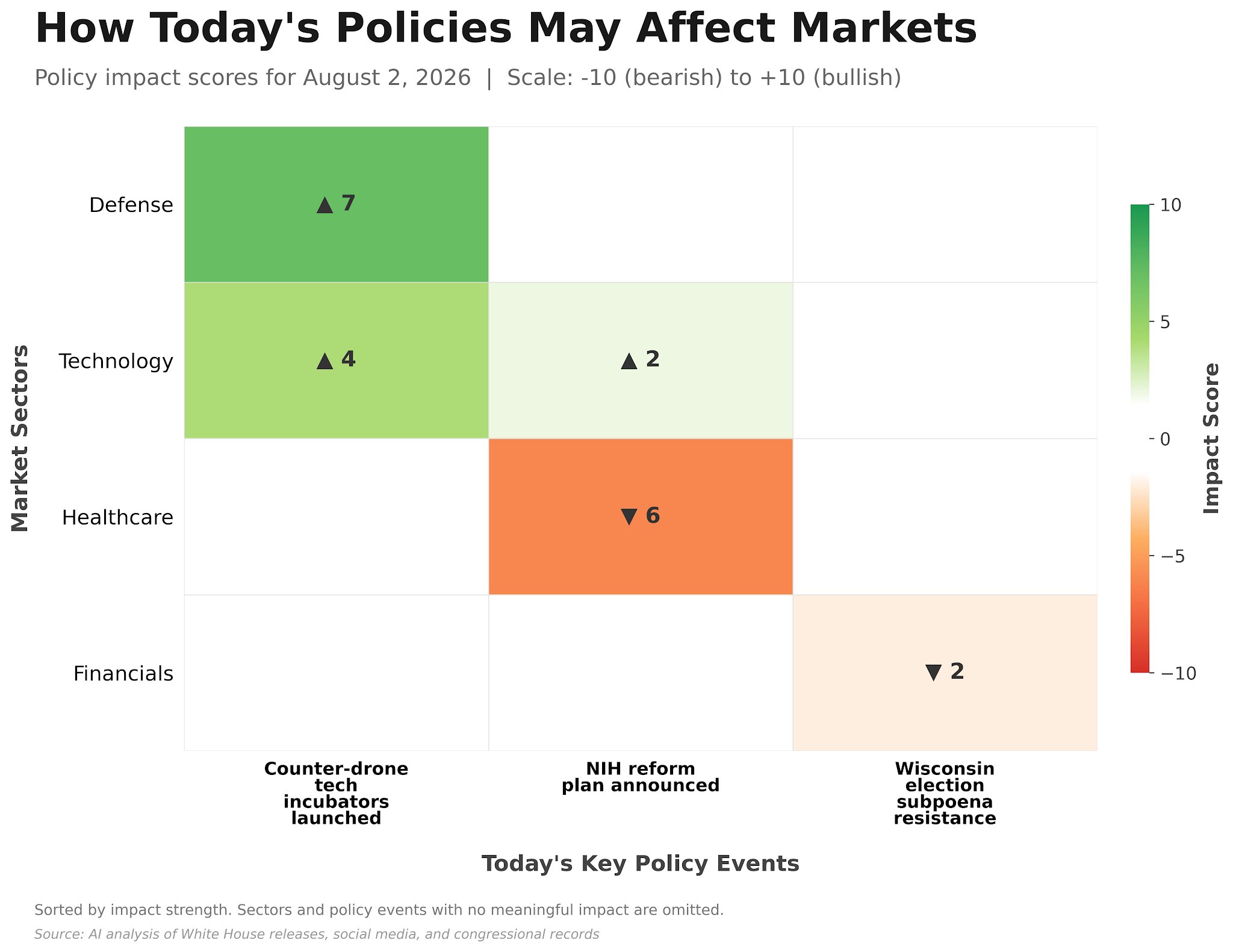
8. Policy Impact Analysis & Heatmap
1. Overview
Trump highlighted the sweeping reforms proposed by his new NIH chief, which include the creation of a new pandemic playbook and a dedicated body to address vaccine injuries. The administration is also establishing technology “incubators” focused on developing advanced systems to counter drone terror attacks. These initiatives represent a shift in federal health policy and national security hardware development.
In a series of posts, Trump shared a positive opinion piece regarding his current energy policies while circulating a critical report concerning ongoing issues in Mexico. He highlighted a news story describing Wisconsin Governor Tony Evers’ vow to resist potential FBI efforts to seize Milwaukee election ballots. Additionally, the President promoted a column explaining the rationale behind renaming the Palm Beach airport in his honor.
In a personal update, Trump celebrated his victory in the Bedminster Club Championship after shooting a score of 70. He stated he was “so honored” by the win, noting that despite limited practice time, his performance served as evidence of pure “TALENT.” He concluded the post by asserting, “I have it, and they don’t!”
The administration’s commitment to accelerating counter-drone technology through dedicated incubators enhances the revenue outlook for tactical security and surveillance contractors, though it simultaneously creates downside risks for legacy defense programs facing potential capital reallocation. Simultaneously, proposed NIH regulatory reforms regarding vaccine liability and pandemic protocols introduce significant operational headwinds for pharmaceutical and biotech entities by increasing prospective litigation costs and disrupting established research pipelines. Underlying these shifts, the escalating friction between state executive branches and federal agencies creates a landscape of institutional volatility, which critics characterize as a “broader environment of policy unpredictability” that threatens to destabilize regional governance and market certainty.
2. White House News
No White House news found.
3. Truth Social Posts
Trump highlighted the sweeping reforms proposed by his new NIH chief, which include the development of a new pandemic playbook and the establishment of a body to address vaccine injuries. Furthermore, his administration is creating “incubators” dedicated to developing advanced technology specifically designed to counter drone terror attacks.
Regarding media and political commentary, Trump shared an opinion piece on his energy policies, circulated a report concerning issues in Mexico, and highlighted a story about Wisconsin Governor Tony Evers vowing to resist FBI efforts to seize Milwaukee ballots. He also promoted a column detailing the reasoning behind naming the Palm Beach airport in his honor.
In a personal update, Trump celebrated his victory in the Bedminster Club Championship with a score of 70. He remarked that he is “so honored” by the win, noting that despite limited practice time due to his focus on other presidential matters, the result is evidence of “TALENT,” asserting, “I have it, and they don’t!”
Reference: https://truthsocial.com/@realDonaldTrump
4. Government Department News
No relevant government department updates found for this date.
5. 2028 Democratic Presidential Candidates
No relevant 2028 Democratic candidate updates found for this date.
6. AI & Tech Company News
No relevant AI & tech company updates found for this date.
7. Congressional Watch
Covers the 2026-08-01 session — the Congressional Record is published with a one-day delay.
No Congressional Record found for 2026-08-01.
8. Policy Impact Analysis & Heatmap
This analysis is provided for informational purposes only. It does not constitute investment advice or a recommendation to buy or sell any security.
Impact on Market
Based on today’s policy developments, our analysis identifies the following market impact themes:
THEME 1. DEFENSE INNOVATION ACCELERATION
The administration is prioritizing rapid development of counter-drone technologies through new dedicated incubators. This shift directs federal capital toward tactical security and surveillance systems. Defense firms will likely see increased contract opportunities as national security threats evolve. Critics suggest this narrow focus might divert essential resources away from larger, legacy military modernization programs.
THEME 2. NIH REGULATORY UNCERTAINTY
Sweeping reforms at the NIH create a turbulent environment for the pharmaceutical and biotech industries. Proposals for a vaccine injury body signal a shift in accountability structures for large manufacturers. Potential changes to pandemic protocols may disrupt long-term research and development pipelines. Industry watchdogs warn that these reforms could increase litigation costs and stifle collaborative public-private research partnerships.
THEME 3. STATE-FEDERAL INSTITUTIONAL FRICTION
Resistance to federal election-related subpoenas highlights rising tensions between state executive branches and national agencies. Such conflicts increase institutional uncertainty and could create localized market volatility. Potential legal standoffs threaten the stability of regional governance and electoral processes. Opponents fear these recurring disputes contribute to a broader environment of policy unpredictability.
Policy Impact Heatmap with Market Direction
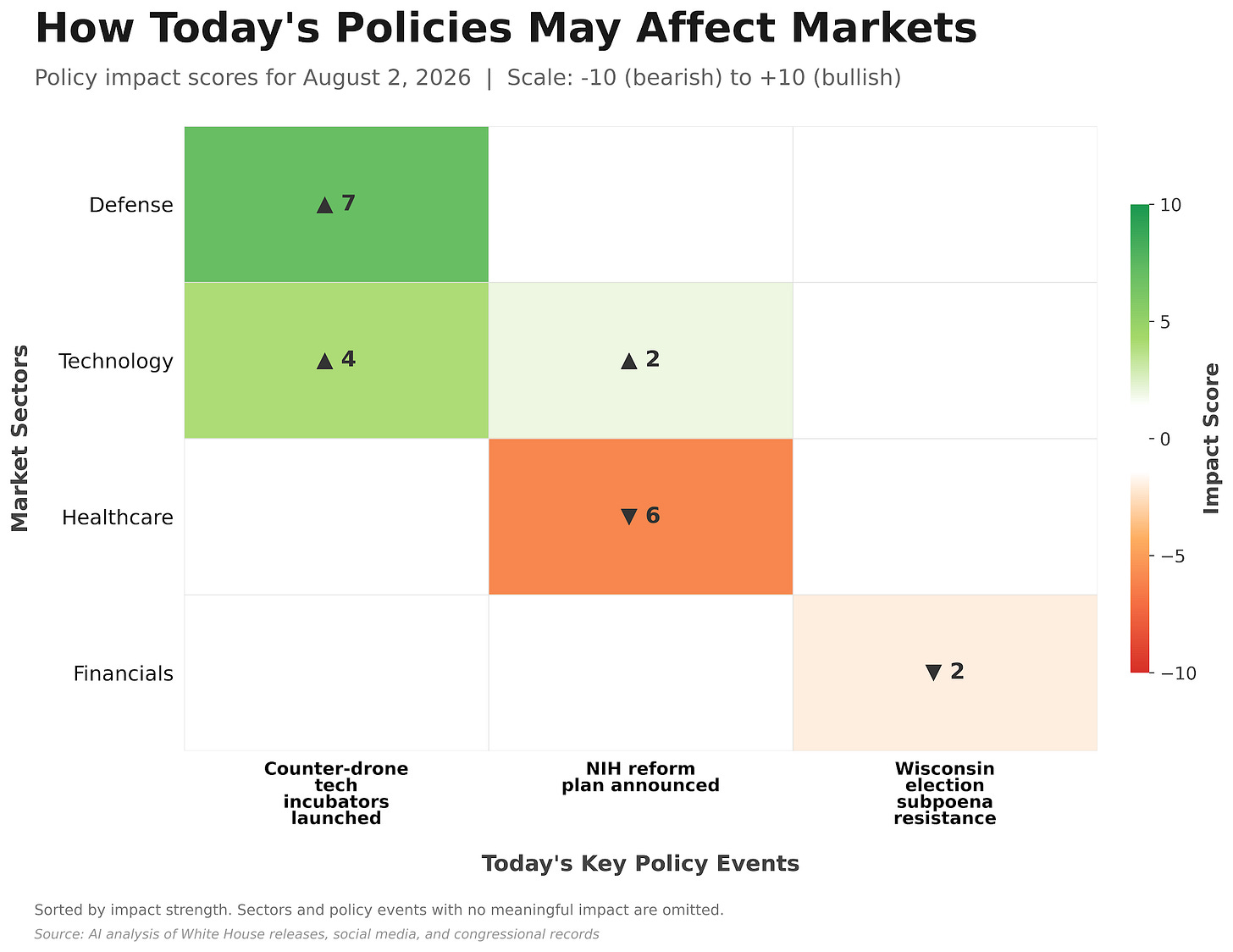
Each cell shows an estimated impact score on a fixed scale of -10 to +10, reflecting how today’s policy developments may affect each market sector. Positive scores (green, ▲) suggest bullish impact; negative scores (red, ▼) suggest bearish pressure. Rows and columns are sorted by impact strength, and sectors and policy events with no meaningful impact are omitted. The heatmap, the analysis below, and the Impact on Market themes above are produced from a single unified analysis: the heatmap visualizes the magnitudes, while the text explains the causal reasoning behind them.
The administration’s pivot toward radical NIH reform introduces significant regulatory uncertainty for the life sciences sector. Analysts highlight that a new vaccine injury body could shift litigation liabilities, impacting pharmaceutical margins. Critics argue that sudden shifts in pandemic mandates risk operational instability across healthcare research networks. Conversely, the increased funding for counter-drone tech incubators creates a clear fiscal tailwind for defense contractors.
Defense firms specializing in anti-access and area-denial systems now face an accelerated procurement cycle. These new incubators prioritize rapid innovation cycles, potentially favoring agile tech firms over traditional prime contractors. Political friction regarding federal ballot seizure creates broader regional risk premia. Markets typically view these state-versus-federal confrontations as potential sources of systemic volatility. This tension may weigh on sentiment if such disputes lead to protracted legal gridlock or institutional breakdown.
-
Washington Policy Review: August 1, 2026
Today’s Report
1. Overview
2. White House News
3. Truth Social Posts
4. Government Department News
5. 2028 Democratic Presidential Candidates
6. AI & Tech Company News
7. Congressional Watch
8. Policy Impact Analysis & Heatmap
1. Overview
President Trump announced that the United States has prepared for significant military action against Iran but opted for a tactical pause. He stated this decision follows requests from Iran and regional partners, creating a window for a potential deal regarding the Hormuz Strait and nuclear disarmament. Trump emphasized that Israel supports this diplomatic opening and urged all parties to “get it DONE” to ensure a prosperous future.
Trump utilized Truth Social to voice his disagreement with U.S. Attorney Jeanine Pirro regarding the recent damage to the Reflecting Pool, characterizing the event as a “pure case of VANDALISM” rather than a contractor error. He linked this issue to his broader mission of “fixing our wonderful White House, just like he is fixing our Country.” Additionally, Trump touted that U.S. oil exports are “SURGING” and highlighted upcoming aesthetic upgrades to the White House, including the installation of a Triumphal Arch.
OpenAI released new research detailing ten significant advances in mathematics and theoretical computer science. The findings cover progress in geometry, cryptography, and computational complexity, contributing to foundational scientific inquiry. This release marks an effort by the company to share developments on long-standing, complex mathematical problems.
The energy sector faces heightened volatility as the administration’s focus on surging export volumes contrasts with the reduction of geopolitical risk premiums following potential military de-escalation in the Strait of Hormuz. In the technology space, breakthroughs in cryptography and complexity theory drive anticipated demand for upgraded semiconductor hardware, yet the pace of these advancements remains clouded by concerns that the innovation is a “reckless gamble” necessitating future regulatory intervention. Meanwhile, industrial firms contracting for infrastructure maintenance contend with operational ambiguity as political disputes over public asset protection create uncertainty regarding the consistency of federal funding and security standards. These conflicting policy signals necessitate that market participants monitor the tension between administrative objectives and the resulting structural uncertainties across these core sectors.
2. White House News
No White House news found.
3. Truth Social Posts
Trump announced that the United States is prepared for significant military action against the Islamic Republic of Iran, but he has decided to pause these plans following requests from Iran and other Middle Eastern nations. He noted that the possibility of a deal has emerged, which would entail the “Immediate, Complete, and Total OPENING OF THE HORMUZ STRAIT” and the elimination of Iran’s nuclear threat. Trump stated he agreed to hold off for the benefit of the world and the survival of a prosperous Iran, noting that Israel supports this commitment and urging stakeholders to “get it DONE.”
Addressing domestic administration and public perception, Trump expressed his total disagreement with U.S. Attorney Jeanine Pirro regarding damage at the Reflecting Pool, maintaining that the destruction, which included markings on the grass, was a “pure case of VANDALISM” rather than a mere contractor difficulty. He further called public attention to the specific physical damage inflicted on the site. Amidst these concerns, he affirmed that he is actively “fixing our wonderful White House, just like he is fixing our Country.” In other updates, Trump highlighted that oil exports are “SURGING” under his administration and shared a preview of the Triumphal Arch before the installation of statues and artwork.
In the realm of media and public support, Trump praised Chairman Rick Crawford as a “total Pro” following a Fox News interview. Additionally, he remarked on the enthusiastic crowd reception for his signage at the UFC fights in Serbia.
Reference: https://truthsocial.com/@realDonaldTrump
4. Government Department News
No relevant government department updates found for this date.
5. 2028 Democratic Presidential Candidates
No relevant 2028 Democratic candidate updates found for this date.
6. AI & Tech Company News
OpenAI (openai.com)
Ten advances in mathematics and theoretical computer science
OpenAI has released new research detailing progress on several long-standing open problems within mathematics and theoretical computer science. The findings encompass significant developments in the fields of geometry, cryptography, and computational complexity, marking a contribution to foundational scientific inquiry.
7. Congressional Watch
Covers the 2026-07-31 session — the Congressional Record is published with a one-day delay.
No Congressional Record found for 2026-07-31.
8. Policy Impact Analysis & Heatmap
This analysis is provided for informational purposes only. It does not constitute investment advice or a recommendation to buy or sell any security.
Impact on Market
Based on today’s policy developments, our analysis identifies the following market impact themes:
THEME 1. ENERGY SECTOR DYNAMICS UNDER SHIFTING GEOPOLITICAL AND EXPORT POLICIES
The simultaneous occurrence of potential military de-escalation in the Strait of Hormuz and a surge in U.S. oil export volumes creates a complex environment for the energy sector. While the administration frames the export surge as a “key policy achievement” that bolsters supply, the pivot away from military action in Iran introduces immediate downward pressure on energy markets due to reduced risk premiums. Opposition figures have expressed skepticism regarding this dual approach, labeling the potential for renewed diplomatic talks as a “weakening of resolve” that may undermine long-term energy security objectives. Consequently, the energy sector faces significant volatility, as traders must weigh the expansion of global export capacity against the potential for renewed Iranian supply competition.
THEME 2. TECHNOLOGICAL ADVANCEMENT AND THE SEMICONDUCTOR LANDSCAPE
New breakthroughs in cryptography and complexity theory published by research organizations signal a potential long-term shift in computational capabilities. These advancements are expected to influence the semiconductor and broader technology sectors by necessitating upgraded hardware to support more complex mathematical processing. While supporters characterize these developments as a “monumental leap forward” for national digital infrastructure, critics have raised concerns about the potential for these same tools to be exploited for cyber warfare, describing the rapid pace of innovation as a “reckless gamble” without sufficient regulatory oversight. These conflicting viewpoints create uncertainty regarding future government intervention in the development and export of next-generation semiconductor components.
THEME 3. INDUSTRIAL INFRASTRUCTURE AND MONITORING OF PUBLIC ASSETS
Recent property damage at a national monument in Washington has led to a public dispute between the executive branch and legal authorities over the characterization of the event. This disagreement influences the industrial sector, particularly firms involved in government contracting for security and facility maintenance, as there is uncertainty regarding the future allocation of funds for the protection of national landmarks. Critics of the administration have described the President’s response as a “dangerous precedent” that minimizes the seriousness of vandalism, while administration allies view the intervention as a necessary rejection of bureaucratic narratives. This environment creates operational ambiguity for industrial entities that rely on consistent federal standards and funding for the preservation and protection of public infrastructure.
Policy Impact Heatmap with Market Direction
Each cell shows an estimated impact score on a fixed scale of -10 to +10, reflecting how today’s policy developments may affect each market sector. Positive scores (green, ▲) suggest bullish impact; negative scores (red, ▼) suggest bearish pressure. Rows and columns are sorted by impact strength, and sectors and policy events with no meaningful impact are omitted. The heatmap, the analysis below, and the Impact on Market themes above are produced from a single unified analysis: the heatmap visualizes the magnitudes, while the text explains the causal reasoning behind them.
Geopolitical tensions in the Middle East dominate market sentiment. The potential for a diplomatic resolution regarding the Strait of Hormuz cools immediate supply-side risks for global energy markets. A de-escalation of conflict reduces the risk premium previously baked into oil prices. Consequently, the Energy sector faces downward pressure as supply availability becomes more predictable. Defense sector expectations shift as the immediate prospect of kinetic military engagement subsides.
Simultaneously, the administration’s focus on surging oil exports provides a counter-narrative for domestic energy producers. Increased export volume supports revenue growth for traditional energy firms despite the geopolitical cooling. Separately, advancements from OpenAI in cryptography and complexity theory reinforce the growth trajectory for the broader Technology sector. While these academic breakthroughs have no immediate fiscal impact, they sustain the narrative of long-term sector superiority. Critics express concerns that administrative focus on high-profile vandalism or political spats may distract from structural economic policy implementation. Such distractions create uncertainty regarding agency focus and procurement stability for large-scale federal contractors.
-
Taxis autonomes en Europe : Après la Suisse et l’Espagne, WeRide veut lancer un service au Danemark au premier semestre 2027
WeRide, spécialiste chinois des systèmes de conduite autonome, annonce ce 3 août un partenariat avec l’opérateur danois de véhicules électriques GreenMobility afin de lancer un service de taxis autonomes au Danemark. “Les entreprises visent à lancer le service au cours du premier semestre 2027 et tous les passagers pourront demander un trajet assuré par le GXR, le véhicule entièrement autonome de WeRide, conforme aux normes européennes”, écrit WeRide dans un communiqué.
-
Ils nous exterminent à petit feu

Rami Abou Jamous écrit son journal pour Orient XXI. Dans ce texte, il revient sur les raisons de son silence, la mort de proches à Gaza — dont celle de la tante de son épouse Sabah —, la réduction de l'aide humanitaire et une situation qui empire chaque jour, à Gaza comme en Cisjordanie.
Samedi 25 juillet.
Salut les amis. Toujours vivant.
Chers lecteurs, chères lectrices, cela fait longtemps que je n'ai pas donné de nouvelles, et je vous prie de me pardonner. Je sais que vous vous êtes inquiétés et que les informations sur Gaza vous manquent. J'ai eu quelques soucis de santé, mais ensuite, je ne sais pas pourquoi, je n'ai pas repris l'écriture. Sabah, ma femme, me demandait souvent : « Pourquoi n'écris-tu pas ? » Le problème, c'est que je n'avais pas de réponse. Depuis plus d'un mois, je vivais avec un cerveau qui voulait parler de tout, et un cœur saturé de chagrin et de tristesse qui n'avait pas envie de parler. Peut-être que ce génocide qui ne cesse pas depuis trois ans, ces catastrophes et massacres quotidiens, ce stress permanent pesaient trop lourd.
Il y a beaucoup de choses à raconter et, en même temps, la communauté internationale n'a rien à dire. Rien de ce qu'il se passe à Gaza n'a d'écho dans le silence du monde. Ni dans mon propre silence que je ne comprends pas moi-même. De quoi était-il fait ? Peut-être que j'avais simplement besoin de me reposer. Peut-être que j'étais arrivé à un point où j'avais besoin de ne rien dire, où je n'avais plus rien à dire.
Chaque jour on apprend la mort d'un ami proche, d'un voisin, dans un bombardement ou à cause d'une maladie non soignée.
Pendant le mois écoulé, nous sommes passés par de grands moments de tristesse. Sabah a perdu sa tante, pas à cause d'un bombardement, mais à cause des rats. Oui, à cause des rats. À Gaza, vous le savez, plus de 1,5 million de personnes vivent toujours sous des tentes dans des camps de fortune. Ces gens sont entassés les uns à côté des autres, concentrés dans 30 % de la surface de Gaza, c'est-à-dire à peu près 120 kilomètres carrés. Récemment, et surtout avec la chaleur, la majorité de ces tentes ont été attaquées par les rats, par les souris, par les reptiles, par les rongeurs.
Quand ils installent leurs bâches, les déplacés essaient de trouver un mur auquel adosser leur abri, afin d'économiser les toiles sur un côté, et pour avoir un pan solide où planter des clous, par exemple. C'est ce qu'avait fait la tante de Sabah. Elle n'avait été déplacée qu'une fois, contrairement à la majorité des Gazaouis, qui ont dû errer d'un endroit à un autre sous les attaques israéliennes. Elle était originaire du quartier de Shejaya — dans l'est de la ville de Gaza —, qui a été complètement rasé par l'armée israélienne. Elle avait fini sous une tente dans le centre de la ville. Cette tente, elle l'avait plantée contre le mur resté debout d'une maison détruite. Il a fini par s'effondrer sur la famille : les rats avaient creusé des trous sous ses fondations fragiles. Toute la famille s'est retrouvée à l'hôpital. Huda est morte au bout de quelques jours. Qu'elle repose en paix. Sa fille a été amputée d'une jambe. Elle est diabétique, ce qui va aggraver ses souffrances.
Il y a aussi l'histoire de cet ami que vous connaissez peut-être, le rappeur palestinien Ayman Mghames qui travaillait avec moi quand j'étais fixeur. Il m'aidait pour les contacts avec les journalistes et pour les traductions. Il a eu la chance de pouvoir quitter Gaza avec sa femme et ses enfants, et est actuellement en France. Malheureusement, il n'a pas pu faire évacuer sa mère, ainsi que son frère et sa famille. Sa belle-sœur a été transférée avec ses enfants en Égypte, où elle est traitée pour un cancer. Le frère d'Ayman était resté à Gaza avec sa mère. Mais il souffrait d'une insuffisance rénale qui lui a été fatale, faute de soins adéquats. Qu'il repose en paix.
Ce n'est qu'un mort parmi tant d'autres. Chaque jour, on apprend la mort d'un ami proche, d'un voisin, dans un bombardement ou à cause d'une maladie non soignée. Tout cela dans le silence du monde entier. Bien sûr, je ne parle pas des populations. Je sais qu'il y a une forte mobilisation, que ce soit en France ou ailleurs, et je sais que beaucoup de lecteurs et lectrices attendent mon journal parce qu'ils veulent savoir ce qu'il se passe à Gaza. Ils veulent savoir la vérité, connaître la réalité.
L'objectif, c'est la déportation des Palestiniens.
Je parle du silence des dirigeants et des décideurs de la communauté internationale. Nous sommes étranglés par l'occupation, massacrés par les Israéliens, dans une impunité totale, à Gaza comme en Cisjordanie où les colons armés attaquent sans cesse les villages. L'objectif, c'est la déportation des Palestiniens. Le plan est désormais sur la table. En Cisjordanie, il est mis en œuvre par les colons, protégés par l'armée d'occupation. Des agences de presse ont récemment rapporté la version israélienne d'une attaque de colons contre un village proche de Naplouse : des « randonneurs » auraient été « attaqués » par des Palestiniens. De paisibles promeneurs amateurs de nature parcourant les territoires palestiniens pour en admirer les paysages auraient donc été agressés par des terroristes sanguinaires qui détestent les sacs à dos.
Il s'agissait en réalité d'une milice de colons armés de fusils M16 venus, comme à leur habitude, harceler et brutaliser les habitants. Un jeune Palestinien a saisi l'arme du chef de bande et l'a tué sur le coup. Les « randonneurs » ont le droit d'attaquer les villages, de brûler les mosquées et les champs, de tuer qui ils veulent. Les Palestiniens qui veulent simplement vivre sur leurs terres n'ont pas le droit de gâcher leurs promenades.
La majorité de la population dépend de l'aide humanitaire qui diminue de plus en plus.
Lire la suite sur orientxxi -
Incendie sur un site Seveso en Moselle : le confinement de 30 000 personnes levé

30 000 personnes ont été appelées à se confiner pendant plusieurs heures, dimanche 2 août, en raison de l'incendie d'un entrepôt classé Seveso, à Gandrange (Moselle). Un nouvel épisode révélateur de la vulnérabilité des industries à la sécheresse et aux canicules ? La préfecture de Moselle indique qu'on « ne connaît pas l'origine de l'incendie ».
Lire la suite - En bref / Pollutions
L'incendie s'est déclaré vers 10 h 30 sur le site de la société Sage (Suez Alternative Fuels & Energies), non loin des installations (…) -
L’IA générative accélère les cyberattaques et les compromissions cloud, mais aussi la chasse aux vulnérabilités, révèle un rapport de CrowdStrike
L’intelligence artificielle est désormais pleinement intégrée à l’arsenal des cybercriminels et des groupes étatiques. C’est le principal enseignement du 2026 Threat Hunting Report de CrowdStrike, qui décrit une accélération spectaculaire des attaques et une exploitation des vulnérabilités en quelques heures seulement. Un nouveau front émerge aussi : celui des infrastructures d’IA elles-mêmes.
-
The right’s exploitation of the Ceuta migrant ‘crisis’ almost guarantees that it will happen again | Ruben Andersson
The EU’s panic and the lack of solidarity emboldens smugglers and the far right – and makes Spain even more vulnerable
For the European hard right and the White House, it seemed almost too good to be true: left-liberal Spain punished with a migration crisis of its own making.
The histrionics came right on cue. As thousands of mainly Moroccan citizens streamed into the tiny Spanish enclave of Ceuta at the tip of north Africa, Spain’s far-right party Vox decried a migrant “invasion”, blaming Spanish prime minister Pedro Sánchez’s regularisation and leftist politics. The Trump administration did the same. A senior Israeli diplomat goaded Madrid over its “colonial” territories while Italy’s prime minister, Giorgia Meloni, called for Spain to be suspended from the Schengen area. Denmark and Finland backed Italy’s move and, by the weekend, 22 EU leaders had penned a letter pointing an implicit finger at Madrid over its presumed failure to “relentlessly combat illegal migration”.
Continue reading... -
Derrière les supposées avancées du «Conseil de paix» à Gaza, l’ombre de Mohammed Dahlan
L’ex-cadre du Fatah, en exil à Abou Dhabi depuis 2011, a participé aux négociations de l’accord sur le désarmement du Hamas annoncé le 30 juillet. Sa légitimité politique parmi les Palestiniens est faible, mais il semble poussé par les États-Unis et Israël pour contourner le Hamas et l’Autorité palestinienne. -
Affaire des «biens mal acquis»: le Parquet national financier réclame un procès, la BNP ciblée
Pour le PNF, la première banque française a directement participé à un vaste système de détournements de fonds mis en place par le clan d’Omar Bongo au Gabon. Ces faits, symboles de la Françafrique, ont perduré pendant des décennies. -
L’Occident contre Patrice Lumumba
À l’été 1960, le jeune Congo indépendant s’enfonce dans la crise. Sécessions du Katanga et du Kasaï, Occident qui le voit comme un ennemi lié à Moscou, volonté de la Belgique de conserver son emprise: Patrice Lumumba se retrouve isolé face à une coalition de forces hostiles. -
Prison : le modèle Bukele du Salvador pourrait-il s’appliquer en France ?
Source :Compte Facebook, 20 février 2026
Etiqe :Illégal
Contenu :
La politique carcérale de Nayib Bukele, un modèle pour la France ? Sur Instagram, des internautes le suggèrent et encensent le Salvador et son président. Le « dictateur cool » aurait « pris des mesures radicales contre les gangs. Résultat : la criminalité s’effondre. »
Un des internautes affirme qu’« en France, on préfère les postures molles. On tolère l’ensauvagement, quartier par quartier », insinuant que la violence explose – une affirmation non étayée par les études sur le sujet. Il demande : « Qu’est-ce qu’on est prêt à accepter en France pour lutter contre la délinquance, pour libérer tous ceux d’entre nous qui se sentent oppressés par l’insécurité ? »
Si le Salvador a véritablement vu son taux d’homicides diminuer sous les mandats de Nayib Bukele, cette baisse – elle-même à nuancer – s’est accompagnée d’atteintes aux droits humains. Au-delà du caractère enviable de ces mesures, l’arsenal juridique français empêcherait vraisemblablement leur mise en pratique. Jusqu’où la comparaison entre la France et le Salvador est-elle tenable ?
89 875 personnes arrêtées depuis 2022
Commençons par un peu de contexte. Outre la réforme constitutionnelle, votée par une assemblée largement acquise à la majorité présidentielle, lui permettant d’être réélu sans limitation, Nayib Bukele s’est illustré, au cours de ses sept années de mandat présidentiel, par sa lutte contre les deux principales pandillas (bandes criminelles) qui sévissent au Salvador : la Mara Salvatrucha (MS-13) et le Barrio 18.
Depuis le 27 mars 2022, date de l’instauration de l’état d’urgence, plus de 89 875 personnes ont été arrêtées au nom de cette lutte. Près de 1,7 % de la population est désormais emprisonnée au Salvador, ce qui en fait le pays affichant le plus fort taux d’incarcération au monde.
« Par rapport aux années précédentes, le pays a réalisé des progrès significatifs (…) liés aux mesures de sécurité mises en œuvre depuis 2022 », souligne l’agence de presse Prensa Latina
Comme le rapporte Prensa Latina, selon l’Index du crime organisé (The Organized Crime Index), une initiative internationale composée d’experts chargés de mesurer l’ampleur du crime organisé dans le monde, le « score de criminalité » du Salvador a baissé ces dernières années.
« Par rapport aux années précédentes, le pays a réalisé des progrès significatifs dans ce classement mondial, alors qu’en 2021, il figurait parmi les pays les moins bien classés (…). Ces progrès sont étroitement liés aux mesures de sécurité mises en œuvre depuis 2022 », souligne l’agence de presse latino-américaine.
La baisse des homicides atteste de cette amélioration. En 2025, le taux d’homicides s’établit à 1,3 pour 100 000 habitants. Tandis qu’en 2015, il était de 104 pour 100 000 habitants. Nayib Bukele semble avoir endigué le phénomène.
Un nombre d’homicides sujet à controverse
Ces chiffres restent toutefois sujets à débat. Comme l’a démontré une enquête publiée par Foreign Policy en 2024, les homicides commis en prison ainsi que les personnes tuées par l’armée et la police ne sont plus comptabilisés depuis 2021.
L’auteur de l’enquête estime qu’en 2023, près de la moitié des homicides n’auraient ainsi pas été pris en compte dans les statistiques officielles. Malgré cette réserve, le nombre d’homicides a bien chuté de manière drastique.
« Vous avez des quartiers entiers où, désormais, vous pouvez circuler nuit et jour sans devoir regarder par-dessus votre épaule, sans prendre toutes sortes de précautions », raconte Thierry Maire, sociologue rattaché au Centre Maurice Halbwachs et spécialiste du Salvador.
« C’est un fait : la violence a chuté. Mais au prix d’un État de droit qui s’effondre. » Thierry Maire, sociologue au Centre Maurice Halbwachs
« Attention, ça ne veut pas dire qu’il n’y a plus de criminalité du tout », nuance le sociologue. C’est d’ailleurs ce que tendent à démontrer les statistiques partagées par l’UNODC, l’Office des Nations unies contre la drogue et le crime.
Les chiffres de la délinquance et de la criminalité sont à prendre avec précaution, et les conclusions qui peuvent en être tirées doivent être questionnées. Comme nous l’avons déjà expliqué ici, ces statistiques témoignent davantage de l’activité des services de police que de la commission des infractions.
« L’efficacité immédiate, vous ne pouvez pas la contester », explique le sociologue. « C’est un fait : la violence a chuté. Mais au prix d’un État de droit qui s’effondre. Les gens sont emprisonnés, ils ne savent pas pourquoi, ils ne sont pas présentés à un juge, ils n’ont pas accès à un avocat et les familles ne sont pas prévenues. »
470 décès en prison depuis 2022
Un modèle d’autant plus questionnable qu’il s’accompagne d’une négation des droits humains. Des ONG comme Amnesty International ont dénoncé des « conditions de détention inhumaines » ainsi que des « arrestations arbitraires et des procès inéquitables ». « Environ 470 décès [sont] survenus en détention depuis le début de l’état d’urgence. Les causes étaient notamment liées à la pratique de la torture », souligne l’ONG.
Nayib Bukele a fait du Centre de confinement du terrorisme (CECOT), la mégaprison de Tecoluca inaugurée en février 2023, l’un des emblèmes du Salvador. « C’est vraiment Alcatraz. Ce n’est même pas qu’on ne peut pas s’en approcher : c’est une prison sous cloche. Si un proche y a été emprisonné, vous ne le saurez que si le gouvernement le décide. Même les avocats n’y ont pas accès », explique Thierry Maire.
« Autrefois, quand quelqu’un disparaissait, tout le monde était à peu près persuadé que, si l’on ne retrouvait pas la personne rapidement, on la retrouverait morte, dépecée, enterrée ou mutilée. Que c’était la faute des gangs. Aujourd’hui, c’est l’inverse. Si vous disparaissez et que tout le monde s’inquiète, on se dit que c’est le gouvernement. L’État fait disparaître les gens. La peur a changé d’origine », assure le sociologue. Ces propos sont corroborés par des ONG comme Human Rights Watch ou encore Cristosal, qui ont documenté des arrestations arbitraires.
Un modèle inenvisageable dans un État de droit comme la France
« Toute personne accusée d’une infraction est présumée innocente jusqu’à ce que sa culpabilité ait été légalement établie. » Article 6 de la Convention européenne des droits de l’homme
Nayib Bukele a lui-même reconnu, en novembre 2024, que 8 000 personnes innocentes avaient été arrêtées à tort, puis relâchées. Autant d’atteintes aux droits humains qui rendraient presque impossible la mise en place d’une telle politique carcérale en France sans tomber dans une non-conformité à la Constitution.
Reconnue comme un principe à valeur constitutionnelle par le Conseil constitutionnel dans sa décision n° 80-127 DC du 20 janvier 1981, la présomption d’innocence est prévue à l’article 9 de la Déclaration des droits de l’homme et du citoyen et consacrée par l’article préliminaire du Code de procédure pénale.
Elle est également garantie par l’article 6, paragraphe 2, de la Convention européenne des droits de l’homme, aux termes duquel : « Toute personne accusée d’une infraction est présumée innocente jusqu’à ce que sa culpabilité ait été légalement établie. »
Mettre en place la « méthode Bukele » sur le territoire français nécessiterait dès lors de sortir de l’Union européenne et de réformer le Code de procédure pénale. Quant au Conseil constitutionnel, il devrait faire évoluer sa jurisprudence, voire être supprimé.
« Le fait est qu’au Salvador (…) les politiques préventives sont quasiment inexistantes. Les causes fondamentales de la délinquance et de la criminalité sont donc rarement véritablement traitées », ajoute Thierry Maire. « Il faut se demander si c’est vraiment efficace à moyen ou à long terme. »
Un système qui inspire pourtant d’autres pays d’Amérique latine, comme l’Équateur, qui copie son voisin salvadorien. Pourtant, l’efficacité de la pratique systématique du « tout-prison » n’est elle-même pas prouvée, comme nous l’expliquons ici.
Auteurs :
Auteur : Antoine Mauvy, journaliste
Relecteur.rices : Clara Robert Motta, journaliste
Etienne Merle, journaliste
Liens d’intérêts ou fonctions politiques déclarés des intervenants à l’article : aucun
Secrétariat de rédaction : Antoine Mauvy, journaliste
L’article Prison : le modèle Bukele du Salvador pourrait-il s’appliquer en France ? est apparu en premier sur Les Surligneurs.
-
Des designers créent une police d’écriture gratuite pour lutter contre le scraping des IA (et c’est open-source)

Avec ShieldFon, lancé fin juillet 2026, un texte reste lisible à l’écran, mais devient trompeur pour les robots qui l’aspirent. Une nouvelle arme typographique contre l’entraînement des IA sur le web.
-
L’Union européenne lance un appel d’offres historique de 30 milliards d’euros pour bâtir sept Gigafactories
La Commission européenne a lancé la procédure de sélection destinée à créer jusqu’à sept “Gigafactories” dédiées aux technologies d’intelligence artificielle sur le territoire de l’Union. Les candidatures devront être déposées avant le 12 novembre 2026, une échéance qui laisse aux consortiums plusieurs mois pour boucler des dossiers particulièrement complexes, tant sur le plan technique que financier.
-
PFAS dans l'eau : la décontamination pourrait coûter jusqu'à 5,7 milliards d'euros

Les eaux destinées à la consommation humaine (EDCH) sont largement contaminées par différents polluants. En 2024, un peu plus de 29 % de la population française a été exposée, via son eau de consommation courante, à la présence de pesticides ou de composés per- et polyfluoroalkylés (PFAS) et autres polluants chimiques d'origine humaine, à des niveaux de concentration dépassant les limites de qualité européennes.
Lire la suite - En bref / Pollutions , Santé , Eau
En septembre 2025, la ministre de la Transition écologique, Monique Barbut, a (…) -
Google vient de corriger le plus gros défaut du bracelet Fitbit Air sur iPhone

Trois mois après sa sortie, le bracelet Google Fitbit Air supporte enfin la technologie HealthKit d'Apple, qui permet de réunir ses données de santé au même endroit et de les utiliser dans plusieurs apps de manière sécurisée. L'application Google Health vient de recevoir la mise à jour tant promise depuis des semaines.
-
Les précurseuses de l'écologie : Rosa Luxemburg, icône révolutionnaire et naturaliste passionnée

[Ces précurseuses écolos et féministes 1/5] Ces dernières années, les écologistes redécouvrent la révolutionnaire Rosa Luxemburg. Sa sensibilité et son attachement au vivant nous rappelle que le combat pour la nature est aussi un combat pour l'émancipation.
Lire la suite - Idée / Féminisme , Idées
Entre les barreaux de sa cellule de prison, Rosa Luxemburg guette l'arrivée du printemps. Nous sommes au début de la Grande Guerre, en 1915, et la militante antimilitariste est de nouveau emprisonnée. Le cœur meurtri par le massacre de (…) -
Les précurseuses de l'écologie : Rosa Luxemburg, icône révolutionnaire et naturaliste passionnée
[Ces précurseuses écolos et féministes 1/5] Ces dernières années, les écologistes redécouvrent la révolutionnaire Rosa Luxemburg. Sa sensibilité et son attachement au vivant nous rappelle que le combat pour la nature est aussi un combat pour l'émancipation.
Lire la suite - Idée / Féminisme , Idées
Entre les barreaux de sa cellule de prison, Rosa Luxemburg guette l'arrivée du printemps. Nous sommes au début de la Grande Guerre, en 1915, et la militante antimilitariste est de nouveau emprisonnée. Le cœur meurtri par le massacre de (…) -
Dans cette ville du Texas, une illustration du « capitalisme du désastre »

Face à la cinquième année de sécheresse à Corpus Christi, ses habitants militent contre les passe-droits accordés aux usines qui entourent la cité côtière et captent 60 % de l'eau potable.
Lire la suite - Reportage / Monde , Luttes , Pollutions , Eau
Corpus Christi (Texas, États-Unis), reportage
À presque chaque conseil municipal de Corpus Christi, un petit groupe d'activistes s'amuse à jouer au « bingo des conneries » (« bullshit bingo »), las d'entendre les élus de cette cité côtière de 317 000 habitants débiter les mêmes arguments à longueur de (…) -
« C'est une guerre de l'eau » : aux États-Unis, cette ville pourrait devenir la première à manquer d'eau
Face à la cinquième année de sécheresse à Corpus Christi, ses habitants militent contre les passe-droits accordés aux usines qui entourent la cité côtière et captent 60 % de l'eau potable.
Lire la suite - Reportage / Monde , Luttes , Pollutions , Eau
Corpus Christi (Texas, États-Unis), reportage
À presque chaque conseil municipal de Corpus Christi, un petit groupe d'activistes s'amuse à jouer au « bingo des conneries » (« bullshit bingo »), las d'entendre les élus de cette cité côtière de 317 000 habitants débiter les mêmes arguments à longueur de (…) -
Sam Altman imagine ChatGPT en chroniqueur familial
Après les réunions, les courriels et les tâches administratives, ChatGPT pourrait-il également prendre en charge les conversations du matin entre parents et enfants ? Sam Altman semble considérer cette évolution comme une piste intéressante.
Dans une publication diffusée sur X, le directeur général d’OpenAI a partagé un cas d’usage qui lui avait été rapporté : connecter à ChatGPT les calendriers d’une famille, lui présenter les centres d’intérêt des enfants, puis lui demander de générer chaque matin un podcast personnalisé pour le trajet vers l’école. Le programme pourrait évoquer le match de football prévu dans l’après-midi, l’anniversaire prochain de l’un des enfants ou quelques informations d’actualité.
La proposition n’a toutefois pas suscité l’enthousiasme attendu. Alex Hirsch, créateur de la série d’animation Gravity Falls, lui a notamment répondu en substance qu’il serait peut-être plus simple de parler directement à ses enfants. Son commentaire a rapidement circulé, accompagné de nombreux messages accusant certains dirigeants de la Silicon Valley de chercher une solution technologique à des interactions humaines élémentaires.
D’autres internautes ont néanmoins défendu l’idée. Selon eux, un contenu personnalisé ne remplacerait pas nécessairement la conversation : il pourrait au contraire servir de point de départ à des échanges avec des adolescents peu disposés à discuter le matin. L’outil serait alors moins un substitut aux parents qu’un nouvel intermédiaire chargé de préparer les sujets.
Au-delà de la moquerie, la proposition soulève aussi une question moins anecdotique : celle des données qu’une famille accepterait de transmettre à un assistant d’IA. Calendriers, anniversaires, activités scolaires ou sportives et préférences personnelles constituent un portrait précis de la vie quotidienne, y compris de celle de mineurs. Leur centralisation dans un service conversationnel suppose donc de s’interroger sur les informations réellement nécessaires, leur conservation et les usages qui pourraient en être faits.
Sam Altman avait déjà expliqué avoir largement utilisé ChatGPT après la naissance de son enfant, notamment pour obtenir des informations sur le développement des nourrissons. Cette nouvelle controverse illustre surtout la difficulté persistante des entreprises d’IA à définir la place de leurs outils : doivent-ils seulement assister les utilisateurs ou commencer à organiser, raconter et interpréter leur vie familiale ?
The post Sam Altman imagine ChatGPT en chroniqueur familial appeared first on INCYBER NEWS.
-
Senate Republicans Rush to Immunize Money Launder-in-Chief’s Tax Crimes
Overnight, Todd Blanche tweeted out documentation showing what he promised John Cornyn (and with him, Thom Tillis) to get their endorsement to be the top law enforcement officer in the US. One document purports to rescind the Terrorist Slush Fund, attempting to moot the lawsuits in Floyd v. DOJ (the EDVA one moving towards discovery), but remaining silent about the Trump v. IRS case Trump appealed on Friday.
Another unsigned document describes that DOJ interprets the tax immunity provision to apply to Trump, his corporate person, and his spawn retroactively, but no one else.

The documents have little legal weight (and I would be surprised if Blanche submitted the declaration in Floyd that Judge Leonie Brinkema has demanded).
But as David Kurtz presciently described, it meets the terms of John Cornyn’s demands, and Cornyn’s spox has signaled this is all it took for the Senator to cave.
Cornyn seems to be aiming to keep the immunity deal intact but to limit it to the retroactive immunity everyone already understood to be part of the deal, not prospective immunity, which an expansive interpretation of the loose language of the agreement might have allowed. Cornyn also apparently wants to make sure no one else gets the benefit of the immunity deal other than the parties to the lawsuit — Trump, two of his sons, and the Trump Org.
At this point, you should be saying WTF?
[snip]
If the reporting on Cornyn’s demands is correct, then Trump, Don Jr., Eric, and their company still get the $100 million gift from the President’s own administration to himself. And locking that in has the political (though not legal) effect of Senate Republicans publicly ratifying the corrupt bargain by voting to confirm Blanche.
In another worrying sign that Cornyn isn’t really asking for much, both sides seem perplexed that things haven’t gotten worked out yet and confident that they can iron out whatever differences remain over the precise language.
“It’s not a big ask,” Cornyn said yesterday, in what may be the understatement of the week.
Many outlets, such as the NYT, are under-reporting the value of this benefit to Trump.
Still, even in its new form, Mr. Blanche’s order for the I.R.S. to abandon any audits of Mr. Trump’s previous tax returns is an unprecedented and potentially illegal benefit to a sitting president, worth potentially tens of millions of dollars in lower taxes and avoided penalties.
In addition to the hundreds of millions disclosed in the tax returns that Charles Littlejohn leaked to the NYT, Trump spent the transition and first term of his Administration — the period covered by this tax amnesty — accepting billions of dollars in bribes.
Worse still, this immunity comes in the wake of Friday’s court filing from Capital One, disclosing that they cut Trump and his corporate persons off from banking in 2021 because of signs they were laundering money.
To the contrary, those documents and Plaintiffs’ own allegations make clear that Capital One closed Plaintiffs’ accounts for anti-money laundering (“AML”) reasons. The closures were the result of months of analysis and a careful review by Capital One’s AML team in accordance with bank policies and regulatory guidance. Capital One never publicized the termination decision nor its confidential internal process giving rise to the closure, and it permitted Plaintiffs several months (and granted several extensions) to find new banking services, which they did.
In short, just days after learning that their liege has recently been laundering money, the Senate GOP is rushing to sanction DOJ’s illegal decision to pardon Trump for those crimes.
The post Senate Republicans Rush to Immunize Money Launder-in-Chief’s Tax Crimes appeared first on emptywheel.
-
‘Just cruel’: Medicaid halt in California and Minnesota plunges caregivers and disabled people into uncertainty
Shock and fury as Trump administration holds back Medicaid funding to states over alleged caregiving fraud
By now, when Shannon Rosa hears about cuts to Medicaid and misinformation from the Trump administration about disabled people and their families, her predominant feeling isn’t fear or sadness.
It’s fury.
Continue reading... -
Lawmakers push for a more robust Epstein Files Transparency Act – but would Trump sign it?
After the justice department botched file rollout under the original act, lawmakers now want legislation with teeth
As Jeffrey Epstein survivors and their supporters continue searching for justice and transparency in the US, a bipartisan group of politicians is trying to rework legislation that heralded the release of long-hidden investigative files on the scandal.
While the Epstein Files Transparency Act (EFTA), signed into law by Donald Trump on 19 November, mandated that the justice department release all investigative files within 30 days with limited exceptions, survivors and their supporters have repeatedly grappled with missed deadlines and what they say are incomplete disclosures.
Continue reading... -
[Tract] C'est la coupure qui fait déborder le vase !

Une première version de ce tract a été distribué devant les locaux de la SAUR à Ifs au mois de juin 2026. Voilà une nouvelle version du tract avec quelques corrections.
C'est la coupure qui fait déborder le vase !
À propos de coupures d'eau dans l'agglomération caennaiseDepuis le printemps 2024 dans l'agglomération caennaise, les squats se font de nouveau couper l'eau. Ces six dernières années, les distributeurs avaient arrêté de la couper et d'empêcher son rétablissement dans les squats investis par l'Assemblée générale de lutte contre toutes les expulsions, suite à une lutte engagée en 2017 par cette dernière contre Veolia.
Pendant plusieurs mois des gens débarquaient régulièrement dans les locaux de Veolia pour exiger l'annulation d'une facture d'eau de 6600 euros pour un grand squat de la Guérinière occupé pendant plus de trois ans. Face au distributeur qui se dédouanait de toute responsabilité en renvoyant vers les pouvoirs publics, la mairie puis le CCAS (centre communal d'action sociale) ont été occupés, forçant ce dernier à éponger la dette.
Début 2023, le syndicat Eau du bassin Caennais a délégué la gestion du réseau d'eau à Eaux de Normandie (filiale de Suez), et à la SAUR, et les coupures ont recommencé. Coïncidence ? Alors qu'avant iels se contentaient de retirer les compteurs d'eau, maintenant iels envoient leurs petites mains faire le sale boulot : dans un squat à Fleury-sur-orne, l'eau a été coupée et l'accès à l'arrivée d'eau bouché avec du gravier et du sable ; au squat rue général Duparge, même chose avec du ciment, sous l'œil des propriétaires (de l'Administration Pénitentiaire) ; puis une coupure d'eau dans un squat à Bourguébus ; et de nouveau une tentative de coupure au squat du 102suudessous, suivie d'une tentative de sectionner les canalisations souterraines en creusant un grand trou dans la rue. Et c'est seulement les interventions dont on a connaissance... Y'en a ras le bol !
Pendant que le système industriel accapare les ressources en eau, les gestionnaires font la chasse aux mauvais payeurs pour grappiller quelques centimes et quelques gouttes d'eau. On doit payer l'eau à cause de groupes, États comme grandes entreprises, qui se l'approprient pour la marchandiser et s'enrichir sur un besoin vital. Ces charognards fixent les prix, et soit tu paies soit tu meurs. Si y'a des gens qui volent l'eau, c'est bien ceux-là, et pas celleux qui se débrouillent pour ne pas payer quelques mètres cubes pour un usage domestique. On nous culpabilise avec des leçons de morale sur la consommation individuelle (fais pipi dans ta douche !), pendant que l'industrie des énergies (nucléaire en tête) pollue des fleuves entiers pour refroidir leurs centrales, que l'agro-alimentaire dépense des tonnes d'eau pour arroser les champs pleins de pesticides et empoisonner les sols, que l'industrie du BTP assèche pour construire des prisons, et que l'industrie de l'armement assoiffe pour fabriquer drones et chars.
Si il faut couper l'eau, c'est aux industries, quelles qu'elles soient !Que dit la loi française (pour l'instant) ?
Depuis 2013 (Loi Brottes), couper l'eau dans une résidence principale est illégal en France, même si les habitant-e-s ne payent pas l'eau. De même, la pratique du « lentillage » (réduire le débit d'eau plutôt que de couper l'eau directement) est illégale. De nombreuses décisions de justice ont entériné ce principe en condamnant Veolia ou la Saur pour des coupures d'eau chez des particuliers. Ces condamnations s'appuient sur l'article L115-3 du Code de l'action sociale et des familles : « Les distributeurs d'eau ne peuvent procéder, dans une résidence principale, à l'interruption, y compris par résiliation de contrat, pour non-paiement des factures, de la fourniture d'eau aux personnes ou familles ».
Contacts :
ag-contre-expulsions [at] riseup.net
eausecours [at] canaglie.netLe tract en deux formats (pour lecture et impression) :

-
Sécheresse : plusieurs réacteurs nucléaires à l'arrêt en France et en Hongrie

La sécheresse très étendue que traverse l'Europe en ce mois d'août affecte aussi les réacteurs nucléaires, dont certains dépendent de l'eau des fleuves pour assurer leur refroidissement. La centrale nucléaire de Chooz, dans les Ardennes, est entièrement à l'arrêt depuis samedi 1er août en raison du débit insuffisant de la Meuse, alors qu'une première tranche était déjà arrêtée depuis le 11 juillet. Cette décision découle de l'accord franco-belge sur la gestion des eaux de la Meuse, signé en (…)
Lire la suite - En bref / Nucléaire , Canicule -
Judicial Notice (08.02.26): Whither Wachtell?
 The letterhead of Wachtell, Lipton, Rosen & Katz, as of March 2000 (photo by David Lat).
This week’s Judicial Notice is sponsored by

With a presence in over a dozen cities across the United States and Asia, Lateral Link boasts an expert recruiting team of former practicing attorneys dedicated to sourcing top-tier legal talent for a diverse clientele, including major international law firms and Fortune 500 companies. To learn more about Lateral Link, please visit our website.
Greetings from the Garden State. Zach and I returned home to New Jersey last night, after spending a week up in Provincetown with our boys. We had a great vacation, which even some midweek rain couldn’t ruin.
The drive back from Massachusetts wasn’t fun, taking much longer than it should have—which partly explains this somewhat delayed edition of Judicial Notice. As usual when I publish JN on a Monday, this news roundup reflects developments through Sunday night, but not Monday (and, as usual, it bears Sunday’s date).
Now, on to the news.
Lawyers of the Week: William “Bill” Savitt and Sarah Eddy.
Star litigators William “Bill” Savitt and Sarah Eddy are having an exciting year. In May, they scored a huge victory for OpenAI and its CEO Sam Altman in Musk v. Altman, successfully trying the case before a jury in Oakland (N.D. Cal.)—and, in Bill Savitt’s case, skillfully cross-examining Elon Musk. This was Savitt’s second major win over Musk; he previously led the Wachtell Lipton Rosen & Katz team that forced Musk to close his $44 billion acquisition of Twitter. (Disclosure: I once worked at WLRK, and I’m friendly with Savitt.)
Now Savitt and Eddy are in the news again. Along with four other litigation partners—Randall Jackson, Ryan McLeod, Anitha Reddy, and Brad Wilson—they left Wachtell Lipton and joined the New York office of Gibson Dunn & Crutcher, where Savitt is now a co-chair of the litigation practice group. Savitt’s move was especially notable because he had been a co-chair of WLRK’s executive committee since 2023 and had worked at the firm since 2000, joining not long after clerking for the late Justice Ruth Bader Ginsburg. First reported by Oliver Barnes and Sujeet Indap of the Financial Times, Savitt’s move garnered coverage well beyond legal outlets—from the likes of Andrew Ross Sorkin and Lauren Hirsch of The New York Times and Erin Mulvaney of The Wall Street Journal (gift links).
The FT reported an interesting additional tidbit: “The group of defectors would have included Wachtell partner Nathaniel Cullerton, but his hiring was scrapped after he was filmed in a viral TikTok video in an apparent romantic embrace” with an associate in Central Park. According to the New York Post, Cullerton’s partner in the so-called “Wachtell lip-lock” was a junior associate who worked directly under him, on the same team—and having a relationship with someone who reported to him might have led to him losing his Gibson Dunn offer (and being placed on leave at WLRK).
And wait, there’s more: per the Post, Bill Savitt and Sarah Eddy were also in a relationship at one point. But this was less problematic than Cullerton’s situation, for a few reasons: (1) Savitt and Eddy are both partners; (2) Savitt was separated from his (soon-to-be-ex) wife when the relationship began, and Eddy, a divorcée, is single (Cullerton is married); (3) Savitt and Eddy are no longer together; and (4) Wachtell doesn’t have a non-fraternization policy, so their romance didn’t violate any firm rules. (A certain very senior partner at WLRK has married at least two former colleagues.)1
Here’s the other thing inquiring minds want to know: how much is Gibson paying Bill Savitt? The Post cited sources who tossed out the figure of $32 million a year, guaranteed for three years—but then quoted another source who said this wasn’t “even in the ballpark of close.” The WSJ was less specific, reporting simply that Savitt will earn “at least $20 million a year” at his new firm. According to The American Lawyer, the top of GDC’s partner compensation scale is just above $20 million (but that’s not dispositive, since sometimes laterals receive short-term guarantees that diverge from—and exceed—the hiring firm’s standard compensation scheme).
I have much more to say about this move, which raises broader issues for Wachtell Lipton, Gibson Dunn, and Biglaw. But I’ll stop here for now, saving my remaining observations for Law Firm of the Week and Move of the Week (see below).
Other lawyers in the news:
Last Wednesday, Dr. Anthony Fauci, former head of the National Institute of Allergy and Infectious Diseases, testified before the Senate Homeland Security and Governmental Affairs Committee. After he invoked the Fifth Amendment more than 100 times, Senator Rand Paul (R-Ky.), a longtime Fauci foe, said he would call for a vote to hold Fauci in contempt of Congress. At one point in the proceedings, Fauci’s lawyer, David Schertler, tried to jump in to explain his client’s invocation of the privilege—but Senator Paul wouldn’t let him speak, ultimately ordering security to remove Schertler from the committee room. (Was Dr. Fauci justified in taking the Fifth as much as he did? Professor Michael Dorf, a leading liberal law professor, expressed some doubts.)
Speaking of Senate drama, what’s the latest in the confirmation process of Acting Attorney General Todd Blanche, nominated by Donald Trump to serve as the permanent AG? It’s unclear. Senators John Cornyn (R-Tex.) and Thom Tillis (R-N.C.), who must vote for Blanche in order for his nomination to make it out of the Senate Judiciary Committee, didn’t immediately declare their support, citing concerns over (1) Trump’s Anti-Weaponization Fund and (2) the scope of an additional agreement to shield Trump and his associates from tax audits. In response, Trump dug in his heels, threatening on Saturday to revive the fund if Blanche isn’t confirmed. But on Sunday night, Blanche posted two documents on social media, which appear to provide written assurances that (1) the $1.8 billion fund “is rescinded and shall have no force or effect,” and (2) only Trump, two of his sons, and the Trump Organization would be immune from tax audits. [UPDATE (4:43 p.m.): Earlier today, Senators Cornyn and Tillis announced their support for Blanche, based on his written assurances “addressing concerns that multiple of our Republican colleagues share.”]
In more positive news for the Trump administration, the Senate confirmed Jay Clayton as Director of National Intelligence, by a vote of 51-47. And the judges of the Southern District of New York appointed James M. McDonald to succeed Clayton as U.S. attorney (S.D.N.Y.). Because Jamie McDonald was Trump’s pick for the role, having represented Trump while practicing at Sullivan & Cromwell, he wasn’t immediately fired (which is what has happened when judges have selected U.S. attorneys not in line with Trump’s wishes).
As expected, former Supreme Court advocate Tom Goldstein filed a notice of appeal in his criminal case. Last week, he was sentenced to six years in federal prison for tax and false-statement offenses.
Judges of the Week: Judges Joan Ericksen, Timothy DeGiusti, Karin Immergut, Kenneth Karas, and Sara Lioi.
Judges Joan Ericksen (D. Minn.), Timothy DeGiusti (W.D. Okla.), Karin Immergut (D. Ore.), Kenneth Karas (S.D.N.Y.), and Sara Lioi (N.D. Ohio) serve in judicial districts across the country. What do they share in common? They’re all members of the Alien Terrorist Removal Court, with Ericksen serving as its chief judge.
The what? As explained on the ATRC’s website, “In 1996 Congress created the Alien Terrorist Removal Court as a specialized court and authorized the Chief Justice of the United States to designate five U.S. district court judges to review applications for the removal from the United States of alien terrorists.”
It’s understandable if the ATRC doesn’t ring a bell. As noted by Adam Liptak in The Docket (via Howard Bashman’s How Appealing), until last month the court hadn’t heard a case since it was established three decades ago, in the wake of the Oklahoma City bombing. But as reported by Josh Gerstein of Politico, that just changed: the Trump administration has turned to the court to try to deport Haji Zada, a 47-year-old mother of seven from Afghanistan. The government alleges that Zada is “the matriarch of an ISIS-sympathizing family aiding in a plot to launch a mass casualty attack on American voters on Election Day.” (Zada’s son and son-in-law, arrested before the scheme was carried out, both pleaded guilty to terrorism-related offenses.)
Why has the Trump administration decided to resurrect what some have called a “zombie court”? The procedures of the ATRC allow the government to do things it can’t normally do, such as rely upon unlawfully obtained evidence or not share all of its evidence with the defendant. But are these procedures constitutional? At a hearing last Thursday before Chief Judge Ericksen, assistant federal defender Matthew Farley, counsel to Haji Zada, argued that “[t]his entire scheme is a violation of due process and unconstitutional.”
Will judges agree? We shall see. Litigants who lose before the ATRC can appeal to the D.C. Circuit—and, ultimately, to the U.S. Supreme Court.
In other news about judges and the judiciary:
The Ninth Circuit isn’t the liberal bastion it once was. It’s now split 16-13, in terms of Democratic versus Republican appointees. Of the 13 Republican appointees, 11 were appointed by Trump—and the Trump appointees are quite prolific, writing separate opinions more frequently than those of other presidents.
Judge Thomas Ludington (E.D. Mich.), who pleaded no contest earlier this year to a misdemeanor drunken-driving charge, was accused of violating the conditions of his probation by not completing court-ordered drug testing during his probation’s first week. But it appears that Judge Ludington is now compliant, so the probation-violation charge against him was dismissed last week.
In memoriam: Judge Rya Zobel, the first woman to serve as a federal judge in the District of Massachusetts, passed away at 94. May she rest in peace.
Job of the Week: an opportunity for a litigation associate in Los Angeles.
Lateral Link is leading the search for an Am Law 100 firm seeking a litigation associate (2nd-4th year) for its Los Angeles office. This role offers broad litigation exposure, including hands-on experience with written discovery, motion practice, and briefing, as well as strong mentorship and professional development. The firm is open to candidates from firms of any size; what matters is litigation experience, writing and analytical skills, and the ability to juggle deadlines—not a specific pedigree. Clerkship experience is a plus, but not required. The firm offers highly competitive compensation and flexible-hours tracks. For immediate consideration, please email Ata Farhadi at afarhadi@laterallink.com or Jon Dunn at jdunn@laterallink.com.