Conversation
-
Washington Policy Review: August 1, 2026
sourceToday’s Report
1. Overview
2. White House News
3. Truth Social Posts
4. Government Department News
5. 2028 Democratic Presidential Candidates
6. AI & Tech Company News
7. Congressional Watch
8. Policy Impact Analysis & Heatmap
1. Overview
President Trump announced that the United States has prepared for significant military action against Iran but opted for a tactical pause. He stated this decision follows requests from Iran and regional partners, creating a window for a potential deal regarding the Hormuz Strait and nuclear disarmament. Trump emphasized that Israel supports this diplomatic opening and urged all parties to “get it DONE” to ensure a prosperous future.
Trump utilized Truth Social to voice his disagreement with U.S. Attorney Jeanine Pirro regarding the recent damage to the Reflecting Pool, characterizing the event as a “pure case of VANDALISM” rather than a contractor error. He linked this issue to his broader mission of “fixing our wonderful White House, just like he is fixing our Country.” Additionally, Trump touted that U.S. oil exports are “SURGING” and highlighted upcoming aesthetic upgrades to the White House, including the installation of a Triumphal Arch.
OpenAI released new research detailing ten significant advances in mathematics and theoretical computer science. The findings cover progress in geometry, cryptography, and computational complexity, contributing to foundational scientific inquiry. This release marks an effort by the company to share developments on long-standing, complex mathematical problems.
The energy sector faces heightened volatility as the administration’s focus on surging export volumes contrasts with the reduction of geopolitical risk premiums following potential military de-escalation in the Strait of Hormuz. In the technology space, breakthroughs in cryptography and complexity theory drive anticipated demand for upgraded semiconductor hardware, yet the pace of these advancements remains clouded by concerns that the innovation is a “reckless gamble” necessitating future regulatory intervention. Meanwhile, industrial firms contracting for infrastructure maintenance contend with operational ambiguity as political disputes over public asset protection create uncertainty regarding the consistency of federal funding and security standards. These conflicting policy signals necessitate that market participants monitor the tension between administrative objectives and the resulting structural uncertainties across these core sectors.
2. White House News
No White House news found.
3. Truth Social Posts
Trump announced that the United States is prepared for significant military action against the Islamic Republic of Iran, but he has decided to pause these plans following requests from Iran and other Middle Eastern nations. He noted that the possibility of a deal has emerged, which would entail the “Immediate, Complete, and Total OPENING OF THE HORMUZ STRAIT” and the elimination of Iran’s nuclear threat. Trump stated he agreed to hold off for the benefit of the world and the survival of a prosperous Iran, noting that Israel supports this commitment and urging stakeholders to “get it DONE.”
Addressing domestic administration and public perception, Trump expressed his total disagreement with U.S. Attorney Jeanine Pirro regarding damage at the Reflecting Pool, maintaining that the destruction, which included markings on the grass, was a “pure case of VANDALISM” rather than a mere contractor difficulty. He further called public attention to the specific physical damage inflicted on the site. Amidst these concerns, he affirmed that he is actively “fixing our wonderful White House, just like he is fixing our Country.” In other updates, Trump highlighted that oil exports are “SURGING” under his administration and shared a preview of the Triumphal Arch before the installation of statues and artwork.
In the realm of media and public support, Trump praised Chairman Rick Crawford as a “total Pro” following a Fox News interview. Additionally, he remarked on the enthusiastic crowd reception for his signage at the UFC fights in Serbia.
Reference: https://truthsocial.com/@realDonaldTrump
4. Government Department News
No relevant government department updates found for this date.
5. 2028 Democratic Presidential Candidates
No relevant 2028 Democratic candidate updates found for this date.
6. AI & Tech Company News
OpenAI (openai.com)
Ten advances in mathematics and theoretical computer science
OpenAI has released new research detailing progress on several long-standing open problems within mathematics and theoretical computer science. The findings encompass significant developments in the fields of geometry, cryptography, and computational complexity, marking a contribution to foundational scientific inquiry.
7. Congressional Watch
Covers the 2026-07-31 session — the Congressional Record is published with a one-day delay.
No Congressional Record found for 2026-07-31.
8. Policy Impact Analysis & Heatmap
This analysis is provided for informational purposes only. It does not constitute investment advice or a recommendation to buy or sell any security.
Impact on Market
Based on today’s policy developments, our analysis identifies the following market impact themes:
THEME 1. ENERGY SECTOR DYNAMICS UNDER SHIFTING GEOPOLITICAL AND EXPORT POLICIES
The simultaneous occurrence of potential military de-escalation in the Strait of Hormuz and a surge in U.S. oil export volumes creates a complex environment for the energy sector. While the administration frames the export surge as a “key policy achievement” that bolsters supply, the pivot away from military action in Iran introduces immediate downward pressure on energy markets due to reduced risk premiums. Opposition figures have expressed skepticism regarding this dual approach, labeling the potential for renewed diplomatic talks as a “weakening of resolve” that may undermine long-term energy security objectives. Consequently, the energy sector faces significant volatility, as traders must weigh the expansion of global export capacity against the potential for renewed Iranian supply competition.
THEME 2. TECHNOLOGICAL ADVANCEMENT AND THE SEMICONDUCTOR LANDSCAPE
New breakthroughs in cryptography and complexity theory published by research organizations signal a potential long-term shift in computational capabilities. These advancements are expected to influence the semiconductor and broader technology sectors by necessitating upgraded hardware to support more complex mathematical processing. While supporters characterize these developments as a “monumental leap forward” for national digital infrastructure, critics have raised concerns about the potential for these same tools to be exploited for cyber warfare, describing the rapid pace of innovation as a “reckless gamble” without sufficient regulatory oversight. These conflicting viewpoints create uncertainty regarding future government intervention in the development and export of next-generation semiconductor components.
THEME 3. INDUSTRIAL INFRASTRUCTURE AND MONITORING OF PUBLIC ASSETS
Recent property damage at a national monument in Washington has led to a public dispute between the executive branch and legal authorities over the characterization of the event. This disagreement influences the industrial sector, particularly firms involved in government contracting for security and facility maintenance, as there is uncertainty regarding the future allocation of funds for the protection of national landmarks. Critics of the administration have described the President’s response as a “dangerous precedent” that minimizes the seriousness of vandalism, while administration allies view the intervention as a necessary rejection of bureaucratic narratives. This environment creates operational ambiguity for industrial entities that rely on consistent federal standards and funding for the preservation and protection of public infrastructure.
Policy Impact Heatmap with Market Direction
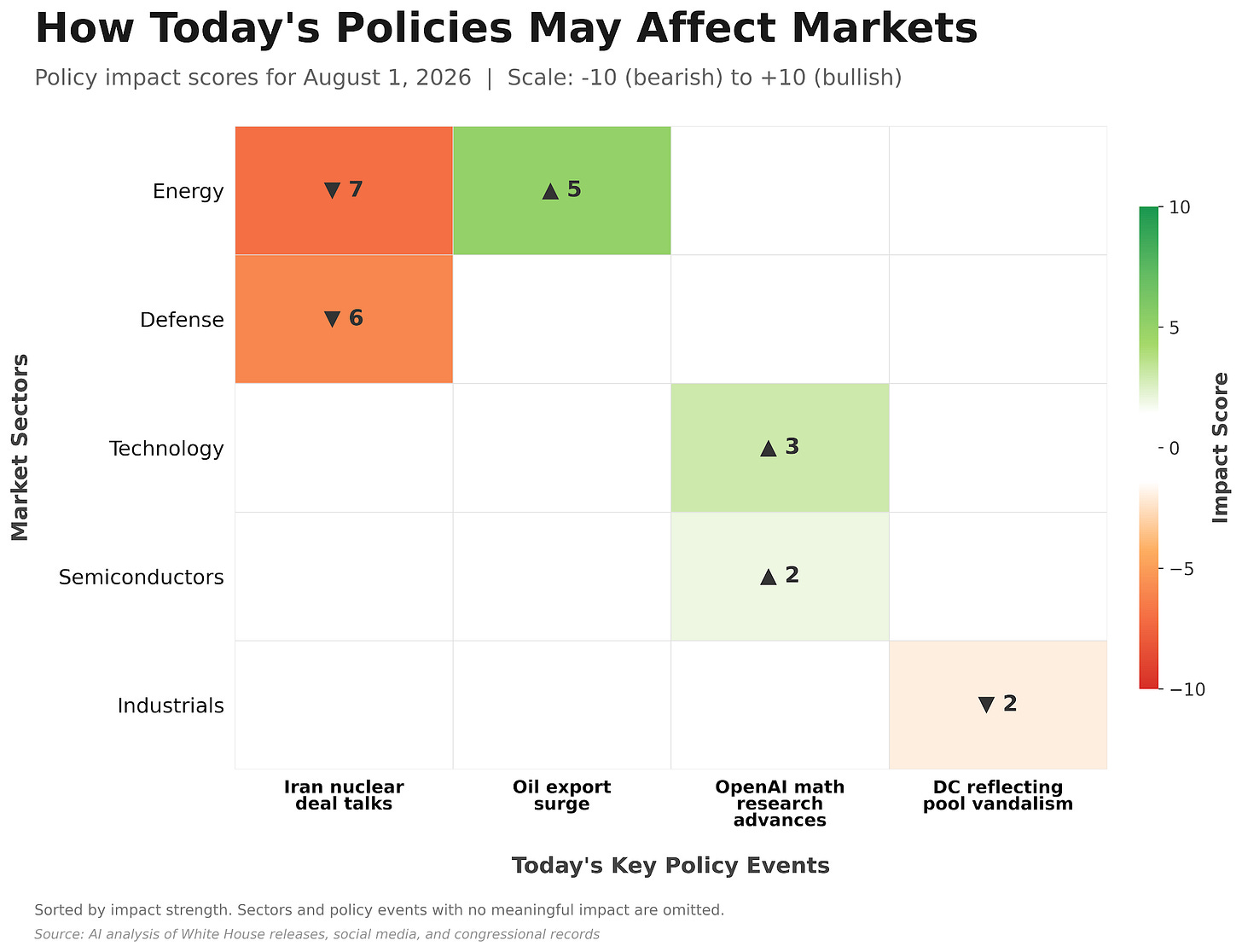
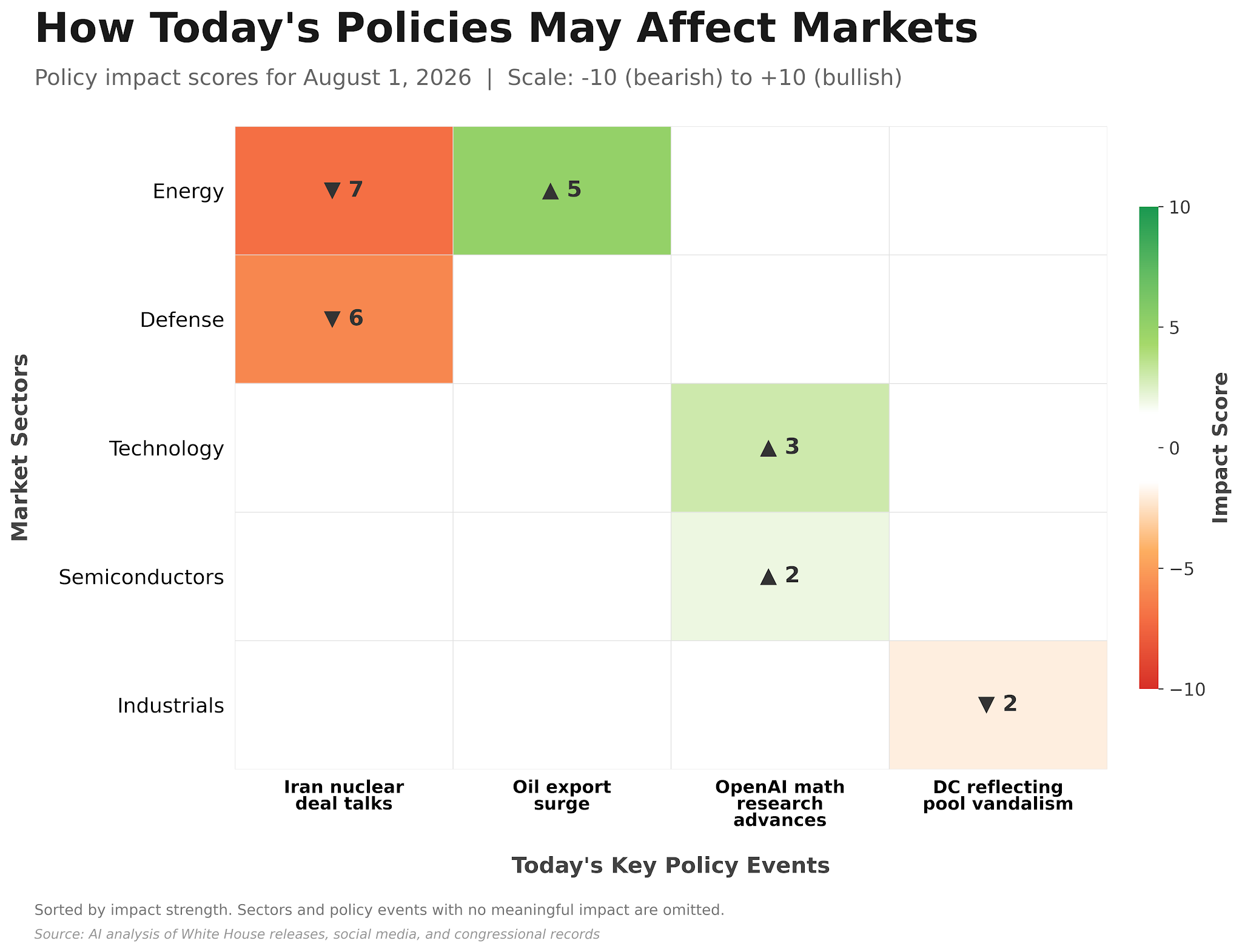
Each cell shows an estimated impact score on a fixed scale of -10 to +10, reflecting how today’s policy developments may affect each market sector. Positive scores (green, ▲) suggest bullish impact; negative scores (red, ▼) suggest bearish pressure. Rows and columns are sorted by impact strength, and sectors and policy events with no meaningful impact are omitted. The heatmap, the analysis below, and the Impact on Market themes above are produced from a single unified analysis: the heatmap visualizes the magnitudes, while the text explains the causal reasoning behind them.
Geopolitical tensions in the Middle East dominate market sentiment. The potential for a diplomatic resolution regarding the Strait of Hormuz cools immediate supply-side risks for global energy markets. A de-escalation of conflict reduces the risk premium previously baked into oil prices. Consequently, the Energy sector faces downward pressure as supply availability becomes more predictable. Defense sector expectations shift as the immediate prospect of kinetic military engagement subsides.
Simultaneously, the administration’s focus on surging oil exports provides a counter-narrative for domestic energy producers. Increased export volume supports revenue growth for traditional energy firms despite the geopolitical cooling. Separately, advancements from OpenAI in cryptography and complexity theory reinforce the growth trajectory for the broader Technology sector. While these academic breakthroughs have no immediate fiscal impact, they sustain the narrative of long-term sector superiority. Critics express concerns that administrative focus on high-profile vandalism or political spats may distract from structural economic policy implementation. Such distractions create uncertainty regarding agency focus and procurement stability for large-scale federal contractors.