Conversation
-
Washington Policy Review: August 2, 2026
sourceToday’s Report
1. Overview
2. White House News
3. Truth Social Posts
4. Government Department News
5. 2028 Democratic Presidential Candidates
6. AI & Tech Company News
7. Congressional Watch
8. Policy Impact Analysis & Heatmap
1. Overview
Trump highlighted the sweeping reforms proposed by his new NIH chief, which include the creation of a new pandemic playbook and a dedicated body to address vaccine injuries. The administration is also establishing technology “incubators” focused on developing advanced systems to counter drone terror attacks. These initiatives represent a shift in federal health policy and national security hardware development.
In a series of posts, Trump shared a positive opinion piece regarding his current energy policies while circulating a critical report concerning ongoing issues in Mexico. He highlighted a news story describing Wisconsin Governor Tony Evers’ vow to resist potential FBI efforts to seize Milwaukee election ballots. Additionally, the President promoted a column explaining the rationale behind renaming the Palm Beach airport in his honor.
In a personal update, Trump celebrated his victory in the Bedminster Club Championship after shooting a score of 70. He stated he was “so honored” by the win, noting that despite limited practice time, his performance served as evidence of pure “TALENT.” He concluded the post by asserting, “I have it, and they don’t!”
The administration’s commitment to accelerating counter-drone technology through dedicated incubators enhances the revenue outlook for tactical security and surveillance contractors, though it simultaneously creates downside risks for legacy defense programs facing potential capital reallocation. Simultaneously, proposed NIH regulatory reforms regarding vaccine liability and pandemic protocols introduce significant operational headwinds for pharmaceutical and biotech entities by increasing prospective litigation costs and disrupting established research pipelines. Underlying these shifts, the escalating friction between state executive branches and federal agencies creates a landscape of institutional volatility, which critics characterize as a “broader environment of policy unpredictability” that threatens to destabilize regional governance and market certainty.
2. White House News
No White House news found.
3. Truth Social Posts
Trump highlighted the sweeping reforms proposed by his new NIH chief, which include the development of a new pandemic playbook and the establishment of a body to address vaccine injuries. Furthermore, his administration is creating “incubators” dedicated to developing advanced technology specifically designed to counter drone terror attacks.
Regarding media and political commentary, Trump shared an opinion piece on his energy policies, circulated a report concerning issues in Mexico, and highlighted a story about Wisconsin Governor Tony Evers vowing to resist FBI efforts to seize Milwaukee ballots. He also promoted a column detailing the reasoning behind naming the Palm Beach airport in his honor.
In a personal update, Trump celebrated his victory in the Bedminster Club Championship with a score of 70. He remarked that he is “so honored” by the win, noting that despite limited practice time due to his focus on other presidential matters, the result is evidence of “TALENT,” asserting, “I have it, and they don’t!”
Reference: https://truthsocial.com/@realDonaldTrump
4. Government Department News
No relevant government department updates found for this date.
5. 2028 Democratic Presidential Candidates
No relevant 2028 Democratic candidate updates found for this date.
6. AI & Tech Company News
No relevant AI & tech company updates found for this date.
7. Congressional Watch
Covers the 2026-08-01 session — the Congressional Record is published with a one-day delay.
No Congressional Record found for 2026-08-01.
8. Policy Impact Analysis & Heatmap
This analysis is provided for informational purposes only. It does not constitute investment advice or a recommendation to buy or sell any security.
Impact on Market
Based on today’s policy developments, our analysis identifies the following market impact themes:
THEME 1. DEFENSE INNOVATION ACCELERATION
The administration is prioritizing rapid development of counter-drone technologies through new dedicated incubators. This shift directs federal capital toward tactical security and surveillance systems. Defense firms will likely see increased contract opportunities as national security threats evolve. Critics suggest this narrow focus might divert essential resources away from larger, legacy military modernization programs.
THEME 2. NIH REGULATORY UNCERTAINTY
Sweeping reforms at the NIH create a turbulent environment for the pharmaceutical and biotech industries. Proposals for a vaccine injury body signal a shift in accountability structures for large manufacturers. Potential changes to pandemic protocols may disrupt long-term research and development pipelines. Industry watchdogs warn that these reforms could increase litigation costs and stifle collaborative public-private research partnerships.
THEME 3. STATE-FEDERAL INSTITUTIONAL FRICTION
Resistance to federal election-related subpoenas highlights rising tensions between state executive branches and national agencies. Such conflicts increase institutional uncertainty and could create localized market volatility. Potential legal standoffs threaten the stability of regional governance and electoral processes. Opponents fear these recurring disputes contribute to a broader environment of policy unpredictability.
Policy Impact Heatmap with Market Direction
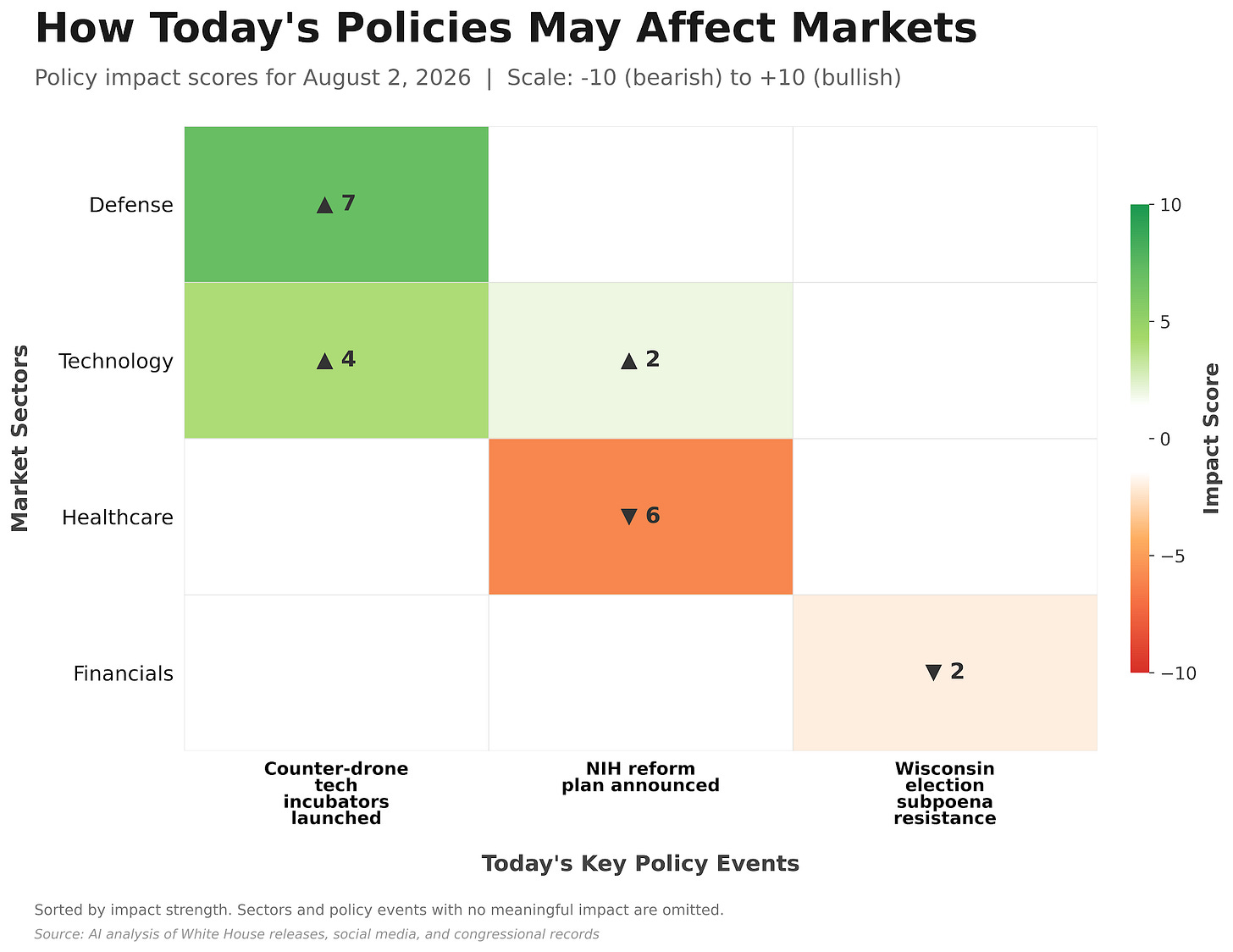
Each cell shows an estimated impact score on a fixed scale of -10 to +10, reflecting how today’s policy developments may affect each market sector. Positive scores (green, ▲) suggest bullish impact; negative scores (red, ▼) suggest bearish pressure. Rows and columns are sorted by impact strength, and sectors and policy events with no meaningful impact are omitted. The heatmap, the analysis below, and the Impact on Market themes above are produced from a single unified analysis: the heatmap visualizes the magnitudes, while the text explains the causal reasoning behind them.
The administration’s pivot toward radical NIH reform introduces significant regulatory uncertainty for the life sciences sector. Analysts highlight that a new vaccine injury body could shift litigation liabilities, impacting pharmaceutical margins. Critics argue that sudden shifts in pandemic mandates risk operational instability across healthcare research networks. Conversely, the increased funding for counter-drone tech incubators creates a clear fiscal tailwind for defense contractors.
Defense firms specializing in anti-access and area-denial systems now face an accelerated procurement cycle. These new incubators prioritize rapid innovation cycles, potentially favoring agile tech firms over traditional prime contractors. Political friction regarding federal ballot seizure creates broader regional risk premia. Markets typically view these state-versus-federal confrontations as potential sources of systemic volatility. This tension may weigh on sentiment if such disputes lead to protracted legal gridlock or institutional breakdown.