Timeline
Every post and feed across this instance
-
Retour de l’Intercollectif Personne à la Rue! suite à l’expulsion de 200 personnes vivant en bidonville à Nantes
Retour de l’Intercollectif Personne à la Rue! suite à l’expulsion de 200 personnes vivant en bidonville à NANTES
« Comme annoncé dans l’épisode précédent, le démantèlement des bidonvilles a bien eu lieu [avant-]hier, mardi 18 août.PRESENTS : l’huissier de justice, le directeur du CCAS, 8 cars de CRS, 2 dépanneuses, ENEDIS pour couper l’électricité.
Un périmètre dit de sécurité, rubalise et CRS costauds, nous a empêché de voir de près…Les familles ont été invitées à sortir leurs caravanes (qui sont leur logement et pas toujours roulantes) et si elles ne savaient pas où aller, à les ranger le long de la route (qui est une route à grande circulation). et à quitter le terrain. L’assurance leur a été données qu’elles pourraient venir récupérer leurs biens restés sur le terrain. L’opération étaient terminée en début d’après midi et une quarantaine de caravanes étaient le long de la route…Dans la soirée, la police est passée diasant que les caravanes qui seraient encore là le lendemain (jeudi 19) seraient mises à la fourrière. Précisons qu’il ne s’agit pas de caravanes pour faire du tourisme mais du logement des personnes.
Ce matin, dès potron minet, nous étions présents.Le nombre de caravanes avait un peu diminué. Les personnes avaient passé la nuit dans les caravanes, mal calées, sans eau, La police n’est pas venue. Les familles ne savent pas où aller, tous le terrains vides autour sont fermés et de toutes façons, là où ils iront, ils seront immédiatement virés. Alors, ils attendent, les enfants sortent des caravanes et la circulation continue, les personnes âgées, malades paniquent…certain-es sont parti-es au travail, pas d’eau, pas de moyen de cuisiner…La vie continue.Pendant ce temps, le chantier d’enrochement des terrains bat son plein et la destruction des cabanes…
Le responsable de la plate forme de résorption des bidonvilles est passé car nous avons signalé plusieurs personnes malades qui auraient dû être mises à l’abri si le bilan social avaient bien été réalisé avavaient avant l’expulsion… »L’intercollectif organise une conférence de presse vendredi pour dénoncer cette impreparation et ses conséquences humaines.


-
Le GTA 6 qui a fuité tourne-t-il déjà sur PC ?

Plusieurs détails aperçus dans les nouvelles vidéos de GTA 6 ont relancé l’hypothèse d’une version PC déjà fonctionnelle. Mais qu'en est-il vraiment ?
-
ChatGPT Ads arrive en Europe : la publicité s’invite dans vos conversations avec l’IA
Ce qu'il faut retenir :
- 31 marchés européens concernés dès le 24 août 2026, parmi lesquels la France, l'Allemagne, l'Espagne, l'Italie, la Suède, la Norvège, le Danemark, les Pays-Bas et l'Autriche.
- L'accès se fait dans un premier temps via des intermédiaires : l'équipe Ads Solutions d'OpenAI, des agences partenaires et des partenaires technologiques. Le libre-service par Ads Manager n'arrivera que plus tard dans le trimestre.
- Seuls les utilisateurs des offres Free et Go verront des publicités. Les abonnés Plus, Pro et Enterprise conservent une expérience sans publicité.
- Les publicités sont clairement identifiées et séparées des réponses de ChatGPT, et OpenAI affirme qu'elles n'influencent pas le contenu généré par l'IA.
Un lancement pensé pour capter les décisions d'achat
Dans sa communication officielle, OpenAI justifie cette expansion par la nature même des usages observés sur ChatGPT. Les utilisateurs ne tapent plus de simples mots-clés comme sur un moteur de recherche classique : ils décrivent un objectif, un projet, des contraintes précises. Préparer un voyage, choisir un logiciel professionnel, meubler un appartement ou se lancer dans un nouveau loisir font partie des exemples cités par l'entreprise.
Pour OpenAI, ChatGPT est ainsi devenu un espace où les décisions se construisent progressivement, ce qui en fait un terrain particulièrement intéressant pour les annonceurs. L'objectif affiché est de permettre aux marques d'intervenir à différentes étapes du parcours client, au moment où les utilisateurs comparent leurs options et s'apprêtent à trancher.
Un modèle économique qui protège les abonnés payants
Point important pour les utilisateurs de ChatGPT : les publicités ne toucheront que les comptes gratuits (Free) et l'offre Go. Les formules payantes, Plus, Pro et Enterprise, resteront sans publicité. Cette répartition suggère qu'OpenAI utilise la publicité comme un levier pour financer l'accès gratuit ou peu coûteux à son service, plutôt que comme une source de revenus généralisée à l'ensemble de sa base d'utilisateurs.
Une plateforme construite étape par étape depuis février
Le lancement européen ne sort pas de nulle part. OpenAI rappelle avoir commencé à tester la publicité dans ChatGPT en février, avec un projet pilote limité aux États-Unis. Au fil des six derniers mois, l'entreprise a progressivement étendu le dispositif à huit marchés supplémentaires avant d'annoncer cette arrivée massive en Europe.
En parallèle, l'infrastructure publicitaire elle-même s'est étoffée :
- Le système d'enchères a démarré au CPM, avant l'ajout du CPC, puis du CPC optimisé pour les conversions (oCPC), permettant aux annonceurs d'aligner leurs campagnes sur leurs objectifs commerciaux réels.
- Le ciblage géographique et les audiences personnalisées ont été intégrés pour aider les entreprises à toucher les profils les plus pertinents.
- Le suivi des performances a été enrichi au-delà du simple clic, avec le lancement d'OpenAI Pixel, d'une API Conversions et d'intégrations de mesure avec des outils tiers, donnant aux annonceurs une vision plus complète de l'impact réel de leurs campagnes.
OpenAI indique que des dizaines de milliers d'annonceurs ont déjà utilisé ChatGPT pour développer leur activité depuis le lancement du pilote. L'inscription pour les entreprises intéressées se fait sur ads.openai.com.
L’article "ChatGPT Ads arrive en Europe : la publicité s’invite dans vos conversations avec l’IA" a été publié sur le site Abondance.
-
Commémoration du 61e anniversaire de la tragédie de 1965-66 en Indonésie
Quand ?
Le 6 septembre de 10h à 18hOù ?
Shakirail 72, rue Riquet, 75019, Paris, FranceEn commémorant le 61e anniversaire de la tragédie 1965-66 en Indonésie, cette année "Solidarité Indonésie" organise un petit festival des films de Watchdoc sur la lutte du peuple indonésien contre le colonialisme, la destruction de l'environnement et l'accaparement de terre de la part de l'État indonésien ou des grandes entreprises indonésiennes ou étrangères.
- Voir aussi : Shakirail
-
Commémoration de 61e anniversaire de la tragédie de 1965-66 en Indonésie
Quand ?
Le 6 septembre de 10h à 18hOù ?
Shakirail 72, rue Riquet, 75019, Paris, FranceEn commémorant le 61e anniversaire de la tragédie 1965-66 en Indonésie, cette année "Solidarité Indonésie" organise un petit festival des films de Watchdoc sur la lutte du peuple indonésien contre le colonialisme, la destruction de l'environnement et l'accaparement de terre de la part de l'État indonésien ou des grandes entreprises indonésiennes ou étrangères.
- Voir aussi : Shakirail
-
Impacts de l’omnibus numérique sur la cybersécurité

Depuis février 2025, en réponse à la demande du Conseil européen, la Commission européenne a présenté au Conseil et au Parlement, pour adoption, douze propositions de simplification, également appelées « trains de mesures omnibus ».
En particulier, le septième train de mesures, proposé par la Commission le 19 novembre 2025, comprend les deux textes suivants visant à simplifier le cadre législatif pour le numérique :
- la proposition de règlement dit « Omnibus numérique » (1) modifiant plusieurs règlementations relatives aux données dont notamment le règlement général sur la protection des données (RGPD) (2), le règlement européen sur la protection des données (RPDUE) (3) et la directive « vie privée et communications électroniques » (4) ;
- le règlement dit « Omnibus numérique sur l’IA » (5), relatif à la simplification de la mise en œuvre des règles harmonisées concernant l’intelligence artificielle, dont le règlement sur l’IA (RIA) (6) qui a été définitivement adopté le 29 juin 2026 ;
Ces textes visent à simplifier le cadre législatif applicable aux données et à l’intelligence artificielle, mais ont également des impacts sur la cybersécurité.
En effet, face à l’accumulation de normes sectorielles et transversales, les directions juridiques et les responsables de la sécurité des systèmes d’information (RSSI) peinent à rationaliser leurs politiques de conformité.
Constat d’un empilement réglementaire en matière de notification cyber
L’obligation de notifier les incidents de sécurité varie aujourd’hui d’un texte à l’autre, créant de l’incertitude juridique et des doublons opérationnels. Ainsi :
- en vertu de l’article 23 de la directive NIS 2 (7), tout « incident important (significant incident) », susceptible de causer une perturbation grave des services ou des pertes financières ou matérielles importantes, doit être notifié par les entités essentielles et importantes au CSIRT national compétent (l’ANSSI en France). La procédure s’articule en trois temps : les entités doivent transmettre une alerte précoce dans un délai de 24 heures à compter de la prise de connaissance, suivie d’une notification d’incident complète sous 72 heures, puis soumettre un rapport final détaillant la cause racine au plus tard un mois après l’alerte précoce ;
- conformément aux obligations de notification du Cyber Resilience Act ou CRA (8), les fabricants de produits comportant des éléments numériques doivent signaler toute vulnérabilité exploitée activement ou tout incident de sécurité majeur impactant leurs matériels ou logiciels. L’information doit être transmise au CSIRT (Centres de réponse aux incidents de sécurité informatique) désigné ainsi qu’à l’ENISA (Agence de l’Union européenne pour la cybersécurité) via une plateforme centralisée. Le calendrier impose une alerte précoce à émettre sous 24 heures après en avoir eu connaissance, une notification détaillée intégrant les premières mesures d’atténuation sous 72 heures, et la fourniture d’un rapport final de résolution (ou la mise à disposition d’un correctif) dans un délai d’un mois ;
- en vertu de l’article 19 du règlement DORA (9), les entités financières doivent notifier tout « incident majeur lié aux TIC » (technologies de l’information et de la communication) aux autorités nationales compétentes (telles que l’ACPR -Autorité de contrôle prudentiel et de résolution- ou l’AMF -Autorité des marchés financiers- en France). La procédure de déclaration s’effectue en trois étapes : l’entité doit transmettre une notification initiale sans délai (au plus tard dans les 4 heures suivant la qualification de l’incident comme majeur ou 24 heures après en avoir pris connaissance), suivie d’un rapport intermédiaire dans un délai de 72 heures, et enfin soumettre un rapport final détaillant l’analyse des causes fondamentales et l’impact financier au plus tard un mois après la résolution de l’incident ;
- aux termes de l’article 73 du RIA, les fournisseurs de systèmes d’IA à haut risque et de modèles d’IA à usage général sont tenus de déclarer tout « incident grave », tel qu’une atteinte à la santé ou aux droits fondamentaux, un décès ou une perturbation majeure d’infrastructures critiques. La notification doit être adressée aux autorités de surveillance du marché nationales et au Bureau européen de l’IA (AI Office). Elle doit intervenir immédiatement et au plus tard dans un délai de 15 jours à compter de la prise de connaissance de l’incident, ce délai étant ramené à 72 heures ou sans délai en cas d’urgence absolue de sécurité publique ;
- en vertu de l’article 33 du RGPD, toute « violation de données à caractère personnel » susceptible de présenter un risque pour les droits et libertés des personnes physiques doit être notifiée à la Cnil. Ainsi, les responsables du traitement (ou les sous-traitants le cas échéant) doivent notifier dans un délai de 72 heures au plus tard après en avoir pris connaissance. En outre, les personnes concernées doivent également être informées lorsque cette violation est susceptible d’engendrer un risque élevé pour leurs droits et libertés, en vertu de l’article 34 du RGPD.
Ce chevauchement engendre un risque de sur-notification et une mobilisation inefficace des équipes de crise.
Impacts de l’omnibus numérique sur ces obligations de notifications
Face au chevauchement de ces régimes (NIS 2, DORA, RGPD, CRA, RIA), la Commission européenne a soumis le septième train de mesures « Omnibus numérique », afin de rationaliser le droit du numérique européen.
Ce train de mesures adapte les règles sectorielles pour éviter qu’un même incident (ex. un ransomware touchant un logiciel médical géré par une IA) n’oblige l’entreprise à rédiger quatre déclarations parallèles avec des repères temporels contradictoires (24h, 72h, 15j).
Il modifie et précise les dispositions du RGPD en matière de notification pour aligner les règles sur la logique Cyber (NIS 2 / DORA / CRA / RIA). L’objectif est d’éviter la « sur-notification » préventive à la Cnil pour les incidents purement techniques où l’atteinte aux données n’est pas encore établie.
A ce titre, dans un avis commun (10) , le Comité européen de la protection des données (CEPD/EDPB) et le Contrôleur européen de la protection des données (CEPD/EDPS) sont favorables à l’augmentation du seuil de risque conduisant à l’obligation de notifier une violation de données à l’autorité de protection des données compétente et à la prolongation du délai pour soumettre une telle notification car cela réduirait considérablement la charge administrative pesant sur les organisations sans porter atteinte à la protection des données à caractère personnel des personnes.
Pour les systèmes d’IA intégrés dans des secteurs critiques couverts par NIS 2 ou DORA, les obligations de déclaration sous le RIA sont réarticulées : si un incident d’IA relève d’une attaque de cybersécurité sans violation directe des droits fondamentaux, les canaux de déclaration NIS 2 / DORA priment afin d’éviter les doublons déclaratifs.
Omnibus numérique : Vers un guichet unique de notification des incidents
Le Guichet Unique de Notification (Single-Entry Point ou SEP) est l’innovation centrale du paquet Omnibus numérique pour concrétiser la simplification administrative.
Il s’agit d’une plateforme numérique centralisée à l’échelle européenne, développée et maintenue sous la responsabilité de l’ENISA (Agence de l’UE pour la cybersécurité) qui permet :
- une saisie unique : l’entreprise renseigne les faits (nature de l’attaque, périmètre des données touchées, systèmes d’IA impactés, mesures prises) ;
- un routage automatique intelligent : le système de l’ENISA ventile et transmet immédiatement les données pertinentes aux différentes autorités nationales et européennes concernées en fonction du champ d’application de l’incident (ex. transmission simultanée du volet données à la Cnil et du volet sécurité à l’ANSSI).
- l’utilisation de formulaires standardisés : les champs de saisie, la qualification des seuils d’impact et les typologies d’indicateurs de compromission (IoC) sont unifiés.
Ainsi, au lieu d’alimenter séparément les portails de la Cnil, de l’ANSSI, de la DGCCRF ou du Bureau de l’IA, l’entité victime d’un incident remplit un formulaire unifié en ligne.
Conclusion
En anticipant cette convergence des règlementations et des obligations de notification, les entreprises pourraient se doter d’une réelle valeur ajoutée stratégique : passant d’une conformité subie à un levier d’agilité organisationnelle et commerciale.
Pour cela, ces acteurs doivent mettre à jour leurs trames contractuelles avec leurs fournisseurs TIC et revoir ou prévoir leurs procédures de gestion d’incidents pour s’adapter à la rationalisation des règles.
(1) Proposition de règlement dit « omnibus numérique » : Proposition de règlement du Parlement Européen et du Conseil modifiant les règlements (UE) 2016/679, (UE) 2018/1724, (UE) 2018/1725 et (UE) 2023/2854 ainsi que les directives 2002/58/CE, (UE) 2022/2555 et (UE) 2022/2557 en ce qui concerne la simplification du cadre législatif numérique, et abrogeant les règlements (UE) 2018/1807, (UE) 2019/1150 et (UE) 2022/868 ainsi que la directive (UE) 2019/1024.
(2) RGPD : Règlement (UE) 2016/679 du Parlement européen et du Conseil du 27 avril 2016 relatif à la protection des personnes physiques à l’égard du traitement des données à caractère personnel et à la libre circulation de ces données, et abrogeant la directive 95/46/CE.
(3) RPDUE : Règlement (UE) 2018/1724 du Parlement européen et du Conseil du 2 octobre 2018 établissant un portail numérique unique pour donner accès à des informations, à des procédures et à des services d’assistance et de résolution de problèmes, et modifiant le règlement (UE) n° 1024/2012.
(4) « Vie privée et communications électroniques » : Directive 2002/58/CE du Parlement européen et du Conseil du 12 juillet 2002 concernant le traitement des données à caractère personnel et la protection de la vie privée dans le secteur des communications électroniques.
(5) « Omnibus numérique sur l’IA » : Règlement (UE) 2026/1744 du Parlement européen et du Conseil du 8 juillet 2026 modifiant les règlements (UE) 2024/1689, (UE) 2018/1139 et (UE) 2023/1230 en ce qui concerne la simplification de la mise en œuvre des règles harmonisées concernant l’intelligence artificielle.
(6) RIA : Règlement (UE) 2024/1689 du Parlement européen et du Conseil du 13 juin 2024 établissant des règles harmonisées concernant l’intelligence artificielle et modifiant les règlements (CE) n° 300/2008, (UE) n° 167/2013, (UE) n° 168/2013, (UE) 2018/858, (UE) 2018/1139 et (UE) 2019/2144 et les directives 2014/90/UE, (UE) 2016/797 et (UE) 2020/1828.
(7) NIS 2 : Directive (UE) 2022/2555 du Parlement européen et du Conseil du 14 décembre 2022 concernant des mesures destinées à assurer un niveau élevé commun de cybersécurité dans l’ensemble de l’Union, modifiant le règlement (UE) no 910/2014 et la directive (UE) 2018/1972, et abrogeant la directive (UE) 2016/1148.
(8) Cyber Resilience Act ou CRA : Règlement (UE) 2024/2847 du Parlement européen et du Conseil du 23 octobre 2024 concernant des exigences de cybersécurité horizontales pour les produits comportant des éléments numériques et modifiant les règlements (UE) n° 168/2013 et (UE) 2019/1020 et la directive (UE) 2020/1828.
(9) DORA : Règlement (UE) 2022/2554 du Parlement européen et du Conseil du 14 décembre 2022 sur la résilience opérationnelle numérique du secteur financier et modifiant les règlements (CE) no 1060/2009, (UE) no 648/2012, (UE) no 600/2014, (UE) no 909/2014 et (UE) 2016/1011.
(10) Avis commun du CEPD du 10 février 2026 : EDPB-EDPS Joint opinion 2/2026 on the Proposal for a Regulation as regards the simplification of the digital legislative framework (Digital Omnibus) (en anglais). Anthony Coquer
Directeur général de Lexing Technologies Carl Buffière
Responsable d’activité au sein de Lexing Technologies

L’article Impacts de l’omnibus numérique sur la cybersécurité est apparu en premier sur Lexing Avocats.
-
Vous vouliez une France sans « wesh » ni « wallah » ? Dommage. On arrive !
Ces derniers jours, des vidéos de paysages montagneux ont suscité une série de commentaires racistes célébrant des espaces prétendument épargnés par les « wesh », les « wallah » et les femmes voilées. Derrière ces réactions se dessine une vieille idée : certains coins de France n'appartiendraient pas à certains Français. Pour Sofiane Zerouala, la réponse tient en deux mots : « On arrive ! »
The post Vous vouliez une France sans « wesh » ni « wallah » ? Dommage. On arrive ! appeared first on Bondy Blog.
-
[BruitsDeToles] Bruits de tôles – Émission du 20 août 2026
Au sommaire de Bruits de Tôles le 20 août 2026 : Un dossier sur les QLCO (quartiers de lutte contre la criminalité organisée Relaxe pour l’envoi d’une souris à l’administration pénitentiaire pour dénoncer les conditions de détention Acharnement de l’administration pénitentiaire et tentative de suicide de Mickaël Gilgenmann Gino extradable vers l’Allemage Libération d’une détenue kurde après 30 ans d’enfermement Des arrestations préventives dans le cadre de la lutte contre le TGV (…)
-
Sécheresse : plusieurs golfs dégradés en France
Alors la population fait face à des restrictions d'eau drastiques, la bourgeoisie continue d'envoyer des petites balles dans des trous.
L’article Sécheresse : plusieurs golfs dégradés en France est apparu en premier sur Contre Attaque.
-
La fin d'un « acharnement » envers le grand tétras ? Le ministère envisage d'abandonner sa réintroduction dans les Vosges

Le ministère de la Transition écologique prévoirait de stopper la réintroduction de cet oiseau dans les Vosges dès la fin de la campagne en cours. Plusieurs associations, qui qualifient ce programme d'« acharnement », s'en félicitent.
Lire la suite - Info / Animaux
Le chant du grand tétras va-t-il disparaître dans les forêts des Vosges ? Selon plusieurs sources indépendantes, contactées par Reporterre, le ministère de la Transition écologique prévoirait de ne pas prolonger les efforts déployés pour préserver cet (…) -
IA quelqu’un ? (1/2) L’hypothèse du cerveau de silicium
Premier épisode de notre enquête sur la possibilité d’une intelligence artificielle douée de conscience. En 2022, Blake Lemoine, ingénieur chez Google, jure entrevoir un esprit dans l’IA sur laquelle il travaillait, avant d’être licencié et désigné comme un illuminé. L’écrivain Loïc Hecht, fin connaisseur de la Silicon Valley, interroge scientifiques et philosophes sur l’émergence d’une conscience de la machine. Tout en se lançant à la recherche de Lemoine…
The post IA quelqu’un ? (1/2) L’hypothèse du cerveau de silicium appeared first on Revue21.fr.
-
Ephéméride des luttes : 21 août

Le 21 août, l'éphéméride des luttes cherche à détruire les chaînes de l'esclavage et de l'exploitation pour que tous et toutes soient libres. Par le feu et par la poudre, pour faire tomber les murs.
1680 : Dans ce qui est aujourd'hui le Nouveau Mexique, le peuple Pueblo s'empare de la ville de Santa Fe et en chassent les colons espagnols, lors de la révolte des Pueblo.
1791 : Début de la révolte des esclaves Noirs de Saint-Domingue.
1852 : En Amérique du Nord, les Indien-ne-s Tlingit détruisent le Fort Selkirk, sur le territoire du Yukon.
1967 : A Londres, le Mouvement de Solidarité Révolutionnaire International mitraille l'ambassade américaine.
1968 : Les chars soviétiques pénètrent en Tchécoslovaquie pour y réimposer l'ordre.
1971 : Prison de San Quentin, aux États-Unis, George Jackson (du Black Panther Party, auteur des 'Frères de Soledad') est abattu par des gardes. Ceux-ci l'accusent d'avoir été en train d'essayer de s'évader de la prison.

1976 : Aux Etats-Unis, début d'une occupation de deux jours de la centrale nucléaire de Seabrook.
1981 : Dans le Tarn-et-Garonne, à Goudourville, le groupe Colt 45 (Coordination Ouvrière pour la Liquidation des Travaux) revendique le fait d'avoir tiré plusieurs balles contre le domicile du chef de chantier du projet de centrale nucléaire de Golfech, alors que la maison était vide.
« Pourquoi un attentat chez M. Silberstein ? C'est la confusion général à Golfech : le gel de la centrale est décidé à Paris mais les travaux continuent sur le site ; les entrepreneurs risquent de perdre quelques contrats mais ce sont les ouvriers qui manifestent et assurent la défense des intérêts patronaux. Dans cette incroyable pagaille, M. Silberstein reste lucide, il arrive même à distinguer “une dizaine d'ouvriers excités par une éventuelle perte d'emploi”. Il comprend, il vient même à justifier leurs exactions contre les antinucléaires : menace contre les occupants de la Rotonde ; cassage de gueules, voitures saccagées et brûlées, tracteur incendié le 16 août. Mais les responsables d'EDF se trompent s'ils croient que nous allons nous préoccuper de quelques castagneurs et les oublier, eux, qui tirent les ficelles… Erreur… Erreur qui pourrait devenir fatale… »
2009 : A Rovolon, près de Padoue en Italie, l'ALF (Front de Libération Animale) incendie une villa, la remise à outils, la fourgonnette, le tracteur et plusieurs véhicules de propriétaires d'un élevage de visons, faisant plus de 100.000 euros de dégâts.
Voir l'éphéméride anarchiste du 21 août.
-
Qu'aurait pensé Tocqueville de la politique de Trump ?
Donald Trump aurait-il fasciné ou effrayé Alexis de Tocqueville ? Pour Eric Keslassy, la pensée de l’auteur de l'ouvrage De la démocratie en Amérique reste extraordinairement moderne et éclaire les dérives à l'œuvre aux Etats-Unis. -
«Chaque année, des plus gros morceaux de roche tombent de la montagne» : le massif du Mont-Blanc éprouvé par le réchauffement climatique
 Juillet 2025. Sur le glacier du Tour, à Chamonix, des alpinistes grimpent jusqu’au refuge Albert 1er d’où l’on peut atteindre facilement les voies réputées du massif du Mont-Blanc. © Capucine Veuillet/AFP
 Tout l’été, Vert vous emmène à la découverte d’un site touristique emblématique percuté par le changement climatique.
Île d’Oléron, GR20 en Corse, Mont-Saint-Michel… Découvrez comment ces endroits se transforment et essayent de s’adapter à un monde en surchauffe. Cette semaine, nous partons dans le massif du Mont-Blanc. Avec la hausse des températures qui provoque des éboulements de plus en plus importants, le plus haut sommet français devient une menace pour les alpinistes.
Retrouvez tous les épisodes de notre série d’été en cliquant ici.C’est une ascension mythique que tentent en moyenne 200 personnes chaque jour de l’été, soit 15 000 à 20 000 par an. Grimper le mont Blanc, plus haut sommet d’Europe occidentale avec ses 4 805 mètres, a toujours été une prouesse. Mais de nouveaux obstacles se sont invités sur la route des amoureux·ses de la montagne depuis que Jacques Balmat et Michel-Gabriel Paccard en ont atteint le point culminant pour la première fois en 1786.
«La pratique de l’alpinisme est confrontée à une modification profonde de son terrain de jeu, que ce soit au niveau des glaciers ou des parois rocheuses», constate Ludovic Ravanel, directeur de recherche en géomorphologie au Centre national de recherche scientifique (CNRS) et accompagnateur en montagne.
En cause : la dégradation du permafrost, ce sol maintenu à une température inférieure à zéro degré Celsius depuis des dizaines de milliers d’années. Il est constitué d’une couche de glace extrêmement épaisse qui se réchauffe sous l’effet du changement climatique, fond et déstabilise les roches qu’elle maintenait reliés.
Mi-août, sécheresse et canicules empêchent l’ascension du mont Blanc
«La glace a un rôle de ciment de la montagne, explique l’expert. Quand il n’y en n’a plus, des pans entiers s’effondrent, et ces évènements sont de plus en plus nombreux car la dégradation du permafrost est profonde et intense.» On parle d’éboulements pour les rochers de moins de 100 mètres-cubes (m3) qui dégringolent, d’écroulements pour les plus volumineux, voire d’avalanches rocheuses lorsque des morceaux de plus de 100 000 m3 s’effondrent. Cet été 2026 marque un record d’écroulements dans le massif du Mont-Blanc selon l’expert, avec 450 contre 300 en 2022.
«Des morceaux plus gros tombent de la montagne quasiment chaque été», alerte le scientifique. Les alpinistes ont pris conscience depuis une vingtaine d’années que la crise climatique impactait de plein fouet le massif du Mont-Blanc. A l’époque, les écroulements se comptaient seulement par dizaines sur l’année. «Il y a eu plusieurs coups d’accélérateurs dans les Alpes, en 2003 bien sûr [année de la canicule la plus intense avant 2026, NDLR], en 2015 où la fermeture administrative du refuge du Goûter [situé sur la Voie normale vers le sommet, NDLR] a été déclarée tellement les conditions étaient mauvaises, et de nouveau en 2022, où l’ascension du mont Blanc était fortement déconseillée», se souvient Ludovic Ravanel.
Avec ses canicules à répétition et sa sécheresse historique, 2026 vient s’ajouter au panel. La mairie de Saint-Gervais-les-Bains (Haute-Savoie) a annoncé le 11 août la fermeture administrative des refuges du Goûter et de Tête Rousse, indispensables à l’ascension par la Voie normale, celle qui est la plus empruntée par le grand public. Le but : dissuader les plus audacieux·ses de monter malgré des conditions très dégradées. Les guides de la compagnie de Chamonix, conscient·es des risques cette saison, avait déjà cessé d’emprunter l’itinéraire une quinzaine de jours auparavant.
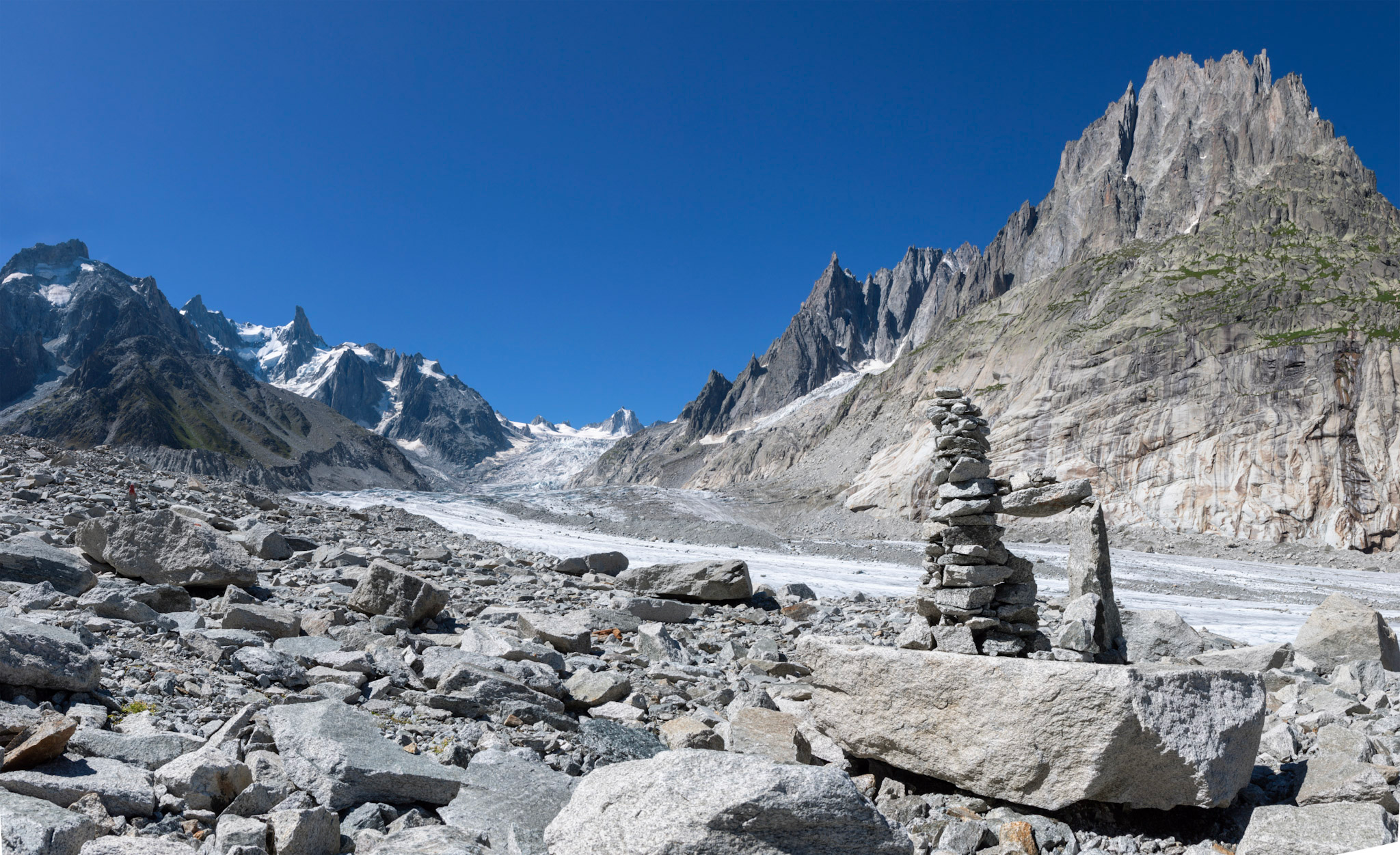 Le cours d’eau glaciaire de la Mer de Glace, avec en arrière-plan les Grandes Jorasses et les Aiguilles. © Renáta Sedmáková/AdobeStock
«Cette année marque encore un nouvelle prise de conscience que la haute montagne est extrêmement sensible à la crise climatique, remarque le géomorphologue. Plein d’itinéraires ne se font plus cet été, comme la voie normale de la Tour ronde. L’arrête des Cosmiques se fait encore, mais en évitant certains secteurs. Le mont Blanc par Chamonix ne se fait plus car il y a des crevasses trop énormes».
Un quart des itinéraires devenus infréquentables
Dans le massif du Mont-Blanc, comme dans celui de la Vanoise ou des Écrins, «25% des itinéraires sont devenus infréquentables l’été en raison du changement climatique», souligne le géographe et accompagnateur en montagne Jacques Mourey. «Soit ils sont trop dangereux à cause des crevasses ou des écroulements, soit ils sont devenus techniquement trop difficiles, ou alors ils souffrent d’un manque d’esthétisme qui décourage les passionnées», détaille-t-il.
«On entendait les pierres tomber […]. À l’aller une d’entre elles est tombée juste devant moi.»
Le couloir du Goûter est devenu emblématique de la multiplication des risques d’écroulement. Passage obligé pour atteindre le sommet du mont Blanc par la voie normale, il a été renommé ces dernières années le «couloir de la mort». En été, les chutes de pierres y sont continues et les accidents fréquents. Cet été, trois montagnard·es y ont perdu la vie.
Gabrielle Larricq, alpiniste en herbe, l’a emprunté sans guide à la fin du mois d’août 2025. «J’ai très mal vécu ce passage, confie-t-elle. Avec mon cousin, nous savions que cette période n’était pas idéale pour l’ascension parce qu’il fait plus chaud et que la montagne est davantage instable, mais il n’y avait plus de places au refuge plus tôt dans la saison.»
«On s’est approché doucement puis on a couru, raconte la jeune femme. On a fait le choix de ne pas s’encorder à ce moment là, on n’a pas regardé en haut, on entendait les pierres tomber car elles ne s’arrêtent pas de chuter. Parfois c’est du gravier, parfois c’est des gros morceaux. À l’aller une d’entre elles est tombée juste devant moi.»
Des ascensions en trois jours, plutôt que deux
D’après une étude de l’université Savoie Mont-Blanc et de l’Institut de géographie alpine sur la déstabilisation de la zone, la saison estivale se divise maintenant en deux temps. Au début de l’été, le couloir subit des éboulements car la neige se transforme en eau et détache de petits blocs de pierre. Dans la deuxième partie de la saison, la situation s’empire et le déneigement complet provoque des écroulements plus dangereux. «Cette saison arrive de plus en plus tôt», avertit Ludovic Ravanel.
Aujourd’hui, chercheur·ses et guides recommandent de faire l’ascension en trois jours plutôt que les deux habituels. Cela permet de passer le couloir du Goûter au petit matin, à l’heure où le soleil ne tape pas encore directement sur la roche. Les décrochements de pierres sont alors moins importants.
Malgré la multiplication des risques, «il n’y a pas d’augmentation du nombre d’accidents car la communauté des alpinistes s’organise», constate Ludovic Ravanel. Quand les guides se mettent à éviter certains secteurs, nombre d’amateur·ices suivent le pas.
Plus de sommet à tout prix : changer le rapport à la montagne
«La situation ne va pas s’améliorer, c’est clair, mais l’alpinisme ne va pas mourir ni dans dix ans ni dans 100 ans, souligne le chercheur. Par contre, on ne pourra pas pratiquer la montagne comme aujourd’hui, de la même manière qu’on ne pratique déjà plus la montagne comme avant». Parmi les changements d’habitude : la haute saison, autrefois en juillet-août, couvre désormais juin-juillet. Les fenêtres de sorties sont plus courtes et les conditions plus aléatoires. «Il faut d’autant plus préparer son itinéraire en amont, se renseigner le jour même, appeler les gardiens si besoin pour savoir comment est le terrain, énumère Jacques Mourey. Impossible d’utiliser de vieux topos tant les voies changent vite.»
Si les habitué·es du massif du Mont-Blanc ne sont plus surpris·es par la détérioration de la montagne, ils et elles s’émeuvent toujours de la voir se transformer sous leurs yeux. «Cet été, l’état de l’arrête de l’Aiguille du midi est marquant, relève Didier Tiberghien, directeur technique de la compagnie des guides de Chamonix. Normalement elle est belle, couverte de neige avec une jolie trace qui se faufile. Cette année, c’est de la glace avec des rochers qui en sortent comme si on avait passé un coup de sèche-cheveux géant.»
 Un éboulement à l’Aiguille du midi, le 12 août dernier. © Antoine Brulport
Les guides se préparent à ces bouleversements depuis une dizaine d’années et ont diversifié leurs offres pour adapter leur modèle économique aux conditions. «2017 a été un tournant, explique Didier Tiberghien. On a pris la décision de rendre notre offre d’alpinisme moins dépendante des conditions de la montagne». Cette année-là, l’institution divise par deux son volume d’activité sur le Mont-Blanc, une mesure qui répond aussi à la surfréquentation de la voie.
Elle propose aujourd’hui davantage de stages pour apprendre l’alpinisme, ainsi que de l’escalade, de la randonnée ou encore du canyoning. «On travaille à un changement de culture : le client ne vient plus venir faire spécifiquement un sommet, car celui-ci ne sera pas toujours accessible, mais plutôt partager une expérience en montagne et apprendre un savoir-faire», précise Didier Tiberghien.
Le manque d’eau, «une épée de Damoclès au dessus de la tête des gardiens»
Les gardien·nes de refuges de haute montagne aussi ont dû s’adapter. Comme les guides, plusieurs choisissent d’ouvrir leur établissement plus tôt dans l’année. La fréquentation est bien plus variable. Au refuge du Couvercle, les montagnard·es se font plus rares au cœur de l’été, lorsque les itinéraires à proximité sont trop dégradés et difficiles. Les touristes affluent au contraire en masse sur de courtes périodes dès que les conditions sont propices. Les fins de saison, elles, deviennent plus compliquées : l’eau qui alimente les refuges, qu’elle vienne de petits cours d’eau ou d’un lac, se fait plus rare.
«C’est une épée de Damoclès au dessus de la tête des gardiens, relève Maria Isabel Lemeur, responsable hébergement à la Fédération française des clubs alpins de montagne (FFCAM). Cet été a commencé sur des conditions déjà dégradées avec la sécheresse.» Pour l’instant, pas de rupture d’approvisionnement. «On est sur la corde raide mais on tient grâce aux petites pluies», note-t-elle. D’année en année, la FFCAM adapte son parc de refuges à la diminution de la ressource. «On ne peut pas tout faire d’un coup car c’est un gros budget, mais on a installé des réserves d’eau, surtout au refuge du Couvercle, ça permet d’avoir plusieurs semaines d’autonomie, on met aussi en place plus de toilettes sèches», liste-t-elle.
«Ne pas pouvoir faire l’ascension du mont Blanc, c’est aussi l’occasion de découvrir des sommets moins célèbres comme la Bérengère», note le géographe Jacques Mourey. L’aiguille de 3 425m se trouve dans la réserve naturelle des Contamines-Montjoie et offre une vue sur le toit de l’Europe. Pour Didier Tiberghien, une chose est sûre : «Peu importe la montagne que l’on gravit, les règles du jeu ont changé».
-
Straight Talk on the CIA’s Mixed Past and Current Troubles
 Dearlove and former CIA chief Leon Panetta teamed up to construct a serious online forum for pressing national security issues, particularly involving intelligence. Investigative CIA historian Tim Weiner joined the show last week.
 Rarely does one hear a discussion of the CIA, its fraught history, and its current challenges that’s altogether clear-headed, very well informed and devoid of cant or prepackaged partisanship. But the other day a U.K. foreign affairs platform called Decision One pulled it off in great style with the estimable Tim Weiner, who after a pretty spectacular career at the New York Times has become a leading historian of CIA operations, and Sir Richard Dearlove, a former head of Britain’s MI6. The very adroit moderator, Rosanna Lockwood, is a British television journalist and international news presenter known for anchoring prime-time programs across Europe, the Middle East, and Asia.
You can watch the lively video of it on YouTube, but I rather enjoyed reading and digesting extensive excerpts of the insightful remarks of Weiner, Dearlove and Lockwood on the transcript (helpfully curated and supplied by Hvylya.net, a Ukrainian-language news and analytical platform that can be rendered in English via Chrome).
 Tim Weiner (CNN)
This is very good stuff. I have only very rarely cross-posted a piece from elsewhere, but I’m doing it with this discussion because of its unusual quality, not to mention its value in helping a larger audience understand our current challenges, particularly during the Trump purges of the I.C. amid the wars in Ukraine and now Iran. And if I can very find a way to ask reprint permission from both sites— I made a very good faith search to contact management—I will certainly grovel, and pay, if need be.
In any event, on with the show. Or you can start reading excerpts, like I did, here:
Cuba: The Cheap Oil Has Run Out
Rosanna Lockwood: The CIA is setting up a secret Cuba task force as President Trump puts more pressure on Havana. It will let the agency quickly direct more financial, human and technical resources at Cuba, to find the fissures in the regime and widen them. The last CIA Cuba task force gave us the failed Bay of Pigs invasion. What does it tell us that they are setting this one up now?Eastern Europeans.
Sir Richard Dearlove: They are living in the expectation that the regime is going to founder and that there will be a new government of some sort in Cuba. It may still be highly nationalistic, but it will be better disposed to the United States, and it certainly will not be operating in that geopolitical theatre at the behest of either Russia or China. This is a huge issue historically for the United States, going back to the Cuba crisis of 1962-63. The signs of crumbling are already there, and the problems are economic: no more cheap oil from Venezuela, no alternative source of supply, and the energy running out. We know about the resilience of the Cuban people, but the situation is parlous, and the CIA will be doing everything it can to detach political figures from loyalty to the regime. This may take a year to play out, but I doubt it will take longer.
Rosanna Lockwood: Could that mandate change if Trump’s patience erodes as he approaches the midterms in November?
Sir Richard Dearlove: Not really. Look at what happened in Venezuela: they removed Maduro but stuck with the regime and then tried to change it economically. I would expect the same in Cuba, and it would not be military. There will be Cuban politicians and members of the elite working out how to personally reinsure with the United States and be part of the story if the government begins to shift. This is very much the sort of situation which a sophisticated intelligence service should be able to exploit readily.
China’s New Embassy on the Edge of the City of London
Rosanna Lockwood: Then there is the plan for a gigantic Chinese embassy in central London, on the site of the Royal Mint. The objection is not about the look or the size of the building on this 5.4-acre site, but about what a Chinese embassy there represents. Luke de Pulford, who runs the Inter-Parliamentary Alliance on China, says that if they expect us to roll over and let our own capital become a Chinese Communist Party power centre, they have completely misjudged the strength of the opposition.Journalism & News Industry
Sir Richard Dearlove: The Royal Mint is just beyond the Tower of London. It is a huge, empty, prestigious venue, and it will let them put a massive community inside the compound, with a lot of residential property. There have been worries about communications cables carrying very sensitive material running close to the site, or through it. The neighbours appealed against the redevelopment, and the news is that the appeal failed. There is also an element of reciprocity, because the British embassy in Beijing needs rebuilding, and that was not going to happen without concessions. I find the symbolism worrying and the scale worrying, because the place will become a sort of European centre for Chinese representation. The question is how many intelligence officers are going to be in there, how many people planning mischief who will not necessarily just be in the UK, but will be moving off, travelling through Europe and other places.
Rosanna Lockwood: Nobody is arguing that there should not be a Chinese embassy in London. That is how this game works.
 Rosanna Lockwood (A-Speakers bureau)
Sir Richard Dearlove: The Chinese missions are pretty well housed across London as it is. They argue that they want to consolidate onto one site, but there is no strong case for letting them move. And we are not an autocracy: we have the rule of law, and the rule of law operates in a case like this. If it had been thought a bad idea at the time, they should have blocked the sale to a foreign government. The site came on the market when it was all far less controversial, the Chinese government bought it, and once they owned it the project became very difficult to stop. The other thing, which has affected the United States as well, is the creation of unofficial Chinese police stations across this country, which are there to observe the behaviour of the Chinese community here and to make sure that Chinese students at British universities are not indoctrinated in a way prejudicial to the leadership of the Communist Party.
Putin Will Test NATO, but Not With Tanks
Rosanna Lockwood: US intelligence now assesses that Putin could test NATO’s resolve with a limited incursion, and the assessment comes amid a shortfall in certain critical munitions. To my mind there is nothing new here. Russia is obsessed with NATO and would love to work out how to separate the United States from its allies, and we have already been seeing all sorts of projectiles and missiles landing in Poland and Romania, whether intentionally or not. To my mind they will try to test this while Trump is still leading the United States, because his cynicism about NATO has been well noted. Does any of it surprise you?
Sir Richard Dearlove: Not particularly. The American comment was a little misleading, because it seemed to imply a formal military incursion into one of the Baltic states. I do not think that is going to happen, and nothing is likely to happen that would trigger Article 5. What you will get, and what you are getting already, are the incidents you describe: drone incursions, missiles landing in Poland, quote unquote accidentally. One can expect more provocative grey war incidents of greater seriousness. We are not talking about a conventional military attack. Putin’s purpose will be to see what sort of reaction he gets, not just from the individual country but from NATO as a whole. And as the war in Ukraine generally goes less well for Russia, the risk of these incidents probably increases.
Writing About the CIA While the CIA Is Being Purged
Rosanna Lockwood: Tim, how hard is it to write a book about the CIA, and has it become harder now?Executive Branch
Tim Weiner: It would be very hard today. Under the present administration there has been an ideological purge at the CIA, as well as at the FBI and at State. You cannot be promoted, you cannot rise to power, unless you answer three questions correctly in the view of the Trump administration. Who won the 2020 election? What did you think of the January 6th insurrection at the Capitol? And who did you vote for in 2024? I do not mean to compare the two regimes invidiously, but in Pol Pot’s Cambodia people were purged because they wore glasses. In Donald Trump’s America, people are being purged because they can see things as they are.
Tim Weiner: Writing Legacy of Ashes was quite different. There you had a rich trove of declassified documents covering most of the Cold War. In 1991 the then director of the CIA, Bob Gates, later US secretary of defense, said we are going to declassify our Cold War history, warts and all. It took more than a decade for the pig to go through the python, but it did, and by the early aughts I had about eight bankers boxes of them. Then, working on an actuarial basis, I interviewed the oldest of the old boys and worked my way forward. For the 21st century there are no declassified documents to speak of. That process has broken down, so The Mission rests almost entirely on interviews.
Sir Richard Dearlove: Tim, can I interject straight away. The Mission is a much more interesting and better informed book than Legacy of Ashes, and you will certainly be aware that I was pretty critical of Legacy of Ashes. A lot of the CIA’s success during the Cold War was simply not in the material Bob Gates released, and some of it is not in the public domain even today. So I felt there was an unfairness, and that the CIA had a much better Cold War than you painted. I did agree with the basic theory of the book, about the distractions of covert action and what they did to the agency’s reputation. With hindsight, do you agree that The Mission is a more accurate book? I am not saying a better one.
Tim Weiner: The fundamental difference is that there is more humanity in The Mission, because there are more voices from the living, as opposed to the dry documentation of the dead.
Betrayal and Trust: The DNA of Intelligence Work
Tim Weiner: There is a long interview in the book with the then sitting director of the clandestine service, Tom Sylvester, and he speaks about the morality of espionage. The operations officer is entering into a criminal conspiracy with his recruited foreign agent to commit treason against that man’s tribe, his country, his party. And yet the bond is a covenant, not unlike marriage, and it depends on trust. This double helix, if you will, of betrayal and trust is the DNA of intelligence work.
Sir Richard Dearlove: I could not agree with you more. I got into terrible trouble after my retirement with le Carré, because I said he had flipped the coin of espionage and made its currency betrayal, whereas its currency was actually trust.
Tim Weiner: Both things are true, and I can see how you get into a tussle with John le Carré, because he certainly does emphasise the betrayals. I can also see why you found some of Legacy of Ashes distasteful: the documentary record emphasised covert action, and like the drunk looking for his keys underneath the lamplight, that is where I found the greater part of my information. But the CIA does not dream up its own missions. It is not as if a bunch of officers were sitting around in Miami in 1960 on the second or third martini and one of them said, let us go kill Fidel Castro. It was Presidents Eisenhower and Kennedy who wanted that. In the first 25 years of the Cold War the agency was largely driven by taskings from presidents, secretaries of defense and secretaries of state: do something, change the world. The mission was twofold: to know the world through espionage and analysis, and to change the world through covert action. The tail wagged the dog more often than not, and you cannot change the world without understanding it.
A Burning Platform Before 9/11
Tim Weiner: In the months and years before the 9/11 attacks, the CIA was, in the words of its director at the time George Tenet, a burning platform. Imagine an oil rig in the North Sea on a stormy night, and the rig is on fire. Talent had drained away after the fall of the Soviet Union: in 1995 the agency admitted 25 people through its school for spies. Who wanted to work in the world of secrets in the mid-1990s, when the world of information was exploding and Google was a startup? Tenet said the system was blinking red, and he was trying to shout from the rooftops to President Bush and Secretary of Defense Rumsfeld that something terrible was about to happen. They were not listening, because the administration’s trust in the agency was diminished. Sir Richard, perhaps 36 hours after the attacks you and your colleagues flew through closed airspace into Washington and met at CIA headquarters. I have always wanted to ask whether you sensed that the US was going to go to war not only against al-Qaeda in Afghanistan, but into Iraq.
Sir Richard Dearlove: It was clear there was a wish in the Bush administration to ascribe 9/11 to a linkage with Saddam Hussein. We in the UK violently disagreed. At a briefing in the White House with the president I challenged the CIA briefer and said he was talking nonsense, that there was absolutely no linkage, and that I could say authoritatively we knew there was not one. I do not want to go into detail as to how we knew. What is also highly relevant is that in June there had been an intelligence summit in Bermuda, organised by the Brits, to exchange what we had on a coming catastrophic attack. But we did not know the time or the place. So the dreadful thing is that when 9/11 happened, it was not a surprise. It was that the jigsaw had not been put together, and there certainly was not a picture of the jigsaw on the lid of the box.
Sir Richard Dearlove: Most of the intelligence was littered around the United States, particularly in regional FBI offices that had failed to coordinate with the CIA. All the more extraordinary because in 1993, I think, when Ramzi Yousef tried to blow up the Twin Towers, I had been briefed on it in detail by the Bureau. Back in London I opened a meeting of all the seniors in intelligence and defence with this: imagine what the situation would now be like if Ramzi Yousef’s surrogates had put the bomb in the right place in the parking of the Twin Towers, because what they were trying to do was to sever the structural pillars and collapse one tower down into the other. So when the 9/11 Commission said it was not a failure of intelligence but a failure of imagination, that rather struck home. After the event, if you put it all together, the intelligence and the targeting were all available. Not unlike Pearl Harbor. Scattered, but available. And one felt a huge sense of inadequacy that we had not stopped this thing happening.
Tim Weiner: Let us remember that the CIA was created not to fight the Cold War, which came later. It was created to prevent a second Pearl Harbor. That was its original remit.
Intelligence Failures Are Usually Policy Failures
Rosanna Lockwood: Intelligence has to be done covertly, and journalists try to hold truth to power. In investigating the agencies, do you undermine the foundations of the myth around them?
Tim Weiner: We have a slightly different set-up here in the United States. We do not have an Official Secrets Act. You cannot get a D-notice around here. Not yet, anyway. I get along quite well with intelligence officers and analysts, because we are essentially in the same business. We want to know secrets. We want to divine mysteries. And both of us can parachute into a foreign country and say, take me to your leader, and often as not you will be taken. Covering the CIA has been like covering a foreign country: you have to learn the customs of the tribe, the lingo, the history and the culture.
“It was clear there was a wish in the Bush administration to ascribe 9/11 to a linkage with Saddam Hussein. We in the UK violently disagreed. At a briefing in the White House with the president I challenged the CIA briefer and said he was talking nonsense, that there was absolutely no linkage, and that I could say authoritatively we knew there was not one.”—Richard Dearlove
Tim Weiner: I will never forget the first time I went to headquarters. It was 1987, I had just turned 31, and I was on my way to Afghanistan to write about the gigantic covert operation the CIA was running there. Congress, in its wisdom, had decided to introduce the Stinger anti-aircraft missile, an American weapon, into the battle. Deniability be damned: until then we had supplied the Mujahideen with Soviet bloc weapons, and this was going to be the first time in the history of the Cold War that American weapons were used to kill Soviets. I called the public information office and asked for one of the country briefings they gave reporters heading somewhere strange. Peter Earnest said absolutely not and hung up on me. So off I went, backpacked with the Mujahideen and saw a Stinger fired in anger. Three months later I had been back at my desk in Washington for barely a day when the phone rang. It was my new best friend from the CIA. How would you like to come in for that briefing now? So off I went, and I walked into the lobby of the cathedral that Allen Dulles had built to himself, and there on the wall is the Gospel of John engraved, John 8:32: and ye shall know the truth and the truth shall make you free. I was hooked. Who would not be? That inscription must be read uncynically. You cannot look at it and say, here is an organisation devoted to deception and they are talking about the truth. No. The mission is to know what is going on in the world in the hope that the United States can form a coherent foreign policy as it faces the dangers that surround it. And that mission is very much endangered today.
Sir Richard Dearlove: Tim, I am alarmed when I hear you say that, because you and I agree that the fundamental role of an intelligence service is to create the information flow which makes good policy. But the division between collecting intelligence and making policy is much more respected in the British system than in the American one. You are not a policymaker if you are the head of MI6. You might be asked your opinion, but you are not inclined to give it. To be fair to George Tenet, he understood that difference absolutely as well. The one thing I would say in the CIA’s favour is that over time it has had some really significant successes and some really good case officers, and I sometimes feel that in your books you are so keen to present the warts that those successes do not carry the same weight as your critique. And a lot of your critique is fair. I am not disagreeing with it.
Tim Weiner: Here I would cite General Michael Hayden, who ran the CIA from 2006 to 2009 and before that the National Security Agency, our equivalent of GCHQ. President Kennedy told the CIA after the Bay of Pigs that your failures are trumpeted and your successes are unheralded. Hayden said, well, of course, if they go heralded they are not successes. They must stay covert. Winkling the successes out after the fact is a formidable task, and I recognise the problem. Will you grant me that there are striking successes heralded in The Mission? And would you agree that what people often call intelligence failures are in fact policy failures, and that the policymakers are directing policy without heed to the intelligence?
Sir Richard Dearlove: I absolutely agree, because in my book intelligence failure is a very misleading phrase. Most intelligence requirements are so tough to fulfil that you are in a permanent state of failure unless you have a success. To penetrate Xi Jinping’s immediate entourage of advisers, so that you know what is going on in his head about China’s plans for Taiwan, is a very tough requirement.
Tim Weiner: That goes to one of the great successes, and latterly one of the great failures, of the CIA in the 21st century, which is penetrating the Chinese Politburo and the Ministry of State Security.
Sir Richard Dearlove: Those are fundamental requirements for British intelligence as well, and they are the areas where services with particularly close relationships talk to each other about the most sensitive operations, even though the material is normally no foreign or UK eyes only. I think the CIA historically, despite all the problems, is not bad at all in the premier division of espionage.
Unpack Your Bags: What Backing Kyiv Cost the CIA
Rosanna Lockwood: Let us get to the modern-day CIA. As we record, the front page of the Financial Times says Trump is dismantling US democratic guardrails, according to former CIA officials now going on the record. How easy is it to get a sense of the mood inside the agency as it pertains to the president and to their work?
Tim Weiner: The week after The Mission was published in the United States in July of 2025, Tom Sylvester, who had been chief of the clandestine service, was summoned to the seventh-floor director’s suite by John Ratcliffe. Sylvester had spoken to me on the record and at length, with particular emphasis on CIA support for Ukraine going back to the 2014 Russian attack which seized the Crimean Peninsula and parts of eastern Ukraine. He was quite explicit about the enormity of what that support meant to the United States, to Europe and of course to the Ukrainian people. As chiefs of the clandestine service have been since at least the 1950s, Tom was slated for a final posting, and the final posting for that job is chief of station in London. Ratcliffe told him to unpack his bags. His career was over because he had spoken to me about his full-throated support for Ukraine. The man initially slated to replace him, Ralph Goff, six times a station chief, was keelhauled for the same reason. This set a tone, which is that if you are athwart of what the president’s impulse is at the moment, and his impulse is generally to screw Ukraine and to parrot the talking points of Vladimir Putin, you are screwed.
Tim Weiner: At that point Ratcliffe was pulling hundreds of officers and analysts away from Russia and Ukraine and pointing them at Latin America, because the president, along with the secretary of defense, had decided to mount an intelligence-based campaign to blow up suspected drug boats in the Caribbean, which he said falsely were ferrying fentanyl from Venezuela to the United States. That was codswallop, utter nonsense. And since then the new chief of the clandestine service, whom I will not name, has been roped into the war crime of blowing civilian boats out of the water and killing more than 200 people to date, most of whom are not known to be drug smugglers. It is a violation of the law of war to deliberately kill civilians. None of this is ennobling.
“Tom [Sylvester] was slated for a final posting, and the final posting for that job is chief of station in London. Ratcliffe told him to unpack his bags. His career was over because he had spoken to me about his full-throated support for Ukraine.”
Tim Weiner: And let us speak of the successes that have been wrought. The president tells you that you are to kidnap the despicable and despotic leader of Venezuela on a charge that he is a drug kingpin. The CIA forthwith helps carry out that mission, providing the intelligence that allowed US commandos to kidnap Maduro and in the process kill about three dozen of his Cuban security team. A striking tactical success in the service of the strategic goal of empire, because the target here was not Venezuela, it was Cuba: cut off Venezuela’s oil to Cuba and strangle the Cuban regime. You are then ordered to help pinpoint the supreme leader of Iran so that he may be killed by American and Israeli bombs. Tactical success in the service of strategic disaster. The fundamental problem for intelligence in Trump’s second administration is that intelligence means nothing to Donald Trump. When he uses the word, he puts it in scare quotes. He cannot be briefed. His mind is made up and he does not want to be confused with facts. What is the role of an intelligence service in an open American democracy when the president does not heed it?
Sir Richard Dearlove: Tim, can I interrupt at this point. I agree with pretty much everything you have said, and Ukraine is an extremely painful issue when it comes to this administration’s attitude. My but is purely an observation. Many of us fundamentally disagree with this administration on policy, but the misfortune is that they are the elected government of the United States, and they are instructing the CIA to carry out that policy. The human rights issue you raise about attacking so-called drug fentanyl boats is crucial, because we have been around this circuit before, in the war on terror, with black sites and interrogations and the other things the CIA was encouraged to do and hid from its British allies, knowing how heavily we would have disagreed. In a way we are going through another cycle. Go back to 1939 and 1940, when you have a very reluctant American government that does not want to go to war with Germany while that catastrophe is falling on Europe. It almost plays out as an exact historical parallel.Executive Branch
Tim Weiner: Yes, and British intelligence very cannily tried to work the United States closer to entering the war.
Sir Richard Dearlove: It did, through the New York station, which we all know about historically. I wish we could do the same with the Trump administration now over Ukraine.
Tim Weiner: So do many Americans.
Fired by the Hundreds, and the Attack Still to Come
Rosanna Lockwood: If the rank and file are being purged unless they engage in the right type of groupthink, there must be people left who think differently. Do they just stay quiet? Talk to us about the damage being done in the long run, and how quickly it could be repaired under a different administration.
Tim Weiner: Among the first things Ratcliffe did, on orders from the White House, was to fire everyone the CIA had hired in the last two years of the Biden administration. Hundreds and hundreds of people trained at the school for spies, a plurality of whom were to join the China mission centre, were kicked to the curb because of when they were hired. Then Ratcliffe, in his wisdom, sent the true first names and true first initials of all these people through an unclassified email to Donald Trump and Elon Musk, then at the White House, to say, look what I did, boss. I guarantee you the Chinese can read the unclassified email systems of the White House and have done so for years. The counterintelligence dangers of those two acts I do not need to spell out to you.
Tim Weiner: Add the ideological purge, which is that you had to be MAGA to be promoted to command rank, and you get an exodus of talented operations officers and analysts. Pity the poor analysts: if their work does not conform to the president’s preconceptions, it is rubbished. And pity the operators trying to recruit foreign agents in some of the world’s most dangerous places, because the word of the United States is no longer the coin of the realm. Would you put your life on the line for this administration, if you were an Iranian or a Russian or a Chinese who wants to fundamentally change the world around you? I posit that you would not. At the FBI the director, the party animal Kash Patel, has similarly purged scores of agents because they worked on the counterintelligence case involving Trump and Putin, or because they were involved in the seizure of the bankers boxes of highly classified documents the president took with him to Mar-a-Lago after he was defeated.Eastern Europeans
Tim Weiner: I posit to you that the cumulative effects of these purges leave the United States in a state of danger that approaches the months leading up to the 9/11 attacks 25 years ago. Trump has also destroyed the cybersecurity offices and architectures that were set up after the Russians attacked our election and our democracy to help elect him in 2016. And the United States, with its Israeli allies, has created a state of general conflagration in the Middle East. The next attack will not look like the last one. It may be silent. It may be unseen. But it is coming.
Sir Richard Dearlove: I find your assessment terrifying, but it gets back to a fundamental point. The core issue is trust. If you are recruiting highly placed human sources with access, trust is your currency, because you have to give the source a lifelong guarantee of anonymity. In the UK we go further: the guarantee is permanent, because the archives of MI6 are never released. From what you are saying, it seems the citadel of intelligence trust which has been so important to the United States is being destroyed or diminished. That seems to be your theory.
Tim Weiner: I am afraid so.
Sir Richard Dearlove: That is a pretty depressing note.
Tim Weiner: We are not here to enforce happiness, Sir Richard.
Sir Richard Dearlove: I know we are not, but I like a touch of optimism about the direction we are going in. Trump’s currency will run out at some point. The question, for you in particular, is how quickly the systems we are familiar with, which have played such important roles and which admittedly failed us at times, can be reconstructed and rebuilt.
Tim Weiner: Yes, but it will take a very long time, and trust once broken is not easily restored. Trump has broken trust with allies throughout NATO and beyond. That trust can be restored, but it will be difficult, and it will be equally difficult to replace the experience and expertise of the people who have fled or been keelhauled. The State Department, I would add, is a ghost ship. Of the close to 200 countries where the US has embassies, more than 80 of the ambassadorships are vacant, and American diplomacy is being conducted by the president’s shady son-in-law and a cryptocurrency hustler, who are cutting side deals for great profit as they project American power around the world. The Foreign Service is in trouble. The clandestine service is in trouble. The FBI is in trouble. And the former Fox News host who is running the Pentagon has purged everyone who is not a straight-up MAGA white man from the command ranks of the American military. The zeal of Christian nationalism that he and the president have injected into the body politic of American national security is toxic.
Tim Weiner: King James I would appreciate this: the president is the body politic, it resides within him. The divine right of kings. Trump has an element of it running through him, although he himself is a godless man. How long the poison running through the bloodstream will persist once the administration is gone, I cannot tell you. The CIA’s crystal ball is better than mine on many a matter.
Trump’s Paradoxical Legacy and the Long Repair
Rosanna Lockwood: Does this open a conversation, if the United States gets to a very different administration next, about changing the system itself? Not that the British do it best, but towards one where the commander in chief does not get to dictate the policy of the intelligence agencies, where there is more of a separation of church and state. That seems the safer route to me.Executive Branch
Sir Richard Dearlove: I think the president is an aberration.
Tim Weiner: Well put, Sir Richard. I have a profound trust in the civic strength of America over time. That is where I come down.
Sir Richard Dearlove: I have one last comment for Tim, and it is bizarre in a way, but one has to think about it. If Trump’s legacy is that he disposed of the regime in Cuba, disposed of the regime in Venezuela and disposed of the regime in Iran, in favour of something more amenable to the West in those three crucial countries, this would be a legacy unmatched by any recent president in foreign policy. That is the confusing thought in my mind.
Tim Weiner: Sir Richard, those are three big ifs. The regime in Venezuela has not changed. Maduro is gone, but the regime by and large remains in place. The Cuban regime is tremendously resilient, and nothing short of an American military invasion will supplant it. They may evolve if the United States decides to give them a whole bunch of carrots as opposed to the big stick. And the regime in Iran, six months later, seems to me more hardline than it was before the attack. As for the fallacy that air power can create political change, let us say the Americans have a touching faith in that particular fantasy.
Tim Weiner: Let me end on a note of hope. We Americans are quite new at this. The Chinese have been in the business of intelligence since Sun Tzu wrote The Art of War 26 centuries ago, the British since Queen Elizabeth I, the Russians since Peter the Great. We have only been at it since 1947. We will get through this, I submit, but it will take years to repair the damage Trump has wrought. He has swung a wrecking ball through the architectures of American intelligence and national security that were built after the Second World War to protect the United States and its allies against the Russians and their allies. Americans do not yet grasp, in the way the British do, the uses of intelligence to inform foreign policy, because they have seen too little good flow from our services, and perhaps I will take a small measure of blame for that. They have also seen attacks on our civil liberties over the decades. The stain that will not out is the use of torture and secret prisons in the name of American national security. And yet we do still stand for something, and it is written in our Declaration of Independence: life, liberty and the pursuit of happiness. We will regain those ideals in time.
Rosanna Lockwood: We always ask our guests what one decision they are looking out for. What are you watching for on American intelligence in the coming months or years?
Tim Weiner: The restoration of sanity in our political discourse, and the wheels coming off the juggernaut that is Donald Trump’s make America great again campaign.
What Dearlove Says Weiner Cannot See
Rosanna Lockwood: Sir Richard, in your 2007 Financial Times review of Legacy of Ashes you wrote about its polemic, its fundamentalist style of argument and its uncompromising bias. You read The Mission rather differently.
Sir Richard Dearlove: What got me about the first book is that it was really a hatchet job based on the consequences of failed covert action missions, which, as he explained, were imposed on the agency, because the presidents who used the CIA used its covert action capability to get around Congress on foreign policy that would have been condemned on the Hill. And there is an awful lot about the Cold War he did not know when he wrote it, because the rules in the CIA about discussing operations outside the public domain are draconian and his interlocutors simply did not inform him. So the book comes out as a distortion, although it is still a very interesting one historically. His point about The Mission is spot on: there is much more humanity in it, because it is based on talking to a succession of very talented and thoughtful CIA operatives, some of whom I know, who were put in a very difficult position in the war on terror, when a lot of what was done was on the borders of legality.Journalism & News Industry
Sir Richard Dearlove: What Tim says about the current state of the national security community is pretty scary stuff. What he did not talk about, because we did not give him the opportunity, is that this is by no means the whole story, because you have to add the massive capability that exists in the National Security Agency and overhead, in satellite technology. We know from published evidence that Zelensky would be having a much, much tougher time in Ukraine if the intelligence feed from Wiesbaden in Germany dried up. So we are still getting from Tim what I would describe as a partial view, because the overall machine which represents American national security is massive, sophisticated, highly technical and human, and he covers just a section of it. We should have a sense of proportionality about that discussion, which I found in his conclusions pretty depressing.
Rosanna Lockwood: Is there a point in anybody outside the intelligence community trying to write about it at this length, when there is always going to be that omission, always going to be a failure to have all the facts?
Sir Richard Dearlove: It is a partial account, but it is a pretty extraordinary one. When I read the chronology of what happened around the time of 9/11 and afterwards, bearing in mind I was involved in that day-to-day business, there is a lot in there that I did not know. The Americans would never have discussed it with a foreign service, even with the Brits, so it comes out after the event. In that sense the book is revelatory, and for anyone who wants a better insight into those events it is certainly worth reading. But I would not take it as the only source and interpretation. People should come and talk to me as well. I mean that as a bit of a joke, but it is probably pretty clear, listening to him, that he and I share a huge amount of common knowledge, some of which I probably know better than him, but I cannot talk about it. ###
Thank you for reading this. SpyTalk is an entirely reader-supported publication. To receive new posts and support the work of all of us here, please consider taking out a paid subscription. We can’t do it without you. Just click below for a no-obligation free trial.
-
Sycophancy in stereo as former Trump hater Michael Cohen loses his nerve
Fawning, deferential, oleaginous – this was the Untruth and Reconciliation Commission as Trump called in to 77 WABC
“Our next guest is a ‘racist’, a ‘conman’ and a ‘cheat’ – someone who behaves more like a ‘mobster’ than a president. Please welcome Donald J Trump!”
That is how Michael Cohen could have introduced Trump on his New York radio show on Thursday. After all, Cohen used such terms to describe the US president in his testimony to Congress in 2019. But now Trump’s former personal lawyer and self-described fixer had different words: “boss” and “sir”. Just like old times.
Continue reading... -
The Evidence Is Mounting That Natalie Harp Is a Major National Security Vulnerability for America

Introduction
[Update at 11:52PM ET on 8/20/2026: Natalie Harp’s creepy letters to President Donald J. Trump have been revealed in full, though it remains possible that many others are yet unseen.}
You may think you already know all the ways in which Natalie Harp—an attractive 35-year-old blonde woman who looks somewhat like the very Donald Trump daughter the president has long openly lusted after (see here, here, here, here, and here) and who appeared out of nowhere praising Trump on Fox News at a key moment in the 2020 presidential campaign season—is an unprecedented national security threat.
You don’t.
This remains true even though, over the last week—ever since Americans learned that during Operation Orange Chicken the president chose to save his new personal aide’s life instead of either the United States Secretary of State (Marco Rubio) or the United States Secretary of the Treasury (Scott Bessent)—many Americans have been worried about how Harp came to be at the center of the people’s business in the White House.
As those questions have mounted, the White House hasn’t been able to answer them.
In fact, it hasn’t even tried.
It won’t make Harp available for interviews; has attacked anyone who mentions Harp with shocking viciousness; and responds to queries about her only with hagiographic praise that wouldn’t be out of place on a government-run Pyongyang bathroom stall.
It won’t even clearly state what the official position is that Donald Trump has now given to an inexperienced young person—Harp was in her mid-20s, and had only just recently finished her schooling in Business Administration at two religious schools, when she entered Trump’s inner circle—even though it’s we taxpayers who are paying $150,000/year to Harp, which notably is about 250% over the 2026 U.S. median salary.
Sometimes the White House says Natalie Harp is Special Assistant to the President.
Sometimes the White House says she is Executive Assistant to the President.
Sometimes the White House says she’s the White House Appointments Secretary.
When she worked on the 2024 Trump presidential campaign, Trump declined to give her any title at all.
For her part, Harp refers to herself a “self-employed entrepreneur” on LinkedIn—thereby erasing her massive government salary and her employment by America’s taxpayers.
Sometimes the White House implies that it’s been grooming Harp to be White House Press Secretary, though besides being telegenic and having briefly worked on-air for a fake-news organization, it’s not clear what would qualify her for that position, either.
Sometimes Harp is merely said to be the leading “gatekeeper” to the President of the United States—i.e., to get to him, you must (rather inexplicably) go through her, first.
What’s clear is that none of these jobs have to do with any of the subjects Ms. Harp studied in school. Nor—far more oddly—does any of it apparently have to do with anything Harp actually does on a daily basis. As readers will see in the list below, nothing Harp does in the White House appears to be worth any salary at all—let alone the well over half a million dollars Harp would earn over the course of a four-year presidential term—for major-media reports unanimously establish that what Harp does is no more than a series of things Trump should do himself or no one should:
She types out social media posts that Trump dictates. Given that Trump and his doctors have consistently said that he’s in excellent physical health, and given that his fingers work and he’s literally sitting beside Harp as she types out his social media posts, and given that most of those social media posts do nothing more than diminish the Office of the President and the standing of the United States in the world—truly, you’ve got to read them to believe how deranged they are (see here, here, here, here, and here)—it would surely be the general consensus of mental health experts, former diplomats, attorneys, and politicos that Trump ought to either stop using social media altogether or else type his own posts. His doing so would presumably reduce their number, force him to consider his words and their number far more carefully than he does when he can simply project his bile directly onto Harp’s furiously typing fingertips, and reduce $150,000/year in federal waste and fraud—exactly the task he set Elon Musk and DOGE to in 2025 but appears only to believe in if it doesn’t effect his own daily routine.
She prints out deranged internet content that sends President Trump spiraling in dangerous ways—and much of what she hands to him is farcical, made up, misleading, disinformation, factually impossible, or mere conspiracy theory. The President of the United States should spend, under his Oath of Office, exactly no time each day surfing the web for the latest crackpot content online, but neither should we be paying $150,000 per annum for someone else to do that. Why? Because the end result is the same: an alternately comical and dangerously misinformed stream of presidential declarations born of a man spending much of his day reading the dregs of the internet in printed-out format. Vanity Fair reports that anything Harp hands to Trump fits into one of three categories that are broadly classifiable as “satisfaction, validation, and jubilation.” So either Harp is deliberately appealing to Trump’s worst psychic demons, getting him to stew daily over his enemies’ comeuppance with a grim, devious satisfaction; or trying to find obscure sources to validate whatever he already believes, which given his native ignorance on most topics and penchant for conspiracy theories means she’s trawling low-quality websites and anonymous digital screeds to pander to the president’s limited digital and/or media literacy; or she’s encouraging him to read about his own victories, which is a waste of any president’s time as it does no more than stroke his ego. None of this constitutes the work of a U.S. president, and none of this is healthy for anyone—let alone a man obsessed with vengeance, adulation, and disinformation.
She ensures that the President of the United States doesn’t read anything of value. As established in Proof of Collusion (2018), Proof of Conspiracy (2019), and Proof of Corruption (2020), Donald Trump infamously doesn’t read his daily intel briefings (the “PDB”), insists that all presentations to him be oral, and when he must read anything demands it be bullet-pointed and no more than a page long (even if the document it summarizes is hundreds of pages). He’s regularly said, by those who’ve worked closely with him, to be functionally illiterate (see here, here, here, and here) as well as someone who—and Trump actually admits this—reads only “about myself.” Putting aside that this likely should disqualify him from any leadership position, let alone the presidency, it’s true that it’s conventionally been the role of a POTUS’ special assistants to bring him the manageable number of newspapers he reads daily, even if, as would surely be the case with Mr. Trump, he reads only their headlines. Harp appears to have exactly the opposite role. She gives the president zero newspapers, magazines, or briefings—ever—but instead creates the appearance of informing the President of the United States about current events by presenting him with squibs written by trolls and cranks. So Harp must be dinged here not just for what she does do, but for what she doesn’t.
She acts as his moral support and “human binky.” This isn’t a slur—this is the reporting that has come from Pulitzer Prize-winning New York Times reporter Maggie Haberman, a Trump biographer and White House Correspondent who says that in the White House it’s a settled and accepted fact that Trump needs Harp around for moral support—someone who’ll praise and validate him endlessly, beyond the normal human bounds of such effusive goosing. Haberman is the one who described Harp as a “human binky” and confirmed that White House staffers likewise see her this way. While it’s beyond the scope of this report to say whether someone who needs as much second-to-second validation as Donald Trump does—and while it’s beyond the skills of this author to state definitively what he suspects is true, which is that such a need indicates Trump lacks an internal sense of self-worth—can ably serve as President of the United States, what’s certain is that Trump should be paying Harp to be his binky, not us. Moreover, and as importantly, this role should not be commingled with other, actually administratively urgent roles that a POTUS needs filled. Certainly, Harp-qua-binky should not make it her business to keep away from Trump other White House officials who might be doing something other than fluffing his shattered ego. Her acts of obstruction are undoubtedly counterproductive to any person running one of the world’s superpowers with skill and adroitness.
And yet, having said all the above, I’ll say too that if you thought this was the worst of the Natalie Harp Situation, you’d be dead wrong. You’d be wrong because the full scope of the problem here can’t be readily conceived of; in fact, it’s so unthinkable—by way of being so unprecedented—that it would be astonishing if any American, at least without first doing a deep dive on Harp themselves, would think of it on their own.
So let’s start with the basics.
Natalie Harp: The Basics
We begin this lengthy report with simple, core realities that are nevertheless unusual and unsettling:
Reliable major-media reporting establishes that Harp is in closer daily physical proximity to the President of the United States daily than anyone on Earth.
Reliable major-media reporting establishes that Harp has more regular access to the often classified information received by the President of the United States daily than anyone on Earth besides the president himself.
Reliable major-media reporting establishes that Harp, who has no background in any arena that’s relevant to the presidency or her current government job—Law, Journalism, Intelligence, National Security, Military Studies, Diplomacy, Foreign Policy, Domestic Policy, Political Science, Sociology, or Public Policy—is the chief decider of what information the President of the United States receives. And thus far her decision has been to “play into the less productive and more troublesome parts of his nature, putting things in front of him that aren’t vetted”—meaning that, by volume, Natalie Harp is the leading misinformation agent in the White House, evem as her sole victim is the leader of the free world.
The President of the United States deems Harp so mission-critical to his life and political career that he not only says she’s the only person in the world who “loves [me] as much as my wife and children,” but chose her—and not his Secretary of State, Secretary of the Treasury, Deputy Chief of Staff (Stephen Miller), chief spokesman (Steven Cheung), or chief speechwriter (Ross Worthington)—to survive the “enormous” risk of a missile attack against Air Force One in Turkey last month. This means that Trump is treating Harp as emergency personnel in the White House when (see supra) there’s no evidence she does anything of any value.
From the foregoing, we’d at least assume that Natalie Harp is the most studied, vetted, tracked, generally known-about person in the White House. After all, one can’t, surely, be in the closest proximity to both Donald Trump and all the information he receives daily—especially under circumstances in which he appears to trust you and care about you more than almost anyone—without having being thoroughly checked out, right?
Well, keep that thought in mind, as you’re going to be more than disappointed.
Natalie Harp: The Omissions
What value Natalie Harp brings to the White House isn’t the only mystery at the heart of her presence mere feet from the President of the United States wherever he goes.
Far more importantly, Harp’s entire life is a black box almost no one has seen inside.
Reliable major-media reporting establishes that Harp did not undergo any security checks whatsoever for the first year-plus of her time in the White House.
Reliable major-media reporting establishes that Harp was the reason these security checks did not occur; in other words, she refused to agree to them, and issued refusals over and over without being willing to offer a reason for them.
Reliable major-media reporting reveals that Harp came onto Trump’s radar when she very publicly said (in 2019, during a Fox News interview) that he had saved her life by signing a so-called “Right to Try” bill in 2018 that let her get experimental treatment for her bone cancer. The problem? Medical experts years ago debunked this lie by Harp, confirming that she would have been well aware when she got her cancer treatments that Trump and his bill had nothing to do with them or her cancer remission. (There is much more on this infra.) In other words, Harp’s whole MAGA “origin story” is a lie.
Harp’s own words establish that she lied, as in a 2024 campaign documentary she can be heard saying (falsely) that Trump was the first politician she ever became interested in and (also falsely, if her “Right to Try” story were at all true) that she became invested in Trump because of his political acumen: “Politics was never something I liked. When I was sick, I started watching the Republican debates. He was my first exposure to politics, and I loved it. Like, this guy, he gets it.” In fact (see infra), Harp’s family reports that her obsession with Republican politics began when she was a child. Yet Trump actively participated in Harp’s cynical ruse, pretending that he hadn’t already come to know her extremely well when he introduced her as a political prop at the 2019 Faith & Freedom Coalition “Road to Majority” Summit (which fell in the midst of his presidential campaign and his ardent wooing of Christian evangelicals). “They were preparing her for death. Her name is Natalie Harp, and because of ‘Right to Try,’ she’s now living, and I think doing phenomenally well. And somebody said she’s here. Are you here, Natalie? Where’s Natalie? Will you come up here, please?” No, “somebody” didn’t casually tell Trump, “she’s here.” Trump operationally transported Harp to a spot on stage where she could used as a premeditated campaign setpiece at a time he was getting bad press for having made fun of evangelicals behind their backs. And as we’ll see infra, he also knew his bill had nothing to do with her recovery.
Harp’s father committed suicide in 2020, and she thereafter lied to everyone about how it happened—a plot her mother supported, suggesting some possible mental instability in Harp’s remaining parent even putting aside what we now know (as is discussed much more, infra): there is a very real possibility that Robert Harp’s death was linked to Donald Trump’s domestic policies in a way that Natalie Harp might have felt required her to lie about it in order to stay in Trump and his team’s good graces during the 2020 U.S. presidential campaign she wanted desperately to be a part of.
The foregoing alleged scheme to lie about a parent’s death is troubling because the parent apparently willing to go along with it—Natalie’s mother—was the one who homeschooled Harp for many years, and is now said by her son Preston Harp to be not just “extremely conservative” but obsessed with giving Natalie a “Christ-led education.” That terminology raises the possibility that Harp’s textbooks as a child were religious texts, and that her knowledge of contemporary civilization is therefore minimal.
Harp did not leave her “Christ-led” schooling to begin non-religious schooling at any point—as in fact she’s never received any non-religious schooling. She went right from her “Christ-led” homeschooling to religious-school study at Point Loma Nazarene University and then a religious-school master’s at Liberty.
Reliable major-media reporting confirms that inside the White House Harp is known as a “loner” who “forgets to eat and sleep” because her devotion to Trump as a pseudoreligious figure (see infra) is so extreme as to be nearly monastic. More than once, observers in journalism have written that Harp appears to consider Trump the Second Coming of Christ, an observation buttressed by the fact that when she had a vlog on the fake-news website OANN she would close out each episode with either a Bible quote or a Trump quote—appearing to treat these two discrete categories of citation as literally interchangeable.
Ms. Harp is estranged from her brother Preston in part because, unlike her, he escaped his mother’s nefarious influence and Natalie didn’t. Natalie now won’t speak to Preston, having been indoctrinated by her mother’s thesis of “American Exceptionalism,” under which thesis she for years tried to feed Natalie and Preston the “delusion” that “[her thesis] is the [sole] correct way of looking at things—that the United States is the boss of the world, and that slavery was normal back then [in the 1800s], so people weren’t bad because they had slaves.” Yes, that’s right, Natalie Harp was raised in a slavery apologist home. Worse still, there’s evidence that the other reason for Preston’s estrangement from Natalie and her mother may have to do with Robert Harp’s death—and may therefore be, also, connected to Natalie’s unhealthy obsession with Donald Trump (more infra).
Harp never revealed to Trump that she has a history of becoming obsessed with GOP presidents and trying to get near to them by inappropriate communications. Her brother describes this as an “obsession” of hers that has lasted for decades.
Needless to say, at this point the sheer volume of red flags here is enough to, going forward, keep Harp out of the White House forever. Ex ante, it would have ensured that she never worked there in the first instance. We can now see why she might have refused in the first instance to fill out security-clearance paperwork or have a deep background check conducted by security professionals inside the federal government.
When I failed the chemotherapies that were on the market, no one wanted me in their clinical trials. They didn't give me the right to try experimental treatments, Mr. President. You did, and without you, I'd have died waiting for them to be approved.
—Natalie Harp, lying on national TV at the 2020 Republican National Convention
So Harp’s origin story is a lie; she refused to let any experts look into it; and yet she wanted to have the closest proximity and access to the President of the United States of anyone on Earth after a quarter-century of religious education had allowed her to transmute a lifelong obsession with GOP presidents to a belief—shared by Donald Trump, worryingly enough—that Trump himself is God’s “Chosen One” on Earth.
Harp’s relationship with Trump is thus revealed as not just delusional and toxic but mutually parasitic, as she feeds Trump’s dangerous delusion that—despite being a serial rapist, convicted criminal, draft dodger, lifelong con man, serial adulterer, and so on—he’s been personally chosen by a God he doesn’t actually believe in to rule the world…
…even as he, in turn, by accepting this heretical premise, feeds Harp’s delusion that she’s now become a latter-day Apostle.
It’s no wonder that it took complaints by numerous White House officials—political and intelligence and security staff alike—for President Trump to be willing to step in and force a security check for Harp, which fact of course only means that the one that was ultimately done (which she passed) was pro forma. It was, that is, conducted by men and women who already understood the result the president wanted from them.
So it would be folly to submit that Natalie Harp received an unbiased, professional, careful, thorough security review. She almost certainly didn’t—or at least no more than Jared Kushner ever did. In other words, Harp was seen as a security risk by all the people in the White House who are expert at spotting these things—to include spotting someone so mentally troubled that she might lash out with violence if she were suddenly torn from a man she likens to Jesus—and Mr. Trump overruled them because he likes being likened to Jesus and can’t fathom the massive personal danger to himself that definitionally accompanies such a third-party delusion.
More to the point, Trump has a history of grudgingly agreeing to basically rushed and fake security checks on his favorite people. He fundamentally has no belief or interest in the security-clearance process, which is why he stole dozens and dozens of boxes of classified documents from the American people in 2020 and 2021. Nor does the man have any abiding trust in those who conduct the checks, which is why he treats them as necessary only when public relations considerations force his hand. (As we’ll see below, Trump largely picks as agents people he knows wouldn’t pass background checks, which is another reason he’s largely eschewed them in his political career.)
And now here’s where things start getting really bad.
Natalie Harp: The Revelations
-
From ‘predator’ to ‘conman’: how Michael Cohen has described Trump
President’s one-time ‘attack dog’ became his fierce critic – but now Cohen says he has forgiven his former boss
Donald Trump has given a radio interview to none other than Michael Cohen, his former longtime personal fixer turned fierce critic, after an apparent reconciliation set the stage for their first public conversation in eight years.
Cohen once had such a tight relationship with the US president that he described himself back in the day as his “attack dog with a law license”, but later became the star witness in Trump’s 2024 criminal trial over his hush-money payments to the adult film star Stormy Daniels. Trump was found guilty on 34 counts of falsifying business records in an effort to interfere with the 2016 election.
Continue reading... -
[Brochure] Sur l'enfermement psychiatrique en France

Pourquoi on propose cette brochure ?
On est tombé en zonant sur les réseaux sociaux dans le courant de l'été sur une brochure juste parue et élaborée par une équipe de personnes engagées pour l'abolition de la psychiatrie et tous les lieux et formes d'enfermement :« Sur l'enfermement psychiatrique en France ». L'objectif avancé de la brochure est de présenter l'éventail de l'enfermement en lien avec la psychiatrie en France, mais aussi la présence tout aussi importante de la psychiatrie et de ses outils dans d'autres lieux d'enfermements ou milieux « fermés »/« protégés ».
La brochure trouve d'autant plus son sens dans le contexte actuel de fascisation et d'eugénisme grandissant. Qu'on pense à la gestion de la pandémie de Covid-19 mais aussi plus récemment aux épisodes caniculaires répétés (durant lesquels les personnes psychiatrisées ou médicamentées sont plus particulièrement victimes) ou encore plus idirectement à la loi « fin de vie » qui introduit dans le droit français le suicide assisté et l'euthanasie, la hiérarchie des vies sur laquelle il se fonde et la menace directe qu'il représente pour les personnes malades ou handicapées, les exemples sont légion.
La psychiatrie est aussi utilisée comme outil de surveillance et de répression depuis maintenant une bonne dizaine d'année, avec une accélération impressionante depuis les mandats Macron. Dès 2018, un nouveau fichier, Hopsyweb, est créé afin de recenser les données relatives aux personnes faisant l'objet de soins psychiatriques sans consentement (internements sur demande d'un tiers, d'un juge, du préfet...) [1]. Derrière le besoin de gestion administrative et sanitaire se trouve une raison bien plus simple qui apparaît un peu moins d'un an après, en mai 2019, lorsqu'un décret officialise le croisement du fichier Hopsyweb avec le le FSPRT (fichier de traitement des signalements pour la prévention de la radicalisation à caractère terroriste). Le tout, sous-entendant évidemment que les forces répressives prennent en compte la psychiatrie et le "trouble mental" soit comme un facteur aggravant de la soi-disant "radicalisation" voire comme menace en soi à prévenir. Ces listes de personnes psychiatrisées rappellent évidemment les mouvements fascistes historiques et l'implication des corporations médicales dans ces derniers, notamment à travers le mouvement eugéniste, qu'on retrouve des Etats-Unis à l'Europe dès les années 1920, soutenu par de nombreuses fondations capitalistes [2] .
Plus récemment, les parlementaires de l'Assemblée et du Sénat ont adopté le 16 juin 2026 la proposition de loi sur les centres de rétention administrative (CRA) dite "loi Rodwell". Une loi qui, non seulement passe la durée légale de rétention dans les CRA de 90 à 210 jours ("à titre exceptionnel" sans que les contours n'en soit bien sûr définis), mais ajoute à l'arsenal répressif le fait que les personnes suspectées devront passer un examen psychiatrique. Une fois l'examen établi, le préfet pourra prononcer une hospitalisation forcée. Cette loi, qui n'a malheureusement pas soulevé une grande opposition, met encore à jour les liens anciens entre la psychiatrie et l'enfermement et consacre l'internement sans procès qui peut désormais concerner tout-e opposant-e. Comme l'écrivaient des camarades dans une tribune publiée sur différents sites Mutu : "Cette loi s'inscrit dans une résurgence internationale d'usage de la psychiatrie à des fins d'enfermement des opposants politiques. Actuellement, l'Iran, la Russie, la Chine pratiquent déjà l'internement forcé à des fins de répression politique systématique. Historiquement, les pays occidentaux l'ont massivement utilisé. Tout au long du XXe siècle, des militant·es des droits civiques ont été massivement diagnostiqué·es comme « psychotiques » pour faire taire leurs revendications. Les suffragettes au début du XXe siècle, les militant·es afroaméricain·es dans les années 1950, les protestataires en URSS dans les années 1960..."
Tribune : Loi Rodwell où l'utilisation de la psychiatrie pour enfermer à bas bruit les opposant·es au pouvoir en place
 | 4 maiLa lutte contre le terrorisme est encore un prétexte à l'enfermement des migrant·es, au recul des droits des personnes trans et au redoublement de l'enfermement des personnes psychiatrisée. Cette loi propose (...)
Alors que des milliers d'internements psychiatriques sans consentement sont réalisés chaque jours (76 000 en 2022) ainsi que les nombreuses morts dans les établissements psychiatriques, il est plus qu'urgent de construire dans les milieux anti-autoritaires un front anti-psychiatrique informé et conséquent, ce à quoi la présente brochure répond tout à fait.
 « Sur l'enfermement psychiatrique en France » (page par page)
« Sur l'enfermement psychiatrique en France » (version cahier)
« Sur l'enfermement psychiatrique en France » (page par page)
« Sur l'enfermement psychiatrique en France » (version cahier)
[1] « Hopsyweb : d'un fichier sanitaire à un fichier policier ? » : https://journals.openedition.org/crdf/8844
[2] Carnegie, Rockefeller et Kellogg ont un rôle central dans le soutien à l'idéologie eugéniste dès la fin du 19e aux Etats-Unis. John Harvey Kellogg fiancne la création d'un institut, la « Race Betterment Fondation » qu'on pourrait traduire par « la Fondation pour l'amélioration de la race »
la bibli anticarcérale, c'est un prête-nom de publication qui sert à proposer des textes, des ressources et des archives des luttes anticarcérales et abolitionnistes pénales. Si jamais y'a quand même une boîte à lettres : labibliantik@riseup.net
-
2026 Is Increasingly Looking Like 2006 Redux
 LEFT: U.S. President George W. Bush. Photo by Ron Sachs-Pool/Getty Images. RIGHT: US President Donald Trump. Photo by Jim WATSON / AFP via Getty Images.
In the immediate aftermath of his 2024 presidential victory, Donald Trump declared that the American people had given him an “unprecedented and powerful mandate.”
This was absurd, of course. It was typical Trumpian hyperbole, but it immediately brought me back twenty years prior, almost to the day, when on November 5, 2004, George W. Bush declared his own presidential mandate, saying,
“I earned capital in this campaign, political capital, and now I intend to spend it.”
His declaration was no less absurd.
Trump had won the 2024 race by 1.5%, ultimately falling below 50%. In his reelection, Bush won by 2.4%, earning a bare majority of the vote.
Both men had first ascended to the presidency thanks to the Electoral College after popular vote losses, and these narrow victories no doubt served as vindication. But arrogance led each to misread their victories and overreach in their second terms, ultimately contributing to their descent to historic levels of disapproval.
But the similarities don’t end there.
With just 75 days until the 2026 midterm election, the myriad parallels between the 2006 cycle and this one are stark. Democrats are taking the lessons of 2006 to drive a wave similar to the one that propelled Nancy Pelosi to the Speakership 20 years ago. From there, they aim to leverage that energy into a massive presidential win in 2028, with expanded congressional majorities, just as they did in 2008.
We rely on the support of paid subscribers to keep us going and to subsidize coverage for readers who can't afford it right now. At just $6/month or $60/year (about 16 cents a day), becoming a paid reader helps keep this work accessible to everyone, not just the people who can pay for it. Thank you for your continued support!
Freefall
As I recounted in a piece just weeks after Trump won back the White House, in early 2005, Bush insisted on “spending the capital” he’d earned in the election by pursuing Social Security privatization, something nobody had voted for. It was this policy overreach that first began to sour the American people on his presidency. He launched his second term privatization push in his February 3, 2005 State of the Union address. And as Brookings summarized,
Within weeks, observers noticed that the more the President talked about Social Security, the more support for his plan declined. According to the Gallup organization, public disapproval of President Bush’s handling of Social Security rose by 16 points from 48 to 64 percent between his State of the Union address and June.
According to Gallup, Bush’s approval rating was as high as 57% in February. By August 1, it had dropped to 45%.
By September, in the wake of his disastrous handling of Hurricane Katrina and with support for Iraq dropping fast, NBC reported, “Bush’s job approval has plummeted to 40 percent, an all-time low for the president.” In Gallup’s polling, Bush first dropped below 40% as of November 1, 2005. And on the eve of the 2006 midterms, Bush was down to 33%.
In that wave election, Democrats retook both the House and Senate, netting 31 new House seats and a whopping 6 Senate seats, giving Rep. Nancy Pelosi the Speaker’s gavel and making Senator Harry Reid Majority Leader.
Trump’s trajectory has been remarkably similar.
In January 2025, Trump wasted no time “spending” his own perceived political capital, making Bush’s privatization push seem almost quaint. His firehose of executive orders began on Day One and continued through March. He signed EOs to reduce the federal bureaucracy, to shutter the Department of Education and to implement voter ID. This was followed by his Liberation Day tariffs in April, the introduction of the “Big Beautiful Bill” in Congress in May and his deployment of National Guard troops to Los Angeles in early June to quell protests resulting from mass ICE arrests.
After beginning his presidency with an approval rating of over 50 percent, by August, his approval had been driven down to 42%, hitting 40% in November per Fifty Plus One’s polling average—the same number as Bush at the same point in his second term. By January of this year, amid the disastrous ICE deployment in Minneapolis, Trump’s average approval had dropped into the 30s. After a poll showed Trump’s approval as low as 36 percent this past March, The Bulwark’s Sarah Longwell declared, “I want to see Trump at 32%,” a number she labeled “The Bush line” because it was Bush’s approval when he left office in 2009.
Due in large part to the rise in gas prices resulting from Trump’s war in Iran, which he launched at the end of February, Trump only needed until July 29 to achieve that distinction.
But as Cook Political’s Amy Walter noted earlier this month, there are even more notable commonalities between 2026 and 2006.
It’s The Economy…And The War…Stupid
For both George W. Bush and Donald Trump, their sharp second-term declines in approval were exacerbated by other factors, including unpopular wars in the Middle East of their own making and remarkably weak economies.
For much of George W. Bush’s first term, his approval rating was buoyed by a post-9/11 rally-around-the-leader glow. It’s hard to imagine these days, but in the wake of 9/11 and the launch of his wars in Afghanistan and Iraq, Bush didn’t dip below 50 percent until 2004. That’s when it became clearer to the American people that the “mission” in Iraq had not been “accomplished” as Bush claimed the year before, and as the Abu Ghraib prison scandal hit that summer. Ultimately, his ploy to run for reelection as a wartime president was successful, returning to positive territory with 51 percent approval in mid-to-late October just in time to win reelection over John Kerry that November.
But by September of 2005, in the same NBC News poll that saw Bush at 40% approval for the first time, his numbers on Iraq hit a new low.
The poll also finds that just 37 percent of respondents approve of Bush’s job handling Iraq, compared with 58 percent who disapprove — another all-time low. In addition, 55 percent want to reduce the number of troops in Iraq, while just 36 percent want to maintain the current level there.
Additionally, while Iraq raged and Bush was pilloried for his response to Hurricane Katrina, there was another notable development that summer. As the headlines blared:
ABC News, July 17, 2005: Gas Reaches Second-Highest Average Price
CNN, August 14, 2005: Gas Prices Hit High
The AP, August 23, 2005: Gasoline prices rise 6 cents to reach a new record high
This is painfully similar to headlines in the months following Trump’s own Middle East misadventure in Iran, which he launched on February 28, 2026.
This April 28, 2026 CBS News headline certainly sounds familiar:
Gas prices jump to their highest level since start of Iran war
And now, as we approach six months of Trump’s own Middle East quagmire, this is how The Economist put it, as a new poll finds Trump at 35% Approval and 61% Disapproval:
Donald Trump’s net approval is -26 according to The Economist’s tracker of YouGov polling. The administration’s resumption of strikes on Iran in mid-July may be to blame. Since then both sides have been locked in a cycle of fighting and half-baked attempts at a ceasefire. Still, by this point, most Americans will not be surprised by Mr Trump’s failure to reach a face-saving settlement to re-open the Strait of Hormuz. Our polling suggests 61% are uneasy about the president’s ability to deal wisely with an international crisis.
Notably:
Mr. Trump’s net approval rating for his handling of inflation and prices reached -44 in August, the lowest it has been this term. That is hardly unexpected. Before the Iran war began, the average price for a gallon of petrol was under $3. Now it is around $4, although inflation has cooled somewhat since the start of the war.
Not to be outdone, take a look at this Fox News headline published just yesterday, reporting on the latest Reuters/Ipsos poll with Trump at a new low approval of 33%:
Trump’s approval rating plummets to new low ahead of critical midterms: ‘More work to do’
Gas prices have jumped from $3 to over $4 per gallon since the Iran war began, and 80% expect an extended conflictTrump has never been a student of history. But he need only have looked back 20 years to understand just how devastating to the country—and to his approval—launching a war in the Middle East during an election year would likely prove to be.
The Generic Ballot
The generic ballot polling question heading into any even-year election serves as an important gauge of general voter sentiment and tends to be predictive as to who will ultimately win control of Congress. Pew Research Center words the question as follows:
“If the elections for U.S. Congress were being held today, would you vote for the Republican Party’s candidate or the Democratic Party’s candidate for Congress in your district?”
As Pew puts it:
There is no national election for Congress, of course; rather, 435 individual races determine the composition of the House. So while it might seem that the generic ballot is too broad a measure to forecast the outcome, it has proven to be an accurate predictor of the partisan distribution of the national vote.
The final forecast of the generic House vote and the actual vote totals have paralleled each other very closely for nearly a half-century in U.S. elections. The average prediction error in off-year elections since 1954 has been 1.1%. The lines plotting the actual vote against the final poll-based forecast vote by Gallup and the Pew Research Center track almost perfectly over time.
Looking at the 2026 midterm generic ballot polling averages today, Fifty Plus One has Democrats up 6.1 points, Real Clear Politics (RCP) has Democrats + 6.4, Race To Win has them at +6.5, and Silver Bulletin at +6.6.
As Walter suggests above, this is eerily similar to RCP’s September 2006 generic ballot average, which had Democrats up by +6.5. According to RCP’s interactive generic ballot graph, the final average heading into Election Day that year had Democrats up by 9.6 percent. The final result that year: Democrats up 7.9. With just 75 days until Election Day, could Democrats replicate such a margin?
Nate Silver thinks so. In a piece published on August 11, when his generic ballot average had Democrats up 6.7, Nate wrote:
…that 6.7-point margin might actually lowball Democrats. That’s because most generic ballot polls at this not-exactly-early-but-not-exactly-late point are being conducted among registered voters rather than likely voters — and therefore, don’t account for turnout. FLIPR makes a likely voter adjustment. In line with our longstanding practices, the adjustment is based mostly on polls that release both likely and registered voter versions of the same survey. Typically in such polls, the LV version has been better for Democrats than the RV version.
In yesterday’s estimate, Silver’s model, which he dubs FLIPR (Forecast with Leading Indicators, Polls and [Expert] Ratings) converts a default polls-only average of D+6.5 to a more robust 7.9-point advantage for Democrats.
As Nate explains, even that may underestimate Democrats’ ultimate Election Day performance.
How about the longer sweep of history? Well, FLIPR has a calculation for that, too. We estimate a “prior” based on all congressional elections since 1946, calibrated based on the president’s approval rating, the result of the previous election, and whether the election was a midterm, and adjusted for ever-increasing partisan polarization. In that calculation, Democrats are favored to win the popular vote for the U.S. House by 8.7 points instead.
Such a result would track almost precisely with the 2006 popular vote margin.
In this environment, with Republicans holding onto a mere 3-seat majority in the House, few question whether Democrats are likely to retake the House. For example, Nate Silver’s most recent deluxe model gives Democrats an 85 percent chance of doing so. The only variables that remain are 1) How large will Democrats’ majority be, and 2) Will the wave be able to sweep Democrats into power in the Senate as well?
Per FLIPR, the projections range from Democrats picking up 18 to 21 seats in the House, even given the GOP advantage through gerrymandering (more on that below). Interestingly, in the Senate, whether you just look at polls or adjust for fundamentals, the model is clear: Democrats have around a 57 percent likelihood of retaking the Senate with a net pick-up of 4 seats.
While a net gain of four Senate seats would underperform 2006’s net gain of six, it should be noted that Nate’s model projects that if Democrats do win the congressional popular vote in November by between 8-9 points, that would translate to a 5th net Senate pick-up.
In this universe, Democrats would hold onto both Michigan and Georgia, and flip Maine, North Carolina, Ohio, Alaska and Texas. And that doesn’t even count Iowa, which FLIPR rates as a tossup, although currently favoring the Republican.
Expanding The Map
It’s worth diving into why an 8+ point advantage in the congressional popular vote would net Democrats just 18 seats in the House this year whereas that same margin of victory netted them 31 seats in 2006.
As Nate Silver explains it:
In the House, Republicans basically won the war in an unprecedentedly aggressive round of mid-decade redistricting, which left the map with a mild Republican bias. That gives Democrats a hurdle to clear. Not to be overlooked: extremely partisan maps drawn by both parties have greatly reduced the number of competitive districts in the House. Even if Democrats have a great year — say, they win the national popular vote for the U.S. House by 9 percentage points, which would qualify as a landslide by modern standards — they’ll have trouble matching the 41-seat gain that they had in 2018.
Or the 31 they gained in 2006.
In the last 20 years, due to a combination of partisan gerrymandering and increased polarization, there are simply fewer seats in play this November. For example, ahead of the 2006 midterms, The Center for Politics rated 70 Republican seats truly in play while just 10 Democratic seats were. Compare that to the 38 total seats they rate either a Toss-up or Lean either R or D this year.
Despite this, just as we saw become key to their strategy back in 2006, the Democrats keep expanding their map of targeted seats.
As Politico reported on August 5, the DCCC is adding 12 Republican-held districts to its target list, bringing its “Districts In Play” up to 58 seats.
The expansion puts several prominent Republicans in Democrats’ sights, notably including Lauren Boebert in Colorado’s 4th, Victoria Spartz in Indiana’s 5th, French Hill in Arkansas’ 2nd, while also adding Tony Gonzales’ now open border seat in Texas’ 23rd, as Democrats bet voter backlash has put even Trump territory in play.
On top of that, just today, Democrats added five more races to their Red to Blue program.
The Democratic Congressional Campaign Committee (DCCC) is adding five new races to its Red to Blue list, a program that looks to equip candidates in particularly competitive districts.
The Red to Blue program is backing Tom Perriello in Virginia, Nancy Lacore in South Carolina, Matt Dunlap in Maine, Zach Dembo in Kentucky and Leela Gray in Florida, bringing the program’s designated races to a total of 37.
It’s no accident that these shifts followed soon after The Center for Politics shifted 13 House race ratings toward Democrats. It is also not an accident that it came in the wake of high-profile Republican scandals.
Take Rep. Max Miller in Ohio’s 7th District. This district went for Trump by 11 points in 2024. Now, in the aftermath of the high-profile accusations of domestic and even child abuse against Miller and his refusal to leave the race, the DCCC is targeting the seat, which is now rated a toss-up.
Then there’s Rep. Chuck Edwards, who represents NC-11, which normally would have been a safe hold for Republicans. Now, however, per Axios,
Chuck Edwards (R-N.C.) dropped his reelection bid after the Ethics Committee found he violated House rules by sexually harassing female aides and creating a hostile work environment. That’s set off a scramble to find a replacement just three months before the election.
The race was shifted to “toss-up” last week by Sabato’s Crystal Ball, even before the ethics report was released. Trump won Edwards’ district by 9.5 points last cycle.
Two other scandal-plagued Republicans in safe districts, Andy Ogles (R-TN) and Cory Mills (R-FL), were recently ousted in their primaries, and their seats are being targeted by the Democrats as well.
This is yet another redux of the 2006 cycle when Republicans’ high-profile scandals led to multiple resignations and fed one of the central narratives of that midterm cycle: The Culture of Corruption.
This year, as Donald Trump outwardly flaunts unprecedented levels of official abuse and corruption seemingly every day, this angle of attack is becoming central to Democrats’ 2026 strategy, particularly when it comes to retaking the U.S. Senate.
As the DSCC’s press release framed it just today:
With less than three months until the midterm elections, new reporting highlights how Democratic candidates are taking on corruption, which is “shaping up to be a major campaign battlefront.”
As warning signs continue to mount for Republicans, polling finds “voters tilted toward associating the Republican Party with corruption,” and voters now ranking “government ethics and reform” high among issues they care about.
Specifically:
For both Sen. Jon Ossoff and state Rep. James Talarico, inveighing against corruption is a key part of their political identities, with their broadsides against Trump and the broader political system key to their viral popularity among liberals.
Both have also been gifted opponents who make for target-rich environments. […] Rep. Mike Collins, the target of the aforementioned House Ethics investigation […] made a fortune in the trucking industry and has backed policies helping it. Talarico is running against state Attorney General Ken Paxton, who handed out the plea deal to a sex offender, faced an indictment on securities fraud charges and was once impeached by the Texas House of Representatives.
The Democrats understand the assignment.
Looking Ahead To 2028
After the 2006 midterm elections, Democratic momentum didn’t slow. As the war in Iraq and the economy worsened, the desire for even more change grew. Gallup found Bush at 25 percent approval in October 2008 ahead of Barack Obama’s landslide presidential victory. In that same election, Democrats were able to expand their majorities in both chambers of Congress (Democrats netted 21 additional House seats and a remarkable 8 additional Senate seats.)
It is hard to imagine such a convergence of historic blunders as Bush presided over in the latter half of his second term—including both the war in Iraq and the 2008 financial crisis—driving Democrats to such majorities in this environment. But Trump’s war in Iran is increasingly seen as a quagmire, and inflation will likely continue to weigh Trump’s approval rating down even after the midterms.
Looking ahead, there are key points to note:
The 2028 Senate map.
In 2028, 34 Senators are up for reelection, including 15 Democrats and 19 Republicans. The fact that the battle for Senate control will largely be fought on Republican terrain is good news for Democrats, although the vast majority are deep red states. There are a few prime pick-up opportunities for Democrats, however, including in Wisconsin, North Carolina, and Ohio. And depending on how 2026 goes, Iowa and Florida may very well be in play as well.
A Change Election
In 2008, even though Democrats had held Congress for two years at that point, they were able to credibly frame themselves as the party of change, particularly as Barack Obama’s campaign became a political and cultural phenomenon. Democrats understand that they must once again take up the mantle of change ahead of 2028. And while it’s difficult to envision another Obama-like campaign, we are already seeing Democratic hopefuls pivoting their messages to a change/anti-system message, anticipating that they can ride continued disapproval of Trump to another back-to-back wave.
Redistricting
One aspect to the 2028 cycle that was not in play 20 years ago is redistricting. Democrats must move aggressively ahead of 2028 to counter the advantage Republicans gained this year. That will have to take place in blue trifecta states, which Marc Elias breaks down here.
But crucially, in a sign that Democrats are rising to the fight, the party understands it can only maximize redistricting advantages by bolstering state-level legislative majorities.
And per Time, that effort is well underway.
Democrats are setting the stage to pursue redistricting efforts in as many as 13 states before 2028, redrawing congressional lines to secure potentially dozens of additional House seats, according to an internal strategy memo obtained exclusively by TIME. To move forward on that plan, party strategists have a list of fewer than two dozen state legislative seats they need to flip in this year’s midterm elections.
“Our ability to go on offense in this year’s environment is not only important for power in 2026, but will have an enormous impact on the power we can build through the end of the decade and wield in the post-2030 redistricting process,” wrote Heather Williams, the president of the Democratic Legislative Campaign Committee, the Democrats’ official arm that works on state legislative races.
As we approach the final stretch of this year’s midterms, and if two-decade-old history is any guide, the wind is at Democrats’ backs to take back both the House and Senate. The question is not just how big the growing Democratic wave will be, but whether the party can convert those wins and continued anti-Trump sentiment into another massive victory in two years.
Our democracy depends on it.
Thanks for reading! This post is public so feel free to share it.
-
U.S. Debt Hits $40 Trillion as America's Borrowing Binge Continues
America's gross national debt topped $40 trillion for the first time on Wednesday, an ominous milestone for an economy that sits on a shaky fiscal foundation after decades of borrowing to pay for the rising costs of the military, social safety net programs and President Trump's tax cuts. -
White House faces questions over security clearance for top Trump aide Natalie Harp
Former ethics tsar calls report that executive assistant to president worked for a year without clearance ‘shocking’
The White House faced fresh questions on Thursday over whether Donald Trump’s closest aide, Natalie Harp, had access to US government secrets without security clearance.
Harp, who is executive assistant to the US president, worked at the White House for a year without the routine clearance, the MS Now network reported on Thursday. She refused to file the relevant forms for unknown reasons, according to two unnamed sources cited by MS Now.
Continue reading... -
Controversial California oil pipeline can continue to operate, judge rules
State sought to stop system off coast of Santa Barbara from resuming operations after Trump ordered its reopening
An oil pipeline can continue to operate off the California coast after a judge gave it the green light this week, despite the opposition of state regulators and environmental groups.
The system off the coast of Santa Barbara resumed operations earlier this year for the first time in more than a decade after Donald Trump ordered Sable Offshore Corporation to reopen it, citing US energy needs during the war in Iran.
Continue reading... -
Les sociétés minières creusent leurs trous. Cet hiver, on se déterre, on les y enterre !

Appel à actions contre l'industrie minière
Nous écrivons cet appel à une période où la civilisation industrielle révèle l'importance de ses fondations : les sous-sols.
Armée par la science et la technologie, la méga-machine extractive repousse les frontières cognitives et territoriales. Tout est désormais transformé en matières premières. De la France à la Chine, des États-Unis à la Russie, d'Imerys à Rio Tinto en passant par BHP Biliton ou Anglo American, états et entreprises passent le monde au peigne fin, brossant jusqu'aux fonds marins et l'Antarctique, à la recherche de minerais aux noms insolites (lithium, cobalt, tungstène, beryllium, etc). Des milliardaires, comme Elon Musk pour le plus connu, investissent dans l'aérospatial afin de prospecter des gisements cosmiques. Ici-bas, sur Terre, la démesure du pillage capitaliste et patriarcal approfondit ses ravages. Les mines entraînent guerres , vols, viols, maladies, pollutions et travail de forçat dans les espaces colonisés comme au Congo, en Indonésie ou en Amérique du Sud. À cet impérialisme s'ajoute l'exploitation intra-muros, alors que la vieille Europe recommence à accueillir la voracité minière à bras ouverts. Que ce soit à Jadar en Serbie ou au Portugal avec le site de Covas do Barosso, en passant par le très médiatisé projet Emili au cœur de la France métropolitaine, et… l'Ukraine, les mêmes logiques de sacrifice des territoires et des populations sont à l'œuvre. Ces dernières continuant de subir la dépossession, la répression et la mise au silence. Les pouvoirs d'états à travers l'USGS, le BRGM et autres centres de recherche et les financeurs (Union Européenne, BPI, actionnaires comme Glencore) provoquent ainsi de nouvelles guerres, de nouvelles dévastations, afin de siphonner les matières fossiles et minérales des sous-sols.
La mondialisation de l'extractivisme est en cours mais ses horreurs ne se font pas sans opposition. Des luttes acharnées se mènent en Laponie, au Canada, en Kanaky, au Sahara, en France, en Grèce, en Allemagne, pour conserver l'eau, la terre. Pour survivre. Des projets sont contestés, retardés, certains sont abandonnés. Face à l'ampleur de la dévastation, n'oublions pas notre force collective.Nous croyons ce système faillible, que sa subversion est possible.
Nous voulons le saper à sa base. Grâce à l'imagination, l'inspiration, l'audace !Partout où ce message circulera, que ces deux mois (Février-Mars 2027) soient semés d'actions autonomes et diverses contre les entreprises minières et ceux qui collaborent avec elles.
Bien appliquées, de petites forces peuvent devenir de grandes menaces.
-
Des “sales arabes” à la transphobie: jusqu’où ira le journaliste Jean-Marc Aubert du Métropolitain?
On le savait raciste, le voici transphobe. À la suite d’une sanglante tentative de viol d’une femme transgenre, le journaliste Jean-Marc Aubert a affirmé, dans un article multipliant les erreurs factuelles, que la victime, Mme D., était « en réalité un homme ». En 2022, le Métropolitain jurait au Poing avoir pris « des mesures » à l’encontre de son journaliste, multi-condamné pour diffamation. Visiblement, cela n’a pas suffi.
Le 13 août à Montpellier, une femme transgenre de 21 ans, Mme D., a été victime d’une tentative de viol et d’une agression sexuelle par deux hommes, suivie d’une attaque par arme tranchante. Les violences ont redoublé lorsque les agresseurs ont réalisé qu’elle était une femme trans. Une centaine d’entailles ont été relevées. « Mes agresseurs ont essayé de me couper l’oreille et un doigt. Je suis lacérée au buste, j’ai des hématomes de partout, des lacérations au dos… Tout mon corps est entaillé, j’ai perdu beaucoup de sang » témoigne la victime au Poing.
Un article transphobe du Métropolitain
C’est le mouvement de gauche Cause Commune qui a sonné l’alerte après la publication d’un article du Métropolitain, présenté sur les réseaux sociaux sous ce titre : « Ils découvrent que “la femme” qu’ils veulent violer a un pénis : une transgenre lacérée », et affublé d’un intertitre aberrant : « Un pénis ». Réduction d’une personne à son intimité, négation de son identité par l’usage des guillemets : la transphobie est incontestable.
Dans son récit, Jean-Marc Aubert évoque une victime ayant reçu « 50 points de suture », tout en la décrivant comme « fort heureusement légèrement blessée ». La manière dont il relate le crime transphobe est sidérante : « L’occasion faisant le larron visiblement, croyant qu’il s’agissait d’une femme, ils ont tenté d’abuser d’elle dans cet endroit isolé après avoir engagé une brève conversation, interrompue en découvrant qu’il s’agissait en réalité d’un homme puisqu’ils ont aperçu son sexe, avant de lui porter des coups tranchants, puis en proférant des insultes. » Une formulation glaçante, qui banalise la tentative de viol tout en niant explicitement l’identité de genre de la victime.
L’art d’écrire avec ses pieds
Tout ou presque est faux dans l’article, comme le confirme au Poing la principale intéressée : « C’est marqué que j’ai 22 ans dans la légende de la photo, puis 21 ans… Il dit que l’agression s’arrête à 17h30, alors qu’elle commence en fait à 17h30. C’est suggéré que j’ai été transmise de l’hôpital au commissariat, ce qui est incorrect. La description des individus ne correspond pas à ce que j’ai dit à la police. Personne n’a “aperçu” mon sexe : l’agresseur qui me faisait une clé d’étranglement l’a saisi après avoir glissé sa main sous ma poitrine. Et il n’y a eu aucune “conversation” avec les agresseurs, sauf à considérer que “putain de merde c’est une trans” est une conversation ». Sur le fond, elle dénonce une « fétichisation de [s]a condition de personne trans, et un focus sur [s]on anatomie qui n’est absolument pas la question ».
L’article se conclut enfin par une étonnante digression sur le Verdanson, « rivière longue de plusieurs kilomètres » qui, « outre sa célébrité lors des épisodes pluvieux méditerranéens et ses brusques augmentations de débit, […] réserve bien des surprises lorsque le soleil est au rendez-vous, ce qui arrive relativement souvent à Montpellier : c’est le QG du Street Art ». Une curieuse anecdote à propos du lieu où la victime s’est « vidée de son sang ». On attend avec impatience l’article relatant la qualité du platane sur lequel s’est écrasé toute une famille.
Cerise sur le gâteau : si l’article concède une « agression transphobe » dans sa version actuelle, la première mouture évoquait à la place « deux individus homophobes ? » Choqué, le conjoint de Mme D. appelle Jean-Marc Aubert, qui lui répond ceci : « Ce sont deux individus qui aiment les femmes, et dès lors qu’ils s’aperçoivent qu’elle a un pénis, ils sont contre l’homosexualité, ils sont donc homophobes. » Le journaliste pose alors une question existentielle au conjoint : « La victime était-elle habillée en homme ou en femme ? »
Dans la même veine, Le Poing dénonçait en 2023 le traitement d’un féminicide par Jean-Marc Aubert, présenté comme un « terrible drame de la rupture », au prétexte que l’assassin « n’aurait pas supporté la récente rupture ». Une formulation qui reprend à son compte le récit du meurtrier et le vieux ressort sexiste du « crime passionnel ».
Jean-Marc Aubert, un journaliste raciste
Dès 2017, Le Poing relevait que le Métropolitain avait publié, en dix mois, 19 articles à charge contre les mineurs étrangers. Interrogé sur sa responsabilité morale après l’attaque, par la Ligue du Midi, d’une association venant en aide aux sans-papiers, Jean-Marc Aubert nous avait accusés d’être téléguidés par un responsable politique local, qu’il avait qualifié de « sale arabe ». Il avait alors précisé : « Dire qu’un arabe est sale, c’est-à-dire qu’il ne se lave pas, qu’il sent mauvais, c’est pas raciste. »
En 2018, il assurait le service après-vente d’une action de Génération identitaire, organisation d’extrême droite dissoute en 2021, présentée sous sa plume comme un « mouvement politique de jeunesse qui rassemble des garçons et des filles », sans mention de son idéologie suprémaciste blanche.
En 2022, Jean-Marc Aubert qualifie à nouveau un homme de « sale arabe », cette fois le président de l’association Français Musulmans Rapatriés. Le Métropolitain dénonce alors auprès du Poing des « propos indéfendables », « à l’opposé des valeurs des personnes qui composent la rédaction », et affirme avoir pris « des mesures » à son encontre.
Serial diffamator
En 2019, alors qu’il couvre la mobilisation contre les violences policières après la mort de Steve Maia Caniço, Jean-Marc Aubert reproduit un tract d’Alliance Police nationale qualifiant les manifestants de « sous-êtres humains ». Le syndicat retirera le tract, mais celui-ci est toujours reproduit sur le site du Métropolitain.
En 2020, le journaliste est condamné à six mois de prison avec sursis pour accès frauduleux à un système de traitement automatisé de données : il s’introduisait sur la plateforme de traitement des alertes des sapeurs-pompiers afin d’y puiser des « scoops ».
La diffamation lui a également valu plusieurs passages devant les tribunaux. Lors d’une nouvelle audience en 2024, la présidente du tribunal rappelle que Jean-Marc Aubert a écopé de six condamnations entre 2013 et 2019, dont cinq pour diffamation. Cette fois, il est relaxé. Il était poursuivi après avoir écrit à tort qu’un nourrisson était mort étouffé, alors que le décès était dû à une méningite, une erreur de nature à causer du tort à la nourrice qui le gardait.
Entre 2020 et 2024, la Ville et la Métropole de Montpellier ont acheté pour 913 832 € d’espaces publicitaires ou de publireportages à 7 Officiel – La Gazette Économique de l’Hérault, qui édite le Métropolitain (et 0 € au Poing : faites un don).
Contactés, le Métropolitain et Jean-Marc Aubert n’ont pas répondu.
L’article Des “sales arabes” à la transphobie: jusqu’où ira le journaliste Jean-Marc Aubert du Métropolitain? est apparu en premier sur Le Poing.
-
Avant son départ pour Mayotte, Édouard Philippe à droite toute sur l’immigration
En visite sur l’île vendredi 21 et samedi 22 août, l’ancien premier ministre compte faire de ce déplacement un marqueur de son virage à droite sur les enjeux migratoires. Les réformes qu’il propose, en plus d’être probablement anticonstitutionnelles, s’appuient sur des mythes. -
Pique-nique contre la porcherie industrielle

Appel à se rassembler le 22 août contre le projet d'élevage intensif
samedi 22 août à 11h, sur la plage d'Auphelle.Les manifestants se donnent rendez-vous à 11h samedi au bord du lac de Vassivière, sur la plage d'Auphelle. Il y aura d'abord une conférence des élus du Limousin, puis un pique-nique partagé avec des prises de paroles des collectifs de citoyens et associations environnementales.
Au-delà de ce projet particulier, cette mobilisation entend également poser une question plus large : quel modèle agricole et quel modèle de développement voulons-nous pour le Limousin ?
Parallèlement, trois recours sont en préparation et doivent être déposés avant le 6 septembre par les collectivités, les citoyens et les associations environnementales. -
The Guardian view on Trump’s MMR executive order: endangering the children he claims to care about | Editorial
The president’s empty advice that children should receive separate jabs against measles, mumps and rubella will only lead to less take-up by parents
Nobody wants to hurt a child. The howl of pain, the tears, the look of betrayed shock all make it very hard to deliver a cherished small person to the needle-wielding nurse. But that’s part of being a responsible parent. It becomes a lot tougher if mum or dad is being fed mixed and erroneous messages about the benefits and harms of vaccination.
Parents have to make a lot of decisions about what’s right for their child, from the school they should go to and the food they should eat to the hours they should spend on the phone or watching TV. In the US, Donald Trump wants them to add another: do they choose to give their children separate jabs against measles, mumps and rubella, involving six visits to the clinic, or should they opt for the combined MMR vaccine, which does the job in two? For decades, the vast majority of families have been taking the advice of doctors, accepting their assurance that the MMR vaccine is safe and very effective. But what are they to think when a US president announces that the triple jab could be “quite lethal” and signs an executive order advising states to offer separate vaccines?
Continue reading... -
Manifestation pour la Palestine
Quand ?
Le 22 août à 15hOù ?
RER Luxembourg Luxembourg, 75006, Paris, FranceNOUS DÉFILERONS CE SAMEDI 22 AOÛT DANS PARIS, ET NOUS VOUS DONNONS RENDEZ-VOUS À 15H DEVANT L'ENTRÉE DU JARDIN DU LUXEMBOURG (Métro-RER Luxembourg).
Notez la date ! Nous vous attendons très nombreux et en famille ce samedi pour demander la libération des 10 000 otages palestiniens, dont le Dr. Abu Safiya, affamé et torturé, de même que 15 autres médecins de Gaza, et une quarantaine de journalistes palestiniens, dont 5 femmes, kidnappés à Gaza et en Cisjordanie, en tant que témoins gênants des atrocités commises par Israël.
CAPJPO-Europalestine
- Voir la page Facebook
-
Destruction de mâts de mesure éoliens en Haute-Vienne

Le 18 janvier 2023, quatre personnes sont arrêtées et accusées de destruction de plusieurs mâts de mesure du vent implantés en Haute-Vienne sur des sites prévus pour l'installation d'éoliennes industrielles.
MAJ
Depuis cette date, les personnes sont toujours sous contrôle judiciaire et attendent une date de procès.
Vous trouverez une émission de radio sur le lien
https://www.aioli-radio.org/emissions/infos-reportages/infos-locales/vla-la-gamelle-52/
Une brochure : Brochure 4 pages à imprimer et diffuser
 et
Brochure 48 pages
Ce document retrace l'histoire de l'affaire, comporte des témoignages, des informations sur les prédateurs, et un avis de tempête !
Nous sommes un collectif qui dénonçons les nuisances sans bornes des installations des éoliennes industrielles. Nous avons les yeux ouverts - et refusons de les fermer - sur le cauchemar technologique qui se propage dans le monde entier. Sur l'avènement du pouvoir des machines et l'omniprésence des objets connectées sur nos vies avec la promesse illusoire d'une amélioration de notre quotidien. Nous voyons les humain·es se faire berner par l'attrait de la fée électricité qui alimente nos chaînes. Ces machines qui nous retirent petit à petit nos facultés, notre autonomie, ces intrusions et contrôles de nos vies.
Des profits du vent
Les entreprises capitalistes n'existent que pour retirer du profit de tout. Avec la complicité et l'aide financière de l'État, elles investissent dans l'éolien car c'est une manne financière. Ni plus ni moins. Y compris quand il n'y a pas de vent pour les alimenter.
On veut faire croire au public-connecté, aux bonnes citoyen·nes qu'avec les aérogénérateurs industriels nous allons vers une transition énergétique. Il n'a jamais été dans l'intention de nos gouvernants de démanteler les centrales nucléaires. Il s'agit d'une addition énergétique. Ce qui semble durable dans tout cela n'est autre que la folie de la civilisation occidentale qui impose son modèle de développement coûte que coûte, son modèle de destruction de la vie et de notre pouvoir autodétermination.Ici comme ailleurs, nous condamnons la déforestation, la pollution sous toutes ses formes, chimique, électromagnétique, sonore et visuelle, la perturbation des vols d'oiseaux et tant d'autres conséquences néfastes de l'implantation de ces aérogénérateurs industriels liées à l'installation d'éoliennes industrielles qui nécessite d'extraire des métaux. Pour nous, tout extractivisme est colonial, qu'il soit perpétué en France ou dans d'autres pays, car il est fait sans l'accord des populations locales. Cette industrie participe à l'exploitation des populations comme en Mongolie et en Amérique du Sud en les faisant travailler dans les mines pour extraire les ressources nécessaires à la production d'énergies dites renouvelables. Les énergies estampillées « vertes » ne sont toujours qu'une industrie néo-coloniale au service des entreprises qui en tirent profit.
Ce système mortifère augmente jour après jour le fossé entre les populations rurales (directement impactées par les implantations des éoliennes industrielles ou par l'extractivisme nécessaire à leur construction) et les populations urbaines qui « bénéficient » des objets hyper connectés. C'est ainsi que les modes de vie autonomes disparaissent au profit des mode de vie dépendants de l'énergie électrique et que s'étendent les mégapoles tentaculaires.
Les vraies victimes ne sont pas celles que la « justice » désigne.
Les vraies victimes sont celles de ces prédateurs que rien n'arrêtent.
Les prédateurs promoteurs :
SAS WPD ONSHORE FRANCE,
ENGIE GREEN S.A.(abandon du projet)
RPGLOBAL FRANCE
Le montant des dommages :
(même si, d'après leurs déclarations, ils n'ont pas la ferme intention de reconstruire ces mâts) est estimé par eux à 350 000 €.Les chefs d'inculpations en résumé :
"Destruction de biens d'autrui", participation à "association de malfaiteurs en vue de préparation d'un délit puni d'au moins 5 ans d'emprisonnement, commis en réunion par une ou plusieurs personnes dissimulant volontairement leur visage afin de ne pas être identifiées" ; pour l'une d'entre-elles "refus de se soumettre aux opérations de relevés signalétiques".
Punition avant jugement :
Le contrôle judiciaire qui leur est imposé depuis maintenant plus de 3 ans :
Interdiction de sortir de la région ;
Pointage régulier à la gendarmerie ;
Interdiction de rentrer en contact avec les autres inculpées ;
Une caution pour rester en liberté : de 100 000 € pour l'une des inculpée. Les 3 autres inculpé·es se « partagent » 20 000 €Tout ceci avant jugement !
Les outils répressifs judiciaires :
- L'argent (caution)
Le prix de la liberté. Le deal est : si tu veux rester en liberté, paye 100 000 €.
- Le contrôle judiciaire
Imposer des contrôles judiciaires qui limitent les déplacements, constituent une peine immédiate et à la durée non limitée. L'interdiction d'entrer en contact entre les inculpé·es limite d'autant plus la défense collective face à la justice.
- Discrimination entre les inculpé·es
Avec l'inégalité des demandes de caution, qui est là aussi pour diviser.
- La prison préventive
Une grande partie des détenues en France sont en préventive/en attente de jugement ; à l'heure où l'État construit en ce moment de nouvelles prisons.
Soutien
Si la destruction de quelques mâts de mesure est au regard de la loi un délit, c'est pour nous un acte de résistance commis sans violence sur des êtres vivants, c'est un acte symbolique qui ne fait qu'entamer l'assurance sans borne, la volonté de conquête de ces prédateurs cupides. Dans un contexte de guerre sociale, ces actes nous semblent de l'ordre de l'auto-défense.
Nous soutenons les personnes accusées de sabotages de mâts de mesure d'éoliennes, qu'elles soient coupables ou innocent·es, car ces actions sont un souffle de résistance contre l'absurdité de ce monde autoritaire et le capitalisme vert.Les personnes accusées attendent toujours une date de procès.
Elles restent sous contrôle judiciaire.Solidarité aux courageuses !
Pour être informée et proposer des actions de soutien, s'inscrire sur la liste à
sisme-request@lists.riseup.net
Pour connaître « toute » l'histoire, télécharger la brochure 48 pages. - L'argent (caution)
-
« Je ne veux tout simplement pas mourir, et je ne veux pas tuer. N’est-ce pas suffisant ? »
« Je ne veux tout simplement pas mourir, et je ne veux pas tuer. N’est-ce pas suffisant ? » Des dizaines de soldats ukrainiens désertent pendant leur formation en Allemagne, rapporte Die Zeit. Die Zeit a relaté en détail l’histoire de Volodymyr Shulhin, 39 ans, originaire de Dnipro. Avant la guerre, il était pianiste, écrivait […] -
«La liberté de navigation est censée prévaloir dans les détroits internationaux»
La géographe Pauline Pic, coautrice d’une «Géopolitique des détroits», analyse la spécificité de ceux d’Ormuz et de Bab-el-Mandeb au Moyen-Orient. Elle souligne que si aucun passage n’est à jamais incontournable, les coûts des routes alternatives peuvent être considérables. -
«Je veux rentrer chez moi»: le cauchemar sans fin des marins bloqués dans le détroit d’Ormuz
La guerre n’est pas l’unique responsable du calvaire que vivent les quelque 6 000 marins toujours bloqués dans le détroit: des armateurs avides de profit refusent de les rapatrier et les obligent à travailler contre leur gré en zone de guerre, dans des conditions déplorables. -
Vieux, durs et va-t-en-guerre: six généraux nommés à la tête du pouvoir iranien
Alors que le protocole d’accord entre les États-Unis et la République islamique a expiré, le Guide suprême a procédé à une réorganisation complète du système militaro-sécuritaire. Celui-ci est adapté à une double confrontation: avec Washington, et avec la population iranienne elle-même. -
Leipzig (Allemagne) : Un petit feu contre une société immobilière et la mobilité électrique
knack.news / jeudi 13 août 2026
Dans la nuit du 12 août, nous avons incendié quatre voitures, sur un parking de la rue Erich-Köhn. Deux d’entre elles appartenaient à la société Grand City Property, les autres étaient une Tesla et une voiture électrique de marque Toyota.
À Leipzig et dans beaucoup d’autres villes, les loyers augmentent depuis des années à un rythme vertigineux et des personnes sont chassées de leurs quartiers. Des entreprises comme GCP, connue pour harceler ses locataire.trices, profitent de cette évolution. Nous vivons dans une société de classe, où d’un côté il y a quelques personnes qui se remplissent les poches, alors que, de l’autre côté, nous devons dépenser une grande partie de notre argent pour le loyer. Nous lançons un petit signal contre cette situation.
On sait depuis des décennies que l’humanité est gravement menacée par la crise climatique. Mais les scientifiques et les politiciens veulent nous faire croire qu’il existe un capitalisme durable, que nous pouvons continuer comme avant, à condition de remplacer l’énergie sale issue du charbon, du pétrole et du gaz par de l’électricité propre. C’est un mensonge et nous n’y croyons pas. Pour les voitures électriques et d’autres technologies modernes, des matières premières sont extraites dans le Sud du monde, de manière coloniale, ce qui s’accompagne de la destruction des habitats humains et animaux.
À bas la folie du progrès ! Expropriation des grands groupes immobiliers ! Solidarité avec tou.tes celles/ceux qui sont persécuté.es par l’État ! -
Évolution récente et projection future de la ressource mondiale en eau souterraine | Maya Costantini, Bertrand Decharme et Jeanne Colin
Cet article analyse l'évolution des ressources en eau souterraine à l'échelle mondiale, en se basant sur des simulations de modèles climatiques. Une méthode simple est proposée pour estimer les prélèvements non renouvelables d'eau souterraine utilisée pour l'irrigation. Les résultats montrent que dans des régions clés comme l'Inde, la Chine et les États-Unis, une grande partie de l'eau utilisée est non renouvelable, aggravant la dette hydrique mondiale. La diminution de la recharge sous l'effet du changement climatique combinée à l'augmentation des prélèvements anthropiques menace la durabilité de la ressource en eau souterraine dans les aquifères de plusieurs régions du monde. Source: La Météorologie -
Leipzig (Allemagne) : Une visite nocturne au groupe immobilier Künne
knack.news / mercredi 12 août 2026
 Vous devez, vous aussi, consacrer la moitié, ou au moins un tiers de vos revenus à votre loyer mensuel ? Dans ce cas, Künne Immobilien est votre partenaire de confiance pour des situations financières critiques. Comme un agriculteur allège ses vaches de leur lait, de même les locatrices et locataires se font traire avec assiduité, chaque mois. Si nous jetons un coup d’œil à l’histoire de l’entreprise, on peut citer les mots suivants de son fondateur, Marko Künne : « Son but : recouvrir l’ensemble de la chaîne de valeur du secteur. Jusqu’à aujourd’hui, Marko Künne croit fermement en Leipzig comme un site de premier choix pour l’immobilier résidentiels et commercial. »
C’est vraiment top ! Alors que le marché de l’immobilier à Leipzig se situe au-delà de tout bon sens, les propriétaires d’appartements comme Künne se remplissent toujours les poches. Tout simplement WOW – qu’est-ce qui vient après ? Sa promotion dans le gouvernement de Friedrich Merz, pour tant de « passion et de flair » ? Là-bas, il serait certainement parmi ses pairs.
Pour exprimer notre colère face à cette situation, la nuit dernière nous avons peinturluré le parc automobile du groupe Künne Immobilien et y avons crevé des pneus – dans l’espoir d’avoir mis un petit grain de sable dans les rouages d’un marché des habitations axé sur le profit. Satisfait.es, nous nous sommes endormi.es et avons rêvé de logements qui, libérés de la logique du profit et des rapports de propriété, servent les besoins des gens qui les habitent et les gèrent eux/elles-mêmes, de manière socialisée. L’initiative « Exproprier Deutsche Wohnen et compagnie », à Berlin, a montré à nous tou.tes à quoi pourrait ressembler un marché du logement repensé. Cela vaut la peine de poursuivre activement cet objectif. Fuck the System! -
Un slogan collaborationniste sur le mur de la vice-présidente du RN
La seule véritable anomalie de cette histoire, c'est la «dédiabolisation» du RN organisée par les médias de masse depuis des années.
L’article Un slogan collaborationniste sur le mur de la vice-présidente du RN est apparu en premier sur Contre Attaque.
-
Non, des images ne montrent pas des affrontements récents entre les agriculteurs et la police à Bruxelles

Source :Compte Facebook, le 18 août 2026
Etiqe :daté
Contenu :
« Les agriculteurs néerlandais et belges luttant contre la police à Bruxelles. Le siège même de l’UE, empire globaliste, sous la colère des agriculteurs. » Les vidéos d’affrontements entre agriculteurs et forces de l’ordre se multiplient ces derniers jours sur les réseaux sociaux. On y voit des cortèges de manifestants avec les drapeaux de différents syndicats agricoles, comme ceux de la FNSEA et de la Confédération paysanne, visés par des grenades de désencerclement lancées par les CRS. Sur une autre, on aperçoit les effectifs de police reculer face à des files de tracteurs en pleine ville.
« De nombreux agriculteurs se battent encore et continueront à se battre pour leur subsistance, notre approvisionnement alimentaire local et contre les autocrates de l’UE sans scrupules », indiquent certaines publications sur Facebook. Et d’ajouter : « Les médias ont enterré les événements. » On n’a effectivement pas vu d’images de telles manifestations cet été dans les médias, et pour cause… elles datent de l’hiver dernier.
Des vidéos tournées entre décembre 2025 et janvier 2026
Ces images sont bien réelles, mais elles n’ont pas été tournées lors de cet été 2026. Les premières images montrent notamment des tracteurs face à un dispositif de policiers anti-émeutes, ainsi que des jets d’eau et des fumigènes. Elles correspondent à une mobilisation organisée à Bruxelles le 18 décembre 2025, contre l’accord commercial entre l’Union européenne et les pays du Mercosur, mais aussi au sujet de l’avenir de la Politique agricole commune et la gestion de l’épizootie de dermatose nodulaire contagieuse.
Ce jour-là, plusieurs milliers d’agriculteurs s’étaient rassemblés dans la capitale belge alors que les dirigeants européens se réunissaient pour discuter notamment de l’accord commercial. La manifestation avait dégénéré en affrontements entre certains manifestants et la police. Comme l’avaient rapporté de nombreux médias au moment des faits, les forces de l’ordre avaient notamment utilisé des gaz lacrymogènes et des canons à eau. Des manifestants avaient lancé des pierres et des pommes de terre en direction des policiers et un tracteur avait été conduit vers une ligne de policiers anti-émeutes.
Une autre vidéo montre également des agriculteurs confrontés aux forces de l’ordre, devant un bâtiment européen. Là encore, il ne s’agit pas de Bruxelles ni d’une manifestation récente. Ces images ont été tournées à Strasbourg, le 20 janvier 2026, devant le Parlement européen. Elles ont notamment été publiées par l’agence de presse CLPRESS, qui indique que plusieurs milliers d’agriculteurs européens s’étaient rassemblés ce jour-là pour protester à nouveau contre l’accord commercial entre l’Union européenne et le Mercosur.
Des mobilisations cet été aux Pays-Bas
Si ces vidéos sont à nouveau partagées ces derniers jours, c’est parce que des agriculteurs se mobilisent de nouveau dans plusieurs régions des Pays-Bas. Depuis la fin du mois de juillet, des organisations agricoles néerlandaises organisent différentes actions contre la politique du gouvernement concernant notamment les restrictions liées à l’azote. Cinq élevages intensifs de volaille risquent de perdre leur licence à cause de leurs émissions d’azote trop importantes.
Plusieurs manifestations et blocages ont eu lieu au mois d’août, avec des convois de tracteurs et des actions sur les routes. Le 14 août, plus de 500 tracteurs ont notamment participé à une mobilisation à Schermerhorn, tandis que d’autres actions étaient organisées dans le pays. Comme le rapportait Courrier International, cette mobilisation, qui comprenait notamment le blocage d’une autoroute, a entraîné la mort de deux personnes et fait six autres blessés des suites d’une collision.
Ce n’est pas la première fois que des images de manifestations d’agriculteurs sont sorties de leur contexte, comme l’avait déjà expliqué la rédaction des Surligneurs en janvier dernier.
Auteurs :
Autrice : Maïwenn Furic, journaliste
Relectrice : Clara Robert-Motta, journaliste
Liens d’intérêts ou fonctions politiques déclarés des intervenants à l’article : aucun
Secrétariat de rédaction : Clara Robert-Motta, journaliste
L’article Non, des images ne montrent pas des affrontements récents entre les agriculteurs et la police à Bruxelles est apparu en premier sur Les Surligneurs.
-
De de Gaulle à Macron, une histoire de la Françafrique
Tout au long de ses quinquennats, Emmanuel Macron a martelé la “ fin de la Françafrique”, un propos qu’il a pu réitérer lors du sommet Africa Forward, au Kenya, réunissant plus de trente chefs d'État et de gouvernement africains. Le dispositif à pourtant… -
Épisode 3/3. « Le travail domestique des femmes rend la crise écologique palpable »
Dans ce troisième et dernier épisode, nous donnons la parole à la sociologue Massilia Ourabah.
Autrice d’une thèse sur l’impact des pratiques écologiques individuelles (souvent qualifiés de « petits gestes » dans les discours publics), elle interroge le rôle du travail domestique réalisé par les femmes dans la prise de conscience des enjeux climatiques.Pourquoi vous êtes-vous intéressée aux liens entre travail domestique et fin du monde ?
Un jour, alors que je rentrais du supermarché, je me suis rendu compte qu’une fois les courses déballées, ma poubelle était plus pleine que mon frigo : en d’autres termes, que la quantité de ce qui détruit la planète – les déchets – dépassait de loin celle des aliments qui allaient me nourrir. C’est un constat, à vrai dire, que peuvent faire la plupart des personnes en charge de préparer les repas pour leur famille. Comment fait-on ce travail censé reproduire la vie dans un monde qui la détruit ?
Je m’intéresse également beaucoup aux pratiques écologiques à bas bruit, celles qui passent en dessous du radar de l’écologie dite sérieuse. Je viens d’une famille kabyle algérienne qui, lorsqu’elle est arrivée en France, vivait avec presque rien dans un tout petit appartement. À une époque où ça n’était pas encore à la mode, ma mère faisait fermenter ses yaourts sur le radiateur, puis les mettait sur le rebord de la fenêtre pour les conserver au frais. J’ai longtemps été frustrée qu’on ne s’intéresse à ces soi-disant petits gestes qu’à travers l’impact qu’ils ont sur la crise écologique. Considérer que la solution est uniquement dans ces pratiques individuelles est une approche dépolitisante qui aplatit les inégalités sociales et de genre, mais les mépriser, c’est ignorer l’importance du travail reproductif majoritairement réalisé par les femmes. J’ai donc voulu poser la question à l’envers : quel impact la crise climatique a‑t-elle sur le travail domestique ?
Qui a répondu à votre enquête ?
Principalement des femmes ! Quand j’ai commencé mes recherches, en 2020, nous étions en pleine épidémie de Covid. J’ai donc passé des annonces sur des groupes Facebook intéressés par les pratiques « zéro déchet » et le do it yourself [qui consiste à créer, fabriquer et réparer soi-même des produits du quotidien]. La plupart de celles qui m’ont répondu ne disposaient pas forcément de revenus importants. Et beaucoup ne tenaient pas un discours politique sur l’écologie.
Leur préoccupation principale, était de préparer à dîner à leurs enfants en faisant en sorte que ce soit bon, pas cher, local, que cela ne produise pas trop de déchets et que ce ne soit pas bourré de pesticides. Elles étaient pleinement conscientes de l’impact très marginal de leurs gestes. Mais en recyclant l’eau de la vaisselle, en se souciant de la provenance de l’alimentation ou en raccommodant les vêtements de leurs enfants, elles se sont mises à faire exister la question écologique au sein de leur foyer et souvent à embarquer – au prix, parfois, de longues négociations – leur conjoint et leurs proches dans ces pratiques.
« Ces femmes ne changent pas le monde mais transforment leur rapport à la planète »
Et justement, les hommes là-dedans ?
Les rares que j’ai eu l’occasion d’interroger n’étaient pas moteurs dans l’adoption de ces petits gestes. Quand les femmes me parlaient volontiers de préoccupations matérielles et quotidiennes, leur discours à eux montait systématiquement en généralité, dans un registre technoscientifique. Pour eux, les solutions à la crise climatique étaient plutôt à chercher dans le développement de techniques de décarbonation ou dans la conception de matériaux biodégradables.
Comment ce travail sur les petits gestes peut-il nous permettre d’imaginer des solutions à la crise écologique ?
La crise environnementale est une crise matérielle qui pose des questions telles que : que faire des déchets ? Comment vivre sous des températures extrêmes ? Comment utiliser les ressources qu’on a à sa disposition ? Pourtant, elle n’est pas toujours ressentie dans sa dimension concrète. S’intéresser aux « petits gestes » réalisés au quotidien dans le cadre du travail domestique permet de la rendre physiquement palpable, y compris quand il n’y a pas de canicule.
Ces gestes ne sont pas suffisants pour faire changement mais ils permettent de mettre à portée de main et à portée de réflexion les enjeux écologiques. Dans un monde où l’argent est dématérialisé, où Internet permet d’accéder d’un clic à des milliards de contenus et où des intelligences artificielles nous proposent de réfléchir à notre place, les petits gestes écologiques fonctionnent comme une piqûre de rappel.
Si les ressources matérielles nécessaires à notre existence nous paraissent aller de soi – par exemple, l’eau potable qui coule du robinet –, cette évidence est en réalité à problématiser. Et cela permet de développer un autre rapport au monde. Ces femmes ne changent pas le monde mais transforment leur rapport à la planète. Pour moi, cela a une valeur en soi, au-delà de la question de l’impact.
-
Une grave faille de sécurité dans Tails corrigée

Tails, le système d'exploitation très utilisé contre la surveillance et la répression vient de corriger une faille de sécurité majeure.
Le 5 août, l'équipe de développement de Tails, le système d'exploitation portable « contre la surveillance et la censure », très utilisé comme outil de sécurité numérique par les militant-es, a proposé une mise à jour d'urgence pour résorber une faille de sécurité majeure.
Les failles de sécurité concernaient le noyau Linux et l'utilisation du navigateur Tor Browser. La première et la plus inquiétante, qui était ouverte depuis 2020, permettait via le navigateur Tor d'obtenir des privilèges de navigateur système et ainsi de pouvoir désanonymiser l'utilisateur·ice du système Tails. La seconde était une vulnérabilité qui pouvaient être exploitée en ouvrant un fichier malveillant dans des applications comme LibreOffice, Audacity ou Git.
L'équipe de Tails recommande ainsi à l'ensemble de ses utilisateurices de bien réaliser la mise à jour 7.10.1 qui vient corriger ces failles. Il est possible de faire la mise à jour directement depuis sa clé Tails, soit automatiquement si la dernière version installée n'est pas trop ancienne, ou bien de manière manuelle en suivant les instructions en ligne
Pour en savoir plus sur le fonctionnement de Tails et comment se créer une clé :
-
« Il fera tout ce que vous lui demanderez » : les versions « uncensored » du modèle d’IA chinois Qwen affolent les réseaux

Depuis sa sortie, Qwen 3.8, le dernier modèle d'IA open source d'Alibaba, a rapidement vu fleurir des versions "uncensored" sur Hugging Face, la principale plateforme d'hébergement et de partage de modèles d'IA. Débarrassées de leurs derniers garde-fous, ces variantes circulent librement.
-
Un des deux journalistes français détenus au Togo a été placé en «résidence surveillée»
Gaël Mocaër et Sebastian Perez Pezzani, et leur guide togolais Fred Vedomey, ont été incarcérés il y a trois semaines. L’un d’eux a été placé jeudi en «résidence surveillée», tandis que les motifs de leur détention restent flous. L’affaire intervient sur fond de tensions entre Lomé et Paris. -
‘Starve the beast’? The $40tn cost of Republicans’ false promises to cut spending
The enormous US debt under Trump will hobble the next Democratic administration – just as the GOP planned
You could pin the US’s staggering $40tn in government debt to Donald Trump’s Keystone Cops-style governance. Tariffs he sold as a new source of revenue were struck down by the supreme court, forcing the government to return tens of billions of dollars to importers. Elon Musk’s “department of government efficiency” (Doge), ostensibly created to stop wasteful government spending, decimated federal programs and probably killed millions of children, but did nothing to close the budget deficit. The burst of inflation following Trump’s misguided adventure in Iran sharply raised the cost of serving the government’s obligations.
Yet as the federal debt hits an all-time high, up from about $35tn when Trump took office less than two years ago, it is worth noting that the US’s gargantuan indebtedness is in fact the product of a longstanding Republican strategy that took shape well before Trump could even dream about gold-plating the White House. It was called “starve the beast”.
Continue reading... -
«Le retour de pratiques impérialistes choque d’autant plus que nous vivons dans un monde d’États-nations»
Nicolas Beaupré et Florian Louis publient «Histoire mondiale des impérialismes». Cet ouvrage collectif analyse l’apogée, la contestation, le déclin puis la résurgence du phénomène impérial depuis deux siècles et demi. -
Marseille : en plein été, l’abattage de 37 arbres provoque la colère
Malgré les promesses de replantation — 210 nouveaux sujets annoncés par la Ville — la pilule ne passe pas. « Les jeunes plants ne remplaceront jamais les îlots de fraîcheur que nous offraient ces géants »
Cet article Marseille : en plein été, l’abattage de 37 arbres provoque la colère est apparu en premier sur La Relève et La Peste.
-
Prepare for Catastrophe!
Time to revisit my argument that people should remember there are multiple ways to fight fascism, all of which ideally work together to restore democracy.- The Erica Chenoweth rule, which says that if you can get 3.5% of a population in the streets, it often leads to regime change.
- Local node activism, as with immigration or data centers.
- Fighting in the courts.
- Beginning to peel off four people in the Senate or eight or nine people in the House.
- Waiting until 2026, winning at least one house of Congress, and beginning to rein in Trump that way.
- Rescuing Republicans from a predictable catastrophe like Democrats did in 2008 and 2020.
I’m revisiting this now for several reasons.
Local nodes
First, because I was badly overdue to add one of the most effective means of fighting fascism in the last 20 months, local activism of the sort we saw in LA, Chicago, and Minnesota in response to ICE invasions and of the sort we’re seeing unite left and right to fight data centers. One strength that local activism has is that media coverage arises out of civil society, the activism itself. This remarkable WSJ story on the activism opposing a Meta data center in Kentucky, for example, describes how activists used hunting maps to track what land Meta was snatching up.
Local officials have tried to assure residents that they are dealing with a major player in AI, not a fly-by-night operator.
Residents spent months piecing together the rumors and clues that float through a small town. One local official said the builder is among the 10 biggest companies in the world. A Maysville woman traveling with her husband on a work trip coincidentally met a man who said he’d been in the area on behalf of Meta.
A public-records request yielded clearer evidence: hundreds of pages of land studies and applications filed by an LLC established for “Project Crisham.” The contact for that LLC, a fiduciary director in the greater Philadelphia area named Pamela Gregorski, has worked on several data-center projects that were later revealed to be Meta sites.
With little information at hand, Bare and her neighbors have coordinated their research.
Janet Garrison, a dirt-bike-riding grandmother who taught information technology at the local community college, downloaded an app used by hunters to map the plots being acquired. She and others set up an information booth at the local fair.
When Garrison first learned of the data center, she thought of her former students and the jobs it might bring. Soon the opaque process irked her.
“We wanted to be a part of this,” she said. “But the NDAs…they just locked down and backed up.”
In the case of data centers, this local opposition has provided the base for political candidates to turn support from Big Data and AI companies into a toxin.
One limitation with the Erica Chenoweth rule is it’s not clear how it works in a country as big as the US. These local nodes provide one of the answers.
Don’t put off to January what could be done today
Another reason I’m reposting this is I’m seeing an increasing number of people not just assuming Democrats will win (in an election assumed to be free and fair without Trump interference) at least one house of Congress in November, but also assuming Democratic subpoenas will be more effective than something they can do now.
While winning one or even both houses of Congress does look increasingly likely, we can’t assume elections will be free and fair and the huge GOP infusion of cash have not yet hit most races.
Plus, people are insanely optimistic about how quickly Democratic Committee Chairpersons will be able to exercise oversight over Trump (as distinct from private industry). Trump succeeded in obstructing such efforts in 2019, and he has new tools to use to do so going forward. That’s not to say Democrats shouldn’t try, but until Democrats either win a bunch of lawsuits (with Trump’s SCOTUS) or defund everything until Trump cries uncle, subpoena power will not be the magic antidote many are treating it as.
There are existing tools that may be more effective than subpoena power, and if we focus on using them now, then the chances of winning the election and exercising real oversight will go up as well.
Chances of snowballing catastrophes are increasing
But the biggest reason I’m posting now is to follow-up on the last installment of this argument I made.
As item 6 on this argues, two of the only times right wingers have been willing to — have begged — to share power this decade came after right wing catastrophes: the Wall Street crisis in 2008 and COVID in 2020.
Neither time did Democrats, empowered by the leverage of GOP desperation, exact enough from Republicans. Had Obama simply invested more, demanded accountability from the banks, and jailed people for stealing people’s homes via mortgage fraud, the entire world would be in a different place. And as we speak, Trump is using that the fraud enabled by the approach used to float the economy during COVID to defund blue states.
But we’re at the point where Trump’s incompetence is beginning to create snowballing problems.
DOGE and RFK Jr — with an assist from Brooke Rollins — have conspired to allow debilitating illnesses, bugs, and poisons flourish.
Whiskey Pete Hegseth has shot America’s collective wad, pushed multiple ships to the brink of mutiny or suicide and in response led to further retreats from the Pacific. The price of oil is heading north again. Trump has emptied the Strategic Petroleum Reserve to dangerous levels. Iran has threatened to treat the next 30 months like an extended hostage crisis. The US is considering retreating from the Middle East. Both US Gulf and Asian allies are feeling betrayed and shopping security options elsewhere.
Partly as a result of that, and partly as a result of Trump’s other financial mismanagement, Scott Bessent is tinkering with the economy in a way that normally reflects a crisis. And Bessent’s efforts aren’t working.
Trump’s corruption is destroying the government services that Americans rely on.
Around the world, extreme climate is creating day-to-day risks for ordinary people; storms led to a nine-day power outage in Gary, IN. This winter the combination of the Iran War and climate problems may lead to further increases in food prices, if not shortages.
Hospitals are closing. People are losing health care. People are losing food stamps.
Largely to feed conspiracy theories, Trump gutted cybersecurity (and Iran exploited that) even as AI makes it far easier to carry out massive attacks — even by accident.
A few weeks back Dan Drezner contemplated something I’ve been contemplating as well. How long will it be until Americans experience attacks within the US that affect their day-to-day life?
What’s going to happen if, via some combination of all this, cities lose their water supply (which has already happened in Puerto Rico) or broad regions lose their electricity? What happens if that occurs during an extreme weather event when millions rely on air conditioning?
Obviously, these snowballing problems only increase Democrats’ chances in November. They increase the likelihood that — as happened in 2008, when John McCain took the lead in at least one poll on August 20 and then picked a charismatic governor as running mate who ended up backfiring, only to have a massive economic crisis starting a month later — November will look very different than it currently does.
But they also increase the chance that there’ll be a catastrophe — multiple catastrophes — at a time when Trump has stripped the government, and especially his cabinet, of competent people. And if something happens — if, as is easily foreseeable, multiple somethings happen at once — we need to be prepared both to help save lives and livelihoods, but also to use the crisis, NeoCon style, as a way to reverse Trump’s abuses. As Naomi Klein taught us almost two decades ago, if you don’t respond to disaster, the fascists will.
One reason I harp endlessly on the multiple ways to fight fascism is that many of the most effective ways to fight fascism don’t involve the Democratic Party, sure as hell don’t require the leadership of Chuck Schumer and Hakeem Jeffries.
There is never an excuse to expect the Democratic Party to fight this fight for you, because some of the most effective ways to fight are things you can do personally.
We don’t know what will happen in the near or long term. We do know that if we’re pursuing all measures, every method of fighting fascism is more likely to succeed.
But I also want people — including Chuck Schumer and Hakeem Jeffries — to consider what happens if Donald Trump, or Republicans watching him destroy the country, declare uncle and beg to be bailed out before we even get to November.
The post Prepare for Catastrophe! appeared first on emptywheel.
-
Microsoft veut mobiliser les batteries des particuliers pour soulager le réseau face à l’appétit électrique de ses data centers
La batterie installée dans le garage d’un particulier pourrait-elle contribuer à absorber la consommation d’un data center de Microsoft ? C’est l’une des pistes étudiées par le géant américain et Qcells, la filiale spécialisée dans l’énergie du groupe sud-coréen Hanwha.
-
Terence Tao, le Mozart des maths modernes, brandit un mème pour expliquer le souci des maths à l’ère de l’IA

Alors que les géants de la tech célèbrent chaque prouesse algorithmique comme une victoire historique, le mathématicien Terence Tao utilise l'ironie d'un mème pour recadrer le débat : générer une démonstration brute avec une IA n'est que la toute première marche de la science.