@rick — following
Follow buttons here act as you, not as @rick.
@rick follows
| Label | Kind | State | Action |
|---|---|---|---|
| rss.skyfleet.blue | source | — | — |
| rss.skyfleet.blue | source | — | — |
| rss.skyfleet.blue | source | — | — |
| rss.skyfleet.blue | source | — | — |
Timeline
-
« J'ai vu disparaître nos terres agricoles » : depuis le 7 octobre, Israël accélère les annexions
Reply source
Liban, Syrie, Gaza, Cisjordanie : l'armée israélienne occupe des pans entiers des pays voisins. Des habitants y dénoncent le règne de l'arbitraire et la crainte d'une annexion sans précédent depuis des décennies.
Lire la suite - Info / Monde , Guerres et Armées
Beyrouth (Liban), correspondance
Qu'est-ce qu'une frontière ? En Israël, la question fait débat : le chef d'état-major de l'armée israélienne, Eyal Zamir, a évoqué la création d'« une nouvelle ligne de frontière » à Gaza. D'abord marquée par des blocs de béton peints, sa « ligne (…) -
« Un cadeau à plusieurs milliards » : le nucléaire grand gagnant du budget 2027
Reply source
Le projet de loi de finances 2027 multiplie les énormes cadeaux à la filière nucléaire : le recours au livret A — sans devoir payer d'intérêts — pour construire des EPR2, un prêt garanti jusqu'à 2090, une fiscalité allégée...
Lire la suite - Info / Nucléaire
Le projet de loi de finances (PLF) pour 2027 ne s'annonce pas austéritaire pour tout le monde. Alors que le gouvernement revendique 43 milliards d'euros de mesures de redressement, le texte présenté le 1er octobre en conseil des ministres prévoit plusieurs cadeaux à (…) -
MISTRAL veut peser dans l’industrie de l’IA, pas seulement dans les discours d’Emmanuel Macron
Reply sourceÉrigée par Emmanuel Macron en étendard de l’innovation française, Mistral a porté sur les scènes nationale et internationale les ambitions de la « startup nation ». Le costume était oversized pour une entreprise encore si jeune, et les critiques n’ont pas manqué de pointer l’écart entre l’emphase politique et la réalité. Désormais valorisée à plus …
L’article MISTRAL veut peser dans l’industrie de l’IA, pas seulement dans les discours d’Emmanuel Macron est apparu en premier sur FRENCHWEB.FR : innovation, tech, network.
-
The Legend of Zelda: Majora's Mask enfin en version européenne sur PC et Android
Reply sourceVous le savez, The Legend of Zelda: Majora's Mask existe en version européenne, avec une ROM PAL 1.1 qui embarque 4 langues (anglais, français, allemand et espagnol), mais 2Ship2Harkinian , le portage PC du jeu dont je vous ai déjà parlé, ne reconnaît que les 2 versions américaines.
C'est pour cela qu'un fork non officiel a décidé de lever cette limite en permettant une lecture de la ROM version PAL 1.1 directement depuis Windows, Linux et Android !
Bien sûr, le fork garde le support des ROM américaines, et comme toujours pour ne pas tomber dans le piratage, il faudra au premier lancement du jeu, désigner l'emplacement de votre ROM à vous (que vous devrez avoir normalement rippé vous-même depuis votre propre version pour rester dans les clous plutôt que dans choper une sur un site random ^^). Ensuite, le jeu génèrera localement son fichier de données (mm.o2r), et les lancements suivants démarreront directement dans le jeu.

Le menu Options sur Android, avec le français sélectionné parmi les quatre langues de la ROM PAL 1.1 (capture fournie par l'auteur du fork)
Sous Windows, il faut donc décompresser le ZIP et lancer 2ship.exe, en gardant 2ship.o2r à côté. Sous Linux, c'est une archive et un exécutable 2s2h.elf, avec le même fichier à ses côtés. Sur Android, il faut l'APK (ARM64 uniquement, Android 7 et OpenGL ES 3.0 minimum), et la version mobile ajoute des commandes tactiles qu'on peut masquer, un menu redimensionnable et un dossier de données déplaçable sur carte SD.

Pas de build macOS, en revanche, alors que le projet d'origine en propose un et ça, c'est un méga snif pour moi.
Alex, l'auteur de ce fork a aussi ouvert une demande de fusion chez 2Ship pour intégrer tout ça au projet d'origine, j'espère que ça passera.
Et après, peut-être qu'il pourra s'attaquer à Zelda 64 Recompiled , l'autre portage de Majora's Mask dont je vous ai parlé, car lui aussi n'accepte que la ROM américaine..
À récupérer sur la page des releases du fork .
-
Présidentielle 2027 : la cybercriminalité du quotidien s’invite dans le débat
Reply sourceUn article qui s’inscrit dans le dispositif CYBER 2027.

La politique française de cybersécurité s’est construite au fil des années autour des grands groupes, des OIV / OSE (opérateurs d’importance vitale et de services essentiels) ainsi que des hôpitaux. L’ANSSI (Agence nationale de la sécurité des systèmes d’information), le dispositif Cybermalveillance.gouv.fr, les fonds mobilisés par France 2030, la directive NIS2 en cours de transposition, puis le 17Cyber en constituent les principaux instruments.
Or la menace atteint aujourd’hui le citoyen dans sa vie courante, par SMS, par téléphone ou par courriel. Cette bascule impose au prochain gouvernement un arbitrage délicat : protéger la population sans faire de la cybersécurité une politique de masse. Une telle politique imposerait à chacun des formations obligatoires et des contrôles généralisés, sur le modèle des exigences que la réglementation fait peser sur les entreprises.
L’IA et les fuites de données crédibilisent les fraudes du quotidien
L’intelligence artificielle a modifié la physionomie de ces attaques. Les courriels frauduleux ne comportent plus de fautes d’orthographe et reproduisent fidèlement les logos bancaires. Les deepfakes (contenus falsifiés par IA) imitent la voix d’un proche qui réclame un virement urgent. Les réseaux criminels, y compris ceux du narcotrafic, louent par ailleurs des rançongiciels automatisés. Les fuites de données subies par certains opérateurs (Free en 2024, Bouygues Telecom en 2025), des intermédiaires de tiers payant (Viamedis et Almerys en 2024) ou des administrations (France Travail en 2024, fichier Ficoba des Finances publiques en 2026) alimentent ce phénomène.
« Les pirates ont récupéré un certain nombre d’informations qui leur donnent suffisamment de crédibilité pour interagir avec le citoyen. Ils connaissent son nom, son prénom, son téléphone et son RIB. Il est alors facile de l’alerter sur des mouvements prétendument inhabituels. Ce n’est même plus le faux conseiller qui appelle. C’est le citoyen qui compose le numéro qui lui a été transmis », déclare Stéphane Bouché, CEO de Secuserve, entreprise membre du collectif Hexatrust.
La téléphonie demeure un terrain favorable à ces manœuvres. Depuis la loi Naegelen de 2020, les opérateurs doivent authentifier les numéros affichés. L’Arcep (Autorité de régulation des communications électroniques, des postes et de la distribution de la presse) a renforcé cette obligation au 1er janvier 2026 : les appels venant de l’étranger qui présentent un numéro mobile français non authentifié s’affichent désormais en numéro masqué. Stéphane Bouché estime pourtant que ce cadre ne suffit pas à verrouiller les réseaux. Il réclame l’application pleine et entière à la téléphonie du principe en vigueur dans la messagerie électronique, où les protocoles SPF, DKIM et DMARC permettent d’authentifier le domaine de l’expéditeur.
Il attend en outre de l’État plusieurs mesures techniques. L’authentification multifacteur (MFA) deviendrait obligatoire sur toutes les messageries, afin d’empêcher les prises de contrôle de boîtes aux lettres. France Identité devrait par ailleurs s’étendre à l’ensemble de la population, car d’anciennes cartes nationales d’identité sont aisément falsifiables. Enfin, la dématérialisation sécurisée des démarches exposées aux fraudes aux aides, à l’image des arnaques visant des artisans autour de MaPrimeRénov’, limiterait les détournements.
Une pédagogie comportementale calibrée pour chaque public
La sensibilisation constitue le second levier, à condition d’en revoir la méthode. SoSafe, plateforme fondée sur les sciences comportementales qui équipe plus de 5,4 millions de collaborateurs, en a fait sa spécialité. « La plupart des campagnes de sensibilisation grand public informent, mais n’installent pas de réflexe. Un citoyen qui a vu une campagne sur le phishing la veille n’est pas mieux protégé six mois plus tard s’il n’a rien pratiqué entre-temps. Une politique publique efficace remplacerait une grande campagne annuelle par des micro-rappels réguliers tout au long de l’année, sur le modèle de la sécurité routière, avec une fréquence plus élevée et personnalisée », commente Arnaud Loubatiere, directeur France et Europe du Sud de SoSafe, également membre d’Hexatrust.
Les TPE, les associations et les collectivités locales souffrent, selon lui, d’un manque de ressources plus que de volonté. Dans ce contexte, SoSafe préconise des modules très courts, compatibles avec l’agenda d’un agent de collectivité ou d’un bénévole associatif. L’éditeur défend aussi des parcours différenciés selon l’exposition réelle, car un agent d’accueil en mairie ne court pas les mêmes risques qu’un artisan. Stéphane Bouché étend la démarche à l’Éducation nationale et plaide pour une sensibilisation cyber dès le collège et le lycée.
Indemniser les victimes et répartir les responsabilités entre acteurs
Selon les deux experts interrogés, l’accompagnement des victimes constitue le point faible du dispositif. Stéphane Bouché cite le témoignage d’une femme escroquée de 24 000 euros qu’elle destinait à ses petits-enfants. Après l’arnaque, elle s’est entendu dire par sa banque que la faute lui revenait intégralement.
« Lorsqu’une personne appelle le 17Cyber pour signaler qu’elle a été victime d’une escroquerie, il faut d’abord lui trouver des solutions sur le plan assurantiel, en fonction des montants. Il ne s’agit pas forcément de la rembourser intégralement, mais au moins de faire un geste envers elle, les banques disposent de moyens suffisants pour le financer. Ensuite, dès qu’elle dépose plainte, elle est invitée à suivre un stage gratuit de sensibilisation, afin que cela ne se reproduise pas », note Stéphane Bouché.
Arnaud Loubatiere écarte lui aussi l’idée de faire porter toute la responsabilité à l’utilisateur et répartit les rôles entre trois acteurs : « Le citoyen doit exercer un rôle de vigilance, à condition d’avoir été formé et outillé pour cela. Les entreprises, qu’il s’agisse des banques, des opérateurs ou des plateformes, ont une obligation de conception. Elles doivent rendre sûr par défaut chaque geste de l’usager, plutôt que de reporter sur lui la charge de détecter la fraude. L’État, enfin, doit harmoniser et financer la formation à grande échelle, au lieu de se cantonner à la sanction a posteriori ».
Les deux dirigeants divergent en revanche sur la place de la réglementation. Stéphane Bouché estime qu’elle doit rester concentrée sur les entités les plus sensibles, notamment à travers NIS2, tandis que la protection du grand public et des petites structures doit davantage reposer sur des mesures concrètes de sensibilisation et de sécurisation. Arnaud Loubatiere envisage au contraire de s’inspirer de cette directive, qui engage la responsabilité des dirigeants en matière de sensibilisation, pour bâtir un cadre adapté aux banques et aux opérateurs télécoms. Leurs propositions dessinent toutefois une voie commune : faire porter l’effort sur les opérateurs, les banques et l’État plutôt que sur le seul citoyen.
Enfin, la lutte contre la cybercriminalité du quotidien doit composer avec la protection des libertés individuelles, à laquelle veille la CNIL (Commission nationale de l’informatique et des libertés) dans le traitement des données personnelles. « La France fait figure de leader en matière de libertés. Je suis d’accord pour les protéger, mais il faut aussi penser à la sécurité. À certains moments, la CNIL devra lever un peu le pied. Le débat politique consistera alors à fixer le seuil de liberté au regard des enjeux de sécurité et de cybersécurité. La confiance n’exclut pas le contrôle, et la cybersécurité n’exclut pas la productivité. C’est le principe du Zero Trust, qui est fondamental », conclut Stéphane Bouché.
The post <strong>Présidentielle 2027</strong> : la cybercriminalité du quotidien s’invite dans le débat appeared first on INCYBER NEWS.
-
Après le trilogue, la bataille pour le contrôle de l’Euro numérique continue
Reply sourceIl y a encore loin de la coupe aux lèvres pour l’euro numérique. Le trilogue européen du 30 septembre n’a débouché sur aucune avancée majeure [1]. Deux jours après la troisième réunion politique entre Parlement européen et Conseil consacré au sujet, le groupe de travail du Conseil a donc remis le dossier sur la table le 2 octobre [2]. Le sujet semble patiner, puisqu’aucun nouveau compromis n’a depuis été rendu public et qu’une nouvelle réunion est déjà programmée le 14 octobre.
Lors du trilogue du 30 septembre, les discussions se sont notamment concentrées sur les frais facturés aux commerçants et les plafonds de détention. Sur ce dernier point, le désaccord illustre presque grandeur nature les conclusions de notre enquête. Le Parlement prévoit que la Commission fixe un plafond par acte délégué, sur recommandation de la BCE. Le Conseil préfère laisser la BCE déterminer les limites effectives, mais à l’intérieur d’un plafond général décidé par les États.
Le débat ne porte donc plus seulement sur le montant de ce plafond, les fameux 3 000 euros régulièrement évoqués et qui ne constituent toujours pas un seuil définitif, mais sur celui qui contrôlera ce paramètre. L’architecture peut techniquement appliquer automatiquement une limite et le politique négocie encore qui pourra la fixer.
Même bataille derrière les frais. Le Conseil propose de les indexer dans un premier temps sur ceux des cartes de débit, éventuellement pendant dix ans, avant de passer à un calcul fondé sur le coût réel du paiement. Le Parlement veut ramener cette transition à cinq ans et n’autoriser le nouveau calcul que s’il réduit la facture des commerçants.
C’est précisément l’un des enseignements de notre enquête sur l’euro numérique : entre ce que l’infrastructure peut faire et ce qu’elle fera effectivement s’intercalent des garde-fous juridiques, mais aussi des choix politiques modifiables. Plafonds, frais, données ou mécanismes antifraude ne sont pas gravés dans le marbre du code, mais de simples variables. Après trois trilogues, Bruxelles négocie toujours qui pourra les changer.
Sources et références
[1] Agence Europe, 30 septembre 2026 – « Euro numérique –PE et Conseil de l’UE confrontent leurs positions sur le modèle de compensation et les plafonds de détention »
[2] Conseil de l’Union européenne, 2 octobre 2026 – Working Party on Financial Services and the Banking Union (Digital Euro)
The post Après le trilogue, la bataille pour le contrôle de l’Euro numérique continue appeared first on INCYBER NEWS.
-
Non, on n’a pas mis fin à la civilisation de la peine
Il y a des chiffres qui font les gros titres. Ce sont en général des statistiques qui révèlent des variations bien apparentes, plus ou moins soudaines. D’autres, à peu près immobiles, retiennent moins l’attention, alors qu’ils méritent tout autant qu’on s’y intéresse. Les derniers résultats de l…Reply source -
Trump Tyranny Tracker | Day 614: Sept. 29, 2026
Reply source Last week, Defense Secretary Pete Hegseth announced “Project Meridian: The Future of Warfare,” a study of automated and AI-powered weaponry. Carolyn Kaster/Associated Press
Welcome to today’s Trump Tyranny Tracker…
Taxpayer money being used to promote Trump, IRS being pulled further into immigration enforcement, and a new plan to ease Russia sanctions and restart business with Moscow are among today’s top stories.
Today at a Glance
Taxpayer money is being used to air ads promoting Trump weeks before the midterms.
Trump officials move to add a citizenship question to federal tax returns.
Trump backs a plan to ease Russia sanctions and restart business with Moscow.
What We Need to Pay Attention To
Taxpayers have funded nearly $1.5M in pro-Trump ads. Criticism is mounting, including from the GOP
What Happened: The White House has spent nearly $1.5 million in taxpayer money airing three ads promoting Trump, including one identical to a 2024 Trump campaign ad. Senate Majority Leader John Thune and other Republicans criticized the spending, while legal experts told AP the ads appear to violate federal restrictions on government-funded propaganda and partisan political activity.
Why It Matters: Americans are struggling to afford food, gas and health insurance and losing programs they rely on. Yet taxpayers are spending nearly $1.5 million on ads promoting Trump, including one taken almost directly from his presidential campaign.
Source: Associated Press
Corruption News
Blumenthal Releases PSI Report Detailing how Lutnick-Linked Crypto Firm Tether Props Up Iran’s Shadow Banking System
What Happened: A Senate investigation found that Tether has become a major part of Iran’s shadow banking system. Commerce Secretary Howard Lutnick previously ran Cantor Fitzgerald, which manages tens of billions of dollars in assets backing Tether and is now led by his son.
Why It Matters: Lutnick’s former company, now run by his son, has a major financial relationship with a crypto firm that Senate investigators say helps Iran move billions of dollars around U.S. sanctions.
Source: Senate Permanent Subcommittee on Investigations
Power Consolidation
Trump Administration Prepares to Ask Tax Filers if They Are U.S. Citizens
What Happened: Trump officials are preparing to require tax filers to disclose whether they and their spouses are U.S. citizens, nationals or legally authorized to work. The proposal comes after the IRS shared addresses for roughly 47,000 people with ICE last year.
Why It Matters: The IRS is being pulled deeper into Trump’s immigration crackdown. Information Americans provide to pay their taxes has become another source of immigration data for the federal government.
Source: New York Times
Weaponization of Institutions
Justice Dept. Unlawfully Withheld Grants to Combat Domestic Violence, Judge Rules
What Happened: A federal judge ruled that Trump’s Justice Department illegally tried to withhold grants from more than two dozen domestic violence and sexual assault organizations unless they accepted new restrictions, including limits on serving undocumented immigrants and programs involving “gender ideology.”
Why It Matters: Trump’s Justice Department tried to hold funding for domestic violence and sexual assault victims hostage to force organizations to follow unrelated White House policies. A federal judge ruled the DOJ had no authority to impose those conditions.
Source: New York Times
FEMA can’t condition security grants on election changes, judge says
What Happened: A federal judge blocked Trump from withholding 20% of counterterrorism grants unless state and local governments adopted election changes favored by the White House. The requirements included hand-marked paper ballots, manual audits and checks of voter rolls against a DHS database.
Source: The Washington Post
Media Suppression & Authoritarian Tactics
Pro-Trump ad campaign was financed by DHS: Sources
What Happened: The nearly $1.5 million in taxpayer money Trump officials have spent airing three ads promoting Trump came through DHS, with money moved into a Customs and Border Protection account designated for “commemorative events.” One of the ads is virtually identical to a Trump 2024 campaign ad.
Source: ABC News
Human & Civil Rights Abuses
Inside the Texas courtroom where toddlers face immigration judges
What Happened: Migrant children as young as 2 are appearing in immigration court to fight deportation, many without attorneys. Trump officials ended a longstanding legal-services contract this summer while accelerating children’s immigration cases.
Why It Matters: Children as young as 2 are facing deportation without lawyers. Trump took away their legal assistance, exposing children who cannot defend themselves to fear, trauma and further abuse.
Source: CNN
Supreme Court allows Trump’s ‘third country’ deportation policy
What Happened: The Supreme Court allowed Trump to continue deporting immigrants to countries where they have no connections while it considers a challenge to the policy. Lower courts had ruled that immigrants must have a meaningful opportunity to challenge deportation to countries where they could face danger.
Why It Matters: Thousands of people have already been sent to third countries, including South Sudan, Eswatini and Rwanda. The ruling allows Trump to keep sending people to countries where they have never lived without the protections lower courts said federal law requires.
Source: NBC News
Three deaths, three states, 24 hours: one day in ICE’s quiet but ‘gruesome’ surge
What Happened: Three immigrants died in three states within 24 hours during ICE operations in July. One was shot by an ICE agent in Maine, another died while being transferred between detention centers in Georgia, and a third was struck and killed by a truck while fleeing immigration officers in Florida. Two were not ICE’s intended targets.
Why It Matters: At least 31 people have died during interactions with immigration authorities in 2026 as ICE arrests reach record levels. ICE operations may be less visible, but the deaths and violence continue to increase.
Source: The Guardian
Government Disruption
Hegseth to cut more generals, admirals in bid to remake military’s top ranks
What Happened: Pete Hegseth plans to cut the number of generals and admirals by as much as 20%, potentially eliminating hundreds of senior positions. The move follows purges and blocked promotions since he took control of the Pentagon.
Why It Matters: The U.S. military is supposed to serve the Constitution, not a president. Purging senior officers and reshaping the top ranks around political loyalty threatens that separation and makes it easier to use the military to carry out Trump’s agenda.
Source: Washington Post
Key data missing for half of US child labor deaths, official report finds
What Happened: A GAO investigation found major gaps in federal data on children killed and injured at work. More than half of 260 child workplace deaths from 2013 to 2023 lacked public information about the cause or industry, while federal coordination on child labor violations has sharply declined since January 2025.
Source: The Guardian
Voice of America Cuts Hurt ‘U.S. National Interests,’ Internal Watchdog Says
What Happened: A State Department inspector general found that Trump’s dismantling of Voice of America weakened U.S. efforts to counter foreign disinformation. VOA now broadcasts in fewer than 10 languages, down from 49, after nearly all of its 1,400 employees were purged or placed on leave.
Why It Matters: VOA reached more than 360 million people and provided independent information in countries flooded with Russian, Chinese and other state propaganda. Trump gutted it, and the government’s own watchdog says the cuts damaged U.S. national interests.
Source: New York Times
ICE wasted millions of taxpayer dollars in rapid push to expand detention capacity, government watchdog finds
What Happened: The GAO found that ICE lost $20 million buying warehouses it later abandoned as detention sites after failing to properly plan for long-term costs. ICE bought 11 warehouses for $1.07 billion and now plans to sell seven of them.
Source: CBS News
Imperial & Geopolitical Watch
Trump says he does not know if Iran is going to ‘give up yet’
What Happened: Trump said he does not know whether Iran is ready to “give up yet” but predicted it eventually will as the U.S. war and blockade continue. Iran has rejected surrender, while the war has disrupted the Strait of Hormuz and pushed global oil prices higher.
Why It Matters: Trump is continuing a war aimed at forcing Iran to capitulate without a clear end in sight. The longer it continues, the more Americans will feel the consequences through higher oil and gas prices.
Source: Reuters
NATO’s front line now stretches across Europe, top commander warns
What Happened: NATO’s top military commander, Gen. Alexus Grynkewich, warned that Russia is escalating its attacks across Europe through long-range drones, airspace violations and sabotage. “In a way we are all eastern flank nations now,” he told European lawmakers.
Source: Stars and Stripes
Far-Right & Russian Influence Watch
Trump’s Latest Appeal to Russia Could Outrage Even His Allies
What Happened: Trump reportedly approved envoy John Coale’s proposal to offer Russia sanctions relief in exchange for releasing political prisoners. The plan would allow the U.S. to begin pursuing business deals with Russia involving oil, diesel, rare earth minerals and other commodities before Russia ends its genocidal war against Ukraine.
Why It Matters: Russia is committing genocide in Ukraine while Trump looks for ways to lift sanctions and get back into business with Moscow. Instead of increasing pressure on Putin to end the invasion, Trump is offering Russia economic relief as Russia mass murders Ukrainians.
Source: The Atlantic
 Unmasking RussiaEurope’s Warnings About Russia Are Getting Much More SpecificOver the past several months, European and U.S. officials have stepped up their warnings that Russia may be preparing to test NATO and that an attack could happen in “months, not years.” Yesterday brought yet another warning, this time from EU foreign policy chief Kaja Kallas, who said European intelligence is seeing signs that Russia could be preparing to escalate even further…Read more8 days ago · 314 likes · 18 comments · Olga Lautman
Economic News
US consumer confidence near 12-1/2-year low amid labor market fears
What Happened: U.S. consumer confidence fell 6.7 points in September to 81.9, its lowest level since April 2014. Confidence dropped across political affiliations, ages and income groups as Americans grew more worried about jobs, inflation and borrowing costs.
Source: Reuters
U.S. ban on almost $1 billion in Canadian imports takes effect
What Happened: Trump imposed a ban on nearly $1 billion in Canadian goods after Canada retaliated against his 50% tariffs on roughly $20 billion in imports. The ban covers dairy products, motorcycles, alcoholic beverages and other goods.
Source: CBS News
Resistance
Check out 50501 for local and nationwide events…
Source: 50501
By the Numbers
$1.5 million — Taxpayer money spent airing three ads promoting Trump.
20% — Share of generals and admirals Pete Hegseth plans to eliminate from the military’s senior ranks.
31 — People who have died during interactions with immigration authorities in 2026.
81.9 — U.S. consumer confidence in September, the lowest level since April 2014.
$1 billion — Approximate value of Canadian imports now banned by Trump
81.9 — U.S. consumer confidence in September, down 6.7 points and the lowest since April 2014.
What to Watch Next
Trump is looking to reopen business with Russia before Putin ends his invasion of Ukraine — How far will Trump go in lifting sanctions and restoring economic ties with Moscow while Russia continues its genocidal war?
Trump officials are pulling the IRS deeper into immigration enforcement — Will tax information become another tool used to identify and target people?
Hegseth is moving to eliminate hundreds of senior military positions after months of purges and blocked promotions — Who will replace the generals and admirals pushed out as Trump and Hegseth remake the military’s leadership?
Taxpayer money is being used to air propaganda promoting Trump weeks before the midterms — Will Congress or federal watchdogs intervene as Trump uses government resources to promote himself ahead of an election?
Key Takeaways
Economic Pressure — Consumer confidence has fallen to its lowest level since 2014 as Americans worry about jobs, inflation and borrowing costs, while Trump escalates his trade war with Canada.
Immigration Crackdown — Children as young as 2 are facing deportation proceedings, third-country deportations are continuing, and at least 31 people have died during interactions with immigration authorities this year.
Military Reshaping — Hegseth plans to eliminate as many as 20% of the military’s generals and admirals after months of purges and blocked promotions.
Rewarding Putin — Trump is looking for ways to lift sanctions and restart business with Moscow while Russia continues its invasion of Ukraine.
Taxpayer-Funded Propaganda — Nearly $1.5 million in taxpayer money has been spent airing ads promoting Trump, including one identical to his 2024 campaign ad.
Call to Action
Document Everything: Document purges, corruption, and power grabs. Share credible information with journalists, watchdogs, and legal experts. Silence enables authoritarianism—see something, say something.
Defend Press Freedom: Support independent journalism by subscribing to and sharing reporting that challenges Trump’s power grab.
Contact Lawmakers: Demand accountability for Trump’s unchecked power and war on oversight.
Mobilize for Action: Organize or join legal efforts and resistance movements to protect democracy and human and civil rights.
Support Whistleblowers: Encourage legal defense funds for government workers facing retaliation for exposing corruption.
Follow my work on YouTube → Subscribe to Unmasking Russia
https://youtube.com/@unmaskingrussia
Preorder My New Book…
Putin’s Pawns takes you on a journey from the earliest days of the Cold War and Soviet KGB active measures through Russia’s attacks on Western elections, the rise of the far right, Trump and Russia, the genocidal war against Ukraine, influence operations across Europe, and the shadow war unfolding today.
It is the story of how Moscow spent decades learning to exploit the weaknesses of democracies and how those tactics brought us to this moment.
Preorder now
https://us.macmillan.com/books/9781250796547/putinspawns/
Thanks for reading the Trump Tyranny Tracker. Stay tuned for more updates.
-
LA and San Diego residents ‘horrified’ by Trump suggesting Iran bomb them
Reply sourceAs Angelenos bemoan ‘sad situation’, those in San Diego say remark a ‘disservice’ to town with multiple naval bases
Donald Trump’s extraordinary implication that Iran could “take out” Los Angeles and San Diego have sparked condemnation across the political spectrum. As residents of the two major west coast cities awoke on Tuesday to another sweltering day in a record-breaking heatwave, the president’s comments sent blood boiling even higher.
Jessica, a 28-year-old Los Angeles hair stylist, was scrolling through social media early on Tuesday morning and was shocked to see that Trump had just suggested Iran should decimate her home town.
Continue reading... -
The Context for Trump’s ‘Take Out’ Los Angeles, San Diego Remarks
Reply source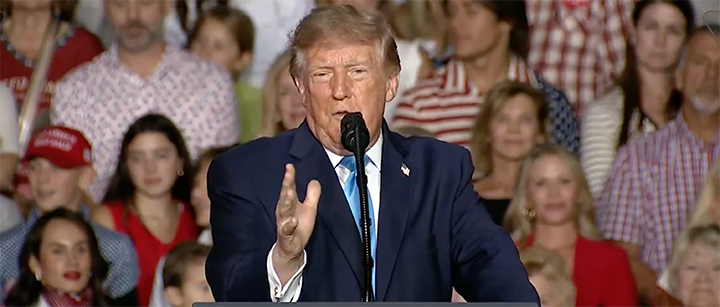
President Donald Trump’s remarks about the possibility that Iran could “take out” Los Angeles and San Diego have sparked a firestorm of criticism, with Democrats claiming the president was either calling for a foreign adversary to attack the U.S. or portraying the destruction of two major cities as acceptable collateral damage.
But given the full context — as well as Trump’s numerous past comments on this issue and the White House’s later clarification — that’s not our reading of the president’s comments. While his wording is confusing, a more plausible interpretation is that he meant the war would prevent Iran from posing a threat to U.S. cities, and higher gas prices are a small sacrifice to make. He’s made versions of those points before, using similar language.
Trump’s remarks came during an Oct. 5 rally in Nebraska.
“Remember, with the war, it’s just artificial. It’s a little bit high,” he said, apparently referencing gas prices. “It’s a small price to pay for keeping the world safe, keeping our country safe. They could take out a city. Let them take — let it — let them take out Los Angeles. Let them take out San Diego.
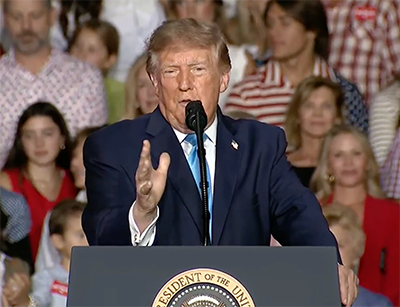 Trump speaks at a rally in Nebraska on Oct. 5.
“That’s — this is a very small price to pay, and it’s going to be over with very soon,” he continued. “It’s essentially almost over with.”
The speech quickly drew outraged responses from Democrats in California and nationally.
“After sending the National Guard and Marines to occupy California, Donald Trump is now saying our foreign enemies should ‘take out’ Los Angeles and San Diego,” California Gov. Gavin Newsom wrote on X. “He is deranged and dangerous.”
Newsom’s press office subsequently posted, “Let’s be clear: The President is advocating for an attack on 10+ million U.S. residents in two of America’s largest cities.”
Newsom posted again the following day, calling Trump’s remarks “dangerous — if not treasonous” and saying that he was directing the state “to actively monitor the situation in the event that foreign actors interpret the President’s remarks as an invitation to target California.”
“The President says the Iran war will end ‘very soon,’” Democratic Sen. Adam Schiff of California posted. “How many times have we heard that promise? And if it means attacks on two major American cities in the process, he is not troubled by the cost.”
“I can’t believe we have to say this, but the annihilation of two major American cities — more than 5 million people — is not a ‘small price to pay’ for Trump’s illegal war,” Sen. Bernie Sanders of Vermont, an independent who caucuses with Democrats, wrote on X.
Trump’s remarks were admittedly confusing, in keeping with his characteristically roundabout style of speaking. His speeches at rallies frequently veer off on tangents before circling back to an earlier point. It doesn’t help that some in the crowd in Nebraska began cheering as he said, “Let them take out Los Angeles. Let them take out San Diego,” though Trump himself didn’t seem to react to or encourage the crowd’s response.
But taken in context, his remarks don’t appear to be “advocating” an attack on U.S. cities or suggesting their destruction would be an acceptable cost.
Trump first referenced the war in Iran a few minutes into his Nebraska speech. “We’re saving the world from what could be one of the worst tragedies ever,” he said, adding that the war would end soon and, when it does, the price of oil “will come tumbling down.”
After riffing on other topics, he eventually came back to the subject of the war, which is when he made his controversial comments about Los Angeles and San Diego. What immediately preceded those statements, however, suggests that Trump wasn’t calling for the destruction of those cities, but rather saying that protecting them is worth paying a bit more at the pump: “It’s a little bit high. It’s a small price to pay for keeping the world safe, keeping our country safe. They could take out a city.”
He was likely making the same point about paying more for gasoline when, after referencing the California cities, he said, “This is a very small price to pay, and it’s going to be over with very soon.”
Trump has used similar language before to argue that higher gas prices are worth it if the war prevents Iran from posing a threat to the U.S.
“The one thing already has happened is, Iran will never have a nuclear weapon,” he said in the Oval Office on Sept. 28. “That’s a very big thing, because if you want to see turmoil and a travesty, let them take out a city with a nuclear weapon. I’m not only talking about Israel and big parts of the Middle East, but let them hit us with a nuclear weapon.”
Speaking to reporters in the Oval Office in March, he said rising oil prices were “a very small thing compared to allowing them to have — you want to see the stock market go down? Start letting them hit you with nukes, OK? I said it this morning, I think it’s a very small price to pay.”
“We’re going to get [the cost of fuel] down,” he told a Nebraska news network on the day of his rally there. “But it’s all going to come pouring down as soon as the war’s over, which will be very soon. And we will not have Iran having a nuclear weapon. And that’s going to be — and I say it and I say it proudly — a relatively small price to pay for keeping nuclear weapons out of the hands of a lunatic nation.”
Reached for comment, a White House spokesperson directed us to an X post from Communications Director Steven Cheung.
“The media freakout over President Trump’s comments is not rooted in reality,” Cheung said. “He was clearly stating U.S. cities would have been threatened if a nuclear Iran hadn’t been stopped.”
In his Feb. 24 State of the Union address, days before the U.S. and Israel launched airstrikes on Iran, Trump said Iran was “working to build missiles that will soon reach the United States of America.” But experts told us the threat of Iran developing an intercontinental ballistic missile capable of reaching the mainland of the United States was not particularly imminent.
Correction, Oct. 7: We misidentified the location where Trump made remarks on Sept. 28. They were made from the Oval Office.
Editor’s note: FactCheck.org does not accept advertising. We rely on grants and individual donations from people like you. Please consider a donation. Credit card donations may be made through our “Donate” page. If you prefer to give by check, send to: FactCheck.org, Annenberg Public Policy Center, P.O. Box 58100, Philadelphia, PA 19102.
The post The Context for Trump’s ‘Take Out’ Los Angeles, San Diego Remarks appeared first on FactCheck.org.
-
[MinuitDecousu] Épisode #264 Sois jeune et casse tout !
Reply sourceAu printemps dernier, on s’est lancé dans un double docu sonore sur le mouvement contre le CPE puis sur celui contre la Loi Travail. Deux mouvements majeurs pour les lycéens et les étudiantes de leur époque, à dix ans d’écart. 2006 et 2016. Notre plan secret, c’était de faire une émission sur le grand mouvement social de la jeunesse de 2026. C’était écrit, le mouvement devait arriver, rien ne pouvait nous échapper : la prophétie Minuit Décousu. Bref, cette semaine, en plein mouvement social lycéen, on donne justement la parole aux lycéen-nes lyonnais-es pour leur donner la parole sur leur mouvement, écouter leurs stratégies et perspectives :- Lyon rejoint la mobilisation nationale : présentation du réseau autonome lycéen Rafal et stratégie (entretien*)- « Un beau sujet de démocratie… » la leçon d’éducation civique du 1er ministre- Bloquer son lycée pour la première fois (entretien avec Robinson et Zoé**)- Trop jeunes pour être écouté-es, assez matures pour être matraqué-es- Marquer les chairs, les esprits et les dossiers scolaires : la répression à l’intérieur et à l’extérieur des lycées (*)- La démocratie absente des lycées et l’empouvoirement par l’AG inter-lycéenne (**)- Contre l’adultisme et la fiction de manipulation du mouvement, la construction d’un autre monde (*/**)Un grand merci au Rafal, à Robinson et Zoé pour les entretiens ! Photographie : blocage devant le lycée Récamier à Lyon par @effugax
-
Trump announces $6.6bn defense shipyard owned by top Republican donor’s firm
Reply sourceBaltimore project to be partly funded by US government but owned by defense firm Anduril, founded by Palmer Luckey
Donald Trump on Tuesday announced the opening of a new $6.6bn shipbuilding factory in Baltimore, partly funded by the US government but owned by Anduril Industries, a politically connected defense company.
Trump’s appearance at a currently unused shipyard in Sparrows Point is a boost to Anduril, whose founder, Palmer Luckey, is a major GOP campaign fundraiser. Luckey has hosted campaign fundraisers for at least 20 Republican politicians, including Trump, the Guardian reported in August. He has given $5.9m to Republican causes since 2017.
Continue reading... -
MAGA Inc.
Reply source
Political leanings: Republican/Conservative
2024 total spending: $456.8 million
Make America Great Again Inc. is one of many political action committees affiliated with President Donald Trump. The super PAC was established six weeks before the 2022 midterm elections to provide a final push for Trump-backed candidates.
As a super PAC, officially known as an independent expenditure-only committee, MAGA Inc. advocates the election or defeat of federal candidates without coordinating with candidates, campaigns or political parties. It can accept unlimited contributions, but it must disclose its donors.
In the 2024 election cycle, MAGA Inc. raised about $410.5 million and spent more than $456.8 million, including nearly $376.9 million on independent expenditures, which are ads and other forms of communication. Its spending on the presidential race supported Trump and opposed Democratic candidates Joe Biden and Kamala Harris. During the Republican primary, the super PAC also spent against Florida Gov. Ron DeSantis and former South Carolina Gov. Nikki Haley.
As of Aug. 31, MAGA Inc. spent about $32.4 million, including more than $2.5 million in independent expenditures, leaving it with about $415.8 million in cash, according to its latest monthly filing with the Federal Election Commission. Large donors to the super PAC in 2026 include Cameron and Tyler Winklevoss, co-founders of the cryptocurrency company Gemini; Diane Hendricks, co-founder of the wholesale company ABC Supply; and Dr. Miriam Adelson, a physician and businesswoman with multiple casino investments.
The super PAC’s independent expenditures this cycle have supported Republican candidates in several House and Senate races. During the 2026 primary elections, it backed Rep. Matt Van Epps, who won Tennessee’s 7th Congressional District special election; Rep. Clay Fuller, who won the special runoff election in Georgia’s 14th Congressional District; and Sen. Darline Graham, the late Sen. Lindsey Graham’s sister, who won the Republican nomination in South Carolina’s Senate race.
More recently, MAGA Inc. became involved in the Texas Senate race, spending millions of dollars supporting Texas Attorney General Ken Paxton against Democratic state Rep. James Talarico.
On Sept. 4, Trump said he expected MAGA Inc. to allocate roughly $400 million to $500 million to help Republicans in the midterms, while also saying he expected to retain some money for the 2028 cycle. The super PAC is also reportedly helping to finance a separate super PAC, No Going Back PAC Inc., which was registered with the FEC on Sept. 1, and has since spent or reserved more than $125 million in advertising, according to the ad-tracking service AdImpact.
In addition, Trump said in an Oct. 5 social media post that MAGA Inc. will fund a series of ads that are “a positive promotion for our Great U.S.A.” Earlier ads featuring Trump, which the White House called “public service announcements,” had previously been paid for using taxpayer-funds, drawing criticism from Democratic lawmakers, ethics experts and even some congressional Republicans.
FactCheck.org Undergraduate Fellow Angela Lin contributed to this article.
Editor’s note: FactCheck.org does not accept advertising. We rely on grants and individual donations from people like you. Please consider a donation. Credit card donations may be made through our “Donate” page. If you prefer to give by check, send to: FactCheck.org, Annenberg Public Policy Center, P.O. Box 58100, Philadelphia, PA 19102.
The post MAGA Inc. appeared first on FactCheck.org.
-
À l'assemblée, le gouvernement et la droite bloquent un article de loi favorable aux victimes de VSS
Reply source -
À l'assemblée, le gouvernement bloque un article de loi favorable aux victimes de VSS
Reply source -
Unprecedented Corruption—and How We End It
Reply source Tiffany Trump, Lara Trump, Eric Trump, Jared Kushner, Ivanka Trump and Donald Trump Jr. Photo by Chip Somodevilla / POOL / AFP via Getty Images.
Another corruption story made headlines over the weekend, and the zone is officially flooded. We barely have time to absorb one hit before the next arrives.
And that’s the point. Trump ally Steve Witkoff and son-in-law Jared Kushner sat down with Vladimir Putin at the Kremlin in early September to discuss ending the war in Ukraine. But Putin had more than peace in mind. He proposed a business deal: the sale of Russian oil conglomerate Lukoil’s international holdings, including a network of oil fields, refineries and gas stations across several countries.
Yes, a multibillion-dollar sale of Russian assets to investors tied to the people supposedly negotiating peace is now part of the talks.
Conflict of interest much?
The road back from corruption and abuse of authority isn’t easy. It requires understanding not only what the hell is going on, but also what allowed it to happen and why no one is stopping it. Then we must figure out how to fix it.
The good news is that we’re not the first democracy to take on an autocratic, family-run regime. We have a long tradition of civil society and order, even if we are unaccustomed to fascist smash-and-grab tactics. But we don’t have to feel our way through. Scholars and experts have drawn road maps for holding corrupt officials accountable and dismantling the systems and incentives that opened the floodgates to cronyism, grift and theft of state property.
So let’s look first at what’s going on, then at the system Trump and his gang broke, and finally at what the democratic opposition can do to fix it once back in power. It’s a big topic with big consequences, and there’s no way out but through, so here we go.
The Big Picture is reader-supported.
To receive new posts and support our work,
consider becoming a free or paid subscriber.What the hell is going on?
Before we unpack the latest scandal, let’s review the cast of characters, Succession-style.
Already at the Russian table are Kushner and Witkoff, both real estate developers, not diplomats. The Trump brothers, Don Jr. and Eric, are in bed with Witkoff’s son Zach their partner in the crypto firm World Liberty Financial. (Ivanka is presumably in bed with her husband.)
The group lined up to buy Lukoil’s foreign assets is led by Todd Boehly. If that name isn’t familiar, he is the co-owner of the Dodgers and a big donor to Trump. Indeed, he gave $2 million to Trump’s political causes, which apparently buys you a seat at the dirty table. The consortium also includes a federal agency, the U.S. International Development Finance Corp.
Also at the table are Qatari brothers Moutaz and Ramez Al-Khayyat, who are partners with Jared and Ivanka on a resort in Albania. That resort drew weeks of daily protests in Tirana this summer, some of the largest since the fall of communism. The protests grew into a national anti-corruption movement.
Then there’s an investment fund controlled by Sheikh Tahnoon bin Zayed Al Nahyan, the United Arab Emirates’ national security adviser and brother of its president, who has ties to Kushner’s private equity firm and to World Liberty.
The Trumps sure know how to keep things in the family. You’ll see these names again and again, so keep track of how they connect.
The Lukoil deal comes cheap for a reason. In October 2025, the U.S. Treasury sanctioned Lukoil and Rosneft, with Treasury Secretary Scott Bessent calling them Russia’s “two largest oil companies that fund the Kremlin’s war machine.” U.S. approval of the sale would free the assets from those sanctions, making the deal lucrative. A spokeswoman for Witkoff said he “has no conflict of interest and no financial stake in this matter” — except that his son Zach co-founded World Liberty. Other investors in that scam are tied to Sheikh Tahnoon, now at the Lukoil table.
In short, Witkoff may have “no financial stake” in the deal, but people important to his son sure do.
The Lukoil talks follow a pattern set by the Trump family’s other new ventures. In August 2025, 1789 Capital, the venture firm where Don Jr. is a partner, took a stake in Vulcan Elements, a maker of rare-earth magnets. Three months later, the Pentagon’s Office of Strategic Capital announced a $620 million loan to the company, which Democratic lawmakers later called the largest the office had ever made. ProPublica reported in May that White House adviser Peter Navarro, a friend of Don Jr., initiated the request, and Pentagon staff compressed a vetting process that normally takes months into weeks. One official recalled the message plainly: “The call came from the White House: We have to get this done.” Estimates of Vulcan’s valuation soared from about $200 million to about $2 billion.
Then there’s the crypto business. Days before Trump’s inauguration, Emirati-backed investors bought 49 percent of World Liberty for a reported $500 million, in a deal involving Sheikh Tahnoon. In May 2025, Zach Witkoff announced that one of Tahnoon’s investment firms would route a $2 billion deal through World Liberty’s stablecoin. That’s billion with a b. Two weeks later, surprise, surprise, the White House agreed to give the UAE access to hundreds of thousands of advanced AI chips, many bound for G42, a firm Tahnoon controls. This decision came despite national security concerns that the chips could leak to China. The White House denied any connection between the investment and the chip decision, but come on.
In August, World Liberty won preliminary conditional approval from the Office of the Comptroller of the Currency to establish a national trust bank. World Liberty is 38 percent owned by DT Marks DEFI LLC, which in turn is 70 percent owned by the Donald J. Trump Revocable Trust and 30 percent by Trump family members. The agency, by the way, is run by Comptroller Jonathan Gould, a Trump appointee. American University banking law professor Hilary Allen told Mother Jones the charter “wouldn’t have happened if Trump wasn’t setting things up to accommodate the crypto industry.”
Add it up and the numbers get very, very large. A January report from House Oversight Committee Democrats estimated $2.25 billion in realized profits for Trump from foreign payments, corrupt oligarchs and others, rising to as much as $9.7 billion including his digital assets.
The state as family business
Taken one at a time, each deal is its own scandal. Taken together, they describe a corrupt model of government that political scientists have studied for more than a century.
Modern civil societies rest on an unspoken premise. The state belongs to the public, and its treasury is separate from the ruler’s purse. Political scientists Stephen Hanson and Jeffrey Kopstein argue the Trump regime is dissolving that bargain, turning the government into the personal property of the man at the top and his inner circle. Under this kind of regime, they write, “Loyalty now counts for more than competence in government service, public office is openly monetized, and personal favor has replaced impersonal rule as the basis of authority.” Kopstein has put it more simply in a line suited to these times: Governance becomes “a family business.”
Family syndicates like this tend to attract eager partners from abroad. Historian Anne Applebaum describes modern autocracies as networks of kleptocrats whose links “are not cemented by ideals, but by deals.” The same names keep turning up in the Trump family’s ledger because they already know how to play ball with the Trumps. That’s how a Gulf royal helps buy nearly half of the Trump family’s crypto company, secures access to advanced American chips and then lines up to buy sanctioned Russian oil with help from the president’s son-in-law.
Firing the referees
Before a corrupt family enterprise can open for business, it needs the authorities out of the picture or bought and paid for. That’s exactly what the Trumps did.
The Vulcan stake, the $2 billion stablecoin deal, the chip approval and the bank charter all followed the removal of officials whose job was to scrutinize deals like these. On Jan. 24, 2025, four days into his second term, Trump fired more than a dozen inspectors general. Weird plural adjectival placement aside, they’re the independent watchdogs who police fraud and abuse inside federal agencies. Trump fired them without giving Congress the 30 days’ notice the law requires. The Pentagon’s inspector general was among them. “The firing of the independent, nonpartisan inspector general was a clear violation of the law,” said Michael Missal, the ousted inspector general at the Department of Veterans Affairs.
The Justice Department was next. After then-acting Deputy Attorney General Emil Bove ordered corruption charges against then-New York City Mayor Eric Adams dropped, at least seven prosecutors resigned, and the department moved to shrink its Public Integrity Section from about 30 prosecutors to as few as five. The unit was established in 1976, after Watergate, to prosecute corrupt officials.
Then came hiding the money trail. In March 2025, the Treasury Department’s Financial Crimes Enforcement Network exempted every American company from the Corporate Transparency Act’s requirement to disclose who actually owns it. The pool of companies required to report shrank from about 32 million to roughly 12,000 foreign entities. The regime also froze enforcement of the Foreign Corrupt Practices Act, the law against bribing foreign officials, and cut the resources behind it.
The world took notice, and so did corrupt partners looking to score big. In February, Transparency International’s latest Corruption Perceptions Index scored the United States 64 out of 100, its lowest ever and down from 76 a decade earlier, amid concerns about politically motivated enforcement and weakened anti-bribery enforcement. The score next year will be even lower, one can imagine.
Corrupt regimes don’t always endure
Political family syndicates also have weak points, and Hanson and Kopstein identify four that should give the opposition some hope and the regime’s enablers some pause.
The first is succession. Trump’s term ends in January 2029, and the Constitution bars a third. Hard stop. That means things will grow increasingly unsteady for the Trump family: “Political succession is the Achilles’ heel of patrimonial rule, and the mere anticipation of a post-Trump future encourages hedging, quiet disloyalty, and a search for alternatives long before any transition formally begins,” Hanson and Kopstein write. Partners in a family business start calculating their own exposure once the protection has an expiration date.
The second is popularity. Or rather, unpopularity in the Trumps’ case. A demagogue’s power depends on seeming inevitable and invincible, and the authors argue that every act of public resistance chips away at that impression. That impression is fading fast. A CBS News/YouGov poll taken Sept. 30 to Oct. 2 put Trump’s approval at 39 percent, below his 43 percent at the same point in his first term and below Joe Biden’s 40 percent heading into the 2022 midterms. The same poll found voters preferring Democrats for the House by 53 percent to 41 percent. CBS’s Battleground Tracker estimates Democrats would win about 229 seats, 11 more than needed for a majority, despite aggressive mid-decade GOP gerrymandering. For a family business that has relied on a Republican Congress to keep its books closed, a Democratic House means subpoenas.
The third is competence. Or rather, incompetence from the Trump White House. A government that drives out its experts and promotes loyalists eventually stops working, the authors argue. We’re seeing this in tariff-driven inflation, rising measles cases, natural disaster aid stalled or withheld and a wave of food recalls. But the war with Iran has become the regime’s costliest failure. By July, after incessant bombing had failed to open the Strait of Hormuz, Richard Haass, president emeritus of the Council on Foreign Relations, described U.S. policy as “at something of a strategic dead end.” In late September, Trump rejected an Iranian offer to reopen the strait, and oil prices jumped. Gas prices set a record for September, averaging $4.33 a gallon. Most voters now say they would prefer a House candidate who opposes both new tariffs and the Iran war.
The fourth is support from abroad. Or rather, lack of it. Allies who lose faith in Washington, the authors predict, will build their own defense and trade arrangements. And that is exactly what has begun to happen, with Canada leading the shift away from U.S. dependence. In June 2025, Ottawa signed a defense and security partnership with the European Union that opened European rearmament programs to Canadian companies. Last month, as new tariffs took effect, Canadian Prime Minister Mark Carney said four decades of integration had left Canada too reliant on the United States. “That time is over,” he said. Two weeks later, Carney told the New York Times his government was reconsidering its purchase of American F-35s, exploring alternatives to Starlink and had spent the past year gaming out what he called the “extreme tail risk” of Trump ordering military action against Canada.
Taking down the family syndicate
Each of these weaknesses gives the opposition an opening, and Democrats have already promised action. House Minority Leader Hakeem Jeffries, in line to become speaker if his party wins in November, told the Associated Press, “If folks have been stealing from the American people, shortchanging the American people or screwing over the American people, we are going to hold the crooks accountable.” Rep. Jamie Raskin, the top Democrat on the House Judiciary Committee, said the party needs to “zero in quickly on the forms of systemic corruption that have cost the public huge amounts of money, and where there are legislative cures available.”
That’s tough talk, but can they deliver, given Trump’s control of the executive branch and his clear willingness to stonewall investigations?
Alina Mungiu-Pippidi, a scholar of how countries bring corruption under control, recommends a two-part strategy: raise the constraints on corrupt behavior and shrink the opportunities for it. A Democratic House can start on the first part in January. The second will have to wait for a Congress and president able to pass real reform. Voters thus will need to understand both the urgency of the moment and the limits of what is possible immediately.
Checking the Trumps
The first check Democrats can impose on the regime is building the evidence. It’s painstaking, unsexy work. But a family business keeps books, and Congress can subpoena them: World Liberty’s investor records, the Pentagon’s file on the Vulcan loan, the communications behind the Lukoil talks. Raskin’s focus on legislative cures doubles as legal strategy, and while the White House will throw up predictable roadblocks, this path has been blazed before.
In Trump v. Mazars USA (2020), the Supreme Court held that Congress may subpoena a president’s personal records, with courts weighing whether a request serves a valid legislative purpose and is “no broader than reasonably necessary.” Subpoenas tied to pending bills on stablecoins, defense lending or sanctions relief would stand the best chance in court.
The White House is readying its defenses. In August, the Justice Department’s Office of Legal Counsel issued an opinion extending executive privilege to the president’s communications with private advisers outside government. That level of legal insulation is an absurd tail wagging a drooling dog, and it will have to be fought in the courts. Senate Democrats expect the regime to invoke privilege “at every turn,” Axios reported. We must also prepare for Trump to promise or issue preemptive pardons to protect the criminals closest to him. But remember: President Trump’s pardon power reaches only “offenses against the United States,” leaving state charges possible.
The second check targets the Trump family’s close partners. Kopstein’s advice to democracy’s defenders is direct: “Raise the costs of loyalty, fracture the elite, and lower the costs of exit.” Sens. Adam Schiff (D-CA), Sheldon Whitehouse (D-RI) and Richard Blumenthal (D-CT) understand this well. If the gavels change hands, they plan to examine the billionaires in cahoots with the regime and the big institutions, universities and law firms that capitulated to it.
The elite wall has already begun to crack in aJuly, the Wall Street Journal’s editorial board, hardly a bastion of liberal thought, accused the Trump family of “cashing in on the Presidency in big and sketchy ways,” citing World Liberty and 1789 Capital’s stake in Vulcan. It warned that Democrats would relish probing the family’s deals if they won either chamber.
The more blatant grifts have drawn fire from Republican lawmakers. Last month, ProPublica reported that Umar Kremlev, a Russian oligarch decorated by Putin, had covered hundreds of thousands of dollars in Don Jr.’s post-wedding festivities in the Bahamas. Sen. John Curtis, a Utah Republican, responded by asking the Senate Judiciary Committee to investigate and subpoena Don Jr.: “A toaster is a wedding gift. A private-island party paid for by a Putin-connected oligarch is something else.” If Don Jr. can be hauled in over a wedding gift, he can be hauled in over the Vulcan loan and World Liberty’s bank charter.
By building the record future prosecutors would need, even without the power to indict directly, Democrats could help beat the clock. Most federal crimes carry a five-year statute of limitations, so conduct from 2025 generally must be charged by 2030. Evidence gathered now by Congress could later serve a Democratic administration, especially if there’s an attorney general willing to prioritize accountability over perceived institutional neutrality.
Shrinking the opportunities
Mungiu-Pippidi also stresses shrinking the openings for graft. This is a longer process requiring legislation, and therefore Democratic control of more than just the House. Any reform must pass the Senate and would presumably face a GOP filibuster and a veto from Trump. But investigations begun in 2027 can build the case for such laws when Democrats next have a trifecta.
Congress has done this before. From 1932 to 1934, the Senate Banking and Currency Committee investigated Wall Street. Its chief counsel, Ferdinand Pecora, exposed self-dealing by the country’s most powerful bankers. Congress later responded with the Banking Act of 1933, better known for its Glass-Steagall provisions, and the Securities Exchange Act of 1934, both aimed at abuses Pecora’s team uncovered.
When Democrats retake the White House and can finally enact laws, the blueprints will be ready. Schiff’s Protecting Our Democracy Act, which he first introduced in the House, would strengthen Congress’s power to enforce subpoenas, bar presidents from pardoning family members or themselves, prohibit using the office for self-enrichment and bolster whistleblower protections. The No Payoffs for Pardons Act, introduced by Senate Minority Leader Chuck Schumer and Blumenthal, would require disclosure of gifts tied to clemency, make explicit that federal bribery law covers the president and vice president and set a 10-year statute of limitations for bribery involving pardons. The same Congress could restore protections for inspectors general, rebuild the Public Integrity Section and write ownership disclosure requirements for American companies back into law.
The public is ahead of Washington on corruption. In a September Economist/YouGov poll, 53 percent of registered voters described Trump as corrupt, including 62 percent of independents—the bloc that decides elections. In an August Reuters/Ipsos poll, three in four Americans said corruption influences federal decisions a great deal or quite a bit.
The biggest barrier to guardrail reform is the filibuster, which grants a minority party an effective veto over major nonbudgetary legislation. Many understandably worry what the GOP would do without the filibuster once back in power. But that could hardly be worse than inaction and paralysis, which would confirm for voters that both parties are corrupt and unreformable.
Corruption may be the byproduct of a family-run banana republic, but it is also the whole point of the game for those who have seized control. That’s why they have destroyed the existing guardrails and made bedfellows of other autocrats. The only effective response is to reclaim our country at the first opportunity and then do everything possible to restore those protections, expand democratic rights and jail those who took part in the money grab.
Thanks for reading!
This post is public so feel free to share it. -
[Nantes] AG étudiante
Reply sourceCe mercredi on continue de s’organiser pour la poursuite du mouvement !
Rendez vous devant le pole étudiant pour l’AG

-
Trump Tyranny Tracker | Day 613: Sept. 28, 2026
Reply source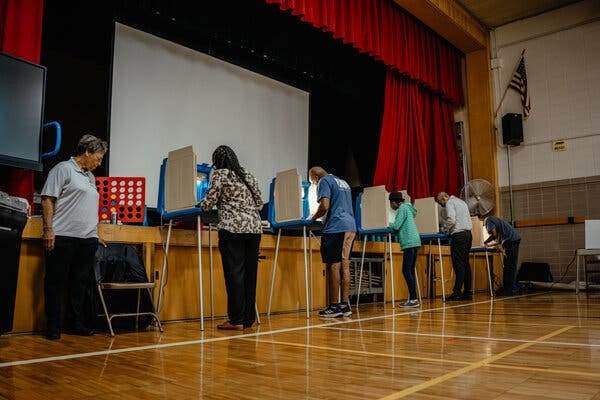 In advance of the upcoming midterm elections, the Trump administration has embarked on an intensive campaign to prove that noncitizens are voting illegally, despite evidence that it is very rare.Credit...Jamie Kelter Davis for The New York Times
Welcome to today’s Trump Tyranny Tracker…
Trump building a national citizenship database to screen voters, taxpayer money being used to air one of his 2024 campaign ads, and a Pentagon breach exposing sensitive information are among today’s top stories.
Today at a Glance
Trump expands a national citizenship database to screen voters weeks before the midterms.
Taxpayer money is being used to air a Trump 2024 campaign ad.
Pentagon breach exposes sensitive information on close to 3 million people.
What We Need to Pay Attention To
Here’s How Trump Is Building a National Citizenship Database to Check Voters
What Happened: The Supreme Court allowed Trump to use an expanded federal citizenship database that combines DHS records with Social Security data to check voter rolls. States can now search millions of registered voters at once, including U.S.-born citizens who previously had no records in the immigration system.
Why It Matters: Trump is turning a government benefits system into a tool for screening voters weeks before the midterms. Eligible U.S. citizens can be wrongly flagged as noncitizens and potentially purged from voter rolls. This is why it is so important to keep checking your voter registration.
Source: New York Times
Corruption
Watchdog Agency Pulls Back on Markets Enforcement Under Trump
What Happened: The Commodity Futures Trading Commission has sharply reduced enforcement under Trump, filing an average of one new case per month, one-fifth the rate under Biden. The agency has also closed investigations and eased oversight of crypto and prediction market companies, including businesses connected to Donald Trump Jr.
Why It Matters: Enforcement is being gutted while industries tied to Trump family businesses benefit from weaker oversight. Farmers, investors and consumers are being left with less protection against fraud and market manipulation.
Source: New York Times
Power Consolidation
The Untold Origins of Trump’s Plan to Sharply Restrict Mail-In Voting
What Happened: The White House sought to require mail ballots to be sent by certified mail and signed for upon delivery. Postal officials warned the plan was unworkable and were later excluded from discussions as Trump moved ahead with new federal restrictions on mail ballots.
Why It Matters: Trump tried to make mail voting harder weeks before the midterms. Postal officials warned the changes could prevent eligible voters from having their ballots counted, while board members reportedly feared Trump would fire them if they pushed back.
Source: ProPublica
Weaponization of Institutions
Hegseth orders cyber, intelligence agencies to prioritize election defense
What Happened: Pete Hegseth ordered U.S. Cyber Command, the NSA, DIA and other military intelligence agencies to prioritize foreign threats to the 2026 elections. The order comes after Trump officials dismantled the FBI’s Foreign Influence Task Force and cut election security operations in other federal agencies.
Source: Defense One
Second prosecutor resigns from Justice Department ‘grand conspiracy’ probe targeting Trump foes
What Happened: Kurt Olsen, a Trump ally who backed efforts to overturn the 2020 election, resigned from the Justice Department’s “grand conspiracy” investigation into former officials who investigated Trump. He is the second Trump-aligned prosecutor to leave the probe in weeks.
Why It Matters: Trump put his cronies in charge of investigating the people who investigated him. Two have now quit without bringing charges, and a career national security prosecutor was removed after questioning whether there was enough evidence to bring a case.
Source: Associated Press
Judge blocks Trump from tying anti-terrorism grants to election changes
What Happened: A federal judge blocked Trump from withholding 20% of counterterrorism grants unless state and local governments adopted election changes favored by the White House. The requirements included hand-marked paper ballots, manual audits and checks of voter rolls against a DHS database.
Why It Matters: Trump tried to use federal counterterrorism money to force states and local governments to change how they run elections. The judge ruled Congress never gave FEMA that authority.
Source: Reuters
Media Suppression & Authoritarian Tactics
Trump administration begins airing 2024 Trump campaign ad in latest taxpayer-funded messaging
What Happened: The federal government is spending taxpayer money to air a television ad virtually identical to one used by Trump’s 2024 presidential campaign. The ad promises a “final battle” against “globalists,” “warmongers,” the “deep state” and the “fake news media,” and ends with “Paid for by the U.S. Government.” More than $319,000 has already been spent airing it.
Why It Matters: Taxpayer money is being used to promote Trump and his propaganda weeks before the election. Russia does the same thing, using state resources to push Putin’s propaganda.
Source: Politico
Human & Civil Rights Abuses
Gone in 90 seconds: an ‘invisibilized’ ICE is arresting more people than ever
What Happened: ICE is expanding operations nationwide while moving away from highly visible raids. Arrests have reached record levels, its workforce has more than doubled to over 22,000, and it has signed more than 2,500 agreements with local law enforcement.
Why It Matters: ICE is expanding its crackdown while making its operations harder to see. Record numbers of people are being arrested using tactics that are harder for families, lawyers and witnesses to track.
Source: The Guardian
Government Disruption
Pentagon breach exposed sensitive data on nearly 3 million people
What Happened: A Pentagon database breach exposed sensitive information on 2.76 million people, including Social Security numbers and details about military and civilian jobs. The system was accessed without authorization for months before the breach was discovered in July.
Why It Matters: A breach exposing millions of military personnel creates identity theft and national security risks, including information that foreign intelligence services can exploit to identify and target U.S. service members.
Source: ABC News
Food safety becomes an election issue as major outbreaks and recalls cause concern
What Happened: Nearly 20,000 laboratory-confirmed cyclospora infections were reported from May through August, compared with 1,180 during the same period last year, making it the largest recorded outbreak of the parasite. Food safety scientists have linked growing risks to federal public health cuts.
Source: CBS News
Trump rolls back car fuel efficiency standards
What Happened: Trump rolled back fuel efficiency standards for cars and light trucks, cutting the 2031 fleet target from 50.4 miles per gallon to 34.9 mpg. Trump says the weaker standards will reduce vehicle prices, while the previous rules were projected to save drivers more than $600 in lifetime fuel costs.
Source: The Hill
Kennedy Center put off planned repairs despite known structural issues, former employees allege
What Happened: Former Kennedy Center employees told Congress that Trump-installed leadership knew about serious structural problems and stopped repairs that had already been funded months before closing the center over safety concerns. Executive director Matt Floca disputes their account and says the repairs became part of a larger project after costs increased.
Source: PBS NewsHour
Imperial & Geopolitical Watch
Trump Offered to Sell Arms to China, U.S. Ambassador Says
What Happened: U.S. Ambassador to China David Perdue said Trump asked Xi Jinping whether China wanted to buy American weapons. The State Department later said U.S. law prohibits arms sales to China and that there is no offer or plan for a sale.
Why It Matters: Trump reportedly offered weapons to America’s main military competitor while holding up a $14 billion arms package for Taiwan and treating it as leverage in negotiations with Beijing. U.S. law prohibits arms sales to China.
Source: New York Times
Far-Right & Russian Influence Watch
Ukraine’s city of Oleshky faces starvation as Russia blocks all aid
What Happened: Roughly 2,000 civilians, including dozens of children, remain trapped in Russian-occupied Oleshky without regular access to food, medicine, running water or electricity. Ukrainian officials say Russian forces are blocking evacuations, shooting down drones carrying food and confiscating humanitarian supplies.
Why It Matters: Russia is deliberately depriving civilians in occupied Ukraine of food and humanitarian aid. Starvation has long been a weapon of Russian repression, most notoriously during the Holodomor genocide, when the Soviet regime used hunger to kill millions of Ukrainians.
Source: Euronews
Economic News
American farmers are hurting — and worried about their futures
What Happened: American farmers are facing sharply higher operating costs and weaker export markets. Fertilizer prices are up 15% from last year and diesel has jumped 80%, while U.S. agricultural exports to China remain far below levels before Trump’s second term.
Why It Matters: Farmers are being hit by the Iran war and Trump’s trade war at the same time. Fuel and fertilizer costs are soaring while one of their biggest export markets has collapsed.
Source: NPR
Resistance
Check out 50501 for local and nationwide events…
Source: 50501
By the Numbers
2.76 million — People whose sensitive information was exposed in the Pentagon breach
$1.1 billion — Counterterrorism grants Trump tried to tie to changes in state and local election rules
$319,000 — Taxpayer money spent airing a Trump 2024 campaign ad
20,000 — Cyclospora infections reported from May through August, compared with 1,180 during the same period last year
22,000 — ICE personnel after more than doubling in size
2,500 — Agreements ICE has signed with local law enforcement agencies
80% — Increase in diesel costs hitting American farmers
12 — Months until the Pentagon breach was discovered after unauthorized access began
What to Watch Next
Trump is building a nationwide voter screening system weeks before election — How will states use the database, and how many eligible citizens will be wrongly flagged and purged from voter rolls?
Trump is using federal power and money to reshape the election environment — What other funding, agencies or government resources will be used to pressure states or promote his political agenda?
Trump has dismantled parts of the government’s election security infrastructure and shifted more responsibility toward the military and intelligence agencies — What role will those agencies play as the midterms approach?
Key Takeaways
Rising Costs — Farmers are facing soaring fuel and fertilizer costs while losing access to one of their biggest export markets.
Election Control — Trump is expanding a national voter screening database while trying to impose federal restrictions on mail voting and use counterterrorism money to force states to adopt his preferred election rules.
Government Breakdown — A Pentagon breach exposed sensitive information on nearly 3 million people while public health cuts leave agencies with fewer resources to protect the food supply.
Immigration Crackdown — ICE has more than doubled its workforce and expanded arrests while shifting toward tactics that are harder for the public to see.
Call to Action
Document Everything: Document purges, corruption, and power grabs. Share credible information with journalists, watchdogs, and legal experts. Silence enables authoritarianism—see something, say something.
Defend Press Freedom: Support independent journalism by subscribing to and sharing reporting that challenges Trump’s power grab.
Contact Lawmakers: Demand accountability for Trump’s unchecked power and war on oversight.
Mobilize for Action: Organize or join legal efforts and resistance movements to protect democracy and human and civil rights.
Support Whistleblowers: Encourage legal defense funds for government workers facing retaliation for exposing corruption.
Follow my work on YouTube → Subscribe to Unmasking Russia
https://youtube.com/@unmaskingrussia
Preorder My New Book…
Putin’s Pawns takes you on a journey from the earliest days of the Cold War and Soviet KGB active measures through Russia’s attacks on Western elections, the rise of the far right, Trump and Russia, the genocidal war against Ukraine, influence operations across Europe, and the shadow war unfolding today.
It is the story of how Moscow spent decades learning to exploit the weaknesses of democracies and how those tactics brought us to this moment.
Thanks for reading the Trump Tyranny Tracker. Stay tuned for more updates.
-
Bayan Salehian doit être libérée immédiatement
Reply sourceliberté pour Bayan
Notre compagnonne anarcha-féministe, Bayan Salehian, a été arrêtée par les forces de sécurité iraniennes.
Bayan Salehian, une médecin kurde de 43 ans spécialisée en médecine interne, anarcha-féministe et militante sociale, a été arrêtée violemment dimanche dernier lors d’une opération des forces de sécurité iraniennes. Elle a été interpellée à son domicile et emmenée dans un lieu tenu secret. Originaire de Saqqez, elle réside actuellement à Urmia.
Selon les informations reçues par l’ organisation de défense des droits humains Hengaw , les forces de sécurité iraniennes ont pris d’assaut le domicile de Salehian à Urmia le dimanche 27 septembre 2026 et l’ont brutalement battue lors de son arrestation.
Des sources au sein de l’organisation ont indiqué que la police avait perquisitionné son domicile et saisi son téléphone portable et son ordinateur portable. Aucune information précise n’est disponible concernant les raisons de l’arrestation de Salehian, les charges retenues contre elle ou son lieu de résidence actuel.
Salehian avait déjà été arrêtée à l’automne 2022, avec deux autres médecins de Saqqez, lors du mouvement « Femme, Vie, Liberté » (Jin, Jiyan, Azadi). Elle avait ensuite été condamnée par le tribunal révolutionnaire de Saqqez à huit mois de prison pour « propagande contre l’État par la publication de contenu en ligne ». Sa peine avait par la suite été commuée en amende.
-
Des tags en solidarité avec la révolte lycéenne sur la permanence d’Eric Coquerel – Communiqué du C.A.N.C.R.E
Reply sourceDans la nuit du 5 au 6 octobre 2026, la permanence du député Eric Coquerel situé à Saint-Ouen a été redécoré des tags suivants : « Nike les appels au calme », »Fuck LFI », « Soutien aux lycéens ».
Eric Coquerel, comme tous ses confrères et consœurs représentants des partis de gauche (LFI & co), tente de pacifier et de récupérer la révolte des lycéens, qui s’est exprimé en grande partie hors des cadres institutionnels classiques depuis son commencement. Leurs appels au calme, au pacifisme, leurs condamnations des violences, leurs tentatives de prendre la direction de la contestation en la rendant « respectable », leur rhétorique sur les « éléments extérieurs perturbateurs » en font des ennemis des mouvements de subversion comme celui qui s’exprime actuellement contre l’Ecole comme instrument de dressage et de sélection.
Morts à tous les chefs, tous les pacificateurs, tous les récupérateurs.
Pour la révolte des lycéens et pour toutes les autres.
le Collectif Anonyme Nyctalope pour la Croissance de la Révolte Ecolière
-
Mouvement lycéen: un début de semaine encore rythmé par les tensions et les violences policières
Après un nombre phénoménal de mineurs en garde à vue, la mutilation d’un lycéen par une grenade à Lens et l’ouverture d’une dizaine d’enquêtes confiées à l’IGPN, parents, enseignants, élus et services d’ordre syndicaux se sont passé le mot pour «protéger» les cortèges dans toute la France mardi 6 octobre.Reply source -
À Lens, un élève mutilé et un lycée sous le choc
Evan S., 15 ans, a perdu sa main gauche, lundi 5 octobre, en marge de la mobilisation lycéenne, après le tir d’une grenade probablement assourdissante par les forces de l’ordre. Mardi, enseignants et camarades dénoncent un usage «disproportionné» de la force. L’IGPN a été saisie.Reply source -
«Vous nous faites honte!»: Nuñez et Lecornu sous les tirs de barrage d’une Assemblée à cran
Lors d’un après-midi agité dans l’hémicycle, la gauche s’est insurgée contre la répression policière orchestrée par le gouvernement contre le mouvement lycéen. Le premier ministre et le ministre de l’intérieur ont dénoncé des «mensonges».Reply source -
«Le manque de moyens est devenu un sujet politique»: le 6 octobre, le mouvement lycéen a changé de dimension
Plusieurs centaines de milliers de personnes ont défilé dans une trentaine de villes mardi, à l’appel conjoint des collectifs lycéens et étudiants et des syndicats d’enseignants. Les cortèges denses, jeunes et bon enfant confirment que le gouvernement ne peut plus ignorer la mobilisation démarrée le 15 septembre.Reply source -
6 octobre : récit d'une mobilisation historique
La mobilisation du 6 octobre est déjà historique, tant par son ampleur que son intensité. Étudiants, salariés, parents d’élèves, personnels d’enseignement ont massivement rejoint les cortèges lycéens pour les protéger et porter avec eux leurs…Reply source -
Trump Tyranny Tracker | Day 610-612: Sept. 25-27, 2026
Reply source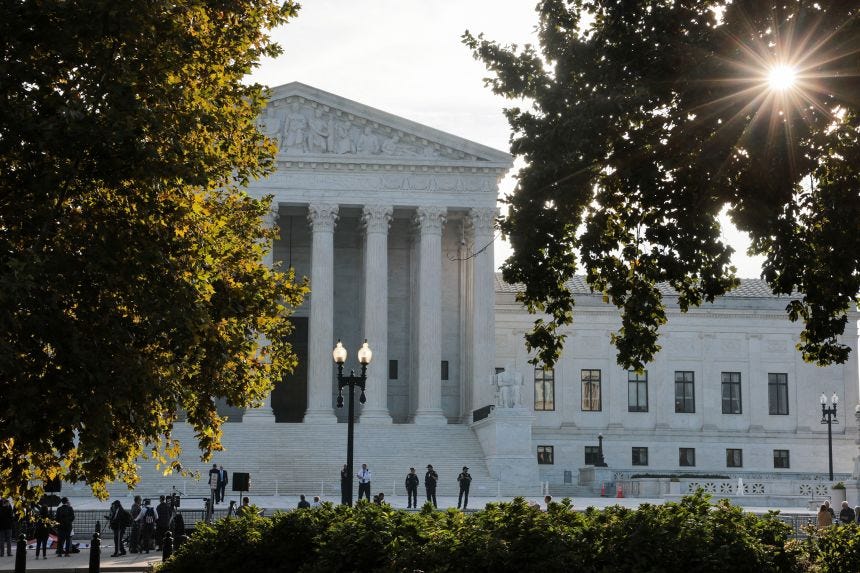 A general view of the US Supreme Court building in Washington, DC, on the first day of the court’s new term, October 5, 2026. Jonathan Ernst/Reuters
Welcome to today’s Trump Tyranny Tracker…
Trump expanding federal control over voter data ahead of the midterms, taxpayer-funded ads promoting his propaganda, and growing military tensions involving Iran and Cuba are among this weekend’s top stories.
This Weekend at a Glance
Trump expands federal voter screening ahead of the midterms as eligible U.S. citizens are wrongly flagged as noncitizens.
Taxpayer-funded television ads promoting Trump and his political agenda expand to more networks.
FBI breach exposes sensitive medical records and personal information of agents working on Russia, China and other intelligence operations.
What We Need to Pay Attention To
Supreme Court lets Trump administration use revamped federal voter eligibility database for now
What Happened: The Supreme Court temporarily allowed states to use Trump’s expanded SAVE database to check voter eligibility ahead of the midterms, overturning a lower court restriction. The system uses federal data to identify potential noncitizens but has already wrongly flagged eligible U.S. citizens.
Why It Matters: The Supreme Court handed Trump another win and a federal tool to challenge voter registrations weeks before the midterms. SAVE has already wrongly identified U.S. citizens as potential noncitizens, putting eligible voters at risk of being flagged or removed from voter rolls.
Source: Associated Press
Corruption
RFK Jr received $4m in book advances from Maha allies over past year
What Happened: RFK Jr. received $4 million in book advances over the past year from Skyhorse Publishing, owned by Tony Lyons, president of the MAHA Center. Kennedy’s disclosures also show nearly $142,000 in free flights and housing from longtime ally and political donor Gavin de Becker. His wife received $210,000 in consulting fees from another Lyons-led MAHA group.
Source: The Guardian
Democrats press RFK Jr. on an ethics agreement change involving law firm fees
What Happened: RFK Jr. told senators before his confirmation that he would transfer his financial interest in vaccine-related litigation to his adult son. Democratic senators say he instead changed his ethics disclosures after the hearings and transferred the interest to his former law firm without explaining the change to Congress.
Why It Matters: Kennedy told senators he would handle a financial conflict one way before they voted on his confirmation, then changed the arrangement afterward without telling them. Senators are now questioning whether he complied with federal ethics requirements.
Source: Associated Press
Power Consolidation
Trump allies could use midterms ‘counting window’ to disrupt results, experts warn
What Happened: Election experts warn that Trump and his allies could use the days after the midterms, while ballots are still being counted, to challenge results and amplify false claims of fraud or foreign interference. Former officials warned that claims of foreign interference could also be used to justify attempts to seize ballots or voting equipment.
Why It Matters: Legitimate vote counting can take days after polls close. Trump’s lies of fraud or foreign interference during that window could be used to undermine the results or justify attempts to seize ballots and voting equipment.
Source: The Guardian
Trump continues voter data push despite repeated setbacks
What Happened: Trump is pushing ahead with plans for DHS to compile lists of Americans eligible to vote using data from across the federal government and share them with states. His Justice Department has lost 25 lawsuits seeking state voter rolls, but DHS has already obtained voter data from at least 47 states.
Source: Reuters
Trump administration uses rare authority to claw back nearly $1B in spending approved by Congress
What Happened: Trump moved to cancel nearly $1 billion in spending already approved by Congress, using a rarely invoked “pocket rescission” five days before the fiscal year ended. The cuts target immigrant services, minority business programs, housing counseling and other domestic programs.
Source: ABC News
Weaponization of Institutions
City council candidate faces ‘riot participation’ charge for ICE shooting protest
What Happened: Austin city council candidate Misael Ramos was arrested on a misdemeanor “riot participation” charge after protesting the ICE shooting of Venezuelan asylum seeker Wilber Rafael Garces Perez. Authorities accuse Ramos of moving barricades and other objects to obstruct traffic; Ramos denies wrongdoing.
Source: ABC News and Associated Press
Nearly 200 people wrongly identified on Nevada’s voter rolls as non-citizens
What Happened: DHS identified 185 people on Nevada’s voter rolls as potential noncitizens after Trump claimed thousands of noncitizens could be registered in the state. Nevada officials reviewed the records and found they belonged to U.S. citizens, while DHS has not provided information needed to substantiate its claims.
Why It Matters: This is exactly the danger of using federal databases to police voter eligibility. DHS falsely identified 185 U.S. citizens as potential noncitizens weeks before the midterms, putting legitimate voters at risk of being wrongly targeted or removed from voter rolls.
Source: The Guardian
Media Suppression & Authoritarian Tactics
Taxpayer-funded pro-Trump TV ad campaign grows with new spot, wider reach
What Happened: The U.S. government is paying for television ads promoting Trump and his political agenda, with two ads airing in three days and at least $443,000 spent on the first. The ads are labeled “Paid for by the U.S. Government,” while the White House calls them public service announcements.
Why It Matters: Taxpayer money is being used to promote Trump and his propaganda weeks before the election. Russia does the same thing, using state resources to push Putin’s propaganda.
Source: Washington Post
White House blocks CNN from covering Trump’s Tennessee trip
What Happened: The White House removed CNN from the press pool traveling with Trump to Tennessee after the network had been scheduled to cover the trip on behalf of the major television networks. ABC, CBS, NBC, and Fox News had briefly stopped participating in the pool earlier in the week after Trump barred CNN from taking its scheduled turns.
Source: NBC News
Human & Civil Rights Abuses
DOJ says it has ended more than 50 decades-old school desegregation cases
What Happened: Trump’s Education Department ended rules allowing schools to identify discrimination through racial disparities and warned schools against considering race when addressing discipline. His Justice Department has also ended more than 50 longstanding school desegregation cases, removing federal court oversight established to prevent racial discrimination.
Why It Matters: Trump is dismantling decades of federal civil rights protections in public schools. Schools will have fewer tools to identify racial discrimination, while dozens of districts with histories of segregation will no longer face federal court oversight.
Source: CBS News and Associated Press
Government Disruption
‘Extremely sensitive medical data’ for FBI agents among hacked records: Report
What Happened: Data stolen in the FBI breach reportedly includes home addresses, relatives’ information, intelligence assignments and sensitive medical records for thousands of special agents, including blood and urine test results. Exposed employees include personnel working on Russia, China, electronic surveillance, FISA, and the FBI’s secretive hacking unit.
Source: ABC News
CDC vaccine policy recommendations grind to a halt under Health Secretary Kennedy
What Happened: The CDC has stopped issuing recommendations on new vaccines after RFK Jr. purged its longtime vaccine advisory committee and replaced it with a panel that was later blocked by a federal judge. Doctors’ groups and insurers are now developing vaccine guidance outside the federal system.
Why It Matters: Kennedy dismantled a 60-year federal process for reviewing vaccines and providing guidance to doctors and patients. America is now left without a functioning national system for updating vaccine recommendations.
Source: Associated Press
US immigration crackdown hits Kansas, disrupts beef processing
What Happened: ICE operations across southwest Kansas kept workers away from meatpacking plants, feedlots and dairies, slowing beef production and delaying thousands of cattle shipments.
Source: Reuters
The Education Dept. hasn’t been dismantled. It’s become more inefficient, staff say
What Happened: Trump’s effort to dismantle the Education Department has scattered employees across at least nine federal buildings and shifted major education programs into agencies whose systems were not designed to administer them. Attempts to move billions of dollars in education grants through other agencies have already run into technical and staffing problems.
Why It Matters: Trump is dismantling the Education Department without a functioning replacement. Programs serving low-income students and children with disabilities are being shifted to agencies that are not equipped to handle them, putting billions in federal education funding at risk.
Source: NPR
Trump administration guts data collection on US education as math and reading scores plummet
What Happened: Trump’s cuts reduced the National Center for Education Statistics from about 100 employees to 12 and eliminated or scaled back much of its research and data collection. DOGE canceled nearly $900 million in Education Department contracts, including studies tracking student performance, school safety and college costs.
Why It Matters: Reading and math scores are at their lowest levels in 25 years while Trump is gutting the systems that track them. Suppressing unfavorable data is a common authoritarian tactic to hide government failures.
Source: The Guardian
Imperial & Geopolitical Watch
Trump Rejects Iranian Proposal for Cease-Fire and Opening of Strait
What Happened: Trump rejected Iran’s proposal for a seven-day ceasefire that would have reopened the Strait of Hormuz and restarted nuclear negotiations. Iran sought the release of at least $12 billion in frozen assets, an oil sanctions waiver and an end to the U.S. naval blockade.
Source: New York Times
U.S. military lays groundwork for potential action around Cuba
What Happened: The Army Reserve is assessing whether military police, medical, engineering, and logistics units could be available within 90–120 days for U.S. Southern Command. U.S. officials said the planning is connected to Cuba, although no deployment orders have been issued.
Why It Matters: Trump has already dragged the U.S. into a costly war with Iran while the military is now preparing for possible action involving Cuba. Trump is risking pulling the U.S. into another war before his first one is over.
Source: CBS News
Far-Right & Russian Influence Watch
Unmasking RussiaRussia Is “Grateful” as Trump Invites Putin to the G20 in MiamiIn his latest effort to whitewash and normalize Russia, Trump has invited war criminal Putin to the G20 summit in Miami this December. Secretary of State Marco Rubio confirmed the invitation yesterday after meeting with Russian Foreign Minister Sergei Lavrov, saying Trump hopes Putin accepts…Read more12 days ago · 66 likes · 11 comments · Olga LautmanEconomic News
Consumer confidence dips in September amid inflation concerns
What Happened: U.S. consumer sentiment fell 7% in September to a four-month low as Americans grew more concerned about inflation and the cost of living. Gas has reached a national average of $4.49 a gallon and diesel $6.50 as the Iran war disrupts global oil supplies.
Source: The Hill
Resistance
Check out 50501 for local and nationwide events…
Source: 50501
By the Numbers
$185 — U.S. citizens wrongly flagged by DHS as potential noncitizens on Nevada’s voter rolls
$4 million — Book advances RFK Jr. received from a publisher that also monetized the MAHA movement
47 — States whose voter data DHS has already obtained
$1 billion — Spending already approved by Congress that Trump moved to cancel
$900 million — Education Department contracts canceled by DOGE
$443,000 — At least spent on the first taxpayer-funded television ad promoting Trump
12 — Employees remaining at the National Center for Education Statistics, down from about 100
$4.49 — National average price for a gallon of gas
$6.50 — National average price for a gallon of diesel
What to Watch Next
Trump is expanding federal control over voter eligibility weeks before the midterms — How many eligible Americans will be wrongly flagged as states begin using the expanded SAVE database?
Trump and his allies are already laying the groundwork to challenge the midterm results — What happens during the days after the election while ballots are still being counted?
The U.S. is already at war with Iran while the military prepares options involving Cuba — Is Trump preparing to pull the United States into another conflict war the first one is over?
Key Takeaways
Rising Costs — The Iran war is pushing fuel prices higher while Trump’s immigration crackdown disrupts U.S. beef production.
Election Interference — Trump is expanding federal voter screening ahead of the midterms while DHS has already wrongly flagged U.S. citizens as potential noncitizens.
State Propaganda — Taxpayer-funded television ads promoting Trump and his political agenda are expanding weeks before the election.
Government Breakdown — Trump’s dismantling of federal agencies is disrupting vaccine guidance, education funding and the collection of basic government data.
Call to Action
Document Everything: Document purges, corruption, and power grabs. Share credible information with journalists, watchdogs, and legal experts. Silence enables authoritarianism—see something, say something.
Defend Press Freedom: Support independent journalism by subscribing to and sharing reporting that challenges Trump’s power grab.
Contact Lawmakers: Demand accountability for Trump’s unchecked power and war on oversight.
Mobilize for Action: Organize or join legal efforts and resistance movements to protect democracy and human and civil rights.
Support Whistleblowers: Encourage legal defense funds for government workers facing retaliation for exposing corruption.
Follow my work on YouTube → Subscribe to Unmasking Russia
https://youtube.com/@unmaskingrussia
Preorder My New Book…
Putin’s Pawns takes you on a journey from the earliest days of the Cold War and Soviet KGB active measures through Russia’s attacks on Western elections, the rise of the far right, Trump and Russia, the genocidal war against Ukraine, influence operations across Europe, and the shadow war unfolding today.
It is the story of how Moscow spent decades learning to exploit the weaknesses of democracies and how those tactics brought us to this moment.
Thanks for reading the Trump Tyranny Tracker. Stay tuned for more updates.
-
Whistleblower report alleges Trump ordered FBI investigation on LA anti-ICE protesters
Reply sourceWhite House denies the allegations as ‘false’ and says ‘first amendment does not protect violent rioting’
Donald Trump ordered the FBI to investigate protesters in Los Angeles who were demonstrating against the president’s immigration crackdown, according to a whistleblower complaint.
Alex Padilla, a Democratic senator who represents California and serves on the Senate judiciary committee, said his office had received a copy of the complaint, which makes sweeping allegations about the Trump administration’s response to protests in LA in early 2025.
Continue reading... -
Spiderman en Gilet Jaune
Reply sourceÀ Nantes ce mardi 6 octobre, une banderole de Spiderman en Gilet Jaune est apparue, comme un symbole de la jeunesse révoltée.
L’article Spiderman en Gilet Jaune est apparu en premier sur Contre Attaque.
-
Jordan Bardella convoque une fausse «source» révisionniste pour prouver qu’il n’est pas antisémite
Le président du RN a mis en cause «Mediapart» en s’appuyant sur le témoignage d’un militant d’extrême droite présenté comme une «source» manipulée. Problème: cet ancien camarade de Jordan Bardella, qui multipliait les recommandations de lectures négationnistes, n’est pas du tout à l’origine de nos révélations et a bien tenu les propos que nous avons publiés.Reply source -
« On n’est même pas sûrs d’avoir un avenir » : la jeunesse dans la rue à Paris
Reply sourceDes milliers de lycéens et d’étudiants ont défilé ce mardi 6 octobre à Paris, rejoints par des enseignants et des parents. Derrière les revendications sur les moyens alloués à l’éducation, une même inquiétude traverse le cortège : celle d’une jeunesse qui ne croit plus vraiment aux promesses faites sur son avenir.
The post « On n’est même pas sûrs d’avoir un avenir » : la jeunesse dans la rue à Paris appeared first on Bondy Blog.
-
Trump Tyranny Tracker | Day 609: Sept. 24, 2026
Reply source The J. Edgar Hoover FBI Building is seen on Sept. 26, 2025, in Washington, D.C. Samuel Corum/Getty Images
Welcome to today’s Trump Tyranny Tracker…
Trump using taxpayer money to air propaganda ads, the Justice Department expanding an investigation into former FBI officials, and Danish intelligence warning that Russia could escalate its attacks against NATO in the coming months are among today’s top stories.
Today at a Glance
Taxpayer-funded television ads promote Trump and echo Republican midterm messaging.
Former FBI officials who investigated Trump are subpoenaed in the Justice Department’s expanding “deep state” probe.
Danish intelligence warns Russia could escalate attacks against NATO and potentially launch a limited military attack.
What We Need to Pay Attention To
US government foots bill for television advertisement featuring Trump’s midterm messaging
What Happened: The U.S. government paid for a television ad featuring Trump and Republican midterm messaging, including “America will never be a communist country” and claims about his tax cuts. The ad aired on Fox News and Newsmax with the disclaimer “paid for by the U.S. government.”
Why It Matters: Taxpayer money is being used to promote Trump and his propaganda weeks before the election. Even Sen. Thom Tillis criticized it, comparing the tactic to Hungary’s Viktor Orbán. Russia does the same thing, using state resources to push Putin’s propaganda.
Source: Associated Press and Wall Street Journal
Corruption News
Trump rolled back regulations for oil company campaign donors, Democrats say
What Happened: A Senate Democratic investigation found that oil and gas companies received tax breaks, subsidies and regulatory rollbacks after Trump asked industry executives for $1 billion in campaign support during the 2024 election. The report documented hundreds of millions of dollars in campaign spending and dozens of federal actions benefiting the industry.
Why It Matters: Trump asked oil executives for $1 billion in campaign support. They spent hundreds of millions backing Republicans, and Trump gave their industry tax breaks, subsidies, and regulatory rollbacks worth billions.
Source: Reuters
Trump administration faces fresh scrutiny after DoJ drops bribery case against Indian billionaire
What Happened: The Justice Department dropped its fraud and bribery case against Indian billionaire Gautam Adani after he hired Trump personal lawyer Robert Giuffra Jr. and offered to invest $10 billion in the U.S. A federal judge approved the dismissal but cited “irregularities” surrounding the decision.
Why It Matters: Adani faced federal criminal charges, hired Trump’s personal lawyer, offered to invest $10 billion in the U.S., and then had his case dropped by Trump’s Justice Department. Senators are demanding answers on whether Trump cronies influenced the decision.
Source: The Guardian
Kennedy Drew $4 Million in Book Advances From Publisher Who Also Monetized MAHA
What Happened: Health Secretary RFK Jr. disclosed receiving $4 million in book advances and more than $270,000 in gifts from close allies over the past year. His wife, Cheryl Hines, also received $210,000 in consulting fees from MAHA Action, a group promoting Kennedy’s policy agenda.
Source: New York Times
Power Consolidation
Justice Jackson Calls Emergency Docket ‘Potentially Corrosive’
What Happened: Justice Ketanji Brown Jackson warned that the Supreme Court’s growing use of its emergency docket is having a “potentially corrosive effect” on the federal judiciary. Trump filed roughly 30 emergency applications during his first year back in office, and the Court granted many of them, allowing challenged policies to take effect while the cases continued.
Why It Matters: Trump has repeatedly used emergency appeals to put major policies into effect before lower courts finish deciding whether they are legal. Jackson warned that deciding consequential cases without full arguments or explanations is damaging the courts and public trust in institutions.
Source: New York Times
Weaponization of Institutions
FBI employees in Trump Mar-a-Lago case seek clarity on subpoenas in Florida ‘grand conspiracy’ probe
What Happened: Former FBI employees who investigated Trump’s retention of classified documents have been subpoenaed before a Florida grand jury investigating the baseless “deep state” conspiracy against Trump. The investigation had previously focused largely on officials involved in investigating Russia’s attack on the U.S. election.
Source: Associated Press
Media Suppression & Authoritarian Tactics
CNN White House reporters denied access to Xi’s state dinner arrival
What Happened: Hours after a federal judge ordered the White House to restore press access to CNN, MS NOW and Politico, White House officials barred CNN and MS NOW reporters from covering Xi Jinping’s arrival for the state dinner. Other television networks were allowed to cover the event.
Why It Matters: Trump is continuing to punish news organizations whose coverage he does not like even after a federal court intervened. This is part of his broader attack on press freedom and the First Amendment.
Source: CNN
Human & Civil Rights Abuses
Democrats demand answers after man dies in car crash during ICE traffic stop in Michigan
What Happened: Mario David Coronado Juarez, a 36-year-old construction worker and father of three, died after crashing into a tree while fleeing an attempted ICE traffic stop in Grand Rapids. DHS says agents ended the enforcement action before the crash, while local police say federal agencies have provided limited information about what happened.
Why It Matters: Another immigration enforcement operation ended in death, and local authorities say federal agencies are not providing the information they need to determine what happened. Michigan officials are now investigating the encounter.
Source: The Guardian
US citizen injured after ICE agents reportedly mistook him for fugitive
What Happened: ICE agents in Evanston, Illinois, tackled and injured a U.S. citizen after mistaking him for the target of an immigration operation. Witnesses said agents pinned him to the ground as he repeatedly said he was a citizen, leaving him with injuries to his head, neck, and teeth before walking away.
Source: The Guardian
Justice Department Scraps Dozens of School Desegregation Cases
What Happened: Trump’s Justice Department has moved to end federal oversight in 57 school desegregation cases, nearly 80% of them in Alabama, Georgia, Louisiana, Mississippi and South Carolina. More than 130 school systems were still operating under DOJ desegregation orders as of last year.
Source: New York Times
‘Torture’: Amnesty International calls for ICE to be abolished
What Happened: Amnesty International released a 168-page report documenting widespread abuses by ICE and other federal immigration agencies, including unlawful killings, excessive force, denial of due process and detention conditions that can amount to torture. The organization called for ICE to be abolished, saying the abuses are too systemic to be fixed through reforms.
Why It Matters: Amnesty found widespread human rights abuses throughout ICE’s leadership, training, operations and accountability systems, including unlawful killings, excessive force, denial of due process, and detention conditions that can amount to torture.
Source: USA Today
Government Disruption
Stolen FBI data reveals employees’ roles in intelligence and surveillance
What Happened: Data stolen from the FBI exposed names, home addresses, phone numbers, and family information for employees working on Russia, China, Hezbollah, human intelligence, electronic surveillance, and the bureau’s secretive hacking unit. ShinyHunters claims to have stolen two to three terabytes of FBI data.
Why It Matters: The breach exposed the identities and locations of personnel conducting some of the FBI’s most sensitive intelligence work, creating a major counterintelligence risk and potentially giving foreign intelligence services information they can use to target employees and their families.
Source: Defense One
Military personnel data exposed in breach, agency warns
What Happened: Unauthorized users accessed unencrypted Defense Department files containing Social Security numbers and military personnel information between October 2025 and July 2026. Roughly four million Defense Department personnel may be affected.
Why It Matters: A breach potentially exposing millions of military personnel creates identity theft and national security risks, including information that foreign intelligence services can exploit to identify and target U.S. service members.
Source: Military Times
Pentagon probing how shipment of F-35 fighter jet parts was diverted
What Happened: The Pentagon is investigating how a shipment of F-35 fighter jet components traveling from Australia to the U.S. was diverted to Hong Kong. The U.S. is trying to recover the parts, which include components related to the aircraft’s canopy and weapons bay door.
Source: CBS News
Trump’s Signature Tax Bill Is Starting to Bite Before the Election
What Happened: Cuts in Trump’s tax cuts for the wealthy law are taking effect, reducing Medicaid, Affordable Care Act subsidies, and SNAP food assistance. Nearly half a million New Yorkers lost low-cost health coverage after expanded federal subsidies expired, while other Americans have lost food assistance.
Source: New York Times
Imperial & Geopolitical Watch
‘Rogue’ US DEA agents are operating illegally on Bahamian soil, ambassador says
What Happened: The Bahamas formally complained to the Justice Department that “rogue” DEA agents are conducting operations in the country without authorization from the Bahamian government or police. The Bahamas permits seven DEA agents to operate there but says other U.S. agents have acted outside that authorization.
Why It Matters: A close U.S. ally is accusing American law enforcement of violating its sovereignty and bilateral agreements. Mexico made a similar allegation involving unauthorized U.S. agents earlier this year.
Source: Reuters
Far-Right & Russian Influence Watch
Denmark warns Russia could escalate hybrid attacks against NATO in coming months
What Happened: Denmark’s military intelligence service warned that Russia is likely to escalate its attacks against NATO in the coming months and said there is a “low but growing” risk of a limited military attack on NATO territory. Possible scenarios include missile or drone strikes, false flag attacks using Ukrainian-made drones, or Russian troops without insignia invading a NATO country.
Why It Matters: Danish intelligence warns Russia could launch a limited attack to test whether NATO will actually defend its members. Trump’s repeated attacks on NATO and threats not to defend allies give Moscow more reason to believe it can escalate.
Source: Kyiv Independent
Economic News
30-year Treasury yield hits highest level since 2004 as bond market rout continues
What Happened: The 30-year Treasury yield surged above 5.5%, its highest level since 2004, while the 10-year yield topped 5.2%, its highest since 2007. Markets are now pricing in a greater than 75% chance of another Federal Reserve rate hike in October.
Source: CNBC
Resistance
Check out 50501 for local and nationwide events…
Source: 50501
By the Numbers
$1 billion — Campaign support Trump asked oil and gas executives for before giving the industry tax breaks, subsidies and regulatory rollbacks
$4 million — Book advances RFK Jr. received from a publisher that also monetized the MAHA movement
30 — Emergency applications Trump filed with the Supreme Court during his first year back in office
57 — School desegregation cases Trump’s Justice Department is moving to end
4 million — Defense Department personnel potentially affected by a breach exposing Social Security numbers and other sensitive information
5.5% — 30-year Treasury yield, its highest level since 2004
What to Watch Next
Trump’s Justice Department is expanding its investigation into officials who investigated him — Who will be subpoenaed next as the baseless investigation expands?
Denmark is warning that Russia could test NATO with a limited military attack or false flag — Will Moscow begin laying the groundwork for one of these scenarios?
Millions of U.S. military personnel may have had sensitive information exposed — What information was accessed, and did foreign intelligence services obtain it?
Key Takeaways
Economic Pressure — Long-term Treasury yields have reached levels not seen in decades, pushing borrowing costs higher for Americans.
State Propaganda — Taxpayer money is being used to promote Trump and his propaganda weeks before the midterm elections.
Human & Civil Rights Abuses — Amnesty International documented widespread human rights abuses across ICE, while Trump’s Justice Department is ending federal oversight in dozens of school desegregation cases.
National Security Failures — Sensitive information belonging to FBI employees and millions of Defense Department personnel has been exposed in major data breaches.
Call to Action
Document Everything: Document purges, corruption, and power grabs. Share credible information with journalists, watchdogs, and legal experts. Silence enables authoritarianism—see something, say something.
Defend Press Freedom: Support independent journalism by subscribing to and sharing reporting that challenges Trump’s power grab.
Contact Lawmakers: Demand accountability for Trump’s unchecked power and war on oversight.
Mobilize for Action: Organize or join legal efforts and resistance movements to protect democracy and human and civil rights.
Support Whistleblowers: Encourage legal defense funds for government workers facing retaliation for exposing corruption.
Follow my work on YouTube → Subscribe to Unmasking Russia
https://youtube.com/@unmaskingrussia
Thanks for reading the Trump Tyranny Tracker. Stay tuned for more updates.
Preorder My New Book…
Putin’s Pawns takes you on a journey from the earliest days of the Cold War and Soviet KGB active measures through Russia’s attacks on Western elections, the rise of the far right, Trump and Russia, the genocidal war against Ukraine, influence operations across Europe, and the shadow war unfolding today.
It is the story of how Moscow spent decades learning to exploit the weaknesses of democracies and how those tactics brought us to this moment.
-
Lycées: mobilisation historique, répression historique
Après cette journée historique de mobilisations à travers toute la France, lycéens, étudiants et personnels de l’Éducation nationale ont fait converger leurs colères pour de meilleures conditions d’enseignement. Après une semaine marquée par les violences policières, le sujet était sur toutes les lèvres. Émission spéciale avec nos invités.Reply source -
Montpellier : 8 000 à 12 000 personnes en soutien aux lycéens, la police disperse la Comédie au gaz lacrymogène
Reply sourceNouvelle journée de mobilisation pour les lycéens de Montpellier, ce mardi 6 octobre. Près de 12 000 étudiants, enseignants, syndicats et parents d’élèves ont défilé à leurs cotés pour défendre leurs revendications. En fin d’après-midi, la police a fait usage de gaz lacrymogène sur la place de la Comédie. L’Observatoire des libertés de Montpellier fait état d’une dizaine de blessés et d’au moins deux interpellations
À Montpellier, près de 12 000 personnes selon les syndicats et 8 000 selon la préfecture se sont mobilisées mardi 6 octobre aux côtés des lycéens. Depuis le début du mouvement, le 29 septembre dernier, ces derniers répètent inlassablement leurs attentes: « On demande des classes moins chargées, détaille Sofia, élève en seconde au lycée Joffre. Cette année, on est 35 à 36 élèves par classe, c’est plus difficile de suivre les cours. » Des demi-journées d’enseignement ont été annulées en début d’année à cause de la chaleur : « Nos profs ont fait grève, il faisait trop chaud dans les salles de classes », explique Malic, 15 ans.
Il y a aussi les emploi du temps à rallonge et la pression liée à la réforme de la plateforme Parcoursup. Dans le cortège, Mathilde a 20 ans. Étudiante à l’université Paul Valéry, elle aussi a connu les classes surchargées au lycée, « sans assez de chaises et de tables » dans les classes, avec « des profs manquants non remplacés ». « Ce n’est pas possible de passer le baccalauréat dans ces conditions. C’est pour ça qu’on est la, il faut que ça change. »
Dans le cortège, beaucoup de pancartes dénoncent la répression du mouvement par les forces de police. Des chants contre la police sont scandés tout le long du trajet. Delphine, pancarte à la main, ne cache pas sa colère : « Mon fils a participé au blocus du lycée Clémenceau. Ils étaient calmes, et ils ont été chargés et gazés sans sommation. »
D’après l’Observatoire des libertés de Montpellier, une adolescente de 17 ans a été gravement blessée à l’œil après une charge policière devant l’établissement, vendredi 2 octobre. Elle souffre aujourd’hui de deux fractures au visage.« C’est inadmissible de traiter des mineurs comme ça, réagit la mère de famille, également enseignante. Je ne suis pas anti-police par principe, mais je suis contre une police aux ordres, violente. Si tu n’arrives pas à gérer sur le terrain, tu démissionnes. »
 De nombreux manifestants dénoncent la gestion sanglante des rassemblements lycéens depuis le 29 septembre. (“Le Poing”)
« On ne réglera pas la situation à coup de matraque »
Dimanche 4 octobre au soir, le Premier ministre Sébastien Lecornu a réclamé à plusieurs de ses ministres des consultations, avec une date butoir : ils ont jusqu’à la fin du mois d’octobre pour donner de premières propositions d’amélioration. Insuffisant pour Jean-Baptiste Vincensini, enseignant et représentant du syndicat SNES FSU Education. « C’est un plan d’urgence massif qu’il nous faut, pas des mesurettes ou de la communication politique. Les revendications portées par les lycéens, ce sont les nôtres depuis des années. On ne réglera pas la situation à coup de matraque. »
 Depuis le début de la mobilisation, plusieurs jeunes ont été blessés. Dans le Val-d’Oise, un adolescent de 14 ans a perdu plusieurs dents après avoir reçu un tir de lance-grenade par un policier à Saint-Ouen-l’Aumône. (“Le Poing”)
Dans la matinée, des élèves de plusieurs établissements ont bravé l’interdiction de rassemblement imposée par la préfecture de l’Hérault. Au moins un jeune a été interpellé devant le lycée Jules Ferry, où plusieurs poubelles ont été incendiées.
Montpellier. Au moins 4 lycées et 5 campus bloqués : la jeunesse sur le pont avant la manif interpro du 6 octobre
Drone, lacrymos sans sommation et grenade de désencerclement
À la fin de la manifestation déclarée, des milliers de jeunes se retrouvent sur la place de la Comédie. Un drone vole dans le ciel et surveille les manifestants. Quelques projectiles volent en direction d’une rangée de CRS postée devant l’Office de tourisme, la plupart sans les toucher. La police réplique à coup de gaz lacrymogène, et charge, sans sommation. S’en suivra une heure d’affrontements, où les forces de l’ordre feront usage d’une grenade de désencerclement. L’Observatoire des Libertés de Montpellier dresse un bilan provisoire d’une dizaine de blessés (la plupart par des coups de matraques, pour certains à la tête), et au moins deux interpellés. Les journalistes indépendants Ricardo Parreira et Samuel Clauzier affirment également avoir été frappés ou bousculés par la police alors qu’ils faisaient leur travail en étant clairement identifiables.
COLÈRE LYCÉENNE : PLUS DE 10 000 MANIFESTANT·E·S À MONTPELLIER Les manifestant·e·s, surveillé·e·s par un drone, essuient de nombreux tirs de grenades lacrymogènes à Montpellier, dont certains sans sommation, et plusieurs blessés par coups de matraques sont à déplorer. https://t.co/wyaL0GnjaB
— Le Poing – Montpellier (@lepoinginfo) October 6, 2026L’article Montpellier : 8 000 à 12 000 personnes en soutien aux lycéens, la police disperse la Comédie au gaz lacrymogène est apparu en premier sur Le Poing.
-
«On se sent délaissé alors qu’on est les adultes de demain» : des milliers de lycéens continuent de se mobiliser malgré la répression
Reply source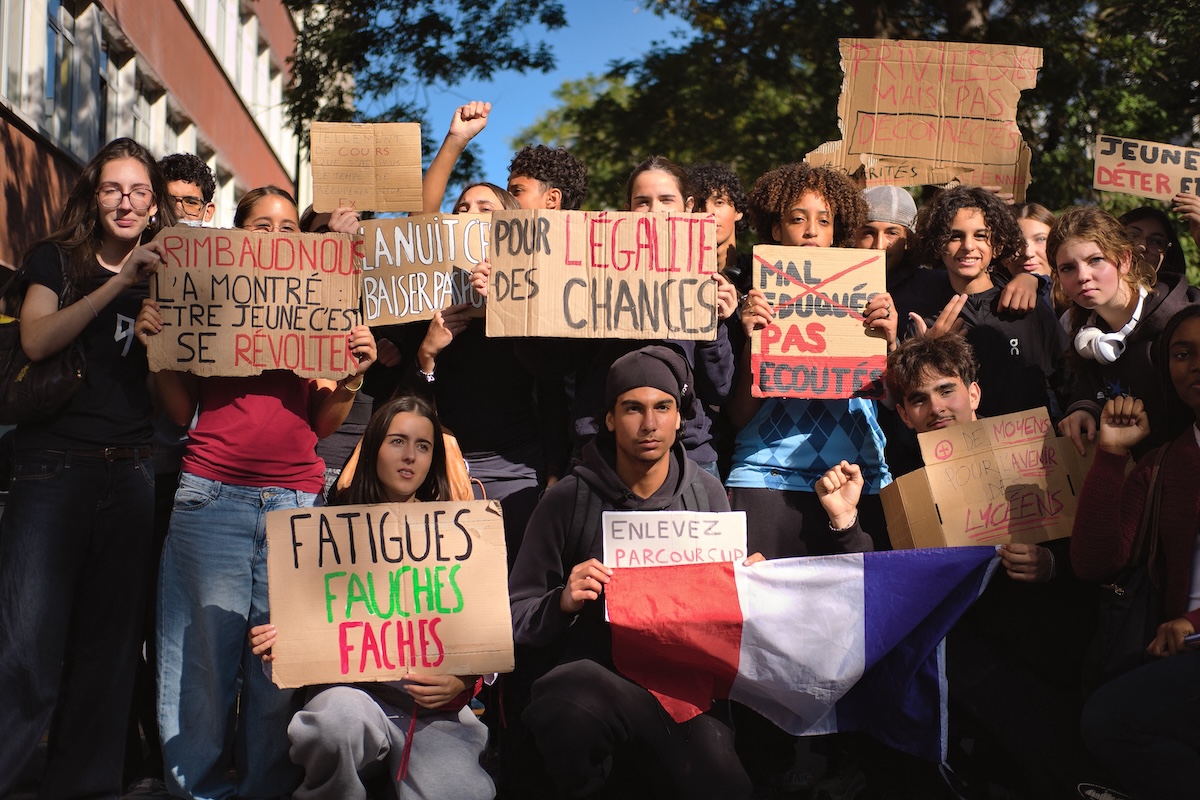 Le 5 octobre, dans le 18ème arrondissement de Paris. Des lycéen·nes bloquent le lycée Saint-Charles-de-Foucauld. © Djoudi Hamani/Hans Lucas via AFP
«On n’a pas de profs, on est dans des classes surchargées, on a des problèmes au niveau de l’hygiène…» Mariama, élève du lycée Maurice-Utrillo de Stains (Seine-Saint-Denis), liste à Vert toutes les raisons qui l’ont poussée à venir tôt ce mardi matin devant son établissement.
Elle désigne les bâtiments derrière la grille. «Certains de nos cours ont lieu dans les préfabriqués : qu’il pleuve ou qu’il neige, il fait extrêmement froid en hiver et chaud l’été», décrit l’adolescente. Comme elle, des dizaines de milliers de lycéen·nes se sont rassemblé·es devant leur établissement pour réclamer de meilleures conditions pour étudier. «On n’a pas les conditions pour travailler, on se sent délaissé par la société alors qu’on est les adultes de demain», s’indigne la jeune femme.
Syndicats, parents et professeurs en soutien
La colère lycéenne, née à Créteil (Val-de-Marne) le 17 septembre, s’est propagée dans toute la France. Après plusieurs jours de blocages de nombreux établissements, ce mardi a été marqué par des manifestations dans plusieurs villes, dans l’Hexagone et en outre-mer. Selon le ministère de l’intérieur, 256 000 manifestant·es se sont mobilisé·es dans le pays. Les organisations syndicales évoquent 450 000 personnes. Au total, 891 lycées sur 3 700 ont vu leurs cours «être suspendus, soit totalement, soit partiellement, toutes causes confondues», a indiqué le ministère de l’éducation nationale.
À Paris, le cortège qui s’est élancé place de la République a réuni 56 000 personnes. Parents, professeur·es, étudiant·es et syndicalistes ont rejoint les lycéen·nes pour exiger davantage de moyens pour l’éducation nationale. Le délabrement de nombreux établissements est au cœur des revendications. Des vidéos tournées par les professeur·es et élèves des lycées Paul-Éluard, à Saint-Denis, ou Blaise-Cendrars, à Sevran, révèlent des plafonds effondrés, des fuites d’eau, des moisissures ou encore un manque de matériel.
«On est là en soutien, pour dire au gouvernement d’écouter cette jeunesse, raconte à Vert Rémi (il n’a pas donné son nom), enseignant en histoire-géographie, syndiqué SNES-FSU dans un lycée de Chelles (Seine-et-Marne). Pour elle, faire des études va être compliqué, le réchauffement climatique va nuire à son avenir, on n’a pas beaucoup d’espoir à lui apporter et, là, cette jeunesse se relève parce qu’elle a envie de créer un autre monde.»
 Le 4 octobre à Saint-Denis (Seine-Saint-Denis), une lycéenne participe à un rassemblement de jeunes pour exiger plus de moyens dans l’éducation nationale. © Kenzo Tribouillard/AFP
«Ce n’est pas parce qu’on est dans le 93 [la Seine-Saint-Denis, NDLR] qu’on est forcément des bandits, s’indigne Jenna, 14 ans, en seconde professionnelle métiers de la construction durable du bâtiment et des travaux publics à Saint-Denis. On veut juste être là pour avoir une bonne éducation, aller au lycée, pouvoir obtenir nos vœux dans Parcoursup.»
La plateforme pour faire son choix d’études supérieures essuie de nombreuses critiques. «Parcoursup brise nos rêves, et c’est encore pire quand on vient des quartiers populaires», explique Koumba, en terminale au lycée Jean-Jaurès de Montreuil.
Place de la République, le collectif écologiste Extinction Rebellion a grimpé sur la statue de Marianne pour y accrocher le message «Lycées délaissées, jeunesse sacrifiée», en soutien au mouvement. Nombre de syndicats ont appelé à rejoindre la mobilisation. Outre ceux de l’éducation nationale, le syndicat agricole Confédération paysanne était présent dans plusieurs rassemblements en France. L’intersyndicale de l’enseignement supérieur et de la recherche a souligné que «l’expression lycéenne et étudiante doit pouvoir se faire sans entrave et dans un cadre démocratique, pacifique, libre et serein».
Plus de 5 000 gardes à vue
Depuis ses débuts, la mobilisation a connu une répression exceptionnelle. Le ministère de l’intérieur a annoncé que 5 000 personnes avaient été placées en garde à vue, essentiellement des mineur·es. À titre de comparaison, 12 000 personnes avaient été interpellées en six mois de mobilisation des Gilets jaunes.
À Tours (Indre-et-Loire), la semaine dernière, un lycéen de 16 ans a perdu l’usage d’un œil lors d’un blocage ; lundi, un adolescent de 15 ans a eu la main arrachée par une grenade à Lens (Pas-de-Calais). Un autre a eu la mâchoire fracturée à Saint-Ouen-l’Aumône (Val-d’Oise), après un tir de grenade lacrymogène. Au total, 215 élèves ont été blessé·es. La police des polices a ouvert dix enquêtes dans le cadre de ces manifestations.
 À Saint-Denis, le 4 octobre. Les lycéen·nes se mobilisent pour demander de meilleures conditions d’étude. © Valérie Dubois/Hans Lucas via AFP
Le ministre de l’éducation nationale, Édouard Geffray, a parlé de «drame» et a annoncé le lancement, depuis lundi soir, d’une plateforme où les élèves pourront «dire leurs difficultés et leurs attentes», jusqu’au 23 octobre. Ce mardi, la Commission nationale consultative des droits de l’homme (CNCDH) a exprimé sa «vive inquiétude» sur le «recours disproportionné à la force».
Sans annoncer de moyens financiers pour l’éducation nationale, le premier ministre Sébastien Lecornu a indiqué ce mardi après-midi que les cours seront suspendus jusqu’à la fin de la semaine pour organiser «un temps de démocratie interne» dans les lycées.
À un peu plus de six mois de la présidentielle – élection qui verra certain·es des lycéen·nes voter pour la première fois –, cette mobilisation s’étire dans un climat politique et social particulièrement tendu, sur fond de hausse des prix et de recherche de coupes budgétaires.
Un enjeu que les jeunes participant·es à la manifestation de Paris ont bien compris. «On est à bout, et ce n’est même pas que nous : ce sont les ouvriers, les pompiers, les agriculteurs, les étudiants, précise Koumba. J’ai peur de ne pas pouvoir nourrir mes enfants plus tard, de ne pas pouvoir payer l’essence, de faire des études que je n’aime pas… Ce sont tous les Français qu’Emmanuel Macron doit écouter.»
-
Pourquoi cette étrange pub pour Walter White tourne-t-elle en boucle sur X depuis des années ?
Reply source
Une étrange publicité mettant en scène Walter White revient sans cesse dans les fils X. Cette dernière cumule désormais plus de 170 millions de vues et renvoie vers un site qui invite les internautes à « soutenir » le personnage de Breaking Bad, à laisser leur nom et éventuellement leur adresse e-mail. Le tout sans expliquer clairement qui l’a créé, ni pourquoi quelqu’un paie encore pour le promouvoir aussi massivement.
-
Bardella : l'antisémitisme, un vivier du RN
L'image du jeune homme lisse, exempt des outrances de la génération de Jean-Marie Le Pen, vole en éclats. Mais tout la contredisait depuis le début : à y regarder de près, celui qui incarne le visage de la dédiabolisation a frayé tout au long de sa courte…Reply source -
L’Europe tient une nouvelle licorne dans la robotique “next-gen” : la start-up allemande RobCo atteint une valorisation d’un milliard de dollars
Reply sourceL’Allemagne est sans nul doute le pays européen le plus dynamique dans la robotique “next-gen”. Elle abrite notamment RobCo, qui a annoncé le 5 octobre avoir dépassé le milliard de dollars (892 millions d’euros) de valorisation, le faisant accéder au statut de “licorne”. Selon le Wall Street Journal, la start-up a réalisé la vente de 40 millions de dollars (35,7 millions d’euros) d’actions secondaires détenues par ses salariés. Elle a par la même occasion fait entrer deux investisseurs : les capital-risqueurs Cherry Ventures et European Tech Collective.
-
Hors des villes, les mobilisations lycéennes sous les radars
Reply source
-
Garde à vue pour jets de citrons et exclusion des « meneurs » : le compliqué blocage d'un lycée rural
Reply source -
Nouveau décodeur Freebox : Free donne enfin de ses nouvelles
Reply source
Promis par Xavier Niel lors du lancement de la Freebox Ultra en janvier 2024, le nouveau Freebox Player est désormais prévu pour début 2027. L'opérateur ne dévoile rien, mais certains imaginent déjà une sorte de « Super Player ».
-
« L'avenir, c'est nous » : le déni climatique alimente la colère lycéenne
Reply source
40 °C lors du bac, « hyper froid » l'hiver, inégalités entre lycées... Le 6 octobre, des milliers de personnes se sont retrouvées à Paris dans le cadre du mouvement social des lycéens. Parmi leurs revendications, la rénovation thermique de leur établissement.
Lire la suite - Reportage / Luttes , Social
Paris, reportage
La scène, vue place de la République à Paris, a quelque chose de vertigineux : un groupe d'adolescents hauts comme trois pommes mange des bonbons devant une rangée de camions de CRS. Autour d'eux, de nombreux jeunes (…) -
Des conditions « infernales » : les lycéens manifestent aussi à cause du chaos climatique
Reply source
40 °C lors du bac, « hyper froid » l'hiver, inégalités entre lycées... Le 6 octobre, des milliers de personnes se sont retrouvées à Paris dans le cadre du mouvement social des lycéens. Parmi leur revendication, la rénovation thermique de leur établissement.
Lire la suite - Reportage / Luttes , Social
Paris, reportage
La scène, vue place de la République à Paris, a quelque chose de vertigineux : un groupe d'adolescents hauts comme trois pommes mange des bonbons devant une rangée de camions de CRS. Autour d'eux, de nombreux jeunes (…) -
Face à la colère des lycéens, Lecornu suspend les cours dans les lycées et promet de « corriger » Parcoursup
Reply sourceFace à la mobilisation, Sébastien Lecornu a aujourd’hui appelé à une « réponse politique » au mouvement lycéen. Il a notamment promis de « corriger tout ce qui était possible » de Parcoursup.
Cet article Face à la colère des lycéens, Lecornu suspend les cours dans les lycées et promet de « corriger » Parcoursup est apparu en premier sur La Relève et La Peste.
-
Arrêter, expulser, déporter : welcome to the USA
Reply source -
California to ‘actively monitor’ for possible threats after Trump said Iran could ‘take out’ LA and San Diego
Reply sourceGavin Newsom said state’s threat-assessment center would be on heightened alert after president’s remarks
California’s governor, Gavin Newsom, on Tuesday directed the state’s emergency preparedness center to “actively monitor” possible threats to the state after Donald Trump suggested Iran could “take out” the cities of Los Angeles and San Diego.
Trump has faced a chorus of condemnation from Democratic leaders in California after his comments at a rally in Nebraska on Monday night, which the White House has suggested were being taken out of context.
Continue reading... -
[IA Insider] Aleph Alpha, Mistral AI, Reflection... Les modèles open-weight occidentaux veulent en découdre avec leurs rivaux chinois
Reply sourceÀ la une
-
Le RN poursuit sa campagne, entre silence, déni, attaques et mensonges
Jordan Bardella et Marine Le Pen ont organisé comme si de rien n’était une conférence de presse sur leur programme économique, tentant d’éviter les quelques questions sur les propos antisémites tenus par le président du parti. Celui-ci a de nouveau ciblé les journalistes, maintenu ses dénégations et déniché un curieux témoin de moralité.Reply source -
Soirée décoloniale à Orly - projection du doc "Algérie, sections armes spéciales"
Reply sourceQuand ?
Le 9 octobre à 18h30Où ?
Salle Marco Polo 1 rue Marco Polo, 94310, Orly , FranceSOIRÉE DÉCOLONIALE
▶ Le collectif Agir pour la Palestine et LFI ORLY
vous proposent la projection du documentaire « Algérie, sections armes spéciales » en présence de la réalisatrice Claire Billet et de l'historien Christophe Lafaye.▶ La table ronde sera animée par Mourad Guichard.
D'autres intervenants seront présents comme Youssef Boussoumah et Farid Bennai et nous éclairerons autour des thèmes suivants :
– > comprendre les processus d'oubli des violences coloniales et questionner nos héritages.
– > de l'Algérie à la Palestine (une histoire qui se duplique)
– > une histoire qui résonne dans nos quartiersVendredi 9 octobre - ouverture des portes à 18h30 (exposition photos et peinture), repas solidaire
20h00 projection du documentaire suivi d'un débat.Salle Marco Polo - 1 rue Marco Polo à Orly (94)
RER C Mona/Romi Gare les Saules
Tram T9 C. Colomb -
Soirée décoloniale à Orly. Projection du doc 'Algérie, sections armes spéciales'
Reply sourceQuand ?
Le 9 octobre à 18h30Où ?
Salle Marco Polo 1 rue Marco Polo, 94310, Orly , FranceSOIRÉE DÉCOLONIALE
Le collectif Agir pour la Palestine et LFI ORLY vous proposent la projection du documentaire « Algérie, sections armes spéciales » en présence de la réalisatrice Claire Billet et de l'historien Christophe Lafaye.
La table ronde sera animée par Mourad Guichard. D'autres intervenants seront présents comme Youssef Boussoumah et Farid Bennai et nous éclairerons autour des thèmes suivants :
– comprendre les processus d'oubli des violences coloniales et questionner nos héritages.
– de l'Algérie à la Palestine (une histoire qui se duplique)
– une histoire qui résonne dans nos quartiersVendredi 9 octobre
Ouverture des portes à 18h30 (exposition photos et peinture), repas solidaire
20h00 projection du documentaire suivi d'un débat.Salle Marco Polo - 1 rue Marco Polo à Orly (94)
RER C Mona/Romi Gare les Saules
Tram T9 C. Colomb -
La guerre au Yémen entre dans une nouvelle phase
Le gouvernement reconnu par la communauté internationale a lancé une opération militaire visant à reprendre le contrôle du pays. Dans le sud, la bataille avec les houthistes se concentre autour du détroit de Bab el-Mandeb et de la troisième ville du pays, Taïz.Reply source