Conversation
-
Unprecedented Corruption—and How We End It
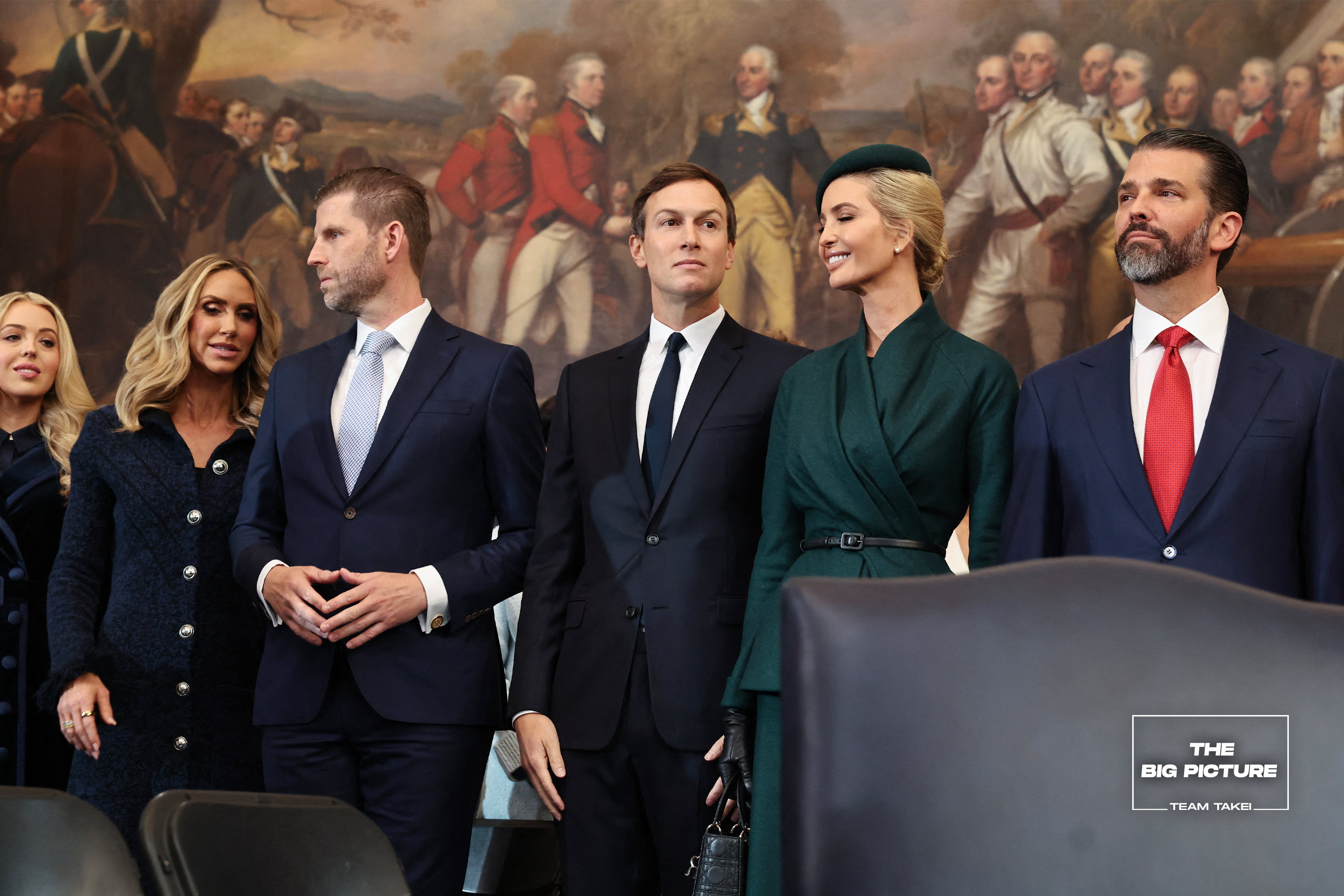
source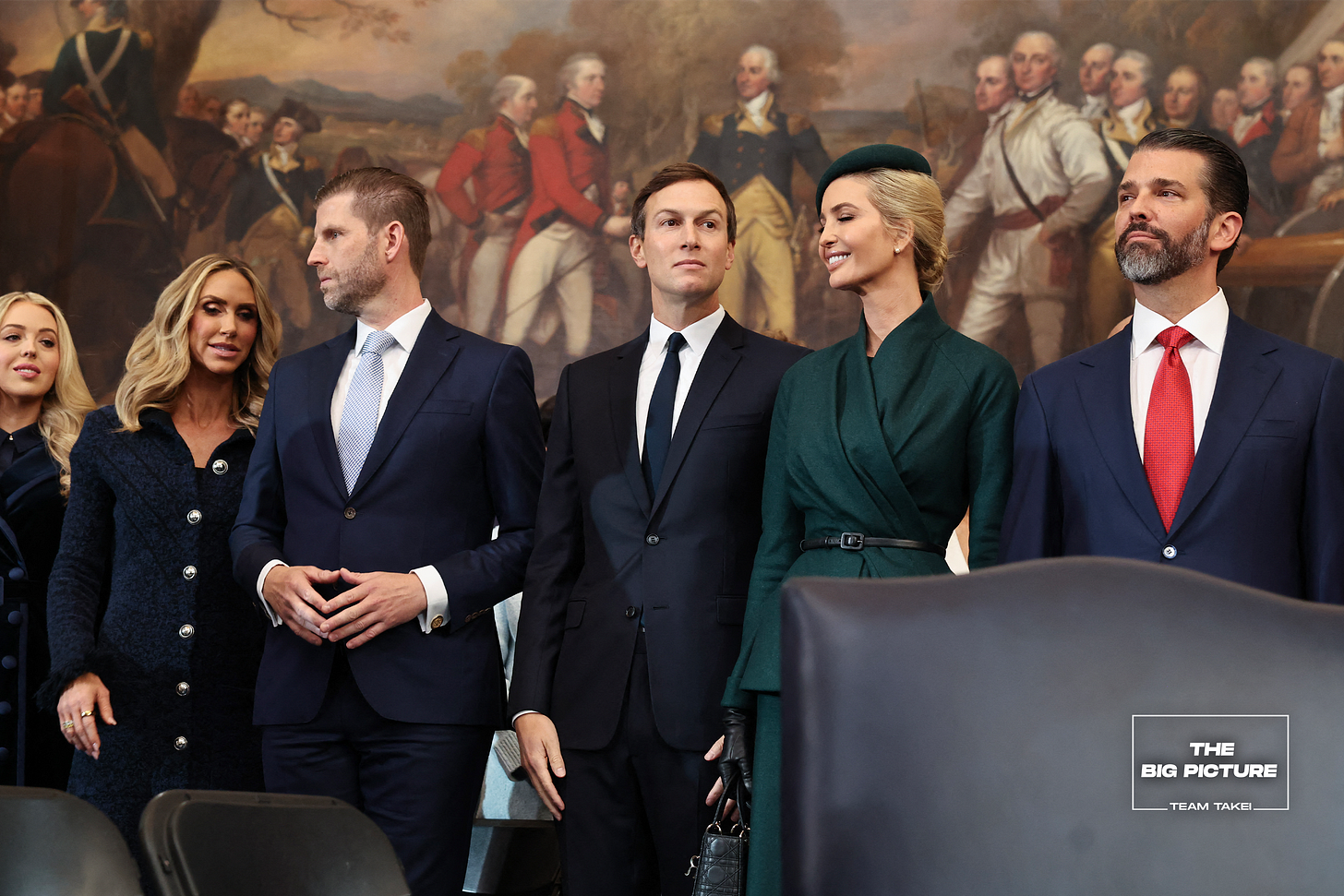 Tiffany Trump, Lara Trump, Eric Trump, Jared Kushner, Ivanka Trump and Donald Trump Jr. Photo by Chip Somodevilla / POOL / AFP via Getty Images.
Another corruption story made headlines over the weekend, and the zone is officially flooded. We barely have time to absorb one hit before the next arrives.
And that’s the point. Trump ally Steve Witkoff and son-in-law Jared Kushner sat down with Vladimir Putin at the Kremlin in early September to discuss ending the war in Ukraine. But Putin had more than peace in mind. He proposed a business deal: the sale of Russian oil conglomerate Lukoil’s international holdings, including a network of oil fields, refineries and gas stations across several countries.
Yes, a multibillion-dollar sale of Russian assets to investors tied to the people supposedly negotiating peace is now part of the talks.
Conflict of interest much?
The road back from corruption and abuse of authority isn’t easy. It requires understanding not only what the hell is going on, but also what allowed it to happen and why no one is stopping it. Then we must figure out how to fix it.
The good news is that we’re not the first democracy to take on an autocratic, family-run regime. We have a long tradition of civil society and order, even if we are unaccustomed to fascist smash-and-grab tactics. But we don’t have to feel our way through. Scholars and experts have drawn road maps for holding corrupt officials accountable and dismantling the systems and incentives that opened the floodgates to cronyism, grift and theft of state property.
So let’s look first at what’s going on, then at the system Trump and his gang broke, and finally at what the democratic opposition can do to fix it once back in power. It’s a big topic with big consequences, and there’s no way out but through, so here we go.
The Big Picture is reader-supported.
To receive new posts and support our work,
consider becoming a free or paid subscriber.What the hell is going on?
Before we unpack the latest scandal, let’s review the cast of characters, Succession-style.
Already at the Russian table are Kushner and Witkoff, both real estate developers, not diplomats. The Trump brothers, Don Jr. and Eric, are in bed with Witkoff’s son Zach their partner in the crypto firm World Liberty Financial. (Ivanka is presumably in bed with her husband.)
The group lined up to buy Lukoil’s foreign assets is led by Todd Boehly. If that name isn’t familiar, he is the co-owner of the Dodgers and a big donor to Trump. Indeed, he gave $2 million to Trump’s political causes, which apparently buys you a seat at the dirty table. The consortium also includes a federal agency, the U.S. International Development Finance Corp.
Also at the table are Qatari brothers Moutaz and Ramez Al-Khayyat, who are partners with Jared and Ivanka on a resort in Albania. That resort drew weeks of daily protests in Tirana this summer, some of the largest since the fall of communism. The protests grew into a national anti-corruption movement.
Then there’s an investment fund controlled by Sheikh Tahnoon bin Zayed Al Nahyan, the United Arab Emirates’ national security adviser and brother of its president, who has ties to Kushner’s private equity firm and to World Liberty.
The Trumps sure know how to keep things in the family. You’ll see these names again and again, so keep track of how they connect.
The Lukoil deal comes cheap for a reason. In October 2025, the U.S. Treasury sanctioned Lukoil and Rosneft, with Treasury Secretary Scott Bessent calling them Russia’s “two largest oil companies that fund the Kremlin’s war machine.” U.S. approval of the sale would free the assets from those sanctions, making the deal lucrative. A spokeswoman for Witkoff said he “has no conflict of interest and no financial stake in this matter” — except that his son Zach co-founded World Liberty. Other investors in that scam are tied to Sheikh Tahnoon, now at the Lukoil table.
In short, Witkoff may have “no financial stake” in the deal, but people important to his son sure do.
The Lukoil talks follow a pattern set by the Trump family’s other new ventures. In August 2025, 1789 Capital, the venture firm where Don Jr. is a partner, took a stake in Vulcan Elements, a maker of rare-earth magnets. Three months later, the Pentagon’s Office of Strategic Capital announced a $620 million loan to the company, which Democratic lawmakers later called the largest the office had ever made. ProPublica reported in May that White House adviser Peter Navarro, a friend of Don Jr., initiated the request, and Pentagon staff compressed a vetting process that normally takes months into weeks. One official recalled the message plainly: “The call came from the White House: We have to get this done.” Estimates of Vulcan’s valuation soared from about $200 million to about $2 billion.
Then there’s the crypto business. Days before Trump’s inauguration, Emirati-backed investors bought 49 percent of World Liberty for a reported $500 million, in a deal involving Sheikh Tahnoon. In May 2025, Zach Witkoff announced that one of Tahnoon’s investment firms would route a $2 billion deal through World Liberty’s stablecoin. That’s billion with a b. Two weeks later, surprise, surprise, the White House agreed to give the UAE access to hundreds of thousands of advanced AI chips, many bound for G42, a firm Tahnoon controls. This decision came despite national security concerns that the chips could leak to China. The White House denied any connection between the investment and the chip decision, but come on.
In August, World Liberty won preliminary conditional approval from the Office of the Comptroller of the Currency to establish a national trust bank. World Liberty is 38 percent owned by DT Marks DEFI LLC, which in turn is 70 percent owned by the Donald J. Trump Revocable Trust and 30 percent by Trump family members. The agency, by the way, is run by Comptroller Jonathan Gould, a Trump appointee. American University banking law professor Hilary Allen told Mother Jones the charter “wouldn’t have happened if Trump wasn’t setting things up to accommodate the crypto industry.”
Add it up and the numbers get very, very large. A January report from House Oversight Committee Democrats estimated $2.25 billion in realized profits for Trump from foreign payments, corrupt oligarchs and others, rising to as much as $9.7 billion including his digital assets.
The state as family business
Taken one at a time, each deal is its own scandal. Taken together, they describe a corrupt model of government that political scientists have studied for more than a century.
Modern civil societies rest on an unspoken premise. The state belongs to the public, and its treasury is separate from the ruler’s purse. Political scientists Stephen Hanson and Jeffrey Kopstein argue the Trump regime is dissolving that bargain, turning the government into the personal property of the man at the top and his inner circle. Under this kind of regime, they write, “Loyalty now counts for more than competence in government service, public office is openly monetized, and personal favor has replaced impersonal rule as the basis of authority.” Kopstein has put it more simply in a line suited to these times: Governance becomes “a family business.”
Family syndicates like this tend to attract eager partners from abroad. Historian Anne Applebaum describes modern autocracies as networks of kleptocrats whose links “are not cemented by ideals, but by deals.” The same names keep turning up in the Trump family’s ledger because they already know how to play ball with the Trumps. That’s how a Gulf royal helps buy nearly half of the Trump family’s crypto company, secures access to advanced American chips and then lines up to buy sanctioned Russian oil with help from the president’s son-in-law.
Firing the referees
Before a corrupt family enterprise can open for business, it needs the authorities out of the picture or bought and paid for. That’s exactly what the Trumps did.
The Vulcan stake, the $2 billion stablecoin deal, the chip approval and the bank charter all followed the removal of officials whose job was to scrutinize deals like these. On Jan. 24, 2025, four days into his second term, Trump fired more than a dozen inspectors general. Weird plural adjectival placement aside, they’re the independent watchdogs who police fraud and abuse inside federal agencies. Trump fired them without giving Congress the 30 days’ notice the law requires. The Pentagon’s inspector general was among them. “The firing of the independent, nonpartisan inspector general was a clear violation of the law,” said Michael Missal, the ousted inspector general at the Department of Veterans Affairs.
The Justice Department was next. After then-acting Deputy Attorney General Emil Bove ordered corruption charges against then-New York City Mayor Eric Adams dropped, at least seven prosecutors resigned, and the department moved to shrink its Public Integrity Section from about 30 prosecutors to as few as five. The unit was established in 1976, after Watergate, to prosecute corrupt officials.
Then came hiding the money trail. In March 2025, the Treasury Department’s Financial Crimes Enforcement Network exempted every American company from the Corporate Transparency Act’s requirement to disclose who actually owns it. The pool of companies required to report shrank from about 32 million to roughly 12,000 foreign entities. The regime also froze enforcement of the Foreign Corrupt Practices Act, the law against bribing foreign officials, and cut the resources behind it.
The world took notice, and so did corrupt partners looking to score big. In February, Transparency International’s latest Corruption Perceptions Index scored the United States 64 out of 100, its lowest ever and down from 76 a decade earlier, amid concerns about politically motivated enforcement and weakened anti-bribery enforcement. The score next year will be even lower, one can imagine.
Corrupt regimes don’t always endure
Political family syndicates also have weak points, and Hanson and Kopstein identify four that should give the opposition some hope and the regime’s enablers some pause.
The first is succession. Trump’s term ends in January 2029, and the Constitution bars a third. Hard stop. That means things will grow increasingly unsteady for the Trump family: “Political succession is the Achilles’ heel of patrimonial rule, and the mere anticipation of a post-Trump future encourages hedging, quiet disloyalty, and a search for alternatives long before any transition formally begins,” Hanson and Kopstein write. Partners in a family business start calculating their own exposure once the protection has an expiration date.
The second is popularity. Or rather, unpopularity in the Trumps’ case. A demagogue’s power depends on seeming inevitable and invincible, and the authors argue that every act of public resistance chips away at that impression. That impression is fading fast. A CBS News/YouGov poll taken Sept. 30 to Oct. 2 put Trump’s approval at 39 percent, below his 43 percent at the same point in his first term and below Joe Biden’s 40 percent heading into the 2022 midterms. The same poll found voters preferring Democrats for the House by 53 percent to 41 percent. CBS’s Battleground Tracker estimates Democrats would win about 229 seats, 11 more than needed for a majority, despite aggressive mid-decade GOP gerrymandering. For a family business that has relied on a Republican Congress to keep its books closed, a Democratic House means subpoenas.
The third is competence. Or rather, incompetence from the Trump White House. A government that drives out its experts and promotes loyalists eventually stops working, the authors argue. We’re seeing this in tariff-driven inflation, rising measles cases, natural disaster aid stalled or withheld and a wave of food recalls. But the war with Iran has become the regime’s costliest failure. By July, after incessant bombing had failed to open the Strait of Hormuz, Richard Haass, president emeritus of the Council on Foreign Relations, described U.S. policy as “at something of a strategic dead end.” In late September, Trump rejected an Iranian offer to reopen the strait, and oil prices jumped. Gas prices set a record for September, averaging $4.33 a gallon. Most voters now say they would prefer a House candidate who opposes both new tariffs and the Iran war.
The fourth is support from abroad. Or rather, lack of it. Allies who lose faith in Washington, the authors predict, will build their own defense and trade arrangements. And that is exactly what has begun to happen, with Canada leading the shift away from U.S. dependence. In June 2025, Ottawa signed a defense and security partnership with the European Union that opened European rearmament programs to Canadian companies. Last month, as new tariffs took effect, Canadian Prime Minister Mark Carney said four decades of integration had left Canada too reliant on the United States. “That time is over,” he said. Two weeks later, Carney told the New York Times his government was reconsidering its purchase of American F-35s, exploring alternatives to Starlink and had spent the past year gaming out what he called the “extreme tail risk” of Trump ordering military action against Canada.
Taking down the family syndicate
Each of these weaknesses gives the opposition an opening, and Democrats have already promised action. House Minority Leader Hakeem Jeffries, in line to become speaker if his party wins in November, told the Associated Press, “If folks have been stealing from the American people, shortchanging the American people or screwing over the American people, we are going to hold the crooks accountable.” Rep. Jamie Raskin, the top Democrat on the House Judiciary Committee, said the party needs to “zero in quickly on the forms of systemic corruption that have cost the public huge amounts of money, and where there are legislative cures available.”
That’s tough talk, but can they deliver, given Trump’s control of the executive branch and his clear willingness to stonewall investigations?
Alina Mungiu-Pippidi, a scholar of how countries bring corruption under control, recommends a two-part strategy: raise the constraints on corrupt behavior and shrink the opportunities for it. A Democratic House can start on the first part in January. The second will have to wait for a Congress and president able to pass real reform. Voters thus will need to understand both the urgency of the moment and the limits of what is possible immediately.
Checking the Trumps
The first check Democrats can impose on the regime is building the evidence. It’s painstaking, unsexy work. But a family business keeps books, and Congress can subpoena them: World Liberty’s investor records, the Pentagon’s file on the Vulcan loan, the communications behind the Lukoil talks. Raskin’s focus on legislative cures doubles as legal strategy, and while the White House will throw up predictable roadblocks, this path has been blazed before.
In Trump v. Mazars USA (2020), the Supreme Court held that Congress may subpoena a president’s personal records, with courts weighing whether a request serves a valid legislative purpose and is “no broader than reasonably necessary.” Subpoenas tied to pending bills on stablecoins, defense lending or sanctions relief would stand the best chance in court.
The White House is readying its defenses. In August, the Justice Department’s Office of Legal Counsel issued an opinion extending executive privilege to the president’s communications with private advisers outside government. That level of legal insulation is an absurd tail wagging a drooling dog, and it will have to be fought in the courts. Senate Democrats expect the regime to invoke privilege “at every turn,” Axios reported. We must also prepare for Trump to promise or issue preemptive pardons to protect the criminals closest to him. But remember: President Trump’s pardon power reaches only “offenses against the United States,” leaving state charges possible.
The second check targets the Trump family’s close partners. Kopstein’s advice to democracy’s defenders is direct: “Raise the costs of loyalty, fracture the elite, and lower the costs of exit.” Sens. Adam Schiff (D-CA), Sheldon Whitehouse (D-RI) and Richard Blumenthal (D-CT) understand this well. If the gavels change hands, they plan to examine the billionaires in cahoots with the regime and the big institutions, universities and law firms that capitulated to it.
The elite wall has already begun to crack in aJuly, the Wall Street Journal’s editorial board, hardly a bastion of liberal thought, accused the Trump family of “cashing in on the Presidency in big and sketchy ways,” citing World Liberty and 1789 Capital’s stake in Vulcan. It warned that Democrats would relish probing the family’s deals if they won either chamber.
The more blatant grifts have drawn fire from Republican lawmakers. Last month, ProPublica reported that Umar Kremlev, a Russian oligarch decorated by Putin, had covered hundreds of thousands of dollars in Don Jr.’s post-wedding festivities in the Bahamas. Sen. John Curtis, a Utah Republican, responded by asking the Senate Judiciary Committee to investigate and subpoena Don Jr.: “A toaster is a wedding gift. A private-island party paid for by a Putin-connected oligarch is something else.” If Don Jr. can be hauled in over a wedding gift, he can be hauled in over the Vulcan loan and World Liberty’s bank charter.
By building the record future prosecutors would need, even without the power to indict directly, Democrats could help beat the clock. Most federal crimes carry a five-year statute of limitations, so conduct from 2025 generally must be charged by 2030. Evidence gathered now by Congress could later serve a Democratic administration, especially if there’s an attorney general willing to prioritize accountability over perceived institutional neutrality.
Shrinking the opportunities
Mungiu-Pippidi also stresses shrinking the openings for graft. This is a longer process requiring legislation, and therefore Democratic control of more than just the House. Any reform must pass the Senate and would presumably face a GOP filibuster and a veto from Trump. But investigations begun in 2027 can build the case for such laws when Democrats next have a trifecta.
Congress has done this before. From 1932 to 1934, the Senate Banking and Currency Committee investigated Wall Street. Its chief counsel, Ferdinand Pecora, exposed self-dealing by the country’s most powerful bankers. Congress later responded with the Banking Act of 1933, better known for its Glass-Steagall provisions, and the Securities Exchange Act of 1934, both aimed at abuses Pecora’s team uncovered.
When Democrats retake the White House and can finally enact laws, the blueprints will be ready. Schiff’s Protecting Our Democracy Act, which he first introduced in the House, would strengthen Congress’s power to enforce subpoenas, bar presidents from pardoning family members or themselves, prohibit using the office for self-enrichment and bolster whistleblower protections. The No Payoffs for Pardons Act, introduced by Senate Minority Leader Chuck Schumer and Blumenthal, would require disclosure of gifts tied to clemency, make explicit that federal bribery law covers the president and vice president and set a 10-year statute of limitations for bribery involving pardons. The same Congress could restore protections for inspectors general, rebuild the Public Integrity Section and write ownership disclosure requirements for American companies back into law.
The public is ahead of Washington on corruption. In a September Economist/YouGov poll, 53 percent of registered voters described Trump as corrupt, including 62 percent of independents—the bloc that decides elections. In an August Reuters/Ipsos poll, three in four Americans said corruption influences federal decisions a great deal or quite a bit.
The biggest barrier to guardrail reform is the filibuster, which grants a minority party an effective veto over major nonbudgetary legislation. Many understandably worry what the GOP would do without the filibuster once back in power. But that could hardly be worse than inaction and paralysis, which would confirm for voters that both parties are corrupt and unreformable.
Corruption may be the byproduct of a family-run banana republic, but it is also the whole point of the game for those who have seized control. That’s why they have destroyed the existing guardrails and made bedfellows of other autocrats. The only effective response is to reclaim our country at the first opportunity and then do everything possible to restore those protections, expand democratic rights and jail those who took part in the money grab.
Thanks for reading!
This post is public so feel free to share it.