@rick — following
Follow buttons here act as you, not as @rick.
@rick follows
| Label | Kind | State | Action |
|---|---|---|---|
| rss.skyfleet.blue | source | — | — |
| rss.skyfleet.blue | source | — | — |
| rss.skyfleet.blue | source | — | — |
| rss.skyfleet.blue | source | — | — |
Timeline
-
Conférence Lexing Panorama 2025-2026 des décisions de la Cnil
Reply source
Les inscriptions pour la Conférence Lexing « Panorama 2025-2026 des décisions de la Cnil » sont ouvertes !
Cette conférence, de Virginie Bensoussan-Brulé, avocate, directrice du pôle Contentieux du numérique, aura lieu :
• Mercredi 14 octobre 2026
• De 9h30 à 11h30
• En distanciel (visioconférence)
Participation gratuite sur inscription obligatoire.Cette présentation, animée par Virginie Bensoussan-Brulé, propose un panorama des principales décisions rendues par la Cnil en 2025 et 2026 afin d’identifier les tendances récentes de son activité répressive et d’en tirer des enseignements pratiques pour les responsables de traitement et les sous-traitants.
Panorama 2025-2026 des décisions de la Cnil
Les décisions rendues par la CNIL en 2025 et 2026 témoignent d’une évolution des priorités de contrôle et des pratiques répressives de l’autorité. Cybersécurité, cookies et traceurs, prospection commerciale, surveillance des salariés, droits des personnes ou encore responsabilité des sous-traitants : les sanctions récentes permettent d’identifier plusieurs tendances structurantes pour les entreprises. La conférence reviendra également sur la montée en puissance de la procédure simplifiée, devenue un véritable outil répressif, ainsi que sur les principaux enseignements à tirer des décisions les plus significatives.
Au programme de cette conférence :
- Décrypter les principales tendances de l’activité répressive de la Cnil en 2025 et 2026 ;
- Comprendre les différences entre procédure ordinaire et procédure simplifiée et leur place croissante dans l’activité de la Cnil ;
- Analyser les principales thématiques de sanctions ;
- Comprendre la place des plaintes et des droits des personnes dans le déclenchement des procédures ;
- Tirer des décisions récentes les principaux points de vigilance et les prochains domaines de contrôle de la Cnil.
Cette conférence permettra de disposer d’une vision actualisée du contentieux Cnil et d’identifier les enseignements opérationnels à intégrer dans les dispositifs de conformité et de prévention des risques.
Participation gratuite – sur inscription uniquement
Inscrivez-vous dès maintenant !
▼ pour participer, remplissez le formulaire d’inscription au bas de cette page ▼
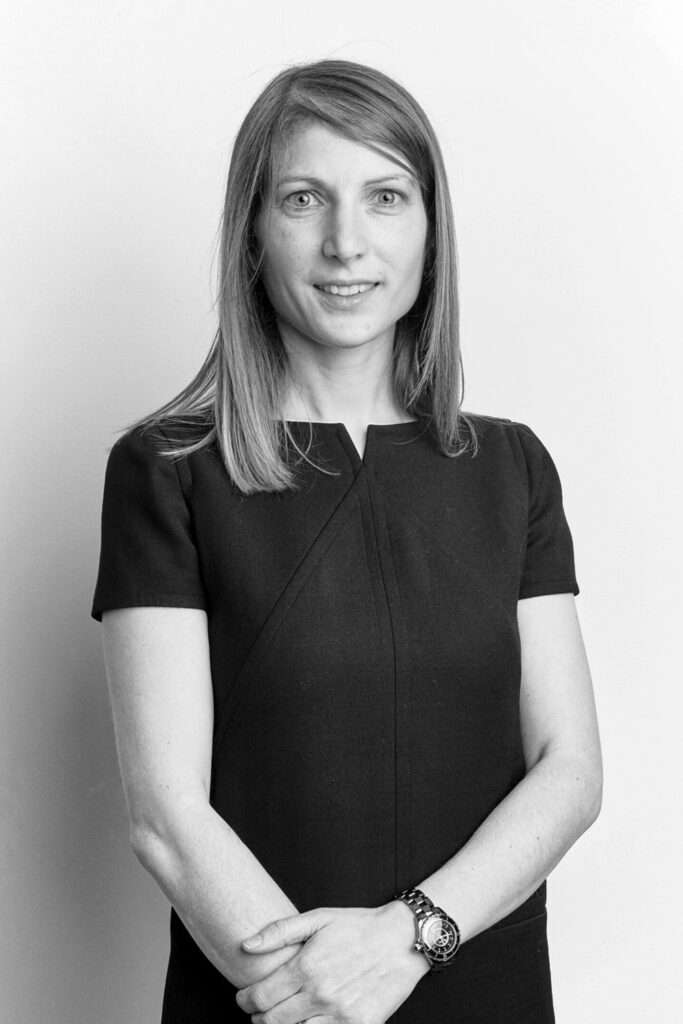
Virginie Bensoussan-Brulé
AvocateDirectrice du pôle Contentieux du numérique
Pour y assister, enregistrez-vous en complétant les champs marqués d’un (*) :
Information Conférence Lexing :
Date : 14-10-2026
Thème : « Panorama 2025-2026 des décisions de la Cnil »
Animée par : Virginie Bensoussan-Brulé
Domaine technique : Données personnelles
Domaine juridique : Informatique et Libertés
Format de conférence : Distanciel
Lexing collecte les données recueillies sur ce formulaire pour traiter vos demandes d'abonnement aux lettres d’information et aux événements publics et gratuits organisés par le cabinet dont les Conférences Lexing, pour gérer l’organisation, l’animation et le suivi de ces évènements, créer, gérer, suivre, enregistrer et exploiter les visioconférences et webinaires publics et gratuits organisés par le cabinet et pour gérer les demandes de désabonnement et les demandes d'exercice des droits Informatique & Libertés.Formulaire d'inscription
(*) Champs obligatoiresCivilité Nom* Prénom* Fonction* Organisme* Adresse Code postal Ville Tél mobile Tél fixe Mél* Domaine d'activité* Présentiel/Distanciel Présentiel/Distanciel : Distanciel S'abonner au programme des Conférences Lexing et à la Lettre d'information de Lexing Combien font 6 + 2 ? *
Conformément à la réglementation applicable en matière de protections des données à caractère personnel, vous pouvez accéder aux données vous concernant, les rectifier, demander leur effacement ou exercer votre droit à la limitation du traitement de vos données. Vous pouvez également exercer votre droit d’opposition au traitement de vos données, à moins qu’un motif impérieux ne prévale, sans limite. De plus, vous pouvez retirer votre consentement, à tout moment, le cas échéant. Enfin, vous disposez d’un droit à la portabilité et d’un droit de formuler des directives spécifiques concernant la conservation, l’effacement et la communication de vos données post-mortem. Ces droits peuvent être exercés directement auprès de Lexing à l’adresse suivante : dpo@lexing.law ou 58 boulevard Gouvion-Saint-Cyr 75017 Paris, en justifiant de votre identité par tout moyen. Au besoin, vous avez le droit d’introduire une réclamation auprès de la Commission nationale de l'informatique et des libertés.
Pour en savoir plus sur la gestion de vos données et vos droits.


L’article Conférence Lexing Panorama 2025-2026 des décisions de la Cnil est apparu en premier sur Lexing Avocats.
-
Ratko Mladić: vie et mort d’un criminel de guerre
L’ancien chef de guerre des Serbes de Bosnie-Herzégovine est décédé jeudi 27 août, à l’âge de 84 ans, à La Haye, où il purgeait une peine de prison à perpétuité. Son décès ravive toutes les déchirures de la région.Reply source -
Devant la justice, des militants identitaires peu bavards pour justifier leur action lors d’un meeting LFI
Lors de la campagne des municipales, une dizaine de militants d’un groupuscule identitaire lillois perturbaient le meeting d’un candidat insoumis à Faches-Thumesnil. Huit personnes étaient appelées à comparaître mercredi 26 août pour répondre de violences en réunion. Trois seulement se sont présentées à l’audience.Reply source -
U.S. Miscalculations Leave Iran Defiant Amid New Sanctions
On Monday, Iran's rial currency fell to a record low as President Donald Trump was set to announce new sanctions, which he referred to as an 'economic D-Day'. This development is intended to add further pressure on an economy already struggling because of previous sanctions and a U.S. naval blockade. Trump's announcement follows the expiration of a 60-day negotiation period aimed at ending the war and reopening the Strait of Hormuz, which was established under an interim peace agreement signed in June, without any resolution being reached.Reply source -
Trump to Axios: I'm not worried Russia will attack NATO
President Trump told Axios in a phone interview on Thursday that he isn't concerned that Russia will attack NATO countries. Why it matters: European leaders have grown extremely concerned and warned publicly that Moscow could test NATO's resolve — and Trump's commitment to Article 5, the alliance's collective-defense clause — through a limited attack or other military provocations. CIA Director John Ratcliffe made a covert trip to Moscow on Tuesday and met with his Russian counterpart, Sergey Naryshkin. Several media outlets reported that the visit was an effort to warn Moscow not to attack a NATO country.Reply source -
Invitation à la prochaine ZADimanche du Collectif pour le Triangle de Gonesse le 30 août 2026
Reply source
Après un été aux multiples canicules et aux conséquences catastrophiques pour le vivant et l'environnement, nous vous proposons, comme chaque dernier dimanche du mois, de nous retrouver sur le Triangle de Gonesse pour faire le point de la situation, envisager les prochaines actions et préparer l'évènement du 27 septembre 2026.
Après un été aux multiples canicules et aux conséquences catastrophiques pour le vivant et l'environnement, nous vous proposons, de nous retrouver sur le Triangle car ONLR et on est toujours là contre la bétonisation des 670 ha du Triangle.
C'est aussi l'occasion pour celles et ceux qui ne sont pas encore venu·es, de découvrir le beau paysage des terres agricoles du Triangle et de passer un moment convivial avec les militant·es qui le défendent, et qui sont heureuses à cette occasion de créer de nouveaux liens !Déroulé de la journée :
• 11h rendez-vous directement sur le lieu (voir ci-dessous), installation du barnum pour le pique-nique ;
• 12h30 pique-nique « auberge espagnole », si vous le souhaitez vous pouvez apporter vos plats et boissons préférées à partager ;
• 14h réunion d'information et de débat sur la situation de la lutte : une demande de permis de construire la cité scolaire est entre les mains du Maire de Gonesse, une réunion publique doit être organisée le 8 octobre à la demande de la Région à Gonesse, les récents « arrêtés d'aménager » du préfet, préparation des prochaines rencontres, etc… Ce sera aussi la préparation de l'évènement du dimanche 27 septembre sur le Triangle : les balades naturalistes, les ateliers de décoration des tuniques, la table ronde, les interventions politiques, la chaîne humaine autour de la ferme...Pour accéder à la ZADimanche
Lieu de la ZADimanche - accessible en voiture : Coordonnées GPS : 48.9777561N, 2.4732594E
Voir l'itinéraire pour le dernier kilomètre par le chemin de la Justice ici
ou : https://ouiauxterresdegonesse.fr/event/zadimanche-du-30-aout-2026/
Accès transports en commun :
• RER D, arrêt [Villiers-le-Bel – Gonesse – Arnouville] (20' depuis Gare du Nord), puis prendre le bus 20 (tête de ligne) ici – arrêt facultatif à demander au machiniste [Patte d'Oie] – Marcher le dernier kilomètre par le chemin de la Justice ;
• RER B, arrêt [Parc des Expositions] (20' depuis Gare du Nord), puis prendre le bus 20 (tête de ligne) – arrêt facultatif à demander au machiniste [Patte d'Oie] – Marcher le dernier kilomètre par le chemin de la Justice.
Proposition d'itinéraire vélo depuis la porte de La Villette ici, suivre Le Croult entre les points 12 et 13 ; pour le retour prendre la rue de Paris dans Gonesse.
Si vous êtes perdu·es et proche de l'arrivée : 06 76 90 11 62
En espérant vous voir nombreuses et nombreux pour cette ZADimanche de rentrée 😊Voir le dernier « Echo du Triangle » de juillet 2026 :
https://ouiauxterresdegonesse.fr/echo-du-triangle-2026-07/C'est dans les mois qui viennent que beaucoup de choses vont se décider, entre le permis de construire de la Cité scolaire en plein champ et loin de tout, mais pas des nuisances sonores maximum (PEB des aéroports Roissy CDG et du Bourget) ! Le permis d'aménager la ZAC donné par le préfet avec destruction de la seule ferme du Triangle, construction d'un échangeur, etc. IL Y A URGENCE A SE MOBILISER !
-
Réunion publique sur la mobilisation contre les pesticides du 3 octobre
Reply source
Le samedi 5 septembre à 19h au Cirque Électrique, Place du Maquis du Vercors, 75020 aura lieu une soirée d'information sur la mobilisation contre pesticides prévue le 3 octobre près de l'usine Syngenta dans l'Eure
Les pesticides tuent, de plus en plus et depuis bien trop longtemps ! Le 3 octobre 2026, nous, paysan·nes, travailleurs et travailleuses agricoles, personnes malades et habitant·es de territoires contaminés convergeront vers le site de Syngenta à Saint-Pierre-la-Garenne, dans l'Eure. Nous y appelons à une manifestation massive pour dénoncer les ravages de l'industrie agrochimique et obtenir la mise à l'arrêt de ce site majeur, emblématique de l'impunité dont bénéficient les multinationales qui nous empoisonnent. Simultanément, des mobilisations auront lieux sur plusieurs autres continents pour dire « Pesticides, Syngenta, ni ici ni ailleurs ! »

Le 1er teaser vidéo de la mobilisation
Les pesticides sont à l'origine d'une véritable épidémie de cancers, en premier lieu chez les travailleurs et travailleuses agricoles. Les quelques multinationales qui en tirent profit intoxiquent toujours plus les terres et les populations. Depuis des années, nous accumulons pourtant les preuves, les alertes et les combats : dossiers de reconnaissance de maladies professionnelles, recours juridiques, enquêtes de terrain, rassemblements devant des points de captage d'eau pollués, manifestations, accompagnement des personnes contaminées... Pourtant, nous ne sommes toujours pas entendu.es. Alors que les scandales sanitaires à ce sujet se multiplient, les pouvoirs publics et les instances européennes continuent de favoriser un modèle agricole soumis aux pesticides et de légiférer en ce sens. Ils installent ainsi une insécurité chimique sur la population entière, C'est pourquoi nous avons engagé une campagne d'actions pour désarmer les infrastructures de production des pesticides sur nos territoires et promouvoir une autre agriculture.
L'appel à mobilisation complet, les raisons de viser ce site et nos 10 exigences concrètes pour sortir des pesticides et défendre une agriculture paysanne
Merci pour tout relais dans vos réseaux et autres initiatives pour faire du 3 octobre une mobilisation majeure pour en finir avec les pesticides.
À l'appel de la Confédération paysanne, Cancer Colère, le CSVPO (collectif de soutien aux victimes des pesticides de l'Ouest), les Soulèvements de la terre.
Avec le soutien d'organisations syndicales, paysannes, décoloniales, écologistes, culturelles... -
Ephéméride des luttes : 28 août
Reply source
Le 28 août, c'est dans la rue que l'éphéméride des luttes se trouve. Elle est dans toutes les grèves, toutes les émeutes et tous les braquages que ce jour a pu voir surgir à travers les années.
1886 : A Lyon, parution du premier numéro de la 'Lutte Sociale'.

1926 : Au Nicaragua, les Marines US débarquent pour protéger les intérêts des États-Unis contre la révolte sandiniste, qui avait réalisé une collectivisation des terres et luttait contre l'instauration d'un capitalisme de monopole.
1927 : A Charleston aux Etats-Unis, ce sont les funérailles des anarchistes italiens Sacco et Vanzetti, exécutés à la chaise électrique quelques jours plus tôt. Des milliers de personnes y assistent.

1936 : En Espagne, au cours de la guerre civile, "près de Huesca en Aragon (Espagne), la section italienne de la Colonne Ascaso guidée par le républicain Mario Angeloni, l'antifasciste libertaire Carlo Rosselli, Camillo Berneri et Umberto Tommasini, repousse une attaque des franquistes. Mais Mario Angeloni et les anarchistes Michele Centrone, Fosco Falaschi et Vincenzo Perrone trouvent la mort lors de ces combats."
Repris de l'éphéméride anarchiste1943 : Au Danemark, grève générale dans tout le pays contre l'occupant nazi.
1944 : Libération de Marseille et de Toulon par les Alliés.
1954 : Mort du cambrioleur anarchiste Alexandre Marius Jacob, né en 1879 à Marseille.
1963 : Aux Etats-Unis, Martin Luther King Jr. prononce son célèbre discours 'I Have a Dream'.
1964 : - A Philadelphie aux USA, une émeute se déclenche et durera trois jours après une énième démonstration de violences policières contre la communauté noire de la ville. 225 magasins sont détruits.
- Le même jour, Bob Dylan fait gouter de la marijuana aux Beatles pour la première fois de leur vie.
1968 : A Chicago, une manifestation organisée par le comité contre la guerre du Vietnam en marge de la contestation du Congrès des Démocrates organisé à ce moment-là débouche sur des émeutes en ville. Mais il y avait 10.000 manifestant-e-s et 23.000 policiers.
1975 : A Londres, l'IRA fait exploser une voiture dans Oxford Street, sans que personne ne soit blessé.
1979 : A Bruxelles, l'IRA fait sauter une bombe sur la Grand Place.
1980 : - Dans le XVième arrondissement de Paris, fusillade entre des militants d'Action Directe et la police au cours d'un braquage de banque.
- A Condé-sur-L'Escaut, dans le Nord, un braquage de banque des autonomes rapporte 16 millions de francs.
1984 : A Paris, Action Directe réalise un attentat à l'explosif contre le siège du Parti Socialiste et contre le Ministère de la Défense.
Voir aussi l'éphéméride anarchiste du 28 août.
-
[Nancy] Geyser ouvert !
Reply source
Le Geyser ouvert c'est chaque jeudi de 16h30 à 22h, venez boire un coup, vous y retrouver, tricoter, poser des affiches, papoter...
Buvette et grignotages vegan à prix libre.
Venez nombreuxses <33
Le Geyser - 11 grande rue, Nancy - est un lieu autogéré ouvert à des collectifs et assos au cœur de la vieille ville de Nancy.
Les toilettes ne sont pas accessibles aux PMR (3e étage sans ascenseur). -
Après un été sous les feux, des incendiaires sévèrement condamnés pour l’exemple
Face à la multiplication des incendies, favorisés par le dérèglement climatique, la réponse pénale a été d’une grande fermeté. Plusieurs procès d’incendiaires, souvent des personnes en souffrance psychiatrique et sociale, ont abouti à des peines de prison. La justice française «ne dispose pas du panel de sanctions adapté», regrette une avocate.Reply source -
Affaire Emmodem : l’Algérienne qu’on croyait connaître
Reply sourceUne mère voilée, un père sous OQTF, du « sang DZ » et de l’islamophobie : il n’en fallait pas beaucoup pour donner vie à l’alter ego algérien inventé par la streameuse Emmodem. Une affaire qui en dit peut-être autant sur son autrice que sur les clichés qui ont permis d’y croire.
The post Affaire Emmodem : l’Algérienne qu’on croyait connaître appeared first on Bondy Blog.
-
« Ça devient orchestré » : le lobbying des laboratoires pour peser sur la Haute autorité de santé
Reply source
Pour la première fois, le président de la Haute autorité de santé a dénoncé publiquement les pressions grandissantes de l'industrie pharmaceutique dans l'évaluation des médicaments. Les patients servent même parfois de relais aux laboratoires.
Lire la suite - Enquête / Santé
Se plaindre directement auprès du président de la République, tenter de débaucher un expert indépendant, financer des associations de patients désespérés… Tous les moyens sont bons pour peser sur les décisions stratégiques de la Haute autorité de (…) -
On n’en a pas fini avec les politiques économiques libérales
A l’heure où les Etats sont davantage préoccupés par leurs dépendances stratégiques que par le libre marché, le libéralisme économique perd du terrain. Il continue pourtant d’écrire les règles du jeu dans bien des domaines.Reply source -
Comment choisir ses pâtes quand 80 % sont contaminées au cadmium ?
Reply source
80 % des pâtes testées contiennent du cadmium, révèle une enquête de 60 Millions de consommateurs. Alors, comment faire pour éviter de manger ce métal lourd et hautement toxique ? La réponse n'est pas simple.
Lire la suite - Info / Quotidien , Alimentation
Le Français raffole de la pasta, au point d'en avoir avalé 9,3 kg en moyenne en 2025. Difficile de s'en passer, notamment pour nourrir les enfants, premiers aficionados. Sauf qu'elles sont très largement contaminées au cadmium, un métal lourd, classé cancérogène et nuisible pour la (…) -
« Interdire l'IA » : des développeurs de logiciels libres rejettent l'intelligence artificielle
Reply source
-
Morris Katz, l’enfant prodige qui veut mamdaniser la gauche européenne
Reply sourceStratège derrière l’élection tonitruante de Zohran Mamdani à la mairie de New York, Morris Katz est devenu l’oracle d’un progressisme aussi clivant que décontracté. Revue21 l’a rencontré à Brooklyn et enquêté, de Bruxelles à Londres, sur son plan pour redonner le goût de la gagne à la gauche radicale de part et d’autre de l’Atlantique.
The post Morris Katz, l’enfant prodige qui veut mamdaniser la gauche européenne appeared first on Revue21.fr.
-
How did Trump get so rich? – podcast
Reply sourceIn the past couple of weeks, the Trump administration has reignited its trade war with Canada, threatened an ‘economic D-day’ against Iran and watched the US national debt surpass $40tn. Meanwhile, Donald Trump has personally made billions of dollars since returning to office.
Jonathan Freedland speaks to Dan Alexander of Forbes about how Trump has amassed his fortune – and what his economic record could mean for voters in the midterms
Watch Jonathan Freedland on our new Politics Weekly YouTube channel
Send your questions and feedback to politicsweeklyamerica@theguardian.com
Subscribe to The Guardian Investigates podcast before the launch of season 2 of Black Box, coming next week
Buy a copy of Dan Alexander’s book White House, Inc here
Continue reading... -
Près de Lyon, ils apprennent à construire leur maison en paille et en bois : «C’est un choix politique, qui allie écologie et économie»
Reply source Dominique Mourrain s’est inscrit à la formation afin de bâtir lui-même une extension de sa maison, respectueuse de l’environnement. © Emma Poesy/Vert
«Si vous pouvez l’avancer un peu par ici !», lance Simon Subtil, la petite soixantaine, qui tient dans ses mains un grand cadre en bois aux airs de charpente miniature. Depuis quelques jours, le retraité se consacre avec sept autres camarades à une série de tâches peu habituelles : tailler, densifier et ficeler d’épaisses bottes de paille afin de les insérer dans une ossature de bois… Il a l’espoir qu’un jour ces quelques planches – assemblées par la petite bande la veille, pour s’entraîner – deviennent les fondations d’une véritable maison.
L’atelier auquel il participe est organisé par l’association Oïkos, qui dispense depuis plus de vingt ans des formations pour les particuliers qui veulent s’initier à l’autoconstruction de bâtiments en matériaux biosourcés – principalement du bois et de la paille.
Pendant toute une semaine, en ce mois d’août, les stagiaires se réunissent dans les locaux de l’association, à L’Arbresle, une petite ville de la périphérie de Lyon (Rhône), pour apprendre la théorie ; et l’appliquent l’après-midi sur un plateau technique situé à La Tour-de-Salvagny, une autre ville du coin. Sur place, elles et ils apprennent les rudiments de cette méthode de construction, qui a l’avantage d’être accessible à tout le monde, performante d’un point de vue énergétique, peu chère et, surtout, respectueuse de l’environnement.
Contourner les constructeurs traditionnels
Ce matin-là, les participant·es sont aligné·es dans une petite salle de classe et écoutent avec attention les conseils dispensés par Emmanuel Deragne, un artisan spécialiste de la construction en bois et en paille. «Surtout, ne forcez jamais pour faire entrer votre botte de paille dans l’ossature, prévient le formateur. C’est le meilleur moyen de vous blesser et de ruiner votre isolation.» Avant de vanter les mérites de cette pratique, encore très confidentielle en France : «L’une de mes stagiaires a isolé sa maison à la paille. Aujourd’hui, il fait 24 degrés chez elle, même quand le thermomètre affiche 38 dehors.»
L’après-midi, un petit groupe se forme pour apprendre à scier les bottes de paille, qui doivent impérativement être sèches, rectangulaires et compactes pour être utilisées comme isolant. De l’autre côté du chantier, abrité·es sous le toit d’une grange semi-ouverte, les autres stagiaires s’entraînent à manipuler une charpente, collée à un mur.
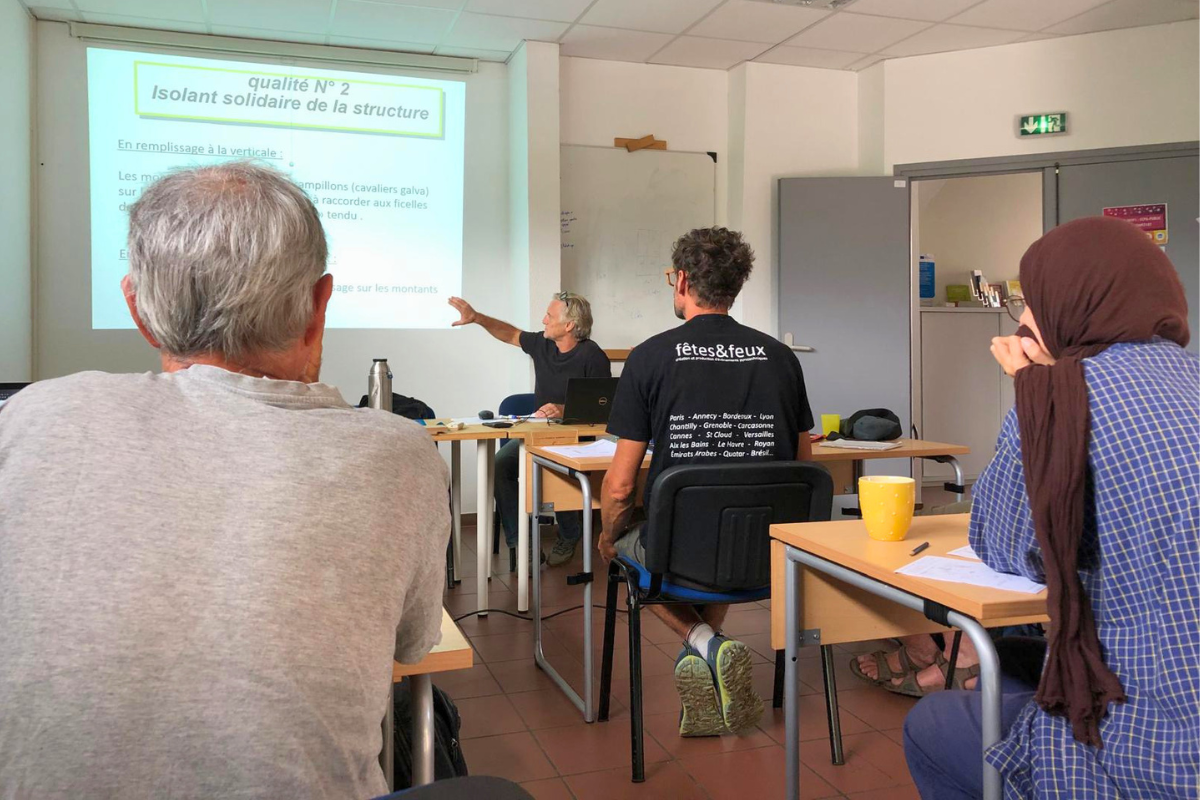 Emmanuel Deragne, artisan spécialiste de la construction en bois et en paille et formateur à Oïkos, a commencé à s’intéresser «par hasard» à cette discipline, avant d’être convaincu par ses nombreux avantages. © Emma Poesy/Vert
«C’est assez simple», sourit Isabelle Martin, qui a fait le déplacement depuis la Sarthe. Avec l’aide de l’association, cette propriétaire d’une chambre d’hôtes espère pouvoir bientôt construire un nouveau gîte en paille sur son terrain. «Ce qui m’a décidée, c’est l’envie de faire moi-même et celle de contourner les entreprises du BTP, confie-t-elle. Pour la rénovation d’un autre bâtiment, j’avais fait appel à une entreprise qui n’a respecté aucune de mes consignes en matière d’écologie. Ça m’a dégoûtée.»
Tout comme Isabelle Martin, Jérôme Benois, un autre stagiaire, souhaite contourner les entreprises du bâtiment pour réaliser l’extension de sa maison. «Je viens d’Isère et, là-bas, tout le monde peut constater les dégâts que causent les cimentiers», lâche-t-il en référence à la condamnation récente de l’exploitant d’une carrière pour négligences après l’effondrement d’un pan du Vercors (notre article). «Je n’ai pas envie de contribuer à la destruction d’autres carrières, dont les déchets bouchent en ce moment même une route près de chez moi», poursuit Jérôme Benois.
Construire autrement
Née en 1991, Oïkos a été créée par des particuliers et des architectes qui voulaient contester l’hégémonie du béton dans la construction, matériau devenu incontournable pour reconstruire la France au sortir de la Seconde Guerre mondiale. «L’utiliser à ce moment de l’Histoire avait du sens, notamment parce qu’il y avait beaucoup à reconstruire, qu’il était bon marché et facile à utiliser, rembobine François Leroux, salarié de l’association. Aujourd’hui, c’est une aberration ; le béton consomme énormément de ressources naturelles et d’énergie.»
Pour construire une maison en ciment, il faut extraire la roche d’une carrière de calcaire, puis la faire chauffer dans un four à 1 800 degrés. La paille, elle, présente l’avantage d’être nettement moins énergivore : renouvelable et produite localement – il suffit de la commander en amont à un·e agriculteur·ice près de chez soi –, elle est isolante en toutes saisons, nécessite une très faible transformation et est peu onéreuse.
 Isabelle Martin, stagiaire chez Oïkos et propriétaire d’une chambre d’hôtes dans la Sarthe, souhaite autoconstruire pour contourner les entrepreneurs du BTP. © Emma Poesy/Vert
Si son utilisation sur les chantiers est encore rare, les grands groupes du secteur s’y mettent progressivement, et quelques grands bâtiments publics en paille ont déjà vu le jour : le lycée professionnel Gergovie à Clermont-Ferrand (Puy-de-Dôme), sorti de terre en 2021, ou encore l’atelier de construction de décors de la Comédie-Française, à Sarcelles (Val-d’Oise), une ancienne passoire thermique isolée avec de la paille en 2024.
Ce matériau est d’autant plus intéressant qu’il est léger et donc facile à manipuler. «Chez les professionnels du bâtiment, le secteur de la paille est celui dans lequel on retrouve le plus de femmes, précise Emmanuel Deragne. Avec ce matériau, on est plus efficace en utilisant des outils qu’en usant de sa force.»
Sur le papier, les particuliers ont doublement raison de s’y intéresser : «Ça peut vite devenir intéressant financièrement, estime François Leroux. En autoconstruction avec de la paille, on peut payer entre 30% et 50% moins cher que pour du bâti traditionnel, selon les travaux que l’on fait.»
Lutter contre les préjugés
En pratique, cela implique de se former et d’y mettre pas mal d’huile de coude. «Quand j’étais plus jeune, il y avait très peu de spécialistes de la paille et j’ai dû passer beaucoup de temps à bosser seul pour perfectionner mes techniques», relate Emmanuel Deragne, qui a commencé sa carrière d’artisan comme spécialiste du bois.
Opter pour la paille implique aussi de passer outre les préjugés. «J’ai parlé de mon projet à mes oncles, qui se sont moqués en disant que je n’avais qu’à m’installer dans le Cantal pour vivre ma vie d’écolo, souffle Artus Beberins, infographiste de 28 ans installé en région parisienne. Et puis, quand on ne connaît pas, ça ne paraît pas solide : tout le monde connaît l’histoire des trois petits cochons, c’est la maison en paille qui s’effondre en premier.»
 À La Tour-de-Salvagny (Rhône), les stagiaires d’Oïkos s’entraînent à découper des bottes de paille, qui serviront plus tard à l’isolation d’une bâtisse. © Emma Poesy/Vert
Pour certains, comme Dominique Mourrain, construire soi-même est une manière concrète de lutter contre le dérèglement climatique, en normalisant de nouvelles pratiques plus vertueuses. «Ça fait trente ans que je m’intéresse à l’écologie, explique cet ex-ambassadeur du tri au sein d’un syndicat d’élimination des déchets. Bâtir ma maison à la campagne avec un matériau capable d’absorber le CO2, c’est avant tout un choix politique.»
Un choix que l’association Oïkos tente, à son échelle, de faciliter, en prêtant à ses membres tout le matériel nécessaire à la conduite d’un chantier bois-paille. Et, souvent, Emmanuel Deragne, qui n’exerce plus que rarement comme artisan, retourne chez d’ancien·nes stagiaires-constructeur·ices, pour filer un coup de main. Une manière de transmettre ce savoir qui pourrait un jour devenir indispensable.
-
Comparing Nixon’s Attacks On The Press To Trump’s
Reply sourceThis article is republished from The Conversation under a Creative Commons license. Read the original article.
In his White House Correspondents’ Association dinner speech on July 24, 2026, President Donald Trump made his usual diatribes against the news media. He derided the “failing” New York Times and reiterated his complaint that CNN reporter Kaitlan Collins doesn’t smile enough. He dismissed the award she received at the dinner as “fake” and celebrated the recent firing of top CBS News employees.
Such ongoing extreme hostility from the president has contributed to Americans’ loss of faith in the news media, which has plummeted to an all-time low.
While the situation is in many ways unique to this moment, a perceived crisis around the very notion of “objective reporting” – and presidential use of that idea to denigrate and delegitimize the press – has a long history.
Nixon administration played hardball
Republican presidential candidate Richard Nixon, for example, attacked coverage of police brutality at the 1968 Chicago Democratic National Convention as one-sided in favor of antiwar protestors. Once in office, Nixon deployed Vice President Spiro Agnew to verbally assault journalists for their putative bias and elitism.
In an infamous 1969 speech, Agnew denounced TV newsmen – they were, indeed, mostly men – as “an effete corps of impudent snobs,” hostile to the president and therefore out of touch with average Americans. Agnew singled out NBC anchorman David Brinkley for his claim that “objectivity is impossible” and that “fairness” was a more reasonable objective. Like many journalists, Brinkley understood “objectivity” as implying an almost mechanical delivery of pure facts, while “fairness” was more realistic, an earnest effort to be judicious.
Agnew concluded with a challenge: People should “let the networks know that they want their news straight and objective.” He framed this populist turn as an alternative to government interference. But journalists felt the looming threat of censorship.
Brinkley’s statement was not impudent. It was realistic: an acknowledgment that journalists are humans with preconceptions and values, but that their professional mandate is to strive for impartiality.
Carefully balanced reporting was not only the baseline of journalists’ training but also a business imperative. There were only three national nightly news shows, all seeking the widest possible audience. Moderation was more profitable than swinging hard left or right.
Although frustrated with journalism in general, Agnew zeroed in on TV in his speech because it had displaced print as Americans’ leading news source. And the reality of Federal Communications Commission licensing, whereby a federal agency determined who could use publicly owned airwaves, made broadcasters vulnerable to the actions of a vengeful president.
The licensing issue still resonates. Comedian Jimmy Kimmel, a frequent Trump critic, had his show briefly suspended by ABC after angering the president’s supporters.
“We can do this the easy way or the hard way,” FCC chair Brandon Carr said. “These companies can find ways to change conduct to take action on Kimmel or, you know, there’s going to be additional work for the FCC ahead.”
Kimmel survived this attack largely because public support surged, and he continues to satirize the White House. Others have been less fortunate.
Journalists fought back
Struggling to compete, newspapers in the 1960s and ’70s could have easily downplayed Agnew’s criticisms of a rival medium.
Instead, they stood up for TV. In the course of my research, I’ve found that not only in publicly accessible material but also in unpublished archival papers both broadcasters and newspapers consistently understood an attack on one media outlet as an attack on all, a lesson that holds true in 2026.
One of Agnew’s “snobs” was the liberal New York Times columnist Tom Wicker. Wicker was on Nixon’s “enemies list,” and he voiced concerns about not just Nixon and Agnew but also more generally about the very notion of objectivity.
Agnew raised hackles across the American journalism community. But Wicker’s reactions stand out in particular, because he was employed by what was then known as “the paper of record,” whose grandiose credo had long been “To Give the News Impartially, Without Fear or Favor.”
In a column published on Nov. 16, 1969, Wicker granted that it was legitimate for Agnew to ask “how the power of that extraordinary medium (TV) can be most equitably controlled and exercised in the general public interest.”
But Wicker underscored that Agnew “couched his argument in direct political attack on those who differed with Mr. Nixon” and “came close to claiming immunity from criticism for Presidential utterance.”
Taking on ‘objectivity’
Two years after Agnew’s “effete snobs” speech, Wicker wrote an essay for Columbia Journalism Review objecting to journalism’s “tradition of objectivity” and “orientation toward nationalism in politics and toward establishmentarianism in other areas of society.”
The consequence, he wrote, was a heavy and generally uncritical reliance on official sources, all in the name of a spurious notion of objectivity.
Deeply offended, New York Times executive editor Abe Rosenthal sent a confidential memo to publisher Punch Sulzberger.
“In essence,” Rosenthal wrote, “what Tom’s piece adds up to is a public statement by … a well-known columnist of the Times … that objectivity and comprehensiveness, the journalistic foundations of this paper, are no longer valid and that the kind of paper the Times is now is no longer meaningful.”
Rosenthal said Wicker’s public expression of these thoughts was “bad for the paper” externally and “bad for morale” internally.
Regardless, such disputes at The New York Times were always waged behind the scenes. The gold standard for journalism was – and remains, whenever possible – to tell the story, not be the story.
Denouncing bias as deflection
Today, by contrast, it is widely known that the CBS News division “is on fire,” as longtime “60 Minutes” correspondent Scott Pelley said, shortly after he was sacked.
Newly installed CBS News Editor-in-Chief Bari Weiss, who has no broadcast experience, positions herself as an advocate for “free speech and free thinking” and her Free Press newsletter as a reclamation of objective reporting. Yet at CBS she has made editorial choices, including killing a story highly critical of the Trump administration, that consistently favor the White House.
Like Agnew, in other words, Weiss appears to cloak uncritical acceptance of presidential positions as a battle against “bias.”
Denouncing “bias” is usually an attempt by those in power to deflect from what reporters have uncovered – from Vietnam to Watergate to Iraq. It is thus startling for someone within journalism to use the establishment’s word – bias – to self-censor.
The apparently deliberate imploding of CBS News and its flagship investigative journalism program “60 Minutes” is all the more shocking when you consider the network’s past triumphs in serving the public interest while angering politicians and presidents.
Holding government accountable
In 1971, for example, the Army and the Nixon administration attacked “The Selling of the Pentagon,” a CBS documentary about military public relations activities. Officials charged that the editing had been misleading and malicious, and the U.S. House of Representatives subpoenaed CBS journalists’ raw footage.
This congressional investigation ended as a victory for the press and the public’s right to know. CBS refused to share its outtakes, and the network’s president risked going to jail for contempt of Congress.
In his column, Wicker declared the documentary excellent, and he correctly painted the subpoena of CBS materials as resulting from White House pressure.
That same year, The New York Times and The Washington Post printed the Pentagon Papers, revealing that the government had been misleading Americans for years regarding Vietnam. The two newspapers were briefly silenced by the White House, which persuaded the courts to order them to cease releasing the documents, and then were vindicated when the Supreme Court barred the government from restraining publication.
Wicker argued that “no statute exists that says government officials must be protected from the exposure of their follies or misdeeds,” and that the Pentagon Papers’ culprit was the government, not the newspapers.
Here, Wicker made a fair, if not strictly objective, evaluation.
Such opinionated defenses of the press still ring true today. Agnew repeatedly attacked naysayers as “nattering nabobs of negativism,” but journalism serves a positive function in particular when its stories are negative.
That’s how the public is able to hold government accountable, and accountability is crucial to the fight for democracy and against censorship and authoritarianism.
Heather Hendershot is Professor of Communication Studies and Journalism at Northwestern University.
-
Vermont's GOP governor: Trump's Lake Ontario order 'petty and disappointing'
Vermont Gov. Phil Scott (R) on Thursday took issue with President Trump's executive order renaming Lake Ontario as "Lake America" as his trade war with Canada intensifies.Reply source -
Trump renames Lake Ontario 'Lake America' amid intensifying US-Canada trade dispute
Trump claimed the shift reflects US territorial control over the lakeReply source -
Trump Orders the Government to Rename Lake Ontario to Lake America
The president also reiterated his criticism that Canada "treats us very badly." Trade talks between the nations collapsed last week.Reply source -
Federal judge lifts final block on Trump mail-in voting order, clearing way for midterm restrictions
A federal judge on Wednesday lifted the final injunction blocking President Donald Trump's executive order restricting mail voting, clearing his administration to impose new ballot requirements weeks before the November midterm election.Reply source -
GOP election law expert: Many more 'low propensity voters in Republican Party' after Trump mail-in voting ruling
Election law attorney Ben Ginsberg said Monday that President Trump's executive order imposing restrictions on mail-in voting will largely impact Republican voters.Reply source -
Court Clears Way for Trump Mail-Ballot Rules, but States Launch New Challenges
A federal judge Wednesday lifted a major legal barrier to President Donald Trump's sweeping mail-ballot order, clearing the way for the U.S. Postal Service to implement new requirements ahead of the November midterm elections.Reply source -
Gino ne doit pas être extradé ! Rassemblement le 30 août 18h à la Plaine
Reply source
Le 19 août dernier a eu lieu l'audience de notre camarade et ami Gino devant la cour d'appel de Paris, qui s'est prononcée favorablement à son extradition vers l'Allemagne sous 10 jours.
Il est plus que nécessaire de se mobiliser massivement et de montrer notre soutien de toutes les manières possibles (communiqués de soutien, banderoles, affichages, rassemblements devant les ambassades, etc.) pour éviter à Gino une extradition imminente.
Ne lâchons pas la pression et poursuivons notre travail de solidarité : Gino ne doit pas être extradé. FREE GINO, FREE THEM ALL
Le 19/08 la cour d'appel de Paris a émis un avis favorable à l'extradition vers l'Allemagne de notre camarade et ami Gino. Comme de nombreux.ses antifascistes à travers toute l'Europe, il est pourchassé par la Hongrie, accusé d'avoir participé à une action contre la manifestation néo-nazie du Jour de l'Honneur à Budapest en février 2023.
Alors que la France avait refusé de le livrer à la Hongrie d'Orban, c'est l'Allemagne qui réclame à son tour une extradition. La même Allemagne qui a illégalement déporté Maja, retenu.e à Budapest depuis 2 ans dans des conditions indignes. En Allemagne, Gino encourt jusqu'à 10 ans de prison. Il risque surtout de suivre le même parcours que Maja.
L'Affaire de Budapest est un procès politique dans un contexte où les organisations antifascistes sont considérées comme terroristes en Hongrie ou comme organisations criminelles en Allemagne. La justice française avec cette dernière décision, joue pleinement leur jeu. Derrière Gino, Zaid, Maja et tous les autres, c'est l'antifascisme tout entier qui est attaqué. Nous devons être à la hauteur.
Nous avons peu de temps. Gino a fait appel devant la Cour de cassation. Jusqu'à ce jugement, saisissons chaque opportunité de faire vivre le soutien. Montrons que derrière nos camarades il y a un mouvement. Un mouvement large, un mouvement fort, un mouvement organisé et surtout un mouvement qui ne se laissera pas intimider.
La répression est la meilleure arme des états bourgeois et des régimes fascistes. Ils veulent nous isoler, nous diviser. Tirons notre force de leurs attaques : mobilisons nous, organisons-nous.
Pour s'opposer à l'extradition de Gino, retrouvons nous le dimanche 30 août à 18h à la plaine (place Jean Jaurès) pour un rassemblement unitaire contre la répression !
Ce rassemblement servira de lancement à une campagne d'actions de soutien, du matériel sera disponible sur place !Contre la répression : solidarité
Liberté pour Gino, non aux extraditions, free all antifas !
Premiers signataires : Comité antifasciste du 4eme, Antifa Social Club Marseille, Assemblea per il 25 aprile, Riposte Antifasciste, Afroqueer RevolutionR, UPM, Tsedek !, Stop Aux Violences d'Etat, Comité Free El Mahdi Lyoubi, Collectif Al Manba, Marseille Antifas 1er, VISA 13

Communiqué suite à la décision de la cour d'appel
Le 19 août dernier a eu lieu l'audience de notre camarade et ami Gino devant la cour d'appel de Paris, qui s'est prononcée favorablement à son extradition vers l'Allemagne sous 10 jours.
Pour celles et ceux qui ne connaissent pas l'affaire Budapest, Gino est accusé par la Hongrie – avec une dizaine d'autres personnes – d'avoir participé à des violences contre des néonazis en 2023, dans le cadre d'un défilé d'extrême droite organisé chaque année à Budapest en Hongrie : le « jour de l'honneur » qui réunit environ un demi-millier de nazis, commémore l'alliance entre soldats de la Waffen-SS et militaires hongrois lors du siège de l'armée rouge à l'hiver 1945, lorsque la dictature hongroise était l'alliée d'Hitler. Certaines prétendues victimes sont des militants d'extrême droit de nationalité allemande.
Suite à un premier mandat d'arrêt européen émis par la Hongrie, Gino avait déjà été détenu en France plusieurs mois à partir de novembre 2024. Si Gino et d'autres camarades étaient extradés, ils risquaient jusqu'à 24 ans d'emprisonnement en Hongrie. Après une longue bataille, la cour d'appel de Paris avait refusé cette extradition estimant que les risques de jugement inéquitable et de mauvaises conditions de détention étaient trop importants. Notre camarade avait donc été remis en liberté sous contrôle judiciaire.
Le 16 décembre 2025, Gino a été arrêté par les agents de la Sous-direction antiterroriste de la police judiciaire (Sdat) suite à l'émission par l'Allemagne d'un mandat d'arrêt européen à son encontre et placé en détention. Il ressortira deux semaines plus tard, mais s'en suit un acharnement judiciaire qui n'en finit pas. La cour décide de reporter sans cesse le délibéré concernant le mandat d'arrêt émis par l'Allemagne.
Mais ce 19 août, les juges ont cédé aux pressions de l'Union Européenne et d'Europol, bafouant tous les principes de l'indépendance de l'institution judiciaire et des principes de liberté fondamentale.Avec l'aide de nos avocats, nous faisons appel de cette décision devant la Cour de cassation, qui aura 40 jours à compter du pourvoi pour se prononcer définitivement.
Il est plus que nécessaire de se mobiliser massivement et de montrer votre soutien de toutes les manières possibles (communiqués de soutien, banderoles, affichages, rassemblements devant les ambassades, etc.) pour éviter à Gino une extradition imminente.
Ne lâchons pas la pression et poursuivons notre travail de solidarité : Gino ne doit pas être extradé.Le Comité Solidarité Budapest
-
Manifs le 20 septembre contre le permis de tuer
Reply source
L'Etat vient de donner encore plus de pouvoir et d'impunité à la police, qui pourra tuer sans être inquiétée. Une véritable insulte aux victimes quotidiennes et à leurs proches. On connait les pratiques de la police, son idéologie et son rôle dans la société capitaliste : défendre l'ordre raciste et patriarcal. Alors sortons dans la rue pour bloquer cette fuite en avant, et contrer le monde policier et fasciste en construction. Pour défendre un futur sans dominations.
(attention la date initiale du 19 est décalée au 20 septembre)
ci dessous l'appel à manifester le 20 septembre :
"APPEL UNITAIRE : NON AU PERMIS DE TUER !SAVE, avec le Comité Justice pour Adama, uni aux familles de victimes de violences et de crimes policiers, syndicats de la justice, associations de défense des droits humains et organisations syndicales, appelle à une grande marche nationale unitaire le 20 septembre 2026 contre la loi instaurant une présomption de légitime défense pour les forces de l'ordre. Derrière son jargon juridique, cette loi n'est rien d'autre qu'un permis de tuer en toute impunité.
Elle légitime une violence qui cible d'abord des vies considérées comme sacrifiables.
Mais une loi qui autorise la police à tirer sans rendre de comptes ne s'arrête jamais à sa première cible. Aujourd'hui les quartiers populaires, demain les manifestant-es, les grévistes et toutes celles et ceux qui défendent leurs droits et leurs libertés.
Tant que son parcours législatif n'est pas achevé, nous pouvons encore l'arrêter. Le 20 septembre, partout en France, unissons-nous et faisons de cette journée une mobilisation massive.
C'est maintenant qu'il faut agir."

rdv le 20/09
pour suivre les infos, sur marseille notamment : https://stopauxviolencesdetat.fr/
-
We Aren't Talking Enough About These Five Possible Senate Pick-Ups
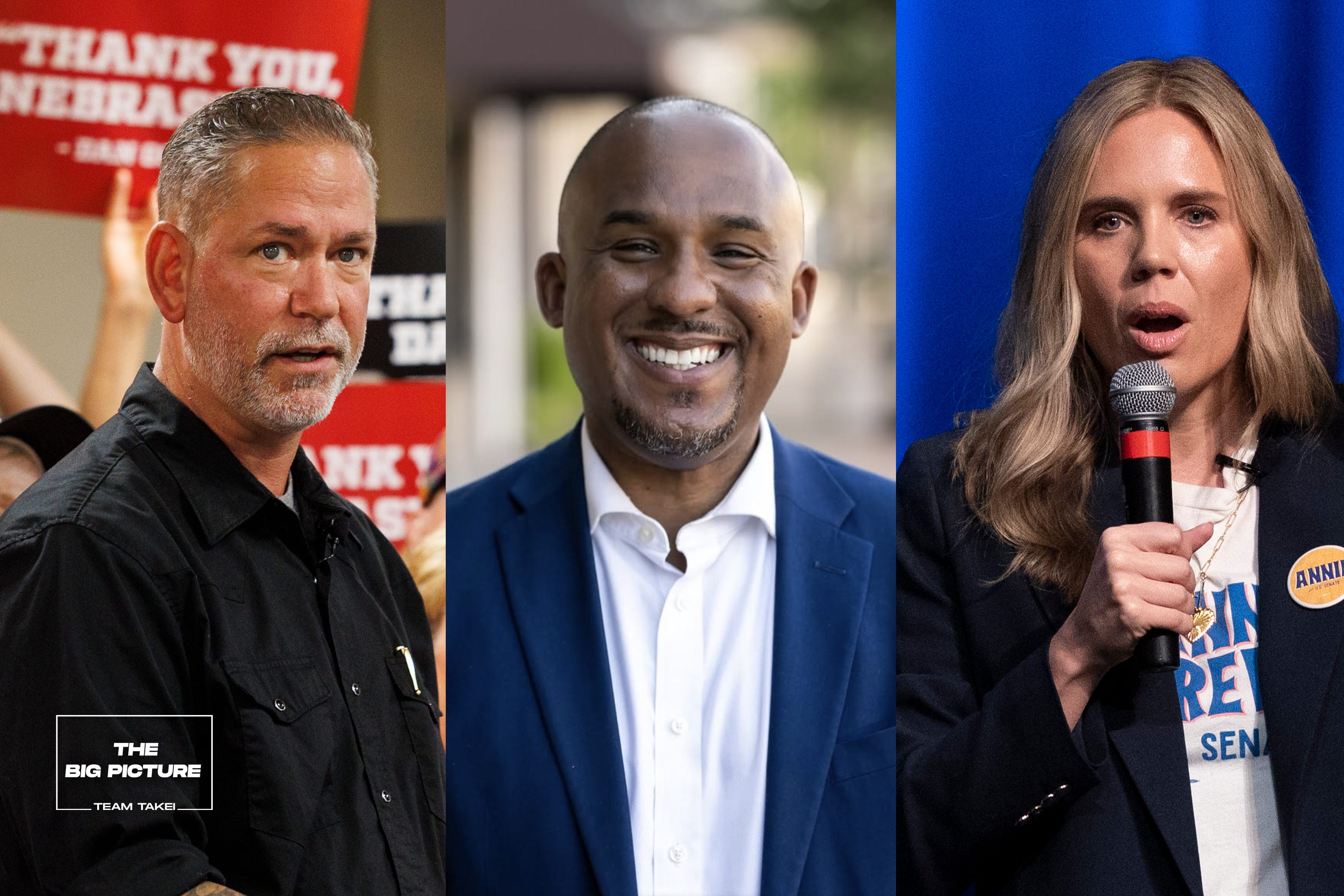
Reply source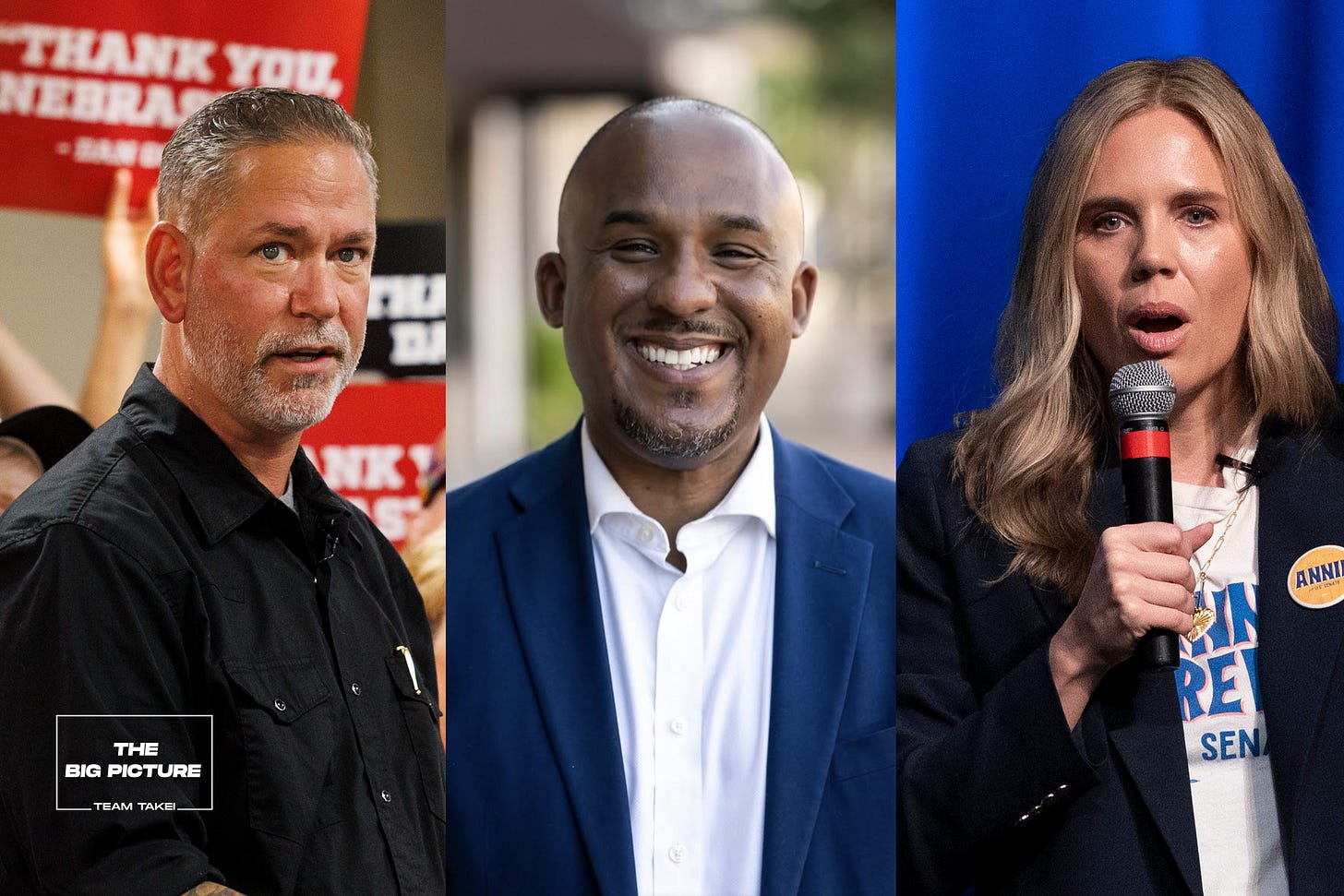 LEFT: Dan Osborn. Photo by Nikos Frazier/Omaha World-Herald via Getty Images. CENTER: Scott Colom. Photo Credit: Scott Colom, Facebook. RIGHT: Democratic U.S. Senate candidate Dr. Annie Andrews. Photo by Sean Rayford/Getty Images.
Last month, the Democratic Senate Campaign Committee, whose mission is to elect Democrats to the U.S. Senate, announced its Win The Senate program: a $40 million investment in ten battleground Senate races, seven of which are on offense and three of which are on defense.
Today, just a month later, The Silver Bulletin’s Deluxe model shows Democrats with a 55% chance of winning the Senate, with the Democratic candidate ahead in seven of the ten targeted races (Georgia, Michigan, New Hampshire, Maine, North Carolina, Ohio, and Texas), behind in two (Iowa and Florida), and a toss-up in one (Alaska). And that’s with more than two months until Election Day.
It wasn’t long ago that Democrats didn’t have much of a chance of flipping the Senate, so the trend is clear: As the war in Iran continues to rage, as Trump sends prices ever higher with an expanding trade war, and as the president’s approval plummets to new lows, the blue wave continues to build. And with that, Democrats’ target map is expanding.
But that too is happening at a shockingly swift pace.
Just in the last two weeks, five Senate races that seemed out of reach for Democrats have now begun to appear winnable if everything goes Democrats’ way. Which, to be fair, is a big if.
But if the story of the 2026 race for control of the U.S. Senate is about Democrats showing strength in deep red Trump country and eating into Republican support in areas where the GOP thought they had a stranglehold, that is doubly true for these five Senate races, which feature Republicans struggling to remain ahead in states Trump won by anywhere from 16 points (Kansas) to 30 points (Arkansas) in 2024.
Is 68 days enough to move these unlikely pick-ups from longshots to flips? Perhaps. But at the very least, as some of the DSCC’s initial target races now look more likely, some resources should now go to these longshot races, if only to make Republicans spend their own where they never thought they’d have to.
Mississippi
Back in March, Scott Colom, a seventh-generation Mississippian who has been elected District Attorney in a politically divided district three times, won the state’s Democratic primary for U.S. Senate.
By any measure, Colom is a long shot to win the seat. A Democrat hasn’t served as U.S. Senator from Mississippi since the 1980s, and Mississippi went for Trump by 23 points. But this year could be different.
In one of the reddest states in the country, Scott Colom is running as a different kind of Democrat. The front page of his website centers messaging about his Christian faith, his law and order career, as well as his MAGA-coded goal to put “Mississippi first.” He hopes to undercut any claim that he is a typical liberal running to be a rubber-stamp vote for Chuck Schumer.
As Colom told the Longplay podcast earlier this month:
“What I’m offering the people is not to be just another Democratic Senator. I’m offering them to be Mississippi’s Senator, someone who fights to make their lives better. The conditions are perfect: We have corruption that is costing Mississipians, we have a Senator Cindy Hyde Smith who’s scared to show up and voting against our interests, and we have a candidate God willing that understands how to win.”
Smartly, Colom is taking a page from other Democrats running in red states, such as Jon Ossoff and James Talarico, who are laser-focused on affordability as a direct result of the corruption by the wealthy and powerful.
As PBS reported:
“I’m going to fight the corruption that we’re seeing in D.C. that’s making everything less affordable,” Colom said, zeroing in on Trump’s tariffs, the Iran war and the Republican-controlled Congress’ capitulation on both. “Our junior senator has totally given away our voice. She’s not worried about us at all.”
And his race is getting noticed. Just this week, Pete Buttigieg endorsed Scott, telling MSNOW:
“I’ve been paying a lot of attention to uphill races that we could actually win,” Buttigieg said. “And yeah, in almost any other year, and with almost any other candidate, a race like this would seem out of reach. But what I see in Scott Colom, and why I wanted to get involved in this race, is there’s a real chance here.”
Buttigieg, who has endorsed over 30 Democrats in races around the nation this cycle ahead of a likely run for president, is urging national Democrats to expand the map of winnable seats and not sleep on a candidate like Colom.
“I certainly hope that the committees and individuals who want to see us take back the chamber look at this race, because what’s clear to me is that you’ve got a candidate and a message that can win, but he’s got to have the resources to get the word out.”
Longtime Democratic strategist Jen Palmieri, co-host of the Longplay podcast, agrees. As she told Morning Joe recently about Colom’s race,
“There’s a theory [in Mississippi] that you just have to get Black turnout up by four percentage points and have a quarter of white voters in the state vote for the Democrat and that’s the margin of victory there. Mississippi is just right there for the taking. It’s not an expensive state to win an election. Even in Mississippi, Trump is not popular. Colom is a very good candidate and Cindy Hyde-Smith is nowhere, not campaigning at all, just taking it for granted.”
At a moment when Trump is at record low approval in the state, Scott Colom is proving his mettle, having outraised the Republican incumbent in the second quarter.
In a press release announcing its Win The Senate program, the DSCC touted their investment in “State-run programs focused on outreach to Latino voters, Black voters, AAPI voters, Alaska Native voters and younger voters.” As more of their targeted races come off the board, and as a Democratic Senate majority looks more within reach, they could pivot to investing in a state like Mississippi, where Scott Colom could be the tip of the spear for the Democrats’ expansion of the Senate map.
Kansas
Of all the states on this list, Kansas was the tightest race in 2024, going for Trump by a still formidable 16 points. Despite that spread, Kansas has elected four Democratic governors in the last 30 years. Democratic wins at the federal level have been more elusive, however. But could 2026 be the year Kansas elects a Democrat to the U.S. Senate for the first time since the 1930s?
In a cycle when Democratic candidate recruitment has been stellar, Adam Hamilton is truly one of Democrats’ top gets. Hamilton, who only launched his campaign for Senate in May, is the founder and senior pastor of not just the largest Methodist Church congregation in the greater Kansas City area, but in the country.
As The New York Times puts it:
Mr. Hamilton, for his part, is a credible fund-raiser and a longtime community leader from a populous part of the state. He founded and leads a roughly 24,000-person congregation based in the suburbs of Kansas City, Mo., right across the state line in Kansas.
It’s an area that once favored center-right Republicans, but shifted sharply away from the party during the Trump era, and has since become a crucial source of Democratic turnout.
Since launching in May, Hamilton proceeded to break a Kansas fundraising record, raising $3.66 million in the first three months of his campaign.
Like Colom, Hamilton is focused on fighting corruption, as he puts it on his campaign website:
Adam is running for Senate because he believes we need to stop the chaos and corruption in Washington by actually listening, and bringing people together to solve problems.
And in an anti-system year, Hamilton is very much running as an anti-system candidate, framing himself as an independent-minded leader ready to hold both parties accountable. As the welcome message to his campaign website reads:
“If you’re ready to change the status quo in Washington, flip this seat and send an independent-minded leader to the Senate, I hope you’ll chip in any amount right now to support my campaign.”
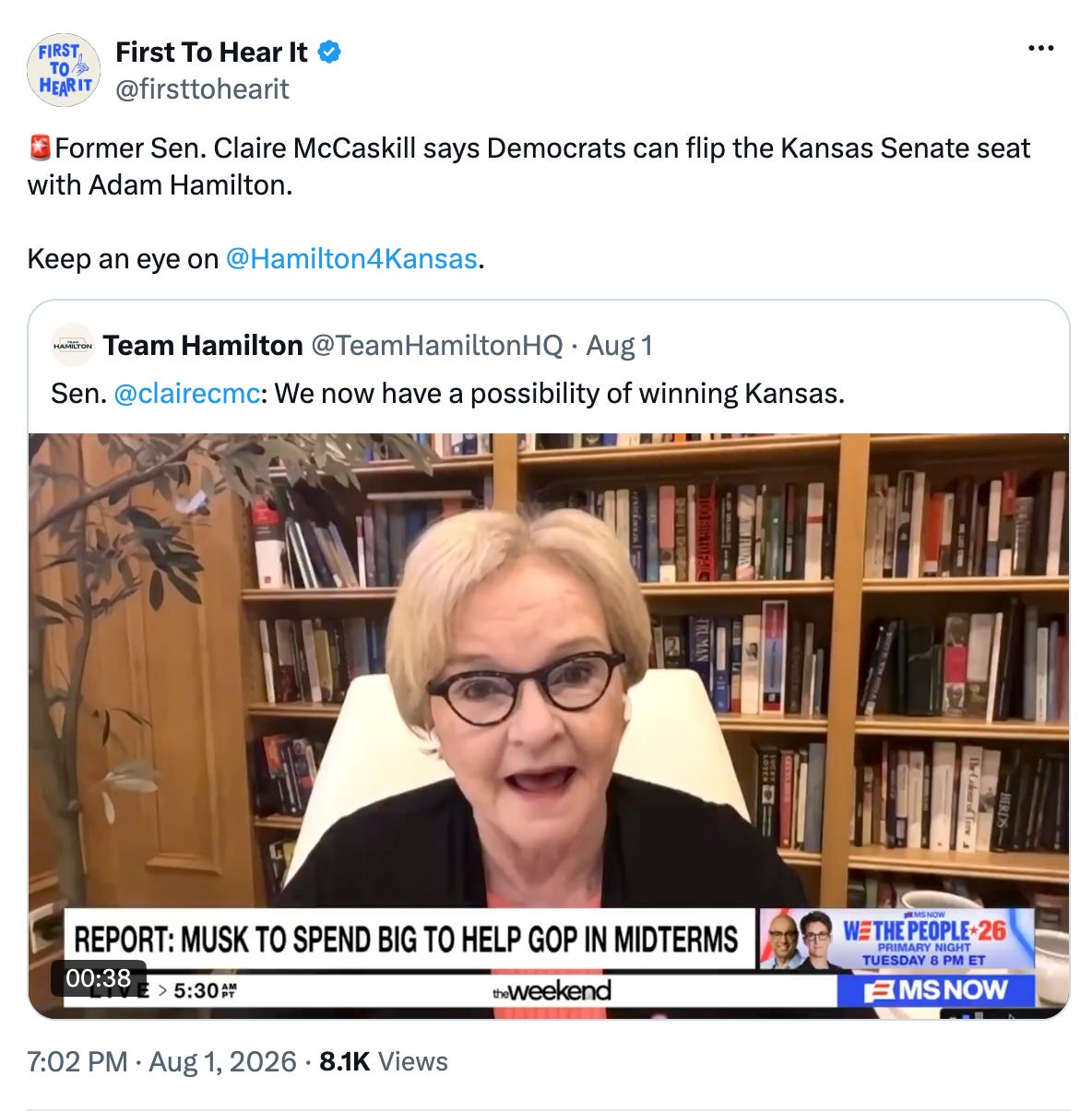
Former Senator Claire McCaskill (D-MO) declared Hamilton a candidate to watch during an August 1 appearance on MSNOW, saying:
“The map is expanding every day. We now have a possibility of winning Kansas. We have a man running in Kansas that nobody’s heard of, his name is Adam Hamilton. But he actually is the pastor of the largest Methodist Church in the country. He got 16,000 contributions in the first 30 days he got in the race and raised $4 million. He is beloved in the Kansas City area. He is really a good man and he is going to be a very strong candidate against that nut Roger Marshall.”
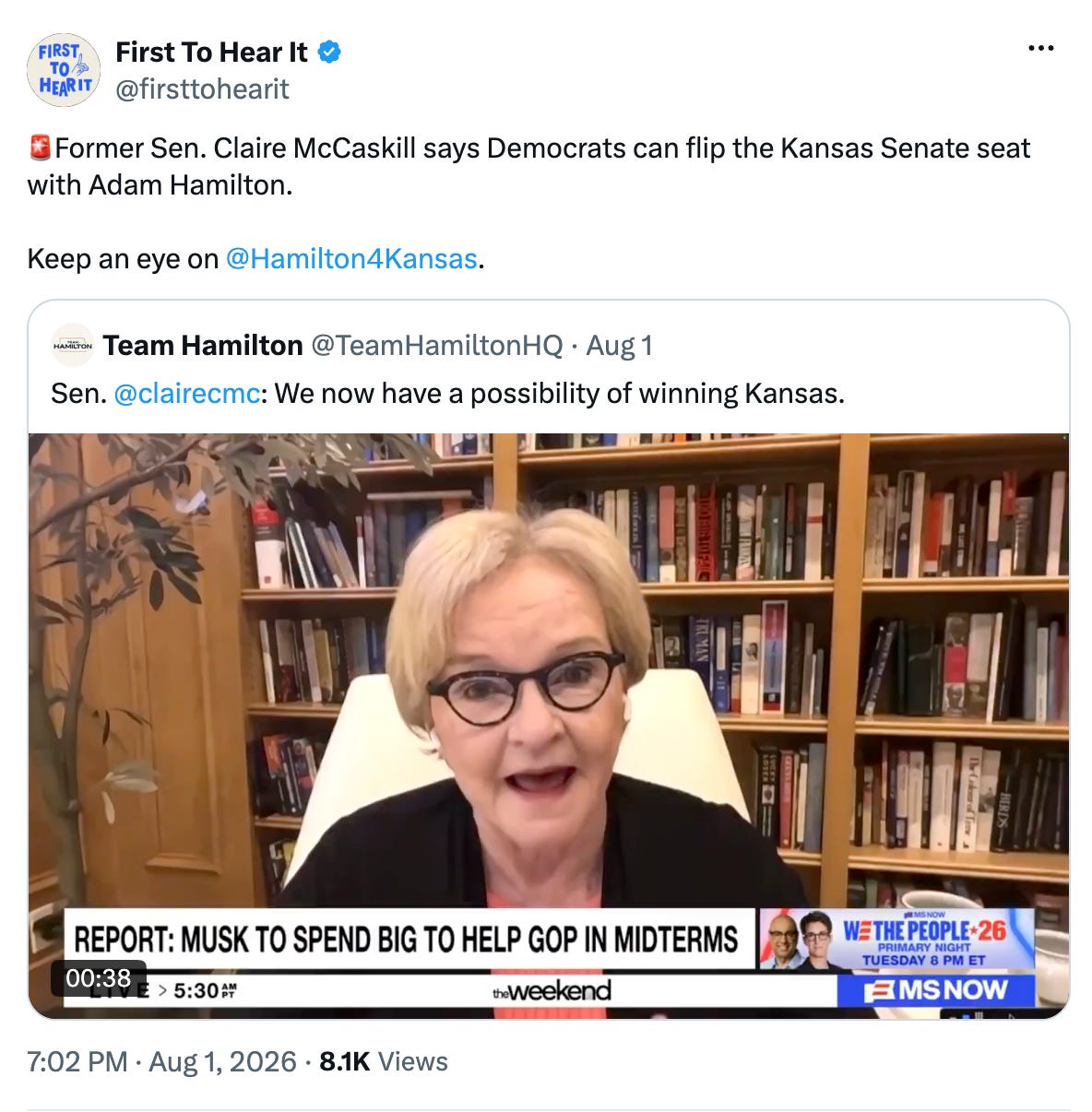
Days later, Hamilton officially won the Democratic nomination.
And just days after that, Public Policy Polling had a poll in the field, whose results bore McCaskill’s bullishness for Hamilton out.
In the poll, not only is Senator Roger Marshall, the Republican incumbent, extremely underwater with a measly 38% approval rating in the state, but Hamilton is essentially tied with Marshall in a head-to-head match-up. And he had only just won the Democratic nomination at that point.
Notably, when respondents heard more about Hamilton’s biography, that result shifted toward Hamilton by two points, putting him ahead of Marshall by a point.
With a virtual tie as his starting point, Hamilton is in a strong position to turn this tie into a lead by November.
South Carolina
On July 11, Senator Lindsey Graham (R-SC) died suddenly at the age of 71, shocking the political world and possibly shaking up the Senate map.
Before his death, Graham was not seen as a terribly endangered Republican, even though the Democratic nominee Dr. Annie Andrews has been consistently polling within single digits of Graham, including as recently as June.
Andrews also outraised Graham in three consecutive quarters, with a whopping $6.4 million haul as of the second quarter of 2026.
Andrews is running as a political outsider with her own anti-system populist reform message.
Dr. Annie Andrews is a pediatrician and a mom, not a politician. She’s spent her entire career serving South Carolina families—not donors and lobbyists—and she’s running for Senate because kids and parents across the state are getting screwed by a system designed to work for the powerful, not the rest of us.
In the wake of Graham’s death, South Carolina Governor Henry McMaster appointed Graham’s sister Darline Graham to the seat, presumably as a place-holder to fill out the remainder of her brother’s term. But a week later, at the urging and full endorsement of Donald Trump, Graham declared she would run for the full Senate term, telling Sean Hannity, “I’m in!”
With Trump behind her, Graham proceeded to finish first in the August 11 multi-candidate special primary for the seat, and then officially became the Republican nominee after defeating Congressman Ralph Norman in the August 25 run-off by five points.
While it appeared that Graham’s shaky debate performance—in what Dan Pfieffer said “might be the single worst debate answer I have ever seen”—may have scuttled her run for the nomination, Trump invested $827k of his MAGA Inc. war chest to boost Graham ahead of the run-off. He also appeared with Graham at a rally on Friday to prove he still has the juice with the Republican base. And it worked, though barely. As Democratic strategist Chuck Rocha put it this week, “something’s going on when Donald Trump can only deliver 52 percent.”
In his latest MessageBox post, Pfieffer explains why Darline Graham winning the nomination on Tuesday gives Andrews the best shot to win this seat.
“First, she is thoroughly unqualified for the position” and “her lack of qualifications was on display for the whole world to see at a recent debate.”
“Second, the circumstances of her ascension are likely to rub voters the wrong way…Voters have never been more skeptical of politicians or angrier about a perceived culture of corruption.”
“Third, Trump is unpopular in South Carolina…Graham’s close affiliation with Trump will likely generate more opposition from Democrats and independents than it will turnout among Republicans.”
Add to that the fact that Graham is facing off against Andrews, who Pfieffer describes as
a political outsider who could be a vessel for frustration with the inside job that led to an inexperienced, unqualified insider as the GOP nominee.
And sure enough, in the wake of Graham’s win in this week’s South Carolina Senate run-off, the race is now all tied up.
As Pfieffer put it in the conclusion of his MessageBox piece:
“I am going to be keeping an eye on this race. Bad candidates lose in bad years, and Graham is a very bad candidate, running in what looks like a very bad year for Republicans.”
Nebraska
In 2024, Independent candidate Dan Osborn, a Navy veteran and industrial mechanic, lost his long-shot Senate challenge to Senator Deb Fischer (R-NE) by less than seven points. Now, two years later, with Nebraska’s other U.S. Senator Pete Ricketts up for reelection, Democrats are hoping to leverage a much more favorable environment (and Donald Trump’s absence from the ballot) to win the seat by backing Osborn.
For his part, Osborn has pledged not to caucus with any party and to remain truly independent:
“I don’t like either party,” he told me over pizza and beer in the town of Albion recently, after a morning of campaigning. “I think they both kind of suck.” His goal, as Mr. Osborn tells it, is to infiltrate the Senate and start breaking the unhealthy two-party death grip on the system.
Yet Democrats have done everything they could to ensure it would be Osborn on the ballot head-to-head against Ricketts in November.
In late July, Cindy Burbank, the Democrat who ran and won the nomination for Senate to prevent a GOP plant from winning as a spoiler, requested to be dropped from the ballot. After the Secretary of State removed her, the Democratic Party of Nebraska voted not to field a candidate in Burbank’s place, a decision a judge reaffirmed just yesterday, setting up a head-to-head match-up between Osborn and Ricketts.
It’s easy to understand why Democrats are taking this tack this year. As The NYT puts it:
Part of what has Democrats so fired up about Mr. Osborn in particular is that he has already proved himself a compelling pitchman for the anti-establishment, working-class message the party is interested in reclaiming.
Mr. Osborn speaks directly to voters’ widespread disaffection with the political establishment, accusing both parties of putting their own interests, and those of their funders, above the public good. He is a fierce critic of the Supreme Court’s Citizens United campaign finance ruling, he does not take corporate PAC donations, and he is adamant that politicians who do — be it Ms. Fischer or Nancy Pelosi — cannot be trusted.
Nebraska Democrats Chair Jane Kleeb, who initially criticized Osborn’s 2024 run, put it well just this week, saying:
“the best way to break up corrupt one-party Republican rule in the Senate is to put a mechanic up against a billionaire.”
This year, as voters of every party are raging against the corrupt political elite and the Washington status quo, Osborn may be just the right man for the moment. And Ricketts may prove to be just the right candidate for Osborn to run against.
As Dave Dayen wrote at The American Prospect earlier this year.
Ricketts sets up perhaps a more appropriate foil for Osborn than Fischer did. He’s not a billionaire—just a mere $200 million in net worth—but his dad sure is. Joe Ricketts founded Ameritrade and merged it with TD Waterhouse in 2006; later, Charles Schwab bought it for $26 billion. The family owns the Chicago Cubs. That wealth has been thrown around to support Pete’s political career as governor and then senator, and punish his enemies. The family spent over $15 million in a decade-plus on Pete’s career, politicians, and ballot measures throughout the state. At one point, the Ricketts family put forth one out of every 14 dollars spent on Nebraska politics in a calendar year.
“He ran the state like a mob boss,” Osborn said. “If you didn’t have complete and utter loyalty, he would spend against you in the next primary … that left a wake of pissed-off conservatives in this state.”
As Dayen notes, Osborn is running on what he calls the Nebraska Fairness and Growth Plan, which lays out his anti-corruption agenda once he gets to Washington, which Osborn describes on his website:
“It’s not a party’s platform or written by consultants. It’s written for the people who punch a clock and wonder why nobody in Washington is fighting for them.”
As Osborn told Dayen:
“If you got hundreds of millions of dollars in your bank account and your dad has $8 billion that you’re the heir to, why do you even want to do this job?” Osborn said. “Why do you even want to walk around and cosplay as a senator and take people’s health care away? Like, it’s frickin’ weird!”
Osborn’s newly released internal poll certainly supports the notion that Nebraska voters are ready to retire the entrenched and corrupt Ricketts.
And as in other red states this cycle, Osborn will be helped by the fact that while Trump won the state with 59% in 2024, his net approval is now slightly underwater, with his approval rating down to the high 40s. So, even in a state where Republicans vastly outnumber Democrats and Independents, 2026 just may be Osborn’s year.
Arkansas
Senator Tom Cotton (R-AR) was first elected in 2014, when he unseated incumbent Democratic Senator Mark Pryor by 17 points. In 2020, Democrats didn’t even field a candidate against him. Instead, Libertarian Ricky Dale Harrington Jr. lost by 33 points.
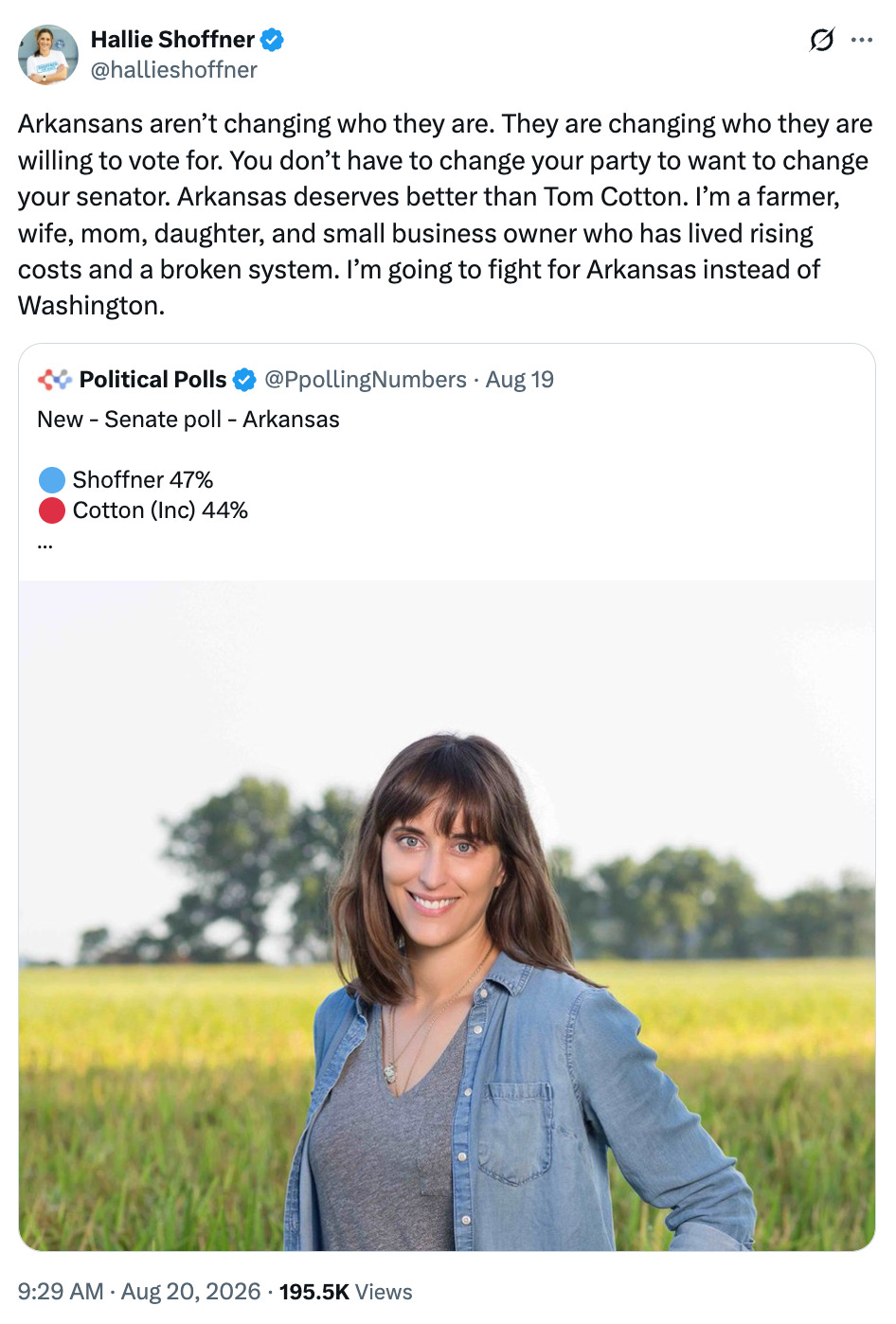
So imagine everyone’s surprise when a shock poll earlier this month showed Democrat Hallie Shoffner up three points over Cotton.
Even Cotton had to address the poll, writing on X last week:
The poll did not exactly come out of left field. The previous one had Shoffner down just three points against Cotton.
But now a newly released poll, which shows Cotton with a double-digit lead over Shoffner, suggests it may have been an outlier. At least Cotton hopes so.
Regardless, the newsworthiness of Shoffner leading Cotton has enabled Shoffner to get the word out to Arkansas voters about who she is and what she’s fighting for.
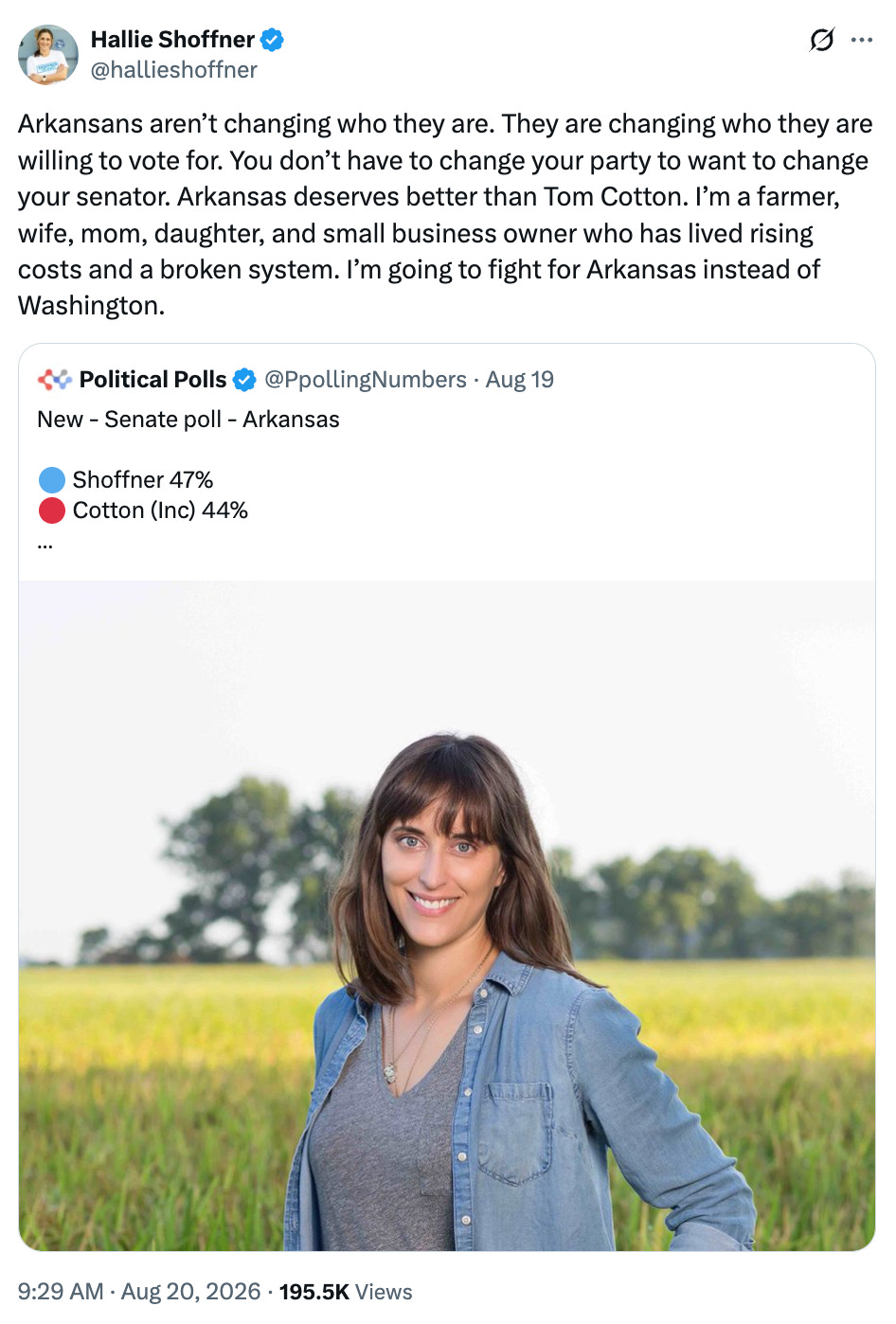
Shoffner, like many red-state Democrats running against entrenched Republican incumbents this year, is running as a check on the corruption in Washington.
On her website, Shoffner promises “to take on the rigged system that is holding Arkansas families back” and to be a “candidate who will fight for real Arkansans, not Washington donors.”

And as her website points out, Shoffner’s biography serves as the perfect counterpoint to Cotton.
Hallie Shoffner is a 6th-generation farmer and small-business owner running for the U.S. Senate to fight for working families.
Hallie grew up in Shoffner, a small farming community in the Arkansas Delta, raised in the fields alongside her farmer parents - learning to grow soybeans, rice, corn, cotton, and wheat. For the past nine years, she operated the family farm - making payroll, working with lenders and insurers, and balancing the realities of farming while raising a family.
And…
…while Arkansas families like hers struggle, Tom Cotton voted against the Farm Bill, against Medicaid, against economic development, and against disaster relief - while supporting tax cuts for billionaires and blowing up the national debt.
Cook Political Report currently lists the Arkansas Senate seat as “Solid Republican” and Kalshi gives Cotton a 95% chance of reelection.
But with Trump’s approval underwater in Arkansas, at a new low of 46% approve versus 53% disapprove, in a state with a strong history of electing Democrats, Shoffner has plenty of time to make this a real race and, importantly, make Tom Cotton and national Republicans spend precious resources on a race they thought was a lock until Shoffner came along.
Is It Possible To Expand The Map?
In any midterm election, conventional wisdom is that voters don’t start to pay attention until after Labor Day. So it’s good news for Democrats that their long-shot candidates are in competitive positions at the end of August.
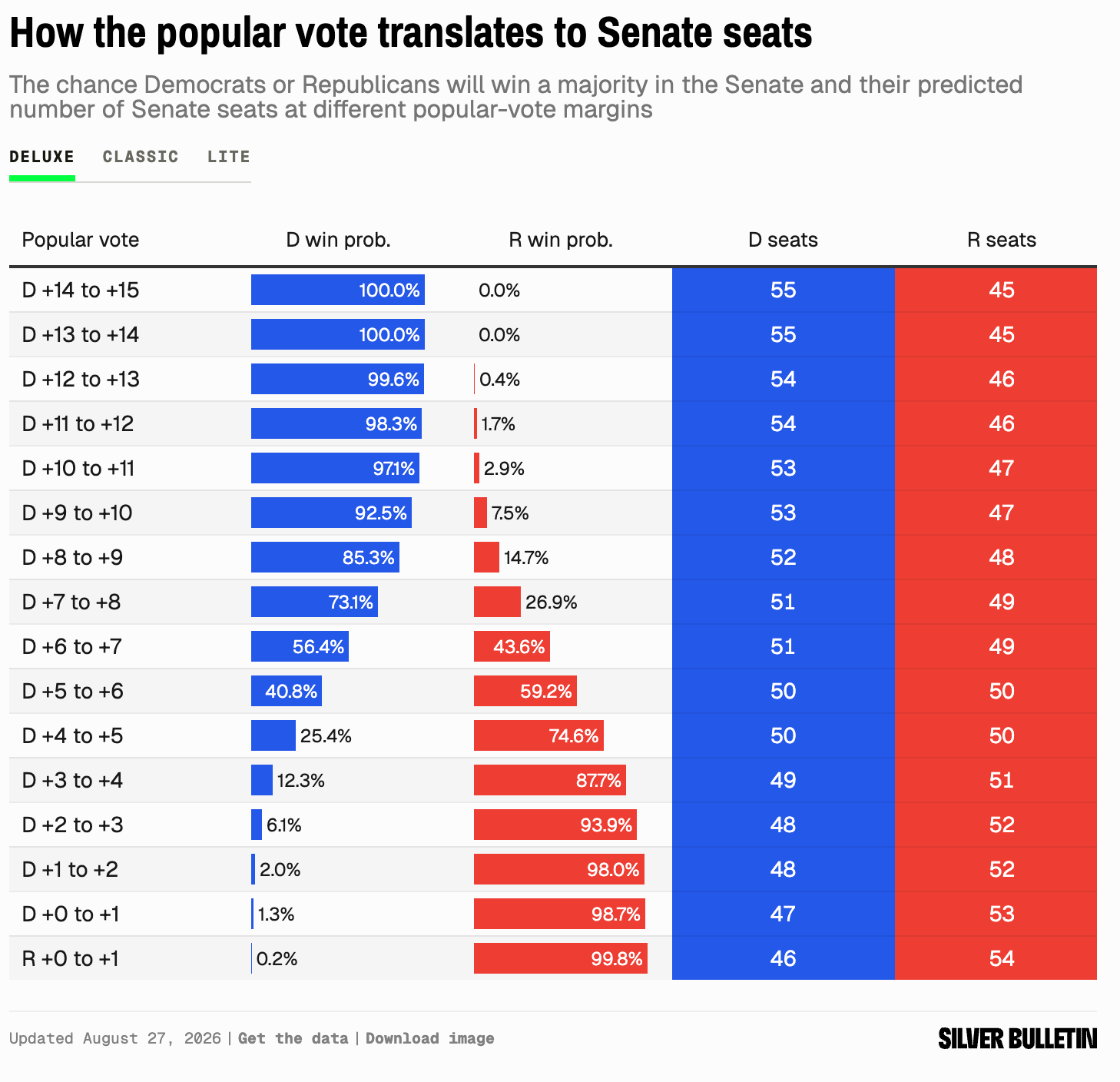
We’re already seeing Democrats’ generic ballot advantage land between 6-7 points, translating to a bare Democratic Senate takeover of 51-49 seats. But what if the congressional popular vote margin ends up being even greater?
As G. Elliott Morris wrote yesterday at Strength In Numbers, while their generic ballot average may have Democrats up by just 6 points,
When voters are weighted according to their stated likelihood to vote, the party’s margin expands to D+7.5, with 51.1% of registered likely voters saying they’ll vote for Democrats in their local congressional seats and 43.6% saying they’ll vote for Republicans.
Among only those voters who say they are definitely going to vote in November, Democrats hold a 9-point lead.
This led Morris to remind us this morning:
IMO people are underestimating the chance of a double-digit Dem margin in Nov. Modal outcome? No, but certainly 20-30%+ chance. Our [Likely Voter] generic ballot is D+8-9, and out-party tends to gain 1-2 points from Sept to Nov.
If we are actually looking at a 9 to 11 point Democratic advantage in the congressional ballot this November, some of these next-tier races could actually play a factor in the election. As Nate Silver notes in his midterm election forecast, there is a direct relationship between the vote margin Democrats get and the number of seats they can pick up.
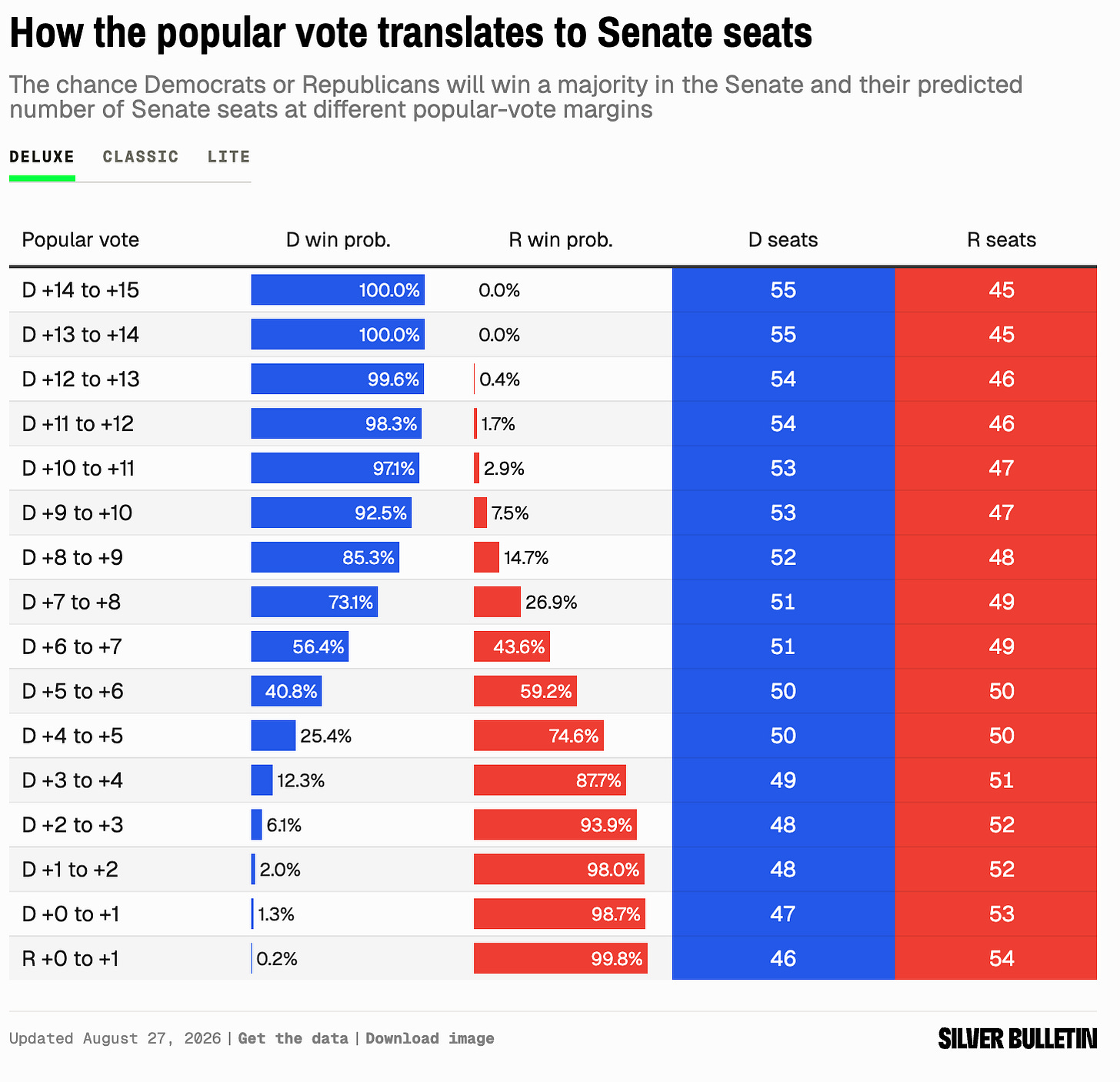
If Democrats do end up winning the popular vote on November 3 by 10 or 11 points, as Morris suggests they could, that would represent an absolute tsunami, which could see Democrats gaining a net of six rather than just the four seats they need to hold the majority.
Democrats should seriously look at investing in some of these long-shot races as we come into the final stretch of the election. It wasn’t so long ago, after all, that James Talarico and Mary Peltola were considered “longshots” too.
-
Pour leur premier débat, les candidats à la présidentielle sommés par le Medef de faire des économies
Sept candidats, pas tous investis ou certains d’aller jusqu’au bout, ont répondu aux questions d’un parterre de patrons décidés à peser sur le scrutin de 2027. Droite et extrême droite ont donné des gages, tandis que les gauches se sont rebiffées.Reply source -
Democrats to investigate ‘miraculous’ rise of Trump Jr’s investment firm
Reply sourceCongressman Jamie Raskin asks president’s son to detail firm’s recent success after he joined 1789 Capital as partner
Democrats on a powerful US congressional committee have launched an investigation into a venture capital firm which has thrived since recruiting Donald Trump’s son.
Donald Trump Jr joined 1789 Capital as a partner just days after his father won a second term in office in November 2024. Congressman Jamie Raskin, ranking member of the US House of Representatives judiciary committee, has asked the president’s son to detail the firm’s recent success.
Continue reading... -
Manifestation pour la Palestine - Pas question de se taire !
Reply sourceQuand ?
Le 29 août à 15hOù ?
Place de la Bastille Place de la Bastille 75011 ParisIls continuent à bombarder Gaza sous blocus, interdisant même aux enfants de se distraire un peu avec des cerfs-volants en papier. Israël continue à bloquer l'aide humanitaire et déruit les aliments pour enfants !
lls tuent, ils démolissent, ils dépossèdent, et ils arrêtent les Palestiniens de Cisjordanie et de Jérusalem-Est, où ils installent de nouvelles colonies.
Ils marquent sur leurs fronts et leurs bras des numéros, lors de leurs « raids » et détentions, un peu partout dans les territoires palestiniens occupés, comme le faisaient les nazis !
Et nous allons rester chez nous ?
Nous appelons à une grande manifestation ce samedi au départ de la Bastille ce samedi 29 août à 15 H ! Venez en famille !— CAPJPO-Europalestine
- Voir la page Facebook
-
Village des services publics à Bercy
Reply sourceQuand ?
Le 8 septembre à 16hOù ?
Ministère de l'Économie, des Finances et du Budget Allée de Bercy 75012 ParisLa CGT organise un rassemblement festif et revendicatif pour la fonction publique.
A partir de 16h, nous appelons les agent·es et les usager·es à se rassembler à Bercy pour demander des comptes !
L'événement, en présence de Sophie Binet qui fera une intervention lors d'un meeting à partir de 17h30, a pour but de mettre en valeur les revendications de la CGT pour la fonction publique et ses agents, notamment dans le cadre du lancement des élections fonctions publiques prévues en décembre 2026.
Nous vous attendons nombreuses et nombreux.
- Voir aussi CGT paris
-
Rassemblement contre l'extradition de Gino et en solidarité avec les inculpé-e-s de Budapest
Reply sourceQuand ?
Le 30 août à 14hOù ?
Place de la Bataille de Stalingrad Place de la Bataille de Stalingrad 75019 ParisLe 19 août dernier a eu lieu l'audience de notre camarade et ami Gino devant la cour d'appel de Paris, qui s'est prononcée favorablement à son extradition vers l'Allemagne sous 10 jours.
Il est plus que nécessaire de se mobiliser massivement et de montrer votre soutien de toutes les manières possibles (communiqués de soutien, banderoles, affichages, rassemblements devant les ambassades, etc.) pour éviter à Gino une extradition imminente.
Ne lâchons pas la pression et poursuivons notre travail de solidarité : Gino ne doit pas être extradé.
Appel à Rassemblement antifasciste dimanche 30 août 14h place de Stalingrad à Paris :
Le 19/08 la cour d'appel de Paris a émis un avis favorable à l'extradition vers l'Allemagne de notre camarade et ami Gino. Comme de nombreux.ses antifascistes à travers toute l'Europe, il est pourchassé par la Hongrie, accusé d'avoir participé à une action contre la manifestation néo-nazie du Jour de l'Honneur à Budapest en février 2023.
Alors que la France avait refusé de le livrer à la Hongrie d'Orban, c'est l'Allemagne qui réclame à son tour une extradition. La même Allemagne qui a illégalement déporté Maja, retenu.e à Budapest depuis 2 ans dans des conditions indignes. En Allemagne, Gino encourt jusqu'à 10 ans de prison. Il risque surtout de suivre le même parcours que Maja.
L'Affaire de Budapest est un procès politique dans un contexte politique où les organisations antifascistes sont considérées comme terroristes en Hongrie ou comme organisations criminelles en Allemagne. La justice française avec cette dernière décision, joue pleinement leur jeu. Derrière Gino, Zaid, Maja et tous les autres, c'est l'antifascisme tout entier qui est attaqué. Nous devons être à la hauteur.
Nous avons peu de temps. Gino a fait appel devant la Cour de cassation. Jusqu'à ce jugement, saisissons chaque opportunité de faire vivre le soutien. Montrons que derrière nos camarades il y a un mouvement. Un mouvement large, un mouvement fort, un mouvement organisé et surtout un mouvement qui ne se laissera pas intimider.
La répression est la meilleure arme des états bourgeois et des régimes fascistes. Ils veulent nous isoler, nous diviser. Tirons notre force de leurs attaques : mobilisons nous, organisons-nous.
Pour s'opposer à l'extradition de Gino, retrouvons nous le dimanche 30 août à 14h place de la Bataille de Stalingrad pour un rassemblement unitaire contre la répression !
Contre la répression : solidarité
Liberté pour Gino, non aux extraditions, free all antifasCommuniqué suite à la décision de la cour d'appel
Le 19 août dernier a eu lieu l'audience de notre camarade et ami Gino devant la cour d'appel de Paris, qui s'est prononcée favorablement à son extradition vers l'Allemagne sous 10 jours.
Pour celles et ceux qui ne connaissent pas l'affaire Budapest, Gino est accusé par la Hongrie - avec une dizaine d'autres personnes - d'avoir participé à des violences contre des néonazis en 2023, dans le cadre d'un défilé d'extrême droite organisé chaque année à Budapest en Hongrie : le « jour de l'honneur » qui réunit environ un demi-millier de nazis, commémore l'alliance entre soldats de la Waffen-SS et militaires hongrois lors du siège de l'armée rouge à l'hiver 1945, lorsque la dictature hongroise était l'alliée d'Hitler. Certaines prétendues victimes sont des militants d'extrême droit de nationalité allemande.Suite à un premier mandat d'arrêt européen émis par la Hongrie, Gino avait déjà été détenu en France plusieurs mois à partir de novembre 2024. Si Gino et d'autres camarades étaient extradés, ils risquaient jusqu'à 24 ans d'emprisonnement en Hongrie. Après une longue bataille, la cour d'appel de Paris avait refusé cette extradition estimant que les risques de jugement inéquitable et de mauvaises conditions de détention étaient trop importants. Notre camarade avait donc été remis en liberté sous contrôle judiciaire.
Le 16 décembre 2025, Gino a été arrêté par les agents de la Sous-direction antiterroriste de la police judiciaire (Sdat) suite à l'émission par l'Allemagne d'un mandat d'arrêt européen à son encontre et placé en détention. Il ressortira deux semaines plus tard, mais s'en suit un acharnement judiciaire qui n'en finit pas. La cour décide de reporter sans cesse le délibéré concernant le mandat d'arrêt émis par l'Allemagne.
Mais ce 19 août, les juges ont cédé aux pressions de l'Union Européenne et d'Europol, bafouant tous les principes de l'indépendance de l'institution judiciaire et des principes de liberté fondamentale.
Avec l'aide de nos avocats, nous faisons appel de cette décision devant la Cour de cassation, qui aura 40 jours à compter du pourvoi pour se prononcer définitivement.
Il est plus que nécessaire de se mobiliser massivement et de montrer votre soutien de toutes les manières possibles (communiqués de soutien, banderoles, affichages, rassemblements devant les ambassades, etc.) pour éviter à Gino une extradition imminente.
Ne lâchons pas la pression et poursuivons notre travail de solidarité : Gino ne doit pas être extradé.— Le comité Solidarité Budapest
-
Permanence juridique et sociale du Syndicat Unifié du Bâtiment
Reply sourceQuand ?
Le 12 septembre de 10h à 12hOù ?
Le 37bis 37 bis, rue des Trois Bornes, 75011, ParisPermanence hebdomadaire juridique et sociale pour les travailleurs et travailleuses du Bâtiment, des Travaux Public, du Bois, de l'Ameublement, des matériaux de construction, du Paysage, de l'Ecologie et de l'Environnement, du Logement, de la Voirie et de l'Equipement.
Notre permanence répond à toutes les questions qui peuvent se poser en termes de : droit du travail, droit des étrangers, droit du logement, Droit à la santé, Droit à la formation et a l'éducation...
Accès gratuit et sans rendez-vous initial.
-
Apéro de rentrée syndicale
Reply sourceQuand ?
Le 3 septembre de 18h à 20hOù ?
Le 37bis 37 bis, rue des Trois Bornes, 75011, ParisLe Syndicat Unifié du Bâtiment de la Confédération Nationale du Travail invite tous les travailleurs et travailleuses du :
- Bâtiment,
- Des Travaux Publics,
- Du Bois,
- De l'Ameublement,
- Des Matériaux de construction,
- Du Logement,
- De l'Equipement,
- Du Paysage,
- De l'Ecologie,
- ...En formation, en activité ou à la retraite,
Syndiqués (à la CNT ou ailleurs) ou non-syndiqués,
A venir prendre l'apéro, ce jeudi 3 septembre, au 37 bis, rue des 3 Bornes (75011). -
Les rencontres de la SUB'OOKS
Reply sourceQuand ?
Le 12 septembre de 15h à 17hOù ?
Dans le cadre des rencontres de la SUB'OOKS, venez rencontrer Mathias LEJOSNE & Yannick ORVEILLON, pour la présentation de leur BD : "Le poulpe noir, une histoire du capitalisme".
- Une BD qui retrace l'histoire du capitalisme du Moyen Âge à nos jours
- Un équilibre maîtrisé entre rigueur scientifique, vulgarisation et humour
- Un dessin en noir et blanc, d'inspiration franco-belge, qui allie clarté et précision historique
- Un dessinateur à la notoriété montante, illustrateur du récent Llibertat (Marabulles, janvier 2026)Pourquoi le capitalisme domine-t-il le monde ? A-t-il toujours existé ? Quels liens entretient-il avec la démocratie, le racisme, le patriarcat ou la crise écologique ?
Pour répondre à ces questions, un poulpe érudit entraîne deux adolescents à travers l'histoire du capitalisme, de sa naissance à aujourd'hui. Au fil des pages se croisent de nombreux penseurs et penseuses, parmi lesquels Adam Smith, Karl Polanyi, Silvia Federici, Naomi Klein, Johann Chapoutot ou encore Monique Pinçon-Charlot.
Le Syndicat Unifié du Bâtiment de la CNT, vous invite à venir fortement en débattre.
-
Rencontre avec Irénée Régnauld - La sommation technologique
Reply sourceQuand ?
Le 9 septembre à 20hOù ?
Le Genre Urbain Rue de Belleville 75020 ParisIrénée Régnauld présente "La sommation technologique" mercredi 9 septembre 2026 à 20h à la librairie Le genre urbain (60, rue de Belleville, 75020 Paris).
- Voir aussi La Fabrique
-
Cancer du sein: la (très) difficile bataille pour la reconnaissance en maladie professionnelle
Malgré la décision du tribunal de Bayonne de reconnaître en maladie professionnelle le cancer du sein d’une hôtesse de l’air, le parcours pour que cette reconnaissance soit généralisée est encore semé d’embûches.Reply source -
Rencontre avec Elsa Marcel et Françoise Vergès - Comment se défendre en de sombres temps ? Renouer avec l'héritage de la défense de rupture
Reply sourceQuand ?
Le 16 septembre à 19h30Où ?
Cirque Electrique Place du Maquis du Vercors 75020 ParisRencontre « Comment se défendre en de sombres temps ? Renouer avec l'héritage de la défense de rupture » entre Elsa Marcel et Françoise Vergès mercredi 16 septembre 2026 à 19h30 au Cirque électrique (Place du Maquis du Vercors, 75020 Paris), en partenariat avec la librairie Planète Io.
- Voir aussi La Fabrique
-
Watch Trump sign executive order renaming Lake Ontario to Lake America - video
Reply sourceThe US president signed order on Thursday amid growing trade war with Canada after the US enacted tariffs against its northern neighbor
Continue reading... -
Trump signs executive order to rename Lake Ontario as Lake America
Reply sourceMark Carney rejects attempt to rename lake as did several US governors, with Tony Evers mocking the move
Donald Trump signed an executive order on Thursday directing the federal government to rename Lake Ontario, making it Lake America, amid his escalating trade war with Canada.
The order directs federal agencies to adopt the name-change on US maps, documents and databases. But Trump has no authority to rename Canada’s portion of the lake, nor to compel Canada, international legal bodies, international mapmakers, or the rest of the world to adopt a new name.
Continue reading... -
The ‘Trust Us’ Era Of Title IX Campus Discipline Is Over
Reply source One of the iconic bronze lions outside Nassau Hall at Princeton University (photo by David Lat).
Portions of this article originally appeared on Bloomberg Law, part of Bloomberg Industry Group, Inc. (800-372-1033), and are reproduced here with permission. Both the text and the footnotes contain material that didn’t appear in my Bloomberg Law column—a form of bonus content for Original Jurisdiction subscribers.
At universities across the country, students are returning to campus after summer break. It’s an exciting and optimistic time for both students and their families.
Interactions with fellow students are one of the best parts of the college experience. But not all interactions are positive—and some unfortunately give rise to serious allegations of student misconduct, including sexual assault.
Title IX prohibits universities that receive federal funding from discriminating “on the basis of sex.” Not taking sexual-assault claims seriously enough can constitute sex discrimination—but so can treating accused students unfairly.
Handling these matters is fraught for schools, but handle them they must: Title IX’s implementing regulations require universities to have procedures for addressing complaints of sex discrimination.
If educational institutions mishandle these cases, they can face dire consequences, including government investigations and civil litigation.1
Universities caught in the middle
Universities must provide redress for students claiming sexual assault and fair procedures for the accused. And they can be sued under Title IX, by either the complainant or the respondent, for not striking the right balance. Two circuit opinions from last month capture this difficult position.
In Arana v. Board of Regents of the University of Wisconsin System, the University of Wisconsin-Madison was sued by a woman who alleged that the school violated Title IX by readmitting her alleged rapist after initially expelling him. Sitting en banc, the US Court of Appeals for the Seventh Circuit ruled for the school, 8-4.
In John Doe v. The Trustees of Princeton University, Princeton was sued by a male student who claimed that it ran afoul of Title IX by finding him responsible for misconduct through unfair disciplinary proceedings. The Third Circuit sided with the student, reversing dismissal of his suit.
“University disciplinary proceedings are the medium for these two people to assert claims and defenses against each other—and if they’re unhappy with the resolution, they can sue the university,” said Joshua Richards, a partner at Saul Ewing who represents institutions of higher education.
“Imagine if, every time you had litigation in federal court, you could sue the judge,” Richards continued. “There is zero incentive for institutions to get one of these cases wrong, when they know that both parties are going to consider litigation.”
A relatively new specialty
It wasn’t always this way. For decades, institutions of higher education weren’t highly regulated at all—in many areas, including student discipline.
“Largely left alone by the executive and judicial branches, schools devised what they thought were good rules to govern misconduct proceedings,” Richards explained. And their approaches were highly variable. Some schools had exclusively student-run processes. Some universities employed very informal systems; if two students had a disagreement, a dean might meet with both of them to talk through their issues.
“For 200 years, campus-discipline issues were handled by a small office within a university, in a kinder, gentler way,” said Richards. “In the past 15 years or so, there has been a monumental shift—and educational institutions have gone from being not highly regulated at all to being treated like oil-and-gas or pharmaceutical companies.”
Major changes took place during the Obama administration, which prioritized dealing with the problem of on-campus sexual assault.
“The legal landscape is so different from what existed before 2011, when the Obama administration issued its ‘Dear Colleague’ letter,” said KC Johnson, a history professor at Brooklyn College who has written widely about campus sexual assault and due process. “Before that point, federal courts were very reluctant to intervene in university disciplinary processes.”
After the 2011 letter, a 2014 report from a White House task force, and a 2015 follow-up letter, universities no longer had free rein over student discipline, at least for sexual-assault claims. The Obama administration wanted schools to take these cases more seriously, and it spelled out procedures that schools needed to put into place.
“Title IX regulation required universities to set up an internal adversarial process,” Richards said. “And when you run a quasi-legal proceeding that picks winners and losers, some people will be unhappy at the end.”
And what do unhappy people do? They sue.
A growing practice area
Justin Dillon started representing accused students in campus-discipline proceedings and Title IX cases in 2014, when he entered private practice after serving as a federal prosecutor in Washington, D.C. It was an opportune time to enter the field, with campus-discipline work taking off under the Obama administration.
Today, Dillon and Christopher Muha, his partner at Dillon PLLC, devote about 70% of their practice to representing respondents in campus-discipline and Title IX cases. They estimate that 90% to 95% of their matters are resolved during internal university proceedings, with little or no publicity.
Litigation is a last resort; in a typical year, their firm might file only one or two Title IX lawsuits in federal court. But when it’s necessary, they’re prepared to litigate—as they did against Princeton, representing the plaintiff who prevailed before the Third Circuit in John Doe v. The Trustees of Princeton University.
Hiring a lawyer to handle a campus-discipline and Title IX matter isn’t cheap (and almost never covered by any type of insurance). A typical case can cost as much as a year at an elite private college. In a complex or drawn-out matter, legal fees can easily run into six figures.
But the stakes for students are incredibly high. If a student accused of sexual assault is adjudged “responsible”—Title IX parlance for “guilty” or “liable”—he can be suspended or even expelled.2 The adjudication becomes part of his official record, affecting future educational and career opportunities, including the ability to transfer to another school if he has been expelled. Employers understandably aren’t eager to hire someone with a history of sexual misconduct, given the liability they can face for sexual harassment by employees.
So parents who can afford it are very willing to pay for top-flight legal counsel for their children. As Richards put it, “Student-discipline matters unfold in a context where if people are found responsible, it will damage them in a way that almost compels them to consider legal action.”

Burford Capital is the leading global finance and asset management firm focused on law. Its businesses include litigation finance and risk management, asset recovery and a wide range of legal finance and advisory activities. Burford is publicly traded on the New York Stock Exchange (NYSE: BUR) and the London Stock Exchange (LSE: BUR) and works with companies and law firms around the world from its global network of offices. For more information, please visit www.burfordcapital.com.
‘Everyone deserves a defense’
Given the seriousness of sexual assault, I asked Justin Dillon and Chris Muha an obvious question: How do you feel about your practice, given the terrible acts some of your clients are accused of?
Their response: The vast majority of their clients are not guilty—at least not guilty of what they’ve been specifically accused of (as opposed to, say, drinking excessively).
“I’ve been doing this for 12 and a half years, and I can count on one hand the number of our clients who are not innocent,” Dillon said.
“There are so few cases where we say to ourselves, ‘He probably did it,’” Muha said.
They also emphasized the due-process points made by criminal-defense lawyers (who will generally tell you, in my experience, that most of their clients are guilty—and their primary role as counsel is securing a favorable plea agreement and sentence).
“Process is important,” Muha said. “Being sure of guilt is important before you impose life-changing consequences.”
“Everyone deserves a defense,” Dillon said. “We don’t live in North Korea.”
Guidance for incoming students
An ounce of prevention is worth a pound of cure—and even though Dillon and Muha are excellent at what they do, it’s far better to never need their services in the first place. For students starting college or graduate school this fall, what advice would they offer?
First, treat everyone with whom you have a romantic interaction with respect—before, during, and after any relationship (or fleeting encounter). Not only is it the right thing to do, but it makes it less likely that the other party will harbor ill will toward you and file a disciplinary complaint.
Second, communicate with your classmates by text message—as opposed to apps where messages disappear, like Snapchat—and save your texts. You’d be surprised by how often texts provide crucial evidence in campus-discipline cases.
Finally, tell your parents immediately if campus disciplinary proceedings are initiated against you—and have them hire a lawyer for you, ASAP. Don’t try to navigate the process on your own.3
“This is often the first major thing that these students have ever been accused of, and they’re understandably afraid of disappointing or upsetting their parents,” said Muha. “But parents are more understanding and more forgiving than you might expect.”
Slowing down, not going away
Campus-discipline and Title IX work is busy. But it’s not at its high-water mark, at least in terms of litigation.
“At a general level, the pace of litigation has slowed since the tail end of the Obama administration and the first Trump administration,” said Johnson, the history professor. Back then, according to Johnson, around 80 Title IX lawsuits involving allegations of sexual misconduct were filed each year; today, it’s closer to 40.4
Johnson attributed much of the decline to the replacement of the Obama administration’s Title IX guidance by new regulations promulgated in 2020 by the first Trump administration. The Trump regulations rejected the “single investigator” model, in which one school official could serve as both investigator and adjudicator, and provided greater protections for respondents, including live hearings with cross-examination of witnesses.
In the view of their supporters, the 2020 Trump regulations increased due process for accused students, leading to a decline in lawsuits claiming unfair treatment in campus disciplinary proceedings. These regulations remain in effect today, after Title IX regulations issued by the Biden administration were blocked by courts and then officially rolled back at the start of the second Trump administration.
In the Title IX arena, the current Trump administration has focused almost exclusively on how the statute applies to transgender issues. It hasn’t taken any major action on Title IX as applied to campus discipline.5
But even if the Trump administration isn’t active in this area, there’s no going back to the pre-Obama era, when universities enjoyed far greater discretion over how they handled sexual assault claims.6
“For decades, federal courts were reluctant to intervene in university disciplinary processes,” Johnson said. “But that has changed in recent years—and courts are no longer willing to simply defer to universities when the schools say, ‘Trust us.’”
-
Les Kurdes font un pas de plus vers la disparition du Rojava
En annonçant la dissolution des Forces démocratiques syriennes, leur chef, Mazloum Abdi, a fait un pas de plus vers la disparition de la région autonome du Rojava, dans le nord-est syrien. Un choix imposé par les changements intervenus à Damas et à Ankara.Reply source -
26 minutes de GTA 6 : le résumé de la présentation historique sur Netflix et YouTube
Reply source
13 ans après GTA 5, Rockstar Games a enfin dévoilé GTA 6 le 27 août, lors d'une présentation de 26 minutes diffusée en exclusivité sur Netflix, puis publiée sur YouTube dans la nuit. Missions, duo Jason-Lucia, nouveau système de police, activités secondaires : voici tout ce que l'on a appris avant la sortie du jeu, le 19 novembre 2026.
-
Trump’s war on Iran is rapidly draining US navy budget, documents and interviews reveal
Reply sourceExclusive: Experts and former officials say accounts are running dry, and funding a war with no clear endgame is the main challenge
Donald Trump’s war on Iran has driven the US military into a severe financial crisis, with the US navy forced to transfer money from its payroll and other sources to cover the costs of combat, according to documents seen by the Guardian, and interviews with navy officials, contractors and defense analysts.
The US-Israeli operation, which has depleted US munitions stockpiles and prompted retaliatory Iranian strikes that have wrecked strategic bases across the Middle East, is piling pressure on budgets across the military.
Continue reading... -
Invitation à la prochaine ZADimanche du CPTG du 30 août
Reply sourceQuand ?
Le 30 août de 11h à 16hOù ?
Chemin de la Justice Chemin de la Justice, 95500, Gonesse, FranceAprès un été aux multiples canicules et aux conséquences catastrophiques pour le vivant et l'environnement, nous vous proposons, comme chaque dernier dimanche du mois, de nous retrouver sur le Triangle pour apprécier la fraîcheur du site.
C'est aussi l'occasion pour celles et ceux qui ne sont pas encore venu·es, de découvrir le beau paysage des terres agricoles du Triangle et de passer un moment convivial avec les militant·es qui le défendent, et qui sont heureuses à cette occasion de créer de nouveaux liens !
Déroulé de la journée :
– 11h rendez-vous directement sur le lieu (voir ci-dessous), installation du barnum pour le pique-nique ;
– 12h30 pique-nique « auberge espagnole », si vous le souhaitez vous pouvez apporter vos plats et boissons préférées à partager ;
– 14h réunion d'information et de débat sur la situation de la lutte : une demande de permis de construire la cité scolaire est entre les mains du Maire de Gonesse, une réunion publique doit être organisée le 8 octobre à la demande de la Région à Gonesse, les récents « arrêtés d'aménager » du préfet, préparation des prochaines rencontres, etc... Ce sera aussi la préparation de l'évènement du dimanche 27 septembre sur le Triangle : les balades naturalistes, les ateliers de décoration des tuniques, la table ronde, les interventions politiques, la chaîne humaine autour de la ferme...Voir le dernier Echo du Triangle de juillet 2026
En espérant vous voir nombreuses et nombreux pour cette ZADimanche de rentrée
Pour accéder à la ZADimanche :
Lieu de la ZADimanche - accessible en voiture : Coordonnées GPS : 48.9777561N, 2.4732594E
Voir l'itinéraire pour le dernier kilomètre par le chemin de la Justice iciAccès transports en commun :
– RER D, arrêt [Villiers-le-Bel - Gonesse - Arnouville] (20' depuis Gare du Nord), puis prendre le bus 20 (tête de ligne) ici - arrêt facultatif à demander au machiniste [Patte d'Oie] - Marcher le dernier kilomètre par le chemin de la Justice ;
– RER B, arrêt [Parc des Expositions] (20' depuis Gare du Nord), puis prendre le bus 20 (tête de ligne) - arrêt facultatif à demander au machiniste [Patte d'Oie] - Marcher le dernier kilomètre par le chemin de la Justice.Proposition d'itinéraire vélo depuis la porte de La Villette : suivre Le Croult entre les points 12 et 13 ; pour le retour prendre la rue de Paris dans Gonesse.
Si vous êtes perdu·es et proche de l'arrivée : 06 76 90 11 62
- Voir aussi Oui aux Terres de Gonesse
-
Trump administration pauses all immigrant visa applications amid new screening policy
The Trump administration has trained much of its immigration crackdown on people who entered the United States illegally from Mexico and elsewhere, but it is intensifying another battle, this time with people who come legally. The State Department has paused all immigrant visa applications while it briefs consular officials around the world on a new policy that aims to keep out people who are considered potential drains on public coffers.Reply source -
U.S. State Department Pauses Immigrant Visa Applications
The Trump administration has paused processing of immigrant visas, which allow recipients to move permanently to the U.S., to train visa officers on new guidance ensuring that applicants have enough financial means to support themselves after they arrive. Immigrant visa applicants with interviews scheduled at U.S. embassies and consulates have been notified by email that their appointments are being postponed. Applicants for immigrant visas most commonly include spouses, parents and siblings of U.S. citizens, as well as some people sponsored by U.S.-based employers, such as foreign nurses to work at underserved hospitals. Foreigners on immigrant visas are granted green cards upon arrival.Reply source -
Trump admin pauses visa appointments worldwide amid heightened screening for applicants
The Trump administration has directed U.S. embassies and consulates around the world to postpone immigrant visa interviews while consular officers complete training on new public-charge guidance, temporarily stalling applications that have reached the interview stage. The State Department told diplomatic posts to reschedule immigrant visa interviews until consular officers complete the training on how to evaluate whether an applicant is likely to become a public charge.Reply source -
«100% Frontières»: sur CNews, on prend les mêmes obsessions et on recommence
Le magazine d’extrême droite a fait sa rentrée pour une nouvelle saison de son émission, critiquée y compris à CNews, sur la chaîne de Vincent Bolloré. La veille, une enquête a révélé des dizaines de publications racistes et antisémites sur un groupe Facebook que «Frontières» est censé modérer.Reply source