@rick — following
Follow buttons here act as you, not as @rick.
@rick follows
| Label | Kind | State | Action |
|---|---|---|---|
| rss.skyfleet.blue | source | — | — |
| rss.skyfleet.blue | source | — | — |
| rss.skyfleet.blue | source | — | — |
| rss.skyfleet.blue | source | — | — |
Timeline
-
Controversial California oil pipeline can continue to operate, judge rules
Reply sourceState sought to stop system off coast of Santa Barbara from resuming operations after Trump ordered its reopening
An oil pipeline can continue to operate off the California coast after a judge gave it the green light this week, despite the opposition of state regulators and environmental groups.
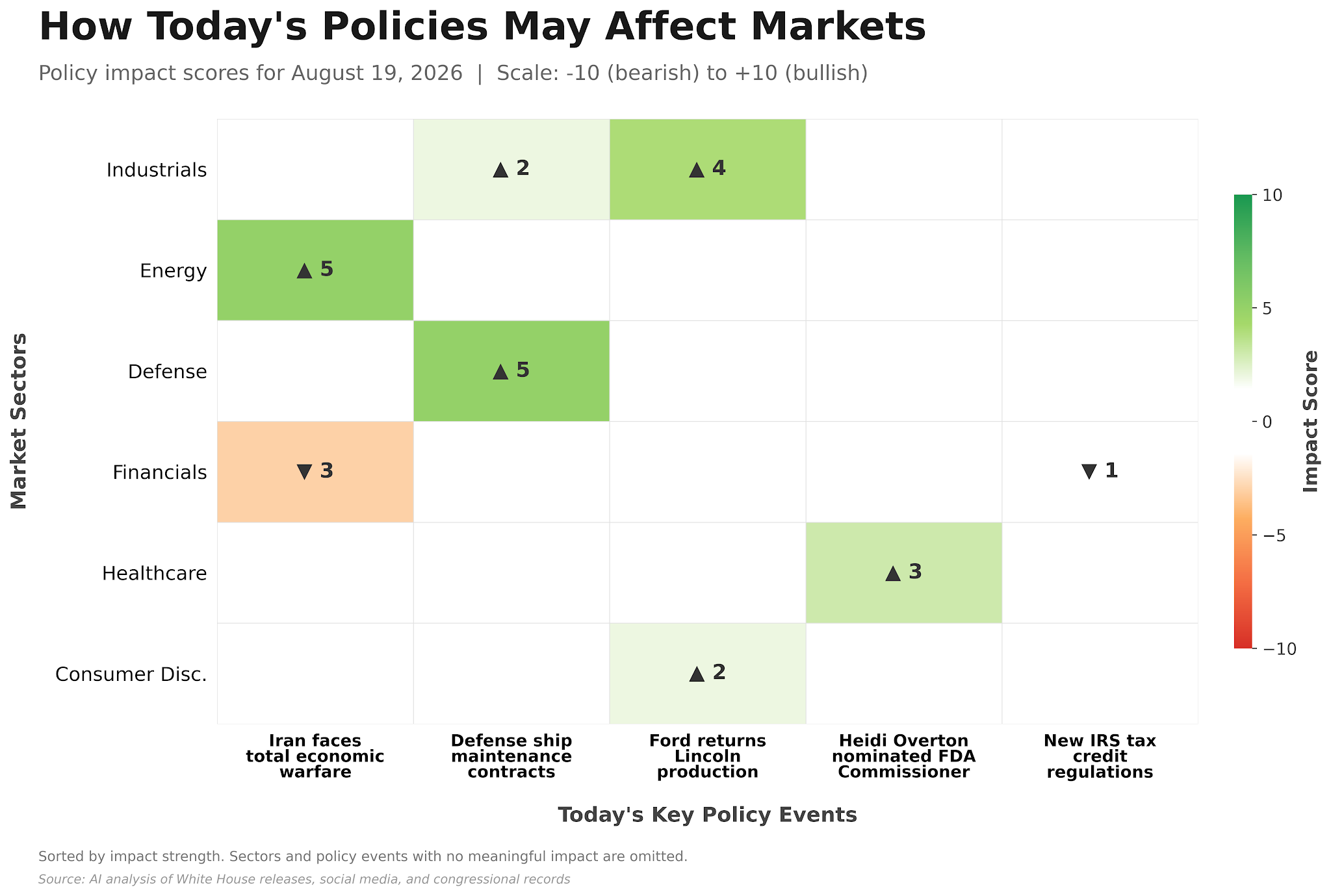
The system off the coast of Santa Barbara resumed operations earlier this year for the first time in more than a decade after Donald Trump ordered Sable Offshore Corporation to reopen it, citing US energy needs during the war in Iran.
Continue reading... -
Les sociétés minières creusent leurs trous. Cet hiver, on se déterre, on les y enterre !
Reply source
Appel à actions contre l'industrie minière
Nous écrivons cet appel à une période où la civilisation industrielle révèle l'importance de ses fondations : les sous-sols.
Armée par la science et la technologie, la méga-machine extractive repousse les frontières cognitives et territoriales. Tout est désormais transformé en matières premières. De la France à la Chine, des États-Unis à la Russie, d'Imerys à Rio Tinto en passant par BHP Biliton ou Anglo American, états et entreprises passent le monde au peigne fin, brossant jusqu'aux fonds marins et l'Antarctique, à la recherche de minerais aux noms insolites (lithium, cobalt, tungstène, beryllium, etc). Des milliardaires, comme Elon Musk pour le plus connu, investissent dans l'aérospatial afin de prospecter des gisements cosmiques. Ici-bas, sur Terre, la démesure du pillage capitaliste et patriarcal approfondit ses ravages. Les mines entraînent guerres , vols, viols, maladies, pollutions et travail de forçat dans les espaces colonisés comme au Congo, en Indonésie ou en Amérique du Sud. À cet impérialisme s'ajoute l'exploitation intra-muros, alors que la vieille Europe recommence à accueillir la voracité minière à bras ouverts. Que ce soit à Jadar en Serbie ou au Portugal avec le site de Covas do Barosso, en passant par le très médiatisé projet Emili au cœur de la France métropolitaine, et… l'Ukraine, les mêmes logiques de sacrifice des territoires et des populations sont à l'œuvre. Ces dernières continuant de subir la dépossession, la répression et la mise au silence. Les pouvoirs d'états à travers l'USGS, le BRGM et autres centres de recherche et les financeurs (Union Européenne, BPI, actionnaires comme Glencore) provoquent ainsi de nouvelles guerres, de nouvelles dévastations, afin de siphonner les matières fossiles et minérales des sous-sols.
La mondialisation de l'extractivisme est en cours mais ses horreurs ne se font pas sans opposition. Des luttes acharnées se mènent en Laponie, au Canada, en Kanaky, au Sahara, en France, en Grèce, en Allemagne, pour conserver l'eau, la terre. Pour survivre. Des projets sont contestés, retardés, certains sont abandonnés. Face à l'ampleur de la dévastation, n'oublions pas notre force collective.Nous croyons ce système faillible, que sa subversion est possible.
Nous voulons le saper à sa base. Grâce à l'imagination, l'inspiration, l'audace !Partout où ce message circulera, que ces deux mois (Février-Mars 2027) soient semés d'actions autonomes et diverses contre les entreprises minières et ceux qui collaborent avec elles.
Bien appliquées, de petites forces peuvent devenir de grandes menaces.
-
Des “sales arabes” à la transphobie: jusqu’où ira le journaliste Jean-Marc Aubert du Métropolitain?
Reply sourceOn le savait raciste, le voici transphobe. À la suite d’une sanglante tentative de viol d’une femme transgenre, le journaliste Jean-Marc Aubert a affirmé, dans un article multipliant les erreurs factuelles, que la victime, Mme D., était « en réalité un homme ». En 2022, le Métropolitain jurait au Poing avoir pris « des mesures » à l’encontre de son journaliste, multi-condamné pour diffamation. Visiblement, cela n’a pas suffi.
Le 13 août à Montpellier, une femme transgenre de 21 ans, Mme D., a été victime d’une tentative de viol et d’une agression sexuelle par deux hommes, suivie d’une attaque par arme tranchante. Les violences ont redoublé lorsque les agresseurs ont réalisé qu’elle était une femme trans. Une centaine d’entailles ont été relevées. « Mes agresseurs ont essayé de me couper l’oreille et un doigt. Je suis lacérée au buste, j’ai des hématomes de partout, des lacérations au dos… Tout mon corps est entaillé, j’ai perdu beaucoup de sang » témoigne la victime au Poing.
Un article transphobe du Métropolitain
C’est le mouvement de gauche Cause Commune qui a sonné l’alerte après la publication d’un article du Métropolitain, présenté sur les réseaux sociaux sous ce titre : « Ils découvrent que “la femme” qu’ils veulent violer a un pénis : une transgenre lacérée », et affublé d’un intertitre aberrant : « Un pénis ». Réduction d’une personne à son intimité, négation de son identité par l’usage des guillemets : la transphobie est incontestable.
Dans son récit, Jean-Marc Aubert évoque une victime ayant reçu « 50 points de suture », tout en la décrivant comme « fort heureusement légèrement blessée ». La manière dont il relate le crime transphobe est sidérante : « L’occasion faisant le larron visiblement, croyant qu’il s’agissait d’une femme, ils ont tenté d’abuser d’elle dans cet endroit isolé après avoir engagé une brève conversation, interrompue en découvrant qu’il s’agissait en réalité d’un homme puisqu’ils ont aperçu son sexe, avant de lui porter des coups tranchants, puis en proférant des insultes. » Une formulation glaçante, qui banalise la tentative de viol tout en niant explicitement l’identité de genre de la victime.
L’art d’écrire avec ses pieds
Tout ou presque est faux dans l’article, comme le confirme au Poing la principale intéressée : « C’est marqué que j’ai 22 ans dans la légende de la photo, puis 21 ans… Il dit que l’agression s’arrête à 17h30, alors qu’elle commence en fait à 17h30. C’est suggéré que j’ai été transmise de l’hôpital au commissariat, ce qui est incorrect. La description des individus ne correspond pas à ce que j’ai dit à la police. Personne n’a “aperçu” mon sexe : l’agresseur qui me faisait une clé d’étranglement l’a saisi après avoir glissé sa main sous ma poitrine. Et il n’y a eu aucune “conversation” avec les agresseurs, sauf à considérer que “putain de merde c’est une trans” est une conversation ». Sur le fond, elle dénonce une « fétichisation de [s]a condition de personne trans, et un focus sur [s]on anatomie qui n’est absolument pas la question ».
L’article se conclut enfin par une étonnante digression sur le Verdanson, « rivière longue de plusieurs kilomètres » qui, « outre sa célébrité lors des épisodes pluvieux méditerranéens et ses brusques augmentations de débit, […] réserve bien des surprises lorsque le soleil est au rendez-vous, ce qui arrive relativement souvent à Montpellier : c’est le QG du Street Art ». Une curieuse anecdote à propos du lieu où la victime s’est « vidée de son sang ». On attend avec impatience l’article relatant la qualité du platane sur lequel s’est écrasé toute une famille.
Cerise sur le gâteau : si l’article concède une « agression transphobe » dans sa version actuelle, la première mouture évoquait à la place « deux individus homophobes ? » Choqué, le conjoint de Mme D. appelle Jean-Marc Aubert, qui lui répond ceci : « Ce sont deux individus qui aiment les femmes, et dès lors qu’ils s’aperçoivent qu’elle a un pénis, ils sont contre l’homosexualité, ils sont donc homophobes. » Le journaliste pose alors une question existentielle au conjoint : « La victime était-elle habillée en homme ou en femme ? »
Dans la même veine, Le Poing dénonçait en 2023 le traitement d’un féminicide par Jean-Marc Aubert, présenté comme un « terrible drame de la rupture », au prétexte que l’assassin « n’aurait pas supporté la récente rupture ». Une formulation qui reprend à son compte le récit du meurtrier et le vieux ressort sexiste du « crime passionnel ».
Jean-Marc Aubert, un journaliste raciste
Dès 2017, Le Poing relevait que le Métropolitain avait publié, en dix mois, 19 articles à charge contre les mineurs étrangers. Interrogé sur sa responsabilité morale après l’attaque, par la Ligue du Midi, d’une association venant en aide aux sans-papiers, Jean-Marc Aubert nous avait accusés d’être téléguidés par un responsable politique local, qu’il avait qualifié de « sale arabe ». Il avait alors précisé : « Dire qu’un arabe est sale, c’est-à-dire qu’il ne se lave pas, qu’il sent mauvais, c’est pas raciste. »
En 2018, il assurait le service après-vente d’une action de Génération identitaire, organisation d’extrême droite dissoute en 2021, présentée sous sa plume comme un « mouvement politique de jeunesse qui rassemble des garçons et des filles », sans mention de son idéologie suprémaciste blanche.
En 2022, Jean-Marc Aubert qualifie à nouveau un homme de « sale arabe », cette fois le président de l’association Français Musulmans Rapatriés. Le Métropolitain dénonce alors auprès du Poing des « propos indéfendables », « à l’opposé des valeurs des personnes qui composent la rédaction », et affirme avoir pris « des mesures » à son encontre.
Serial diffamator
En 2019, alors qu’il couvre la mobilisation contre les violences policières après la mort de Steve Maia Caniço, Jean-Marc Aubert reproduit un tract d’Alliance Police nationale qualifiant les manifestants de « sous-êtres humains ». Le syndicat retirera le tract, mais celui-ci est toujours reproduit sur le site du Métropolitain.
En 2020, le journaliste est condamné à six mois de prison avec sursis pour accès frauduleux à un système de traitement automatisé de données : il s’introduisait sur la plateforme de traitement des alertes des sapeurs-pompiers afin d’y puiser des « scoops ».
La diffamation lui a également valu plusieurs passages devant les tribunaux. Lors d’une nouvelle audience en 2024, la présidente du tribunal rappelle que Jean-Marc Aubert a écopé de six condamnations entre 2013 et 2019, dont cinq pour diffamation. Cette fois, il est relaxé. Il était poursuivi après avoir écrit à tort qu’un nourrisson était mort étouffé, alors que le décès était dû à une méningite, une erreur de nature à causer du tort à la nourrice qui le gardait.
Entre 2020 et 2024, la Ville et la Métropole de Montpellier ont acheté pour 913 832 € d’espaces publicitaires ou de publireportages à 7 Officiel – La Gazette Économique de l’Hérault, qui édite le Métropolitain (et 0 € au Poing : faites un don).
Contactés, le Métropolitain et Jean-Marc Aubert n’ont pas répondu.
L’article Des “sales arabes” à la transphobie: jusqu’où ira le journaliste Jean-Marc Aubert du Métropolitain? est apparu en premier sur Le Poing.
-
Avant son départ pour Mayotte, Édouard Philippe à droite toute sur l’immigration
En visite sur l’île vendredi 21 et samedi 22 août, l’ancien premier ministre compte faire de ce déplacement un marqueur de son virage à droite sur les enjeux migratoires. Les réformes qu’il propose, en plus d’être probablement anticonstitutionnelles, s’appuient sur des mythes.Reply source -
Pique-nique contre la porcherie industrielle
Reply source
Appel à se rassembler le 22 août contre le projet d'élevage intensif
samedi 22 août à 11h, sur la plage d'Auphelle.Les manifestants se donnent rendez-vous à 11h samedi au bord du lac de Vassivière, sur la plage d'Auphelle. Il y aura d'abord une conférence des élus du Limousin, puis un pique-nique partagé avec des prises de paroles des collectifs de citoyens et associations environnementales.
Au-delà de ce projet particulier, cette mobilisation entend également poser une question plus large : quel modèle agricole et quel modèle de développement voulons-nous pour le Limousin ?
Parallèlement, trois recours sont en préparation et doivent être déposés avant le 6 septembre par les collectivités, les citoyens et les associations environnementales. -
The Guardian view on Trump’s MMR executive order: endangering the children he claims to care about | Editorial
Reply sourceThe president’s empty advice that children should receive separate jabs against measles, mumps and rubella will only lead to less take-up by parents
Nobody wants to hurt a child. The howl of pain, the tears, the look of betrayed shock all make it very hard to deliver a cherished small person to the needle-wielding nurse. But that’s part of being a responsible parent. It becomes a lot tougher if mum or dad is being fed mixed and erroneous messages about the benefits and harms of vaccination.
Parents have to make a lot of decisions about what’s right for their child, from the school they should go to and the food they should eat to the hours they should spend on the phone or watching TV. In the US, Donald Trump wants them to add another: do they choose to give their children separate jabs against measles, mumps and rubella, involving six visits to the clinic, or should they opt for the combined MMR vaccine, which does the job in two? For decades, the vast majority of families have been taking the advice of doctors, accepting their assurance that the MMR vaccine is safe and very effective. But what are they to think when a US president announces that the triple jab could be “quite lethal” and signs an executive order advising states to offer separate vaccines?
Continue reading... -
Manifestation pour la Palestine
Reply sourceQuand ?
Le 22 août à 15hOù ?
RER Luxembourg Luxembourg, 75006, Paris, FranceNOUS DÉFILERONS CE SAMEDI 22 AOÛT DANS PARIS, ET NOUS VOUS DONNONS RENDEZ-VOUS À 15H DEVANT L'ENTRÉE DU JARDIN DU LUXEMBOURG (Métro-RER Luxembourg).
Notez la date ! Nous vous attendons très nombreux et en famille ce samedi pour demander la libération des 10 000 otages palestiniens, dont le Dr. Abu Safiya, affamé et torturé, de même que 15 autres médecins de Gaza, et une quarantaine de journalistes palestiniens, dont 5 femmes, kidnappés à Gaza et en Cisjordanie, en tant que témoins gênants des atrocités commises par Israël.
CAPJPO-Europalestine
- Voir la page Facebook
-
Destruction de mâts de mesure éoliens en Haute-Vienne
Reply source
Le 18 janvier 2023, quatre personnes sont arrêtées et accusées de destruction de plusieurs mâts de mesure du vent implantés en Haute-Vienne sur des sites prévus pour l'installation d'éoliennes industrielles.
MAJ
Depuis cette date, les personnes sont toujours sous contrôle judiciaire et attendent une date de procès.
Vous trouverez une émission de radio sur le lien
https://www.aioli-radio.org/emissions/infos-reportages/infos-locales/vla-la-gamelle-52/
Une brochure : Brochure 4 pages à imprimer et diffuser
et
Brochure 48 pages
Ce document retrace l'histoire de l'affaire, comporte des témoignages, des informations sur les prédateurs, et un avis de tempête !
Nous sommes un collectif qui dénonçons les nuisances sans bornes des installations des éoliennes industrielles. Nous avons les yeux ouverts - et refusons de les fermer - sur le cauchemar technologique qui se propage dans le monde entier. Sur l'avènement du pouvoir des machines et l'omniprésence des objets connectées sur nos vies avec la promesse illusoire d'une amélioration de notre quotidien. Nous voyons les humain·es se faire berner par l'attrait de la fée électricité qui alimente nos chaînes. Ces machines qui nous retirent petit à petit nos facultés, notre autonomie, ces intrusions et contrôles de nos vies.
Des profits du vent
Les entreprises capitalistes n'existent que pour retirer du profit de tout. Avec la complicité et l'aide financière de l'État, elles investissent dans l'éolien car c'est une manne financière. Ni plus ni moins. Y compris quand il n'y a pas de vent pour les alimenter.
On veut faire croire au public-connecté, aux bonnes citoyen·nes qu'avec les aérogénérateurs industriels nous allons vers une transition énergétique. Il n'a jamais été dans l'intention de nos gouvernants de démanteler les centrales nucléaires. Il s'agit d'une addition énergétique. Ce qui semble durable dans tout cela n'est autre que la folie de la civilisation occidentale qui impose son modèle de développement coûte que coûte, son modèle de destruction de la vie et de notre pouvoir autodétermination.Ici comme ailleurs, nous condamnons la déforestation, la pollution sous toutes ses formes, chimique, électromagnétique, sonore et visuelle, la perturbation des vols d'oiseaux et tant d'autres conséquences néfastes de l'implantation de ces aérogénérateurs industriels liées à l'installation d'éoliennes industrielles qui nécessite d'extraire des métaux. Pour nous, tout extractivisme est colonial, qu'il soit perpétué en France ou dans d'autres pays, car il est fait sans l'accord des populations locales. Cette industrie participe à l'exploitation des populations comme en Mongolie et en Amérique du Sud en les faisant travailler dans les mines pour extraire les ressources nécessaires à la production d'énergies dites renouvelables. Les énergies estampillées « vertes » ne sont toujours qu'une industrie néo-coloniale au service des entreprises qui en tirent profit.
Ce système mortifère augmente jour après jour le fossé entre les populations rurales (directement impactées par les implantations des éoliennes industrielles ou par l'extractivisme nécessaire à leur construction) et les populations urbaines qui « bénéficient » des objets hyper connectés. C'est ainsi que les modes de vie autonomes disparaissent au profit des mode de vie dépendants de l'énergie électrique et que s'étendent les mégapoles tentaculaires.
Les vraies victimes ne sont pas celles que la « justice » désigne.
Les vraies victimes sont celles de ces prédateurs que rien n'arrêtent.
Les prédateurs promoteurs :
SAS WPD ONSHORE FRANCE,
ENGIE GREEN S.A.(abandon du projet)
RPGLOBAL FRANCE
Le montant des dommages :
(même si, d'après leurs déclarations, ils n'ont pas la ferme intention de reconstruire ces mâts) est estimé par eux à 350 000 €.Les chefs d'inculpations en résumé :
"Destruction de biens d'autrui", participation à "association de malfaiteurs en vue de préparation d'un délit puni d'au moins 5 ans d'emprisonnement, commis en réunion par une ou plusieurs personnes dissimulant volontairement leur visage afin de ne pas être identifiées" ; pour l'une d'entre-elles "refus de se soumettre aux opérations de relevés signalétiques".
Punition avant jugement :
Le contrôle judiciaire qui leur est imposé depuis maintenant plus de 3 ans :
Interdiction de sortir de la région ;
Pointage régulier à la gendarmerie ;
Interdiction de rentrer en contact avec les autres inculpées ;
Une caution pour rester en liberté : de 100 000 € pour l'une des inculpée. Les 3 autres inculpé·es se « partagent » 20 000 €Tout ceci avant jugement !
Les outils répressifs judiciaires :
- L'argent (caution)
Le prix de la liberté. Le deal est : si tu veux rester en liberté, paye 100 000 €.
- Le contrôle judiciaire
Imposer des contrôles judiciaires qui limitent les déplacements, constituent une peine immédiate et à la durée non limitée. L'interdiction d'entrer en contact entre les inculpé·es limite d'autant plus la défense collective face à la justice.
- Discrimination entre les inculpé·es
Avec l'inégalité des demandes de caution, qui est là aussi pour diviser.
- La prison préventive
Une grande partie des détenues en France sont en préventive/en attente de jugement ; à l'heure où l'État construit en ce moment de nouvelles prisons.
Soutien
Si la destruction de quelques mâts de mesure est au regard de la loi un délit, c'est pour nous un acte de résistance commis sans violence sur des êtres vivants, c'est un acte symbolique qui ne fait qu'entamer l'assurance sans borne, la volonté de conquête de ces prédateurs cupides. Dans un contexte de guerre sociale, ces actes nous semblent de l'ordre de l'auto-défense.
Nous soutenons les personnes accusées de sabotages de mâts de mesure d'éoliennes, qu'elles soient coupables ou innocent·es, car ces actions sont un souffle de résistance contre l'absurdité de ce monde autoritaire et le capitalisme vert.Les personnes accusées attendent toujours une date de procès.
Elles restent sous contrôle judiciaire.Solidarité aux courageuses !
Pour être informée et proposer des actions de soutien, s'inscrire sur la liste à
sisme-request@lists.riseup.net
Pour connaître « toute » l'histoire, télécharger la brochure 48 pages. - L'argent (caution)
-
« Je ne veux tout simplement pas mourir, et je ne veux pas tuer. N’est-ce pas suffisant ? »
« Je ne veux tout simplement pas mourir, et je ne veux pas tuer. N’est-ce pas suffisant ? » Des dizaines de soldats ukrainiens désertent pendant leur formation en Allemagne, rapporte Die Zeit. Die Zeit a relaté en détail l’histoire de Volodymyr Shulhin, 39 ans, originaire de Dnipro. Avant la guerre, il était pianiste, écrivait […]Reply source -
«La liberté de navigation est censée prévaloir dans les détroits internationaux»
La géographe Pauline Pic, coautrice d’une «Géopolitique des détroits», analyse la spécificité de ceux d’Ormuz et de Bab-el-Mandeb au Moyen-Orient. Elle souligne que si aucun passage n’est à jamais incontournable, les coûts des routes alternatives peuvent être considérables.Reply source -
«Je veux rentrer chez moi»: le cauchemar sans fin des marins bloqués dans le détroit d’Ormuz
La guerre n’est pas l’unique responsable du calvaire que vivent les quelque 6 000 marins toujours bloqués dans le détroit: des armateurs avides de profit refusent de les rapatrier et les obligent à travailler contre leur gré en zone de guerre, dans des conditions déplorables.Reply source -
Vieux, durs et va-t-en-guerre: six généraux nommés à la tête du pouvoir iranien
Alors que le protocole d’accord entre les États-Unis et la République islamique a expiré, le Guide suprême a procédé à une réorganisation complète du système militaro-sécuritaire. Celui-ci est adapté à une double confrontation: avec Washington, et avec la population iranienne elle-même.Reply source -
Leipzig (Allemagne) : Un petit feu contre une société immobilière et la mobilité électrique
Reply sourceknack.news / jeudi 13 août 2026
Dans la nuit du 12 août, nous avons incendié quatre voitures, sur un parking de la rue Erich-Köhn. Deux d’entre elles appartenaient à la société Grand City Property, les autres étaient une Tesla et une voiture électrique de marque Toyota.
À Leipzig et dans beaucoup d’autres villes, les loyers augmentent depuis des années à un rythme vertigineux et des personnes sont chassées de leurs quartiers. Des entreprises comme GCP, connue pour harceler ses locataire.trices, profitent de cette évolution. Nous vivons dans une société de classe, où d’un côté il y a quelques personnes qui se remplissent les poches, alors que, de l’autre côté, nous devons dépenser une grande partie de notre argent pour le loyer. Nous lançons un petit signal contre cette situation.
On sait depuis des décennies que l’humanité est gravement menacée par la crise climatique. Mais les scientifiques et les politiciens veulent nous faire croire qu’il existe un capitalisme durable, que nous pouvons continuer comme avant, à condition de remplacer l’énergie sale issue du charbon, du pétrole et du gaz par de l’électricité propre. C’est un mensonge et nous n’y croyons pas. Pour les voitures électriques et d’autres technologies modernes, des matières premières sont extraites dans le Sud du monde, de manière coloniale, ce qui s’accompagne de la destruction des habitats humains et animaux.
À bas la folie du progrès ! Expropriation des grands groupes immobiliers ! Solidarité avec tou.tes celles/ceux qui sont persécuté.es par l’État ! -
Évolution récente et projection future de la ressource mondiale en eau souterraine | Maya Costantini, Bertrand Decharme et Jeanne Colin
Cet article analyse l'évolution des ressources en eau souterraine à l'échelle mondiale, en se basant sur des simulations de modèles climatiques. Une méthode simple est proposée pour estimer les prélèvements non renouvelables d'eau souterraine utilisée pour l'irrigation. Les résultats montrent que dans des régions clés comme l'Inde, la Chine et les États-Unis, une grande partie de l'eau utilisée est non renouvelable, aggravant la dette hydrique mondiale. La diminution de la recharge sous l'effet du changement climatique combinée à l'augmentation des prélèvements anthropiques menace la durabilité de la ressource en eau souterraine dans les aquifères de plusieurs régions du monde. Source: La MétéorologieReply source -
Leipzig (Allemagne) : Une visite nocturne au groupe immobilier Künne
Reply sourceknack.news / mercredi 12 août 2026
 Vous devez, vous aussi, consacrer la moitié, ou au moins un tiers de vos revenus à votre loyer mensuel ? Dans ce cas, Künne Immobilien est votre partenaire de confiance pour des situations financières critiques. Comme un agriculteur allège ses vaches de leur lait, de même les locatrices et locataires se font traire avec assiduité, chaque mois. Si nous jetons un coup d’œil à l’histoire de l’entreprise, on peut citer les mots suivants de son fondateur, Marko Künne : « Son but : recouvrir l’ensemble de la chaîne de valeur du secteur. Jusqu’à aujourd’hui, Marko Künne croit fermement en Leipzig comme un site de premier choix pour l’immobilier résidentiels et commercial. »
C’est vraiment top ! Alors que le marché de l’immobilier à Leipzig se situe au-delà de tout bon sens, les propriétaires d’appartements comme Künne se remplissent toujours les poches. Tout simplement WOW – qu’est-ce qui vient après ? Sa promotion dans le gouvernement de Friedrich Merz, pour tant de « passion et de flair » ? Là-bas, il serait certainement parmi ses pairs.
Pour exprimer notre colère face à cette situation, la nuit dernière nous avons peinturluré le parc automobile du groupe Künne Immobilien et y avons crevé des pneus – dans l’espoir d’avoir mis un petit grain de sable dans les rouages d’un marché des habitations axé sur le profit. Satisfait.es, nous nous sommes endormi.es et avons rêvé de logements qui, libérés de la logique du profit et des rapports de propriété, servent les besoins des gens qui les habitent et les gèrent eux/elles-mêmes, de manière socialisée. L’initiative « Exproprier Deutsche Wohnen et compagnie », à Berlin, a montré à nous tou.tes à quoi pourrait ressembler un marché du logement repensé. Cela vaut la peine de poursuivre activement cet objectif. Fuck the System! -
Un slogan collaborationniste sur le mur de la vice-présidente du RN
Reply sourceLa seule véritable anomalie de cette histoire, c'est la «dédiabolisation» du RN organisée par les médias de masse depuis des années.
L’article Un slogan collaborationniste sur le mur de la vice-présidente du RN est apparu en premier sur Contre Attaque.
-
Non, des images ne montrent pas des affrontements récents entre les agriculteurs et la police à Bruxelles
Reply source
Source :Compte Facebook, le 18 août 2026
Etiqe :daté
Contenu :
« Les agriculteurs néerlandais et belges luttant contre la police à Bruxelles. Le siège même de l’UE, empire globaliste, sous la colère des agriculteurs. » Les vidéos d’affrontements entre agriculteurs et forces de l’ordre se multiplient ces derniers jours sur les réseaux sociaux. On y voit des cortèges de manifestants avec les drapeaux de différents syndicats agricoles, comme ceux de la FNSEA et de la Confédération paysanne, visés par des grenades de désencerclement lancées par les CRS. Sur une autre, on aperçoit les effectifs de police reculer face à des files de tracteurs en pleine ville.
« De nombreux agriculteurs se battent encore et continueront à se battre pour leur subsistance, notre approvisionnement alimentaire local et contre les autocrates de l’UE sans scrupules », indiquent certaines publications sur Facebook. Et d’ajouter : « Les médias ont enterré les événements. » On n’a effectivement pas vu d’images de telles manifestations cet été dans les médias, et pour cause… elles datent de l’hiver dernier.
Des vidéos tournées entre décembre 2025 et janvier 2026
Ces images sont bien réelles, mais elles n’ont pas été tournées lors de cet été 2026. Les premières images montrent notamment des tracteurs face à un dispositif de policiers anti-émeutes, ainsi que des jets d’eau et des fumigènes. Elles correspondent à une mobilisation organisée à Bruxelles le 18 décembre 2025, contre l’accord commercial entre l’Union européenne et les pays du Mercosur, mais aussi au sujet de l’avenir de la Politique agricole commune et la gestion de l’épizootie de dermatose nodulaire contagieuse.
Ce jour-là, plusieurs milliers d’agriculteurs s’étaient rassemblés dans la capitale belge alors que les dirigeants européens se réunissaient pour discuter notamment de l’accord commercial. La manifestation avait dégénéré en affrontements entre certains manifestants et la police. Comme l’avaient rapporté de nombreux médias au moment des faits, les forces de l’ordre avaient notamment utilisé des gaz lacrymogènes et des canons à eau. Des manifestants avaient lancé des pierres et des pommes de terre en direction des policiers et un tracteur avait été conduit vers une ligne de policiers anti-émeutes.
Une autre vidéo montre également des agriculteurs confrontés aux forces de l’ordre, devant un bâtiment européen. Là encore, il ne s’agit pas de Bruxelles ni d’une manifestation récente. Ces images ont été tournées à Strasbourg, le 20 janvier 2026, devant le Parlement européen. Elles ont notamment été publiées par l’agence de presse CLPRESS, qui indique que plusieurs milliers d’agriculteurs européens s’étaient rassemblés ce jour-là pour protester à nouveau contre l’accord commercial entre l’Union européenne et le Mercosur.
Des mobilisations cet été aux Pays-Bas
Si ces vidéos sont à nouveau partagées ces derniers jours, c’est parce que des agriculteurs se mobilisent de nouveau dans plusieurs régions des Pays-Bas. Depuis la fin du mois de juillet, des organisations agricoles néerlandaises organisent différentes actions contre la politique du gouvernement concernant notamment les restrictions liées à l’azote. Cinq élevages intensifs de volaille risquent de perdre leur licence à cause de leurs émissions d’azote trop importantes.
Plusieurs manifestations et blocages ont eu lieu au mois d’août, avec des convois de tracteurs et des actions sur les routes. Le 14 août, plus de 500 tracteurs ont notamment participé à une mobilisation à Schermerhorn, tandis que d’autres actions étaient organisées dans le pays. Comme le rapportait Courrier International, cette mobilisation, qui comprenait notamment le blocage d’une autoroute, a entraîné la mort de deux personnes et fait six autres blessés des suites d’une collision.
Ce n’est pas la première fois que des images de manifestations d’agriculteurs sont sorties de leur contexte, comme l’avait déjà expliqué la rédaction des Surligneurs en janvier dernier.
Auteurs :
Autrice : Maïwenn Furic, journaliste
Relectrice : Clara Robert-Motta, journaliste
Liens d’intérêts ou fonctions politiques déclarés des intervenants à l’article : aucun
Secrétariat de rédaction : Clara Robert-Motta, journaliste
L’article Non, des images ne montrent pas des affrontements récents entre les agriculteurs et la police à Bruxelles est apparu en premier sur Les Surligneurs.
-
De de Gaulle à Macron, une histoire de la Françafrique
Tout au long de ses quinquennats, Emmanuel Macron a martelé la “ fin de la Françafrique”, un propos qu’il a pu réitérer lors du sommet Africa Forward, au Kenya, réunissant plus de trente chefs d'État et de gouvernement africains. Le dispositif à pourtant…Reply source -
Épisode 3/3. « Le travail domestique des femmes rend la crise écologique palpable »
Reply sourceDans ce troisième et dernier épisode, nous donnons la parole à la sociologue Massilia Ourabah.
Autrice d’une thèse sur l’impact des pratiques écologiques individuelles (souvent qualifiés de « petits gestes » dans les discours publics), elle interroge le rôle du travail domestique réalisé par les femmes dans la prise de conscience des enjeux climatiques.Pourquoi vous êtes-vous intéressée aux liens entre travail domestique et fin du monde ?
Un jour, alors que je rentrais du supermarché, je me suis rendu compte qu’une fois les courses déballées, ma poubelle était plus pleine que mon frigo : en d’autres termes, que la quantité de ce qui détruit la planète – les déchets – dépassait de loin celle des aliments qui allaient me nourrir. C’est un constat, à vrai dire, que peuvent faire la plupart des personnes en charge de préparer les repas pour leur famille. Comment fait-on ce travail censé reproduire la vie dans un monde qui la détruit ?
Je m’intéresse également beaucoup aux pratiques écologiques à bas bruit, celles qui passent en dessous du radar de l’écologie dite sérieuse. Je viens d’une famille kabyle algérienne qui, lorsqu’elle est arrivée en France, vivait avec presque rien dans un tout petit appartement. À une époque où ça n’était pas encore à la mode, ma mère faisait fermenter ses yaourts sur le radiateur, puis les mettait sur le rebord de la fenêtre pour les conserver au frais. J’ai longtemps été frustrée qu’on ne s’intéresse à ces soi-disant petits gestes qu’à travers l’impact qu’ils ont sur la crise écologique. Considérer que la solution est uniquement dans ces pratiques individuelles est une approche dépolitisante qui aplatit les inégalités sociales et de genre, mais les mépriser, c’est ignorer l’importance du travail reproductif majoritairement réalisé par les femmes. J’ai donc voulu poser la question à l’envers : quel impact la crise climatique a‑t-elle sur le travail domestique ?
Qui a répondu à votre enquête ?
Principalement des femmes ! Quand j’ai commencé mes recherches, en 2020, nous étions en pleine épidémie de Covid. J’ai donc passé des annonces sur des groupes Facebook intéressés par les pratiques « zéro déchet » et le do it yourself [qui consiste à créer, fabriquer et réparer soi-même des produits du quotidien]. La plupart de celles qui m’ont répondu ne disposaient pas forcément de revenus importants. Et beaucoup ne tenaient pas un discours politique sur l’écologie.
Leur préoccupation principale, était de préparer à dîner à leurs enfants en faisant en sorte que ce soit bon, pas cher, local, que cela ne produise pas trop de déchets et que ce ne soit pas bourré de pesticides. Elles étaient pleinement conscientes de l’impact très marginal de leurs gestes. Mais en recyclant l’eau de la vaisselle, en se souciant de la provenance de l’alimentation ou en raccommodant les vêtements de leurs enfants, elles se sont mises à faire exister la question écologique au sein de leur foyer et souvent à embarquer – au prix, parfois, de longues négociations – leur conjoint et leurs proches dans ces pratiques.
« Ces femmes ne changent pas le monde mais transforment leur rapport à la planète »
Et justement, les hommes là-dedans ?
Les rares que j’ai eu l’occasion d’interroger n’étaient pas moteurs dans l’adoption de ces petits gestes. Quand les femmes me parlaient volontiers de préoccupations matérielles et quotidiennes, leur discours à eux montait systématiquement en généralité, dans un registre technoscientifique. Pour eux, les solutions à la crise climatique étaient plutôt à chercher dans le développement de techniques de décarbonation ou dans la conception de matériaux biodégradables.
Comment ce travail sur les petits gestes peut-il nous permettre d’imaginer des solutions à la crise écologique ?
La crise environnementale est une crise matérielle qui pose des questions telles que : que faire des déchets ? Comment vivre sous des températures extrêmes ? Comment utiliser les ressources qu’on a à sa disposition ? Pourtant, elle n’est pas toujours ressentie dans sa dimension concrète. S’intéresser aux « petits gestes » réalisés au quotidien dans le cadre du travail domestique permet de la rendre physiquement palpable, y compris quand il n’y a pas de canicule.
Ces gestes ne sont pas suffisants pour faire changement mais ils permettent de mettre à portée de main et à portée de réflexion les enjeux écologiques. Dans un monde où l’argent est dématérialisé, où Internet permet d’accéder d’un clic à des milliards de contenus et où des intelligences artificielles nous proposent de réfléchir à notre place, les petits gestes écologiques fonctionnent comme une piqûre de rappel.
Si les ressources matérielles nécessaires à notre existence nous paraissent aller de soi – par exemple, l’eau potable qui coule du robinet –, cette évidence est en réalité à problématiser. Et cela permet de développer un autre rapport au monde. Ces femmes ne changent pas le monde mais transforment leur rapport à la planète. Pour moi, cela a une valeur en soi, au-delà de la question de l’impact.
-
Une grave faille de sécurité dans Tails corrigée
Reply source
Tails, le système d'exploitation très utilisé contre la surveillance et la répression vient de corriger une faille de sécurité majeure.
Le 5 août, l'équipe de développement de Tails, le système d'exploitation portable « contre la surveillance et la censure », très utilisé comme outil de sécurité numérique par les militant-es, a proposé une mise à jour d'urgence pour résorber une faille de sécurité majeure.
Les failles de sécurité concernaient le noyau Linux et l'utilisation du navigateur Tor Browser. La première et la plus inquiétante, qui était ouverte depuis 2020, permettait via le navigateur Tor d'obtenir des privilèges de navigateur système et ainsi de pouvoir désanonymiser l'utilisateur·ice du système Tails. La seconde était une vulnérabilité qui pouvaient être exploitée en ouvrant un fichier malveillant dans des applications comme LibreOffice, Audacity ou Git.
L'équipe de Tails recommande ainsi à l'ensemble de ses utilisateurices de bien réaliser la mise à jour 7.10.1 qui vient corriger ces failles. Il est possible de faire la mise à jour directement depuis sa clé Tails, soit automatiquement si la dernière version installée n'est pas trop ancienne, ou bien de manière manuelle en suivant les instructions en ligne
Pour en savoir plus sur le fonctionnement de Tails et comment se créer une clé :
-
« Il fera tout ce que vous lui demanderez » : les versions « uncensored » du modèle d’IA chinois Qwen affolent les réseaux
Reply source
Depuis sa sortie, Qwen 3.8, le dernier modèle d'IA open source d'Alibaba, a rapidement vu fleurir des versions "uncensored" sur Hugging Face, la principale plateforme d'hébergement et de partage de modèles d'IA. Débarrassées de leurs derniers garde-fous, ces variantes circulent librement.
-
Un des deux journalistes français détenus au Togo a été placé en «résidence surveillée»
Gaël Mocaër et Sebastian Perez Pezzani, et leur guide togolais Fred Vedomey, ont été incarcérés il y a trois semaines. L’un d’eux a été placé jeudi en «résidence surveillée», tandis que les motifs de leur détention restent flous. L’affaire intervient sur fond de tensions entre Lomé et Paris.Reply source -
‘Starve the beast’? The $40tn cost of Republicans’ false promises to cut spending
Reply sourceThe enormous US debt under Trump will hobble the next Democratic administration – just as the GOP planned
You could pin the US’s staggering $40tn in government debt to Donald Trump’s Keystone Cops-style governance. Tariffs he sold as a new source of revenue were struck down by the supreme court, forcing the government to return tens of billions of dollars to importers. Elon Musk’s “department of government efficiency” (Doge), ostensibly created to stop wasteful government spending, decimated federal programs and probably killed millions of children, but did nothing to close the budget deficit. The burst of inflation following Trump’s misguided adventure in Iran sharply raised the cost of serving the government’s obligations.
Yet as the federal debt hits an all-time high, up from about $35tn when Trump took office less than two years ago, it is worth noting that the US’s gargantuan indebtedness is in fact the product of a longstanding Republican strategy that took shape well before Trump could even dream about gold-plating the White House. It was called “starve the beast”.
Continue reading... -
«Le retour de pratiques impérialistes choque d’autant plus que nous vivons dans un monde d’États-nations»
Nicolas Beaupré et Florian Louis publient «Histoire mondiale des impérialismes». Cet ouvrage collectif analyse l’apogée, la contestation, le déclin puis la résurgence du phénomène impérial depuis deux siècles et demi.Reply source -
Marseille : en plein été, l’abattage de 37 arbres provoque la colère
Reply sourceMalgré les promesses de replantation — 210 nouveaux sujets annoncés par la Ville — la pilule ne passe pas. « Les jeunes plants ne remplaceront jamais les îlots de fraîcheur que nous offraient ces géants »
Cet article Marseille : en plein été, l’abattage de 37 arbres provoque la colère est apparu en premier sur La Relève et La Peste.
-
Prepare for Catastrophe!
Reply source
Time to revisit my argument that people should remember there are multiple ways to fight fascism, all of which ideally work together to restore democracy.- The Erica Chenoweth rule, which says that if you can get 3.5% of a population in the streets, it often leads to regime change.
- Local node activism, as with immigration or data centers.
- Fighting in the courts.
- Beginning to peel off four people in the Senate or eight or nine people in the House.
- Waiting until 2026, winning at least one house of Congress, and beginning to rein in Trump that way.
- Rescuing Republicans from a predictable catastrophe like Democrats did in 2008 and 2020.
I’m revisiting this now for several reasons.
Local nodes
First, because I was badly overdue to add one of the most effective means of fighting fascism in the last 20 months, local activism of the sort we saw in LA, Chicago, and Minnesota in response to ICE invasions and of the sort we’re seeing unite left and right to fight data centers. One strength that local activism has is that media coverage arises out of civil society, the activism itself. This remarkable WSJ story on the activism opposing a Meta data center in Kentucky, for example, describes how activists used hunting maps to track what land Meta was snatching up.
Local officials have tried to assure residents that they are dealing with a major player in AI, not a fly-by-night operator.
Residents spent months piecing together the rumors and clues that float through a small town. One local official said the builder is among the 10 biggest companies in the world. A Maysville woman traveling with her husband on a work trip coincidentally met a man who said he’d been in the area on behalf of Meta.
A public-records request yielded clearer evidence: hundreds of pages of land studies and applications filed by an LLC established for “Project Crisham.” The contact for that LLC, a fiduciary director in the greater Philadelphia area named Pamela Gregorski, has worked on several data-center projects that were later revealed to be Meta sites.
With little information at hand, Bare and her neighbors have coordinated their research.
Janet Garrison, a dirt-bike-riding grandmother who taught information technology at the local community college, downloaded an app used by hunters to map the plots being acquired. She and others set up an information booth at the local fair.
When Garrison first learned of the data center, she thought of her former students and the jobs it might bring. Soon the opaque process irked her.
“We wanted to be a part of this,” she said. “But the NDAs…they just locked down and backed up.”
In the case of data centers, this local opposition has provided the base for political candidates to turn support from Big Data and AI companies into a toxin.
One limitation with the Erica Chenoweth rule is it’s not clear how it works in a country as big as the US. These local nodes provide one of the answers.
Don’t put off to January what could be done today
Another reason I’m reposting this is I’m seeing an increasing number of people not just assuming Democrats will win (in an election assumed to be free and fair without Trump interference) at least one house of Congress in November, but also assuming Democratic subpoenas will be more effective than something they can do now.
While winning one or even both houses of Congress does look increasingly likely, we can’t assume elections will be free and fair and the huge GOP infusion of cash have not yet hit most races.
Plus, people are insanely optimistic about how quickly Democratic Committee Chairpersons will be able to exercise oversight over Trump (as distinct from private industry). Trump succeeded in obstructing such efforts in 2019, and he has new tools to use to do so going forward. That’s not to say Democrats shouldn’t try, but until Democrats either win a bunch of lawsuits (with Trump’s SCOTUS) or defund everything until Trump cries uncle, subpoena power will not be the magic antidote many are treating it as.
There are existing tools that may be more effective than subpoena power, and if we focus on using them now, then the chances of winning the election and exercising real oversight will go up as well.
Chances of snowballing catastrophes are increasing
But the biggest reason I’m posting now is to follow-up on the last installment of this argument I made.
As item 6 on this argues, two of the only times right wingers have been willing to — have begged — to share power this decade came after right wing catastrophes: the Wall Street crisis in 2008 and COVID in 2020.
Neither time did Democrats, empowered by the leverage of GOP desperation, exact enough from Republicans. Had Obama simply invested more, demanded accountability from the banks, and jailed people for stealing people’s homes via mortgage fraud, the entire world would be in a different place. And as we speak, Trump is using that the fraud enabled by the approach used to float the economy during COVID to defund blue states.
But we’re at the point where Trump’s incompetence is beginning to create snowballing problems.
DOGE and RFK Jr — with an assist from Brooke Rollins — have conspired to allow debilitating illnesses, bugs, and poisons flourish.
Whiskey Pete Hegseth has shot America’s collective wad, pushed multiple ships to the brink of mutiny or suicide and in response led to further retreats from the Pacific. The price of oil is heading north again. Trump has emptied the Strategic Petroleum Reserve to dangerous levels. Iran has threatened to treat the next 30 months like an extended hostage crisis. The US is considering retreating from the Middle East. Both US Gulf and Asian allies are feeling betrayed and shopping security options elsewhere.
Partly as a result of that, and partly as a result of Trump’s other financial mismanagement, Scott Bessent is tinkering with the economy in a way that normally reflects a crisis. And Bessent’s efforts aren’t working.
Trump’s corruption is destroying the government services that Americans rely on.
Around the world, extreme climate is creating day-to-day risks for ordinary people; storms led to a nine-day power outage in Gary, IN. This winter the combination of the Iran War and climate problems may lead to further increases in food prices, if not shortages.
Hospitals are closing. People are losing health care. People are losing food stamps.
Largely to feed conspiracy theories, Trump gutted cybersecurity (and Iran exploited that) even as AI makes it far easier to carry out massive attacks — even by accident.
A few weeks back Dan Drezner contemplated something I’ve been contemplating as well. How long will it be until Americans experience attacks within the US that affect their day-to-day life?
What’s going to happen if, via some combination of all this, cities lose their water supply (which has already happened in Puerto Rico) or broad regions lose their electricity? What happens if that occurs during an extreme weather event when millions rely on air conditioning?
Obviously, these snowballing problems only increase Democrats’ chances in November. They increase the likelihood that — as happened in 2008, when John McCain took the lead in at least one poll on August 20 and then picked a charismatic governor as running mate who ended up backfiring, only to have a massive economic crisis starting a month later — November will look very different than it currently does.
But they also increase the chance that there’ll be a catastrophe — multiple catastrophes — at a time when Trump has stripped the government, and especially his cabinet, of competent people. And if something happens — if, as is easily foreseeable, multiple somethings happen at once — we need to be prepared both to help save lives and livelihoods, but also to use the crisis, NeoCon style, as a way to reverse Trump’s abuses. As Naomi Klein taught us almost two decades ago, if you don’t respond to disaster, the fascists will.
One reason I harp endlessly on the multiple ways to fight fascism is that many of the most effective ways to fight fascism don’t involve the Democratic Party, sure as hell don’t require the leadership of Chuck Schumer and Hakeem Jeffries.
There is never an excuse to expect the Democratic Party to fight this fight for you, because some of the most effective ways to fight are things you can do personally.
We don’t know what will happen in the near or long term. We do know that if we’re pursuing all measures, every method of fighting fascism is more likely to succeed.
But I also want people — including Chuck Schumer and Hakeem Jeffries — to consider what happens if Donald Trump, or Republicans watching him destroy the country, declare uncle and beg to be bailed out before we even get to November.
The post Prepare for Catastrophe! appeared first on emptywheel.
-
Microsoft veut mobiliser les batteries des particuliers pour soulager le réseau face à l’appétit électrique de ses data centers
Reply sourceLa batterie installée dans le garage d’un particulier pourrait-elle contribuer à absorber la consommation d’un data center de Microsoft ? C’est l’une des pistes étudiées par le géant américain et Qcells, la filiale spécialisée dans l’énergie du groupe sud-coréen Hanwha.
-
Terence Tao, le Mozart des maths modernes, brandit un mème pour expliquer le souci des maths à l’ère de l’IA
Reply source
Alors que les géants de la tech célèbrent chaque prouesse algorithmique comme une victoire historique, le mathématicien Terence Tao utilise l'ironie d'un mème pour recadrer le débat : générer une démonstration brute avec une IA n'est que la toute première marche de la science.
-
« Pendant les foins, c'est intenable » : les agriculteurs en colère contre le passage au tout-numérique
Reply source
La comptabilité sur papier, c'est bientôt terminé : à la rentrée, les agriculteurs devront tous faire des factures de manière électronique. Beaucoup jugent cette obligation intenable et dénoncent une « marche forcée vers le tout numérique ».
Lire la suite - Info / Agriculture
« Moi, j'appelle ça le remembrement numérique. Après, on n'aura plus personne en face de nous : tout sera numérisé. » À l'approche de la réforme de la facturation électronique, Olivier Niol, 57 ans, ne décolère pas. Avec sa femme Béatrice, il est (…) -
Œuvres spoliées dans les musées: tous complices?
Que faire de nos émerveillements dans les salles de musées devant des objets extraeuropéens, souvent pillés durant la colonisation? Le grand public a-t-il, lui aussi, une responsabilité dans sa manière de regarder des œuvres spoliées? Retour sur des expériences contrastées.Reply source -
Les drapeaux anglais ont-ils été interdits par la mairie de Bristol ?
Reply source
Source :Compte Facebook, août 2026
Etiqe :pas vraiment
Contenu :
Depuis juillet 2024, l’Angleterre est régulièrement secouée par des émeutes anti-migrants, où des centaines de militants d’extrême droite attaquent des personnes étrangères, des mosquées, ou des hôtels hébergeant des demandeurs d’asile. L’extrême droite, portée par le parti Reform de Nigel Farage, a atteint en 2025 un pic historique de popularité à 35% d’intentions de vote.
Dans ce contexte, de nombreux mouvements nationalistes s’approprient les drapeaux nationaux (l’Union Jack britannique ou la Croix de Saint-Georges anglaise) pour assumer leur rejet de l’immigration. C’est notamment le cas du mouvement Raise The Colours, lancé en 2025 par le militant d’extrême droite Andy Saxon.
Une vidéo, partagée massivement sur les réseaux sociaux, semble immortaliser une de ces manifestations, où l’on peut voir une rue entière d’un quartier bardée de drapeaux anglais. L’internaute explique que ces drapeaux auraient été d’abord interdits par la ville de Bristol, pour ne pas « mettre les migrants mal à l’aise ». Ce seraient les habitants qui, révoltés par la mesure, auraient décidé de braver l’interdiction pour s’opposer à la mairie écologiste.
En réalité, les drapeaux ont simplement été interdits sur la voie publique pour des raisons de sécurité, lorsqu’ils sont accrochés aux poteaux électriques ou aux lampadaires. Ils n’ont jamais été interdits sur les propriétés privées.
La rue la plus patriote d’Angleterre ?
Cette vidéo est authentique. Elle a été publiée le 20 juin 2026 par le média local Bristol 24/7, dans un article titré « Les drapeaux sont de retour dans ‘la rue la plus patriote d’Angleterre' ». On y voit la fameuse rue Torrington, située dans le quartier Knowle West de Bristol, traversée de part en part par des banderoles de drapeaux anglais.
Selon l’article, ce sont en effet les résidents qui ont décidé d’installer les banderoles après le premier match de l’équipe masculine anglaise de football à la Coupe du monde 2026. Ce n’est pas la première fois que cette rue se pare de drapeaux, c’est même une tradition dans le quartier à chaque grande compétition sportive (souvent du football). On peut en trouver d’autres exemples, par exemple en 2021, au moment de l’Euro de football masculin.
Cependant, aucune revendication de cet acte ne permet de savoir s’il a été fait pour s’opposer à la supposée décision municipale, comme l’affirment les internautes, ou simplement pour soutenir l’équipe nationale.
La mairie écologiste prise pour cible
Il est d’ailleurs faux de dire que la mairie de Bristol a interdit les drapeaux anglais pour ne pas « mettre à l’aise les migrants ». Cette fausse information a été pour la première fois diffusée par un compte X, qui assure être un compte « d’informations politiques », mais qui diffuse majoritairement des contenus anti-immigration et en soutien à Nigel Farage, le candidat du parti d’extrême droite Reform.
Cette polémique mélange deux problèmes distincts : l’interdiction de drapeaux sur la voie publique et le fait que des personnes aient pu être mal à l’aise face à ces derniers. Les deux évènements concernent Tony Dier, chef écologiste du conseil municipal de Bristol. L’interdiction de drapeaux est récente, mais la phrase de Tony Dier date de l’été 2025.
Dans une interview du 26 août 2025 pour la BBC de Bristol, au cours de laquelle la journaliste lui demande ce qu’il ferait dans l’hypothèse où des habitants viendraient se plaindre que des drapeaux soient brandis dans leurs rues. Tony Dyer répond en effet que des personnes l’avaient déjà contacté pour exprimer un mal-être sans en préciser les détails. Il appelait notamment son camp politique à ne pas « laisser » le drapeau anglais à l’extrême droite.
Le conseiller municipal avait d’ailleurs diffusé un communiqué à l’époque pour dénoncer la récupération de la croix de Saint-Georges par des « campagnes de désinformation et de haine à l’encontre des migrants ».
Mais ce n’est pas pour cette raison que les drapeaux ont été interdits sur la voie publique.
La sécurité avant tout
Dans un autre communiqué de Tony Dyer, daté cette fois du 5 juin 2026 – soit dix mois après son intervention sur la BBC et juste avant le début de la Coupe du monde – le conseiller municipal explique les raisons de l’interdiction : « Il est interdit d’accrocher des drapeaux aux lampadaires, aux balustrades ou à tout autre bien public. Veuillez ne rien accrocher aux lampadaires : cela pose des problèmes de santé et de sécurité. »
Ce sont donc des contraintes de sécurité qui obligent la mairie à interdire l’installation sauvage de drapeaux sur la voie publique. Un homme était d’ailleurs décédé quelques mois plus tôt à Bristol en tentant d’installer ivre un drapeau britannique sur un lampadaire. Il évoque aussi la dangerosité de ces drapeaux dans le cas où ils se détachent, pouvant tomber sur des voitures et provoquer des accidents routiers.
De plus, ce ne sont pas seulement les drapeaux anglais qui sont interdits, mais les drapeaux « du monde entier », que Tony Dyer décrit comme « des preuves de soutien, une mer de couleurs qui sillonnent nos quartiers, et font partie de ce qui rend des évènements comme la Coupe du monde si exceptionnels. »
Il évoquait d’ailleurs déjà ce souci de sécurité dans le premier communiqué de 2025 consacré à Raise The Colours : « Si un drapeau bloque une route, présente un risque pour la sécurité ou est peint sur des infrastructures telles que des ronds-points, nous avons l’obligation légale d’intervenir. Il ne s’agit pas de faire taire qui que ce soit, mais d’assurer la sécurité de tous. »
Contrairement à ce qu’affirment les internautes, la mairie ne s’oppose pas aux drapeaux en eux-mêmes, puisque le même communiqué encourage chacun à arborer le drapeau de son choix « chez soi », sur la façade de sa propre maison, en toute sécurité.
Si le maire de Bristol a bien affirmé il y a un an que des personnes étaient mal à l’aise face aux mouvements d’extrême droite comme Raise The Colours, c’est pour des raisons de sécurité que les drapeaux ont été interdits sur la voie publique lors de la Coupe du monde.
Auteurs :
Auteur : Clément François, journaliste
Relectrice : Clara Robert-Motta, journaliste
Liens d’intérêts ou fonctions politiques déclarés des intervenants à l’article : aucun
Secrétariat de rédaction : Clément François, journaliste
L’article Les drapeaux anglais ont-ils été interdits par la mairie de Bristol ? est apparu en premier sur Les Surligneurs.
-
Paiement : Stripe rachète OpenRouter pour aider les entreprises à choisir et optimiser leur utilisation des modèles d’intelligence artificielle
Reply sourceAprès avoir levé 113 millions de dollars en mai dernier, Alex Atallah, le cofondateur d’OpenRouter, avait décrit son entreprise comme « l’équivalent de Stripe pour l’IA » : sa plateforme permet aux développeurs d’accéder, depuis une interface unique, à des centaines de modèles proposés par différents fournisseurs, là où Stripe joue le rôle d’intermédiaire entre les entreprises et les infrastructures de paiement.
-
Trump’s Misleading Crime Drop Claims
Reply source
In announcing the latest FBI annual report on nationwide crime, President Donald Trump wrongly cast the decline in crime in 2025 as a dramatic turnaround and made misleading claims about the impact of his administration’s policies.
Speaking to an audience of law enforcement officers at the Nassau County police academy on Aug. 14, Trump said that his speech was meant to “celebrate the historic progress our administration is making together with law enforcement partners nationwide to restore law and order in America.” The FBI that day released data collected from local law enforcement agencies showing that both violent and property crime nationwide declined from 2024 to 2025, with the largest one-year drops in the violent crime and murder rates since the FBI began publishing these estimates in 1936.
The president accurately cited those large one-year reductions, but he ran afoul of the facts and available evidence in taking credit for them:
- Trump claimed that the decline happened “because of what the federal government’s doing.” Criminology experts say there are many plausible factors and the exact reasons are unclear.
- He claimed that the U.S. experienced “a horrible four years” of violent crime during the Biden administration. But violent crime fell during the second half of Biden’s presidency and was lower in the last year of Joe Biden’s term compared with Trump’s final year in office.
- Trump vastly overstated the decline in crime since his deployment of National Guard troops in Washington, D.C., Memphis and New Orleans, citing 70% or 80% reductions that don’t match up with police data. Experts also say the troops aren’t the primary reason for crime dropping in those cities.
- The president suggested that an executive order he signed upon taking office in 2025 contributed to a significant decline in police officers dying in the line of duty that year. However, the law enforcement organization that keeps records of such deaths said the decrease was “likely” due to other factors.
Trump’s speech embracing the FBI’s report for 2025 is noteworthy because he previously disparaged the FBI reports as “fake,” “phony” and “a fraud” when they showed a decline in crime under Biden.
Reasons for Crime Drop Unclear
Trump cited several statistics from the FBI report and claimed credit for the 2024-to-2025 crime reduction. But criminology experts have said the reasons behind the decrease are myriad and unclear. Also, the large single-year declines in 2025 follow a few years of crime dropping after a spike during the 2020 pandemic.
“And with your help, last year, we achieved the largest drop in murder rate ever recorded, the lowest level in 125 years. That’s since the year 1900,” Trump said, adding that according to the FBI crime report, “we achieved the single largest reduction in violent crime in American history.”
Trump is correct that the FBI report says the data it collects from local law enforcement agencies show the 2024-to-2025 decreases in both the violent crime rate and the murder rate were the largest one-year declines since the FBI began releasing the nationwide crime estimates in 1936. The violent crime rate went down by 9.7%, and the murder and nonnegligent manslaughter rate dropped by 18.5%, the FBI said.
The data are estimates based on figures submitted by more than 17,000 local law enforcement agencies covering about 96% of the U.S. population. The violent crime rate went from 362.9 offenses per 100,000 population in 2024 to 327.6 per 100,000 population last year. The murder rate dropped from 5.1 per 100,000 to 4.1.
Trump’s reference to the murder rate being the lowest since 1900 comes from a report by the Council on Criminal Justice, a nonprofit think tank, which used FBI statistics dating back to 1960 and public health data going back to 1900 in determining that. (See Figure 20 in CCJ’s year-end report for 2025.)
The murder rate is the lowest over that time, per CCJ’s methodology. The FBI said the 4.1 rate is tied with the bureau’s 1955 and 1956 figures. (CCJ explained to us that it didn’t use the FBI estimates prior to 1960 because they weren’t standardized and are considered less reliable.)
Regardless, the murder rate is now at a historic low.
“Overall, it was the largest percentage point drop in murder, violent crime and property crime ever recorded,” Jeff Asher, a co-founder of AH Datalytics, a consulting firm that compiles crime data, wrote on Substack. “With murder you have to go all the way back to 2024 to find the previous largest one-year drop in murder and before that the previous largest one-year drop was in 2023.”
In his speech, Trump went on to credit his administration. “But we have the numbers down because of what the federal government’s doing,” the president said. “We get no — we get no credit for it. … They like to take all the credit, but everyone knows we’ve done an amazing job.”
In an Aug. 18 press release, the White House similarly said that Trump and his administration “have delivered the most dramatic decline in violent crime in American history.” It wrongly said the FBI crime estimates “mark the decisive reversal of the crime crisis Democrats left behind.” As we explain later in this article, the rates for violent crimes were lower in 2024 than in 2020, Trump’s last year of his first term. The press release went on to cite figures on arrests made by the FBI.
Presidents of both parties often take credit for the good things that happen while they’re in office, but experts say the reasons behind the 2025 crime figures aren’t yet known.
“The homicide drop is historic and crystal clear. But right now, what’s driving it is about as clear as a glass of milk,” Adam Gelb, the president and CEO of the Council on Criminal Justice, said in a statement. “Rates are falling in cities with very different public safety strategies, economic conditions, and political leadership.”
Criminology experts have told us before that one or even a few years of crime data isn’t enough to draw conclusions.
“As with every edition with these kind of reports, the feeding frenzy begins to take credit,” Matthew Cavedon, director of the Cato Institute’s Project on Criminal Justice, told the Washington Post. “Everybody wants to be able to go to the public and the voters and say, ‘This is exactly what did it.’ It’s a bit of a fool’s errand to even try.”
The Trump administration, however, is taking a victory lap. We asked the White House if there were reports or other information it could point to showing the crime drop in 2025 was due to the administration’s actions or policies. “President Trump is right: thanks to this Administration’s tough-on-crime policies, 2025 showed the largest year-to-year decrease in violent crime. President Trump has restored law and order,” Lauren Bis, a White House spokeswoman, said in response.
In an interview, Gelb told us that there could be some impact on crime from what the administration is doing, but we don’t know what that is yet.
He said that attrition is one factor that could be playing a role, as there are fewer high-risk people on the street. Factors contributing to that, he said, include a surplus in murders beginning in 2020 (resulting in more arrests and some criminals killed), a spike in drug overdose deaths, and the federal government’s immigration enforcement and other activities. While clearly not all those who die from drug overdoses, or all immigrants swept up by the federal government, have committed crimes, some percentage of them would have some involvement in criminal activity.
Available data have shown that the majority of immigration enforcement by the federal government has swept up people without convictions or charges for violent crime. A February CBS News report said that about 14% of nearly 400,000 arrests by Immigration and Customs Enforcement in 2025 involved those with charges or convictions for violent crimes, according to an internal Department of Homeland Security document. We’ve also reported that an increasing percentage of ICE arrests over Trump’s first year back in office were of those with no criminal convictions or pending charges, whether for violent or lesser offenses. Still, the increased enforcement does result in some number of violent criminals being detained.
Gelb cautioned, however, that reducing crime isn’t “as simple as taking bad guys off the street,” because of the replacement effect, where those arrested are quickly replaced by someone else in a criminal organization, such as in gang activity, drug dealing or organized retail theft.
Asked when there might be clarity on the Trump administration’s impact on crime, Gelb said, “We’re still trying to understand the crime drop that started in the early 1990s. So, I don’t think we can expect definitive conclusions that with any precision assign credit to any particular policy, program, party or leader. … But with careful and rigorous analysis, we can get a lot closer.”
Next month, CCJ is convening about 50 crime researchers and scholars to discuss the reasons behind the decline in crime in recent years, and they’re looking at about 40 different plausible factors. Gelb said that they fall into three buckets: criminal justice operations, strategies, policies and programs; technology; and social and cultural shifts.
He went on to list several factors in each of those buckets. Criminal justice would include local and federal policies under multiple administrations, community violence intervention programs, and mayoral offices’ whole-of-government strategies that involve everything from policing to improving street lighting. Technology includes a “massive expansion in the last few years of surveillance” through cameras; a shift to a cashless society, which reduces robberies; and improvements in emergency medical care that can lower the lethality rate from assaults or robberies. Finally, the broad social and cultural changes include people drinking less, particularly young people, and kids spending more time at home alone — on their phones — rather than being out with friends.
“You know the movie ‘Everything Everywhere All at Once’?” Gelb asked. “That’s what we’ve got here. And when you have so many, so many things happening at once, it can be extremely hard to disentangle.”
Violent Crime Under Biden
Trump also claimed that the U.S. had “four years in hell” because of violent crime under Biden. But the violent crime rate was lower when Biden left office than when Biden was inaugurated.
“And in the past four years, before I took office, our country was overrun by violent criminals,” Trump said. “I mean, you remember just a couple of years ago, how bad it was, right? It was really bad, foreign gangs, savage thugs with Biden, sleepy Joe. What a — what a horrible four years. That was four years in hell. We lived in hell.”
FBI data show the overall violent crime rate did increase a smidge during the first half of Biden’s term. It was 389.5 per 100,000 population in 2022, a slight bump from the rate of 389.2 per 100,000 in 2020, Trump’s last full year in office, when violent crime spiked during the pandemic. (See Table 1 after downloading the FBI’s 2025 estimations for crime in the U.S.)
But violent crime began to fall in 2023 and the rate was down to 362.9 per 100,000 in 2024. That was 26.3 fewer offenses per 100,000 population than in 2020 and even down from the pre-pandemic rate of 368.6 per 100,000 in 2019.
In fact, the rates of murder, rape, robbery and aggravated assault were all lower in 2024 than in 2020. The murder rate in particular dropped from 6.6 in 2020 to 5.1 in 2024, and the number of murders declined by about 21%. At the same time, the rate of aggravated assaults declined by 13.7 offenses per 100,000 and the raw number went down by almost 2%.
Impact of National Guard
Trump touted his efforts to deploy the National Guard and federal law enforcement to assist several cities with crime, and he said it has paid dramatic dividends. But he vastly overstated the drop in crime post-National Guard. And crime experts say the infusion of National Guard troops is not the primary reason for the reduced crime those cities have experienced.
 Members of the U.S. National Guard patrol near the Washington Monument on the National Mall with the Lincoln Memorial in the background on Aug. 6 in Washington, D.C. Photo by Kevin Carter/Getty Images.
Via presidential memos, Trump deployed the National Guard in several cities to focus on public safety: in Washington, D.C., on Aug. 11, 2025; in Memphis on Sept. 15; and in New Orleans in late December.
“In Memphis, crime is down 71%. In New Orleans, crime is down 75%. And in D.C., crime is down 81%,” Trump said. “I’ll tell you, because D.C. is very personal for me, but in D.C., crime is — it was so bad when I got there. A year and a half ago, people were being murdered, three a week on average. We have very few murders anymore.”
There were 16 homicides in Washington, D.C., in July, more than the “three a week on average” Trump said was the norm before he deployed the National Guard there.
But overall, crime and homicides are generally down in the three cities where Trump deployed the National Guard, just not by nearly as much as Trump claimed. And crime had been trending down for at least a few years prior to the National Guard arrival.
The White House did not respond to our question about the source of Trump’s figures.
Washington, D.C.
On Aug. 11, 2025, Trump declared what he called “Liberation Day in D.C.” to “rescue our nation’s capital from crime, bloodshed, bedlam and squalor and worse.” He put the Metropolitan Police Department under temporary federal control and deployed the National Guard to the nation’s capital to help with law enforcement.
Data from the city’s Metropolitan Police Department indicate a 20% reduction in overall crime in D.C. so far in 2026, compared with a similar period in 2025.
Digging into the numbers, there were 67 homicides between Jan. 1 and Aug. 14, 33% fewer than over the same period in 2025 (nearly entirely before the National Guard deployment). Robberies over the same period were down 14%. But sex abuse cases were up 2%, and assaults with a dangerous weapon rose 40%. Overall, violent crime rose 4%. Property crimes declined by 23%.
After spiking in 2023, violent crime had been trending steadily downward in Washington, D.C., before Trump’s federal surge.
“If you want to argue that there was an additional decline on top of that [the downward trend] due to all these interventions, you could plausibly make that argument,” Asher, with AH Datalytics, told the Washington Post. “But you can’t make the argument that the intervention caused that decline or even was a major factor in those trends turning over.”
Thaddeus Johnson, an assistant professor at Georgia State University and a senior fellow at the Council on Criminal Justice, echoed that conclusion, telling the Washington Post, “One would be hard-pressed to say that it didn’t play a role, but you would also be hard-pressed to say it was the only or primary reason why we’ve seen reductions.”
“DC homicides fell from 187 in 2024, the year before [Trump] took office, to 127 in 2025, and are down another 32% so far this year, from about 3.6 murders a week in 2024 to about 2 a week now,” Richard Hahn, senior manager for research and evidence in the Niskanen Center’s criminal justice department, told us via email. “That is a roughly 40% improvement on the pace he inherited, not 81%, and the sharpest single drop (274 homicides in 2023 to 187 in 2024) happened entirely under local policing before his term began.”
Hahn is one of the co-authors of a report from the Niskanen Center, a centrist think tank, titled, “Washington, D.C.’s Crime Decline and Its Lessons for American Policing.”
The analysis concluded that deployment of the National Guard to D.C. gets “some credit” for “a narrow slice of crime,” Hahn told us. “The Guard was posted in tourist corridors, transit hubs, and federal areas rather than the neighborhoods where violence concentrates, and Guard members could detain but not arrest. We found the deployment produced a real reduction, about 24%, in opportunistic property crime where the Guard was visible, and no detectable effect on violent crime. That is what the research on policing would predict: visible uniformed presence deters crimes of opportunity, but it does not reach violence rooted in interpersonal disputes.”
According to the report, “What the Guard brought was a massive, sudden shock from the visible presence of uniformed military personnel on the streets of Washington almost overnight. For crimes driven by opportunistic calculation, that visibility appears to have mattered. For violent crime, which is less deterrable by patrol presence alone, it did not.”
The report concluded that while the Guard’s deployment “reduced the occurrence of specific crimes, it was (and remains) a blunt and expensive instrument.” The report’s analysis found that “a targeted, data-driven policing strategy optimized on where and when crime actually occurs could achieve comparable or better outcomes at a fraction of the cost.”
Memphis
Last September, Trump’s executive order created the Memphis Safe Task Force, which included sending hundreds of federal law enforcement agents and deploying 1,450 National Guard troops to the city.
In Memphis, total crime dropped nearly 39% from the period of Oct. 1 to Aug. 18 compared with the same period the year before, according to city data. That includes drops in crimes across the board: -41% for murder; -30% for aggravated assault; -32% for sexual assault; -48% for robbery; -28% for burglary; -36% for larceny; and -62% for motor vehicle theft.
Memphis Mayor Paul Young told Action News 5 in Memphis that the task force “amplified” state and city efforts — including millions in state funds targeting violent crime and other targeted enforcement approaches — that had already resulted in crime dropping 27% in the year before the task force was created.
“I think two things can be true at the same time,” Tyreece Miller, U.S. marshal for the Western District of Tennessee, told Action News 5. “I think crime was trending downward. But I think the task force certainly escalated the decrease in crime.”
New Orleans
In late December 2025, Trump deployed 350 National Guard members to New Orleans. But the results have been mixed.
In New Orleans, crime began to markedly drop in late 2023, but leveled off in mid-2025. Since the National Guard arrived in New Orleans in late December, crime overall has remained relatively unchanged. The rolling yearly total number of crimes on Aug. 18 was 13,375, up slightly from the yearly total ending Aug. 17, 2025, of 13,207. Year-to-date, overall crime is up 4.8% compared with the same period last year; murder is down 23.9%; and sexual assault is up 1.6%.
“The National Guard has had no impact on New Orleans’ murder trend,” Asher, of AH Datalytics, told us via email. “To begin with, the Guard is deployed largely in the French Quarter where gun violence is very rare. In addition, shootings in New Orleans began falling dramatically in mid-2023 with the city experiencing a 60 percent drop in shooting incidents between mid-2023 and early 2025. This trend began long before the National Guard arrived and almost certainly has been caused by other factors.”
Hahn also cautioned not to ascribe too much credit to National Guard deployment in the three cities.
“The whole country is in a historic crime decline,” Hahn said, citing the FBI’s 2025 report that found the largest one-year drops in violent crime and murder since the bureau started tracking the data. “The Council on Criminal Justice found homicide down 21% in 2025 across its big-city sample, and down another 18% in the first half of 2026, putting the country on track for a historic low. Against that backdrop, the three deployment cities look much like everywhere else. When crime is falling nearly everywhere, falling crime in three cities is not sufficient evidence that any particular intervention worked.”
Trump, meanwhile, said he stands ready to implement similar federal surges in other cities that are receptive.
“For other cities like New York, Chicago, L.A., all they have to do is call us and we will stop that crime,” Trump said. “We’ll stop that horrible crime.”
But Hahn said the data do not support that, as big cities around the country saw major crime drops over the last several years, commensurate to the cities where Trump sent the National Guard.
“Crime has not dropped more dramatically in the deployment cities than in New York, Chicago, and LA,” Hahn said. “In 2025, the NYPD recorded the fewest shooting incidents in its recorded history (688, down 24% from 2024) with murders down 20%. Chicago ended 2025 with 411 homicides, down 30% and the fewest in decades, per CPD data. Los Angeles recorded its fewest homicides since 1966, down 19%. And Denver led the nation’s large cities with a 41% homicide decline. None of these cities had a Guard deployment. That they matched or beat the deployment cities without federal troops is strong evidence that the Guard is not what is driving the numbers.”
Decline in Police Dying on Duty
Trump appeared to credit an executive order he signed in early 2025 for last year’s decline in the number of police officers who died in the line of duty. But that was not one of the reasons for the decrease that was cited by the law enforcement organization that tracks those deaths.
“Shortly after taking office, I signed a historic executive order directing that anyone convicted of killing a police officer should face the death penalty,” Trump said. “And last year, deaths of law enforcement — well, think of this — deaths of law enforcement officers in the line of duty fell to an 80-year low.”
Trump did sign an executive order on Jan. 20, 2025, directing the attorney general to “pursue the death penalty for all crimes of a severity demanding its use,” including “murder of a law-enforcement officer.” The National Law Enforcement Officers Memorial Fund also reported that 109 officers died in the line of duty in 2025, representing a 26% decrease from 148 officers in 2024.
The 2025 total — which included 45 officers who died after being shot — was the lowest since 93 officers died in the line of duty in 1943, according to NLEOMF figures. But as far as the reason for the overall decline in 2025, the NLEOMF did not mention Trump’s executive order.
“We lament to document even a single such death, but this encouraging downward trend in fatalities likely reflects the continued adoption of proven best practices by police, sheriff, and corrections agencies, as well as a growing emphasis on the physical and psychological health of the men and women who work to keep our communities safe,” NLEOMF CEO Bill Alexander said in a statement in January. “These practices align directly with — and underscore the importance of — NLEOMF’s Officer Safety and Wellness initiatives, which are designed to help ensure that more officers return home safely at the end of each shift.”
Experts on the death penalty previously told us that there is no conclusive evidence that capital punishment is “a very strong preventative” to violent crimes such as murder, as Trump has claimed.
Editor’s note: FactCheck.org does not accept advertising. We rely on grants and individual donations from people like you. Please consider a donation. Credit card donations may be made through our “Donate” page. If you prefer to give by check, send to: FactCheck.org, Annenberg Public Policy Center, P.O. Box 58100, Philadelphia, PA 19102.
The post Trump’s Misleading Crime Drop Claims appeared first on FactCheck.org.
-
«Le débit d’eau du fleuve a été divisé par dix»: le long du Rhin asséché, l’économie s’enraye
Depuis début août, la navigation sur le Rhin est fortement entravée en raison des faibles niveaux et débits du fleuve. Pour pallier la réduction des charges des bateaux, les entreprises se reportent sur le ferroviaire mais aussi les poids lourds, plus émetteurs en gaz à effet de serre.Reply source -
Missouri court allows new Trump-backed US House districts to be used in November election
A Missouri judge has allowed new U.S. House districts backed by President Donald Trump to be used in the November elections, rejecting a bid by to put the Republican-friendly districts to a statewide vote of the people. The ruling Wednesday by Cole County Circuit Judge Daniel Green is a victory for Republicans seeking to hold onto their slim majority in the U.S. House. But the case is likely to end up in the state Supreme Court.Reply source -
Missouri judge hands Trump, GOP major redistricting win ahead of midterm elections
A Missouri judge handed President Donald Trump and Republicans a major redistricting victory Wednesday, ruling that the state's referendum process cannot be used to challenge congressional maps drawn by the Legislature and allowing a new GOP-friendly map to remain in place for November's midterm elections. Cole County Circuit Judge Daniel Green ruled Wednesday that Missouri's constitutional referendum provisions "do not apply to congressional redistricting enacted by the General Assembly," siding with Republican Secretary of State Denny Hoskins in a closely watched fight over a Trump-backed map that could help determine control of the U.S. House.Reply source -
Corruption : TotalEnergies et 5 majors pétrolières poursuivies par le Kazakhstan
Reply source
Une procédure d'arbitrage confidentielle sur fond d'accusations de corruption oppose le Kazakhstan au consortium pétrolier North Caspian Operating Consortium (NCOC), qui réunit TotalEnergies, Shell, ExxonMobil, Eni, Inpex et la China National Petroleum Company. Elle est en cours devant la Cour permanente d'arbitrage de La Haye, rapporte le Consortium international des journalistes d'investigation (Icij).
Lire la suite - En bref / Monde , Fossiles
Le gouvernement kazakh reproche au NCOC d'avoir attribué à des entreprises (…) -
Nouvelle fuite de données en France : Red by SFR alerte ses clients
Reply source
Red by SFR a averti ses clients d'un accès non autorisé à leurs données personnelles, détecté début juillet 2026 sur un outil interne.
-
Hydrocarbures dans les outre-mer : « l'attrait des ressources fossiles est en contradiction avec l'idée même d'une décolonisation »
Reply source
« Aurons-nous l'audace, dans les territoires d'outre-mer, d'inventer un avenir sans prédation fossile, pour préserver notre propre conception du vivant ? » demande le député de Martinique Marcellin Nadeau dans cette tribune, qui appelle à une représentativité politique plus juste.
Lire la suite - Tribune / Énergie , Politique , Antiracisme
Marcellin Nadeau est député de Martinique. Il est membre de la commission du développement durable à l'Assemblée nationale et siège au groupe GDR (Gauche démocrate et républicaine). Les noms des signataires de (…) -
Guyane, Martinique... « La ruée vers les énergies fossiles prolonge l'œuvre coloniale »
Reply source
« Aurons-nous l'audace, dans les territoires d'outre-mer, d'inventer un avenir sans prédation fossile, pour préserver notre propre conception du vivant ? » demande le député de Martinique Marcellin Nadeau dans cette tribune, en appelant à défendre une représentativité politique plus juste.
Lire la suite - Tribune / Énergie , Politique
Marcellin Nadeau est député de Martinique. Il est membre de la commission du développement durable à l'Assemblée nationale et siège au groupe GDR (Gauche démocrate et républicaine). Les noms des (…) -
Dans le Pas-de-Calais : la gendarmerie provoque un incendie en traquant des réfugiés
Reply sourceCe n'est pas le feu le plus étendu de cet été caniculaire, mais c'est l'un des plus graves et inhabituels. Il a été provoqué par des tirs de grenades de la gendarmerie.
L’article Dans le Pas-de-Calais : la gendarmerie provoque un incendie en traquant des réfugiés est apparu en premier sur Contre Attaque.
-
Piratage de la DGFiP : le gouvernement veut une nouvelle unité cyber, mais pour quoi faire ?
Reply source« Arrêtons de découvrir la lune à chaque cyberattaque ». Pour Sébastien Lecornu, les attaques qui frappent actuellement les administrations ne révèlent pas une menace nouvelle, mais les faiblesses persistantes de l’État pour y faire face. Le Premier ministre estime donc qu’il est nécessaire d’accélérer le renforcement de ses défenses.
-
FOIA Docs Show Brendan Carr Intimately Collaborated With White House, Right Wing Propaganda Orgs
Reply sourceBack in 2014 you might remember there was a giant, two-year, manufactured news cycle where Republicans pretended to be outraged that the then Obama White House had openly supported the FCC’s efforts to impose some modest net neutrality rules (designed to protect consumers and competition from telecom monopoly abuse of power).
At the time, major press outlets endlessly parroted Republican claims that the president’s perfectly legal public support of FCC policy was somehow underhanded, illegal, or applied undue pressure on an independent agency. Right wing friendly “think tanks” like the Hudson Institute suffered endless embolisms over the purported impropriety:
“The unwelcome assault on the independence of the FCC is a threat not merely to that agency. It is a threat to our entire system of government based on the rule of law. It is also a threat to the Internet. Where there is no rule of law, the Internet does not flourish.”
The Republican Committee on Homeland Security and Governmental Affairs even launched a two-year investigation culminating in a bogus report falsely claiming that there had been all sorts of nefarious intermingling between the White House and FCC. Republicans, I’ll repeat, were absolutely outraged that the White House would even open its mouth to comment on policy the agency was already pursuing.
Twelve years later and not only is net neutrality dead as a doornail thanks to corrupt collaboration between Republicans and telecom monopolies, but the FCC has taken up permanent residence inside the White House’s colon, making any claim of FCC independence laughable under Trumpism.
Or at least that’s the takeaway of this new report by the Guardian, which obtained documents via a Freedom of Information Act request and a lawsuit filed by the advocacy group Democracy Forward.
The documents show FCC boss Brendan Carr has had deep and intimate collaboration with both the White House and right wing propaganda companies as he’s pursued policies ranging from blatant censorship of of journalism and the media, to efforts to dismantle (at times illegally) consumer protections, media consolidation limits, and most corporate oversight:
“Between 12 March 2025 and 11 February 2026, Carr attended at least eight meetings at the White House, according to the records, and had at least three scheduled calls with administration officials, including two conversations with chief of staff Susie Wiles. He also spoke by phone with administration officials such as controversial health secretary Robert F Kennedy Jr.
In addition, the files provide insight into Carr’s media strategy, including communications with producers at Fox News, and make public previously undisclosed meetings he has held with media titans such as Fox Corp chief executive Lachlan Murdoch and Sinclair Broadcast Group chair David Smith.”
That Carr is ignoring any pretense of agency independence, coordinating messaging with right wing agitprop factories like Fox News and Sinclair, and disproportionately meeting with right-wing friendly companies to their exclusive benefit shouldn’t surprise anybody and isn’t illegal (in a country with dead or dying corruption, lobbying, and influence-peddling laws), but it is a notable new high watermark for Republican hypocrisy. Twelve years ago, I’ll repeat, Republicans (including Carr, who had previously worked as an attorney at the agency), insisted the president even opening his mouth on policy was somehow illegal and an outrageous erosion of FCC independence.
The FCC is, to be clear, supposed to be independent from White House influence and meaningfully overseen by Congress. Though you might recall that last year in congressional testimony Carr raised eyebrows by insisting the agency is no longer independent — even going so far as to delete the word from the agency website.
Having regulators that are marionettes for the whims of your autocratic leadership is obviously corrupt and anti-democratic. Now it’s impossible to determine where Donald Trump’s incoherent whims begin and the FCC’s purported autonomy ends as Brendan Carr harasses media companies critical of the president, and strips away what’s left of U.S. consumer protection guardrails down to the studs.
Ultimately, I suspect the closest Carr will ever get to meaningful punishment is a revolving door gig at an AT&T-funded think tank where he whittles away the rest of his years getting paid high six figures to perpetuate the ongoing destruction of whatever’s left of U.S. public interest guardrails.
-
Après 150 ans d'absence, la nigelle des champs réapparaît dans la Sarthe
Reply source
On la croyait disparue pour de bon dans la Sarthe : la dernière observation de cette petite fleur blanche aux cinq pétales remonte à 1879. La nigelle des champs a été observée sur une parcelle à Parcé-sur-Sarthe début juillet par Esther Servain, étudiante en master d'écologie et en stage au Conservatoire botanique national de Brest.
Lire la suite - En bref / Nature
Autrefois largement répandue, la fleur, qui pousse dans les champs calcaires et secs, est devenue de plus en plus rare partout dans le pays, notamment à cause (…) -
Une offre d’emploi de Google confirme ce qu’on observe dans Discover
L’entreprise a publié une fiche de poste pour un ingénieur senior dans son équipe « Discover Ranking », l’équipe qui fabrique le classement de votre flux. Parmi les prérequis, une ligne retient l’attention : le candidat doit savoir construire et déployer des « modèles de systèmes de recommandation (retrieval, prediction, ranking, embedding) en production ».Reply source
L’offre « Staff Software Engineer, Discover Ranking » sur Google Careers. La quatrième ligne des prérequis nomme les briques du système. Surlignage ajouté par nos soins.Quatre mots techniques, qui décrivent la chaîne complète d’un système de recommandation : sélectionner des contenus candidats, prédire ce que chaque lecteur va en faire, les classer, et représenter lecteurs et contenus sous une forme que la machine sait comparer.
Une offre d’emploi décrit des compétences recherchées, rien de plus. Sa valeur vient du recoupement : chez 1492.vision, nous observons de vrais flux Discover depuis deux ans, et ces mots recoupent très exactement ce que nous voyons passer. Voici trois exemples concrets, racontés simplement ; l’analyse complète, chiffres et graphiques à l’appui, est dans notre étude de référence (disponible en français et en anglais).
Chaque carte de votre flux porte des prédictions
Commençons par le mot « prediction ». Chaque carte qui s’affiche dans un flux Discover a été évaluée par des modèles qui prédisent le comportement du lecteur : va-t-il s’arrêter dessus ? Cliquer ? Lire en profondeur ?
Ces prédictions laissent des traces bien concrètes : des scores, que nous observons sur les cartes de nos panels de test. Et elles se résument à deux questions étonnamment indépendantes :
- Cette carte va-t-elle arrêter l’œil ? C’est une propriété de l’article : son titre, son image. Elle varie peu d’un lecteur à l’autre.
- Ce lecteur précis va-t-il s’engager ? Cliquer, lire longtemps, interagir. Celle-ci dépend énormément de chaque lecteur.
Les deux peuvent diverger complètement, et c’est toute la définition du clickbait : un titre qui arrête l’œil de tout le monde et ne retient personne. À l’inverse, un contenu de niche peut engager profondément ses lecteurs sans jamais accrocher la majorité.
Dans nos mesures, ces prédictions collent au comportement réel observé ensuite sur le panel : quand le score d’engagement prédit est haut, l’interaction constatée est environ deux fois plus forte que quand il est bas.
L’affinité change tout, à contenu égal
La personnalisation se raconte en deux exemples.
Premier exemple. Sur nos comptes de test, nous avons comparé deux éditeurs de sport, sur la même thématique, face aux mêmes comptes. Le potentiel de leurs sujets, tel que le système lui-même l’évalue, était du même ordre. Résultat : pour l’un des deux, les prédictions d’engagement étaient environ 2 fois plus élevées, et la visibilité finale dans les flux environ 8 fois plus forte, à sujet comparable.
Le détail qui surprend : l’éditeur dominant est celui que nos comptes de test suivent le moins, au sens du bouton « Suivre » de Google. Ce qui fait la différence, c’est l’affinité que ces lecteurs ont déjà installée avec la source : un historique de lectures, d’interactions, de rendez-vous pris. Le modèle a appris que ces lecteurs précis s’engagent avec cette source, et il le prédit.
Deuxième exemple, pour situer le rôle du bouton « Suivre ». Pour un même éditeur tech, à sujets égaux, les comptes qui le suivent obtiennent des prédictions d’engagement presque doublées par rapport aux comptes qui ne le suivent pas, et une visibilité un peu plus forte. Suivre compte, comme un signal parmi d’autres qui nourrit l’affinité. L’affinité, elle, fait la décision.
D’où une boucle qui s’auto-renforce, lecteur par lecteur : un lecteur découvre une source et s’y engage ; cette affinité s’installe dans les modèles ; la source devient plus visible dans son flux ; il s’y engage davantage. La boucle favorise structurellement les sources qui ont su créer une relation avec leurs lecteurs, et la fidélisation devient un levier direct de visibilité Discover, mesurable dans les prédictions elles-mêmes.
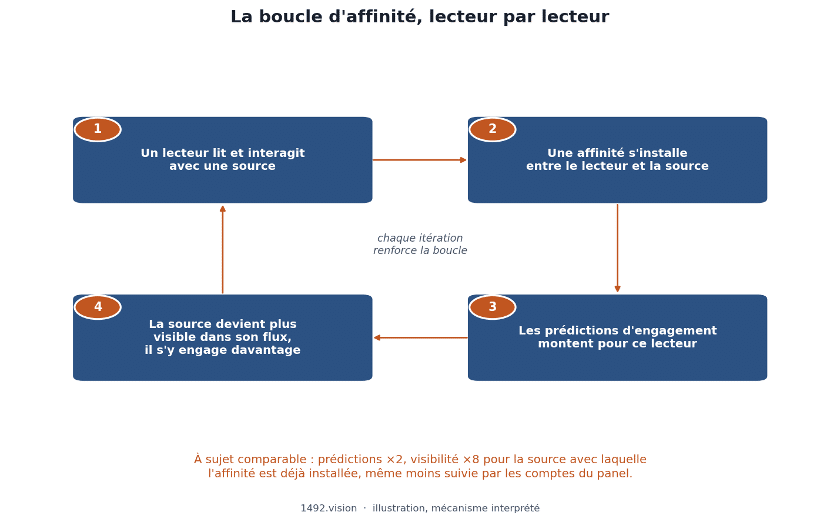 La boucle d’affinité se renforce lecteur par lecteur. Schéma, mécanisme interprété à partir de nos observations.
Un lecteur, plusieurs profils
Dernier mot de la liste : « embedding ». Derrière ce terme, une idée simple : pour vous recommander des contenus, la machine vous représente sous forme de coordonnées, et recommande ce qui est « proche » de vous.
Nos observations suggèrent que Google maintient plusieurs profils de vous en parallèle, plutôt qu’un seul : vos intérêts de fond, vos curiosités du moment, ce qui est en tendance autour de vous, et même un profil orienté achats. Votre flux du matin est le point de rencontre de ces différentes versions de vous.
C’est cohérent avec ce que tout utilisateur de Discover constate : le flux mélange vos passions stables, l’actu chaude et des essais parfois surprenants. Derrière ce qui ressemble à des sautes d’humeur de l’algorithme, il y a une architecture.
Ce qu’il faut en retenir
L’offre d’emploi valide un vocabulaire ; nos observations montrent la machinerie au travail. Pour un éditeur, trois conséquences :
- À contenu comparable, l’affinité installée entre vos lecteurs et votre marque pilote la visibilité. Fidéliser (faire revenir, faire interagir, faire suivre) est un levier Discover à part entière, au même titre que le travail éditorial, et dans nos tests il pèse davantage que le seul bouton « Suivre ».
- Capter l’attention et créer de l’engagement sont deux chantiers distincts, qui se mesurent et se travaillent séparément.
- L’engagement n’est que la moitié de l’histoire : l’offre parle de contenu « engaging, and useful », et la satisfaction du lecteur est portée par d’autres signaux. Optimiser le clic seul est une stratégie à courte vue.
Google a nommé publiquement les briques de sa machine à recommander. Nous, de l’extérieur, nous continuons à mesurer ce qu’elles font, carte après carte. L’analyse complète est ici.
Méthodologie : observations issues d’un panel de comptes de test sur de vrais flux Discover ; « suivre » s’entend au sens du bouton « Suivre » de Google, mesuré sur ce panel ; les deux cas éditeurs sont des illustrations sur de petits échantillons. Méthode complète, chiffres et graphiques : l’étude complète.
Damien Andell, co-fondateur de 1492.vision. Observations issues de l’analyse de vrais flux Google Discover ; les mécanismes décrits sont nos interprétations, pas des confirmations de Google.
L’article "Une offre d’emploi de Google confirme ce qu’on observe dans Discover" a été publié sur le site Abondance.
-
L’immense Samsung Odyssey OLED G9 revient en stock à 669 €, son prix le plus bas
Reply source
[Deal du jour] Brièvement disparue hier, l’offre sur le Samsung Odyssey OLED G9 est déjà de retour chez Carrefour. Cet immense écran OLED de 49 pouces repasse à 669,99 € au lieu de 1 099 €, soit son prix le plus bas jamais observé.
-
Michael Cohen, ex-fixer for Trump who once testified against him, hosts president on his radio show – as it happened
Reply sourceDespite previously comparing him to a ‘mobster’, Trump’s former personal lawyer showers him with praise. This blog is now closed.
An FBI team seized electronic devices from former US representative Eric Swalwell at the San Francisco airport on Saturday, then raided his home in Washington, DC, the next day, CNN reported Thursday.
The raid is part of a federal investigation into the sexual assault allegations which ultimately drove the Bay Area Democrat to resign from office in April, sources familiar with the investigation told CNN. The Manhattan District Attorney’s Office and the Los Angeles Sheriff’s Department subsequently opened criminal investigations on Swalwell.
Continue reading... -
Washington Policy Review: August 19, 2026
Reply sourceToday’s Report
1. Overview
2. White House News
3. Truth Social Posts
4. Government Department News
5. 2028 Democratic Presidential Candidates
6. AI & Tech Company News
7. Congressional Watch
8. Policy Impact Analysis & Heatmap
Noctral is an app. For anyone carrying an argument they’d like to test on someone sharper. Free on iOS.
→ Download on the App Store
→ noctralai.com1. Overview
President Trump’s trade agenda reached a milestone as Ford Motor Company announced the reshoring of Lincoln production to the United States. The White House credits this move to the administration’s policy shifts, which aim to eliminate Chinese imports and foster domestic job growth. Officials assert that these actions represent a “decisive victory over decades of offshoring,” emphasizing a commitment to ensuring vehicles are “Made in America, by American workers.”
On Truth Social, President Trump declared an “economic D-Day” against Iran, implementing what he described as the “most crushing economic operation” ever to prevent the nation from acquiring nuclear weapons. He warned that any country facilitating Iranian financial or oil interests would face “tremendous economic consequences.” Additionally, the President nominated Dr. Heidi Overton as FDA Commissioner, calling her a “rockstar” who will spearhead a “most transformative health agenda.” Trump also used the platform to endorse Ryan Elijah for Congress, celebrate the electoral loss of Alexander Vindman, and promote an upcoming Midterm Convention in Dallas.
The Treasury Department, in conjunction with the IRS, proposed new regulations to restrict refundable tax credits, ensuring that benefits like the child and earned income tax credits are reserved exclusively for U.S. citizens and qualified aliens. Treasury Secretary Scott Bessent remarked, “Under President Trump, the days of illegal aliens collecting taxpayer-funded benefits are over.” Simultaneously, the State Dept held discussions between Deputy Secretary Landau and Norwegian State Secretary Kravik regarding Middle East peace and European security. The DOW also finalized multiple contracts totaling over $112 million, covering naval infrastructure upgrades in Guam, Utah, and development of a low-cost logistics vessel.
In California, Governor Gavin Newsom announced the full implementation of Universal Transitional Kindergarten, a move the administration says saves families $14,000 annually and represents a “big investment” that is “paying off.” Governor Wes Moore of Maryland unveiled a $14.7 million grant program to train 845 new educators, alongside a 20-year solar power agreement projected to save the state $515 million. Meanwhile, Illinois Governor JB Pritzker scheduled a naturalization ceremony for 320 new citizens and an appearance at the state’s Sale of Champions event.
OpenAI introduced “Private Safety Processing” to extend its Zero Data Retention policy, allowing automated systems to detect misuse across interactions without retaining customer content. By utilizing customer-controlled encryption keys, the company seeks to enhance security for enterprise users. This update is designed to balance the need for identifying complex AI risks with the requirement for strict user data privacy.
Aggressive sanctions against Iran are tightening global oil supply, exerting upward pressure on energy prices as market participants price in the risk of sustained geopolitical volatility. Simultaneously, the policy shift toward industrial reshoring bolsters the domestic manufacturing base, though this transition faces headwinds from higher input costs and potential inflationary pressure on consumer goods. Conversely, the transition toward accelerated clinical trial pathways at the FDA serves as a catalyst for the biotechnology sector, shifting the regulatory landscape from “bureaucratic caution” toward a rapid, innovation-focused framework. These policy developments collectively reshape sector fundamentals by balancing the security of energy and industrial supply chains against the risks of increased operational expenses and reduced regulatory oversight.
2. White House News
President Trump’s Trade Agenda Is Rebuilding the American Auto Industry
Ford Motor Company will reshore Lincoln production to the United States, ending Chinese imports and creating thousands of jobs. The White House describes this move as proof that “President Donald J. Trump’s America First trade agenda is delivering exactly as designed.” CEO Jim Farley noted the decision followed the Administration’s policy shift. As more automakers expand domestic operations, the White House claims “President Trump’s America First agenda is scoring a decisive victory over decades of offshoring,” resulting in more vehicles being “Made in America, by American workers.”
Reference: https://www.whitehouse.gov/releases/2026/08/president-trumps-trade-agenda-is-rebuilding-the-american-auto-industry/
3. Truth Social Posts
Trump announced the implementation of the “most crushing economic operation ever taken against any country” regarding Iran, characterizing the move as an “economic D-Day” intended to ensure the nation never acquires a nuclear weapon. He warned that any country providing lifelines to Iran, including oil smuggling or financial transfers, would face “tremendous economic consequences,” asserting that Iran’s military infrastructure is now effectively destroyed. In domestic appointments, Trump nominated Dr. Heidi Overton to serve as FDA Commissioner, describing her as a “rockstar” who will help lead a “most transformative health agenda” focused on faster cures and lower drug prices.
Regarding political developments, Trump highlighted the upcoming Midterm Convention in Dallas, Texas, which he described as “the greatest rally of them all” designed to celebrate recent victories and prepare for upcoming elections. He also endorsed Ryan Elijah for Congress, noting that Elijah “stands for everything MAGA,” and shared a media report concerning Byron Donalds’ potential run for Florida Governor.
Trump celebrated the electoral loss of Alexander Vindman, whom he labeled a “treasonous creep,” while reaffirming his stance that his past conversation with President Zelenskyy was a “perfect call.” He further asserted that Vindman should be prosecuted for his previous actions, while praising Florida’s Ashley Moody as a “truly fantastic senator.”
Reference: https://truthsocial.com/@realDonaldTrump
4. Government Department News
State Department (state.gov)
Deputy Secretary Landau’s Meeting with Norwegian State Secretary Kravik
Deputy Secretary of State Christopher Landau met with Norwegian State Secretary Andreas Motzfeldt Kravik to discuss shared diplomatic priorities. The two officials focused on advancing efforts to promote peace in the Middle East and strengthening bilateral cooperation regarding security initiatives throughout Europe.
Department of War (war.gov)
The Department of War announced multiple contract awards. Eight firms received a combined $112.8 million for hull, mechanical, and electrical services for the surface fleet and submarines. Core Tech-HDCC-Kajima (CHK) LLC was awarded $61.6 million for communications infrastructure at Naval Base Guam and Camp Blaz. Agrippa Industries Inc. received an $18.9 million contract to develop a low-cost logistics vessel system. Additionally, Northrop Grumman Systems Corp. secured a $12.7 million modification for capital maintenance projects at Navy facilities in Utah.
Treasury Department (home.treasury.gov)
Treasury, IRS Propose Rules to Protect Refundable Tax Credits from Abuse by Illegal Aliens
The Treasury Department and the IRS have issued proposed regulations to clarify eligibility for refundable individual income tax credits, ensuring these benefits are reserved for U.S. citizens and qualified aliens. By applying the Personal Responsibility and Work Opportunity Reconciliation Act of 1996, the rules categorize the refunded portions of the adoption, child, American opportunity, and earned income tax credits as federal public benefits. Treasury Secretary Scott Bessent stated, “Under President Trump, the days of illegal aliens collecting taxpayer-funded benefits are over.”
5. 2028 Democratic Presidential Candidates
Gavin Newsom (gov.ca.gov)
Governor Newsom Announces Appointments
Governor Newsom announced several appointments, including Ayushi Roy as State Chief Technology Officer and Eric De La Cruz as Executive Director for the Racial Equity Commission. Additionally, Lisa Weiler, Christine Aurigemma, Michael Love, Michelle Bello, and Matthew Asner were appointed or reappointed to the State Rehabilitation Council. These roles involve varying requirements for Senate confirmation and compensation, with several positions serving without pay. The appointees bring experience from sectors including education, civil rights, technology, and healthcare.
California Launches Universal Transitional Kindergarten and Expanded Student Support
California has achieved full implementation of Universal Transitional Kindergarten, offering free pre-K to every four-year-old and saving families an estimated $14,000 annually per child. The state continues to provide two free meals to all public school students, having served 3.5 billion meals to date. These initiatives are part of a broader $12.5 billion investment in early education, mental health resources, and expanded after-school programming. Governor Newsom stated, “We made a big investment in our kids, and it’s paying off,” citing improved academic outcomes across the state.
Wes Moore (governor.maryland.gov)
Governor Moore Announces $14.7 Million in Grow Your Own Educators Grants, Supporting 845 Educators
Governor Moore awarded $14.7 million in grants to 13 local school systems to expand teacher preparation pathways for 845 non-licensed staff members. The initiative aims to address teacher vacancy gaps by providing debt-free pathways to licensure. Anne Arundel, Frederick, and St. Mary’s counties received the largest portions of the funding. This program, expanded through the Excellence in Maryland Public Schools Act, focuses on high-need areas like special education and early childhood, while fostering a more diverse educator workforce through sustainable local pipelines.
Maryland officials announced a 20-year Power Purchase Agreement with REV Renewables that is projected to save the state up to $515 million. Beginning in 2028, the state will source approximately 250,000 megawatt-hours annually from the Jade Meadow III Solar Project in Garrett County. The project, located on a reclaimed coal mine, will supply nearly 15 percent of the state’s electricity portfolio. Officials stated the agreement serves as a “major win for Maryland,” protecting the state from energy market volatility while advancing renewable energy goals.
JB Pritzker (gov.illinois.gov)
Governor Pritzker’s Public Schedule for August 19, 2026
Governor Pritzker will attend a Naturalization Oath Ceremony at 11:00 AM at the Orr Building in Springfield, where approximately 320 individuals from 50 countries will be sworn in as new citizens. Later that evening, at 5:15 PM, the Governor will deliver remarks at the Governor’s Sale of Champions held at the Illinois State Fairgrounds Coliseum. Both events will be available to stream via the official state website, though no additional press availability is scheduled.
6. AI & Tech Company News
OpenAI (openai.com)
Offering Zero Data Retention for frontier models
OpenAI is introducing “Private Safety Processing” to expand its Zero Data Retention (ZDR) policy. This feature allows automated systems to detect patterns of misuse across multiple interactions without OpenAI personnel accessing or retaining customer content. For deployments using OpenAI-provided storage, data remains encrypted with customer-controlled keys. By extending safety monitoring to cross-interaction contexts, OpenAI aims to balance security and privacy for enterprise customers, ensuring that sensitive information remains under user control while maintaining safeguards against complex AI risks.
7. Congressional Watch
Covers the 2026-08-18 session — the Congressional Record is published with a one-day delay.
No Congressional Record found for 2026-08-18.
8. Policy Impact Analysis & Heatmap
This analysis is provided for informational purposes only. It does not constitute investment advice or a recommendation to buy or sell any security.
Impact on Market
Based on today’s policy developments, our analysis identifies the following market impact themes:
THEME 1. GEOPOLITICAL ISOLATION AND ENERGY VOLATILITY
The aggressive expansion of sanctions against Iran forces a potential supply contraction in global energy markets. While the intent is to cripple Iranian military capacity, the secondary sanction threat creates significant compliance burdens for international banks. Critics warn that such extreme measures may destabilize regional stability and invite retaliatory cyber risks. Consequently, energy prices face upward pressure as the prospect of supply-chain disruptions dominates short-term outlooks.
THEME 2. INDUSTRIAL RESHORING AND SUPPLY CHAIN SHIFTS
The move by domestic automakers to relocate production back to American soil signals a pivot toward localized manufacturing. Policy mechanisms now prioritize domestic job creation over global cost-optimization strategies. Industry analysts observe that while this strengthens the U.S. industrial base, it may increase input costs for manufacturers. Opposition voices express concern that such reversals in global integration could lead to higher vehicle prices for consumers.
THEME 3. FDA REGULATORY ACCELERATION
The appointment of a new FDA Commissioner signals a shift toward rapid, innovation-focused clinical trial reforms. The administration aims to reduce the time-to-market for new pharmaceutical products. While this promises to boost American biotech innovation, some public health advocates worry that diminished oversight could threaten patient safety standards. The sector now faces a transition toward an environment where speed is prioritized over traditional bureaucratic caution.
Policy Impact Heatmap with Market Direction

Each cell shows an estimated impact score on a fixed scale of -10 to +10, reflecting how today’s policy developments may affect each market sector. Positive scores (green, ▲) suggest bullish impact; negative scores (red, ▼) suggest bearish pressure. Rows and columns are sorted by impact strength, and sectors and policy events with no meaningful impact are omitted. The heatmap, the analysis below, and the Impact on Market themes above are produced from a single unified analysis: the heatmap visualizes the magnitudes, while the text explains the causal reasoning behind them.
The administration’s declaration of “economic warfare” against Iran serves as the day’s primary market signal. By mandating total isolation and threatening secondary sanctions on global partners, the policy elevates geopolitical risk premiums for international financial institutions and shipping entities. However, the resulting supply-side constraints on Iranian oil production provide a bullish impulse for energy sector valuations. Ford’s decision to reshore production underscores a shifting trend where major industrials adjust supply chains in response to “America First” trade pressures. This localization trend potentially increases domestic capital expenditure while mitigating long-term trade volatility. Simultaneously, the nomination of Dr. Heidi Overton at the FDA signals a push for expedited clinical pathways, which analysts anticipate may lower regulatory hurdles for domestic biopharmaceutical firms. While supporters view this as “transformative,” critics frequently cite concerns regarding the long-term integrity of drug safety standards under accelerated review timelines. Furthermore, the new IRS rules regarding refundable tax credits reflect a tightening of fiscal policy, aimed at preserving benefit integrity but introducing increased compliance requirements for the financial sector. These actions collectively emphasize a transition toward protectionist domestic industrial policy and heightened aggressive containment of strategic adversaries.
-
Has Trump no shame about all the money he has made since being in office? | Francine Prose
Reply sourceBy now we know that charity, generosity and compassion are virtues that the US president doesn’t seem to have even in trace amounts
Many years ago, in the crowded corridor of a Manhattan hotel, I was surprised to find myself standing face-to-face with Imelda Marcos, then the first lady of the Philippines. At that time, she was said to possess 3,000 pairs of shoes.
I desperately longed to ask the wife of the dictatorial president Ferdinand Marcos why anyone could need all those shoes. And more importantly, why would someone spend so much of her country’s wealth on stiletto heels when so many citizens were so desperately poor? But natural reticence, good manners or simply fear prevailed, and I walked away.
Continue reading... -
From McDonald’s to Congress: can a former fry cook flip a key district for Democrats?
Reply sourceManny Rutinel hopes price-tag politics can win key voters in Colorado House race
During his presidential campaign in October 2024, Donald Trump staged a photo op at a McDonald’s franchise in Pennsylvania, where he was briefly taught how to work the fryer and drive-thru window at the closed restaurant, while making several unsubstantiated claims about Kamala Harris’s past summer job at McDonald’s.
The posturing around McDonald’s garnered significant publicity, as Trump and Republicans capitalized on an affordability crisis triggered by high inflation that occurred globally due to the Covid pandemic.
Continue reading...