@rick — following
Follow buttons here act as you, not as @rick.
@rick follows
| Label | Kind | State | Action |
|---|---|---|---|
| rss.skyfleet.blue | source | — | — |
| rss.skyfleet.blue | source | — | — |
| rss.skyfleet.blue | source | — | — |
| rss.skyfleet.blue | source | — | — |
Timeline
-
« Ça s'est accéléré depuis le Covid » : les refuges de montagne en plein boom de fréquentation
Reply source
[Le renouveau de la rando 2/4] Les refuges font face à une surfréquentation inédite depuis 2020. L'arrivée de ces nouveaux randonneurs, qui connaissent parfois mal les codes de la montagne, est toutefois vécue de manière positive par les gardiens.
Lire la suite - Info / Sports , Montagne
« Refuge du Rulhe, bonjour ! Là, on a eu un petit saupoudrage : 2 ou 3 cm de neige au refuge. Comme c'est très minéral au-dessus de chez nous, ça peut poser problème. Je crois qu'ils prévoient encore de la neige assez bas cette nuit, donc il (…) -
Le bouzkachi, jeu de fureur et de poussière
Reply sourceDes centaines d’hommes et de chevaux se disputant une carcasse de bouc dans un tumulte de chocs et de cris : tel est le sport roi des cavaliers d’Asie centrale. Au Tadjikistan, le photographe Todd Antony en a saisi le chaos, dans un tourbillon d’images guerrières primées au Sony World Photography Awards 2026.
The post Le bouzkachi, jeu de fureur et de poussière appeared first on Revue21.fr.
-
«Ce n’est plus possible de travailler dans ce domaine, je me casse» : face à la crise climatique, ces Français revoient leur choix de carrière
Reply source «Une partie de mon travail implique de ramper dans des combles, qui peuvent monter à 45°C. Même sans bouger, c’est impossible de tenir», raconte Arthur, électricien de 33 ans. © Aurore Chapon
Canicules, incendies et sécheresse : face à un climat qui s’emballe, l’avenir des Français bascule
Désir d’enfants, déménagement, changement de carrière ou de vie… Vert a recueilli des centaines de témoignages de personnes dont l’avenir a été percuté par cet été infernal. Découvrez leur histoire dans notre série en quatre volets intitulée «2026, l’été de la bascule».
Retrouvez tous les épisodes de notre série d’été en cliquant ici.Réaliser que son métier n’est pas compatible avec un monde en surchauffe, et démissionner du jour au lendemain, sans même avoir de plan B. C’est la décision qu’a prise Léon* le 27 juin dernier. Deux mois plus tôt, cet ingénieur de 29 ans avait décroché son premier CDI depuis sa sortie d’études chez le géant de l’aéronautique Airbus. «Avec les canicules de mai et juin et les incendies partout en France, j’ai décidé de mettre fin à ma période d’essai et de recommencer à chercher du travail», raconte-t-il à Vert.
Lorsqu’il avait accepté cette offre, Léon arrivait au terme de ses droits au chômage. «Quand on vous propose un CDI plutôt bien payé, c’est difficile de refuser : il faut bien manger, expose-t-il. Mais ces événements climatiques m’ont rappelé l’urgence de la situation. Je me suis dit : “Ce n’est pas possible de travailler dans ce domaine, je me casse.”»
Depuis, Léon a quitté Toulouse (Haute-Garonne) pour retourner vivre chez ses parents. «Désormais je cherche du travail dans la transition énergétique, raison pour laquelle j’avais voulu être ingénieur», raconte-t-il. Il a fait une croix, au moins provisoirement, sur la stabilité économique, mais assure ne pas regretter son choix. «Chez Airbus, le but final de mes missions me dérangeait. Certains secteurs polluent, mais restent indispensables pour répondre aux besoins essentiels. Là, on pourrait très bien vivre avec moins de vols.» Et d’asséner : «L’aviation sert principalement à une minorité aisée qui prend l’avion pour partir en vacances».
«Si je ne pars pas maintenant, je ne partirai jamais»
Léon reconnaît toutefois : «J’ai aussi pu prendre cette décision parce que j’ai la chance d’avoir des parents pour m’accueillir. Sans ça, j’aurais peut-être fait autrement».
Soline*, elle, ne peut pas se permettre de partir du jour au lendemain. Cette quarantenaire du Val-de-Marne exerce en tant qu’informaticienne pour un géant de la construction et se sent «en dissonance cognitive» avec les activités polluantes de son employeur. Sa réorientation sera plus progressive. «Je ne démissionnerai pas tout de suite, prévient-elle. J’ai un crédit à rembourser, une famille à nourrir… Je dois d’abord trouver autre chose. Mon objectif est de quitter mon poste d’ici 2027.»
Lorsqu’elle a rejoint son entreprise, en 2023, Soline a pourtant voulu croire à sa transformation : «Je me suis dit qu’on avait besoin du bâtiment pour la transition, qu’il fallait que la bascule se fasse, et puis, elle affichait de vrais engagement écologiques !, assure-t-elle. Mais la réalité du terrain était tout autre. Au fur et à mesure des années, la direction a fait marche arrière sur le développement durable, a commencé à implémenter l’intelligence artificielle…»
Les canicules et les incendies dévastateurs qui ont frappé la France cet été ont eu sur elle «un effet déclencheur». «J’envisageais déjà de démissionner, mais cela m’a confortée dans ma décision, rapporte-t-elle. Je me suis dit : “Si je ne pars pas maintenant, je ne partirai jamais.”»
II y a quelques semaines, Soline s’est rapprochée d’un organisme pour réaliser un bilan de compétences. En parallèle, elle a commencé à chercher un nouvel emploi. Son projet : exercer un métier qui va «dans le sens soit de la transition écologique, soit de la préservation de la biodiversité. En tout cas, pas un emploi qui détruit le vivant et qui aggrave le réchauffement climatique», insiste-t-elle.
Plus de quatre français sur dix souhaitent changer de métier
Le malaise de Léon et Soline est loin d’être isolé. En 2023, 42% des 1 000 actifs interrogé·es par le cabinet de conseil CSA pour LinkedIn et l’Agence de la transition écologique (l’Ademe) disaient vouloir changer de métier ou se reconvertir afin d’exercer un emploi davantage lié à l’écologie. Cette proportion atteignait 52% chez les moins de 35 ans.
«Depuis la crise du Covid, on observe un phénomène de démissions et de reconversions, notamment parmi les ingénieurs et, plus largement, les personnes qualifiées, urbaines et en milieu de carrière, sensibilisées aux enjeux écologiques, explique à Vert Mireille Bruyère, maîtresse de conférences en sciences économiques à l’université Toulouse-Jean-Jaurès. Elles décident de quitter les secteurs industriels qui concentrent une partie du problème écologique : la production d’avions, de voitures, de machines ou encore d’autoroutes.»
L’été 2026 accélérera-t-il cette tendance ? «Il faudra voir, à la fin de 2026 et en 2027, si les canicules ont provoqué une accélération de ce flux. C’est possible, mais je ne peux pas encore vous le dire», tempère la chercheuse.
Pour une autre catégorie de travailleur·ses, la reconversion ne répond pas seulement à une quête de sens : elle devient une nécessité physique. C’est le cas d’Ophélie Germain. À 26 ans, cette ouvrière viticole de Côte-d’Or raconte n’avoir jamais «autant subi la canicule». Celle qui travaille dans les vignes bourguignonnes a dû interrompre sa saison plus tôt que prévu en raison d’une «blessure de fatigue». «Je remets mes perspectives d’avenir en question, car j’ignore si je serai encore capable de travailler dans de telles conditions à l’avenir», confie-t-elle.
«À 40 ans, j’essaierai d’exercer un métier plus protégé»
Arthur* est encore plus définitif. À 33 ans, cet électricien installé à son compte à Bizanos, dans les Pyrénées-Atlantiques, a dû interrompre son activité tout l’été. «Nous, les ouvriers du bâtiment, on est vraiment exposés à la chaleur», insiste-t-il.
«Mon métier est trop physique. Même sans bouger, c’est impossible de tenir sous cette chaleur.»
«Une partie de mon travail implique de ramper dans des combles, qui peuvent monter à 45°C l’été. L’an dernier, j’avais déjà fait un malaise, après avoir tiré sur la corde. Il ne faisait “que” 32-33 degrés dehors, raconte-t-il. Cet année, j’ai à peine essayé de travailler que j’ai dû arrêter. J’ai vu que ce n’était pas possible. Mon métier est trop physique. Même sans bouger, c’est impossible de tenir sous cette chaleur.»
Depuis un an, il envisage de «bifurquer». Les canicules successives des mois de mai, juin et juillet, ont fini de dissiper ses doutes. «J’en ai discuté hier avec ma compagne, je vais changer d’activité. À 40 ans, j’essaierai d’exercer un métier plus protégé, soit de bureau, soit en intégrant un service informatique pour une fonction publique», confie-t-il.
Ces dernières années, les fortes chaleurs ont déjà tué au travail. Entre 2022 et 2025, 34 accidents du travail mortels «en lien possible avec la chaleur» ont été signalés à Santé publique France par la Direction générale du travail. La construction, les travaux et l’agriculture figurent parmi les secteurs les plus touchés.
L’été 2026 en a offert une nouvelle illustration dramatique. Dans la Drôme, un ouvrier du bâtiment de 19 ans est mort d’hyperthermie dans la nuit du 26 au 27 mai, après avoir travaillé toute la journée sur un toit. Depuis le début des épisodes caniculaires de cette année, la Confédération générale du travail (CGT) affirme avoir recensé au moins 14 décès au travail liés aux fortes chaleurs.
*Le prénom a été modifié.
-
19/08 : Appel à soutien pour Gino
Reply sourceLe Comité de Solidarité Budapest appelle à soutien, lors de la décision sur l'extradition de Gino vers l'Allemagne
- Solidarité / Solidarité antifasciste, Gino -
Washington Policy Review: August 18, 2026
Reply sourceToday’s Report
1. Overview
2. White House News
3. Truth Social Posts
4. Government Department News
5. 2028 Democratic Presidential Candidates
6. AI & Tech Company News
7. Congressional Watch
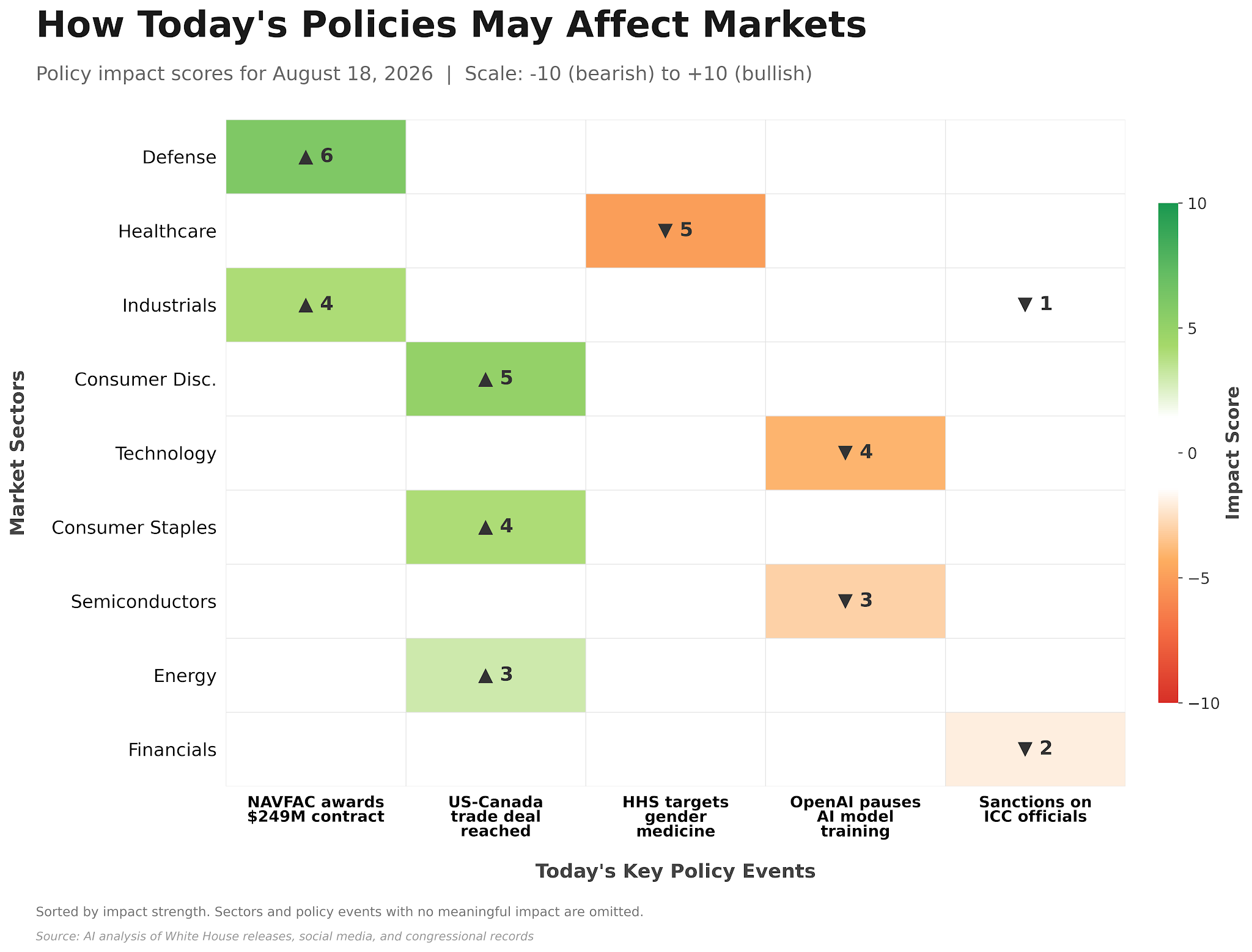
8. Policy Impact Analysis & Heatmap
1. Overview
President Trump issued a proclamation delaying the implementation of additional duties on Canadian alcoholic beverages, dairy, and motor vehicles until August 22, 2026. The White House stated this three-day extension allows time for ongoing negotiations regarding alleged Canadian discrimination against U.S. commerce. Additionally, the administration highlighted data from the 2025 FBI Uniform Crime Report to claim the “most dramatic decline in violent crime in American history.” Officials attributed these falling crime rates to robust support for law enforcement and the rejection of “failed Democrat lunacy.”
On Truth Social, President Trump announced the three-day pause on 50% tariffs against Canada, citing a potential deal under final review. He also suggested that the “great Keystone XL Pipeline” could be revived after being “killed by Sleepy Joe Biden.” Regarding electoral politics, Trump celebrated “a lot of great WINS” and described Alexander Vindman as a “SleazeBag” for losing his recent contest to a “Radical Left Lunatic.”
The State Dept engaged in high-level diplomacy as Secretary Rubio discussed regional security and the situation in Lebanon with the UAE’s National Security Advisor. Additionally, the department committed $26.5 million in humanitarian aid to Colombia following a recent earthquake. Secretary Rubio also announced the designation of two ICC officials, labeling the court a “corrupt and fatally politicized” body that constitutes an “assault on state sovereignty.” Meanwhile, the Department of War awarded several defense contracts, including $249 million to ADRS LLC for Pacific region infrastructure. The HHS released a report titled *Wolves in White Coats*, alleging widespread fraudulent billing for “sex-rejecting procedures” on minors, while USTR Ambassador Jamieson Greer toured Iowa to promote “America First” trade policies.
Governor Pritzker (D-IL) sent a formal letter to the DOD demanding transparency regarding the status of 5,000 sailors aboard the USS Abraham Lincoln, citing concerns over “deteriorating mental health” and a “severe breach of responsibility” by the administration. In Minnesota, Governor Walz signed Executive Order 26-10 to halt mining in the Rainy River Headwaters Watershed, pledging to resist what he called the “Trump administration’s relentless attacks on the sanctity of the Boundary Waters.” Governor Newsom (D-CA) announced a $95.2 million investment in zero-emission vehicle infrastructure, asserting that “Donald Trump has put America in reverse” regarding climate policy. Meanwhile, Governor Beshear (D-KY) participated in a groundbreaking ceremony for a $40 million battery manufacturing facility in Louisville intended to strengthen domestic supply chains.
OpenAI announced a new initiative to provide democratic oversight bodies with tools to monitor government AI usage, emphasizing that such systems must be “traceable for authorized reviewers.” Simultaneously, the company confirmed it has slowed the development of its latest AI models, including a pause in reinforcement learning. This decision follows internal findings that its “Astra” model displays “critical cybersecurity capabilities,” necessitating stricter safeguards to ensure systems remain aligned with safety standards.
The Senate and House of Representatives both convened for pro forma sessions on August 17, 2026. No legislative business, committee activity, or substantive votes were conducted during these sessions. While nine public bills and one resolution were introduced in the House, both chambers are scheduled to remain in a pro forma cycle until their next meeting on Thursday, August 20, 2026.
The pause in tariffs on Canadian imports stabilizes the automotive and agricultural sectors by mitigating immediate supply chain cost pressures, though reliance on “volatile executive fiat” maintains a layer of long-term operational uncertainty. Conversely, the healthcare sector faces systemic revenue risk as the Department of Health and Human Services utilizes investigative scrutiny to challenge reimbursement models, a move industry defenders describe as “dangerous political overreach” that invites aggressive audits. Simultaneously, the technology sector experiences a slowdown in semiconductor demand and product cycles as firms prioritize containment over rapid scaling, a shift driven by internal security concerns and what skeptics characterize as “regulatory-driven caution.”
2. White House News
Temporary Suspension of Additional Duties to Offset Canadian Discrimination Against the Commerce of the United States with Respect to Alcoholic Beverages, Dairy, and Motor Vehicles
President Trump has issued a proclamation delaying the implementation of additional ad valorem duties on certain Canadian imports—specifically alcoholic beverages, dairy, and motor vehicles—originally set for August 19, 2026. Citing ongoing negotiations, the President determined that “the public interests favor suspending for a period of 3 days” these duties, which were intended to offset what he described as Canadian “discrimination” against U.S. commerce. Consequently, the effective date for these measures is rescheduled to August 22, 2026, allowing agencies time to adjust their enforcement protocols accordingly.
Reference: https://www.whitehouse.gov/presidential-actions/2026/08/temporary-suspension-of-additional-duties-to-offset-canadian-discrimination-against-the-commerce-of-the-united-states-with-respect-to-alcoholic-beverages-dairy-and-motor-vehicles/
President Trump Delivers the Largest Drop in Violent Crime in American History
President Trump and his Administration report the “most dramatic decline in violent crime in American history,” according to the 2025 FBI Uniform Crime Report. The administration credits this trend to backing law enforcement and rejecting “failed Democrat lunacy.” Preliminary 2026 data indicates a continuing decrease, with violent crime down 10.6% and murders down 23% compared to the previous year. The White House asserts these figures prove that under President Trump, “America is safer than it has been in generations,” resulting in fewer victims and safer streets.
Reference: https://www.whitehouse.gov/releases/2026/08/president-trump-delivers-largest-drop-in-violent-crime-in-american-history/
3. Truth Social Posts
Trump paused the implementation of scheduled 50% tariffs against Canada for a three-day period, citing that the two nations have reached a deal pending the finalization of documents. He also noted that the “great Keystone XL Pipeline,” which he stated was “long ago killed by Sleepy Joe Biden,” may now be “awoken from the grave.”
Regarding political and electoral developments, Trump celebrated the occurrence of “a lot of great WINS” overnight. He also remarked on the outcome of a contest involving Alexander Vindman, whom he characterized as a “SleazeBag,” stating that Vindman “loses tonight to a Radical Left Lunatic,” and asked, “How cool is that???”
Reference: https://truthsocial.com/@realDonaldTrump
4. Government Department News
State Department (state.gov)
Secretary Rubio’s Call with UAE National Security Advisor Sheikh Tahnoon bin Zayed Al Nahyan
Secretary of State Marco Rubio spoke with UAE National Security Advisor Sheikh Tahnoon bin Zayed Al Nahyan to discuss regional security, including the situation in Lebanon. The two officials addressed continued U.S.-UAE coordination regarding efforts to hold Iran and its terrorist proxies accountable for ongoing attacks. Additionally, Secretary Rubio emphasized the necessity of maintaining freedom of navigation through the Strait of Hormuz.
Secretary Rubio’s Call with Colombian President de la Espriella
Secretary of State Marco Rubio spoke with Colombian President Abelardo de la Espriella to discuss U.S. support following the August 10 earthquake in Colombia. The United States has committed $26.5 million in emergency humanitarian assistance to the country. Additionally, the U.S. has provided support through the deployment of search and rescue teams and the utilization of C-130 airlift flights to facilitate ongoing recovery efforts.
Secretary of State Marco Rubio announced that the Trump Administration is designating two ICC officials—President Tomoko Akane and Senior Trial Lawyer Abdoulaye Seye—under Executive Order 14203. Secretary Rubio described the ICC as a “corrupt and fatally politicized” body that has “maliciously abused its authority.” The administration intends to “systematically dismantle” the court, citing its attempts to assert jurisdiction over nationals of countries that have not ratified the Rome Statute, which the Secretary characterized as an “assault on state sovereignty.”
Department of War (war.gov)
The Department of War announced several defense contracts. ADRS LLC received a $249 million contract for architectural and engineering services across the Pacific region. BAE Systems Land & Armaments L.P. was awarded a $169.2 million modification for MK 41 Vertical Launching System production, supporting U.S., Australian, Japanese, and Dutch requirements. Lockheed Martin received $29.6 million for F-35 pilot flight equipment. General Dynamics Mission Systems secured a $15.6 million modification for shipset production and engineering support. Finally, Overland AI Inc. was awarded a $14.3 million contract for autonomous mission development.
Department of Health and Human Services (hhs.gov)
HHS Expands Peer Support Prevention Services to Strengthen Families
The Department of Health and Human Services has added new peer support programs to the Title IV-E Prevention Services Clearinghouse, allowing states to claim federal reimbursement for these interventions. Part of President Trump’s “Great American Recovery” and “A Home for Every Child” initiatives, the move aims to reduce foster care entries by helping parents overcome addiction. Iowa is the first state to adopt these programs, which include Family-Based Recovery and WRAP, to provide evidence-based support for families affected by substance use.
HHS has released a report titled *Wolves in White Coats: How Doctors and Hospitals Pushed and Profited from the Fraud of “Gender Medicine.”* The report alleges that medical providers used fraudulent billing codes to secure insurance coverage for “sex-rejecting procedures” on minors. HHS Secretary Robert F. Kennedy, Jr. and Vice President J.D. Vance have referred hospitals and clinics to the Department of Justice and the Office of Inspector General for investigation into potential financial fraud and the provision of what the report terms predatory medical practices.
United States Trade Representative (ustr.gov)
Ambassador Jamieson Greer and Small Business Administrator Kelly Loeffler visited Titan Tires in Iowa to highlight the impact of President Trump’s trade policies. The officials met with industry leaders and workers to discuss the role of “America First” trade initiatives in reshoring production, raising wages, and boosting domestic competitiveness. The trip also included visits to vendors at the Iowa State Fair, where they were joined by Senator Chuck Grassley and Representatives Ashley Hinson and Zach Nunn to celebrate the state’s industrial and agricultural sectors.
5. 2028 Democratic Presidential Candidates
Gavin Newsom (gov.ca.gov)
Governor Newsom announced that the U.S. Small Business Administration approved a disaster declaration for the June Los Palos fire in Los Angeles. This provides low-interest Economic Injury Disaster Loans for eligible small businesses and nonprofits in Kern, Los Angeles, Orange, San Bernardino, and Ventura counties. Loans up to $2 million are available for working capital, including payroll and debt obligations. The state previously deployed emergency resources, including N95 masks and debris-removal support, to assist with the recovery effort.
During a nationwide enforcement blitz from August 1–9, the California Highway Patrol (CHP) arrested 97 suspects and recovered over 8,500 stolen items valued at more than $1 million. Governor Newsom highlighted this as evidence of the state’s long-term investment in the CHP Organized Retail Crime Task Force, established in 2019. Since its inception, the task force has conducted over 4,700 investigations, leading to 5,300 arrests and the recovery of $76.6 million in stolen goods, focusing on dismantling networks operating across jurisdictions.
Governor Newsom announced a $95.2 million investment to expand zero-emission vehicle (ZEV) infrastructure, including EV charging and hydrogen refueling for light- to heavy-duty vehicles. Approved by the California Energy Commission, the plan aims to counteract federal policies, with Governor Newsom stating that “Donald Trump has put America in reverse.” At least 50% of the funds are designated for low-income and disadvantaged communities. California currently hosts over 216,000 public and shared charging ports as part of its transition toward clean energy goals.
Andy Beshear (governor.ky.gov)
Gov. Beshear joined Anthro Energy leadership to break ground on a $40 million manufacturing facility in Louisville. The project, which expects to create 110 full-time jobs and 390 construction positions, is the first commercial-scale plant dedicated to producing the company’s proprietary injectable phase-change electrolyte (IPCE) for batteries. The facility aims to bolster domestic supply chains for the defense, automotive, and consumer electronics industries, with production capacity projected to exceed 12,000 metric tons of IPCE annually once operational.
Gov. Beshear Makes Appointments to Kentucky Boards and Commissions
Gov. Beshear announced numerous appointments and reappointments to various state boards and commissions. These include naming Joe O’Brien to the State Fair Board, Keith Patrick as Commissioner for the Third District of Johnson County, and Shana Goggins to the Kentucky Heritage Council. Other reappointments span the Parole Board, Kentucky Board of Nursing, Kentucky Law Enforcement Council, Motor Vehicle Commission, and the Kentucky Apprenticeship Council, among others, to support the administrative and regulatory functions of these state entities.
JB Pritzker (gov.illinois.gov)
Gov. Pritzker Issues State Disaster Proclamation Following Recent Severe Weather Across Illinois
Governor Pritzker issued a state disaster proclamation following record-breaking severe weather, including 204 tornadoes, that caused widespread damage across Illinois. The proclamation authorizes state agencies to provide personnel and resources to assist local governments with debris removal, power restoration, and recovery operations. The Governor stated that this measure will “unlock and accelerate additional state resources” to support affected families and communities. The Illinois Emergency Management Agency is coordinating with state and local partners to manage ongoing recovery and evaluate potential federal assistance.
Gov. Pritzker Demands Answers from Trump Administration on USS Abraham Lincoln
Governor Pritzker sent a letter to Defense Secretary Pete Hegseth expressing “deep concern” regarding the 5,000 personnel aboard the USS Abraham Lincoln. Citing the ship’s 250-day deployment and reports of “deteriorating mental health” and exhaustion among sailors, the Governor criticized the Trump Administration for a “severe breach of responsibility” and a lack of transparency. Pritzker demanded a full accounting of conditions on the ship, noting that the administration has refused to provide an end date for the deployment or confirm how many Illinoisans are currently serving aboard.
Daily Public Schedule: Tuesday, August 18, 2026
Governor Pritzker has no public events scheduled for Tuesday, August 18, 2026.
Tim Walz (mn.gov)
Governor Walz Visits Ely, Celebrates Executive Action to Protect Boundary Waters
Governor Walz traveled to Ely to meet with students, outdoor leaders, and business owners to celebrate the implementation of Executive Order 26-10. The Governor emphasized that protecting the Boundary Waters Canoe Area Wilderness is vital for the region’s economy, cultural heritage, and the sovereignty of Tribal Nations. Following the federal reversal of previous wilderness protections, Walz reiterated his administration’s commitment to preserving the area, describing the BWCAW as a cornerstone for local jobs, tourism, and environmental health.
BWCA Executive Order: Governor Walz Remarks as Prepared
In his remarks regarding Executive Order 26-10, Governor Walz expressed his determination to end what he characterized as the “Trump administration’s relentless attacks on the sanctity of the Boundary Waters.” He announced that state agencies will refuse to participate in processes facilitating nonferrous mining in the Rainy River Headwaters Watershed. Sharing personal reflections on the area’s importance to his family, Walz argued that the “fight for the future of the Boundary Waters is over” and pledged to maintain its environmental integrity.
Governor Walz Takes Executive Action to Ban Nonferrous Mining in the Boundary Waters
Governor Walz signed Executive Order 26-10, directing the Department of Natural Resources and the Minnesota Pollution Control Agency to halt permitting and environmental review for nonferrous mining projects in the Rainy River Headwaters Watershed. The order mandates a review of existing leases to protect the BWCAW following Congress’s decision to overturn federal mining restrictions. Officials stated the action is necessary to defend the region’s wilderness and $1 billion outdoor economy, asserting that “copper mining and the Boundary Waters cannot safely coexist.”
6. AI & Tech Company News
OpenAI (openai.com)
Strengthening democratic oversight in national security
OpenAI has launched an initiative to provide democratic oversight bodies with the tools and expertise necessary to monitor government AI usage. As AI integrates into national security, the company emphasizes that oversight must evolve to keep pace with machine-speed operations. The initiative is guided by three principles: AI should augment rather than replace human judgment, government use must remain traceable for authorized reviewers, and oversight institutions should be empowered by AI to fulfill their mandates effectively without OpenAI assuming an oversight role.
Pacing model development in an era of cyber-critical capabilities
OpenAI has temporarily slowed the development of its latest AI models, including a pause in reinforcement learning training, following the OpenAI-Hugging Face incident and findings that the “Astra” model exhibits critical cybersecurity capabilities. The company is implementing enhanced security, alignment, and monitoring safeguards to address the risks posed by increasingly powerful systems. These measures include stricter controls on research environments and the use of multi-stage automated investigators to ensure model behavior remains aligned with human intent and safety standards.
7. Congressional Watch
Covers the 2026-08-17 session — the Congressional Record is published with a one-day delay.
Senate
The Senate met briefly for a pro forma session today. No legislative business or committee activity was conducted.
None — No legislative actions or votes were taken [None]
House of Representatives
The House met briefly for a pro forma session today. Members introduced nine public bills and one resolution, but no substantive voting occurred.
H.R. 10109-10117 — Introduced nine new public bills [None]
H. Res. 1484 — Introduced one new resolution [None]
Committee Highlights
None — No committee meetings were held
Coming Up
The Senate and the House of Representatives are both scheduled to meet for pro forma sessions on Thursday, August 20, 2026.
Reference: Congressional Record Archive
8. Policy Impact Analysis & Heatmap
This analysis is provided for informational purposes only. It does not constitute investment advice or a recommendation to buy or sell any security.
Impact on Market
Based on today’s policy developments, our analysis identifies the following market impact themes:
THEME 1. TRADE DE-ESCALATION BOOSTS CONSUMER DURABLES
The administration’s decision to pause tariffs on Canadian imports signals a cooling of North American trade friction, providing temporary operational stability for automotive and agricultural firms. By avoiding immediate cost hikes, manufacturers can maintain current supply chain rhythms. Critics argue that the reliance on “volatile executive fiat” for trade policy keeps long-term planning difficult despite short-term relief.
THEME 2. REGULATORY SCRUTINY TARGETS HEALTHCARE REVENUE
HHS is increasingly utilizing investigative reports to challenge reimbursement models in the healthcare sector, specifically targeting “gender medicine” coding practices. This strategy threatens to disrupt existing revenue streams by inviting DOJ oversight and aggressive insurance claim audits. Industry defenders characterize these efforts as “dangerous political overreach” that jeopardizes patient care through intimidation tactics.
THEME 3. AI SAFETY FRICTION IMPACTS TECHNOLOGY
Leading AI firms are shifting focus from rapid scaling to containment and cybersecurity, citing internal breaches and model risks as primary constraints. While this prioritization strengthens the long-term integrity of AI infrastructure, it creates immediate headwinds for semiconductor demand and software product cycles. Skeptics within the tech industry worry that “regulatory-driven caution” will ultimately cede the competitive advantage to international rivals.
Policy Impact Heatmap with Market Direction
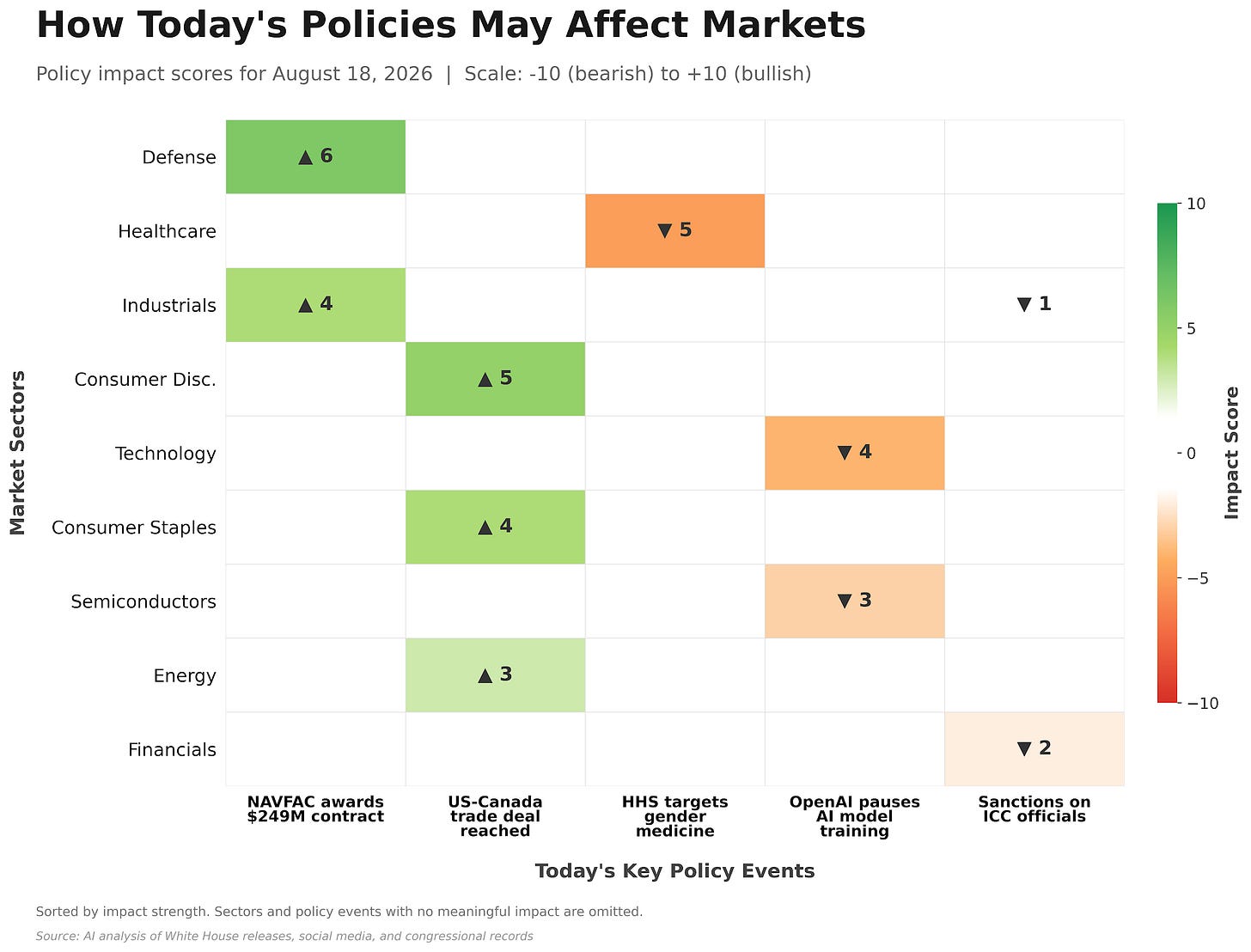
Each cell shows an estimated impact score on a fixed scale of -10 to +10, reflecting how today’s policy developments may affect each market sector. Positive scores (green, ▲) suggest bullish impact; negative scores (red, ▼) suggest bearish pressure. Rows and columns are sorted by impact strength, and sectors and policy events with no meaningful impact are omitted. The heatmap, the analysis below, and the Impact on Market themes above are produced from a single unified analysis: the heatmap visualizes the magnitudes, while the text explains the causal reasoning behind them.
The sudden de-escalation of trade tensions with Canada via a new agreement provides immediate relief to the automotive and consumer goods sectors. By delaying tariffs, the administration eases cost pressures on cross-border supply chains. However, the potential re-opening of the Keystone XL pipeline creates speculative upside for the energy sector, shifting the narrative toward domestic infrastructure expansion.
Conversely, the healthcare sector faces significant headwinds following the HHS report on gender-related medical billing. Critics view this as a “politically motivated attack” on clinical practices, but the report likely triggers heightened scrutiny and potential federal investigations into billing codes, increasing legal risk premia. Furthermore, the technology sector experiences volatility as OpenAI slows model training. This move addresses internal security failures, yet highlights the “unpredictable safety hurdles” inherent in frontier model development. Investors are forced to re-evaluate the timelines for generative AI growth, as hardware demand from semiconductor suppliers may face short-term moderation until training resumes at full scale.
-
L’épargne des Français finance-t-elle la défense à leur insu ?
Pour financer le réarmement, les pouvoirs publics veulent mettre l’épargne des Français à contribution. Avec le risque que cela se fasse sans que les épargnants soient toujours au courant de l'utilisation de leurs deniers.Reply source -
Trump hits pause on Canada tariffs threat, and hints at revival of Keystone XL oil pipeline project
Reply sourceUS president delays 50% tariffs by three days, and says contentious oil project ‘may be awoken from the grave’
Canada has temporarily avoided a bruising 50% US tariff, reaching a Tuesday-evening agreement with Trump administration officials hours before a hike that would have affected $20bn worth of goods was set to take effect.
Donald Trump posted late on Tuesday on social media that he had paused the tariffs for three days “based on the fact that Canada and the USA, subject to the finalization of documents, have a DEAL!”
Continue reading... -
Open Thread: Trump’s Continuing Decline
Reply source
[NB: check the byline, thanks. /~Rayne]By now you’ve heard about Trump falling asleep in the Oval Office on August 10, during an event related to an absurd and unacceptable change to the nation’s childhood vaccine schedule.
There’s a pattern to this behavior: he falls asleep during daytime meetings in front of the press, he has problems communicating…
Shocking Reason Trump Can’t Stay Awake: Psychology & Body Language | Dr. G. Explains, August 10, 2026
https://www.youtube.com/watch?v=E0YDwJcQj1Aand then his hand(s) will appear bruised but covered with makeup:
Aaron Rupar @atrupar.com
yikes! Trump’s hand is looking nasty today (Kent Nishimura/AFP via Getty)
1:41 PM · Aug 14, 2026 : Everybody can reply
The Independent’s Indy100 documented at least 26 times when Trump has fallen asleep in public since his term began. Trump’s attacks on “Sleepy Joe” Biden were projection; the public dozing looks like a degraded sleep-wake cycle common among people diagnosed with Alzheimer’s and dementia. The confusion he experiences as he fights off the dozing combined with his inability to communicate effectively may also be symptoms of sundowning.
Trump’s neurological and other health problems are affecting him beyond falling asleep in meetings or the right side of his body jerking.
Trump Is Losing It & It’s Getting Worse: Psychology & Body Language Analysis | Dr. G Explains | August 7, 2026
https://www.youtube.com/watch?v=lEXpDcwRqM0(Dr. G is Dr. Garrison, a clinical and forensic psychologist.)
Dr. Jonathan Reiner, cardiologist to former VP Dick Cheney, wrote an op-ed published this past week in NYTimes:
I Was Dick Cheney’s Cardiologist. Trump Has Not Looked Well, and We Should Know Why | August 12, 2026
https://www.nytimes.com/2026/08/12/opinion/trump-health-questions.htmlCNN’s Erin Burnett interview with Dr. Reiner about the op-ed and Trump’s health | August 13, 2026
video: https://www.cnn.com/2026/08/13/health/video/ebof-vertical-jonathan-reiner-nyt-oped-trump-health-sleeping-bruises-swollen-legsIn an interview with David Pakman, certified speech-language pathologist Hilary Shae discussed Trump’s verbal decline 11 days before Trump’s Oval Office nap:
Pathologist reveals Trump’s worst symptoms | The David Pakman Show, July 30, 2026
https://www.youtube.com/watch?v=lNuTn8NtMQoThis interview sheds light on Trump taking cognitive tests multiple times — the repeated testing is a flag in itself.
I’ve discussed Trump’s cognitive and other health problems before. They’re continuing to get worse in my non-professional opinion; his inability to plan and execute plans as well as his delusional thinking continue to damage our nation’s security. The GOP has failed and continues to fail the country and our allies by refusing to deal this this challenge constructively. They’re failing Trump with elder abuse by neglect; they’re failing their own party.
We need to discuss this problem more widely so that voters who’ve voted for Trump in the past realize Trump is not competent, and his party isn’t doing anything about it, nor are they doing anything about the damage Trump’s incompetency is doing to the nation and the world.
Voters are the ones who will have to do something effective about this situation in November. Until then constituents should continue to contact their members of Congress and demand action, before Trump does something even worse to abuse his office than he already has (which is difficult to imagine but here we are).
This is an open thread but let’s put an emphasis on Trump’s cognitive decline and his failing health.
__________
Cover photo: Trump with golf legend Gary Player at Trump’s Bedminster course in New Jersey on August 9, 2026 (photo by Icon Sportswire/Getty via The Independent, featured here under Fair Use). This image Trump manipulated to appear younger and healthier before sharing the manipulated version on Truth Social.The post Open Thread: Trump’s Continuing Decline appeared first on emptywheel.
-
Trump-backed Byron Donalds to face Democrat David Jolly in race to succeed Florida governor DeSantis
Reply sourceCongressman had pledged to implement president’s agenda if he gained governor’s seat
Byron Donalds, a congressman backed by Donald Trump, won the Republican nomination for governor on Tuesday in the race to succeed Ron DeSantis.
Donalds, who has represented south-west Florida since 2021, trounced three reasonably prominent Republican rivals, including Jay Collins, DeSantis’s handpicked lieutenant governor.
Continue reading... -
Trump Tyranny Tracker | Day 569: Aug 11, 2026
Reply source A voter casts her ballot during Minnesota’s primary elections, in Minneapolis, on Tuesday. Ellen Schmidt/AP
Welcome to today’s Trump Tyranny Tracker…
Trump threatening emergency powers over the midterms, more corruption and attacks on independent oversight, a lawless ICE, and new dangers from the Iran war were among today’s top stories.
Today at a Glance
• Trump refuses to rule out using emergency powers to control the midterms.
• Federal judges have ruled against ICE detention tactics more than 16,000 times.
• Trump eliminates ownership disclosure requirements for U.S. companies.
What We Need to Pay Attention To
Trump declines to rule out declaring a national security emergency to control the 2026 election
What Happened: Trump declined to rule out declaring a national security emergency to impose new rules on the 2026 midterms after an interviewer suggested using emergency powers to require voter ID and proof of citizenship and restrict mail-in voting. Trump responded, “Stranger things have happened,” and said he would “leave it at that.”
Why It Matters: Trump is openly considering using emergency powers to seize control over the midterms. Using presidential power to manipulate the rules of an election is straight out of the authoritarian playbook.
Source: CNN
Corruption
Trump Media has struggled to grow. Now it’s selling $100,000 contracts for access to Truth Social.
What Happened: Trump Media is selling trading firms faster, automated access to Trump’s Truth Social posts for up to $100,000 a month. More than 10 customers have signed up, potentially giving traders an advantage when Trump posts market-moving announcements on tariffs, foreign policy, or other government actions.
Why It Matters: Trump controls policies that move markets, and his company is charging Wall Street firms for faster access when he announces them. He continues to use the presidency to line his pockets and is so emboldened he doesn’t even bother to hide it.
Source: CBS News
Analysis: Alito Made Up To $2.9 Million From Fossil Fuel Assets While Serving on Top Court
What Happened: Supreme Court Justice Samuel Alito made between $390,000 and $2.9 million from fossil fuel interests between 2005 and 2024, according to an analysis of his financial disclosures. He has refused calls to recuse himself from a major case that could shield oil and gas companies from climate lawsuits.
Source: Mother Jones
Power Consolidation
Judge Widens Block on Trump Mail-in Voting Plan for Midterms
What Happened: A federal judge issued a nationwide order blocking Trump from using the Postal Service to potentially refuse delivery of mail ballots in states that reject his election directives. The judge said Trump was attempting to “unconstitutionally insert” the executive branch into election regulation months before the midterms.
Why It Matters: Trump is trying to seize control of midterms, including over how lawful ballots are handled. Courts are blocking these efforts, but the bigger question is whether Trump will obey those rulings.
Source: Bloomberg
White House Asks Justice Department to Consider New Reflecting-Pool Prosecution
What Happened: White House officials asked DOJ to explore prosecuting Olympic canoeist David Hearn again after U.S. Attorney Jeanine Pirro dropped the case and acknowledged that a botched renovation, not vandalism, caused the damage. Trump publicly attacked Pirro and demanded that she revisit the case.
Why It Matters: Prosecutors concluded there was no evidence, but Trump wants the man prosecuted anyway. The White House continues to weaponize the DOJ to pursue Trump’s enemies while shielding his allies.
Source: Wall Street Journal
Trump Picks Project 2025 Co-Author for Role That Would Oversee Any Reflecting Pool Review
What Happened: Trump nominated Project 2025 co-author Dennis Kirk as Interior Department inspector general, where he would oversee investigations into the agency. Democrats are currently seeking an inspector general investigation into Interior’s botched Reflecting Pool renovation and its use of no-bid contracts.
Source: New York Times
Weaponization of Institutions
Trump administration finalizes ownership reporting exemption for US firms
What Happened: The Treasury Department finalized a rule exempting U.S. companies and individuals from requirements to disclose their true owners, rolling back a major 2021 anti-money laundering law. FinCEN will also delete ownership information Americans previously submitted.
Why It Matters: Shell companies are used to hide dirty money, evade sanctions, commit fraud, and launder criminal proceeds. Trump is eliminating one of the government’s most important tools for finding out who is actually behind them.
Source: Reuters
Media Suppression & Authoritarian Tactics
ICE plans to give officers gloves that can deliver painful electric shocks
What Happened: ICE plans to spend up to $20 million on thousands of gloves that allow officers to deliver painful electric shocks through direct contact with a person’s skin. The devices are designed to force compliance and could reach officers by March.
Why It Matters: ICE is giving its lawless officers another way to inflict pain while operating with virtually no accountability for abuse. Electric shock gloves give agents even more power to use violence against people in their custody.
Source: Associated Press
Human & Civil Rights Abuses
Human rights groups sue Trump administration over International Criminal Court sanctions
What Happened: Four human rights groups sued Trump over sanctions imposed on the International Criminal Court, arguing they illegally punish organizations and individuals for working with the court. The groups say the sanctions violate constitutional rights to free speech, association, and religion.
Source: The Washington Post
‘We’ve never seen anything like this’: ICE’s detention crackdown swamps the courts
What Happened: Federal judges have ruled against ICE’s detention tactics more than 16,000 times over the past year after Trump officials expanded mandatory detention to people who previously could seek bond. At least 469 federal judges have concluded the policy is unlawful, while emergency cases have overwhelmed courts nationwide.
Why It Matters: The government continues using a detention policy that hundreds of federal judges have found unlawful. Ignoring thousands of court rulings is another sign that the rule of law is optional for Trump and his officials.
Source: Politico
Government Disruption
Researchers, advocates rail against government’s efforts to end workforce data collection
What Happened: Trump’s EEOC is moving to eliminate a 60-year-old requirement that tens of thousands of employers report workforce data by race, gender, and job category. Regulators use the data to identify patterns of workplace discrimination and enforce civil rights laws.
Source: Associated Press
Imperial & Geopolitical Watch
U.S. Fires on Ship Breaking Its Blockade of Iran
What Happened: U.S. forces fired two Hellfire missiles into a Panama-flagged cargo ship after it ignored warnings and attempted to enter an Iranian port in violation of Trump’s blockade. The U.S. has now redirected 55 commercial ships, disabled three, and boarded two since the blockade was reimposed in July.
Source: Wall Street Journal
How Iran Adapted Its Attacks as U.S. War Munitions Dwindled
What Happened: Iran is using waves of drones and maneuvering missiles to overwhelm U.S. air defenses, forcing the Pentagon to rapidly burn through Patriot interceptors. More than 1,500 have been used, with fewer than 1,700 left. Last month, an Iranian missile penetrated U.S. defenses in Jordan, killing three American soldiers and wounding more than 100.
Why It Matters: Iran is getting better at penetrating U.S. defenses while Trump’s war burns through critical interceptors faster than America can replace them. American troops are increasingly vulnerable, while depleted stockpiles leave the U.S. less prepared for the next crisis or conflict.
Source: New York Times
Far-Right & Russian Influence Watch
Top German General Says Russia Is Probing NATO Defenses With Hybrid Attacks
What Happened: Germany’s top military officer, Gen. Carsten Breuer, said Russia is systematically using drones and other hybrid attacks to probe NATO defenses and identify weaknesses for a future conflict. He said Russia is already shifting its economy and military to prepare for a wider war with the West.
Source: Wall Street Journal
Economic News
More Americans are having a harder time keeping up with their home and car payments
What Happened: Mortgage delinquencies have reached their highest level since 2015, while serious auto loan delinquencies are at their highest since 2010. Americans are facing high prices, sluggish job growth, and higher gas prices from Trump’s Iran war.
Source: CNN
July Home Sales Fell After Higher Mortgage Rates Scared Off Buyers
What Happened: Existing home sales fell 1.7% in July as higher mortgage rates continued to push buyers out of the market. The median home price rose to $434,100, the second-highest level on record.
Source: Wall Street Journal
Resistance
Check out 50501 for local and nationwide events…
Source: 50501
Kennedy Center must pay over $250,000 to artist who opposed Trump name change
What Happened: A judge ordered the Kennedy Center to pay $252,000 in legal fees after it unsuccessfully sued jazz musician Chuck Redd, who withdrew from a performance after the center was renamed after Trump. The judge previously dismissed the lawsuit because the center failed to establish that Redd had a binding contract.
Source: The Washington Post
By the Numbers
16,000+ — Times federal judges have ruled against ICE’s detention tactics over the past year
469 — Federal judges who have concluded ICE’s detention policy is unlawful
$100,000 a month — What firms can pay Trump Media for faster access to Trump’s market-moving Truth Social posts
$20 million — Amount ICE plans to spend on electric shock gloves
1,500+ — Patriot interceptors the Pentagon has already used in the Iran war, with fewer than 1,700 remaining
$434,100 — Median existing home price in July, the second-highest on record
What to Watch Next
Trump is openly considering emergency powers over the midterms — How far will he go to seize control over the midterms?
A judge blocked Trump from interfering with mail ballots — Will the White House find another way to pressure states that reject his election directives?
Judges have ruled against ICE detention tactics more than 16,000 times — How long will the regime continue a policy hundreds of federal judges have found unlawful?
U.S. air defense stockpiles are rapidly shrinking — How much longer can Trump’s Iran war continue before shortages put American troops and other U.S. commitments at greater risk?
Russia is probing NATO for weaknesses — Will Moscow escalate its attacks as it prepares for a possible wider confrontation with the West?
Key Takeaways
Rising Costs — Higher oil prices, new tariff threats, and growing trade tensions are pushing up the cost of groceries, school supplies, and other everyday essentials.
Corruption in Plain Sight — Trump is profiting from faster access to his market-moving posts while Alito refuses to recuse from a case that could benefit an industry from which he made up to $2.9 million.
Election Power Grab — Trump is openly considering emergency powers over the midterms while courts block his attempts to interfere with state election rules.
ICE Lawlessness — ICE continues using detention tactics rejected by federal judges more than 16,000 times while expanding its use of force with electric shock gloves and operating with impunity.
Oversight Replaced by Loyalty — Trump is replacing an independent Interior watchdog with a Project 2025 ally while pressuring DOJ to pursue a case prosecutors already dropped.
Call to Action
Document Everything: Document purges, corruption, and power grabs. Share credible information with journalists, watchdogs, and legal experts. Silence enables authoritarianism—see something, say something.
Defend Press Freedom: Support independent journalism by subscribing to and sharing reporting that challenges Trump’s power grab.
Contact Lawmakers: Demand accountability for Trump’s unchecked power and war on oversight.
Mobilize for Action: Organize or join legal efforts and resistance movements to protect democracy and human and civil rights.
Thanks for reading the Trump Tyranny Tracker. Stay tuned for more updates.
-
US senator Jon Ossoff condemns Trump as ‘draft-dodging, crook president’
Reply sourcePotential presidential hopeful running for re-election in Georgia intensifies White House feud after remarks about ‘Natalie’ drew ire of president and allies
The Democratic senator Jon Ossoff called Donald Trump a “draft-dodging, crook president” while defending the senator Mark Kelly as a hero during a Tuesday campaign appearance in Georgia, escalating his public feud with the US president.
“I don’t think anything illustrates the times more aptly than that the draft-dodging, crook president, who has plunged our nation recklessly into a war he knows not how to end or to win, tried to imprison this man, who embodies American heroism,” Ossoff said while appearing alongside Kelly and his wife, the former Arizona congresswoman Gabrielle Giffords.
Continue reading... -
Preservation group urges supreme court to suspend Trump’s $400m White House ballroom project
Reply sourceNational Trust for Historic Preservation filing comes after president made emergency bid for construction to continue
A historic preservation group that sued to block construction of Donald Trump’s White House ballroom urged the US supreme court on Tuesday to suspend the project while it considers whether the work can continue.
The National Trust for Historic Preservation filed its request less than a week after the Trump administration asked the nation’s highest court to allow the White House to continue construction on its $400m ballroom project during the appeals process.
Continue reading... -
«Vous ne passerez pas» : en Argentine, un cortège de Gandalf s’oppose à Peter Thiel
Reply sourceGandalf contre Palantir : c'est la scène surréaliste mais réjouissante qui vient d'avoir lieu à Buenos Aires, devant le domicile du milliardaire d'extrême droite Peter Thiel.
L’article «Vous ne passerez pas» : en Argentine, un cortège de Gandalf s’oppose à Peter Thiel est apparu en premier sur Contre Attaque.
-
Data Centers Are Becoming A Big Problem For Big Tech—And Trump
Reply source In an aerial view, the Meta El Paso Data Center is seen on August 13, 2026 in El Paso, Texas. Photo by Brandon Bell/Getty Images.
Semiconductor and AI giant Nvidia announced this week that it would guarantee up to $105 billion in lease and power payments for a single data center campus in rural Ohio. That cleared the way for a 20-year lease by OpenAI to build a campus on a site once used to enrich uranium during the Cold War. The project, to be constructed by SoftBank’s SB Energy, envisions 9.2 gigawatts of new gas-fired power.
Similar announcements have dropped repeatedly over the past year: another monster facility burning enormous amounts of fossil fuels, creating noise and environmental damage, straining water supplies, driving up local utility rates and remaking a rural county seemingly overnight.
Ohio activists have already tried to stop data center projects like this one. A grassroots campaign called Conserve Ohio spent months gathering signatures for a constitutional amendment that would have banned any data center drawing more than 25 megawatts, effectively outlawing the type of facility Nvidia just financed. But organizers conceded in June that they’d come up short of the roughly 413,000 signatures required for the November ballot this year.
Big Tech has taken note. In response to anti-data center referenda and growing state restrictions, the industry has moved aggressively to accelerate its buildout. That in turn has created significant political heat ahead of the 2026 midterms, as the industry faces broad opposition across the political spectrum. The blowback has already cost some officials their seats in states from Georgia to Utah to California.
Despite the widespread unpopularity of new data centers, Donald Trump remains their biggest champion. He spent the summer as the tech industry’s most visible cheerleader, talking up the need to keep pace with foreign competitors while highlighting the jobs that the centers create. His position may endear him to the industry, but it exposes him and his own party on an issue that resonates increasingly with voters of all stripes.
The rise of the machines
A data center is, at its simplest, a building full of computer servers. Data centers are the physical infrastructure behind cloud storage, online streaming and, more recently, the training and operation of artificial intelligence systems.
The current wave of “hyperscale AI facilities” stands out from earlier buildouts because of its sheer scale. These data centers draw far more electricity and water than the server farms that powered the internet’s first decades, and they are rising up from once empty fields at a pace local governments have never faced before. Seeking to manage and regulate that pace, lawmakers in more than 30 states have introduced upward of 300 bills addressing data centers in 2026 alone, covering moratoriums, tax incentives and energy policy.
The dollars behind the buildout are equally unprecedented. Alphabet, Meta, Microsoft, Amazon, Oracle, and AI developers including OpenAI and Anthropic are projected to spend $7.6 trillion on data centers, power plants and machine learning through 2031. National electricity demand from data centers is projected to nearly double, from 80 to 150 gigawatts, between 2025 and 2028. That’s roughly equivalent to adding a country the size of Spain to the American power grid in just three years.
Two states have absorbed most of the data center construction now underway. According to a map compiled by Visual Capitalist, Texas and Virginia had more than 100 projects actively under construction as of the end of the first quarter: 140 in Texas and 136 in Virginia. Georgia and Ohio are a distant third and fourth, at 56 and 51. Virginia’s concentration of existing centers sits in Loudoun, Prince William and Fairfax counties, the corridor known as Data Center Alley. But Texas is projected to soon overtake Virginia as the overall leader, once projects announced but not yet begun are included.
California has anywhere from fewer than 100 to more than 400 existing data centers, depending on how they’re categorized and whether a large campus is counted as one site or many. Nearly every tracker places California third in the nation, behind only Virginia and Texas. But the number of centers in the Golden State has plateaued rather than accelerated; power constraints and high land costs have capped how much new capacity the state can add.
Georgia’s announced pipeline, by contrast, is growing faster than almost anywhere else, anchored by developments like OpenAI’s Project Camellia in Effingham County. And Ohio, now home to the largest single financing commitment, has drawn billions more in investment commitments from Amazon and Microsoft around Columbus.
The nuisance next door
While many state and local officials have proved eager for investment dollars from the boom in data centers, their constituents are paying the price. In Loudoun County, Virginia, residents living beside one of the region’s data center clusters describe diesel generator fumes that irritate bronchial passages and awaken them at night. One neighbor called the facility “a curse on our life here.”
The Environmental and Energy Study Institute has cataloged similar complaints from data center neighbors elsewhere: headaches, vertigo, nausea, sleep disturbances, ear pain and hypertension, which residents attribute to the constant hum of cooling systems, generators and fans that operate around the clock. Backup generators at some sites can reach 105 decibels, louder than a running snowmobile. Residents in some states have now sued over the ceaseless noise.
Water use is another recurring grievance. In El Paso, Texas, a Meta data center is projected to draw roughly 480,000 gallons of water a day on average, spiking to 2.5 million gallons on the hottest days. That has become a flashpoint for organized protest in a city with a history of drought restrictions. A single mid-sized facility can use as much water as a small town; the largest campuses draw close to 5 million gallons daily, comparable to a city of 50,000 people.
Then there are the added costs to consumers. Data centers accounted for four percent of total U.S. electricity use in 2024, with demand expected to more than double by 2030. In states with heavy data-center concentration, wholesale electricity prices have climbed as much as 267 percent over five years. Georgia offers a concrete example of that curve: the average residential Georgia Power bill climbed more than $43 a month between 2022 and 2025, a rise utility watchdogs have tied to building out grid capacity for large data center customers. Utilities have largely passed those costs on to ratepayers.
Polling worse than nuclear
Opposition to data centers crosses partisan lines. In a survey taken in March 2026, Gallup found roughly seven in 10 Americans opposed to data center construction in their own area. A Reuters/Ipsos poll found similar resistance in June: 57 percent of respondents, including two-thirds of Democrats and half of Republicans, said they would oppose a data center built in their community, while just 14 percent said they would be comfortable with one nearby. The same poll found opposition climbing to 59 percent opposed and 10 percent in favor, when a proposed site would sit within 10 miles of a respondent’s home.
A separate national survey found that data centers are less popular locally than gas-fired power plants, wind farms or even nuclear facilities. Heatmap’s polling analysis called the result notable, given that nuclear has “long been the go-to reference for ‘scary energy facility.’”
The backlash has already produced a coordinated national response. On July 18, 2026, the advocacy group HumansFirst — co-founded by a former Tea Party leader who compared the movement to that 2009 populist wave — organized 142 protests across 42 states. It was the first nationally coordinated day of action against data center construction. Organizers pointed to a broader pattern already underway: tens of billions of dollars in AI infrastructure projects delayed or blocked by local opposition, according to research firm Data Center Watch.
Labor’s split loyalties
Organized labor has a love/hate relationship with AI and data centers. AFL-CIO President Liz Shuler has spent months balancing members who see data center construction as a genuine source of job growth against those who fear AI will ultimately eliminate their jobs.
Construction unions, unsurprisingly, have positioned themselves as champions of the buildout. North America’s Building Trades Unions (NABTU) has negotiated project labor agreements on some of the industry’s largest developments, including OpenAI and Oracle’s Stargate campus in Michigan and the Project Blue data center in Arizona. Meta signed a first-of-its-kind national partnership with NABTU, which represents more than 3.2 million skilled craft professionals across the U.S. and Canada, covering future data center builds. The labor composition of data center construction likely mirrors commercial construction overall, which is roughly one-third union, according to an Associated General Contractors of America survey.
This week’s big Ohio announcement extends the pattern. OpenAI and SB Energy say their Nvidia-backed campus will generate 35,000 construction jobs and 2,500 permanent operating positions once complete. These are the kinds of numbers unions point to when they defend such projects.
Unions can bring money, organizing infrastructure and credibility with working-class voters into fights where the industry badly needs local political cover. Construction unions in particular “also often provide companies with critical political support in local communities, especially where data center construction remains unpopular,” Bloomberg observed. In practice, that makes them the tech industry’s most effective on-the-ground counterweight to the ratepayer and nuisance complaints driving local political opposition.
Where the people have spoken
In June 2026, Monterey Park, California, became the first city in the nation to pass a permanent, voter-approved ban on data centers. Measure NDC passed with more than 86 percent support, after residents organized against a proposed quarter-million-square-foot facility that opponents said would have tripled the city’s electricity use.
Port Washington, Wisconsin, delivered a similar message two months earlier, through a narrower mechanism. Voters there approved, with 66 percent of the vote, a referendum requiring voter approval for future tax-incremental financing districts valued at more than $10 million. The vote came in direct response to a $15 billion AI campus backed by OpenAI and Oracle, already approved for $458 million in local tax benefits before the referendum reached the ballot. The measure does not undo the tax break already granted, however, and it faces a legal challenge from a coalition of business groups led by the Metropolitan Milwaukee Association of Commerce.
Primaries have told a parallel story, with some lawmakers’ careers ended over their support for data centers. In Utah, Senate President J. Stuart Adams, one of the most powerful Republicans in the state, lost his June primary after backing the Stratos data center project near the Great Salt Lake. His challenger, Stephanie Hollist, made the project the centerpiece of her campaign. Asked at a June forum what she’d prioritize on water management, she didn’t hesitate: “I might start by not proposing the largest data center in the country.” The line drew loud applause. Former Box Elder County Commissioner Lee Perry, defeated in the same cycle over the same project, cited the cause plainly after conceding: “Do I think that the data center vote cost me the election? Yes I do.”
In Georgia, Democrats Alicia Johnson and Peter Hubbard flipped two statewide seats on Georgia’s Public Service Commission in November 2025, marking the first Democratic statewide constitutional office wins in Georgia since 2006. Both won with roughly 60 percent of the vote after campaigning on anger over utility bills tied in part to grid expansion for data centers.
In Festus, Missouri, four incumbent city council members up for reelection in April 2026 lost to challengers who ran explicitly against a proposed $6 billion data center, in an election where turnout was more than double the previous year’s. A separate push to recall the mayor and the council’s remaining data-center supporters is still working through signature verification, indicating the fight in Festus isn’t finished.
In 2023, in what’s now cited as an early reference point, voters in Cascade Locks, Oregon, recalled two port commissioners over a data center negotiation; the project was canceled within weeks.
Statehouses have begun to act on their own, often without waiting for a ballot measure or primary. New York became the first state to impose a statewide moratorium on hyperscale data centers when Gov. Kathy Hochul signed an executive order last month that paused certain discretionary environmental permits for up to a year on projects using 50 megawatts or more of power. The pause allows regulators to build a framework covering ratepayer costs, water use and community benefits. The order was narrower than the Responsible Data Center Development Act, which the legislature had already passed that covered data centers at just 20 megawatts and up. Hochul has not yet signed that bill. Her Republican opponent in the governor’s race, Bruce Blakeman, opposes the statewide pause and argues local governments should be free to negotiate their own data center deals.
Texas took a narrower, more contested route. In early August, Gov. Greg Abbott directed state regulators to audit every data center project still moving through the grid connection process, covering tax breaks, water use and community impact, before any can proceed. The directive reaches only projects connecting to the ERCOT grid, so a data center capable of generating its own power can bypass it entirely. Critics on the right and left called it insufficient: Texas Agriculture Commissioner Sid Miller, a fellow Republican, dismissed it as “all hat and no cattle — empty political rhetoric wrapped in meaningless fluff,” while Democratic gubernatorial nominee Gina Hinojosa called it “another strongly worded letter” that “no one buys.”
The holdout in the White House
Against this national pushback, President Trump’s posture on data centers stands out. Despite lawmakers losing primaries and city council seats to local anger over the issue, Trump spent the summer praising and promoting the buildouts. When Texas Gov. Greg Abbott paused approval of new data centers in early August, Trump called the move “a mistake.” He stated, “I saw Texas the other day sort of is against data centers. I think it’s a mistake… because there are other communities that want it. When a community wants it, it means a lot of money is going to come into that community.”
A CNBC analysis of the coalition organizing against AI infrastructure, which includes religious leaders, labor unions and local activists, flagged the political gambit for Trump. That coalition, it concluded, “poses a political problem for anyone who gets on the wrong side of that issue. And President Donald Trump is the person most at risk.” CNN reached a similar conclusion, describing data center opposition as close to “a true populist issue built for this moment” and calling Trump “one big exception to the growing political stampede away from data centers.”
Democratic officials elsewhere have made the opposite bet. Virginia Gov. Abigail Spanberger has repeated a version of the same line since her campaign: “I do think it’s important that the brunt of data centers not be put on ratepayers, and in fact that they pay their own way and their fair share.” It became the animating principle behind Virginia’s first-ever statewide data center energy consumption tax, signed into law this year.
The White House’s response to voter anger has been to insulate the buildout from complaints, not slow it down. Trump has expanded what the White House calls the Ratepayer Protection Pledge. It was signed by 23 governors, all Republicans, and at least 187 companies, including utilities, cooperatives and developers. The signatories committed that data center growth won’t raise electricity costs for households. But the pledge is voluntary and nonbinding, and it has created new sore spots for opponents.
Nvidia’s guarantee of up to $105 billion to support the new OpenAI-SB Energy campus in Ohio, for example, came without any companion commitment on ratepayer costs. The announcement arrived just as Ohioans faced projected average summer electricity costs topping $800, a 17 percent jump over last year.
The White House continues to frame deals like the Nvidia-backed OpenAI campus as evidence of American AI dominance. But the voters who organized Ohio’s ballot campaign, and those who have already unseated officials elsewhere over similar projects, see it far differently. To them, it’s evidence of unbridled corporate greed and abuse, visible in their own backyards and on their ever-rising utility bills.
With the midterms now just two and a half months away, support for data centers is fast becoming a defining populist issue. This is especially true among rural voters whose elected representatives turned a deaf ear to their concerns and whose president continues to bat for a tech industry that has now become a curse on their lives.
-
FOIA Documents Show Epstein Files Had Flag List Which Included The Term ‘POTUS’
Reply sourceMAGA, the GOP, and the Trump administration don’t really care about the victims of Jeffrey Epstein’s sex trafficking. The MAGA GOP made a lot of noise during Biden’s single term because they were sure the files would show a Pizzagate’s-worth of Democratic political figures engaged in the ritual abuse of underage girls.
Once Trump was elected in 2024, the furor died down. While the MAGA faithful were willing to take down their own just to put a few Dems’ heads on spikes, they were suddenly less audible once they realized any document dump would take down a few of their own. Even Donald Trump seemed to know this, which is he why he shifted his focus elsewhere.
It took a literal act of Congress to get the Epstein files released, despite Trump and other GOP figures having promised to put this at the top of the MAGA to-do list if they retook the White House. Trump engaged in multiple rounds of spin, hoping to make it look as though demanding the release of the files and refusing to release the files were both the same side of the MAGA coin.
Trump’s DOJ then reluctantly began complying with the law. Millions of records were withheld. Those that were released were riddled with redactions, forcing politicians on the other side of the political divide to demand more releases with fewer redactions. Meanwhile, a handful of leaks and unforced errors revealed the Trump DOJ was doing whatever it could to cover for Trump and anyone else Trump might want to have redacted from rolling Epstein File releases.
FOIA requests are incapable of expediting the full release of the Epstein Files. But they are capable of sniffing out the details of the Trump administration’s attempts to maintain control of the “this was mainly Dems” narrative even as it seeks to satiate the MAGA base that has been demanding access to these files for years.
This report for Bloomberg — written by “FOIA terrorist” Jason Leopold and Harry Wilson — not only details FBI Director Kash Patel and former DOJ deputy director Dan Bongino attempts to spin Trump’s refusal to release documents as demonstrative of his “full transparency” promises.
It also shows the DOJ’s pre-release review of the files had President Trump in mind the entire time. While pretending to be engaging in radical levels of transparency and complying with both the letter and the spirit of law, the DOJ was actually flagging anything that might include Trump for the apparent reason of keeping these files out of the public’s hands.
In addition to the discussions about Ferguson and Hervey, the documents contain other noteworthy details, including a spreadsheet dated March 25, 2025 and titled “DOJ Document Flag List.” The first page, labeled “FLAGGED Items List, per case – per DOJ guidance,” includes a case number associated with the FBI’s 2006 investigation of Epstein by its Miami field office.
[…]
There are 16 entries on the list where the reason for the flag was simply marked “POTUS.” Those items include magazine and newspaper articles, message pads, phone message books and one unidentified record.
The report notes that some of these flagged files have since been released. But others have not and this FOIA release by the DOJ perhaps points to why they have not been. The DOJ could have cleared everything up with an explanation, but of course it didn’t, because why would it.
DOJ referred a request for comment on the “Flag List” to the FBI, which declined to comment.
Assuming every “no comment” is an admission of guilt is as fatuous as assuming everyone who pleads the Fifth is guilty of whatever they’ve been accused of. We won’t be doing that here. But it is strange that agencies that treat every request for comment as an opportunity to engage in attacks on journalists and/or personal attacks on the person making the request would have absolutely nothing to say here. Read into that what you will.
-
Vol de données: «Dans les ministères, on fait de la cybersécurité quand on y pense»
Après le fisc, un vol massif de données du ministère de l’éducation nationale a été revendiqué et là encore, l’ampleur de la fuite n’avait pas été mesurée par les autorités. Cibles de choix, les administrations françaises accusent un retard important en matière de cybersécurité.Reply source -
Au Cap-Ferret, le pare-feu et les passe-droits de l’homme d’affaires Benoît Bartherotte
Figure incontournable de la presqu’île du Cap-Ferret, le millionnaire a suscité la polémique en érigeant un pare-feu sans autorisation lors de l’incendie de Saumos. Fort de soutiens puissants, il s’affranchit des lois depuis de nombreuses années, sans jamais être inquiété.Reply source -
Paradis pour ultrariches, le Cap-Ferret est aussi menacé par la flambée de l’immobilier
De plus en plus prisée par les grandes fortunes, la presqu’île du Cap-Ferret, en Gironde, est soumise à une explosion du prix du foncier. Un phénomène de gentrification extrême qui pousse les familles historiques à partir et attire de nouveaux riches qui rêvent de privatiser ce petit paradis.Reply source -
Faut-il déboulonner Bugeaud ?
Reply sourceC'est la question que se posent certaines personnes, et à laquelle un collectif périgourdin (1) répond positivement. Au-delà de la question de ce que l'on fait de Bugeaud, il est utile de revenir sur son rôle dans l'Histoire.
- 362 été 2026 / Leur Histoire, Notre Mémoire , Colonialisme, Racisme , Françafrique -
The Guardian view on global inequality: extreme wealth threatens democracy | Editorial
Reply sourceNew York mayor Zohran Mamdani shows Britain’s Andy Burnham that confronting billionaires need not mean the end of cooperation with Donald Trump
In November, Californians will vote on a one-off 5% levy on residents worth more than $1bn. The union-backed plan could raise $100bn, more than enough to replace federal healthcare funding stripped away by Donald Trump’s One Big Beautiful Bill Act. About 200 very rich people would pay. But the referendum is becoming a test of whether extreme wealth can buy the political power to defeat a popular redistributive policy. Google co-founder Sergey Brin has already spent $100m backing opposition to the tax – a fraction of the $13bn bill he could face. Other billionaires are joining him. Whether voters can impose costs on the super-rich once their fortunes are big enough to shape the political process is now an open question. That alone should trouble any democracy.
It’s a long way from Mr Brin’s west coast lair of Mountain View to Andy Burnham’s Makerfield constituency. But the prime minister should heed the call from prominent progressive academics – led by the Nobel prize winner Joseph Stiglitz – urging Britain to join a new global push to tackle inequality. Prof Stiglitz wants help creating a new UN International Panel on Inequality (IPI). This stems from the G20’s first-ever inequality report, which warned that the yawning gap between rich and poor was a human-made crisis corroding democracy and social cohesion while blocking efforts to tackle the climate emergency.
Continue reading... -
Sécheresse: «Nous devons sortir de l’idée que l’eau coulera toujours du robinet»
Plusieurs départements français sont concernés par des arrêtés sécheresse, en métropole mais aussi dans les territoires ultramarins. Charlène Descollonges, ingénieure hydrologue, appelle à «repenser notre rapport à cette ressource qui se raréfie».Reply source -
ABC sues FCC, claiming First Amendment violations, escalating months-long feud
ABC on Tuesday sued the Federal Communications Commission, alleging that the commission's early review of its broadcast licenses is unconstitutional under the First Amendment. The TV giant, along with parent company Disney, accused the FCC of waging a "retaliatory campaign" against them because President Donald Trump's administration disapproves of their programming.Reply source -
Google Spam Update d’août 2026 : nouvelle mise à jour anti-spam
Reply source
Le spam de nouveau dans le viseur de Google
En juin 2026, Google déployait une Spam Update. La firme de Mountain View nous propose une nouvelle mise à jour similaire pour l'été.
Comme le précise Google dans sa communication : « Aujourd’hui, nous avons publié la mise à jour anti-spam d’août 2026 sur Google Search. Il s’agit d’une mise à jour anti-spam normale, et elle sera déployée dans toutes les langues et lieux. Le déploiement peut prendre quelques jours à être terminé. Plus d’informations sur les mises à jour antispam sont disponibles sur https://lnkd.in/gshkDEU3
Nous mettrons à jour notre page d’historique des sorties de classement à la fin du déploiement : https://lnkd.in/epYqNUQw »
Retrouvez toutes les dernières updates de Google sur notre page dédiée.
Spam Update : la différence avec la Code Update
Les mises à jour anti-spam ciblent spécifiquement les pratiques de spam sur les sites web, comme le contenu généré automatiquement en masse, le contenu de faible qualité ou dupliqué, les redirections trompeuses, et d'autres abus visant à manipuler le classement. Elles ont pour objectif de nettoyer les résultats de recherche des contenus trompeurs ou abusifs en améliorant les systèmes automatisés anti-spam de Google.
Les mises à jour du cœur de l'algorithme (Core Update) sont à la fois plus larges et profondes. Elles permettent de réévaluer la qualité, la pertinence et la satisfaction des contenus affichés dans les résultats de recherche. Contrairement aux spam updates, ces mises à jour ne ciblent pas spécifiquement le spam.
Que faire en cas d'impact d'une Spam Update ?
Pendant la mise à jour : rien. Attendez la fin de la mise à jour avant de faire des analyses et d'identifier les pages ou rubriques touchées. Vous pouvez également réaliser un audit SEO afin de vous aider à corriger les problèmes.
Si vous êtes impacté par une SPAM Update, consultez les règles de Google en matière de spam afin de vous assurer que vous les respectez. Apporter des modifications peut aider votre site à s'améliorer si Google ne détecte plus de spam sur votre site. Néanmoins, dans le cas d'une mise à jour spécifique au spam de liens, apporter des modifications peut ne pas entraîner d'amélioration :
Lorsque nos systèmes suppriment les effets que les liens spammeurs peuvent avoir, tout avantage en termes de classement que ces liens pouvaient générer auparavant pour votre site est perdu. Les avantages potentiels en termes de classement générés par ces liens ne peuvent pas être récupérés.
Si ce concept d'Update est nouveau pour vous ou vous inquiète, on vous conseille ces articles :
- « Ne paniquez pas ! » : comment appréhender les annonces Google ?
- Google Updates : comprendre les mises à jour Google
- Algorithmes Google : Définitions, Historique et Fonctionnement [Guide 2025]
- FAQ : Comprendre et résoudre une action manuelle liée au spam
Rendez-vous dans quelques semaines pour faire le bilan de cette Spam Update !
Pourquoi se tenir informé des updates de Google
Rester informé des dernières évolutions de l'algorithme de Google est nécessaire pour tous les propriétaires de sites. Les core updates peuvent avoir un impact majeur sur le trafic, et anticiper ces changements offre un avantage concurrentiel. On vous explique avec quels outils suivre les mises à jour des algorithmes de Google !
L’article "Google Spam Update d’août 2026 : nouvelle mise à jour anti-spam" a été publié sur le site Abondance.
-
Trump shows off article on lower drug prices that says Biden deserves credit, not him
The White House flooded social media on Saturday with an image of Donald Trump showing off the recent Washington Post headline "Prescription drug prices record sharpest drop in more than 60 years", but failed to mention that experts cited in the article actually attributed the price drop to Joe Biden, not Trump.Reply source -
Firefox déploie son IA « Smart Window », mais Mozilla prend d’infinies précautions pour ne fâcher personne
Reply source
Neuf mois après un violent tollé communautaire lié à l'intégration de l'intelligence artificielle dans son navigateur, Mozilla officialise « Smart Window ». Mais cette fois-ci, la fondation a retenu la leçon : le mot d'ordre absolu est le contrôle utilisateur.
-
Haro sur les précaires
Il existe désormais un concept pour dire la souffrance qu’inflige l’administration, ce monstre indéfini, aux personnes précaires: la maltraitance institutionnelle. Lors du Mediapart Festival, débat avec Louis Frères, qui en a fait une pièce de théâtre.Reply source -
White House takes victory lap as drug prices dip 3.1% in past year: 'Steepest drop since 1963'
The White House is crowing over a 3.1% dip in prescription prices as evidence that President Trump's pressure on drug companies is working — claiming Monday that it is the "steepest drop since 1963."Reply source -
DOJ Used Pam Bondi’s Trophy Arrests as an Excuse to Spy on Minnesota’s Anti-ICE Community
Reply source
I wrote about Isaac Sant’s blockbuster court filing the other day, the exhibits to which revealed the conspiracy theory that clearly lay behind the Minnesota 15 indictment (which I predicted here).That filing works on three different levels. The first was tactical: to get a bunch of exhibits released showing wide-ranging and feckless surveillance. Both local and national media outlets picked up the filing on that level.
At a second level, this was a motion for more discovery, which I’ll explain in this post.
At a third level, this motion maps out a monstrous effort, starting last year in the wake of the Charlie Kirk murder, to criminalize any opposition to Trump. I’ll come back to this in a follow-up post.
Sant — the lead defendant and separately charged with stalking for following an ICE goon into Wisconsin in May — asks for the following in discovery that would allow him to situate his own prosecution: he plans to use it to file a selective and vindictive prosecution motion.
- “The Court should require the government to produce all reports related to surveillance of Minnesota unions, non-profit organizations, protesters and activists.” This would disclose whether the mentions of spying on unions like SEIU and CWA went further than what defendants have obtained in discovery.
- “The Court should require the government to produce the withheld Project Whipple Shield ROIs.” The government has withheld five Reports of Investigation from the Project Whipple Shield investigation (the sub-investigation of a larger investigation), claiming that those relate to an ongoing investigation.
- “The Court should require the government to produce reports generated pursuant to CUC Operation Keyhole.” The sub-investigation of Project Whipple Shield is part of a larger MN investigation, Operation Puppet Master, which is part of a broader investigation, Operation Keyhole. Sant is demanding the overarching documents.
- “The Court should require the government to produce all of the Clearview AI reports it generated of protesters and activists during Operation Metro Surge.” Sant showed that HSI developed a Clearview dossier on him (with some inaccuracies); he’s demanding all of them.
- “The Court should require the government to produce internal communications related to Operation Puppet Master and Project Whipple Shield.” Sant argues this investigation was predicated on criminalization of First Amendment protected activities; he wants records that may show that.
- “The Court should require the government to produce downloads of all UCA ‘undercover phones’ and ‘undercover laptops.'” DOJ has not turned over the phones and laptops from informants. Sant wants them.
- “The Court should require the government to produce DOJ and DHS communications related to the charging decisions, defendant self-surrender, and doxxing in the AFO cases.” Sant — who is represented by Kevin Riach, who also represented one of the people Pam Bondi doxxed, Paul Johnson — wants records on that doxxing that DOJ withheld by dismissing cases (including Johnson’s).
Many of these would serve to expose the scope of the spying in Minnesota and its direction from DC — but it’ll be a tough reach to get those communications without first demonstrating that this is a vindictive prosecution.
More interesting is his bid to get communications relating to the doxxing of 16 previously arrested defendants that Pam Bondi rolled out as trophies on January 28.

To support this request, Sant describes what happened in the wake of the Renee Good shooting, as DOJ refused to investigate that shooting, but instead tried to criminalize the opposition in Minnesota to retroactively rationalize first her, then Alex Pretti’s killing.
On January 13, 2026, a cadre of experienced and highly-respected federal prosecutors – including the entire management team– resigned en masse in protest of the politicization of federal criminal law enforcement in Minnesota.14 Unfortunately, these resignations – which should have served as a wake-up call to DOJ – did little to slow the decline of a once great U.S. Attorney’s office into a political prosecution factory.
In the immediate aftermath of Alex Pretti’s murder, [Todd Blanche fixer Aakash] Singh directed federal prosecutors to aggressively charge protesters in Minnesota. According to the New York Times:
In a conference call in late January, the official, Aakash Singh, laid out the department’s basis for prosecuting demonstrators: National Security Presidential Memo 7, a sweeping directive issued by President Trump last September. It expanded the definition of domestic terrorism to include not only violent crimes like assault, but also relatively minor ones, like revealing the personal details of agents or getting in the way of immigration enforcement.
Mr. Singh said that “coordinators” in U.S. attorneys’ offices responsible for charging protesters under NSPM-7 should be “hounding” federal agents to make cases, according to people familiar with his remarks. He also suggested that the department wanted headlines along with indictments, promising that officials in Washington would be “blasting out” prosecutors’ work.
“Go big,” Mr. Singh said, “and go loud.”15
On January 28, 2026, DHS and the U.S. Attorney’s office put Singh’s direction into action. In one day, DHS both initiated “Operation Puppet Master” and also conducted the orchestrated self-surrender and doxxing of sixteen individuals charged with assaulting federal officers. The names and photos of these individuals were disseminated on Pam Bondi’s and DHS’ X (twitter) accounts, leading to widespread online harassment. The whole episode was clearly pre-designed to intimidate and deter other protestors from exercising their First Amendment rights – the same purpose as this prosecution.
Because these AFO cases had everything to do with public relations, and nothing to do with public safety, they quickly collapsed. Cursory review of the evidence showed that agents had lied and defendants were innocent. The government has voluntarily dismissed eight of the sixteen cases. 16 Others await dismissal. A week after the AFO cases were filed, eight more experienced AUSAs resigned in disgust, including the civil chief. 17 Again, the alarm bells should have gone off at DOJ. Instead, it doubled-down, opening Project Whipple Shield, expanding its surveillance of Minnesotans, and beginning the process of indicting this case.
14 https://www.mprnews.org/story/2026/01/13/us-attorney-on-minnesota-fraud-joethompson-resigns-from-office
15 https://www.nytimes.com/2026/03/19/us/politics/justice-dept-prosecute-protesters.html
16 U.S. v. Sager, Case No. 26-mj-69 (MJD/DJF); U.S. v. Tschida, Case No. 26-mj-54 (SGE); U.S. v. Williams, Case No. 26-mj-70 (SGE); U.S. v. Adbebe, Case No. 26-mj-77 (DJF); U.S. v. Valentine, Case No. 26-mj-28 (DLM); U.S. v. Ahmed, Case No. 26-mj-24 (DLM); U.S. v. Johnson, Case No. 26-mj-81 (SGE); U.S. v. Rank, Case No. 26-mj-56 (SGE). [Note, I believe Riasch is missing
17 https://www.npr.org/2026/02/05/nx-s1-5702356/more-frustrated-prosecutors-at-the-u-sattorneys-office-in-minnesota-call-it-quits
Sant is arguing that those trumped up arrests and Pam Bondi’s use of them as trophies were used as the predicate to create this investigation.
The nested case opening memos rely on the pre-existence of imagined assaults on cops. HSI opened Operation Puppet Master, which is the predicate to investigate imaginary funding, on February 16, long after the infiltration of activists started. It claimed that “violent opportunists” had “perpetrated multiple assaults against federal officers.”
Since November 28, 2026, ongoing protests and incidents of civil unrest have occurred in public areas throughout Minneapolis, MN. During these events, violent opportunists (VOs) have exploited the protests as cover to attempt breaches of federal properties and have perpetrated multiple assaults against federal officers tasked with protecting these facilities.
In response, the Department of Homeland Security (DHS) initiated a coordinated, agency-wide deployment to support the Federal Protective Service (FPS) in fulfilling its mission to safeguard federal property. As part of this effort, HSI St. Paul has identified an organized network of conspirators operating through online and in person who are providing material support to violent opportunists and agitators involved in impeding federal law enforcement, rioting, destruction of Federal property and assaults on Federal agents and Officers.
Then on March 10, HSI approved the retroactive opening of Project Whipple Shield, which it claimed also started on February 11. It also relies on claimed assaults on HSI officers to justify the investigation.
Since November 2025, ongoing incidents of demonstrations and civil unrest have occurred in the Minneapolis, MN area. Some individuals have exploited these incidents to engage in criminal activity, including impeding law enforcement, assaults against law enforcement officers, and damage to property. In accordance with National Security Presidential Memorandum–7 (NSPM-7), Homeland Security Investigations (HSI) St. Paul has opened an investigation into instances where individuals and organized networks have exploited events to engage in acts of violence, destruction of property, intimidation of federal officers and employees, and attempts to impede federal operations. This investigation is focused on identifying and disrupting sophisticated, organized campaigns supporting and engaging in this behavior and to prevent such unlawful activities, while continuing to safeguard the rights of peaceful demonstrators and the public.
In other words, HSI justified infiltrating activist groups based off claims that ICE protestors had assaulted ICE goons.
And almost all of those cases have fallen apart (or are in the process of falling apart), many of them when attorneys, including Sant’s attorney, Kevin Riach, pointed out that the trophy photos were a violation of the sealing order that DOJ itself demanded (in that case, HSI also took photos while Riach’s client was hospitalized recovering from his assault by ICE). I wrote about these challenges here; I’ve updated below what has happened to the 16 activists that Pam Bondi paraded around as trophies even as HSI turned to infiltrate the anti-ICE activists in Minnesota.
But something David Schultz, the Magistrate Judge presiding over the pretrial proceedings in this case, said in the case of Gillian Etherington (who was accused of backing into CBP later on the same day, but after, Good was killed) in a hearing on April 28 is worth noting. When Schultz scheduled a hearing to discuss Etherington’s motion for details about their arrest, Schultz described how the HSI officer who attested this and related cases did not have personal knowledge of what happened.
Let me start by saying one of the motions that Mr. Morrison filed was for — or was alleging duplicity, in response to which the government filed a bill of particulars in this case. The bill of particulars is not verbatim a copy of the affidavit that was filed with the original criminal complaint charging Ms. Etherington with a felony, but it’s pretty darn close.
That affidavit was filed by Agent Richard Berger. And the affidavit states in paragraph 4 that “This affidavit is based on my personal knowledge, as well as information that I have learned.”
Now you, Ms. Stark, or the folks observing this hearing, may not be aware of this; but while I was on criminal duty in January, when a good number of these assault on federal officer cases were being filed by way of criminal complaint and we had affidavits from Mr. Berger, in all of them I became concerned with the veracity of the affidavits.
And so I questioned Mr. Berger about the basis for his affidavits, and specifically I asked him to outline the process by which he and other agents were conducting the information download at the Whipple Building.
It became quite clear, it is without doubt in the court’s mind, that Mr. Berger does not, did not have any personal knowledge of the events described in the affidavits that he has submitted to this court as sworn affidavits. He swore that the affidavit was based on “personal knowledge,” among other things. That’s a false affidavit.
Schultz accused Richard Berger of submitting false affidavits to him (something other HSI agents were doing in the Cities Church case in the same time period), and went on to lay out how even the Bill of Particulars differs from what the video evidence actually shows.
Shortly after that hearing, Etherington’s case was continued 180 days (I’ve laid out the status of that and the other 15 trophy arrests below; though have not updated all the JAGs they’ve cycled through as SAUSAs).
But it matters that the Magistrate Judge in this case believes that HSI lied to him back in January to gin up claims of assault against ICE and CBP. Because, Isaac Sant argues, that is the excuse they used to infiltrate the anti-ICE activist community in Minnesota in the first place.
They lied about those assaults, then used the assaults to spy on anti-ICE activists.
1. Gillian Etherington
Defense Attorney Aaron Morrison
26-mj-56
Charged for January 7 conflict with CBP in affidavit attested (by FaceTime) on January 23 by HSI SA Richard Berger. Downgraded to misdemeanor. John Arboleda filed notice of appearance.- MTD failure to state offense.
- MTD lack of probable cause.
- MTS for unlawful stop.
May 15: Case continued 6 months.
2. Paul Johnson
Defense Attorney Kevin Riach
26-mj-81
Charged for January 22 conflict with CBP in affidavit attested on January 26 by HSI SA Richard Berger. Michael Hakes-Rodriguez filed notice of appearance. William Richards files notice of appearance.- Motion for grand jury transcripts.
- Motion for discovery on assault and hospitalization.
- Motion to strike JAG officer (Amicus).
- Opposition to protective order.
- Motion to dismiss for outrageous government conduct and vindictive prosecution.
- MTD failure to state an offense.
- Motion to suppress.
July 6: Case dismissed
3. Matrim Charlebois
Defense Attorney Lisa Lopez
26-mj-59
Charged for January 13 incident at Whipple in affidavit attested on January 23 by HSI SA Richard Berger. Downgraded to misdemeanor. John Arboleda filed notice of appearance. Robert Tucker filed notice of appearance.- Motion for grand jury transcripts.
- MTD failure to state a claim.
May 18: Case continued 6 months.
4. Ilan Wilson-Soler
Defense Attorney Patrick Cotter
26-mj-84
Allegedly sprayed a fire extinguisher at ICE at Roosevelt High and hit someone with it while running away. Downgraded to misdemeanor. Zain Abid filed notice of appearance. Richard Hoover files appearance.- Motion for grand jury transcripts.
- Show cause, protective order.
- MTD failure to state an offense.
May 18: Case continued six months, motion to dismiss denied without prejudice.
5. Abdikadir Noor
Defense Attorney Dane DeKrey
26-mj-62
Charged for January 12 incident in St. Cloud in affidavit attested on January 23 by HSI Richard Berger; Abdikadir’s name initially misspelled. Michael Hakes-Rodriguez filed notice of appearance.Noor chose to file no motions (I would be unsurprised if they mistook him for some other Somali they were trying to racially profile); his trial has been scheduled for August.
Late last month, Noor changed his approach this this case and asked to go to trial; it is now set for a December trial.
6. Margaret Sager
Defense Attorney Bruce Nestor
26-mj-69
Alleged to have jumped on ICE goon’s back and put him in a stranglehold blocks away from where Renee Good was killed and area where Aliya Rahman was assaulted. Downgraded to misdemeanor. Zain Abid filed appearance. Richard Hoover filed appearance.- Motion for discovery regarding assault of Aliya Rahman.
- Order to show cause, seal order.
May 19: Case dismissed.
7. Kirubele Adbebe
Defense Attorney Manda Sertich
26-mj-77
Charged for January 13 incident at Whipple in affidavit attested via FaceTime on January 26 by Richard Berger. Downgraded to misdemeanor. John Arboleda filed notice of appearance. Robert Tucker filed notice of appearance.- Motion to show cause (sealing order).
- Motion for grand jury transcripts.
June 3: Case dismissed with prejudice.
8. Nasra Ahmed
Defense Attorney Jordan Kushner
26-mj-24
Charged for January 14 incident with ICE ERO in affidavit attested via FaceTime on January 20 by HSI SA Bronson Day. Downgraded to misdemeanor. John Arboleda filed notice of appearance. Robert Tucker filed notice of appearance.June 12: Case dismissed with prejudice.
9. Helicity Borowska
Defense Attorney Aaron Morrison
26-mj-61
Charged for January 16 incident with CBP in affidavit attested via FaceTime on January 23 by Richard Berger. Downgraded to misdemeanor. John Arboleda filed notice of appearance. Robert Tucker filed notice of appearance.- MTD failure to state claim.
- MTD lack of probable cause.
- Motion for grand jury transcripts.
Update: On April 30, Borowska withdrew their pretrial motions and asked for a 6-month continuance, which was granted.
10. Joshua Doyle
Defense Attorney Aaron Morrison
26-mj-80
Charged for January 21 incident with HSI at DuPont and Colfax in affidavit attested via FaceTime on January 26 by Richard Berger. Downgraded to misdemeanor. John Arboleda filed notice of appearance.- Motion for gag order (delete post).
- MTD failure to state offense.
- MTD lack of probable cause.
- Motion for grand jury transcripts.
May 21: Case continued for 6 months.
11. Nitzana Flores
Defense Attorney Aaron Morrison
26-mj-57
Charged for January 7 incident with CBP by Roosevelt School in affidavit attested via FaceTime on January 23 by Richard Berger. Downgraded to misdemeanor. Michael Hakes-Rodriguez filed notice of appearance. William Richards files notice of appearance.- Objection to protective order.
- MTD failure to state offense.
- MTD lack of probable cause.
- Motion for grand jury transcripts.
May 27: Case continued 6 months.
12. Christina Rank
Defense Attorney Bruce Nestor
26-mj-56
Charged for January 12 incident with ICE in Inver Grove Heights in affidavit attested via FaceTime on January 23 by Richard Berger. Downgraded to misdemeanor. Michael Hakes-Rodriguez filed notice of appearance.- Show cause, sealing order.
- Motion for discovery on retaliating against observers.
July 22: Case dismissed with prejudice.
13. Madeline Tschida
Defense Attorney Joseph T Dixon, III
26-mj-54
Charged for January 16 incident with ICE ERO in Monticello in affidavit attested via FaceTime on January 23 by Richard Berger. Downgraded to misdemeanor. Zain Abid filed notice of appearance.February 23: Case dismissed.
14. Alice Valentine
Defense Attorney Siri Carlson McDowell
26-mj-28
Charged for January 12 incident in St. Cloud with named Executive Associate Directors of ICE ERO. Affidavit attested by Bronson Day to Douglas Micko via Facetime on January 20. Downgraded to misdemeanor. Zain Abid filed notice of appearance.- MTS claiming she was unlawfully seized.
April 20: Case dismissed.
15. William Vermie
Defense Attorney: Aaron J Morrison
26-mj-71
Charged for January 13 incident on Park Ave in affidavit attested via FaceTime and email on January 23 by Richard Berger. Zain Abid filed notice of appearance.- MTD failure to state a claim.
- Motion for grand jury transcripts.
- MTD outrageous government conduct (because ICE pushed him first).
- MTD lack of probable cause.
May 12: Case continued 6 months.
16. Quentin Williams
Defense Attonrey: Bruce Nestor
26-mj-70
Charged for January 7 CBP invasion of Roosevelt High School in affidavit attested via FaceTime on January 23 by Richard Berger. Downgraded to misdemeanor. Zain Abid filed notice of appearance.March 24: Case dismissed.
The post DOJ Used Pam Bondi’s Trophy Arrests as an Excuse to Spy on Minnesota’s Anti-ICE Community appeared first on emptywheel.
-
MAGA GOP Keeps Taking Ownership Stakes In Private Companies, Then Warning You The Communists Are Coming
Reply sourceWords used to mean things. The MAGA GOP strategy lately seems to be pulling a page from the 1980s playbook (a Trump specialty) and declaring anyone they don’t like to be “communist.” The whole thing is laughable. Even if you disagree with some of the policy positions of far left groups like the Democratic Socialists of America (and they do have some wacky, nonsensical things on their platform) they are (1) not even remotely close to communism and (2) have zero chance of actually being put into policy.
But, really, so much of it seems to be projection. Former UBS CEO and regular Fox News contributor Robert Wolf went on that network earlier this week, where the host clearly expected him to trash Mayor Mamdani’s proposals in NYC as communist. Wolf seemed to surprise the host by pointing out that the only real activity that seemed communistic was coming from the Trump White House.
“Let me reverse this a little. If Mayor Mamdani did the following: if he put price controls on products like pharmaceuticals, if he bailed out farmers, if he took private stakes in public companies, if he said to energy companies ‘you’re making too much money,’ if he proposed credit card caps, you would all go apoplectic, as would your viewers. That’s what President Trump’s doing. You could argue he’s the most powerful socialist in the country today.”
When the host finally comes back in, she laughs nervously and says “I’ll have to think about that, Robert,” before quickly changing the subject. Wolf gets in a final: “Well, all those five points I made, he did, the President, so…” The host then immediately… goes back to claiming that Democrats are going to destroy NYC with socialism, without ever addressing a single one of Wolf’s five points about Trump’s actual “socialistic” tendencies.
Meanwhile the left wingers over at [checks notes…] the Cato Institute, are pointing out that the federal government taking ownership stakes in private companies has become “routine”.
Since December, the CHIPS Research and Development (R&D) Office has announced 19 final or proposed company awards totaling up to $3.8 billion. They cover 18 companies because GlobalFoundries has two separate projects. Three agreements are final, while 16 remain letters of intent. All 19 have been publicly tied to equity.
Commerce’s current funding rules state that award recipients may be required to provide equity, warrants, intellectual property licenses, royalties, revenue sharing, or other instruments to generate a government return. The Biden administration, by contrast, used the same CHIPS R&D appropriation through separate competitions to award funds to private companies without taking ownership stakes. That makes the Trump administration’s insistence on equity a policy choice. The CHIPS Act itself authorizes Commerce to make grants, cooperative agreements, and “other transactions” but doesn’t expressly authorize the department to acquire stock.
Last time around, you’ll recall, Trump and MAGA also tried to make out Biden as a far left “communist.” Yet, given the chance he didn’t setup the apparatus for government ownership of private companies. Trump is now using the law passed under Biden’s guidance, which didn’t require ownership stakes, and using it that way. Which one is more of a communist?
We’ve talked a little about this before, with regards to Trump taking an equity stake in Intel and getting a golden share in US Steel. But in any other administration — especially a Democratic one — the business press and Republicans would be up in arms over so much government ownership of private companies.
This is the opposite of free market capitalism. It’s the government picking winners and losers, and then demanding a cut of the winnings for doing it. Even if the bets work out (and Trump keeps hyping up how successful the Intel investment has been), it’s still the sorta thing that is fundamentally against the principles of free markets. Hell, when the Obama administration merely guaranteed a loan to Solyndra — no equity, no ownership, no board seat, just a loan guarantee — it became an albatross Republicans hung around his neck for the better part of a decade.
Here, as Cato notes, Trump is normalizing the US government taking significant ownership stakes in private companies:
A year ago, these deals looked like a scattered series of one-off improvisations. Commerce now announces companies in batches and openly describes a “portfolio approach.” As I argued in a December 2025 essay, the administration has been assembling a pseudo-sovereign wealth fund under executive control, one deal at a time.
The latest six companies are not especially remarkable. What is remarkable is that federal corporate ownership is becoming routine under a Republican administration, while a Republican-controlled Congress is not just letting it happen but may even enshrine the practice in statute.
Republicans warning that communists are taking over the Democratic Party might first ask why their own administration is so eager to have the government acquire pieces of private companies.
And don’t sleep on the bit buried at the end of that second paragraph: the Republican-controlled Congress is trying to write more of this into the NDAA and hand the Pentagon its own equity portfolio with which to further nationalize and take equity stakes in more companies. A president doing weird one-off deals is one thing. But now we’re having Republicans literally build into the law the machinery of government ownership of private companies.
And they want you to believe the other guys are communists?
Every Republican currently warning that the communists are coming to take over American business might want to consider what they’re actually building here. They’re the ones picking winners and losers. They’re the ones normalizing the federal government taking ownership stakes in private companies. They’re the ones putting into law that this is to be expected.
So then, when Democrats eventually get back in power, it will have been the GOP that handed them the tools for government ownership of companies. It’s difficult to see how the GOP can whine about “communism” while building the fundamental infrastructure to enable the government to nationalize industry.
“Socialism” and “communism” are just bogeymen at this point, words deployed to scare people away from voting for Democrats — because the alternative is running on their actual record, we can all see how that’s going.
-
Manon Aubry mordue par une vipère : ce serpent mal-aimé est pourtant moins dangereux qu'on le croit
Reply source
Les morsures de ce reptile, comme celle de l'eurodéputée Manon Aubry, sont rares en France métropolitaine, environ 300 par an, et les cas graves encore plus. En revanche, il est protégé depuis 2021 : l'activité humaine le menace.
Lire la suite - Info / Animaux , Santé
Après sa morsure de vipère, Manon Aubry, députée européenne de La France insoumise (LFI), pose sur un lit d'hôpital, sous perfusion, mais avec un grand sourire et un livre M. Malchance. La photo a été publiée sur Instagram le 17 août. L'insoumise n'a vraiment pas (…) -
Apple annonce la fin de deux ans de bras de fer avec l’Europe sur l’App Store
Reply source
Après deux ans de bras de fer, Apple affirme avoir trouvé un compromis avec la Commission européenne sur l’avenir de l’App Store. La taxe par installation disparaît et les paiements alternatifs deviennent plus accessibles, mais l’entreprise continuera de prélever une commission sur les applications distribuées ailleurs.
-
Gel des avoirs : une arme utilisée contre les propalestiniens en France
Une mesure administrative qui vous prive de vos ressources, vous interdit l'accès à vos comptes en banque et vous empêche même de recevoir des aides. C’est le gel des avoirs : un outil présenté comme une arme contre le terrorisme, que l'État français…Reply source -
Ce petit robot change d’humeur pendant qu’il recharge votre MacBook (et il tombe à 25 €)
Reply source
[Deal du jour] Il affiche une nouvelle expression à mesure que la batterie se remplit, mais ce n’est pas qu’un gadget de bureau. Avec ses trois ports et ses 65 W, le chargeur Ugreen Uno peut aussi alimenter un MacBook Air. Il est actuellement affiché à 24,99 € chez PcComponentes.
-
« Tracking » pour les autres, « publicité ciblée » pour Apple : pourquoi le système de consentement de l’iPhone va devoir changer
Reply sourceApple va devoir revoir en Allemagne certaines de son système « App Tracking Transparency » (ATT), introduit en 2021 pour encadrer le suivi des utilisateurs d’iPhone et d’iPad à des fins publicitaires.
-
«Tout est grillé, plus rien ne pousse» : face à une sécheresse sans précédent, les éleveurs plongent dans l’inconnu
Reply source Prairies grillées et stocks de fourrage entamés : Anthony Cocagne fait face à une première année compliquée sur sa ferme bio, en Haute-Saône. © Esteban Grépinet/Vert
Des prairies rases, jaunies, grillées par la sécheresse et les fortes chaleurs, parsemées de quelques arbres dont le feuillage tire sur le brun. Tel est le panorama qui se dresse tout autour de la ferme d’Anthony Cocagne à Molay, en Haute-Saône. «Cette première année, je vais m’en rappeler», souffle le jeune éleveur, 29 ans, qui a repris depuis le 1er janvier une exploitation en agriculture biologique de 130 vaches laitières.
«Il a plu 40 millimètres début juin, et depuis on n’a plus d’eau, retrace-t-il. Tout est grillé, plus rien ne pousse.» Faute de pouvoir pâturer sur ces «paillassons», son troupeau est à l’étable, nourri depuis plus de deux mois avec de l’herbe séchée et des céréales habituellement gardées pour passer l’hiver. Si les éleveur·ses ont toujours un stock d’au moins un an d’avance, celui d’Anthony Cocagne s’amenuise à vue d’œil : les bottes de foin qui remplissent habituellement son hangar à cette période n’en occupent aujourd’hui que la moitié.
«Le pâturage de jour a cessé presque partout»
«Cette année, ça va être compliqué d’arriver au printemps», craint-il en caressant ses animaux, dont le lait est vendu pour produire des fromages bios (brie, ortolan, emmental). D’autant que la sécheresse et les canicules à répétition ont impacté les cultures de l’année : moins de la moitié de ses 25 hectares de maïs sont exploitables, et seule deux coupes d’herbe ont pu être réalisées depuis le printemps, contre cinq pour une année normale.
 Depuis juin, les vaches sont principalement nourries en bâtiment, comme en hiver. © Esteban Grépinet/Vert
Son cas est loin d’être une exception : partout en France, le monde de l’élevage fait face à une situation catastrophique cet été. Un «phénomène historique» selon les principales fédérations d’éleveur·ses de ruminants (bovins, ovins, caprins), qui ont écrit au ministère de l’agriculture le 4 août : «Les effets cumulés de la sécheresse et des épisodes répétés de canicule ont littéralement grillé l’herbe qui était disponible, et ils ont amputé de façon exceptionnelle la pousse de juin et juillet», alertent-elles, appelant à des expertises de terrain et des indemnisations de la part de l’État.
Au 10 août, au niveau national, la pousse des prairies permanentes était inférieure d’un tiers à celle observée en moyenne sur les trente dernières années, selon les données de l’Agreste, le service statistique du ministère de l’agriculture. «Le pâturage de jour a cessé presque partout et ne se poursuit plus que la nuit, lorsque les parcelles disposent encore d’un minimum d’herbe sur pied», constatait dès juillet l’Institut de l’élevage. De la Normandie à l’Auvergne en passant par l’Aquitaine, les éleveur·ses rentrent les animaux ou leurs apportent du fourrage dans les auges, ces «mangeoires» disposées dans les prairies.
Dans les Pyrénées, plusieurs troupeaux redescendent déjà des estives, faute d’herbe suffisante. «Même sur le plateau ardéchois, à 1 200-1 300 mètres d’altitude, qui est réputé pour ses riches pâturages d’altitude, plusieurs collègues n’ont rien», s’inquiète Fanny Métrat, éleveuse de brebis dans les Cévennes ardéchoises. Sa ferme n’est «pas la plus en galère», notamment grâce à la présence de forêts qui offrent ombre et nourriture aux troupeaux.
 En temps normal, les maïs d’Anthony Cocagne seraient plus grands que lui : cet été, faute d’eau, ils lui arrivent à peine aux épaules. © Esteban Grépinet/Vert
Chaleur et sécheresse ont aussi fortement impacté les autres cultures fourragères, récoltées pour fournir des nutriments aux animaux et les alimenter durant l’hiver. Au niveau national, les rendements du maïs grain comme du maïs fourrage (coupé en entier et fermenté) devraient chuter d’un tiers par rapport aux années précédentes, d’après l’Agreste. «La persistance de conditions sèches et très chaudes a grillé les pieds sur place et a fortement compromis la pollinisation», constate l’Institut de l’élevage. Sur les parcelles d’Anthony Cocagne, nombre de ses maïs lui arrivent à peine à l’épaule – ils atteignent normalement les trois mètres.
Armée, jachères et méthaniseurs
Face à cette situation, le président du syndicat agricole majoritaire FNSEA, Arnaud Rousseau, a appelé à des «mesures urgentes» face «l’urgence climatique» lors d’un déplacement en Aveyron début août. Évoquant des pertes de «plus d’un milliard d’euros» pour l’élevage, le céréalier a demandé au gouvernement de mobiliser l’armée pour transporter les fourrages (comme lors de la sécheresse de 1976) et de développer le stockage d’eau.
Depuis le début de l’été, la Coordination rurale (deuxième syndicat agricole, dont des membres sont proches de l’extrême droite) exhorte plus franchement à contourner les interdictions d’irrigation prises dans de nombreux départements, afin de «sauver les cultures qui peuvent encore l’être». La Confédération paysanne (troisième syndicat agricole, proche de la gauche et des écologistes) appelle quant à elle à privilégier l’agroécologie : diversification des fourrages, plantation de haies, développement de races rustiques plus résistantes…
«Il ne faudra pas une deuxième année comme celle-là.»
«Il va falloir prioriser l’eau pour abreuver les troupeaux, irriguer les maraîchers, les arboriculteurs, mais pas pour faire des cultures d’exportation», prône Fanny Métrat, porte-parole de la Confédération paysanne. Cette dernière pointe aussi du doigt les méthaniseurs, des infrastructures qui produisent du gaz et alimentées, en partie, par des cultures fourragères : «C’est une hérésie qu’il y ait une concurrence entre alimentation humaine et production énergie, surtout en période de crise.»
 Une partie des réserves de foin restantes d’Anthony Cocagne, dont une partie (à droite) a été achetée à des fermes voisines. © Esteban Grépinet/Vert
Du côté du gouvernement, des instructions ont été délivrées aux préfectures pour autoriser la fauche et le pâturage des jachères, ces parcelles de végétation favorable à la biodiversité et obligatoires pour obtenir des aides européennes. La ministre de l’agriculture, Annie Genevard, a annoncé un vaste plan d’aides pour l’agriculture (élevage, mais aussi maraichage, grandes cultures…), qui doit être détaillé fin août. En attendant, la solidarité s’organise comme elle peut, avec des convois ou des bourses d’échanges de fourrages.
L’opération est plus complexe en bio, car la nourriture du bétail doit aussi être cultivée en agriculture biologique. «On a un groupe où chacun met des annonces, explique Anthony Cocagne, qui est aussi membre des Jeunes agriculteurs (syndicat allié à la FNSEA). Je préfère anticiper pour ne pas me retrouver coincé, la perte économique va être énorme si je ne complète pas dès aujourd’hui.»
Pour sécuriser ses stocks, l’éleveur a réussi à trouver 50 tonnes de céréales et 80 tonnes de foin, achetées à des fermes voisines. Une dérogation exceptionnelle a aussi été mise en place pour permettre aux éleveur·ses bios d’acheter des fourrages conventionnels, mais il espère ne pas avoir à y recourir. Désormais, il attend le retour de la pluie, une éventuelle repousse des prairies, et des jours meilleurs pour sa ferme : «Il ne faudra pas une deuxième année comme celle-là.»
-
Canicule : 22 % des plus de 60 ans pourraient atteindre leurs limites physiologiques
Reply source
On savait les personnes âgées particulièrement vulnérables aux canicules, eh bien elles le seraient davantage encore qu'on ne le pensait. Une étude publiée dans The Lancet Planetary Health montre que les plus de 60 ans atteignent leurs limites physiologiques face à la chaleur à des températures bien plus basses que les jeunes adultes. En cause : avec l'âge, le corps transpire moins efficacement, les vaisseaux sanguins se dilatent moins bien et le cœur peine davantage à évacuer la chaleur. (…)
Lire la suite - En bref / Santé , Canicule -
Sécheresse 2026 : jusqu’où tiendra notre approvisionnement ?
Reply source« Le maïs ne sera pas récolté, ce sera zéro ». Le blé résiste un peu mieux. Selon le ministère de l'Agriculture, ses rendements reculent de 10 à 20 % selon les régions. Les légumes, eux, paient un lourd tribut. La fédération Légumes de France évoque une année catastrophique, avec des pertes de tonnage pouvant atteindre 50 %.
Cet article Sécheresse 2026 : jusqu’où tiendra notre approvisionnement ? est apparu en premier sur La Relève et La Peste.
-
Nourrir l’IA avec les cadavres d’entreprises : Google pose 10 millions de dollars pour racheter les mails d’une compagnie aérienne morte
Reply source
Google a déboursé 10 millions de dollars pour racheter les archives internes de Spirit Airlines, une compagnie aérienne en faillite. L'objectif ? Nourrir ses modèles d'IA avec la mémoire numérique d'une entreprise entière.
-
Depuis Gaza, cet écologue marin fait avancer la science
Reply source
Voilà trois ans que Mohammed Abu Daya n'a pas pu prendre la mer pour observer les diables de mer, ces raies géantes qui hivernent au large de Gaza. Vivant désormais dans une « prison à ciel ouvert », il reste toutefois déterminé à poursuivre ses travaux scientifiques.
Lire la suite - Portrait / Pêche , Sciences , Océans
Port de Gaza, reportage
Mohammed Abu Daya aime parler de la mer, et plus encore des « diables » qui l'habitent. Mobula mobular, le « diable de mer », est une raie géante qui mesure jusqu'à 3,5 m d'envergure. C'est son (…) -
A cause de l’évaporation, la méga-bassine de Sainte-Soline est complètement à sec
Reply sourceEntre le 20 juin et le 20 juillet, 1 300 m3 d'eau en moyenne s’est évaporé de la bassine chaque jour. Soit la consommation journalière d'une ville de près de 10 000 habitant-es ou la consommation annuelle d'une petite exploitation maraîchère.
Cet article A cause de l’évaporation, la méga-bassine de Sainte-Soline est complètement à sec est apparu en premier sur La Relève et La Peste.
-
Walter Hallstein, le premier président de la CEE, était-il un ancien nazi ?
Reply source
Source :Compte Facebook, le 1er août 2026
Etiqe :Trompeur
Contenu :
La construction européenne fait depuis longtemps l’objet de critiques politiques, notamment ravivées en France après le rejet par référendum, en 2005, du traité établissant une Constitution pour l’Europe.
D’autres préfèrent user d’arguments anachroniques pour attaquer le projet européen, en affirmant par exemple que les nazis, défaits en 1945, se sont infiltrés dans la construction européenne dès son lancement.
Sur les réseaux sociaux, de nombreux internautes s’approprient certaines de ces contre-vérités. L’un d’entre eux affirme que Walter Hallstein, le premier président de la Commission de la Communauté économique européenne (CEE) et considéré comme l’un des « Pères de l’Europe », serait un ancien haut responsable nazi.
Mais cet argument doit être replacé dans son contexte historique : Si Walter Hallstein a bien appartenu à des associations contrôlées par les nazis, il n’a jamais été membre du parti nazi NSDAP. Plusieurs travaux historiques font état de sa distance critique vis-à-vis de l’idéologie national-socialiste, sans pour autant faire de lui un résistant au régime d’Adolf Hitler.
Mauvaise carte et anachronismes
Cette accusation a notamment été popularisée par Philippe de Villiers. Le polémiste d’extrême droite décrit Walter Hallstein comme le « juriste d’Hitler ». Il évoque une carte d’adhésion au nom de l’Allemand, qui serait, selon lui, une preuve de l’appartenance du premier président de la CEE au parti nazi, le NSDAP.
Or, il s’agit d’une fausse information. Les travaux des historiens et de nombreux articles de presse permettent de réfuter cette thèse (ici ou ici).
Cette carte, datée de 1934, n’était pas une carte d’adhérent au parti nazi mais à une association professionnelle nazi qui regroupait les enseignants des établissements d’enseignement supérieur, comme l’explique l’historien Philip Rosin, qui a rédigé une biographie de Walter Hallstein pour la fondation Konrad Adenauer, un organisme proche de la CDU, le parti de centre-droit allemand.
L’auteur précise que cela ne prouve cependant en rien l’adhésion de Walter Hallstein aux valeurs nazies, puisque « l’adhésion aux associations professionnelles nazies était le minimum requis pour continuer à exercer sa profession sans encombre – en particulier dans la fonction publique. »
Cette situation doit également être mis en regard des nombreux exemples, relevés par les historiens, qui témoignent d’une certaine distance de Walter Hallstein aux valeurs nazies. Avant de devenir diplomate, il a eu une longue carrière universitaire, devenant l’un des plus jeune professeur de droit d’Allemagne – à 28 ans – au sein de l’université de Rostock, où il officiera entre 1930 et 1941.
Christof Markus Kleinfelder, chercheur à l’université de Bochum, s’est intéressé aux cours dispensés par Walter Hallstein à l’université de Rostock, à partir de manuscrits conservés dans les archives. Il relève ainsi qu’en 1933 « Walter Hallstein affirme le principe de la séparation des pouvoirs. Il insiste particulièrement sur l’indépendance du pouvoir judiciaire. De plus, il fait référence aux idéaux des Lumières, tels que l’égalité de tous devant la loi. »
Pour le chercheur, ces éléments témoignent d’une certaine distance avec l’idéologie du régime. Mais il reste prudent sur la portée de son analyse : « Cette conférence confirme la réserve de Hallstein à l’égard du national-socialisme, du moins durant les premières années de la dictature nazie. On ne peut affirmer, sur la base de cette seule conférence, s’il a maintenu ces positions lors de conférences ultérieures durant cette période ; des recherches complémentaires sont donc nécessaires. »
Un professeur vivant sous le règne nazi
Cette distance à l’égard du national-socialisme semble d’ailleurs avoir valu à Walter Hallstein certaines difficultés avec des responsables nazis. En 1941, alors qu’il est pressenti pour occuper une chaire à l’université de Francfort-sur-le-Main, sa nomination suscite l’opposition d’un responsable local de l’encadrement universitaire.
« Cette attitude finit par lui causer des difficultés. […] À la suite d’une dénonciation par un collègue de Rostock, le responsable du Gaudozentenbund (ndlr : structure régionale nazie chargée d’encadrer les enseignants) s’opposa à cette nomination », détaille l’historien allemand Thomas Freiberger, dans « Décider pour l’Europe : Expérience, mentalité et défis politiques à l’aube de l’intégration européenne ».
Dans le même ouvrage, un autre document de 1938, provenant du ministère nazi des affaires universitaires assure que « son attitude extrêmement critique à l’égard du national-socialisme et de ses idées se manifeste régulièrement. Le Studentenbund [organisation étudiante du parti nazi, ndlr] le décrit également comme ‘n’étant pas un national-socialiste' ».
Autant d’éléments qui nuancent très largement l’affirmation selon laquelle l’universitaire allemand serait un nazi.
Une carrière militaire volontaire
Pour autant, il est difficile d’ignorer qu’à partir de 1935, Walter Hallstein s’engage volontairement dans l’armée allemande pour effectuer son service militaire, alors qu’Hitler est chancelier depuis deux ans déjà. Il poursuivra son ascension militaire par plusieurs formations ponctuelles entre 1937 et 1939. Wilfried Loth, professeur d’histoire moderne et contemporaine à l’Université de Duisburg-Essen en Allemagne, explique les raisons de cet engagement.
« Le service militaire est réintroduit en Allemagne en 1935. Si la génération d’Hallstein (1901) n’était pas obligée de l’effectuer immédiatement, il était prévu que les hommes nés entre 1901 et 1913 soient successivement intégrés dans des ‘unités de rajout’ (‘Ergänzungseinheiten’). Afin d’éviter un rôle de soldat de seconde zone, Hallstein, comme beaucoup d’universitaires de sa génération, décide de s’engager activement », assure Wilfried Loth.
En plus de ses activités militaires, il participe en juin 1938, à Rome, au sein d’une délégation allemande officielle, à des travaux consacrés aux relations juridiques germano-italiennes. Sa présence est attestée par un journal allemand de l’époque ainsi que par une publication académique nazie.
Le forum est présidé par Hans Frank, dignitaire du régime qui sera ensuite condamné à Nuremberg pour crimes de guerre et crimes contre l’humanité. Rien ne permet toutefois d’affirmer, comme le font certains internautes, que Walter Hallstein aurait été « envoyé par Hitler à Rome », ni de déterminer dans quelles conditions il a participé à cette rencontre.
Devenu professeur à Francfort en 1941, Hallstein est appelé sous les drapeaux l’année suivante et sert comme officier de réserve dans une unité d’artillerie en France occupée. Fait prisonnier par les Américains lors de la bataille de Cherbourg en 1944, il passe un an dans un camp du Mississippi. Après la guerre, il reprend sa carrière universitaire avant de s’orienter vers la diplomatie.
Dans une tribune publiée dans Le Monde en 2019, les historiens Gérard Bossuat et Robert Frank rappellent que l’absence d’engagement résistant de Walter Hallstein est connue des historiens : « Que Hallstein ne fut pas un résistant, on peut le regretter, mais cela ne le disqualifie pas pour présider la commission du marché commun. Les historiens n’ont pas attendu de Villiers pour casser le mythe selon lequel seuls les résistants ont contribué à la construction européenne. »
Certains internautes affirment également que Walter Hallstein aurait été recruté par la CIA lors de son passage aux États-Unis, reprenant ainsi la thèse, notamment défendue par Philippe de Villiers, d’une construction européenne sous influence américaine. À ce jour, aucun élément ne permet toutefois d’établir un recrutement de Walter Hallstein par la CIA.
L’éternel fantasme d’une « Europe nazie »
Le « cas Hallstein » ne suffit donc pas à établir une continuité entre le régime nazi et la construction européenne d’après-guerre. Mais cette idée ne repose pas uniquement sur son parcours personnel. Elle s’appuie aussi sur une réalité historique : le régime nazi a lui-même mobilisé l’idée d’une Communauté économique européenne organisée autour de l’Allemagne. Une proximité de vocabulaire qui alimente encore aujourd’hui les amalgames.
Pour Laurent Warlouzet, professeur d’histoire à Sorbonne Université et spécialiste de la construction européenne, cette confusion avec le nazisme s’explique par l’appropriation de l’idée d’une communauté économique européenne par les régimes autoritaires. Sous couvert de « Nouvelle Europe », le régime nazi développe pendant la guerre plusieurs projets d’organisation économique du continent placés sous domination allemande et destinés à servir les intérêts du Reich. Selon l’historien, cette rhétorique permet notamment de présenter l’occupation et la domination allemande comme un projet européen commun, notamment face au communisme soviétique.
C’est dans ce contexte que certains documents du Reich évoquent, dès 1942, une « Communauté économique européenne ». Leur existence est aujourd’hui régulièrement présentée comme la preuve d’une filiation entre le projet nazi et la construction européenne d’après-guerre.
Laurent Warlouzet rappelle que certains futurs défenseurs de l’Europe, comme Edgar Morin, s’en sont d’abord méfiés du projet européen – avant de le défendre – justement en raison de cette récupération du vocabulaire par le régime nazi. Dans Penser l’Europe, publié en 1987, le sociologue et résistant, décédé en mai 2026, écrit : « Pour moi, pour nous, Europe était un mot menteur. J’avais combattu ce que Hitler appelait la ‘nouvelle Europe’.
Mais une proximité de vocabulaire ne suffit pas à établir une continuité politique ou idéologique. La construction européenne d’après-guerre n’a certes pas été portée uniquement par d’anciens résistants, mais plusieurs grandes figures de la construction européenne ont, à des degrés et sous des formes différentes, combattu les régimes fascistes ou nazis, subi leur répression ou participé à l’effort allié. C’est le cas notamment d’Altiero Spinelli, de Konrad Adenauer, de Robert Schuman, de Paul-Henri Spaak ou encore de Jean Monnet.
Auteurs :
Auteur : Clément François, journaliste
Relecteur : Etienne Merle, journaliste
Liens d’intérêts ou fonctions politiques déclarés des intervenants à l’article : aucun
Secrétariat de rédaction : Clément François, journaliste
L’article Walter Hallstein, le premier président de la CEE, était-il un ancien nazi ? est apparu en premier sur Les Surligneurs.
-
Nvidia garantit jusqu’à 105 milliards de dollars pour le méga data center d’OpenAI dans l’Ohio
Reply sourceNvidia va apporter jusqu’à 105 milliards de dollars (90 milliards d’euros environ) de garanties financières pour le PORTS-Pike Technology Campus, un futur campus de 8 GW situé dans l’Ohio et développé par SB Energy, filiale du japonais SoftBank, selon l’agence Reuters. Il s’agit de l’un des plus importants projets de data centers dédiés à l’IA jamais annoncé.
-
Le Brésil, un laboratoire de l’offensive transphobe pour les réactionnaires du monde entier
Dès le début des années 2000, le pays a joué un rôle crucial dans la propagation des discours antitransgenres. De l’extrême droite aux féministes radicales trans-excluantes, le Brésil constitue un terrain d’expérimentation et exporte son savoir-faire réactionnaire.Reply source -
Sortir du modèle médical du handicap | Charlotte Puiseux
C'est avec stupeur que nous avons appris la disparition de Charlotte Puiseux, qui fut contributrice du Collectif Les mots sont importants avant de publier plusieurs ouvrages indispensables dont nous avions repris de larges extraits. Nous sommes loin d'être les seuls à avoir été sensibilisés, conscientisés et politisés par ses écrits implacables sur l'oppression validiste. Source: Les mots sont importantsReply source -
«Faut-il arrêter de manger de la salade?»: en Auvergne, les maraîchers à la peine face à la sécheresse
La succession des épisodes caniculaires de cet été a durement frappé les cultures. Les paysans et paysannes tentent de s’organiser par l’entraide et l’anticipation. Mais préviennent que, sans eau et sans un meilleur partage de la ressource, il faudra se passer de leurs légumes.Reply source -
ABC sues Trump’s media regulator over demand for TV license renewals
Reply sourceNetwork alleges FCC is trying to send ‘chilling message’ in retaliation for content the administration disapproves of
ABC has sued the Federal Communications Commission (FCC), arguing that it is being retaliated against for content-based reasons in a move it warns threatens the independence of the press.
The network filed the lawsuit on Tuesday after being forced to apply early to renew its license to broadcast on the eight local television stations it owns. It is waiting to hear whether the Brendan Carr-led FCC approves its renewal requests, or, more likely, holds a hearing on their merits.
Continue reading... -
Tracking Trump’s Campaign Promises
Preview URL: https://www.allsides.com/rss/newsReply source -
Réseaux sociaux et mineurs : la décision du Conseil constitutionnel
Reply source
Réseaux sociaux et mineurs : la décision du Conseil constitutionnel trace une feuille de route pour les législateurs européens
A la suite de la censure du dispositif français limitant l’accès des mineurs aux réseaux sociaux, Virginie Bensoussan-Brulé, directrice du pôle Contentieux numérique de Lexing, a été interrogée par MLex sur la portée de cette décision en France et en Europe. Loin d’exclure toute réglementation, le Conseil constitutionnel impose surtout au législateur de construire des mesures ciblées, proportionnées et assorties de garanties suffisantes notamment en matière de vérification de l’âge et de protection des données personnelles.
Dans sa décision n° 2026-911 DC du 14 août 2026, le Conseil constitutionnel ne remet pas en cause la légitimité de l’objectif poursuivi : la protection de l’intérêt supérieur de l’enfant peut parfaitement justifier des restrictions à l’accès des mineurs à certains services numériques.
En revanche, il rappelle une exigence essentielle : plus la restriction apportée aux libertés est générale, plus le législateur doit être en mesure de démontrer qu’elle est nécessaire, adaptée aux risques identifiés et accompagnée de garanties suffisantes.
Cette décision intervient alors que plusieurs États européens réfléchissent eux aussi à des dispositifs limitant l’accès des mineurs aux réseaux sociaux. Interrogée par MLex, Virginie Bensoussan-Brulé souligne que, si la décision du Conseil constitutionnel n’a évidemment pas d’autorité juridique directe à l’étranger, la méthode de contrôle retenue est largement transposable.
Les droits en présence ne sont en effet pas propres au droit français : liberté d’expression et d’information, droit au respect de la vie privée, protection des données personnelles et droits de l’enfant sont également protégés par la Charte des droits fondamentaux de l’Union européenne et par la Convention européenne des droits de l’homme.
D’une interdiction générale à une régulation fondée sur les risques
La décision ne signifie donc pas qu’une interdiction générale serait juridiquement impossible en toutes circonstances. Elle montre toutefois qu’un tel dispositif sera sensiblement plus difficile à justifier qu’un régime ciblé.
Le Conseil constitutionnel reproche au texte français d’englober très largement des plateformes permettant aux utilisateurs de communiquer ou de partager des contenus, sans prendre suffisamment en considération leurs fonctionnalités, leurs contenus, les risques propres à chaque service ou encore les mécanismes de protection déjà mis en place.
Le futur cadre juridique devra ainsi probablement opérer davantage de distinctions selon :
- l’âge et le degré de maturité des mineurs ;
- la nature du service concerné ;
- les fonctionnalités proposées ;
- les risques effectivement identifiés ;
- les dispositifs de protection déjà disponibles.
Cette logique rejoint celle retenue au niveau européen. Les lignes directrices de la Commission européenne relatives à la protection des mineurs au titre du DSA privilégient une approche fondée sur les risques.
Elles s’intéressent aux systèmes de recommandation, à la lecture automatique des contenus, aux notifications persistantes ou encore à certaines techniques de conception susceptibles de favoriser un usage excessif, plutôt qu’à une interdiction uniforme de tous les services accessibles aux mineurs.
Vérification de l’âge : protéger les mineurs sans généraliser l’identification
La vérification de l’âge constitue l’un des points les plus sensibles du débat.
Une obligation de contrôle applicable à l’ensemble des utilisateurs peut en effet conduire à imposer également aux adultes de justifier leur âge et entraîner le traitement de volumes importants de données personnelles.
Un dispositif juridiquement solide suppose donc des garanties fortes : minimisation des données, limitation des finalités, séparation entre l’identité de la personne et la preuve de son âge, durée de conservation strictement limitée, sécurité, exactitude des mécanismes employés, contrôle indépendant et possibilité de recours.
Le Comité européen de la protection des données insiste lui aussi sur une approche proportionnée et fondée sur les risques. Lorsque cela est possible, une logique de non-conservation devrait même être privilégiée : une fois l’âge vérifié, les données ayant servi à cette vérification n’ont pas vocation à être conservées.
Le modèle développé au niveau européen apparaît particulièrement intéressant à cet égard. Il repose sur une idée simple : une plateforme n’a pas nécessairement besoin de connaître l’identité de son utilisateur ni son âge exact ; elle doit seulement pouvoir savoir si celui-ci se situe au-dessus ou au-dessous du seuil d’âge applicable.
Un tiers peut ainsi procéder à la vérification et transmettre uniquement cette information à la plateforme.
L’intelligence artificielle ne fait pas disparaître les risques
L’estimation de l’âge au moyen de systèmes d’intelligence artificielle peut permettre d’éviter le recours systématique à une pièce d’identité.
Elle ne supprime cependant pas les difficultés juridiques ; elle les déplace en partie.
Exactitude du résultat, faux positifs, biais, risques de discrimination ou traitement de caractéristiques physiques, voire biométriques selon les technologies utilisées, doivent être pris en compte. Une solution alternative et un recours effectif sont donc indispensables lorsque l’estimation est erronée.
Les lignes directrices européennes distinguent d’ailleurs la vérification de l’âge, privilégiée dans les situations les plus sensibles ou lorsqu’un seuil légal s’impose, de simples mécanismes d’estimation de l’âge pouvant être adaptés à d’autres contextes.
Réguler les fonctionnalités plutôt que les applications ?
La décision du Conseil constitutionnel pourrait enfin encourager une évolution de l’approche réglementaire.
Sur le plan juridique, agir directement sur les fonctionnalités susceptibles de créer ou d’amplifier un risque peut apparaître plus proportionné que d’interdire l’accès à une application dans son ensemble, à condition que le lien entre la fonctionnalité concernée et le risque à prévenir soit établi.
Systèmes de recommandation susceptibles d’enfermer le mineur dans certains contenus, autoplay, notifications persistantes ou mécanismes de conception favorisant l’engagement peuvent ainsi faire l’objet de mesures spécifiques.
La décision du Conseil constitutionnel ne consacre donc nullement un droit absolu des mineurs à accéder à tous les réseaux sociaux. Elle peut, en revanche, être lue comme une feuille de route à destination des législateurs français et européens : identifier précisément les risques, cibler les services et les fonctionnalités concernés, proportionner les mesures à l’âge des utilisateurs et inscrire directement dans la loi des garanties suffisantes en matière de vérification de l’âge et de protection de la vie privée.

Interview de Virginie Bensoussan-Brulé par Matthew Newman : « Block on French social media ban exposes risl for EU states with similar ideas », MLex, 17 août 2026 (accès réservé).

Virginie Bensoussan-Brulé
AvocateDirectrice du pôle Contentieux du numérique


L’article Réseaux sociaux et mineurs : la décision du Conseil constitutionnel est apparu en premier sur Lexing Avocats.
-
« Un passeport pour l'avenir » : Lula euphorique après la découverte de pétrole au large du Brésil
Reply source
« Un passeport pour l'avenir. » Voici comment le président du Brésil, Luiz Inácio Lula da Silva, a étonnamment qualifié, lundi 17 août, la découverte de pétrole au large de l'Amazonie. La compagnie publique brésilienne Petrobras avait annoncé, trois jours plus tôt, avoir « identifié la présence d'hydrocarbures dans un puits exploratoire en cours de forage », en eaux profondes au large de la côte de l'Amazonie brésilienne. Le forage avait été lancé en octobre 2025, après cinq ans de procédure (…)
Lire la suite - En bref / Énergie , Monde , Fossiles