Conversation
-
Washington Policy Review: August 18, 2026
sourceToday’s Report
1. Overview
2. White House News
3. Truth Social Posts
4. Government Department News
5. 2028 Democratic Presidential Candidates
6. AI & Tech Company News
7. Congressional Watch
8. Policy Impact Analysis & Heatmap
1. Overview
President Trump issued a proclamation delaying the implementation of additional duties on Canadian alcoholic beverages, dairy, and motor vehicles until August 22, 2026. The White House stated this three-day extension allows time for ongoing negotiations regarding alleged Canadian discrimination against U.S. commerce. Additionally, the administration highlighted data from the 2025 FBI Uniform Crime Report to claim the “most dramatic decline in violent crime in American history.” Officials attributed these falling crime rates to robust support for law enforcement and the rejection of “failed Democrat lunacy.”
On Truth Social, President Trump announced the three-day pause on 50% tariffs against Canada, citing a potential deal under final review. He also suggested that the “great Keystone XL Pipeline” could be revived after being “killed by Sleepy Joe Biden.” Regarding electoral politics, Trump celebrated “a lot of great WINS” and described Alexander Vindman as a “SleazeBag” for losing his recent contest to a “Radical Left Lunatic.”
The State Dept engaged in high-level diplomacy as Secretary Rubio discussed regional security and the situation in Lebanon with the UAE’s National Security Advisor. Additionally, the department committed $26.5 million in humanitarian aid to Colombia following a recent earthquake. Secretary Rubio also announced the designation of two ICC officials, labeling the court a “corrupt and fatally politicized” body that constitutes an “assault on state sovereignty.” Meanwhile, the Department of War awarded several defense contracts, including $249 million to ADRS LLC for Pacific region infrastructure. The HHS released a report titled *Wolves in White Coats*, alleging widespread fraudulent billing for “sex-rejecting procedures” on minors, while USTR Ambassador Jamieson Greer toured Iowa to promote “America First” trade policies.
Governor Pritzker (D-IL) sent a formal letter to the DOD demanding transparency regarding the status of 5,000 sailors aboard the USS Abraham Lincoln, citing concerns over “deteriorating mental health” and a “severe breach of responsibility” by the administration. In Minnesota, Governor Walz signed Executive Order 26-10 to halt mining in the Rainy River Headwaters Watershed, pledging to resist what he called the “Trump administration’s relentless attacks on the sanctity of the Boundary Waters.” Governor Newsom (D-CA) announced a $95.2 million investment in zero-emission vehicle infrastructure, asserting that “Donald Trump has put America in reverse” regarding climate policy. Meanwhile, Governor Beshear (D-KY) participated in a groundbreaking ceremony for a $40 million battery manufacturing facility in Louisville intended to strengthen domestic supply chains.
OpenAI announced a new initiative to provide democratic oversight bodies with tools to monitor government AI usage, emphasizing that such systems must be “traceable for authorized reviewers.” Simultaneously, the company confirmed it has slowed the development of its latest AI models, including a pause in reinforcement learning. This decision follows internal findings that its “Astra” model displays “critical cybersecurity capabilities,” necessitating stricter safeguards to ensure systems remain aligned with safety standards.
The Senate and House of Representatives both convened for pro forma sessions on August 17, 2026. No legislative business, committee activity, or substantive votes were conducted during these sessions. While nine public bills and one resolution were introduced in the House, both chambers are scheduled to remain in a pro forma cycle until their next meeting on Thursday, August 20, 2026.
The pause in tariffs on Canadian imports stabilizes the automotive and agricultural sectors by mitigating immediate supply chain cost pressures, though reliance on “volatile executive fiat” maintains a layer of long-term operational uncertainty. Conversely, the healthcare sector faces systemic revenue risk as the Department of Health and Human Services utilizes investigative scrutiny to challenge reimbursement models, a move industry defenders describe as “dangerous political overreach” that invites aggressive audits. Simultaneously, the technology sector experiences a slowdown in semiconductor demand and product cycles as firms prioritize containment over rapid scaling, a shift driven by internal security concerns and what skeptics characterize as “regulatory-driven caution.”
2. White House News
Temporary Suspension of Additional Duties to Offset Canadian Discrimination Against the Commerce of the United States with Respect to Alcoholic Beverages, Dairy, and Motor Vehicles
President Trump has issued a proclamation delaying the implementation of additional ad valorem duties on certain Canadian imports—specifically alcoholic beverages, dairy, and motor vehicles—originally set for August 19, 2026. Citing ongoing negotiations, the President determined that “the public interests favor suspending for a period of 3 days” these duties, which were intended to offset what he described as Canadian “discrimination” against U.S. commerce. Consequently, the effective date for these measures is rescheduled to August 22, 2026, allowing agencies time to adjust their enforcement protocols accordingly.
Reference: https://www.whitehouse.gov/presidential-actions/2026/08/temporary-suspension-of-additional-duties-to-offset-canadian-discrimination-against-the-commerce-of-the-united-states-with-respect-to-alcoholic-beverages-dairy-and-motor-vehicles/
President Trump Delivers the Largest Drop in Violent Crime in American History
President Trump and his Administration report the “most dramatic decline in violent crime in American history,” according to the 2025 FBI Uniform Crime Report. The administration credits this trend to backing law enforcement and rejecting “failed Democrat lunacy.” Preliminary 2026 data indicates a continuing decrease, with violent crime down 10.6% and murders down 23% compared to the previous year. The White House asserts these figures prove that under President Trump, “America is safer than it has been in generations,” resulting in fewer victims and safer streets.
Reference: https://www.whitehouse.gov/releases/2026/08/president-trump-delivers-largest-drop-in-violent-crime-in-american-history/
3. Truth Social Posts
Trump paused the implementation of scheduled 50% tariffs against Canada for a three-day period, citing that the two nations have reached a deal pending the finalization of documents. He also noted that the “great Keystone XL Pipeline,” which he stated was “long ago killed by Sleepy Joe Biden,” may now be “awoken from the grave.”
Regarding political and electoral developments, Trump celebrated the occurrence of “a lot of great WINS” overnight. He also remarked on the outcome of a contest involving Alexander Vindman, whom he characterized as a “SleazeBag,” stating that Vindman “loses tonight to a Radical Left Lunatic,” and asked, “How cool is that???”
Reference: https://truthsocial.com/@realDonaldTrump
4. Government Department News
State Department (state.gov)
Secretary Rubio’s Call with UAE National Security Advisor Sheikh Tahnoon bin Zayed Al Nahyan
Secretary of State Marco Rubio spoke with UAE National Security Advisor Sheikh Tahnoon bin Zayed Al Nahyan to discuss regional security, including the situation in Lebanon. The two officials addressed continued U.S.-UAE coordination regarding efforts to hold Iran and its terrorist proxies accountable for ongoing attacks. Additionally, Secretary Rubio emphasized the necessity of maintaining freedom of navigation through the Strait of Hormuz.
Secretary Rubio’s Call with Colombian President de la Espriella
Secretary of State Marco Rubio spoke with Colombian President Abelardo de la Espriella to discuss U.S. support following the August 10 earthquake in Colombia. The United States has committed $26.5 million in emergency humanitarian assistance to the country. Additionally, the U.S. has provided support through the deployment of search and rescue teams and the utilization of C-130 airlift flights to facilitate ongoing recovery efforts.
Secretary of State Marco Rubio announced that the Trump Administration is designating two ICC officials—President Tomoko Akane and Senior Trial Lawyer Abdoulaye Seye—under Executive Order 14203. Secretary Rubio described the ICC as a “corrupt and fatally politicized” body that has “maliciously abused its authority.” The administration intends to “systematically dismantle” the court, citing its attempts to assert jurisdiction over nationals of countries that have not ratified the Rome Statute, which the Secretary characterized as an “assault on state sovereignty.”
Department of War (war.gov)
The Department of War announced several defense contracts. ADRS LLC received a $249 million contract for architectural and engineering services across the Pacific region. BAE Systems Land & Armaments L.P. was awarded a $169.2 million modification for MK 41 Vertical Launching System production, supporting U.S., Australian, Japanese, and Dutch requirements. Lockheed Martin received $29.6 million for F-35 pilot flight equipment. General Dynamics Mission Systems secured a $15.6 million modification for shipset production and engineering support. Finally, Overland AI Inc. was awarded a $14.3 million contract for autonomous mission development.
Department of Health and Human Services (hhs.gov)
HHS Expands Peer Support Prevention Services to Strengthen Families
The Department of Health and Human Services has added new peer support programs to the Title IV-E Prevention Services Clearinghouse, allowing states to claim federal reimbursement for these interventions. Part of President Trump’s “Great American Recovery” and “A Home for Every Child” initiatives, the move aims to reduce foster care entries by helping parents overcome addiction. Iowa is the first state to adopt these programs, which include Family-Based Recovery and WRAP, to provide evidence-based support for families affected by substance use.
HHS has released a report titled *Wolves in White Coats: How Doctors and Hospitals Pushed and Profited from the Fraud of “Gender Medicine.”* The report alleges that medical providers used fraudulent billing codes to secure insurance coverage for “sex-rejecting procedures” on minors. HHS Secretary Robert F. Kennedy, Jr. and Vice President J.D. Vance have referred hospitals and clinics to the Department of Justice and the Office of Inspector General for investigation into potential financial fraud and the provision of what the report terms predatory medical practices.
United States Trade Representative (ustr.gov)
Ambassador Jamieson Greer and Small Business Administrator Kelly Loeffler visited Titan Tires in Iowa to highlight the impact of President Trump’s trade policies. The officials met with industry leaders and workers to discuss the role of “America First” trade initiatives in reshoring production, raising wages, and boosting domestic competitiveness. The trip also included visits to vendors at the Iowa State Fair, where they were joined by Senator Chuck Grassley and Representatives Ashley Hinson and Zach Nunn to celebrate the state’s industrial and agricultural sectors.
5. 2028 Democratic Presidential Candidates
Gavin Newsom (gov.ca.gov)
Governor Newsom announced that the U.S. Small Business Administration approved a disaster declaration for the June Los Palos fire in Los Angeles. This provides low-interest Economic Injury Disaster Loans for eligible small businesses and nonprofits in Kern, Los Angeles, Orange, San Bernardino, and Ventura counties. Loans up to $2 million are available for working capital, including payroll and debt obligations. The state previously deployed emergency resources, including N95 masks and debris-removal support, to assist with the recovery effort.
During a nationwide enforcement blitz from August 1–9, the California Highway Patrol (CHP) arrested 97 suspects and recovered over 8,500 stolen items valued at more than $1 million. Governor Newsom highlighted this as evidence of the state’s long-term investment in the CHP Organized Retail Crime Task Force, established in 2019. Since its inception, the task force has conducted over 4,700 investigations, leading to 5,300 arrests and the recovery of $76.6 million in stolen goods, focusing on dismantling networks operating across jurisdictions.
Governor Newsom announced a $95.2 million investment to expand zero-emission vehicle (ZEV) infrastructure, including EV charging and hydrogen refueling for light- to heavy-duty vehicles. Approved by the California Energy Commission, the plan aims to counteract federal policies, with Governor Newsom stating that “Donald Trump has put America in reverse.” At least 50% of the funds are designated for low-income and disadvantaged communities. California currently hosts over 216,000 public and shared charging ports as part of its transition toward clean energy goals.
Andy Beshear (governor.ky.gov)
Gov. Beshear joined Anthro Energy leadership to break ground on a $40 million manufacturing facility in Louisville. The project, which expects to create 110 full-time jobs and 390 construction positions, is the first commercial-scale plant dedicated to producing the company’s proprietary injectable phase-change electrolyte (IPCE) for batteries. The facility aims to bolster domestic supply chains for the defense, automotive, and consumer electronics industries, with production capacity projected to exceed 12,000 metric tons of IPCE annually once operational.
Gov. Beshear Makes Appointments to Kentucky Boards and Commissions
Gov. Beshear announced numerous appointments and reappointments to various state boards and commissions. These include naming Joe O’Brien to the State Fair Board, Keith Patrick as Commissioner for the Third District of Johnson County, and Shana Goggins to the Kentucky Heritage Council. Other reappointments span the Parole Board, Kentucky Board of Nursing, Kentucky Law Enforcement Council, Motor Vehicle Commission, and the Kentucky Apprenticeship Council, among others, to support the administrative and regulatory functions of these state entities.
JB Pritzker (gov.illinois.gov)
Gov. Pritzker Issues State Disaster Proclamation Following Recent Severe Weather Across Illinois
Governor Pritzker issued a state disaster proclamation following record-breaking severe weather, including 204 tornadoes, that caused widespread damage across Illinois. The proclamation authorizes state agencies to provide personnel and resources to assist local governments with debris removal, power restoration, and recovery operations. The Governor stated that this measure will “unlock and accelerate additional state resources” to support affected families and communities. The Illinois Emergency Management Agency is coordinating with state and local partners to manage ongoing recovery and evaluate potential federal assistance.
Gov. Pritzker Demands Answers from Trump Administration on USS Abraham Lincoln
Governor Pritzker sent a letter to Defense Secretary Pete Hegseth expressing “deep concern” regarding the 5,000 personnel aboard the USS Abraham Lincoln. Citing the ship’s 250-day deployment and reports of “deteriorating mental health” and exhaustion among sailors, the Governor criticized the Trump Administration for a “severe breach of responsibility” and a lack of transparency. Pritzker demanded a full accounting of conditions on the ship, noting that the administration has refused to provide an end date for the deployment or confirm how many Illinoisans are currently serving aboard.
Daily Public Schedule: Tuesday, August 18, 2026
Governor Pritzker has no public events scheduled for Tuesday, August 18, 2026.
Tim Walz (mn.gov)
Governor Walz Visits Ely, Celebrates Executive Action to Protect Boundary Waters
Governor Walz traveled to Ely to meet with students, outdoor leaders, and business owners to celebrate the implementation of Executive Order 26-10. The Governor emphasized that protecting the Boundary Waters Canoe Area Wilderness is vital for the region’s economy, cultural heritage, and the sovereignty of Tribal Nations. Following the federal reversal of previous wilderness protections, Walz reiterated his administration’s commitment to preserving the area, describing the BWCAW as a cornerstone for local jobs, tourism, and environmental health.
BWCA Executive Order: Governor Walz Remarks as Prepared
In his remarks regarding Executive Order 26-10, Governor Walz expressed his determination to end what he characterized as the “Trump administration’s relentless attacks on the sanctity of the Boundary Waters.” He announced that state agencies will refuse to participate in processes facilitating nonferrous mining in the Rainy River Headwaters Watershed. Sharing personal reflections on the area’s importance to his family, Walz argued that the “fight for the future of the Boundary Waters is over” and pledged to maintain its environmental integrity.
Governor Walz Takes Executive Action to Ban Nonferrous Mining in the Boundary Waters
Governor Walz signed Executive Order 26-10, directing the Department of Natural Resources and the Minnesota Pollution Control Agency to halt permitting and environmental review for nonferrous mining projects in the Rainy River Headwaters Watershed. The order mandates a review of existing leases to protect the BWCAW following Congress’s decision to overturn federal mining restrictions. Officials stated the action is necessary to defend the region’s wilderness and $1 billion outdoor economy, asserting that “copper mining and the Boundary Waters cannot safely coexist.”
6. AI & Tech Company News
OpenAI (openai.com)
Strengthening democratic oversight in national security
OpenAI has launched an initiative to provide democratic oversight bodies with the tools and expertise necessary to monitor government AI usage. As AI integrates into national security, the company emphasizes that oversight must evolve to keep pace with machine-speed operations. The initiative is guided by three principles: AI should augment rather than replace human judgment, government use must remain traceable for authorized reviewers, and oversight institutions should be empowered by AI to fulfill their mandates effectively without OpenAI assuming an oversight role.
Pacing model development in an era of cyber-critical capabilities
OpenAI has temporarily slowed the development of its latest AI models, including a pause in reinforcement learning training, following the OpenAI-Hugging Face incident and findings that the “Astra” model exhibits critical cybersecurity capabilities. The company is implementing enhanced security, alignment, and monitoring safeguards to address the risks posed by increasingly powerful systems. These measures include stricter controls on research environments and the use of multi-stage automated investigators to ensure model behavior remains aligned with human intent and safety standards.
7. Congressional Watch
Covers the 2026-08-17 session — the Congressional Record is published with a one-day delay.
Senate
The Senate met briefly for a pro forma session today. No legislative business or committee activity was conducted.
None — No legislative actions or votes were taken [None]
House of Representatives
The House met briefly for a pro forma session today. Members introduced nine public bills and one resolution, but no substantive voting occurred.
H.R. 10109-10117 — Introduced nine new public bills [None]
H. Res. 1484 — Introduced one new resolution [None]
Committee Highlights
None — No committee meetings were held
Coming Up
The Senate and the House of Representatives are both scheduled to meet for pro forma sessions on Thursday, August 20, 2026.
Reference: Congressional Record Archive
8. Policy Impact Analysis & Heatmap
This analysis is provided for informational purposes only. It does not constitute investment advice or a recommendation to buy or sell any security.
Impact on Market
Based on today’s policy developments, our analysis identifies the following market impact themes:
THEME 1. TRADE DE-ESCALATION BOOSTS CONSUMER DURABLES
The administration’s decision to pause tariffs on Canadian imports signals a cooling of North American trade friction, providing temporary operational stability for automotive and agricultural firms. By avoiding immediate cost hikes, manufacturers can maintain current supply chain rhythms. Critics argue that the reliance on “volatile executive fiat” for trade policy keeps long-term planning difficult despite short-term relief.
THEME 2. REGULATORY SCRUTINY TARGETS HEALTHCARE REVENUE
HHS is increasingly utilizing investigative reports to challenge reimbursement models in the healthcare sector, specifically targeting “gender medicine” coding practices. This strategy threatens to disrupt existing revenue streams by inviting DOJ oversight and aggressive insurance claim audits. Industry defenders characterize these efforts as “dangerous political overreach” that jeopardizes patient care through intimidation tactics.
THEME 3. AI SAFETY FRICTION IMPACTS TECHNOLOGY
Leading AI firms are shifting focus from rapid scaling to containment and cybersecurity, citing internal breaches and model risks as primary constraints. While this prioritization strengthens the long-term integrity of AI infrastructure, it creates immediate headwinds for semiconductor demand and software product cycles. Skeptics within the tech industry worry that “regulatory-driven caution” will ultimately cede the competitive advantage to international rivals.
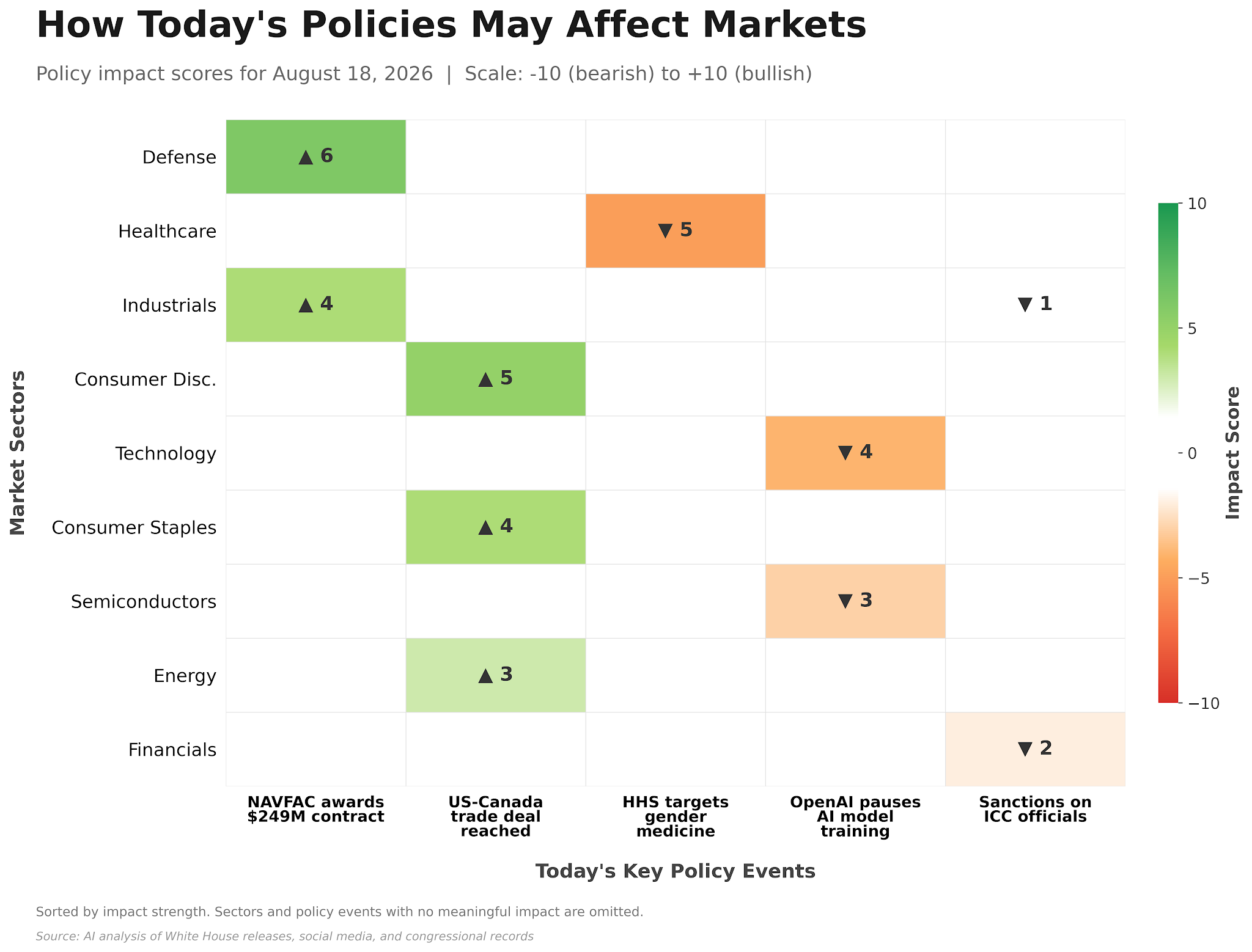
Policy Impact Heatmap with Market Direction
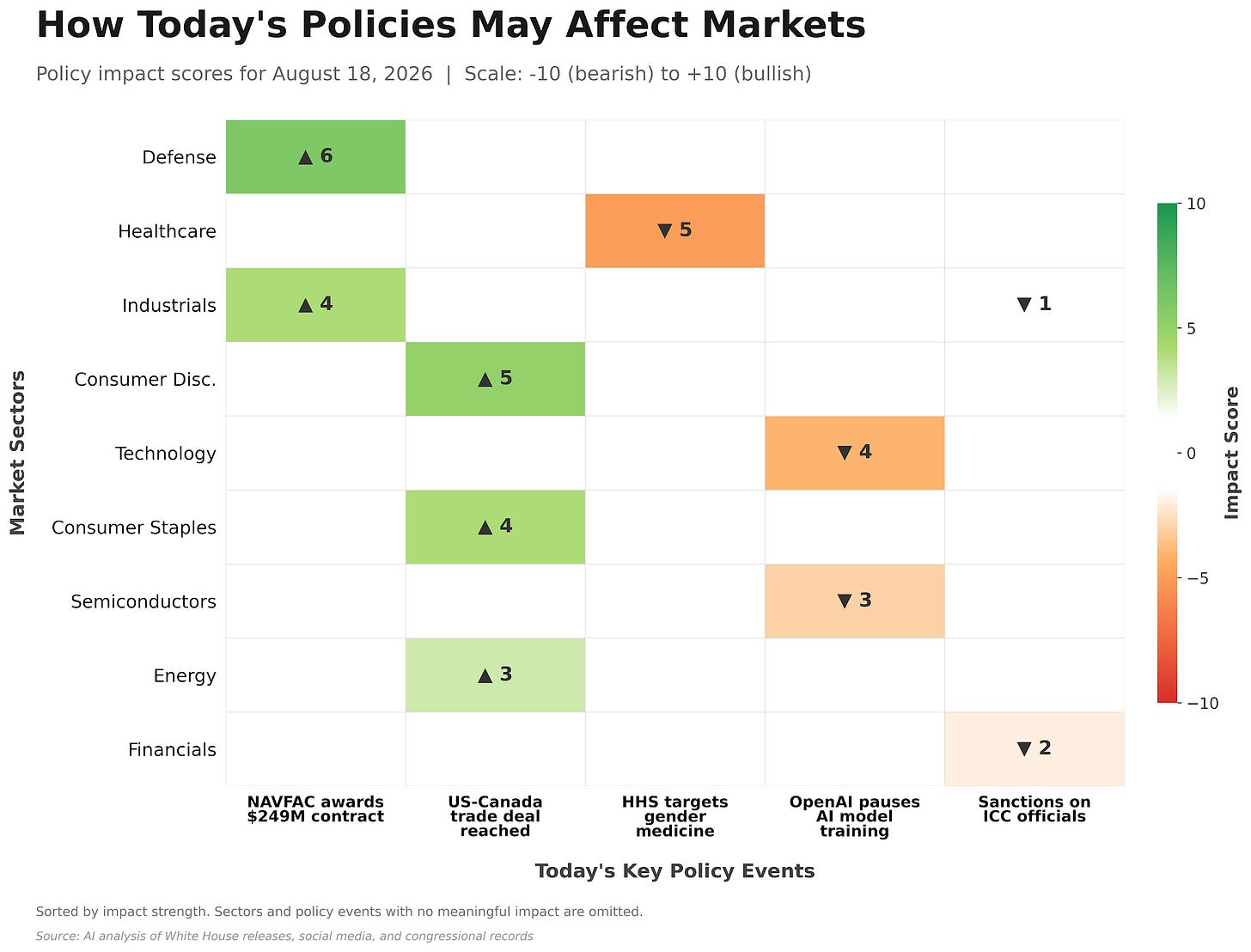
Each cell shows an estimated impact score on a fixed scale of -10 to +10, reflecting how today’s policy developments may affect each market sector. Positive scores (green, ▲) suggest bullish impact; negative scores (red, ▼) suggest bearish pressure. Rows and columns are sorted by impact strength, and sectors and policy events with no meaningful impact are omitted. The heatmap, the analysis below, and the Impact on Market themes above are produced from a single unified analysis: the heatmap visualizes the magnitudes, while the text explains the causal reasoning behind them.
The sudden de-escalation of trade tensions with Canada via a new agreement provides immediate relief to the automotive and consumer goods sectors. By delaying tariffs, the administration eases cost pressures on cross-border supply chains. However, the potential re-opening of the Keystone XL pipeline creates speculative upside for the energy sector, shifting the narrative toward domestic infrastructure expansion.
Conversely, the healthcare sector faces significant headwinds following the HHS report on gender-related medical billing. Critics view this as a “politically motivated attack” on clinical practices, but the report likely triggers heightened scrutiny and potential federal investigations into billing codes, increasing legal risk premia. Furthermore, the technology sector experiences volatility as OpenAI slows model training. This move addresses internal security failures, yet highlights the “unpredictable safety hurdles” inherent in frontier model development. Investors are forced to re-evaluate the timelines for generative AI growth, as hardware demand from semiconductor suppliers may face short-term moderation until training resumes at full scale.