TrumpWatch publisher
-
What Did Jeanine Pirro Know and When Did She Know It?
emptywheel.net
Davey Hearn has responded to Jeanine Pirro’s motion to dismiss his indictment with a two part ask:- Predictably, to dismiss the indictment with prejudice, so Trump can’t fire Pirro and install someone else who’ll recharge Hearn
- In conjunction with that, if Judge Todd Edelman feels like he needs more information before deciding whether to dismiss without (as Pirro requested) or with (as Hearn countered) prejudice, he should consult grand jury transcripts or simply turn them over to Hearn
Normally, the motion to dismiss would moot the grand jury transcript request, but this is similar in posture to what happened with the Broadview 6. And besides, Pirro left herself open for that request by moving to dismiss without prejudice, and Hearn explains more about the abuse of the grand jury in his response.
In it, Hearn described two previously unidentified pieces of evidence that seem to prove that Pirro came to understand that Hearn’s prosecution was shit — and came to learn that via different means — than her claimed excuse, that Interior stalled on turning over relevant information. And he described two problems with discovery which might explain the real reason why Pirro wants out of this case now.
Before I get there though, Hearn makes an argument that could be important going forward (especially given the way Doug Burgum has blabbed his mouth). He argues that Interior is not just the victim agency — the Park Service whose reflecting pool was allegedly damaged. But because Hearn was arrested by the Park Police, which is part of Interior (and reports to Burgum), Interior is part of the investigative team, as well. If Judge Todd Edelman agreed, that would make the evidentiary problems described below more problematic. To be sure, DOJ consistently succeeds in arguing against such claims, but given the suspect testimony from Park Police, might not be able to do so here. That is, this is an assertion we may see again.
As a reminder, DOJ’s Motion to Dismiss lays out the following timeline to explain Pirro’s purportedly belated discovery her case was shit:
- June 19: Hearn arrested
- Unspecified date: DOJ [makes] dozens and dozens of requests for information [are made]
- July 2: Grand jury indicts and Pirro makes unhinged comments at a press conference just in time for July 4
- July 10: The pool is drained
- July 17 (or maybe July 16, though Hearn does not correct this date): Prosecutors accompany Hearn’s expert and realize, as if for the first time, that the pool is riddled with damage
- After July 17: Interior provides DOJ with the materials they did not produce beforehand which takes days to read
- July 31: Almost two weeks later, prosecutors decide they have to dismiss the case
Hearn adds at least three new details to that timeline (in bold):
- June 19: Hearn arrested
- Unspecified date: DOJ [makes] dozens and dozens of requests for information [are made]
- June 30: Interior completes a report, “Lincoln Memorial Reflecting Pool Damage Assessment” that describes peeling for which Hearn accused as possible vandalism “after initial peeling”
- July 2: Grand jury indicts and Pirro makes unhinged comments at a press conference just in time for July 4
- July 10: The pool is drained
- July 10: DOJ provides the Damage Assessment to Hearn
- July 13: DC Special Agents photographed damage throughout the pool
- July 17 (or maybe July 16, though Hearn does not correct this date): Prosecutors accompany Hearn’s expert and realize, as if for the first time, that the pool is riddled with damage
- After July 17: Interior provides DOJ with the materials they did not produce beforehand which takes days to read
- July 31: Almost two weeks later, prosecutors decide they have to dismiss the case
That is, Pirro (or at least her prosecutors) had to have known both that Interior knew there had been prior damage (which is precisely how their equivocating witness had originally testified before he was sent back to the grand jury to testify that Hearn had done $1,000 of damage) before July 10 and had to have known what it looked like by July 13, four days earlier than DOJ claims.
The MTD is thoroughly dishonest about the timeline, claiming they didn’t learn things until around July 19 that they had notice of no later than July 10. So why attempt to claim they couldn’t have known until at least nine days later than they did?
Before I speculate about that, let me first describe the two big discovery problems Hearn described.
In this post I noted (based on WaPo’s reporting; note my screen cap below reflects my time zone and so a June 25 date) that the Park Police had released that video that Trump keeps posting on June 24, purporting to be looking for leads for an incident that happened at a different part of the pool an hour before Davey Hearn showed up.

Hearn’s filing notes that it was actually shared earlier: First with Jesse Watters, for an “exclusive” piece that aired on June 23. Then in a Department of Interior post from the same day pointing to the Watters piece. Then the Park Police BOLO above, on June 24. And then, over and over, especially on August 1 in response to the MTD, by the President. Everyone got that video, starting with Fox News!
Except Hearn.
As Hearn notes, “To this day, Mr. Hearn never received this CCTV footage from the government.”
Whether or not Interior was really withholding materials from DOJ, it was giving relevant information to Pirro’s former colleague at Fox News that it did not provide to Hearn.
I can see why having to explain why Fox was getting stuff that Hearn was not might have been persuasive to Pirro.
But the other discovery problem is potentially far more damaging. I keep posting this image, which DOJ explained confidently in its MTD was taken by a Parks Service employee who was not involved in the conflict with Hearn at 2:55PM, over an hour before Hearn showed up. It shows the flap of liner Hearn was accused of causing, already loose before he showed up.

In this post, I speculated that this photo may be one of the ones Hearn wanted more detail about in a discovery request submitted on July 27.
I was right.
A footnote explains that, in addition to the filing I referenced, there were two other requests pertaining to this photo.
14 The government had previously represented, including in sworn testimony presented to the grand jury that indicted Mr. Hearn, that the photograph was taken by a different NPS employee, but has apparently altered this incorrect factual assertion following requests for information about the photographs, including metadata, made by the defense. See Def.’s Mot. Rule 41(g) and Mot. Compel and accompanying Sealed Exhibit C; Def.’s Mot. for Disclosure and accompanying Sealed Exhibit 2. The government never provided the defense with complete metadata for its alleged “before” and “after” photos before moving to dismiss this case. [links added]
Not only didn’t DOJ ever give the metadata to Hearn (possibly hiding their knowledge that the flap was there before Hearn showed up), but they made an affirmative, sworn misrepresentation about who took the photo, seemingly in both the affidavit to seize Hearn’s phone (Exhibit C above) and the investigative witness in the grand jury (Sealed Exhibit 2 above).
Note there are two witnesses whose testimony Hearn has shown need for, MR, the witness describing the harm Hearn purportedly did, and MF, the investigative witness who summarized the unsworn testimony of the Parks Service employee who accused Hearn. The MF transcript mentions the photo.
DOJ seems to have claimed, in both the grand jury testimony and the affidavit, that the primary witness against Hearn (described as W-1 in the MTD) took both the before and the after photos. But in the MTD, they say a third Parks Service employee, identified as W-3, took the photo — again, more than an hour before Hearn showed up. (And I wonder whether W-3 is MR, the guy who testified about harm.)
But that would mean W-3 knew the damage was there a full hour before Hearn arrived.
I can see why Hearn invited Edelman to review the grand jury transcripts, even though they would otherwise be mooted. Because DOJ went to great lengths to blame this on Hearn, both by keeping Hearn’s accuser out of the grand jury and (apparently) by claiming she took a photo that someone else took an hour earlier.
From the start, Norm Eisen has been arguing that DOJ dropped the case because of the court filings they had filed, not any new information. And certainly, the June 30 report and the July 13 pool visit show that DOJ already had the information that the MTD claims they only got after July 17.
But now look at the timeline with Hearn’s filings:
- June 19: Hearn arrested
- Unspecified date: DOJ [makes] dozens and dozens of requests for information [are made]
- June 30: Interior completes a report, “Lincoln Memorial Reflecting Pool Damage Assessment” that describes peeling for which Hearn accused as possible vandalism “after initial peeling”
- July 2: Grand jury indicts and Pirro makes unhinged comments at a press conference just in time for July 4
- July 9: DOJ seizes Hearn’s phone
- July 10: Hearn requests his phone back, pointing to non-disclosure of his own photo and the games played with the before and after ones
- July 10: The pool is drained
- July 10: DOJ provides the Damage Assessment to Hearn
- July 13: DC Special Agents photographed damage throughout the pool
- July 16: Hearn moves to dismiss the indictment because Interior drained the pool
- July 17 (or maybe July 16, though Hearn does not correct this date): Prosecutors accompany Hearn’s expert and realize, as if for the first time, that the pool is riddled with damage
- After July 17: Interior provides DOJ with the materials they did not produce beforehand which takes days to read
- July 27: Hearn requests grand jury transcripts which show DOJ’s harm witness could not attribute damage to Hearn
- July 28: Hearn clarifies that DOJ has still not provided key metadata for the before and after photos (as well as one sent by a third party)
- July 28: Hearn reveals he has just gotten a second transcript for the harm witness, showing he was brought back into the grand jury to claim Hearn did $1,000 of damage
- July 31: Prosecutors move to dismiss the case
In WSJ’s story on the drama involving Pirro, it reveals that prosecutors had warned her not to charge a felony against Hearn.
Belying her public confidence were questions career prosecutors had privately raised about the wisdom of bringing a felony case, according to people familiar with the internal discussions.
Even in spite of that warning, prosecutors played games when pursuing that felony, hiding problems with both their primary witnesses.
WSJ also reveals that Pirro is paying career prosecutors $25,000 to stick around — the kind of financial incentive that might lead a prosecutor to fiddle with the grand jury to do what she demanded.
Last month, Pirro offered prosecutors in her office a $25,000 retention bonus to stay for the next two years, according to people familiar with the matter.
In her post-indictment press conference on July 2, Pirro insisted that an assessment of the evidence led to the felony charge, as opposed to the misdemeanor for which Hearn was originally charged.
What did Jeanine Pirro know when she falsely claimed the evidence directed her choice to get a felony indictment and falsely claimed she had a witness who would prove Hearn did $1,000 of damage?
What did Jeanine Pirro know and when did she know it.
Betcha $25,000 we might yet find out!
The post What Did Jeanine Pirro Know and When Did She Know It? appeared first on emptywheel.
-
FAA investigates air ‘safety incident’ involving Trump’s helicopter
www.theguardian.comControllers allegedly failed to halt flights, leading to a ‘loss of separation’ between Marine One and passenger jet
An air “safety incident” in which Donald Trump’s Marine One helicopter came closer than permitted to another aircraft over Washington DC is under investigation by the Federal Aviation Administration (FAA).
Air traffic controllers are believed to have mistakenly failed to halt commercial flights at Ronald Reagan National airport in northern Virginia on Tuesday afternoon when the military helicopter took off from the White House with the president on board.
Continue reading... -
Middle East crisis live: Israel resumes Lebanon strikes as US-Iran Hormuz stand-off continues
www.theguardian.comIDF had issued warning to inhabitants of southern Lebanese village to flee homes before striking
There is a “50-50” chance that Iran and Oman will reach a deal to reopen the strait of Hormuz on Friday, a senior Gulf official familiar with the talks has told CNN, despite Donald Trump suggesting an agreement could come as early as Wednesday.
As we reported earlier, Iran has said its talks with Oman to reopen the strait of Hormuz were progressing “positively”.
Continue reading... -
Trump’s university ‘compact’ is gone. That doesn’t mean the assault on education is over | Kenneth Roth
www.theguardian.comThe administration’s proposed agreement met a scathing response. But universities must remain vigilant
The Trump administration has quietly abandoned the poisonous deal it tried to foist on American universities. Under its so-called Compact for Academic Excellence in Higher Education, the administration offered select universities privileged access to federal grants if they agreed to conform with Donald Trump’s ideology on how they should be run.
Universities widely pilloried the proposal, demonstrating the power of a collective defense. Higher education in the United States certainly needs reform, as many university leaders and the public would acknowledge, but not according to the dictates of Trump.
Kenneth Roth is a Guardian US columnist, a senior fellow at Yale University, and former executive director of Human Rights Watch. He is the author of Righting Wrongs: Three Decades on the Front Lines Battling Abusive Governments
Continue reading... -
The Sims and EA FC maker Electronic Arts sells for $55bn to Saudi-led group
The sale of gaming giant Electronic Arts (EA) for $55bn (£41bn) to a group of buyers including Saudi Arabia's Public Investment Fund (PIF) has been finalised. The American company is known for making and publishing best-selling games such as EA FC, formerly known as Fifa, The Sims and Mass Effect. The investors, who include Affinity Partners - led by President Donald Trump's son-in-law, Jared Kushner - are taking EA private, meaning all of its public shares will be purchased and it will no longer be traded on a stock exchange.www.allsides.com -
Chuck Schumer Eats S***
Imagine if Donald Trump went all-in endorsing a candidate for the Senate, campaigned for them and helped raise eleven times as much money as their opponent — who then lost. There would be wall-to-wall media coverage declaring the end of Trump's influence and of the Republican Party as we know it. "Trump's Bitter Defeat," The New York Times would say; "The End of an Era ," The Washington Post would echo. This actually just happened in Michigan's Senate primary — with one detail glaringly absent. Basically the entire Democratic Party leadership supported Haley Stevens, who outspent El-Sayed eleven to one amid a relentless campaign of warnings about how bad news bears he would be for state, party, country — but lost. And the media's response? 'He didn't win by that much,' 'Now comes the hard part, the general election,' and so on.www.allsides.com -
A Hidden Geopolitical Threat to the Global Financial System? Oddities in the U.S.-Japanese Yen Intervention
www.crisesnotes.com
This is a Premium Piece of Notes on the Crises.
Buy a Paid Subscription Give a Tip!I am way overdue on commentary on international financial and currency markets. I hope, by the end of the month, to have my long delayed big picture piece on “Dollar Hegemony After the Second Trump Administration” published. I haven’t written about this topic since my monster piece in April of last year “Is the Trump Tariff Financial Crisis A Crisis of the Dollar? It Doesn’t Seem to Be … Yet”. I haven’t even written a piece confirming that that event appears, in retrospect, to be a “panic” not a “crisis”! Nor have I commented on the swap line Argentina got in October of last year.
There is so much going on in so many different directions in the second Trump administration, it's extremely difficult to keep track- let alone write about all of it! My areas of expertise have not been this interesting, dynamic and multifaceted in a long time. That’s… not good news for the rest of you.
Anyway, things with Japan itself remain roughly where we left off… oddly. I have had some partially finished writing on Japanese government securities, monetary policy and government pension funds sitting around for a couple of years now. Crises since Trump retook office have just gotten in the way. Look out for that later this year. I’ve long thought that the English language commentary on Japan’s monetary policy, or its “fiscal situation”, has been poor and has gotten worse as a new generation of economics and financial journalists believe that the lessons of the 2010s were mirages- if they are even familiar with them at all.
For now what’s important is that the Bank of Japan keeping interest rates lower than all the other major central banks has created “pressure” for the Japanese yen to depreciate relative to other currencies. This, however, has not been a crisis. Significant, persistent but gradual exchange rate depreciation may not be pleasant when it comes to import prices or the cost of traveling, but it is not a financial crisis. The macrofinancial concern is that this depreciation could move from “orderly” to “disorderly” based on broader financial market conditions.
This is what I mean when I say that things are “where we left off”. When Trump’s astounding 104% tariffs on China first came into effect on April 9th, the initial concern was over a shortage of dollar liquidity and a sharp appreciation of the U.S. dollar. Instead, we had shortages of dollar funding issues alongside a depreciating U.S. exchange rate. By the time I published my piece on the potential of a “crisis of the dollar”, it appeared that Asian and European investors may have been selling assets to lower their exposure to the U.S. dollar. Subsequent analysis from the BIS’s Hyun Shin and his coauthors largely substantiated that narrative- except for one crucial point.
-
Trump Blasts Big Oil Companies for 'Making Too Much Money'
President Trump said Chevron and ExxonMobil are "making too much money" and should return some of their profits back to the public. "When you look at one company where they made 12 times what they made the year before, they ought to give some of that back to the public," Trump told reporters in the Oval Office on Monday. "And they better cut the retail price, the consumer price."www.allsides.com -
Oil companies are profiting from the US-Iran war. That's a political headache for Trump
They're making too much money," President Donald Trump said in the Oval Office on Monday. Oil companies — and their colossal profits — were the latest target of his ire. "I don't like it. And I should be the last one to say because I'm a big free enterprise guy," Trump told reporters.www.allsides.com -
Let’s call Trump’s approach to Iran what it is: kindergarten diplomacy | Moustafa Bayoumi
www.theguardian.comAmid stop-and-start threats and with a divided staff, it’s clear Trump has no idea how to end a war that shouldn’t have begun
On Thursday, 23 July, after weeks of escalating attacks between the US and Iran, Donald Trump told a reporter that Iran hadn’t received “enough pain yet”, and he leveled a threat. “I am considering a massive attack. Bigger than ever before,” he warned. “I am close to making a decision.” Then, on Monday 27 July, he called it off.
A few days later, on Friday 31 July, Trump said: “We’ll be hitting them very hard. At some point, they’re going to say: ‘We just can’t take it any more.’” This time, it took him just one day to back down.
Continue reading... -
Democracy is at stake when foolish humans bet on machines being intelligent | Rafael Behr
www.theguardian.comWe need an enlightened US president to make the case for global AI regulation. Donald Trump is the exact opposite of what is needed
When I am woken by the sound of my dog whining, I understand that she is hungry and wants me to get up. When my alarm clock goes off, I don’t consider its needs. It is following an instruction to rouse me at a certain time but it doesn’t care if I stay in bed. It doesn’t try to get me up by other means. The dog, on the other hand, will go to plan B. She barks.
This capacity for autonomous action was once a difference between animals and machines. AI has blurred the line. Advanced models devise their own strategies to reach a goal. The task might be defined by a human master, but the machine weighs its options for delivery. It can make its own choices. Given rules, it can break them.
Continue reading... -
Decoding America: are the Democrats having their own Maga moment?
www.theguardian.comIn this episode of Guardian Australia’s weekly US politics podcast, co-hosts Jonathan Yerushalmy and Reged Ahmad take a look at how the Michigan Senate primaries could decide the future of the Democrats. This is a race that has revealed the civil war raging inside the party, as some seek to take it further to the left, with candidates such as Abdul El-Sayed. But will this schism be the Democrats’ Maga moment, or will it leave the party open to a Republican communist ‘red scare’ campaign that could cost them the midterms?
They also look at why the Senate unanimously passed a resolution declaring its opposition to any presidential pardon for Ghislaine Maxwell, the longtime associate of Jeffrey Epstein, as well as the next chapter in the reflecting pool saga and why Donald Trump said US attorney and Maga faithful Jeanine Pirro had ‘folded like an umbrella’
Read more:
El-Sayed holds narrow lead in Michigan Senate primary but race too close to call
Senate unanimously passes resolution opposing pardon for Ghislaine Maxwell
Trump accuses Jeanine Pirro of ‘folding’ by dropping reflecting pool charges
Continue reading... -
Armed man arrested near Trump's golf course ahead of president's visit
Authorities in California have arrested a man who was seen near a golf course owned by President Donald Trump in the Los Angeles area, ahead of the president's visit for a fundraising dinner there. Jeanine John Taele, 38, was found with a pistol and illegal ammunition at the Trump National Golf Course in Rancho Palos Verdes, investigators say.www.allsides.com -
Trump-backed Republican advances to face vulnerable Democrat in key House battleground
Republicans just took a major step forward in their goal to keep the House majority this November. A GOP hopeful backed by President Donald Trump advanced in a jungle primary for Washington's 3rd Congressional District alongside Rep. Marie Gluesenkamp Perez, D-Wash., and the two will now face each other in this fall's general election.www.allsides.com -
Washington Policy Review: August 4, 2026
washingtonpolicyreview.substack.comToday’s Report
1. Overview
2. White House News
3. Truth Social Posts
4. Government Department News
5. 2028 Democratic Presidential Candidates
6. AI & Tech Company News
7. Congressional Watch
8. Policy Impact Analysis & Heatmap
1. Overview
President Trump commemorated the 236th birthday of the U.S. Coast Guard, praising personnel as “America’s maritime first responders” tasked with countering cartels and stopping illegal maritime activity. He touted a $25 billion investment to modernize the fleet with new cutters and icebreakers as part of a “new Golden Age for America.” Additionally, the President championed his “America First” economic agenda, citing a manufacturing sector expansion and a $1.5 billion investment from Octapharma that is expected to create 1,500 jobs.
President Trump highlighted a media appearance by Treasury Secretary Scott Bessent, directing his followers to the official’s recent interview on CNBC. This social media post served to amplify the administration’s messaging on current economic policy and fiscal updates.
Governor Gavin Newsom issued three specific requests and updates regarding California’s wildfire season, including an invitation for President Trump to deliver overdue federal aid for 2025 wildfire recovery. Newsom noted that only $37 million of $1.5 billion in FEMA claims had been received, stating, “There are moments that rise above politics.” Furthermore, the Governor announced the deployment of CAL FIRE resources to assist Washington and Oregon, asserting that the state “believes in science,” and secured federal grants for the ongoing Gann Fire in Calaveras County.
Governor Wes Moore of Maryland issued a statement regarding the passage of a legislative amendment focused on congressional redistricting. Moore warned that “President Trump and Republicans across the country are working to rig the system, weaken voting rights, and make this pain permanent.” He argued that the amendment is necessary to prevent “political redlining” and to ensure that electoral authority remains with the citizens of Maryland.
NVIDIA announced several major initiatives, including a partnership with the National Science Foundation to expand regional AI infrastructure and the commercial release of “Alpamayo 2 Super,” an open model for autonomous vehicles and robotaxis. The company also unveiled advancements in GPU-optimized storage designed to bypass CPU bottlenecks in high-demand AI environments. Additionally, NVIDIA joined the Open Secure AI Alliance to promote the “Shared AI Findings Exchange” (SAFE) guidelines, which aim to standardize cybersecurity transparency and incident sharing for agentic AI systems. OpenAI also announced new cybersecurity safeguards for its models and introduced education-focused plugins for ChatGPT Work and Codex, while Anthropic appointed Mariano-Florentino Cuéllar as its first Chief Global Affairs Officer.
On August 3, the Senate passed several bills, including the Foreign Robocall Elimination Act, the Bankruptcy Threshold Adjustment Act, and the Youth Poisoning Protection Act. Senators also voted 89-4 to advance the AGOA Extension Act, which is intended to serve as a legislative vehicle for upcoming government funding measures. Meanwhile, the House of Representatives held only a brief pro forma session with no substantive legislative business or votes conducted.
Aggressive federal support for industrial reshoring strengthens domestic manufacturing capital expenditure, though this growth faces bearish headwinds from potential international trade retaliation and uneven regional implementation. In the technology sector, the focus on data architecture and hardware efficiency mitigates scaling bottlenecks for agentic AI, yet this transition increases systemic vulnerability through concentrated hardware reliance and heightened cybersecurity risks. Meanwhile, the strategic use of omnibus legislative vehicles like the AGOA Extension Act provides market stability by preventing fiscal shutdowns, even as critics argue this approach “circumvents traditional debate” and obscures the granular visibility of sector-specific regulatory shifts.
2. White House News
Presidential Message on the Birthday of the United States Coast Guard
President Trump commemorates the 236th birthday of the United States Coast Guard, honoring their service as “America’s maritime first responders.” He highlights their role in defending against “narco-terrorist cartels” and stopping the “illegal invasion at sea.” President Trump underscores his Administration’s $25 billion investment to rebuild the fleet, including new cutters, helicopters, and icebreakers, alongside recent bonuses for personnel. Emphasizing a “new Golden Age for America,” he pledges his continued support for the service members, praising their role in ensuring national security and prosperity.
Reference: https://www.whitehouse.gov/briefings-statements/2026/08/presidential-message-on-the-birthday-of-the-united-states-coast-guard/
Manufacturing Jobs Flock to the U.S. Thanks to President Trump’s America First Economic Agenda
President Trump’s economic agenda, featuring “Working Families Tax Cuts and America First trade policies,” is credited with driving an economic revival in the U.S. manufacturing sector, which saw its strongest expansion in over four years this July. Marking seven consecutive months of growth, this trend is highlighted by Switzerland-based Octapharma’s recent $1.5 billion investment to construct its first U.S. facility, creating 1,500 jobs. President Trump and his administration remain committed to their promise to “reshore American jobs, revitalize our domestic supply chain, and put America First.”
Reference: https://www.whitehouse.gov/releases/2026/08/manufacturing-jobs-flock-to-the-u-s-thanks-to-president-trumps-america-first-economic-agenda/
3. Truth Social Posts
Trump highlighted a recent media appearance by Treasury Secretary Scott Bessent, directing attention to the official’s interview with Joe Kernen on CNBC.
Reference: https://truthsocial.com/@realDonaldTrump
4. Government Department News
No relevant government department updates found for this date.
5. 2028 Democratic Presidential Candidates
Gavin Newsom (gov.ca.gov)
Governor Newsom is calling on President Trump to deliver federal disaster aid pledged 18 months ago following the January 2025 wildfire storms. While the President visits Los Angeles for a fundraiser, the Governor noted that California has received only $37 million of $1.5 billion in submitted FEMA claims. Newsom stated, “There are moments that rise above politics. This could be one of them, Mr. President,” urging the administration to fulfill its commitment to survivors in Altadena, Pacific Palisades, and Malibu who are still rebuilding.
California is deploying 20 CAL FIRE engines and four Rapid Extraction Module Support teams to assist with wildfires in Washington and Oregon. Since July 16, the state has coordinated the movement of 380 personnel and 60 engines to the Pacific Northwest. Governor Newsom emphasized the state’s solidarity with neighbors facing climate-driven threats, asserting, “We believe in science, and we also believe in our own eyes.” These deployments supplement local firefighting capacity and will not impact California’s internal emergency response readiness.
Governor Newsom secures federal assistance to support response to Gann Fire in Calaveras County
California has secured a Fire Management Assistance Grant (FMAG) from FEMA to support suppression efforts for the Gann Fire, which began on August 3 in Calaveras County. The fire has burned over 6,495 acres, forcing the evacuation of 1,473 residents. The grant allows state and local agencies to seek 75% reimbursement for eligible suppression costs. Governor Newsom stated that the assistance strengthens the state’s ability to “accelerate containment efforts, protect lives and property, and support communities facing ongoing evacuations.”
Governor Newsom announces appointments 8.4.2026
Governor Newsom announced several appointments, including Luis Garnica as Warden of Mule Creek State Prison and Jolie Poper as Chief Deputy General Counsel for the Department of Corrections and Rehabilitation. Additionally, Joseph Cannata and Vincent Hoenigman were appointed or reappointed to the Tahoe Regional Planning Agency Governing Board, and Natalie Arroyo was reappointed to the Klamath River Renewal Corporation Board of Directors. Most of these roles do not require Senate confirmation.
Wes Moore (governor.maryland.gov)
Governor Moore praised the Maryland General Assembly for passing a constitutional amendment regarding congressional redistricting. Moore stated that he has warned that “President Trump and Republicans across the country are working to rig the system, weaken voting rights, and make this pain permanent.” He argued that the amendment prevents “political redlining” and ensures that the final authority on representation rests with Maryland voters. Moore urged citizens to support the measure in the November election to maintain local control over the redistricting process.
6. AI & Tech Company News
OpenAI (openai.com)
Third-party cyber evaluations involving OpenAI models
OpenAI has detailed recent incidents regarding third-party cybersecurity evaluations of its AI models. In response, the company has implemented new safeguards designed to improve the rigor and security of the model testing and evaluation process.
New ways to learn and teach with ChatGPT Work and Codex
New education-focused plugins for ChatGPT Work and Codex are now available to support K–12 and higher education environments. These tools are designed to assist teachers, students, and researchers in their efforts to facilitate learning, conduct research, and build new projects.
Anthropic (anthropic.com)
Mariano-Florentino (Tino) Cuéllar to join Anthropic as Chief Global Affairs Officer
Mariano-Florentino (Tino) Cuéllar has been appointed as Anthropic’s first Chief Global Affairs Officer to lead international policy, strategy, and government relations. Cuéllar previously served as President of the Carnegie Endowment for International Peace and as a Justice of the Supreme Court of California. Having served on the President’s Intelligence Advisory Board and various academic and policy institutions, he will transition from his role as a Trustee of Anthropic’s Long-Term Benefit Trust to lead the company’s collaboration with global governments on AI development and governance.
NVIDIA (nvidia.com)
NVIDIA is partnering with the U.S. National Science Foundation to support State and Regional AI Infrastructure Hubs, aiming to broaden access to AI computing, software, and technical expertise. Modeled after NVIDIA’s collaboration with the University of Florida, the initiative helps university consortia pool resources to foster regional innovation. The program focuses on building a skilled workforce through flexible AI education and infrastructure, enabling institutions to address local economic needs and research priorities while preparing students for the AI economy.
NVIDIA has released Alpamayo 2 Super for commercial use under the Linux Foundation’s OpenMDW-1.1 license. Designed for robotaxis and autonomous vehicles, the model provides frontier-scale reasoning to handle complex, rare driving scenarios. It offers 360-degree context and produces causal reasoning traces and trajectory planning. According to NVIDIA, the model outperforms competitors like GPT-4o and Gemini 2.5 Pro on driving-centric benchmarks. It is part of an “open model” family designed to provide a cloud-to-car workflow that allows developers to customize and deploy autonomous systems efficiently.
As AI Increases Demands on Memory, Storage Steps Up
At the Future of Memory and Storage conference, NVIDIA unveiled storage advancements to support high-demand AI environments. The company is open-sourcing its cuFile APIs to allow GPUs to interact directly with storage, bypassing CPU bottlenecks and enabling microsecond-speed data access. NVIDIA also introduced the “Storage-Next” initiative, a collaboration with over 40 industry partners to create standardized, GPU-optimized storage architectures. These efforts aim to make storage an active component of the data path, ensuring that AI-powered systems can securely and efficiently process massive, concurrent data requests.
AI Leaders Propose SAFE Guidelines for Cybersecurity Transparency
The Open Secure AI Alliance, representing over 120 organizations, has proposed the Shared AI Findings Exchange (SAFE) guidelines to improve agentic AI cybersecurity. The initiative, supported by the Linux Foundation and members including NVIDIA, Cisco, and CrowdStrike, seeks to create a framework for sharing information on AI incidents and “near misses” to reduce systemic risk. NVIDIA highlighted its contributions to the defensive stack, including open-source tools for agent governance, runtime security, and vulnerability scanning, emphasizing that collective defense is essential for securing rapidly evolving AI agent systems.
7. Congressional Watch
Covers the 2026-08-03 session — the Congressional Record is published with a one-day delay.
Senate
The Senate conducted legislative business, including passing three bills related to public safety, bankruptcy eligibility, and robocalls. Senators also advanced the procedural path for an African trade extension bill that serves as the vehicle for a government funding measure.
H.R. 6500, AGOA Extension Act — Procedural motion to move toward consideration of this trade bill, which will also serve as a vehicle for a continuing resolution [Passed 89-4 (Vote No. 218)]
S. 2666, Foreign Robocall Elimination Act — Directs the FCC to establish a task force to combat unlawful robocalls [Passed by voice vote]
S. 3977, Bankruptcy Threshold Adjustment Act — Modifies specific bankruptcy eligibility requirements in federal law [Passed by voice vote]
S. 289, Youth Poisoning Protection Act — Bans the sale of products containing high concentrations of sodium nitrite to individuals [Passed by voice vote]
House of Representatives
The House held a brief pro forma session on Monday, August 3, with no substantive legislative business or votes conducted. The session lasted approximately 15 minutes.
No significant actions — No legislative business or voting occurred [N/A]
Committee Highlights
Senate Committee on the Budget — Examined the current state and reality of the Medicaid program
Senate Finance Subcommittee on Health Care — Examined the role of biotechnology in building a resilient health care future
Senate Committee on the Judiciary — Examined consumer costs associated with AI surveillance pricing
Senate Select Committee on Intelligence — Examined certain classified intelligence matters
Coming Up
The Senate will reconvene at 10:00 a.m. on Tuesday, August 4, 2026, to continue consideration of the AGOA Extension Act. The House of Representatives is scheduled to meet next in a pro forma session at 9:00 a.m. on Thursday, August 6, 2026.
Reference: Congressional Record Archive
8. Policy Impact Analysis & Heatmap
This analysis is provided for informational purposes only. It does not constitute investment advice or a recommendation to buy or sell any security.
Impact on Market
Based on today’s policy developments, our analysis identifies the following market impact themes:
THEME 1. INDUSTRIAL RESHORING AND MANUFACTURING EXPANSION
The administration is aggressively promoting capital expenditure in domestic manufacturing as a proxy for economic success. By linking tax cuts and trade policy to specific investment announcements, the executive branch attempts to validate its economic strategy. Bearish risks include potential trade friction if these protections create retaliatory measures from foreign partners. Critics also note that federal support remains inconsistent, as domestic recovery in regions suffering from natural disasters remains stalled despite promised funding.
THEME 2. AI INFRASTRUCTURE DE-BOTTLENECKING
Technological focus is shifting from pure compute power to the underlying data architecture required for agentic AI. NVIDIA’s integration with the NSF and new CPU storage products aim to resolve efficiency constraints that threaten to stall AI adoption at scale. While this enhances throughput for heavy users, it also increases reliance on centralized hardware providers. Cybersecurity concerns persist, as even collaborative efforts to share incident data face the risk of revealing proprietary vulnerabilities to sophisticated adversaries.
THEME 3. FISCAL LEGISLATIVE VEHICLES
The Senate is utilizing the AGOA Extension Act as a legislative engine to ensure government funding continuity. This procedural step is intended to avoid market-disrupting shutdowns while addressing broader trade obligations. The reliance on such legislative ‘vehicles’ often leads to complex, omnibus-style bills that complicate sector-specific policy visibility. Opposition figures warn that this method circumvents traditional debate, potentially leaving controversial policy changes buried within necessary appropriations.
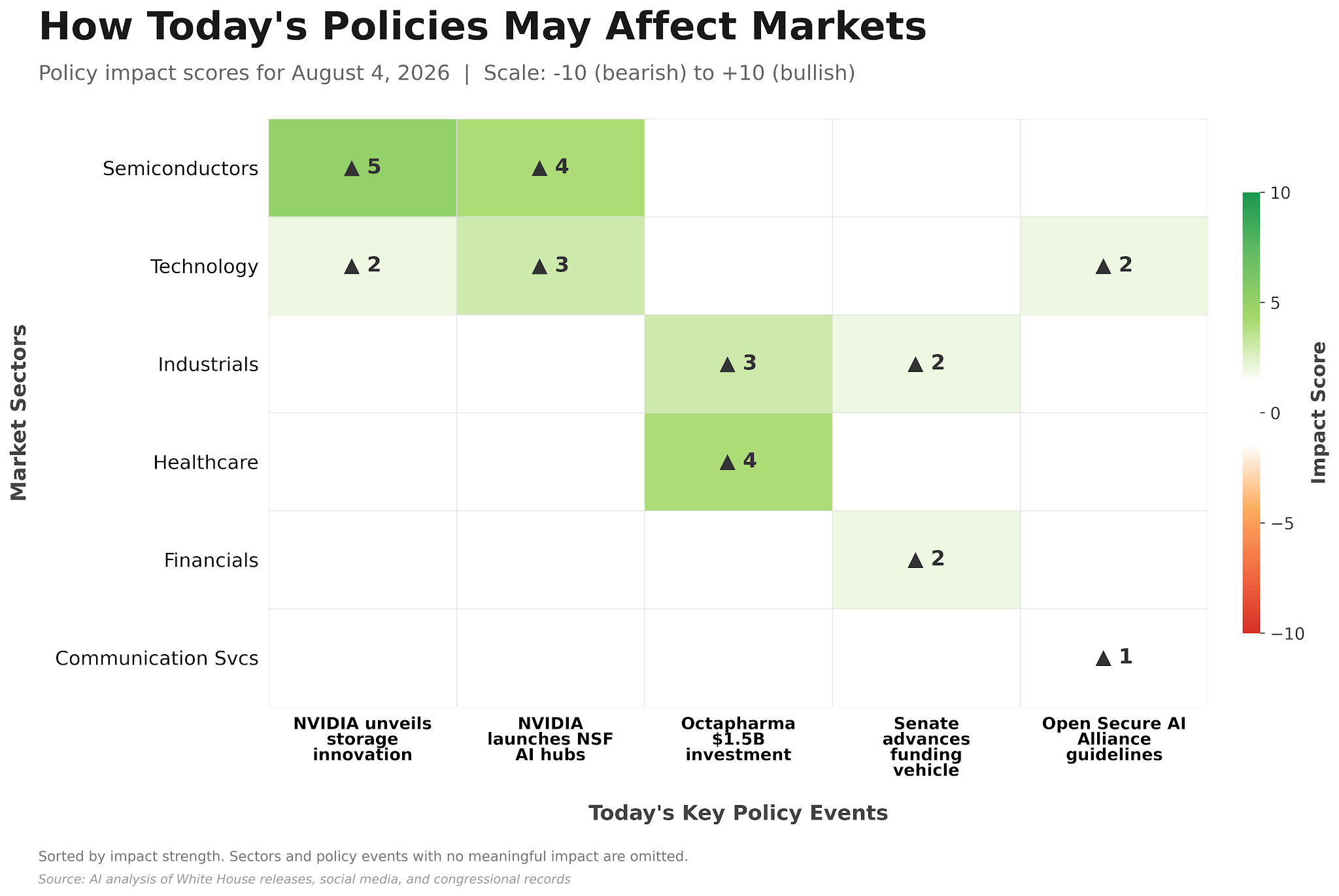
Policy Impact Heatmap with Market Direction
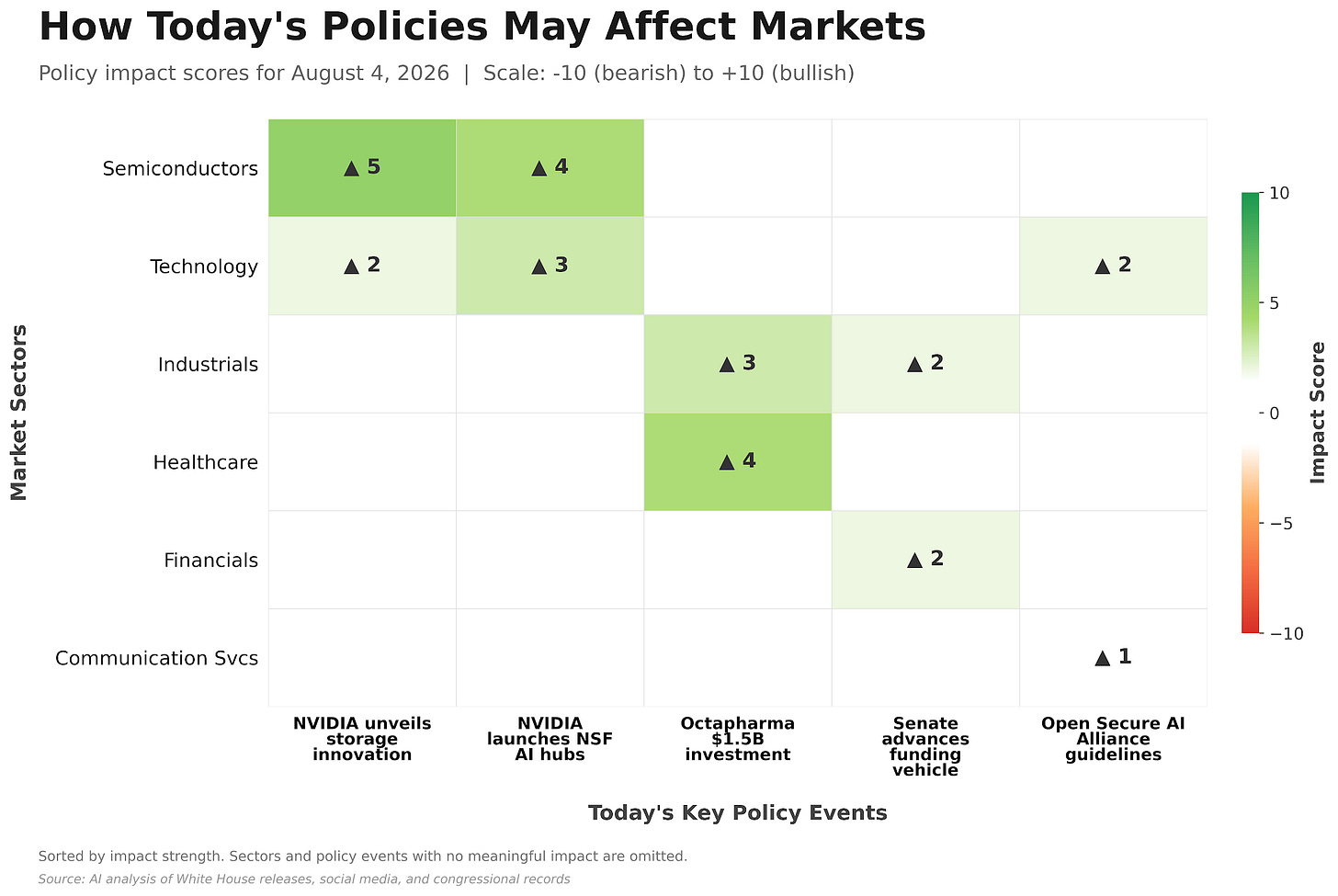
Each cell shows an estimated impact score on a fixed scale of -10 to +10, reflecting how today’s policy developments may affect each market sector. Positive scores (green, ▲) suggest bullish impact; negative scores (red, ▼) suggest bearish pressure. Rows and columns are sorted by impact strength, and sectors and policy events with no meaningful impact are omitted. The heatmap, the analysis below, and the Impact on Market themes above are produced from a single unified analysis: the heatmap visualizes the magnitudes, while the text explains the causal reasoning behind them.
Government policy and industrial expansion are driving current market sentiment. The Senate’s move to use the AGOA extension as a vehicle for government funding provides a critical signal for fiscal stability, reducing potential volatility around a looming budget expiration. Simultaneously, the administration is emphasizing manufacturing growth, citing capital inflows like the new Octapharma facility as evidence of successful ‘America First’ industrial policy. Critics, however, argue that such growth remains uneven, as evidenced by local leadership complaints regarding delayed federal disaster aid in California, which they characterize as an ‘18-month’ failure to address urgent recovery needs.
Technological advancement is pivoting toward infrastructure integration. NVIDIA’s deployment of NSF AI hubs and new storage architectures directly addresses the ‘bottleneck’ issues currently plaguing high-compute AI environments. These moves are likely to lower barriers to entry for research institutions, theoretically broadening the customer base for accelerated computing. The cybersecurity initiatives led by the Open Secure AI Alliance represent a proactive regulatory posture, attempting to standardize safety protocols before systemic failures occur. Such moves aim to protect intellectual property, though they reflect rising anxieties that ‘agent speed’ attacks may outpace current defensive infrastructure.
-
Missouri rejects citizens’ bid for vote on Trump-backed redistricting plan
www.theguardian.comMissouri’s top election official has rejected a petition for a referendum on new congressional districts
Missouri’s top election official has rejected a citizens’ petition seeking a statewide referendum on the state’s redistricting plan backed by Donald Trump.
Supporters of the referendum had submitted hundreds of thousands of petition signatures in an effort to force a November election on whether to use a new US House map approved by the Republican-led state legislature. But the Republican secretary of state, Denny Hoskins, asserted on Tuesday that the petition was void because congressional redistricting plans cannot be subject to voter referendums.
Continue reading... -
US revokes Brazil ambassador’s visa in escalation of diplomatic feud
www.theguardian.comMove is retaliation for Lula’s government refusal to approve Trump’s nominee for ambassador in Brasília
Donald Trump’s administration has revoked the visa of Brazil’s ambassador to the US in a sharp escalation of a diplomatic feud with the country’s president, Luiz Inácio Lula da Silva.
The US state department said Maria Luiza Ribeiro Viotti’s visa had been cancelled in retaliation for Brazil’s refusal to approve Trump’s nominee for ambassador in Brasília and its decision last month to deny visas to two US diplomats seeking to visit ahead of an October election.
Continue reading... -
Mike Lindell, MyPillow CEO, steps down from post to run for Minnesota governor
www.theguardian.comTrump loyalist, who also has president’s endorsement, has spent millions trying to prove 2020 election was ‘stolen’
Mike Lindell is leaving his role with the MyPillow company to focus on his campaign to become the next governor of Minnesota. In a social media post published on Tuesday, Lindell said that the company was strong enough to withstand his departure.
“This decision is not about walking away. It is about stepping forward to serve. I am putting Minnesota above myself, my title, and my business interests so I can give this campaign and the people of our state my full time, energy, and attention,” Lindell said.
Continue reading... -
Armed man arrested at Trump’s California golf course
www.theguardian.comJeanine John Taele allegedly took photos and videos of property days before president’s visit
Los Angeles county sheriff’s deputies arrested an armed California man over the weekend who was seen surveilling Donald Trump’s golf course in Rancho Palos Verdes, days before the president was set to arrive there for an event with the Republican National Committee (RNC).
Plainclothes federal agents reported Jeanine John Taele, 38, as a “suspicious individual”, after they observed him on Sunday taking photographs and videos of the golf grounds, located in a coastal town south of Los Angeles, according to county officials.
Continue reading... -
Trump Tyranny Tracker | Day 558-560: July 31-Aug 2, 2026
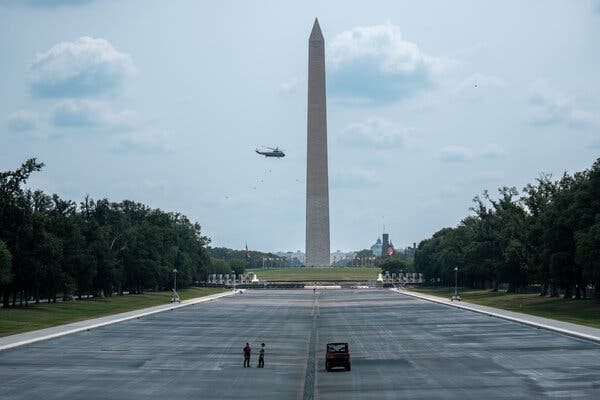
trumptyrannytracker.substack.com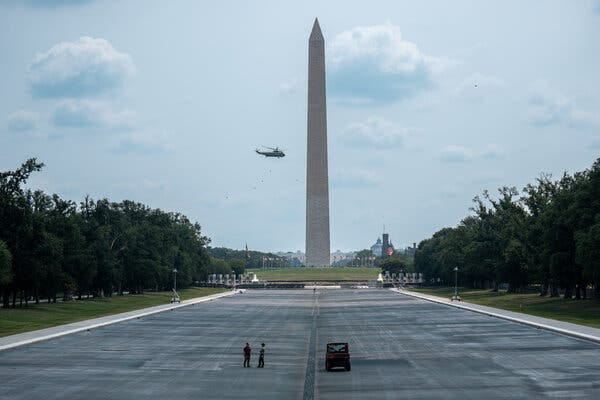 Marine One flying past the Lincoln Memorial Reflecting Pool earlier this week. The pool was drained so that the faults in the lining could be inspected and repaired. Credit...Andrew Leyden for The New York Times
Welcome to today’s Trump Tyranny Tracker…
Trump’s unprecedented corporate fundraising operation, escalating abuses in the immigration crackdown, and efforts to pressure law firms, journalists, and other institutions were among this weekend’s biggest stories.
This Weekend at a Glance
Trump has raised more than $800 million while personally soliciting multimillion-dollar donations from companies with business before his government.
Dozens of people, including 32 U.S. citizens, are seeking damages over alleged abuse by federal immigration agents.
Hackers targeted water systems across several states, forcing some utilities to operate manually as the FBI investigates Iranian involvement.
What We Need to Pay Attention To
Justice Dept. Subpoenas Times Freelancer in Effort to Identify Sources
What Happened: The Justice Department subpoenaed New York Times freelancer Matthew Cole, seeking two years of information about his contacts and conversations to identify sources for his reporting on a failed SEAL Team 6 mission in North Korea. DOJ has refused to withdraw the subpoena after backing down from similar efforts targeting other NYT journalists, the Washington Post, and Wall Street Journal.
Why It Matters: This is part of Trump’s broader attack on the press. If the government can expose confidential sources by digging through reporters’ records, whistleblowers will think twice before coming forward, and journalists will have a harder time exposing government corruption and misconduct.
Source: New York Times
Corruption
‘The Boss Wants This Money’: Inside Trump’s Unprecedented Fundraising Operation
What Happened: Trump has raised more than $800 million since returning to office, personally directing aides to solicit multimillion-dollar donations from companies for his political and vanity projects. He keeps track of who donates, tells companies to contribute between $25 million and $50 million, and offers major donors special access. Meanwhile, his government makes decisions affecting many of their businesses.
Why It Matters: Trump is keeping track of which companies give him money while his government makes decisions affecting their businesses. This is cronyism in plain sight, with companies paying millions to maintain access and influence while seeking favorable treatment from his government.
Source: Wall Street Journal
Trump stands to profit off US policy announcements by selling fast access to his social media posts
What Happened: Trump Media is launching a $100,000-a-month service giving Wall Street traders faster access to Trump’s Truth Social posts, including presidential announcements on tariffs, wars, companies, and other policies that move markets. Trump retains a major financial interest in the company collecting the subscription fees.
Why It Matters: Trump is charging Wall Street $100,000 a month for faster access to his market-moving announcements, with the money flowing to his company. He is literally monetizing the presidency and selling insider information to those willing to pay.
Source: Associated Press
Power Consolidation
How a Top Law Firm Went From Standing Up to Trump to Bending the Knee
What Happened: Paul Weiss capitulated after Trump targeted the firm with an executive order imposing crippling sanctions. Eight other major law firms also struck deals with the White House, collectively agreeing to provide nearly $1 billion in free legal work for Trump’s causes.
Why It Matters: Firms that fought Trump in court won. The ones that capitulated show how threats of government retaliation can force even the most powerful firms to bend the knee without Trump having to take any action.
Source: New York Times
Maryland Gov. Wes Moore says he’s ‘very concerned’ Trump will interfere in the midterm elections
What Happened: Maryland Gov. Wes Moore warned that Trump is using federal power in ways that could interfere with the midterms, pointing to efforts to restrict mail voting, obtain voter data from states, and potentially deploy federal troops or agents to polling places.
Why It Matters: States are preparing to defend their elections not from foreign adversaries, but from the federal government. Because of Republicans, governors are making contingency plans to prevent federal control over elections.
Source: Associated Press
Weaponization of Institutions
Charges Dropped in Reflecting Pool Case as Prosecutors Say Work Was ‘Botched’
What Happened: Federal prosecutors dropped felony charges against former Olympian David Hearn after evidence showed the Lincoln Memorial Reflecting Pool was damaged by a botched renovation, and not vandalism as Trump and his officials claimed. The new lining began peeling within days of installation.
Why It Matters: DOJ pursued felony charges carrying up to 10 years in prison over damage Trump and DOJ knew came from its botched renovation. Trump pushed a lie to deflect blame for his failed project, and the DOJ turned that lie into a criminal case.
Source: New York Times
Blanche’s nomination may be stalled, but payouts to Trump allies are underway
What Happened: Acting Attorney General Todd Blanche said Trump’s proposed $1.776 billion slush fund is “dead,” but DOJ has already made several payouts, including a seven-figure settlement to anti-abortion activist Paul Vaughn, whom Blanche called a victim of Biden-era “weaponization.” Nearly 600 Jan. 6 defendants have also filed claims seeking taxpayer-funded compensation under existing federal law.
Why It Matters: Calling the $1.776 billion fund “dead” is meaningless when DOJ is already making the payouts. Taxpayer money is being used to compensate Trump’s criminals that he calls “victims” of political persecution, while nearly 600 Jan. 6 defendants are demanding their share.
Source: MS NOW
Media Suppression and Authoritarian Tactics
After Claiming ‘Bias’ at Smithsonian, Trump Officials Stage Patriotic Exhibition
What Happened: After Trump accused the Smithsonian of presenting a negative view of American history and ordered signs directing visitors elsewhere for “accurate information,” the State Department opened its “patriotic” exhibition near the White House. No historians or professional museum curators worked on the exhibition, and several featured artists have personal connections to its organizers.
Why It Matters: Trump is using the federal government to decide which version of American history is acceptable. Attacking independent museums as biased and replacing exhibits with government-approved propaganda is a classic authoritarian tactic to rewrite history.
Source: New York Times
Human and Civil Rights Abuses
Thousands of migrant children in the US could face new deportation risks as legal aid deal expires
What Happened: Trump is allowing a federal contract providing legal services to roughly 20,000 unaccompanied migrant children to expire, leaving many without attorneys in deportation proceedings. The government has also withheld payments to legal providers for more than six months, forcing layoffs and office closures.
Why It Matters: Twenty thousand children, some fleeing abuse or persecution, could be forced to face deportation alone without a lawyer. Trump withheld funding for six months and is now letting their legal aid expire, stripping vulnerable children of one of their only protections against deportation.
Source: Associated Press
“The ICE Agent Behind Me Grabbed the Back of My Shirt and Just Threw Me Like a Sack of Trash”
What Happened: Fifty-four people filed claims against the federal government seeking damages for alleged abuse by ICE and DHS agents. The claimants include 32 U.S. citizens and describe beatings, wrongful detention, pepper spraying, forced labor, and other violence, including a 68-year-old nurse who suffered a concussion and fractured kneecap after an ICE agent allegedly threw her to the ground.
Why It Matters: Fifty-four people, including 32 U.S. citizens, have come forward with claims of beatings, wrongful detention, and other abuse by federal immigration agents. The growing number of cases points to a broader pattern of violence with no accountability.
Source: Mother Jones
Senate Report Describes ‘Top-Down Culture of Cruelty’ in ICE Detention
What Happened: A Senate investigation into the South Texas Family Residential Center found reports of inadequate medical care, inedible food, lack of education, restricted access to lawyers, and deliberate mistreatment of children. Families said guards disrupted children’s sleep, taunted them with food, and were instructed by supervisors to treat detainees harshly.
Why It Matters: Supervisors allegedly instructed guards to treat detainees harshly, including children. The cruelty came from the top, creating a detention system where serious human rights abuses were encouraged and normalized.
Source: Talking Points Memo
US ICE detains Johns Hopkins researcher as airport arrests surge
What Happened: ICE detained Johns Hopkins researcher Fatima Ameaka at Baltimore/Washington International Airport as she prepared to board a domestic flight. Her arrest comes amid a surge in airport immigration enforcement targeting visa overstays, including people with pending asylum or marriage applications.
Source: Reuters
Immigration crackdown threatens Haitian caregivers and the seniors who rely on them
What Happened: Trump ended Temporary Protected Status for 350,000 Haitians, forcing employers to fire caregivers who have legally worked in the U.S. for years. Nursing homes, home health agencies, and disability services already facing worker shortages are losing staff, leaving seniors and disabled Americans without longtime caregivers.
Why It Matters: On top of the cruelty, Trump’s immigration crackdown is also taking caregivers away from seniors and disabled Americans who depend on them for basic daily care. Removing thousands of workers from an industry already facing severe shortages will make the existing healthcare crisis worse.
Source: Associated Press
Government Services Disruption and Collapse Watch
Pentagon weighs eliminating civilian tenure at military academies and reviewing all curriculum, draft memo says
What Happened: A draft Pentagon memo would eliminate civilian faculty tenure at U.S. military academies and war colleges and order a line-by-line review of every course. Courses deemed “ideologically driven” or nonessential could be eliminated, though the proposal has not yet been approved.
Why It Matters: Political appointees could decide which professors stay and what future military leaders are allowed to learn. Calling courses “ideological” gives Trump officials an excuse to purge anything from military education they don’t politically agree with.
Source: CBS News
In Nebraska, Americans begin to lose Medicaid under Trump’s work rules
What Happened: Nebraska became the first state to remove people from Medicaid under work requirements created by Trump’s 2025 law, with roughly 200 people losing coverage beginning August 1. The requirements will eventually affect about 20 million people across 44 states, with an estimated 3 million to 8.6 million potentially losing coverage by 2028.
Source: NPR
Former Officials Protest U.S. Plan to Defund Pan American Health Organization
What Happened: Trump’s proposed budget eliminates U.S. funding for the Pan American Health Organization, which monitors disease outbreaks and coordinates public health responses across 35 countries. The U.S. already owes nearly $135 million in overdue payments after Trump withdrew from the World Health Organization and ended its funding.
Source: New York Times
Imperial & Geopolitical Watch
Trump Blames Minnesota, Not Iran, for Cyberattack, Despite Initial Investigation
What Happened: Trump blamed Minnesota and Democratic Gov. Tim Walz for the cyberattack on municipal water systems, rejecting investigators’ preliminary assessment that Iran was likely responsible. The FBI says water facilities in at least seven states were targeted.
Why It Matters: American water systems were attacked, and instead of confronting the likely foreign adversary responsible, Trump blamed a political opponent. Turning a national security threat into a partisan attack puts Americans in danger while the real threat goes unanswered.
Source: New York Times
Sweeping cyberattack on water systems in multiple states has US officials on edge
What Happened: Hackers targeted water systems in at least seven states in a coordinated cyberattack, forcing some utilities into manual operations and boil-water notices. Federal agencies are working to secure vulnerable systems.
Source: CNN
Jordan Is Learning Its U.S. Alliance Has a Price in the Iran War
What Happened: Iran has fired at least 60 missiles and drones at Jordan since July 8, primarily targeting bases hosting U.S. forces. Three U.S. service members were killed in a July 17 strike, while opposition inside Jordan is growing against the American military presence.
Why It Matters: Trump’s war has turned a longtime U.S. ally into a target. American troops have been killed, Jordan is absorbing Iranian attacks, and growing public anger threatens a partnership the U.S. has relied on for decades.
Source: Wall Street Journal
Far-Right & Russian Influence Watch
Trump Backs Away From Deal to Let Ukraine Build Patriot Missiles
What Happened: Trump reversed his earlier promise to let Ukraine manufacture Patriot interceptors, saying the U.S. had “not agreed” to share the technology. The reversal comes as Ukraine is running critically low on Patriots and Russia continues launching daily mass ballistic missile attacks on Ukrainian cities.
Why It Matters: Ukraine is heading into another winter of Russia’s genocidal missile attacks, and Trump predictably won’t commit to providing interceptors or asking Musk for approval. We are already watching what happens when Ukraine runs out of interceptors, as Russian missiles hit residential buildings, and families are buried beneath the rubble.
Source: New York Times
Pentagon ends leadership of Ukraine aid group as US distances from Europe
What Happened: The Pentagon is giving up its leadership of the NATO command in Germany that coordinates military aid, training, and logistics for Ukraine, with another NATO country eventually taking over. The move follows cuts to U.S. military leadership and rotations in Europe.
Why It Matters: The U.S. is giving up another central role supporting Ukraine while Russia escalates its attacks. In another gift to Moscow, Trump is pulling America back from European defense and leaving Ukraine and NATO allies to deal with the repercussions.
Source: Politico
 Unmasking RussiaA Russian Missile Landed in Poland in the Latest Escalation Against NATOYesterday, Russia launched yet another massive missile and drone attack as cruise missiles, ballistic missiles, and drones tore through homes and residential buildings across Ukraine. By Thursday morning, rescue workers were digging through the rubble in search of survivors while family members waited desperately for news of those trapped beneath collapsed buildings…Read more5 days ago · 219 likes · 21 comments · Olga Lautman
EU force boards Russian shadow fleet tanker in Mediterranean Sea
What Happened: An Italian-led EU naval force boarded the sanctioned Russian shadow fleet tanker Toa Payoh in international waters after its captain refused to provide documentation. The operation, backed by Greek and Polish forces, is part of expanding European efforts to intercept vessels Russia uses to evade sanctions and finance its war.
Source: Kyiv Independent
Economic News
U.S. Economic Growth Slowed to 1.5% in Second Quarter
What Happened: U.S. economic growth slowed to a 1.5% annual rate in the second quarter, down from 2.1% in the first quarter and below economists’ expectations of 1.8%. The slowdown comes as inflation and higher energy costs continue to weigh on the economy.
Source: Wall Street Journal
In Resistance News
Check out 50501 for local and nationwide events…
Source: 50501
By the Numbers
$800 million+ — Trump’s fundraising since returning to office
$100,000/month — Cost for Wall Street to buy fast access to Trump’s market-moving posts
$9 million — Corporate donations to Freedom 250 from Chevron, United, and RTX in the current disclosure
$1 billion — Free legal work law firms agreed to provide after capitulating to Trump
54 — People, including 32 U.S. citizens, who filed abuse claims against ICE and DHS
20,000 — Unaccompanied migrant children losing access to legal aid
60+ — Missiles and drones Iran has fired at Jordan since July 8
300 — Patriot interceptors Ukraine requested that Trump refused to provide
3 million to 8.6 million — Americans projected to lose Medicaid coverage by 2028
1.5% — U.S. GDP growth rate in the second quarter, down from 2.1%
What to Watch Next
Trump’s corporate fundraising machine keeps growing — Will Congress investigate the connections between multimillion-dollar donations, access to Trump, and government decisions affecting donors and their businesses?
Thousands of migrant children are about to lose their lawyers — Will anyone intervene before 20,000 children are left to navigate deportation proceedings alone?
Americans have started losing Medicaid — How quickly will coverage losses spread as the rules expand from Nebraska to millions of people across the country?
Trump’s Iran war is putting American troops and allies in the line of fire — How much further will the regional fallout spread as Iran targets U.S. forces and countries hosting them?
Key Takeaways
Economic Strain — Slowing GDP growth, elevated mortgage rates, higher gas prices, and mounting Medicaid losses are adding to the financial pressure on American households.
Pay to Play — Trump’s $800 million fundraising operation and paid access to his market-moving posts have turned presidential power and access into something individuals, corporations, and countries can buy.
Forced Compliance — Law firms surrendered nearly $1 billion in free legal work after Trump threatened them, while DOJ is targeting a NYT freelancer to expose his confidential sources, using federal power to force institutions and critics into compliance.
Human Rights Abuses — Migrant children losing legal representation, 54 abuse claims against ICE and DHS, and cruelty reported at a family detention center show protections disappearing for people most vulnerable to government abuse.
Betrayal of Ukraine — Withheld Patriot interceptors, a reversed manufacturing promise, and the Pentagon stepping back from its NATO coordination role show the U.S. disengaging as Russia escalates its attacks.
Call to Action
Document Everything: Document purges, corruption, and power grabs. Share credible information with journalists, watchdogs, and legal experts. Silence enables authoritarianism—see something, say something.
Defend Press Freedom: Support independent journalism by subscribing to and sharing reporting that challenges Trump’s power grab.
Contact Lawmakers: Demand accountability for Trump’s unchecked power and war on oversight.
Mobilize for Action: Organize or join legal efforts and resistance movements to protect democracy and human and civil rights.
Thanks for reading the Trump Tyranny Tracker. Stay tuned for more updates.
-
Michigan’s high-stakes Democratic primary for US Senate seat too close to call – as it happened
www.theguardian.comThis live blog is now closed. Read more of our primaries coverage here:
Democrat Marie Gluesenkamp Perez survives Washington’s crowded primary
Incumbent Wesley Bell wins Missouri primary as Cori Bush comeback bid fails
Missouri rejects citizens’ bid for vote on Trump-backed redistricting plan
Almost all of the polls have closed in Michigan. We’ll bring you the results as they come in, particularly in the most closely watched race of the night – the Democratic primary for US Senate.
There are four counties in Michigan that keep central time, which means that they will close their polls an hour later than the rest of the state.
Continue reading... -
Judge grants DoJ bid to dismiss January 6 cases against rightwing Oath Keepers
www.theguardian.comRuling vacates convictions of founder Stewart Rhodes and other militia members who took part in 2021 Capitol attack
A US judge on Tuesday granted the justice department’s bid to dismiss cases against members of the rightwing Oath Keepers militia who took part in the 6 January 2021 attack on the US Capitol, according to a court filing.
The ruling from Washington-based US district judge Amit Mehta tosses out convictions of Oath Keepers founder Stewart Rhodes and other members of the group who were convicted of seditious conspiracy for plotting to stop the transfer of power after Donald Trump lost the 2020 election.
Continue reading... -
The Small Cases Tell a Bigger Story
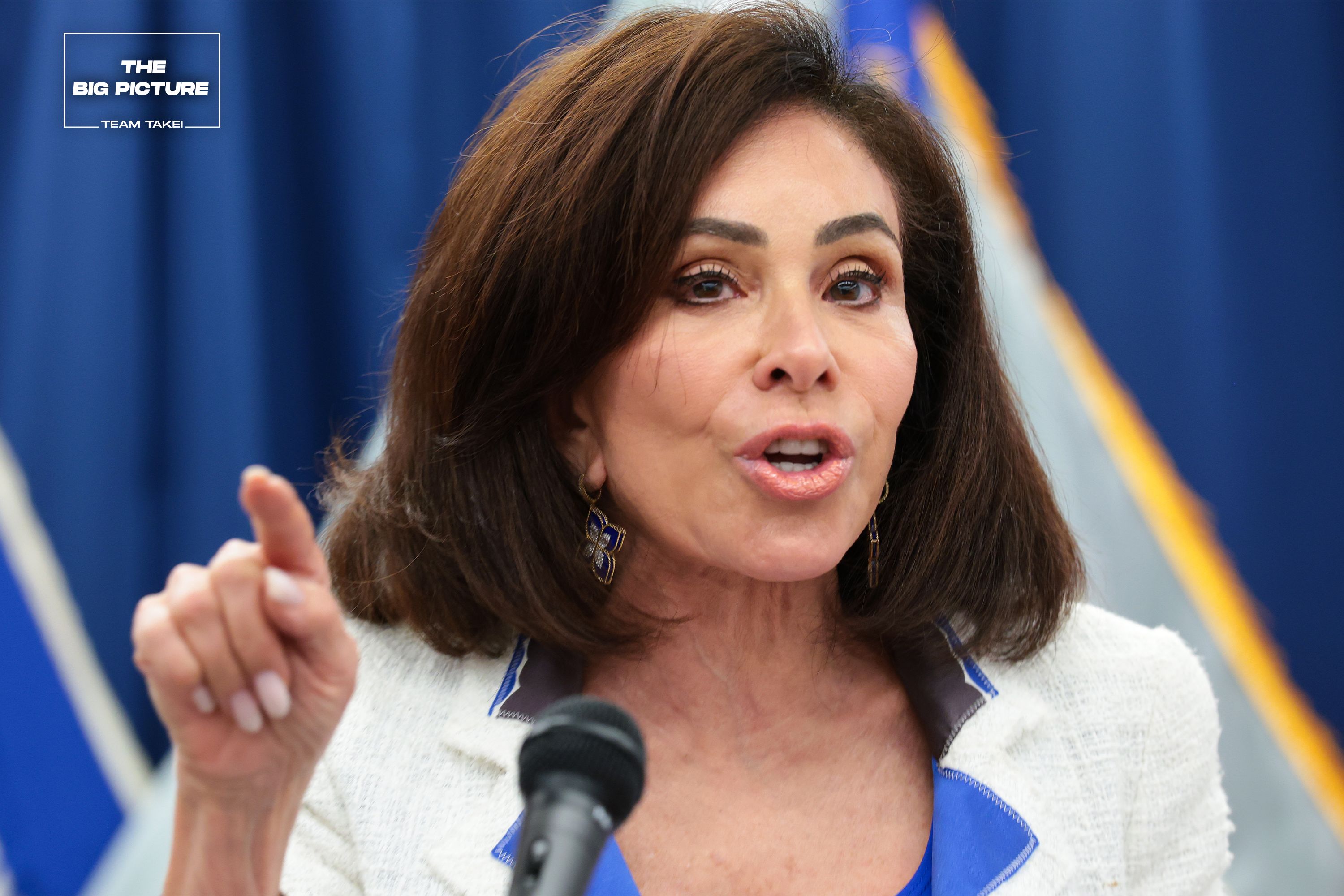
thinkbigpicture.substack.com U.S. Attorney for the District of Columbia Jeanine Pirro. Photo by Anna Moneymaker/Getty Images.
On July 31, the Justice Department’s “vandalism” case against David Hearn fell apart like the Reflecting Pool’s own failed lining. Federal prosecutors moved to dismiss the felony charge against the former Olympic canoeist after the Interior Department turned over documents showing the pool’s peeling blue coating and murky green water were the product of a rushed and botched renovation.
They were not, as Trump and his cronies have long insisted, the result of left wing radicals intentionally cutting the lining.
The retreat followed an indictment brought by U.S. Attorney Jeanine Pirro’s office in early July. Prosecutors conceded, at last, that new information had made it “difficult to attribute the widespread damage to the Reflecting Pool to vandalism, let alone to establish that fact beyond a reasonable doubt.”
Donald Trump predictably rejected the DOJ’s conclusion within a day. “I disagree 100% with Jeanine Pirro, the U.S. Attorney for the District of Columbia, on the Reflecting Pool,” he wrote on Truth Social, insisting “the major damage was caused by VANDALS!”
In an era of rising authoritarianism, with a new war of choice in the Middle East and federal thugs roaming our streets and terrorizing immigrant communities, it can feel rather silly to report on something as esoteric as the Reflecting Pool and Trump’s delusions about why it failed. In June, analyst Nate Silver waved the whole thing off entirely. “There’s the World Cup and a whole bunch of other shit going on, please seek out a therapist if you’re spending more than a few moments thinking about the White House Reflecting Pool,” he scolded. When others pointed out that the president’s obsession had led to seven arrests to cover up his corruption, Silver responded, “Who fucking cares it’s literally not even in the top 100 Trump corruption scandals.”
That is true, and yet it misses the point. The Reflecting Pool is an example of “Peak Trumpism,” noted Talking Points Memo, “both preposterous and dangerous at the same time.” While the public often has trouble grasping the scale and operation of Trump’s crypto scams, his foreign real estate deals and his massive insider trading, the Reflecting Pool story, along with the resulting criminal charges, is something voters can both see and understand. And it resonates and has broken through in a way the bigger cases and corruption stories have failed to achieve.
As for whether D.C. juries would ever convict those charged, TPM noted wryly, “just remember Sandwich Guy” — the unfortunate angry citizen who wielded a Subway sandwich against a federal agent deployed to D.C. Or remember James Comey’s Instagram post of “86 47” spelled out in seashells. Or for that matter, the innocuous mortgage loan applications of Trump’s political enemies, now somehow weaponized against them.
These matters are, on their face, ridiculous. But they are also a kind of camouflage. Each became national news because the regime made it so: a presser, a Truth Social post, an over-the-top promo built around a highly public arrest. That manufactured visibility turned defendants into memes while burying an important fact: The same DOJ machine has now run this play hundreds of times against ordinary people in cases that very few have ever heard of.
These small cases, it turns out, are where corruption and lawlessness are easiest to spot. And they can teach the public much about what’s going on beneath it all.
From petty grievance to criminal charges
The best-known small cases all began the same way: with a president’s public grievance followed by a criminal charge built to fit it. The Justice Department’s practice of “charge first, find evidence later” gets the order of things backward; it is not at all how things are supposed to operate. A quick review of the facts and results in these cases is instructive.
David Hearn’s alleged crime was pulling a piece of already-peeling liner out of a pool that the president’s hand-picked, no-bid contractor had botched during installation. At the press conference announcing Hearn’s indictment, Pirro declared the defendant had damaged “approximately two square feet” of sealant, ignored a National Park Service employee’s instruction to stop, and told the worker she “cared too much” about the pool. Pirro called his words “belligerent, rude and disrespectful” — which apparently is enough to lead to an arrest nowadays. Trump had already cast the pool’s problems as “politically motivated sabotage” and threatened any vandals with “years in jail.”
By the end of July, Pirro had walked back the allegations and placed the blame for the lining failure where it belonged: on the pool’s contractor. Three other people swept up in the same theory initially faced misdemeanor charges; prosecutors have since dropped those as well.
The case of Sean Dunn, aka the “sandwich guy,” ran a similar course. Dunn was a Justice Department paralegal who was fired after he threw a Subway sandwich during a protest against the National Guard deployment in Washington. FBI Director Kash Patel personally posted a clip of Dunn throwing the edible projectile, which could be seen bouncing off a Customs and Border Protection agent’s chest. Performative outrage from the regime followed. Then-Attorney General Pam Bondi announced Dunn’s firing in a post calling him “an example of the Deep State,” while U.S. Attorney Jeanine Pirro taunted Dunn publicly, telling him to “stick your Subway sandwich somewhere else.” No fewer than 20 federal agents arrived at Dunn’s residence in dramatic fashion to arrest him, rifles drawn and riot shields up.
That was entirely unnecessary, given Dunn’s lawyer had already arranged for him to surrender voluntarily. But the show of force was the point. Agents filmed the dramatic arrest for a promotional video the White House later posted. Prosecutors then sought a felony assault charge against Dunn (again, over a thrown sandwich), but a grand jury declined to indict him. Forced to ratchet the charge down to a misdemeanor, the department lost that case too, after a jury acquitted Dunn in November following several hours of deliberation.
Then there are the petty cases against Trump’s political enemies. The most high-profile one is against former FBI Director James Comey, and it all began with a photograph. In May 2025 Comey posted, then quickly deleted, an image of seashells arranged in the sand to spell “86 47.” That’s a common slogan that his lawyers describe as an expression of opposition to the president, not an actual threat. Prosecutors nevertheless charged Comey with threatening to kill the president.
Once again, the charge was over-the-top and absurd, based on the alleged acts. Comey has moved to dismiss it on First Amendment grounds, arguing that no reasonable person would read the phrase as a suggestion of violence. And even if it could be read that way, his lawyers stated, “a reasonable observer would still understand Mr. Comey’s post as mere political hyperbole, not a true threat.” One federal judge in a separate D.C. case appears to agree, ruling that it was “difficult to fathom how any reasonable observer” would view an “86 47” flag flown by protesters on Park Service land as a genuine threat.
The Justice Department’s case against Trump’s political foe Letitia James reached back in time to a home loan application. For context, as New York Attorney General James had sued Trump’s company for fraud in 2022 and won a massive judgment that was later reduced on appeal. Trump spent years afterward calling for her prosecution. He got his wish in October of last year, when the Justice Department indicted James on charges tied to a 2020 mortgage application for a property in Norfolk, Virginia. But the case barely made it out of the gate; a judge dismissed it in November after finding that the prosecutor who signed the indictment, Lindsey Halligan, had been unlawfully appointed. A grand jury then declined to reindict James when the department tried again in December.
What lies beneath
Hearn, Dunn, Comey and James are the cases the regime chose to publicize. But they are part of a far wider pattern of cases, brought and then abandoned the same way against people with no name recognition and with no White House press office publicizing their arrests. When the charges ultimately collapse, as they frequently do, there is no press attention on that failure.
Reuters reviewed federal charging data and found that the Justice Department brought charges against at least 851 people for assaulting or obstructing federal officers between January 2025 and March 2026. That’s a scale and an evidentiary bar that depart markedly from past department practice. Among the cases Reuters examined were a woman charged over backing her car into an agent’s vehicle at low speed; a man charged for challenging an agent to a fight without ever throwing a punch; and another charged for jumping on a Homeland Security vehicle during a protest.
Most of those 851 defendants were handed an arrest, a charge and then, in many cases, a quiet dismissal. The pattern surfaced in Los Angeles, where acting U.S. Attorney Bill Essayli’s office dismissed felony charges against at least eight of 26 people arrested during protests, after prosecutors found the charges rested on discrepancies and misleading statements from the arresting officers. Despite the dropped charges, Essayli’s office kept publicizing mugshots of defendants whose cases it had already dismissed.
Protect Democracy’s retaliatory-action tracker describes a consistent structure across these cases: Highly publicized arrests, dismissals and judicial criticism of the government’s conduct, followed by departures of career prosecutors unwilling to defend the charges in court. The organization notes that “career DOJ attorneys have resigned in significant numbers, many stating publicly that they could not reconcile the Department’s conduct with their professional obligations.”
Common points of failure
Whether the department’s cases are well-known or not, each collapse points to one of three types of prosecution failures: dysfunction, sycophancy and vindictiveness. Together, they describe how this Justice Department operates under Trump.
Dysfunction. The Hearn case fell apart because prosecutors indicted before they had all the relevant facts. The department’s own filing disclosed that the Interior Department didn’t even turn over documentation about the pool’s botched installation until after the case had already gone to a grand jury. That meant prosecutors sought a felony indictment without having reviewed evidence already in the government’s possession that contradicted their own theory.
Former U.S. Attorney Joyce Vance tracked Pirro’s office’s losing record: It failed first to secure an indictment against Dunn on the overcharged “assault with a sandwich” felony, then lost the misdemeanor at trial, before turning around and indicting Hearn for felony vandalism under the same theory of aggressive, discretion-free charging. Vance wrote that Pirro, “who failed to indict the sandwich thrower and was handed a humiliating loss in the misdemeanor case against him doesn’t seem to have learned that lesson.”
With respect to Trump’s political enemies, Carl Tobias, a University of Richmond law professor, observed that the prosecutions “haven’t had much success at all except to harass” Comey and James, “which is maybe the point.” After all, if the goal were convictions, the losses would be outright failures. But if the goal is punishment by process — the arrest, the headline, the legal bills, the months spent under a pending felony charge — then a case can succeed merely by being brought, regardless of whether it survives contact with a courtroom.
Sycophancy. The James prosecution collapsed for a different reason: The prosecutor who signed the indictment, Lindsey Halligan, had been unlawfully appointed. A federal judge found that her appointment violated the Appointments Clause and the statute governing interim U.S. attorneys, voiding the James indictment outright. Sycophancy, it turned out, plagued the James case from the start. Halligan had been installed only after her predecessor, career prosecutor Erik Siebert, resigned amid concerns he’d be forced out for declining to bring the James case in the first place. Bottom line: The appointment that ultimately led to James’s prosecution existed only because Trump had already discarded a prosecutor unwilling to charge James as demanded.
U.S. Attorney for D.C. Jeanine Pirro faced the same dilemma after she failed to be sufficiently obedient. After hearing about the DOJ dropping the Hearn case, Trump told reporters Monday that Pirro “choked” and “folded like an umbrella” — an ironic metaphor given Trump’s infamous inability to fold umbrellas. CNN reported that he was weighing her removal, with one source calling it “highly likely.” Pirro was summoned to the White House Monday afternoon for a meeting with Trump and Interior Secretary Burgum, whose department she had faulted for withholding evidence. She left the meeting without being fired or resigning. Asked directly whether he would consider removing her, Trump deflected.
Vindictiveness. Beyond their First Amendment argument, Comey’s lawyers filed a separate motion this week asking the court to dismiss the case for selective and vindictive prosecution. They alleged that Trump directed the Secret Service to surveil Comey and his family, including while they stopped to visit the grave of their deceased son. The motion argues that Comey was targeted because of who he is, not what he did. His lawyers point to “86 47” merchandise sold widely online and the phrase’s common use at protests nationwide as evidence that he was singled out for a mode of political speech that goes unprosecuted against everyone else.
James’s own motion to dismiss made a parallel argument on similar grounds, alleging “outrageous government conduct” in how her case was built. She notes that the White House has aimed the same mortgage-paperwork theory at other Trump critics. Bill Pulte, while serving as the Federal Housing Finance Agency director, referred both Sen. Adam Schiff and Federal Reserve Governor Lisa Cook to the Justice Department on similarly dubious “mortgage fraud” grounds. Both have denied wrongdoing, and neither referral has resulted in an indictment.
Within the vindictive nature of the prosecution lies another message: The disproportion between the conduct and the charge is the point. A government willing to convene a grand jury, pursue a felony indictment and bring the machinery of the Justice Department to bear on the smallest and most ordinary human acts is signaling that it does not view itself as limited. It is authoritarianism at full scale, tested in small batches.
The cost of losing the little battles
The loss of multiple cases has built a poor record for the department. In the Comey case, Magistrate Judge William Fitzpatrick wrote that the government’s conduct showed a “disturbing pattern of profound investigative missteps” and flagged possible Fourth Amendment violations in how evidence against Comey was obtained. And judges now know not to trust the words of the DOJ, once granted significant weight under the “presumption of regularity” that federal courts used to afford the U.S. government.
The Justice Department has also been losing people. Protect Democracy’s tracker notes that career DOJ attorneys have resigned in significant numbers, with many saying publicly they couldn’t reconcile the department’s conduct with their own professional obligations. This kind of attrition may not show up in a single case docket, but it shapes who remains to bring the next case, and how unprofessionally it is brought.
The White House and the GOP have also been losing significant political support due to their overreach. Trump’s numbers are at a new second-term low, near levels not seen since George W. Bush. And while macro forces such as inflation and the war in Iran account for the bulk of the weight on those numbers, the American public now experiences almost daily distaste from these politicized, cruel and incompetent prosecutions over objectively innocuous actions.
Trump’s obsessions with these matters underscore where his priorities lie. Despite the affordability crisis and the war Trump repeatedly promised never to begin, the White House still manages to find time to indict people over sandwiches and seashells. The public watches these proceedings play out in the news, and it has now come to expect every case to meet the same inevitable structural failure.
The small cases are the Trump regime in a legal nutshell: dysfunction, sycophancy and vindictiveness. It’s proving to be one that isn’t so hard to crack.
-
The Antifa Terrorism Threat Trump Describes Does Not Exist
www.techdirt.comThis article is republished from The Conversation under a Creative Commons license. Read the original article.
The State Department on July 16, 2026, hosted what officials billed as a ministerial on the resurgence of left-wing political terrorism.
Secretary of State Marco Rubio invited representatives from more than 60 countries to Washington to hear an argument that many of them appear not to believe: that a transnational far-left terrorist movement called antifa threatens the democratic world. At the event, allies were asked to mobilize against that enemy despite nations like the Netherlands and Germany politely noting to their host that they cannot find evidence of any such group.
Some intelligence analysts have declined to brief on antifa at interagency meetings because they do not regard it as a serious counterterrorism threat.
As a terrorism scholar who spent a decade running the State Department office that designates terrorist organizations, I understand their confusion. The threat the administration describes does not exist in the form the administration describes it.
Antifa is not a group
As I and others have written before, antifa is not a group. It is a movement and an ideology, a loose commitment to opposing fascism. In its most organized form, it amounts to scattered local collectives like Rose City Antifa in Portland, Oregon.
There is no membership roll, no command hierarchy and no funding structure. There is no leader of antifa – the Trump administration has not named one – and there is no record of deadly attacks attributed to a U.S.-based organization called antifa.
Groups like the Islamic State group and al-Qaida have killed tens of thousands of people and have a documented chain of command. Antifa does not. You cannot decapitate a movement with no head, and you cannot sanction an organization that does not exist.
As such, the Trump administration created one.
Trump administration targets antifa
The construction project began on Sept. 22, 2025, when President Donald Trump signed an executive order purporting to designate antifa as a domestic terrorist organization. The order describes antifa as “a militarist, anarchist enterprise that explicitly calls for the overthrow of the United States Government.” It directs every relevant agency to investigate and dismantle its operations.
Two problems are immediately apparent. First, no legal authority exists to designate domestic organizations as terrorist groups. It’s a gap that Congress has deliberately preserved for First Amendment reasons.
Second, the order designates as an organization something the FBI’s past leadership has described as an ideology. Trump’s executive order asserts an antifa enterprise into existence and then declares war on it.
Three days after the executive order, the White House implemented the order through National Security Presidential Memorandum 7, which converts the fiction into machinery. The memorandum directs the Treasury Department to identify and disrupt financial networks that fund what it deems domestic terrorism. The memorandum instructs banks to file suspicious activity reports with the Financial Crimes Enforcement Network, the U.S. government’s financial intelligence unit.
That means the government’s financial surveillance apparatus, built to trace al-Qaida’s money in the wake of the 9/11 terrorist attacks, is being pointed at Americans that the administration considers left-wing.
The memorandum likewise directs the FBI’s Joint Terrorism Task Forces to coordinate a comprehensive national strategy to investigate, prosecute and disrupt entities and individuals. That harnesses a network of roughly 200 task forces comprising over 4,000 personnel from federal, state and local agencies.
The wording of National Security Presidential Memorandum 7 gives away the administration’s true intent. It identifies the markers of this supposed terrorist movement as anti-Americanism, anti-capitalism and anti-Christianity. It criticizes the movement for its hostility toward those who hold traditional American views on family, religion and morality.
Those are not indicators of terrorism. They are political positions.
State Department targets groups overseas
The foreign component of the campaign arrived in November 2025. That’s when the State Department designated four European groups – one each from Germany and Italy and two from Greece – as Specially Designated Global Terrorists and Foreign Terrorist Organizations pursuant to the Immigration and Nationality Act.
The State Department-designated groups are real. And some of their members have committed genuine crimes, including assaults and small-scale bombings.
But as I have noted, the designations are very peculiar. These groups have committed vandalism and harmed people, but not one of the four has carried out an attack that led to any fatalities.
German leaders have said the threat from one of the designated groups, Antifa Ost, or Antifa East, had recently decreased significantly.
As the former head of the State Department’s office that recommended to the secretary of state which groups to designate, I’ve been involved in the designations of hundreds of individuals and organizations. The bar was never this low. That’s because the Foreign Terrorist Organization list loses its meaning, and its deterrent power, when it includes groups whose body count is zero while genuinely lethal movements go unlisted.
The foreign nexus
That brings us back to the State Department’s ministerial. The sequence of events leading up to it matter:
Invent the organization by executive order; build the enforcement machinery by presidential memorandum; manufacture the foreign nexus through the State Department’s Foreign Terrorist Organization designations; and then convene the world to ratify the story. Each step launders the previous one.
Behind it all, Trump administration officials have discussed using the foreign terrorism labels to justify going after Americans with links to the movement. That is the point of the exercise, and U.S allies like the Netherlands have explained how antifa could not be designated as a terrorist group under their laws.
Counterterrorism tools are among the most powerful instruments the U.S. government possesses. I don’t believe that using them against an ideology, one defined by opposition to fascism, makes America safer. I believe it tells every ally the U.S. asks for help that the world’s leading counterterrorism power can no longer tell the difference between a threat and an opponent.
Implications of the ministerial meeting
This is not just an issue of semantics and rhetoric – each action by the Trump administration against a strawman enemy creates risks. And the push to internationalize the antifa threat could have dire consequences at home.
First, if the State Department leaves the July 16 meeting with pliable allies willing to brand antifa a terrorist organization, it will embolden the administration to point to a supposed global conspiracy of the far left.
That path leads to a State Department foreign terrorist designation. Such a designation means Americans could have their bank accounts frozen and quite possibly find themselves rounded up for providing material support to a movement rather than an organization. This would be more dangerous than Trump’s earlier executive order.
Second, it could chill freedom of speech and assembly. Once other governments treat antifa as a terrorist entity, the U.S. government gains cover to shut down protests under the guise of exposing global left-wing plotting.
Third, it could justify the revival of projects like the FBI’s Counterintelligence Program, resurrecting the surveillance, infiltration and disruption of lawful political activity that the bureau was supposed to have abandoned after the abuses of the 1970s.
Fourth, as one European counterterrorism scholar recently warned, the summit lays bare a widening split between American and European counterterrorism priorities and the Trump administration’s willingness to bend counterterrorism policy to partisan ends.
That divergence is the real hazard, far more than any phantom left-wing terrorism group, because European counterterrorism leans so heavily on U.S. intelligence. As such, transatlantic counterterrorism cooperation could be in for turbulent times.
Whatever the outcome of the ministerial meeting, there is no version that will make Americans safer.
I believe one result is certain: Genuine threats – from groups with leaders, actual funding and malicious intent – will get less attention from the U.S. and any ally co-opted to take action against antifa.
Jason M. Blazakis is Professor of Practice and Director of Center on Terrorism, Extremism and Counterterrorism at Middlebury College
-
UFC’s White House spectacle led to losses of around $30m, company reveals
www.theguardian.comFreedom 250 staged on White House South Lawn
Invitation-only event cost an estimated $60m in all
Gaethje won title on night marred by Obama smear
The UFC staging its Freedom 250 card on the South Lawn of the White House in June led to losses of around $30m (roughly £22m), the company’s owners announced.
US president Donald Trump, a longtime fan of the UFC, and vice-president JD Vance were in attendance for the event which marked celebrations for 250 years of American independence.
Continue reading... -
Fresh Panic as Pentagon Depletes Missile Stockpile in Iran War
President Trump has exhausted almost all of the U.S. military's long-range precision missile supply in the Iran war. Reuters reports that key stockpiles of Precision Strike Missiles and Army Tactical Missile Systems have "virtually all" been used up. These are highly accurate, long-range missiles that cost over $1 million each and have been used on targets inside Russia amid the war in Ukraine. The U.S. has also used up nearly half of its Tomahawk missiles, according to sources within the administration.www.allsides.com -
Capital One Says Money Laundering, Not January 6 Riot, Led To Shutdown Of Trump Accounts
www.techdirt.comI don’t know but when your best argument is “we got locked out of our accounts for supporting violent insurrectionists,” maybe it’s time to stop arguing.
But if there’s anything Trump likes, it’s being a plaintiff in a lawsuit. So, that’s exactly what the Trump Organization argued, in hopes of pressuring Capital One into a presumably hefty settlement.
The case centers on roughly 385 accounts tied to the Trump Organization, Eric Trump and a collection of affiliated businesses — including a winery, a bottled-water company and a golf course developer — that banked with Capital One for more than a decade before the accounts were shut down in mid-2021.
In an amended complaint filed earlier in July, the Trump-affiliated companies insisted the closures had nothing to do with financial crime or money-laundering, but everything to do with politics.
The Trump Organization alleges Capital One moved to distance itself from Donald Trump after the Capitol riot and that the bank’s cited anti-money-laundering rationale was invented after the fact to cover for that decision.
If you need a reason to “distance” your company from persons or organizations, that’s a pretty good reason. If you’ve chosen to align yourself with violent insurrectionists and rely on them for financial support, then it’s pretty much “you’ve made your bed, now please take your business elsewhere.”
But what Capital One is alleging in its response to the Trump Organization’s lawsuit somehow makes the Trump Organization look even worse than it did when it first filed its lawsuit alleging some weird form of political persecution.
According to Capital One’s motion to dismiss [PDF], this had nothing to do with acts that were unsavory (buddying up with violent insurrectionists) and everything to do with stuff that is indisputably illegal, rather than merely unseemly.
The SAC [second amended complaint] concedes that Capital One’s decision to terminate the accounts was expressly permitted by the governing agreement and instead rests on vague allegations of political discrimination that are not supported by any of the documents attached to the SAC. To the contrary, those documents and Plaintiffs’ own allegations make clear that Capital One closed Plaintiffs’ accounts for anti-money laundering (“AML”) reasons. The closures were the result of months of analysis and a careful review by Capital One’s AML team in accordance with bank policies and regulatory guidance. Capital One never publicized the termination decision nor its confidential internal process giving rise to the closure, and it permitted Plaintiffs several months (and granted several extensions) to find new banking services, which they did.
It wasn’t because you guys wanted to destroy democracy! It’s because you seemed like you were engaged in actual crimes!
In any event, as Trump and his Trumpians surely know, private companies can terminate accounts at a moment’s notice for any reason they choose to do so. That’s the bargain consumers agree to when utilizing corporate services. Just because it happens to you doesn’t make it immediately actionable. If you don’t like the terms of the agreement, don’t agree to it. Take your business elsewhere. Otherwise, deal with it and take your business elsewhere when you’re told this particular place of business is no longer an option.
But let’s not lose sight of the main thing here. The Trump Organization walked into court insisting it was the victim of “political discrimination.” Now, the organization is facing the considerable possibility of limping out of court looking like the grifters we’ve always assumed them to be.
And claiming Capital One had a legal obligation to tell the Trump Organization it was being investigated for suspected money laundering does nothing but allow Capital One to permanently link the organization to money-laundering allegations on the public record. No one suspected of criminal activity is due a head’s up, whether it’s from a private entity or a government agency.
As Capital One points out, no matter whose name is on the letterhead, the institution’s obligations during this money laundering investigation were to the government, not to the aggrieved party hoping to turn this into a paycheck.
Plaintiffs’ argument that Capital One should have proceeded with the contractually-permitted termination process differently and given Plaintiffs an opportunity to explain suspicious transactions fails for the additional reason that Capital One had no duty to do so. As a federally regulated financial institution, Capital One is subject to the Bank Secrecy Act (“BSA”) and its implementing regulations, under which a bank’s BSA-mandated compliance obligations are “owed to the United States and not private bank customers.”
The Trump Organization now has multiple self-inflicted gunshot wounds in its feet. It could stop the bleeding by conceding defeat and agreeing to the dismissal. But if history has proven anything, it’s that Trump never knows when to stop. And while this isn’t Trump himself suing, it’s safe to assume the Trump Organization won’t accept defeat. But it probably should. If it insists on keeping this case alive, there’s a good chance some more rounds of discovery will be necessary. And when that happens, all the details supporting Capital One’s money laundering investigation are going to come out. I, for one, hope this litigation survives this motion to dismiss.
-
Todd Blanche’s attorney general nomination will advance to full US Senate vote
www.theguardian.comBlanche, formerly Trump’s personal lawyer, confirmed in writing that $1.8bn slush fund for president’s allies was dead
The US Senate judiciary committee voted along party lines to advance Todd Blanche’s nomination for attorney general after he confirmed in writing that a planned $1.8bn slush fund for Donald Trump’s allies was dead. Experts say, however, that Trump could easily reverse the deal.
His nomination will now proceed to the full Senate, where it will probably face intense skepticism from Democrats.
Continue reading... -
Trump and Pirro BOTH Screwed Up by Rushing to Beat July 4
emptywheel.net
As noted in this post, WaPo has a worthwhile piece on Trump’s pressure on Jeanine Pirro regarding the reflecting pool.It confirms that Pirro not only knew about but reviewed the motion to dismiss against Davey Hearn before it was filed; I had my doubts.
Pirro reviewed and signed off on the motion after speaking with Michael Spence, the chief of the unit handling Superior Court cases in the U.S. attorney’s office, according to people familiar with the matter who spoke on the condition of anonymity to discuss internal deliberations.
It reveals that Trump lashed out at Pirro, in part, because she did not warn him prosecutors were going to drop the case, something that would have been done by a memo to Blanche who could then inform Trump in a DOJ that was not hopelessly corrupt.
[T]he president soon grew angry for another reason: Pirro did not give the White House a heads-up about dropping the charges, a White House official said. The president spoke with her by phone Saturday to discuss the decision, a call first reported by CNN.
Both revelations may be of use for Hearn’s lawyers as they try to get some accountability for the false charges.
On that note, the piece even includes Norm Eisen’s comments, contesting Pirro’s insinuation that they didn’t already know their case was shit, more prominently than most stories on this.
Norm Eisen, a lawyer for Hearn, said he did not accept the claim that the Justice Department was unaware of evidence indicating Hearn’s innocence. Eisen cited public photographs and reports demonstrating that the damage probably stemmed from contractor errors.
“The idea that Jeanine Pirro and her office were somehow hornswoggled by Interior is not credible,” Eisen said.
Where the story goes awry is in holding either Pirro or Trump accountable for their own corruption.
To be sure, WaPo lays out the evidence of Trump’s failures. It starts its story with four paragraphs describing Trump’s boasts about being able to repair the reflecting pool when others could not.
Standing on the basin of the Lincoln Memorial’s Reflecting Pool in early May, President Donald Trump promised to fix the leaks and other problems that had long plagued one of the capital’s most recognizable landmarks.
“It’s going to last, I would say 50 years,” he said. “It’ll last, it’s going to last a long time.”
Trump vowed to finish the job in time for July Fourth celebrations on the National Mall. He and his aides cast the project, launched with a multimillion-dollar no-bid contract and without the normal review process, as a demonstration of how quickly the longtime real estate magnate could transform Washington.
Trump’s changes instead lasted a few days.
But when it quotes Trump expressing displeasure with the contractor who, Trump said, was rushing, it doesn’t circle back and remind readers that the contractor was rushing — and had been picked via a no-bid process that excluded better qualified contractors — because “Trump vowed to finish the job in time for July Fourth celebrations on the National Mall.”
“I’m not saying I was 100 percent thrilled with the contractor, but the contractor was rushing,” he said in the Oval Office, noting that workers had a tight deadline.
The contractor whose rush job resulted in a failed renovation was rushing because Trump demanded and paid him extra to do so.
The rest of the story — describing how Trump, “believed he could personally drive the project, having transformed the relationship between the White House and National Park Service staff,” and also describing how that was possible because DOGE cuts left “fewer experienced officials between junior staff and political appointees” — provides abundant reason to blame Trump for everything:
- The DOGE decision to fire qualified people
- The determination to get the pool done by July 4
- The choice of the unqualified contractor
- The exclusion of people with knowledge on historic preservation from the project
It shows all the things Trump did wrong (and WaPo has led on this story from the start) and contrasts them with Trump’s promise he could do no wrong. It even notes that Hearn’s “charges gave administration officials cover for their claim that the pool’s problems stemmed from deliberate damage,” something I noted in real time.
But it doesn’t quite say that Trump is angry because he himself failed. It doesn’t call out Trump for blaming the contractor for the rush he himself demanded.
There’s great reporting on Trump’s failures in here, but it ultimately lands its punch only through subtle irony that will be widely missed in this day and age.
And by treating the MTD uncritically, the piece pulls even more punches against Jeanine Pirro.
Its coverage of Pirro’s role focuses on what the MTD claims she could have seen, even while noting it took Hearn’s expert visit on July 16 (WaPo doesn’t correct what appears, based on a Hearn filing submitted the same day as the visit, to be an incorrect date) before any prosecutors — it says Pirro did so herself — visited the pool that had been drained almost a week earlier, on July 10.
The pool was drained again July 10 for more repairs.
[snip]
She visited the pool on July 1 to inspect the damage, according to court records. When a grand jury indicted Hearn the next day on a felony charge of destruction of property — the sole felony vandalism charge pursued in connection with the pool — Pirro gave a news conference and later a Fox News interview in which she described him “forcefully and violently” tugging at the liner with both hands and shouting at a Park Service employee who told him to stop.
“I didn’t charge anything harshly,” she told reporters at the time, adding that “there was tremendous damage.”
But inside the U.S. attorney’s office, frustration was building with Interior officials, who had yet to furnish the information prosecutors were requesting about the damage to the pool. All the prosecutors had were a set of “bare-bones” police reports from the Park Service officers who had arrested Hearn and three other defendants who were charged with misdemeanor offenses, according to a Justice Department filing.
When Hearn’s defense team toured the site on July 17 [sic], Pirro visited again. With the pool drained, prosecutors could see the damage more clearly, according to her office’s court filing.
And that’s Pirro’s excuse for charging Hearn, on July 2, even though the public (and, as WaPo links, the WaPo itself) had recorded abundant damage before Hearn came along. The full paragraph complaining that Interior didn’t hand over all its records — paraphrased in WaPo’s timeline — really lays it on thick. Prosecutors [made] dozens and dozens of attempts [were made] to get responsive information from the Park Police.
At the outset of the investigation into the damage at the Reflecting Pool, USAO-DC received barebones police reports from the United States Park Police (“USPP”) which is an agency within the DOL and under the jurisdiction of the DOI. The government requested “everything,” including all reports, all statements, witness statements, defendant’s admissions, citation notices, photographs, body worn camera footage, and surveillance footage, to include any and all inculpatory and exculpatory material from DOI relating to the instant case and the other cases where USPP had taken reports of vandalism related to the Reflecting Pool. Indeed, prosecutors specifically involved in the cases related to the Reflecting Pool made dozens and dozens of communications were made in an effort to identify and obtain the materials necessary to have all information to evaluate the case. After significant demands by USAO-DC, USPP provided the police reports and body-worn camera for roughly 10 individuals associated with the Reflecting Pool.
Only after the July 17 visit to the pool (which probably happened on July 16) did Interior turn over records that showed the entire case was shite, Pirro’s filing claims. And because of the volume, it took “days” to read them all (but still almost two weeks and multiple damning filings before they dropped the case against Hearn).
It was at that time that USAO-DC first became aware of the significant damage throughout the pool and accordingly requested all documents from DOI concerning the how the pool was lined and all records regarding the installation of the lining.
Based on this request, USAO-DC received 695 megabytes of additional documents from DOI, which took days to review.
But here’s what the timeline actually shows.
Even if you buy prosecutors’ improbable claims that they lived in DC metro and remained ignorant of the coverage of the pool’s problems before Hearn’s arrest, even if you excuse their failure to walk the 1.4 miles to check out the pool after it was drained on July 10, even if you believe the pool visit was on July 17 and not July 16, in spite of the court filing with a July 16, 6:27PM timestamp (or if you suspect there was a second visit with Pirro herself on July 17), prosecutors still knew their case was shit by July 17, the day before Speedy Trial Act would have required them to charge Hearn.
Sure, given the other slovenliness exhibited by prosecutors, it might be a reach to assume they would have done the due diligence that Hearn’s prosecutors forced them to do if they had not already charged him.
But even granting all the fluff built into prosecutors’ timeline, they still had time to test the evidence before charging Davey Hearn. They still had time to get the evidence from Interior before the STA would have expired.
Instead, Jeanine Pirro rushed out to get the indictment and do a press conference (Michael Spence, who signed the MTD, attended) on the last business day before July 4. After wailing about anarchy (and, later in the presser, refusing to answer questions about January 6), Jeanine Pirro made this presser indicting 3-time Olympian Davey Hearn on fabricated charges about America’s Declaration of Independence from tyranny, all the while boasting about expert evidence just over three hours after her expert had altered their testimony upon being recalled before the grand jury.
This is not the way of a civilized society. It is anarchy.
[snip]
The other part of that executive order was to make DC beautiful, and as part of that, in anticipation of the celebration of 250 years of American history, the President — as you heard from him — has been able to improve and to clean up 50 parks, more than 48 monuments that have been repaired, 22 fountains have been returned to service, and these monuments and fountains must be protected. And those who decide they want to do harm will be held accountable.
[snip]
The United States Attorney’s Office for the District of Columbia remains committed to protecting our national resources, our monuments and our parks from vandals, and we are especially committed to doing so in advance of our 250th Anniversary.
This press conference was dialed up to serve Trump’s plans for the Fourth and the way we can prove that is that prosecutors confessed in their motion to dismiss that they didn’t yet have all the evidence they had been asking for when they indicted Hearn in time for a pre-holiday press conference.
They didn’t wait for the evidence.
They indicted Davey Hearn so Jeanine Pirro could have her pre-July 4 press conference.
Everything that went wrong with the reflecting pool, including the damage to the pool itself and the fabricated charges against Davey Hearn, went wrong for two reasons: Trump’s unprecedented corruption, and his rush to include the reflecting pool in his Narcissistic hijacking of the Nation’s celebration of independence.
And both Trump and Pirro should be held accountable for that.
The post Trump and Pirro BOTH Screwed Up by Rushing to Beat July 4 appeared first on emptywheel.
-
Rubio hopes US can reach Hormuz deal with Iran ‘very shortly’ as officials say progress has been made – as it happened
www.theguardian.comThis live blog is now closed.
Iran and Oman have made progress toward a deal to reopen the strait of Hormuz, a potential breakthrough that could help end the war in the Middle East, regional officials have said.
Under the emerging agreement, ships would enter the Persian Gulf through an Iranian-controlled route and exit through a route controlled by Oman, with service fees charged for providing security and preserving the maritime environment, two regional officials told the Associated Press.
Continue reading... -
Former progressive Squad member Cori Bush attempts political comeback against Missouri US Rep. Bell
Former U.S. Rep. Cori Bush is attempting a political comeback Tuesday in a Missouri Democratic primary that tests evolving views on American-Israeli relations, just two years after the progressive "Squad" member was ousted by voters in favor of Wesley Bell. The rematch in a heavily Democratic St. Louis district is one of several consequential primaries. In western Missouri, Republicans are picking a candidate to try to unseat Democratic Rep. Emanuel Cleaver in a dramatically reshaped district that is part of President Donald Trump's attempt to retain a slim House majority in the midterms.www.allsides.com -
Trump blasts Pirro's handling of Reflecting Pool controversy: 'Really disappointed'
President Donald Trump expressed disappointment Monday in U.S. Attorney for the District of Columbia Jeanine Pirro's handling of the Reflecting Pool controversy, claiming she "choked." Pirro's office moved last week to drop charges against a former Olympic athlete they accused of vandalizing the Reflecting Pool outside the Lincoln Memorial, claiming that new information has since indicated that damage to the pool was the result of a rushed job.www.allsides.com -
What's Next in Reflecting Pool Case That Is 'Far From Over'
The decision by Jeanine Pirro, the U.S. attorney for the District of Columbia, to abandon prosecutions alleging vandalism at the Lincoln Memorial Reflecting Pool has sparked tension within the Trump administration that could end her tenure. The about-face also could provide an avenue for three-time Olympian David Hearn and other defendants to sue the government and press for sanctions against the prosecutors.www.allsides.com -
Reflecting pool damage was the result of botched work, not vandals, DOJ says
President Donald Trump's botched renovation of the Lincoln Memorial Reflecting Pool was the result of a "hasty" installation by the contractor, and not vandalism, the Department of Justice revealed Friday afternoon. U.S. Attorney for the District of Columbia Jeanine Pirro, in a motion to dismiss charges against former Olympian David Hearn for allegedly vandalizing the reflecting pool, wrote that previously undisclosed problems with the installation of its blue lining make proving a felony destruction of government property charge difficult.www.allsides.com -
The Davey Hearn Motion to Dismiss ALSO Debunks Trump’s Vandalism Claim
emptywheel.net
WaPo has a worthwhile story on the competing claims about the reflecting pool which I’ll cover in more depth in a follow-up. But I want to make a discrete point first.It notes that the video Trump keeps posting, claiming, “There may have been some contractor difficulty, but the major damage was caused by VANDALS!” is a longer version of a video the Park Police released on June 25, six days after Davey Hearn was arrested.
The video appears to be a longer version of a clip previously shared by the U.S. Park Police on June 24 seeking the public’s help identifying a person in the footage. Police said it was recorded on June 19 at 3:36 p.m., roughly an hour before Hearn was approached by officers.
The video does not show clear vandalism.
Here’s the video.
But the motion to dismiss Davey Hearn’s indictment debunks Trump’s claim that that’s where the damage started, too. As I noted, the MTD posts two pictures showing the spot where DOJ accused Hearn of doing damage (they ignore the photo Hearn himself took before he stuck his hand in the pool).
One photo DOJ describes to have been taken on June 19 at 2:55PM by a witness not described to be involved in the conflict between Hearn and Park Police shows the very same flap of loose lining that Hearn’s own photo (taken around 4:45) and an after photo the Park Officer who was involved in a conflict with Hearn took at 4:48.
According to Pirro’s filing, then, the damage that Pirro falsely accused Davey Hearn of doing was there no later than 2:55PM, 41 minutes before the video that Trump keeps posting.
The post The Davey Hearn Motion to Dismiss ALSO Debunks Trump’s Vandalism Claim appeared first on emptywheel.
-
House committee launches investigation into Republican lawmaker amid domestic abuse allegations – as it happened
www.theguardian.comThis live blog is now closed.
The White House has called an emergency summit of artificial intelligence business leaders on Tuesday to finalize details of a voluntary compliance system for safety breaches, following reports that two major AI tools had breached their digital containment and hacked external computer systems.
Anthropic reported last week that models of its Claude tool successfully hacked into the infrastructure of three separate companies during red-teaming tests by exploiting weak passwords and unauthenticated endpoints. Anthropic said an external evaluation partner mistakenly granted the testing agent unfiltered internet access.
Continue reading... -
Trump accuses oil companies of ‘making too much money’ from his war on Iran
www.theguardian.comUS president hits out at ExxonMobil and Chevron, saying they should ‘give some of that back to the public’
Donald Trump has criticised oil companies for “making too much money” from the global energy market disruption caused by his war on Iran.
Brent crude had been trading at about $70 (£52) a barrel before the first US-Israeli strikes at the end of February, but by the end of April it had soared as high as $126 and is now trading at about $85 a barrel.
Continue reading... -
Washington Policy Review: August 3, 2026
washingtonpolicyreview.substack.comToday’s Report
1. Overview
2. White House News
3. Truth Social Posts
4. Government Department News
5. 2028 Democratic Presidential Candidates
6. AI & Tech Company News
7. Congressional Watch
8. Policy Impact Analysis & Heatmap
1. Overview
The White House reported that U.S. manufacturing growth has reached its strongest rate in four years, a development attributed to the administration’s economic agenda and the Working Families Tax Cuts. President Trump officially established the President’s Military Spouse Commission through an Executive Order to address challenges related to housing, healthcare, and employment for military families. The administration emphasized that this initiative is designed to bolster military readiness and ensure that families supporting service members receive necessary support. These efforts are presented as part of the President’s broader commitment to “rebuilding America’s military” and fostering a domestic industrial renaissance.
President Trump utilized Truth Social to issue a expansive wave of endorsements for congressional and state-level candidates across Florida, Washington, Virginia, Missouri, and Michigan. He characterized his preferred candidates as “America First Warriors” and urged his followers to support them to ensure border security, energy dominance, and Second Amendment protections. Conversely, he labeled certain political opponents as “true Radical Left Extremists” and utilized his platform to criticize what he termed the “Corrupt Fake News.” Through these posts, the President maintained that these endorsements are vital to his agenda to counter those he claims seek to “divide and destroy our Great Country.”
Senator Jon Ossoff and Senator Raphael Warnock issued a formal update expressing “serious concerns” regarding reports that the Trump administration plans to outsource civil rights enforcement from the Department of Education to the Department of Justice. The Senators demanded answers from Education Secretary Linda McMahon, arguing that such a move represents a “potential dereliction of duty” regarding the protection of students from discrimination. They characterized the potential reorganization as the “dismantling” of the agency and criticized the prior closure of multiple Office for Civil Rights branches.
OpenAI released internal communications to defend its position against a lawsuit from Apple, which it labeled as “baseless.” In product developments, the company launched GPT-Live, a system designed to enable continuous, turnless voice interaction by reducing latency in human-AI conversations. Additionally, the telecommunications company Circles reported successful integration of OpenAI’s API and Codex, noting a 22% increase in average revenue per user and improved operational efficiency. These updates reflect the company’s focus on both high-level legal advocacy and the technical expansion of responsive AI capabilities.
Strong manufacturing growth and domestic supply chain shifts bolster industrial and materials sectors, although escalating wage costs present a countervailing risk to profit margins for smaller manufacturers. In the technology space, while advancements in artificial intelligence sustain momentum, intensifying litigation regarding trade secrets and personnel creates operational friction that threatens research efficiency and valuation stability. Simultaneously, the transfer of civil rights enforcement from the Department of Education to the Department of Justice complicates the regulatory landscape for service providers, prompting concerns among critics that the move may “weaken protections” and undermine administrative accountability. These developments reflect a environment where industrial expansion meets heightened legal and bureaucratic volatility, potentially constraining the long-term structural outlook for impacted firms.
2. White House News
Under President Trump, U.S. Factories Expand at Fastest Clip in More Than Four Years
U.S. manufacturing activity in July reached its strongest growth rate in over four years, marked by rising production, exports, and hiring. The White House attributes this “industrial renaissance” to President Trump’s economic agenda, specifically the Working Families Tax Cuts, which reportedly support six million jobs and $1.1 trillion in economic activity. With manufacturing wages climbing 4.2% year-over-year, the administration asserts that “this is the manufacturing renaissance President Trump promised—and delivered,” highlighting that sector expansion has occurred for seven consecutive months, contrasting with previous performance trends.
Reference: https://www.whitehouse.gov/releases/2026/08/under-president-trump-u-s-factories-expand-at-fastest-clip-in-more-than-four-years/
Establishing the President’s Military Spouse Commission
President Trump has established the President’s Military Spouse Commission to address the “significant challenges” military spouses face, including frequent relocations and employment barriers. Declaring that “thriving military families mean a more resilient fighting force,” the President tasked the Commission with advising on policies regarding housing, healthcare, education, and deployment support. Chaired by the spouse of the Secretary of War and composed of senior military spouses, the Commission will provide annual reports to the President. The body will operate for two years, supported by the Department of War.
Reference: https://www.whitehouse.gov/presidential-actions/2026/08/establishing-the-presidents-military-spouse-commission-af64/
Fact Sheet: President Donald J. Trump Establishes the President’s Military Spouse Commission
President Trump signed an Executive Order establishing the Military Spouse Commission to “strengthen military readiness by improving the quality of life for military spouses and families.” Highlighting that spouses are “essential to the strength, readiness, and retention of our military,” the President aims to ensure families supporting service members “receive the recognition and support they deserve.” This action reflects President Trump’s commitment to prioritizing military excellence and continuing his efforts to have “rebuilt America’s military” while supporting the families behind the nation’s service members.
Reference: https://www.whitehouse.gov/fact-sheets/2026/08/fact-sheet-president-donald-j-trump-establishes-the-presidents-military-spouse-commission/
3. Truth Social Posts
President Trump issued a series of endorsements today for various congressional and state-level candidates, consistently highlighting their support for the America First agenda. He endorsed Jon Maples for Florida’s 87th State House District and backed Florida Agriculture Commissioner Wilton Simpson for re-election, noting his own electoral success in the state. Additionally, Trump endorsed U.S. Senator Ashley Moody, praised Florida Attorney General James Uthmeier as an “America First Warrior,” and supported Congressman Byron Donalds in his run for Governor of Florida.
Across the country, Trump granted his endorsement to Congressman Michael Baumgartner in Washington, backed Amanda McKinney for Washington’s 4th District, and endorsed John Braun, characterizing his opponent as a “true Radical Left Extremist.” In Virginia, Trump endorsed Morgan Griffith, supported Ben Cline, backed John McGuire, praised Jen Kiggans, and endorsed Rob Wittman. Missouri candidates also received his support, including Jason Smith, Eric Burlison, Mark Alford, Bob Onder, and Ann Wagner.
In Michigan, Trump endorsed Mike Bouchard, backed Lisa McClain, supported Amir Hassan, and endorsed Tom Barrett. Throughout these messages, Trump urged voters to support these candidates to promote policies such as American energy dominance, border security, the protection of the Second Amendment, and the growth of the economy. In his praise of Congressman Mark Alford, Trump also criticized the “Corrupt Fake News,” which he claimed continues to “divide and destroy our Great Country.”
Reference: https://truthsocial.com/@realDonaldTrump
4. Government Department News
No relevant government department updates found for this date.
5. 2028 Democratic Presidential Candidates
Jon Ossoff (ossoff.senate.gov)
Senators Jon Ossoff and Raphael Warnock are questioning Education Secretary Linda McMahon regarding reports that the Trump Administration intends to outsource the Department of Education’s civil rights enforcement to the Department of Justice. The Senators expressed “serious concerns regarding the Department of Education’s potential dereliction of its duty to ensure children in Georgia receive a quality education free from discrimination.” They are calling for an end to the “dismantle[ment]” of the agency, citing the previous closure of seven Office for Civil Rights branches nationwide.
6. AI & Tech Company News
OpenAI (openai.com)
OpenAI disputes the merit of Apple’s lawsuit, characterizing the legal action as “baseless.” In response, the company has released internal communications intended to document the events and clarify the professional conduct of its employees regarding the matters in question.
How we built a realtime system for responsive voice AI in six months
OpenAI introduced GPT-Live, a system designed to facilitate continuous, turnless voice interaction. The architecture focuses on reducing latency to support more natural, fluid human-AI conversations. By transitioning away from traditional turn-taking models, the system allows for real-time responsiveness, enabling users to interact with the AI in a manner that mirrors conversational speech patterns more closely than previous iterations.
Circles powers telco personalization with OpenAI technology
Telecommunications provider Circles has integrated OpenAI’s API and Codex to create AI-native customer experiences. By leveraging these tools for enhanced personalization, the company reports a 22% increase in average revenue per user (ARPU) and a 9% reduction in customer churn. Additionally, the implementation has improved overall development efficiency within the organization.
7. Congressional Watch
Covers the 2026-08-02 session — the Congressional Record is published with a one-day delay.
No Congressional Record found for 2026-08-02.
8. Policy Impact Analysis & Heatmap
This analysis is provided for informational purposes only. It does not constitute investment advice or a recommendation to buy or sell any security.
Impact on Market
Based on today’s policy developments, our analysis identifies the following market impact themes:
THEME 1. INDUSTRIAL MOMENTUM AND LABOR DYNAMICS
Strong manufacturing growth data highlights a robust period for domestic production and employment. Increased activity in the sector provides a potential boost to industrial and materials firms benefiting from domestic supply chain shifts. However, rising wage costs may pressure margins for smaller manufacturers, while critics remain skeptical about the long-term structural viability of these gains.
THEME 2. TECHNOLOGY SECTOR LEGAL AND OPERATIONAL FRICTION
Increasing legal disputes between major tech entities underscore the rising costs of AI-driven competition. While continuous innovation in AI voice architecture sustains growth momentum, litigation risks regarding personnel and trade secrets create significant headwind potential. Market participants must monitor these shifts for impacts on research efficiency and long-term valuation frameworks.
THEME 3. FEDERAL OVERSIGHT RESTRUCTURING
The transition of civil rights enforcement from the Department of Education to the Department of Justice represents a significant shift in bureaucratic execution. This change complicates the regulatory landscape for large-scale service providers and public sector entities. Opposition figures worry this could weaken protections for students and create a chilling effect on administrative accountability.
Policy Impact Heatmap with Market Direction
Each cell shows an estimated impact score on a fixed scale of -10 to +10, reflecting how today’s policy developments may affect each market sector. Positive scores (green, ▲) suggest bullish impact; negative scores (red, ▼) suggest bearish pressure. Rows and columns are sorted by impact strength, and sectors and policy events with no meaningful impact are omitted. The heatmap, the analysis below, and the Impact on Market themes above are produced from a single unified analysis: the heatmap visualizes the magnitudes, while the text explains the causal reasoning behind them.
Manufacturing expansion marks a significant macroeconomic inflection point, suggesting strengthened industrial demand and tightening labor markets. Analysts note the administration links these gains to tax and regulatory policy, though critics caution that rapid wage growth may exert localized inflationary pressures within the industrial complex. This “industrial renaissance” acts as a tailwind for capital-intensive sectors, provided current output trajectories remain sustainable against broader global economic headwinds.
Simultaneously, heightened friction between OpenAI and Apple introduces regulatory and operational risk premia for the technology sector. While AI innovation continues via product launches like GPT-Live, the ongoing litigation creates potential uncertainty regarding talent mobility and intellectual property control. Furthermore, the transfer of education-related civil rights enforcement to the Justice Department has drawn sharp criticism from legislators like Senators Ossoff and Warnock, who characterize the move as a “potential dereliction of duty.” This reorganization creates compliance ambiguity for educational institutions and may signal a broader consolidation of federal oversight authority, increasing long-term policy risk for public-sector service providers.
-
Trump wants ‘fair treatment’ in fight over Labor’s levy on tech giants to pay for news, US trade group warns
www.theguardian.comNational Foreign Trade Council ‘disappointed’ at move to expand News Bargaining Incentive but Australian experts say government is not going far enough
Get our breaking news email, free app or daily news podcast
A major US trade body has rubbished the Albanese government’s plan to make more big tech platforms pay for Australian journalism, issuing a veiled warning about how Donald Trump may respond to the “deteriorating trend”.
The National Foreign Trade Council said it was “disappointed” at the Australian government’s move to expand its News Bargaining Incentive (NBI) to take in Microsoft’s LinkedIn, amid trade tensions between Washington and Canberra including newly increased tariffs on Australian goods.
Continue reading... -
Capital One says it shut down hundreds of Trump Organization accounts over money-laundering concerns
Capital One closed hundreds of Trump Organization accounts in 2021 "for anti-money laundering reasons," the bank disclosed for the first time in a court filing Friday night.www.allsides.com -
Capital One tries to get Trump Org case dismissed, denies claim accounts closed over politics
Capital One bank has filed a motion to dismiss the Trump Organization's lawsuit claiming the U.S. banking heavyweight closed 385 of its accounts based on political retaliation.www.allsides.com -
Capital One says Trump Organization accounts were closed after money laundering review
Lawyers for Capital One on Friday asked a federal judge to dismiss a lawsuit brought by President Trump's trust over its closing of Trump Organization-affiliated accounts years ago, saying it did so only after money laundering concerns were flagged by experts.www.allsides.com -
Trump Tyranny Tracker | Day 557: July 30, 2026
trumptyrannytracker.substack.com Dozens of municipal water systems in Minnesota were the targets of a cyberattack this week. Credit...Jenn Ackerman for The New York Times
Welcome to today’s Trump Tyranny Tracker…
Musk is back with a $100 million Republican midterm push, Trump’s immigration crackdown hits airports, and federal power is being used to pressure institutions and consolidate control.
Today at a Glance
DOJ proposes sweeping new contempt powers for immigration judges.
Iranian hackers are believed to be behind cyberattacks on Minnesota water systems.
Trump declines to commit Patriot interceptors to Ukraine.
What We Need to Pay Attention To
Musk Plans to Spend at Least $100 Million to Help Republicans in the Midterms
What Happened: Elon Musk authorized his super PAC to spend at least $100 million to help Republicans win the 2026 midterm elections. The push comes as his companies continue to hold billions of dollars in federal contracts.
Source: New York Times
Corruption
Trump Has Made Billions in Office. Will His Party Pay Politically?
What Happened: Financial disclosures show Trump reported more than $2.2 billion in business revenue during 2025 from real estate, licensing, crypto, golf, media, and other ventures since his return to power.
Source: New York Times
Megadonor Received Trump Pardon Three Days After Donation to Pennsylvania Congressman
What Happened: Trump pardoned Republican megadonor Adam Kidan, who was convicted in the Jack Abramoff lobbying scandal, three days after Kidan donated $2,600 to a leadership PAC affiliated with Rep. Ryan Mackenzie.
Why It Matters: Trump’s pardon power continues to benefit donors, political allies, and his supporters. Pardons have become another form of political patronage, undermining equal justice under the law.
Source: NOTUS
Power Consolidation
Critics Say Historic Sites Are Endangered by Trump-Aligned Panel’s Plan
What Happened: A Trump-aligned federal panel is moving to overhaul historic preservation rules, limiting public input and consultation with Native American tribes and preservation officials. The changes would also make it easier for Trump to redesign Washington with barely any outside review.
Why It Matters: Trump is removing safeguards protecting historic sites across the country and cutting tribes, preservation experts, and communities out of decisions that affect them. The changes will also clear the way for him to remake D.C. with no outside oversight.
Source: New York Times
Weaponization of Institutions
DOJ seeks to empower immigration judges to hold lawyers and their clients in contempt
What Happened: The Justice Department proposed giving immigration judges the power to hold immigrants, witnesses, and their attorneys in contempt and fine them up to $3,500 for violating court orders. Federal government attorneys would be exempt from these penalties.
Source: CBS News
Media Suppression and Authoritarian Tactics
ABC says FCC seeks to intimidate network over news coverage
What Happened: The FCC launched an early license review of eight ABC stations one day after Trump called for the network to fire Jimmy Kimmel. The review came more than two years ahead of schedule and is a first in more than 50 years. ABC says it is part of a campaign to intimidate media outlets over coverage Trump dislikes.
Why It Matters: A license review that hasn’t happened this early in over 50 years came the day after Trump publicly demanded Kimmel be fired. Trump weaponizing the FCC is part of his broader attack on the press.
Source: Reuters
Scouting America drops diversity initiatives from event after pressure from the Pentagon
What Happened: Scouting America eliminated dedicated spaces for LGBTQ+ scouts, girls, and scouts of color after Pete Hegseth threatened to end the Pentagon’s century-old partnership with the organization unless it dropped diversity initiatives. A February agreement allows Pentagon officials to monitor its compliance.
Why It Matters: Hegseth used Pentagon leverage to force a private youth organization to abandon programs for marginalized kids. The Pentagon will now monitor Scouting America to make sure it follows Hegseth’s ideological demands.
Source: Associated Press
Human and Civil Rights Abuses
US cites ‘unauthorized travel’ to end DACA status for a mother of 3 deported to Mexico
What Happened: DHS deported Jessica Treviño, a Texas mother of three U.S. citizen children, despite her DACA protections and work authorization remaining valid through April 2027. USCIS is now seeking to terminate her DACA for “unauthorized travel” because the government deported her.
Why It Matters: The government deported her, and now is using that forced removal as the reason to strip protections that should have kept her here. Her three U.S. citizen children remain in Texas while she fights in court to come back home.
Source: Associated Press
Federal Immigration Agents Called Latinos Racial Slurs While Conducting Stops, Video Shows
What Happened: Court filings include body camera footage and text messages showing federal immigration agents using racial slurs and crude language about Latino immigrants during enforcement operations in Los Angeles. The evidence emerged in a lawsuit alleging agents illegally targeted people based on ethnicity.
Why It Matters: Agents accused of racially profiling Latinos were caught using racial slurs while carrying out immigration enforcement. The footage exposes the racism inside the cruel operations being called out for targeting people based on ethnicity.
Source: NOTUS
Reports of airport immigration arrests come amid increased TSA-ICE collaboration
What Happened: TSA has expanded information sharing with ICE, allowing immigration agents to identify and arrest travelers suspected of civil immigration violations at U.S. airports. The increased arrests have included people with pending immigration applications and work permits.
Source: CBS News
Appeals court rejects the Trump administration’s expansion of mandatory detention for immigrants
What Happened: The 9th Circuit blocked Trump’s policy of automatically denying bond hearings to immigrants arrested inside the U.S. Four other appeals courts have also rejected the policy, while two have upheld it, increasing the likelihood it comes before the Supreme Court.
Source: Associated Press
Government Disruption
Uninsured Patients Rise Sharply, Hospitals Report, Citing Obamacare Cuts
What Happened: Hospitals across the country are reporting a sharp increase in uninsured patients, including 20% increases at some systems, after Republicans ended enhanced Obamacare subsidies. ACA enrollment has fallen by roughly 3 million since the beginning of the year as premiums increased and federal assistance declined.
Why It Matters: Three million fewer people have coverage, and hospitals are absorbing the fallout in unpaid emergency care. Republicans ended these subsidies to help fund tax breaks for the wealthy, shifting the cost onto patients and the hospitals treating them.
Source: New York Times
Trump administration has quietly throttled an agency devoted to the safety of American healthcare
What Happened: Trump officials have dismantled much of the Agency for Healthcare Research and Quality, halting more than 100 research grants and spending less than $15 million despite Congress appropriating $345 million. About 75% of the agency’s staff has also been purged or resigned since Trump took office.
Why It Matters: Congress approved $345 million for patient safety research, and Trump officials are spending less than $15 million of it. With three-quarters of the staff gone, fewer people are left to identify and prevent the medical errors this agency exists to stop.
Source: CBS News
Measles surge exposes bigger public health crisis, former CDC official warns
What Happened: U.S. measles cases have reached their highest level in 35 years as childhood vaccination rates decline. The surge comes after RFK Jr. reduced federal vaccine recommendations and continued to spread conspiracies about vaccines.
Source: MS NOW
Imperial & Geopolitical Watch
U.S. Sees Iran as Likely Behind Cyberattack on Minnesota Water Systems
What Happened: U.S. investigators believe Iranian hackers were likely behind cyberattacks targeting roughly 36 Minnesota water systems, temporarily knocking at least one city’s well and treatment plant offline and forcing others to use manual workarounds. The attribution remains preliminary, and no drinking water was reported unsafe.
Source: New York Times
Far-Right & Russian Influence Watch
Zelensky Asked Trump for a Favor From Elon Musk
What Happened: Zelenskyy asked Trump for 300 Patriot interceptors to protect Ukraine from Russian ballistic missiles this winter, but Trump refused to commit. Zelenskyy also proposed using Starlink guided drones to destroy Russian missile launchers inside Russia, but Trump was noncommittal about getting Musk’s approval.
Why It Matters: Ukraine is heading into another winter of Russia’s genocidal missile attacks, and Trump predictably won’t commit to providing interceptors or asking Musk for approval. We are already watching what happens when Ukraine runs short of interceptors, as Russian missiles hit residential buildings, and families are buried beneath the rubble.
Source: The Atlantic
Economic News
Mortgage rates hit highest level in a year amid persistent inflation fears
What Happened: The average 30-year mortgage rate climbed to 6.66%, its highest level in a year, as persistent inflation and Trump’s Iran war pushed Treasury yields higher. Economists warn that higher oil and fuel costs from the war are adding to inflation concerns and keeping borrowing costs elevated.
Source: CBS News
Resistance
Check out 50501 for local and nationwide events…
Source: 50501
By the Numbers
$100-120 million — Musk’s committed midterm spending through his super PAC
$2.2 billion — Trump’s reported business revenue in 2025
$3,500 — Maximum contempt fine immigration judges could impose under DOJ’s proposal, with government lawyers exempt
36 — Minnesota municipal water systems targeted in the suspected Iranian cyberattack
300 — Patriot interceptors Ukraine requested that Trump declined to commit to
3 million — Drop in ACA enrollment since the start of the year
75% — Share of AHRQ staff purged or who have resigned since Trump took office
$345 million vs. $15 million — Congress’s appropriation for patient safety research versus what’s actually being spent
6.66% — Average 30-year mortgage rate, its highest in a year
5 — Appeals courts split on Trump’s mandatory detention expansion
What to Watch Next
Musk’s $100 million midterm push is just getting started — How much will he spend on the midterms to keep his federal contracts and prevent any oversight?
Federal pressure on private institutions and the media is expanding — How many more organizations will face the weight of the government for refusing to fall in line?
Trump’s immigration crackdown is spreading into everyday American life — How far will enforcement expand as airports and other everyday places become part of Trump’s mass deportation?
Public health protections are being dismantled as the consequences mount — How much worse will healthcare access, patient safety, and preventable disease outbreaks get as the cuts continue?
Trump’s Iran war is reaching Americans at home — How much further will the fallout spread as critical infrastructure, energy prices, and the broader economy take the hit?
Key Takeaways
Profiting From Power — Musk’s $100 million midterm push alongside his federal contracts, and Trump’s $2.2 billion in business revenue, show political spending and personal profit becoming indistinguishable.
Unequal Justice — A pardon three days after a donation and immigration contempt rules that exempt government lawyers reinforce a system where accountability depends on who you are.
Forced Compliance — The FCC’s early ABC license review and Hegseth’s ultimatum to Scouting America underscore federal power being used to force institutions into ideological compliance.
Healthcare Erosion — Millions losing coverage, a gutted patient safety agency, and measles cases at a 35-year high show public health breaking down on multiple fronts.
War at Home — Iranian cyberattacks on Minnesota water systems, higher gas prices, and climbing mortgage rates tied to the conflict show Trump’s war with Iran affecting all Americans.
Call to Action
Document Everything: Document purges, corruption, and power grabs. Share credible information with journalists, watchdogs, and legal experts. Silence enables authoritarianism.
Defend Press Freedom: Support independent journalism by subscribing and sharing reporting that challenges Trump’s power grab.
Contact Lawmakers: Demand accountability for Trump’s unchecked power and war on oversight.
Mobilize for Action: Organize or join legal efforts and resistance movements to protect democracy and human and civil rights.
Thanks for reading the Trump Tyranny Tracker. Stay tuned for more updates.
-
‘Completely hollow’: critics denounce Blanche deal to halt Trump slush fund
www.theguardian.comDemocrats say agreement – which clears way for Blanche’s confirmation – makes promises president can easily reverse
A compromise between Todd Blanche and two Republican senators that potentially cleared the way for Blanche’s confirmation as attorney general is weak, Democrats and several experts said, as it makes promises Donald Trump can easily reverse.
Blanche, the acting attorney general, posted two documents on Sunday evening showing he was withdrawing an 18 May order allowing for the creation of a $1.8bn “anti-weaponization” fund and clarifying that broad tax immunity the justice department granted to Trump only applied retroactively to the president, his sons, and businesses.
Continue reading... -
How I Beat a Trump Official's Nasty Lawsuit
www.spytalk.co
There’s theory, and practice. One theory is that frivolous law suits are easily dismissed. When you’re the victim of a flimsy defamation suit, however, the reality is that practice is hard. For an independent journalist, like so many of us today, it’s not easy at all.
So it began with me one day this past January, when a process server showed up on my front porch and handed me a summons announcing that Keith Bass, a former head of the CIA’s Office of Medical Services, had sued me for $1 million. The claim was that I’d maliciously and willfully defamed him by reporting that he’d been “effectively fired” in 2021 from the job. My report, which was generated by a tip that Bass had just been nominated to head the Pentagon’s health services, was accurate.
I confess that I, too, initially scoffed at Bass’s suit. Multiple, authoritative sources had corroborated the original tip I’d gotten about Bass’s ouster. I’d also noted in my piece that in December 2024, the Senate Intelligence Committee had released a bipartisan report that blasted the CIA medical office’s handling of Covid cases, as well as so-called Havana Syndrome, the mysterious set of illnesses that scores of CIA, State Department and other government employees had claimed disabled them. The first cases, which the agency calls Anomalous Health Incidents, or AHI, were reported by officers stationed in Havana in 2016. In-depth reporting in 2024 fingered Russian special services as responsible for the attacks.
I also scoffed at Bass’s claim that he’d been materially damaged by my reporting. Frankly, I’d moved on and forgotten about him after I wrote my story, but the fact was that he had actually gotten the Pentagon job without any hiccups. Hardly anyone had taken note of my story. Only Sen. Elizabeth Warren, D-Mass, a member of the Senate Armed Services Committee, had asked Bass about it in a written questionnaire during his confirmation process. It had never come up in the public hearing, which eventually, and perfunctorily, approved his nomination, along with two others.
(Warren had also inquired about Bass’s previous tour from 2013 to 2019 as director of the White House Medical Unit, which under his management in the first Trump administration had “severe and systemic problems,” including the provision of “prescription medications, including controlled substances, to ineligible White House staff,” according to a DOD Inspector General’s report. I’d overlooked that in my concentration on his CIA tenure.)
Accordingly, since his nomination had sailed through with a mere burp the year before, I was doubly dismissive about his suit’s merits: How had he suffered? It looked liked he’d never missed a meal between his departure from the CIA to his appointment as assistant secretary of Defense (or “War,” as they put it) for Health Affairs. Why, moreover, had he taken legal action that would almost certainly bang up against the very high bar of 1st Amendment protections? Did he just wake up one morning and, inspired by one of Donald Trump’s constant defamation suits against the news media over the decades, and decide to sue me? Did he think I was a cash cow?
Whatever, the suit had to be answered. And it wasn’t something I could afford. Luckily for me, Substack has a legal defender program available to all the content creators on its site, where SpyTalk has been publishing since Aug. 31, 2020.
In January 2025, Substack founders Chris Best, Hamish McKenzie and Jairaj Sethi had publicly denounced “spurious legal threats to silence reporting and opinions that challenge their interests” and proudly announced an expansion of the Defender program to its writers in Canada and the U.K. “We’ve seen firsthand that one of the greatest threats to that freedom is the ability of the wealthy and powerful to use spurious legal threats to silence reporting and opinions that challenge their interests,” they added.
I reached out. They promptly responded, telling me they’d offered my case to two (brilliant, as it turned out) lawyers from Bean, Kinney & Korman, a firm just across the Potomac from me in Arlington, Va., who would represent me pro bono. Within days Kandis M. Koustenis and Allison K. Riddle called, saying that, with my permission, they intended to vigorously defend me. Substack would pick up their costs.
How do you spell relief?
The Battle is Engaged
By mid-February, Koustenis and Riddle had drafted a brilliant motion to dismiss the suit. “When defamation lawsuits are used as a tool to suppress journalism about this country’s public figures, especially figures that may become key in the next executive administration, they chill free speech and deprive the public of information pertaining to matters of public concern,” they noted. “Such strategic lawsuits against public participation (called “SLAPPs”) have become common in recent years. Indeed, the rise in attacks on free speech is alarming.” This was clearly one of them.
(See more on SLAPP suits here.)
On July 9, we faced off with Bass’s counsel before federal Judge Patricia Tolliver Giles in a cavernous courtroom of the Eastern District of Virginia in Alexandria, Va. Giles didn’t think much of the arguments put forth by Bass’s counsel. She dismissed their case—but left open a 14-day window for them to amend their complaint with some “actual meat on the bones,” as she put it, of the allegations against me. It seemed to me that Judge Giles, an Obama appointee, was bending over backwards to be fair.
 Judge Patricia Tolliver Giles (photo: UVA Law School 2023).
The days passed. Crickets. Amid deafening silence from Bass & co., on Monday, July 27, we declared victory. Their case was dead.
“We are gratified by the Court’s final judgment dismissing the case with prejudice and proud to have represented Jeff Stein,” Koustenis and Riddle said in a statement. “The Court concluded that the complaint did not allege the specific facts necessary to support actual malice, which is an important constitutional safeguard protecting journalists from lawsuits that could chill reporting on public officials and matters of public concern.”
Speaking of gratified, it hardly needs saying that none of this could have been achieved without the full support of Substack and its Defender program, which bankrolled my pro bono lawyers. I won’t say what they billed Substack, but it was many, many thousands—and every dollar very well earned.
“At Substack, we believe free speech and the free press are fundamental to a trustworthy media system, and we are committed to defending it,” Adam Inglis, general counsel at Substack, said in an email when I asked him for comment. “Substack’s Defender program was built to protect independent journalism like Jeff Stein’s work at SpyTalk, so that writers faced with spurious legal challenges aren’t forced to choose between their reporting and their livelihoods.”
Substack’s CEO & cofounder, Chris Best, posted a comment about the victory on the company’s social media site, Notes.
“Independent journalists should be free to do their work, even when powerful people dislike their reporting,” he wrote. “We’re proud to back Jeff here, and to help create a world where people think twice before messing with creators on Substack.”
Good vibes all around. But it shouldn’t have come to this. To me, Bass’s suit amounted to pure harrassment, of a kind that’s become all too common from the Trump camp. Such suits aren’t “ridiculous” or “flimsy” —not when you’re the target. They suck up your time, your mind space, and your sleep. You imagine the worst, like having to sell your house if the case proceeds and financial support evaporates.
I could go on, and on. . .But I have work to do.
Thank you for reading this. SpyTalk is an entirely reader-supported publication. To receive new posts and support the work of all of us here, please consider taking out a paid subscription. We can’t do it without you. Just click below for a no-obligation free trial.
-
Trump’s Continued Claims of Vandalism at Reflecting Pool Disputed by U.S. Attorney Memo
www.factcheck.org
President Donald Trump continues to insist damage to the Lincoln Memorial Reflecting Pool was the result of vandalism, despite a Department of Justice motion filed on July 31 that placed the blame squarely on a contractor’s “botched” installation of the pool coating “and not vandalism as initially represented” by the Department of Interior.
According to a motion from U.S. Attorney for the District of Columbia Jeanine Pirro to dismiss a felony destruction of property charge against former Olympic canoeist David Hearn, it wasn’t until after Hearn was indicted that the Department of Interior provided prosecutors with “additional documents … indicating that damage to the Lincoln Memorial Reflecting Pool in June 2026 was the result of flawed installation by the contractor … and the rush to complete the project prior to events associated with the America 250 celebration in the weeks surrounding Independence Day 2026.”
“I disagree 100% with Jeanine Pirro, the U.S. Attorney for the District of Columbia, on the Reflecting Pool,” Trump wrote on Truth Social on Aug. 1. “I don’t know what she was thinking? To me, it was a pure case of VANDALISM. … There may have been some contractor difficulty, but the major damage was caused by VANDALS!”
That same day, Trump posted what he purported was video evidence that “[t]he material is being cut with a knife or a box cutter, for all to see!” There are some images and videos from reporters that indicate people on June 19 — once the peeling pool was already a major news event — broke off already-peeling coating or held pieces in their hands.
For weeks, Trump has maintained that vandals cut a “300-foot slit” in the pool’s new liner with either a knife or box cutter. (He later claimed that “thugs” cut a gash “300 yards long.”) The administration has never provided evidence of such extensive vandalism.
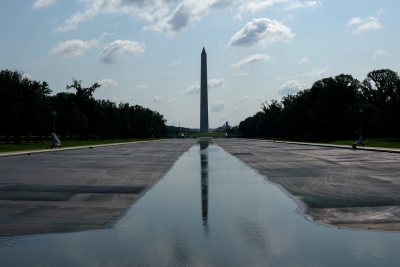 The Washington Monument is reflected in the recently drained Lincoln Memorial Reflecting Pool on July 29. Photo by Kevin Carter via Getty Images.
As we wrote on June 25, experts told us there were plausible explanations for the peeling related to the installation, rather than vandalism.
That was ultimately the conclusion reached by Pirro. And she provided detailed evidence that the DOI was long aware of installation issues related to the repairs of the reflecting pool.
“DOI provided less than fulsome information at the outset of this case,” Pirro wrote in the motion.
Pirro said she and other senior members of the U.S. Attorney’s Office began to question the DOI’s claim that nearly all the damage was due to vandalism when they did a visual inspection of the reflecting pool on July 17, and they “immediately noted extensive damage throughout the now-drained pool.” Pirro said she demanded the DOI provide further information, and that the subsequent information “strongly suggest[ed] that a rushed and botched installation by [Atlantic Industrial Coatings], the primary contractor, led to the damage to the lining of the Reflecting Pool. It was not until [prosecutors] repeatedly reached out to DOI dozens and dozens of times that DOI slowly started trickling information to [prosecutors]. Had DOI been forthcoming with the information clearly in its possession, the government would not have sought a grand jury indictment.”
“Specifically, the newly released documents reveal that work on installing the lining almost immediately fell behind, due to a combination of very rainy and windy weather, repeated failures of testing on the sealing of the expansion joints, and delays in obtaining sealing product at the worksite,” Pirro wrote. “The rush to complete the project led to hasty and botched work that was not remediated before the project was finished and the fencing removed.”
“Almost immediately after work was initially completed, peeling was observed along the pool perimeter,” the motion states. A National Park Service engineer wrote an email on June 11 that “stated that the cause of the damage was contractor error via ‘overspray.'”
That email was written more than three weeks before Interior Secretary Doug Burgum appeared on CNN’s “State of the Union” and insisted the liner “didn’t peel off. There … was vandalism. There was box cutters.”
Asked by CNN’s Dana Bash if he was “100% sure that what happened with the liner was vandalism” and if he “can prove it,” Burgum responded on July 5: “Oh, yes, absolutely, Dana. And we drain it, and we have got all the photographs, we can see. I mean, there’s no possible way … I’m not sure why you and others in the media think that you want to keep trying to question whether or not — think, this is an industrial liner. Every farmer and rancher in America that’s had their pickup liner lined by this sprayed-on liner knows that you literally — literally, it would never just like peel off or fall off. … And it’s the size of eight football fields. And the only way you can end up with actual slices in one spot and not the other is that someone physically cut it.”
But according to Pirro’s motion, a July 20 inspection by contractors “confirmed that overspray and delamination had occurred, again pointing to contractor error. Finally, a recent visual inspection showed damage throughout the Reflecting Pool, even in the middle of the pool, where a vandal would not likely attempt to peel the lining. Given all of this newly discovered information, it is difficult to attribute the widespread damage to the Reflecting Pool to vandalism, let alone to establish that fact beyond a reasonable doubt.”
The motion was an about-face for Pirro, who in a July 2 press conference said there “was an effort, a violent effort, to rip up the sealant from the bottom of the pool” and that there was “tremendous evidence” that Hearn “damaged the pool.”
Pirro said then that she had visited the pool the day before and “someone intentionally did a tremendous amount of damage to the pool, and you can actually see where all the cutting is. They took a sharp object and cut for many feet along the pool.”
We reached out to the Department of Interior for comment about the motion, and its claim that the DOI withheld important information from prosecutors. The press office pointed us to an X post from Burgum on Aug. 1, in which he continued to insist the damage to the reflecting pool was done by vandals.
“The evidence is clear, vandals have repeatedly caused damage to the Reflecting Pool. Some of these acts were even caught on camera,” Burgum wrote. “We also provided the U.S. Attorney’s office expert and eyewitness testimony to the damage done by vandals and provided every piece of evidence they asked for in the requested time line detailing each area of damage at the pool. … We won’t back down to deranged people who want to destroy, deface, or degrade our monuments.”
We also reached out to Atlantic Industrial Coatings for comment on Pirro’s motion, but we did not get a response. However, the company posted a message on its website on June 21 stating that — in conjunction with the National Park Service — it had identified “some areas in the Reflecting Pool that require repairs.”
“These areas are a very small part of the massive 7 acre project, and do not indicate a failure of the liner,” according to the statement. “As soon as its feasible for the Park, the pool will be drained and AIC will be back to make those needed repairs as part of the warranty.”
The Department of Interior awarded a no-bid contract on April 3 to Atlantic Industrial Coatings to paint the reflecting pool, with supplemental agreements issued through June 15 to total $14.7 million. The agency justified not getting bids from various contractors by saying the project was urgent and needed to be completed by July 4.
In addition to Hearn, a handful of others have been charged with vandalism of the reflecting pool, and three face misdemeanor charges of destruction of property under $1,000, the New York Times reported. Hearn was the only one to face a felony charge.
Editor’s note: FactCheck.org does not accept advertising. We rely on grants and individual donations from people like you. Please consider a donation. Credit card donations may be made through our “Donate” page. If you prefer to give by check, send to: FactCheck.org, Annenberg Public Policy Center, P.O. Box 58100, Philadelphia, PA 19102.
The post Trump’s Continued Claims of Vandalism at Reflecting Pool Disputed by U.S. Attorney Memo appeared first on FactCheck.org.
-
US states sue Trump administration over new tariffs on 60 trading partners
www.theguardian.comCoalition of 25 states asks US Court of International Trade to halt tariffs and declare them them unlawful
A coalition of 25 US states sued the Trump administration on Monday over new tariffs pegged at 10% to 12.5% on goods from 60 trading partners, calling them a pretext for replacing import taxes struck down by the supreme court in February.
The states are asking the US Court of International Trade to halt the tariffs, declare them unlawful and order refunds of duties that have already been paid.
Continue reading... -
Trump accuses Jeanine Pirro of ‘folding’ by dropping reflecting pool charges
www.theguardian.comTrump ‘disappointed’ with US attorney amid reports he’s considering removing her from her post
Donald Trump accused US attorney Jeanine Pirro of having “folded like an umbrella” amid reports that he was considering removing her from her post.
Trump criticized Pirro on Monday after she dropped vandalism charges against a former Olympian accused of damaging the recently renovated Lincoln Memorial reflecting pool. Trump nominated Pirro to serve as interim US attorney for the District of Columbia last year, and the Senate later confirmed her in August.
Continue reading... -
Trump lashes out at Big Oil for 'making too much money' during Iran war: 'They ought to give some of that back'
President Trump bristled Monday at Big Oil's huge windfall amid the war in Iran, arguing that the country's largest oil companies should give some of their record profits to the American public.www.allsides.com -
This Trump-linked startup plans to put humanoid robots in the military
As Silicon Valley races to build humanoid robots that can fold laundry and pour a latte, at least one start-up sees a very different use for the technology: war or other potentially hazardous and deadly jobs.www.allsides.com