Conversation
-
Washington Policy Review: August 4, 2026
sourceToday’s Report
1. Overview
2. White House News
3. Truth Social Posts
4. Government Department News
5. 2028 Democratic Presidential Candidates
6. AI & Tech Company News
7. Congressional Watch
8. Policy Impact Analysis & Heatmap
1. Overview
President Trump commemorated the 236th birthday of the U.S. Coast Guard, praising personnel as “America’s maritime first responders” tasked with countering cartels and stopping illegal maritime activity. He touted a $25 billion investment to modernize the fleet with new cutters and icebreakers as part of a “new Golden Age for America.” Additionally, the President championed his “America First” economic agenda, citing a manufacturing sector expansion and a $1.5 billion investment from Octapharma that is expected to create 1,500 jobs.
President Trump highlighted a media appearance by Treasury Secretary Scott Bessent, directing his followers to the official’s recent interview on CNBC. This social media post served to amplify the administration’s messaging on current economic policy and fiscal updates.
Governor Gavin Newsom issued three specific requests and updates regarding California’s wildfire season, including an invitation for President Trump to deliver overdue federal aid for 2025 wildfire recovery. Newsom noted that only $37 million of $1.5 billion in FEMA claims had been received, stating, “There are moments that rise above politics.” Furthermore, the Governor announced the deployment of CAL FIRE resources to assist Washington and Oregon, asserting that the state “believes in science,” and secured federal grants for the ongoing Gann Fire in Calaveras County.
Governor Wes Moore of Maryland issued a statement regarding the passage of a legislative amendment focused on congressional redistricting. Moore warned that “President Trump and Republicans across the country are working to rig the system, weaken voting rights, and make this pain permanent.” He argued that the amendment is necessary to prevent “political redlining” and to ensure that electoral authority remains with the citizens of Maryland.
NVIDIA announced several major initiatives, including a partnership with the National Science Foundation to expand regional AI infrastructure and the commercial release of “Alpamayo 2 Super,” an open model for autonomous vehicles and robotaxis. The company also unveiled advancements in GPU-optimized storage designed to bypass CPU bottlenecks in high-demand AI environments. Additionally, NVIDIA joined the Open Secure AI Alliance to promote the “Shared AI Findings Exchange” (SAFE) guidelines, which aim to standardize cybersecurity transparency and incident sharing for agentic AI systems. OpenAI also announced new cybersecurity safeguards for its models and introduced education-focused plugins for ChatGPT Work and Codex, while Anthropic appointed Mariano-Florentino Cuéllar as its first Chief Global Affairs Officer.
On August 3, the Senate passed several bills, including the Foreign Robocall Elimination Act, the Bankruptcy Threshold Adjustment Act, and the Youth Poisoning Protection Act. Senators also voted 89-4 to advance the AGOA Extension Act, which is intended to serve as a legislative vehicle for upcoming government funding measures. Meanwhile, the House of Representatives held only a brief pro forma session with no substantive legislative business or votes conducted.
Aggressive federal support for industrial reshoring strengthens domestic manufacturing capital expenditure, though this growth faces bearish headwinds from potential international trade retaliation and uneven regional implementation. In the technology sector, the focus on data architecture and hardware efficiency mitigates scaling bottlenecks for agentic AI, yet this transition increases systemic vulnerability through concentrated hardware reliance and heightened cybersecurity risks. Meanwhile, the strategic use of omnibus legislative vehicles like the AGOA Extension Act provides market stability by preventing fiscal shutdowns, even as critics argue this approach “circumvents traditional debate” and obscures the granular visibility of sector-specific regulatory shifts.
2. White House News
Presidential Message on the Birthday of the United States Coast Guard
President Trump commemorates the 236th birthday of the United States Coast Guard, honoring their service as “America’s maritime first responders.” He highlights their role in defending against “narco-terrorist cartels” and stopping the “illegal invasion at sea.” President Trump underscores his Administration’s $25 billion investment to rebuild the fleet, including new cutters, helicopters, and icebreakers, alongside recent bonuses for personnel. Emphasizing a “new Golden Age for America,” he pledges his continued support for the service members, praising their role in ensuring national security and prosperity.
Reference: https://www.whitehouse.gov/briefings-statements/2026/08/presidential-message-on-the-birthday-of-the-united-states-coast-guard/
Manufacturing Jobs Flock to the U.S. Thanks to President Trump’s America First Economic Agenda
President Trump’s economic agenda, featuring “Working Families Tax Cuts and America First trade policies,” is credited with driving an economic revival in the U.S. manufacturing sector, which saw its strongest expansion in over four years this July. Marking seven consecutive months of growth, this trend is highlighted by Switzerland-based Octapharma’s recent $1.5 billion investment to construct its first U.S. facility, creating 1,500 jobs. President Trump and his administration remain committed to their promise to “reshore American jobs, revitalize our domestic supply chain, and put America First.”
Reference: https://www.whitehouse.gov/releases/2026/08/manufacturing-jobs-flock-to-the-u-s-thanks-to-president-trumps-america-first-economic-agenda/
3. Truth Social Posts
Trump highlighted a recent media appearance by Treasury Secretary Scott Bessent, directing attention to the official’s interview with Joe Kernen on CNBC.
Reference: https://truthsocial.com/@realDonaldTrump
4. Government Department News
No relevant government department updates found for this date.
5. 2028 Democratic Presidential Candidates
Gavin Newsom (gov.ca.gov)
Governor Newsom is calling on President Trump to deliver federal disaster aid pledged 18 months ago following the January 2025 wildfire storms. While the President visits Los Angeles for a fundraiser, the Governor noted that California has received only $37 million of $1.5 billion in submitted FEMA claims. Newsom stated, “There are moments that rise above politics. This could be one of them, Mr. President,” urging the administration to fulfill its commitment to survivors in Altadena, Pacific Palisades, and Malibu who are still rebuilding.
California is deploying 20 CAL FIRE engines and four Rapid Extraction Module Support teams to assist with wildfires in Washington and Oregon. Since July 16, the state has coordinated the movement of 380 personnel and 60 engines to the Pacific Northwest. Governor Newsom emphasized the state’s solidarity with neighbors facing climate-driven threats, asserting, “We believe in science, and we also believe in our own eyes.” These deployments supplement local firefighting capacity and will not impact California’s internal emergency response readiness.
Governor Newsom secures federal assistance to support response to Gann Fire in Calaveras County
California has secured a Fire Management Assistance Grant (FMAG) from FEMA to support suppression efforts for the Gann Fire, which began on August 3 in Calaveras County. The fire has burned over 6,495 acres, forcing the evacuation of 1,473 residents. The grant allows state and local agencies to seek 75% reimbursement for eligible suppression costs. Governor Newsom stated that the assistance strengthens the state’s ability to “accelerate containment efforts, protect lives and property, and support communities facing ongoing evacuations.”
Governor Newsom announces appointments 8.4.2026
Governor Newsom announced several appointments, including Luis Garnica as Warden of Mule Creek State Prison and Jolie Poper as Chief Deputy General Counsel for the Department of Corrections and Rehabilitation. Additionally, Joseph Cannata and Vincent Hoenigman were appointed or reappointed to the Tahoe Regional Planning Agency Governing Board, and Natalie Arroyo was reappointed to the Klamath River Renewal Corporation Board of Directors. Most of these roles do not require Senate confirmation.
Wes Moore (governor.maryland.gov)
Governor Moore praised the Maryland General Assembly for passing a constitutional amendment regarding congressional redistricting. Moore stated that he has warned that “President Trump and Republicans across the country are working to rig the system, weaken voting rights, and make this pain permanent.” He argued that the amendment prevents “political redlining” and ensures that the final authority on representation rests with Maryland voters. Moore urged citizens to support the measure in the November election to maintain local control over the redistricting process.
6. AI & Tech Company News
OpenAI (openai.com)
Third-party cyber evaluations involving OpenAI models
OpenAI has detailed recent incidents regarding third-party cybersecurity evaluations of its AI models. In response, the company has implemented new safeguards designed to improve the rigor and security of the model testing and evaluation process.
New ways to learn and teach with ChatGPT Work and Codex
New education-focused plugins for ChatGPT Work and Codex are now available to support K–12 and higher education environments. These tools are designed to assist teachers, students, and researchers in their efforts to facilitate learning, conduct research, and build new projects.
Anthropic (anthropic.com)
Mariano-Florentino (Tino) Cuéllar to join Anthropic as Chief Global Affairs Officer
Mariano-Florentino (Tino) Cuéllar has been appointed as Anthropic’s first Chief Global Affairs Officer to lead international policy, strategy, and government relations. Cuéllar previously served as President of the Carnegie Endowment for International Peace and as a Justice of the Supreme Court of California. Having served on the President’s Intelligence Advisory Board and various academic and policy institutions, he will transition from his role as a Trustee of Anthropic’s Long-Term Benefit Trust to lead the company’s collaboration with global governments on AI development and governance.
NVIDIA (nvidia.com)
NVIDIA is partnering with the U.S. National Science Foundation to support State and Regional AI Infrastructure Hubs, aiming to broaden access to AI computing, software, and technical expertise. Modeled after NVIDIA’s collaboration with the University of Florida, the initiative helps university consortia pool resources to foster regional innovation. The program focuses on building a skilled workforce through flexible AI education and infrastructure, enabling institutions to address local economic needs and research priorities while preparing students for the AI economy.
NVIDIA has released Alpamayo 2 Super for commercial use under the Linux Foundation’s OpenMDW-1.1 license. Designed for robotaxis and autonomous vehicles, the model provides frontier-scale reasoning to handle complex, rare driving scenarios. It offers 360-degree context and produces causal reasoning traces and trajectory planning. According to NVIDIA, the model outperforms competitors like GPT-4o and Gemini 2.5 Pro on driving-centric benchmarks. It is part of an “open model” family designed to provide a cloud-to-car workflow that allows developers to customize and deploy autonomous systems efficiently.
As AI Increases Demands on Memory, Storage Steps Up
At the Future of Memory and Storage conference, NVIDIA unveiled storage advancements to support high-demand AI environments. The company is open-sourcing its cuFile APIs to allow GPUs to interact directly with storage, bypassing CPU bottlenecks and enabling microsecond-speed data access. NVIDIA also introduced the “Storage-Next” initiative, a collaboration with over 40 industry partners to create standardized, GPU-optimized storage architectures. These efforts aim to make storage an active component of the data path, ensuring that AI-powered systems can securely and efficiently process massive, concurrent data requests.
AI Leaders Propose SAFE Guidelines for Cybersecurity Transparency
The Open Secure AI Alliance, representing over 120 organizations, has proposed the Shared AI Findings Exchange (SAFE) guidelines to improve agentic AI cybersecurity. The initiative, supported by the Linux Foundation and members including NVIDIA, Cisco, and CrowdStrike, seeks to create a framework for sharing information on AI incidents and “near misses” to reduce systemic risk. NVIDIA highlighted its contributions to the defensive stack, including open-source tools for agent governance, runtime security, and vulnerability scanning, emphasizing that collective defense is essential for securing rapidly evolving AI agent systems.
7. Congressional Watch
Covers the 2026-08-03 session — the Congressional Record is published with a one-day delay.
Senate
The Senate conducted legislative business, including passing three bills related to public safety, bankruptcy eligibility, and robocalls. Senators also advanced the procedural path for an African trade extension bill that serves as the vehicle for a government funding measure.
H.R. 6500, AGOA Extension Act — Procedural motion to move toward consideration of this trade bill, which will also serve as a vehicle for a continuing resolution [Passed 89-4 (Vote No. 218)]
S. 2666, Foreign Robocall Elimination Act — Directs the FCC to establish a task force to combat unlawful robocalls [Passed by voice vote]
S. 3977, Bankruptcy Threshold Adjustment Act — Modifies specific bankruptcy eligibility requirements in federal law [Passed by voice vote]
S. 289, Youth Poisoning Protection Act — Bans the sale of products containing high concentrations of sodium nitrite to individuals [Passed by voice vote]
House of Representatives
The House held a brief pro forma session on Monday, August 3, with no substantive legislative business or votes conducted. The session lasted approximately 15 minutes.
No significant actions — No legislative business or voting occurred [N/A]
Committee Highlights
Senate Committee on the Budget — Examined the current state and reality of the Medicaid program
Senate Finance Subcommittee on Health Care — Examined the role of biotechnology in building a resilient health care future
Senate Committee on the Judiciary — Examined consumer costs associated with AI surveillance pricing
Senate Select Committee on Intelligence — Examined certain classified intelligence matters
Coming Up
The Senate will reconvene at 10:00 a.m. on Tuesday, August 4, 2026, to continue consideration of the AGOA Extension Act. The House of Representatives is scheduled to meet next in a pro forma session at 9:00 a.m. on Thursday, August 6, 2026.
Reference: Congressional Record Archive
8. Policy Impact Analysis & Heatmap
This analysis is provided for informational purposes only. It does not constitute investment advice or a recommendation to buy or sell any security.
Impact on Market
Based on today’s policy developments, our analysis identifies the following market impact themes:
THEME 1. INDUSTRIAL RESHORING AND MANUFACTURING EXPANSION
The administration is aggressively promoting capital expenditure in domestic manufacturing as a proxy for economic success. By linking tax cuts and trade policy to specific investment announcements, the executive branch attempts to validate its economic strategy. Bearish risks include potential trade friction if these protections create retaliatory measures from foreign partners. Critics also note that federal support remains inconsistent, as domestic recovery in regions suffering from natural disasters remains stalled despite promised funding.
THEME 2. AI INFRASTRUCTURE DE-BOTTLENECKING
Technological focus is shifting from pure compute power to the underlying data architecture required for agentic AI. NVIDIA’s integration with the NSF and new CPU storage products aim to resolve efficiency constraints that threaten to stall AI adoption at scale. While this enhances throughput for heavy users, it also increases reliance on centralized hardware providers. Cybersecurity concerns persist, as even collaborative efforts to share incident data face the risk of revealing proprietary vulnerabilities to sophisticated adversaries.
THEME 3. FISCAL LEGISLATIVE VEHICLES
The Senate is utilizing the AGOA Extension Act as a legislative engine to ensure government funding continuity. This procedural step is intended to avoid market-disrupting shutdowns while addressing broader trade obligations. The reliance on such legislative ‘vehicles’ often leads to complex, omnibus-style bills that complicate sector-specific policy visibility. Opposition figures warn that this method circumvents traditional debate, potentially leaving controversial policy changes buried within necessary appropriations.
Policy Impact Heatmap with Market Direction
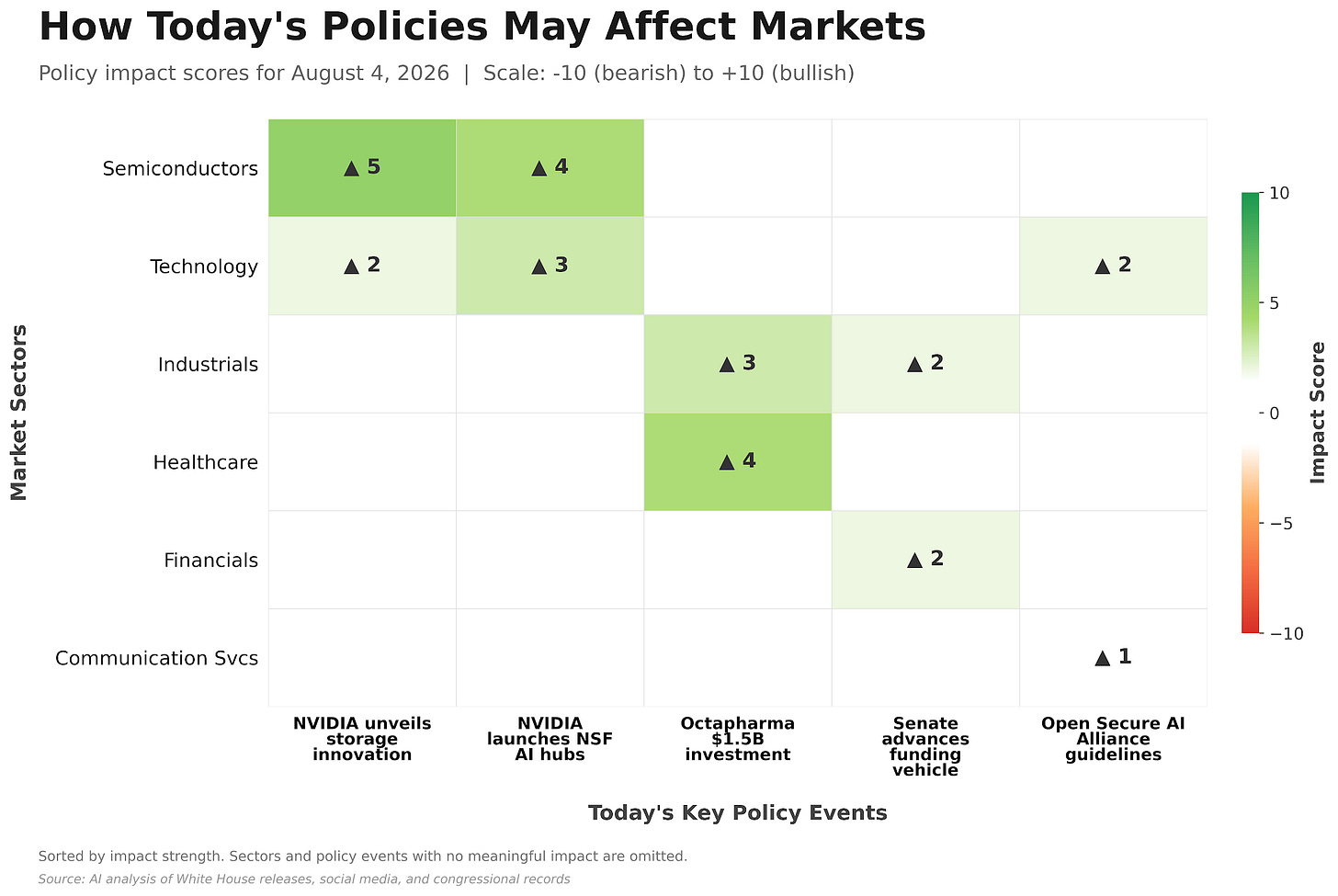
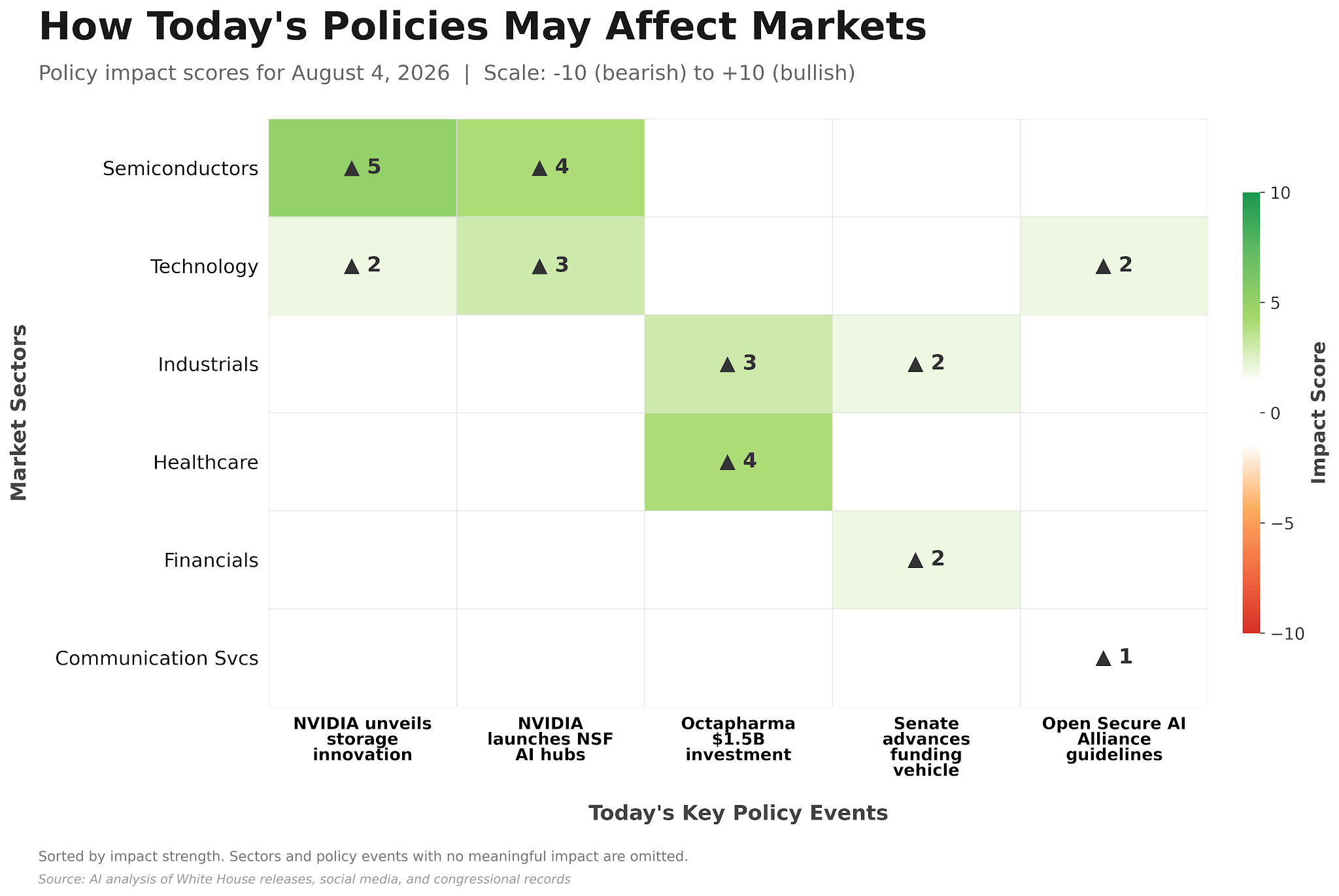
Each cell shows an estimated impact score on a fixed scale of -10 to +10, reflecting how today’s policy developments may affect each market sector. Positive scores (green, ▲) suggest bullish impact; negative scores (red, ▼) suggest bearish pressure. Rows and columns are sorted by impact strength, and sectors and policy events with no meaningful impact are omitted. The heatmap, the analysis below, and the Impact on Market themes above are produced from a single unified analysis: the heatmap visualizes the magnitudes, while the text explains the causal reasoning behind them.
Government policy and industrial expansion are driving current market sentiment. The Senate’s move to use the AGOA extension as a vehicle for government funding provides a critical signal for fiscal stability, reducing potential volatility around a looming budget expiration. Simultaneously, the administration is emphasizing manufacturing growth, citing capital inflows like the new Octapharma facility as evidence of successful ‘America First’ industrial policy. Critics, however, argue that such growth remains uneven, as evidenced by local leadership complaints regarding delayed federal disaster aid in California, which they characterize as an ‘18-month’ failure to address urgent recovery needs.
Technological advancement is pivoting toward infrastructure integration. NVIDIA’s deployment of NSF AI hubs and new storage architectures directly addresses the ‘bottleneck’ issues currently plaguing high-compute AI environments. These moves are likely to lower barriers to entry for research institutions, theoretically broadening the customer base for accelerated computing. The cybersecurity initiatives led by the Open Secure AI Alliance represent a proactive regulatory posture, attempting to standardize safety protocols before systemic failures occur. Such moves aim to protect intellectual property, though they reflect rising anxieties that ‘agent speed’ attacks may outpace current defensive infrastructure.