TrumpWatch publisher
-
The Democratic Party Playbook Is On The Ballot In Michigan
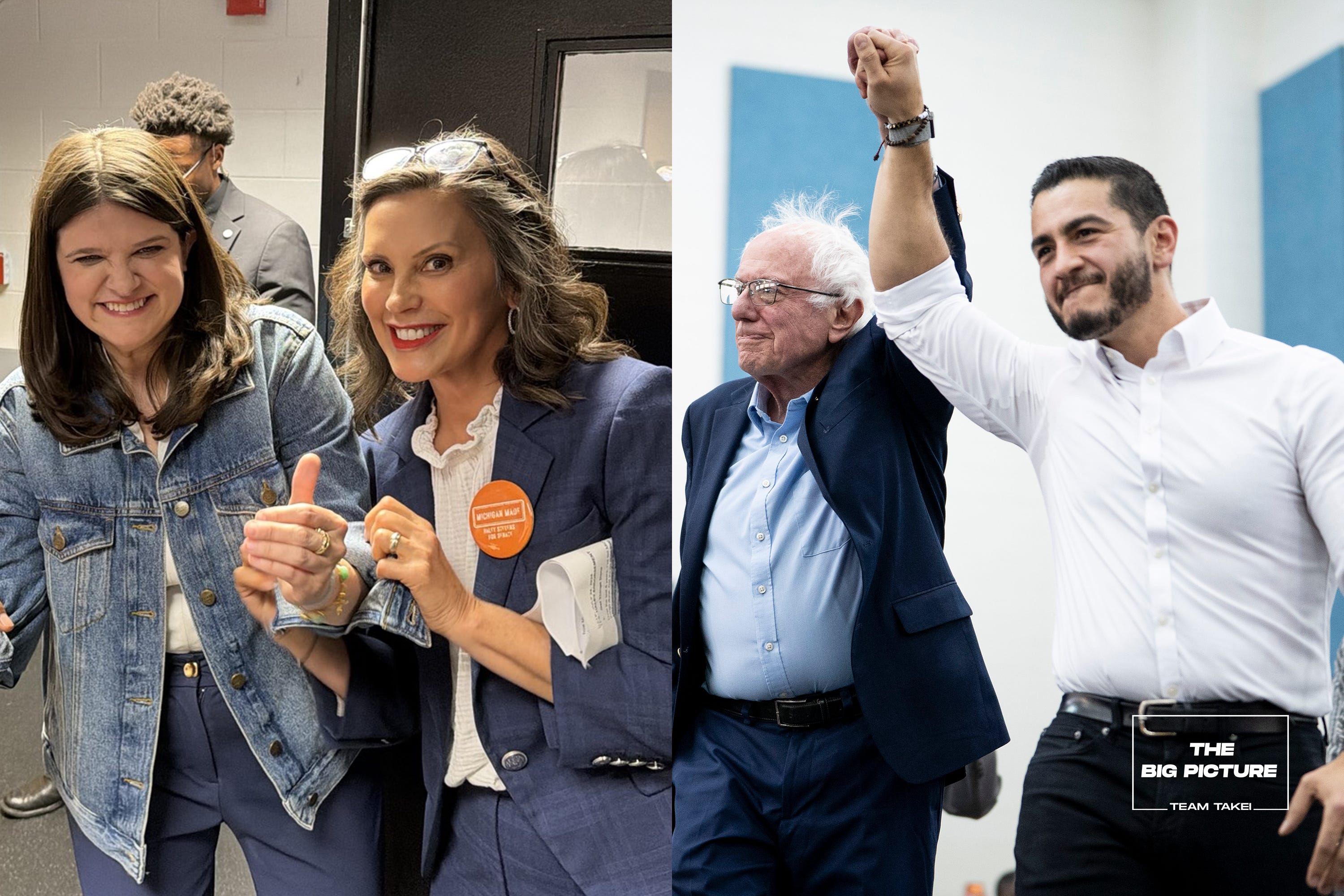
thinkbigpicture.substack.com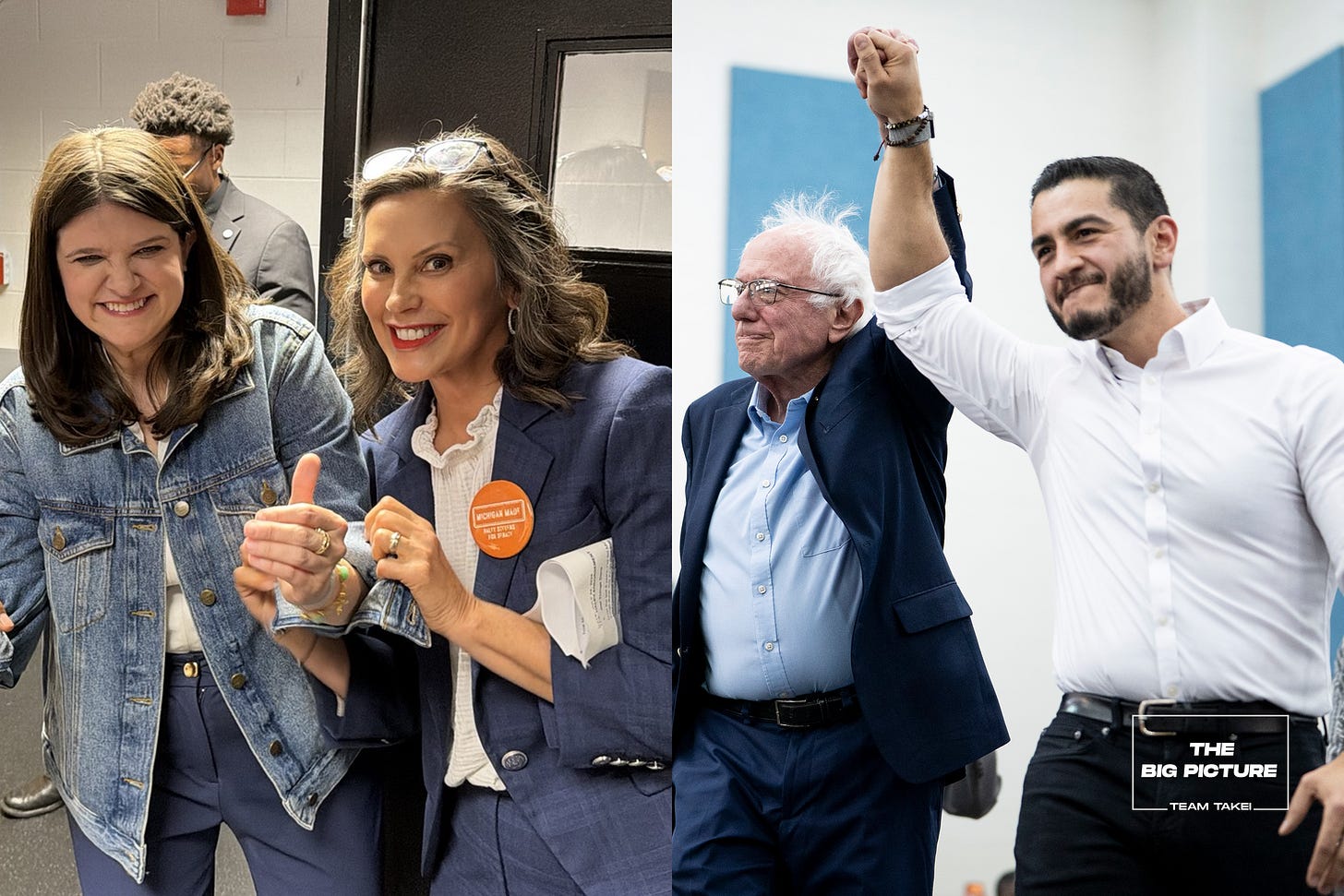 LEFT: Haley Stevens and Gretchen Whitmer. Photo Credit: X.com/HaleyforMI. RIGHT: Abdul El-Sayed and Bernie Sanders. Photo by Sarah Rice/Getty Images.
Tomorrow, August 4th, marks Election Day in the Michigan Democratic primary for U.S. Senate between Dr. Abdul El-Sayed and Rep. Haley Stevens. But when the results come in, they will represent much more than the culmination of a long, hard-fought primary between two Democratic candidates.
As Vox put it, this race is “less a Senate primary than a proxy war for where the party goes next.” And with the Senate majority on the line, the stakes are incredibly high, which is why a factional rift between the “normie” or establishment lane of the Democratic Party and its left flank is tearing much of the party in two, with this primary race at the center of the fight.
For over a year, the Democratic Party has been undergoing a battle for its future, beginning with Zohran Mamdani’s victory over former New York Governor Andrew Cuomo in the race for Mayor of New York City. Many brushed it off as a quirk of a very blue city, whose voters were uniquely open to electing a Democratic Socialist to lead their city. But something was very clear to many of us at the time: What Mamdani achieved in New York City in that primary was translatable to other parts of the country, and Democrats everywhere should be taking notes.
Now, just over a year after Mamdani’s surprise primary victory, it’s clear many of these normie Democrats ignored the warning signs and got caught flat-footed as progressive challengers to the establishment won over majorities of primary voters in many races around the country. On the eve of the Michigan Senate primary, many are looking to this race for a sign as to which direction the Democratic Party is headed, as it offers the first opportunity to see this dynamic play out at the statewide level in a bona fide swing state won by Trump.
The contrast between the candidates is stark. Dr. El-Sayed, endorsed by Senator Bernie Sanders and Rep. Alexandria Ocasio-Cortez, has been running to the left as the anti-establishment reformer. Rep. Stevens, endorsed by Senator Chuck Schumer and Governor Gretchen Whitmer, is a moderate who has run the usual establishment plays.
Polls currently show El-Sayed surging ahead of Stevens in the primary, even while other polls show Stevens performing better in the general against former Rep. Mike Rogers, the presumptive Republican candidate in the race. Much like another hard-fought primary 18 years ago, Michigan Democrats are being asked to choose between their heart and their head. And which they choose is likely to tell us a lot about the direction of the Democratic Party heading into 2028.
Clinton 2008 vs. Mamdani 2025
In early July, during the first head-to-head debate between El-Sayed and Stevens, I experienced a case of déjà vu.
There was Stevens, fielding her first question about affordability and framing herself as the candidate of experience against a male opponent she portrayed as a lightweight.
-
Eric Trump Advises Company at Forefront of Army Robots in Race with China
American defense companies are accelerating the development of autonomous and semi-autonomous robotic systems that military leaders say could transform future warfare, even as China is widely viewed as making major advances in integrating robotic soldiers and artificial intelligence into its armed forces.www.allsides.com -
Did Stan Woodward Get Paid Via the Proceeds of the Money Laundering that Todd Blanche Immunized?
emptywheel.net
When right wingers performed Xitter outrage over the list of subpoenas — targeting the financial records of much of the MAGAt right — that Chuck Grassley released last October, I noted that what they were wailing about looked an awful like an investigation into money laundering.Those subpoenas asked for records that would show Trump raised money using false pretenses of supporting voting integrity between November 2020 and his insurrection. It tracked what happened to a Joint Fundraising Committee. It tracked what happened with payroll for some far right organizations run by people like Mark Meadows and Stephen Miller.
As I noted at the time, these subpoenas closely tracked allegations made in the January 6 Report.
The Trump Campaign spent the money on President Trump, giving donations to his associates, and keeping it for himself in Save America. Hundreds of millions of dollars that were raised to go towards “election defense” and “fighting voter fraud” were not spent that way at all. To the contrary, most of the funds remain unspent, and millions have been paid to companies that are known affiliates of President Trump, or payments to entities associated with former Trump administration officials. Since the election, former Trump officials who are still working for President Trump’s PACs, and are publicly receiving salaries as FEC-reported “payroll,” are also associated with these companies.
For example, from July 2021 to the present, Save America has been paying approximately $9,700 per month to Dan Scavino,171 a political adviser who served in the Trump administration as White House Deputy Chief of Staff.172 Save America was also paying $20,000 per month to an entity called Hudson Digital LLC. Hudson Digital LLC was registered in Delaware twenty days after the attack on the Capitol, on January 26, 2021,173 and began receiving payments from Save America on the day it was registered.174 Hudson Digital LLC has received payments totaling over $420,000, all described as “Digital consulting.”175 No website or any other information or mention of Hudson Digital LLC could be found online.176 ThoughHudson Digital LLC is registered as a Delaware company, the FEC Schedule B listing traces back to an address belonging to Dan and Catherine Scavino.177
Nick Luna, President Trump’s former personal assistant and “body man,” was being paid from April 2021 to December 2021 approximately $12,000 per month by Save America for “payroll.”178 The Make America Great Again PAC (MAGA PAC)—formerly the authorized committee of President Trump’s reelection campaign, Donald J. Trump for President—paid $20,000 per month to a limited liability corporation called Red State Partners LLC from April 2021 through October 2021, and Save America paid Red State Partners LLC $20,000 in February 2022.179 The company was registered in Delaware on March 11, 2021 180 and has received a total of $170,000.181 Though it is registered in Delaware, disclosures filed with the Federal Election Committee (FEC) list Red State Partners at an address inMiami, Florida, that is an address for Nick Luna and his wife, Cassidy Dumbauld.182
Further, Vince Haley, Taylor Swindle, and Ross Worthington are corporate officers of a company known as Pericles LLC.183 Haley is a former policy advisor to President Trump,184 Swindle is the Chief Financial Officer for Gingrich 360,185 and Ross Worthington is the former White House speechwriter 186 who wrote the speech President Trump delivered on the Ellipse on January 6th.187 Pericles LLC was registered on January 27, 2021,188 the day after Scavino’s Hudson Digital LLC, and, since then, has received payments from Save America totaling at least $352,700.189
That’s one reason it was completely unsurprising to me when Capital Bank revealed on Friday that they had shut down Trump’s accounts because of money laundering concerns.
To the contrary, those documents and Plaintiffs’ own allegations make clear that Capital One closed Plaintiffs’ accounts for anti-money laundering (“AML”) reasons. The closures were the result of months of analysis and a careful review by Capital One’s AML team in accordance with bank policies and regulatory guidance. Capital One never publicized the termination decision nor its confidential internal process giving rise to the closure, and it permitted Plaintiffs several months (and granted several extensions) to find new banking services, which they did.
Whether or not Jack Smith investigated whether this was money laundering — or a campaign finance violation — all this sloshing of cash might look like money laundering to any bank required to look for such things. And when banks find such sloshing, they file Suspicious Activity Reports to the Feds and shut down the accounts in question.
We know Capital One shut down the accounts. That level of concern requires banks file SARs.
There are two subpoenas for Capital One among the ones Chuck Grassley revealed, though not for Trump. One, for records from September 2020 to the date of the subpoena, April 6, 2023, for Justin Clark. And one issued on November 16, 2022 — days before Jack Smith was appointed — also from September 2020 to the present, for the Conservative Partnership Institute, Mark Meadows’ gig. There were a slew of subpoenas to CPI, asking about how they awarded their grants, asking specifically about (among others) Stephen Miller.
That’s the stuff that (as the January 6 Committee noted) looked pretty suspect.
But there’s another use of Trump’s campaign funds that prosecutors investigated, which could be money laundering or could simply be suspected obstruction.

Those are subpoenas, including one dated March 23, 2023, that ask for materials related to the representation of everyone whose lawyers would have been vetted by Susie Wiles, who ran Trump’s Save America PAC.
The law firms mentioned include Woodward Brand — the law firm of Stan Woodward, who represented Kash Patel and others, and who in his current role as Associate Attorney General signed the IRS “settlement” — and Dhillon Law, the law firm of current Assistant Attorney General Harmeet Dhillon, at which current White House Counsel David Warrington also worked.

To be clear: Those payments may be entirely kosher, except insofar as they suggest that people only got legal representation after Wiles made sure they would protect Donald Trump (which allegation shows up in the stolen document indictment). But we do know those payments were investigated, thanks to Chuck Grassley.
And now that Trump has forced Capital One to reveal that he looked like he was laundering money in 2021, in precisely the period he appeared to be laundering funds raised for election integrity to pay off those who were part of the coup, we deserve an answer before Trump defense attorney Todd Blanche sweeps Trump’s crimes under the rug again.
Were any of the people appointed to high positions in the current administration beneficiaries of the money laundering Blanche is attempting to immunize?
The post Did Stan Woodward Get Paid Via the Proceeds of the Money Laundering that Todd Blanche Immunized? appeared first on emptywheel.
-
Free At Last, Free At Last, Thank God Almighty Trump’s Taxes are Free At Last
emptywheel.net

Seal of the US Internal Revenue Service
Donald Trump, February 26, 2016 (via PBS):
Republican presidential front-runner Donald Trump is sticking to his new explanation for why he can’t yet release copies of his recent tax returns: The IRS is auditing him, as Trump says it has for the last 12 years.
“Until my audit is finished, you’re not going to see anything,” Trump said Friday, adding that he believes the government has unfairly targeted his returns. “I’m not going to complicate things.”
[snip]
During Thursday’s debate, Trump predicted what anyone reviewing his tax returns would find: “nothing, nothing.” But the odds of being randomly audited every year for a decade is vanishingly small — and Trump’s statement that “four or five” years of his tax returns are actively being audited raised even more questions. The IRS’s normal statute of limitations for an audit is three years — though that time frame is extended in instances of substantial underreporting and there is no time limit on reviews in the event of fraud.
The unsigned “clarifying” statement on the so-called “settlement” of Trump’s lawsuit against himself dba the IRS with respect to his exposure to audits past, present, and future by the IRS, printed on stationery of the Office of the Attorney General:
Further, the May 19, 2026 Order regarding a mutual release of claims applies by its terms only retroactively.
Putting these two together, I guess this now means that since all Trump’s past IRS filings – both his personal returns and the returns of any/all corporate entities – are final and no longer facing a threat of an audit, I fully expect Trump to quickly release his returns from the past five years. He is anxious, after all, to prove just how wonderful a businessman he is and just how fabulously wealthy he is, a billionaire (at least!) the likes of which the world has never seen.
Right?
I also expect a complete Democratic sweep of the US House and Senate races in November, and a pony under my Christmas tree this December.
The post Free At Last, Free At Last, Thank God Almighty Trump’s Taxes are Free At Last appeared first on emptywheel.
-
Trump meets his obstinate match in Iran’s hardball regime
www.theguardian.comUS president reduced to bemoaning Tehran’s ‘unbelievable duplicity’ as he struggles to find solid negotiating ground
The Donald Trump doctrine has always contained a tenuous relationship with the truth. It was his mentor, the infamous New York lawyer Roy Cohn, who taught the young real estate mogul always to claim victory and never to admit defeat. Unfortunately for Trump, in Iran the US president has found a counterpart just as stubborn as himself.
As Trump claims new negotiations are to begin with Tehran this week, Iran has shown it can also reignite the conflict by lobbing ballistic missiles at US bases in the region and maintaining a stranglehold on the strait of Hormuz, effectively taking initiative in the stalled peace process. And time is of the essence for Trump as the clock ticks toward a global energy crisis and a painful midterm elections for him and his Republican party.
Continue reading... -
DOJ Dumps Reflecting Pool Charges, Admits It Was All The Fault Of Trump’s No-Bid Pool Guys; While Trump Sticks By His Vandalism Story
www.techdirt.comHail to the Chief. Our country is being run by paranoid conspiracy theorist megalomaniac who openly wishes to kick-start America’s first autocracy. Nothing that goes wrong is ever the president’s fault. It’s always the fault of officials with insufficient loyalty or the criminal acts of people out to get him.
Trump decided the Lincoln Reflecting Pool needed a makeover. Not because it had several long-term issues that had been inadequately addressed over the years but because Trump wanted to make it look more Trump-y. That meant draining the entire thing to apply a layer of “American flag blue,” a hue Trump made up on the spot to demonstrate he was more American than any American who had come before him.
Rather than turn this over to the people best qualified to do the job via a bidding/vetting process, Trump handed out a no-bid contract to an entity that called Mar-a-Lago home and whose owner had thrown some money Trump’s way in the past. The company hired to do this is headed by a long-term Trump donor and sports a name that would become eerily prescient once it was through botching the job: Greenwater Solutions.
Shortly after the refurb, the water in the pool turned a bright shade of green, due to the wholly expected explosion of algae, thanks to the conditions created by the pool shutdown/startup and vastly encouraged by the “American flag blue” now coating the bottom of the reflecting pool.
Shortly after that, the pool sealant began floating to the surface, prompting curious visitors to grab chunks of the “American flag blue” material that bubbled up as Interior Department personnel tried to beat science at its own game by flooding the “Greenwater Green” pool with hydrogen peroxide.
Trump then claimed — without facts in evidence — that the green tint and floating sealant were the actions of vandals, presumably related to the antifa or whatever. In the space of a single press conference, Trump turned a 150-foot flaw in the sealant into a 350-foot “gash” that could only have been created by anti-Trump vandals.
Then the arrests began. US Attorney Jeanine Pirro promised to punish anyone caught “vandalizing” the pool to the full effect of the law. Department of Interior boss Doug Burgum mindlessly repeated Trump’s wild speculation, claiming he too was in possession of “evidence” of criminal pool fuckery. Trump continued to do what Trump always does: engage in stream-of-consciousness responses when asked to provide proof of his accusations.
Former US Olympics team member David Hearn was the first to be officially indicted for daring to touch pieces of the broken pool. That case fell apart almost immediately. First, the government’s own witness testified during the grand jury proceedings that anything Hearn grabbed from the pool was the result of defective workmanship, rather than evidence of malicious vandalism.
This prompted Hearn’s legal team to demand transcripts of the grand jury proceedings. After all, if the unnamed government employee had testified that the pool would have been falling apart with or without Hearn’s brief interaction, the resulting indictment meant government prosecutors seemingly ignored the fact that it takes at least $1,000 of damage to support a federal vandalism charge.
Well, it’s all over now, at least in terms of prosecution. (The government will likely be contending with a civil rights lawsuit in the near future.) None other than lead prosecutor Jeanine Pirro has admitted there’s no basis for the criminal charges against Hearn.
Not only that, but the DOJ’s dismissal [PDF] specifically calls out the botched pool repair job performed by another one of Trump’s no-bid buddies (Greenwater Solutions did the filtration/drainage, while Atlantic Industrial Coatings redid the pool surface). It does this as it seeks to purge itself of any blame for pursuing yet another transparently vindictive prosecution to appease the president.
[I]t was not until after the return of the indictment, that the DOI provided additional documents to the USAO-DC indicating that damage to the Lincoln Memorial Reflecting Pool in June 2026 was the result of flawed installation by the contractor, Atlantic Industrial Coatings (“AIC”), and the rush to complete the project prior to events associated with the America 250 celebration in the weeks surrounding Independence Day 2026. It was not until after these documents were produced that USAO-DC first became aware of information showing that the damage was the result of a botched installation and not vandalism as initially represented by DOI. Indeed, USAO DC could only rely (on the information provided by DOI that the damage was entirely caused by vandals, including the defendant in this case, David Hearn…
This is US Attorney Jeanine Pirro throwing the Interior Department under the bus in hopes of saving her job. That’s not going to work.
First of all, even after this filing Trump still insists the damage was due to vandalism, despite all evidence on the record showing otherwise.

That’s Donald Trump “truthing” the untruth:
I disagree 100% with Jeanine Pirro, the U.S. Attorney for the District of Columbia, on the Reflecting Pool. I don’t know what she was thinking? To me, it was a pure case of VANDALISM, that included the grass, which had a big 86 47 emblazoned in giant letters on it, and other elements of the surrounding area. There may have been some contractor difficulty, but the major damage was caused by VANDALS! President DJT
Nothing to see here, just the President of the United States insisting that his made up fantasy, that no one ever believed was true, is true in the face of a filing from his own hand-picked attorneys at the Justice Department. One would think that the president accusing a US Attorney of lying to a federal court would be a big deal, except everyone let’s it pass because they know he’s full of shit.
The same goes for Doug Burgum, the current Interior Secretary, who similarly insists this is vandalism despite evidence to the contrary, much of it produced by his own agency.

That’s Burgum tweeting:
The evidence is clear, vandals have repeatedly caused damage to the Reflecting Pool. Some of these acts were even caught on camera. We also provided the U.S. Attorney’s office expert and eyewitness testimony to the damage done by vandals and provided every piece of evidence they asked for in the requested time line detailing each area of damage at the pool.
The Reflecting Pool is part of the Lincoln Memorial and dates back to 1922.
@POTUS cares deeply about protecting our sacred national monuments and his leadership has led the restoration of our Nation’s Capital by Making D.C. Safe and Beautiful Again.
Intentional damage done to the Reflecting Pool is no different than defacing any one of our other national monuments.
We won’t back down to deranged people who want to destroy, deface, or degrade our monuments.
So the US Attorney is saying that the Interior Department provided the DOJ with evidence that it was the shoddy workmanship of Trump’s hand-picked contractors. And the Secretary of the Interior makes a public statement saying that’s false?
This administration can’t get its story straight, and that’s going to come back to haunt them in court.
Finally, Pirro’s still likely to face some bench-slapping over this case because she can’t pretend to have just heard of it now when her office definitely heard the damage was due to a “botched installation” from a government witness and yet still charged ahead with securing an indictment against David Hearn.
The DOJ says it’s wrong. But it won’t dismiss the charges against Hearn with prejudice, which means it can still take another swing at this if Trump makes it clear that needs to happen. But what’s admitted here means it will most likely need to abandon any pending criminal cases against alleged vandals if it expects the court to grant it any form of good faith going forward.
Given all of this newly discovered information, it is difficult to attribute the widespread damage to the Reflecting Pool to vandalism, let alone to establish that fact beyond a reasonable doubt.
That’s the DOJ’s own admission, which is now on the public record. If it continues to pursue criminal charges, it can’t possibly expect any subsequent indictments to survive a cursory review in court. Pirro’s office needs to cut and run ASAP. And Pirro should know that it’s too late to save her job. She fucked up when she decided to tell the court the truth. And that’s something Trump will see as unforgivable.
But now any American who actually wants to know the truth about the Reflecting Pool debacle can read for themselves what the administration itself has to say about the matter when it came time to actually reveal to the court what they knew. If they’d rather believe Trump and Burgum, they can. But they can’t pretend the only evidence on the record shows the Reflecting Pool fell apart because Trump handed millions of tax dollars to donors and personal friends, rather than actually try to get the job done right the first time.
-
Confusion about the Chessboard Trump Has Overturned in His Tantrum
emptywheel.net
In recent days, several NYT stories on Iran have raised questions about who in the US, if anyone, has a full grasp on the chessboard they’re playing.First was a pretty hilarious story from David Sanger, which said as much about Sanger’s own beliefs about presidential power as Trump’s infirmities. Deep in the story, Sanger describes the swagger that Trump exhibited in a June interview, a swagger that came after months of successful cons from Trump on Iran.
A month ago, he exuded confidence that he had found the way to declare victory. On June 17, Mr. Trump signed with a flourish — at the Palace of Versailles, where World War I officially ended in 1919 — a hastily written, 14-point cease-fire agreement.
At the time, Mr. Trump said that a new, more “reasonable” set of Iranian leaders had seen the light, and were being driven by economic interests.
“I believe they have had enough,” Mr. Trump said in an interview with The Times on June 14. He argued that he was able to get the deal because he was threatening a massive attack, prompting Iran to fold.
“We were going in for the big one, and they said, ‘Please don’t do it, we will make a deal.’ And we made a deal right after that,” he said.
It lasted only two weeks.
But the story begins by describing Trump being surprised that he doesn’t have as much power as he said when he was successfully conning David Sanger earlier in June.
But in recent weeks, he has seemed trapped, his presidency gradually consumed by a war he cannot find his way out of.
He has discovered limits on his power that he could have scarcely imagined as he began full combat operations on Feb. 28, when he set out goals for a swift end to Iran’s nuclear program and the overthrow of the country’s government.
Five months later, those goals remain almost entirely unaccomplished. And Mr. Trump, once confident that overwhelming force would enable him to pursue in Iran what he proudly called the “Venezuela model” — a change of government to one amenable to U.S. control — is now hesitant to plunge back into major combat operations that his intelligence agencies assess are unlikely to work as well in Tehran.
He has been unable to control surging oil prices, or their effects on the stock market. The shipping that crawled to a stop in the Strait of Hormuz, then was opened for a few short weeks, is back to a trickle, with a second choke point, between the Red Sea and the Gulf of Aden, now threatened. And while the president has threatened to take Kharg Island, where Iran ships oil, or to seize its underground stores of enriched uranium, he has said publicly that he knows there is no appetite for sending in ground troops.
Those limits have left him deeply frustrated, his aides say, and have made him more erratic, even by Trumpian standards.
On Saturday, NYT published a story describing various Iranian sources crowing that they had used Trump’s last ceasefire to expand the battlefield, which NYT took to mean to Hezbollah and the Houthis.
“We are playing a grand game of chess; the militias are Iran’s chess pieces to be moved wisely at the right time and place, for maximum impact,” Mehdi Rahmati, an analyst in Iran and an expert on the regional militias, said in a phone interview.
Aside from lobbing missiles and drones at military bases housing U.S. troops, the attacks have been calibrated to avoid direct confrontations with American or Israeli forces, which could lead to harsh retaliation against Iran, analysts said. Igniting a fire at the Saudi oil facility drew the kingdom into the war, but the Saudi response targeted Iraqi militias accused of the attack rather than Iran.
Iran mobilized its proxy forces for a variety of reasons, analysts said. First and foremost, the strategy aims to limit oil exports from the region, driving up gas prices in the United States ahead of the U.S. midterm elections and reducing revenue for Washington’s Arab allies.
The same day as that proxy story, NYT published a worthwhile story describing how no one trusts American hegemony anymore.
To America’s allies, President Trump’s war in Iran, now in its sixth month, seems headed for a strategic defeat.
They worry that the inability of the United States to turn military superiority into a sustainably changed Iran has displayed a vulnerability that Russia and China will welcome. In addition, Mr. Trump’s goals remain unmet, and the U.S. military is running short on key armaments that it needs for global reach.
For the moment, Iran is seemingly resolute under a more radical government, its nuclear and ballistic missile programs are degraded but not destroyed, and the Strait of Hormuz is effectively under its control. The war has left both the United States and Israel in weaker positions — and blaming each other for the mess.
[snip]
Many countries disliked the global order as it was, Mr. Niblett said, but there was one. “Now America has confirmed itself as a force of disorder and everyone is drawing lessons from it, and trying to be less dependent,” he said. “No one wants to be subject to a whipsaw foreign policy that doesn’t know its limits, and that is a strategic defeat.”
Then there’s the David French column making the rounds worrying this could turn into World War. Early on, he wonders whether strategy is the word for what led Trump to invade Iran … but later in the column, he suggests there has been a change in what he still calls a “strategy.”
This was always the most likely outcome. The president chose to take on a much more powerful country than, say, Saddam Hussein’s Iraq in 2003 while using far less force than we employed to topple the Iraqi government.
What did he expect would happen?
Oh, right, we know. He thought he could topple a vicious, deeply embedded authoritarian regime with a few targeted airstrikes and a fantasized popular uprising. As he has said many times, he expected a version of his Venezuela outcome, and when the Venezuela strategy failed, if “strategy” is the word, there was no real Plan B — other than to bomb Iran more and hope for capitulation.
[snip]
Let’s put all this together: The initial American strategy failed, the war with Iran is consuming the entire region, Iran and Ukraine are risking a face-off, there is evidence that both Russia and China are escalating their military commitments, American munitions stocks are dwindling, and Trump is raging.
In between those comments, French lists a lot of things that have been true from the start:
- Iranian success at hitting American bases (which happened the second day of the war) and allies’ infrastructure.
- The Houthis joining the conflict, which is new — but one big reason the US is short on missiles is because Whiskey Pete Hegseth had no strategy when he blew missiles attempting to suppress the Houthis last year.
- Ukraine striking a ship in the Caspian, months after Israel did, and also months after Zelenskyy traveled to the region to offer defense assistance.
- Russia and China helping Iran, which was true (at least for Russia) from the start, though Reuters reported China may soon escalate its support.
- Russia continues to threaten to spill out of Ukraine into neighboring NATO states.
French is not wrong to worry the scope of the Iran war will grow, nor is he wrong to note that the risk stems in significant part from Trump’s unreliability. But again, all that’s been true from the very start.
So has Trump’s stubborn refusal to stop coddling Russia and China, steps that would be necessary to shift US posture.
The thing I find most curious, though, is that NYT’s stories on cyberattacks striking American water systems are relegated to separate stories which only tangentially focus on the war.
The scope of cyberattacks on U.S. water systems has grown to include at least seven states and may be far wider, officials and experts warned, as the authorities raced to safeguard the nation’s water supply against an assault that increasingly appeared to be the work of Iran.
While there were no indications that any water supply had been altered or made unsafe to drink, state and local officials throughout the country were on high alert for potential problems in vulnerable computers that are commonly used to monitor and adjust water quality, including chemical-treatment levels and water pressure. Minnesota first publicly reported the attacks, and now Michigan says its systems have also been targeted.
The attack has little precedent, experts said, but has long been the stuff of nightmares and sensationalized Hollywood thrillers: an apparent cyberattack by a foreign power during a time of war that could, at least in theory, jeopardize the health and safety of Americans.
[snip]
Alex Orleans, a former U.S. government cybersecurity contractor who specializes in tracking Iranian hacking groups, said Tehran had been engaging in a wide variety of hacking operations against U.S., Israeli and Middle Eastern targets since the start of the war in February. But the intrusions into the U.S. water systems appeared to be a significant escalation.
“What’s unprecedented here is that we’re seeing direct, tangible effects to live industrial control systems inside U.S. critical infrastructure,” said Mr. Orleans, who is now the chief of threat intelligence at Sublime Security, an email protection company. [my emphasis]
This, in spite of the March attack by Iranian hackers on Stryker explicitly described as retaliation for the attack on a school in Minab.
And of course, Trump’s response to allowing US swing states to be attacked during a war he started is to blame his political adversaries.– to claim being hacked by Iran is a sign of incompetence even though Trump’s own campaign was hacked by Iran, too.
The Commander in Chief refuses to defend the homeland against the country he invaded. And he gets away with it, in significant part, because we can’t even conceive of a war in which the US might be targeted in the same way the US targets others — by striking water facilities.
Whiskey Pete Hegseth’s DOD is at such a loss they’re crowdsourcing solutions to the war that competent people would never have started.
The request from a senior officer at the US military command carrying out President Donald Trump’s war with Iran came in an email: We need ideas.
“We are looking for new creative and unconventional ways to pressure and punish Iran,” an officer in US Central Command’s intelligence branch wrote in a message sent Wednesday to a broad group of military analysts, according to a source familiar with the message. A second source also said that a senior US military officer sent the message last week soliciting new ideas for how to deal with Iran.
The crowdsourcing-style query, which military officials said was unusual over email, is one sign of the limited — and potentially unpalatable —options available to Trump to force Iran into a deal on his terms. Hoping to find an alternative, the official at CENTCOM kicked off the brainstorming session via email to see if anyone had a better idea. The second source said CENTCOM is looking at everything, acknowledging it needs to reevaluate the strategy.
That’ll work. Crowdsourcing while your opponent totally reframes the chessboard.
The post Confusion about the Chessboard Trump Has Overturned in His Tantrum appeared first on emptywheel.
-
Key GOP holdouts say they'll back Blanche for attorney general after he rescinded Trump's 'anti-weaponization' fund
Two key Senate Republicans said Monday they will back Todd Blanche, Donald Trump's nominee for attorney general, after he rescinded the president's "anti-weaponization" fund.www.allsides.com -
Blanche order keeps intact immunity deal barring investigation of Trump and his family
Acting Attorney General Todd Blanche's Sunday night memo formally rescinding the $1.776 "anti-weaponization" fund leaves intact another key provision for President Trump: an order offering broad immunity to him, his adult children and their business for past conduct.www.allsides.com -
Trump Spends The Weekend Fighting For The $1.776 Billion Slush Fund His Chosen Attorney General Swears Is Dead
www.techdirt.comSometimes it helps to just write out everything that happened leading up to a situation so we don’t lose sight of just how ridiculous it is.
I mean, would you believe that a President would sue his own IRS for something that happened under his own watch and did him no harm, demand $10 billion, and when a judge calls into question how that’s possible, come up with a “settlement” between the two “parties” that grants himself, his family, and his far-flung businesses (already under investigation for tax fraud) a complete get-out-of-jail-free card from tax audits along with a special $1.776 billion slush fund which he can hand out to insurrectionists who tried to overturn an election he had lost?
And then, his Acting Attorney General seeking the permanent job (who had been the President’s personal lawyer in early criminal cases, including one where the President was convicted of 34 felonies), would tell inquiring Senators that the slush fund wasn’t moving forward, but refuse to put that in writing?
When you write it all out that way, it sounds kinda crazy.
Last month Judge Kathleen Williams nuked the fund and alerted various state bars to the ethical lapses of all the government lawyers involved, including Todd Blanche, the President’s personal criminal defense lawyer-turned Acting Attorney General-turned nominee for the permanent Attorney General position.
Blanche’s nomination had stalled out, in part because two Republican Senators (Cornyn and Tillis, both of whom are leaving office after Trump refused to support their attempts to stay) have questioned the slush fund. Blanche refused to put it in writing that the fund was going away, leading to this strained exchange with Cornyn:
Republican Sen. John Cornyn of Texas, reading from the settlement on Wednesday, noted that it says the terms of the deal “may be modified only upon the written agreement of the parties.”
“Has there been a written agreement of the parties to modify the settlement fund?” he asked.
“No, the settlement fund is just not moving forward,” Blanche responded. “There’s no modification. It never started. No money went from the Treasury to any other account.”
When pressed, however, as to whether the settlement agreement may be enforceable by the parties, Blanche conceded that the president could challenge it down the road.
“Yes, it’s an enforceable document, so I suppose if President Trump’s counsel sought to enforce it, that they potentially could … try to enforce the contract. They can’t force the Department of Justice to move forward with the weaponization fund. They could potentially say that we breached by not moving forward,” Blanche said. “They haven’t done that, and I’m not aware that they’re planning on doing that.”
Given all of that, you would think that, perhaps, Trump wouldn’t make any public effort to say that the fund should still exist.
But, again, we live in the upside down world, where if Donald Trump wants something, he just throws a temper tantrum until he gets it. Three new developments have happened regarding all this in the past few days.
First, on Friday, Donald Trump appealed Williams’ order and filed a long, rambling motion about how unfair the order was. That doesn’t sound like someone who is willing to accept that the fund is dead. Second, on Saturday, Trump posted a rant to his personal social media site about how mad he was at Cornyn and Tillis, and how he still needed the fund, and even hoped Congress would pass a separate law giving him the slush fund. Finally, despite these two things making it abundantly clear that Trump still plans to create a slush fund for his cosplay militia, on Sunday, Blanche finally signed a letter claiming the slush fund was dead.
Let’s take these each in order.
First the appeal and the whiny motion about it. The most incredible thing about it is that, even though it was filed by lawyers hired by Donald Trump (the person), as I was reading it, it read like it was filed by the Justice Department. Remember, the entire reason that Williams killed the “settlement” of Trump’s lawsuit against his own IRS was that there appeared to be no adversarial parties in the case, and it was just Donald Trump suing himself in order to give the “settlement” the stamp of authenticity that it was part of a federal case.
While, to their credit, this new filing at least brings in real lawyers from an actual serious law firm, DLA Piper, alongside Trump’s original two-bit lawyer Alejandro Brito, the argument itself is still a mess. Again, you could totally picture either Donald Trump or his DOJ/IRS filing this since the original ruling applies to both. Because they’re not adverse parties. They’re all on the same side.
The ruling rests on a grievous legal error: that, because President Trump supervises the Executive Branch, he and the United States necessarily possess the same legal interest and cannot be adverse to each other. That is wrong. President Trump asserted a personal claim arising from the theft of his own tax information. The IRS and the U.S. Department of the Treasury (“Treasury”) represented the sovereign’s interests in public funds and federal law. Donald Trump Jr., Eric Trump, and The Trump Organization asserted their own independent claims. Presidential supervision did not erase those rights or merge those interests.
The Sanctions Order nevertheless erroneously treated its novel theory of adversity as the starting point and then refracted the facts through that mistaken lens. Settlement became proof of collusion, even though there was none, potential (weak) defenses became proof that the claims were fictitious, which they were not, and ordinary professional relationships became proof of coordination, which did not exist. But the Sanctions Order identified no pre-filing sub rosa agreement, no false allegation, and no specific direction by President Trump controlling Defendants’ litigation decisions. The predicate legal error thus supplied the conclusion, causing the Sanctions Order to incorrectly recast entirely innocuous facts as misconduct.
The danger posed by the Sanctions Order is profound. The Court called the Article III question “unprecedented,” appointed six amici, and devoted nearly thirty pages to resolving it— yet it then declared the contrary position “so obvious and so insurmountable” that advancing it warranted career-altering sanctions. Id. at 9-38, 53 n.69. That mistake converts disagreement into professional punishment, and strikes at the integrity of the adjudicative process itself. A system that sanctions lawyers for advancing positions on constitutional questions cannot sustain fearless advocacy or principled legal development.
Note the tell in that last bit: the “professional punishment” landed on both sides — Trump’s lawyers and the government’s — which is exactly the point Williams was making. And, yes, courts are historically reluctant to sanction lawyers at all. But that reluctance is the problem, not evidence that the one judge willing to do it got it wrong.
As for the claims that the DOJ was actually representing the IRS’s best interests, and not Donald Trump’s, that’s belied by quotes from Donald Trump himself — who publicly admitted he was negotiating with himself — and the terms of the “settlement” which make no sense and do nothing to support the interests of the IRS, the public, or the American taxpayer. If this case was actually about Trump’s leaked tax returns, how does giving the family a release from tax audits or handing over nearly $2 billion to insurrectionists (wholly unrelated to this suit) have any of the American people’s interests in mind?
The strongest argument this filing has is that one part of the ruling is arguably prior restraint. To make sure that the settlement agreement for the slush fund was not used for improper enrichment, Judge Williams barred the parties from invoking the settlement in other proceedings. Trump’s new lawyers say that this part is prior restraint:
In addition, Rule 11 and inherent authority cannot support an order forbidding the President, private Plaintiffs, federal agencies, and sweeping categories of associated persons from “referring to” the Settlement Agreement or invoking it in any future judicial, administrative, regulatory, arbitral, or other official proceeding. D.E.106 at 47. That unprecedented injunction regulates future speech and advocacy, is unconstitutional, and is patently unlawful.
The Sanctions Order’s command is a content-based prior restraint. It singles out one subject—the Settlement Agreement—and suppresses one message, i.e., that the Settlement Agreement exists and may carry legal effect. Prior restraints carry a “heavy presumption” of constitutional invalidity, Bantam Books, Inc. v. Sullivan, 372 U.S. 58, 70 (1963), and constitute “the most serious and the least tolerable infringement on First Amendment rights.” Nebraska Press Ass’n v. Stuart, 427 U.S. 539, 559 (1976). They require findings that the threatened harm is “both great and certain and cannot be mitigated by less intrusive measures.” CBS, Inc. v. Davis, 510 U.S. 1315, 1317 (1994) (Blackmun, J., in chambers). The Sanctions Order identified no threatened unlawful speech, no resulting harm, and no reason narrower relief would be inadequate. Indeed, it did not address the First Amendment at all.
And while this is the strongest argument, that doesn’t make it actually strong. The order does not stop Trump or his lawyers from talking about the settlement. They can post about it on Truth Social, complain about it on Fox, write a book about it. What they can’t do is walk into another court, agency, or arbitration and invoke a settlement that a federal judge just voided due to the lack of adverse parties. The only “speech” being restrained is further fraud on the court.
But the fact that Trump bothered to make this argument at all is the real tell. You don’t fight for the right to invoke a settlement in future proceedings unless you’re planning to invoke it in future proceedings — which is precisely what Blanche has spent months assuring senators would never happen.
Then, even as Blanche was negotiating with Cornyn and Tillis to get them to vote in favor of his AG nomination by promising not to create the fund, on Saturday, Trump said hell yes he intends to make use of the fund — and added that he’d like Congress to pass a law establishing the same fund as a backup, in case the courts kill the one he negotiated with himself:

That’s a Trump post on Truth Social saying:
If Senators Cornyn and Tillis, both upset because I wouldn’t Endorse them (they lost, and quit, respectively!), aren’t going to approve Todd Blanche, one of the most respected professionals, according to everybody, in the Country, to be the United States Attorney General, then I will keep Todd as Acting A.G., and push hard to get the Anti-Weaponization Bill, which takes care of those who have been so badly treated by the Crooked Joe Biden (and Obuma!) Administration (I get nothing, although I was treated horribly!), PASSED. Todd Blanche was a voice of reason! It will immediately be back on the table, and I will get it done. Thank you for your attention to this matter! President DJT
Once again, Trump’s ability to shoot his allies in the back remains undefeated. Cornyn (especially) and Tillis have said that their hesitancy in approving Blanche had a lot to do with the weaponization fund. Blanche’s approval appeared contingent on a theatrical claim that the fund wasn’t going forward. To have Trump then come out and say “hell yes it’s going forward, even over the objections of Cornyn & Tillis” seems unlikely to appease those two Senators.
Tillis, for one, was not impressed:

That’s Tillis tweeting:
Despite comments as late as yesterday that the fund is dead, President Trump clearly intends to resurrect the payout pot for punks either by inappropriately establishing another bogus fund or pushing Congress to vote for a bill that the majority of Republicans in the Senate would be against.
It’s unfortunate that Todd Blanche, who I consider qualified for the job, will not be confirmed because of this reversal. Hopefully, we can resolve this by Tuesday.
It’s been quite clear that Trump has no intention of ever letting go of this slush fund, but it’s classic Trump that he couldn’t even keep his mouth shut long enough to pretend the fund wasn’t going forward and to get Blanche approved.
Which then brings us to the last bit that came out late Sunday: Blanche tweeting out that the DOJ had finally decided to “rescind” the weaponization fund in writing. Something he had refused to do over the past few weeks.

There are two separate letters there. The first “rescinds” the fund, while making an obnoxious snarky comment about “frivolous lawsuits” filed to challenge it:
A. The Attomey General’s May 18, 2026 Order establishing the Anti-Weaponization Fund (“Fund”) is rescinded and shall have no force or effect.
B. For the avoidance of doubt, nothing in this Order is intended to contradict or otherwise be contrary to prior representations by the Department of Justice that the Fund is not operative. No Members were appointed; no funds were transferred; no process for receiving claims was established; no claims were paid. Nevertheless, several frivolous lawsuits have been filed challenging the Fund, and at least one court has declined to dismiss those claims as moot. This Order establishes, beyond any doubt, that there is no Fund…
If the cases were “frivolous” then why would you need to rescind the agreement?
The second, with snide shots at Congress for not believing his statements, says a bit more on the matter:
Department of Justice Rescinds Anti-Weaponization Order and Addresses the May 19 Release
The Department of Justice today announced that the Acting Attorney General rescinded the May 18, 2026 Order that established “The Anti-Weaponization Fund.” Although the Acting Attorney General has repeatedly advised Congress through testimony, including under oath, as well as in written responses, that the Fund is not moving forward, and the Department has repeatedly represented to district courts that the Fund is not moving forward, today’s Order officially rescinds the May 18, 2026 Order.
Further, the May 19, 2026 Order regarding a mutual release of claims applies by its terms only retroactively. Additionally, the terms “Lawfare and/or Weaponization” in that Order were already defined in the Settlement Agreement as the use of government power “to target individuals, groups, and entities for improper and unlawful political, personal, and/or ideological reasons.”
The Acting Attorney General stands by all of his July 15, 2026 Senate Judiciary Committee testimony, including answers to questions asked by Senator Cornyn related to the scope and applicability of the May 19, 2026 Order. A transcript of the Acting Attorney General’s testimony is attached. He incorporates that testimony by reference, and restates that it is DOJ’s interpretation that the Order only has any effect, including on any release of claims, on the named parties in the lawsuit referenced in the Order.
This all seems pretty obviously designed to get Cornyn and Tillis off his back by saying “see?!? I’ve now put it in writing. Now shut up and vote to make me Attorney General.” And, who knows, it might work.
That’s even though nothing in there actually answers Cornyn’s actual question discussed above. The DOJ cannot single-handedly go back on this agreement. It was, we are told (including in the appeal from Trump on Friday), a private agreement between two distinct parties: Donald Trump and the Justice Department. As such “rescinding” it from just the DOJ side is meaningless since, as Blanche himself admitted to Cornyn, Trump can still try to claim in court that the settlement is valid.
And given Trump’s public statements about why he needs the fund, as well as his lawyers’ statement in the appeal that it tramples his rights to order him not to claim the settlement is valid in court… you’d have to be pretty slow not to pick up on what Trump intends here.
Also, notice what didn’t get rescinded. The May 18th order (creating the slush fund) is what he pretends is gone, but the May 19th order, which clears Trump, his family, and their businesses from IRS audits over past business practices remains. Blanche pretends that saying it “applies by its terms only retroactively” is a meaningful limitation, but that was always obviously the case. By all accounts, the Trump family books are a mess, and they likely owe the IRS a ton of money. And the Blanche announcement makes it clear that remains as is.
So, to sum it all up, Blanche has rescinded an order based on a settlement he can’t single-handedly rescind, to appease Senators whose votes he needs, while the President has made it clear he’s going to move forward with his fund no matter what.
The simple reality here is that we have a crooked President with his hand-picked henchman trying to do the bare minimum to appease a compliant GOP-run Senate, while the President himself can’t keep his own mouth shut long enough to even put up the pretend facade that there’s no corruption going on here.
Under any other President, this would be an impeachable offense. Here it was just another weekend under the Trump Presidency.
-
Washington Policy Review: August 2, 2026
washingtonpolicyreview.substack.comToday’s Report
1. Overview
2. White House News
3. Truth Social Posts
4. Government Department News
5. 2028 Democratic Presidential Candidates
6. AI & Tech Company News
7. Congressional Watch
8. Policy Impact Analysis & Heatmap
1. Overview
Trump highlighted the sweeping reforms proposed by his new NIH chief, which include the creation of a new pandemic playbook and a dedicated body to address vaccine injuries. The administration is also establishing technology “incubators” focused on developing advanced systems to counter drone terror attacks. These initiatives represent a shift in federal health policy and national security hardware development.
In a series of posts, Trump shared a positive opinion piece regarding his current energy policies while circulating a critical report concerning ongoing issues in Mexico. He highlighted a news story describing Wisconsin Governor Tony Evers’ vow to resist potential FBI efforts to seize Milwaukee election ballots. Additionally, the President promoted a column explaining the rationale behind renaming the Palm Beach airport in his honor.
In a personal update, Trump celebrated his victory in the Bedminster Club Championship after shooting a score of 70. He stated he was “so honored” by the win, noting that despite limited practice time, his performance served as evidence of pure “TALENT.” He concluded the post by asserting, “I have it, and they don’t!”
The administration’s commitment to accelerating counter-drone technology through dedicated incubators enhances the revenue outlook for tactical security and surveillance contractors, though it simultaneously creates downside risks for legacy defense programs facing potential capital reallocation. Simultaneously, proposed NIH regulatory reforms regarding vaccine liability and pandemic protocols introduce significant operational headwinds for pharmaceutical and biotech entities by increasing prospective litigation costs and disrupting established research pipelines. Underlying these shifts, the escalating friction between state executive branches and federal agencies creates a landscape of institutional volatility, which critics characterize as a “broader environment of policy unpredictability” that threatens to destabilize regional governance and market certainty.
2. White House News
No White House news found.
3. Truth Social Posts
Trump highlighted the sweeping reforms proposed by his new NIH chief, which include the development of a new pandemic playbook and the establishment of a body to address vaccine injuries. Furthermore, his administration is creating “incubators” dedicated to developing advanced technology specifically designed to counter drone terror attacks.
Regarding media and political commentary, Trump shared an opinion piece on his energy policies, circulated a report concerning issues in Mexico, and highlighted a story about Wisconsin Governor Tony Evers vowing to resist FBI efforts to seize Milwaukee ballots. He also promoted a column detailing the reasoning behind naming the Palm Beach airport in his honor.
In a personal update, Trump celebrated his victory in the Bedminster Club Championship with a score of 70. He remarked that he is “so honored” by the win, noting that despite limited practice time due to his focus on other presidential matters, the result is evidence of “TALENT,” asserting, “I have it, and they don’t!”
Reference: https://truthsocial.com/@realDonaldTrump
4. Government Department News
No relevant government department updates found for this date.
5. 2028 Democratic Presidential Candidates
No relevant 2028 Democratic candidate updates found for this date.
6. AI & Tech Company News
No relevant AI & tech company updates found for this date.
7. Congressional Watch
Covers the 2026-08-01 session — the Congressional Record is published with a one-day delay.
No Congressional Record found for 2026-08-01.
8. Policy Impact Analysis & Heatmap
This analysis is provided for informational purposes only. It does not constitute investment advice or a recommendation to buy or sell any security.
Impact on Market
Based on today’s policy developments, our analysis identifies the following market impact themes:
THEME 1. DEFENSE INNOVATION ACCELERATION
The administration is prioritizing rapid development of counter-drone technologies through new dedicated incubators. This shift directs federal capital toward tactical security and surveillance systems. Defense firms will likely see increased contract opportunities as national security threats evolve. Critics suggest this narrow focus might divert essential resources away from larger, legacy military modernization programs.
THEME 2. NIH REGULATORY UNCERTAINTY
Sweeping reforms at the NIH create a turbulent environment for the pharmaceutical and biotech industries. Proposals for a vaccine injury body signal a shift in accountability structures for large manufacturers. Potential changes to pandemic protocols may disrupt long-term research and development pipelines. Industry watchdogs warn that these reforms could increase litigation costs and stifle collaborative public-private research partnerships.
THEME 3. STATE-FEDERAL INSTITUTIONAL FRICTION
Resistance to federal election-related subpoenas highlights rising tensions between state executive branches and national agencies. Such conflicts increase institutional uncertainty and could create localized market volatility. Potential legal standoffs threaten the stability of regional governance and electoral processes. Opponents fear these recurring disputes contribute to a broader environment of policy unpredictability.
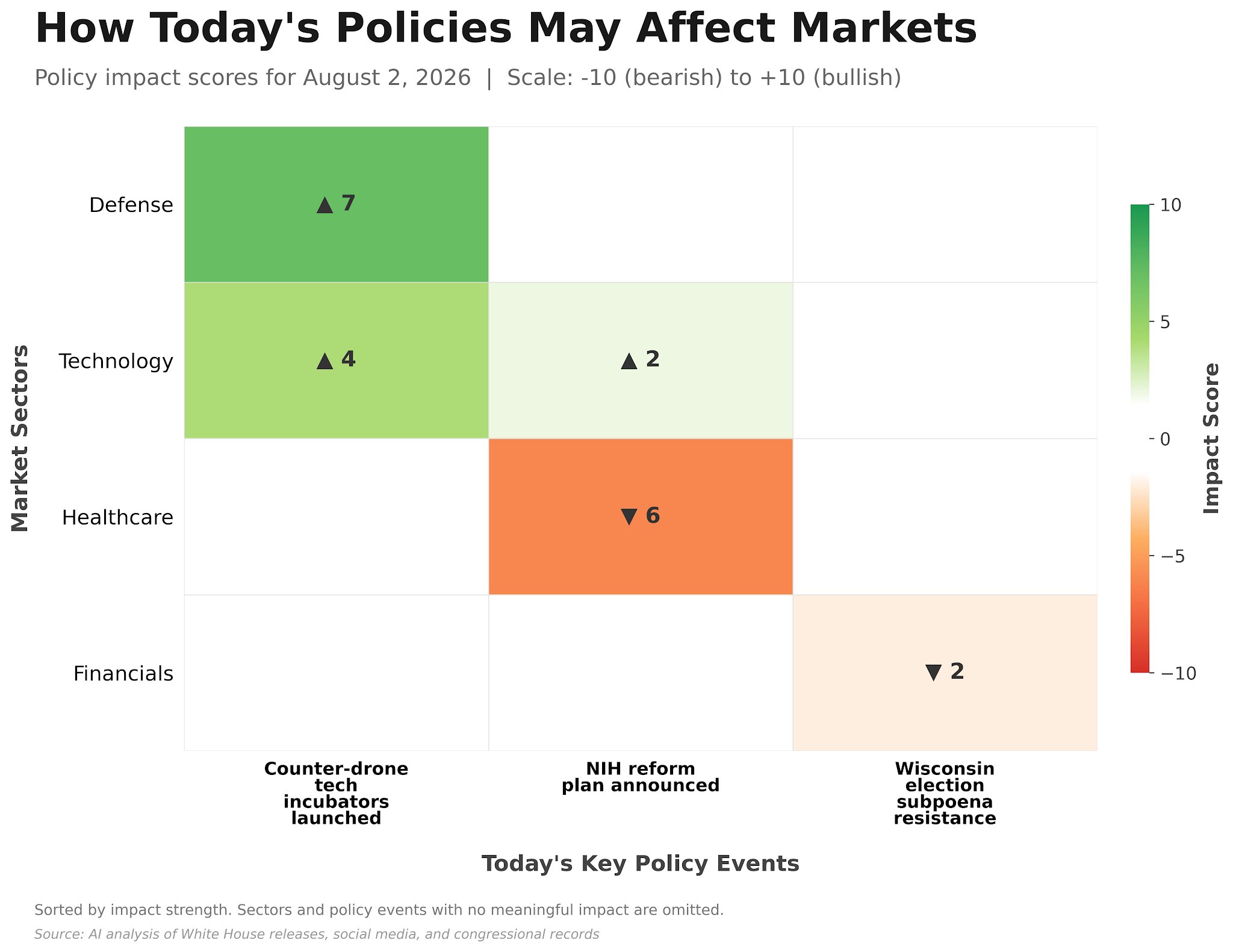
Policy Impact Heatmap with Market Direction
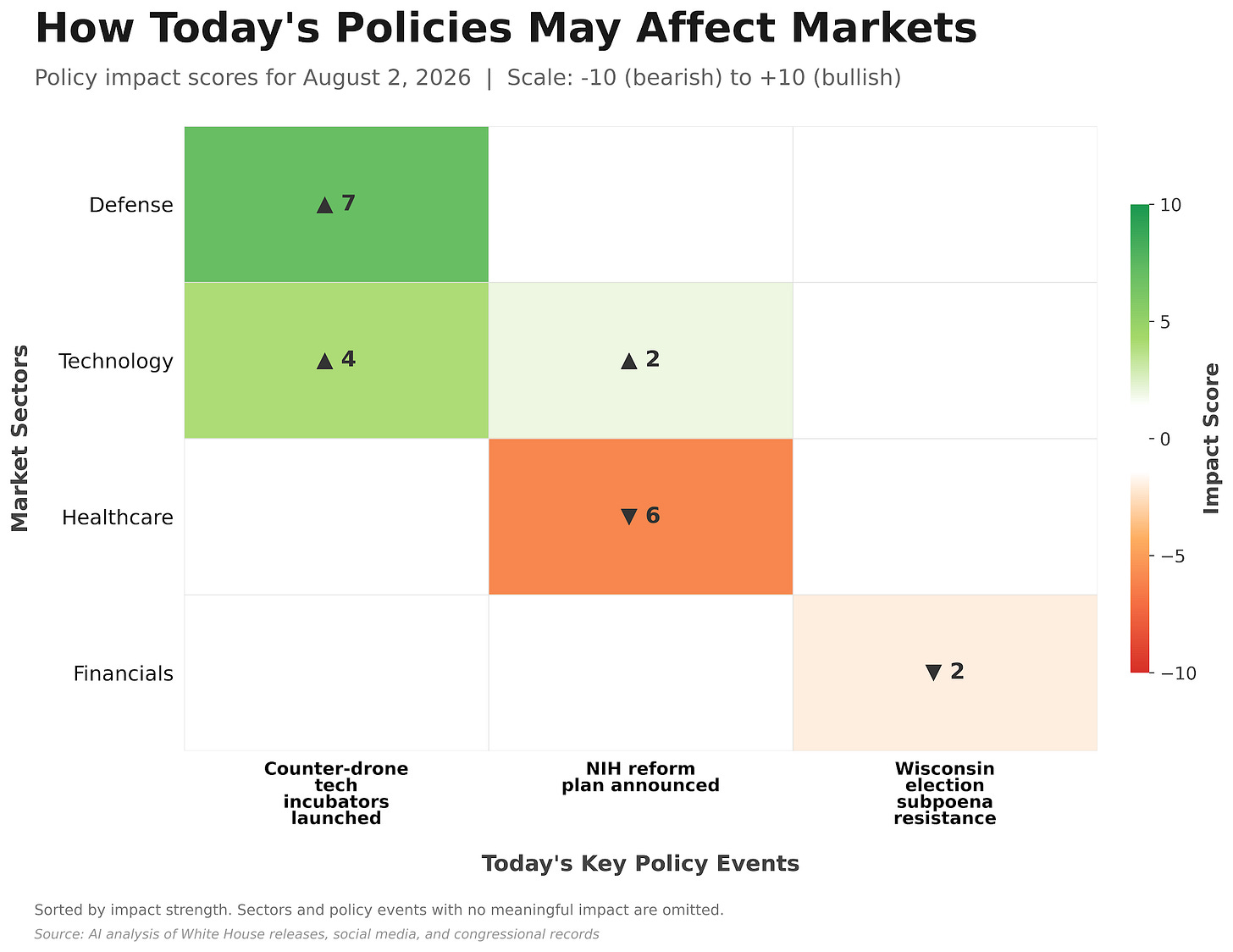
Each cell shows an estimated impact score on a fixed scale of -10 to +10, reflecting how today’s policy developments may affect each market sector. Positive scores (green, ▲) suggest bullish impact; negative scores (red, ▼) suggest bearish pressure. Rows and columns are sorted by impact strength, and sectors and policy events with no meaningful impact are omitted. The heatmap, the analysis below, and the Impact on Market themes above are produced from a single unified analysis: the heatmap visualizes the magnitudes, while the text explains the causal reasoning behind them.
The administration’s pivot toward radical NIH reform introduces significant regulatory uncertainty for the life sciences sector. Analysts highlight that a new vaccine injury body could shift litigation liabilities, impacting pharmaceutical margins. Critics argue that sudden shifts in pandemic mandates risk operational instability across healthcare research networks. Conversely, the increased funding for counter-drone tech incubators creates a clear fiscal tailwind for defense contractors.
Defense firms specializing in anti-access and area-denial systems now face an accelerated procurement cycle. These new incubators prioritize rapid innovation cycles, potentially favoring agile tech firms over traditional prime contractors. Political friction regarding federal ballot seizure creates broader regional risk premia. Markets typically view these state-versus-federal confrontations as potential sources of systemic volatility. This tension may weigh on sentiment if such disputes lead to protracted legal gridlock or institutional breakdown.
-
Washington Policy Review: August 1, 2026
washingtonpolicyreview.substack.comToday’s Report
1. Overview
2. White House News
3. Truth Social Posts
4. Government Department News
5. 2028 Democratic Presidential Candidates
6. AI & Tech Company News
7. Congressional Watch
8. Policy Impact Analysis & Heatmap
1. Overview
President Trump announced that the United States has prepared for significant military action against Iran but opted for a tactical pause. He stated this decision follows requests from Iran and regional partners, creating a window for a potential deal regarding the Hormuz Strait and nuclear disarmament. Trump emphasized that Israel supports this diplomatic opening and urged all parties to “get it DONE” to ensure a prosperous future.
Trump utilized Truth Social to voice his disagreement with U.S. Attorney Jeanine Pirro regarding the recent damage to the Reflecting Pool, characterizing the event as a “pure case of VANDALISM” rather than a contractor error. He linked this issue to his broader mission of “fixing our wonderful White House, just like he is fixing our Country.” Additionally, Trump touted that U.S. oil exports are “SURGING” and highlighted upcoming aesthetic upgrades to the White House, including the installation of a Triumphal Arch.
OpenAI released new research detailing ten significant advances in mathematics and theoretical computer science. The findings cover progress in geometry, cryptography, and computational complexity, contributing to foundational scientific inquiry. This release marks an effort by the company to share developments on long-standing, complex mathematical problems.
The energy sector faces heightened volatility as the administration’s focus on surging export volumes contrasts with the reduction of geopolitical risk premiums following potential military de-escalation in the Strait of Hormuz. In the technology space, breakthroughs in cryptography and complexity theory drive anticipated demand for upgraded semiconductor hardware, yet the pace of these advancements remains clouded by concerns that the innovation is a “reckless gamble” necessitating future regulatory intervention. Meanwhile, industrial firms contracting for infrastructure maintenance contend with operational ambiguity as political disputes over public asset protection create uncertainty regarding the consistency of federal funding and security standards. These conflicting policy signals necessitate that market participants monitor the tension between administrative objectives and the resulting structural uncertainties across these core sectors.
2. White House News
No White House news found.
3. Truth Social Posts
Trump announced that the United States is prepared for significant military action against the Islamic Republic of Iran, but he has decided to pause these plans following requests from Iran and other Middle Eastern nations. He noted that the possibility of a deal has emerged, which would entail the “Immediate, Complete, and Total OPENING OF THE HORMUZ STRAIT” and the elimination of Iran’s nuclear threat. Trump stated he agreed to hold off for the benefit of the world and the survival of a prosperous Iran, noting that Israel supports this commitment and urging stakeholders to “get it DONE.”
Addressing domestic administration and public perception, Trump expressed his total disagreement with U.S. Attorney Jeanine Pirro regarding damage at the Reflecting Pool, maintaining that the destruction, which included markings on the grass, was a “pure case of VANDALISM” rather than a mere contractor difficulty. He further called public attention to the specific physical damage inflicted on the site. Amidst these concerns, he affirmed that he is actively “fixing our wonderful White House, just like he is fixing our Country.” In other updates, Trump highlighted that oil exports are “SURGING” under his administration and shared a preview of the Triumphal Arch before the installation of statues and artwork.
In the realm of media and public support, Trump praised Chairman Rick Crawford as a “total Pro” following a Fox News interview. Additionally, he remarked on the enthusiastic crowd reception for his signage at the UFC fights in Serbia.
Reference: https://truthsocial.com/@realDonaldTrump
4. Government Department News
No relevant government department updates found for this date.
5. 2028 Democratic Presidential Candidates
No relevant 2028 Democratic candidate updates found for this date.
6. AI & Tech Company News
OpenAI (openai.com)
Ten advances in mathematics and theoretical computer science
OpenAI has released new research detailing progress on several long-standing open problems within mathematics and theoretical computer science. The findings encompass significant developments in the fields of geometry, cryptography, and computational complexity, marking a contribution to foundational scientific inquiry.
7. Congressional Watch
Covers the 2026-07-31 session — the Congressional Record is published with a one-day delay.
No Congressional Record found for 2026-07-31.
8. Policy Impact Analysis & Heatmap
This analysis is provided for informational purposes only. It does not constitute investment advice or a recommendation to buy or sell any security.
Impact on Market
Based on today’s policy developments, our analysis identifies the following market impact themes:
THEME 1. ENERGY SECTOR DYNAMICS UNDER SHIFTING GEOPOLITICAL AND EXPORT POLICIES
The simultaneous occurrence of potential military de-escalation in the Strait of Hormuz and a surge in U.S. oil export volumes creates a complex environment for the energy sector. While the administration frames the export surge as a “key policy achievement” that bolsters supply, the pivot away from military action in Iran introduces immediate downward pressure on energy markets due to reduced risk premiums. Opposition figures have expressed skepticism regarding this dual approach, labeling the potential for renewed diplomatic talks as a “weakening of resolve” that may undermine long-term energy security objectives. Consequently, the energy sector faces significant volatility, as traders must weigh the expansion of global export capacity against the potential for renewed Iranian supply competition.
THEME 2. TECHNOLOGICAL ADVANCEMENT AND THE SEMICONDUCTOR LANDSCAPE
New breakthroughs in cryptography and complexity theory published by research organizations signal a potential long-term shift in computational capabilities. These advancements are expected to influence the semiconductor and broader technology sectors by necessitating upgraded hardware to support more complex mathematical processing. While supporters characterize these developments as a “monumental leap forward” for national digital infrastructure, critics have raised concerns about the potential for these same tools to be exploited for cyber warfare, describing the rapid pace of innovation as a “reckless gamble” without sufficient regulatory oversight. These conflicting viewpoints create uncertainty regarding future government intervention in the development and export of next-generation semiconductor components.
THEME 3. INDUSTRIAL INFRASTRUCTURE AND MONITORING OF PUBLIC ASSETS
Recent property damage at a national monument in Washington has led to a public dispute between the executive branch and legal authorities over the characterization of the event. This disagreement influences the industrial sector, particularly firms involved in government contracting for security and facility maintenance, as there is uncertainty regarding the future allocation of funds for the protection of national landmarks. Critics of the administration have described the President’s response as a “dangerous precedent” that minimizes the seriousness of vandalism, while administration allies view the intervention as a necessary rejection of bureaucratic narratives. This environment creates operational ambiguity for industrial entities that rely on consistent federal standards and funding for the preservation and protection of public infrastructure.
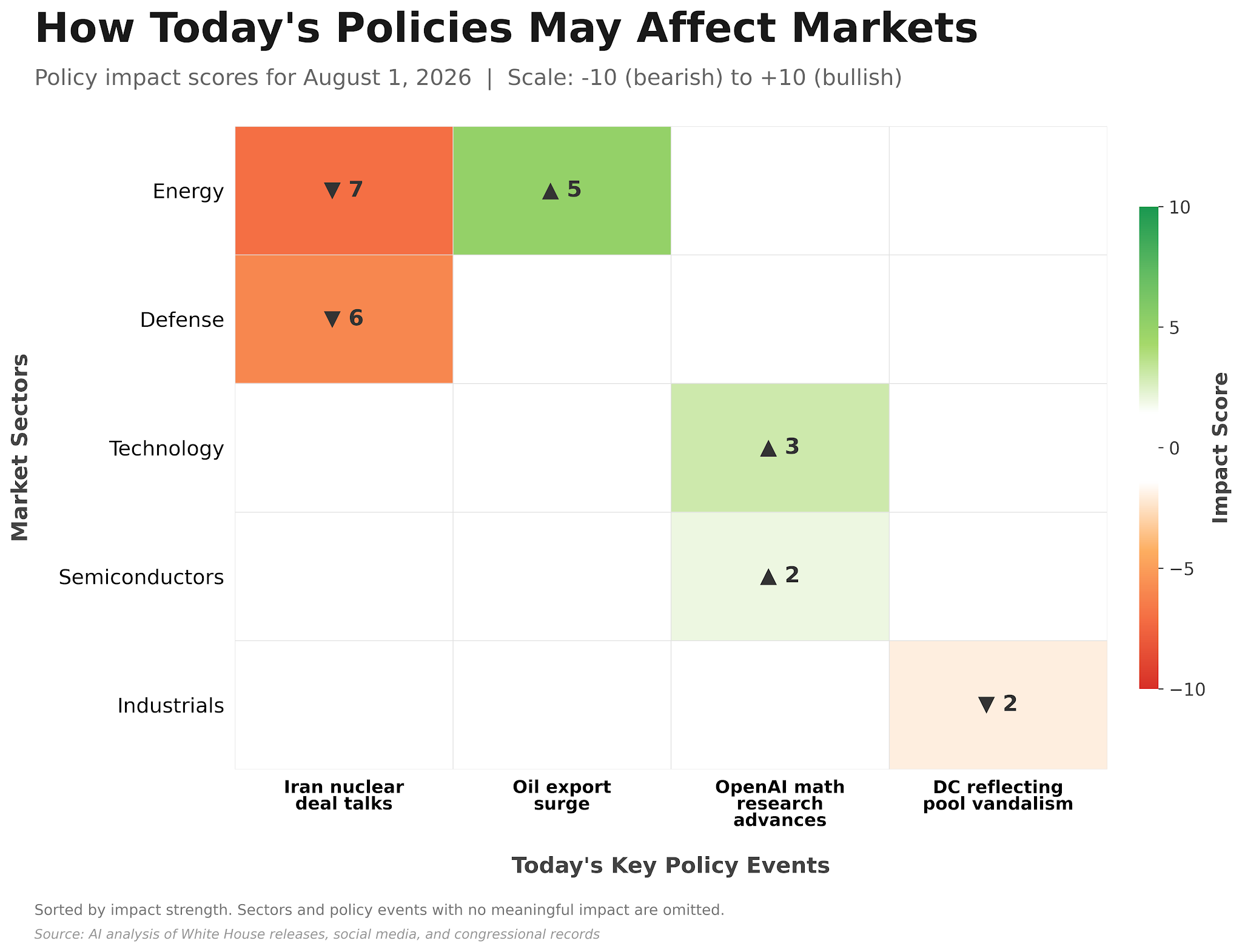
Policy Impact Heatmap with Market Direction
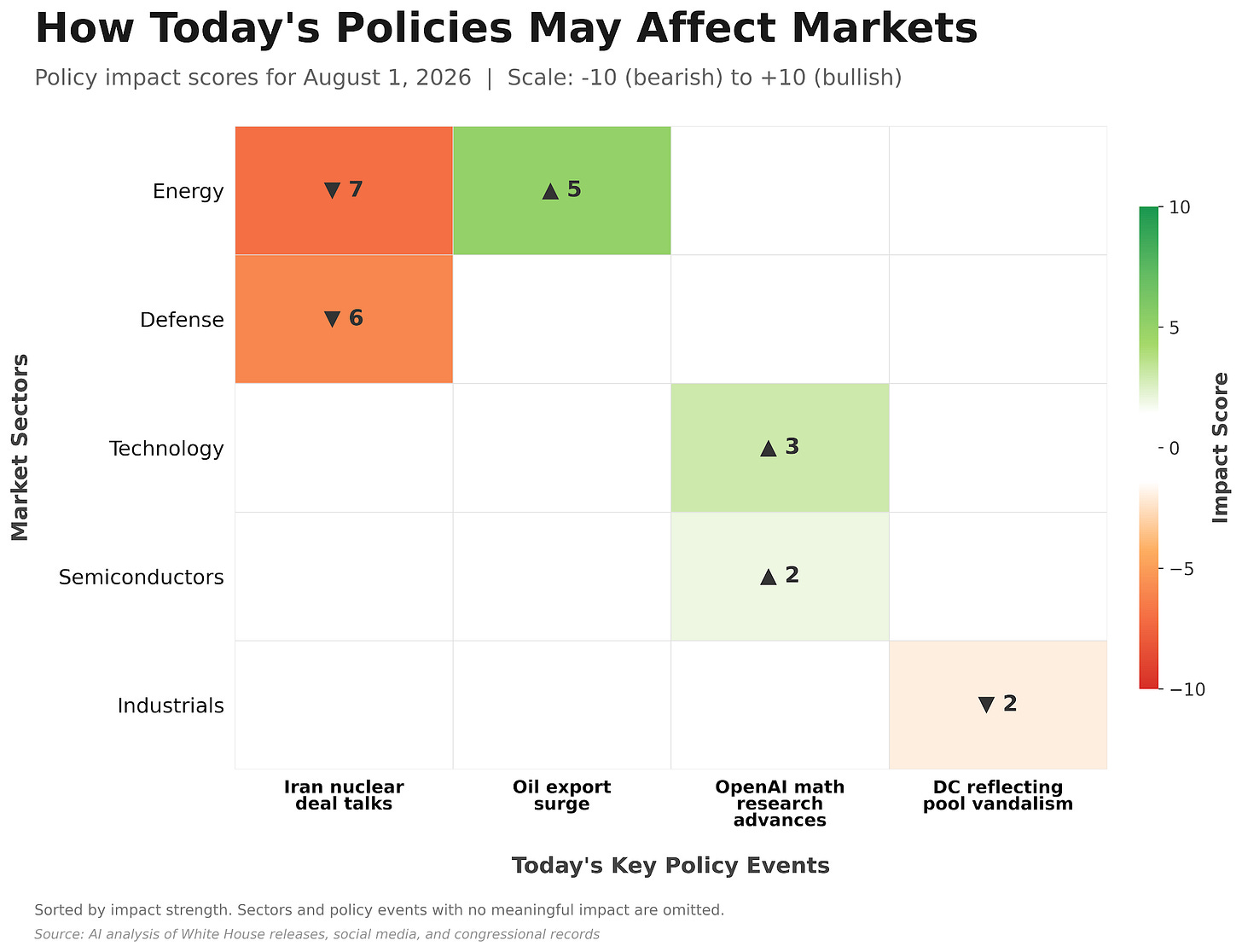
Each cell shows an estimated impact score on a fixed scale of -10 to +10, reflecting how today’s policy developments may affect each market sector. Positive scores (green, ▲) suggest bullish impact; negative scores (red, ▼) suggest bearish pressure. Rows and columns are sorted by impact strength, and sectors and policy events with no meaningful impact are omitted. The heatmap, the analysis below, and the Impact on Market themes above are produced from a single unified analysis: the heatmap visualizes the magnitudes, while the text explains the causal reasoning behind them.
Geopolitical tensions in the Middle East dominate market sentiment. The potential for a diplomatic resolution regarding the Strait of Hormuz cools immediate supply-side risks for global energy markets. A de-escalation of conflict reduces the risk premium previously baked into oil prices. Consequently, the Energy sector faces downward pressure as supply availability becomes more predictable. Defense sector expectations shift as the immediate prospect of kinetic military engagement subsides.
Simultaneously, the administration’s focus on surging oil exports provides a counter-narrative for domestic energy producers. Increased export volume supports revenue growth for traditional energy firms despite the geopolitical cooling. Separately, advancements from OpenAI in cryptography and complexity theory reinforce the growth trajectory for the broader Technology sector. While these academic breakthroughs have no immediate fiscal impact, they sustain the narrative of long-term sector superiority. Critics express concerns that administrative focus on high-profile vandalism or political spats may distract from structural economic policy implementation. Such distractions create uncertainty regarding agency focus and procurement stability for large-scale federal contractors.
-
The right’s exploitation of the Ceuta migrant ‘crisis’ almost guarantees that it will happen again | Ruben Andersson
www.theguardian.comThe EU’s panic and the lack of solidarity emboldens smugglers and the far right – and makes Spain even more vulnerable
For the European hard right and the White House, it seemed almost too good to be true: left-liberal Spain punished with a migration crisis of its own making.
The histrionics came right on cue. As thousands of mainly Moroccan citizens streamed into the tiny Spanish enclave of Ceuta at the tip of north Africa, Spain’s far-right party Vox decried a migrant “invasion”, blaming Spanish prime minister Pedro Sánchez’s regularisation and leftist politics. The Trump administration did the same. A senior Israeli diplomat goaded Madrid over its “colonial” territories while Italy’s prime minister, Giorgia Meloni, called for Spain to be suspended from the Schengen area. Denmark and Finland backed Italy’s move and, by the weekend, 22 EU leaders had penned a letter pointing an implicit finger at Madrid over its presumed failure to “relentlessly combat illegal migration”.
Continue reading... -
Senate Republicans Rush to Immunize Money Launder-in-Chief’s Tax Crimes
emptywheel.net
Overnight, Todd Blanche tweeted out documentation showing what he promised John Cornyn (and with him, Thom Tillis) to get their endorsement to be the top law enforcement officer in the US. One document purports to rescind the Terrorist Slush Fund, attempting to moot the lawsuits in Floyd v. DOJ (the EDVA one moving towards discovery), but remaining silent about the Trump v. IRS case Trump appealed on Friday.
Another unsigned document describes that DOJ interprets the tax immunity provision to apply to Trump, his corporate person, and his spawn retroactively, but no one else.

The documents have little legal weight (and I would be surprised if Blanche submitted the declaration in Floyd that Judge Leonie Brinkema has demanded).
But as David Kurtz presciently described, it meets the terms of John Cornyn’s demands, and Cornyn’s spox has signaled this is all it took for the Senator to cave.
Cornyn seems to be aiming to keep the immunity deal intact but to limit it to the retroactive immunity everyone already understood to be part of the deal, not prospective immunity, which an expansive interpretation of the loose language of the agreement might have allowed. Cornyn also apparently wants to make sure no one else gets the benefit of the immunity deal other than the parties to the lawsuit — Trump, two of his sons, and the Trump Org.
At this point, you should be saying WTF?
[snip]
If the reporting on Cornyn’s demands is correct, then Trump, Don Jr., Eric, and their company still get the $100 million gift from the President’s own administration to himself. And locking that in has the political (though not legal) effect of Senate Republicans publicly ratifying the corrupt bargain by voting to confirm Blanche.
In another worrying sign that Cornyn isn’t really asking for much, both sides seem perplexed that things haven’t gotten worked out yet and confident that they can iron out whatever differences remain over the precise language.
“It’s not a big ask,” Cornyn said yesterday, in what may be the understatement of the week.
Many outlets, such as the NYT, are under-reporting the value of this benefit to Trump.
Still, even in its new form, Mr. Blanche’s order for the I.R.S. to abandon any audits of Mr. Trump’s previous tax returns is an unprecedented and potentially illegal benefit to a sitting president, worth potentially tens of millions of dollars in lower taxes and avoided penalties.
In addition to the hundreds of millions disclosed in the tax returns that Charles Littlejohn leaked to the NYT, Trump spent the transition and first term of his Administration — the period covered by this tax amnesty — accepting billions of dollars in bribes.
Worse still, this immunity comes in the wake of Friday’s court filing from Capital One, disclosing that they cut Trump and his corporate persons off from banking in 2021 because of signs they were laundering money.
To the contrary, those documents and Plaintiffs’ own allegations make clear that Capital One closed Plaintiffs’ accounts for anti-money laundering (“AML”) reasons. The closures were the result of months of analysis and a careful review by Capital One’s AML team in accordance with bank policies and regulatory guidance. Capital One never publicized the termination decision nor its confidential internal process giving rise to the closure, and it permitted Plaintiffs several months (and granted several extensions) to find new banking services, which they did.
In short, just days after learning that their liege has recently been laundering money, the Senate GOP is rushing to sanction DOJ’s illegal decision to pardon Trump for those crimes.
The post Senate Republicans Rush to Immunize Money Launder-in-Chief’s Tax Crimes appeared first on emptywheel.
-
‘Just cruel’: Medicaid halt in California and Minnesota plunges caregivers and disabled people into uncertainty
www.theguardian.comShock and fury as Trump administration holds back Medicaid funding to states over alleged caregiving fraud
By now, when Shannon Rosa hears about cuts to Medicaid and misinformation from the Trump administration about disabled people and their families, her predominant feeling isn’t fear or sadness.
It’s fury.
Continue reading... -
Lawmakers push for a more robust Epstein Files Transparency Act – but would Trump sign it?
www.theguardian.comAfter the justice department botched file rollout under the original act, lawmakers now want legislation with teeth
As Jeffrey Epstein survivors and their supporters continue searching for justice and transparency in the US, a bipartisan group of politicians is trying to rework legislation that heralded the release of long-hidden investigative files on the scandal.
While the Epstein Files Transparency Act (EFTA), signed into law by Donald Trump on 19 November, mandated that the justice department release all investigative files within 30 days with limited exceptions, survivors and their supporters have repeatedly grappled with missed deadlines and what they say are incomplete disclosures.
Continue reading... -
Judicial Notice (08.02.26): Whither Wachtell?
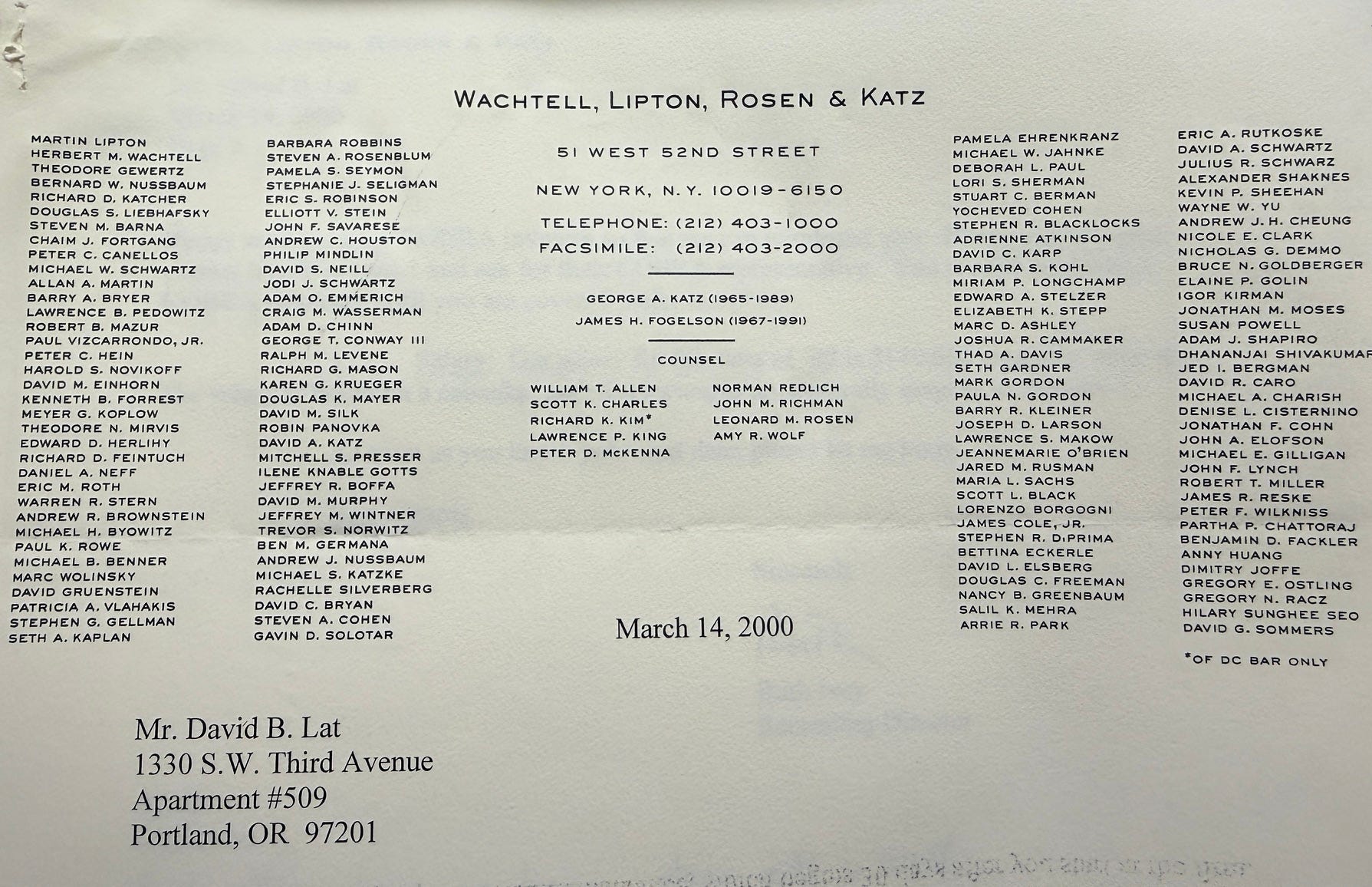
davidlat.substack.com The letterhead of Wachtell, Lipton, Rosen & Katz, as of March 2000 (photo by David Lat).
This week’s Judicial Notice is sponsored by

With a presence in over a dozen cities across the United States and Asia, Lateral Link boasts an expert recruiting team of former practicing attorneys dedicated to sourcing top-tier legal talent for a diverse clientele, including major international law firms and Fortune 500 companies. To learn more about Lateral Link, please visit our website.
Greetings from the Garden State. Zach and I returned home to New Jersey last night, after spending a week up in Provincetown with our boys. We had a great vacation, which even some midweek rain couldn’t ruin.
The drive back from Massachusetts wasn’t fun, taking much longer than it should have—which partly explains this somewhat delayed edition of Judicial Notice. As usual when I publish JN on a Monday, this news roundup reflects developments through Sunday night, but not Monday (and, as usual, it bears Sunday’s date).
Now, on to the news.
Lawyers of the Week: William “Bill” Savitt and Sarah Eddy.
Star litigators William “Bill” Savitt and Sarah Eddy are having an exciting year. In May, they scored a huge victory for OpenAI and its CEO Sam Altman in Musk v. Altman, successfully trying the case before a jury in Oakland (N.D. Cal.)—and, in Bill Savitt’s case, skillfully cross-examining Elon Musk. This was Savitt’s second major win over Musk; he previously led the Wachtell Lipton Rosen & Katz team that forced Musk to close his $44 billion acquisition of Twitter. (Disclosure: I once worked at WLRK, and I’m friendly with Savitt.)
Now Savitt and Eddy are in the news again. Along with four other litigation partners—Randall Jackson, Ryan McLeod, Anitha Reddy, and Brad Wilson—they left Wachtell Lipton and joined the New York office of Gibson Dunn & Crutcher, where Savitt is now a co-chair of the litigation practice group. Savitt’s move was especially notable because he had been a co-chair of WLRK’s executive committee since 2023 and had worked at the firm since 2000, joining not long after clerking for the late Justice Ruth Bader Ginsburg. First reported by Oliver Barnes and Sujeet Indap of the Financial Times, Savitt’s move garnered coverage well beyond legal outlets—from the likes of Andrew Ross Sorkin and Lauren Hirsch of The New York Times and Erin Mulvaney of The Wall Street Journal (gift links).
The FT reported an interesting additional tidbit: “The group of defectors would have included Wachtell partner Nathaniel Cullerton, but his hiring was scrapped after he was filmed in a viral TikTok video in an apparent romantic embrace” with an associate in Central Park. According to the New York Post, Cullerton’s partner in the so-called “Wachtell lip-lock” was a junior associate who worked directly under him, on the same team—and having a relationship with someone who reported to him might have led to him losing his Gibson Dunn offer (and being placed on leave at WLRK).
And wait, there’s more: per the Post, Bill Savitt and Sarah Eddy were also in a relationship at one point. But this was less problematic than Cullerton’s situation, for a few reasons: (1) Savitt and Eddy are both partners; (2) Savitt was separated from his (soon-to-be-ex) wife when the relationship began, and Eddy, a divorcée, is single (Cullerton is married); (3) Savitt and Eddy are no longer together; and (4) Wachtell doesn’t have a non-fraternization policy, so their romance didn’t violate any firm rules. (A certain very senior partner at WLRK has married at least two former colleagues.)1
Here’s the other thing inquiring minds want to know: how much is Gibson paying Bill Savitt? The Post cited sources who tossed out the figure of $32 million a year, guaranteed for three years—but then quoted another source who said this wasn’t “even in the ballpark of close.” The WSJ was less specific, reporting simply that Savitt will earn “at least $20 million a year” at his new firm. According to The American Lawyer, the top of GDC’s partner compensation scale is just above $20 million (but that’s not dispositive, since sometimes laterals receive short-term guarantees that diverge from—and exceed—the hiring firm’s standard compensation scheme).
I have much more to say about this move, which raises broader issues for Wachtell Lipton, Gibson Dunn, and Biglaw. But I’ll stop here for now, saving my remaining observations for Law Firm of the Week and Move of the Week (see below).
Other lawyers in the news:
Last Wednesday, Dr. Anthony Fauci, former head of the National Institute of Allergy and Infectious Diseases, testified before the Senate Homeland Security and Governmental Affairs Committee. After he invoked the Fifth Amendment more than 100 times, Senator Rand Paul (R-Ky.), a longtime Fauci foe, said he would call for a vote to hold Fauci in contempt of Congress. At one point in the proceedings, Fauci’s lawyer, David Schertler, tried to jump in to explain his client’s invocation of the privilege—but Senator Paul wouldn’t let him speak, ultimately ordering security to remove Schertler from the committee room. (Was Dr. Fauci justified in taking the Fifth as much as he did? Professor Michael Dorf, a leading liberal law professor, expressed some doubts.)
Speaking of Senate drama, what’s the latest in the confirmation process of Acting Attorney General Todd Blanche, nominated by Donald Trump to serve as the permanent AG? It’s unclear. Senators John Cornyn (R-Tex.) and Thom Tillis (R-N.C.), who must vote for Blanche in order for his nomination to make it out of the Senate Judiciary Committee, didn’t immediately declare their support, citing concerns over (1) Trump’s Anti-Weaponization Fund and (2) the scope of an additional agreement to shield Trump and his associates from tax audits. In response, Trump dug in his heels, threatening on Saturday to revive the fund if Blanche isn’t confirmed. But on Sunday night, Blanche posted two documents on social media, which appear to provide written assurances that (1) the $1.8 billion fund “is rescinded and shall have no force or effect,” and (2) only Trump, two of his sons, and the Trump Organization would be immune from tax audits. [UPDATE (4:43 p.m.): Earlier today, Senators Cornyn and Tillis announced their support for Blanche, based on his written assurances “addressing concerns that multiple of our Republican colleagues share.”]
In more positive news for the Trump administration, the Senate confirmed Jay Clayton as Director of National Intelligence, by a vote of 51-47. And the judges of the Southern District of New York appointed James M. McDonald to succeed Clayton as U.S. attorney (S.D.N.Y.). Because Jamie McDonald was Trump’s pick for the role, having represented Trump while practicing at Sullivan & Cromwell, he wasn’t immediately fired (which is what has happened when judges have selected U.S. attorneys not in line with Trump’s wishes).
As expected, former Supreme Court advocate Tom Goldstein filed a notice of appeal in his criminal case. Last week, he was sentenced to six years in federal prison for tax and false-statement offenses.
Judges of the Week: Judges Joan Ericksen, Timothy DeGiusti, Karin Immergut, Kenneth Karas, and Sara Lioi.
Judges Joan Ericksen (D. Minn.), Timothy DeGiusti (W.D. Okla.), Karin Immergut (D. Ore.), Kenneth Karas (S.D.N.Y.), and Sara Lioi (N.D. Ohio) serve in judicial districts across the country. What do they share in common? They’re all members of the Alien Terrorist Removal Court, with Ericksen serving as its chief judge.
The what? As explained on the ATRC’s website, “In 1996 Congress created the Alien Terrorist Removal Court as a specialized court and authorized the Chief Justice of the United States to designate five U.S. district court judges to review applications for the removal from the United States of alien terrorists.”
It’s understandable if the ATRC doesn’t ring a bell. As noted by Adam Liptak in The Docket (via Howard Bashman’s How Appealing), until last month the court hadn’t heard a case since it was established three decades ago, in the wake of the Oklahoma City bombing. But as reported by Josh Gerstein of Politico, that just changed: the Trump administration has turned to the court to try to deport Haji Zada, a 47-year-old mother of seven from Afghanistan. The government alleges that Zada is “the matriarch of an ISIS-sympathizing family aiding in a plot to launch a mass casualty attack on American voters on Election Day.” (Zada’s son and son-in-law, arrested before the scheme was carried out, both pleaded guilty to terrorism-related offenses.)
Why has the Trump administration decided to resurrect what some have called a “zombie court”? The procedures of the ATRC allow the government to do things it can’t normally do, such as rely upon unlawfully obtained evidence or not share all of its evidence with the defendant. But are these procedures constitutional? At a hearing last Thursday before Chief Judge Ericksen, assistant federal defender Matthew Farley, counsel to Haji Zada, argued that “[t]his entire scheme is a violation of due process and unconstitutional.”
Will judges agree? We shall see. Litigants who lose before the ATRC can appeal to the D.C. Circuit—and, ultimately, to the U.S. Supreme Court.
In other news about judges and the judiciary:
The Ninth Circuit isn’t the liberal bastion it once was. It’s now split 16-13, in terms of Democratic versus Republican appointees. Of the 13 Republican appointees, 11 were appointed by Trump—and the Trump appointees are quite prolific, writing separate opinions more frequently than those of other presidents.
Judge Thomas Ludington (E.D. Mich.), who pleaded no contest earlier this year to a misdemeanor drunken-driving charge, was accused of violating the conditions of his probation by not completing court-ordered drug testing during his probation’s first week. But it appears that Judge Ludington is now compliant, so the probation-violation charge against him was dismissed last week.
In memoriam: Judge Rya Zobel, the first woman to serve as a federal judge in the District of Massachusetts, passed away at 94. May she rest in peace.
Job of the Week: an opportunity for a litigation associate in Los Angeles.
Lateral Link is leading the search for an Am Law 100 firm seeking a litigation associate (2nd-4th year) for its Los Angeles office. This role offers broad litigation exposure, including hands-on experience with written discovery, motion practice, and briefing, as well as strong mentorship and professional development. The firm is open to candidates from firms of any size; what matters is litigation experience, writing and analytical skills, and the ability to juggle deadlines—not a specific pedigree. Clerkship experience is a plus, but not required. The firm offers highly competitive compensation and flexible-hours tracks. For immediate consideration, please email Ata Farhadi at afarhadi@laterallink.com or Jon Dunn at jdunn@laterallink.com.
-
Israel says it has serious concerns with Hamas disarmament deal
Israel has shared "serious security concerns" with the White House regarding the proposed disarmament deal with Hamas, an Israeli official said as Israeli strikes overnight and into Sunday evening killed at least 17 people, including children, in Gaza. The remarks by Doron Spielman, spokesperson for Israeli Prime Minister Benjamin Netanyahu's office, were some of the first public comments since U.S. President Donald Trump announced the agreement.www.allsides.com -
Board of Peace 'still not celebrating' Hamas deal: 'There is no trust. There is only fear and loathing'
President Donald Trump announced his Board of Peace's 15-point plan for demilitarizing Gaza with a triumphant tone, but the officials actually implementing the plan are not taking any victory laps yet. The 15-point plan is expected to take anywhere between 200 and 350 days to complete, and this new deal is only just getting off the ground. While Hamas has signed onto the plan, the terrorist group has proven to be an unreliable partner in executing joint initiatives in Gaza. Israeli ministers, meanwhile, have signaled dissatisfaction and opposition to the entire process.www.allsides.com -
Trump declines to call for Max Miller’s resignation amid abuse allegations – live
www.theguardian.comPresident says he will ‘let the families figure that out’ and calls situation ‘a very sad thing’ when asked if Ohio Republican should step down
On Tuesday, we’ll bring you the latest from Michigan where voters will head to the polls for competitive primaries in Senate and House races.
The most closely watched competition is the Democratic primary for the US Senate, where congresswoman Haley Stevens is up against former public health official Abdul El-Sayed. They’re vying to ultimately win the seat of outgoing senator Gary Peters in November. The race has now turned into a proxy battle for the future of the Democratic party. Establishment-backed Stevens has received support from party leaders and her race has been buoyed by millions from the pro-Israel lobby. Meanwhile the insurgent El-Sayed has built a strong grassroots movement and is endorsed by progressives lawmakers in the Democratic caucus.
Continue reading... -
UK manufacturing growth picks up as Trump tariff chaos eases
www.theguardian.comFactories in upbeat mood despite fears over economic impact of US war on Iran, poll finds
UK manufacturers ramped up production last month for the fourth consecutive month and at the fastest pace in almost two years, according to a leading survey of the industry.
The S&P Global poll of manufacturers found them in upbeat mood in July, though anxious about the prospect of a long war in the Middle East that would block supplies of oil and gas, and raise the cost of production.
Continue reading... -
Democrats Couldn't Be Prouder of Kaitlan Collins
Donald Trump cracked jokes at the White House Correspondents' Dinner this weekend. Yes, they actually rescheduled it after the failed shooting in April. That's how much journalists enjoy giving themselves awards. Trump made them listen to his jokes, which they hated, especially the one about Kaitlan Collins looking like a transgender celeb.www.allsides.com -
Are Trump’s most blatant authoritarian moves backfiring? | Jan-Werner Müller
www.theguardian.comThe president’s methods, from ‘flooding the zone’ with scandals to prioritizing loyalty over competence, could ultimately weaken rather than strengthen him
The pattern is by now all too familiar: with every power grab Trump tries – from a fraudulent speech about voter fraud to appeals to his supreme court to let him rig the midterms – a debate kicks off about whether these moves are signs of strength or of desperation. Maybe we keep getting caught in this debate because the question is badly posed. So much of what is distinctive about Trump’s governance during his second term can serve the consolidation of an autocratic regime and at the same time create particular vulnerabilities for the regime. We have to become better at identifying these weaknesses, as opposed to being shellshocked by Trump’s brazenness every single time.
Aspiring autocrats operate differently in the 21st century; in previous eras, they had little hesitation about unleashing violence and committing massive human rights violations. Today, they try to fool both domestic and international audiences into thinking that democracy and the rule of law still exist. The recently deposed Hungarian prime minister, Viktor Orbán, was a master of this technique; he spent many years performing what he called “the peacock dance” to convince the European Commission (and Chancellor Angela Merkel) that he wasn’t creating a kleptocratic autocracy.
Jan-Werner Müller is a Guardian US columnist and a professor of politics at Princeton University
Continue reading... -
Middle East crisis live: Trump claims strait of Hormuz could open ‘by tomorrow’ as Iran denies any talks taking place
www.theguardian.comUS president claims talks are ‘not very complex’ as he speaks at White House as Iran’s foreign ministry says there are no talks taking place with US
People walk near a billboard depicting Iran’s late supreme leader Ayatollah Ali Khamenei, on a street in Tehran, Iran, earlier today.
Six Saudi-flagged supertankers have changed course in the Gulf of Aden in recent days amid threats from the Iran-aligned Houthis, Reuters reports.
Continue reading... -
Oil prices plunge and Europe’s markets rally after Trump calls off Iran strikes
www.theguardian.comBrent crude drops by 5% after US president claimed talks on Middle East peace deal would resume
Crude oil prices fell sharply while stocks and government bonds rallied on Monday after Donald Trump cancelled planned strikes on Iran and claimed peace talks were about to resume.
Brent crude was trading 5% lower at $83.47 a barrel by lunchtime, after falling as much as 7.3% to $81.55 a barrel. US West Texas Intermediate dropped more than 5% to $79.47 a barrel.
Continue reading... -
In Dropping Reflecting Pool Case, Pirro Draws Trump's Wrath
Jeanine Pirro faced the cameras on July 2 with characteristic self-assurance to announce the indictment of the 67-year-old ex-Olympian David Hearn for trashing "sacred" government property, President Trump's highly prized but shoddily renovated Reflecting Pool. "This is not only a priority for the president, but for myself," said Ms. Pirro, the U.S. attorney for the District of Columbia, disclosing felony vandalism charges against Mr. Hearn for touching the lining of the pool in front of the Lincoln Memorial. She added: "We will prove beyond a reasonable doubt that Hearn willfully destroyed property."www.allsides.com -
GOP senator on Trump's Reflecting Pool vandalism claims: 'He grows anxious when he has an unexpressed thought'
Republican Sen. John Kennedy (La.) said Sunday he is unsure whether President Trump truly believes his claims that vandals damaged the Lincoln Memorial Reflecting Pool.www.allsides.com -
Acting AG Todd Blanche reaches deal with holdout senators to scrap $1.8B 'anti-weaponization' fund
After a weekslong standoff between senators and the Trump administration, acting Attorney General Todd Blanche announced Sunday night that the parties had reached a deal and that had he issued an order "officially" rescinding a $1.8 billion anti-weaponization fund.www.allsides.com -
Trump’s hypocritical new tariffs are a chance for the world to fight back | Joseph Stiglitz
www.theguardian.comThe president’s pretext of stopping forced labour is only a ruse – he is trying to grab a share of global trade for the US
Here he goes again. The US President, Donald Trump, is increasing and decreasing tariffs willy-nilly, violating international agreements that he himself signed and almost surely violating federal law. The only difference this time is that he has a new pretext for abusing tariffs: stopping forced labour.
Of course, the administration is right that too little is being done about forced labour. But its stated concern is a ruse. With the new tariffs closely tracking the ones that Trump imposed on the basis of trade balances, are we supposed to believe that bilateral trade deficits just so happen to be highly correlated with the use of forced labour?
Continue reading... -
Blanche formally rescinds Trump’s $1.8bn ‘anti-weaponization fund’ ahead of nomination hearing
www.theguardian.comTodd Blanche issues formal order terminating measure widely derided as a ‘slush fund’, in move that could clear path for his nomination as attorney general
Acting US attorney general Todd Blanche issued a formal order late on Sunday terminating Donald Trump’s $1.8bn “anti-weaponization fund” to compensate his political allies, a move that follows weeks of negotiations with two Republican senators who were blocking his nomination to become attorney general.
While Blanche has repeatedly said publicly that the fund was dead, the justice department had resisted formally confirming that in writing. That had drawn concern from lawmakers that it could be revived in some form, especially after Trump expressed continued support for the idea.
Continue reading... -
New SpyWeek: Clayton Squeaks In, Endless Iran War, CIA & Trump's Chinese Election Doc
www.spytalk.co The best European spy agencies? L’Express did a poll. See below.
Headhunters: Mossad and the CIA are “obsessed” with hunting down and killing Ayatollah Mojtaba Khamenei. So says The Times of London.
Panetta on Iran War: The U.S. is locked into an “unwinnable war” with Iran that has no clear end, former CIA Director (and SecDef) Leon Panetta said. He compared the ongoing military operation to the wars in Iraq and Afghanistan. (The Hill)
Eviction Notice: Acting DNI Bill Pulte is reportedly resigned to vacating his office, reports Politico. Pulte had asked Trump “to delay Clayton’s swearing-in, or at least [let him] stay in the job longer,” a White House official told Politico earlier in the week, “arguing his mission of majorly reshaping the agency had not yet come to a close.” Last week Pulte boasted about “executing a 5th and Near Final Round of TERMINATIONS” at ODNI, “an approximately 30% Staff Reduction from Weeks Ago.” Jay Clayton, whose DNI nomination was finally confirmed by the Senate after a contentious hearing that raised troubling questions about his fealty to Trump over the law, is planning to move in Monday.
CIA Doc Doctors?: Hundreds of ex-CIA officials have “called for investigations into whether the White House helped the CIA draft a document to boost the president’s claims that China interfered in the 2020 elections.” The group, issuing a statement under the banner of The Steady State, an organization of over 400 former national security officials, “fears the document may have been manufactured from ‘cherry-picked’ CIA reports with direct input from the White House before the president’s primetime address on what he called ‘shocking vulnerabilities’ in the nation’s election system.” The group said the CIA note cited by the White House “includes ‘a number of anomalies’ that don’t identify the office, author, context or definitive conclusion based on the agency’s information, among other issues.” It “also departs from ‘typical’ CIA style and format,” according to the group’s letter, “which was sent to congressional intelligence committees and the inspectors general for the CIA and intelligence community.”(The Independent)
8647 or Fight: The Secret Service “knowingly conducted illegal electronic surveillance” of James Comey, lawyers for the former FBI director say, at the urging of high level Trump administration officials, including the president himself. Comey’s phone was tracked as he and his wife drove north on I-95, but “agents lost contact when the Comeys stopped to visit the cemetery where their son is buried, his attorneys say.” (CNN and CNBC)
Iran Mole: A dual British and Azerbaijani citizen by the name of Rashad Sultanov was “arrested after accusations he surveilled” an important U.K. military base in Cyprus that is “a hub for Mideast operations, and shared the details with the Revolutionary Guards.” (New York Times)
Iran Moles 2: Iranian hackers are suspected as responsible for infiltrating the control systems of water systems in a spreading number of midwestern states. A joint alert from the FBI and the Environmental Protection Agency on Thursday “warned that ‘malicious cyber actors’ have been remotely tampering with…several water and energy systems across the country since shortly after the Iran war began on Feb. 28,” reported The Washington Post. More: The U.S. Cybersecurity and Infrastructure Security Agency “has for months been warning the public that Iran may seek to compromise water utilities and other critical infrastructure,” reported the New York Times. Trump blamed the Minnesota attacks on…Minnesota.
Don’t miss our fascinating conversation with Bojan Pancevski, author of “The Nord Stream Conspiracy,” on the SpyTalk podcast here, or wherever your preferred platform. And do leave us your comments.
China Mole: The Canadian woman of Chinese origin being held in Belgium on suspicion of spying for an unidentified “third country” inside NATO’s military command was was “vetted” and “cleared” by multiple Canadian security services—”despite a finding by Canada’s public service watchdog that she committed fraud in a hiring competition …” (The Bureau)
Chinese Eyes On: A local police force has been discovered expanding its already ubiquitous facial recognition system onto foreigners. (New York Times
U.S. Eyes On: A local police chief in Georgia who was accused of using Flock, a license plate monitoring system, to keep track of his ex-girlfriend’s movements, committed suicide before he could be brought to trial, The Washington Post reported Sunday “Flock’s array of license-plate cameras was built to fight crime. But at least 50 law enforcement officers were charged with or accused of misusing it and other systems.” The company told the Post “that its more than 120,000 shoebox-size cameras now scan the roads of more than 6,000 communities and record 20 billion plate scans a month.” Some Massachusetts towns are pushing back, reported the Boston Globe.
Best European Spooks? The French newspaper L’Express spoke to “60 intelligence professionals” from the CIA, MI6, Mossad, Ukraine’s SBU and more—to build “an exclusive ranking of Europe’s best spy agencies.” How’d they fare?
1.MI6 (UK)
2. DGSE (France)
3. AIVD (Netherlands)Go you Dutch!
Thank you for reading this. SpyTalk is an entirely reader-supported publication. To receive new posts and support the work of all of us here, please consider taking out a paid subscription. We can’t do it without you. Just click below for a no-obligation free trial.
-
Our Wins Of The Week
thinkbigpicture.substack.comThis was not a good week to be Donald Trump, or any Republican running in this year’s midterm elections for that matter.
A new spate of polls showed Trump with record-low approvals.
33% in AP:
34% in CNN:
He even reached the so-called “Bush line” of 32% in a new Quinnipiac poll.
These polls corresponded with some record-high numbers for Democrats on the generic congressional ballot, which asks which party voters want to control Congress.
From D+7:
To D+8:
To D+10:
And to make matters worse for Republicans, they are absolutely cratering among Independents.
Just a reminder that our Tuesday and Thursday content is free for all readers.If you missed this week’s pieces, please check out The Mail’s the Thing and Sealing The Midterm Election Deal. -
The Guardian view on global corporate tax: a $500bn prize that states must seize | Editorial
www.theguardian.comDonald Trump may reject the negotiations, but he cannot veto a global effort to make multinational companies answer to governments
Governments are told that public services must shrink because money is tight. Yet a new Tax Justice Network report says that countries could capture an extra $500bn a year without raising corporate tax rates. The answer is to tax multinational profits where real economic activity happens – known as unitary taxation. No new profit is created. Revenue simply shifts from tax havens where profits are “booked” to the countries where workers produce and customers spend.
Making that principle a global tax standard depends on UN talks opening in New York on Monday. Modelled on the UN climate regime, a fiscal framework convention would create the governing body and procedures, with protocols providing detailed rules. The UN wants agreement by late 2027. Donald Trump’s US walked out last year and urged others to follow. None did.
Do you have an opinion on the issues raised in this article? If you would like to submit a response of up to 300 words by email to be considered for publication in our letters section, please click here.
Continue reading... -
Doug Burgum Accuses Jeanine Pirro of Lying
emptywheel.net
Donald Trump’s psychological need to create his own reality has started to create problems for his efforts to abuse the legal system.His attempt to complain that he was debanked by Capital One, for example, forced the bank to reveal that it cut Trump off not because of politics but because of evidence of money laundering.
To the contrary, those documents and Plaintiffs’ own allegations make clear that Capital One closed Plaintiffs’ accounts for anti-money laundering (“AML”) reasons. The closures were the result of months of analysis and a careful review by Capital One’s AML team in accordance with bank policies and regulatory guidance. Capital One never publicized the termination decision nor its confidential internal process giving rise to the closure, and it permitted Plaintiffs several months (and granted several extensions) to find new banking services, which they did.
Trump’s attempt to sue himself has because a leaker exposed his tax crimes has, at the least, created new precedents about his own conflicts and could do much worse.
And as I predicted just two days after Davey Hearn’s arrest, the attempt to actually gin up prosecutions to blame imaginary vandals for Trump’s own corruption did in fact lead to the release of damning proof that Trump’s attempt to fix the reflecting pool instead did serious damage to it.
The heavy-handed arrests themselves have gotten a lot of attention. Good luck to Jeanine Pirro attempting to prosecute these cases, not least because doing so would require calculating the value of a painted cover that degraded before the defendants came along. Prosecuting these cases would necessitate addressing whether Trump’s repairs did what they were supposed to, an inquiry Pirro will be loathe to do.
Trump’s emotional neediness may well now be exacerbating things.
Trump responded to the motion to dismiss Davey Hearn’s case the only way a Narcissist could: by lashing out and lying some more: first, by posting a tweet claiming to “disagree” with Pirro, followed by a video that appears to show Black kids being Black kids, followed by hours of AI slop creating the false illusion he’s sexy.
To be fair, Trump’s rant had the desired effect. Lazy journalists focused their reports on the motion to dismiss on Trump’s fee fees, not on the corruption described in the MTD or, better yet, the abundant evidence that Pirro is still lying.

But then Doug Burgum did what courtiers to corrupt dictators are required to do. He performed belief in Trump’s own stated claim that the damage was done by vandals.

In the process, he did something else: He called Jeanine Pirro a liar.
In their motion to dismiss, prosecutors claimed they had [made] dozens of attempts [were made] to get Interior to cough up evidence.
[P]rosecutors specifically involved in the cases related to the Reflecting Pool made dozens and dozens of communications were made in an effort to identify and obtain the materials necessary to have all information to evaluate the case. After significant demands by USAO-DC, USPP provided the police reports and body-worn camera for roughly 10 individuals associated with the Reflecting Pool.
But then, the prosecutors claim, when they accompanied Hearn’s expert (or lawyer) to the reflecting pool on July 17 (only it was probably July 16), they saw, as if for the first time, that the pool was badly damaged, and so demanded — and received — more material from Interior. And as a result, prosecutors implausibly claim, they learned for the first time how badly Trump fucked up the renovation.
On July 17, 2026, as a defense expert inspected the now-drained Reflecting Pool, United States Attomey Pirro and senior USAO-DC employees once again visited the site and this time immediately noted extensive damage throughout the now-drained pool, It was at that time that USAO-DC first became aware of the significant damage throughout the pool and accordingly requested all documents from DOI concerning the how the pool was lined and all records regarding the installation of the lining.
Based on this request, USAO-DC received 695 megabytes of additional documents from DOI, which took days to review. These documents indicated a rushed and flawed installation process, with repeated failures of the lining during the installation process, and extensive peeling of the lining throughout the Reflecting Pool. This was the first time that DOI made USAO-DC aware of such information.
Now, as this has been developing — including when Nicole Sandler and I recorded our weekly podcast at noon on Friday just hours before the motion to dismiss — I have repeatedly noted how fucking stupid it is to dick around on a case, like this one, on which Norm Eisen is on the defense team. Eisen’s Democracy Defenders litigate against Trump’s corruption on a near daily basis in any case. In the last week, for example, Democracy Defenders have been involved in an AFGE lawsuit to enforce EEOC, they’ve claimed some credit for the ruling halting the Paramount takeover of Warners, and they’ve renewed their effort to get Todd Blanche disbarred. (See their press releases here.)
But as tireless as Eisen’s civil lawsuits have been, a defense attorney has tools that are unavailable to mere civil litigators, starting with the fact that (as happened here) you can demand certain things in discovery that it usually takes a year or more to get via lawsuit, if even that succeeds.
And so, I’ve been thinking since Eisen first filed as an attorney for Hearn, you’d have to be fucking stupid to dick around on this case.
Crazier still, Trump has had it in for Eisen for some time, including him along with Tish James, Alvin Bragg, and Andrew Weissmann, in the list of people from whom he has stripped security clearances. Did he miss that Eisen is involved in this case??? Did he not know that by tampering in the case he might give Norm Eisen leverage to expose more corruption?
After DOJ filed the motion to dismiss Friday, Eisen, along with co-counsels Mary Dohrmann and Steve Levin, issued a fairly mild statement. Trump owes Hearn an apology, they said.
The Trump administration’s case against Davey Hearn should have never been brought. Its dismissal today does not erase the abuse of government power in arresting and charging a patriotic American who did nothing wrong. The government’s approach was ready, fire, aim. The administration owes Mr. Hearn an apology.
But then Trump, by “disagreeing” with Jeanine Pirro, at a minimum gave Hearn’s lawyers reason to demand that Judge Todd Edelman dismiss the case with prejudice. If the President is attacking his US Attorney, after all, then Hearn has no way of ensuring that Trump won’t just replace her with someone who’ll renew the case.
And then Burgum directly disputed prosecutors’ claim that they [made] “significant demands” [were made] before Interior coughed up the bare minimum of evidence for these cases. Burgum claims Interior complied “in the requested time line.”
We also provided the U.S. Attorney’s office expert and eyewitness testimony to the damage done by vandals and provided every piece of evidence they asked for in the requested time line detailing each area of damage at the pool.
To be clear: We know Pirro’s prosecutors are lying. Among other things, the witness who was supposed to testify that Hearn had done $1,000 of damage instead testified, at first, about how much damage pre-existed Hearn’s arrival.
According to the witness, the pool was leaking more than one million gallons of water per week; its expansion joints had exceeded their service life; and the liner already contained a rip, See Sealed Exhibit 1, Grand Jury Tr. of MR. at 6-7, 19-20 (July 2, 2026). The govemment’s witness further confirmed that repairs were already necessary to address those conditions. Exhibit 1 at 28. Those facts establish the legally relevant baseline: the condition of the property immediately before the alleged conduct.
And when prosecutors described what is likely that witness’ testimony, they left out all those details.
W-4, an employee specializing in maintenance and repairs employed by the National Park Service, stated that repairing the additional damage caused to the reflecting pool based on the defendant’s conduct would cost over $1000.
But before Trump and Burgum opened their yaps, it was not clear that Eisen and Dohrmann and Levin would be able to do much about the clear misrepresentations in the motion to dismiss. After all, dismissing the case normally moots things like a request to see grand jury testimony.
But now a cabinet member has accused Jeanine Pirro of lying. Doug Burgum has suggested that Pirro had all the evidence she asked for in order to make a sound prosecutorial decision, but charged Hearn anyway.
Burgum is not going to take the fall for Pirro’s stupid decisions.
So now, it’s no longer Norm Eisen’s word against Pirro’s, without grand jury transcripts to prove he was right. Now Eisen has a dispute among Trump’s top aides. Eisen has a cabinet member’s claims.
Which (if Hearn qualifies for legal fees under the Hyde Act, which might be limited if Democracy Defenders paid for his legal expenses) may start Hearn down the same path the Broadview 6 defendants are attempting to go: legal fees, sanctions, even a Special Counsel. He may not get there — it is still exceedingly difficult to get any of these things. But Doug Burgum just gave him an opening to try.
Before Trump and Burgum opened their yaps, Eisen was asking for an apology.
Afterwards, Eisen had this to say:
Trump and Burgum are attacking Pirro because she admitted what we established in our legal filings all along: Trump’s botched renovation was responsible for the damage–not Davey Hearn. However, Pirro’s claim that she and her office were previously duped by Interior is nonsense. Starting immediately after arraignment, our motions repeatedly proved that the administration was to blame for the Reflecting Pool failures, not Davey. This is far from over, as we consider all legal remedies.
This is far from over, Eisen said after Burgum thought he could help his Narcissistic boss by reinforcing his lies.
The post Doug Burgum Accuses Jeanine Pirro of Lying appeared first on emptywheel.
-
The pro-Israel lobby has swayed US presidents since Truman. It must end with Trump | Ian Lustick and Eli Clifton
www.theguardian.comOur new book tracks the growth over nearly eight decades, of the most powerful foreign policy lobby in US history
In 1948, with war raging in Palestine, Harry Truman found himself trapped.
On one side were Zionist lobbyists and the president’s domestic political advisers, who were urging him to support the establishment of a Jewish state in as much of Palestine as possible. On the other were his top foreign policy and national security officials, led by the secretary of state, George C Marshall. Their unanimous recommendation was to prevent the establishment of a Jewish state, which they believed would trigger war in the Middle East and endanger the future of US relations with the Arab and Muslim world.
Continue reading... -
Newsom boasts of California's upcoming minimum wage increase, criticizes Trump for ignoring workers
California's statewide minimum wage is set to rise next year. Starting on Jan. 1, 2027, the statewide minimum wage will rise to $17.40 an hour, an increase Gov. Gavin Newsom boasted about on Friday. Newsom — who has been eyeing a 2028 presidential run — said in a statement that California's fiscal policies helped turn the state into "one of the strongest economies in the world" while the Trump administration and the Republican-led Congress fail to address "everyday cost pressures for working families." The federal minimum wage has remained at $7.25 per hour since 2009.www.allsides.com -
Trump is determined to pursue his trade war – and he may be difficult to stop
www.theguardian.comThe president’s minions have trawled the statutes to restore roadblocks to trade. The invocation of Smoot-Hawley looks especially dangerous
Donald Trump may have found the killer weapon to punish countries at will: by imposing tariffs on their exports to the United States.
The president has been looking for a new tool since February, when the supreme court struck down tariffs he slapped on virtually all of America’s trading partners based on the International Economic Emergency Powers Act, or IEEPA, on the spurious grounds that the US faced a variety of national emergencies. It’s become a parlor game among policy wonks to predict what new legal justification he would deploy to replace them.
Eduardo Porter is a journalist focused on economics and politics. He writes the newsletter Being There on Substack
Continue reading... -
For most US small businesses, Trump’s tariffs aren’t the big issue they were
www.theguardian.comTariffs are annoying and disruptive, but this round is less impactful – and business owners are taking them in their stride
Rebounding from his defeat at the supreme court in February, Donald Trump has recently announced a new round of tariffs, invoking sections of various trade acts to levy amounts on industries and countries based on reasons ranging from “forced labor” to “excess capacity”.
And how are small and medium-sized businesses in the US reacting? One word: snoozefest.
Continue reading... -
Decades on from the US’s disastrous campaign in Afghanistan, Trump is making all the same mistakes | Simon Tisdall
www.theguardian.comThe president has blundered into a ‘forever war’ with Iran he can’t win, but refuses to end. Such hubris has a long history
It’s five years this month since the chaotic retreat of US forces from Kabul. The Nato-backed invasion and occupation of Afghanistan, launched after the 11 September 2001 terrorist attacks on New York City and Washington DC, is now widely regarded as a failure. It cost the lives of more than 2,400 US and 450 British troops, and tens of thousands of civilians (the exact number is unknown). Although al-Qaida terrorists were routed, their Taliban hosts reimposed repressive, misogynistic Islamist rule after regaining power in 2021. Afghanistan became a byword for ill-considered western interventionism and nation-building. It was the archetypal “forever war”, a phrase first coined during Vietnam.
If this cautionary tale had any lasting value, it was as a deterrent to politicians and generals tempted to rashly embark on open-ended conflicts without just cause, defined, achievable aims, and an exit strategy. Dismayingly, the forever war lesson had to be learned all over again in Iraq, which the US and UK invaded in 2003 and departed, having caused huge harm for scant benefit, in 2011. “Never again!” was the passionate cry at the time and since. And yet, it seems, the same disastrous pattern is now repeating after Donald Trump’s incomprehensibly foolish decision to attack Iran. A war he termed a “little excursion” is entering its sixth month and has been escalating rapidly. It, too, has a forever feel.
Continue reading... -
Trump backs down on Iran strikes in expectation of ‘rapidly’ reaching a deal
www.theguardian.comUS president claims delay is also in response to requests from Iran and other countries in the region
Donald Trump has said he cancelled planned military strikes against Iran on the basis of “rapidly” reaching a deal on its nuclear programme and the full reopening of the strait of Hormuz.
The US president paused the strikes in expectation of a breakthrough and in response to requests from Iran and other countries in the region, he claimed on his Truth Social platform on Saturday.
Continue reading... -
In His Tax Fraud Appeal, Donald Trump Says His Failsons Are Just Like Hunter Biden
emptywheel.net
I’m genuinely delighted not just that Trump has appealed Judge Kathleen Williams’ order imposing sanctions for the fraud he conducted in her court, but how he has asked for a stay in her ruling, to which she responded by asking the amici she appointed to weigh in again.THIS MATTER is before the Court on the Expedited Motion to Stay the Sanctions Order and Related Proceedings Pending Appeal (DE 114 ) (“Motion”), filed by Plaintiffs President Donald J. Trump, Donald J. Trump Jr., Eric Trump, and The Trump Organization, LLC, together with their attorneys Alejandro Brito and Daniel Epstein. In the twenty-four-page Motion, Plaintiffs and their attorneys seek a stay of the Court’s July 13, 2026 Order (DE 106 ) pending appeal and request an expedited ruling from this Court by August 5, 2026. Accordingly, and in light of the fact that Defendants do not intend to appear or file a response to the Motion, the Court requests that the amici curiae previously appointed by the Court on April 29, 2026 (DE 43 )–John Gleeson, David A. O’Neil, Donald B. Verrilli, Jr., Faith E. Gay, Philippe Z. Selendy, and Corey Stoughton–submit a response identifying relevant legal authority and addressing the multiple issues raised in Plaintiffs’ and their attorneys’ Motion to assist the Court in resolving this matter.
We’re in the Make Attorneys Get Attorneys stage of things, but a single lawyer — DLA Piper’s Chris Oprison — appears to be representing both Trump’s lawyers who were sanctioned, Alejandro Brito and Daniel Epstein, and Trump, his corporate person, and his failsons, replicating one of the problems in the initial suit, the treatment of purportedly different entities as one.
The motion is, in part, a messaging vehicle (of the sort Trump has already been sanctioned for in SDFL). It mentions the word “collusion” (which, based on Xitter traffic, has probably been sent out to propagandists to repeat over and over) 12 times, even though Williams only used it (three times) in her opinion to refer to accusations 35 former government officials made — just twice — in their own intervention. even though Williams spoke of improper purpose and the government officials spoke of fraud.
Settlement became proof of collusion, even though there was none, potential (weak) defenses became proof that the claims were fictitious, which they were not, and ordinary professional relationships became proof of coordination, which did not exist.
[snip]
On May 29, 2026, the Court ordered Plaintiffs to brief their position on certain issues, “including (1) the charges of collusion and whether the Parties are truly adverse; (2) the assertion that the dismissal in this case was premised on deception by the Parties; and (3) the question of whether the case should be reopened because the Court was the ‘victim of a fraud.’”
[snip]
The Sanctions Order’s incorrect findings of collusion, improper purpose, and bad faith all flowed from its threshold legal error on Article III adversity.
[snip]
Moreover, disagreement over an “unprecedented” constitutional question cannot support findings of collusion, improper purpose, and bad faith—much less career-altering sanctions against counsel for advancing the contrary view
[snip]
The Court appointed six amici, devoted nearly thirty pages to the issue, and then wrongly declared the contrary position “so obvious and so insurmountable” that advancing it established collusion, improper purpose, and bad faith.
[snip]
The Sanctions Order’s Purported Indicia of Collusion Do Not Support Its Findings, But Rather Repackage Its Erroneous Theory of Adversity
Every circumstance the Sanctions Order incorrectly invoked as evidence of collusion is consistent with a genuine controversy resolved by settlement.
[snip]
The duration and docket volume of unrelated cases do not establish collusion here.
[snip]
Plaintiffs filed on January 29, 2026. The Sanctions Order nevertheless wrongly treated counsel’s appearance at Littlejohn’s October 2023 plea hearing as notice to every Plaintiff of every disclosure, without addressing the later IRS notices. At most, that theory supplied a disputed limitations defense. See Aloe Vera of Am., Inc. v. United States, 699 F.3d 1153, 1160 (9th Cir. 2012) (The date of discovery applies to “knowledge of each particular disclosure” rather than “by a single generalized event.”); Bancroft Glob. Dev. v. United States, 330 F. Supp. 3d 82, 95-97 (D.D.C. 2018) (refusing to dismiss a complaint on statute of limitations grounds). This did not establish knowing misconduct or collusion.
The remaining circumstances are further removed from collusion.
[snip]
With respect to Mr. Brito, the Court acknowledged that he “did not sign the ‘settlement agreement,’ but his name appears on it,” which is not evidence to support any erroneous finding of collusion, nor can it rightfully serve to support the Court’s sanctions against Mr. Brito.
[snip]
The May 29 Order directed Plaintiffs to respond to accusations of collusion, adversity, deception, and fraud on the Court. D.E.65 at 2-3. It never ordered Mr. Brito or Mr. Epstein to show cause. It never identified any act by either Attorney as sanctionable. It never advised their professional standing, bar status, or ability to practice in this District was at stake.
The entire motion argues a straw man, collusion, rather than addressing the question at issue, whether there was any adversity between the parties.
It does so in a filing that dodges the primary issue: Whether Donald Trump, with the claims of authority he has made in both the Slaughter case (where he won the right to fire people granted independence by Congress) and an Executive Order signed at the beginning of his term, can claim to be adverse from his own DOJ. The stay request doesn’t mention either of those.
Instead, Oprison (who as Associate White House Counsel helped George W Bush defend against the US Attorney firing scandal) relies heavily on US v Nixon, a case in which there was an Independent Counsel of the sort that Trump — and Aileen Cannon in this District — ruled was unlawful, though he quoted it just once.
The cases that actually govern this dispute confirm adversity. Nixon requires courts to “look behind names that symbolize the parties to determine whether a justiciable case or controversy is presented.” 418 U.S. at 693. For that reason, Nixon found adversity between the President in his personal capacity and an instrumentality of the Executive Branch.
In fact, the part of Nixon that Oprison quotes actually supports Judge Williams, because it describes precisely the kind of analysis she did to find that there was no adversity between Trump and the Executive he has made far more unitary than it was in 1974 (when Nixon was issued) or 2006 (when Oprison argued Bush could fire Senate confirmed US Attorneys).
He views the present dispute as essentially a “jurisdictional” dispute within the Executive Branch which he analogizes to a dispute between two congressional committees. Since the Executive Branch has exclusive authority and absolute discretion to decide whether to prosecute a case, Confiscation Cases, 7 Wall. 454 (1869); United States v. Cox, 342 F.2d 167, 171 (CA5), cert. denied sub nom. Cox v. Hauber, 381 U.S. 935 (1965), it is contended that a President’s decision is final in determining what evidence is to be used in a given criminal case. Although his counsel concedes that the President ha delegated certain specific powers to the Special Prosecutor, he has not “waived nor delegated to the Special Prosecutor the President’s duty to claim privilege as to all materials . . . which fall within the President’s inherent authority to refuse to disclose to any executive officer.” Brief for the President 42. The Special Prosecutor’s demand for the items therefore presents, in the view of the President’s counsel, a political question under Baker v. Carr, 369 U. S. 186 (1962), since it involves a “textually demonstrable” grant of power under Art. II.
The mere assertion of a claim of an “intra-branch dispute,” without more, has never operated to defeat federal jurisdiction; justiciability does not depend on such a surface inquiry. In United States v. ICC, 337 U. S. 426 (1949), the Court observed, “courts must look behind names that symbolize the parties to determine whether a justiciable case or controversy is presented.” Id. at 337 U. S. 430. [my emphasis]
The motion for a stay mentions Charles Littlejohn — the guy who, under Donald Trump, leaked the tax returns of Trump that all previous Presidents have released willingly — 25 times in the filing. It mentions Alina Habba, whose intervention in Littlejohn’s sentencing triggered the statute of limitations, just twice, and neither time by name, making it impossible, in theory, to distinguish her from the counsels appealing because they — like Habba before them — got sanctioned for their bullshit lawsuit.
In reaching that conclusion, the Sanctions Order wrongly treated the claims of the other plaintiffs—Donald Trump Jr., Eric Trump, and The Trump Organization—as “parenthetical” to those of President Trump. Id. at 22 n.29. The Sanctions Order did not separately analyze those Plaintiffs’ injuries, statutory claims, or notice of the disclosures. The Court also concluded that Plaintiffs’ claims were untimely, incorrectly measuring the limitations period from the appearance of President Trump’s counsel at Littlejohn’s plea hearing, without regard to when each Plaintiff received IRS notice of the disclosures at issue. Id. at 5, 37. The Court relied on judicially noticed news reports, public commentary, and other materials outside the record to find information and make erroneous conclusions about the Parties’ and the Attorneys’ motives.
[snip]
The Sanctions Order’s statute of limitations analysis also fails. D.E.106 at 5, 24 n.31, 37, 43, 50. The Complaint alleged separate discovery dates for each Plaintiff, beginning with President Trump’s January 29, 2024, IRS notice and extending into 2026 for The Trump Organization. D.E.1 ¶¶ 76-86. Plaintiffs filed on January 29, 2026. The Sanctions Order nevertheless wrongly treated counsel’s appearance at Littlejohn’s October 2023 plea hearing as notice to every Plaintiff of every disclosure, without addressing the later IRS notices. At most, that theory supplied a disputed limitations defense. See Aloe Vera of Am., Inc. v. United States, 699 F.3d 1153, 1160 (9th Cir. 2012) (The date of discovery applies to “knowledge of each particular disclosure” rather than “by a single generalized event.”); Bancroft Glob. Dev. v. United States, 330 F. Supp. 3d 82, 95-97 (D.D.C. 2018) (refusing to dismiss a complaint on statute of limitations grounds). This did not establish knowing misconduct or collusion.
And it’s in that context in which Oprison makes a stupid move in his otherwise best point. In her opinion, Judge Williams dispensed with Trump’s corporate person and his spawn in a footnote, in significant part because then, as now, they are not treating themselves as a party distinct from Trump.
29 Counsel for Plaintiffs points to the other Plaintiffs—Donald J. Trump, Jr., Eric Trump, and the Trump Organization, LLC—as having separate, disinterested claims from those of President Trump, establishing a viable case or controversy. However, these Plaintiffs share the same attorney, the same parent company, and the same parent and have not espoused any different or distinct view of this matter or this “Settlement.” Accordingly, the Court will treat their role as parenthetical to that of Lead Plaintiff President Trump.
Williams’ logic may be sound, but this was a rather cavalier treatment. Oprison relies heavily on any separate claims the failsons might have to argue there was adversity that never manifested in the IRS lawsuit.
But then he invokes Hunter Biden — the lawsuit Hunter filed because IRS investigators splayed his records all over creation, including on TV, which Littlejohn never did, but which he dropped because he went broke.
Further, the Sanctions Order’s theory is indefensible as to Donald Trump Jr., Eric Trump, and The Trump Organization. None exercised authority over the IRS or Treasury. Yet the Court wrongly treated their claims as “parenthetical” because of shared counsel, family or corporate ties, and a common litigation position with the President. D.E.106 at 22 n.29. That reasoning would disable all Presidents’ family, friends, former colleagues, and affiliated businesses from asserting private rights against the Executive Branch whenever their interests align with the Executive Branch. That is untenable. Article III does not extinguish private statutory rights through association with the President. See, e.g., Biden v. IRS, No. 1:23-cv-02711-TJK (D.D.C. filed Sept. 18, 2023) (suit by Hunter Biden against the IRS, during President Biden’s term, for the alleged unauthorized disclosure of his tax-return information).
And I’m interested in that not just because this is a totally inapt example. Hunter didn’t file with his Daddy, after all. He paid — or rather stiffed, which is the matter of ongoing litigation — his own lawyer in the case. The disgruntled IRS agents didn’t reveal Joe Biden’s tax returns because … they were already public. And Hunter was prosecuted using the kind of protections against unitary government that Trump has completely destroyed.
Hunter Biden never got to avenge the mistreatment of him by the IRS because he went broke. But now Oprison has invited him to tell that story, to explain (as Hunter has been doing non-stop on Xitter of late) how he was never even accused of the kinds of corruption the Trump failsons commit on a daily basis. He certainly never got to lay out how Donald Trump personally intervened in the criminal case against him with both Bill Barr and Jeffrey Rosen, a violation of the same law, 26 CFR 7217, that Williams raised to describe the criminal violations at issue here.
- After Rudy released the “laptop,” President Trump led chants of “Lock him up” about Hunter Biden.
- In the wake of the laptop release in mid-October 2020, Trump raised the Hunter prosecution with Bill Barr.
- Bill Barr admitted having personal knowledge of how information from Scott Brady got shared with Weiss’ team, including on October 23.
- In December 2020, after the investigation into Hunter was publicly revealed as a tax investigation but while Trump was still President, Trump tweeted twice more about the investigation.
- On December 27, 2020, in the same hours-long phone call where Trump first floated replacing Jeffrey Rosen with Jeffrey Clark, Trump also raised the Hunter Biden investigation.
- During his January 6 speech, Trump claimed that if more people had known about the contents of the “laptop,” he would have won and he also taunted, “Where’s Hunter?”
- Trump posted about Hunter on March 31, 2023 after learning about the Alvin Bragg indictment.
- Trump posted about the Hunter Biden plea deal three times on the day it was released on June 20, 2023, in one case calling it “The Hunter/Joe Biden settlement.”
- On June 24, after the IRS agents’ transcripts were released, Trump made two more posts suggesting allegations against Hunter tied to Joe.
- On June 26, Trump linked to a post falsely claiming that Hunter had shared classified documents with “foreign regimes.”
Like all else with this lawsuit and much of what Trump has done lately, I’m not sure Trump is going to like where this could go.
The post In His Tax Fraud Appeal, Donald Trump Says His Failsons Are Just Like Hunter Biden appeared first on emptywheel.
-
Capital One says it closed Trump Organization’s accounts after anti-money-laundering review
www.theguardian.comDisclosure from 2021 investigation marks first time a bank has formally tied money-laundering concerns to Donald Trump
Capital One Financial hit back on Friday against a lawsuit over its decision to close the Trump Organization’s bank accounts years ago, stating that it did so after a review by anti-money-laundering experts.
The disclosure marks the first time a bank has formally tied money-laundering concerns to Donald Trump’s family business. Capital One is seeking to dismiss the case by casting doubt on claims of illegally debanking – or denying services on religious or political grounds – the Trump Organization.
Continue reading... -
Trump offering early access to online posts in move seen as corruption
www.theguardian.comTruth Social, where Trump’s account is by far the largest, to offer users early access for up to $100,000 per month
Donald Trump is now offering early access to his Truth Social posts in a move that has been seen as corruption benefitting a sitting president.
Trump Media and Technology Group officially rolled out its new subscription-based data service on Saturday, giving paying customers faster, real-time access to Truth Social posts from Trump and other high-profile accounts.
Continue reading... -
Trump’s reflecting pool saga: a timeline of failure and finger-pointing
www.theguardian.comAs Jeanine Pirro moves to drop charges, flawed work by Trump-connected contractor emerges as culprit
Donald Trump’s Lincoln Memorial reflecting pool saga appears to be winding down after prosecutors dropped vandalism charges against former Olympian David Hearn – but not entirely.
On Friday, Trump appointee and US attorney Jeanine Pirro and assistant US attorney Michael Spence petitioned a judge to dissolve the justice department’s case against Hearn, 67, who had been accused of pool sabotage, and instead blamed the “botched installation” of pool liner materials that caused it peel, and “less than fulsome information” offered by the Department of Interior.
Continue reading... -
The Flapping Holes in Jeanine Pirro’s Davey Hearn Juicebox Jam
emptywheel.net
In this post, I laughed at how liberally Jeanine Pirro’s prosecutors (the motion was signed by Michael Spence, the Chief of DC’s Superior Court Division, not the AUSAs who had been working the case) used the passive voice in the motion to dismiss the case against Davey Hearn.Even on its face, though, their excuse has some pretty obvious holes. After pretending to have seen none of the extensive reporting about problems with the reflecting pool in the months leading up to Hearn’s arrest, they claim they only first noticed the other damage to the reflecting pool on July 17, when accompanying Hearn’s expert for an inspection of the now-drained pool.
On July 17, 2026, as a defense expert inspected the now-drained Reflecting Pool, United States Attomey Pirro and senior USAO-DC employees once again visited the site and this time immediately noted extensive damage throughout the now-drained pool, It was at that time that USAO-DC first became aware of the significant damage throughout the pool and accordingly requested all documents from DOI concerning the how [sic] the pool was lined and all records regarding the installation of the lining.
Upon seeing the damage, they “accordingly requested all documents from DOI concerning the how [sic] the pool was lined.” DOJ doesn’t explain why that request was successful when the dozens and dozens of communications that prosecutors “made … were made” had not been successful.
Indeed, prosecutors specifically involved in the cases related to the Reflecting Pool made dozens and dozens of communications were made in an effort to identify and obtain the materials necessary to have all information to evaluate the case. After significant demands by USAO-DC, USPP provided the police reports and body-worn camera for roughly 10 individuals associated with the Reflecting Pool.
Nor do they explain why they hadn’t held off on indicting the case until DOI had made that material available in the first place.
That’s their excuse though: They didn’t have access to information on what happened to the pool until after Hearn’s attorney visit and so were helpless to know their case was shit.
And then, they claim, they got 695 megabytes of records which “took days to review,” which is the implicit excuse for letting the case fester two more weeks, from July 17 until July 31.
That visit may actually have been July 16; that’s when Emma Howard, an attorney working with Hearn’s team, describes being taken for a visit in her declaration accompanying a motion to dismiss of the same day, asking to throw out the case because the scene of the crime had been altered.
4. Immediately upon walking due west along the long edge of the pool, I observed that all of the pool liner appeared to be damaged in multiple spots throughout the entirety of the pool This included warping, cracking, peeling, areas where the entire liner was missing, and other forms of damage.
5. AUSA Kevin Reddington accompanied us and showed us the precise location where Mr. Heam allegedly touched the pool liner.
[snip]
7. As can be observed, there is a large oval shaped bald patch at this point running approximately 3.5 feet across.
DOJ discovered this damage (they claim) because Howard documented it — with pictures, which I’ll return to.
Yet during those two weeks and before, the case was already riddled with problems, problems entirely of DOJ’s doing.
The problem that got the most attention was the grand jury testimony from the witness addressing the amount of damage DOJ was trying to pawn off on Hearn.
The very same day this grand jury testimony happened, Pirro gave a big press conference. Ryan Reilly, who knows from covering a zillion January 6 cases that you can only charge a felony for damaging government property if you can prove $1,000 of damage, asked Pirro how she would prove that Hearn did that much damage.
Reilly: Was this part of the pool specifically, was the sealant already partially removed, did he rip it back, can you describe in detail because he maintains that it looks the same as it did…
Let me interrupt here and insist that you watch the video and pay particular attention to the shit going on with Pirro’s mouth while she gets this question.
Reilly: … before he arrived. That’s his —
Pirro: You know, I’m not gonna get into the evidence but what I told you is what our witnesses saw, and experienced, there was an effort — a violent effort! — to rip up the sealant from the bottom of the pool. And irrespective of whether or not, you know, we think that you know there is some situation that preceded it, we can state, and prove, beyond a reasonable doubt, that he caused damage, and that damage is over $1,000.
Reilly: Keying in on that, how do you prove that $1,000 —
Pirro: With an expert. Come to the trial.
Reilly: Does it have to be drained because —
Pirro: We’ll hear all that at the trial.
Reilly: Did he have tools or was it just his bare hands?
Pirro: Right now we believe it’s his bare hands. Both hands.
Reilly: So does that indicate it was probably damaged before or do you believe that he damaged it further.
Pirro: Oh, he damaged it.
Reilly: … Had already been damaged before —
Pirro: He damaged the pool.
Reilly: — before he touched it.
Pirro: He damaged this pool.
Reilly: But there had been all these videos out there —
Pirro: Well good, I’m glad you’ve got that evidence. Cmon in the grand jury you can testify.
That exchange took place at 2:58PM on July 2. Just three hours and one minute earlier, we know from the supplement to Hearn’s bid to get the grand jury testimony, prosecutors reporting to Pirro pulled their expert witness back into the grand jury for a second time.
According to the newly disclosed transcript, the government excused M.R. at 11:36 am Exhibit 3 at 29. Twenty-one minutes later, at 11:57 am, the government recalled MR. and presented the additional testimony that the damage attributable to Mr. Hearn was “definitely” more than $1,000. Id. at 29-30. But by that time, the government should have known that this additional testimony was likely false or misleading, Just minutes before he was excused by government counsel at 11:36 am, M.R. had given testimony establishing that no specific amount of damage was attributable to Mr. Hearn.
That’s what DOJ only decided to turn over belatedly — an oversight, prosecutors claimed. The original portion of the grand jury testimony, however, said this witness testified that you could not separate out the damage Hearn purportedly did from the preexisting damage.
[T]he government’s witness could not identify the repairs necessary to address damage allegedly caused by Mr. Hearn. The witness testified that the repairs at issue would have been necessary regardless of Mr. Hearn’s alleged conduct. Exhibit 1 at 26, 28. The ‘government’s estimated repair range—S6,000 to $15,000—was based on the size of an area, rather than on damage attributed to any particular act by Mr. Hearn. Exhibit 1 at 15, 28. And the government’s witness expressly confirmed that the same estimated range of repairs, $6,000 to $15,000, “would still [have been] necessary before the defendant interacted with the pool.” Exhibit 1 at 28.
Pirro’s witness first testified there was not discrete damage from Hearn to which you could place a $1,000 price tag. Then minutes later, the same witness said Hearn had “definitely” done more than $1,000 in damage. And three hours later, when asked about how DOJ could distinguish pre-existing damage from the damage Hearn purportedly did, Pirro contorted her mouth into a screw and blurted out that a witness — presumably the witness who had just equivocated on precisely this point — would prove that Hearn had done $1,000 in damage.
With all that in mind, check out how Pirro’s prosecutors described — in their attempt to claim they were justified in charging Hearn before they got all those documents from DOI — what must be this witness’ testimony:
W-4, an employee specializing in maintenance and repairs employed by the National Park Service, stated that repairing the additional damage caused to the reflecting pool based on the defendant’s conduct would cost over $1000.
Sure, this witness did state that, but only after they stated, minutes earlier, that there was a whole bunch of other damage and the repairs would have been “necessary before the defendant interacted with the pool.”
Which means the witness testified about all that other damage, the precise thing poor Jeanine Pirro describes being helpless to discover until the pool was drained (as Reilly presciently predicted).
Hearn insisted damage was done “before he arrived,” Reilly noted. The expert witness testified that the repairs were necessary “before” Hearn “interacted with the pool.”
There was also a bitter fight about precisely this chronology starting before July 16 (or 17, if you believe Pirro’s flunkies) and through last week.
On July 9, after Hearn had already publicly explained multiple times the damage was done before he arrived, DOJ seized his phone when he appeared at a status hearing. The next day, his attorneys filed a motion to get it back, based on several complaints. Partly, it was a dickish way to seize the phone (rather than getting his attorneys cooperation to get it), partly, several weeks worth of attorney-client communications were on that phone.
But the biggest complaint was that the affidavit to seize it didn’t mention a key bit of exculpatory evidence: a picture Hearn took before he touched the pool.
the affidavit never mentions a widely published photograph taken by Mr. Hearn before he touched the Reflecting Pool showing that the damage the government has falsely attributed to Mr, Hearn had already taken place. Exhibit A at 3; Exhibit B at 8. The photograph, publicly available since June 20, 2026, eviscerates any probable cause established by the affidavit—and presumably the evidence presented to the Superior Court grand jury that returned the indictment of Mr Hearn.
Before I show you that picture, let me review another point of contention, as reflected in a discovery letter Hearn’s lawyers docketed on Tuesday. In response to a question from attorneys on whether they were satisfied that DOJ had provided the metadata for pictures of the pool, Hearn’s attorneys said, no, they didn’t have acceptable metadata for the pictures of the pool. What they had was an evidentiary shitshow, including a photo obtained from someone else that had no reliable metadata.
In response to your July 27, 2026 email seeking to confirm whether we “received the pictures of the Reflecting Pool with metadata,” we note that the Government has not in fact produced the photographs of the Reflecting Pool with their underlying data.
At USAO-241 through USAO-246, the Government produced screenshots depicting portions of certain on-device application screens-—-namely, Google Photos “Details” panes, an iOS Messages thread, and photo-detail views—from what appear to be at least two different devices: a Google Pixel 7a and an Apple iPhone 14. But screenshots of an application display are not the images” underlying metadata and cannot, by themselves, be authenticated or independently verified. They contain no embedded EXIF or XMP data, file-system timestamps, hash values, or reliable identification of the device owner or user. Accordingly, although the Government has produced screenshots purporting to display metadata, it has not produced the relevant metadata itself.
Moreover, even assuming the accuracy of the dates and times displayed in the screenshots, the information they provide is insufficient to establish the information material to the defense. Several items—-for example, USAO-242 and USAO-246, which are labeled “image000” and reflect “No camera information” and “No lens information”—contain no apparent captured metadata. In addition, the Messages thread produced by the Government indicates that at least one image was For such images, the date and time displayed may reflect when the image was received, downloaded, saved, or otherwise added to the device, rather than when it was originally captured on the source device.
That dispute about metadata is one reason I’m interested in the confident discussion of the metadata of two pictures included in Pirro’s motion to dismiss. One photo was taken by a Parks employee not described to be involved in the confrontation with Hearn at 2:55PM on June 19 (though the motion says it was July because if you still work for Pirro you must be slovenly); the other was taken after Hearn’s arrest, at 4:48PM, by a Parks employee who claimed he yelled at her.
A third NPS employee, W-3, took a photograph of the area where the defendant was seen pulling the lining prior to the incident involving the defendant. Metadata associated with the photo indicates that it was captured at 2:55 PM on July [sic] 19, 2026, shortly before W-1 and W-2 observed the defendant aggressively pulling and further damaging this compromised are of the Reflecting Pool.
[page break then photo]
‘The photograph below was taken by NPS employee W-1 after the incident involving Hearn. Metadata associated with the photo indicates that it was captured on June 19, 2026, at 4:48 PM. A review of USPP body-worn camera shows the officers speaking with the defendant at 4:40 PM
[page break then photo]
As noted, the filing uses a trick my college freshmen might use: sizing the photos such that there was a page break between the description and the photo, meaning you couldn’t easily compare the two photos, before and after.
Here’s what those three photos — the uninvolved Parks employee, Hearn’s photo that didn’t get mentioned in the warrant affidavit, and the Parks employee who claimed he snapped at her — look like (these screen caps include just the damage shown in the pictures), as well as the one a lawyer for Hearn took on July 16:
June 19, 2:55PM, W-3:

June 19 Hearn photo as published by the Beeb on June 21, which was also published on June 20 in the WaPo (hot link).

June 19, 4:48PM, W-1:

Before, during, after. They also show the same goddamn flap of liner.
So does the picture taken by Emma Howard on July 16, though there is added shit visible in the since-drained pool.

DOJ always had in their possession — in the possession of their primary witnesses!! — two photos showing the before and after which, along with Hearn’s photo that had been publicly published, all showed the very same flap of pool liner.
They all showed that all the damage had already been done an hour or more before Hearn arrived at the scene of the crime.
Prosecutors weren’t helpless to know their case was shit before getting the DOI records.
They already had photographic proof that Hearn didn’t do the damage to the pool.
But they charged him anyway.
The post The Flapping Holes in Jeanine Pirro’s Davey Hearn Juicebox Jam appeared first on emptywheel.
-
Trump vows to push $1.8bn slush fund as Senate committee set to reconsider AG nomination
www.theguardian.comAfter declaring ‘anti-weaponization’ fund ‘dead’, Trump reverses and says he’ll revive it despite Senate opposition
The US Senate judiciary committee has scheduled a meeting early next week to consider Todd Blanche’s nomination for attorney general, as Donald Trump promised to revive the controversial $1.8bn “anti-weaponization” fund.
The meeting, set for Tuesday, comes as Blanche’s confirmation has stalled over a dispute between the president and outgoing Republican senators John Cornyn and Thom Tillis, who are seeking written confirmation that the justice department would not establish the proposed fund.
Continue reading... -
Trump’s favorite cable news channel is pushing back against his war on Iran
www.theguardian.comProminent Fox News hosts have expressed concern, bewilderment and frustration over US objectives in Iran
Throughout his two presidencies, Donald Trump has leaned on reliable support from the conservative opinion wing of his favorite cable news channel, Fox News.
But, like a broad swathe of the American public, several traditionally supportive commentators on the channel have recently expressed concerns about whether the war on Iran is succeeding, suggesting that Trump is on increasingly dicey footing in the conservative media world he relies on for backing.
Continue reading... -
Laura Loomer, Lindsey Graham and the deepening Iran crisis: what’s behind Trump’s reset with Zelenskyy?
www.theguardian.comThe US administration has struck a warmer tone of late as Ukraine has shown its value as an ally in the Middle East
As leadership pairings go, Donald Trump and Volodymyr Zelenskyy is not a match made in heaven.
It is a far cry from the warm rapport and kindred spiritedness that defined Ronald Reagan’s relationship with Margaret Thatcher, or even the guarded pragmatic friendliness Reagan forged with Mikhail Gorbachev to effectively end the cold war.
Continue reading... -
The Democrats have one last chance to halt the erosion of US democracy – and it’s less than 100 days away | Timothy Garton Ash
www.theguardian.comAmerican democrats need a Hungarian-style landslide to overwhelm Trump’s attempts to rig November’s midterm elections
In these days of extreme weather events, it seems odd to say that the US needs a big landslide. But a landslide defeat for President Donald Trump in November’s midterm elections is exactly what is required if the country is to start reversing his deliberate and rapid erosion of its democracy.
The respected Varieties of Democracy (V-Dem) Institute at Gothenburg University argues that in 2025 the US saw one of the most rapid declines in liberal democracy on record. “Democracy in the USA,” says its Democracy Report 2026, “is now at its worst in 60 years.” As the imperial republic marks the 250th anniversary of its founding, the danger seen at the very beginning of its constitutional order by anti-federalists such as Patrick Henry – that of an overmighty president abusing his executive power in an attempt to become a new king – has come closer than ever before.
Continue reading... -
The US war on Iran is spinning out of control | Mohamad Bazzi
www.theguardian.comTrump’s conflict keeps escalating, with Saudi Arabia joining airstrikes in Iraq and reportedly planning an attack on the Houthis. A recession could follow
The US war against Iran is spiraling out of control. Over the past week, the conflict has expanded across the Middle East, with attacks and counterattacks in at least five other countries. Instead of a quick war that sought to topple Iran’s regime, Donald Trump has started a regional conflict that risks severely disrupting energy supplies and prices – and triggering a global recession.
After a few days of relative calm, the conflict resumed with the Pentagon carrying out almost nightly strikes against Iran, and Tehran retaliating against US military bases in the region. The conflict also extended to attacks in Saudi Arabia, Iraq, Yemen, Jordan and Egypt. And there’s little sign that peace negotiations between the US and Iran, which are being brokered by Pakistan and Qatar, are making much progress.
Continue reading...