Conversation
-
The Democratic Party Playbook Is On The Ballot In Michigan
source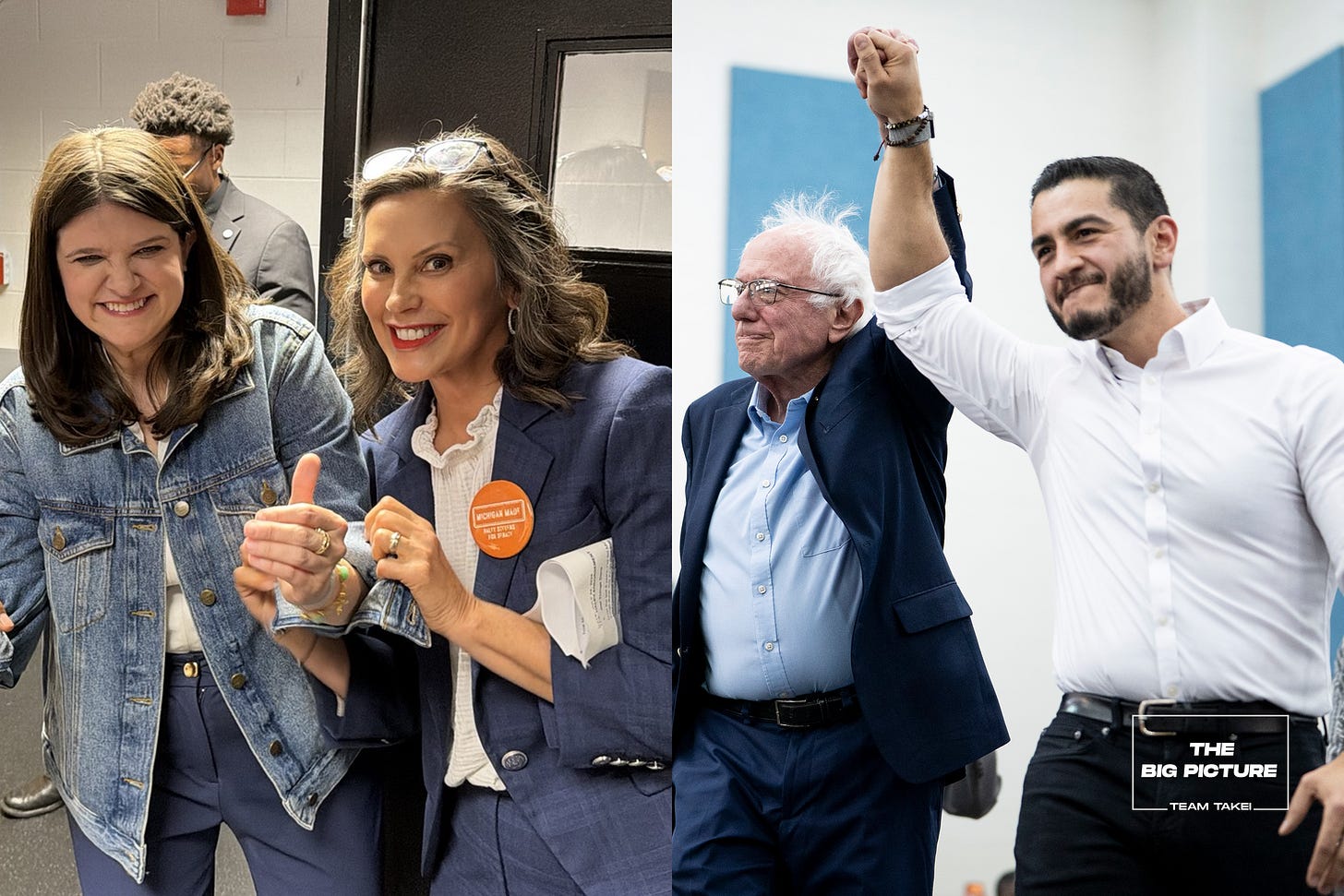 LEFT: Haley Stevens and Gretchen Whitmer. Photo Credit: X.com/HaleyforMI. RIGHT: Abdul El-Sayed and Bernie Sanders. Photo by Sarah Rice/Getty Images.
Tomorrow, August 4th, marks Election Day in the Michigan Democratic primary for U.S. Senate between Dr. Abdul El-Sayed and Rep. Haley Stevens. But when the results come in, they will represent much more than the culmination of a long, hard-fought primary between two Democratic candidates.
As Vox put it, this race is “less a Senate primary than a proxy war for where the party goes next.” And with the Senate majority on the line, the stakes are incredibly high, which is why a factional rift between the “normie” or establishment lane of the Democratic Party and its left flank is tearing much of the party in two, with this primary race at the center of the fight.
For over a year, the Democratic Party has been undergoing a battle for its future, beginning with Zohran Mamdani’s victory over former New York Governor Andrew Cuomo in the race for Mayor of New York City. Many brushed it off as a quirk of a very blue city, whose voters were uniquely open to electing a Democratic Socialist to lead their city. But something was very clear to many of us at the time: What Mamdani achieved in New York City in that primary was translatable to other parts of the country, and Democrats everywhere should be taking notes.
Now, just over a year after Mamdani’s surprise primary victory, it’s clear many of these normie Democrats ignored the warning signs and got caught flat-footed as progressive challengers to the establishment won over majorities of primary voters in many races around the country. On the eve of the Michigan Senate primary, many are looking to this race for a sign as to which direction the Democratic Party is headed, as it offers the first opportunity to see this dynamic play out at the statewide level in a bona fide swing state won by Trump.
The contrast between the candidates is stark. Dr. El-Sayed, endorsed by Senator Bernie Sanders and Rep. Alexandria Ocasio-Cortez, has been running to the left as the anti-establishment reformer. Rep. Stevens, endorsed by Senator Chuck Schumer and Governor Gretchen Whitmer, is a moderate who has run the usual establishment plays.
Polls currently show El-Sayed surging ahead of Stevens in the primary, even while other polls show Stevens performing better in the general against former Rep. Mike Rogers, the presumptive Republican candidate in the race. Much like another hard-fought primary 18 years ago, Michigan Democrats are being asked to choose between their heart and their head. And which they choose is likely to tell us a lot about the direction of the Democratic Party heading into 2028.
Clinton 2008 vs. Mamdani 2025
In early July, during the first head-to-head debate between El-Sayed and Stevens, I experienced a case of déjà vu.
There was Stevens, fielding her first question about affordability and framing herself as the candidate of experience against a male opponent she portrayed as a lightweight.