Conversation
-
Washington Policy Review: August 3, 2026
sourceToday’s Report
1. Overview
2. White House News
3. Truth Social Posts
4. Government Department News
5. 2028 Democratic Presidential Candidates
6. AI & Tech Company News
7. Congressional Watch
8. Policy Impact Analysis & Heatmap
1. Overview
The White House reported that U.S. manufacturing growth has reached its strongest rate in four years, a development attributed to the administration’s economic agenda and the Working Families Tax Cuts. President Trump officially established the President’s Military Spouse Commission through an Executive Order to address challenges related to housing, healthcare, and employment for military families. The administration emphasized that this initiative is designed to bolster military readiness and ensure that families supporting service members receive necessary support. These efforts are presented as part of the President’s broader commitment to “rebuilding America’s military” and fostering a domestic industrial renaissance.
President Trump utilized Truth Social to issue a expansive wave of endorsements for congressional and state-level candidates across Florida, Washington, Virginia, Missouri, and Michigan. He characterized his preferred candidates as “America First Warriors” and urged his followers to support them to ensure border security, energy dominance, and Second Amendment protections. Conversely, he labeled certain political opponents as “true Radical Left Extremists” and utilized his platform to criticize what he termed the “Corrupt Fake News.” Through these posts, the President maintained that these endorsements are vital to his agenda to counter those he claims seek to “divide and destroy our Great Country.”
Senator Jon Ossoff and Senator Raphael Warnock issued a formal update expressing “serious concerns” regarding reports that the Trump administration plans to outsource civil rights enforcement from the Department of Education to the Department of Justice. The Senators demanded answers from Education Secretary Linda McMahon, arguing that such a move represents a “potential dereliction of duty” regarding the protection of students from discrimination. They characterized the potential reorganization as the “dismantling” of the agency and criticized the prior closure of multiple Office for Civil Rights branches.
OpenAI released internal communications to defend its position against a lawsuit from Apple, which it labeled as “baseless.” In product developments, the company launched GPT-Live, a system designed to enable continuous, turnless voice interaction by reducing latency in human-AI conversations. Additionally, the telecommunications company Circles reported successful integration of OpenAI’s API and Codex, noting a 22% increase in average revenue per user and improved operational efficiency. These updates reflect the company’s focus on both high-level legal advocacy and the technical expansion of responsive AI capabilities.
Strong manufacturing growth and domestic supply chain shifts bolster industrial and materials sectors, although escalating wage costs present a countervailing risk to profit margins for smaller manufacturers. In the technology space, while advancements in artificial intelligence sustain momentum, intensifying litigation regarding trade secrets and personnel creates operational friction that threatens research efficiency and valuation stability. Simultaneously, the transfer of civil rights enforcement from the Department of Education to the Department of Justice complicates the regulatory landscape for service providers, prompting concerns among critics that the move may “weaken protections” and undermine administrative accountability. These developments reflect a environment where industrial expansion meets heightened legal and bureaucratic volatility, potentially constraining the long-term structural outlook for impacted firms.
2. White House News
Under President Trump, U.S. Factories Expand at Fastest Clip in More Than Four Years
U.S. manufacturing activity in July reached its strongest growth rate in over four years, marked by rising production, exports, and hiring. The White House attributes this “industrial renaissance” to President Trump’s economic agenda, specifically the Working Families Tax Cuts, which reportedly support six million jobs and $1.1 trillion in economic activity. With manufacturing wages climbing 4.2% year-over-year, the administration asserts that “this is the manufacturing renaissance President Trump promised—and delivered,” highlighting that sector expansion has occurred for seven consecutive months, contrasting with previous performance trends.
Reference: https://www.whitehouse.gov/releases/2026/08/under-president-trump-u-s-factories-expand-at-fastest-clip-in-more-than-four-years/
Establishing the President’s Military Spouse Commission
President Trump has established the President’s Military Spouse Commission to address the “significant challenges” military spouses face, including frequent relocations and employment barriers. Declaring that “thriving military families mean a more resilient fighting force,” the President tasked the Commission with advising on policies regarding housing, healthcare, education, and deployment support. Chaired by the spouse of the Secretary of War and composed of senior military spouses, the Commission will provide annual reports to the President. The body will operate for two years, supported by the Department of War.
Reference: https://www.whitehouse.gov/presidential-actions/2026/08/establishing-the-presidents-military-spouse-commission-af64/
Fact Sheet: President Donald J. Trump Establishes the President’s Military Spouse Commission
President Trump signed an Executive Order establishing the Military Spouse Commission to “strengthen military readiness by improving the quality of life for military spouses and families.” Highlighting that spouses are “essential to the strength, readiness, and retention of our military,” the President aims to ensure families supporting service members “receive the recognition and support they deserve.” This action reflects President Trump’s commitment to prioritizing military excellence and continuing his efforts to have “rebuilt America’s military” while supporting the families behind the nation’s service members.
Reference: https://www.whitehouse.gov/fact-sheets/2026/08/fact-sheet-president-donald-j-trump-establishes-the-presidents-military-spouse-commission/
3. Truth Social Posts
President Trump issued a series of endorsements today for various congressional and state-level candidates, consistently highlighting their support for the America First agenda. He endorsed Jon Maples for Florida’s 87th State House District and backed Florida Agriculture Commissioner Wilton Simpson for re-election, noting his own electoral success in the state. Additionally, Trump endorsed U.S. Senator Ashley Moody, praised Florida Attorney General James Uthmeier as an “America First Warrior,” and supported Congressman Byron Donalds in his run for Governor of Florida.
Across the country, Trump granted his endorsement to Congressman Michael Baumgartner in Washington, backed Amanda McKinney for Washington’s 4th District, and endorsed John Braun, characterizing his opponent as a “true Radical Left Extremist.” In Virginia, Trump endorsed Morgan Griffith, supported Ben Cline, backed John McGuire, praised Jen Kiggans, and endorsed Rob Wittman. Missouri candidates also received his support, including Jason Smith, Eric Burlison, Mark Alford, Bob Onder, and Ann Wagner.
In Michigan, Trump endorsed Mike Bouchard, backed Lisa McClain, supported Amir Hassan, and endorsed Tom Barrett. Throughout these messages, Trump urged voters to support these candidates to promote policies such as American energy dominance, border security, the protection of the Second Amendment, and the growth of the economy. In his praise of Congressman Mark Alford, Trump also criticized the “Corrupt Fake News,” which he claimed continues to “divide and destroy our Great Country.”
Reference: https://truthsocial.com/@realDonaldTrump
4. Government Department News
No relevant government department updates found for this date.
5. 2028 Democratic Presidential Candidates
Jon Ossoff (ossoff.senate.gov)
Senators Jon Ossoff and Raphael Warnock are questioning Education Secretary Linda McMahon regarding reports that the Trump Administration intends to outsource the Department of Education’s civil rights enforcement to the Department of Justice. The Senators expressed “serious concerns regarding the Department of Education’s potential dereliction of its duty to ensure children in Georgia receive a quality education free from discrimination.” They are calling for an end to the “dismantle[ment]” of the agency, citing the previous closure of seven Office for Civil Rights branches nationwide.
6. AI & Tech Company News
OpenAI (openai.com)
OpenAI disputes the merit of Apple’s lawsuit, characterizing the legal action as “baseless.” In response, the company has released internal communications intended to document the events and clarify the professional conduct of its employees regarding the matters in question.
How we built a realtime system for responsive voice AI in six months
OpenAI introduced GPT-Live, a system designed to facilitate continuous, turnless voice interaction. The architecture focuses on reducing latency to support more natural, fluid human-AI conversations. By transitioning away from traditional turn-taking models, the system allows for real-time responsiveness, enabling users to interact with the AI in a manner that mirrors conversational speech patterns more closely than previous iterations.
Circles powers telco personalization with OpenAI technology
Telecommunications provider Circles has integrated OpenAI’s API and Codex to create AI-native customer experiences. By leveraging these tools for enhanced personalization, the company reports a 22% increase in average revenue per user (ARPU) and a 9% reduction in customer churn. Additionally, the implementation has improved overall development efficiency within the organization.
7. Congressional Watch
Covers the 2026-08-02 session — the Congressional Record is published with a one-day delay.
No Congressional Record found for 2026-08-02.
8. Policy Impact Analysis & Heatmap
This analysis is provided for informational purposes only. It does not constitute investment advice or a recommendation to buy or sell any security.
Impact on Market
Based on today’s policy developments, our analysis identifies the following market impact themes:
THEME 1. INDUSTRIAL MOMENTUM AND LABOR DYNAMICS
Strong manufacturing growth data highlights a robust period for domestic production and employment. Increased activity in the sector provides a potential boost to industrial and materials firms benefiting from domestic supply chain shifts. However, rising wage costs may pressure margins for smaller manufacturers, while critics remain skeptical about the long-term structural viability of these gains.
THEME 2. TECHNOLOGY SECTOR LEGAL AND OPERATIONAL FRICTION
Increasing legal disputes between major tech entities underscore the rising costs of AI-driven competition. While continuous innovation in AI voice architecture sustains growth momentum, litigation risks regarding personnel and trade secrets create significant headwind potential. Market participants must monitor these shifts for impacts on research efficiency and long-term valuation frameworks.
THEME 3. FEDERAL OVERSIGHT RESTRUCTURING
The transition of civil rights enforcement from the Department of Education to the Department of Justice represents a significant shift in bureaucratic execution. This change complicates the regulatory landscape for large-scale service providers and public sector entities. Opposition figures worry this could weaken protections for students and create a chilling effect on administrative accountability.
Policy Impact Heatmap with Market Direction
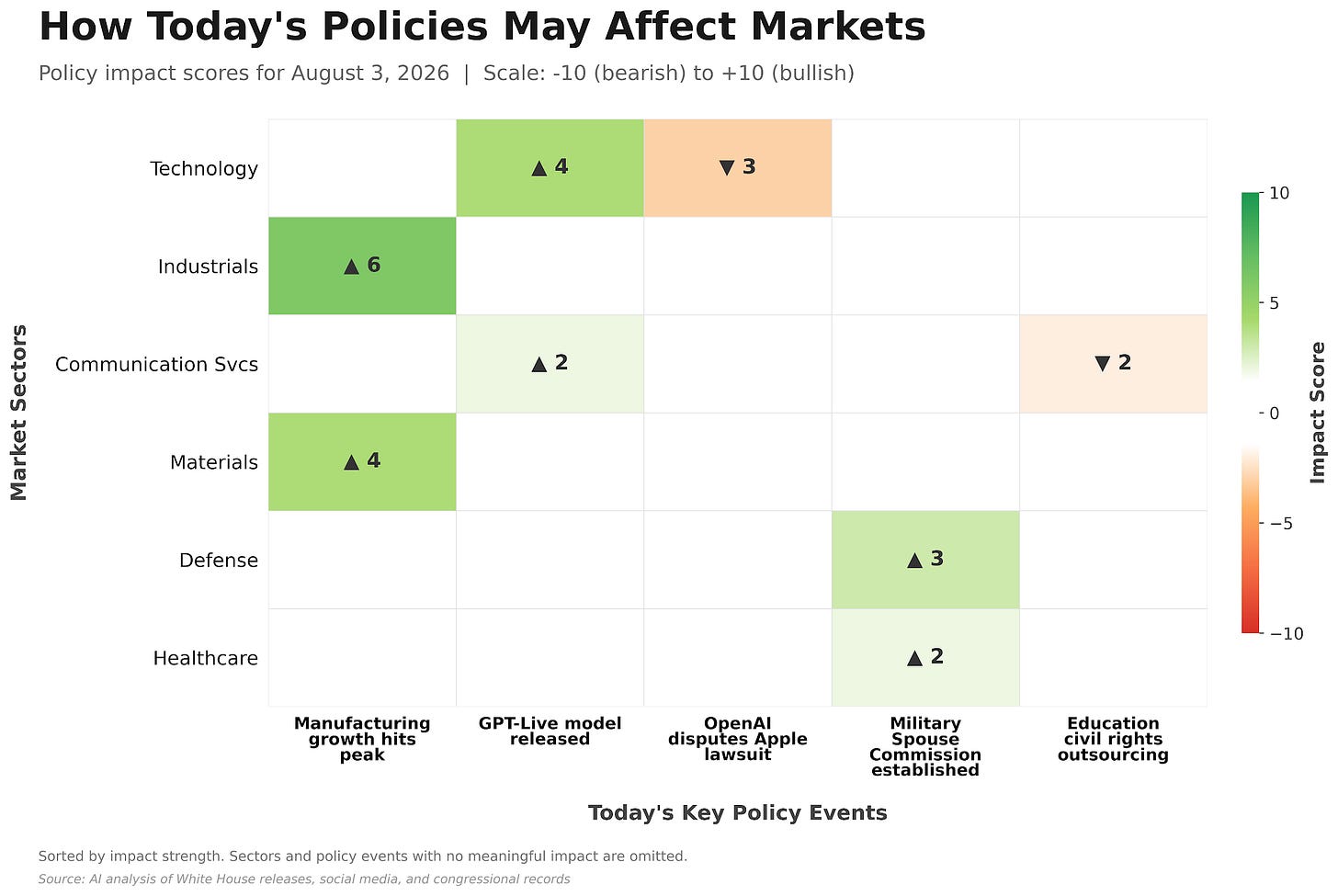
Each cell shows an estimated impact score on a fixed scale of -10 to +10, reflecting how today’s policy developments may affect each market sector. Positive scores (green, ▲) suggest bullish impact; negative scores (red, ▼) suggest bearish pressure. Rows and columns are sorted by impact strength, and sectors and policy events with no meaningful impact are omitted. The heatmap, the analysis below, and the Impact on Market themes above are produced from a single unified analysis: the heatmap visualizes the magnitudes, while the text explains the causal reasoning behind them.
Manufacturing expansion marks a significant macroeconomic inflection point, suggesting strengthened industrial demand and tightening labor markets. Analysts note the administration links these gains to tax and regulatory policy, though critics caution that rapid wage growth may exert localized inflationary pressures within the industrial complex. This “industrial renaissance” acts as a tailwind for capital-intensive sectors, provided current output trajectories remain sustainable against broader global economic headwinds.
Simultaneously, heightened friction between OpenAI and Apple introduces regulatory and operational risk premia for the technology sector. While AI innovation continues via product launches like GPT-Live, the ongoing litigation creates potential uncertainty regarding talent mobility and intellectual property control. Furthermore, the transfer of education-related civil rights enforcement to the Justice Department has drawn sharp criticism from legislators like Senators Ossoff and Warnock, who characterize the move as a “potential dereliction of duty.” This reorganization creates compliance ambiguity for educational institutions and may signal a broader consolidation of federal oversight authority, increasing long-term policy risk for public-sector service providers.