Conversation
-
The Small Cases Tell a Bigger Story
source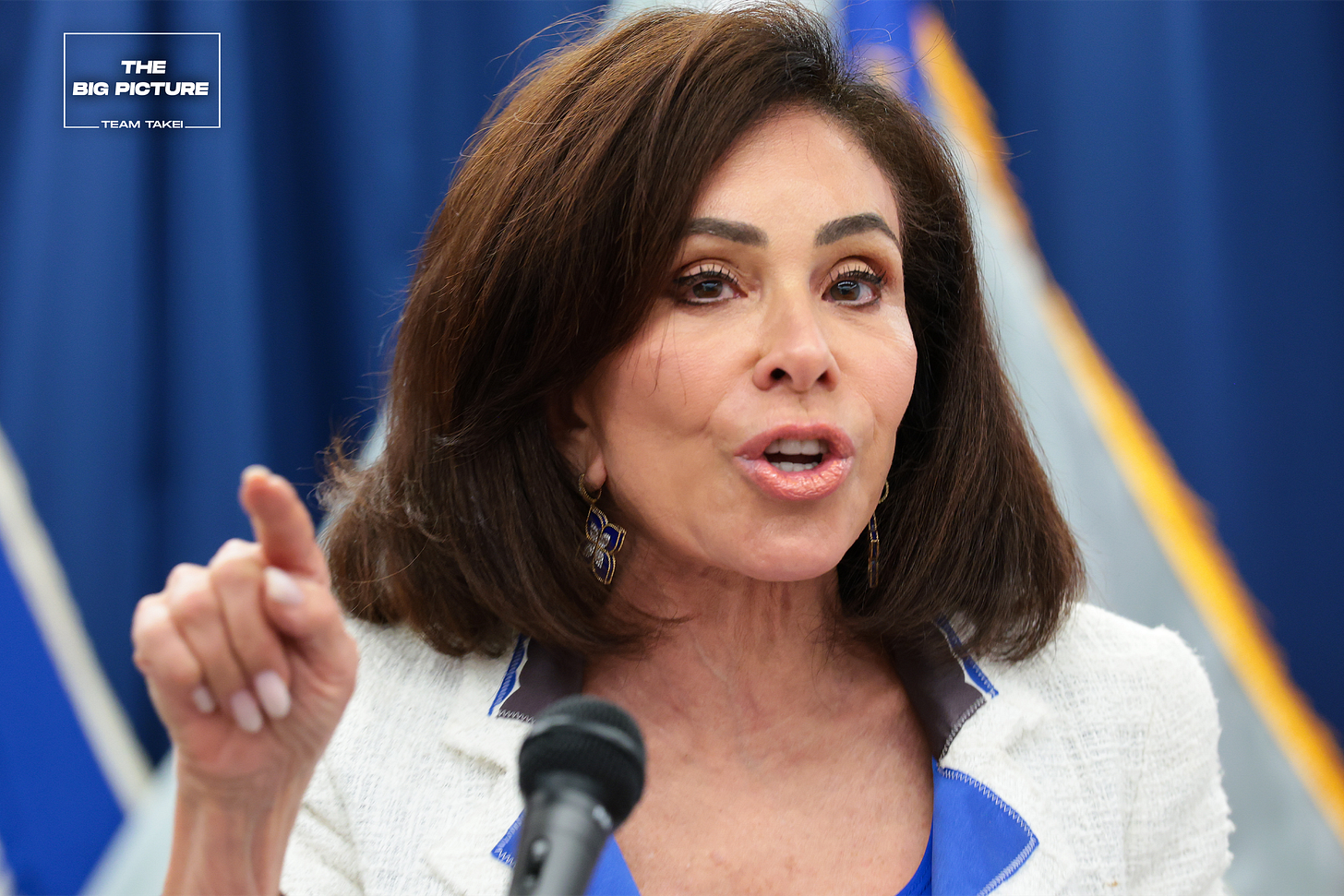 U.S. Attorney for the District of Columbia Jeanine Pirro. Photo by Anna Moneymaker/Getty Images.
On July 31, the Justice Department’s “vandalism” case against David Hearn fell apart like the Reflecting Pool’s own failed lining. Federal prosecutors moved to dismiss the felony charge against the former Olympic canoeist after the Interior Department turned over documents showing the pool’s peeling blue coating and murky green water were the product of a rushed and botched renovation.
They were not, as Trump and his cronies have long insisted, the result of left wing radicals intentionally cutting the lining.
The retreat followed an indictment brought by U.S. Attorney Jeanine Pirro’s office in early July. Prosecutors conceded, at last, that new information had made it “difficult to attribute the widespread damage to the Reflecting Pool to vandalism, let alone to establish that fact beyond a reasonable doubt.”
Donald Trump predictably rejected the DOJ’s conclusion within a day. “I disagree 100% with Jeanine Pirro, the U.S. Attorney for the District of Columbia, on the Reflecting Pool,” he wrote on Truth Social, insisting “the major damage was caused by VANDALS!”
In an era of rising authoritarianism, with a new war of choice in the Middle East and federal thugs roaming our streets and terrorizing immigrant communities, it can feel rather silly to report on something as esoteric as the Reflecting Pool and Trump’s delusions about why it failed. In June, analyst Nate Silver waved the whole thing off entirely. “There’s the World Cup and a whole bunch of other shit going on, please seek out a therapist if you’re spending more than a few moments thinking about the White House Reflecting Pool,” he scolded. When others pointed out that the president’s obsession had led to seven arrests to cover up his corruption, Silver responded, “Who fucking cares it’s literally not even in the top 100 Trump corruption scandals.”
That is true, and yet it misses the point. The Reflecting Pool is an example of “Peak Trumpism,” noted Talking Points Memo, “both preposterous and dangerous at the same time.” While the public often has trouble grasping the scale and operation of Trump’s crypto scams, his foreign real estate deals and his massive insider trading, the Reflecting Pool story, along with the resulting criminal charges, is something voters can both see and understand. And it resonates and has broken through in a way the bigger cases and corruption stories have failed to achieve.
As for whether D.C. juries would ever convict those charged, TPM noted wryly, “just remember Sandwich Guy” — the unfortunate angry citizen who wielded a Subway sandwich against a federal agent deployed to D.C. Or remember James Comey’s Instagram post of “86 47” spelled out in seashells. Or for that matter, the innocuous mortgage loan applications of Trump’s political enemies, now somehow weaponized against them.
These matters are, on their face, ridiculous. But they are also a kind of camouflage. Each became national news because the regime made it so: a presser, a Truth Social post, an over-the-top promo built around a highly public arrest. That manufactured visibility turned defendants into memes while burying an important fact: The same DOJ machine has now run this play hundreds of times against ordinary people in cases that very few have ever heard of.
These small cases, it turns out, are where corruption and lawlessness are easiest to spot. And they can teach the public much about what’s going on beneath it all.
From petty grievance to criminal charges
The best-known small cases all began the same way: with a president’s public grievance followed by a criminal charge built to fit it. The Justice Department’s practice of “charge first, find evidence later” gets the order of things backward; it is not at all how things are supposed to operate. A quick review of the facts and results in these cases is instructive.
David Hearn’s alleged crime was pulling a piece of already-peeling liner out of a pool that the president’s hand-picked, no-bid contractor had botched during installation. At the press conference announcing Hearn’s indictment, Pirro declared the defendant had damaged “approximately two square feet” of sealant, ignored a National Park Service employee’s instruction to stop, and told the worker she “cared too much” about the pool. Pirro called his words “belligerent, rude and disrespectful” — which apparently is enough to lead to an arrest nowadays. Trump had already cast the pool’s problems as “politically motivated sabotage” and threatened any vandals with “years in jail.”
By the end of July, Pirro had walked back the allegations and placed the blame for the lining failure where it belonged: on the pool’s contractor. Three other people swept up in the same theory initially faced misdemeanor charges; prosecutors have since dropped those as well.
The case of Sean Dunn, aka the “sandwich guy,” ran a similar course. Dunn was a Justice Department paralegal who was fired after he threw a Subway sandwich during a protest against the National Guard deployment in Washington. FBI Director Kash Patel personally posted a clip of Dunn throwing the edible projectile, which could be seen bouncing off a Customs and Border Protection agent’s chest. Performative outrage from the regime followed. Then-Attorney General Pam Bondi announced Dunn’s firing in a post calling him “an example of the Deep State,” while U.S. Attorney Jeanine Pirro taunted Dunn publicly, telling him to “stick your Subway sandwich somewhere else.” No fewer than 20 federal agents arrived at Dunn’s residence in dramatic fashion to arrest him, rifles drawn and riot shields up.
That was entirely unnecessary, given Dunn’s lawyer had already arranged for him to surrender voluntarily. But the show of force was the point. Agents filmed the dramatic arrest for a promotional video the White House later posted. Prosecutors then sought a felony assault charge against Dunn (again, over a thrown sandwich), but a grand jury declined to indict him. Forced to ratchet the charge down to a misdemeanor, the department lost that case too, after a jury acquitted Dunn in November following several hours of deliberation.
Then there are the petty cases against Trump’s political enemies. The most high-profile one is against former FBI Director James Comey, and it all began with a photograph. In May 2025 Comey posted, then quickly deleted, an image of seashells arranged in the sand to spell “86 47.” That’s a common slogan that his lawyers describe as an expression of opposition to the president, not an actual threat. Prosecutors nevertheless charged Comey with threatening to kill the president.
Once again, the charge was over-the-top and absurd, based on the alleged acts. Comey has moved to dismiss it on First Amendment grounds, arguing that no reasonable person would read the phrase as a suggestion of violence. And even if it could be read that way, his lawyers stated, “a reasonable observer would still understand Mr. Comey’s post as mere political hyperbole, not a true threat.” One federal judge in a separate D.C. case appears to agree, ruling that it was “difficult to fathom how any reasonable observer” would view an “86 47” flag flown by protesters on Park Service land as a genuine threat.
The Justice Department’s case against Trump’s political foe Letitia James reached back in time to a home loan application. For context, as New York Attorney General James had sued Trump’s company for fraud in 2022 and won a massive judgment that was later reduced on appeal. Trump spent years afterward calling for her prosecution. He got his wish in October of last year, when the Justice Department indicted James on charges tied to a 2020 mortgage application for a property in Norfolk, Virginia. But the case barely made it out of the gate; a judge dismissed it in November after finding that the prosecutor who signed the indictment, Lindsey Halligan, had been unlawfully appointed. A grand jury then declined to reindict James when the department tried again in December.
What lies beneath
Hearn, Dunn, Comey and James are the cases the regime chose to publicize. But they are part of a far wider pattern of cases, brought and then abandoned the same way against people with no name recognition and with no White House press office publicizing their arrests. When the charges ultimately collapse, as they frequently do, there is no press attention on that failure.
Reuters reviewed federal charging data and found that the Justice Department brought charges against at least 851 people for assaulting or obstructing federal officers between January 2025 and March 2026. That’s a scale and an evidentiary bar that depart markedly from past department practice. Among the cases Reuters examined were a woman charged over backing her car into an agent’s vehicle at low speed; a man charged for challenging an agent to a fight without ever throwing a punch; and another charged for jumping on a Homeland Security vehicle during a protest.
Most of those 851 defendants were handed an arrest, a charge and then, in many cases, a quiet dismissal. The pattern surfaced in Los Angeles, where acting U.S. Attorney Bill Essayli’s office dismissed felony charges against at least eight of 26 people arrested during protests, after prosecutors found the charges rested on discrepancies and misleading statements from the arresting officers. Despite the dropped charges, Essayli’s office kept publicizing mugshots of defendants whose cases it had already dismissed.
Protect Democracy’s retaliatory-action tracker describes a consistent structure across these cases: Highly publicized arrests, dismissals and judicial criticism of the government’s conduct, followed by departures of career prosecutors unwilling to defend the charges in court. The organization notes that “career DOJ attorneys have resigned in significant numbers, many stating publicly that they could not reconcile the Department’s conduct with their professional obligations.”
Common points of failure
Whether the department’s cases are well-known or not, each collapse points to one of three types of prosecution failures: dysfunction, sycophancy and vindictiveness. Together, they describe how this Justice Department operates under Trump.
Dysfunction. The Hearn case fell apart because prosecutors indicted before they had all the relevant facts. The department’s own filing disclosed that the Interior Department didn’t even turn over documentation about the pool’s botched installation until after the case had already gone to a grand jury. That meant prosecutors sought a felony indictment without having reviewed evidence already in the government’s possession that contradicted their own theory.
Former U.S. Attorney Joyce Vance tracked Pirro’s office’s losing record: It failed first to secure an indictment against Dunn on the overcharged “assault with a sandwich” felony, then lost the misdemeanor at trial, before turning around and indicting Hearn for felony vandalism under the same theory of aggressive, discretion-free charging. Vance wrote that Pirro, “who failed to indict the sandwich thrower and was handed a humiliating loss in the misdemeanor case against him doesn’t seem to have learned that lesson.”
With respect to Trump’s political enemies, Carl Tobias, a University of Richmond law professor, observed that the prosecutions “haven’t had much success at all except to harass” Comey and James, “which is maybe the point.” After all, if the goal were convictions, the losses would be outright failures. But if the goal is punishment by process — the arrest, the headline, the legal bills, the months spent under a pending felony charge — then a case can succeed merely by being brought, regardless of whether it survives contact with a courtroom.
Sycophancy. The James prosecution collapsed for a different reason: The prosecutor who signed the indictment, Lindsey Halligan, had been unlawfully appointed. A federal judge found that her appointment violated the Appointments Clause and the statute governing interim U.S. attorneys, voiding the James indictment outright. Sycophancy, it turned out, plagued the James case from the start. Halligan had been installed only after her predecessor, career prosecutor Erik Siebert, resigned amid concerns he’d be forced out for declining to bring the James case in the first place. Bottom line: The appointment that ultimately led to James’s prosecution existed only because Trump had already discarded a prosecutor unwilling to charge James as demanded.
U.S. Attorney for D.C. Jeanine Pirro faced the same dilemma after she failed to be sufficiently obedient. After hearing about the DOJ dropping the Hearn case, Trump told reporters Monday that Pirro “choked” and “folded like an umbrella” — an ironic metaphor given Trump’s infamous inability to fold umbrellas. CNN reported that he was weighing her removal, with one source calling it “highly likely.” Pirro was summoned to the White House Monday afternoon for a meeting with Trump and Interior Secretary Burgum, whose department she had faulted for withholding evidence. She left the meeting without being fired or resigning. Asked directly whether he would consider removing her, Trump deflected.
Vindictiveness. Beyond their First Amendment argument, Comey’s lawyers filed a separate motion this week asking the court to dismiss the case for selective and vindictive prosecution. They alleged that Trump directed the Secret Service to surveil Comey and his family, including while they stopped to visit the grave of their deceased son. The motion argues that Comey was targeted because of who he is, not what he did. His lawyers point to “86 47” merchandise sold widely online and the phrase’s common use at protests nationwide as evidence that he was singled out for a mode of political speech that goes unprosecuted against everyone else.
James’s own motion to dismiss made a parallel argument on similar grounds, alleging “outrageous government conduct” in how her case was built. She notes that the White House has aimed the same mortgage-paperwork theory at other Trump critics. Bill Pulte, while serving as the Federal Housing Finance Agency director, referred both Sen. Adam Schiff and Federal Reserve Governor Lisa Cook to the Justice Department on similarly dubious “mortgage fraud” grounds. Both have denied wrongdoing, and neither referral has resulted in an indictment.
Within the vindictive nature of the prosecution lies another message: The disproportion between the conduct and the charge is the point. A government willing to convene a grand jury, pursue a felony indictment and bring the machinery of the Justice Department to bear on the smallest and most ordinary human acts is signaling that it does not view itself as limited. It is authoritarianism at full scale, tested in small batches.
The cost of losing the little battles
The loss of multiple cases has built a poor record for the department. In the Comey case, Magistrate Judge William Fitzpatrick wrote that the government’s conduct showed a “disturbing pattern of profound investigative missteps” and flagged possible Fourth Amendment violations in how evidence against Comey was obtained. And judges now know not to trust the words of the DOJ, once granted significant weight under the “presumption of regularity” that federal courts used to afford the U.S. government.
The Justice Department has also been losing people. Protect Democracy’s tracker notes that career DOJ attorneys have resigned in significant numbers, with many saying publicly they couldn’t reconcile the department’s conduct with their own professional obligations. This kind of attrition may not show up in a single case docket, but it shapes who remains to bring the next case, and how unprofessionally it is brought.
The White House and the GOP have also been losing significant political support due to their overreach. Trump’s numbers are at a new second-term low, near levels not seen since George W. Bush. And while macro forces such as inflation and the war in Iran account for the bulk of the weight on those numbers, the American public now experiences almost daily distaste from these politicized, cruel and incompetent prosecutions over objectively innocuous actions.
Trump’s obsessions with these matters underscore where his priorities lie. Despite the affordability crisis and the war Trump repeatedly promised never to begin, the White House still manages to find time to indict people over sandwiches and seashells. The public watches these proceedings play out in the news, and it has now come to expect every case to meet the same inevitable structural failure.
The small cases are the Trump regime in a legal nutshell: dysfunction, sycophancy and vindictiveness. It’s proving to be one that isn’t so hard to crack.