Timeline
Every post and feed across this instance
-
Aides publiques aux entreprises : ces dizaines de milliards qui embarrassent le patronat
Afin d’apporter sa pierre au débat, récurrent depuis quelques années, sur les aides publiques aux entreprises, le ministère des Finances vient de publier ses propres chiffres dans une annexe au projet de loi de finances pour 2027 . Après celles du Sénat, de l’Inspection générale des finances et du… -
Fort Hood survivors praise Trump for scrapping Hasan execution livestream: 'We're not barbaric'
Victims warned a broadcast could become a propaganda tool for terrorist groups like al-Qaeda and ISIS -
Trump shuts down Pentagon plan for public execution: 5 takeaways
President Trump put an abrupt end on Thursday to questions about whether the Pentagon would really livestream the firing squad execution of the Fort Hood shooter, former Army Maj. Nidal Malik Hasan. -
Trump cancels Hegseth's plan to live-stream Fort Hood shooter's execution
President Donald Trump said on Thursday that the forthcoming execution of a former U.S. Army psychiatrist who killed 13 colleagues at Fort Hood, Texas, in 2009 will not be live-streamed, upending a controversial plan that Defense Secretary Pete Hegseth unveiled last week. -
Trump’s new press secretary says it’s ‘unknown’ how much she’ll deal with media
Katie Zacharia faces mounting questions over her legal credentials after admitting she did not pass the bar exam
Donald Trump’s new White House press secretary says it is “unknown” how much she will engage with the press, amid mounting questions over her legal credentials after admitting she did not pass the bar exam.
In a brief interview with the Guardian, Katie Zacharia detailed the whirlwind sprint to replace her predecessor Karoline Leavitt as the US president’s chief spokesperson.
Continue reading... -
What Early Voting Data Is Telling Us About The 2026 Midterms
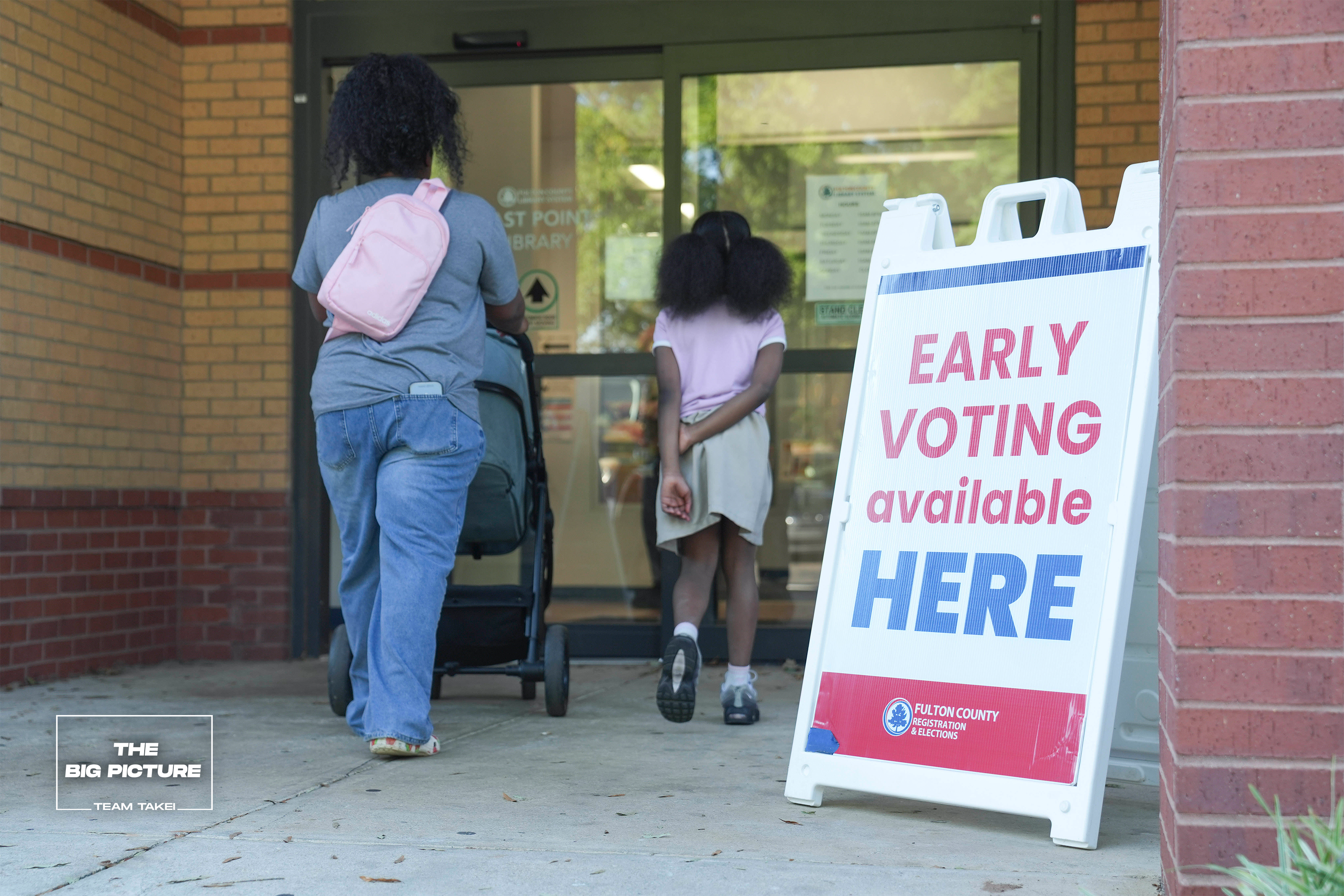
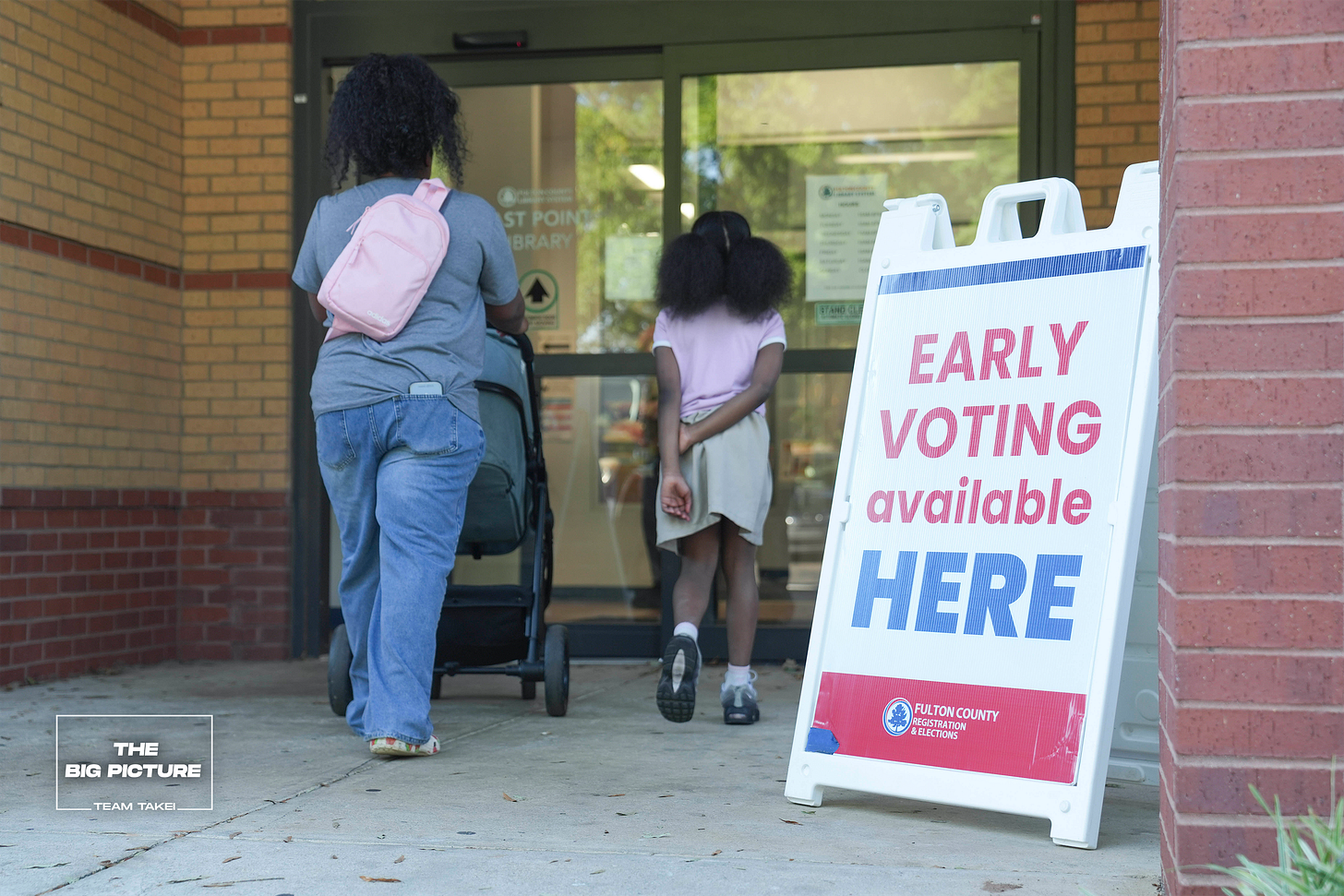 A person walks past an early voting sign at the East Point Library on the first day of early voting on October 13, 2026 in Atlanta, Georgia. Photo by Megan Varner/Getty Images.
On Saturday, October 17, millions of Americans in all 50 states across more than 2,500 events, will be gathering for the final No Kings rally before the midterms.
But unlike previous rallies, ‘No Kings 4’ is not just about protesting Trump’s authoritarianism.
This one will be laser focused on something of vital importance this election season: early voting.
Indivisble’s No Kings website states,
“Efforts to undermine trust in our elections and make it harder for people to be heard are happening across the country right now. Our democracy depends on every eligible voter having the freedom to participate without intimidation, interference, or barriers.”
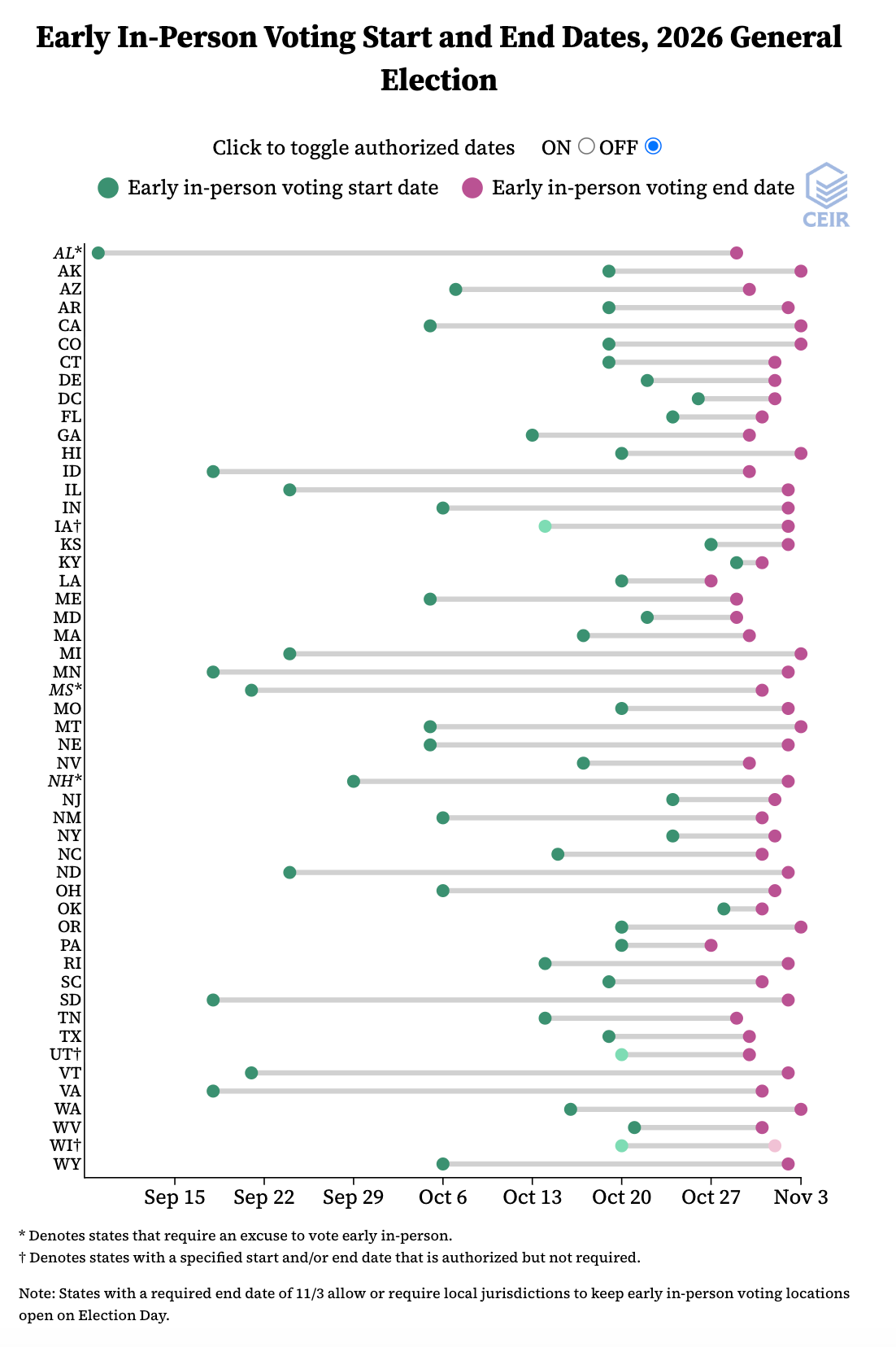
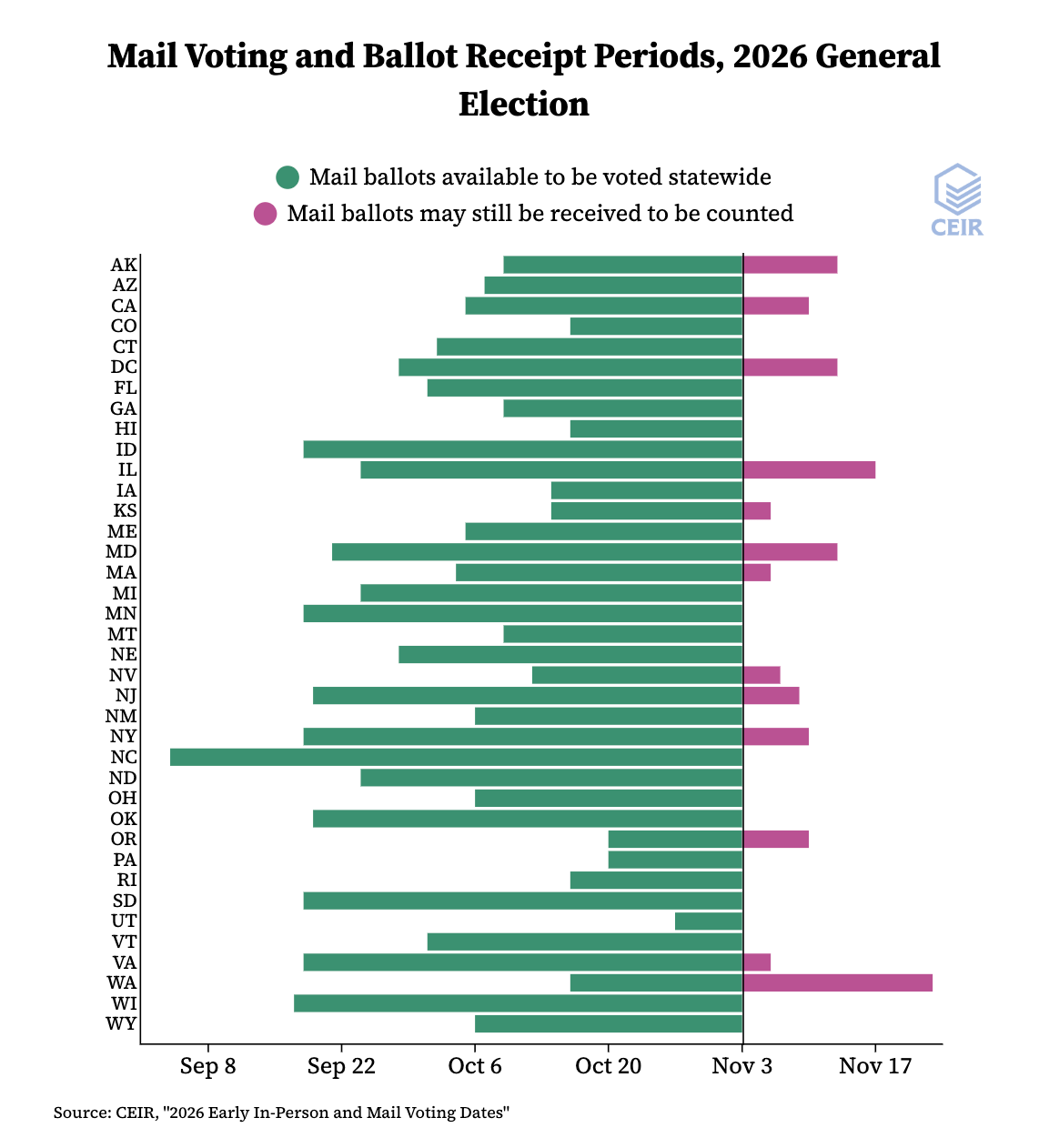
As of today, voters in half of all U.S. states are already able to vote early in person with even more already accepting absentee ballots by mail. And by the look of the voting trends so far, Democratic voters view banking their votes early as key to limiting interference from Donald Trump. But the picture is a complicated one.
What can we glean from the data about which voters are turning out early and where the early vote is surging? And does it provide a sense of what could happen on November 3?
The National Early Voting State of Play
According to The Center for Election Innovation and Research, 25 states currently allow in-person early voting.
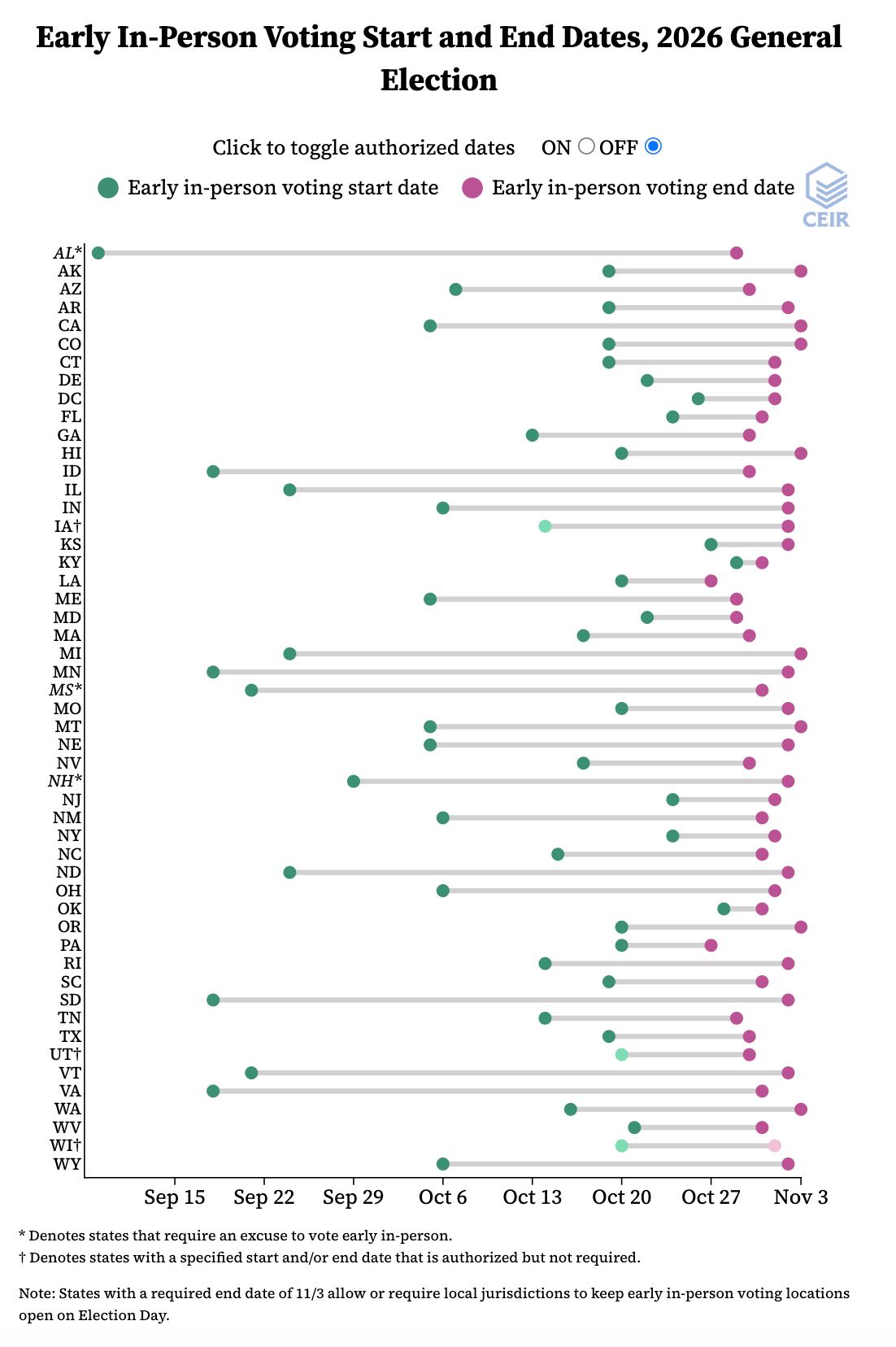
And still more states already accept early absentee ballots by mail.
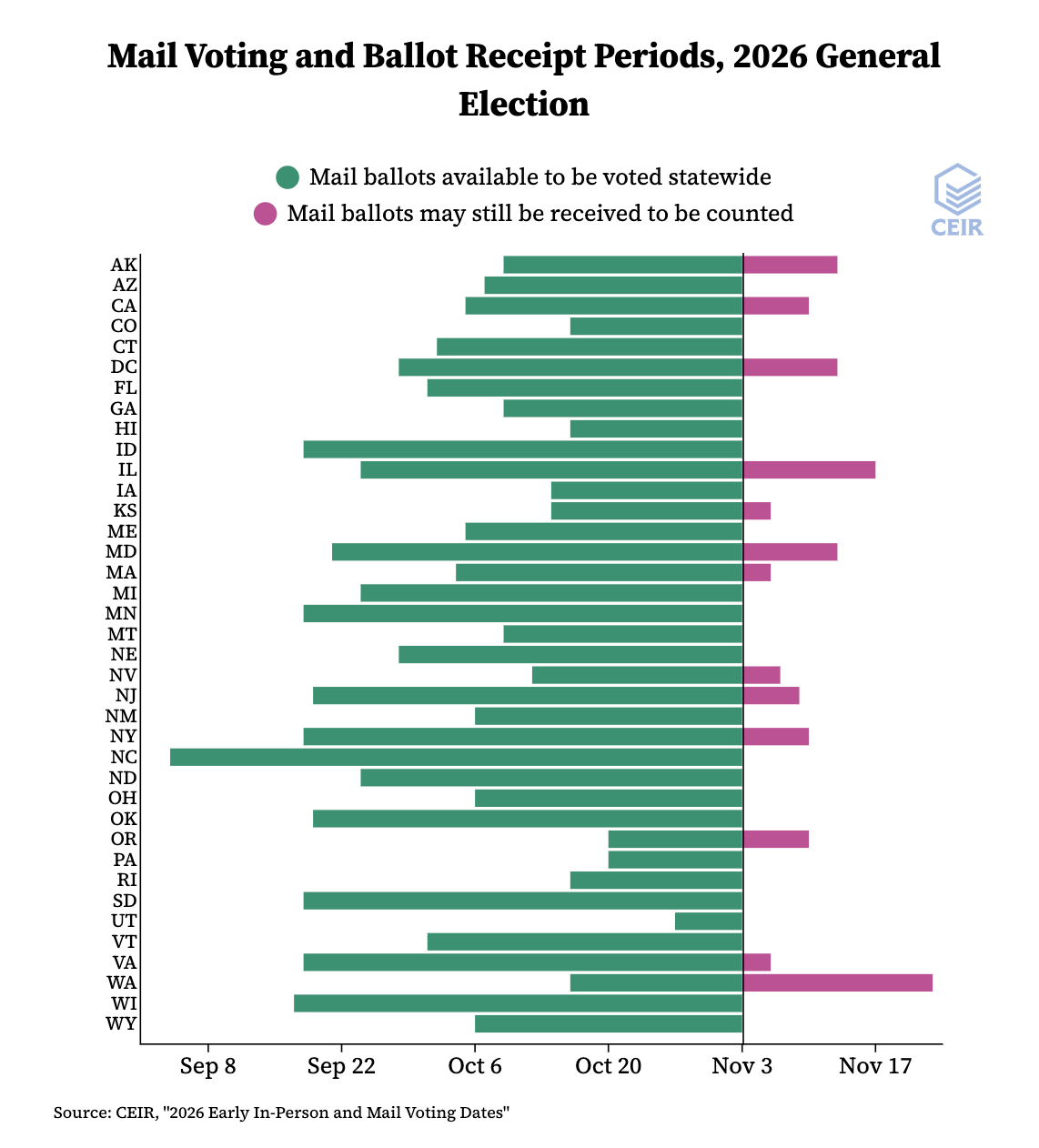
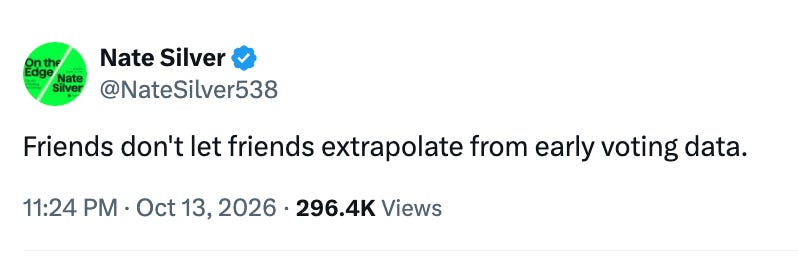
Before we dive in to actual early vote results, some caveats.
Early Vote data tells us who has voted, but not how.
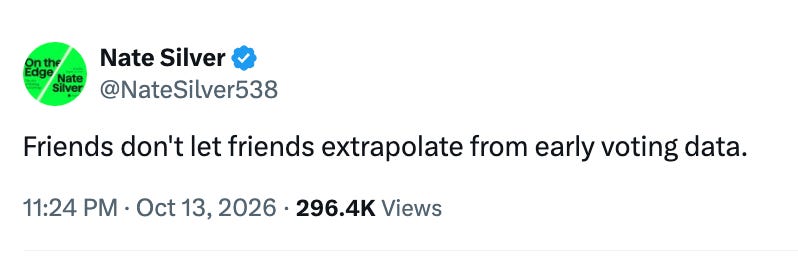
After all, the voters who are voting early may just be voters who would have voted anyway, rather than indicating a surge of new voters.
The New York Times does a good job of laying out the dangers of relying too heavily on early vote to draw conclusions about the electorate at large. While looking at the partisan breakdown of early voters can be useful, that data is often not available. As The Times notes,
The most common way to assess the partisanship of early voters is by looking at their party registration. That method largely falls apart in the 19 states where party registration is not recorded, including battlegrounds such as Michigan, Texas and Georgia.
And even when that data is available, it’s not always a perfect proxy for how people will vote.
Additionally, trying to gauge the electorate at large from the early vote turnout is imperfect at best.
Early votes in recent years have tended to favor Democrats over Republicans in general elections. The 2024 presidential election in Pennsylvania provides a stark example: Even though Kamala Harris won the early vote by 31 percentage points, Election Day voters favored Mr. Trump by 15 percentage points. He won the state by two percentage points.
The Times explains when that early vote data can still be helpful.
Voting trends from early ballots can provide information about what to expect as votes begin to be reported.
If, for example, early votes in a particular election are overwhelmingly cast by registered Democrats, we can also expect absentee vote reports on election night to favor the Democratic candidate.
All that said, the limitations of early vote data as a predictor of the voting habits of the electorate at large has not stopped analysts from digging into the data and even modeling it to gauge trends that inform what to expect on Election Night.
From these analyses, there are two narratives emerging.
Turnout Relative To Prior Elections
So far, the story about Early Voting in 2026 is that ballots cast are up from 2022, the last midterm election, and are generally more Democratic.
On one hand, this should not be terribly surprising, considering the data we have seen both in the special election results over the past cycle as well as public polling that tells us Democrats have the enthusiasm advantage this cycle. Considering the threats Trump has made to interfere in our elections, it tracks that anti-Trump voters would be the first to register their protests by ballot.
And that’s exactly what the analysis is showing, albeit with some interesting data regarding where the early voter surges are coming from.
For a live look at Early Vote totals, both for early in-person and absentee by mail returned ballots, take a look at University of Florida Election Lab’s early vote tracker, compiled by Dr. Michael McDonald.
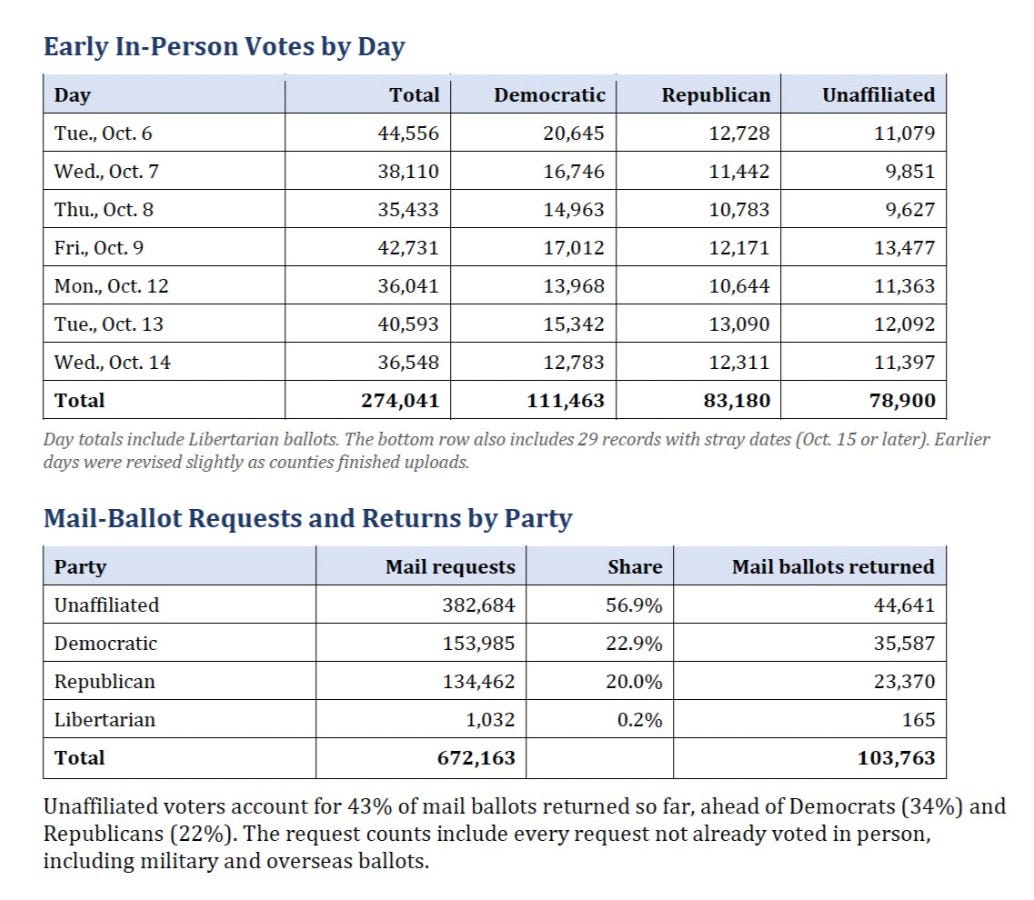
As of the time of publication, a total of 6.2 million early votes have been cast, including 1.4 million early in-person votes. Among the early votes cast in states that collect partisan ID information, the breakdown is 51.1% Democratic, 28.7% Republican and 20.2% Other.
How do these numbers compare to the last midterm election? There’s this report from JMC Analytics as of Oct. 12:
A comparison of “same point in time data” between 2022 and 2026. Bottom line: (1) turnout up 24%, and (2) in 14 states with partisan data, it’s more Dem than in 2022 (from +22 to +29 D).
This is how TargetSmart’s Tom Bonier put it on Wednesday:
This is certainly the story out of Virginia, where Early Voting began on September 18. Earlier this week, Governor Abigail Spanberger made waves by announcing what she called “extraordinary voter turnout” in early voting there relative to 2022. She reported that 450,000 Virginians have ALREADY voted, compared to just over 200,000 at this point in 2022.
One data point Spanberger made a point of noting:
“That turnout in terms of a percentage change from the last midterm election is most notable in our rural, agricultural and historically most Republican areas.”
This is a trend seen among the early voters in Ohio as well, where CNN’s headline blared:
Early voting figures suggest Democratic gains in Ohio’s most Trump-friendly counties
CNN reports:
So far, affiliated Democrats make up larger shares of pre-election voters than they did two years ago, even in the most Republican parts of the state.
At this point in 2024, Republicans had a 30-percentage point lead over Democrats in counties that voted for President Donald Trump by 20 points or more, according to data from the Ohio Secretary of State. This year, that’s shrunk to just five points.
While this CNN report is from almost a week ago, the overall trend was clear:
The data is just the latest sign of a positive midterm environment for Democrats, as former Sen. Sherrod Brown looks to defeat Republican Sen. Jon Husted, and it comes as a CNN poll finds Brown leading by six points. In the governor’s race, Democrat Amy Acton leads Republican Vivek Ramaswamy by eight points.
The overall electorate so far is about 27 points more Democratic than it was at the same point in 2024.
And MAGA is already sounding the alarm.
With Early Voting having just begun in Georgia on Tuesday, it was good news for Democrats there as well, per Prof. McDonald:
Tuesday, Oct 13 was the first day of Georgia in-person early voting. A healthy total of 188,668 persons voted in-person. This compares with 134,655 who voted in-person on the first day of in-person voting in 2022.
The early vote surge was so dramatic that, based on the enthusiasm exhibited in the early voter data, Secretary of State Brad Raffensperger expects the 2026 vote to exceed 2022’s total turnout.
State election data shows that the initial wave brought out roughly 190,000 total first-day voters, representing an increase of 55,000 voters compared to the first day of early voting in the 2022 midterm election.
Georgia Secretary of State Brad Raffensberger attributed the historic numbers to rapid population growth and energized voters motivated by key political issues. Raffensberger stated he expects total turnout for this election cycle to challenge or surpass the previous record set in 2022, when nearly 4 million Georgians voted.
The question is whether that increased turnout represents an electorate more favorable to Democrats.
According to Vote Hub’s Early Vote tracker, the early vote trend in Georgia is tracking to a 2024 Harris +1.2 environment, a 3-point shift toward Democrats from two years ago.
This model, based on two days of early voting data, predicts Jon Ossoff to win with between 56%-63% of the vote
G Elliott Morris believes he has found a novel way of using the early vote to model out what to expect from the electorate at large as well.
In his early vote live blog, Morris tracks “individual-level voter file data and compare changes in behavior at the person level.”
In his first post on October 12, Morris confirmed Virginia’s strong early vote showing and explained,
“If members of one party who voted early last cycle aren’t voting early now, that tends to be indicative of a turnout problem that persists through Election Day.”
Looking at who has turned out in Virginia at this comparable point in the 2024 cycle, Morris concludes:
In Virginia to date, the data pretty unambiguously show Republican turnout is lagging benchmarks compared to 2024. Accounting for election-day voters leaning Republican, my best educated guess is that Virginia is looking about 2 to 4 points more Democratic in terms of party share, or about 3 points on vote margin, compared to 2024.
And what about relative to 2025, which was a very strong year for Democrats? Interestingly, per a Cardinal News analysis, while the total Early Vote numbers in the state relative to this time last year are slightly down, looking at the raw vote totals coming out of certain areas of Virginia tells a different story.
“When we look at the raw numbers and realize that Fairfax County has cast 8,762 more early votes than last year this time, and Scott County is down 161, we get some sense of the problem likely developing for Republicans. Democrats appear to be banking more votes than they did last year, a good year for them, while Republicans appear to be casting fewer votes. State Navigate, the forecasting site run by Virginia Tech grad Chaz Nuttycombe, sees the early voting running 4.2 percentage points more Democratic than a year ago.”
There is one more trend worth remembering: how are unaffiliated voters voting? While analysts often like to think in terms of blue or red, in many states, it’s unaffiliated voters who are likely to make the difference in the Early Vote, as this analysis by Ohio Common Ground reminds us.
The takeaway: while Republicans in Ohio appear to be eating away at Democrats’ in-person vote lead over time, the real variable is unaffiliated/independent voters, who have the largest share of mail-in ballots.
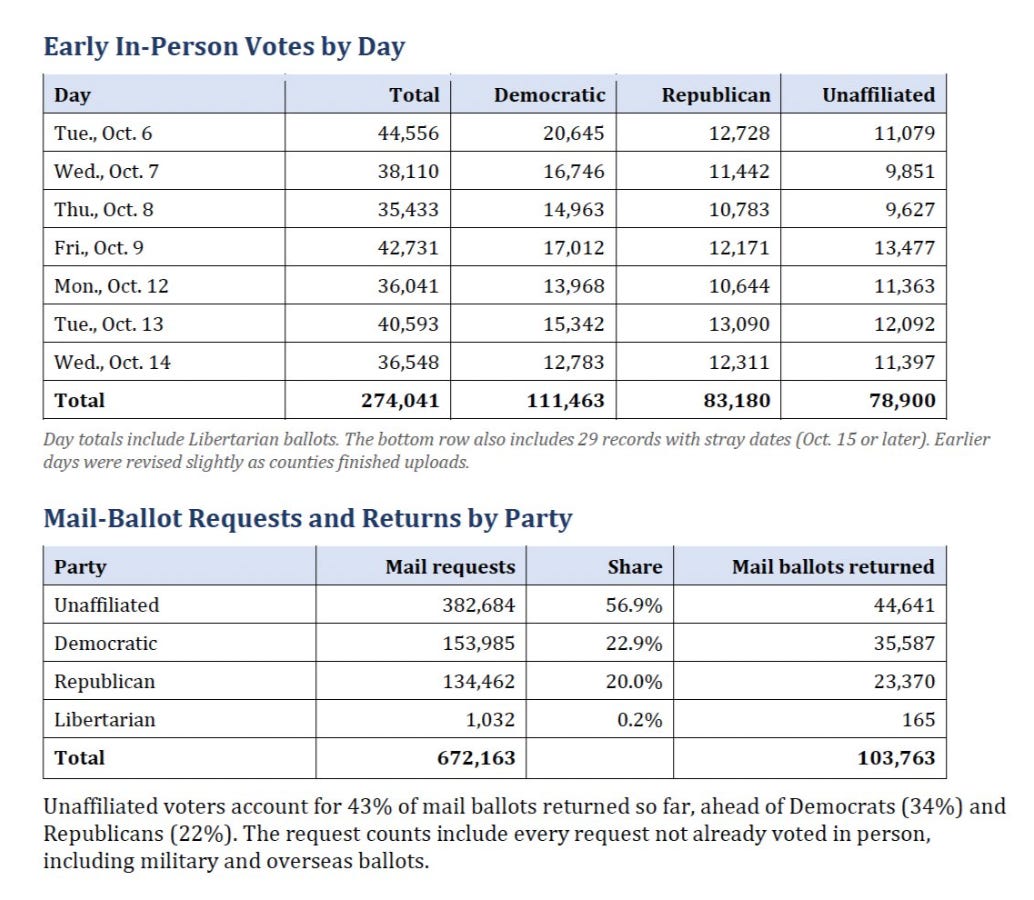
But again, if it does come down to independent voters, Republicans should take no comfort from that.
Are Voters Of Color Surging?
In a year when ICE has been a constant threat to Hispanic communities, and when the Trump administration has refused to rule out deploying ICE at the polls this November, polls this year have consistently shown a shift among Hispanic voters away from the Republican Party, particularly relative to 2024 when Trump surged among those same voters.
The bad news for Republicans is that this shift in sentiment appears to be showing up in enthusiasm based on early vote turnout.
Election analyst Tom Bonier sees a surge in voters of color broadly relative to the 2022 midterms.
And that is very bad news for Republicans.
Per Bonier, the surge is more pronounced among Hispanic voters than among Black or AAPI voters.
But perhaps most important is the improvement from this point in 2024, when Trump made inroads among the Hispanic community.
The New Republic dug into this trend with Bonier, who explains it this way.
“While it’s still early, it’s incredibly unusual to see any group outperform presidential turnout at this point in the cycle,” Tom Bonier, a senior adviser at TargetSmart, told me. “Latino turnout tends to drop more in midterms. So seeing this early surge suggests we’ll potentially see historic levels of Latino engagement.”
What’s driving all this? The economy is likely the primary driver: The NBC poll found 74 percent of Latinos nationally disapprove of Trump’s handling of the economy. Latinos prefer Democrats to Republicans on the issue by 21 points—a huge turnaround from 2024, when Trump narrowly led Kamala Harris among Latinos on it.
But immigration also looms large. NBC finds 69 percent of Latinos disapprove of Trump’s handling of immigration and 58 percent disapprove on border security. Even the Republican pollster who helps conduct NBC’s poll says the issue is a big factor driving Latinos to Democrats.
To further bolster his point, Bonier posted this chart showing a surge in Hispanic early voting relative to 2022.
As for whether this can be attributed to population growth, Bonier makes the point:
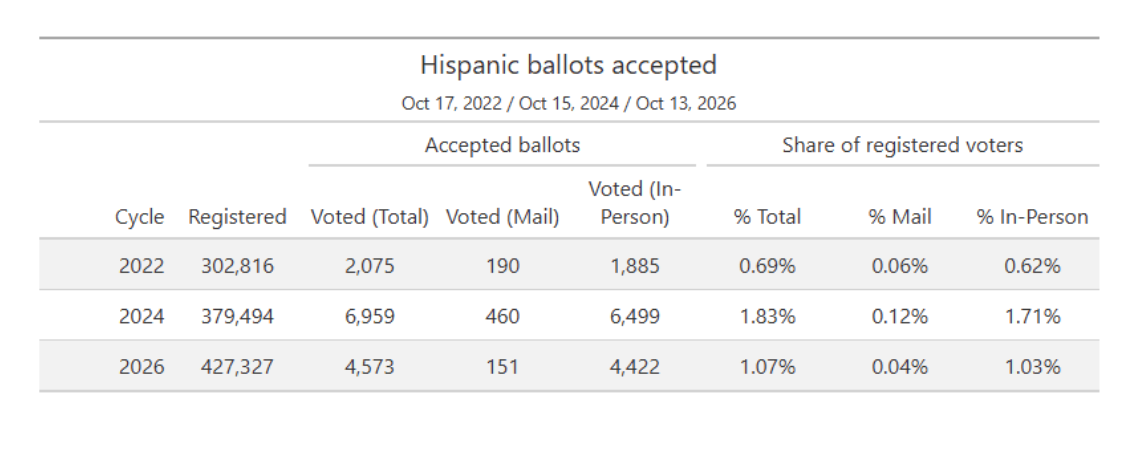
Prof. McDonald’s analysis of the first day of early voting in Georgia confirms this conclusion.
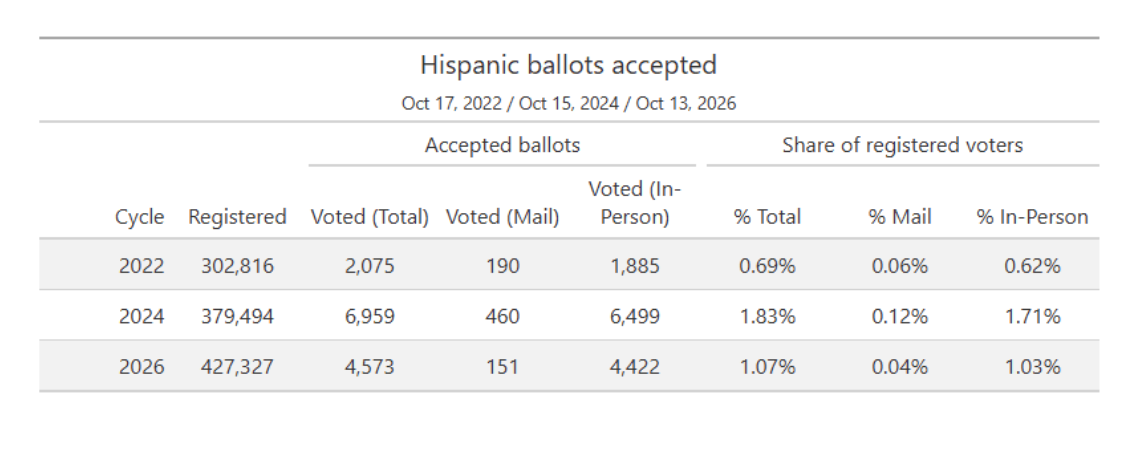
Hispanic turnout in Georgia is indeed elevated over 2022, but it is not above 2024. In 2026, 4,573 Hispanics voted, compared with less than half that raw number in 2022 of 2,075. 2024 was a higher 6,959. Georgia Hispanic registration grew by about 125,000 from 2022 to 2026 (that in itself is a big increase!), so as a rate of voter registration Hispanic turnout increased from 0.69% in 2022 to 1.07% as of the first day of 2026 in-person early voting.
We know turnout has increased overall comparing 2026 to 2022, so is Hispanic engagement greater relative to other groups? The answer is, “Yes.”
When it comes to Black voters, the story isn’t quite as clear.
Take Georgia. On day one of Early Voting, Vote Hub estimated that the share of the Black vote was up from day one in 2024, when Kamala Harris was on the ballot.
This led MSNOW’s Eric Michael Garcia to speculate that there may be a Callais effect happening, with Black voters turning out as a backlash against the Supreme Court’s gutting of the Voting Rights Act:
This analysis does not hold up entirely, however, since the Black share of the early vote is actually down relative to 2022. As Zachary Donnini, head of data science at Vote Hub, noted, this may be indicative more of a drop in the white share of early votes than particular strength among the Black vote.
That said, after looking at the second day of early voting in Georgia, Donnini wrote:
The data shared here is very, very good for Democrats w.r.t GA turnout. Low prop Black voters are highly mobilized compared to the same day as 2024. And GA data is probably one of the strongest datapoints for Dems (after VA).
But it is too early to tell how pronounced this trend is nationwide.
As Elect Project’s John Couvillon puts it:
Early Voting Patterns Are Shifting
When trying to draw conclusions about the 2026 electorate based on early voting patterns, comparing it to the 2022 Early Vote provides the nearest apples-to-apples comparison.
But it is important to remember how much has changed since 2022, when it comes to voting patterns.
It’s instructive to look at G Elliot Morris’s analysis of Iowa’s first day of early voting, which, on paper, looks great for Democrats.
According to the U Florida election lab, Iowa early voters on the first day of early voting yesterday were 56% Democratic and 29% Republican, or D+27 on vote margin.
This is the best first-day performance for Democrats in Iowa early voting going back to at least 2020.
Morris notes that
In 2022, according to L2, early voters on the first day of early voting (October 19, 2022) cast roughly 9,600 votes. The 17k that voted yesterday represent a doubling of interest in early voting.
But Morris issues an important caveat:
But I would urge caution at this juncture, especially against reading too much into the party composition numbers. All early voters in Iowa in 2022 had a party registration of D+16, in a year when Chuck Grassley (a Republican) won the statewide Senate seat by 13 points. That’s partly because Election Day voters skewed heavily Republican (by 21 points in party registration) and made up 60% of ballots, but also because party registration is not vote choice.
Since 2022, Republicans’ Election Day advantage has steadily shrunk. In other words, the boost they get when in-person votes are added to the early and mail-in totals is smaller each cycle. That’s not surprising. Two forces drove the gap at its peak: Trump’s attacks on mail-in voting, which pushed Republicans away from voting by mail, and the Covid-19 pandemic, which kept many Democrats from voting in person. With both of these several years behind us, each party’s voters are returning to more normal habits, and the gap is closing.
But this year, there is a new wrinkle: Donald Trump’s threats to interfere with mail-in voting via the U.S. Postal Service may be driving Democrats to vote early in-person in particularly large numbers. And it may be leading to some deceptively strong mail-in numbers among Republican voters.
Republicans are already licking their chops over this report out of Nevada.
This is a point Nathaniel Rakich addressed when confronted with pro-GOP mail-in vote data out of Michigan.
But in Pennsylvania, it’s a different story altogether: MAGA is starting to panic.
This all points to the difficulty in extrapolating trends about the electorate at large from early voter data, particularly this far out from Election Day.
But all told, looking at Bonier’s most recent post about the national early vote that has been reported as of last night, the turnout trends among real early votes certainly seem to confirm what polling has shown for months now: increased enthusiasm among Democrats to vote and a depressed GOP electorate.
And importantly, these numbers are consistent, at least so far, with the expected Blue Wave election that shows only the slightest sign of abating.
-
17 Octobre : Rassemblements !
Le 17 octobre, appel a rassemblement partout en france ! Et aussi à chambéry ! -
Greenland contradicts Trump's claim that 'massive' oil and gas drilling is about to begin there
Greenland's government pushed back against President Donald Trump's claim on Wednesday that "massive oil, gas and mineral exploration is getting ready to begin" in the Arctic territory. -
Trump Refers To 'Our' Greenland As He Touts Oil Drilling
President Donald Trump has referred to "our new and beautiful Greenland," as he touted a new program to explore oil, gas and minerals deposits. -
Trump announces massive oil, gas and mineral exploration plans in Greenland, touts national security benefits
President Donald Trump announced Wednesday that "massive" oil, gas and mineral exploration was expected to begin in Greenland. -
Apocalypse Now and Then | Arundhati Roy
Artificial intelligence is capitalism's final destination Source: Equator -
Retour sur l'évacuation de campement de Stalingrad | le Collectif d'accès au droit
Un manque de communication, des associations exclues, des promesses de places d'hébergement et d'absence de mobilier anti-SDF non tenues, le grand n'importe quoi de cette nouvelle opération d'évacuation des campements situés sous la ligne 2 du métro. Source: Relevé sur le Net... -
Ce soir, jeudi 15/10, un match oppose OFI CRETE et RENNES. Il y a donc une…
Ce soir, jeudi 15/10, un match oppose OFI CRETE et RENNES. Il y a donc une présence des FAFS / ULTRAS GRECS OFI DANS LES RUES (saluts nazis, stick, …).
Une VEILLE ANTIFASCISTE est donc organisée à ST ANNE à 20h.
L’objectif est de veiller toute la soirée, pour minimiser le risque pendant et après le match (23h) de sorties des nazies.
Organisons-nous et protégeons-nous !

-
US justice department sues California over alleged noncitizen voting
DoJ had demanded that LA county confirm citizenship of people on list in thumb drive, but officials refused
The US Department of Justice sued California on Thursday, seeking a court order to prevent the state from tabulating certain ballots cast in the midterm elections.
The suit came two days after the department made a specious demand to the state. On Tuesday, the department sent election officials in Los Angeles county a thumb drive with a handwritten password purporting to contain the names of noncitizens registered to vote. The department asked officials to confirm the citizenship of anyone on the list and set aside ballots from those whose status could not be confirmed. It gave the state 48 hours – an extremely narrow window – to take action. It did not provide details on how it came up with the names on the list. In its lawsuit, filed in federal court in the central district of California, the justice department said it had provided the state with more than 20,000 names of likely noncitizens.
Continue reading... -
Sabotage alimentation électrique Centr’Alp en Isère
Aux riverains du parc industriel et technologique de Centr’Alp à Voreppe :
A toute personne qui se sente concernée :
Il y a quelques jours, nous avons attaqué les postes électriques de Voreppe et de Moirans. Au moyen du feu on a coupé l’alimentation électrique et imposé un arrêt aux entreprises situées dans le parc technologique de Centr’Alp. Une petite pause.
Notre action a pu vous causer des désagréments. Notre action a pu vous faire peur. Vous êtes peut-être en colère. Ce n’est pas notre but. Si vous nous permettez, nous aimerions vous inviter à partager cette réflexion avec nous pour éclaircir nos motivations.
Nos maisons se trouvent collées à des industries cancérigènes. Nous allons nous promener dans des champs pollués, et nous avons vue sur ces bâtiments de Centr’Alp. Nous respirons l’air que leurs cheminées recrachent. Nous buvons l’eau qu’ils consomment et polluent.
Mais ce n’est pas tout. Car nous habitons littéralement à quelques pas de l’horreur. D’installations qui produisent des systèmes d’armement, qui massacrent aujourd’hui à Gaza et demain ailleurs. Des usines qui fabriquent des puces électroniques. Des centres de recherche qui favorisent toujours plus d’extraction de métaux pour construire des centres de données et leur monde du tout-connecté.
Vous ne l’avez pas choisi, nous ne l’avons pas choisi, mais nous cohabitons avec l’horreur. Les composants de missiles qui massacrent des familles entières à Gaza sont produits à côté des jardins où nous prenons l’apéro.
Et cela nous rend en quelque sorte complices de ce que le système industriel fait subir aux populations, aux animaux et à la terre. Nous pouvons fermer les yeux et ne pas y penser. Faire du déni.
Mais le temps du déni de ce monde touche à sa fin. Nous le sentons tous. Des choses graves se passent et quelque chose doit changer. Radicalement.
Nous pouvons faire plein de choses. Mais ce que nous ne pouvons plus faire, c’est rester les bras croisés. L’autre jour, nous avons choisi le sabotage pour faire quelque chose et stopper pour un temps notre cohabitation avec l’horreur. On sait bien que ça peut paraître peu ou pas suffisant. Mais comme on dit, il faut bien commencer quelque part.
Avec notre action, nous avons plus particulièrement cherché à provoquer une coupure de courant chez les entreprises ci-dessous. C’est temporaire, mais on estime que c’est un bon début.
Les fabricants de composants électroniques et électriques: ADMIR, W3 Embedded, Pyxalis, Apte-Cstronic, Detection Technology, Schneider Electric
Les acteurs de l’extraction et de la construction industrielle : le centre de recherche de la multinationale minière Rio Tinto, C-TEC Constellium Technology Center, Chauvin (machines pour l’extraction), ARC Aluminium, Chimimeca, Poma
Les usines de systèmes d’armement et de surveillance : Thales Electron Devices (dont différents sites ont été ciblés par des actions et des blocages, comme récemment en Savoie où un pylône saboté a privé de courant son usine de composants électroniques), Radiall, Apte-Cstronic, SNEF…
Les sous-traitants du secteur des semi-conducteurs : Ravanat (chaudronnerie pour les secteurs des semi-conducteurs, de l’industrie chimique, du nucléaire, de la défense, de l’aéronautique, de la production d’hydrogène…), Entegris, Nominal Concept…
Nos amitiés chaleureuses à toutes ces personnes qui ne restent pas les bras croisés face à la guerre d’extermination contre la population palestinienne et face aux ravages que l’on fait subir à la nature au nom du développement économique.
Signé
Groupe d’action « Haut Les Cœurs »
-
Nantes : communiqué de l’AG étudiante suite au 67 heures d’occupation

Depuis le mercredi 07 octobre, l’un des bâtiments de Nantes Université était occupé par des étudiant.es et militant.es, accompagné.es par de nombreuses personnes venues les soutenir.
Dans ce communiqué, nous souhaitons répondre à la présidence, et aux médias et nous adresser au plus grand nombre pour rétablir la vérité sur les événements récents survenus à Nantes Université.
Tout d’abord, nous voudrions rappeler les raisons qui nous ont poussé.es à rejoindre la révolte lycéenne et à décider de l’occupation de Censive. Cette décision répondait à un besoin d’avoir des locaux ouverts à toutes et tous, notamment pour accueillir les lycéen.nes révolté.es dont les lycées étaient fermés et qui étaient sous le coup d’un arrêté préfectoral d’interdiction d’approcher leur établissement.
La présidence entravant systématiquement l’organisation au sein du campus, nous avons décidé l’occupation ensemble au cours d’une Assemblée Générale réunissant plus de 2000 personnes. L’université est censée être le berceau premier du vivre ensemble, de la pensée libre et de l’élévation culturelle et devrait être un lieu propice à l’organisation collective.
Aujourd’hui, il n’en est rien.
L’actuelle présidence de Nantes Université, qui prône pourtant une « université libre et ouverte » à qui veut bien l’entendre, exerce en réalité au sein de Nantes Université le pouvoir le plus répressif de son histoire. Nous parlons ici, entre autres, du durcissement du règlement intérieur, des interdictions de tenues d’Assemblées Générales, du fichage des étudiant.e.s mobilisé.e.s, du contrôle de l’usage des espaces et des savoirs, de la propagande militariste ambiante et de sa réponse sécuritaire automatique à toute tentative d’organisation contestataire.
Le contexte que nous décrivons ici est commun à toutes les universités et il est le lourd symptôme des politiques menées par nos gouvernements successifs.
C’est donc dans un contexte d’université portée par des dynamiques austéritaires et répressives que nous avons relevé la tête et décidé d’occuper les locaux.
Alors que tout portait à croire que nous serions expulsé.es en quelques heures, nous avons tenu près de trois jours. Cette occupation montre que nous sommes capables d’imposer un rapport de force à la présidence et à nos dirigeants.
Nous avons de quoi être fièr.es et voudrions profiter de ce communiqué pour remercier l’ensemble des travailleurs et travailleuses de Nantes Université : nous vous remercions pour le soutien qui nous a été accordé dans cette occupation. Nous remercions également toutes celles et ceux qui ont participé de près ou de loin à faire vivre la « Commune de Censive”.
Vendredi 09 octobre, des images volées de l‘intérieur du bâtiment ont été publiées dans un court reportage par le média d’extrême-droite CNews. Une fois ce reportage diffusé, la ligne était donnée : l’occupation de Censive est devenue le symbole d’une forme spectaculaire de « déchéance ».
Mais nous savons toutes et tous comme il est facile, pour les médias, de repeindre le tableau et de manipuler l’opinion publique. L’instrumentalisation d’une poignée d’images a suffi à passer sous silence les nombreux aspects positifs de ce que nous avions réussi à mettre en place à l’intérieur.
Dans les faits, la « Commune de Censive” a été avant tout un espace inventif et auto-géré. Au sein de cette occupation, nous avons réussi – en quelques heures seulement et sous la pression constante liée aux menaces d’expulsion – à amorcer la mise en place d’un système communautaire et fonctionnel.
Pendant ces 67 heures d’occupation, nous sommes parvenus à :
– tenir une cantine solidaire autogérée et| nourrir gratuitement des centaines de personnes, en comptant notamment sur le soutien et la solidarité de nombreuses associations
– organiser un pôle santé avec des équipes bénévoles, formées et autogérées pour concevoir, accueillir et fournir différemment l’accès au soin au sens large
– nettoyer, à tour de rôle, les sanitaires et parties communes tout au long de l’occupation
– mettre en place l’autodéfense et la vigilance au sein et autour du bâtiment, afin d’assurer au mieux la sécurité de celles et ceux prenant part à l’occupation et d’anticiper au mieux la répression policière, que nous savons toutes et tous ultra-violente
– construire, avec l’appui de professeur.es et intervenant.es venus de tous horizons, des espaces de discussion pour penser et se former collectivement, notamment grâce à la mise en place d’ateliers divers (éducation populaire, histoire des mouvements sociaux en France et dans le monde, système politique actuel…)
Pendant 67 heures, nous nous sommes auto-organisés pour mettre en place des espaces de fête et des espaces de calme, des espaces de formation, une salle de diffusion pour regarder des films ensemble, des salles d’ateliers pour discuter et débattre de sujets précis, des cellules d’écoute concernant addictions et VSS, des espaces où dormir en sécurité, d’autres où se retrouver pour faire des jeux, d’autres encore pour faire de la musique.
Nous avons réussi à faire naître une communauté dans laquelle la mise en commun primait (nourriture, électroménager, ustensiles, matériel médical et informatique, jeux de société, instruments de musique…) et nous avons vu se dessiner l’esquisse d’une Société Libre.
Nous sommes parfaitement conscient.es que cette occupation n’était pas parfaite. Il s’agit d’une première expérience militante pour la plupart d’entre nous et nous nous sommes nous-mêmes trouvés en désaccord à plusieurs reprises et sur plusieurs sujets aus ein du mouvement. Ces désaccords ont donné lieu à des discussions constructives et ont confirmé notre désir commun d’évoluer et de faire mieux. Comme toutes et tous, nous apprenons, tous les jours.
La présidence nous a repris le bâtiment avant que nous ne puissions aller plus loin, mais l’esquisse aperçue nous a suffi pour faire grandir notre espoir et notre détermination. Aujourd’hui, nous voulons adresser un message simple : la fin de l’occupation ne signe pas la fin du mouvement. Nous n’avons rien réglé.
Si la présidence prône une université « libre et ouverte à tous », nous voulons qu’elle s’oppose concrètement au décret « Bienvenue en France », qui multiplie par 10 les frais d’inscription à l’université pour les étudiant.e.s étrangers. Nous souhaitons aussi qu’elle refuse catégoriquement le système Parcoursup, qui exclut toujours plus les élèves de classes populaires et les lycéen.es étranger.es de l’accès à l’enseignement supérieur.
En réalité, la présidence participe à la construction d’une université élitiste et libérale que nous refusons de voir advenir. Elle se place comme un maillon à part entière dans la chaîne sécuritaire, raciste et xénophobe que l’Etat se charge aisément de construire.
– Samedi 10 octobre à 6h30 du matin, un important dispositif de CRS accompagné par la BAC (plus de 300 agents répartis dans une quarantaine de véhicules) est intervenu dans le cadre d’une opération spéciale,visant à déloger étudiant.es, lycéen.nes et soutiens présent.es sur place. Carine Bernault, présidente de l’université, a ensuite fait le tour des médias pour s’exprimer au sujet de l’occupation.
Elle y déclarait « soutenir nos sincères revendications”. Comme d’habitude, les actes ne suivent pas les mots. Nous avons publiquement diffusé un premier communiqué le 8 octobre, lendemain du début de l’occupation, sur le compte Instagram de l’AG de Nantes.
L’a t-elle réellement lu ?
La présidente disait également avoir retrouvé le bâtiment « saccagé”. Nous souhaitons démentir ces éléments de langage exagérés.
Le bâtiment n’a pas été saccagé, et ni le mobilier ni le matériel n’ont été détruits. Les dégradations se résument surtout à des tags sur les murs et des stickers collés. Nous voudrions rappeler que les tags et les stickers sont un moyen historique et traditionnel d’appropriation des lieux pour la communauté militante et étudiante.La présidente parle de « centaines de milliers d’euros » de travaux de réhabilitation. D’une part, ce montant est largement exagéré. D’autre part, il n’est en rien comparable avec la casse de l’université publique imposée par l’État (que nous dénonçons d’ailleurs sur ces murs). Le montant des travaux n’a rien à voir non plus avec le montant engagé dans le dispositif démesuré mis en place pour déloger quelques dizaines d’occupant.es.
Il serait peut-être temps que la présidence revoie ses priorités.
Nous nous opposons également à l’instrumentalisation du personnel de l’Université exerçant leur profession sous des statuts précaires. D’après la présidence, c’est « autant d’argent qui ne pourra pas servir à titulariser des enseignants”.
Cela fait plus de quinze ans que des mouvements sociaux traversent l’institution universitaire pour réclamer plus de moyens, notamment pour titulariser les enseignant.es. S’il est possible aujourd’hui de financer ces « lourds travaux de réhabilitation du bâtiment », alors il était possible hier d’accorder la titularisation des enseignant.es sous statuts précaires.
Mais nous le savons, ce qu’il manque en réalité aux instances décisionnaires de Nantes Université pour décider de la titularisation de ces professeur.es, c’es tavant tout une volonté politique d’en finir avec les emplois précaires au sein de l’université.
Nous ne nous laisserons pas avoir par le discours mensonger et manipulateur de la présidence.
Le monde tel qu’il est aujourd’hui ne nous promet plus rien pour notre avenir. On nous demande de vivre sagement dans des studios minuscules aux loyers indécents et à la salubrité souvent intolérable. On nous demande d’être exemplaires au lycée de 8h à 18h sans nous garantir l’accès à une formation supérieure. On nous demande de nous tuer au travail en parallèle de nos études sans nous garantir un accès aux master. On nous demande ensuite d’aller au bout de nos cursus sans nous garantir un emploi qui nous permettra de sortir de la précarité.
C’est contre l’incertitude constante, la sélection croissante et plus généralement l’avenir qui nous est imposé que nous nous battons. Et nous ne lâcherons rien.
Ensemble, nous refusons d’être des citoyen.nes modèles.
Nous refusons de nous taire. Le système nous prépare à mourir au travail et à la guerre sans avoir eu la chance de vivre, le tout en regardant le monde brûler sur le bûcher du capitalisme et de l’ordre établi.
Nous refusons de voir nos parents mourir au travail et nos anciens maltraités dans des mouroirs. Nous refusons de réarmer démographiquement le pays pour voir nos enfants envoyé.es au front. Nous refusons de voir nos frères et nos sœurs tué.es dans l’horreur de la guerre aux quatre coins de la planète, qui se meurt déjà elle-même.
Nous refusons aussi de vivre et travailler sous des températures extrêmes, en été comme en hiver, dans nos logements comme dans nos salles de classe.
Notre ambition, c’est celle-ci : ne jamais être de parfaits petits soldats, lisses et manipulables, qui courbent l’échine, de gré ou de force, face à un État répressif et autoritaire.
La « Commune de Censive” est un marqueur du rejet absolu et total de tout ce que cette société nous impose. C’est aussi le reflet clair et limpide de notre désir de rêver à mieux et d’habiter le monde autrement. C’est le crépuscule d’une nouvelle époque qui émerge depuis longtemps déjà dans le cœur de la société.
Il est évident que nos ambitions ne s’arracheront que par la lutte, alors nous lutterons.
Nous souhaitons désormais nous adresser à vous toutes et tous : ensemble, observons nos conditions d’études, nos conditions de travail et nos conditions de vie.
Ensemble, regardons ce qui se profile dans un avenir proche et ce qu’il est en train de se produire actuellement : les lycéen.ne.s sont dans la rue dans tout le pays, les étudiant.es s’organisent dans un mouvement massif, les ouvrier.es, artisan.es, intermittent/es et agriculteur.ices se remettent en mouvement.
Tout comme les pompiers, les éducateur.ices et les soignant.es continuent leur lutte perpétuelle pour des moyens et des conditions de travail et de vie dignes.Il est temps d’accentuer la pression pour prendre ce qui nous revient de droit et que I’Etat nous vole en permanence et en toute impunité.
Ressortons les gilets jaunes et faisons plier nos gouvernements.
Comme nous, réunissez-vous, organisez-vous, manifestez, bloquez, occupez vos espaces, réappropriez-vous vos usines. Faisons converger nos luttes et élargissons le combat. La suite nous appartient.
Nous voulons tout !
-
À Saint-Denis, la police tente d’interpeller un élève dans le bureau du proviseur
La quasi-totalité des professeurs du lycée Paul-Éluard de Saint-Denis se sont mis en grève ce jeudi. Et demandent la démission du proviseur, après une tentative d’interpellation d’un élève dans l’enceinte de leur établissement. -
Autoroute A412 en Haute-Savoie: la justice refuse de suspendre les travaux
La cour administrative d’appel de Lyon a rejeté la demande des opposants à l’autoroute qui doit relier Thonon-les-Bains à Machilly, en Haute-Savoie. Les requérants envisagent de saisir le Conseil d’État. -
Fonderie de Bretagne: histoire d’une spirale de destruction industrielle
Le tribunal de commerce de Lorient a prononcé, jeudi 15 octobre, la liquidation de la Fonderie de Bretagne, amenant 244 personnes à perdre leur emploi. Derrière cette nouvelle faillite industrielle, présentée comme une fatalité par la direction et les pouvoirs publics, il y a pourtant des responsables. -
«LFI est un parti présidentiel de campagne, pas un parti de politisation populaire»
La dynamique indéniable de La France insoumise occulte ses paradoxes, estime le politiste Rémi Lefebvre: si le mouvement est efficace pour son candidat Jean-Luc Mélenchon, il peine à offrir à ses militants gratifications et activité durable en dehors du temps électoral. -
Campagne «carrée» et maillage militant: comment LFI compte gagner la présidentielle
Depuis qu’il a lancé sa quatrième campagne présidentielle, le mouvement de Jean-Luc Mélenchon multiplie les démonstrations de force, aidé par un candidat et un état-major rodés à l’exercice. L’enjeu de la structure insoumise est désormais de mieux s’implanter, avec un travail inédit de cartographie du territoire. -
Knives Out! Habba versus Grenell and Zampolli versus Landau and Guilfoyle versus Everyone and Everyone versus Wiles
I’m not sure if there’s one precipitating factor causing the flood of nasty in-fighting among Trump’s top people — though Serbia and Venezuela appear to be hot-buttons.But I do know it has gotten hard to keep track of.
Kimberly Guilfoyle
Start with Kimberly Guilfoyle. The source of her downfall is a guy named Eric Deters, who had paid Guilfoyle some ton of money to get an extradition, to get little in return. WSJ had a slew of stories, of which most aired that Deters’ complaints.
September 25: The Mystery Man Shadowing Kimberly Guilfoyle as She Pushes Deals Across Europe
October 7: ‘Honey Please’: Kimberly Guilfoyle Pushed Donor to Wire $100,000 to Her Amex Account
October 10: At Davos, Kimberly Guilfoyle Boasted of Private Jet Trips, Luxury Stays
October 13: Kimberly Guilfoyle Resigns as U.S. Ambassador to Greece
October 13: Inside Kimberly Guilfoyle’s Final Days as Ambassador to Greece
Don’t miss The Bulwark’s interviews with Deters (one, two), in which Sam Stein asks Deters if he isn’t sort of extorting everyone here.
After Guilfoyle’s resignation, the Daily Mail reminded that it had busted up the Guilfoyle-Don Jr relationship in the first place and quoted some Trumpsters imagining that Guilfoyle may exact her revenge.
Allies of the president are said to be relieved that Guilfoyle is leaving her post, but insiders have warned the Trump family may not have heard the last of her.
‘Having her back in America would be a nightmare. Kimberly knows where the bodies are buried. She knows the people, the secrets, the fights, the relationships,’ one source told the Daily Mail.
‘Nobody wants an angry Kimberly back home with nothing to lose.’
Her firing now raises the prospect of her former fiancé Don Jr and the rest of the Trump family and their cronies facing that fallout.
I’d love to see it. Guilfoyle knows where a lot of bodies are buried. Remember, she played a key role in the insurrection in 2020!
But sadly, I don’t think she has the talent to negotiate the criminal legal exposure to do that.
James Blair and Chris LaCivita
Meanwhile, NYT revealed that after James Blair had left the White House in order to try to salvage the midterms for the GOP, he and Chris LaCivita were instead in Serbia helping pro-Russian
October 6: Amid Midterm Crunch, Trump Advisers Took Time to Help Russia-Aligned Government
Buried in that first story and a number of follow-ups was the detail that Susie Wiles’ daughter was also in Serbia making bank.
Sadly, I don’t think the prospect of top Trump aides cashing in on helping Russian puppets was a problem for Trump. As the story mentioned, though mostly in passing, Don Jr has been cozying up to the same people. I think the problem is that Republicans are facing disaster and … Blair is nowhere to be seen. Or rather, is seen someplace where he’ll be of little use to the GOP, unless they’re trading work in Serbia for Russian interference in the US.
That led a lot of the endangered Republicans to bitch and bitch.
And so Trump played dumb about the disclosure, claiming he might fire them.

We’ve seen this play before with Paul Manafort, among others. I doubt much will come of it.
Alina Habba and Ric Grenell
Then there’s Alina Habba and Ric Grenell. On Monday, NYT explained some of the mystery behind Habba’s marriage to a much younger billionaire Turkish dude, Turhan Mildon.
October 12: A Trump Loyalist, a Turkish Investor and a Battle for Wealth and Influence
While both deny there’s anything utilitarian about this marriage, the story describes how Mildon’s cement contract in Venezuela posed a problem.
Before the United States captured Mr. Maduro, aides to Mr. Trump and some U.S. intelligence officials expressed concern about Mr. Mildon’s work with the Maduro government, according to multiple people briefed on the matter. Mr. Mildon had spent months trying to build ties between Alex Saab, one of Mr. Maduro’s closest confidants in Venezuela, and Republicans in Mr. Trump’s orbit. The Trump administration had considered placing sanctions on Mr. Mildon, two people involved in the discussions at the time said.
Once Mr. Maduro was out of the picture, things for Mr. Mildon got even worse.
Until he married Habba, and then Delcy Rodriguez reconsidered terminating his cement contract.
But there was a bright spot: Mr. Mildon had met Ms. Habba, one of Mr. Trump’s most prominent legal defenders. They started dating this year, soon after Mr. Maduro’s downfall. By this past summer, the couple’s burgeoning romance had begun to draw attention. Specifically, it caught the eye of Ms. Rodríguez, according to two people close to her. Mr. Mildon was in a serious relationship with a woman who had high-level access to Mr. Trump — the one person keeping Ms. Rodríguez in power.
Since taking office, Ms. Rodríguez has been trying to balance the interests of the competing MAGA factions, and gauging their relative influence over Mr. Trump. After learning of Mr. Mildon’s powerful allies, she decided to pause her order terminating his cement contracts, allowing him to continue to profit from them, according to people familiar with her thinking
While the NYT does not say definitively who introduced Mildon and Habba (a report when they married said a diplomatic source introduced them, which for a slew of reasons made me wonder if Tom Barrack had) but it implies that Mildon met Habba at some Kennedy Center events back when Ric Grenell — who keeps finding himself on the losing side of Trump’s Venezuelan adventures — ran the joint.
He became a frequent guest at the John F. Kennedy Center for the Performing Arts, where he networked with the man in charge of the institution at the time, Richard Grenell. Mr. Grenell was also working as Mr. Trump’s special envoy to Venezuela, and trying to broker Mr. Maduro’s exit from power.
Mr. Grenell introduced Mr. Mildon to some of the MAGA crowd. Mr. Mildon’s spokesman said his client and Ms. Habba had first met at an event at the Kennedy Center in late 2025, and started dating in early 2026.
Just one day later, Axios described a big blow-up between Habba and Grenell over a payment Mildon claims Grenell received but did not deposit.
October 14: Exclusive: White House probes claims of missing Kennedy Center money in “MAGA blood feud”
In the matter of days, Ric Grenell went from chasing the baseless Talarico smear to demanding that Caputo demand proof before posting Habba’s hit job on him.

Update: In a story matching WSJ, NYT reveals Mildon may actually be just 25. Habba is 42.
Paolo Zampolli versus Christopher Landau
Which brings me to Paolo Zampolli — the guy who claims to have introduced Melania and Donald — versus Christopher Landau — the far right Deputy Secretary of State whose father was a diplomat (and who therefore may be one of just a handful of people in the Trump Administration who knows or cares how agencies are supposed to run).
October 15: Nasty email fight between 2 top Trump appointees spills into the open
I have no fucking clue (yet) why we’re getting this now. The Politico story describing it traces a dispute that started last November and continued until this July, when Dan Scavino broke up the fight by putting Sarah Rogers (whose far right shenanigans make her pro-Russian by default) between the two of them. Landau kept trying to rein in Zampolli’s extracurricular activities, and Zampolli kept making it clear that Landau is not the boss of him.
Even though he’s assigned to the State Department, Zampolli, who last year posted on social media that he’s “never had a boss in my life,” has publicly indicated that typical bureaucratic org charts do not apply to him.
“My number-one boss is the president of America,” Zampolli told the Financial Times. “I get my instructions from the White House, Commerce and the Department of War … anything to advance the America First agenda.”
But many of his Instagram posts also appear to provide backup to Landau’s assertions that Zampolli has gone far beyond his remit on cultural issues, including posts of meeting the energy minister of Romania, working on nuclear energy issues in Hungary, attending World Bank/International Monetary Fund meetings, meeting with the United Arab Emirates’ director of foreign direct investment and even discussing with an Argentine official how to send that country’s astronauts to space.
I mean, Zampolli knows the secret that Melania and Donald are hiding about Epstein, so I’m certain Landau is not the boss of Zampolli.
What I find interesting is that, in June, Zampolli reportedly pinned the March NYT story describing how Zampolli got his ex-baby mama deported to Brazil on Landau, which makes zero sense — much of the story seemed sourced to Amanda Ungaro herself, but also to the people at ICE whom Zampolli asked to make it happen. Or possibly Corey Lewandowski.
In one particularly heated exchange on June 19, Zampolli asked State Department Inspector General Arne Baker to investigate Landau, complaining that Landau was restricting his authority. Zampolli asked for a meeting with Baker to discuss his concerns about Landau. (A spokesperson for the inspector general declined to comment on whether any investigation was opened.)
The same day, Zampolli accused Landau of being the source for a New York Times story “that caused irrepable [sic] harm to the First Lady and to my family.” He doesn’t cite the Times story. But several months earlier in March, the Times reported that during a custody battle, Zampolli had asked Immigration and Customs Enforcement to deport Amanda Ungaro, the mother of Zampolli’s son, to Brazil, to help him gain custody of their teenage son. The story mentions Melania Trump in passing. Zampolli denied that he ever asked ICE to detain Ungaro.
As I said, that makes zero sense and it makes less sense that Zampolli would wait three months to try to pin it on Landau and it would take four more months — until right before the GOP gets hammered in midterms — for a story told to 16 different people on an email chain would get told.
But it’s that kind of fortnight, I guess.
Incidentally, Zampolli is also being sued by a woman who claims he raped her in October 2023.
Update: Oh. This is why this got aired in the press.

Susie Wiles
Which brings us, finally, the a Politico Playbook piece today describing that Trump is entertaining replacing Susie Wiles (who, by the way, I had thought was leaving after the election anyway).
October 15: Trump’s ice maiden is under fire
It includes some names of insane people and some names of people who’d be insane replacements for Wiles.
Trump has floated several people who could replace Wiles as chief of staff: The senior elected Republican official said the president had mentioned Stephen Miller, his deputy chief of staff, and Randy Levine, the president of the New York Yankees, as an outside-the-building option.
Trump is also considering Steve Witkoff, Bill Pulte and Kevin McCarthy, people close to the president told us. Allies of McCarthy, the former House speaker, have been arguing that he could help Trump handle a hostile Democratic Congress.
But they key part is someone appears to have leveraged Susie’s daughter, Katie’s, corruption in Serbia to put a target on Susie.
Trump has bristled at recent reports showing several longtime advisers are profiting from foreign consulting business, including top Wiles allies James Blair and Chris LaCivita(see the NYT). Katie Wiles, the chief of staff’s daughter, was reported (see the FT) to be representing Republika Srpska, the pro-Russian, semi-autonomous Bosnian Serb territory for which Blair and LaCivita also did work. Trump was not previously aware of Katie Wiles’ foreign work and rivals of Susie Wiles have made sure the headlines surrounding her daughter reached the president, one person close to the president said.
“Susie has this whole cadre of people that have been found to have been monetizing his ecosystem pretty dramatically,” a senior outside adviser told Playbook.
As I noted yesterday, some of the people most responsible for the ass-handing that Republicans are about to suffer are attempting to dodge the blame even while making juvenile efforts to stave it off.
And meanwhile, a bunch of vultures are buzzing around the vacuum of a policy process trying to make bank, trying to take out rivals in public and private.
Let’s hope they reveal enough that we can use it to reclaim the country from these horrible people.
The post Knives Out! Habba versus Grenell and Zampolli versus Landau and Guilfoyle versus Everyone and Everyone versus Wiles appeared first on emptywheel.
-
The Disappointed Originalist: Sherif Girgis
Within the world of legal nerds, there has been a lot of buzz lately about originalism, the theory of constitutional interpretation that calls for interpreting the Constitution based on the original public meaning of its provisions. Some of this might be due to the start of the latest Term of the U.S. Supreme Court, and some of this might be connected to the publication of Justice Samuel Alito’s new book, So Ordered: An Originalist’s View of the Constitution, the Court, and Our Country.
In light of this, I was delighted to speak with Professor Sherif Girgis of Notre Dame Law School, a leading scholar of originalism and a former law clerk to Justice Alito. In our conversation, Sherif and I covered what he views as the best argument in support of originalism, as well as the particular type of originalism he espouses (because originalism is not a monolith). We also discussed the current Supreme Court, including what grade he would give it; the chances that the justices will overrule Obergefell v. Hodges, which recognized the constitutional right to same-sex marriage; and the past, present, and future of the First Amendment.
Thanks to Sherif for joining me—and congratulations to him on his upcoming move to Harvard Law School.
Show notes:
Sherif Girgis bio, The University of Notre Dame Law School
What Is Originalism? | Interview: Sherif Girgis, by Sarah Isgur and David French for Advisory Opinions
Sherif Girgis joins the Harvard Law faculty, by Harvard Law News Staff
Sponsored by:

NexFirm helps Biglaw attorneys become founding partners. To learn more about how NexFirm can help you launch your firm, call 212-292-1000 or email careerdevelopment@nexfirm.com.
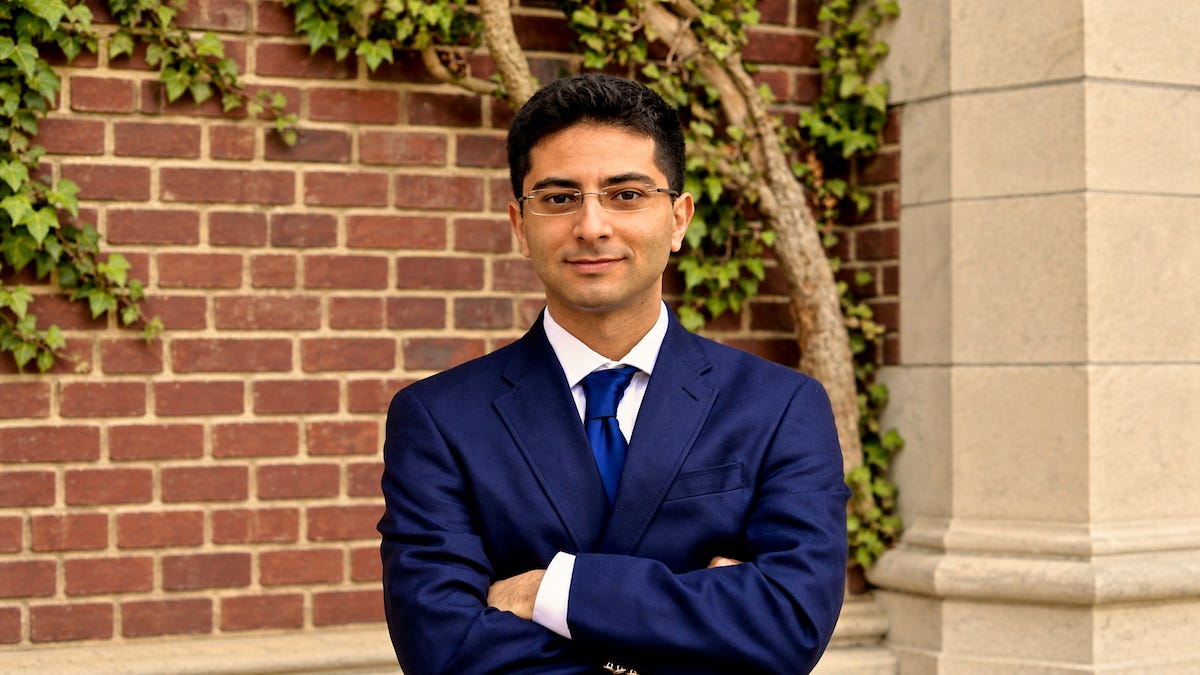 Professor Sherif Girgis (courtesy photo)
Three quick notes about this transcript. First, it has been cleaned up from the audio in ways that don’t alter substance—e.g., by deleting verbal filler or adding a word here or there to clarify meaning. Second, my interviewee has not reviewed this transcript, and any transcription errors are mine. Third, because of length constraints, this newsletter may be truncated in email; to view the entire post, simply click on “view entire message” in your email app.
David Lat: Welcome to the Original Jurisdiction podcast. I’m your host, David Lat, author of a Substack newsletter about law and the legal profession also named Original Jurisdiction, which you can read and subscribe to at davidlat dot substack dot com. You’re listening to the 107th episode of this podcast, recorded on Wednesday, October 7.
Thanks to this podcast’s sponsor, NexFirm. NexFirm helps small and midsize law firms offer Biglaw-caliber benefits at small-firm prices. To learn how NexFirm can improve your employee benefits program, call 212-292-1002 or email betterbenefits at nexfirm dot com. Want to know who the guest will be for the next Original Jurisdiction podcast? Follow NexFirm on LinkedIn for a preview.
If you are a legal nerd (and I know many of you are), you will enjoy today’s episode. My guest today is Sherif Girgis, a professor of constitutional law as well as a philosopher. He is currently a professor at the Notre Dame Law School. But as of January 1, Sherif will join the faculty of Harvard Law School—news that was announced just last month.
Sherif is a leading scholar of originalism, which calls for interpreting the Constitution based on the original public meaning of its provisions. So in our conversation, we took a deep dive into originalism, probing its intellectual foundations. But we covered a number of other interesting topics, including the current Supreme Court and what grade Sherif would give it; the chances that the Court will overrule Obergefell, which recognized the constitutional right to same-sex marriage; and the future of the First Amendment, including generational differences of opinion about the importance of free speech. Without further ado, here’s my conversation with Sherif Girgis.
Sherif, thank you so much for joining me.
Sherif Girgis: Thanks for having me.
DL: Tell us about your background and upbringing. Where did you grow up?
SG: Well, the exciting part is that I was born in Cairo, Egypt, and then the wah-wah part is that I grew up in Dover, Delaware—which was actually great. It was a great place to be. I was born to Egyptian parents. We moved to the U.S. when I was very young, maybe two. I went to public school there and was on track to become an engineer, like my parents, and was thinking that well into maybe at least middle school. And then I had a sudden moral and then religious conversion, and I went from not practicing anything to becoming a Catholic. That opened up my interest in philosophy and theology and switched me on to the humanities. And that’s how I ended up studying what I did in college and onward.
DL: Interesting. So, to double back, you mentioned your parents were engineers. What led them to relocate from Egypt to the United States?
SG: It was for the most trite but wonderful and heartwarming reasons: They wanted more liberty and more economic opportunity. My parents were both Christians. My dad at the time was working partly in Saudi Arabia, and he wasn’t able to practice his faith freely when he was in Saudi Arabia—and even in Egypt, there was significant discrimination against the Christian minority. My parents also knew that there was enormous economic opportunity in the U.S. And so they were able to get a green card through my aunt, my dad’s sister, who was already in the U.S. and married to a U.S. citizen, and went from there.
DL: So you mentioned this religious conversion. If it’s not too personal, what prompted that? Was it a friend? Was it something you read?
SG: It’s a totally fair question. So, my family had been practicing Coptic Orthodoxy, which is a kind of ancient Egyptian brand of Christianity, which has a lot of resonance with Catholicism, where I ended up. Then we stopped practicing for several years, so I wasn’t practicing anything. And then I had a very sudden moral conversion, which I disclose to people only after a couple of drinks, and that made me believe very strongly in the supernatural—and also, because of the way it was triggered, reignited my belief in Christianity in particular.
I was aware of lots of differences among Christian denominations, through friends and family that were all over the place. We had just gotten on the internet a little bit before then, and so I used that to start reading about all the differences and the church’s history and apologetics and all the debates on that front, and I became convinced that the Catholic Church was the church that Christ founded. So I had to end up there somehow. I asked my parents if I could convert, and they thought it was a weird kind of inverse adolescent rebellion and told me to wait a little bit, which was totally fair and reasonable at the time. So I did wait a few years, and then I became a Catholic and have stayed there.
DL: I have to say, as someone who was born Catholic—because my parents are from the Philippines—I’m always impressed at the much greater knowledge of theology and church history possessed by converts, as opposed to those of us who just rolled into Catholicism off the turnip truck. You’re probably very steeped in a lot of these debates and Aquinas and Augustine and all of the other great scholars in the Catholic tradition.
SG: Well, different people come in in different ways, if they do come in sometime after childhood. For some of us, what you’re describing is just a byproduct of the fact that we ended up reading our way in and being captured by the intellectual tradition. And some people are captured more by the beauty of the liturgy, by the music, or by the church’s art. I was captured by the ideas: I came to think they were compelling and then, eventually, that they were true, and that the church was a truth-telling kind of thing. And so that was necessary for me to get to the point where I came to think that I should become a Catholic.
DL: So, by the time you arrived at Princeton, were you already interested in philosophy and theology and Catholicism?
SG: Yes. In fact, that’s why I applied to Princeton. As I said earlier, I had been thinking I was going to become an engineer. So I was going to go to the University of Delaware, which has a fantastic engineering program. It was just a 45-minute drive from my house, which seemed great. And I did apply there, just in case I ended up wanting to go there.
I didn’t apply to a lot of fancy schools—almost none of the Ivy Leagues or anything like that. But at some point, I read a story about Robby George at Princeton, and I was captured by something in particular about his approach. He’s the McCormick Professor of Jurisprudence at Princeton; he teaches constitutional law and philosophy of law there, and he’s a Catholic. But the thing that had captivated me was not so much his Catholicism but the fact that he was a proponent of natural law theory, which I knew almost nothing about. All I knew from the profile of him was that he thought that on certain moral questions, like the sanctity of life, the things I thought of as the church’s teachings were also accessible and defensible by reason. And so it’s not just that these aren’t crazy views, or you can show that these aren’t crazy views, but that there are actually secular arguments for thinking these are better than the alternative views on secular grounds. And I was struck by that and a little bit shocked by that and very intrigued.
So, I applied to Princeton alongside my other mostly local and not very elite schools. And to my surprise, I got into Princeton, and I ended up going there. And when I got there, I was not totally sure what I wanted to study, but was leaning towards philosophy and ended up doing that, both at Princeton for my major and then for my master’s degree at Oxford, and then for a Ph.D. back at Princeton.
DL: At what point did you become a mentee or an acolyte of Professor George, who’s a very eminent scholar in the field? He has spoken and tweeted very warmly about you. At what point did you come into his orbit?
SG: It felt like a gradual thing. I was there just to take his classes and learn from him alongside everybody else. Almost everybody else that I worked with closely was in the philosophy department; Professor George is in the politics department. So it was a very gradual thing. I did well in his classes and then started giving him feedback on some of his work, working in a kind of an RA capacity, and then occasionally writing with him.
And I didn’t have that unusual a relationship with him, in the sense that one of his real gifts is being a very hands-on, involved, and invested mentor and teacher. He’s got lots of people in the U.S. Senate, like Ted Cruz, and people in the White House Counsel’s Office—the White House Counsel himself, Will Scharf, was in my section of his civil-liberties class when I took it. And so one of his legacies is being a really open and fair-minded mentor for a lot of people, and not just to people who are interested in his work or even share his views.
DL: And he’s a fascinating figure in his own right. If people haven’t checked it out, they should listen to his recent, or maybe not so recent by now, interview with Andrew Sullivan on Sullivan’s podcast, which I thought was interesting because I learned that Robby came from a very humble and working-class background. I always thought of him in this very “fancy” way. He’s this Princeton professor; he’s this philosopher and theorist. And I was very interested in his own personal story. I thought, “Wow. That wasn’t the background I expected.”
SG: I agree—and I think that’s part of why I was inspired by his example. As I mentioned, I went to a public school in Dover, Delaware, for K-12. Dover is a small place. My high school class started with 600, and I think only about 330 of us graduated. It was a place that had people from all kinds of backgrounds, including people facing a lot of challenges given their lot in life, socioeconomically or otherwise. So I felt pretty out of place at Princeton, with lots of peers who had gone to boarding schools or otherwise seemed way more polished. I just thought, “I barely got in. I should enjoy it and try to learn as much as I can, but I’m not really of Princeton.” And the example of the success and the thriving of people like Robby George gave me a kind of encouragement on that front.
DL: When you graduated from Princeton, did you already have an interest in legal theory in particular? Did you already think you might go into legal academia?
SG: I had some interest in that, but I was mainly interested in philosophy. So I studied a degree called the B.Phil. in philosophy—it’s really a master’s in philosophy at the University of Oxford—and then at the end of that, I applied to and started a Ph.D. in philosophy back at Princeton. And the plan at that stage had been to become a philosophy professor.
But at the end of my first year in the program, I thought a couple of things. First, I thought philosophical work is really valuable when you’re an A++ philosopher, but it feels really worthless if you’re a B+ philosopher. I was not confident at that stage that I’d be an A+ philosopher, and so I felt like continuing on the path was a huge wager.
Second, I just had a kind of angst about a bunch of things, about whether the work linked up enough with the real world to feel grounded, even just to see what the conceptual implications of the work were, much less the practical implications. Sometimes that was difficult, given the style of philosophy that you get professionalized into in grad school. I was also not confident that I would get a job in philosophy—and so, at the end of this long road, I might have to switch careers anyway. And I saw many super talented people who did.
And then finally, I was interested as an affirmative matter—so not just running from stuff—in the intersection of law and philosophy. A bunch of my interests from college onward were in that vein. And so I thought, given that cluster of reasons, it’s more than a hedge to… it’s something more positive than a hedge, but it’s also a hedge, to go to law school. So I took leave to go to Yale Law School and then did a bunch of back-and-forth, and eventually I got both degrees.
DL: What was your first job outside of the academy—as in, not being a student in the academy?
SG: My first job was a clerkship for Judge Tom Griffith on the D.C. Circuit, which was amazing. He’s an incredible human being, super generous and warm and outgoing. He’s a great judge, extremely fair-minded—scrupulous, really—about living as much as possible by the kind of FedSoc orthodox lights that he was formed by, of trying to figure out what the best, most faithful reading of the legal materials is and not what you want it to be. He’s an unbelievable writer—and we would go back and forth on drafts for sometimes dozens of times.
And I think to myself very often that the two years in which I grew the most as a writer were Mrs. Swain’s English composition class in middle school—or I guess I should say three years, my year with Mrs. Swain and then the two clerkships that I had with Judge Griffith and then later Justice Samuel Alito.
DL: They’re both very distinguished, prominent jurists. Judge Griffith actually recently stepped down from the bench—or maybe not so recently, I can’t even keep track of time anymore—and he also gave a very interesting podcast interview on Advisory Opinions. They’re both well-known jurists. They’re both, I would say, conservative—however you want to define that.
How would you compare the two? Where would you say there are maybe differences in their work as jurists or as people or their styles?
SG: Temperamentally, they’re different. Judge Griffith is extremely outgoing and wants to talk to everybody all the time. Justice Alito is more reserved at first—and then, as I learned in chambers, he really opens up once he’s warmed up to the situation and to a group of people, a new group of people. So they’re both incredibly warm, and they’re both very funny and very sharp-witted, but they do have that temperamental difference.
And then as judges, I think Justice Alito is different from most judges, especially most on the conservative legal movement side. People tend to be very self-conscious about having an articulated methodology that guides them. So they have not a formula, because you can’t reduce it to a formula, but they have steps that don’t exhaust the process, but that very explicitly guide the process: “All right. We start with the text, and then we go to these materials, and then we go to those materials. And these moves are okay, and those moves aren’t.”
Justice Alito was formed by the same movement and has some of the same touchstones, but is a much more intuitive thinker. So both in case discussions and sometimes in the drafting process, he would start with an instinct that was usually driven by hypotheticals on both sides of the issue, and then he would work backwards. There would be a kind of… what academics, in their jargon, call “reflective equilibrium.” You have your instinctive, intuitive judgments about particular applications, and then you have the general principles that you think might explain those, and then you go back and forth between the two to figure out what a stable equilibrium would look like.
And I think what I learned from Justice Alito’s approach was that it wasn’t results-oriented in the sense of, “Oh, we’ve got a political outcome, and we all know it, and we just need to work our way backwards from that,” but it was oriented to the facts of a case and to the particulars. And I think I unlearned some of my expectations that judging could be an algorithm, which I had developed not so much from clerking for Judge Griffith but from being in law school at a time when, if you were in the Federalist Society, as I was, the formulas of judging were salient, were top of mind. And so I gained an appreciation for basically a lawyerly sense as a guide to legal reasoning and legal judgment.
DL: I totally agree with you. Your explanation of Justice Alito really crystallizes the vague understanding I had of his methodological approach. I would also commend people to, of course, his new book, So Ordered, and The Wall Street Journal piece that he wrote about it, and also, again, to give a plug to our friends at Advisory Opinions, the episode they recently did with you, where you also walked through that WSJ piece.
I think Justice Alito is accurate in describing himself as a “practical” or “working” originalist, in the sense that he starts with or at least gives a lot of importance to the original public meaning of constitutional or statutory text, but he’s not mechanical about it or doctrinaire about it. And he seems to have perhaps a more flexible approach than some of the other originalists. I don’t know if you would agree with that.
SG: Yes. I think one of the differences is in how much confidence you have that the original meaning will settle a case—and one difference between Justice Alito and some of the other originalist justices is that he is a lot less confident of that. In those cases, you resort to other materials—and for him, there’s a common-law lawyer element to his reasoning. So, for him, a lot of times the other materials are precedents, and it’s about trying to draw a through-line through the precedent—which is a much less mechanical thing than trying to apply a meaning you’ve extracted from the text.
And that drawing a through-line—whether it’s through the precedents or through other legal materials or through history that’s not clearly tied to original meaning but still seems to be a relevant guide—is a much more discretionary exercise. It requires a dose of common sense to anticipate how different actors would have filled in the gaps when they didn’t spell everything out for you in a canonical text. And I think that makes a difference both to how the opinions read and, in some cases, to how the outcomes are reached.
So I can’t think of a case where he would say anything close to, “This was the original meaning of the text, but we need to contradict it because…” But I think he’s just much less confident that the original meaning will settle the kinds of cases that get to an apex court. And he is less likely to devolve onto some other early historical material just because it’s early historical material as the way to fill the gaps. So, for example, he’s less likely to say, “Look to the common law of trespass to fill the gaps in Fourth Amendment jurisprudence, where we don’t know how the Founders would have applied the norm, rather than looking to precedents or to broader norms of reasonableness.”
DL: After your clerkships, where did you go?
SG: I clerked for Justice Alito, and then I went to Jones Day, where I had an amazing time in the Issues & Appeals group in the D.C. office. My wife and I paid a premium so that we would live near a Metro station to cut the commute, because we expected long hours in the office. And then, four weeks in, COVID happened—so I spent a year and a half working from my living room in our high-premium apartment. But it was still a great experience. Through lots of Zoom interactions, I still got to know some amazing people, not just in the D.C. office but elsewhere.
And to my surprise, I liked it. Because once I was in law school, given the way that I got to law school, I was still thinking I was going to be an academic, and the question was, “Am I going to be an academic in law or philosophy?” Eventually, I went towards law—and so I was practicing because I thought it’s appropriate, if you’re going to teach people who are going to go into practice, to get some practice experience. And I thought becoming a better lawyer would also make me a better law professor. But I enjoyed it enough that if it didn’t work out for me to get an academic job, I actually would not have been crushed—and I was surprised by that.
But in any event, I did get an academic job, as a professor at Notre Dame Law School. I got here in 2021, and then I got tenure a little over a year ago—and it’s been amazing. It’s an incredible community, with world-class faculty and students, as well as an incredibly supportive dean and administration.
I attribute the combination of excellence, academic rigor, and dedication to the craft, on the one hand, and an incredibly warm and virtuous community, on the other hand, to the Catholic mission of the place—which has not required and has never been understood to require everybody to be Catholic (something like 40% of our students and faculty are non-Catholic). But it does require people to be asking big questions about how the law and their own legal practice will fit in with their broader moral principles, as well as what the point of the law is, and to think of themselves as parts of a community and not just a bundle of people all working together.
DL: I totally share your admiration and respect for Notre Dame Law School, especially its faculty. I think that pound for pound, especially in terms of younger scholars, it really is one of the best law schools out there, especially for people who are interested in originalism, which I think people have to be, at least if they are lawyers and law professors and Supreme Court advocates and what have you. So I share your admiration for Notre Dame Law. But as people may have seen in the news, it is possible you may be moving to a perhaps different place come January?
SG: Yes, that’s right. So it was a very difficult decision, but I am going to be starting at Harvard Law School in January, and I’m hoping to be able to serve the same broader mission and ideals that Notre Dame Law School does incredibly well, at and from a place where my views are far less represented and where I think the difference I’m adding to the community and to the student body and so on is more pronounced.
DL: Well, that makes perfect sense to me. My readers and listeners are very familiar with my own views on the importance of intellectual diversity. And I will say, to give a shoutout or props to Harvard Law School, that compared to a lot of its peer schools—including my alma mater and yours, Yale Law School, as well as Stanford Law School—Harvard has always had a very strong intellectual community while also experiencing less of the rancor, I guess, that maybe some of its peer institutions have had. So hopefully you should feel right at home there.
SG: That seems right to me. And I really did enjoy my visiting semester last semester; I had a great rapport with the students and the faculty.
DL: If you’re the managing partner of a boutique or midsize law firm, attracting and retaining great people is your most important responsibility. Competing with Biglaw for talent is difficult when your benefits don’t measure up. NexFirm helps you offer Biglaw-caliber benefits at a price built for smaller firms. To learn more, call 212-292-1002 or email betterbenefits at nexfirm dot com.
Returning to our discussion of originalism, can you tell us in a nutshell the Sherif Girgis version of originalism?
SG: I think of myself as a disappointed originalist. So, I’m an originalist—and in most of the areas where I feel less originalist or look less originalist, it’s because I’ve been disappointed by the inability of originalism, as I had thought of it early on, to do the things I had hoped it would do.
I suppose I should back up a little bit: I think the original public meaning or the original ordinary meaning of the constitutional text does a lot less work than we would have hoped—because in case after case, at least the kinds of salient blockbuster cases or the hard cases that get to the apex court, the text you’re applying is something like “due process” or “equal protection” or “the freedom of speech” or “the executive power,” which can’t do almost any of its work by its ordinary meaning alone. You’re not looking at what “executive” meant at the time in Webster’s dictionary to figure out whether the authority to recognize foreign powers is part of the executive power.
So what’s going on instead? If it’s not the ordinary meaning of the terms, it’s that the terms are pointing you to something off the page—to a pre-existing right (in the case of the First and Second Amendments), or to pre-existing traditions, or to some mushy soup of practices and traditions and norms and expectations that are partly captured in practice and partly captured in treatises and partly captured in early decisions, but not that many decisions.
And so I think that, of the many options that are out there, something called “original-law originalism”—which is spearheaded by Will Baude at Chicago and Steve Sachs at Harvard, but has other adherents to it—is broadly right. It basically says, “Look, when you’re interpreting a legal instrument like the Constitution, you should follow whatever the interpretive conventions were for instruments of that kind at the time.”
So it’s “original,” in the sense that you look to the moves that were authorized at the time, or any moves that have been authorized since in lawful ways. But it’s not “original meaning alone,” in the sense that those moves might look to something other than the ordinary meaning of the text. There might be rules of construction that sometimes take you away from that ordinary meaning, or there might be terms of art that point you to other sources of law to incorporate.
I think that approach is broadly right, actually for natural-law reasons that are spelled out well by my colleague Jeff Pojanowski and Kevin Walsh of CUA [Catholic University of America] Law in an article called “Enduring Originalism.” I think the natural-law tradition, which is all about how law is supposed to serve the common good and morality, actually gives you good moral reasons to not want judges to just do open-ended moral reasoning case-by-case, but instead to seek the rule-of-law values that come from treating a past act as authoritative. But I think the way to do that with something open-ended like the Constitution is the somewhat open-ended original-law approach.
DL: You did mention the words “common good,” which of course make people’s ears perk up in certain circles. What are your thoughts on the common-good constitutionalism espoused by Adrian Vermeule?
SG: I think some of these different approaches in the more contemporary debates are underspecified in ways that make it hard to tell exactly what the contrasts might or might not be. For example, I think you need a moral reason for whatever your method’s going to be—and I think the moral reason has to bottom out in something-something, the common good.
So if originalism is the right approach, it’s the right approach because, at least given the facts of our system, that’s what serves the common good. It could serve the common good not just by giving good outcomes, but maybe it would serve the common good by respecting authority, which itself is a requirement of a well-ordered society. And so Joel Alicea gives an argument that looks not to the substance of the outcomes as the sole argument for originalism but to the idea that in our system, the people are the sovereign. The common good requires you to honor the sovereign unless you have strong reason not to—and the way to do that in a system where the people are the sovereign is to go by the understanding that people had when they adopted the legal instrument.
So I think all those things converge, but they’re moral arguments about the common good that converge on saying some kind of originalism is appropriate. But what I was saying earlier about how open-ended originalism can be—and how it often requires a dose of common sense, or going from a soup of practices to a broader principle that explains those practices—I think all of that might depend on normative reasoning in some way. So it’s not just that the common good gives you reason for being an originalist, but sometimes the best way to be an originalist, given the materials we’ve got, will require some normative reasoning as well.
DL: We are recording this interview shortly after the start of the new Supreme Court Term. Imagine that you, as a professor, had to give the current Supreme Court as a whole—not individual pupils or justices, but the current Court as a whole—a letter grade (and not reflecting grade inflation—you’re a Princeton alum, and Princeton has always been pretty rigorous about grading). If you were to give the Supreme Court a grade on how it’s doing, what grade would you give it?
SG: Well, it feels presumptuous to answer, but you asked the question, so I’ll answer it as a citizen, not as somebody claiming to be superior to them in any important respect. I think I’d say an A-?
It’s not that I agree with every case, or even 90% of the cases or something like that, or even all the important or blockbuster cases. And it’s not even that I think that what they’re doing methodologically makes sense at every turn. You mentioned earlier my skepticism of some of their “history and tradition” cases. I think the approach they take to the Second Amendment, for example—at least as exemplified in Bruen, the 2022 case—does not make a lot of sense and will lead to problematic outcomes without a good justification.
Okay, so I think there are serious problems—but I think those problems are the problems that any judicial philosophy would begin to experience as it moved from being a dissenting philosophy to being a governing philosophy. It’s kind of a metaphor that several people now have made use of to describe the transition that’s happening at the Court. And I don’t think that their ways of dealing with those challenges are unreasonable. I think they’re asking the right questions, and they’re self-conscious about methodology in a way that no modern court has ever been, I think, or to a degree that no modern court has been.
And I think that’s producing really good and important debates that at least have a chance of leading in the right direction as they close some of these open questions. And I think that their craft, their integrity, those things are really strong as well. So, I think it’s pretty good.
DL: I actually share a lot of your views. So, I’m curious—and again, we could spend hours on this—but I have to ask you a question that my husband, Zach Shemtob, the executive editor of SCOTUSblog, wanted me to ask you. You’ve hinted at it in our earlier discussion about originalism. In your view, what is the ultimate justification for originalism?
Is it that it leads to better outcomes—either on a systemic basis or a case-by-case basis, which you could think of in an act-versus-rule-utilitarianism kind of way? Is it judicial restraint? I’m guessing not, based on what you said in your recent appearance on Advisory Opinions. Is it that it is required as a matter of political or social-contract theory? You mentioned natural law earlier; you mentioned common good. What is the foundational justification for originalism?
SG: So I don’t think it’s that it leads to good outcomes—though if it systematically led to horrible outcomes, then the case for it would be defeated, and we would need to go back to the drawing board. So it’s sensitive to outcomes in that very, very limited sense.
But I think the main argument is an argument from the importance of authority. Any legal system, to really promote the common good in the way that it has to promote the common good, requires coordination, and coordination across a vast community requires authority. And the authority, as long as it’s within the bounds of reasonableness most of the time, is entitled to deference out of love for the common good. And the way you defer to an authoritative settlement that’s reflected in a legal instrument like the Constitution is to interpret it according to the expectations about methods of interpretation or interpretive moves that were accepted at the time that the instrument was adopted. So that’s why I’m an original-law originalist.
So when you look to the source, the common good gives you a strong presumptive obligation, for the sake of coordination and all of its downstream benefits, to honor authority. And when an authority takes an authoritative act, to honor that act is to abide by it according to—and to interpret it according to—the way it was expected to be interpreted at the time. So it’s an authority thing all the way down.
DL: And is that ultimately tied to a notion of the people as sovereign? Because I guess the question then becomes, where does this authority come from?
SG: Yes. In our system, obviously, the people being sovereign plays an important role, and that’s what makes the ratification the authoritative act. But it’s not the only way a legitimate system could be built, so you could have…
The question for an authority… there’s a bit of a chicken-and-egg problem, but in practice, it gets worked out. The most important thing about an authority is that it’s capable of coordinating people in the way that’s required to promote the common good, which means that somehow or other, people have to start honoring an authority before it becomes an authority. And once there’s a critical mass of honoring it, once you pass some inflection point in that respect, then it becomes incumbent on us to keep honoring it, unless or until it’s producing so much injustice that the common good is better served by a revolution, effectively.
Now, you can imagine a more gradual version of that, where we all slide so far away from honoring this past act—the adoption of the Constitution—as authoritative, such that there’s no longer any coordination benefit to pretending to treat it as authoritative. So there can be a slow movement away from treating something as an authority. But that would be a world in which we had all held hands and jumped eventually and said, “The Constitution is no longer law.”
And I don’t think we’re in that world. It’s an empirical question; we could be. If Sam Moyn and Ryan Doerfler’s argument for significantly departing from the Constitution—if not sort of scrapping the idea that it’s higher law, at least scrapping the idea that judicial interpretations of it have special authority—if that takes, then we’ll be in that world. But until then, I think if we’re treating the Constitution as an authority in the first place, the best way to do that is to abide by whatever interpretive moves were understood at the time or lawfully changed since.
DL: Let me ask you one more question in the theoretical realm, and then we will touch on some more concrete things. Where does natural law play into what you just discussed?
SG: I think natural law gives you the argument for caring about authority, and it gives you a vision of what the common good is that strengthens that case. And here, there are a lot of resonances running from Aristotle through Aquinas to contemporary thinkers like John Finnis, which give you a vivid sense of, “Here’s what the common good is. Here’s what the human good is like, and it involves lots of different goods, like friendship, knowledge, health, aesthetic experience, religion, play, blah, blah, blah”—which means that there are lots of different ways to live a good life individually and as a community.
But there are also lots of goods that depend massively on coordination. My ability to live and to thrive depends on the specialization and division of labor and so on. That requires enormous amounts of coordination across vast populations, which makes the case for authority, which in turn makes the case for honoring that authority. So it gets you to the importance of authority for the human good, and then figuring out what that authority says on the ground is going to be a system-by-system question.
DL: An important part of constitutional interpretation that we have not discussed is stare decisis, or respect for precedent. Your former boss, Justice Alito, dissented in Obergefell, the case that recognized a constitutional right to same-sex marriage. In a recent interview with CBS’s Jan Crawford—a great interview, very long and in-depth—Justice Alito described a push to overrule Obergefell, in which he vigorously dissented, as “not a realistic prospect.”
You’ve written quite a bit about marriage. And this is certainly an issue I’m interested in, as somebody who’s in a same-sex marriage. Would you agree with Justice Alito that trying to overrule Obergefell is, at this point, not a realistic prospect?
SG: I certainly agree with respect to the current Court. I’ve never asked any of the justices about this, so I feel comfortable opining. I can’t imagine four votes on the current Court to grant cert. I also, practically speaking, can’t imagine a legislature actually ever getting across the line into actually trying to challenge Obergefell through legislation, as opposed to toothless resolutions or something. And then even if you did get four votes to grant cert on the current Court, I think enough of the members would think that reliance interests or something else tells against overruling, even if the decision were very poorly reasoned.
The only caveat I’ll add to that is that the last 10 years of our politics in general have made me wary of being too confident of any particular prediction about what’s politically feasible. And so with a future Court, or 10 years or 20 years from now, who knows. But in the foreseeable future, I agree it’s not a realistic prospect.
DL: In addition to constitutional interpretation, you’re an expert on the First Amendment. You have a casebook on it coming out next year. This is admittedly a very broad question, so answer it however you like, but how do you feel about the current state of the First Amendment and free speech more generally? Because some of us who care very deeply about it, myself included, are concerned. I think free speech faces threats from both the right and the left, from both the Trump administration and some of the people who are most passionately opposed to the Trump administration. What are your thoughts?
SG: I think the main divide here is age. My sense is that the Boomers and Gen X, maybe—which is obviously the better part of the federal bench, for example, and the Supreme Court—are quite hardcore about protecting a very robust free-speech regime. And they believe very strongly in the importance of a mix of ideas, all being allowed to play freely, and they’re very wary of government trying to put a thumb on the scale, much less censor. And so they tend to apply pretty stringent free-speech doctrines and tend to apply them not quite categorically, but pretty close. And then I think of younger people, on both the left and the right, as being more sensitive to the possibility or being quicker to think that speech might cause harms of the kind that we’re in a position to regulate and that we should be regulating.
So I guess one of the interesting questions will be whether that eventually trickles into the judiciary. Because right now, based on my priors about what the current Court will do, if all you tell me about a case is that it’s a free-speech case and it got to the Supreme Court, my guess is going to be that the free-speech claimant wins. Now, obviously, that leaves out lots of details, and it depends on the case, but that’s my guess right now.
But this Court is not going to be the Court forever, and so it’s an interesting question how things will play out over time. And even though there’s tons and tons of very pro-free-speech precedent on the books now at the highest level, you can always manipulate doctrine if you want to. And in a way, the temptation to manipulate it is stronger the more categorical the doctrine is, because it can feel like it’ll prove too much if it’s applied by its terms. So I think it’s an open question where we will be 20 years from now.
DL: Your generational point is spot on. I’m a proud Gen Xer myself, which may explain my staunch pro-free-speech views. I don’t know if you feel comfortable addressing this as a casebook author—I don’t know if you’re supposed to be somehow scrupulously neutral about these things—but in terms of your own normative views, where do you fall?
For example, I will say for myself, I am very sympathetic to this current Court’s approach to speech issues, which, as you mentioned, is very protective of speech in a sort of conventional way. I don’t know if you share that comfort with the current doctrine—or whether you, being a younger person than I am or than the justices are, might be more open to these attempts to regulate.
SG: I share your priors. I don’t doubt that free speech causes real harm in some cases, harm to reputations, harm to maybe important causes, to our moral ecology in various ways. And I’m probably a little bit more comfortable than the current Court to call some speech worthless. So take the “animal crush videos” case from about 16 years ago. I’m happier to say, “Okay, that’s worthless speech, and we can be confident enough that we’re not going to slide all the way down the slippery slope if we say that it’s worthless speech and allow regulation accordingly.” Or take sexually explicit material involving minors that was computer-generated—there’s no place in my heart for that kind of speech as speech worth protecting. But in general, especially when it comes to the heartland of matters of public debate, I think we need to give speech a very wide berth.
If there’s a challenge to that, it’s just that there will be open questions as the Court deals more and more with modern technology and the changes that are created by AI and by social-media platforms and by a bunch of other things that are of a scale that we haven’t had to deal with in prior free-speech cases and that make it at least an interesting question whether and how the precedents from the past apply.
So I don’t think it’s all a mechanical exercise. But I do, holding other things equal, want to err on the side of leaving as much room for debate as possible.
DL: Okay. That’s great. It’s interesting you mentioned the animal crush videos case. That was one where your former boss, Justice Alito, was the one justice in an 8-1 split. So I can see your intellectual lineage there.
Turning to my speed round, these are four standard questions, and they are the same for all my guests. And my first question is, what do you like the least about the law? And this can either be the practice of law or law as an abstract system.
SG: I think the thing I like the least about the law is its distance from the things that matter in themselves. So when you’re an associate—let’s say you’re a first-year associate, you’re doing doc review, and the doc review is to help one company get a billion dollars from another company, and the companies themselves do work that you can’t get excited about—you’re many, many links in the chain away from something that’s worth caring about for its own sake, as opposed to thinking of it just as a means to things. And so it takes a lot of reminding and a lot of thinking of the bigger picture to find meaning in the nitty-gritty of the work that’s right in front of you. And that’s true in practice, but there’s also a version of that for academic work in the law as well.
I think the case can be made that it is meaningful and important work, and it’s part of a system that’s absolutely crucial for the common good in ways that trickle down to concrete interests of flesh-and-blood human beings. But it takes a little bit of work to see it.
DL: I totally agree with you, and I think that explains the alienation that some junior associates in large firms might feel from their work.
My second question is, what would you be if you were not a lawyer—or perhaps I should say, in your case, a law professor?
SG: There are two possibilities. One is a linguist. I was obsessed with languages when I was younger. And I still am—in some nearby possible world, I’m like, I don’t know, a translator or a linguist or something like that.
The other possibility is a geometry teacher. I love teaching in general. And when I was in tenth grade, I loved the straightforwardness and deductive neatness and tidiness of geometry. And the idea—the satisfaction I think I would get from blowing the minds of 15-year-olds by introducing them to that kind of world of logical rigor for the first time—would be really satisfying.
DL: That’s great. My third question is, how much sleep do you get each night?
SG: I probably average about six and a half hours, but I should be averaging an hour more, I think.
DL: Oh, six and a half is not bad, especially for a busy person with a couple of young kids. So I will accept that.
My last question is, any final words of wisdom, such as career advice or life advice, for my listeners?
SG: This is more technical than “wisdom” makes it sound, but there’s a podcast and an associated online platform called OptimalWork that I recommend to my students all the time. It provides a bunch of best practices that are rooted in psychiatry and empirical psychological work and just general mental health approaches. In the first place, it’s supposed to be a way of working well and hitting flow in your work on command—that’s the sell, the initial carrot. But it turns out to be a whole approach to dealing with challenge in life in general and using every difficulty and every experience and every task as an opportunity to grow in all the ways that you care about at the most fundamental level. And I find it—just to circle back to the first point—to be a great way to more immediately find meaning, even in the work that feels most like drudgery.
DL: Wow. Well, I’m going to check that out—thank you for the recommendation. And thank you again for joining me, Sherif; I really enjoyed our conversation.
SG: So did I. Thanks so much, David.
DL: Thanks so much to Sherif for joining me.
Thanks again to NexFirm for sponsoring the Original Jurisdiction podcast. NexFirm helps boutique law firms offer Biglaw-caliber benefits at small-firm prices. To learn how NexFirm can help your firm attract and retain exceptional talent, call 212-292-1002 or email betterbenefits at nexfirm dot com.
Thanks to Tommy Harron, my sound engineer here at Original Jurisdiction, and thanks to you, my listeners and readers. To connect with me, please email me at davidlat at substack dot com, or find me on Twitter, Facebook, and LinkedIn, at davidlat, and on Instagram and Threads at davidbenjaminlat.
If you enjoyed today’s episode, please rate, review, and subscribe. Please subscribe to the Original Jurisdiction newsletter if you don’t already, over at davidlat dot substack dot com. This podcast is free, but it’s made possible by paid subscriptions to the newsletter.
The next episode should appear on or about Wednesday, October 28. Until then, may your thinking be original and your jurisdiction free of defects.
Ed. note: If you’ve made it this far, you’re probably a devoted reader or listener who knows that I typically post Original Jurisdiction podcast episodes every other Wednesday—and today is Thursday. I apologize for the belated publication of this episode, a consequence largely of our recent family vacation throwing me off my usual schedule. (This occasional lateness is why I mention, at the end of every episode, that the next episode will be posted “on or about” the scheduled airdate, as opposed to a date certain.)
-
Trump cancels Hegseth's planned livestream for Nidal Hasan execution
President Trump on Wednesday said he was canceling any livestream of the execution of Nidal Malik Hasan, the former U.S. Army Major who killed 13 people in the 2009 attack on Fort Hood. -
Trump says government won't livestream execution of Fort Hood shooter Nidal Hasan
President Donald Trump said Thursday that the government will not livestream the firing-squad execution of Fort Hood shooter Nidal Hasan — contradicting a recent announcement by Defense Secretary Pete Hegseth. -
Trump rules out livestream for Nidal Hasan firing squad execution
President Donald Trump announced that the planned firing squad execution of convicted Fort Hood shooter Nidal Hasan will not be livestreamed, reversing an earlier Pentagon announcement that the public would be able to watch the convicted mass killer's final moments.Trump said in a Truth Social post that broadcasting the execution could serve as a powerful deterrent to terrorism but acknowledged that many Americans would rather not witness Hasan's death. "He will die, as scheduled, by firing squa -
La bataille d'Assas : les étudiants font reculer l'extrême-droite
Pour la première fois de son histoire, l’université Panthéon-Assas, ancien fief de l’extrême droite, a été bloquée pendant deux jours, en solidarité avec le mouvement lycéen. Des sbires fascistes qui se baptisent eux-mêmes les « Waffen Assas » ont attaqué… -
Lycées, 17 octobre: «Faisons fructifier la colère»
La mobilisation du 17 octobre signe-t-elle un début de convergence des luttes? Après des semaines de manifestations lycéennes et étudiantes, les appels à se mobiliser se multiplient. Notre émission en accès libre. -
C·E·R·C·L·E de parole féministe - Thème libre
Le prochain cercle de parole féministe sera un cercle à thème libre (en fonction de ce qui émerge de chacun·e le jour J) ! Il aura lieu en mixité choisie (plus d'infos ci-dessous) le vendredi 16 octobre 2026 de 18h à 20h à l'AQCV, 3 rue du Laurier, 73000 Chambéry -
Rendez-vous critique de l'actu critique
A partir de l’actualité sociale et politique, à partir d’articles et documentation, la lessiveuse propose d’échanger. L’envie : chercher à élaborer une pensée collective sur des sujets de société. -
“Vous condamnez les violences ?“
"Le pouvoir macroniste, contrairement à ce qu’il suggère aujourd’hui pour mieux justifier la répression exceptionnellement féroce du mouvement lycéen, sait parfaitement s’accommoder de véritables violences – et qu’il lui arrive même de les encourager en… -
Francs-Tireurs Partisans : s'attaquer à l'extrême droite, autrement qu'avec des mots
Petite histoire militante du groupe FTP à Marseille dans les années 90. Première partie.
- Repères / Solidarité antifasciste, Marseille, FTP-MOI -
Ukraine says new Starlink restrictions disrupt military as it reels from intel gaps and Trump clash
Ukraine has accused Elon Musk's SpaceX of undermining its ability to defend itself by limiting Starlink internet services as it reeled from intense Russian ballistic missile attacks that it said came without the usual warning from allies. -
“Cortège”, le « Waze des manifs » lancé par un influenceur montpelliérain
À deux jours de la mobilisation du 17 octobre, le créateur de contenu politique montpelliérain Neru lance Cortège, une carte collaborative sur laquelle les manifestants signalent en temps réel forces de l’ordre, gaz lacrymogène ou street medics. Gratuite, sans compte et au code source ouvert, l’application assure ne rien savoir de ceux qui l’utilisent
Neru, influenceur politique de gauche basé à Montpellier, publie chaque jour une chronique d’actualité sur Instagram, TikTok et YouTube. Il vient de lancer Cortège, une application gratuite destinée aux manifestants, à quelques jours de la journée de mobilisation du samedi 17 octobre. Elle fonctionne sur le modèle de Waze, appliqué aux cortèges. Il suffit de deux appuis pour placer un signalement sur la carte : CRS, BAC, nasse, lacrymo, canon à eau, charge, sommations, mais aussi street medic, legal team, zone calme ou blocus de lycée. Chaque point disparaît seul au bout de 10 minutes à trois heures selon sa catégorie. Les autres utilisateurs peuvent le confirmer ou le retirer avec deux boutons, « Toujours là » et « Plus là ». Le téléphone vibre si une charge, des gaz ou une nasse sont signalés à moins de 300 mètres, et si des sommations sont annoncées dans un rayon d’un kilomètre.
Autour de la carte, Cortège propose un agenda des mobilisations, qui reprend plus de 500 rendez-vous prévus samedi avec les parcours et les points de dispersion fournis par les organisations. Une rubrique « Mes droits » fonctionne sans réseau : garde à vue, contrôle d’identité, sommations, droit de filmer la police. Elle renvoie aussi vers le formulaire de signalement de la Ligue des droits de l’Homme. Un bouton SOS envoie à un proche choisi à l’avance un SMS pré-rempli avec l’heure, la position et le numéro de la legal team du secteur. Les organisations et les legal teams disposent de leur propre espace pour publier des annonces localisées et vérifier les signalements.
« Anonyme par construction, pas par promesse »
C’est l’argument central de Neru. L’application ne demande aucun compte et n’utilise ni cookie, ni traceur publicitaire, ni outil de mesure d’audience. Selon son créateur, la position GPS ne quitte jamais le téléphone. L’application télécharge les signalements par carrés d’environ 5 km, si bien que le serveur ignore où se trouve l’utilisateur dans cette zone. Un signalement ne contient qu’une catégorie, une heure et une position arrondie à une dizaine de mètres, et il est effacé à expiration. Pour lutter contre le spam, l’application stocke uniquement des empreintes chiffrées de l’adresse IP, avec une clé renouvelée toutes les six heures, et jamais l’adresse elle-même. Les fonds de carte OpenStreetMap passent par le serveur de Cortège, ce qui empêche le fournisseur de carte de voir les adresses IP des manifestants. Les notifications, facultatives, sont chiffrées de bout en bout.
Ces garanties peuvent être vérifiées par n’importe qui. Le code est publié en licence libre (AGPL-3.0) sur GitHub et reste consultable par tous. L’application est hébergée en France, sans publicité.
Un contexte de mobilisation lycéenne sous tension
Neru présente son outil comme une réponse à la gestion du mouvement lycéen. Au 9 octobre, le ministère de la Justice recensait 6 877 gardes à vue depuis le début de la mobilisation, dont 86 % concernaient des mineurs, selon les chiffres cités dans le communiqué. La plateforme de la LDH indique de son côté avoir reçu près d’une centaine de signalements de violences policières présumées en une semaine.
« Pendant qu’on enferme des mineurs par milliers, l’information circule mal dans les cortèges : des rumeurs sur une boucle Snap, des numéros de legal team perdus, explique Neru. Cortège réunit la carte, les droits et l’entraide dans une seule appli, sans jamais savoir qui s’en sert. »
Le premier vrai test aura lieu samedi, dans les rues de Montpellier comme ailleurs.
Cortège est accessible gratuitement sur cortege.neru.tv, sur iPhone, Android et ordinateur, et s’installe sur l’écran d’accueil depuis le navigateur.
L’article “Cortège”, le « Waze des manifs » lancé par un influenceur montpelliérain est apparu en premier sur Le Poing.
-
Elon Musk blames Trump, US military for SpaceX restrictions Ukraine warns could have deadly consequences
Elon Musk pointed to the Trump administration Wednesday after Ukraine scrambled to reverse new Starshield restrictions put in place by the trillionaire's company that disrupted military operations and threatened Kyiv's ability to intercept Russian attack drones. -
Mouvement lycéen : « Si même les étudiants d'HEC s'y mettent… »
 Source : L'Humanité
Payant
-
Des robots humanoïdes dans des micro-usines conteneurisées : Le pari ambitieux de la start-up suédoise 120ft
Et si les robots humanoïdes assemblaient des produits dans de petites usines sous formes de conteneurs ? C’est l’ambition de 120ft. La start-up suédoise sort de terre et annonce ce 15 octobre une première levée de fonds de 576 000 euros auprès de 22 fonds et business angels.
-
Trump cancels plan to livestream execution after global condemnation
Soldier who killed 13 people in 2009 will still be executed, but president said ‘people would rather not watch him die’
Donald Trump has shelved a widely condemned plan to livestream the execution of Nidal Malik Hasan, who was convicted of killing 13 people at a military base at Fort Hood in Texas in 2009.
In a social media post on Thursday, Trump argued that broadcasting such an execution “might have been a strong deterrent for the World to witness how America deals with Terrorists and SCUM like Hasan” but said that “many very good and well meaning people would rather not watch him die, through streaming, or through any other visual device”.
Continue reading... -
Budget européen : ces économies qui vont nous coûter très cher
 Source : Le Nouveau Paradigme
-
Après la victoire de Glucksmann, les ralliements à Mélenchon se multiplient
 Source : Politis
Payant
-
De la promesse aux preuves : comment le groupe Lefebvre fait auditer la gouvernance de son assistant juridique GenIA-L
Le groupe Lefebvre veut apporter des garanties sur la manière dont il développe et pilote GenIA-L, son assistant d’IA destiné aux professionnels du droit et du chiffre. L’éditeur vient d’annoncer l’obtention de la certification ISO/IEC 42001:2023 pour le système de management de cette solution, sur un périmètre couvrant la France, la Belgique, l’Italie et le Royaume-Uni.
-
Révolte lycéenne: les parents solidaires, entre inquiétude et fierté
Tiraillés entre la crainte de la répression policière et l’envie de voir leurs enfants se battre pour l’école et leur avenir, les parents prêtent main-forte à la mobilisation lycéenne. Et prennent aussi des leçons d’humilité, qu’ils partagent dans les colonnes du Club de «Mediapart». -
Discuter avec les talibans pour expulser des Afghans: «une bascule» pour la France
Un dialogue «technique» a été engagé par le ministère des affaires étrangères afin de renvoyer en Afghanistan les exilés jugés dangereux. Un rassemblement de protestation était prévu jeudi à Paris. -
L’épandage de près de 90 000 litres de triallate, un pesticide ultra dangereux pour l’eau, autorisé par le gouvernement
« Cette décision ne respecte pas les conditions de la dérogation d’urgence », poursuit Pia Savart, alors que cette procédure est censée être autorisée uniquement « en cas de danger grave et exceptionnel qui ne peut être maîtrisé par d'autres moyens raisonnables ».
Cet article L’épandage de près de 90 000 litres de triallate, un pesticide ultra dangereux pour l’eau, autorisé par le gouvernement est apparu en premier sur La Relève et La Peste.
-
Il voulait «faire la peau aux écolos» : le président de la Coordination rurale Bertrand Venteau condamné à 15 000 euros d’amende
 Bertrand Venteau, président national de la Coordination rurale, prend la parole devant le tribunal d’Auch avant son procès, jeudi 3 septembre. © Théo Mouraby/Vert
Ce jeudi, le tribunal correctionnel d’Auch (Gers) a condamné le président de la Coordination rurale (CR), Bertrand Venteau, à 15 000 euros d’amende, dont 10 000 avec sursis, pour avoir déclaré qu’il fallait «faire la peau» aux écologistes.
Lors du congrès du syndicat agricole, le 19 novembre 2025, il avait lancé : «Les écolos, la décroissance, veulent nous crever, nous devons leur faire la peau.»
Cette assemblée de la CR «n’était pas réservée à ses seuls membres mais aussi ouverte à d’autres personnes, dont la presse», a relevé le tribunal. Et d’expliquer que «la condition de publicité nécessaire pour caractériser l’infraction de “provocation publique” était remplie».
Le leader syndical s’est ainsi rendu coupable de «provocation publique et directe non suivie d’effet à commettre un crime ou un délit», détaille la juridiction. Elle précise qu’il est également condamné «à verser la somme de 1 500 euros au profit de l’association France nature environnement», FNE, au titre des frais de procédure.
Les ONG sont satisfaites
L’ONG est partie civile, aux côtés de Générations futures et FNE Occitanie-Pyrénées. «On est satisfait de la reconnaissance de sa culpabilité, indique à Vert Anne Roques, juriste à FNE. Les juges ont pris conscience de la gravité des faits, et de la pression sur la justice et les parties civiles le jour du procès.»
Des membres du syndicat – dont certain·es cadres sont proches de l’extrême droite – avaient lancé des œufs sur les militant·es écologistes à leur entrée dans le tribunal, le 3 septembre dernier. Les victimes ont déposé douze plaintes pour ces jets commis en marge de l’audience.
«La liberté d’expression syndicale ne peut être invoquée lorsqu’il s’agit d’appeler à s’en prendre physiquement à des membres d’associations ou des élu·es favorables au vivant et à la transition écologique», insiste FNE. Anne Roques s’indigne des «nombreux faits de violences» qui ont visé ces derniers mois «les locaux de plusieurs associations membres de notre réseau», parmi lesquelles Nature environnement 17, Indre Nature et FNE Limousin.
Au début du mois d’octobre, les locaux d’Indre Nature ont été couverts de messages menaçants. «On va revenir bientôt. Tic tac, tic tac», pouvait-on lire à côté d’affiches de la Coordination rurale 36. La branche locale du syndicat a également déposé des déchets devant le bâtiment. En réponse, l’association a affiché une pancarte «Merci aux agriculteurs avec qui nous travaillons, toute l’année, sur le terrain. Leur détresse est réelle, et nous ne la mélangeons pas avec les méthodes d’une organisation».
Une nouvelle action en justice contre Bertrand Venteau
Anne Roques déplore que «les membres de la Coordination rurale se pensent encore au-dessus des lois, Bertrand Venteau a gardé un ton toujours menaçant cet été». Le 23 septembre, sur le plateau de RMC-BFM, il avait appelé les agriculteur·ices à construire des retenues d’eau illégales.
Ce jeudi, Générations futures et FNE ont saisi le juge civil pour faire retirer plusieurs communications de la Coordination rurale (écrites et vidéo) qui incitent à créer des retenues d’eau illégales et à ne pas respecter les arrêtés liés à la sécheresse.
«Ces méthodes visent à nous faire taire, a tancé Nadine Lauverjat, déléguée générale de Générations futures. Nous irons devant les tribunaux chaque fois que nécessaire.»
-
Le 17 octobre et après, un seul mot d’ordre : répartition égalitaire des richesses et du travail !
Depuis 3 semaines, la jeunesse se mobilise et subit une répression sans précédent en guise de réponse à ses revendications. Des appels à la mobilisation circulent pour le 17 octobre contre les galères de la vie chère,… -
Montpellier : à la veille des vacances, quelles perspectives pour le mouvement lycéen ?
Ils étaient 7 000 dans les rues de Montpellier mardi 13 octobre, un millier ce jeudi 15. À la veille des vacances, les lycéens mobilisés refusent de parler d’essoufflement : nouveaux blocages dès vendredi, convergence espérée samedi 17 octobre et promesse de reprendre la lutte à la rentrée
Place Albert-Ier, ce jeudi 15 octobre, le cortège a fondu. Un millier de lycéens se rassemblent, sept fois moins que mardi. Au micro, un professeur syndiqué à Sud Éducation livre sa lecture de la décrue : « Aujourd’hui, nous sommes moins nombreux car la police a fait en sorte de débloquer les établissements pour que les cours reprennent. Mais la lutte continue. »Lycée Jules-Guesde de Montpellier : l’absence excusée, sauf pour les « bloqueurs parfaitement identifiés »
Le mot « essoufflement », les manifestants le récusent depuis plusieurs jours, tout en le sentant venir. Mardi déjà, Omerine, étudiante à Paul-Valéry, concèdait « un petit essoufflement », qui va selon elle « vite revenir ». Son camarade Sacha y voit surtout une question de fiche de paie : « Le seul moment où ça s’essouffle, c’est parce que les gens ont besoin de travailler. » Un lycéen de Joffre, qui revendique « plus de 10 000 » manifestants lors d’un précédent cortège montpelliérain, juge logique « d’en perdre quelques-uns » à mesure que le mouvement avance.
Ce jeudi, Milo et Camille, élèves à Clemenceau, retournent l’accusation contre le gouvernement. « Il ne parle que des lycées qu’il fait fermer lui-même, mais ne donne plus les chiffres des lycées bloqués, pour faire croire que le mouvement s’essouffle », affirment-ils.
Bloquer encore, avant la coupure
Première perspective, immédiate : le blocage. « Demain, on va bloquer à nouveau, on ne veut pas lâcher », assure Caliste, lycéenne à Agropolis, avant la manifestation de ce jeudi. Elle entend continuer « après les vacances, jusqu’à être entendus ». Entendus comment ? Pas par la voie que propose, selon elle, l’exécutif. « Ce que le gouvernement veut, c’est qu’on mette dans des formulaires les trucs qu’on dit dans la rue. Mais on l’a vu avec les gilets jaunes, ça ne sert à rien. »
Les formulaires en question ont un nom : une plateforme d’écoute des lycéens et des étudiants, mise en place par le gouvernement. « Clairement insuffisant », tranchait mardi Martin, étudiant à Paul-Valéry et porte-parole du SCUM, membre de l’Union étudiante.
Caliste ramène aussi le débat dans sa propre classe. « On nous a promis 3 000 remplaçants, mais tu les trouves où ? Depuis la rentrée, on n’a pas de professeur d’histoire-géo. Ça fait une semaine qu’on doit avoir un remplaçant, il n’est toujours pas là. » Avant de trancher : « Avoir peur de la police et ne pas bloquer, c’est donner une chance au fascisme. »
Des revendications qui débordent le lycée
Avant le départ ce jeudi, Enki, élève à Joffre, déroule au micro les revendications du mouvement. Il dénonce le gel du point d’indice des enseignants et la suppression de 1 500 postes que prévoirait, selon lui, le gouvernement. Les lycéens réclament toujours l’abrogation de Parcoursup, des moyens pour la santé mentale des jeunes, la rénovation thermique des bâtiments et la suppression de la réforme Blanquer, qu’il juge « responsable des emplois du temps 8 h-18 h tous les jours ».
Le mouvement se veut aussi solidaire au-delà de Montpellier. « Nous soutenons les lycéens de banlieue, des milieux ruraux et d’Outre-mer », poursuit Enki. Et il pointe l’absence d’interlocuteur : « On n’a eu aucune réponse politique, juste de la répression policière, parce que le gouvernement a peur et sait qu’on peut gagner. » Il invoque à l’appui les rapporteurs de l’ONU, qui, selon lui, « tirent la sonnette d’alarme » sur les violences policières en France.
Annoncés comme une réponse au mouvement, les 3 000 remplaçants annoncés par le ministère de l’Éducation nationale ne convainquent personne dans le cortège. « Des miettes », balaient Milo et Camille. « On a l’impression qu’on se fout un peu de nous », s’agaçait mardi le lycéen de Joffre, qui doute que ces postes voient le jour. Et s’ils existent ? « Ce serait un scandale que 3 000 profs ne soient pas affectés après de longues études », poursuit-il. Une étudiante de l’école d’architecture de Montpellier ironise sur cette soudaine découverte : « On avait 3 000 profs disponibles en face d’élèves qui n’avaient pas de profs, et on va nous faire croire qu’on les découvre. » Trois mille enseignants retrouvés sous le tapis : la rue aura au moins servi d’inventaire.
À la fac, les CRS au petit matin
Les étudiants, eux, ajoutent leurs propres revendications. Martin en compte dix pour son syndicat, de la rénovation des logements du Crous à la fin de Bienvenue en France, un décret que le SCUM juge « raciste », en passant par l’abrogation de la mesure qui concerne la suppression des APL pour les étudiants étrangers. Localement, le syndicat fait pression sur les présidences d’université pour inscrire les « sans-fac », ces étudiants restés sans affectation en licence ou en master.
La mobilisation y prend aussi la forme de blocages et d’occupations. Selon Martin, après une occupation de l’université Paul-Valéry dans la nuit de lundi à mardi, huit camions de CRS sont arrivés mardi à 7 h 30 pour déloger les occupants. Il décrit une « forte répression policière » ce matin-là sur les blocus de plusieurs facultés, dont droit, économie et éducation. Toutes auraient été débloquées, à l’exception de la fac de sciences.
LES CRS DEBLOQUENT LA FAC DE DROIT DE MONTPELLIER Ce mercredi 14 octobre, les CRS sont intervenus pour débloquer la faculté de droit et de sciences politiques, sous les applaudissements de certains étudiants. La police a fait usage de gazeuse à main sur des jeunes mobilisés. https://t.co/vRYEs2RRoh
— Le Poing – Montpellier (@lepoinginfo) October 14, 2026Samedi 17 octobre, la date de la convergence
Faute de réponse, les lycéens misent sur l’élargissement. Tous les regards se tournent vers samedi 17 octobre, date annoncée comme un potentiel retour des gilets jaunes réagissant au coût de la vie, et notamment à celui de l’essence. « On aura plus de crédibilité si on le fait avec les gilets jaunes, les pompiers, les agriculteurs », estime Eléa, lycéenne à Agropolis. Milo et Camille appellent, eux, « les travailleurs » à rejoindre le mouvement. Un appel à manifester aux côtés de l’intersyndicale le 5 novembre a également été lancé.
Pour Martin, le 17 doit montrer « qu’il y a une convergence des luttes ». Le retour annoncé des gilets jaunes enthousiasme le cortège. Chloé, en seconde à Joffre, y voit même un effet des blocus : « Le fait que les lycéens manifestent a encouragé les gilets jaunes à revenir. » Sacha, lui, compte sur leur savoir-faire : « Ils sont connus pour se faire entendre. »
L’enthousiasme se teinte toutefois d’inquiétude. Cabé, un artiste venu soutenir les lycéens, prédit des blessés et glisse une pique à l’adresse de Laurent Nuñez, ministre de l’intérieur, que ça n’a « pas l’air de déranger ». Le lycéen de Joffre dit craindre pour ses proches qui manifesteront samedi, après avoir vu, selon lui, une répression « de plus en plus violente contre des lycéens ».
Mais Eléa prévient : « Il ne faut pas s’arrêter à samedi. » Elle espère des manifestations pendant les vacances. À défaut de cours à bloquer, la bataille se déplacera sur les réseaux sociaux, où les lycéens comptent « continuer de faire circuler des informations ».
Pacifique ou « manières fortes » ?
Derrière la date se pose aussi la question des moyens. Le lycéen de Joffre appelle à manifester pacifiquement, « même si je sais très bien que ce n’est pas assez pour se faire entendre », soufflait mardi un lycéen. Sacha, plus désabusé, constate que les actions « fortes, voire violentes comme qualifient les médias » obtiennent davantage, et décrit un difficile compromis entre la bienveillance médiatique et l’efficacité.
Plusieurs manifestants dénoncent aussi le traitement médiatique. Les médias « enlèvent la partie revendication » pour ne montrer que « les casseurs », regrette Sacha. Omerine, quant à elle, lance un appel aux parents et grands-parents : « Pas forcément à nous comprendre, pas forcément à être d’accord avec nous, mais au moins à nous écouter. »
La rentrée, avec les profs ?
Reste l’inconnue de la rentrée, que les lycéens ne veulent pas affronter seuls. Le professeur de Sud Éducation qui a pris la parole en début de manifestation ce jeudi 16 octobre leur promet du renfort : « Vous avez les mêmes revendications que nous. On sera à vos côtés à la rentrée, les vacances n’arrêteront pas le mouvement. »Surtout, il décrit un effet d’entraînement inversé, où les élèves mobilisent les adultes : « Ce que vous faites nous aide à aller chercher les collègues pour discuter de nos conditions de travail en salle des profs. Vous êtes nos camarades, vous êtes légitimes dans votre lutte. »
Tous ne voient pas pour autant le mouvement survivre aux vacances. L’étudiante en architecture doute d’une mobilisation après le 17, et juge que ce n’est « pas forcément l’objectif » : il s’agit d’abord de faire entendre les revendications, puis de voir si le gouvernement réagit. Martin fait le pari inverse et voit dans le 17 un « point d’ancrage » pour la suite. Chloé, elle, regarde plus loin : « Avec les présidentielles qui arrivent, peut-être que les partis vont plus essayer de résoudre les problèmes. » Avant d’ajouter, lucide : « Ils font des promesses, mais on ne sait jamais s’ils vont les respecter. »
L’article Montpellier : à la veille des vacances, quelles perspectives pour le mouvement lycéen ? est apparu en premier sur Le Poing.
-
111 femmes tuées par leur conjoint ou ex-conjoint en 2025 : les féminicides à nouveau en hausse
En 2025, 111 femmes ont été tuées par leur conjoint ou ex-conjoint en France, selon l’étude annuelle du ministère de l’Intérieur. Un chiffre en hausse de 4% sur un an.
L’article 111 femmes tuées par leur conjoint ou ex-conjoint en 2025 : les féminicides à nouveau en hausse est apparu en premier sur Les Nouvelles News.
-
Cancers de la peau : travailler dehors nous expose davantage

Agricultrices, jardiniers et ouvriers du bâtiment ont un triste point commun : ils sont exposés aux rayons UV dans le cadre de leur activité professionnelle, et donc plus exposés aux cancers de la peau.
Lire la suite - En bref / Santé
Dans une expertise publiée le 15 octobre, l'Agence nationale de sécurité sanitaire de l'alimentation, de l'environnement et du travail (Anses) conclut à l'existence d'un lien avéré entre l'exposition aux UV — que la source soit naturelle ou artificielle — dans le cadre professionnel, et la (…) -
Mistral AI multiplie les acquisitions pour maîtriser toute la chaîne de valeur de l’IA en entreprise
Mistral AI ne se contente plus de développer des modèles d’intelligence artificielle. Le laboratoire français d’intelligence artificielle, créé en avril 2023, accélère sa stratégie d’acquisitions pour renforcer ses positions sur les différents maillons de la chaîne de valeur. Après Koyeb en février, Emmi AI en mai et Pimento en septembre, il annonce ce 14 octobre 2026 sur le réseau social X le rachat de New Material, un studio spécialisé dans la conception de produits intégrant l’intelligence artificielle.