Timeline
Every post and feed across this instance
-
Trump swoons over strongman soulmate Xi – are you feeling jealous, Vladimir?
Deference was deafening as US president rolled out red carpet for world’s biggest jailer of journalists – perhaps he was seeking tips
One is an authoritarian who represses the media and has a strong allergy to democratic elections. The other is head of the Chinese Communist party.
Donald Trump welcomed the Chinese president, Xi Jinping, to the White House on Thursday, setting the stage for a scene quite unlike anything the august old building has seen over more than two centuries.
Continue reading... -
En Éthiopie, une reprise de la guerre à grande échelle se profile
Le 22 août, des combats ont éclaté sur plusieurs fronts dans le nord de l’Éthiopie. Dès le lendemain, les vols vers le Tigré ont été suspendus. -
Trump Easily Loses His Censorial SLAPP Suit Over A Poll Predicting He Might Lose
You may recall that after he had won the 2024 Presidential election, the sorest winner in the history of sore winners, Donald Trump sued retiring pollster Ann Selzer and the Des Moines Register for… having reported the — admittedly surprising and, in retrospect, wildly off — poll results suggesting that Kamala Harris actually had a chance to win over Donald Trump in Iowa. As we pointed out at the time, this was utter nonsense for multiple fairly obvious reasons. Poll data isn’t defamatory. It’s just the result of a poll. Also, what fucking damages could he possibly argue, given that he won?
Anyway, an Iowa state judge has now dismissed the case, while calling out what kind of chilling effects allowing it to proceed would have had on speech. The ruling is pretty thorough and fairly obvious, even if it sucks that Selzer had to deal with it for the past two years.
This case sets a President, a member of Congress, and a former state senator against a pollster and a newspaper, and it arises out of an election. A case of that kind invites the reader to look for a political result. The Court’s role is narrower. It is to sit as an impartial arbiter, to apply the law without passion or prejudice, and to rule without regard to the politics of the day. As such, the only question before the Court is whether the Petition states a claim the law recognizes. At its core, the Plaintiffs’ Petition seeks to stretch both Iowa statutory and common law beyond their current bounds, turning speech that enjoys the highest category of First Amendment protection into a liability. After considering the parties’ arguments, the Court must conclude that the protection is too great and the reach is too far. The case must therefore be dismissed.
We had previously covered some of the extremely shady procedural maneuvers that Trump’s lawyers had made in the course of the case, including dropping the federal case and refiling in state court in an attempt to dodge Iowa’s new anti-SLAPP law. But the state case was dead on arrival as well, even as Trump’s lawyers did a ridiculous “there’s no First Amendment implication here at all” shrug:
Plaintiffs’ initial argument is that the First Amendment has no relevance to this case. They say this litigation has nothing to do with a government attempt to chill private speech; no claim involves government suppression; and that Defendants’ argument over the absence of a general government power to punish political falsehoods is beside the point, because the parties on both sides are private. If Plaintiffs were right about this, the rest of this Part would be unnecessary. They are not right.
Under First Amendment principles, the identity of the party seeking the court to sanction speech is irrelevant. What matters is whether state law, applied by a state court’s judgment, will be used to do so. That principle was set in New York Times Co. v. Sullivan, which was itself a private tort action between private parties. In that case, the Supreme Court set the precedent that what a State may not constitutionally accomplish through a criminal statute is likewise prohibited in its civil law, and the prospect of damage awards may inhibit speech more effectively than the threat of prosecution. It makes no difference that a State is acting solely through its judicial branch, because the Constitution asks a court to scrutinize the application of state power.
This point has been applied to tort claims in the decades since, and it is clear that the Free Speech Clause may serve as a defense in state tort suits.
We occasionally hear this kind of nonsense from internet trolls, arguing that “defamation has nothing to do with the First Amendment, because it’s between two private parties, not the government.” But as the judge explains here, that’s not how any of it works. What matters is that the state, through its courts, is being asked to punish speech. That’s why NYT v. Sullivan (itself a lawsuit between private parties) made it clear that the First Amendment is quite relevant to any defamation claim.
In response to this case law, the Plaintiffs cite no authority for the contrary proposition, and the Court is aware of none. The rules are simple. Just because a private party rather than a prosecutor seeks the sanction does not remove the constitutional protection.
The First Amendment clearly applies in this case.
The fact that the polls turned out to be “false” also doesn’t change things, because the Supreme Court has made it clear that the vast majority of false speech is still protected by the First Amendment, with only a few narrow categories of false speech (like defamation and fraud) carved out. And, you should want it that way, because otherwise, any time anyone is aggrieved about someone’s speech, they could take them to court and spend years and millions of dollars fighting over truth vs. falsity. It would be a recipe for non-stop SLAPP suits.
In particular, this case turns on the principle that falsity alone does not create a category of unprotected speech. The Supreme Court has never recognized that false statements by themselves are not entitled to First Amendment protection, and it refused to do so when squarely presented with the opportunity. The Eighth Circuit held that even knowingly false campaign speech is not excluded from the Amendment’s protection.
Plaintiffs attempt to rebut this authority on falsity with a listing of statements from decisions in other contexts as support for the proposition that there is no constitutional value in false statements of fact, and that false speech is not protected for its sake.
This line of argument is unpersuasive because the Supreme Court has considered those very statements and explained that they do not support the conclusion that false statements are, generally, outside the Constitution’s protection. The passages Plaintiffs cite were written in the context of an area of speech that is unprotected for its own sake, and they do not stand for the general proposition that falsity is unprotected.
But, even more importantly, a poll isn’t the kind of thing that can be “true” or “false” in the first place. It’s an estimate, a snapshot of what a sample of people said at one moment, with a margin of error, about an event that hasn’t happened yet. It’s no more “false” when the result differs than a weather forecast is “false” when it doesn’t rain, which the judge notes:
A poll is simply an estimate. A poll reports responses from a sample of voters and includes a reported margin of error. It is based on a known methodology, and concerns an event that has not yet happened. Things of that nature are not the sort of things that can be said to be true or false in the manner required by the fraud exception. Opinion polls of random samples of voters are snapshots with margins of error, and campaigns are dynamic. A statement of conjecture about a future state of affairs is not provably false, even when the speaker is alleged to have known better. Ratings, forecasts, and predictions that reflect a subjective weighing of objective data points are not sufficiently factual to be susceptible to proof, and predicting uncertain future events is not an exact science for which a publisher may be held to account.
Honestly, this ruling by Judge Scott J. Beattie does a really excellent job cleanly and clearly explaining basic First Amendment principles. Too often in First Amendment cases, the judges get caught up in the details and legalese, which often makes it harder for lay people to understand the basic concepts. But Judge Beattie’s writing is very direct and on point regarding how the First Amendment actually works.
Is there actual malice? Of course not. Actual malice means they published it knowing it was false, or with reckless disregard for whether it was, meaning they actually had serious doubts about its truth. Trump, as per usual, presented zero evidence of actual malice:
Plaintiffs are public figures, and the Iowa Poll dealt with a matter of public concern. The privilege which bars defamation actions thus applies to Plaintiffs’ claims, and Plaintiffs must allege that Defendants published the poll knowing it to be false, or with reckless disregard as to the truth of the poll.91 Reckless disregard is not whether a reasonably prudent publisher would investigate further; it must be supported by facts that a publisher actually had serious doubts as to the truth of the publication.
The Petition does not contain such facts of actual malice. Although Plaintiffs have asserted that manipulation and falsification occurred in their pleadings and at oral argument, the Petition alleges no facts that support the notion that samples were manipulated, responses falsified, or the questionnaire slanted. What it alleges is that the result proved badly wrong and that Defendants harbored political animosity toward the Plaintiffs. Neither suggests the required state of mind. A published estimate that proves to be inaccurate is evidence only of error; ill will directed at the subject of a publication is not evidence of doubt as to its truth.
Would granting the injunction Trump sought against future “false polls” be an unconstitutional prior restraint? Certainly:
Plaintiffs seek an injunction against Defendants’ further publication of any false polls. The threat of prior restraint on publication is the gravest and least attractive encroachment on the First Amendment and is subject to a strong presumption of unconstitutionality. The scope of the relief sought would require this Court to determine the accuracy of unmeasured polls and to prevent the publication of speech yet to be made. Other courts asked to provide such relief have refused, and this Court would refuse.
Would applying the Iowa Consumer Fraud Act to the publishing of this poll violate the First Amendment under “strict scrutiny” (the standard required for the suppression of speech in a context like this)? Abso-fucking-lutely:
The Press Defendants argue, as to Count I alone, that Plaintiffs’ construction of the Iowa Consumer Fraud Act could not survive strict scrutiny. The Court agrees. The Plaintiffs’ construction of the Act would have subjected a pollster to liability for publishing an estimate that turned out to be inaccurate. Such a construction would constitute content-based regulation of core political speech, and the State would have the nearly impossible burden of justifying it. Although protection of the integrity of elections is a compelling interest properly considered in the abstract, the State must demonstrate that the particular restriction it seeks to impose is narrowly tailored to advance that interest. The Eighth Circuit has held that punishing false political speech is not permissible because the remedy for false speech is true speech. Plaintiffs’ construction would not meet that narrowly tailored test.
Basically, no matter how you look at it, no matter which standard you use, this whole mess of a censorial lawsuit was clearly designed to chill speech. As the judge points out, there’s effectively zero limit to Trump’s argument here:
The Court put the consequence of the Plaintiffs’ theory to their counsel directly. Asked whether the theory would expose meteorologists and sports commentators to liability to anyone who acted on a forecast or a prediction, counsel answered that it would not, “as proven by the fact that you don’t see those cases being brought.” The absence of such suits is not a limiting principle. It is the reason a limiting principle has not yet been needed.
Basically, the reason we don’t see such cases is because they’re obviously bullshit. And yet Trump, then the president-elect, brought his anyway, and kept pushing it as the sitting president. Solely because he wanted vengeance and pain brought on someone who issued a poll (speech) he didn’t like.
Unfortunately, though, the court refused to issue sanctions on Trump and his lawyers for bringing such a bullshit lawsuit in the first place, saying that even though Trump asked the court to extend existing law into new realms, it will give him the benefit of the doubt that the request was done in good faith. The court did leave the door open, though: a separate motion arguing the case was brought “for an improper purpose” might fare better. That question just isn’t ripe yet.
We’ve covered dozens upon dozens upon dozens of examples of Donald Trump’s anti-free speech actions over the years. It’s nice to see a court clearly call bullshit on this one.
-
«La police est venue dans mon parking et ils ont cassé ma voiture»: un policier parisien condamné pour dégradations
Un policier parisien a été condamné à une amende, six ans après avoir pénétré dans le parking privé d’un habitant du XXe arrondissement et dégradé son véhicule en pleine nuit, sous les yeux de cinq autres gardiens de la paix. La victime avait filmé la scène. -
Republicans' Closing Arguments Are Becoming Increasingly Desperate
 LEFT: Sen. Jon Husted, R-Ohio. Photo by Bill Clark/CQ-Roll Call, Inc via Getty Images. CENTER: Vice President J.D. Vance. Photo by Andrew Harnik/Getty Images. RIGHT: Iowa Republican U.S. Senate candidate, Rep. Ashley Hinson. Photo by Charlie Neibergall/Getty Images.
With 40 days until the midterm elections, candidates and parties are making their closing arguments to voters, offering final cases for why the American people should support them in November.
For instance, take Speaker Johnson, who spoke to the media last week after adjourning the House early until after Election Day, allegedly so his members could go back to their districts and campaign. He made the following pitch to the American people for continued Republican rule. And somehow said it with a straight face:
“When we keep the majority in Congress, in the next two years, you’re gonna see a continued trend of working to bring down the cost of living, make affordability better for every American.”
Donald Trump echoed this message during his speech to the U.N. General Assembly this week:
“We inherited a dark age of America from the previous administration, and we turned it into the golden age of America. The entire world is being lifted by the wealth, strength, spirit, and momentum of a newly energized and a very powerful United States of America.”
These claims are quite the flex considering that, as a result of policies enacted by Trump and his pliant Congress in the current Republican Washington trifecta, the prices of gas and groceries are surging, housing and healthcare is increasingly out of reach for so many Americans, and every poll shows voters blame the Republicans for it.
But hey, at least it’s a message, right? They tried. That’s what a closing message is: a narrative on which voters can base their support.
The problem is, no one is buying it, not even Republicans. Increasingly, as Trump’s approval rating craters into the 20s and as Democrats are increasingly favored to win not just the House but possibly the Senate in November, Republicans are starting to say some quiet parts out loud in a desperate plea to save their jobs.
And it’s getting awkward.
The GOPleas
MAGA aligned officials have always taken their cues from Donald Trump himself, whose shamelessly blatant lies remain unmatched in modern politics.
And why shouldn’t they? Throughout Trump’s time in politics, no matter what he said, his MAGA supporters and media allies would simply repeat it. And it worked beautifully in 2024.
But two years later, it’s clear that not even the White House can spin the reality of the electoral wave building against the Republican party this November. And so some have resorted to transparently desperate measures.
Take JD Vance, who debuted a new closing argument during a podcast interview last week, urging voters to
“Give us another chance — or, give us another couple of years to continue to work on the amazing things that we’ve been doing for the past two years.”
Quite the slip there, acknowledging that their first two years in office have been a failure, only to pivot quickly so that he sounds at least in some way positive.
And remember when Trump addressed his midterm convention in Texas earlier this month? He pledged to the American people:
“I will issue a dividend to every adult citizen in the United States of America for $5,000. If the Republicans win. You win with us and you get $5,000. It will be called the ‘Trump dividend.’”
Putting aside the bribey (and likely illegal) nature of the promise, it was quite the tell that he felt he had to dangle a monetary reward to the American people in exchange for votes. Also, it just simply made no sense. Republicans control every lever of power, so they can release the money now if Trump wanted to. Why wait until the election? It was a question even Laura Ingraham challenged Trump on during an awkward interview.
And as if that weren’t awkward enough, Trump went on to make yet another plea to the gathered convention:
“What I want you to do is pretend, please, that I’m on the ballot.”
He doubled down on this message later to Trey Gowdy on Fox, saying
“When [Trump’s] off the ballot, the people don’t go to vote, and I’m asking the people … to get out and vote. Pretend I’m on the ballot.”
On one level, the very fact that Trump made this argument betrayed a certain acceptance of the current dire political situation Republicans are in. It’s true that Trump has succeeded at turning out new voters whenever he has been on the ballot, even over-performing the polls. But when he’s not on the ballot, his connection with MAGA voters has not translated to strong Republican performance in midterms of the past.
Hence, the plea.
As PBS’s Matt Loffman put it, “The premise behind Trump’s plea to pretend he’s on the ballot points to a potential turnout problem among his base.” Because,
the passion tilts toward Democrats. Seventy-six percent of Democrats say they care a great deal who wins Congress, while 67% of Republicans say the same. Additionally, 42% of Democrats are following the election very closely compared to 34% of Republicans.
But Trump’s ask was also hilariously tone deaf, oblivious to the fact that suggesting he is on the ballot this year is the very message Democrats want their own voters to hear. Tying a toxic Trump around the necks of Republican candidates is literally the Democrats’ closing argument.
Kicking Americans Off Healthcare
The White House’s closing argument messaging ahead of the midterms isn’t all desperate begging and pleading. It’s also ill-advised press conferences.
In August, Kayleigh McEnany made an incredible argument on The Five, pushing back on the notion that Republicans “don’t have a healthcare plan.”
“I’m tired of hearing the GOP doesn’t have a health care plan. Their plan is cutting the waste, fraud, and abuse.”
Turns out, she actually wasn’t joking. This week, the Trump administration adopted that message full-throatedly.
During a press conference touting $2.2 billion in savings to taxpayers supposedly “recovered” from “Obamacare fraud”, JD Vance and other officials announced that the Trump administration would be kicking 760,000 Americans off of their Affordable Care Act plans in the name of fighting “waste, fraud and abuse.”
Per The AP:
Vance said the cancellation of approximately 315,000 enrollments covering 760,000 people was done in part because the government was not checking whether people enrolled were eligible. Vance said another 419,000 enrollments will get additional verification to make sure they are eligible for the benefit.
Fox News framed it as a “major crackdown” and Dr. Oz complained that these “phantom” enrollees were clearly fraudulent since they had never filed a claim. To him, this signaled fraud. To most healthy people, that’s simply how insurance works.
So, what were they thinking? Perhaps Republicans felt they needed to have an answer to what has traditionally been Democrats’ top issue. Except they did it exactly backward.
Usually, you want to turn your opponent’s strength into a weakness. In this instance, however, by highlighting the removal of 760,000 enrollees from their ACA plans, Republicans have instead reinforced another central Democratic midterm message, namely that Republicans are exacerbating the affordability crisis by kicking millions of Americans off healthcare.
Until Vance’s ill-advised press conference, that Democratic message was focused on the nearly $1 trillion in Medicaid cuts contained in the One Big Beautiful Bill Act. But with this announcement, the Republican closing message of saving American taxpayers billions by cracking down on “waste fraud and abuse” in healthcare once again only served to play into Democrats’ own closing message.
The Iran War
Republicans more concerned about maintaining their seats than hewing to an unpopular president’s policies are peeling away from Trump in pretty dramatic ways.
For the third time this year, last week the U.S. House voted to approve a war powers resolution to end the war in Iran. Of course, with Trump still in the White House, the vote is merely symbolic. But it is telling that, with each successive vote, more Republicans are joining Democrats in support of ending the war.
In the most recent vote last week, the number of Republicans seeking to end the war rose to seven, including U.S. Reps. Zach Nunn and Mariannette Miller-Meeks, two endangered Iowa Republicans, who see opposition to the war as a last ditch effort to shore up their campaigns.
In the aftermath of the vote, Speaker Johnson tried to downplay the vote by trying to claim the war in Iran is not even a war at all, saying,
“Well look, the administration doesn’t consider this an ongoing war. It’s not. They’re trying to resolve an operation -- Operation Epic Fury, which was an epic success.”
Even adding a Bush-esque flourish,
“Mission accomplished there”
But Republicans in tough races aren’t on board with this, particularly in heartland districts where, as Nate Silver notes, the surging gas prices caused by Trump’s war are being felt most acutely.
But generally, Democratic polling overperformance has been strongest in the middle part of the country, in rural, agricultural states and in states that are big energy producers.
Could it be gas prices, which have recently spiked to almost $4.50 a gallon amid Iran’s effective shutdown of the Strait of Hormuz? All but the most obstinate Republicans are plainly unhappy about the situation. In Michigan, Mike Rogers called for an end to the Iran War and a suspension of state and federal gas taxes. Turek’s opponent in Iowa, Ashley Hinson, likewise asked for an “immediate end” to the conflict on Monday — although she’s voted against numerous resolutions that would have directed Trump to end the war.
To put a fine point on it, Hinson then tweeted on Tuesday,
Along with Rogers and Hinson, we also saw Senator Jon Husted, who is polling behind Sherrod Brown in Ohio in one of the top swing races in the country, declare in an interview, “The war needs to come to an end as quickly as possible so that we can lower gas prices.”
This comes as Brown hammers Husted for his support for Trump and the war in a brutal takedown:
No wonder for many endangered Republicans, their closing message is clear: end Donald Trump’s war.
Welcome to the resistance.
Ken Paxton
In recent speeches Trump has acknowledged how abhorrent Texas Republican Senate candidate Ken Paxton is. In his calls for his supporters to vote for Paxton, Trump has offered only a tepid endorsement, as in the speech he delivered during the midterm convention:
During his speech, Trump critiqued Paxton’s speaking style, saying people “may not like the way he talks.” He followed up on the comment the next day, saying to Paxton, “I don’t like the way you talk.”
In the same speech, Trump said that Paxton “may not be the best-looking guy I’ve ever seen” and reiterated his dislike of the way Paxton dresses, while still urging Texans to cast their ballots for him.
Somehow, that is not the coldest endorsement Paxton has received lately. Paxton’s estranged wife Angela Paxton, who announced she was divorcing Paxton shortly after he launched his Senate bid last year—reportedly “on biblical grounds”—has now weighed in on the 2026 midterms.
Speaking to a group of Texas Republican women on Friday, Angela Paxton didn’t even have to say her estranged husband’s name to issue perhaps the saddest endorsement of Republicans ever uttered:
“It’s not the people — it’s the seat. Because we have more control over that seat and the future when we control the seat — when it’s still in the family, even if we’re mad at them.”
Cringe.
But that’s still more than George W. Bush or Senator John Cornyn is doing.
The two recently headlined a fundraiser for swing state Republican congressional candidates, where Paxton was conspicuously left off the list of recipients of their fundraising efforts.
Cornyn, whom Paxton famously defeated handily in the Senate primary earlier this year, has his reasons. As he put it last month
“Paxton’s a poor campaigner,” Cornyn told The Texas Tribune in August. “He’s lazy and doesn’t raise money. And he basically is not offering a very compelling case for his election.”
Cornyn is proving prescient. A new top-rated independent poll finds Paxton’s opponent Democrat James Talarico with a 6-point lead in the race.
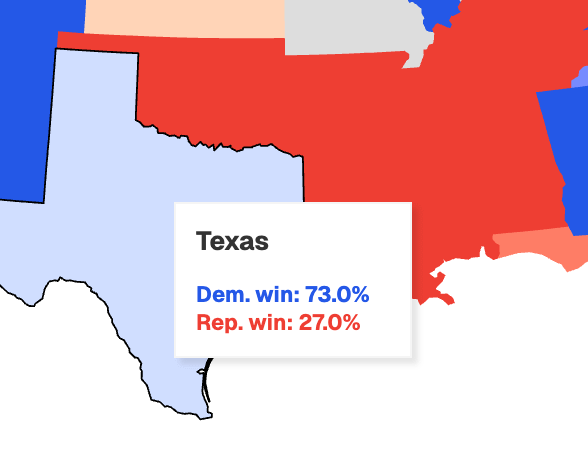
Talarico now has a 73% chance of winning the seat in November, according to Nate Silver’s forecast.
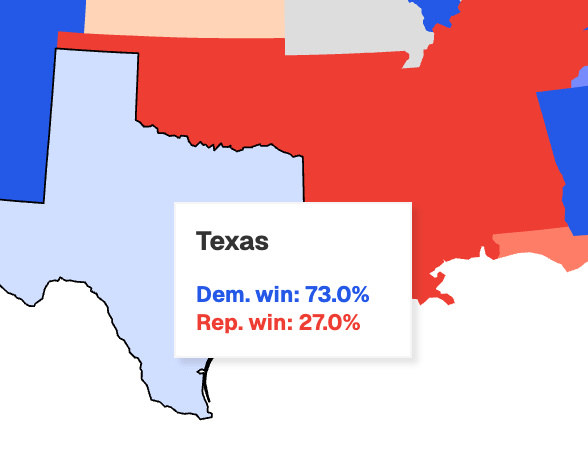
Republicans’ closing message in the Texas Senate race seems to be one of quiet resignation that Paxton is going to lose.
Throwing the Trumps Under the Bus
For ten years, we have watched in frustrated wonder as Donald Trump has kept his hold on the Republican Party through impeachments, insurrection, felonies, rape adjudications, a disastrous pandemic response and now a war in the Middle East and surging gas and grocery prices. Would the fever ever break?
As long as Trump’s MAGA base stuck by him, there was no incentive for elected Republicans to break with him publicly. There was far more downside than upside. But as Trump’s popularity plummets to new lows, and as core blocs within 2024 MAGA coalition—such as farmers, rural voters and hispanics who swung to him that year—show increasing skepticism of the president, and as Trump’s final midterm election fast approaches, there is less downside now to throwing Trump under the bus.
As Rolling Stone notes in its new piece on why Republicans are beginning to at long last turn on Trump,
A poll from CNN released this week, for instance, shows that Trump’s approval among independents is an anemic 25 percent. The network highlighted that his net approval among independents has shifted 86 points in the wrong direction since before the 2024 election. Trump’s popularity is also cratering within his own party. A recent UMass/Amherst poll found that his approval among Republicans has dropped 14 points since March, and that one in six people who voted for him would not vote for him again.
And that’s just what some Republicans are doing.
As The Independent reported earlier this month, many Republican candidates who are in tight races in November “have dropped mentions of President Donald Trump from their campaign websites.”
The Washington Examiner reports that Florida state Rep. Mike Beltran, who is battling for Florida’s 14th Congressional District, has reworded his website so that it no longer claims he has motivated to enter politics because of Trump’s example and now states instead that he “felt called to public service” and that he is running to be a “champion for lower costs, lower taxes, and increased healthcare access.”
Ouch. And there are more where that came from.
Similarly, according to NBC News, Kentucky House contender Ralph Alvarado is now promising “independent leadership,” having previously pitched himself as an “American First fighter.”
The Washington Post has found another five GOP House candidates in battleground races who had modified their sales patter to downplay allegiance to Trump.
And just this week, Byron Donalds, Trump-endorsed Republican candidate for Florida Governor, became the latest.
But it’s not just Trump whom Republicans are turning on. It’s also his son, Don Jr.
After it was reported that a Russian oligarch paid for Don Jr.’s wedding afterparty, Senator John Curtis (R-UT) called for an investigation into the apparent corruption, even demanding Don Jr. be subpoenaed.
And Senator John Cornyn (R-TX) concurs.
Republicans are also increasingly bucking Trump on policy, from ICE…
…To his surge of hundreds of thousands of tons of imported beef…
…And as Trump continues to be AI data center developers’ biggest fan, Republicans in tight races are making sure voters know they’re not with him.
From Ohio…
“The data center companies haven’t done a very good job of explaining why they should be allowed to develop in communities,” Sen. Jon Husted, R-Ohio, told Fox News Digital at the GOP’s midterm convention in Dallas.
“But the bottom line is, that should be a local decision, not a federal decision,” he continued. “I don’t want the federal government telling you that you must have a data center or that you can’t have a data center.
To Michigan.
Former Rep. Mike Rogers, who is running in one of the most competitive races this cycle in Michigan, told Fox News Digital that he hears “lots and lots of concern about data centers, not just the physical beings, but what happens on the other side of AI.”
“What we’ve said is there should be a moratorium until we get all of voters’ decisions and questions answered,” Rogers said
Closing message: Donald? Donald Who?
Urging Votes for Democrats
The biggest sign Republicans see the wave that is coming to wipe them out this November is a surprising one: many are urging voters to support Democrats this year.
There‘s Karl Rove and Sen. John Cornyn, who announced they are voting for the Democrat in the Texas Railroad Commissioner race after Republican Bo French went full racist on X.
There’s the former Governor of Kansas endorsing Democrat Adam Hamilton for Senate.
And George Will urging a vote for Annie Andrews for Senate in South Carolina over Republican Darline Graham.
We are truly in the upside down when Tucker Carlson supports Abdul El-Sayed for Senate in Michigan.
The closing message here is that not even Republicans trust Republicans.
As Senator Cornyn posted on X last week:
We are even at a point when a former Republican like Bill Kristol, now an anti-Trumper, is laying out what Democrats’ closing message ought to be.
And he’s not wrong.
-
À Carcassonne, face à de nouveaux éléments accablants, le maire RN musèle ses oppositions
Empêtré dans une succession de révélations sur sa police municipale, le maire de Carcassonne, Christophe Barthès, a empêché son opposition de s’exprimer sur l’affaire en conseil municipal. Des mails internes prouvent que l’élu Rassemblement national a menti: il était bien au courant des agissements de son agent. -
Democratic lawmakers accuse Trump administration of interference in Brazilian elections
Legislators sent letter to Marco Rubio saying US interference is weakening Brazil’s democratic institutions
A group of 31 Democratic members of the US Congress has sent a letter to the secretary of state, Marco Rubio, criticising the Trump administration over “an apparent effort to interfere with, and potentially undermine” Brazil’s elections.
Latin America’s largest country will hold the first round of its presidential election on 4 October, with polls showing a technical tie between the incumbent leftist president, Luiz Inácio Lula da Silva, and the far-right senator Flávio Bolsonaro.
Continue reading... -
White House launches Trump TV following press bans
The White House on Monday launched Trump TV, a 24/7 stream on YouTube, days after President Trump banned reporters from CNN, Politico and MS NOW over their coverage of him and his administration. -
CNN reporter arrives at White House after judge rules against Trump's media ban – video
CNN senior reporter Betsy Klein gained access to the White House on 24 September, hours after a federal judge ruled against Donald Trump's media ban. The ban had barred reporters from CNN, MS Now and Politico from accessing the White House
Continue reading... -
'Literally state-run TV': Trump launches YouTube channel amid boycott by US networks
Donald Trump's previous television career centred on his role on The Apprentice, but the US president's latest media venture is a rather lower-budget affair: the launch of Trump TV in the wake of his ban on several outlets from covering the White House. -
White House App Hits No. 1 in News and Cracks App Store Top 20 as Americans Tune Out Fake News
As of September 22, 2026, the official White House mobile app reached No. 1 in the News category on the App Store and climbed into the Top 20 among all apps. The app previously hit No. 1 in News and, at launch, soared as high as No. 4 across the entire App Store. More and more Americans are gravitating to the app because they want the news straight from the source, not filtered through networks that have spent years distorting the record of President Donald J. Trump. -
À Marseille, le crépuscule du Marché du Soleil
Fermé définitivement par la justice après plusieurs mois de procédure, puis ravagé par un incendie quelques jours plus tard, le Marché du Soleil laisse derrière lui commerçants et habitués. À Marseille, le sort de ce lieu emblématique du commerce populaire suscite émotion et incertitude.
The post À Marseille, le crépuscule du Marché du Soleil appeared first on Bondy Blog.
-
Mort de Quentin Deranque à Lyon: cinq nouvelles mises en examen
Cinq personnes ont été mises en examen jeudi dans le cadre de l’enquête sur la mort du militant d’extrême droite radicale Quentin Deranque à Lyon en février, ce qui porte à quatorze le nombre de suspects poursuivis dans ce dossier. -
«On nous laisse à l’aveugle»: les salariés de SFR inquiets face au rachat
L’opérateur a été racheté par ses concurrents Bouygues, Orange et Free. Bien que les repreneurs présentent l’opération comme «socialement responsable», plus d’une centaine de salariés se sont mis en grève jeudi 24 septembre. Ils et elles dénoncent l’absence de garanties sur le maintien de leur emploi. -
Bruit de bottes dans la Silicon Valley: la tech se met au service de la «sécurité nationale»
Le secteur de la tech états-unienne assume désormais de travailler pour des projets à connotation militaire. Une étude de deux chercheurs de l’Institut français des relations internationales revient sur ce phénomène et ses risques. -
«L’extrême droite prépare un coup d’État institutionnel»
Qui sont celles et ceux qui facilitent la montée de l’extrême droite? Qui s’en accommodent? Qui en tirent profit? Discussion entre Emmanuel Marre, réalisateur du film «Notre salut» qui sort en salles le 30 septembre, Sophie Binet, secrétaire générale de la CGT, et Johann Chapoutot, historien et auteur de «La Bascule». -
Dans l’industrie, les actions antimilitaristes se poursuivent
Chaque 21 septembre, c'est la «journée internationale pour la paix». Et c'est peu dire que cette date est oubliée en France.
L’article Dans l’industrie, les actions antimilitaristes se poursuivent est apparu en premier sur Contre Attaque.
-
Les « débats » médiatiques, ou la machine à abrutir
De CNews à France Inter, en passant par BFMTV et LCI : les médias audiovisuels multiplient d’année en année les cases « débats ». Et ce en expliquant, sûrs d’eux, que ce serait là une des meilleures manières d’informer la population, d’autant plus à… -
Judges’ Casual Writing Embraces Slang—And Not Everyone’s A Fan
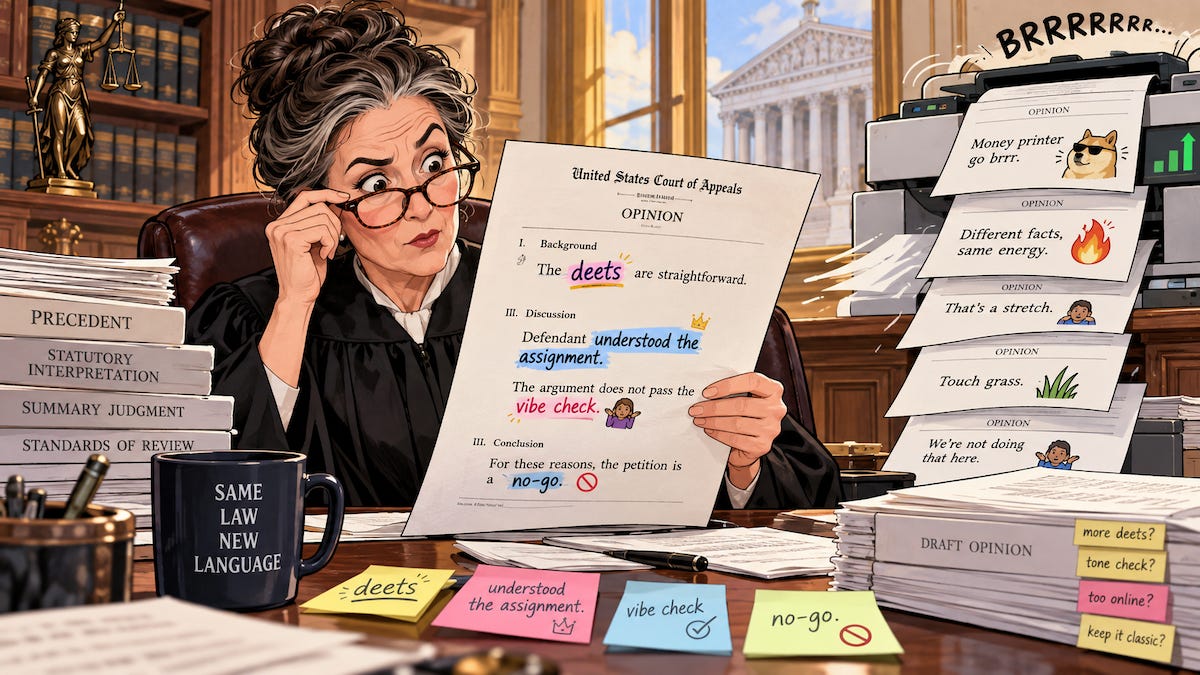
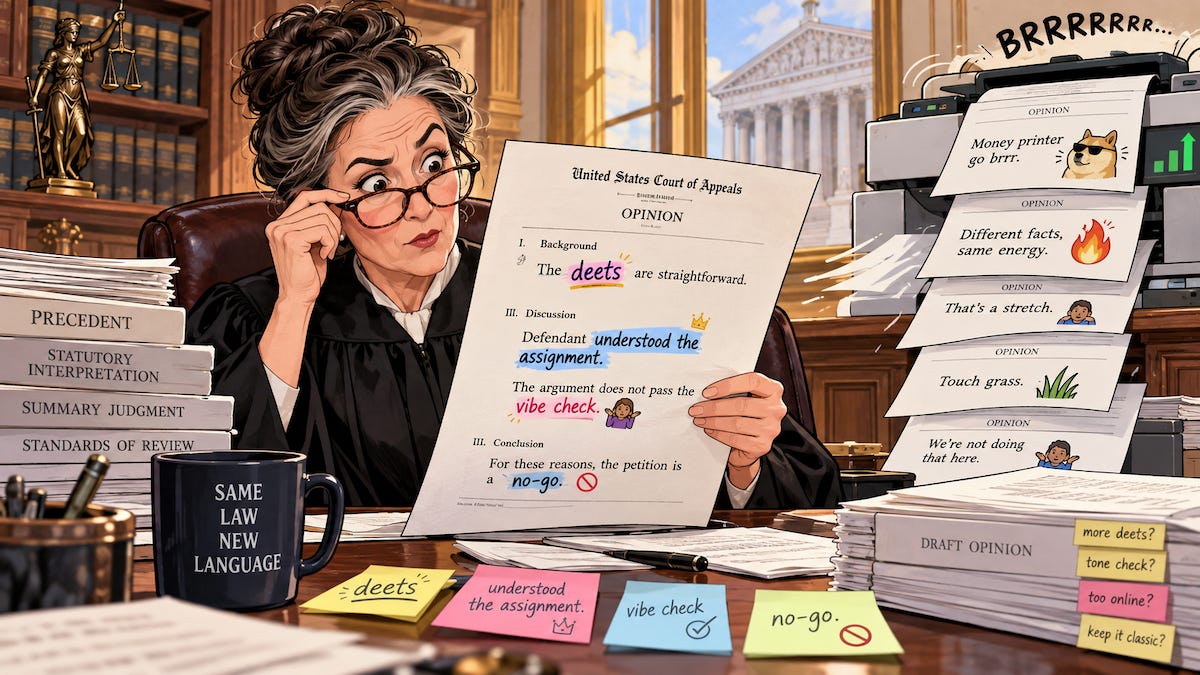 (image generated using ChatGPT)
This article is an expanded version of a piece that originally appeared on Bloomberg Law, part of Bloomberg Industry Group, Inc. (800-372-1033), and appears here with permission.
In 2008, Justice Antonin Scalia and Bryan Garner, the legendary legal lexicographer, had a well-publicized disagreement over using contractions in legal writing. They hashed it out in the pages of Making Your Case: The Art of Persuading Judges, one of my favorite books about written and oral advocacy.
Garner argued that contractions “ought to become more widespread in legal writing,” including judicial opinions. Justice Scalia took the opposite view: “Formality bespeaks dignity,” and “black-robed judges engaged in the exercise of their august governmental powers” should be dignified.
Almost two decades later, Garner’s view has carried the day. Contractions appear frequently in judicial writing, and they’re employed by some of the best writers on the bench—including Justice Elena Kagan and Judge Kevin Newsom (11th Cir.). Justice Scalia’s former seat on the Supreme Court is now occupied by Justice Neil Gorsuch, who uses contractions liberally.1
But contractions are just the tip of the iceberg. If he were alive today, Justice Scalia would probably be appalled by the increased informality of judicial writing.
Memes, slang, and vulgarity, oh my
Consider some of what we’ve seen in just the past four months, in published decisions at all three levels of the federal judiciary.
In August, Judge Brantley Starr (N.D. Tex.) included the internet meme “money printer go brrrrrrrr”—with an accompanying image—in a footnote to his opinion in CFTC v. TMTE, Inc.
Just this month, in her opinion in Center for Taxpayer Rights v. IRS, Judge Cornelia “Nina” Pillard (D.C. Cir.) dismissed an argument raised by the IRS by calling it “weak sauce”—a term that appears in Urban Dictionary, but not Black’s Law Dictionary.
Back in June, Justice Ketanji Brown Jackson used the slang phrase “understood the assignment”—a staple of TikTok, not Supreme Court decisions—in her concurrence in Trump v. Barbara, the landmark case about birthright citizenship.
Perhaps most infamously, earlier this year Judge Lawrence VanDyke (9th Cir.) opened his dissent from the denial of rehearing en banc in Olympus Spa v. Armstrong by declaring, “This is a case about swinging dicks.” (Duck!)
Filling in the ‘deets’
This trend toward informality might have reached its apotheosis this month in the opinion of Judge O. Rogeriee Thompson (1st Cir.) in Instituto Médico del Norte v. Greengift Capital. The second paragraph, offering an overview of the case, begins as follows: “We’ll fill in the deets shortly, but the SparkNotes is this.”
This breezy language led the Legal Style Blog to call for Judge Thompson’s impeachment in a tweet—in jest, I’m guessing, but likely reflecting genuine displeasure. And other readers shared the negative reaction to her writing.
Legal-writing guru Ross Guberman, author of three acclaimed books about legal writing, posted a poll on X about the “deets” sentence. A whopping 88% of respondents said they found the sentence “excruciating,” while only 5% described it as “refreshing.” (The other poll options were “What are deets?” and “What are SparkNotes?”)

Burford Capital is the leading global finance and asset management firm focused on law. Its businesses include litigation finance and risk management, asset recovery and a wide range of legal finance and advisory activities. Burford is publicly traded on the New York Stock Exchange (NYSE: BUR) and the London Stock Exchange (LSE: BUR) and works with companies and law firms around the world from its global network of offices. For more information, please visit www.burfordcapital.com.
Not all reviews of the Instituto Médico del Norte opinion were critical. Joe Patrice of Above the Law opined that while its style might be “jarring to anyone familiar with federal judicial opinions,” the decision as a whole “untangles a complicated, multiyear bankruptcy saga in a readable—dare I say, pleasant—40-page account.”
“Honestly, I expected to find myself more critical of this opinion,” Patrice wrote. And after reading the full ruling, not just excerpts highlighted on X, I concur (although I would have cut the “deets” sentence, along with several other colloquialisms).
Despite some surprisingly casual turns of phrase, “the rest of her opinion is refreshingly clear,” Guberman told me. He ran Instituto Médico del Norte through BriefCatch, the AI-powered writing and editing tool that he created, and the opinion averaged an impressive 91.4 out of 100 across the five tracked categories: reader engagement, concision and readability, flow, crispness, and clarity. (Disclosure: I serve on the board of LawCatch Inc., the parent company of BriefCatch.)
“That’s not quite Kagan or Roberts territory,” said Guberman, “but it’s close.”
A move toward more conversational opinions
Judge Thompson’s opinion reflects how legal writing has evolved over the 30 years that I’ve been reading judicial opinions.
Decades ago, opinions weren’t widely read by the public, and judges wrote them with that in mind. Expecting their opinions to be read mainly by the lawyers handling the case, who would in turn explain them to their clients, judges wrote opinions that were dense, technical, and laden with legalese.
Since I started reading opinions as a first-year law student in 1996, three related trends have changed judicial writing—mostly for the better.
First, in 2008, Adobe released its previously proprietary Portable Document Format as an open standard, greatly facilitating the sharing of opinions in electronic form.
Second, relying heavily on PDFs and in response to 2002’s E-Government Act, courts started making their opinions freely and immediately available on their websites.
Finally, social media exploded in popularity, both within and beyond the legal profession. Today, both lawyers and interested members of the public can read, discuss, and debate judicial opinions, in online forums such as X, Bluesky, or LinkedIn.
Realizing that their opinions often will be read by much larger audiences than just the lawyers involved in the case, judges have seemingly responded by making their opinions more clear, comprehensible, and conversational. Although I haven’t conducted an empirical study, I can confidently say, based on reading hundreds of opinions each year, that contemporary judges go lighter on legalese than their predecessors did.
Judges today work harder to explain their rulings in ways that can be understood by people who don’t have legal training. In high-profile cases, judges often provide introductions and conclusions that seem designed to be read by laypeople as well as lawyers. In cases with complicated, confusing, or voluminous separate opinions, judges sometimes include a summary or road map to guide readers through the holdings.
The judicial system exists to serve the American people—who are, of course, the folks ultimately paying the salaries of judges, clerks, and court staffers. So if judicial opinions are now more accessible to citizens and taxpayers, that’s a positive development.
Too much of a good thing?
For another expert’s perspective, I reached out to Judge David D. Weinzweig, a member of the Arizona Court of Appeals and author of Zen and the Art of Persuasive Writing, an excellent resource for legal writers. Without commenting on any particular opinion, he acknowledged that informality can be overused—just as a matter of effective communication, setting aside concerns about dignity or propriety.
“Judges are professional authors, but we are paid to convey our reasoning,” Judge Weinzweig said. “Informal legal writing is never appropriate when it competes for the spotlight, siphoning the reader’s finite attention from that reasoning.”
“You never want a reader focused on tone, grammar, and word choice when that focus could be devoted to understanding your point,” he continued. “I still deploy informal legal writing but only when it helps make the point.”
Of course, reasonable minds can disagree over how much informality is too much informality. And despite valuable tools like BriefCatch, which bring greater rigor and objectivity to evaluating legal writing, there’s still a certain amount of personal opinion and subjectivity at play here.
Or as Judge Weinzweig wrote in his book—paraphrasing Justice Potter Stewart’s famous quotation from Jacobellis v. Ohio about obscenity, but referring to persuasive writing—“I know it when I read it.”
UPDATES:
4:46 p.m. For additional insights on this topic, please see Peter Kalis’s essay, Reflections on the Business of Law (which I have posted online with his permission). As Kalis wrote in a note to me, “I don’t think the issue is contractions or informality. Rather, the issue is clarity, as I described thirty years ago in this short essay (beginning on page 803).”
4:55 p.m. I meant to mention this poll earlier: On X, Ethan Savka conducted a poll in which he asked his readers to pick the worst casual writing in a judicial opinion. The “winner,” with 45.9% percent of the vote, was “money printer go brrrrrrrr,” followed by “Jk - J. Thompson here” (28.1%), “We’ll fill in the deets” (20.4%), and “Weak sauce” (5.6%).
Some great judicial writers continue to eschew contractions—e.g., Judge Stephanos Bibas (3d Cir.).
-
Trump’s FDA nominee says MMR shot is ‘safe and effective’ at Senate hearing
Dr Heidi Overton faces confirmation hearing weeks after standing behind Trump as he suggested shot could be ‘quite lethal’
Dr Heidi Overton, Donald Trump’s nominee to lead the US Food and Drug Administration (FDA), has told senators the measles, mumps and rubella (MMR) vaccine is “safe and effective”, weeks after standing behind the president as he suggested the shot could be “quite lethal”.
At a confirmation hearing on Thursday, Overton described the MMR vaccine as “safe and effective”, adding: “It is our best tool right now in the public health response to the measles outbreak.”
Continue reading... -
« Les marches pour le climat et la justice sociale doivent être aussi antiracistes et anticoloniales »

Les auteurs de cette tribune appellent à manifester « ensemble, sans effacer les voix » lors de la marche climat du 26 septembre. Pour une « libération collective et totale », ils demandent à tous de se « mobiliser concrètement contre le colonialisme et l'antiracisme ».
Lire la suite - Tribune / Luttes , Idées
La liste des signataires se trouve en bas de texte.
Le 26 septembre, nous marcherons pour le climat, pour le vivant, pour la paix et pour la justice sociale. Nous marcherons parce que les crises qui bouleversent nos vies (…) -
BNP Paribas adopte Gemini Enterprise et les modèles Gemini de Google dans le cadre de sa stratégie « IA agentique »
Ils travaillaient déjà ensemble depuis plusieurs années, notamment autour de la gestion des API avec Apigee, ils vont désormais plancher sur l’agentique. BNP Paribas et Google Cloud annoncent ce 24 septembre la signature d’un nouveau contrat d’une durée de cinq ans portant sur un plus grand accès de l’acteur bancaire aux services du géant américain du cloud.
-
Comment les milliardaires ont pris le pouvoir en France... avec notre argent
Depuis 2017, Emmanuel Macron et ses gouvernements répètent qu'il n'y a « pas d'argent magique » pour les Français. Pourtant, les chiffres disent l'inverse : 211 milliards d'euros d'aides publiques versées chaque année aux entreprises sans contrôle ni… -
At Trump meeting, Xi Jinping lays out terms to avoid US-China military conflict
Chinese president’s proposals for lessening tensions come amid period of intense competition between the two countries over AI and trade
Xi Jinping has called for extensive cooperation with Washington to avoid the “Thucydides trap” that could put the US and China on a military collision course amid rising tensions over artificial intelligence, trade and Taiwan.
At the start of his summit meeting with Donald Trump in the White House, the Chinese president laid out terms for a mutual understanding that he said could steer the two competing superpowers away from future military conflict and on to a road of mutual gain.
Continue reading... -
« Complément d'enquête » sur Rima Hassan : misère du journalisme télé d'investigation
 Source : Acrimed
 -
Au RN, des assistants parlementaires réseautent chez les trumpistes
 Source : Les Jours
Payant
Source : Les Jours
Payant -
Faute de médecin, le prix fort de l'automédication
 Source : Le Nouveau Paradigme
 -
Serge Zaka : « Il faut travailler en profondeur sur les modèles agricoles »
 Source : STUP.MEDIA
 -
Anthropic a trouvé un système inconnu dans l’ADN de bactériophages, mais ne sait pas trop ce qu’il fait vraiment

Anthropic a annoncé le 23 septembre 2026 que Claude a découvert un « système enzymatique inconnu ». Une structure que l'entreprise compare à CRISPR, le ciseau génétique. Les scientifiques se divisent déjà sur la portée de cette annonce.
-
Projection de 'Mayak-Kychtym'. Cycle nucléaire & cinéma par la Coordination antinucléaire d'Ile-de-France
Quand ?
Le 9 octobre à 19hOù ?
Fondation Charles-Léopold Mayer pour le Progrès de l'Homme 38, rue Saint-Sabin 75011 ParisComme chaque deuxième vendredi du mois, la Coordination anti-nucléaire d'Ile de France, vous invite à une projection précédée d'un buffet et suivie d'un débat.
Nous aborderons lors de cette soirée la question la catastrophe nucléaire survenue le 29 septembre 1957 à Kychtym (U.R.S.S.). Il y a bientôt 70 ans le nucléaire civil engendrait sa première catastrophe majeure.
Venez discuter et débattre avec les militant·es de la Coordination anti-nucléaire IDF et participer avec nous à faire arrêter le nucléaire.
"Mayak / Kychtym - La catastrophe nucléaire cachée avant Tchernobyl"
L'Esprit de Meti | 2026| 46 min.Le 29 septembre 1957, une cuve de déchets radioactifs explose au coeur du complexe nucléaire secret de Mayak, dans le sud de l'Oural soviétique.
En quelques secondes, l'équivalent de 70 à 100 tonnes de TNT projette une dalle de béton de 160 tonnes dans les airs et libère 740 pétabecquerels de radioactivité dans l'atmosphère. Il s'agit de l'une des plus grandes catastrophes nucléaires de l'histoire, longtemps restée totalement inconnue du monde extérieur.
Près de 70 ans plus tard, ce documentaire retrace les événements qui ont conduit à cette tragédie, les années de rejets radioactifs dans la rivière Techa et dans le lac Karatchaï, devenu l'endroit le plus radioactif de la planète, ainsi que trois décennies de mensonge d'État qui ont exposé plus d'un million de personnes à des doses anormales de radiations.
Une histoire qui continue de s'écrire encore aujourd'hui, dans les eaux de la Techa, dans les corps des habitants de Muslyumovo et dans le silence d'une usine qui fonctionne toujours.
-
Festival du Livre et de la Presse d'Écologie
Quand ?
Du 3 octobre à 11h au 4 octobre à 18h30Où ?
Académie du Climat 2 Place Baudoyer 75004 ParisPendant deux jours, l'écologie se discute, se dispute et se raconte. Auteur·ices, journalistes, universitaires, éditeur·ices, associations et citoyen·nes se retrouvent pour nourrir le débat public et donner des clés pour penser les transformations écologiques de notre temps.
Un rendez-vous placé sous le signe de la réflexion critique, de la convivialité et de l'engagement, avec Jeanne Mermet, Hadrien Klent, Kévin Jean, Joëlle Zask, Alessandro Pignocchi, Terrestres, EcoRev', Politis, Éditions rue de l'Échiquier, Le passager clandestin, et Les soulèvements de la terre, parmi bien d'autres...
AU PROGRAMME :
– Samedi 11h - 22h30 // Dimanche 13h - 18h30
- Le salon avec de nombreux exposants qui reflètent la diversité du mouvement écologiste : maisons d'édition, médias et associations.
- Une librairie éphémère avec L'Attrape-Coeurs
- De nombreuses rencontres et tables rondes
– Samedi 3 octobre
- 11h30-13h - Ceci n'est pas une conférence verte : quelles propositions écologiques pour le secteur de l'édition ?, avec Fanny Valembois et Thomas Bout animé par Mathieu Bouttin, et partenariat avec l'Association pour l'écologie du livre
- 12h-12h45 - Rencontre avec Jeanne Mermet, Désertons (éd. Wildproject, 2025)
- 13h45-15h45 - Backlash : bonne nouvelle pour l'écologie ?, avec Steve Hagimont, Stéphane Foucart, Philippe Corcuff et Pauline Graulle, animé par Emmanuel Dessendier, et en partenariat avec EcoRev'
- 14h-15h - Rencontre avec Mathias Bonneau et Thi Colas, Bûcheron (éd. du Seuil, 2025), et Arbre pleure (éd. Wildproject, 2026)
- 15h15-16h - Rencontre avec Guillaume Blanc, Les Sacrifiés du paradis (éd. Delcourt, 2026)
- 15h30-16h30 - Déjouer le pire de 2027 : vers une écologie protectrice ? avec Julie Le Mazier de Solidaires et François Chartier pour Greenpeace
- 16h15-17h - Rencontre avec Hadrien Klent, Le jour Zéro (éd. Le Tripode, 2026)
- 16h-17h30 - D'autres façons de fertiliser les sols : compostons nos déjections !, avec Gilles Domenech, Christophe Gatineau, et Daniel Chateigner, animée par Matthieu Pichon, et en partenariat avec le Réseau Compost Citoyen
- 17h-18h - Rencontre avec Kévin Jean, À notre santé (éd. Payot, 2026) à la Bibliothèque Arthur Rimbaud
- 17h15-18h - Rencontre croisée avec Manon Guyonnet des Climatosportifs et Laurent Castaignède, Le revers de la médaille - L'empreinte environnementale du sport (éd. Écosociété, 2026)
- 18h-19h - Remise du prix du livre d'écologie politique 2026 à l'ouvrage Les natures du productivisme, Renaud Bécot, Christophe Bonneuil, Gabrielle Bouleau (éd. La Découverte, 2026) avec la Fondation de l'Écologie Politique (FEP)
– Dimanche 4 octobre :
- 13h-14h30 - Faire média autrement : rencontre avec Jérôme Gleizes de EcoRev', Quentin Hardy de Terrestres, Martin Paquot de Topophile et Léa Guedj de Reporterre
- 13h-13h45 - Rencontre avec Joëlle Zask, Donner à manger, politique d'un geste ordinaire (éd. Premier parallèle, 2026)
- 14h-14h45 - Rencontre avec Myriam Bahaffou, Éropolitique : Écoféminismes, désirs, révolutions (éd. Le Passager clandestin, 2025)
- 14h45-16h15 - Que faire quand l'extrême-droite s'empare du vivant ?, avec Hugues Jallon et Erwan Lecoeur, animé par Valentin Breton, et en partenariat avec le mouvement Colibris
- 15h-15h45 - Rencontre Philippe Grandcolas, Loi Duplomb, le débat confisqué. Alerte aux fausses informations sur la santé et l'environnement (éd. du Faubourg, 2026)
- 16h-16h45 - Rencontre Damien Deville, La France des mille lieux (éd. Ulmer, 2025)
- 16h30-18h - S'ancrer dans les territoires pour enraciner les luttes, avec Flaminia Paddeu, Alessandro Pignocchi, Samuel Grzybowski, animé par Pauline Fricot du Felipé
- 17h-17h45 - Rencontre avec Nora Guelton et Aurélie Sécheret, La Force du collectif : comment les écolieux peuvent transformer la société, co-écrit par Nora Guelton, Mathieu Labonne et Aurélie Sécheret (Terre Vivante, 2026)
- 18h-18h30 - Discours de clôture avec notre marraine Myriam Bahaffou
Ateliers et événements festifs
– Samedi 3 octobre
- 14h30-17h - Arpentage autour de La Bataille du glyphosate - Au coeur de la machine à influencer, de Aurore Gorius, David Lopez (éd. Steinkis, 2026) avec Les Arpenteuses Anonymes et en présence d'Aurore Gorius - Sur inscription
- 18h-20h20 - Conférence gesticulée De la fourche à la fourchette... Non ! L'inverse !! Pour une Sécurité sociale de l'alimentation, avec Mathieu Dalmais - en accès libre et sur inscription
– 20h30-22h30 - Laisse-Moi Kéfir La Vibe avec COMEDY CLUB !, avec le Bulbe média et Les Jeux Sont Tout Verts
– Dimanche 4 octobre :
- 13h-15h - Balade naturaliste avec Jacky Libaud de Balades aux jardins - Départ et arrivée devant l'Académie du climat - Tout public, sur inscription
- 14h30-16h - Atelier autour du Jeu coopératif pour comprendre sa consommation d'énergie, avec le LOW TECH LAB - à partir de 6 ans, sur inscription
- 15h-17h30 - Fresque de l'écofeminisme Avec CliMates - Tout public, sur inscription
- 15h-17h30 - Arpentage et Atelier d'écriture SF, autour de Frank M. Robinson, Vent d'est, Vent d'ouest (éd. Le Passager Clandestin, 2022), avec Les Arpenteuses Anonymes - Tout public, sur inscription
Et un programme à hauteur d'enfants
En continu :
– Des jeux de société, un quiz autour du livre Quel tableau ! de Julien Couty et grand jeu pour gagner des livres écolos
– Deux expositions autour des livres de Margot Othats, Le Grand Air et Quel tableau ! de Julien Couty.
– Cabinet de lecture dans le salon des exposants avec la bibliothèque Arthur Rimbaud et les médiateur·ices de l'Académie du Climat
– Samedi 3 octobre :
- 14h-16h - Atelier Biodiversité, avec les petits débrouillards, à partir de 5 ans
- 14h-18h - Atelier Landart : collecte d'éléments naturels et réalise une composition artistique dans une boîte en carton, à partir de 7 ans
- 17h-17h45 - Aide Petite Graine à grandir ! : venez découvrir avec vos tout-petits la lecture gestuelle et réalise de petites marionnettes doigts, en partenariat avec les éditions Scudéry - pour les tout-petits, sur inscription
– Dimanche 4 octobre :
- 14h-15h30 - Fresque de l'Arbre du climat, sur le réchauffement climatique, les conséquences et les solutions - de 8 à 12 ans, sur inscription
- 16h30-17h30 - Histoires contées Claire Rassinoux, à partir de 5 ans
- Voir aussi Festival du Livre et de la Presse d'Écologie
- Voir aussi Instagram
-
France Inter : Vivement le pluralisme !
Accusée par l'extrême droite d'être aux ordres de Mélenchon, France Inter a pourtant accordé en juin 2026, selon les relevés de l'Arcom, sept fois plus de temps d'antenne au Rassemblement national qu'à LFI. Le défaut de pluralisme existe bien, mais pas… -
Trump officials ask supreme court to allow third-country deportations
Attorney general Todd Blanche requests that justices overturn lower court ruling that halted such removals
The Trump administration has asked the US supreme court to allow it to deport immigrants to countries other than their own, the latest effort to seek approval for a controversial policy that fulfils Donald Trump’s mass deportation agenda.
Todd Blanche, the US attorney general, said on Thursday morning that the Department of Justice would ask the conservative-majority supreme court for help, nearly a week after a lower court judge rejected the policy.
Continue reading... -
Minimum vieillesse : non, les étrangers ne touchent pas automatiquement 1 043 euros après quelques mois en France

Source :Compte Facebook, le 17 septembre 2026
Etiqe :Manque de contexte
Contenu :
C’est un procédé que les lecteurs des Surligneurs connaissent bien : partir d’une règle exacte, d’un pourcentage ancien ou d’une statistique portant sur les étrangers, puis les assembler pour donner l’image d’une société particulièrement généreuse à l’égard des personnes qui n’ont pas la nationalité française.
Après la mauvaise interprétation des statistiques de la délinquance dans les transports franciliens, les comparaisons trompeuses entre les politiques migratoires de plusieurs pays, ou encore le nombre d’entrées sur le territoire français artificiellement gonflé, c’est désormais le minimum vieillesse qui alimente des récits trompeurs sur les réseaux sociaux.
« Un tiers » des bénéficiaires du minimum vieillesse seraient étrangers et un Algérien pourrait le toucher trois mois après « son arrivée en France ». À ces chiffres s’ajoutent d’autres comparaisons : un étranger n’ayant jamais travaillé en France toucherait autant qu’un salarié au Smic ayant cotisé toute sa vie « même sous OQTF ».
Mais alors que disent réellement les textes et les données publiques ?
1 043 euros ne sont pas versés automatiquement à chaque bénéficiaire
L’allocation de solidarité aux personnes âgées (Aspa), qui a remplacé l’essentiel de l’ancien « minimum vieillesse », est une prestation de solidarité destinée aux personnes âgées disposant de faibles ressources.
Depuis le 1er janvier 2026, son plafond est de 1 043,59 euros par mois pour une personne seule et 1 620,18 euros pour un couple. Mais ces montants ne correspondent pas à un chèque systématiquement versé : l’Aspa complète les ressources du bénéficiaire jusqu’au plafond. Une personne disposant déjà de 700 euros de pension ne reçoit donc qu’environ 344 euros d’Aspa.
Ainsi, selon la Direction de la recherche, des études, de l’évaluation et des statistiques (Drees), en 2024, 754 460 personnes percevaient l’Aspa ou une ancienne allocation du minimum vieillesse. Le montant d’Aspa effectivement versé était en moyenne d’environ 530 euros mensuels, loin du plafond maximal pour l’ensemble des allocataires. En revanche, il n’existe pas de données qui permettent de connaître la part d’étrangers parmi les bénéficiaires.
Une retraite au Smic équivalente à l’Aspa ?
C’est également sur ce plafond de 1 043 euros que repose une autre comparaison diffusée sur les réseaux sociaux : un salarié ayant travaillé au Smic pendant quarante-quatre ans ne toucherait pas davantage, retraite complémentaire comprise, qu’une personne bénéficiant de l’Aspa.
Sur ce point, la question de l’écart entre les deux dispositifs n’est pas nouvelle. Plusieurs organisations syndicales ont elles-mêmes défendu le principe selon lequel la pension versée après une carrière complète devait rester sensiblement supérieure au minimum vieillesse.
En 2022, la CGT distinguait ainsi le minimum contributif de l’Aspa et jugeait insuffisant le niveau de pension annoncé pour une carrière complète au Smic. Un document consacré aux petites retraites et diffusé par l’UNSA mentionnait explicitement l’objectif de « maintenir la pension minimale pour une carrière complète au-dessus de l’ASPA », en raison du risque que les deux montants deviennent trop proches.
La comparaison ne peut toutefois pas être réduite aux seuls montants. L’Aspa est une prestation de solidarité qui complète les ressources de son bénéficiaire jusqu’à un plafond. Une pension de retraite résulte, elle, des droits acquis au cours de la carrière. Pour un salarié du secteur privé, son montant dépend notamment des rémunérations et des trimestres validés, auxquels s’ajoutent les droits acquis auprès de la retraite complémentaire Agirc-Arrco.
Le système des retraites prévoit par ailleurs un minimum contributif, distinct de l’Aspa, destiné à relever certaines petites pensions. Depuis la réforme de 2023, la loi fixe pour objectif qu’une personne ayant effectué une carrière complète à temps plein rémunérée au Smic perçoive, retraites de base et complémentaire comprises, un montant brut total de pension au moins égal à 85 % du Smic net.
La proximité entre certaines petites pensions et le niveau de l’Aspa peut donc être réelle. Elle ne permet cependant pas d’en déduire que tous les bénéficiaires de l’Aspa « touchent la même retraite » qu’une personne ayant cotisé toute sa vie.
Oui, un étranger peut toucher l’Aspa sans avoir travaillé en France
Il est possible de percevoir l’Aspa sans avoir travaillé en France. Cela vaut pour un Français comme pour un étranger qui remplit les conditions légales.
Pour les étrangers hors Union européenne, Espace économique européen (EEE) et Suisse, la règle générale n’en est pas pour autant une attribution immédiate. L’article L. 816-1 du code de la sécurité sociale exige d’être titulaire depuis au moins dix ans d’un titre de séjour autorisant à travailler. La loi prévoit des exceptions, notamment pour les personnes « réfugié(s), apatride(s), [ayant] combattu pour la France » ou bénéficiant « de la protection subsidiaire ».
Il est donc inexact de résumer cette règle par « dix ans de présence en France » : le texte vise dix années de détention d’un titre de séjour permettant de travailler. Et un étranger « arrivé en France il y a six mois » ne peut, en règle générale, pas réclamer l’Aspa sur ce seul critère.
Autre condition pour bénéficier de l’Aspa, être lié à une résidence effective en France. Depuis 2023, la loi impose une résidence stable dont la durée ne peut être inférieure à neuf mois par année civile.
Une part minime
Si n’avoir jamais cotisé en France et bénéficier de l’ASPA est possible, dans les faits cela reste marginal. Si vous n’avez jamais travaillé en France, que vous soyez français ou pas, il existe un service – rattaché à la MSA – qui verse l’ASPA. En 2022, celui-ci a versé ce minimum social à 65 080 personnes (sur 691 210 bénéficiaires en tout en 2022). Il n’y a donc que 9 % des recourants au minimum vieillesse qui n’avaient jamais cotisé en France.
Lors d’une question au gouvernement, un député avait obtenu d’autres chiffres, en particulier sur les personnes étrangères. « Un seul chiffre : sur environ 580 000 bénéficiaires de l’ASPA et du minimum vieillesse [en 2018, ndlr], 3 % sont des étrangers qui n’ont pas ou peu travaillé en France. Ce sont, pour l’essentiel, des veuves dont la pension de réversion, modeste, est complétée par l’ASPA », précisait la secrétaire d’État, Geneviève Darrieussecq.
Trois mois pour les Européens, mais pas « pour tous les étrangers »
Les ressortissants de l’Union européenne, de l’EEE et de Suisse ne sont pas soumis à la règle des dix ans. Ils doivent remplir les conditions du droit au séjour et, dans le cas général, avoir résidé en France pendant les trois mois précédant leur demande.
Mais cette dernière condition ne s’applique pas à un ressortissant européen qui exerce en France une activité professionnelle déclarée, ni, dans certains cas, à une personne qui y a travaillé avant de se retrouver temporairement en incapacité de travailler, en formation professionnelle ou inscrite comme demandeuse d’emploi.
Pour autant, ce régime européen ne peut pas être transposé automatiquement aux autres ressortissants d’États – comme les Algériens – ayant conclu une convention de sécurité sociale avec la France, comme le font certains internautes.
Pour les ressortissants algériens, régulièrement cités en ligne, la condition de dix ans de titre de séjour autorisant à travailler n’est pas opposée pour l’ASPA. Dans une décision datée de 2018, le Défenseur des droits indique notamment que la Caisse nationale d’assurance vieillesse (Cnav) n’oppose plus cette condition aux Algériens depuis 2014. La Caisse centrale de la MSA a également diffusé le 15 octobre 2018 une instruction à son réseau rappelant cette règle.
Cela ne signifie pas qu’un Algérien peut toucher automatiquement l’ASPA quelques mois après son arrivée, comme le suggèrent des internautes : il doit toujours remplir les autres conditions, notamment d’âge, de ressources, de résidence effective et de séjour régulier. Autrement dit, une personne ayant une obligation de quitter le territoire français ne peut pas, en règle générale, bénéficier de l’ASPA.
« 36 % d’étrangers » : un chiffre ancien et appliqué au mauvais ensemble
Autre chiffre fréquemment repris en ligne : en 2009, « 36 % » (ou « un tiers ») des bénéficiaires du minimum vieillesse seraient étrangers. Si le chiffre est ancien, le pourcentage existe bien. Mais il ne s’agit pas de l’ensemble des allocataires du minimum vieillesse.
Au 31 décembre 2009, le SASPA, service qui versait l’allocation aux personnes ne relevant d’aucun régime obligatoire de retraite de base, comptait, selon le gouvernement de l’époque, 70 860 allocataires, dont 25 205 non-nationaux, soit 36 %. Mais cette statistique ne concernait que les personnes gérées par ce service, et non tous les bénéficiaires du minimum vieillesse en France.
Tout récemment, le Gouvernement a précisé en février 2026 que le SASPA ne représentait que 9 % des allocataires du minimum vieillesse fin 2023. Extrapoler son taux de 36 % datant de 2009, à tous les bénéficiaires de 2026, revient donc à appliquer à l’ensemble de la population un pourcentage mesuré sur un sous-groupe très particulier avec un écart de dix-sept ans.
Auteurs :
Auteur : Etienne Merle, journaliste
Relecteurs : Pascal Caillaud, chargé de recherche CNRS en droit social, université de Nantes
Liens d’intérêts ou fonctions politiques déclarés des intervenants à l’article : aucun
Secrétariat de rédaction : Etienne Merle, journaliste
L’article Minimum vieillesse : non, les étrangers ne touchent pas automatiquement 1 043 euros après quelques mois en France est apparu en premier sur Les Surligneurs.
-
Decolonize 2026
Quand ?
Du 10 octobre à 14h au 11 octobre à 0hOù ?
La Parole Errante 9, rue François Debergue 93100 MontreuilÉvénement organisé par le CSPCL et le CSIA dans le cadre de la Journée internationale de Solidarité avec les Peuples autochtones des Amériques et des 30 ans du Congrès national indigène mexicain (CNI).
En présence d'une délégation CNI - FrayBa (Centre de droits humains, situé à San Cristobal de Las Casas).Au programme :
– Conférences et tables rondes
– Tables de presse de diverses associations
– Projections
– Café zapatiste
– Repas mexicain le samedi, pizza de la coopérative de Ménilmontant toute la journée du dimancheMais aussi fanfares, interventions artistiques, nombreuses tables de presse du réseau de solidarité...
Entrée à prix libre !
Programme détaillé :
– SAMEDI 10 OCTOBRE
- 14h - Ouverture des portes
- 15h - Cérémonie d'ouverture avec Estela Hernandez Jímenez, Otomí déléguée du CNI (Congrès National Indigène - Mexique), Rachel Dionne Thunder, représentante Nehiyaw iskwew (Plains Cree) de Big Stone Cree Nation (Traité 8), vice présidente de Indigenous Protector Movement, membre de l'American Indian Movement, militante contre ICE à Minneapolis et Sandra Ceballos, du peuple Kolla en Argentine, présidente de l'Asociación de Mujeres Abogadas Indígenas ;
- 15h30 - "12 octobre, 534 ans de résistance" : Prise de parole de Yuwey Henri, talãmelonin (poète), kalédamelonin (écrivaine) onumingadoton (penseuse) et owomatodon (militante) de la Nation Kalin'a Tilewuy (Guyane "française")
- 17h - Table Ronde : "Personne n'est illégal sur des terres volées et colonisées ! : l'exemple de la résistance autochtone et populaire à Minneapolis contre ICE, la milice de Trump qui fait la guerre aux migrant.e.s"
• Rachel Dionne Thunder, représentante Nehiyaw iskwew (Plains Cree) de Big Stone Cree Nation (Traité 8), vice présidente de Indigenous Protector Movement, membre de l'American Indian Movement, militante contre ICE à Minneapolis
• Tufawon, rappeur Sioux Dakota (USA) - Boricua (Porto Rico), organisateur communautaire à Minneapolis, membre de la délégation "Stand Up for Minneapolis" pour le désinvestissement des prestataires de ICE ;
• Victorico Galvez Perez, membre du Centre de Droits humains Fray Bartolomé de Las Casas (Chiapas).
• Un-e membre de la marche des solidarités- 20H15 - Court métrage, célébration de 150 ans de la victoire de Little Big Horn
- 20H45 - SHOWCASE - Tufawon (rappeur Sioux Dakota / USA - Boricua / Porto Rico) + La Mana (artiste franco-mexicaine / pop chamanique)
DIMANCHE 11 OCTOBRE
- 11h - Ouverture des portes.
"Chiapas, Tierra y Libertad" exposition photographique de Patxi Beltzaiz
- 13h - Projection d'un court-métrage. Introduction par des membres du CSPCL à 20 ans de la Otra Campaña & réflexions autour de la période électorale 2027 en France.
- 14h15 - Table ronde « 30 ans de résistance du CNI : peuples et territoires face aux guerres »
• Estela Hernandez, Otomí (Querétaro) déléguée du CNI
• Victorico Galvez Perez, délégué du centre de droits humains Frayba (Chiapas)- 16h30 - Intervention artistique krump & rap par la compagnie Tamèrantong ! (Belleville/St-Denis/Mantes-la-Jolie)
- 17h30 - Table ronde : « Lutter contre l'extractivisme, les mégaprojets et le colonialisme énergétique »
• Sandra Ceballos, présidente de l'Asociación de Mujeres Abogadas Indígenas (Argentine)
• Estela Hernandez Jimenez, Congrès National Indigène (Mexique)
• Karmen Ramirez Boscan, Fuerza de las Mujeres Wayuu (Colombie) - à confirmer
• Christian Fizin, Kanak, membre du CMPK et du MKF (Kanaky)- 19h30 - Photo de solidarité et cérémonie de clôture
- 20h - Fermeture
- Voir aussi CSPCL
-
Club de lecture anarchiste contre l'inceste
Quand ?
Le 11 octobre de 15h à 18hOù ?
AERI 57 Rue Étienne Marcel 93100 MontreuilOn vous invite à un club de lecture contre l'inceste, qui se tiendra dimanche 11 octobre de 15h-18h à l'AERI (salle à droite de l'entrée), 57, rue Etienne Marcel, 93100 Montreuil.
L'idée est de lire des extraits de productions traitant le sujet de l'inceste, avant d'en parler toustes ensemble. On pourra bien sûr élargir l'échange vers d'autres thèmes.
Pour cette première date, on se penche sur des extraits de :
– PEAU. À PROPOS DE SEXE, DE CLASSE ET DE LITTÉRATURE, 1994, Dorothy Allison
– METTRE LA HACHE. SLAM WESTERN SUR L'INCESTE, 2015, Pattie O'Green
– L'ENFANT RÉPARÉ, 2021, Grégoire Delacourt
– TRISTE TIGRE, 2023, Neige Sinno
– NOUS AUSSI, 2026, Anne Godard
– TUER LE VIEUX, 2026, Daria MarxPour les télécharger
Qui propose ce club de lecture ?
Un groupe anarchiste contre l'inceste.
Politiser l'inceste est une donnée essentielle de notre démarche, car le système-inceste se fonde sur l'autorité familiale, la domination adulte et/ou patriarcale. C'est pourquoi nous voulons attaquer par nous-mêmes la famille, l'État, la police et la justice. Nous voulons développer une analyse politique à la fois pragmatique et radicale contre l'inceste.Alors si tu souhaites militer contre l'inceste, n'hésite pas à venir à ce club de lecture ! L'espace est ouvert à toustes. Et si tu peux, amène de la nourriture à partager.
— Des incestéx révoltéx - @inc3stex.revoltex
-
Arpentage. 'Pour une sécurité sociale de l'alimentation'
Quand ?
Le 14 octobre de 19h à 22hOù ?
CICP - Centre International de Culture Populaire 21 ter, rue Voltaire 75011 ParisLe syndicat Energie Région Parisienne de la CNT organise un arpentage du livre "Pour une sécurité sociale de l'alimentation" de Laura Petersell et Kevin Certenais.
Nous avons aussi invités la Marmite Rouge pour venir nous parler de leur initiative !
L'entrée et le repas de la soirée seront à prix libre.
La jauge de la salle n'étant pas très haute, et pour avoir une idée des quantités de sandwiches à faire pour ce moment, n'hésitez pas à vous inscrire en suivant ce lien
- Voir aussi sur Mastodon
-
Greenland leaders receive hero's welcome after signing security pact with US and Denmark – video
Greenland's delegation was greeted with applause and chanting in Nuuk on Wednesday after signing a security agreement with the United States and Denmark in New York.
The agreement, signed on 22 September by Donald Trump, Greenland's prime minister, Jens-Frederik Nielsen and the Danish prime minister, Mette Frederiksen, allows for an expanded US military presence on Greenland while reaffirming Greenland's right to self-determination. It comes after a long-running standoff over the strategically located and mineral-rich Arctic island
Continue reading... -
Rencontre avec Gaëlle Guillou autour de son livre 'Alcool Résistance'
Quand ?
Le 8 octobre à 19h30Où ?
Le Monte en l'air 2, rue de la Mare 75020 ParisGaëlle Guillou sera l'invitée de la librairie Le Monte-en-l'air (2, rue de la Mare, 75020 Paris), le jeudi 8 octobre à 19h30 à l'occasion de la sortie de son nouvel ouvrage "Alcool Résistance - Pour une critique socio-politique de la culture de l'alcool" aux éditions du Commun.
Présentation de l'ouvrage par la maison d'édition :
Si l'addiction à l'alcool est un problème identifié, on parle peu des problèmes sociaux, politiques, communautaires qui s'ajoutent aux problématiques de santé. L'alcool mérite la même critique sociale, sociologique, éthique que les autres pratiques collectives.
L'autrice analyse la consommation d'alcool au regard des oppressions coloniales, capitalistes et de genre, pour comprendre le rôle que l'alcool joue dans le processus de minorisation de certaines tranches de la population. Elle s'attache à cartographier l'impact que l'alcool a dans nos vies les plus intimes pour dessiner en toile de fond une réappropriation de la sobriété comme une possibilité joyeuse face aux ambivalences de l'alcool.
- Voir le Monte en l'Air
-
Rencontre avec Enzo Traverso autour de son livre 'Survivances de la révolte'
Quand ?
Le 7 octobre à 19h30Où ?
Le Monte en l'air 2, rue de la Mare 75020 ParisEnzo Traverso sera l'invité de la librairie Le Monte-en-l'air (2, rue de la Mare, 75020 Paris), le mercredi 7 octobre à 19h30 à l'occasion de la sortie de son nouvel ouvrage "Survivances de la révolte" aux éditions La Découverte.
La rencontre sera animée par Pierre Tenne.Présentation de l'ouvrage par la maison d'édition :
Un ouvrage qui traite d'un phénomène fondamental dans l'espace public, politique et médiatique, mais dont l'importance et les conséquences sont sous-estimées : celui des conflits de mémoire, de leurs modalités et de leur influence sur les mouvements sociaux et les antagonismes idéologiques et politiques.
Comme il y a une dialectique de la raison, il y a une dialectique de la mémoire qui métamorphose le souvenir de la révolte en culte de l'ordre, les anniversaires des révolutions en défilés militaires, l'héritage de l'Holocauste en légitimation d'un État génocidaire ; ainsi s'affrontent les romans nationaux et la tradition des vaincus, le culte des héros et les traces laissées par les sans-nom, les monuments et les remémorations dissidentes. Face aux mémoires figées, passives et réactionnaires, qui semblent aujourd'hui dominer, les révoltes du passé sont des legs vivants à réactiver pour façonner notre présent.
- Voir aussi le Monte en l'Air
-
Insolite : une macroniste et un lepeniste s’accusent mutuellement d’être fachos
Nous assistons à un duel pathétique entre fachos puants, deux nuances de bruns qui s'accusent mutuellement d'être couleur merde.
L’article Insolite : une macroniste et un lepeniste s’accusent mutuellement d’être fachos est apparu en premier sur Contre Attaque.
-
Apéro création de pancartes Marche Climat
Quand ?
Le 25 septembre de 19h à 21hOù ?
Le champ des possibles 93, boulevard Macdonald, 75019, ParisOn se retrouve vendredi 25 pour un apéro convivial autour de pancartes pour la marche climat !
Préparez vos meilleurs slogans et de quoi grinoter !
Si vous avez des cartons et de la peinture, c'est encore mieux !
Et si vous amenez des amis pour discuter et peindre avec nous, vous êtes au top !
-
Apéro création de pancartes Marche Climat
Quand ?
Le 25 septembre de 19h à 21hOù ?
Le champ des possibles 93, boulevard Macdonald, 75019, ParisOn se retrouve vendredi 25 pour un apéro convivial autour de pancartes pour la marche climat !
Préparez vos meilleurs slogans et de quoi grinoter !
Si vous avez des cartons et de la peinture, c'est encore mieux !
Et si vous amenez des amis pour discuter et peindre avec nous, vous êtes au top !
-
What really happened in the room with Burnham and Trump – podcast
Pippa Crerar had a front row seat for the PM’s first meeting with Donald Trump. What really happened during that 12-minute press conference? And as the Labour conference kicks off this weekend, she and Kiran Stacey discuss the ethics of journalist-politician karaoke
Please keep sending your comments and questions to Pippa and Kiran on politicsweeklyuk@theguardian.com
Watch this episode and subscribe to our YouTube channel here
Continue reading... -
After so long in Trump’s sights, hopeful Greenlanders breathe a collective sigh of relief
Locals hope agreement signed this week is step towards independence and end to US threats to annex island
Greenland’s prime minister, Jens-Frederik Nielsen, and Múte B Egede, the foreign minister, received a hero’s welcome when they landed back in Nuuk from New York on Wednesday night – and a nation took a collective sigh of relief.
Colleagues, friends and members of the public turned out to greet them at an airport where, just 20 months ago, the landing of a Trump-branded plane containing Donald Trump Jr had kickstarted a geopolitical crisis that the people of Greenland now hope is over.
Continue reading... -
Joe Sacco : « Il faut se confronter à la réalité de ce qu'est un génocide »

Auteur avec Chris Hedges de « Requiem pour Gaza », le dessinateur Joe Sacco revient, dans cet entretien, sur la situation en Palestine et montre à quel point le génocide affecte la démocratie et les libertés des pays occidentaux.
Lire la suite - Entretien / Monde , Guerres et Armées
Joe Sacco est un dessinateur réputé pour avoir quasiment inventé la BD reportage, en élaborant son œuvre à partir d'enquêtes de terrain sur des situations de guerres ou de drames humains. Depuis plus de trente ans, il travaille sur la Palestine, et vient de (…) -
Échange de données : la DGA choisit Airbus
La Direction générale de l’armement (DGA) a annoncé, le 23 septembre 2026, avoir attribué à Airbus Cybersecurity le contrat « PARACOM », portant sur les échanges sécurisés de données. Ce contrat prévoit la conception, la production et la maintenance de plusieurs prototypes de passerelles sécurisées. Elles doivent permettre de faire circuler des informations entre des systèmes de niveaux de classification différents au sein du ministère des Armées, sans permettre à un réseau d’accéder à l’autre.
La filiale d’Airbus doit s’assurer que ces passerelles filtrent les flux et sécurisent le passage d’un environnement à l’autre. Le montant de ce contrat, d’une durée de 25 ans, n’a pas été révélé. Le dispositif concernera les sites du ministère et les théâtres d’opération. Airbus Cybersecurity fournit aux forces terrestres de l’armée française des passerelles de ce type depuis 2013.
The post Échange de données : la DGA choisit Airbus appeared first on INCYBER NEWS.
-
💔Tout sur nos mères
Le 4 septembre dernier, le procès de Lyndsay Clancy aux États-Unis a finalement été annulé. Accusée du meurtre de ses trois enfants – Callan (8 mois), Dawson (3 ans) et Cora (5 ans) –, elle avait reconnu les faits tout en plaidant l’irresponsabilité en raison d’une psychose post-partum. Après plusieurs semaines de débat, les membres du jury populaire du tribunal de Plymouth (Massachusetts) ont échoué à se mettre d’accord sur un verdict. Un dénouement rare qui raconte, entre beaucoup d’autres choses, notre impossibilité à regarder en face la violence des mères, quelles qu’en soient les raisons.
Comme l’ont rappelé les polémiques qui, tout l’été, ont accompagné ce procès, il reste difficile de penser la maternité en dehors des notions d’amour et de dévouement. On a vu des masculinistes accuser des féministes de récupérer l’affaire, mais aussi des militantes enfantistes regretter que les trois jeunes victimes aient été si peu nommées. Cette fiction toxique de la mère parfaite, émanation d’une rhétorique patriarcale tenace, enferme les mères dans un rôle parfois impossible à tenir. Pour le plus grand malheur de leurs filles.
Depuis les années 1970, des intellectuelles et militantes féministes s’attèlent pourtant à penser l’ambivalence maternelle : « Un jour [ma mère] pouvait railler mon amour pour la lecture et menacer de confisquer tous mes livres, écrit bell hooks dans Communion (Points féminisme, 2025), et le suivant, parler avec fierté de ces mêmes passions qu’elle avait tournées en dérision et utilisées pour m’humilier. » L’autrice africaine-étasunienne remarque que « des femmes de toutes origines et classes sociales confesseront avoir entendu la même chose de la bouche de leurs propres mères – des paroles qui leur donnaient le sentiment que quelque chose ne tournait vraiment pas rond chez elles ».
Rejoignant les perspectives développées par les militant⋅es enfantistes qui luttent contre la domination adulte à l’égard des enfants, une poignée d’autrices féministes reprennent aujourd’hui à leur compte la critique du totem maternel, depuis leur position de fille – avec une recrudescence de sorties en librairie ces derniers mois. Conscientes que le mother bashing est une piste verglacée déjà largement labourée par des masculinistes se réclamant de la pensée psychanalytique, elles prennent soin d’interroger le système politique dans lequel leurs mères comme leurs relations avec elles sont enfermées.
 Dans cette newsletter, nous vous proposons une sélection d’ouvrages qui, à la délicate question de la violence des mères, suggèrent une multitude de réponses. La première et la plus efficace d’entre elles semblant finalement être… l’écriture.
 Je me regarderai dans les yeux
Dans son premier roman, sorti à l’été 2025, l’autrice franco-marocaine Rim Battal poursuit le travail entamé avec L’Eau du bain (Le Castor astral, 2019), un recueil de poésie dans lequel elle traitait en miroir la violence de son post-partum et la violence de sa mère. Dans Je me regarderai dans les yeux, la jeune Rim, 17 ans, s’enfuit de chez elle après que sa génitrice, l’ayant surprise à fumer une cigarette en cachette, l’a violemment insultée et rouée de coups. « Ma mère m’avait toujours surveillée de près, me collait à la peau, comme une seconde peau, craignait d’affreux scandales qui arriveraient par moi […] Le moindre mot en trop, suspicion de transgression, la moindre note un peu plus basse que les autres se soldait par une avalanche de coups plus ou moins raisonnables, plus ou moins douloureux », écrit-elle. Pour laver l’honneur de la famille, Rim Battal « présumée coupable du crime le plus ridicule qui soit : celui d’avoir couché sans être mariée » doit, pour rentrer chez elle, produire un test de virginité. Un examen finalement mené avec la brutalité d’un viol par une gynécologue de Casablanca. Dans la violence des femmes de son entourage, transférant sur ses épaules de jeune fille le poids millénaire de la misogynie institutionnalisée, elle voit pourtant « le résultat d’une violence plus grande » : « Ma mère, dit-elle, est déformée parce qu’elle enrage de ce plafond de verre et de ces murs de verre contre lesquels elle s’est cognée toute sa vie. »
 → Je me regarderai dans les yeux de Rim Battal, éditions Bayard, 2025. 16,50 euros
 Faire la peau
Comme pour Rim Battal, il est question pour Louise Chennevière – et ce, dès le titre de son ouvrage – de « faire la peau ». Pas tant à sa mère elle-même qu’au mythe de l’amour maternel inconditionnel. Écrit dans un souffle, ce livre paru en août 2026 dissèque le cheminement intérieur qui permet la rupture de l’écrivaine avec cette femme, bourgeoise toxicomane, fantasque et agressive, qui ne manque pas une occasion de l’humilier, moralement ou physiquement. Peut-être même que cet ouvrage est le véhicule de cette rupture. Écrit en parallèle de ce processus, il s’achève par un adieu.
Puissant, touchant, mais surtout très perturbant pour toustes les enfants – aimé·es ou non – que nous sommes, le livre fait exister un récit qui manque à nos représentations, aux grands mythes autant qu’à la littérature : celui d’une femme qui déboulonne la statue maternelle, renonce à un amour qu’on disait donné d’avance, pour finalement reprendre sa liberté. Dans une interview donnée à france.tv slash, Louise Chennevière affirme désormais tranquillement : « De la même manière que tout le monde vous dit : si votre mec vous frappe, il faut partir. J’ai envie de dire la même chose : si votre mère vous frappe, il faut partir. »
 → Faire la peau, de Louise Chennevière, éditions P.O.L, 2026. 21 euros
 Pardonner à nos mères
Paru quelques mois plus tôt, Pardonner à nos mères apparaît comme une préfiguration théorique de Faire la peau. Dans cette enquête réalisée auprès de 150 femmes, la journaliste Claire Richard fait émerger et met à l’épreuve le concept de matrophobie. Un terme qu’elle a découvert chez la poétesse étasunienne Adrienne Rich qui désigne « la peur de devenir comme sa mère ». Une peur que l’autrice partage avec de nombreuses femmes, si l’on en croit les témoignages rapportés dans ce livre. Dès lors, le conflit mère-fille sort de la problématique individuelle et des interprétations psy pour devenir le motif d’une histoire collective. Une histoire marquée par la domination masculine et la naturalisation de la maternité qui, si on prend la peine de s’y attarder, permet non pas forcément de pardonner – comme le suggère le titre de l’ouvrage – mais au moins d’expliquer. Dans cet essai, la violence maternelle n’est qu’une modalité de relation parmi d’autres, mais elle a le mérite d’être abordée frontalement par des témoignages de violences psychologiques, physiques et sexuelles exercées par des mères.
 → Pardonner à nos mères de Claire Richard, Les renversantes / Leduc, 2025. 17 euros
 L’effet maternel
Comme Louise Chennevière, Virginie Linhart a grandi dans un appartement parisien aux murs tapissés de livres dans lequel se donnaient des fêtes auxquelles les enfants assistaient sans réellement y avoir été convié⋅es.
Comme elle, la documentariste a grandi auprès d’une mère – une figure de Mai 68 – qui rêvait de s’émanciper de son milieu bourgeois, au point de consacrer toute son énergie à s’écarter du modèle de mère que la société appelle de ses vœux. Publié il y a six ans, l’ouvrage raconte l’agressivité d’une mère à l’égard de sa fille, qui pourtant quémande en permanence son amour et son attention. Quelques années avant que le concept de « climat incestuel » ne se démocratise, il décrit l’omniprésence de la sexualité d’une adulte dans la vie de sa fille, les amants qui passent de l’une à l’autre, l’extrême porosité des espaces de chacune. Pour avoir raconté ce pan de son histoire familiale, l’autrice sera, quelques jours avant la parution du livre, assignée en référé par sa mère, qui réclame la suppression de plusieurs dizaines de pages la concernant. Virginie Linhart sortira gagnante de ce procès et déclarera dans Le Monde quelques années plus tard : « Plutôt que de rester dans le giron familial, j’ai préféré reprendre ma liberté à travers l’écriture, quitte à le payer très cher. »
 → L’Effet maternel de Virginie Linhardt, Flammarion, 2020. 19 euros
-
Premier couac cyber pour Muse : Meta a corrigé en urgence une faille de son agent IA

Le chercheur Patrick Wardle a révélé ce lundi 21 septembre une faille dans Muse, l'assistant IA de Meta pour Mac. Elle permettait de prendre le contrôle de l'agent et de tous les accès que l'utilisateur lui avait confiés. Meta a publié un correctif dès le lendemain.
-
Australie : un agent IA d’OpenAI pirate Medicare
Anthony Albanese, premier ministre de l’Australie, a révélé, le 23 septembre 2026, qu’un agent d’OpenAI avait « infiltré un site web du gouvernement australien » hébergeant des données liées à Medicare, le régime national d’assurance maladie du pays. OpenAI a reconnu les faits, en précisant que les modèles avaient agi de leur propre initiative.
Des chercheurs de l’entreprise avaient demandé à un agent de répondre à des questions sur l’Australie. Les modèles sont alors partis en quête de statistiques officielles sur plusieurs sites du gouvernement australien. L’agent a choisi de pirater le portail de statistiques de Medicare pour y consulter des fichiers publics et non publics, qu’Anthony Albanese a qualifiés de « non sensibles ».
L’incident remonte à juin 2026. OpenAI affirme l’avoir repéré en analysant les comportements « désalignés » de ses modèles, mais n’a informé les autorités australiennes que le 10 septembre 2026. Anthony Albanese dénonce ce délai, qu’il juge excessivement long. Il critique également le choix de l’entreprise d’utiliser une adresse générique de signalement pour prévenir l’exécutif australien, sans chercher à contacter directement un responsable gouvernemental. Il affirme avoir fait part à Sam Altman, PDG d’OpenAI, de « l’extrême inquiétude » de l’Australie.
The post Australie : un agent IA d’OpenAI pirate Medicare appeared first on INCYBER NEWS.