Conversation
-
Judges’ Casual Writing Embraces Slang—And Not Everyone’s A Fan
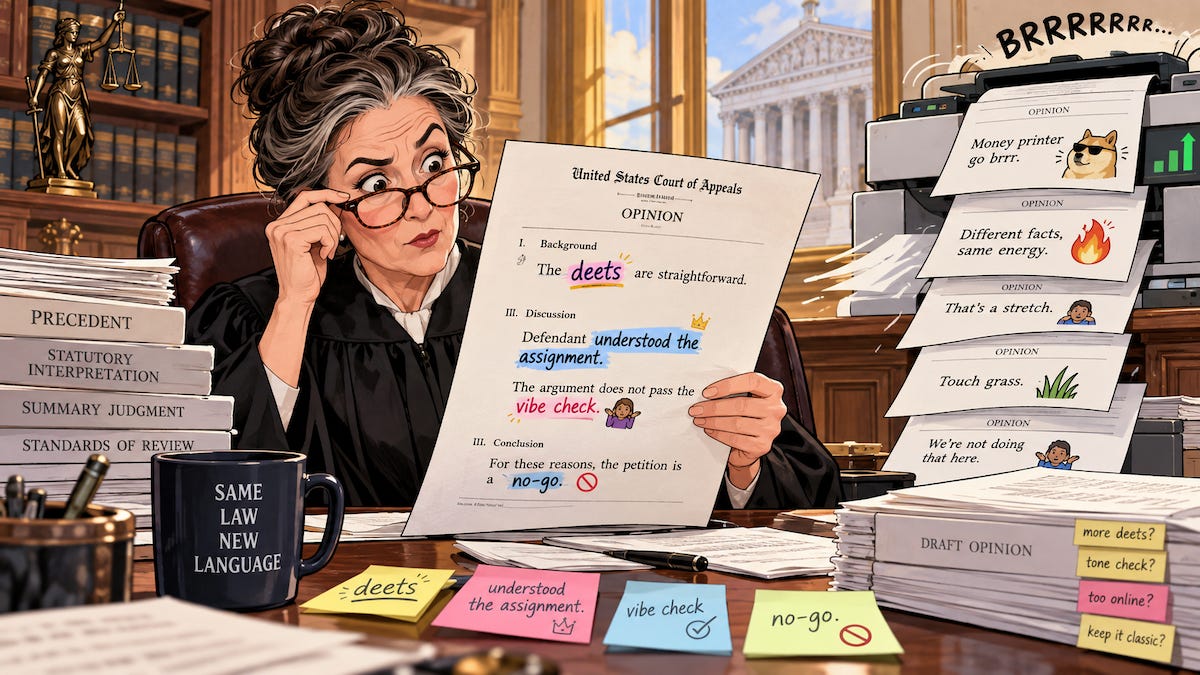
source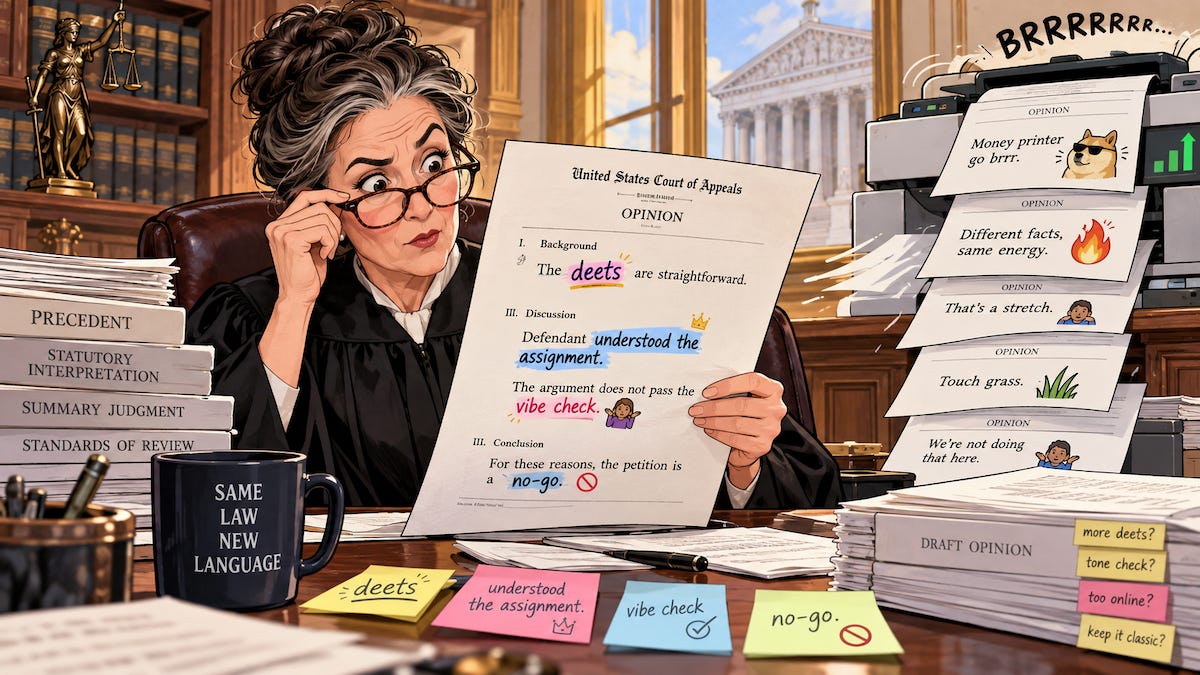 (image generated using ChatGPT)
This article is an expanded version of a piece that originally appeared on Bloomberg Law, part of Bloomberg Industry Group, Inc. (800-372-1033), and appears here with permission.
In 2008, Justice Antonin Scalia and Bryan Garner, the legendary legal lexicographer, had a well-publicized disagreement over using contractions in legal writing. They hashed it out in the pages of Making Your Case: The Art of Persuading Judges, one of my favorite books about written and oral advocacy.
Garner argued that contractions “ought to become more widespread in legal writing,” including judicial opinions. Justice Scalia took the opposite view: “Formality bespeaks dignity,” and “black-robed judges engaged in the exercise of their august governmental powers” should be dignified.
Almost two decades later, Garner’s view has carried the day. Contractions appear frequently in judicial writing, and they’re employed by some of the best writers on the bench—including Justice Elena Kagan and Judge Kevin Newsom (11th Cir.). Justice Scalia’s former seat on the Supreme Court is now occupied by Justice Neil Gorsuch, who uses contractions liberally.1
But contractions are just the tip of the iceberg. If he were alive today, Justice Scalia would probably be appalled by the increased informality of judicial writing.
Memes, slang, and vulgarity, oh my
Consider some of what we’ve seen in just the past four months, in published decisions at all three levels of the federal judiciary.
In August, Judge Brantley Starr (N.D. Tex.) included the internet meme “money printer go brrrrrrrr”—with an accompanying image—in a footnote to his opinion in CFTC v. TMTE, Inc.
Just this month, in her opinion in Center for Taxpayer Rights v. IRS, Judge Cornelia “Nina” Pillard (D.C. Cir.) dismissed an argument raised by the IRS by calling it “weak sauce”—a term that appears in Urban Dictionary, but not Black’s Law Dictionary.
Back in June, Justice Ketanji Brown Jackson used the slang phrase “understood the assignment”—a staple of TikTok, not Supreme Court decisions—in her concurrence in Trump v. Barbara, the landmark case about birthright citizenship.
Perhaps most infamously, earlier this year Judge Lawrence VanDyke (9th Cir.) opened his dissent from the denial of rehearing en banc in Olympus Spa v. Armstrong by declaring, “This is a case about swinging dicks.” (Duck!)
Filling in the ‘deets’
This trend toward informality might have reached its apotheosis this month in the opinion of Judge O. Rogeriee Thompson (1st Cir.) in Instituto Médico del Norte v. Greengift Capital. The second paragraph, offering an overview of the case, begins as follows: “We’ll fill in the deets shortly, but the SparkNotes is this.”
This breezy language led the Legal Style Blog to call for Judge Thompson’s impeachment in a tweet—in jest, I’m guessing, but likely reflecting genuine displeasure. And other readers shared the negative reaction to her writing.
Legal-writing guru Ross Guberman, author of three acclaimed books about legal writing, posted a poll on X about the “deets” sentence. A whopping 88% of respondents said they found the sentence “excruciating,” while only 5% described it as “refreshing.” (The other poll options were “What are deets?” and “What are SparkNotes?”)

Burford Capital is the leading global finance and asset management firm focused on law. Its businesses include litigation finance and risk management, asset recovery and a wide range of legal finance and advisory activities. Burford is publicly traded on the New York Stock Exchange (NYSE: BUR) and the London Stock Exchange (LSE: BUR) and works with companies and law firms around the world from its global network of offices. For more information, please visit www.burfordcapital.com.
Not all reviews of the Instituto Médico del Norte opinion were critical. Joe Patrice of Above the Law opined that while its style might be “jarring to anyone familiar with federal judicial opinions,” the decision as a whole “untangles a complicated, multiyear bankruptcy saga in a readable—dare I say, pleasant—40-page account.”
“Honestly, I expected to find myself more critical of this opinion,” Patrice wrote. And after reading the full ruling, not just excerpts highlighted on X, I concur (although I would have cut the “deets” sentence, along with several other colloquialisms).
Despite some surprisingly casual turns of phrase, “the rest of her opinion is refreshingly clear,” Guberman told me. He ran Instituto Médico del Norte through BriefCatch, the AI-powered writing and editing tool that he created, and the opinion averaged an impressive 91.4 out of 100 across the five tracked categories: reader engagement, concision and readability, flow, crispness, and clarity. (Disclosure: I serve on the board of LawCatch Inc., the parent company of BriefCatch.)
“That’s not quite Kagan or Roberts territory,” said Guberman, “but it’s close.”
A move toward more conversational opinions
Judge Thompson’s opinion reflects how legal writing has evolved over the 30 years that I’ve been reading judicial opinions.
Decades ago, opinions weren’t widely read by the public, and judges wrote them with that in mind. Expecting their opinions to be read mainly by the lawyers handling the case, who would in turn explain them to their clients, judges wrote opinions that were dense, technical, and laden with legalese.
Since I started reading opinions as a first-year law student in 1996, three related trends have changed judicial writing—mostly for the better.
First, in 2008, Adobe released its previously proprietary Portable Document Format as an open standard, greatly facilitating the sharing of opinions in electronic form.
Second, relying heavily on PDFs and in response to 2002’s E-Government Act, courts started making their opinions freely and immediately available on their websites.
Finally, social media exploded in popularity, both within and beyond the legal profession. Today, both lawyers and interested members of the public can read, discuss, and debate judicial opinions, in online forums such as X, Bluesky, or LinkedIn.
Realizing that their opinions often will be read by much larger audiences than just the lawyers involved in the case, judges have seemingly responded by making their opinions more clear, comprehensible, and conversational. Although I haven’t conducted an empirical study, I can confidently say, based on reading hundreds of opinions each year, that contemporary judges go lighter on legalese than their predecessors did.
Judges today work harder to explain their rulings in ways that can be understood by people who don’t have legal training. In high-profile cases, judges often provide introductions and conclusions that seem designed to be read by laypeople as well as lawyers. In cases with complicated, confusing, or voluminous separate opinions, judges sometimes include a summary or road map to guide readers through the holdings.
The judicial system exists to serve the American people—who are, of course, the folks ultimately paying the salaries of judges, clerks, and court staffers. So if judicial opinions are now more accessible to citizens and taxpayers, that’s a positive development.
Too much of a good thing?
For another expert’s perspective, I reached out to Judge David D. Weinzweig, a member of the Arizona Court of Appeals and author of Zen and the Art of Persuasive Writing, an excellent resource for legal writers. Without commenting on any particular opinion, he acknowledged that informality can be overused—just as a matter of effective communication, setting aside concerns about dignity or propriety.
“Judges are professional authors, but we are paid to convey our reasoning,” Judge Weinzweig said. “Informal legal writing is never appropriate when it competes for the spotlight, siphoning the reader’s finite attention from that reasoning.”
“You never want a reader focused on tone, grammar, and word choice when that focus could be devoted to understanding your point,” he continued. “I still deploy informal legal writing but only when it helps make the point.”
Of course, reasonable minds can disagree over how much informality is too much informality. And despite valuable tools like BriefCatch, which bring greater rigor and objectivity to evaluating legal writing, there’s still a certain amount of personal opinion and subjectivity at play here.
Or as Judge Weinzweig wrote in his book—paraphrasing Justice Potter Stewart’s famous quotation from Jacobellis v. Ohio about obscenity, but referring to persuasive writing—“I know it when I read it.”
UPDATES:
4:46 p.m. For additional insights on this topic, please see Peter Kalis’s essay, Reflections on the Business of Law (which I have posted online with his permission). As Kalis wrote in a note to me, “I don’t think the issue is contractions or informality. Rather, the issue is clarity, as I described thirty years ago in this short essay (beginning on page 803).”
4:55 p.m. I meant to mention this poll earlier: On X, Ethan Savka conducted a poll in which he asked his readers to pick the worst casual writing in a judicial opinion. The “winner,” with 45.9% percent of the vote, was “money printer go brrrrrrrr,” followed by “Jk - J. Thompson here” (28.1%), “We’ll fill in the deets” (20.4%), and “Weak sauce” (5.6%).
Some great judicial writers continue to eschew contractions—e.g., Judge Stephanos Bibas (3d Cir.).