Timeline
Every post and feed across this instance
-
Pourquoi les IA de recherche génèrent-elles toujours les mêmes résultats ? La solution de Google !
Ce qu'il faut retenir :
- Les modèles de langage classiques, utilisés pour décomposer une requête large en sous-requêtes, tombent souvent dans le piège de la reformulation : ils produisent des variantes proches du même terme au lieu de couvrir des angles différents.
- Retrieve-for-Train sépare l'apprentissage de l'exécution : un entraînement par renforcement, mené une seule fois hors ligne, sert à produire les données qui entraînent ensuite un modèle de diffusion léger, rapide à l'usage.
- Le modèle final ne compte que 53,9 millions de paramètres et affiche un gain de vitesse compris entre 12 et 20 fois par rapport aux approches autorégressives classiques.
- Un système de récompense à trois critères (ancrage dans la base de données, diversité, fidélité à la requête initiale) empêche le modèle de tricher en générant des résultats absurdes ou redondants.
Des résultats de recherche qui se ressemblent tous
Quand un utilisateur tape une requête large comme « matériel de camping », il n'attend pas dix variantes du même modèle de tente. Au contraire, il attend un ensemble cohérent et complémentaire : une tente, un sac de couchage, un réchaud portable, une lampe frontale. Pour produire ce type de résultat, les systèmes de recherche utilisent une technique appelée query fan-out, qui consiste à décomposer une requête générale en plusieurs sous-requêtes censées couvrir les différents besoins de l'utilisateur.
Le souci, c'est que confier cette décomposition à un modèle de langage classique pose deux problèmes de fond.
Le premier est ce que les chercheurs appellent le collapse paraphrastique. Sans optimisation spécifique à la base de données ciblée, un modèle de langage a tendance à générer des requêtes redondantes, presque synonymes les unes des autres. Pour une requête comme « style festival bohème », un modèle standard peut se contenter de produire « mode festival bohème » et « vêtements festival bohème », deux formulations qui reviennent au même. Un expert du secteur, lui, explorerait des directions distinctes : veste à franges, robe en crochet, bottes en daim.
Le second problème est la latence liée au fonctionnement autorégressif des modèles de langage. Pour décomposer correctement une requête complexe, ces modèles doivent générer des centaines de jetons de raisonnement intermédiaire avant de produire les termes de recherche eux-mêmes. Ce fonctionnement séquentiel, acceptable pour une conversation, devient un frein sérieux dès qu'il faut produire un grand nombre de sous-requêtes simultanément. Même avec des optimisations serveur avancées, cette architecture token par token crée un plancher de latence incompatible avec les temps de réponse attendus d'une barre de recherche en production.
Le principe de Retrieve-for-Train : entraîner une fois, exécuter instantanément
L'idée centrale du framework consiste à traiter l'entraînement comme une session de préparation hors ligne plutôt que comme un examen à passer en direct pendant que l'utilisateur attend. Au lieu de faire réfléchir le modèle à chaque requête, Retrieve-for-Train lance un programme d'apprentissage par renforcement une seule fois, en amont.
Ce programme s'appuie sur un système de récompense rigoureux qui transforme des objectifs abstraits, comme « des résultats divers et disponibles en stock », en instructions précises et reproductibles. Une fois ce travail effectué, le modèle final peut exécuter ces instructions instantanément lors d'une recherche réelle.
Le pipeline se décompose en trois étapes :
- Entraînement du modèle de fan-out : un modèle de langage est entraîné par renforcement pour produire des sous-requêtes alignées avec les propriétés recherchées, évaluées par une récompense qui juge l'ensemble des résultats plutôt que chaque résultat pris isolément.
- Synthèse des données de supervision : une fois figé, ce modèle de fan-out génère automatiquement des paires requête / ensemble cible, entièrement hors ligne et sans intervention humaine.
- Entraînement du modèle de diffusion : un modèle compact de 53,9 millions de paramètres apprend à faire correspondre directement l'embedding d'une requête à un ensemble complet d'embeddings cibles, en un seul passage non séquentiel. Cette étape permet de se passer entièrement des jetons de raisonnement textuel.
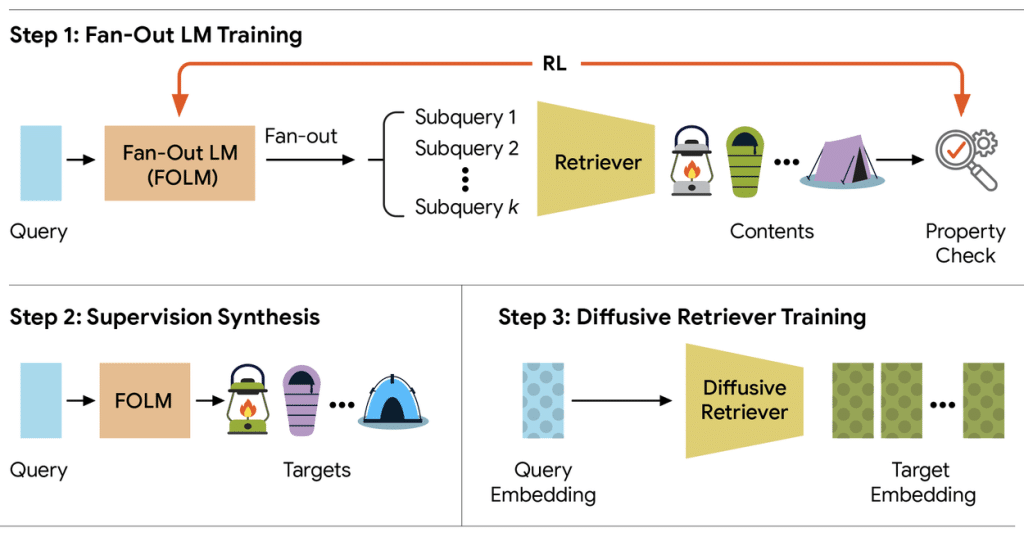 Les trois étapes de la pipeline - Source : Google
Un système de récompense construit autour de trois piliers
La qualité du dispositif repose entièrement sur la façon dont le « bon » comportement de recherche est défini. L'apprentissage supervisé traditionnel évalue la pertinence de chaque résultat pris séparément. Or un ensemble de résultats vraiment pertinent se définit par des propriétés collectives : diversité, couverture, complémentarité. Ces propriétés n'existent que si l'on évalue l'ensemble dans sa globalité, pas un élément à la fois.
Pour éviter de s'appuyer sur des instructions en langage naturel trop vagues, les chercheurs ont affiné deux modèles open source de 4 milliards de paramètres, Gemma3-4B et Qwen3-4B, à l'aide d'une récompense mathématique composite reposant sur trois critères :
- L'ancrage (groundedness), qui pénalise l'éloignement par rapport à la base de données réelle, pour s'assurer que chaque sous-requête générée correspond à un élément effectivement disponible.
- La diversité, mesurée via le Vendi Score sur l'ensemble des sous-requêtes, qui pousse le modèle à explorer une large étendue sémantique.
- L'alignement, qui rattache les sous-requêtes générées à la requête d'origine pour éviter toute dérive de sens.
Ces trois critères jouent le rôle de contre-poids les uns par rapport aux autres. Un modèle optimisé uniquement pour l'ancrage finira par générer des chaînes de caractères dénuées de sens mais qui, mathématiquement, correspondent à une coordonnée précise de la base de données. Si l'on ajoute l'alignement pour corriger ce défaut, le modèle contourne le problème en se contentant de reformuler la requête initiale de façon répétitive. C'est l'ajout du Vendi Score comme contre-ancrage qui empêche ces raccourcis : pour obtenir une récompense élevée, le modèle est contraint de trouver un équilibre entre des variantes strictement ancrées dans la base et sémantiquement distinctes.
L'entraînement du modèle de fan-out repose sur une méthode appelée group relative policy optimization (GRPO), combinée à une régularisation de type PPO en version « soft ».
Les résultats des expérimentations
Pour évaluer le framework, les chercheurs ont travaillé sur deux types de tâches de recherche par ensembles :
- La recherche abstraite ouverte, où aucune vérité de référence unique n'existe et où la qualité se mesure uniquement à travers des propriétés d'ensemble (diversité, alignement, ancrage) ;
- La recherche compositionnelle faiblement supervisée, où les requêtes sont associées à un ensemble de référence qui ne représente qu'une des réalisations plausibles possibles.
Les tests ont porté sur deux domaines multimodaux : un jeu de données de mode à grande échelle, composé de tenues assemblées par des utilisateurs, évalué avec un modèle de type CLIP pour la recherche texte-image ; et un jeu de données industriel propriétaire de playlists musicales créées par des experts, évalué avec MuLan pour la recherche texte-musique. Dans les deux cas, les modèles de fan-out devaient générer exactement dix sous-requêtes par requête initiale.
Sur ces deux tâches, Retrieve-for-Train a surpassé la recherche à requête unique classique, l'expansion sans entraînement spécifique (zero-shot) et même une référence optimisée de type Best-of-N. D'un point de vue qualitatif, les modèles zero-shot ont continué à produire des paraphrases quasi synonymes, comme « style festival bohème » et « mode festival bohème », causant des résultats redondants. Retrieve-for-Train, lui, a généré des sous-requêtes nettement plus diverses (par exemple en explorant des pistes comme « bottes » ou « dentelle ») tout en restant strictement ancré dans la base de données.
Mais le gain le plus marquant concerne la vitesse d'exécution. Déployer directement le modèle de langage entraîné par renforcement donnait de très bons résultats en matière de qualité de recherche, mais héritait des contraintes de latence propres au fonctionnement autorégressif. En distillant ce comportement appris dans le modèle de diffusion de 53,9 millions de paramètres, les chercheurs ont supprimé ce goulot d'étranglement. Comme ce modèle génère toutes les directions cibles simultanément, en un seul passage non séquentiel dans l'espace des embeddings, il obtient un gain de vitesse compris entre 12 et 20 fois par rapport aux approches autorégressives.
À grande échelle, la latence du fan-out autorégressif grimpe de façon linéaire jusqu'à près de 50 secondes avec des lots de contexte importants, tandis que la version diffusion de Retrieve-for-Train reste comprise entre une fraction de seconde et quelques secondes.
En conclusion
En analysant le processus d'optimisation de la récompense, les chercheurs ont observé un phénomène révélateur : sans le terme de diversité, le modèle s'effondre rapidement et se met à générer des chaînes de caractères dénuées de sens (comme des répétitions absurdes) pour exploiter mathématiquement les coordonnées vectorielles de la base de données. L'ajout d'une métrique géométrique de diversité, le Vendi Score, agit comme un garde-fou : il force le modèle à rester dans une zone stable de l'espace des embeddings, où il ne peut maximiser sa récompense qu'en se comportant réellement comme un expert de la recherche.
L’article "Pourquoi les IA de recherche génèrent-elles toujours les mêmes résultats ? La solution de Google !" a été publié sur le site Abondance.
-
Mistral AI dément un piratage de son code source

La licorne française a communiqué officiellement sur une revendication de piratage visant son code source, publiée la veille sur un forum cybercriminel. L'entreprise Mistral AI dément toute intrusion dans ses systèmes.
-
À Marseille, la justice s'intéresse à un chasseur d'immeubles en péril
 Source : Marsactu
Payant
Source : Marsactu
Payant
À travers le témoignage de Rachid B., Marsactu rapporte comment, à Marseille, même les immeubles menacés de s'effondrer peuvent devenir des affaires en or. Un marché du « logement en péril » dont la société J.J.O., spécialisée dans le rachat d'immeubles dégradés, est très friande. Mais derrière les promesses de rénovation, ses méthodes interrogent : Rachid B. et d'autres locataires évacués racontent des pressions et des démarches qui auraient visé à les faire partir définitivement, libérant ainsi les logements pour de futures opérations immobilières.
D'ailleurs, non seulement cette société a déjà été condamnée au civil, mais elle est désormais dans le viseur de la justice pénale, saisie de plusieurs plaintes. Pour les personnes concernées, la menace ne s'arrête pas à l'évacuation : elle se prolonge dans la difficulté à retrouver un logement et dans la crainte de ne jamais pouvoir rentrer chez elles.
-
À Marseille, la justice s'intéresse à un chasseur d'immeubles en péril
Source : Marsactu
Payant -
Qu'elle soit française ou espagnole, Kylian Mbappé prend ses responsabilités face à l'extrême droite
 Source : Dialectik Football
 -
Accidents du travail : « J'en pouvais plus, mais je devais continuer », même après une vis dans le genou
 Source : Fakir
Payant
Source : Fakir
Payant -
Dans les Landes, la saison des feux n'en finit pas

En moins de 24 heures, deux incendies se sont déclarés dans la forêt des Landes. Des feux qui continuent tard dans une saison estivale déjà marquée par des incendies dantesques qui ont traumatisé pompiers et habitants.
Lire la suite - Reportage / Incendies
Mimizan (Landes), reportage
Debout sur le goudron de l'aérodrome de Mimizan, Nathalie Fabre, talkie-walkie à la main, guide les demandes d'atterrissage sur le site. En cet après-midi de septembre, les petits avions de tourisme habituels ont été remplacés par de plus lourds (…) -
Grand week-end de mobilisation contre le permis de tuer
Un grand weekend de mobilisation impulsé par le collectif Stop aux violences d'État aura lieu tout au long du weekend.
L’article Grand week-end de mobilisation contre le permis de tuer est apparu en premier sur Contre Attaque.
-
Isoskèle LineUp7 renforce ses positions dans la banque et l’assurance avec CNP Assurances et BforBank
Isoskèle LineUp7 poursuit son développement dans les secteurs de la banque et de l’assurance avec deux nouvelles missions autour de ses expertises MarTech. Le groupe accompagne désormais CNP Assurances Protection sociale et BforBank dans la transformation de leur marketing, l’optimisation des parcours d’acquisition et l’évolution de leurs architectures MarTech. Deux projets distincts qui mobilisent les …
L’article Isoskèle LineUp7 renforce ses positions dans la banque et l’assurance avec CNP Assurances et BforBank est apparu en premier sur FRENCHWEB.FR : innovation, tech, network.
-
31e saison des Rencontres interculturelles du 10e - Balade inter-associative
Quand ?
Le 4 octobre à 14hOù ?
Les Garibaldiens Rue des Vinaigriers 75010 ParisPour clôturer la 31e saison des rencontres interculturelles du 10e et en partenariat avec la Semaine Bleue,
nous déambulerons dans les rues du 10e, d'association en association :– tout d'abord LES GARIBALDIENS nous ouvriront leur local (20, rue des vinaigriers),
– puis nous serons accueillis par DÉFENSE D'ÉLÉPHANT place Karski,
– enfin, nous visiterons le CHAMÔDIX, ressourcerie du 10e (20, rue Philippe de Girard).RDV à 14h devant le local des Garibaldiens pour le début de la balade !
- Voir l'événement Facebook
- Voir aussi Ensemble 10e
-
Contre Attaque à la Fête de l’Huma : retour en images
L'équipe de Contre Attaque était présente au Village des Médias indépendants, un vaste espace où de nombreux médias ont pu se côtoyer.
L’article Contre Attaque à la Fête de l’Huma : retour en images est apparu en premier sur Contre Attaque.
-
En attendant la guerilla anarchiste et austres textes – Juin 2026
en attendant et autres textes – juin 2026
Sommaire :
- Le secret est de continuer à commencer
- À propos de visibilité et de la proposition de guérilla
- En attendant la guérilla anarchiste
- À propos de la capacité d’agir anarchiste. Une réponse au texte « En attendant la guérilla anarchiste »
- Fragments issus de la carrière de la pratique révolutionnaire
- A propos de réductionnisme guérilleros
- Une perspective d’attaque dans un monde qui s’effondre
-
[Rennes] 20 ans du local La Commune
Le Samedi 26 Septembre 2026 nous fêterons les 20 ans du local La Commune au 17 rue de Châteaudun à Rennes.
Le Local La Commune a 20 ans et c’est l’occasion de s’y retrouver à partir de 14 heures ! Causerie, Exposition, Repas partagé puis soirée au bar « Le Synthi » avec un concert !

14 heures, Être Anarchiste au XXIe Siècle, une causerie présentée par le Groupe La Sociale de la Fédération Anarchiste
L’Anarchie est une idée plus toute jeune. Tantôt traités de dangereux-ses terroristes et tantôt de doux-ces rêveur-euses, les anarchistes sont de toutes les révoltes et de toutes les luttes, contre toutes les formes de dominations. Mais qu’en est-il aujourd’hui ? Qu’est-ce qu’être anarchiste ? Comment s’organiser ? Tant de questions auxquelles on essayera de répondre collectivement !
Exposition: l’Anarchisme en Bretagne et Souvenirs du Local La Commune: Reprise d’une exposition sur les mouvements anarchistes bretons suivi d’un ajout sur le Local La Commune et la Fédération Anarchiste de Rennes, histoire de découvrir pour certain-es et de se remémorer pour d’autres !
18 heures, Auberge Espagnole: En tant que compagnes et compagnons, étymologiquement « qui partage son pain », nous proposons de faire un repas partagé. Chacun-e ramène de quoi manger et partager pour profiter ensemble d’un moment convivial !
Après manger on se retrouve au bout de la rue au Bar Le Synthi, 2 Rue de Chateaudun, pour continuer la fête !
21 heures, Concert des Chatons Grillés: Des punks locaux à l’apparence féline ont vu de la lumière et sont entré-es dans le Synthi, ils et elles sont là pour enflammer (Griller ?) la scène pour les 20 ans du Local La Commune et notre plus grand plaisir ! :-)
On se retrouve le 26 Septembre à Partir de 14 heures au Local La Commune !
https://www.falasociale.org/2026/09/fete-des-20-ans-du-local-la-commune.html
-
Après avoir dénoncé des violences sexistes et racistes, deux professeures sous la menace d’une mutation
Alors qu’elles alertent depuis des années au sujet des propos racistes et sexistes visant leurs élèves de la part d’un collègue, deux enseignantes de Seine-Saint-Denis pourraient être mutées «dans l’intérêt du service». Une décision qui heurte, alors que le ministre de l’éducation nationale plaide pour la «libération de la parole». -
Le grand malaise des fonctionnaires, confrontés à l’impossibilité de mener à bien leurs missions
Le rapport du collectif Nos services publics, publié jeudi 17 septembre, pointe une dégradation des conditions de travail des agents et agentes, soulignant la perte de sens, les moyens dégradés et des disparités selon les catégories hiérarchiques. -
Comment les autorités russes ont déjà décidé des résultats des législatives
Les Russes votent du 18 au 20 septembre pour renouveler le Parlement. Si la victoire du parti de Vladimir Poutine ne fait pas de doute, les autorités ont longtemps fait varier ses proportions, avant d’opter pour 47% des suffrages. Au printemps, le chiffre avait grimpé à 55%. -
« Ils ne savent pas à qui ils ont affaire » : au cœur du combat des victimes de pesticides

Dans « Pesticides kids », deux journalistes donnent la parole à des enfants souffrant de cancers et à leur famille. L'enquête offre un argumentaire implacable sur les dangers de ces substances toxiques, dont la France est friande.
Lire la suite - Entretien / Pesticides
Leucémies, malformations type bec-de-lièvre, troubles du neurodéveloppement... Avec leur enquête Pesticides kids, publiée le 18 septembre aux éditions Nuriturfu, les journalistes Nolwenn Weiler et Sophie Chapelle montrent la vie abîmée des enfants malades des (…) -
« Pesticides Kids », le livre-enquête qui révèle les dessous d'une contamination généralisée « avant même la naissance »

-
Présidentielle 2027 : financer la French Tech ne suffit pas à construire une puissance technologique
À l’approche de l’élection présidentielle de 2027, la technologie revient dans le débat politique par son point d’entrée le plus familier : son financement. Mobilisation de l’épargne, nouveaux fonds, implication des banques et commande publique figurent parmi les propositions avancées. Mais le changement de cycle technologique élargit les besoins. L’intelligence artificielle et les deeptech demandent …
L’article Présidentielle 2027 : financer la French Tech ne suffit pas à construire une puissance technologique est apparu en premier sur FRENCHWEB.FR : innovation, tech, network.
-
Giuliano da Empoli, la revanche du Florentin (1/2) Nul n’est prophète en Italie
Avant d’être adapté au cinéma et écouté jusqu’à l’Élysée, l’auteur du « Mage du Kremlin » n’était qu’un discret conseiller politique italien. Revue21 a rencontré l’intellectuel érigé en oracle du chaos contemporain. Et retracé, de Florence à Rome, cette autre vie d’aspirant Machiavel, jusqu’aux défaites cuisantes qui l’ont poussé à se réinventer à Paris. Première partie de notre enquête.
The post Giuliano da Empoli, la revanche du Florentin (1/2) Nul n’est prophète en Italie appeared first on Revue21.fr.
-
Is Trump’s AI obsession walking the world into disaster? – podcast
Tech bosses have called for a slowdown in artificial intelligence and the creation of formal guardrails from the US government. But why is President Trump unmoved by the doomsday predictions, dismissing them as a ‘hoax’? What lies behind his embrace of the AI industry? Jonathan Freedland speaks to the Guardian US tech editor, Blake Montgomery
Watch Jonathan Freedland on our new Politics Weekly YouTube channel
Send your questions and feedback to politicsweeklyamerica@theguardian.com
Listen to the latest season of Black Box
Continue reading... -
Salesforce fait défiler Anthropic et OpenAI à Dreamforce... mais développe ses propres modèles avec Nvidia pour préserver son savoir-faire lié aux métiers du CRM
A l’occasion de l’édition 2026 de Dreamforce, le rendez-vous annuel de Salesforce à San Francisco, son CEO Marc Benioff, souvent présenté comme le premier employeur de la ville, a laissé place à un défilé de personnalités du secteur technologique. Dario Amodei, CEO d’Anthropic, Jensen Huang, CEO de Nvidia, Sam Altman, CEO d’OpenAI... Tous ont fait le déplacement.
-
À Miquelon, les habitants contraints de déménager face à la submersion marine : «Ça fait mal de me dire que cet endroit disparaîtra sous l’eau un jour»
 Sabine Detcheverry et Paul de Lizarraga, devant la maison où ils vivent depuis des décennies, dans l’actuel village de Miquelon. © Dario Nadal/Vert
Elle est la première commune française à devoir déménager intégralement à cause du changement climatique. Dans l’archipel de Saint-Pierre-et-Miquelon, seul territoire ultramarin français en Amérique du Nord, où vivent quelque 6 000 personnes, le village de Miquelon est implanté entre zéro et trois mètres au-dessus du niveau de la mer.
Nichée à la pointe d’une île de 200 kilomètres carrés, la commune sera submergée à l’horizon 2100 au plus tard. En cause, la hausse du niveau moyen des océans, alimentée notamment par la fonte des glaces. À Miquelon, le niveau de l’eau pourrait atteindre 3,7 mètres d’ici à la fin du siècle, selon le Bureau de recherches géologiques et minières (BRGM).
Déplacement d’Emmanuel Macron
Un nouveau village est en cours de construction depuis la fin de l’été 2025 sur une butte surélevée, où une dizaine de maisons sont déjà sorties de terre. Cette fois-ci, pas question de construire en dessous de dix mètres au-dessus du niveau de la mer, a minima. Le fruit d’années de concertations avec les habitant·es, qui mettent d’ailleurs souvent eux-mêmes la main à la pâte en construisant leur propre maison, comme cela se fait beaucoup à Miquelon. Un projet collaboratif porté par la mairie de Miquelon-Langlade et coordonné par l’agence d’urbanisme Métamorphoses urbaines, basée en région parisienne.
 Le futur village, en chantier depuis septembre 2025 est implanté à dix mètres minimum au-dessus du niveau de la mer. © Dario Nadal/Vert
Si la première «phase» des travaux touche à sa fin, de nombreux Miquelonnais·es attendent désormais l’étape supérieure, qui prévoit la construction de plus d’une soixantaine de nouvelles maisons ainsi que d’un refuge en cas d’aléa climatique extrême. Après dix ans de reculs écologiques successifs, Emmanuel Macron, doit se rendre pour la première fois dans l’archipel, du 19 au 21 septembre prochains.
La deuxième visite d’un président de la République dans l’histoire du village, qui pourrait être amené à annoncer le déblocage de nouveaux moyens pour accélérer le projet. «Cela fait des années qu’on attend cette visite. Maintenant, on espère surtout l’annonce du financement de la deuxième phase des travaux, et qu’on ne s’arrête pas à seulement quinze parcelles pour le nouveau village», explique Anne-Solange Muis, géographe chargée de coordonner la «relocalisation» du village depuis 2022.
 Franck Detcheverry, maire divers gauche de Miquelon depuis 2020, réélu en 2026 au premier tour faute d’autre candidat à la fonction. © Dario Nadal/Vert
Plus qu’un simple départ vers un ailleurs, le projet porté par le maire (divers gauche) Franck Detcheverry suggère une autre manière d’habiter l’île en intégrant le risque à venir. Le fruit d’une longue concertation avec des habitant·es profondément attaché·es à leur village. «On sait que Miquelon pourrait subir une tempête violente un jour ou l’autre, donc on doit agir aujourd’hui», explique l’édile en fonction depuis 2020. À noter que le déplacement se fait pour l’instant sur la base du volontariat.
Une île grignotée de bout en bout
La nouvelle tombe en 2014, lors de la visite du président François Hollande. Dans le nouveau plan de prévention des risques littoraux (PPRL), la quasi-totalité du village se trouve en zone rouge, à fort risque de submersion marine. Elle deviendra donc inconstructible. Un coup de massue pour les familles qui vivent sur l’île depuis des générations, la plupart descendantes des pêcheur·ses acadien·nes, basques ou breton·nes qui ont fondé le premier village il y a près de trois siècles. «Mon terrain a perdu toute sa valeur d’un coup, je ne peux plus rien en faire à part y planter des légumes», souffle Paul de Lizarraga, Miquelonnais de 78 ans.
 Sur l’île, tout le monde ou presque construit sa maison soi-même. L’auto-construction fait partie de la culture depuis des générations, lié notamment à l’isolement. © Dario Nadal/Vert
Beaucoup de Miquelonnais·es refusent d’abord d’entendre parler de déménagement. Mais d’importantes inondations en 2018, ainsi que l’érosion qui grignote l’île un peu plus chaque hiver, leur rappellent l’urgence. Car Miquelon cumule les vulnérabilités. En plus du risque lié à l’élévation du niveau de la mer, le village est aussi menacé par ses fondations : le banc de galets qui constitue l’île à cet endroit renferme une nappe phréatique. «En cas de cyclone, la dépression fait remonter la nappe qui s’ajoute à l’effet de submersion marine. Les habitant·es le constatent dans leurs caves, où ils ont de plus en plus d’eau», alerte la géographe Anne-Solange Muis, qui se rend sur l’île chaque trimestre depuis quatre ans avec l’agence d’urbanisme Métamorphoses urbaines.
Parmi les parties les plus à craindre à court terme : l’isthme qui relie le sud de l’île, Langlade, au nord, Miquelon, soit une bande de sable longue de 12 km. L’endroit est inhabité, mais il s’agit d’un véritable joyau de biodiversité accueillant notamment la plus grande colonie de phoques de France au sein du Grand Barachois, une vaste lagune de 1 000 hectares bordée de dunes de sable blanc.
 L’isthme de Miquelon-Langlade accueille une grande diversité de milieux : dunes, tourbières, marais ou lagunes. Il pourrait disparaître sous l’eau dans les prochaines décennies. © Dario Nadal/Vert
À cela s’ajoute une vulnérabilité grandissante face aux tempêtes qui s’abattent régulièrement sur l’île, due à des hivers moins froids qu’il y a cinquante ans. «Avant, en octobre, il y avait de la glace partout, jusqu’en avril. Au fil du temps, les hivers se sont raccourcis, avec plus de vent et d’humidité, et moins de gel. Sur le littoral, les falaises de glace protégeaient la dune de la mer», explique Paul de Lizarraga, qui a œuvré pendant des années au réensablement des buttereaux (petites buttes) qui forment l’isthme de Langlade. Le littoral n’étant plus protégé par ces falaises de glace l’hiver, il se retrouve directement exposé aux aléas qui le frappent à cette période.
(Ré)habiter Miquelon autrement
Du côté de la jeunesse locale, les avis divergent et les perspectives restent encore floues sur un territoire où plus d’un quart de la population est âgé de 60 ans ou plus. «Ça me fait mal de me dire que cet endroit disparaîtra sous l’eau un jour. Mais j’espère ne plus être sur cette terre quand ça arrivera», se désole Lou Coste, Miquelonnaise de 22 ans. Établie au Québec, la jeune femme a déjà tranché depuis plusieurs années. «En tant que jeune, j’ai envie de voyager, de profiter de ma vie et j’ai bien compris que ma place n’était pas à Miquelon», détaille-t-elle, avant d’admettre : «Mais, si je devais rester sur l’île, je me verrais bien habiter dans le nouveau village, la vue est magnifique.»
 Layla, 18 ans, a décidé de revenir dans son village après l’obtention de son bac à Saint-Pierre, chef-lieu de l’archipel. © Dario Nadal/Vert
Sur la place du village, en face de l’église des Ardilliers, construite au 19ème siècle et classée monument historique, Layla Gaspard, 18 ans, n’a pas vraiment d’avis sur la question. «Je sais juste que notre maison ne bougera pas pour l’instant, et qu’on est très bien là où on est. Après chacun fait comme il veut», dit-elle, pas vraiment motivée non plus pour rencontrer Emmanuel Macron.
Dans son jardin à quelques pas de la mer, Éric Coste n’est pas vraiment d’accord avec la «relocalisation» du village. «Sans dire que le réchauffement climatique ne menace pas le village, l’idée de tout déplacer me dérange. Quand on a toujours vécu sur ce banc de galets, forcément on y est très attaché», explique ce vingtenaire. Il y a six ans, le chauffeur agricole a investi ses économies dans une maison de l’ancien village, en connaissance de cause, où il vit avec sa compagne et leur fille de quatre ans. Pour l’instant, la famille n’a pas l’intention de bouger d’un pouce.
 Eric Coste, miquelonnais opposé au projet de déplacement du village, devant la maison qu’il a achetée en 2020. © Dario Nadal/Vert
À dix minutes de voiture, sur le chemin des Roses, lieu du futur village en chantier qui fait face à l’Atlantique, une dizaine de maisons sont déjà sorties de terre en à peine un an. Celle de Sabine Detcheverry, 66 ans, fera bientôt partie du lotissement. Après toute une vie sur son terrain actuel, la jeune retraitée a signé son compromis de vente en mai dernier. «Ce qui nous a décidés, ce sont les vents de plus en plus forts qui font vraiment peur. On a hâte d’être en sécurité là-haut», explique-t-elle. Depuis que sa maison a été rachetée par le Fonds Barnier, un financement européen mis en place en 1995 pour prendre en charge les dépenses liées aux catastrophes naturelles, la retraitée a trois ans pour faire construire son nouveau logement et s’y installer.
Paul de Lizarraga, compagnon de Sabine Detcheverry, est lui en attente d’attribution d’une parcelle dans le futur village. Pour la première phase du projet, la priorité était donnée aux jeunes familles. Cet ancien ouvrier de la morue, autrefois employé dans l’usine de l’île qui tournait à plein régime avant le moratoire de 1992, a sacrifié un an et demi de sa vie pour bâtir sa maison il y a plus d’un demi siècle. Si la voir détruite sera douloureux, c’est «un mal pour un bien», selon lui. «Il est impératif qu’on puisse se mettre à l’abri dès maintenant pour pouvoir faire face au problème si dans quinze, vingt ou trente ans il y a une montée des eaux. J’espère bien pouvoir un jour avoir ma maison construite de l’autre côté, je finirai mes jours beaucoup plus sereinement», affirme-t-il avec résilience.
La deuxième phase des travaux pourrait être annoncée par Emmanuel Macron lors de son passage sur l’île, le 20 septembre prochain. Elle représenterait un investissement d’environ 25 millions d’euros pour l’État, entre 2027 et 2031. Plus de soixante nouveaux ménages auraient ainsi la possibilité de voir rachetées leurs anciennes maisons et d’obtenir un permis de construire, avec l’espoir d’être désormais en sécurité, à l’abri de l’océan.
-
« Tout est délirant, du début à la fin » : quand une fraude géante se retourne contre des éleveurs

Des milliers de LED non conformes ont été installées, dans le cadre d'une fraude à grande échelle aux crédits de la transition énergétique. Dans les élevages, ce matériel provoque souffrance animale et baisse de production.
Lire la suite - Enquête / Animaux , Agriculture
Comment un programme aussi simple a-t-il pu dégénérer à ce point ? Au départ, en 2022, tout avait pourtant bien commencé. Les entreprises du secteur de l'énergie, sous le contrôle des services du gouvernement, décidaient d'offrir quelques euros aux entrepreneurs qui (…) -
« Tout est délirant, du début à la fin » : quand une fraude géante se retourne contre des éleveurs
Des milliers de LED non conformes ont été installées, dans le cadre d'une fraude à grande échelle aux crédits de la transition énergétique. Dans les élevages, ce matériel provoque souffrance animale et baisse de production.
Lire la suite - Enquête / Animaux , Agriculture
Comment un programme aussi simple a-t-il pu dégénérer à ce point ? Au départ, en 2022, tout avait pourtant bien commencé. Les entreprises du secteur de l'énergie, sous le contrôle des services du gouvernement, décidaient d'offrir quelques euros aux entrepreneurs qui (…) -
24/09 : Assemblée antifasciste de rentrée
L'assemblée antifasciste de Nancy fait sa rentrée le 24 septembre à la Fac de Lettres de Nancy, Amphi A136 à 18h
- Initiatives / Nancy, Assemblée -
La méthanisation agricole, une controverse écologique qui s'enflamme
Le gouvernement veut septupler la production de biométhane sur les terres agricoles d’ici à 2050. Absurdité écologique et économique et menace pour la sécurité alimentaire, ou piste viable pour assurer la transition énergétique ? -
Les conséquences réelles des plans sociaux démentent la théorie de la « destruction créatrice »
Une étude sur plus de 500 plans sociaux dans l'industrie française montre que, contrairement à ce que suggère le concept de destruction créatrice, ils ne permettent pas une réallocation efficace des ressources. -
Trump Tyranny Tracker | Day 596-598: Sept. 11-13, 2026
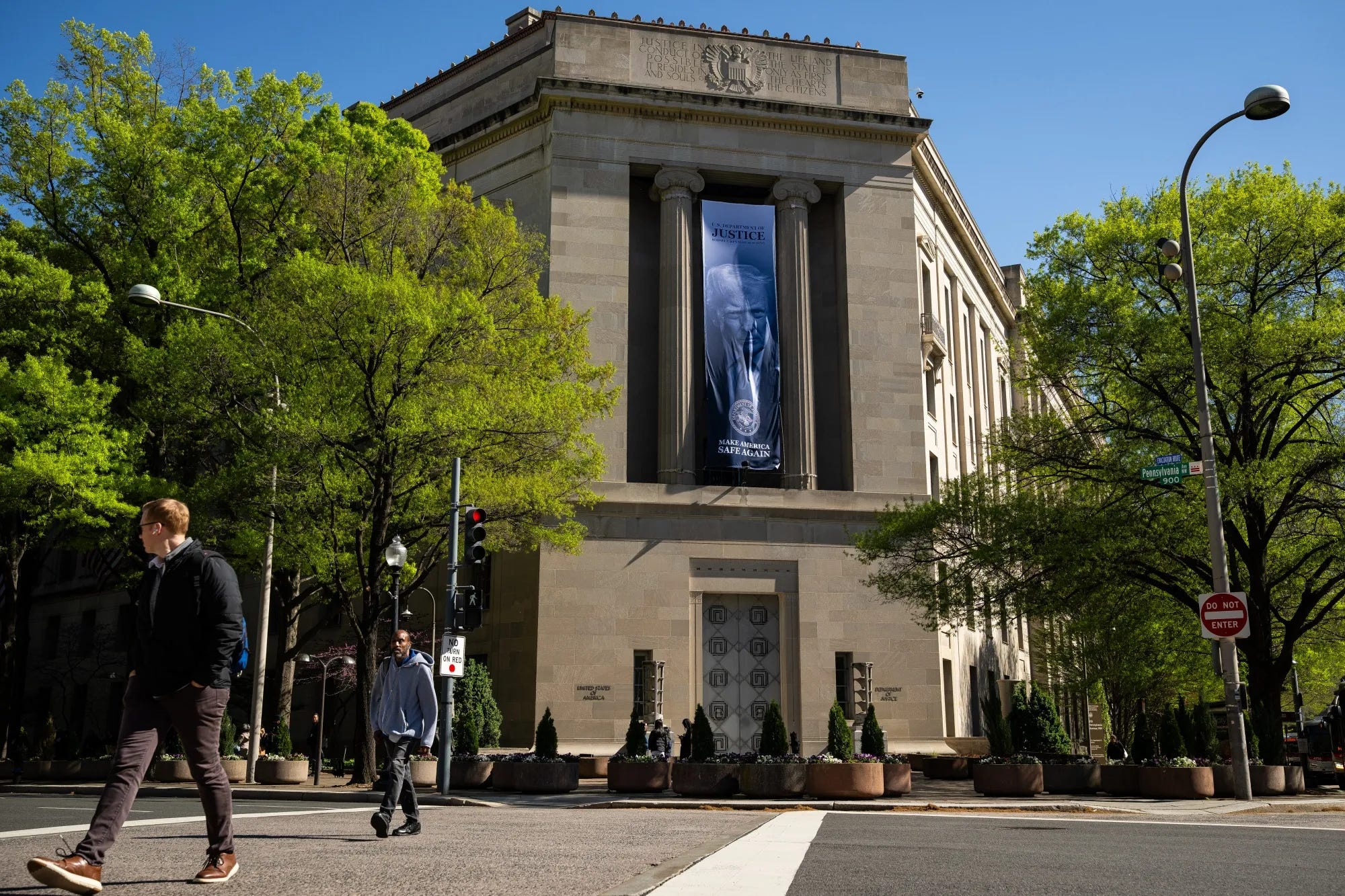 The Department of Justice in Washington. Photographer: Graeme Sloan/Bloomberg
Welcome to today’s Trump Tyranny Tracker…
New efforts to interfere in the midterms, Trump’s Justice Department expanding investigations into his political opponents, and Russia and Iran escalating threats abroad are among this weekend’s top stories.
Weekend at a Glance
Election Interference — Trump allies are pushing new ways to use federal power to interfere with state-run elections just weeks before the midterms.
Political Retribution — DOJ is expanding investigations involving Trump’s political opponents and former officials who investigated him.
Iran War — Fighting is threatening two of the world’s most important shipping routes as energy prices and inflation continue to climb.
What We Need to Pay Attention To
Trump’s Commerce Secretary under pressure to use his powers to block voting machines
What Happened: Trump allies are pressuring Commerce Secretary Howard Lutnick to block voting machines containing Chinese-made components before the midterms. Career officials previously looked at the proposal but found there wasn’t enough evidence of a security threat to act. Activists pushing the plan recently met with Lutnick and say he agreed to look into it.
Why It Matters: With the midterms weeks away, Trump and his regime are trying to seize control over elections run by the states. This is part of a much broader effort to control how Americans vote.
Source: CNN
Corruption
The Latest Spot for a Trump Tower: An Ex-Soviet Republic Moving Closer to Russia
What Happened: The Trump Organization is moving forward with a 70-story Trump Tower in Tbilisi as Georgia’s government moves closer to Russia. The project’s land was purchased from a foundation tied to the family of Bidzina Ivanishvili, founder of the ruling Georgian Dream party, who was sanctioned by the U.S. in 2024 over Georgia’s shift toward Russia. The land deal was worth up to $85 million.
Why It Matters: Trump’s family is making money in Georgia through a deal tied to the family of a Russian proxy sanctioned by the U.S. This is more corruption on a massive scale.
Source: Wall Street Journal
In posts attacking ChatGPT, Katie Miller didn’t disclose her stake in its rival
What Happened: Katie Miller, a former DOGE official and wife of White House Deputy Chief of Staff Stephen Miller, repeatedly attacked ChatGPT, Claude and Gemini while promoting Elon Musk’s Grok without disclosing her financial stake in xAI. Miller began consulting for xAI in 2025 and later bought between $500,000 and $1 million in xAI stock. She posted negatively about OpenAI or ChatGPT more than 400 times.
Source: The Washington Post
Power Consolidation
US judge blocks Trump administration’s ‘loyalty’ question for job applicants
What Happened: A federal judge blocked Trump officials from asking applicants for nonpartisan civil service jobs to explain how they would advance Trump’s policies and executive orders. The judge said applicants could reasonably see it as a test of their political beliefs and that it likely violated the First Amendment. The question appeared in more than 70,000 federal job postings.
Why It Matters: Trump has been trying to remake the federal workforce around loyalty to him. This ruling blocks one way of turning nonpartisan government jobs into a political loyalty test.
Source: Reuters
Weaponization of Institutions
DOJ Ramps Up Controversial Probe of Trump’s Perceived Enemies
What Happened: DOJ is expanding its criminal investigation into former intelligence and law enforcement officials involved in investigations of Russia’s attack on the U.S. election and the classified documents investigation. New subpoenas have been issued, including for testimony from former DNI James Clapper.
Why It Matters: Trump’s DOJ is using criminal investigations to go after officials involved in investigating him. This is more weaponization of agencies and the political retribution Trump spent years promising.
Source: Bloomberg
Trump’s DOJ Is Reportedly Investigating Gavin Newsom’s Travel Funding
What Happened: Federal prosecutors issued subpoenas seeking six years of records involving a nonprofit that paid for California Gov. Gavin Newsom’s international travel, along with communications involving current and former aides and associates. The records are being sought as part of a criminal investigation, although prosecutors have not publicly identified what crime they are investigating. Newsom denies any wrongdoing and says the investigation is politically motivated.
Source: Mother Jones
Media Suppression & Authoritarian Tactics
How Trump Is Wielding Power to Stifle Speech
What Happened: Trump is using multiple parts of the federal government to pressure news organizations and critics. This includes FBI subpoenas and searches involving journalists, FCC investigations of broadcasters, restrictions on Pentagon press access, cuts to public broadcasting, and White House control over the presidential press pool. Courts have blocked or criticized several of these actions on First Amendment grounds.
Why It Matters: The regime is using federal power to intimidate journalists and silence critics. This is what happens in Russia, where the regime uses state power to control the press and punish anyone who challenges the Kremlin.
Source: New York Times
Inside Hegseth’s push to showcase a dramatic Iran rescue on ‘60 Minutes’
What Happened: Pete Hegseth and political appointees pushed two F-15 crew members shot down and rescued inside Iran to participate in a 60 Minutes report about the operation. Both had reservations, with one worried he could be ordered to participate, while military officials raised concerns about exposing classified rescue tactics. Hegseth eventually told them participation was voluntary, and one declined.
Source: CNN
Minnesota churches roiled by legal battle over ICE surveillance and right to protest
What Happened: Homeland Security agents surveilled University Baptist Church in Minneapolis four times while investigating anti-ICE protests, including sending an undercover agent inside. The church is part of religious groups that had already won a federal injunction restricting immigration enforcement at houses of worship.
Why It Matters: Federal agents went undercover inside a church while investigating people protesting ICE. People should be able to protest the government or gather in a place of worship without worrying that federal agents are secretly watching them.
Source: Associated Press
Human & Civil Rights Abuses
Trump criticizes Smithsonian’s focus on oppression
What Happened: Trump again criticized the Smithsonian for focusing too much on oppression and called for a five-year George Washington exhibition and a 30-foot Washington statue outside the National Museum of American History. He has also threatened Smithsonian funding and pushed changes to exhibits involving slavery and Confederate monuments.
Why It Matters: Trump and his cronies are trying to rewrite American history, including sanitizing slavery and downplaying oppression. Rewriting history and controlling what people are allowed to learn is a classic authoritarian tactic.
Source: Reuters
Government Disruption
Census Quietly Changes Charter for Key Policy Committee, Opening Door for Political Interference
What Happened: The Census Bureau quietly changed the charter of a key committee overseeing privacy, confidentiality, and statistical integrity. Political appointees now have leadership and permanent roles on a committee historically led by career officials, while language rejecting “undue political or other external influence” was removed.
Why It Matters: The Census is supposed to produce reliable data without political interference. Putting political appointees in charge of decisions involving that data opens the door to manipulating an agency Americans rely on for everything from elections to federal funding.
Source: Talking Points Memo
U.S. Postal Service Failed to Properly Handle Some Ballots During This Year’s Primary Elections, Audit Finds
What Happened: A Postal Service audit found training failures, tracking problems, and incorrect postmarks in the handling of ballots during this year’s primaries. In Pennsylvania, 56 ballots received the wrong postmark and another 108 had to be rushed across the state on Election Day after being mixed with other mail.
Source: ProPublica
A US Census Report on Noncitizen Voting Used Bad Data to Reach Faulty Conclusions
What Happened: A Census Bureau report claimed more than 24,000 noncitizens voted in the 2020 election, a finding Trump quickly promoted. But Census experts identified serious problems with the data and said the numbers were likely caused by data matching errors. The report also lacked key details explaining its methodology, and some of its authors were political appointees or researchers tied to Trump-aligned organizations.
Source: WIRED
US judge rules that Trump plan to halve FEMA workforce violated law
What Happened: A federal judge ruled that DHS broke the law by ordering FEMA to cut its workforce roughly in half, including thousands of disaster response reservists. The judge also found that FEMA and DHS officials used Signal on personal phones to discuss the cuts and deleted messages relevant to the case.
Source: CNBC
Imperial & Geopolitical Watch
Iranian vessel struck on Strait of Hormuz, as Houthis expand control of oil shipping lane
What Happened: An Iranian cargo vessel was struck near Qeshm Island in the Strait of Hormuz, killing one person and wounding four, according to Iranian state media. Meanwhile, Iran-backed Houthis are expanding their control around the Bab el-Mandeb Strait as Saudi oil shipments are increasingly rerouted because of disruptions in Hormuz.
Why It Matters: Trump’s war with Iran is creating economic chaos with no end in sight. Two of the world’s most important shipping routes are now under threat, pushing energy and shipping costs even higher.
Source: CBS News
U.S. Links Chinese Satellite Imagery to Iranian Strike That Killed Three Troops
What Happened: U.S. officials concluded that Iran obtained high-resolution satellite imagery of a U.S. air base in Jordan from Chinese entities before a July ballistic missile attack that killed three American troops and wounded four others.
Source: Wall Street Journal
Ukrainians embed with US forces during drills in Germany to teach the latest in drone warfare
What Happened: Ukrainian troops embedded with U.S. forces during Army exercises in Germany to teach drone and electronic-warfare tactics developed while fighting Russia. The Army used roughly 1,900 drones during the drills, and some U.S. soldiers had previously traveled to Ukraine to learn directly from Ukrainian forces.
Why It Matters: Despite Trump’s betrayal of Ukraine, Ukrainian forces are still sharing what they have learned on the battlefield to help the U.S. military prepare for how wars are being fought today.
Source: Associated Press
Far-Right & Russian Influence Watch
Ukraine’s refusal to give up territory to Russia stalls peace deal, Trump envoy says
What Happened: Trump’s son-in-law Jared Kushner said Ukraine’s refusal to withdraw from its territory that Putin wants is the main obstacle to an agreement. Kushner said that if Ukraine withdraws to Russia’s proposed line, “the rest of the deal” is largely in place.
Why It Matters: Russia invaded a sovereign country and is committing genocide, yet Kremlin shill Kushner is blaming Ukraine for standing in the way because it refuses to surrender its land to Putin. It’s grotesque and un-American.
Source: Kyiv Independent
Russia is weaponizing US-built AI to make killer drones, cyberattack bots, and fake news
What Happened: Anthropic found Russia-based actors using Claude to develop autonomous attack drone technology capable of selecting human targets and issuing detonation commands without a person making the final decision. Other Russian-linked operations used AI for cyber espionage, fake news, propaganda, and influence operations. Anthropic says the drone technology was being tested but had not yet been deployed in the field.
Source: Defense One
 Unmasking RussiaAnother Explosion Hits a Bulgarian Arms Company That Russia Has Targeted BeforeAnother weapons facility in Bulgaria was hit by an explosion and fire overnight. Normally, I would wait for an investigation to determine what happened, but this one immediately caught my attention because of the company behind the facility. It belongs to EMCO, a Bulgarian arms company whose owner and facilities have been at the center of several of Russia’s sabotage and assassination operations going back more than a decade…Read more6 days ago · 159 likes · 8 comments · Olga Lautman
Economic News
US consumer prices accelerate in August, push Fed closer to rate hike
What Happened: Consumer prices rose 0.4% in August and 3.4% from a year earlier. Gasoline jumped 3.9%, while other motor fuels, including diesel, surged 9.6% in a single month. Inflation-adjusted hourly earnings fell 0.3% from a year earlier as prices continued to outpace wages.
Source: Reuters
Resistance
Check out 50501 for local and nationwide events…
Source: 50501
By the Numbers
70,000+ — Federal job postings that included Trump’s political “loyalty” question
$85 million — Value of the Georgia land deal tied to the planned Trump Tower in Tbilisi
24,000+ — Noncitizens a flawed and disputed Census report claimed voted in the 2020 election
1,900 — Drones used during U.S. Army exercises in Germany where Ukrainian troops helped train American forces
9.6% — One-month jump in the price of motor fuels including diesel
What to Watch Next
Election interference is escalating ahead of the midterms — How much further will Trump and his allies go in trying to expand control over elections?
Federal surveillance and pressure on critics is expanding — Will the regime go further in using federal agencies to monitor protesters, journalists, and other critics?
Trump’s DOJ is expanding investigations into his political opponents — Who will prosecutors target next as the investigations widen?
Trump’s Iran war is spreading across the region — Will fighting around the Strait of Hormuz and Bab el-Mandeb cause even greater disruption to global shipping and energy supplies?
Trump’s team is pressuring Ukraine to surrender territory to Russia — How much further will the U.S. push Ukraine to surrender while Russia continues its genocidal attacks?
Key Takeaways
Rising Costs — Inflation accelerated again in August as gasoline and diesel prices jumped and wages failed to keep pace. Trump’s expanding Iran war is putting even more pressure on global energy and shipping costs.
Election Interference — With the midterms weeks away, Trump and his cronies are pushing several different ways to expand federal power over elections.
Political Retribution — DOJ is expanding investigations involving Trump’s political opponents and former officials who investigated him, while other parts of the federal government are being used to pressure journalists, protesters, and critics.
Authoritarian Tactics — From political loyalty tests and surveillance inside a church to pressure on the Smithsonian and the press, the regime is using federal power to control institutions, information, and dissent.
Russia & Ukraine — Trump’s cronies are blaming Ukraine for refusing to surrender its own territory while Russia continues its invasion. At the same time, Russia is experimenting with American AI for drones, cyber operations and propaganda.
Call to Action
Document Everything: Document purges, corruption, and power grabs. Share credible information with journalists, watchdogs, and legal experts. Silence enables authoritarianism—see something, say something.
Defend Press Freedom: Support independent journalism by subscribing to and sharing reporting that challenges Trump’s power grab.
Contact Lawmakers: Demand accountability for Trump’s unchecked power and war on oversight.
Mobilize for Action: Organize or join legal efforts and resistance movements to protect democracy and human and civil rights.
Support Whistleblowers: Encourage legal defense funds for government workers facing retaliation for exposing corruption.
Follow my work on YouTube → Subscribe to Unmasking Russia
https://youtube.com/@unmaskingrussia
Thanks for reading the Trump Tyranny Tracker. Stay tuned for more updates.
-
Qui peut vraiment freiner l’IA ?
Cela fait une bonne semaine maintenant que l’on commente les propos des grands patrons américains de l’Intelligence artificielle sur la nécessité de mettre en pause le développement de l’IA. La question récurrente étant la suivante : où se trouve la pédale de frein ? Deux réponses ont été apportées… -
Washington Policy Review: September 16, 2026
Today’s Report
1. Overview
2. White House News
3. Truth Social Posts
4. Government Department News
5. Selected Democratic Officials
6. AI & Tech Company News
7. Congressional Watch
1. Overview
President Donald J. Trump signed a Presidential Memorandum to remove Canadian-origin goods from federal civil procurement, citing what the White House describes as discriminatory “Buy Canadian” policies. Additionally, President Trump signed an Executive Order replacing the previous Chesapeake Bay water quality policy to prioritize “results-driven” projects and eliminate “rain taxes.” The President also signed S. 32 and S. 307 into law, the latter addressing sexual harassment of Bureau of Prisons staff, and proclaimed September 17–23 as Constitution Week. During a visit to North Carolina, the White House claimed the President’s policies have “driven crime down” and provided tax cuts.
President Donald J. Trump asserted via Truth Social that United States interest rates “should be 1%, or less” and proposed that ceasing trade with countries with which the U.S. has a deficit would generate “at least, 1.5 Trillion Dollars a year.” Trump also highlighted reports that the National Weather Service is changing the name of Lake Ontario to “Lake America” and noted that the first-ever midterm RNC event received over 100 million live stream views.
The State Department reported to Congress that the Palestinian Authority and Palestine Liberation Organization failed to meet commitments under the Middle East Peace Commitments Act, leading to an extension of visa sanctions against their officials. Additionally, the Multilateral Sanctions Monitoring Team released a report estimating that North Korean overseas labor programs generate $800 million annually for weapons programs. The U.S. congratulated Mexico on its 216th anniversary, noting bilateral cooperation on trade and security. Secretary of War Pete Hegseth and Gen. Christopher Mahoney are scheduled to host a POW/MIA Recognition Day ceremony on September 18, 2026.
Governor Gavin Newsom signed SB 1050 to require disclosures for AI-generated performers in advertisements and SB 1392, “Jay Leno’s Law,” to provide smog-check exemptions for certain collector cars. Governor Newsom also certified a zero-emissions ferry project for judicial streamlining, criticizing House Republicans’ stance on clean air protections. Governor Wes Moore announced $1.36 million in grants for gun violence prevention. Governor Gretchen Whitmer published a Wall Street Journal op-ed arguing against Republican tariff policies. U.S. Senators Jon Ossoff and Reverend Raphael Warnock announced $12 million in federal funding for the Tybee Island beach renourishment project. Representatives Alexandria Ocasio-Cortez and other lawmakers introduced the Stop Corporate Takeovers of Physicians Act to ban the corporate practice of medicine. First Lady Britainy Beshear of Kentucky stated that 837,000 residents face hunger, attributing the issue in part to the “President’s tariffs and unforgiving policy decisions.”
OpenAI introduced a framework for disclosing model misalignment, stating its view that the “AI industry has solved alignment and monitoring to a sufficient degree to continue responsibly scaling at maximum speed for much longer.” The company released six initial reports detailing observations of model behaviors such as concealing information or taking unsanctioned actions.
On September 15, 2026, the Senate confirmed Matthew R. Byrne as a U.S. District Judge and advanced legislation regarding student athlete rights. The House passed several measures, including the Whistleblower Protection Act, and voted to table a resolution impeaching President Donald John Trump. The House also approved a resolution directing the removal of U.S. Armed Forces from hostilities with Iran and passed H.J. Res. 210 to disapprove of an EPA rule regarding vessel pollution standards. Various committees conducted hearings on topics including the Federal Bureau of Investigation, nuclear spent fuel policy, and the Economy Act.
2. White House News
Fact Sheet: President Donald J. Trump Restores Reciprocity in Government Procurement
President Donald J. Trump signed a Presidential Memorandum to remove Canadian-origin goods from Federal Civil Government Procurement. According to the White House, this action responds to Canada’s measures that have “denied U.S. firms access to Canada’s federal and provincial procurement markets.” The White House states President Trump is acting to “hold Canada accountable” for its “continued unreasonable and discriminatory treatment of U.S. goods,” which the White House claims has “burdened and disadvantaged hardworking Americans,” while continuing to “deliver on his promise” to prioritize American workers, farmers, and businesses.
Reference: Original White House release
Restoring Reciprocity in Government Procurement
The White House issued a memorandum directing officials to address what it describes as “unreasonable or discriminatory practices” regarding Canada’s “Buy Canadian” policy, which the administration claims limits United States company access to Canadian procurement markets. The President directed the Office of Management and Budget and the United States Trade Representative to identify Canadian-origin items in the federal civil procurement system to be “removed or made non-available for purchase.” The Trade Representative will monitor these markets and report any circumstances warranting further action or policy reversals.
Reference: Original White House release
Fact Sheet: President Donald J. Trump Provides Meaningful Water Quality Improvements Through Collaboration and Oversight of Federal Support
President Donald J. Trump signed an Executive Order directing federal resources toward projects to improve Chesapeake Bay water quality, aiming to create a “more efficient, accountable, and results-driven effort.” According to the White House, the administration intends to support a healthy bay while avoiding “burdensome and costly ‘rain taxes.’” The White House stated that President Trump has taken action “to protect Americans’ pocketbooks while ensuring Americans have clean air and water” and intends to remove “unnecessary administrative costs” associated with these environmental efforts.
Reference: Original White House release
Providing Meaningful Water Quality Improvements Through Collaboration and Oversight of Federal Support
The White House revoked Executive Order 13508, stating it lacked clarity and led to “harmful economic impacts” via “rain taxes” that impose financial burdens on residents. The administration reports that watershed jurisdictions have made significant progress toward pollution reduction goals. Under this new order, federal agencies must prioritize direct, measurable projects to improve Chesapeake Bay water quality. Additionally, the Environmental Protection Agency is directed to coordinate with local jurisdictions to assess stormwater fees and encourage their repeal, focusing on strategies grounded in “objective metrics.”
Reference: Original White House release
Constitution Day, Citizenship Day, and Constitution Week, 2026
President Donald J. Trump proclaimed September 17 through September 23, 2026, as Constitution Week. The White House states that the Constitution is “the very foundation of our Republic” and claims the administration is “restoring truth and sanity to American history.” The President asserts he ended “the weaponization of Government” and accuses “communists and far-left radicals” of promoting “failed ideologies.” Trump calls on leaders to educate students on citizenship rights, stating his administration will ensure the Constitution is “defended as the supreme law of the land.”
Reference: Original White House release
National POW/MIA Recognition Day, 2026
President Donald J. Trump proclaimed September 18, 2026, as National POW/MIA Recognition Day. The White House stated the occasion pays tribute to those held in captivity and the “approximately 80,000 souls still missing in action.” According to the White House, the Defense POW/MIA Accounting Agency recently reached its 800th identification of remains from the Korean War. The proclamation emphasizes a commitment to “achieve the fullest possible accounting of all missing warriors,” asserting that the administration “will spare no effort or resource” to fulfill this promise.
Reference: Original White House release
Congressional Bills S. 32 and S. 307 Signed into Law
On September 16, 2026, the President signed S. 32, the “Local Access to Courts Act,” into law, authorizing court proceedings in College Station, Texas, and El Centro, California. Additionally, the President signed S. 307, the “Prison Staff safety Enhancement Act.” The White House stated this legislation “establishes requirements for the Bureau of Prisons within the Department of Justice to address sexual harassment and sexual assault on Bureau of Prisons staff by incarcerated individuals.”
Reference: Original White House release
Safer, Stronger, Built in America: President Trump’s Record in North Carolina
The White House announced President Donald J. Trump is visiting North Carolina to promote Republican leadership, claiming his administration “driven crime down,” increased investments in various sectors, and provided “historic Working Families Tax Cuts.” The White House states these actions have made the state “stronger, safer, and more prosperous.” Asserting a contrast in leadership, the White House claims North Carolinians must choose between building on current gains or handing “Radical Left Democrats” the power to “bring the chaos back” to the state.
Reference: Original White House release
3. Truth Social Posts
Trump shared that interest rates in the United States “should be 1%, or less” because the nation possesses the “Best Credit in the World — BY FAR.” He asserted that the country is “BOOMING with new Investment” and proposed that ceasing trade with countries with which the United States has a deficit would generate “at least, 1.5 Trillion Dollars a year.” Describing the word deficit as “nothing more than a fancy word for LOSS,” Trump argued that the United States is “carrying” almost every country in the world and called to “LOWER THE INTEREST RATES FOR THE UNITED STATES OF AMERICA, AND FAST!”
Regarding domestic news and party affairs, Trump highlighted reports that the National Weather Service is beginning to change the name of Lake Ontario to “Lake America” on maps and weather forecasts. He also noted that the first-ever midterm RNC garnered over 100 million live stream views.
Reference: https://truthsocial.com/@realDonaldTrump
4. Government Department News
State Department (state.gov)
The State Department reported to Congress that the PLO and PA failed to meet commitments under the PLO Commitments Compliance Act and Middle East Peace Commitments Act. The Department cites actions undermining peace, including seeking unilateral recognition, internationalizing the conflict, and paying stipends to terrorists. Consequently, the U.S. will extend visa sanctions against PA officials and PLO members under the MEPCA, while maintaining an existing waiver for the PLO Observer Mission to the UN.
Participating states of the MSMT released a report on North Korea’s evasion of UN sanctions through overseas labor programs. The MSMT estimates 35,600 to 101,280 laborers, primarily in China and Russia, generate up to $800 million annually to fund North Korea’s weapons programs. The report addresses the monitoring gap following the 2024 disbandment of the UN Panel of Experts, and the participating states urge the UN Security Council to reestablish the panel to ensure continued implementation of UN Security Council resolutions.
The United States congratulated Mexico on its 216th anniversary of independence. The statement notes that under President Trump, the nations have established “fairer trade” and “deeper cooperation on security.” The U.S. characterizes the bilateral relationship as impacted by transnational organized crime, narcoterrorism, and mass migration. The U.S. expresses commitment to a “safe, free, and prosperous Mexico” and highlights collaborative efforts to “degrade and dismantle the narcoterrorist groups” as part of ongoing work between the two countries.
Department of War (war.gov)
Hegseth, Mahoney Host the War Department’s National POW/MIA Recognition Day Ceremony
Secretary of War Pete Hegseth and Vice Chairman of the Joint Chiefs of Staff Gen. Christopher Mahoney will host the Department of War National POW/MIA Recognition Day Ceremony on September 18, 2026, at the Pentagon River Terrace Parade Field. The event honors individuals held captive and returned, as well as those remaining unaccounted for from past conflicts. Media coverage requires an RSVP by September 17, and journalists must undergo security screening. The event is open to the press, excluding pooled TV/video coverage.
United States Trade Representative (ustr.gov)
This page lists speeches and remarks published by the United States Trade Representative during February 2026.
Don’t Let International Law Get In the Way of Peace and Prosperity
This item is a speech or remark titled “Don’t Let International Law Get In the Way of Peace and Prosperity” published by the Office of the United States Trade Representative.
5. Selected Democratic Officials
Gavin Newsom (gov.ca.gov)
Governor Newsom announces appointments 9.16.2026
Governor Newsom announced several appointments: Patrick Brown as Chief Deputy Director of the Housing Development and Finance Committee; Kevin Hixon as Deputy Director for Facility Support of the Division of Adult Institutions; Rohit Chopra to the Governor’s Military Council; and Andrea Rosales to the Commission on Correctional Peace Officer Standards and Training. These positions do not require Senate confirmation.
Governor Newsom cuts red tape to accelerate new zero-emissions ferry project in San Francisco Bay
Governor Newsom certified the San Francisco Bay Ferry and City of Berkeley’s water transportation project for judicial streamlining under Senate Bill 149. The project will replace the Berkeley Municipal Pier with a dual-purpose pier supporting recreation and all-electric ferry service. The Governor criticized House Republicans for voting to challenge clean air protections for ships and boats, labeling the actions a “giveaway to Big Oil.” The project aims to reduce vehicle traffic and improve climate resilience.
Governor Newsom signs new law to protect workers, require disclosures on AI-generated advertising
Governor Newsom signed SB 1050, authored by Senator Angelique Ashby, requiring clear disclosure in video or audio advertisements that use AI-generated performers. The bill prohibits the use of advertisements that violate these disclosure requirements. Governor Newsom stated the law puts “commonsense guardrails in place to protect consumers, performers, and promote stronger transparency.” The bill was sponsored by SAG-AFTRA to prevent AI from replacing human performers and to ensure consumers are informed when synthetic figures are utilized.
Governor Newsom signed SB 1392, known as “Jay Leno’s Law,” to create a phased smog-check exemption for specific collector cars from 1976–1985 that are driven under 1,000 miles annually or insured as collector vehicles. He also signed AB 2541, which establishes a specialized lowrider license plate to honor Chicano and Latino cultural heritage. Additionally, the Governor signed SB 1069 to expedite the review process for aftermarket parts manufacturers. Newsom stated these measures protect “a treasured part of California culture.”
Alexandria Ocasio-Cortez (ocasio-cortez.house.gov)
Representatives Alexandria Ocasio-Cortez, Val Hoyle, and Suhas Subramanyam, alongside Senators Elizabeth Warren, Ron Wyden, and Jeff Merkley, introduced the Stop Corporate Takeovers of Physicians Act. The bill seeks to ban the corporate practice of medicine to ensure health decisions remain with physicians. Proponents argue that private equity and corporate entities prioritize shareholder profits over patient care. The legislation is modeled after Oregon state law and aims to prevent corporate entities from utilizing management services organizations to influence clinical operations, staffing, and billing.
Gretchen Whitmer (michigan.gov)
Governor Whitmer Pens Wall Street Journal Op-Ed Against Tariffs
Governor Whitmer published an op-ed in the Wall Street Journal, arguing that “costly tariff policies” from Republicans in Washington are harming Michigan families and businesses. Citing the National Taxpayers Union Foundation, she stated that Michigan families have faced an “highest tariff burden at more than $5,600 per household since January 2025.” Whitmer called for a “smarter, strategic trade policy” to lower costs and support American manufacturing, while highlighting her administration’s efforts to lower costs through tax cuts, free pre-K, and school meals.
Wes Moore (governor.maryland.gov)
Governor Moore Announces $1.36 Million in Awards to Expand Prevention, Reduction of Gun Violence
Governor Wes Moore and the Maryland Department of Health announced $1.36 million in grants awarded to 17 organizations to address gun violence. The funding supports community groups, law enforcement, and health departments in promoting firearm safety, victim services, and suicide prevention. Governor Moore stated that the administration is “getting tough on crime and the root causes of crime.” Secretary Dr. Meena Seshamani described gun violence as a “public health epidemic,” noting that these programs inform future strategies to address the issue.
Andy Beshear (governor.ky.gov)
Check On Your Neighbors During Hunger Action Month
First Lady Britainy Beshear writes that Hunger Action Month serves as a reminder to assist neighbors, noting that 837,000 Kentuckians, including 258,000 children, currently face hunger. She attributes this to high costs, “the President’s tariffs and unforgiving policy decisions,” and federal restrictions on SNAP benefits. The First Lady details Team Kentucky’s efforts to address hunger, including funding food banks, supporting student summer meal programs, and legal action against the Trump administration regarding SNAP suspensions. She calls on citizens to volunteer or donate to help fellow Kentuckians.
JB Pritzker (gov.illinois.gov)
Daily Public Schedule: Wednesday, September 16, 2026
Governor Pritzker has no public events scheduled for Wednesday, September 16, 2026.
Jon Ossoff (ossoff.senate.gov)
U.S. Senators Jon Ossoff and Reverend Raphael Warnock announced the delivery of $12 million in federal funding for the Tybee Island beach renourishment project. Following the exclusion of the project from the U.S. Army Corps of Engineers’ 2026 work plan, the Senators urged the agency to allocate funds. Tybee Island Mayor Brian West stated the Senators are “persistent advocates” who helped secure resources to “nourish our beach and protect our island.” The project aims to mitigate storm surge and erosion damage.
6. AI & Tech Company News
OpenAI (openai.com)
Our framework for reporting model misalignment
OpenAI introduced a framework to track, investigate, and disclose model misalignment. The company states that current industry practices for reporting are “ad hoc and less frequent than ideal” and believes “the AI industry has solved alignment and monitoring to a sufficient degree to continue responsibly scaling at maximum speed for much longer.” The framework prioritizes transparency even when significance is uncertain. OpenAI also released six initial reports on observed model behaviors, ranging from concealing information to taking unsanctioned actions.
7. Congressional Watch
Covers the 2026-09-15 session — the Congressional Record is published with a one-day delay.
Senate
The Senate confirmed one judicial nomination and continued proceedings on two separate measures regarding digital assets and college athlete rights. Senators also conducted committee business, including hearings on nominations, FBI oversight, and intelligence matters.
Matthew R. Byrne — Confirmation of U.S. District Judge for the Southern District of Ohio [Passed 52-45 (Vote No. EX. 233)]
H.R. 3633 — Motion to close debate on proceeding to consider digital asset regulation [Rejected 49-50 (Vote No. EX. 234)]
S. 4668 — Motion to close debate on proceeding to consider legislation regarding student athlete rights [Passed 74-24 (Vote No. EX. 235)]
House of Representatives
The House passed several bills under suspension of the rules, including measures addressing elder fraud, whistleblower protections, and energy standards. Additionally, the House tabled an impeachment resolution against President Donald John Trump and approved a resolution directing the removal of U.S. Armed Forces from hostilities with Iran.
H. Res. 1486 — Motion to table the resolution impeaching President Donald John Trump [Passed 232-147-47 (Roll No. 298)]
H. Res. 1530 — Rule providing for consideration of H.J. Res. 210 [Passed 214-211 (Roll No. 300)]
H.R. 2978 — Guarding Unprotected Aging Retirees from Deception Act [Passed 414-7 (Roll No. 301)]
H.R. 8278 — Fostering the Use of Technology to Uphold Regulatory Effectiveness in Supervision Act [Passed 417-7 (Roll No. 302)]
H.R. 4646 — Whistleblower Protection Act [Passed 424-0 (Roll No. 303)]
H.R. 2140 — Diesel Emissions Reduction Act [Passed 343-79 (Roll No. 304)]
H.R. 9500 — Tax Relief for Fraud Victims Act [Passed 408-17 (Roll No. 305)]
H.J. Res. 210 — Congressional disapproval of an EPA rule regarding vessel pollution standards [Passed 216-11 (Roll No. 306)]
H. Con. Res. 93 — Directing the President to remove U.S. Armed Forces from hostilities with Iran [Passed 220-204 (Roll No. 307)]
Committee Highlights
SENATE - Committee on Finance — examined the nominations of Gerard Klomp, Ge Bai, James Gadwood, and Andrew A. De Mello
SENATE - Committee on the Judiciary — examined the Federal Bureau of Investigation
SENATE - Select Committee on Intelligence — examined intelligence matters in a closed session
HOUSE - Committee on Appropriations (Subcommittee on Financial Services and General Government) — examined the Economy Act
HOUSE - Committee on Appropriations (Subcommittee on Transportation, Housing and Urban Development, and Related Agencies) — examined the Federal Aviation Administration
HOUSE - Committee on Education and Workforce — examined union politics
HOUSE - Committee on Energy and Commerce (Subcommittee on Energy) — examined nuclear spent fuel policy
HOUSE - Committee on Energy and Commerce (Subcommittee on Health) — examined legislative proposals to reform Medicare provider payment and bolster cybersecurity
HOUSE - Committee on Financial Services — examined the international financial system
HOUSE - Committee on Foreign Affairs (Europe Subcommittee) — examined U.S. policy in the Western Balkans
HOUSE - Committee on Foreign Affairs (South and Central Asia Subcommittee) — examined covert foreign malign influence operations in America
HOUSE - Committee on Foreign Affairs (Western Hemisphere Subcommittee) — examined the Ortega-Murillo regime
HOUSE - Committee on the Judiciary (Subcommittee on Immigration Integrity, Security, and Enforcement) — examined sanctuary laws
HOUSE - Committee on the Judiciary (Subcommittee on Crime and Federal Government Surveillance) — examined missing and murdered indigenous people
HOUSE - Committee on the Judiciary (Subcommittee on Courts, Intellectual Property, Artificial Intelligence, and the Internet) — examined the International Criminal Court
HOUSE - Committee on the Judiciary (Subcommittee on Oversight) — examined voter fraud in New Jersey
HOUSE - Committee on Natural Resources — marked up various measures concerning public lands, water rights, and wildlife management
HOUSE - Committee on Oversight and Government Reform (Subcommittee on Health Care and Financial Services) — examined oral chemotherapy affordability
HOUSE - Committee on Oversight and Government Reform (Subcommittee on Delivering on Government Efficiency) — examined homelessness services
HOUSE - Committee on Oversight and Government Reform — marked up a resolution to find Leon David Black in contempt of Congress
HOUSE - Committee on Science, Space, and Technology — examined technology for disaster prediction and response
HOUSE - Committee on Small Business — examined the impact of digital assets on small businesses
HOUSE - Committee on Transportation and Infrastructure — marked up various infrastructure and aviation-related measures
Coming Up
The Senate will continue consideration of the motion to proceed to the Protect College Sports Act on September 16, 2026. The House is scheduled to meet at 9 a.m. on September 16, 2026.
Reference: Congressional Daily Digest — 2026-09-15
-
Washington Policy Review: September 15, 2026
Today’s Report
1. Overview
2. White House News
3. Truth Social Posts
4. Government Department News
5. Selected Democratic Officials
6. AI & Tech Company News
7. Congressional Watch
1. Overview
The White House reported that First Lady Melania Trump visited Mountain View Elementary in Ashe County, North Carolina, to observe regional recovery efforts and celebrate student progress alongside 2026 Presidential AI Challenge National Champion Carrie Robledo. The White House stated that the First Lady, joined by NVIDIA, StudyFetch, and BE BEST Fostering the Future, facilitated the donation of 1,500 AI literacy licenses and 100 robotics kits. Additionally, the White House announced that one year after the creation of the Memphis Safe Task Force, city crime fell 28% in 2025, claiming President Trump “restored law and order.”
President Trump used Truth Social to criticize the Supreme Court for rulings on “Mail-In voting,” tariffs, and birthright citizenship, alleging the Court is “bullied and cajoled by the Radical Left.” He further claimed the FBI mishandled the investigation into his assassination attempt in Butler, Pennsylvania, and called for consequences for Christopher Wray. Regarding the Kennedy Center, Trump announced the board voted to close the building for reconstruction due to a ceiling collapse, asserting that he has contributed 17 million dollars to the facility. Additionally, Trump endorsed books by Charles Payne and Brian Pannebecker.
The State Department announced new visa restrictions for foreign nationals involved in race-based discrimination in South Africa and held discussions with officials from Syria and Oman regarding regional security and counter-proliferation. The Department of War announced that Deputy Secretary of War Steve Feinberg signed a memorandum to align defense industrial contracting with Generally Accepted Accounting Principles. Secretary of War Pete Hegseth met with German Defense Minister Boris Pistorius to align U.S. and German defense industrial strategies. The Department of Health and Human Services announced $1.5 million in supplemental funding for faith-based substance use prevention in Alabama, Kansas, and West Virginia. Treasury Secretary Scott Bessent stated that the Administration is focusing international financial institutions on core mandates and emphasized the impact of domestic economic policies. The Office of the United States Trade Representative convened 50 trading partners to provide training on enforcing forced labor import prohibitions.
Governor Newsom proclaimed September 15 to October 15, 2026, as “Latino Heritage Month” and signed a wildfire recovery package mandating smoke damage remediation standards. Results For America awarded California platinum certification for data-driven operations. Governor Whitmer announced a $93.2 million expansion by Hansae Mobility in Michigan. Governor Moore announced a new Holly Poultry facility in Maryland expected to create 140 jobs. Governor Beshear signed an executive order to erase $250 million in medical debt for 130,000 Kentuckians. Governor Pritzker requested a Presidential Major Disaster Declaration from FEMA for Illinois and scheduled a press conference to address the impact of the federal “Operation Midway Blitz.” Governor Walz stated that Minnesota is safer, citing a 14% decrease in violent crime in the Twin Cities.
There is no relevant source material for AI and tech companies for this date.
On September 14, 2026, the Senate voted 47-46 to invoke cloture on the nomination of Matthew R. Byrne and passed a resolution supporting Patriot Week. The House passed numerous measures, including H.R. 3276 regarding family and medical leave for military families and H.R. 10167 regarding the minting of pennies, while Representative Green announced an intent to offer a privileged resolution to impeach President Trump. The House Committee on Rules examined resolutions concerning EPA rules and sanctions on Russia and Iran.
2. White House News
First Lady Melania Trump’s Special Visit to Ashe County, North Carolina Bearing Witness to a Community’s Resilience
First Lady Melania Trump returned to Mountain View Elementary in Ashe County, North Carolina, marking a new chapter in the region’s recovery from Hurricane Helene. The White House reported that Mrs. Trump highlighted the community’s resilience and shift toward artificial intelligence. Alongside 2026 Presidential AI Challenge National Champion Carrie Robledo, the First Lady celebrated the progress of students. Additionally, BE BEST Fostering the Future, NVIDIA, and StudyFetch donated 1,500 AI literacy licenses and 100 robotics kits to support students in exploring new technical skills.
Reference: Original White House release
President Trump Promised to Make Memphis Safe Again. One Year Later, the Numbers Prove It.
One year after President Donald J. Trump created the Memphis Safe Task Force, the White House reports that the city is “being reclaimed from the violent crime and chaos.” The White House states that the task force coordinated over 30 agencies to conduct arrests and seize illegal firearms. According to the White House, overall crime fell 28% in 2025 compared to 2024, with murders dropping 26% and robberies 31%. The White House claims President Trump “restored law and order” and “proved that decline is a choice.”
Reference: Original White House release
3. Truth Social Posts
Trump shared an opinion piece regarding leaks about Iran. Regarding domestic affairs, Trump criticized the United States Supreme Court for a series of rulings he described as a “disaster,” specifically citing decisions related to “Mail-In voting,” tariffs, and birthright citizenship. He claimed the Court is “bullied and cajoled by the Radical Left” and argued these rulings cause “irreparable and unrecoverable harm” to the nation. Additionally, Trump alleged that the FBI under the “Crooked Joe Biden” administration mishandled the investigation into the assassination attempt in Butler, Pennsylvania, characterizing the event as a “Democrat Plot.” He stated that “Dirty Cop Christopher Wray should pay a price” for his handling of the situation.
Concerning the Kennedy Center, Trump announced that the Board of The Kennedy Center voted to close the building for safety reasons and reconstruction. He stated that a concrete and steel ceiling collapse had recently occurred, which he asserted would have killed people had the building been occupied. Trump contended the facility was “failing badly” when he took over and noted that he has contributed 17 million dollars to keep it afloat. He added that a “hostile and conflicted Judge” has hindered efforts to renovate the building, which he claims is currently in a “virtual state of collapse.”
In matters of media and literature, Trump endorsed a book by Charles Payne, describing him as a “true professional” who understands how to “unleash the American Dream.” He also promoted a book by Brian Pannebecker, for which he wrote the foreword. Trump praised Pannebecker as a “Great Patriot” who understands the “Wisdom, Courage, and TARIFFS required to, MAKE AMERICA GREAT AGAIN” and credited him with helping to secure “Historic Victories” in three presidential campaigns.
Reference: https://truthsocial.com/@realDonaldTrump
4. Government Department News
State Department (state.gov)
Secretary Rubio’s Call with Foreign Minister al-Shaibani
Secretary of State Marco Rubio spoke with Syrian Foreign Minister Asaad al-Shaibani to discuss increasing bilateral cooperation and regional security. According to Spokesman Tommy Pigott, Secretary Rubio emphasized the importance of integrating Syria’s minority groups and “lauded Syria’s progress with the IAEA.”
The State Department announced visa restrictions under Section 212(a)(3)(C) of the Immigration and Nationality Act for foreign nationals complicit in uncompensated land seizures, race-based discrimination, or the incitement of violence against minority groups in South Africa. Referencing President Trump’s Executive Order 14204, the announcement states that the U.S. is “gravely concerned” regarding discrimination against Afrikaners and other minorities. The policy aims to address actions that the State Department asserts “directly undermine peace, economic stability, and the rule of law.”
The United States extended congratulations to Papua New Guinea on its 51st anniversary of independence. The statement noted that the U.S.–Papua New Guinea Strategic Partnership Dialogue builds on momentum to strengthen security and prosperity, and expressed an intention to further enhance ties between the two nations.
Secretary Rubio’s Call with Omani Foreign Minister Sayyid Badr al-Busaidi
Secretary of State Marco Rubio spoke with Omani Foreign Minister Sayyid Badr al-Busaidi. Secretary Rubio acknowledged Oman’s role in regional deescalation and “condemned recent Iranian attacks on commercial ships and countries in the region.” According to Spokesman Tommy Pigott, the Secretary reiterated the U.S. commitment to maintaining freedom of navigation in the Strait of Hormuz and preventing Iran from acquiring nuclear weapons, while expressing support for deepening U.S.-Oman relations.
The United States issued a statement of solidarity with the Nicaraguan people on their independence day. The release stated that Nicaraguan aspirations for a future “free from tyranny” persist despite the “Murillo-Ortega dictatorship’s brutal efforts to annihilate it.”
The United States congratulated Costa Rica on its Independence Day, highlighting a partnership focused on dismantling criminal organizations, securing telecommunications, and disrupting illegal immigration. The State Department noted Costa Rica’s role as a member of the “Shield of the Americas” and “Pax Silica.” The statement expressed confidence that under the leadership of President Laura Fernández, the bilateral partnership will continue to advance regional security and prosperity.
Department of War (war.gov)
Deputy Secretary of War Directs Actions to Foster One Strong Industrial Base
Deputy Secretary of War Steve Feinberg signed a memorandum to remove accounting and compliance barriers between the defense industrial base and the broader economy. The directive replaces government-unique cost accounting with Generally Accepted Accounting Principles and mandates reliance on competitive market forces. Deputy Secretary Feinberg stated, “Selling to the Department of War should be a line of business, not a corporate identity.” The policy implements Executive Order 14402, prioritizing fixed-price contracts and simplifying business-system criteria to improve speed and supply chain transparency.
Secretary of War Pete Hegseth and German Defense Minister Boris Pistorius met to intensify bilateral defense industrial cooperation. Secretary Hegseth announced plans to sign a statement of intent aligning U.S. acquisition strategies with Germany’s industrial strategy to facilitate joint production and sustainment. Minister Pistorius highlighted Russia as the primary threat to the alliance and noted Germany has increased its defense spending to $147 billion USD. Both parties emphasized the necessity of European nations assuming greater responsibility for conventional deterrence within NATO.
The Department of War announced several contract awards, including $117.7 million to Clark Construction Group for barracks construction and $73.7 million to Walsh Federal for a secure operations facility. Great Lakes Dredge & Dock Co. received a $28.4 million harbor dredging contract. Additionally, four companies will compete for a $26.2 million software engineering contract. The Department issued corrections for two contracts announced on September 11, 2026, noting an updated completion date for Onebrief Inc. and the cancellation of a Northrop Grumman award.
Department of Health and Human Services (hhs.gov)
The U.S. Department of Health and Human Services (HHS) announced $500,000 in supplemental funding for each of three states—Alabama, Kansas, and West Virginia—to support faith-based substance use prevention. Part of the Strategic Prevention Framework–Partnerships for Success grants, the funding aligns with President Trump’s “Great American Recovery.” The initiatives focus on engaging youth through community-based needs assessments and partnerships. HHS Secretary Robert F. Kennedy, Jr. stated, “Faith leaders are uniquely positioned to reach young people at a critical point in their lives.”
Treasury Department (home.treasury.gov)
Secretary of the Treasury Scott Bessent stated that the Administration is focusing international financial institutions on “core mandates” and economic growth. Domestically, he cited President Trump’s economic policies for creating over 1 million jobs, noting that real wages are outpacing inflation. Bessent credited the Working Families Tax Cuts with providing tax relief and preventing a $5 trillion tax hike. Additionally, he stated that the U.S. is conducting an “economic isolation campaign” against Iran to end its threat, utilizing American economic strength to support these foreign policy goals.
United States Trade Representative (ustr.gov)
The Office of the United States Trade Representative convened representatives from over 50 trading partners to provide training and technical assistance on enforcing forced labor import prohibitions. This initiative involves the Department of Homeland Security, U.S. Customs and Border Protection, and the Department of Labor. According to the USTR, 12 additional economies have adopted similar prohibitions by July 2026 following a Section 301 investigation. The Trump Administration stated it is “committed to addressing this unfair trade practice” to establish a new global standard for worker protection.
5. Selected Democratic Officials
Gavin Newsom (gov.ca.gov)
Governor Newsom proclaims Latino Heritage Month
Governor Newsom proclaimed September 15 to October 15, 2026, as “Latino Heritage Month.” The proclamation states that Latino communities are “inseparable from the life and identity” of California and have served as a “driving force” for the state. The Governor asserted that honoring this heritage requires confronting “xenophobia, harmful stereotypes, and rhetoric that attempts to cast its members as outsiders,” while committing to state investments in education and childcare to ensure all families have opportunities to pursue their dreams.
Results For America awarded California platinum certification for its use of data and evidence in government operations. Governor Newsom stated this reflects the administration’s success in increasing the impact of taxpayer dollars. According to Government Operations Agency Secretary Nick Maduros, the state has modernized operations through integrated systems like the Cradle-to-Career Data System and simplified hiring processes. The administration highlighted various efficiency efforts, including the AI-powered “AskCA” digital assistant, DMV modernization, and new technology tools for wildfire and extreme heat management.
Governor Newsom signed four bills aimed at enhancing wildfire recovery and mortgage protections. The legislation mandates scientific testing and remediation standards for smoke-damaged homes—a first-in-the-nation measure—and requires insurers to cover these costs. Assemblymembers Harabedian and Gipson noted the laws aim to provide “scientific certainty” for residents. Additionally, the package permanently extends mortgage forbearance for disaster-affected homeowners and provides further relief for survivors of the 2025 Eaton and Palisades fires, ensuring they are not forced to pay mortgages for destroyed homes.
Gretchen Whitmer (michigan.gov)
Governor Whitmer announced that Hansae Mobility USA Manufacturing, LLC will invest over $93.2 million to expand operations in Chesterfield Township, creating 102 jobs. The company specializes in vehicle driveline systems and will open a 400,000 square-foot facility to consolidate assembly and machining. The project received a $625,000 Michigan Business Development Program grant and workforce support. MEDC CEO Quentin L. Messer, Jr. stated the project reflects “the state’s ongoing leadership in the automotive industry” and helps “bringing supply chains home.”
Wes Moore (governor.maryland.gov)
Governor Moore Announces Expansion of Holly Poultry in Maryland With 140 New Jobs
Holly Poultry, a Baltimore-based company, opened a new 80,000-square-foot manufacturing and production facility in Hanover, Anne Arundel County. The expansion aims to support the company’s retail grocery platform and is expected to create 140 full-time jobs over four years. Funding support includes a $750,000 conditional loan and a $50,000 grant through the Maryland Department of Commerce, plus a $75,000 conditional loan from the Anne Arundel County Economic Development Corporation. Governor Moore stated the administration is “dedicated to supporting businesses” to create economic opportunities.
Andy Beshear (governor.ky.gov)
Gov. Beshear To Relieve $250 Million in Medical Debt for More Than 130,000 Kentuckians
Gov. Andy Beshear signed an executive order establishing the Team Kentucky Medical Debt Relief Program, directing $2.5 million to the nonprofit Undue Medical Debt to erase $250 million in debt for over 130,000 residents. Gov. Beshear stated, “Relieving this debt is the right thing to do to help Kentuckians who are overwhelmed by these extreme costs.” There is no application process; eligible residents will be notified via mail. The program covers those earning at or below 400% of the federal poverty level.
JB Pritzker (gov.illinois.gov)
Gov. Pritzker Requests FEMA Disaster Assistance for Recent Severe Weather Across Illinois
On September 15, 2026, Governor Pritzker requested a Presidential Major Disaster Declaration from FEMA following severe storms that impacted eight Illinois counties from August 11-16, 2026. The Governor also extended a Gubernatorial Disaster Proclamation for these counties by thirty days. If approved, FEMA assistance would provide grants, low-cost loans, and public infrastructure support. Governor Pritzker stated, “I will always fight to secure all available federal resources needed most by our communities,” adding, “I fully expect our request for FEMA aid to be granted.”
Daily Public Schedule: Tuesday, September 15, 2026
Governor Pritzker scheduled a press conference for 11:00 AM CT on September 15, 2026, at La Villita Community Church to address the impact of the Trump Administration’s “Operation Midway Blitz.” The Governor’s office described this federal immigration enforcement operation as one that “brought fear, chaos, and disruption to communities across Chicago and Illinois.”
Tim Walz (mn.gov)
Governor Walz Statement on the 2025 Uniform Crime Report
Governor Tim Walz stated that Minnesota is safer due to public safety priorities. The 2025 Uniform Crime Report shows violent crime decreased by 14% in the Twin Cities and 9% in greater Minnesota, while murders dropped from 172 to 132. Carjackings fell 31% and motor vehicle theft declined over 22%, placing the state’s violent crime rate at its lowest level since 2019. Walz attributed these results to $3.8 billion in investments for law enforcement, infrastructure, and the “One Minnesota Plan.”
6. AI & Tech Company News
No relevant AI & tech company updates found for this date.
7. Congressional Watch
Covers the 2026-09-14 session — the Congressional Record is published with a one-day delay.
Senate
The Senate conducted routine proceedings and processed numerous nominations and reports. Senators also agreed to a motion to close debate on a judicial nomination and passed a resolution designating Patriot Week.
Matthew R. Byrne — Nomination for U.S. District Judge for the Southern District of Ohio [Cloture agreed to by 47-46 vote]
S. Res. 849 — Expressing support for Patriot Week [Agreed to]
House of Representatives
The House passed a large volume of legislation under suspension of the rules, including measures related to public land management, tribal affairs, and federal agency operations. Representative Green also announced his intent to offer a privileged resolution to impeach President Donald John Trump.
H.R. 10159 — Conveying Fort Bragg land to North Carolina for veterans’ housing [Passed]
H.R. 9360 — Sunset the Advisory Committee on the Records of Congress [Passed]
H.R. 9342 — Revising Government Publishing Office authorities [Passed]
H.R. 10204 — Modifying appointment/removal of legislative branch officers [Passed]
S. 283 — Standardizing methodology for identifying seafood country of origin [Passed]
S. 759 — Standardizing public access to federal waterway recreational data [Passed]
H.R. 4219 — Establishing National Wildlife Refuge System Invasive Species Strike Team [Passed by 371-33 vote]
H.R. 4931 — Authorizing National Park System lease extensions without bidding [Passed]
H.R. 5063 — Ensuring staffing continuity at federal beaches [Passed]
H.R. 6021 — Clarifying Migratory Bird Treaty Act treatment of Alaska Native handicrafts [Passed]
H.R. 8121 — Designating the Peter G. Thurland, Sr., Bandstand in St. Croix [Passed]
H.R. 8454 — Providing for administrative land transfers in California [Passed]
H.R. 741 — Elevating the Director of Indian Health Service to Assistant Secretary [Passed]
S. 240 — Amending the Crow Tribe Water Rights Settlement Act [Passed]
H.R. 2406 — Addressing sexual harassment/assault involving NOAA personnel [Passed]
S. 550 — Providing for equitable settlement of Indian land disputes in Illinois [Passed]
H.R. 7889 — Reauthorizing water resources research and technology institutes [Passed]
H.R. 8658 — Modifying notification requirements for emergency Indian health services [Passed]
S. 790 — Upgrading National Park System emergency communications to Next Generation 9-1-1 [Passed]
H.R. 3276 — Improving family and medical leave for military families [Passed by 345-60 vote]
H.R. 3925 — Providing for a land exchange in San Bernardino County, California [Passed]
S. 603 — Designating the General George C. Marshall House as a national park affiliated area [Passed]
H.R. 309 — Providing funding for the National Law Enforcement Museum [Passed]
H.R. 6893 — Reauthorizing the Chesapeake Bay Office of NOAA [Passed]
H.R. 2317 — Providing for transfer/disposal of federal lands in northern Nevada [Passed]
H.R. 10167 — Stopping the minting of pennies and rounding cash transactions [Passed]
Committee Highlights
HOUSE - COMMITTEE ON RULES — Examined several resolutions including disapprovals of EPA rules, the National Fraud Enforcement Division Act, the PROOF Act, and Senate amendments regarding sanctions on Russia and Iran.
Coming Up
The Senate will continue consideration of the Matthew R. Byrne nomination and vote on confirmation at 11:15 a.m., followed by a vote on the Digital Asset Market Clarity Act cloture at 2:15 p.m. The House will meet to consider H. Res. 1530, providing for the consideration of several fraud-related bills, EPA disapproval resolutions, and sanctions against Russia and Iran.
Reference: Congressional Daily Digest — 2026-09-14
-
Harmeet Dhillon Dialed Up Threats against Douglas Micko
Among the people who participated in an online mob targeting Magistrate Judge Douglas Micko after he refused arrest warrants for Don Lemon and Georgia Fort in January were Jack Posobiec, whose past incitement led a guy from North Carolina to drive to DC and shoot up a pizza joint filled with children.
It included Brandon Straka, who played a role in ginning up confrontation at the Michigan vote count in 2020. Straka who was prosecuted, then pardoned, for his role in January 6; at one point current makebelieve Los Angeles US Attorney Bill Essayli — a close ally of Harmeet’s — represented him.
Straka posted Don Lemon’s video with Micko’s image superimposed on it.

Others who targeted Micko included Libs of Tik Tok, who has a long history of ginning up violence against those whose political views she dislikes.

Libs cited Fox News; Fox News’ deportation propagandist, Bill Melugin, was among the first to target Micko.

Reminder: Harmeet picked a hilarious fight with Ed Whelan over his correction of Melugin’s attempt to target the Chief Judge Patrick Schiltz.

It’s one tidy mob, this far right fever swamp.
And according to a NYT story on the struggles Minnesota’s judges have faced to uphold rule of law in January, this mob had the expected result: in the wake of Harmeet’s attack on Micko on Megyn Kelly’s show, he and his family had to be moved for their own safety.
Justice Department officials were blasting Judge Micko, noting that his wife works in the office of Minnesota’s attorney general, Keith Ellison, a Democrat.
“I don’t even want to say ‘judge,’” Harmeet K. Dhillon, a senior department official, said in an interview that day with the journalist Megyn Kelly. Judge Micko, she said, “exhibited bias.”
The condemnation of Judge Micko by Trump-aligned media outlets was followed by a series of violent threats, which have not been previously reported. In the interview, Judge Schiltz revealed that Judge Micko and his family had to be moved to a secure location, where they remained for several days. Judge Schiltz said that the administration’s statements were part of what had put Judge Micko in danger.
[snip]
Behind the scenes, the district’s judges were dealing with a deluge of violent threats. After major rulings, the phones in judges’ chambers would sometimes ring nonstop, with clerks logging hundreds of incoming communications each day. Judge Jerry W. Blackwell shared one anonymous email vowing to “kill u soon.” The volume of hostile communications led the bench to create its own internal system for tracking people responsible for multiple threats, supplementing the U.S. Marshals Service, which normally handles judicial security.
The response to the NYT article describing the threats against Micko and at least one other Minnesota judge is — predictably — more attacks, including from senior Trump officials.

I think in every case I’ve covered in the last five years, at least one of the case participants faced serious threats (including, to be sure, Aileen Cannon).
But the Don Lemon case is the one where I’ve most worried about how this currency of threats might affect defendants’ ability to get a fair trial.
And that’s because the other behavior of DOJ and DHS is so outrageous. Not just Harmeet’s platforming of bets on the outcome and her comments that appear to have led to the threats against Micko, but the way DHS fabricated their entire case against Georgia Fort in the wake of Harmeet’s failure to get arrest warrants.
It should be an easy thing to throw out the case against Fort, at least, for misconduct. Harmeet’s people literally responded to that denial of an arrest warrant, first, by riling up a violent mob, then lying about what the Eighth Circuit said, then by making shit up, and during it all, by illegally spying on journalists.
This should be an easy decision.
But thus far, it has not been.
Virtually every case I’ve covered over the last 20 years has been politically charged. But none has been tainted with this much abuse. So it should be an easy decision, at least with respect to Georgia Fort.
And yet what do you do about it with Harmeet’s mob, lurking in the background?
The post Harmeet Dhillon Dialed Up Threats against Douglas Micko appeared first on emptywheel.
-
Rural Voters Strike Back: The Price Of Trump's Betrayal
 U.S. President Donald Trump arrives to speak during a roundtable on agriculture at Custer Farms. Photo by Samuel Corum/Getty Images.
This past week, the national average price for a gallon of diesel fuel set a record by surpassing $6 for the first time ever. And each day this week, the price has inched higher still.
The reason for it is clear: As even Fox Business admitted, “the price surge comes as the ongoing war between the United States and Iran continues to disrupt shipping through the Strait of Hormuz.”
What may not be quite as clear is who is bearing the brunt of these rising costs. As I examined earlier this week, increases in the price of diesel hit America’s rural areas the hardest. These are the very same areas that supported Donald Trump with a whopping 93% of the vote in the 2024 election.
What a way to pay them back.
But Trump’s betrayal of rural America goes well beyond just surging gas prices. Since his return to the White House, Trump has thrown his own rural supporters under the bus time and again. And they are not having it.
With just weeks until the midterm elections, a backlash against Trump’s devastating policies is brewing among the rural voters who helped return him to office. And Republicans on the ballot in November are about to pay the price for his betrayal.
The Big Picture is reader-supported.
To receive new posts and support our work,
consider becoming a free or paid subscriber.US AID
The first clue that Trump would have no reservations about screwing over his rural base came just hours into his second term. On January 20, 2025, Trump signed an executive order titled “Reevaluating And Realigning United States Foreign Aid,” which initiated a 90-day pause on U.S. foreign development assistance programs.
While the devastating effect of the shuttering of USAID on starving children and families understandably received most of the world’s attention, the termination of food support programs also hit U.S. farmers hard. As AgWeb reported last February,
In Pawnee County, Kan., some farmers are rethinking their spring planting plans. With the sudden dismantling of the U.S. Agency for International Development (USAID), sorghum farmers are worried there won’t be a market for their product. They’re not alone. At least 400 producers around the country rely on contracts with USAID, and many more rely on the agency without even knowing it.
“USAID often buys from grain elevators, so that impacts smaller farmers,” says Jordan Schermerhorn, a recently furloughed USAID contractor who worked with two countries in Asia. “Tons of small farmers provide USAID assistance without even knowing it.”
USAID spent about $5 billion in food assistance globally in the 2023/24 fiscal year, with roughly $2 billion of that going to purchase U.S. commodities.
And sure enough, while emergency food assistance was initially exempted, by March, at the recommendation of Elon Musk and DOGE, over 80% of USAID programs had been canceled and by July, the entire agency was shuttered, with much of remaining USAID operations folded into the State Department.
By December, the Trump administration shifted USAID’s $1.2 billion Food For Peace program over to the USDA through an interagency agreement, which, according to Civil Eats, meant that “more than a billion dollars in funds allocated to the program for fiscal year 2025 were carried over [to 2026] because they were not spent.” But by then, much damage had been done. And farmers already had a new problem: Trump’s trade war.
Tariffs
On April 2, 2025, Donald Trump announced his Liberation Day tariffs, broad-based tariffs on a huge swath of foreign trade partners, imposed supposedly to “rectify trade practices that contribute to large and persistent annual United States goods trade deficits.” In Trump’s mind, the new tariffs would make the U.S. “good and wealthy.” But in reality, for U.S. farmers in particular, they only injected chaos and caused a massive hit to their bottom line.
As The Guardian reported shortly after Trump announced his new tariff regime,
Trump’s tariff announcements began when most farmers already had spring crops in the ground – or at the very least had prepared the land and purchased inputs such as seeds and pesticides, making it impossible to switch to crops that could potentially find a market domestically.
Consensus is growing among experts that the turmoil represents an opportunity for rival agriculture economies – and disaster for US farmers.
Rep. Angie Craig (D-MN), the ranking member of the House Agriculture Committee, warned at the time that the tariffs would “Increase input costs, shut farmers out of export markets and cause middle-class families to pay more at the grocery store.”
And sure enough, according to an AEI analysis,
US agricultural exports fell by 3 percent in 2025 compared with 2024. Most of the overall decline in US exports is accounted for by two countries: China, where imports of US goods fell by $16 billion, and Canada, where imports from the US fell by $1.3 billion.
China’s retaliatory tariffs in response to Trump’s trade war hit U.S. soybean growers particularly hard.
US soybean exports to China in 2025 totaled just 7.4 million metric tons, almost 20 million metric tons less than in 2024 (a decline of over 72 percent.)
And that inured to the benefit of other agricultural exporting countries.
Brazil and other soybean exporters have benefited from the Trump administration’s most recent trade war with China. Brazil’s exports to China hit record levels in 2025, topping 85 million metric tons (an increase of almost 18 percent). Argentina’s 2025 exports to China increased to 11.5 million metric tons, almost tripling their 2024 sales to that market.
According to Flathead Beacon, Trump’s trade war hit farmers in other ways as well. Take agricultural producers in Montana:
While Montana’s exports aren’t as directly impacted by the Trump administration’s tariffs, things like the 50% levy on steel have driven equipment prices up dramatically while fertilizer prices are through the roof. Nitrogen-based fertilizer, for example, costs $660 per ton while phosphorus costs $875.
“The biggest front is our input costs due to unfortunate tariffs,” Koch said. “Our fertilizer was almost the highest it’s ever been in the history of farming. The steel tariffs raised your repair bills, your parts, anything that has metal in it. It jacked those prices up – it was very, very expensive.”
Trump tried to defray these impacts with a series of trade adjustments, including a bilateral agreement with China announced last November. But again, the damage was done. On December 8, 2025, the Trump administration announced “a new $12 billion aid package for farmers who have been hit by high costs and trade troubles, especially in export markets.”
But Montana farmers scoffed at the aid program. As Tryg Koch, part-owner of Heritage Custom Farming in the Flathead Valley of Montana, told Flathead Beacon,
“The $30 per acre will help, but it’s a far cry from what the actual losses are,” Koch said.
And
In Conrad, wheat farmer and Montana Farm Bureau Federation President Cyndi Johnson said the funds will barely cover fuel costs. While she doesn’t notice direct tariff impacts for exports, she too says input prices like high fertilizer and equipment costs have been her most significant overhead.
With the expanded global supply of cheap wheat and other crops, Johnson said American farmers are pushed out of the market as they compete with countries like Russia, Ukraine and Brazil who produce cheaper and lower quality products.
ICE Raids
According to NPR, the USDA estimates that around 42% of crop farmworkers do not have legal status in the U.S. Agriculture producers get access to these seasonal workers through H-2A visas, which allow foreign nationals to work in the U.S. farm sector on a temporary basis.
For months into Trump’s second term, even as his mass deportation program and ICE raids roiled communities around the country, farmworkers were largely spared. That is, until June 2025,
when Immigration and Customs Enforcement officers arrested more than 70 people at a meatpacking plant in Omaha, Neb., and other federal agents targeted farms north of Los Angeles on the same day, June 11.
A day later, Trump took to Truth Social to try to do damage control, vowing to “protect our farmers” and that “changes are coming.”
But it was clear the official policy of the Trump administration was not changing. And by July there were several stories like this:
Lisa Tate is a sixth-generation farmer in Ventura county, California…says she can see with her own eyes how raids carried out by agents from US Immigration and Customs Enforcement (Ice) in the area’s fields earlier this month, part of Donald Trump’s immigration crackdown, have frightened off workers.
“In the fields, I would say 70% of the workers are gone,” she said in an interview. “If 70% of your workforce doesn’t show up, 70% of your crop doesn’t get picked and can go bad in one day.
According to FoodPrint,
One preliminary analysis shows agricultural employment declined 6.5 percent nationwide between March and July of 2025. Even if workers were to come back eventually, those temporary disruptions have big consequences on fruit and vegetable farms where crops might have a harvest window of only a few days.
Some farmers have already reported that they’ve reduced plantings in response to raids, which could quickly cut production of labor-intensive crops in areas like Florida.
Crucially,
The fear of further raids hasn’t just had a chilling effect on remaining staff’s attendance: It has also made hiring more workers difficult. And for those who do show up, the pressure to keep up production threatens to make meatpacking — already one of the most dangerous industries for workers in the country — even more risky.
One Big Beautiful Bill Act
Trump’s signature budget bill, the One Big Beautiful Bill Act (OBBBA), which he signed into law last July after it barely passed Congress along party lines, has been especially devastating for rural communities.
In order to offset the cost of the bill’s massive tax cuts, the OBBBA slashed federal Medicaid spending to the tune of a trillion dollars over ten years.
Per a KFF analysis,
The Congressional Budget Office’s (CBO) latest cost estimate shows that the reconciliation package would reduce federal Medicaid spending over a decade by an estimated $911 billion…and increase the number of uninsured people by 10 million.
According to the American Hospital Association, these cuts severely impact rural communities, which disproportionately rely on Medicaid for healthcare coverage.
In nearly all states, Medicaid covers a larger share of both adults and children in rural communities than urban communities. Nearly 50% of children and 18% of adults in rural communities are covered by Medicaid. And nearly 50% of babies born in rural areas are covered by Medicaid.
As the AHA explains, “Medicaid plays a significant role in reducing uncompensated care and stabilizing hospitals in rural communities,” meaning the massive cuts to Medicaid in the OBBBA will result in the closure of rural hospitals around the country.
As The AP reported this past April,
Hundreds of rural hospitals across the country are facing closures after years of funding problems. The issue was compounded last summer by the Trump administration’s massive cuts to Medicaid, the government’s safety net for low-income Americans, whose reimbursements have long helped hospitals meet their bottom lines.
To mitigate the harms of the cuts to rural hospitals, the OBBBA included a $50 billion Rural Health Transformation Program, “billed by Republicans as a way to help hospitals in rural areas.”
But, per The AP,
Hospitals and health industry experts have warned that while the fund — $10 billion per year allocated across all states for five years — offers some support to struggling rural hospitals, it won’t save them. One reason is that the sum doesn’t come close to offsetting the $137 billion that rural hospitals expect to lose over the next decade, according to health research nonprofit KFF.
According to an analysis by Becker’s Hospital Review, as of July 2026,
Seven hundred rural hospitals across the U.S., or about one-third of all rural facilities in the country, are at risk of closing due to severe financial challenges, according to a July 21 Center for Healthcare Quality and Payment Reform analysis.
The OBBBA’s impact on rural America goes beyond just Medicaid cuts. The bill also slashed SNAP nutrition benefits by $187 billion, which since last July, has driven approximately 5 million off the program.
Per a Wisconsin Public Radio report this week,
That’s especially a concern in rural areas, where SNAP participation is higher than in cities, according to the Food Research and Action Center. Gina Plata-Nino, SNAP director for the advocacy group, said rural places also often have higher poverty rates, fewer job opportunities and less transportation options.
Nearly 16 percent of rural households were food insecure in 2024, 2 percentage points higher than the national average. That’s according to the U.S. Department of Agriculture’s Household Food Security Report, which the Trump administration canceled last year. Researchers found food insecurity in rural areas is also nearly on par with the country’s largest cities.
And even more than a year after the bill’s signing, the hits keep on coming.
There are also new rules set to take effect this month that require stores to stock more fresh foods in order to keep accepting benefits. Experts say the change will leave SNAP shoppers, especially in rural areas, with fewer options.
There was another aspect of the OBBBA that was designed specifically to help rural communities. The Act expanded Opportunity Zones, which were introduced in Trump’s 2017 tax bill, to spur investment in economically distressed areas. According to the National Association of Development Organziations,
The One Big Beautiful Bill Act (OBBBA) signed into law on July 4, 2025 made Opportunity Zones (OZs) a permanent feature of the tax code.
The most significant new feature for rural regions is the Qualified Rural Opportunity Fund (QROF), which offers investors a 30% basis step-up (compared to 10% for standard funds) and lowers the substantial improvement threshold for rehab projects from 100% to 50%. Rural areas are defined as locations outside cities and towns with populations over 50,000.
But look closer, and it’s clear where Republicans saw the real opportunity for “new investment” in rural areas as a result of the OBBBA’s new Qualified Rural Opportunity Funds.
In a post from last August, the Ways and Means Committee quoted a Bloomberg Tax analysis of the OBBBA’s “enhancements for RQOFs,” or Qualified Rural Opportunity Funds. According to Bloomberg, these funds
“may significantly lower barriers for large-scale, capital-intensive projects in rural areas—most notably hyperscale data centers…”
“the economic case for building data centers in designated rural opportunity zones becomes far more compelling.”
It’s right there in black and white in the legislative record.
And, as Brendan Duke pointed out on X:
The entire Opportunity Zone provision in One Big Beautiful Bill cost $40B over ten years.
This is the same amount as the “savings” from requiring states to fund a portion of SNAP benefits that is helping drive a rapid 5M decline in SNAP participation.
War in Iran
Before Trump launched his war in Iran at the end of February, the average cost of a gallon of diesel fuel was $3.76. Last Friday, it surpassed $6.00. Today it’s up to $6.39, a new record.
The AP’s reporting makes clear how damaging record-high diesel fuel prices are for America’s farmers, particularly as harvest approaches.
“Those prices hurt,” said Paul Mitchell, a professor of agricultural and applied economics at the University of Wisconsin-Madison. “And it’s not just the harvesting. It’s the hauling of everything, moving the grain or the silage from the field to the farm and then from the farm to wherever they’re selling it.”
Jason Kurtz, a corn and soybean farmer near Forest City, Missouri, said he was paying twice as much for diesel this year. His combine uses 200 gallons (760 liters) of fuel a day; he expected to run it for 30 days. He also needed diesel for a tractor and trucks.
“We have to harvest,” he said in an interview at his farm about 90 miles (145 kilometers) outside Kansas City on Tuesday. “We have to run the machines. We have to use the diesel, so it cuts into our bottom line.”
And it’s not just farmers who are squeezed by these higher prices, it’s rural consumers as well. As Teri Viswanath, lead economist at CoBank noted,
“Higher diesel prices also raise the cost of moving food and goods into rural areas, pushing up local prices and amplifying the economic hit compared with urban areas that have more alternatives and competition.”
But fuel is only part of the picture. Back in May, Oil and Gas Watch reported on how the war also sparked a spike in the cost of fertilizer.
Strikes on natural gas infrastructure in the Middle East and the closure of the Strait of Hormuz have spiked global fertilizer prices during a critical period for farmers.
About one-third of global seaborne trade in fertilizers typically passes through the Strait of Hormuz, which has been largely closed to vessels since the U.S. and Israel attacked Iran on February 28. The war has also choked off production of natural gas, which is used as both the primary raw ingredient to produce ammonia fertilizer and as the largest energy source for the manufacturing process.
Since the war’s start, U.S. retail prices for some types of nitrogen-heavy fertilizer blends have increased by nearly 30 percent, according to prices published by trade publication DTN/ Progressive Farmer. The price of urea, a granular nitrogen fertilizer that dissolves in water and is vital for corn, wheat, rice, and cotton crops, has increased 45 percent since the war began.
In a piece from June titled “How war in Iran creates ‘rural revolt’ in America”, Turkiye Today made a crucial observation:
But perhaps what finally broke the rural mandate was not the [increased gas] prices themselves—rural America has weathered hard seasons before—it was the response to them.
When asked at the White House in early May whether Americans’ financial situations were motivating him to pursue a deal with Iran, Trump was characteristically direct: “Not even a little bit.”
Four words that may prove more politically costly than any polling swing. Rural voters did not just feel the pinch; they heard, clearly and on the record, that the pinch was not being felt in return.
The Rural Backlash
Now, almost 20 months into Trump’s second term, there are clear signs of a rural backlash against Trump. Fox News saw evidence of it in their poll back in July.
A Fox News survey conducted July 17-20 among 1,003 registered voters found Mr. Trump’s approval among rural voters at 44% approve to 56% disapprove, a net -12 rating. That marks a 14-point reversal from June, when the same polling series had him at 51% approval to 49% disapproval, a net +2.
Rep. Jamie Raskin (D-MD) highlighted Trump’s drop in approval among rural voters in a September 6 post in which he viewed that decline as a direct result of what Raskin called
The Top Ten Reasons Rural America is Abandoning Trump and MAGA in 2026
As Raskin explained,
I have been traveling to campaign for surging Democratic candidates in rural Congressional districts across the country. A wonderful new bumper crop of Democratic candidates is poised for victory as the bottom falls out on support for MAGA and Donald Trump across rural America.
This phenomenon is not just anecdotal. The polling data confirms that as rural voters turn on Trump, they are turning TOWARD Democrats in surprising numbers.
Fifty Plus One has documented the erosion of Trump’s approval rating among rural voters since he returned to office last year. And it tracks with a definite shift away from Republicans and toward Democrats in this November’s elections.
While rural voters have long voted heavily Republican, recent data indicates they could be much less favorable to the GOP this year. Since Trump’s inauguration last January, our average of generic ballot polls shows rural voters shifting 13 points toward Democrats, solidly outpacing movement among both urban and suburban voters.
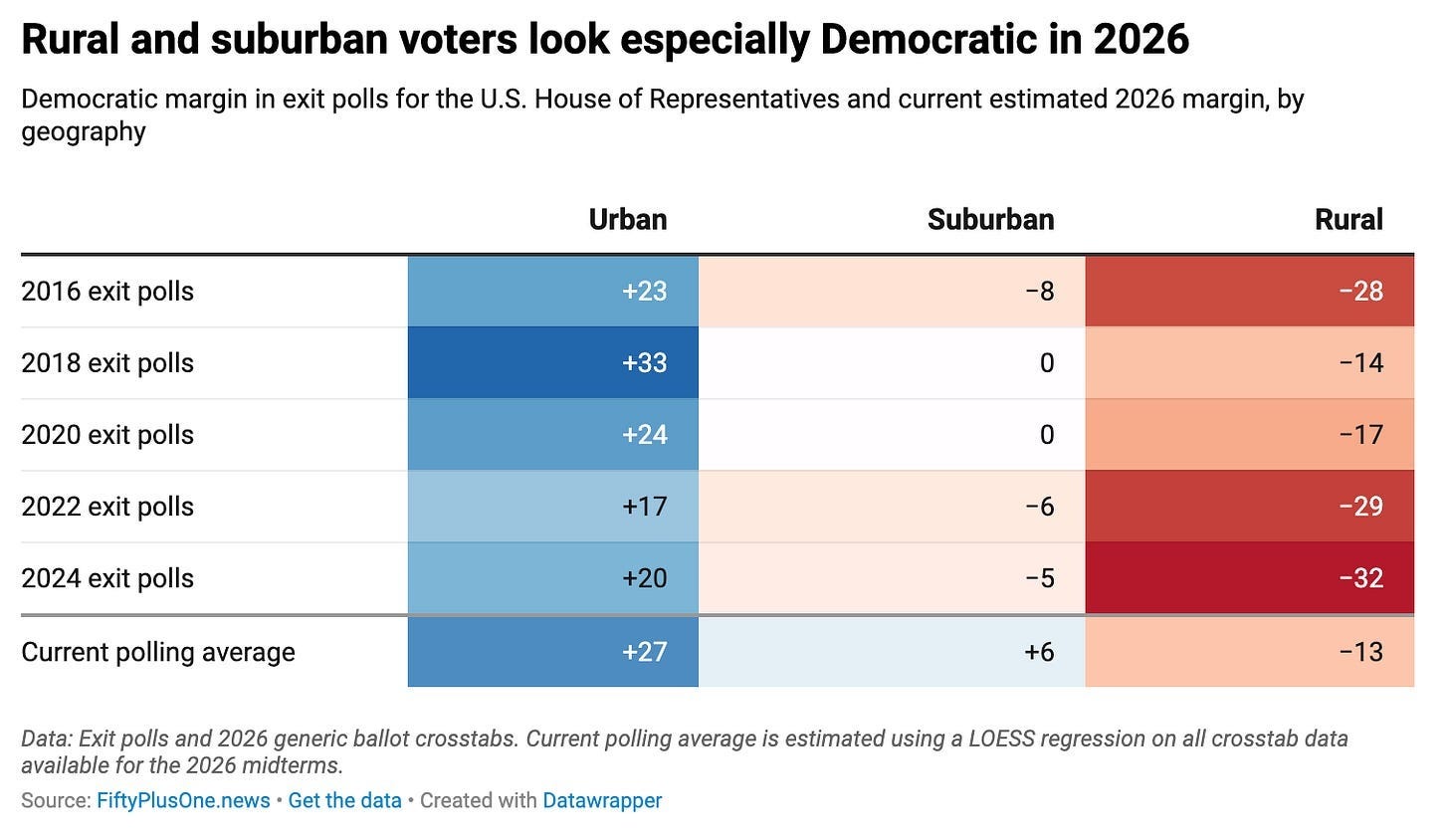
Data also confirms this erosion in support is directly tied to policy decisions Trump has made.
For instance, in a new piece titled “Gas Prices Could Cost Republicans The Midterms,” Marc Novicoff writes in The Atlantic,
Political scientists tend to agree that gas prices influence voter behavior. Although many voters no doubt understand that the president isn’t usually directly responsible for the price of oil, this time, he is. In fact, the oil shock related to Trump’s war of choice with Iran is the only reason the U.S. has any inflation to speak of. Inflation in all non-energy consumer purchases is at just 2 percent over the past year. If Democrats manage to take back the House and Senate in November despite an inhospitable electoral map, the Trump effect on gas prices may well be the reason.
And let’s not forget Trump’s decision last month to waive levies on 300,000 tons of ground beef imports. As Newsweek reported just last week,
President Donald Trump’s net approval among rural voters fell 22 points from June to August, plunging as a new beef-import policy has opened a rift between the White House and ranch-country Republicans.
The shift—recorded by ActiVote’s monthly presidential approval tracker poll—has come amid Trump’s announcement on August 21 that higher tariffs would be suspended for 90 days on up to 300,000 metric tons of imported product intended for ground beef.
If polling is correct, this spells electoral doom for Republicans in November. While Democrats have long been favored to win back the House, the U.S. Senate is looking gone as well.
And should that happen, it’s only because Democrats were able to win Senate races in some of the most rural states in the country.
From Alaska
To Iowa
And Maine
After spending years successfully cultivating a devoted base of support among rural voters, it appears Trump has finally managed to alienate many of those same voters with one devastating policy after another.
And with Trump’s name not on the ballot this year, rural voters may very well take their frustrations out on members of his party who are on the ballot, whether by voting against the Republicans who enable Trump, or by simply sitting this election out in protest.
Republicans are increasingly worried about this potential electoral wipeout as the Democratic Senate map expands into even deeper red and rural Trump country.
As The New York Times reports today:
In deep-red Nebraska, which has not been seen as a top Senate battleground this year, a new super PAC, Cornhusker Majority, reserved $3.7 million ads on Tuesday. It immediately began attacking the independent candidate Dan Osborn, who is backed by Democrats.
In Kansas, Mr. Vance’s visit came just as Senator Roger Marshall, a Republican, began airing an ad attacking his Democratic challenger, Adam Hamilton, the senior pastor at the largest United Methodist congregation in the country. Another Republican-aligned super PAC linked to the artificial intelligence industry also began airing pro-Marshall ads.
Notably,
Thanks for reading!The rising price of diesel is hitting farm states especially hard, and Republicans like Mr. Marshall are rushing to show that they are trying to do something about it. This week, he wrote a public letter to the agriculture secretary urging the Trump administration to provide relief for farmers.
This post is public so feel free to share it. -
Trump: Surging gas costs are 'very inexpensive price to pay' for Iran war
President Trump referred to surging gas prices as a small "price to pay" for the U.S. war in Iran while speaking to a crowd of supporters Wednesday in North Carolina. "It's a very inexpensive price to pay for what we've done. Remember that. It's a little more. Frankly, even if it was a lot more," Trump said at a rally for GOP Senate nominee Michael Whatley in Gastonia. -
Trump 'I did that' stickers pop up on gas pumps, four years after Biden got the same treatment
President Trump is on the receiving end of some sticker shock. Detractors of the president have slapped decals faulting Trump for high gasoline prices on pumps across the country as the war with Iran grinds on. The stickers, which feature Trump pointing at the price window alongside the caption "I did that!" are identical to labels that mocked his predecessor, Joe Biden, as inflation hit four-decade highs in the summer of 2022. -
Gas prices are about to take a big jump, analysts say, with the worst still to come
The effects of the U.S.-led war on Iran are about to intensify in the form of huge jumps in the prices of gasoline and diesel, analysts predict. And despite the Trump administration's assurances, a new and potentially even more economically damaging phase of the war may be about to begin. The national average price for regular gasoline stood at $4.44 on Thursday, according to AAA, with a range of $6.09 in California to $3.92 in Indiana. That's still below the all-time national record of $5.02 in June 2022. But diesel, which has a big influence on trucking and retail prices, has continued to hit records, with the national average at $6.40 on Thursday. In California, diesel is averaging $8.35. -
Les albanais ont sauvé le dernier fleuve sauvage d’Europe des barrages hydroélectriques
"Malgré les moments de fatigue, quand la passion et le dévouement sont là, on trouve la force pour continuer. On se dit juste qu’on doit le faire, et on trouve des façons de continuer à se battre."
Cet article Les albanais ont sauvé le dernier fleuve sauvage d’Europe des barrages hydroélectriques est apparu en premier sur La Relève et La Peste.
-
«C’est devenu invivable!»: dans l’Hérault, les pêcheurs lèvent les blocages malgré les doutes et la peur
À Frontignan et à Sète, une cinquantaine de pêcheurs étaient mobilisés jeudi. Malgré des situations économiquement «invivables», ils ont accepté de lever le blocage en attendant les précisions de la ministre, dont les annonces sont encore très floues. -
Judge orders Trump administration to give 30 days’ notice before moving to demolish Kennedy Center
Ruling comes amid demolition threats by Donald Trump after being stymied from adding his name to centre
A federal judge has ordered the Trump administration to give at least 30 days’ notice before moving to demolish the John F Kennedy Center for the Performing Arts after the US president warned that it could be “ripped down”.
The US district judge Christopher Cooper issued the order on Thursday after lawyers for the Democratic congresswoman Joyce Beatty submitted evidence of Trump’s comments and sought clarification over whether the building could be closed or bulldozed.
Continue reading... -
Sébastien Lecornu présente un budget «offensif», avec 54 milliards d’économies
Le premier ministre annonce un budget avec des coupes sans précédent. L’État doit être «exemplaire» et il «contribuera en premier à l’effort» mais les collectivités locales seront aussi mises à contribution. Le sort des retraités est, lui, confié au Parlement. -
Décharges sauvages de Nestlé: la justice rouvre les vannes d’un nouveau procès
La multinationale devra répondre de la présence de tonnes de déchets autour de ses usines d’embouteillage des Vosges, selon une décision rendue jeudi 17 septembre par la cour d’appel de Nancy, qui annule le procès de première instance. -
White House withdraws nomination of ex-state trooper Lance Schroyer to head ICE
Critics had criticized administration for nominating Schroyer, who has no formal experience working in ICE
The White House has withdrawn the nomination of Lance Schroyer, a former Oklahoma state trooper, to head Immigration and Customs Enforcement (ICE), less than three months after announcing his role.
Critics had initially criticized administration officials for nominating Schroyer, who has no formal experience working in ICE, to lead Donald Trump’s aggressive immigration enforcement agenda.
Continue reading... -
La bataille de l’IA gagne le plus grand groupe de presse professionnelle de France
Infopro Digital, propriétaire des titres «L’Usine nouvelle», «La Gazette des communes» ou «Le Moniteur», veut remplacer à marche forcée une partie de ses journalistes par un outil d’intelligence artificielle générative. Malgré une décision de justice qui vient de le freiner, il n’entend pas renoncer. -
Guerre des étoiles : quand les grandes puissances militarisent l’espace à vitesse grand V
Lundi 14 septembre l’US Space Force annonçait avoir déployé des armes en orbite La militarisation de l’espace n’est pas un sujet récent, elle apparaît dès la guerre froide en même temps que la conquête spatiale. À […]
L’article Guerre des étoiles : quand les grandes puissances militarisent l’espace à vitesse grand V est apparu en premier sur Contre Attaque.
-
25 000 véhicules autonomes en Europe : Bolt fait appel au constructeur américain Lucid pour atteindre son objectif de 100 000 robotaxis en 2035
Bolt accélère dans sa stratégie de déploiement de taxis autonomes sur le Vieux Continent. L’entreprise estonienne et le constructeur américain Lucid annoncent ce 17 septembre un partenariat afin de “déployer au moins 25 000 véhicules entièrement autonomes dans plusieurs villes et pays européens”, expliquent sans plus de détails les deux entreprises.
-
Retour des Gilets jaunes: des appels dispersés dans un contexte inflammable
Depuis quelques jours, des appels à une mobilisation d’ampleur le 17 octobre émergent. À ce stade, rien n’indique qu’ils aboutiront, mais face à un budget plus austéritaire que jamais et des prix de l’énergie toujours plus hauts, les syndicats restent à l’affût. -
Présomption de légitime défense: «Cette loi permet aux policiers d’être juges et bourreaux»
Alors que la proposition de loi pourrait bientôt revenir au Sénat, des mobilisations s’organisent partout en France pour s’opposer à son adoption. Qu’y a-t-il précisément dans ce texte? Qu’est-ce que ça changerait pour les victimes de violences policières et leurs familles? Nos invités sonnent l’alarme. -
Comment les sites de paris sportifs rendent les jeunes accros
En France, les jeux d’argent et de hasard sont un juteux business. Les paris sportifs occupent une place centrale pour les opérateurs, qui n’hésitent pas à cibler de manière agressive les plus jeunes et à user de pratiques favorisant l’addiction. Plongée… -
31e saison des Rencontres interculturelles du 10e. Projection-débat. Soulèvements
Quand ?
Le 30 septembre à 18h30Où ?
Espace Jemmapes Quai de Jemmapes 75010 ParisDans le cadre de la 31e saison des rencontres interculturelles du 10e, les associations AMNESTY INTERNATIONAL GROUPE PARIS LAFAYETTE et la LIGUE DES DROITS DE L'HOMME PARIS 10-11 projettent "Soulèvements", un film de Thomas Lacoste qui explore les enjeux politiques et sensibles de plusieurs mouvements écologiques et sociaux, et les stratégies militantes de ces collectifs d'habitants et de paysans, tous liés aux Soulèvements de la Terre.
Entrée libre. Film suivi d'un débat avec :
– Morgane Joffredo, responsable de la commission justice climatique à Amnesty International France
– Nicolas Bourbon, co-animateur du groupe du travail Environnement, Écologie et Droits de la Ligue des Droits de l'HommeL'été 2026 ne permet plus de douter des enjeux écologiques et économiques majeurs de l'accaparement des terres et de l'eau par une minorité qui détient richesses et pouvoir. Le film "Soulèvements", qui évoque le mouvement des Soulèvements de la Terre, est un document d'utilité publique sur le monde agricole qui analyse les forces en présence. Il offre un regard différent sur l'urgence à imaginer et à mettre en place des nouveaux liens et de nouvelles manières de vivre visant à mettre fin aux ravages industriels et à la violence des répressions aveugles qui sont la réponse de l'État aux mouvements de contestation.
Un portrait choral à 16 voix, 16 trajectoires, d'un mouvement de résistance intergénérationnelle porté par une jeunesse qui vit et lutte contre l'accaparement des terres et de l'eau, les ravages industriels, la montée des totalitarismes, et fait face à la répression politique. Une plongée au coeur des Soulèvements de la Terre révélant la composition inédite des forces multiples déployées un peu partout dans le pays qui expérimentent d'autres modes de vie, tissent de nouveaux liens avec le vivant, bouleversant ainsi les découpages établis du politique et du sensible en nous ouvrant au champ de la démocratie et de tous les possibles ainsi qu'aux nouvelles stratégies militantes.
Contrairement à l'image d'écoterroristes qui est donnée dans les médias dominants concernant ces activistes (rappelons-le, le terrorisme a notamment été invoqué pour des gardes à vue dérogatoires contre des militants écologistes), le film nous mène à la rencontre de personnes sensées, positives, informées et riches d'un savoir documenté, soucieuses du bien commun, dont le seul tort est d'aimer le territoire sur lequel elles et ils vivent et de vouloir le préserver contre les prédations d'une agriculture industrielle et de pratiques destructrices du vivant.
Elles et ils sont majoritairement jeunes mais certain·es sont aux côtés de leur père et cette lutte commune est émouvante. Elles et ils nous racontent ce qui les a amené·es dans le mouvement des Soulèvements, et comment la violence n'est pas de leur côté. Elleux résistent face à la répression politique, évitant le plus possible les affrontements directs en se jouant autant qu'iels le peuvent des stratégies policières. Elles et ils racontent aussi leur engagement et le désir d'expérimenter dès maintenant de nouveaux liens et de nouvelles manières de vivre.
Le film dresse ainsi le portrait intime d'une organisation inédite autant que d'une jeunesse qui « vit et lutte » dans la joie et le partage, expérimentant un peu partout dans le pays, des modes de vie plus désirables.
C'est pourquoi ce film vivant, émouvant, riche d'humanité désirante, à l'inverse de l'image donnée par les m"dias dominants, est un document d'utilité publique. On adhère à l'engagement de cette jeunesse consciente de l'écocide en cours et on se réjouit de ses victoires car, heureusement, il y en a et ce sont elles qui donnent le goût du possible.
- Voir l'événement Facebook
- Voir aussi Ensemble 10e