Conversation
-
Rural Voters Strike Back: The Price Of Trump's Betrayal
source U.S. President Donald Trump arrives to speak during a roundtable on agriculture at Custer Farms. Photo by Samuel Corum/Getty Images.
This past week, the national average price for a gallon of diesel fuel set a record by surpassing $6 for the first time ever. And each day this week, the price has inched higher still.
The reason for it is clear: As even Fox Business admitted, “the price surge comes as the ongoing war between the United States and Iran continues to disrupt shipping through the Strait of Hormuz.”
What may not be quite as clear is who is bearing the brunt of these rising costs. As I examined earlier this week, increases in the price of diesel hit America’s rural areas the hardest. These are the very same areas that supported Donald Trump with a whopping 93% of the vote in the 2024 election.
What a way to pay them back.
But Trump’s betrayal of rural America goes well beyond just surging gas prices. Since his return to the White House, Trump has thrown his own rural supporters under the bus time and again. And they are not having it.
With just weeks until the midterm elections, a backlash against Trump’s devastating policies is brewing among the rural voters who helped return him to office. And Republicans on the ballot in November are about to pay the price for his betrayal.
The Big Picture is reader-supported.
To receive new posts and support our work,
consider becoming a free or paid subscriber.US AID
The first clue that Trump would have no reservations about screwing over his rural base came just hours into his second term. On January 20, 2025, Trump signed an executive order titled “Reevaluating And Realigning United States Foreign Aid,” which initiated a 90-day pause on U.S. foreign development assistance programs.
While the devastating effect of the shuttering of USAID on starving children and families understandably received most of the world’s attention, the termination of food support programs also hit U.S. farmers hard. As AgWeb reported last February,
In Pawnee County, Kan., some farmers are rethinking their spring planting plans. With the sudden dismantling of the U.S. Agency for International Development (USAID), sorghum farmers are worried there won’t be a market for their product. They’re not alone. At least 400 producers around the country rely on contracts with USAID, and many more rely on the agency without even knowing it.
“USAID often buys from grain elevators, so that impacts smaller farmers,” says Jordan Schermerhorn, a recently furloughed USAID contractor who worked with two countries in Asia. “Tons of small farmers provide USAID assistance without even knowing it.”
USAID spent about $5 billion in food assistance globally in the 2023/24 fiscal year, with roughly $2 billion of that going to purchase U.S. commodities.
And sure enough, while emergency food assistance was initially exempted, by March, at the recommendation of Elon Musk and DOGE, over 80% of USAID programs had been canceled and by July, the entire agency was shuttered, with much of remaining USAID operations folded into the State Department.
By December, the Trump administration shifted USAID’s $1.2 billion Food For Peace program over to the USDA through an interagency agreement, which, according to Civil Eats, meant that “more than a billion dollars in funds allocated to the program for fiscal year 2025 were carried over [to 2026] because they were not spent.” But by then, much damage had been done. And farmers already had a new problem: Trump’s trade war.
Tariffs
On April 2, 2025, Donald Trump announced his Liberation Day tariffs, broad-based tariffs on a huge swath of foreign trade partners, imposed supposedly to “rectify trade practices that contribute to large and persistent annual United States goods trade deficits.” In Trump’s mind, the new tariffs would make the U.S. “good and wealthy.” But in reality, for U.S. farmers in particular, they only injected chaos and caused a massive hit to their bottom line.
As The Guardian reported shortly after Trump announced his new tariff regime,
Trump’s tariff announcements began when most farmers already had spring crops in the ground – or at the very least had prepared the land and purchased inputs such as seeds and pesticides, making it impossible to switch to crops that could potentially find a market domestically.
Consensus is growing among experts that the turmoil represents an opportunity for rival agriculture economies – and disaster for US farmers.
Rep. Angie Craig (D-MN), the ranking member of the House Agriculture Committee, warned at the time that the tariffs would “Increase input costs, shut farmers out of export markets and cause middle-class families to pay more at the grocery store.”
And sure enough, according to an AEI analysis,
US agricultural exports fell by 3 percent in 2025 compared with 2024. Most of the overall decline in US exports is accounted for by two countries: China, where imports of US goods fell by $16 billion, and Canada, where imports from the US fell by $1.3 billion.
China’s retaliatory tariffs in response to Trump’s trade war hit U.S. soybean growers particularly hard.
US soybean exports to China in 2025 totaled just 7.4 million metric tons, almost 20 million metric tons less than in 2024 (a decline of over 72 percent.)
And that inured to the benefit of other agricultural exporting countries.
Brazil and other soybean exporters have benefited from the Trump administration’s most recent trade war with China. Brazil’s exports to China hit record levels in 2025, topping 85 million metric tons (an increase of almost 18 percent). Argentina’s 2025 exports to China increased to 11.5 million metric tons, almost tripling their 2024 sales to that market.
According to Flathead Beacon, Trump’s trade war hit farmers in other ways as well. Take agricultural producers in Montana:
While Montana’s exports aren’t as directly impacted by the Trump administration’s tariffs, things like the 50% levy on steel have driven equipment prices up dramatically while fertilizer prices are through the roof. Nitrogen-based fertilizer, for example, costs $660 per ton while phosphorus costs $875.
“The biggest front is our input costs due to unfortunate tariffs,” Koch said. “Our fertilizer was almost the highest it’s ever been in the history of farming. The steel tariffs raised your repair bills, your parts, anything that has metal in it. It jacked those prices up – it was very, very expensive.”
Trump tried to defray these impacts with a series of trade adjustments, including a bilateral agreement with China announced last November. But again, the damage was done. On December 8, 2025, the Trump administration announced “a new $12 billion aid package for farmers who have been hit by high costs and trade troubles, especially in export markets.”
But Montana farmers scoffed at the aid program. As Tryg Koch, part-owner of Heritage Custom Farming in the Flathead Valley of Montana, told Flathead Beacon,
“The $30 per acre will help, but it’s a far cry from what the actual losses are,” Koch said.
And
In Conrad, wheat farmer and Montana Farm Bureau Federation President Cyndi Johnson said the funds will barely cover fuel costs. While she doesn’t notice direct tariff impacts for exports, she too says input prices like high fertilizer and equipment costs have been her most significant overhead.
With the expanded global supply of cheap wheat and other crops, Johnson said American farmers are pushed out of the market as they compete with countries like Russia, Ukraine and Brazil who produce cheaper and lower quality products.
ICE Raids
According to NPR, the USDA estimates that around 42% of crop farmworkers do not have legal status in the U.S. Agriculture producers get access to these seasonal workers through H-2A visas, which allow foreign nationals to work in the U.S. farm sector on a temporary basis.
For months into Trump’s second term, even as his mass deportation program and ICE raids roiled communities around the country, farmworkers were largely spared. That is, until June 2025,
when Immigration and Customs Enforcement officers arrested more than 70 people at a meatpacking plant in Omaha, Neb., and other federal agents targeted farms north of Los Angeles on the same day, June 11.
A day later, Trump took to Truth Social to try to do damage control, vowing to “protect our farmers” and that “changes are coming.”
But it was clear the official policy of the Trump administration was not changing. And by July there were several stories like this:
Lisa Tate is a sixth-generation farmer in Ventura county, California…says she can see with her own eyes how raids carried out by agents from US Immigration and Customs Enforcement (Ice) in the area’s fields earlier this month, part of Donald Trump’s immigration crackdown, have frightened off workers.
“In the fields, I would say 70% of the workers are gone,” she said in an interview. “If 70% of your workforce doesn’t show up, 70% of your crop doesn’t get picked and can go bad in one day.
According to FoodPrint,
One preliminary analysis shows agricultural employment declined 6.5 percent nationwide between March and July of 2025. Even if workers were to come back eventually, those temporary disruptions have big consequences on fruit and vegetable farms where crops might have a harvest window of only a few days.
Some farmers have already reported that they’ve reduced plantings in response to raids, which could quickly cut production of labor-intensive crops in areas like Florida.
Crucially,
The fear of further raids hasn’t just had a chilling effect on remaining staff’s attendance: It has also made hiring more workers difficult. And for those who do show up, the pressure to keep up production threatens to make meatpacking — already one of the most dangerous industries for workers in the country — even more risky.
One Big Beautiful Bill Act
Trump’s signature budget bill, the One Big Beautiful Bill Act (OBBBA), which he signed into law last July after it barely passed Congress along party lines, has been especially devastating for rural communities.
In order to offset the cost of the bill’s massive tax cuts, the OBBBA slashed federal Medicaid spending to the tune of a trillion dollars over ten years.
Per a KFF analysis,
The Congressional Budget Office’s (CBO) latest cost estimate shows that the reconciliation package would reduce federal Medicaid spending over a decade by an estimated $911 billion…and increase the number of uninsured people by 10 million.
According to the American Hospital Association, these cuts severely impact rural communities, which disproportionately rely on Medicaid for healthcare coverage.
In nearly all states, Medicaid covers a larger share of both adults and children in rural communities than urban communities. Nearly 50% of children and 18% of adults in rural communities are covered by Medicaid. And nearly 50% of babies born in rural areas are covered by Medicaid.
As the AHA explains, “Medicaid plays a significant role in reducing uncompensated care and stabilizing hospitals in rural communities,” meaning the massive cuts to Medicaid in the OBBBA will result in the closure of rural hospitals around the country.
As The AP reported this past April,
Hundreds of rural hospitals across the country are facing closures after years of funding problems. The issue was compounded last summer by the Trump administration’s massive cuts to Medicaid, the government’s safety net for low-income Americans, whose reimbursements have long helped hospitals meet their bottom lines.
To mitigate the harms of the cuts to rural hospitals, the OBBBA included a $50 billion Rural Health Transformation Program, “billed by Republicans as a way to help hospitals in rural areas.”
But, per The AP,
Hospitals and health industry experts have warned that while the fund — $10 billion per year allocated across all states for five years — offers some support to struggling rural hospitals, it won’t save them. One reason is that the sum doesn’t come close to offsetting the $137 billion that rural hospitals expect to lose over the next decade, according to health research nonprofit KFF.
According to an analysis by Becker’s Hospital Review, as of July 2026,
Seven hundred rural hospitals across the U.S., or about one-third of all rural facilities in the country, are at risk of closing due to severe financial challenges, according to a July 21 Center for Healthcare Quality and Payment Reform analysis.
The OBBBA’s impact on rural America goes beyond just Medicaid cuts. The bill also slashed SNAP nutrition benefits by $187 billion, which since last July, has driven approximately 5 million off the program.
Per a Wisconsin Public Radio report this week,
That’s especially a concern in rural areas, where SNAP participation is higher than in cities, according to the Food Research and Action Center. Gina Plata-Nino, SNAP director for the advocacy group, said rural places also often have higher poverty rates, fewer job opportunities and less transportation options.
Nearly 16 percent of rural households were food insecure in 2024, 2 percentage points higher than the national average. That’s according to the U.S. Department of Agriculture’s Household Food Security Report, which the Trump administration canceled last year. Researchers found food insecurity in rural areas is also nearly on par with the country’s largest cities.
And even more than a year after the bill’s signing, the hits keep on coming.
There are also new rules set to take effect this month that require stores to stock more fresh foods in order to keep accepting benefits. Experts say the change will leave SNAP shoppers, especially in rural areas, with fewer options.
There was another aspect of the OBBBA that was designed specifically to help rural communities. The Act expanded Opportunity Zones, which were introduced in Trump’s 2017 tax bill, to spur investment in economically distressed areas. According to the National Association of Development Organziations,
The One Big Beautiful Bill Act (OBBBA) signed into law on July 4, 2025 made Opportunity Zones (OZs) a permanent feature of the tax code.
The most significant new feature for rural regions is the Qualified Rural Opportunity Fund (QROF), which offers investors a 30% basis step-up (compared to 10% for standard funds) and lowers the substantial improvement threshold for rehab projects from 100% to 50%. Rural areas are defined as locations outside cities and towns with populations over 50,000.
But look closer, and it’s clear where Republicans saw the real opportunity for “new investment” in rural areas as a result of the OBBBA’s new Qualified Rural Opportunity Funds.
In a post from last August, the Ways and Means Committee quoted a Bloomberg Tax analysis of the OBBBA’s “enhancements for RQOFs,” or Qualified Rural Opportunity Funds. According to Bloomberg, these funds
“may significantly lower barriers for large-scale, capital-intensive projects in rural areas—most notably hyperscale data centers…”
“the economic case for building data centers in designated rural opportunity zones becomes far more compelling.”
It’s right there in black and white in the legislative record.
And, as Brendan Duke pointed out on X:
The entire Opportunity Zone provision in One Big Beautiful Bill cost $40B over ten years.
This is the same amount as the “savings” from requiring states to fund a portion of SNAP benefits that is helping drive a rapid 5M decline in SNAP participation.
War in Iran
Before Trump launched his war in Iran at the end of February, the average cost of a gallon of diesel fuel was $3.76. Last Friday, it surpassed $6.00. Today it’s up to $6.39, a new record.
The AP’s reporting makes clear how damaging record-high diesel fuel prices are for America’s farmers, particularly as harvest approaches.
“Those prices hurt,” said Paul Mitchell, a professor of agricultural and applied economics at the University of Wisconsin-Madison. “And it’s not just the harvesting. It’s the hauling of everything, moving the grain or the silage from the field to the farm and then from the farm to wherever they’re selling it.”
Jason Kurtz, a corn and soybean farmer near Forest City, Missouri, said he was paying twice as much for diesel this year. His combine uses 200 gallons (760 liters) of fuel a day; he expected to run it for 30 days. He also needed diesel for a tractor and trucks.
“We have to harvest,” he said in an interview at his farm about 90 miles (145 kilometers) outside Kansas City on Tuesday. “We have to run the machines. We have to use the diesel, so it cuts into our bottom line.”
And it’s not just farmers who are squeezed by these higher prices, it’s rural consumers as well. As Teri Viswanath, lead economist at CoBank noted,
“Higher diesel prices also raise the cost of moving food and goods into rural areas, pushing up local prices and amplifying the economic hit compared with urban areas that have more alternatives and competition.”
But fuel is only part of the picture. Back in May, Oil and Gas Watch reported on how the war also sparked a spike in the cost of fertilizer.
Strikes on natural gas infrastructure in the Middle East and the closure of the Strait of Hormuz have spiked global fertilizer prices during a critical period for farmers.
About one-third of global seaborne trade in fertilizers typically passes through the Strait of Hormuz, which has been largely closed to vessels since the U.S. and Israel attacked Iran on February 28. The war has also choked off production of natural gas, which is used as both the primary raw ingredient to produce ammonia fertilizer and as the largest energy source for the manufacturing process.
Since the war’s start, U.S. retail prices for some types of nitrogen-heavy fertilizer blends have increased by nearly 30 percent, according to prices published by trade publication DTN/ Progressive Farmer. The price of urea, a granular nitrogen fertilizer that dissolves in water and is vital for corn, wheat, rice, and cotton crops, has increased 45 percent since the war began.
In a piece from June titled “How war in Iran creates ‘rural revolt’ in America”, Turkiye Today made a crucial observation:
But perhaps what finally broke the rural mandate was not the [increased gas] prices themselves—rural America has weathered hard seasons before—it was the response to them.
When asked at the White House in early May whether Americans’ financial situations were motivating him to pursue a deal with Iran, Trump was characteristically direct: “Not even a little bit.”
Four words that may prove more politically costly than any polling swing. Rural voters did not just feel the pinch; they heard, clearly and on the record, that the pinch was not being felt in return.
The Rural Backlash
Now, almost 20 months into Trump’s second term, there are clear signs of a rural backlash against Trump. Fox News saw evidence of it in their poll back in July.
A Fox News survey conducted July 17-20 among 1,003 registered voters found Mr. Trump’s approval among rural voters at 44% approve to 56% disapprove, a net -12 rating. That marks a 14-point reversal from June, when the same polling series had him at 51% approval to 49% disapproval, a net +2.
Rep. Jamie Raskin (D-MD) highlighted Trump’s drop in approval among rural voters in a September 6 post in which he viewed that decline as a direct result of what Raskin called
The Top Ten Reasons Rural America is Abandoning Trump and MAGA in 2026
As Raskin explained,
I have been traveling to campaign for surging Democratic candidates in rural Congressional districts across the country. A wonderful new bumper crop of Democratic candidates is poised for victory as the bottom falls out on support for MAGA and Donald Trump across rural America.
This phenomenon is not just anecdotal. The polling data confirms that as rural voters turn on Trump, they are turning TOWARD Democrats in surprising numbers.
Fifty Plus One has documented the erosion of Trump’s approval rating among rural voters since he returned to office last year. And it tracks with a definite shift away from Republicans and toward Democrats in this November’s elections.
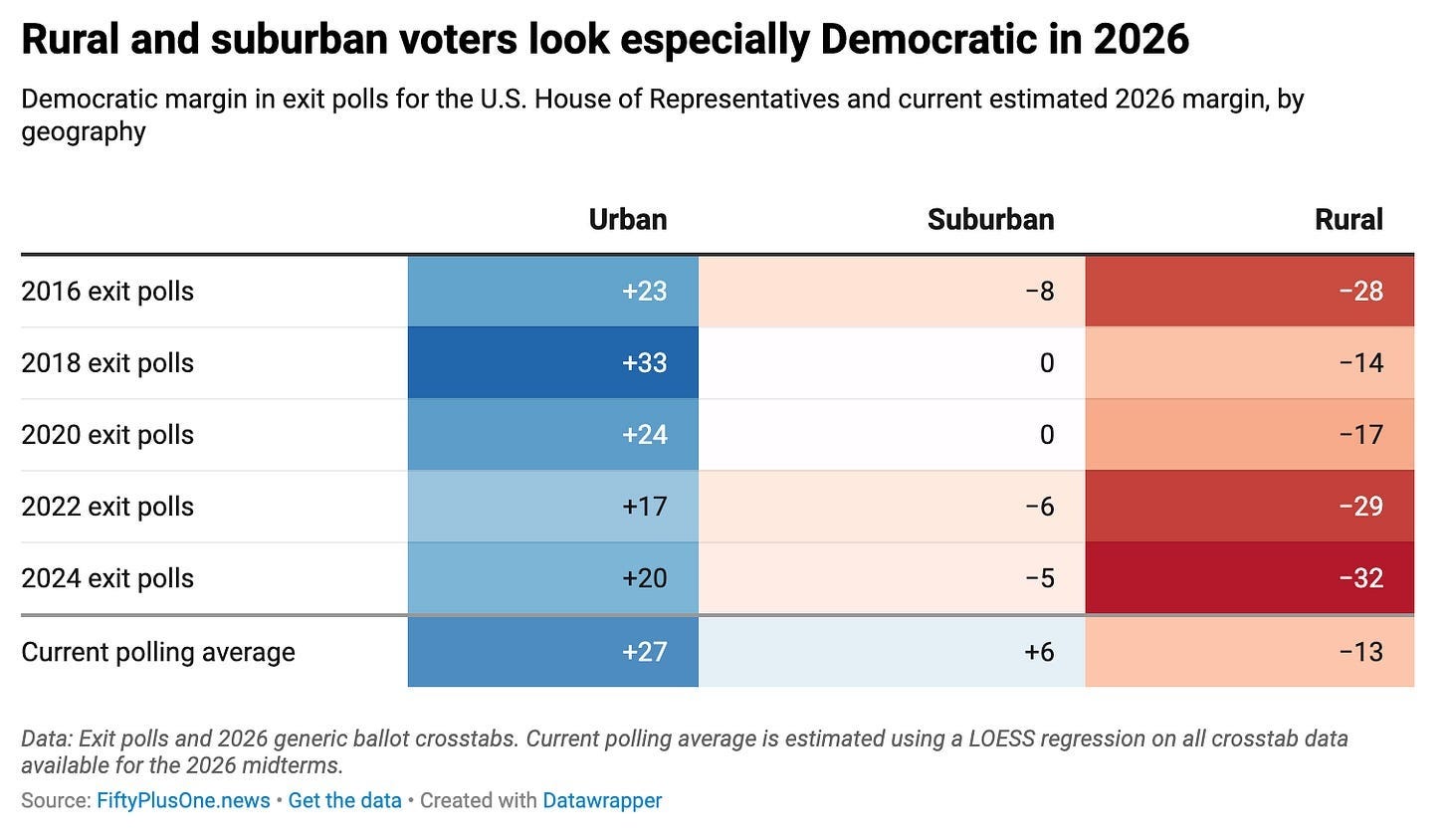
While rural voters have long voted heavily Republican, recent data indicates they could be much less favorable to the GOP this year. Since Trump’s inauguration last January, our average of generic ballot polls shows rural voters shifting 13 points toward Democrats, solidly outpacing movement among both urban and suburban voters.
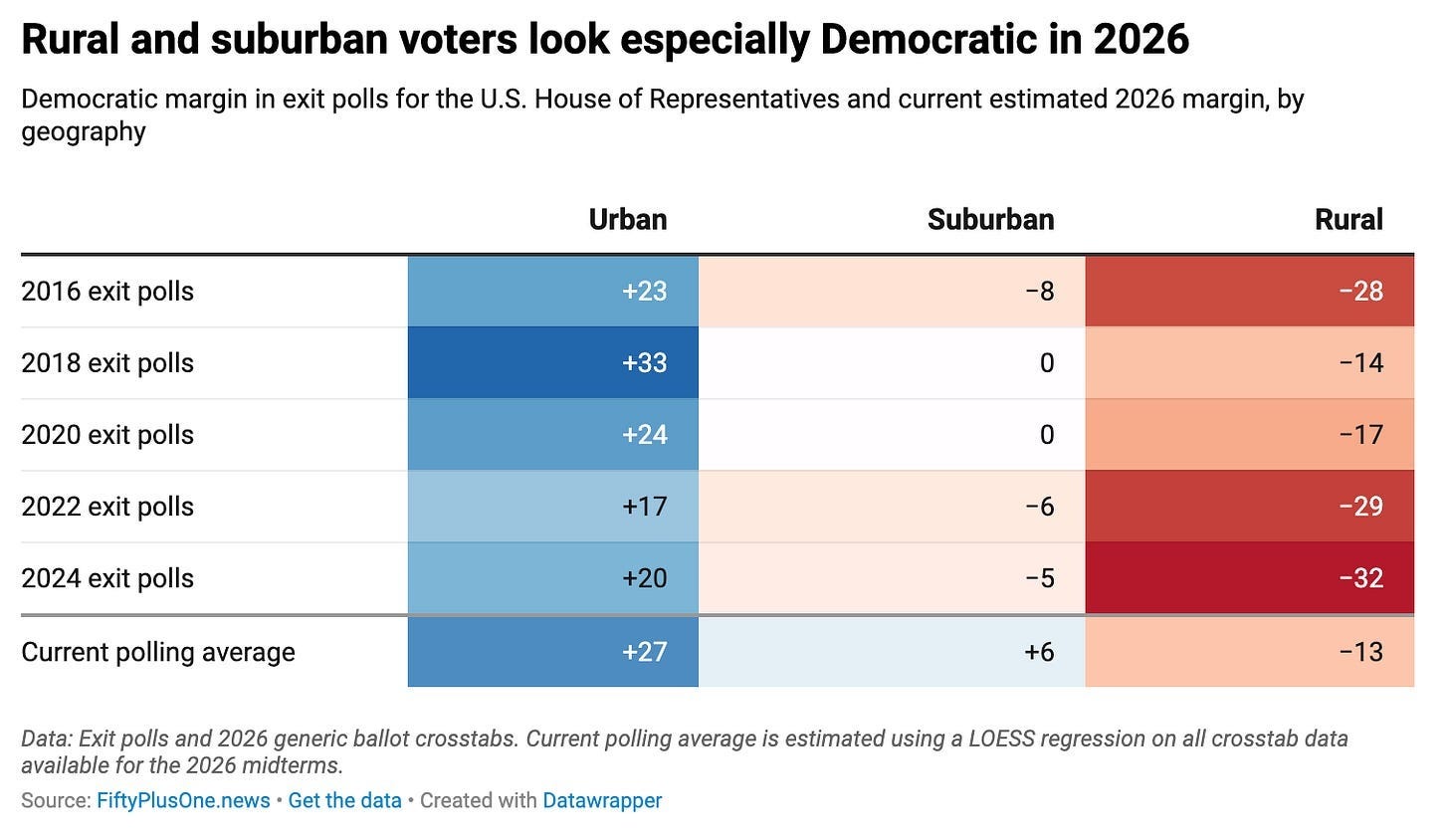
Data also confirms this erosion in support is directly tied to policy decisions Trump has made.
For instance, in a new piece titled “Gas Prices Could Cost Republicans The Midterms,” Marc Novicoff writes in The Atlantic,
Political scientists tend to agree that gas prices influence voter behavior. Although many voters no doubt understand that the president isn’t usually directly responsible for the price of oil, this time, he is. In fact, the oil shock related to Trump’s war of choice with Iran is the only reason the U.S. has any inflation to speak of. Inflation in all non-energy consumer purchases is at just 2 percent over the past year. If Democrats manage to take back the House and Senate in November despite an inhospitable electoral map, the Trump effect on gas prices may well be the reason.
And let’s not forget Trump’s decision last month to waive levies on 300,000 tons of ground beef imports. As Newsweek reported just last week,
President Donald Trump’s net approval among rural voters fell 22 points from June to August, plunging as a new beef-import policy has opened a rift between the White House and ranch-country Republicans.
The shift—recorded by ActiVote’s monthly presidential approval tracker poll—has come amid Trump’s announcement on August 21 that higher tariffs would be suspended for 90 days on up to 300,000 metric tons of imported product intended for ground beef.
If polling is correct, this spells electoral doom for Republicans in November. While Democrats have long been favored to win back the House, the U.S. Senate is looking gone as well.
And should that happen, it’s only because Democrats were able to win Senate races in some of the most rural states in the country.
From Alaska
To Iowa
And Maine
After spending years successfully cultivating a devoted base of support among rural voters, it appears Trump has finally managed to alienate many of those same voters with one devastating policy after another.
And with Trump’s name not on the ballot this year, rural voters may very well take their frustrations out on members of his party who are on the ballot, whether by voting against the Republicans who enable Trump, or by simply sitting this election out in protest.
Republicans are increasingly worried about this potential electoral wipeout as the Democratic Senate map expands into even deeper red and rural Trump country.
As The New York Times reports today:
In deep-red Nebraska, which has not been seen as a top Senate battleground this year, a new super PAC, Cornhusker Majority, reserved $3.7 million ads on Tuesday. It immediately began attacking the independent candidate Dan Osborn, who is backed by Democrats.
In Kansas, Mr. Vance’s visit came just as Senator Roger Marshall, a Republican, began airing an ad attacking his Democratic challenger, Adam Hamilton, the senior pastor at the largest United Methodist congregation in the country. Another Republican-aligned super PAC linked to the artificial intelligence industry also began airing pro-Marshall ads.
Notably,
Thanks for reading!The rising price of diesel is hitting farm states especially hard, and Republicans like Mr. Marshall are rushing to show that they are trying to do something about it. This week, he wrote a public letter to the agriculture secretary urging the Trump administration to provide relief for farmers.
This post is public so feel free to share it.