TrumpWatch publisher
-
Trump says White House needs 'military complex' as courts block his ballroom
President Donald Trump initially insisted that he needed to build a White House ballroom to entertain VIP guests. The president and his deputies have lately focused on a different argument: It's crucial for national security. The "desperately needed National Security structure" must be completed, Trump wrote on his Truth Social platform Friday night, hours after administration officials asked the Supreme Court to let them finish the controversial project.www.allsides.com -
Trump directs Hegseth to scale back joint military exercises with South Korea
President Donald Trump directed the Pentagon on Sunday to substantially scale back planned joint military exercises with South Korea, saying that South Korea declined to help with denuclearizing Iran. "These exercises are not only costly, with much of these costs paid for by the United States of America (as usual!), but send a signal that is totally inappropriate and hostile," Trump wrote on Truth Social, while emphasizing his "very good relationship" with North Korean leader Kim Jong Un.www.allsides.com -
Trump’s tough-guy image has been undone by his own actions | Mohamad Bazzi
www.theguardian.comThe president was forced to hide in a catering truck amid the Iran war, in an encapsulation of the conflict’s failures
For decades, Donald Trump cultivated a public image based on strength and dominance. He was a brash New York real estate mogul; a reality TV star who deployed his signature phrase: “You’re fired!” to eliminate contestants from The Apprentice; and eventually US president and undisputed leader of the Republican party.
In recent months, Trump has taken his boastfulness to an extreme, reportedly telling confidants that he’s “the most powerful person to ever live” and comparing himself with some of history’s most feared leaders, including Genghis Khan, Napoleon, Hitler, Stalin and Mao.
Continue reading... -
Top Democrat slams Trump’s ‘inane, haphazard’ cuts to US-South Korea drills – live
www.theguardian.comSenator Jack Reed slammed ‘another inane, haphazard decision’ after Trump ordered the Pentagon to scale back military drills with South Korea aimed at deterring North Korea
Republican senator Thom Tillis deplored Trump’s decision to cut US military drills with South Korea, which comes despite military officials from both countries warning that Kim Jong-un’s regime is learning new battlefield expertise, including new drone tactics, from assisting Russia with its war in Ukraine.
Tillis wrote on X:
South Korea has been a solid military ally for over 70 years that possesses exquisite military capabilities. Reducing joint exercises with South Korea does nothing more than free up thousands of North Korea’s troops to support Putin’s systematic kidnapping, torture, rape, and murder of innocent Ukrainian citizens.
Continue reading... -
Washington Policy Review: August 15, 2026
washingtonpolicyreview.substack.comToday’s Report
1. Overview
2. White House News
3. Truth Social Posts
4. Government Department News
5. 2028 Democratic Presidential Candidates
6. AI & Tech Company News
7. Congressional Watch
8. Policy Impact Analysis & Heatmap
1. Overview
President Trump utilized Truth Social to call for immediate Senate action on the “NO MORE CHANGING THE CLOCKS ACT.” He argued that ending the biannual practice of adjusting clocks is vital to ending “ridiculous” disruptions and suggested that additional evening daylight is a strategy for “fighting crime.” He pressed legislators to finalize the bill without delay.
In electoral matters, Trump granted his “Complete and Total Endorsement” to Florida State Representative Kim Kendall for her re-election campaign. He highlighted her experience as an air traffic controller and business owner as assets for her district. Trump praised Kendall for her defense of “Florida Values,” specifically noting her focus on election integrity, parental rights, the protection of the “under siege Second Amendment,” and her efforts to stop “Migrant Crime.”
The State Dept issued formal statements regarding two international anniversaries. Secretary Rubio extended congratulations to Liechtenstein for its National Day, highlighting the mutual commitment to “freedom” and investment, while pledging to deepen commercial ties. Additionally, the department celebrated the 66th anniversary of the independence of the Republic of the Congo, with the Secretary affirming his commitment to bolstering the commercial and security relationship between the two nations.
The administration’s push for permanent daylight savings time creates potential tailwinds for the retail and consumer sectors by extending evening activity hours, though uncertainty regarding the Senate’s legislative timeline introduces operational volatility. Concurrently, a strategic emphasis on deregulation aims to catalyze industrial and small business growth by lowering compliance costs, further reinforcing the domestic manufacturing supply chain. While these policies are intended to enhance national productivity, critics argue that broad-brush deregulation risks “weakening institutional oversight and environmental protections,” potentially exposing firms to future regulatory reversals. This combination of pro-cyclical labor shifts and reduced industrial constraints defines the current policy environment, shaping the operational landscape for domestic enterprises.
2. White House News
No White House news found.
3. Truth Social Posts
President Trump demanded that the Senate act immediately to pass the “NO MORE CHANGING THE CLOCKS ACT,” arguing that the end of biannual time adjustments is necessary to eliminate “ridiculous” disruption and chaos. He emphasized that additional daylight hours later in the day serve as a tool for “fighting crime” and urged lawmakers to “GET IT DONE” without further delay.
Regarding electoral politics, Trump bestowed his “Complete and Total Endorsement” upon Florida State Representative Kim Kendall for her re-election campaign. He characterized Kendall as a “Strong Champion” for her district, citing her professional background as an air traffic controller and business owner as evidence of her capability. He praised her for defending “Florida Values,” prioritizing election integrity and parental rights, and stated that she remains committed to stopping “Migrant Crime” and defending the “always under siege Second Amendment.”
Reference: https://truthsocial.com/@realDonaldTrump
4. Government Department News
State Department (state.gov)
Secretary of State Marco Rubio extended congratulations to Liechtenstein on its National Day. The statement emphasizes the long-standing partnership between the two nations, built on a mutual commitment to freedom and cooperation regarding business and investment. Secretary Rubio expressed a dedication to deepening commercial ties and fostering innovation to advance shared prosperity and commercial diplomacy goals in the coming year.
The Republic of the Congo National Day
Secretary of State Marco Rubio congratulated the people of the Republic of the Congo on the 66th anniversary of their independence. Highlighting a historic collaboration that spans over six decades, Secretary Rubio stated his commitment to strengthening the commercial and security relationship between the two nations. The message concluded with best wishes for a prosperous year ahead for the Republic of the Congo.
5. 2028 Democratic Presidential Candidates
JB Pritzker (gov.illinois.gov)
Daily Public Schedule: Saturday, August 15, 2026
Governor Pritzker has no public events scheduled for Saturday, August 15, 2026.
6. AI & Tech Company News
No relevant AI & tech company updates found for this date.
7. Congressional Watch
Covers the 2026-08-14 session — the Congressional Record is published with a one-day delay.
No Congressional Record found for 2026-08-14.
8. Policy Impact Analysis & Heatmap
This analysis is provided for informational purposes only. It does not constitute investment advice or a recommendation to buy or sell any security.
Impact on Market
Based on today’s policy developments, our analysis identifies the following market impact themes:
THEME 1. LEGISLATIVE PUSH FOR PERMANENT DAYLIGHT SAVINGS
The administration is accelerating pressure on the Senate to permanently adopt daylight savings time to enhance productivity. Retail and consumer sectors anticipate a marginal boost from consistent evening activity levels. Opponents express concern that these shifts ignore potential health impacts associated with permanent non-standard time. Uncertainty regarding Senate timing remains a primary risk factor for logistical planning.
THEME 2. REGULATORY DEREGULATION AND DOMESTIC FOCUS
The administration continues to utilize formal endorsements to signal a hardline stance on deregulation and domestic manufacturing. This strategy aims to reduce compliance burdens for industrial firms and small businesses. Critics argue that such broad-brush deregulation risks weakening institutional oversight and environmental protections. Investors note that this policy trajectory suggests a high likelihood of continued administrative support for domestic supply chain sovereignty.
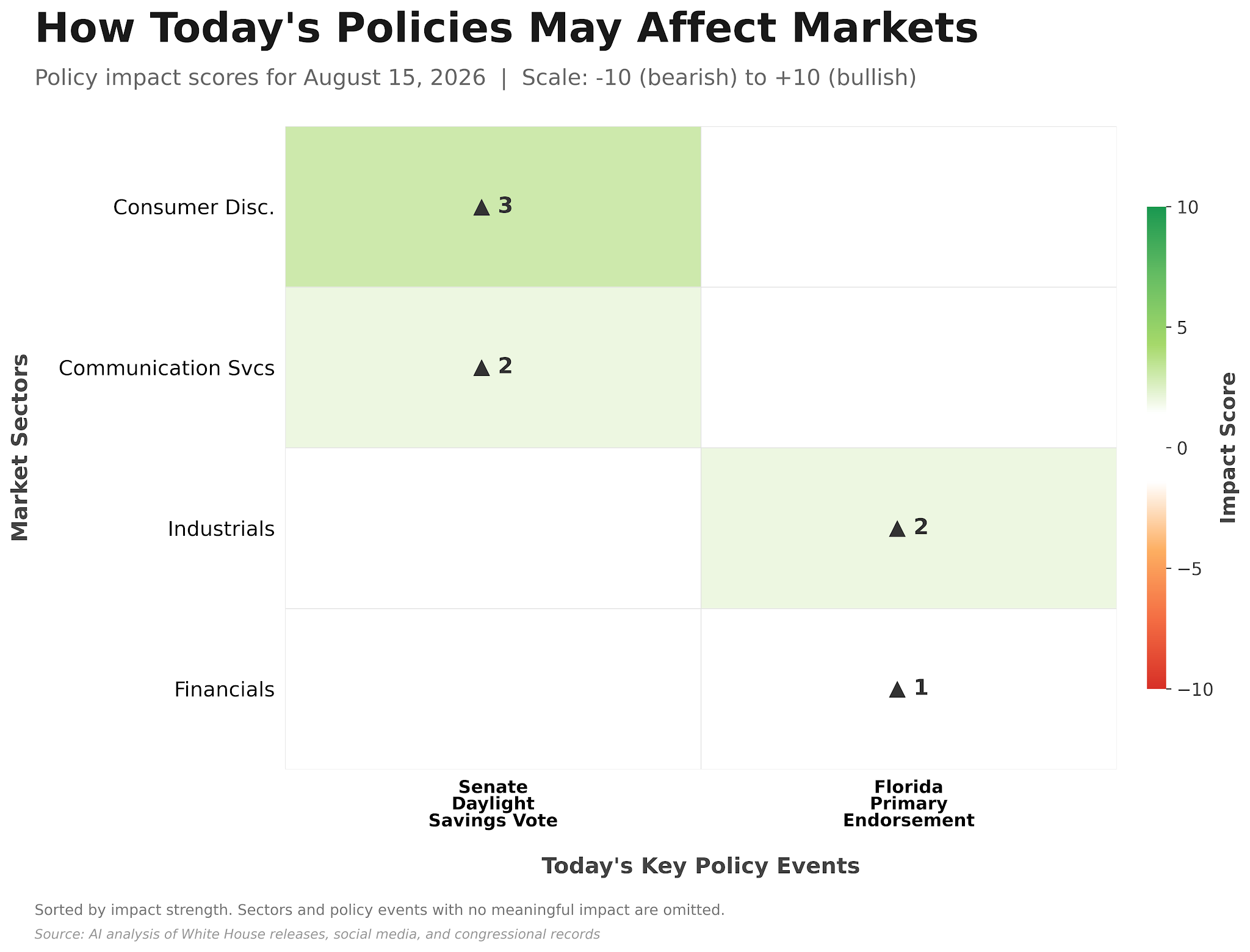
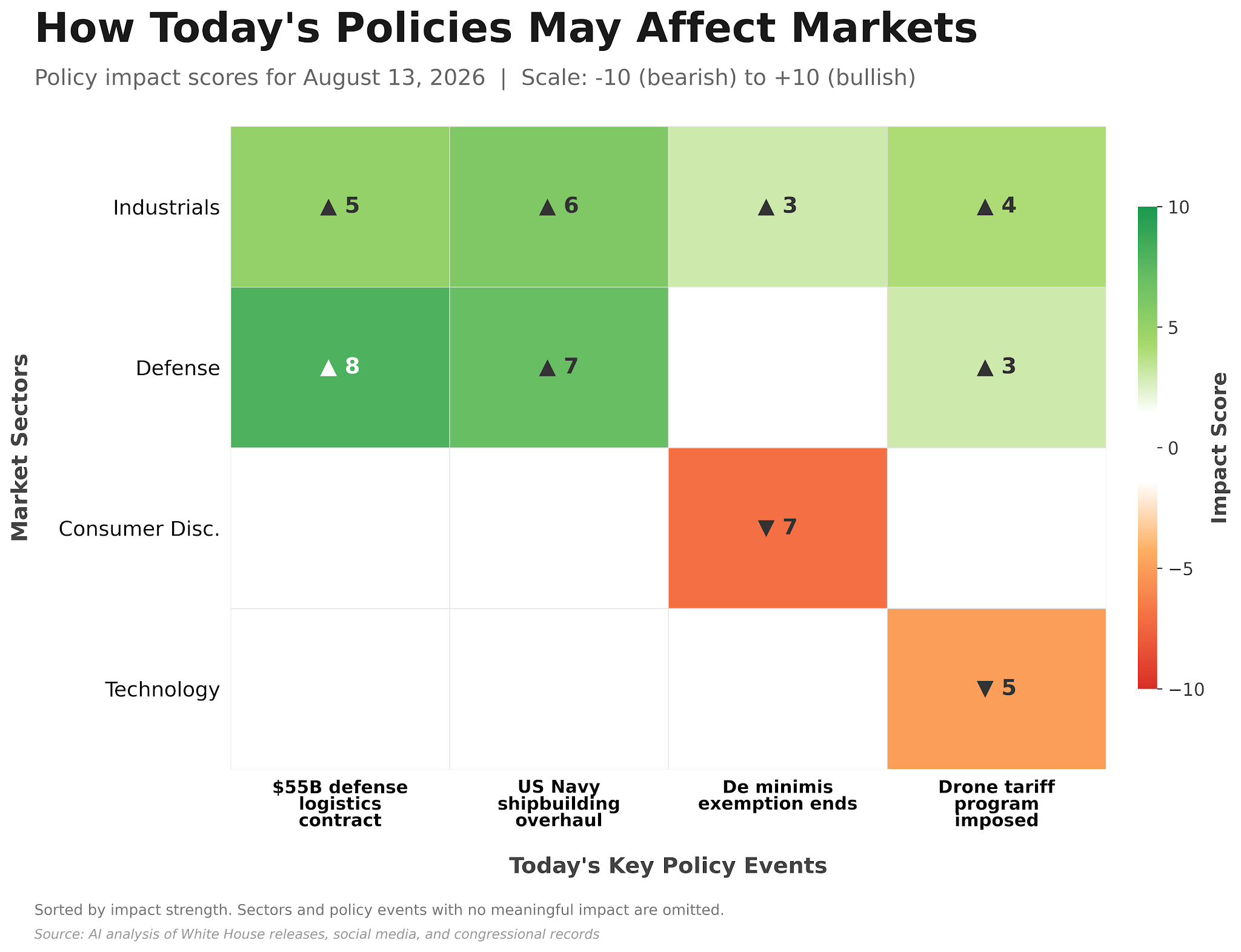
Policy Impact Heatmap with Market Direction
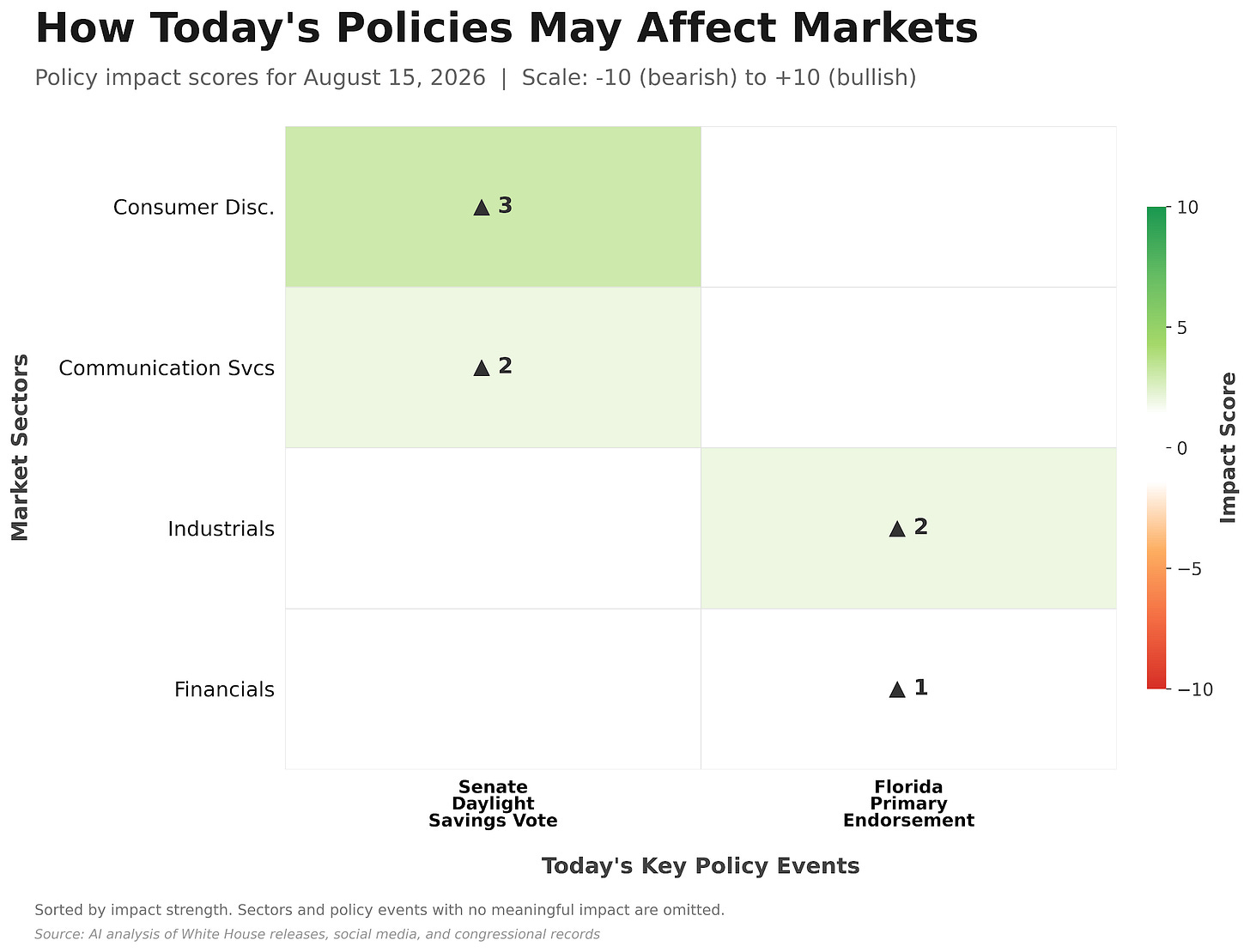
Each cell shows an estimated impact score on a fixed scale of -10 to +10, reflecting how today’s policy developments may affect each market sector. Positive scores (green, ▲) suggest bullish impact; negative scores (red, ▼) suggest bearish pressure. Rows and columns are sorted by impact strength, and sectors and policy events with no meaningful impact are omitted. The heatmap, the analysis below, and the Impact on Market themes above are produced from a single unified analysis: the heatmap visualizes the magnitudes, while the text explains the causal reasoning behind them.
Market attention focuses on the push to finalize the No More Changing the Clocks Act. This shift aims to reduce economic disruption caused by the biannual transition. Analysts expect positive impacts on consumer discretionary spending and retail traffic due to extended evening daylight. Retailers and entertainment venues often benefit from increased consumer activity during later hours. Supporters argue the current system causes unnecessary productivity losses and organizational chaos across sectors.
Simultaneously, the administration continues to prioritize domestic manufacturing and regulatory reduction. The recent endorsement of candidates aligned with these policies signals continued friction for existing labor regulations. Critics warn that aggressive deregulation may lead to negative externalities for industrial compliance. However, proponents argue these actions foster a more favorable environment for localized production and capital investment. Market participants remain focused on how these executive-led priorities influence upcoming legislative agendas and federal agency oversight.
Noctral is an app. You spend ten minutes being interviewed by an AI about what you’re working on and what you’ve changed your mind about. That becomes your Digital Twin. Overnight it meets the twins of the people who think closest to you, using vector similarity rather than job titles. What comes back is up to you: someone to argue with, someone working on the same problem from another angle, or something you’d never have thought to build alone.
For anyone carrying an argument they’d like to test on someone sharper. Free on iOS.
-
Judicial Notice (08.16.26): Curtain Time
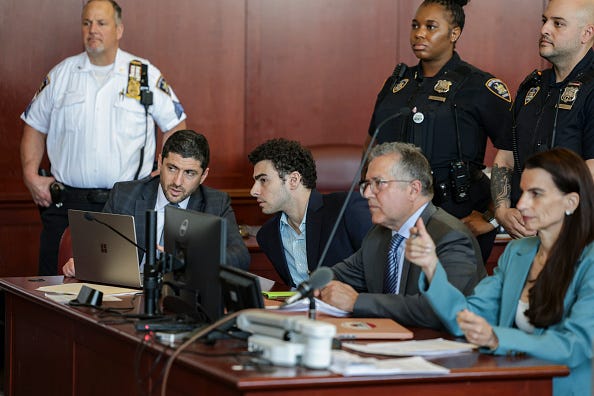
davidlat.substack.com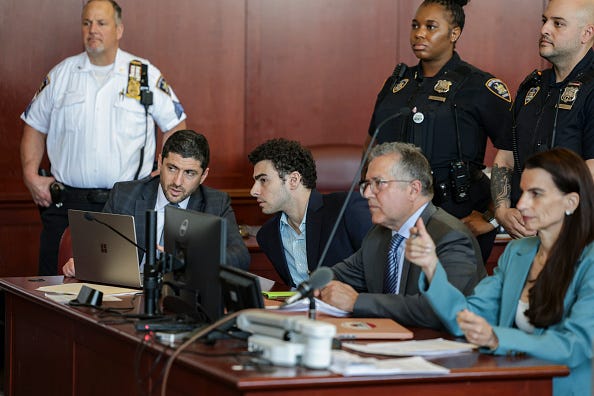 Seated at counsel table, left to right: Jacob Kaplan, Luigi Mangione, Marc Agnifilo, and Karen Friedman Agnifilo (photo by Jeenah Moon via Getty Images).
This week’s Judicial Notice is sponsored by
Chambers-ranked and Harvard-educated, Jeff is the trusted closer for high-stakes disputes. His battle-tested system of managed communications empowers clients to make clear, strong decisions in a calm, informed environment. It makes the right resolution obvious. If settlement seems impossible, call him.
It’s hard to believe, but summer is almost over (and for the school-age kids of some of my friends who don’t live in the northeast, summer already is over, as I see from their back-to-school posts on social media). Summer is my favorite season—not because I love the heat, but because I appreciate the season’s more relaxed vibe—so I’m sad that it’s coming to an end.
The highlight of last week for me was guest-hosting the Advisory Opinions podcast, together with my husband Zach—aka Zachary Baron Shemtob, executive editor of SCOTUSblog. Sarah Isgur and David French left huge shoes to fill, so Zach and I enlisted some help. For Tuesday’s episode, we were joined by Amy Howe, co-founder and primary reporter of SCOTUSblog; for Thursday’s episode, our guest was Adam Feldman, author of Legalytics. Thanks to Sarah and David for the opportunity, and thanks to Zach, Amy, and Adam for the company.
Every now and then, I offer a practical tip in Judicial Notice, so here’s the latest. Last month, I almost fell for a scam, which began with a call informing me of fraudulent charges on my credit card—something that has happened to me many times over the years, which is partly why it was initially convincing. Fortunately, I figured out in the middle of the call that they were scammers (by consulting with my pal Claude).
I was disturbed by how much personal information the scammers had about me. So after hanging up on them, I froze my credit, to make it harder for unauthorized parties to open new credit accounts in my name. To learn why and how to put a credit freeze in place, check out this FTC article.
Now, on to the news.
Lawyer of the Week: Trent McCotter.
In the wake of Todd Blanche’s confirmation to serve as U.S. attorney general, who has taken on the critical duties he handled as deputy attorney general? As the #2 person at the U.S. Department of Justice, the DAG oversees the DOJ’s day-to-day operations and serves as the AG’s right hand.
For now, while we await a nominee, the duties of the DAG are being discharged on an acting basis by Principal Associate Deputy Attorney General Trent McCotter—a graduate of UNC Law, former federal law clerk and prosecutor, and former associate at Jenner & Block, interestingly enough (given the firm’s adversarial relationship with the administration nowadays). McCotter was also a partner at Boyden Gray PLLC, the prominent conservative boutique—and one of his former colleagues at the firm, Boyden Gray managing partner Michael Buschbacher, praised McCotter’s selection, declaring that “there’s no one better that Todd Blanche could have picked."
In less happy news for McCotter, he was on the receiving end of a benchslap last Monday, as reported by The New York Times (gift link). McCotter had the unenviable task of handling the controversial dismissal of an indictment leveling corruption and other charges against Gautam Adani, India’s richest man, and seven other defendants. Why was it controversial? Back in May, The Wall Street Journal (gift link) reported that Adani’s lead lawyer, Sullivan & Cromwell co-chair Robert Giuffra—who’s also one of Donald Trump’s personal attorneys—told DOJ officials that the case against Adani was preventing him from investing $10 billion in the United States.
In response to McCotter’s motion, Judge Nicholas Garaufis (E.D.N.Y.) dismissed some of the counts—including all the counts against Adani—but not all counts against all defendants. And in his 47-page opinion, the judge had harsh words for McCotter:
As noted throughout this opinion, the irregularities in the decision to dismiss the Indictment are concerning. On the current record, McCotter appears to have eschewed the professional opinions of innumerable officials from various federal offices and replaced them with his singular judgment. The fact that McCotter came to this decision largely in collaboration with defense counsel, and seemingly without input from the FBI and SEC agents who investigated the alleged misconduct, or the attorneys from the Department, SEC, and U.S. Attorney’s Office who brought the case, appears to be highly unusual. McCotter’s refusal to meet the procedural requirements of Rule 48(a)—even after the court’s clear direction to do so—evinces a lack of respect for the Judiciary as a co-equal branch.
On the bright side for McCotter and the government, Judge Garaufis rejected the speculation that the Trump administration dismissed the charges because Adani promised to invest $10 billion—and declared himself “satisfied that Defendant Gautam Adani's $10 billion investment promise was, in fact, a ‘non-consideration.’” So one can say of this case something that could be said of many matters handled by the Trump DOJ: it didn’t go particularly well, but it could have been much worse.
In other news involving a top Trump administration lawyer, I mentioned last week Trump’s selection of Will Scharf as his next White House Counsel, effective September 1. For profiles of Scharf, see, e.g., Bloomberg Law and Law360. As noted by Politico, Scharf will play an “incredibly important” role—especially if Democrats take control of the House in the midterms, then use Congress’s investigative and oversight powers to put the Trump administration through the wringer.
In memoriam: Professor Randal “Randy” Picker, a faculty member at the University of Chicago Law School since 1989, passed away at 66. May he rest in peace.
Judge of the Week: Judge Andrew Oldham.
How is a judicial opinion like a thriller? It’s important to hook the reader from the opening. Judge Britt Grant (11th Cir.) garnered favorable mentions on social media for the first paragraph of her opinion in Renfroe v. USAA General Indemnity Co., which managed the impressive feat of making an insurance case interesting:
A father and daughter owned a house together. But it was not as idyllic as it might sound—each warned the insurance company that the other would likely burn the house down. Remarkably, the insurer issued and maintained the policy anyway. Less remarkably, the house burned down a month later.
I also enjoyed the way that Judge Stephanos Bibas (3d Cir.) began his opinion in Blasingame v. Malibu Boats, LLC, a case about allegedly defective boats that he heard while sitting by designation in the District of Delaware:
The two best days in a boater’s life are the day he buys his boat and the day he sells it. Boating, while thrilling, can be expensive and even dangerous.
But who is to blame when a boat fails to live up to expectations? Plaintiffs allege that boats manufactured and sold by Malibu Boats did not perform as advertised.
Meanwhile, Judge Andrew Oldham (5th Cir.) took some flak for two recent introductions of his. Here’s the opening of State of Mississippi v. Department of Energy, which was about whether the DOE could promulgate new regulations on home cooking appliances through a “Direct Final Rule” (i.e., without going through the standard notice-and-comment process):
The Biden Administration proposed numerous regulations to make home appliances more expensive and less useful. See, e.g., Louisiana v. DOE, 90 F.4th 461 (5th Cir. 2024). As part of that effort, one official even proposed banning gas stoves. See Ari Natter, US Safety Agency to Consider Ban on Gas Stoves Amid Health Fears, Bloomberg (Jan. 9, 2023), https://perma.cc/7E2V-DFN5 (quoting statement of Consumer Product Safety Commission official Richard Trumpka [sic], Jr.). These efforts generated significant controversy and public backlash. [UPDATE (8/17/2026, 10:06 a.m.): I moved the citation to Ari Natter, which I had erroneously placed before the reference to the official’s comment about gas stoves. Also, that official’s surname is “Trumka,” not “Trumpka”—Freudian slip?]
And here’s the intro to La Union del Pueblo Entero v. Abbott, a lawsuit arguing that a Texas election law was inconsistent with the Americans with Disabilities Act:
It has long been established that mail-in ballots are prone to fraud. See, e.g., Veasey v. Perry, 71 F. Supp. 3d 627, 676 (S.D. Tex. 2014) (“Mail-in ballots are not secure.”), aff’d in relevant part, 830 F.3d 216, 256 (5th Cir. 2016) (en banc). That is why voting by mail jeopardizes election integrity and democracy itself.
These rather “Trumpy” openings—the first attacking the Biden administration, the second tying voting by mail to election fraud—led some observers to suggest that Judge Oldham, a top Supreme Court contender in the current administration, might be “auditioning” for the next SCOTUS opening.
To be honest—and with all due respect to Judge Oldham, whom mutual friends have praised—I’m not a fan of such strongly opinionated intros, especially when they run the risk of coming across as political. Readers, what do you think?
In other news about judges and the judiciary:
What do I share in common with Chief Justice John Roberts? Sadly for me, not much, but there’s this: we’ve both written for Substack. For a series on American presidents appearing in the pages of In Pursuit, the Chief Justice wrote an excellent essay on William Howard Taft (via Howard Bashman’s How Appealing).1
Speaking of Chief Justice Roberts, the current format of SCOTUS oral arguments has made him a less active questioner, according to a new study by Professors Lee Epstein and Eric Posner (via Adam Liptak).
Speaking of notable new research, Professors Stephen Choi and Mitu Gulati have posted a pair of interesting papers to SSRN: Trump v. Biden Judges: Is the Gap Closing?, an update of their earlier research into how well different judges perform on the bench, and The Last Casebook Hero, an examination of which judges are writing opinions that are making their way into casebooks.
In case you missed it, I indulged in some Friday fun and published a post asking readers to rank the circuit courts by importance.
In nominations news, last week brought word of two new nominees. First, Trump nominated Judge Lee Rudofsky (E.D. Ark.) to the Eighth Circuit (as I predicted). According to Michael Fragoso of National Review, “Between Lee’s credentials, his career, his record on the bench, and his support for the conservative legal movement, he’s a tremendous pick for the Eighth Circuit.” Over the years, the Eighth Circuit has been something of a sleepy court; but in Fragoso’s words, it’s “on the verge of being made truly great, following the strong appointments of Judges Traynor, Smith, Kobes, Stras, and Grasz”—and now Rudofsky.
Second, Trump nominated a White House lawyer, Samuel “Sam” Adkisson, to the Eastern District of Tennessee. Senator Bill Hagerty (R-Tenn.) praised Adkisson, noting his tenure “as a law clerk for U.S. Supreme Court Chief Justice John Roberts, as well as two outstanding federal appellate judges [Judges Amul Thapar and Gregory Katsas], not to mention his service as associate counsel to the most demanding client in the world—the president of the United States.”
A 2018 graduate of Yale Law School, Adkisson will be criticized by Democrats as inexperienced, but I expect he’ll be confirmed by the Senate (which Republicans control until January, regardless of what happens in the midterms). As noted by Professor Rob Luther, who worked on nominations in the first Trump administration, youth in judicial nominees is a feature, not a bug—with young district judges serving as “a blueprint of the next Republican President’s Court of Appeals judges.”
In memoriam:
Justice John Carro—who spent 25 years serving on the New York State bench, becoming the first Puerto Rican named to the Appellate Division’s First Department—passed away at 98. (One of his four children who went into the law, Justice Gregory Carro, is now presiding over the state-court prosecution of Luigi Mangione, discussed below.)
Judge Frank Bullock, Jr. (M.D.N.C.), who served on the federal bench for more than two decades, passed away at 87.
May they rest in peace.
Job of the Week: an opportunity for midlevel to senior corporate associates in Dallas.
Lateral Link is assisting a leading international law firm in its search for midlevel to senior corporate/M&A associates (4–8 years) to join its growing Dallas office. This is a unique opportunity to focus on traditional and strategic M&A transactions rather than primarily private equity work. The group is extremely busy, the firm is in growth mode, and associates receive significant responsibility and direct client exposure. The ideal candidate will have strong M&A experience from a top-tier firm, including drafting and negotiating transaction documents, managing due diligence, and running deals or significant portions of transactions. While partnership has become increasingly difficult at many top firms, this opportunity offers a stronger path to partnership on a global platform. Interested? Contact Wendy Boone at wendyboone@laterallink.com for confidential consideration.
-
New in SpyWeek: That CIA Mystery Plane, the Iran Threat to Kill Trump, Israeli and Russian Intrigue, and More
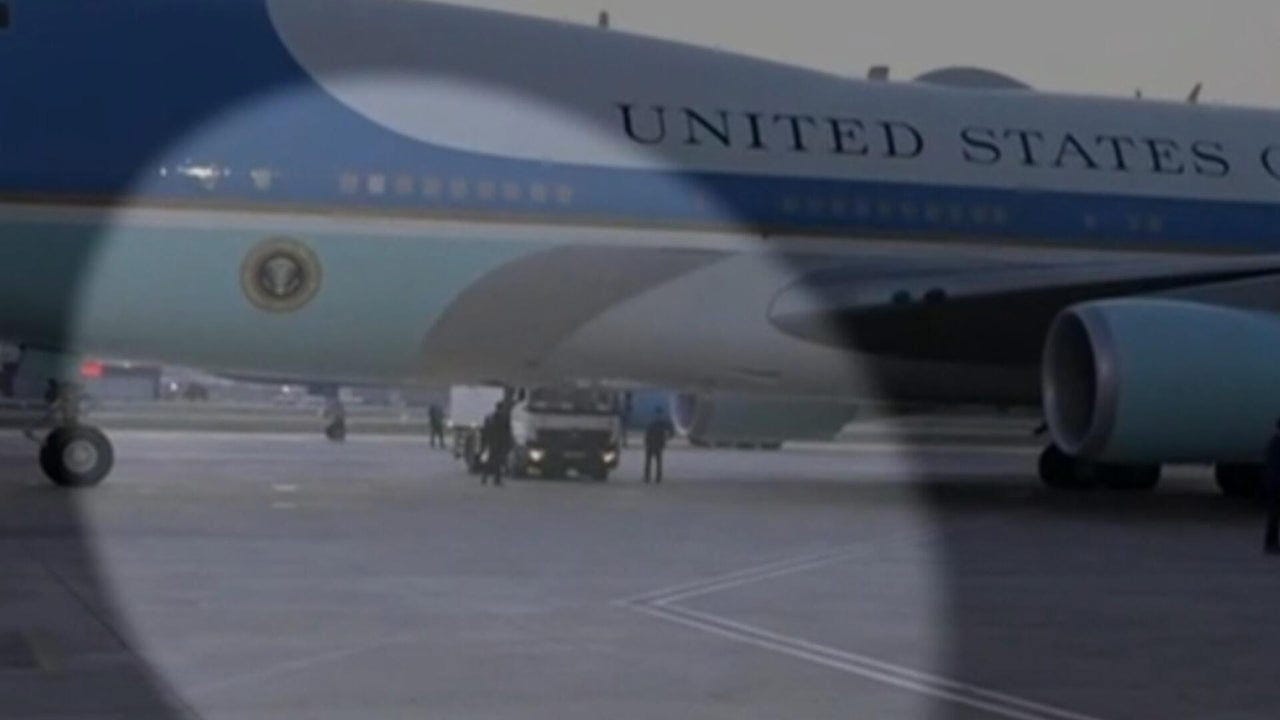
www.spytalk.co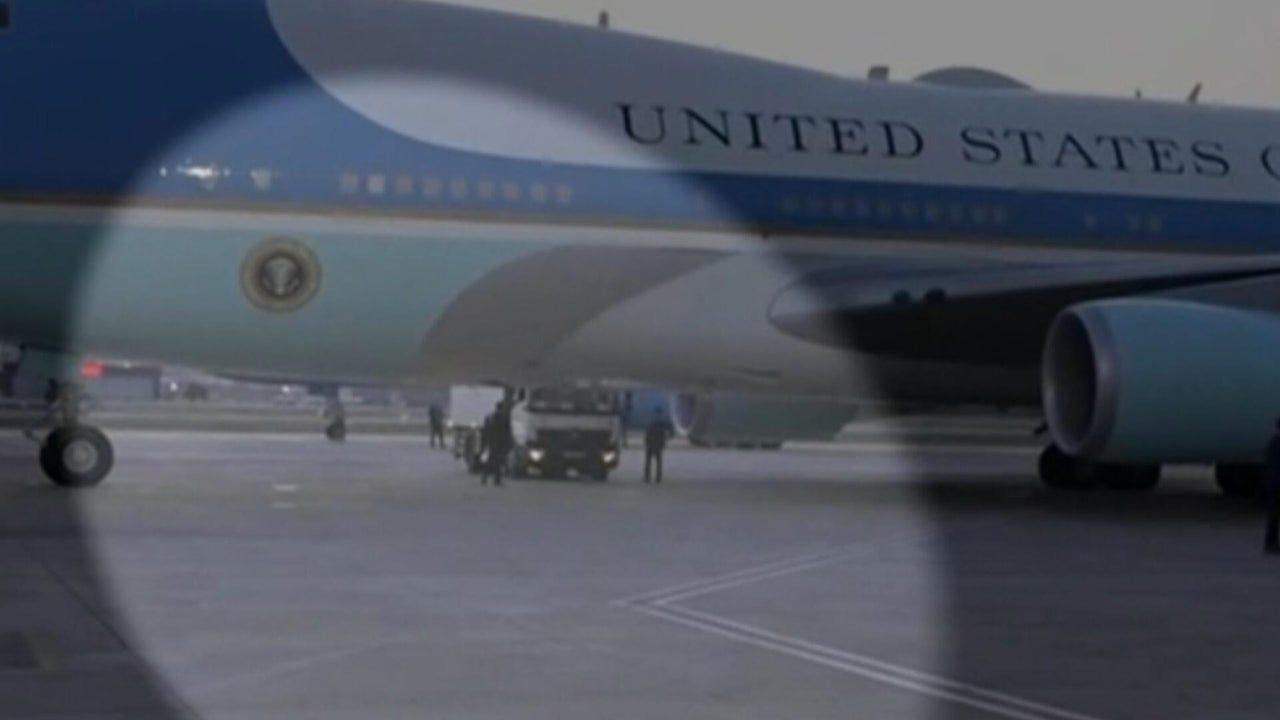 Trump slipped away from Air Force One in a catering container. Did an Israeli intelligence report cause panic? (CBS).
Israeli Plane Trick? It was a report from Israeli intelligence that prompted the Secret Service to persuade President Trump to ditch his tricked out Qatari-gifted 747 for the regular Air Force One and then secretly abandon that for yet another jet in Turkey, leaving Secretary of State Marco Rubio, Treasury Secretary Scott Bessent, other White House staffers and the press corps to fly home on what became a decoy plane. But as it turned out, the CIA had “low confidence’ in the Iranian threat before Trump switched planes in Turkey, according to The Washington Post, which quoted a source saying that the warning fitted “a broader pattern of Israeli intelligence reporting that some officials see as designed as much to shape presidential decision-making as to inform it.”
Trump’s IRGC Back Channel: Since U.S. and Israeli warplanes targeted Iran’s civilian leadership for assassination in the opening days of the now six-month long war, the Trump administration has struggled to find somebody to talk to in Tehran. So they looked around and settled on Nechirvan Barzani, the president of the Kurdistan region in Iraq, “who had something very few others do: the trust of both U.S. and IRGC leaders,” reports Trump telegrapher Barak Ravid at Axios.
Iran’s Secret Plan to Escalate the War: “Arab intelligence officials have picked up evidence—including communications between Iran and militia allies in countries such as Yemen and Iraq—of a strategic shift inside the country’s hard-line leadership to get their forces ready to widen the war and raise the costs for the U.S., officials familiar with the findings say. Alarming weaker Gulf countries like Kuwait, Iran’s leaders are increasingly talking about offensive operations on enemy territory.” (WSJ)
Disinfo on Iran Nuclear? An anonymous post on X in India in early August claiming Iran had gone nuclear and quoting its IRGC commander saying “his country would never give up its nuclear weapon ambitions as long as Israel and the United States possessed those weapons,” got traction in Washington—no matter that it was palpably untrue, reported the New York Times on Sunday.
The phony post was first boosted by Israeli social media, then PM Benjamin Netanyahu, then by Israeli TV, after which “Mike Waltz, the Trump administration’s ambassador to the United Nations, reposted the quotation, as did Senator Rick Scott of Florida, a Republican,” the Times said. “Fox News also reported the claim, as anchors and guests cited it as evidence of Iran’s duplicity.” Coincidentally, former U.S. Marine Corps Captain Haley Fuller went deep on cognitive warfare of all kinds at Military.com, but noted, “Recent reporting and disclosure filings illustrate how Israeli-linked information efforts—including paying undeclared influencers—”have combined overt messaging with targeted digital persuasion.”
Iran in U.S. Water: With U.S. cyber defenses weakened by DOGE cuts and political witch hunts, Trump administration security agencies have struggled to positively identify the exact responsibility for the foreign infiltration of American water control systems, mostly in the American heartland—although an official Iranian role is strongly suspected. Now citizen cyber-sleuths have stepped forward, with “a program to help small, vulnerable water utilities across the country combat similar attacks,” reports the Independent. “Cybersecurity experts told The Independent last week that the new wave of attacks could open a new, asymmetrical front in the U.S. war with Iran that cash-strapped and under-resourced public utilities are not prepared to face.”
CIA Mystery Plane: U.S. air attacks on fishing boats near the Galapagos Islands were aided by “a high-end business jet equipped with specialized surveillance technology,” The Washington Post reported. “In each of the incidents,” the plane ”flew from El Salvador in the direction of the fishing vessels on the days of the strikes and in the days prior, according to flight- and ship-tracking data. Details about the plane, and the pattern of its flights before the incidents, suggest that it may be linked to the secret CIA program” assisting the Trump administration’s kinetic anti-narcotics tactics in the Pacific. Survivors said that “small quadcopter drones either dropped munitions on the vessels or detonated by crashing into them. The men said they were then taken aboard a nearby ship, hooded and cuffed by armed men, and transported to El Salvador—only to be returned later without explanation to Ecuador.” Independent journalist Seth Hettena linked the plane to River City Companies LLC, a company whose “principal office is listed as a UPS Store in Henrico, Virginia, a Richmond suburb.”
Russian Plot to Kill U.S. Citizen: Polish Prime Minister Donald Tusk said Thursday his security services disrupted an “unprecedented” Russian plot to kill a Ukrainian-American citizen in the country. The suspected assassin was arrested Aug. 7, Tusk said, without naming him/her or the intended victim. “The operation to disrupt the plot was carried out in cooperation with U.S. services, said Tomasz Siemoniak, Poland’s minister overseeing intelligence services. He said the targeted victim was a U.S. citizen ‘of Ukrainian origin.’” (CBS) (AP)
Was He Really a Russian Spy? Fascinating, convoluted true spy story by veteran foreign correspondent Shaun Walker centered on Igor Rogov, a 27-year-old Russian exile in Poland whose “whole career as an anti-Kremlin activist might have been a cover story for his FSB work.” (Guardian.)
Fall Guys: On Thursday former Russian Defense Minister Sergei Ivanov “died after falling from a window at the age of 73,” a fate common among high ranking officials and oligarchs who fall out of favor (sorry) with the Kremlin. Ukrainian military veteran Mykhailo Rohoza reported on X: “Once considered one of Vladimir Putin‘s closest allies and even a potential successor, Ivanov held several of Russia’s most powerful positions, including Defense Minister, Security Council Secretary, and Kremlin Chief of Staff. The Kremlin confirmed his death.”
Like Old Times in Vienna: “Austria’s Defence Ministry has urgently asked all soldiers whether they recognise or were contacted by 21 people suspected of being Russian intelligence officers under diplomatic cover in Vienna,” Kremlin watcher Anton Shekhovtsov reported on X. “It fears the operatives (linked to the GRU, SVR and FSB) targeted military staff to extract information.” Cue The Third Man zithers.
Like Old Times in Korea: South Korean intelligence has an old-timey so-called numbers station to communicate with its secret agents in the north. It opens with KPop tunes. You can listen to a sample here. Meanwhile, South Korean police accused two ex-Chinese military men of espionage activities near U.S. bases in the country. “In one case, a man is accused of intercepting flight communications near an airbase where U.S. fighter jets are based, while in the other, information about military drills between U.S. and South Korean forces was allegedly obtained. (CNN)
Putin Testing NATO Defenses: NATO warplanes downed yet another Russian drone, this one over Romania. The incursions into NATO airspace “have become a near-weekly occurrence this summer,” said the Wall Street Journal. “Many are believed to result from Russian or Ukrainian electronic-warfare systems interfering with drone navigation equipment, but some are also suspected of being Russian attempts to probe NATO air defenses.”
Me ‘n’ the Jackal: Veteran Washington Post national security investigative reporter Joby Warrick on Thursday recounted his prison visit last year with the infamous terrorist Carlos the Jackal (real name, Ilich Ramírez Sánchez). “His audacious and brutal hostage-taking at OPEC headquarters ushered in a new form of terrorism,” the headline noted. “Fifty years later, what has he — and the world — learned?” Warrick’s feature piece was an excerpt from his new book, The Jackal: The Rise and Fall of Carlos, the World’s First Super-Terrorist. He’ll be the SpyTalk podcast’s featured guest later this week.
Kabul Chaos Remembered: Aug. 30 will mark the fifth anniversary of the calamitous end to America’s 20-year war in Afghanistan. In the confidential oral histories of the disastrous decisions by senior leaders over the decades, obtained by The Washington Post’s Craig Whitlock, one thread stood out: Washington never understood the country, its people, and its enemies—a blind ignorance fueled by faulty, or nonexistent, intelligence. As early as September 2003, Defense Secretary Donald Rumsfeld complained to an aide, “I have no visibility into who the bad guys are in Afghanistan or Iraq. I read all the Intel from the community and it sounds as though we know a great deal, but in fact, when you push at it, you find out we haven’t got anything that is actionable. We are woefully deficient in human intelligence.” See Whitlock’s monumental The Afghanistan Papers: A Secret History of the War, for more insight and teachable lessons.
Legal Spies or Provocateurs?: A federal indictment unsealed Wednesday accuses the Southern Poverty Law Center, a longtime civil rights group, of criminally paying undercover agents inside the KKK and the neo-Nazi National Socialist Movement. Prosecutors also allege that former SPLC Director Heidi Beirich “was romantically involved with an informant who was receiving payments,” according to The Washington Post. Her lawyer called the case an effort to “silence political opponents.”
Thank you for reading SpyWeek, which takes several hours to report, assemble and write over the weekend (mostly because I’m slow). But you, dear reader, keep me going with your critiques (and, of course) favorable comments, not to mention the cash with which many of you support all of us here. It really helps keep the lights on, so thank you, thank you, thank you. And to others, especially first time visitors, if you haven’t considered a paid subscription, please give it a thought now, because we just can’t do it without you. You can click below for a no-obligation free trial.
-
Trump orders cuts to South Korea joint drills despite warnings about Kim regime
www.theguardian.comPresident says he ‘gets along great’ with dictator but US officials say Ukraine war is boosting North’s capabilities
Donald Trump has said he is scaling back joint US military drills with South Korea aimed at deterring North Korea, despite military officials from both countries warning that Kim Jong-un’s regime is learning new battlefield tactics from the Ukraine war.
The drills under Ulchi Freedom Shield, one of two major annual exercises held by South Korea and the US, start on Monday and run until 27 August.
Continue reading... -
Republican senator denounces Trump’s ‘crazy, stupid’ claims about MMR vaccine safety
www.theguardian.comOutgoing Louisiana senator Bill Cassidy, a medical doctor, voted to confirm anti-vaccine activist RFK Jr as health secretary before speaking out
The Republican senator Bill Cassidy – a medical doctor who voted to confirm anti-vaccine activist Robert F Kennedy as federal health secretary in early 2025 – on Sunday denounced Donald Trump’s “crazy, stupid” claims about the safety of the combined MMR vaccine for undermining faith in immunization.
When Trump recently ordered changes to the recommended childhood vaccination schedule, with Kennedy by his side, the president called for two shots of the combined measles, mumps and rubella vaccine to be scrapped in favor of two doses of three separate vaccines, claiming that the MMR shots are “sort of like a nuclear weapon” that could be “quite lethal”.
Continue reading... -
Our Wins Of The Week
thinkbigpicture.substack.comAfter more bruising primary fights, Democrats are once again uniting heading into November.
After David Crowley defeated Francesca Hong for the Democratic nomination for Wisconsin Governor, not only did Hong graciously endorse Crowley…
But Hong joined Crowley and the entire Wisconsin Democratic slate for a unity brunch…
Which included Sarah Godlewski, Wisconsin’s Secretary of State, who is Crowley’s pick for Lieutenant Governor.
Crowley announced a massive fundraising haul in the wake of his victory.
Also on Tuesday, in Minnesota, after Lt. Gov. Peggy Flanagan defeated Rep. Angie Craig in the Democratic Senate primary, Craig also graciously endorsed Flanagan.
And as an added dose of schadenfreude, My Pillow Guy Mike Lindell, who was endorsed by Donald Trump, lost the Republican nomination for Minnesota Governor. Except he won’t concede.
Because of course 🙄
This Democratic unity comes amid new polls showing Democrats surging in the race for U.S. Senate in Ohio…
In North Carolina…
In Michigan…
And…what is happening in Kansas…?
We know times are hard across the board. We rely on the support of paid subscribers to keep us going — and to subsidize this coverage for readers who can’t afford it right now. At $6/month or $60/year (about 16 cents a day), your subscription helps keep this work accessible to everyone, not just the people who can pay for it.
-
Sex doll with bruises is worse than creepy | Brief letters
www.theguardian.comA disturbing find | World leaders in food containers | A spineless politician | Nigel Farage and Count Binface | Back-row smooching
I find it disturbing that this sex doll “had hair, a nose piercing and markings that resembled bruises and grazes” (A ‘body’ found in a suitcase was actually a sex doll. How did NSW police get it so wrong?, 12 August). I suppose it could be said that at least these injuries weren’t inflicted on a real woman, but what does it say about the (presumed) man who owned it – or the manufacturer that created it? “Creepy” is too mild a word for this .
Rosemary Fletcher-Jones
New Milton, Hampshire• Boris Johnson once hid in a fridge and now Donald Trump hides in an airline meals container (Report, 11 August). I wonder who will be the next head of government to seek refuge in something designed to store food?
Continue reading...
William Ward
London -
Australian health experts fear US vaccine scepticism is catching on as ‘anything Trump says filters through’
www.theguardian.comAustralia records 3% fall in one-year-olds fully immunised against hepatitis B as downward trend continues, expert says
Get our breaking news email, free app or daily news podcast
Australian medical experts have warned a shift in child vaccination advice in the US is not grounded in science and could undo decades of public health advances.
The US president, Donald Trump, signed an unprecedented executive order calling for American children to be vaccinated against fewer diseases, suggesting a link to autism despite no evidence. The official number of recommended immunisations for children would drop to 11, compared with 18 at the end of 2024.
Continue reading... -
Trump's DOJ allows Prohibition-era National Firearms Act to lapse
It was 92 years ago when Congress, motivated by Prohibition-era gun violence and the attempted assassination of President-elect Franklin D. Roosevelt, passed the National Firearms Act, which, among other things, made it more difficult to buy silencers, short-barreled rifles and short-barreled shotguns. It remained intact — and wasn't especially controversial — for generations.www.allsides.com -
Judge drops Nevada case against electors accused of forging certificate in 2020 election
The yearslong case against six Nevada Republicans who were accused of submitting a bogus certificate that falsely declared Donald Trump the winner of the state's 2020 presidential election has been dismissed, a judge ruled Thursday. The dismissal marks the latest setback in swing states' efforts to prosecute fake electors who tried to keep Trump in the White House after he lost to Joe Biden in 2020. Three other fake elector cases in Arizona, Michigan and Georgia have been dismissed. Arizona Attorney General Kris Mayes recently dismissed her office's criminal case but vowed to bring it back to a grand jury in hopes of securing another indictment. The dismissal was a legal maneuver aimed at getting around a deadline for starting new grand jury proceedings after Mayes lost an appeal earlier in June.www.allsides.com -
Among the First Things Attorney Matthew Skiba Did Was Target Democrats
emptywheel.net
NYT has a story about the subpoena Chicago US Attorney Andrew Boutros’ office obtained to target a Democratic political consulting firm with a tie to Judge Juan Merchan, the judge who presided over Trump’s hush payment fraud case, Fifteen paragraphs into it, Glenn Thrush revealed who carried out that politicized investigation last August: William Hogan and Matthew Skiba, two of the prosecutors in the Broadview Six case.The career prosecutors who secured the subpoena, Matthew Skiba and William Hogan, both played roles in an ill-fated case against six protesters accused of assaulting federal agents during the White House-directed immigration crackdown in 2025 known as Midway Blitz.
The U.S. attorney’s office in Chicago had to withdraw the charges in that case after defense lawyers raised concerns about the conduct of Mr. Boutros’s prosecutors before a grand jury. That prompted Mr. Boutros, who worked as a prosecutor in the office he now runs, to announce a review of internal procedures.
Thrush bolloxed the details of the Broadview Six case a bit.
Defense attorneys raised concerns about what happened in the grand jury, sure. More specifically, they pointed out how problematic it was to charge six people with a conspiracy because a large ICE SUV drove into them as they peacefully protested. Boutros’ office didn’t have to drop the charges. Prosecutors chose to do so, first, in an attempt to keep the events of the grand jury secret. Then Boutros dropped the case entirely when Judge April Perry revealed that prosecutors had engaged in taboo practices to obtain the indictment.
And it’s not entirely clear why Boutros chose to conduct an investigation — whether it was legitimate concern or just an attempt to protect the other prosecutors on the case.
Launching that showy review served to scapegoat Sheri Mecklenburg, the prosecutor who violated the taboos, and protect the other prosecutors.
That is, to protect Hogan and Skiba.
By pretending all the misconduct happened in that grand jury last October, Boutros is claiming that it doesn’t matter that Hogan redacted the transcript, hiding most of the misconduct, before handing grand jury transcripts to Judge Perry. Hogan claims and Boutros has parroted that claim that the redactions were an attempt to provide just what Perry ordered, the passages instructing on the law.
Except Hogan didn’t do that. He covered up two passages instructing on the law, too, including one that directly addressed a concern previously raised by the defense. So by focusing on the grand jury, Boutros is attempting to shut down any investigation into whether, and what, Hogan was attempting to cover-up when he redacted those transcripts, because it could be more than just the taboo tactics.
For his part, Skiba largely dodged accountability for the taboo behavior in the grand jury by — in the hearing where the case fell apart — pointing to his own inexperience. He just showed up, after all, on July 14 (after serving as a Clerk and a state prosecutor).
MR. SKIBA: So in full candor, Your Honor, I started with this office on July 14th. I had been with the office for less than two months. This was the second time I was before a grand jury. The first time was a simple PSN case
Of course, that means that one of the first things Skiba did when he believed he was protected by grand jury secrecy was to claim that being run into by a large ICE SUV was just like ambushing a Joe Biden campaign bus on the freeway, which — when exposed — was obviously an inapt precedent but also an expression of Skiba’s own raging MAGAt grievance.

Until this story, it seemed this was the first thing Skiba did when he moved from his state prosecutor job to the US Attorney’s office, to hop on the Trump Train before a grand jury.
Now we know that even before that, Andrew Boutros had entrusted Skiba, a brand new AUSA, to conduct an incredibly sensitive investigation, effectively retaliating against a judge’s family because he dared treat Trump as some subject to rule of law, like the rest of us.
And that raises more questions about why Boutros is working so hard to protect Skiba, along with Hogan.
The post Among the First Things Attorney Matthew Skiba Did Was Target Democrats appeared first on emptywheel.
-
Trump’s midterm malaise: endless war and high prices could spell doom for Republicans in November
www.theguardian.com‘Complete unraveling’ of Trump and Republican project reflects attitude of not caring at all about governance
He was always one step ahead. Donald Trump won the US presidency as a wildly unlikely outsider in 2016 and staged an astonishing comeback to win it again in 2024. Even his foes grudgingly called him a political savant with an intuition for exploiting grievances that left so-called experts floundering.
But now they are asking if the dark genius has lost his touch. Trump is trapped in the quagmire of an unpopular war, obsessing over monuments in Washington and looking for a new spokesperson after his White House press secretary quit. If the 80-year-old was deliberately trying to sabotage his Republican party in November’s midterm elections, it is not clear what he would do differently.
Continue reading... -
Families of US sailors denounce Trump and Hegseth for ‘dismissing their experiences and calling them liars’
www.theguardian.comOne US sailor’s mother asks: ‘My son signed up to serve his country. But why isn’t his country serving him?’
Naval families with loved ones deployed for months on US warships amid the Iran war have reacted with fury to Donald Trump and the defense secretary Pete Hegseth’s dismissal of their concerns about the extreme pressures and dire conditions they are enduring.
The Guardian has talked to three naval families who have been following the physical and mental stresses bearing down on their relatives with mounting alarm. The families, with loved ones onboard the USS Abraham Lincoln and USS Tripoli, all spoke anonymously for fear of retribution against their active-duty relatives.
Continue reading... -
Trump shows off article on lower drug prices that says Biden deserves credit, not him
www.theguardian.comUS president credits himself with lowest drug prices in 60 years, when article says drop is more likely due to Biden
The White House flooded social media on Saturday with an image of Donald Trump showing off the recent Washington Post headline “Prescription drug prices record sharpest drop in more than 60 years”, but failed to mention that experts cited in the article actually attributed the price drop to Joe Biden, not Trump.
On its official accounts, the White House triumphantly captioned the photograph of Trump: “POV: you bring the receipts.” Karoline Leavitt, the White House press secretary, also shared it.
Continue reading... -
Trump says he will declare Strait of Hormuz a US territory
President Trump claimed during remarks on Long Island, N.Y., on Friday that he will make the Strait of Hormuz a U.S. territory, despite the fact that Oman and Iran share jurisdiction of the waterway. "Pretty soon, I will be declaring the Hormuz Strait a territory of the United States," Trump said during an address highlighting his administration's efforts to combat crime in the U.S.www.allsides.com -
Iran rejects 'delusions' after Trump says he wants the Strait of Hormuz to be a U.S. territory
TEHRAN, Iran — A defiant Iran called on the U.S. to "accept the reality of defeat and stop indulging in delusions" after President Donald Trump suggested that he would soon declare the Strait of Hormuz a "territory of the United States." The crucial waterway that handled one-fifth of the world's oil before the war "cannot be seized with a tweet, nor with an aircraft carrier, nor by issuing an order, nor through an election speech," Iran's Deputy Foreign Minister Kazem Gharibabadi said in a post on X early Saturday.www.allsides.com -
Trump Says U.S. Will Declare Strait of Hormuz 'U.S. Territory' — 'After We Finish Defeating Iran'
President Donald Trump said Friday that the United States will declare the Strait of Hormuz "U.S. territory" after it finishes defeating Iran, escalating his assertion of American control over the strategic waterway as Tehran vowed that the strait "has been Iranian, is Iranian, and will remain Iranian." "After we finish defeating Iran, which is being very badly defeated, pretty soon I'll be declaring the Hormuz Strait a territory of the United States," Trump told a crowd during an event in Nassau County, New York.www.allsides.com -
Stephen A Smith admits Byron Donalds could make him a Republican, calls him 'the real deal'
ESPN host Stephen A. Smith said Thursday that Rep. Byron Donalds, R-Fla., could make him a Republican, praising the Trump-backed gubernatorial frontrunner days before Florida Republicans choose their nominee to succeed Gov. Ron DeSantis. "And I ain't no d--- Republican. But that mean if anybody could make me one, it would be him. I'm just going to keep it a buck. I'm just letting you know," Smith said.www.allsides.com -
Andrew Ferguson and Joe Simonson Squeal about Their $277 Fraud Charges
emptywheel.net
This is the summary of allegedly fraudulent expenditures charged against Esmerelda Soriano, an Orange County food cart owner indicted on two counts of SNAP fraud.
Devlin Barrett highlighted her case in a story about how Trump is focusing on low-level fraud while pardoning far bigger fraudsters. Barrett describes how JD Vance — whom taxpayers pay $235,100 a year so he can get his son flown by helicopter to his golf lesson — focused on this kind of case in a speech in April.
Soriano Produce, a weathered white food truck advertising ice cream treats as well as fruits and vegetables, drew the attention of undercover agents at Immigration and Customs Enforcement for what investigators said was a startlingly high number of food stamp transactions for such a small business.
The case against the food truck owner, Esmeralda Soriano, is an example of the Trump administration’s push to show that “no fraud is small enough or big enough to look away from,” as Vice President JD Vance said in a speech in April.
The new emphasis on small-dollar fraud comes as the administration has issued pardons and commutations to white-collar convicts, pulled back from pursuing criminal cases against multinational corporations and dropped high-profile charges against wealthy executives.
Barrett doesn’t mention that Todd Blanche has also bragged about focusing DOJ resources on $1,001 fraud cases.
In response to the story, the FTC’s propagandist and sometime Free Beacon hack, Joe Simonson (whom Ballotpedia describes being paid $197,200 as a part time detailee to the White House), wrote a 7-tweet screed, calling NYT a “mid-cap tech company,” pretending Barrett’s story opposed prosecuting fraud, and wailing because (he said) the NYT hates Trump for pointing out what a waste of resources this is.
The New York Times, a mid-cap tech company known for its crossword puzzles and recipes, is out today attacking the DOJ and @VP for working to arrest fraudsters. If you just read the headline and you’ll assume we’re bullying small business owners for not having the right permits.
[snip]
Interview a normal person to see if they think it’s a good idea that this administration is holding fraudsters accountable? Nope, let’s talk to this partisan weirdo instead.
The New York Times hates President Trump and Vice President Vance. That’s not a new. But how could that hatred drive them to attack bipartisan, antifraud work? Maybe they don’t just hate the President and Vice President. Maybe they hate you for caring about getting ripped off.
Nowhere in his 7-tweet screed did Joe the Free Beacon hack manage to link Barrett’s story. Nowhere in his 7-tweet screed did he manage to mention that the two charged crimes amount to $277, $724 less than even what Blanche said he was going to go after (though DOJ suspects that Soriano committed fraud on a far grander scale, to the tune of hundreds of million). Nowhere did he mention that DOJ asked to cage Soriano while she awaits trial, which would itself cost more than the alleged crime.
Nowhere did Joe the Free Beacon hack mention that HSI investigated this crime, which not only means investigators adhere to a far lower standard for investigating crimes than the FBI would, but they diverted their attention away from investigating things like child sex trafficking to hunt down $277 in charged SNAP crimes.
Nowhere did Joe the Free Beacon hack mention that this focus on low-level fraud arises, in part, from a stupid directive Aakash Singh (whose exact salary is not public, but is somewhere north of $160,000, a huge boost from the $64,362 Chuck Grassley used to pay him) imposed, which has correlated with a significant drop in white collar crime prosecutions.
To try to drive up the number of cases, department officials have internally declared that each assistant U.S. attorney should have at least 25 open cases at all times. For a low-level prosecutor handling common drug or violent offenses — or food stamp fraud — that is not particularly high. For a senior prosecutor handling complex public corruption or corporate fraud investigations, two dozen open cases can be a crushing workload.
In phone calls to prosecutors around the country, a senior Justice Department official, Aakash Singh, has pushed back against criticism of the rule. That threshold of 25 cases is the bare minimum to show that a prosecutor “has a pulse,” he has told officials, according to people familiar with his remarks, who spoke on the condition of anonymity to share the details of internal discussions.
[snip]
From the start of Mr. Trump’s second term to this May, the administration brought 4,747 white-collar cases, or about 5 percent of the total criminal cases, according to federal statistics analyzed by Justice Connection, a group of former department employees that has been critical of the Trump administration’s sweeping changes.
Those figures are a significant drop from previous administrations (5,554 cases from the same period under President Joseph R. Biden Jr.; 6,626 cases in Mr. Trump’s first term; and 8,781 cases in President Barack Obama’s second term).
Nowhere did Joe the Free Beacon hack mention that Orange County’s DA — who would, traditionally, prosecute this kind of low level crime — is also working on this case. So is USDA’s Inspector General, who might otherwise investigate why Brooke Rollins (who is paid $253,100) was engaged in pay-to-play with a SNAP contractor.
Concurrently with Army 250, a fundraising mechanism was being test driven at the U.S. Department of Agriculture (USDA), using the congressionally-chartered nonprofit partner of the U.S. Forest Service, the National Forest Foundation (NFF), as the enabling fundraising nonprofit.
The test drive centered on the Great American Farmers Market (GAFM), which was staged in 2025 and billed as “a weeklong celebration of food, family, and farming.”28 Planning meeting agendas for the staff of USDA Secretary Brooke Rollins—which were obtained by Committee Democrats—showed that she or her staff intended to solicit donations for the event from companies with business before the federal government, since USDA was a sponsor of the event.29
[snip]
Four companies—Chobani LLC, Visa, Inc., John Deere, and Tractor Supply Company—each contributed between $100,000 and $499,999,33 routing the money to the “Secretary’s Priorities” fund, which gives the USDA Secretary wide latitude to spend on “initiatives that are directly aligned with the mission and priorities of the USDA Forest Service.”34
At least three of the four contributors held clear business interests before the government. Chobani holds over $12 million in contracts with USDA that are described as “commodities for [U.S. government] food donations” and are derived from the Supplemental Nutrition Assistance Program (SNAP) and Child Nutrition Programs, Food and Nutrition Service accounts.35 Visa was fighting an antitrust lawsuit brought by the U.S. Department of Justice.36 John Deere was fighting an antitrust lawsuit brought by the Federal Trade Commission.37 The company had also been singled out in 2024 by then-candidate Trump with a threatened 200 percent tariff if John Deere moved its manufacturing to Mexico.38 Put plainly, companies with matters pending before the federal government paid into a fund controlled by a Cabinet secretary, routed through a conservation charity that had to manufacture a forestry rationale to accept the checks.
After Joe the Free Beacon hack posted his 7-tweet screed, his boss, FTC Chair Andrew Ferguson (who makes around $197,200), RTed the 7-tweet screed with a flame and a thread emoji, falsely claiming that any of this demonstrated Ferguson and JD Vance’s little Fraud Task Force’s commitment to prosecuting all fraud.
🔥🧵from @SaysSimonson
. As usual, Joe is exactly correct about this. When we said we’re going to stop fraud against government programs, we meant ALL fraud. Every dollar this woman allegedly stole from American citizens was an injustice. She’s getting what she deserves: JUSTICE.This is all intended to serve as theater claiming to hunt waste fraud and abuse.
This theater is costing taxpayers far, far more than the charged crime in this case. Just a single helicopter flight to a golf lesson for 9-year old Ewan Vance costs more than this charged crime.
And taxpayers are paying Joe the Free Beacon hack to distract you from that fact.
The post Andrew Ferguson and Joe Simonson Squeal about Their $277 Fraud Charges appeared first on emptywheel.
-
Donald Trump doesn’t just love billionaires, he loves multimillionaires too
www.theguardian.comUS tax policy deprives the government of revenue and overwhelmingly serves the interests of the rich
After the House passed its version of Donald Trump’s One Big Beautiful Bill Act (OBBBA) last year – the one that paired a $5tn-plus tax cut with $1tn-plus of cuts from food stamps and Medicaid – the House speaker, Mike Johnson, explained that “this is not giving tax cuts to the millionaires”. The beneficiaries, he said, were “small business owners” that “provide the jobs in every community in America”.
Johnson was playing to the myth of the modest, sturdy Main Street job creator. It is an appealing story. It’s also the most consequential piece of BS distorting American policy that deprives the government of tax revenue, stunts American capitalism, twists regulations, thwarts competition and overwhelmingly serves millionaires’ interests.
Continue reading... -
Washington Policy Review: August 14, 2026
washingtonpolicyreview.substack.comToday’s Report
1. Overview
2. White House News
3. Truth Social Posts
4. Government Department News
5. 2028 Democratic Presidential Candidates
6. AI & Tech Company News
7. Congressional Watch
8. Policy Impact Analysis & Heatmap
Noctral is an app. You spend ten minutes being interviewed by an AI about what you’re working on and what you’ve changed your mind about. That becomes your Digital Twin. Overnight it meets the twins of the people who think closest to you, using vector similarity rather than job titles. What comes back is up to you: someone to argue with, someone working on the same problem from another angle, or something you’d never have thought to build alone. For anyone carrying an argument they’d like to test on someone sharper. Free on iOS.
→ Download on the App Store
→ noctralai.com1. Overview
President Trump issued a commemorative message marking the 81st anniversary of the end of World War II, celebrating the “complete and total victory” of American forces and the sacrifice of the “Greatest Generation.” Regarding domestic policy, he honored the 91st anniversary of the Social Security Act while touting the elimination of federal taxes on benefits for millions of seniors. Additionally, the President signed a memorandum aimed at preventing “criminal illegal aliens and fraudsters” from accessing Social Security, describing the move as a necessity to ensure program integrity and financial stability.
The Department of State extended congratulations to India for its Independence Day, emphasizing the “stronger than ever” U.S.-India partnership, and similarly marked the Republic of Korea’s national day by highlighting the two nations’ “unwavering commitment” to mutual security. The Department of State also coordinated $11 million in new humanitarian aid for Colombia following a major earthquake, facilitating the delivery of supplies via SOUTHCOM. The Department of War finalized agreements with Boeing and RTX to accelerate production of missile interceptors, with officials stating the goal is to place the defense industrial base on a “wartime footing.” Furthermore, HHS Secretary Kennedy continued his focus on nutrition, showcasing low-cost healthy meals and announcing that major health systems have joined a pledge to prioritize “nutrient-dense” food in hospitals.
Governor JB Pritzker announced a significant $800 million investment by Stellantis to reopen a facility in Belvidere, Illinois, for the production of the next-generation Jeep Cherokee. Pritzker also signed legislation establishing a state flood rebate program, asserting that the initiative is required because “the Trump administration retreats from its responsibility” regarding federal disaster assistance. Governor Gavin Newsom announced bond financing for the La Brea Tar Pits research center, while Senator Jon Ossoff’s office highlighted his legislative success in passing the Federal Prison Oversight Act to address systemic corruption. Governor Andy Beshear conducted several administrative appointments for various state boards, including the Kentucky Parole Board and the Board of Nursing.
Anthropic announced the implementation of new watermarking technology in future Claude models to align with requirements under the EU AI Act. The company explained that this method influences the model’s word selection to create an undetectable pattern, allowing for the verification of machine-generated text. This technical shift aims to provide security and transparency in output while maintaining the quality and “creativity” of the model’s responses.
The Senate and the House of Representatives both held brief pro forma sessions on August 13, 2026, with no legislative business, debate, or votes conducted in either chamber. During the House pro forma session, members introduced 27 new public bills and three resolutions. No committee meetings took place, and both chambers are scheduled to reconvene for further pro forma sessions on August 17.
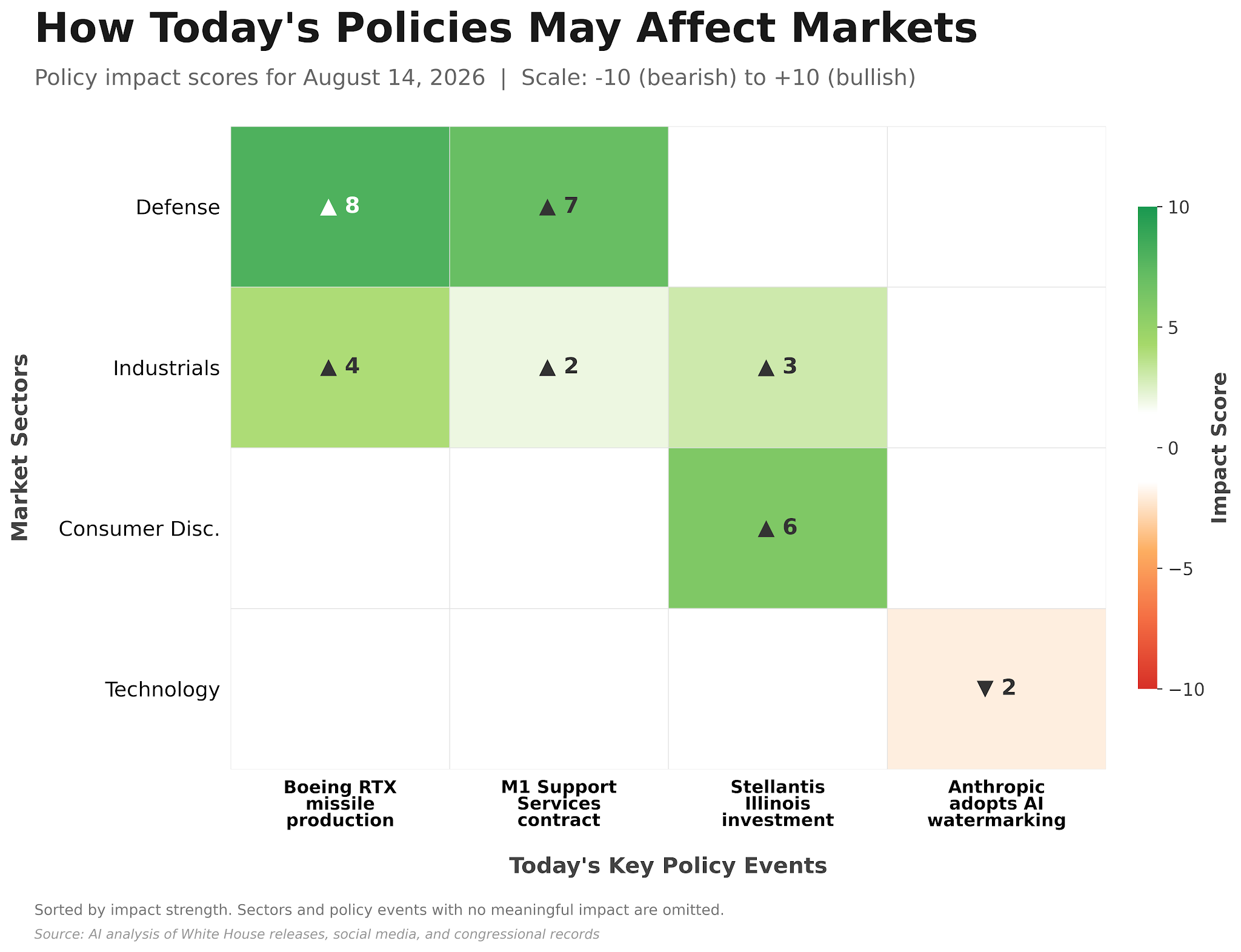
Expansion of the defense industrial base via long-term supply chain framework agreements provides a structural revenue tailwind for prime contractors, though critics warn that reduced competition may create persistent inflationary pressure on procurement budgets. Simultaneously, regional automotive manufacturing is experiencing a resurgence fueled by state-level capital incentives for electrification, despite concerns that such public-private partnerships represent an “inefficient use of state taxpayer resources” compared to organic market development. Conversely, the technology sector faces mounting operational headwinds as rigorous international watermarking mandates impose technical standardization costs, a trend detractors claim prioritizes “bureaucratic control over innovation” at the expense of software development velocity.
2. White House News
Presidential Message on the Anniversary of Winning World War II
President Trump commemorates the 81st anniversary of Imperial Japan’s unconditional surrender, marking the “complete and total victory” of American forces in World War II. The President honors the “Greatest Generation” for their sacrifice in battles like Midway and Iwo Jima, noting that over 400,000 Americans died to preserve freedom. Today, he emphasizes that Japan is a close ally, joined with the United States in the “defense of a free and open Indo-Pacific,” while vowing that the “valor” of these veterans will forever define the American story.
Reference: https://www.whitehouse.gov/briefings-statements/2026/08/presidential-message-on-the-anniversary-of-winning-world-war-ii/
Presidential Message on the Anniversary of the Social Security Act
President Trump commemorated the 91st anniversary of the Social Security Act, pledging to “defend Social Security” and “protect America’s seniors.” He highlighted the Working Families Tax Cuts Act, which eliminated federal taxes on Social Security benefits, providing over 35 million seniors an average deduction of $7,500. Additionally, the President signed a memorandum to stop “criminal illegal aliens and fraudsters” from accessing benefits, aiming to eliminate “waste, fraud, and abuse.” His administration maintains these efforts are designed to ensure long-term program integrity and financial stability for retirees.
Reference: https://www.whitehouse.gov/briefings-statements/2026/08/presidential-message-on-the-anniversary-of-the-social-security-act/
3. Truth Social Posts
No relevant Truth Social posts found.
4. Government Department News
State Department (state.gov)
Secretary of State Marco Rubio extended congratulations to India on its Independence Day. He highlighted that the U.S.-India relationship is “stronger than ever” due to the personal relationship between President Trump and Prime Minister Modi. Rubio noted that collaboration in areas such as defense, energy security, critical minerals, artificial intelligence, and space cooperation strengthens both nations and the broader Indian Ocean region. He emphasized that the deep ties between the two peoples form the foundation of an “innovative, resilient, and forward-looking” partnership.
Trump Administration Announces Additional Support Following Colombia Earthquake
The Trump Administration announced $11 million in additional humanitarian assistance for Colombia following a 7.4 magnitude earthquake, totaling $26.5 million in aid. The Department of State is coordinating with Colombian President Abelardo de la Espriella to provide food, shelter, and health support. Working with SOUTHCOM, the U.S. is airlifting supplies, including Starlink kits for connectivity, from Miami. Two search and rescue teams from Virginia and California are currently providing technical and engineering support. Consular services remain available for U.S. citizens in the region.
Republic of Korea National Day
Secretary of State Marco Rubio congratulated the Korean people on their national day, affirming the U.S.-ROK alliance rooted in “shared values, mutual trust, and an unwavering commitment to each other’s security and prosperity.” Rubio cited President Trump’s historic state visit last fall as the start of a new era in bilateral relations. He emphasized deepening cooperation in economic security, shipbuilding, and critical minerals, describing the ROK as an “indispensable partner” in expanding prosperity and maintaining peace.
Secretary Rubio’s Call with Costa Rican President Fernández
Secretary of State Marco Rubio spoke with Costa Rican President Laura Fernández to reaffirm the bilateral partnership between the United States and Costa Rica. During the call, the two leaders discussed strategies to strengthen security cooperation and continue to grow their bilateral trade and investment relationship.
Department of War (war.gov)
The Department of War has finalized framework agreements with Boeing and RTX to accelerate production of SM-3 Block IIA and Block IB interceptors. These munitions support the Aegis Ballistic Missile Defense System. Under Secretary of War Michael P. Duffey stated the agreements are part of an effort to “stabilize our supply chains, expand munitions production and put our entire defense industrial base on a wartime footing” to ensure Warfighters have the necessary resources. The Acquisition Transformation Strategy facilitated these agreements by removing procurement red tape.
The Department of War issued several contracts, including a $10 billion award to M1 Support Services L.P. for pilot training at Fort Rucker, Alabama, and a $636 million modification to Boeing for Apache airframe logistics. Tidewater Inc. received $249 million for construction services in Germany. Other awards include $115 million to Airbus for UH-72B helicopters, $82 million to AM General for tactical vehicles, $29 million to CAE USA for flight training, $19 million to McMillen Inc. for gate repairs, and $9.9 million to New South Associates for cultural resources.
Department of Health and Human Services (hhs.gov)
Secretary Kennedy and Chef Geoffrey Zakarian Show Americans How to Cook Real Food for Under $5
HHS Secretary Robert F. Kennedy, Jr. released a new episode of “The Real Food Show” featuring chef Geoffrey Zakarian. The program demonstrates how to prepare nutritious, whole-food meals for under $5 per serving. Focusing on eggs and simple techniques, the series aims to help Americans implement Dietary Guidelines by making healthy eating accessible. Secretary Kennedy stated, “Eating healthy does not have to be expensive or complicated,” emphasizing the administration’s goal to give families the confidence to bring real food back to the table.
American Hospital Association Leaders Join HHS Make Hospital Food Healthier Pledge
HHS announced that health systems led by current and past American Hospital Association chair members have joined the “Make Hospital Food Healthier Pledge.” Corewell Health, Houston Methodist, and Sanford Health committed to reducing processed foods and prioritizing nutrient-dense meals. Secretary Kennedy stated, “Hospitals cannot promote healing while serving food that contributes to chronic disease.” CMS Administrator Dr. Mehmet Oz noted the pledge supports the Trump Administration’s efforts to place nutrition at the center of healthcare, reinforcing the concept that “food is medicine” for patient recovery.
5. 2028 Democratic Presidential Candidates
Gavin Newsom (gov.ca.gov)
Governor Newsom announces appointments 8.14.2026
Governor Newsom announced several state appointments: Yael Sheinfeld as Deputy Secretary of Communications for the Business and Consumer Services Agency; Kimberly Tenggardjaja as Assistant Secretary of Biodiversity and Habitat; Kathleen Kelly Janus to the California State University Board of Trustees; and Chaunise “Chaun” Powell to the Board of Behavioral Sciences. Additionally, Shannon Cheffet-Walsh was appointed to the Osteopathic Medical Board. These roles involve various administrative, educational, and environmental oversight responsibilities, with some positions requiring Senate confirmation.
IBank closes $236 million in bond financing for La Brea Tar Pits Reimagine Project
The California Infrastructure and Economic Development Bank (IBank) issued $236.03 million in revenue bonds to fund the La Brea Tar Pits Reimagine Project. The project includes building the Samuel Oschin Global Center for Ice Age Research, improving site accessibility, and expanding educational facilities. Governor Newsom stated the project “reflects the Golden State’s lasting commitment to science, education, and ingenuity.” The development is expected to create approximately 2,270 jobs and generate $188 million in labor income.
Andy Beshear (governor.ky.gov)
Gov. Beshear Makes Appointments to Kentucky Boards and Commissions
Governor Andy Beshear announced a series of appointments and reappointments to various state boards and commissions. Key placements include Shawn Helbig, Cyndi Heddleston, and Gregory Leist to the Parole Board; Joe O’Brien to the State Fair Board; and Keith Patrick as Commissioner for the Third District of Johnson County. Additionally, individuals were appointed or reappointed to the Kentucky Board of Nursing, Law Enforcement Council, Motor Vehicle Commission, Kentucky Heritage Council, Kentucky Apprenticeship Council, and the Kentucky Board of Emergency Medical Services.
JB Pritzker (gov.illinois.gov)
Gov. Pritzker’s Statement on Stellantis’ Expanded Investment in Illinois
Governor Pritzker announced that Stellantis will invest over $800 million at its Belvidere facility to launch the new STLA One platform and produce the next-generation Jeep Cherokee. The investment aims to restore thousands of jobs to the area. The Governor’s Office and the Department of Commerce and Economic Opportunity are currently working with Stellantis and the United Auto Workers to finalize an incentive package intended to support the plant’s reopening and long-term manufacturing operations in the Rockford region.
Gov. Pritzker Signs Legislation Establishing State Flood Rebate Program
Governor Pritzker signed Senate Bill 3925, authorizing local home equity assurance programs to provide financial relief to homeowners facing flood damage. The Governor stated the program is necessary because “the Trump administration retreats from its responsibility to provide critical relief” after denying FEMA assistance for 2025 storm damage. The legislation expands the Home Equity Assurance Act, allowing participating communities to use property tax-funded commissions to assist residents with recovery costs when federal aid is unavailable.
UPDATED Daily Public Schedule: Friday, August 14, 2026
On August 14, 2026, Governor Pritzker held a press event at the West Lawn Park Field House in Chicago to sign legislation providing flood damage relief to Illinois families. Following this, the Governor conducted a tour of storm-damaged areas in Lansing, Illinois.
Jon Ossoff (ossoff.senate.gov)
MS NOW Highlights Senator Ossoff’s Record of Congressional Oversight and Reform
MS NOW reports on Senator Ossoff’s use of investigative powers to address corruption and abuse, specifically within the Federal Bureau of Prisons and Georgia’s foster care system. His work led to the passage of the bipartisan Prison Camera Reform Act to upgrade facility security and the Federal Prison Oversight Act to mandate inspections and establish an Ombudsman. Additionally, Ossoff secured bipartisan legislation to protect children from sex trafficking after his investigation uncovered systemic failures in the foster care system.
6. AI & Tech Company News
Anthropic (anthropic.com)
How Claude’s text watermark works
Anthropic is implementing watermarking in future Claude models to comply with the EU AI Act. This method embeds an undetectable pattern by subtly influencing the model’s selection of equally likely words during text generation. Using a cryptographic key, the process replaces standard random number generation with a predictable sequence that does not impact output quality, creativity, or readability. Similar to the SynthID-Text approach, this allows for post-hoc verification of whether text was generated by Claude, though effectiveness has inherent limitations.
7. Congressional Watch
Covers the 2026-08-13 session — the Congressional Record is published with a one-day delay.
Senate
The Senate met briefly for a pro forma session that lasted less than one minute. No legislative business or debate occurred during this session.
No significant actions — No legislative business or votes were conducted [None]
House of Representatives
The House of Representatives held a brief pro forma session lasting three minutes. Members introduced 27 new public bills and three resolutions during the session.
H.R. 10082–10108 — Introduction of 27 new public bills [Introduced]
H. Res. 1481–1483 — Introduction of 3 new resolutions [Introduced]
Committee Highlights
No committee meetings were held.
Coming Up
The Senate will meet in a pro forma session at 1:30 p.m. on Monday, August 17, 2026. The House of Representatives will meet in a pro forma session at 9:00 a.m. on Monday, August 17, 2026.
Reference: Congressional Record Archive
8. Policy Impact Analysis & Heatmap
This analysis is provided for informational purposes only. It does not constitute investment advice or a recommendation to buy or sell any security.
Impact on Market
Based on today’s policy developments, our analysis identifies the following market impact themes:
THEME 1. DEFENSE INDUSTRIAL BASE EXPANSION
The Department of War is aggressively scaling up production for critical missile systems to bolster national security. New multi-year contracts and supply chain framework agreements ensure long-term capital flows to prime defense contractors. This initiative aims to address existing munitions shortfalls. Critics remain concerned that sustained reliance on specialized contractors limits competition and risks inflationary pressure on procurement budgets.
THEME 2. AUTOMOTIVE MANUFACTURING RESURGENCE
Strategic investments in domestic automotive facilities are revitalizing regional manufacturing hubs. State-level incentives continue to attract capital toward new vehicle platforms and electrification efforts. These projects emphasize local job growth and long-term industrial commitment. Opponents often question the efficacy of public-private partnerships, labeling them as potentially inefficient uses of state taxpayer resources compared to market-driven outcomes.
THEME 3. AI REGULATORY COMPLIANCE COSTS
Major technology firms are increasingly integrating watermarking to satisfy rigorous international regulatory frameworks. While intended to provide transparency, these mandates impose standardized technical requirements on proprietary software. The industry faces an evolving landscape where compliance creates persistent operational friction. Critics argue that such mandates prioritize bureaucratic control over innovation and could inadvertently stifle the competitive edge of American software developers.
Policy Impact Heatmap with Market Direction
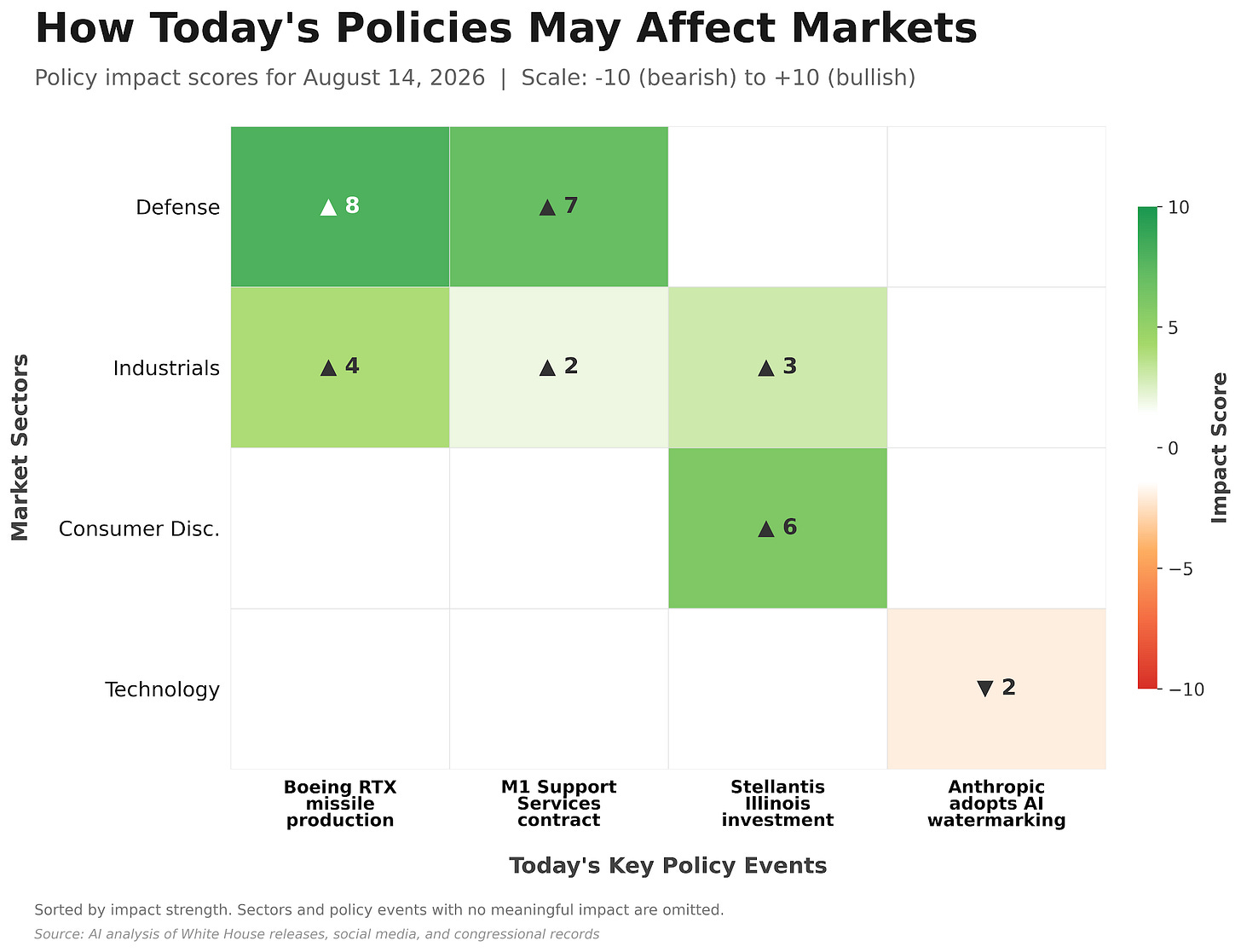
Each cell shows an estimated impact score on a fixed scale of -10 to +10, reflecting how today’s policy developments may affect each market sector. Positive scores (green, ▲) suggest bullish impact; negative scores (red, ▼) suggest bearish pressure. Rows and columns are sorted by impact strength, and sectors and policy events with no meaningful impact are omitted. The heatmap, the analysis below, and the Impact on Market themes above are produced from a single unified analysis: the heatmap visualizes the magnitudes, while the text explains the causal reasoning behind them.
The defense sector experiences a significant tailwind following the Department of War’s strategic efforts to stabilize and expand munition supply chains. Framework agreements with prime contractors prioritize long-term production of interceptors, signaling sustained fiscal support for domestic manufacturing. The massive, multi-decade pilot training contract further reinforces the revenue visibility for firms operating within the military-industrial complex.
Simultaneously, the automotive sector receives a major boost from substantial private investment in Illinois. The Stellantis commitment to the STLA One platform demonstrates a pivot toward domestic electric vehicle production. While Governor Pritzker champions these job-creation efforts, opposition figures frequently criticize the underlying costs of government-subsidized incentives. These industrial developments contrast with the technology sector’s compliance-driven overhead. The adoption of mandatory AI watermarking underscores the mounting regulatory burden facing developers as they align with international standards like the EU AI Act. Increased regulatory friction may elevate operational costs and limit product differentiation for major platforms.
-
Trump downplays concerns about sailors onboard USS Abraham Lincoln amid record deployment
www.theguardian.comPresident said nine months at sea ‘not nearly long enough’ even as families call for attention to mental health crisis
Donald Trump has downplayed concerns about US sailors enduring a record-setting deployment of nearly nine months onboard the USS Abraham Lincoln on Friday, saying the deployment was “not nearly long enough” as concerns mount over mental health and supply issues onboard the aircraft carrier.
The US president made the comments during a brief exchange with reporters before flying to New York for an event highlighting falling violent crime rates across the US.
Continue reading... -
Trump says he will declare Strait of Hormuz a US territory
President Trump claimed during remarks on Long Island, N.Y., on Friday that he will make the Strait of Hormuz a U.S. territory, despite the fact that Oman and Iran share jurisdiction of the waterway. "Pretty soon, I will be declaring the Hormuz Strait a territory of the United States," Trump said during an address highlighting his administration's efforts to combat crime in the U.S...www.allsides.com -
Karoline Leavitt leaves behind a legacy of lies. What's next for the Trump aide?
Karoline Leavitt, 28, is leaving her demanding job as Donald Trump's press secretary to spend more time with her two young children and her 60-year-old husband. According to a post by Trump On Truth Social, Leavitt will be departing her role at the end of the month and will serve as one of Trump's "top outside advisors". In other words: the official version of events is that Leavitt is resigning on her own terms for family reasons and not because Trump's approval ratings are at record lows and she's a rat fleeing a sinking ship...www.allsides.com -
Trump threatens to declare strait of Hormuz ‘territory of the United States’
www.theguardian.comSeriousness of remark made in New York on Friday, and whether it signaled new policy position, not clear
Donald Trump has threatened to declare the strait of Hormuz as “a territory of the United States” as his administration struggles to conclude the war with Iran.
During a speech at a police academy on Long Island, New York, on Friday, the US president said he would “pretty soon” designate the waterway – a crucial chokepoint for global trade, through which about a fifth of the world’s seaborne oil supplies typically pass – a US territory.
Continue reading... -
BBC seeks to subpoena Trump children and son-in-law over defamation lawsuit
www.theguardian.comNetwork wants to serve Jared Kushner, Ivanka Trump and Donald Trump Jr after president sues over January 6 documentary
The BBC is trying to subpoena Donald Trump’s children as it builds its defense against the president’s defamation lawsuit centered on a documentary on the January 6 insurrection.
In a motion filed on Friday, the BBC sought authorization to serve Trump’s two eldest children, Donald Trump Jr and Ivanka Trump, and son-in-law Jared Kushner, with subpoenas for testimony and their records on the events of 6 January 2021.
Continue reading... -
Wisconsin Governor primary upset. Trump's catering truck ruse exposed. Outrage over air craft carrier conditions.
thinkbigpicture.substack.com Democratic Wisconsin gubernatorial candidate David Crowley. Photo by Scott Olson/Getty Images.
David Crowley Upsets Francesca Hong in Race for Wisconsin Governor
On Tuesday, several states including Wisconsin, Minnesota and Connecticut held primaries. In Wisconsin, after polling consistently ahead, democratic socialist State Rep. Francesca Hong, who had been leading strongly in the polls, fell short in her bid for the Democratic nomination for Governor, losing to Milwaukee County Executive David Crowley by 0.5 percent. Just a month earlier, Crowley had dropped his campaign for Governor amid poor polling but reentered ten days later at the urging of Democratic Governor Tony Evers (D-WI), who endorsed him in a last minute attempt to halt Hong’s momentum. Belying claims of intraparty animosity, Hong immediately endorsed Crowley and appeared with the entire Democratic slate at a unity breakfast, pledging to campaign together to ensure a Democratic win in November.
In the hard-fought race for the Democratic nomination for U.S. Senate from Minnesota, Lieutenant Governor Peggy Flanagan, a progressive endorsed by Senator Bernie Sanders (I-VT) and Rep. Alexandria Ocasio-Cortez (D-NY), defeated moderate Rep. Angie Craig (D-MN) by almost 20 points. Despite Hong’s narrow loss in neighboring Wisconsin, Flanagan’s decisive victory in Minnesota was a sign that the progressive populist momentum that has been a feature of this primary season was still alive and well. Meanwhile in Connecticut, Governor Ned Lamont (D-CT) survived a primary challenge from the left, but 78 year-old Rep. John Larson (D-CT) was defeated by 46-year-old former Hartford Mayor Luke Bronin. Larson had held his seat in Congress for 27 years.
White House Ruse to Whisk Trump Away From Ankara Amid Threat Draws Outrage
On Monday, The Washington Post reported that on July 8, based on Israeli intelligence warning of a potential Iranian assassination attempt, Donald Trump was secreted off Air Force One via a catering truck onto an Air Force C-32A jet, which flew him and a few select aides from Ankara, Turkey to safety in Britain.
We know times are hard across the board. We rely on the support of paid subscribers to keep us going and to subsidize this coverage for readers who can't afford it right now. At $6/month or $60/year (about 16 cents a day), your subscription helps keep this work accessible to everyone, not just the people who can pay for it.
-
Trump Wants The DOJ To Go After Olympian David Hearn Again In Reflecting Pool Vandalism Case
www.techdirt.comThis is why having a case dismissed with prejudice is important.
Trump’s cronies/donors — who were paid millions to do a job they’d never done before — failed to bring the Lincoln Reflecting Pool up to spec by July 4th, preventing Trump from taking sole credit for everyone else’s hard work while turning the nation’s 250th birthday into a celebration of himself.
When the “American flag blue” undercoating began floating to the surface and the rest of the pool turned green due to the completely expected explosion in algae growth, Trump decided it would be better to arrest people for “vandalism” than throw his financial supporters under the bus.
Former Olympian David Hearn was the big catch. Trump, Interior Department Secretary Doug Burgum, and US Attorney Jeanine Pirro all claimed they had tons of evidence to support felony vandalism charges against their star defendant. Another handful of people were arrested and hit with misdemeanor charges, solely for the purpose of propping up Trump’s “it was vandals!” lies.
But the whole thing fell apart when the cases moved forward. In Hearn’s case, a government witness testified the damage was due to faulty repair work by the contractors, rather than anything Hearn or anyone else had done to the pool. This undercut Trump’s 350-foot vandal attack narrative. It also tanked the case for US Attorney Jeanine Pirro, who moved to dismiss the case due to being misled by the Interior Department, which apparently buried details of the faulty fix in hopes of making Trump’s revenge convictions a reality.
Shortly after dropping the case, Pirro went toe-to-toe with Trump and DOI head Burgum, laying out all the evidence that contradicted Trump’s concocted narrative. Trump responded by attacking Pirro publicly in press comments and Truth Social posts. These attacks included some off-the-cuff remarks that seemed to have teleported in from a 1930s gangster b-movie script:
“Instead of going after the people that did it, the judge went after her and went after her department,” he continued. “And I guess she choked. I don’t know what the hell happened.”
[…]
Trump exclaimed minutes later that Pirro “folded like an umbrella.”
I only bring this up again because Trump has clearly demonstrated that umbrellas are impossible to “fold.”
Anyway, back to the point of the post: having a prosecution dismissed with prejudice means the government doesn’t get a second chance to do the wrong thing. The DOJ in general never does this because… who knows? Maybe some precedent will get handed down that revives a case. Maybe the cold case kids will find some sort of unidentifiable powder in the evidence locker. Or maybe the fucking president of the United States will just start ordering people to do the same thing again, only harder.
White House officials have asked the Justice Department to consider a new prosecution of a man accused of vandalizing the Lincoln Memorial Reflecting Pool, according to people familiar with the discussions, as President Trump fumes over U.S. Attorney Jeanine Pirro’s decision to drop the case.
[…]
After White House outreach, Justice Department officials are exploring whether another type of case—likely based on misdemeanor allegations—is even possible.
And we’re right back where we started: with Trump trying to punish a US citizen because Trump embarrassed himself.
This isn’t going to end well for Trump. I mean, I would hope. The presiding judge is still trying to find out why the DOJ didn’t dismiss the charges against Hearn with prejudice, given that it had admitted in court that there was no evidence to support them.
And Hearn himself isn’t letting this go. If the DOJ decides to try again, this will vastly increase the chances the presiding judge will give his lawyers access to the grand jury materials he’s been requesting ever since the government’s witness testified (before the grand jury) that any so-called “vandalism” was actually just the side effects of a botched rush-job performed by under-qualified contractors better known for their loyalty to Trump than their specific set of skills.
Trump is too stupid to recognize this will only result in more damning evidence of his self-serving hubris. Pirro knows this case is fucked so it’s highly unlikely she’ll be willing to do what Trump is demanding. And no one in the administration with the intelligence to recognize why this is a terrible idea is willing to do anything but appease the madman they’ve chosen to serve at the expense of their own credibility and future employment opportunities. Let’s hope this all goes as badly as it should for Trump. After all, he’s earned it.
-
Ranking The Circuit Courts By Importance
davidlat.substack.com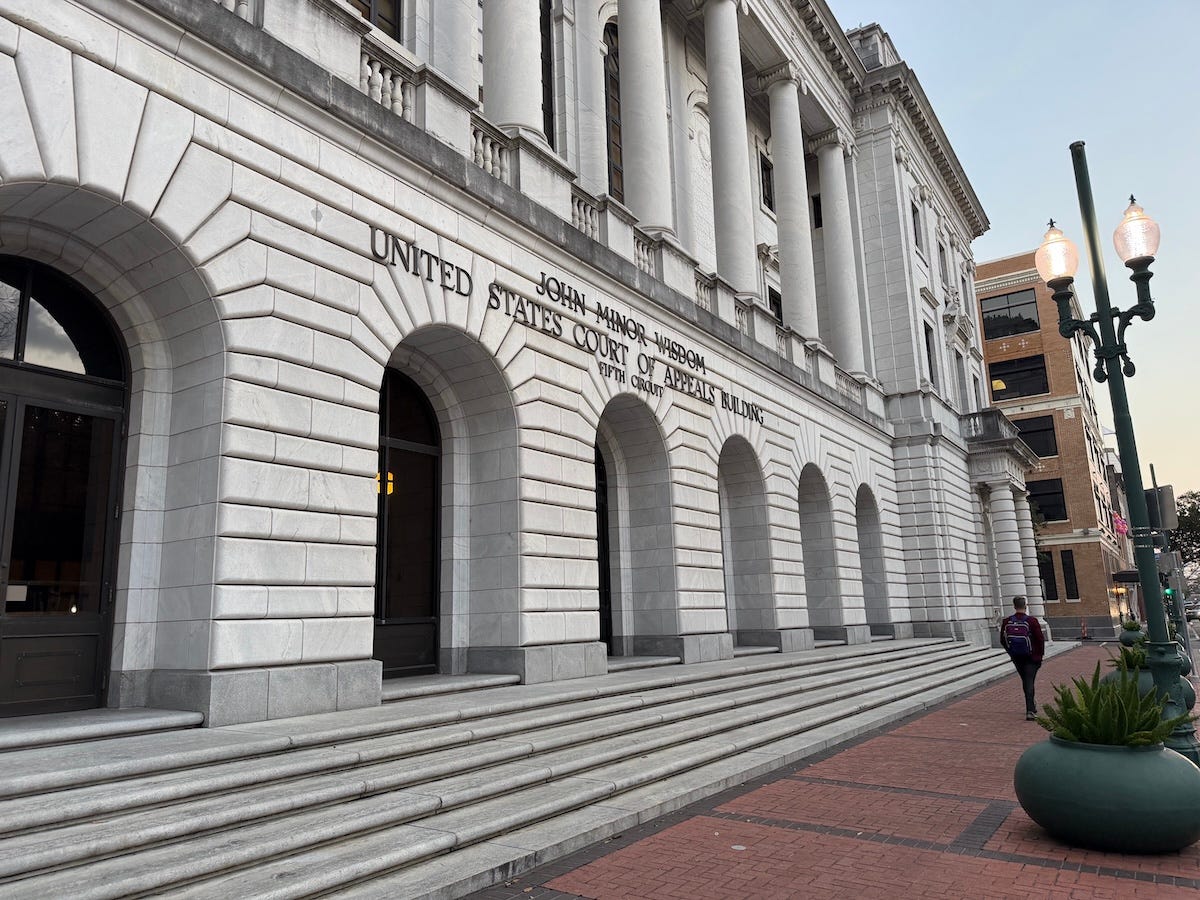 The John Minor Wisdom Courthouse in New Orleans, home to the U.S. Court of Appeals for the Fifth Circuit (photo by David Lat).
Welcome to Original Jurisdiction, the latest legal publication by me, David Lat. You can learn more about Original Jurisdiction by reading its About page, and you can email me at davidlat@substack.com. This is a reader-supported publication; you can subscribe by clicking here.
It’s a Friday afternoon during the dog days of August, so I won’t hit you with anything heavy. Instead, I bring you a Notice and Comment post — in which I tee up a topic and invite all of you, my readers, to debate and discuss. The comments section will be open to all readers, not just paid subscribers (as is always the case with N&C posts).
Earlier this week, I had the pleasure of co-hosting the Advisory Opinions podcast (along with my husband, SCOTUSblog executive editor Zach Shemtob). For Tuesday’s episode, we were joined by Amy Howe, co-founder and primary reporter of SCOTUSblog. For yesterday’s episode, our guest was Adam Feldman, author of the Legalytics newsletter on Substack.
If you listened to Thursday’s episode, you received advance notice of our subject for today. From my reader mailbag:
I hope all is well! I’ve been a longtime reader of Original Jurisdiction.
I’m currently clerking for a federal appellate judge, and my co-clerks and I recently got into a friendly debate about how to rank — or, perhaps more appropriately, group — the federal appellate courts by importance.
The conventional view seems to put the D.C. Circuit at the top, followed by the Second and Ninth Circuits. But the picture gets more complicated from there.The Fifth and First Circuits, for example, can play an outsized role in challenges to government action, depending on the administration in power. The Eleventh Circuit seems to have a particularly large number of feeder judges whose opinions are cited widely outside the circuit. The Third Circuit doesn’t produce a huge volume of published opinions, but the opinions it does publish seem to be particularly well-cited. And the Seventh Circuit seems to have gone relatively quiet over the last few years.
I’m not sure whether this has come up on OJ recently, but I thought it was an interesting question. I’d be very curious to hear your thoughts on how you would rank or group the circuits, and what factors you think are most useful in measuring a circuit’s broader influence.Before I turn over the floor to my readers, I’d like to share with you some data. To kick things off, here are the circuit courts ranked by the populations they cover:
Ninth Circuit: 67.1 million
Eleventh Circuit: 38.7 million
Fifth Circuit: 38.0 million
Sixth Circuit: 33.5 million
Fourth Circuit: 32.9 million
Seventh Circuit: 25.3 million
Second Circuit: 23.8 million
Third Circuit: 23.4 million
Eighth Circuit: 21.9 million
Tenth Circuit: 19.0 million
First Circuit: 14.1 million
D.C. Circuit: 678,972
Federal Circuit: N/A
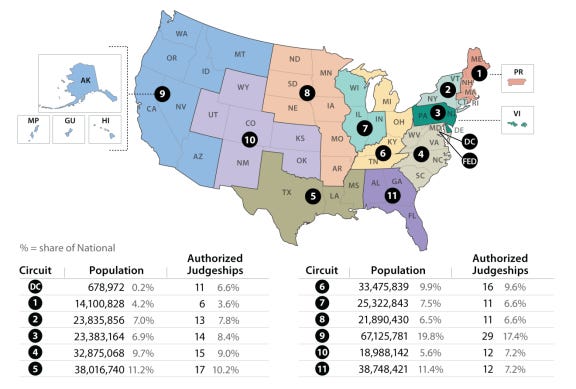
Of course, population isn’t everything; a court’s docket matters too. As noted by my correspondent, the D.C. Circuit is generally regarded as the most important circuit court — based on the high-profile cases it hears involving federal agencies, national security, and executive power — even though it covers the smallest population. And I’d argue that during the second Trump administration, it has only grown in importance, as a result of the many challenges to federal government action it has had to hear.1
In terms of the size of different courts’ dockets — i.e., caseloads — here are the circuits ranked by cases filed during the 12-month period ending June 30, 2026, based on data from the Administrative Office of the U.S. Courts (noting parenthetically how each circuit’s caseload ranking differs from its population ranking; “-” signifies no change):2
Ninth Circuit (-): 9,047
Fifth Circuit (+1): 5,481
Eleventh Circuit (-1): 4,756
Fourth Circuit (+1): 3,443
Sixth Circuit (-1): 3,419
Second Circuit (+1): 3,360
Eighth Circuit (+2): 2,632
Third Circuit (-): 2,514
Seventh Circuit (-3): 2,408
Tenth Circuit (-): 1,735
Federal Circuit: 1,362
First Circuit (-1): 1,136
D.C. Circuit (-1): 1,081
[UPDATE (8:49 p.m.): A commenter pointed out to me that the Federal Circuit’s caseload stats are available; they’re just contained in a separate report. So the ranking above was revised to add 1,362 for the Federal Circuit (it was previously listed as “N/A”), and this revision bumped the First and D.C. Circuits down by one spot each.]
But not all cases are created equal; the content or nature of a court’s docket matters too. As noted by my correspondent, the Second Circuit historically has been seen as a top-three court in significance, based largely on how it has decided many major business cases over the years. But it could be argued that as the business docket has waned, so has the Second Circuit’s importance.
I also agree with my correspondent’s point that in recent years, the First and Fifth Circuits have become more influential, based on how often they’ve been called upon to rule on challenges to federal government action. Challenges to Biden administration policies were often filed in Texas districts, which sent them to the Fifth Circuit; challenges to Trump administration policies are often filed in blue states like Massachusetts, New Hampshire, and Rhode Island, sending them to the First Circuit.
I’ll conclude my comments here, lest I taint the jury pool. Readers, what do you think? Please opine in the comments — which are open to everyone, not just subscribers. Thanks!
[UPDATE (5:17 p.m.): I made minor tweaks to this post to improve the logical transitions between the paragraphs discussing dockets and caseloads. In addition, on New Hampshire, please see the discussion in the comments about how it’s more of a purple state: although it has voted Democratic in every presidential race for two decades, Republicans currently control state government.]
1For the same reason, I’d argue that the U.S. District Court for the District of Columbia is now the most important federal trial court — sorry, S.D.N.Y. folks — but that’s an argument for another day.
2As for why the Federal Circuit isn’t included, you’ll have to ask the AO. A footnote to their table notes that it “does not include data for the U.S. Court of Appeals for the Federal Circuit,” but doesn’t explain why.
Thanks for reading Original Jurisdiction, and thanks to my paid subscribers for making this publication possible. Subscribers get (1) access to Judicial Notice, my time-saving weekly roundup of the most notable news in the legal world; (2) additional stories reserved for paid subscribers; and (3) the ability to comment on posts. You can email me at davidlat@substack.com with questions or comments, and you can share this post or subscribe using the buttons below.
-
Trump’s spying on left-wing groups recalls J Edgar Hoover’s Cointelpro | Ken Roth
www.theguardian.comThe FBI from the 1950s to the 1970s tried to infiltrate and discredit leftist organizations. Trump seems to be repeating that sordid practice
It is bad enough that the Trump administration blocked a federal criminal investigation when an Immigration and Customs Enforcement (ICE) agent killed Renee Good as she was turning her car away from him in Minneapolis the past January. Just before the shooting, Good and her partner had been observing and protesting against ICE officers.
Instead, it turns out the administration has been investigating progressive and even mainstream groups that have been involved in protests against Donald Trump’s sweeping deportations, according to newly released government documents.
Continue reading... -
Spreading Jesus Through the OMB: The Final Levers OMB Has Over Agencies are “Management Initiatives”
www.crisesnotes.com
This is a free piece of Notes on the Crises. All pieces in our OMB coverage will be free. Please take out a paid subscription to support this work. Or leave a tip.
Joshua Lawrence is a research fellow at Notes on the Crises and graduate of Sarah Lawrence College. Find him on Bluesky here.
Juan Hanes is a research fellow at Notes on the Crises and a Journalism student at NYU. Find him on Bluesky here.
This is the final part of a 5-part series. Read Part 1, Part 2, Part 3. & Part 4
Welcome to the fifth and final installment (we promise!) of our miniseries on the “seven levers” that the Office of Management and Budget’s Resource Management Offices (RMOs) use to exert their influence over administrative agencies. Leading up to this point, we have covered the various mechanisms of control that the RMOs use during the budget “preparation” and budget “execution” phases. Today, we turn away from the “phases” of the budget, to talk about something a little different: presidential management initiatives. These may sound obscure, but they will prove to be central to the workings of the Office.
But before explaining why that is, we must make one thing clear. These final two levers, insofar as they deal with questions of “management” as articulated in Professor Eloise Pasachoff’s original article, do not cover the entire scope and power of the “M” side of OMB. “Management” under OMB is a very extensive topic, with its own confusing history. Grasping “Management” means examining relevant statutes, and dedicated sub-offices in OMB that will have to be done in future work. What we will focus on instead here is a very particular slice of the “Management” pie –- and it just so happens that this slice intersects so much so with the “budgeting” side of things, that it naturally muddles the line between those “M” and “B” sides anyway.
The slice in question is the aforementioned “management initiatives” (and specifically, “President’s Management Agenda”) that has become a staple of OMB and presidential policy in the past few decades. It is the language and form of these management initiatives that often prefigures the substantive changes that agencies face when transitioning from one presidential administration to the next.
But before we can dive into the specifics, we must of course ask the very simple question: what is a management initiative?
Management Initiatives?
The concept of a “management initiative” is a bit hard to nail down precisely, in part because the meaning of the term has varied considerably over the history of OMB. What Pasachoff is referring to as “management initiatives” in her article, though, is a more broad and loose concept—one that we can understand as “management goals that the President or OMB has communicated to the agencies”. The vehicle for communication, and thus the substance or specificity of the goal itself, can vary from goal to goal, and president to president.
In this sense, management initiatives are to some extent as old as OMB, or even the original Bureau of the Budget itself. Nixon, in his original efforts to reorganize the Budget Bureau into the OMB we know today, sought to make management the centerpiece of the new office. OMB observer Shelley Lynne Tomkin wrote in 1998 that Nixon’s reorganization aimed to “remove BOB/OMB from the business of making policy”, in order to “redirect its energies toward bringing the federal government under centralized control through management improvements”. And though there is no doubt that Nixon’s reorganization efforts had a distinctly political motive, the idea that “management” sits in a more technocratic realm compared to “budgeting” is crucial to building our understanding of management initiatives.
In short, then, a “management initiative” tends to be a goal to alter the structure and procedures of an agency—without inherently touching on any “political” question. This makes management questions conceptually easier to divorce from policy than budgeting (as questions of “the budget” and money are more commonly understood to have political overtones…) Changing the structure of an agency in the abstract does not necessarily demand such overt political decisionmaking. And yet…
In practice, of course, management initiatives are still deeply political. And more and more – particularly under Trump –- we are seeing management initiatives that pull no punches in pushing political goals. To that end, it is hard to look back on any moment in the past five decades of OMB history and say that any particular management initiative – whether it came in the form of Nixon’s “Management by Objective Plan”, or the modern “Presidential Management Agendas” – were merely technocratic. This fact is the crux of Pasachoff’s analysis of management initiatives, and it is what we will keep in mind as we delve into the specifics on how management initiatives work.
With that established, then, let’s not go any further without exploring how the first management lever works…
The President’s Management Agenda Lever (Also Known As: the “Do-What-I-Tell-You-To” Lever)
The President’s Management Agenda (PMA) is the most modern manifestation of management initiatives. As stated, “management initiatives” in the abstract have existed in many different forms across the history of OMB. But a recognisable form was far more recent: it was not until George W. Bush’s OMB published their 64-page PMA in 2001 that this modern iteration was born.
Upholding the spirit of the many management initiatives that came before, Bush’s PMA buried many of its wider political objectives in the bland language of technocratic reform. In the document were five “government-wide initiatives”: “Strategic Management of Human Capital”, “Competitive Sourcing”, “Improved Financial Performance”, “Expanded Electronic Government”, and “Budget and Performance Integration”. These were dry, boring terms.
As perhaps indicated by the incredibly uninteresting names, none of these goals necessitated an inherently (or at least overtly) political objective. But under a closer examination, like another early 2000s release had it, Bush’s intentions were “Not That Innocent”.
Of course, some of the more specific programmatic goals, which take up the second half of the agenda, had a more openly political slant. In that second half, for instance, we can find efforts to “privatize military housing”, and make it easier for “faith-based” community organizations to work with the government (weakening the separation of church and state) — in either case, such “Management” efforts can hardly be considered apolitical.
But the technocratic facade of the agenda prevailed even among the more overtly political goals. Under the “Faith-Based and Community Initiative", for example, the agenda identified the “bureaucratic, inflexible, and impersonal” nature of existing government programs as one of the key barriers to ending “poverty and despair” across the country. The solution was thus that agencies were to “identify and remove the inexcusable barriers” that make it difficult for “faith-based and community organizations” to receive money and work with the federal government. In practice, this meant grant reform and tax deductions, to streamline the process of supporting “faith-based” (aka religious) charities and institutions.
Pasachoff herself argued that such an effort was merely an attempt “to weaken the wall between church and state”, much in line with the evangelical temperament that President Bush made central to his public persona (For example, he declared Jesus to be his favorite philosopher at one point during his 2000 campaign).
Bush Jr. was not the first to politicize management initiatives of course. Management initiatives under Nixon, for example, were conveyed via the President’s “Management by Objectives” program, which a source cited by Pasachoff described best:
This [Nixon’s reforms] meant focusing on management—so long as it wasn't boring public administration theory but rather “management in the get-the-Secretary-to-do-what-the-President-needs-and-wants-him-to-do-whether-he-likes-it-or-not sense.”
Practically speaking, the Management by Objectives program was a set of personalized goals handed out to 21 different administrative agencies that set out to restructure staff hierarchies, and reform typical agency procedures. The effectiveness of Nixon’s MBO program was… questionable, partly because the fallout from Watergate and Vietnam destroyed Nixon’s credibility within the administrative state. But what is undoubted is the fact that such efforts were anything but policy-neutral.
From the foundations set by Nixon and the precise manifestation of management initiatives established by Bush Jr., we have now been able to observe PMAs in action for over two decades. Each president since Bush has effectively followed a tradition to release a PMA within the first year or so of taking office—-and within each PMA we get to see different flavors of covert policy control.
Whereas President Bush made “performance” a centerpiece of his management strategy, suggesting that agencies must develop policy and spend money by evaluating which past decisions have “performed” the best, President Obama chose instead to drive agency decision making via “evidence”. Although the specific programmatic details between Bush’s “performance-based” agenda and Obama’s “evidence-based” agenda differed slightly, the overarching thesis was the same: agencies ought to act in ways that are “proven” to be “effective”… whatever that might mean!
The rub, of course, lies in the fact that critics of each President’s initiatives ended up making the same argument against both: each leader attempted to implement procedural changes, only as a means of creating government structures that favored their preferred policy decisions. Under each agenda, it would often turn out that the “evidence” or “performance” results would frequently end up favoring the programs and policies that each president had a vested interest in. We are shocked, shocked that this was the case.
And in Trump, the PMA lives on. Though it is worth noting that Trump’s second term PMA (released via an OMB memo last December), in typical Trump fashion, hardly makes an effort to conceal its political goals. This fact is a deviation even from the PMA released during Trump’s first term, which contained much more procedural detail as opposed to rhetorical dogma. But the extent of these changes will be the subject of a full-length breakdown once we catch up to covering the OMB memos for fiscal year 2026. (So stay tuned!)
For now, we emphasize only that PMAs are a decades-old mechanism for outlining what are essentially political goals via the language of technocratic, bureaucratic, and science-based reform. OMB’s role in this process not only involves the centralized formulation of these agendas in collaboration with the President, but also the promulgation of the agenda thereafter.
But a mere document outlining what a president wants can only achieve so much. That’s basically a wish list! What this lever lacks is what Pasachoff would describe as a “procedural hook” to enforce the goals, and to make their implementation tangible. That is where the next (and final) lever comes in.
The Budget-Nexus Lever
The budget-nexus lever of OMB’s management initiatives is exactly what it sounds like: a connecting force between the raw policy of the PMA, and the concrete action of budget formulation. As we have covered extensively in this series, the budget is perhaps the central site where OMB’s power manifests with full force. Connecting the management goals of the president to the budget, then, offers a great chance for OMB to flex its full muscle, in order to keep the administrative agencies in line.
How is the budget linked to management initiatives? Well, there is perhaps no better way to answer this question than to refer to the budget formulation bible that is the OMB’s Circular A-11 guidance document. (As you can tell, we’re going to be talking about this circular quite a bit as we continue to focus on the OMB…)
First of all, the A-11 has a dedicated section (section 220) to explain what the PMA is and how agencies should go about applying it. In this and the previous section of the circular, the PMA is looped in with the requirements of the “GPRA Modernization Act of 2010”, which, as the name suggests, is a law that revamps the “Government Performance and Results Act of 1993”. These laws explicitly ordain OMB as the centralized administrator of both government-wide and agency-specific management goals. In this sense, the PMA becomes one of the many precise articulations of how OMB and the president seek to improve government “performance”. In conjunction with GPRA-specific reporting requirements, then, agencies are required to submit reports regularly detailing the status of their management reform efforts. The specifics on when and how agencies are to report this information is detailed in the circular A-11.
To be sure, the “procedural hook” established by tying PMAs to the GPRA does not inherently force agencies to reflect on the president’s management initiatives when formulating budget requests. At the time that Pasachoff was writing her original article during the Obama administration, it seems as though the most recent A-11s did not make mention of the PMA when discussing compliance with the GPRA and other congressional requirements. As a matter of fact, the term “President’s Management Agenda” and its related acronym does not appear once in the 2016 A-11. In fact, it did not make any appearance until 2018—when the section on the GPRA Modernization Act was updated to draw that connection to the PMA.
But none of these developments had yet occurred when Pasachoff first wrote about PMAs and the “budget-nexus” lever, which is why her analysis is focused more specifically on the way management initiatives are looped in with budgetary decisions. And in spite of the new references to the PMA in more recent A-11s, Pasachoff’s budget-nexus analysis still stands.
During the Obama administration, the budget connection was abundantly clear. Although the exact term “President’s Management Agenda” made no appearance, Pasachoff noted a clause that stated that budget requests were “more likely to be fully funded”, should they be “grounded” in the “evidence” agenda outlined in Obama’s PMA. Of course, this language has since been removed from the A-11 (by Trump-era initiatives.) But another clause stating that agency budget requests should reflect “efforts and planned action to strengthen management and improve program performance” still stands to this day.
But beyond the A-11, one of the clearest connections between PMAs and the budget lies merely in the fact that many management initiatives are themselves inherently budget-focused. Obama’s evidence goals reflect this in part, but perhaps the greatest example of this comes once again from the Bush administration.
The fifth and final “government-wide” initiative from Bush’s original PMA was “Budget and Performance Integration”. The problem identified was that the government would function “poorly and inefficiently’ so long as budgeting decisions were not made based on “results”. More clearly, the PMA suggested that there was a lack of uniformity, consistency, and rigor in agency self-evaluation at the time. Bush & co argued that correcting this issue was thus the central focus of the president’s management initiatives. The first solution to come from this was a “traffic lights” system of sorts: a list of standards was generated, then agencies were given either a green, yellow, or red rating depending on how many of those criteria were met.
This system eventually evolved into the more well known Program Assessment Rating Tool, or PART system, that gave agencies a numeric score based on apparent performance and results. Given the fact that the entire system was devised as a means of allocating government spending more “efficiently”, the connection to the budget is all but obvious. In his 2007 book explaining the federal budget, Allen Schick made the following comments on PART:
OMB insists that there is no automatic linkage of PART scores and budget decisions. However, it also takes the view that federal dollars should be targeted to programs that can prove they have achieved measurable results. In fact, independent researchers have found that PART scores are correlated with presidential budget decisions. Programs with effective ratings are much more likely to be budgeted for increases than those rated ineffective. But PART scores are a weak influence on congressional decisions, especially when OMB seeks to eliminate programs rated ineffective. [emphasis added]
That means that—as with all of our analysis on OMB’s budgetary preparation process—the nuance lies most prominently in the fact that Congress, and not the executive, is supposed to have the final word on appropriations. To the extent that OMB follows through in apportioning the legally required amounts (an increasingly difficult ask as of 2026), and then to the extent that Congress undercuts the suggestions of the president’s budget requests, the effectiveness of the budget-nexus lever can only stretch so far.
But the above is true of every lever we have talked about across the last five articles of this miniseries. And that’s exactly why it is crucial to understand these levers in conjunction and as a system and not isolated or on their own. The PMA lever only works insofar as OMB has the power to procedurally enforce agency compliance. As this series has already demonstrated, that procedural enforcement only works insofar as OMB can exercise the many other budgetary control levers that we have delved into. Put very simply: no lever on its own can be understood as the end all be all to OMB power. Even as we now wrap up this series, there are likely more mechanisms of control within the office that we have yet to come across.
We hope that this “Seven Levers” rabbit hole has taught readers a thing or two about the scope and significance of the Office of Management and Budget’s powers. You may well still have questions! This series has opened a massive can of worms in terms of concepts, documents, and legal mechanisms, that will each require further exploration and explanation at later dates. For now, though, we conclude this series and you can look forward to us continuing our breakdowns of OMB’s public memoranda for Fiscal Year 2025 (and beyond!)
Stay tuned, as our analysis of OMB has only just begun.
-
Donald Trump can’t beat Iran and Nigel Farage can only beat a bin. When it counts, these populists are just losers | Jonathan Freedland
www.theguardian.comThe pattern in the US and Britain is clear. They serve up stunt after stunt to mask incompetence and the betrayal of all those who trusted them
It’s a shame Nigel Farage ducked the announcement of his victory in the Clacton byelection, which confirmed his return as MP for the seat he had needlessly resigned from just a few weeks earlier. You’d have thought he would have loved it. It was the culmination of a stunt, an exercise in politics as performance. It was a display animated by – and seeking to inflame – grievance, a million miles away from the hard, grinding work of tackling the problems that underlie those grievances. It was an attempt to deflect scrutiny, distract attention and evade responsibility. It was, in other words, everything nationalist populists like him excel at. Indeed, the only thing.
Reform UK said Farage stayed away because Essex police had warned of a “credible threat” to his security, a claim swiftly denied by Essex police. (Add a flexible approach to the truth to that list of nationalist populists’ talents.) Still, it was a slightly odd claim to make. Recall Farage’s favoured explanation – there are others – for the undeclared £5m gift he received from the Thailand-based crypto billionaire Christopher Harborne, which prompted the very parliamentary investigation that so riled the Reform leader he felt compelled to quit his seat and seek a preemptive not guilty verdict from the people of Clacton: namely, that he needed the money to pay for private, enhanced security. It seems £5m was not quite enough to ensure the lucky recipient would be safe standing next to a man dressed as a bin.
Jonathan Freedland is a Guardian columnist
Do you have an opinion on the issues raised in this article? If you would like to submit a response of up to 300 words by email to be considered for publication in our letters section, please click here.
Continue reading... -
Politicians shouldn’t weigh in on individual criminal cases | Brief letters
www.theguardian.comPC Andrew Harper | Trump’s mistake | Hydration breaks | Climate advice for the government
Why are more people not concerned to uphold the principle that ministers should be kept clear from involvement in individual cases (What could Andy Burnham do to block early release of PC Andrew Harper’s killers?, 10 August)? Do we really want specific imprisonment decisions based on populist pressure?
Mark de Brunner
Burn Bridge, North Yorkshire• So Donald Trump thinks it would be a “terrible mistake” to get rid of Gianni Infantino (Report, 11 August). Didn’t he say something similar about Viktor Orbán? Maybe he will send JD Vance to help with the re-election campaign – that went well in Hungary.
Continue reading...
Michael Crapper
Whitchurch, Hampshire -
Sheri Mecklenburg’s Tech Troubles: “It’s on the E drive. It’s on the stick.”
emptywheel.net
Goddamnit.There’s something I can’t get out of my head from Chicago US Attorney Andrew Boutros’ bid to defeat sanctions for his prosecutors’ misconduct.
William Hogan makes excuses, Boutros parrots them
Much of Boutros’ response to defendants’ bid for discovery, sanctions, and investigation attempts to bolster the excuses AUSA William Hogan offered to Judge April Perry on May 21 to explain why the redactions he made to the grand jury transcripts hid Sheri Mecklenburg’s misconduct before the grand jury.
MR. PARENTE: Too, Judge, again, you repeatedly say there’s only 30 lines. There’s only 30 lines. These gentlemen were sitting here and heard the Court say that and now we find out there are missing pages. I don’t understand how that is not misleading the Court. I understand Mr. Boutros advocating for his AUSAs, but having done the job, if I heard a Judge say, well, there is only 30 lines. I think it’s IT related, what could it be. And I know in my mind what is going on here, how do you not approach the Court?
MR. HOGAN: I’d like to address that. The direction was to give the Court the law on 372 charge and there was a lot of other discussion in the grand jury. And the missing pages also account for the testimony of at least two witnesses. We just didn’t turn over the testimony of one of the agents, for example, or both of the agents, I think.
THE COURT: Mr. Parente still has not seen the transcripts.
MR. HOGAN: There was some IT issues.
MR. PARENTE: I’m sure there were. But these are games that civil attorneys play. This isn’t what someone whose job it is to always do the right thing should do. Again, this was personal, Judge. It was quoted in the paper, “Prosecutors blasted Parente for hysterically speculating about perceived misconduct in what was the normal practice” —
He was just following Judge April Perry’s order, Hogan claimed, providing just the legal instructions on the conspiracy charge. And besides, her misimpression that any withheld materials had to do with technical problems wasn’t entirely baseless. “There was some IT issues,” Hogan claimed.
I’ve already shown that Hogan’s claim he complied with Judge Perry’s instructions (and Boutros’ claim that this is undisputed) is bullshit.
Hogan withheld one of the most important points of instruction, about whether people who walked away from the SUV that had just driven into a peaceful protest could be charged with conspiracy. This was one of the core issues that defendants had raised in their requests for grand jury transcripts, so its redaction is particularly damning. Hogan also withheld an exchange on October 9 about the import of the ICE goon driving into protestors; while it’s a less important legal instruction than the other redacted passage, both Hogan and AUSA Matthew Skiba treated it as legal instruction for the later grand jury hearings.
Boutros attempts to make Hogan’s IT claim credible
But Boutros’ attempt to rescue Hogan’s claim that “There was some IT issues,” is problematic for other reasons. As I wrote here, Boutros does cite purported tech issues in his narrative of how the indictment went down. But what he cites as evidence is all over the map. He includes when the court reporter helped Sheri Mecklenburg set up her computer. He includes the grand jury foreperson confirming to Mecklenburg that the orange light indicates her transcript recorder was on. He includes one instance where Matthew Skiba was wrestling with his videos, but not a second one, in the subsequent transcript. And the pièce de résistance, Boutros points to where Mecklenburg says her battery ran out as a technical problem, a fair argument, as far as that goes.
There are two problems with Boutros’ inventory, on top of the fact that there’s no consistency to the things Boutros treats as technical problems. Of the four things Boutros cites as technical problems, several — the one from October 9, and the one right at the beginning of October 16 — would have been invisible to Judge Perry when she first reviewed the transcripts; Hogan redacted those bits. The part of the October 23 transcript where AUSA Skiba again struggles a bit with the video also appears in a redacted section — Skiba, in fact, said he was comfortable with doing the video right before the redaction, in what Perry could see. The clearest reference to technical problems that would have been visible to Judge Perry appears in the October 16 transcript where Skiba says, “Sheri, of course I’m having technical difficulties” before a 12-line redaction, during which the prosecutors discuss the video problems while Mecklenburg gripes about people who left before the ICE witness testified. But that’s just a 12-line redaction. That can’t explain Perry’s misimpression.
A far more important purported technical problem — where Mecklenburg says her battery has run out — does not (based on the publicly released redacted transcript) appear in the redacted transcripts provided to Perry, either, at least as they were subsequently released. But Mecklenburg’s claim her battery ran out should have appeared, even in the redacted transcript. In the since-released unredacted transcript, it is time-stamped to have occurred at 10:11 which, based on that time stamp, should have appeared before testimony broke before lunch on October 16, but which currently appears at the end of the transcript, after testimony (all redacted in the first set) that was time-stamped as having occurred at 3:33. Maybe that passage showed up in what Perry initially reviewed — it would be a reasonable explanation for her belief there were big technical problems — except if so, then the transcript (the 7-minute anomaly I wrote about here) has been doctored.
The Boutros inconsistency I find far more intriguing wouldn’t have shown up in the redacted transcripts, either, and so couldn’t be the explanation for Judge Perry’s misimpression. It also doesn’t show up in the transcripts Boutros references in his court filing, but for a different reason entirely. For his filing, Boutros cites to the docket number of the unredacted transcripts that were released, docket number 219 (October 9), 220 (October 16), and 221 (October 23).
Boutros ignores the transcript showing politicization
But as far as I see, Boutros never cites to the subsection of FBI Agent Evan Hylton’s October 9 testimony that was released on June 18, nine days after the other transcripts, docket number 230.
Whereas Boutros relies on the sworn testimony of the ICE goon to describe what (the ICE goon claims) happened to him, the US Attorney does not rely on Hylton’s sworn testimony to describe how the investigation proceeded, relying instead on William Hogan’s claims of how it went down. In effect, Boutros’ narrative recreates the original redaction of Hylton’s testimony, hiding — for example — that Mecklenburg and Hylton showed the videos (and individual screen caps of the targets) during the section Boutros studiously avoids mentioning, not “the prosecutors,” plural.
She gave her “summary”— which she reiterated was “not evidence” or “testimony”—before facing technical issues. Id. at 5- 9.
In addition to the Case Agent testifying, the prosecutors played two videos showing different angles of the incident from September 26, 2025. Id. at 14-16. After Case Agent’s testimony, the grand jurors asked factual questions about, for example, Agent A’s interview and his thought process, whether Agent A could have stopped the vehicle, and whether other cars were around. Id. at 11-19. [my emphasis]
This silence speaks volumes.
Boutros makes expansive claims in his filing that there is no evidence of politicization, citing to Judge Perry’s decision on that point before she looked at any transcripts. Yet there’s a good deal of evidence of politicization in the Hylton transcript. In it, Hylton describes not identifying the most culpable people crowding the SUV at Broadview and trying to identify them, but instead finding Kat Abughzaleh’s post from the event and networking out from there.
So let’s go to — in searching the internet, did law enforcement find that an individual using the name Kat Abughazaleh —
MS. MECKLENBURG: And I’ll give you the spelling, court reporter, before I go.
BY MS. MECKLENBURG: Q. had posted a video of the incident on her social media?
A. Yes.
Q. And when you looked further at this individual’s social media, did law enforcement discover that she had posted a different video from the Broadview facility the morning of the incident before it started?
A. Yes.
Q. Was that posted on her own social media, in fact, her Instagram channel?
Hylton’s testimony is pretty damning to Boutros’ claim there was not politicization, because a whole bunch of right wingers RTed the Abughazaleh post described in that testimony. Mike Davis, who is reported to be close to Todd Blanche’s fixer, Aakash Singh (the guy whom Boutros is trying to protect by invoking Trump v. US), even RTed it and @ed Andrew Boutros, ordering him to prosecute Abughazaleh and her “co-conspirators.”

FBI Agent Hylton’s testimony is perfectly consistent with having done just that — having done just what private citizen and far right nutjob Mike Davis ordered Boutros to do. He took Abughazaleh’s post, investigated the protest with her as a focal point, and then Mecklenburg charged them with a conspiracy, in spite of the fact that some or most of them walked away after the SUV drove into them.
Hylton’s testimony is all the more damning given a confession in Boutros’ filing. Having told one of the defense attorneys that he had no communications about what to charge, Boutros backtracks somewhat, stating that no one told him what investigative steps to take or what charges to file, a confession that could be consistent with acting on Davis’ tweeted order. After denying following orders in pursuing this prosecution, Boutros explains that — just a day after Aakash Singh buddy Mike Davis ordered him, Andrew Boutros, to charge Abughazaleh and her “co-conspirators,” — there was a virtual meeting on September 27 attended by people from Main Justice and his office (and another office on the West Coast), where “a public video” from Broadview was played.
15 On July 15, 2026, counsel for one of the former Defendants sent an email to the U.S. Attorney’s Office asking whether the Office “still stands” behind its assertion that there were “no communications” “with anyone outside the USAO” regarding “who and what to charge” or its “investigatory or charging decisions.” R. 110 at 3 (bold in original, italics added). The Front Office is not aware of any communications in which it took direction from anyone outside the U.S. Attorney’s Office regarding its decisions as to what investigatory steps the local prosecution team would take or who the local prosecution team would charge when prosecutors went into the grand jury to indict this case. Out of an abundance of caution, the Office notes there was a virtual meeting on September 27, 2025, among Main Justice lawyers, the Chicago U.S. Attorney’s Office, lawyers from at least one other U.S. Attorney’s Office on the West Coast, and many federal law enforcement agencies where the September 26 “Broadview” incident was mentioned (and a public video played) as part of a broader discussion of incidents and conduct against ICE during that time. To the Front Office’s knowledge, the virtual meeting did not mention the identity or political affiliation of any person. It was only later when Chicago FBI agents assigned to the case began investigating the matter that the Office learned the identity of some of the people involved in the incident. Moreover, as would be expected in the normal course, there were discussions between the Office and Main Justice regarding such things as case updates, especially given the publicity the case generated after it had been charged. These privileged discussions are not only permitted but are contemplated. See supra 19; In re United States, 398 F.3d at 618 (“How the United States reaches its litigating positions, who said what to whom within the prosecutor’s office, and so on, are for the Attorney General and the President to evaluate. The Judicial Branch is limited to assessing counsel’s public deeds.”). [my emphasis]
Then, just days later on September 30, Hylton started investigating by networking out to people with some digital tie to Abughazaleh, rather than trying to identify the people who genuinely obstructed the SUV. Hylton did not let the evidence drive the investigation but instead let Abughazaleh’s network do so.
Q. It does. Are these videos — are these videos that law enforcement obtained from public sources?
A. Yes, they are.
Q. So, in other words, people posted these videos and that’s how law enforcement was able to get them, right?
A. That is correct.
Q. Were they posted and/or tagged by people who have identified themselves or law enforcement has identified as being present during the September incident?
A. Yes.
Q. And by other people as well?
A. Yes.
That’s part of what Boutros avoids comment on by exercising his right to remain silent about Hylton’s testimony. The other part, as I said, involves the most interesting technical difficulties.
Boutros ignores the thumb drive/E-drive problem
As I noted here, Boutros implies that the very first technical problems appeared on pages 5 to 9 of the October 9 transcript.
He cites a five page passage, from page 5 to page 9. But the only thing that obviously reflects a technical issue — besides Mecklenburg waiting before she turned on her own computer — is an exchange on page 9 where the court reporter interrupts to help Mecklenburg plug in and turn on her own computer.
THE COURT REPORTER: I will just activate your computer. Set it up real quick.
There is a USB behind the monitor.
MS. MECKLENBURG: I think this is going to work. We’ll find out. Okay.
That’s the sum total of any claimed technical difference in that first appearance, the court reporter helping Mecklenburg set up her own computer. There were sixteen pages redacted.
In fact, that single page of technical difficulty — if you can claim that turning on your own computer is a technical difficulty — continues well into the Hylton testimony, the transcript Boutros doesn’t cite, so he should have cited that other transcript too.
It starts when Mecklenburg explains the reason she would go onto have technical difficulties, the reason why she didn’t know you could just plug your computer into the USB cord.
“I don’t usually bring my computer.”
So I’m going to make sure my computer is up, you know I don’t usually bring my computer, and get it going. You want to get — do you want to get him?
[snip]
Okay. Let’s see what I got. You know this makes me very concerned. This is what I was worried about. Nothing is coming — my documents won’t come up. I might have to do it from the agent or — I can’t get anything.
Unbelievable. Let’s see if this will work. I have it on a disk, which doesn’t play as well, but we’ll all have to get through it, and I will get right to you, agent. Okay.
THE COURT REPORTER: I will just activate your computer. Set it up real quick. There is a USB behind the monitor.
MS. MECKLENBURG: I think this is going to work. We’ll find out. Okay.
Something led Mecklenburg to do something different, do a grand jury presentation from her computer as opposed to (I assume) Elmo, what prosecutors generally use in trials.
The beginning of Hylton’s testimony starts normally enough: he briefly describes his background, explains his supervisor ordered him to investigate the Broadview 6 incident, and Mecklenburg makes him explain how he knows what he’ll testify to.
Then, she has him attest to video.
Q. Have you viewed the video that had been marked as Incident — that have been marked as Government — Grand Jury Exhibit Video Passenger Side and Front and Grand Jury Exhibit Video Driver’s Side and Front.
She then introduces a thumb drive that has the exhibits for the presentation, the exhibits Hylton has just walked over from the FBI.
You and I have gone over the exhibits for today, correct?
A That is correct.
Q. And those exhibits have been put on a stick that we’re using that has been marked as Grand Jury Exhibit 1, right?
(Document marked as Grand Jury Exhibit No. 1 for identification.)
BY THE WITNESS:
A. Yes.
BY MS. MECKLENBURG: Q. And are those exhibits – were you able to see that those exhibits were just carried right over from evidence that was provided by the FBI?
A. Yes.
Referring back to the main transcript, that “stick” is the sole exhibit introduced that day.
As Sheri Mecklenburg started to present the two videos used with the grand jury on October 9 — the two main videos used with the grand jury — she complains that she can’t get the videos working.
And then, having just admitted that “I don’t usually bring my computer” and having Hylton validate the evidence on a stick, she describes she’s actually running the presentation from the E-drive, or maybe a stick.
MS. MECKLENBURG: So I’m going to play these straight through. One is pretty short and the other a little longer, but I want you first to see what happened. Then we’ll go through when we identify people slow and snip bits, and I will point them out. So I will just play it for you.
At least I hope I am. It’s not going to work. I didn’t think so. If this doesn’t play, I’ll have you pull up your computer and do it. Let’s not fool around. We’re running out time.. Can you play the two videos for us?
Because it’s on the E drive and not my computer.
I’m sorry. Hang on. Don’t play it yet. It’s my fault. It’s on the E drive. It’s on the stick. I forgot. I don’t have a mouse here. So it’s taking me a little bit. There we go. This should do it. Okay.
This, one of the most extended instances of technical difficulty in any transcript, reveals Mecklenburg may have been using some other presentation than the one on the thumb drive, the one introduced into evidence, by accessing the E-drive from the computer that she (unusually) brought with her to the grand jury.
The Kat Abughazaleh video not introduced into evidence
And that matters, because Mecklenburg showed photos and videos that were not obviously introduced into evidence, not by exhibit number, and not by video reference.
In the first part of Mecklenburg’s colloquy with Hylton, she formally introduces into evidence the same exhibits she later has the ICE goon introduce on October 23, which are reflected in the table of contents for that later appearance. She describes entering exhibits 13, 15, 16, 18, 36, 41, 42, 48, 49, 38, 39, 44 into evidence. (As compared to what she showed two weeks later, she seems to skip photos 17 and 38).
But then later, she introduces things — including what sounds like the video Abughazaleh posted, the one a bunch of right wingers, including Aakash Singh buddy Mike Davis, RTed, demanding charges — that she does not introduce as evidence, but instead sometimes references by page number.
Q. Yes. Okay. Let’s take a look, — is this the video that law enforcement observed of Kat Abughazaleh on her Instagram account?
A. Yes.
Q. And did that – is that the video where she said she was at 25th and Harvard?
A. Yes.
Q. And is this an accurate picture that you know of of Kat Abughazaleh?
A. Yes.
Q. I’ll play it. It’s only a few seconds. (Whereupon, a video was played.)
BY MS. MECKLENBURG: Q. Did law enforcement find additional known videos of Kat Abughazaleh?
A. Yes.
Q. I’m going to go to page 45. And I am showing you what on page ·· I’m looking at what is the comparison photos, page 4, and then I’m going to show you.one on page 5, which is from the video, and ask you if those are known photos of Kat Abughazaleh?
A. Yes.
Mecklenburg describes “law enforcement” “posting” stills from the video.
Q. Did law enforcement recognize Kat Abughazaleh as an individual who appeared the video of the incident?
A. Yes.
Q. Did law enforcement then post stills of Ms. Abughazaleh from her video? A. Yes.
Q. I’m sorry. Let me back up. From the video of the incident?
A. That is correct.
She even misstates at one point, suggesting law enforcement posted about it rather than Abughazaleh, before correcting herself.
Q. Did law enforcement – did Ms. Abughazaleh also post on her social media that she was part of the incident on September 26, 2025?
A. She did.
Q. And I’m going to show you now a posting. This was found on her social media oops. Sorry.
On her own social media, correct?
Again, none of these photos or social media posts are introduced into evidence as exhibits like the photo — Exhibit 39 — of the word “PIG” allegedly scratched onto the back of the vehicle, nor do I see where she introduced her presentation as a whole (though she does explain the typos in Michael Rabbitt’s and Brian Straw’s names are due to the fact that she wrote it late the night before).
And it continues, with one after another of Mecklenburg’s targets, descriptions of posts and photos and press conferences, none of which are individually introduced as exhibits.
There may be twenty pieces of evidence Mecklenburg relies on, which show how these targets were chosen not because they were culpable in obstructing this SUV that drove into them, but because they had a tie to Kat Abughazaleh or spoke out against the SUV incident. She even describes how Joselyn Walsh was identified by Googling “guitar girl Broadview ICE,” which would bring you to this Facebook post, describing how a rubber bullet went through Walsh’s guitar and hit her in her leg.

This was Hylton’s explanation, as elicited by Mecklenburg, as to how Walsh got charged: someone knew to Google for a post about her complaints of being shot.
DOJ dropped charges against Walsh in March, before abandoning the rest of the charges.
I see no record any of this was ever introduced as evidence.
We’ve been assuming that William Hogan redacted these transcripts to hide Mecklenburg’s misconduct … and no doubt that was part of it.
But what if he redacted them to hide the politicization? What if the “IT issues” he was trying to hide were the difficulties Mecklenburg narrated in real time, switching back and forth from the thumb drive, which was entered into evidence, and whatever she presented from her E-drive, which was not?
Hogan was happy to provide transcripts … but not exhibits
There are a few more data points to suggest that William Hogan was corruptly trying to hide this colloquy in addition to all Mecklenburg’s other misconduct. They started to flip out, in escalating steps, when she asked for exhibits, not just transcripts.
As I’ve laid out, Boutros claims that he and his prosecutors were responding to the order that Judge Perry first gave on April 9. That invited prosecutors to submit, ex parte, just “relevant portions” of the transcripts.
To the extent the Government does not object to an ex parte in camera review of the transcripts, the relevant portions of the transcripts as outlined in the motion may be provided to the Court by 4/20/2026 in lieu of a written response.
The government asked for and got an extension — to, they claim, obtain the transcripts. In that request, they emphasize this will just be portions of the transcripts (remember, the first one was sent to Boutros in real time).
The UNITED STATES OF AMERICA, by its attorney, ANDREW S. BOUTROS, United States Attorney for the Northern District of Illinois, respectfully submits this unopposed motion for an extension of time until April 23, 2026, to provide the relevant portions of the grand jury transcripts to the Court for an in camera review.
[snip]
This extension will allow the government the opportunity to obtain all relevant transcripts to provide the Court, which it has been seeking to obtain. [my emphasis]
When DOJ submitted the transcripts, they claimed to be submitting all three transcripts, even while emphasizing, again, they were ordered just to provide “the relevant portions of the transcripts.” (As I’ve shown, they did not do so.) But then, having reviewed the redacted transcripts, Perry instructed the government to bring unredacted copies to the next in-person hearing. In granting that request, Judge Perry ordered something different: she ordered them to bring presentations, as well.
MINUTE entry before the Honorable April M. Perry: The Government’s motion to file grand jury transcripts under seal [128] is granted. This matter is set for a hearing 4/29/2026 at 10:30 a.m. in person in Courtroom 1725. The Government is asked to bring to the hearing fully un−redacted versions of the transcripts it has filed under seal (which currently contain redactions within the colloquy portions) as well as a copy of any presentation(s) or document(s) shown to the grand jurors summarizing the law. Mailed notice.
Read narrowly, such an order would only implicate the presentation Skiba did for the second and third grand jury session. That would have shown Skiba to be a raging MAGAt because of the way he relied on a totally inapt precedent only a frothy Trump supporter would know about. Read broadly, though, that would require bringing whatever Mecklenburg had on her E-drive, the social media posts showing this prosecution arose out of an attempt to target Abughazaleh.
That’s when DOJ decided to dismiss the felony conspiracy charge in an attempt to moot the request. When Chris Parente asked Hogan if he would bring the transcripts to that hearing, even though he claimed to be planning to dismiss the charges, Hogan refused.

The mootness argument did work, for about a day. But then the defense asked for the transcripts again because Hogan seemed so determined to keep them under wraps. This request asked for the transcripts and focused on the instruction, but it also asked for any “documents shown to the grand jury,” which again, might or might not include the stuff Mecklenburg had on her E-drive.
Moreover, given the government’s constantly shifting theories regarding the conspiracy charged in Count One and the Court’s order requiring production of the unredacted grand jury transcripts and, perhaps more importantly, the instructions of the law and documents shown to the grand jury regarding the law, the government’s tactic of bringing a superseding information but not immediately dismissing the indictment appears to evade the Court’s order and withhold the grand jury transcripts that the defense and, in many respects, the public at large have a compelling interest to see.
On May 18, Judge Perry ordered the government to give her the unredacted transcripts. That’s what led to the dramatic May 21 hearing where she revealed Mecklenburg’s vouching and conflicts with the jurors.
Chris Parente filed an emergency motion to preserve everything. He posted Hogan’s email (screen capped above) refusing to bring transcripts to the April 29 hearing, where he sought, and succeeded, in temporarily mooting the question of grand jury transcripts. Diane MacArthur, perhaps the one Chicago AUSA everyone involved still trusts, filed a notice of appearance and responded by saying that defendants no longer had standing to demand such things, and besides, everything would be preserved under the Federal Records Act. Terence Campbell, Andrew Martin’s attorney, replied basically saying, whoa, that was a remarkably touchy response … makes me want transcripts even more!
With each response, DOJ acted more and more paranoid.
At a hearing on May 26, MacArthur showed up and argued that DOJ was retaining a sufficient scope of materials to litigate this further.
When Tuesday’s hearing began, MacArthur told the judge she’d be handling the case from here on out.
“Thank you for volunteering as tribute,” Perry told MacArthur when court began.
MacArthur is a longtime, well-regarded veteran of the U.S. attorney’s office. She participated in the trials of former Illinois House Speaker Michael J. Madigan and ex-Chicago Ald. Edward M. Burke, which both ended with convictions for the once-powerful politicians.
Perry called Tuesday’s hearing to consider a request from Straw that she order prosecutors to preserve communications related to the grand jury proceedings.
Though prosecutors officially opposed such an order, MacArthur explained Boutros’ office had already taken multiple steps to preserve records from the case. She said a “litigation hold” was sought Saturday at the national Executive Office for U.S. Attorneys.
She said that triggered an indefinite hold on text messages, documents and notes relating to the grand jury and the decision by previous prosecutors to redact transcripts from the proceedings.
MacArthur said the hold applies to all former prosecutors on the “Broadview Six” case as well as three top leaders in Boutros’ office.
However, when defense attorneys sought an order from Perry that would have gone further — covering agents in the case — she told them she had questions about their ability to participate in the case going forward.
Based on the representations of MacArthur, Judge Perry denied the request for a preservation order.
And despite her representations that she would be handling the case going forward, that was the last that MacArthur has shown up in the docket. Days later, a guy who moved to Chicago from Indiana, Nathaniel Whalen, filed his notice of appearance, and he’s the only person besides Boutros on the attempt to evade sanctions.
And that’s when, having first exploited the credibility of the last trustworthy AUSA to defeat a motion to preserve and then dropping her from this team, Boutros invoked Trump v US specifically in his argument that the Broadview 6 are not entitled to discovery.
I don’t doubt there is far more than Boutros is trying to bury than why Mecklenburg entered a thumb drive into evidence then proceeded to rely on a file on her E-drive.
I suspect the communications between Mike Davis and Aakash Singh, by themselves, would display the malice behind this procesution.
But Andrew Boutros’ attempt to distract Judge April Perry by pointing to an orange light shining on Sheri Mecklenburg’s computer should only focus more attention on the tech difficulty he ignored, buried amid the evidence showing the selectivity of this prosecution: The E-drive never admitted into evidence.
The post Sheri Mecklenburg’s Tech Troubles: “It’s on the E drive. It’s on the stick.” appeared first on emptywheel.
-
Trump’s dismal Patriot Games were the Hunger Games ordered off Temu | Aaron Timms
www.theguardian.comMonkey bars, gawky teenagers and a presidential cameo – all given a prime-time showcase by ABC – combined for the most leaden hour of America’s 250th birthday summer
Culturally, it’s been a tough few months for Donald Trump. The UFC night he held at the White House for his birthday got lost amid the froth and excitement of the World Cup. The Great American State Fair on the Washington DC National Mall was a dud. The president’s jokes at the White House Correspondents’ Dinner all bombed. Could the Patriot Games, a nationwide competition to find the American schoolchildren most adept at traversing a set of monkey bars, help rescue the summer?
Last night we got our answer: no. A one-hour prime-time special brought us the best of the Patriot Games, and in a crowded field it managed to offer some of the most leaden TV of the American semiquincentennial. Freedom 250, the White House-backed non-profit that hosted the UFC fight at the White House and the Great American State Fair, produced the event, and put up the $125,000 in college scholarship winnings that went to each winner on the boys’ and girls’ side of the competition. The final round of the Games actually took place earlier this week, at a sports training facility outside Cleveland, Ohio. Last night we just got the best bits, and judging by what that amounted to, we should all be thankful we never had to endure the other bits. This was Trumpworld’s answer to the Hunger Games, but it’s unlikely there will be much clamor for a sequel. The patriots may be hungry for more, but the rest of us? Eh.
Continue reading... -
BP to develop offshore gasfield in Venezuela with firms linked to Trump administration
www.theguardian.comMove will be one of first large-scale foreign investments in country since US ousted leader Nicolás Maduro in January
BP has answered Donald Trump’s call for oil companies to help rebuild Venezuela’s fossil fuel industry with new plans to develop a large offshore gasfield.
BP will partner with two oil firms with close links to the Trump administration to develop the second phase of the Loran gasfield, in one of the first large-scale foreign investments in Venezuela since the US ousted its leader Nicolás Maduro in January.
Continue reading... -
Trump asks US supreme court to allow construction of White House ballroom
www.theguardian.comAdministration asks justices to keep appeals court decision to halt work on hold while it prepares a full appeal
The Trump administration has asked the US supreme court to allow construction of the president’s controversial $400m White House ballroom to proceed after an appeals court ordered work to halt.
In a case testing Donald Trump’s presidential authority, the Washington-based US court of appeals for the District of Columbia circuit ruled last week that the controversial project lacked the necessary approval from US Congress.
Continue reading... -
Trump administration finalizes rule to end federal support for gender-affirming care
The Trump administration finalized a rule on Tuesday to end gender-affirming care through Medicaid and the Children's Health Insurance Program (Chip), a move that will make it harder for vulnerable children to access healthcare and that eschews evidence to advance an anti-transgender ideology, opponents say. The rule is set to take effect on 13 October – but legal challenges could delay or block it entirely.www.allsides.com -
Trump Admin Ends Medicaid, CHIP Funding For 'Trans' Child Mutilation Procedures
The Centers for Medicare and Medicaid Services (CMS) announced Tuesday that it is stopping all U.S. taxpayer funding of child genital mutilation surgeries and cross-sex hormones. CMS Administrator Dr. Mehmet Oz announced that Medicaid and the Children's Health Insurance Program (CHIP) will cease all funding for the "sex-rejecting procedures on children, which include puberty blockers, cross-sex hormones, and surgical operations." CMS stated that these dangerous procedures "can result in irreversible damage, including infertility, impaired sexual function, diminished bone density, altered brain development, and other lasting physiological effects."www.allsides.com -
Trump administration finalizes rule restricting trans healthcare for minors on Medicaid
The Trump administration on Tuesday released a final rule blocking the use of federal Medicaid dollars for transgender healthcare for minors, as well as barring Children's Health Insurance Program (CHIP) plans from paying for gender-affirming procedures for minors. The final rule released by The Centers for Medicare and Medicaid Services (CMS) bars Medicaid dollars from paying for what it refers to as "sex-rejecting procedures for children under 18" as well as blocking CHIP agencies from paying for the same procedures for people under the age of 19.www.allsides.com -
Trump’s great plane escape | Politics Weekly America
www.theguardian.comWhen Air Force One took off from Turkey after July’s Nato summit, almost everyone believed Donald Trump was on board … but he wasn’t. Jonathan Freedland talks to Tara Setmayer of the Seneca Project about why the White House felt the need to come up with such an elaborate lie to protect the president
Continue reading... -
Trump dismisses concerns about USS Abraham Lincoln, saying its record-breaking 250 days at sea ‘not nearly enough’ – live
www.theguardian.comPresident claims families not worried, despite relatives raising concerns, but confirms USS George Washington will replace aircraft carrier on Iran mission
The Trump administration, in its appeal to the supreme court today, said that “this case involves an extraordinary and unlawful injunction that will halt the ongoing construction of the integrated military complex including a totally secure ballroom space, at the East Wing of the White House, which is vitally required by national security.”
It’s worth noting that the appeals court ruling blocks the above-ground construction of the ballroom, but would allow the work on the underground security structure to continue.
Continue reading... -
Washington Policy Review: August 13, 2026
washingtonpolicyreview.substack.comToday’s Report
1. Overview
2. White House News
3. Truth Social Posts
4. Government Department News
5. 2028 Democratic Presidential Candidates
6. AI & Tech Company News
7. Congressional Watch
8. Policy Impact Analysis & Heatmap
Noctral — a social network for experts. Whether you're in a fellowship, an accelerator, a grad program, or just deep in policy, you're matched on what you're working on and what you're curious about. Free on iOS.
1. Overview
President Trump signed executive actions to revitalize the U.S. Navy and the broader maritime industrial base, mandating the adoption of a “Finland Model” for foreign partnerships and reforming procurement processes. He also issued a proclamation imposing 100 percent tariffs on heavy unmanned aircraft systems and 25 percent on smaller units to counter national security threats. These initiatives reflect the administration’s broader strategy to decouple from foreign supply chains and incentivize domestic manufacturing.
On Truth Social, President Trump celebrated a legal victory at the U.S. Court of International Trade regarding the “de minimis” loophole, which he argued facilitated the movement of illicit goods. He also endorsed a slate of New York congressional candidates, labeling certain opponents as “Radical Left Lunatics” and accusing them of promoting harmful policies. Additionally, Trump announced the creation of “The Patriot Games,” a new athletic competition for young Americans.
The State Department officially eliminated all diversity, equity, and inclusion (DEI) initiatives, asserting that the prior framework was “ideologically extreme and discriminatory.” Secretary of War Hegseth, during his visit to Panama, promoted the “Trump corollary to the Monroe Doctrine” and reaffirmed the U.S. commitment to securing the Panama Canal. HHS announced a $102 million investment in health centers and released a report alleging $61 million in fraudulent billing for “sex-rejecting procedures on minors.” Meanwhile, the Treasury Department highlighted manufacturing growth in Iowa, and the USTR successfully resolved a labor dispute at a Yazaki facility in Mexico.
Governor Gavin Newsom announced that California has initiated enforcement actions against data brokers under the state’s privacy laws, criticizing companies that attempt to “intimidate” consumers. He further contrasted his launch of an Environmental Youth Advisory Council with the Trump administration’s decision to disband a similar federal body, which he called a “profound step backward.” In other actions, Governor Whitmer celebrated the completion of Flint’s lead service line project, while Representatives Ocasio-Cortez and Velázquez demanded $30 billion in federal aid for the ongoing water crisis in Puerto Rico, citing “federal neglect and mismanagement.”
The administration’s shift toward protectionist supply chain policies creates a bifurcated landscape where localized manufacturers gain a competitive advantage while retail and consumer tech sectors face margin compression and logistical friction from the removal of low-duty import channels. Simultaneously, a strategic surge in defense and maritime industrial spending provides long-term revenue stability for contractors integrated into national security infrastructure, despite concerns regarding the “massive” fiscal burden this expansion imposes. Agency reforms prioritizing nationalistic and “practical” objectives further recalibrate the operational landscape for federal partners, though observers note that these rapid administrative pivots risk inducing systemic bureaucratic paralysis.
2. White House News
Fact Sheet: President Donald J. Trump Rebuilds the U.S. Navy and America’s Shipbuilding Industrial Base
President Trump signed a National Security Presidential Memorandum aimed at addressing “critical long-term issues in Navy shipbuilding and ship repair programs” while restoring capacity and competition to the maritime industrial base. The administration asserts this action will revitalize the industry, which is “essential to the national security and economic prosperity of the United States.” By expanding commercial shipbuilding capacity and strengthening alliances, President Trump intends to “decisively usher in a new Maritime Golden Age” that restores American maritime dominance and fosters a more resilient workforce.
Reference: https://www.whitehouse.gov/fact-sheets/2026/08/fact-sheet-president-donald-j-trump-rebuilds-the-u-s-navy-and-americas-shipbuilding-industrial-base/
Fact Sheet: President Donald J. Trump Bolsters National Security and Strengthens U.S. Supply Chains by Imposing Tariffs on Drones and Their Parts and Components
President Trump signed a proclamation addressing national security threats posed by imported drones and their components. This initiative aims to strengthen America’s drone industry and supply chain, which the administration claims will “protect the national security of the United States and its defense and defense-adjacent industrial base.” By implementing a drone tariff program, President Trump intends to support and create American jobs, continuing his established record of rebuilding key sectors of the industrial base to ensure the nation’s long-term economic and security strength.
Reference: https://www.whitehouse.gov/fact-sheets/2026/08/fact-sheet-president-donald-j-trump-bolsters-national-security-and-strengthens-u-s-supply-chains-by-imposing-tariffs-on-drones-and-their-parts-and-components/
Adjusting Imports of Unmanned Aircraft Systems and Unmanned Aircraft Systems Components into the United States
President Trump has issued a proclamation declaring that unmanned aircraft systems (UAS) and their components are being imported in quantities that “threaten to impair the national security of the United States.” Citing vulnerabilities from reliance on foreign supply chains and cybersecurity risks, the President is imposing 100 percent ad valorem duties on certain heavy UAS and docking stations, and 25 percent duties on smaller UAS and components. The order also establishes an onshoring incentive program, authorizing the Secretary of Commerce to grant tariff relief to companies expanding domestic production.
Reference: https://www.whitehouse.gov/presidential-actions/2026/08/adjusting-imports-of-unmanned-aircraft-systems-and-unmanned-aircraft-systems-components-into-the-united-states/
Rebuilding the United States Navy and America’s Shipbuilding Industrial Base
President Trump issued a memorandum to rebuild the U.S. Navy and shipbuilding industrial base by addressing “shipbuilding setbacks” caused by “overly complex designs” and an “atrophied shipbuilding industrial base.” The directive mandates replacing aircraft carrier launch and elevator systems with steam and hydraulic alternatives and adopts a “Finland Model” to encourage foreign partnerships in domestic shipyards. Key requirements include planning a fifth public Navy Yard, establishing a component repair center, and reforming Naval Sea Systems Command to ensure “results-based accountability” and reduced bureaucracy in maritime procurement.
Reference: https://www.whitehouse.gov/presidential-actions/2026/08/rebuilding-the-united-states-navy-and-americas-shipbuilding-industrial-base/
3. Truth Social Posts
Trump celebrated a major legal victory at the U.S. Court of International Trade regarding the “de minimis” exemption, which he described as a “despicable loophole” that allowed foreign shippers to bypass tariffs and facilitate the flow of narcotics and counterfeit goods. By rescinding this privilege, Trump stated that he has ensured America is “safer” and that recovered tariff revenue will help fund the military and tax relief initiatives, including his proposals for “no tax on tips” and “no tax on social security.” Additionally, he highlighted an ethics complaint involving Senator Sheldon Whitehouse, noting that the senator allegedly backed laws to benefit his wife’s financial interests. Trump also announced he will be hosting “The Patriot Games,” an athletic competition featuring young Americans who participated in the nation’s 250th birthday celebration.
Throughout the day, Trump issued a series of endorsements for congressional and state-level candidates, consistently emphasizing an “America First” agenda that includes securing the border, cutting taxes and regulations, unleashing American energy dominance, and defending the “always under siege Second Amendment.” He endorsed Catalina Lauf for Florida’s 19th District and re-endorsed State Representative “MAGA” Meg Weinberger for her Florida district. Regarding New York politics, Trump expressed his anticipation for a visit to the state to support Nassau County Executive Bruce Blakeman, whom he endorsed for Governor. He further endorsed Kailee Buller for New York’s 22nd District, contrasting her platform with that of her opponent, John Mannion, whom he warned would eliminate tax protections and promote policies like “transgender mutilation of your children.”
Trump’s New York endorsements continued with support for Jeanine Driscoll in the 4th District, where he criticized opponent Laura Gillen, and backed Congresswoman Claudia Tenney for re-election. He also affirmed his support for Congressman Nick Langworthy and endorsed Peter Oberacker in the 19th District, calling his opponent, Josh Riley, a “Radical Left Extremist.” Rounding out his New York list, Trump endorsed Congressman Mike Lawler, supported Congresswoman Nicole Malliotakis, endorsed Mike LiPetri while describing opponent Tom Suozzi as a “Radical Left Lunatic,” backed Congressman Andrew Garbarino, endorsed Congressman Nick LaLota, and supported Anthony Constantino for the 21st District.
Reference: https://truthsocial.com/@realDonaldTrump
4. Government Department News
State Department (state.gov)
Secretary of State Marco Rubio extended congratulations to Pakistan on its Independence Day. He highlighted ongoing cooperation in areas including regional mediation, critical minerals, energy, counterterrorism, and trade. Rubio emphasized that these partnerships are “turning potential into progress and delivering real results” for both nations while commemorating the long-standing bonds of friendship between the American and Pakistani people.
Representatives from the DRC, Rwanda, the U.S., Qatar, Togo, and the African Union met in Geneva to advance the Washington Accords. The parties agreed to two new initiatives for monitoring and verification, with a trilateral planning conference scheduled for October 2026. The DRC presented its Disarmament, Demobilization, and Reintegration (DDR) plan for the FDLR, and members consulted with MONUSCO on regional DDR operations. The parties committed to reconvene in September to continue peace efforts.
Under Secretary Allison Hooker and Nigerian officials met to address Nigeria’s human rights and security challenges. The discussions focused on protecting Middle Belt Christian communities, strengthening judicial institutions, and counterterrorism cooperation. While the U.S. noted Nigeria’s efforts in police recruitment and extremist prosecutions, it highlighted ongoing concerns regarding civilian fatalities and humanitarian transparency. The delegation reaffirmed the U.S. commitment to helping Nigeria protect vulnerable populations and deepen security ties.
Joint Statement from the International Contact Group for the Great Lakes (ICG)
The ICG, including the U.S. and several European nations, acknowledged a protocol signed by the DRC and a faction of the FDLR for disarmament and demobilization. The group urged the DRC to establish a clear operational timeline, emphasize accountability, and avoid operational collaboration with the FDLR, which it deemed contrary to the Washington Accords. The ICG also commended a recent prisoner exchange between the DRC and AFC/M23, calling for continued adherence to international humanitarian law and unimpeded aid access.
Ending DEI Ideology in the Foreign Service
The State Department has eliminated diversity, equity, and inclusion (DEI) initiatives, claiming the prior agenda was “ideologically extreme and discriminatory.” The Department asserts that previous DEI materials “shamefully denigrated the United States” and distracted from core diplomatic objectives. Under President Trump, the administration is refocusing Foreign Service training on merit and practical skills. The Department stated that these reforms ensure diplomats are better prepared to address threats like hostile powers, narcotics smuggling, and illegal immigration.
Department of War (war.gov)
Secretary of War Pete Hegseth led the Americas Counter Cartel Coalition (A3C) Forum in Panama and participated in the PANAMAX 2026 military exercise. The Secretary emphasized operationalizing the coalition against narco-terrorism and reaffirmed the U.S.-Panama commitment to securing the Panama Canal. During the trip, Hegseth held bilateral meetings to strengthen defense ties, notably securing Colombia’s accession as the 19th A3C member and signing an Access, Basing, and Overflight agreement. He also visited U.S. forces participating in jungle operations training.
Integrity Technologies Corp. was awarded a multiple-award contract valued at up to $65 billion for global expeditionary support, including theater operations, logistics, and disaster relief. Additionally, 29 companies, including Accenture Federal Services and Booz Allen Hamilton, received a $278 million multiple-award contract for operational exercise design, technical documentation, and systems integration. These contracts support geographic Combatant Command operations. The primary contract includes a five-year base period with a five-year option, while the support contracts focus on enhancing force-level architecture and requirements verification.
Secretary of War Pete Hegseth Holds a Press Availability at the USS Gridley
Secretary Hegseth stated that the U.S. Navy is maintaining an “ironclad blockade” of the Strait of Hormuz to prevent Iran from acquiring nuclear weapons. He asserted that the U.S. can sustain this blockade indefinitely. Addressing concerns regarding deployment conditions, Hegseth dismissed reports of poor morale as “completely misrepresented,” expressing gratitude for the sailors’ dedication. He further noted that the U.S. is expanding its anti-cartel maritime efforts and applying similar interdiction strategies against Iranian vessels in the INDOPACOM region to project American power.
Secretary Hegseth praised U.S. troops, calling them “the real 1 percent,” and stated that SOUTHCOM’s priorities have shifted from “gender issues and climate change” to military readiness under President Trump. He introduced the A3C motto, “we do bad things to bad people,” to describe the mission against drug cartels and terrorist organizations. Hegseth highlighted the importance of the Trump corollary to the Monroe Doctrine, asserting that the U.S. will not permit foreign influence to control regional terrain like the Panama Canal.
Department of Health and Human Services (hhs.gov)
HHS announced $102 million in New Access Points awards to 158 health centers, establishing 415 new sites. This initiative aims to provide primary care to nearly 1 million more Americans and represents the first major expansion of the program since 2019. HHS Secretary Robert F. Kennedy, Jr. stated the investment supports the goal to “Make America Healthy Again.” HRSA is also implementing President Trump’s America First agenda by helping health centers source American-made medical supplies and equipment.
HHS Releases Report Exposing Fraudulent Insurance Coding For Sex-rejecting Procedures On Minors
HHS released a report, “Wolves in White Coats,” alleging widespread insurance coding fraud involving sex-rejecting procedures for minors. The report identifies roughly $61 million in claims for puberty blockers billed under endocrine disorder codes. Vice President JD Vance and Secretary Kennedy have referred identified hospitals to the DOJ and HHS Office of Inspector General for investigation. Secretary Kennedy stated the administration is “restoring transparency and integrity to American medicine” and seeking to hold those responsible for potential illegal billing practices accountable.
Treasury Department (home.treasury.gov)
Treasury Secretary Scott Bessent Highlights America’s Main Street and Manufacturing Renaissance
Treasury Secretary Scott Bessent visited Iowa to promote President Trump’s economic agenda, specifically citing the “Working Families Tax Cuts” and efforts to reduce regulatory burdens. During meetings with Vermeer Corporation and Iowa banking leaders, Bessent highlighted how these policies facilitate investment, job creation, and support for small businesses. Discussions also covered the new Trump Accounts and the permanent end to beneficial ownership reporting requirements. Officials emphasized the role of these measures in rewarding hard work and enabling direct employer contributions to child savings accounts.
United States Trade Representative (ustr.gov)
The United States has resolved a Rapid Response Labor Mechanism (RRM) case involving the Yazaki automotive facility in Leon, Mexico. Following allegations of union interference and retaliation against workers organized by the independent union SINTTIA, the U.S. requested a review in November 2025. Mexico conducted an investigation and worked with the company to implement corrective measures. Deeming the denial of rights remediated, USTR Ambassador Greer has directed the Treasury Secretary to resume the liquidation of goods imported from the facility.
5. 2028 Democratic Presidential Candidates
Gavin Newsom (gov.ca.gov)
ICYMI: California takes historic action against data brokers
California has launched its first enforcement actions under the Delete Act and the California Consumer Privacy Act against data brokers LocateSmarter LLC and Cybba, Inc. LocateSmarter was penalized for failing to register and for allegedly requiring partial Social Security numbers to process opt-out requests, a practice Governor Newsom labeled as something that could “intimidate” consumers. Over 475,000 Californians have used the state’s Delete Request and Opt-Out Platform (DROP) to manage their personal data, which simplifies the deletion process previously requiring individual requests.
Governor Newsom announced that CalEPA is accepting applications for a new Environmental Youth Advisory Council for residents aged 14-20. The Governor characterized President Trump’s decision to disband the federal EPA’s National Environmental Youth Advisory Council as a “profound step backward.” The state council aims to integrate youth perspectives into environmental policy, addressing issues like climate action and air quality. Applications are open through September 21, 2026, and no prior leadership experience is required for those looking to “help shape and protect the environment they stand to inherit.”
La Agencia de Protección Ambiental de California (CalEPA) ha abierto el periodo de solicitud para su primer Consejo Asesor Juvenil, dirigido a personas de 14 a 20 años. El Gobernador Newsom contrastó esta iniciativa con la administración del Presidente Trump, afirmando que “mientras Washington silencia a la misma generación que heredará este planeta, California está dando a los jóvenes un lugar en la mesa.” El consejo busca fomentar la participación juvenil en políticas climáticas estatales. Los interesados pueden postularse hasta el 21 de septiembre de 2026 sin necesidad de experiencia previa.
Alexandria Ocasio-Cortez (ocasio-cortez.house.gov)
Ocasio-Cortez and Velázquez Statement on Puerto Rico Water Crisis
Representatives Ocasio-Cortez and Velázquez issued a statement addressing the ongoing water crisis in Puerto Rico, which has left over 180,000 households without consistent running water. The representatives described the situation as a result of “federal neglect and mismanagement” exacerbated by climate change. They challenged Governor González’s claim that the crisis is beyond local control, calling for the immediate disbursement of $30 billion in federal disaster aid and urging FEMA to stop requiring upfront payment for infrastructure repairs to ensure access to water.
Gretchen Whitmer (michigan.gov)
Governor Whitmer and Flint officials announced the completion of the city’s lead service line replacement project, with the final known lead line removed on July 31, 2026. The $140 million effort replaced approximately 11,600 lines. Additionally, Flint has achieved a decade of compliance with state and federal water safety standards, recording a 90th percentile lead level of 3 parts per billion in recent monitoring. Mayor Neeley credited the milestone to community resilience and a collaborative partnership with the state.
Wes Moore (governor.maryland.gov)
Governor Moore spoke at the University of Maryland Eastern Shore’s inaugural Aviation Maintenance Technician (AMT) graduation, highlighting the program’s role in workforce development. The administration has invested over $2.9 million in FY2026 for regional airport infrastructure, including runway and terminal improvements across Maryland. The governor emphasized these efforts as part of a broader strategy to support “lighthouse industries,” such as aerospace and defense, aiming to build “opportunities for work, wages and wealth” while strengthening the state’s economic infrastructure through targeted skills training and facility modernization.
Andy Beshear (governor.ky.gov)
Gov. Beshear Provides Team Kentucky Update
Governor Beshear announced a 29% increase in July General Fund receipts, totaling over $1.4 billion. BOS Innovations opened a new $5.4 million robotic systems facility in Lexington, creating 111 jobs. The Kentucky National Guard upgraded to HH-60 Black Hawk helicopters, doubling mission range for rescue operations. Additionally, the state is launching the Team Kentucky Early Learning Center for executive branch employees and received regional recognition for the U.S. 460 highway project in Eastern Kentucky. The Governor also noted a recent uptick in highway fatalities.
JB Pritzker (gov.illinois.gov)
Governor Pritzker’s Public Schedule for August 13, 2026
Governor Pritzker will officially open the 2026 Illinois State Fair with a ribbon-cutting ceremony at 10:00 AM. Throughout the day, the Governor will attend the opening of the fair’s tents, participate in the Conservation World ribbon-cutting, present the “County Fair Person of the Year” award at the County Fair Luncheon, and pose for photos with the 2026 County Fair Queens. Most events will be available via livestream at www.illinois.gov/livevideo.
Tim Walz (mn.gov)
Governor Walz Orders Flags at Half-Staff to Honor Leslie R. Washington
Governor Walz has ordered all U.S. and Minnesota flags to fly at half-staff to honor wildland firefighter Leslie R. Washington. A member of the K-River 2 Tribal firefighting crew, Washington died on August 11, 2026, following a medical emergency while responding to the Bear Trap Fire near Ely, Minnesota. Governor Walz praised Washington’s “courage, bravery, and sacrifice,” noting his dedication to protecting natural resources and property across both Alaska and Minnesota.
The Commission on Judicial Selection is accepting applications for a judicial vacancy in the Fourth Judicial District, created by the upcoming retirement of the Honorable Matthew G. Frank. The position is based in Hennepin County. The commission seeks candidates who demonstrate integrity, legal knowledge, and a commitment to serving a diverse public. Completed applications must be submitted to chair Erin Sindberg Porter by 4:00 pm on September 3, with interviews anticipated for October.
6. AI & Tech Company News
No relevant AI & tech company updates found for this date.
7. Congressional Watch
Covers the 2026-08-12 session — the Congressional Record is published with a one-day delay.
No Congressional Record found for 2026-08-12.
8. Policy Impact Analysis & Heatmap
This analysis is provided for informational purposes only. It does not constitute investment advice or a recommendation to buy or sell any security.
Impact on Market
Based on today’s policy developments, our analysis identifies the following market impact themes:
THEME 1. PROTECTIONIST SUPPLY CHAIN REALIGNMENT
The administration is aggressively dismantling low-duty import channels to prioritize domestic production over global efficiency. By closing the de minimis loophole and imposing steep drone tariffs, the policy landscape now heavily favors firms with localized supply chains. Retailers and consumer tech companies face significant margin compression and logistical friction. Critics warn this strategy risks inflationary shocks and supply shortages for critical tech hardware.
THEME 2. DEFENSE INDUSTRIAL BASE EXPANSION
A surge in government spending is targeting the revitalization of the maritime and logistics industrial base. Large-scale defense contracts are moving beyond traditional weaponry into foundational theater sustainment and infrastructure. This ensures stable, multi-year demand for contractors integrated into the defense ecosystem. Opposition figures note that such “massive” spending increases elevate long-term fiscal burdens despite the stated goals of national security.
THEME 3. RESTRUCTURING FEDERAL AGENCY PRIORITIES
Internal agency reforms are stripping away previous diversity-oriented mandates to emphasize meritocratic and nationalist objectives. By refocusing the State Department and HHS on “practical” outcomes, the government is signaling a narrower interpretation of federal mission scope. These shifts introduce new operational requirements for federal contractors and partners. Observers worry that these sudden administrative pivots may induce temporary bureaucratic paralysis.
Policy Impact Heatmap with Market Direction
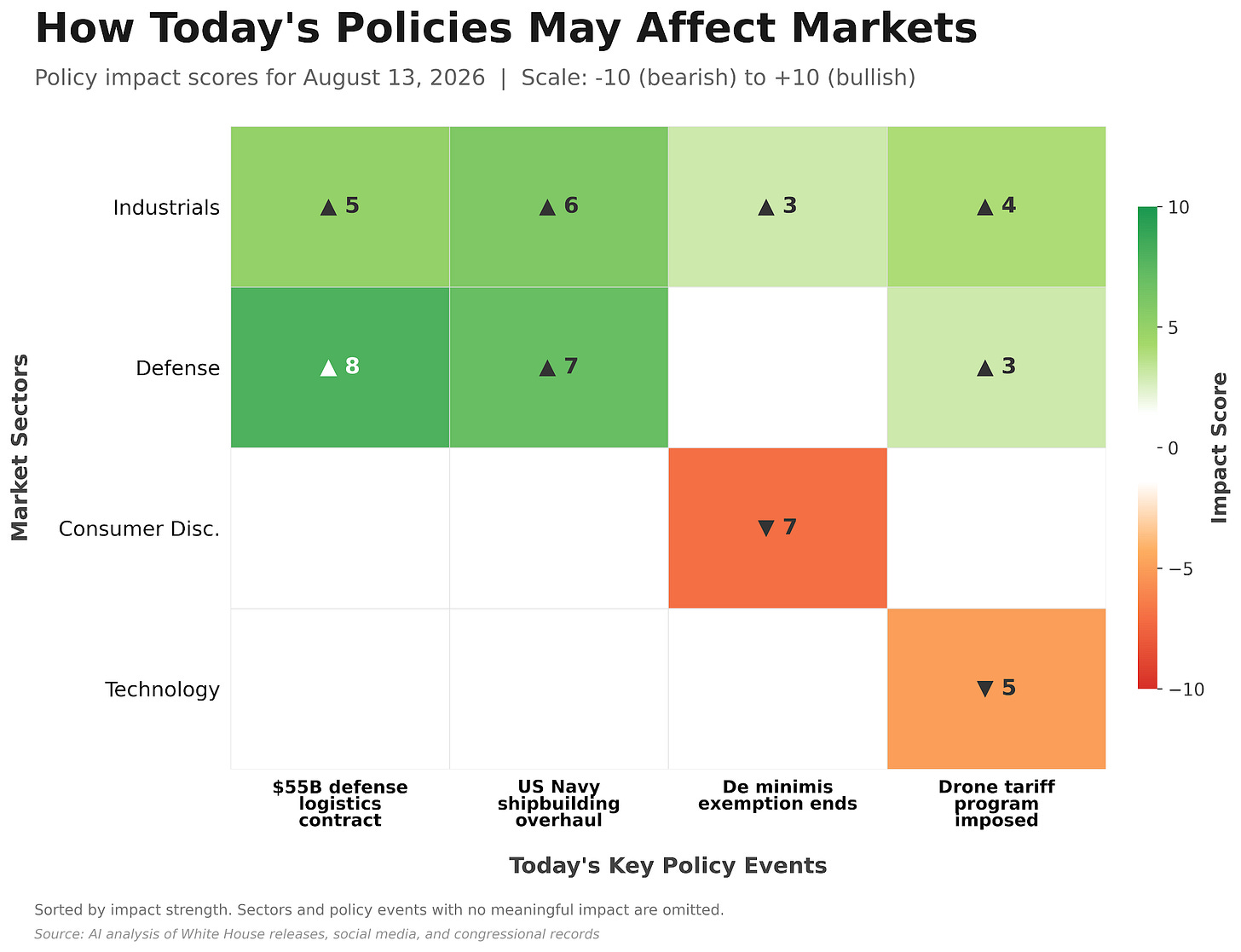
Each cell shows an estimated impact score on a fixed scale of -10 to +10, reflecting how today’s policy developments may affect each market sector. Positive scores (green, ▲) suggest bullish impact; negative scores (red, ▼) suggest bearish pressure. Rows and columns are sorted by impact strength, and sectors and policy events with no meaningful impact are omitted. The heatmap, the analysis below, and the Impact on Market themes above are produced from a single unified analysis: the heatmap visualizes the magnitudes, while the text explains the causal reasoning behind them.
The administration’s shift toward industrial protectionism and defense-centric fiscal policy marks a significant realignment. The termination of the “de minimis” import exemption creates immediate margin pressure for e-commerce and retail firms relying on low-cost foreign sourcing. This pivot mandates higher compliance costs and supply chain reconfiguration for consumer-facing sectors. Concurrently, the 100 percent drone tariffs act as a protectionist barrier, punishing technology companies dependent on global component assembly while favoring domestic manufacturing.
Defense and maritime industrial players benefit from a massive influx of capital. The $55 billion logistics contract provides long-term revenue visibility, while the Navy shipbuilding directive signals a shift away from complex procurement toward “results-based accountability.” Critics argue these protectionist measures invite retaliatory trade actions and may drive inflation, potentially harming consumer purchasing power. While the administration frames these actions as “reshoring” and “national security” imperatives, the underlying effect is a contraction of globalized supply chains. Capital flows will increasingly favor firms aligned with domestic production and government-contracted military theater support.
-
Trump’s great plane escape – podcast
www.theguardian.comWhen Air Force One took off from Turkey after July’s Nato summit, almost everyone believed Donald Trump was on board … but he wasn’t. Jonathan Freedland talks with Tara Setmayer of the Seneca Project about why the White House felt the need to come up with such an elaborate lie to protect the president
Archive: AP, Reuters
Watch Jonathan Freedland on our new Politics Weekly YouTube channel
Send your questions and feedback to politicsweeklyamerica@theguardian.com
Continue reading... -
Doctors, Medical Associations Already Giving A Giant Middle Finger To Trump’s Vaccine EO
www.techdirt.comAs expected, this didn’t take very long. Earlier this week we pointed out that Donald Trump supplanted RFK Jr. as the world’s most infamous anti-vaxxer when he vomited out a bonkers executive order that reduced the recommended childhood vaccination schedule for American children, pared down which diseases were recommended for vaccination, and demanded that the MMR vaccine be split into three separate shots on a spaced out timeline. Combined with Trump outright lying in the ceremony about how the MMR shot was the size of a soda bottle and was “lethal”, the waters around inoculating children against truly horrifying diseases became much more muddy.
The consequences for this will be the result of the actions of two different groups of people. The first are American parents. Because an EO is nothing like a federal mandate, parents will have the greatest influence on what shots their children receive, which is exactly how it should be. What shouldn’t be, however, is having an American population in which 30% proudly wear shirts and hats that say “Trump is right about everything!” and act upon that statement. Which means some not-insignificant percentage of American parents will take Trump’s EO and justifications as gospel and will refuse to get some of these shots for their children. That will endanger their own children, of course, but it will also endanger all the rest of us, too. Less vaccinations mean those that have health conditions so they can’t get vaccinated are put at risk as herd immunity disappears, while the rest of us get to sit around and wonder if the increased presence of these diseases will allow for them to evolve beyond our current immunity protections.
The other group are medical professionals themselves. Fortunately, that group at least is already giving a giant middle finger to Trump and his toilet-paper EO. Here’s a local example from Florida.
Pediatricians in Florida are pushing back on President Donald Trump’s executive order calling for changes to the childhood vaccination schedule.
And the state’s leading pediatric medical association, the Florida Chapter of the American Academy of Pediatrics, said they’re not on board.
“We don’t answer to this nonsense, we don’t recommend changing it,” said Dr. Rana Alissa, president of the FCAAP and an associate professor of pediatrics at the University of Florida. “We go by evidence-based science, we don’t go by politics and politicians.”
This is helpful, but it won’t be enough. Still, it is a good thing that the actual medical professionals out there are informing their patients that Trump and Kennedy are medical morons and that they shouldn’t listen to them. Those doctors are going to have some heavy lifting on their hands, specifically because Trump decided to make it harder for those doctors to keep their patients healthy.
In a statement, president of the American Academy of Pediatrics Dr. Andrew Racine called the executive order “dangerous.”
The order “will do nothing to support families of children with autism or advance understanding of the condition,” Racine said in a released statement. “The only purpose of this announcement is to sow confusion so that more people doubt the importance of vaccines. Delaying or skipping shots is risky, especially as measles continues to spread and children go back to school.”
This is where I think it’s worth reminding you all that the case count of measles for 2026 is already at least 2,465, compared with last year’s total of 2,289. And I’ll add on to that the fact that 68% of those cases occurred in children 19 years or younger and 93% of all cases occur in those that are unvaccinated or in which a vaccination status cannot be confirmed.

In other words, the very group of people that are currently being the most harmed by measles are in the crosshairs of this executive order for things to get much, much worse for them. And, and I cannot stress this all, for the rest of us as well.
-
The Stink of Israeli Election Interference Has Entered the Operation Orange Chicken Chat
sethabramson.substack.com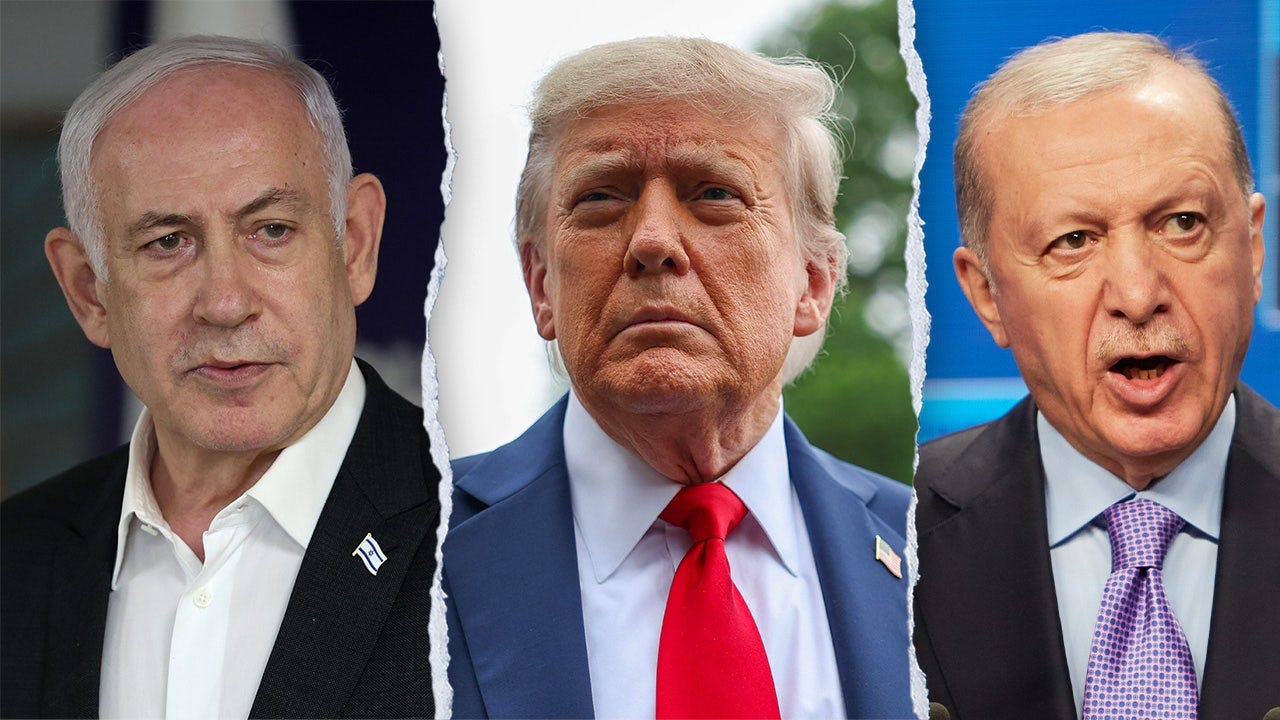
To receive free, unrestricted access to this publication’s 500+ exclusive reports for seven days, just click the “free trial” button below. You can cancel your subscription to Proof at any time.
Introduction