TrumpWatch publisher
-
Kennedy Center board restores Trump's name, testing judge
The Kennedy Center board voted Thursday to again add President Trump's name to the John F. Kennedy Center for the Performing Arts, two anonymous sources told Axios.www.allsides.com -
Iran just raised the price of Trump's waiting game
A week ago, U.S. officials say President Trump was on the verge of ordering a return to major combat operations against Iran.www.allsides.com -
Trump orders Pentagon to redesign US aircraft carrier to use steam catapults to launch jets
www.theguardian.comPresident has suggested steam catapults every year since 2017, saying digital systems are too ‘complicated’
After nearly a decade of loudly complaining about the fact that modern US aircraft carriers use electromagnetic systems to launch fighter jets instead of steam-powered catapults, Donald Trump has directed the Pentagon to redesign a new aircraft carrier to replace the modern system with the old-fashioned catapults he prefers.
Trump signed a national security memorandum on Thursday directing the defense secretary, Pete Hegseth, and the acting navy secretary, Hung Cao, to make the change he has had his heart set on since at least 2017, when he first described his idea to Time magazine.
Continue reading... -
Projectionists Beam New Kennedy Center Makeover Version With Light Show Parody Of Trump
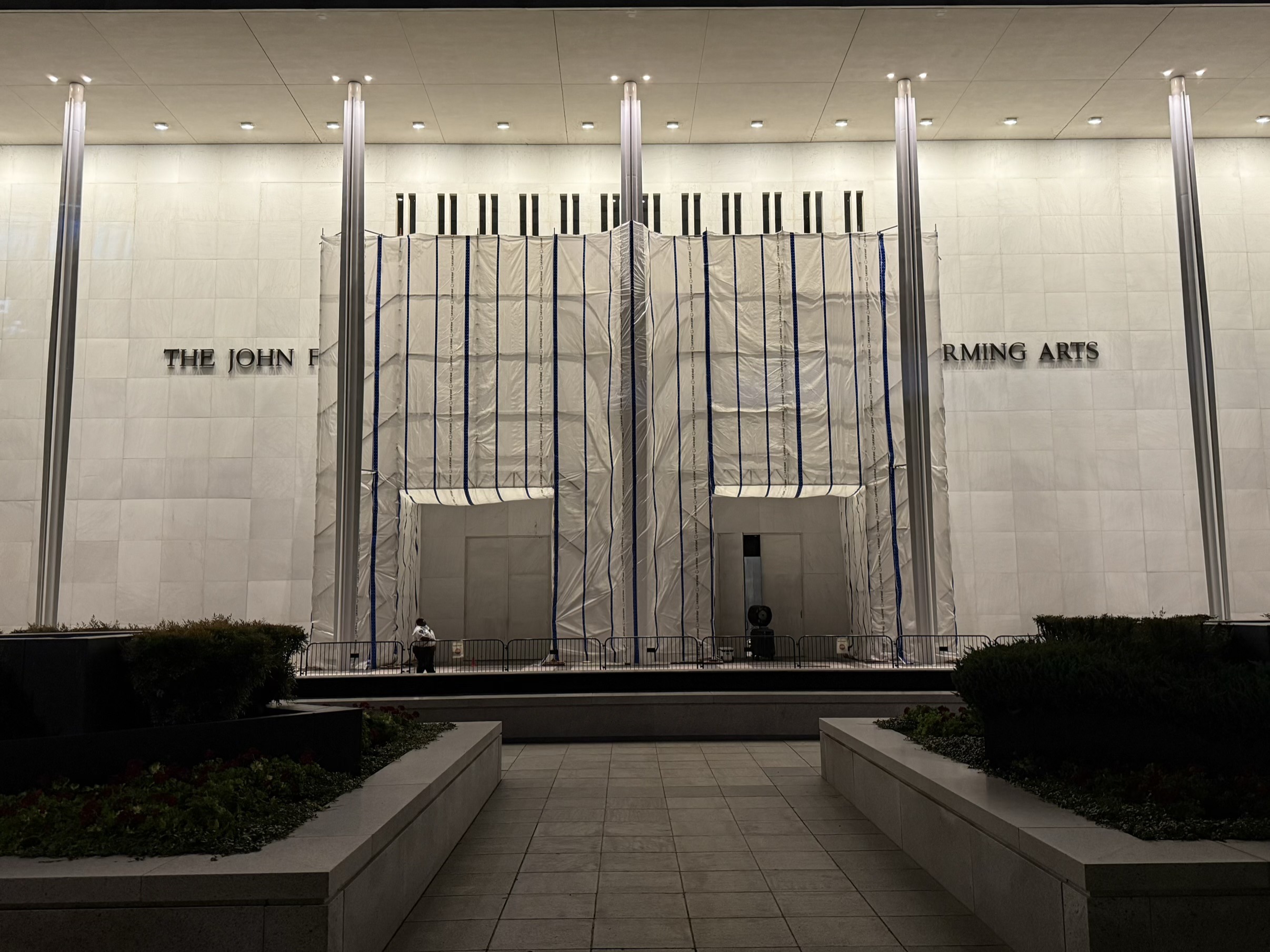
dcmediagroup.us John F. Kennedy Center for the Performing Arts name covered with a tarp as of August 13, 2026. Photo: J. Zangas/DCMG
Washington DC—They rode up late at night along the silent driveway to the John F. Kennedy Center for the Performing Arts. Stopping just long enough to attach a few cables and turn on their projector, they beamed a light show from a car window. Security was caught totally flat-footed. The light show parodied Trump’s vanity project for shuttering the venerable monument and cloaking its name.
The light show borrowed from another show the group displayed on the back of the Kennedy Center in February. But this time they updated it to make fun of the fact that U.S. District Court Judge Christopher Cooper ruled against every effort to take over, rename, and degrade services at the venerable arts center.
The activists knew they shouldn’t be out late taking part in clandestine activity like that. Amidst the oppressive humidity of evaporating democracy, things could get out of hand. It could put them afoul of a law prohibiting defacement of buildings. Lampooning a presidential vanity project could get them into real deep State trouble. “Stranger things have happened.”
A former Olympian was charged with felony vandalism for his arms length reach into the reflecting pool to touch algae sodden paint. That was no joke. He was forced to retain counsel and show up in court on bogus charges which were later dismissed…because they were knowingly bogus. Such fate could easily befall them.
What a golden opportunity they thought. It felt good anyway to take a jab at a narcissist’s inflated vision of himself. Stick a bug in the eye of injustice, so to say. At this juncture what did the light runners have to lose? A little light here and there, speaking truth and power to darkness never hurt anyone. But apparently it had.
A rent-a-cop wearing a heavily starched uniform credentialed with BTI Special Police patches and a good performance ribbon, bounded out of the shadows to stop them. He jumped in front of the light beam. But by then it was already too late. Some of the light show got through. The video was caught. And by the same time the next night, it would be going places.
The video was a redux production of a previous light show on the back side of the Kennedy Center. The new show added a few updates including a show curtain opening to reveal Trump’s name falling off letter by letter from the Kennedy Center.
“You can’t project something onto the building’” he said. “Because it’s a federal building you can’t project anything onto the building. I looked it up.” He called for backup. He wasn’t going to let anyone editorialize the noble white image on the Kennedy Center.
The projectionists were cooperative and turned off the projector. Plausible deniability of the law won the day and they were free to go. They drove away.
Back in February the team of rent-a-cops that night couldn’t stop the show because the projection was out of the Kennedy Center zone, beyond their reach. It was beamed from U.S. Park jurisdiction along the Potomac River. So the special police did the only thing they could and took pictures of the activists. The projectionists didn’t care. The kept the lights going right up until National Park Police came and ran them off. They got plenty of honks in support from passing motorists.
Trump’s Kennedy Center Board, a group of insiders he appointed himself to do whatever he told them to do, had voted in December 2025 to authorize a name change of the Kennedy memorial. The White House announced the Board vote to change the name and the next day on December 19, 2025, workers altered its title by placing his own name over the top of John F. Kennedy’s name.
A suit was filed over the change. Eventually U.S. District Judge Christopher Cooper ruled and ordered the Trump appointed board to remove it within 14 days by June 12. They took it down on June 13 in the early morning hours, late by several hours. The removal didn’t take long but rather than take it down in daylight construction workers waited until after nightfall to put up a tarp so as to conceal its removal.
A narcissist hates public humiliation. But hundreds of DC residents thronged to the sleepy area outside of the Kennedy Center into the late night and early morning hours jeering and chanting as the name was take down. The tarp didn’t stop District residents from gloating and celebrating the Schadenfreude of the takedown.
The shame of having to remove it was too much for someone who has been taught all their life and had grown to adulthood to do something other children have been taught not to do. That is to never admit wrong doing. So he concealed the removal of his name with a giant tarp. The tarp is still in place as of August 13, 2026, three months after the court ruling to remove Trump’s name.
Judge Cooper also prohibited the Trump-appointed Board from closing down the Arts Center and cancelling events already scheduled.
But in a late breaking update the Trump appointed Kennedy Center Board has voted to add Trump’s name as a credit for renovation, and to close the arts center for 2 years to renovate it. Both of these votes go against Judge Cooper’s previous ruling. This story is not going away quietly.
But on this night the rabble-rousers succeeded in sneaking into the Arts Center complex in plain view. They drove right up to the front and acted boldly. They know they’re taking a calculated risk running their game of light shows. As of this, which is at least their 25th consecutive show, it is not doing any harm to or damaging any part of District architecture or memorials. It’s not that it is costing taxpayers anything. It’s that they are projecting light shows unexpectedly in prominent places and getting away with it. It’s that they’re doing something a ballooning authoritarian does not want them to do but hasn’t been able to stop them. And that’s what resistance is all about. It’s the kind of resistance that others see and laugh at the moment. They feel good at seeing something funny that others are doing. By resisting anyway, even though things are getting difficult they’re spreading the joy of good trouble. It’s the kind of resistance that makes others say to themselves: look at what they’re doing. I can do something like that too.
The post Projectionists Beam New Kennedy Center Makeover Version With Light Show Parody Of Trump appeared first on DCMediaGroup.
-
Tracking Trump’s Campaign Promises
President Donald Trump made a lot of promises on the 2024 campaign trail. Which have been kept, and which are unfulfilled?www.allsides.com -
A Family Tragedy in the Age of Trump
Once upon a time, it was practically de minimis for either political party to disavow a candidate facing allegations of domestic violence. But now is not that time.www.allsides.com -
The Rise Of The Anti-System Moderate
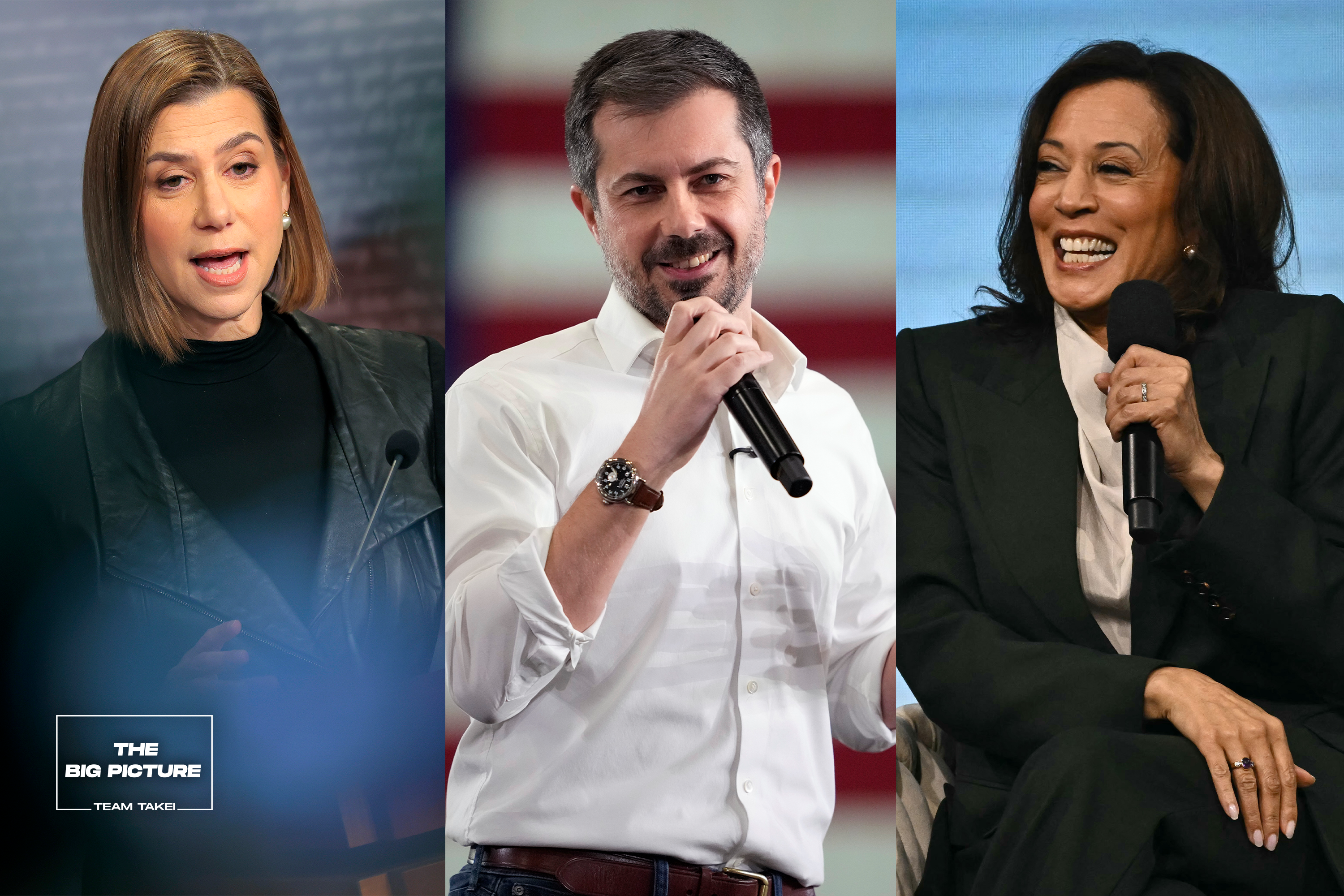
thinkbigpicture.substack.com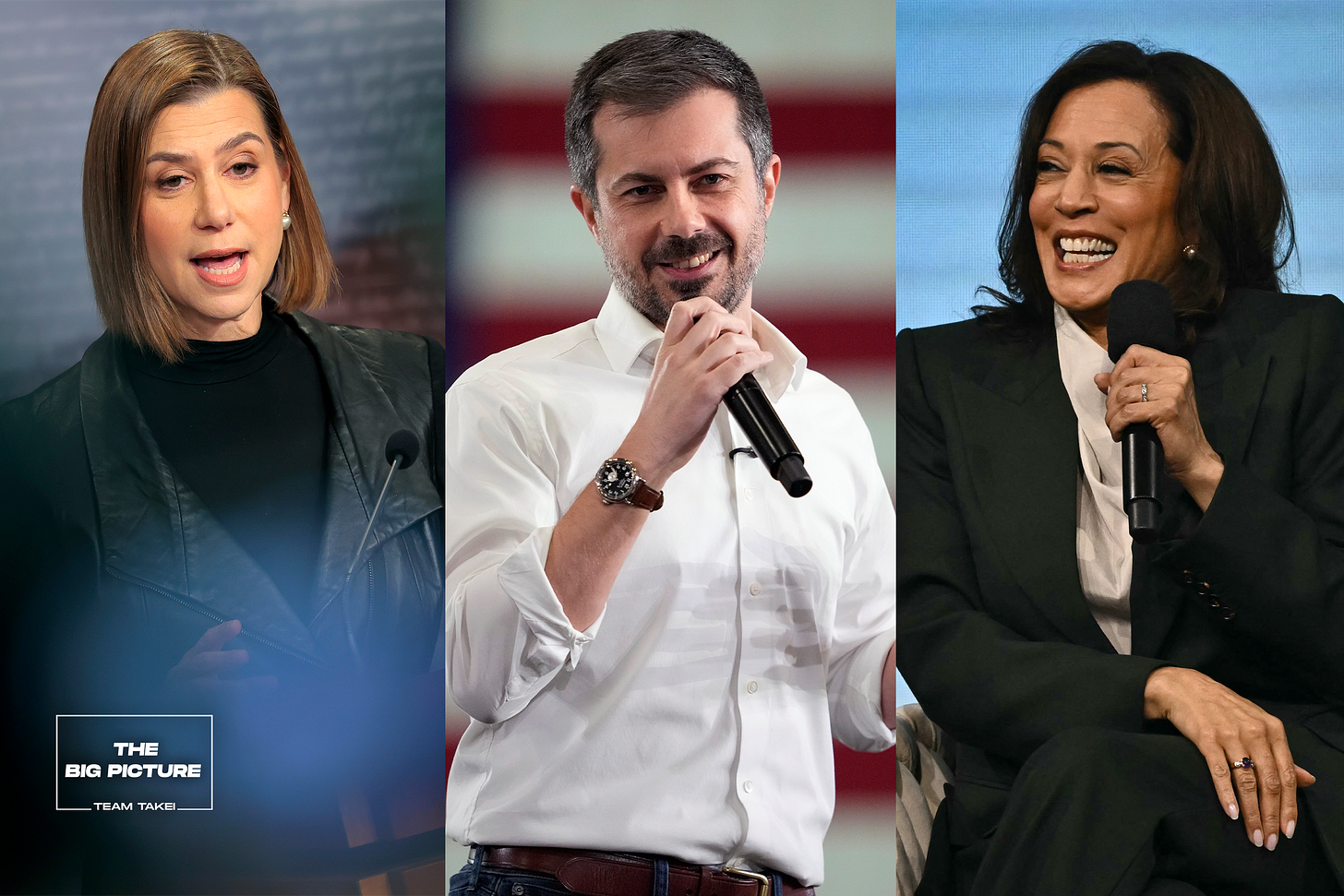 LEFT: U.S. Sen. Elissa Slotkin (D-MI). Photo by Heather Diehl/Getty Images. CENTER: Pete Buttigieg. Photo by Kayla Wolf/Getty Images. RIGHT: Former U.S. Vice-President Kamala Harris. Photo by Joe Klamar / AFP via Getty Images.
Beyond all else, the defining narrative of this Democratic primary cycle has been the emergence of progressive anti-establishment Davids running strongly against—and often defeating—more moderate establishment Goliaths. But as primary season approaches its end, is that narrative proving a false juxtaposition?
Several Democratic 2028 hopefuls sure hope so.
Whether it was Zohran Mamdani against Andrew Cuomo last year, Graham Platner against Janet Mills this Spring, or Abdul El-Sayed against Haley Stevens this summer, the story was the same: the progressive upstart rose from relative obscurity to massive grassroots popularity through creative campaigning and endorsements from progressive champions like Bernie Sanders and AOC. And despite being massively outspent by their more moderate opponents, who had both big establishment money and big name endorsements behind them, on election night the voters sent a message: The same old establishment playbook wasn’t going to fly this year.
This dynamic between the center and the left, and between defenders of the status quo versus anti-system changemakers, had grown into a full-fledged factional dispute among Democratic base voters, with some even pledging not to support the ultimate Democratic nominee in November.
But now that the establishment successfully struck back on Tuesday with a last minute hail Mary, locking in establishment pick David Crowley as the Democratic nominee for Governor of Wisconsin, that rift may be closing, even as the true narrative of the primary season comes more clearly into focus.
As The AP put it yesterday,
Forget left vs. center. Democratic voters are making clear they just want change.
Several of the 2028 Democratic hopefuls have been taking notes and are betting that being the candidate railing against the status quo while being ideologically middle-of-the-road—and even a part of the dreaded establishment—are not mutually exclusive.
As the 2028 presidential primary season draws ever nearer, several Democrats are already positioning themselves as Goldilocks candidates, merging both these qualities in the hope that 2028 is the year of the “anti-system moderate.”
Reformers Rising
For much of the Trump 2.0 era, Democrats have been undergoing an identity crisis. After Trump’s second presidential victory—this time bolstered by a popular vote win—along with the U.S. House and Senate both in Republican hands, Democrats were officially in the wilderness. The vibes were against them, the power was against them, and the people seemed to be against them.
When Trump was sworn in on January 20, 2025, his approval rating was actually above water, just above 50%. Democratic leadership and many Democrats in elected office simply did not know how to respond to Trump’s unconstrained corruption and authoritarianism. As a result, Democratic voters made them pay at the ballot box when they got the chance. For the past year and a half, Democratic voters everywhere have sent a very clear message to the Democratic Party establishment: no concessions, no business as usual, it’s time to step up and fight.
Some Democrats were happy to oblige. Governor Gavin Newsom (D-CA) and Governor JB Pritzker (D-IL) in particular adopted combative stances against Trump’s policies, notably his deployment of National Guard troops to their states, and in Newsom’s case, Trump’s mid-decade redistricting scheme.
But it wasn’t just opposition to Trump and Republicans that Democrats were craving. There was a palpable anger at the Democratic Party itself. As I wrote back in May of last year, Democratic presidential aspirants by then were already in the midst of their “path forward primary,” trying to best position themselves to respond to the mood of the Democratic primary electorate. Of the three buckets of leadership style I identified—the messengers, the fighters, and the reformers—in retrospect, it appears the reformers were the closest to truly understanding what the voters wanted.
But could sitting elected Democrats, members of the very establishment the base was revolting against, credibly convey such an anti-system message? And perhaps more importantly, could candidates who were seen as well within the ideological mainstream, i.e., normie center-left Democrats, appeal to an electorate increasingly enamored by leftist candidates?
After Tuesday’s Wisconsin results, it appears the answer is yes. As Democratic strategist Lis Smith put it to The AP,
“The through line between these races isn’t ideology. It’s impatience with this political system that feels disconnected from the urgency voters feel. The demand for change is much broader than the demand for socialism.”
Increasingly, it appears several top-tier Democratic hopefuls understand this, as they work to cast themselves as the change Democratic voters are looking for.
The “Established Insurgents”
Senator Elissa Slotkin (D-MI) was early to understand that deep reform of the party was needed to ensure Democrats continue to win presidential elections into the future. Last Spring, mere months into her first term as U.S. Senator, Slotkin launched her “war plan” to fight Trump and return Democrats to power. Slotkin sees herself very much as a Midwest whisperer for Democrats, diagnosing part of the problem that voters in the middle of the country see Democrats as “weak and woke.” Now, a year later, even Rep. Alexandria Ocasio-Cortez appears to agree, recently saying, “Woke 1.0 was crazy.”
As of earlier this month, Politico caught back up with Slotkin to gauge her take on the 2026 primary cycle. And once again, her diagnosis appears on point:
For Slotkin, the distinction between progressives and moderates isn’t as important as the distinction between Democrats with mealymouthed messages and those with big plans that will signal serious change to voters. “The messages coming out of people — Democrat, Republican, independent — are basically, ‘We want new leadership, period, and we want bold ideas,’” Slotkin said. “And I think there’s a vacuum of that, and what you see are people on the further left of the spectrum filling that. And I don’t begrudge them. They’re responding to an across-the-board general desire. Now, that’s not to say when I go to Kansas that any individual says, ‘I want to be a socialist.’”
Now other Democratic 2028 hopefuls are heeding that same message, trying to walk a fine line between being a part of the establishment yet still claiming the mantle of reform.
As Gavin Newsom put it recently to reporters as he campaigned for Democrats in Michigan:
“I think this notion of insurgency over incumbency is the real message here, and people just want fighters that want people with conviction, strength, clarity. People that get it, want to get things done, and they’re done with the status quo.”
“I totally respect that,” Newsom added. “I long felt like I’ve been an established insurgent. I’ve always had that mindset.”
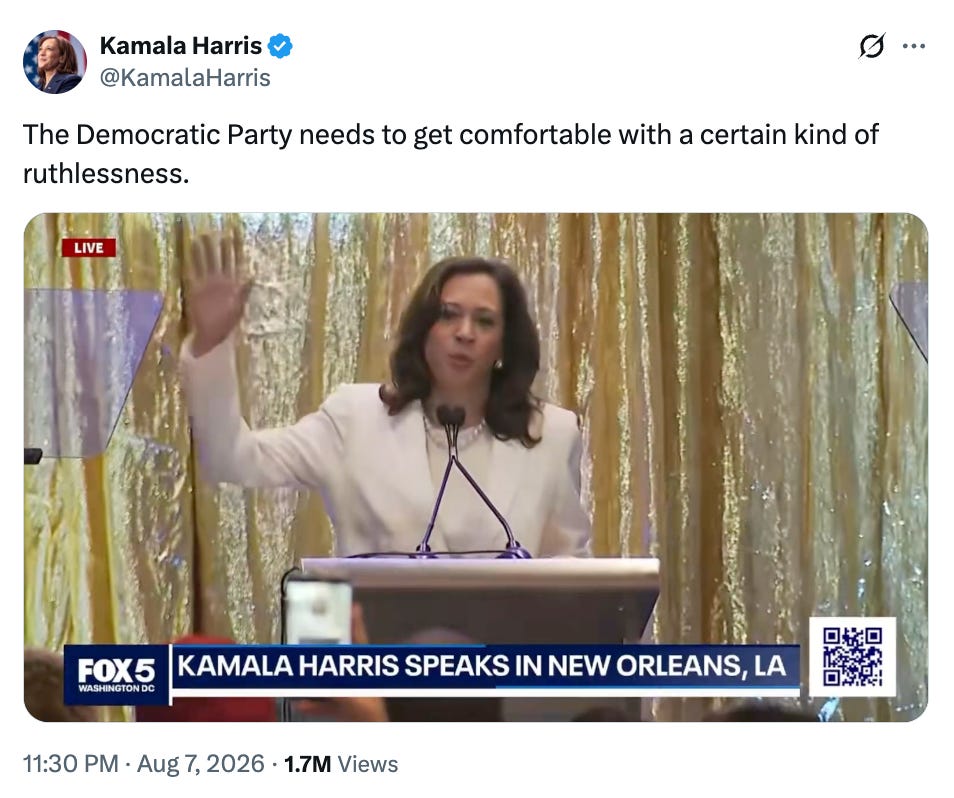
Kamala Harris struck a similar chord in a recent speech, arguing Democrats need to change their style of leadership and get comfortable with a certain level of “uncompromising” “ruthlessness” to combat the “broken status quo.”
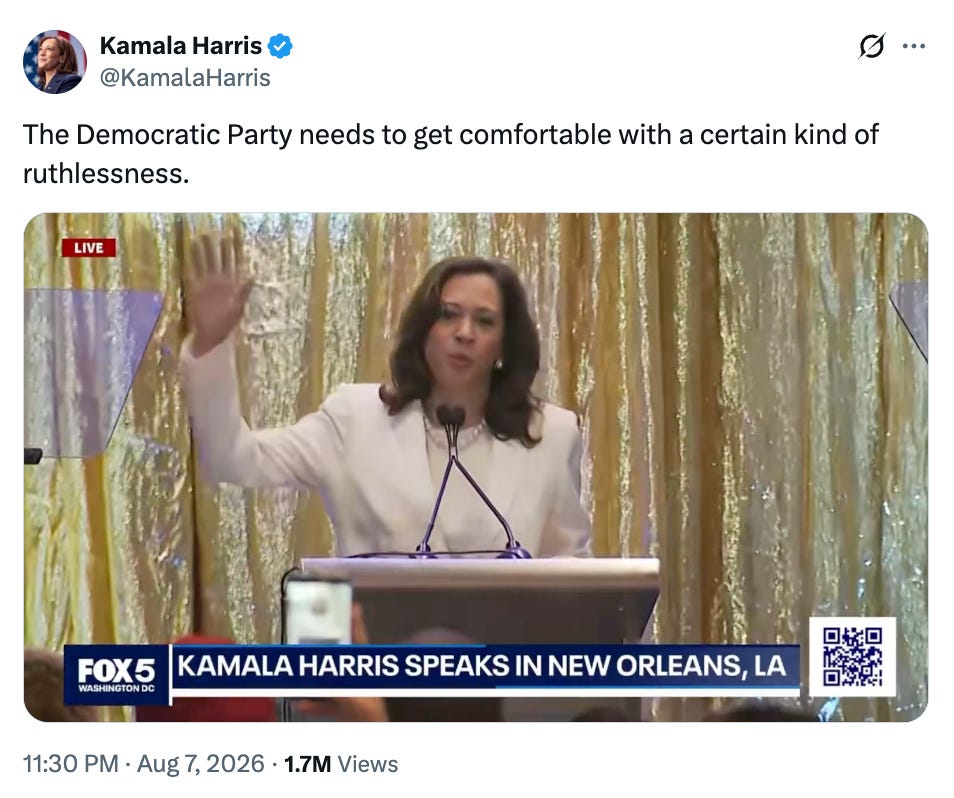
Harris also recently came out explicitly for expanding the Supreme Court to 13 justices and has sought to portray herself as a commonsense reformer.
“We’ll also need to look in the mirror and hold ourselves accountable. Government has to earn the trust of the people,” Harris will say. “And that means responding to the actual needs of the people—not with bureaucracy, but with speed and transparency. Not with process — but with progress.”
That sounds an awful lot like another Democrat who has sparked presidential buzz, appearing near the top of any list of 2028 hopefuls: Pete Buttigieg.
Buttigieg has lain relatively low since leaving the Biden administration last year, traveling the country holding town halls, largely in red states and districts. As someone with a reputation for being a middle-of-the-road institutionalist, Buttigieg has cultivated a reputation for going into spaces that are typically hostile to Democrats and making eloquent, often viral arguments for why the Democratic Party has the better set of values and agenda for moving the country forward.
But listen to him lately and there is a distinct anti-establishment tenor to his remarks, recalling some of the candidates who have been winning primaries this year.
In a June interview with NOTUS, Buttigieg said running the Department of Transportation “radicalized him.” Elaborating, Buttigieg explained,
It showed me the need for institutional change. I’m an ideological moderate, but when it comes to our institutions, I think that what I saw was just how hard it was to get even common-sense things done. How many layers of bureaucracy delayed the delivery of a new bridge or airport?
Additionally, Buttigieg is insistent that, unlike in 2020, Democrats not run on a “return to normalcy” agenda despite every instinct of Democratic Party institutions to want to return to some fictional previous ideal time in the past.
I believe very strongly that there’s no going back. It is not possible, or even desirable, to try to restore a previous status quo. Obviously, a lot of the things that are going on right now are terrible, and in my view, some of them are criminal. That doesn’t mean the right answer is to just pick up the pieces and have what we used to have. Because the flaws of our economic and social and financial and political status quo from before, I think, helped to explain what got us into the mess we’re in right now.
Buttigieg reiterated this during a recent sit-down with Jonathan Martin for Politico, and explicity addressed the notion of whether an ideological moderate could in fact also be the champion of bold reforms.
But to me, the most important thing is — are we demonstrating a readiness to be focused on building what’s next or are we basically preaching some version of “return to normal”? “Return to normal,” in my view, won’t work. One way to say I’m not a “return to normal” is to present the idea that looks furthest left, because that makes you, in a certain way, seem bold. I don’t think it’s the only way to be bold. And so, I think it is really important to not let it lapse into a “left versus center” thing, when the most important question to me is, are we gonna try to sell some version of a previous status quo?
There’s a risk that there’s an unspoken Democratic assumption that we’re trying to take us back to … I don’t know what, is it 2012, is it 1992, is it 2021? Whatever it is, we can’t go there. We shouldn’t try, we shouldn’t want to.
All four of these Democratic hopefuls are banking that anti-status quo reform messaging will serve as a proxy for whatever ideological leftism Democratic voters may be craving. Because, as we saw in 2024, Kamala Harris was widely perceived by voters as more extreme than Donald Trump. Painful as it is to admit, Trump ran and won as the anti-system moderate of that cycle.
And new data confirms Democrats would be correct to emulate that strategy.
Reaching Anti-System Voters
In last week’s Michigan Senate primary, the anti-establishment progressive, Dr. Abdul El-Sayed, eked out a narrow win over the establishment moderate, Rep. Haley Stevens. But pollster G. Elliott Morris, in a new piece this week, warned readers not to fall into a narrative trap, writing, “people are largely missing the real story in the Democratic Party today.”
He went on:
The strongest predictor of individual perception of politicians, including El-Sayed and Zohran Mamdani, is not whether someone identifies as a progressive or a moderate, but whether they think the American system needs to be torn down and rebuilt.
These are the so-called “anti-system” voters I have written about before. The general gist is that there’s a group of voters out there who have very weak ideological attachments but very strong anti-system orientation. Donald Trump used this group to win the presidential elections of 2016 and 2024.
For politicians, whether on the left or more in the center, that anti-system sentiment can do a lot of heavy lifting, and it may just hold the key for how candidates can appeal to the left and the center of the Democratic Party in 2028.
As Morris explains:
A lot of political pundits are interpreting the divide in the Democratic Party right now as a left-vs-right divide. But as this data shows, it’s better understood as a divide over whether you think things in this country are generally OK or just merely “poor,” or whether you think the system needs fundamental changes. Those are not the same question, and the second one is currently doing a lot of work driving voting behavior in both primaries and the general election.
While Morris has found a direct correlation between anti-system candidates and their appeal among progressive voters, he notes that anti-system voters are not confined to the left.
Moderates who say they want “major, disruptive changes” to the political system (54% of moderates) are backing Democrats 69% to 14% in their local House races, while moderates who don’t (46%) are backing Republicans 61% to 24%.
These moderate voters are otherwise very similar — ideologically, demographically, and geographically. What’s driving their behavior is their anti-system orientation.
This has significant ramifications for what will comprise mainstream Democratic policy heading into the next presidential cycle. It is anti-system, for example, to oppose more funding for Israel, to oppose the use of dark money in politics, to fight for Medicare For All, and to support a wealth tax to pay for it.
Look at Peggy Flanagan’s massive victory over Angie Craig in Tuesday’s Minnesota U.S. Senate primary. Flanagan is the sitting Lieutenant Governor of the state, and very much a part of the establishment. Yet she was able to run and win on an economic populist message similar to El-Sayed in Michigan, focused on getting money out of politics and fighting for Medicare for All. These policies have the benefit of being both anti-system and broadly popular among leftists and moderates alike.
And among the potential Democratic 2028 hopefuls, Rep. Alexandria Ocasio-Cortez has been singing this tune for years. Small wonder that she consistently polls at or near the top of any 2028 Democratic preference survey.
The big question moving forward is this: How “anti-system” are these moderate politicians willing to go when it comes to setting the Democratic policy agenda for the 2028 presidential race and beyond?
-
Who will replace Karoline Leavitt as the next White House press secretary?
www.theguardian.comKaroline Leavitt’s abrupt departure has sparked a tough race inside Trump’s circle for the prominent position
Karoline Leavitt’s surprise resignation as the White House press secretary is set to trigger a sharp-elbowed race inside Donald Trump’s world for one of the most prominent positions in the Trump administration.
Several names have circulated since the US president announced that Leavitt would step down at the end of the month to spend more time with her family.
Continue reading... -
Donald Trump empowers US private companies to conduct cyber-attacks
www.theguardian.comPresident signed memorandum giving private sector a role in fighting ‘transnational criminal organizations’
Donald Trump signed a memo on Wednesday that aims to give private companies the power to carry out offensive cyber-attacks against foreign criminal entities.
The president signed a national security presidential memorandum directing his administration to “leverage the capability and innovation of the private sector to help conduct these cyber operations under the direction, control and authority of the US government”, the White House said.
Continue reading... -
Kennedy Center board votes again to renovate building and inscribe Trump’s name on it – report
www.theguardian.comThe center has until next week to present plan to judge who had blocked earlier rehab and name change
The board of the John F Kennedy Center for the Performing Arts in Washington is said to have voted once again to move forward with Donald Trump’s controversial plan to temporarily shutter the building for substantial renovations, as well as to inscribe the US president’s name on the facade of its building, despite a federal order for his name to be removed from the signage.
The board – mostly handpicked, staunch allies of the president – voted “to close the Kennedy Center’s main building, while keeping a newer addition to the campus, known as the Reach, open for limited programming and to operate as an active memorial to John F Kennedy”, according to the New York Times, which was first to report the results.
Continue reading... -
What is the MMR vaccine and how does Trump’s executive order affect parents and children?
www.theguardian.comPresident’s order calls for several changes to childhood vaccinations – and experts say it’ll lead to confusion
On Monday, Donald Trump signed an executive order pushing for revisions to how children in the US are vaccinated.
The executive order calls for several changes. These include fewer vaccinations overall and a recommendation that the combined measles, mumps and rubella (MMR) vaccine be replaced with separate shots for each disease administered during separate medical visits. The latter direction is currently impossible to implement because no stand-alone shots for these diseases are licensed in the US.
Continue reading... -
The Fake Free Speech President Has Unleashed ICE On Its Critics
www.techdirt.comIt still amazes me that there are people out there who think that Donald Trump is a supporter of free speech. It has never been true. Anyone who looks will note that the Trump administration regularly engages in clearly unconstitutional attempts to suppress speech. But because he and his supporters like to claim he’s a free speech supporter, they believe it.
But here’s yet another story showing how that’s bullshit. The Wall Street Journal has a detailed report on how Trump’s personal secret police militia, ICE, is actively investigating, intimidating, and silencing people who criticize them online.
In recent months, ICE has deployed a round-the-clock digital dragnet to scour the public internet—from Facebook to Instagram to X—for speech that could endanger the agency’s mission. The government has paid millions to private contractors to surface everything from potential threats to agents to activities that could disrupt ICE’s operations, according to federal documents, contractors and former Homeland Security Investigations agents.
The program has ensnared U.S. citizens and activist groups that alert community members about ICE activity. Contractors prepare daily reports and dossiers on threat actors, identifying the poster’s name, location, date of birth, workplace, Social Security number, vehicle registration and criminal history when possible.
To unmask anonymous online critics, DHS has sent hundreds of subpoenas to social-media companies, according to people familiar with the matter. Its agents have tracked down Americans at work and on the road, asking them to sign letters acknowledging their online speech about ICE “may” be a crime.
Criticizing ICE online is not a crime. It’s protected speech under the First Amendment. I’d point out that all of this clearly violates Trump’s early executive order on free speech, but did anyone ever take any of that seriously? It was always just red meat to throw out to his cultish base, rather than anything real.
Indeed, you can see that in the fact that the very same MAGA trolls who falsely insisted that the Biden admin was actively “censoring” people on social media will be quick to defend what ICE is doing here, even though it’s way more clearly an attack on the First Amendment rights of ICE’s critics.
DHS sent administrative subpoenas to Reddit for the information of 11 accounts that had posted “content critical of federal actions” between July and December of last year, the company’s most recent transparency reporting period, according to a person familiar with the matter.
While the article notes that Reddit (thankfully) pushed back on these requests, this is still quite different from the reports the Biden administration occasionally sent to social media companies, which tended to be much more “does this violate your rules?” not “reveal who these critics are.”
The article notes that these attacks on free speech appear to be ratcheting up as ICE and Trump grow more desperate to control the narrative around their secret police activities. That escalation now includes seeking grand jury subpoenas for critics’ information. And now that Trump gave ICE a lot more money, they’re investing millions in surveillance tech to track down online critics:
In the past year, OPR spearheaded an initiative to dramatically expand the agency’s ability to monitor online critics and potential threats, according to contractors, federal documents and former HSI agents.
Teams of contractors now scour the internet using sophisticated surveillance tools to find commentary that the agency regards as potentially dangerous.
ICE spending on surveillance technology and consultants has surged, reaching $258 million during Trump’s first full year back in the White House, a 57% increase from the same period a year prior, according to the Journal’s analysis.
ICE has inked at least six contracts that involve scanning public records for “threats,” paying out nearly $50 million since 2020. More than half those funds were obligated since last January, and another award potentially worth up to $50 million the agency continues to extend. The most recent awards call for contractors to help the agency geolocate individuals labeled as “extremists,” compile reports on individuals and cross-reference information with government databases, contracting documents show.
Of course, MAGA folks will claim they have to track down “threats,” but much of the content doesn’t sound threatening at all. For example:
… a New York poll worker named Paigelynne Gonyea received a voicemail from a man identifying himself as an agent with Homeland Security.
“We were just calling you in reference to a post that we believe you made on Instagram where you doxxed an ICE agent back in January,” said the caller.
Shortly after, two agents from ICE OPR arrived at the voting site where she was working.
They held printed screenshots from her account, she said, including the post in question. The agents flipped by it quickly, she said, but she caught one thing: The post included a photo of Ross, the immigration officer who killed Good.
The file that agents were holding also contained Gonyea’s address, date of birth and what looked like a picture of her taken at airport security, she said. They told her to take down the post and asked her to sign a letter acknowledging she had been informed that she “may” have violated federal law with her social-media account.
Gonyea said she was only able to find one post that spoke about a specific ICE agent: ”I think today is a great day for Jonathan Ross to be indicted!” the 40-year-old influencer and author had written in the post, referencing the Minnesota Star Tribune article that first named him.
All of this is textbook behavior for thin-skinned authoritarians unwilling to tolerate even the mildest criticism. But in America, we’re supposed to have rights, including the right to free speech. But somehow all the people who claimed that Biden was suppressing speech have gone completely silent about stories like this one. Trump claiming to be the free speech president and claiming to outlaw anyone in the government from suppressing free speech means absolutely nothing as activities like the ones described here continue to happen daily.
-
Trump’s Government Responded to Murdering Alex Pretti by Spying on the Entire Anti-ICE Community in Minnesota
emptywheel.net
In the Minnesota Antifa 15 case, defendant Ian Sant has a blockbuster filing revealing details of the broad spying HSI did after they killed Alex Pretti, targeting activists, unions, No Kings, and environmental organizations. NYT reported on the contents of the filing, and the exhibits, here.The filing reveals that a DOJ prosecutor who entered restricted grounds on January 6 — whom DOJ has put in charge of investigating Antifa — presented this case to the grand jury, including this slide trying to implicate much of the left in Minnesota and the country to DAMN, the group alleged to be at the core of this activity.

Sant also describes how they did a Clearview dossier on him which returned a false positive implicating a guy, his very pregnant wife, and their child.
When I first wrote up this indictment, I predicted that DOJ was doing just this kind of networked criminalization — attempting to tie most of the left to low-level instances of alleged violence.
DOJ will argue that it doesn’t matter than most of the defendants never chose to have anything to do with Wagner, most never participated in the hard blockades, but instead did legally protected things like tracking ICE vehicles. Because defendants entered into an agreement with Sant, Apland, and Kennedy, I imagine prosecutors will argue, they’re on the hook for Wagner and/or events that happened months later or months earlier.
Compared to both the Spokane 3 and Prairieland cases, each of which focused on a single event, this is an attempt to criminalize months of organization by strapping Twin Cities’ activism onto the face of Wagner.
And it’s not just those already charged this attempts to criminalize. There are — as mentioned — multiple references to other anarchist groups, people like Sam the shield-builder in Chicago along with long-time comrade Forrest in California, the anarchist speaking circuit in Ann Arbor and Seattle, as well as the zine, Crimethinc, which played a role in the Praireiland case. Partly in an attempt to test the indictment’s reliance on informants (there may be two or three), I laid out the references to unindicted co-conspirators in the indictment, below; the way the last reference to an unindicted co-conspirator focusing on Delaney Hall (plus DOJ’s treatment of the arrest of a Cities Church defendant there) makes me believe they’ll soon seek a similar indictment there.
But the indictment also lays out coordination with the AFL-CIO, 50501, and DSA, hypothetically putting some of the most important normie left organizations in a conspiracy with Kyle Wagner too.
And sure enough, that’s what they did.
The post Trump’s Government Responded to Murdering Alex Pretti by Spying on the Entire Anti-ICE Community in Minnesota appeared first on emptywheel.
-
Man who carried Clinton nuclear 'football' reveals what 'scares the hell out of me' about Air Force One story
A retired Air Force lieutenant colonel who carried the nuclear "football" for former President Bill Clinton says the extraordinary Air Force One shell game departing Ankara, Turkey, last month to protect President Donald Trump from a potential attack was hardly unprecedented.www.allsides.com -
Trump Uses Deceptive Chart in False Inflation Boast
www.factcheck.org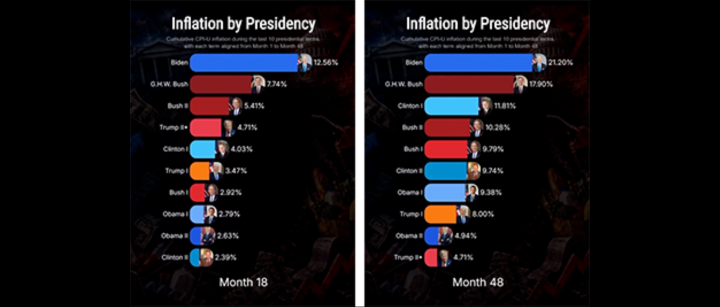
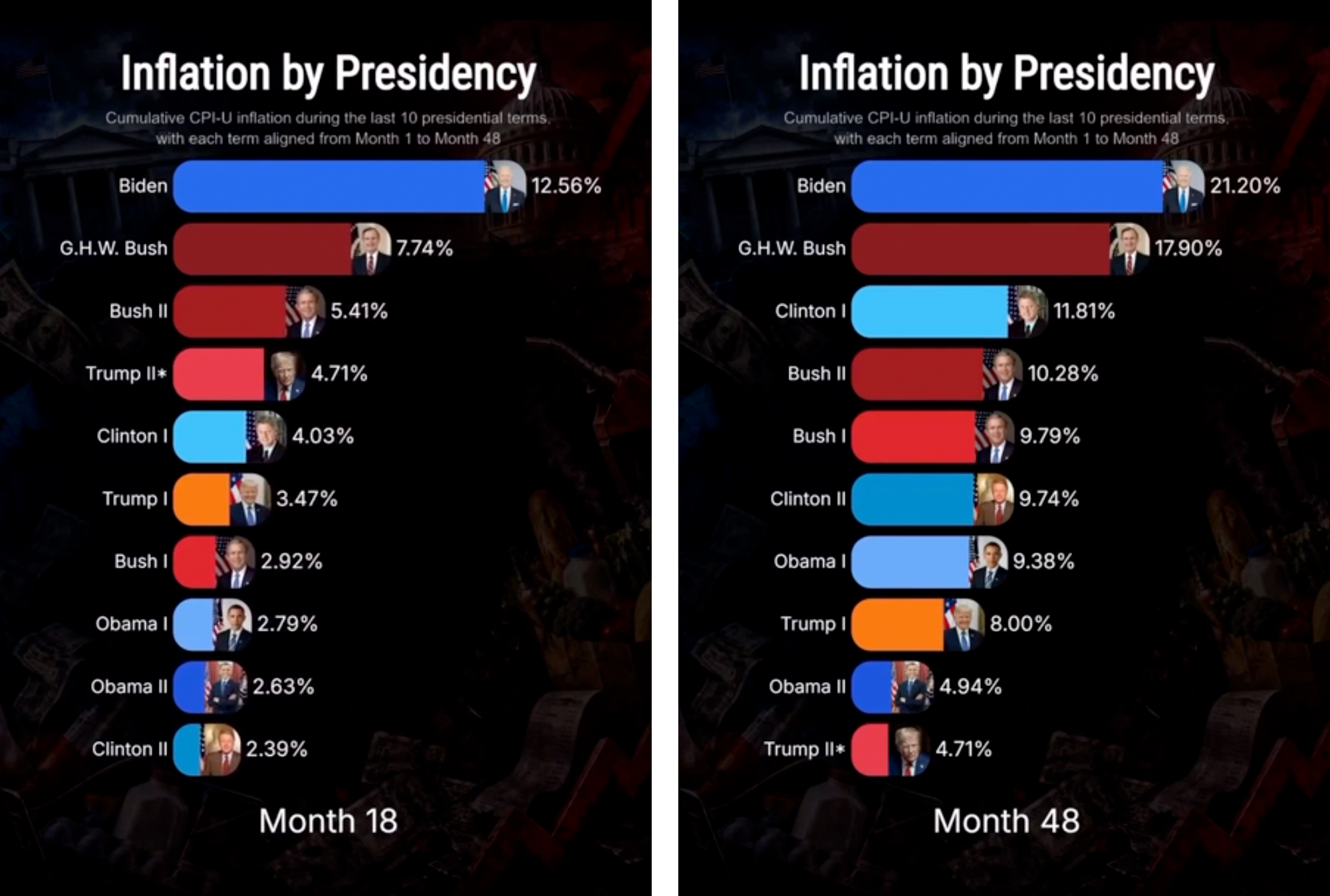
In a recent interview, President Donald Trump falsely claimed to be the “lowest of the last 10 presidents on inflation,” seemingly based on a chart Trump posted to social media that misleadingly compares price growth over the first 18 months of his second term with total inflation at the end of his predecessors’ full four-year terms.
For that comparison to hold, of course, you have to assume inflation will be 0% for the next two and a half years — a highly implausible scenario.
A more telling comparison is to look at where inflation stood 18 months into each of the last 10 presidential terms. By that metric, Trump doesn’t have the lowest inflation at this point in his term, but rather the fourth highest.
Trump posted the video infographic — which appears to come from an Instagram creator of “viral money charts” — on his Truth Social account Aug. 9. Titled “Inflation by Presidency” and scored to dramatic music, it purports to show cumulative inflation for each of the last 10 presidential terms (not presidents) at months one through 48. The rankings change each month as total inflation grows.
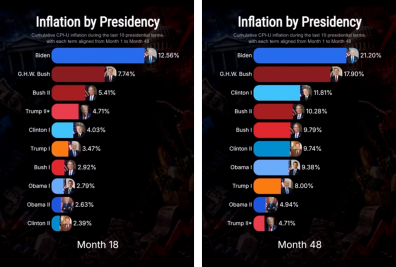 Screenshots from the graphic Trump posted to social media. The Month 48 slide (right) shows his second term as having the lowest cumulative inflation — but it compares his first 18 months to other presidents’ full four-year terms. A more accurate comparison is the Month 18 slide (left). (Note: Our calculations of cumulative inflation using BLS’ seasonally adjusted CPI-U numbers differ slightly from the ones above.) Charts by Instagram user @yunggeeski_.
After 18 months, however, the “Trump II” inflation total stops growing — because the rest of his presidency hasn’t happened yet — while the others continue to climb. As a result, Trump’s second term drops through the rankings and is shown as having the lowest cumulative inflation after 48 months.
Trump bragged about this deceptive statistic in an interview with conservative commentator Wayne Allyn Root, which was posted online Aug. 11.
“Did you see the charts that came in yesterday?” Trump said. “I’m the lowest of the last 10 presidents on inflation. I mean, it’s crazy. It’s a chart.”
In fact, federal economic data show cumulative inflation at this point in Trump’s second term is higher than it was at the same point in most of his recent predecessors’ terms.
According to the Bureau of Labor Statistics’ Consumer Price Index, prices grew 4.34% between January 2025 and July 2026. Going back to the late 1980s, only three presidents presided over higher inflation in their first 18 months — Joe Biden with 12.27%, George H.W. Bush with 7.67% and second-term George W. Bush with 5.90%.
The rest — both Clinton and Obama terms, George W. Bush’s first term and Trump’s first term — were all between 2.38% (Clinton’s second term) and 3.92% (Clinton’s first term) a year and a half after inauguration.
The creator of the graphic, an Instragram creator with the handle @yunggeeski_, told us in a message that their aim was to show the “full trajectories” of previous administrations, and the software they use would have made it hard to remove Trump’s second term from the data after month 18.
“The chart itself wasn’t intended to claim that Trump will have the lowest inflation over an entire term, since obviously the remainder of the term hasn’t happened yet,” they said.
Asked for comment, White House spokesman Kush Desai did not directly address the president’s use of the misleading statistic, but touted what he said were the administration’s successes in fighting inflation.
“President Trump inherited the worst inflation crisis in a generation, and has implemented policies that have brought prices of key essentials ranging from prescription drugs to eggs to auto insurance down in historic ways, with even more relief to come,” Desai said in a statement. (While prices of those three items have indeed come down in the past year, the overall inflation rate is higher than when Trump took office.)
“Given the President cannot definitely predict inflation rates in the future, only an idiot would take issue with him touting the results of his agenda so far,” Desai added.
But “so far” Trump isn’t the “lowest of the last 10 presidents on inflation,” as he claimed.
Editor’s note: FactCheck.org does not accept advertising. We rely on grants and individual donations from people like you. Please consider a donation. Credit card donations may be made through our “Donate” page. If you prefer to give by check, send to: FactCheck.org, Annenberg Public Policy Center, P.O. Box 58100, Philadelphia, PA 19102.
The post Trump Uses Deceptive Chart in False Inflation Boast appeared first on FactCheck.org.
-
The Communist Threat to America is Real
During his address at Mount Rushmore, on the eve of our nation's 250th anniversary, President Donald Trump warned Americans of a "resurgence of the Communist threat is now present in our country—including among newcomers who adopt ideologies that are fundamentally contrary to our way of life."www.allsides.com -
Trump's justice department arrests expert on far right as part of SPLC crackdown
The justice department on Wednesday arrested a leading expert on far-right extremism, charging her with financial crimes as part of the government's ongoing case against the Southern Poverty Law Center (SPLC).www.allsides.com -
Washington Policy Review: August 12, 2026
washingtonpolicyreview.substack.comAdvertisement: Noctral is a professional network where the introductions are made by an AI twin you write once. Every night it has a real conversation with another member's twin, inside communities you choose, and you read the whole transcript and decide whether you want to talk. All day it keeps going without you — the twins write the feed, and you never post a thing.
Noctral, free on the App Store: https://apps.apple.com/app/noctral-ai-twin-networking/id6786786677
1. Overview
President Trump issued a memorandum authorizing private U.S. companies to conduct “Cyber Surveillance Operations” against foreign criminal organizations under federal oversight. He also proclaimed August 2026 as National Substance Use Primary Prevention Month, touting his border policies as the most secure in history while asserting that his administration is “cleaning up our streets.” Additionally, the White House released a fact sheet detailing the administration’s commitment to using every available tool to disrupt criminal groups that “attack Americans.”
On Truth Social, Trump nominated Lee Rudofsky to the Eighth Circuit Court of Appeals, praising him as a “rock solid defender of the Constitution.” He expressed support for White House Press Secretary Karoline Leavitt as she transitions into a role advising the GOP for the upcoming midterm elections. Furthermore, Trump urged the Senate to pass the Sunshine Protection Act and issued a wave of endorsements for Florida congressional candidates and state-level officials, emphasizing their shared focus on border security and tax reduction.
The State Department and HHS announced the U.S. will serve as the new Secretariat for the Geneva Consensus Declaration to “protect life at all stages.” The State Department also launched a Birth Tourism Prevention Task Force to address the exploitation of immigration laws, stating that “citizenship is not a commodity.” Meanwhile, the Department of War awarded major contracts for ship repairs and aircraft tactical terminals, and HHS announced a $4 million initiative to expand rapid syphilis testing to protect infants and mothers.
Governor Gavin Newsom announced that California state employees will gain discounted access to the AI tool Claude through a new partnership with Anthropic. Governor Wes Moore announced that the company Cloudforce will expand its headquarters in Maryland, creating 250 new jobs, while Governor Andy Beshear celebrated the grand opening of a $5.4 million robotics facility in Lexington, Kentucky. Governor JB Pritzker’s schedule included an appearance at the Illinois State Fair to unveil the traditional butter cow.
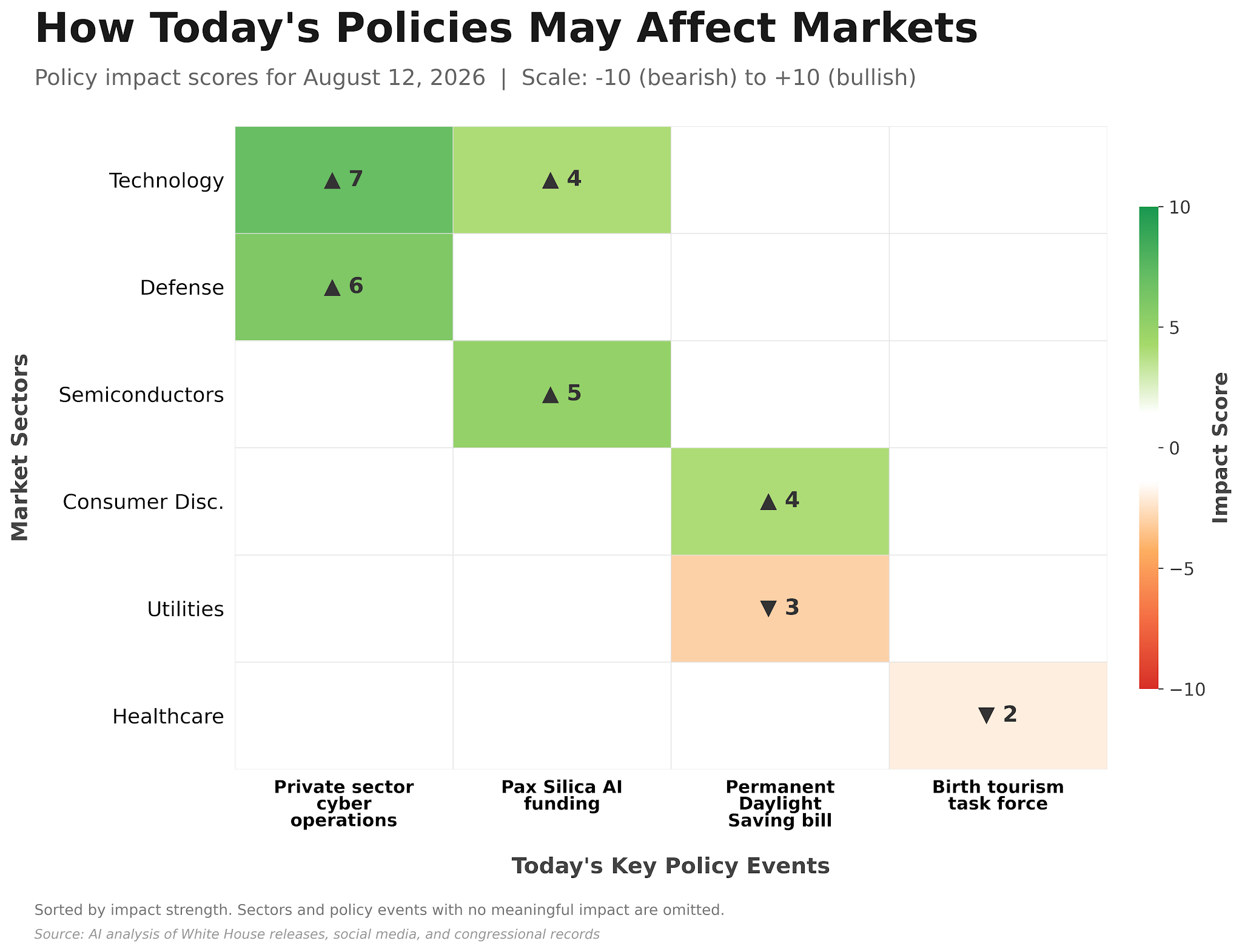
The administration’s authorization of private offensive cyber operations provides a new growth vertical for defense and specialized technology firms, though it simultaneously introduces heightened systemic risk for cloud infrastructure due to the potential for retaliatory geopolitical escalation. The Pax Silica AI Assistance Project functions as a bullish mechanism for hardware stability by prioritizing supply chain provenance, despite the prospect that administrative credentialing requirements may impose costly compliance burdens on global logistics providers. Finally, legislative movement toward permanent Daylight Saving Time acts as a catalyst for increased discretionary spending within the retail and leisure sectors, although this shift in consumer patterns risks creating operational volatility and increased costs for the energy sector.
2. White House News
Expanding Capabilities to Combat Transnational Cyber-Enabled Crime
President Trump issued a memorandum directing the National Coordination Center to create a program authorizing private U.S. companies to conduct “Cyber Surveillance Operations and Cyber Effects Operations” against foreign Cyber-Enabled Transnational Criminal Organizations. Overseen by the Departments of Justice and Homeland Security, the program aims to utilize private sector ingenuity to counter threats to American citizens. Participating companies must undergo rigorous vetting, maintain federal bonds, and operate under strict government oversight to ensure compliance with the Constitution and international law while targeting criminal networks.
Reference: https://www.whitehouse.gov/presidential-actions/2026/08/expanding-capabilities-to-combat-transnational-cyber-enabled-crime/
Fact Sheet: President Donald J. Trump Expands Capabilities to Combat Transnational Cyber-Enabled Crime
President Trump signed a National Security Presidential Memorandum empowering federal law enforcement to utilize cyber tools against transnational criminal organizations operating in foreign jurisdictions. This initiative aims at “disrupting” groups that “attack Americans” and exploit them through cyberspace. By taking this action, President Trump is “unleashing every available tool” to combat foreign-based organized crime. Ultimately, the administration states that President Trump is “committed to addressing crime targeting Americans regardless of where it originates,” reinforcing his objective to deliver enhanced security and justice for the nation.
Reference: https://www.whitehouse.gov/fact-sheets/2026/08/fact-sheet-president-donald-j-trump-expands-capabilities-to-combat-transnational-cyber-enabled-crime/
National Substance Use Primary Prevention Month, 2026
President Trump proclaimed August 2026 National Substance Use Primary Prevention Month, aiming to stop addiction before it begins. Highlighting his administration’s efforts, the President cited the HALT Fentanyl Act and the designation of cartels as terrorist organizations as key achievements. He claims the southern border is “the most secure in American history,” blocking “deadly narcotics.” Contrasting his policies with others, he stated, “While radical lunatics pass out needles, my Administration is cleaning up our streets.” The proclamation emphasizes evidence-based prevention, prioritizing education to protect America’s youth.
Reference: https://www.whitehouse.gov/presidential-actions/2026/08/national-substance-use-primary-prevention-month-2026/
3. Truth Social Posts
Trump announced the nomination of Lee Rudofsky to the United States Court of Appeals for the Eighth Circuit, describing him as a “rock solid defender of the Constitution.” Additionally, Trump praised his White House Press Secretary, Karoline Leavitt, as she prepares to transition into a new role as a top outside advisor and influential voice for the Republican Party to help “conclusively win the Midterm Elections.” Regarding policy, Trump urged Republican Senators to pass the Sunshine Protection Act, framing the elimination of biannual time changes as a measure that will save energy costs, boost various industries, and improve public health and safety.
In electoral politics, Trump endorsed Mike Mazzei for Governor of Oklahoma, contrasting his support for a new aluminum plant with the opposition of his opponent, Gentner Drummond. Trump characterized Drummond as a “FAKE Republican” who has associated with the “totally corrupt and anti-American” Lincoln Project. Furthermore, Trump offered his “Complete and Total Endorsement” to Senator Ashley Moody, endorsed Byron Donalds for Governor of Florida, and backed James Uthmeier for Florida Attorney General, highlighting their commitment to an America First agenda.
Trump also issued a series of endorsements for Florida congressional candidates, including Wilton Simpson, Jimmy Patronis, Kat Cammack, Aaron Bean, John Rutherford, Randy Fine, Mike Haridopolos, Gus Bilirakis, Anna Paulina Luna, Laurel Lee, Sydney Gruters, Greg Steube, Scott Franklin, Brian Mast, Mario Diaz-Balart, and María Elvira Salazar. In each endorsement, he emphasized the candidates’ dedication to securing the border, cutting taxes, promoting domestic energy production, and protecting the Second Amendment.
Reference: https://truthsocial.com/@realDonaldTrump
4. Government Department News
State Department (state.gov)
Secretary Rubio’s Call with Foreign Minister Gerapetritis
Secretary of State Marco Rubio spoke with Greek Foreign Minister Giorgios Gerapetritis to discuss U.S.-Greece cooperation in the Eastern Mediterranean. Secretary Rubio acknowledged Greece’s role as a NATO ally and reaffirmed the strength of the bilateral relationship, highlighting ongoing collaboration in defense, energy, law enforcement, technology, and cultural ties.
State Department Establishes Task Force to End Birth Tourism
Under President Trump’s leadership, the State Department has launched a Birth Tourism Prevention Task Force to combat the exploitation of U.S. immigration laws. Asserting that “citizenship is not a commodity to be acquired through the calculated exploitation” of law, the department is working with the Department of Homeland Security to identify deception patterns. Foreign nationals and facilitators involved in birth tourism schemes face potential visa revocation and loss of access to the United States.
Pax Silica AI Assistance Project NOFO
The State Department has issued a Notice of Funding Opportunity for the Pax Silica AI Assistance Project, aiming to commit up to $50 million in foreign assistance to secure global AI supply chains. The project seeks to develop a credentialing and provenance platform to expedite the shipping of semiconductors and AI infrastructure. A pilot program will launch in Panama, with potential expansion to other Pax Silica partners. The application deadline is August 20, 2026.
HHS Secretary Robert F. Kennedy, Jr. and Secretary of State Marco Rubio announced that the United States will assume the role of Secretariat for the Geneva Consensus Declaration, taking over from Hungary. The Declaration, which has over 40 signatories, seeks to promote women’s health, “protect life at all stages,” and “defend the family as the fundamental unit of society.” The Secretariat will be housed within the HHS Office of Global Affairs, reflecting a whole-of-government commitment to these values.
Department of War (war.gov)
Joint Statement on 2nd Meeting of the Joint Angolan-American Defense Cooperation Committee
The United States and Angola held their second Joint Defense Cooperation Committee meeting on August 5–6, 2026, to reaffirm their commitment to defense cooperation. Delegations led by General Ref Afonso Carlos Neto and Assistant Secretary of War Daniel Zimmerman signed an addendum to governing regulations to facilitate closer coordination between their armed forces. The parties intend to pursue a deeper security relationship and will address operational and tactical issues at an upcoming National Coordination Meeting. The next committee meeting is scheduled for 2028 in the United States.
The Department of War announced several defense contracts. Cayuse Native Hawaiian Veterans LLC received a $249 million contract for Military Sealift Command ship repairs in Guam. Leonardo DRS was awarded $39.6 million for F/A-18 and EA-18G aircraft tactical terminals. Symetrics Industries received $14.15 million for F/A-18 weapon repair assemblies, supporting Foreign Military Sales to Japan and France. Lockheed Martin Space was awarded a $211.4 million modification for THAAD launchers for the UAE. Additionally, Cottrell Contracting and Marinex Construction received dredging and construction contracts for the Army Corps of Engineers.
Department of Health and Human Services (hhs.gov)
Secretary Kennedy Announces Landmark Food Policy Reforms to Advance President Trump’s MAHA Agenda
HHS announced new food policy reforms to support President Trump’s “Make America Healthy Again” (MAHA) agenda. The department proposed a rule requiring manufacturers to notify the FDA when declaring substances “Generally Recognized as Safe” (GRAS). Additionally, HHS and the USDA submitted a proposed federal definition for ultra-processed foods (UPFs) for final review. HHS Secretary Robert F. Kennedy, Jr. stated these actions aim to reverse the “chronic disease epidemic” by providing greater transparency and stronger science to federal nutrition policy.
HHS, ONDCP, and HUD Launch First-Ever ‘Treatment First’ Toolkit to Combat Homelessness and Addiction
HHS Secretary Robert F. Kennedy, Jr., ONDCP Director Sara Carter, and HUD Secretary Scott Turner released the “Treatment First” toolkit to address the intersection of homelessness and substance use. The resource provides evidence-based strategies to transition individuals toward recovery and independence. The initiative supports the Trump Administration’s commitment to safety and the “Great American Recovery Initiative.” Officials emphasized that housing alone is insufficient, and that prioritizing coordinated, accountability-driven treatment is necessary to “offer real hope” to those struggling with addiction and homelessness.
HHS launched a $4 million initiative to increase access to rapid, point-of-care syphilis testing in emergency departments and nontraditional healthcare settings. The move addresses a 700% increase in congenital syphilis cases over the past decade. HHS Secretary Robert F. Kennedy, Jr. noted that most cases are preventable with timely intervention. The funding will support the CDC in linking patients to care and closing diagnostic gaps, aiming to prevent stillbirths, infant deaths, and lifelong medical complications for mothers and their children.
HHS Secretary Robert F. Kennedy, Jr. and Secretary of State Marco Rubio announced that the United States has assumed the role of Secretariat for the Geneva Consensus Declaration. The Secretariat will be based in the HHS Office of Global Affairs. The Declaration, which has over 40 signatories, seeks to promote women’s health, protect life, and support the family as the “fundamental unit of society.” The secretaries emphasized that the Trump Administration is committed to advancing these values across the UN system.
5. 2028 Democratic Presidential Candidates
Gavin Newsom (gov.ca.gov)
California is offering a free state parks pass to all fourth graders for the 2026-27 school year, providing unlimited day-use access to 54 participating parks. Families can download the pass at ReserveCalifornia.com. This initiative aims to foster a “lifelong connection with nature” and supports the state’s Outdoors for All goals. The program targets 10-year-olds, a developmental stage identified as ideal for environmental engagement. This effort complements other access programs, including the California State Library Parks Pass and the Golden Bear Pass, as part of a broader $1 billion investment.
Governor Newsom announced new government efficiency measures following a 2025 executive order. Updates include a partnership with Anthropic to provide state employees with discounted access to the AI tool Claude. The California Department of Human Resources implemented a “pooled hiring” model, reducing screening and interview time by 75%. The California Department of Tax and Fee Administration launched “Quick File” to simplify business tax submissions. Additionally, the new “CalHeatScore” tool provides data to help agencies and organizations manage risks associated with extreme heat events.
Wes Moore (governor.maryland.gov)
Cloudforce will expand its headquarters at National Harbor, doubling its footprint by 15,000 square feet. The AI platform company plans to retain 130 existing employees and create 250 new jobs over five years. The expansion is supported by $1.375 million in combined state and county conditional loans and potential tax credits. Cloudforce cited Maryland’s technical talent and university partnerships as key drivers for remaining in the state. The firm continues to collaborate with local institutions to provide career pathways in the artificial intelligence sector.
Andy Beshear (governor.ky.gov)
BOS Innovations, a Canadian robotics company, has opened its first U.S. manufacturing facility in Lexington. The $5.4 million investment creates 111 full-time jobs, supporting the company’s growing American customer base through improved automation integration services. Governor Beshear noted the project highlights Kentucky’s ongoing success in attracting foreign direct investment and advanced manufacturing. Local officials welcomed the expansion, citing the region’s skilled workforce and commitment to economic growth as key factors in the company’s decision to locate in the commonwealth.
JB Pritzker (gov.illinois.gov)
Daily Public Schedule: Wednesday, August 12, 2026
Governor Pritzker is scheduled to attend the unveiling of the butter cow at the Illinois State Fair in Springfield. The event will take place at the Dairy Building on the Illinois State Fairgrounds. A media availability session is planned following the unveiling.
6. AI & Tech Company News
No relevant AI & tech company updates found for this date.
7. Congressional Watch
Covers the 2026-08-11 session — the Congressional Record is published with a one-day delay.
No Congressional Record found for 2026-08-11.
8. Policy Impact Analysis & Heatmap
This analysis is provided for informational purposes only. It does not constitute investment advice or a recommendation to buy or sell any security.
Impact on Market
Based on today’s policy developments, our analysis identifies the following market impact themes:
THEME 1. PRIVATIZED CYBER WARFARE
The administration’s decision to allow private firms to engage in offensive cyber effects operations creates a unique growth vertical for specialized tech and defense contractors. This initiative integrates corporate agility into national security infrastructure. However, the policy invites significant geopolitical risk. Critics suggest this creates a moral hazard where corporate actions could provoke international conflict, potentially leading to retaliatory strikes against U.S.-based cloud and infrastructure assets.
THEME 2. AI SUPPLY CHAIN HARDENING
The Pax Silica AI Assistance Project establishes a state-backed framework to secure and expedite the movement of semiconductor inputs and AI hardware. By funding a credentialing platform in Panama, the government is prioritizing supply chain provenance over pure efficiency. This represents a long-term bullish signal for the AI ecosystem’s stability. A bearish risk remains, as the bureaucratic overhead of credentialing could create new compliance burdens for importers and global logistics providers.
THEME 3. CONSUMER DEMAND SHIFTS
Legislative progress toward permanent Daylight Saving Time acts as a fiscal stimulus for the retail, restaurant, and sports sectors. By extending evening daylight, the policy aims to maximize discretionary spending and traffic during peak commercial hours. Yet, the energy sector remains a point of contention. Some analysts argue that shifting load patterns could introduce volatility into existing power grid management strategies, potentially increasing operational costs.
Policy Impact Heatmap with Market Direction
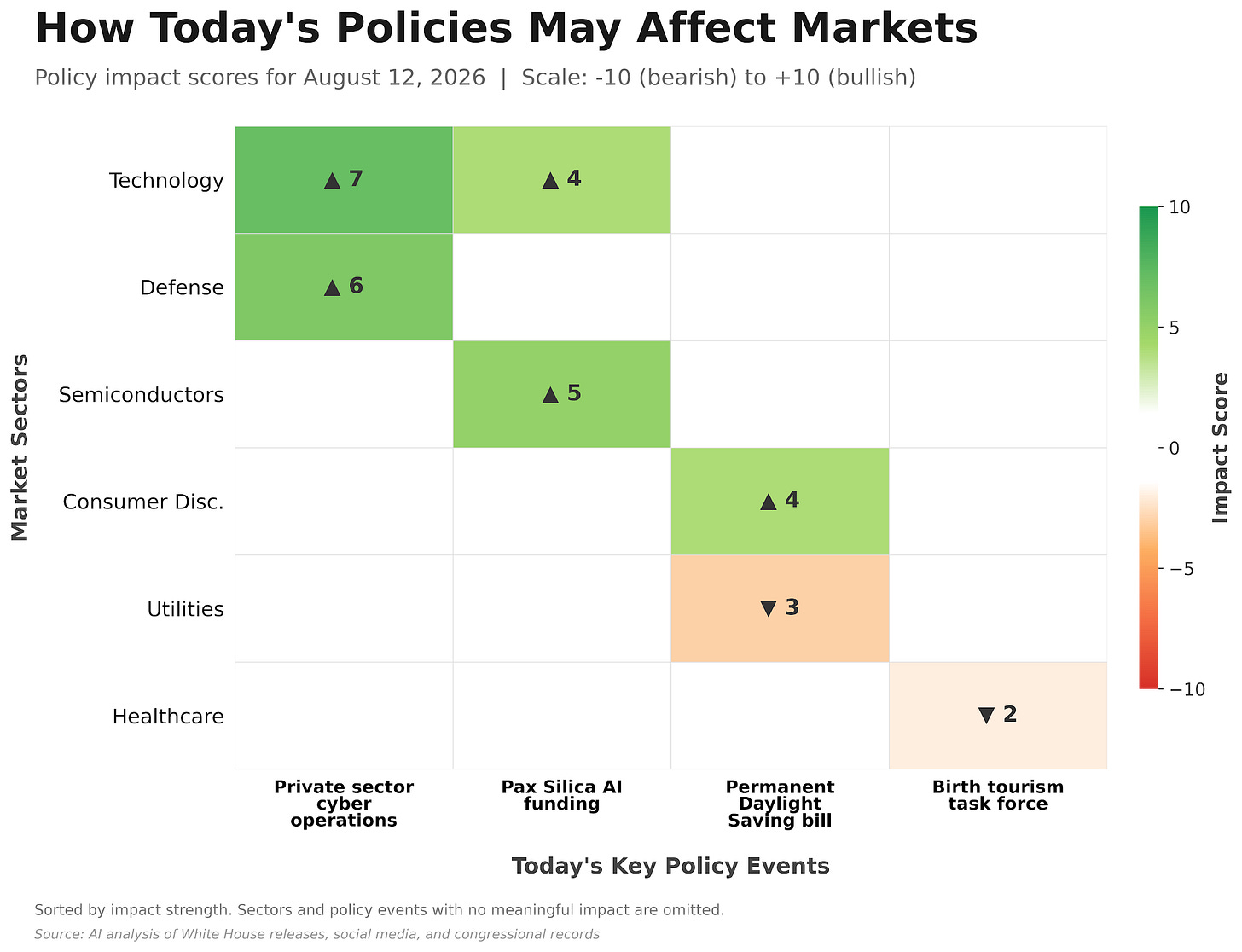
Each cell shows an estimated impact score on a fixed scale of -10 to +10, reflecting how today’s policy developments may affect each market sector. Positive scores (green, ▲) suggest bullish impact; negative scores (red, ▼) suggest bearish pressure. Rows and columns are sorted by impact strength, and sectors and policy events with no meaningful impact are omitted. The heatmap, the analysis below, and the Impact on Market themes above are produced from a single unified analysis: the heatmap visualizes the magnitudes, while the text explains the causal reasoning behind them.
The authorization of private sector cyber operations represents a significant policy pivot. By outsourcing offensive capabilities to private firms, the administration creates a new revenue stream for cybersecurity contractors. This move likely increases risk premia for global firms operating in high-threat jurisdictions. Critics may argue that this blurring of lines between private enterprise and state intelligence risks retaliation against U.S. corporate infrastructure.
Simultaneously, the Pax Silica initiative signals a strategic effort to harden AI supply chains. By incentivizing transshipment hubs like Panama, the policy aims to mitigate logistical bottlenecks for semiconductors. While intended to bolster supply security, market participants should note potential integration costs for tech firms. The permanent Daylight Saving Time bill serves as a demand-side catalyst for consumer-facing industries. Proponents, including the administration, suggest it will boost retail and tourism volumes. Conversely, utilities may face structural adjustments as residential demand patterns shift with additional evening daylight.
-
Why Karoline Leavitt might be impossible for Trump to replace
Donald Trump hardly needs anyone else to serve as his mouthpiece. The most clamorous president in modern history always gets his message out — in a daily riot of online posts, interviews and rancor with reporters. The departure of a press secretary therefore might seem like a trifle to the messenger in chief. But the exit of Karoline Leavitt, announced Wednesday, represents a significant personal and political loss. The vacuum she'll leave will emphasize her role as a vital member of the president's brain trust.www.allsides.com -
The Sources from the Catering Cart
emptywheel.net
The other day, WaPo had a follow-up to their story about how Trump hid inside a catering cart, disclosing who else escaped from Old Air Force One to fly from Turkey to the UK on a military jet: Natalie Harp, Walt Nauta, Dan Scavino, and a few other lower level people.As President Donald Trump secretly left an Air Force One jet on a catering truck last month in response to a potential Iranian assassination threat in Turkey, he was accompanied by some of his most loyal and longest-serving aides but no Cabinet officials.
Other passengers on the truck included Dan Scavino, the White House deputy chief of staff; Natalie Harp, the president’s executive assistant; and Walt Nauta, the director of Oval Office operations, according to a U.S. official familiar with the operation and corroborating material reviewed by The Washington Post. The official spoke on the condition of anonymity because he was not authorized to talk to the media.
A few lower-profile aides also were present, but the group did not include Secretary of State Marco Rubio or other officials at the highest level of the government, according to the official and the material. Together, those aboard the catering truck moved under concealment from the legacy Air Force One aircraft to a smaller Air Force C-32A before flying to Britain separately from the White House press corps and senior officials.
Whiskey Pete Hegseth was already on the military jet that would sneak Trump into the UK, having entered it the normal way, up the stairs.
Among those on the smaller jet was Defense Secretary Pete Hegseth, who boarded the C-32A using external stairs in a manner that made him look like
The details about who was in that catering cart are useful for more than the detail that Trump took his comfort blonde, Harp, with him but not Stephen Miller (or any other Cabinet official, to include Marco Rubio).
It may explain why Trump went so nutso that any of this leaked.
As CNN reported while NYT was fighting subpoenas, in addition to pursuing NYT, Susie Wiles and Kash Patel started seizing phones almost immediately. They also had to learn who was traveling with Trump — who was in that catering cart.
Chief of staff Susie Wiles, President Donald Trump’s closest aide, and FBI Director Kash Patel helped personally orchestrate a sprawling investigation last week at the White House aimed at determining who in the government leaked information about the security deficiencies of a Qatari-gifted airplane meant to be used as Air Force One – with some officials being asked to turn over their phones to investigators on White House grounds, sources familiar with the matter told CNN.
Trump had fumed over disclosures about the new plane, sources said, and his government quickly stood up an intense leak probe that roiled the government. As the investigation unfolded, at least one federal agency emailed employees warning that if they were contacted by outside agencies requesting information and devices, they needed to immediately contact their own agency’s attorneys, one source told CNN.
The sources said Patel — who had been preparing to travel to Chicago — was diverted to the White House on Friday to take a hands-on role in running the probe, which became public early the next morning when the New York Times reported that the Justice Department had issued subpoenas to four of its journalists who reported on security concerns surrounding the new plane.
Patel posted up in an office next to Wiles’ for roughly seven hours, as the two established what one source referred to as a “war room” in the West Wing.
In addition to asking for cell phones, investigators sought information from those who were traveling with Trump or had a role in the trip, including officials across various agencies. Not all officials who were asked to turn over their devices did so, one of the sources told CNN.
It remains unclear why DOJ subpoenaed NYT — and tried to bully them into disclosing sources. I’ve noted a bunch of potential reasons, some of which are quaint at this point:
- Because DOJ learned the NYT had sources for the real threat, the specific threat from Iran.
- Because NYT had sources for the threat Israel raised, which Trump mistook to relate to the real threat, but as a result alerted NYT there was more there.
- To prevent NYT from pursuing the ruse story.
- As part of the subterfuge, to reinforce the idea that the switch was about counter missile defenses rather than something else.
But they all exist on top of another dynamic: Very few of Trump’s aides were allowed in his military jet. He left some very important people back on Old Air Force One as bait, along with the traveling press corps. And the underlying story, the escape in the catering cart, is pretty fucking humiliating.
Consider the very small circle of potential sources for this story:
- One of those closest aides in the catering cart, or the junior people they brought with them
- A very small group of the big-ego people left back as bait on Old Air Force One
- Someone inside the Secret Service, involved in the ruse
- Turkish sources, who learned of the transfer
Donald Trump doesn’t know whether one of his most trusted aides, someone like his comfort blonde, is exposing his humiliation, whether one of the big-egoed people left as bait is exacting revenge, or whether someone like Whiskey Pete is leaking Signal texts to journalists again.
And the circle of people who might have betrayed his humiliating secret is very, very narrow.
None of that justifies the abusive way Kash and Susie Wiles started chasing down sources.
But it does explain it.
The post The Sources from the Catering Cart appeared first on emptywheel.
-
Will Trump’s next press secretary be a better liar than the first five?
www.theguardian.comAs Karoline Leavitt plans to step down, it’s apparent how the president above all values a readiness to twist the truth
As Karoline Leavitt prepares to step down from her role as Donald Trump’s fifth White House press secretary, a brief review of her tenure, and that of her predecessors, makes clear that the most fabulist president in US history prizes one quality above all else in the women and men who speak for him: a willingness to tell outrageous lies.
Leavitt started her tenure by telling a wild falsehood at her very first news conference, when she claimed that the Biden administration had planned to use $50m in taxpayer dollars to send condoms to Gaza. Later the same day, the Guardian reported that the claim was directly contradicted by USAID records.
Continue reading... -
‘Trump Said A Thing’ Journalism Must Stop
www.techdirt.comOne obvious byproduct of letting what’s left of U.S. journalism consolidate in the hands of a bunch of giant corporations is the end result winds up being a feckless mess. Generally corporations don’t want to upset advertisers, ownership (usually Conservative, white, and male), event sponsors, or potential advertising targets, so their journalism winds up being hollow, performative, and toothless.
One end result of this is something I affectionately call “CEO said a thing!” journalism, which kind of looks like journalism, but generally involves mindlessly parroting whatever a wealthy executive (or politician) says without context, correction, or even third-party objective analysis.
You’ll endlessly see this in corporate press coverage of corporations and tech. But it’s more generally reflected in their coverage of all rich men. Especially guys like Elon Musk or Donald Trump, who have found it incredibly easy to manipulate what’s left of our press into parroting every brain fart they have, regardless of whether there’s any useful new information or meaningful tether to factual reality.
This has been on particularly proud display when it comes to Trump and his unpopular and pointless war in Iran, with each week bringing a new headline of a plan that doesn’t exist, a pivot that never happened, or a strategy that isn’t coherent — or even real. The U.S. press, with occasional refreshing exception, endlessly just repeats whatever Trump says, regardless of whether what he’s saying is useful, real, or true.
Media critic Dan Froomkin has it right when he calls for a moratorium on “Trump says” headlines where every statement by our mad idiot king is mindlessly repeated without context or correction:
“It’s simple: Newsroom leaders should ban headlines based on what Trump says if there is legitimate reason to suspect that he may not be relating truthful, accurate, and durable information.
I’m only a tiny bit more tolerant of the Trump “claims”, “maintains”, “blames”, and “insists” headlines, but at least those impart an iota of doubt.”
The problem is this has been going on for generations. We’re more than ten years into Trump authoritarianism and propaganda. There’s no more room for giving meaningful credence to the idea that newsrooms and top editors are doing this simply because they don’t know any better.
They do this because corporate consolidated media isn’t interested in truth-telling journalism, they’re interesting in journalistic simulacrum and infotainment kayfabe that props up the interests and values of the extraction class. The public interest, hard-nosed journalism, and a properly informed electorate is the last thing on these gentlemen’s minds.
This isn’t some funny accident and it’s not subtle. Republicans and most rich white men are treated with kid gloves by 75% of the U.S. press because the corporations that own what’s left of these companies don’t want to rock the boat. They want their latest giant shitty merger approved. Their ownership likes tax cuts. Journalism that tells the truth isn’t what they’re here for.
Froomkin remains hopeful all the same:
“Surely our top newsroom leaders don’t see themselves as being in the business of spreading disinformation. But that’s what happens when they use the headlines and the tops of their articles to tell us what “Trump says” without caveats or pushback — when their headlines and leads should instead be devoted primarily to those caveats and pushbacks.”
Froomkin is right, though I’d argue this isn’t something that a compelling letter to the editor can fix. This sort of abject cowardice is systemic and by design. And while there’s still great journalism that can occur at many modern media companies, it’s increasingly becoming the exception, not the rule. We’re not debating our way out of this. The fix is massive structural reform.
The fixes are obvious and have always been there, and they involve things large media company owners don’t like: like reforged media consolidation limits, real antitrust enforcement, media ownership diversity requirements, improved media literacy and education standards (an informed audience that demands more of our journalistic institutions can shape coverage), a restoration of U.S. public media, and creative new funding models for real independent, worker-owned (and inevitably unionized) journalism.
We’re way past the point where we can assume this isn’t intentional, or can believe that simply asking better of these companies will result in the outcomes we’re all looking for.
-
Trump has amassed staggering wealth in ‘most openly corrupt’ presidency
www.theguardian.comEthics experts and Democrats express alarm as Trump uses office to grow his personal fortune to ‘unprecedented’ level
Donald Trump’s use of his second presidency to grow his personal fortune has alarmed legal and ethics experts and congressional Democrats as he has reaped an “unprecedented” $2.2bn in 2025 revenues by amassing big cryptocurrency holdings, benefiting from wealthy foreign interests, expanding his Truth Social business and more, while federal oversight of his actions has waned.
Trump last year raked in at least $1.4bn from his crypto ventures according to financial disclosure forms he filed in June. Simultaneously, about one million investors in a Trump crypto scheme suffered almost $3.8bn in losses as their volatile crypto holdings tanked in value.
Continue reading... -
Trump orders Pentagon to scrap modern jet launching tech on new US aircraft carrier and revert to steam catapults – live
www.theguardian.comPresident’s desire to revert to old-fashioned system has been an obsession of his since 2017 and will reportedly cost Navy billions
Donald Trump’s executive order on vaccines does not change the US recommendations for the shots – but experts say it does create confusion and doubt about vaccines, which will lead to more illness and possibly deaths among children and will make it harder for families and pediatricians to protect them.
The executive order was an attempt to reinstate sweeping changes to the vaccine schedule made earlier this year by Robert F Kennedy Jr, secretary of the US Department of Health and Human Services and a longtime vaccine opponent – changes that were later halted by a federal judge.
Continue reading... -
How Trump’s order on vaccines is sowing confusion, doubt and fear
www.theguardian.comThe order cannot effect change, and is only ‘undermining trust in vaccines’ as CDC guidance remains the same
Donald Trump’s executive order on vaccines does not change the US recommendations for the shots – but experts say it does create confusion and doubt about vaccines, which will lead to more illness and possibly deaths among children and will make it harder for families and pediatricians to protect them.
The executive order was an attempt to reinstate sweeping changes to the vaccine schedule made earlier this year by Robert F Kennedy Jr, secretary of the US Department of Health and Human Services and a longtime vaccine opponent – changes that were later halted by a federal judge.
Continue reading... -
Trump administration accused of ‘bullying’ union leader at consumer protection agency
www.theguardian.comCritic of Consumer Financial Protection Bureau leadership was put under investigation and suspended from job
The Trump administration has been accused of “bullying and intimidation” after a labor union leader and critic was put under investigation and suspended from his job at the Consumer Financial Protection Bureau (CFPB).
Stephen Wheeler, a data scientist at the agency since 2022 and chair of the CFPB union organizing committee, was placed on administrative leave effective immediately earlier this month. The union said it was not provided with any specific violations or given any details of the investigation.
Continue reading... -
CIA had 'low confidence' in Iranian threat before Trump switched planes in Turkey
U.S. intelligence officials were skeptical of an Iranian assassination threat against President Donald Trump that was relayed by Israel and prompted an extraordinary clandestine maneuver that saw him secretly fly out of Turkey in an alternate military aircraft, current and former U.S. officials familiar with the intelligence said.www.allsides.com -
Pentagon official and former Aukus sceptic says deal is ‘full steam ahead’, echoing Trump
www.theguardian.comElbridge Colby, a US under secretary of war, says he is ‘very pleased’ with the nuclear submarine program’s progress
Get our breaking news email, free app or daily news podcast
Elbridge Colby, the third-highest-ranking official at the Pentagon and formerly an avowed Aukus sceptic, has mirrored his president’s language on the nuclear submarine deal, saying it is “full steam ahead”.
Colby, a US under secretary of war, was the author of the Trump administration’s review of the Aukus deal, which would see the US sell three in-service Virginia-class submarines to Australia, before the development of Australia’s domestically built Aukus-class submarines.
Continue reading... -
Former US Marine Robert Gilman released from detention in Russia
A former U.S. Marine who spent more than four years imprisoned in Russia has been released on humanitarian grounds and is on his way back to the U.S., the Trump administration announced Tuesday. Robert Gilman, a U.S. citizen who was arrested in Russia in January 2022 and imprisoned for 1,666 days was released after his health deteriorated while in custody and his condition became life-threatening, according to reports from hospital officials received by the U.S. government.www.allsides.com -
US Marine veteran Robert Gilman arrives in US after release from detention in Russia
American Robert Gilman, who was released from Russian detention for humanitarian reasons on Tuesday amid severe concerns about his health, has arrived back in the United States. Gilman, a 32-year-old Marine veteran, had been detained in Russia since 2022. President Donald Trump said Tuesday he had spoken with Gilman, whose advocates and family had feared was "near death" after allegedly being subjected to physical and psychological torture.www.allsides.com -
Charlottesville Virginia Riot Echos Racial Injustice Warning Nine Years On
dcmediagroup.us Reverend Cornel West joined clergy in a human line to oppose the Unite the Right supremacist rally. Photo by J. Zangas/DCMG
Washington DC—It was nine years ago on August 12, that dozens of supremacist, Alt-Right, neo-nazi, klansmen, and nationalist groups rallied in Charlottesville, Virginia against a plan to remove a statue of Confederate General Robert E. Lee from downtown Lee Park. Organized by Jason Kessler, the ‘Unite the Right’ rally was a 2-day event held 11-12 August 2017 to link far right groups into an extended extremist movement revitalizing White supremacy. The groups gained more public footing that Summer, after Trump centered nationalist figures and parroted extreme right wing talking points from his position of power. It helped create the climate and space nurturing extremism in public spaces.
Richard Spencer and his National Policy Institute, was also present at the Unite the Right rally. His far right extremist organization had already held a rally at the Press Club in downtown Washington DC the night before the 2016 inauguration. He had also held a conference at the Ronald Reagan World Trade Center and other rallies in Washington DC. Gatherings of alt-right and neo-nazis were taking place in other cities across the country.
Members of the Unite the Right groups rallied the evening of August 11 at the University of Virginia, carrying tiki-torches in the evening and chanting anti-Semitic slogans. Their cries of “Blood and soil” and “You will not replace us,” drew alarm. They were throwbacks to the Third Reich rise to power during the Weimar Republic of pre-1933 Germany. Video of a stream of men walking with torches and chanting extremist chants popped up that Friday night on social media and spread like a fire in a mattress warehouse. There were clashes between the hundreds of torch bearing extremists and counter-protesters. Mace was spayed onto counter-protesters and police declared an unlawful assembly.
Charlottesville Riot—Epoch of Incredulity
The next day, an independent media colleague requested help in covering the Saturday rally and offered to drive to Charlottesville. So we went. We parked in a public lot not more than five blocks from Robert E. Lee Park, site of the giant Lee statue scheduled to be removed.
Getting close to Lee Park and the supremacist rally was straight forward. It was surprisingly easy to access. There were few Virginia State Police and only a line of short traffic metal barricades with a single strip of yellow police tape reading ‘Police Line-Do No Cross’ set up to separate the rally and counter-protesters. It seemed a considerably lax crowd control preparation. I’d covered many events in the District where right wing extremists showed up and the resultant counter-protests were never calm and orderly demonstrations. There were almost always clashes so DC police knew how to prepare for them.
So seeing such a large group of Alt-right, supremacists, and neo-nazis come together at an event with little police presence presented all the possible ingredients of incendiary civil unrest. There were fewer than a dozen police at the park. At one point there were about six police stationed at the barricades. There were several hundred extremists and as many as 500 counter-protesters. The die was cast for an historic confrontation. Police should and could have been ready, especially considering the clash from the night before. They were not prepared.
 Hundreds of nationalists, KKK members, neo-nazis, and far right extremists rallied on August 12, 2017.
Reverend Cornel West joined hands and locked arms with dozens of fellow clergy, forming a long human wall separating the supremacists and neo-nazis from the assembled counter-protesters. When asked what his message was, he told me, “Bearing witness to love and justice.” It was the last moment of calm before the dam broke.
The rally had been scheduled to begin at 12 noon but counter-protesters had already streamed to the park oppose the extremist groups. Heckling gave way to taunting and threats. Shoving gave way to punching and assaults. The assembly was declared unlawful by 11:30 am, before it was actually scheduled to begin. Police ordered the Unite the Right rally to leave Lee park. As supremacists began leaving and walking in groups directly into counter-protesters, anti-racist counter-protesters began chanting, “ No Nazis, no KKK, no fascist USA.”
They carried signs reading ’Black Lives Matter,’ and ‘Smash Supremacy,’ amongst other hand-made signs.
One moment of relative rationality stood out in the chaos, although there were many disturbing moments. A supremest holding a heavy shield and wearing goggles and a gas mask around his neck faced off with a sparsely dressed Black man. Tony Lewis wore only a white tank top, some slacks and a black baseball cap with a black ‘X’ over its bill.
On the shield was painted “NC 14,” a reference to the so-called “race riot” in Wilmington, North Carolina in 1898. Then, during what was actually a terrorist coup, thousands of Whites overthrew the democratically elected mixed-race government of Wilmington, burned the only African American newspaper office, burned and looted all the Black-owned businesses, and killed or lynched an estimated 3-400 Blacks. The “N.C. 14” painted on his shield was a reference to this dark day in history but the symbolism eluded many of us at that moment.
Lewis confronted the White man behind the shield after hundreds of extremists began leaving the park. Lewis tried to reason with the man, saying, I am an American too.” Lewis also told him he was a Veteran who had served in uniform during the Persian Gulf War but the man refused to hear or listen to what he had to say. The man told Lewis to “leave us alone.” It seemed that the attitude he held against Lewis mimicked the tones of 1898 Wilmington.
 One man tried to reason with the heavily armored group.
Moments later someone launched fireworks over the opposing groups. It was hard to tell from what side it came. Others hurled plastic bottles of water, further egging on the commotion. Then sticks and banner poles were used as clubs. Some of the supremacists carried clubs with them to the rally. They were certainly outfitted for street violence, wearing riot gear, shields, and helmets. (DCMediaGroup story from that day.)
The cordon of clergy left as the Virginia State Police declared an unlawful assembly. It was the second of such declarations they issued that weekend. What few police had been there had left the park and there were no police to stop the clashes. The opposing groups were now locked in street battles. They confronted and battled in the narrow streets and we in the media were caught in the center of the riot as factions fought for control of its center.
Sign posts became clubs and opponents beat each other. Many were injured severely. A man stomped on another who had been knocked unconscious. Several dragged him. A woman was bloodied.
As we were caught in the center, groups somehow ignored us. Someone fired a shot. It sounded like a pistol, based on previous marksmanship training. A helicopter hovered above. No police stopped or attempted to intervene to stop the fighting which had melted into the plasma of a riot. Someone threw urine and it splashed across the press line. I was thankful it wasn’t a stone. Urine can be washed away. A bloody soaked wound, not so.
We escaped through a gap in the fighting and turned east back up the hill towards the parking garage a few blocks away. We saw a group of supremacists beating a young Black man who was unconscious. We later learned his name was Deondre Harris. He was treated by street medics at the scene but needed hospitalization based on the seriousness of his wounds. We had parked feet from where he was beaten.
The worst was yet to come.
As the counter-protesters organized to march against the United the Right rally, James Fields, a white supremacist, deliberately drove his car into the assembly as it was preparing to march, killing activist Heather Heyer, and injuring 19 others, some severely.
We did not witness this but the incidents we had seen were quite enough to make every one of us sick. Several friends I knew who went to the street march were forever changed by what they saw.
During a phone interview with Jason Charter, a witness to the car attack, he said, “I heard the car screeching and I turned and see it ramming people, throwing them on the windshield and into the air,” he said. “I ran to help people and make sure they were ok and people were everywhere screaming medic.”
Charter said that moments after the car backed up, medics were on the scene helping the injured. He was shaken up by the incident. Video of Charlottesville riots (Caution Content warning—depicting violence).
Aftermath of the Charlottesville Riots
If anything could be said good about the riots it was that it re-awakened the nation to a vein of racial hatred that has existed for over two centuries. The nation clamored to denounce the groups that created havoc in Charlottesville and Jason Kessler’s ill conceived plan to unite them. His rally had the opposite effect he intended. Attitudes towards symbolic public memorials to Civil War figures changed quickly and irreversibly as citizens rallied to pressure State and local governments to remove them from public spaces and parks.
James Fields, then 20, was convicted after a federal trial and sentenced to life without the possibility of parole plus 419 years. He was subsequently tried and sentenced in Charlottesville by a State court to life imprisonment. DCMediaGroup story about the trial of James Fields.
Heather Heyer was celebrated and heralded as a civil rights beacon. She had not even planned to go to the protest but was going to meet her boyfriend for lunch nearby. She was an accidental activist that day and caught at the scene. Her mother dedicated the rest of her life to speaking out against racism in her daughter’s memory.
The blowback against Kessler was a tsunami of change. He attempted to hold a press conference the next day on 13 August in downtown Charlottesville but was run out of town by angry citizens. His speech was drowned out by angry opponents. Police had to escort him to safety.
Kessler foolishly tried a Unite the Right protest in Washington DC a year later with a march from George Washington University to the White House. About five people showed up to join him. Trackers captured his movements at the metro in Vienna. They noticed groups which had begun mobilizing weeks before in anticipation of his return. Nearly 15,000 from civil rights and human rights groups from across the region rallied in opposition to him and thousands of DC police and Federal agents formed a cordon to keep people from getting close to him. Video of Kessler and Unite the Right march in DC on August 12, 2018.
The Robert E. Lee statue was removed. The park was renamed Emancipation Park in 2017. Its name was changed again to Market Street Park in July 2018. Another Charlottesville park named after Stonewall Jackson, also a well-known Confederate General, was also renamed to Justice Park that year. Southern heritage statues came down from many cities across the South. Some were taken down by citizens with ropes and chains.
A statue of Confederate General Pike in Washington DC was taken down by citizens in 2018 after National Park Service deterred its removal. DCMediaGroup story about the Pike statue.
Richard Spencer’s National Policy Institute fell out of favor as a tide of opposition in Alexandria among citizens rose against it. The landlord renting space to his organization did not renew his lease. His website went dark in 2020.
The aftermath of the United the Right rallies saw citizens reclaiming their power over the inherent evil of supremacy by mobilizing and showing up where it reached into public forums. Rallies and protests against supremacy were held in many towns and cities across the country. This in turn carried momentum into the Black Lives Matter movement.
Video of Charlottesville Riots on August 12, 2017:
Video of anti-racism protests in DC on August 12, 2028.
The post Charlottesville Virginia Riot Echos Racial Injustice Warning Nine Years On appeared first on DCMediaGroup.
-
Trump’s Airport Catering Cart Scandal Is Getting Worse—and Now May Be Linked to the Midterms
sethabramson.substack.com ABOVE: President Donald Trump’s escape vehicle—an airport catering container—and Air Force One in Ankara, Turkey on July 8, 2026 (photo: The Washington Post).
To receive free, unrestricted access to this publication’s 500+ exclusive reports for seven days, just click the “free trial” button below. You can cancel your subscription to Proof at any time.
Introduction
Thus far, U.S. corporate media has primarily focused on the unprecedented logistics of President Donald Trump’s movements in Ankara, Turkey on July 8, 2026, which most notably included secreting himself in an airport catering container, staging a fake onboarding and deplaning of Air Force One (more infra), and spending a month lying gregariously about the July 8 operation in public.
Somewhat less attention has fallen on the baseline circumstances surrounding what some on social media are now tongue-in-cheekedly denominating Operation Orange Chicken, which are in themselves nearly as unusual.
On July 8, Trump was mere hours removed from relaunching his illegal war in Iran with a massive bombardment of 80 Iranian military targets. He was in the midst of following up this return to unilateral military action in Iran (a war crime) with another massive bombardment, this one striking 90 Iranian military targets, including some “military logistics infrastructure” (a euphemism for blowing up civilian roads that military vehicles might conceivably use at some point, with such attacks on civilian targets eligible to constitute war crimes to the same degree unilateral, “aggressive” international warfare in the first instance does). A leading conservative Iranian cleric and member of Iran’s parliament, Hamid Rasaei, had just publicly advocated for his government attacking Ankara, now that “the bastard Trump is within our reach and has come to Turkey for the NATO summit,” with Rasaei specifically urging Tehran to “officially and without hesitation target the location where Trump and several other criminals are staying in Turkey with a missile” (emphasis supplied).
Consistent with this threat, Trump and his team had just received urgent intelligence from Israel indicating that Iranian assets in Turkey were planning to launch shoulder-fired missiles at the presidential delegation in Ankara—which of course included not just President Trump but some of the “several other criminals” Mr. Rasaei was likely speaking of, including Secretary of State Marco Rubio, Secretary of Defense Pete Hegseth, and Secretary of the Treasury Scott Bessent.
Beyond all this, Trump had just received specific additional intelligence indicating that an attack was imminent, with the BBC now revealing that “[there was] a person near the NATO summit who had been seen with a shoulder-fired missile” (emphasis added).
What’s more, the New York Times now reports, Iran didn’t just have an assassin ready and a stock of missiles in hand, but the assassin knew where to fire his missiles—as he knew the building Trump was sleeping in… and even the floor he was staying on.
All this had Trump so rattled on July 8 that he spent all day repeatedly speaking, and in public, about the possibility that he was about to be assassinated.
CNN reports that Trump was noticeably “preoccupied” with the subject of his own potential imminent death, a fact he has now, in mid-August, been lying about with unusual fervor (insisting to the American press, unconvincingly, that “I don’t worry about anything. Whatever it is—you know my attitude? Whatever.”)
That Trump has a decades-long history of physical cowardice is of course well-known, from his years of draft-dodging during the Vietnam War to his terrified hiding inside a White House bunker amidst peaceful George Floyd protests in Washington in 2020, from his quickly memed expressions of terror during minor security incidents at past campaign events to his hilarious, viral, oddly ironic fear of bald eagles and even stairs (yes, Trump is “scared of stairs,” the BBC reports). This said, Trump can be forgiven for being terrified at the prospect of dying inside a fiery missile explosion in Turkey.
But there’s an even deeper context to unfold here.
First, Turkey is Iran’s western neighbor; it’s merely a long day’s drive from where Trump was on July 8 to a nation that America is at war with—a war Trump launched illegally and idiosyncratically, meaning Iran has every reason to believe (and possibly be correct) that “but for” Trump, America and Iran wouldn’t be in a hot war right now.
And Turkey’s place in that war is extremely complex. Turkey hosts American soldiers at Incirlik Air Base in Adana—only about a five-hour drive from Ankara—and more to the point, Incirlik had already, by July 8, been a military target of the Iranians on several occasions. Moreover, on July 8, Trump was in Turkey not only for a NATO summit but to announce he was “certainly” looking to restart transfers of previously statutorily banned heavy weaponry to Turkey (including F-35s). This was an action Iran would have taken as a military threat in the same way of Russia deems America arming its western neighbor Ukraine a national security issue (a Kremlin view that Trump has actually publicly endorsed as reasonable).
In other words, July 8 was the pinnacle of Trump’s provocations of Iran.
He was at that moment in the midst of hitting 170 Iranian targets over a 24-hour period; he was announcing a massive renewed military partnership with Iran’s western neighbor; he was traveling with two of the three Cabinet members Iran would most want to assassinate (America’s secretaries of “State” and “War”), not to mention CJCS Gen. Dan Caine; and despite the fact that he had voluntarily traveled to within a day’s drive of a nation he was at the time avidly committing war crimes against, instead of keeping a comparatively low profile he was spending the whole day forecasting that the Iranians were about to fire a missile at him inside Turkey.
One could be forgiven for thinking that Trump was almost, in some way it’s difficult to wrap one’s mind around, relishing the prospect.
And it’s against this backdrop that—knowing himself an Iranian assassination target, but also knowing that Secretary Rubio and Secretary Hegseth were also Iranian targets—Trump learned from the U.S. Intelligence Community (USIC) that there wasn’t just an Iranian assassin in Ankara with shoulder-fired missiles waiting to murder him but that, based on the Israeli intelligence units whose word he’d come to rely on explicitly, an attack on his convoy was likely imminent.
The situation the above facts establish is so blindingly obvious that even some of the most obtuse, hateful, mentally diseased news observers in America—take neo-Nazi, infamous Trump dinner guest at Mar-a-Lago, and 2024 Kanye West presidential campaign manager Nick Fuentes as an example—can with alacrity tell us what was going on.
As Fuentes rightly declaimed here, “[Trump] really believed Iran was going to blow [his] plane one out of the sky.... they thought Air Force One would get shot down.”
Yes.
That’s the size of it.
Trump—along with his team—had become convinced, by the evening of July 8, that Air Force One was going to come under missile fire, and it was going to come under fire from exactly the sort of weaponry (MANPADS, Man-Portable Air-Defense Systems) that Air Force One, whether properly equipped like the “old” one is now or improperly equipped like the $400 million “new” one the Qataris bribed Trump with is, would be equally susceptible to because MANPADS operate below the altitude of many infrared and radar guidance systems.
Indeed, the moment in time Trump would have been most vulnerable to a MANPADS-based assassination attempt, as he and his team well knew on July 8, was during his takeoff and landing in Ankara.
That was when the assassin was likely to strike.
Which is why CNN now reports that, on July 8, Trump and his team deemed the odds of their deaths on the tarmac in Ankara to be “enormous.”
How good was Iran’s intelligence regarding every move Trump made in Ankara? So good, it bears repeating, that the New York Times reports would-be Iranian assassins knew “specifically where Trump was staying in Ankara, including which floor of the building.” The stream of information about the Iranian MANPADS threat coming into the USIC was so fulsome that by the end of July 7, 2026—the day before Trump hid in an airport catering cart—Trump and his team knew that “there was a specific threat of a surface-to-air missile against Air Force One, meaning whichever plane was carrying the president,” and that “someone in the vicinity of the NATO summit had been spotted with a shoulder-fired missile” (emphasis supplied).
Given that the president didn’t leave Turkey until July 8, it means his team had at least a full day to process this intelligence. But frankly, even the fact that the intelligence existed, and that it arrived inside the USIC from so many different streams, strongly implied that there had been pre-summit chatter forecasting the enormous danger Trump and his top staffers would be in if they traveled to Ankara for an event Trump didn’t want to attend, anyway.
So given Trump’s long and well-documented history of seeking to incite or provoke violence for political purposes—e.g. (non-exhaustively) in 1980, in 1989, in 2015, in 2016, in 2018, in 2019, 2020, in 2021, in 2022, in 2023—it’s hard not to see in every action he took in Turkey in July 2026 a desire to see Iran War violence break out in that country.
We can even imagine the politically advantageous fallout of this for Trump. Picture Trump taking to the cameras to excoriate NATO for failing to keep its summit safe, and perhaps even using that failure as a justification for further limiting America’s role in the purely defensive alliance. Or picture Trump demanding new congressional authorization(s) for his Iran war—or even a NATO response under Article 5—in the wake of an Iranian attack on a NATO member’s soil. Picture Trump using an Iranian attack on Turkey as justification for doubling down on his statute-busting demand that all military sanctions on Turkey be dropped. And in picturing all this, recall that Trump traveled to Turkey with nothing much to gain, given his disdain for NATO, its members, and its mission. Only a major security incident there could have done much to alter the political equations Trump faced both in and out of Iran.
All of which underscores that the key question in the “Operation Orange Chicken” scandal remains, “Why did Trump travel to Ankara under these circumstances?”
Mr. Trump’s public anger at NATO, let alone the fact of him being in a hot war with Turkey’s neighbor, could easily have explained his absence from any NATO summit.
That Turkey’s autocratic leader, Recep Tayyip Erdoğan, a family friend and all-but-business partner of Trump’s (see more here, here, and here) is now a mortal enemy of Iran—which Erdogan confirmed by forming a military alliance with Iran’s leading enemies this month—clearly put an additional target on Ankara’s back this summer, as if Iran having previously launched missiles at Turkey weren’t enough to confirm it.
Trump launching 170 new attacks on Iran as soon as he entered Turkey becomes, in this view, merely the cherry on top of a bizarre confection of presidential incitement.
But there’s another, slightly less obvious question that’s also begged here. Given all of the foregoing, why didn’t Trump and his team foreground the security situation for the entirety of Trump’s July trip to Turkey? Why not establish in advance the dangers of the trip—after all, Trump has said that he wants to gift himself the Congressional Medal of Honor specifically for traveling into dangerous areas by plane when he doesn’t have to—in so doing legitimizing basically any ploy he or his team used to keep him safe?
Name a way to avoid a MANPADS attack—from traveling by ground instead of air to flying only under cover of darkness, from keeping no public schedule for a departure to securing the entire airfield in Ankara using the Turkish and American militaries—and the security situation Trump entered in Turkey in July would have warranted it had he and his team simply been honest about the dangers he was facing. Alternately, Trump could have done what he’s done dozens of times already during the Iran War: lower its temperature artificially via pre-textual negotiations, false advocacy for peace, preposterously timed ceasefires, inscrutable public statements, humanitarian pauses used for other purposes, and the like.
Nearly every week Trump uses one of these ploys to goose the mid-war markets.
So why in the world did he travel to within a day’s drive of Iran this July while doing everything he could to incite yet another Iranian assassination attempt, from launching illegal airstrikes to announcing a new military alliance with Iran’s enemies to making his assassination in Turkey a nonstop topic of public conjecture? Why did Trump act in a way that appears to have been calibrated to create one of the most incredible findings ever published by CNN—as already noted above, the reality that Trump agents adjudged the risk of America’s sitting president dying on July 8 to be “enormous”?
That’s a rhetorical question.
Because it does seem we now have the answer to it.
And explaining how we have arrived at that answer is the work of this Proof report.
Ten Developments in This Unprecedented Story That Blow It Wide Open
-
Leavitt to leave White House press secretary role, Trump says
President Trump announced in a Truth Social post Wednesday that White House press secretary Karoline Leavitt is stepping down from her role in the administration.www.allsides.com -
Karoline Leavitt leaving White House press secretary job, shortly after returning from maternity leave
White House press secretary Karoline Leavitt is departing her post at the end of August to spend more time with her family, President Trump announced.www.allsides.com -
Karoline Leavitt: six key takeaways from 20 months as Trump’s press secretary
www.theguardian.comTrump’s most prominent spokesperson won regular plaudits from her boss for her unflinching defense of his agenda
Donald Trump’s most prominent spokesperson, Karoline Leavitt, is leaving the White House. The US president announced on Wednesday that his press secretary would depart at the end of the month.
Leavitt, who has served in the role since Trump’s returned to power in January 2025, won regular plaudits from her boss for her unflinching defense of his agenda, but faced frequent criticism for amplifying misinformation and curbing press freedom.
Continue reading... -
Trump Admin Releases Final Rule Attacking Healthcare for Low-Income Trans Kids
Since President Donald Trump returned to the White House, he's been vowing to stamp out gender-affirming medical care—what his administration terms "sex-rejecting procedures"—for young people diagnosed with gender dysphoria. Now, his administration is specifically going after the health care of trans kids from low-income families. On Tuesday, the Centers for Medicare & Medicaid Services released a final rule forbidding Medicaid and the Children's Health Insurance Program from paying for puberty blockers and hormone therapy to treat gender dysphoria, as well as the surgeries provided in rare cases to older teens. The Medicaid part of the rule applies to patients under age 18, while the CHIP provision applies to patients under 19. The rule will take effect in October, with one exception: For patients already on cross-sex hormones, coverage for those medications will continue for an additional six months to allow for a "limited tapering period," according to the final rule.www.allsides.com -
ICE Agents Set To Wear Electric Shock Gloves: Here's How They Could Be Used
The Trump administration could soon equip federal immigration agents with gloves capable of delivering electric shocks during physical confrontations, according to a Department of Homeland Security (DHS) procurement notice. The devices—known as the G.L.O.V.E., or Generated Low Output Voltage Emitter—are manufactured by Kentucky-based Compliant Technologies LLC, and are marketed as a tool to help officers gain control of resistant individuals during close-range encounters.www.allsides.com -
Greenland forces Trump-linked US oil firm to delay drilling
www.theguardian.comMove defies US envoy’s claim that Americans could be extracting crude by as early as next year
Greenland authorities have forced a US oil company connected to Donald Trump to postpone drilling wells in the Arctic territory, defying claims by the US president’s envoy that Americans could be extracting crude by next year.
Amid Trump’s imperialist threats, tensions have been rising on Greenland’s eastern coast after the oil company brought drilling equipment ashore in July without permission, drawing a “strong warning” from the government.
Continue reading... -
Judge awards $252,480 to musician who canceled Kennedy Center performance
www.theguardian.comKennedy Center had sued Chuck Redd for canceling Christmas Eve concert after Trump renamed institution
A superior court judge in Washington DC has ordered the Kennedy Center to pay more than $250,000 to a musician who canceled a performance at the arts center after the White House announced that Donald Trump’s name would be added to the venue.
Judge Tanya Jones Bosier ordered the Kennedy Center on Monday to pay $252,479.70 in legal fees and costs to attorneys for musician Chuck Redd within 45 days.
Continue reading... -
Lindell alleges voting irregularities, refuses to concede
MyPillow founder Mike Lindell is refusing to concede in Minnesota's Republican gubernatorial primary, alleging irregularities in the vote totals. The businessman, who is backed by President Trump, lost to Minnesota House Speaker Lisa Demuth (R) by roughly 11 percentage points, according to Decision Desk HQ...www.allsides.com -
Trump sued for charging up to $100,000 for early access to his Truth Social posts
President Donald Trump is being sued over a new service from his social media platform, Truth Social, that charges customers up to $100,000 for early notifications to his posts, with plaintiffs arguing that "the scheme is extraordinary, corrupt, and unconstitutional." "The President stands to gain financially by giving 'market-moving' government information to those who are willing and able to pay his personal company," states the complaint filed by news group The Intercept Media and the nonprofit Freedom of the Press Association in the Southern District of New York on Wednesday...www.allsides.com -
DSA Darling Francesca Hong Narrowly Loses Wisconsin Primary In Major Upset Following Progressive Snub
Francesca Hong failed to secure the Democratic nomination for Wisconsin governor Tuesday night amid lack of support from high-profile leftists. Hong lost the primary by less than one percent to David Crowley, the Democratic candidate who earned the endorsement of outgoing Wisconsin Gov. Tony Evers. Crowley will face off against Republican nominee Tom Tiffany, the Wisconsin congressman endorsed by President Donald Trump. Hong boasted double-digit poll leads ahead of the primary. Hong also enjoyed the backing of the Democratic Socialists of America (DSA) and other aligned lawmakers, like Minnesota Rep. Ilhan Omar and California Rep. Ro Khanna...www.allsides.com -
Trump sued over $100,000-a-month early-access offer to Truth Social posts
www.theguardian.comSuit alleges subscription offer aims to sell privileged access to information generated in president’s official capacity
Donald Trump has been sued after a subscription service charging up to $100,000 a month for early access to his posts on his Truth Social platform sparked allegations of corruption.
The lawsuit, filed in the US district court for the southern district of New York, was brought by the Intercept and the Freedom of the Press Foundation against Trump, two of his aides and the executive office of the president.
Continue reading... -
Trump officials again urge US supreme court intervention on mail ballots
www.theguardian.comJustice department asks justices to pause decision that blocked Trump’s order to tighten voting-by-mail rules
Donald Trump’s administration again asked the US supreme court on Wednesday to intervene to fully implement the president’s executive order restricting the use of mail-in ballots ahead of the November midterm elections that will decide control of US Congress.
The US Department of Justice filed a request asking the justices to put on hold a decision made on Tuesday by US district judge Indira Talwani in Boston that blocks the US Postal Service from nationwide enforcement of the directive’s tighter rules for voting by mail.
Continue reading... -
This Week In The Big Picture
thinkbigpicture.substack.comThroughout this year’s Democratic primaries, a narrative has taken root pitting the candidates of the progressive left, widely seen as “insurgents” running to disrupt the status quo, versus more moderate candidates largely aligned with the Democratic establishment.
While the anti-establishment candidates don’t always prevail in the end, the Democratic base is undeniably in an anti-establishment mood. And now, the party’s 2028 hopefuls are beginning to position themselves accordingly.
In tomorrow’s piece, explores how “normie” Democratic leaders with presidential aspirations are beginning to adopt the rhetoric and even some positions of the anti-establishment left, betting that they can run as a new breed of “anti-system moderates” in the 2028 presidential primary.
And in case you missed it yesterday, broke down all the abuses of justice we should expect from Todd Blanche now that he’s been sworn in as Attorney General. In his piece, Kuo explores how we can rebuild the post-Watergate guardrails put in place to ensure an independent Department of Justice.
-
Judiciary Committee Dems Open Investigation Into DOJ’s Reflecting Pool Revenge Prosecutions
www.techdirt.comThe current president continues to self-destruct. Fortunately for us, he insists on doing this publicly.
After handing a donor and an unproven company the massive job of redoing the Lincoln Memorial Reflecting Pool in “American flag blue” in hopes of being able to use it to celebrate himself during America’s 250th birthday, everything went tits tints up. The lining fell apart. And the “American flag blue” was soon replaced by an “Antifa Frog green” influx of algae.
Rather than demand an explanation from the no-bid contractors or simply decide to shift his focus elsewhere, Donald Trump immediately claimed (without evidence!) that this was the work of anti-American vandals. Trump’s claims were immediately echoed by both Interior Department head Doug Burgum and DC US Attorney Jeanine Pirro. While all three insisted there was tons of damning evidence to support their outlandish claims, to date not one of them has produced anything remotely resembling a smoking gun.
Instead, we’ve been (mis)treated to malicious prosecutions that were immediately abandoned after the government’s own star grand jury witness said the damage supposedly caused by vandals was actually the result of shoddy workmanship.
Pirro did the right thing and dismissed charges against the Reflecting Pool defendants, starting with former Olympian David Hearn — the only one of the defendants facing a felony charge. Trump wanted Hearn cuffed and stuffed as a trophy of his ability to beat the truth at its own game.
Pirro went to bat for herself and threw Burgum under the bus following these dismissals. But that didn’t stop both Burgum and Trump from continuing to insist the Reflecting Pool failures were the work of vandals, all while publicly verbally assaulting Pirro for doing the same thing both of these men are doing: trying to save their own asses.
To this day, Trump continues to insist mountains of evidence exist. But the administration’s smoking gun more resembles a weapon purchased on layaway that it has yet to make a payment on. And after several days of being undercut by facts in literal evidence, Trump has finally changed his tune… a bit.
“There was substantial damage to the Reflecting Pool, also but, unfortunately, there is no video or proof, other than the damage, itself,” he wrote on Truth Social. “We are working on the Pool, and it will reopen shortly. As with many jobs, there was also some contractor error done by rushing the job for a July 4th opening, but it was a very small area of this massive Pool, and was relatively inconsequential.”
These are surprising admissions, given the source. Not only does Trump admit (while doing as much downplaying as possible) that some damage might be the result of his no-bid contractors, he has also admitted the government has no evidence to support criminal charges against anyone.
That admission gives credence to Pirro’s claims during the DOJ’s dismissals — that the DOJ had been misled by Doug Burgum and his DOI lackeys to believe evidence existed to support the charges. But that hardly excuses Pirro, who basically insisted that everyone the DOJ had charged was guilty AF during her appearance on Fox News earlier this year.
Whatever Pirro did or didn’t know at the point she decided to start pursuing these investigations may become public knowledge in (hopefully) the near future. Not content to just let Trump, Pirro, and Burgum walk away from a handful of revenge prosecutions performed for the sole purpose of allowing Trump to punish other people for his own failures, members of the House Judiciary Committee are mobilizing the system of checks-and-balances to find out who knew what and when. Greg Sargent has the details for The New Republic:
Democrats on the House Judiciary Committee are set to launch an investigation into the decision to criminally charge Hearn and others over the Reflecting Pool fiasco, I’m told. Although Democrats are in the minority, their probe offers a blueprint for what they’ll pursue with subpoena power if they control the House in six months.
This week, Representative Jamie Raskin—the ranking Democrat on the Judiciary Committee and potentially its future chair—will formally demand that the Justice and Interior Departments turn over a wealth of documents related to the charging decisions made in this case.
While it’s true this will run into considerable opposition from GOP Committee members, it’s not like the minority party has to ask permission to open investigations. However, they will need some Republican support if they want this investigation to be anything more than symbolic.
But that’s not the only pressure the Trump DOJ is facing. David Hearn’s case may have been dismissed (but notably, without prejudice, which means the government can always try again), but his lawyers aren’t quitting. They’ve been demanding grand jury documents for weeks.
Eisen and Hearn’s other lawyers are not letting this drop. For some time now, they’ve been seeking access to full transcripts of the grand jury proceedings—including instructions that prosecutors gave jurors on charging guidelines—to determine whether prosecutors misled them to secure Hearn’s indictment.
Trump obviously wants to keep this thing alive. He may live to regret this decision. The people opposed to him and his actions want the same thing, but for the purpose of pursuing justice, rather than — like Trump and his administration — hoping to pervert it further.
-
Patriot Games: Trump’s ‘freedom finale’ to celebrate 250 is … a school sports day
www.theguardian.com‘Outstanding young Americans’ came together to catch a tennis ball for freedom
The Patriot Games, held this week in Ohio, was intended to be a “national athletic competition celebrating the character, determination, and excellence that define the American spirit”, according to a press release.
The competition, which organizers insisted would be nothing like the Hunger Games, was to bring together “outstanding young Americans” from across the country, “to compete, inspire, and showcase the values that have shaped the United States for nearly 250 years”. ESPN, hosting the games, said it would “test excellence in skillsets of beloved American sports”.
Continue reading... -
In Ohio, Haitians’ American dream shatters as ICE prepares to deport them
www.theguardian.comUS immigration has ramped up operations against Haitians, whose temporary protected status was removed by Trump
When Monsanto Maler walked out of an Immigration and Customs Enforcement (ICE) facility in Blue Ash, Ohio, at 9.15am on Sunday with an ankle monitor freshly attached to his left leg, he put his hand over his face, burst into tears and fell to the ground.
He had come to the US in June 2023, fleeing gangs in Cap-Haïtien, Haiti, where he had been hit over the right side of his head, leaving a large, visible scar.
Continue reading... -
Harmeet Dhillon’s Flunkies Move to Strike an Argument about the First Amendment
emptywheel.net
Lawyers working for Harmeet Dhillon — whose office has stopped enforcing the FACE Act to protect abortion clinics and used it in the Cities Church case against ICE protestors and journalists — have asked a judge to strike journalist Georgia Fort’s motion to dismiss that indictment on First Amendment grounds.In a filing not signed by the local SAUSA brought in for the case, Civil Rights Division attorneys complain that, since they’ve indicted 38 people, it’ll take forever if Magistrate Judge Douglas Micko has to review long filings like this.
The “volume, scope, and complexity” of this case reinforces the superfluousness of Defendant’s brief. Doc. 140 (order designating this case as complex). This case has 38 defendants. There are already eight pending motions to dismiss (Docs. 97, 547, 592, 593, 594, 609, 610, 611), and more are forthcoming. See Doc. 547 at 6 n.2. (“The defendants intend to file a separate motion…”). And there likely will be dozens, if not hundreds, of additional pretrial motions. Defendant alone filed three motions to dismiss (Doc. 592-594 and six other motions last week (Doc. 596-601). Allowing Defendant to file such a lengthy brief on a single issue accordingly threatens the parties’ ability to timely and concisely present arguments, needlessly consumes resources that are better devoted to other motions, and undermines the Court’s ability to expeditiously resolve this case.
*“The term ‘brief’—derived from the Latin brevis—meaning short—seems inapt here.” McCurry v. Kenco Logistics Servs., 942 F.3d 783, 791 n.5 (7th Cir. 2019).
These lawyers from DC go on to admit that there’s no local rule prohibiting this, the District case they rely on to claim there should be a limit is from another Circuit entirely, and Micko has not set any limit in his scheduling order.
To be fair, they probably had the same response I had (as someone who is used to Districts that do have strict length limitations) as I read Fort’s motion: “Holy shit this is long!” But it matters that they’re trying to silence Fort’s MTD on First Amendment grounds and not her 48-page MTD for Selective and Vindictive prosecution.
That’s true partly because Harmeet’s flunkies are dismissing as “factual background and procedural history, much of which is already familiar to the parties and the Court” language that actually provides details of the day of the Cities Church protest which prosecutors left out their bid to indict her, such as the interviews she and Don Lemon conducted and the inaction by local cops who were onsite; that takes up around 20 pages. Some of those details, such as a description of how DOJ insisted on trophy arrests of both Fort and Lemon, provide the foundation for her other, cross-referenced arguments. And some of it, such as Fort’s description of how this prosecution is silencing her ongoing reporting, is unique to and a critical part of this argument.
It also matters that Dhillon is trying to limit Fort’s argument about the First Amendment because Fort is actually making four different arguments:
- FACE Act explicitly precludes the prosecution of expressive content
- The First Amendment protects a journalist for reporting on matters of public interest
- Harmeet Dhillon is enforcing the FACE Act in a content-based manner
- If the government denies these three things, then the prosecution is unconstitutionally vague
It matters that Dhillon is trying to limit Fort’s argument, especially, because a 5-page section establishes the basis for the four different ways Harmeet Dhillon is exercising content-based discrimination in her enforcement of the FACE Act.
The government is selectively enforcing Sections 241 and 248 to allow expression it favors while punishing speech it openly disfavors. First, the government is enforcing these laws against journalists who covered the protests, but not the parishioners or the Church, both of whom also captured and disseminated footage of the protest. Second, the government routinely allows federal law enforcement agents to interrupt church services and other church functions, and to have those raids covered by journalists, while prosecuting the journalists who covered the protest here. Third, the government is prosecuting journalists for supposedly amplifying the anti-ICE protesters’ message through their news reporting, while using their arrests and prosecution both to suppress that message and, through their own footage, to advance a pro-ICE viewpoint. Finally, the government is enforcing the section of the FACE Act protecting church services while expressly refusing to enforce the section protecting reproductive health facilities (except “crisis pregnancy centers”), or to punish journalists who cover conduct at such facilities.
This includes a long section talking about the number of times ICE has intimidated people who were attending church.
Second, although DHS long had a policy against immigration enforcement at “place[s] of worship” and other sensitive locations, Ex. 27 (citing similar policies dating back to 2011), the government rescinded that limitation on the day of President Trump’s second inauguration, Ex. 28. Since then, ICE has deliberately targeted churches and other houses of worship to conduct immigration raids. According to three DOJ attorneys briefed on the government’s strategy, ICE specifically “plan[ed] to target Spanish-speaking churches across the country.” Ex. 29.
These were not just rumored plans. In June 2025, one Bishop in Los Angeles, California reported that his congregation “experienced at least one case of ICE agents entering a parish property and seizing several people.” Ex. 30.
In Georgia, an individual was attending worship services with his wife and children, when ICE seemingly set off his “immigration GPS ankle monitor.” Ex. 31. When he stepped outside to check on the issue, “ICE officers were waiting to take him into custody” in the middle of observing mass. Id.
The Christian Broadcasting Network reported that, during Operation Charlotte’s Web in North Carolina, ICE arrested a man at his church “during a service project” held “after a Saturday service.” Ex. 32. Video of the raid showed some parishioners fleeing into the nearby woods, others scrambling to get inside the church, one woman openly sobbing, and children huddling together.63
In North Hills, California, ICE arrested a parishioner on the grounds of the North Hills United Methodist Church during a church-sponsored event.64 The pastor of the church reported that the arrest was so “terrorizing”—disrupting its food ministry, childcare services, and after-school programs—that it moved its services fully online going forward as a result.65 As was the case here, journalists were on scene when the raid occurred.66
Meanwhile, here in Minnesota, ICE has staked out churches during Spanish mass hours, which one pastor characterized as “a real interference with our parishioners’ right to worship,” adding that it cut attendance at services “by half.” Ex. 33.
Even assuming that the government could plausibly distinguish between disruptions at houses of worship by ICE agents (which it embraces) and disruptions by protesters (which it seeks to criminalize), it has no basis to treat the journalists covering each type of action differently. In that regard, the government has not charged the individual who recorded and published footage of the North Carolina raid, or the individual(s) who captured and published the North Hills raid, including the reporter who was on scene at the time and covered it. Similarly, as noted above, the government has directed its agents to be “camera-ready,” and invited journalists to “ride along” for some of the agency’s most high-profile raids. See Part II.A, supra. And the government has outfitted agents with body cameras to enable them to capture events from their own perspectives, but now seeks to criminalize journalists for obtaining their independently-captured footage. 67
63 Christian Broad. Network (@ChristianBroadcastingNetwork), Ice Arrest at Church Sparks Outrage in Charlotte, YouTube (Dec. 22, 2025), https://perma.cc/94Z7-24SN.
64 KTLA 5 (@KTLA), Community devastated after congregant arrested during immigration raid on L.A. church grounds, YouTube (Feb. 2, 2026), https://perma.cc/L45B-FHQ4.
65 Id.
66 NBCLA (@NBCLA), Church leaders to denounce ICE raids on property, YouTube (Feb. 2, 2026), https://perma.cc/9NT5-7MGY.
67 Preston Mizell, DHS Secretary Noem stands by body camera requirement for federal agents following Trump comments, Fox News (Feb. 3, 2026), https://perma.cc/A7N4- H7JL (“DHS announced that federal law enforcement officers would be required to wear body cameras.”). [links added]
And in a section pointing out that DOJ refuses to prosecute the FACE Act against abortion extremists, Fort notes that no one ever tried to prosecute journalists covering abortion clinic protests, once again focusing on how Harmeet is criminalizing the coverage of some protests but not others.
Notably, in at least one of the pardoned FACE Act cases, local journalists covered the protest and arrests, including inside the clinics, but were never charged with anything. 69 Again, even if the government could plausibly distinguish between protests at abortion clinics (which it embraces) and protests at churches (which it seeks to criminalize), it has no basis to treat the journalists covering each type of action differently based on the topic and message of the underlying protest.
This filing is more than I expected; I thought it would focus more on the abortion/church discrimination Harmeet has confessed to, though that is a part of it.
But by laying out that Harmeet, whose job it is to protect Civil Rights, has done nothing as ICE has deprived Latinos and other immigrant communities of their right to worship without fear of invasion, Fort makes Harmeet’s inaction a central part of this prosecution.
Among the imagined harms that Harmeet’s flunkies raise about the length of this filing is that other “Defendant[s] will have to read the brief and determine whether he or she wishes to join it in whole or part.” Laid out that way, this motion to strike would, in effect, serve as prior restraint preventing other defendants from reading this 85-page motion and realizing what an important argument it is. Lawyers who have joined Harmeet’s project of encouraging the intimidation of Latino church-goers worry that this case will be about the special protections Harmeet is enforcing for a right wing church led by an ICE goon, but not more mainstream churches around the country that serve Latino and other immigrant populations.
This filing may well convince Judge Micko to ask Fort to cut this down a bit. But if that happens, it will serve to censor Fort’s speech about Harmeet’s own refusal to protect the rights of immigrant communities.
Which may well create another legal fight entirely.
Motions
Georgia Fort
Don Lemon
The post Harmeet Dhillon’s Flunkies Move to Strike an Argument about the First Amendment appeared first on emptywheel.
-
Trump’s secret flight switch indicates severity of assassination threat by Iran
www.theguardian.comIran lost top leaders in the war and US ‘humiliation … a form of revenge’, say experts, after administration’s flight ruse
Since the joint US-Israeli strikes in February that killed Iran’s supreme leader, Ayatollah Ali Khamenei, and scores of other senior Iranian officials on the first day of the war, a revenge plot to kill Donald Trump should not have appeared far-fetched.
But the US administration’s elaborate ruse to spirit Trump off of Air Force One in Turkey last month indicates a credibility to the Iranian threat that has surprised many in Washington – including the Trump aides and journalists left on the jet that may have remained the target of an Iranian missile strike.
Continue reading...