Conversation
-
Trump’s Airport Catering Cart Scandal Is Getting Worse—and Now May Be Linked to the Midterms
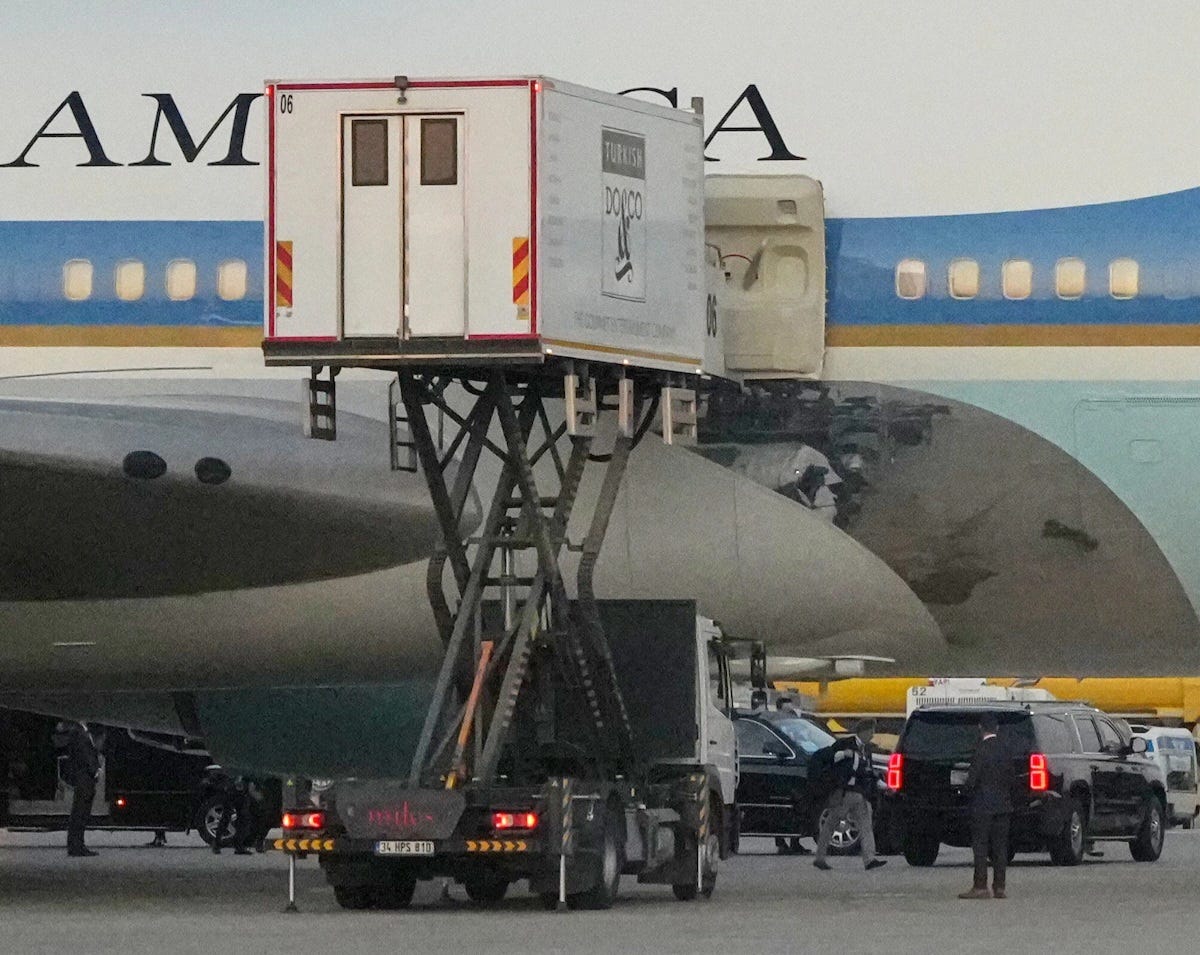
source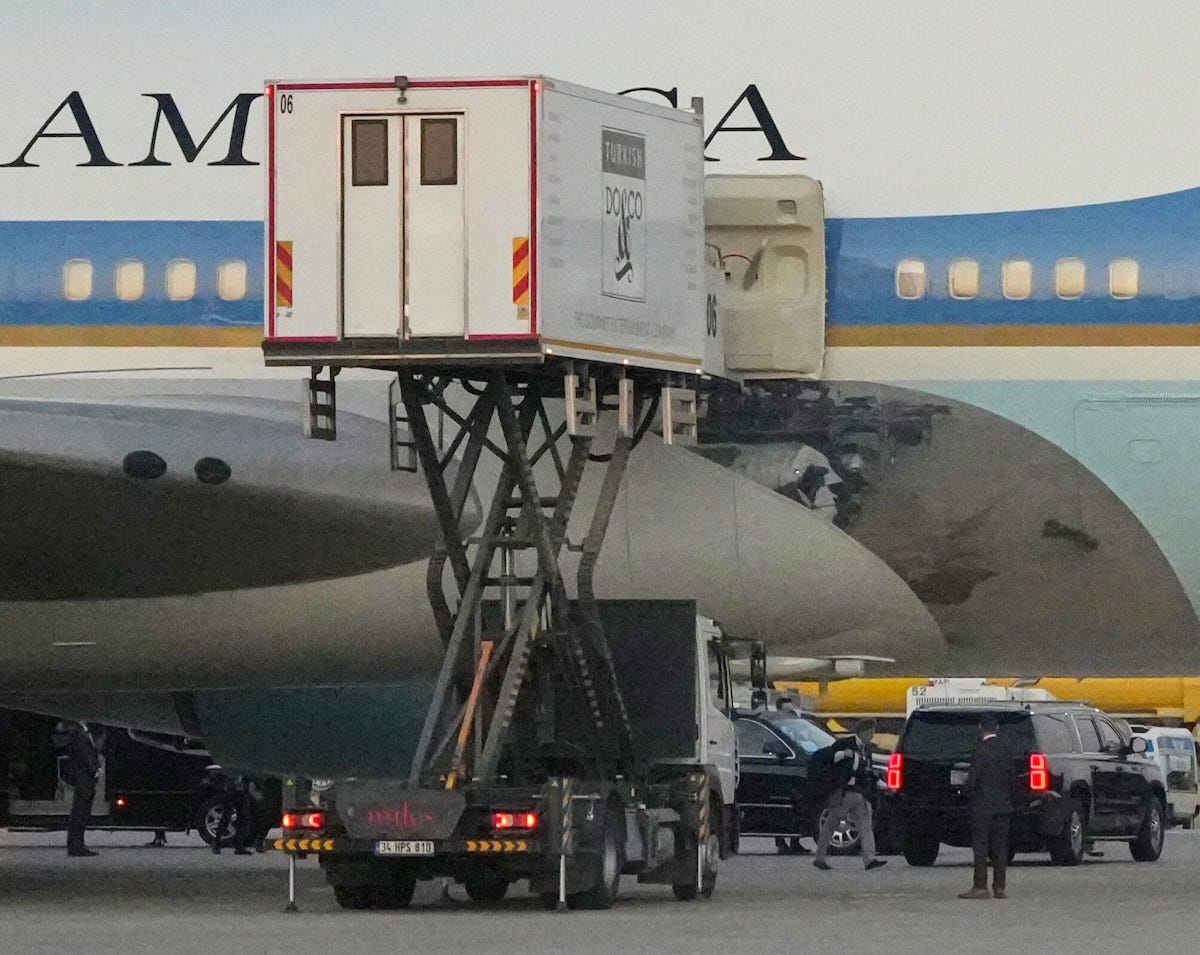 ABOVE: President Donald Trump’s escape vehicle—an airport catering container—and Air Force One in Ankara, Turkey on July 8, 2026 (photo: The Washington Post).
To receive free, unrestricted access to this publication’s 500+ exclusive reports for seven days, just click the “free trial” button below. You can cancel your subscription to Proof at any time.
Introduction
Thus far, U.S. corporate media has primarily focused on the unprecedented logistics of President Donald Trump’s movements in Ankara, Turkey on July 8, 2026, which most notably included secreting himself in an airport catering container, staging a fake onboarding and deplaning of Air Force One (more infra), and spending a month lying gregariously about the July 8 operation in public.
Somewhat less attention has fallen on the baseline circumstances surrounding what some on social media are now tongue-in-cheekedly denominating Operation Orange Chicken, which are in themselves nearly as unusual.
On July 8, Trump was mere hours removed from relaunching his illegal war in Iran with a massive bombardment of 80 Iranian military targets. He was in the midst of following up this return to unilateral military action in Iran (a war crime) with another massive bombardment, this one striking 90 Iranian military targets, including some “military logistics infrastructure” (a euphemism for blowing up civilian roads that military vehicles might conceivably use at some point, with such attacks on civilian targets eligible to constitute war crimes to the same degree unilateral, “aggressive” international warfare in the first instance does). A leading conservative Iranian cleric and member of Iran’s parliament, Hamid Rasaei, had just publicly advocated for his government attacking Ankara, now that “the bastard Trump is within our reach and has come to Turkey for the NATO summit,” with Rasaei specifically urging Tehran to “officially and without hesitation target the location where Trump and several other criminals are staying in Turkey with a missile” (emphasis supplied).
Consistent with this threat, Trump and his team had just received urgent intelligence from Israel indicating that Iranian assets in Turkey were planning to launch shoulder-fired missiles at the presidential delegation in Ankara—which of course included not just President Trump but some of the “several other criminals” Mr. Rasaei was likely speaking of, including Secretary of State Marco Rubio, Secretary of Defense Pete Hegseth, and Secretary of the Treasury Scott Bessent.
Beyond all this, Trump had just received specific additional intelligence indicating that an attack was imminent, with the BBC now revealing that “[there was] a person near the NATO summit who had been seen with a shoulder-fired missile” (emphasis added).
What’s more, the New York Times now reports, Iran didn’t just have an assassin ready and a stock of missiles in hand, but the assassin knew where to fire his missiles—as he knew the building Trump was sleeping in… and even the floor he was staying on.
All this had Trump so rattled on July 8 that he spent all day repeatedly speaking, and in public, about the possibility that he was about to be assassinated.
CNN reports that Trump was noticeably “preoccupied” with the subject of his own potential imminent death, a fact he has now, in mid-August, been lying about with unusual fervor (insisting to the American press, unconvincingly, that “I don’t worry about anything. Whatever it is—you know my attitude? Whatever.”)
That Trump has a decades-long history of physical cowardice is of course well-known, from his years of draft-dodging during the Vietnam War to his terrified hiding inside a White House bunker amidst peaceful George Floyd protests in Washington in 2020, from his quickly memed expressions of terror during minor security incidents at past campaign events to his hilarious, viral, oddly ironic fear of bald eagles and even stairs (yes, Trump is “scared of stairs,” the BBC reports). This said, Trump can be forgiven for being terrified at the prospect of dying inside a fiery missile explosion in Turkey.
But there’s an even deeper context to unfold here.
First, Turkey is Iran’s western neighbor; it’s merely a long day’s drive from where Trump was on July 8 to a nation that America is at war with—a war Trump launched illegally and idiosyncratically, meaning Iran has every reason to believe (and possibly be correct) that “but for” Trump, America and Iran wouldn’t be in a hot war right now.
And Turkey’s place in that war is extremely complex. Turkey hosts American soldiers at Incirlik Air Base in Adana—only about a five-hour drive from Ankara—and more to the point, Incirlik had already, by July 8, been a military target of the Iranians on several occasions. Moreover, on July 8, Trump was in Turkey not only for a NATO summit but to announce he was “certainly” looking to restart transfers of previously statutorily banned heavy weaponry to Turkey (including F-35s). This was an action Iran would have taken as a military threat in the same way of Russia deems America arming its western neighbor Ukraine a national security issue (a Kremlin view that Trump has actually publicly endorsed as reasonable).
In other words, July 8 was the pinnacle of Trump’s provocations of Iran.
He was at that moment in the midst of hitting 170 Iranian targets over a 24-hour period; he was announcing a massive renewed military partnership with Iran’s western neighbor; he was traveling with two of the three Cabinet members Iran would most want to assassinate (America’s secretaries of “State” and “War”), not to mention CJCS Gen. Dan Caine; and despite the fact that he had voluntarily traveled to within a day’s drive of a nation he was at the time avidly committing war crimes against, instead of keeping a comparatively low profile he was spending the whole day forecasting that the Iranians were about to fire a missile at him inside Turkey.
One could be forgiven for thinking that Trump was almost, in some way it’s difficult to wrap one’s mind around, relishing the prospect.
And it’s against this backdrop that—knowing himself an Iranian assassination target, but also knowing that Secretary Rubio and Secretary Hegseth were also Iranian targets—Trump learned from the U.S. Intelligence Community (USIC) that there wasn’t just an Iranian assassin in Ankara with shoulder-fired missiles waiting to murder him but that, based on the Israeli intelligence units whose word he’d come to rely on explicitly, an attack on his convoy was likely imminent.
The situation the above facts establish is so blindingly obvious that even some of the most obtuse, hateful, mentally diseased news observers in America—take neo-Nazi, infamous Trump dinner guest at Mar-a-Lago, and 2024 Kanye West presidential campaign manager Nick Fuentes as an example—can with alacrity tell us what was going on.
As Fuentes rightly declaimed here, “[Trump] really believed Iran was going to blow [his] plane one out of the sky.... they thought Air Force One would get shot down.”
Yes.
That’s the size of it.
Trump—along with his team—had become convinced, by the evening of July 8, that Air Force One was going to come under missile fire, and it was going to come under fire from exactly the sort of weaponry (MANPADS, Man-Portable Air-Defense Systems) that Air Force One, whether properly equipped like the “old” one is now or improperly equipped like the $400 million “new” one the Qataris bribed Trump with is, would be equally susceptible to because MANPADS operate below the altitude of many infrared and radar guidance systems.
Indeed, the moment in time Trump would have been most vulnerable to a MANPADS-based assassination attempt, as he and his team well knew on July 8, was during his takeoff and landing in Ankara.
That was when the assassin was likely to strike.
Which is why CNN now reports that, on July 8, Trump and his team deemed the odds of their deaths on the tarmac in Ankara to be “enormous.”
How good was Iran’s intelligence regarding every move Trump made in Ankara? So good, it bears repeating, that the New York Times reports would-be Iranian assassins knew “specifically where Trump was staying in Ankara, including which floor of the building.” The stream of information about the Iranian MANPADS threat coming into the USIC was so fulsome that by the end of July 7, 2026—the day before Trump hid in an airport catering cart—Trump and his team knew that “there was a specific threat of a surface-to-air missile against Air Force One, meaning whichever plane was carrying the president,” and that “someone in the vicinity of the NATO summit had been spotted with a shoulder-fired missile” (emphasis supplied).
Given that the president didn’t leave Turkey until July 8, it means his team had at least a full day to process this intelligence. But frankly, even the fact that the intelligence existed, and that it arrived inside the USIC from so many different streams, strongly implied that there had been pre-summit chatter forecasting the enormous danger Trump and his top staffers would be in if they traveled to Ankara for an event Trump didn’t want to attend, anyway.
So given Trump’s long and well-documented history of seeking to incite or provoke violence for political purposes—e.g. (non-exhaustively) in 1980, in 1989, in 2015, in 2016, in 2018, in 2019, 2020, in 2021, in 2022, in 2023—it’s hard not to see in every action he took in Turkey in July 2026 a desire to see Iran War violence break out in that country.
We can even imagine the politically advantageous fallout of this for Trump. Picture Trump taking to the cameras to excoriate NATO for failing to keep its summit safe, and perhaps even using that failure as a justification for further limiting America’s role in the purely defensive alliance. Or picture Trump demanding new congressional authorization(s) for his Iran war—or even a NATO response under Article 5—in the wake of an Iranian attack on a NATO member’s soil. Picture Trump using an Iranian attack on Turkey as justification for doubling down on his statute-busting demand that all military sanctions on Turkey be dropped. And in picturing all this, recall that Trump traveled to Turkey with nothing much to gain, given his disdain for NATO, its members, and its mission. Only a major security incident there could have done much to alter the political equations Trump faced both in and out of Iran.
All of which underscores that the key question in the “Operation Orange Chicken” scandal remains, “Why did Trump travel to Ankara under these circumstances?”
Mr. Trump’s public anger at NATO, let alone the fact of him being in a hot war with Turkey’s neighbor, could easily have explained his absence from any NATO summit.
That Turkey’s autocratic leader, Recep Tayyip Erdoğan, a family friend and all-but-business partner of Trump’s (see more here, here, and here) is now a mortal enemy of Iran—which Erdogan confirmed by forming a military alliance with Iran’s leading enemies this month—clearly put an additional target on Ankara’s back this summer, as if Iran having previously launched missiles at Turkey weren’t enough to confirm it.
Trump launching 170 new attacks on Iran as soon as he entered Turkey becomes, in this view, merely the cherry on top of a bizarre confection of presidential incitement.
But there’s another, slightly less obvious question that’s also begged here. Given all of the foregoing, why didn’t Trump and his team foreground the security situation for the entirety of Trump’s July trip to Turkey? Why not establish in advance the dangers of the trip—after all, Trump has said that he wants to gift himself the Congressional Medal of Honor specifically for traveling into dangerous areas by plane when he doesn’t have to—in so doing legitimizing basically any ploy he or his team used to keep him safe?
Name a way to avoid a MANPADS attack—from traveling by ground instead of air to flying only under cover of darkness, from keeping no public schedule for a departure to securing the entire airfield in Ankara using the Turkish and American militaries—and the security situation Trump entered in Turkey in July would have warranted it had he and his team simply been honest about the dangers he was facing. Alternately, Trump could have done what he’s done dozens of times already during the Iran War: lower its temperature artificially via pre-textual negotiations, false advocacy for peace, preposterously timed ceasefires, inscrutable public statements, humanitarian pauses used for other purposes, and the like.
Nearly every week Trump uses one of these ploys to goose the mid-war markets.
So why in the world did he travel to within a day’s drive of Iran this July while doing everything he could to incite yet another Iranian assassination attempt, from launching illegal airstrikes to announcing a new military alliance with Iran’s enemies to making his assassination in Turkey a nonstop topic of public conjecture? Why did Trump act in a way that appears to have been calibrated to create one of the most incredible findings ever published by CNN—as already noted above, the reality that Trump agents adjudged the risk of America’s sitting president dying on July 8 to be “enormous”?
That’s a rhetorical question.
Because it does seem we now have the answer to it.
And explaining how we have arrived at that answer is the work of this Proof report.
Ten Developments in This Unprecedented Story That Blow It Wide Open