Conversation
-
Spreading Jesus Through the OMB: The Final Levers OMB Has Over Agencies are “Management Initiatives”
source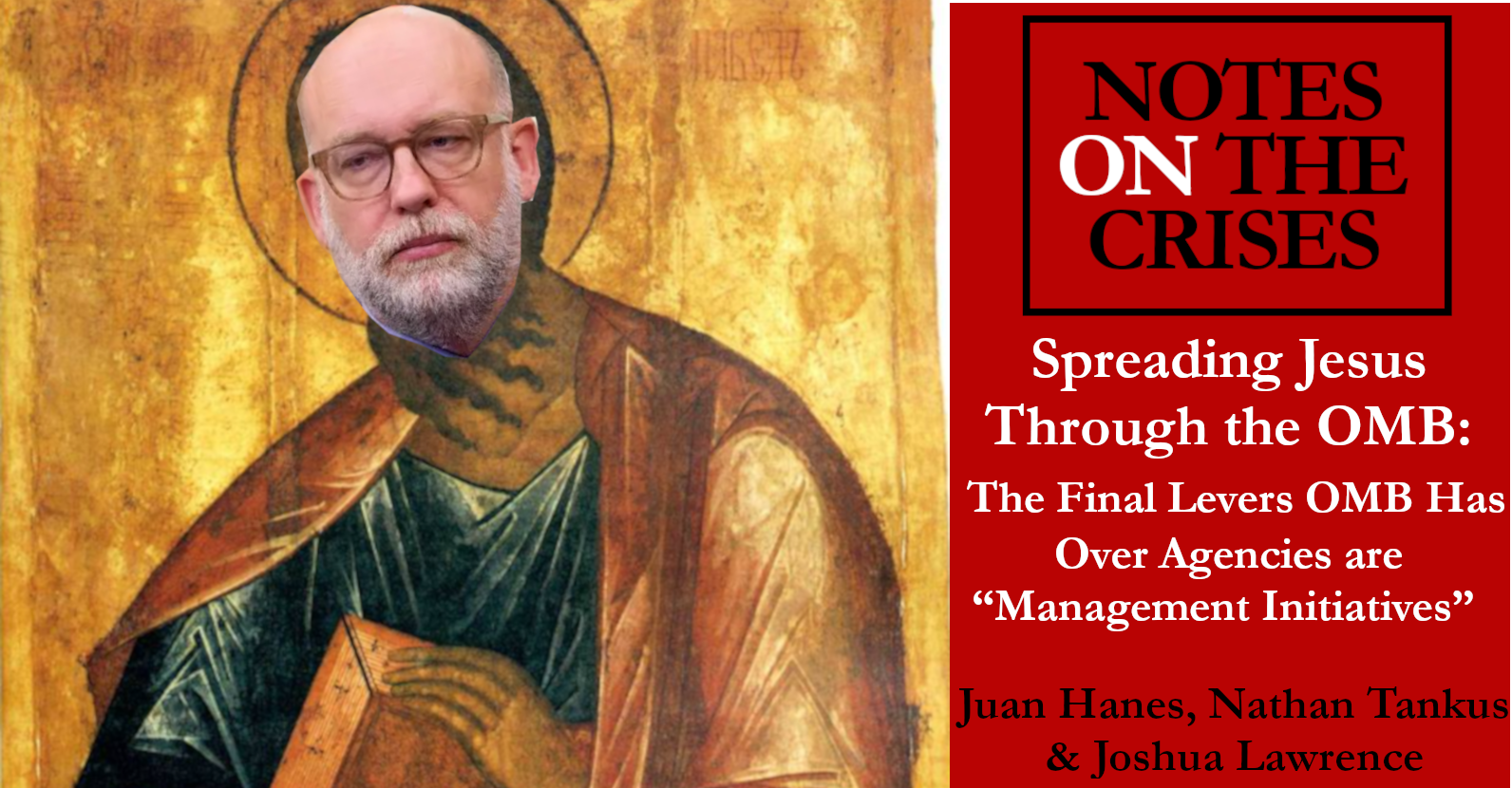
This is a free piece of Notes on the Crises. All pieces in our OMB coverage will be free. Please take out a paid subscription to support this work. Or leave a tip.
Joshua Lawrence is a research fellow at Notes on the Crises and graduate of Sarah Lawrence College. Find him on Bluesky here.
Juan Hanes is a research fellow at Notes on the Crises and a Journalism student at NYU. Find him on Bluesky here.
This is the final part of a 5-part series. Read Part 1, Part 2, Part 3. & Part 4
Welcome to the fifth and final installment (we promise!) of our miniseries on the “seven levers” that the Office of Management and Budget’s Resource Management Offices (RMOs) use to exert their influence over administrative agencies. Leading up to this point, we have covered the various mechanisms of control that the RMOs use during the budget “preparation” and budget “execution” phases. Today, we turn away from the “phases” of the budget, to talk about something a little different: presidential management initiatives. These may sound obscure, but they will prove to be central to the workings of the Office.
But before explaining why that is, we must make one thing clear. These final two levers, insofar as they deal with questions of “management” as articulated in Professor Eloise Pasachoff’s original article, do not cover the entire scope and power of the “M” side of OMB. “Management” under OMB is a very extensive topic, with its own confusing history. Grasping “Management” means examining relevant statutes, and dedicated sub-offices in OMB that will have to be done in future work. What we will focus on instead here is a very particular slice of the “Management” pie –- and it just so happens that this slice intersects so much so with the “budgeting” side of things, that it naturally muddles the line between those “M” and “B” sides anyway.
The slice in question is the aforementioned “management initiatives” (and specifically, “President’s Management Agenda”) that has become a staple of OMB and presidential policy in the past few decades. It is the language and form of these management initiatives that often prefigures the substantive changes that agencies face when transitioning from one presidential administration to the next.
But before we can dive into the specifics, we must of course ask the very simple question: what is a management initiative?
Management Initiatives?
The concept of a “management initiative” is a bit hard to nail down precisely, in part because the meaning of the term has varied considerably over the history of OMB. What Pasachoff is referring to as “management initiatives” in her article, though, is a more broad and loose concept—one that we can understand as “management goals that the President or OMB has communicated to the agencies”. The vehicle for communication, and thus the substance or specificity of the goal itself, can vary from goal to goal, and president to president.
In this sense, management initiatives are to some extent as old as OMB, or even the original Bureau of the Budget itself. Nixon, in his original efforts to reorganize the Budget Bureau into the OMB we know today, sought to make management the centerpiece of the new office. OMB observer Shelley Lynne Tomkin wrote in 1998 that Nixon’s reorganization aimed to “remove BOB/OMB from the business of making policy”, in order to “redirect its energies toward bringing the federal government under centralized control through management improvements”. And though there is no doubt that Nixon’s reorganization efforts had a distinctly political motive, the idea that “management” sits in a more technocratic realm compared to “budgeting” is crucial to building our understanding of management initiatives.
In short, then, a “management initiative” tends to be a goal to alter the structure and procedures of an agency—without inherently touching on any “political” question. This makes management questions conceptually easier to divorce from policy than budgeting (as questions of “the budget” and money are more commonly understood to have political overtones…) Changing the structure of an agency in the abstract does not necessarily demand such overt political decisionmaking. And yet…
In practice, of course, management initiatives are still deeply political. And more and more – particularly under Trump –- we are seeing management initiatives that pull no punches in pushing political goals. To that end, it is hard to look back on any moment in the past five decades of OMB history and say that any particular management initiative – whether it came in the form of Nixon’s “Management by Objective Plan”, or the modern “Presidential Management Agendas” – were merely technocratic. This fact is the crux of Pasachoff’s analysis of management initiatives, and it is what we will keep in mind as we delve into the specifics on how management initiatives work.
With that established, then, let’s not go any further without exploring how the first management lever works…
The President’s Management Agenda Lever (Also Known As: the “Do-What-I-Tell-You-To” Lever)
The President’s Management Agenda (PMA) is the most modern manifestation of management initiatives. As stated, “management initiatives” in the abstract have existed in many different forms across the history of OMB. But a recognisable form was far more recent: it was not until George W. Bush’s OMB published their 64-page PMA in 2001 that this modern iteration was born.
Upholding the spirit of the many management initiatives that came before, Bush’s PMA buried many of its wider political objectives in the bland language of technocratic reform. In the document were five “government-wide initiatives”: “Strategic Management of Human Capital”, “Competitive Sourcing”, “Improved Financial Performance”, “Expanded Electronic Government”, and “Budget and Performance Integration”. These were dry, boring terms.
As perhaps indicated by the incredibly uninteresting names, none of these goals necessitated an inherently (or at least overtly) political objective. But under a closer examination, like another early 2000s release had it, Bush’s intentions were “Not That Innocent”.
Of course, some of the more specific programmatic goals, which take up the second half of the agenda, had a more openly political slant. In that second half, for instance, we can find efforts to “privatize military housing”, and make it easier for “faith-based” community organizations to work with the government (weakening the separation of church and state) — in either case, such “Management” efforts can hardly be considered apolitical.
But the technocratic facade of the agenda prevailed even among the more overtly political goals. Under the “Faith-Based and Community Initiative", for example, the agenda identified the “bureaucratic, inflexible, and impersonal” nature of existing government programs as one of the key barriers to ending “poverty and despair” across the country. The solution was thus that agencies were to “identify and remove the inexcusable barriers” that make it difficult for “faith-based and community organizations” to receive money and work with the federal government. In practice, this meant grant reform and tax deductions, to streamline the process of supporting “faith-based” (aka religious) charities and institutions.
Pasachoff herself argued that such an effort was merely an attempt “to weaken the wall between church and state”, much in line with the evangelical temperament that President Bush made central to his public persona (For example, he declared Jesus to be his favorite philosopher at one point during his 2000 campaign).
Bush Jr. was not the first to politicize management initiatives of course. Management initiatives under Nixon, for example, were conveyed via the President’s “Management by Objectives” program, which a source cited by Pasachoff described best:
This [Nixon’s reforms] meant focusing on management—so long as it wasn't boring public administration theory but rather “management in the get-the-Secretary-to-do-what-the-President-needs-and-wants-him-to-do-whether-he-likes-it-or-not sense.”
Practically speaking, the Management by Objectives program was a set of personalized goals handed out to 21 different administrative agencies that set out to restructure staff hierarchies, and reform typical agency procedures. The effectiveness of Nixon’s MBO program was… questionable, partly because the fallout from Watergate and Vietnam destroyed Nixon’s credibility within the administrative state. But what is undoubted is the fact that such efforts were anything but policy-neutral.
From the foundations set by Nixon and the precise manifestation of management initiatives established by Bush Jr., we have now been able to observe PMAs in action for over two decades. Each president since Bush has effectively followed a tradition to release a PMA within the first year or so of taking office—-and within each PMA we get to see different flavors of covert policy control.
Whereas President Bush made “performance” a centerpiece of his management strategy, suggesting that agencies must develop policy and spend money by evaluating which past decisions have “performed” the best, President Obama chose instead to drive agency decision making via “evidence”. Although the specific programmatic details between Bush’s “performance-based” agenda and Obama’s “evidence-based” agenda differed slightly, the overarching thesis was the same: agencies ought to act in ways that are “proven” to be “effective”… whatever that might mean!
The rub, of course, lies in the fact that critics of each President’s initiatives ended up making the same argument against both: each leader attempted to implement procedural changes, only as a means of creating government structures that favored their preferred policy decisions. Under each agenda, it would often turn out that the “evidence” or “performance” results would frequently end up favoring the programs and policies that each president had a vested interest in. We are shocked, shocked that this was the case.
And in Trump, the PMA lives on. Though it is worth noting that Trump’s second term PMA (released via an OMB memo last December), in typical Trump fashion, hardly makes an effort to conceal its political goals. This fact is a deviation even from the PMA released during Trump’s first term, which contained much more procedural detail as opposed to rhetorical dogma. But the extent of these changes will be the subject of a full-length breakdown once we catch up to covering the OMB memos for fiscal year 2026. (So stay tuned!)
For now, we emphasize only that PMAs are a decades-old mechanism for outlining what are essentially political goals via the language of technocratic, bureaucratic, and science-based reform. OMB’s role in this process not only involves the centralized formulation of these agendas in collaboration with the President, but also the promulgation of the agenda thereafter.
But a mere document outlining what a president wants can only achieve so much. That’s basically a wish list! What this lever lacks is what Pasachoff would describe as a “procedural hook” to enforce the goals, and to make their implementation tangible. That is where the next (and final) lever comes in.
The Budget-Nexus Lever
The budget-nexus lever of OMB’s management initiatives is exactly what it sounds like: a connecting force between the raw policy of the PMA, and the concrete action of budget formulation. As we have covered extensively in this series, the budget is perhaps the central site where OMB’s power manifests with full force. Connecting the management goals of the president to the budget, then, offers a great chance for OMB to flex its full muscle, in order to keep the administrative agencies in line.
How is the budget linked to management initiatives? Well, there is perhaps no better way to answer this question than to refer to the budget formulation bible that is the OMB’s Circular A-11 guidance document. (As you can tell, we’re going to be talking about this circular quite a bit as we continue to focus on the OMB…)
First of all, the A-11 has a dedicated section (section 220) to explain what the PMA is and how agencies should go about applying it. In this and the previous section of the circular, the PMA is looped in with the requirements of the “GPRA Modernization Act of 2010”, which, as the name suggests, is a law that revamps the “Government Performance and Results Act of 1993”. These laws explicitly ordain OMB as the centralized administrator of both government-wide and agency-specific management goals. In this sense, the PMA becomes one of the many precise articulations of how OMB and the president seek to improve government “performance”. In conjunction with GPRA-specific reporting requirements, then, agencies are required to submit reports regularly detailing the status of their management reform efforts. The specifics on when and how agencies are to report this information is detailed in the circular A-11.
To be sure, the “procedural hook” established by tying PMAs to the GPRA does not inherently force agencies to reflect on the president’s management initiatives when formulating budget requests. At the time that Pasachoff was writing her original article during the Obama administration, it seems as though the most recent A-11s did not make mention of the PMA when discussing compliance with the GPRA and other congressional requirements. As a matter of fact, the term “President’s Management Agenda” and its related acronym does not appear once in the 2016 A-11. In fact, it did not make any appearance until 2018—when the section on the GPRA Modernization Act was updated to draw that connection to the PMA.
But none of these developments had yet occurred when Pasachoff first wrote about PMAs and the “budget-nexus” lever, which is why her analysis is focused more specifically on the way management initiatives are looped in with budgetary decisions. And in spite of the new references to the PMA in more recent A-11s, Pasachoff’s budget-nexus analysis still stands.
During the Obama administration, the budget connection was abundantly clear. Although the exact term “President’s Management Agenda” made no appearance, Pasachoff noted a clause that stated that budget requests were “more likely to be fully funded”, should they be “grounded” in the “evidence” agenda outlined in Obama’s PMA. Of course, this language has since been removed from the A-11 (by Trump-era initiatives.) But another clause stating that agency budget requests should reflect “efforts and planned action to strengthen management and improve program performance” still stands to this day.
But beyond the A-11, one of the clearest connections between PMAs and the budget lies merely in the fact that many management initiatives are themselves inherently budget-focused. Obama’s evidence goals reflect this in part, but perhaps the greatest example of this comes once again from the Bush administration.
The fifth and final “government-wide” initiative from Bush’s original PMA was “Budget and Performance Integration”. The problem identified was that the government would function “poorly and inefficiently’ so long as budgeting decisions were not made based on “results”. More clearly, the PMA suggested that there was a lack of uniformity, consistency, and rigor in agency self-evaluation at the time. Bush & co argued that correcting this issue was thus the central focus of the president’s management initiatives. The first solution to come from this was a “traffic lights” system of sorts: a list of standards was generated, then agencies were given either a green, yellow, or red rating depending on how many of those criteria were met.
This system eventually evolved into the more well known Program Assessment Rating Tool, or PART system, that gave agencies a numeric score based on apparent performance and results. Given the fact that the entire system was devised as a means of allocating government spending more “efficiently”, the connection to the budget is all but obvious. In his 2007 book explaining the federal budget, Allen Schick made the following comments on PART:
OMB insists that there is no automatic linkage of PART scores and budget decisions. However, it also takes the view that federal dollars should be targeted to programs that can prove they have achieved measurable results. In fact, independent researchers have found that PART scores are correlated with presidential budget decisions. Programs with effective ratings are much more likely to be budgeted for increases than those rated ineffective. But PART scores are a weak influence on congressional decisions, especially when OMB seeks to eliminate programs rated ineffective. [emphasis added]
That means that—as with all of our analysis on OMB’s budgetary preparation process—the nuance lies most prominently in the fact that Congress, and not the executive, is supposed to have the final word on appropriations. To the extent that OMB follows through in apportioning the legally required amounts (an increasingly difficult ask as of 2026), and then to the extent that Congress undercuts the suggestions of the president’s budget requests, the effectiveness of the budget-nexus lever can only stretch so far.
But the above is true of every lever we have talked about across the last five articles of this miniseries. And that’s exactly why it is crucial to understand these levers in conjunction and as a system and not isolated or on their own. The PMA lever only works insofar as OMB has the power to procedurally enforce agency compliance. As this series has already demonstrated, that procedural enforcement only works insofar as OMB can exercise the many other budgetary control levers that we have delved into. Put very simply: no lever on its own can be understood as the end all be all to OMB power. Even as we now wrap up this series, there are likely more mechanisms of control within the office that we have yet to come across.
We hope that this “Seven Levers” rabbit hole has taught readers a thing or two about the scope and significance of the Office of Management and Budget’s powers. You may well still have questions! This series has opened a massive can of worms in terms of concepts, documents, and legal mechanisms, that will each require further exploration and explanation at later dates. For now, though, we conclude this series and you can look forward to us continuing our breakdowns of OMB’s public memoranda for Fiscal Year 2025 (and beyond!)
Stay tuned, as our analysis of OMB has only just begun.