Conversation
-
Judicial Notice (08.16.26): Curtain Time
source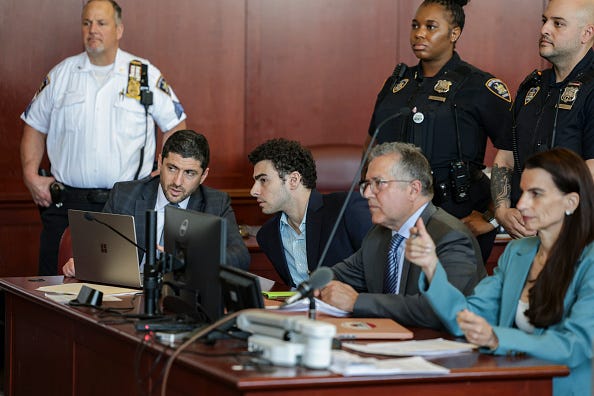 Seated at counsel table, left to right: Jacob Kaplan, Luigi Mangione, Marc Agnifilo, and Karen Friedman Agnifilo (photo by Jeenah Moon via Getty Images).
This week’s Judicial Notice is sponsored by
Chambers-ranked and Harvard-educated, Jeff is the trusted closer for high-stakes disputes. His battle-tested system of managed communications empowers clients to make clear, strong decisions in a calm, informed environment. It makes the right resolution obvious. If settlement seems impossible, call him.
It’s hard to believe, but summer is almost over (and for the school-age kids of some of my friends who don’t live in the northeast, summer already is over, as I see from their back-to-school posts on social media). Summer is my favorite season—not because I love the heat, but because I appreciate the season’s more relaxed vibe—so I’m sad that it’s coming to an end.
The highlight of last week for me was guest-hosting the Advisory Opinions podcast, together with my husband Zach—aka Zachary Baron Shemtob, executive editor of SCOTUSblog. Sarah Isgur and David French left huge shoes to fill, so Zach and I enlisted some help. For Tuesday’s episode, we were joined by Amy Howe, co-founder and primary reporter of SCOTUSblog; for Thursday’s episode, our guest was Adam Feldman, author of Legalytics. Thanks to Sarah and David for the opportunity, and thanks to Zach, Amy, and Adam for the company.
Every now and then, I offer a practical tip in Judicial Notice, so here’s the latest. Last month, I almost fell for a scam, which began with a call informing me of fraudulent charges on my credit card—something that has happened to me many times over the years, which is partly why it was initially convincing. Fortunately, I figured out in the middle of the call that they were scammers (by consulting with my pal Claude).
I was disturbed by how much personal information the scammers had about me. So after hanging up on them, I froze my credit, to make it harder for unauthorized parties to open new credit accounts in my name. To learn why and how to put a credit freeze in place, check out this FTC article.
Now, on to the news.
Lawyer of the Week: Trent McCotter.
In the wake of Todd Blanche’s confirmation to serve as U.S. attorney general, who has taken on the critical duties he handled as deputy attorney general? As the #2 person at the U.S. Department of Justice, the DAG oversees the DOJ’s day-to-day operations and serves as the AG’s right hand.
For now, while we await a nominee, the duties of the DAG are being discharged on an acting basis by Principal Associate Deputy Attorney General Trent McCotter—a graduate of UNC Law, former federal law clerk and prosecutor, and former associate at Jenner & Block, interestingly enough (given the firm’s adversarial relationship with the administration nowadays). McCotter was also a partner at Boyden Gray PLLC, the prominent conservative boutique—and one of his former colleagues at the firm, Boyden Gray managing partner Michael Buschbacher, praised McCotter’s selection, declaring that “there’s no one better that Todd Blanche could have picked."
In less happy news for McCotter, he was on the receiving end of a benchslap last Monday, as reported by The New York Times (gift link). McCotter had the unenviable task of handling the controversial dismissal of an indictment leveling corruption and other charges against Gautam Adani, India’s richest man, and seven other defendants. Why was it controversial? Back in May, The Wall Street Journal (gift link) reported that Adani’s lead lawyer, Sullivan & Cromwell co-chair Robert Giuffra—who’s also one of Donald Trump’s personal attorneys—told DOJ officials that the case against Adani was preventing him from investing $10 billion in the United States.
In response to McCotter’s motion, Judge Nicholas Garaufis (E.D.N.Y.) dismissed some of the counts—including all the counts against Adani—but not all counts against all defendants. And in his 47-page opinion, the judge had harsh words for McCotter:
As noted throughout this opinion, the irregularities in the decision to dismiss the Indictment are concerning. On the current record, McCotter appears to have eschewed the professional opinions of innumerable officials from various federal offices and replaced them with his singular judgment. The fact that McCotter came to this decision largely in collaboration with defense counsel, and seemingly without input from the FBI and SEC agents who investigated the alleged misconduct, or the attorneys from the Department, SEC, and U.S. Attorney’s Office who brought the case, appears to be highly unusual. McCotter’s refusal to meet the procedural requirements of Rule 48(a)—even after the court’s clear direction to do so—evinces a lack of respect for the Judiciary as a co-equal branch.
On the bright side for McCotter and the government, Judge Garaufis rejected the speculation that the Trump administration dismissed the charges because Adani promised to invest $10 billion—and declared himself “satisfied that Defendant Gautam Adani's $10 billion investment promise was, in fact, a ‘non-consideration.’” So one can say of this case something that could be said of many matters handled by the Trump DOJ: it didn’t go particularly well, but it could have been much worse.
In other news involving a top Trump administration lawyer, I mentioned last week Trump’s selection of Will Scharf as his next White House Counsel, effective September 1. For profiles of Scharf, see, e.g., Bloomberg Law and Law360. As noted by Politico, Scharf will play an “incredibly important” role—especially if Democrats take control of the House in the midterms, then use Congress’s investigative and oversight powers to put the Trump administration through the wringer.
In memoriam: Professor Randal “Randy” Picker, a faculty member at the University of Chicago Law School since 1989, passed away at 66. May he rest in peace.
Judge of the Week: Judge Andrew Oldham.
How is a judicial opinion like a thriller? It’s important to hook the reader from the opening. Judge Britt Grant (11th Cir.) garnered favorable mentions on social media for the first paragraph of her opinion in Renfroe v. USAA General Indemnity Co., which managed the impressive feat of making an insurance case interesting:
A father and daughter owned a house together. But it was not as idyllic as it might sound—each warned the insurance company that the other would likely burn the house down. Remarkably, the insurer issued and maintained the policy anyway. Less remarkably, the house burned down a month later.
I also enjoyed the way that Judge Stephanos Bibas (3d Cir.) began his opinion in Blasingame v. Malibu Boats, LLC, a case about allegedly defective boats that he heard while sitting by designation in the District of Delaware:
The two best days in a boater’s life are the day he buys his boat and the day he sells it. Boating, while thrilling, can be expensive and even dangerous.
But who is to blame when a boat fails to live up to expectations? Plaintiffs allege that boats manufactured and sold by Malibu Boats did not perform as advertised.
Meanwhile, Judge Andrew Oldham (5th Cir.) took some flak for two recent introductions of his. Here’s the opening of State of Mississippi v. Department of Energy, which was about whether the DOE could promulgate new regulations on home cooking appliances through a “Direct Final Rule” (i.e., without going through the standard notice-and-comment process):
The Biden Administration proposed numerous regulations to make home appliances more expensive and less useful. See, e.g., Louisiana v. DOE, 90 F.4th 461 (5th Cir. 2024). As part of that effort, one official even proposed banning gas stoves. See Ari Natter, US Safety Agency to Consider Ban on Gas Stoves Amid Health Fears, Bloomberg (Jan. 9, 2023), https://perma.cc/7E2V-DFN5 (quoting statement of Consumer Product Safety Commission official Richard Trumpka [sic], Jr.). These efforts generated significant controversy and public backlash. [UPDATE (8/17/2026, 10:06 a.m.): I moved the citation to Ari Natter, which I had erroneously placed before the reference to the official’s comment about gas stoves. Also, that official’s surname is “Trumka,” not “Trumpka”—Freudian slip?]
And here’s the intro to La Union del Pueblo Entero v. Abbott, a lawsuit arguing that a Texas election law was inconsistent with the Americans with Disabilities Act:
It has long been established that mail-in ballots are prone to fraud. See, e.g., Veasey v. Perry, 71 F. Supp. 3d 627, 676 (S.D. Tex. 2014) (“Mail-in ballots are not secure.”), aff’d in relevant part, 830 F.3d 216, 256 (5th Cir. 2016) (en banc). That is why voting by mail jeopardizes election integrity and democracy itself.
These rather “Trumpy” openings—the first attacking the Biden administration, the second tying voting by mail to election fraud—led some observers to suggest that Judge Oldham, a top Supreme Court contender in the current administration, might be “auditioning” for the next SCOTUS opening.
To be honest—and with all due respect to Judge Oldham, whom mutual friends have praised—I’m not a fan of such strongly opinionated intros, especially when they run the risk of coming across as political. Readers, what do you think?
In other news about judges and the judiciary:
What do I share in common with Chief Justice John Roberts? Sadly for me, not much, but there’s this: we’ve both written for Substack. For a series on American presidents appearing in the pages of In Pursuit, the Chief Justice wrote an excellent essay on William Howard Taft (via Howard Bashman’s How Appealing).1
Speaking of Chief Justice Roberts, the current format of SCOTUS oral arguments has made him a less active questioner, according to a new study by Professors Lee Epstein and Eric Posner (via Adam Liptak).
Speaking of notable new research, Professors Stephen Choi and Mitu Gulati have posted a pair of interesting papers to SSRN: Trump v. Biden Judges: Is the Gap Closing?, an update of their earlier research into how well different judges perform on the bench, and The Last Casebook Hero, an examination of which judges are writing opinions that are making their way into casebooks.
In case you missed it, I indulged in some Friday fun and published a post asking readers to rank the circuit courts by importance.
In nominations news, last week brought word of two new nominees. First, Trump nominated Judge Lee Rudofsky (E.D. Ark.) to the Eighth Circuit (as I predicted). According to Michael Fragoso of National Review, “Between Lee’s credentials, his career, his record on the bench, and his support for the conservative legal movement, he’s a tremendous pick for the Eighth Circuit.” Over the years, the Eighth Circuit has been something of a sleepy court; but in Fragoso’s words, it’s “on the verge of being made truly great, following the strong appointments of Judges Traynor, Smith, Kobes, Stras, and Grasz”—and now Rudofsky.
Second, Trump nominated a White House lawyer, Samuel “Sam” Adkisson, to the Eastern District of Tennessee. Senator Bill Hagerty (R-Tenn.) praised Adkisson, noting his tenure “as a law clerk for U.S. Supreme Court Chief Justice John Roberts, as well as two outstanding federal appellate judges [Judges Amul Thapar and Gregory Katsas], not to mention his service as associate counsel to the most demanding client in the world—the president of the United States.”
A 2018 graduate of Yale Law School, Adkisson will be criticized by Democrats as inexperienced, but I expect he’ll be confirmed by the Senate (which Republicans control until January, regardless of what happens in the midterms). As noted by Professor Rob Luther, who worked on nominations in the first Trump administration, youth in judicial nominees is a feature, not a bug—with young district judges serving as “a blueprint of the next Republican President’s Court of Appeals judges.”
In memoriam:
Justice John Carro—who spent 25 years serving on the New York State bench, becoming the first Puerto Rican named to the Appellate Division’s First Department—passed away at 98. (One of his four children who went into the law, Justice Gregory Carro, is now presiding over the state-court prosecution of Luigi Mangione, discussed below.)
Judge Frank Bullock, Jr. (M.D.N.C.), who served on the federal bench for more than two decades, passed away at 87.
May they rest in peace.
Job of the Week: an opportunity for midlevel to senior corporate associates in Dallas.
Lateral Link is assisting a leading international law firm in its search for midlevel to senior corporate/M&A associates (4–8 years) to join its growing Dallas office. This is a unique opportunity to focus on traditional and strategic M&A transactions rather than primarily private equity work. The group is extremely busy, the firm is in growth mode, and associates receive significant responsibility and direct client exposure. The ideal candidate will have strong M&A experience from a top-tier firm, including drafting and negotiating transaction documents, managing due diligence, and running deals or significant portions of transactions. While partnership has become increasingly difficult at many top firms, this opportunity offers a stronger path to partnership on a global platform. Interested? Contact Wendy Boone at wendyboone@laterallink.com for confidential consideration.