Conversation
-
Ranking The Circuit Courts By Importance
source The John Minor Wisdom Courthouse in New Orleans, home to the U.S. Court of Appeals for the Fifth Circuit (photo by David Lat).
Welcome to Original Jurisdiction, the latest legal publication by me, David Lat. You can learn more about Original Jurisdiction by reading its About page, and you can email me at davidlat@substack.com. This is a reader-supported publication; you can subscribe by clicking here.
It’s a Friday afternoon during the dog days of August, so I won’t hit you with anything heavy. Instead, I bring you a Notice and Comment post — in which I tee up a topic and invite all of you, my readers, to debate and discuss. The comments section will be open to all readers, not just paid subscribers (as is always the case with N&C posts).
Earlier this week, I had the pleasure of co-hosting the Advisory Opinions podcast (along with my husband, SCOTUSblog executive editor Zach Shemtob). For Tuesday’s episode, we were joined by Amy Howe, co-founder and primary reporter of SCOTUSblog. For yesterday’s episode, our guest was Adam Feldman, author of the Legalytics newsletter on Substack.
If you listened to Thursday’s episode, you received advance notice of our subject for today. From my reader mailbag:
I hope all is well! I’ve been a longtime reader of Original Jurisdiction.
I’m currently clerking for a federal appellate judge, and my co-clerks and I recently got into a friendly debate about how to rank — or, perhaps more appropriately, group — the federal appellate courts by importance.
The conventional view seems to put the D.C. Circuit at the top, followed by the Second and Ninth Circuits. But the picture gets more complicated from there.The Fifth and First Circuits, for example, can play an outsized role in challenges to government action, depending on the administration in power. The Eleventh Circuit seems to have a particularly large number of feeder judges whose opinions are cited widely outside the circuit. The Third Circuit doesn’t produce a huge volume of published opinions, but the opinions it does publish seem to be particularly well-cited. And the Seventh Circuit seems to have gone relatively quiet over the last few years.
I’m not sure whether this has come up on OJ recently, but I thought it was an interesting question. I’d be very curious to hear your thoughts on how you would rank or group the circuits, and what factors you think are most useful in measuring a circuit’s broader influence.Before I turn over the floor to my readers, I’d like to share with you some data. To kick things off, here are the circuit courts ranked by the populations they cover:
Ninth Circuit: 67.1 million
Eleventh Circuit: 38.7 million
Fifth Circuit: 38.0 million
Sixth Circuit: 33.5 million
Fourth Circuit: 32.9 million
Seventh Circuit: 25.3 million
Second Circuit: 23.8 million
Third Circuit: 23.4 million
Eighth Circuit: 21.9 million
Tenth Circuit: 19.0 million
First Circuit: 14.1 million
D.C. Circuit: 678,972
Federal Circuit: N/A
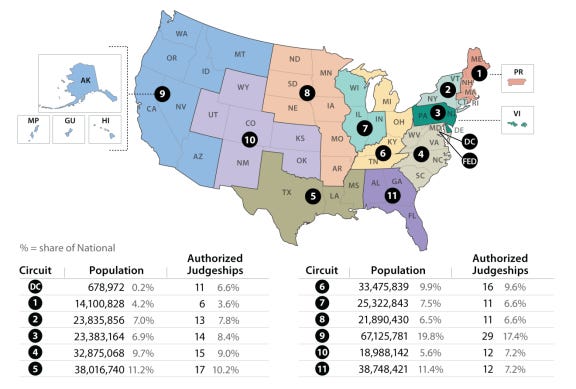
Of course, population isn’t everything; a court’s docket matters too. As noted by my correspondent, the D.C. Circuit is generally regarded as the most important circuit court — based on the high-profile cases it hears involving federal agencies, national security, and executive power — even though it covers the smallest population. And I’d argue that during the second Trump administration, it has only grown in importance, as a result of the many challenges to federal government action it has had to hear.1
In terms of the size of different courts’ dockets — i.e., caseloads — here are the circuits ranked by cases filed during the 12-month period ending June 30, 2026, based on data from the Administrative Office of the U.S. Courts (noting parenthetically how each circuit’s caseload ranking differs from its population ranking; “-” signifies no change):2
Ninth Circuit (-): 9,047
Fifth Circuit (+1): 5,481
Eleventh Circuit (-1): 4,756
Fourth Circuit (+1): 3,443
Sixth Circuit (-1): 3,419
Second Circuit (+1): 3,360
Eighth Circuit (+2): 2,632
Third Circuit (-): 2,514
Seventh Circuit (-3): 2,408
Tenth Circuit (-): 1,735
Federal Circuit: 1,362
First Circuit (-1): 1,136
D.C. Circuit (-1): 1,081
[UPDATE (8:49 p.m.): A commenter pointed out to me that the Federal Circuit’s caseload stats are available; they’re just contained in a separate report. So the ranking above was revised to add 1,362 for the Federal Circuit (it was previously listed as “N/A”), and this revision bumped the First and D.C. Circuits down by one spot each.]
But not all cases are created equal; the content or nature of a court’s docket matters too. As noted by my correspondent, the Second Circuit historically has been seen as a top-three court in significance, based largely on how it has decided many major business cases over the years. But it could be argued that as the business docket has waned, so has the Second Circuit’s importance.
I also agree with my correspondent’s point that in recent years, the First and Fifth Circuits have become more influential, based on how often they’ve been called upon to rule on challenges to federal government action. Challenges to Biden administration policies were often filed in Texas districts, which sent them to the Fifth Circuit; challenges to Trump administration policies are often filed in blue states like Massachusetts, New Hampshire, and Rhode Island, sending them to the First Circuit.
I’ll conclude my comments here, lest I taint the jury pool. Readers, what do you think? Please opine in the comments — which are open to everyone, not just subscribers. Thanks!
[UPDATE (5:17 p.m.): I made minor tweaks to this post to improve the logical transitions between the paragraphs discussing dockets and caseloads. In addition, on New Hampshire, please see the discussion in the comments about how it’s more of a purple state: although it has voted Democratic in every presidential race for two decades, Republicans currently control state government.]
1For the same reason, I’d argue that the U.S. District Court for the District of Columbia is now the most important federal trial court — sorry, S.D.N.Y. folks — but that’s an argument for another day.
2As for why the Federal Circuit isn’t included, you’ll have to ask the AO. A footnote to their table notes that it “does not include data for the U.S. Court of Appeals for the Federal Circuit,” but doesn’t explain why.
Thanks for reading Original Jurisdiction, and thanks to my paid subscribers for making this publication possible. Subscribers get (1) access to Judicial Notice, my time-saving weekly roundup of the most notable news in the legal world; (2) additional stories reserved for paid subscribers; and (3) the ability to comment on posts. You can email me at davidlat@substack.com with questions or comments, and you can share this post or subscribe using the buttons below.