TrumpWatch publisher
-
The Jimmy Carter Talk Has Started
emptywheel.net
Back in March, I pointed to how obsessed Trump was — in an interview done in the wake of his invasion of Venezuela — with avoiding the humiliation Iran imposed on Jimmy Carter.
Donald Trump has a pathological need to avoid being seen as he sees Jimmy Carter, a loser, someone who keeps leeching power over the course of an extended crisis.
And yet, as he keeps doing things that make that far more likely, just making shit up, everyone makes the obvious comparison with Carter’s failures.
I think a lot of the commentary has not considered that Trump has caused himself a resounding blow to his own self-image, and every time they make the comparison with 1979, that wound is renewed. At a very personal level, he will be seeking ways to not look like a loser. Which could make his decisions still more irrational.
Over and over, Trump described how, as the Venezuela operation was ongoing, he kept worrying about ending up like Jimmy Carter.
David E. Sanger
Did you watch either by video —
President Trump
I did. I was, I saw it.
David E. Sanger
What — what did that feel like? You were down at Mar-a-Lago?
President Trump
It’s like watching a movie, except you’re — it’s a little bit, you know — look, you don’t know if —
Katie Rogers
Are you worried when this is happening, while you’re watching? Or what is going through your mind?
President Trump
Yeah, I’m worried that it ends up being Jimmy Carter disaster that destroyed his entire administration.
When Sanger asked Trump if he had “studied” prior occupations, he instead wanted to talk again about Jimmy Carter — and Karoline Leavitt immediately tried to distract from with the Bunker-Ballroom.
David E. Sanger
Did you study some other occupations? Japan, Iraq, others?
President Trump
Yes, yes. I studied, I studied —
David E. Sanger
And what — what lesson did you draw from that, that we should know —
President Trump
That it’s highly risky.
David E. Sanger
— for Venezuela?
President Trump
That’s what I do.
David E. Sanger
OK, so —
President Trump
I looked at — I looked at some of the attacks. I studied the Carter attack. It was a disaster. I would have never done it that way.
David E. Sanger
You were talking about the attack. I was asking about the occupations that followed —
President Trump
You know, they had — they had a — they had a sandstorm. Did you know that? And they decided to go forward. We would go back, and let’s hit it three days later. They wanted to go forward, and they said, keep going. Helicopters don’t work well in the sand.
Karoline Leavitt
Sir, do you want to show them the renovations?
Trump didn’t take the right lessons from his study.

President Donald Trump is staring down two stark liabilities that threaten to damage his Republican Party in the midterms and to ruin his second term-legacy.
Somehow he’s maneuvered himself into a more vulnerable spot regarding Iran than any president since Jimmy Carter. As in the 1979-80 hostage crisis, the Islamic Republic is exerting political pressure that it can dial up on the US leader ahead of a national election. A week ago, Trump’s team predicted a deal to reopen the Strait of Hormuz was imminent. But Tehran, now dictating terms to the US global superpower, has imposed tough new conditions.
At the same time, Trump faces a separate but related problem at home. The war’s impact on energy prices is further souring voter perceptions of the economy. He’s entered the doom loop in which presidents and officials scan data for silver linings but voters see only indifference to their plights. Twists like Friday’s bad jobs report are untimely for the GOP with November fast approaching.
Trump has served up his own greatest fear.
The post The Jimmy Carter Talk Has Started appeared first on emptywheel.
-
When Donald Trump and Bernie Sanders Are the Same Person
When Abdul El-Sayed claimed victory in the Michigan Democratic Senate primary last Wednesday morning, it was not hard to look back into recent political history to identify the roots of his triumph.www.allsides.com -
Doctors and lawmakers condemn Trump order calling for sweeping changes to childhood vaccines – as it happened
www.theguardian.comThis live blog is now closed.
Wisconsin is not the only state with high stakes primary races on 11 August.
We’ll also be bringing you the latest on a number of pivotal contests. In Minnesota, the closely watched and crowded Democratic primary for US Senate seems to be a competition between lieutenant governor Peggy Flanagan and congresswoman Angie Craig.
Continue reading... -
NORAD says fighter jets intercepted several general aviation aircraft over Bedminster
The North American Aerospace Defense Command (NORAD) announced on Sunday that its F-16 fighter jets intercepted several general aviation aircraft over Bedminster, New Jersey, where Trump's golf club is located. Reports indicated that the aircraft violated the temporary flight restrictions that were put in place for the surrounding area. Two aircraft were reported connected to the incident.www.allsides.com -
Trump: Data centers could be 'bigger than oil' as Texas seeks pause
President Donald Trump says Texas is making a mistake by pausing data center projects. Trump made the remarks while in an interview with Punchbowl News that was uploaded on YouTube on Aug. 7. During a discussion about artificial intelligence and the rapid expansion of data centers, Trump said that if he were a governor, he would want the data center projects "so badly."www.allsides.com -
Judicial Notice (08.09.26): Star-Crossed Lovers
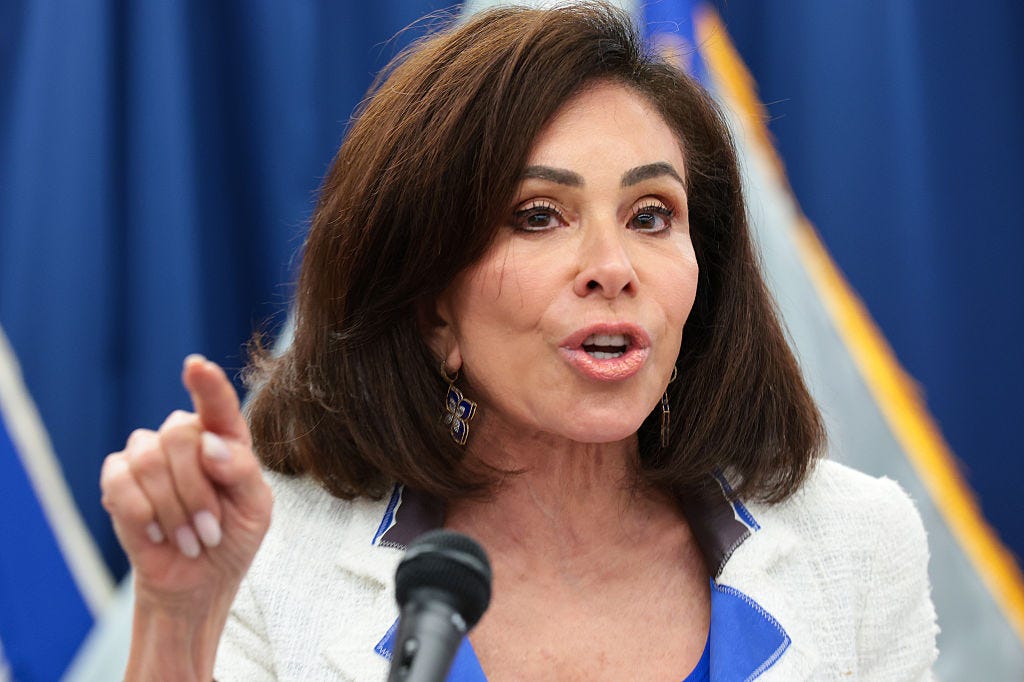
davidlat.substack.com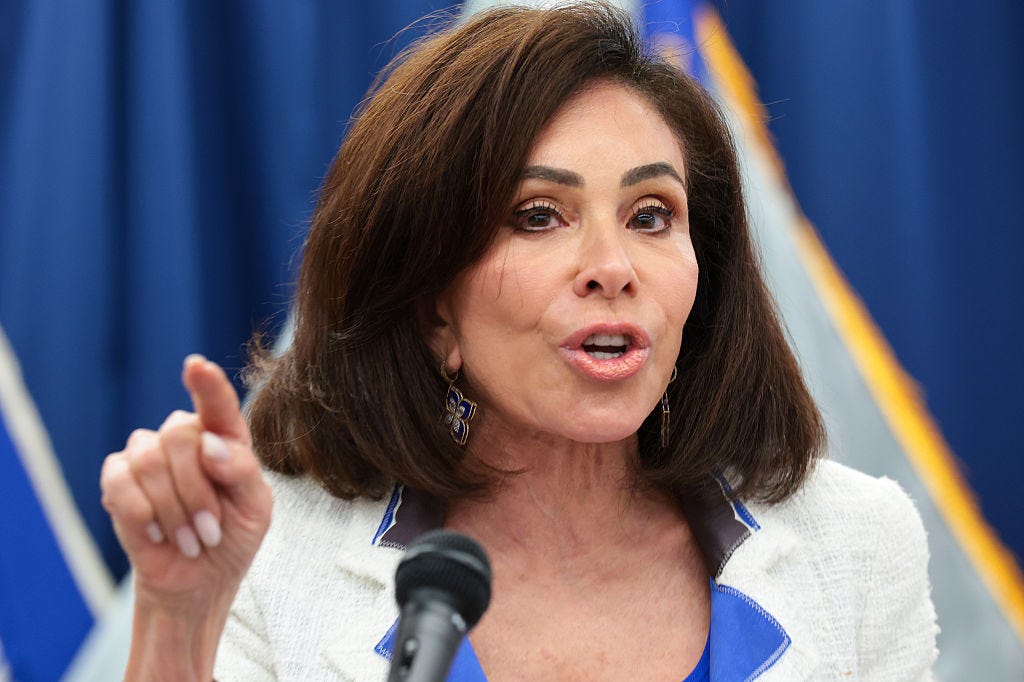 U.S. Attorney Jeanine Pirro (D.D.C.), at a press conference announcing her office’s prosecution of former Olympic canoeist David Hearn—a case she dropped, a few weeks later (photo by Anna Moneymaker via Getty Images).
This week’s Judicial Notice is sponsored by

Turn your litigation expertise into investment insight. Burford Capital is seeking a commercial litigator with 5+ years of experience to join our U.S. commercial investment team. This is a unique opportunity to apply your litigation experience in the growing alternative asset class of legal finance, evaluating legal risk and structuring innovative financing solutions for leading companies and law firms. Learn more and apply.
In the last edition of Judicial Notice, the most-clicked link was—to my surprise—the photo I used to illustrate the post, featuring the Wachtell Lipton Rosen & Katz letterhead as of March 2000. And when I posted an image of my former firm’s letterhead on LinkedIn, it went viral (by law-nerd standards), garnering more than 185,000 pageviews.
Given this surprising interest in the WLRK letterhead—which back then listed associates as well as partners, making it something of a curiosity—I updated last week’s Judicial Notice to swap in a more legible and somewhat more recent version (from 2003). If you’re interested, you can click here to view it. (See if you can find my name, as well as those of other Wachtell alumni you might recognize.)
Now, on to the news.
Lawyer of the Week: Jeanine Pirro.
On July 31, U.S. Attorney Jeanine Pirro (D.D.C.) moved to dismiss her office’s indictment of former Olympian canoeist David “Davey” Hearn, whom it had charged with felony destruction of property for allegedly vandalizing the Lincoln Memorial Reflecting Pool. According to her motion, the evidence “strongly suggest[s]” that damage to the lining of the Reflecting Pool was caused not by vandalism, but by a “rushed and botched installation” by the contractor.
This didn’t sit well with her boss, Donald Trump, who has repeatedly blamed the many problems with the Reflecting Pool’s renovation on vandals. He publicly criticized Pirro, historically his staunch ally and loyalist, for “choking” and “folding like an umbrella”—and summoned her to a White House meeting, along with Interior Secretary Doug Burgum (whose office Pirro had blamed for providing incorrect information about the work done on the Reflecting Pool).
The meeting, which took place last Monday, was an “Oval Office showdown,” according to The New York Times (gift link)—“a high-drama, face-to-face meeting” that was “worthy of two decorated veterans of confrontational reality TV.” Here’s more, from Tyler Pager, Glenn Thrush, and Katie Rogers of The Times:
Ms. Pirro came prepared. She entered the White House from the West Executive driveway in a bright red blazer that matched her fight-back mood, schlepping a white box containing evidence, plus a black box with documents, on wheels.
Waiting for her in the Oval Office, along with the president: Mr. Trump’s chief of staff, Susie Wiles, and David Warrington, the White House counsel. After about an hour of intense back-and-forth, Ms. Pirro emerged with her job intact, for now.
Emphasis on “for now.” According to C. Ryan Barber, Josh Dawsey, and Meridith McGraw of the Wall Street Journal (gift link), “People close to the president said it is too early to say whether Pirro’s job is safe, noting that Trump remains angry that his longtime ally publicly undercut him.”
Critics of the Trump administration faulted Pirro for not realizing at an earlier stage, based on publicly available information, that the vandalism claims were far-fetched—and generally viewed the whole situation as “a complete catastrophe for the U.S. Attorney's Office and the administration,” as Ken White said on Serious Trouble.
On the other hand, from a “better late than never” perspective, Pirro did eventually drop the charges—showing that, in White’s words, “even Jeanine Pirro has limits to the extent to which she’ll get kicked around for doing stupid stuff for Donald Trump.” Or as longtime defense attorney Joe Flood told Salvador Rizzo, who wrote an impressively balanced profile of Pirro for the Washington Post (gift link), Pirro should “get[] some credit for standing up to Trump.”
Speaking of standing up to Trump, might we see more of that from Todd Blanche—confirmed as U.S. Attorney General on Saturday, 50-49? That was part of the justification that Senator Bill Cassidy (R-La.) gave for casting the deciding vote for Blanche, expressing the hope that being a Senate-confirmed AG would give him “greater leverage to push for things that should be pushed for.”
Other lawyers in the news:
I’ll surely have more to say about this news in next week’s Judicial Notice—it broke just as I was putting the finishing touches on this edition—but at around 5:30 p.m. on Sunday (today), Donald Trump announced on Truth Social that effective September 1, Will Scharf will succeed David Warrington as White House Counsel (and Warrington will return to the private sector).
As some of you might recall, Scharf—a Harvard Law School graduate, former federal law clerk and prosecutor, and former personal lawyer to Trump—currently serves as White House staff secretary, an influential role once held by Brett Kavanaugh. Back in June, Scharf was Lawyer of the Week for persuading Trump not to (1) suspend habeas corpus for unlawful immigrants or (2) invoke the Insurrection Act to deal with domestic protests.
If anyone has additional info on this transition in the White House Counsel’s Office—e.g., whether Scharf had much competition for the job (I’m guessing no), or where Warrington is headed next (I’m guessing a conservative boutique like his former firm, Dhillon Law Group)—please drop me a line.Last Friday, the Senate used its relatively new en bloc process to confirm a fifth batch of second-Trump nominees, 51-47. This group of over 70, whose names can be viewed on the Senate website, included a number of lawyers, such as a new Department of Justice Inspector General, Donald Berthiaume; four U.S. attorneys, namely, Kenneth Sorenson (D. Haw.), Timothy VerHey (W.D. Mich.), Sean Costello (S.D. Ala.), and Christopher Nassar (N.D. Okla.); and two members of the National Labor Relations Board (NLRB), James Macy and David Prouty, whose arrival will give the NLRB a quorum.
A year ago last month, Louis Capozzi became Missouri Solicitor General—and, at age 30, the youngest state SG in the country. He spoke about his first year in office, including growing his team from five lawyers to 15, with the National Law Review and Law360 (which wrote about the rise of state SG’s offices more broadly, in an article titled “How State SG Offices Became A Judicial Pipeline”)
Speaking of successful young lawyers, congratulations to Bloomberg Law’s latest 40 Under 40 honorees, as well as to Law360’s 160-plus Top Attorneys Under 40.
Judge of the Week: Judge Jennifer Mascott.
Last week, Daniel Barnes and Jacob Wendler wrote a piece for Politico about an unusual situation involving Judge Jennifer “Jenn” Mascott (3d Cir.). Here’s the opening of their piece, titled “‘Is she even allowed to be doing this?’: Inside a federal judge’s side gig running a PR firm”:
A Trump-appointed federal appeals judge spent months running a Washington public affairs firm after being appointed to the bench last year, an arrangement that contributed to an exodus among the firm’s staff and clients and only ended when the firm went out of business at the end of June.
Jennifer Mascott, a former conservative law professor who sits on the 3rd Circuit Court of Appeals, was deeply involved in daily operations at the firm, Adfero, for at least six months after she was confirmed as a judge in October 2025, according to 14 former employees and clients granted anonymity to discuss internal details of the firm’s final months.
Nine of the former employees said Mascott, who inherited her ownership stake in the firm from her late husband in 2023, worked at least once a week out of Adfero’s office in Washington and oversaw the firm’s staffing, business development efforts and client relations in between her full-time judicial duties in Wilmington and Philadelphia.
Readers who alerted me to the Politico piece expressed surprise at this arrangement. In general, to avoid ethical issues, federal judges don’t take on non-judicial employment (setting aside teaching and writing books, which they’re allowed to do). If judges do decide to take positions outside the judiciary, they almost always resign from the bench (as former judge Gregory Van Tatenhove (E.D. Ky.) did last month, before becoming dean of the University of Kentucky’s Rosenberg College of Law).
But interestingly enough, the Code of Conduct for United States Judges provides that a judge “may serve as an officer, director, active partner, manager, advisor, or employee of a business,” as long as the business is “closely held and controlled by members of the judge’s family.” This provision allowed Mascott to run Adfero as managing trustee, as requested by her late husband Jeff Mascott—who tragically passed away in 2023 at 48, from pancreatic cancer. As Judge Mascott told Politico:
Consistent with those fiduciary and legal and ethical duties, I endeavored to keep the company going while that was viable and also routinely consulted with long-time firm HR lawyers and other advisors and legal and ethical experts about how to comply with all requirements and how to evaluate whether the company should be wound down, sold, or otherwise entrusted to other firm leadership.
Not surprisingly, responses to Politico’s report varied based on one’s political leanings. Senator Chris Coons (D-Del.), a prominent Democrat on the Senate Judiciary Committee, announced that he’s thinking about filing a judicial misconduct complaint against Mascott (whose nomination to a Delaware-based seat on the Third Circuit he opposed). Meanwhile, conservatives assailed the Politico piece as “disgusting” (Ilya Shapiro) and a “hit job” (Eric Wessan).
I’m friendly with Judge Mascott; I like her personally (based on admittedly limited interactions), and I have a positive opinion of her as a judge (based on her limited tenure on the bench). That said, I wouldn’t call the Politico article a hit piece; it struck me as a legitimate piece of investigative journalism, reporting on an unusual situation that certainly raises ethical questions (but doesn’t appear to involve any ethical violation, based on the code provision mentioned above).
I don’t know the specifics of the situation that Mascott was thrust into by the shockingly sudden passing of her husband—who was diagnosed in 2022 and died in 2023, leaving behind Jenn Mascott as the sole parent to four young children. As a general matter, though, I’d suggest that judges should probably try to avoid situations where they’re involved in the running of outside businesses, even closely held family concerns. And I wonder whether Judge Mascott—with the benefit of hindsight, which is admittedly 20/20—regrets not immediately selling Adfero (perhaps to its employees with an earn-out), in light of the fact that the business ultimately closed its doors.
In other news about judges and the judiciary:
In an interview with James Taranto of the Wall Street Journal (gift link via Howard Bashman’s How Appealing), Justice Samuel Alito confirmed what we already knew (thanks to things like his clerk hiring): “Obviously I’m here for another term.”
Speaking of SCOTUS, a new Marquette Law School Poll (via Adam Liptak’s The Docket) found that 47% of adults approve of the way the Court is handling its job, while 53% disapprove (pretty much unchanged from May—so the final merits rulings of OT 2025 didn’t move the needle).
Judge Brantley Starr (N.D. Tex.)—yes, he’s related to the late Ken Starr (his uncle)—received a lot of attention for the colorful footnotes in his recent opinion in CFTC v. TMTE, Inc. Some readers enjoyed them—like Peter Beck and Seamus Hughes of Court Watch, who wrote that “the entire opinion… is a ride, complete with a reference to the greatest Christmas movie ever produced (footnote 37).” But I did hear privately from others who found the opinion self-indulgent—especially footnote 51, which apparently references a 4chan Meme (or so Reddit tells me). I also wonder whether Judge Starr’s opinion is what Judge Stephen Dillard had in mind when he tweeted, a few days later, “There may be cases where it’s necessary (or at least reasonable) to include an emoji, meme, or the like in a judicial opinion. But I do think judges should avoid using them in a way that appears to be gratuitous.”
In the past year or so, Fifth Circuit judges have started dissenting from grants of rehearing en banc, issuing opinions that some call “disgrantles” or simply “grantals.” Perhaps this will become a trend in other circuits, now that it has been covered by folks like Jacqueline Thomsen of Bloomberg Law and Avalon Zoppo of Law.com. I’m not sure how I feel about this; readers, what do you think?
In nominations news, the Senate confirmed eight judges to the D.C. Superior Court and Court of Appeals—the District’s local courts—but no new Article III judges. The senators will return from their August recess on September 14.
Job of the Week: an opportunity for a midlevel corporate associate in Chicago.
Lateral Link is conducting a search for a midlevel corporate/M&A/private equity associate to join a premier global law firm in Chicago. The corporate group represents the largest practice in the Chicago office, combining the welcoming culture and close-knit environment of a midsize firm with the sophisticated resources and expansive reach of a global platform. Working side-by-side with partners in firmwide leadership, you will gain direct exposure to key decision-makers in a group with a proven fast track to promotion. Candidates must be active members of the Illinois bar with hands-on experience leading middle-market M&A and private equity transactions for funds, institutional investors, and portfolio companies, including drafting, negotiating, and managing deal teams from diligence to closing. For immediate and confidential consideration, submit your résumé to Liz McGarry at emcgarry@laterallink.com.
-
New in SpyWeek: Kremlin Hints FSB May Tempt Kash with Dem Dirt in Moscow, as Berlin Expels Russian Spies, CIA Targets Cuba
www.spytalk.co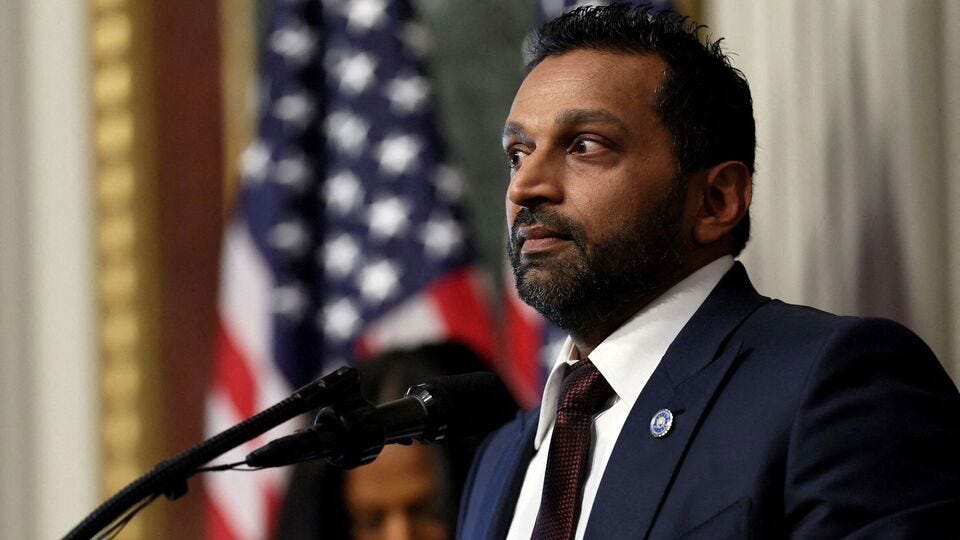 Earlier this year FBI Director Kash Patel claimed without evidence that Democrats went “overseas and hire(d) some bogus intelligence asset to manufacture fraudulent, fake, unverified information” against Trump & co. (LiveMint file photo)
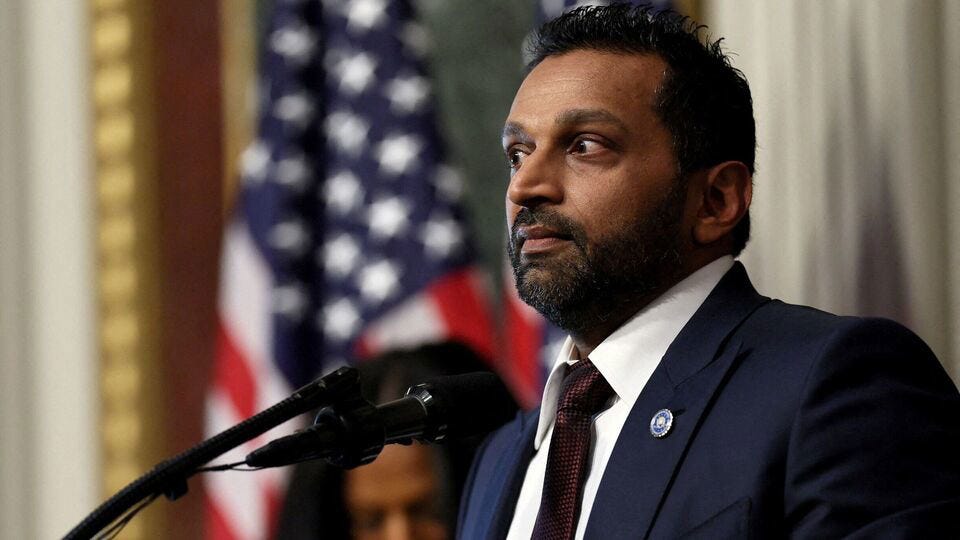
Moscow Mule? FBI Director Kash Patel’s scheduled Moscow sojourn only weeks before the U.S. midterm elections has generated lots of questions, but none so provocative as one from prominent Kremlin commentator Vladimir Vasiliev, a senior researcher at the Russian Academy of Sciences’ Institute for U.S. and Canadian Studies, who suggested the FSB may offer Patel dirt on Democrats. “It is assumed that Russia has some kind of kompromat on the Democrats, and it could be provided by us, in one form or another, to the American side,” Vasiliev told Moskovsky Komsomolets, known as MK, “a Russian outlet with a long history of publishing information and propaganda from the FSB, Russia’s Federal Security Service,” according to Kremlin watcher Olga Lautman. Vasiliev added that “Moscow might naturally ask, ‘What will we get in return?’” There’s much more on this worth your time at Lautman’s “Unmasking Russia” newsletter. Patel also took an underreported trip to Beijing late last month to forge FBI ties with Chinese law enforcement.
Russia, Russia: Germany has expelled 400 Russians since 2022, including 80 suspected intelligence agents under diplomatic cover, according to the tabloid Bild. Meanwhile, an explosive drone discovered near Ukrainian planes at a German airport has been linked to Russia, U.S. intelligence officials told the Wall Street Journal. They also say “Putin could try to test NATO’s resolve with a limited assault on an allied country in the next few years. The assessments envision scenarios ranging from a cyberattack to a small-scale land incursion.”
Ears for Trump: The president has made it incredibly easy for adversary intelligence services to eavesdrop on his conversations, writes Calder Walton, a historian at Harvard’s Kennedy School of Government and author of SPIES: The Epic Intelligence War Between East and West. “One can only imagine how many foreign spies are also listening in to his phone conversations,” Walton wrote at the U.K.’s iPaper. “Any foreign intelligence service worth its name will have recruited agents at his Mar-a-Lago resort in Florida, where security is known to be pathetic. At the end of his first term, Trump had classified documents lying around in one of his bathrooms.”
Follow the Money: “Inside the War on Hezbollah’s Finances” unveils how “Israel and the United States aren’t just targeting the Lebanese militant group’s weapons. They’re going after its money.” (New York Times)
Tehran Security Shuffle: “The appointment of Mohsen Rezaei as secretary of the Supreme National Security Council suggests that Iran’s old guard is consolidating power,” reports The New York Times. Rezaei, “who led Iran’s Islamic Revolutionary Guards Corps during the Iran-Iraq War of the 1980s…is replacing Mohammad Bagher Zolghadr, who stepped into the role when the council’s previous secretary, Ali Larijani, was killed in an Israeli strike during the U.S.-Israeli attacks on Iran earlier this year.”
Iran’s Swimmer Bots: CISA, the U.S. Cybersecurity and Infrastructure Security Agency, is close to proving that it’s Iran that’s been slithering into water control systems across the upper Midwest. “The hackers were ‘targeting water entities of all sizes’ and it recommended “facilities unplug vulnerable controllers from the internet,” it said. (New York Times)
China’s Hitchhiker Spies: “Royal Navy spy drones used by Britain’s elite special forces secretly sent data to China,” blares The Telegraph, a reliable vehicle for U.K. defense leaks. “The cameras on the K3 Scout surveillance drones had components made in China which were secretly transmitting information to a device in the country.”
Netherlands Blacklists Israel: The Dutch internal security agency NCTV now ranks Israel as a threat alongside Iran and Russia. “Placing Israel in the same threat category as Iran and Russia gives Dutch security services institutional cover to treat routine Israeli diaspora outreach as a counterintelligence concern, setting a template other European governments may follow,” said The Jerusalem Post. “The National Coordinator for Terrorism and Security (NCTV) report, released on July 17, lists Israel as one of the countries that aims to ‘control public opinion and political decision making.’”
Ukraine Infowars: Coming this week, The Propaganda Manual of the Ukraine War: Information Warfare by Russia, Ukraine, and Western Nations: Lessons Learned for Future Conflicts, from Thomas Kent, a disinformation expert, from the American Foreign Policy Council. “The book represents two years of research. It describes Russian, Ukrainian, and what have passed for Western information operations in the course of the war,” writes the author. “It attempts to judge what tactics were the most and least successful for each side. The book also assesses an array of ‘resilience’ tactics to protect civilian populations from foreign propaganda efforts.”
Target Havana: The CIA’s buffed-up task force on Cuba is looking for a few good puppets to replace the regime’s communist leaders, a la Delcy Rodrîguez in Venezuela, reports the New York Times. This comes on top of the Trump administration’s financial and economic strangulation of the island.
Former CIA Station Chief Goes Crypto: A former CIA station chief in Caracas, Enrique “Rick” de la Torre “registered on Monday as a lobbyist for a Cayman-based crypto firm previously fined $45 million, including regarding sanctions policy,” reported Jack Poulson on his All Source Intelligence news site. De la Torre was Venezuela station chief “during a period that overlapped with high-profile U.S. intelligence and political operations in the country, including the 2024–2025 capture of former President Nicolás Maduro,” reported Türkiye Today, a center-right news outlet associated with the Recep Erdoğan regime.
FBI Agent Goes Crypto, Badly: An FBI counterintelligence agent has been arrested on charges of “taking about $1 million worth of cryptocurrency from the digital accounts of an overseas suspect in a U.S. criminal investigation, according to court documents reviewed by the Wall Street Journal. Patrick Yaroch, an FBI supervisory agent in Washington, D.C., “came forward late last week to confess, telling a Justice Department employee that it was ‘eating him up inside,’ and he wanted to ‘get it off his chest.’” (MSN)
Don’t miss this week’s SpyTalk podcast featuring former senior FBI executive Lauren C. Anderson on chaos in the Bureau under MAGA warrior Kash Patel.
RIP Sam Faddis: Charles S. Faddis, an ex-CIA officer who won praise years ago as an insightful critic of the agency but later morphed into an election-conspiracies activist, died late last month in Philadelphia from “Covid-related lung disease and pneumonia,” the New York Times reported Friday. (Back in 2013, one of his former CIA colleagues volunteered to me that Faddis was “the best boss I ever had, by far.”)
Fishy Colombians: Ukraine has expelled Colombians suspected of ties to the nation’s drug cartels and rebel groups who’ve been soaking up Kyiv’s vaunted expertise in lethal low cost drones. (Financial Times)
True Spy Yarn: “The BBC went looking for Hussam Luka, the former head of Syria’s most powerful civilian intelligence agency,” the BBC headlined on Friday. “They started with his phone book.” Eventually, the reporters located him in Russia. “Known as ‘The Spider,’ Luka was one of Assad’s top henchmen, accused of orchestrating atrocities and systematic torture, and sanctioned by the UK, US and European Union.” A riveting read about yet another sadist leader sheltered by Moscow over the decades.
On the Screen: High Value Target: The Hunt for Saddam, debuts Sept. 13 onTNT. The multipart docudrama is the story of John Nixon, “the first CIA officer to interrogate Saddam Hussein,” reports Deadline. (See the trailer here.) Back in May, Nixon’s CIA colleague William (Jerry) Watson described the agency’s criminally bad intelligence-gathering on, and fruitless hunt for, Iraqi WMD on the SpyTalk podcast.
Thank you for reading this. SpyTalk is an entirely reader-supported publication. To receive new posts and support the work of all of us here, please consider taking out a paid subscription. We can’t do it without you. Just click below for a no-obligation free trial.
-
Trump appoints staff secretary Will Scharf as new White House counsel
www.theguardian.comScharf, who helped president win approval for $400m ballroom, to replace David Warrington on 1 September
Donald Trump announced on Sunday that Will Scharf, the staff secretary who helped secure approval for the $400m White House ballroom project, will become White House counsel and assistant to the president.
Effective 1 September, Scharf will replace David Warrington, who will be leaving the administration to join the private sector. Warrington formerly served as a personal counsel and a lawyer for Trump’s 2024 campaign.
Continue reading... -
Trump Tyranny Tracker | Day 564: Aug 6, 2026
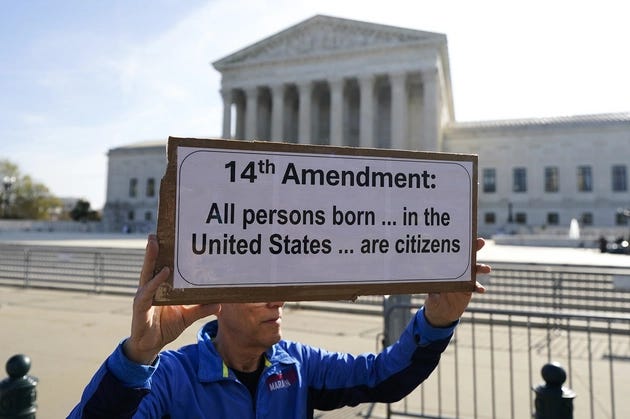
trumptyrannytracker.substack.com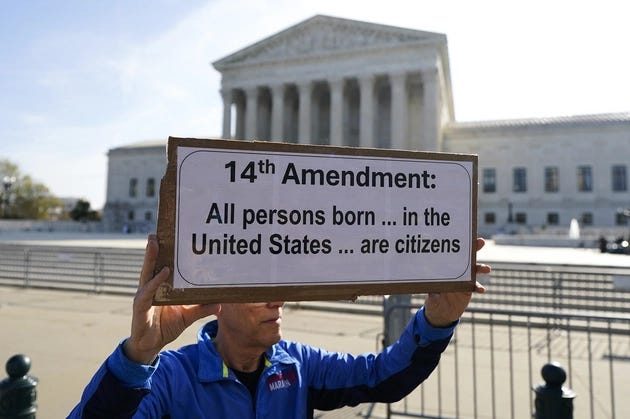 People demonstrate outside the U.S. Supreme Court ahead of U.S. President Donald Trump’s arrival on April 01, 2026 in Washington, DC. | Al Drago/Getty Images
Welcome to today’s Trump Tyranny Tracker…
Trump’s family is benefiting from billions in federal spending, misconduct complaints are soaring as DOJ watchdogs disappear, and Trump’s Iran war is draining critical U.S. weapons as intelligence warns Russia may test NATO.
Today at a Glance
Trump signs new executive orders targeting birthright citizenship
DHS is held in contempt for withholding communications from more than 800 immigration agents
Millions of children could lose free school meals this fall because of Trump’s SNAP cuts.
What We Need to Pay Attention To
A Growing Number of Election Deniers Hold Key Local Roles in Midterms
What Happened: At least 25 election deniers have taken positions overseeing elections since 2024 in counties with key House, Senate, and statewide races. They join at least 69 already in office, including 41 who have tried to interfere with elections or have ties to election denier groups.
Why It Matters: Election deniers who tried to overturn a free and fair election now have power over how elections are run and certified. Giving them control over voter rolls, procedures, and certification allows them to interfere with results and undermine the midterms.
Source: New York Times
Corruption
Tech firm’s $50 million Trump library gift preceded massive federal land deal
What Happened: SoftBank donated $50 million to Trump’s presidential library in January while seeking federal approval for a massive AI data center in Ohio. Two months later, Trump officials approved a lease giving a SoftBank subsidiary roughly 3,700 acres of federal land for the project.
Why It Matters: A company seeking a massive deal from the U.S. government gave $50 million to Trump’s presidential library and got the deal two months later. The library gives companies seeking government favors another way to funnel millions to Trump.
Source: MS NOW
Trump seeks to shield his business finances from BBC in libel lawsuit
What Happened: Trump is trying to stop the BBC from obtaining financial records from hundreds of his companies in his $10 billion defamation lawsuit. Trump claimed the BBC damaged his businesses, but after a judge ruled that his finances were subject to discovery, he moved to rewrite the lawsuit and focus instead on damage to his reputation.
Source: Politico
Lawmakers call for Pentagon probe of Trump family-backed companies
What Happened: Lawmakers are asking the Pentagon inspector general to investigate $3.2 billion in federal contracts, investments, and loans awarded to 15 companies tied to Eric Trump and Donald Trump Jr., most after Trump returned to office. One Trump Jr.-backed company received a $620 million Pentagon loan after reportedly being fast-tracked ahead of others.
Why It Matters: Billions in taxpayer-backed contracts, loans, and investments are flowing to companies tied to Trump’s sons while their father controls the government awarding them. It creates a system where Trump’s family is profiting from federal decisions he has power over.
Source: The Washington Post
Power Consolidation
Trump Signs Executive Orders Targeting Birthright Citizenship
What Happened: Trump signed two executive orders imposing new restrictions on birthright citizenship just weeks after the Supreme Court ruled his previous attempt unconstitutional. The orders target children of some foreign government employees, mothers accused of traveling to the U.S. to give birth, and parents the government labels “alien enemies” or members of terrorist groups.
Why It Matters: Trump lost his attempt to restrict birthright citizenship and is trying another way around the Supreme Court. The Constitution guarantees citizenship to people born in America, and Trump cannot decide which children that protection applies to.
Source: New York Times
Weaponization of Institutions
Justice Department says Duke Law School illegally considered race in admissions
What Happened: Trump’s DOJ accused Duke Law School of illegally considering race in admissions, claiming personal essays and first-generation college status are being used as proxies for race. DOJ is seeking a settlement and has launched similar actions against other universities.
Source: Associated Press
Court holds DHS in contempt, accusing it of withholding agents’ phone data
What Happened: A federal judge held DHS in contempt for failing to hand over messages from the personal phones of more than 800 immigration agents involved in LA raids at the center of a racial profiling lawsuit. Previously released messages showed agents using racist slurs. DHS admitted that at its current pace, producing the remaining records could take up to four years.
Why It Matters: DHS was ordered to preserve evidence in a civil rights case and failed to do it. Agents have already been caught using racist slurs, and now the government is delaying the release of messages that could reveal how much further the racism went.
Source: MS NOW
Senate panel votes to hold Fauci in contempt
What Happened: Senate Republicans voted along party lines to hold Anthony Fauci in contempt after he invoked his Fifth Amendment right and refused to testify about his role during the Covid pandemic. Rand Paul says he plans to bypass a full Senate vote and send the matter directly to Trump’s DOJ for possible prosecution.
Why It Matters: Fauci exercised his constitutional right against self-incrimination, and Republicans want him prosecuted for it. They are trying to turn a congressional investigation into another route for sending one of Trump’s longtime targets to jail.
Source: Politico
Media Suppression & Authoritarian Tactics
Federal Communications Commission scraps limit on broadcast TV ownership
What Happened: The FCC voted 2–1 to eliminate a decades-old rule limiting how many U.S. households a single television company’s stations can reach. The change could clear the way for major mergers, including Nexstar’s proposed $6.2 billion purchase of Tegna, which would put stations reaching at least 60% of U.S. households under one company.
Why It Matters: Millions of Americans get their news from local television. Allowing a few corporations to control more local stations concentrates enormous power over what information Americans receive.
Source: NBC News
West Point won’t fight ban on school policy limiting professors’ speech
What Happened: West Point agreed to a court order blocking a policy that required civilian professors to get approval before publishing papers, speaking at conferences, or appearing on podcasts. The academy’s longest-serving law professor challenged the policy as an unconstitutional restriction on free speech. The academy did leave open the possibility of appealing the ruling.
Source: The Washington Post
Human & Civil Rights Abuses
A Commission Monitoring Human Rights Violations Is Concerned About the US
What Happened: The Inter-American Commission on Human Rights held its first hearing on freedom of expression and peaceful assembly in the U.S. after complaints of excessive force against immigration protesters, journalists, and bystanders. Witnesses described federal agents shooting protesters with pepper balls, using chemical irritants, while facing no accountability.
Why It Matters: An international human rights body that investigates abuses across the Americas is now examining the U.S. over its treatment of protesters and journalists. What began as an immigration crackdown is being used against people who protest, document, or criticize it.
Source: Mother Jones
Louisiana school board and federal government end 61 years of segregation monitoring
What Happened: Trump’s DOJ agreed with Louisiana officials to end 61 years of federal desegregation oversight of Bossier Parish Schools. DOJ spent decades enforcing these orders but now calls them federal intrusion into local schools.
Why It Matters: Federal oversight existed because local officials could not be trusted to dismantle segregation on their own. Now the DOJ is walking away from one of the federal government’s most important tools for enforcing equal protection in public schools.
Source: Associated Press
21-year-old pregnant mom detained at Dilley facility for over a month, family says
What Happened: ICE detained 21-year-old Laura Rojas Ortiz and her infant son during a routine check-in and has held them for more than 40 days. Rojas Ortiz is five months pregnant with what her family says is a high-risk pregnancy, and has reportedly received no ultrasound, blood tests, or specialist care.
Source: ABC News
Trump administration targets children amid push to ‘deport at all costs’
What Happened: A federal lawsuit alleges Trump officials are accelerating deportations of unaccompanied migrant children, including survivors of trafficking and abuse who qualify for legal protections in the U.S. Some children have reportedly been ordered deported even after being approved for protected immigration status.
Why It Matters: These protections exist specifically to keep abused and trafficked children from being sent back into danger. Trump officials are pushing to deport them anyway in their cruel drive to increase deportation numbers.
Source: The Guardian
DHS Is Hiring Bounty Hunters to Find and Photograph Deported People’s Homes Abroad
What Happened: DHS is hiring private investigators to track down deported immigrants in their home countries, photograph their homes, and collect information from them. DHS says it is targeting people who still owe immigration related fines after leaving the U.S.
Source: WIRED
Government Disruption
At Trump’s DOJ, watchdogs gutted as misconduct complaints soar
What Happened: Nearly half the staff at the DOJ office responsible for investigating attorney misconduct has left during Trump’s second term, while new investigations have fallen to a 20-year low. At the same time, misconduct complaints have hit a 20-year high, with federal judges accusing DOJ lawyers of false statements, defying court orders, and using the legal system against political opponents.
Why It Matters: Misconduct allegations inside DOJ are soaring at the same time the office responsible for investigating them is being gutted. That leaves DOJ lawyers with fewer consequences for abusing their power.
Source: Reuters
Trump Administration to Deregulate Head Start
What Happened: Trump officials are moving to eliminate most of Head Start’s 133 pages of federal requirements, including standards for class sizes, math and literacy instruction, medical and dental screenings, and home visits. Head Start currently provides early education, health care, and other support to roughly 700,000 low-income children.
Why It Matters: Head Start was created to provide poor children with more than basic child care, including education, health screenings, nutrition, and family support. Trump officials are stripping away many of the standards that make those services part of the program.
Source: New York Times
Pentagon Removes Decades of Weapon Test Reports From Public View
What Happened: The Pentagon removed 25 years of unclassified weapons testing reports from public access, including reports exposing performance, maintenance, and safety problems. The Pentagon has also cut its independent testing office from 126 employees to 30 and removed 90 weapons programs from its oversight.
Source: Bloomberg
Trump, Hegseth clashed at Camp David over Iran missile depletion concerns
What Happened: Trump reportedly confronted Pete Hegseth after learning that severe munitions shortages are limiting U.S. military options against Iran. The U.S. has nearly exhausted some critical weapons, including ATACMS missiles, while shortages of Patriot and other air-defense interceptors are leaving barely any available for Ukraine.
Source: The Washington Post and The Atlantic
Imperial & Geopolitical Watch
At least 12 states report cyberattacks on water systems possibly linked to Iran-backed hackers, sources say
What Happened: Suspected Iran-backed hackers have targeted water systems in at least 12 states, including more than 30 systems in Minnesota. Hackers gained remote access to pumps, valves, and water pressure controls, forcing some utilities to operate manually. Federal investigators are continuing to investigate and have not officially blamed Iran.
Source: CBS News
US to shut five consulates as critics fear China could fill diplomatic vacuum
What Happened: The State Department plans to close U.S. missions in Canada, Grenada, Japan, Indonesia, and Cameroon as Trump continues shrinking America’s diplomatic presence abroad. More than half of U.S. ambassadorial posts worldwide are vacant.
Why It Matters: Trump is pulling America back from places where China is competing for influence. China already has a diplomatic presence in three of the five countries the U.S. is abandoning, handing Beijing more room to fill the vacuum.
Source: The Guardian
Carney says US trade talks are ‘nasty’ after Trump criticizes Canada’s leadership
What Happened: Canadian Prime Minister Mark Carney said trade negotiations with the U.S. have turned “nasty” as Trump threatens additional tariffs and publicly attacks Canada’s leadership. Carney said the countries are now “in the middle of a tariff war.”
Source: Associated Press
Far-Right & Russian Influence Watch
U.S. Intel Finds Putin Could Test NATO’s Resolve With Limited Incursion
What Happened: New U.S. intelligence warns that Putin could test NATO with a cyberattack, hybrid operation, or limited military incursion sometime between this fall and 2029. The warning comes as U.S. stocks of Patriot, THAAD, SM-3, Stinger, and other critical weapons are severely depleted.
Source: Wall Street Journal
Economic News
Millions of U.S. children could lose free school meals this fall due to SNAP changes
What Happened: Millions of children could lose access to free school meals after Trump’s tax cuts for the wealthy law cut SNAP enrollment and severed the automatic link between food stamps and free school meals. An estimated 1.5 million children have already lost SNAP benefits, while as many as 18.3 million students could lose access to free school meals.
Source: CBS News
Resistance
Check out 50501 for local and nationwide events…
Source: 50501
Airline workers reportedly decline to help US agents as Trump migrant crackdown accelerates
What Happened: ICE and TSA have dramatically expanded immigration enforcement at U.S. airports as Trump pushes for 2,000 arrests a day, including detaining people with pending asylum, visa, and green card applications. Some airline workers are refusing to cooperate without proper legal authority. Southwest employees, for example, blocked an ICE agent from boarding a plane without a judicial warrant.
Source: The Guardian
By the Numbers
$3.2 billion — Federal contracts, investments, and loans awarded to 15 companies tied to Trump’s sons.
$620 million — Pentagon loan awarded to one Trump Jr.-backed company after it was reportedly fast-tracked.
$50 million — SoftBank donation to Trump’s presidential library two months before Trump officials approved a lease for 3,700 acres of federal land for its subsidiary.
18.3 million — Students who could lose access to free school meals because of Trump’s SNAP changes.
1.5 million — Children who have already lost SNAP benefits.
700,000 — Low-income children served by Head Start as Trump officials move to eliminate hundreds of program requirements.
800+ — Immigration agents whose phone communications DHS failed to preserve and turn over in a civil rights case.
30 — Staff remaining in the Pentagon’s independent weapons testing office after sweeping cuts.
25 — Election deniers who have taken positions overseeing elections since 2024, joining at least 69 already in office.
20% — Level some critical U.S. munitions have reportedly fallen to compared with Pentagon targets after five months of war with Iran.
12 states — Water systems targeted in cyberattacks suspected of being carried out by Iran.
What to Watch Next
Election deniers are gaining control over how key races are run and certified — Will they use that power to interfere with midterm results they don’t like?
Trump is trying to restrict birthright citizenship after losing his previous attempt — How far will he go to get around the Supreme Court?
Trump’s Iran war has dangerously depleted critical U.S. weapons — What happens if Putin attacks NATO while American stockpiles are strained?
DHS was held in contempt for withholding agents’ communications in a racial-profiling case — What will those messages show if DHS is finally forced to turn them over?
Trump’s Iran war may now be reaching critical infrastructure inside the U.S. — Will attacks on water systems spread to other critical infrastructure?
Key Takeaways
Family Profits — Companies tied to Trump’s sons have received billions from the federal government, while a $50 million donor to Trump’s presidential library received a massive federal land deal two months later.
Accountability Gutted — DOJ misconduct complaints are at a 20-year high while its internal watchdog loses staff and opens fewer investigations, while the Pentagon is cutting weapons oversight and removing decades of testing reports from public view.
Election Threat — Election deniers who tried to undermine a free and fair election are now in critical positions with power over voter rolls, procedures, and certification.
Children Targeted — Abused and trafficked migrant children face accelerated deportation, a pregnant mother and her infant remain detained, and millions of American children could lose free school meals.
Military Depleted — Trump’s Iran war is burning through critical American weapons, leaving fewer available for U.S. defense, Ukraine, and a potential conflict elsewhere.
Call to Action
Document Everything: Document purges, corruption, and power grabs. Share credible information with journalists, watchdogs, and legal experts. Silence enables authoritarianism—see something, say something.
Defend Press Freedom: Support independent journalism by subscribing to and sharing reporting that challenges Trump’s power grab.
Contact Lawmakers: Demand accountability for Trump’s unchecked power and war on oversight.
Mobilize for Action: Organize or join legal efforts and resistance movements to protect democracy and human and civil rights.
Thanks for reading the Trump Tyranny Tracker. Stay tuned for more updates.
-
Netanyahu rejects US-led 15-point Gaza peace plan in rare public break with Trump
www.theguardian.comIsraeli PM says IDF will not withdraw until Hamas is disarmed and rebukes US pressure to end wars without his country’s buy-in
Israel’s prime minister, Benjamin Netanyahu, has rejected a US-backed 15-point peace plan for Gaza in a rare public break with Donald Trump.
In a statement on Sunday, Netanyahu said that he was confronting a “wave of rumours about Israeli weakness and Israeli withdrawals on all fronts” and rebuked US pressure to end wars in Gaza, Lebanon and Iran without Israel’s buy-in.
Continue reading... -
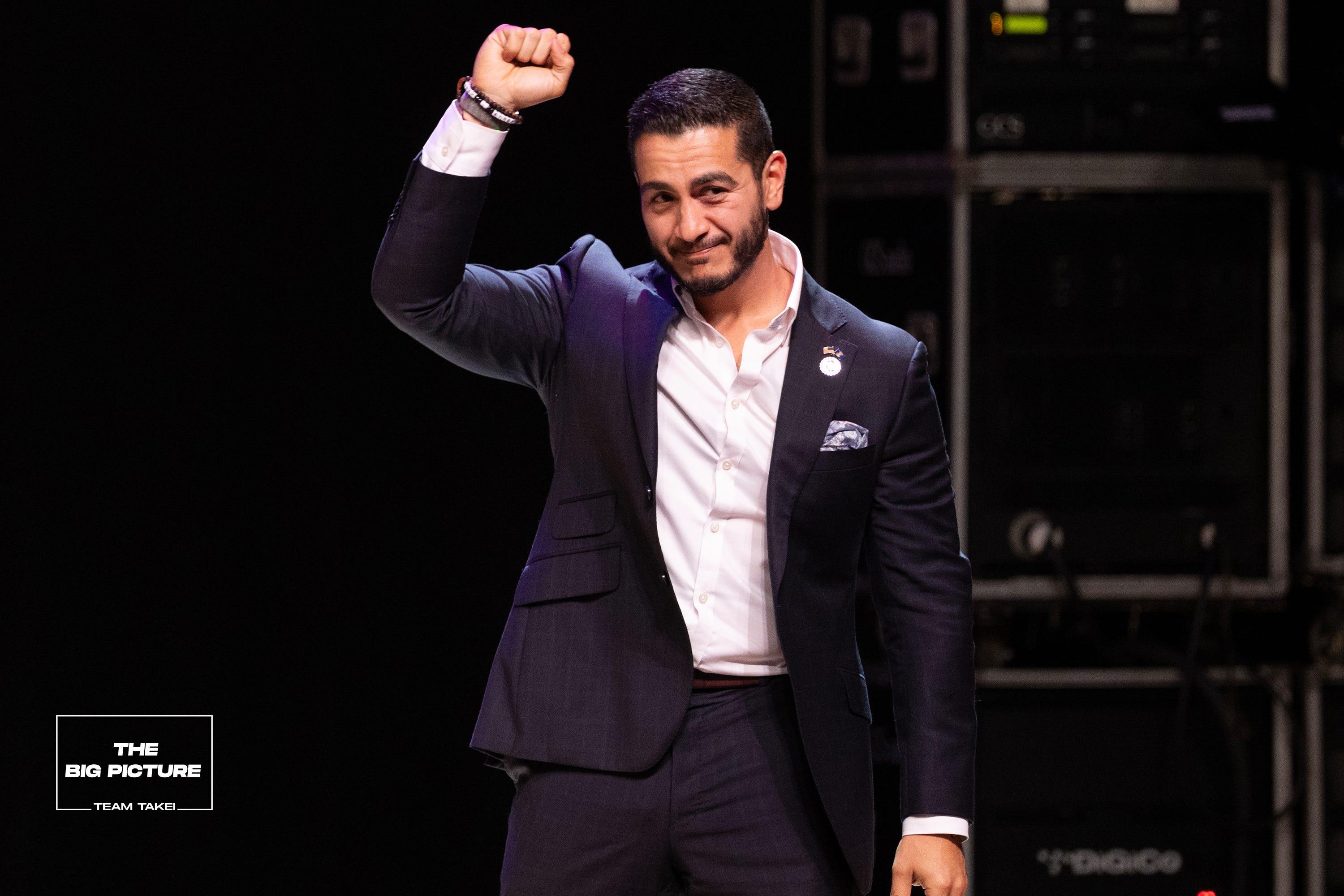
Abdul El-Sayed embraces Trump claim he represents ‘very different’ America
www.theguardian.comMichigan nominee, who spoke to Obama after primary win, vows to fight inequality as president ‘makes billions off you’
Abdul El-Sayed, the Democratic nominee for US Senate in Michigan, embraced Donald Trump’s suggestion that the two represent “VERY DIFFERENT” versions of the US, pledging to fight inequality while the president is “making billions of dollars off of you”.
In a Saturday night post on his Truth Social platform, Trump shared an image of himself and the first lady, Melania Trump, beside a photo of El-Sayed, who is Muslim, and his wife, Sarah Jukaku, wearing a hijab. “Two VERY DIFFERENT America’s [sic],” read the caption.
Continue reading... -
Washington Policy Review: August 8, 2026
washingtonpolicyreview.substack.comToday’s Report
1. Overview
2. White House News
3. Truth Social Posts
4. Government Department News
5. 2028 Democratic Presidential Candidates
6. AI & Tech Company News
7. Congressional Watch
8. Policy Impact Analysis & Heatmap
1. Overview
President Trump highlighted several administration successes, emphasizing a milestone in jobless claims that have remained below 200,000 for three consecutive weeks. He noted that he plans to host over 120 Team USA Winter Olympians and Paralympians at the White House to celebrate their achievements. Additionally, Trump asserted that the United States currently maintains “massive” amounts of munitions to ensure national defense readiness.
On Truth Social, Trump discussed his recent legislative tax victories during a trip to Las Vegas and celebrated the termination of Haiti Temporary Protected Status. He promoted a new fraud-reporting website designed to highlight his task force’s accomplishments and suggested that Republican campaign coffers remain stronger than those of the Democrats. Regarding the 2020 election, he circulated claims that he said undermine the “most secure” election narrative, specifically citing reports of Arizona voter file hacking that he argued went unpunished by the Department of Justice.
The State Department addressed regional security and diplomacy through several announcements. The agency rejected China’s establishment of a “national nature reserve” at Scarborough Reef, labeling it a “unilateral attempt” to advance maritime claims through coercion. Additionally, the department celebrated Singapore’s 61st National Day, underscoring a commitment to security and AI cooperation. Finally, the department marked the one-year anniversary of the peace deal between Armenia and Azerbaijan, highlighting progress on the Trump Route for International Peace and Prosperity (TRIPP) and the launch of a $201 million investment fund to “cement peace.”
In the 2028 Democratic candidate updates, Governor J.B. Pritzker issued a daily public schedule confirming that he had no public events on his agenda for Saturday, August 8, 2026.
NVIDIA announced that Firebird has launched the CIS region’s largest AI factory in Armenia, utilizing NVIDIA’s accelerated computing infrastructure. The facility intends to support sovereign AI capacity by deploying over 70,000 Rubin and Blackwell GPUs by 2027. NVIDIA plans to invest in this expansion, aiming to scale the infrastructure across Armenia and Kazakhstan to reach a total of 2 gigawatts of capacity.
The Senate held an extensive session, concluding in the early hours of Saturday morning to finalize government funding and key confirmations. The chamber passed H.R. 6500, which extends fiscal year 2027 government funding, and approved the “Lindsey O. Graham Sanctioning Russia and Iran Act.” Senators also confirmed Todd Blanche as Attorney General in a 50-49 vote and approved the “Common Cents Act” by voice vote to eliminate the penny. Conversely, an amendment to the Help America Vote Act that would have required photo identification for federal voters failed to invoke cloture.
Tightened sanctions on Russia and Iran disrupt global supply chains, thereby elevating risk premiums for firms with significant international infrastructure exposure. Conversely, the global expansion of AI infrastructure sustains robust demand for specialized semiconductors and server hardware, though potential regulatory hurdles concerning technology transfers and sustainability remain a structural concern. Fiscal 2027 funding legislation provides a valuation floor for industrial and defense sectors through guaranteed government contracts, yet this stability is offset by new leadership signaling an era of “intensified” antitrust and fraud enforcement. The market trajectory is thus defined by a tension between state-backed capital inflows and an increasingly interventionist regulatory environment.
2. White House News
No White House news found.
3. Truth Social Posts
Trump highlighted his recent legislative tax victories during a visit to Las Vegas and noted that jobless claims remain below 200,000 for the third consecutive week, a milestone not seen in 57 years. Furthermore, he lauded an immigration victory regarding the end of Haiti Temporary Protected Status and announced that he will host over 120 Team USA Winter Olympians and Paralympians at the White House. On matters of national defense, Trump asserted that the United States currently possesses “massive” amounts of munitions.
Regarding administrative and political affairs, the White House has launched a fraud website to showcase the achievements of his task force, while Trump observed that Republican coffers are strong for the midterms compared to the Democrats. He also shared an opinion piece detailing the role of Chuck Grassley in the confirmation of Todd Blanche. Expressing appreciation for his standing, Trump thanked supporters for “Great Poll Numbers” and affirmed a sentiment as “Very true.” He also made a brief mention of “Trump Aberdeen!” (no link).
Trump continued to scrutinize the 2020 election, circulating new evidence that he claims undermines the narrative that it was the “most secure” election in history. He further pointed to reports that hundreds of thousands of Arizona voter files were hacked in 2020 without subsequent prosecution by the Department of Justice.
Reference: https://truthsocial.com/@realDonaldTrump
4. Government Department News
State Department (state.gov)
China’s “Administrative Measures” at Scarborough Reef
The United States rejects China’s enforcement of a “national nature reserve” at Scarborough Reef, which denies Filipino fishermen access to traditional fishing grounds. The State Department characterizes this as a “unilateral attempt” by China to utilize “dubing environmental and legal pretexts” and coercion to advance its maritime claims in the South China Sea. The U.S. reaffirmed its support for the Philippines and commitment to a free and open Indo-Pacific.
The United States commemorates Singapore’s 61st National Day and the 60th anniversary of diplomatic relations between the two nations. Secretary of State Marco Rubio highlighted the countries’ partnership in security cooperation, counterproliferation, cybersecurity, and artificial intelligence. The U.S. emphasized its commitment to strengthening this enduring relationship through emerging technologies and shared economic interests to ensure regional peace, stability, and prosperity.
One year after President Trump brokered peace between Armenia and Azerbaijan, the U.S. continues advancing the Trump Route for International Peace and Prosperity (TRIPP). This infrastructure project, designed to modernize transit and energy networks, is currently seeing engineering progress in both nations. Secretary of State Marco Rubio also announced the launch of the $201 million Trans-Caspian Enterprise Fund to drive private investment across the region, positioning TRIPP as a model for how economic cooperation can “cement peace” after long-standing disputes.
5. 2028 Democratic Presidential Candidates
JB Pritzker (gov.illinois.gov)
Daily Public Schedule: Saturday, August 8, 2026
Governor J.B. Pritzker has no public events scheduled for Saturday, August 8, 2026.
6. AI & Tech Company News
NVIDIA (nvidia.com)
Firebird Launches CIS Region’s Largest AI Factory in Armenia
Firebird has launched the CIS region’s largest AI factory in Armenia, utilizing NVIDIA accelerated computing and Dell Technologies infrastructure. The facility aims to provide sovereign AI capacity for local developers and institutions. Firebird plans to deploy over 70,000 Rubin and Blackwell GPUs by 2027, supported by NVIDIA’s DSX platform for increased energy efficiency. The company intends to scale this model across Armenia and Kazakhstan, targeting 2 gigawatts of capacity. NVIDIA plans to invest in Firebird to support this infrastructure expansion in frontier markets.
7. Congressional Watch
Covers the 2026-08-07 session — the Congressional Record is published with a one-day delay.
Senate
The Senate conducted extensive business, focusing on fiscal appropriations, foreign policy sanctions, and a large slate of executive branch and judicial nominations. The session extended into the early hours of Saturday morning to finalize government funding and confirm the new Attorney General.
H.R. 6500, Continuing Appropriations and Extensions Act — Extends government funding and authorizations for fiscal year 2027 [Passed 90-6 (Roll No. 228)]
H.R. 5334, Lindsey O. Graham Sanctioning Russia and Iran Act — Imposes new sanctions related to the Russian Federation [Passed 86-11 (Roll No. 224)]
Todd Blanche — Confirmed as Attorney General [Confirmed 50-49 (Roll No. 230)]
S. 1525, Common Cents Act — Ends the minting of the penny and rounds cash transactions to the nearest 5 cents [Passed by voice vote]
S. 5271, Help America Vote Act amendment — Requires photo identification for federal voters [Failed to invoke cloture 52-46 (Roll No. 231)]
Executive Nominations — Confirmed dozens of various agency heads and ambassadors en bloc [Passed 51-47 (Roll No. 225)]
House of Representatives
The House of Representatives was not in session on this day. No legislative business or committee activity occurred.
None — The House was not in session [No action taken]
Committee Highlights
No committee meetings were held — No chambers conducted hearings or markups
Coming Up
The Senate will meet in a pro forma session at 10 a.m. on Monday, August 10, 2026. The House will also meet in a pro forma session at 11 a.m. on Monday, August 10, 2026.
Reference: Congressional Record Archive
8. Policy Impact Analysis & Heatmap
This analysis is provided for informational purposes only. It does not constitute investment advice or a recommendation to buy or sell any security.
Impact on Market
Based on today’s policy developments, our analysis identifies the following market impact themes:
THEME 1. GEOPOLITICAL FRICTION AND SANCTIONS
The Senate’s move to tighten sanctions on Russia and Iran signals a deepening of geopolitical tensions. This policy shifts costs onto global energy and commodity markets by disrupting established supply chains. Opposition critics express concern that such actions force regional partners to pivot toward alternative economic blocs. The broader market impact reflects elevated risk premiums for firms with international infrastructure exposure.
THEME 2. AI INFRASTRUCTURE EXPANSION
The launch of the Armenian AI factory highlights the aggressive global buildout of computing power. This trend sustains demand for specialized semiconductor components and high-performance server hardware. While fueling innovation, this rapid expansion faces scrutiny regarding energy consumption and the sustainability of regional compute clusters. The influx of advanced hardware into secondary markets may face future regulatory hurdles regarding sensitive technology transfers.
THEME 3. FISCAL CONTINUITY AND REGULATORY SHIFTS
The passage of fiscal 2027 funding ensures a steady stream of government contracts for key industrial and defense players. The concurrent confirmation of new executive branch leadership suggests a transition toward intensified antitrust and fraud enforcement efforts. Market participants remain cautious as the administrative focus shifts toward high-profile investigations. Observers note that while contract flows provide a floor for valuations, regulatory volatility remains an persistent downside risk.
Policy Impact Heatmap with Market Direction
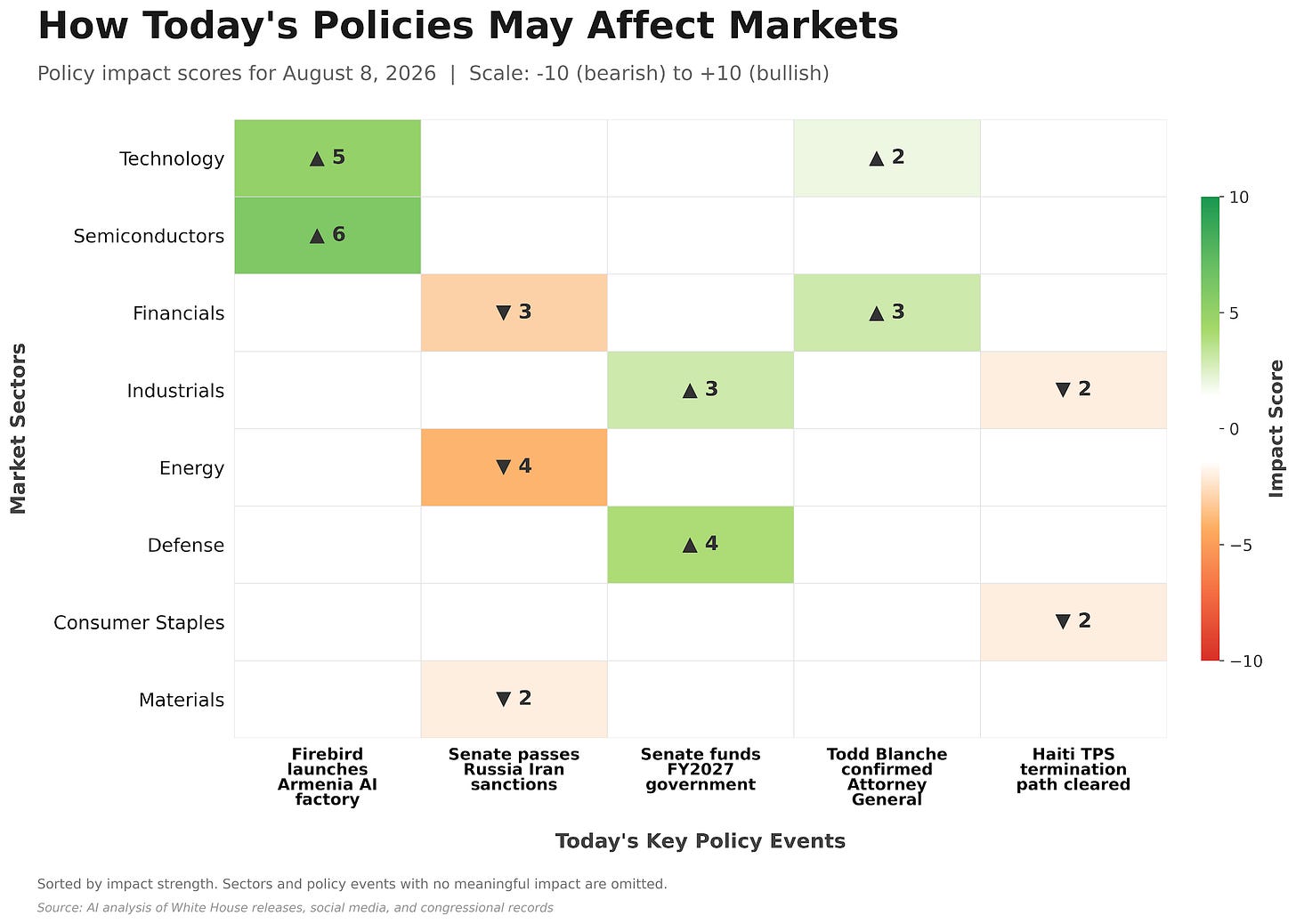
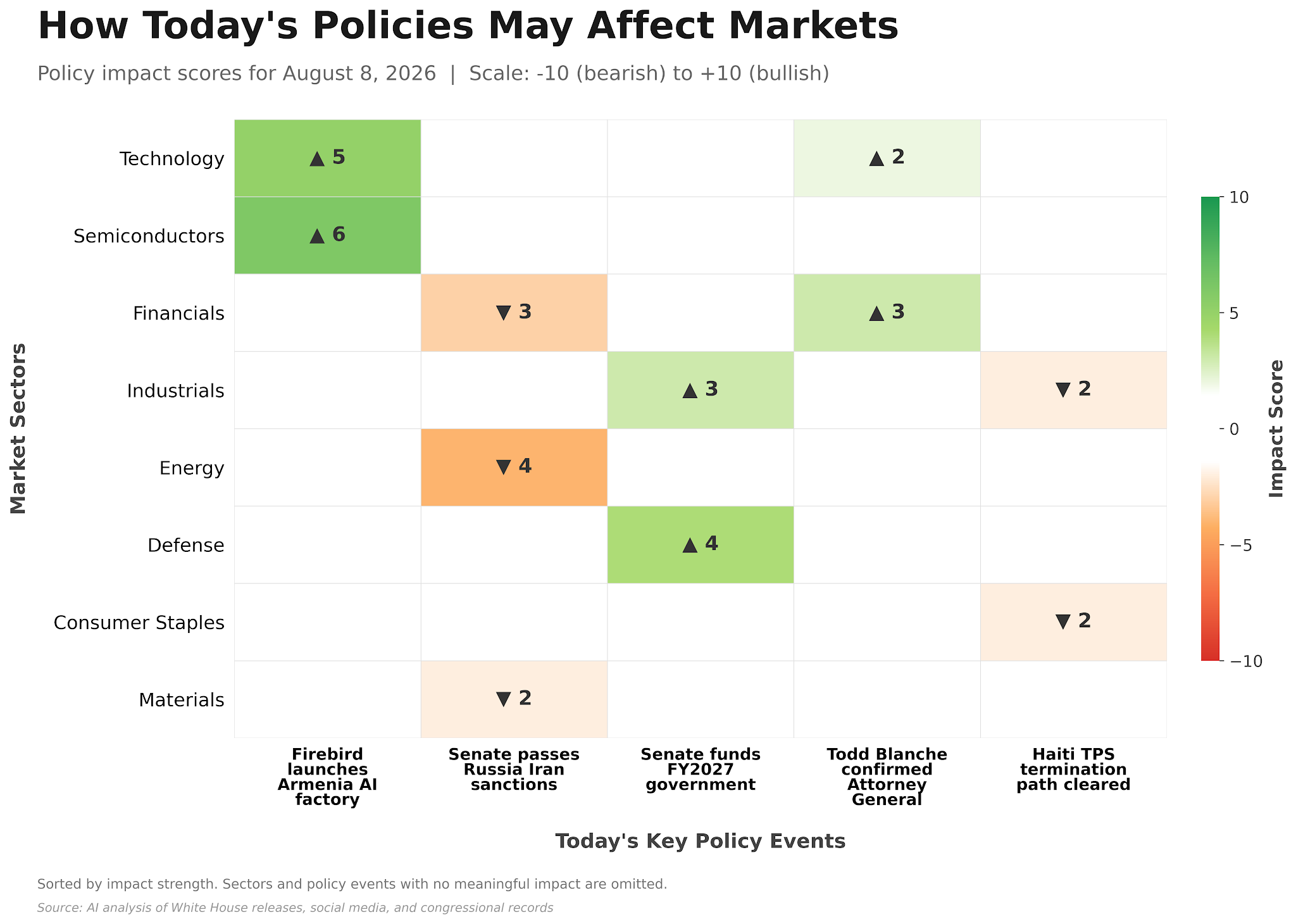
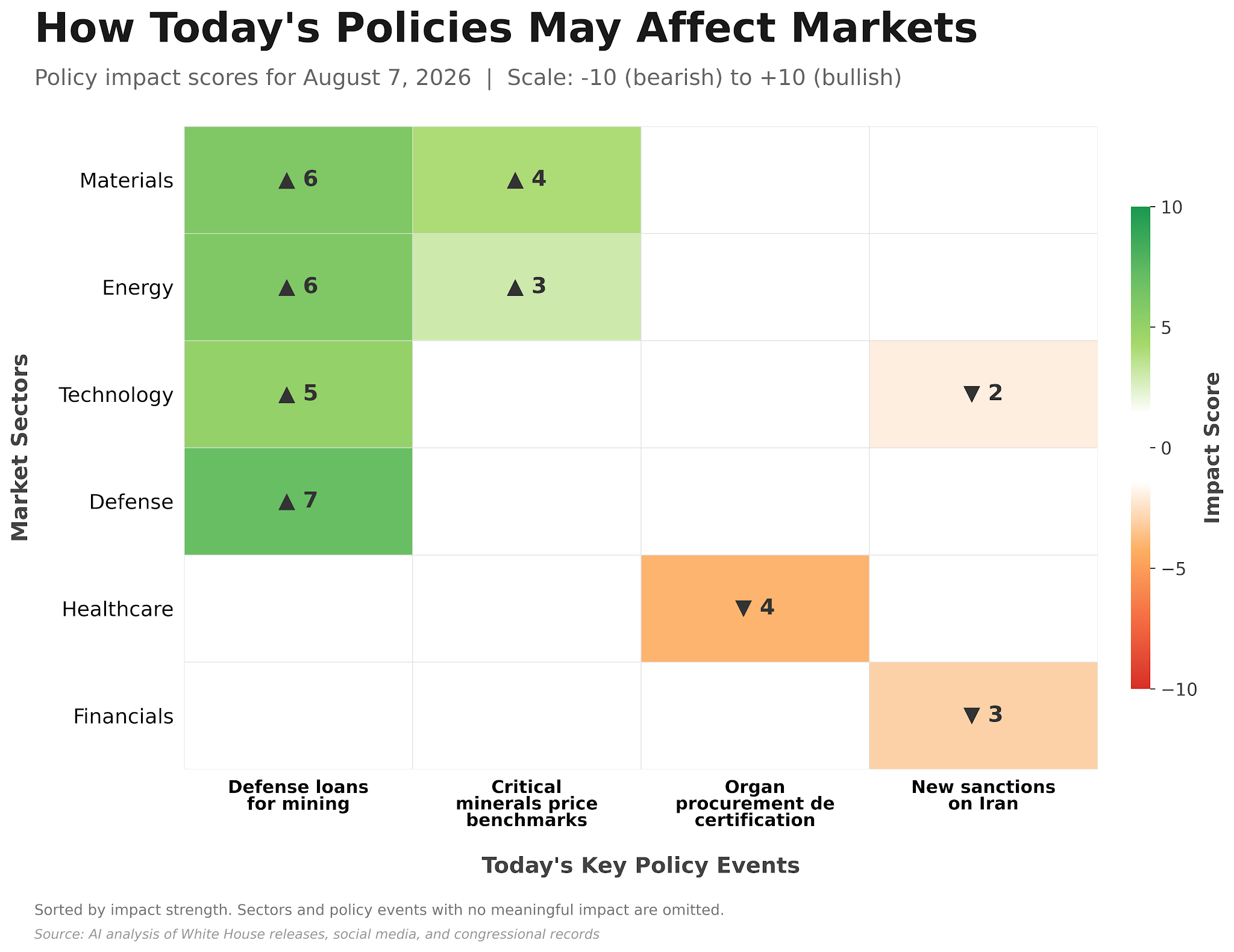
Each cell shows an estimated impact score on a fixed scale of -10 to +10, reflecting how today’s policy developments may affect each market sector. Positive scores (green, ▲) suggest bullish impact; negative scores (red, ▼) suggest bearish pressure. Rows and columns are sorted by impact strength, and sectors and policy events with no meaningful impact are omitted. The heatmap, the analysis below, and the Impact on Market themes above are produced from a single unified analysis: the heatmap visualizes the magnitudes, while the text explains the causal reasoning behind them.
The Senate passage of new sanctions against Russia and Iran creates immediate downside risk for energy and global commodity sectors. Markets anticipate higher compliance costs and restricted access to international markets for firms with exposure to these regions. Concurrently, the confirmation of a new Attorney General suggests a pivot toward a more aggressive regulatory environment for corporate oversight. This development introduces uncertainty for large financial and technology institutions previously navigating a more lenient enforcement landscape.
The deployment of a massive AI infrastructure hub in Armenia underscores the rapid expansion of global high-performance computing capacity. The commitment to utilize high-end GPU hardware indicates strong underlying demand for semiconductor producers. Furthermore, the passage of the fiscal 2027 appropriations act provides near-term stability for government contractors. Defense and industrial firms benefit from the certainty of federal funding flows. Critics argue that “reckless spending” within this package could sustain inflationary pressures, potentially complicating the outlook for interest-sensitive sectors despite the current positive signal from low jobless claims.
-
Washington Policy Review: August 7, 2026
washingtonpolicyreview.substack.comToday’s Report
1. Overview
2. White House News
3. Truth Social Posts
4. Government Department News
5. 2028 Democratic Presidential Candidates
6. AI & Tech Company News
7. Congressional Watch
8. Policy Impact Analysis & Heatmap
1. Overview
President Trump hosted a roundtable with the mining industry to announce over $2 billion in new projects and $180 million for mining school investments. This initiative aims to strengthen domestic supply chains and reduce reliance on “hostile foreign countries.” Additionally, the President submitted several nominations to the Senate, including Leslie Becera for the Department of Transportation and Julia Nesheiwat as Ambassador-at-Large for the Arctic.
The State Department, in coordination with the Treasury, sanctioned six entities and one individual, including digital asset exchanges, for assisting the Iranian regime in laundering funds. Acting Attorney General Todd Blanche led a delegation to Colombia for the inauguration of President Abelardo de la Espriella, promising $1 billion in security aid. Furthermore, the Department of War committed over $2 billion in loans and investments to domestic mining and battery companies to establish a “lethal Arsenal of Freedom.” HHS Secretary Robert F. Kennedy, Jr. initiated the decertification of a Kentucky organ procurement organization, citing “persistent patient safety failures.”
Governor Gavin Newsom announced “MyFirstEV” rebates of $3,500 for zero-emission vehicle buyers and criticized President Trump for being “hellbent on burning more expensive fossil fuels.” In Michigan, Governor Gretchen Whitmer and the Army Secretary announced that Camp Grayling is now a premier U.S. military test range for drone innovation. Governor Wes Moore of Maryland launched an interactive tool to link SNAP recipients with workforce development, characterizing the move as a way to help families “overcome new red tape imposed by the Trump administration.” Governor JB Pritzker of Illinois signed an agreement with Indonesia to expand trade, aiming to mitigate the impacts of “trade instability caused by the President Trump administration’s tariffs.”
OpenAI reported that its upcoming model, Astra, reached the “Critical” threshold for cybersecurity capabilities, noting it can autonomously identify zero-day exploits. The company has implemented heightened security, including sandboxed testing and universal monitoring, to ensure responsible deployment. Meanwhile, Anthropic updated its Fable 5 model to reduce biology-related “false positives” while maintaining strict safeguards to prevent the misuse of “dual-use” research in virology.
The Senate passed several measures by voice vote on August 6, including the USMMA Athletics Act and the DeOndra Dixon INCLUDE Project Act, and confirmed a Space Force general. Senate committees examined small business capital access and international scam operations. The House held a three-minute pro forma session and conducted no legislative business. The Senate is scheduled to vote on the SEED Act on August 7, while the House will next meet on August 10.
Federal prioritization of the defense industrial base via direct capital injection provides a bullish tailwind for domestic critical material processors, though this strategy carries inherent risks of capital misallocation should these entities fail to achieve commercial viability without sustained state support. Treasury’s expansion of sanctions into decentralized finance networks creates a bearish outlook for digital asset participants, as the inclusion of these exchanges within national security protocols threatens to fragment global payment markets and stifle fintech innovation. Simultaneously, rigorous federal oversight and the rapid decertification of healthcare providers generate substantial operational uncertainty, with critics warning that such administrative volatility risks creating “unnecessary chaos” within essential medical service delivery networks.
2. White House News
Fact Sheet: President Donald J. Trump Announces Billions in New Deals and Investments to Power American Mining
President Trump held a roundtable with the mining industry to announce over $2 billion in new projects intended to “revitalize the industry” and $180 million for mining school investments. This initiative aims to strengthen domestic supply chains, reduce reliance on “hostile foreign countries,” and protect national security. By prioritizing domestic critical materials, the administration seeks to bolster the American mining workforce while ensuring economic resilience for vital industries. President Trump’s leadership is reportedly focused on “restoring America’s mining industry and national and economic security.”
Reference: https://www.whitehouse.gov/fact-sheets/2026/08/fact-sheet-president-donald-j-trump-announces-billions-in-new-deals-and-investments-to-power-american-mining/
Nominations Sent to the Senate
President Trump has sent several nominations to the Senate for confirmation. These include Leslie Becera for Assistant Secretary of Transportation, Dennis Kirk as Inspector General for the Department of the Interior, and Mary Lazare as Assistant Secretary for Aging. Additionally, Julia Nesheiwat was nominated for the new position of Ambassador-at-Large for the Arctic. The list also includes various diplomatic appointments, such as ambassadors to Tonga, Madagascar, Chad, Nicaragua, and others, alongside reappointments for the Export-Import Bank of the United States and the National Mediation Board.
Reference: https://www.whitehouse.gov/presidential-actions/2026/08/nominations-sent-to-the-senate-e61c/
3. Truth Social Posts
No relevant Truth Social posts found.
4. Government Department News
State Department (state.gov)
A New Era in U.S.-Colombia Relations
A U.S. delegation led by Acting Attorney General Todd Blanche attended the inauguration of Colombian President Abelardo de la Espriella. The Trump Administration intends to provide $1 billion in security assistance to deepen the partnership. Key goals include dismantling transnational narcoterrorist networks, strengthening security forces against Foreign Terrorist Organizations, enhancing coca eradication and interdiction efforts, and halting illegal migration through increased border security coordination.
Secretary of State Marco Rubio at President Trump’s Roundtable on American Mining
Secretary of State Marco Rubio highlighted the administration’s efforts to secure critical mineral supply chains, emphasizing industrial strength and national sovereignty. Under the Trump Administration, the State Department has signed 27 critical mineral agreements and launched “FORGE,” an international partnership to leverage public finance for supply chain security. The “Pax Silica” initiative, led by Under Secretary Jacob Helberg, aims to coordinate private sector investment in mining and refining to ensure the U.S. remains independent of foreign control over essential resources.
Targeting Digital Asset Exchanges Fueling the Iranian Regime
The U.S. has sanctioned six entities and one individual, including two digital asset exchanges, for assisting the Iranian regime in laundering funds. This action follows recent Iranian attacks on commercial vessels in the Strait of Hormuz. The administration stated it will continue to deny the regime resources used for nuclear ambitions and terrorism. Additionally, the State Department’s Rewards for Justice program is offering up to $15 million for information to disrupt the financial mechanisms of the IRGC and its branches.
Severing Iran’s Illicit Cash Pipeline
The Treasury Department is dismantling a network of currency exchange houses and shell companies used by Iran to launder hundreds of millions of dollars. These measures are part of the Trump Administration’s “maximum pressure” campaign to cut off funding for the regime’s regional aggression and support for terrorism. By targeting the facilitators and banks involved in sanction evasion, the administration aims to isolate the regime from the international financial system and hold those who assist its illicit activities accountable.
The United States extended congratulations to President Alassane Ouattara and the people of Côte d’Ivoire on their 66th National Day. The U.S. reaffirmed its strategic relationship with the nation, highlighting ongoing efforts to expand bilateral trade and investment while strengthening regional security to create new opportunities for both countries.
Department of War (war.gov)
The Department of War’s Office of Strategic Capital (OSC) has issued a $400 million conditional loan commitment to Sunrise Energy Metals Limited to develop a scandium value chain in Australia. This initiative seeks to end foreign dominance in scandium processing and secure supply for U.S. defense and commercial sectors. The OSC gains a right of first offer on the mine’s output, aligning with President Trump’s mandate to “secure a resilient, domestic supply chain for rare earths” and reduce dependence on foreign adversaries.
OSC announced a $1.4 billion conditional loan commitment to Sila Nanotechnologies to expand domestic production of silicon-carbon battery anodes and cell manufacturing. This investment supports President Trump’s goal to “aggressively onshore critical materials” for the defense industrial base. The project aims to reduce reliance on foreign battery components, providing critical energy storage for satellite operations, unmanned aerial systems, and munitions, while establishing a “lethal Arsenal of Freedom for the American warfighter.”
The Department of War has partnered with Strategic Bauxite USA for an $85.5 million equity investment to create a secure, western-hemisphere supply chain for refractory-grade bauxite. Currently, the U.S. relies heavily on Chinese sources for this material, which is essential for high-temperature components like heat shields and turbine engines. By expanding a mine in Guyana and building domestic processing facilities, the Department aims to meet 100% of U.S. military demand and “no longer wait for supply chain dependencies to be exploited.”
The Department of War is investing over $80 million into mining and metallurgy programs at the Colorado School of Mines, South Dakota School of Mines, and Johns Hopkins University. These funds will support technology innovation hubs, workforce development, and the training of geologists and engineers to bolster the national industrial base. The initiative reflects President Trump’s commitment to “solidify America’s role as a global leader in critical minerals production” and ensure the workforce is capable of meeting national security requirements.
OSC has committed $150 million to Niron Magnetics to construct a manufacturing facility in Minnesota for rare earth-free permanent magnets. This project aims to end reliance on foreign-dominated rare earth supply chains by using domestically abundant iron and nitrogen. By scaling production to 1,500 tons annually, the Department intends to mitigate supply chain vulnerabilities and equip the military with components that “enhance battlefield lethality,” fulfilling President Trump’s mandate to “leverage advanced commercial technology” for industrial resilience.
Department of War Publishes Fifth Release of Unidentified Anomalous Phenomena Files on WAR.GOV/UFO
The Department of War has published its fifth batch of declassified historical files regarding Unidentified Anomalous Phenomena (UAP). This release is conducted under the Presidential Unsealing and Reporting System for UAP Encounters (PURSUE). The documents are available for public viewing on the Department’s official website, and officials confirmed that additional file releases will continue on a rolling basis.
Department of Health and Human Services (hhs.gov)
HHS Decertifies Kentucky Organ Procurement Organization to Protect Patients, Restore Trust
HHS has initiated the decertification of Network for Hope, the organ procurement organization serving Kentucky and parts of Indiana, Ohio, and West Virginia, citing persistent patient safety failures. Despite multiple federal reviews and opportunities for correction, the agency determined the organization continued to endanger donors and transplant patients. HHS Secretary Robert F. Kennedy, Jr. stated the move reflects the “Trump Administration’s commitment to protecting the sanctity of life,” emphasizing that organizations failing federal standards will be held accountable.
Treasury Department (home.treasury.gov)
Treasury Dismantles Iranian Regime’s Global Clandestine Currency Networks
The Treasury Department’s Office of Foreign Assets Control sanctioned multiple networks facilitating Iran’s shadow banking system, which moves funds for the regime’s oil sales and military apparatus. Treasury Secretary Scott Bessent stated that “Iran’s shadow banking system is buckling under Economic Fury” and emphasized that facilitators will be targeted. The action, taken under Executive Order 13902, targets entities including Shahr Bank, Titan Exchange, and Alps International for laundering revenue to support Iran’s petroleum sector and illicit financial operations.
Treasury Sanctions Crypto Exchanges Funding Iran’s IRGC and Enabling Illicit Finance
Treasury sanctioned digital asset exchanges and a front-company network used by Iran to launder funds for the Islamic Revolutionary Guard Corps (IRGC). The action targets Siavash Kayvanpour and platforms including Shelbit Exchange and Aban Tether. Secretary Bessent noted that the regime’s reliance on crypto is “further evidence that Economic Fury is working.” The U.S. State Department’s Rewards for Justice program is offering up to $15 million for information to disrupt these financial mechanisms, which support the IRGC and various terrorist groups.
Secretary Bessent Issues Statement Welcoming S&P Global Release of Critical Mineral Reference Prices
The Treasury Department welcomed S&P Global’s new reference prices for critical minerals, including Gallium, Germanium, and Tungsten. Secretary Bessent stated that “transparent, market-based pricing is essential to attracting the private capital needed to build secure, resilient, and diversified critical mineral supply chains.” The administration aims to use these benchmarks to counter non-market policies, support investor confidence, and advance the Trump Administration’s efforts to address market distortions while strengthening international trade frameworks for critical minerals.
Treasury Continues to Follow the Money in Minnesota to Eliminate Fraud
FinCEN renewed a Geographic Targeting Order (GTO) requiring banks and money transmitters in Hennepin and Ramsey Counties, Minnesota, to report funds transfers of $3,000 or more sent overseas. The measure aims to combat the fraud-driven diversion of state and federal benefits, which has cost Minnesota billions. Secretary Bessent stated, “The Trump Administration will not allow criminals to profit from programs intended to help vulnerable Americans.” The order, effective for 180 days, assists law enforcement in tracing the laundering of stolen taxpayer funds.
United States Trade Representative (ustr.gov)
Ambassador Greer Welcomes S&P Global Critical Minerals Pricing Benchmarks
Ambassador Jamieson Greer endorsed S&P Global’s new pricing benchmarks for critical minerals, including gallium, germanium, tungsten, antimony, and neodymium/praseodymium. These benchmarks aim to foster market transparency and support long-term investment. Ambassador Greer stated that this initiative complements the Trump Administration’s supply chain resilience efforts and will inform the ongoing negotiation of the Agreement on Trade in Critical Minerals. The proposed agreement seeks to implement border-adjusted price floors and common standards to counter non-market policies and address global price instability.
5. 2028 Democratic Presidential Candidates
Gavin Newsom (gov.ca.gov)
Governor Newsom announces appointments 8.7.26
Governor Newsom announced several executive branch appointments: Grecia Staton as Chief Deputy Director at the Department of Industrial Relations; Dana Martinez as General Counsel at the Public Employment Relations Board; Salena Chow as Chief Deputy Director at Healthcare Access and Information; Jami Terrell as Deputy Director and Chief Counsel at the Department of Health Care Services; and Monica Montano as Deputy Director of Legislative Affairs at the Department of Managed Health Care. These positions do not require Senate confirmation.
Governor Newsom announces judicial appointments
Governor Newsom nominated eight individuals for the Court of Appeal: Rashida Adams, Denise Hippach, David Sapp, Lauri Damrell, Marsha Amin, Lisa Rodriguez, Juliet Macaulay, and Frederick Chung. Additionally, he appointed nine Superior Court judges across Los Angeles, Riverside, San Diego, Sonoma, and San Francisco counties. The appellate nominations require confirmation by the Commission on Judicial Appointments, and several will face voter confirmation in the November 3, 2026, general election.
The Governor announced instant rebates of up to $3,500 for first-time zero-emission vehicle buyers through the “MyFirstEV” program, funded by a $135.5 million state investment matched by automakers. He also noted California’s battery storage capacity has exceeded 21,000 megawatts. Criticizing the federal approach, the Governor stated, “While President Trump is hellbent on burning more expensive fossil fuels and raising costs for Americans, California is proving there’s a better way,” asserting that state policies enhance energy independence and provide economic security.
Thirty-six new wildlife officers graduated from the California Department of Fish and Wildlife (CDFW) Law Enforcement Division academy in Paradise, California. Following field training, these officers will join approximately 450 existing personnel to enforce fish and wildlife laws, conduct marine and cannabis enforcement, and respond to environmental emergencies. The training program, certified by the Commission on Peace Officer Standards and Training, prepares officers for a variety of public safety and natural resource protection duties across the state.
Gretchen Whitmer (michigan.gov)
Governor Whitmer announced new Fiscal Year 2027 budget investments for rail grade separation projects to reduce traffic congestion and improve safety. Key projects include a $59 million effort to raise the Canadian National rail line over Allen Road in Wayne County and a $115 million highway elevation project on M-85 in Trenton. The Governor stated, “Fixing the damn roads means less wear on your car, a smoother drive, and safer travel for every Michigander.” The budget also increases state support for local road and transit programs.
Governor Whitmer and Army Secretary Dan Driscoll announced that Camp Grayling is now one of four premier U.S. military test ranges open to private industry for rapid experimentation. The initiative, managed by the U.S. Army Test and Evaluation Command, aims to streamline innovation in drone and counter-drone technologies. Industry partners can request access via a new digital portal. A specialized test event is scheduled for September 2026 to help developers “harden their drone and counter-drone systems” against electronic warfare conditions similar to those in Ukraine.
Wes Moore (governor.maryland.gov)
The Maryland Insurance Administration recovered over $53.5 million for consumers during the first half of 2026 through various department programs. Governor Moore stated, “As H.R. 1 makes it harder for people to attain healthcare on the ACA exchange and is taking away people’s Medicaid altogether, $53.5 million dollars returned means money back in Marylanders’ pockets.” The administration emphasized its commitment to mitigating rising living costs while providing consumer advocacy, licensing, and grievance resolution services through initiatives like the Health Coverage Assistance Team.
The Maryland Department of Human Services launched an interactive tool to link SNAP recipients with a workforce development network of 46 partners. Governor Moore stated the effort helps residents “overcome new red tape imposed by the Trump administration to take away families’ food assistance.” The $30 million initiative provides free training and support services. The administration is utilizing this tool to mitigate the impact of federal H.R. 1 requirements, noting that Maryland’s SNAP participation decline has been less severe than in most other states.
JB Pritzker (gov.illinois.gov)
Gov. Pritzker Announces Illinois–Indonesia Agreement to Expand Trade and Economic Cooperation
Governor Pritzker and Indonesian officials signed a Memorandum of Understanding to strengthen ties in business, education, workforce development, and agriculture. The agreement aims to diversify export markets for Illinois soybean producers, specifically to mitigate the impact of trade instability caused by the President Trump administration’s tariffs. With Indonesia as a growing trade partner, the state seeks to reduce reliance on the Chinese market and capitalize on Illinois’ status as a leading national exporter.
Gov. Pritzker Announces One Appointment to Boards and Commissions
Governor Pritzker appointed Nicole Bateman to the Central Illinois Economic Development Authority. Bateman currently leads the Economic Development Corporation of Decatur and Macon County and serves as Chief Strategy Officer for the Illinois Fermentation and Agriculture Biomanufacturing Tech Hub. Her appointment is subject to confirmation by the Illinois Senate.
Gov. Pritzker Takes Bill Action
Governor Pritzker signed various bills into law covering a wide range of state policies. Key legislation includes measures to reform Tax Increment Financing, create the Equitable Access to Education, Employment, and Training for Incarcerated Individuals with Disabilities Act, and establish the Patient Access to Pharmacy Protection Act. Other signed bills address child abuse protections, literacy resources for color-vision-deficient students, and procedures for gun offenders. Additional acts concern higher education rights, infrastructure naming, and new requirements for adult changing stations.
Daily Public Schedule: Friday, August 7, 2026
Governor Pritzker’s schedule includes signing a Memorandum of Understanding with Indonesia at the Chicago Press Room and attending a ribbon-cutting ceremony at the Austin Green Line Station. Additionally, the Governor and Lieutenant Governor Stratton are set to sign SB 3325, which establishes menopause education requirements, and SB 3020, which provides legal protections against online harassment, doxing, and digital tracking.
Tim Walz (mn.gov)
Governor Walz Thanks Grace Arnold for Her Service as Department of Commerce Commissioner
Governor Tim Walz announced that Grace Arnold is stepping down as Minnesota Department of Commerce Commissioner after seven years of state service. Appointed in 2021, Arnold was credited by the Governor for her leadership in consumer protection, clean energy initiatives, and financial literacy efforts. Deputy Commissioner of Insurance Julia Dreier will serve as the temporary commissioner. Dreier, who has led the Commerce Department’s insurance division since 2021, previously held roles at the Centers for Medicare & Medicaid Services and within the Minnesota healthcare policy sector.
Jon Ossoff (ossoff.senate.gov)
Sens. Ossoff and Warnock are demanding that the Defense Health Agency (DHA) provide information regarding plans to close inpatient services and convert the Dwight D. Eisenhower Army Medical Center into an urgent care facility. The Senators argue the DHA’s failure to respond to a June 2026 inquiry is “unacceptable.” They are urging the agency to rescind its Congressional notification for service changes until the impact on servicemembers, veterans, and their families in Augusta is fully clarified.
The U.S. Senate passed a resolution authored by Sens. Ossoff and Warnock to honor those affected by the August 6, 2025, mass shooting at Ft. Stewart. The resolution recognizes the victims, commends the soldiers who subdued the shooter, and praises the first responders and support personnel involved. Sen. Ossoff highlighted this commemoration while noting his ongoing efforts to improve military housing conditions at Georgia bases, including initiatives to ban non-disclosure agreements for military families regarding housing issues.
6. AI & Tech Company News
OpenAI (openai.com)
Responding to the next frontier of critical cyber capabilities
OpenAI reports that its upcoming model, Astra, has reached the “Critical” threshold for cybersecurity capabilities. Evaluations indicate the model can autonomously identify and develop zero-day exploits in hardened systems. In response, the company has paused non-compliant internal activities and implemented heightened security measures, including sandboxed testing and universal monitoring of model logic. OpenAI is working with government agencies and safety organizations to ensure responsible deployment, emphasizing that these advanced tools should be used to strengthen defenses against cyber threats.
Anthropic (anthropic.com)
Improving Fable 5’s Biology Safeguards
Anthropic has updated Fable 5 to reduce “false positives” in biology-related queries, decreasing system “fallbacks” to less capable models by approximately 85%. While this enhancement allows Fable 5 to better assist with general health, educational, and clinical tasks, the model still redirects requests involving “dual-use” areas like virology and molecular design to Opus 5. The company maintains these strict safeguards to prevent the potential misuse of frontier capabilities for developing biological weapons, acknowledging the difficulty in distinguishing between beneficial research and malicious intent.
7. Congressional Watch
Covers the 2026-08-06 session — the Congressional Record is published with a one-day delay.
Senate
The Senate focused on passing several non-controversial measures and confirmed a Space Force nomination. The chamber also reached a procedural agreement to debate and vote on tax-related legislation and pending nominations on August 7.
S. 3266, USMMA Athletics Act — Supports athletic programs at the U.S. Merchant Marine Academy [Passed by voice vote]
S. 434, Space Commerce Advisory Committee Act — Establishes a committee for commercial space activity advice [Passed by voice vote]
S. 2398, Kay Hagan Tick Reauthorization Act — Reauthorizes the Kay Hagan Tick Act [Passed by voice vote]
S. 1838, DeOndra Dixon INCLUDE Project Act — Authorizes research and training programs related to Down syndrome [Passed by voice vote]
Space Force Nomination — Confirmed one rank of general in the Space Force [Confirmed by voice vote]
House of Representatives
The House held a brief pro forma session on August 6 that lasted only three minutes. No legislative business or committee meetings occurred during this time.
N/A — No legislative actions or votes were conducted [None]
Committee Highlights
Senate - Committee on Banking, Housing, and Urban Affairs — Examined strategies for unlocking capital access for small businesses
Senate - Committee on Foreign Relations — Examined the U.S. response to international scam operations
Senate - Committee on Homeland Security and Governmental Affairs — Voted to report a wide package of government oversight and postal facility naming bills
Coming Up
The Senate will convene at 10 a.m. on August 7 to continue consideration of nominations and vote on the SEED Act (H.R. 5334). The House will next meet in a pro forma session at 11 a.m. on Monday, August 10.
Reference: Congressional Record Archive
8. Policy Impact Analysis & Heatmap
This analysis is provided for informational purposes only. It does not constitute investment advice or a recommendation to buy or sell any security.
Impact on Market
Based on today’s policy developments, our analysis identifies the following market impact themes:
THEME 1. INDUSTRIAL ONSHORING VIA DEFENSE SPENDING
The administration is prioritizing the defense industrial base by channeling capital directly into critical material extraction and processing. These conditional loans serve as a synthetic supply chain policy intended to insulate domestic technology and battery manufacturers from foreign market volatility. Bearish risks include potential capital misallocation in nascent industries and the danger of building capacity that lacks long-term commercial viability without continuous government backing.
THEME 2. FINANCIAL ENFORCEMENT AND DIGITAL SANCTIONS
Treasury actions against digital asset networks signal a concerted effort to limit Iran’s ability to bypass traditional financial systems. By linking digital asset exchanges to national security, the government is expanding the scope of its sanctions regime to include decentralized finance participants. Opposition figures argue this heavy-handed approach could lead to fragmented global payment markets and inadvertently stifle legitimate financial technology innovation.
THEME 3. DISRUPTION IN HEALTHCARE OVERSIGHT
Increased federal intervention in healthcare administration is creating significant operational uncertainty for established service providers. The move to decertify underperforming organizations reflects a policy of strict federal accountability in the medical sector. Critics warn that these rapid administrative shifts may disrupt patient care and create “unnecessary chaos” within critical healthcare logistics networks.
Policy Impact Heatmap with Market Direction
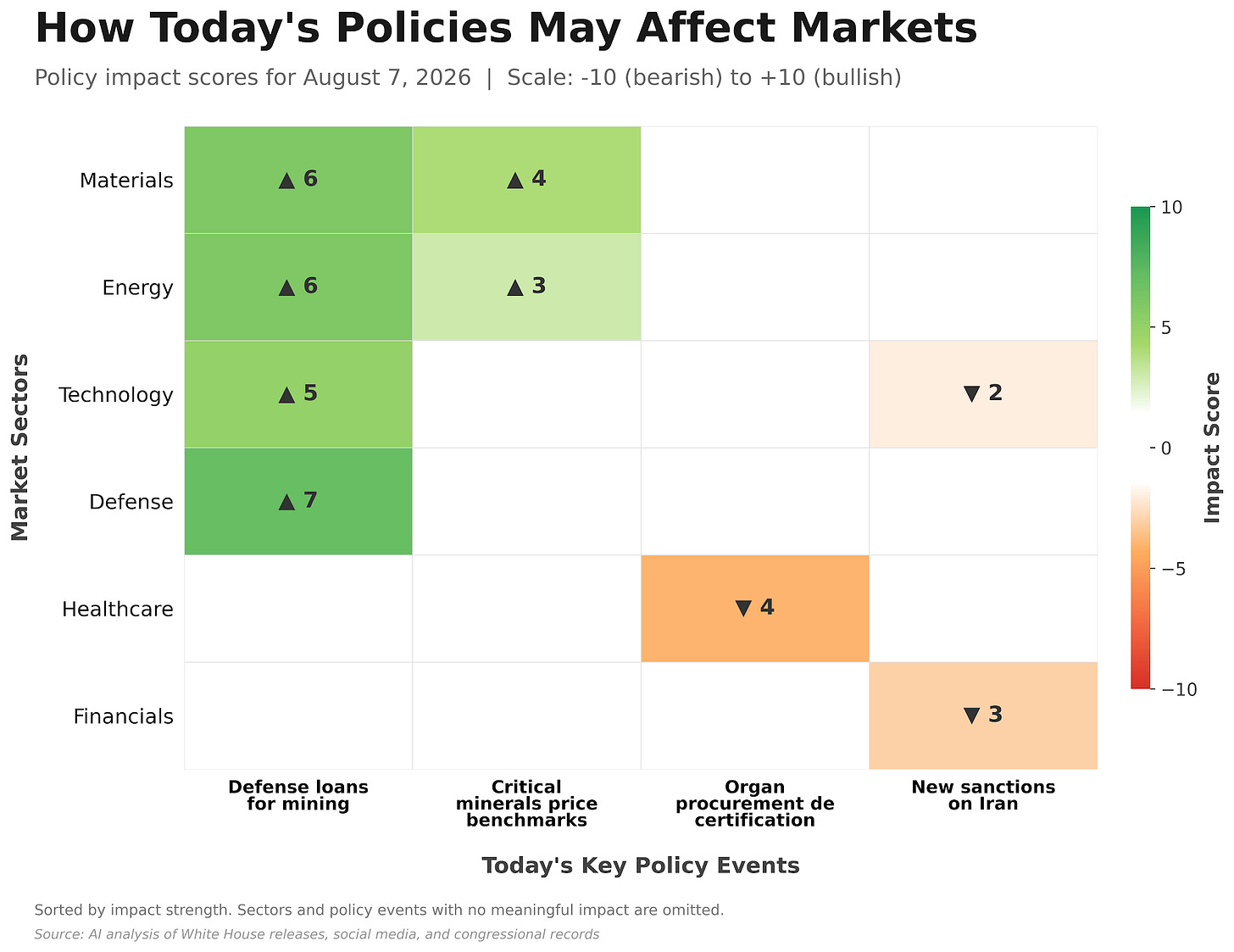
Each cell shows an estimated impact score on a fixed scale of -10 to +10, reflecting how today’s policy developments may affect each market sector. Positive scores (green, ▲) suggest bullish impact; negative scores (red, ▼) suggest bearish pressure. Rows and columns are sorted by impact strength, and sectors and policy events with no meaningful impact are omitted. The heatmap, the analysis below, and the Impact on Market themes above are produced from a single unified analysis: the heatmap visualizes the magnitudes, while the text explains the causal reasoning behind them.
The administration is aggressively utilizing the Department of War to reshape industrial supply chains through targeted financial interventions. By deploying billions in conditional loans to domestic battery and magnet producers, the government aims to force an onshoring of critical inputs for defense and tech sectors. This move seeks to reduce reliance on foreign-dominated markets, directly boosting capital flows into domestic Materials and Energy firms. These efforts are complemented by the endorsement of new mineral pricing benchmarks, intended to facilitate market-based stability and long-term investment. Simultaneously, the Treasury is tightening control over financial plumbing by sanctioning digital asset exchanges tied to Iran. These actions effectively increase the risk premium for international digital financial networks while creating a clear state-directed mandate for domestic manufacturing. Healthcare volatility persists as HHS signals a more punitive regulatory environment for medical service providers. The decertification of regional organ procurement organizations underscores a shift toward strictly enforced performance accountability. While proponents describe these mining investments as “restoring America’s... economic security,” critics in opposition-led states suggest that aggressive federal oversight and the rollback of certain federal benefits create “harmful” obstacles for service delivery and state-level administration. The combination of industrial subsidies and restrictive sanctions signals a broader pivot toward economic nationalism in both energy and finance.
-
Undisputed! Andrew Boutros Makes a False Claim
emptywheel.net
In a motion arguing he and his AUSAs should not be sanctioned, US Attorney for Chicago Andrew Boutros made a substantive false claim. I can’t prove he knowingly lied; that would require the kind of investigation Boutros insists is not warranted. But I can show his false claim happens to be among the core disputes in the Broadview 6 case.The legal argument in this filing (inapt invocation of Trump v. US notwithstanding) might be sound. But it’ll only work if Judge April Perry buys his explanation for why his AUSAs handed her grand jury transcripts that kept the misconduct Sheri Mecklenburg engaged in hidden behind redactions. The excuse is that William Hogan, a guy with past ethical accusations that Boutros chose not to mention in his filing, was just following orders — April Perry’s orders — to provide the grand jury transcripts pertaining to how they charged a conspiracy.
Boutros claims Judge Perry can only hold prosecutors in contempt if they disobeyed her order to turn over instructions on conspiracy
Boutros explains it this way:
The only potentially applicable order in this case [for which prosecutors could be held in contempt] is this Court’s order regarding the grand jury transcripts. Yet former Defendants made a very “narrow” request for only those portions of the grand jury transcripts “pertaining to how the 18 U.S.C. § 372 conspiracy charge was explained to the Grand Jury” and any “related exchanges.” R. 118 at 1. This Court ordered the Government to provide in camera “the relevant portions of the transcripts as outlined in the motion.” R. 119. The Government undisputedly provided all those portions in the redacted transcripts. Whether the Government should have provided additional portions not requested, former Defendants have never argued the Government failed to comply with this Court’s order. United States v. Streett, 437 F. Supp. 3d 940, 952 (D.N.M. 2020) (defendant’s attempts to convince someone else to get picture of his child abuse victims and cover it up was not contemptuous because it did not violate Court’s order prohibiting him from contacting or attempting to contact victims); see also, e.g., Denver-Greeley Valley Water Users Assoc. v. McNeil, 131 F.2d 67, 70 (10th Cir. 1942) (“literal compliance” is not contempt).
Nor did the Government violate the Court’s order to turn over “any related exchanges” to the § 372 legal explanation. R. 118 at 1. “Related exchanges” do not “clearly” (Joyce, 498 F.2d at 596) include: Experienced AUSA 1’s preamble containing “vouching” (Oct. 9), statements suggesting jurors who could not deliberate without bias should leave (Oct. 16), or references to ex parte communications unrelated to the law (Oct. 23). At a minimum, the order is “ambiguous” as to those discussions, and any failure to turn those portions over was not contemptuous. In re Betts, 927 F.2d at 987.
Boutros argues that Judge Perry has no authority to punish the prosecutors, because she did not issue any order that prosecutors defied. He says the only possible contempt was the order she gave to provide the portions of grand jury transcripts outlined in defendants’ motion to compel them.*
He claims to be sure, however, that prosecutors had “undisputedly” provided all those portions; he cites nothing defendants or Perry have said where they agree.
In any case, his claim is false. Prosecutors did not fully comply with Judge Perry’s order to turn over all the legal instructions on conspiracy.
Prosecutors withheld critical instruction on leaving a conspiracy
Most importantly, prosecutors omitted a fairly critical exchange from the October 23 transcript, the session where the grand jury ultimately indicted the Broadview 6, from what they initially shared with Judge Perry; I first noted this omission this post.
As a grand juror tried to track each of the (at that point) six defendants on the two videos prosecutors were showing, they mentioned that some of the defendants seemed to walk away from the Expedition that had driven into their protest. Mecklenberg responded to that observation by claiming that walking away from a spontaneous conspiracy would not affect whether they had joined the conspiracy or not.
GRAND JUROR: — Michael Rabbitt no longer appears in the frame. And neither Kat or either Kat appears to be anywhere near the front of the truck again. I’m just wondering about that. So I don’t — I’m struggling to locate them.
MS. MECKLENBURG: You — they don’t have — they can step away. You can do it that — you can impede for some time, and then you can decide that you’re going to stop. That doesn’t change the fact that you have impeded for some time. And they could be going — and we don’t know where they are here. They could be going and doing something else to the car or something else. We just don’t know.
GRAND JUROR: Okay.
MS. MECKLENBURG: So I — what’s — the probable cause comes from when you do see them on the video, not from when you don’t.
Shortly thereafter, in response to the foreperson also attempting to track each of the defendants, Mecklenburg claimed it was part of the conspiracy that people moved in and out (of the frame? the crowd? I have no idea).
MS. MECKLENBURG: So it’s happening at the same time. But keep in mind, people are moving in and out —
MADAM FOREPERSON: Yeah.
MS. MECKLENBURG: — which is part of the conspiracy.
You can argue whether Mecklenburg’s claim about conspiracy law was correct or not; I think it is (as a grand juror said of the case as a whole) a crock of shit.
But she was undisputedly responding to questions about how conspiracy law applied in this case.
These exchanges should have been included in what got shared with Perry.
Prosecutors included similar instructions
Such exchanges are precisely the kind of thing that Boutros pointed to as proof of the robust back and forth in the October 9 and 23 grand jury discussions.
The grand jurors asked the AUSAs about, among other things, whether conspiracy required forethought (id. at 22), if actions alone could show a conspiratorial agreement (id. at 23), “how far does” the scope of the conspiracy “go” (id.), and whether it was against the law to touch a law enforcement car (id. at 24-25, 30-31).
[snip]
The grand jurors also asked questions about the law, including: the necessity of them weighing in on a misdemeanor (id. at 51-52, 25-31), and if “basically . . . anybody who walked in front of that car could be charged with a conspiracy even if they weren’t actually touching the car and somehow impeding it.” Id. at 55; see also id. at 9, 16, 52-54 (other questions). [links added]
All of these, which include multiple questions about whether it was illegal to touch a cop’s car (and — in one case — challenging whether defendant Cat Sharp had done so), were included, unredacted, among the materials that Hogan deemed responsive Judge Perry’s order.
Questions about whether touching the car were included unredacted.
Questions about whether people who stepped away could be charged were not.
Given the standard for inclusion Boutros is describing in his filing — and given what was actually included in the transcripts originally shared with Perry — the exchanges about leaving a conspiracy should have been included. They were not.
It could be a mistake! Indeed, but for all the other damning evidence, that should be the default assumption here.
But there’s a lot of reason to believe it was intentional.
Boutros gets touchy about the standard for entering this conspiracy
Remember what happened here: People were protesting on a public street, and the ICE goon drove his black Expedition into them. There were definitely people who responded by surrounding and pounding on the car; there was damage (including the word “pig” scratched into the car) that prosecutors not only never tied to the defendants, but never isolated as having been done by anyone in the crowd.
Prosecutors argued that the act of impeding a car that drove into protestors was a spontaneous conspiracy to obstruct the ICE goon’s work, or at least his attempt to get to work. Spontaneous conspiracies are already pushing the edge of conspiracy law (though the argument worked in the Spokane protestors’ case on the same conspiracy charge), but in this case, the “conspiracy” involved a “victim” who initiated contact with lawful protestors in public space, protestors he called “trash in the street” in a text he sent.
What constituted entering into and remaining in this spontaneous conspiracy would always have been a heated contest. In his filing, Boutros uses merely touching the ICE goon’s car — the car that drove into protestors — as the baseline for entering into the conspiracy.
There was a crowd protesting at the facility, some of whom ended up in front of and touching and/or banging on his car. Id. at 78-80. The parties disagreed about the legal significance and constitutional implications of their actions, but former Defendants have never contested that each of them at least touched the Agent’s car, and the Court has confirmed as much. R. 142 at 7-9
[snip]
Former Defendants have never disputed their presence on the scene—which was captured on publicly available video—and even agreed they touched Agent A’s car (also captured on video).
And he seems to assert, without pointing to proof, that defendants did not contest whether they did touch the car that drove into them (as noted above, in the grand jury, there was heated debate about whether Cat Sharp ever did touch the car).
In other words, Boutros tries to dodge the problematic structure of this imagined conspiracy by criminalizing touching a car that drove into you.
This kind of instruction is precisely what defendants asked for
And that’s precisely why defendants took a series of steps that led up to the sharing of transcripts with Judge Perry; it’s precisely the kind of question defendants were raising in the filing Perry invoked when issuing her order.
Boutros’ discussion of the background to defendants’ request for transcripts notes that the request came in the wake of a prior request for specifics about how DOJ was applying the conspiracy. He quotes the defendants saying their request was “narrow,” and implies that Hogan complied by saying the misconduct Perry identified when she first revealed these transcripts would not have been included in her order. But he never bothers to show that Hogan provided everything she asked for.
On January 23, 2026, former Defendants moved for clarification about which of the three means in § 372 they were alleged to have violated. R. 61. Around that time, Experienced AUSA 1 left the Office for a temporary detail in another branch of Government. R. 83, 86. On February 2, 2026, Experienced AUSA 2—who has been with the Office for roughly 40 years—entered his appearance. R. 73. A third prosecutor, AUSA 3, filed his appearance on February 13, 2026. R. 85. The Government filed a motion saying it would only proceed on the “force and intimidation” prong of § 372 and thereby narrowed Count 1 (the felony charge). R. 96. Around that time, the Government moved to dismiss two of the former Defendants with prejudice. R. 91.
The remaining former Defendants sought discovery relating to vindictive or selective prosecution. R. 94. This Court denied the motion. R. 117. [long discussion that doesn’t address the evidence of vindictiveness since released]
The next day, on April 8, 2026, former Defendants made a “narrow” request to see “Grand Jury transcripts pertaining to how the 18 U.S.C. § 372 conspiracy charge was explained to the Grand Jury” and “any related exchanges.” R. 118 at 1. Former Defendants wanted to ensure the grand jury had been instructed on all the relevant § 372 means now that the Government was proceeding on only one. Id. at 1-2, 4. Alternatively, they asked this Court to conduct an in camera review “and order disclosure of those portions of the transcripts the Court determines are necessary to allow Defendants an opportunity to develop this issue further.” Id. at 1, 12.
But Boutros leaves key context out of the request. I provided that background myself in this post. The important bits are:
- Defendants, January 23: Hey, it’s not at all clear how defendants violated 18 USC 372 or what theory of force you’re using. Can we have a Bill of Particulars? [Doc 61]
- DOJ, February 11: No. [Doc 81]
- Defendants, February 23: But bodyworn camera video you only provided on February 12 confirms what we argued in our motion: “Abughazaleh, Defendants Joselyn Walsh, Andre Martin, Michael Rabbitt, and Catherine Sharp all independently moved away from the SUV within seconds after they found themselves in its path.” [Doc 87]
- Judge Perry, February 26: You gotta tell them which theory of conspiracy you’re using. [Doc 89]
- DOJ, March 12: Uh, we’ve decided we don’t have a case against Cat Sharp and Joselyn Walsh. [Doc 91]
- DOJ, March 13: Uh, we’ve decided we only have evidence that defendants intimidated the ICE goon who drove into them. [Doc 96]
- Several requests, including a motion for discovery on selective and vindictive prosecution, a motion to dismiss on 1A grounds, and a motion for details of what evidence from other conspirators will be used.
- Defendants, April 8: Since the government changed its theory of the case and keeps needing to think about it, we want grand jury transcripts “pertaining to how the 18 U.S.C. § 372 conspiracy charge was explained to the Grand Jury.” [Doc 118]
- Judge Perry, April 9: The government can either respond to defendants’ request, or “the relevant portions of the transcripts as outlined in the motion may be provided to the Court by 4/20/2026 in lieu of a written response.” [Doc 119]
That’s the genesis of the order that, Andrew Boutros insists, Hogan “undisputedly” responded to in full. The claim that most of the defendants responded to an Expedition driving into their protest by walking away was at the core of their request for explanation about the conspiracy charge; it was likely at the core of the reason the government dropped their case against Sharp and Walsh. And it would be at the core of any claim that defendants entered into a spontaneous conspiracy to obstruct the guy who just drove his giant SUV into their protest.
What did they do when the Expedition drove into them?
They walked away.
And yet, when grand jurors, based on their observation that some of the defendants did just that, asked Sheri Mecklenburg on the day they indicted the Broadview 6, what about people who walked away, Mecklenburg said that was all part of the conspiracy.
Again, it doesn’t matter whether Mecklenburg’s instruction to jurors was right or not: that you could be charged for conspiring to obstruct an ICE goon after he drove his SUV into your protest if your response was to walk away. If the instruction was pertinent to grand jurors’ decision to indict people who did walk away, then DOJ had to turn it over to Judge Perry.
They did not.
They didn’t do so, even though a significant part of defendants’ argument that led Judge Perry to make DOJ explain their theory of conspiracy in the first place substantially focused on how you could enter into a spontaneous conspiracy if you walked away from it.
The hybrid section of Hylton’s testimony
There’s one more piece of arguable legal instruction that Hogan withheld, revealed by the funkiness in the treatment of FBI Agent Evan Hylton’s transcript (I wrote abt the far bigger funkiness with the ICE witness’ testimony here).
As I laid out here, the court reporters treated testimony from the ICE witness as a separate transcript for both his October 16 (the sketchy one) and his October 23 testimony. That has a number of effects, two of which are important to the question of whether Hogan complied with Judge Perry’s order or whether DOJ deliberately tried to hide stuff from her.
- Funkiness aside, the ICE witness’ testimony makes up a negligible portion of the transcript that includes legal instruction; in the October 23 transcript, for example, the ICE agent’s testimony is marked by a 4-line placeholder
- The ICE witness’ testimony has its own table of contents (October 16; October 23)
These tables of contents were made after the fact and should not be considered reliable, but they do provide an extra road map for what happened with the transcript.
In the case of Hylton, however, the court reporter treated it as all one transcript. And he inaccurately described that the entire thing, pages 3 through 76, consisted of direct examination — of Hylton, is the implication — by Sheri Mecklenburg.

When Hogan redacted the October 16 and 23 transcripts, he could just ignore the separate transcripts pertaining to the ICE testimony (ignoring, of course, the 7-minute anomaly in the October 16 one). But for the October 9 transcript, he had to isolate Hylton’s testimony himself.
To make things worse, Mecklenburg prepared to discuss the law — “I would like to present the law to you” — right before she invited questions, making that work harder. Most of what ensued involved questions for Hylton. But then the foreperson premised a question, “I don’t know if this is a legal question or a question for the agent. I’m pretty sure it’s legal.” Mecklenburg immediately stopped the question and dismissed Hylton.
So there was this hybrid period. Hylton was still there but grand jurors were asking whatever they wanted to know. During it, both the agent and Mecklenburg addressed some questions about the investigation: why they weren’t presenting any of the more obviously obstructive protestors, whether there were fingerprints, what a trucker who would have witnessed the event said. The investigation is ongoing, one or another of them responded.
When Hogan redacted the transcript, he redacted everything up to the moment that Mecklenburg formally dismissed Hylton, on page 62, which would have looked perfectly reasonable to Judge Perry, since the table of contents identified everything up through page 73 as testimony. When DOJ publicly released the transcripts however, they withheld only from the moment from when Hylton was sworn — recorded on page 10, to the moment Mecklenburg described she wanted to discuss the law on page 53 for further redaction. That was released on June 9, and then the pages of Hylton’s testimony that had been redacted in the purportedly unredacted testimony, pages 10 through 53, were released on June 18. (Note, this only pertains to the public releases. I think defendants got everything on May 21.)
And the release of that hybrid section revealed an exchange that was not obviously evidentiary, and Mecklenburg answered that herself: by bullying the grand juror who asked it.
GRAND JURY: Couldn’t he have stopped?
MS. MECKLENBURG: Couldn’t he have stopped?
GRAND JURY: If he is afraid of running over people, isn’t the right thing to do to stop?
MS. MECKLENBURG: Well, didn’t you hear the testimony that he said he was afraid to stop because he was afraid they were going to break the windows and pull him out and he would be injured?
So he said — the testimony was that he said he was concerned about stopping for his own safety and he was concerned about the safety in the front. So he had to balance it. And this is not testimony now, but I would argue he did a pretty good job of balancing it because nobody got hurt.
GRAND JURY: I know.
MS. MECKLENBURG: So you want to talk about the right thing. What if he had stopped?
GRAND JURY: But it’s the flip of the thing is can’t you say he was trying to run over the people?
MS. MECKLENBURG: Did you really think when you saw that video
GRAND JURY: No. It’s a bad question —
This is a less clear-cut case than the two exchanges that included the word “conspiracy” as part of the answer. But it’s still important.
The question is important background to a question Boutros himself pointed to (I’ve marked it in red in his discussion above), does the ICE goon have the right to drive into protestors, which was shared with Perry, as well as Boutros’ insistence that anyone who was touched by the car is fair game for indictment. It’s important background to DOJ’s insistence that grand jurors who thought this whole thing was a crock of shit were biased, as opposed to offended by the notion that the ICE goon who decided to drive into a protest was a victim.
And the answer to that question was integrated into Matthew Skiba’s legal instruction and presentation for both the subsequent weeks (October 16; October 23).

Skiba certainly treated it as legal instruction.
Yet it, and the bullying Mecklenburg did, was withheld from Perry, treated as Hylton’s testimony.
The disappearing bodyworn cameras
Now’s a good time to talk about the bodyworn cameras — the ones that defendants claim showed most of them walking away from the scene of the imagined conspiracy.
There was a big to-do early in this prosecution about such things. In January, after learning that Mecklenburg cherry-picked what video from Broadview police department was relevant, defendants asked for a preservation order. The government did not object, but did claim that Mecklenburg, Skiba, and the FBI agent pulled all bodyworn video that showed the defendants. Perry signed the preservation order on January 30. But — as disclosed during pretrial motions in limine practice in May — in fact, bodyworn camera video that would be important to determine whether defendants did walk away was destroyed.
Counsel for the government repeatedly assured defense counsel that Broadview was informed of this request, and, in a letter dated December 18, 2025, further advised that the AUSAs personally went to Broadview, reviewed all the videos, and “tagged the video showing the incident and any video that morning showing any of the defendants” so that it would be saved to be included in a future discovery production. Despite assurances that the video was being preserved, defense counsel was later notified that certain Broadview police department body camera footage had been “lost/deleted.” Defense counsel were advised that this lost or deleted footage included videos that were previously tagged by the AUSAs as being relevant and material. Specifically, the AUSA assigned to the case at the time wrote to defense counsel as part of a discovery production on February 12, 2026:
Also, you will see an FBI 302 explaining that the Broadview Police Department was unable to transmit some of the videos that we tagged during our visit to the Broadview Police Department in December 2025, that the Broadview Police no longer can access those videos, and their efforts to recover those videos thus far have been unsuccessful. It is our understanding, memorialized in a 302, that Broadview Police had a new system for body-worn camera footage and they appeared to have difficulty with it at the time. However, based on our review, the videos were all repetitive of the same scenes from different officers’ body cameras, standing near each other. In reviewing the videos we were able to obtain and produce to you, it appears that these videos show the same scenes we saw on the videos that Broadview was unable to access.
[snip]
As the Court will see at trial, there will be material disagreements about exactly what happened in the moments before and during the time Agent A decided to turn his SUV into the crosswalk and into the protestors. What the government describes as “repetitive” likely shows different angles that are most likely material to Defendants’ version of events, especially because Defendants were located at different positions in the crosswalk when the SUV turned into them.
That makes Mecklenburg’s squirminess, in two instances in the transcripts, about the Broadview cops suspect. When a grand juror asked her, on October 9, whether they’d be hearing testimony from the cops who let the ICE goon through their checkpoint, Mecklenburg almost immediately turned it into a discussion about politics and jurisdiction as a way of explaining why she wasn’t calling the cops.
Perhaps most damning, the following week, Mecklenburg responded to a grand juror asking whether there was any law enforcement video by claiming that there were no cops there and so no video.
GRAND JUROR: Who took the videos? What’s the source of these videos?
MS. MECKLENBURG: This video is from Ms. Abagazala’s social media.
MR. SKIBA: Yeah. So some were like a Twitter, an Instagram. Some were, I believe, YouTube. This was all civilians taking photos.
MS. MECKLENBURG: Yeah. No law enforcement was out there, so they didn’t take any video.
As with Boutros, I have no idea whether this was an intentional lie. And it is not legal instruction, so this material wouldn’t have been turned over operating on Hogan’s claim that he was just trying to follow Perry’s order. But I find it suspect that, in October, Mecklenburg affirmatively claimed that video that would prove exculpatory did not exist, and then in February, she said it had been destroyed. It makes the choice to withhold related instruction more suspicious.
Some of Boutros’ unredacted page numbers are undisputedly redacted
Finally, Boutros made another misstatement (albeit not as central to his argument).
Partly to explain how Judge Perry had notice there were more than just a few lines of the grand jury missing, Boutros provides a very contorted inventory of the pages that were redacted and omitted. (This passage is one of the reasons I went down this rabbit hole, so thanks, Andrew!) In it, he claims the page numbers clearly show what was omitted.
On April 23, the Government submitted to the Court for in camera review those portions of the transcripts “detailing the presentment of the law on the 18 U.S.C. § 372 conspiracy charge and any related exchanges.” R. 128; R. 129 (Exs. A, B, and C). The transcripts the Government tendered to the Court also contained black redactions clearly marking what was not produced and page numbers showing that the first transcript omitted all pages between 4 and 61; the second transcript omitted pages 3, 9-10, and 30-36; and the third transcript omitted pages 4, 29-40, and a few pages at the end. R. 129 (Exs. A, B, and C). These omitted pages totaled more than 80.8 As he later stated in court, Experienced AUSA 2 took responsibility for the redactions. R. 187 at 30.
8 In addition to the 80 omitted pages, the transcripts contained additional pages that were not provided to the Court because they included witness testimony and portions other than the §372 law and related colloquies. See R. 219 (Oct. 9, 2025, transcript consisted of 76 total pages); R. 220 (Oct. 16, 2025, transcript consisted of 53 total pages); R. 221 (Oct. 23, 2025, transcript consisted of 98 total pages). All three transcripts consisted of a combined 227 pages. [my emphasis]
Having spent most of yesterday trying to track what actually happened with the transcripts, the notion this was feasible without the full transcripts is bullshit, particularly given that there’s no discernible reason why some stuff was omitted and other stuff just redacted.
And in several places — contrary to Boutros’ claim — a page number was redacted, which had the effect of making it harder to understand how many pages — 15, in this case — had been removed.

This includes the passage with the question about walking away from a conspiracy.
Hogan did not follow Judge Perry’s order
Boutros is wrong. It is bluster for the US Attorney to suggest that Hogan undisputedly complied with Judge Perry’s order. There are two instances where information that prosecutors otherwise treated as instruction was omitted from what got shared with Perry, and one of those goes to the heart of the case.
To some degree it doesn’t matter whether Boutros knowingly lied when he made the claim (though a knowing lie would be further contempt). Once the question is under dispute, then Judge Perry has reason to inquire further. Especially given the stack of evidence showing that prosecutors knew the import of that passage, and otherwise withheld related information.
So while I can’t prove Boutros wittingly lied when he claimed Hogan had complied, it should be undisputed there’s reason for Judge Perry to dig further into this.
*Throughout this post, I use the word “defendants” to refer to those now exonerated. I do so because my discussion addresses prosecutors’ treatment of them from the time they were targets, then defendants, and now exonerees; I found using the term “exonerees” when discussing the grand jury discussions confusing.
Redacted transcripts:
Unredacted transcripts:
- October 9 unredacted transcript
- Redacted 3-61; omitted 4-60
- Evan Hylton Testimony: pages 10-53 (pages 54-61 omitted from his transcript, but included in unredacted)
- October 16 unredacted transcript
- Redacted 2-4; omitted 3
- Redacted 8-11; omitted 9-10
- Redacted 25-26 (none omitted)
- Redacted 27-28 (none omitted)
- Redacted 29-37; 30-36 omitted
- ICE witness: introduced 37, testimony starts 40
- October 23 unredacted transcript
- Redacted 3-5; omitted 4-5
- Redacted 29-41; omitted 30-39
- Redacted 52-57; omitted 53-55
- ICE witness: testimony begins 68
The post Undisputed! Andrew Boutros Makes a False Claim appeared first on emptywheel.
-
Taylor Swift songs removed from Trump and White House’s social media posts
www.theguardian.comRage-baiting efforts of Trump accounts silenced after posts such as a video linking her Red album to Republicans
Some of Taylor Swift’s songs have been removed from videos posted on social media by Donald Trump’s campaign and the White House, silencing efforts to mock the pop star.
A video posted on 3 August featuring the US president and the first lady, Melania Trump, watching fireworks was posted this month on TikTok with Swift’s song August.
Continue reading... -
Netanyahu says Israel won't pull out of Gaza before Hamas disarms
Israeli Prime Minister Benjamin Netanyahu restated his rejection of Donald Trump's latest Gaza plan in televised remarks to his right-wing government on Sunday, even as Israel's military has effectively halted attacks in the territory under pressure from the U.S. President. Netanyahu is in campaign mode as he seeks re-election at a vote due on October 27 but is caught between far-right ministers angered by concessions in Gaza and his key military backer, Trump, who wants progress toward ending the conflict there with a new 15-point peace plan.www.allsides.com -
Israel rejects Trump's 15-point plan for Gaza
Prime Minister Benjamin Netanyahu says Israel has rejected United States President Donald Trump's Board of Peace plan for Gaza and will not withdraw forces until the Palestinian group Hamas fully disarms. "Israel rejects the 15-point document," Netanyahu said at a cabinet meeting on Sunday, referring to the plan endorsed last month by Hamas.www.allsides.com -
Trump posts examples of alleged Reflecting Pool vandalism amid push for Pirro to revisit decision
President Trump on Saturday posted photos of alleged vandalism to the Lincoln Memorial Reflecting Pool amid a push for U.S. Attorney for the District of Columbia Jeanine Pirro to revisit a recent decision to drop charges related to the pool. Late Saturday, the president posted two photos of what appeared to be graffiti and some peeling of the coating of the pool. Both photos were labeled with the word "Vandalism."www.allsides.com -
The Not-So-Special Relationship
The wild swings in the U.S.-Israel alliance over two Trump administrations belie a clear trend. Half a century after being formed against the backdrop of the Cold War, the "special relationship" is coming apart. The Israeli and American military establishments are closer than ever, yet the estrangement between their countries' political elites grows.www.allsides.com -
The Broadview ICE Agent’s 7-Minute Gap
emptywheel.net
I’m still working on my big post showing that US Attorney Andrew Boutros made a false claim in his attempt to stave off sanctions for the misconduct in the Broadview 6 case.But first I want to point to a seven minute … well, let’s call it an anomaly. I’m not yet sure it’s a gap … that occurred on the second day of grand jury testimony, the day grand jurors told prosecutor Sheri Mecklenburg that her case was a crock of shit.
As I noted in this post, his explanation for how the Front Office (that is, he himself and his Criminal Chief) got involved “in realtime” doesn’t make sense. The post laid out Boutros’ weird attempt to rationalize AUSA William Hogan’s failure to inform Judge April Perry that she was mistaken in believing that the huge gaps in the grand jury transcripts they gave her were due to tech failures. Boutros pointed to things like orange lights and on buttons to justify Hogan’s lack of candor.
Boutros points to Mecklenburg’s reference to her battery running out as a tech problem. But that does’t reflect any involvement by his managers at all, or explain when they would have heard something was wrong to know to intervene.
Boutros attributes the way the transcript that day ended to yet more technical difficulties.
Agent A gave his testimony. Id. at 40-54. After another technical issue, the transcript reveals there was off-the-record discussion and “the testimony was abruptly stopped.” Id. at 54. The grand jury was not asked to return an indictment that day. Id.; R. 187 at 32. Rather, when Experienced AUSA 1 contacted members of the Front Office in “realtime” regarding the “excusing of grand jurors,” the grand jury session was “immediately called off.” R. 187 at 51.
Mecklenburg’s battery ran out.
O. Did you use your flashing law enforcement lights?
A. I did not, although I — I thought that I could.
Q. Let me stop you.
A. Okay.
MS. MECKLENBURG: I need the batteries on the recorder.
(Discussion held off the record.)
(Whereupon the testimony was abruptly stopped.)
This may well be a technical issue, but it doesn’t explain why Boutros credited himself — in his first speaking part in this case on April 21 — with calling off the grand jury sessions in “real time.”
With respect to the excusing of grand jurors that took place, which was the second time that the prosecutor sought to return an indictment, that is an issue that I was aware of in realtime. And once I became aware of it, I immediately called off that grand jury session.
Especially since he pinky swears he didn’t know of the vouching or ex parte conversations that were at issue in the October 16 grand jury appearance he claims to have called off in real time.
9 The United States Attorney was emailed a copy of the transcript from the October 9, 2025, grand jury presentation on October 14, 2025, but has no recollection of reviewing the transcript at that time, and is quite certain he did not review the transcript at that time. The United States Attorney did not receive a copy of the October 16 or October 23, 2025, transcripts until late April 2026, shortly before the Government moved to dismiss the indictment. At that time (late April 2026), the United States Attorney reviewed relevant portions of all three transcripts. Irrespective, no one ever brought the vouching or ex parte issues to the United States Attorney’s attention until late April 2026, nor was the United States Attorney aware of the vouching or ex parte issues until late April 2026.
By all appearances, that session ended because Mecklenburg’s battery ran out, not because Boutros intervened.
The 7-minute, um, anomaly may explain it.
The treatment of both law enforcement witnesses’ testimony is funky here; I’ll deal with the weirdness of the FBI witness in the main post, probably. The transcript for that guy was released in three batches: DOJ used his testimony as an excuse to redact broad swaths of the redacted October 9 transcript they first shared with Judge Perry. Then DOJ unsealed parts of it for what was publicly released as the main transcript. Then they released a partial transcript of his testimony later.
(I want to thank Biden Bus Barrister Matthew Skiba for helping me understand the anomaly with this transcript.)
With the ICE agent’s October 16 testimony (see note below for his October 23 testimony), however, DOJ released his transcript as part of the main transcript, but showed that it was transcribed separately.
That October 16 transcript includes time stamps (the October 9 and October 23 ones do not). The end of the main transcript shows him walking in for testimony at 10:04.

A notation explains that his testimony “is not included in this transcript.” End of excerpt.
The second part of the transcript shows the grand jury reconvening at 2:43PM, seemingly almost four hours and forty minutes later — an awfully long time for lunch!! — and starts with the foreperson swearing him in. (The difference in typeface size here is due to my screencap.)

The timestamp on the transcript is not far off that 2:43 start. Mecklenburg starts at 3:10.

That timestamp seems to increment as you’d expect from there, with timestamps in the margin every 20 or 30 seconds. The third to last question Mecklenburg asks him is marked as 3:33.

All that suggests he testified for almost 23 minutes.
Except that the last timestamp on his testimony is 10:11 — seven minutes after the end of the first part of the transcript. But four hours before when this session formally began.

Call me crazy but where it says Ms. Mecklenburg looks like heavier typeface.
You could attribute it to some screw up in the two grand jury transcripts except for two things: the clear identification of the second session starting at 2:43PM. And the tick tock of the timestamp in the margin that suddenly reverts back four hours. Tick tock. Tick tock. Tick to–oops! My battery died!
There are some other, um, anomalies with this transcript that I’m still unpacking.
For the moment, all I can say is that the ICE agent who drove his Expedition into a bunch of people who were peacefully protesting and then accused them of assaulting him also seems to have a time machine, in which he flew back and forth in time four hours as grand jurors called the whole thing a crock of shit.
Update: I didn’t talk about the ICE dude’s second testimony, on October 23. His testimony was handled similarly to the way it was on October 16, with a separate testimony, with its own timestamp, within the whole. His testimony appears about 45 minutes into the grand jury presentation, and it continues for 40 pages after that. Aside from the introductions, there are no timestamps on this transcript.
The post The Broadview ICE Agent’s 7-Minute Gap appeared first on emptywheel.
-
Donald Trump Told Us He Was Warned about the Missile Shortage Before He Started the Iran War
emptywheel.net
There have been three important stories about the missile shortage that currently prevents Trump from trying to reverse the humiliating defeat he has suffered in Iran.First, WaPo describing a spat at Camp David, in which Trump laid into Whiskey Pete Hegseth because Trump’s Fox News Host didn’t tell him about the missile shortages.
President Donald Trump’s frustration over the Iran war boiled over at Camp David last week, where he demanded answers from Defense Secretary Pete Hegseth on why he had apparently been misled on extreme munitions shortages that now threaten to limit military options with Iran, two people familiar with the exchange told The Washington Post.
The encounter took place on the sidelines of his Cabinet meeting at Camp David on Friday where Trump vented at Hegseth that he thought the munitions issue “had been fixed,” according to both people familiar with the conversation, who, like others, spoke on the condition of anonymity due to fear of retaliation.
The shortages, particularly in long-range guided missiles and air-defense interceptors, have been part of the reason Trump has pulled back from launching additional massive strikes against Iran in recent days, one of the sources said.
[snip]
Back at Camp David, as he was confronted by Trump over the bare weapons stockpile, Hegseth defended himself and blamed his deputy, Stephen Feinberg, for the shortages and for not ensuring Trump was fully apprised of the issue, both people familiar said.
The exchange underscored Trump’s increasing frustration with his defense secretary, who was one of the biggest early advocates for taking military action against Iran, convincing Trump it would be a quick and relatively easy win, according to multiple officials.
The story has been updated to reflect the aftermath: Sean Parnell’s accusations that the story is not true, multiple statements affirming Trump’s support for his Crusader Secretary of Defense, Trump’s insistence both that the US has all the missiles it needs and that the people who said differently committed treason.

The especially weird part of Parnell and Karoline Leavitt’s attempt to deny the flap, though, is shouldn’t the President be angry with a Secretary of Defense who conducted the war in such a dumbass way, losing the war while blowing the missile reserves?
And in case Trump’s threats to hunt down the people who revealed the missile shortage — which has been publicly reported over and over and over — didn’t already make clear the shortage is real, midway through the week there was the Reuters story that said almost all long range missiles are gone.
The U.S. Army has used up much of its global stockpile of highly accurate long-range missiles during its five-month war with Iran, according to three people familiar with the data, raising concerns about the military’s readiness for future conflicts.
The missiles are principally the Army’s surface-to-surface weapons, known as Army Tactical Missile Systems (ATACMS) and Precision Strike Missiles (PrSM). The U.S. has used “virtually all” of these weapons, according to two of the sources.
CNN matched with a story saying that nearly 80% of THAAD interceptors are gone.
Finally there’s the CNN story describing that Dan Caine wants to find an off-ramp from the Iran war because of the missile shortage.
Over the last few weeks, Chairman of the Joint Chiefs Gen. Dan Caine has privately made clear to other top Trump advisers that the US needs to find an off-ramp from the war with Iran — because the military options on the table to escalate the conflict could backfire and airpower alone is unlikely to achieve President Donald Trump’s stated objectives, according to three sources familiar with the matter.
“Caine is looking for an off ramp,” one of the sources said bluntly.
Caine is not alone in his view that the war has reached a crossroads. He has discussed concerns about the military options for escalating the conflict and raised the prospect of finding an off-ramp from the war with other key Cabinet officials, including CIA Director John Ratcliffe, Secretary of State Marco Rubio and Vice President JD Vance, two of the sources said.
The top US general has recently side-barred with some of those key, like-minded Trump advisers in an effort to facilitate interagency coordination and ensure they are on the same page ahead of meetings with the president. The aim has been to make clear the limitations and pitfalls of the available military options, including those that do not involve putting US boots on the ground, the sources said.
Thanks in part to the squealing Trump and Sean Parnell are doing, the buzz has focused on the recriminations, as if it is unknowable how much of a surprise this missile shortage is.
It’s not. Trump told us himself, on February 23, five days before he started this war. As I laid out in April, after first Axios and then WaPo (including some of the journalists on this week’s story) and also — as I noted when they got subpoenaed — WSJ all warned about the missile shortages, and other risks to the Iran invasion. And that same day, Trump responded.

Mostly, Trump attempted to deny that Caine was against the war. But in the process, he basically said he would decide whether or not to go to war, not Caine.
- I am the one that makes the decision
- [I]f [Caine] is told to do so
- [H]e only knows […] how to WIN
Donald Trump told us on February 23, before he started this war, that he was reading the stories describing that he was warned, including about the missile shortage. And his response was to say that the decision was his, that if we went in spite of the warnings, the decision was his.
The post Donald Trump Told Us He Was Warned about the Missile Shortage Before He Started the Iran War appeared first on emptywheel.
-
Blanche confirmation allows Trump to continue ‘pervasive, breathtaking corruption’, says Schumer – as it happened
www.theguardian.comSenate minority leader condemns Republicans after Donald Trump’s former defense lawyer confirmed by 50 votes to 49 early on Saturday morning. This blog is now closed.
Joe Biden’s prostate cancer has spread throughout his body, causing the former president great pain, his son Hunter Biden said during an interview broadcast Friday.
“The cancer has spread, metastasized into his bones and further,” Hunter Biden said in a sit-down with the BBC. “It’s very painful and it’s very debilitating in many respects.”
Continue reading... -
How the Navy SEALs Lost Their Way
www.spytalk.co
For a community that once prided itself on being quiet professionals, the Navy SEALs are hard to miss these days. Bookshelves groan under the weight of endless SEAL memoirs that have become a content farm for Hollywood blockbusters and TV streaming series. A number of SEAL veterans have also built second careers as podcast hosts, leadership consultants, Hollywood consultants, or pitchmen for supplements, energy drinks, and merchandise. Seven retired SEALs are current members of Congress, and others hold senior posts in the Trump administration.
Few other special operations communities behave this way. Only a handful of former Delta Force operators and Army Rangers have written books, and a few serve in Congress, but most keep quiet. No one hears from the operators in the Air Force’s special tactics squadron or those in secretive units with classified codenames, who are the true quiet professionals.
So what happened to the SEALs? The short answer is that the War on Terror happened, and they lost their way. The longer answer, laid out in journalist Matthew Cole’s 2022 book Code Over Country: The Tragedy and Corruption of SEAL Team Six, is that SEALs became completely unaccountable, leading some to believe, not without reason, that they could do whatever they wanted—on the battlefield and off.
-
Bluster and backdown have turned Iran war into Trump’s own Groundhog Day
www.theguardian.comThe US president’s profound ignorance of his enemy has led to an impotent cycle of empty threats, analysts say
Being the subject of mockery may be the most intense of all Donald Trump’s known aversions.
Yet more than five months after embarking on a war of choice against Iran, the US president risks attracting ridicule as he struggles to secure a military victory – while repeatedly threatening devastating bombardment against the Tehran regime, only to back down on the pretext of renewed negotiations.
Continue reading... -
Trump loyalist Todd Blanche confirmed by Senate as US attorney general
www.theguardian.comMajor win for president as former personal lawyer wins approval despite outcry over $1.8bn slush fund
The US Senate voted to narrowly confirm Todd Blanche as attorney general in a major win for Donald Trump, who will now have his one-time personal attorney sitting atop the nation’s law enforcement apparatus.
Senator Bill Cassidy of Louisiana cast the deciding vote in Blanche’s favor after two other Republicans – Susan Collins of Maine and Lisa Murkowski of Alaska – voted against him. Every Democrat rejected Blanche’s nomination as the Republican-led Senate voted 50-49.
Continue reading... -
US accused of meddling in British politics with $500,000 grant for ‘public education’ courses
www.theguardian.comDocuments published on US embassy’s website prompt claims of attempt to export Maga propaganda to UK
The US embassy in London is offering grants of up to half a million dollars for new “public education” programmes in what has been criticised as interference in British domestic politics.
Using language that the pro-Trump Maga movement has sought to appropriate, a funding notice identifies a goal of fostering a “national conversation” about “shared civilizational values” underpinning US-UK ties. Priority will go to applicants aiming to celebrate “freedom of speech” and “limited government”.
Continue reading... -
Greenland issues ‘strong warning’ as Trump-linked oil firm prepares to drill
www.theguardian.comIsland’s government says no approval given after Greenland Energy brings kit ashore for exploratory drilling
An American oil company connected to Donald Trump is preparing to sink wells in remote Greenland despite not having received permission from the local authorities.
As the US president renews his threats to claim the vast Arctic territory, materials to prepare for drilling were brought ashore in recent days on Greenland’s eastern coast.
Continue reading... -
Trump Tyranny Tracker | Day 563: Aug 5, 2026
trumptyrannytracker.substack.com The seal of the U.S. Department of Homeland Security is displayed outside the headquarters of the Federal Emergency Management Agency, July 25, 2026 in Washington. Kevin Carter/Getty Images
Welcome to today’s Trump Tyranny Tracker…
Trump’s regime is going after protesters’ Signal chats, protecting Trump and his family from potentially massive tax liabilities, and establishing unprecedented FBI ties with Russia and China.
Today at a Glance
• ICE threatens elected sheriffs with prosecution for refusing to cooperate with Trump’s deportation campaign.
• Federal judges face escalating threats after ruling against Trump.
• Trump’s National Guard deployment in Washington is projected to cost taxpayers $1.4 billion.
What We Need to Pay Attention To
DHS Wants Protesters’ Signal Group Chats
What Happened: DHS is demanding access to private Signal group chats used by protesters who sued the government for violating their free speech rights. The agency is seeking the encrypted messages as part of the lawsuit.
Why It Matters: Protesters sued the government for suppressing their speech, and now the government is using that lawsuit to go after their private conversations. It is another way to identify, track, and intimidate people organizing against Trump’s extreme agenda.
Source: WIRED
Corruption
Trump Seeks a Boost for Hemp That Would Benefit a Top Aide’s Family
What Happened: The White House pressured senators to delay new restrictions on hemp products, inserting the change into a must pass spending bill. The industry lobbying campaign was led in part by the son-in-law of Trump chief of staff Susie Wiles, whose companies sell hemp gummies and vapes.
Why It Matters: This is what corruption looks like: people close to power using government influence and policy in ways to financially benefit their families and allies.
Source: New York Times
Freedom 250 Sponsors Failed to Disclose Donations — A Potential Lobbying Law Violation
What Happened: Major corporations that lobby the federal government gave millions to Trump-chaired Freedom 250 but failed to disclose the donations as potentially required by federal lobbying law. Only three of nearly two dozen corporate sponsors reported their contributions. ExxonMobil, Oracle, and several defense contractors did not.
Why It Matters: Corporations with business before Trump’s government are giving millions to an organization he chairs while failing to disclose the money. It creates another hidden pipeline for companies seeking access and favorable treatment from Trump to funnel money.
Source: NOTUS
Power Consolidation
Todd Blanche Kept Trump’s Tax Audit Shield. It Could Erase a $100 Million IRS Bill
What Happened: Todd Blanche, Trump’s former personal lawyer, is keeping a settlement provision shielding Trump, his sons, and the Trump Organization from IRS audits of returns filed before May 19. The protection would prevent the IRS from pursuing more than $100 million in potential back taxes and penalties.
Why It Matters: Trump put loyalists in key government positions, and now he is benefiting from it. His former personal lawyer is running DOJ while preserving a deal that would save Trump and his family more than $100 million and shield them from investigations.
Source: TIME
Weaponization of Institutions
The SEC Bought Airline Data to Monitor Flights Worldwide
What Happened: The SEC purchased access to more than a billion airline ticketing records covering travel in the U.S. and around the world. The data included passengers’ names, itineraries, flight details, and credit card information and was likely obtained without warrants.
Why It Matters: Federal agencies are buying enormous amounts of sensitive information about Americans without getting a warrant. It is another tool for a growing surveillance state that can track people while bypassing basic privacy protections.
Source: 404 Media
ICE Threatens Sheriffs With Prosecution Over Access to Inmates
What Happened: ICE threatened the elected sheriffs of Minneapolis and Chicago with federal witness tampering charges for refusing to give immigration agents broad access to inmates without judicial warrants. Federal courts have already ruled that state and local governments cannot be forced to help enforce federal immigration law.
Why It Matters: Trump is using the threat of federal prosecution to force elected officials to carry out his agenda. Turning law enforcement into a weapon for compelling obedience is a hallmark of authoritarian regime.
Source: New York Times
Media Suppression & Authoritarian Tactics
This federal judge ruled against Trump. Then the threats began.
What Happened: Federal judges who ruled against Trump are facing escalating threats. Judge John McConnell received credible death threats and a delivery invoking the murdered son of another federal judge after blocking Trump’s federal funding freeze. All three judges on his Rhode Island court have received threats tied to rulings against Trump cases.
Why It Matters: Trump and his officials repeatedly attack judges who rule against them, calling them “monsters,” “lunatics,” and illegitimate. This intimidation is meant to make judges fear the consequences of enforcing the law.
Source: The Washington Post
Human & Civil Rights Abuses
Trump’s immigration crackdown has detained more than 50 military spouses and parents
What Happened: More than 50 parents and spouses of active duty U.S. service members have been detained since Trump returned to office, with at least six deported. Trump ended longstanding protections that shielded immediate military family members from detention and deportation.
Why It Matters: Trump’s mass deportation campaign is separating the families of Americans serving in the military. Some service members have been forced to take leave, delay deployments, or care for children alone because their family members were detained or deported.
Source: Associated Press
Heat Is Killing Texas Prisoners, and State Leaders Won’t Shell Out for AC
What Happened: A federal judge found that roughly 134,500 people in Texas prisons face a substantial risk of serious harm from extreme heat, with some cells exceeding 110 degrees. The judge called the system for deciding who gets an air conditioned bed “arbitrary, inadequate, and ineffective,” while Texas continues fighting efforts to require safer conditions.
Source: Mother Jones
Legal aid groups alarmed as Trump administration awards $150M migrant child contract to Texas firm
What Happened: Trump officials awarded a $150 million no-bid contract to a small Texas law firm to provide legal services to unaccompanied migrant children in government shelters. Only two of its 25 listed lawyers claim relevant immigration experience, while its founder served in Trump’s first term and several attorneys have ties to Trump or conservative causes.
Why It Matters: Trump officials handed $150 million meant to protect children facing deportation to a politically connected firm with almost no immigration experience. The children will get worse representation while people connected to Trump got a massive government contract.
Source: Associated Press
ICE begins outfitting Haitian immigrants with ankle monitors, attorneys say
What Happened: ICE has begun summoning Haitian immigrants in Ohio to check-ins, arresting them, fitting them with ankle monitors, and ordering them not to travel more than 75 miles from home. About 50 Haitians with temporary protected status were called in Friday, as Trump moves to strip protections from roughly 350,000 Haitians.
Source: The Washington Post
Government Disruption
Moldy showers and no soap: Military families are outraged by conditions on USS Lincoln
What Happened: Sailors and Marines aboard the USS Abraham Lincoln are reportedly dealing with severe exhaustion, food and supply shortages, moldy showers, broken laundry facilities, and periods without hot water as the carrier enters its ninth month at sea and fifth straight month of combat operations against Iran. The crew has had only two days off the ship since deploying in November.
Why It Matters: Trump’s prolonged Iran war is pushing U.S. service members to the breaking point. Exhausted crews operating for months with almost no time off creates dangerous conditions where mistakes can become deadly.
Source: MS NOW
Government watchdog still can’t identify who all worked for DOGE
What Happened: More than a year after DOGE swept through the federal government, GAO still cannot determine everyone who worked for it or whether they followed ethics requirements. It identified 206 DOGE operatives in the Executive Office of the President, but 10 of 25 agencies failed to provide requested information and others could not produce ethics training or financial disclosure records.
Why It Matters: DOGE operatives were given extraordinary access to government agencies, systems, and sensitive information, and more than a year later we still don’t know who all of them were or whether they followed basic ethics rules. You cannot hold people accountable when the government cannot even identify them.
Source: The Washington Post
National Guard’s Washington DC Deployment Will Cost $1.4 Billion by 2029: DOD
What Happened: The Pentagon estimates Trump’s National Guard deployment in Washington will cost taxpayers roughly $1.4 billion if it continues through January 2029. About 4,600 troops are currently deployed, and Trump has ordered them to remain through the end of his term.
Source: Military.com
Imperial & Geopolitical Watch
Proposed Hormuz deal would give Iran control of inbound traffic, sources say
What Happened: A proposed deal to reopen the Strait of Hormuz would give Iran control over ships entering the Gulf and potentially allow Tehran to collect fees on their cargo. The proposal would be a major concession after five months of war, despite Trump previously insisting Iran would never be allowed to control the waterway.
Why It Matters: Trump started this war demanding Iran’s “unconditional surrender.” Five months later, Iran has more control over one of the most important shipping routes than it had before the war.
Source: Reuters
Yemen’s Houthis Say They’ll Target Tankers in Northern Red Sea
What Happened: Iran-backed Houthis said they will target Saudi oil tankers in the northern Red Sea after Saudi Arabia diverted ships away from the Bab el-Mandeb. With the Iran war already restricting shipping through the Strait of Hormuz, the threat puts one of Saudi Arabia’s main alternative oil export routes at risk.
Source: Bloomberg
Washington holds up approval for France’s US ambassador pick amid human rights spat
What Happened: The State Department is delaying approval of France’s incoming ambassador to D.C. after French diplomats criticized the U.S. for siding with Russia and North Korea against renewing the U.N. human rights chief’s mandate.
Why It Matters: Trump officials are retaliating against a longtime U.S. ally for criticizing a U.S. decision to side with Russia and North Korea on human rights. They are using diplomatic power to punish an ally for publicly disagreeing with them.
Source: Politico EU
Far-Right & Russian Influence Watch
Under Patel, FBI forges unprecedented law enforcement ties with China, Russia
What Happened: Kash Patel has established unprecedented law enforcement ties with China and Russia, including intelligence sharing and monthly personnel exchanges with China’s Ministry of Public Security. Chinese officials have visited multiple FBI facilities, FBI agents have traveled to China, and Patel is planning a similar trip to Russia in October.
Why It Matters: The FBI is opening its personnel, facilities, and investigative information to Russia and China, two of America’s most aggressive intelligence adversaries. These are the same governments whose espionage and influence operations the FBI is supposed to protect the country from.
Source: Reuters
No Russian ballistic missiles shot down by Ukraine in night of attacks that killed 17
What Happened: Russia fired more than two dozen missiles at Kyiv and surrounding areas overnight, killing at least 17 people and wounding dozens. Ukraine failed to intercept any of the ballistic missiles as its supply of air-defense interceptors runs dangerously low.
Why It Matters: Ukraine has been begging for more interceptors to protect its cities from Russian ballistic missiles. Those missiles are now getting through, and Ukrainians are being killed because the air defenses needed to stop them are running out.
Source: CNN
Economic News
Private-Sector Hiring Missed Expectations in July, ADP Report Says
What Happened: U.S. private employers added just 44,000 jobs in July, well below the 75,000 economists expected and down from 95,000 in June. Leisure and hospitality lost 11,000 jobs.
Source: Wall Street Journal
Resistance
Check out 50501 for local and nationwide events…
Source: 50501
Judge ‘reluctantly’ tosses Oath Keepers’ Jan. 6 cases despite their ‘unearned grace’
What Happened: Judge Amit Mehta “reluctantly” dismissed the final eight Jan. 6 cases against Oath Keepers leader Stewart Rhodes and other members after Trump’s Justice Department moved to drop the charges. Mehta said the decision gives them “unearned grace” and closes the last prosecutions seeking accountability for the attack on the Capitol.
Source: MS NOW
By the Numbers
$1.4 billion — Projected cost of keeping Trump’s National Guard deployment in Washington through January 2029.
$150 million — No-bid contract awarded to a politically connected Texas law firm to represent unaccompanied migrant children
$100 million+ — Potential back taxes and penalties Trump and his family could avoid under the tax audit shield preserved by Todd Blanche.
1 billion+ — Airline ticketing records the SEC purchased access to, including passengers’ names, travel histories, and credit card info.
350,000 — Haitians who could lose temporary protected status as ICE begins arresting and placing ankle monitors on them.
134,500 — People in Texas prisons facing a substantial risk of serious harm from extreme heat.
4,600 — National Guard troops currently deployed in D.C.
206 — DOGE operatives GAO identified in the Executive Office of the President, despite still being unable to determine everyone who worked for DOGE.
50+ — Parents and spouses of active-duty U.S. service members detained under Trump’s immigration crackdown.
17 — People killed in Russia’s latest missile attack on Kyiv and surrounding areas as Ukraine couldn’t intercept any of the ballistic missiles.
8 — Final Jan. 6 cases against Oath Keepers insurrectionists dismissed after Trump’s DOJ moved to drop the charges.
What to Watch Next
DHS is trying to gain access to protesters’ private Signal conversations — How far will federal agencies go to identify and track people organizing against Trump?
Kash Patel is opening unprecedented FBI relationships with Russia and China — How much access will these adversaries get to the FBI?
ICE is threatening elected sheriffs with felony prosecution — Will DOJ follow through and prosecute local officials for exercising rights upheld by federal courts?
Trump and his family remain protected from IRS audits that could expose them to more than $100 million in taxes and penalties — Will the tax shield preserved by Todd Blanche remain in place?
Trump’s Iran war is spreading from the Strait of Hormuz into the Red Sea and threatening more of the region’s oil routes — How much further will the fallout spread?
Key Takeaways
Rising Costs — Higher oil prices, new tariff threats, and growing trade tensions are pushing up the cost of groceries and other everyday essentials.
Surveillance State — From DHS demanding protesters’ private Signal chats to federal agencies buying databases of Americans’ travel and financial information, government surveillance is expanding.
Personal Protection — Trump’s former personal lawyer is preserving a government deal that will save Trump and his family more than $100 million in taxes and penalties.
Federal Intimidation — ICE is threatening elected sheriffs with felony charges while judges who rule against Trump face escalating threats.
Adversaries Welcomed — Kash Patel is opening unprecedented FBI relationships with Russia and China, including intelligence sharing and personnel exchanges with China and an upcoming trip to Russia.
Call to Action
Document Everything: Document purges, corruption, and power grabs. Share credible information with journalists, watchdogs, and legal experts. Silence enables authoritarianism—see something, say something.
Defend Press Freedom: Support independent journalism by subscribing to and sharing reporting that challenges Trump’s power grab.
Contact Lawmakers: Demand accountability for Trump’s unchecked power and war on oversight.
Mobilize for Action: Organize or join legal efforts and resistance movements to protect democracy and human and civil rights.
Thanks for reading the Trump Tyranny Tracker. Stay tuned for more updates.
-
The Roberts Majority Restructured Government
emptywheel.netIn June SCOTUS decided two cases, Trump v. Slaughter and Trump v. Cook, on the power of the president to fire members of independent agencies despite tenure protections enacted by Congress. Roberts was joined by the usual five in Slaughter, but in Cook, the majority is the three Democratic appointees, Roberts and Kavanaugh. The cases are irreconcilable. In Slaughter, the Court said that Trump can fire anyone who works for any agencies without cause.
/When an agency “executes” a congressional mandate against private parties, it exercises executive power—no ifs, ands, or quasis about it.
Cook holds that Governors of the Federal Reserve Board can be fired only for cause after notice and a hearing, ignoring the holding in Slaughter, or perhaps reserving it for a later date, on the hypocritical grounds that the Solicitor General waived the Constitutional issue decided in Slaughter.
Slaughter is a case about the Federal Trade Commission, which has rule-maaking authority, the power to impose fines and the power to litigate. The Board of Governor of the Fed has broad regulatory authority over the US banking system, including the power to set monetary policy and to make and enforce rules about reserves. The Humphrey-Hawkins Full Employment Act requires the Fed to set US monetary policy so as to minimize inflation and push towards full employment. Doing so requires enforcing a congressional mandate against private parties by forcing privately-owned banks to increase reserves.
Roberts doesn’t mention the Cook case in his Slaughter opinion, and doesn’t mention Slaughter in his Cook opinion. This article by Lev Menand is a thorough debunking of Roberts’ shoddy reasoning and poor judgment. Menand explains the history and tradition analysis seemingly adopted by Roberts which is similar to that in the absurd Bruen case. Roberts’ version of history and tradition are barely recognizable to people like Menand who know actual history.
Stare decisis and reliance
Slaughter overturns the decision in Humphrey’s Executor v. US. which held that the president could not remove commissioners of the FTC except as permitted by the law creating the agency. Both before and after it was decided, Congress created a number of agencies which are shielded from presidential attack. Roberts deals with those under the heading of reliance. But reliance is just one of the factors used to decide whether a case should be overruled, rather than modified or left alone under the rule of stare decisis.
Stare decisis is the principle that prior decisions should be followed. It’s a fundamental principle in the development of the Common Law, which is the basis for our legal system. In their confirmation hearings, Alito, Gorsuch, Kavanaugh, and Barrett all testified that they accepted stare decisis as a principle governing their jurisprudence. I assume Roberts accepts it, and am less sure about Thomas. Barrett articulated her views about stare decisis and originalism in this article:
The claim that the original public meaning of constitutional text constitutes law is in some tension with the doctrine of stare decisis. Stare decisis is a sensible rule because, among other things, it protects the reliance interests of those who have structured their affairs in accordance with the Court’s existing cases. But what happens when precedent conflicts with the original meaning of the text?
Whatever they told Senators didn’t hold up well in practice. Stare decisis just doesn’t matter to these six in politically charged cases. Cook and Slaughter are two examples, but perhaps the best known is Dobbs v. Jackson Women’s Health Organization, the case that overruled Roe v. Wade. Alito wrote:
In this case, five factors weigh strongly in favor of overruling Roe and Casey: the nature of their error, the quality of their reasoning, the “workability” of the rules they imposed on the country, their disruptive effect on other areas of the law, and the absence of concrete reliance.
The words that follow are merely the substitution of Alito’s opinion for Harry Blackmun’s. Alito doesn’t like the reasoning, thinks it is founded on a serious “error”, thinks the rule is not workable, and misstates the nature of the last two factors. It’s a simple case of changes in members of SCOTUS producing changes in outcomes, a raw exercise of power.
Roberts doesn’t address any of Alito’s first four factors as such. He says it was always a problematic case.He claims Humphrey’s Executor was wrong, on the grounds that the Constitution vests the executive power of the government in the president. That must, he claims, includes the power to fire people at will. He doesn’t explain why. He merely substitutes his pet theory of the unitary executive for two centuries of contrary and more nuanced cases. He says it’s out of step with other decisions, without mentioning that almost all of those decisions are grounded in the unitary executive theory. He doesn’t admit that the unitary executive nonsense was generated by the Federalist Society in the early 1980s.
Roberts says that appellee Slaughter’s reliance argument is based on the creation of agencies with leaders with protected tenure after Humphrey’s Executor. He claims that the rationale for that reliance is false. That fails to account for the fact that many agencies were created with this protection starting with the founding, as Menand shows. Congress didn’t have to explain its decisions to SCOTUS back then. He claims that this protected tenure gives Congress too much power, which is bad.
The underlying dangers
What happened here is that the notion of “reliance” is limited to the bare act of legislating. In the same way, in Dobbs Alito says reliance applies only a tiny number of women pregnant at the date of the opinion. Wpmen who might become pregnant later can’t rely on Roe v. Wade. That’s part of what’s really wrong in both cases. In Dobbs, the issue isn’t any specific woman’s right to control her body. The liberty acknowledged in Roe v. Wade is foundational to the way women participate in our society, and therefore we all rely on it. After Dobbs women’s ability to participate fully in our society was disrupted, and their health was endangered, as was predicted. Here’s a small example: many parents urge their daughters not to attend the college of their choice if it’s in an anti-woman state.
In the same way, allowing the president to fire people for no reason radically restructures the way our government has worked for centuries. Among other things, it means that we have no continuity in many crucial areas such as climate change and labor conditions. It means that the president can use the power of those agencies for personal gain and for punishing his perceived enemies, all without any accountability thanks to the obscene decision in Trump v. US.
Worse, Roberts doesn’t even ask himself if the tenure clause is integral to the statutory scheme. Would Congress have created the FTC or the EPA the same way if it weren’t for Humphrey’s Executor? Why doesn’t the loss of protected tenure mean that the entire statute is unconstitutional? Obviously that would be insanely disruptive, so Roberts is afraid to try to explain.
Perhaps the worst problem is the reality check. It’s bad enough that the Roberts majority has changed the balance of power and reshaped our government to suit their personal preference. But to give the power to Trump is dangerous to the nation and the world. It’s a crime against democracy.
Impeach all six.
The post The Roberts Majority Restructured Government appeared first on emptywheel.
-
Blanche rescinds fund for Trump allies after GOP senators threaten to block his attorney general bid
Acting Attorney General Todd Blanche issued a formal order late Sunday terminating President Donald Trump's $1.8 billion "anti-weaponization fund" to compensate his political allies, a move that follows weeks of negotiations with two Republican senators who were blocking his nomination to become attorney general.www.allsides.com -
Trump-backed incumbent ousted in House primary as GOP redistricting push set to reshape Tennessee
President Donald Trump's clout with Republican voters was put to the test in Tennessee Thursday, as voters headed to the polls for the state's first primaries under a newly redrawn congressional map designed to bolster Republicans' chances of expanding their thin majority in the U.S. House this fall.www.allsides.com -
Americans Pay the Price for Trump's War While Oil and Gas Companies Get Rich
As the war grinds on, there is no end in sight to the high energy and gasoline prices plaguing American families.www.allsides.com -
Who are the Trump allies running Latin America? – Stateside with Kai and Carter
www.theguardian.comAn outspoken conservative endorsed by Donald Trump was sworn into office as Colombia’s new president on Friday. Abelardo de la Espriella is the seventh rightwing politician to take office in Latin America since the start of Trump’s second term. Kai Wright speaks to former US ambassador to Panama John Feeley about why the region is moving rightwards, and how it is boosting Trump’s foreign policy objectives, from immigration to containing China.
Continue reading... -
El-Sayed wins Michigan primary. Trump enraged at Jeanine Pirro over reflecting pool. Todd Blanche wins key vote toward confirmation.
thinkbigpicture.substack.com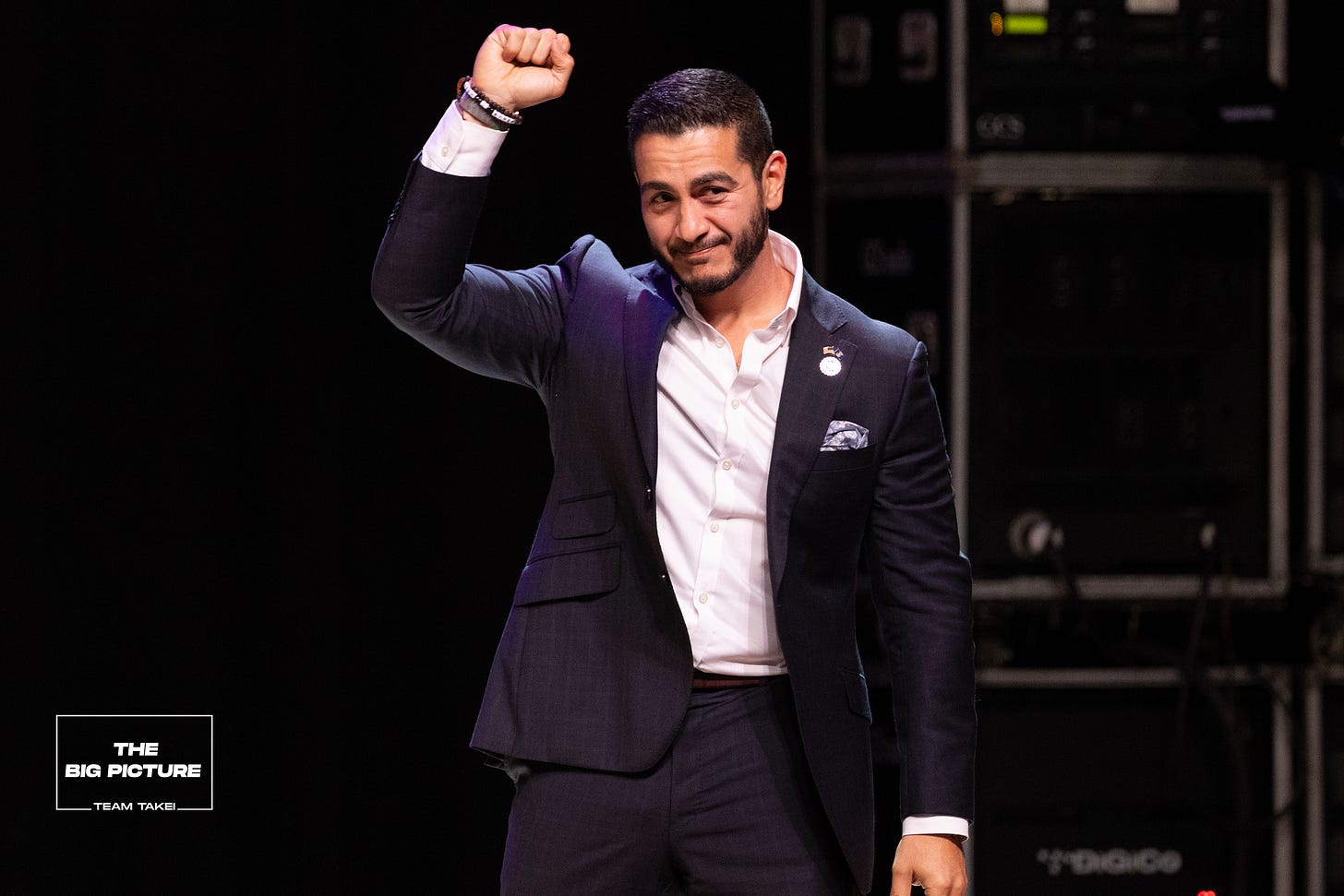 Democratic candidate for U.S. Senate Abdul El-Sayed speaks to supporters at an election-night rally. Photo by Scott Olson/Getty Images.
Abdul El-Sayed Narrowly Wins Michigan Democratic Senate Nomination
On Tuesday, Dr. Abdul El-Sayed emerged as the Democratic nominee for U.S. Senate for Michigan after defeating Rep. Haley Stevens by just one point. The result was much closer than most recent polls of the race had predicted. The American Israel Public Affairs Committee (AIPAC) whose support for Stevens over El-Sayed in the primary became a flashpoint in this race, suggested it may shift its support to Mike Rogers, the Republican in the general election, to keep El-Sayed out of the U.S. Senate. The Democratic establishment, which had broadly supported Stevens in the race, quickly coalesced around El-Sayed, with Stevens herself offering both a full-throated endorsement as well as a photo of the two of them hugging at a Michigan Democratic Party event. On Friday, Michigan Democrats were planning to hold a unity rally to solidify their commitment to their entire Democratic ticket in November.
The left’s track record was mixed on Tuesday. In Michigan’s 7th District, progressive William Lawrence won the Democratic nomination in Elissa Slotkin’s old district, and in MI-13, Sanders and AOC-endorsed Donavan McKinney unseated Rep. Shri Thanedar. In Tennessee, progressive Memphis State Rep. Justin Pearson won the primary for the U.S. House in Tennessee’s newly drawn 9th District. But in the St. Louis-anchored First District of Missouri, Rep. Wesley Bell handily defeated DSA-backed Cori Bush, who was challenging Bell for her old seat that he won in 2024. On the Republican side, Trump-endorsed Rep. Andy Ogles was defeated in the primary for his TN-05 seat by a candidate supported by Tennessee’s Governor Bill Lee. Meanwhile in Michigan’s 8th District, Trump-endorsed Amir Hassan, a Navy veteran and former law enforcement officer from Flint, Michigan, was easily defeated by Tom Smith, a candidate who had dropped out of the race in July. Smith will now return to the race to face Rep. Kristen McDonald Rivet, who is running for her second term representing the swing district in the U.S. House.
Donald Trump Enraged at Jeanine Pirro over Reflecting Pool Case
Last week, the Department of Justice acknowledged in a court filing that the damage to the Reflecting Pool was due to a “hasty and botched” renovation and dropped the charges it had filed against former Olympian David Hearn, whom it had accused of vandalizing the pool’s floor. Trump took to Truth Social on Saturday to declare that he disagreed with the decision of Jeanine Pirro—his hand-picked U.S. attorney for the District of Columbia—to drop the charges against Hearn, once again calling the damage “vandalism.” Then on Monday, Trump reportedly “laid into Pirro” and “read her the riot act” over her dropping the charges during a White House meeting.
-
Trump renews bid to fire Fed governor Lisa Cook despite supreme court ruling
www.theguardian.comWhite House continues to target Cook despite decision from justices that upheld Federal Reserve’s independence
Donald Trump is attempting once again to oust the US Federal Reserve governor Lisa Cook over allegations of mortgage fraud, despite a recent US supreme court decision that upheld the central bank’s independence.
Cook reportedly received a letter from the White House this week that provided notice, in accordance to the supreme court’s June ruling, that Trump was “considering removing” her from her Fed position over the same claims of mortgage fraud that he levied against her last summer.
Continue reading... -
Argentina’s government posts ICE-style video of immigration operation
www.theguardian.comSocial media video shows 60-year-old woman being led away in handcuffs, but she was released minutes later
The Argentinian government posted a video on social media showing a 60-year-old woman being led away in handcuffs by two federal police officers during an immigration operation in Buenos Aires.
The woman’s face is shown unblurred in the video, which has nearly 1m views and depicts one of hundreds of such operations carried out by the administration of the far-right president, Javier Milei, directly inspired by Donald Trump’s immigration crackdown in the US.
Continue reading... -
Trump Tyranny Tracker | Day 562: Aug 4, 2026
trumptyrannytracker.substack.com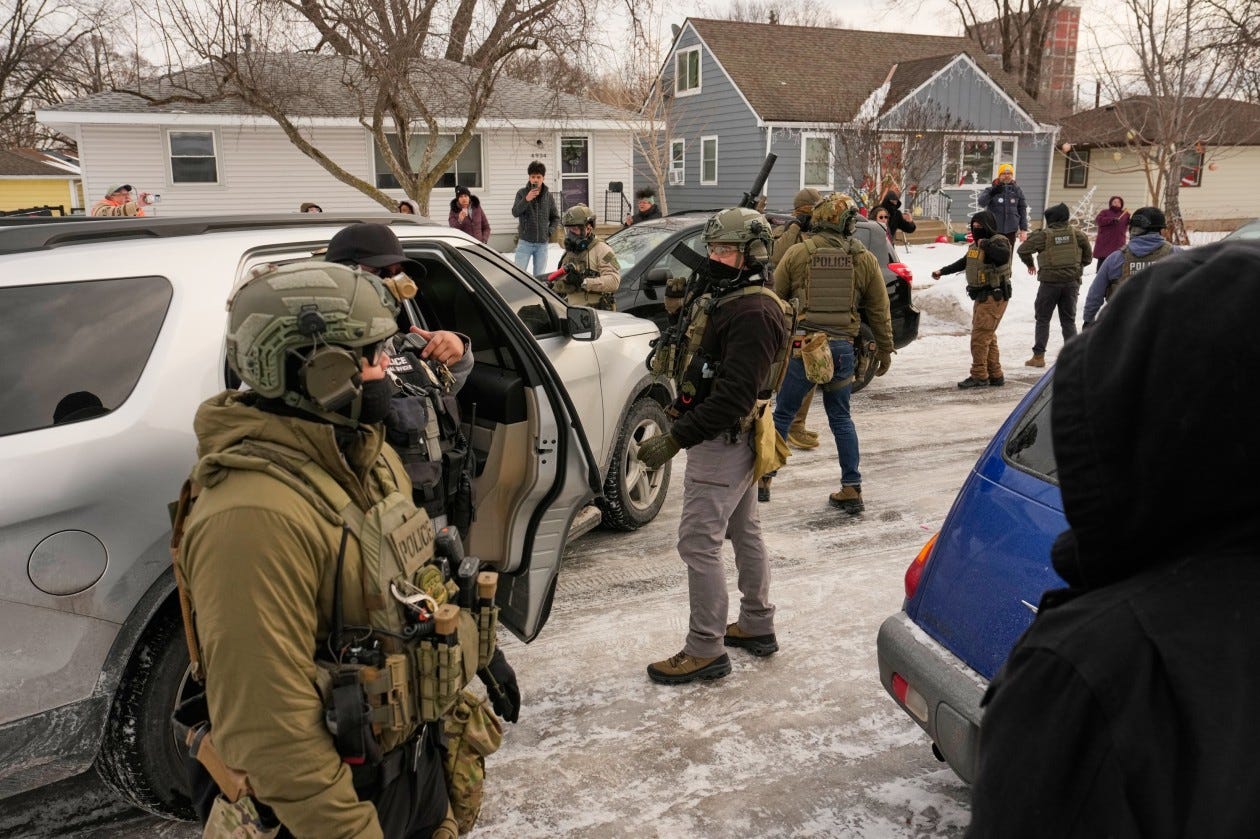 Federal immigration officers make an arrest as bystanders film the incident earlier this year in Minneapolis. (AP Photo/John Locher) John Locher/Associated Press
Welcome to today’s Trump Tyranny Tracker…
Trump’s regime is monitoring Americans’ social media, collecting DNA from children and people never convicted of crimes, and erasing the remaining Jan. 6 cases against Oath Keepers.
Today at a Glance
• ICE is building dossiers on U.S. citizens
• DOJ erased the remaining Jan. 6 charges against eight Oath Keepers insurrectionists
• Trump’s Iran war depleted close to 80% of U.S. THAAD interceptors
What We Need to Pay Attention To
How ICE Is Weaponizing Social Media Against Its Critics
What Happened: ICE expanded its surveillance program monitoring social media for threats and activity that could interfere with immigration enforcement. Contractors compile dossiers on people flagged by the system, including U.S. citizens, while DHS has issued hundreds of subpoenas to identify anonymous users and sent agents to question people over their posts.
Why It Matters: ICE is building dossiers on Americans, unmasking anonymous users, and sending agents to their homes over online speech. These are authoritarian tactics meant to make people afraid of criticizing the government and organizing to protest.
Source: Wall Street Journal
Corruption
US consumer watchdog supervisor warned staff of 'unpleasant' fallout if they go too hard on firms
What Happened: A top CFPB examiner warned staff of “most unpleasant” consequences if they were too aggressive while examining financial firms. Trump officials have also cut CFPB examinations in half and scaled back oversight of student loans, medical debt, and other areas.
Why It Matters: Trump is gutting the agency meant to protect Americans from financial abuse while intimidating the people responsible for policing banks and lenders. Less oversight means corporations can exploit consumers without consequences.
Source: Reuters
FCC Commissioners Face Ethics Complaints for Taking Luxury Gifts From Paramount
What Happened: FCC Chair Brendan Carr and Commissioner Olivia Trusty face ethics complaints for accepting expensive Kennedy Center tickets from Paramount while the FCC reviewed major deals involving the company. Carr has reported more than $75,000 in gifts from CBS or its parent company since 2017, while Trusty accepted two tickets from Paramount worth more than $12,000.
Source: ProPublica
Power Consolidation
US Sends Election Monitors to Four Michigan Cities for Primary
What Happened: Trump’s DOJ sent election monitors to four Michigan cities during the primary: Detroit, Hamtramck, Lansing, and East Lansing. The cities have large Black, Arab-American, Muslim, immigrant, and college student communities.
Why It Matters: Trump is pushing federal control deeper into elections ahead of the midterms, targeting mail voting and voter rolls while sending DOJ monitors into local elections. He continues to lay the groundwork to interfere in elections that will determine control of Congress.
Source: Bloomberg
Weaponization of Institutions
ICE Collected Nearly 1 Million People’s DNA Last Year—Including Young Children
What Happened: ICE collected around 920,000 DNA profiles for the FBI’s criminal DNA database in 2025, including people never convicted of a crime and children held with their families in immigration detention. Their DNA can be retained indefinitely.
Why It Matters: Hundreds of thousands of people never convicted of a crime, including children, are being placed in a permanent federal DNA database. History has repeatedly shown how dangerous government lists are.
Source: WIRED
Blanche deal leaves loopholes on ‘anti-weaponization’ fund, Trump immunity
What Happened: Senate Democrats say Todd Blanche’s agreement to eliminate Trump’s proposed $1.776 billion slush fund leaves loopholes allowing a similar payout scheme to return. The deal also leaves a sweeping order intact shielding Trump from federal investigations into his past conduct.
Why It Matters: Trump’s former personal lawyer is taking over DOJ while Trump, his family, and companies remain shielded from federal investigations into past conduct. The deal also leaves a path to revive a taxpayer-funded payout scheme for Trump criminals.
Source: The Hill
Judge Pained as He Grants Dismissal of Jan. 6 Charges Against Oath Keepers
What Happened: A federal judge granted Trump’s DOJ request to dismiss the remaining Jan. 6 charges against eight Oath Keepers, including Stewart Rhodes, wiping their records clean and effectively ending the largest criminal investigation in DOJ history. Judge Amit Mehta called the dismissals “unearned grace” that diminishes the gravity of Jan. 6.
Source: New York Times
States sue to block feds from sharing personal data of millions who receive social service benefits
What Happened: More than 20 states and Washington, D.C., sued to block a Trump rule allowing personal information from millions of low-income families receiving federal assistance to be shared across the government and potentially with private entities. The data includes Social Security numbers and immigration status.
Why It Matters: Information families were required to provide to receive government assistance could now be repurposed for surveillance and immigration enforcement. Government benefits should not become a backdoor for collecting and sharing sensitive information on millions of people.
Source: Associated Press
Media Suppression & Authoritarian Tactics
Trump vowed to ‘bring free speech back.’ Judges in 75 cases ruled that he has stifled it
What Happened: Federal judges have ruled against Trump in 75 First Amendment cases involving freedom of speech, religion, and the press. The cases include retaliation against universities and law firms, restrictions on journalists, punishment of pro-Palestinian speech, and excessive force against protesters.
Why It Matters: Trump’s government has lost 75 of 93 First Amendment cases decided during his second term. Courts are repeatedly finding the same thing: Trump is using government power to punish speech, journalists, protesters, and institutions he doesn’t like.
Source: Reuters
Human & Civil Rights Abuses
Salvadoran man complained of access to medication before death at NJ immigration jail, family says
What Happened: Edwin Lopez-Cornejo died after a medical emergency while detained at Delaney Hall in New Jersey. His family says he had diabetes, high blood pressure, and seizures and was not receiving access to his medications. The day before his death, he told his mother he had lost feeling in half his face and arm.
Why It Matters: Lopez-Cornejo reportedly went without regular medication and described alarming medical symptoms the day before he died in ICE custody. His family is demanding an independent investigation into whether medical neglect contributed to his death.
Source: Associated Press
ICE arrests hit record high in July as enforcement quietly ramps up
What Happened: ICE arrested 51,000 people in July, the highest monthly total in DHS history, as enforcement quietly expanded across the country. Some of those detained had no criminal records and held valid work authorization or parole documents.
Source: ABC News
As For-Profit Companies Battle Over ICE Contracts, Immigrants Are Caught in the Middle
What Happened: Private contractors are competing for hundreds of millions of dollars in Trump immigration contracts, including a self-deportation contract worth up to $915 million. Companies are profiting from detention, deportation flights, food, laundry, and other services as ICE rapidly expands.
Why It Matters: Trump’s mass deportation operation isn’t only built on cruelty and human rights abuses. It has become a profit machine, with private companies making more money as more people are detained and deported.
Source: Mother Jones
University of Maryland ‘teacher of the year’ detained by ICE in Texas
What Happened: ICE detained University of Maryland pharmacy instructor Berhanu Kibret at Dallas-Fort Worth airport as he returned from a conference where he received a “teacher of the year” award. DHS says he overstayed his visa, while the university says he has valid work authorization. He has no reported criminal convictions.
Source: The Guardian
Government Disruption
Nearly 80% of interceptors for a key missile defense system depleted, sources say
What Happened: The U.S. military has depleted nearly 80% of its THAAD interceptors and roughly half of its Patriot interceptors since the Iran war began, with senior commanders warning that stockpiles are “dangerously low.” The Army has also used virtually all of its highly accurate long-range surface-to-air weapons.
Why It Matters: Trump’s war with Iran is burning through some of America’s most critical missile defenses. The U.S. now has fewer interceptors to protect American troops, defend allies, or respond to other crises.
Source: CNN
US State Department to close consulates in Canada, Japan and Indonesia, sources say
What Happened: The State Department plans to close U.S. diplomatic posts in Canada, Japan, Indonesia, Cameroon, and Grenada, following earlier plans to shutter nearly a dozen other missions. The White House budget office had pushed for closing as many as 30 posts as Trump shrinks America’s diplomatic presence abroad.
Source: Reuters
Imperial & Geopolitical Watch
Iran Sees US as Weak After Trump Backs Off Strikes, CSIS Says
What Happened: Iran believes it has the upper hand after Trump repeatedly threatened major military strikes and then backed down. Tehran has interpreted Trump’s repeated threats without follow-through as American weakness.
Source: Bloomberg
U.S. Revokes Brazilian Ambassador’s Visa Amid Diplomatic Standoff
What Happened: Trump officials revoked the visa of Brazil’s ambassador to Washington as tensions escalate ahead of Brazil’s October presidential election. The move follows 50% U.S. tariffs and sanctions imposed amid Trump’s accusations that Brazil is unfairly targeting former President Jair Bolsonaro and other conservatives.
Why It Matters: Trump is using U.S. tariffs, sanctions, and diplomatic pressure to punish Brazil for going after Bolsonaro and his allies. He is using American power to interfere in another country’s election and protect his far-right allies
Source: Wall Street Journal
Far-Right & Russian Influence Watch
Oh Look, Another Far-Right Extremist at the Pentagon
What Happened: Justin Overbaugh, a Pentagon official overseeing defense intelligence and security agencies, has repeatedly promoted Christian nationalist and far-right figures and ideas. He has praised Christian nationalist Stephen Wolfe, promoted Doug Wilson’s church network, supported Germany’s far-right AfD and British anti-Islam extremist Tommy Robinson, and advocated for government-endorsed Christianity.
Why It Matters: A Pentagon official overseeing U.S. intelligence and security agencies is openly promoting Christian nationalism and far-right movements. Extremist ideology continues to be normalized inside the institutions responsible for national security and across the federal government.
Source: Mother Jones
Economic News
US job openings fall as healthcare vacancies post largest drop in 11 months
What Happened: U.S. job openings fell by 178,000 in June to 7.36 million, with healthcare and social assistance recording its largest drop in available jobs in nearly a year. The decline comes as Americans continue facing elevated inflation and economic uncertainty.
Source: Reuters
Resistance
Check out 50501 for local and nationwide events…
Source: 50501
Appeals Court Says E.P.A. Cannot Block Billions in Climate Grants
What Happened: A federal appeals court ruled that Trump’s EPA cannot terminate $20 billion in climate grants that it froze early last year over allegations of waste and fraud. Investigations by the EPA inspector general, Justice Department, and FBI never substantiated those allegations.
Source: New York Times
By the Numbers
$75,000+ — Gifts FCC Chair Brendan Carr has reported receiving from CBS or its parent company since 2017.
8 — Oath Keepers whose remaining Jan. 6 charges Trump’s DOJ erased, including leader Stewart Rhodes.
920,000 — DNA profiles ICE added to the FBI’s criminal database in 2025, including children and people never convicted of crimes.
75 of 93 — First Amendment cases Trump’s regime has lost during his second term.
51,000 — ICE arrests in July, the highest monthly total in DHS history.
Nearly 80% — Share of U.S. THAAD interceptors depleted since Trump’s war with Iran began.
50% — Share of U.S. Patriot interceptors depleted since the Iran war began.
$915 million — Potential value of a private contract tied to Trump’s self-deportation program.
$1.776 billion — Size of Trump’s proposed slush fund, which could return in another form.
20+ states — Suing to stop sensitive information on millions of low-income families from being shared across the federal government.
What to Watch Next
ICE surveillance is expanding beyond immigration enforcement — How far will DHS go in monitoring Americans, unmasking anonymous accounts, and sending agents to question people over political speech?
Trump is pushing federal power deeper into elections — What role will DOJ play in the midterms as Trump targets mail voting, voter rolls, and sends federal monitors into local elections?
The government is building massive databases on people who committed no crimes — Will courts stop ICE from permanently storing DNA and block the government from sharing sensitive benefits data?
Trump’s Iran war is draining U.S. missile defenses — What happens if another crisis erupts while THAAD, Patriot, and other interceptor stockpiles are dangerously low?
The deportation industry is becoming big business — How much more taxpayer money will flow to private companies as ICE arrests and detention continue to surge?
Key Takeaways
Mass Surveillance — ICE is building dossiers on Americans, collecting DNA from children and people never convicted of crimes, and the government is seeking broader access to sensitive personal data.
Speech Suppression — Trump has lost 75 of 93 First Amendment cases while ICE monitors online speech and federal power is used against critics, protesters, journalists, and institutions.
Deportation Profits — ICE arrests reached a record 51,000 in July while private companies compete for hundreds of millions of dollars from Trump’s expanding detention and deportation operation.
Extremism Normalized — Trump’s DOJ erased the remaining Oath Keepers cases while a Pentagon official overseeing intelligence and security openly promotes Christian nationalism and far-right extremist movements.
Defenses Depleted — Trump’s Iran war has burned through nearly 80% of U.S. THAAD interceptors and roughly half of Patriot interceptors while Iran views his threats as weakness.
Call to Action
Document Everything: Document purges, corruption, and power grabs. Share credible information with journalists, watchdogs, and legal experts. Silence enables authoritarianism—see something, say something.
Defend Press Freedom: Support independent journalism by subscribing to and sharing reporting that challenges Trump’s power grab.
Contact Lawmakers: Demand accountability for Trump’s unchecked power and war on oversight.
Mobilize for Action: Organize or join legal efforts and resistance movements to protect democracy and human and civil rights.
Thanks for reading the Trump Tyranny Tracker. Stay tuned for more updates.
-
Appeals court halts construction of Trump’s $400m White House ballroom
www.theguardian.comRuling put on hold for two weeks, allowing administration to appeal to US supreme court
A US federal appeals court has ordered the Trump administration to halt construction of the US president’s $400m White House ballroom, in a fresh blow to the controversial project.
Donald Trump, who demolished the historic East Wing of the White House last year to make way for planned ballroom, has repeatedly touted it as “a gift” to the US people.
Continue reading... -
The Nuclear Bomb Hidden in Trump’s Immunity Decision
emptywheel.net
Trump v. US did more than give Trump immunity for his past crimes. It endorsed the idea that the President could personally intervene in any prosecution at DOJ. And the US Attorney for Chicago just relied on that part of the SCOTUS precendent in the Broadwater 6 case.The post The Nuclear Bomb Hidden in Trump’s Immunity Decision appeared first on emptywheel.
-
Washington Policy Review: August 6, 2026
washingtonpolicyreview.substack.comToday’s Report
1. Overview
2. White House News
3. Truth Social Posts
4. Government Department News
5. 2028 Democratic Presidential Candidates
6. AI & Tech Company News
7. Congressional Watch
8. Policy Impact Analysis & Heatmap
1. Overview
President Trump signed two executive orders aimed at curtailing “birth tourism” and safeguarding American citizenship, a move he described as essential to protecting the nation’s integrity from “malign foreign actors.” Additionally, he issued a proclamation establishing a new tariff program on polysilicon imports, asserting that domestic production is critical to U.S. national security. The administration also launched fraud.gov, a new platform designed to track the Task Force to Eliminate Fraud’s efforts to recover illicit payments and “crush criminal networks.” Finally, the President proclaimed August 7, 2026, as National Purple Heart Day to honor combat-wounded service members.
On Truth Social, President Trump endorsed State Senator Brent Taylor for Congress while criticizing procedural efforts by Michigan candidate Abdulrahman Mohamed El-Sayed to terminate the filibuster, which Trump warned could lead to “Democrats packing the Supreme Court.” He promoted reports regarding his administration’s ability to utilize new tariff weapons against nations he claimed were “ripping off” America, while also circulating an article asserting he “Won The Iran War.” Furthermore, Trump defended Secretary Pete Hegseth against media reports, labeling the coverage “treasonous” and praising Hegseth for “historic recruitment gains” and the removal of DEI initiatives.
The State Department announced $2 billion in partnerships with faith-based organizations to provide humanitarian aid, alongside new sanctions on entities supporting the Cuban military. The Department of War awarded multiple defense contracts, including a $699 million agreement for petroleum infrastructure and $44.4 million for robotic systems. HHS Secretary Robert F. Kennedy, Jr. proposed reforms to Head Start programs, intending to “remove unnecessary bureaucracy” and shift oversight to state governments. Treasury Secretary Scott Bessent addressed Arizona bankers, emphasizing the need to combat financial abuse by “illicit actors” and criticizing regulations he suggested were “too small to succeed.”
Several Democratic governors issued statements challenging the Trump administration’s economic and regulatory agenda. Governor Newsom condemned an FCC decision regarding broadcast media ownership, characterizing it as an attempt to establish a “propaganda machine for his MAGA agenda.” Governor Whitmer released reports criticizing federal tariffs as “irresponsible” and “erratic,” while Governor Pritzker formally demanded tariff relief for Illinois families, arguing that while large corporations receive billions in refunds, households remain burdened by the President’s “reckless trade policies.” Conversely, Governor Moore announced a new partnership to secure the future of the Preakness Stakes, and Governor Beshear expanded a pre-K pilot program while regulating data center energy usage.
OpenAI announced a partnership with the American Psychological Association to integrate psychological science into AI tools, focusing on creating “safe, age-appropriate” experiences for youth that prioritize real-world relationships. NVIDIA introduced its “Cosmos 3” open model family to advance physical AI, enabling vision systems and robots to better understand and simulate physical environments. These initiatives reflect broader industry efforts to ground AI development in evidence-based research and facilitate specialized hardware deployment.
On August 5, 2026, the Senate confirmed Erica Schwartz as Director of the CDC in a 51-44 vote and passed the Northern Border Security Enhancement and Review Act. Senators also rejected a resolution to disapprove an EPA rule on PFAS reporting in a 48-50 vote. Meanwhile, various committees advanced measures, including child internet safety requirements in the Commerce Committee and land-into-trust measures in the Indian Affairs Committee. The House of Representatives was not in session, with no legislative actions recorded for the chamber.
The administration’s strategic shift toward domestic industrial reshoring through heightened tariff protections for critical inputs aims to bolster the defense sector, though these mandates simultaneously introduce margin compression risks for high-tech firms facing increased production costs. Concurrently, the deregulation of broadcast ownership rules serves as a catalyst for media consolidation by facilitating greater operational scale, even as these shifts invite potential legal challenges from entities characterizing the policy as a threat to “democratic safeguards.” Furthermore, executive orders restricting immigration pathways are expected to tighten labor supplies, potentially driving up operational expenses and curbing long-term consumption growth across industries heavily reliant on an international workforce.
2. White House News
Fact Sheet: President Donald J. Trump Ends Birth Tourism and Protects the Meaning and Value of American Citizenship
President Trump signed two Executive Orders aimed at safeguarding American citizenship following the *Trump v. Barbara* case. Describing the privilege of U.S. citizenship as a “priceless and profound gift,” the administration intends to end “birth tourism” and protect the meaning of citizenship. These actions reflect the President’s commitment to “fix the immigration system, prioritize American citizens, and protect U.S. citizenship.” By implementing these measures, President Trump seeks to fulfill his promise to put Americans first and restore integrity to the nation’s immigration processes.
Reference: https://www.whitehouse.gov/fact-sheets/2026/08/fact-sheet-president-donald-j-trump-ends-birth-tourism-and-protects-the-meaning-and-value-of-american-citizenship/
Continuing to Protect the Meaning and Value of American Citizenship
President Trump issued an executive order to restrict birthright citizenship, citing the Supreme Court’s ruling in *Trump v. Barbara*. The order prohibits federal agencies from recognizing citizenship for children of non-citizen parents if the parents are “alien enemies,” foreign government employees, engaged in fraudulent activity, or involved in commercial transactions to access birthright citizenship. President Trump states the policy aims to guard against “malign foreign actors who attempt to swindle American citizens.” Relevant agencies must update regulations and issue implementation guidance within 30 days to ensure compliance.
Reference: https://www.whitehouse.gov/presidential-actions/2026/08/continuing-to-protect-the-meaning-and-value-of-american-citizenship/
Ending Birth Tourism
President Trump issued an executive order to curb “birth tourism,” defined as entering the U.S. on a nonimmigrant visa to give birth. Stating that “citizenship is not a commodity to be acquired through calculated exploitation,” the President directed the Secretaries of State and Homeland Security to implement policies preventing such entry. The order allows for visa revocations, entry denials, and actions against facilitators of these schemes. While aiming to maintain immigration system integrity, the directive permits exemptions based on humanitarian grounds or the national interest.
Reference: https://www.whitehouse.gov/presidential-actions/2026/08/ending-birth-tourism/
Fact Sheet: President Donald J. Trump Bolsters National Security and Strengthens U.S. Supply Chains by Imposing Tariffs on Polysilicon and its Derivatives
President Trump signed a proclamation establishing a polysilicon tariff program to protect the United States’ industrial base and supply chain from imports he stated “threaten national security.” This initiative aims to defend the nation’s defense-adjacent sectors, building on the President’s “record of securing critical industries.” By targeting polysilicon, the administration seeks to bolster domestic economic strength, asserting that “America’s national security and economic strength depend on rebuilding key sectors of our industrial base” to ensure long-term resilience against foreign market pressures.
Reference: https://www.whitehouse.gov/fact-sheets/2026/08/fact-sheet-president-donald-j-trump-bolsters-national-security-and-strengthens-u-s-supply-chains-by-imposing-tariffs-on-polysilicon-and-its-derivatives/
Adjusting Imports of Polysilicon and its Derivatives into the United States
President Trump issued a proclamation declaring that polysilicon imports “threaten to impair the national security of the United States.” Citing declining domestic production and foreign market distortions, the President established a minimum import price (MIP) program for polysilicon and its derivatives, alongside a 15 percent ad valorem duty on downstream products effective December 4, 2026. The order also mandates an onshoring program, authorizing the Secretary of Commerce to incentivize companies to build domestic production facilities, thereby aiming to “revitalize the United States polysilicon sector.”
Reference: https://www.whitehouse.gov/presidential-actions/2026/08/adjusting-imports-of-polysilicon-and-its-derivatives-into-the-united-states/
National Purple Heart Day, 2026
President Trump proclaimed August 7, 2026, as National Purple Heart Day to honor service members wounded or killed in combat, describing recipients as having displayed “valor beyond measure.” The President emphasized that his administration has “rebuilt our military into the strongest and most lethal fighting force in the world” and touted efforts to strengthen the Department of Veterans Affairs by slashing backlogs and providing financial relief. Trump concluded by calling on Americans to recognize the “courage and sacrifice” of veterans and their families who secured the nation’s freedom.
Reference: https://www.whitehouse.gov/presidential-actions/2026/08/national-purple-heart-day-2026/
Private Sector Answers President Trump’s Call to Lower Prices for American Families
President Trump is addressing an economy he describes as “battered by years of inflation that crushed working families.” His administration is implementing policies to “restore American energy dominance, slash red tape, and secure fair trade” to promote prosperity. These efforts are reportedly yielding results, with private sector companies, major retailers, and energy providers cutting prices on essential goods and services. Furthermore, President Trump’s “Most Favored Nation approach” has secured commitments from major drugmakers to align U.S. prescription costs with lower international rates, while automakers aim to improve vehicle affordability.
Reference: https://www.whitehouse.gov/releases/2026/08/private-sector-answers-president-trumps-call-to-lower-prices-for-american-families/
Fraud.gov: Track the Trump Administration’s Relentless War on Fraud
President Trump and Vice President JD Vance have launched fraud.gov, a website tracking the White House Task Force to Eliminate Fraud’s efforts to “shut off the money, crush criminal networks, and deliver swift justice.” The administration reports that the Task Force has uncovered nearly $230 billion in fraud, prevented $56 billion in illicit payments, and secured significant legal recoveries. Asserting that “the era of unchecked fraud is over,” the administration states it will continue to expose schemes and return recoverable funds to the American people to restore public trust.
Reference: https://www.whitehouse.gov/releases/2026/08/fraud-gov-track-the-trump-administrations-relentless-war-on-fraud/
3. Truth Social Posts
Trump endorsed State Senator Brent Taylor for Tennessee’s 9th Congressional District, highlighting his background as a businessman and his commitment to core party issues like border security, energy dominance, and election integrity. Regarding legislative strategy, he remarked on the irony of sharing a common goal with Michigan Senate candidate Abdulrahman Mohamed El-Sayed regarding the termination of the filibuster. Trump cautioned his Republican colleagues that El-Sayed’s push for this procedural change is “gone Termination CRAZY,” warning that success would lead to the Democrats packing the Supreme Court and potentially rendering him the “last Republican President.”
On the economic and foreign policy front, Trump promoted reports concerning his allies’ efforts to equip the executive branch with a new tariff weapon intended to punish nations he describes as “ripping off” America. Furthermore, he circulated an article asserting that he successfully “Won The Iran War.”
Addressing domestic media coverage, Trump dismissed rumors regarding Secretary Pete Hegseth as “false and completely unfounded,” characterizing the Washington Post’s reporting as “treasonous.” He expressed total satisfaction with Hegseth’s leadership, specifically noting historic recruitment gains, the removal of DEI initiatives, and successful military operations in Venezuela and Iran, the latter of which he stated has been “decimated for the purpose of NOT ALLOWING IT TO EVER HAVE A NUCLEAR WEAPON.”
Reference: https://truthsocial.com/@realDonaldTrump
4. Government Department News
State Department (state.gov)
The U.S. announced nearly $2 billion in partnerships with faith-based organizations to provide global health and humanitarian aid, the largest such allocation in over 20 years. This includes $1.4 billion for integrated health services in over 20 countries through partners like World Vision and $538 million in humanitarian response funding for Samaritan’s Purse and others. The initiative aims to leverage faith-based networks to improve healthcare delivery and crisis response, with at least 80% of resources dedicated to frontline services to reach those in need without “bureaucratic delay.”
Welcoming Talks in Caracas to Advance Venezuela’s Political Transition
The U.S. welcomes the arrival of a delegation from Venezuela’s 2015 National Assembly in Caracas for in-person talks with the interim government. These discussions seek to address the needs of those impacted by recent earthquakes and advance political freedoms. The U.S. continues to support this process as a critical component of President Trump’s three-phase plan for the country’s stabilization, economic recovery, and political reconciliation.
Targeting Enablers of the Cuban Regime’s Arms Imports and Foreign Military Cooperation
The Trump Administration sanctioned five entities and eight individuals involved in procuring military equipment for the Cuban Ministry of the Revolutionary Armed Forces. The State Department described the Cuban regime as a “state sponsor of terrorism” that provides support to radicals and hosts adversaries. Secretary of State Rubio stated that the U.S. will use all available tools to address these national security threats, asserting that “the United States will not tolerate a rogue state harboring hostile foreign military, intelligence, and terror operations just ninety miles from the American homeland.”
United States to Host Ministerial Launch Event for IAEA’s Maritime Nuclear Initiative in Washington
The U.S. will host an International Atomic Energy Agency (IAEA) forum in Washington from August 26-27, 2026, to launch the Atomic Technologies Licensed for Applications at Sea (ATLAS) initiative. The event aims to advance the deployment of civil nuclear energy in maritime transport, including the use of floating nuclear power plants. This effort aligns with President Trump’s pledge to “revitalize innovation in nuclear technologies” and expand global access to reliable nuclear power while addressing legal, regulatory, and safety challenges.
The U.S. congratulated Jamaica on its 64th anniversary of independence. The State Department reaffirmed its commitment to the bilateral partnership, focusing on regional stability, recovery from Hurricane Melissa, and collaborative efforts to combat transnational organized crime and illegal immigration.
The U.S. extended congratulations to President Rodrigo Paz and the people of Bolivia on their 201st Independence Day. The State Department noted that this is the first such celebration in nearly two decades marked by a “truly renewed partnership” between the two nations. The administration highlighted Bolivia’s membership in the “Shield of the Americas” and its commitment to working with President Paz to foster security and prosperity across the Western Hemisphere.
Department of War (war.gov)
The Department of War announced multiple contract awards. Notable actions include a $699 million multiple-award contract for design-build services supporting petroleum infrastructure, and a $127 million architect-engineering contract for Naval Facilities Engineering Systems Command. Teledyne FLIR Unmanned Ground Systems received $44.4 million for robotic system software sustainment. Additional contracts were awarded to GEM Building Contractors for maintenance facility construction ($26 million), Luxfer Magtech for chemical agent detector kits ($10 million), and World Wide Technology for expeditionary IT hardware ($14.9 million).
Department of Health and Human Services (hhs.gov)
HHS Unveils Proposed Head Start Reforms to Expand Access and Empower Parents
HHS has proposed a new rule, “Reducing Federal Burden for Head Start Programs,” to support President Trump’s vision of expanding access and reducing administrative red tape. HHS Secretary Robert F. Kennedy, Jr. stated the proposal intends to “remove unnecessary bureaucracy” and “trust parents and local communities.” The rule aims to preserve or expand 236,000 slots and save $2.2 billion by shifting oversight to states, emphasizing whole-food nutrition, and capping administrative costs. The proposal is open for public comment for 60 days.
Treasury Department (home.treasury.gov)
Remarks from Secretary of the Treasury Scott Bessent at Event with Arizona Bankers in Phoenix
Treasury Secretary Scott Bessent addressed community bankers in Phoenix, emphasizing their critical role in small-business lending and economic growth. He criticized post-crisis regulations for hindering community banks, stating they created a climate that is “too small to succeed.” Bessent outlined the administration’s efforts to secure the financial system, specifically regarding illegal immigration. He highlighted new Treasury and OCC guidance aimed at preventing financial abuse by illicit actors, urging banks to increase vigilance to ensure financial services are not used to facilitate unlawful conduct.
5. 2028 Democratic Presidential Candidates
Gavin Newsom (gov.ca.gov)
Governor Newsom proclaims State of Emergency in Calaveras County for the Gann Fire response
Governor Newsom proclaimed a State of Emergency in Calaveras County due to the Gann Fire, which has burned over 10,300 acres since August 3, 2026. The fire has resulted in one fatality, forced over 1,400 evacuations, and threatens critical infrastructure. The proclamation authorizes state agencies to expedite resources and coordinate with local partners. California has also secured a Fire Management Assistance Grant from FEMA to aid suppression efforts. Over 2,700 personnel are currently deployed to contain the blaze amidst high fire danger conditions.
Governor Newsom announces appointments
Governor Newsom announced several new appointments to state boards. Kaitlan Sakuma was appointed to the California Student Aid Commission. Additionally, Autumn Ragone, Fabian Molina, Leilani Wong, and Eunice Kingsley Abel were appointed to the Youth Empowerment Commission. These roles serve various functions in state advocacy and student support, with terms and compensation requirements varying by position.
Governor Newsom signs legislation 8.6.2026
Governor Newsom signed two bills into law: AB 1919, concerning the Santa Cruz Metropolitan Transit District’s voter-approved tax initiatives, and AB 1923, regarding local ballot measures in Fresno County. The full text for both pieces of legislation is available through the California Legislative Information website.
Trump’s FCC illegally axes limits that protect Americans from broadcast media conglomerates
Governor Newsom issued a statement condemning the Federal Communications Commission for weakening broadcast media ownership protections. He characterized the action as a move by the Trump administration to “chip away at the foundations of our democracy” and establish a “propaganda machine for his MAGA agenda.” Newsom argued that the decision flouts congressional limits on media monopolies, stating that the move “will make it easier for Trump, through his proxies and toadies, to control what Americans see, hear, and read.”
Governor Newsom is urging the public to oppose a federal review of California’s Coastal Management Program. The Governor claims the Trump administration seeks to force “reckless offshore oil extraction to pad the wallets of his corrupt oil cronies.” The state has formally submitted comments opposing the review, which follows a critique by Commerce Secretary Howard Lutnick. The Governor warns the federal push threatens the state’s $51 billion coastal economy and encourages residents to submit comments during the designated public input period.
Gretchen Whitmer (michigan.gov)
Gov. Whitmer Shares Alarming Impact of DC Republicans’ Tariffs on Michigan in New Reports
Governor Whitmer released state reports detailing the negative economic impact of federal tariffs implemented by the Trump Administration. The analysis cites increased costs for families, higher grocery and gas prices, and rising expenses for state construction and procurement projects. Whitmer, alongside Attorney General Dana Nessel, is currently suing the administration over these trade policies. State officials characterized the tariffs as “irresponsible” and “erratic,” warning that they disrupt trade relationships, hurt the agricultural sector, and weaken Michigan’s long-term economic competitiveness.
Wes Moore (governor.maryland.gov)
Governor Moore announced a new schedule and media rights partnership for the Preakness Stakes and Black-Eyed Susan races following the state’s acquisition of the event’s intellectual property. State and industry leaders, including local government officials and legislative members, expressed support for the changes. Proponents state the move will strengthen the national profile of the races, secure the future of the thoroughbred industry, and provide economic benefits to the Park Heights community and the broader Maryland economy through a long-term deal with NBC Sports.
Governor Moore has nominated Kevin Sexton to serve as Chair of the Maryland Health Services Cost Review Commission. Sexton, who previously served on the commission for eight years and as CEO of Holy Cross Hospital, is tasked with overseeing the state’s hospital rate-setting framework and advancing health system models like AHEAD. Industry groups, including the Maryland Hospital Association and MedChi, lauded the nomination, citing Sexton’s experience and collaborative approach as essential for ensuring high-quality, affordable healthcare access for all Marylanders.
Andy Beshear (governor.ky.gov)
Gov. Beshear Provides Team Kentucky Update
Governor Beshear announced economic investments, including over $5.2 million for local infrastructure through the Kentucky Product Development Initiative and $748,620 in matching grants for technology companies. New facility openings and expansions by Artisans Inc., ADM, KOI Superior Walls, and ISCO Industries are creating hundreds of jobs. Additionally, the Governor signed an executive order regulating data centers, mandating that developers submit energy plans, ensuring fair tax contributions, and prohibiting utility companies from raising rates to cover development costs associated with these projects.
Gov. Beshear Expands Pre-K Pilot Program to Dawson Springs
Governor Beshear announced the expansion of the Team Kentucky Pre-K Pilot Program to the Dawson Springs Independent School District, marking the fifth district to join the initiative. This expansion serves over 160 children, providing full-day early education to ensure school readiness. The program, which has received broad support from business leaders and school superintendents, is part of a phased effort to increase state-wide childcare access. Since May, the administration has increased childcare capacity for nearly 3,000 children across the commonwealth.
JB Pritzker (gov.illinois.gov)
Gov. Pritzker Announces Regional Site Readiness Program Grant Awards
Governor Pritzker and the Illinois Department of Commerce and Economic Opportunity awarded $35 million to 22 sites through the Regional Site Readiness Program. The funding includes 11 planning grants for studies and 11 capital grants for infrastructure like roads and utilities. Part of a broader $500 million FY2026 initiative, these grants aim to remove barriers to industrial development, increase speed-to-market for business projects, and attract private investment to communities across Illinois. To date, the state has provided $115 million to support 63 site-readiness projects.
Governor Pritzker sent a letter to President Trump demanding tariff relief for Illinois families, noting that while large corporations have received billions in refunds following a Supreme Court ruling, working families have received nothing. Pritzker previously invoiced the administration for $8.6 billion—representing $1,700 per Illinois household—to offset costs caused by what he terms the administration’s “unlawful tariffs.” Pritzker argued that while wealthy corporations have been compensated, Illinois families remain burdened by the “reckless trade policies” of the President.
6. AI & Tech Company News
OpenAI (openai.com)
Working with the American Psychological Association on youth mental health and AI
OpenAI is partnering with the American Psychological Association (APA) to integrate psychological science into the development of AI tools for young people. This collaboration aims to create “safe, age-appropriate” experiences that reinforce real-world relationships rather than replacing them. Initiatives include developing resources for parents and clinicians, establishing practical safeguards, and convening experts to address youth mental health needs. The project focuses on ensuring AI tools provide support during moments of distress while preventing overreliance and promoting healthy usage patterns grounded in evidence-based research.
NVIDIA (nvidia.com)
Into the Omniverse: How Open World Models Push the Frontier of Physical AI
NVIDIA is advancing physical AI through its new Cosmos 3 open model family, designed to help robots, autonomous vehicles, and vision systems understand and predict physical environments. By utilizing a mixture-of-transformers architecture, Cosmos 3 enables vision reasoning, world simulation, and action prediction. The model is available under the OpenMDW 1.1 license, allowing developers to specialize the technology for specific hardware. Integrated with NVIDIA Omniverse and OpenUSD, the platform supports the creation of simulation-ready environments, reducing the need for costly real-world data collection.
7. Congressional Watch
Covers the 2026-08-05 session — the Congressional Record is published with a one-day delay.
Senate
The Senate focused on a mix of nominations and legislative business, including advancing measures related to northern border security and African trade. Senators also conducted several committee hearings and business meetings covering topics such as Social Security solvency, artificial intelligence safety, and various judicial and executive nominations.
Erica Schwartz, Director of CDC — Confirmed to lead the Centers for Disease Control and Prevention [Passed 51-44 (Vote No. 220)]
S. 850, Northern Border Security Enhancement and Review Act — Requires updates to northern border threat analysis and strategy [Passed by voice vote]
S.J. Res. 187 — Disapproves an EPA rule regarding PFAS reporting and recordkeeping [Failed 48-50 (Vote No. 222)]
En bloc nominations — Agreement to proceed with a package of nominations under S. Res. 817 [Passed 50-44 (Vote No. 221)]
H.R. 6500, AGOA Extension Act — Extends African trade preferences and customs user fees [Cloture motion filed for August 7]
House of Representatives
The House of Representatives was not in session today. It is scheduled to convene for a pro forma session on Thursday, August 6, 2026.
None — No legislative action taken as the House was not in session [N/A]
Committee Highlights
Senate Commerce, Science, and Transportation — Approved legislation regarding child internet safety and AI chatbot design requirements
Senate Finance — Examined policy approaches for maintaining Social Security solvency
Senate Indian Affairs — Approved several land-into-trust measures and examined the growth of prediction markets
Senate Foreign Relations — Held hearings on ambassadorial nominations and received an intelligence briefing on the war in Sudan
Senate Judiciary — Held hearings on judicial and Department of Justice nominations and examined the Muslim Brotherhood network
Coming Up
The Senate will continue consideration of en bloc nominations on August 6, 2026, with roll call votes expected. The House will meet in a pro forma session on the same day.
Reference: Congressional Record Archive
8. Policy Impact Analysis & Heatmap
This analysis is provided for informational purposes only. It does not constitute investment advice or a recommendation to buy or sell any security.
Impact on Market
Based on today’s policy developments, our analysis identifies the following market impact themes:
THEME 1. INDUSTRIAL RESHORING AND INPUT COSTS
The administration is prioritizing the expansion of domestic production capacity through tariff protection and minimum price mandates. By targeting critical inputs like polysilicon, the government aims to insulate the defense industrial base from foreign market volatility. However, this creates significant cost headwinds for high-tech sectors that utilize these materials. Bearish risks include potential retaliatory trade measures and supply chain bottlenecks that could compress margins for domestic technology firms.
THEME 2. MEDIA SECTOR DEREGULATION
The FCC’s move to relax broadcast ownership rules creates a clear path for industry consolidation and increased scale. This environment benefits larger media conglomerates seeking to optimize operations and capture market share through acquisition. Critics argue that these actions threaten democratic safeguards by centralizing information control. The primary risk remains increased regulatory scrutiny and legal challenges from state-level opposition figures who view this deregulation as politically motivated.
THEME 3. IMMIGRATION RESTRICTIONS AND LABOR SUPPLY
The executive orders targeting birthright citizenship and birth tourism reflect an aggressive stance on immigration policy. These measures aim to restrict specific entry pathways, which may tighten labor supplies in sectors reliant on migrant and international populations. Concerns persist that these policies could inadvertently dampen long-term consumption growth and heighten operational costs for businesses that depend on a broad, accessible workforce.
Policy Impact Heatmap with Market Direction
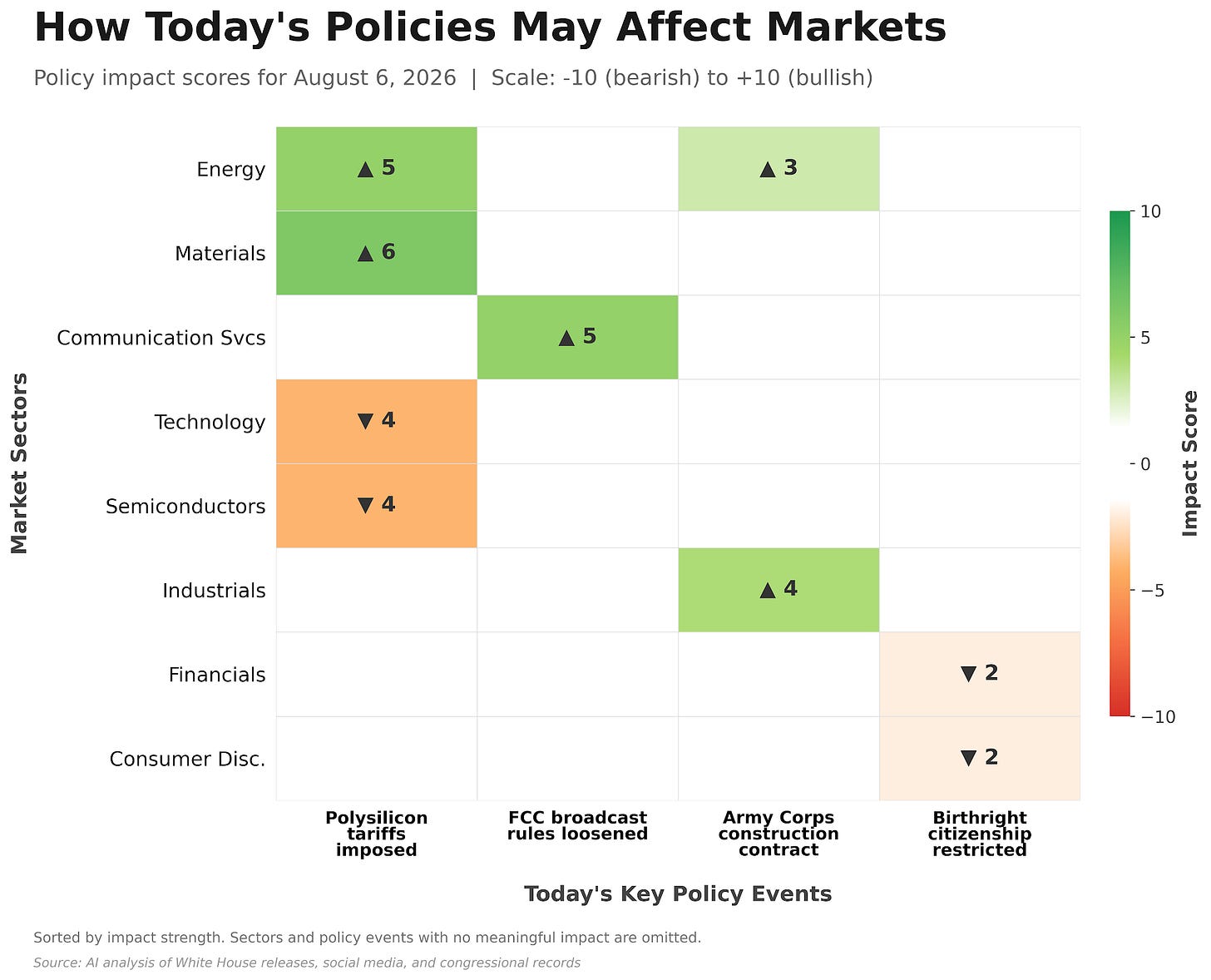
Each cell shows an estimated impact score on a fixed scale of -10 to +10, reflecting how today’s policy developments may affect each market sector. Positive scores (green, ▲) suggest bullish impact; negative scores (red, ▼) suggest bearish pressure. Rows and columns are sorted by impact strength, and sectors and policy events with no meaningful impact are omitted. The heatmap, the analysis below, and the Impact on Market themes above are produced from a single unified analysis: the heatmap visualizes the magnitudes, while the text explains the causal reasoning behind them.
Federal policy shifts toward industrial protectionism and administrative deregulation dominated the landscape. The imposition of minimum import prices and duties on polysilicon represents a targeted effort to reshore supply chains for defense-adjacent industries. While intended to foster domestic resilience, this policy increases input costs for the technology and semiconductor sectors, which rely on global polysilicon supplies. Opponents, including Governor Whitmer, argue that such protectionist measures exacerbate inflationary pressures and burden regional manufacturing competitiveness.
Simultaneously, the deregulation of broadcast ownership provides a tailwind for media consolidation. This shift allows larger entities to absorb smaller local outlets, potentially increasing pricing power and scale within the communication services sector. However, critics like Governor Newsom characterize these changes as a threat to media diversity, labeling the move a ‘dictator’s playbook’ that facilitates political control. The divergence between state-level emergency response protocols—such as California’s mobilization for fire risks—and the federal focus on restrictive immigration and trade underscores a widening policy rift. This fragmentation increases regulatory uncertainty, as firms must navigate conflicting directives across federal and state jurisdictions.
-
Trump’s attorney general pick Todd Blanche appears to clear last hurdle for confirmation
www.theguardian.comBill Cassidy, Republican seen as a decisive holdout, said he is prepared to back Trump’s former personal lawyer
Bill Cassidy, the US Republican senator seen as the decisive holdout on Todd Blanche’s nomination for attorney general, announced on Friday that he will support the pick, setting the stage for a major win for Donald Trump.
Confirmation that Cassidy, of Louisiana, is prepared to back Blanche – Trump’s former personal lawyer, and a loyal ally of the president – appeared to clear the last hurdle of his confirmation process, which had been challenged by the defections of the Republican senators Lisa Murkowski and Susan Collins.
Continue reading... -
Trump is laying waste to the agency that keeps hospital patients safe | Robert B Shpiner
www.theguardian.comFew have heard of the Agency for Healthcare Research and Quality, but it has saved tens of thousands of lives and billions of dollars
When I started my training in 1980, we accepted an arithmetic that would now be indefensible. Central lines, the catheters we threaded into the great veins of the critically ill, became infected, and some of those patients died. We recorded the deaths as complications. Almost no one thought of them as preventable, because no one had yet done the slow work of proving they were.
That work got done, and federal money paid for it. Beginning in 2008, the Agency for Healthcare Research and Quality, a small arm of the health department, funded a national effort in more than a thousand adult intensive care units: a checklist, a sterile insertion protocol, and a unit culture in which a nurse could stop a surgeon. Central-line bloodstream infections fell by 41%, from 1.915 to 1.133 per 1,000 catheter days. The agency estimates that effort alone averted between 290 and 605 deaths. Across its wider work on hospital-acquired harm, AHRQ’s own accounting credits 20,500 deaths prevented and $7.7bn saved in the four years from 2014 to 2017. Hardly any of my patients have heard of the agency. That was always rather the point.
Robert B Shpiner is an internist and clinical professor of medicine at the David Geffen School of Medicine at UCLA. He has practiced and taught intensive care medicine for more than 40 years
Continue reading... -
Iran plots to deal Trump a blow in midterms by keeping him entangled in war
www.theguardian.comBy dragging out talks, Tehran aims to damage the US president politically – but some fear a bruised and weakened Trump could lash back
Tehran has set out a protracted negotiating timetable designed to keep Donald Trump embroiled in the Iran conflict until the midterm elections, in the hope of inflicting the same ruinous blow on his presidency as Jimmy Carter suffered over the 1979-81 US embassy hostage crisis.
For many inside Iran, inflicting meaningful revenge on Trump is a legitimate and self-standing war aim, reflected in the mood of those attending the funeral of the supreme leader Ali Khamenei where demands for retribution were ubiquitous.
Continue reading... -
Trump unbound: the making of an imperial presidency | Politics Weekly America
www.theguardian.comDonald Trump’s second term is unlike his first. The politicians who challenged him are gone. The lawyers who once pushed back now choose their battles. What remains is an imperial president with almost no internal checks - using executive power to reshape everything from the economy to immigration and even the presidency itself.
Few journalists have covered Trump as closely as the New York Times's Jonathan Swan. He speaks to Jonathan Freedland about how the president has consolidated such enormous power and what it could mean for America - and the world.
Regime Change by Jonathan Swan and Maggie Haberman https://guardianbookshop.com/regime-change-9781398567597/
Continue reading... -
Receipts! DOGE Fails an Audit
emptywheel.net
As some of the stories reporting the results of a GAO study of DOGE’s fabricated savings claims, we’ve long known that DOGE was lying about its savings. For example, in Politico’s story on GAO’s report notes, they identified that most of Elon Musk’s claims of savings were bullshit a year ago.Number fudging at the Department of Government Efficiency — the executive agency spearheaded by Elon Musk to ostensibly eliminate excess spending — had already been documented in a myriad of news reports. Among them, an August 2025 analysis of DOGE’s receipts by POLITICO found only $1.4 billion of its claimed $32.7 billion in contract savings was legitimate.
I’ve got a whole page of stories debunking DOGE’s false claims. This GAO report makes almost 70, and I’ve been missing a good many, such as the disclosures in court filings that show the DOGE boys basically made shit up or proved that the bad data from the DOGE boys was getting citizens dropped from voting rolls.
But this DOGE report matters.
It matters, first of all, because this is GAO, Congress’ official accounting body. This was an official attempt to test DOGE’s claims, and like all the other ones, it found a great deal of fluff and bullshit, with more claimed contract terminations remaining than actually terminated.

As many news outlets had before, it showed that many of the lease terminations Musk took credit for had been terminated during Joe Biden’s presidency — over 40% of the claimed lease terminations. And of the leases they claimed to have terminated, over 70% of claimed savings were bullshit.

My favorite detail of the lease analysis (which was always just a small fraction of DOGE’s claimed savings, but an important part because DOGE was attempting to reshape government by eliminating the physical infrastructure of it) explains that an attempted DOGE cut led to a $1.5 million increase in rent after the government rescinded the lease termination, only to have the landlord jack up the rent.
we found at least one instance when a lease identified for termination that was later rescinded led to higher costs. Specifically, officials from a tenant agency we spoke with provided an example where the building owner refused to rescind the lease termination, which forced GSA to renegotiate a new lease at a higher rate of over $1.5 million more per year than before with a 5-year firm term.
But the most important finding, in my opinion, is that GAO couldn’t replicate either Musk’s results or even his claimed accounting method. GAO could only confirm that DOGE used its claimed methodology in 27.5% of its claims. Over sixty percent it did not.

Coming from GAO, this is an actionable finding, one that makes the prospect of subpoenas for Musk and Katie Miller’s testimony next year positively delightful. They didn’t just lie about their savings, they lied about what they claimed were their savings.
And when President AOC (or whoever) takes over in 2029, Musk’s fraudulent accounting claims by themselves should be reason to revisit all the federal contracts he relies on.
This all also matters, now, because it comes at a time when the gild may finally be coming off of Elon Musk’s ability to dupe investors. SpaceX, at least, is not working out the way all Musk’s past inflated companies have, even in spite of dominating in several growth sectors.
And it matters because Musk has just renewed his sometimes unlawful effort to keep the GOP in power, at least in the Senate. Musk is going to spend $100 million dollars to attempt to ensure that Elizabeth Warren, among others, will not have the ability to subpoena him to see whether there’s a tie between his fraudulent claims about DOGE and his reliance on government contracts and regulatory forbearance.
In a report Warren did last year, she pointed to a range of regulatory agencies that had either ended enforcement actions or intervened to help Musk out (click through for the links and the many other details).
Ending enforcement actions against Musk’s businesses During the Trump Administration, federal agencies have dropped investigations into Musk companies, declined to enforce regulations against them, or foregone penalties that appear to have been warranted.
28. Dormant cases abound: reportedly “in more than 40 other federal agency matters [related to Musk], regulators have taken no public action on their investigations for several months or more.”
29. The Air Force declined to even review SpaceX for suspension or debarment as a contractor, despite concerns that Musk is repeatedly engaging with top Russian officials, including Vladimir Putin.
30. Similarly, it is unclear whether the Pentagon Office of the Undersecretary of Defense for Intelligence and Security has continued its review of Musk allegedly failing to report communications with foreign leaders, as required by DoD’s continuous vetting process.
31. The Department of Justice (DOJ) dropped its immigration case against SpaceX for discriminating against refugees and asylees in hiring.
32. The National Labor Relations Board (NLRB) took steps to settle allegations against SpaceX.
33. The Occupational Safety and Health Administration (OSHA) closed an investigation into Tesla for allegedly violating workplace safety rules.
Undercutting agencies regulating and investigating Musk’s businesses Largely guided by Musk’s DOGE, the Trump Administration has hamstrung the agencies overseeing Musk’s companies, gutting their staff, throwing sand in the gears of their operations, and embedding DOGE staff loyal to Musk.
34. Musk has direct business interests before over 70% of agencies and departments targeted by DOGE.
35. The Consumer Financial Protection Bureau (CFPB) was a top target. Musk called for “delet[ing]” the agency and DOGE attempted to fire up to 90% of CFPB staff, who would regulate X Money.
36. President Trump fired the CFPB Director and the new head of CFPB forbade the agency from doing work — after CFPB had received over 300 consumer complaints about Tesla.
Musk was orchestrating these government benefits from himself while lying about his purported purpose in having access to them all, cutting waste fraud and abuse.
Elon Musk got government benefits while pretending to hunt fraud — and his claims to have found waste and abuse are based on fraudulent accounting; he doesn’t even use his own stated methodology most of the time!!!
And all this matters because just yesterday, Trump rolled out the successor to the fraudulent DOGE receipts site, a similarly packaged Fraud Ledger.

The website shows even less rigorous methodology than the discredited DOGE one. Much of the claimed savings on there amount to labeling Trump’s decisions to roll back social spending to blue states as fraud, rather than his own decision (mirrored in the DOGE cuts to grants to Blue states now being confirmed in court filings) to simply defund his political opponents. Some of the categories tracked here are deliberately different than the ones in which fraud would normally be tracked — rather than confirmed fraudulent payments, it lists intended fraud amount. Over and over, it relies on allegations of fraud rather than verdicts of it.
The criminal charges — the one category here subject to normal standards of evidence — are buried at the end, and there are no links to the criminal cases.
And of course, it doesn’t include the long list of fraudsters Trump has pardoned, often eliminating restitution payments to the victims.
It doesn’t list Trump’s convicted, confessed, or ongoing fraud.
DOGE came in promising to reverse all the bad government accounting that Elon Musk’s fever dreams were sure existed (and existed, except in the billion dollar contracts to him).
And instead, it set new standards for bad government accounting.
It was both wasteful and fraudulent. And Trump has just moved that effort to defraud under a new name, the Fraud Task Force, which is exercising similarly fraudulent accounting.
The post Receipts! DOGE Fails an Audit appeared first on emptywheel.
-
With their assault on science, Trumpists aren’t just harming America – they’re harming themselves | Jan-Werner Müller
www.theguardian.comThe administration is subjugating science to political imperatives, a major blow to US soft power and technological progress
The Trump administration is waging an unprecedented war on institutions devoted to research and higher learning. While plenty of countries have harmed universities by imposing neoliberal logics on academia – creating artificial markets in the name of spurring professors to be more productive – the Trumpist subjugation of all science to political imperatives has no equivalent in a democracy; if anything, it is reminiscent of Stalin’s Soviet Union. The assault now also targets foreign students and any kind of international collaboration – a major blow to US soft power. Why are Trumpists engaging in what can only be described as an act of wanton self-injury?
Project 2025’s Russell Vought, the director of the office of management and budget, initiated the rule change that would make any federal grant subject to review by political appointees – including funds for science that so far have been allocated through judgment by first-rate fellow scientists. This measure would furnish Trumpists with a new weapon to threaten universities along the lines of: “Nice medical school you have there – pity if something were to happen to it because your administration had failed to come into alignment with the president’s priorities.”
Jan-Werner Müller is a Guardian US columnist and a professor of politics at Princeton University
Continue reading... -
Trump blasts appeals court for halting White House ballroom construction, claiming decision is a ‘national security threat’ – as it happened
www.theguardian.comThis live blog is now closed.
Following Lisa Murkowski’s announcement that she plans to vote “no” on Todd Blanche’s nomination to lead the Department of Justice, the acting attorney general can’t afford another defection in order to secure the permanent position.
So far the only other holdout is Senator Bill Cassidy – a GOP lawmaker from Louisiana. Cassidy, a former physician, said this week he’s concerned about Blanche’s ability to lead the justice department independently, considering he once served as Donald Trump’s personal lawyer.
Continue reading... -
Trump faces calls for windfall tax on big oil’s profits from Iran war
www.theguardian.comUS president’s complaint industry ‘making too much money’ comes after his policies boosted corporations
Donald Trump’s statement that oil companies have made “too much money” from the Iran war has angered environmentalists, who say that his policies were designed to benefit those very corporations. If he really believes his own claims, he should impose a windfall profits tax, advocates say.
“Trump’s declaration that big oil is ‘making too much money’ belies his accommodation and giveaways to the industry that have enabled its price-gouging – not to mention his disaster of a war of choice against Iran,” said Tyson Slocum, energy program director at the consumer advocacy non-profit Public Citizen. “But like a broken clock that’s correct twice a day, the president is right that oil companies are ‘making too much money’, which means Trump should endorse a windfall profits tax.”ExxonMobil and Chevron on Friday both reported windfall profits for the second quarter of the year. Chevron said its earnings soared nearly 400% to $12bn, while Exxon’s profits more than doubled to $14.5bn. On Monday evening, Trump took aim at those gains, saying the companies “ought to give some of that back to the public”.
Continue reading... -
DOGE Debunking
emptywheel.netRunning Xitter threads from Momentum Chaser
January 30: Fact Check: No evidence US spent $50 million on condoms for Gaza
January 30: FACT FOCUS: No evidence that $50 million was designated by the US to buy condoms for Hamas
February 12: ‘Some of the things that I say will be incorrect’: Musk backs away from false claim of $50 million for Gaza condoms
February 17: No, 150-Year-Olds Aren’t Collecting Social Security Benefits
February 18: Why DOGE’s ‘Receipts’ Show Elon Musk’s Math Doesn’t Add
February 18: DOGE Claimed It Saved $8 Billion in One Contract. It Was Actually $8 Million.
February 19: New Social Security chief refutes claims of deceased people over 100 years old getting checks
February 19: DOGE released data about federal contract savings. It doesn’t add up
February 19: Tens of millions of dead people aren’t getting Social Security checks, despite Trump and Musk claims
February 21: DOGE’s Only Public Ledger Is Riddled With Mistakes
February 22: Musk’s DOGE says it has saved $55 billion. Not so fast.
February 22: DOGE Claims It Has Saved Billions. See Where.
February 25: Nearly 40% of contracts canceled by DOGE are expected to produce no savings
February 25: DOGE Quietly Deletes the 5 Biggest Spending Cuts It Celebrated Last Week
February 26: Dozens of DOGE ‘receipts’ saved no money and killed contracts meant to boost efficiency
February 26: DOGE releases updated “wall of receipts” with more discrepancies
February 26: Musk’s cost-cutting drive quietly deletes billions in claimed savings from website
February 26: A look at the misleading and incorrect claims on DOGE’s ‘wall of receipts’
February 26: Musk claims DOGE ‘restored’ Ebola prevention effort. Officials disagree.
February 28: DOGE Said It Cut $232 Million From Social Security Budget. It Was Only About Half a Million.
March 1: DOGE’s savings page fixed old mistakes — and added new ones
March 2: DOGE Claims Credit for Killing Contracts That Were Already Dead
March 3: Elon Musk’s DOGE initiative deletes billions more from its list of savings.
March 3: The Musk-Trump War on Federal Employees Doesn’t Add Up
March 4: DOGE website offers error-filled window into Musk’s government overhaul
March 5: Department of Government Efficiency Deletes a Claim and Resurrects an Error
March 5: Trump Decried Millions Spent ‘Making Mice Transgender.’ It Was Cancer and Asthma Research
March 11: DOGE mischaracterizes a study as transgender, and USDA cancels it
March 13: Elon Musk’s cuts fail to stop US federal spending hitting new record
March 13: DOGE Makes Its Latest Errors Harder to Find
March 18: ‘It’s a Heist’: Real Federal Auditors Are Horrified by DOGE
March 20: On Its Website, DOGE Deletes More Than 100 Government Leases It Said Were Canceled
March 21: How DOGE is making government almost comically inefficient
March 24: Why DOGE is struggling to find fraud in Social Security
April 11: How DOGE may have improperly used Social Security data to push voter fraud narratives
April 11: See How Government Spending Is Up Even as Musk Touts Savings
April 12: Musk’s Latest Fraud Finding Isn’t What It Seems
April 13: DOGE Is Far Short of Its Goal, and Still Overstating Its Progress
April 15: Trump aids Musk’s Social Security fraud hunt, despite lack of evidence
April 16: Nearly a Billion Dollars in DOGE ‘Savings’ Disappeared Overnight
April 24: 100 days of DOGE: lots of chaos, not so much efficiency
April 24: Musk Goons Purged Living U.S. Citizens from Social Security
April 24: What Elon Musk Didn’t Budget For: Firing Workers Costs Money, Too
April 28: What has DOGE done in Trump’s first 100 days?
April 29: Trump’s team has disrupted some $430 billion in federal funds, top Democrats say; tracker
May 5: As Musk steps back, experts say Doge cuts have harmed government services
May 13: DOGE Removes Dozens of Resurrected Contracts From Its List of Savings
May 14: DOGE Vastly Overstated Its Real Estate Cuts — Then Spent Two Months Backtracking
May 15: DOGE went looking for phone fraud at SSA — and found almost none
May 17: How DOGE’s grand plan to remake Social Security is backfiring
June 6: DOGE Developed Error-Prone AI Tool to “Munch” Veterans Affairs Contracts (with code review)
June 16: The Bureaucrat and the Billionaire: Inside DOGE’s Chaotic Takeover of Social Security
June 26: How long will you wait for Social Security help? Why it’s anybody’s guess.
June 27: USAID Shutdown Costs Top $6 Billion, Internal Estimate Shows
August 1: THE $21.7 BILLION BLUNDER: Analyzing the Waste Generated by DOGE
August 12: Just how much has DOGE exaggerated its numbers? Now we have receipts.
September 25: Unchecked and Unaccountable: How DOGE Jeopardizes Americans’ Data Without Regard for Law and Congress
October 1: Federal agencies are rehiring workers and spending more after DOGE’s push to cut
November 22: Inside the DOGE Succession Drama Elon Musk Left Behind
November 23: Exclusive: DOGE ‘doesn’t exist’ with eight months left on its charter
November 24: DOGE “cut muscle, not fat”; 26K experts rehired after brutal cuts
December 2 DOGE Isn’t Dead. Here’s What Its Operatives Are Doing Now
December 11: DOGE had a cutting spree. 550 vet-owned businesses felt it.
December 21: The year Trump broke the federal government
December 23: How Did DOGE Disrupt So Much While Saving So Little?
2026
January 9: Dismantling of USAID: How the US lost its agricultural shield of food security
January 9: Doge cuts cost US taxpayers $10bn to cover workers’ paid leave, analysis finds
The post DOGE Debunking appeared first on emptywheel.
-
Burnham urged to tackle cost of living crisis by pressuring Trump to end Iran war
www.theguardian.comTrade unions say UK prime minister must begin by revoking permission for US to use RAF bases for airstrikes in Gulf
Trade unions have called on Andy Burnham to tackle the cost of living crisis at its source by pressuring Donald Trump to bring the conflict in the Middle East swiftly to an end.
Leaders from 10 unions, including Unison, the UK’s largest, urged the prime minister to oppose further fighting in the Gulf to help bring down energy and fuel costs.
Continue reading...