Conversation
-
Washington Policy Review: August 6, 2026
sourceToday’s Report
1. Overview
2. White House News
3. Truth Social Posts
4. Government Department News
5. 2028 Democratic Presidential Candidates
6. AI & Tech Company News
7. Congressional Watch
8. Policy Impact Analysis & Heatmap
1. Overview
President Trump signed two executive orders aimed at curtailing “birth tourism” and safeguarding American citizenship, a move he described as essential to protecting the nation’s integrity from “malign foreign actors.” Additionally, he issued a proclamation establishing a new tariff program on polysilicon imports, asserting that domestic production is critical to U.S. national security. The administration also launched fraud.gov, a new platform designed to track the Task Force to Eliminate Fraud’s efforts to recover illicit payments and “crush criminal networks.” Finally, the President proclaimed August 7, 2026, as National Purple Heart Day to honor combat-wounded service members.
On Truth Social, President Trump endorsed State Senator Brent Taylor for Congress while criticizing procedural efforts by Michigan candidate Abdulrahman Mohamed El-Sayed to terminate the filibuster, which Trump warned could lead to “Democrats packing the Supreme Court.” He promoted reports regarding his administration’s ability to utilize new tariff weapons against nations he claimed were “ripping off” America, while also circulating an article asserting he “Won The Iran War.” Furthermore, Trump defended Secretary Pete Hegseth against media reports, labeling the coverage “treasonous” and praising Hegseth for “historic recruitment gains” and the removal of DEI initiatives.
The State Department announced $2 billion in partnerships with faith-based organizations to provide humanitarian aid, alongside new sanctions on entities supporting the Cuban military. The Department of War awarded multiple defense contracts, including a $699 million agreement for petroleum infrastructure and $44.4 million for robotic systems. HHS Secretary Robert F. Kennedy, Jr. proposed reforms to Head Start programs, intending to “remove unnecessary bureaucracy” and shift oversight to state governments. Treasury Secretary Scott Bessent addressed Arizona bankers, emphasizing the need to combat financial abuse by “illicit actors” and criticizing regulations he suggested were “too small to succeed.”
Several Democratic governors issued statements challenging the Trump administration’s economic and regulatory agenda. Governor Newsom condemned an FCC decision regarding broadcast media ownership, characterizing it as an attempt to establish a “propaganda machine for his MAGA agenda.” Governor Whitmer released reports criticizing federal tariffs as “irresponsible” and “erratic,” while Governor Pritzker formally demanded tariff relief for Illinois families, arguing that while large corporations receive billions in refunds, households remain burdened by the President’s “reckless trade policies.” Conversely, Governor Moore announced a new partnership to secure the future of the Preakness Stakes, and Governor Beshear expanded a pre-K pilot program while regulating data center energy usage.
OpenAI announced a partnership with the American Psychological Association to integrate psychological science into AI tools, focusing on creating “safe, age-appropriate” experiences for youth that prioritize real-world relationships. NVIDIA introduced its “Cosmos 3” open model family to advance physical AI, enabling vision systems and robots to better understand and simulate physical environments. These initiatives reflect broader industry efforts to ground AI development in evidence-based research and facilitate specialized hardware deployment.
On August 5, 2026, the Senate confirmed Erica Schwartz as Director of the CDC in a 51-44 vote and passed the Northern Border Security Enhancement and Review Act. Senators also rejected a resolution to disapprove an EPA rule on PFAS reporting in a 48-50 vote. Meanwhile, various committees advanced measures, including child internet safety requirements in the Commerce Committee and land-into-trust measures in the Indian Affairs Committee. The House of Representatives was not in session, with no legislative actions recorded for the chamber.
The administration’s strategic shift toward domestic industrial reshoring through heightened tariff protections for critical inputs aims to bolster the defense sector, though these mandates simultaneously introduce margin compression risks for high-tech firms facing increased production costs. Concurrently, the deregulation of broadcast ownership rules serves as a catalyst for media consolidation by facilitating greater operational scale, even as these shifts invite potential legal challenges from entities characterizing the policy as a threat to “democratic safeguards.” Furthermore, executive orders restricting immigration pathways are expected to tighten labor supplies, potentially driving up operational expenses and curbing long-term consumption growth across industries heavily reliant on an international workforce.
2. White House News
Fact Sheet: President Donald J. Trump Ends Birth Tourism and Protects the Meaning and Value of American Citizenship
President Trump signed two Executive Orders aimed at safeguarding American citizenship following the *Trump v. Barbara* case. Describing the privilege of U.S. citizenship as a “priceless and profound gift,” the administration intends to end “birth tourism” and protect the meaning of citizenship. These actions reflect the President’s commitment to “fix the immigration system, prioritize American citizens, and protect U.S. citizenship.” By implementing these measures, President Trump seeks to fulfill his promise to put Americans first and restore integrity to the nation’s immigration processes.
Reference: https://www.whitehouse.gov/fact-sheets/2026/08/fact-sheet-president-donald-j-trump-ends-birth-tourism-and-protects-the-meaning-and-value-of-american-citizenship/
Continuing to Protect the Meaning and Value of American Citizenship
President Trump issued an executive order to restrict birthright citizenship, citing the Supreme Court’s ruling in *Trump v. Barbara*. The order prohibits federal agencies from recognizing citizenship for children of non-citizen parents if the parents are “alien enemies,” foreign government employees, engaged in fraudulent activity, or involved in commercial transactions to access birthright citizenship. President Trump states the policy aims to guard against “malign foreign actors who attempt to swindle American citizens.” Relevant agencies must update regulations and issue implementation guidance within 30 days to ensure compliance.
Reference: https://www.whitehouse.gov/presidential-actions/2026/08/continuing-to-protect-the-meaning-and-value-of-american-citizenship/
Ending Birth Tourism
President Trump issued an executive order to curb “birth tourism,” defined as entering the U.S. on a nonimmigrant visa to give birth. Stating that “citizenship is not a commodity to be acquired through calculated exploitation,” the President directed the Secretaries of State and Homeland Security to implement policies preventing such entry. The order allows for visa revocations, entry denials, and actions against facilitators of these schemes. While aiming to maintain immigration system integrity, the directive permits exemptions based on humanitarian grounds or the national interest.
Reference: https://www.whitehouse.gov/presidential-actions/2026/08/ending-birth-tourism/
Fact Sheet: President Donald J. Trump Bolsters National Security and Strengthens U.S. Supply Chains by Imposing Tariffs on Polysilicon and its Derivatives
President Trump signed a proclamation establishing a polysilicon tariff program to protect the United States’ industrial base and supply chain from imports he stated “threaten national security.” This initiative aims to defend the nation’s defense-adjacent sectors, building on the President’s “record of securing critical industries.” By targeting polysilicon, the administration seeks to bolster domestic economic strength, asserting that “America’s national security and economic strength depend on rebuilding key sectors of our industrial base” to ensure long-term resilience against foreign market pressures.
Reference: https://www.whitehouse.gov/fact-sheets/2026/08/fact-sheet-president-donald-j-trump-bolsters-national-security-and-strengthens-u-s-supply-chains-by-imposing-tariffs-on-polysilicon-and-its-derivatives/
Adjusting Imports of Polysilicon and its Derivatives into the United States
President Trump issued a proclamation declaring that polysilicon imports “threaten to impair the national security of the United States.” Citing declining domestic production and foreign market distortions, the President established a minimum import price (MIP) program for polysilicon and its derivatives, alongside a 15 percent ad valorem duty on downstream products effective December 4, 2026. The order also mandates an onshoring program, authorizing the Secretary of Commerce to incentivize companies to build domestic production facilities, thereby aiming to “revitalize the United States polysilicon sector.”
Reference: https://www.whitehouse.gov/presidential-actions/2026/08/adjusting-imports-of-polysilicon-and-its-derivatives-into-the-united-states/
National Purple Heart Day, 2026
President Trump proclaimed August 7, 2026, as National Purple Heart Day to honor service members wounded or killed in combat, describing recipients as having displayed “valor beyond measure.” The President emphasized that his administration has “rebuilt our military into the strongest and most lethal fighting force in the world” and touted efforts to strengthen the Department of Veterans Affairs by slashing backlogs and providing financial relief. Trump concluded by calling on Americans to recognize the “courage and sacrifice” of veterans and their families who secured the nation’s freedom.
Reference: https://www.whitehouse.gov/presidential-actions/2026/08/national-purple-heart-day-2026/
Private Sector Answers President Trump’s Call to Lower Prices for American Families
President Trump is addressing an economy he describes as “battered by years of inflation that crushed working families.” His administration is implementing policies to “restore American energy dominance, slash red tape, and secure fair trade” to promote prosperity. These efforts are reportedly yielding results, with private sector companies, major retailers, and energy providers cutting prices on essential goods and services. Furthermore, President Trump’s “Most Favored Nation approach” has secured commitments from major drugmakers to align U.S. prescription costs with lower international rates, while automakers aim to improve vehicle affordability.
Reference: https://www.whitehouse.gov/releases/2026/08/private-sector-answers-president-trumps-call-to-lower-prices-for-american-families/
Fraud.gov: Track the Trump Administration’s Relentless War on Fraud
President Trump and Vice President JD Vance have launched fraud.gov, a website tracking the White House Task Force to Eliminate Fraud’s efforts to “shut off the money, crush criminal networks, and deliver swift justice.” The administration reports that the Task Force has uncovered nearly $230 billion in fraud, prevented $56 billion in illicit payments, and secured significant legal recoveries. Asserting that “the era of unchecked fraud is over,” the administration states it will continue to expose schemes and return recoverable funds to the American people to restore public trust.
Reference: https://www.whitehouse.gov/releases/2026/08/fraud-gov-track-the-trump-administrations-relentless-war-on-fraud/
3. Truth Social Posts
Trump endorsed State Senator Brent Taylor for Tennessee’s 9th Congressional District, highlighting his background as a businessman and his commitment to core party issues like border security, energy dominance, and election integrity. Regarding legislative strategy, he remarked on the irony of sharing a common goal with Michigan Senate candidate Abdulrahman Mohamed El-Sayed regarding the termination of the filibuster. Trump cautioned his Republican colleagues that El-Sayed’s push for this procedural change is “gone Termination CRAZY,” warning that success would lead to the Democrats packing the Supreme Court and potentially rendering him the “last Republican President.”
On the economic and foreign policy front, Trump promoted reports concerning his allies’ efforts to equip the executive branch with a new tariff weapon intended to punish nations he describes as “ripping off” America. Furthermore, he circulated an article asserting that he successfully “Won The Iran War.”
Addressing domestic media coverage, Trump dismissed rumors regarding Secretary Pete Hegseth as “false and completely unfounded,” characterizing the Washington Post’s reporting as “treasonous.” He expressed total satisfaction with Hegseth’s leadership, specifically noting historic recruitment gains, the removal of DEI initiatives, and successful military operations in Venezuela and Iran, the latter of which he stated has been “decimated for the purpose of NOT ALLOWING IT TO EVER HAVE A NUCLEAR WEAPON.”
Reference: https://truthsocial.com/@realDonaldTrump
4. Government Department News
State Department (state.gov)
The U.S. announced nearly $2 billion in partnerships with faith-based organizations to provide global health and humanitarian aid, the largest such allocation in over 20 years. This includes $1.4 billion for integrated health services in over 20 countries through partners like World Vision and $538 million in humanitarian response funding for Samaritan’s Purse and others. The initiative aims to leverage faith-based networks to improve healthcare delivery and crisis response, with at least 80% of resources dedicated to frontline services to reach those in need without “bureaucratic delay.”
Welcoming Talks in Caracas to Advance Venezuela’s Political Transition
The U.S. welcomes the arrival of a delegation from Venezuela’s 2015 National Assembly in Caracas for in-person talks with the interim government. These discussions seek to address the needs of those impacted by recent earthquakes and advance political freedoms. The U.S. continues to support this process as a critical component of President Trump’s three-phase plan for the country’s stabilization, economic recovery, and political reconciliation.
Targeting Enablers of the Cuban Regime’s Arms Imports and Foreign Military Cooperation
The Trump Administration sanctioned five entities and eight individuals involved in procuring military equipment for the Cuban Ministry of the Revolutionary Armed Forces. The State Department described the Cuban regime as a “state sponsor of terrorism” that provides support to radicals and hosts adversaries. Secretary of State Rubio stated that the U.S. will use all available tools to address these national security threats, asserting that “the United States will not tolerate a rogue state harboring hostile foreign military, intelligence, and terror operations just ninety miles from the American homeland.”
United States to Host Ministerial Launch Event for IAEA’s Maritime Nuclear Initiative in Washington
The U.S. will host an International Atomic Energy Agency (IAEA) forum in Washington from August 26-27, 2026, to launch the Atomic Technologies Licensed for Applications at Sea (ATLAS) initiative. The event aims to advance the deployment of civil nuclear energy in maritime transport, including the use of floating nuclear power plants. This effort aligns with President Trump’s pledge to “revitalize innovation in nuclear technologies” and expand global access to reliable nuclear power while addressing legal, regulatory, and safety challenges.
The U.S. congratulated Jamaica on its 64th anniversary of independence. The State Department reaffirmed its commitment to the bilateral partnership, focusing on regional stability, recovery from Hurricane Melissa, and collaborative efforts to combat transnational organized crime and illegal immigration.
The U.S. extended congratulations to President Rodrigo Paz and the people of Bolivia on their 201st Independence Day. The State Department noted that this is the first such celebration in nearly two decades marked by a “truly renewed partnership” between the two nations. The administration highlighted Bolivia’s membership in the “Shield of the Americas” and its commitment to working with President Paz to foster security and prosperity across the Western Hemisphere.
Department of War (war.gov)
The Department of War announced multiple contract awards. Notable actions include a $699 million multiple-award contract for design-build services supporting petroleum infrastructure, and a $127 million architect-engineering contract for Naval Facilities Engineering Systems Command. Teledyne FLIR Unmanned Ground Systems received $44.4 million for robotic system software sustainment. Additional contracts were awarded to GEM Building Contractors for maintenance facility construction ($26 million), Luxfer Magtech for chemical agent detector kits ($10 million), and World Wide Technology for expeditionary IT hardware ($14.9 million).
Department of Health and Human Services (hhs.gov)
HHS Unveils Proposed Head Start Reforms to Expand Access and Empower Parents
HHS has proposed a new rule, “Reducing Federal Burden for Head Start Programs,” to support President Trump’s vision of expanding access and reducing administrative red tape. HHS Secretary Robert F. Kennedy, Jr. stated the proposal intends to “remove unnecessary bureaucracy” and “trust parents and local communities.” The rule aims to preserve or expand 236,000 slots and save $2.2 billion by shifting oversight to states, emphasizing whole-food nutrition, and capping administrative costs. The proposal is open for public comment for 60 days.
Treasury Department (home.treasury.gov)
Remarks from Secretary of the Treasury Scott Bessent at Event with Arizona Bankers in Phoenix
Treasury Secretary Scott Bessent addressed community bankers in Phoenix, emphasizing their critical role in small-business lending and economic growth. He criticized post-crisis regulations for hindering community banks, stating they created a climate that is “too small to succeed.” Bessent outlined the administration’s efforts to secure the financial system, specifically regarding illegal immigration. He highlighted new Treasury and OCC guidance aimed at preventing financial abuse by illicit actors, urging banks to increase vigilance to ensure financial services are not used to facilitate unlawful conduct.
5. 2028 Democratic Presidential Candidates
Gavin Newsom (gov.ca.gov)
Governor Newsom proclaims State of Emergency in Calaveras County for the Gann Fire response
Governor Newsom proclaimed a State of Emergency in Calaveras County due to the Gann Fire, which has burned over 10,300 acres since August 3, 2026. The fire has resulted in one fatality, forced over 1,400 evacuations, and threatens critical infrastructure. The proclamation authorizes state agencies to expedite resources and coordinate with local partners. California has also secured a Fire Management Assistance Grant from FEMA to aid suppression efforts. Over 2,700 personnel are currently deployed to contain the blaze amidst high fire danger conditions.
Governor Newsom announces appointments
Governor Newsom announced several new appointments to state boards. Kaitlan Sakuma was appointed to the California Student Aid Commission. Additionally, Autumn Ragone, Fabian Molina, Leilani Wong, and Eunice Kingsley Abel were appointed to the Youth Empowerment Commission. These roles serve various functions in state advocacy and student support, with terms and compensation requirements varying by position.
Governor Newsom signs legislation 8.6.2026
Governor Newsom signed two bills into law: AB 1919, concerning the Santa Cruz Metropolitan Transit District’s voter-approved tax initiatives, and AB 1923, regarding local ballot measures in Fresno County. The full text for both pieces of legislation is available through the California Legislative Information website.
Trump’s FCC illegally axes limits that protect Americans from broadcast media conglomerates
Governor Newsom issued a statement condemning the Federal Communications Commission for weakening broadcast media ownership protections. He characterized the action as a move by the Trump administration to “chip away at the foundations of our democracy” and establish a “propaganda machine for his MAGA agenda.” Newsom argued that the decision flouts congressional limits on media monopolies, stating that the move “will make it easier for Trump, through his proxies and toadies, to control what Americans see, hear, and read.”
Governor Newsom is urging the public to oppose a federal review of California’s Coastal Management Program. The Governor claims the Trump administration seeks to force “reckless offshore oil extraction to pad the wallets of his corrupt oil cronies.” The state has formally submitted comments opposing the review, which follows a critique by Commerce Secretary Howard Lutnick. The Governor warns the federal push threatens the state’s $51 billion coastal economy and encourages residents to submit comments during the designated public input period.
Gretchen Whitmer (michigan.gov)
Gov. Whitmer Shares Alarming Impact of DC Republicans’ Tariffs on Michigan in New Reports
Governor Whitmer released state reports detailing the negative economic impact of federal tariffs implemented by the Trump Administration. The analysis cites increased costs for families, higher grocery and gas prices, and rising expenses for state construction and procurement projects. Whitmer, alongside Attorney General Dana Nessel, is currently suing the administration over these trade policies. State officials characterized the tariffs as “irresponsible” and “erratic,” warning that they disrupt trade relationships, hurt the agricultural sector, and weaken Michigan’s long-term economic competitiveness.
Wes Moore (governor.maryland.gov)
Governor Moore announced a new schedule and media rights partnership for the Preakness Stakes and Black-Eyed Susan races following the state’s acquisition of the event’s intellectual property. State and industry leaders, including local government officials and legislative members, expressed support for the changes. Proponents state the move will strengthen the national profile of the races, secure the future of the thoroughbred industry, and provide economic benefits to the Park Heights community and the broader Maryland economy through a long-term deal with NBC Sports.
Governor Moore has nominated Kevin Sexton to serve as Chair of the Maryland Health Services Cost Review Commission. Sexton, who previously served on the commission for eight years and as CEO of Holy Cross Hospital, is tasked with overseeing the state’s hospital rate-setting framework and advancing health system models like AHEAD. Industry groups, including the Maryland Hospital Association and MedChi, lauded the nomination, citing Sexton’s experience and collaborative approach as essential for ensuring high-quality, affordable healthcare access for all Marylanders.
Andy Beshear (governor.ky.gov)
Gov. Beshear Provides Team Kentucky Update
Governor Beshear announced economic investments, including over $5.2 million for local infrastructure through the Kentucky Product Development Initiative and $748,620 in matching grants for technology companies. New facility openings and expansions by Artisans Inc., ADM, KOI Superior Walls, and ISCO Industries are creating hundreds of jobs. Additionally, the Governor signed an executive order regulating data centers, mandating that developers submit energy plans, ensuring fair tax contributions, and prohibiting utility companies from raising rates to cover development costs associated with these projects.
Gov. Beshear Expands Pre-K Pilot Program to Dawson Springs
Governor Beshear announced the expansion of the Team Kentucky Pre-K Pilot Program to the Dawson Springs Independent School District, marking the fifth district to join the initiative. This expansion serves over 160 children, providing full-day early education to ensure school readiness. The program, which has received broad support from business leaders and school superintendents, is part of a phased effort to increase state-wide childcare access. Since May, the administration has increased childcare capacity for nearly 3,000 children across the commonwealth.
JB Pritzker (gov.illinois.gov)
Gov. Pritzker Announces Regional Site Readiness Program Grant Awards
Governor Pritzker and the Illinois Department of Commerce and Economic Opportunity awarded $35 million to 22 sites through the Regional Site Readiness Program. The funding includes 11 planning grants for studies and 11 capital grants for infrastructure like roads and utilities. Part of a broader $500 million FY2026 initiative, these grants aim to remove barriers to industrial development, increase speed-to-market for business projects, and attract private investment to communities across Illinois. To date, the state has provided $115 million to support 63 site-readiness projects.
Governor Pritzker sent a letter to President Trump demanding tariff relief for Illinois families, noting that while large corporations have received billions in refunds following a Supreme Court ruling, working families have received nothing. Pritzker previously invoiced the administration for $8.6 billion—representing $1,700 per Illinois household—to offset costs caused by what he terms the administration’s “unlawful tariffs.” Pritzker argued that while wealthy corporations have been compensated, Illinois families remain burdened by the “reckless trade policies” of the President.
6. AI & Tech Company News
OpenAI (openai.com)
Working with the American Psychological Association on youth mental health and AI
OpenAI is partnering with the American Psychological Association (APA) to integrate psychological science into the development of AI tools for young people. This collaboration aims to create “safe, age-appropriate” experiences that reinforce real-world relationships rather than replacing them. Initiatives include developing resources for parents and clinicians, establishing practical safeguards, and convening experts to address youth mental health needs. The project focuses on ensuring AI tools provide support during moments of distress while preventing overreliance and promoting healthy usage patterns grounded in evidence-based research.
NVIDIA (nvidia.com)
Into the Omniverse: How Open World Models Push the Frontier of Physical AI
NVIDIA is advancing physical AI through its new Cosmos 3 open model family, designed to help robots, autonomous vehicles, and vision systems understand and predict physical environments. By utilizing a mixture-of-transformers architecture, Cosmos 3 enables vision reasoning, world simulation, and action prediction. The model is available under the OpenMDW 1.1 license, allowing developers to specialize the technology for specific hardware. Integrated with NVIDIA Omniverse and OpenUSD, the platform supports the creation of simulation-ready environments, reducing the need for costly real-world data collection.
7. Congressional Watch
Covers the 2026-08-05 session — the Congressional Record is published with a one-day delay.
Senate
The Senate focused on a mix of nominations and legislative business, including advancing measures related to northern border security and African trade. Senators also conducted several committee hearings and business meetings covering topics such as Social Security solvency, artificial intelligence safety, and various judicial and executive nominations.
Erica Schwartz, Director of CDC — Confirmed to lead the Centers for Disease Control and Prevention [Passed 51-44 (Vote No. 220)]
S. 850, Northern Border Security Enhancement and Review Act — Requires updates to northern border threat analysis and strategy [Passed by voice vote]
S.J. Res. 187 — Disapproves an EPA rule regarding PFAS reporting and recordkeeping [Failed 48-50 (Vote No. 222)]
En bloc nominations — Agreement to proceed with a package of nominations under S. Res. 817 [Passed 50-44 (Vote No. 221)]
H.R. 6500, AGOA Extension Act — Extends African trade preferences and customs user fees [Cloture motion filed for August 7]
House of Representatives
The House of Representatives was not in session today. It is scheduled to convene for a pro forma session on Thursday, August 6, 2026.
None — No legislative action taken as the House was not in session [N/A]
Committee Highlights
Senate Commerce, Science, and Transportation — Approved legislation regarding child internet safety and AI chatbot design requirements
Senate Finance — Examined policy approaches for maintaining Social Security solvency
Senate Indian Affairs — Approved several land-into-trust measures and examined the growth of prediction markets
Senate Foreign Relations — Held hearings on ambassadorial nominations and received an intelligence briefing on the war in Sudan
Senate Judiciary — Held hearings on judicial and Department of Justice nominations and examined the Muslim Brotherhood network
Coming Up
The Senate will continue consideration of en bloc nominations on August 6, 2026, with roll call votes expected. The House will meet in a pro forma session on the same day.
Reference: Congressional Record Archive
8. Policy Impact Analysis & Heatmap
This analysis is provided for informational purposes only. It does not constitute investment advice or a recommendation to buy or sell any security.
Impact on Market
Based on today’s policy developments, our analysis identifies the following market impact themes:
THEME 1. INDUSTRIAL RESHORING AND INPUT COSTS
The administration is prioritizing the expansion of domestic production capacity through tariff protection and minimum price mandates. By targeting critical inputs like polysilicon, the government aims to insulate the defense industrial base from foreign market volatility. However, this creates significant cost headwinds for high-tech sectors that utilize these materials. Bearish risks include potential retaliatory trade measures and supply chain bottlenecks that could compress margins for domestic technology firms.
THEME 2. MEDIA SECTOR DEREGULATION
The FCC’s move to relax broadcast ownership rules creates a clear path for industry consolidation and increased scale. This environment benefits larger media conglomerates seeking to optimize operations and capture market share through acquisition. Critics argue that these actions threaten democratic safeguards by centralizing information control. The primary risk remains increased regulatory scrutiny and legal challenges from state-level opposition figures who view this deregulation as politically motivated.
THEME 3. IMMIGRATION RESTRICTIONS AND LABOR SUPPLY
The executive orders targeting birthright citizenship and birth tourism reflect an aggressive stance on immigration policy. These measures aim to restrict specific entry pathways, which may tighten labor supplies in sectors reliant on migrant and international populations. Concerns persist that these policies could inadvertently dampen long-term consumption growth and heighten operational costs for businesses that depend on a broad, accessible workforce.
Policy Impact Heatmap with Market Direction
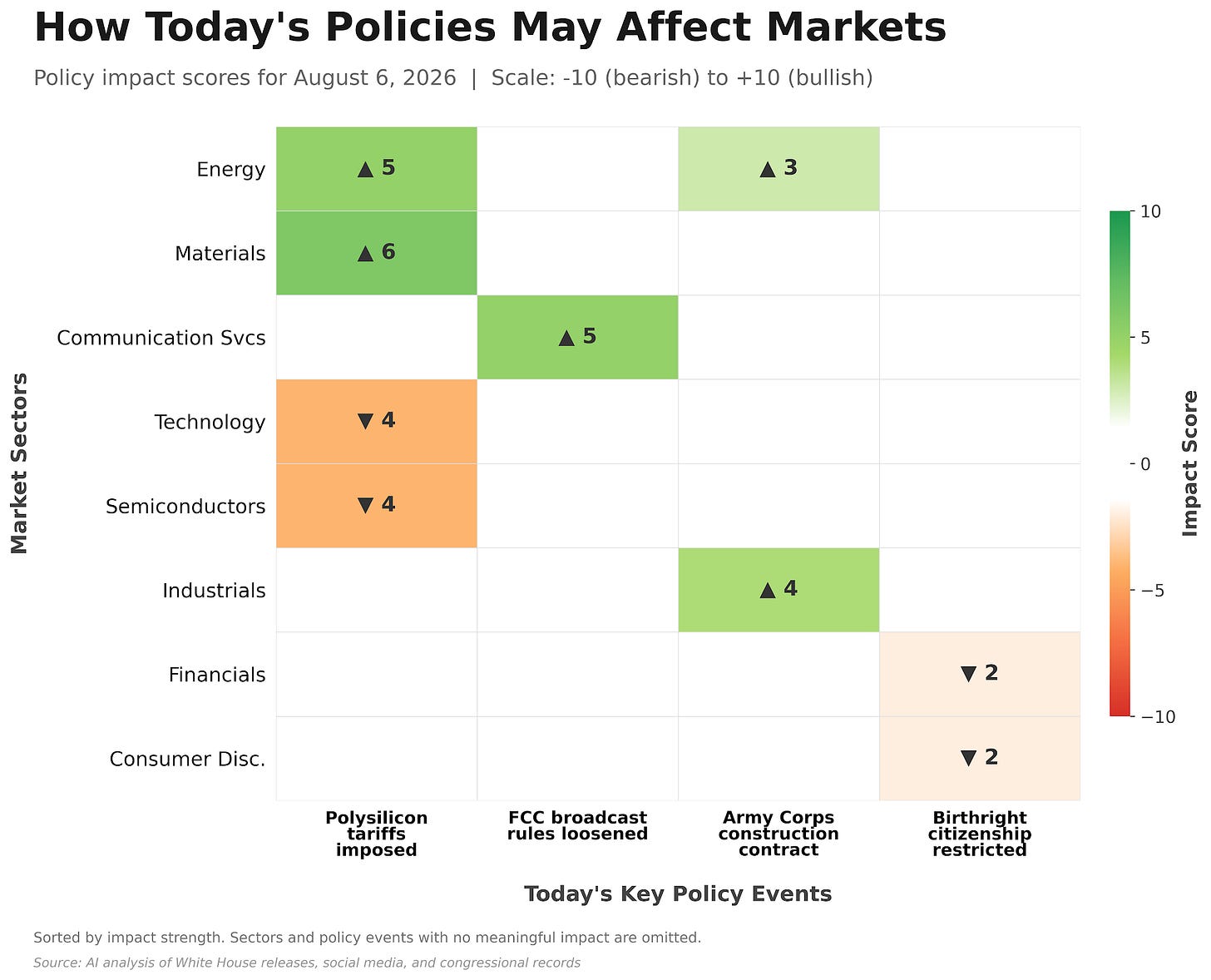
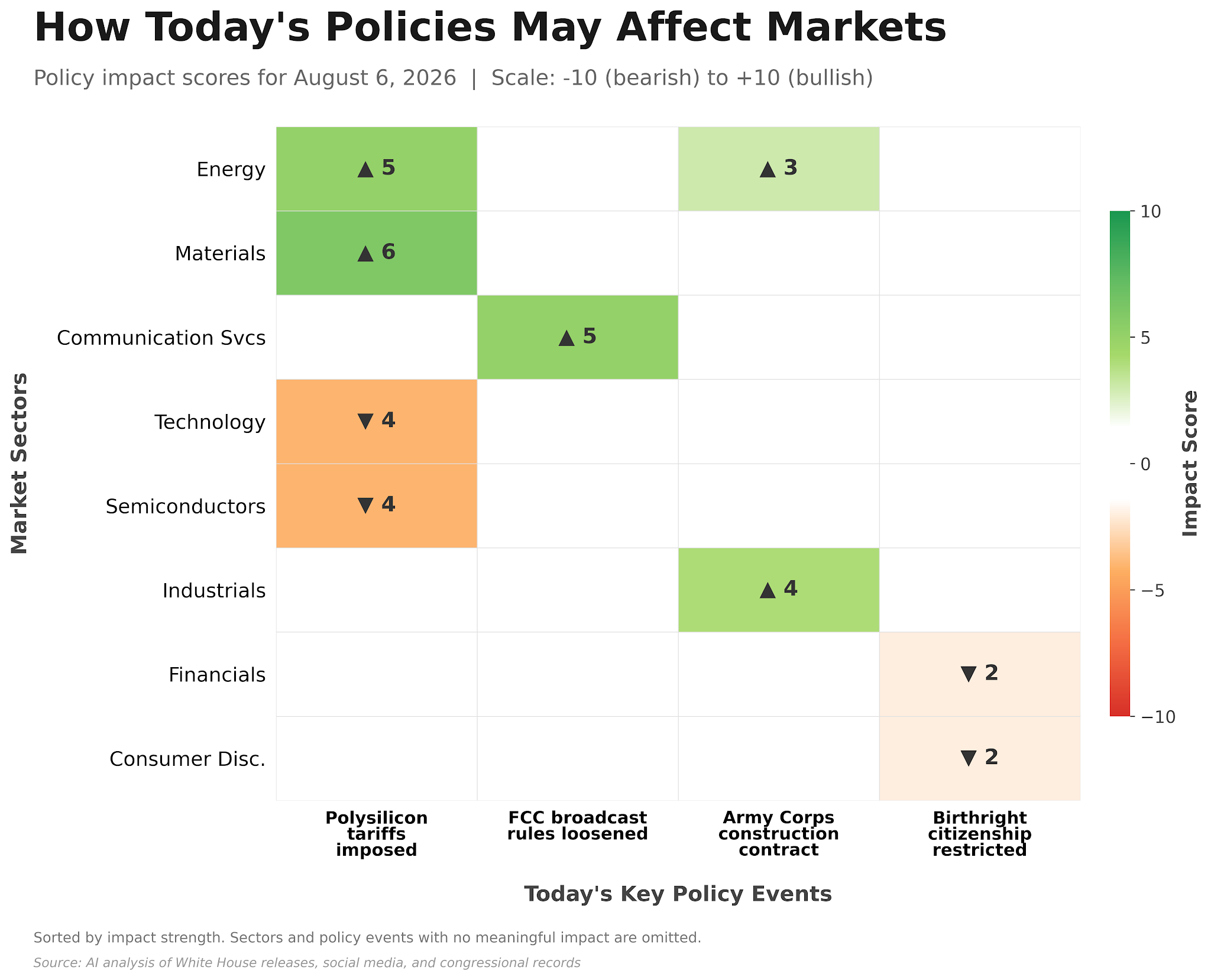
Each cell shows an estimated impact score on a fixed scale of -10 to +10, reflecting how today’s policy developments may affect each market sector. Positive scores (green, ▲) suggest bullish impact; negative scores (red, ▼) suggest bearish pressure. Rows and columns are sorted by impact strength, and sectors and policy events with no meaningful impact are omitted. The heatmap, the analysis below, and the Impact on Market themes above are produced from a single unified analysis: the heatmap visualizes the magnitudes, while the text explains the causal reasoning behind them.
Federal policy shifts toward industrial protectionism and administrative deregulation dominated the landscape. The imposition of minimum import prices and duties on polysilicon represents a targeted effort to reshore supply chains for defense-adjacent industries. While intended to foster domestic resilience, this policy increases input costs for the technology and semiconductor sectors, which rely on global polysilicon supplies. Opponents, including Governor Whitmer, argue that such protectionist measures exacerbate inflationary pressures and burden regional manufacturing competitiveness.
Simultaneously, the deregulation of broadcast ownership provides a tailwind for media consolidation. This shift allows larger entities to absorb smaller local outlets, potentially increasing pricing power and scale within the communication services sector. However, critics like Governor Newsom characterize these changes as a threat to media diversity, labeling the move a ‘dictator’s playbook’ that facilitates political control. The divergence between state-level emergency response protocols—such as California’s mobilization for fire risks—and the federal focus on restrictive immigration and trade underscores a widening policy rift. This fragmentation increases regulatory uncertainty, as firms must navigate conflicting directives across federal and state jurisdictions.