TrumpWatch publisher
-
Pauline Hanson echoes Trump as she lashes out about ‘fake news’ reporting on lavish London hotel
www.theguardian.comOne Nation leader says party covered ‘all travel costs’ for her European trip – aside from those paid by billionaire Gina Rinehart
Get our breaking news email, free app or daily news podcast
Pauline Hanson has lashed out at major news outlets for reporting on One Nation, angrily denying that she used donations from supporters to fund a lavish London hotel on her recent holiday – but confirming her party did foot the bill.
One Nation has also defended its decision to bar journalists including from the Guardian and ABC from events, denying that the principle of “free speech” applied to journalists asking questions at a press conference.
Continue reading... -
Trump unbound: the making of an imperial presidency – podcast
www.theguardian.comDonald Trump’s second term is unlike his first. The politicians who challenged him are gone. The lawyers who once pushed back now choose their battles. What remains is an imperial president with almost no internal checks, using executive power to reshape everything from the economy, immigration and even the presidency itself.
Few journalists have covered Trump as closely as the New York Times journalist Jonathan Swan. Jonathan Freedland speaks to him about how the president has consolidated such power – and what it could mean for the US and the world
Watch Jonathan Freedland on our new Politics Weekly YouTube channel
You can find Jonathan Swan and Maggie Habermans’ book Regime Change here
Send your questions and feedback to politicsweeklyamerica@theguardian.com
Continue reading... -
Trump’s birthright citizenship attack the latest effort in obsessive campaign
www.theguardian.comFor more than a decade, president has been fixated on trying to undermine a key constitutional right
With a pair of executive orders on Thursday, Donald Trump has tried – once again – to undermine the guarantee of birthright citizenship, a right enshrined in the US constitution and reaffirmed by the supreme court just five weeks ago.
The orders attempt to broaden the categories of children who would be ineligible for automatic US citizenship and ban so-called “birth tourism”, which the president claimed is practiced by “hundreds of thousands” of people.
Continue reading... -
Trump Tyranny Tracker | Day 561: Aug 3, 2026
trumptyrannytracker.substack.com
Welcome to today’s Trump Tyranny Tracker…
Trump is expanding his mass deportation, using federal power against protesters and innocent people, and leaving Ukraine without the Patriot interceptors it desperately needs as Russian missiles mass murder civilians.
Today at a Glance
• Trump plans to spend $1.6 billion expanding ICE partnerships with state and local police
• Prosecutors dropped all four Reflecting Pool cases after Trump’s vandalism claims fell apart.
• ICE arrests hit a record 51,000 in July as Trump’s mass deportation operation accelerates.
What We Need to Pay Attention To
An airport search, a wiped phone and a potential test of Fourth Amendment protections
What Happened: Border Patrol officers, coordinating with the FBI, searched U.S. citizen and activist Sam Tunick’s luggage, diary, and phone without a warrant after he returned from an overseas trip. Agents admitted they had no basis for telling Tunick they suspected child sexual abuse material. He was later charged with destroying evidence after providing a passcode that wiped his phone.
Why It Matters: Federal agents searched a U.S. citizen’s phone, diary, and belongings without a warrant, using a child sexual abuse claim they admitted had no basis. They then prosecuted him when his phone was wiped. The case tests whether border search powers can be used to bypass Americans’ Fourth Amendment protections.
Source: CNN
Corruption
Trump accounts were closed in 2021 due to concerns over possible money laundering, Capital One says
What Happened: Capital One disclosed in a court filing that it closed Trump’s accounts in 2021 after its anti-money laundering team flagged suspicious financial activity potentially linked to money laundering. The disclosure came in response to Trump’s lawsuit claiming the bank targeted him for political reasons.
Why It Matters: Trump claims he was politically targeted, but Capital One says it closed his accounts over potential money laundering risks. If the bank found activity serious enough to close the accounts, why wasn’t it investigated by U.S. authorities?
Source: Associated Press
New disclosures reveal $9M in corporate donations to Trump’s Freedom 250
What Happened: Chevron, United Airlines, and defense contractor RTX donated a combined $9 million to Trump’s Freedom 250, including $5 million from Chevron alone. The group has raised more than $50 million from corporate sponsors while offering major donors branding opportunities and private access to Trump.
Why It Matters: Companies with billions in federal contracts and regulatory decisions at stake are paying millions for access to Trump. It is another pay-to-play scheme funneling corporate money for presidential access.
Source: Politico
Power Consolidation
White House directly involved in Blanche order rescinding ‘anti-weaponization’ fund
What Happened: White House chief of staff Susie Wiles and other senior officials were involved in negotiations over Trump’s $1.776 billion slush fund to pay settlements to Trump’s criminals and pardoned Jan. 6 insurrectionists. Trump agreed to drop the current fund to secure Senate confirmation of his former personal lawyer Todd Blanche, while leaving a path to revive the payout scheme.
Why It Matters: Trump wants taxpayers to compensate people who committed violent crimes on his behalf on Jan. 6. Pardoning them, erasing their cases, and trying to pay them sends a dangerous message to future supporters that political violence carried out for Trump will be protected and rewarded.
Source: CNN
Weaponization of Institutions
Trump to Supercharge Local Police Immigration Enforcement With $1.6 Billion
What Happened: Trump plans to spend $1.6 billion through September 2027 to expand ICE partnerships that give state and local police federal immigration enforcement powers. The number of agreements has surged more than 1,470% since January 2025, with more than 2,100 partnerships now operating nationwide.
Source: NOTUS
Prosecutors drop more Lincoln Memorial Reflecting Pool vandalism cases
What Happened: Federal prosecutors dropped charges against all four people accused of vandalizing the Lincoln Memorial Reflecting Pool after the cases fell apart because the damage came from a botched renovation, not vandalism. Trump continues calling the defendants vandals and attacked U.S. Attorney Jeanine Pirro for dropping the cases, saying she “choked” and “folded like an umbrella.”
Why It Matters: Trump lied that these people vandalized the Reflecting Pool and demanded his DOJ prosecute them. Even after the cases fell apart because the damage wasn’t vandalism, he keeps repeating the lie and demanding prosecutions. Now he is attacking his own prosecutor for refusing to punish innocent people for something they did not do.
Source: USA Today
Media Suppression & Authoritarian Tactics
Treasury Sued Over Lawsuit Settlement Payouts to Trump Allies
What Happened: CREW sued Treasury for allegedly withholding legally required information about settlements paid through the taxpayer-funded Judgment Fund. The lawsuit comes as pardoned Jan. 6 insurrectionists and other Trump criminals seek government payouts through settlements with Trump officials.
Why It Matters: Trump criminals are seeking taxpayer-funded payouts while Treasury keeps the details hidden from the public. Americans have a right to know whether their money is being used to reward people Trump pardoned and others politically connected to him.
Source: Bloomberg
She protested ICE raids. Then agents showed up at her door
What Happened: Trump’s DOJ has charged more than three dozen people in at least 10 cases under a rarely used Civil War-era conspiracy law, every one targeting people protesting immigration enforcement. Nearly 50 others face conspiracy charges under other statutes, including protesters not personally accused of violence or property destruction.
Why It Matters: Trump wiped away conspiracy cases against Jan. 6 insurrectionists while using serious federal conspiracy charges against people protesting his immigration crackdown. Protesters who aren’t even accused of violence can face years in federal prison.
Source: NPR
Human & Civil Rights Abuses
ICE arrests hit record high in July as enforcement quietly ramps up
What Happened: ICE arrested 51,000 people in July, the highest monthly total in DHS history, as immigration enforcement expanded nationwide. Some of those detained had no criminal records and held valid work authorization or parole documents.
Source: ABC News
An unwritten federal policy is blocking workers’ discrimination claims
What Happened: The EEOC quietly ordered administrative judges to stop processing class action discrimination cases brought by federal workers while Trump officials prepare to overhaul civil rights enforcement. The unwritten directive has stalled cases involving thousands of workers, including a class action alleging widespread sexual harassment at a federal prison.
Why It Matters: Thousands of federal workers have been blocked from pursuing class action discrimination claims without any written rule or public explanation. The government stopped processing their cases while it rewrites the rules.
Source: The Washington Post
‘Stark example of brutality’: Trump’s ICE used court orders in plan to force-feed at least 10 hunger strikers in detention
What Happened: Trump officials sought court orders to forcibly treat at least 10 hunger strikers in ICE detention through force feeding, forced hydration, and involuntary blood draws. At least three detainees underwent the procedures, including an asylum seeker who was force fed for nearly eight months.
Source: The Guardian
Government Disruption
Trump overhaul could gut Head Start preschool standards, leaving states to set the rules
What Happened: Trump officials plan to replace more than 100 pages of federal Head Start standards with roughly a dozen, leaving staffing ratios, health screenings, family engagement, and other requirements largely to states and local governments. The proposal could also add new requirements for homeless and unemployed parents.
Source: Associated Press
People with disabilities fear service cuts as Trump’s DOJ questions legal protections
What Happened: DOJ issued a legal opinion saying federal disability rights laws do not require states to provide services that allow people with disabilities to live at home instead of in institutions, reversing decades of federal enforcement following a 1999 Supreme Court ruling.
Why It Matters: DOJ is weakening protections that have allowed people with disabilities to live at home instead of being forced into institutions. States are using the new interpretation in court to challenge those protections.
Source: CBS News
US farm agency staff warn trade, research, aid programs at risk from reorganization
What Happened: Trump plans to relocate more than 2,500 USDA employees from D.C., but most affected workers surveyed say they will quit rather than move. More than 15,000 USDA employees have already left since Trump began dismantling the federal workforce, putting agricultural research, food aid, trade, rural programs, and SNAP at risk.
Source: Reuters
Imperial & Geopolitical Watch
Iran Says No Talks With the U.S. on Hormuz Strait
What Happened: Iran denied Trump’s claim that negotiations are underway to reopen the Strait of Hormuz, saying no talks with the U.S. are taking place. Tehran confirmed separate negotiations with Oman over restoring commercial shipping, while Trump threatened a massive military strike if a deal is not reached.
Source: Wall Street Journal
US military asks troops for ‘creative and unconventional’ ideas to punish Iran
What Happened: A senior U.S. Central Command officer sent an unusual email asking military analysts for “creative and unconventional ways to pressure and punish Iran” as Trump considers escalating the war. The request comes after weeks of U.S. airstrikes have failed to force Iran into a deal, with CENTCOM reportedly reassessing its strategy.
Why It Matters: After months of war and 18 U.S. service members killed, the military is asking for new ideas to “punish Iran” because Trump’s strategy has failed to force Tehran into a deal. Meanwhile, the U.S. continues to be at war with no clear strategy for ending it.
Source: CNN
Far-Right & Russian Influence Watch
Zelensky says Ukraine has ‘no interceptors’ as ballistic missiles hit Kyiv
What Happened: Russia fired 27 ballistic missiles at Ukraine overnight, killing at least nine people in Kyiv and injuring more than 30. Zelenskyy said Ukraine intercepted only one because it has “no interceptors,” days after asking Trump for more Patriot missiles. Trump also backed away from his promise to let Ukraine manufacture them.
Why It Matters: Zelenskyy has been practically begging for Patriot interceptors to protect Ukrainians from Russian mass murder. Now with interceptors running out, almost all of Russia's ballistic missiles are getting through and killing Ukrainians. Meanwhile, Trump is refusing to provide more or let Ukraine produce them.
Source: The Washington Post
Economic News
Twenty-five states sue Trump administration over latest global tariffs
What Happened: Twenty-five states sued Trump over new 10% and 12.5% tariffs on goods from 60 countries representing more than 99% of U.S. imports. The states argue Trump is using a different trade law to reimpose sweeping tariffs after they were struck down by the U.S. Court of International Trade and the Supreme Court.
Source: CNBC
Resistance
Check out 50501 for local and nationwide events…
Source: 50501
By the Numbers
$9 million — Combined donations from Chevron, United Airlines, and defense contractor RTX to Trump’s Freedom 250.
$1.776 billion — Size of Trump’s proposed slush fund for settlements benefiting political allies and pardoned Jan. 6 defendants.
$1.6 billion — Trump’s planned spending to expand partnerships giving local police federal immigration enforcement powers.
1,470% — Increase in ICE partnerships with state and local law enforcement since January 2025.
51,000 — ICE arrests in July, the highest monthly total in DHS history.
15,000+ — USDA employees who have already left since Trump began dismantling the federal workforce.
27 — Russian ballistic missiles fired at Ukraine overnight; Ukraine intercepted only one.
25 states — Suing Trump over his latest attempt to reimpose global tariffs.
18 — U.S. service members killed since Trump’s war with Iran began.
99%+ — Share of U.S. imports represented by the 60 countries covered by Trump’s latest tariffs.
What to Watch Next
The Fourth Amendment is facing a major border-search test — How far will courts allow federal agents to go in searching Americans’ phones without a warrant?
Trump is building a nationwide immigration enforcement network — How much further will ICE expand into local policing after partnerships surged more than 1,470%?
Trump is still trying to reward Jan. 6 insurrectionists with taxpayer money — What form will the payout scheme take after the current $1.776 billion fund was dropped?
Trump’s Iran strategy has no clear endgame — What comes next as the military searches for new ways to pressure Iran while Tehran denies the negotiations Trump says are happening?
Key Takeaways
Rights Under Attack — Federal agents are searching Americans without warrants, and DOJ is using serious conspiracy charges against people protesting Trump’s immigration crackdown.
Political Violence Rewarded — Trump pardoned Jan. 6 insurrectionists, erased remaining cases, and is still pursuing ways to compensate his criminals with taxpayer money.
Deportation Machine Expands — Record ICE arrests and $1.6 billion for local police partnerships are rapidly expanding Trump’s mass deportations.
Government Being Gutted — Head Start standards are being stripped down, disability protections weakened, and thousands of USDA workers have already left as Trump dismantles federal programs and capacity.
No Exit Strategy — Trump’s Iran war has killed 18 U.S. service members and failed to force Tehran into a deal, while the military is now asking troops for new ideas on how to “punish Iran.”
Call to Action
Document Everything: Document purges, corruption, and power grabs. Share credible information with journalists, watchdogs, and legal experts. Silence enables authoritarianism—see something, say something.
Defend Press Freedom: Support independent journalism by subscribing to and sharing reporting that challenges Trump’s power grab.
Contact Lawmakers: Demand accountability for Trump’s unchecked power and war on oversight.
Mobilize for Action: Organize or join legal efforts and resistance movements to protect democracy and human and civil rights.
Thanks for reading the Trump Tyranny Tracker. Stay tuned for more updates.
-
Trump again rebukes Jeanine Pirro over reflecting pool ‘vandalism’ case
www.theguardian.comPresident attacks ‘terrible mistake’ of US attorney, who said in court filing damage stemmed from botched renovation
Donald Trump has doubled down on his criticism of Jeanine Pirro after the US attorney for the District of Columbia publicly challenged his claims that vandals had damaged the recently renovated Lincoln Memorial reflecting pool.
“She said there was no vandalism. There was tremendous vandalism,” Trump told NBC News on Thursday. “So, she made a terrible mistake. I don’t understand why she did such a stupid thing.”
Continue reading... -
Trump’s AI Framework Is So Bad They Won’t Show You What’s In It
www.techdirt.comFor a while now we’ve been mocking the Trump White House’s plans for an “AI framework” that would have the frontier AI labs hand over their top models for an initial review. After all, this was more or less the exact same plan that the Biden admin worked out in 2023, but it was done in a thoughtful and careful manner. And it caused a bunch of the VC bros in Silicon Valley to come out in support of fascism, while claiming it was a necessary defense against Biden’s attack on supposedly open innovation. Of course, all of that was bullshit, and that’s made even more clear by every step the Trump White House has taken to reinvent a similar “voluntary” AI review plan, but dumber.
Indeed, Trump’s AI framework is so dumb… that they’re keeping it a secret.
The White House does not plan to publicly release its new framework for evaluating advanced AI models, three sources familiar with the discussions told Axios.
Ah, transparency at work. It’s also wreaking havoc on the rest of the AI ecosystem that wasn’t invited to the White House to get the details.
The Trump administration invited staffers from OpenAI, Anthropic, Google, Meta, Nvidia, and other leading AI companies to the White House on Tuesday to share an overview of its new AI oversight framework, the people said. AI developers will have the ability to voluntarily submit new models to the federal government up to 30 days ahead of their public release. The White House will then vet their cyber capabilities according to a classified benchmarking system and share the AI models with federal agencies and trusted corporate partners.
The White House isn’t sharing more information about its testing criteria or which AI models will be covered by the framework, though open models will reportedly be excluded, according to Axios. That has left smaller AI startups, safety advocates, and third-party researchers in the dark about crucial aspects of how the federal government is addressing the cyber risks posed by advanced AI systems. Some argue that the secretive process will give an advantage to larger companies.
Considering that the likes of Andreessen Horowitz (investors in OpenAI) claimed they had to support Donald Trump over Joe Biden because they would support anyone who agreed with their “little tech agenda,” I’m curious how they can possibly square that with the fact that this new framework is significantly worse than the Biden framework, specifically for the “little tech” companies that a16z has used as a shield to defend their support for authoritarian politics?
Of course, the other reason why the White House is probably keeping the framework a secret is because it would show how incompetent they are. All the reporting so far suggests the entire process has been a clusterfuck, which is much more about which companies get to set up which regulatory moats to protect their own business models, rather than what’s best for either innovation or the American public.
At Nvidia, Microsoft, Google and Meta, executives grew increasingly concerned that Anthropic and OpenAI would win over the White House with their arguments for tighter restrictions, according to two of the people. That would potentially cement the A.I. start-ups’ positions as market leaders,
Other A.I. labs were at risk of falling permanently behind, the people added. And because several of the companies make their own open-source models or supply hardware to businesses that use open-source technology, they worried the restrictions could harm them.
Over private texts, phone calls and video conferences, executives quietly built an argument that open-source models were good for the world and for American innovation, according to three of the people familiar with the talks.
But, of course, that’s just the way things work when you have a White House that makes decisions entirely based on transactional motives, rather than anything involving principles.
As we discussed last week, so much of this is all about whose vision of the AI world wins out — whether a handful of giant companies get to lock in the regulatory moat they’ve built for themselves, or an actually competitive market lets people make their own decisions and keep control over their own experiences. Maybe that’s the real reason nobody’s allowed to see the rulebook: because it would reveal who the administration agreed to let write the rules.
-
Judge Edelman Will Give Davey Hearn the Last Word
emptywheel.net
Judge Todd Edelman has issued an order dismissing the case against Olympic canoeist Davey Hearn, but reserving whether he should do so with or without prejudice for more briefing.ORDERED that the Government’s Motion to Dismiss the Indictment is GRANTED IN PART; and it is
FURTHER ORDERED that this case is DISMISSED, and it is
FURTHER ORDERED that the government’s request for a dismissal without prejudice and the Defendant’s request for dismissal with prejudice are HELD IN ABEYANCE, and it is
FURTHER ORDERED that the government may file a Reply to the Defendant’s Response to Government’s Motion to Dismiss the Indictment, not to exceed 15 doublespaced pages, on or before August 18, 2026; and it is
FURTHER ORDERED that the Defendant may file a Sur-Reply, not to exceed 10 double-spaced pages, no more than 7 days after the filing of any government Reply.
There are several notable aspects to this.
First, he notes that Hearn has moved for the case to be dismissed with prejudice, in part to prevent Trump from demanding it be refiled, but that as an alternative, Hearn would like the grand jury transcripts that this motion to dismiss may have been an attempt to stave off.
1 In the alternative, the defense requests that the Court grant the Defendant’s pending Motion for Disclosure of Grand Jury Minutes and Legal Instructions or conduct an in camera review of the requested materials before ruling on the Government’s Motion.
You might think the order for more briefing is just an invitation for DOJ to do what they should have done from the start, to dismiss the case with prejudice.
Except that, remarkably, Edelman has built in a chance for Hearn to respond to whatever the government files. To fact check it, perhaps. He describes how, barely three weeks after indicting Hearn, DOJ claimed it had learned new stuff, as if for the first time.
Approximately three weeks later, on July 31, 2026, the government filed its Motion to Dismiss the Indictment (“Government’s Motion”). The Government’s Motion describes in considerable detail information the government reportedly learned from the Department of the Interior after the return of the Indictment that “strongly suggest(s] that a rushed and botched installation [of the lining] by AIC, the primary contractor, led to the damage to the lining of the Reflecting Pool,” Gov’t Mot, at 18, and that has led the government to conclude that “it is difficult to attribute the widespread damage to the Reflecting Pool to vandalism, let alone to establish that fact beyond a reasonable doubt,”
Of course, Hearn has debunked all of that. They always had a photo in their possession showing that the flap of liner they accused Hearn of ripping was ripped before he got there — they just were lying to judges about where it came from and, possibly, when it was taken. They had notice no later than July 10, barely a week after the indictment, that Interior knew the earliest damage was not vandalism. DOJ’s own agents sussed out the pool on July 13, but Jeanine Pirro claimed they only checked it on on July 17 (or maybe on July 16).
Edelman has built in a sur-reply for Hearn, as if he fully expects he may be lied to, ten pages due a week after DOJ files.
Normally, judges permit or invite sur-replies if the moving party adds new details in their reply, but Edelman has built that in, and told DOJ he has built that in.
Not only that, Edelman plans to have a hearing about this. While he replaced a pretrial hearing that had been scheduled for September 11, his order says his staffers will contact the parties to schedule a hearing on the pending motions.
‘The undersigned’s chambers will contact counsel to schedule a hearing on the pending motions.
Motions, plural. Which therefore presumably includes the request for grand jury transcripts, as well as Hearn’s demand he get his phone back.
Jeanine Pirro utterly botched the game theory of this dismissal in every way. And for the life of me, I can’t imagine how she improves on her abysmal performance thus far.
Update: Disgruntled Interior staffers have taken this moment to tell Politico that Doug Burgum is evading the Federal Records Act.
[O]fficials at Interior decry what they view as a culture of secrecy. Burgum asked colleagues early on about trying to add a sensitive compartmented information facility, or SCIF, on the department’s sixth floor even though one exists just three floors below, according to a person who heard the comment. According to three staffers who witnessed it, officials have routinely shredded official documents and use disappearing Signal messages — even for mundane scheduling matters — to avoid communications being preserved, as is required by the Federal Records Act.
“They’re terrified of written records,” said one former official.
The post Judge Edelman Will Give Davey Hearn the Last Word appeared first on emptywheel.
-
The Blueprint To Unrig Our Democracy From Right-Wing Rule
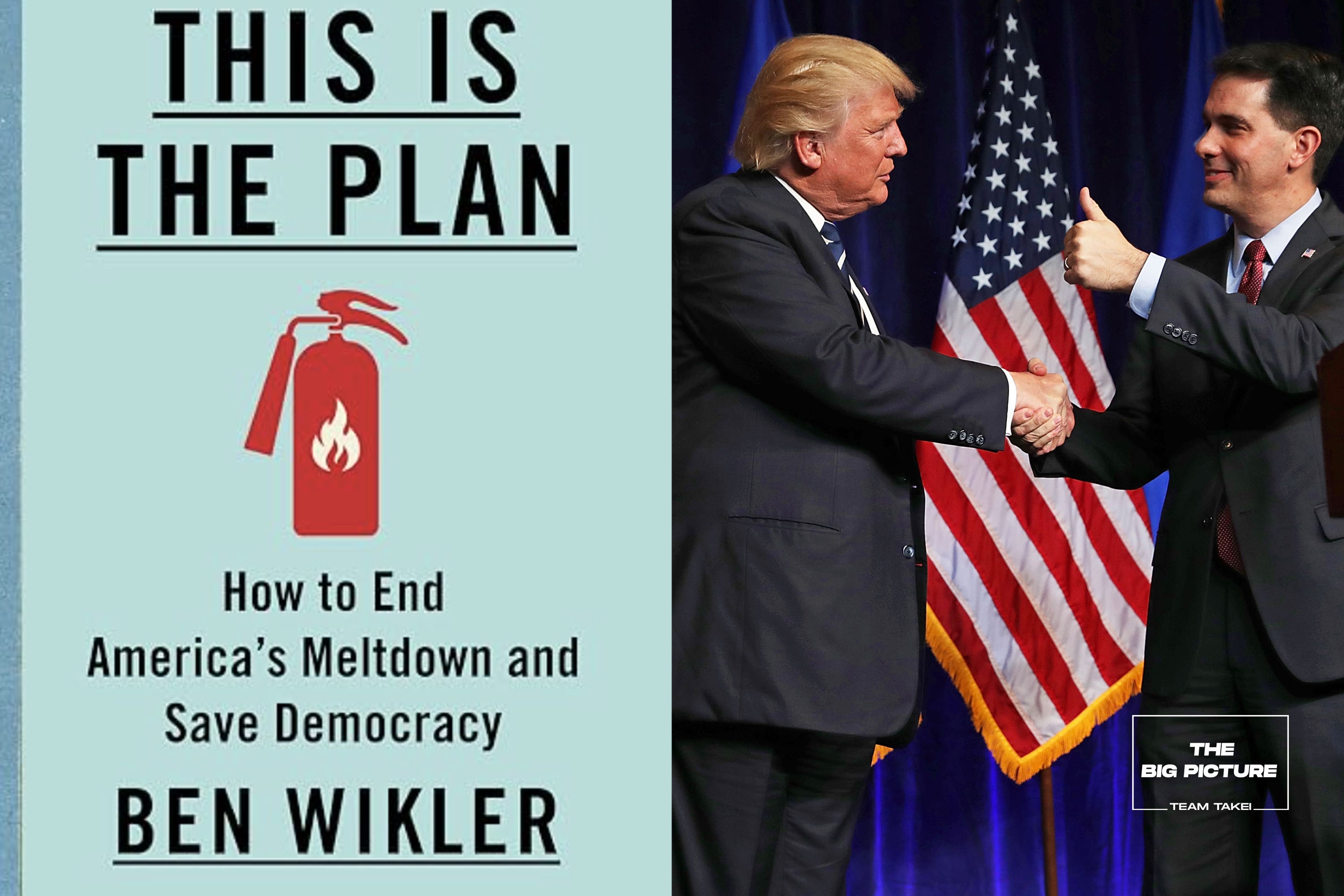
thinkbigpicture.substack.com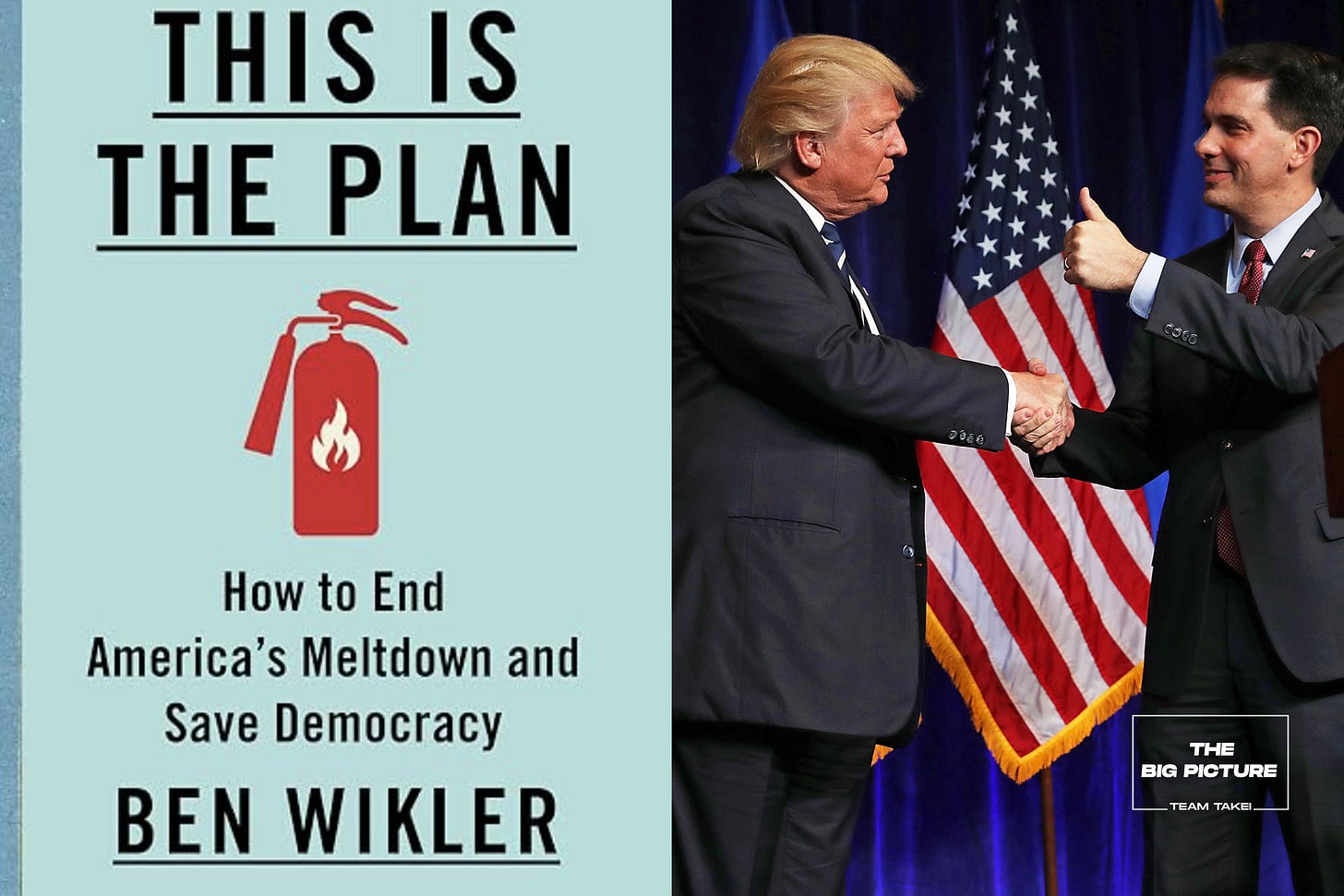 LEFT: This Is The Plan cover. Credit: ThisIsThePlan.com. RIGHT: Donald Trump shakes hands with Scott Walker. Photo by Chip Somodevilla/Getty Images.
In 2010, Republicans in Wisconsin rode the Tea Party wave to a trifecta of government control in the state, winning the governorship and both houses of the state legislature. And with that power, Republicans proceeded to cement themselves into what they hoped were permanent majorities.
In 2011, Republicans passed partisan gerrymandered district maps that were so rigged in their favor that, in a year when Barack Obama won the state by more than six points and state Republican candidates received less than a majority of the vote, Republicans ended up with 60 out of 99 State Assembly seats.
Wisconsin Republicans tried—and for a time succeeded—to establish minority rule in the state. Even when they lost, they won. Journalist David Daley aptly called it a “democracy desert.”
If that sounds familiar, it should.
Donald Trump and MAGA Republicans in Congress and in red state governments around the country have tried to implement minority rule at a larger scale. They have eaten away at our foundations of democracy to install permanent Republican power. So if we want to unrig our system and restore our democracy, we’re going to need a plan.
Thankfully, has just released one.
Wikler, who served as the Wisconsin State Democratic Party Chair from 2019-2025, presided over a systematic unrigging of the state. During this time, liberal justices retook the majority on the state supreme court, the legislature passed new maps, and today Democrats have an opportunity to retake majorities in both state legislative chambers and hold a Democratic trifecta in the state for the first time since 2010.
In This Is The Plan: How To End America’s Meltdown And Save Democracy, Wikler lays out not just how Wisconsin Democrats were able to restore democracy in their state over the course of several years, but also how we can use the same tactics and strategies to unrig America.
We spoke with Ben to find out more about what that plan entails and how each of us can join the fight to help restore our democracy.
 Ben Wikler, author of This Is The Plan: How To End America’s Meltdown And Save Democracy
 Q: You were Chair of the Wisconsin Democrats from 2019 to 2025, during which you were able to transform Wisconsin from a “democracy desert” to a full-fledged functioning democracy. With your book, you turn your attention to the U.S. as a whole with a new transformation plan. What are you hoping to convey to readers, and what need does your plan address?
Ben Wikler: So many Democrats—and people in general who are dismayed by the state of the U.S. political and economic system—have asked me, “What is the plan?”
My goal with this book is to lay out a realistic and, I hope, energizing answer for how we get out of this mess.
By “the plan,” I mean a plan that ladders up from what each individual can do this week, all the way through the specific policies that can unrig the system itself so that this country works for everyone. Step by step, year by year. Along the way, I map out how you can help win elections, which elections we have to win, and what policies elected officials at all levels will need to pass once they’re in power in order to build a future of American government by, of, and for the people.
The thesis of the book is that even in this moment of domination by the wealthiest people the world has ever known, regular citizens are not powerless. In fact, if they direct their power to the fights that are balanced on a knife’s edge but can affect the future of American democracy—often obscure elections for offices like state Supreme Court or state legislature—then there’s a gigantic opportunity to build a better future.
And for any of this to work, we have to have blast doing it. Which is why the book is shamelessly riddled with Princess Bride quotes. We have to “have fun storming the castle”—in a peaceful, civil, non-January-6th-y sort of way.
Q: You write you want to “end Trumpism and unrig America” the way you unrigged Wisconsin. What do you envision are some of the key milestones and benchmarks, and how realistic do you think they are to meet?
BW: The reason I know that it’s possible to unrig the national political system is that a movement of thousands of people, of which I was proud to be one, unrigged a GOP-dominated system of control in my home state. That required years of work focused on multiple parts of the government—in particular, electing a pro-democracy governor, preventing GOP supermajorities in the state legislature, and finally winning a pro-democracy majority on the state Supreme Court.
Looking at the national landscape, we’ve got a rigged system at multiple levels—including a corrupt, partisan, and rogue U.S. Supreme Court; gerrymandered US House districts; a president chosen through a preposterous system in the Electoral College; and a U.S. Senate in which, thanks to current rules around the filibuster, a minority of senators has a veto over laws supported by the majority—which is exactly the opposite of what the Founders intended.
The plan is to change all of that. First, alongside the fight for Congressional majorities in 2026, focus on winning state governments. Blue state-level trifectas can dictator-proof their states and also pass the National Popular Vote Interstate Compact, which would make the Electoral College a ceremonial body and award the presidency to whoever wins the national popular vote.
Then, in 2028, Democrats and independents have to win the White House and both chambers of Congress.
2029 is the pivotal year: the Senate has to change its rules, and then the governing trifecta has to pass a major U.S. Supreme Court reform—term limits are a leading idea; a national gerrymandering ban (and potentially proportional representation for the U.S. House), and welcome DC statehood and a referendum on statehood in Puerto Rico.
Do all that before 2030, and the usual midterm backlash won’t lead to nationwide gerrymandering that undercuts democracy through 2042. Both parties will have opportunities to pass laws that reflect their values, and the public will decide which it prefers. You know, like in a real democracy. Wild idea.
Q: In the book, you make an interesting point that while Freedom of Speech usually gets most of the First Amendment attention, it’s Freedom of Assembly that is core to making political change, through what you refer to as “relational organizing.” Can you say more about that, and explain how, no matter where folks live, we can all start to take action to make a difference in our communities?
BW: Abraham Lincoln put it best, in a letter to a Whig campaign committee in 1840: “Keep a CONSTANT WATCH on the DOUBTFUL VOTERS, and from time to time have them TALKED TO by those IN WHOM THEY HAVE THE MOST CONFIDENCE.”
Every one of us has that trusted person we text when we’re about to vote and haven’t taken the time to look up the candidates for some obscure local office. For some people, it’s the same when they’re thinking about who to support for Congress. If you can become that trusted person, you can help make sure that great candidates get the support they need to win. I map out in the book how the process of building relationships with voters who are on the fence—people who aren’t sure whether to vote, or whom to vote for—is at the heart of the superpower each of us holds in a democracy: organizing.
In Wisconsin, starting with my predecessor state party chair, we’ve been building a neighbor-to-neighbor organizing network that operates year-round to persuade and turn out voters in every single election. It has an enormous impact in our state. In This Is the Plan, I map out how you, wherever you might be, can build a team of people that engages in exactly this way, and the tactics that will make the biggest difference to election outcomes.
Q: You identify three pillars that make up what you call the essence of politics: “Listen, Build Trust, Persuade.” Can you elaborate on this? How is listening to voters essential if you want to persuade them to vote your way?
BW: The voters who decide close elections are the fence-sitters: people who are on the fence about whether to vote, or on the fence about who to vote for, or both. They’re a diverse bunch, but they generally have something in common, and it’s a big thing: they don’t put politics at the center of their lives. It’s not that they don’t care. They have values and beliefs just as strong as yours or mine. But very often they don’t much like politics, they don’t really trust politicians, they think the whole thing can feel like bullshit, and they’d rather spend time thinking about something else.
For many of these Americans, politics is like curling: an activity of which they’re vaguely aware when it’s on television for a few weeks every four years (say, during the Winter Olympics), but which has little to do with them and is not their consuming obsession. Ask such a voter about the “Broomgate” scandal that rocked the world of curling, and they’ll give you a blank stare. Trying to persuade fence-sitters to join your political side by reeling off ideas that sound like obscure political minutia can land the same way.
So if you want to persuade them, remember that they’re interested in different things from you. Don’t try to change their interests. Don’t lecture them about how they should pay more attention. Don’t yell at them to convince them they’re wrong. Instead, meet them where they are. Listen to them long enough to understand how they make sense of things, and find a value that you share, a basis for making common cause.
You can’t do any of that if you only show up every four years, which is exactly why the organizing has to be constant. Listen first. Earn the trust. Then, and only then, do you get to persuade.
Q: Are there any local elections or local political leaders we should be watching this year as examples of where your plan is already working?
BW: Yes! I’ll start in my own backyard: Wisconsin.
The core idea of the book is that every level of political power sets the rules for the other levels. So if you want to unrig American democracy, a great place to start is by winning power at the state level. Wisconsin demonstrates the power of this approach. My state was dubbed a “democracy desert,” with maps so gerrymandered that, in 2018, Democrats won every statewide office and 54 percent of the state assembly vote, and got 36 percent of the seats. Then we won a majority on the state supreme court, that court threw out the rigged maps, and control of the legislature is finally in play.
That brings me to two spectacular leaders who have played a pivotal role in those fights—and are now poised to play an even bigger role in our state’s history: Wisconsin Assembly Democratic Leader Greta Neubauer and Senate Democratic Leader Dianne Hesselbein.
When Republicans were on the verge of winning supermajority control of both chambers, Leader Neubauer and her team ran a spectacular operation that blocked the GOP’s ambitions by 2491 votes across two districts. Then, for two years, they ran an astonishingly complex operation to ensure that there would never be more than one Assembly Democrat outside the chamber—which ensured that the GOP couldn’t override Governor Evers’s veto, despite repeated attempts. And then, on new maps in 2024, she flipped ten Assembly seats. Five more to go for a majority. She’s a fighter and a kindred political spirit, and I can’t wait to see her wield the gavel.
Meanwhile, in Leader Hesselbein, the spirit of Fighting Bob lives on: supercharged electoral success—sweeping every purple state Senate seat in 2024, and putting her caucus within two seats of an outright majority in 2026; superb candidate recruitment; and a total focus on delivering results once she becomes Majority Leader. She holds her caucus together and, over and over, manages to split the GOP caucus in the Wisconsin legislature and block their worst plans.
They oversee the caucus campaign committees—the ones that identify the most flippable seats, the best targets on offense or on defense. They’ve mapped out the battle plan for this fall. They’re leaders to watch.
Q: For local activists who want to impact a local race in their area that could come down to just a few votes, what are your top three things they should do to maximize their odds of success?
If your local race might come down to a few votes, first, congratulations. You’ve been given a gift. You have a chance to play a decisive role in determining an election result. Now, your job is to figure out where your energy has the biggest impact.
1. Talk to the people you know. The very most powerful thing you can do as a volunteer in politics is to talk to your actual friends and family who are fence-sitters. In the world of political operatives, this is called relational organizing, and it’s as effective as campaign outreach gets. When you talk to friends, they listen. One experiment in Florida found that voters who received text messages from people they personally knew were 8.6 percentage points more likely to vote than those in the control group. So scroll through your phone, make a list of fifty people in key areas who’ve occasionally missed elections, and stay in touch with them. You’ll make the ghost of Abraham Lincoln smile.
2. Do Polling Place Vote Tripling. It’s got a very non-catchy name, PPVT, and try to pronounce it and it sounds like you’re practicing your embouchure before playing some polka on a tuba. But it’s wildly powerful. Once early voting starts, go outside a polling place in a neighborhood where any given voter is likely to be voting on your side, mind your local distance rules, and greet people as they leave after voting. Flash them your winningest smile, and ask them if they can text three of their friends, right then, and remind them to vote early. You’re talking to people who’ve just voted, so they’re proudly brandishing their “I Voted” sticker; you’re getting them to do on-the-spot relational organizing, so the people they text actually read the message; and you’ll talk to way more people than you would knocking on doors where nobody’s home.
3. Plug into a group that takes the science of voter contact seriously. Find a campaign or organization near you that practices relational organizing, and sign up. Make sure you’re not signing up for an Elon Musk front group, and you’re good to go. They’ll match the contacts on your phone against the voter file and hand you a list of exactly who to reach. There are, in fact, apps for that. Politics is a team sport; start or join a team that uses a Moneyball approach to getting the biggest result out of every hour or every dollar, and you’ll discover that being part of something effective is often a joy.
This Is the Plan isn’t a book about shortcuts. Unrigging the American political system is a long fight that will take years. To sustain political energy across such an epic journey, you need to make friends along the way. But the great thing about politics is that, in fact, you’ll meet people you love when you’re working in service of something larger than yourself. I fell in love with my wife while we were putting up posters for a protest. You can’t help but make lifelong friends when you’re in the political trenches together. In the process of organizing your way to a better democracy, you just might help solve America’s loneliness crisis at the same time.
-
Trump signs new orders targeting birthright citizenship
www.theguardian.comOrders come after supreme court rejected president’s first bid to restrict guarantee enshrined in US constitution
Donald Trump has made a second attempt to restrict the constitutional guarantee of birthright citizenship, just weeks after the US supreme court rejected his initial, more sweeping bid to deny automatic citizenship to the children born to undocumented immigrants and temporary foreign residents.
Trump on Thursday signed two executive orders that seek to broaden the categories of children ineligible for automatic US citizenship and ban so-called “birth tourism”. The directives are expected to face legal challenges.
Continue reading... -
Report: Mass Deportations Cost $2,358 per Taxpayer
American taxpayers would pay about $2,358 each to fund President Donald Trump's mass deportation effort, according to a new calculator released by the Economic Policy Institute. The Trump administration rejects the claim, however, instead saying the real cost to taxpayers comes from illegal immigration. The left-leaning EPI analysis, highlighted by Axios, estimated the federal government will spend roughly $268.9 billion on deportation efforts during Trump's second term through funding provided by the One Big Beautiful Bill Act, appropriations, and other sources.www.allsides.com -
Trump deportations cost taxpayers $2,358 each
American taxpayers would pay about $2,358 each for President Trump's mass deportation push, according to a new calculator tool from the Economic Policy Institute. Why it matters: The estimate fuels debate over whether billions of federal dollars devoted to deportations could instead fund other public priorities such as food assistance, health care or housing.www.allsides.com -
Map Shows ICE Deportation Costs in Every US County
A new report suggests the money spent on deportations across the United States could be spent on funding over 925,000 schoolteachers or pay for over 5 million veterans' medical care. The findings from the Economic Policy Institute (EPI) showed federal tax dollars being spent down to the state and county levels, as the Trump administration has drastically ramped up immigration enforcement over the past 18 months with the goal of mass deportations.www.allsides.com -
The Trump Administration Promises the 'Largest Denaturalization Effort Ever'
The Trump administration pledged to define itself largely by a hard-line approach to immigration. In keeping with that promise, it is pursuing what the government calls the "largest denaturalization effort ever." Denaturalization isn't new, but it has been used sparingly in modern history, in part because it is extremely costly and time-consuming amid finite resources. An immigrant may be denaturalized for a few reasons, including misrepresenting themselves to the government in a way that helped them obtain citizenship and committing certain crimes prior to naturalization occurring.www.allsides.com -
The Fight Between Airlines And ICE Is Heating Up
Airlines are engaged in a tense battle with Immigration and Customs Enforcement (ICE) over the federal agency's efforts to arrest more targets at airports. As the Trump administration ramps up its mass deportation campaign, ICE officers have increasingly been seen making arrests at airports. It's part of a new tactic to nab foreigners who have overstayed their visas.www.allsides.com -
No evidence? No problem. Trump pushes ahead on false claims that Reflecting Pool was vandalized
Jeanine Pirro this week found out there is a trade-off between loyalty to President Donald Trump and being loyal to reality. The U.S. attorney for the District of Columbia — a fierce defender and decades-long friend — openly refuted Trump's claims of vandalism regarding one of his treasured construction projects in the nation's capital, admitting in court filings that damage to the Lincoln Memorial Reflecting Pool was due to shoddy workmanship.www.allsides.com -
US federal judge halts order for Trump to turn over financial records to BBC
www.theguardian.comJudge issues temporary pause while he considers Trump’s request to revise his libel lawsuit against BBC
A federal judge has temporarily halted an order requiring Donald Trump to turn over detailed financial information about his business empire to the BBC as part of an ongoing libel lawsuit.
US district judge Roy Altman issued the temporary pause while he considers Trump’s request to revise and narrow parts of his lawsuit against the BBC over a 2024 documentary that aired in the UK.
Continue reading... -
Rebecca Hendin on Donald Trump’s pursuit of a multimillion-dollar lawsuit against the BBC – cartoon
www.theguardian.com -
Trump denies US low on key munitions in war with Iran after reports of shortages
www.theguardian.comPresident’s comment come after report he had demanded answers from Pete Hegseth over alleged shortages
Donald Trump has lashed out at reports that the US is running short of key munitions in its war with Iran, threatening long prison sentences for officials who leak information about the military’s weapons stocks.
The US president claimed on Thursday that the US had “massive amounts” of ammunition and said more was being manufactured and shipped to the region, as his frustration over the conflict spilled into a public attack on the media.
Continue reading... -
Trump’s Gaza Board of Peace issues first building contract – for a military base
www.theguardian.comExclusive: Louisiana firm awarded tender to build rudimentary outpost to house Moroccan troops
Donald Trump’s Board of Peace, which was set up in January to oversee the reconstruction of Gaza, has finally issued its first construction contract in the devastated territory: a project to build a rudimentary 150-person military outpost to house Moroccan troops, a source familiar with the matter told the Guardian.
The contract, which has not yet been finalised, was awarded to Arkel International, a Louisiana-based firm that has previously carried out work with the US government in countries such as Iraq.
Continue reading... -
Cash is king: Washington Republicans bankroll midterms as National Democrat coffers are in the red
On the heels of President Donald Trump's Tuesday fundraiser in Los Angeles, and with the November midterms less than 100 days away, Washington Republicans hold a commanding financial edge over Washington Democrats that could prove decisive in key races for control of Congress.www.allsides.com -
ACLU blasts Trump’s new orders on birthright citizenship, saying they are doomed to fail in court– as it happened
www.theguardian.comThis live blog is now closed.
One quick note on the contempt resolution: Senator Rand Paul may try to send it straight to the Department of Justice, since advancing it in the Senate would require 60 votes. Republicans hold just 53 seats, making it almost certain to fall short of that threshold.
Republicans on a Senate committee voted to hold Anthony Fauci in contempt of Congress on Thursday. This comes after a bitter hearing last week, where the retired public health official invoked the fifth amendment for fear of self-incrimination and possible prosecution by Republican lawmakers on the homeland security and governmental affairs committee – who have routinely vilified Fauci for his handling of the Covid-19 response.
Continue reading... -
Exclusive: Major Republican fundraiser winning contracts from Trump administration, emails reveal
www.theguardian.comPalmer Luckey has donated $5.9m to Republicans and bundled more, while reaping billions in Pentagon contracts
Wealthy Republicans on the west coast received an emailed invitation in July to an upcoming fundraiser titled “Keep the Senate”. The email, obtained by the Guardian, described the event as a “private roundtable and dinner with the National Republican Senatorial Committee” where donors can pledge $50,000 for seats at the head table, and mingle with legislative heavy hitters from Capitol Hill including the Senator majority leader, John Thune, and Mike Rogers, who is running for Senate in Michigan with Donald Trump’s endorsement.
One of the organizers listed on the invite was the defense industry tycoon Palmer Luckey, the 33-year-old co-founder of sprawling weapons manufacturer Anduril Industries.
Continue reading... -
Eight days of fury: Paper trail exposes FBI bid to probe Trump as Russian asset for firing Comey
The latest declassified documents relating to the FBI's politically motivated investigations into President Donald Trump revealed that the Bureau secretly investigated Trump for alleged ties to Russia over his firing of then-FBI Director James Comey. As Just the News' John Solomon reported Wednesday, the electronic communication opening the probe was sent on May 16, 2017 – a mere week after Trump fired Comey. The FBI knew that the firing had nothing to do with Russia, yet investigated the sitting president anyway.www.allsides.com -
Top Democrats accuse Trump officials over Israeli settlers’ ‘unbridled violence’
www.theguardian.comLetter says lifting of sanctions sent ‘clear message’ settlers can use deadly force in West Bank without consequences
Senior Democrats have accused Donald Trump’s administration of giving a green light to violent Israeli settlers in the occupied West Bank, warning that its policies created “a climate of impunity and unbridled violence” that endangers both Palestinians and US citizens.
In a letter seen by the Guardian, a group of 19 Democratic senators and representatives call for the restoration of sanctions against extremist settlers and demand independent US investigations into the deaths of nine US citizens killed in the West Bank since 2022.
Continue reading... -
‘Morocco feels emboldened’: Trump’s influence in spotlight after Ceuta disaster
www.theguardian.comWashington-Rabat ties under scrutiny as questions swirl over what led to deadly influx into tiny Spanish territory
The cosy relationship between Washington and Rabat has long been flaunted by both sides, from Morocco’s announcement this year that it would be the first African state to join Donald Trump’s Board of Peace to the congratulatory message recently sent by Trump to mark King Mohammed VI’s 27 years in power.
The latest example landed this week. As Spain grappled with the aftermath of the sudden influx – and swift return – of more than 70,000 people into Ceuta, Morocco’s monarch confirmed he had named a $1bn highway flanking the disputed territory of Western Sahara after Trump.
Continue reading... -
Washington Policy Review: August 5, 2026
washingtonpolicyreview.substack.comToday’s Report
1. Overview
2. White House News
3. Truth Social Posts
4. Government Department News
5. 2028 Democratic Presidential Candidates
6. AI & Tech Company News
7. Congressional Watch
8. Policy Impact Analysis & Heatmap
1. Overview
The White House highlighted President Trump’s recent policy impacts in Nevada, crediting his administration with securing the “largest tax cut for working families” and achieving the “most secure border on record.” Officials credited these initiatives with driving down local crime and attracting billions in private investment, asserting that the administration’s “America First” agenda is delivering tangible results for the state’s residents. Separately, newly declassified FBI memos revealed a 2017 investigation into whether President Trump acted on behalf of the Russian government, though records suggest agents viewed the probe as a biased effort to “get Trump.”
On Truth Social, President Trump promoted an interview with Treasury Secretary Scott Bessent and celebrated a “28-1” win rate in recent political endorsements. He characterized media coverage of his single loss as “FAKE NEWS” and issued a stern warning regarding election integrity in Wayne County, Michigan, labeling the process “strictly Third World.” Additionally, Trump criticized Michael Moore as a “Loser” and maintained that his administration’s economic performance has initiated a “Golden Age of America” that his opponents cannot undo.
The State Department addressed the OAS on the “Murillo-Ortega dictatorship” in Nicaragua and saw Secretary Rubio discuss European security and Iran with his UK counterpart. The State Dept also announced $102 million in rewards and visa revocations to degrade the CJNG cartel, alongside $242 million in new Ebola relief. HHS Secretary Robert F. Kennedy, Jr. celebrated Kentucky’s medical schools joining a nutrition initiative and oversaw the decertification of an organ procurement organization due to “persistent patient safety failures.” The Treasury Department opened media credentialing for the upcoming G20 Finance Ministerial in North Carolina and released new guidance on tax credits for paid family leave.
Democratic governors focused on state-level infrastructure and economic initiatives. Governor Pritzker demanded answers from oil CEOs regarding high gas prices in Illinois, blaming the costs on President Trump’s “unlawful war with Iran” and accusing companies of generating “windfall profits.” Governor Moore signed legislation to place a redistricting amendment on the November ballot, claiming Republicans are working to “rig the system” and “weaken voting rights.” Meanwhile, Senator Ossoff voted against the CDC Director confirmation, citing a “reckless and sustained attack on the CDC” by the administration, while also introducing bipartisan legislation to bolster emergency alerts via satellite.
NVIDIA announced a significant expansion in domestic manufacturing to support U.S. AI infrastructure. Partnering with Wistron, the company opened a 324,000-square-foot facility in Fort Worth, Texas, to produce Grace Blackwell Superchips. This effort is part of a broader $700 million investment intended to onshore supply chains and move toward producing $500 billion in AI infrastructure within the United States.
The Senate conducted routine legislative business on August 4, passing the ALS Act Reauthorization and the National Plan for Epilepsy Act by voice vote. The Senate Judiciary Committee voted to report the nomination of Todd Blanche for Attorney General favorably to the full chamber. Meanwhile, the House of Representatives was not in session, and no legislative business occurred in that chamber.
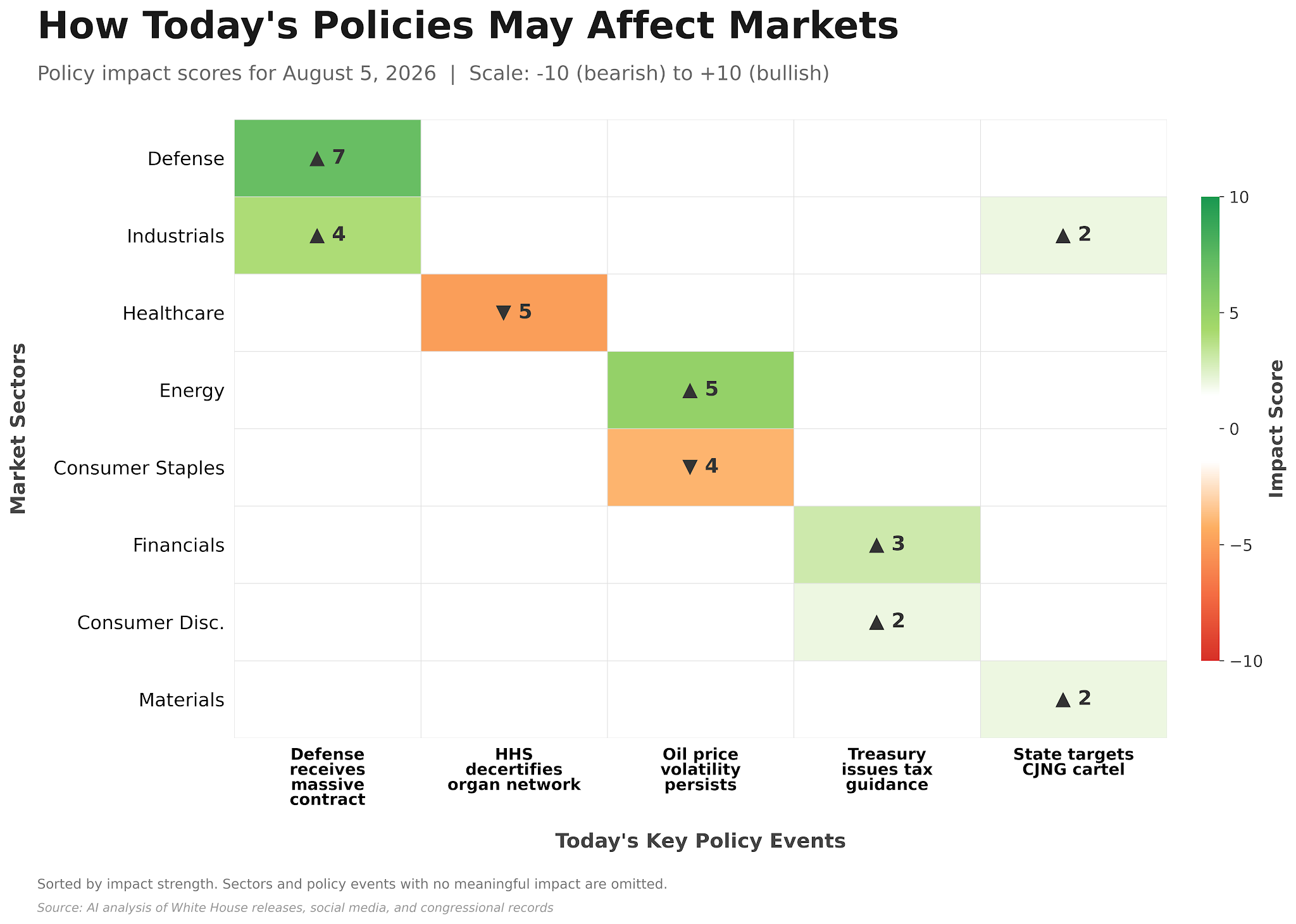
Escalating geopolitical instability in the Strait of Hormuz elevates crude oil prices and inflationary pressures, compelling central banks to scale back rate-cut expectations and suppressing consumer discretionary spending. Simultaneously, robust federal fiscal commitments to domestic defense and industrial sectors provide a stable revenue floor for prime contractors, although this heavy capital allocation risks distorting labor and material markets. Within the healthcare sector, heightened regulatory enforcement and stricter performance standards introduce significant business continuity risks, a policy shift that critics characterize as “overreach” potentially fragmenting local delivery networks.
2. White House News
President Trump and Republicans Deliver Big Wins for the Silver State
President Trump and Republican leadership are “delivering results for Nevada families, workers, seniors, and communities,” according to the White House. The administration credits his policies with creating the “largest tax cut for working families in American history” and establishing the “most secure border on record.” Since returning to office, the President has reportedly driven down crime, unleashed American energy, opened federal lands, and attracted billions in private investment to the state, reinforcing the administration’s stance that “America First means Nevada First.”
Reference: https://www.whitehouse.gov/releases/2026/08/president-trump-and-republicans-deliver-big-wins-for-the-silver-state/
FBI Secretly Opened Probe Alleging Trump Fired Comey Because He Was a Russian Asset, Declassified Memos Show
Newly declassified FBI memos reveal that in May 2017, the bureau opened a criminal investigation, codenamed “Oxferd Comma,” to determine if President Trump was “wittingly or unwittingly, involved in activities for or on behalf of the Government of the Russian Federation.” The probe, predicated on concerns regarding the firing of James Comey, sought evidence of obstruction and potential Russian control. However, reports indicate FBI agents had largely dismissed collusion allegations beforehand, with one agent describing the investigation as a misguided effort to “get Trump.”
Reference: https://www.whitehouse.gov/releases/2026/08/fbi-secretly-opened-probe-alleging-trump-fired-comey-because-he-was-a-russian-asset-declassified-memos-show/
3. Truth Social Posts
Trump highlighted a recent television interview featuring Treasury Secretary Scott Bessent. Regarding domestic political contests, he noted his successful record on endorsements, where he achieved a “28-1” win rate, while criticizing the media for focusing solely on his single loss and labeling such coverage as “FAKE NEWS.”
Concerning the state of the Democratic Party and local elections, Trump observed that the projected winner of a recent race is a “Communist loser who hates Jews and Israel,” noting that the polls were “way off.” He also issued a strong warning regarding the integrity of voting in Wayne County, Michigan, describing it as “strictly Third World” and susceptible to “fake mail-in ballots” that might “surprisingly” appear. To counter this, he urged voters to support Mike Rogers to make the election “TOO BIG TO RIG.”
Finally, Trump derided Michael Moore as a “failed political pundit” and a “Loser,” while dismissing the critiques Moore offered regarding the 2024 election. Trump asserted that his administration has ushered in the “Golden Age of America” defined by the “Best Economic Numbers, EVER,” and maintained that these successes are too powerful for a small group of political opponents to destroy or alter.
Reference: https://truthsocial.com/@realDonaldTrump
4. Government Department News
State Department (state.gov)
U.S. Participation in Special Meeting at the OAS Permanent Council on Nicaragua
Senior Bureau Official Michael Kozak addressed the OAS Permanent Council regarding the “Murillo-Ortega dictatorship’s threat to the peace and security of our hemisphere.” The U.S. presented a draft resolution, co-sponsored by Argentina, Costa Rica, Panama, and Paraguay, to convene a Meeting of Consultation of Ministers of Foreign Affairs. The United States urged collective regional action, stating it “cannot continue to act alone” against the regime’s “desecration of democratic principles” and called for supporting the Nicaraguan people’s right to live free from tyranny.
Secretary Rubio’s Meeting with UK Foreign Secretary Miliband
Secretary of State Marco Rubio met with UK Foreign Secretary Ed Miliband to discuss European security roles and regional stability. The two officials emphasized the necessity for Europe to take on a greater share of responsibility for its own security. Additionally, they reaffirmed their joint commitment to maintaining safe transit in the Strait of Hormuz and ensuring that Iran is prevented from developing or obtaining a nuclear weapon.
Degrading CJNG: Announcing over $100 Million in Reward Offers and Visa Restrictions
Supporting President Trump’s mission to “eliminate narco-terrorist cartels,” the State Department announced up to $102 million in rewards for information leading to the conviction of eight leaders and associates of the Cártel de Jalisco Nueva Generación (CJNG). The department also revoked visas for 65 individuals linked to the cartel. Officials described CJNG as a “most violent and dangerous” group that “poisons American communities with illicit fentanyl, cocaine, heroin, and methamphetamine,” asserting that cartel operatives can no longer “terrorize the American people.”
Ebola Response Update – August 5, 2026
The U.S. is providing an additional $242 million to combat the Ebola outbreak in the Democratic Republic of the Congo and Uganda, bringing total State Department contributions to over $512 million. The funding supports surveillance, border screening, and treatment facilities. The administration maintains a Level 4 “Do Not Travel” advisory for the region. The State Department is assisting U.S. citizens in the area with security updates and financial loans for travel adjustments, emphasizing that the “Trump Administration has no higher priority than the safety and security of U.S. citizens.”
Department of War (war.gov)
The Department of War announced multiple defense contracts. Key awards include: $210.4 million to Hudson Technologies for industrial gas; $41.4 million to Pentaq Manufacturing for combat uniforms; $82.9 million to Carahsoft Technology for Air Force software renewals; and $67.5 million to Allison Transmission for Abrams tank components. Additionally, CCI Facility Contractors received $13.4 million for electrical infrastructure at Cape Canaveral, Loc Performance Products was awarded $18.9 million for vehicle track shoes, and G.A. Mechanical was awarded $16.9 million for utility infrastructure repairs.
Department of Health and Human Services (hhs.gov)
Kentucky Becomes Latest State to Achieve Full Participation in HHS Nutrition Education Initiative
Kentucky has reached full participation in the HHS Nutrition Education Initiative, as all medical schools in the commonwealth committed to providing at least 40 hours of nutrition education over four years. HHS Secretary Robert F. Kennedy, Jr. stated, “We cannot solve America’s chronic disease epidemic if doctors graduate without understanding how food shapes health.” Nationwide, 76 medical schools across 36 states have now joined the initiative, alongside eight major medical organizations committed to comprehensive educational reforms.
HHS Decertifies Kentucky Organ Procurement Organization to Protect Patients, Restore Trust
HHS is decertifying the Network for Hope, an organ procurement organization (OPO) serving Kentucky and surrounding states, citing persistent patient safety failures. Secretary Robert F. Kennedy, Jr. noted the action reflects the “Trump Administration’s commitment to protecting the sanctity of life.” Following federal reviews, officials determined the organization failed to meet safety standards or improve after corrective actions. CMS Administrator Dr. Mehmet Oz stated, “If you can’t be trusted to safeguard patients... we’ll find organizations that can.” New reforms include mandating OPTN Patient Safety Officers at all OPOs.
Treasury Department (home.treasury.gov)
Media Credentialing Opens for the United States G20 Finance Ministerial in Asheville, North Carolina
Treasury Secretary Scott Bessent will host the U.S. G20 Finance Ministerial in Asheville, North Carolina. The event includes a meeting for finance and central bank deputies from August 29–30, 2026, followed by a meeting for finance ministers and central bank governors from August 31–September 1, 2026. Media members must apply for credentials by August 24, 2026. Approved attendees will receive further logistical details and security information regarding the proceedings.
The Treasury and IRS released Notice 2026-28, outlining the permanent expansion of the employer tax credit for paid family and medical leave under the Working Families Tax Cuts. Secretary Scott Bessent stated the policy gives businesses “greater incentives to provide paid leave so workers can care for a newborn or other family member or recover from a serious illness without sacrificing their financial security.” Beginning in 2026, the guidance allows employers to claim credits for insurance premiums and wages paid for leave.
Quarterly Refunding Statement of Deputy Assistant Secretary for Federal Finance Brian Smith
The Treasury is offering $125 billion in securities to refund $96.3 billion in maturing debt, raising $28.7 billion in new cash. Auctions for 3-year, 10-year, and 30-year securities are scheduled for August 11–13, 2026. Treasury plans to maintain current coupon and floating rate note auction sizes for coming quarters. The department expects the Treasury General Account balance to peak at $1.05 trillion in late October and is implementing a buyback program for liquidity and cash management purposes.
Report to the Secretary of the Treasury from the Treasury Borrowing Advisory Committee
The Treasury Borrowing Advisory Committee reports that global markets are significantly influenced by energy price volatility stemming from the Iran conflict. While U.S. economic growth continues, the Federal Reserve has shifted toward a more hawkish stance, with some participants favoring rate increases. The committee notes that Treasury remains “adequately funded” for the remainder of FY26, though it projects a widening funding gap in subsequent fiscal years. The committee suggests maintaining specific cash balance targets for the Treasury General Account through the end of 2026.
5. 2028 Democratic Presidential Candidates
Gavin Newsom (gov.ca.gov)
Governor Newsom announces appointments 8.5.2026
Governor Newsom announced four appointments: Lele Yutzy as Director of the Office of Civil Rights; Jennifer Song as Deputy Secretary and Special Counsel for Enforcement at the California Business and Consumer Services Agency; Jane Park as Deputy Secretary for Energy at the California Natural Resources Agency; and Shweta Maurya as Senior Product Manager at the Office of Data and Innovation. These roles involve varying levels of state oversight and compensation, ranging from $154,860 to $220,584 annually.
Governor Newsom signs tribal-state gaming compact
Governor Newsom has officially signed a new tribal-state gaming compact between the State of California and the Yurok Tribe.
California’s tax agency cracks down on $168 million in illicit cannabis, tobacco
The California Department of Tax and Fee Administration has recovered $168 million in illicit cannabis and tobacco goods since 2019, including $22 million in early 2026. Governor Newsom stated that this enforcement protects the legal market and ensures “revenues that fund vital state programs are protected.” The state also reported high compliance rates regarding intoxicating hemp and kratom restrictions. These efforts are part of a broader strategy, supported by the Unified Cannabis Enforcement Task Force, to dismantle illegal operations and combat tax evasion.
Governor Newsom secures federal assistance to support response to Gann Fire in Calaveras County
Governor Newsom secured a Fire Management Assistance Grant from FEMA to support suppression efforts for the Gann Fire in Calaveras County. The fire, which began August 3, 2026, has burned over 6,495 acres, leading to the evacuation of 1,473 residents. The grant allows state and local agencies to apply for 75% reimbursement of eligible suppression costs. State agencies, including CAL FIRE and Cal OES, are coordinating response operations to contain the fire, protect property, and manage evacuations for threatened communities.
Gretchen Whitmer (michigan.gov)
Governor Whitmer announced a $2 billion investment plan across several Michigan companies, including fairlife, Chobani, and Mitra Chem, expected to create or retain 817 jobs. Fairlife is investing $650 million in a Coopersville expansion, while Chobani is investing $567 million to grow its La Colombe facility in Norton Shores. These projects, supported by the Make It in Michigan Competitiveness Fund, focus on food systems and infrastructure, with state grants assisting in regional water and wastewater system improvements to support long-term economic growth.
Wes Moore (governor.maryland.gov)
Governor Moore Announces New Preakness Race Schedule
Governor Moore announced a new schedule for the Preakness and Black-Eyed Susan Stakes following the state’s acquisition of the races’ intellectual property. The Preakness will move to the fourth Sunday in May, while the Black-Eyed Susan Stakes will be showcased on Saturday. Additionally, the Maryland Jockey Club and NBC Sports extended their partnership through 2032, ensuring continued coverage across NBC, Peacock, and NBCSN. Officials stated these changes aim to support Maryland’s economy, honor the state’s equine history, and modernize the racing experience for fans.
Governor Moore Signs Legislation to Put Redistricting Constitutional Amendment on November Ballot
Governor Moore signed HB 2100, placing a constitutional amendment on the November 2026 ballot to clarify Maryland’s redistricting process. If ratified, the amendment will confirm that redistricting standards for legislative districts do not apply to congressional districts. Governor Moore stated, “I have warned that President Trump and Republicans across the country are working to rig the system, weaken voting rights, and make this pain permanent.” The measure follows the work of the Governor’s Redistricting Advisory Commission and is intended to ensure redistricting decisions remain with Maryland voters.
Andy Beshear (governor.ky.gov)
Artisans Inc., a 100% employee-owned custom apparel manufacturer, has opened an $8.4 million facility in Lexington, creating 55 new jobs. The company consolidated operations from Wisconsin into this new location on Mercer Road. Founded in 1963, the firm specializes in decorated apparel for schools, resorts, and retailers. State and local officials celebrated the investment as a boost to the regional economy and a testament to Kentucky’s attractiveness for manufacturing businesses.
JB Pritzker (gov.illinois.gov)
Governor Pritzker has sent letters to major oil company CEOs demanding explanations for rising gasoline prices in Illinois, which he attributes to the impact of President Trump’s “unlawful war with Iran.” Pritzker argues that oil companies are generating “windfall profits” while Illinois drivers face costs that have risen by $1.30 per gallon. The Governor is requesting information on how these companies are profiting from the conflict and what steps they will take to provide financial relief to Illinois families by August 21, 2026.
Daily Public Schedule: Thursday, August 5, 2026
Governor Pritzker is scheduled to visit the iFab Integrated Bioprocessing Research Laboratory in Urbana, Illinois, to announce the second round of Regional Site Readiness awards. This initiative aims to foster job creation and business development throughout the state. A press availability is planned following the announcement.
Daily Public Schedule: Wednesday, August 5, 2026
Governor Pritzker has no public events scheduled for Wednesday, August 5, 2026.
Jon Ossoff (ossoff.senate.gov)
Sen. Ossoff Statement on CDC Director Confirmation Vote
Senator Ossoff voted against the confirmation of Dr. Schwartz as CDC Director. While offering his congratulations, Ossoff expressed concerns regarding the leadership of HHS Secretary Robert F. Kennedy, Jr., characterizing his tenure as a “reckless and sustained attack on the CDC” that has “gutted and demoralized” the workforce. Ossoff stated that after speaking with Dr. Schwartz, he “lacked sufficient confidence in her independence” given the current political climate, though he remains open to working with her to support the agency’s mission.
Sens. Ossoff, Cornyn Introduce Bipartisan Legislation to Strengthen Emergency Alerts
Sens. Ossoff and John Cornyn introduced the bipartisan Mystic Alerts Act, which aims to improve wireless emergency alerts by enabling delivery via satellite technology. This legislation seeks to ensure alerts reach citizens during disasters when ground-based cellular infrastructure is compromised, citing the loss of life during recent flooding in Texas as a primary motivator. The bill is part of Ossoff’s broader public safety efforts, which recently included securing federal funding for emergency response equipment and infrastructure in Spalding County, Conyers, and Tybee Island.
6. AI & Tech Company News
NVIDIA (nvidia.com)
NVIDIA and Partners Build in America, for America
NVIDIA is supporting the National Science Foundation’s State and Regional AI Hubs program to broaden access to AI research resources across U.S. colleges. Simultaneously, the company is expanding domestic manufacturing, exemplified by Wistron’s new 324,000-square-foot facility in Fort Worth, Texas. Producing Grace Blackwell Superchips, this plant is part of a $700 million investment aimed at reindustrializing the U.S. NVIDIA continues to partner with companies like TSMC and Foxconn to onshore supply chains, aiming to produce $500 billion in AI infrastructure domestically.
7. Congressional Watch
Covers the 2026-08-04 session — the Congressional Record is published with a one-day delay.
Senate
The Senate conducted routine legislative business and passed several non-controversial measures regarding health research and education. Senators also advanced the nomination process for the Director of the Centers for Disease Control and Prevention and continued debating a trade extension act.
S. 4472, ALS Act Reauthorization — Reauthorizes critical therapy access provisions through fiscal year 2031 [Passed by voice vote]
S. 494, National Plan for Epilepsy Act — Establishes a coordinated national research plan for epilepsy [Passed by voice vote]
S. Res. 830, Fulbright Program 80th Anniversary — Recognizes the 80th anniversary of the Fulbright Program [Passed by voice vote]
Todd Blanche — Nominated to be Attorney General [Ordered reported favorably by the Judiciary Committee]
House of Representatives
The House of Representatives was not in session on August 4, 2026. No legislative business or committee activity took place.
None — No session held [N/A]
Committee Highlights
Senate - Budget — Examined the current state and financial reality of the Medicaid program
Senate - Finance Subcommittee on Health Care — Examined the role of biotechnology in shaping a resilient health care future
Senate - Judiciary Subcommittee on Crime and Counterterrorism — Examined the consumer costs associated with AI surveillance pricing
Senate - Judiciary — Ordered the nomination of Todd Blanche for Attorney General to be reported
Coming Up
The Senate will convene at 10:30 a.m. on Wednesday, August 5, to continue considering the AGOA trade extension and vote on the nomination of Erica Schwartz for CDC Director. The House will meet in a pro forma session at 9 a.m. on Thursday, August 6.
Reference: Congressional Record Archive
8. Policy Impact Analysis & Heatmap
This analysis is provided for informational purposes only. It does not constitute investment advice or a recommendation to buy or sell any security.
Impact on Market
Based on today’s policy developments, our analysis identifies the following market impact themes:
THEME 1. GEOPOLITICAL ENERGY RISK
Ongoing conflict in the Strait of Hormuz continues to drive crude oil volatility and inflationary expectations. Persistent supply chain sensitivities force central banks to pivot away from rate-cut expectations. Critics argue that these high energy costs act as a regressive tax, severely dampening consumer discretionary spending power.
THEME 2. DEFENSE INDUSTRIAL EXPANSION
Government contract flows toward domestic industrial and defense manufacturers remain robust as the administration prioritizes security-related supply chains. This concentrated fiscal spending creates a reliable revenue floor for prime contractors. However, analysts warn that heavy reliance on defense-linked capital allocation can create distortions in labor and material markets.
THEME 3. HEALTHCARE REGULATORY SCRUTINY
Federal agencies are adopting a more punitive stance toward non-compliant service providers in the medical space. By enforcing stricter performance standards through decertifications, the administration aims to improve quality but introduces sudden business continuity risks. Opposition figures characterize these interventions as ‘overreach’ that could fragment local healthcare delivery networks.
Policy Impact Heatmap with Market Direction
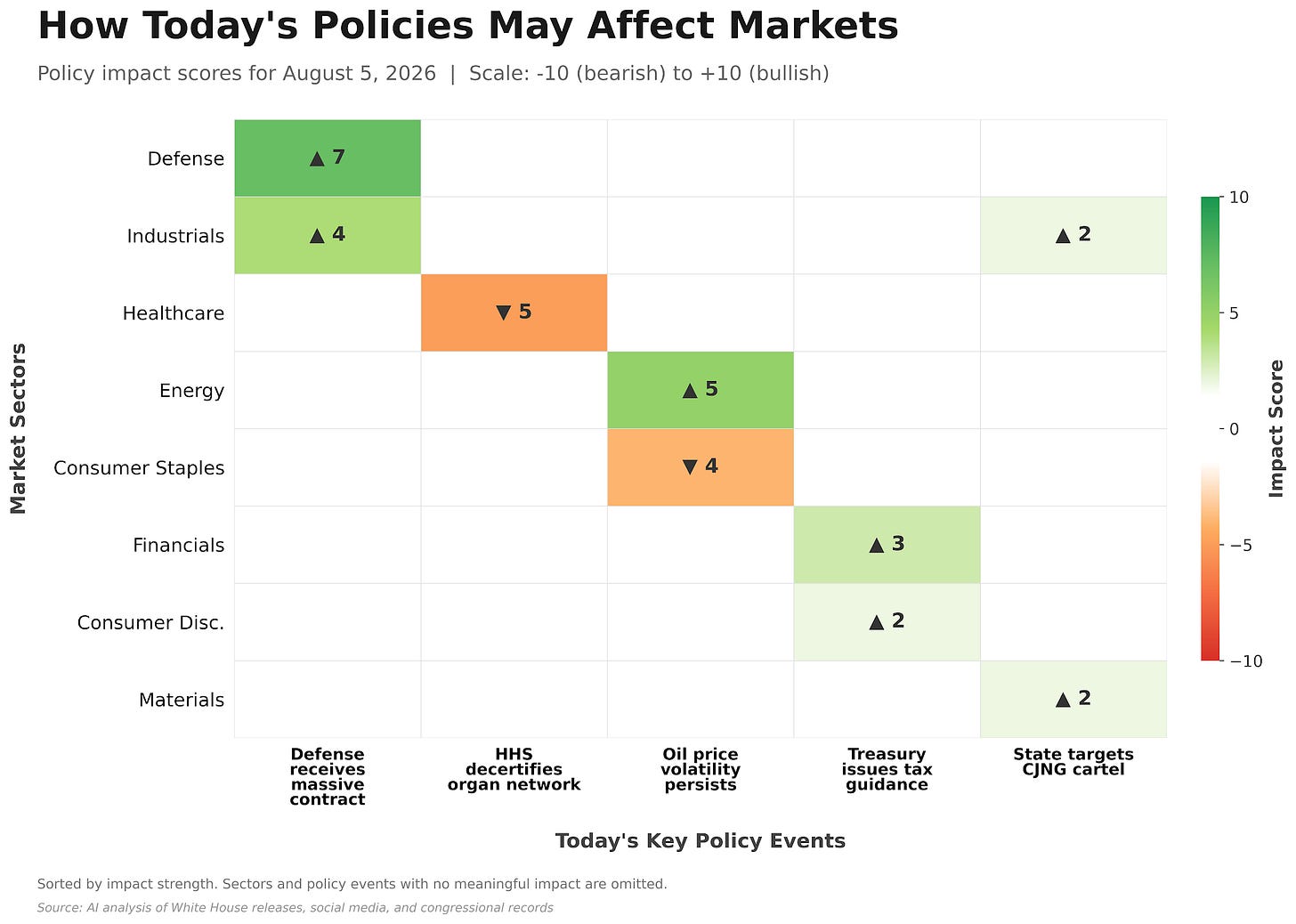
Each cell shows an estimated impact score on a fixed scale of -10 to +10, reflecting how today’s policy developments may affect each market sector. Positive scores (green, ▲) suggest bullish impact; negative scores (red, ▼) suggest bearish pressure. Rows and columns are sorted by impact strength, and sectors and policy events with no meaningful impact are omitted. The heatmap, the analysis below, and the Impact on Market themes above are produced from a single unified analysis: the heatmap visualizes the magnitudes, while the text explains the causal reasoning behind them.
Geopolitical tensions in Iran continue to drive energy market volatility, forcing a repricing of interest rates as inflation risks persist. Elevated oil prices increase operating costs for transportation-heavy sectors and weigh on consumer sentiment, prompting political pushback against energy firm margins. The Treasury’s move to expand tax credits for paid family leave provides a fiscal cushion for employers and labor, though the broader macroeconomic environment remains sensitive to these shifting input costs.
Simultaneously, the administration’s aggressive approach to regulatory oversight is reshaping industry operations. The decertification of a major organ procurement organization demonstrates a shift toward stricter federal performance standards, introducing operational risk for healthcare entities reliant on government contracts. Concurrently, the Department of Defense is sustaining high-volume capital flows to industrial suppliers to bolster readiness. This duality of government action—tightening regulatory enforcement while maintaining heavy defense spending—creates a complex landscape for capital allocation. Market participants are balancing these regulatory headwinds against the tailwinds of sustained government industrial contracts and tax-advantaged business incentives.
-
Trump urges GOP senators to back off hemp ban
President Donald Trump and top White House officials are privately lobbying Republican senators to delay a ban on intoxicating hemp that's set to kick in this fall.www.allsides.com -
Senate Confirms Dr. Erica Schwartz as C.D.C. Director
Dr. Schwartz, a deputy surgeon general in the first Trump administration, has publicly supported childhood vaccines.www.allsides.com -
FAA Investigates Marine One Safety Incident in Washington
Federal aviation officials are reviewing an air-traffic safety incident Tuesday involving a military helicopter carrying President Trump.www.allsides.com -
No evidence? No problem. Trump pushes ahead on false claims that Reflecting Pool was vandalized
Jeanine Pirro this week found out there is a trade-off between loyalty to President Donald Trump and being loyal to reality.www.allsides.com -
Federal judge acknowledges Supreme Court ruling clearing path for Trump to end Haiti TPS
President Donald Trump on Wednesday notched a major immigration victory after a federal judge acknowledged that the court order blocking the administration from ending temporary protected status (TPS) for hundreds of thousands of Haitians is no longer in effect after the Supreme Court's ruling in Mullin v. Doe.www.allsides.com -
Man arrested at Trump’s California golf course wore earpiece and took photos, police say
www.theguardian.comJeanine John Taele faces new weapons charges as details of ‘suspicious’ behavior ahead of president’s visit emerge
A California man who was arrested at Donald Trump’s Los Angeles-area golf course ahead of a presidential visit is facing more charges, as authorities released new details about the investigation.
Authorities say federal agents first observed 38-year-old Jeanine John Taele near the golf grounds in Rancho Palos Verdes on 31 July, wearing an earpiece and capturing photographs and videos of security agents assessing the property.
Continue reading... -
Trump Overstates Magnitude of Noncitizen Voting in New Jersey
www.factcheck.org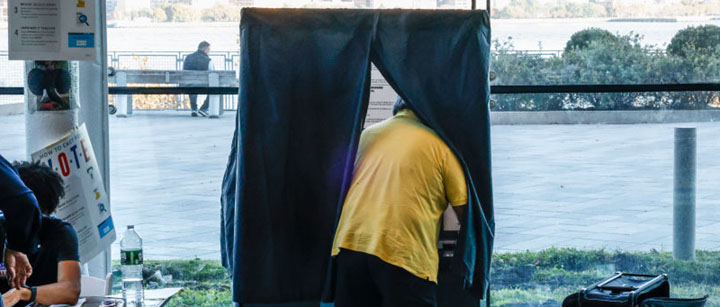
New Jersey’s governor announced that “a software error” in the state’s motor vehicle registration system resulted in 6,600 noncitizens being improperly added to the state’s voter registration list. The state’s preliminary investigation found that up to 400 votes were cast by noncitizens, far fewer than the “thousands of votes” claimed by President Donald Trump.
Trump has seized on the incident as validation of his longtime but unsupported claims about massive numbers of noncitizens voting.
“Well, you saw what happened, they caught thousands of votes in New Jersey where illegal aliens were allowed to vote,” Trump said on July 22, a day after New Jersey Gov. Mikie Sherrill, a Democrat, made the announcement. “Thousands and thousands of votes. They voted in favor of the transgender mutilization of your children and in favor of — in favor of men playing in women’s sports. Isn’t that lovely? They voted against lower energy prices, lower car prices, and bigger paychecks for everyone. They voted against every one of these things.”
Trump again cited the New Jersey case during a speech on July 27 when making a push for the SAVE America Act, which includes a photo ID requirement for voting and proof of citizenship when registering to vote in federal elections. Election experts have said the bill’s specific requirements would make it difficult for some legitimate voters to cast a vote. (New Jersey does not require photo ID at polling places, in most cases, but some form of identification is required if a voter does not voter does not provide valid ID at the time of registration.) Despite the president’s advocacy, the SAVE America Act has stalled in the Senate.
“You read recently in New Jersey, where tremendous numbers of people were found out that they were on the voter rolls totally illegally, and that’s all over the country,” Trump said. “That’s nothing compared to what’s going on in California and Minnesota and so many other states.”
Trump’s claim about rampant noncitizen voting around the country is unsupported. As we have written, experts have found that voting in federal elections by noncitizens is relatively rare. The conservative Heritage Foundation’s election fraud database has documented a little over 100 cases of noncitizens who have been convicted of illegally voting or registering to vote since 1982. But let’s look at New Jersey, specifically, where Trump said “tremendous numbers” of noncitizens were found — “totally illegally” — on voter rolls.
The July 21 announcement by Sherrill represents a significant batch of noncitizen registration and voting. But the number of votes was too small to change the outcome of any federal election in New Jersey.
To put the numbers in some perspective, Democratic presidential nominee Kamala Harris beat Trump in New Jersey’s 2024 presidential race by more than 252,000 votes. Even if all 400 noncitizens voted one way — and Sherrill noted “they were registered as Democrats, Republicans, and the majority unaffiliated, and were scattered across the state” — it would not have been enough to swing the presidential election. “We have no evidence at this time that any elections were swayed,” Sherrill said.
Sherrill said that the noncitizens were inadvertently registered “through no fault of their own.”
We should note that Trump also called the noncitizens who voted in New Jersey “illegal aliens.” We don’t know the legal status of those who were improperly registered to vote, nor of those who voted. But about half of noncitizens living in the U.S. are estimated to be “unauthorized,” according to the Immigration Research Initiative. In other words, about half of noncitizens in the U.S. are lawful permanent residents (green card holders) or temporary legal visa holders, such as workers and students. In addition, “among people who are unauthorized are a very significant number who the government has given some protection from deportation,” the Immigration Research Initiative notes. For example, many have pending asylum cases or have been extended Temporary Protected Status or humanitarian parole.
How Noncitizens Got on Voter Rolls
In her press conference on July 21, Sherrill said that she recently discovered that between June 2023 and June 2024 “a serious software error” in the state’s motor vehicle registration system led to 6,600 noncitizens being put on the state’s voter rolls.
“When New Jerseyans applied for a driver’s license or identification at the MVC [Motor Vehicle Commission], they were asked if they wanted to register to vote,” Sherrill said. “In the case of this error, some individuals indicated that they weren’t citizens and weren’t eligible to vote, but the software registered them anyway.”
 A voter casts their ballot at the Babbio Center on Nov. 5, 2024, in Hoboken, New Jersey. Photo by Kena Betancur/Getty Images.
The contractor, IDEMIA, based in France, said its software performed according to state specifications.
“All 6,600 individuals indicated ‘Yes’ to wanting to register to vote and ‘No’ to being a US Citizen,” Lisa Shoemaker, IDEMIA’s senior vice president of global corporate relations, said in a statement reported by Politico. “This information was recorded correctly and always available to the MVC via the database that MVC utilized to gather voter information and transmit to the Division of Elections. At no point was a noncitizen ever marked as a citizen in the database.”
Shoemaker said that in June 2024 the MVC told IDEMIA to change its software so that people who indicated they were not citizens were not given the option to register to vote.
Sherrill said the state is replacing the vendor. And she tapped an independent law firm, CSG Law, to investigate the issue. The state’s Division of Elections — now more than two years after the issue was discovered by the MVC — “is working to ensure anyone who is illegally registered is removed from the voter rolls.”
“This entire situation is unacceptable,” Sherrill said, placing blame on IDEMIA, which she said “released software with such a glaring error,” as well as the MVC because it “took a year to get this issue fixed.” She also blamed the previous administration of Democrat Phil Murphy. “It’s unacceptable that no one in the previous administration brought this to light, demanded accountability, or took action when it happened years ago,” Sherrill said.
Murphy’s spokesperson said Murphy had no knowledge of the issue until Sherrill announced it on July 21.
Sherrill said the incident does not substantiate the president’s longstanding, but unsupported claims about massive noncitizen voting.
“Let me be clear: Donald Trump has zero credibility on the issue of election integrity,” Sherrill said. “For the past 10 years, he’s cried wolf and peddled bizarre conspiracy theories about fraud with no evidence.”
David Becker, the executive director and founder of the Center for Election Innovation & Research, a nonpartisan nonprofit, agreed that the revelation about noncitizen voting in New Jersey is concerning, but he said it was important to contextualize it.
“You know, we’re going to hear from supporters of the president saying, ‘See, the Democrats said this never happened, and it happened.’ I don’t know anyone credible who says it’s never happened,” Becker said in a press conference on July 23. “It just happens exceedingly rarely, and there’s no evidence it’s changing any elections whatsoever.”
Said Becker: “6,600 records in New Jersey is 0.1% of the total active voter registration list. It’s not very much at all, and 400 voters … that is 0.009% of the total number of votes cast in 2024 in New Jersey in the November 2024 election.”
“There’s no evidence that this affected any election whatsoever,” Becker said. “It’s an incredibly small amount, and it’s also spread out amongst parties: Republicans, Democrats, no party. That was very clear from the press conference. This does not support President Trump’s claims about noncitizen voting. It largely does comport with his Department of Homeland Security’s conclusion that it’s extremely rare.”
Trump Says Number Registered Is Higher
Meanwhile, Trump said that the number of noncitizens registered to vote in New Jersey is much higher than the figure identified by Sherrill.
In a post on Truth Social after Sherrill’s announcement, Trump stated, “35,152 is the new number just released by Homeland Security of non-citizens registered to vote in New Jersey. These are just the ones that got caught. The real numbers will prove to be many times this amount.”
During his primetime address to the nation on July 16, Trump claimed that a Department of Homeland Security investigation “identified approximately 278,000 noncitizens who are registered to vote in federal elections.”
A DHS document released by the White House claimed that a review of “public data files” in four states that have refused to share the private voter data with the government — California, Pennsylvania, New Jersey and Nevada — found over 250,000 noncitizens illegally registered to vote. According to a DHS press release issued on July 17, that included 35,152 in New Jersey.
Sherrill said the state received a letter from DHS about that claim.
“We have asked them for any evidence of this, where they got that number, who this is,” Sherrill said. “We’ve received nothing back yet.”
Sherrill said if DHS “provides us any credible information, we will of course investigate it as we do with every piece of information that we have.” But Sherrill said she thinks the figure is part of Trump’s “ongoing misinformation” about election fraud. Officials in California, Nevada and Pennsylvania also responded to the DHS letter demanding more transparency about how DHS derived its figures.
“That number has no credibility whatsoever until DHS shares their methodology on that number,” Becker said.
“What they’re also saying is that they matched the data they had from the states, which was only the public voter file, with no unique identifiers, no personally identifiable information, to some other data source, possibly commercial, and made conclusions about citizenship status on that,” Becker said in a press conference. “There’s no way that anyone can make a confident match on that. There’s too many challenges. There are data entry errors. There’s fuzzy name matching. There’s junior and senior problems. There’s so many problems that it is almost designed to create a huge number of false positives.”
New Jersey Refusing to Share Names
Calling the voting by 400 noncitizens “unacceptable and illegal,” Harmeet Dhillon, a federal assistant attorney general in the Justice Department’s civil rights division, wrote to Sherrill demanding that New Jersey provide prosecutors with the name, address, date of birth and nationalities of the 6,600 noncitizens added to the state voter rolls as well as the names of those who voted (including when and where they voted).
On a podcast, Dhillon said those who voted could face deportation or criminal charges.
Sherrill said she won’t provide the information requested by DOJ.
“We now have certain people that, through no fault of their own, have been registered to vote,” Sherrill said at her July 21 press conference.
“It may imperil their immigration status,” she said. “It may imperil different things. We are working very hard to protect them, but that is the responsibility of the people that worked for the MVC that knew that this was going on and did nothing to remedy it — that’s wrong. It would be really the utmost in hypocrisy for the state to charge them when it’s our fault. However, I would not put it past the federal government. So we are working very hard on ways in which we can protect people here in the state of New Jersey. We are not in the practice of releasing personally identifying information to the federal government right now, given that the Trump administration continues to weaponize it against people.”
When Sherrill sent Dhillon a formal letter indicating that New Jersey would not provide the identifying information requested, Dhillon responded via X, “DOJ will get this information through all legal means!”
Editor’s note: FactCheck.org does not accept advertising. We rely on grants and individual donations from people like you. Please consider a donation. Credit card donations may be made through our “Donate” page. If you prefer to give by check, send to: FactCheck.org, Annenberg Public Policy Center, P.O. Box 58100, Philadelphia, PA 19102.
The post Trump Overstates Magnitude of Noncitizen Voting in New Jersey appeared first on FactCheck.org.
-
Trump’s Cherry-Picked Inflation Boast
www.factcheck.org
In one month, from May to June, overall inflation in the U.S. dropped at the “fastest rate in more than six years,” as President Donald Trump said in late July remarks. But he has repeatedly cited the statistic while wrongly suggesting that the inflation rate is now “way down” from when he took office. It’s not.
 Photo by alvaro gonzalez via Getty Images.
The big one-month drop came after several months of increases in the inflation rate that were largely due to high oil and gasoline prices caused by the war with Iran. When the U.S. and Iran were honoring a ceasefire agreement in June, those energy prices declined, helping to lower the rate of inflation.
“Energy prices are volatile,” Joseph E. Gagnon, a senior fellow at the Peterson Institute for International Economics, told us in an email. “Any one-month change needs to be viewed in connection with other recent months, which have shown large increases.”
And the fact that oil and gasoline prices have risen again due to rekindled U.S. fighting with Iran could result in the rate of inflation increasing once again. As of Aug. 5, the Federal Reserve Bank of Cleveland projected a minimal monthly increase in the inflation rate for July – not another monthly rate decrease.
In addition, the annualized rate of inflation in June still was higher than it was when Trump became president in January 2025.
Trump has referred to the latest official inflation figures multiple times while talking up the American economy in recent speeches and remarks.
“And it was just announced that inflation is dropping at the fastest rate in more than six years,” he said at a campaign-style rally in Michigan on July 27. “We’re dropping it. You know, I inherited this mess.”
On July 23, at the Environmental Protection Agency, he said, “You know, we inherited the worst inflation in the history of America from the Biden administration. And as you know, last week, it was announced that inflation is way down. It’s down more than it’s been in over six years.”
And the day before that, in Georgia, he said, “Inflation is way down. We’re coming way down. And last week, it was announced just last week that inflation dropped by the largest amount in more than six years, because we’re doing it right. We’re running the country properly.”
But some of what he claimed was false or misleading.
The president’s claims followed the release of data published by the U.S. Bureau of Labor Statistics on July 14. After a 0.9% monthly increase in March, a 0.6% increase in April and a 0.5% increase in May, the Consumer Price Index for All Urban Consumers — on a seasonally adjusted basis — decreased by 0.4% in June, the BLS said.
“This decline in the all items index was the largest 1-month decrease since April 2020 when it fell 0.8 percent,” the bureau noted in a news release about the latest numbers.
So, that portion of what Trump said is accurate. But it’s only part of the story.
The BLS press release also said, “Over the last 12 months, the all items index increased 3.5 percent before seasonal adjustment.” And the 3.5% annualized inflation rate in June, although down from 4.2% year-over-year in May, was still higher than the 3.0% annual rate in January 2025 when Trump took office.
The annual rate reached 9.1% in June 2022 under then-President Joe Biden — which still was not the “worst inflation in the history of America” — but had come down significantly by the time Trump was sworn in. The annual rate was down to 2.4% for the 12 months ending in February, right before the war with Iran began.
On the last day of February, the U.S. and Israel launched airstrikes on Iran, beginning the now monthslong conflict. The U.S.-Israeli attack led to Iran blocking the Strait of Hormuz – a vital waterway in the Middle East for the export of crude oil and other goods – which caused a spike in oil and gasoline prices that contributed to three consecutive increases in the CPI, from March to May.
Oil and gasoline prices then came down when tensions between the warring nations began to ease in late May, leading to the U.S. and Iran signing a temporary agreement in June to suspend the fighting and open the Strait of Hormuz while the countries negotiated a long-term peace deal.
At the beginning of June, the price of West Texas Intermediate crude oil, the U.S. benchmark, was as high as almost $100 a barrel, according to the Energy Information Administration. At the same time, the average U.S. price for regular grade gasoline, which is heavily influenced by oil prices, was about $4.31 per gallon, EIA data show. (Gasoline had climbed to $4.50 a gallon on average in mid-May.)
But by the end of June, WTI crude was down to roughly $71 a barrel and a gallon of gasoline in the U.S. averaged $3.83. The decline in energy prices was the primary reason for the drop in the inflation rate that Trump praised.
“The index for energy fell 5.7 percent in June after rising 3.9 percent in May, 3.8 percent in April, and 10.9 percent in March,” the BLS said in its most recent CPI report. “The energy index was the largest contributor to the monthly all items decrease, more than offsetting increases in other indexes including those for shelter and food.”
Energy prices, however, are also the reason that the decline in the month-to-month inflation rate may not last long.
After the U.S. and Iran were not able to complete a peace deal, the attacks between the two countries resumed in July, and Iran said the Strait of Hormuz was again closed. The U.S. then said it would reimpose a blockade on Iran’s own use of the strait.
As a result, oil and gasoline prices have risen. WTI crude was as high as $93 a barrel on July 23 – before dropping to about $86 on July 31, according to the most recent EIA data. Average gasoline prices, meanwhile, were up to about $4.08 for the week ending Aug. 3.
When oil and gasoline prices went up in March, April and May, the inflation rate increased. That could happen again.
“Setting aside the volatility caused by oil and energy prices, underlying inflation is moving right around 3%, so that’s not going to provide material comfort to households or investors,” Joe Brusuelas, chief economist for market consulting firm RSM US, told CNN for a July 30 story. “The improvement in June will be partially or completely reversed by the upward volatility in July.”
Gagnon, the Peterson Institute senior fellow, said energy price volatility is a reason that the Federal Reserve and many economists look to so-called “core” inflation, which measures the change in prices excluding energy and food items.
From May to June, the BLS said there was no change in the price index for all items less food and energy. Year over year, core inflation was 2.6% in June — down from 2.9% in May and the 3.3% Trump inherited in January 2025.
In an Aug. 5 update, the Federal Bank of Cleveland’s inflation “nowcasting” model projected that core inflation increased about 0.2% in July and about 2.5% for the 12 months ending in July.
The July inflation report from the BLS is set to be released Aug. 12.
Editor’s note: FactCheck.org does not accept advertising. We rely on grants and individual donations from people like you. Please consider a donation. Credit card donations may be made through our “Donate” page. If you prefer to give by check, send to: FactCheck.org, Annenberg Public Policy Center, P.O. Box 58100, Philadelphia, PA 19102.
The post Trump’s Cherry-Picked Inflation Boast appeared first on FactCheck.org.
-
White House confirms new helipad for supersized Marine One helicopter
www.theguardian.comChanges come after report says Trump unhappy with helipad’s appearance and lawn’s slope
The White House has confirmed that contractors are redoing a new helipad built on the South Lawn to accommodate a new supersized Marine One chopper recently added to the presidential transport fleet.
A White House official said the changes to the circular concrete landing pad were ordered as “we continue to make improvements as part of the ongoing project to best match the needs of the White House”.
Continue reading... -
Trump team pushes to block court order giving BBC access to financial records
www.theguardian.comPresident has sued the broadcaster for $10bn, claiming a documentary on 2021 Capitol attack led to financial harm
Donald Trump’s legal team is making an 11th-hour attempt to block a court order that would grant the BBC access to the president’s financial records, as part of his multibillion-dollar lawsuit against the British broadcaster.
Trump claims that the BBC’s 2024 documentary on the January 6 attacks have damaged the president’s business interests. In July, a Miami-based judge ruled that the president would have to start handing over detailed financial records to the BBC by 6 August. The records would reveal details into the hundreds of businesses owned by the US president’s family trust.
Continue reading... -
Trump’s War On Journalists Also Includes Targeting A Freelance NYT Contributor
www.techdirt.comDonald Trump took possession of a $400 million “gift” plane from the Qatari government earlier this year. Trump claimed it was a coup for taxpayers and a boon for America, even as he made it clear this was all about him. According to Trump, no plane was more luxurious than this graft-y replacement for the Air Force One. He bragged about how much it reflected his own taste in upmarket products, which meant the plane’s interior was undoubtedly festooned in gold leaf and stocked with steak-grade ketchup.
But was it secure? That’s kind of a big deal when it comes to presidential transport. Turns out it wasn’t. Trump rode his graft jet to Turkey for a diplomatic meeting but was forced to ride the old Air Force One out of the country when it was discovered his new gaudy aircraft didn’t possess the necessary security measures/counter-measures.
In response to this reporting of the Air Force One Mk. II’s failure, the Trump administration behaved like the Trump administration: it subpoenaed the New York Times reporters, demanding all sort of information in hopes of uncovering the reporters’ government sources.
That’s not how this is supposed to work. The FBI and DOJ both have extensive guidelines that are meant to discourage open attacks on the First Amendment. All of these appear to have been ignored in the administration’s haste to find out who needed to be punished for telling the truth about Trump and his Qatari luxury jet.
Fortunately, the court curb-stomped the DOJ when the New York Times challenged the subpoenas. The DOJ really had no answer for the court’s questions, given that the court had plenty of precedent to work with while the DOJ was limited to being a nominally prehensile Trump appendage. Faced with the (admittedly slim) prospect of being sanctioned by a thoroughly irritated federal judge, the DOJ withdrew the subpoenas.
But that’s not the end of the story, apparently. The administration is targeting anyone remotely related to the New York Times and/or reporting that doesn’t please Donald. The New York Times is now going to bat for one its freelancers, who has also been targeted by this vindictive administration.
In February, F.B.I. agents showed up at the New York home of the reporter, Matthew Cole, to deliver the grand jury subpoena, which was issued by prosecutors in Newport News, Va., according to the people familiar with the matter, who described the private conversations on the condition of anonymity.
The investigators are seeking his testimony about two years’ worth of information about Mr. Cole’s contacts and conversations, as they try to identify his sources for the article about the operation in North Korea, the people familiar with the matter said. It is unclear if the administration has also sought Mr. Cole’s phone and email data, as it has done in other cases.
This is apparently related to Cole’s reporting about a failed surveillance operation authorized by Trump during his first term in office — one that was carried out in hopes of planting a recording device capable of intercepting Kim Jong-un’s communications.
For the operation, the military chose SEAL Team 6’s Red Squadron — the same unit that killed Osama bin Laden. The SEALs rehearsed for months, aware that every move needed to be perfect. But when they reached what they thought was a deserted shore that night, wearing black wet suits and night-vision goggles, the mission swiftly unraveled.
A North Korean boat appeared out of the dark. Flashlights from the bow swept over the water. Fearing that they had been spotted, the SEALs opened fire. Within seconds, everyone on the North Korean boat was dead.
The SEALs retreated into the sea without planting the listening device.
No one likes discussing a failed operation, so understandably this one hadn’t been publicly discussed prior to Cole’s report (with an assist by Dave Philipps). But this attempt to pressure Cole into revealing his sources seems more motivated by Trump’s unwillingness to discuss this mission with the people he’s supposed to be discussing these things with.
The Trump administration did not notify key members of Congress who oversee intelligence operations, before or after the mission. The lack of notification may have violated the law.
What’s inexplicable in normal terms is why this wasn’t a problem until now. This article was published last September. The underlying incident occurred in 2019. But it took until February 2026 for the administration to do anything about it. The Trump administration is far more aggressive and far less respectful of the law this time around, which explains why it would move against this reporting now. However, the delay between the reporting and revenge suggests this was a reaction to Trump seeing something on social media, rather than his administration engaging in a thorough internal investigation for months before deciding it needed to do damage to the First Amendment to move this forward.
Hopefully, this subpoena will soon be tossed into the Trump DOJ discard pile. But losing all the time won’t stop this administration from going after journalists for reporting on Trump’s failures. This administration is incapable of learning from its mistakes because it thinks it’s never wrong. The war on journalists will continue as long as Trump — and the GOP he’s turned into a MAGA puppet — holds power.
-
Trump immigration crackdown ensnares families of US troops
www.theguardian.comAn AP investigation found dozens of active-duty troops’ parents and spouses detained despite protections
The Trump administration has detained dozens of parents and spouses of active-duty US troops as it rolls back immigration protections for military families in the pursuit of its mass deportation agenda.
More than 50 parents and spouses of active-duty service members have been detained since Donald Trump returned to office, and at least six have been deported, an Associated Press investigation found. It is the first accounting of such detentions, which the government does not track.
Continue reading... -
Judge signals Trump’s defamation lawsuit against Wall Street Journal may be dismissed again
www.theguardian.comObama-appointed judge seemed unmoved by Trump attorneys’ arguments in case also naming Murdoch
A federal judge in Florida seemed skeptical of arguments from Donald Trump’s legal team on Wednesday over whether the court should allow a $10bn defamation lawsuit against the Wall Street Journal to move forward.
Trump sued the Journal and the News Corp founder Rupert Murdoch over a July 2025 article about a “bawdy” letter reportedly from Trump that was included in a 2003 birthday book for disgraced financier Jeffrey Epstein. Trump has denied authoring or signing the letter, and his attorneys have argued that the Journal published the story despite having been told it was false.
Continue reading... -
US congressman refuses to drop re-election bid over ex-wife's abuse claims
A US congressman who is battling abuse allegations from his ex-wife and her father, a US senator, has vowed not to quit. Ohio Republican Max Miller, who is fighting for his political life on the eve of a deadline to file for re-election, told CNN: "I'm never going to back down." He acknowledged that President Donald Trump had phoned him on Monday to express doubts about his ability to win in November.www.allsides.com -
Trump Admin Issues $100B Tariff Refunds as States Sue Over New Duties
The government is pressing ahead with refunds on the tariffs that were struck down by the Supreme Court in February, but a group of states is now suing to block the new duties they say have been imposed as a direct replacement for these. According to documents filed by customs officials with the U.S. Court of International Trade and cited by the Financial Times, the Trump administration has now paid out around $100 billion in tariff refunds to importers.www.allsides.com -
Trump is already redoing his $5M White House helipad after complaining it was slanted
Construction crews have spent weeks digging up the South Lawn of the White House to build a massive granite helipad to accommodate Donald Trump's Marine One helicopter. But the president has reportedly directed contractors to redo the work after growing frustrated by the lawn's slope, which prevents the landing pad from sitting level with the horizon. According to The Washington Post, workers have already started to dismantle the project, which includes taking apart a 100-foot-wide presidential seal.www.allsides.com -
This Week In The Big Picture
thinkbigpicture.substack.comIn 2010, Republicans in Wisconsin rode the Tea Party wave to a trifecta of government control in the state, winning the governorship and both houses of the state legislature. And with that power, Republicans proceeded to try to rig themselves into permanent majorities.
What Republicans tried to do in Wisconsin back then has distinct echoes in what Donald Trump has tried to achieve for Republicans nationally in his second term. That makes Ben Wikler, the former Chair of the Wisconsin Democrats who succeeded at actually unrigging Wisconsin during his tenure, the premiere authority on how we can repair our democracy in a post-Trump America.
In tomorrow’s piece, we speak with about his new book, This Is The Plan: How To End America’s Meltdown And Save Democracy, in which he provides a blueprint for how Democrats can organize to take back power in the wake of Republicans’ all out assault on our democratic institutions.
And in case you missed it, on Monday, broke down the two distinct political playbooks that battled it out in yesterday’s Michigan Democratic Senate primary. And while Abdul El-Sayed’s victory was far slimmer than many expected, there is a lesson the Democratic establishment should take from El-Sayed’s campaign if they want to both fend off challenges from the left in the future, as well as set themselves up for success against Republicans.
And in yesterday’s piece, exposed the Trump administration’s well-worn tactic of turning ordinary citizens into criminals to camouflage its own corruption and lawlessness.
-
Trump is pioneering the role of commentator-in-chief when issues grow thorny
www.theguardian.comThe president is constantly assigning motives, identifying heroes and villains, and telling his audience what to think
This was originally published in This Week in Trumpland. Sign up to receive it in your inbox every Wednesday
From Charles Barkley to Thierry Henry to John McEnroe, the path from the arena to the commentary box is well trodden, and plenty of politicians have made the transition from elected office to the TV studio. One man, however, insists on doing both at the same time.
Donald Trump is the US president, empowered to kill terrorists, grant pardons, sign and veto bills, and represent the nation on the world stage. But when issues become thorny, as they have of late, he is wont to embrace an alternative role as commentator-in-chief.
Continue reading... -
Armed Man Arrested at Trump Golf Club Near Los Angeles
A California man was arrested at the Trump National Golf Club near Los Angeles over the weekend after he was found with a loaded firearm and was seen taking photographs of the property on multiple occasions, the authorities said.www.allsides.com -
Who Is Jeanine John Taele? Armed Man Arrested at Trump Golf Course
A man who was carrying ammunition and had a gun in his pickup truck was arrested at Donald Trump's Los Angeles-area golf course on Sunday, after appearing to monitor security preparations days before the president was scheduled to attend a fundraiser there, authorities said.www.allsides.com -
DOJ Invokes Trump v. US to Protect Todd Blanche’s Fixer, Aakash Singh
emptywheel.net
The Chicago US Attorney’s Office has submitted its objection to requests from the Broadview 6 that there be some kind of further punishment — discovery, contempt, an investigation — for the misconduct on the case.There are some gaping holes in the argument, which I’ll return to.
But there’s one part of the argument that deserves immediate attention.
In the Broadview 6 requests, they asked for discovery on the role of Todd Blanche’s fixer, Aakash Singh, noting both that he was the instrument of the vindictive prosecution against Kilmar Abrego, and that his reported conduct — that is, dismissing grand jurors who object to a case — is precisely what happened in this one.
Any documents, communications, and records between any member of the Front Office or any AUSA in the U.S. Attorney’s Office for the Northern District of Illinois and Associate Deputy Attorney General Aakash Singh5 or Acting Attorney General Todd Blanche relating to the investigation, decision to charge, the proposed indictment, the grand jury proceedings, or the postindictment proceedings in this case before the Court. From September 19, 2025 through May 31, 2026. (This request includes cell phone records from any cell phone used for such communication with Mr. Singh.)
5 The request regarding Aakash Singh is well-supported based upon publicly available information regarding Mr. Singh’s direct involvement in matters of this type, including presentations made to grand juries.
First, publicly available reporting indicates that Mr. Singh has played a central role in guiding the prosecution of “top administration targets such as Kilmar Abrego Garcia, James Comey, and Don Lemon” and, of particular note here, in seeking “to dismiss [grand] jurors who presented hurdles” when “grand juries refused to indict . . . following mass street arrests.” Ben Penn, In-Your-Face DOJ Aide Rides Prosecutors for ‘Chief Client’ Trump, Bloomberg Law, Feb. 19, 2026, https://news.bloomberglaw.com/us-law-week/in-yourface-doj-aide-rides-prosecutors-for-chief-client-trump (emphasis added).
Second, Mr. Singh engaged in numerous substantive—and now Courtdocumented —communications directly with the prosecution team in the Abrego Garcia case. Ex. A, Court Order in Case No. 25-cr-115, M.D. Tenn. (Dkt. #312) (identifying numerous specific communications to and from Mr. Singh and the assigned prosecutor related to that prosecution, as well as Mr. Singh’s involvement, oversight, and direction to the prosecution team, at pp. 7, 8, 9, 10, 11, 12, 14, 18, 19, 20, 21, 24, 25, 26, 27, 28, 29, 31, and 32). [emphasis original]
The DOJ response objects to this request in a number of nested ways. There’s no evidence of contempt, Judge April Perry is not competent to conduct an investigation, and much of this is privileged, among other arguments. Blah blah blah.
But the Todd Blanche’s DOJ did something that it has generally stopped short of doing, in spite of all the various ways DOJ has invoked expansive authority this term.
It invoked Trump v. US.
Separately, as the Supreme Court recently held, “[i]nvestigative and prosecutorial decisionmaking is ‘the special province of the Executive Branch,’” and so even the “President may discuss potential investigations and prosecutions with his Attorney General and other Justice Department officials to carry out his constitutional duty to ‘take Care that the Laws be faithfully executed.” Trump v. United States, 603 U.S. 593, 620 (2024) (quotations and citations omitted). Thus, members of the Executive Branch are constitutionally required to “take Care that the Laws be faithfully executed,” and it is entirely appropriate for them to “decide which crimes to investigate and prosecute.” Id. (quoting U.S. Const. Art. II, § 3). Although the Supreme Court in 2024 made clear that the law permits such interactions, as already noted and consistent with Department policy, in this matter, the United States Attorney reported the Office’s charging decision to Main Justice shortly before the first grand jury presentation in this case. R. 110 at 4, n.2.15 Former Defendants are not entitled to any communications relating to charging decisions or any other intra-agency or interagency communications, including those with other individuals in Main Justice or federal law enforcement, because the law disallows their access to such communications both as a matter of separation of powers and privilege.
In a footnote, it implicitly (with the citation to In re United States) threatened Judge April Perry with a mandamus petition if she went there, even while not answering the unnamed counsel’s question (because the answer is limited to charging decisions, not — for example — grand jury tactics on how to obtain abusive indictments).
15 On July 15, 2026, counsel for one of the former Defendants sent an email to the U.S. Attorney’s Office asking whether the Office “still stands” behind its assertion that there were “no communications” “with anyone outside the USAO” regarding “who and what to charge” or its “investigatory or charging decisions.” R. 110 at 3 (bold in original, italics added). The Front Office is not aware of any communications in which it took direction from anyone outside the U.S. Attorney’s Office regarding its decisions as to what investigatory steps the local prosecution team would take or who the local prosecution team would charge when prosecutors went into the grand jury to indict this case. Out of an abundance of caution, the Office notes there was a virtual meeting on September 27, 2025, among Main Justice lawyers, the Chicago U.S. Attorney’s Office, lawyers from at least one other U.S. Attorney’s Office on the West Coast, and many federal law enforcement agencies where the September 26 “Broadview” incident was mentioned (and a public video played) as part of a broader discussion of incidents and conduct against ICE during that time. To the Front Office’s knowledge, the virtual meeting did not mention the identity or political affiliation of any person. It was only later when Chicago FBI agents assigned to the case began investigating the matter that the Office learned the identity of some of the people involved in the incident. Moreover, as would be expected in the normal course, there were discussions between the Office and Main Justice regarding such things as case updates, especially given the publicity the case generated after it had been charged. These privileged discussions are not only permitted but are contemplated. See supra 19; In re United States, 398 F.3d at 618 (“How the United States reaches its litigating positions, who said what to whom within the prosecutor’s office, and so on, are for the Attorney General and the President to evaluate. The Judicial Branch is limited to assessing counsel’s public deeds.”).
In May, Jack Goldsmith argued that this type of reliance is precisely what Trump might try, but we really hadn’t seen it yet.
In an article published last year, I argued that the decision would be less important for its immunity holding than for its rulings “on the President’s exclusive removal power and exclusive power over investigation and prosecution.” I claimed that while it was “hard to predict” how the Supreme Court would treat these rulings,
it is not hard to predict how the executive branch will use the Trump rulings, at least until they are later revised by courts. In litigation it will invoke them in support of broad presidential power. It will also invoke them inside the executive branch, in many contexts outside of judicial review, in deciding which executive branch actions are lawful, and in deciding, relatedly, which congressional statutes to disregard as unconstitutional.
I speculated in particular that the executive branch would rely on Trump to expand its law enforcement discretion and its authority over removal, presidential supervision, and executive privilege.
It is still early, but to date the public record shows that Trump has had less formal impact than I anticipated.
Now we have, in an instance in which elected Democrats and Democratic candidates are testing whether the misconduct used to indict them came from the top.
In an instance where there’s good reason to believe the past instrument of Todd Blanche’s vindictive prosecution had struck again.
The post DOJ Invokes Trump v. US to Protect Todd Blanche’s Fixer, Aakash Singh appeared first on emptywheel.
-
Another assassination plot? Feds charge Hispanic man named 'Jeanine' caught with hollow-point rounds at Trump's golf club
Leftists have for years publicly fantasized about the demise of President Donald Trump. Some radicals have attempted to make these murderous dreams a reality — and on at least three occasions came awfully close to succeeding.www.allsides.com -
Abdul El-Sayed offers a template for Democrats to defeat Trumpism | Peter Beinart
www.theguardian.comThe candidate has crafted a progressive nationalism and shown his party how to turn Republicans’ financial advantage against them
Every now and then, a Senate race sets the direction for an entire party. In 1991, a state official named Harris Wofford – advised by a foul-mouthed Cajun named James Carville – upset his far better-known Republican opponent to win a special election in Pennsylvania. He did it by promising to expand access to healthcare – and thus created a template for Bill Clinton’s presidential campaign the following year.
If Abdul El-Sayed can follow up his victory in last night’s Democratic Senate primary by winning the general election in Michigan this fall, he will have created a template of his own. Despite his closer-than-expected margin of victory, his campaign offers a model for how Democrats across the country can answer the political challenge posed by Donald Trump.
Continue reading... -
Nicola Jennings on Donald Trump’s complaints about oil companies – cartoon
www.theguardian.com