Conversation
-
Washington Policy Review: August 5, 2026
sourceToday’s Report
1. Overview
2. White House News
3. Truth Social Posts
4. Government Department News
5. 2028 Democratic Presidential Candidates
6. AI & Tech Company News
7. Congressional Watch
8. Policy Impact Analysis & Heatmap
1. Overview
The White House highlighted President Trump’s recent policy impacts in Nevada, crediting his administration with securing the “largest tax cut for working families” and achieving the “most secure border on record.” Officials credited these initiatives with driving down local crime and attracting billions in private investment, asserting that the administration’s “America First” agenda is delivering tangible results for the state’s residents. Separately, newly declassified FBI memos revealed a 2017 investigation into whether President Trump acted on behalf of the Russian government, though records suggest agents viewed the probe as a biased effort to “get Trump.”
On Truth Social, President Trump promoted an interview with Treasury Secretary Scott Bessent and celebrated a “28-1” win rate in recent political endorsements. He characterized media coverage of his single loss as “FAKE NEWS” and issued a stern warning regarding election integrity in Wayne County, Michigan, labeling the process “strictly Third World.” Additionally, Trump criticized Michael Moore as a “Loser” and maintained that his administration’s economic performance has initiated a “Golden Age of America” that his opponents cannot undo.
The State Department addressed the OAS on the “Murillo-Ortega dictatorship” in Nicaragua and saw Secretary Rubio discuss European security and Iran with his UK counterpart. The State Dept also announced $102 million in rewards and visa revocations to degrade the CJNG cartel, alongside $242 million in new Ebola relief. HHS Secretary Robert F. Kennedy, Jr. celebrated Kentucky’s medical schools joining a nutrition initiative and oversaw the decertification of an organ procurement organization due to “persistent patient safety failures.” The Treasury Department opened media credentialing for the upcoming G20 Finance Ministerial in North Carolina and released new guidance on tax credits for paid family leave.
Democratic governors focused on state-level infrastructure and economic initiatives. Governor Pritzker demanded answers from oil CEOs regarding high gas prices in Illinois, blaming the costs on President Trump’s “unlawful war with Iran” and accusing companies of generating “windfall profits.” Governor Moore signed legislation to place a redistricting amendment on the November ballot, claiming Republicans are working to “rig the system” and “weaken voting rights.” Meanwhile, Senator Ossoff voted against the CDC Director confirmation, citing a “reckless and sustained attack on the CDC” by the administration, while also introducing bipartisan legislation to bolster emergency alerts via satellite.
NVIDIA announced a significant expansion in domestic manufacturing to support U.S. AI infrastructure. Partnering with Wistron, the company opened a 324,000-square-foot facility in Fort Worth, Texas, to produce Grace Blackwell Superchips. This effort is part of a broader $700 million investment intended to onshore supply chains and move toward producing $500 billion in AI infrastructure within the United States.
The Senate conducted routine legislative business on August 4, passing the ALS Act Reauthorization and the National Plan for Epilepsy Act by voice vote. The Senate Judiciary Committee voted to report the nomination of Todd Blanche for Attorney General favorably to the full chamber. Meanwhile, the House of Representatives was not in session, and no legislative business occurred in that chamber.
Escalating geopolitical instability in the Strait of Hormuz elevates crude oil prices and inflationary pressures, compelling central banks to scale back rate-cut expectations and suppressing consumer discretionary spending. Simultaneously, robust federal fiscal commitments to domestic defense and industrial sectors provide a stable revenue floor for prime contractors, although this heavy capital allocation risks distorting labor and material markets. Within the healthcare sector, heightened regulatory enforcement and stricter performance standards introduce significant business continuity risks, a policy shift that critics characterize as “overreach” potentially fragmenting local delivery networks.
2. White House News
President Trump and Republicans Deliver Big Wins for the Silver State
President Trump and Republican leadership are “delivering results for Nevada families, workers, seniors, and communities,” according to the White House. The administration credits his policies with creating the “largest tax cut for working families in American history” and establishing the “most secure border on record.” Since returning to office, the President has reportedly driven down crime, unleashed American energy, opened federal lands, and attracted billions in private investment to the state, reinforcing the administration’s stance that “America First means Nevada First.”
Reference: https://www.whitehouse.gov/releases/2026/08/president-trump-and-republicans-deliver-big-wins-for-the-silver-state/
FBI Secretly Opened Probe Alleging Trump Fired Comey Because He Was a Russian Asset, Declassified Memos Show
Newly declassified FBI memos reveal that in May 2017, the bureau opened a criminal investigation, codenamed “Oxferd Comma,” to determine if President Trump was “wittingly or unwittingly, involved in activities for or on behalf of the Government of the Russian Federation.” The probe, predicated on concerns regarding the firing of James Comey, sought evidence of obstruction and potential Russian control. However, reports indicate FBI agents had largely dismissed collusion allegations beforehand, with one agent describing the investigation as a misguided effort to “get Trump.”
Reference: https://www.whitehouse.gov/releases/2026/08/fbi-secretly-opened-probe-alleging-trump-fired-comey-because-he-was-a-russian-asset-declassified-memos-show/
3. Truth Social Posts
Trump highlighted a recent television interview featuring Treasury Secretary Scott Bessent. Regarding domestic political contests, he noted his successful record on endorsements, where he achieved a “28-1” win rate, while criticizing the media for focusing solely on his single loss and labeling such coverage as “FAKE NEWS.”
Concerning the state of the Democratic Party and local elections, Trump observed that the projected winner of a recent race is a “Communist loser who hates Jews and Israel,” noting that the polls were “way off.” He also issued a strong warning regarding the integrity of voting in Wayne County, Michigan, describing it as “strictly Third World” and susceptible to “fake mail-in ballots” that might “surprisingly” appear. To counter this, he urged voters to support Mike Rogers to make the election “TOO BIG TO RIG.”
Finally, Trump derided Michael Moore as a “failed political pundit” and a “Loser,” while dismissing the critiques Moore offered regarding the 2024 election. Trump asserted that his administration has ushered in the “Golden Age of America” defined by the “Best Economic Numbers, EVER,” and maintained that these successes are too powerful for a small group of political opponents to destroy or alter.
Reference: https://truthsocial.com/@realDonaldTrump
4. Government Department News
State Department (state.gov)
U.S. Participation in Special Meeting at the OAS Permanent Council on Nicaragua
Senior Bureau Official Michael Kozak addressed the OAS Permanent Council regarding the “Murillo-Ortega dictatorship’s threat to the peace and security of our hemisphere.” The U.S. presented a draft resolution, co-sponsored by Argentina, Costa Rica, Panama, and Paraguay, to convene a Meeting of Consultation of Ministers of Foreign Affairs. The United States urged collective regional action, stating it “cannot continue to act alone” against the regime’s “desecration of democratic principles” and called for supporting the Nicaraguan people’s right to live free from tyranny.
Secretary Rubio’s Meeting with UK Foreign Secretary Miliband
Secretary of State Marco Rubio met with UK Foreign Secretary Ed Miliband to discuss European security roles and regional stability. The two officials emphasized the necessity for Europe to take on a greater share of responsibility for its own security. Additionally, they reaffirmed their joint commitment to maintaining safe transit in the Strait of Hormuz and ensuring that Iran is prevented from developing or obtaining a nuclear weapon.
Degrading CJNG: Announcing over $100 Million in Reward Offers and Visa Restrictions
Supporting President Trump’s mission to “eliminate narco-terrorist cartels,” the State Department announced up to $102 million in rewards for information leading to the conviction of eight leaders and associates of the Cártel de Jalisco Nueva Generación (CJNG). The department also revoked visas for 65 individuals linked to the cartel. Officials described CJNG as a “most violent and dangerous” group that “poisons American communities with illicit fentanyl, cocaine, heroin, and methamphetamine,” asserting that cartel operatives can no longer “terrorize the American people.”
Ebola Response Update – August 5, 2026
The U.S. is providing an additional $242 million to combat the Ebola outbreak in the Democratic Republic of the Congo and Uganda, bringing total State Department contributions to over $512 million. The funding supports surveillance, border screening, and treatment facilities. The administration maintains a Level 4 “Do Not Travel” advisory for the region. The State Department is assisting U.S. citizens in the area with security updates and financial loans for travel adjustments, emphasizing that the “Trump Administration has no higher priority than the safety and security of U.S. citizens.”
Department of War (war.gov)
The Department of War announced multiple defense contracts. Key awards include: $210.4 million to Hudson Technologies for industrial gas; $41.4 million to Pentaq Manufacturing for combat uniforms; $82.9 million to Carahsoft Technology for Air Force software renewals; and $67.5 million to Allison Transmission for Abrams tank components. Additionally, CCI Facility Contractors received $13.4 million for electrical infrastructure at Cape Canaveral, Loc Performance Products was awarded $18.9 million for vehicle track shoes, and G.A. Mechanical was awarded $16.9 million for utility infrastructure repairs.
Department of Health and Human Services (hhs.gov)
Kentucky Becomes Latest State to Achieve Full Participation in HHS Nutrition Education Initiative
Kentucky has reached full participation in the HHS Nutrition Education Initiative, as all medical schools in the commonwealth committed to providing at least 40 hours of nutrition education over four years. HHS Secretary Robert F. Kennedy, Jr. stated, “We cannot solve America’s chronic disease epidemic if doctors graduate without understanding how food shapes health.” Nationwide, 76 medical schools across 36 states have now joined the initiative, alongside eight major medical organizations committed to comprehensive educational reforms.
HHS Decertifies Kentucky Organ Procurement Organization to Protect Patients, Restore Trust
HHS is decertifying the Network for Hope, an organ procurement organization (OPO) serving Kentucky and surrounding states, citing persistent patient safety failures. Secretary Robert F. Kennedy, Jr. noted the action reflects the “Trump Administration’s commitment to protecting the sanctity of life.” Following federal reviews, officials determined the organization failed to meet safety standards or improve after corrective actions. CMS Administrator Dr. Mehmet Oz stated, “If you can’t be trusted to safeguard patients... we’ll find organizations that can.” New reforms include mandating OPTN Patient Safety Officers at all OPOs.
Treasury Department (home.treasury.gov)
Media Credentialing Opens for the United States G20 Finance Ministerial in Asheville, North Carolina
Treasury Secretary Scott Bessent will host the U.S. G20 Finance Ministerial in Asheville, North Carolina. The event includes a meeting for finance and central bank deputies from August 29–30, 2026, followed by a meeting for finance ministers and central bank governors from August 31–September 1, 2026. Media members must apply for credentials by August 24, 2026. Approved attendees will receive further logistical details and security information regarding the proceedings.
The Treasury and IRS released Notice 2026-28, outlining the permanent expansion of the employer tax credit for paid family and medical leave under the Working Families Tax Cuts. Secretary Scott Bessent stated the policy gives businesses “greater incentives to provide paid leave so workers can care for a newborn or other family member or recover from a serious illness without sacrificing their financial security.” Beginning in 2026, the guidance allows employers to claim credits for insurance premiums and wages paid for leave.
Quarterly Refunding Statement of Deputy Assistant Secretary for Federal Finance Brian Smith
The Treasury is offering $125 billion in securities to refund $96.3 billion in maturing debt, raising $28.7 billion in new cash. Auctions for 3-year, 10-year, and 30-year securities are scheduled for August 11–13, 2026. Treasury plans to maintain current coupon and floating rate note auction sizes for coming quarters. The department expects the Treasury General Account balance to peak at $1.05 trillion in late October and is implementing a buyback program for liquidity and cash management purposes.
Report to the Secretary of the Treasury from the Treasury Borrowing Advisory Committee
The Treasury Borrowing Advisory Committee reports that global markets are significantly influenced by energy price volatility stemming from the Iran conflict. While U.S. economic growth continues, the Federal Reserve has shifted toward a more hawkish stance, with some participants favoring rate increases. The committee notes that Treasury remains “adequately funded” for the remainder of FY26, though it projects a widening funding gap in subsequent fiscal years. The committee suggests maintaining specific cash balance targets for the Treasury General Account through the end of 2026.
5. 2028 Democratic Presidential Candidates
Gavin Newsom (gov.ca.gov)
Governor Newsom announces appointments 8.5.2026
Governor Newsom announced four appointments: Lele Yutzy as Director of the Office of Civil Rights; Jennifer Song as Deputy Secretary and Special Counsel for Enforcement at the California Business and Consumer Services Agency; Jane Park as Deputy Secretary for Energy at the California Natural Resources Agency; and Shweta Maurya as Senior Product Manager at the Office of Data and Innovation. These roles involve varying levels of state oversight and compensation, ranging from $154,860 to $220,584 annually.
Governor Newsom signs tribal-state gaming compact
Governor Newsom has officially signed a new tribal-state gaming compact between the State of California and the Yurok Tribe.
California’s tax agency cracks down on $168 million in illicit cannabis, tobacco
The California Department of Tax and Fee Administration has recovered $168 million in illicit cannabis and tobacco goods since 2019, including $22 million in early 2026. Governor Newsom stated that this enforcement protects the legal market and ensures “revenues that fund vital state programs are protected.” The state also reported high compliance rates regarding intoxicating hemp and kratom restrictions. These efforts are part of a broader strategy, supported by the Unified Cannabis Enforcement Task Force, to dismantle illegal operations and combat tax evasion.
Governor Newsom secures federal assistance to support response to Gann Fire in Calaveras County
Governor Newsom secured a Fire Management Assistance Grant from FEMA to support suppression efforts for the Gann Fire in Calaveras County. The fire, which began August 3, 2026, has burned over 6,495 acres, leading to the evacuation of 1,473 residents. The grant allows state and local agencies to apply for 75% reimbursement of eligible suppression costs. State agencies, including CAL FIRE and Cal OES, are coordinating response operations to contain the fire, protect property, and manage evacuations for threatened communities.
Gretchen Whitmer (michigan.gov)
Governor Whitmer announced a $2 billion investment plan across several Michigan companies, including fairlife, Chobani, and Mitra Chem, expected to create or retain 817 jobs. Fairlife is investing $650 million in a Coopersville expansion, while Chobani is investing $567 million to grow its La Colombe facility in Norton Shores. These projects, supported by the Make It in Michigan Competitiveness Fund, focus on food systems and infrastructure, with state grants assisting in regional water and wastewater system improvements to support long-term economic growth.
Wes Moore (governor.maryland.gov)
Governor Moore Announces New Preakness Race Schedule
Governor Moore announced a new schedule for the Preakness and Black-Eyed Susan Stakes following the state’s acquisition of the races’ intellectual property. The Preakness will move to the fourth Sunday in May, while the Black-Eyed Susan Stakes will be showcased on Saturday. Additionally, the Maryland Jockey Club and NBC Sports extended their partnership through 2032, ensuring continued coverage across NBC, Peacock, and NBCSN. Officials stated these changes aim to support Maryland’s economy, honor the state’s equine history, and modernize the racing experience for fans.
Governor Moore Signs Legislation to Put Redistricting Constitutional Amendment on November Ballot
Governor Moore signed HB 2100, placing a constitutional amendment on the November 2026 ballot to clarify Maryland’s redistricting process. If ratified, the amendment will confirm that redistricting standards for legislative districts do not apply to congressional districts. Governor Moore stated, “I have warned that President Trump and Republicans across the country are working to rig the system, weaken voting rights, and make this pain permanent.” The measure follows the work of the Governor’s Redistricting Advisory Commission and is intended to ensure redistricting decisions remain with Maryland voters.
Andy Beshear (governor.ky.gov)
Artisans Inc., a 100% employee-owned custom apparel manufacturer, has opened an $8.4 million facility in Lexington, creating 55 new jobs. The company consolidated operations from Wisconsin into this new location on Mercer Road. Founded in 1963, the firm specializes in decorated apparel for schools, resorts, and retailers. State and local officials celebrated the investment as a boost to the regional economy and a testament to Kentucky’s attractiveness for manufacturing businesses.
JB Pritzker (gov.illinois.gov)
Governor Pritzker has sent letters to major oil company CEOs demanding explanations for rising gasoline prices in Illinois, which he attributes to the impact of President Trump’s “unlawful war with Iran.” Pritzker argues that oil companies are generating “windfall profits” while Illinois drivers face costs that have risen by $1.30 per gallon. The Governor is requesting information on how these companies are profiting from the conflict and what steps they will take to provide financial relief to Illinois families by August 21, 2026.
Daily Public Schedule: Thursday, August 5, 2026
Governor Pritzker is scheduled to visit the iFab Integrated Bioprocessing Research Laboratory in Urbana, Illinois, to announce the second round of Regional Site Readiness awards. This initiative aims to foster job creation and business development throughout the state. A press availability is planned following the announcement.
Daily Public Schedule: Wednesday, August 5, 2026
Governor Pritzker has no public events scheduled for Wednesday, August 5, 2026.
Jon Ossoff (ossoff.senate.gov)
Sen. Ossoff Statement on CDC Director Confirmation Vote
Senator Ossoff voted against the confirmation of Dr. Schwartz as CDC Director. While offering his congratulations, Ossoff expressed concerns regarding the leadership of HHS Secretary Robert F. Kennedy, Jr., characterizing his tenure as a “reckless and sustained attack on the CDC” that has “gutted and demoralized” the workforce. Ossoff stated that after speaking with Dr. Schwartz, he “lacked sufficient confidence in her independence” given the current political climate, though he remains open to working with her to support the agency’s mission.
Sens. Ossoff, Cornyn Introduce Bipartisan Legislation to Strengthen Emergency Alerts
Sens. Ossoff and John Cornyn introduced the bipartisan Mystic Alerts Act, which aims to improve wireless emergency alerts by enabling delivery via satellite technology. This legislation seeks to ensure alerts reach citizens during disasters when ground-based cellular infrastructure is compromised, citing the loss of life during recent flooding in Texas as a primary motivator. The bill is part of Ossoff’s broader public safety efforts, which recently included securing federal funding for emergency response equipment and infrastructure in Spalding County, Conyers, and Tybee Island.
6. AI & Tech Company News
NVIDIA (nvidia.com)
NVIDIA and Partners Build in America, for America
NVIDIA is supporting the National Science Foundation’s State and Regional AI Hubs program to broaden access to AI research resources across U.S. colleges. Simultaneously, the company is expanding domestic manufacturing, exemplified by Wistron’s new 324,000-square-foot facility in Fort Worth, Texas. Producing Grace Blackwell Superchips, this plant is part of a $700 million investment aimed at reindustrializing the U.S. NVIDIA continues to partner with companies like TSMC and Foxconn to onshore supply chains, aiming to produce $500 billion in AI infrastructure domestically.
7. Congressional Watch
Covers the 2026-08-04 session — the Congressional Record is published with a one-day delay.
Senate
The Senate conducted routine legislative business and passed several non-controversial measures regarding health research and education. Senators also advanced the nomination process for the Director of the Centers for Disease Control and Prevention and continued debating a trade extension act.
S. 4472, ALS Act Reauthorization — Reauthorizes critical therapy access provisions through fiscal year 2031 [Passed by voice vote]
S. 494, National Plan for Epilepsy Act — Establishes a coordinated national research plan for epilepsy [Passed by voice vote]
S. Res. 830, Fulbright Program 80th Anniversary — Recognizes the 80th anniversary of the Fulbright Program [Passed by voice vote]
Todd Blanche — Nominated to be Attorney General [Ordered reported favorably by the Judiciary Committee]
House of Representatives
The House of Representatives was not in session on August 4, 2026. No legislative business or committee activity took place.
None — No session held [N/A]
Committee Highlights
Senate - Budget — Examined the current state and financial reality of the Medicaid program
Senate - Finance Subcommittee on Health Care — Examined the role of biotechnology in shaping a resilient health care future
Senate - Judiciary Subcommittee on Crime and Counterterrorism — Examined the consumer costs associated with AI surveillance pricing
Senate - Judiciary — Ordered the nomination of Todd Blanche for Attorney General to be reported
Coming Up
The Senate will convene at 10:30 a.m. on Wednesday, August 5, to continue considering the AGOA trade extension and vote on the nomination of Erica Schwartz for CDC Director. The House will meet in a pro forma session at 9 a.m. on Thursday, August 6.
Reference: Congressional Record Archive
8. Policy Impact Analysis & Heatmap
This analysis is provided for informational purposes only. It does not constitute investment advice or a recommendation to buy or sell any security.
Impact on Market
Based on today’s policy developments, our analysis identifies the following market impact themes:
THEME 1. GEOPOLITICAL ENERGY RISK
Ongoing conflict in the Strait of Hormuz continues to drive crude oil volatility and inflationary expectations. Persistent supply chain sensitivities force central banks to pivot away from rate-cut expectations. Critics argue that these high energy costs act as a regressive tax, severely dampening consumer discretionary spending power.
THEME 2. DEFENSE INDUSTRIAL EXPANSION
Government contract flows toward domestic industrial and defense manufacturers remain robust as the administration prioritizes security-related supply chains. This concentrated fiscal spending creates a reliable revenue floor for prime contractors. However, analysts warn that heavy reliance on defense-linked capital allocation can create distortions in labor and material markets.
THEME 3. HEALTHCARE REGULATORY SCRUTINY
Federal agencies are adopting a more punitive stance toward non-compliant service providers in the medical space. By enforcing stricter performance standards through decertifications, the administration aims to improve quality but introduces sudden business continuity risks. Opposition figures characterize these interventions as ‘overreach’ that could fragment local healthcare delivery networks.
Policy Impact Heatmap with Market Direction
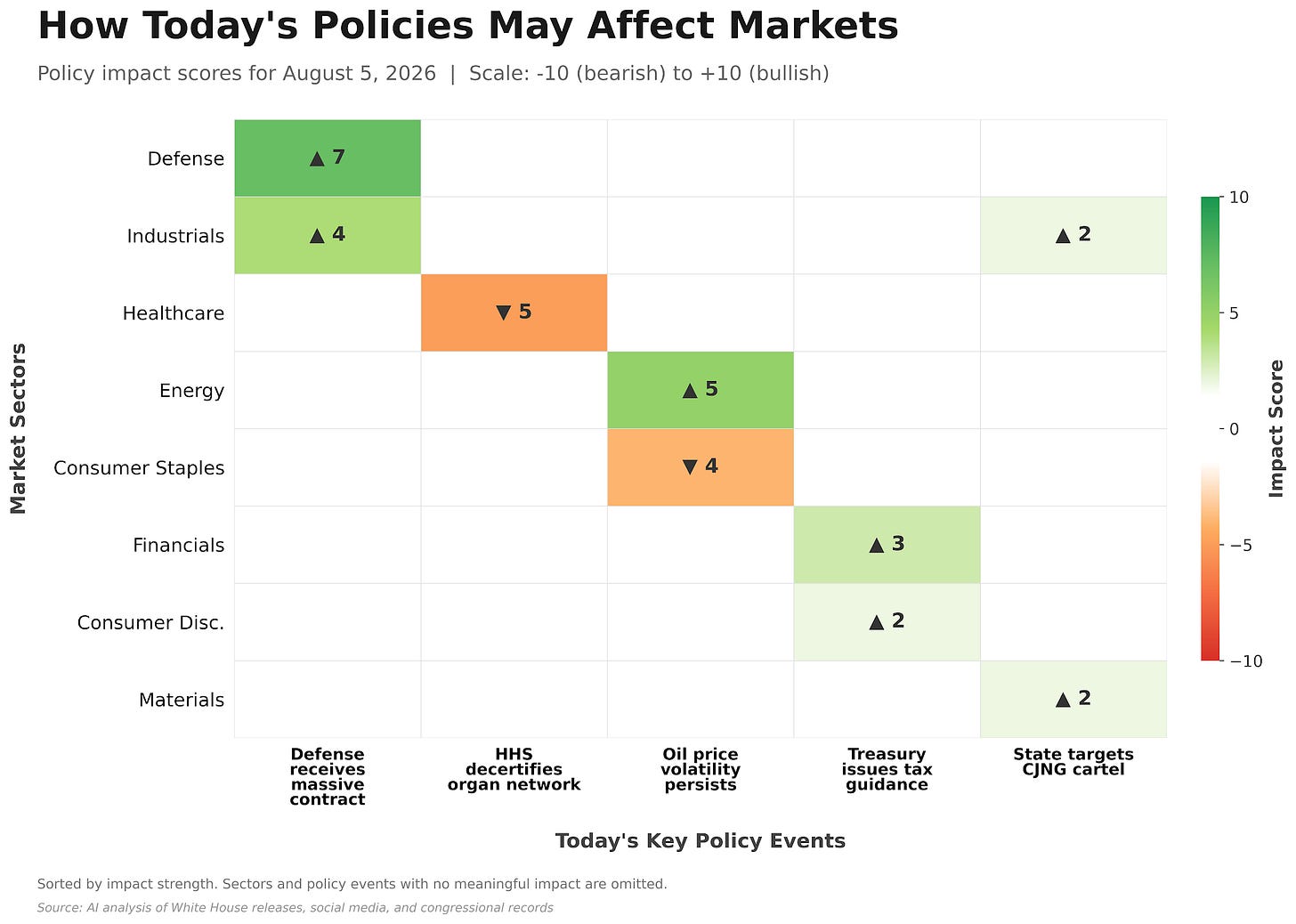
Each cell shows an estimated impact score on a fixed scale of -10 to +10, reflecting how today’s policy developments may affect each market sector. Positive scores (green, ▲) suggest bullish impact; negative scores (red, ▼) suggest bearish pressure. Rows and columns are sorted by impact strength, and sectors and policy events with no meaningful impact are omitted. The heatmap, the analysis below, and the Impact on Market themes above are produced from a single unified analysis: the heatmap visualizes the magnitudes, while the text explains the causal reasoning behind them.
Geopolitical tensions in Iran continue to drive energy market volatility, forcing a repricing of interest rates as inflation risks persist. Elevated oil prices increase operating costs for transportation-heavy sectors and weigh on consumer sentiment, prompting political pushback against energy firm margins. The Treasury’s move to expand tax credits for paid family leave provides a fiscal cushion for employers and labor, though the broader macroeconomic environment remains sensitive to these shifting input costs.
Simultaneously, the administration’s aggressive approach to regulatory oversight is reshaping industry operations. The decertification of a major organ procurement organization demonstrates a shift toward stricter federal performance standards, introducing operational risk for healthcare entities reliant on government contracts. Concurrently, the Department of Defense is sustaining high-volume capital flows to industrial suppliers to bolster readiness. This duality of government action—tightening regulatory enforcement while maintaining heavy defense spending—creates a complex landscape for capital allocation. Market participants are balancing these regulatory headwinds against the tailwinds of sustained government industrial contracts and tax-advantaged business incentives.