Timeline
Every post and feed across this instance
-
Steve Hilton, Xavier Becerra clash in testy California governor’s race debate
The candidates running to replace Gavin Newsom sparred over taxes, immigration and regulating AI
Xavier Becerra and Steve Hilton, the candidates running to be California’s next governor, clashed on Wednesday over taxes, immigration and regulating artificial intelligence in a testy debate held days before voters begin receiving their ballots in the heavily Democratic state.
Hilton, the former Fox News host endorsed by Donald Trump, used the hourlong matchup, hosted by CNN in its studio in Burbank, California, to argue that Becerra, a former congressman who served as the US health and human services secretary during the Biden administration, was not actively campaigning and instead taking voters for granted.
Continue reading... -
Balayant les discours alarmistes, le gouvernement américain confie la sécurité de l’IA à ceux qui la développent
La scène pourrait presque passer pour une réunion de crise. Donald Trump entouré de Dario Amodei, Greg Brockman, Sundar Pichai, Mark Zuckerberg, Jensen Huang et Elon Musk pour parler des risques liés à l’intelligence artificielle. Pourtant, ce rassemblement a davantage des airs de garden party au vu des extraits vidéo qui tournent en boucle sur les réseaux sociaux, les grands du monde de l’IA se donnant des airs de « grande famille ».
-
Loyer, électricité, Internet, assurance : le poids croissant des dépenses contraintes
Le sentiment que le travail ne paie plus s’explique largement par la progression des dépenses sur lesquelles les ménages ont peu de prise, comme le logement. Elles font pourtant l’objet d’un désintérêt politique global. -
Le « pacte Papin », une occasion de favoriser la transmission des entreprises aux salariés
Dans une « lettre aux entrepreneurs » diffusée sur les réseaux sociaux, le Premier ministre Sébastien Lecornu a annoncé une série de mesures à venir dans le projet de loi de finances 2027, parmi lesquelles certaines visent à faciliter la transmission d’entreprises aux salariés. Elles s’inscrivent… -
PROOF EXCLUSIVE: Ten More Ways Trump and His Agents Are Rigging the Coming Elections

Introduction
A Proof reader of Part I of this series commented below that report, “This is scary on an unprecedented level.”
And it was. The report exhaustively outlined twelve unprecedented ways that Donald Trump is rigging the 2026 midterm elections.
But for as scary and without precedent as that Proof report and its contents were, this author and many readers suspected that it detailed only a fraction of the story. It was clear—even when that report was published on September 21—that a Part II, Part III, and maybe even parts beyond that would eventually become necessary, even urgent.
Why? Because no president or political party has done more to try to rig a federal election than Donald Trump and the Republicans are doing right now in 2026, a fact made all the more grotesque by the fact that it’s these same entities who have spent the last decade crying wolf about supposed election theft as a justification for their own election crimes.
But this isn’t the first election Republicans have tried to steal. Or second. Or fourth.
In 2000, bussed-in Republican operatives led by Trump friends including Roger Stone staged a fake riot—the so-called Brooks Brothers Riot—to stop all vote-counting in Florida just as Democratic presidential candidate Al Gore was about to pull ahead in the state.
A plainly right-leaning Supreme Court then implicitly blessed that riot as dispositive by insisting that vote-counting in the state of Florida stop, though (a) there was time to complete it, and (b) it was the role of the Florida Supreme Court, not SCOTUS, to determine and when and whether Florida state election laws had been violated. To aid the Republican theft of the election the Court had to develop a new definition of the Fourteenth Amendment that it immediately opined would never ever be applied again.
In 2004, as discussed in much greater detail below—so it won’t be belabored here—an Ohio elected official linked to far-right Supreme Court Justice Clarence Thomas (and his wife Ginni Thomas, who informally ran White House personnel decisions for Mr. Trump in his first term) orchestrated a conspiracy to disenfranchise just enough Black and poor and college-aged Ohioans that that’s likely what gave the Republican George W. Bush victory in the election by a mere 50,000-vote swing in the Buckeye State. It goes without saying that just as there was no punishment, and indeed much reward, for Florida’s Secretary of State Katherine Harris’s rigging of state election protocols for Mr. Bush in Florida in 2000—Republicans soon gifted her with a seat in Congress to better underscore the party’s dedication to premeditated election-rigging—Ohio’s Kenneth Blackwell was granted ever more and more power in the Thomases’ circle once it was clear that he would steal the franchise from hundreds of thousands of his fellow Black Americans.
In 2016, scores of unreported collusive contacts between the Trump campaign—run by a Kremlin agent Trump well knew was a Kremlin agent when he hired him, Paul Manafort—dovetailed beautifully with the Kremlin’s own micro-targeting operations, a “British” micro-targeting operation devised by a Russian and overseen by Trump campaign CEO Steve Bannon, and a foreign policy quid pro quo involving proposed Trump Organization business in Russia negotiated by Trump fixer Michael Cohen at Trump’s explicit behest. The collusion, most of it never investigated by Robert Mueller (for all that Trump fans pretended it had been) was so comically obvious that it saw Manafort handing over proprietary campaign polling data to a known Kremlin agent in Manafort’s personal and professional circle, Konstantin Kilimnik, in Trump lawyer Rudy Giuliani’s favorite New York City cigar bar; not just one Donald Trump son but two (Donald Trump Jr. and Jared Kushner) meet alongside Mr. Manafort with multiple Kremlin agents in Donald Trump’s own house; and Trump’s eldest son Don trying (as did Trump adviser Roger Stone) to coordinate secretly with the Kremlin-asset WikiLeaks operation—a clearinghouse for the criminally stolen Democratic files Donald Trump had on national television successfully urged his Kremlin friends to try to get access to.
All this strategic dovetailing may well have turned the tide in a tight election.
In 2024, Trump ran for president while a private citizen, making it virtually impossible to track all the promises he made to would-be foreign election interferers to try to get them to help him. Suffice to say that we know this much: Donald Trump stole highly classified documents from the American people across months and months of federal criminal conspiring in late 2020 and early 2021, and his own subsequent statements—which focused on his right to sell such materials as he claims former GOP president Richard Nixon did—make clear that he intended to distribute those classified materials, which include his secret plans for a future war in Iran, to the highest bidder.
The point here is a fairly simple one: since 1988—when George W. Bush’s father beat Democratic presidential candidate Michael Dukakis, who’d been leading him for almost the entire election season—by agreeing to air what at the time was the most racist television ad the American electorate had ever seen, the Willie Horton Ad, the Republican Party has had no demonstrated ability to win a popular vote in the United States. The Willie Horton Ad was created by the business partner of Trump pal Roger Stone, Lee Atwater, and Trump friend Roger Ailes, confirming that the nihilistic and diabolical thinking of Trump and his circle has infected American life for decades.
Indeed, for 38 years now the GOP—and now MAGA—playbook has been to suppress the vote, conspire with foreign agents, spread mass disinformation, wrongly purge citizens from voter rolls, call in bomb threats, stage violent riots and rebellions, and engage in other more esoteric but equally illicit conduct that easily meets at least the ordinary definition of treason in order to win elections. Democrats may well pander cynically to their base, and may rightly work diligently to especially ensure that their base is able to vote easily, but only Republicans have become known more for feckless “election ratfuckery” than even attempting to develop a policy agenda American voters are interested in.
These are historical facts—not partisan spin. And they’re the backdrop for this report.
Ten More Ways Trump and His Agents Are Rigging the Coming Elections
-
En une année, 5 % des glaciers suisses ont fondu

Plus de 5 % de la masse des glaciers ont disparu au cours de la seule année 2026, en Suisse. Et en 5 ans, c'est près de 20 % du volume des glaciers qui ont fondu dans le pays. C'est le constat glaçant (si on peut dire) révélé le 1er octobre par le rapport annuel de la Commission suisse pour l'observation de la cryosphère, de l'Académie des sciences naturelles suisse, à partir des données du Réseau des relevés glaciologiques.
Lire la suite - En bref / Climat
L'épaisseur moyenne de glace de certains glaciers a diminué de (…) -
Procès de Robert Ménard à Montpellier : le “bon sens” contre l’État de droit ?
Jugé ce mercredi 30 septembre à Montpellier pour avoir refusé de marier Eva et Mustapha en 2023 au motif que celui-ci était visé par une obligation de quitter le territoire français, le maire d’extrême droite de Béziers assume tout. Entouré de Bruno Retailleau et d’élus venus défendre son « bon sens », il a fait de l’audience une tribune. Le parquet requiert 7 500 euros d’amende. Délibéré le 1er décembre
Il est 18 h 42, soit plus de cinq heures après le début des débats, quand Eva M. s’avance à la barre, vêtue de noir. « Par où commencer ? J’étais une personne lambda, et un matin je me suis réveillée, j’étais l’objet d’un débat national. »
Le 6 juillet 2023, elle est dans le bus, en plein préparatifs de son mariage, quand on lui envoie la vidéo : le maire de Béziers annonce à la télévision qu’il ne la mariera pas au motif que son fiancé est sous le coup d’une Obligation de quitter le territoire français (OQTF) « Je n’ai pas dormi de la nuit », se remémore-t-elle devant le tribunal. Le lendemain à 8 heures, elle tente de voir Robert Ménard pour lui dire que la police aux frontières est passée chez elle et lui a confirmé qu’elle avait le droit de se marier. Elle enregistre l’échange, « pour me défendre face à un maire qui a un pouvoir politique énorme ». Puis vient la mairie.« Quand j’arrive en robe de mariée le 7 juillet, j’imagine pas une seconde que des médias vont me sauter dessus. » Sa voix se noue. « L’alarme incendie sonne, la porte de la mairie se ferme. Derrière nous, des gens nous huent, se moquent de nous. » Quelques minutes plus tard, le maire sort, écharpe en bandoulière, pour annoncer son refus devant les caméras.
Mustapha est expulsé vers l’Algérie le 20 juillet 2023, « sans pouvoir me prévenir ». Eva raconte l’homme qui l’a aidée « à m’apaiser, à manger normalement » après des violences subies avant lui, et sa fille cadette qui l’appelait papa. « Quand il est parti, elle le cherchait derrière la porte. Je ne savais pas comment lui expliquer. » Elle pleure. Elle dit aussi que son compagnon a été accusé de viol sur deux chaînes de télévision, « alors que c’est faux ». Le couple a fini par se marier le 14 juillet dernier à Bir El Djir, près d’Oran. Depuis trois ans, Eva enchaîne les allers-retours à chaque vacances scolaires. « Quels sont les projets de ma vie ? Je ne sais pas. »
« Je savais les risques que je prenais »
Quelques heures plus tôt, l’épisode cévenol et l’alerte météo sur l’Hérault n’ont pas douché les volontés de se rassembler. Dès midi, une quarantaine de personnes attendent devant les grilles closes du tribunal pour soutenir le couple, sans savoir si l’audience se tiendra. L’arrivée des partisans du maire, drapeau tricolore au vent, déclenche chants et slogans antifascistes.
Procès de Robert Ménard à #Montpellier : devant le tribunal, l’arrivée des soutiens du maire de #Béziers provoque des slogans antifascistes de la part de soutiens du couple que l’édile a refusé de marier https://t.co/ILszueIcYq
— Le Poing – Montpellier (@lepoinginfo) September 30, 2026Vers 13 h 15, Bruno Retailleau, ancien ministre de l’Intérieur et candidat à la présidentielle de 2027, fait son entrée, sous étroite protection policière. Cité comme témoin de la défense, comme le sénateur de la Somme Stéphane Demilly, il est accueilli par une pluie d’applaudissements et un parterre d’écharpes tricolores, parmi lesquelles celle du député RN Aurélien Lopez-Liguori. Dans la salle, le plafond fuit. « Les moyens de la justice sont ce qu’ils sont », glisse un avocat sous les gouttes.
Robert Ménard est poursuivi pour avoir pris des mesures destinées à faire échec à l’exécution de la loi, en refusant de célébrer ce mariage. Il encourt cinq ans de prison, 75 000 euros d’amende et une peine d’inéligibilité. En février 2025, il avait refusé la procédure de plaider-coupable. Le parquet de Béziers, après onze pages d’audition des futurs époux, avait pourtant donné son feu vert à l’union, faute d’indices sérieux d’un mariage de complaisance.
À la barre, le maire se dit « écartelé » entre ses deux casquettes d’officier d’état civil et d’officier de police judiciaire. « Vous me demandez de marier une personne à qui vous avez demandé de quitter le territoire. » Le président Gilles Maschio ne se laisse pas embarquer : « La hiérarchie des normes devrait vous permettre de prendre une décision : la liberté de mariage est au-dessus. » Ménard objecte qu’il s’agit d’un « mauvais choix ». « La réponse, c’est l’État de droit », tranche le président. Puis : « La solution, c’est d’expulser monsieur ? »
Si c’était à refaire ? « Exactement », répond le prévenu, qui convoque le pape et ceux qui se sont dressés contre des lois « iniques », comme le droit à l’avortement. « Des fois, le bon sens, c’est important. » L’expression reviendra toute la journée.
Puis il se tourne vers la partie civile : « Madame, je vous connais, ça aurait été un Chinois, j’aurais fait pareil. » Eva fond en larmes, son avocate lui tend un mouchoir. Le maire enchaîne : « Madame pleure aujourd’hui, mais elle n’avait pas beaucoup pleuré devant moi jusqu’à présent. Elle a milité contre moi. »
Pourquoi ses adjoints n’ont-ils pas célébré l’union à sa place ? « Personne ne l’aurait fait, car nous avons à peu près tous les mêmes idées », tranche le maire. Et le « mariage blanc » ? L’avocat de l’association Les Amoureux au ban public lui relit son interview au Figaro, la veille de la cérémonie : il y détaillait l’âge des fiancés, les trois enfants d’Eva, ses aides sociales, et concluait que ça « sentait le mariage blanc à plein nez ». « C’est ce que disait le procureur au début, moi je l’ai cru », répond Ménard.
« Vous vous foutez de moi ? »
L’avocate d’Eva, Vanessa Edberg, retourne alors l’argument de l’ordre public contre le prévenu. Elle rappelle que l’OQTF de Mustapha n’était pas motivée par un trouble à l’ordre public, puis évoque le casier du maire, « bien plus fourni qu’une seule condamnation ». « N’êtes-vous pas une menace à l’ordre public ? » Ménard explose : « Vous vous foutez de moi ? C’est une saloperie de dire ça. » Il rappelle ses 25 ans à la tête de Reporters sans frontières : « J’en ai fait bien plus que vous tous réunis pour les droits de l’Homme. » Un avocat se lève pour défendre la profession, la salle s’échauffe.
Un peu plus tard, pile au moment où l’avocate lui demande si toute l’affaire n’était pas un plan de communication, un coup de tonnerre éclate au-dessus du tribunal. « Je n’ai pas besoin de ça », répond l’intéressé, qui reconnaît dans la foulée passer« dans les médias quatre à cinq fois par semaine ». Qui a choisi de médiatiser l’affaire, demande Me Mohamed Jaite, pour la LDH ? « Madame M. », répond l’édile. « Et vous ? » « Oui. »
Ses condamnations, dont 2 000 euros avec sursis pour diffamation ? « Des affaires de presse. Je ne vole pas des poules, je n’escroque personne, je défends juste des convictions. » Le président lui fait remarquer que devant un tribunal correctionnel, cela peut poser problème. « À vos yeux, pas aux miens. » Et de citer sa condamnation à cinq ans de prison en Turquie pour avoir mis en cause le régime : « C’est ça, être un délinquant ? Alors je suis un délinquant, et je suis fier de l’être. »
À l’avocat de SOS Racisme, Paul-Roger Gontard, qui rappelle qu’un élu d’opposition peut marier sur délégation, Ménard répond que « 90 % des gens » à Béziers approuvent son action, et que personne ne le lui a demandé. « Un élu d’opposition a pourtant demandé », corrige l’avocat. Devant la salle d’audience, vers 16 heures, on entend scander « Aquí es Besièrs », slogan populaire au stade de rugby et pendant la féria.
« Je ne suis pas juriste, je suis sénateur »
Vient ensuite le défilé des témoins. Le premier, Stéphane Demilly, sénateur de la Somme, n’a pas grand-chose à dire sur le dossier, mais beaucoup sur sa proposition de loi interdisant le mariage aux étrangers en situation irrégulière, adoptée par le Sénat le 20 février 2025, puis enlisée à l’Assemblée sous près de 300 amendements. « Le mariage est un droit, ça ne doit pas être un passe-droit », répète-t-il. Interrogé par l’avocate d’Eva, il livre la perle de la journée : « Je pense qu’une OQTF est une loi. J’imagine que c’est la justice française qui délivre une OQTF. » C’est en réalité un acte administratif pris par le préfet. « Je ne suis pas juriste, je suis sénateur », se justifie le centriste. Réplique de Me Edberg : « Un sénateur ne sait même pas ça alors qu’il porte une loi sur la question… »
À 17 h 35, Bruno Retailleau prend le relais. Selon lui, l’exécution des mesures d’éloignement relève de « la quasi-impossibilité », et Ménard a « choisi un équilibre » : célébrer ce mariage aurait permis à Mustapha d’obtenir rapidement un titre de séjour grâce à l’accord franco-algérien de 1968. Mustapha est-il une menace à l’ordre public ? Le candidat préfère parler de « malaise démocratique », de maires soumis à des « injonctions contradictoires », puis des logements qu’on leur demande de construire sans terrains. Rien à voir avec le dossier, mais la campagne présidentielle s’annonce longue, et tout est sans doute bon pour occuper la scène. Son successeur place Beauvau, Laurent Nuñez, avait pourtant estimé en mai que le maire aurait dû « respecter la loi ».
Quarante-cinq minutes plus tard, David Lisnard, maire de Cannes et président de l’Association des maires de France, prévient qu’il n’est « pas venu parler d’amour ou d’immigration ». Pour illustrer le dilemme des élus confrontés aux « injonctions contradictoires » , il choisit la Gironde, où il faudrait défricher la forêt contre les incendies alors que telle espèce est protégée. Dans la même situation, il dit qu’il pourrait lui aussi refuser de célébrer le mariage.
« Une collection d’arbitraires »
Il est autour de 19 h 40 quand les parties civiles commencent leurs plaidoiries. Me Vincent Le Junter, pour Les Amoureux au ban public, raille un prévenu qui « assume sans assumer ». « Les preuves de l’infraction débordent, il n’y a qu’à les ramasser, et le premier qui les donne, c’est monsieur Ménard. » Il rappelle que le maire lançait dans Midi Libre, la veille du mariage, « qui va m’obliger ? », et demande une requalification plus lourde, dès lors que les mesures ont été suivies d’effet. Il voit dans l’interview au Figaro « le bingo des discriminations », fondé sur l’origine, la nationalité et la différence d’âge, et cite l’horoscope du magazine de l’agglo de Béziers, truffés de saillies discriminatoires, dont le maire est directeur de publication. Il évoque aussi les insultes racistes lancées au couple devant la mairie, rapportées par Le Canard enchaîné. Pour l’avocat, le prévenu « pense qu’il a tous les pouvoirs : maire, préfet, procureur ». Un goût pour les pleins pouvoirs déjà illustré par son arrêté sur l’ADN des chiens, annulé par le tribunal administratif au motif qu’il lui donnait accès à un fichier normalement innaccessible aux maires, puis aussitôt repris. Sur son banc, Eva pleure en silence. Un mouchoir lui parvient du fond de la salle, de main en main.
Pour Me Jaite, de la Ligue des droits de l’Homme, Ménard « savait depuis longtemps qu’il ne célébrerait pas ce mariage » et a fait entrer un couple vulnérable dans un « traquenard ». Il aurait pu annoncer son refus et garder la tribune pour l’audience, plaide-t-il, « mais il a choisi l’exposition et l’humiliation publique du couple ». Bras et jambes croisés sur sa chaise, le maire fait non de la tête. Me Gontard, plaidant pour l’association S.O.S. Racisme, constituée partie civile, s’attaque quant à lui au fameux « bon sens » , qui aurait selon lui conduit les colons à juger l’esclavage acceptable. « Si chaque maire se fie à son bon sens, on n’a plus d’État de droit, on a une collection d’arbitraires. » Me Edberg conclut : « La politique est venue salir votre tribunal. »
Il est maintenant 21 heures, et sur le banc des journalistes, venus en nombre, on peut entendre des ventres gargouiller. Le procureur Thierry Lescouarc’h tient une ligne simple : « Les faits sont établis et revendiqués. » Le droit au mariage est fondamental et «ne laisse aucune place à l’interprétation personnelle ». Il n’y a, selon lui, aucune contradiction entre les normes, contrairement à ce qu’on a pu entendre toute la journée. Il requiert 7 500 euros d’amende, soit un dixième du maximum encouru. Et surtout, aucune peine d’inéligibilité n’est requise. Quelques regards incrédules s’échangent dans la salle.
La défense, elle, décrit un maire « dévoué à sa ville » qui ne se serait offert aucune tribune, « à l’inverse des associations présentes ». Un de ses avocats l’assure : « Robert Ménard est un vrai socialiste, il aime les gens. » Et puis les Biterrois l’ont réélu au premier tour en mars, avec 65,60 % des voix. Me Sylvain Fournier plaide la relaxe : un refus de marier serait une omission et non un acte positif entraînant un empêchement d’exécuter la loi, et l’alarme incendie qui aurait sonné le jour du mariage n’apparaîtrait que dans les déclarations du couple. .
À 22 h 18, Robert Ménard s’offre une dernière tribune politico-médiatique pour aujourd’hui. Il dit supporter mal les avocats qui « pensent que quand je parle du bon sens, c’est un truc de plouc ». « 73 % des Français sont d’accord avec moi sur cette mesure. Ça voudrait dire qu’ils sont des arriérés ? » Puis : « Je n’ai jamais dit que j’avais raison. » Juste qu’il le referait. Délibéré le 1er décembre.
L’article Procès de Robert Ménard à Montpellier : le “bon sens” contre l’État de droit ? est apparu en premier sur Le Poing.
-
Rennes 2, Bloquée , occupée !
Rennes 2, Bloquée , occupée !


-
Hegseth says he will cut number of US generals by 20% in anti-diversity speech – as it happened
This live blog is now closed.
Rachel Leingang and Riley Messer
Some of the biggest food and agriculture corporations in the US are funding a campaign that pays social media influencers to combat elements of Robert F Kennedy Jr’s Make America Healthy Again platform, according to an investigation by the Guardian and Documented, an investigative watchdog and journalism project.
Continue reading... -
Google annonce Gemini 4 Argon et revendique des meilleurs résultats qu’OpenAI et Anthropic

Totalement distancé depuis le printemps 2026, Google avait d'abord promis Gemini 3.5 Pro en mai avant de l'annuler à cause de ses trop mauvais résultats. Le géant du web annonce le 30 septembre « Gemini 4 Argon », son nouveau modèle de frontière présenté comme supérieur à GPT-6 Astra, Claude Fable 5.1 et Claude Opus 5.5. Tout suggère que Google vient de rattraper plusieurs générations en un modèle, pendant que ses concurrents en ont lancé plusieurs dizaines.
-
« Splann ! » condamne les entraves au travail des journalistes du « Cri » lors du pèlerinage Feiz e Breizh
« Splann ! » apporte son plein soutien à la rédaction du « Cri » et aux journalistes Adrien Giraud et Thomas Louapre, empêchés d’exercer leur métier lors du pèlerinage Feiz e Breizh, qui s’est tenu les 19 et 20 septembre derniers à Sainte-Anne-d’Auray, dans le Morbihan.
L’article « Splann ! » condamne les entraves au travail des journalistes du « Cri » lors du pèlerinage Feiz e Breizh est apparu en premier sur Splann ! | Premier média d'enquête indépendant en Bretagne.
-
4 takeaways from the MAHA Summit
Trump administration officials mingled with insurers, corporate executives and wellness influencers at the second Make America Healthy Again (MAHA) summit. They discussed issues ranging from affordability, the U.S. food supply and the food pyramid, as well as the use of artificial intelligence in healthcare. Along with many other mainstream outlets, The Hill was not granted press credentials to attend but watched a free livestream. Here are takeaways from the event. -
[Mayday] #258 Les dépendances artificielles
Émission du 30 septembre 2026, fabriquée sans robotsLes assoiffés, par Kim et Le Frigo avec un bout de texte de Camille Charvet*Chat GPT, la coke et moi, un entretien de Kim, le Frigo aux ciseauxDépendre des robots, un billet de Luigi qui dépend pas mal de lectures diagonales récentes**En Thérap’IA, séance proposée par NaméChez la psy, récits intimes du Frigo et de NaméL’IA n’est pas thérapeute, entretien de Kim avec une psychologueMon agent IA, une situation mise en scène par KimEt à la fin c’est la Silicon Valley qui gagne, un finish de LuigiMusiques ; NLF3 avec « Shadonga falls »Meridian Brothers, Salvatora robotsOognah Haines- Vacccum – part.1*Camille Charvet, Les assoiffés, 2026** Irénée Régnault, La sommation technologique au temps des catastrophes, 2026Contre Atlas de l’Intelligence artificielle de Kate Crowford, 2023Marie-José Mondzain, Peine Kapita, monologue avec l’IA, 2026
-
Trump’s AI chatbot turns on its master
The famously fact-averse president rolled out a new AI tool – but its answers don’t conform to his version of reality
Donald Trump, in a development that could almost be from a Greek tragedy, appears to have invented something that is willing to do what no one in his orbit will: tell him the truth.
The president launched America.gov on Tuesday, an AI platform which the White House says will make it easier for Americans to interact with the federal government and eventually complete services like renewing passports and enrolling in Medicare.
Continue reading... -
‘There’s Always A Way’: Jaime Santos
Earlier this month, Jaime Santos joined Proskauer Rose, making her the latest in a series of appellate advocates to switch firms in 2026. She came from Goodwin, where she practiced for more than a dozen years and served as co-head of the Supreme Court and appellate practice.
What led Jaime to make the move, and what does she think is driving all the lateral hiring in the space? With a new Supreme Court Term starting this coming Monday, which cases is she watching? And as the first ERISA and employee-benefits lawyer I’ve had on the podcast (after more than 100 episodes), what does she see as the key emerging issues in the field?
Thanks to Jaime for such an interesting and inspiring conversation, and congratulations to her on joining Proskauer.
Show notes:
Jaime Santos bio, Proskauer Rose LLP
Goodwin Supreme Court Group Chief Santos Bolts for Proskauer, by Meghan Tribe and Jacklyn Wille for Bloomberg Law
Proskauer Hires Goodwin Procter’s Supreme Court Co-Head, by Kevin Penton for Law360
Sponsored by:

NexFirm helps Biglaw attorneys become founding partners. To learn more about how NexFirm can help you launch your firm, call 212-292-1000 or email careerdevelopment@nexfirm.com.
 Jaime Santos (courtesy photo)
Three quick notes about this transcript. First, it has been cleaned up from the audio in ways that don’t alter substance—e.g., by deleting verbal filler or adding a word here or there to clarify meaning. Second, my interviewee has not reviewed this transcript, and any transcription errors are mine. Third, because of length constraints, this newsletter may be truncated in email; to view the entire post, simply click on “view entire message” in your email app.
David Lat: Welcome to the Original Jurisdiction podcast. I’m your host, David Lat, author of a Substack newsletter about law and the legal profession also named Original Jurisdiction, which you can read and subscribe to at davidlat dot substack dot com. You’re listening to the 106th episode of this podcast, recorded on Wednesday, September 23.
Thanks to this podcast’s sponsor, NexFirm. NexFirm helps small and midsize law firms offer Biglaw-caliber benefits at small-firm prices. To learn how NexFirm can improve your employee benefits program, call 212-292-1002 or email betterbenefits at nexfirm dot com. Want to know who the guest will be for the next Original Jurisdiction podcast? Follow NexFirm on LinkedIn for a preview.
My guest today is Jaime Santos, co-chair of the Compensation and Benefits Litigation Practice at Proskauer Rose and one of the nation’s leading appellate and ERISA litigators. We began our conversation by covering Jaime’s impressive and inspiring career path, which took her from a trailer park in a tiny town in Indiana to Harvard Law School, followed by two federal clerkships and partnership at two top law firms. We then discussed how she built her practice in appellate and ERISA litigation, her recent move from Goodwin Procter to Proskauer, and her thoughts on the game of musical chairs now unfolding in the Supreme Court and appellate bar. We concluded by talking about her most meaningful matters over the years, including her victory before the high court in Wilkinson v. Garland, as well as the most interesting cases in the Supreme Court’s upcoming Term and in the world of ERISA and employee-benefits litigation. Without further ado, here’s my conversation with Jaime Santos.
Jaime, thank you so much for joining me.
Jaime Santos: Thank you. I’m excited to be here.
DL: Tell us about your background and upbringing. Where did you grow up?
JS: I grew up in the Midwest, in this tiny town in Indiana called Rensselaer—basically in the middle of a cornfield. I was raised by a single mom with one sibling, and we grew up in a trailer park. When I was 14, we moved to St. Louis, Missouri—the inner city, which is the opposite of a rural Indiana cornfield. My aunt, who lived in St. Louis at the time, basically told my mom, “You cannot raise these children in Indiana with only corn and white people. Move to St. Louis. We will help out, and we’ll get these kids through high school and make sure they have a good future.”
DL: I wouldn’t have guessed that you were from the Midwest because you went to college out on the West Coast and law school out on the East Coast. Do you have any lawyers in the family?
JS: No lawyers in the family. My mom, before I was born, worked in the South Chicago steel mills, and then, when I was growing up in Indiana, she was a bookkeeper for a small printing company. My dad left when I was a year old. So I don’t even know that I met any lawyers until after undergrad.
It was funny: I went to the University of San Diego mostly because I wanted to get as far away from home as possible. When I was applying to schools, I got this beautiful glossy magazine—this is how we used to apply to undergrad—and it had beautiful pictures of the ocean. I applied, immediately got in, and got a full scholarship, so I didn’t apply anywhere else. I thought, “Well, this is the objective: get into college and have someone else pay for it.” And I spent four years there.
DL: What did you major in when you were there?
JS: I majored in ethnic studies, sociology, and Spanish.
DL: And what were you thinking in terms of your career at the time?
JS: I didn’t really know. I thought maybe I wanted to be a professor or maybe I wanted to work for nonprofits. I didn’t do debate or anything like that. I was really involved in student government, the multicultural center, and student leadership. To help pay for things, I also worked a ton through undergrad: I was a sandwich delivery person and a telemarketer, and I worked at the registrar.
I did have this one professor—my favorite professor, Dr. Rafik Mohamed—who taught a class called Sociology of Law. At the very beginning of the class, he taught us, just for a few minutes, how people sometimes write case briefs—the notes that law students keep to track cases and what they mean. We went through the class, and at the end of the semester, I went to his office and said, “Hey, that thing you taught us at the beginning—I decided to do that with every case we read.” I showed him all the notes I’d put together and said, “I’ve noticed a bunch of patterns across cases.” He said, “You’re a weirdo who does this for fun. You definitely need to go to law school.”
I didn’t at the time. I worked for four years after undergrad—as an event planner at a nonprofit, then at a law firm. But eventually I realized he was right, and I really wanted to use my brain. And event planning was fun, but it’s just not a very brainy activity. So I studied really hard for the LSAT, got into Harvard, and ended up going there about four years after I graduated from undergrad.
DL: When you were at HLS, did you have an idea of what type of law you wanted to practice?
JS: Going in, I definitely didn’t, because I was so excited just to be there. Harvard was the one place, when I was growing up, that anyone in my family would have known—other schools, we didn’t know as well. I was the first in my family to go to college; my mom and dad didn’t go, and neither did my grandparents.
I was so excited to go that I completely threw myself into everything; I studied crazy hard. I was afraid I was going to be the dumbest person at Harvard, surrounded by all these fancy people who’d gone to Ivy League undergrads. So I studied nonstop, at least the first two years.
I had more fun my third year. I got onto Law Review, I RA’d for a bunch of different professors, and I took really hard classes. Dan Meltzer had this super hard Fed Courts class—it was a five-credit class that felt like a 20-credit class—and I studied so hard that I literally sprained my neck. I had to get treatment because I sprained my neck studying too hard.
Coming out of that, I thought maybe I wanted to do labor and employment work. But when I was clerking—first on the Central District of California, then on the Ninth Circuit—I realized pretty quickly that I didn’t actually care about subject matter. I just liked complicated issues that were really hard.
Going into the clerkships, I thought, “I probably want to do labor or employment work.” Coming out of them, I thought, “I just want to do nerd stuff.”
DL: Which did you do first, the Ninth Circuit clerkship or the Central District clerkship?
JS: The Central District clerkship, though I actually got my Ninth Circuit clerkship first. I interviewed with Judge Raymond Fisher—I think it was probably in the fall right before my 3L year—and after I got that clerkship, he helped me talk to some district judges as well. Then I went through the normal interview timing process for district court clerkships at the time, which was just the year before graduation. Now it’s apparently the year you’re born—but back then, it was more human.
DL: Yes, I totally agree, and it’s really unfortunate how the timing has shaken out. But it’s interesting that you went to the district court right after law school, because I actually think a district court clerkship is, in many ways, the harder job, and a little overwhelming if you go straight from law school, whereas a circuit clerkship is more like a transition from law school to the practical world. And so that first clerkship must have been a demanding experience.
JS: It was. I clerked for Judge George King, who was then the chief judge of the Central District of California, and he was a particularly demanding judge to work for. He was really smart and really great, and I learned a ton. But we were working 80- to 100-hour weeks, every week, the entire year. It was very demanding.
For Judge Fisher, I think part of why he liked clerks who had clerked on the district court first was that it broke them in—or at least gave them a much better understanding of what district courts were doing, because he liked to defer to district courts on things they did better, and not defer on things that were really classic appellate issues. And I was absolutely a better Ninth Circuit clerk because I had been through the district court clerkship and understood what the dockets looked like and the incredible caseload and what trials looked like and how everything gets resolved.
DL: I totally agree. I think clerks who’ve clerked for a district court before a circuit court are probably less inclined to recommend reversal in everything, because they know how tough that job is and respect the discretion district judges have over so many areas. So I’m sure it made you a better clerk.
JS: I hope so. I don’t know that Judge Fisher would say I was the best clerk; I would often get in trouble for trying to come up with new arguments no one had proposed. One time I wrote a very long memo about Heck v. Humphrey and how the whole case failed. And I remember he wrote at the top of my bench memo something like, “This looks great. Did anyone argue it?” And I said, “No, Judge….” And he said, “Okay, let’s deal with what the parties argued.”
DL: Party presentation: it’s a thing. So you probably felt right at home once you got into practice.
JS: Absolutely. After my clerkship, I joined Goodwin Procter. The timing was funny: I finished my clerkship when I gave birth to twins, who were born a month early—only about seven business days before the end of my clerkship. I felt very bad about that, like I’d abandoned Judge Fisher.
So I finished my clerkship, gave birth to twins, and then twelve weeks later started at Goodwin. It was funny, because Willy Jay—who’s now at Paul Weiss—had just started there maybe the year before. I wasn’t hired by him or into the appellate group at all; I was just hired into litigation generally. I had a mentor at the firm who helped me weasel my way into the appellate group, basically by trying to make myself completely indispensable on any appeal.
When I started, Willy had just hired two recent Supreme Court clerks who weren’t allowed to work on Supreme Court matters for a couple of years. They didn’t really have much of an appellate group otherwise. So once I’d weaseled my way in and shown that I had a strong work ethic and would do literally anything I was asked to do, Willy started putting me on his Supreme Court matters. I also had—at the time, and still have—a raging case of imposter syndrome. I think of it as an asset, even though a lot of people see it as a weakness. It made me really good at my job because it made me question what I was doing, in constructive ways: I made sure that my arguments were airtight, that I researched more, and that I worked harder than other people.
Once I’d shown my value, I got to do more appellate work. I had a turning point around 2015. I worked with Willy on Teva v. Sandoz, a patent case, and I’d also argued two Ninth Circuit pro bono appeals. That work, taken together, left me completely hooked on appellate work, and I knew that was what I wanted to focus on. After the Teva argument, I told Willy that it had almost made me want to apply for a Supreme Court clerkship. He said, “What are you talking about? Why did you never apply?” I said, “I didn’t clerk for a feeder judge, and I just thought I wouldn’t have a chance.” He said, “You should definitely apply.”
So I applied for clerkships, and I got an interview with Justice Sonia Sotomayor. I didn’t end up getting the clerkship, but I spent the last month of my maternity leave with my youngest child basically prepping for that interview. I read the last three years of Supreme Court opinions, I read every opinion Justice Sotomayor had ever written, and I spent a month reflecting on what I wanted to do and where I wanted to go.
When I didn’t get the clerkship, I asked my firm if I could move down to D.C., because I wanted to immerse myself in the appellate world and learn from Willy and build our D.C. appellate practice, if he’d have me. The firm was incredibly supportive; they said, “Absolutely.” I moved a few months later.
Once I got down there, I was facing a bit of a conundrum: I tend to be a Type A, ambitious person, and I really wanted to be the most successful appellate lawyer I could be. But I knew I didn’t have the credentials that a lot of your former guests have—folks like Lisa Blatt, Paul Clement, Easha Anand, and Willy as well. But I really wanted to be good at this and get to a very high level.
So I thought, “You’re going to have to find a different way, Jaime. It’s not the normal path. Supreme Court to OSG [Office of the Solicitor General] isn’t going to work for you, and you’re going to have to find another way to get there.” I spent the next five-plus years trying, on the one hand, to get really good at honing my appellate craft and learning as much as I could, and, on the other, trying to figure out how to raise my profile and expand my network so I could succeed in the long term. You can only go so far being smart and hardworking. In D.C., that doesn’t actually get you very far, and it doesn’t get you hired.
I started doing a lot of public speaking, at law schools and conferences, and talked about anything: diversity in the legal profession, what it’s like to be a working mom, appellate practice. I got the chance to work with a group of current and former law clerks to advocate on issues of judicial misconduct in the federal courts, and then ended up working with a bunch of judiciaries across the country on their own judicial misconduct procedures, and that gave me the chance to testify before the Senate Judiciary Committee and the Judicial Conference. I helped start a podcast. I ended up serving as secretary of the Inn of Court in D.C., which is where the 200 biggest appellate nerds meet once a month during the Supreme Court Term for cocktails and panels. I thought, “This is a ton of work, but it’ll give me the chance to know everyone.” So I did all of these things as my side gig, while also trying to learn to be a really good appellate lawyer.
DL: What you just described is exactly what lawyers who want to build a practice need to be doing—because as you say, and I know it’s a cliché, being smart and hardworking is table stakes. You need to stand out in some other way.
So you were very modest when you said you “started a podcast.” Tell us what podcast that was.
JS: Back in the day, pre-pandemic, I helped start Strict Scrutiny. I was on it for the first year, then left, and it has continued to grow.
DL: It’s now one of the largest, most successful, and most influential legal podcasts—or podcasts, period, anywhere. What led you to leave after a year?
JS: There were a number of different factors. It was never going to be a long-term option for me, in part because when I do something important, I put a lot of work into it. I was spending 15 to 20 hours a week on the podcast, which was awesome. I loved it. I got to know everything about the Court, and I got to talk every week with three other brilliant women. But long-term, there was just no way—unless I stopped sleeping entirely—that I could keep doing that. So that was a piece of it.
The other piece of it is that it’s hard to do what Strict Scrutiny became and also be an effective advocate. Especially toward the end of my tenure, I felt like the tone was a little different than what I was necessarily comfortable with. I love edgy commentary, but if you’re trying to advocate before the Supreme Court, being on a podcast that sometimes takes a mocking tone toward the justices or the advocates isn’t a great idea. It’s also just not my style as much. So I thought that I could do smart, interesting commentary on the Supreme Court in other venues, and it might be time to give it a rest, while continuing to support the people who do that work.
DL: I have a couple of thoughts. First, I’m not surprised that you spent that much time on the podcast. People need to know that we try to make these things look relatively easy, but it takes a lot of work to prepare for a podcast. When I have guests, I’ve researched them, I’ve read their writing, I’ve listened to oral arguments—I’ve done all sorts of things. And for a news-driven podcast like Strict Scrutiny, Leah Litman, Kate Shaw, and Melissa Murray are really busting their tails to follow the news of the day.
On your point about being outspoken or candid, being a law professor is good for that kind of work, because (a) they have tenure—they can afford to be outspoken and don’t have to worry about clients or judges being upset—and (b) law professors work hard, but they have a lot of flexibility. You have clients, and you’re a working parent. So I don’t know how you’d find another 15 or 20 hours a week—unless you stopped sleeping, as you said. So I totally understand that.
You were working hard and dealing with imposter syndrome, and it clearly worked: you wound up being, alongside Willy Jay, the co-head of appellate at Goodwin. How long did you spend at Goodwin? You were there for a good long stretch.
JS: Yes—13 years. I think the last two or three years I was co-chair of the practice. Willy had gone on to become co-chair of the non-IP litigation group at Goodwin generally, and when he moved into that role, I moved into the co-chair role, along with my former colleague Kevin Martin, who’s in Massachusetts. I loved that role. Leadership is just in my DNA—getting the chance to lead the group, help expand it, and instill a sense of business development and proactiveness in everyone. I got to hire people and help promote people, and the group there is really phenomenal. It was a great place to spend 13 years.
DL: You recently made a move. This was certainly in the news, and once again, you have a leadership role too. Maybe you can tell us about that.
JS: Yes. I recently joined Proskauer Rose, straddling the litigation department and the employee benefits practice.
I definitely wasn’t looking to leave Goodwin. I really loved my colleagues, and my practice was growing there. Proskauer approached me through a friend who’s also a recruiter—shout-out to Karen Vladeck, whose lesser-known husband is Steve Vladeck. I’ve known her and Steve since I was on the Harvard Law Review and was the supervising editor for his book review; it’s funny how things come full circle.
So Proskauer approached me. The firm has this really incredible benefits platform, and an important part of my practice on the appellate side has always been ERISA litigation; I made that an intentional part of my practice. Their benefits practice and their benefits relationships are really conducive to the ERISA piece, and they wanted to invest heavily in that space. They also wanted to invest more broadly in their litigation practice. They’ve been building their trial practice, including folks who’ve joined on the antitrust side. My colleague Bart Williams joined from Munger about ten years ago and really turbocharged their trial practice.
So it seemed like a really great match for the two pieces of my practice I’d been building, and it was a super intensive process. I’ve heard of people switching firms in a month or so, and I don’t know how that would work. I spent three or four months interviewing, I visited three different offices, and I probably interviewed with 30 partners. Part of that is the firm wanting to make sure it’s recruiting people who culturally fit, but it was also very much me wanting to get a real feel for the place—because if I was going to leave this nerdy group of people I adore at Goodwin, I needed to feel sure of it.
And so I ended up coming to Proskauer, and I have been here for about a month.
DL: I have a couple of thoughts. First, you picked a great platform. Given your focus on ERISA, employee benefits, and executive compensation, Proskauer is really tops in that substantive area. I’m not surprised you were steered in the right direction by Karen, who’s one of the best recruiters in the industry—and a former law firm partner herself, so she knows the ins and outs.
I’m curious how you developed this additional expertise beyond the Supreme Court and appellate work. How did you come by the ERISA and employee-benefits focus?
JS: When I mentioned earlier that I didn’t have the normal path available to me and had to find a new way to do this, it was around the same time I was trying to figure it all out. I like being a generalist appellate lawyer, because I get bored doing the same thing too much. But on the appellate side, in terms of strategically building a practice, it’s really helpful to have one or two niche areas you know really well; you can market yourself, and you can speak on them.
I remember sitting in my D.C. office thinking, “What do I want my niche to be?” I thought about patent work; there’s a lot of work there. But there were a ton of, for lack of a better term, fancy gray-haired men with lots of credentials who were already the go-to lawyers in the space. Willy is one of them, Seth Waxman another—and no one’s going to hire me over Seth Waxman for a patent appeal. I thought about antitrust; I really like antitrust cases, but the dynamic was the same there. And bankruptcy—Roy Englert is amazing, the bankruptcy appellate god. I liked product-liability work. But Goodwin had largely wound down its product-liability practice, so that wasn’t going to be a good match.
I was going through the specialties, and I came to ERISA. I had done some ERISA cases, and I really liked them—because there’s a combination of administrative law, statutory interpretation, and some common law. It’s also very complicated, and everyone else hates it. So then I thought, “Who on the ERISA defense side is the appellate person?” And there wasn’t anyone; there was literally no one who was the overwhelming ERISA appellate person. On the plaintiffs’ side, there certainly were lawyers like David Frederick, Peter Stris, and Matt Wessler. But they do that work on the plaintiffs’ side, not on the defense side. And I thought, “This is an area where I can really carve out a place, be really good, and get to argue the appeals I lead.”
It turned out to be great for me in the long term, because it’s the one area where I feel I don’t have to fight over arguments or field the question, “Should she be the one who argues?” Even after I’d argued in the Supreme Court and argued en banc in the Sixth Circuit, in other areas, like patent, I’d have clients say, “I think someone with more experience, who’s done more Federal Circuit appeals, might be better.” That doesn’t happen on the ERISA side, because there isn’t someone more experienced—some gray-haired man who’s better suited. I’m the person, and I really like these cases. It was a strategic move that’s been great for my practice and a lot of fun.
DL: If you’re the managing partner of a boutique or midsize law firm, attracting and retaining great people is your most important responsibility. Competing with Biglaw for talent is difficult when your benefits don’t measure up. NexFirm helps you offer Biglaw-caliber benefits at a price built for smaller firms. To learn more, call 212-292-1002 or email betterbenefits at nexfirm dot com.
So I just want to highlight the wisdom of your approach. I spoke to a very successful lawyer at the top of their particular niche, and this person told me that when advising law students or young lawyers on choosing a practice, their advice is this. First, find something you’re genuinely interested in; don’t go into something just because it’s hot or trendy. Next, ask yourself whether there’s already a go-to person in that field—someone like Roy Englert or Seth Waxman. And then, if there’s no one who is that person, go be that person. So I guess you went and became that person for your field.
Let me now ask you about another topic. You’re an appellate and Supreme Court lawyer who moved in 2026, so join the club. It seems like pretty much every appellate and Supreme Court litigator moved in 2026. I won’t go through all of them, lest I leave somebody out—but what is up with this?
JS: It’s a very fair question, and I think there are a bunch of things going on. Some people are probably just chasing money. There’s a crazy amount of money kicking around, based on what I’ve heard about what some firms are willing to pay for an appellate practice.
For others, it’s more complicated. There are firms that have been undergoing a massive amount of change over the last ten years, increasing their transactional practice and shrinking their litigation practice. For litigators, and appellate litigators in particular, that can be really problematic. It can create bigger conflicts landscapes when you have big tech practices, especially if you’re representing smaller or mid-cap companies, since that can mean you can’t handle matters for Fortune 100 companies.
And with more of a focus on transactional practice, there’s less high-stakes litigation—and without high-stakes litigation, it’s really hard to have a successful appellate practice, unless you’re Paul Clement and people just pick up the phone and call you. It’s Paul, and Lisa Blatt, and Elizabeth Prelogar, and that’s basically it; there are probably a couple of others, but for the rest of us mortals, it doesn’t work that way. So as firms have changed their strategy, some appellate lawyers have taken a hard look at their practices and asked, “Is this really the right platform for me, or might I thrive somewhere else?”
And maybe the other piece is that if you look back 10 to 15 years, that was when you started to see litigation practices think, “I need an appellate practice to support my litigation practice—I’m losing pitches because we don’t have a good litigator here.” So a lot of people joined appellate practices 10 to 15 years ago, including Willy, and they might just want a change now. When you’ve been at the same place for a long time, you might just want a new experience. If you enjoy building a practice, you can start to feel antsy being part of one that’s already built—and that’s also a good reason to try something new.
DL: Looking back over the course of your career as a Supreme Court, appellate, and ERISA and benefits litigator, is there a particular matter you’re most proud of? I have one guess in my head, but I’ll let you tell us.
JS: I’ll give two—one appellate, one ERISA. The appellate one is probably obvious: I argued Wilkinson v. Garland in the Supreme Court a couple of years ago, on behalf of an immigrant, Situ Wilkinson, who was seeking relief from deportation under the cancellation-of-removal provision of the INA [Immigration and Nationality Act]. He was arguing that his removal would cause serious harm to his minor son, a U.S. citizen, and that he should therefore be allowed to stay in the United States. The Third Circuit had held there was no jurisdiction to review the immigration agency’s decision. We convinced the Supreme Court to take up the case, and it reversed.
There were a couple of reasons it was meaningful. The obvious one is that it was amazing to be entrusted by Situ to argue a case where his life and his family were on the line. You’re probably aware of this, but there are so many budgetary pressures in law firm practice that sometimes it feels like you’re just trying to get words on paper while spending as little time as possible. Getting to litigate a case the way I really wanted to—chasing down every thread, going down every rabbit hole, reading every case on the subject—is just a fun way to litigate, and I don’t get to do it that often.
It was also very meaningful because my family was there, and my mom came out from St. Louis to watch me argue. I talk to my husband and kids about my work, but I don’t really talk to my growing-up family about my work that much. I think part of it is that when I was growing up as a poor kid, people didn’t really talk about their jobs; you usually didn’t enjoy your job that much. It just wasn’t part of the culture I grew up in. And my work is complicated, technical, and not particularly intuitive, so I don’t talk to my mom much about what I do. But she could come out to the Supreme Court and completely understand the gravity of what I was doing, and having her there was a real point of pride.
Two of my three kids came. (One said, “That sounds too boring, Mommy, I’d rather go to school,” and went to school instead of watching me argue.) One of my kids got in trouble at the Court for trying to lie down on my husband’s lap, and she was told that wasn’t allowed. I remember thinking to myself, “You don’t wake up the justices when they fall asleep—why Emily?” So that was very meaningful to me.
The other reason it was meaningful is that I was proud to have gotten this coalition of justices. You have to count to five, and in an immigration case, that can be hard. But we got all three of the justices appointed by President Trump, plus Justice Kagan and Justice Sotomayor, to combine on this majority opinion. It goes to show that if you find the right case, make the right arguments, and do it with care, you can prevail. And I made sure to involve immigration advocates at every stage of briefing and at every moot. I don’t think it’s fair or just or right to take a case up to the Supreme Court that you have no chance of winning on behalf of a marginalized population, just to get an argument. I would never do that. I think it’s problematic, and I know some members of the bar do it, and I’m completely against it. But this was a case we really thought we had a chance at winning. We could make a good textual argument, we had good precedent, and we thought we could build a coalition. And we did, and it created good precedent nationwide.
DL: And what was the trial court matter?
JS: I’m going to anonymize it a bit, because it’s a case that’s still pending, but it’s an ERISA case—part of a series of cases that have gone almost 100% against ERISA defendants. There are something like 70 or 80 cases in this genre, and on almost every issue raised, courts have ruled in favor of ERISA plaintiffs. I see that pretty often in ERISA cases: you get one decision, and then another district court thinks, “I hate ERISA cases… This judge said this, I’ll go along with it.” It gathers steam, and everyone just keeps citing the original case.
There was an associate at my prior firm, Isabel Marin, who is awesome, and she and I basically crafted these arguments—really just administrative law and standing arguments that no one had started briefing when we started working on these cases. We went into court and told the judge, “We know that 25 courts have ruled against us, but these are really good arguments. Most of them weren’t raised, and if they were, they were poorly briefed; you can see it in the decisions, which say things like, ‘This issue was raised, but barely briefed.’ Please just take an independent look at this.”
We won an across-the-board decision, with the judge going against a wall of adverse authority: 100% of courts had gone the other way on Article III standing. I felt like it was a situation where the quality of the advocacy actually made a difference. Sometimes you don’t feel like it matters, but this time it really felt like it did. And even though it was an ERISA victory, it felt just like a normal appellate, ad-law, constitutional victory.
DL: That’s a great example. So much of lawyering comes down to creativity and to seeing arguments that haven’t been raised before.
I can also understand how amazing it must have been to have your mother in the audience when you argued Wilkinson v. Garland. It probably wasn’t easy for her as a single mom, and I got a bit of a chill or shiver as you were just telling me about how meaningful it must have been for her to watch her daughter argue before the highest court in the land.
Speaking of the highest court in the land, we’re recording this shortly before the start of the upcoming Supreme Court Term. Just an hour ago, I finished presenting on a CLE panel previewing the Term. For listeners who don’t follow the Court as closely as we do, what would you identify as some of the biggest cases or cases worth following?
JS: There aren’t a lot of high-profile cases that have been granted yet for this Term, but I always say that in September, and then the Court goes and grants a billion cases that give me heartburn. I think the Court is also leaving room in its docket for election cases this fall, in case they come up.
Probably the biggest case I’m keeping an eye on is the Suncor Energy case, which is about whether litigants can use state tort law to sue companies that have contributed to climate change. It’s interesting because, from my read, the defendant below was really trying to rely on general federal preemption principles—the idea that federal law, whether common law or statutory, supersedes state tort law. But the Supreme Court right now really does not like anything that starts with the word “implied”: implied private right of action, implied preemption, implied remedies—it’s a no-go. So the defendant has had to shift the argument toward a more constitutional, separation-of-powers argument, and it’ll be interesting to see how the justices come out on this and how principled the decision is. That’s one I’m keeping an eye on.
Another one—I call it the “Blockbuster Video bandanas case,” which isn’t what it actually is—it’s a case about the Video Privacy Protection Act, the statute passed many years ago so that Blockbuster couldn’t secretly reveal that George Clooney really liked binge-watching Teletubbies. It kept companies from disclosing people’s video-watching history, but the statute is written broadly enough that it could plausibly cover any transaction for any goods or services by a company that puts videos online. Think Home Depot self-help videos—my husband watches those all the time. Does this VPPA statute mean Home Depot can’t disclose that he bought a humidifier last year? I don’t know. The plaintiff says, “Yes—look at the statute, those words are on the page.” The defendant says, “What are you talking about? That’s not what the statute was meant to do.”
I think this is another case where the Court’s commitment to textualism versus contextualism is really going to be tested. I kind of believe the Court is textualist until it is not, and then you get this purposivism that masquerades as contextualism. Or maybe it’s just a better way of taking a look at the bigger picture, while still operating under a textualist method. But in both of these cases, I’ll be curious to see how principled the decision is.
DL: I totally agree with those picks—those are two of the most interesting cases. My husband Zach is the executive editor of SCOTUSblog, and he and I have gone back and forth on Suncor, because as a policy matter, you can understand why…
JS: It’s crazy, there’s no way…
DL: … you don’t want state or local officials being able to go after national or multinational companies. I understand that. But what’s the hook? As you mentioned, the Court doesn’t like anything “implied.” So what’s the concrete textual hook for ruling in favor of the companies? I don’t know; we’ll see. It’ll be interesting.
And on the VPPA case, this is the statute that was passed around the time of the Robert Bork nomination, when someone leaked his video-rental history—which had nothing scandalous in it, but people didn’t like the fact that it had been leaked. Doesn’t this case involve the plaintiff being served ads based on their viewing? We’re all served ads based on what we watch; it’s just a fact of modern life. So that’s an interesting one too.
JS: Yeah, it’s a question of how you deal with a statute that clearly wasn’t aimed at this, using this textualist approach the Court is taking. I could easily see a decision where the Court says, “Those words are on the page. Congress can amend it.” That also seems kind of insane as a policy matter, but maybe that’s just a policy issue.
DL: Are there any cases that you would mention or identify as sleeper cases, some important cases that are on the docket for the Court but maybe not getting the buzz they deserve?
JS: So there are two cases. One is a case my former colleague, Will Evans, who’s amazing and wonderful, is arguing: Montoya Palacios v. Liggins. It’s about EAJA fees—Equal Access to Justice Act fees, which a prevailing plaintiff who sues and wins against the government can generally recover, as long as it’s not a tort case and as long as certain standards are met.
Does EAJA apply in habeas cases? They’re technically civil cases, but they don’t always feel very civil all the time. This is a really important case right now, given all of the immigration raids the administration has been conducting—habeas has been the only avenue for relief in many cases. Even the government has said, in some instances, “You can only do this through habeas; you can’t bring a class action, you can’t bring an APA lawsuit.” Many of the groups doing this work are civil-rights organizations, nonprofits, or solo practitioners—teeny tiny little practices. So if they can’t recover EAJA fees when they win, even when the government wasn’t justified in its actions, it’ll be really hard for them to take on this work.
And the availability of EAJA fees affects what the government does in the first instance. When our client, Situ Wilkinson, was in immigration detention—he’d been there for years—we filed a habeas action to try to get him a bond hearing, which he’d been denied. The government, when we filed, agreed to release him as long as we agreed not to seek EAJA fees. I don’t know that he would’ve gotten out if there hadn’t been that risk of EAJA fees; why not just keep litigating? So it affects primary conduct, and it’s certainly important to the work immigration lawyers are doing.
DL: And then you mentioned there was maybe one other matter you wanted to highlight.
JS: Yes—there’s an ERISA case, obviously, which is the most important case of the Term. Luke McCloud, my friend from law school, is arguing it: Andersen v. Intel. It’s about what an ERISA plaintiff needs to show, when challenging an investment-plan lineup in a retirement plan, to state a viable claim. It’ll probably bore a generalist audience, but the Supreme Court granted cert in a similar case a few years ago, Hughes v. Northwestern University, and kind of punted on this issue. So I’ll be curious whether the Court digs in this time.
My experience with ERISA cases at the Supreme Court is that it usually writes very short, unanimous opinions that don’t really say that much. Maybe the justices are bored, or maybe they’re just worried about getting that area of law wrong. I’ll be curious whether they actually dig in, or just issue another very short, nine-page unanimous opinion from Justice Sotomayor.
DL: Well, it’s funny, I feel like ERISA is almost like a sleeper topic. It’s vitally important, but it doesn’t get as much attention as I think it deserves. And full disclosure, I’m something of an ERISA nerd myself. For those of you who aren’t familiar, it’s the Employee Retirement Income Security Act of 1974. I took ERISA in law school, I later worked with my professor as a research assistant on his ERISA casebook, and my father-in-law is a pension actuary—so I actually have this weird interest in ERISA.
So I’m curious—I’ve had more than 100 guests on this podcast, including a number of Supreme Court and appellate advocates, but you’re actually the first ERISA and employee-benefits lawyer I’ve had on. Besides what’s happening at the Supreme Court, what’s an issue that’s really on the minds of ERISA lawyers right now? It doesn’t have to be something on appeal. What’s an issue in the trenches that some of your clients are concerned about?
JS: Historically, over the last 15 or 20 years, most ERISA litigation—the class action litigation I focus on—has been on the retirement-plan side. And there’s been a recent push toward health-plan litigation. I think that creates an enormous amount of risk for employers who sponsor health plans, because those plans are incredibly complicated. They often involve hundreds of millions of dollars—a lot of it employer money, since employers are often heavily subsidizing health plans—and a lot of people don’t understand them at all. So a plaintiff, or a plaintiff’s lawyer, can come in and wreak a lot of havoc without really understanding how things operate, and make things look very factually complicated. I’ve seen a number of health-plan class actions over the last couple of years starting to wind their way through the courts.
On the ERISA appellate side in particular, the areas most interesting to appellate courts, and especially the Supreme Court, are a bit like patent law—where you find something that’s ERISA, but not too ERISA. Think of where ERISA intersects with Article III standing or with class actions. There’s a bunch of issues percolating about the standing of plan participants who claim there was some violation of ERISA but can’t show they would have been in any different position even if ERISA had been complied with.
There’s also an issue winding through the courts about whether you can certify a mandatory, no-opt-out class of ERISA plan participants who are seeking money. For basically 15 years, courts almost uniformly said, “Yes, absolutely, a non-opt-out class is fine.” The Fourth Circuit recently said, “Wait—no, that’s a Rule 23(b)(3) class. You can’t do that.” It was the first court to go against this wall of authority, and I’ve already seen that issue pending in one other circuit.
So those are the kinds of issues I think can reach the Supreme Court despite being ERISA cases.
DL: Do you think that that last issue is going to result in a split perhaps?
JS: Absolutely. I think it’s only a matter of time.
DL: Interesting—well, I hope you’re the one to argue it.
So, turning to my speed round, these are four questions, and they are the same for all my guests. My first question is, what do you like the least about the law? And this can be the practice of law, or law as an abstract system.
JS: It’s probably somewhere in between the two: I really dislike the purity test that exists right now on both the conservative and progressive sides of the legal world. I’ve gotten a lot of flak from the progressive movement for… I have a lot of friends who are conservative lawyers or judges, and I sometimes have views that diverge from the left side of the political spectrum. I think that’s a good thing; it’s good to maintain relationships with people who feel differently from you. But I think there’s a sense right now that if you don’t violently agree with everyone in your ideological tribe, you’re a fraudster or a sellout.
I’ll give just one example of this. I remember when the SEC v. Jarkesy case came out a Term or two ago, and it was about whether the SEC could do in-house adjudication of claims for civil penalties instead of going to court. And I remember reading through the majority opinion, and I called a friend of mine and I said, “Okay, so quick question. I’m a progressive, so I know I’m supposed to hate this, but why? Don’t progressives like due process? Don’t we like access to courts? Do we really like immigrants being subject to in-house adjudication where the Department of Justice and DHS are the judge, jury, and prosecutor? Absolutely not. And so why would we like it for the SEC?”
So I feel like that kind of thinking can paint you as a pariah, and I don’t like that—and I know it happens on the conservative side, too. And I just wish we could be a little bit more open-minded and listen a little bit more.
DL: I totally agree with you there; you’re preaching to the choir. My second question is, what would you be if you were not a lawyer?
JS: So I would like to say an adventure tour guide, because I mentioned I’m an adrenaline junkie. When we go to Disney World with the kids, I’m the roller-coaster parent; my husband is the hold-the-bags parent. But realistically, I probably am too risk-averse for that. So maybe a baker? I really love baking. I like the precision. I like the creativity. I like that you immediately know if you have succeeded or failed, instead of having to wait a year for an opinion after argument. So maybe a baker.
DL: I’m with you on the baking. I like the precision. I do not have the judgment or discretion to be a cook and say, “Oh, I’ll throw in a little more of this or that.” With baking, if you follow the recipe, it works.
JS: Exactly, exactly.
DL: My third question is, how much sleep do you get each night?
JS: Currently, I probably average about six to seven hours a night, which is not too bad. It has gotten better. My first four years out of law school, I was averaging probably two to four hours, which is awful, but part of this was I had newborn twins who did not sleep, and I was practicing, and that was really tough, and I had demanding clerkships.
But more recently, I really need more sleep. As I get older, I really, really, really need more sleep. One thing I’ve noticed is that the time I go to sleep matters sometimes more than the amount of sleep I get. So if I go to sleep at 1:00 a.m., my sleep is trash; it doesn’t matter how much I try to get. If I go to sleep earlier, I’m in a much better situation.
Before argument, I prioritize sleep over everything, because I definitely notice that I am sharper and I can use my brain more efficiently when I have better sleep. So the two nights before argument, I always try to get at least eight hours of sleep, and my Friday night fun is to try to go to bed at 9:00 p.m.—that’s my favorite thing ever.
DL: Well, getting good sleep before an oral argument is good advice, and that brings me to my last question: any final words of wisdom, such as career advice or life advice for my listeners?
JS: Sure—so maybe two, but I might come up with a third by the end. The first is to be kind. I think this is going to sound too Pollyannish, but kindness for me is one of the most underrated characteristics that people have. And for my part—especially living in D.C., where everyone is smart and hardworking—I am so much more impressed by people who treat each other well than by someone who is super smart. And I’m talking about being kind to everyone—not just the people above you, but judges, their clerks, the staff, the leaders of your group, the IT people, the TSA agents—saying thank you, just being kind. If you are kind to people, they will have your back, they will be loyal to you, and when you make a mistake or say something stupid, like I do all of the time, they will forgive you and be understanding. So number one, be kind; that’s my governing principle.
The number two piece of advice is to try to focus more on raising other people up than yourself. There are so many people, in D.C. especially, who are just always focused on promoting themselves. And in my experience, if you focus on promoting other people and what they are doing—whether it’s making your client look good, making your colleague look good, making a junior lawyer look good, making a friend look good—you’ll be happier, other people will do better, and then the universe just kind of has a way of making sure it works out from a karma perspective. So try to help other people instead of yourself.
And then maybe a third one is, “There’s always a way.” There’s a way to do what you want to do, and you just have to find that way. I remember saying, after I did not get the clerkship with Justice Sotomayor, “Okay, this door is closed, so I have to do a little light breaking and entering and find a crawl space or break a window.” There’s always a way to do what you want to do. It might not be immediately apparent, but I try to find a way. If I have a bad day or a bad argument or get a bad decision, I let myself have 24 hours to sulk, and then I have to get myself up and figure out what to do. So take your 24 hours and then get your butt up and start figuring out another option.
DL: Well, you have definitely found a way to have a fascinating and really inspiring career. Jaime, thank you so much for joining me.
JS: Thank you. It was really fun.
DL: Thanks so much to Jaime for joining me, and congratulations to her on joining Proskauer.
Thanks again to NexFirm for sponsoring the Original Jurisdiction podcast. NexFirm helps boutique law firms offer Biglaw-caliber benefits at small-firm prices. To learn how NexFirm can help your firm attract and retain exceptional talent, call 212-292-1002 or email betterbenefits at nexfirm dot com.
Thanks to Tommy Harron, my sound engineer here at Original Jurisdiction, and thanks to you, my listeners and readers. To connect with me, please email me at davidlat at substack dot com, or find me on Twitter, Facebook, and LinkedIn, at davidlat, and on Instagram and Threads at davidbenjaminlat.
If you enjoyed today’s episode, please rate, review, and subscribe. Please subscribe to the Original Jurisdiction newsletter if you don’t already, over at davidlat dot substack dot com. This podcast is free, but it’s made possible by paid subscriptions to the newsletter.
The next episode should appear on or about Wednesday, October 14. Until then, may your thinking be original and your jurisdiction free of defects.
-
[DuPainEtDesParpaings] Football(h)eur.euses
Dans cet épisode, il est question de foot. De sport, d’équipe, de bienveillance et de détermination. Rencontre avec un club queer féministe qui réinvente le foot, non pas dans ses règles mais dans ses valeurs.
-
Appel à converger vers le lycée Paul Eluard
Quand ?
Le 1 octobre à 10h30Où ?
lycée Paul Eluard 15 Avenue Jean Moulin, 93200, Saint-Denis, FranceDernière minute !
Un appel tourne sur Tiktok et Snap pour une manifestation ce jeudi des lycées de toute l'île de France à Paul Eluard, épicentre du Mouvement.
-
«Football Leaks»: Manchester City reconnu coupable d’une fraude à 1 milliard d’euros
Huit ans après les révélations de «Mediapart» et de l’EIC basées sur les documents Football Leaks, le club de Manchester City a été reconnu coupable de fraude et de dopage financier massif, à hauteur de plus d’un milliard d’euros, par la Premier League, qui organise le championnat anglais de première division. -
Sabotages, incursions aériennes: la Russie poursuit ses tentatives de déstabilisation en Europe
L’Estonie a dénoncé un «sabotage» après l’incendie des locaux d’un fabricant de drones. Plusieurs autres attaques, notamment en Allemagne et en Pologne, ont été attribuées à Moscou récemment. Pas de quoi faire céder à la panique, estiment les pays Baltes, en première ligne. -
Conférence de solidarité avec les prisonniers révolutionnaires en Inde
Quand ?
Le 11 octobre de 15h à 17h30Où ?
AGECA 177 Rue de Charonne 75011 ParisÉvènement de solidarité avec les prisonniers révolutionnaires en Inde.
La Ligue anti-impérialiste internationale - section France organise une conférence sur la question des prisonniers révolutionnaires en Inde et en solidarité avec le mouvement révolutionnaire naxalite.
Depuis des décennies la lutte des classes en Inde fait l'objet d'une intense répression. Aujourd'hui le régime fasciste de Modi tente de mettre en place « l'Hindutva » une idéologie suprémaciste hindou réprimant notamment les minorités éthniques et religieuses telles que les Advisasis et les Tamouls.
Les paysans pauvres sont chassés de leur terre, la nature est saccagée au profit des grandes compagnies minières internationales qui pillent les ressources naturelles du pays.
L'État Indien à travers son immense appareil représsif tente de détruire à travers de vastes opérations militaires - l'opération « Kagaar » les guérillas naxalites qui depuis les jungles et les montagnes du pays défendent la perspective d'une Nouvelle Inde débarassée du féodalisme, du système des castes et de l'oppréssion impérialiste.
Depuis la lutte des campagnes juqu'aux luttes ouvrières dans les grands centres urbains jusqu'au récent « mouvement des cafards » des milliers de révolutionnaires, dirigeants syndicaux, démocrates ou étudiants ont été arrêtés par l'État Indien.
Cette conférence vise donc à présenter au publlic la situation du mouvement révolutionnaire en Inde, la lutte des prisonniers révolutionnaires et plus largement la situation des minorités ethniques et religieuses.
La liste des intervenants sera bientôt rendue publique : un ancien prisonnier révolutionnaire de Turquie prendra la parole pour parler de son expérience et lier les luttes des prisonniers dans les pays fascistes à travers le monde. Des représentants de divers minorités ethniques et religieuses prendront la parole ainsi que des organisations de l'État Français tel que la Jeunesse Communiste ainsi que des syndicalistes.
Rendez-vous à la salle de l'AGECA à Paris dimanche 11 octobre à 15h pour cette grande conférence.
Plus d'infos : laifrance@proton.me
-
Federal Reserve watchdog finds no criminal violations for building renovation cost overruns
Trump criticized $2.4bn rehab amid attempts to pressure then Fed chair Jerome Powell into lowering interest rates
An internal watchdog said the Federal Reserve mismanaged costs associated with a $2.4bn renovation of its Washington DC headquarters, but noted that no criminal violations occurred, according to a report released on Wednesday.
For over a year, Donald Trump has centered his attacks against the Fed and former chair Jerome Powell around the renovations, including a months-long Department of Justice criminal investigation that was dropped in April.
Continue reading... -
Une présidentielle sous la menace des marchés financiers
La présidentielle se jouera dans un contexte de pression directe des marchés financiers. Mais derrière le prétendu «retour à la réalité», cette menace est politique et vise, avant tout, la destruction complète du modèle social de l’après-guerre. -
L’affaire Bardella, miroir des égarés de la République
Ces dernières années, le camp présidentiel, mais aussi une grande partie du patronat et des médias, ont validé presque sans réserve l’entreprise de dédiabolisation du Rassemblement national, tout en disqualifiant méthodiquement la gauche. Par lâcheté, cynisme ou simple adhésion idéologique. -
Des gilets jaunes aux lycéens : éloge de l'émeute
En région parisienne, d’abord, puis maintenant partout en France, les lycéens se mobilisent. Et ce selon des mots d’ordre diverses, de manières spontanée et informelle. Notre invité, le philosophe Jacques Deschamps, décrit ce phénomène comme une «… -
Affaire Bardella: le soutien sans surprise d’un ministre de Benyamin Nétanyahou
Le RN se réjouit du soutien apporté à Jordan Bardella par Amichai Chikli, ministre des affaires de la diaspora, qui l’avait déjà accueilli en 2025 pour une conférence sur l’antisémitisme. Un homme qui incarne à lui seul le rapprochement opéré ces dernières années par le gouvernement Nétanyahou avec l’internationale réactionnaire. -
Double psy-op pour détruire le mouvement social
Désintox d'une rafale de fake news au sommet de l'État comme dans les médias : une psy-op pour justifier l'écrasement des lycéens.
L’article Double psy-op pour détruire le mouvement social est apparu en premier sur Contre Attaque.
-
Après le procès du meurtre d’Aramburú, un député veut restreindre l’acquisition d’armes à feu
Le procès de Loïk Le Priol et Romain Bouvier a mis en lumière une réalité peu connue: en France, n’importe qui peut acheter une arme à feu dite «de collection», à condition d’avoir plus de 18 ans. Ce sont ces armes qui ont servi à tuer l’ex-rugbyman, et c’est ce à quoi s’attaque le député basque Peio Dufau. -
This Week In The Big Picture
Democrats are poised to retake the U.S. House majority in this year’s midterms. The question remaining is what their margin of victory will be.
Thanks to Donald Trump’s mid-decade redistricting scheme and the Supreme Court’s Callais decision, Republicans were able to redraw themselves a cushion of three or four more seats that Democrats will have to overcome to achieve even a bare majority. But in a potential Democratic wave election, where the environment may favor Dems by as much as +9 or +10 points, it’s worth asking whether those redrawn districts are even safe for the GOP.
In tomorrow’s piece, will take a look at the state of Republicans’ gerrymanders ahead of the November 3 election. It’s no accident that Trump is traveling to Alabama this week to help shore up what was supposed to be a slam dunk gerrymandered seat.
And in case you missed it yesterday, explored five stories of Republican political malpractice, which together paint a picture of a party that has lost complete touch with the voters that sent them to Washington. They provide a glimpse into why Republicans are likely to be booted from power in just over 30 days.
-
Qui pour gouverner la Suède? Les tractations continuent
La droite va-t-elle tenter de former un gouvernement, ou contraindre les sociaux-démocrates, victorieux des élections, à reprendre les tractations? Le suspense reste entier, mercredi 30 septembre, à l’issue de nouvelles consultations au Parlement de Stockholm. -
Un avion Flydubai à destination de Tel-Aviv dérouté après un incident en vol
Le premier ministre israélien Benyamin Nétanyahou a accusé mercredi l’un des pilotes du vol d’avoir poignardé l’autre pour provoquer un crash, plongeant l’appareil dans le chaos et le forçant à atterrir en urgence en Arabie saoudite. -
Donald le renversant
Le « Trump Derangement Syndrome » (TDS) est l'expression favorite de Trump et de ses partisans pour désigner la prétendue maladie mentale de leurs adversaires, que l'on pourrait diagnostiquer tout aussi bien chez ses supporters les plus serviles. Cette… -
La France prête la main à la traque des antifascistes européens
La Cour de cassation a validé mercredi 30 septembre la remise du militant «Gino» à l’Allemagne. La France avait refusé de le livrer à la Hongrie en 2025. En parallèle, la cour d’appel de Budapest a condamné Maja T. à sept ans de prison pour les violences de 2023 contre des néonazis, reprochées aussi à Gino. -
Propos antisémites de Bardella : CNews impose le silence pour protéger la taupe
-
‘President of the Unites States’: White House’s AI accord includes spelling error
Donald Trump and six tech executives voluntarily signed the document, which included a misspelling, committing to safely developing AI
The White House misspelled “United States” under the signature of Donald Trump on an accord he signed with AI executives on Tuesday.
At the bottom of the accord on “Super Intelligence”, the term Trump has used to rebrand artificial intelligence, the president’s signature appeared as “President of the Unites States”.
Continue reading... -
Chuck Grassley and Far Right Propagandists Covering Up How Trump Defrauded MAGAts
In spite of the amusement we all had at Eric Schmitt’s considerable expense, yesterday’s Jack Smith hearing was a shitshow, not least because Democrats were grandstanding just as much as right wingers. As a result, when a very feeble Chuck Grassley played his tired trick of generating outrage over something easily explained, Democrats rarely used their time to give Smith a chance to explain the bullshit right wingers were pretending to be outraged over.There were three investigative prongs that have fairly obvious answers but which answers Democrats did not elicit from Smith:
- Why Smith obtained a bunch of information on Trump’s fundraising (including the PAC fundraising he used to pay legal fees for witnesses who did not incriminate Trump), including checks from large and small donors alike.
- Why Smith collected information on all the GOP entities that that fundraising flowed into, instead of paying for what Trump said he had raised it for, election integrity.
- Why it is normal — boring even!! — that Smith obtained communications with journalists from the devices he exploited.

Far right propagandists, including everyone from the Federalist, John Solomon, Murdoch properties, and Washington Times squealed and squealed and squealed, as if collecting journalists’ request for comment from newsmakers about topics they were in the process of making public were some grave assault on the First Amendment.

This is not just performative outrage, but it’s a confession on the part of the far right propagandists of how stupid they are.
It has been public for years that investigators obtained communications involving journalists (indeed, that happens in virtually every investigation of a newsworthy person, including both Jim Comey investigations Solomon has been gleeful over). In fact I showed, in detail, how useful they were in this case three years ago, when I laid out how Josh Dawsey’s queries about the corrupt fundraising Trump was doing between the election and January 6 elicited discussions within the Trump campaign (and, presumably, the White House) about covering up how corrupt that fundraising was.
The fundraising aspect of Trump’s Big Lie has been accessible to investigators, even beyond the fact that there’s boatloads of financial evidence available with a subpoena, because reporters, including Josh Dawsey, were able to track Trump’s fundraising in real time back in 2020, and when they saw what he was doing, they asked the Director of Communications for Trump’s campaign, Tim Murtaugh, about it.
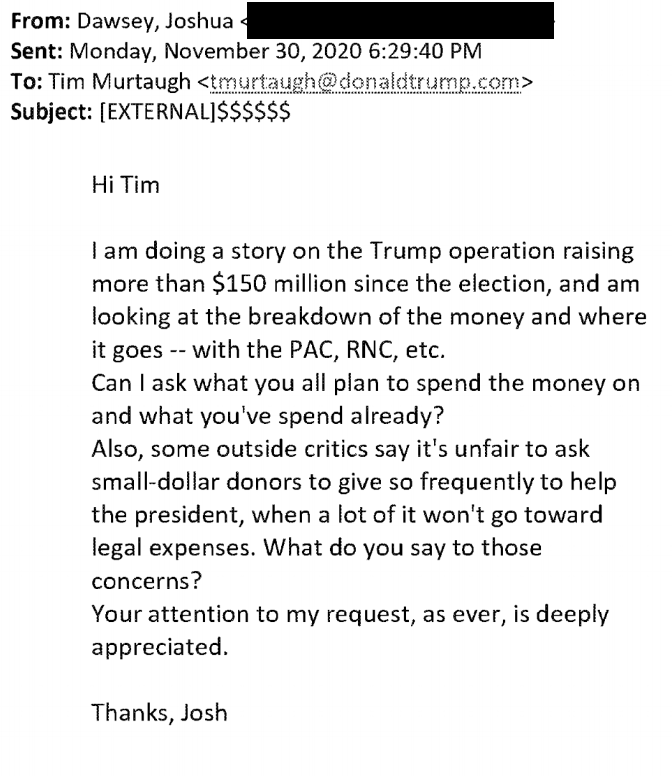
Dawsey wrote a story on December 1, 2020, over a month before the Big Lie led to an insurrection, reporting on this scam.
President Trump’s political operation has raised more than $170 million since Election Day, using a blizzard of misleading appeals about the election to shatter fundraising records set during the campaign, according to people with knowledge of the contributions.
The influx of political donations is one reason that Trump and some allies are inclined to continue a legal onslaught and public relations blitz focused on baseless claims of election fraud, even as their attempts have repeatedly failed in court and as key states continue to certify wins for President-elect Joe Biden.
Much of the money raised since the election is likely to go into an account for the president to use on political activities after he leaves office, while some of the contributions will go toward what is left of the legal fight.
[snip]
The donations are purportedly being solicited for the Official Election Defense Fund, whose name is featured prominently atop the Trump campaign’s website.
There is no such account, however. The fundraising requests are being made by the Trump Make America Great Again Committee, a joint fundraising effort of the Trump campaign and the Republican National Committee. As of Nov. 18, that committee also shares its funds with Save America, a new leadership PAC that Trump set up in early November and that he can use to fund his activities after the presidency.
The day after Dawsey wrote that story, a Trump supporter in Colfax, LA, donated $1,000 that they wanted used, “fighting for election [illegible]” (other of the hundreds of checks Grassley released yesterday even more specifically said they wanted their money spent on election integrity — though many were for the later period when the funds went directly to pay for friendly witnesses).

Back in 2020, Dawsey appears to have gotten no response from Murtaugh.
What happened with his inquiry instead — along with one Politico’s Maggie Severns sent on November 11 and a follow-up question CNN’s Jeremy Diamond sent on November 24, all among the 16 outlets listed by Grassley yesterday — is that Murtaugh, who could have no conceivable attorney client privilege, sent the query to Justin Clark, who otherwise would have attorney-client privilege, along with a bunch of other senior campaign officials, to ask whether they should “still ignore” press inquiries about the fundraising.
In the case of Dawsey’s email, they said things like this to each other:
On Nov 30, 2020, at 7:03 PM, Tim Murtaugh <tmurtaugh@donaldtrump.com> wrote:
I side with no comment. He’s going to write about the split and if we say stuff about legal expenses it will serve to highlight the argument that the fundraising pitch is misleading.
From: Jason Miller <jmiller@donaldtrump.com> Sent: Monday, November 30, 2020 7:24 PM
To: Tim Murtaugh <tmurtaugh@donaldtrump.com> Cc: Sean Dollman <sdollman@donaldtrump.com>; Justin Clark <jclark@donaldtrump.com>; Bill Stepien <BStepien@donaldtrump.com>
Subject: Re: [EXTERNAL]$$$$$$
Fair points. Sean -what are the reporting deadlines for these respective entities -12/15? It will be tougher to dodge such answers after reporters can find it themselves.
[snip]
Re: [EXTERNAL]$$$$$$
We should talk tomorrow about whether to just announce this by press release like we would any other fundraising announcement. If we have the numbers we can discuss how the breakdown among entities needs to be messaged. Also key, as Jason pointed out, that POTUS is on board with how it will be described. [my emphasis]
In response to Dawsey’s query back on November 30, 2020, Murtaugh, Clark, Jason Miller, CFO Sean Dollman, and Campaign Manager Bill Stepien exchanged emails recognizing that the fundraising pitch they were using was misleading, strategizing how they were going to continue to distract journalists from the misleading aspect of their pitches after they had to disclose their fundraising, and noting that they were going to ask Trump if he was comfortable with them fluffing journalists on how they were misleading small donors.
And sure enough, it was misleading. That $1,000 from a Louisiana Trump supporter didn’t go to election integrity. It lined the pockets of, among other things, Melania’s favorite dress designer.
For example, from July 2021 to the present, Save America has been paying approximately $9,700 per month to Dan Scavino,171 a political adviser who served in the Trump administration as White House Deputy Chief of Staff.172 Save America was also paying $20,000 per month to an entity called Hudson Digital LLC. Hudson Digital LLC was registered in Delaware twenty days after the attack on the Capitol, on January 26, 2021,173 and began receiving payments from Save America on the day it was registered.174 Hudson Digital LLC has received payments totaling over $420,000, all described as “Digital consulting.”175 No website or any other information or mention of Hudson Digital LLC could be found online.176 Though Hudson Digital LLC is registered as a Delaware company, the FEC ScheduleB listing traces back to an address belonging to Dan and Catherine Scavino.177
[snip]
Through October 2022, Save America has paid nearly $100,000 in “strategy consulting” payments to Herve Pierre Braillard,195 a fashion designer who has been dressing Melania Trump for years.196
[snip]
From January 2021 to June 2022, Save America has also reported over $2.1 million in “legal consulting.” Many firms perform different kinds of practice, but more than 67% of those funds went to law firms that are representing witnesses involved in the Select Committee’s investigation whowere subpoenaed or invited to testify.
That Louisiana voter was defrauded. And far right propagandists like John Solomon and Margot Cleveland are outraged that someone investigated — using communications asking for details about such things — attempts to defraud loyal MAGAts.
The post Chuck Grassley and Far Right Propagandists Covering Up How Trump Defrauded MAGAts appeared first on emptywheel.
-
Pourquoi le voile obsède tant les Français ?
C'est probablement un des sujets qui obsède le plus les médias mainstream français : le voile. Les femmes qui portent le voile, la signification du port du voile, les raisons cachées du port du voile... Tous ces débats polluent notre espace médiatique… -
Seth Meyers on Trump canceling $1bn in federal funds: ‘Is he adding a waterslide to the reflecting pool?’
Late-night hosts weighed in on Trump’s relationship with tech leaders and the White House’s new AI-powered site
On Tuesday night, late-night hosts discussed a Maha summit in Washington DC, the White House’s new AI-powered website and Donald Trump once again falling asleep on live TV.
Continue reading... -
Test de la batterie externe Ugreen MagFlow Pro avec son refroidissement liquide visible
- Contient des liens affiliés Amazon -Je teste depuis quelques jours la dernière batterie externe MagFlow Pro , qui, en plus d'être très efficace, et franchement rigolote. Pourquoi ? Et bien elle donne envie de regarder autre chose que le pourcentage de charge du téléphone.
En effet, sur la façade externe de la batterie, vous pouvez voir petites gouttes qui circulent dans son circuit de refroidissement liquide sont vraiment très rigolotes à suivre, avec ce côté un peu addictif qui parlera forcément aux geeks. Pour un accessoire habituellement oublié derrière un iPhone, c'est franchement bien trouvé.

Ugreen appelle ce système CryoPulse et l'associe à une feuille de cuivre et une coque en aluminium pour évacuer la chaleur. À l'usage, la recharge est effectivement rapide et le dispositif semble faire son travail, même si cette impression ne permet pas de chiffrer ce que le liquide apporte à lui seul.
 Charger la vidéo depuis YouTube
Ce clic autorise une connexion à Google : adresse IP transmise et traceurs possibles.
En savoir plus
Voir cette vidéo sur YouTube
La partie magnétique permet de fixer la batterie au dos d'un téléphone compatible MagSafe, avec une puissance sans fil qui peut atteindre 25 W grâce à la norme Qi2 dans sa meilleure version. Attention, la compatibilité magnétique d'un iPhone ne signifie pas qu'il acceptera forcément cette puissance, et mieux vaut utiliser une coque MagSafe ou retirer sa coque habituelle.
Le câble USB-C intégré est probablement l'autre détail le plus chouette de cette batterie, parce que vous avez directement de quoi brancher votre téléphone sans chercher un câble au fond du sac. Il monte jusqu'à 45 W, et UGREEN annonce un iPhone 17 Pro Max rechargé à 65 % en 30 minutes en filaire.

Avec ses 10 000 mAh, la MagFlow Pro pèse 220 grammes pour environ 10,8 sur 7,1 centimètres et 1,62 centimètre d'épaisseur. Le format est donc assez compact pour être transporté avec le téléphone, même si vous ajoutez forcément du poids à l'ensemble une fois les deux appareils aimantés.
L'écran sur le côté affiche la charge restante, la puissance et même le nombre de cycles, ce qui donne un peu plus d'informations que les habituelles petites diodes. La batterie accepte de son côté une recharge à 30 W, histoire de pouvoir la remplir assez rapidement entre deux déplacements.

Un port USB-C supplémentaire permet de brancher un autre appareil.
À 105,99 euros contre un prix conseillé de 129,99 euros, elle n'est pas la moins chère de sa catégorie, mais c'est un chouette produit. Avec un petit défaut, qui est assez amusant, les bulles s'entendent quand on colle la batterie à son oreille. Mais bon, a priori personne ne recharge son téléphone avec une batterie externe collée à l'oreille, et ce détail ne gâche pas le plaisir de regarder les petites bulles façon Matrix.
-
Pour les fêtes de fin d'année, le train encore plus cher que l'avion

158 euros pour un Paris-Nice en seconde classe, en aller simple, dès 7h00. C'est le prix à payer pour voyager en train avec la SNCF pendant les fêtes de fin d'année, d'après la Fédération nationale des associations d'usagers des transports (Fnaut) qui dénonce sur son site « des prix déjà délirants ».
Lire la suite - En bref
Les ventes pour les trajets fin décembre ont ouvert le 30 septembre, sur le site de la SNCF, suscitant une forte demande, faisant automatiquement monter les prix, dénonce la Fnaut : « Le (…) -
Le lobby agro-industriel se renforce au Sénat après les élections

Le basculement réactionnaire anti-écolo du Sénat risque encore de s'accélérer après les élections sénatoriales du 27 septembre. Le lobby agro-industriel sort notamment renforcé de ces élections, avec l'élection de quatre sénateurs issus de ses rangs.
Lire la suite - En bref / Politique
C'est ce que relève le média Contexte, qui note l'entrée dans la chambre haute de l'ancien président des Jeunes agriculteurs et ancien vice-président du syndicat agricole productiviste la FNSEA Pascal Coste, élu sénateur Les Républicains (LR) (…) -
Search Console : un outil gratuit pour voir (enfin) la page entière rendue par Google
Une capture d'écran coupée à mi-page
Depuis la disparition de l'ancien « Explorer comme Google », en 2019, on vérifie le rendu d'une page avec l'outil d'inspection d'URL. On lance le test en direct, on ouvre la page testée, et l'onglet Capture d'écran montre ce que Google a affiché. Cette capture s'arrête pourtant à environ 1 750 pixels de haut. Sur une page catégorie, une fiche produit ou un long article, tout le bas de page reste invisible : le maillage de pied de page, les blocs chargés en JavaScript, les avis, la FAQ...
La page explorée, celle que Google a enregistrée lors de son dernier passage et qui sert à l'indexation, est encore moins bien lotie. Search Console en fournit le HTML, sans aucune capture. Pour savoir à quoi elle ressemblait, il fallait lire le code brut, ou le coller dans un fichier HTML et l'ouvrir dans son navigateur.
Des solutions de contournement peu fiables
Natzir lui-même avait publié en 2020 un notebook Google Colab qui simulait le rendu de Googlebot avec Puppeteer. Ce type d'outil, comme les crawlers qui exécutent le JavaScript, imite Google sans disposer de ses données. Il charge la page à sa façon, avec ses propres délais, et le résultat peut s'éloigner de ce que le moteur a réellement vu.
Un bookmarklet qui reconstruit la page à partir du HTML de Google
GSC Full Render reprend le HTML rendu que Search Console affiche déjà dans l'onglet HTML, sans recharger la page, et le reconstitue en entier dans l'onglet Capture d'écran. Il fonctionne aussi bien sur la page testée que sur la page explorée. Les images, les feuilles de style et les polices sont chargées par votre navigateur, sans les délais du test en direct.
Ce que Google n'a certainement pas pu charger reste absent, avec un contour orange à son emplacement : les ressources bloquées par le robots.txt, celles qui ont renvoyé une erreur HTTP (404, 5xx) et les images en lazy loading dont le script ne s'est jamais exécuté. Un compteur liste chaque ressource manquante avec sa raison.
Les ressources classées en « Autre erreur » sont chargées malgré tout, car Search Console n'en précise pas la cause et il s'agit souvent de la limite de temps du test. Natzir rappelle au passage que ces délais sont propres à l'outil de test, et qu'au moment de l'indexation, Google se montre bien plus patient.
 La page entière dans l'onglet Capture d'écran de l'inspection d'URL. Capture : Natzir Turrado, GSC Full Render.
La liste complète des liens de la page
Le bouton d'agrandissement affiche la page en grand, et le bouton Links y ajoute la liste de tous ses liens, que plusieurs filtres permettent d'affiner :
- la destination, interne ou externe ;
- l'attribut rel (follow, nofollow, ugc, sponsored) ;
- l'explorabilité, avec la raison quand le lien n'est pas explorable (javascript:, href vide, onclick...) ;
- l'état au chargement : visible, dans un carrousel, replié dans un menu ou un onglet, invisible ou masqué ;
- les anomalies d'URL : paramètres, fragment, http, majuscules, caractères non ASCII, plus de 115 caractères, lien relatif sans barre oblique...
Un clic sur une ligne mène au lien sur la page, et la liste s'exporte en CSV, avec une colonne par critère. Natzir s'en sert surtout pour retrouver l'origine des URL étranges du rapport Pages : on inspecte les pages susceptibles de pointer vers elles, puis on repère le lien fautif et sa nature. En audit, l'outil permet aussi de vérifier qu'un lien figure bien dans le HTML rendu et qu'il est explorable. C'est le genre de fonction qu'on aurait aimé trouver dans la Search Console dès le départ.
 La liste des liens, filtrable et exportable en CSV. Les liens listés sont encadrés sur la page. Capture : Natzir Turrado, GSC Full Render.
Les limites de l'outil
Les scripts de la page ne s'exécutent pas, si bien qu'un contenu qui n'apparaît qu'au défilement peut rester caché. L'outil ne vérifie ni les codes HTTP ni les redirections des liens, car le navigateur ne peut pas lire les réponses des autres sites depuis Search Console. Les ressources étant chargées aujourd'hui par votre navigateur, le résultat peut différer si le serveur sert autre chose à Googlebot. Une police hébergée sans en-tête CORS peut enfin s'afficher dans une police de remplacement.
Comment installer GSC Full Render
Téléchargez le fichier
install.htmldu dépôt GitHub de l'outil, ouvrez-le dans votre navigateur et glissez le bouton GSC Full Render dans votre barre de favoris. Dans l'inspection d'URL, ouvrez ensuite la page testée ou la page explorée, puis cliquez sur le favori. Un second clic désactive l'outil.Un bookmarklet s'exécute avec votre session Search Console, d'où l'intérêt de savoir ce qu'il fait. Nous avons relu le code de la version publiée le 30 septembre : tout se passe dans le navigateur, aucune donnée n'est envoyée, et la page s'affiche dans un cadre isolé où ses propres scripts ne peuvent pas s'exécuter. Merci à Natzir pour ce partage !
L’article "Search Console : un outil gratuit pour voir (enfin) la page entière rendue par Google" a été publié sur le site Abondance.
-
« Il faut creuser partout » : TotalEnergies veut encore augmenter sa production de pétrole

TotalEnergies veut augmenter sa production de pétrole et de gaz de 2 à 3 % par an entre 2030 et 2035. Selon Maxime Combes, économiste et membre d'Attac, la législation sur le climat est insuffisante pour encadrer le pétrolier.
Lire la suite - Entretien / Énergie
Après un été chaotique marqué par le réchauffement climatique, TotalEnergies s'enfonce toujours plus dans le déni. À l'occasion de sa journée investisseurs, qui a eu lieu à New York le 28 septembre, le pétrolier français a dévoilé ses ambitions pour la décennie à (…) -
« Il faut creuser partout » : TotalEnergies veut encore augmenter sa production de pétrole
TotalEnergies veut augmenter sa production de pétrole et de gaz de 2 à 3 % par an entre 2030 et 2035. Selon Maxime Combes, économiste et membre d'Attac, la législation sur le climat est insuffisante pour encadrer le pétrolier.
Lire la suite - Entretien / Énergie
Après un été chaotique marqué par le réchauffement climatique, TotalEnergies s'enfonce toujours plus dans le déni. À l'occasion de sa journée investisseurs, qui a eu lieu à New York le 28 septembre, le pétrolier français a dévoilé ses ambitions pour la décennie à (…) -
Un «costard en kevlar» : l’affaire Bardella révèle le visage du fascisme et l’honneur du journalisme
 Marine Le Pen s’en est pris aux journalistes de Mediapart, après les révélations sur Jordan Bardella. © Daniel Perron/Hans Lucas via AFP
Marine Le Pen, mardi 29 septembre, devant une assemblée de journalistes : «Il va falloir dire à Mediapart d’enfiler son costard en kevlar.» En France, en 2026, la présidente de l’une des principales forces politiques suggère aux journalistes d’un média indépendant de s’équiper d’un gilet pare-balles.
«Officine d’extrême gauche», «fanatiques», «barbouzerie», «islamo-gauchistes», «prémices d’une guerre totale»… Après que Mediapart a révélé de nombreux écrits antisémites attribués à Jordan Bardella (qui aurait pu prédire ?), mettant à mal des années de «dédiabolisation», le RN contre-attaque de la manière la plus vile qui soit. Et révèle de nouveau son vrai visage.
Cette offensive politique est appuyée par les médias du groupe Bolloré, qui créent des éléments de langage pour défendre leur poulain, et même pire : ils partent en chasse contre les «taupes» du RN qui parlent aux journalistes, comme le révèle Le Monde ce mercredi.
J’en sais quelque chose pour y avoir travaillé jadis : par son indépendance, son exigence et son intransigeance avec les valeurs de notre métier, par ses milliers d’enquêtes, ses révélations folles sur Cahuzac, Sarkozy, Fillon, Le Pen et tant d’autres… Mediapart fait honneur au journalisme. Et le journalisme, c’est un pilier de la démocratie qui est en danger.
«Le RN n’a jamais changé»
Contrairement à ce qu’ont affirmé beaucoup de titres de presse, Mediapart «n’accuse» personne de quoi que ce soit par ces révélations. Ni policier·es, ni juges, notre métier de journalistes consiste à découvrir, vérifier, révéler et porter dans le débat public des faits importants pour la démocratie.
Les Français·es ont besoin de savoir que le président du RN, qui pourrait devenir le prochain premier ministre en cas de victoire de Marine Le Pen : a baigné dans l’antisémitisme d’Alain Soral ; a été assistant de l’eurodéputé RN défenseur du négationnisme Jean-François Jalkh ; a frayé avec la figure néofasciste Frédéric Chatillon ; a pour bras droit actuel François Paradol, qui a fait partie des réseaux d’Alain Soral.
Si ces gens-là parviennent au pouvoir, les médias qui ne mettront pas un genou à terre seront leurs premières cibles. La Hongrie ou les États-Unis nous l’ont bien montré : une démocratie, ça ne tient pas bien longtemps quand la presse libre est mise au pas.
En bref, le RN n’a jamais changé. Il avait juste enfilé une cravate. Tout notre soutien à nos confrères et consœurs de Mediapart.
-
Firefox 157 arrive avec Nova, son plus grand redesign depuis 2021

Mozilla a lancé ce mardi 29 septembre Firefox 157, qui active pour tous le nouveau design Nova sur ordinateur et sur mobile. C'est le plus gros changement d'interface du navigateur depuis Proton, en 2021.
-
Relapse - Le jailbreak qui libère presque toutes les PS5
Depuis quelques jours, la scène PlayStation 5 a un nouveau nom en bouche : Relapse !
Il s'agit d'un tout nouvel exploit qui vise assez large puisqu'il "libère" les consoles jusqu'alors restées bloquées du firmware 7.00 jusqu'à la version 13.60, pour les PS5 comme les PS5 Pro. C'est d'autant plus impressionnant que c'est la première fois qu'une faille kernel publique va aussi loin...
Mais ce qui a fait réagir tout le monde surtout, c'est la vitesse ! Car l'ancienne méthode, baptisée P2JB, pouvait prendre jusqu'à cinquante minutes avant que le jailbreak n'aboutisse, alors que Relapse, lui, fait le taf en quelques secondes à peine.
Pour réaliser ce jailbreak, il faut d'abord faire pointer le DNS de la console vers un serveur tiers, puis ouvrir une page web cachée dans le guide utilisateur avec le navigateur de la console. C'est à ce moment-là qu'une faille du moteur WebKit ouvre une première porte d'entrée pour un second exploit qui peut alors toucher le cœur du système afin d'obtenir un accès en lecture ET en écriture sur le système de fichiers.
Ensuite, grâce à cet accès, on peut lancer du code maison (les fameux homebrews) comme des applis ou encore des mods non officiels que la console refuserait normalement. Des utilisateurs sur le Reddit r/PS5_Jailbreak rapportent même avoir réussi à y faire tourner des jeux récents, comme le remaster de The Witcher 3 sorti le jour même !! Bien sûr, rien pour le moment n'a été vérifié sérieusement... On verra bien.
Par contre, on n'est pas encore sûr de la PS5 débridée pour la vie car l'exploit est éphémère... en effet, à chaque extinction on en perd les effets et il faut alors le relancer à la main au reboot suivant. Et surtout ce n'est pas toujours très clean car d'après des joueurs qui l'ont testé, il peut parfois provoquer des plantages (freeze, reboot...etc) mais rien de dramatique non plus. Voilà, avec cet exploit, l'accès reste donc partiel et pour le moment, y'a pas de Linux installable ni de réel contrôle complet de la machine.
Et surtout Relapse s'arrête à la 13.60, et le nouveau firmware 14.00 publié le 16 septembre corrige le bug, ce qui met hors course toute console mise à jour ces deux dernières semaines.
Maintenant si vous avez une PS5 qui n'a pas encore eu cette MAJ 14.00 car vous la gardez soigneusement à l'écart du PlayStation Network parce que Sony bannit sans pitié le matériel modifié, y'a peut-être moyen de tester, en n'oubliant pas non plus que ce fameux DNS dont je vous causais au début de l'article envoie le trafic de votre console vers un serveur dont on ignore encore le vrai propriétaire...
De son côté, Sony n'a pas encore réagi à part en publiant cette mise à jour de son firmware.
Source : le dépôt Relapse sur GitHub.
-
Trump ally urges administration to ‘step back’ and rethink immigration agenda
Republican senator Jim Justice of West Virginia criticizes immigration crackdown as ranchers’ associations condemn ICE activity
A close political ally of Donald Trump has broken from the administration’s aggressive immigration enforcement agenda and recommended it “step back” to evaluate what it could do better.
“To get better, the first thing you got to do is admit you’re doing something wrong,” Jim Justice, a Republican senator of West Virginia, told Politico. “And in this situation, with all that’s going on and all the stuff, we probably got to step back from it and say: ‘Maybe we’re doing something wrong here or there,’ and then adjust to that.”
Continue reading... -
Avion repeint en vert : les militants de Greenpeace condamnés à des amendes symboliques en appel

Neuf militants de Greenpeace avaient comparu le 24 juin devant la cour d'appel de Paris pour une action sur le tarmac de Roissy en 2021. Ils avaient partiellement repeint la carlingue d'un avion en vert pour dénoncer le greenwashing du transport aérien. La cour d'appel les a condamnés, le 30 septembre, à des amendes allant de 400 euros avec sursis à 500 euros.
Lire la suite - En bref / Luttes , Justice
Des peines « symboliques », s'est réjoui Greenpeace France dans un communiqué, qui note que, par rapport au jugement initial, « la (…) -
L'océan se réchauffe : Copernicus lance « son avertissement le plus sévère à ce jour »

Encore et encore, les alertes se multiplient et la situation planétaire empire de manière catastrophique. Le programme européen Copernicus a publié le 30 septembre son 10e rapport annuel sur l'état des océans. Les chercheurs y lancent leur « avertissement le plus sévère à ce jour sur les profondes transformations à l'œuvre dans l'océan, alors qu'un épisode El Niño probablement sans précédent se dessine dans le Pacifique ».
Lire la suite - En bref / Océans
Non seulement l'océan atteint un niveau de chaleur inédit, mais le (…) -
« Boycotter l'IA et son monde » : débat et mode d'emploi en vidéo

Le 24 septembre, Reporterre organisait une soirée autour du thème « boycotter l'intelligence artificielle et son monde ». Avec un sociologue, une militante et un travailleur du secteur numérique. À retrouver en vidéo.
Lire la suite - Édito / Rencontres de l'écologie , Vie de Reporterre
La trajectoire qu'est en train d'emprunter le développement de l'intelligence artificielle n'est pas soutenable. Ni en matière de consommation électrique – même dans un pays comme la France qui produit de l'électricité en excédent, parce que nous avons besoin de cette (…)