Timeline
Every post and feed across this instance
-
« Pendant les foins, c'est intenable » : les agriculteurs en colère contre le passage au tout-numérique

La comptabilité sur papier, c'est bientôt terminé : à la rentrée, les agriculteurs devront tous faire des factures de manière électronique. Beaucoup jugent cette obligation intenable et dénoncent une « marche forcée vers le tout numérique ».
Lire la suite - Info / Agriculture
« Moi, j'appelle ça le remembrement numérique. Après, on n'aura plus personne en face de nous : tout sera numérisé. » À l'approche de la réforme de la facturation électronique, Olivier Niol, 57 ans, ne décolère pas. Avec sa femme Béatrice, il est (…) -
Œuvres spoliées dans les musées: tous complices?
Que faire de nos émerveillements dans les salles de musées devant des objets extraeuropéens, souvent pillés durant la colonisation? Le grand public a-t-il, lui aussi, une responsabilité dans sa manière de regarder des œuvres spoliées? Retour sur des expériences contrastées. -
Les drapeaux anglais ont-ils été interdits par la mairie de Bristol ?

Source :Compte Facebook, août 2026
Etiqe :pas vraiment
Contenu :
Depuis juillet 2024, l’Angleterre est régulièrement secouée par des émeutes anti-migrants, où des centaines de militants d’extrême droite attaquent des personnes étrangères, des mosquées, ou des hôtels hébergeant des demandeurs d’asile. L’extrême droite, portée par le parti Reform de Nigel Farage, a atteint en 2025 un pic historique de popularité à 35% d’intentions de vote.
Dans ce contexte, de nombreux mouvements nationalistes s’approprient les drapeaux nationaux (l’Union Jack britannique ou la Croix de Saint-Georges anglaise) pour assumer leur rejet de l’immigration. C’est notamment le cas du mouvement Raise The Colours, lancé en 2025 par le militant d’extrême droite Andy Saxon.
Une vidéo, partagée massivement sur les réseaux sociaux, semble immortaliser une de ces manifestations, où l’on peut voir une rue entière d’un quartier bardée de drapeaux anglais. L’internaute explique que ces drapeaux auraient été d’abord interdits par la ville de Bristol, pour ne pas « mettre les migrants mal à l’aise ». Ce seraient les habitants qui, révoltés par la mesure, auraient décidé de braver l’interdiction pour s’opposer à la mairie écologiste.
En réalité, les drapeaux ont simplement été interdits sur la voie publique pour des raisons de sécurité, lorsqu’ils sont accrochés aux poteaux électriques ou aux lampadaires. Ils n’ont jamais été interdits sur les propriétés privées.
La rue la plus patriote d’Angleterre ?
Cette vidéo est authentique. Elle a été publiée le 20 juin 2026 par le média local Bristol 24/7, dans un article titré « Les drapeaux sont de retour dans ‘la rue la plus patriote d’Angleterre' ». On y voit la fameuse rue Torrington, située dans le quartier Knowle West de Bristol, traversée de part en part par des banderoles de drapeaux anglais.
Selon l’article, ce sont en effet les résidents qui ont décidé d’installer les banderoles après le premier match de l’équipe masculine anglaise de football à la Coupe du monde 2026. Ce n’est pas la première fois que cette rue se pare de drapeaux, c’est même une tradition dans le quartier à chaque grande compétition sportive (souvent du football). On peut en trouver d’autres exemples, par exemple en 2021, au moment de l’Euro de football masculin.
Cependant, aucune revendication de cet acte ne permet de savoir s’il a été fait pour s’opposer à la supposée décision municipale, comme l’affirment les internautes, ou simplement pour soutenir l’équipe nationale.
La mairie écologiste prise pour cible
Il est d’ailleurs faux de dire que la mairie de Bristol a interdit les drapeaux anglais pour ne pas « mettre à l’aise les migrants ». Cette fausse information a été pour la première fois diffusée par un compte X, qui assure être un compte « d’informations politiques », mais qui diffuse majoritairement des contenus anti-immigration et en soutien à Nigel Farage, le candidat du parti d’extrême droite Reform.
Cette polémique mélange deux problèmes distincts : l’interdiction de drapeaux sur la voie publique et le fait que des personnes aient pu être mal à l’aise face à ces derniers. Les deux évènements concernent Tony Dier, chef écologiste du conseil municipal de Bristol. L’interdiction de drapeaux est récente, mais la phrase de Tony Dier date de l’été 2025.
Dans une interview du 26 août 2025 pour la BBC de Bristol, au cours de laquelle la journaliste lui demande ce qu’il ferait dans l’hypothèse où des habitants viendraient se plaindre que des drapeaux soient brandis dans leurs rues. Tony Dyer répond en effet que des personnes l’avaient déjà contacté pour exprimer un mal-être sans en préciser les détails. Il appelait notamment son camp politique à ne pas « laisser » le drapeau anglais à l’extrême droite.
Le conseiller municipal avait d’ailleurs diffusé un communiqué à l’époque pour dénoncer la récupération de la croix de Saint-Georges par des « campagnes de désinformation et de haine à l’encontre des migrants ».
Mais ce n’est pas pour cette raison que les drapeaux ont été interdits sur la voie publique.
La sécurité avant tout
Dans un autre communiqué de Tony Dyer, daté cette fois du 5 juin 2026 – soit dix mois après son intervention sur la BBC et juste avant le début de la Coupe du monde – le conseiller municipal explique les raisons de l’interdiction : « Il est interdit d’accrocher des drapeaux aux lampadaires, aux balustrades ou à tout autre bien public. Veuillez ne rien accrocher aux lampadaires : cela pose des problèmes de santé et de sécurité. »
Ce sont donc des contraintes de sécurité qui obligent la mairie à interdire l’installation sauvage de drapeaux sur la voie publique. Un homme était d’ailleurs décédé quelques mois plus tôt à Bristol en tentant d’installer ivre un drapeau britannique sur un lampadaire. Il évoque aussi la dangerosité de ces drapeaux dans le cas où ils se détachent, pouvant tomber sur des voitures et provoquer des accidents routiers.
De plus, ce ne sont pas seulement les drapeaux anglais qui sont interdits, mais les drapeaux « du monde entier », que Tony Dyer décrit comme « des preuves de soutien, une mer de couleurs qui sillonnent nos quartiers, et font partie de ce qui rend des évènements comme la Coupe du monde si exceptionnels. »
Il évoquait d’ailleurs déjà ce souci de sécurité dans le premier communiqué de 2025 consacré à Raise The Colours : « Si un drapeau bloque une route, présente un risque pour la sécurité ou est peint sur des infrastructures telles que des ronds-points, nous avons l’obligation légale d’intervenir. Il ne s’agit pas de faire taire qui que ce soit, mais d’assurer la sécurité de tous. »
Contrairement à ce qu’affirment les internautes, la mairie ne s’oppose pas aux drapeaux en eux-mêmes, puisque le même communiqué encourage chacun à arborer le drapeau de son choix « chez soi », sur la façade de sa propre maison, en toute sécurité.
Si le maire de Bristol a bien affirmé il y a un an que des personnes étaient mal à l’aise face aux mouvements d’extrême droite comme Raise The Colours, c’est pour des raisons de sécurité que les drapeaux ont été interdits sur la voie publique lors de la Coupe du monde.
Auteurs :
Auteur : Clément François, journaliste
Relectrice : Clara Robert-Motta, journaliste
Liens d’intérêts ou fonctions politiques déclarés des intervenants à l’article : aucun
Secrétariat de rédaction : Clément François, journaliste
L’article Les drapeaux anglais ont-ils été interdits par la mairie de Bristol ? est apparu en premier sur Les Surligneurs.
-
Paiement : Stripe rachète OpenRouter pour aider les entreprises à choisir et optimiser leur utilisation des modèles d’intelligence artificielle
Après avoir levé 113 millions de dollars en mai dernier, Alex Atallah, le cofondateur d’OpenRouter, avait décrit son entreprise comme « l’équivalent de Stripe pour l’IA » : sa plateforme permet aux développeurs d’accéder, depuis une interface unique, à des centaines de modèles proposés par différents fournisseurs, là où Stripe joue le rôle d’intermédiaire entre les entreprises et les infrastructures de paiement.
-
Trump’s Misleading Crime Drop Claims

In announcing the latest FBI annual report on nationwide crime, President Donald Trump wrongly cast the decline in crime in 2025 as a dramatic turnaround and made misleading claims about the impact of his administration’s policies.
Speaking to an audience of law enforcement officers at the Nassau County police academy on Aug. 14, Trump said that his speech was meant to “celebrate the historic progress our administration is making together with law enforcement partners nationwide to restore law and order in America.” The FBI that day released data collected from local law enforcement agencies showing that both violent and property crime nationwide declined from 2024 to 2025, with the largest one-year drops in the violent crime and murder rates since the FBI began publishing these estimates in 1936.
The president accurately cited those large one-year reductions, but he ran afoul of the facts and available evidence in taking credit for them:
- Trump claimed that the decline happened “because of what the federal government’s doing.” Criminology experts say there are many plausible factors and the exact reasons are unclear.
- He claimed that the U.S. experienced “a horrible four years” of violent crime during the Biden administration. But violent crime fell during the second half of Biden’s presidency and was lower in the last year of Joe Biden’s term compared with Trump’s final year in office.
- Trump vastly overstated the decline in crime since his deployment of National Guard troops in Washington, D.C., Memphis and New Orleans, citing 70% or 80% reductions that don’t match up with police data. Experts also say the troops aren’t the primary reason for crime dropping in those cities.
- The president suggested that an executive order he signed upon taking office in 2025 contributed to a significant decline in police officers dying in the line of duty that year. However, the law enforcement organization that keeps records of such deaths said the decrease was “likely” due to other factors.
Trump’s speech embracing the FBI’s report for 2025 is noteworthy because he previously disparaged the FBI reports as “fake,” “phony” and “a fraud” when they showed a decline in crime under Biden.
Reasons for Crime Drop Unclear
Trump cited several statistics from the FBI report and claimed credit for the 2024-to-2025 crime reduction. But criminology experts have said the reasons behind the decrease are myriad and unclear. Also, the large single-year declines in 2025 follow a few years of crime dropping after a spike during the 2020 pandemic.
“And with your help, last year, we achieved the largest drop in murder rate ever recorded, the lowest level in 125 years. That’s since the year 1900,” Trump said, adding that according to the FBI crime report, “we achieved the single largest reduction in violent crime in American history.”
Trump is correct that the FBI report says the data it collects from local law enforcement agencies show the 2024-to-2025 decreases in both the violent crime rate and the murder rate were the largest one-year declines since the FBI began releasing the nationwide crime estimates in 1936. The violent crime rate went down by 9.7%, and the murder and nonnegligent manslaughter rate dropped by 18.5%, the FBI said.
The data are estimates based on figures submitted by more than 17,000 local law enforcement agencies covering about 96% of the U.S. population. The violent crime rate went from 362.9 offenses per 100,000 population in 2024 to 327.6 per 100,000 population last year. The murder rate dropped from 5.1 per 100,000 to 4.1.
Trump’s reference to the murder rate being the lowest since 1900 comes from a report by the Council on Criminal Justice, a nonprofit think tank, which used FBI statistics dating back to 1960 and public health data going back to 1900 in determining that. (See Figure 20 in CCJ’s year-end report for 2025.)
The murder rate is the lowest over that time, per CCJ’s methodology. The FBI said the 4.1 rate is tied with the bureau’s 1955 and 1956 figures. (CCJ explained to us that it didn’t use the FBI estimates prior to 1960 because they weren’t standardized and are considered less reliable.)
Regardless, the murder rate is now at a historic low.
“Overall, it was the largest percentage point drop in murder, violent crime and property crime ever recorded,” Jeff Asher, a co-founder of AH Datalytics, a consulting firm that compiles crime data, wrote on Substack. “With murder you have to go all the way back to 2024 to find the previous largest one-year drop in murder and before that the previous largest one-year drop was in 2023.”
In his speech, Trump went on to credit his administration. “But we have the numbers down because of what the federal government’s doing,” the president said. “We get no — we get no credit for it. … They like to take all the credit, but everyone knows we’ve done an amazing job.”
In an Aug. 18 press release, the White House similarly said that Trump and his administration “have delivered the most dramatic decline in violent crime in American history.” It wrongly said the FBI crime estimates “mark the decisive reversal of the crime crisis Democrats left behind.” As we explain later in this article, the rates for violent crimes were lower in 2024 than in 2020, Trump’s last year of his first term. The press release went on to cite figures on arrests made by the FBI.
Presidents of both parties often take credit for the good things that happen while they’re in office, but experts say the reasons behind the 2025 crime figures aren’t yet known.
“The homicide drop is historic and crystal clear. But right now, what’s driving it is about as clear as a glass of milk,” Adam Gelb, the president and CEO of the Council on Criminal Justice, said in a statement. “Rates are falling in cities with very different public safety strategies, economic conditions, and political leadership.”
Criminology experts have told us before that one or even a few years of crime data isn’t enough to draw conclusions.
“As with every edition with these kind of reports, the feeding frenzy begins to take credit,” Matthew Cavedon, director of the Cato Institute’s Project on Criminal Justice, told the Washington Post. “Everybody wants to be able to go to the public and the voters and say, ‘This is exactly what did it.’ It’s a bit of a fool’s errand to even try.”
The Trump administration, however, is taking a victory lap. We asked the White House if there were reports or other information it could point to showing the crime drop in 2025 was due to the administration’s actions or policies. “President Trump is right: thanks to this Administration’s tough-on-crime policies, 2025 showed the largest year-to-year decrease in violent crime. President Trump has restored law and order,” Lauren Bis, a White House spokeswoman, said in response.
In an interview, Gelb told us that there could be some impact on crime from what the administration is doing, but we don’t know what that is yet.
He said that attrition is one factor that could be playing a role, as there are fewer high-risk people on the street. Factors contributing to that, he said, include a surplus in murders beginning in 2020 (resulting in more arrests and some criminals killed), a spike in drug overdose deaths, and the federal government’s immigration enforcement and other activities. While clearly not all those who die from drug overdoses, or all immigrants swept up by the federal government, have committed crimes, some percentage of them would have some involvement in criminal activity.
Available data have shown that the majority of immigration enforcement by the federal government has swept up people without convictions or charges for violent crime. A February CBS News report said that about 14% of nearly 400,000 arrests by Immigration and Customs Enforcement in 2025 involved those with charges or convictions for violent crimes, according to an internal Department of Homeland Security document. We’ve also reported that an increasing percentage of ICE arrests over Trump’s first year back in office were of those with no criminal convictions or pending charges, whether for violent or lesser offenses. Still, the increased enforcement does result in some number of violent criminals being detained.
Gelb cautioned, however, that reducing crime isn’t “as simple as taking bad guys off the street,” because of the replacement effect, where those arrested are quickly replaced by someone else in a criminal organization, such as in gang activity, drug dealing or organized retail theft.
Asked when there might be clarity on the Trump administration’s impact on crime, Gelb said, “We’re still trying to understand the crime drop that started in the early 1990s. So, I don’t think we can expect definitive conclusions that with any precision assign credit to any particular policy, program, party or leader. … But with careful and rigorous analysis, we can get a lot closer.”
Next month, CCJ is convening about 50 crime researchers and scholars to discuss the reasons behind the decline in crime in recent years, and they’re looking at about 40 different plausible factors. Gelb said that they fall into three buckets: criminal justice operations, strategies, policies and programs; technology; and social and cultural shifts.
He went on to list several factors in each of those buckets. Criminal justice would include local and federal policies under multiple administrations, community violence intervention programs, and mayoral offices’ whole-of-government strategies that involve everything from policing to improving street lighting. Technology includes a “massive expansion in the last few years of surveillance” through cameras; a shift to a cashless society, which reduces robberies; and improvements in emergency medical care that can lower the lethality rate from assaults or robberies. Finally, the broad social and cultural changes include people drinking less, particularly young people, and kids spending more time at home alone — on their phones — rather than being out with friends.
“You know the movie ‘Everything Everywhere All at Once’?” Gelb asked. “That’s what we’ve got here. And when you have so many, so many things happening at once, it can be extremely hard to disentangle.”
Violent Crime Under Biden
Trump also claimed that the U.S. had “four years in hell” because of violent crime under Biden. But the violent crime rate was lower when Biden left office than when Biden was inaugurated.
“And in the past four years, before I took office, our country was overrun by violent criminals,” Trump said. “I mean, you remember just a couple of years ago, how bad it was, right? It was really bad, foreign gangs, savage thugs with Biden, sleepy Joe. What a — what a horrible four years. That was four years in hell. We lived in hell.”
FBI data show the overall violent crime rate did increase a smidge during the first half of Biden’s term. It was 389.5 per 100,000 population in 2022, a slight bump from the rate of 389.2 per 100,000 in 2020, Trump’s last full year in office, when violent crime spiked during the pandemic. (See Table 1 after downloading the FBI’s 2025 estimations for crime in the U.S.)
But violent crime began to fall in 2023 and the rate was down to 362.9 per 100,000 in 2024. That was 26.3 fewer offenses per 100,000 population than in 2020 and even down from the pre-pandemic rate of 368.6 per 100,000 in 2019.
In fact, the rates of murder, rape, robbery and aggravated assault were all lower in 2024 than in 2020. The murder rate in particular dropped from 6.6 in 2020 to 5.1 in 2024, and the number of murders declined by about 21%. At the same time, the rate of aggravated assaults declined by 13.7 offenses per 100,000 and the raw number went down by almost 2%.
Impact of National Guard
Trump touted his efforts to deploy the National Guard and federal law enforcement to assist several cities with crime, and he said it has paid dramatic dividends. But he vastly overstated the drop in crime post-National Guard. And crime experts say the infusion of National Guard troops is not the primary reason for the reduced crime those cities have experienced.
 Members of the U.S. National Guard patrol near the Washington Monument on the National Mall with the Lincoln Memorial in the background on Aug. 6 in Washington, D.C. Photo by Kevin Carter/Getty Images.
Via presidential memos, Trump deployed the National Guard in several cities to focus on public safety: in Washington, D.C., on Aug. 11, 2025; in Memphis on Sept. 15; and in New Orleans in late December.
“In Memphis, crime is down 71%. In New Orleans, crime is down 75%. And in D.C., crime is down 81%,” Trump said. “I’ll tell you, because D.C. is very personal for me, but in D.C., crime is — it was so bad when I got there. A year and a half ago, people were being murdered, three a week on average. We have very few murders anymore.”
There were 16 homicides in Washington, D.C., in July, more than the “three a week on average” Trump said was the norm before he deployed the National Guard there.
But overall, crime and homicides are generally down in the three cities where Trump deployed the National Guard, just not by nearly as much as Trump claimed. And crime had been trending down for at least a few years prior to the National Guard arrival.
The White House did not respond to our question about the source of Trump’s figures.
Washington, D.C.
On Aug. 11, 2025, Trump declared what he called “Liberation Day in D.C.” to “rescue our nation’s capital from crime, bloodshed, bedlam and squalor and worse.” He put the Metropolitan Police Department under temporary federal control and deployed the National Guard to the nation’s capital to help with law enforcement.
Data from the city’s Metropolitan Police Department indicate a 20% reduction in overall crime in D.C. so far in 2026, compared with a similar period in 2025.
Digging into the numbers, there were 67 homicides between Jan. 1 and Aug. 14, 33% fewer than over the same period in 2025 (nearly entirely before the National Guard deployment). Robberies over the same period were down 14%. But sex abuse cases were up 2%, and assaults with a dangerous weapon rose 40%. Overall, violent crime rose 4%. Property crimes declined by 23%.
After spiking in 2023, violent crime had been trending steadily downward in Washington, D.C., before Trump’s federal surge.
“If you want to argue that there was an additional decline on top of that [the downward trend] due to all these interventions, you could plausibly make that argument,” Asher, with AH Datalytics, told the Washington Post. “But you can’t make the argument that the intervention caused that decline or even was a major factor in those trends turning over.”
Thaddeus Johnson, an assistant professor at Georgia State University and a senior fellow at the Council on Criminal Justice, echoed that conclusion, telling the Washington Post, “One would be hard-pressed to say that it didn’t play a role, but you would also be hard-pressed to say it was the only or primary reason why we’ve seen reductions.”
“DC homicides fell from 187 in 2024, the year before [Trump] took office, to 127 in 2025, and are down another 32% so far this year, from about 3.6 murders a week in 2024 to about 2 a week now,” Richard Hahn, senior manager for research and evidence in the Niskanen Center’s criminal justice department, told us via email. “That is a roughly 40% improvement on the pace he inherited, not 81%, and the sharpest single drop (274 homicides in 2023 to 187 in 2024) happened entirely under local policing before his term began.”
Hahn is one of the co-authors of a report from the Niskanen Center, a centrist think tank, titled, “Washington, D.C.’s Crime Decline and Its Lessons for American Policing.”
The analysis concluded that deployment of the National Guard to D.C. gets “some credit” for “a narrow slice of crime,” Hahn told us. “The Guard was posted in tourist corridors, transit hubs, and federal areas rather than the neighborhoods where violence concentrates, and Guard members could detain but not arrest. We found the deployment produced a real reduction, about 24%, in opportunistic property crime where the Guard was visible, and no detectable effect on violent crime. That is what the research on policing would predict: visible uniformed presence deters crimes of opportunity, but it does not reach violence rooted in interpersonal disputes.”
According to the report, “What the Guard brought was a massive, sudden shock from the visible presence of uniformed military personnel on the streets of Washington almost overnight. For crimes driven by opportunistic calculation, that visibility appears to have mattered. For violent crime, which is less deterrable by patrol presence alone, it did not.”
The report concluded that while the Guard’s deployment “reduced the occurrence of specific crimes, it was (and remains) a blunt and expensive instrument.” The report’s analysis found that “a targeted, data-driven policing strategy optimized on where and when crime actually occurs could achieve comparable or better outcomes at a fraction of the cost.”
Memphis
Last September, Trump’s executive order created the Memphis Safe Task Force, which included sending hundreds of federal law enforcement agents and deploying 1,450 National Guard troops to the city.
In Memphis, total crime dropped nearly 39% from the period of Oct. 1 to Aug. 18 compared with the same period the year before, according to city data. That includes drops in crimes across the board: -41% for murder; -30% for aggravated assault; -32% for sexual assault; -48% for robbery; -28% for burglary; -36% for larceny; and -62% for motor vehicle theft.
Memphis Mayor Paul Young told Action News 5 in Memphis that the task force “amplified” state and city efforts — including millions in state funds targeting violent crime and other targeted enforcement approaches — that had already resulted in crime dropping 27% in the year before the task force was created.
“I think two things can be true at the same time,” Tyreece Miller, U.S. marshal for the Western District of Tennessee, told Action News 5. “I think crime was trending downward. But I think the task force certainly escalated the decrease in crime.”
New Orleans
In late December 2025, Trump deployed 350 National Guard members to New Orleans. But the results have been mixed.
In New Orleans, crime began to markedly drop in late 2023, but leveled off in mid-2025. Since the National Guard arrived in New Orleans in late December, crime overall has remained relatively unchanged. The rolling yearly total number of crimes on Aug. 18 was 13,375, up slightly from the yearly total ending Aug. 17, 2025, of 13,207. Year-to-date, overall crime is up 4.8% compared with the same period last year; murder is down 23.9%; and sexual assault is up 1.6%.
“The National Guard has had no impact on New Orleans’ murder trend,” Asher, of AH Datalytics, told us via email. “To begin with, the Guard is deployed largely in the French Quarter where gun violence is very rare. In addition, shootings in New Orleans began falling dramatically in mid-2023 with the city experiencing a 60 percent drop in shooting incidents between mid-2023 and early 2025. This trend began long before the National Guard arrived and almost certainly has been caused by other factors.”
Hahn also cautioned not to ascribe too much credit to National Guard deployment in the three cities.
“The whole country is in a historic crime decline,” Hahn said, citing the FBI’s 2025 report that found the largest one-year drops in violent crime and murder since the bureau started tracking the data. “The Council on Criminal Justice found homicide down 21% in 2025 across its big-city sample, and down another 18% in the first half of 2026, putting the country on track for a historic low. Against that backdrop, the three deployment cities look much like everywhere else. When crime is falling nearly everywhere, falling crime in three cities is not sufficient evidence that any particular intervention worked.”
Trump, meanwhile, said he stands ready to implement similar federal surges in other cities that are receptive.
“For other cities like New York, Chicago, L.A., all they have to do is call us and we will stop that crime,” Trump said. “We’ll stop that horrible crime.”
But Hahn said the data do not support that, as big cities around the country saw major crime drops over the last several years, commensurate to the cities where Trump sent the National Guard.
“Crime has not dropped more dramatically in the deployment cities than in New York, Chicago, and LA,” Hahn said. “In 2025, the NYPD recorded the fewest shooting incidents in its recorded history (688, down 24% from 2024) with murders down 20%. Chicago ended 2025 with 411 homicides, down 30% and the fewest in decades, per CPD data. Los Angeles recorded its fewest homicides since 1966, down 19%. And Denver led the nation’s large cities with a 41% homicide decline. None of these cities had a Guard deployment. That they matched or beat the deployment cities without federal troops is strong evidence that the Guard is not what is driving the numbers.”
Decline in Police Dying on Duty
Trump appeared to credit an executive order he signed in early 2025 for last year’s decline in the number of police officers who died in the line of duty. But that was not one of the reasons for the decrease that was cited by the law enforcement organization that tracks those deaths.
“Shortly after taking office, I signed a historic executive order directing that anyone convicted of killing a police officer should face the death penalty,” Trump said. “And last year, deaths of law enforcement — well, think of this — deaths of law enforcement officers in the line of duty fell to an 80-year low.”
Trump did sign an executive order on Jan. 20, 2025, directing the attorney general to “pursue the death penalty for all crimes of a severity demanding its use,” including “murder of a law-enforcement officer.” The National Law Enforcement Officers Memorial Fund also reported that 109 officers died in the line of duty in 2025, representing a 26% decrease from 148 officers in 2024.
The 2025 total — which included 45 officers who died after being shot — was the lowest since 93 officers died in the line of duty in 1943, according to NLEOMF figures. But as far as the reason for the overall decline in 2025, the NLEOMF did not mention Trump’s executive order.
“We lament to document even a single such death, but this encouraging downward trend in fatalities likely reflects the continued adoption of proven best practices by police, sheriff, and corrections agencies, as well as a growing emphasis on the physical and psychological health of the men and women who work to keep our communities safe,” NLEOMF CEO Bill Alexander said in a statement in January. “These practices align directly with — and underscore the importance of — NLEOMF’s Officer Safety and Wellness initiatives, which are designed to help ensure that more officers return home safely at the end of each shift.”
Experts on the death penalty previously told us that there is no conclusive evidence that capital punishment is “a very strong preventative” to violent crimes such as murder, as Trump has claimed.
Editor’s note: FactCheck.org does not accept advertising. We rely on grants and individual donations from people like you. Please consider a donation. Credit card donations may be made through our “Donate” page. If you prefer to give by check, send to: FactCheck.org, Annenberg Public Policy Center, P.O. Box 58100, Philadelphia, PA 19102.
The post Trump’s Misleading Crime Drop Claims appeared first on FactCheck.org.
-
«Le débit d’eau du fleuve a été divisé par dix»: le long du Rhin asséché, l’économie s’enraye
Depuis début août, la navigation sur le Rhin est fortement entravée en raison des faibles niveaux et débits du fleuve. Pour pallier la réduction des charges des bateaux, les entreprises se reportent sur le ferroviaire mais aussi les poids lourds, plus émetteurs en gaz à effet de serre. -
Missouri court allows new Trump-backed US House districts to be used in November election
A Missouri judge has allowed new U.S. House districts backed by President Donald Trump to be used in the November elections, rejecting a bid by to put the Republican-friendly districts to a statewide vote of the people. The ruling Wednesday by Cole County Circuit Judge Daniel Green is a victory for Republicans seeking to hold onto their slim majority in the U.S. House. But the case is likely to end up in the state Supreme Court. -
Missouri judge hands Trump, GOP major redistricting win ahead of midterm elections
A Missouri judge handed President Donald Trump and Republicans a major redistricting victory Wednesday, ruling that the state's referendum process cannot be used to challenge congressional maps drawn by the Legislature and allowing a new GOP-friendly map to remain in place for November's midterm elections. Cole County Circuit Judge Daniel Green ruled Wednesday that Missouri's constitutional referendum provisions "do not apply to congressional redistricting enacted by the General Assembly," siding with Republican Secretary of State Denny Hoskins in a closely watched fight over a Trump-backed map that could help determine control of the U.S. House. -
Corruption : TotalEnergies et 5 majors pétrolières poursuivies par le Kazakhstan

Une procédure d'arbitrage confidentielle sur fond d'accusations de corruption oppose le Kazakhstan au consortium pétrolier North Caspian Operating Consortium (NCOC), qui réunit TotalEnergies, Shell, ExxonMobil, Eni, Inpex et la China National Petroleum Company. Elle est en cours devant la Cour permanente d'arbitrage de La Haye, rapporte le Consortium international des journalistes d'investigation (Icij).
Lire la suite - En bref / Monde , Fossiles
Le gouvernement kazakh reproche au NCOC d'avoir attribué à des entreprises (…) -
Nouvelle fuite de données en France : Red by SFR alerte ses clients

Red by SFR a averti ses clients d'un accès non autorisé à leurs données personnelles, détecté début juillet 2026 sur un outil interne.
-
Hydrocarbures dans les outre-mer : « l'attrait des ressources fossiles est en contradiction avec l'idée même d'une décolonisation »

« Aurons-nous l'audace, dans les territoires d'outre-mer, d'inventer un avenir sans prédation fossile, pour préserver notre propre conception du vivant ? » demande le député de Martinique Marcellin Nadeau dans cette tribune, qui appelle à une représentativité politique plus juste.
Lire la suite - Tribune / Énergie , Politique , Antiracisme
Marcellin Nadeau est député de Martinique. Il est membre de la commission du développement durable à l'Assemblée nationale et siège au groupe GDR (Gauche démocrate et républicaine). Les noms des signataires de (…) -
Guyane, Martinique... « La ruée vers les énergies fossiles prolonge l'œuvre coloniale »
« Aurons-nous l'audace, dans les territoires d'outre-mer, d'inventer un avenir sans prédation fossile, pour préserver notre propre conception du vivant ? » demande le député de Martinique Marcellin Nadeau dans cette tribune, en appelant à défendre une représentativité politique plus juste.
Lire la suite - Tribune / Énergie , Politique
Marcellin Nadeau est député de Martinique. Il est membre de la commission du développement durable à l'Assemblée nationale et siège au groupe GDR (Gauche démocrate et républicaine). Les noms des (…) -
Dans le Pas-de-Calais : la gendarmerie provoque un incendie en traquant des réfugiés
Ce n'est pas le feu le plus étendu de cet été caniculaire, mais c'est l'un des plus graves et inhabituels. Il a été provoqué par des tirs de grenades de la gendarmerie.
L’article Dans le Pas-de-Calais : la gendarmerie provoque un incendie en traquant des réfugiés est apparu en premier sur Contre Attaque.
-
Piratage de la DGFiP : le gouvernement veut une nouvelle unité cyber, mais pour quoi faire ?
« Arrêtons de découvrir la lune à chaque cyberattaque ». Pour Sébastien Lecornu, les attaques qui frappent actuellement les administrations ne révèlent pas une menace nouvelle, mais les faiblesses persistantes de l’État pour y faire face. Le Premier ministre estime donc qu’il est nécessaire d’accélérer le renforcement de ses défenses.
-
FOIA Docs Show Brendan Carr Intimately Collaborated With White House, Right Wing Propaganda Orgs
Back in 2014 you might remember there was a giant, two-year, manufactured news cycle where Republicans pretended to be outraged that the then Obama White House had openly supported the FCC’s efforts to impose some modest net neutrality rules (designed to protect consumers and competition from telecom monopoly abuse of power).
At the time, major press outlets endlessly parroted Republican claims that the president’s perfectly legal public support of FCC policy was somehow underhanded, illegal, or applied undue pressure on an independent agency. Right wing friendly “think tanks” like the Hudson Institute suffered endless embolisms over the purported impropriety:
“The unwelcome assault on the independence of the FCC is a threat not merely to that agency. It is a threat to our entire system of government based on the rule of law. It is also a threat to the Internet. Where there is no rule of law, the Internet does not flourish.”
The Republican Committee on Homeland Security and Governmental Affairs even launched a two-year investigation culminating in a bogus report falsely claiming that there had been all sorts of nefarious intermingling between the White House and FCC. Republicans, I’ll repeat, were absolutely outraged that the White House would even open its mouth to comment on policy the agency was already pursuing.
Twelve years later and not only is net neutrality dead as a doornail thanks to corrupt collaboration between Republicans and telecom monopolies, but the FCC has taken up permanent residence inside the White House’s colon, making any claim of FCC independence laughable under Trumpism.
Or at least that’s the takeaway of this new report by the Guardian, which obtained documents via a Freedom of Information Act request and a lawsuit filed by the advocacy group Democracy Forward.
The documents show FCC boss Brendan Carr has had deep and intimate collaboration with both the White House and right wing propaganda companies as he’s pursued policies ranging from blatant censorship of of journalism and the media, to efforts to dismantle (at times illegally) consumer protections, media consolidation limits, and most corporate oversight:
“Between 12 March 2025 and 11 February 2026, Carr attended at least eight meetings at the White House, according to the records, and had at least three scheduled calls with administration officials, including two conversations with chief of staff Susie Wiles. He also spoke by phone with administration officials such as controversial health secretary Robert F Kennedy Jr.
In addition, the files provide insight into Carr’s media strategy, including communications with producers at Fox News, and make public previously undisclosed meetings he has held with media titans such as Fox Corp chief executive Lachlan Murdoch and Sinclair Broadcast Group chair David Smith.”
That Carr is ignoring any pretense of agency independence, coordinating messaging with right wing agitprop factories like Fox News and Sinclair, and disproportionately meeting with right-wing friendly companies to their exclusive benefit shouldn’t surprise anybody and isn’t illegal (in a country with dead or dying corruption, lobbying, and influence-peddling laws), but it is a notable new high watermark for Republican hypocrisy. Twelve years ago, I’ll repeat, Republicans (including Carr, who had previously worked as an attorney at the agency), insisted the president even opening his mouth on policy was somehow illegal and an outrageous erosion of FCC independence.
The FCC is, to be clear, supposed to be independent from White House influence and meaningfully overseen by Congress. Though you might recall that last year in congressional testimony Carr raised eyebrows by insisting the agency is no longer independent — even going so far as to delete the word from the agency website.
Having regulators that are marionettes for the whims of your autocratic leadership is obviously corrupt and anti-democratic. Now it’s impossible to determine where Donald Trump’s incoherent whims begin and the FCC’s purported autonomy ends as Brendan Carr harasses media companies critical of the president, and strips away what’s left of U.S. consumer protection guardrails down to the studs.
Ultimately, I suspect the closest Carr will ever get to meaningful punishment is a revolving door gig at an AT&T-funded think tank where he whittles away the rest of his years getting paid high six figures to perpetuate the ongoing destruction of whatever’s left of U.S. public interest guardrails.
-
Après 150 ans d'absence, la nigelle des champs réapparaît dans la Sarthe

On la croyait disparue pour de bon dans la Sarthe : la dernière observation de cette petite fleur blanche aux cinq pétales remonte à 1879. La nigelle des champs a été observée sur une parcelle à Parcé-sur-Sarthe début juillet par Esther Servain, étudiante en master d'écologie et en stage au Conservatoire botanique national de Brest.
Lire la suite - En bref / Nature
Autrefois largement répandue, la fleur, qui pousse dans les champs calcaires et secs, est devenue de plus en plus rare partout dans le pays, notamment à cause (…) -
Une offre d’emploi de Google confirme ce qu’on observe dans Discover
L’entreprise a publié une fiche de poste pour un ingénieur senior dans son équipe « Discover Ranking », l’équipe qui fabrique le classement de votre flux. Parmi les prérequis, une ligne retient l’attention : le candidat doit savoir construire et déployer des « modèles de systèmes de recommandation (retrieval, prediction, ranking, embedding) en production ».
L’offre « Staff Software Engineer, Discover Ranking » sur Google Careers. La quatrième ligne des prérequis nomme les briques du système. Surlignage ajouté par nos soins.Quatre mots techniques, qui décrivent la chaîne complète d’un système de recommandation : sélectionner des contenus candidats, prédire ce que chaque lecteur va en faire, les classer, et représenter lecteurs et contenus sous une forme que la machine sait comparer.
Une offre d’emploi décrit des compétences recherchées, rien de plus. Sa valeur vient du recoupement : chez 1492.vision, nous observons de vrais flux Discover depuis deux ans, et ces mots recoupent très exactement ce que nous voyons passer. Voici trois exemples concrets, racontés simplement ; l’analyse complète, chiffres et graphiques à l’appui, est dans notre étude de référence (disponible en français et en anglais).
Chaque carte de votre flux porte des prédictions
Commençons par le mot « prediction ». Chaque carte qui s’affiche dans un flux Discover a été évaluée par des modèles qui prédisent le comportement du lecteur : va-t-il s’arrêter dessus ? Cliquer ? Lire en profondeur ?
Ces prédictions laissent des traces bien concrètes : des scores, que nous observons sur les cartes de nos panels de test. Et elles se résument à deux questions étonnamment indépendantes :
- Cette carte va-t-elle arrêter l’œil ? C’est une propriété de l’article : son titre, son image. Elle varie peu d’un lecteur à l’autre.
- Ce lecteur précis va-t-il s’engager ? Cliquer, lire longtemps, interagir. Celle-ci dépend énormément de chaque lecteur.
Les deux peuvent diverger complètement, et c’est toute la définition du clickbait : un titre qui arrête l’œil de tout le monde et ne retient personne. À l’inverse, un contenu de niche peut engager profondément ses lecteurs sans jamais accrocher la majorité.
Dans nos mesures, ces prédictions collent au comportement réel observé ensuite sur le panel : quand le score d’engagement prédit est haut, l’interaction constatée est environ deux fois plus forte que quand il est bas.
L’affinité change tout, à contenu égal
La personnalisation se raconte en deux exemples.
Premier exemple. Sur nos comptes de test, nous avons comparé deux éditeurs de sport, sur la même thématique, face aux mêmes comptes. Le potentiel de leurs sujets, tel que le système lui-même l’évalue, était du même ordre. Résultat : pour l’un des deux, les prédictions d’engagement étaient environ 2 fois plus élevées, et la visibilité finale dans les flux environ 8 fois plus forte, à sujet comparable.
Le détail qui surprend : l’éditeur dominant est celui que nos comptes de test suivent le moins, au sens du bouton « Suivre » de Google. Ce qui fait la différence, c’est l’affinité que ces lecteurs ont déjà installée avec la source : un historique de lectures, d’interactions, de rendez-vous pris. Le modèle a appris que ces lecteurs précis s’engagent avec cette source, et il le prédit.
Deuxième exemple, pour situer le rôle du bouton « Suivre ». Pour un même éditeur tech, à sujets égaux, les comptes qui le suivent obtiennent des prédictions d’engagement presque doublées par rapport aux comptes qui ne le suivent pas, et une visibilité un peu plus forte. Suivre compte, comme un signal parmi d’autres qui nourrit l’affinité. L’affinité, elle, fait la décision.
D’où une boucle qui s’auto-renforce, lecteur par lecteur : un lecteur découvre une source et s’y engage ; cette affinité s’installe dans les modèles ; la source devient plus visible dans son flux ; il s’y engage davantage. La boucle favorise structurellement les sources qui ont su créer une relation avec leurs lecteurs, et la fidélisation devient un levier direct de visibilité Discover, mesurable dans les prédictions elles-mêmes.
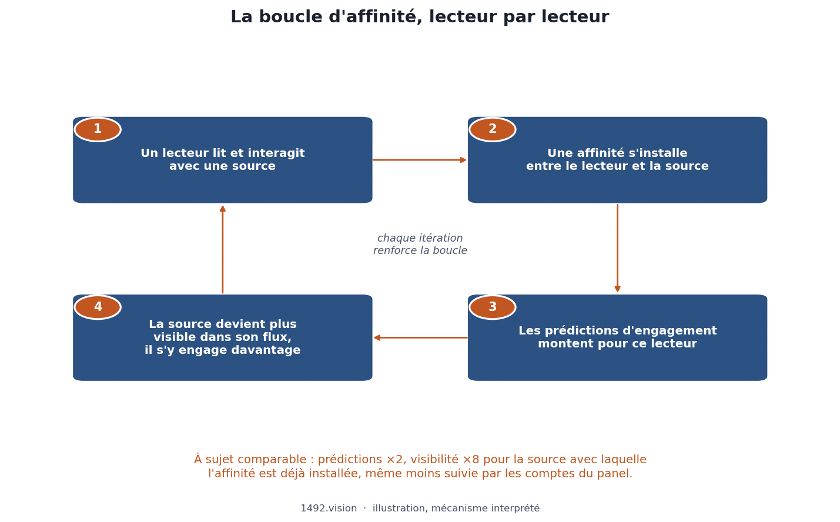 La boucle d’affinité se renforce lecteur par lecteur. Schéma, mécanisme interprété à partir de nos observations.
Un lecteur, plusieurs profils
Dernier mot de la liste : « embedding ». Derrière ce terme, une idée simple : pour vous recommander des contenus, la machine vous représente sous forme de coordonnées, et recommande ce qui est « proche » de vous.
Nos observations suggèrent que Google maintient plusieurs profils de vous en parallèle, plutôt qu’un seul : vos intérêts de fond, vos curiosités du moment, ce qui est en tendance autour de vous, et même un profil orienté achats. Votre flux du matin est le point de rencontre de ces différentes versions de vous.
C’est cohérent avec ce que tout utilisateur de Discover constate : le flux mélange vos passions stables, l’actu chaude et des essais parfois surprenants. Derrière ce qui ressemble à des sautes d’humeur de l’algorithme, il y a une architecture.
Ce qu’il faut en retenir
L’offre d’emploi valide un vocabulaire ; nos observations montrent la machinerie au travail. Pour un éditeur, trois conséquences :
- À contenu comparable, l’affinité installée entre vos lecteurs et votre marque pilote la visibilité. Fidéliser (faire revenir, faire interagir, faire suivre) est un levier Discover à part entière, au même titre que le travail éditorial, et dans nos tests il pèse davantage que le seul bouton « Suivre ».
- Capter l’attention et créer de l’engagement sont deux chantiers distincts, qui se mesurent et se travaillent séparément.
- L’engagement n’est que la moitié de l’histoire : l’offre parle de contenu « engaging, and useful », et la satisfaction du lecteur est portée par d’autres signaux. Optimiser le clic seul est une stratégie à courte vue.
Google a nommé publiquement les briques de sa machine à recommander. Nous, de l’extérieur, nous continuons à mesurer ce qu’elles font, carte après carte. L’analyse complète est ici.
Méthodologie : observations issues d’un panel de comptes de test sur de vrais flux Discover ; « suivre » s’entend au sens du bouton « Suivre » de Google, mesuré sur ce panel ; les deux cas éditeurs sont des illustrations sur de petits échantillons. Méthode complète, chiffres et graphiques : l’étude complète.
Damien Andell, co-fondateur de 1492.vision. Observations issues de l’analyse de vrais flux Google Discover ; les mécanismes décrits sont nos interprétations, pas des confirmations de Google.
L’article "Une offre d’emploi de Google confirme ce qu’on observe dans Discover" a été publié sur le site Abondance.
-
L’immense Samsung Odyssey OLED G9 revient en stock à 669 €, son prix le plus bas

[Deal du jour] Brièvement disparue hier, l’offre sur le Samsung Odyssey OLED G9 est déjà de retour chez Carrefour. Cet immense écran OLED de 49 pouces repasse à 669,99 € au lieu de 1 099 €, soit son prix le plus bas jamais observé.
-
Michael Cohen, ex-fixer for Trump who once testified against him, hosts president on his radio show – as it happened
Despite previously comparing him to a ‘mobster’, Trump’s former personal lawyer showers him with praise. This blog is now closed.
An FBI team seized electronic devices from former US representative Eric Swalwell at the San Francisco airport on Saturday, then raided his home in Washington, DC, the next day, CNN reported Thursday.
The raid is part of a federal investigation into the sexual assault allegations which ultimately drove the Bay Area Democrat to resign from office in April, sources familiar with the investigation told CNN. The Manhattan District Attorney’s Office and the Los Angeles Sheriff’s Department subsequently opened criminal investigations on Swalwell.
Continue reading... -
Washington Policy Review: August 19, 2026
Today’s Report
1. Overview
2. White House News
3. Truth Social Posts
4. Government Department News
5. 2028 Democratic Presidential Candidates
6. AI & Tech Company News
7. Congressional Watch
8. Policy Impact Analysis & Heatmap
Noctral is an app. For anyone carrying an argument they’d like to test on someone sharper. Free on iOS.
→ Download on the App Store
→ noctralai.com1. Overview
President Trump’s trade agenda reached a milestone as Ford Motor Company announced the reshoring of Lincoln production to the United States. The White House credits this move to the administration’s policy shifts, which aim to eliminate Chinese imports and foster domestic job growth. Officials assert that these actions represent a “decisive victory over decades of offshoring,” emphasizing a commitment to ensuring vehicles are “Made in America, by American workers.”
On Truth Social, President Trump declared an “economic D-Day” against Iran, implementing what he described as the “most crushing economic operation” ever to prevent the nation from acquiring nuclear weapons. He warned that any country facilitating Iranian financial or oil interests would face “tremendous economic consequences.” Additionally, the President nominated Dr. Heidi Overton as FDA Commissioner, calling her a “rockstar” who will spearhead a “most transformative health agenda.” Trump also used the platform to endorse Ryan Elijah for Congress, celebrate the electoral loss of Alexander Vindman, and promote an upcoming Midterm Convention in Dallas.
The Treasury Department, in conjunction with the IRS, proposed new regulations to restrict refundable tax credits, ensuring that benefits like the child and earned income tax credits are reserved exclusively for U.S. citizens and qualified aliens. Treasury Secretary Scott Bessent remarked, “Under President Trump, the days of illegal aliens collecting taxpayer-funded benefits are over.” Simultaneously, the State Dept held discussions between Deputy Secretary Landau and Norwegian State Secretary Kravik regarding Middle East peace and European security. The DOW also finalized multiple contracts totaling over $112 million, covering naval infrastructure upgrades in Guam, Utah, and development of a low-cost logistics vessel.
In California, Governor Gavin Newsom announced the full implementation of Universal Transitional Kindergarten, a move the administration says saves families $14,000 annually and represents a “big investment” that is “paying off.” Governor Wes Moore of Maryland unveiled a $14.7 million grant program to train 845 new educators, alongside a 20-year solar power agreement projected to save the state $515 million. Meanwhile, Illinois Governor JB Pritzker scheduled a naturalization ceremony for 320 new citizens and an appearance at the state’s Sale of Champions event.
OpenAI introduced “Private Safety Processing” to extend its Zero Data Retention policy, allowing automated systems to detect misuse across interactions without retaining customer content. By utilizing customer-controlled encryption keys, the company seeks to enhance security for enterprise users. This update is designed to balance the need for identifying complex AI risks with the requirement for strict user data privacy.
Aggressive sanctions against Iran are tightening global oil supply, exerting upward pressure on energy prices as market participants price in the risk of sustained geopolitical volatility. Simultaneously, the policy shift toward industrial reshoring bolsters the domestic manufacturing base, though this transition faces headwinds from higher input costs and potential inflationary pressure on consumer goods. Conversely, the transition toward accelerated clinical trial pathways at the FDA serves as a catalyst for the biotechnology sector, shifting the regulatory landscape from “bureaucratic caution” toward a rapid, innovation-focused framework. These policy developments collectively reshape sector fundamentals by balancing the security of energy and industrial supply chains against the risks of increased operational expenses and reduced regulatory oversight.
2. White House News
President Trump’s Trade Agenda Is Rebuilding the American Auto Industry
Ford Motor Company will reshore Lincoln production to the United States, ending Chinese imports and creating thousands of jobs. The White House describes this move as proof that “President Donald J. Trump’s America First trade agenda is delivering exactly as designed.” CEO Jim Farley noted the decision followed the Administration’s policy shift. As more automakers expand domestic operations, the White House claims “President Trump’s America First agenda is scoring a decisive victory over decades of offshoring,” resulting in more vehicles being “Made in America, by American workers.”
Reference: https://www.whitehouse.gov/releases/2026/08/president-trumps-trade-agenda-is-rebuilding-the-american-auto-industry/
3. Truth Social Posts
Trump announced the implementation of the “most crushing economic operation ever taken against any country” regarding Iran, characterizing the move as an “economic D-Day” intended to ensure the nation never acquires a nuclear weapon. He warned that any country providing lifelines to Iran, including oil smuggling or financial transfers, would face “tremendous economic consequences,” asserting that Iran’s military infrastructure is now effectively destroyed. In domestic appointments, Trump nominated Dr. Heidi Overton to serve as FDA Commissioner, describing her as a “rockstar” who will help lead a “most transformative health agenda” focused on faster cures and lower drug prices.
Regarding political developments, Trump highlighted the upcoming Midterm Convention in Dallas, Texas, which he described as “the greatest rally of them all” designed to celebrate recent victories and prepare for upcoming elections. He also endorsed Ryan Elijah for Congress, noting that Elijah “stands for everything MAGA,” and shared a media report concerning Byron Donalds’ potential run for Florida Governor.
Trump celebrated the electoral loss of Alexander Vindman, whom he labeled a “treasonous creep,” while reaffirming his stance that his past conversation with President Zelenskyy was a “perfect call.” He further asserted that Vindman should be prosecuted for his previous actions, while praising Florida’s Ashley Moody as a “truly fantastic senator.”
Reference: https://truthsocial.com/@realDonaldTrump
4. Government Department News
State Department (state.gov)
Deputy Secretary Landau’s Meeting with Norwegian State Secretary Kravik
Deputy Secretary of State Christopher Landau met with Norwegian State Secretary Andreas Motzfeldt Kravik to discuss shared diplomatic priorities. The two officials focused on advancing efforts to promote peace in the Middle East and strengthening bilateral cooperation regarding security initiatives throughout Europe.
Department of War (war.gov)
The Department of War announced multiple contract awards. Eight firms received a combined $112.8 million for hull, mechanical, and electrical services for the surface fleet and submarines. Core Tech-HDCC-Kajima (CHK) LLC was awarded $61.6 million for communications infrastructure at Naval Base Guam and Camp Blaz. Agrippa Industries Inc. received an $18.9 million contract to develop a low-cost logistics vessel system. Additionally, Northrop Grumman Systems Corp. secured a $12.7 million modification for capital maintenance projects at Navy facilities in Utah.
Treasury Department (home.treasury.gov)
Treasury, IRS Propose Rules to Protect Refundable Tax Credits from Abuse by Illegal Aliens
The Treasury Department and the IRS have issued proposed regulations to clarify eligibility for refundable individual income tax credits, ensuring these benefits are reserved for U.S. citizens and qualified aliens. By applying the Personal Responsibility and Work Opportunity Reconciliation Act of 1996, the rules categorize the refunded portions of the adoption, child, American opportunity, and earned income tax credits as federal public benefits. Treasury Secretary Scott Bessent stated, “Under President Trump, the days of illegal aliens collecting taxpayer-funded benefits are over.”
5. 2028 Democratic Presidential Candidates
Gavin Newsom (gov.ca.gov)
Governor Newsom Announces Appointments
Governor Newsom announced several appointments, including Ayushi Roy as State Chief Technology Officer and Eric De La Cruz as Executive Director for the Racial Equity Commission. Additionally, Lisa Weiler, Christine Aurigemma, Michael Love, Michelle Bello, and Matthew Asner were appointed or reappointed to the State Rehabilitation Council. These roles involve varying requirements for Senate confirmation and compensation, with several positions serving without pay. The appointees bring experience from sectors including education, civil rights, technology, and healthcare.
California Launches Universal Transitional Kindergarten and Expanded Student Support
California has achieved full implementation of Universal Transitional Kindergarten, offering free pre-K to every four-year-old and saving families an estimated $14,000 annually per child. The state continues to provide two free meals to all public school students, having served 3.5 billion meals to date. These initiatives are part of a broader $12.5 billion investment in early education, mental health resources, and expanded after-school programming. Governor Newsom stated, “We made a big investment in our kids, and it’s paying off,” citing improved academic outcomes across the state.
Wes Moore (governor.maryland.gov)
Governor Moore Announces $14.7 Million in Grow Your Own Educators Grants, Supporting 845 Educators
Governor Moore awarded $14.7 million in grants to 13 local school systems to expand teacher preparation pathways for 845 non-licensed staff members. The initiative aims to address teacher vacancy gaps by providing debt-free pathways to licensure. Anne Arundel, Frederick, and St. Mary’s counties received the largest portions of the funding. This program, expanded through the Excellence in Maryland Public Schools Act, focuses on high-need areas like special education and early childhood, while fostering a more diverse educator workforce through sustainable local pipelines.
Maryland officials announced a 20-year Power Purchase Agreement with REV Renewables that is projected to save the state up to $515 million. Beginning in 2028, the state will source approximately 250,000 megawatt-hours annually from the Jade Meadow III Solar Project in Garrett County. The project, located on a reclaimed coal mine, will supply nearly 15 percent of the state’s electricity portfolio. Officials stated the agreement serves as a “major win for Maryland,” protecting the state from energy market volatility while advancing renewable energy goals.
JB Pritzker (gov.illinois.gov)
Governor Pritzker’s Public Schedule for August 19, 2026
Governor Pritzker will attend a Naturalization Oath Ceremony at 11:00 AM at the Orr Building in Springfield, where approximately 320 individuals from 50 countries will be sworn in as new citizens. Later that evening, at 5:15 PM, the Governor will deliver remarks at the Governor’s Sale of Champions held at the Illinois State Fairgrounds Coliseum. Both events will be available to stream via the official state website, though no additional press availability is scheduled.
6. AI & Tech Company News
OpenAI (openai.com)
Offering Zero Data Retention for frontier models
OpenAI is introducing “Private Safety Processing” to expand its Zero Data Retention (ZDR) policy. This feature allows automated systems to detect patterns of misuse across multiple interactions without OpenAI personnel accessing or retaining customer content. For deployments using OpenAI-provided storage, data remains encrypted with customer-controlled keys. By extending safety monitoring to cross-interaction contexts, OpenAI aims to balance security and privacy for enterprise customers, ensuring that sensitive information remains under user control while maintaining safeguards against complex AI risks.
7. Congressional Watch
Covers the 2026-08-18 session — the Congressional Record is published with a one-day delay.
No Congressional Record found for 2026-08-18.
8. Policy Impact Analysis & Heatmap
This analysis is provided for informational purposes only. It does not constitute investment advice or a recommendation to buy or sell any security.
Impact on Market
Based on today’s policy developments, our analysis identifies the following market impact themes:
THEME 1. GEOPOLITICAL ISOLATION AND ENERGY VOLATILITY
The aggressive expansion of sanctions against Iran forces a potential supply contraction in global energy markets. While the intent is to cripple Iranian military capacity, the secondary sanction threat creates significant compliance burdens for international banks. Critics warn that such extreme measures may destabilize regional stability and invite retaliatory cyber risks. Consequently, energy prices face upward pressure as the prospect of supply-chain disruptions dominates short-term outlooks.
THEME 2. INDUSTRIAL RESHORING AND SUPPLY CHAIN SHIFTS
The move by domestic automakers to relocate production back to American soil signals a pivot toward localized manufacturing. Policy mechanisms now prioritize domestic job creation over global cost-optimization strategies. Industry analysts observe that while this strengthens the U.S. industrial base, it may increase input costs for manufacturers. Opposition voices express concern that such reversals in global integration could lead to higher vehicle prices for consumers.
THEME 3. FDA REGULATORY ACCELERATION
The appointment of a new FDA Commissioner signals a shift toward rapid, innovation-focused clinical trial reforms. The administration aims to reduce the time-to-market for new pharmaceutical products. While this promises to boost American biotech innovation, some public health advocates worry that diminished oversight could threaten patient safety standards. The sector now faces a transition toward an environment where speed is prioritized over traditional bureaucratic caution.
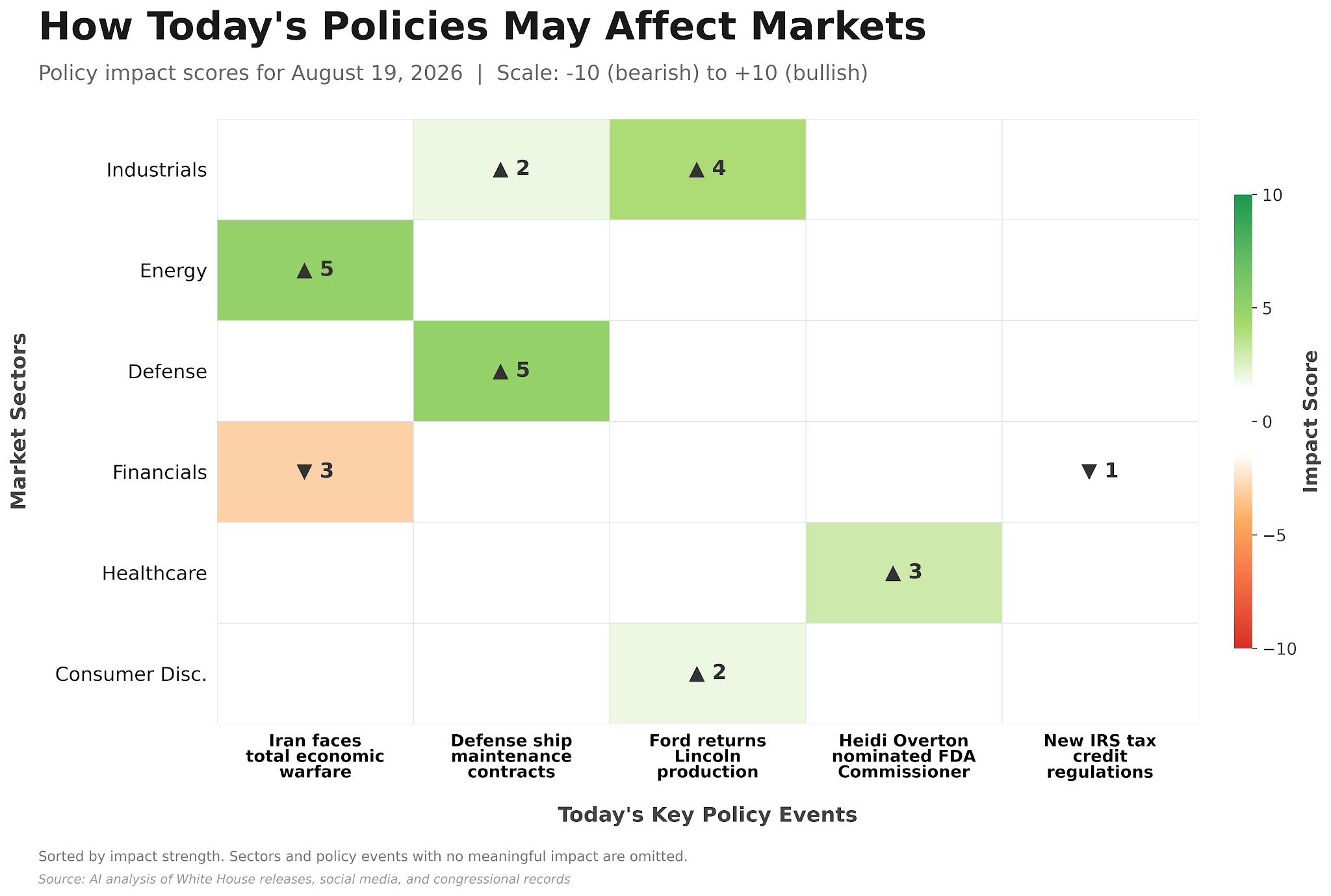
Policy Impact Heatmap with Market Direction

Each cell shows an estimated impact score on a fixed scale of -10 to +10, reflecting how today’s policy developments may affect each market sector. Positive scores (green, ▲) suggest bullish impact; negative scores (red, ▼) suggest bearish pressure. Rows and columns are sorted by impact strength, and sectors and policy events with no meaningful impact are omitted. The heatmap, the analysis below, and the Impact on Market themes above are produced from a single unified analysis: the heatmap visualizes the magnitudes, while the text explains the causal reasoning behind them.
The administration’s declaration of “economic warfare” against Iran serves as the day’s primary market signal. By mandating total isolation and threatening secondary sanctions on global partners, the policy elevates geopolitical risk premiums for international financial institutions and shipping entities. However, the resulting supply-side constraints on Iranian oil production provide a bullish impulse for energy sector valuations. Ford’s decision to reshore production underscores a shifting trend where major industrials adjust supply chains in response to “America First” trade pressures. This localization trend potentially increases domestic capital expenditure while mitigating long-term trade volatility. Simultaneously, the nomination of Dr. Heidi Overton at the FDA signals a push for expedited clinical pathways, which analysts anticipate may lower regulatory hurdles for domestic biopharmaceutical firms. While supporters view this as “transformative,” critics frequently cite concerns regarding the long-term integrity of drug safety standards under accelerated review timelines. Furthermore, the new IRS rules regarding refundable tax credits reflect a tightening of fiscal policy, aimed at preserving benefit integrity but introducing increased compliance requirements for the financial sector. These actions collectively emphasize a transition toward protectionist domestic industrial policy and heightened aggressive containment of strategic adversaries.
-
Has Trump no shame about all the money he has made since being in office? | Francine Prose
By now we know that charity, generosity and compassion are virtues that the US president doesn’t seem to have even in trace amounts
Many years ago, in the crowded corridor of a Manhattan hotel, I was surprised to find myself standing face-to-face with Imelda Marcos, then the first lady of the Philippines. At that time, she was said to possess 3,000 pairs of shoes.
I desperately longed to ask the wife of the dictatorial president Ferdinand Marcos why anyone could need all those shoes. And more importantly, why would someone spend so much of her country’s wealth on stiletto heels when so many citizens were so desperately poor? But natural reticence, good manners or simply fear prevailed, and I walked away.
Continue reading... -
From McDonald’s to Congress: can a former fry cook flip a key district for Democrats?
Manny Rutinel hopes price-tag politics can win key voters in Colorado House race
During his presidential campaign in October 2024, Donald Trump staged a photo op at a McDonald’s franchise in Pennsylvania, where he was briefly taught how to work the fryer and drive-thru window at the closed restaurant, while making several unsubstantiated claims about Kamala Harris’s past summer job at McDonald’s.
The posturing around McDonald’s garnered significant publicity, as Trump and Republicans capitalized on an affordability crisis triggered by high inflation that occurred globally due to the Covid pandemic.
Continue reading... -
Davey Hearn’s Extra Bites at the Apple
If I did bonus content at this website like a Substack, this would be the kind of post that would be the bonus: Something so weedy it may get no comments. But since everything is free here, you call can read — or skip — my analysis of the chess game I think is going on in the Davey Hearn indictment.Or, if this stuff floats your boat you can support it here.
I want to revisit the post where I noted that Judge Todd Edelman issued an order — for a reply (which we got yesterday and I addressed here), a sur-reply (due in a week), and a hearing. As I noted that order — somewhat unusually — alerted Hearn’s team they would get another bite at the apple.
And then they took two or three more bites.
Last Thursday, Hearn submitted a filing that, procedurally, served to add something to their initial response to the government’s motion to dismiss; Hearn submitted his response back on August 4. They submitted this supplement, even though they already knew they were going to get a sur-reply. In doing so they submitted it before whatever the government filed Tuesday.
Basically, it said that Donald Trump continues to be a jerk. In addition to all Trump’s (and Doug Burgum’s) attacks on Jeanine Pirro, the supplement also pointed to this post from Trump which, as I noted here, attempted to recuperate a key witness in this case, W-1.

Trump took a passage of Pirro’s motion to dismiss and — unusually for his Truth Social propaganda — attempted to spin a court filing. The President of the United States chose to vouch for W-1, the Park Service employee who is Davey Hearn’s main accuser.
Hearn took the instance of Trump vouching for W-1 to assail her credibility, not only by introducing new evidence, but finding cause to attach a written statement she wrote — “older gentleman pullup up” — as a sealed exhibit which (if Edelman relies on it) we’ll be able to ask for under 1A precedent.
While the President —without evidence—referred to W-I as a “highly credible witness,” the evidence produced in discovery by the government itself tells a different story. For one, W-1’s handwritten statement from the date of Mr. Hearn’s arrest is contradicted by other evidence in the case, W-1’s initial statement asserts in part
Older gentleman pullup up on his bike wearing a bike outfit purple shirt + bike shorts came up to the pool took his phone out and started taking pictures he then kept tugging until the [National] Guard came up to him.14
Yet, publicly available video shows Mr. Hearn standing next to the Reflecting Pool while calmly putting on his bike glove and interacting with W-1, then walking to his bike, picking it up, and beginning to walk away—all before a group of three Guardsmen approached him.’* Accordingly, W-I’s statement that Mr. Hearn “kept tugging until the Guard came up to him” is demonstrably false.
Moreover, the government itself has provided conflicting versions of W-1’s account of her interaction with Mr. Hearn., In W-1’s initial written statement, quoted in part above, she alleged that Mr. Hearn simply “said [she] was awfully sensitive about the pool.” But U.S. Attorney Pirro —despite ethics rules to the contrary—publicly recounted a more dramatic version of events, stating that Mr. “Hearn reacted by shouting at that Park’s employee, saying that she ‘cared too much about the Reflecting Pool,” and ‘why did she even care? since it ‘wasn’t her pool?”16
14 This witness statement is filed contemporaneously under seal as Sealed Exhibit A to this motion.
15 See Emily Miller (@Emilymiller) = X (June 20, 2026), https://x.com/emilymiller/status/2068470763783381356.
16 Press Conference, Jeanine Ferris Pirro, U.S, Att’y for the District of Columbia (July 2, 2026), PBS NewsHour, https:/Avww.youtube.com/watch?v=pEPVRNKq3oM.
It goes on from there, describing how the government repeatedly attested that W-1 took a key video — which showed that damage to the pool was there hours before Hearn arrived — they now attribute to someone else. The filing attributes that claim to two sealed exhibits, previously included on prior filings, but included again here just in case. Again, if Edelman relies on them, we can demand them under 1A precedent.
Hearn expanded those allegations about W-1 in the record before DOJ filed their response. DOJ did not address those allegations and may have, arguably, forfeited responding.
In addition to laying out what a jerk Trump is about this case, Hearn also filed a discovery request to the docket. It argued that Hearn needed a very long very detailed list of discovery because it was relevant to whether the case should be dismissed with or without prejudice.
‘We understand from Mr, Carter’s emails to Mary Dohrmann on August 13 that the Government is taking the position that it will not provide any further discovery in light of the Court’s dismissal of the case. We believe that the missing discovery may bear directly on the Court’s decision whether the dismissal is with or without prejudice. Among other things, the Government’s refusal to provide the discovery raises troubling questions about the reasons the Government moved to dismiss the case when it did, and what actions of the Government would have been revealed if the missing discovery had been supplied in a timely way.
That is, before the government submitted its filing on Tuesday, Hearn’s team said, we think that we need this discovery to determine whether your reasons to dismiss the case are what you say they are.
And so, when DOJ submitted its reply arguing that Judge Edelman should dismiss this case without prejudice, Hearn’s discovery request was already docketed before DOJ said,
The defense repeatedly argues that dismissal with prejudice is warranted because the government sought an indictment in bad faith and in disregard of the available evidence. This is flatly wrong, as discussed below. But it also misconstrues the law. “The salient issue, however, is not whether the decision to maintain the federal prosecution was made in bad faith but rather whether the Government’s later efforts to terminate the prosecution were similarly tainted with impropriety.” Rinaldi v. United States, 434 U.S. 22, 30 (1977).
Before DOJ replied, correctly, that the issue is why they moved to dismiss the case, Hearn asked for discovery (it really is an extensive list and no matter what else happens could serve as a roadmap for FOIA), effectively saying, if you refuse this, you may have dismissed to cover all this up.
And sure enough, in his motion to compel that discovery (which actually was filed hours before the government reply), Hearn effectively says if DOJ refuses to turn over this information, it’ll raise further questions about why they dismissed the case.
2 The government’s refusal to provide this discovery, coupled with the timing of its motion to dismiss, provides further reason to scrutinize the government’s purpose in requesting dismissal, including what actions of the govemment would have been revealed if the government had continued with the case on the Court’s trial schedule.
Then he provides reasons why, he says, he needs all this. Much of it would have been fair game if Hearn were going to trial but as it is serves mostly as a guide for what documents are out there, how many cops were involved in arrests, what the other charged cases relied on. But some of the requests are quite reasonable — most of all the data seized from Hearn’s own phone, the data behind the “before” photo. originally attributed to Hearn’s main accuser (Hearn exposed DOJ’s attempt to refuse this just before DOJ moved to dismiss), and the CCTV footage Interior shared with Jesse Watters but not with Hearn — and as such make this a viable motion.
TI, All data extracted from Mr, Hearn’s cell phone that the Government has not yet destroyed and/or deleted.
11. Production of any and all data extracted from the phone.
12, All forensic extraction reports and logs, with hash values.
13. The Application/Affidavit and Search Warrant for the device.
14. Following production of this data, the Government must destroy all data extracted from the phone, both physical and electronic, from all systems and servers, and provide a written accounting of what has been destroyed or deleted, when, from which systems and servers, and by whom.
[snip]
V. Unredacted copies of discovery related to Mr. Heam, including identifying relevant witnesses and persons with information relevant to Mr. Heam’s defense and ongoing briefing in this matter.
20. The individual who took the “before” photograph metadata from the “before” photograph with EXIF metadata intact, and any communications between [redacted] or other NPS employee and any law enforcement witness, including at Bates Numbers USAO-241 and USAO-242.
[snip]
VII. All CCTV or other surveillance camera footage covering the reflecting pool basin from April 23,2026 through the present
37. All CCTV or other surveillance camera footage covering the Reflecting Pool basin fiom April 2, 2026 through the preset inclting from any NPS, Park Police. or partner agency mobile or fixed platform. To date no CCTV footage has been produced.
38, Without limitation, the CCTV footage that produced the video posted at [NPS URL]
[Trump post URL]
[Jesse Watters show URL]
Not only doesn’t DOJ (whose participants likely face a sea of conflicting motives — keep their job, their bar license, avoid Trump’s wrath — which have little to do with normal considerations) address any of these interventions from Hearn, but they make it worse by relying again on W-1’s testimony and the picture Hearn took on his phone (about which they have lied elsewhere) to dispense with concerns about the original indictment, even after Hearn raised further concerns about the lies about W-1’s testimony.
W-1 stated they observed the defendant using his cellular telephone to take what the NPS employee believed to be video or a photograph(s) of the damage to the reflecting pool. However, the United States Park Police never took possession of the defendants phone to verify if any additional damage was done. The NPS employee, W-1, stated that the defendant then knelt, placed both hands into the reflecting pool—below the surface of the water—and started to “violently” tug at a portion of the blue pool coating, At no time was the defendant seen removing anything from the pool.
Again, this discovery request doesn’t have to work. But by formally asking, it provides basis for argument in next week’s filing, and gives Judge Edelman one more legal issue on which to weigh in, which will probably be followed by a legal fight to achieve the requests pertaining to Hearn’s phone in a subsequent motion.
DOJ wanted all this to go away and this is an attempt to lay legal framework to prevent that from happening.
280814 Discovery: Files a discovery letter sent the same day
260814 Supplement: Points to Trump’s whining and inconsistencies with primary accuser; the filing submits three partially new exhibits
260818 Dismiss Response: The government argues that Hearn is not entitled to dismissal with prejudice
The post Davey Hearn’s Extra Bites at the Apple appeared first on emptywheel.
-
Du 19 au 25 août 1944 : la dernière insurrection populaire victorieuse dans Paris
Le 19 août 1944, il y a 82 ans, le peuple de Paris entamait la dernière mobilisation insurrectionnelle et armée qu’ait connu la France.
L’article Du 19 au 25 août 1944 : la dernière insurrection populaire victorieuse dans Paris est apparu en premier sur Contre Attaque.
-
North Korea fires 10 missiles day after Trump curtails South Korea joint drills
Launches, detected by South Korea and Japan, came after US scaled back exercises with South Korea in apparent overture to Kim Jong-un
North Korea has launched about 10 short-range ballistic missiles towards the sea, South Korea’s military said, a day after Pyongyang shrugged off Donald Trump’s order to scale back US military drills with South Korea in an apparent attempt to resume diplomacy.
The joint chiefs of staff said the missiles were launched from the region of Pyongyang at around 5pm (08.00 GMT) on Thursday towards North Korea’s eastern waters.
Continue reading... -
Lyon : l’industriel Daikin autorisé à remplacer un PFAS toxique… par un autre
Le gaz réfrigérant R1234YF se dégrade en TFA (acide trifluoroacétique), le plus petit des PFAS reprotoxique qui envahit déjà notre environnement et notre eau potable.
Cet article Lyon : l’industriel Daikin autorisé à remplacer un PFAS toxique… par un autre est apparu en premier sur La Relève et La Peste.
-
Un 15e lynx tué par un automobiliste cette année en France

Le lynx Onoz a été tué après une collision avec une voiture sur une route du Jura. L'information a été diffusée par le centre Athénas, un hôpital pour animaux sauvages du Jura, sur sa page Facebook, le 18 août. Il s'agit du quinzième de ces félins tué cette année par un automobiliste en France.
Lire la suite - En bref / Animaux
Onoz avait déjà été victime d'une collision et été soigné par le centre, avant d'être relâché le 1er juin. « Il avait parfaitement réussi sa réinsertion et se préparait à conquérir un territoire... (…) -
L’armée israélienne reconnaît avoir tiré sur la voiture de Hind Rajab, tuée à 5 ans à Gaza
Le corps de l’enfant a été retrouvé dans un véhicule criblé de balles, plusieurs jours après que la petite fille a été entendue pour la dernière fois, lors d’un long appel téléphonique avec le Croissant-Rouge palestinien, le 29 janvier 2024. L’État hébreu avait auparavant nié la présence de ses troupes dans la zone où les faits se sont déroulés. -
La Tunisie se confronte pour la première fois au problème de la soumission chimique
Un colloque s’est tenu à Tunis à l’occasion de la sortie d’un livre de la Franco-Tunisienne Leïla Chaouachi sur les agressions sexuelles facilitées par la drogue. Constat: le manque de sensibilisation et la répression sévère de la consommation de stupéfiants freinent la libération de la parole. -
Crypto bank part-owned by Trump family offers depositors way to ‘gain favor’ with White House, experts say
Democrats have called World Liberty Financial Trust Company a stark example of corruption but officials claim there is no insider dealing
Two fundamentals underpin the business model of a new crypto bank partly owned by the Trump family. The first is that there is almost no risk it can lose money, according to cryptocurrency experts – and the second, they say, is that the sole logical motivation for depositors to put in their funds is the prospect of a financial connection to a US president and his relatives.
World Liberty Financial Trust Company received conditional approval this month from the US office of the comptroller of the currency (OCC) to start a bank. An entity affiliated with Donald Trump and his family members owns about 38% of the company. The agency is led by a political appointee of the US president.
Continue reading... -
Notre cerveau serait à son apogée entre 55 et 60 ans
Certains traits déclinent avec l’âge, comme la flexibilité cognitive, tandis que d'autres s'améliorent. Par exemple, la stabilité émotionnelle atteint son pic vers l’âge de 75 ans et la capacité de résister aux biais cognitifs peut s’améliorer jusqu’à 80 ans !
Cet article Notre cerveau serait à son apogée entre 55 et 60 ans est apparu en premier sur La Relève et La Peste.
-
Récupérer des noyaux et faire naître un verger urbain : près de Montpellier, une expérience d’écologie populaire qui porte ses fruits
Sylvain est trésorier de l’association du Verger partagé. Cet été, il transforme la récolte de prunes en dizaines de pots de confiture pour l’ensemble des bénévoles. © Cécilia Brès/Vert

À Castries, les arbres du verger autonome résistent aux sécheresses, sans irrigation, ni entretien intensif de la part des bénévoles. © Cécilia Brès/Vert
De retour de plusieurs années en Guadeloupe, sensible aux enjeux d’accès à l’eau, Jenny se rapproche de l’équipe de Castries, intriguée par la réussite de ce «verger méditerranéen» non-irrigué. © Cécilia Brès/Vert

Chaque noyaux et pépin recèle le potentiel de devenir un arbre. Alors, les bénévoles de l’association Le verger partagé sèment tout ce qu’ils récupèrent et laissent la nature décider. © Cécilia Brès/Vert
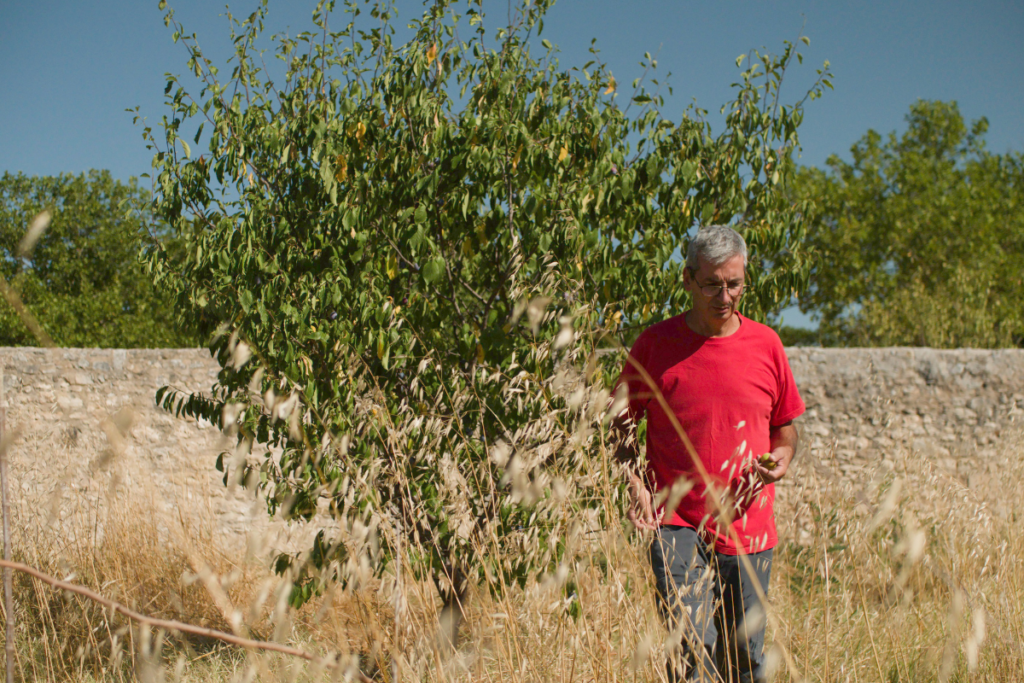
Sylvain, menuisier retraité, propose des ateliers «greffage» : une technique horticole qui permet de rendre un arbre plus résistant et améliorer la qualité de ses fruits. © Cécilia Brès/Vert

Parmi les centaines d’arbres fruitiers, le Verger partagé abrite une majorité d’abricotiers, pêchers et pruniers. Viennent ensuite les amandiers et les pommiers. © Cécilia Brès/Vert
«Nos fruits sont vivants, ressemons-les !» Le slogan barre le couvercle de la caisse en bois, posée au sol. Dedans, une trentaine de noyaux. Abricot, cerise, pêche, prune, amande, mais aussi pépins de pomme et de poire : l’association Le verger partagé récupère tout. Elle dispose de plusieurs points de collecte à Castries, en périphérie de Montpellier, dans l’Hérault. À la médiathèque, au centre socioculturel. Et ici, à l’entrée même du verger.
Il y a dix ans, ce n’était qu’une friche agricole. Une bande de terre grande comme un terrain de football, cernée par le mur d’enceinte du château et un lotissement avec piscines. Aujourd’hui, se dresse une petite forêt nourricière, née des noyaux et pépins semés chaque automne par des dizaines de bénévoles.
«On sème tout ce qu’on a, et c’est la nature qui décide.»
En cette chaude matinée d’août, Sylvain, trésorier de l’association, et Jenny s’engouffrent dans le verger. Ils veillent à ne pas quitter le chemin de végétation aplatie, parmi les herbes hautes. Le soleil cogne. À chaque pas, les fruits du gaillet gratteron, plante sauvage qui a inspiré les scratchs Velcro, s’agrippent un peu plus aux pantalons.
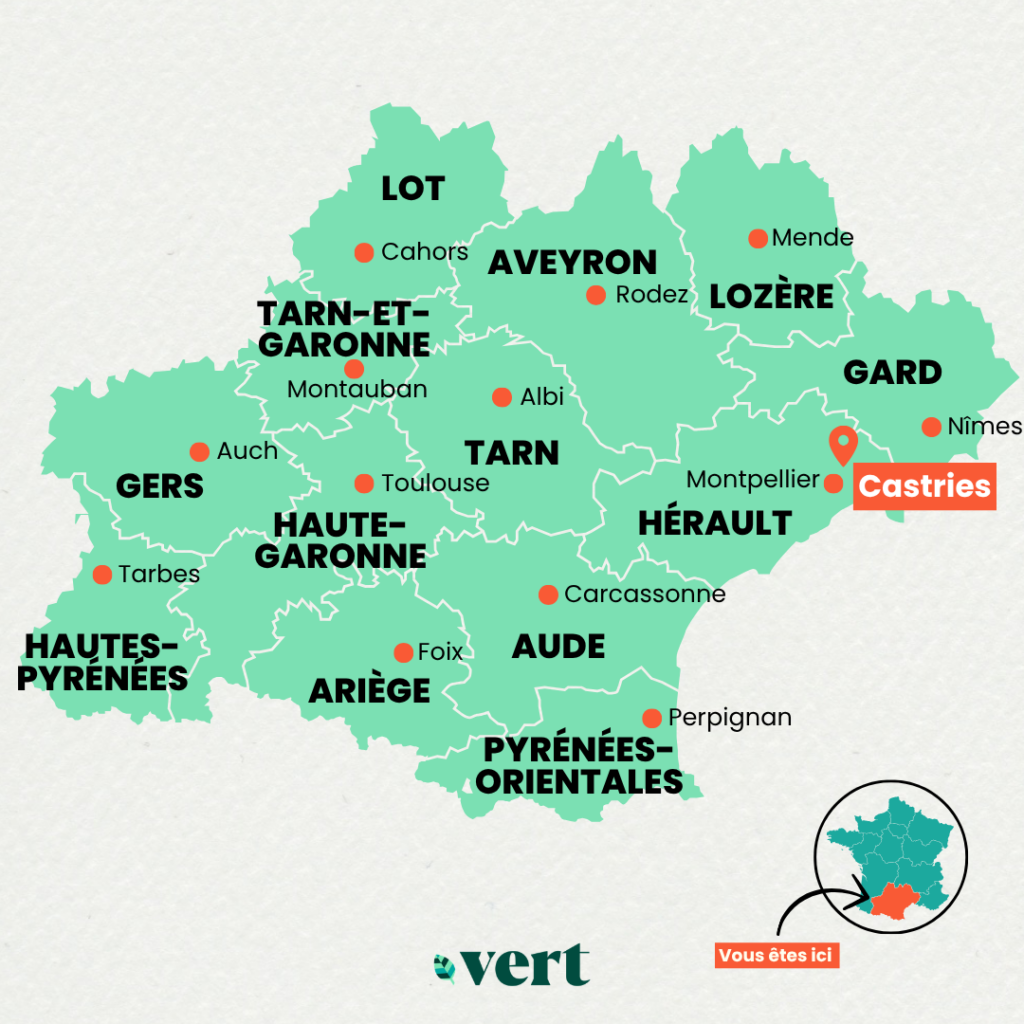
Le binôme prend le temps d’observer les arbres. L’un deux ploie sous le poids des prunes : Sylvain en a déjà tiré quarante kilos, et un pot de confiture pour chaque bénévole. Plus loin, un amandier, délesté de ses feuilles, retient de nombreux fruits. Récolte prévue en septembre.
Sans irrigation, ni pesticides, ces fruitiers semés résistent aux sécheresses. Mieux : ils dépassent certains de leurs voisins, achetés en pépinières et arrivés les premiers, il y a dix ans.
À l’époque, une entreprise souhaite offrir cent arbres à la commune. José Brochier, membre fondateur du Verger partagé, raconte : «On a formé un petit groupe d’habitants et on est allé voir la première adjointe. On lui a dit : « On nous propose cent fruitiers, est-ce que vous avez un terrain ?”». Après quelques péripéties, 75 arbres sont plantés sur la parcelle communale en décembre 2016.
Dans la région, les vergers sont irrigués et reçoivent beaucoup de traitements pesticides. Pour innover et s’éviter un «boulot monstre», les bénévoles misent sur une agriculture pluviale, dépendante des précipitations. Mais la sécheresse s’installe. Les plants souffrent, ils exigent trop d’eau.
 Chaque noyaux et pépin recèle le potentiel de devenir un arbre. Alors, les bénévoles de l’association Le verger partagé sèment tout ce qu’ils récupèrent et laissent la nature décider. © Cécilia Brès/Vert
Alors, l’association délaisse la plantation de petits arbres. Dès la deuxième année, elle pratique le semi direct : la graine est introduite dans la terre, directement sur la parcelle, et sans travail préalable du sol. «Un arbre semé développe une racine pivot qui lui permet d’aller chercher l’eau très profondément», explique José Brochier, ingénieur agronome à la retraite.
Depuis, les bénévoles ne cessent de ressemer des pépins et noyaux, collectés auprès des habitant·es. «C’est du vivant, on ne jette pas du vivant, défend-il. On sème tout ce qu’on a, et c’est la nature qui décide.»
Résistance au changement climatique
Laisser la nature décider, une démarche au cœur de la «régénération naturelle assistée» (RNA). L’association applique ces principes d’agroforesterie : garder un sol couvert, mélanger les essences d’arbres, ne pas tailler, accueillir les espèces pionnières. Dans le verger, des ormes, frênes et acacias, semés par le vent et les oiseaux, se sont invités. «On observe des synergies. Un fruitier semé à côté d’un frêne pousse mieux que les autres», précise José Brochier.
«Celui qui va sortir dans ces conditions difficiles, génétiquement, ce sera le guerrier prêt à affronter le contexte.»
Les bénévoles ont un temps retiré à la main les capnodes, de robustes coléoptères, et les cétoines, ces insectes d’un vert lamé qui s’attaquent aux fleurs des arbres semés. Résultat : ceux-ci ont souffert de porter trop de pommes. L’association laisse maintenant la nature s’autoréguler : «Elle fait ça très bien», glisse José Brochier. Seuls certains arbres sont greffés, comme les poiriers sauvages. Cette technique horticole permet de les rendre plus vigoureux et d’améliorer la qualité de leurs fruits. Les arbres de pépinières, eux, restent faibles et résistent péniblement.
Dans un contexte d’accélération du dérèglement climatique, rien de surprenant pour Olivier Hébrard, docteur en sciences de l’eau et consultant en agroécologie : «Il y a soixante ans, on dépassait peu les 35 degrés dans l’été. Maintenant, on l’atteint largement au-delà de trente jours. Si vous associez un arbre de pépinière, dont les racines ont tendance à rester en surface, un arrosage goutte-à-goutte, et un sol pas du tout vivant, vous créez un système très fragile.»
 À Castries, les arbres du verger autonome résistent aux sécheresses, sans irrigation, ni entretien intensif de la part des bénévoles. © Cécilia Brès/Vert
S’appuyer sur la nature et la régénération naturelle assistée est pour le scientifique une parade. «C’est intéressant de semer des noyaux sur un sol couvert de végétation, explique-t-il. Celui qui va sortir dans ces conditions difficiles, génétiquement, ce sera le guerrier prêt à affronter le contexte.»
Escargots, broussailles et plaqueminiers
À Castries, les semences doivent résister aux mulots. Les jeunes plants aux escargots. Puis, il leur faut s’extraire des ronces et du chiendent que l’association laisse pousser, misant sur leur capacité à «réparer» le sol compacté par des années de culture de la vigne. «Une plante qui s’installe prépare l’arrivée de la suivante, confirme Olivier Hébrard. La ronce est une plante pionnière, elle a une forte capacité racinaire et un pouvoir décompactant. Elle aère la terre et prépare l’arrivée de la forêt»
Le voisinage s’inquiète de la broussaille. Mais ce couvert végétal est aussi un rempart potentiel face aux incendies, assure le scientifique. «Quand vous débroussaillez, vous asséchez le milieu. Sur un terrain plat comme le verger partagé, grâce au couvert végétal, l’eau se répartit et s’infiltre mieux. Et cette centaine d’arbres, c’est la meilleure ingénierie hydrologique : leurs racines améliorent la structure du sol et favorisent la rétention d’eau. Les plantes sont beaucoup moins inflammables. On est sur quelque chose de très réfléchi. Il faut communiquer», conclut le chercheur.
 De retour de plusieurs années en Guadeloupe, sensible aux enjeux d’accès à l’eau, Jenny se rapproche de l’équipe de Castries, intriguée par la réussite de ce «verger méditerranéen» non-irrigué. © Cécilia Brès/Vert
Les bénévoles favorisent le dialogue et la pédagogie. Accueillis sur la parcelle, les écolier·es de Castries peuvent choisir un «arbre ami». «Justine», «Oma» ou «Jules» : leurs étiquettes jaunes se balancent au bout des branches. Pour dupliquer son modèle de verger méditerranéen et voir naître toujours plus d’arbres, l’association se rapproche d’agriculteur·ices du territoire. Elle sème directement sur leurs parcelles en friches : trois hectares aujourd’hui, dix autres à l’automne.
Alors, il faut intensifier la collecte. L’équipe a noué un partenariat avec une grande chaîne de magasins bios, dans trois communes autour de Montpellier. Les clients peuvent déposer leurs pépins et noyaux, mais aussi en récupérer.
Au verger, Sylvain et Jenny achèvent leur tour. Seul le plus vieux cerisier semble mort, même si les autres ont perdu beaucoup de feuilles. Le plaqueminier, l’arbre du kaki, est lui couvert de fruits. Avant de partir, les bénévoles cueillent et dégustent une prune. Sitôt recrachés, les deux noyaux rejoignent la caisse de collecte, en bordure de parcelle : ils seront ressemés dès l’automne.
-
Google ajoute Marvell à ses partenaires pour développer ses puces IA et pourrait prendre une participation à son capital
Marvell va contribuer au développement d’une gamme de puces destinées à l’écosystème des Tensor Processing Units (TPU) de Google, rapporte l’agence de presse Reuters.
-
YouTube annonce plusieurs changements : à quoi va ressembler la nouvelle interface ?

YouTube a présenté, le 19 août 2026, plusieurs changements en cours de déploiement sur mobile, le Web et les téléviseurs. La plateforme promet notamment un lecteur vidéo plus épuré, une bibliothèque réorganisée et une meilleure intégration des Shorts sur grand écran.
-
Incendies : la Belgique rattrapée par son manque de pompiers

La Belgique vit l'un des pires incendies de son histoire. Depuis le 14 août, le feu a ravagé plus de 3 000 hectares sur le plateau des Hautes Fagnes, à l'est du pays.
Lire la suite - En bref / Incendies
Les pompiers wallons ont pu compter sur l'appui d'avions bombardiers d'eau venus de Norvège, d'Allemagne, de Suède et des Pays-Bas. L'ampleur des feux questionne sur les moyens ou la préparation de la Belgique face au risque d'incendie : avant ce soutien international, les pompiers ne disposaient que deux hélicoptères de la (…) -
François Fillon suspendu de la Légion d’honneur après sa condamnation pour emplois fictifs
L’ancien premier ministre a été radié pour dix ans de l’ordre de la Légion d’honneur après la confirmation définitive de sa condamnation, en février, dans le dossier des emplois fictifs de son épouse. -
Le Scouarnec: information judiciaire ouverte pour dix nouveaux viols et quarante agressions sexuelles
Le parquet de Lorient a annoncé mercredi 19 août l’ouverture d’une information judiciaire pour quarante nouvelles agressions sexuelles et dix viols contre Joël Le Scouarnec, ex-chirurgien condamné en mai 2025 pour près de 300 viols et agressions sexuelles. -
Manifestation pour le respect de la loi du 11 février 2005
Quand ?
Le 19 septembre à 13hOù ?
Place d'Italie Place d'Italie 75013 ParisLES JEUNES DÉFICIENTS VISUELS APPELLENT À UNE MOBILISATION NATIONALE
Deux personnes aveugles sont mortes ces derniers mois après être tombées sur les voies du métro, à Paris puis à Lyon. Ces drames mettent en lumière les conséquences concrètes d'un manque d'accessibilité des transports : une perte d'autonomie, mais aussi une exposition à des situations de danger qui pourraient être évitées.
C'est pourquoi nous, collectif de jeunes citoyens aveugles et malvoyants pour l'accessibilité des transports, appelons à une mobilisation nationale le samedi 19 septembre 2026 à 13h00, place d'Italie devant la mairie du 13e.
« On a perdu la vue. Pourquoi devrait-ont aussi perdre la vie ? »
L'accessibilité est aussi une question de sécurité
Pour les personnes aveugles et malvoyantes, l'absence d'aménagements adaptés peut transformer un déplacement quotidien en véritable parcours à risque : absence de repères, informations voyageurs inaccessibles, correspondances difficiles à identifier, cheminements mal conçus ou équipements indispensables en panne.
« Ne pas rendre les transports accessibles, ce n'est pas seulement limiter notre autonomie. C'est aussi compromettre notre sécurité. L'accessibilité ne doit pas être considérée comme un confort ou comme une politique réservée au handicap : elle permet concrètement à chacun de se déplacer de manière plus sûre », estime Benjamin, l'organisateur du mouvement.
La sécurité ne doit toutefois pas être pensée au détriment de l'autonomie. Pour les personnes handicapées, pouvoir se déplacer librement suppose de pouvoir bénéficier de transports à la fois accessibles, fiables et sécurisés.
De la marche blanche à la mobilisation nationale
Cette mobilisation inédite s'inscrit dans la continuité de la première marche blanche organisée à Paris en hommage à Germain au mois de janvier, après son décès dans le métro. Réunis à Denfert-Rochereau pour lui rendre hommage, nous avons souhaité faire de cette mobilisation un point de départ pour porter une revendication plus large : l'accessibilité des transports ne peut plus être traitée comme une question secondaire.
Le samedi 19 septembre 2026 à 13h00, place d'Italie, devant la mairie du 13e arrondissement de Paris, nous appelons ainsi à un rassemblement pour demander des mesures concrètes en faveur de transports sécurisés. Cette mobilisation ne concerne pas uniquement Paris ou les grandes métropoles : nous demandons une véritable politique nationale, qui prenne également en compte les territoires ruraux et périurbains, où l'absence de solutions de transport accessibles peut avoir des conséquences majeures sur l'autonomie et la vie quotidienne.
Un plan national, avec des engagements vérifiables
Le collectif demande au Gouvernement de mettre en place un plan national pluriannuel pour l'accessibilité des transports comprenant notamment :
– un état des lieux public de l'accessibilité des réseaux de transport sur l'ensemble du territoire ;
– un calendrier de mise en accessibilité à court, moyen et long terme ;
– des financements clairement identifiés ;
– un responsable désigné pour chaque engagement ;
– la mise en accessibilité des stations, gares et arrêts, mais également des correspondances et des cheminements ;
– des informations voyageurs accessibles visuellement et auditivement ;
– le maintien en fonctionnement des équipements indispensables à l'accessibilité et des solutions de remplacement en cas de panne ;
– des solutions de transport accessibles dans les territoires ruraux et périurbains ;
– l'association systématique des personnes en situation de handicap à la conception, aux tests et au suivi des aménagements.« Nous ne voulons plus de nouvelles annonces sans calendrier. Nous demandons des dates, des moyens et des résultats. », annonce Samantha, porte-parole du collectif.
Du handicap à l'intérêt général
Si la mobilisation est née d'une réalité vécue par des jeunes déficients visuels, ses revendications dépassent largement le seul handicap visuel.
Une station accessible est également plus facile à utiliser pour une personne âgée, un parent avec une poussette, une personne enceinte, une personne temporairement blessée ou un voyageur se déplaçant avec des bagages.
Dans les territoires ruraux et périurbains, l'enjeu est encore plus important. Lorsqu'une personne qui ne peut pas conduire ne dispose pas d'un transport accessible, ce sont potentiellement son accès aux études, à l'emploi, aux soins et à ses proches qui sont remis en cause.- Voir aussi WhatsApp
-
L'anarchisme révolutionnaire contre le renoncement

Texte paru en italien à l'été 2022, dans le n°7 du Giornale anarchico, et traduit pour la distro Haokah en novembre 2025 (https://distrohaokah.noblogs.org/).
Le texte rappelle que la perspective révolutionnaire est au coeur de l'anarchisme. Pourtant, « aujourd'hui plus qu'hier encore, il y a des trompettes qui de tous les coins nous parlent du caractère impraticable de la lutte révolutionnaire, du fait qu'elle est hors du temps et hors limite de temps. On nous dit que nous devrions nous adapter. Et le faire impliquerait entre autres d'adopter, définitivement, cette logique de l'action pour l'action ».
Il n'y aurait plus qu'à agir sans but, de manière atomisée et sans « aspirer à l'appel de l'utopie » ; il n'y aurait plus qu'à répondre au besoin intime de cohérence, ou à la sensibilisation, éventuellement par le geste, sans se jeter dans la lutte révolutionnaire avec méthode et stratégie.
Cela peut même aller jusqu'à la reddition face au pouvoir, en s'adaptant au rabais, adaptation « qui au fur et à mesure, en l'espace de quelques décennies drapées d'une atmosphère de fin de l'histoire, a conduit en fin de compte au retrait d'une partie du mouvement vers ces thèses libérales indéfendables pour tout anarchiste et à repousser fermement car elles provoquent un désistentialisme totalement inoffensif pour le pouvoir » [désistentialisme, jeu de mot en italien entre renoncement/résignation et existentialisme].
C'est ainsi qu'une partie du mouvement anarchiste, décomposé en logiques de milieux, peut se ranger du côté de l'Etat ukrainien contre l'Etat russe, « choix interventionniste qui n'a rien de révolutionnaire et encore moins d'internationaliste », ou de se transformer en extrême-gauche du programme du capital, comme n'importe quel gauchiste.Brochure complète à télécharger ici : https://distrohaokah.noblogs.org/files/2025/11/L-anarchisme-revolutionnaire-contre-le-renoncement.pdf
-
Camargue : face au changement climatique, le sel sur le banc des accusés
Dans le delta du Rhône, la présence accrue du sel dans les terres et les étangs est le symptôme du changement climatique. Pour apaiser les tensions sur le sujet, des scientifiques ont mis en scène le « procès du sel ». -
Un an de Gemini et 400 Go gratuits : l’offre de Google à ne pas manquer pour la rentrée

Google remet le couvert pour la rentrée : douze mois de Gemini sont offerts aux étudiants. Le cadeau est néanmoins un peu moins intéressant que l'année dernière : les étudiants français reçoivent Google AI Plus (400 Go de stockage, environ 60 euros de valeur sur douze mois), et non plus l'abonnement AI Pro distribué en 2025.
-
[RADIO] FARM OR DIE : le festival itinérant des luttes paysannes revient cet été ! rediffusion reportage sonore du festival en 2025
 Ce vendredisoir 21 aout 2026 à 20h à radioairlibre.net ou 87.7FM à Bruxelles rediffusion de l'émission tranche d'anar à laquelle on annonce la nouvelle édition du festival Farm or Die fin août 2026 et on rediffuse le reportage sonore du festival Farm or Die, première édition de l'année passée fin août 2025.𝙪𝙣 𝙛𝙚𝙨𝙩𝙞𝙫𝙖𝙡 𝙞𝙩𝙞𝙣𝐞́𝙧𝙖𝙣𝙩 𝙙𝙚 𝙛𝙚𝙧𝙢𝙚 𝙚𝙣 𝙛𝙚𝙧𝙢𝙚. C'est à la rencontre des paysannes et paysans engagé-es dans des modèles agricoles inspirants, qu'un collectif d'artistes fera chemin en cette fin d'été en Entre-Sambre-et-Meuse.
L'objectif : créer du réseau, renforcer des synergies et développer de l'entraide au travers d'une dynamique festive et revendicatrice.
En 2025, l'aventure a démarré à Vierves-sur-Viroin, est passée par la Bergerie de la Scayes, pour se rendre ensuite à L'Amagda à Macon et terminer en beauté à la Ferme de la Sarthe !
Et cette année il ya la suite, la 2 ième édition du festival farm or die aura lieu du jeudi 27 aout jusqu'à dimanche 31 aout. Le convoi se déplacera en itinérance dans 4 fermes paysannes, du jeudi 27 au dimanche 30 août 2026 : 𝙁𝙚𝙧𝙢𝙚 𝙙𝙪 𝙈𝙖𝙪𝙨𝙩𝙞𝙩𝙘𝙝𝙞 (𝙇𝙀𝙀𝙍𝙉𝙀𝙎) 𝙁𝙚𝙧𝙢𝙚 𝙙𝙪 𝙥𝙧𝐞́ 𝙖𝙪𝙭 𝙘𝙝𝐞̂𝙣𝙚𝙨 (𝙈𝘼𝘾𝙊𝙉) 𝘽𝙚𝙧𝙜𝙚𝙧𝙞𝙚 𝙙𝙚 𝙡𝙖 𝙎𝙘𝙖𝙮𝙚𝙨 (𝙊𝙄𝙂𝙉𝙄𝙀𝙎) 𝙁𝙚𝙧𝙢𝙚 𝙙𝙚𝙨 𝙧𝙚𝙞𝙣𝙚𝙨 𝙙𝙚𝙨 𝙥𝙧𝐞́𝙨 (𝙁𝙀𝙎𝘾𝙃𝘼𝙐𝙓)
Chaque escale sera l'occasion de rencontrer les paysannes et paysans dans leur cadre de vie, de mettre leurs pratiques en lumière, et d'entendre leurs engagements pour mieux les propager.
Il y aura aussi des tables de presse, des prises de paroles, des stands associatifs et d'autres joyeusetés (jonglerie, sérigraphie live, contes,…) !
Pour plus d'infos sur les activités et les groupes de musiques festival Farm or Die 2026 voici ici
et à la page facebook de chaque ferme : Ferme du Maustitchi
Ferme du pré aux chênes
Bergerie de la Scayes
Ferme des reines des prés
Ce vendredisoir 21 aout 2026 à 20h à radioairlibre.net ou 87.7FM à Bruxelles rediffusion de l'émission tranche d'anar à laquelle on annonce la nouvelle édition du festival Farm or Die fin août 2026 et on rediffuse le reportage sonore du festival Farm or Die, première édition de l'année passée fin août 2025.𝙪𝙣 𝙛𝙚𝙨𝙩𝙞𝙫𝙖𝙡 𝙞𝙩𝙞𝙣𝐞́𝙧𝙖𝙣𝙩 𝙙𝙚 𝙛𝙚𝙧𝙢𝙚 𝙚𝙣 𝙛𝙚𝙧𝙢𝙚. C'est à la rencontre des paysannes et paysans engagé-es dans des modèles agricoles inspirants, qu'un collectif d'artistes fera chemin en cette fin d'été en Entre-Sambre-et-Meuse.
L'objectif : créer du réseau, renforcer des synergies et développer de l'entraide au travers d'une dynamique festive et revendicatrice.
En 2025, l'aventure a démarré à Vierves-sur-Viroin, est passée par la Bergerie de la Scayes, pour se rendre ensuite à L'Amagda à Macon et terminer en beauté à la Ferme de la Sarthe !
Et cette année il ya la suite, la 2 ième édition du festival farm or die aura lieu du jeudi 27 aout jusqu'à dimanche 31 aout. Le convoi se déplacera en itinérance dans 4 fermes paysannes, du jeudi 27 au dimanche 30 août 2026 : 𝙁𝙚𝙧𝙢𝙚 𝙙𝙪 𝙈𝙖𝙪𝙨𝙩𝙞𝙩𝙘𝙝𝙞 (𝙇𝙀𝙀𝙍𝙉𝙀𝙎) 𝙁𝙚𝙧𝙢𝙚 𝙙𝙪 𝙥𝙧𝐞́ 𝙖𝙪𝙭 𝙘𝙝𝐞̂𝙣𝙚𝙨 (𝙈𝘼𝘾𝙊𝙉) 𝘽𝙚𝙧𝙜𝙚𝙧𝙞𝙚 𝙙𝙚 𝙡𝙖 𝙎𝙘𝙖𝙮𝙚𝙨 (𝙊𝙄𝙂𝙉𝙄𝙀𝙎) 𝙁𝙚𝙧𝙢𝙚 𝙙𝙚𝙨 𝙧𝙚𝙞𝙣𝙚𝙨 𝙙𝙚𝙨 𝙥𝙧𝐞́𝙨 (𝙁𝙀𝙎𝘾𝙃𝘼𝙐𝙓)
Chaque escale sera l'occasion de rencontrer les paysannes et paysans dans leur cadre de vie, de mettre leurs pratiques en lumière, et d'entendre leurs engagements pour mieux les propager.
Il y aura aussi des tables de presse, des prises de paroles, des stands associatifs et d'autres joyeusetés (jonglerie, sérigraphie live, contes,…) !
Pour plus d'infos sur les activités et les groupes de musiques festival Farm or Die 2026 voici ici
et à la page facebook de chaque ferme : Ferme du Maustitchi
Ferme du pré aux chênes
Bergerie de la Scayes
Ferme des reines des prés -
Air Force major detained again for Capitol protest after Trump criticism
The U.S. service member who was arrested on the steps of the U.S. Capitol last month after he advocated for President Trump's impeachment was detained again, a U.S. Air Force spokesperson confirmed Wednesday evening. U.S. Air Force Major Jason Watson was ordered into "pretrial confinement" on Tuesday, the spokesperson told The Hill. -
Trump selects Heidi Overton, White House aide, to lead FDA
President Donald Trump announced Wednesday he will nominate Heidi Overton, a top aide at the White House's Domestic Policy Council, to serve as the next commissioner of the Food and Drug Administration. If confirmed, Overton would succeed Marty Makary in a position that is one of the most powerful in U.S. health care, with the agency's sweeping mandate touching the daily lives of every American. The FDA oversees drugs, vaccines, tobacco products, the bulk of the food supply and more. -
From Fang Fang to Trump dossier, Eric Swalwell weighs in on sex-trap spycraft
Rep. Eric Swalwell, a new member of the House Select Committee on Intelligence in April 2015, sat down for a classified briefing from the FBI on Capitol Hill. The briefing was about him. Mr. Swalwell was in a relationship with a Chinese national named Fang Fang, who went by Christine Fang in the U.S. The FBI wanted to warn him that she was a spy for Beijing. "Swalwell was briefed regarding the intelligence cycle and methods by which foreign governments and their agents target politicians," says a declassified FBI memo. "Specifically, the briefing discussed Fang Fang and her connections to (redacted) and the Chinese intelligence services." -
Trump threatens Iran's trade partners, as military strikes make way for economic pressure
Donald Trump has announced a new campaign to isolate Iran's economy, threatening "tremendous economic consequences" on any country that helps or does business with Tehran, a move that could set up a fresh confrontation with China if implemented. "Today, I am announcing the most crushing economic operation ever taken against any country!" Trump wrote on Truth Social. "Any country that allows its financial institutions, businesses, airports, or government entities to provide any type of lifeline to Iran will itself face tremendous economic consequences." -
Meta AI débarque sur Mac pour concurrencer ChatGPT et Claude (et on lui souhaite bon courage)

Quelques mois après avoir abandonné son application Messenger sur macOS, Meta lance une version bêta de Meta AI pour Mac, avec pour objectif de concurrencer Claude ou ChatGPT. Pour l'instant, ce sont surtout les créateurs et les entreprises qui sont sa cible.
-
Deux réalisateurs français arrêtés et détenus au Togo avec un collaborateur local
Les familles des deux documentaristes français arrêtés le 27 juillet au Togo et détenus avec un collaborateur local ont fait part mercredi 19 août de leur «immense inquiétude», notamment pour leur santé. Reporters sans frontières appelle à leur «libération immédiate». -
États-Unis : l'hécatombe des Amérindiennes sort progressivement du silence médiatique | Yann Le Ny
Aux États-Unis, des milliers de femmes amérindiennes disparaissent ou sont assassinées dans une quasi-indifférence. Longtemps cantonné aux marges, ce drame commence à émerger dans l'espace médiatique, sans que le nombre de disparitions ne baisse ni que la colère des communautés ne retombe. Source: RFI -
Instagram vous dit que vos notifications sont désactivées ? C’est probablement un bug

Depuis le 19 août 2026, plusieurs utilisateurs d'Instagram voient des messages leur indiquant que leurs notifications sont désactivées, alors que ce n'est pas le cas. Il s'agit probablement d'un bug.