Timeline
Every post and feed across this instance
-
Trump Tyranny Tracker | Day 570: Aug 12, 2026
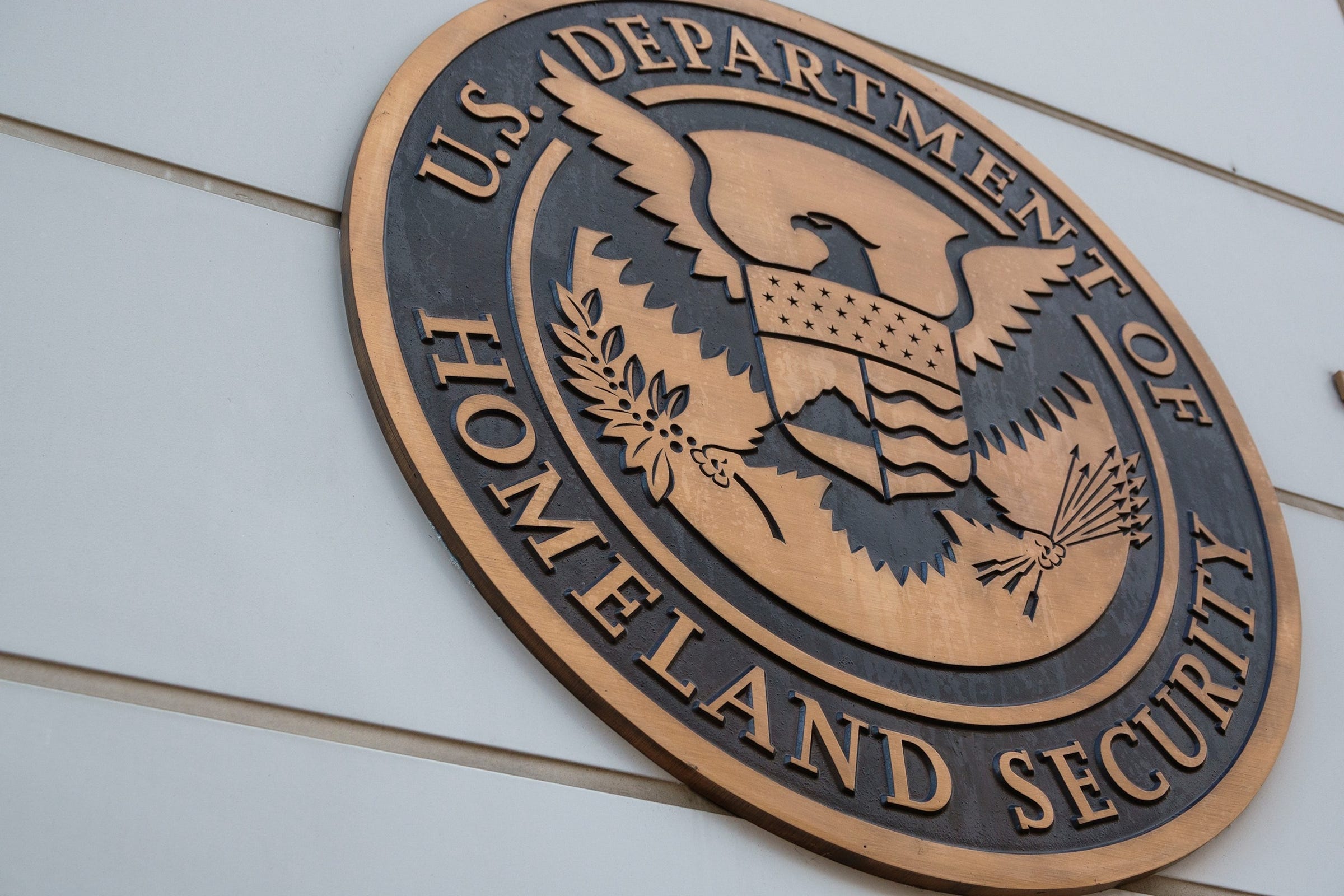 The seal of the U.S. Department of Homeland Security is displayed outside the headquarters of the Federal Emergency Management Agency, July 25, 2026 in Washington. Kevin Carter/Getty Images
Welcome to today’s Trump Tyranny Tracker…
ICE threatening an American citizen, Trump expanding federal control over elections, government surveillance of political activists, and the growing costs of the Iran war were among today’s top stories.
Today at a Glance
•ICE agent points a gun at a U.S. citizen.
• DHS deploys federal agents to advance Trump’s election lies ahead of the midterms.
• Government intel centers monitor activists organizing against mass surveillance.
What We Need to Pay Attention To
ICE agent points gun at Virginia woman who shouted at them in video that conflicts with government’s narrative
What Happened: An ICE agent pointed a gun at Virginia therapist Carolina Molina after she shouted insults at agents during an immigration operation. DHS accused Molina of trying to run agents over, but dashcam and cellphone footage disputes key parts of that account and shows agents blocking her vehicle as she tried to leave.
Why It Matters: A federal agent pointed a gun at a U.S. citizen after she criticized ICE, and DHS then portrayed her as a dangerous “agitator” who tried to run agents over. Once again, the abuse was caught on video, exposing the lies used to justify it.
Source: CNN
Corruption
Suit Challenges Plan to Sell Early Access to Trump’s Truth Social Posts
What Happened: The Intercept and Freedom of the Press Foundation sued Trump over a Truth Social service selling faster access to his posts for up to $100,000 a month. More than 10 customers, mostly trading firms, have signed up, potentially giving them early access to presidential announcements capable of moving markets.
Why It Matters: Trump controls policies that moves markets while his company profits from selling faster access to his announcements. The lawsuit is challenging one of the more blatant ways Trump is using the presidency to enrich himself and his family.
Source: New York Times
Trump administration finalizes ownership reporting exemption for US firms
What Happened: Trump’s Treasury Department finalized a rule exempting U.S. companies and individuals from requirements to disclose their true owners to FinCEN, making permanent the rollback of a major anti-money laundering safeguard. Treasury will also delete beneficial ownership information previously submitted by Americans from the government database.
Source: Reuters
Power Consolidation
Markwayne Mullin uses Homeland Security to further Trump’s voter fraud crusade
What Happened: Homeland Security Secretary Markwayne Mullin has expanded DHS’s role in investigating “voter fraud,” deploying Homeland Security Investigations agents to pursue voter records and threatening election officials with penalties or even prison. DHS claimed more than 250,000 potential noncitizens were registered in four states but provided no names or methodology. Agents investigating individual cases repeatedly found false matches and people who had never registered or voted.
Why It Matters: Trump is turning DHS into an election enforcement operation built around his election lies. Federal agents are now pursuing voters and election officials months before the midterms, with states threatened with funding cuts and election officials threatened with prosecution if they resist.
Source: CNN
A New Draft Rule for the Census Seeks Sweeping Changes to How Political Power Is Allocated
What Happened: A draft Trump proposal would exclude undocumented immigrants and broad categories of other noncitizens from the population count used to allocate seats in Congress and eliminate the collection of race and ethnicity data from the Census. The changes would likely shift representation away from Democratic-leaning states while eliminating data used to challenge racial discrimination in voting.
Source: Talking Points Memo
DOJ legal office says Trump’s outside advisers can be shielded by executive privilege
What Happened: Trump’s Justice Department issued a legal opinion saying executive privilege can extend to private advisers who do not work for the federal government, potentially shielding their communications with Trump from congressional and legal investigations. The opinion comes months before the midterms, when a Democratic takeover of Congress will trigger investigations into Trump and his advisers.
Why It Matters: Trump’s DOJ is expanding executive privilege to people who don’t even work for the government, creating another shield around his inner circle just as he faces the possibility of congressional investigations.
Source: CBS News
Trump refuses to back down as Supreme Court blocks major policies
What Happened: Trump is pursuing new ways to impose policies the Supreme Court recently blocked, including restrictions on birthright citizenship, efforts to fire Fed Governor Lisa Cook, and new tariffs. After the Court upheld birthright citizenship, Trump said, “We’re ending it a different way.”
Why It Matters: Trump is treating Supreme Court rulings as obstacles to get around rather than decisions he has to follow. If a president simply finds another way to do what the courts ruled he cannot do, judicial checks on presidential power become meaningless.
Source: The Washington Post
Weaponization of Institutions
Justice Department sends team to monitor Minnesota primary elections
What Happened: Trump’s DOJ deployed about 20 staffers to monitor voting in Hennepin and Ramsey counties during Minnesota’s primary, despite Hennepin County rejecting its request to place monitors inside polling locations. State law required the federal monitors to remain at least 100 feet from polling sites.
Why It Matters: Trump is pushing federal law enforcement deeper into state run elections months before the midterms. DOJ tried to put federal personnel inside polling places over the objections of local election officials.
Source: The Hill
Ex-Southern Poverty Law Center official faces federal fraud charges
What Happened: The DOJ charged former Southern Poverty Law Center official Heidi Beirich with fraud, false statement, and money laundering conspiracies, expanding its criminal case against the civil rights organization. The indictment comes after whistleblowers alleged DOJ officials rushed the original case despite objections from career prosecutors.
Source: MS NOW
Media Suppression & Authoritarian Tactics
The Government is Monitoring Anti-Flock TikTok and Instagram Accounts
What Happened: State, local, and federal law enforcement fusion centers are monitoring social media accounts and planned events associated with opposition to Flock license plate surveillance cameras. Intelligence bulletins identified activists, listed cities participating in upcoming protests, and urged police to increase patrols around the cameras while linking the broader movement to separate acts of “vandalism.”
Why It Matters: Government intelligence networks are tracking people organizing against mass surveillance and lumping lawful political activity together with criminal vandalism. Using government surveillance to track people protesting government surveillance is a great example of how a surveillance state operates.
Source: 404 Media
Human and Civil Rights Abuses
DHS cites recent policy shift after not disclosing death of Guatemalan man who had been in custody
What Happened: ICE did not publicly report the death of Guatemalan immigrant Jose Chajon-Raxon, who suffered an apparent seizure one day after entering Delaney Hall and was released from ICE custody while hospitalized. Under a policy adopted this year, ICE no longer investigates or reports deaths occurring within 30 days after someone leaves its custody.
Why It Matters: ICE can release critically ill detainees from custody and then avoid investigating or publicly reporting their deaths. The new policy creates a loophole that makes deaths connected to ICE detention easier to hide from Congress and the public.
Source: Associated Press
‘Shoved the tube so hard it tore my nose’: Kurdish film-maker recounts ‘inhumane’ ICE force-feeding
What Happened: ICE repeatedly force fed Kurdish asylum seeker and filmmaker Gabar Choli during a hunger strike, shackling and pinning him down while medical staff inserted a feeding tube through his nose and into his stomach. The practice continued intermittently for close to eight months, leaving him with injuries to his nose and esophagus, stomach problems, and psychological trauma.
Source: The Guardian
Government Disruption
FEMA’s ‘Shadow Administrator’ Was Paid by a DOGE Member’s Startup for Months
What Happened: Court filings show Kara Voorhies, an outside contractor described as FEMA’s “shadow administrator,” continued working inside DHS while being paid through a subcontracting chain involving a company owned by DOGE operative Kyle Schutt. Voorhies, who had no previous government experience, reviewed FEMA contracts and grants worth more than $100,000 while working alongside DOGE.
Why It Matters: A DOGE operative had access to FEMA systems while his own company was being used to pay a contractor influencing FEMA spending. People with private financial interests were being given power over billions in government funds.
Source: WIRED
Doctors say Trump’s vaccine order will raise fears, cause confusion and endanger kids
What Happened: Doctors and medical organizations warn Trump’s overhaul of the childhood vaccine schedule will create confusion, increase vaccine hesitancy, and leave children vulnerable to preventable diseases. Trump called for separating and spacing out vaccines while again promoting conspiracies that childhood vaccines are linked to autism. This comes as the U.S. faces its largest measles outbreak in more than 30 years.
Source: Associated Press
Head of US travel association sounds alarm on potential expansion of visa bond program
What Happened: Trump made permanent a policy allowing the government to require visitors from 50 countries to post bonds of up to $20,000 for tourist or business visas. Visa issuances in those countries have fallen 83%, while overall overseas travel to the U.S. is down 4.3% this year and Canadian travel has fallen 25%.
Source: Reuters
Imperial & Geopolitical Watch
U.S. and Ukrainian Forces Went Head-to-Head in an Exercise. Ukraine’s Drones Won.
What Happened: Ukrainian drone operators defeated a U.S. armored brigade during a major Army exercise in Germany, locating vehicles and scoring simulated strikes so quickly that U.S. units had to be repeatedly returned to the exercise. The drill exposed U.S. vulnerabilities to the small drones that have transformed warfare in Ukraine.
Why It Matters: Trump continues to attack Ukraine instead of taking advantage of the battlefield expertise it has offered to share. Now U.S. troops are facing the same drone attacks from Iran that Ukraine has spent years learning how to defeat.
Source: Wall Street Journal
Strait of Hormuz ship traffic near three-month low as U.S.-Iran deal in doubt
What Happened: Ship traffic through the Strait of Hormuz is about 90% below prewar levels as Trump’s agreement with Iran to reopen the waterway remains stalled. Iran says it will not fully reopen the strait until the U.S. meets its demands, while an interim June agreement has collapsed.
Source: CNBC
Far-Right & Russian Influence Watch
Sell Ukraine 10% of US Patriots and ‘we will destroy all the Russians’ ballistic missiles,’ Zelensky tells CNN
What Happened: Zelensky said Ukraine has only about 1% of the U.S. Patriot interceptor stockpile and is receiving 2.5 times fewer interceptors than in 2025, even as Russia has doubled its monthly ballistic missile attacks. He said 5% of U.S. stocks would protect Ukraine through the winter, while 10% would allow it to intercept all Russian ballistic missiles.
Source: CNN
 Unmasking RussiaSweden Disrupts Russian Spy OperationWhile Europe is still dealing with the fallout from last week’s Russian terrorist attack at Germany’s Leipzig/Halle Airport and revelations, literally on the same day, that Russian intelligence plotted to assassinate the head of a German drone manufacturer, Sweden announced Monday that it had disrupted yet another Russian intelligence operation…Read more7 days ago · 305 likes · 13 comments · Olga Lautman
Economic News
Workers’ Wage Gains Have Been Erased by Inflation
What Happened: Workers’ inflation adjusted hourly earnings fell 0.1% in July as inflation wiped out wage gains. Annual inflation reached 3.4%, with fuel prices up 39.1% from a year ago as Trump’s Iran war and disruption in the Strait of Hormuz drives energy costs higher.
Source: NOTUS
US officials warn of higher oil and gas prices due to Strait of Hormuz shutdown
What Happened: Trump’s Energy Information Administration raised its oil and gasoline price forecasts because of continued restrictions in the Strait of Hormuz. Gas is now projected to average $3.78 a gallon, up from $2.98 before the Iran war. Only eight vessels crossed the strait in a day compared with roughly 120 per day before the war.
Why It Matters: Trump says the Strait of Hormuz is open, but his own government says restrictions are continuing and driving energy prices higher. Americans are paying the price for a war Trump claimed was over in March.
Source: CNN
Resistance
Check out 50501 for local and nationwide events…
Source: 50501
By the Numbers
250,000+ — Noncitizen voter registrations DHS claimed without providing names, evidence, or methodology
$100,000 a month — What trading firms can pay for faster access to Trump’s market-moving posts
83% — Drop in visa issuances in countries subject to Trump’s visa bond program
90% — Drop in ship traffic through the Strait of Hormuz from prewar levels
1% — Share of the U.S. Patriot interceptor stockpile Zelensky says Ukraine currently has
39.1% — Increase in fuel prices over the past year
$3.78 — Projected average gas price this year, up from $2.98 before Trump’s Iran war
What to Watch Next
DHS is deploying federal agents around Trump’s election lies — How far will the regime go in pressuring voters, election officials, and states before the midterms?
DOJ is expanding its presence around elections — Will federal election monitoring expand into more states as the midterms approach?
Trump is looking for ways around Supreme Court rulings — What happens if the courts say no and Trump continues to do it anyway?
ICE changed how deaths after detention are reported — How many deaths connected to ICE custody will disappear from public reporting under the new policy?
The government is surveilling political activists — Will Congress or courts step in as law enforcement networks are used to monitor Americans engaged in lawful political activity?
Key Takeaways
War Costs Rise — The Iran war is pushing fuel prices higher, disrupting nearly all traffic through Hormuz, and consuming military resources needed elsewher
Election Power Grab — DHS and DOJ are expanding their roles in elections while Trump pushes his election lies and threatens officials who resist federal demands.
Rule of Law — Trump is searching for ways around Supreme Court decisions while his DOJ builds new legal protections around his private advisers.
Surveillance State — Government networks are monitoring activists organizing against surveillance while ICE abuses continue with no transparency and accountability.
Vaccine Chaos — Trump is upending the childhood vaccine schedule and promoting conspiracies about autism as the U.S. faces its largest measles outbreak in more than 30 years.
Call to Action
Document Everything: Document purges, corruption, and power grabs. Share credible information with journalists, watchdogs, and legal experts. Silence enables authoritarianism—see something, say something.
Defend Press Freedom: Support independent journalism by subscribing to and sharing reporting that challenges Trump’s power grab.
Contact Lawmakers: Demand accountability for Trump’s unchecked power and war on oversight.
Mobilize for Action: Organize or join legal efforts and resistance movements to protect democracy and human and civil rights.
Thanks for reading the Trump Tyranny Tracker. Stay tuned for more updates.
-
Donald Trump’s White House Declassified the Eric Swalwell File to Affect His Election
The most important date you need to know about the Eric Swalwell files (Swalwell investigative file, Fang informant file) that John Solomon oversold, again, the other day, are not the ones that show that Eric Swalwell was probably fucking a Chinese spy in the same time frame that he reportedly had a “fling” with then Congressional Intern Katie Waldman around 2014, nor that the investigation into whether Swalwell knowingly accepted foreign donations from Christine Fang lasted into the time he served on the Intelligence Committee.The most important date is the date the White House declassified the files: March 23, several months in advance of the California gubernatorial primary on June 2, and several weeks before Swalwell dropped out of the race on April 12 in the face of allegations of sexual misconduct.

The story the files tell is only damning to the extent it reveals Swalwell would fuck a young woman who showed up at his door uninvited, as he described doing with Fang, without thinking twice about it.
But we learned far worse than that from the reporting leading up to his resignation.
The files describe that FBI started testing whether Fang would make a worthwhile informant about the Chinese intelligence ties her family had in March 2013. But in June 2013, the FBI discovered she had solicited donations on behalf of Swalwell, and the FBI switched focus from Chinese spies to a Democratic Congressman (Fang seems to have had closer ties to then-Fremont Mayor Bill Harrison than Swalwell). The following spring, the FBI closed Fang as an informant and then laid out a plan, using an informant, to test whether Swalwell would accept donations from China. They formally opened the investigation targeting Swalwell in June 2014. In 2015, they tried to get Swalwell to accept a donation via Fang. On April 30, 2015, the FBI did a defensive briefing for Swalwell, and Swalwell offered up numerous details about Fang (and asked whether she may have surveilled his campaign). Days later (presumably having discovered he was neither hiding nor protecting her), on May 5, 2015, the FBI did a formal interview, where Swalwell admitted he had had sex with Fang. The FBI continued to interview others — the intern Fang placed in Swalwell’s office, the winery owner who had provided Fang assistance, and the Burger King owner who had also supported Fang — who had ties to Fang’s introduction to Swalwell.
The latter interview is interesting for the observation that he “did recall FANG being upset in the past when SWALWELL had a girlfriend.” After all, the period when Fang was cultivating Swalwell squarely overlaps with the period when Stephen Miller’s future wife reportedly had a fling with Swalwell.
In October 2015, FBI gave up its plan to try to get Swalwell to accept Chinese donations; it turns out Fang had figured out the FBI informant was an FBI informant.
In March 2016, the FBI interviewed Swalwell again to obtain testimony to present to a grand jury. He told them about the time Fang showed up at his door and they had sex, in more detail (but he claims he couldn’t remember details because he had taken an Ambien). He also told them about the shit show fundraising event at the Wynn Casino in Las Vegas, where Fang hadn’t delivered the donations she promised but had tried to get him into her grand suite, that had originally raised concerns.
In February 2017, the FBI closed down the part of the investigation targeting Swalwell. While Fang had tried to donate to him, he had returned the donations she attempted to give him. She had committed a crime, FBI had concluded; he had not, a clearer exoneration than the one Robert Mueller came to about Trump’s knowing acceptance of help from Russians in 2016.
In May 2017, the FBI shut down the investigation. Not because Jack Smith was going easy on a Democrat, as frothy right wingers are claiming, but because Fang had fled the country and in any case, the Special Agent in Charge in San Francisco, “determined that prosecution is non-viable due to national security reasons.”
When you publicly release details of the FBI’s counterintelligence operations, as Trump now has, you help foreign spies.
In fact, some of this was aired in real time. On March 28, before Swalwell dropped out of the gubernatorial race, WaPo reported that Kash was planning on releasing the files.
FBI Director Kash Patel is pressing to release a decade-old investigative file involving Rep. Eric Swalwell (D-California) and a suspected Chinese intelligence operative, recently dispatching agents in the bureau’s San Francisco office to quickly redact the files before they are released publicly despite no evidence of wrongdoing by Swalwell, according to three people familiar with the effort.
Two days later, still before Swalwell dropped out of the gubernatorial race, WaPo reported that Norm Eisen and Sean Hecker sent a cease and desist letter to stave off the release.
Swalwell’s attorneys, Sean Hecker and Norman L. Eisen, wrote in Monday’s letter that releasing the Swalwell documents would violate several laws, including the federal Privacy Act of 1974. It would also violate the First Amendment, they added, since it would amount to targeting Swalwell for his outspoken views about President Donald Trump.
The cease-and-desist letter also warned against running afoul of the long-standing Justice Department norm that law enforcement agents should refrain from taking any public investigatory steps against a political candidate in the 60 days before an election, to prevent even the appearance of the department using its power to sway the vote.
“For these reasons, we demand that you cease and desist from all efforts to publicly disclose any investigative files concerning Congressman Swalwell, including any effort to dispatch agents to gather, redact, and prepare such files for release,” the letter said.
And now we find out that some unnamed person at the White House did declassify those files, all ready to go to affect an election.
The day after Swalwell stepped down, Katie Miller complained that the timing of all this was suspect, complained about a “coordinated takedown” the likes of which the White House already had planned for Swalwell.

Back in March, when the release of these files were only a potential future hit job, WaPo revealed that Kash was considering sending Agents to China to seek dirt on Swalwell.
As FBI director, Patel has focused on trying to bring a criminal case against the outspoken Democrat, reassigning multiple agents in San Francisco to work on the matter, the current and former officials said. FBI leaders have even discussed sending agents to China to talk to the suspected intelligence operative, believing she could have damaging information about Swalwell, according to two of the people familiar with the investigation.
[snip]
The lengths that Patel’s circle is going to in the bid to pursue a political foe of the president have raised alarms within the bureau, where some officials fear that releasing the files — even with redactions — could compromise law enforcement sources and investigatory methods, making it harder for the FBI to gain trust with potential witnesses.
They also said they feared the repercussions of sending agents to the territory of an adversarial nation to dig up information on a sitting congressman. Such an interview, legal experts said, would be impossible without Chinese interference, and Fang would be considered an unreliable witness.
Since then, Kash’s favorite mouthpiece for propaganda, Jana Winter, revealed that Kash — who had at least used to own $5 million in Shein stock — had traveled to China himself in late July.
Patel returned from a trip to Beijing in late July, and a similar trip to Russia has been tentatively planned for October, according to FBI officials.
In exclusive interviews with Reuters, Patel described the FBI’s initiatives with what he called “non-traditional partners” as selective and limited to specific types of transnational crimes such as global child pornography networks and cyber scam centers that prey on Americans.
[snip]
During his trip to Asia last month, Patel met with Chinese Minister of Public Security Wang Xiaohong and Vice Minister Xu Datong to deepen what Chinese state media described as “practical cooperation” on a range of criminal activities.
Winter’s credulous piece also served to prep Kash’s trip to Russia in October.
Kash Patel didn’t just redact the Fang files in March. The White House declassified them, in the middle of an election campaign.
Which is a far more damning detail than anything in the actual files.
The post Donald Trump’s White House Declassified the Eric Swalwell File to Affect His Election appeared first on emptywheel.
-
Canicule en prison : de la torture institutionnalisée
Peut-on vivre une canicule en prison comme n'importe où ailleurs ? Dans cet entretien, la chercheuse et autrice Hélène Nogues-Brunet revient sur son livre "Surveiller, punir et réinsérer en Anthropocène", qui relit le travail de Michel Foucault à l'aune… -
Canicules : 7 300 morts en excès selon Santé publique France

Le bilan provisoire de la surmortalité lors des vagues de chaleur de l'été 2026 s'élève désormais à 7 300 morts, a annoncé mercredi 19 août Santé publique France. Au moins 1 243 décès en excès, toutes causes confondues, ont été enregistrés rien que du 3 au 22 juillet, date à laquelle s'arrête ce bilan provisoire.
Lire la suite - En bref / Santé , Canicule
Près des trois quarts de ces disparitions « concernent les personnes âgées de 75 ans et plus », plus vulnérables car elles souffrent souvent de comorbidités. Cet épisode (…) -
Unhinged White House response shows senator’s ‘Natalie’ barb struck a nerve
Senator Jon Ossoff, who is up for re-election, came up with arguably the standout line of the midterm elections so far
Jon Ossoff really struck a nerve. That much is clear.
The US senator for Georgia, running for re-election in November, came up with arguably the standout line of the midterm elections campaign so far when discussing Donald Trump at a rally on Sunday.
Continue reading... -
« Une des plus grandes maladies de nos rivières françaises, c’est l’incision »
« Jusqu'à présent, le sport national c'était d'envoyer le plus vite possible l’eau à la mer. L’enjeu aujourd’hui, c'est de garder l'eau sur le bassin versant. »
Cet article « Une des plus grandes maladies de nos rivières françaises, c’est l’incision » est apparu en premier sur La Relève et La Peste.
-
Les Américains disent non aux data centers d’IA : face à la fronde, les Big Tech sortent le carnet de chèques et les Etats serrent la vis
La fronde continue de grossir aux Etats-Unis contre les projets de méga data centers. Les grandes entreprises technologiques doivent composer avec cette opposition des populations locales. Ce mouvement est suffisamment important pour commencer à peser sur les projets et pousser les responsables politiques à intervenir.
-
La justice française ordonne la remise à l’Allemagne du militant antifasciste «Gino»
Le ressortissant albanais est accusé de violences commises en marge d’un défilé néonazi à Budapest en 2023. Libéré en avril après que Paris a refusé son extradition vers la Hongrie, il fait l’objet d’un nouveau mandat européen émis par Berlin. -
Canicule: 1 243 morts «en excès» en juillet lors de la deuxième vague de chaleur
Avec 1 243 décès excédentaires enregistrés du 3 au 22 juillet, la deuxième vague de chaleur de l’été 2026, moins meurtrière que celle de fin juin, porte à 7 300 morts le bilan encore provisoire des victimes des fortes températures cette année, a annoncé mercredi Santé publique France. -
Decoding America: Why Maga vaccine scepticism might be catching – podcast
In this episode of Guardian Australia’s US politics podcast, co-hosts Reged Ahmad and Jonathan Yerushalmy look at what the reported food shortages and mental health crisis on the USS Lincoln say about whether the US military is stretched too thin as the war on Iran drags on.
They also look at Donald Trump’s vaccine executive order and why experts are fearful it could spread vaccine hesitancy to Australia. Finally, what’s the update on Trump and North Korean leader Kim Jong Un’s long-running bromance?
Continue reading... -
« Les cartes zombies sont de retour en ligne » : comment une faille Visa permet de ressusciter des cartes expirées

Trois chercheurs ont démontré qu'une carte bancaire périmée peut, dans certaines conditions, redevenir opérationnelle en paiement sans contact.
-
US treasury doubles debt buyback to steady bond market amid inflation fears
Interest rates, now sitting at about 3.5-3.7%, expected to go up if inflation doesn’t come down to Fed’s 2% target
The US treasury is doubling its buyback of government debt in an effort to balance out the bond market as officials at the US Federal Reserve remain divided over how to deal with high inflation.
The yield rate on 10-year, 20-year and 30-year treasury notes all hit 20-year highs this week, with the 30-year treasury yield rising to its highest rate since 2007. The rapid rise was concerning news for borrowers as major loans, including mortgages, are backed by treasuries.
Continue reading... -
« Offensives sur l'urbanisme » : la loi Montagne officiellement publiée

La loi « pour une montagne vivante et souveraine » a été publiée le 19 août matin au Journal officiel. Cette nouvelle législation constitue un « détricotage » de la protection des milieux montagnards, déplorait l'association Mountain Wilderness auprès de Reporterre lors de son vote à l'Assemblée nationale cet été.
Lire la suite - En bref / Montagne
« Offensives sur l'urbanisme »
Au nom de la simplification, la loi assouplit les règles d'urbanisme pour faciliter le développement immobilier en montagne, qui devait jusqu'ici (…) -
Claude peut désormais envoyer des mails à votre place, même sans validation

Claude peut désormais rédiger, transférer et envoyer des mails directement depuis Gmail, a annoncé Anthropic le 18 août 2026. Une nouvelle étape vers un assistant capable d’agir à votre place, avec une validation humaine activée par défaut.
-
Info.gouv.fr : attention vos données fuitent, étonnant, non ? (Non)
Même si elles ne sont pas piratées vos données personnelles partent vers des boites privées
Nous vous le racontions dans un récent édito, Google en sait plus sur vous que votre moitié ou que vos parents. Même punition avec la plupart des plateformes et les data brokers. Ce qui est particulièrement énervant, c’est que même les sites publics « monétisent » vos visites. Exemple avec le site du gouvernement info.gouv.fr
 Nos données personnelles fuyant dans l'immensité du cyberespac, circa 2025 (Allégorie)
Vous pensiez peut-être que lors d’une visite sur le site du gouvernement français, les données personnelles qui accompagnent votre « surf » ne s’éparpillaient pas aux quatre coins de la planète et plus précisément sur des serveurs et dans des lacs de données d’entreprises privées qui les utiliseront peut-être pour gagner de l’argent en les revendant ou qui risquent d'être piratés un jour ? Erreur.
Reprenons. Nous vous racontions dans un édito récent que lorsque vous chargez une page sur le Web, un certain nombre d’informations sont envoyées au serveur que vous consultez.
Par exemple, votre adresse IP qui est généralement géolocalisable, la version exacte de votre système d’exploitation, celle de notre navigateur, l’adresse de la page qui vous a amené là si vous avez cliqué sur un lien, la taille de votre écran (ce qui donne une indication sur votre device) et sa résolution (une information sur vos moyens financiers).
Si le site visité garde ces informations dans ses logs sans rien en faire à part de la mesure d’audience avec un logiciel dédié et hébergé par ledit site, pourquoi pas (c'est ce que nous faisons chez Reflets, et encore, vous pouvez désactiver cela dans votre espace personnel).
Mais que se passe-t-il s’il délègue la mesure d’audience à Google comme 80% des sites. Ou à un autre opérateur privé ? Que se passe-t-il si le site construit ses pages à la volée (lorsque vous la chargez) en utilisant des composants fournis par des entreprises tierces ?
Par...
-
Trump says US and Canada have reached last-minute deal to delay 50% US tariffs on Canadian imports
President Donald Trump said Tuesday he was delaying the 50% U.S. tariffs on $20 billion worth of Canadian imports after the two countries reached a last-minute deal less than two hours before the sanctions were to go into effect. The announcement, which Trump made on his social media platform, buys time for more negotiations and avoids, for now, another strain in already tense relations between the historic allies. -
Who Is Natalie Harp? NYT Reporter Maggie Haberman on Trump's Aide & His Attacks on Women Reporters
Pulitzer Prize-winning reporter Maggie Haberman is the co-author of the new book Regime Change: Inside the Imperial Presidency of Donald Trump. In the book, Haberman and her fellow New York Times journalist Jonathan Swan provide an inside look at how the administration has handled many of the biggest crises of Trump's second term. Haberman, who has been reporting on Trump since the 1990s, details his frequent attacks on the press over critical reporting, particularly against female reporters. She also discusses the renewed controversy over his close aide Natalie Harp, whom Haberman describes as "something like a human binky" for Trump. -
L'acétamipride réautorisé : la loi d'urgence agricole est officiellement adoptée

La loi d'urgence agricole a été promulguée mercredi 19 août. Elle autorise la réintroduction dérogatoire de l'acétamipride et du flupyradifurone, deux pesticides interdits en France. Ce texte va également permettre de faciliter les tirs de loups et les procédures pour la construction de mégabassines — afin de doubler les volumes d'eau stockés d'ici 2035 — et de fermes-usines.
Lire la suite - En bref / Pesticides , Agriculture , Politique
Dans la foulée, Mathilde Panot, la présidente du groupe de La France Insoumise à l'Assemblée nationale, a annoncé (…) -
Open Thread: Ask Broadcast TV Viewers, “Natalie Who?”
[NB: check the byline, thanks. /~Rayne]I have the unenviable opportunity to consume far too much broadcast TV these days, albeit second hand. I also have the unenviable opportunity to do this inside the same broadcast media market where Mar-a-Lago resides.
What I noticed after the end of the barrage of MAGA-laden Florida primary ads and coverage on Tuesday-Wednesday this past week is that viewers who rely on broadcast TV for their news will have learned abso-fucking-lutely nothing about Trump’s aide Natalie Harp or how the White House freaked out after Sen. Jon Ossoff mentioned her in a campaign speech last weekend.
You’ll see what I mean if you go to YouTube and do these searches:
abc world news tonight august 2026
nbc nightly news august 2026
cbs evening news august 2026
You’ll see videos of the telecast programs each of these three major broadcast TV networks have published online.
You’ll also see that ABC and NBC do a nice job of breaking out links to each of the stories they cover and including those links in the summary area below the video.
CBS, however, doesn’t do this. You’ll have to go through the news program to find each story they covered.
CBS also has an other interesting difference from ABC and NBC: there’s no August 19, 2026 program uploaded to YouTube at all. The telecast from the day before and the day after are both there, but not the 19th. Was this telecast video purged? Is this Bari Weiss and David Ellison’s work?
What all three networks share in common: not a single mention of Natalie Harp or Jon Ossoff’s mention of her.
A sizable swath of voters learned nothing about this national security risk, or how the White House has tried to protect Harp in spite of the risk she and her lack of security clearance have posed.
These broadcast TV viewers have been saturated with news about celebrity Hayden Pannetiere’s death, they’ll have learned more than they wanted about Meghan Markle and her spouse Prince Harry moving back to the UK, they’ll have been informed about damage from natural disasters and aircraft crashes.
But not a damned thing about Trump having handled Harp’s security clearance after she refused to get one for a year while working as his aide.
Cable news is very different; much of what the very-online learned about Harp’s relationship to Trump has been shaped by reporting by MS Now and CNN. These networks have programs published on YouTube which include coverage, discussion, and analysis of Harp’s relationship with Trump. (Did I check Fox News? Hah, of course not.)
The largest newspapers also pose a problem.
NYTimes has an article in Thursday’s issue, on A15; see the blurb at the bottom of the front page which reads, “’With all my heart, Natalie’ President Trump’s devoted White House aide and gatekeeper Natalie Harp is always by his side. What, exactly, does she do?”
https://d2dr22b2lm4tvw.cloudfront.net/ny_nyt/2026-08-20/front-page.pdf (Change the day’s date in the URL to see 8/19-8/22 front pages.)
But nothing more mentioned on Friday’s or Saturday’s front pages.
And nothing appeared on the front pages of these major US city newspapers:
Washington Post
https://dedq39jz5ilmb.cloudfront.net/20260819/A01_RE_EZ_DAILY_20260819.pdf (Change the day’s date in two places in this URL to see 8/19-8/22 front pages
Chicago Sun-Times
https://d2dr22b2lm4tvw.cloudfront.net/il_cst/2026-08-19/front-page.pdf (Change the day’s date in the URL to see 8/19-8/22 front pages.)Chicago Tribune
https://d2dr22b2lm4tvw.cloudfront.net/il_ct/2026-08-19/front-page.pdf (Change the day’s date in the URL to see 8/19-8/22 front pages.)Los Angeles Times
https://d2dr22b2lm4tvw.cloudfront.net/ca_lat/2026-08-19/front-page.pdf (Change the day’s date in the URL to see 8/19-8/22 front pages.)If the same voters relied on these papers as well as broadcast network TV for their news, they don’t know about Natalie Harp let alone that she poses an enormous national security risk to the US as well as Trump.
If asked today these same voters are likely to respond, “Natalie who?”
Granted, you may also have zero interest in Trump’s fangirl-office-wife-side-piece. But if you’ve been reading this site regularly, you know Harp is a national security risk.
Imagine broadcast news media similarly failing to report on other national security risks. It’s not a stretch because I know the three major broadcast news networks are NOT reporting on Trump’s war on Iran in any depth as just one example; they’re not connecting it to inflation experienced in the US along with the rest of the world. The war gets the same or less coverage than any celebrity issue du jour.
It’s going to be on each of us to fix this — becoming our own form of distribution system, supporting news outlets doing better coverage — as our broadcast TV news media and major newspapers continue to fail us. Disney-ABC may finally have gotten a spine to fight back against Trump’s censorship, but they’re still under his thumb in their refusal to confront Trump by tackling controversial topics involving him.
This is an open thread, bring your off-topic material here as well as your media criticism.
The post Open Thread: Ask Broadcast TV Viewers, “Natalie Who?” appeared first on emptywheel.
-
Atelier d'écriture aux prisonnier.es -L'Argentière

A partir de 18h30 venez a l'espace saint Jean a l'argentiere la bessee pour un atelier d'écriture au prisonnier.es
Venez rencontrer les gens qui offrent le café aux familles devant la prison à Gap et qui, ce 26 aout, au centre social de l'Argentiere, ramènent stylos, feutres et envellopes pour ecrire a des enfermé.e.s qui cherchent des correspondant.e.s pour lutter contre l'isolement carcéral.
Pas besoin d'être un.e crack en orthographe ou en dessin, pas même besoin de savoir écrire le français ! Pas besoin non plus de connaître la prison, d'y avoir un proche (mais si c'est le cas, on vous aidera a faire la 1ere lettre avec plaisir). On vous apporte des adresses et des combines et puis on s'y met ensemble... on peut même partager un apéro ensuite !
-
Les éleveurs rattrapés par la sécheresse jusque dans les alpages

Les troupeaux souffrent de la sécheresse et du manque d'eau dans les alpages. Dans les Pyrénées, la situation devient critique et contraint certains éleveurs à redescendre précipitamment leurs bêtes.
Lire la suite - Reportage / Agriculture , Montagne , Canicule
Seix et Aleu (Ariège), reportage
« La situation est catastrophique. Je viens ici depuis vingt-deux ans et je n'avais jamais vu cela. » Près de la cabane de Subéra, dans les Pyrénées ariégeoises, environ 130 bovins errent sur des prairies jaunies par le soleil, à la recherche d'herbe fraîche. (…) -
Disposer de son corps, une lutte encore inachevée
Contraception, avortement, stérilisations forcées pour les unes mais interdites pour les autres: le corps des femmes japonaises est toujours sous contrôle, malgré des décennies de mobilisations. L’archipel attend toujours d’elles qu’elles fassent avant tout des enfants. Troisième volet de notre série. -
Le pouvoir des monopoles technologiques passé au crible
Dans son dernier ouvrage, «The Rulers», l’économiste Cecilia Rikap décrit la nature originale de la domination exercée par les géants du numérique. Leur contrôle direct et indirect sur l’ensemble de l’économie et l’intelligence artificielle renforce encore le phénomène. -
Dans l’urgence du séisme, la Colombie réoriente sa diplomatie en s’alignant avec Tel-Aviv et Washington
Investi le 7 août, Abelardo de la Espriella doit affronter les conséquences du phénomène sismique qui a frappé le pays trois jours plus tard. Au milieu du marasme, le chef d’État d’extrême droite a esquissé une diplomatie de rupture avec la ligne de son prédécesseur. -
Natalie Harp Is the Unsupervised Gatekeeper to the Man with the Nuclear Buttons
The first story I unpacked about Natalie Harp was this one, from Marc Caputo, who was and remains exceedingly well-connected with right wing Floridians (Though the first time I mentioned her discussed how unvetted her 2020 Convention speech to Trump was.)In a story that broke the news that Harp had posted a video promising Trump would bring about a “unified Reich,” Caputo instead focused on her gatekeeping role.
Perhaps more than anyone else, Harp gatekeeps much of what Trump sees on social media and reads in the news.
“IF YOU WANT THE PRESIDENT TO SEE SOMETHING, the best route is Natalie,” says a knowledgeable source who spoke on condition of anonymity to describe the internal workings of Trump’s inner team and who has passed information to the candidate via Harp. “Don’t underestimate her importance.”
Much later in the story, Caputo described that Trump’s campaign staffers didn’t supervise Harp.
“No one spends as much time on this campaign around him as Natalie,” said one insider. “If people think she’s an airhead because of her looks, they don’t understand how smart she is and how much the president relies on her.”
The campaign’s co-managers, Susie Wiles and Chris LaCivita, don’t directly oversee Harp and, the source said, and essentially leave her alone.
“Natalie fills a role and Chris and Susie know that’s what he wants,” the source said, “so they focus on other things.”
In the WSJ’s story from yesterday introducing Harp to those just checking in, they describe her the same way: She’s the gatekeeper.
To Democrats, Harp is one of the president’s chief enablers. For Republicans, she is Trump’s gatekeeper. A well-timed text to Harp can unlock access to Trump, giving well-known lobbyists and fringe figures alike an audience with the most powerful man in the world.
They, too, emphasize that no one supervises Harp — still not Susie Wiles, not Trump’s comms team, not what they euphemistically call his national security team.
The shortest path to getting something on the Resolute Desk, the people said, is often through Harp. One person close to the White House said that Harp’s cellphone number is even more precious than Trump’s.
White House officials say Harp hasn’t taken a single vacation day since joining the Trump administration and remains in constant contact with the president, sitting in on Situation Room meetings, Oval Office meetings and meetings aboard Air Force One in his private office.
While all executive staff work for the president, Harp reports exclusively to Trump and no one else, according to people familiar with the dynamic. She has at times ruffled feathers among White House aides by immediately following through on Trump’s directives without first checking in with the chief of staff, the communications office or the national-security team.
In the wake of Jon Ossoff’s mere suggestion that Trump was traveling with Natalie rather than focusing on winning a war, several new anecdotes have come out.
Just a week after we learned that Harp was among the aides who snuck out of Old Air Force One in a catering cart — a story that Trump went to unprecedented lengths to squelch, in part because only Harp and a few other people knew about the story — we learn that Trump went on a similarly paranoid hunt in 2024 when her devotional letters were leaked by one of the “tiny number of people” who had access to them.
It was late November 2024. Donald Trump hadn’t even been sworn back into office yet, and yet he was already busy ordering up the kind of sweeping leak hunts that would come to define much of his second presidency.
The president-elect was absolutely livid, three sources with direct knowledge of the matter told me. On Nov. 25 that year, the New York Times ran a story that quoted from a series of leaked “devotional letters” that close Trump aide and confidant, Natalie Harp, had written to her boss. Eyebrow-raising lines included, “You are all that matters to me.”
“I want to bring you joy,” Harp warmly penned, “to feel like we can get through a day without ever having to talk ‘work.’”
Trump, the sources said, was furious about this for days, and ordered advisers to conduct what one of the sources called an expansive “mole hunt” to figure out who leaked the private correspondence – or, “love letters,” as some Trump advisers mockingly called them. The president-elect privately bellowed about how there were a tiny number of people, including himself, who had access to Harp’s letters, and that he considered it a towering “invasion of privacy” for anyone to leak them.
One of the three sources says they were “interviewed” by Trump officials for the informal leak probe, and that they were asked to hand over their phone for inspection. It is unclear if Trump ever found the “moles” responsible.
I gotta believe that Harp is one of the few people Trump would never suspect of leaking his most sensitive details.
Then there are the multiple stories — one describing her living in the Bedminster locker room to evade Secret Service distancing, another describing her squishing into an SUV to ensure she would be at his court appearance — which have been presented as testament to just how nutso Harp is about her boss.
White House aide Natalie Harp’s closeness to Trump had “alarmed” the Secret Service and unnerved his 2024 campaign staff.
Matthews’ comments, made during an appearance on CNN’s Laura Coates Live on Monday, came a day after Georgia Senator Jon Ossoff, a Democrat, singled out Harp by name at a campaign rally, accusing Trump of preferring to “travel with Natalie” instead of doing his job.
“They tried to get her to not stay at Bedminster that summer while they were on the campaign trail, because even campaign staff recognized that it was a weird relationship between the two,” Matthews said, referring to efforts by Trump’s 2024 campaign staff to keep Harp from staying with him at his Bedminster, New Jersey, golf club.
“So what did Natalie Harp do? She found a workaround. She stayed in the women’s locker room all summer long. So I think that it’s fair to point out the sycophancy of her in particular, and their close relationship.”
Or, they could be viewed as a measure of the extent to which she will go to ensure she retains her gatekeeper role.
The far right wants to pretend Ossoff’s comment was a slur about an innocent young lady who is in fact a gutter racist who is, at 35, pushing middle age, especially by Trump’s standards. They want to pretend this is a debate about whether the old man with cankles that look like pumpkins is fucking the aide that looks like Ivanka.
And all the while we’re not talking about what it means that anyone with a trusted relationship with Harp could learn anything about Donald Trump, could learn the content of all his meetings, all his messages, all his phone calls, could pass him — and pass on, in his name — any kind of untoward message.
Natalie Harp may be just what the far right wants to pretend she is: A staffer who has gone nutso for her boss, and therefore lavishes the kind of treatment on him that his increasingly fragile ego needs to function in the face of Narcissistic injuries.
But if she were something else, no one would be in a position to know about it.
Correction: I originally said that Trump and Harp snuck out of the Flying Bribery Palace. But it was Old Air Force One.
The post Natalie Harp Is the Unsupervised Gatekeeper to the Man with the Nuclear Buttons appeared first on emptywheel.
-
Cet opérateur téléphonique veut nous éloigner des écrans

L'opérateur mobile Telecoop et son modèle coopératif détonnent dans le secteur des télécoms. Son forfait qui récompense la sobriété numérique rencontre du succès auprès de ceux qui cherchent des alternatives éthiques.
Lire la suite - Reportage / Économie , Quotidien , Numérique , Alternatives
19ᵉ arrondissement de Paris, reportage
« Moins vous consommez, moins vous payez. » La promesse sur laquelle repose le modèle économique de Telecoop, petit poucet des télécommunications est pour le moins curieuse. Débarquée sur le marché des opérateurs téléphoniques en 2020, (…) -
Trump is full speed ahead in making money off being the US president | Margaret Sullivan
Some restraint on Trump’s excesses might be accomplished if November’s midterm elections give Democrats more power
Donald Trump is essentially unrestrained when it comes to enriching himself during his second term, with no sign of stopping. If anything, he’s ramping things up.
The numbers so far are astonishing. He amassed $2.2bn in 2025 revenues, the Guardian and other news outlets have reported.
Continue reading... -
Ligue 1+ : une infime partie des matchs sera proposée en 4K UHD pour la saison 2026/2027

La plateforme Ligue 1+ s'apprête à lancer le coup d'envoi de sa deuxième saison. Deux nouveautés cette année : 100 % des matchs chaque week-end, et quelques affiches en 4K UHD.
-
L’Américain Groq lève 350 millions de dollars et se réinvente en cloud d’inférence après son accord avec Nvidia
Groq veut tourner la page. La start-up américaine vient de boucler une série A de 350 millions de dollars (300 millions d’euros environ). L’opération, menée par la société d’investissement Disruptive, valorise désormais l’entreprise à 3,5 milliards de dollars, contre 6,9 milliards de dollars il y a moins d’un an.
-
Les autorités polonaises ont-elles recours à des drones pour repérer les chiens maltraités ?

Source :Compte Facebook, le 17 août 2026
Etiqe :aucune preuve
Contenu :
La Pologne a-t-elle déployé des patrouilles aériennes pour endiguer la maltraitance animale ? A en croire plusieurs internautes, Varsovie aurait recours à des drones « équipés d’imagerie thermique et de caméras puissantes » pour localiser des chiens attachés pendant de longues heures ou bien dans de mauvaises conditions.
« Les caméras thermiques peuvent détecter la chaleur émise par un animal, tandis que les caméras zoom peuvent aider les inspecteurs à voir les conditions autour de lui sans passer des heures à [fouiller] des propriétés grandes ou éloignées. Pour un chien laissé à l’extérieur dans un temps glacial, ces heures sauvées pourraient avoir une importance importante », explique un internaute, visiblement bien renseigné.
Le président de la République polonais, Karol Nawrocki, a bien promulgué, le 27 juillet, une nouvelle loi relative au bien-être animal qui interdit aux propriétaires de chats et de chiens de les garder attachés, sauf exceptions (transport, vétérinaire, le temps d’une course…). La précédente loi autorisait à restreindre l’animal pendant 12 heures. Mais le texte n’entrera en vigueur que dans un an. Et surtout, il ne prévoit aucun dispositif de repérage des contrevenants à l’aide de drones.
Aucun article de presse polonais ne rapporte l’utilisation de drones à imagerie thermique pour repérer les chiens immobilisés par leurs propriétaires. La première occurrence de cette rumeur figure sur un site commercial faisant la promotion de produits de beauté et contenant de nombreux articles piège-à-clics. L’article en question ne cite aucune source à l’origine de cette information.
Contacté, le ministère de l’Agriculture polonais n’a pas donné suite à nos sollicitations. L’antenne de la police nationale de la région de Varsovie affirme, quant à elle, « ne pas conduire de telles activités ».
Si l’existence des drones patrouilleurs polonais reste très hypothétique, l’imagerie thermique aérienne est bel et bien employée ailleurs dans le monde, non pas pour repérer des chiens attachés, mais pour retrouver des animaux perdus ou abandonnés.
Auteurs :
Auteur : Nicolas Turcev, journaliste
Relectrice : Clara Robert-Motta, journaliste
Liens d’intérêts ou fonctions politiques déclarés des intervenants à l’article : aucun
Secrétariat de rédaction : Nicolas Turcev, journaliste
L’article Les autorités polonaises ont-elles recours à des drones pour repérer les chiens maltraités ? est apparu en premier sur Les Surligneurs.
-
Trump veut abroger une loi protégeant les forêts vierges de l'exploitation

Donald Trump vient de planter un sérieux coup de canif dans la protection des forêts encore vierges des États-Unis. Son administration propose d'abroger une règle vieille de vingt-cinq ans qui interdit, sauf exceptions, la construction de routes et l'exploitation forestière dans de vastes zones encore intactes. Au total, près de 18 millions d'hectares pourraient perdre cette protection, notamment en Alaska, Californie, Montana, Oregon et Washington. Le Colorado et l'Idaho conserveraient (…)
Lire la suite - En bref / Monde , Forêts -
Le réchauffement climatique, premier responsable de la surchauffe des mers européennes

Une étude du collectif World Weather Attribution (WWA), parue le 19 août, alerte sur la surchauffe des mers européennes cet été, sous l'effet du réchauffement climatique. « Cette année, les températures élevées de surface de la mer ont été remarquables non seulement par leur intensité, mais aussi par leur précocité », conclut l'équipe de chercheurs. « De l'Atlantique au large de l'Irlande jusqu'à la Méditerranée, les mers européennes connaissent une hausse alarmante de leurs températures », (…)
Lire la suite - En bref / Climat -
Trump pauses 50% tariffs on Canada hours before deadline after announcing potential deal
President Donald Trump said late Tuesday that he is pausing 50% tariffs on Canadian goods scheduled to take effect Wednesday, saying the two countries have reached a deal pending final documentation. "I have paused the 50% Tariffs against Canada, that were scheduled to kick in tomorrow morning for a three day period, based on the fact that Canada and the U.S.A., subject to the finalization of documents, have a DEAL!" Trump wrote on Truth Social. -
Trump pauses 50 per cent tariffs on Canadian goods for 3 days
U.S. President Donald Trump announced late Tuesday he will pause the implementation of 50 per cent tariffs on a range of Canadian goods for three days, posting the decision less than two hours before the crushing levies were set to take effect. In an initial online post, the president said he delayed the levies "based on the fact that Canada and the U.S.A., subject to the finalization of documents, have a DEAL!" A White House declaration later said the suspension is "in the public interest" because Canadian negotiators "expressed a commitment" to concede on trade grievances the Trump administration had cited as the reason for threatening the tariffs in the first place. -
Trump pauses new tariffs on Canada for three days, saying deal close
US President Donald Trump said he will delay imposing new tariffs on a wide array of Canadian goods for three days as the countries firm up a trade deal. "I have paused the 50% Tariffs against Canada, that were scheduled to kick in tomorrow morning for a three day period, based on the fact that Canada and the U.S.A., subject to the finalization of documents, have a DEAL!" Trump said in a social media post. -
Ellis Boyle Thinks Fictional Stochastic Terrorism Is More Dangerous Than Actual Stochastic Terrorism
DOJ has submitted its responses to Jim Comey’s challenges to his prosecution.In general, there are key gaps in each of the arguments where someone close to Trump should be. For example, in response to Comey’s motion to suppress two warrants that relied, in part, on the claims a family member of Comey’s wife made, it makes no mention that the person’s opinion on the meaning of 8647 changed after listening to Rudy Giuliani.
Defendant scrutinizes the recounting of Person 1’s statements, arguing it supports a Franks hearing based on whether Person 1 immediately perceived “86” as having a violent meaning, versus whether Person 1 eventually concluded the term “86” as a “call to violence.” [DE 40, Pg. 22].
The same is true for DOJ’s response to Comey’s vindictive and selective prosecution claim. It spends the bulk of the response disclaiming vindictiveness, relying heavily on an affidavit from Ellis Boyle (which itself has holes, starting with the AUSA who presented the indictment) and 12 citations to Judge Emily Marks’ ruling denying a vindictive and selective prosecution claim from SPLC.
It spends just a few pages responding to Comey’s argument that no one else has gotten prosecuted for an 86-based threat.
In it, DOJ points to an insane argument it made at more length in other responses, that Comey’s publication of a novel focused on a character — possibly modeled on Trump — who used threats to invoke stochastic terrorism to elicit violence against his enemies makes his seashell post criminal.
Begin with Comey’s claim that others have not been indicted for using “86” in connection with President Trump or former President Biden. DE 36 at 45–46. In his view, items listed for sale on Amazon containing the phrase “8645,” “8646,” and “8647,” are synonymous with Comey’s post. DE 36 at 45–46. Not so. The context and the setting of language matters, especially for a true threats analysis (as explained in opposition to Comey’s true-threats motion). Thus, not every statement containing the phrase “8647” is equal, and surrounding context—such as former FBI Director and mob prosecutor Comey’s near contemporaneous publication of a novel in which the antagonist gets his political rivals killed by communicating coded threats online—guides the analysis. Those differences in context go directly to “the strength of the evidence” as to whether those statements are true threats, and strength of evidence is a legitimate prosecutorial factor. Olvis, 97 F.3d at 744.
From there, DOJ dispenses with the comparators Comey presented by claiming that two of them (the first from Joe DiGenova, the second Steve Bannon) used language that separated themselves from the statements.
Given that and other context, none of Comey’s comparators are similarly situated. Indeed, many of the comparators’ posts do not and did not concern the sitting President after a string of assassination attempts. Additionally, many of Comey’s alleged comparators’ posts by their plain language are dramatized advocacy statements or past tense hypotheticals, see DE 36 at 46 (“should be drawn and quartered” and “I would actually like to go back to the olde time.” (emphasis added)), differing from Comey’s statement that on its face was not accompanied by conditional or past tense language. Instead, it communicated a present tense intention to kill President Trump.
Comey’s statement, reminder, was, “Cool shell formation on my beach walk,” though DOJ makes a ridiculous argument that Comey may have done the shell formation itself, in part, because it was four miles away from his beach cottage.
But that passage purporting to address “many” of Comey’s four comparators ignores Comey’s fourth — Paul Gosar’s pictures targeting Democrats with violence — and, most importantly, his first: Jack Posobiec.
In addition, several public figures have recently made statements about government officials that were comparable to, or far more violent than, Mr. Comey’s statement here. None was charged. First, on January 29, 2022, conservative media personality Jack Posobiec tweeted “86 46,” a reference to then-President Biden. Jack Posobiec (@JackPosobiec), X (Jan. 29, 2022; 23:23 ET), https://perma.cc/6NUQ-X7LR. Mr. Posobiec, a former Trump campaign official and U.S. Navy Reserve intelligence officer, did not retract his post. He faced no criminal charges.
The passages of Comey’s novel DOJ rely on make a case for charging someone who uses stochastic terrorism against his enemies because it worked before, five times in that case.
I think we can prove—and no sheikh case pun intended here—that Buchanan is willfully blind to the individual attacks. He knows an attack will follow his words but he closes his eyes so he can say he wasn’t part of it. Under the law, that willful blindness makes him as guilty as if he did the attack himself.”
He turned back to the board and began drawing lines out from Buchanan’s name, like the spokes of a wheel. “We can show five times he singled out someone, saying, in his word, ‘They have to go’ or ‘They must be stopped.’ Over and over again, he said that about a particular person—and within the overall context of ‘Words aren’t enough, people need to actually do something and take action.’ And his listeners did exactly that—five times that we know of.
Comey had to know his 8647 post would result in terrorism because he knows how stochastic terrorism works, the argument goes.
As I may write up, EDNC US Attorney Ellis Boyle makes a superb argument Donald Trump should be prosecuted for statements he made, as a private citizen, in 2023.
But this argument makes DOJ’s silence about the Posobiec comparator all the more damning. Posobiec knew, when he posted his 8646 post targeting Joe Biden in 2022, that his own statements had resulted in stochastic terrorism in the past, when Edgar Maddison Welch responded to Posobiec’s PizzaGate conspiracies by arming himself, driving to DC, and shooting up a pizza joint filled with children.
Jim Comey has never (as far as we know) succeeded in eliciting stochastic terrorism against him — though Trump’s minions have succeeded in eliciting true threats against Comey on at least two occasions, comparators about which DOJ is notably silent.

But Jack Posobiec has.
Ellis Boyle is arguing, in all seriousness, that fictional stochastic terrorism is more dangerous than Jack Posobiec’s past success at targeting a Democratic-owned pizza joint with his inflammatory false claims.
The post Ellis Boyle Thinks Fictional Stochastic Terrorism Is More Dangerous Than Actual Stochastic Terrorism appeared first on emptywheel.
-
L'appel aux élections de Mykhailo Fedorov : un reboot démocratique ? | Anna Colin Lebedev
Sur le fond, les critiques de Fedorov ne sont pas le signe d'un dysfonctionnement politique, mais plutôt d'un fonctionnement assez sain. Un acteur politique de premier plan se positionne comme une alternative à Zelensky. Ce n'est pas un militaire mais un civil ; ce n'est pas non plus quelqu'un d'étranger à la défense de l'Ukraine. Source: Relevé sur le Net... -
Socialists capture major Florida victory on hit-or-miss night for Trump-endorsed primary candidates
Tuesday night's primary elections featured closely watched federal races from sunny South Florida to the frigid Alaskan tundra and two states in between, all of which will help decide whether Republicans maintain control of Congress, or whether Democrats overtake them. Three states also featured critical gubernatorial primary elections. -
Trump dangles Netanyahu endorsement in pressure campaign on Gaza
President Trump is dangling the possibility of an endorsement in Israel's late October election as he seeks to pressure Israeli Prime Minister Benjamin Netanyahu to move forward on his Gaza peace plan. Trump, in an interview with Fox News on Monday, said it's "appropriate" for him to stay out of the Israeli elections on October 27, but in the same breath said, "I may endorse somebody." -
Washington poursuit son offensive contre la CPI en sanctionnant sa présidente
Cette décision états-unienne contre Tomoko Akane constitue principalement une réponse aux enquêtes menées par la Cour pénale internationale contre Israël, allié des États-Unis. Le premier ministre de l’État hébreu a salué cette résolution. L’instance internationale estime qu’elle «sape l’État de droit». -
Republican Byron Donalds and Democrat David Jolly set to square off for Florida's governorship
Florida's primary voters went with the favorites in both parties Tuesday night, setting up a long-expected clash to determine who will be the state's next governor after eight years of Ron DeSantis. On the Republican side, Rep. Byron Donalds, who has been endorsed by President Donald Trump, outran a crowded GOP field to win his party's nomination, NBC News projects, while Republican-turned-Democrat David Jolly, a former member of Congress, won his primary. -
À New York, Zohran Mamdani bataille pour taxer les plus riches
Annoncée en avril, la Pied-à-Terre Tax du maire de New York est son projet phare pour faire contribuer davantage les ménages les plus fortunés. Sans surprise, elle suscite une vive contestation, au point de donner lieu à des contentieux juridiques. -
Déjà 52 jours de vagues de chaleur cet été, un record en France

Elle gravit encore le podium. La vague de chaleur que subit actuellement la France est désormais la deuxième plus longue jamais enregistrée dans le pays, a annoncé Météo-France le 19 août à l'AFP.
Lire la suite - En bref / Climat
Depuis le 28 juillet, cela fait 22 jours que les fortes chaleurs pèsent sur l'Hexagone. Cette vague dépasse donc en durée celle de 2003 (16 jours) et de juillet 2006 (21 jours). Le record de la plus longue vague de chaleur avait été atteint en juillet 1983 (23 jours).
« Avec un ITN [indicateur (…) -
Cette grosse promotion sur la Switch 2 tombe juste avant la hausse de septembre

[Deal du jour] Alors que la Nintendo Switch 2 passera de 469,99 € à 499,99 € le 1er septembre 2026, AliExpress fait tomber la console à 374,28 €. Attention toutefois : il s’agit d’une version britannique, parfaitement utilisable en France, mais livrée avec une prise secteur anglaise.
-
Paris va expulser deux diplomates iraniens «dans les tout prochains jours»
Cette décision intervient en représailles à l’Iran, qui a décrété «persona non grata» deux agents de l’ambassade de France à Téhéran qui ont été arrêtés en juillet. «Une action d’intimidation extrêmement grave de la part des services de sécurité iraniens», estimait Jean-Noël Barrot. -
OpenAI lance ChatGPT for Teens : une version dédiée aux 13-17 ans censée mieux encadrer les risques liés à l’IA
OpenAI a dévoilé ChatGPT for Teens, une déclinaison du chatbot pensée pour les 13-17 ans « conçue pour aider les jeunes à apprendre, à développer leur esprit critique, à approfondir leurs connaissances et à utiliser l’IA en toute confiance». La bascule s’opère automatiquement dès que le système estime qu’un utilisateur est mineur, ou si celui-ci déclare se situer dans cette tranche d’âge.
-
300 000 € dorment sur ce site et n’importe quel internaute peut tenter de les gagner

N’importe qui peut mettre son ordinateur au travail pour tenter de récupérer les 300 000 € qui dorment sur ce site. La somme est bien réelle, la méthode parfaitement légale et aucune inscription n’est nécessaire. Seul problème : vos chances sont faibles (infiniment faibles).
-
« Nous suspendons certains entraînements de nos modèles d’IA de pointe » : OpenAI met un coup de frein dans la course aux capacités après l’affaire Hugging Face
Face à des signaux jugés préoccupants sur les capacités cyber d'Astra, son futur modèle de langage dans l'IA, OpenAI a annoncé le 18 août 2026 la suspension de certains entraînements par apprentissage par renforcement.
-
«Il faut politiser les canicules» : devant l’Assemblée, Extinction Rebellion dénonce l’inaction climatique et brûle une maquette de la Terre
 Les activistes brandissent une banderole et brûlent une maquette de la Terre devant l’Assemblée nationale. © Extinction Rebellion
«Les incendies et canicules de cet été ne sont pas un coup du sort mais le fruit des décisions des industriels et des politiques», s’indigne Capucine*, militante du collectif Extinction Rebellion (XR). Elle a allumé une maquette de la Terre devant l’Assemblée nationale, à Paris, mardi soir. Un écho aux incendies historiques qui ont ravagé la France et sont toujours en cours en Europe, ainsi qu’aux canicules successives de l’été.
L’organisation, habituée aux blocages et actions de désobéissance civile, a repris du service en ce mois d’août pour interpeller les politiques et citoyen·nes alors que la campagne pour l’élection présidentielle de 2027 démarre officiellement ce mercredi.
Dans un discours prononcé à quelques pas de l’institution, XR dénonce «l’inconséquence de nos décideurs politiques et des grands industriels, captifs d’un modèle de pensée d’un autre siècle.» Il liste les évènements contradictoires à une baisse des émissions de dioxyde de carbone (CO2) de la France qui se sont déroulés en plein été de sécheresse, à l’image du doublement des bénéfices de TotalEnergies sur un an, qui se dirige vers davantage d’exploitation d’énergies fossiles, ou de la décision du Conseil d’État qui a validé l’autoroute A69, promettant plus de véhicules individuels sur les routes et d’artificialisation des terres.
 Les activistes réclament la fin «des projets écocidaires». © Extinction Rebellion
«Cette action vise à politiser les incendies de cet été, explique à Vert Capucine. On pointe souvent du doigt les pyromanes, mais les vrais criminels qui ne freinent pas le réchauffement climatique ne sont jamais cités».
Face à la sidération ou à la résignation que peut entraîner la chaleur suffocante, le collectif tient à rappeler que les solutions existent. «Elles sont atteignables, imposons les dans le débat public», lance Ernest*, militant de XR. Parmi leurs revendications : faire appliquer les 146 mesures de la convention citoyenne pour le climat mise en place par Emmanuel Macron, dont il a ignoré de nombreuses suggestions. Ils et elles exigent également l’arrêt «des projets écocidaires», tels que la construction de l’autoroute A69 ou l’extension de l’aéroport de Paris-Charles-de-Gaulle.
«Ça fait des années qu’on demande des actes et qu’on a l’impression de crier dans le vide, déplore Capucine. Mais, par les actions, on peut sortir de notre impuissance.» Conscient de l’élection présidentielle qui approche à grand pas, Extinction Rebellion demande la mise en place d’une assemblée citoyenne décisionnaire. Son objectif, selon le collectif : définir les mesures à prendre pour atteindre au plus vite la neutralité carbone et pour adapter les services publics au dérèglement climatique.
*Le prénom a été modifié.
-
Étude Ahrefs : un mois après leur lancement en France, les AI Overviews font déjà chuter le CTR de 23 %
Ce qu'il faut retenir :
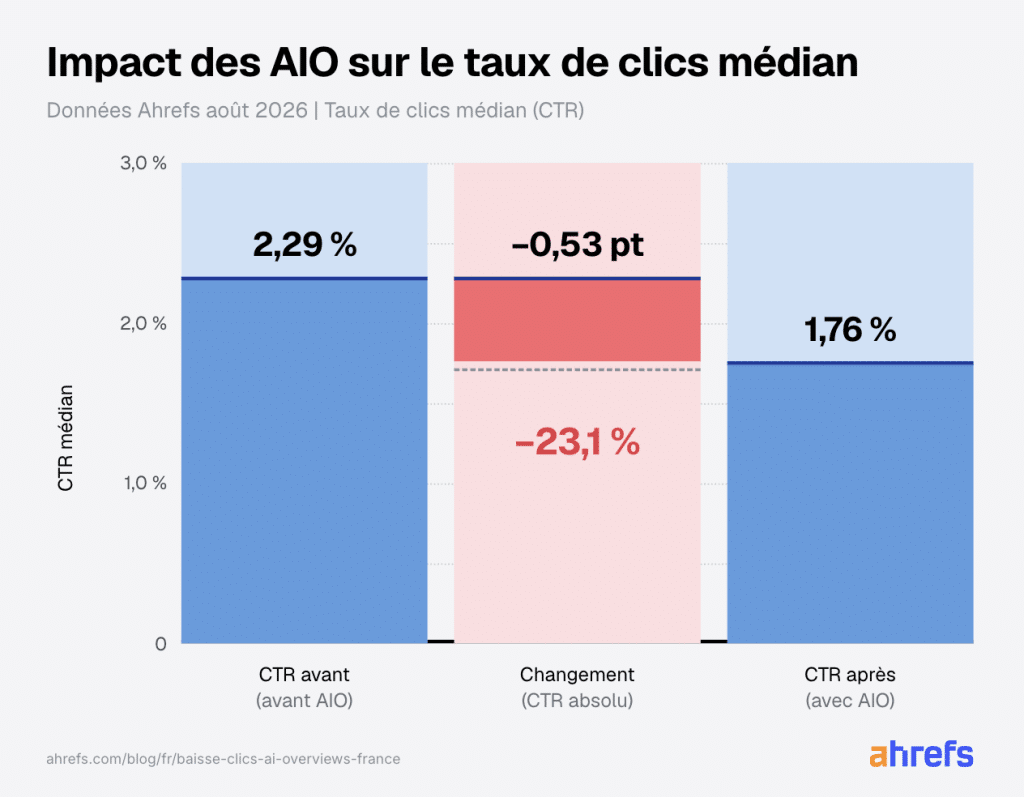
- Les domaines très exposés aux AI Overviews (plus de 20 % de leurs requêtes concernées) perdent 23,1 % de CTR en neuf jours, un chiffre qui monte à −24,8 % une fois neutralisée l'évolution du groupe témoin (+2,3 % sur la même période) 82,2 % des domaines très exposés perdent du CTR
- À la médiane, sur l'ensemble du panel de 963 domaines, la baisse est de 5,7 % de CTR et 8,8 % de clics
- Près de la moitié des domaines du panel (48 %) ont perdu plus de 10 % de leurs clics, et 5 % en ont perdu plus de la moitié
- Les domaines en .fr sont plus touchés (−12,3 % de clics) que la moyenne du panel (−8,8 %)
- La santé est le secteur le plus exposé (taux d'AI Overview de 22,2 %) et le plus touché (−20,4 % de CTR)
- Selon l'étude mondiale d'Ahrefs, la baisse de CTR en position 1 sur les requêtes avec AI Overview est passée de −34,5 % au printemps 2025 à −58 % fin 2025
Ce que montre l'étude
Dans une nouvelle étude publiée hier, Ahrefs a comparé deux populations de domaines pour isoler ce qui relève spécifiquement des AI Overviews d'une simple variation saisonnière.
Les domaines très exposés, c'est-à-dire ceux dont plus de 20 % des requêtes déclenchent un AI Overview, enregistrent une baisse moyenne de CTR de 23,1 % en neuf jours. Sur ce même groupe, 82,2 % des domaines perdent du CTR : à ce niveau d'exposition, s'en sortir est devenu l'exception plutôt que la règle.
Le groupe témoin, composé de domaines dont moins de 2 % des requêtes déclenchent un AI Overview, sert de point de comparaison. Sur la même période, son CTR progresse de 2,3 %. Ahrefs précise que le −23,1 % du groupe très exposé est calculé sans retrait de cette évolution du témoin : une fois cette hausse prise en compte, l'effet réel attribuable aux AI Overviews atteint −24,8 %.
Autrement dit, les domaines très exposés n'ont pas seulement perdu 23 % de CTR, ils ont aussi raté la légère hausse dont le reste du marché a profité sur la même période.
Une relation à peu près linéaire entre exposition et perte de CTR
En comparant la variation du taux de clics au taux d'AI Overview sur l'ensemble des domaines étudiés, Ahrefs obtient une pente de −0,9 : chaque point de taux d'AI Overview supplémentaire coûterait environ un point de CTR.
Ahrefs formule cet ordre de grandeur comme un repère opérationnel, pas comme une prédiction. L'étude précise elle-même qu'une pente n'est pas une prédiction, que certains sites très exposés s'en sortent, et que d'autres, peu exposés, reculent pour des raisons sans rapport avec l'IA.
Les impressions montent, les clics tombent
Selon Ahrefs, il y a eu peu de perte de positions dans les SERP fin juillet. Les pages continuent de s'afficher aussi souvent qu'avant, parfois davantage, mais elles sont moins cliquées. Le cas le plus marqué du panel affiche +183 % d'impressions pour −1,9 % de clics, soit un CTR divisé par plus de trois.
Les chiffres à la médiane sur l'ensemble du panel
Sur l'ensemble des 963 domaines retenus dans l'étude, et non plus seulement sur le groupe très exposé, la médiane du panel affiche une baisse de 5,7 % de CTR et de 8,8 % de clics.
La répartition des pertes de clics sur ce panel est la suivante :
- 48 % des domaines ont perdu plus de 10 % de leurs clics
- 19 % en ont perdu plus de 30 %
- 5 % en ont perdu plus de 50 %
Presque un site sur deux a donc perdu plus de 10 % de ses clics quotidiens, et un sur vingt en a perdu la moitié, en seulement neuf jours.
Ahrefs signale par ailleurs que l'exposition va probablement continuer de progresser : le taux d'AI Overview médian des sites étudiés est aujourd'hui de 5,4 %, et 29 % d'entre eux dépassent déjà 10 %. Ces taux ont augmenté sur tous les marchés depuis 2024, selon l'étude.
Les .fr plus touchés que la moyenne
Les domaines en .fr du panel perdent 12,3 % de clics en médiane, contre 8,8 % pour l'ensemble des sites étudiés. Ahrefs avance une explication : les sites français seraient plus exposés aux AI Overviews que les acteurs internationaux présents sur le marché français.
Le secteur santé, le plus touché
Un secteur se détache nettement dans l'étude : la santé, avec un taux d'AI Overview de 22,2 %, le plus élevé relevé, et une baisse de CTR de 20,4 %.
Ahrefs explique ce résultat par la nature des requêtes santé, majoritairement informationnelles et à réponse courte, c'est-à-dire le type de requête que l'AI Overview absorbe le mieux : la réponse tient dans l'encart et l'utilisateur repart sans avoir besoin de cliquer. Pour Ahrefs, ce qui détermine l'exposition au risque n'est donc pas tant la verticale que l'intention derrière les requêtes : une requête à laquelle un paragraphe suffit est une requête à risque, tandis qu'une requête qui suppose un outil, un compte, un prix, un achat ou un avis humain résiste mieux.
Une trajectoire qui pourrait s'aggraver
L'étude situe ces résultats français dans une trajectoire plus large observée à l'échelle mondiale. Sur cette étude mondiale, l'impact des AI Overviews sur le CTR de la position 1 est passé de −34,5 % au printemps 2025 à −58 % fin 2025. Selon Ahrefs, l'effet ne s'atténue pas avec le temps : il s'accentue, à mesure que l'AI Overview se déclenche sur davantage de requêtes et que les utilisateurs prennent l'habitude de moins cliquer.
Ahrefs indique vouloir relancer cette analyse sur une fenêtre plus longue pour suivre l'évolution du marché français, sans affirmer à ce stade qu'il suivra la même trajectoire que le marché mondial.
Des ordres de grandeur cohérents avec d'autres études
Ahrefs rapproche ses résultats de mesures publiées par d'autres acteurs sur l'effet des AI Overviews sur le CTR organique : une baisse de 49,4 % à 65,2 % relevée par Seer Interactive, une baisse supérieure à 50 % selon Kevin Indig, et une baisse de 47,5 % selon Authoritas.
Méthodologie de l'étude
Ahrefs a suivi les 1 000 domaines générant le plus de clics en France entre avril et juillet 2026, via des données agrégées de Google Search Console. Les domaines dont l'historique ne couvrait pas l'intégralité de la période ont été écartés, ce qui ramène le panel final à 963 domaines.
Pour chaque domaine, Ahrefs a calculé la moyenne quotidienne de clics, d'impressions et de CTR sur les 28 jours précédant le 22 juillet 2026, puis sur les 9 jours suivant cette date.
Ahrefs a également mesuré le taux d'AI Overview de chaque domaine, c'est-à-dire la part de ses requêtes France qui déclenchent un AI Overview. Cette donnée sert à répartir les domaines entre le groupe très exposé (plus de 20 % de requêtes concernées) et le groupe témoin (moins de 2 %), afin d'isoler l'effet propre aux AI Overviews de l'évolution générale du CTR sur la période, saisonnalité de fin juillet comprise.
L'étude précise que le chiffre de −23,1 % de CTR médian pour le groupe très exposé est la variation brute observée, sans retrait de l'évolution du groupe témoin. Sur la même période, le CTR du groupe témoin progresse de 2,3 %. En intégrant cet écart, l'effet réel attribué aux AI Overviews est estimé à −24,8 %.
L’article "Étude Ahrefs : un mois après leur lancement en France, les AI Overviews font déjà chuter le CTR de 23 %" a été publié sur le site Abondance.