Timeline
Every post and feed across this instance
-
Incendies : ils et elles se forment pour intervenir avant les pompiers

Alors que l'Espagne fait face à des incendies de plus en plus ravageurs, aggravés par le changement climatique, des citoyens se forment pour agir dès les premières minutes et empêcher que le feu ne devienne incontrôlable.
Lire la suite - Reportage / Incendies , Alternatives
Esparreguera (Espagne), reportage
« C'est super les gars, mais envoyez le jet un peu plus loin pour atteindre l'arbuste en feu ! » s'écrie Jordi Diaz Baño, au milieu d'un parc forestier au pied de la montagne de Montserrat, en Catalogne. « Et n'oubliez surtout pas de (…) -
Ephéméride des luttes : 11 août

Le 11 août a été fertile de luttes et de désirs de liberté à travers les époques, et voilà pourquoi l'éphéméride des luttes veut lui rendre hommage. Souvenons-nous de celles et ceux qui ont lutté avant nous pour continuer aujourd'hui.
1882 : A Tikhvine près de Novgorod, naissance de Voline, importante figure du mouvement anarchiste Russe, qui participa notamment à plusieurs insurrections et fut très critique des bolcheviques.
1898 : A Bruxelles, le commissaire de police Monmaerts, venu pour arrêter l'anarchiste Henri WILLEMS à son domicile, est reçu par des coups de feu. Willems parvient à s'enfuir poursuivi par la foule et les policiers sur lesquels il décharge à vingt-deux reprises ses armes.
Henri Willems, jeune ouvrier sculpteur, était en 1893 l'administrateur du "Libertaire" belge, journal qui sera interdit par la police le 20 février 1894, à la suite de la parution d'articles incitant à la désobéissance civile où saluant la mémoire d'Auguste Vaillant. Arrêté début 1895, Willems sera condamné à deux ans et demi de prison pour ses articles écrits dans "Le Libertaire" et dans le journal "L'Antipatriote". Repris de l'éphéméride anarchiste.1905 : A Buenos Aires, tentative d'attentat de l'anarchiste catalan Salvador Planas Virella contre le président argentin Manuel Quintana, mais un problème avec son pistolet l'empêche de tirer. Il sera arrêté et emprisonné.

1927 : - A Bâle, une bombe anarchiste explose en faisant de gros dégâts dans la gare de Barfuesserplatz en soutien à Sacco et Vanzetti, anarchistes Italiens qui risquent alors la peine de mort aux Etats-Unis.
- A Sacramento, plusieurs bombes explosent pour la même raison, dont l'une détruit le Théâtre de l'Etat.
1944 : Florence est libérée de l'occupation nazie suite à une insurrection des partisan-e-s.
1964 : En Espagne, attentat raté contre le dictateur Franco du fait de l'arrestation des anarchistes Stuart Christie et Fernando Caballo, qui portaient une valise d'explosifs.
1965 : A Los Angeles, début des émeutes de Watts suite à des violences policières, qui dureront cinq jours. 4.000 personnes seront arrêtées (pour environ 30.000 participants) et on dénombre 35 morts.
1966 : John Lennon s'excuse d'avoir dit que les Beatles étaient plus célèbres que Jésus-Christ.
1970 : A Crossmaglen en Irlande du Nord, l'IRA fait sauter la voiture de deux militaires de l'armée britannique.
1974 : A Villa María en Argentine, l'ERP (Ejército Revolucionario del Pueblo) enlève un militaire de haut rang de l'armée du pays.
1980 : A Viterbo en Italie, deux carabinieri meurent lors d'une fusillade avec des militants de Prima Linea, lors de laquelle est aussi blessé le militant Michele Viscardi.
1982 : A Lyon, attentat de 'L'Affiche Rouge' contre une société d'import/export.
2001 : En Colombie, trois membres de l'IRA irlandaise sont arrêtés dans une zone contrôlée par les rebelles.
2002 : A Irvine en Pennsylvanie, l'ELF (Front de Libération de la Terre) incendie une station de recherches des forêts, provoquant 700.000 dollars de dégâts.
Voir aussi l'éphéméride anarchiste du 11 août.
-
A Ceuta, l’Europe a encouragé la violation des droits des migrants par l’Espagne
On pouvait croire qu’en adoptant le pacte de l’Union européenne (UE) sur la migration et l’asile , entré en application en juin 2026, les pays membres avaient enfin réussi à surmonter leurs dissensions en matière de gestion des mouvements migratoires. Rappelons que ce pacte était censé apaiser les… -
Washington Policy Review: August 10, 2026
Today’s Report
1. Overview
2. White House News
3. Truth Social Posts
4. Government Department News
5. 2028 Democratic Presidential Candidates
6. AI & Tech Company News
7. Congressional Watch
8. Policy Impact Analysis & Heatmap
1. Overview
President Trump commemorated National Shooting Sports Month by pledging to defend Second Amendment rights and minimize regulations on gun owners. The administration also released a report claiming that its intervention in D.C., led by the National Guard, successfully reduced violent crime to historic lows. Additionally, the President signed an Executive Order establishing “Gold Standard Childhood Vaccine Recommendations,” which aims to promote informed consent and support parental choice regarding immunizations.
On Truth Social, President Trump demanded that Iran provide reparations for victims of past conflicts and roadside bombs, instructing his representatives to prioritize these demands in future negotiations. He expressed strong support for FIFA President Gianni Infantino and issued a wave of endorsements for various congressional and gubernatorial candidates in the upcoming August 11 elections. Trump also attacked a report by the Center for American Progress that questioned the efficacy of the National Guard’s role in D.C., labeling the organization a “Radical Left SCAM” and indicating that a lawsuit is forthcoming.
The State Department marked the one-year anniversary of the White House peace summit with Armenia and Azerbaijan, noting continued progress in regional stability and infrastructure development. The Bureau of Diplomatic Security secured a guilty plea from a Florida man who threatened Secretary of State Marco Rubio, while the Department simultaneously announced the revocation of over 175,000 visas for national security and criminal concerns. At a renaming ceremony for a base honoring Senator Lindsey Graham, Secretary of War Pete Hegseth and Treasury Secretary Scott Bessent praised the Senator’s legacy and urged Congress to support increased military funding. HHS Secretary Robert F. Kennedy, Jr. announced new FDA food safety reforms, including a formal definition for “ultra-processed foods,” to further the administration’s MAHA agenda.
Governor Gavin Newsom announced a new AI Cyber Defense Program to secure California’s infrastructure, criticizing the Trump administration for “scaling back” federal support for state-level cybersecurity. He also condemned a proposed federal firearm regulation change, accusing the administration of being “in the pocket of criminals” by potentially easing online gun purchase rules. Meanwhile, Governor Wes Moore announced $80 million in grants to expand rural healthcare access through the Rural Health Transformation Program, a move supported by federal HHS investments. Governor Tim Walz highlighted Minnesota’s natural resources during a trip to the state’s northern region and ordered flags to be flown at half-staff to honor the late Justice Esther M. Tomljanovich.
OpenAI announced the expansion of its Daybreak program, introducing two new access tiers for its AI models to assist cybersecurity professionals in defending against automated threats. The “Daybreak Red” tier provides access to the GPT-5.6-Cyber model, which is specialized for vulnerability research and exploit validation. Additionally, OpenAI sent a formal letter to Texas Governor Greg Abbott, expressing the company’s commitment to developing “responsible AI infrastructure” in collaboration with local stakeholders and utility providers.
The administration’s executive order prioritizing “personal autonomy” in vaccine scheduling introduces significant revenue uncertainty for high-volume vaccine developers by threatening the standardization that underpins their business models. Conversely, the defense sector remains supported by consistent procurement contracts for essential aerospace sustainment, signaling a commitment to strategic military readiness despite broader shifts in political rhetoric. Meanwhile, the implementation of “confrontational diplomacy” regarding historical financial restitution creates elevated volatility in energy markets, as the demand for retroactive compensation from geopolitical adversaries complicates regional stability and increases long-term risk premia.
2. White House News
Presidential Message on National Shooting Sports Month
President Trump commemorates National Shooting Sports Month by celebrating the “glorious exercise of our Second Amendment rights” and the nation’s hunting traditions. The administration is prioritizing access to public lands for shooting and hunting through the Make America Beautiful Again Commission and updated regulations intended to reduce “unnecessary burdens on law-abiding gun owners.” President Trump emphasizes the connection between sporting traditions, conservation efforts, and personal responsibility, stating that he will “continue to defend our Second Amendment rights” and preserve America’s “frontier heritage” for future generations.
Reference: https://www.whitehouse.gov/briefings-statements/2026/08/presidential-message-on-national-shooting-sports-month-4561/
Fact Sheet: President Donald J. Trump Delivers Gold Standard Childhood Vaccine Recommendations for Americans
President Trump signed an Executive Order to recognize “Gold Standard Childhood Vaccine Recommendations” intended to “maximize parental choices” regarding immunizations. The policy aligns childhood vaccine categories with scientific evidence and practices from peer developed countries. The initiative follows a January 2026 HHS scientific assessment that compared U.S. vaccine recommendations with international peers, evaluating vaccine uptake, public trust, and mandates. Ultimately, the administration states that “President Trump is committed to building a healthier future for America, starting with our youngest generation” through these updated medical standards.
Reference: https://www.whitehouse.gov/fact-sheets/2026/08/fact-sheet-president-donald-j-trump-delivers-gold-standard-childhood-vaccine-recommendations-for-americans/
Delivering Gold Standard Childhood Vaccine Recommendations for Americans
President Trump issued an executive order to align U.S. childhood vaccine recommendations with international best practices, citing the need to support “maximal parental choice” and “personal autonomy and informed consent.” The order establishes “Gold Standard Childhood Vaccine Recommendations,” categorizing immunizations and advocating for single-dose administration over combination products. Furthermore, it directs HHS to research vaccine safety and instructs the Attorney General to challenge state laws that conflict with “parental authority, religious freedom, disability accommodations, and equal protection under the law” regarding immunization mandates and exemptions.
Reference: https://www.whitehouse.gov/presidential-actions/2026/08/delivering-gold-standard-childhood-vaccine-recommendations-for-americans/
One Year Later, President Trump Has Delivered on Making D.C. Safe Again
One year after President Trump declared a crime emergency in the District of Columbia and established the Make D.C. Safe and Beautiful Task Force, the administration reports that “violent crime has been smashed to levels not seen in decades.” Through an partnership of federal and local agencies, including the National Guard, the administration claims it successfully removed “violent predators” and cleared homeless encampments. The report asserts that under President Trump’s leadership, the city is no longer a “Democrat-run nightmare” and is becoming the “safest and most beautiful capital.”
Reference: https://www.whitehouse.gov/releases/2026/08/one-year-later-president-trump-has-delivered-on-making-d-c-safe-again/
3. Truth Social Posts
Trump addressed international affairs by demanding that Iran provide compensation for victims of their conflicts, including those killed by roadside bombs and the families of victims from the USS Cole, as well as the families of protestors killed over the last 50 years. He instructed his representatives to include these demands in all future negotiations, further stating that Iran should be held responsible for damages and deaths in Lebanon, Syria, Yemen, and Gaza. Additionally, Trump defended FIFA President Gianni Infantino, calling him “fantastic” and warning that replacing him would be a “terrible mistake.”
Domestically, Trump issued a broad wave of endorsements for the August 11, 2026, elections, including Senator Darline Graham Nordone for the South Carolina U.S. Senate seat, Barry Moore for U.S. Senate in Alabama, and Tommy Tuberville for Governor of Alabama. He also endorsed Jerry Carl, Rhett Marques, Gary Palmer, Brad Finstad, Tom Emmer, Michelle Fischbach, Pete Stauber, Tony Wied, Michael Alfonso, Glenn Grothman, Scott Fitzgerald, Derrick Van Orden, and Bryan Steil for their respective congressional seats, while backing Tom Tiffany for Governor of Wisconsin. Separately, he celebrated the announcement that Supreme Court Justice Samuel Alito will remain on the bench for another term, and he shared a photo with golfer Gary Player (no link).
Trump also attacked a report from the Center for American Progress that claimed the deployment of the National Guard had no impact on crime, labeling the organization a “Radical Left SCAM.” He criticized the group’s diverse list of funders, ranging from technology companies to foreign embassies, and characterized the findings as a personal effort to “hate or demean ‘TRUMP.’” He announced that a lawsuit is being prepared and that he is considering targeting the organization’s individual contributors, asserting that under his administration, “Crime is way down.”
Reference: https://truthsocial.com/@realDonaldTrump
4. Government Department News
State Department (state.gov)
Joint Statement of the United States, Armenia, and Azerbaijan on the Peace Summit Anniversary
The U.S., Armenia, and Azerbaijan marked the one-year anniversary of the White House peace summit. Leaders noted progress in normalizing relations and stability in the South Caucasus. Projects like the Trump Route for International Peace and Prosperity (TRIPP) are advancing, supported by U.S. investment and infrastructure development. Both nations have signed strategic partnership charters with the U.S. and implemented trade agreements. Following the summit, Azerbaijan lifted transit restrictions with Armenia, and both countries pledged to support the sovereignty and territorial integrity of one another.
A Miami man, Jon Christopher Enriquez, pleaded guilty to transmitting threats through interstate communications after posting threats on X against Secretary of State Marco Rubio. The investigation, led by the Bureau of Diplomatic Security with support from several law enforcement agencies, identified posts threatening the Secretary with execution. Protecting Department leadership from violence remains a top priority for the Bureau, which maintains continuous monitoring to detect and respond to such threats against officials.
State Department Revokes More Than 175,000 Visas
The State Department has revoked over 175,000 visas from foreign nationals for reasons including criminal activity, immigration system abuse, and endangering national security. Common grounds for revocation include assault, theft, drug crimes, reckless driving, and fraud. The Department cited continuous vetting operations as the method for identifying these individuals. Under President Trump and Secretary Rubio, the Department emphasized that holding a U.S. visa is a privilege rather than a right and stated it would continue to revoke visas of those who threaten American safety.
Secretary of State Marco Rubio extended congratulations to Ecuador on the 217th anniversary of its independence. He highlighted the “robust and historic bond” between the two nations, noting that under the Trump Administration, cooperation has intensified in areas of transnational crime, narcoterrorism, trade, civil nuclear energy, and critical minerals. Rubio commended Ecuador’s participation in the Shield of the Americas and the Americas Counter Cartel Coalition, affirming a shared commitment to a “free and prosperous Western Hemisphere.”
Department of War (war.gov)
The Department of War announced multiple defense contracts, including a $109 million award to Boeing for 76 F/A-18 outer wing panels. Supply Chain Management Inc. received a $20.7 million contract for technical and logistical services for Navy surface combat weapons, and Systems Application & Technologies Inc. was awarded $20.7 million for support services for the Aircraft Instrumentation Division. Additionally, Childs Engineering Corp. and Appledore Marine Engineering were each awarded indefinite-delivery/indefinite-quantity contracts worth up to $15 million for routine inspection of waterfront facilities.
Secretary of War Pete Hegseth Remarks at Joint Base Lindsey Graham Naming Ceremony
Secretary of War Pete Hegseth honored Senator Lindsey Graham at a renaming ceremony for the South Carolina joint base. Hegseth praised Graham as a patriot who fought against “radical leftist ideology” that he claimed “killed our military recruiting.” He stated that President Trump has successfully worked to “run those radicals out of the Pentagon.” Hegseth urged Congress to approve a $1.5 trillion investment for the military, citing it as the best way to honor Graham’s legacy and ensure national strength.
Remarks by Undersecretary of War for Policy Elbridge Colby in Manila, Philippines
Undersecretary of War for Policy Elbridge Colby emphasized a shift toward “hard-nosed, clear-eyed republican realism” in U.S. foreign policy. He described President Trump’s strategy as a move away from post-Cold War “comfortable illusions” toward a focus on concrete national interests. Colby characterized this approach as “NATO 3.0” in Europe and a “Trump Corollary” in the Western Hemisphere, emphasizing practical partnerships and shared responsibility. He affirmed that the Indo-Pacific remains a paramount priority for the U.S. in ensuring regional deterrence and defense.
Department of Health and Human Services (hhs.gov)
Secretary Kennedy Announces Landmark Food Policy Reforms to Advance President Trump’s MAHA Agenda
HHS Secretary Robert F. Kennedy, Jr. announced two major initiatives to support President Trump’s “Make America Healthy Again” (MAHA) agenda. The FDA proposed a rule requiring mandatory notifications for food substances deemed “Generally Recognized as Safe” (GRAS), closing existing transparency gaps. Additionally, HHS and the USDA submitted the federal government’s first formal definition of “ultra-processed foods” (UPFs). These actions aim to modernize food safety oversight, improve scientific consistency in nutrition research, and address chronic disease by increasing transparency regarding ingredients entering the U.S. food supply.
Treasury Department (home.treasury.gov)
Remarks from Treasury Secretary Scott Bessent at Joint Base Lindsey Graham Renaming Ceremony
Treasury Secretary Scott Bessent delivered remarks at the renaming ceremony for the base now known as Joint Base Graham. Highlighting Senator Lindsey Graham’s decades of service in the Air Force and the Senate, Bessent described him as a patriot who prioritized national safety and possessed a “generosity of spirit.” Bessent praised Graham’s career as a testament to the American dream and noted that the base, home to the C-17 fleet, serves as a fitting legacy for a man he called “America’s workhorse.”
5. 2028 Democratic Presidential Candidates
Gavin Newsom (gov.ca.gov)
First Partner Jennifer Siebel Newsom and Senate President pro Tem Monique Limón honored 11 California women founders on the Senate floor. The event celebrated their leadership across sectors like STEM, agriculture, and finance. The initiative, supported by the F5 Collective and the California Women’s Wealth Advisory Council, aims to close the women’s wealth gap and encourage investment in women-led businesses. Honorees received Senate resolutions for their economic contributions and innovation, which officials say are essential to strengthening the state’s economy and inspiring future entrepreneurs.
Governor Newsom condemns Trump administration proposal to weaken federal gun safety
Governor Newsom criticized the Trump administration for proposing federal firearm regulation changes that would ease online gun purchases and permit the destruction of records used for crime tracing. Newsom stated that the administration is “in the pocket of criminals” and “putting our communities in danger.” Multiple state agencies, including the Department of Public Health and CalVet, filed formal comments opposing the proposal, citing risks to public safety, veteran suicide prevention efforts, and the ability of crime victims to seek justice and restitution.
Governor Newsom announced that nine television projects, including reboots of *The Rockford Files* and *Clueless*, have been awarded tax credits under California’s expanded program. These productions are expected to generate $608 million in economic activity and create over 1,000 filming days in the state. Officials highlighted the program’s success in driving industry growth, with application volume increasing 82% in the last year. The program aims to maintain California’s competitive edge in entertainment by providing incentives for high-quality, local productions featuring A-list talent.
Governor Newsom launched a new AI Cyber Defense Program to defend state assets and critical infrastructure against artificial intelligence-enabled cyber threats. The initiative directs state agencies to improve cybersecurity coordination and expand AI-driven defenses. Newsom stated that the state must build robust defenses, noting that cyberattacks are becoming faster and more sophisticated. The program aims to address emerging risks while the Trump administration scales back federal support for local and state cybersecurity, ensuring that essential services like water, power, and transportation remain secure.
Wes Moore (governor.maryland.gov)
Governor Moore announced $80 million in grant funding awarded to 41 recipients under Maryland’s Rural Health Transformation Program. These funds aim to expand primary, behavioral, and dental care in rural communities through initiatives like telehealth, mobile pediatric services, and innovative technology. Supported by a $168 million federal investment from the HHS Secretary, the program reflects the administration’s goal that “Marylanders’ ability to access affordable and quality health care should not depend on their zip code.” CMS Administrator Dr. Mehmet Oz lauded the program’s locally driven approach.
JB Pritzker (gov.illinois.gov)
Daily Public Schedule: Monday, August 10, 2026
Governor Pritzker has no public events scheduled for Monday, August 10, 2026.
Tim Walz (mn.gov)
Governor Walz Visits Minnesota’s Northernmost Point
Governor Walz traveled to the Northwest Angle and Warroad to highlight Minnesota’s outdoor destinations and support local economies. Accompanied by DNR Commissioner Sarah Strommen, the Governor toured a forestry office, bridge construction, and Zippel Bay State Park. He encouraged citizens to explore the state’s natural resources, noting that such visits provide essential economic support to communities recovering from recent wildfires. The administration emphasized that state parks have seen a 20% increase in visitors, along with significant expansions in trail mileage and reforestation efforts.
Governor Walz Orders Flags at Half-Staff to Honor Former Justice Esther M. Tomljanovich
Governor Walz has ordered all United States and Minnesota flags at state buildings to fly at half-staff on August 11, 2026, to honor the late former Justice Esther M. Tomljanovich. Describing her as a “trailblazer for women,” the Governor recognized her service on the Minnesota Supreme Court and her advocacy for gender equality, including her work to establish equal pay protections. Justice Tomljanovich, a pioneer in the state’s legal system, served as one of the first female judges and justices in Minnesota history.
6. AI & Tech Company News
OpenAI (openai.com)
OpenAI’s letter to Governor Abbott on responsible AI infrastructure in Texas
OpenAI sent a letter to Texas Governor Greg Abbott regarding the development of responsible AI infrastructure within the state. The company expressed its commitment to collaborating with state and local leaders, community stakeholders, and utility providers to ensure that the deployment of AI infrastructure provides significant benefits to the people of Texas.
Expanding Daybreak as the Cyber Defense Window Narrows
OpenAI is expanding the Daybreak program with two access tiers to provide defenders with advanced tools against AI-driven cyberattacks. “Daybreak Blue” offers frontier models like GPT-5.6 Sol for general defensive tasks, while “Daybreak Red” provides access to the new GPT-5.6-Cyber model, purpose-trained for vulnerability research and exploit validation. GPT-5.6-Cyber is designed to reduce refusal rates on complex cybersecurity requests, achieving a 95% completion rate on advanced scenarios compared to 1.5% for the standard model, helping security professionals stay ahead of automated threats.
Putting frontier cyber models in more trusted hands
OpenAI is expanding its Daybreak Cyber Partner Program to integrate frontier AI models into existing security products and services. By partnering with cybersecurity firms, the company aims to help organizations identify and remediate vulnerabilities more efficiently. Approved partners use Daybreak Blue or Red access within governed environments featuring identity verification, logging, and human oversight. This initiative is designed to provide enterprises with advanced defensive capabilities while maintaining strict controls, ensuring that these powerful tools are used responsibly by security practitioners to protect their clients’ infrastructure.
7. Congressional Watch
Covers the 2026-08-09 session — the Congressional Record is published with a one-day delay.
No Congressional Record found for 2026-08-09.
8. Policy Impact Analysis & Heatmap
This analysis is provided for informational purposes only. It does not constitute investment advice or a recommendation to buy or sell any security.
Impact on Market
Based on today’s policy developments, our analysis identifies the following market impact themes:
THEME 1. HEALTHCARE REGULATORY DISRUPTION
The administration’s executive order on childhood vaccines aims to shift the landscape toward “personal autonomy” and away from standard mandates. This creates material risks for vaccine developers who operate on high-volume, standardized combination schedules. Critics argue that undermining proven public health practices could lead to a resurgence of preventable diseases, ultimately increasing long-term systemic healthcare costs. Market participants are watching for potential legal challenges to state-level mandates as the Attorney General prepares to intervene in state-level enforcement.
THEME 2. DEFENSE PROCUREMENT CONTINUITY
Despite a shift toward isolationist rhetoric, the administration continues to prioritize critical military sustainment through targeted contract awards. The F/A-18 wing panel order confirms that established aerospace firms retain strong government support for maintaining core national capabilities. This remains a bullish signal for the defense industrial base as officials emphasize the need for readiness in the Indo-Pacific theater. The primary risk remains the reliance on sole-source contracts which may face future scrutiny from budget-conscious congressional factions.
THEME 3. GEOPOLITICAL DIPLOMATIC FRICTION
The administration is increasingly using formal negotiations as a platform for demanding retroactive financial restitution from adversaries. The new demand for compensation from Iran, linked to historical combat losses, adds an unpredictable variable to energy and foreign policy risk premia. This “confrontational diplomacy” threatens to derail stability in energy-producing regions. Investors remain wary that such aggressive posturing will limit the potential for de-escalation, maintaining high volatility in energy-related sectors.
Policy Impact Heatmap with Market Direction
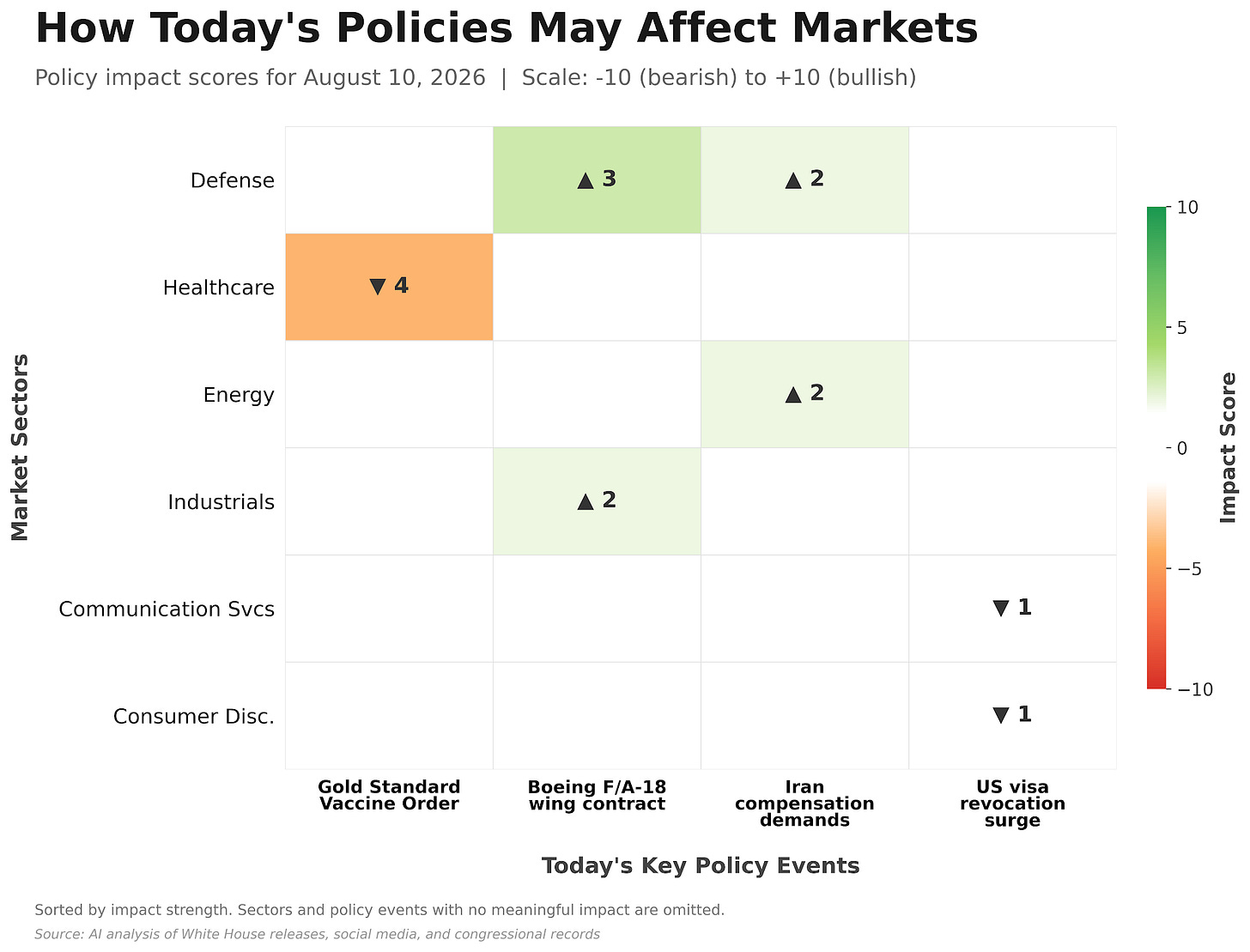
Each cell shows an estimated impact score on a fixed scale of -10 to +10, reflecting how today’s policy developments may affect each market sector. Positive scores (green, ▲) suggest bullish impact; negative scores (red, ▼) suggest bearish pressure. Rows and columns are sorted by impact strength, and sectors and policy events with no meaningful impact are omitted. The heatmap, the analysis below, and the Impact on Market themes above are produced from a single unified analysis: the heatmap visualizes the magnitudes, while the text explains the causal reasoning behind them.
The administration’s directive to prioritize “Gold Standard” vaccine recommendations creates significant regulatory uncertainty for the healthcare sector. By challenging state-level mandates and promoting single-dose administration over established combination products, the policy risks disrupting supply chains for major vaccine manufacturers. Critics view this as an “unnecessary” political interference that may erode public health standards. Simultaneously, the focus on visa revocations adds friction to global mobility, likely impacting service sectors that rely on international labor and cross-border consumer demand. These administrative actions reflect a broader pivot toward decentralization and strict border control measures, raising compliance costs for multinational corporations.
Defense spending remains a bright spot, highlighted by the latest sole-source award to Boeing for F/A-18 sustainment. This underscores the administration’s commitment to “peace through strength” and maintains robust revenue streams for legacy military contractors. Conversely, the aggressive stance on Iranian compensation demands injects a new risk premium into energy markets. This rhetoric threatens to complicate ongoing diplomatic efforts, potentially restricting future supply integration. While the administration frames these moves as “defending sovereignty,” market participants must navigate heightened geopolitical tension that favors traditional industrial and defense incumbents over firms exposed to international integration.
-
Quand Paris nourrissait Paris
Entre le XIXe et la première moitié du XXe siècle, Paris assurait une grande partie de sa consommation de légumes grâce à un maraîchage intensif et ingénieux, dont les techniques sont encore étudiées aujourd’hui. -
Trump reportedly hid in catering container to board secret flight in Turkey amid Iran threat
Elaborate ruse was used to transport president to military flight from Air Force One in July
Donald Trump departed on a secret military flight from Turkey to Britain last month when the White House said he was flying aboard Air Force One, in an extraordinary ruse – prompted by an Iranian assassination threat – that involved hiding the president in an airport catering container, according to reporting from the Washington Post and the New York Times.
The operation took place when Trump was in Ankara for a Nato summit with world leaders, according to the Post. The president reportedly boarded the old Air Force One jumbo jet in view of television cameras, and then was secretly shuttled minutes later to a smaller plane via an airport catering truck typically used to load meals and other supplies preflight, a US official told the Post.
Continue reading... -
Donald Trump says it would be a ‘terrible mistake’ to replace Fifa’s Gianni Infantino
US president backs ‘fantastic’ Infantino in Truth Social post
Infantino under pressure following doomed World Cup sell-off plan
US president Donald Trump has warned Fifa would be making a “terrible mistake” if they get rid of Gianni Infantino as the head of world football’s governing body.
Infantino has come under pressure following his doomed plan to sell off stakes in the men’s World Cup to private investors.
Continue reading... -
Trump’s media company, which also owns Truth Social, reports $238m loss
Company also announced a paid service for early access to president’s posts on policies to the social media site
Donald Trump’s media company – which owns the Truth Social platform favored by the US president – posted a $238m loss in the second quarter.
Trump Media & Technology on Monday reported that losses in the three months through June came as the company branched into new ventures including crypto. The company’s new chief executive, Kevin McGurn, announced at a conference call about the earnings that after a yearlong effort to expand into online betting and crypto, the company would be refocusing on social media.
Continue reading... -
Trump demands Iran pay compensation for decades of US soldier deaths
US president’s statement is latest sign that negotations to end war and reopen strait of Hormuz have stalled
Donald Trump has said he will demand that Iran pay compensation for the deaths of thousands of US soldiers and Iran’s own civilians killed in recent decades in the latest sign his negotiations to end the war and reopen the strait of Hormuz have reached an impasse.
The US president is trying to end conflicts in Iran, Gaza and Lebanon, and his additional demands of Iran are likely to provoke anger in Tehran at the same time as Israel has rejected Trump’s terms for a 15-point roadmap to end the war in Gaza.
Continue reading... -
Trump Doubles Down On Conspiracy Theories After DOJ Drops Reflecting Pool Vandalism Charges
We’ll see how long US Attorney (and, of course, former Fox News personality) Jeanine Pirro gets to keep her job. I would guess the exit door is only inches away from hitting her ass since she refused to carry out Donald Trump’s plan to punish Reflecting Pool visitors for highlighting the failures of his no-bid contract buddies.
Former Olympian David Hearn got rung up first on federal vandalism charges. Then he got un-rung, once the DOJ told the court Doug Burgum’s Interior Department had basically lied to it about the most likely causes of the peeling sealant and algae swarms that embarrassed the president into pressing criminal charges and threatening journalists.
The crux of dismissal motion by the DOJ was this:
[I]t was not until after the return of the indictment, that the DOI provided additional documents to the USAO-DC indicating that damage to the Lincoln Memorial Reflecting Pool in June 2026 was the result of flawed installation by the contractor, Atlantic Industrial Coatings (“AIC”), and the rush to complete the project prior to events associated with the America 250 celebration in the weeks surrounding Independence Day 2026. It was not until after these documents were produced that USAO-DC first became aware of information showing that the damage was the result of a botched installation and not vandalism as initially represented by DOI. Indeed, USAO DC could only rely (on the information provided by DOI that the damage was entirely caused by vandals, including the defendant in this case, David Hearn…
Despite the insult of being lied to by a fellow member of the federal government, the DOJ could only bring itself to move for a dismissal without prejudice, which means the administration can always take another swing at Hearn and the other Reflecting Pool defendants.
The good news is that everyone facing criminal charges for supposedly “vandalizing” the botched, hasty pool repair job is now off the hook… at least for now.
Court records now show that prosecutors are dropping the charges against the three other defendants – Justin Carreno, Cameron Thiers and Sophie Dennison-Gibby – who were all accused of destruction of property with a value of less than $1,000.
The bad news is everything else. Ever since the first dismissal, both Donald Trump and DOI Secretary have done little more than bash Pirro for actually doing her damn job and claiming (again, without evidence) that the Reflecting Pool was vandalized, rather than just mishandled by a.) one of Trump’s donors/pool guys and b.) a company that had never been awarded a federal contract before.
For what it’s worth, it seems Pirro did confront Trump and Burgum about their wild antifa-vandalism-whatever-the-fuck assertions. Pirro did the right thing and — according to this report — did it well.
Mr. Trump raged against Ms. Pirro in private on Monday. Then he raged a little to reporters. Rumors she would be fired burbled through West Wing. Then he raged a little bit more before hosting a high-drama, face-to-face meeting with Ms. Pirro at the White House worthy of two decorated veterans of confrontational reality TV.
Mr. Burgum had been invited too, so Ms. Pirro came prepared. She entered the White House from the West Executive driveway in a bright red blazer that matched her fight-back mood, schlepping a white box containing evidence, plus a black box with documents, on wheels.
This confrontation seemed to have gone as well as it possibly could. According to NYT sources, Pirro made a solid case that Burgum had concocted a vandalism cover story to conceal his contribution to the Reflecting Pool embarrassment. This is as good as it gets when it comes to Trump:
Mr. Trump seemed considerably less angry by day’s end, the person said.
It didn’t last long. In addition to the insults he handed out immediately following the Hearn dismissal, Trump had this to say in the days following the White House meeting with Pirro:
“U.S. Attorney Jeanine Pirro should re-visit her hastily made decision,” Trump wrote in a post on Truth Social.
[…]
Trump, who has repeatedly alleged that vandals damaged the pool, has sharply criticized Pirro for dropping the case, saying this week that she had “choked” under pressure from a judge and “folded like an umbrella.”
And, as is par for the course for Trump, he’s also attacked the judge handling the case (who did nothing more than respect the government’s dismissal motion) and disparage the work done by the pool crews he so recently defended as so far above reproach that any issues with the pool whatsoever could only be due to malicious acts of vandalism.
If this were a normal presidency and a normal timeline, I’d say something pithy like “it’s all over but the desperate flailing.” But it isn’t, so any pithiness is immediately undercut by the realization that “desperate flailing” is MAGA GOP SOP, and with this party in power, it can always be converted into actual punishment of Trump’s perceived enemies.
Trump can never be wrong, so he’s back on his vandalism bullshit.
President Trump on Saturday posted photos of alleged vandalism to the Lincoln Memorial Reflecting Pool amid a push for Jeanine Pirro, the U.S. Attorney for the District of Columbia, to revisit a recent decision to drop charges related to the pool.
Late Saturday, the president posted two photos of what appeared to be graffiti and some peeling of the coating of the pool. Both photos were labeled with the word “Vandalism.”
Just imagine the dumbest, weakest, vaguest, conspiracy theory-ist shit you’ve ever seen. Now, lower your expectations.


These are pictures taken of something somewhere. One is labeled “RIP,” which is hardly instructive since we can’t tell what this is or what relevance this peeling has to do with anything. Even if we are to immediately believe (or even recognize) these to be photos of the Reflecting Pool and its lining, there’s nothing in here that immediately suggests malicious damage, rather than what’s already on the record: a hasty application job done by under-qualified people working under severe time constraints and somehow still managing to go millions of dollars over budget.
These are the sort of things you bring to the attention of the contractor performing the work, not the sort of thing you use to support criminal charges. It’s one thing to see a shattered window and a heavy object nearby. It’s quite another to see some peeling weather stripping around the sill and claiming your house has been vandalized.
This government is nearly as dangerous as it is stupid. But that’s only because its stupidity is unparalleled. The most venal president in history is seeing the end results of his willingness to allow his loyalty to be purchased. It’s the worst form of kleptocracy: one that’s fully bought into the Sunk Cost Fallacy.
-
Trump signs executive order with plan to reduce number of recommended childhood vaccines
MMR vaccine would be broken into separate shots under order, putting a financial and logistical strain on families
Donald Trump has signed an executive order with plans for sweeping changes to the childhood vaccination schedule that would require that the measles, mumps and rubella vaccine to be broken into three separate shots, once it becomes available in the US.
The order recommends that all shots be given at separate medical visits, a frequent point Trump has made despite the safety, ease and lower costs of giving vaccines together.
Continue reading... -
Todd Blanche, Trump’s former personal lawyer, sworn in as US attorney general
Loyalist sworn in after Senate voted narrowly in favor of his confirmation on Saturday morning
Todd Blanche has been sworn as the US attorney general, cementing Donald Trump’s installation of his former personal attorney as head of the Department of Justice.
Blanche, who has been serving as acting attorney general since April, was confirmed in his new position during a ceremony at the White House on Monday. The 52-year-old is the second Senate-confirmed attorney general of Trump’s second term, after Pam Bondi, who was ousted earlier this year.
Continue reading... -
Todd Blanche Is Hiding How SPLC Warned FBI about a Murder-for-Hire Scenario
In the ten days since Jeanine Pirro moved to dismiss the case against Davey Hearn, I’ve been crowing about a prediction I made two days after Hearn’s arrest: It would backfire.The heavy-handed arrests themselves have gotten a lot of attention. Good luck to Jeanine Pirro attempting to prosecute these cases, not least because doing so would require calculating the value of a painted cover that degraded before the defendants came along. Prosecuting these cases would necessitate addressing whether Trump’s repairs did what they were supposed to, an inquiry Pirro will be loathe to do.
Sure enough, Pirro is clinging to her job after a motion to dismiss — blaming Department of Interior for DOJ’s own failures — also revealed that DOI knew the reflecting pool renovation was falling apart before Davey Hearn showed up.
I made a similar prediction about the SPLC indictment: that they would ask for proof of the way SPLC helped the FBI prevent terrorism, which had a likelihood of backfiring.
I suspect they’ll also do something that had a key role in the collapse of the case against Michael Sussmann: they can request the FBI’s own records of tips SPLC shared with the Bureau. When Sussmann got his own FBI and DOJ records, he was able to show:
- The DNS data that Durham had claimed was invented was, instead, data that the FBI itself relied on.
- Some of the things about which Durham invented conspiratorial explanations were clearly explained by Sussmann’s cooperation on the DNC investigation.
- Sussmann had provided similar tips to DOJ based on DNS traffic that Rodney Joffe had discovered.
- Joffe had a long and useful history of sharing valuable information with the FBI.
SPLC is similarly situated as Sussmann was: a long-term valued partner to the FBI, which had provided important tips that helped FBI prevent crimes, just as ADL’s tip, had it been prioritized, could have prevented the Evergreen shooting.
At the very least, such discovery will show that the FBI used SPLC tips, knowing how they were gathered, and found them important tools to prevent political violence. But given the slovenly nature of this DOJ and the rush with which Kash and Todd Blanche rolled out a gift for Stephen Miller, it is exceedingly likely there will be bigger surprises about how FBI used or misused SPLC tips in such discovery, including failing to use them to prevent serious crime, just like Kash failed to prevent the Holly shooting.
On Friday, Judge Emily Marks denied SPLC’s motion to dismiss for selective and vindictive prosecution. In spite of some commentary on the opinion, it applies precedent as it has traditionally been applied, before the President turned the entire DOJ into his weaponization machine. As such it reminds me of the opinions by two Trump appointees ruling against Hunter Biden’s twice claims of selective and vindictive prosecution. The politicization was crystal clear. But it was also exercised through prosecutors who could claim they’re not biased against the defendant.
Just a few hours after Marks released her opinion, SPLC filed a motion to compel demanding that DOJ cough up records of FBI’s past reliance on information from the organization.
The SPLC’s repeated efforts to provide federal law enforcement agencies with evidence generated by the informant program and used by those agencies used to investigate, prosecute, and, on repeated occasions, convict individual members of racist groups engaged in criminal activity are fundamentally inconsistent with the government’s core theory: that the SPLC was “engaged in the active promotion of racist groups.” Such evidence is plainly favorable to the defense and must be produced. See, e.g., Kyles v. Whitley, 514 U.S. 419, 441-43 (1995) (evidence that another individual gave inconsistent accounts of the crime in a possible effort to frame the defendant was favorable to the defense and should have been disclosed); Brady v. Maryland, 373 U.S. 83, 86-87 (1963) (prosecution’s failure to disclose that another individual admitted to killing victim constituted suppression of evidence favorable to the accused); United States v. Severdija, 790 F.2d 1556, 1560 (11th Cir. 1986) (written recording of defendant’s statement at time of event “constitute[d] favorable and material evidence wholly consistent with appellee’s defense” and thus satisfied the Brady standard).
Despite the fact that evidence showing that the SPLC cooperated with law enforcement by providing information about the members of these groups is material and exculpatory, the government has apparently taken no steps over the past three months to search for or obtain this exculpatory information from its files or disclose it to the defense.1
1 Shortly after arraignment on the original indictment on May 7, 2026, the government produced three categories of information it deemed exculpatory: 1) a letter from SPLC donors stating that they believed the use of their funds to support the informant program was proper and consistent with their expectations; 2) a recorded interview of a bank employee which included her statement that she was fully aware that the bank accounts the SPLC opened in the names of “fictitious entities” (ECF 51, Introduction) were in fact utilized by the SPLC to protect the safety of those individuals; and 3) Bank-1’s records and email communications confirming the SPLC’s connection to the alias bank account names that were associated with the SPLC, the bank’s knowledge of that association, and its knowledge of the purpose of having the alias names on the accounts. In total, the government produced just 20 pages of supposed Brady material and none of it is responsive to the three requests at issue here.
As it describes, even before the indictment SPLC reminded DOJ of three instances where DOJ relied on information from SPLC to investigate or disrupt terrorists: An Atomwaffen extremist who was charged in Nevada, a Vanguard America member was prevented from getting security clearance and detained, and the extensive information shared in advance of Unite the Right.
An exhibit to the motion lists 10 more examples — including at least one SPLC informant that the FBI made their own informant — they’ve learned about during the investigation. These are heavily redacted, but (in addition to the three prior examples) the motion describes:
- A presumed SPLC informant interviewed on February 23 described handing over a “rifle” from someone he was informing on and “immediately turned it over to the feds.”
- A presumed SPLC informant met with the Feds both before and after attending a Volksfront meeting. This witness met with the Feds on May 5.
- A presumed SPLC informant “received information from the FBI and worked undercover with Aryan Nations.” This witness met with the Feds on March 23.
- A presumed SPLC informant tipped an FBI Agent in the Asheville office to someone stockpiling weapons. This witness met with the Feds on December 8.
- A presumed SPLC informant, who was interviewed by the Feds on December 8 (and so is likely the same informant as appears in item 4), had contact with the Knoxville FBI office.
- A presumed SPLC informant worked as an informant for the FBI in 2011-2012. An FBI Agent confirmed this in December 2020.
- A presumed SPLC informant alerted the FBI to a murder-for-hire scenario (this may be the same informant as appears in item 1). This is sourced to a February 23 interview.
- A presumed SPLC informant (or perhaps employee) engaged with two FBI agents. This person was interviewed by the Feds on March 31.
- A presumed SPLC informant shared information with a Montana FBI Agent about the Malheur occupation. This person was interviewed by the Feds on March 31 (and so may be the same person as item 8).
- A presumed SPLC informant served as an FBI informant. This person was interviewed by the Feds on April 17.
Remember: Back in April, SPLC had to ask Judge Marks to get Todd Blanche to stop lying about SPLC’s usefulness to the Feds, when he claimed,
There’s no information that we have that suggests that the money they were paying to these informants and these members of these organizations, they then turned around and shared what they learned with law enforcement.
Blanche mostly equivocated, but he hasn’t repeated the claim.
The FBI learned most of this information before Blanche’s April 21 comments. In one case, it is information (again, apparently about an SPLC informant the FBI itself recruited) going back to 2020.
And DOJ won’t turn the information over.
Indeed, the prosecutor on this case suggested that if Judge Marks orders DOJ to turn over this information, they’ll just declare at least some of it is classified.
In fact, after the Court issued its pre-trial scheduling Order in this case (ECF 107), Assistant U.S. Attorney Kevin Davidson emailed defense counsel and advised that, as it concerns any motion to compel, if the prosecution “[is] ordered to turn over FBI documents related to F’s that haven’t already been turned over . . . some documents will almost certainly be classified” “at a certain level.” This is the first time the government has raised the specter of classified documents possibly existing as it relates to law enforcement material involving any F’s, and would be encompassed in and by the SPLC’s document requests described in this motion.
At this point, it’s hard to tell whether DOJ is refusing to share this information because they:
- Fucked up by charging this and they’re trying to preserve the case
- Don’t want to admit to MAGAts that far right extremists are dangerous
- Consider these right wing terrorists — like the adjudicated January 6 terrorists Trump freed on his first day on the job — their allies and so really just want to make SPLC useless
And while Judge Marks’ decision on the selective and vindictive prosecution claim is solidly within precedent if not reality, withholding all the materials that SPLC would need to mount a defense would not be.
The Michael Sussmann case is not the only high profile precedent for that. As SPLC cites by referring to just one of the many Proud Boy informants who were referenced or testified in the Proud Boys’ case, “Aaron,” the Proud Boys got such information, even in a prosecution that they insist was unfair.
And yet Blanche’s DOJ insists on treating the SPLC worse than they treated the now — pardoned or dismissed — far right extremists who led the attack on the Capitol on January 6.
The post Todd Blanche Is Hiding How SPLC Warned FBI about a Murder-for-Hire Scenario appeared first on emptywheel.
-
À Nice, un père tue son fils de 17 ans après avoir été quitté: ces crimes vicariants que la France ne veut pas voir
Maltraiter voire tuer un enfant pour faire souffrir sa mère: les violences vicariantes sont encore considérées en France comme des faits divers isolés. Il s’agit pourtant d’une forme spécifique de violences conjugales, comme l’Espagne l’a compris depuis près de dix ans. -
Explaining the Medicare Drug-Plan Subsidy That Trump Is Ending

Q: Is President Donald Trump really cutting Medicare subsidies?
A: The Trump administration recently announced that it is ending a temporary subsidy that has reduced premiums for Medicare Part D standalone prescription drug plans. The subsidy, originally slated to run through at least 2027, was put into place by the Biden administration to offset expected premium increases after major changes to the Part D benefit. Analysts say some Medicare beneficiaries could see higher Part D premiums as a result.
FULL ANSWER
We’ve received several questions from readers about whether the Trump administration is cutting or changing the Medicare Part D prescription drug benefit. The administration is not changing the benefit itself, but recently announced that it will end a temporary subsidy that had helped keep premiums for standalone Part D prescription drug plans down.
The change could lead to higher prescription-drug premiums for some Medicare recipients, though we won’t know the full impact until we get more detailed information about 2027 premiums this fall.
 Photo by Tada Images / stock.adobe.com
To understand what’s going on, it’s helpful to have some background on the different parts of Medicare and how the subsidy came about in the first place.
Broadly, Medicare coverage has three components: Part A covers inpatient hospital care; Part B covers outpatient medical services, and Part D is prescription drug coverage. Beneficiaries can access that coverage in one of two ways. They can enroll in what’s called traditional or original Medicare, which includes Parts A and B, and add a separate, standalone Part D prescription drug plan. Or they can sign up for what are called Medicare Advantage plans — subsidized plans offered by private insurers that bundle hospital, outpatient and, typically, prescription drug coverage together.
According to the nonpartisan health policy research organization KFF, more than 56 million people were enrolled in Part D coverage as of February — 44% in standalone prescription drug plans and 56% through Medicare Advantage plans.
The end of the temporary subsidy should not affect premiums for Medicare Advantage enrollees, as it was targeted specifically to the standalone prescription drug plans available to people with traditional Medicare.
Those standalone drug plans are offered by private insurers that contract with the government. The 2022 Inflation Reduction Act included a major overhaul of the Part D benefit, with several changes meant to make prescription drugs more affordable for seniors with standalone Part D plans. Among those changes was capping enrollees’ total out-of-pocket spending on prescription drugs for the first time, starting in 2025. The cap was $2,000 for that year.
Those changes, however, were expected to lead to higher premiums, as insurers adjusted to higher costs on their end.
One way policymakers tried to mitigate that was by limiting annual increases in something called the “base beneficiary premium,” which is used in calculating the premiums that people actually pay. The Inflation Reduction Act caps year-to-year base premium increases at 6% per year through 2029; that provision remains unchanged.
Separately, the Biden administration in 2024 created the temporary subsidy program, which was meant to further stabilize standalone drug-plan premiums starting in 2025 (hence its official name, the Part D Premium Stabilization Demonstration). The Trump administration renewed the subsidy at a lower level for 2026, then announced last month that it would no longer be in place for 2027.
The subsidy cost $9.8 billion over two years, according to the Government Accountability Office.
Juliette Cubanski, vice president and director of the program on Medicare policy at KFF, said the premium demonstration program appears to have worked as intended. In 2026, the subsidy reduced premiums for standalone Part D plans by an estimated $16 per month on average, according to the federal Medicare Payment Advisory Commission.
“To put that in context, the average standalone drug plan premium this year is $36 a month,” she said. “So without that additional subsidy, people might have had to pay nearly 50% more for drug coverage this year.”
By extension, some Medicare beneficiaries could see higher increases in their Part D premiums for 2027 now that the subsidy is ending, she said. But we won’t have a clear picture of how costs are changing until September, when the federal government releases information about premiums for specific plans.
Dr. Mehmet Oz, the head of the Centers for Medicare & Medicaid Services, the federal agency responsible for Medicare, has said most people will not see a large spike in premiums.
“The Biden admin gave BILLIONS of taxpayer money DIRECTLY to Big Insurance Companies,” Oz wrote in a July 28 post on X, referring to the subsidy. “This is unacceptable. We are stabilizing the market so this bailout is no longer needed. Premiums will go up by less than $10 [per month] for most Medicare recipients, with many even seeing LOWER premiums.”
We asked CMS what those figures were based on. In response, a spokesperson said bids submitted by insurers for 2027 plans show the subsidy demonstration is no longer needed because the market has adjusted.
“We understand that outside organizations without plan bid information have voiced concerns, however our data shows that plan bids have stabilized,” the spokesperson told us in an email. “[A]mong the roughly quarter of Medicare beneficiaries enrolled in plans the previous demo impacted, over 85% of beneficiaries will have access to a Part D plan that is either lower cost or less than a $10 increase next year.”
The spokesperson also said all of those beneficiaries “will have access to at least three prescription drug plan options with total monthly premiums of $50 or less.”
The spokesperson did not respond to our followup question about whether 85% of those beneficiaries could stay in their current plans without premiums rising more than $10, or if some would have to switch plans to keep costs below that level.
Again, we’ll get clearer data on this in September.
“It may well be true that plans have gained sufficient experience in managing drug costs under the revamped Part D benefit design,” Cubanski said. “But I think it’s also true that without this enhanced financial support, there are going to be some Medicare beneficiaries who will face deeper premium increases.”
She encouraged people with standalone Part D coverage to look at their plans carefully during this fall’s open enrollment period; in addition to changes in premiums, it’s possible that insurers could pare back which drugs they cover, increase cost-sharing or make other plan changes to keep their costs down.
If premiums do rise significantly, that could also have other effects on the market for standalone prescription drug plans.
Cubanski said the temporary subsidy was designed to not just stabilize premiums, but also to stabilize enrollment. She noted that standalone Part D plans already face “stronger financial headwinds” compared with Medicare Advantage drug plans, which are more heavily subsidized. If more people switch to Medicare Advantage, that could push up overall Medicare spending over time. The Medicare Payment Advisory Commission estimates the federal government is paying 14% more for Medicare Advantage enrollees compared to what they would have cost under traditional Medicare, a difference of $76 billion in 2026.
Standalone Part D plans are also important in many rural areas, where people have fewer Medicare Advantage options, Cubanski said.
“People still have about 10 prescription drug plans on average to choose from in 2026, so it’s not like this market [for standalone prescription drug plans] is on the verge of collapse,” Cubanski said. “But we have seen some, I think, concerning signs about the health of this marketplace relative to drug coverage through Medicare Advantage plans.”
Editor’s note: FactCheck.org does not accept advertising. We rely on grants and individual donations from people like you. Please consider a donation. Credit card donations may be made through our “Donate” page. If you prefer to give by check, send to: FactCheck.org, Annenberg Public Policy Center, P.O. Box 58100, Philadelphia, PA 19102.
The post Explaining the Medicare Drug-Plan Subsidy That Trump Is Ending appeared first on FactCheck.org.
-
The Guardian view on the failed Gaza peace plan: Trump’s hollow claims are ignored in Jerusalem | Editorial
Israel’s prime minister, Benjamin Netanyahu, has no interest in agreeing to a deal. For relief to come to Gaza, real US pressure must be exerted
At the end of July, Donald Trump announced that a “monumental” US-backed deal had been struck on Gaza, securing the phased disarmament of Hamas in parallel with Israeli military withdrawal. Three days later it was reported that another 18 people had died in Israeli airstrikes. Not for the first time, it appeared that Mr Trump’s rhetoric had only a distant relationship with the reality it purported to describe.
Such suspicions were duly confirmed yesterday. Under pressure from far-right members of his coalition, Israel’s prime minister, Benjamin Netanyahu, explicitly rejected the sequencing of a 15-point plan from the increasingly hapless Board of Peace – an international body set up by the US president – and poured scorn on “a wave of rumours of … Israeli withdrawals on all fronts”. In a direct message to the White House, Mr Netanyahu stated that “we know how to stand our ground, even against our best friends when necessary.”
Do you have an opinion on the issues raised in this article? If you would like to submit a response of up to 300 words by email to be considered for publication in our letters section, please click here.
Continue reading... -
Flip-flopping Netanyahu rejects Gaza plan but cannot placate all his allies
Israeli prime minister faces incompatible demands from his far-right government ministers and from Donald Trump
Benjamin Netanyahu’s public rejection of a US-backed deal for Gaza drew scepticism in Israel, amid reports he was personally hammering out details of a pilot military withdrawal days earlier.
The Israeli prime minister is struggling to balance incompatible demands on Gaza policy from his key domestic and international allies.
Continue reading... -
Non, les rendez-vous de la Caf ne sont pas accordés en priorité aux réfugiés

Source :Compte Facebook de Jean Messiha, le 4 août 2026
Etiqe :pas de faveur
Contenu :
La Caf de l’Eure a-t-elle discriminé ses usagers ? Dans une vidéo virale publiée sur son compte TikTok personnel le 4 août et retirée depuis, l’homme le plus fort de France, Aurélien Lejeune, s’est livré à une analyse de l’offre de services de sa caisse d’allocations familiales.
Face caméra, le strongman explique devoir notifier un changement de situation professionnelle, mais ne parvient pas à réaliser la démarche sur le site de l’organisme ou par téléphone. « Je me dis [que] c’est pas grave, je vais prendre rendez-vous, y’a des bureaux à côté de chez moi », explique le sportif à ses 24 000 abonnés. Mais à son grand dam, la plateforme lui indique qu’aucun rendez-vous n’est disponible dans sa zone actuellement – vidéo du site à l’appui.
Sauf que, « un peu curieux », Aurélien Lejeune décide, selon ses dires, de tester d’autres motifs de prise de rendez-vous. « [Pour] la plupart des motifs ça [ne] marche pas, il n’y a pas de rendez-vous possible, sauf [pour l’un d’entre eux] », assure le strongman, qui continue sa démonstration vidéo depuis le site de la Caf de l’Eure.
Sur le menu déroulant des motifs de prise de rendez-vous, le sportif choisit l’option « réfugié/déplacé », et là, une dizaine de rendez-vous apparaît pour les dates du 7 et 10 août. Aurélien Lejeune commente, un brin amer : « Je ne sais pas comment interpréter [ce résultat, alors que] c’est un service français payé par mes impôts. »
En quelques heures, la vidéo fait le tour des réseaux sociaux, qui auront moins de mal à tirer des conclusions. Le polémiste d’extrême droite Jean Messiha s’indigne qu’« un pays privilégie les étrangers à ses propres citoyens ». Dans son sillon, de nombreux internautes pointent du doigt une rupture d’égalité dans l’accès au service public, en faveur des réfugiés.
Mais rien de tout cela n’est vrai : les créneaux de rendez-vous qu’Aurélien Lejeune a pu visualiser étaient disponibles pour tous les usagers de la Caf de l’Eure qui en avaient besoin, et non les seuls réfugiés.
L’accueil physique réservé à certains cas
Joint par Les Surligneurs, l’organisme explique : « Sur la période concernée, les rendez-vous pour les changements de situation professionnelle [le motif choisi par Aurélien Lejeune, ndlr] que nous avons mis à disposition se déroulaient exclusivement par téléphone. Or, sur la période choisie, tous les créneaux téléphoniques étaient déjà réservés. » D’où l’absence de rendez-vous proposé au sportif.
En revanche, pour d’autres motifs, la Caf de l’Eure accueille bien les allocataires dans ses antennes. « En général, les rendez-vous physiques sont consacrés à des situations pour lesquelles il faut que l’on prenne un peu plus de temps avec l’allocataire pour bien comprendre sa situation et faire le tour de ses droits », explique l’organisme.
Cela concerne les réfugiés et déplacés, lesquels peuvent prétendre à certaines allocations comme le RSA ou la prime d’activité. Comme les entretiens peuvent buter sur la barrière de la langue ou nécessiter la présence d’un interprète, l’organisme propose un accueil sur site. L’intégralité des rendez-vous qui s’affichent sur l’écran d’Aurélien Lejeune après avoir choisi l’option « réfugié » sont d’ailleurs bien des rendez-vous en présentiel, repérables par l’icône en forme de marqueur GPS qui s’affiche à droite de l’horaire.
Mais il est faux de prétendre, comme le fait le sportif, que ces créneaux étaient réservés aux seuls ressortissants étrangers. Les rendez-vous physiques des 7 et 10 août mis à disposition par la Caf de l’Eure étaient également ouverts aux ressortissants français dont la situation justifiait un accueil en présentiel.
Des usagers non réfugiés accueillis en agence
Les Surligneurs ont eu accès à un document interne de l’organisme qui montre que des allocataires qui n’étaient pas forcément des réfugiés ont pris des rendez-vous sur cette période.
Seulement, les motifs pour lesquels ils ont pu bénéficier d’une rencontre avec un agent étaient plus lourds qu’un simple changement de situation professionnelle. Il s’agit de séparations, de réductions d’activité pour prendre soin d’un enfant, de dettes envers la Caf, ou encore de situations de handicap. Ces rendez-vous ont été pris sur la plateforme entre le 31 juillet et le 7 août, et les créneaux d’accueil correspondent à ceux obtenus par Aurélien Lejeune en optant pour le motif « réfugié/déplacé » sur la plateforme.
Les Surligneurs ont pu confirmer la disponibilité des créneaux d’accueil de la Caf de l’Eure pour les ressortissants français en effectuant leur propre simulation. Nous avons tenté de prendre rendez-vous pour deux motifs différents pour lesquels les Caf sont plus susceptibles d’ouvrir des rendez-vous en présentiel : une situation de handicap d’une part, et en se déclarant réfugié ou déplacé d’autre part. Dans les deux cas, la plateforme de l’Eure a renvoyé le même résultat : deux créneaux en présentiel, le 17 août, à 10h15 ou 10h30, à l’antenne de Louviers.
Autrement dit, la Caf de l’Eure n’a jamais réservé ses rendez-vous physiques aux seuls réfugiés ou déplacés au détriment des Français. Simplement, sur la période concernée, l’accompagnement des ressortissants étrangers était l’un des motifs pouvant justifier l’accueil d’un allocataire en agence, au même titre que d’autres cas de figure qui nécessitent des échanges prolongés, comme l’analyse de la situation d’une personne handicapée, ou de celle d’un parent isolé.
Auteurs :
Auteur : Nicolas Turcev, journaliste
Relectrice : Clara Robert-Motta, journaliste
Liens d’intérêts ou fonctions politiques déclarés des intervenants à l’article : aucun
Secrétariat de rédaction : Nicolas Turcev, journaliste
Cet article a été réalisé dans le cadre d’un partenariat avec la Caisse nationale des allocations familiales (Cnaf). Conformément aux règles d’indépendance éditoriale des Surligneurs, la Cnaf n’est pas intervenue dans la rédaction de l’article ni ses conclusions.
L’article Non, les rendez-vous de la Caf ne sont pas accordés en priorité aux réfugiés est apparu en premier sur Les Surligneurs.
-
Non, la France ne compte pas 58 fois plus de départs de feu que la Chine
Source :Compte X, le 2 août 2026
Etiqe :faux
Contenu :
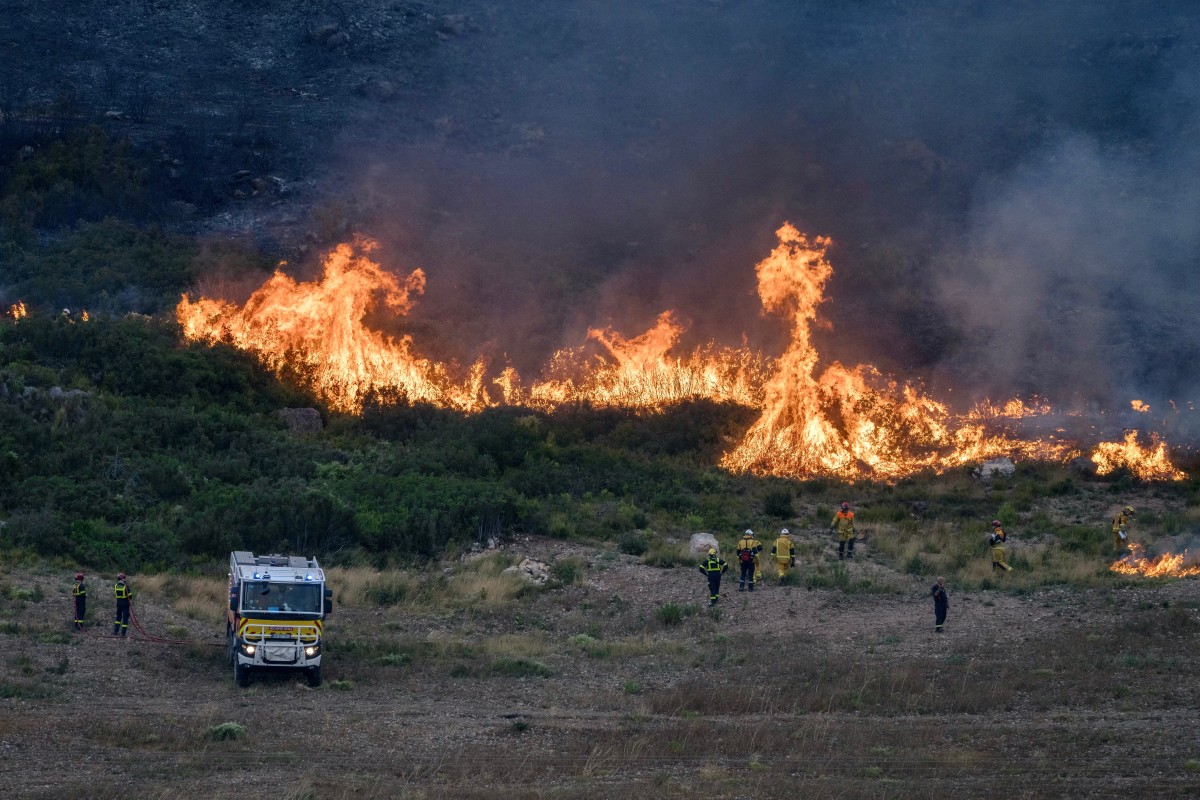
« La Chine n’a enregistré que 226 départs de feu en 2025, en France, on en est déjà à plus de 13 000. » La phrase a de quoi alarmer, alors que l’été 2026 est marqué par les incendies dans l’Hexagone. À croire cette publication sur les réseaux sociaux, cela voudrait dire qu’il y aurait presque 58 fois plus de départs de feu en France qu’en Chine.
Le grand écart entre les chiffres avancés est pourtant incorrect. Il est la conséquence d’une confusion entre le nombre de départs de feu – tous feux confondus – et celui de feux de forêt, seulement. Les Surligneurs font le point.
Tout est parti d’un reportage diffusé au JT de 13h
L’affirmation s’accompagne d’un reportage diffusé au journal télévisé de 13h de TF1 du 2 août 2026 : « Chine, techniques radicales contre les incendies ». « En vingt-cinq ans, la Chine a divisé par 100 le nombre d’incendies forestiers sur son territoire », notent les journalistes qui ont réalisé ce sujet avant d’insister sur les méthodes de dissuasion mises en place par le gouvernement chinois pour enrayer les départs de feu de forêt. Dans les deux minutes de reportage, il n’est fait mention d’aucun autre chiffre.
Mais alors, comment l’internaute relayant le reportage a-t-il pu conclure qu’il n’y aurait eu que 226 départs de feu en Chine contre 13 000 en France ?
Côté français, pas de mention d’un quelconque bilan chiffré dans le reportage. Néanmoins, le 30 juillet 2026, le ministre de l’Intérieur a fait état de « 14 131 feux depuis le début de la saison », en conférence de presse. Un nombre qui se situe donc dans le même ordre de grandeur que ce qu’avance l’internaute.
Côté chinois, il faut se référer au lancement du reportage (à partir de 9 min 50) – qui n’apparaît pas dans l’extrait choisi, et qui n’est plus disponible en ligne, mais que Les Surligneurs ont pu consulter. « Comment lutter contre ces incendies ? La Chine semble avoir trouvé le remède. Elle n’a enregistré que 226 départs de feu l’an dernier, un niveau historiquement bas », annonce la présentatrice du JT, Audrey Crespo-Mara.
Le reportage concerne exclusivement les départs de feu de forêt en Chine, mais il est donc lancé avec un chiffre présenté comme celui, plus général, des « départs de feu ». Cette imprécision peut expliquer l’interprétation erronée qui en est faite par l’internaute.
Distinguer feux et feux de forêt
Les chiffres concernant les incendies en général et les feux de forêt sont assez difficiles à comparer, car tous les services de l’État, même au sein d’un même pays, ne comptabilisent pas de la même façon.
Ainsi, en France, en 2024, 234 702 incendies ont été recensés par la direction générale de la Sécurité civile et de la gestion des crises (DGSCGC). Parmi ces feux, en 2024, la majorité provenait de feux d’habitations et de bureaux (63 023 interventions pour ce motif) quand les feux de végétations comptabilisaient 29 270 interventions. Pour cette même année 2024, la Base de données sur les incendies de forêt en France (BDIFF) – pilotée par le ministère de l’Agriculture et de la Souveraineté alimentaire et le ministère de l’Intérieur – ne comptabilisait « que » 1 356 feux de forêt. Pour l’année suivante, en 2025, l’Office national des forêts (ONF) répertoriait 15 000 départs de feu ont été répertoriés, dont 1 800 feux de forêt.
La différence entre ces chiffres s’explique par le fait que la DGSCGC recense les interventions des pompiers, quand le BDIFF a une définition plus stricte : les incendies de forêt sont restreints aux feux qui touchent une zone forestière d’une « surface minimale de 0,5 hectare et que des arbres ou arbustes y sont partiellement ou complètement détruits ».
En 2025, la Chine a enregistré 841 000 feux (selon le Bureau national des incendies et des secours), dont 397 000 « incendies en plein air ». Seuls 272 ont été qualifiés de « feux de forêt », détaillait Wang Tianrui, porte-parole de l’Administration nationale des sapeurs-pompiers, lors d’une conférence de presse en mars 2026.
Le règlement concernant l’identification des feux de forêt en Chine a été modifié fin 2025. Ainsi, à partir de 2026, sont considérés comme des feux de forêt des incendies qui touchent une superficie forestière supérieure à 0,067 hectare et/ou qui font un ou plusieurs blessés graves, tandis que pour les feux de prairies, la superficie doit être supérieure à dix hectares brûlés.
Un fossé entre le nombre de feux de forêt en Chine et en France
Même s’il est périlleux de faire une comparaison entre deux systèmes de classification différents, il est possible d’avoir un ordre d’idée du nombre d’incendies à la fois en Chine et en France. L’an dernier, il y a eu 3,6 fois plus de feux sur lesquels sont intervenus les secours – tous feux confondus – en Chine qu’en France. À noter que la superficie du territoire chinois représente environ 17 fois la France métropolitaine.
De la même façon, la définition de « feu de forêt » n’est pas exactement la même entre les deux pays, mais, à en croire que les données des services de sécurité des deux pays, la France compterait 6,6 fois plus de feux de forêt que la Chine (en 2025, 1 800 en France contre 272 en Chine). Si l’écart annoncé par l’internaute (13 000 contre 226) est faux, ce ratio – 6,6 fois plus – peut légitimement interroger.
Le reportage de TF1 évoque des pistes pour expliquer une moindre proportion d’incendies en Chine : les politiques de prévention, surveillance et répression particulièrement développées en Chine. La manière de comptabiliser les incendies forestiers, du côté des administrations chinoises, pourrait éventuellement jouer un rôle aussi, comme nous l’avons évoqué.
La différence dans la couverture forestière de chaque pays pourrait aussi apporter une explication, notamment mise en relation avec la densité de la population. Le taux de boisement s’élève à 32 % en France métropolitaine contre 25 % en Chine. Mécaniquement, le territoire français se trouve donc un peu plus exposé au risque de feux de forêt.
En superposant une carte des forêts avec celle de la densité de la population, il est possible d’affiner l’analyse à l’échelle régionale. Certaines provinces particulièrement peuplées en Chine sont moins densément boisées, au Nord-Est notamment. L’urbanisation à proximité des forêts est un facteur clé pour penser les risques de feux. En France métropolitaine, 90% des départs de feux sont d’origine humaine, précise l’ONF.
La pertinence du calcul du nombre de départ de feu
Plus largement, d’autres indicateurs sur les incendies sont à considérer en plus du nombre de départs de feu, pour comparer la situation entre deux pays, comme par exemple la durée du feu et la superficie brûlée. « La surface des feux est importante pour arriver à voir la puissance des feux, notamment à leur éclosion, note Christophe Chantepy, expert en Défense des forêts contre les incendies (DFCI) pour l’ONF. Jusqu’à présent 95 % des feux étaient arrêtés avant de faire 5 hectares [en France], grâce à l’efficacité des services de lutte. »
Le spécialiste revient sur le suivi du nombre de départs de feu : « Il est pertinent car un feu qui ne démarre pas ne va donc rien détruire. C’est là que nous voyons notamment la force des politiques de prévention. Mais tout seul, sans analyse, ça ne vaut rien. » Il ajoute : « On pourrait avoir un nombre de départs de feu supérieur et pour autant une meilleure sensibilisation. Des actes qui étaient sans conséquences les années précédentes se retrouvent [maintenant] à pouvoir faire démarrer un feu, avec la sécheresse de la végétation. »
Auteurs :
Autrice : Mathilde Lafargue, journaliste
Relectrice : Clara Robert-Motta, journaliste
Liens d’intérêts ou fonctions politiques déclarés des intervenants à l’article : aucun
Secrétariat de rédaction : Clara Robert-Motta, journaliste
L’article Non, la France ne compte pas 58 fois plus de départs de feu que la Chine est apparu en premier sur Les Surligneurs.
-
Grenoble : Apprendre à incendier un utilitaire Equans
Cric / dimanche 9 août 2026
La nuit du 21 au 22 juillet, un véhicule utilitaire appartenant à la société Equans a été incendié à Grenoble, dans la rue de la Pasionaria
Pour cela, il suffisait d’une simple plaque chimique allume-feu à base de kérosène blanc pour allumer le feu. Elle est placée sur le pneu avant de n’importe quel véhicule à roues, et allumée avec un briquet qui n’a pas peur du vent, puis le pneu commence à prendre feu après quelques minutes. Ce type d’incendie peut être facilement éteint avec un petit extincteur tant que le moteur n’a pas été touché.La plaque d’allume-feu doit rester dans son emballage plastique pour limiter les odeurs pendant le transport, puis elle est allumée dans son emballage car il brûle bien. Si l’emballage plastique porte des inscriptions, placez-les face vers le haut, ils brûleront mieux que face contre le bas. Ces plaques peuvent s’acheter dans tous les supermarchés, payez en espèces, portez au moins une casquette pour vous protéger des caméras.
Pour consulter les sites ci-dessous, nous recommandons d’utiliser Tor et Tails (https://tails.net)
Pour mieux éviter la répression : https://www.notrace.how
Pour mieux utiliser les outils numériques : https://www.anarsec.guide
Pour donner des idées : https://warriorup.noblogs.orgLes cibles sont partout, repérez votre itinéraire, évitez les caméras, changez de tenue, attaquez puis disparaissez dans la nuit.
-
Nantes : Actions directes contre le CRA au champs de manoeuvres
Indymedia Nantes / samedi 8 août 2026
La préfecture a installé des barrières devant le terrain où ils veulent construire un CRA. Il y a deux semaines des camarades sont allé.es les débouloner (voir article) [relayé aussi ici ; NdAtt.]. La préfecture les a remises. On s’est dit que c’était à notre tour d’aller les enlever. Arrivé.es sur place, on a trouvé toutes les barrières en vrac par terre. Bravo à l’équipe déterminée qui est passé avant nous !
-
Hœdic (Morbihan) : « La jeunesse emmerde le Front national »
Le Parisien/ dimanche 9 août 2026Une apparition qui n’est pas passée inaperçue. Vendredi 7 août, Marine Le Pen a été chahutée alors qu’elle faisait escale sur l’île d’Hoëdic, dans le Morbihan. Sur les images rapidement relayées sur les réseaux sociaux, on voit la candidate du Rassemblement national à l’élection présidentielle devant un restaurant, avant d’embarquer sur un bateau sous les sifflements de plusieurs personnes.
Les quelques personnes réunies sur la plage lui crient « La jeunesse emmerde le Front national », refrain de Porcherie, chanson du groupe punk Bérurier Noir sortie au milieu des années 1980. Habituée à être secouée, Marine Le Pen répond aux manifestants par un salut apparemment ironique avant que son embarcation ne s’éloigne.[…] La présence de la députée dans la région n’a rien d’inhabituel. Comme chaque année, Marine Le Pen se réfugie dans son fief familial breton à La Trinité-sur-Mer.
La cité balnéaire occupe depuis longtemps une place particulière dans l’histoire familiale. Jean-Marie Le Pen, mort en janvier 2025, y est né en 1928 et y est enterré. Hoëdic ne se situe qu’à une heure en bateau de là. […] -
En Côte d’Ivoire, les promesses englouties du barrage d’Eiffage
""«Mediapart» avait révélé en 2025 l’impact catastrophique pour la biodiversité du barrage de Singrobo, construit par le géant français du BTP Eiffage. Aujourd’hui, le chantier est à l’arrêt, et les riverains ont perdu leurs moyens de subsistance et dénoncent le montant ridicule des indemnités. -
Rejets massifs de PFAS : une métropole porte plainte contre BASF

La plainte déposée par la Métropole de Rouen vise les rejets massifs de polluants éternels, le TFA, provenant d'une usine de l'entreprise de pesticides BASF.
Lire la suite - Info / Pesticides , Pollutions
La Métropole de Rouen a déposé une plainte le 30 juillet avec constitution de partie civile, adressée au procureur de la République, contre l'entreprise de pesticides BASF pour des rejets de polluants éternels (PFAS) en provenance de son usine de Saint-Aubin-lès-Elbeuf (Seine-Maritime), classée Seveso seuil haut. Le chimiste allemand (…) -
L’Amérique latine sous le règne de Trump et de Dieu
L’arrivée au pouvoir d’Abelardo de la Espriella en Colombie coïncide avec la volonté de Washington de reprendre la main dans le sous-continent. Tout comme Donald Trump, le nouveau président colombien instrumentalise la religion au service d’un nationalisme chrétien. -
Traitement des violences sexuelles sur mineurs: des policiers outrés par un Darmanin amnésique
Après la révélation d’un courrier adressé à Laurent Nuñez, des policiers dénoncent l’«hypocrisie» et la «trahison» de Gérald Darmanin. Celui-ci pointe des dysfonctionnements structurels des services d’enquête alors qu’il a été ministre de l’intérieur pendant quatre ans. -
Meta dévoile Muse Glimmer et Mark Zuckerberg en profite pour dérouler sa « philosophie » de l’IA

Meta publie Muse Glimmer, un modèle d'agent de 30 milliards de paramètres conçu pour tourner en local, sous licence ouverte. L'occasion pour Mark Zuckerberg de publier un long texte définissant sa doctrine sur l'avenir de la superintelligence.
-
Quels sont les meilleurs smartphones en 2026 ? Voici ceux que nous achèterions vraiment

Après plusieurs mois à passer d’un iPhone à un Galaxy, puis d’un Pixel à un smartphone pliant, Numerama a fait le tri. Des modèles à 300 € aux appareils qui frôlent les 2 000 €, voici les smartphones qui méritent votre argent en 2026.
-
Trump admits reflecting pool makeover was rushed but renews vandalism claim
US president on Truth Social concedes contractor had cut some corners to finish $14m renovation project by deadline
Donald Trump has conceded his own administration’s renovation of the Lincoln Memorial reflecting pool was rushed and shoddy, while insisting that alleged vandals were to blame for damage to the Washington landmark.
In a post on his Truth Social platform, the US president said the pool’s contractor had cut some corners to finish the $14m repainting project in time for a 4 July opening. “As with many jobs, there was also some contractor error done by rushing the job,” he wrote on Sunday, claiming the resulting damage from this was confined to “a very small area” and “relatively inconsequential”.
Continue reading... -
John Oliver on Trump’s DoJ: ‘Potential long-term damage is difficult to sum up’
The Last Week Tonight host discussed how the president has transformed, weakened and weaponised the Department of Justice
John Oliver took aim at Donald Trump’s attempts to corrupt the Departmenr of Justice, calling it a once-respected institution that has now been infected by “utter maniacs”.
The Last Week Tonight host spoke about justice and how it’s “both a snatched blinded lady and a pretty good name for a dog above 40lb” before talking about the “absolute fiasco” that has warped the justice department.
Continue reading... -
Incapables !
Les fuites de données personnelles vont continuer, encore et encore...
Depuis 1997, l'auteur de ces lignes pointe l'inaction des entreprises et des administrations en matière de protection des données personnelles. D'une part la sécurité informatique est délaissée, d'autre part les données sont monétisées. Ces deux points ne sont pas décorrélés. Résultat, les utilisateurs sont plongés dans un cauchemar numérique sans même le savoir, avant même que leurs données ne fuitent.
 Avant, ne circulaient que les données que vous vouliez envoyer. Maintenant, on vous vole les vôtres, les plus personnelles. - CC
Lorsque Internet est devenu accessible au grand public, les machines avaient un rôle : faire circuler l'information. Les tuyaux étaient la voie (on les appelait « les autoroutes de l'information »). Les machines faisaient ce qu'on leur demandait. Amener la donnée d'un point A à un point B. Et puis ça s'est gâté.
Les entreprises, très frileuses au début, ont débarqué en masse. Elles ont dépensé ses millions pour des sites Web faits à la va-vite. Tellement à la va-vite que leurs serveurs étaient de véritables passoires. Les données confidentielles des entreprises fuitaient, les données personnelles de leurs clients s'étalaient sur le Net.
L'auteur de ces lignes s'était d'ailleurs fait une spécialité de raconter dans des articles les mésaventures des boites ou des administrations de tous pays qui affichaient côté marketing un message triomphant sur leurs présence sur Internet et de l'autre, les données personnelles de leurs clients ou leurs plans stratégiques les plus confidentiels. Copies d'écran à l'appui, pour le #LULZ...
Chaque année, l'idée de pouvoir trouver des serveurs aussi importants mal configurés semblait à première vue un challenge. La source d'articles allait forcément se tarir au fur et à mesure que ces technologies devenaient mieux connues, que la sécurité informatique se faisait plus présente, que les bugs étaient révélés avec l'apparition du mouvement du « full disclosure » et de...
-
NORAD says fighter jets intercepted several general aviation aircraft over Bedminster
The North American Aerospace Defense Command (NORAD) announced on Sunday that its F-16 fighter jets intercepted several general aviation aircraft over Bedminster, New Jersey, where Trump's golf club is located. Reports indicated that the aircraft violated the temporary flight restrictions that were put in place for the surrounding area. Two aircraft were reported connected to the incident... -
White House, Trump campaign remove Taylor Swift songs from posts
The White House and President Trump's campaign team have removed music from Taylor Swift from their online videos. A TikTok clip of Trump and first lady Melania Trump posted six days ago with Swift's song "August" is now silent. The caption still reads, "mood because it's August and Donald Trump is your president."... -
When does daylight saving time end in 2026? As early as possible
We're less than three months from gaining an hour of sleep – unless Congress acts quickly. While the House earlier this summer passed a bill that would make daylight saving time – the time we're on right now – permanent, it's unclear if or when the Senate could take up the legislation. President Trump, however, has expressed his support for the bill. If the Senate doesn't pick up the bill soon, and no other action is taken, our clocks will soon fall back to standard time until March... -
Netanyahu calculates upsetting Trump is his least-bad option
Netanyahu calculates upsetting Trump is his least-bad option Read more about Netanyahu calculates upsetting Trump is his least-bad option -
Washington Policy Review: August 9, 2026
Today’s Report
1. Overview
2. White House News
3. Truth Social Posts
4. Government Department News
5. 2028 Democratic Presidential Candidates
6. AI & Tech Company News
7. Congressional Watch
8. Policy Impact Analysis & Heatmap
1. Overview
President Trump announced that Will Scharf will serve as Assistant to the President and White House Counsel beginning September 1st. Trump praised the outgoing counsel, David Warrington, for his service while describing Scharf as “Tough, Strong, and Smart.” The President further characterized Scharf’s background as essential for continuing his administration’s legal defense against what he labeled the “corrupt and illegal campaign of Weaponization” orchestrated by the previous administration.
Regarding domestic matters, Trump reported on ongoing repairs and security upgrades at the Reflecting Pool following alleged vandalism by David Hearn. He asserted that Black and Brown voters are increasingly “flocking to the Republican Party” because they fundamentally reject “communism and socialism.” Internationally, the President highlighted a report documenting a “worldwide border crackdown” under his tenure and shared an opinion piece by Hillary Clinton suggesting his Gaza policy is currently the most viable option available. Trump also posted updates regarding his personal time spent golfing with Gary Player at his properties in New Jersey and Scotland.
The State Dept is actively engaging Caribbean leaders through the CANTO 2026 conference to advocate for secure digital infrastructure and the exclusion of untrusted vendors from regional ICT ecosystems. In tandem with the Commerce Department, the agency is providing technical assistance to help regional governments draft legislation to improve 5G, satellite connectivity, and AI readiness. Additionally, Deputy Secretary of State Christopher Landau began a regional trip to Trinidad and Tobago and Guyana to discuss energy security, critical minerals, and economic investment with local leadership. Meanwhile, Secretary of War Pete Hegseth is visiting Joint Base Charleston alongside several state and federal officials, an event scheduled for broadcast on the DOW’s digital platforms.
Mandates enforcing the use of “trusted vendors” in Caribbean telecommunications impose significant compliance burdens on hardware supply chains, creating headwinds for firms reliant on diverse, cost-efficient international networks. Conversely, federal facilitation of regional energy partnerships in Guyana and Trinidad creates tailwinds for private energy producers by stabilizing supply routes, though critics warn that a lack of local oversight risks environmental and long-term market instability. Finally, the prioritization of domestic defense infrastructure maintenance signals steady support for local base operations, though observers note that this narrow focus may offer only limited improvements to broader defense procurement efficiency.
2. White House News
No White House news found.
3. Truth Social Posts
Trump announced that Will Scharf will become Assistant to the President and White House Counsel effective September 1st, succeeding David Warrington, whom he praised for doing a “truly outstanding job.” Trump described Scharf as “Tough, Strong, and Smart,” noting his legal background and history of representing the administration against what he termed the “corrupt and illegal campaign of Weaponization” conducted by the previous administration.
Regarding domestic affairs, Trump highlighted witness testimony from a National Park Service employee alleging that David Hearn vandalized the Reflecting Pool, while also noting that security cameras are being installed and the pool will reopen shortly. He also asserted that Black and Brown voters are “flocking to the Republican Party” because they reject communism and socialism and recognize the party’s history. In the international sphere, Trump shared a report crediting his leadership for a “worldwide border crackdown” and circulated an opinion piece by Hillary Clinton suggesting that despite opposition, his Gaza plan is currently the best available option.
During his personal time, Trump posted about spending time with Gary Player at Bedminster and shared an additional image of the golfer at Trump Turnberry. He also featured the 10th hole at his Palm Beach County golf course and commented on “51 years of bad behavior.”
Reference: https://truthsocial.com/@realDonaldTrump
4. Government Department News
State Department (state.gov)
United States Advances Trusted Digital Infrastructure at CANTO 2026
The U.S. engaged Caribbean leaders at the CANTO Annual General Meeting to promote secure digital infrastructure and exclude untrusted vendors from regional ICT ecosystems. Officials introduced a new initiative to expand undersea cables and improve 5G, satellite connectivity, and AI readiness. The State Department, in collaboration with the Commerce Department, is providing legal and technical assistance to help regional governments draft trusted-vendor legislation, aiming to bolster hemispheric network security and long-term economic growth.
Deputy Secretary Landau’s Travel to Trinidad and Tobago and Guyana
Deputy Secretary of State Christopher Landau is traveling to Trinidad and Tobago and Guyana from August 9-12, 2026. In Trinidad and Tobago, he will meet with Prime Minister Kamla Persad-Bissessar to discuss energy, security, and economic cooperation. In Guyana, Landau will consult with President Irfaan Ali and cabinet members regarding expanded investment opportunities and strategic collaboration in energy and critical minerals. The visit aims to reinforce regional partnerships, energy resilience, and shared economic prosperity.
Department of War (war.gov)
Secretary of War Pete Hegseth Travels to Joint Base Charleston, South Carolina
Secretary of War Pete Hegseth is scheduled to visit Joint Base Charleston in South Carolina. He will be accompanied by Secretary of the Air Force Dr. Troy E. Meink, Treasury Secretary Scott Bessent, Governor Henry McMaster, and Senator Darline Graham. The event will be broadcast on Pentagon Channel 2 and livestreamed across official Department of War digital platforms.
5. 2028 Democratic Presidential Candidates
JB Pritzker (gov.illinois.gov)
Daily Public Schedule: Sunday, August 9, 2026
Governor JB Pritzker has no public events scheduled for Sunday, August 9, 2026.
6. AI & Tech Company News
No relevant AI & tech company updates found for this date.
7. Congressional Watch
Covers the 2026-08-08 session — the Congressional Record is published with a one-day delay.
No Congressional Record found for 2026-08-08.
8. Policy Impact Analysis & Heatmap
This analysis is provided for informational purposes only. It does not constitute investment advice or a recommendation to buy or sell any security.
Impact on Market
Based on today’s policy developments, our analysis identifies the following market impact themes:
THEME 1. SECURE DIGITAL INFRASTRUCTURE MANDATES
United States efforts to promote trusted vendors in the Caribbean represent a systematic attempt to isolate non-aligned telecommunications providers. This directive imposes significant compliance burdens on firms reliant on multi-national hardware supply chains. Critics argue such mandates disrupt existing cost-efficient networks and may provoke retaliatory regulatory actions from international competitors.
THEME 2. ENERGY SECURITY AND REGIONAL DIPLOMACY
Diplomatic missions to Guyana and Trinidad highlight an intensification of U.S. focus on regional energy partnerships. By facilitating cooperation between private energy producers and regional governments, the administration aims to secure reliable supply routes. Opponents worry that deepening these ties without robust local oversight could lead to environmental vulnerabilities and long-term instability in regional energy markets.
THEME 3. DEFENSE SECTOR READINESS
The Secretary of War’s focus on military installations indicates a continued priority for domestic defense infrastructure maintenance. This visit underscores the importance of operational readiness in key strategic regions like the Carolinas. Critics contend that prioritizing localized base visits over broader strategic reform may yield limited gains for overall defense procurement efficiency.
Policy Impact Heatmap with Market Direction
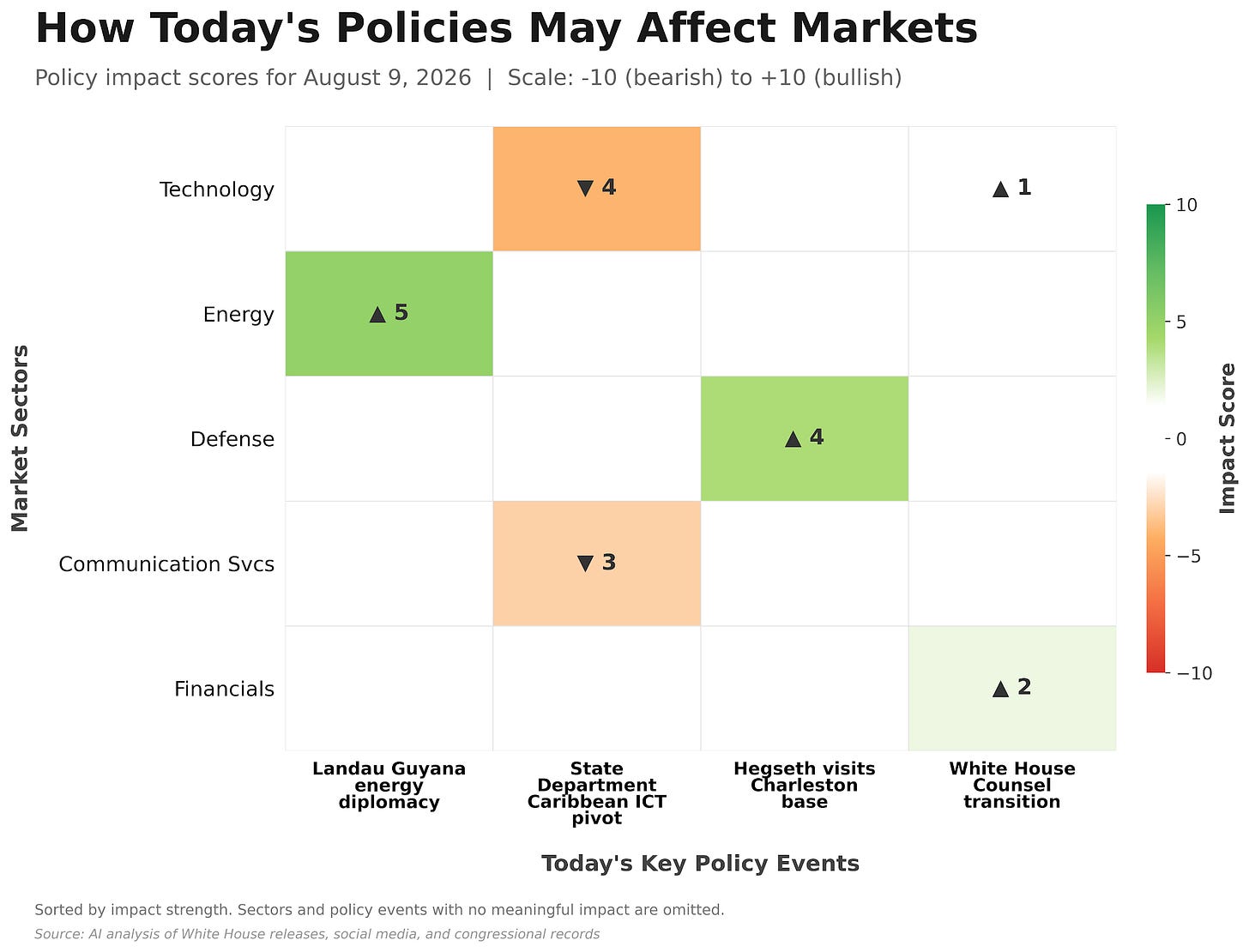
Each cell shows an estimated impact score on a fixed scale of -10 to +10, reflecting how today’s policy developments may affect each market sector. Positive scores (green, ▲) suggest bullish impact; negative scores (red, ▼) suggest bearish pressure. Rows and columns are sorted by impact strength, and sectors and policy events with no meaningful impact are omitted. The heatmap, the analysis below, and the Impact on Market themes above are produced from a single unified analysis: the heatmap visualizes the magnitudes, while the text explains the causal reasoning behind them.
State Department efforts to secure Caribbean digital infrastructure aim to displace foreign competitors from the regional market. This regulatory alignment forces telecommunications firms to pivot away from specific supply chains, increasing short-term capital expenditures. Energy sector sentiment improves as diplomatic focus on Guyana and Trinidad signals deepened bilateral cooperation regarding regional resource extraction and supply security. These efforts are viewed as strategic measures to consolidate western energy dominance.
Concurrently, the appointment of a new White House Counsel marks a transition in the administration’s legal and regulatory posture. Market participants often interpret such personnel changes as signals for shifts in antitrust enforcement or compliance standards. While the administration maintains a rigorous stance on border and digital security, opposition figures remain concerned that these actions may lead to retaliatory trade barriers or increased geopolitical friction in the Western Hemisphere. The focus remains on strengthening domestic and allied industrial capacity through targeted engagement and infrastructure oversight.
-
GOP midterm strategy embraces Trump's 'communism' fixation
Painting Democrats as communists would not have been their first choice. But current and former White House aides welcome the midterm election strategy that President Donald Trump has concocted — especially as administration officials have struggled to defend Trump's economic policies in his second term. "Where things are at right now, Trump's record doesn't really get the base too excited," a former aide to the president told MS NOW, acknowledging that "if you look at what voters care about right now, Trump doesn't have a lot to boast of."... -
«C’est dangereux pour les fonds marins, les bateaux et les baigneurs» : la pollution invisible des vieux câbles internet sous-marins
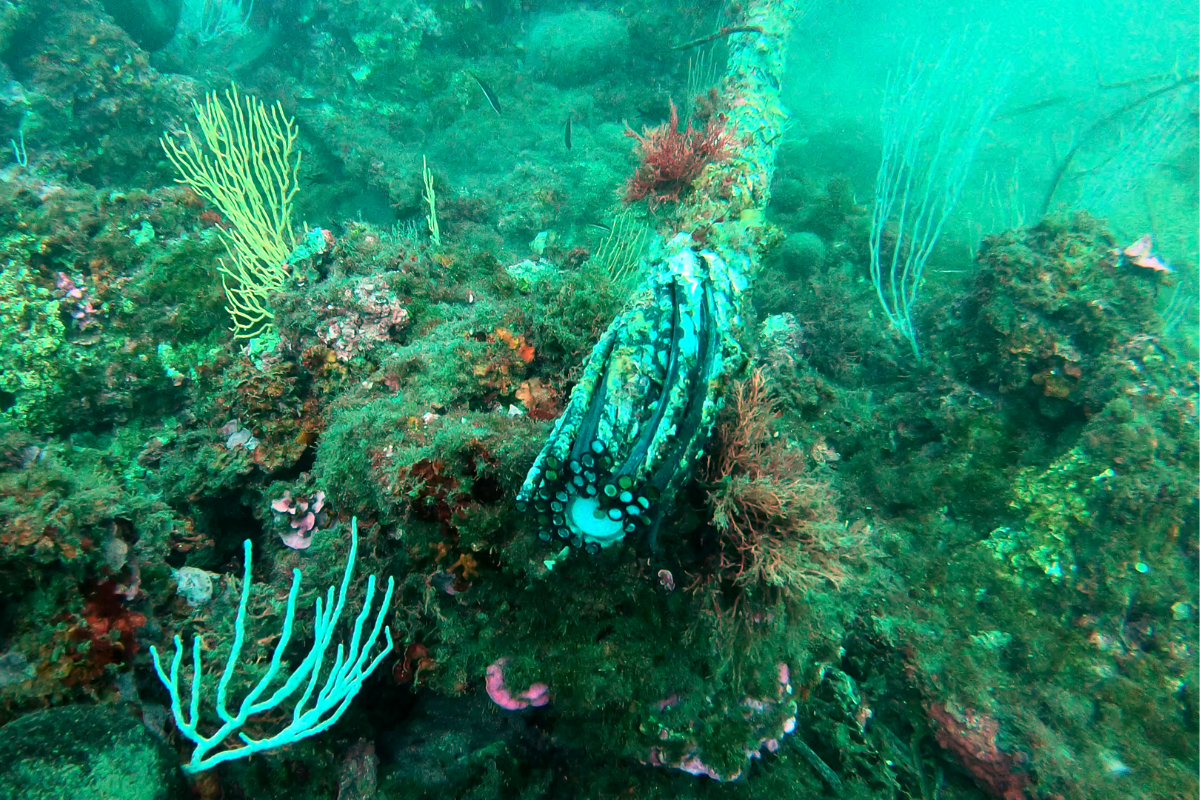 Une fois hors service, les câbles qui voient passer nos communications internet et téléphoniques, restent souvent sur place, au milieu des récifs. © Parc marin de la Côte bleue
Ce printemps, un petit événement a animé le monde de la tech : le premier câble transatlantique de fibre optique, le TAT-8, a été retiré des fonds marins. Méconnu, ce type d’infrastructure voit passer 99% des données internet mondiales, mais aussi les communications téléphoniques. Si l’opération a été largement saluée par la presse spécialisée, c’est qu’elle est peu courante.
D’après l’un des rares chiffres sur le sujet, issu de l’industrie elle-même, plus de 3,5 millions de kilomètres de câbles sous-marins ont été posés depuis le milieu du 19ème siècle. Les deux tiers sont aujourd’hui inactifs et «la majorité est laissée sur place». Le TAT-8 ne fait d’ailleurs pas exception à la règle : seulement 45% du câble a en réalité pu être retiré.
En l’absence de législation internationale sur le sujet, le retrait des câbles est d’abord un enjeu de rentabilité. L’activité de l’entreprise à l’origine de l’opération, Subsea Environmental Services, consiste à acheter des câbles hors service à ses propriétaires pour revendre les métaux qu’ils contiennent. Pour que cela reste intéressant, elle se limite aux eaux internationales, reconnaît son directeur John Theodoracopulos : «En dehors des zones internationales, il y a des réglementations que nous ne sommes pas en mesure de prendre en compte.» Pour rappel, les zones maritimes à plus de 370 kilomètres des côtes ne sont sous la juridiction d’aucun État : ce sont les eaux internationales.
En clair, si Subsea Environmental Services veut opérer dans les eaux nationales d’un État, elle doit réaliser des études d’impact et se plier à certaines règles environnementales. L’entreprise, l’une des rares spécialisées dans ce domaine, évite aussi les zones dans lesquelles les câbles s’emmêlent et où en retirer un pourrait abîmer les autres. Elle se concentre donc sur une petite partie du réseau hors service, celle qui combine facilité de démontage et absence de réglementation.
Du plomb en zone baignable
Ces entreprises ne représentent donc pas une solution à grande échelle pour le démantèlement des câbles inactifs. D’autant plus que ce n’est pas en haute mer mais près du littoral que les fonds marins sont les plus riches, et donc les plus susceptibles d’être abîmés. C’est ce qu’a constaté le Parc marin de la Côte bleue (PMCB), dans les Bouches-du-Rhône. Le site se trouve en périphérie de Marseille, premier hub européen de trafic de données internet, avec 17 câbles actifs. En 2019, il a réalisé une expertise d’impact écologique inédite sur quatre câbles Orange hors service qui traversent le parc.
Le PMCB a constaté plusieurs dégâts dans son périmètre. Certaines infrastructures qui ne sont plus attachées bougent quand la mer est agitée et écrasent les herbiers de posidonie, essentiels à l’écosystème marin. D’autres, dont la protection se détériore, libèrent des substances toxiques. «C’est dangereux pour les fonds marins, les bateaux et les baigneurs. La protection en plomb se défait et des morceaux de métal se désagrègent en zone baignable à deux mètres de profondeur», résume Benjamin Cadeville, auteur du rapport d’expertise.
L’expert a contacté Orange pour exiger le retrait des câbles. La société de télécommunications a d’abord refusé, prétextant qu’ils ont été posés au temps où l’entreprise était publique et portait le nom de France Télécom. Si l’argument est discutable, Orange ayant hérité des câbles, le parc ne parvient pas à prouver sa responsabilité, raconte Benjamin Cadeville : «Dans le code de l’environnement, le propriétaire d’une infrastructure doit remettre en état le site quand elle est hors service. Mais, à l’époque, personne ne faisait attention, donc on n’a pas conservé les preuves.»
Des câbles censés durer vingt-cinq ans… hors service au bout de dix
Le parc a finalement obtenu le démantèlement des câbles dans l’enceinte du parc grâce à un accord à l’amiable avec Orange fin 2021. En revanche, tout n’a pas pu être retiré : «Par moment, il est plus dommageable de retirer un câble, car le naturel se mélange avec les déchets. Certaines parties sont trop enfoncées dans le sable, d’autres trop imbriquées avec les récifs», explique Benjamin Cadeville. Plus un câble reste longtemps dans l’eau, plus ce risque augmente. Aujourd’hui, le PMCB doit surveiller l’état des câbles restants pour prévenir les nouvelles détériorations. Contactée, Orange ne souhaite pas commenter mais indique que sa politique «est de respecter les obligations légales tout en optimisant les opérations marines dans les zones concernées».
Des situations similaires existent partout où il y a des câbles hors service en France. C’est seulement depuis 2011 que l’État impose à leurs propriétaires d’allouer, dès la mise à l’eau, un montant à leur démantèlement sur la partie dans les eaux françaises. Pour Clément Marquet, chercheur à l’École des mines de Paris spécialisé dans l’empreinte du numérique, cette évolution légale est cruciale mais arrive un peu tard : «Au début des années 2000, il y a eu une bulle spéculative autour d’internet : on a posé plus de câbles que nécessaire. Dès les années 2010, ils sont devenus obsolètes avec l’arrivée de nouveaux câbles plus puissants.»
Ces infrastructures sont conçues pour tenir vingt-cinq ans mais, dans les faits, c’est beaucoup moins. On parle de «durée de vie économique», explique Clément Marquet. «Un câble peut fonctionner seulement sept à dix ans s’il est considéré comme obsolète», pointe le chercheur. C’est le cas des quatre câbles de la Côte bleue, qui n’auront duré qu’une dizaine d’années chacun ; ou encore du TAT-8. L’infrastructure transatlantique retirée au printemps était hors service depuis une panne en 2002, après quatorze ans d’activité. La réparation n’a pas été jugée assez rentable.
Les eaux internationales, ce far west
En l’absence de régulation, la gestion des anciens câbles est encore pire en haute mer, déplore Clément Marquet : «Dans les eaux internationales, une pratique consiste à couper les câbles et à les laisser sur le côté.» Benjamin Cadeville abonde : «Quand ils veulent faire de la place pour un nouveau câble, ils poussent les anciens afin de dégager la route : c’est l’équivalent de tasser une poubelle.»
Il n’existe pas d’étude indépendante sur l’impact écologique de la fin de vie des câbles en haute mer. À peine existe-t-il une liste de recommandations pour retirer les câbles sans abîmer les fonds marins, fournie par une organisation qui regroupe des acteurs du secteur. Une liste non contraignante : «Rien n’impose le retrait des câbles dans une zone maritime située au-delà des eaux territoriales», rappelle le texte.
L’obsolescence de ces infrastructures a aussi des conséquences en termes de consommation de ressources naturelles, comme le montre l’association Le Nuage était sous nos pieds, qui alerte sur l’empreinte écologique du numérique. «À chaque nouveau câble, il y a des études environnementales ; mais elles ne prennent pas en compte l’extractivisme : ils n’existent pas sans l’extraction de métaux lourds», explique un membre de l’association qui a souhaité rester anonyme. «La question qu’il faut se poser, c’est : “De combien de câbles avons-nous besoin, et pourquoi ?”», développe l’un de ses camarades, qui n’a pas non plus donné son nom.
L’association rappelle la réalité concrète du numérique, loin de l’image véhiculée par les géants du secteur, qui parlent volontiers d’un internet «dématérialisé» ou «dans les nuages» – le fameux cloud. En outre, les câbles finissent de plus en plus souvent leur course dans les datacenters qui pullulent avec l’essor de l’intelligence artificielle (IA). Un développement massif qui pose question en termes de consommation en eau et en électricité. Clément Marquet souligne que le déploiement des câbles sous-marins «est indispensable à l’explosion de l’IA», elle-même «très inquiétante en termes de captation de ressources».
-
À la rencontre de ce rapace mangeur de serpents

Rapace emblématique de la garrigue méditerranéenne, le circaète Jean-le-Blanc se reproduit difficilement. Dans les Alpes-de-Haute-Provence, des naturalistes et des forestiers travaillent de concert pour protéger les nids.
Lire la suite - Reportage / Animaux , Forêts
Digne-les-Bains (Alpes-de-Haute-Provence), reportage
Cédric Arnaud a installé sa longue-vue à l'ombre d'un érable, au centre d'une clairière écrasée de soleil. Il ne lui faut pas longtemps pour l'orienter et retrouver ce qu'il cherche : un nid de circaètes (…) -
OpenAI freine le développement de son propre modèle Astra, visiblement trop doué pour le piratage

Dans un billet publié le 7 août 2026, OpenAI affirme ne pas pouvoir exclure que son prochain modèle, Astra, ait atteint le niveau de risque le plus élevé de son référentiel de sécurité interne.
-
Meta tente un retour en force dans l’IA avec Muse Glimmer, un modèle taillé pour tourner en local sur un Mac ou un PC
Meta a-t-il finalement trouvé la marche à suivre pour se sortir de l’impasse dans laquelle il se trouvait jusqu’alors ? Bloqué entre ses investissements colossaux dans l’intelligence artificielle, des réorganisations internes à répétition et des acquisitions contrariées, le géant des réseaux sociaux vient de dévoiler ce qui pourrait être le premier signe d’une renaissance. Le nom de ce phénix ? Muse Glimmer.
-
Trump envoie des bulldozers défigurer un parc national pour stopper l'immigration

Le 6 août, des bulldozers ont débarqué au sein du parc national de Big Bend, au sud du Texas, aux États-Unis. Des entrepreneurs mandatés par le gouvernement fédéral ont entamé les travaux de construction d'une barrière frontalière le long du Río Grande. « Il s'agit de l'attaque la plus odieuse contre un parc national américain depuis des générations », a déclaré Laiken Jordahl, défenseur des terres publiques au Centre pour la diversité biologique.
Lire la suite - En bref / Libertés , Politique
D'après la carte en ligne de l'agence (…) -
Aux États-Unis, une nouvelle vague de cyberattaques cible les réseaux d’eau en s’attaquant à des équipements industriels exposés sur Internet
Les autorités américaines font face à une vague inhabituelle de cyberattaques contre les services de distribution d’eau et d’assainissement. Le FBI parle « d’acteurs cybermalveillants » qui ont accédé à distance à des ordinateurs connectés à Internet utilisés par les opérateurs de l’eau. Les pirates ont modifié des paramètres, des adresses IP et des mots de passe, compromettant dans certains cas la capacité des exploitants à surveiller et contrôler leurs installations.
-
Nouvelle vague de chaleur dans plusieurs pays d’Europe
Le mois de juillet a déjà été le plus chaud jamais enregistré pour presque 120 millions d’Européens, en particulier au Royaume-Uni, en France et en Espagne. En ce début août, l’Europe affronte à nouveau des températures record et une sécheresse généralisée. -
Les multinationales pétrolières ont engrangé 93 milliards de dollars de superprofits en pleine guerre et crise climatique
Patrick Galey (Global Witness) résume l'absurdité de la situation : « Vous savez que Big Oil prend le monde pour des imbéciles lorsque l'un de leurs plus grands alliés, Donald Trump, leur intime l'ordre de freiner leur profitabilité. »
Cet article Les multinationales pétrolières ont engrangé 93 milliards de dollars de superprofits en pleine guerre et crise climatique est apparu en premier sur La Relève et La Peste.
-
Diffamation, grâce, prison: les militants marocains constamment face à la justice
Depuis quelques années, la machine répressive contre un certain nombre de figures de l’opposition, qui se battent pour la liberté d’opinion, semble s’être intensifiée. Il suffit d’une déclaration qui dérange, et les dés sont lancés pour les emmener de la convocation judiciaire à la case prison. -
Quand l’eau vient à manquer
Entre l'Aude et les Pyrénées Orientales, deux vigneronnes aux profils bien différents, remettent en cause les pratiques locales historiques pour s'adapter, dans cette région aux avant postes du changement climatique et confrontée à la diminution de la… -
Souveraineté spatiale : face à Starlink, l’UE renforce la constellation IRIS² avec 66 satellites supplémentaires dédiés à la sécurité et à la défense
Bruxelles et SpaceRISE, un consortium mené par SES, Eutelsat et Hispasat, ont finalisé un accord portant sur l’ajout de 66 satellites en orbite terrestre basse au programme IRIS².
-
Amazon installe une centrale à gaz de 7,65 gigawatts pour ses data centers
Le média Distilled a recoupé trois permis de construire déposés auprès des autorités texanes avec des images satellite montrant un défrichement démarré le 24 juillet. Amazon a confirmé derrière : le projet GW Ranch, dans le comté de Pecos, est bien le sien.
La centrale est développée par Pacifico Energy sur un terrain de plus de 8 000 acres, soit environ 3 240 hectares. Elle alignera jusqu'à 35 turbines à gaz pour 7,65 gigawatts, complétées par 1,8 GW de stockage sur batteries et 750 mégawatts de solaire installés sur place.
La particularité du projet, c'est son raccordement : il n'y en a pas.
GW Ranch fonctionne en réseau privé, isolé d'ERCOT, le réseau électrique texan. Amazon a acheté le site et achètera l'électricité produite, sans passer par la file d'attente d'interconnexion qui immobilise les autres projets pendant des années. C'est le premier campus de data centers IA hors réseau de l'entreprise.
L'argument commercial est prêt depuis longtemps. Amazon explique que son campus est alimenté par une production nouvelle sur site qui n'augmentera pas la facture d'électricité des familles texanes, et techniquement, c'est exact.

Le permis délivré en janvier par la TCEQ, l'agence environnementale du Texas, autorise jusqu'à 33 millions de tonnes de CO2 par an. La centrale au charbon la plus émettrice du pays, James H. Miller Jr. en Alabama, tourne autour de 16 millions de tonnes. Le plafond texan est donc au double.
Ce chiffre reste un plafond d'autorisation et pas une prévision, puisqu'une centrale ne tourne jamais à pleine charge toute l'année. Mais un permis calibré à ce niveau signifie que l'exploitant s'est ménagé la place pour le faire.
Le calendrier est serré. Premier électron visé au premier trimestre 2027, un gigawatt en service en 2028, cinq gigawatts et plus d'ici 2031. Pacifico avait annoncé le projet à 5 GW, il est monté à 7,65 en cours de route.
Trente-cinq turbines à gaz allumées en 2026 pour faire tourner des modèles d'IA, ça pique un peu quand même.
Environ 59 projets du même genre sont annoncés aux États-Unis, pour près de 90 GW cumulés. Amazon reste signataire du Climate Pledge, qu'elle a cofondé. Interrogée sur cette situation, l'entreprise répond que le monde est différent de ce qu'il était à l'époque. Ah ben d'accord.
Source : Distilled.earth
-
Demain l’autogestion… et ses obstacles
L’histoire du PSU est étroitement liée à celle de la CFDT. Avec l’autogestion, les deux organisations ont partagé une référence commune. Le rapport de parti à syndicat a cependant été source de conflit, tandis que l’irruption du PS est venue compliquer la donne.