Conversation
-
Judicial Notice Supplement (09.27.26): Goodbye Kiss
source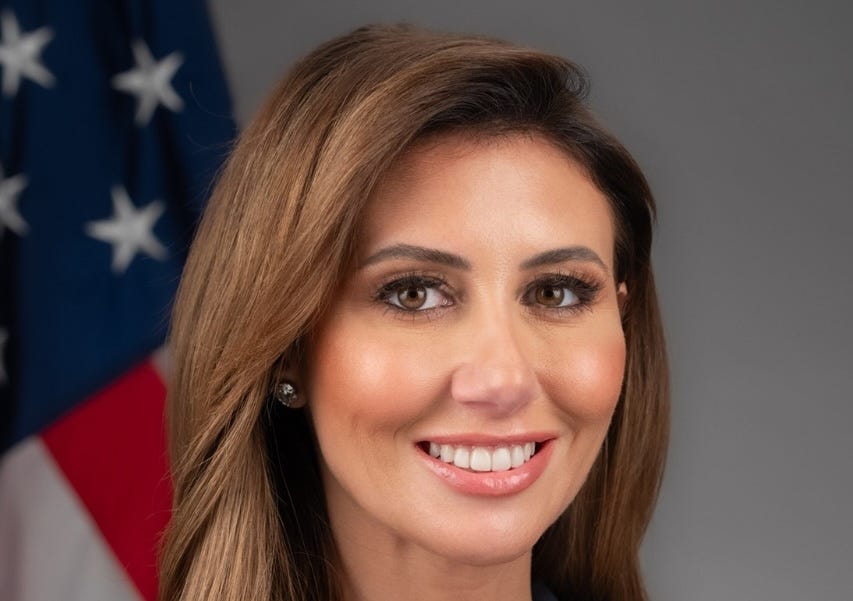 Former acting U.S. attorney Alina Habba (official portrait by the U.S. Department of Justice).
Welcome to Original Jurisdiction, the latest legal publication by me, David Lat. You can learn more about Original Jurisdiction by reading its About page, and you can email me at davidlat@substack.com. This is a reader-supported publication; you can subscribe by clicking here.
Greetings, and welcome to what I’ve dubbed “Judicial Notice Supplement”—or, in homage to the Federal Supplement or F. Supp., “JN Supp.” As I explained in yesterday’s Judicial Notice, JN Supp. is where I’ll share additional material that I couldn’t fit into Judicial Notice proper.
As I do with Judicial Notice, I’ve organized this post with topic-based headlines. The headlines are “linkable”: If you want to email JN to someone and have them focus on a particular section, you can click next to the heading and copy a link that will take the reader directly to the relevant section.
Please note that as I did with yesterday’s Judicial Notice, I’m sticking to news that broke on or before September 27 (which explains why this post and yesterday’s both bear that date). Anything noteworthy from after that date will be considered for this coming weekend’s Judicial Notice.
Let’s dive in, shall we?
Lawyer of the Week: Sheri Mecklenburg.
Besides former assistant U.S. attorney Sheri Mecklenburg (N.D. Ill.), who left the Justice Department after sending out quite the resignation letter, here are other attorneys who were in the news last week:
I seriously considered California Attorney General Rob Bonta for Lawyer of the Week. He led a coalition of 12 Democratic-led states that settled with Paramount Skydance, allowing its $110 billion acquisition of Warner Bros. Discovery to close (assuming judicial approval). Reactions to the resolution varied, as reported by The New York Times: Governor Gavin Newsom (D-Cal.) called it “a practical path forward,” while the advocacy organization Free Press, which opposes media consolidation, dubbed it “weak.” If you have an opinion, share it in the comments.
It’s official: Nathaniel Cullerton, the Wachtell Lipton litigation partner who was filmed making out with an associate in Central Park, is now a former Wachtell partner. The news was reported by the New York Post, which obtained confirmation from the firm: “Wachtell Lipton and Mr. Cullerton mutually agreed to part ways,” a spokesperson said in a statement. The associate remains at Wachtell. (If you’re wondering how on earth two Wachtell lawyers went viral for a public make-out session—and how internet sleuths (or busybodies) even figured out their identities—check out this Mashable article.)
My former office, the U.S. Attorney’s Office for the District of New Jersey, lost around 50 lawyers last year (as reported by Max Mitchell, Nicholas Malfitano, and Charles Toutant for a two-part series in the New Jersey Law Journal, here and here). Much of the attrition occurred during and after the rocky tenure of former acting U.S. attorney Alina Habba. But Habba, 42, kissed all that goodbye—and now saves her smooches for her new husband, Turkish billionaire Turhan Mildon, 29. The two got married last Saturday at the Waldorf Astoria New York, in a wedding that cost an estimated $10 million. (This is Habba’s third marriage; she was previously married to parking lot magnate Gregg Reuben and New Jersey lawyer Matthew Eyet.)
Before he was a Connecticut state government official convicted of federal bribery and extortion charges, Konstantinos “Kosta” Diamantis was a lawyer—so presumably he understood that fleeing to Greece ahead of sentencing was not going to improve his legal situation. Yes, Diamantis had surrendered his U.S. passport—but he still had a Greek passport, which authorities believe he used to take a boat to the Bahamas and then fly to London.
Mariah Medina, a criminal defense attorney in San Antonio, was reprimanded in open court for wearing this dress (click on the tweet to read the entire thread, which details Medina’s interaction with the judge):
Medina’s tweet went viral, with 7.3 million views as of this writing. Some defended her attire—e.g., Assistant Attorney General for Civil Rights Harmeet Dhillon, who declared the garment “lovely and appropriate”—while others opined that Medina should have worn a jacket over the dress.
Readers, what do you think? (In case it affects your view, this took place at a case-management hearing, with no jurors present.)
[UPDATE (5:04 p.m.): The judge who reprimanded Medina, Judge Yolanda Huff of Bexar County, Texas, responded in a statement. Some highlights:
It wasn’t just the dress; Medina was also wearing tennis shoes and carrying a backpack.
“In my opinion, she was completely disrespectful to me as the judge and exhibited unprofessional behavior in the courtroom by failing to wear professional attire required during trial proceedings.”
“I did not, in any way, embarrass her in open court. I spoke very softly and quietly to Ms. Medina—so much so that she had to lean forward to hear me. If you notice in the video, people around us were completely unaware of our conversation.”
“Ms. Medina made this a public spectacle by posting to social media. Every law student, attorney and Judge are aware of the proper attire for court.”]
In memoriam: Tara Sutton—a longtime partner in the Minneapolis office of Robins Kaplan, where she chaired the national mass-torts practice—passed away at 59 from “a brief illness” (per the firm). May she rest in peace.
Judge of the Week: Judge Timothy Kelly.
In addition to Judge Timothy J. Kelly (D.D.C.) and the temporary restraining order he issued in CNN, Inc. v. Trump, here’s additional news about judges and the judiciary:
Chief Justice John Roberts and Justices Brett Kavanaugh and Amy Coney Barrett are the three justices most often in the majority at the Court. They were also the only three justices who attended last Thursday’s state dinner at the White House honoring Chinese leader Xi Jinping. It’s not clear whether other justices were invited; back in April, all six Republican-appointed justices attended the White House state dinner held in honor of King Charles.
Judge Thomas Ludington (E.D. Mich.), who pleaded no contest to a misdemeanor drunken-driving charge in April, agreed to remain on paid leave—i.e., off the bench, not hearing cases—until September 1, 2027. If he does return to hearing cases, he will first take senior status. For more details about what Judge Ludington agreed to do to resolve two judicial-misconduct complaints—one filed by Fix the Court executive director Gabe Roth, the other initiated by Chief Judge Jeffrey Sutton (6th Cir.)—see this order from Judge Sutton.
Judicial diva is as judicial diva does? Judge Colleen McMahon—one of the biggest personalities on the S.D.N.Y., a court with no shortage of them—issued a short but scathing order in a discovery dispute (which I won’t bother summarizing; it’s only two pages, so just read it for yourself and enjoy the lulz). Over at Court Watch, Seamus Hughes and Peter Beck wrote, “We’re pretty sure we’d quit lawyering forever if we ever got this order.”
In nominations news, the Senate confirmed Angela Colmenero—most recently, deputy chief of staff to Governor Greg Abbott (R-Tex.), and before that, his principal deputy general counsel—to serve as a judge on the U.S. District Court for the Southern District of Texas.
In memoriam: Justice Edward H. Lehner—who served on the New York Supreme Court for more than 20 years, but was most well-known for helping to pass the Empire State’s groundbreaking “pooper scooper” law during his earlier stint as a state legislator—passed away at 93. May he rest in peace.
Ruling of the Week: People Not Politicians v. Onder.
The SCOTUS ruling in the Missouri election-map dispute wasn’t the only significant opinion from last week. Here are other noteworthy decisions and dispositions:
Elsewhere on the emergency docket, last Friday the justices “cleared the way for the Trump administration to move forward with its plan to use a modified centralized database to verify voters’ citizenship,” per Amy Howe of SCOTUSblog. The majority in Department of Homeland Security v. League of Women Voters issued a seven-page, per curiam opinion; Justice Ketanji Brown Jackson dissented, joined by Justices Sonia Sotomayor and Elena Kagan.
Sticking with the interim docket, Justice Kagan declined to involve the Court in a high-profile custody dispute between a surrogate, McKenna West, and the intended parents with whom she had been working, Nausheen Gilkar and Omar Ahmed. After the baby boy being carried by West was diagnosed with a serious heart problem, Gilkar and Ahmed asked West to get an abortion; she refused, then fled her home state of Alaska for Texas, where she gave birth. The parties have been fighting it out in court ever since. A California court ultimately recognized Gilkar and Ahmed as the boy’s parents; West asked SCOTUS to stay that ruling, but Justice Kagan denied her request.
In Anthropic PBC v. United States Department of War, a divided panel of the D.C. Circuit rejected Anthropic’s challenge to the Trump administration’s designation of the AI giant as a supply-chain risk to U.S. national security. Judge Gregory Katsas wrote the opinion, which was joined by Judge Neomi Rao; Judge Karen LeCraft Henderson dissented.
Speaking of Judge Rao, she wrote the majority opinion in Mahoney v. United States Capitol Police Board (joined by Judge Henderson), which concluded that a Capitol Police policy prohibiting public demonstrations on the East Steps of the Capitol unless they’re sponsored by a member of Congress is “unconstitutionally overinclusive.” Judge Judith Rogers dissented—in an opinion that was “even more protective of free-speech rights,” as noted by Kyle Cheney and Josh Gerstein of Politico.
The Second Circuit denied rehearing en banc in Barbosa da Cunha v. Freden, in which the panel held that detention isn’t mandatory for noncitizens who are apprehended by immigration enforcement in the interior of the United States (as opposed to at the border, where different rules apply). Judge Steven Menashi, joined in part by Judge Michael Park, dissented from that denial. Interestingly enough, Judge Matthew Schwartz, joined by Judge Richard Sullivan, concurred; although they agreed with the substantive analysis of the dissent, they didn’t support full-court rehearing, especially since the Supreme Court is likely to decide the issue soon. (This led the prominent conservative activist Mike Davis to call out Judge Schwartz, a recent Trump appointee: “Stop being weak. Bold and fearless. You’re not a Bush judge.”)
In KalshiEX LLC v. Schuler, the Sixth Circuit ruled that federal law “neither expressly nor impliedly preempts Ohio’s or Tennessee’s gambling laws.” This deepens a circuit split on who can regulate prediction markets—which I predict will make it onto the Supreme Court’s docket for October Term 2026. The unanimous opinion by Judge Julia Smith Gibbons affirmed a ruling by Judge Sarah Daggett Morrison (S.D. Ohio) and vacated one by Judge Aleta Arthur Trauger (M.D. Tenn.), reflecting how split lower courts are on this issue.
In Red Wine & Blue v. LaRosa, the Sixth Circuit reinstated an Ohio law requiring residents to present documentary proof of citizenship when registering to vote at the state’s motor vehicle offices. Judges John Nalbandian and Whitney Hermandorfer formed the majority, while Judge Kevin Ritz dissented.
In Yukutake v. Lopez, the Ninth Circuit, sitting en banc, ruled 6-5 that “Hawaii’s shall-issue regime [for firearms regulation] comports with the Second Amendment.” Judge John Owens wrote the majority opinion, while Judges Ryan Nelson, Daniel Bress, Lawrence VanDyke, Danielle Forrest, and Bridget Bade all penned or joined dissents.
File United States v. Primrose under “chutzpah.” From John Ross of Short Circuit: “Honestly, kudos to this guy who told the Ninth Circuit that using a stolen identity for over 30 years should constitute ‘adverse possession’ rather than identity theft. The case comes out the way you’d expect, but still: Way to go down swinging—or, y’know, identity-thieving.” (No, seriously: as set forth in Judge Forrest’s opinion, Walter Glenn Primrose—yes, that’s his real name—argues that “[t]here should come a time when a person who has lived under an assumed name has earned the right to that name and identity.”)
Turning to the trial courts, a New Mexico jury found Meta Platforms liable for more than 43 million violations of state law, arising out of allegedly misleading statements about the company’s privacy practices in the wake of the Cambridge Analytica data scandal. At $5,000 per violation, this could in theory add up to $219 billion—although whether anything remotely approaching that figure could survive post-trial proceedings is another question. I expect a negotiated resolution: New Mexico was one of three states that didn’t join last month’s $18 billion settlement of litigation brought by the AGs of 47 states, who alleged that the social-media giant designed Facebook and Instagram to be addictive to children and teens—and violated state and federal law in the process.
In a 63-page opinion in Trump v. Selzer, Iowa District Court Judge Scott Beattie dismissed Donald Trump’s lawsuit against the Des Moines Register and pollster Ann Selzer, arising out of a poll published before the 2024 election that showed Trump trailing Kamala Harris. Bob Corn-Revere of the Foundation for Individual Rights and Expression (FIRE), which represented Selzer, told The Times, “This lawsuit was laughable from the beginning and never should have been brought.”
Litigation of the Week: U.S. Department of Homeland Security v. D.V.D.
In other litigation news:
Could saving humanity from our AI overlords… violate the Sherman Act? The plaintiffs in Buist v. Anthropic, PBC allege that Anthropic, OpenAI, SpaceXAI, and Google all agreed “to slow the pace at which each company improves the competing products it sells to consumers”—and “[a]n agreement among competitors to reduce the quality of their products and the rate at which those products improve” is a classic antitrust violation. For more on this issue, see this WIRED article, “The AI ‘Slowdown’ Is an Antitrust Mess,” by Maddy Varner (a former technologist for the Federal Trade Commission). I’m not huge on regulation as a general matter, but I tend to agree with Professor Cass Sunstein’s view that while “[i]nnovation should not be squelched,” the serious risks posed by AI require some amount of regulation—and perhaps one underappreciated benefit of a regulatory framework is that it could give AI companies clearer protection against antitrust claims arising from safety measures requiring some degree of industry-wide coordination.
Florida Attorney General James Uthmeier filed a shareholder lawsuit against The Times, alleging that the board of directors’ lack of oversight of the outlet’s editorial practices is hurting state pension holders that own stock in the company.
Our household orders far too much food through delivery apps (even after moving from New York City to the suburbs), so it stuck with me when I read an article in the Washington Post quoting a delivery-worker advocate recommending Grubhub over DoorDash and Uber Eats, on the ground that Grubhub treats workers better. I remembered this piece when I read about a $131.5 million settlement between DoorDash and NYC, resolving claims that DoorDash underpaid or failed to pay 264,000 delivery workers.
An anonymous woman who claimed in court papers that Jay-Z (Shawn Carter) had raped her when she was 13 has recanted her allegation—and now claims that her lawyers at the time filed her case against Carter “without conducting any independent investigation, background inquiry, or due diligence, and without obtaining any corroboration of the allegations.”
Deal of the Week: Paramount Skydance’s $110 billion acquisition of Warner Bros. Discovery.
The Deal of the Week was Paramount Skydance’s $110 billion acquisition of Warner Bros. Discovery. But it’s important to remember that not all major transactions are M&A matters.
Last Thursday, Anthropic and Akamai Technologies announced a deal in which Anthropic will pay Akamai at least $11.6 billion to use its cloud infrastructure and software over seven years. Akamai is represented by a Freshfields team led by partners Ethan Klingsberg and Taryn Zucker.
Law Firm of the Week: Paul Weiss.
Over the past year, Paul Weiss has been experiencing major change. But it’s far from the only law firm in the headlines these days. Here are some others:
Two Biglaw firms that are winning in the lateral-hiring war are Gibson Dunn and Sidley Austin. For a deep dive into what they’re up to, including data, see this Law.com piece by Dan Roe and Melina Block, “Unpacking the Ambitions of Sidley and Gibson Dunn.”
Which firms are the go-to shops for the Republican National Committee this midterm cycle? The top three are Consovoy McCarthy, Jones Day, and Dhillon Law Group, according to the latest Federal Election Commission (FEC) filings.
Seyfarth Shaw LLP was hit with a proposed class-action lawsuit for allegedly failing to protect the personal information of more than 56,000 people that was exposed in an August data breach.
Duane Morris settled a lawsuit brought by former employment-law partner Meagan Garland, in which she alleged that the firm “unlawfully classifies its non-equity partners as ‘partners’ and business owners of the Firm for taxation and employment purposes, when in fact these non-equity partners are employees who misleadingly bear the title of ‘partner.’” The parties are still working out the specific terms, per Reuters.
Speaking of Reuters, Sara Randazzo’s latest column looks at how Gunderson Dettmer, a top firm serving the tech sector, is training its lawyers on winning business in the age of AI.
Uplift Investors, a Connecticut-based PE firm, signed its sixth deal to invest in a law firm’s back-office operations through a management services organization—this time with Rainwater Holt & Sexton, an Arkansas-based personal injury firm.
Move of the Week: Weil Gotshal rehiring Peter Feist from Cravath and Debra Sinclair from Willkie Farr.
In addition to the hires discussed in Judicial Notice—including Paul Weiss hiring Christopher Machera from Weil, and Weil welcoming back Peter Feist and Debra Sinclair—here are other notable moves that were announced last week:
In New York, Vinson & Elkins hired two finance partners, Loren Finegold and Ed Comber, from Latham & Watkins—and Finegold will lead V&E’s structured-finance and securitization practice.
Speaking of Latham, the firm picked up Greg Van Houten, a commercial litigator who represents corporate policyholders in high-stakes insurance coverage disputes, from Haynes Boone in Washington, D.C.
Sticking with litigators, Quinn Emanuel hired trial lawyer Sean Suber from Winston Taylor in Chicago. Meanwhile, Alston & Bird added Devin Donohue in Century City, Andy Hutchison in San Francisco, and Sandhya “Sandy” Brown in D.C. (where Brown spent 20 years at the FTC).
Speaking of lawyers with valuable government experience, former associate deputy attorney general Paul Perkins joined the D.C. office of Morrison Foerster. He’s now a partner in the investigations and white-collar defense group, as well as chair of MoFo’s False Claims Act practice.
O’Melveny & Myers hired bankruptcy and restructuring partner Penelope Jensen in New York.
Still with me? If you’ve read this far, congratulations: you’re a hard-core reader of Original Jurisdiction and Judicial Notice.
So you’re precisely the people I want to take my poll about my little experiment with “JN Supp.” Would you prefer one big news roundup, published on Sunday or Monday, or two somewhat smaller ones, delivered to you on consecutive days (starting on either Sunday or Monday)?
Thanks for reading Original Jurisdiction, and thanks to my paid subscribers for making this publication possible. Subscribers get (1) access to Judicial Notice, my time-saving weekly roundup of the most notable news in the legal world; (2) additional stories reserved for paid subscribers; and (3) the ability to comment on posts. You can email me at davidlat@substack.com with questions or comments, and you can share this post or subscribe using the buttons below.