Conversation
-
Judicial Notice (08.23.26): No Nonsense
source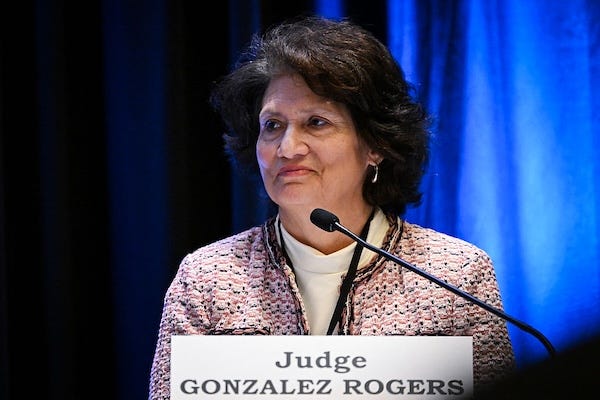 Chief Judge Yvonne Gonzalez Rogers (photo by Drew Angerer/AFP via Getty Images).
This week’s Judicial Notice is sponsored by

BriefCatch is trusted by over 22,000 legal professionals, 50 Am Law 200 firms, and 70+ courts. Built directly into Microsoft Word, it delivers real-time insights to help you write with precision, clarity, and confidence. And with RealityCheck, BriefCatch now verifies that citations are accurate and authorities are used correctly. To learn more, schedule a meeting with an expert—or try it out for free with BriefCatch Express.
*Taps mic.* Anybody out there? It’s late August, and things are quiet—which is fine by me, since my fall is looking hectic.
I published one post, my podcast interview of Molly Abraham, the new general counsel of Coinbase. We discussed pending legislation affecting crypto (the CLARITY Act), how Coinbase’s legal team is using AI, and whether em dashes—which Molly and I both adore and will continue to use, even if they’re a hallmark of AI-generated writing—should be surrounded by spaces on either side. (For more on that controversial topic, see my LinkedIn post—featuring a reader poll that’s still open.)
Here’s my practical pointer for the week: Don’t touch jalapeño peppers with your bare hands; instead, use disposable gloves. If you do touch hot peppers with your bare hands, wash them thoroughly, with something other than regular hand soap. (I learned this the hard way, but I’ll spare you the embarrassing details.)
Now, on to the news.
Lawyer of the Week: James Percival.
On July 23, James Percival, general counsel of the Department of Homeland Security, posted a thread on X that opened as follows: “Every day, the brave men and women of ICE risk their lives to remove the Worst of the Worst from our country. Today, in honor of the DHS Worst of the Worst series, I am starting a new series: Worst of the Worst, District Judge Edition.” He then criticized four judges:
Judge Matthew Kennelly (N.D. Ill.), for “enter[ing] an order staying the termination of TPS [Temporary Protected Status] for Burma…. even though these decisions are not subject to judicial review”;
Judge Allison Burroughs (D. Mass.), for “den[ying] our request to go forward with termination of Somalia TPS notwithstanding our Supreme Court wins”;
Judge Paula Xinis (D. Md.), for entering an order preventing the removal of Kilmar Abrego Garcia; and
Judge Hernan Vera (C.D. Cal.), for “enter[ing] an order micromanaging DHS’s use of force policy with respect to violent anti-ICE agitators in Los Angeles.” [UPDATE (8/24/2026, 8:50 a.m.): Typo corrected: Judge Vera sits in the Central District of California, not the Northern. The typo was mine, not Percival’s.]
Percival’s thread generated blowback. Critics argued that his calling out these judges by name—during a politically polarized time, and in light of the dramatic increase in threats against judges—“could get someone killed,” as former federal prosecutor Gregory Wallance argued in USA Today. In response, Percival condemned “the absolute absurdity of the liberal media response” to his tweets, arguing that “legitimate fact-based critiques of judges and their rulings is fair game in a free society”—and adding that “the media has no issue with it if the judge is conservative.”
Now the controversy has escalated: Last Tuesday, 128 retired judges filed an ethics complaint against Percival with the Florida Bar. They argued that Percival’s “Worst of the Worst” thread “had the effect of impugning the integrity of the four sitting judges,” “mischaracterized important elements of the cases,” “increase[d] the unfounded perception that the judiciary is biased and its results unfair,” and “raise[d] the risk of threats of violence against judges.”
As a strong supporter of both free speech and the federal judiciary, I see legitimate concerns on both sides. In a free and democratic society, judicial rulings—and the judges who issue them—are not above criticism. But criticism should ideally be measured and responsible, in light of the serious and growing threats against judges.
Readers, what do you think? Read Percival’s original X thread, check out the retired judges’ complaint, and vote in this poll:
Other lawyers in the news:
As first reported by Court Watch and picked up by Above the Law and Law360, former assistant U.S. attorney Alexander Strohmeyer was indicted on 12 charges of threatening to murder three former officials in the U.S. Attorney’s Office (M.D. Tenn.)—who were involved in his August 2024 termination from that office—as well as two of these officials’ immediate family members. The criminal complaint that preceded the indictment, which includes screenshots of threatening text messages allegedly sent by Strohmeyer, is… quite the read.
According to a new study by Professors Lee Epstein and Eric Posner (via Adam Liptak), the 10 most active participants in Supreme Court oral arguments from 2005-2026 were nine justices and one lawyer: Paul Clement, who argued an astounding 101 cases over this 20-year span.
Speaking of Supreme Court advocates, Amy Howe penned an interesting post for SCOTUSblog about who gets appointed by the justices to argue as amicus—or “friend of the Court”—to defend a position when a party has abandoned it.
In a follow-up on last week’s Lawyer of the Week, Acting Deputy Attorney General Trent McCotter, might he get nominated to serve as the Senate-confirmed Deputy Attorney General? He’s in the running but has some competition, per Bloomberg Law—with Associate Attorney General Stanley Woodward, Assistant Attorneys General Harmeet Dhillon (Civil Rights) and Colin McDonald (National Fraud Enforcement), and U.S. Attorney Bill Essayli (C.D. Cal.) as possibilities.
Not in the running: failed D.C. U.S. attorney nominee turned U.S. pardon attorney Ed Martin, who’s stepping down as pardon attorney and leaving the DOJ to fight unspecified “Legal Battles for the upcoming Midterm Election and the Presidential Election of 2028,” according to a Truth Social post by Donald Trump.
Congratulations to Paul Caron on his reappointment as dean of Pepperdine Law, which he has led for the past nine years—making him #16 on the list of longest-serving law deans in the United States.
In memoriam: Ted Striggles—a professional dancer and a lawyer, who used his legal skills to help struggling artists—passed away at 84. May he rest in peace.
Judge of the Week: Chief Judge Yvonne Gonzalez Rogers.
This year has been a big one for Chief Judge Yvonne Gonzalez Rogers (N.D. Cal.). In May, she presided over the high-profile trial in Musk v. Altman—and dismissed Elon Musk’s case against Sam Altman, after an advisory jury issued a verdict against Musk.
In July, the 61-year-old, Oakland-based jurist took over as chief judge of the Northern District of California. In my opinion, N.D. Cal. is one of the five most important district courts in the country right now, thanks to its popularity as a venue for big-ticket cases involving Big Tech—such as Apple Inc. v. Epic Games, Inc., over which Judge Gonzalez Rogers presided, now before the U.S. Supreme Court (in part)—and challenges to Trump administration policies.
And now, Chief Judge Gonzalez Rogers is in the news once again. She’s presiding over the multidistrict litigation known as In re: Social Media Adolescent Addiction/Personal Injury Products Liability Litigation, thousands of cases alleging that social-media giants are putting out platforms that are addictive and harmful to children. Last week, the first trial in the MDL got underway, in People of the State of California v. Meta Platforms Inc.—a case involving claims by 29 state attorneys general that Meta is violating state consumer protection and federal privacy laws.
As she did in Musk v. Altman, Judge Gonzalez Rogers is using an advisory jury. As she explained in a pretrial order, because “the issues at play in this trial impact the daily lives of the public across the states involved,” “the Court deems it prudent to call an advisory jury to solicit the ‘standard of the community.’” But as she reminded the parties at a hearing earlier this month, “I’m ultimately the factfinder here”—which puts her in a position of great power.
Given the historic and high-stakes nature of this trial, it’s not surprising that numerous news outlets—including MLex, Law360, and CNBC—ran profiles of Chief Judge Gonzalez Rogers. Here are some takeaways:
Her background. Although she’s lived in California for decades, she was born in Houston and grew up poor in San Antonio. She earned money for her studies by working for her family’s real-estate business, which involved cleaning houses and doing yard work. She left Texas to attend college at Princeton, before returning to the Lone Star State to attend law school at the University of Texas.
Her path to the bench. After graduating from law school in 1991, she moved to San Francisco and started working at Cooley. She was the firm’s first Latina lawyer, and in 1999, she became Cooley’s first Latina partner. She left the firm in 2003 to focus on her children—she and her husband, energy consultant Matt Rogers, have three kids—but she remained involved in the legal world. In 2008, then-governor Arnold Schwarzenegger appointed her to Alameda County Superior Court, and in 2011, then-president Barack Obama appointed her to the Northern District of California (where she became the court’s first Latina judge).
Her approach to cases. Litigants and lawyers describe her as “smart,” “fair,” and hardworking. When she’s on the bench, she’s “tough,” “authoritative,” and “no nonsense.” In the words of Judge James Donato, a former colleague (at Cooley) and current colleague (on the bench), “You’re not going to get away with bluster, posturing or a fake front in her courtroom.” Or as Steve Berman of Hagens Berman put it, “If lawyers give her bulls**t, she just goes after them.”
In other news about judges and the judiciary:
Two years ago this month, Judge Kenneth King appeared in these pages as Judge of the Week, after he allegedly ordered a 15-year-old girl to be handcuffed, put in a jail uniform, and locked in a detention cell for several hours (for the offense of dozing off during a school field trip to his courtroom). The girl’s mother sued on her daughter’s behalf, alleging Fourth Amendment violations and various torts under Michigan law. Judge David Lawson (E.D. Mich.) denied Judge King’s motion to dismiss—and last Friday, a unanimous panel of the Sixth Circuit affirmed (via Orin Kerr).
Last week, I praised a recent opinion of Judge Stephanos Bibas (3d Cir.) for its highly engaging introduction. What are some of Judge Bibas’s writing tips? Check out his interview with Avalon Zoppo of Law.com.
For more writing lessons from judges, see this fun SCOTUSblog post by Ross Guberman—“Six justices, five techniques: writing lessons from the 2025-26 term”—and Judge David Weinzweig’s great new book, Zen and the Art of Persuasive Writing.
In nominations news, Trump announced 11 new judicial nominees, nine on Tuesday and another two on Thursday:
North Dakota Solicitor General Philip Axt (D.N.D.);
Kentucky 34th Circuit Court Judge Daniel Ballou (E.D. Ky.);
Magistrate Judge Richard Bennett (S.D. Tex.);
First Assistant U.S. Attorney Courtney Coker (N.D. Tex.);
Littler Mendelson shareholder Bradford “Brad” Kelley (E.D. La.);
First District Court of Appeal Judge Robert “Bobby” Long (M.D. Fla.);
Peter Mansfield (E.D. La.), chief of the Civil Division in the U.S. Attorney’s Office;
Jesus Osete (W.D. Mo.), principal deputy assistant attorney general for the DOJ Civil Rights Division;
Trevor Pemberton (E.D. Okla.), a former Oklahoma state-court judge and general counsel to Governor Kevin Stitt (R-Okla.);
Magistrate Judge Kyle Reardon (D. Alaska); and
Zach West (N.D. Okla.), director of special litigation in the Oklahoma Attorney General’s Office.
Based on the state of the Senate calendar, they probably won’t get confirmation votes until the lame-duck session, according to Nate Raymond of Reuters.
In memoriam: Walter Braud—the first Black judge in Illinois’s 14th Judicial Circuit, who later served as the circuit’s chief judge—passed away at 86. May he rest in peace.
Job of the Week: an opportunity for a real estate associate in Atlanta.
Lateral Link is partnering with an Am Law 100 firm seeking a 3rd–5th year real estate associate for its Atlanta office. The group represents developers—primarily on the borrower side, with select lender work—across acquisitions, dispositions, development, and related financings, giving the role broad exposure to the full transaction life cycle (roughly 80% real estate, 20% finance). Candidates should have solid commercial real estate transactional experience, ideally with some real estate finance or lending exposure. Open to attorneys currently in Atlanta or willing to relocate. To apply, send your résumé and law school transcript to Marion Wilson at mwilson@laterallink.com.