Conversation
-
Washington Policy Review: September 2, 2026
sourceToday’s Report
1. Overview
2. White House News
3. Truth Social Posts
4. Government Department News
5. 2028 Democratic Presidential Candidates
6. AI & Tech Company News
7. Congressional Watch
8. Policy Impact Analysis & Heatmap
1. Overview
President Trump officially signed H.R. 6500, the “Continuing Appropriations and Extensions Act, 2027,” into law on September 2, 2026, securing funding for federal agencies through December 11. In other executive actions, the President touted a new agreement to secure majority control over 65 billion barrels of Venezuelan oil, framing it as an “America First” victory designed to lower domestic gas prices. The administration also issued commemorative messages for National Preparedness Month, National Childhood Cancer Awareness Month, and National Recovery Month, highlighting initiatives such as the “Make America Healthy Again Commission” and the designation of drug cartels as terrorist organizations. Furthermore, the White House released a critique of Democrats, alleging they prioritize a “dangerous radical agenda” over commonsense policies regarding the economy, border security, and tax cuts.
On Truth Social, President Trump highlighted the construction of a new $400 million Ballroom and Military complex in Washington, D.C., which he described as a “gift” to the nation. He promoted his administration’s economic focus on lowering the costs of drugs, beef, and gas to strengthen the national supply chain. Internationally, Trump shared reports regarding legal pathways for Jewish Canadians and proposed renaming the Hormuz Strait to “TRUMP STRAIT.” Additionally, he declared the digital renaming of Lake Ontario to “Lake America” on Apple Maps to be “complete, ratified, and binding.”
The State Department condemned the Nicaraguan National Assembly’s constitutional amendments, labeling the act a “legislative sham” intended to “entrench their illegitimate dynasty.” The DOW reported that the U.S. Space Command relocation to Alabama remains “on-time and on-budget,” while Secretary of War Pete Hegseth met with Australian Minister for Defence Richard Marles to discuss regional deterrence and the AUKUS partnership. Additionally, HHS Secretary Robert F. Kennedy, Jr. released a new episode of “The Real Food Show” to promote affordable, healthy eating as part of the “Make America Healthy Again” initiative.
Democratic leaders issued various challenges and updates regarding federal and state policy. Governor Pritzker demanded that President Trump resume construction on the Brandon Road Interbasin Project, accusing the administration of “putting partisanship ahead of protecting” natural resources. Governor Beshear requested that the President rescind “harmful” tariff and trade policies, arguing they are fueling a “cost-of-living crisis.” Conversely, Senator Jon Ossoff pressed the CDC to restore maternal health programs following staffing cuts, calling the current situation “unconscionable.” Governor Whitmer announced a $5 million defense industry investment in Michigan, while Governor Newsom reported the removal of thousands of illegal products from California shelves.
The House of Representatives engaged in significant legislative activity on September 1, 2026, passing H.R. 6500 to extend duty-free treatment for certain African nations and H. Res. 1490, which officially denounced socialism. Members also passed H.R. 9436, the Northeast Lobsterman Protection Act, and moved to hold Michael Joseph and Hector Roos in contempt of Congress via voice vote. Additionally, the chamber addressed ethics allegations concerning Rep. Chuck Edwards, passing H. Res. 1498 with a 413-2 vote. Various subcommittees conducted markups on legislation concerning AI, telecommunications, and immigration security.
The push to secure Venezuelan oil reserves suggests a long-term downward pressure on crude prices by expanding supply, though concerns regarding geopolitical friction persist. Simultaneously, the extension of federal fiscal support provides a stable revenue floor for defense and infrastructure contractors, further bolstered by domestic manufacturing growth that analysts argue may be countered by inflationary “tariff-heavy” trade policies. Conversely, the divergence between federal fiscal alignment and fragmented state-level regulatory enforcement in the consumables sector introduces operational volatility and heightened compliance costs for national retailers. These disparate policy drivers create a bifurcated environment where industrial and energy sectors benefit from strategic stability, while consumer-facing firms face increasing friction from inconsistent regional oversight.
2. White House News
President Trump Secures the Biggest Oil Deal in World History
President Trump has secured what the White House calls the “biggest oil deal in world history,” granting the U.S. majority control over 65 billion barrels of Venezuelan oil reserves. This agreement aims to “dramatically bolster our oil supply” and lower gas prices for Americans at no cost to taxpayers. The administration emphasizes this achievement as an “America First” victory, while explicitly seeking to “correct the record against the main stream media’s baseless attacks” regarding the scale and significance of this major energy acquisition.
Reference: https://www.whitehouse.gov/releases/2026/09/president-trump-secures-the-biggest-oil-deal-in-world-history/
Congressional Bill H.R. 6500 Signed into Law
On Wednesday, September 2, 2026, President Trump signed H.R. 6500, the “Continuing Appropriations and Extensions Act, 2027,” into law. This legislation enacts a short-term continuing resolution providing fiscal year 2027 appropriations for Federal agencies through December 11, 2026. The act ensures funding for “continuing projects and activities of the Federal Government” while extending various program authorities, including those related to veteran affairs and surface transportation.
Reference: https://www.whitehouse.gov/briefings-statements/2026/09/congressional-bill-h-r-6500-signed-into-law/
G20 Innovation Ministerial Concludes with Consensus Statement
G20 ministers concluded an Innovation Ministerial in Chapel Hill, hosted by the Department of Commerce and the OSTP. Members reached a consensus statement promoting “pro-innovation policy frameworks” and released the “Carolina Principles for Emerging Technologies,” focusing on research and commercialization. Secretary Howard Lutnick hailed the event as a “historic moment of unity,” while OSTP Director Michael Kratsios emphasized an “optimistic vision for the future.” The ministerial included various tech industry leaders in fireside chats and introduced new objectives aimed at expanding workforce development and private sector partnerships.
Reference: https://www.whitehouse.gov/releases/2026/09/g20-innovation-ministerial-concludes-with-consensus-statement/
Presidential Message on National Preparedness Month
For National Preparedness Month, President Trump calls on all Americans to ready their homes, businesses, and communities against natural and man-made threats. Emphasizing that “readiness begins with understanding the risks,” the President urges citizens to take practical steps like maintaining emergency kits and knowing evacuation routes. His administration is strengthening critical infrastructure and supply chains while implementing the National Resilience Strategy. President Trump advocates for increased state and local operational capacity, asserting that a prepared nation ensures that citizens “stand strong, who never back down, and who always put America First.”
Reference: https://www.whitehouse.gov/briefings-statements/2026/09/presidential-message-on-national-preparedness-month-6e71/
Presidential Message on National Childhood Cancer Awareness Month
For National Childhood Cancer Awareness Month, President Trump and his Administration are prioritizing pediatric cancer research and prevention. Acknowledging that cancer “remains the leading cause of death among children in the United States,” the President is leveraging Artificial Intelligence and the “Make America Healthy Again Commission” to identify the “root cause of chronic illnesses.” By fostering technological innovation, the Administration aims to develop better treatments, accelerate cures, and “eradicate this vicious disease” to ensure every child has the opportunity to achieve their “unique American Dream.”
Reference: https://www.whitehouse.gov/briefings-statements/2026/09/presidential-message-on-national-childhood-cancer-awareness-month/
Presidential Message on National Recovery Month
During National Recovery Month, President Trump emphasizes his commitment to helping Americans struggling with addiction, noting that “48.4 million Americans suffer from addiction.” His administration launched the Great American Recovery Initiative and enacted the HALT Fentanyl Act to classify fentanyl-related substances as Schedule I drugs. Furthermore, the President has “formally designated major international drug cartels as foreign terrorist organizations” and prioritized non-opioid pain treatments. By securing the border and strengthening grant programs, the administration aims to combat overdose deaths and support those seeking a “second chance.”
Reference: https://www.whitehouse.gov/briefings-statements/2026/09/presidential-message-on-national-recovery-month/
Ten Times Extreme Liberal Democrats in Congress Put Their Dangerous Agenda Ahead of the American People
President Trump and Republicans assert they are delivering “commonsense policies” to boost the economy and improve safety, while accusing “Extreme Liberal Democrats” of pursuing a “dangerous radical agenda.” The administration highlights that Democrats have repeatedly voted against legislation regarding socialism, tax cuts, the SAVE AMERICA Act, and the Laken Riley Act. Furthermore, the President claims Democrats oppose healthcare price transparency, measures protecting women’s sports, and efforts to hold Iran accountable, ultimately arguing that the party is no longer aligned with the interests of average Americans.
Reference: https://www.whitehouse.gov/fact-sheets/2026/09/ten-times-extreme-liberal-democrats-in-congress-put-their-dangerous-agenda-ahead-of-the-american-people/
3. Truth Social Posts
Trump shared a New York Post opinion piece criticizing New York Attorney General Letitia James, and he characterized an unnamed individual as “A Nice Man!!!” Regarding domestic policy and infrastructure, Trump noted that hundreds of workers are currently constructing a new Ballroom and Military complex in Washington, D.C., which he described as a “400 Million Dollar gift” to the country that prevailed after a “long, hard, fight in the Court System.” He further highlighted his administration’s focus on fall affordability, specifically noting lower prices for drugs, beef, and gas, while emphasizing that these pharmaceutical initiatives serve to restore the national supply chain and increase security.
On the international front, Trump highlighted reports that Christian leaders are urging him to establish a legal pathway for Jewish Canadians experiencing antisemitism. He also suggested that the Hormuz Strait should be renamed “TRUMP STRAIT” now that it is under U.S. control, claiming it would be “hotter” than ever before. Additionally, Trump declared that the renaming of Lake Ontario to “Lake America” by Apple Maps is now “complete, ratified, and binding.”
Reference: https://truthsocial.com/@realDonaldTrump
4. Government Department News
State Department (state.gov)
Responding to the Murillo-Ortega Dictatorship’s Legislative Sham
The State Department condemned the Nicaraguan National Assembly for amending the constitution to solidify the power of Daniel Ortega and Rosario Murillo, characterizing the move as an attempt to “entrench their illegitimate dynasty.” The U.S. called on international partners to cease standard business operations with the regime, citing threats to hemispheric stability. The Trump Administration pledged to pursue further actions against the government for its human rights violations and suppression of free elections, affirming support for the Nicaraguan people’s right to self-determination.
Department of War (war.gov)
One Year In, U.S. Space Command Headquarters Relocation Moving Expeditiously to ‘Rocket City, USA’
One year after President Trump announced moving U.S. Space Command headquarters to Huntsville, Alabama, the command has established a growing presence at Redstone Arsenal. Currently, over 140 personnel are stationed there, with plans to reach 200 by year-end and half of the total staff by 2028. The transition is supported by $147.5 million in fiscal 2026 funding for digital infrastructure. Gen. Stephen Whiting stated the relocation remains “on-time and on-budget,” fulfilling the President’s directive while maintaining global command and control.
Secretary of War Pete Hegseth met with Australian Minister for Defence Richard Marles at the Pentagon to mark the 75th anniversary of the ANZUS Treaty. The leaders discussed strengthening regional deterrence, accelerating force posture initiatives, and increasing industrial cooperation regarding guided weapons. They highlighted progress in the AUKUS partnership, including preparations for the 2027 commencement of Submarine Rotational Force – West activities in Western Australia. Secretary Hegseth emphasized the necessity for allies to invest in sovereign security and contribute to collective defense.
Secretary of War Pete Hegseth hosted Australian Deputy Prime Minister Richard Marles at the Pentagon to commemorate the 75th anniversary of the U.S.-Australia alliance. Both officials emphasized the deepening personal and institutional ties between their administrations and militaries. They addressed the “complex threat picture” in the current global environment and the importance of aligning defense capabilities. Marles noted that the alliance remains the cornerstone of Australian strategic policy and emphasized the necessity of their partnership to maintain a stable balance of power.
The Department of War announced several contract awards on September 2, 2026. Major awards include $121.7 million to Clark Construction Group for a cybersecurity operations facility at Fort Meade and a $90 million bridge contract to SupplyCore Inc. for facilities maintenance. Boeing received $55.3 million for MH-47G program parts, NAG LLC was awarded $39.4 million for radar tank level indicator hardware, and General Dynamics Mission Systems received $15.1 million for unmanned submarine mining assets. Additionally, Integer Technologies secured $10.2 million for cyber-physical maritime defense research.
Department of Health and Human Services (hhs.gov)
Secretary Kennedy and Daphne Oz Team Up for Third Episode of The Real Food Show
HHS Secretary Robert F. Kennedy, Jr. released the third episode of “The Real Food Show,” featuring chef and author Daphne Oz. The episode demonstrates a “no-cook” recipe for mock tuna chickpea salad costing $2.64 per serving, utilizing ingredients emphasized in updated Dietary Guidelines. Secretary Kennedy stated, “Under President Trump’s leadership, we are making it easier for Americans to put real, nutritious food back at the center of the family table.” The series aims to provide affordable, healthy meal options to help “Make America Healthy Again.”
5. 2028 Democratic Presidential Candidates
Gavin Newsom (gov.ca.gov)
Governor Newsom announced the removal of 7,403 illegal hemp products and 7,888 prohibited kratom and 7-OH items from store shelves, citing 99.33% and 97.75% compliance rates among Alcoholic Beverage Control licensees. The state targets these substances due to health risks, including overdose and respiratory depression. Newsom stated, “We’ve made the rules clear, giving businesses the opportunity to comply, and we’re holding accountable those who don’t.” The initiative is part of broader efforts to protect consumers and prevent youth access to dangerous, unapproved products.
California’s regulated cannabis market has generated nearly $8.4 billion in tax revenue since 2018, funding childcare, youth prevention, and environmental recovery. Governor Newsom emphasized the importance of supporting compliant businesses while targeting illicit operators, noting a recent $13.3 million seizure of illegal products in Los Angeles County. The state utilizes the Unified Cannabis Enforcement Task Force to disrupt illegal operations. Newsom declared, “We are building a legal cannabis market that generates billions for Californians, and going after the illicit operators who undermine it.”
Governor Newsom announced that the California National Guard’s Counterdrug Task Force has intercepted nearly 40,000 pounds of fentanyl and over 54 million pills since 2021, valued at $534 million. This enforcement, supported by state funding, is paired with addiction treatment and naloxone distribution. California reported its lowest homicide rate since 1966, with declines across all major crime categories in 2025. Newsom stated, “California is getting safer because of our sustained investment, strong partnerships and effective strategies to disrupt the criminal networks that put Californians at risk.”
Gretchen Whitmer (michigan.gov)
Gov. Whitmer Announces 125 New Defense Industry Jobs in Sterling Heights
Governor Whitmer announced that Capture Group Inc. will invest $5 million to establish a manufacturing and engineering hub in Sterling Heights, creating 125 new jobs. The facility will focus on developing and producing Counter-UAS platforms, optical surveillance systems, and remote-controlled weapon stations to address threats from unmanned aerial systems. The project received a $936,000 performance-based grant from the Michigan Strategic Fund. This expansion establishes a U.S. presence for the company, choosing Michigan over sites in Florida and Virginia to support the national defense industrial base.
Wes Moore (governor.maryland.gov)
Governor Moore Announces Judicial Appointment to Appellate Court of Maryland
Governor Wes Moore has appointed Judge Kendra Young Ausby to the Appellate Court of Maryland, At-Large. Judge Ausby, who has served as an Associate Judge on the Circuit Court for Baltimore City since 2010, brings extensive experience in medical malpractice, family law, and criminal procedure. Her career includes prior roles as Principal Counsel for the Maryland Office of the Attorney General and as an Assistant Public Defender. She holds a J.D. from the University of Baltimore School of Law.
Andy Beshear (governor.ky.gov)
Following a request to President Donald Trump and FEMA, Gov. Beshear announced Public Assistance for 20 Kentucky counties impacted by fatal flooding from June 17-30. The severe weather resulted in over 8 inches of rain and six deaths. Designated counties include Bullitt, Butler, Clinton, Cumberland, Garrard, Grayson, Green, Hardin, Henderson, Jackson, Jessamine, Madison, Meade, Mercer, Metcalfe, Ohio, Owsley, Rockcastle, Spencer, and Wayne. The Team Kentucky Emergency Relief Fund remains available to assist survivors with funeral expenses and other recovery needs.
Gov. Beshear sent a letter to President Donald Trump demanding the rescission of tariff and trade policies, claiming they are fueling a “cost-of-living crisis” and damaging Kentucky’s bourbon, coal, and agriculture industries. The Governor stated, “It is the American consumer, not the foreign exporter, who pays the price for Trump’s failed tariff and trade strategy,” estimating costs at over $2,500 per family. Beshear cited rising utility and grocery bills, retaliatory tariffs from trade partners, and potential job losses in the distilling and mining sectors as primary concerns.
GE Appliances and IUE-CWA announced a $1 billion investment to make Louisville’s Appliance Park the largest home appliance manufacturing site in the U.S. Plans include a $400 million investment to move dryer production from Mexico to Kentucky, $112 million for washer and dryer platform upgrades, and the continuation of a $490 million investment for front-load washer production. Gov. Beshear described the project as a win for the state’s “pro-business and pro-union” environment, further solidifying the facility’s role as the company’s global headquarters.
JB Pritzker (gov.illinois.gov)
Gov. Pritzker Demands President Trump Restart Construction on Brandon Road Interbasin Project
Governor Pritzker is demanding that President Trump immediately resume construction of the Brandon Road Interbasin Project, which was halted in July without explanation. The project is intended to prevent invasive carp from reaching the Great Lakes, a risk underscored by the recent discovery of juvenile silver carp just 80 miles from Lake Michigan. Pritzker stated, “The Great Lakes should not become collateral damage in political games,” and criticized the administration for “putting partisanship ahead of protecting one of America’s greatest natural resources.”
Daily Public Schedule: Wednesday, September 2, 2026
Governor Pritzker has no public events scheduled for Wednesday, September 2, 2026.
Tim Walz (mn.gov)
Governor Walz Celebrates Start of $1.8 Billion Blatnik Bridge Replacement Project
Governor Walz, joined by Wisconsin Governor Tony Evers and labor leaders, broke ground on the $1.8 billion Blatnik Bridge replacement. The project, funded by state commitments and a $1 billion federal grant, replaces the aging structure connecting Duluth and Superior. Construction will run through 2032, aiming to support regional commerce and over one million labor hours. Officials highlighted partnerships with Tribal Nations and the project’s necessity for maintaining vital freight routes, as the current bridge faces load restrictions and service life expiration.
Jon Ossoff (ossoff.senate.gov)
Sen. Ossoff Delivering Nearly $50 Million to Upgrade Robins Air Force Base
Senator Jon Ossoff is directing nearly $50 million in federal funding toward infrastructure improvements at Robins Air Force Base in Georgia. As the top Democrat on the Military Construction and VA Appropriations Subcommittee, Ossoff secured these funds to support HVAC and fire safety repairs, new office spaces, a decontamination area, and sewer system upgrades. Ossoff stated, “The team protecting our nation at Robins Air Force Base needs continued support for their heroic efforts,” noting that the project funding was secured through bipartisan government legislation passed earlier this year.
Sen. Ossoff Pressing CDC Director to Restore Decimated Maternal and Infant Health Programs
Senator Jon Ossoff is demanding that CDC Director Erica Schwartz restore maternal and infant health programs following significant staff reductions in March 2025. The inquiry focuses on how the agency plans to maintain critical research and prevention efforts, specifically regarding the Pregnancy Risk Assessment Monitoring System, despite losing approximately 2,400 employees. Ossoff characterized the current staffing gaps as “unconscionable,” emphasizing the need to prevent maternal deaths in Georgia. The Senator continues to challenge the Trump Administration’s funding cuts and management decisions affecting the CDC’s public health workforce.
6. AI & Tech Company News
No relevant AI & tech company updates found for this date.
7. Congressional Watch
Covers the 2026-09-01 session — the Congressional Record is published with a one-day delay.
Senate
The Senate met briefly for a pro forma session on September 1, 2026. No legislative business or committee meetings were conducted during this time.
No significant actions were taken during this session.
House of Representatives
The House held a full day of legislative activity, which included swearing in a new member, passing several measures, and holding multiple committee hearings. The chamber focused on foreign trade, internal ethics investigations, and national policy stances.
H.R. 6500, AGOA Extension Act — Extends duty-free treatment for imports from certain African nations [Passed 370-48 (Roll No. 286)]
H. Res. 1490, Condemnation of socialism — Expresses official disapproval and denouncement of socialism in all forms [Passed 220-192 (Roll No. 289)]
H.R. 9436, Northeast Lobsterman Protection Act of 2026 — Extends the duration of certain North Atlantic right whale regulations [Passed 219-196 (Roll No. 291)]
H. Res. 1498, Allegations regarding Rep. Chuck Edwards — Addresses pending ethics allegations concerning the Representative [Passed 413-2 (Roll No. 292)]
H. Res. 1504 and H. Res. 1505 — Recommends holding Michael Joseph and Hector Roos in contempt of Congress for failure to comply with subpoenas [Passed by voice vote]
Committee Highlights
HOUSE - Energy and Commerce Subcommittee on Commerce, Manufacturing, and Trade — Marked up and forwarded 12 bills regarding tech, AI, and consumer goods
HOUSE - Education and Workforce Subcommittee on Early Childhood, Elementary, and Secondary Education — Examined state-led child care solutions for working families
HOUSE - Energy and Commerce Subcommittee on Communications and Technology — Marked up and forwarded 6 bills related to telecommunications and AI
HOUSE - Foreign Affairs Middle East and North Africa Subcommittee — Examined U.S. security interests and Houthi terrorism in the Red Sea
HOUSE - Judiciary Subcommittee on Immigration Integrity, Security, and Enforcement — Examined the consequences of sanctuary city immigration policies
Coming Up
The Senate will meet in a pro forma session on Friday, September 4, 2026. The House is scheduled to meet on Wednesday, September 2, 2026, to consider H.R. 1501, the Protecting Domestic Mining Act.
Reference: Congressional Record Archive
8. Policy Impact Analysis & Heatmap
This analysis is provided for informational purposes only. It does not constitute investment advice or a recommendation to buy or sell any security.
Impact on Market
Based on today’s policy developments, our analysis identifies the following market impact themes:
THEME 1. ENERGY SUPPLY EXPANSION
Securing control over Venezuelan oil reserves marks a significant shift in global energy supply dynamics, potentially depressing long-term crude prices. This policy aims to bolster domestic reserves and reduce dependency on volatile foreign sources. Bearish risks remain as opposition figures question the long-term feasibility of maintaining control over foreign energy assets and the potential for increased geopolitical friction.
THEME 2. INDUSTRIAL POLICY AND FISCAL STABILITY
The federal budget extension ensures the continuity of essential infrastructure projects and defense spending, providing a predictable floor for government contractors. Major private sector investments, such as the GE Appliances expansion, underscore a broader trend of domestic manufacturing revitalization. Critics, however, warn that continued high spending and tariff-heavy trade policies may offset these gains by stoking persistent inflationary pressures.
THEME 3. FRAGMENTED REGULATORY ENVIRONMENT
Disparate state-level enforcement actions, particularly in the consumables and hemp sectors, create a complex operational landscape for businesses. While federal policy focuses on fiscal and national security alignment, states are increasingly pursuing independent, restrictive agendas regarding non-traditional consumer products. This divergence creates significant compliance costs and revenue uncertainty for national retailers operating across state lines.
Policy Impact Heatmap with Market Direction
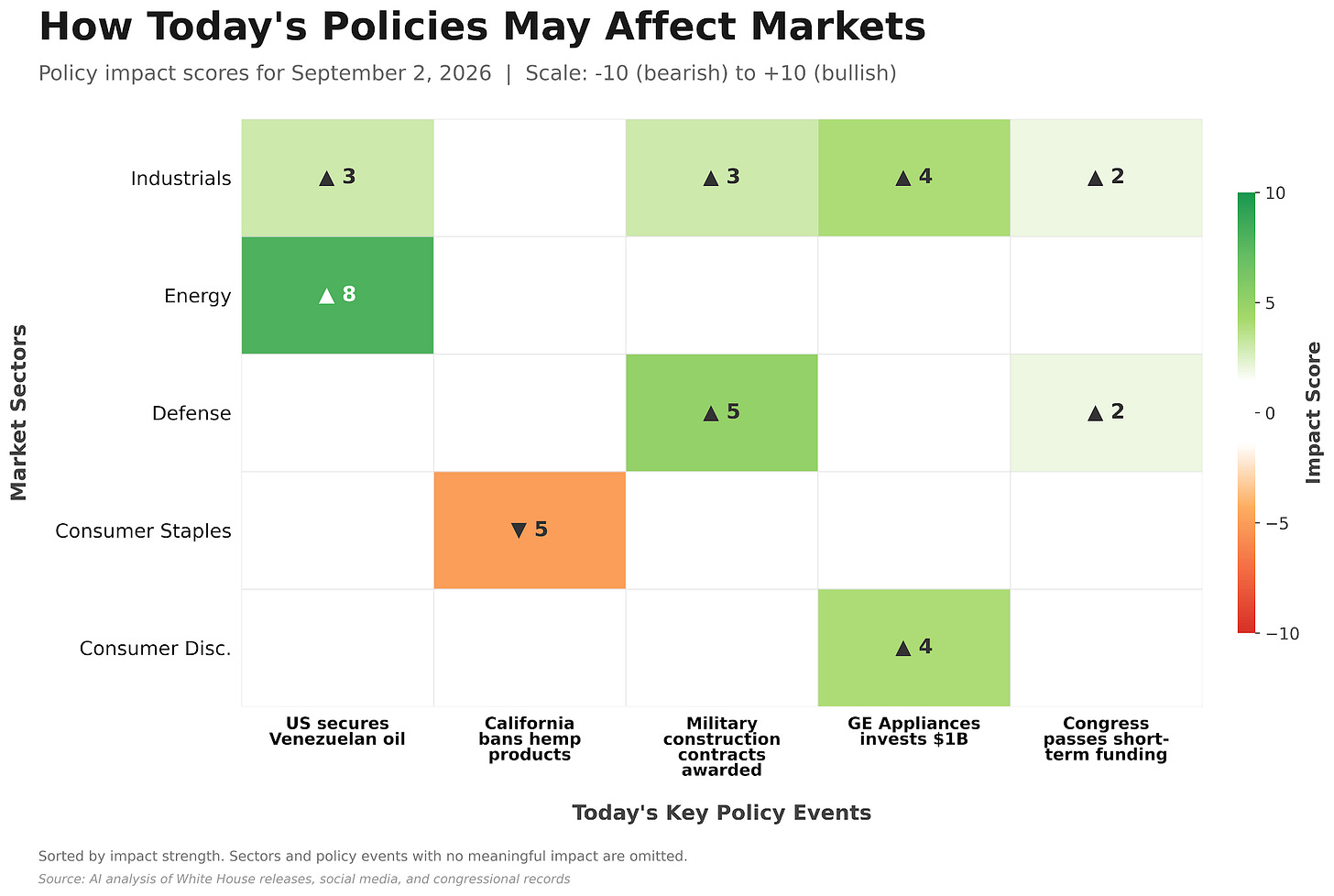
Each cell shows an estimated impact score on a fixed scale of -10 to +10, reflecting how today’s policy developments may affect each market sector. Positive scores (green, ▲) suggest bullish impact; negative scores (red, ▼) suggest bearish pressure. Rows and columns are sorted by impact strength, and sectors and policy events with no meaningful impact are omitted. The heatmap, the analysis below, and the Impact on Market themes above are produced from a single unified analysis: the heatmap visualizes the magnitudes, while the text explains the causal reasoning behind them.
The administration’s strategic acquisition of Venezuelan oil reserves serves as a major supply-side catalyst, likely lowering domestic input costs and increasing energy sector valuation. While the White House touts this as an “America First” victory, critics and regional governors, such as Kentucky’s Beshear, highlight the persistent friction between aggressive tariff policies and consumer cost burdens. These trade-offs create a volatile environment for Industrials and Energy companies balancing lower input costs against potential retaliatory trade barriers.
Simultaneously, the enacted continuing resolution provides critical fiscal certainty for Defense and Industrial contractors, as evidenced by the immediate award of significant military construction contracts. The sector further benefits from localized investments, such as the major manufacturing expansion in Kentucky. However, state-level regulatory divergence, exemplified by California’s aggressive removal of hemp and kratom products, introduces localized “regulatory risk” for consumer-facing firms. This fractured policy landscape ensures that while federal spending supports heavy industry, idiosyncratic state restrictions continue to disrupt broader retail supply chains and commodity-based revenue streams.