Conversation
-
Washington Policy Review: August 11, 2026
sourceToday’s Report
1. Overview
2. White House News
3. Truth Social Posts
4. Government Department News
5. 2028 Democratic Presidential Candidates
6. AI & Tech Company News
7. Congressional Watch
8. Policy Impact Analysis & Heatmap
1. Overview
President Trump traveled to Ohio to attend the Patriot Games finals, an event celebrating the nation’s 250th anniversary and honoring American youth. The White House utilized the visit to showcase the administration’s economic agenda, asserting that tax relief and energy policies have left the state “thriving.” Additionally, the administration cited a new mid-year report showing a 17.2% decline in homicides across major U.S. cities. Officials credited this trend to the “Trump Effect in full force” and the administration’s focus on a “law-and-order agenda.”
On Truth Social, President Trump announced that he has directed Dr. Mehmet Oz to end federal Medicaid and CHIP funding for gender transition procedures for minors, characterizing the practices as “barbaric” and “unthinkable.” He also confirmed the release of U.S. Marine veteran Robert Gilman from Russian detention, noting that the release occurred following his personal negotiations with Vladimir Putin without a prisoner exchange. Furthermore, Trump criticized New York City’s congestion pricing and “Pied-a-Terre Tax” as “dangerous” policies, endorsed Mike Lindell for Governor of Minnesota, and promoted a book detailing his presidency.
State Dept news confirmed the release of Robert Gilman and highlighted a $15.5 million aid package for earthquake recovery in Colombia. The department also joined a coalition statement calling for 24-hour notification for ballistic missile tests and published a report on fiscal transparency. The DOW launched the “Golden Dome for America Hub” to streamline missile defense procurement and awarded nearly $1.5 billion in new contracts. Meanwhile, HHS officially finalized a rule to terminate federal funding for “experimental and life-altering sex-rejecting procedures” for minors, while Treasury’s FinCEN eliminated beneficial ownership reporting requirements for small businesses.
Governor Newsom launched the California Teen Tech Council to integrate youth perspectives into AI and digital wellness policy, stating the effort ensures teens “help shape their future rather than simply inherit it.” He also announced a $239 million investment to fast-track 1,700 affordable housing units and unveiled a strategic plan to combat extreme heat. Governor Moore reported that Maryland achieved nearly all of its 2025 Chesapeake Bay pollution reduction targets, while Governor Pritzker officially renamed the historic Illinois State Armory to honor former Governor Jim Edgar. Senator Jon Ossoff introduced bipartisan legislation with Senator Katie Britt aimed at expanding colorectal cancer screenings for Americans under 50 to ensure “early cancer detection saves lives.”
Congressional activity on August 10, 2026, was limited, as both the House and Senate held brief sessions without conducting formal votes or committee hearings. The House of Representatives formally introduced 12 new public bills and three resolutions into the legislative record. Both chambers are scheduled to remain in a pro forma session status until reconvening on August 13, 2026.
The administration’s shift toward aggressive deregulation reduces administrative friction for financial institutions and private entities, favoring capital formation by dismantling traditional reporting mandates. Simultaneously, the establishment of the Golden Dome procurement hub accelerates integration for tech-forward defense contractors by removing “legacy organizational barriers,” though this rapid digitalization may introduce security vulnerabilities within critical infrastructure. Conversely, the restriction of Medicaid reimbursement pathways imposes immediate revenue pressure on specialized healthcare providers, creating a heightened risk premium for institutions dependent on federal funding. These policy realignments reflect a broader strategic pivot toward operational velocity and deregulation, balanced against the potential for systemic instability and increased operational headwinds in highly regulated sectors.
2. White House News
America First Means Ohio First: President Trump, Republicans Deliver for Ohio
President Trump is visiting Ohio for the Patriot Games finals, an event honoring American youth in celebration of the nation’s 250th anniversary. The administration asserts that under his leadership, Ohio is “thriving” due to historic tax relief, decreased crime rates, and unleashed energy production. The statement highlights that President Trump’s “Working Families Tax Cuts” and “America First economic agenda” are attracting private investment and delivering “concrete results” for the state, emphasizing that his law and order initiatives are successfully reducing violent crime across the region.
Reference: https://www.whitehouse.gov/releases/2026/08/america-first-means-ohio-first-president-trump-republicans-deliver-for-ohio/
ICYMI: “Violent crime keeps falling in biggest U.S. cities”
A new mid-year report shows significant declines in violent crime, which the White House attributes to President Trump’s “law-and-order agenda.” Data from the Major Cities Chiefs Association reveals a 17.2% drop in homicides across large cities, with notable decreases in Washington, D.C., Memphis, and New Orleans. Crediting the “Trump Administration” for surging federal resources, the report asserts the national murder rate is on pace for record lows. Proponents describe this positive statistical trend as “the Trump Effect in full force,” marking a continuation of historic progress in public safety.
Reference: https://www.whitehouse.gov/releases/2026/08/icymi-violent-crime-keeps-falling-in-biggest-u-s-cities/
3. Truth Social Posts
President Trump announced that he has directed Dr. Mehmet Oz to end Medicaid funding for gender transition surgeries and hormones for minors, labeling such medical practices “barbaric” and “unthinkable.” Turning to international affairs, he confirmed the release of U.S. Marine veteran Robert Gilman from Russian imprisonment, noting that the release occurred without a prisoner exchange following his personal discussions with President Vladimir Putin. He expressed his gratitude to his diplomatic team and remarked that Gilman’s only request upon landing at Andrews Air Force Base would be a cheeseburger.
Regarding domestic policy and political endorsements, Trump criticized the New York City “Pied-a-Terre Tax” and congestion pricing, characterizing these measures as a “dangerous political experiment” that is driving residents away and threatening the region with “Financial, and then Social, RUIN.” He is currently investigating whether the federal government possesses the legal authority to intervene in New York’s economic policies. Additionally, he endorsed Mike Lindell for Governor of Minnesota, praising him for his efforts regarding election integrity.
In his social media activity, Trump also promoted Todd Starnes’ new book, “The Golden Age: How Trump Saved America.” He further highlighted reports claiming that the Obama-era intelligence reports concerning Russia collusion were “corrupt from start” and shared commentary on newly released documents regarding the origins of the Russia investigation.
Reference: https://truthsocial.com/@realDonaldTrump
4. Government Department News
State Department (state.gov)
United States Mobilizes Life-Saving Response to Colombia Earthquake
The Trump Administration has mobilized $15.5 million in emergency aid following a 7.4 magnitude earthquake in Colombia on August 10. The State Department deployed a Disaster Assistance Response Team (DART) to coordinate relief efforts and structural assessments. Funding supports partners including Catholic Relief Services, the UN World Food Program, and World Vision. The U.S. also contributed $200 million to the Colombia Pooled Fund to address broader humanitarian needs. Consular assistance is available for U.S. citizens through the Embassy in Bogota.
Joint Statement on Notifications of Ballistic Missile Launches
A coalition of nations, including the United States, issued a statement calling on all countries to provide at least 24 hours’ notice for intercontinental and submarine-launched ballistic missile tests. The signatories condemned recent unnotified Pacific missile activity as dangerous, stating such actions increase the risk of miscalculation and threaten global security. The statement encourages adherence to the Hague Code of Conduct and transparency regarding missile class, launch windows, and trajectory to ensure safety for mariners and airmen.
Robert Gilman has been released after over four years of detention in Russia and is returning to the United States for medical treatment. The State Department thanked Russia for its cooperation with Special Envoy Steve Witkoff. The administration reiterated its commitment to securing the release of all unjustly detained Americans, specifically mentioning Stephen Hubbard. The statement emphasizes that President Trump will “not stop until all unjustly detained Americans are home.”
Secretary Rubio’s Meeting with Austrian Foreign Minister Meinl-Reisinger
Secretary of State Marco Rubio met with Austrian Foreign Minister Beate Meinl-Reisinger in Washington to discuss European security, national sovereignty, and the protection of critical technologies. Secretary Rubio congratulated Austria on its recent election to the UN Security Council and identified key areas of mutual interest for both nations.
Department of State Releases 2026 Fiscal Transparency Report
The State Department published its 2026 Fiscal Transparency Report, which evaluates government budget reliability and public procurement processes globally. Out of 139 governments assessed, 73 met minimum transparency standards, while 67 did not. The report aims to foster market confidence, combat corruption, and protect U.S. taxpayer funds used for foreign assistance. By encouraging debt disclosure and transparent awarding of contracts, the Department seeks to create a fairer environment for U.S. companies and improve global economic stability.
The United States extended congratulations to President Marshal Mahamat Idriss Deby Itno and the people of Chad on the 66th anniversary of the nation’s independence. The message emphasized the “enduring partnership and mutual respect” between the two countries, reaffirming a commitment to bilateral cooperation on regional security, economic prosperity, and the welfare of their citizens.
Department of War (war.gov)
The Department of War has launched the “Golden Dome for America Ecosystem Hub,” a digital portal designed to connect commercial tech companies, venture capitalists, and startups directly with missile defense program managers. Gen. Mike Guetlein stated the platform aims to “short-circuit the ‘Valley of Death’” and cut bureaucratic red tape to rapidly deploy defensive capabilities. The initiative seeks to leverage “commercial-off-the-shelf technologies” to maintain fiscal accountability while building a scalable, multi-layered homeland missile defense shield to counter sophisticated aerial threats.
The Department of War awarded several major contracts, including a $992 million award to Torch Technologies for technical advisory services and a $309.6 million contract to Hensel Phelps Construction for the Red Hill Water Treatment Facility in Hawaii. BAE Systems received $149.7 million for maintenance and modernization of the USS Boxer. Additional contracts were issued to General Dynamics for Ground Resiliency ($30.4 million), Lockheed Martin for aircrew simulator training ($22.6 million), and Barnett Paving & Sealing for base pavement work ($25 million).
Secretary of War Pete Hegseth Travels to Panama
Defense Secretary Pete Hegseth is traveling to Panama to participate in the Americas Counter Cartel Coalition (A3C) Forum. During his visit, he is scheduled to meet with Panamanian President José Raúl Mulino and senior Colombian officials. Additionally, Secretary Hegseth will visit U.S. service members participating in the Jungle Operations Training Course and observe PANAMAX training exercises.
Department of Health and Human Services (hhs.gov)
HHS Ends Federal Medicaid and CHIP Funding for Sex-Rejecting Procedures for Children and Youth
HHS, led by Secretary Robert F. Kennedy, Jr., has issued a final rule ending federal Medicaid and CHIP funding for “experimental and life-altering sex-rejecting procedures” for minors, effective October 13. Citing safety concerns and a lack of evidence for clinical benefit, the policy covers puberty blockers, cross-sex hormones, and surgeries. A six-month transition period is provided for children currently receiving hormone therapy. The rule does not affect coverage for mental health services. CMS Administrator Dr. Mehmet Oz stated the move prioritizes “protecting children from potentially irreversible harm.”
Treasury Department (home.treasury.gov)
FinCEN has issued a final rule eliminating the requirement for U.S. persons and companies to report beneficial ownership information under the Corporate Transparency Act. Treasury will delete existing records for those now exempt. Secretary Scott Bessent stated the move is a “victory for common sense and American small businesses” that fulfills President Trump’s promise to “cut red tape.” Foreign entities acting as reporting companies remain subject to the existing requirements.
Treasury Announces Employer Contributions to Trump Accounts, Drawing Corporate Support
Treasury released guidance enabling employers to contribute up to $2,500 annually to employees’ dependents’ Trump Accounts on a tax-free basis. Employees may also make pre-tax contributions via employer cafeteria plans. Secretary Scott Bessent noted that these accounts provide families a “new way to build wealth from day one.” Over 50 companies have committed to the program, which Treasury frames as a tool to help businesses attract workers while fostering long-term financial security for American families.
United States Trade Representative (ustr.gov)
Ambassador Jamieson Greer and SBA Administrator Kelly Loeffler are traveling to Iowa to visit Titan Tires and the Iowa State Fair. During the trip, they will meet with workers to discuss how President Trump’s pro-growth policies are supporting job creation and the reshoring of production. Ambassador Greer will also join Governor Kim Reynolds and Representatives Ashley Hinson and Zach Nunn at the state fair to highlight Iowa’s agricultural and industrial sectors.
5. 2028 Democratic Presidential Candidates
Gavin Newsom (gov.ca.gov)
First Partner Jennifer Siebel Newsom and #HalfTheStory have launched the California Teen Tech Council, an initiative under the California Innovation Council. The council aims to include youth perspectives in state policy regarding AI, digital wellness, and technology. Governor Newsom stated that the goal is to ensure teens “help shape their future rather than simply inherit it.” The program will recruit students statewide this fall for leadership training, with the intent of empowering them to act as advisors and advocates for healthier digital ecosystems.
Governor Newsom fast-tracks 1,700 new affordable housing units
Governor Newsom announced a $239 million investment to accelerate the construction of 20 affordable rental housing developments, totaling 1,700 units. These projects utilized a streamlined approval process to reduce delays and development costs. The investment is part of broader state efforts to address the housing shortage and homelessness crisis. According to the administration, these policies contributed to a 6.8% reduction in unsheltered homelessness in California, which the Governor’s office cited as the largest such reduction in the nation.
Governor Newsom unveiled an updated Extreme Heat Action Plan to mitigate the impacts of rising temperatures on California communities. The strategy focuses on four pillars: public awareness, service response for vulnerable populations, resilience of the built environment, and the use of nature-based solutions. Mandated by Senate Bill 306, the plan aims to improve coordination across state agencies. Secretary for Natural Resources Wade Crowfoot emphasized the need for both immediate safety measures during heatwaves and long-term investments, such as urban greening and power grid hardening.
Governor Newsom highlighted 15 new behavioral health projects funded through the Behavioral Health Continuum Infrastructure Program (BHCIP) and Proposition 1. Since 2021, the state has invested $5.8 billion in this infrastructure, resulting in over 437 projects across 546 facilities. These initiatives aim to increase residential beds and outpatient capacity, specifically targeting rural and tribal communities. Officials stated that these efforts are central to the state’s strategy for transforming the behavioral healthcare system and providing “treatment options, closer to home, designed for preventative care, and long-term recovery.”
Wes Moore (governor.maryland.gov)
Governor Moore announced that Maryland has met or surpassed nearly all 2025 pollution reduction targets under the 2014 Chesapeake Bay Watershed Agreement, achieving 100% of sediment and phosphorus goals and 99% of nitrogen goals. Success was driven by investments in wastewater treatment and agricultural conservation. While the state outpaced the broader regional partnership, officials are now shifting focus toward 2040 targets. Priorities include modernizing infrastructure and addressing stormwater and agricultural runoff to improve water quality for the state’s significant seafood and tourism industries.
JB Pritzker (gov.illinois.gov)
Gov. Pritzker Renames Historic Springfield Armory as Governor Jim Edgar Executive Office Building
Governor Pritzker has officially renamed the historic Illinois State Armory in Springfield as the Governor Jim Edgar Executive Office Building. Funded by the Rebuild Illinois initiative, the renovated 231,765-square-foot facility will house over 870 state employees across various agencies, including the Department of Central Management Services and the Governor’s Office of Management and Budget. The renaming serves to honor Governor Edgar’s long career of public service, integrity, and his commitment to fiscal responsibility and bipartisan leadership within the state.
Daily Public Schedule: Tuesday, August 11, 2026
Governor Pritzker’s public schedule for August 11, 2026, included a 10:00 AM ceremony at the Executive Mansion in Springfield to commemorate the renaming of the Illinois State Armory in honor of former Governor Jim Edgar. The event was made available for public viewing via a live stream on the official Illinois state website. No further press availability was scheduled for the day.
Jon Ossoff (ossoff.senate.gov)
Sens. Ossoff, Britt Introduce Bipartisan Legislation to Help Detect & Prevent Colorectal Cancer
Senator Jon Ossoff and Senator Katie Britt have introduced the Colorectal Cancer Early Detection Act to address rising cancer rates among Americans under 50. The legislation aims to provide state funding for increased screenings, public awareness campaigns, and support for health care professionals. Citing data that colorectal cancer is the leading cause of cancer-related death for this demographic, the senators stated, “Early cancer detection saves lives,” and emphasized the necessity of providing resources to treat and inform the public about this disease.
6. AI & Tech Company News
No relevant AI & tech company updates found for this date.
7. Congressional Watch
Covers the 2026-08-10 session — the Congressional Record is published with a one-day delay.
Senate
The Senate met briefly for a pro forma session that lasted less than one minute. No legislative business or committee meetings were conducted during this time.
None — No legislative actions occurred [N/A]
House of Representatives
The House met for a brief session, during which it introduced 12 new public bills and three resolutions. The chamber did not conduct any committee hearings or formal voting.
H.R. 10070–10081 — Twelve public bills were formally introduced into the legislative record [Introduced]
H.J. Res. 213–214 and H. Res. 1480 — Three resolutions were formally introduced into the legislative record [Introduced]
Committee Highlights
None — No committee hearings or markups were held in either chamber
Coming Up
The Senate is scheduled to meet for a pro forma session on Thursday, August 13, 2026, at 8 a.m. The House of Representatives is also scheduled to meet for a pro forma session on Thursday, August 13, 2026, at 9 a.m.
Reference: Congressional Record Archive
8. Policy Impact Analysis & Heatmap
This analysis is provided for informational purposes only. It does not constitute investment advice or a recommendation to buy or sell any security.
Impact on Market
Based on today’s policy developments, our analysis identifies the following market impact themes:
THEME 1. DEREGULATION AND COMPLIANCE RELIEF
The administration is aggressively dismantling reporting mandates to stimulate small business growth and reduce corporate overhead. The removal of beneficial ownership filings provides an immediate reduction in administrative friction for financial institutions and private entities. Critics, however, may argue that such transparency rollbacks could increase systemic risks related to illicit finance and corporate opacity. The trend favors a lighter regulatory touch intended to prioritize domestic capital formation over federal oversight.
THEME 2. DEFENSE INDUSTRIAL BASE ACCELERATION
The launch of the Golden Dome hub signals a structural shift toward rapid, tech-forward defense procurement. By creating a unified digital portal, the government is incentivizing nontraditional tech players to participate in homeland security infrastructure projects. This mechanism aims to dilute the traditional “legacy organizational barriers” that have historically slowed procurement cycles. While bullish for integrated defense-tech contractors, the shift raises concerns about whether rapid integration can maintain rigorous security standards for critical infrastructure.
THEME 3. HEALTHCARE REGULATORY HEADWINDS
Federal agencies are increasingly leveraging funding conditions to influence private hospital service models. The prohibition of Medicaid reimbursement for specific procedures creates an immediate revenue impact for medical providers. Opposition figures suggest these restrictions interfere with clinical judgment and could result in operational disruption for specialized health networks. This policy creates a new risk premium for healthcare entities heavily reliant on federal reimbursement pathways.
Policy Impact Heatmap with Market Direction
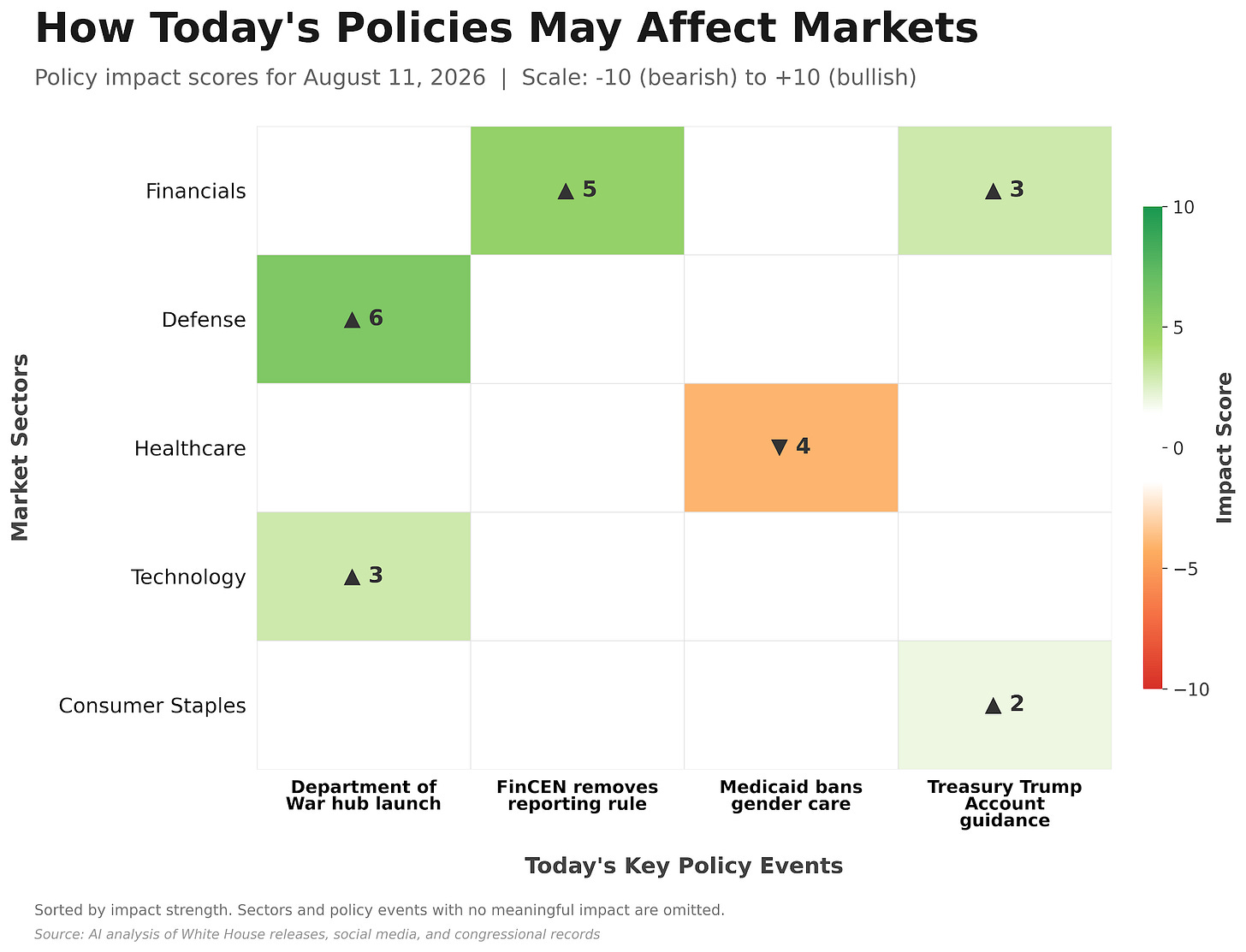
Each cell shows an estimated impact score on a fixed scale of -10 to +10, reflecting how today’s policy developments may affect each market sector. Positive scores (green, ▲) suggest bullish impact; negative scores (red, ▼) suggest bearish pressure. Rows and columns are sorted by impact strength, and sectors and policy events with no meaningful impact are omitted. The heatmap, the analysis below, and the Impact on Market themes above are produced from a single unified analysis: the heatmap visualizes the magnitudes, while the text explains the causal reasoning behind them.
Federal policy shifts today favor deregulation and industrial mobilization. The Treasury’s decision to repeal beneficial ownership reporting under the Corporate Transparency Act significantly lowers compliance costs for the financial sector. This aligns with the administration’s broader push to strip away what Secretary Bessent characterizes as “burdensome” red tape. Concurrently, the Department of War’s new digital hub aims to tighten links between the private sector and missile defense initiatives. By “slashing bureaucratic red tape,” this move effectively lowers entry barriers for commercial tech firms, potentially accelerating contract flow and R&D for defense-linked technology companies.
Conversely, the healthcare sector faces tightening regulatory constraints. The CMS rule ending Medicaid funding for specific procedures targets hospital revenue streams, signaling a shift in federal healthcare priorities. While proponents label these interventions as “barbaric,” the mandate forces hospitals to restructure clinical offerings. These actions reflect a distinct prioritization of fiscal liberalization for businesses alongside social-conservative regulatory alignment. Market participants should monitor the potential for similar restrictive mandates across other federal health programs. Simultaneously, the focus on direct-to-consumer wealth vehicles through Trump Account guidance indicates a shift toward private-sector-led financial incentives, which may alter employee benefit structures over the coming fiscal year.