Conversation
-
And the Ban Played On
source
In light of current events, we wanted to take a moment to say a huge thank you to our readers for allowing us to operate as independent media who will not bend to the President and his team of bullies. Engagement from free readers helps get more eyes on our content and the support of paid subscribers enables us to continue our operations. If you’re able to, consider upgrading to a paid subscription today.
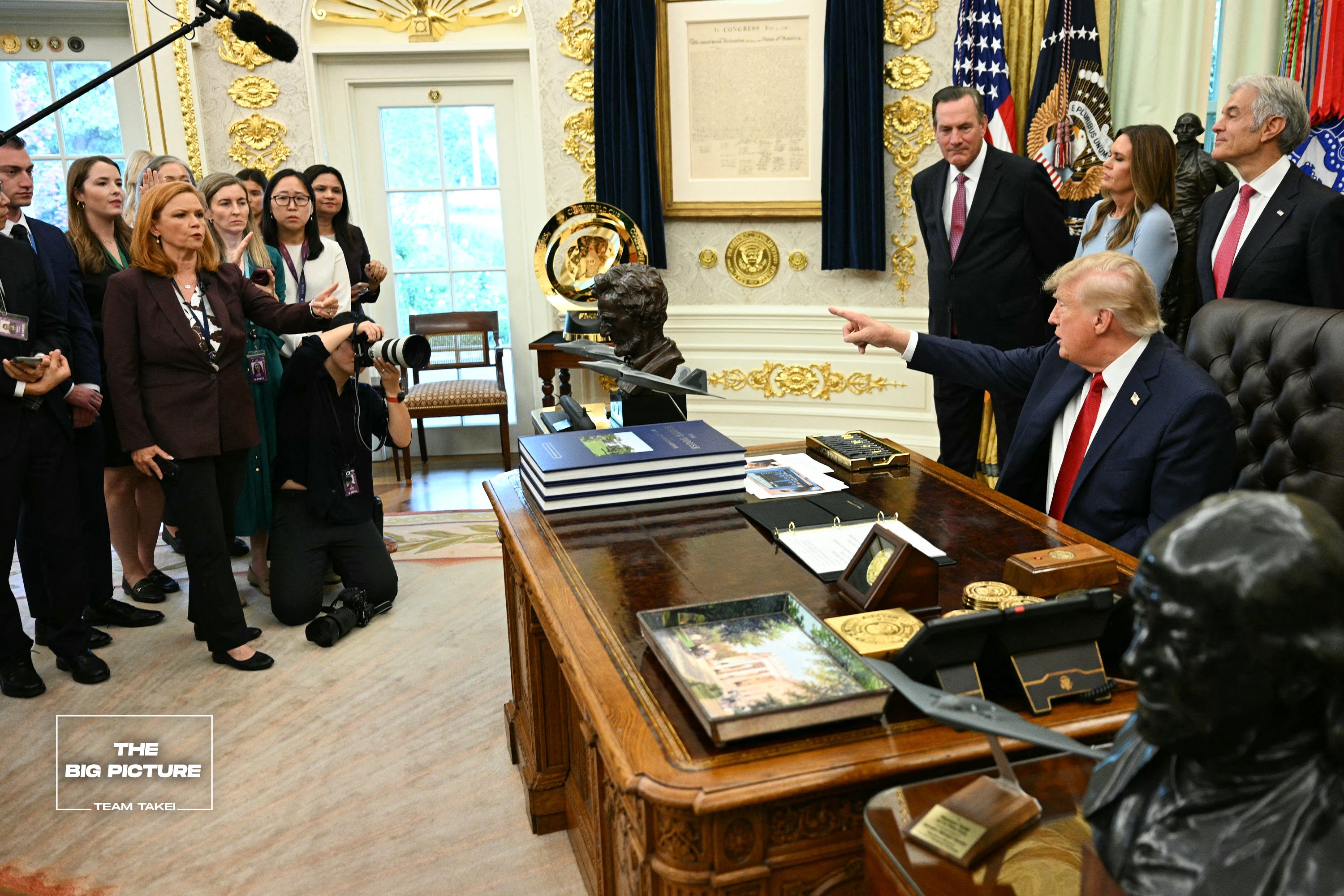
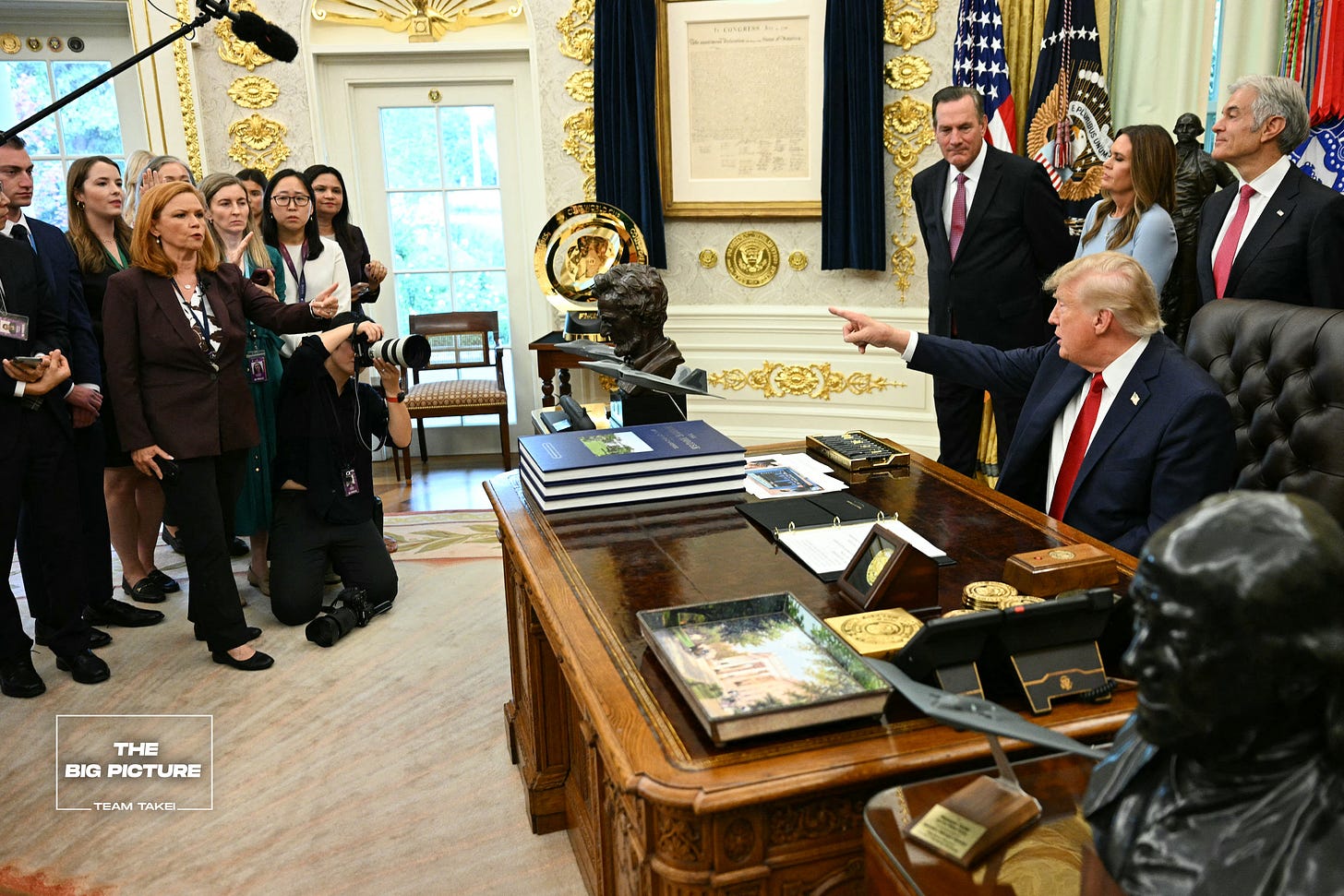 US President Donald Trump takes a question from NBC reporter Kelly O’Donnell in the Oval Office of the White House in Washington, DC, on September 18, 2026. Photo by Jim WATSON / AFP via Getty Images.
For the insecure tyrant, “all questioning is a forcible intrusion … like a knife cutting into the flesh of the victim,” the writer Elias Canetti once wrote. Ruth Ben-Ghiat, a scholar of fascism and authoritarianism at NYU, invoked that line to describe President Trump’s decision to bar CNN, MS NOW and Politico from the White House.
Trump has insulted and excluded individual journalists throughout both of his terms, Ben-Ghiat noted, but banning entire news organizations marks an escalation. She places the latest move inside a recognizable pattern of autocratic behavior, noting that “such leaders very rarely course correct. Instead they double down: aggressions increase as their legitimacy decreases, and the mania to control the narrative grows.” She calls it “autocratic backfire” and ties it to Trump’s sinking numbers ahead of the midterms.
It began, as many things do with the 47th president, with a Friday afternoon Truth Social post, perhaps with help from his aide and confidante, Natalie Harp. “I am banning [CNN, MS NOW and Politico] from the White House as a result of their constant ‘reporting’ FAKE NEWS!” Trump wrote, adding that the ban was “effective immediately.” He continued, “Media Outlets shouldn’t be able to constantly write or report FICTION and LIES when they’re covering the President of the United States, the Trump Administration, or the United States of America,” warning that “other Fake News Media Outlets” would follow. He gave no indication of how the ban would be enforced, and some White House staffers were reportedly caught off guard by the announcement, as has become quite common of late.
On Saturday morning, security stopped reporters and a cameraman from MS NOW at a West Wing entrance, and Secret Service officers confiscated their press badges. CNN’s Betsy Klein and Politico’s Cheyenne Haslett were denied entry the same morning. By Sunday night, the White House had also pulled CNN from Monday’s pool television rotation, an assignment that would have had CNN crew members traveling with Trump to the U.N. General Assembly in New York.
Asked whether the ban was meant to intimidate the press, Trump denied it. “No, no, no, no. I dislike dishonest press, like you. I think you’re terrible,” he responded to a Bloomberg reporter, adding that the outlets “purposely write negative news” to “diminish the Republicans and a Republican administration.”
Monday evening, the White House’s official account teased an announcement. “Something’s coming. Stay tuned,” it declared over footage of an old television set. Then it launched “Trump TV: The Essentials Station” at 7 p.m., a 24/7 stream described as covering “the Trump Administration’s biggest moments all in one place.” It went live the same day the television pool went dark. A handful of pro-Trump accounts moved to fill the coverage gap within hours, declaring themselves a replacement White House pool. But as legal analyst Joyce Vance pointed out, they lacked the technical capacity, meaning the equipment, staffing and control-room infrastructure pool duty requires.
Propaganda, Ben-Ghiat wrote, needs both “noise and silence.” The ban supplied the silence, and the White House supplied the noise: a 24/7 in-house stream, “Trump TV,” launched from whitehouse.gov the same evening. But the audience did not follow. According to reporting by The Daily Beast, the stream, hosted on the White House’s YouTube channel, drew about 8,000 viewers at its 7 p.m. launch; 90 minutes later, viewership had fallen below 4,000, and by 9 p.m. it was down to roughly 3,000 — a fraction of what the major networks draw in the same prime-time hour. By 10:40 p.m. only 2,425 people were watching, a sliver of the channel’s 3.18 million subscribers, and it bottomed out overnight at barely 1,000 viewers during a rerun of a year-old Trump speech alongside Britain’s King Charles.
Trump TV may have failed right out of the gate, but the ban is in place for now. So will it be struck down by the courts? This should be an easy yes, but there are some nuances. To understand where things stand and how we got here, we need to rewind to Trump 1.0.
The ban as a pattern, not an aberration
This is, of course, not the first time Trump has tried to silence his critics with an outright ban. During his first term, in November 2018, we got a clear view of the autocrat-to-be when Trump suspended CNN chief White House correspondent Jim Acosta’s White House press credentials, following a heated exchange over the midterm elections. CNN sued, arguing the revocation violated both Acosta’s First Amendment right to report and his Fifth Amendment right to due process.
U.S. District Judge Timothy J. Kelly, whom Trump had appointed to the bench the year before, granted CNN a temporary restraining order. But he did so only on the due process claim. He found the White House’s decision-making “so shrouded in mystery” that no one could explain who had pulled Acosta’s pass or why. Kelly was explicit about the limits of his ruling. “I have not determined that the First Amendment was violated here,” he wrote. Rather than litigate further, the White House permanently restored Acosta’s press pass, and CNN dropped the suit. The First Amendment question went unanswered.
Fast forward to Feb. 11, 2025, when Trump banned the Associated Press from the Oval Office and Air Force One after it declined to adopt “Gulf of America” in place of “Gulf of Mexico” in its stylebook. That was a particular level of petty, and the AP understandably sued. The case went before U.S. District Judge Trevor N. McFadden, another Trump appointee.
On April 8, 2025, McFadden granted a preliminary injunction, writing: “under the First Amendment, if the Government opens its doors to some journalists — be it to the Oval Office, the East Room, or elsewhere — it cannot then shut those doors to other journalists because of their viewpoints. The Constitution requires no less.” He added that the AP was not asking for “extra special access” — “all the AP wants, and all it gets, is a level playing field.”
The White House appealed, and on June 6, 2025, a divided three-judge panel of the D.C. Circuit stayed McFadden’s order as to the Oval Office, Air Force One and other small spaces. Judge Neomi Rao, writing for the panel’s conservative majority, reasoned that “these restricted presidential spaces are not First Amendment fora opened for private speech and discussion” and that “the White House therefore retains discretion to determine, including on the basis of viewpoint, which journalists will be admitted.” But the panel drew a line at the Brady Briefing Room, where reporters work daily. “When the White House opens its facilities to the press generally... it cannot exclude journalists based on viewpoint.” The full D.C. Circuit declined to rehear the stay en banc on July 22, 2025. The same three-judge panel heard oral argument on the underlying merits on Nov. 24, 2025. Ten months later, it has still not ruled.
The networks answer
Following the White House’s latest blanket ban on three news outlets, CNN responded within hours of Trump’s post, before the ban had even taken effect. “We have a right under the U.S. Constitution to do our reporting without hindrance or interference from the government,” the network wrote, “and this ban is an illegal assault on this fundamental right.” Politico’s global editor-in-chief, Jonathan Greenberger, told his newsroom on Saturday that reporter Cheyenne Haslett had been turned away at the gates. “We stand by her and all reporters here covering the White House. As we said yesterday, we will vigorously defend our First Amendment rights.”
By Monday morning, those statements had gelled into court filings. CNN, MS NOW and Politico filed a joint lawsuit in the U.S. District Court for the District of Columbia, naming as plaintiffs the outlets themselves along with three of the barred reporters. The case, Cable News Network v. Trump, also names as defendants White House communications director Steven Cheung, Secret Service Director Sean Curran and White House chief of staff Susie Wiles.
“This morning, we notified the government that we are filing a lawsuit today to protect our First Amendment rights and defend the principle that the government does not decide what the press reports or publishes,” the outlets said in a joint statement. “Without notice or process, the White House revoked our journalists’ credentials because it objected to our reporting. Left unchallenged, this threatens press freedom and the public’s right to independent journalism free from government interference.” The complaint named the harm directly. “This ban could not be a more direct assault on the First Amendment nor a more blatant violation of our most fundamental constitutional principles.”
The Associated Press, which fought its own yearlong access battle with the administration, issued a statement of solidarity. “No news organization — or person — should be retaliated against by the government over the words they use.” The White House Correspondents’ Association, led by Fox News correspondent Jacqui Heinrich, called for a reversal of the decision, warning that the exclusion set a standard that “could be applied to any outlet in the future” and declaring, “The American people, through a free and independent press, must be able to scrutinize those elected to power, regardless of whether government officials view it favorably.” The New York Times and The Washington Post joined the boycott by withholding even still photographs of Trump’s events that day.
ABC, CBS, CNN, Fox News and NBC — the five networks that make up the White House television pool — announced Monday that they would suspend pool coverage of the president entirely in solidarity with the banned outlets. In a rare joint statement, the five declared, “The public has a vital interest in receiving accurate, independent information about its government. No administration should restrict a news organization because it objects to its reporting.” C-SPAN noted that it could not broadcast White House events without the pool feed.
The Find Out portion arrived within hours. Monday afternoon, Trump held a ribbon-cutting for a new White House helipad. He declined to take questions shouted at him before he boarded Marine One but, without a pool camera or microphone present, his remarks were unintelligible over the noise of the parked helicopter. Newsmax, one of the few outlets still covering the event, acknowledged the problem on air. “There’s no microphone because the pool cameras aren’t there,” anchor Bianca de la Garza said, adding: “Obviously the ramifications are right here. Can’t hear what the president’s saying.” Axios called the moment “a remarkable and immediate ramification of Trump’s attempt to limit pool access.”
Later Monday, asked about the boycott after a meeting with New York City Mayor Zohran Mamdani, Trump insisted he was not worried. “They said they were going to boycott me, but they never boycott me, so I wasn’t very worried about that.”
Veteran journalist and longtime anchor Dan Rather called the ban a test Trump is failing on his own terms. “Journalism has survived dictators, despots, and others who have tried to control the Fourth Estate. It will survive Donald Trump too.” He noted that the ban was announced without consulting the president’s own staff — “his chief of staff wasn’t even in Washington” — and argued that Fox’s participation in the boycott, more than anything else, “may be an indicator that even they are sensing that he has gone too far.”
Trump, the courts and the judge he already knows
Monday’s lawsuit drew an immediate reply from Trump himself. In a second Truth Social post, he complained about the assigned judge directly and previewed his own expected outcome: “The Judge’s name is Tim Kelly, and he was, sadly, appointed by ‘TRUMP.’ In other words, almost without question and, as usual, we’ll go for appeal because Fake News people and publications that only write negatively, and who violate our National Security by writing false and defamatory stories with unknown ‘sources,’ shouldn’t be allowed access to the most important Office anywhere in the World.” He added: “With such a Crooked and Corrupt Press, how did I win in such a LANDSLIDE?” and called “FAKE NEWS ... A THREAT TO DEMOCRACY.”
Kelly is the same judge who ordered Acosta’s credentials restored in 2018, a fact Trump volunteered along with his own prediction of the outcome. But Kelly’s docket includes another irony Trump has not mentioned. In 2023, Kelly handed down a 22-year sentence to former Proud Boys chairman Enrique Tarrio for seditious conspiracy. It was the longest sentence given to any Jan. 6 defendant. But Trump pardoned Tarrio on his first day back in office.
Reporters seeking comment on the lawsuit were directed by the press office to Trump’s own Truth Social post rather than given a formal statement. The White House is still without a press secretary since Karoline Leavitt’s departure. Fox News did obtain an unattributed line from “the White House” defending the ban. “The Fake News has no place demanding a spot in the President’s Oval Office. The lies they smear are a disservice to the American public and tear at the very fabric of our Democracy. They’re completely capable of reporting from directly outside.”
Vice President JD Vance offered the most substantive on-record defense so far, explaining to Breitbart that the banned outlets retain plenty of access short of White House credentials: “They can still report on the Trump White House. They can still get the public reports. They can still, of course, talk to people in the administration and outside the administration.”
The First Amendment quicksand beneath the ban
Legal takes on Trump’s position have reached a rare consensus: they are uniformly against it. Georgetown law professor Steve Vladeck called the ban “overtly viewpoint-based” and said flatly that “this is just not a close case” — that hand-picking three outlets for exclusion because of the president’s disagreement with their coverage is “about as close to a textbook violation of the existing precedents as it comes.” He added that the outlets “should (and almost certainly will) win.”
Vladeck’s conservative counterpart, George Washington University law professor Jonathan Turley, who has been sharply critical of the banned outlets’ coverage and stresses that the White House “is not without good-faith arguments,” reaches the same conclusion, writing that “viewpoint discrimination has long been viewed as not a reasonable basis for exclusion.”
Jameel Jaffer, executive director of the Knight First Amendment Institute at Columbia, explained that the ban’s legal exposure stems partly from where the outlets were banned from. “If President Trump means to expel these news organizations from the White House press pool, his action is doubly unconstitutional because the press pool is a ‘public forum’ under the First Amendment, which means the president can’t exclude journalists from it on the basis of their viewpoints.” Katie Fallow, the institute’s deputy litigation director, made the same point about the briefing room specifically, noting that “the courts have said repeatedly the government is not allowed to kick people out of that forum based on their viewpoint.”
Case law backs their confidence. Sherrill v. Knight is the leading precedent. In 1977, the D.C. Circuit considered the case of Robert Sherrill, a Nation correspondent denied a White House press pass on Secret Service security grounds. The court held that denying a pass to a bona fide journalist “violates the first amendment unless it furthers a compelling governmental interest identified by narrowly and specifically drawn standards,” and separately required notice, an opportunity to rebut, and a written decision before any pass could be revoked. The court did not find a freestanding constitutional right to White House access. But it found that once the government establishes that access, it cannot arbitrarily take it away.
The government is not entirely without an argument, but it rests on forum doctrine rather than any claim of unlimited discretion. Under Cornelius v. NAACP Legal Defense Fund (1985), government property that has not been opened to general public discourse — a “nonpublic forum” — need only be governed by restrictions that are “viewpoint-neutral and reasonable.” That’s a far lower bar than the “strict scrutiny” courts apply to a public forum.
As Turley notes, the D.C. Circuit has already ruled for the White House on this theory. In Ateba v. Leavitt, the court upheld the denial of a permanent hard pass to journalist Simon Ateba, treating the White House press area as a nonpublic forum. And in the AP litigation, Justice Department lawyers pressed a version of the same argument to defend the Oval Office and Air Force One exclusions specifically because those spaces are not press facilities like the Brady Briefing Room but rooms intended for the president’s personal use, where he retains “personal autonomy” to decide whose questions he answers. Judge Rao’s stay in the AP case adopted that reasoning, finding the government likely to succeed as to those spaces specifically because they are not “First Amendment fora opened for private speech and discussion.”
The trouble for the White House is that this new ban does not target the Oval Office or Air Force One. It targets general grounds access, hard passes and pool duty. This is the White House’s general-purpose press infrastructure, the very part of the nonpublic-forum spectrum that Ateba and Rao’s own opinion treat differently. Even a nonpublic forum’s restrictions must be viewpoint-neutral; Sherrill, Ateba and Rao’s AP ruling all say so.
The government’s strongest argument, then, would have been to argue not that it can exclude CNN, MS NOW and Politico because of their viewpoints (which the ban clearly does, based on Trump’s own Truth Social posts) but that the exclusion represents a reasonable, viewpoint-neutral reallocation of limited space, unconnected to the content of the outlets’ coverage.
But nothing in the record so far suggests the regime intends to make that argument, or that it could do so credibly given Trump’s own statements.
I didn’t want any stupid press coverage anyway!
Given the law’s protection of open fora from viewpoint discrimination, and the White House’s very likely loss in this battle, we shouldn’t be surprised if, in a pique of spite, Trump decides to bar every member of the press from the White House. That’s admittedly a truly absurd and bad outcome for our democracy, even if it would feel like a welcome reprieve for many. But it would also be a self-own that would starve him of the very attention he craves and thrives on.
After all, “Trump TV,” with its few thousand die-hard viewers, isn’t going to get him the ratings he needs.
Thanks for reading!
This post is public so feel free to share it.