Conversation
-
Washington Policy Review: August 30, 2026
sourceToday’s Report
1. Overview
2. White House News
3. Truth Social Posts
4. Government Department News
5. 2028 Democratic Presidential Candidates
6. AI & Tech Company News
7. Congressional Watch
8. Policy Impact Analysis & Heatmap
1. Overview
President Trump utilized Truth Social to advocate for a protectionist trade policy, specifically targeting Canada. He argued that the U.S. has suffered financial losses and urged Canadian companies to relocate operations domestically to avoid new tariffs. Asserting that his tariff strategy has “revived” the automotive sector, he stated he no longer wishes to rely on Canadian parts or vehicles.
The President also announced a new oil agreement with Venezuela intended to refill the Strategic National Reserve. Regarding cultural and domestic concerns, he criticized New York Governor Kathy Hochul regarding the release of criminals and pledged to restore the World War II Monument after reports of vandalism. Furthermore, he expressed an intention to renovate the “decrepit” Kennedy Center and shared an anecdote regarding Google Maps’ labeling of Lake Ontario as “Lake America.”
Trump initiated a public conflict with media figures, specifically challenging Kristen Welker of *Meet the Press*. He claimed a 99% success rate for his political endorsements and warned he would report the journalist for “purposeful inaccuracy.” Additionally, the State Dept issued two formal statements: one acknowledging the results of Iceland’s recent referendum on EU accession negotiations, and another extending congratulations to Malaysia on its 69th independence anniversary. These updates emphasized the ongoing U.S. commitment to maintaining bilateral partnerships and promoting regional stability.
Forced reshoring initiatives driven by the threat of steep tariffs introduce significant cost headwinds for manufacturing firms with deep cross-border dependencies, potentially dismantling established supply chain efficiencies. Simultaneously, aggressive regulatory intervention in agriculture and media aims to decentralize market power, creating substantial operational volatility for consolidated food processors and communication entities facing heightened political scrutiny. Conversely, strategic efforts to realign energy and aerospace trade flows through state-led partnerships offer new growth avenues, though these “politically-driven” deals risk displacing long-standing commercial arrangements and inviting retaliatory trade friction.
2. White House News
No White House news found.
3. Truth Social Posts
Trump focused heavily on economic and trade policy, specifically regarding Canada, asserting that the United States has lost billions annually and must incentivize companies to return stateside to avoid tariffs. He urged Canadian companies to relocate immediately, arguing that domestic manufacturing—including the automotive sector—has been “revived” and “saved” through his aggressive tariff strategy. He stated that he no longer wants Canadian parts or cars, labeling the country a poor trade partner. Additionally, he announced plans to refill the Strategic National Reserve using oil from a new deal with Venezuela. These economic efforts were highlighted by an aide who praised his job creation record and a recent aircraft deal with Bangladesh. Other administration actions included breaking the grip of major meat processors, securing the aforementioned oil agreement, and considering legal pathways for Jewish Canadians.
Regarding domestic and cultural issues, Trump criticized New York Governor Kathy Hochul for the release of criminals and vowed to restore the Reflecting Pool and grounds at the World War II Monument following acts of vandalism. He expressed a desire to renovate the “decrepit” Kennedy Center, celebrated a successful NASA launch, and recommended Ted Cruz’s new book about Justice Clarence Thomas. In separate posts, he shared news regarding Google Maps labeling Lake Ontario as “Lake America.”
Trump also launched a sharp offensive against the media, calling for FCC intervention against what he described as “fake polls” and biased reporting. He singled out Kristen Welker of Meet the Press, challenging her characterization of his endorsement success rate. Trump insisted that his record, which he claimed includes a 99% success rate and 100% in Senatorial contests, represents “the strongest Endorsement in the History of Politics,” and he warned that he would report her for “purposeful inaccuracy.”
Reference: https://truthsocial.com/@realDonaldTrump
4. Government Department News
State Department (state.gov)
United States Response to Iceland’s EU Accession Referendum
The United States acknowledges Iceland’s August 29 referendum regarding the potential resumption of EU accession negotiations. The U.S. government respects the sovereign choice of the Icelandic people and reaffirms its confidence in Iceland’s ongoing role as a vital NATO ally. The State Department remains committed to enhancing the bilateral partnership with Iceland across security, energy, innovation, and economic sectors to promote mutual peace and prosperity.
United States Congratulates Malaysia on 69th Independence Anniversary
Secretary of State Marco Rubio extended congratulations to the people of Malaysia on the 69th anniversary of the nation’s independence. The United States highlights the enduring partnership between the two countries, emphasized by robust economic ties and a mutual commitment to maintaining freedom of navigation in the Indo-Pacific. As a primary investor and trading partner, the U.S. seeks to further deepen cooperation with Malaysia to ensure continued peace and prosperity in the region.
8. Policy Impact Analysis & Heatmap
This analysis is provided for informational purposes only. It does not constitute investment advice or a recommendation to buy or sell any security.
Impact on Market
Based on today’s policy developments, our analysis identifies the following market impact themes:
THEME 1. PROTECTIONIST TRADE FRICTION
Trade policy is shifting toward forced reshoring of North American manufacturing through the threat of steep tariffs. This policy forces firms with heavy Canadian dependencies to evaluate costly supply chain migrations. Opposition groups warn that these actions dismantle efficient cross-border trade networks and invite retaliatory measures from key partners.
THEME 2. REGULATORY INTERVENTION IN FOOD AND MEDIA
The administration is expanding its oversight reach to dismantle established market structures in agriculture and media. By breaking the concentration of meat processors, the government aims to empower smaller producers at the expense of consolidated firms. Concurrently, using the FCC to target media outlets creates a volatile environment for communication companies facing political scrutiny.
THEME 3. STRATEGIC COMMODITY REALIGNMENT
The administration is leveraging foreign partnerships to secure vital energy reserves and manufacturing contracts. By tapping Venezuelan supply and securing new aerospace orders from Bangladesh, the government is actively altering trade flows. Observers remain concerned that these specific, politically-driven deals could displace long-standing commercial arrangements.
Policy Impact Heatmap with Market Direction
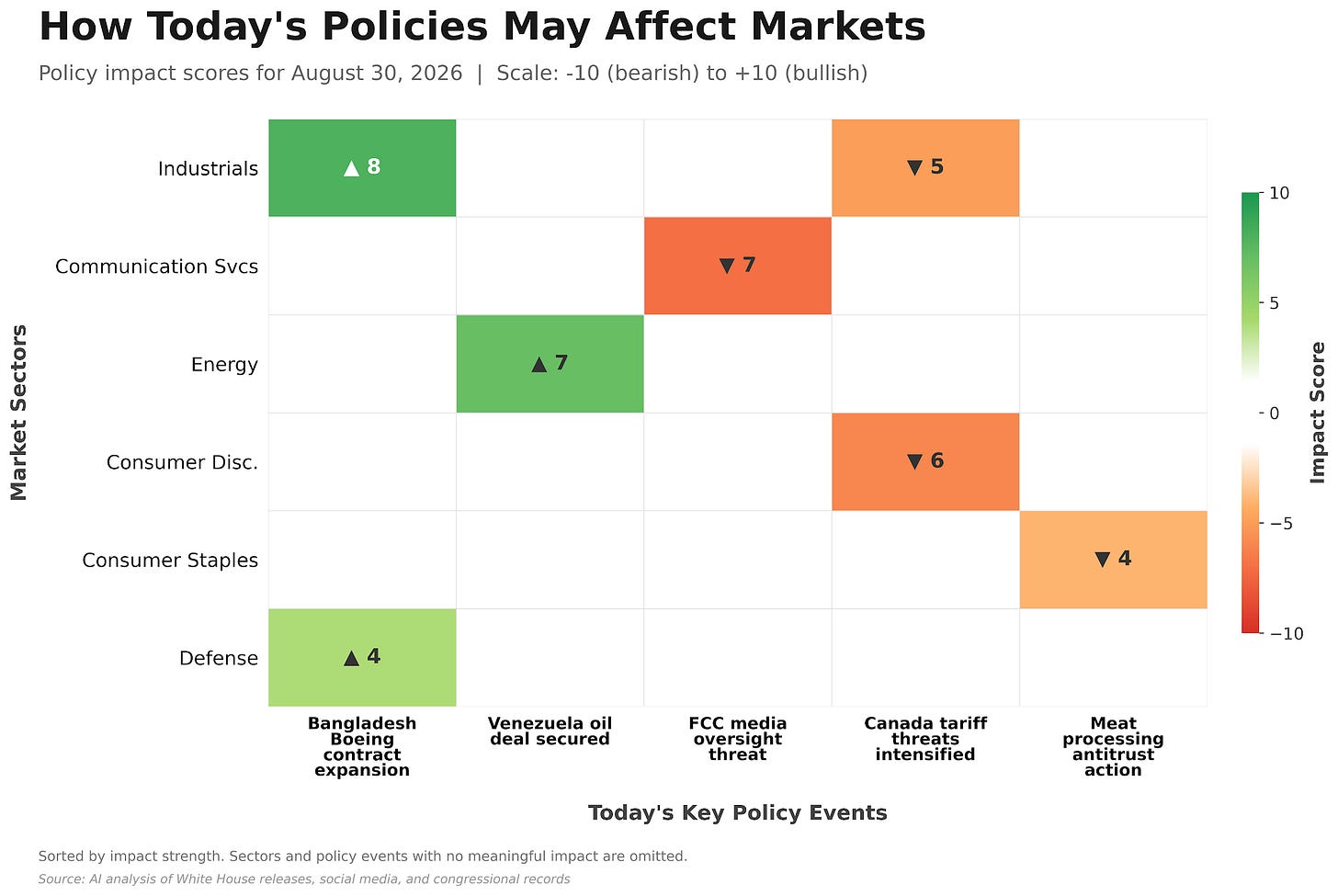
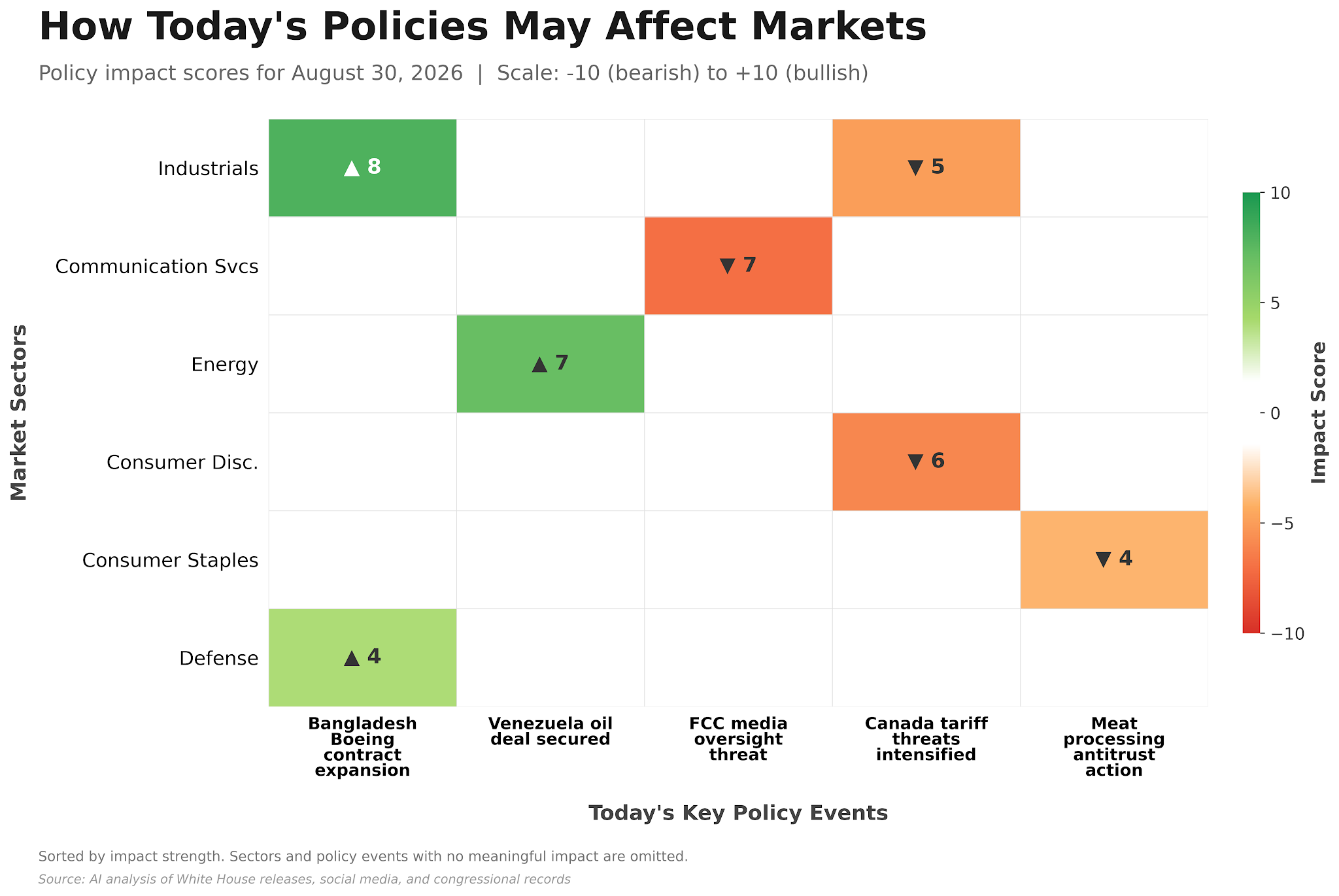
Each cell shows an estimated impact score on a fixed scale of -10 to +10, reflecting how today’s policy developments may affect each market sector. Positive scores (green, ▲) suggest bullish impact; negative scores (red, ▼) suggest bearish pressure. Rows and columns are sorted by impact strength, and sectors and policy events with no meaningful impact are omitted. The heatmap, the analysis below, and the Impact on Market themes above are produced from a single unified analysis: the heatmap visualizes the magnitudes, while the text explains the causal reasoning behind them.
Policy developments today center on aggressive protectionist shifts and tactical commodity procurement. The escalation of tariff threats against Canadian manufacturing creates significant supply chain uncertainty for the automotive and industrial sectors, forcing firms to weigh higher operational costs against relocation risks. Critics argue these “reckless” trade barriers threaten cross-border integrated manufacturing, potentially spiking consumer prices.
Simultaneously, the administration’s deal with Venezuela to fill the Strategic National Reserves serves as a bullish catalyst for domestic energy market stability, though it disrupts established OPEC supply dynamics. Meanwhile, the directive targeting “big four” meat processors introduces regulatory risk for major food conglomerates, as antitrust intervention seeks to reconfigure supply chains in favor of independent ranchers. The administration’s pursuit of media entities via the FCC introduces a new layer of political risk premium for the communication services sector. These maneuvers reflect a broader transition toward state-directed economic outcomes, where administrative pressure is increasingly prioritized over traditional market equilibrium.