Conversation
-
Washington Policy Review: July 29, 2026
sourceToday’s Report
1. Overview
2. White House News
3. Truth Social Posts
4. Government Department News
5. 2028 Democratic Presidential Candidates
6. AI & Tech Company News
7. Congressional Watch
8. Policy Impact Analysis & Heatmap
1. Overview
President Trump issued a formal message commemorating the 221st birthday of Alexis de Tocqueville, citing his insights into America’s “moral foundations” and “civic spirit” as essential to the nation’s future. The Administration reaffirmed its commitment to sovereignty and religious liberty, pledging to restore the country as “one glorious Nation under God.” Additionally, the White House reported that violent crime has reached historic lows, attributing this success to “relentless efforts to enforce the rule of law” and support for police departments across the country.
On Truth Social, President Trump lamented that Supreme Court rulings regarding “Birthright Citizenship and TARIFFS” have cost the nation “TRILLIONS AND TRILLIONS OF DOLLARS.” Reflecting on the COVID-19 pandemic, he defended “Operation Warp Speed” as a “SPECTACULAR SUCCESS” while labeling Dr. Anthony Fauci’s pandemic-era guidance as “CRAZY.” Trump alleged that Fauci protected China by disputing the Wuhan Laboratory origin theory and criticized President Biden for granting the doctor “vast destructive power.”
Governor Gavin Newsom condemned the Trump administration’s alleged “weaponization of federal law enforcement,” highlighting court documents that suggest an August 2025 immigration raid was a politically motivated “stunt.” Seeking to project leadership, Newsom deployed an elite wildfire management team to Washington State to combat the Sinlahekin Fire, framing the move as an example of “what real climate and wildfire leadership looks like.” Meanwhile, Governor Wes Moore announced new Maryland energy programs to help residents “control their own power” and criticized federal H.R. 1 changes, labeling them “unprecedented federal attacks on the services our communities rely on.”
OpenAI announced that adjusting two specific API settings for GPT-5.6 successfully tripled its scores on the ARC-AGI-3 benchmark, improving both reasoning and operational efficiency. The company also launched an initiative to provide 100,000 academic researchers with free access to its advanced AI models to streamline scientific workflows. Additionally, OpenAI detailed how GPT-5.6 balances “frontier intelligence with frontier efficiency” to maximize the utility and intelligence provided per dollar spent.
On July 28, the Senate confirmed Walter Clayton as the Director of National Intelligence in a 51-47 vote. Senators also voted 86-12 to end debate on the motion to proceed to H.R. 5334, which concerns tax deductions for educator expenses. The House was not in session, though several committees scheduled upcoming hearings to examine issues such as senior fraud, AI in the workplace, and the testimony of Anthony Fauci.
Politicized federal enforcement creates heightened legal and compliance risks that destabilize the regulatory environment for firms operating under administrative jurisdiction. Conversely, state-level electrification subsidies provide localized tailwinds for utility and green infrastructure sectors, though critics contend such mandates foster “fiscal inefficiencies” and distortive market pricing. While tech companies attempt to entrench their market position by embedding AI models into foundational research, rising concerns over the proliferation of “deception tools” suggest that impending legislative scrutiny may constrain the unchecked deployment of agentic systems.
2. White House News
Presidential Message on the Birthday of Alexis de Tocqueville
President Trump honors Alexis de Tocqueville on his 221st birthday, commemorating the author of “Democracy in America” for his insights into the nation’s “moral foundations” and “civic spirit.” The President highlights Tocqueville’s observation that American strength resides in “hardworking, God-fearing Americans.” Emphasizing that “freedom and democracy cannot survive without morality and public virtue,” the Administration reaffirms its commitment to defending sovereignty, religious liberty, and national heritage. Ultimately, the President pledges to restore America as “one glorious Nation under God” by upholding the principles Tocqueville once recognized.
Reference: https://www.whitehouse.gov/briefings-statements/2026/07/presidential-message-on-the-birthday-of-alexis-de-tocqueville/
Crime Plummets to Another Historic Low Under President Trump
President Trump’s administration reports that violent crime is “collapsing at a pace unmatched in modern American history,” with mid-year data indicating homicides are on track for their lowest level in over a century. The White House attributes these outcomes to its “relentless efforts to enforce the rule of law” and “back the police.” The administration highlights significant homicide decreases in cities where it intervened following local leadership failures, asserting that President Trump is “delivering faster and more decisively than any Administration in history” to restore safety.
Reference: https://www.whitehouse.gov/releases/2026/07/crime-plummets-another-historic-low-under-president-trump/
3. Truth Social Posts
Trump lamented that Supreme Court rulings regarding “Birthright Citizenship and TARIFFS” have cost the nation “TRILLIONS AND TRILLIONS OF DOLLARS” in lost money and prestige. In a separate note, Trump offered a brief expression of gratitude to Abe.
Reflecting on the COVID-19 pandemic, Trump asserted that “Operation Warp Speed” was a “SPECTACULAR SUCCESS” and maintained that far more deaths occurred under the Biden administration than his own. He criticized Dr. Anthony Fauci’s guidance, labeling his ideas “CRAZY” and alleging that he protected China by disputing the Wuhan Laboratory origin theory. Trump claimed he “overrode” Fauci and eventually pushed him “out of play” while favoring the Federalist approach of allowing governors to decide lockdown policies. Furthermore, he stated that he warned President Biden about Fauci, characterizing the doctor as someone who either “didn’t have a clue, or was dishonest,” yet criticized Biden for subsequently granting him “vast destructive power.”
Reference: https://truthsocial.com/@realDonaldTrump
4. Government Department News
No relevant government department updates found for this date.
5. 2028 Democratic Presidential Candidates
Gavin Newsom (gov.ca.gov)
New court documents expose Trump administration’s political targeting of Governor Newsom
Newly released federal court documents and internal messages suggest the August 2025 immigration raid near a Governor Newsom press conference was a politically motivated “stunt” rather than a standard enforcement operation. Homeland Security personnel described being diverted from other tasks to carry out the operation for media attention. Governor Newsom condemned the action as a “weaponization of federal law enforcement” and an “abuse of power,” while also citing allegations of racist remarks made by agents during the mission.
California accelerates and modernizes state hiring process, saving thousands of hours of staff time
California has implemented a new hiring guide designed to improve government efficiency by reducing administrative burdens. The initiative is projected to save over 500,000 staff hours annually by streamlining screening processes and moving away from heavy, exam-style scoring. By cutting bureaucratic hurdles while maintaining merit-based standards, the state aims to attract top talent more effectively and reduce recruitment timelines. This effort aligns with Governor Newsom’s ongoing executive directives to modernize state operations through better workforce planning and human-centered design.
Governor Newsom deploys elite wildfire team to Washington State as western fires surge
Governor Newsom has deployed CAL FIRE Incident Management Team 4 to Washington State to assist in managing the 8,500-acre Sinlahekin Fire. This deployment, requested under the Northwest Compact Agreement, marks the first time a California management team has been mobilized to Washington to address a climate-driven wildfire. California is also providing technical assistance to French fire officials and supporting other Western states, demonstrating, as the Governor stated, “what real climate and wildfire leadership looks like” through shared resources and expertise.
Wes Moore (governor.maryland.gov)
Governor Moore Announces Appointment of Tony Bridges as Maryland Transit Administrator
Governor Moore has appointed former Delegate Tony Bridges as the new Administrator of the Maryland Transit Administration, effective September 1, 2026. Bridges, currently the Deputy Legislative Officer for the Moore administration, previously served as an Assistant Secretary at the Maryland Department of Transportation. He succeeds outgoing Administrator Holly Arnold. The Governor stated that Bridges’ experience will help the agency “build a safer, more reliable, and more equitable transportation network.” Bridges expressed his commitment to advancing the administration’s transit agenda and providing “world-class customer service.”
Governor Moore announced a new series of Maryland Energy Administration programs for Fiscal Year 2027 designed to lower utility costs and promote clean energy. These initiatives include incentives for residential solar, home electric vehicle chargers, and the electrification of medium and heavy-duty vehicles. The administration aims to help residents “control their own power” amid rising electricity bills. Director Kelly Speakes-Backman noted that these programs target affordability for those with high energy burdens. Detailed application information is available on the Maryland Energy Administration website.
Following federal rule changes under H.R. 1, which resulted in over 35,000 Marylanders losing SNAP benefits, Governor Moore announced new strategies to reconnect eligible residents to food assistance. The administration is utilizing the “Maryland Benefits One Application” tool, simplified renewal processes, and a new mobile outreach campaign to assist those affected. The Governor described the federal changes as “unprecedented federal attacks on the services our communities rely on” and stated the state is “working to remove federal red tape” to prevent families from going hungry.
6. AI & Tech Company News
OpenAI (openai.com)
How enabling two settings tripled our scores on the ARC-AGI-3 benchmark
OpenAI achieved a significant performance increase on the ARC-AGI-3 benchmark by adjusting two specific API settings for GPT-5.6. These changes, which involve retaining reasoning processes and enabling data compaction, effectively tripled the model’s scores while enhancing overall operational efficiency.
Accelerating scientific discovery with ChatGPT for Academic Researchers
OpenAI is providing 100,000 academic researchers with complimentary access to its most advanced AI models. This initiative aims to assist the scientific community in streamlining research workflows, fostering collaboration, and driving innovation across various academic disciplines.
How GPT-5.6 fuses frontier intelligence with frontier efficiency
GPT-5.6 introduces advancements designed to improve AI efficiency across inference tasks and agentic workflows. By optimizing model architecture and processing, the update aims to increase the utility and intelligence provided per dollar spent, making high-performance AI more accessible and cost-effective.
7. Congressional Watch
Covers the 2026-07-28 session — the Congressional Record is published with a one-day delay.
Senate
The Senate confirmed Walter Clayton as the new Director of National Intelligence. Additionally, the Senate voted to end debate on a motion to proceed to legislation regarding educator expense deductions.
Walter Clayton — Confirmed as Director of National Intelligence [Passed 51-47 (Vote No. EX. 211)]
H.R. 5334, SEED Act — Motion to close debate on considering the bill regarding educator tax deductions [Passed 86-12 (Vote No. EX. 212)]
House of Representatives
The House of Representatives was not in session today. It is scheduled to reconvene for a pro forma session later this week.
No significant actions were taken as the House was not in session.
Committee Highlights
Senate - Energy and Natural Resources — Scheduled a business meeting to review numerous public land, conservation, and water project bills
Senate - Homeland Security and Governmental Affairs — Scheduled a hearing to examine the testimony of Anthony Fauci
Senate - Special Committee on Aging — Scheduled a hearing regarding the impact of AI deception tools on senior fraud
Senate - Health, Education, Labor, and Pensions — Scheduled a hearing to examine the impact of AI on the workplace
Coming Up
The Senate will continue consideration of the motion to proceed to H.R. 5334 at 10:30 a.m. on July 29. The House will meet in a pro forma session at 8:30 a.m. on July 30.
Reference: Congressional Record Archive
8. Policy Impact Analysis & Heatmap
This analysis is provided for informational purposes only. It does not constitute investment advice or a recommendation to buy or sell any security.
Impact on Market
Based on today’s policy developments, our analysis identifies the following market impact themes:
THEME 1. ADMINISTRATIVE OVERREACH AND AGENCY CREDIBILITY
Internal documentation regarding the orchestration of federal raids for partisan purposes undermines the perceived neutrality of the administrative state. Markets often react negatively to signs of politicized enforcement as it increases legal uncertainty and compliance risk. Critics argue that such “reckless” use of executive power destabilizes the regulatory environment, creating unpredictable barriers for businesses operating under federal jurisdiction.
THEME 2. DIVERGENT ENERGY AND CLIMATE POLICY
While federal efforts focus on broader regulatory restrictions, state-level initiatives like those in Maryland continue to funnel capital toward clean energy and electrification. These subsidies provide localized tailwinds for utility companies and green infrastructure developers. However, opposition figures frequently warn that heavy reliance on state-level mandates and subsidies creates fiscal inefficiencies and distortive market pricing that may not be sustainable without federal coordination.
THEME 3. AI INTEGRATION AND RESEARCH PROLIFERATION
Tech companies are aggressively pursuing broader distribution of AI models to solidify their influence within the academic and scientific communities. By providing free access, these firms attempt to embed their technology into the foundational research layer of the economy. Nevertheless, policymakers express increasing concern regarding the potential for “deception tools” and systemic fraud, suggesting that future legislative action may seek to curtail the unchecked deployment of agentic AI systems.
Policy Impact Heatmap with Market Direction
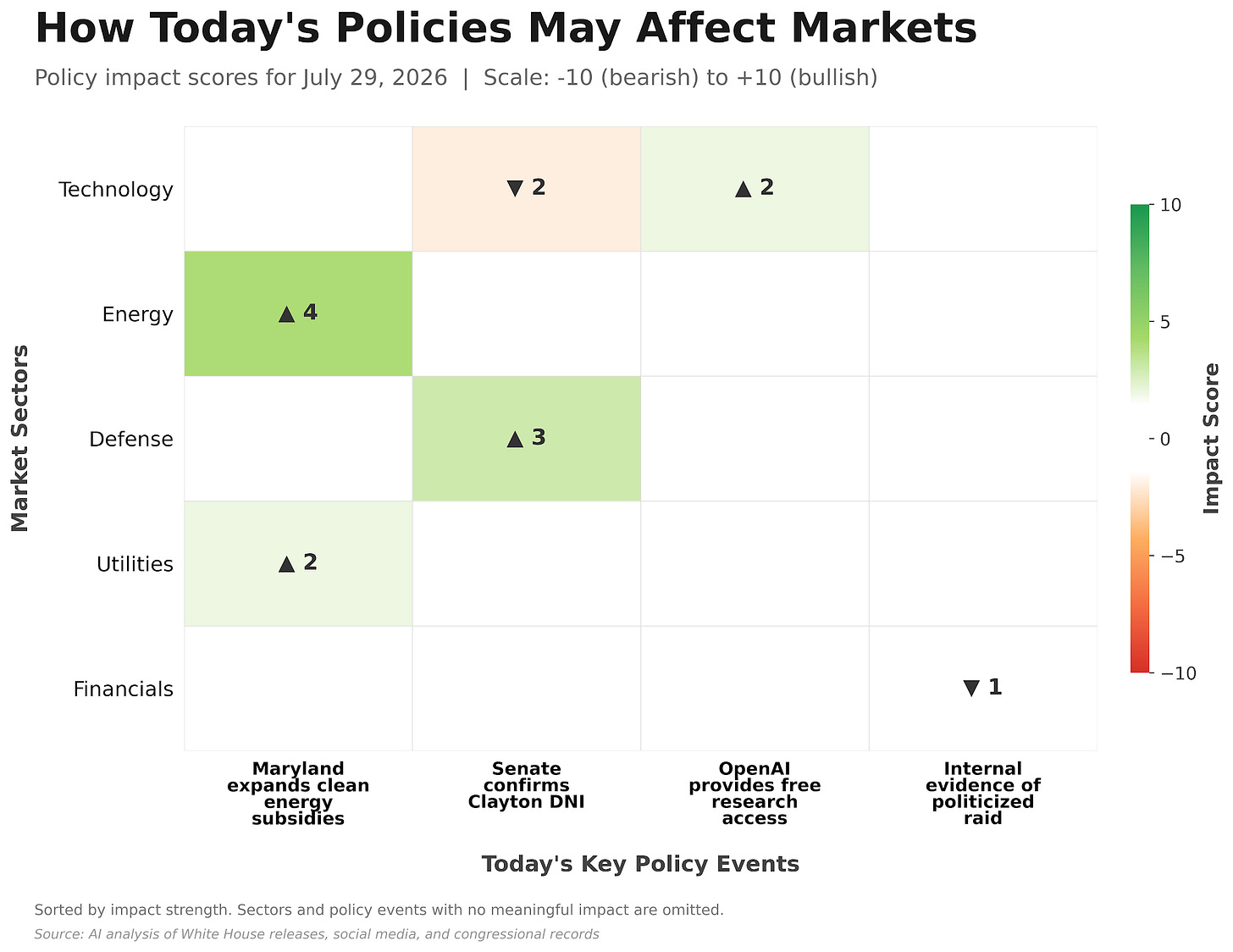
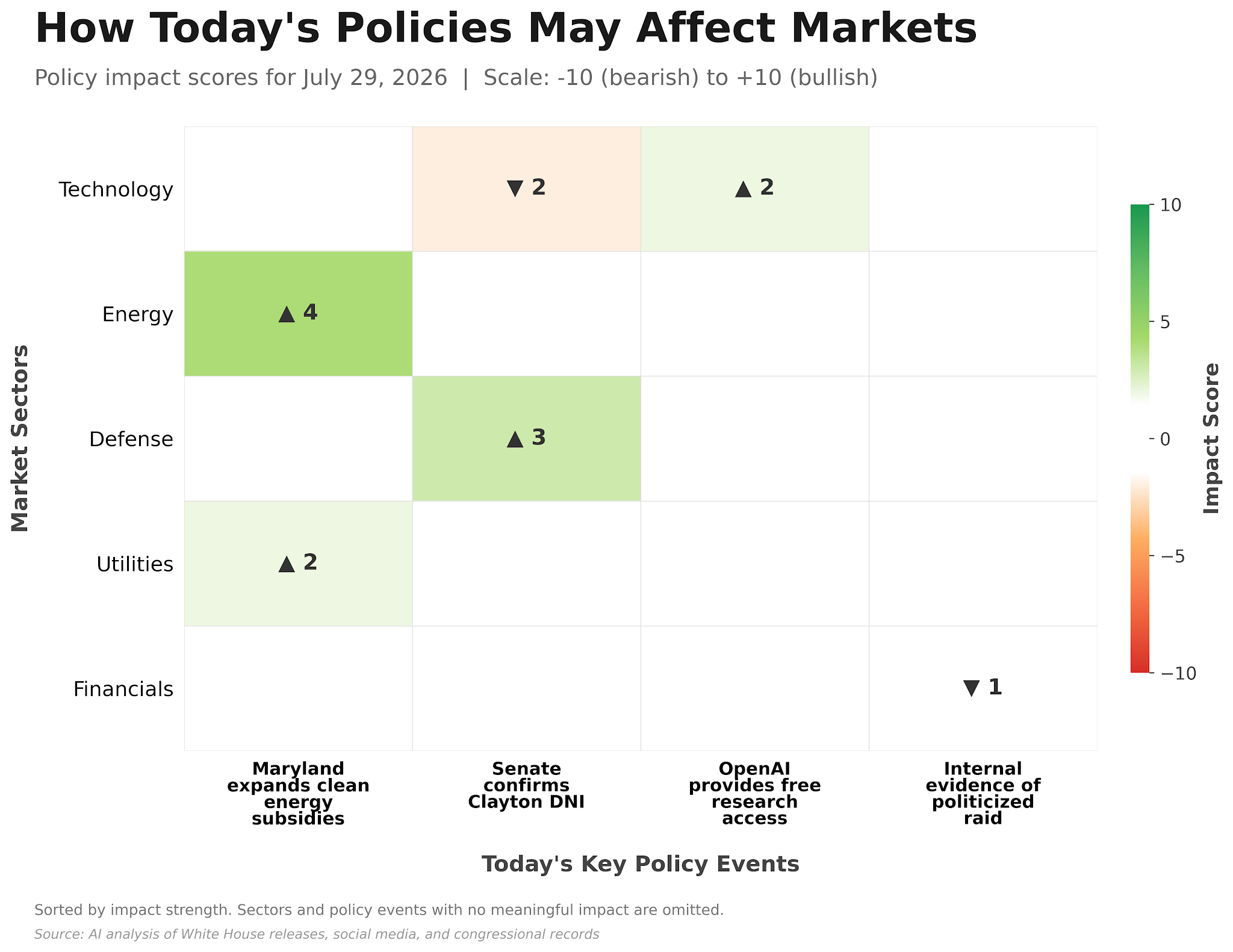
Each cell shows an estimated impact score on a fixed scale of -10 to +10, reflecting how today’s policy developments may affect each market sector. Positive scores (green, ▲) suggest bullish impact; negative scores (red, ▼) suggest bearish pressure. Rows and columns are sorted by impact strength, and sectors and policy events with no meaningful impact are omitted. The heatmap, the analysis below, and the Impact on Market themes above are produced from a single unified analysis: the heatmap visualizes the magnitudes, while the text explains the causal reasoning behind them.
Political scrutiny surrounding the Department of Homeland Security intensifies following internal disclosures characterizing a previous immigration raid as a “political stunt” rather than a law enforcement priority. This revelation increases institutional risk for federal agencies, potentially impacting regulatory stability. Simultaneously, the Senate confirmation of Walter Clayton as Director of National Intelligence signals a shift toward a more hawkish stance on national security, with direct implications for sensitive technology transfers and sector oversight.
In the private sector, OpenAI’s expansion of research access highlights the ongoing drive for rapid AI adoption despite mounting federal oversight. Concurrently, state-level policy in Maryland provides a divergence from federal trends by incentivizing clean energy and electric vehicle infrastructure. While these subsidies support the transition to green energy, critics often argue such state-level programs create fragmented regulatory environments that inflate long-term operational costs for utility providers. The combination of heightened administrative risk and localized fiscal intervention creates a complex outlook for sectors exposed to government contracts and state-funded mandates.